Shared posts

01 Apr 04:14

Doomsday Prep For Non-Paranoid People

by Leigh Anderson on Lifehacker, shared by Kate Dries to Jezebel
Illustration by Sam Woolley.

What’s your nightmare, since November 8th? Perhaps your subconscious, like mine, has reserved 3AM-5AM for an exercise I like to call “Panic Town,” a half-awake, blurry, mental recitation of anything that could go catastrophically wrong for the country, or for you personally, or for...literally anyone. It’s a fun two hours! Then I read the news.

Lately, these fear ramblings largely focus on what will happen in the event of a natural disaster or terrorist attack. (I know there are other things to worry about too, maybe even more pressing, how about you not tell me about them in the comments.) And while I’ve always laughed at the doomsday preppers who build bunkers and stockpile guns, I’ve recently started to consider that they might be on to something. Not for an apocalypse, necessarily, but for a disaster on an ordinary American scale: Hurricanes Katrina or Sandy, September 11th, even the 2010 blizzard with its empty grocery shelves and no clear routes to the hospitals. In my early-morning panics, I ask myself, how on it do I think the Trump administration will be? Will Trump’s FEMA be a fast, organized, efficient machine?

LOL. I started ordering canned food.

And so, while I don’t think I’m newly paranoid, I am newly...prepared. Fortunately, the internet provides both camaraderie and online shopping for people who can vividly imagine literally every terrible scenario, and I quickly found myself down a rabbit hole of opinions on what I, my husband, and two small kids need, for, say, two weeks in an apartment with no access to food, water, heat, or medical attention. Or what we’ll need for a fast skedaddle out of town. But I persevered, and bought what I think is the bare minimum for health and safety in the event of a disaster. Below, everything I have in either my emergency supply kit or our “go bags,” or both.

  • Water. After the 2010 blizzard, I laid in some gallons of distilled water, but they eventually leaked, and—being an easily defeated person—I never replaced them. Google tells me that you want hard-sided, refillable containers. We live in a cramped apartment, so I went for the stacking water bricks that don’t take up a lot of room. You want a gallon per day per person: FEMA says for three days; NYC says a week. I say for as many of those water bricks as I can drape a quilt over and call it a coffee table.
  • Food. Canned goods for home, and energy bars for the go bags. Two weeks’ worth of canned goods for four people takes up a whole cabinet in my kitchen, so that’s now my designated emergency-supply place. So long, popcorn-popper and stand mixer. You are artifacts of a more happy-go-lucky time.
  • A two-week supply of birth control. No one wants a disaster baby.
  • A whistle. I mean, I don’t think I’m going to be trapped under rubble, but then, who does?
  • First aid and toiletry kit, especially Band-Aids and moleskins, in the event of hiking out of town. The kit includes sunscreen, Advil, children’s Tylenol, Imodium, Claritin, sunscreen, toothpaste and toothbrushes.
  • Masks. For any kind of disaster that involves dust and debris.
  • Paper maps of New York and surrounding states. I have a terrible sense of direction, and God forbid I have to walk to my parents in West Virginia with only a dim idea of which way to go. I’d be all Blair Witch by the time I got to Pennsylvania.
  • Copies of all our important documents, in ziplocks. Also good for when the terrorists take down the cloud and you have to argue with the Citibank teller that yes you do have an account there.
  • A utility knife. A Leatherman, which is now in my go bag, and which is so much fun to play with I wish I had a second one. If you don’t want a utility knife, at the very least keep a can opener near your food.
  • Duct tape. I don’t know why, but the various preppers recommend it. It’s cheap, so why not?
  • Potassium iodide. This was actually not my idea, and on the paranoia scale I think this one’s pretty high up. During the George W. Bush administration, my former boyfriend’s mother, a M.D. who had trained to care for people who’d survived war and other traumas, insisted we keep a packet of potassium iodide, which provides some protection to the thyroid in the event of a dirty bomb. After the breakup, I kept the Le Creuset, and he kept the KI. So it’s paranoid, whatever, potassium iodide is cheaper than Le Creuset.
  • Mylar blankets. If the power goes out, no heat. If we’re walking somewhere in the winter, no heat.
  • Tampax. My period has taken me by surprise every month for thirty years, that’s how fast I learn. Disaster-time will be the moment that all changes, I swear.
  • Cheap ponchos. If we’re walking out of town I want to try to stay dry.
  • A crank radio that will also charge our phones, and extra chargers.
  • A flashlight, plus more flashlights. Every flashlight I buy, the kids squirrel away for nighttime shenanigans, so now I actually have nine or ten flashlights that I can’t find.
  • A lamp and a billion-hour candle.
  • Batteries for all of the above, in ziplocks.
  • A deck of cards. I love games and in fact wrote a giant how-to for parlor games, outdoor games, and card games. And because God is capricious, I married a man who is not a big game player. A disaster is the perfect time to force him to learn.
  • Chocolate bars. In the event of a shelter-in-place kind of situation, we will need some treats. Unfortunately I ate those treats immediately after buying them, ordered some more, ate those, and so on. I hope the disaster catches me in the four-hour window in which I actually have chocolate in the house.
  • Five backpacks, which I got at the Good Will, because I am a frugal paranoiac. These are our go bags, one for each person for our family, plus an extra for my husband to keep at work. In his work go bag I also put a blanket, another billion-hour candle, and, in case he has to sleep at work, a comic novel. Something lighthearted, because if he’s sleeping at work I know he’s going to be freaking the fuck out. I considered The Road but decided that was unkind.
  • Water purification tablets, a bottle of unscented bleach, and a medicine dropper. Also feels a little ‘noidy, but if we run out of bottled water, I don’t want to be gulping grody bacteria water.
  • Matches in a ziplock.
  • Cash in small bills.
  • A roll of toilet paper, baby wipes, and hand sanitizer. Paranoid ladies still want to stay fresh.
  • Contractor’s bags. If the toilet stops flushing and there’s no trash pickup, we’re going to need to designate a waste zone. I’m going to call it “somewhere pretty far away from here.”
  • A gun: Just kidding, no gun. If my kids can find all the flashlights, they can find a gun.

For specific product recommendations, I relied pretty heavily on this product guide from The Sweethome, New York City’s Emergency Management “go bag” page, and FEMA’s Emergency Supply List.


The thing about disaster preparedness is that it’s hard to stop. I mean, 3AM-5AM still serves up dreadful scenarios every morning, and I usually need a couple cups of coffee to determine whether stockpiling camping gear, Tamiflu, lipstick, and nylons are the next logical steps or merely the ravings of Panic Town. But for now, at least, we’re set. Except for the chocolate.

Update: Yes, if you have prescription meds you’d die or suffer without, definitely pack an extra few weeks’ worth in your go-bag. And stick in extra glasses for anyone who wears prescription lenses. I didn’t add these because the former doesn’t apply to me, and I haven’t gotten around yet to buying the latter, but commenters have reminded me that these two things are at the top of the FEMA list.

07 Mar 23:48

The Americans Recap: After-School Special

by Laura Hudson

It's baptism day at the Reed Street Church, accompanied by the cool acoustic guitar stylings of Pastor Tim. Paige is about to go for a little swim and begin her new life in Christ, a coming-of-age moment that feels very different from the way that most baptisms are conducted: Rather than parents making a declaration of faith and identity for their child, she is making one for herself.

It's something that makes Philip and Elizabeth — her parents, the secret atheist KGB spies — display a weird mess of emotions and faces throughout the ceremony, although Elizabeth smiles a little when Pastor Tim talks about her daughter's ideological fervor: "Paige gives her whole heart to every political action we engage in at this church."

Back at home, Philip asks Paige if she feels any different, and she says something about feeling more at peace. Still worried — rightly — that Elizabeth is going to recruit Paige into the KGB, he tries to give his daughter a coded speech about just saying no to … something? "Stand up for what you want. You should never feel pressure to do anything that you don't feel is right for you." Paige, naturally, thinks this is about drinking or drugs rather than her parents being Soviet spies and pretty much blows it off.

The debate between Philip and Elizabeth is on some level about the nature of choice itself, particularly as it exists in that fraught space between parents and children. As much as Philip insists he doesn't want Paige to be "forced" into their way of life — that placing that weight of their secret on her is a sort of coercion — Elizabeth is convinced that Paige isn't really choosing at all. After all, how could she choose an option that she's never been given?

Anxious and unresolved, Elizabeth digs out her secret pack of cigarettes and ends up smoking them in the garage, only to end up getting caught by Paige in a hilarious role reversal. When Elizabeth confesses to smoking, Paige says that she doesn't like it, but obviously she and Henry already know. "We're not clueless, mom."

Paige also finally calls Elizabeth on the amazingly weird faces of horror and alarm her mom makes every time religion comes up, as though Paige is constantly farting Jesus. She tries to turn their rare moment of honesty into a real conversation about religion, but just ends up with yet another spinelessly vague response from Elizabeth that "it's just not really my thing." Part of Elizabeth's problem — part of why she and Paige never seem to get truly close—is that she defines herself to her daughter in terms that are entirely negative: as what she isn't, rather than what she is.

Back in Soviet prison, Nina is taking a page from the Jennings "make it real" playbook, and using her actual emotional trauma over her betrayal to ply her cell mate for information. After crying and asking if her boyfriend betrayed her, too, she learns that indeed, Evi was a very willing participant in the espionage, not a patsy. After a short scene where we see Nina eating an unusually good meal in a different cell, the guards come to drag Evi away for her crimes. "Nina, what did you do?" she screams. Nina knows exactly what she did.

Stan, meanwhile, finally kind of sort of starts to move on by sleeping with Tori, although she immediately calls him on not being truly "present" — the same distraction and detachment that eventually tore him and Sandra apart. When a longtime friend dies suddenly, however, Sandra ends up waltzing back in to hug and comfort Stan — though it's clear she doesn't want a reconciliation. I don't really know where this story line is going, but I also don't care; as with so many breakups, it has now become simultaneously boring and excruciating.

Philip's pseudo-seduction of Kimmy continues, this time with copious amounts of weed and Pink Floyd. After getting super high, Kimmy wants to take a bath — with Philip of course, although he demurs. This time it's not just about avoiding statutory rape, however; he needs the time to let a KGB agent into the house and put a customized panel with a tape recorder in briefcase of Kimmy's CIA bigwig father. After Kimmy exits the bath, she drops her towel and offers herself to Philip — only to get shut down yet again. He mumbles something about going to church and God and wanting to be better, but she takes it badly, and personally anyway. This might be the right choice on many, many levels, but it's not going very well for the operation.

When Philip meets with Gabriel, he learns some unfortunate news about the tape recorder: In order to keep up with the situation in Afghanistan, they need to change the tapes weekly, not monthly. Gabriel is concerned that Philip's refusal to get intimate may get in the way, since this kind of access will require "a real bond" with Kimmy. Then Gabriel switches tacks to another, very sensitive topic involving children: Philip's illegitimate son Misha, the one he learned about back in the first season and has never met. Misha is in the military, and Gabriel has been checking up on him: "He's good. He's trustworthy. He's like you in that respect."

At her latest rendezvous with the charming graduate student Hans, Elizabeth learns that he's spotted something strange at a student meeting — a person who reminds him of the undercover agents he used to see in activists groups back in Johannesburg. After a bit of reconnaissance, Gabriel discovers that the student in question has been meeting with someone from South African intelligence and could be planning a violent attack to discredit the anti-apartheid movement. Good catch, Hans! Inevitably, the conversation with Gabriel turns to Paige, and Elizabeth says that she's going ahead without Philip. "But you're not going ahead," says Gabriel. As much as she's pushed for it, she knows what happens when she pulls the trigger, how everything changes.

In the final scenes of the episode, everything dovetails and we find both Jennings parents waiting to pick up children after school: Philip waiting for Kimberly, and Elizabeth waiting for Paige.

Elizabeth has finally decided to take the next step with Paige, albeit a small one: driving her daughter to the ghetto and telling her a whitewashed version of the Gregory story, and revealing that she and Philip used to be hard-core activists in the "civil rights movement." It's an obvious attempt to link her beliefs to Paige's anti-apartheid convictions, by way of a space that I would call "truth adjacent." She hints that their work wasn't all sunshine and roses: "We didn't just sing songs and march. We fought in other ways. It wasn't always legal. It was right … Sometimes doing good is harder than going to rallies and signing petitions."

Paige is a bit confused by this, just like she was confused by Philip's speech, because they are feeding her odd, disjointed fragments of their own agendas and expecting her to make sense of them. Does that mean that she's not doing enough, asks Paige? No, says Elizabeth. "I brought you here because I wanted you to know that I'm more like you than you think." It's so close to what Gabriel tells Philip about Misha, about the way parents want to grow closer to their children by projecting themselves on to them, by seeing them as similar.

And that's what makes what happens between Philip and Kimmy so interesting. When Philip first meets up with Kimmy again after school, she's a bit standoffish, still reeling from the rejection. But then he says the magic words that her insecure little teenager heart so desperately wants to hear: "I can't stop thinking about you." Soon enough, they're back in her room, and it seems almost certain that Philip has to sleep with her in order to keep the operation going. But then he throws a curve ball. He tells her a story about how he got a girl pregnant when he was 17, and now he wants to take accountability and be a better father, a better man in a way that he wasn't before.

It's one of those stories Philip and Elizabeth tell their assets sometimes, the kind that’s not true per se, but touches on something that is real to them. It's hard to tell whether they do this because it helps them sell the moment — because it helps them "make it real" — or because it ends up being a sort of role-play that actually helps them process their lives, no matter how many levels of deception they have to filter it through.

He asks Kimmy to pray with him. When he says, "Please help me to do the right thing and be a better person," he is telling a rare sort of truth, to both a god he doesn't believe in and a girl he is deceiving. More important, he's making a surprising choice: Instead of staying true to his ideals and sacrificing Kimmy for the greater good, he turns to Paige's beliefs to find another way. He takes the faith of his daughter and places it between himself and the sin he doesn't want to commit — between himself and the girl he doesn't want to hurt — in a way that might save them both.

"That was amazing," says Kimmy, when they finish praying. "It was," says Philip, and he means it. He doesn't see himself in Paige. Instead, when he wants to be better than he is, he'd rather see her in himself. Maybe, in the end, he, too, wants to be forgiven, to be reborn. For all of Elizabeth's insistence that she knows best, maybe Paige was right after all. She's not clueless. Maybe they have a thing or two to learn from her as well.

Read more posts by Laura Hudson

Filed Under: the americans ,tv ,tv recaps ,recaps ,overnights

08 Jan 15:57

The People Of San Luis Obispo Are Way Too Excited About This Guy’s DeLorean

by Ashley Burns

Now that 2015 is finally here, you can expect to read plenty of tributes and think pieces about Back to the Future Pt. II, as well as essays demanding that people stop writing tributes and think pieces about Back to the Future Pt. II. That’s because in the 1989 film Marty McFly, his girlfriend Jennifer (who was always way too good for him) and Doc Brown travel to October 21, 2015 so they can stop Marty’s life and kids from being generally terrible. Obviously, your friends and Internet trolls have been pretending for several years now that their arrival date was different, but it’s definitely October 21.

Outside of features about how that fantasy motion picture failed at actually predicting the future or 30-somethings whining about the lack of pink Hoverboards, you can expect to see a surge in nostalgic merchandising. For example, a man in San Luis Obispo, California is currently renting a replica of Doc Brown’s DeLorean time machine. He even has a white wig and a prop Hoverboard, so you know that you’re getting the complete experience, and people are absolutely thrilled about it.

The time machine features working lights and switches, and there are only about 6,000 DeLorean’s in the world and of those cars only about 10 are replicas of Doc Brown’s time machine.

Paul Correa, a movie fan, saw the San Luis Obispo DeLorean and said, “I watched the movie 10 times when I was a kid, I watched all the sequels. Michael J Foxx [sic] is heroic.”

Another movie fan, Nicholas, visiting San Luis Obispo said, “It’s amazing I immediately took my camera out and started taking pictures.”

We asked to see the car up close and personal today and it attracted a large crowd of people taking photos of it. (Via KEYT)

It’s easy to be cynical or make fun of these people for getting into the spirit of celebrating the 30th anniversary of a sequel, but I’m not going to lie – I really want to drive that damn DeLorean. However, I do have to correct “Doc Brown” from that local news report. Doc didn’t invent the Hoverboard, dude. I expect a 10% discount for that error.

07 Feb 15:01

An Epic, Hilarious 23-Minute Compilation Video of the Best Vines of 2013: WATCH

by Kyler Geoffroy

Screen Shot 2013-12-31 at 1.13.10 PM

Who knew six second clips could be so entertaining? A perfect lunch break video for those still at work.

Watch, AFTER THE JUMP...


09 Jan 19:52

Classism in the Rise and Fall of the Duck Dynasty Patriarch

by Mimi Schippers PhD

This Duck Dynasty thing seems to have everyone’s undies in a culture war bunch with lots of hand wringing about free speech (find out why this is ridiculous here), the persecution of Christians, and the racism, sexism, and homophobia of poor, rural, Southern whites.

There is, however, an underlying class story here that is going unsaid.

2

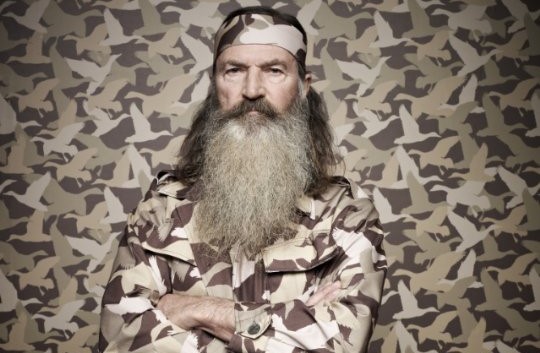
Phil Robertson is under fire for making heterosexist comments and trivializing racism in the south in GQ.  While I wholeheartedly and vociferously disagree with Robertson, I am also uncomfortable with how he is made to embody the “redneck.”  He represents the rural, poor, white redneck from the south that is racist, sexist, and homophobic.

This isn’t just who he is; we’re getting a narrative told by the producers of Duck Dynasty and editors at GQ—extremely privileged people in key positions of power making decisions about what images are proliferated in the mainstream media.  When we watch the show or read the interview, we are not viewing the everyday lives of Phil Robertson or the other characters.  We are getting a carefully crafted representation of the rural, white, Southern, manly man, regardless of whether or not the man, Phil Robertson, is a bigot (which, it seems, he is).

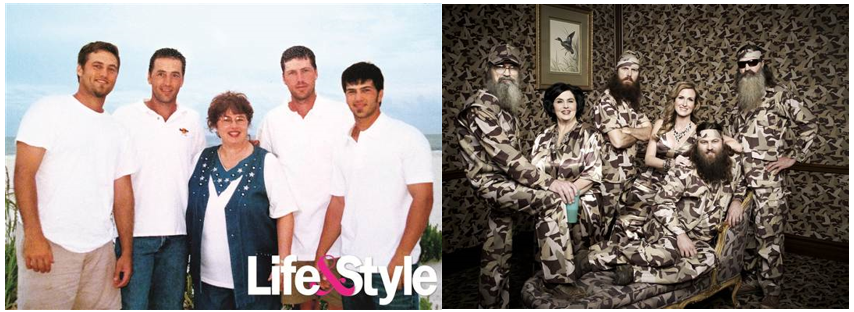
The stars of Duck Dynasty eight years ago (left) and today (right):

1

This representation has traction with the American viewing audience.  Duck Dynasty is the most popular show on A&E.  Folks love their Duck Dynasty.

There are probably many reasons why the show is so popular.  Might I suggest that one could be that the “redneck” as stereotyped culture-war icon is pleasurable because he simultaneously makes us feel superior, while saying what many of us kinda think but don’t dare say?

Jackson Katz talks about how suburban white boys love violent and misogynistic Gangsta Rap in particular (not all rap music is sexist and violent, but the most popular among white audiences tends to be this kind). Katz suggests that “slumming” in the music of urban, African American men allows white men to feel their privilege as white and as men.  They can symbolically exercise and express sexism and a sense of masculine power when other forms of sexism are no longer tolerated.  Meanwhile, everybody points to the rapper as the problem; no one questions the white kid with purchasing power.

Might some of the audience of Duck Dynasty be “slumming” with the bigot to feel their difference and superiority while also getting their own bigot on?  The popularity of the show clearly has something to do with the characters’ religiosity and rural life, but I’m guessing it also has something to do with the “redneck” spectacle, allowing others to see their own “backwoods” attitudes reinforced (I’m talking about racism, sexism, and homophobia, not Christianity).

He is a representation of a particular masculinity that makes him compelling to some and abhorrent to others, which also makes him the perfect pawn in the culture wars.  Meanwhile, we are all distracted from social structure and those who benefit from media representations of the rural, white, southern bigot. 

Sociologists Pierrette Hondagneu-Sotelo and Michael Messner suggest that pointing the finger at the racist and homophobic attitudes of rural, poor whites — or the sexist and homophobic beliefs of brown and black men, like in criticism of rap and hip hop — draws our attention away from structures of inequality that systematically serve the interests of wealthy, white, straight, and urban men who ultimately are the main benefactors.  As long as we keep our concerns on the ideological bigotry expressed by one type of loser in the system, no one notices the corporate or government policies and practices that are the real problem.

While all eyes are on the poor, rural, white, Southern bigot, we fail to see the owners of media corporations sitting comfortably in their mansions making decisions about which hilarious down-trodden stereotype to trot out next.  Sexist, homophobic, and racist ideology gets a voice, while those who really benefit laugh all the way to the bank.

Mimi Schippers, PhD is an Associate Professor of Sociology at Tulane University.  She is working on a book on the radical gender potential of polyamory.  Her first book was Rockin’ Out of the Box: Gender Maneuvering in Alternative Hard Rock.  You can follow her at Marx in Drag.

Cross-posted at The Huffington Post and Marx in Drag.  Photos from the Internet Movie Database and Today.

(View original at http://thesocietypages.org/socimages)

13 Jul 15:49

Is Sofia Vergara the Worst Human Being Alive?

by Jenna Sauers

Is Sofia Vergara the Worst Human Being Alive?

Or just the most vulgar and out-of-touch? That's the question on my mind after reading the profile in this month's Harper's Bazaar, in which the actress whines about how her (Jewish!) business manager is such a buzzkill about her Birkin habit and explains that the success of Modern Family has finally allowed her to pursue her true calling — endorsements.

Vergara, who grew up in wealth in Colombia, currently has five Hermès Birkin bags, which start at around $9,000. Her son, Manolo, disapproves of this:

"I tell Manolo, 'If I don't have enough money for your college this month, you have to sell the Birkins.' My business manager is very traditional, Jewish guy. Every time I buy one of those, he calls me and says, 'Sofia, it's Craig. Did you buy this, or is it a fraud?' I'm like, 'Craig, listen … what would you prefer? Me popping champagne bottles and doing drugs and wasting money or buying bags? These are valuable. These, Manolo can sell!'"

Her favorite thing about Modern Family, the show that makes Vergara the highest-paid woman in television?

"I would be lying to you if I didn't say the success of it. For me, it has allowed me to do the things I always wanted—my endorsements."

It's just wonderful how her day job as an actor has made it possible for Vergara to finally pursue her dream — shilling. She even has a Kmart line specifically geared to poors!

Vergara mentions, twice, that she totally thinks she could play "a psychopath." But she's not gunning for "serious" roles. "It's not like I go to my agent and say, 'You have to make me in Schindler's List 2.'

In the video/very unsubtle ad for the restaurant Serendipity 3 that accompanies the story, Vergara shows off her new Hermès Kelly bag and eats a $1,000 gold-leaf covered ice-cream sundae. The sundae they mocked on 30 Rock. A record-breaking 47.8 million Americans are currently on food stamps.

Sofia Vergara's Modern Love [HB]

27 Jun 18:30

Photo

by tschad


30 May 03:17

10 Simple Kitchen Tips You Wish Someone Told You Earlier

by Darya Rose

Photo by me and the sysop

For myself and people of my generation, cooking represents the worst kind of irony. Feeding ourselves is our most basic human need, but for some reason no one bothered to tell us how to do it (or even that it was important to learn).

So we grew up, left the house and became dependent on restaurants and instant meals, only to find out 10 years later that this “food” has been killing us slowly.

Now what are we supposed to do?

Learning to cook is important, but can be intimidating if you’ve never done more than boil water, open cans and zap frozen entrees. Navigating the kitchen is much easier if you know a few simple tricks that seasoned chefs take for granted.

10 Simple Kitchen Tips You Wish Someone Told You Earlier

1.Use tongs to cooking pretty much everything

Spatulas are awesome for anything that needs to be flipped or scraped, like eggs and pancakes. For everything else, tongs are the way to go. They’re much more nimble and less awkward to use, and you’ll find far fewer things jumping from your pan onto the floor. If you have non-stick cookware, be sure to use tongs with nylon tips. And always go for the 12-inchers.

2. Store everything in tupperware

As much as I’d like to be the kind of person who trims their herbs, puts them in an vase then wraps them in a damp paper towel so they last a week, I’m way too lazy for that. The good news though is that tupperware keeps almost everything fresh for much longer than your crisper, including berries, salad greens and produce that has already been cut. Because it is reusable, it is also more ecofriendly.

3. If you own a knife, don’t use a garlic press

Peeling and pressing garlic is a huge waste of time. To use a clove of garlic, set it on a cutting board and smash it with the flat side of a big knife (any chef’s knife will do). The papery skin will come right off, and you can mince it real quick right there in about 10 seconds. Done.

4. Keep a separate cutting board for things you don’t want flavored with garlic and onion

Assuming you follow any recipe ever, you’ll probably be using your cutting board for cutting onions or garlic. If so, I recommend getting a separate board you keep aside for cutting fruit, cheeses and other things that you’d prefer didn’t absorb the odors of previous meals.

5. Herbs that are supposed to be green should be purchased fresh, not dry

With the possible exception of dried oregano (great in Mexican, Greek and Italian foods), herbs are always better fresh. They’re also cheap and available almost anywhere. In particular, always buy fresh parsley, basil, cilantro, thyme, tarragon or chives if you can help it (a few should be in your fridge at all times). The dried versions are OK if not too old, but they’re very delicate and the jar will probably go bad before you use it twice.

6. Don’t bother with pre-filled spice racks

If you want spices to serve their purpose (making food taste better), you shouldn’t own a pre-filled spice rack. Spices go off quickly, and when their color starts to dull they’ve lost a lot of their flavor. There are several dried spices that are invaluable in my kitchen (cinnamon, cloves, curry powder, cumin, coriander, chili pepper, etc.), but you should purchase them as you need them, and in small quantities unless you use them frequently.

7. Overcooking is probably your biggest kitchen mistake

Overcooked vegetables are mushy and flavorless, overcooked meat is tough and chalky, overcooked grains are soggy and fall apart. In other words, overcooked food is bad food. Learn the art of taking food off the heat just before it is done, and let it finish cooking with its internal temperature. You can always cook it more, but you can never cook it less.

8. If it tastes OK but not great, it probably needs salt—and maybe some vinegar or olive oil

The media loves to bash salt, but I’m not convinced that sodium (rather than processed food) is the real problem. Also, the small amount you use when cooking at home won’t compare to what you’d get at a restaurant or in a packaged meal. Though over-salted food certainly tastes bad, under-salted food is bland and boring and a little dash can often save a dish.

If you think you’ve added enough salt but something is still off, try a small splash of vinegar or lemon (any acid) to brighten the flavor. If the food is dry or sticky, try adding a touch of olive oil. These three things can fix almost any lackluster meal.

9. Don’t buy regular big onions, use shallots or leeks

For most everyday cooking, milder onions will enhance your dish and give it more nuance. Big, strong onions certainly have their place in cooking (soups, roasts, etc.), but most kitchen experiments will be improved by more subtle onion flavor.

10. Fruit (other than berries) shouldn’t be stored in the fridge

Refrigerators dull the taste of most produce, so if you bought something that doesn’t need to go in there leave it out. Most fruits including apples, oranges, pears and bananas don’t belong in the refrigerator unless you’re not planning on eating them soon. I don’t refrigerate tomatoes, avocados or peppers either. Very hot climates are an exception, however.

What are your favorite simple kitchen tips?

Originally published June 1, 2011.

02 May 16:05

Just Two Friends Talking About the Federal Budget And What It Means Exactly

by Mary Mann
by Mary Mann


Mattea Kramer is Research Director for National Priorities Project, a non-profit dedicated to making the federal budget transparent. She gives great budget briefs. I have never actually made enough money to have to pay federal taxes. I talked to her about the federal budget, and why I should care.

Mary Mann: So I guess the big news now is that Obama just put through his budget. But he wrote this thing on this paper, and now what happens to it? Do I have any say in that? Can I be like: “Will you add this, sir?”

Mattea Kramer: No, you can’t get anything new into the President’s budget that came out last week, but here’s the unfortunate thing about that budget: it’s not going to become law. That’s not a good reason for it not to contain your priorities—it should still reflect the priorities of the American people—but it doesn’t matter because it basically has no hope of being passing through Congress.

MM: Then what’s it for? Just for them to look at it and say: “We hate this, we’re going to write a new one?”

MK: Well, in the last few years, yes. Exactly.

See, it’s supposed to come out in February, not April—that’s the start of the annual budget process. The President comes out with his proposal in February, and then that goes to the House and the Senate and they look it over and use it as the starting point to write what hopefully becomes the new budget, which goes into effect at the start of the new fiscal year, October 1st. But in recent years, Obama’s budget has not done anything more than what you just said: lawmakers’ look at it and decide that they hate it, or they don’t even look at it.

MM: Do they just write their own, then he just decides whether to sign this brand-new thing or not?

MK: He does have to sign it into law, and that’s sort of been why what we’ve gotten lately is the most… watered-down doesn’t even begin to describe it. What we have right now for 2013 is basically a budget that’s a continuation of 2012 funding levels because nobody could agree on anything else.

MM: Aren’t those numbers totally wrong?

MK: Yeah. Like, if you think we should invest money in job training and education so that millennials don’t flail and fail—we’re not doing that right now, because we’re still using the 2012 budget. It’s also wrong if you think old programs are wasteful or ineffective or have run their course, because they’re still being funded this year. We’re basically just living in a time warp where it’s still 2012.

MM: That sucks.

MK: Yeah, it’s bad.

MM: Okay, so if Congress decides what to do, is my input just down to who I elect? After they’re elected I really can’t do anything, right?

MK: I think most people feel that way, like they have no power in Washington, but Congress works for us, each individual lawmaker is acutely aware of what it will take to get reelected, so if they hear from constituents on particular issues, they are paying attention. They have legislative aides that are keeping track of constituents who are getting in touch with them, saying “I’m in favor of this” or “I’m not in favor of that.” If all of us were in touch with our elected officials on a regular basis about what we believe should happen in this country… I think this country would look really different.

MM: But… well, this is dumb, but from watching shows like West Wing I imagine that lobbyists are the only people with any real power. Is there a lobby for people in their twenties and thirties?

MK: Yeah, there is! We, the at the National Priorities Project, have a great partner organization called Young Invincibles. We actually put out a report with them in November about how budget debates are totally shortchanging millennials, not including job creation or education reform, but it’s an uphill battle in part because of what you just mentioned: the power of lobbying. Basically, these narrow interests are well-organized and well-funded, and this huge swath of people born in the eighties are disorganized and poorly funded.

MM: There’s a great South Park episode where everyone over a certain age, 65 or something, has to take their driver’s tests again and everyone is losing their licenses so AARP sends a bunch of old people parachuting into town to save the day and get the old people their licenses back. That’s sort of the impression that I have, that these lobbies like AARP have been around so long that they’ve built this solid organization that can really solve problems for their generation. I don’t really feel protected in that way, where there’s an organization to whom I can just say “take care of this.”

MK: You’re spot on. Young people have far less power. We have less money, we’re less likely to vote, under eighteen we can’t vote, so there’s disproportionate power to older people. When you look at where our tax dollars go, a huge amount goes to Social Security and Medicare which by and large are for the elderly. That’s not saying that those programs aren’t important, they definitely are, but young people, I think most people would agree, are really important too.

MM: And we probably won’t get Social Security, right? Is that a myth or is that true?

MK: That’s a myth. Right now Social Security is fully solvent for the next two decades, after that it’s about 75% solvent through 2086, and it only needs some small tweaks to be 100% solvent for that time and beyond. So it’s well within the ability of our lawmakers to make those tweaks, and in their interests. That’s an intentionally created myth. Under President Bush, a lot of people wanted to privatize Social Security, so it behooved them to make it look like we were facing an immediate crisis.

MM: Well, thank God. Social Security! The other thing is, half my friends are uninsured and everyone is paying student loans, and I don’t have a good sense that either of those things will change anytime soon. I mean, I know that now we all have to have health care now, but who’s enforcing that?

MK: For student loans, there’s not much change on the horizon, unfortunately. For now. But with health care, there’s good news and bad news: the good news is that the Affordable Healthcare Act allows people to be on their parent’s insurance until twenty-six, which has helped a lot of people, but after that you have to be insured. You’ll have to pay a fine on your taxes if you’re not insured.

MM: A fine? Woah. When does that start?

MK: On your 2014 taxes, so in 2015. Two years. It’ll be a big change. It’s kind of crazy to think about.

MM: So let’s say you’re me, and you’re going to be just finishing grad school, and you’ll owe a ton of student loans… Who’s going to give me healthcare? Is it going to be insanely expensive?

MK: Don’t worry, you’re going to be alright. Medicaid is changing the thresholds for who qualifies for healthcare, so you”ll qualify and that will be very affordable.

MM: But how will people know about that? Can I just google Medicaid and click “help me”?

MK: Oh man, I don’t know. We haven’t even gotten there yet. How will the federal Government and the states tell billions of people that they have to have health insurance or pay more taxes? It’s going to be interesting.

MM: They’re going to have to partner with Google and do an “Apply for Medicaid” Google Doodle or something.

MK: Well yeah, except that there’s a lot of Americans who aren’t on the good old Interwebs, and if you’re going to require health insurance, there’s a lot of people that will need to be reached in non-wifi communities. I’d guess that a portion of the people who aren’t on the Internet are elderly and they’re already insured on Medicare so they’ll be okay, but low-income people who don’t have access to technology… I don’t know. It’s an enormous task.

MM: A shitshow.

MK: Absolutely.

MM: Here’s another thing: I’ve never had to pay my federal taxes, except Social Security and Medicare, I always get it all back. Since a lot of us in our twenties aren’t making that much money, I always wonder how many of us get all our money back and how that’s going to effect the government as we get older. Is that a thing? This might be a weird question.

MK: No, I hear what you’re saying. It is a thing. It does not bode well for the federal tax revenue. Our generation’s earning power is permanently reduced because of the Great Recession. In key years if you don’t have work experience, or if you have big gaps in your employment, you pay for that for the rest of your career. A generation-wide reduction in employment and income prospects will definitely have implications for federal tax revenue and it’s not good. One of the things in the budget the President just came out with was a limit on all the deductions and loopholes that the wealthiest taxpayers enjoy, because they’re big. It’s not at all clear whether that will get passed into law though.

MM: Yikes. Are there things that I can do that will make it better for me later, or will make it better for me now? It’s kind of scary that we’re going to have such a low earnings potential as a generation because of the recession. That it lasts forever.

MK: I didn’t mean to be such a downer on that one.

MM: Maybe that’s why everyone is obsessed with canning things now. We’re all going to be poor.

MK: Ha, yeah, we have to store away food! Well, see all the stuff we’ve just talked about, this is not set in stone—none of it—not the budget process or where our tax dollars go or what’s going to happen in the future. It’s a path that we’re on right now. But we can change it. We can change the laws that are on the books. All of this is organic and should come from the people. So if we want it to look different from how it looks right now or what it’s projected to, we can change it. But it takes some work. It takes rolling up your sleeves and getting involved. Voting, writing letters, getting informed, informing other people—all that stuff.

MM: How should I get informed though? For example, what happens with the budget that they’re making now? Will we get to see it? Will we understand it? How do you know to write a letter if you don’t know what’s going on?

MK: Actually, that’s one of the things that has been going wrong lately. Remember when I told you about how they’re still funding the 2013 government like it’s 2012? One of the things that happens when they’re doing these temporary spending bills or continuing resolutions is that we don’t get to see it—there’s a last minute backroom deal and then gazillions of pages come out. So not only is it stupid policy, it’s really bad democracy, because they’re no opportunity for us to give input. The way this process is supposed to work is that there are should be all these moments where we can talk to elected officials—whether it’s budget committees or appropriation committees or our own legislators. The way things are happening right now is really bad for our democracy.

MM: What are you saying? We won’t be able to see it before it’s done?

MK: Well I don’t know how it will go for the 2014 budget—for the 2013 budget that was the case, but I don’t know how it will go this year. It’s possible we’ll get to read it. Obama certainly didn’t help us by releasing his budget two months late.

MM: Is that even allowed?

MK: It’s not, it’s illegal.

MM: Really? It’s illegal? Is anything going to happen to him?

MK: Nope.

MM: What was his excuse? Like, did the dog eat the first one?

MK: (laughs, graciously) It was bullshit, honestly, and here’s the thing, his administration gave the excuse that they couldn’t release the budget because they didn’t know what was going to happen with sequestration…

MM: Wait, can you explain the sequestration stuff?

MK: Sequestration is a silly budget word for across-the-board spending cuts, and it took affect on March 1st. In February, when he was supposed to have his budget done, the President didn’t know whether or not these cuts would take effect because Congress was trying to figure out how to avoid them, so his administration said they couldn’t release the budget because they wouldn’t know what was happening in 2013 until sequestration got sorted out. There were some other things up in the air too, but then he comes out with his budget two months late and the numbers don’t show what happened with sequestration because the President’s administration said they wrote the budget before that! (Throws up arms in frustration.)

MM: But what happened with sequestration? Did they cut things?

MK: Yeah, these across-the-board spending cuts are in effect for this year, for 2013, and they’re slated to do more cuts in 2014 if Congress doesn’t do anything to prevent them. So for this year, the Department of Defense is seeing some cuts, and also Title 1 grants for some schools, and Head Start and lots of other things.

MM: But what does that look like? I mean, let’s say you and I are the congress…

MK: That would be so great.

MM: I know! So, do I say, dude, Mattea, I feel like doing some sequestering, here’s a whiteboard, I’m gonna write down some shit, you tell me which things I should cut? Is that how it goes?

MK: (laughs) No, no, they wrote this nonsensical law in 2011 that basically said that if Congress didn’t do this debt reduction plan there would be these across-the-board spending cuts and the idea was that the cuts would be so stupid and so bad that the lawmakers would have to come up with a plan to avoid them. It was like a gun to the head so they’d have to act.

MM: Wait, so if the gun’s to the head, who put the gun there? Did the lawmakers put the gun to their own collective head?

MK: Yes, they cocked their own trigger to force themselves into action. That is how bad things are.

MM: That’s ridiculous.

MK: I know! (laughs) And then they didn’t do anything!

MM: Let me get this straight. So if you and I are the Congress, last year we were like, uh, if we don’t do anything this year then next year these things are going to be cut whether we want to or not?

MK: Yup.

MM: And then we didn’t do anything…

MK: …Then we didn’t do anything and then we started blaming each other.

MM: Back then when Congress set that gun to their heads, was that when they wrote those things on the whiteboard and said: “These are the things that we’ll cut?”

MK: Yeah, you could say that, they wrote these things on the whiteboard. Yeah. That’s basically what they did, but back in 2011. The cuts affect only the discretionary budget, so that’s separate from mandatory spending. It doesn’t affect Medicare, Social Security, Medicaid…

MM: Why can’t they just do these things in an easier way and make them more accessible so that I can know and understand know what’s going on before it’s affecting me?

MK: They should. Like, I shouldn’t have a job explaining this. This stuff should be transparent, they should do what I do at the government level so that we can understand it, but they don’t.

MM: I wish there was a .gov that I could go to that would say “here’s this law, this is the deal with it, here’s pictures that describe what it means…”

MK: There’s definitely not that. They do put every word of every piece of legislation online for all of us to see and read—the government printing office has a lot of that stuff, and the site Thomas has the status of legislation and tax bills—but it’s all in legislative language so most people can’t read it.

MM: Why is that even a thing? I don’t understand why they can’t write a bill that isn’t painful to read.

MK: Yeah, I know. I actually once asked an attorney friend why and apparently, according to her, the impossible legislative language is important because you have to be very very specific when you’re writing a law.

MM: But can’t you be super specific without being weird about it?

MK: I would think so. I wish. Oh! There’s also a site called PopVox (https://www.popvox.com/) that has plain language, or it’s intended to be plain, with summaries and status of laws so that you can know what’s happening and have a chance to do something. And know when your moment is to talk to legislators about it. So that’s pretty cool.

MM: So, one last question, let’s say you had to make some sort of chart that showed how me and the federal budget intersect—what would that look like? Are we even on the same page? Are the feds the whole page and I’m like a dot somewhere in there?

MK: Hmmmm… it would be an illustration. A picture. And it would be like, oh the water is safe to drink, and there’s roads, and there’s a rule of law enforced, and there’s a justice system (that’s not perfect but it’s there), and there’s public education and national security and community development and parks…. so there’s all these things, and arrows coming from all of them pointing at you. Arrows, arrows, arrows…

MM: That’s not a chart at all!

MK: …arrows, arrows…

MM: So everything affects me.

MK: Exactly.


Mary Mann lives in New York. Photo: Leader Nancy Pelosi

5 Comments
19 Apr 22:23

trickbop: TO THE


trickbop:

TO THE

18 Apr 11:23

All cats love boxes. All cats. this is one of the greatest...


All cats love boxes.

All cats.

this is one of the greatest things I have ever seen

13 Apr 00:23

superwholocks-bitch: so my nan was spouting some crap about how gay people aren’t really people...

superwholocks-bitch:

so my nan was spouting some crap about how gay people aren’t really people because of what it says in the bible so I said “you think the only people who are people, are the people who look and think like you but if you walked the footsteps of a stranger, you’ll learn things you never knew” and she shut the fuck up

she had no idea I was quoting a song from Pocahontas 

image

12 Apr 15:36

What It's Like to Die in a Black Hole

by Max Read

What It's Like to Die in a Black HoleIn terms of "coolest ways to die," it's hard to beat "sucked into a black hole." The question's just: what would that entail, exactly? No one has first-hand experience. Would you spend weeks floating past its event horizon, before eventually being ripped apart? Or would you—as string theorist Joseph Polchinski recently proposed—soar into a "seething maelstrom of particles... hit a wall of fire and be burned to a crisp in an instant"?

As it turns out, the answer to that question could change the way we understand the physical universe.

In this month's Nature, Zeeya Merali writes about the coolest current debate in physics. Until recently, most physicists agreed that black hole death involved being ripped apart (and then crushed)—a process they called, charmingly, "spaghettification." But calculations by string theorist Joseph Polchinski seem to indicate that you'd actually get burned alive in a wall of fire at the black hole's event horizon.

Here's how Merali describes the two methods on an accompanying podcast:

Spaghettification

"You cross the event horizon[...] the theoretical surface around the black hole around which light can't escape[...] You kind of just drift past. Slowly, you start to get closer and closer to the core of the black hole. The force of gravity by that point is so strong that it starts to pull on your feet much, much more strongly than it does your head. So you get stretched out, and physicist have a word for this, which, you'll probably understand when I say it: it's called 'spaghettification.' You get ripped apart, and the bits of you that remain get crushed into the center of the black hole."

Wall of Fire

"It's just as unpleasant but it is faster. These calculations carried out by this group in California basically said that when you cross the event horizon, you catch fire. It's do with something called Hawking Radiation. [Black holes] don't just sit there doing nothing [...] they also have a temperature and they can give off radiation. This latest analysis has been looking more closely into the process of how that radiation is given off, and through a complicated set of calculations, they found that these particles that are coming off the event horizon can create an enormous amount of energy that would cause you to... well, would set you on fire."

So: obviously this is an important debate for stoned college kids. But why is it important to physicists? As it turns out, the "Wall of Fire" model precludes Einsteinian relativity—but "fixing" it breaks our current understanding of quantum physics. Physicists are still debating the models: "To completely understand the firewall paradox, we may need to flesh out that dictionary," Harvard's Juan Maldacena told Merali, "but we won't need to throw it out." Another way of resolving all of this: toss someone in a black hole and see what happens.

[Nature, NASA illustration via AP]

11 Apr 21:51

We Are the Awesomest Nation in the History of the World

by Paul Constant


If this goddamned story doesn't make you want to stand up and salute the stars and stripes, I don't know what will:

NASA is planning for a robotic spaceship to lasso a small asteroid and park it near the moon for astronauts to explore, a top senator revealed Friday.

The robotic ship would capture the 500-ton 25-foot asteroid in 2019. Then using an Orion space capsule, now being developed, a crew of about four astronauts would nuzzle up next to the rock in 2021 for spacewalking exploration, according to a government document obtained by The Associated Press.

Repeat: The United States of America is going to go fucking lasso a fucking asteroid with our fucking space robot, motherfuckers!

[ Comment on this story ]

[ Subscribe to the comments on this story ]
06 Apr 20:46

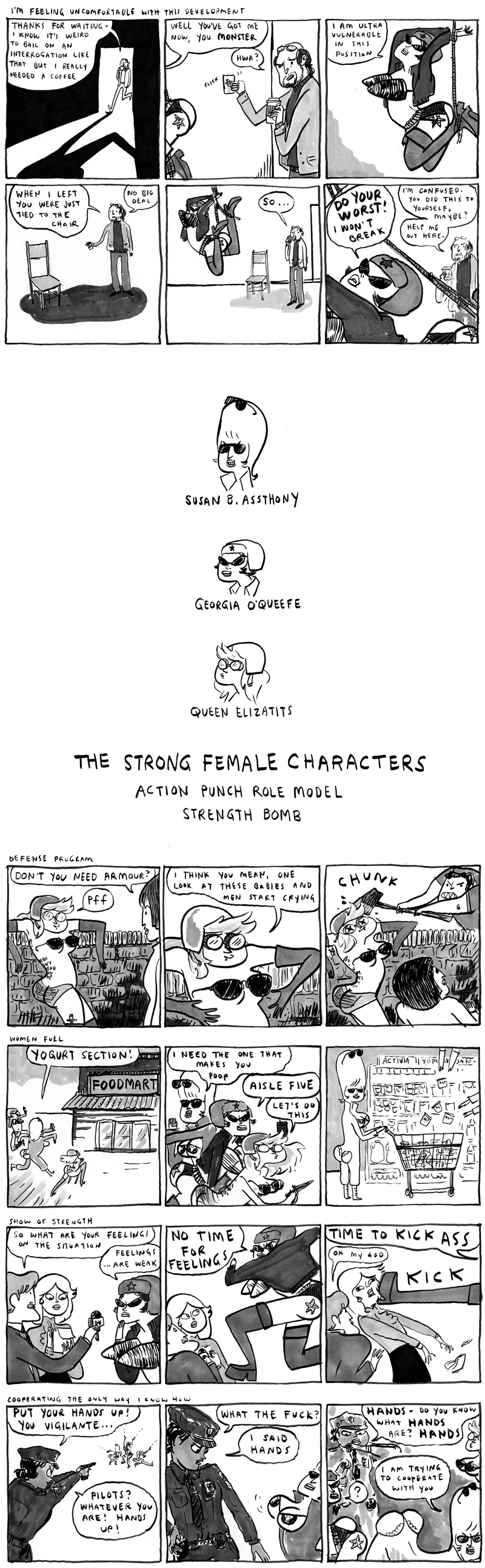
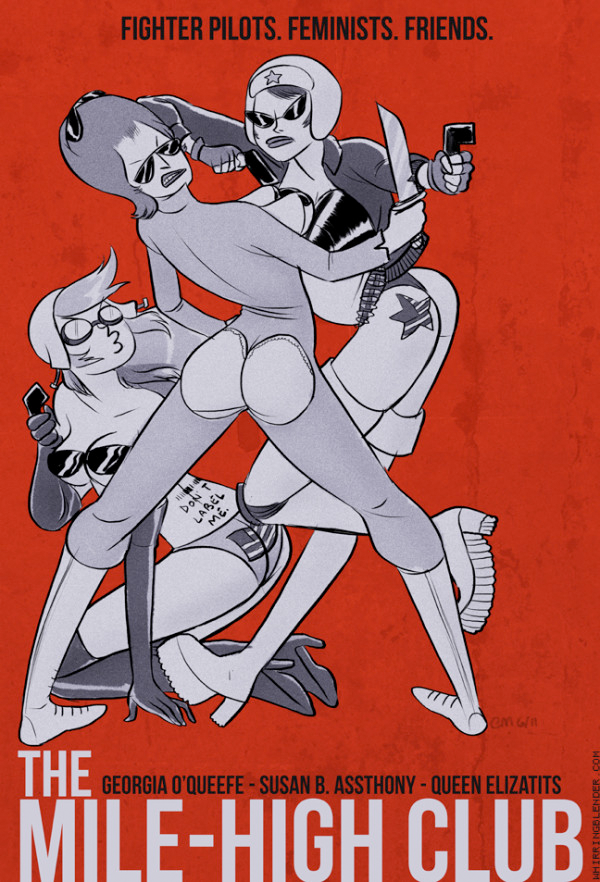
Hark, a Vagrant: Strong Female Characters 2


buy this print!

The Strong Female Characters are back, and dare I say, stronger than EVER?

Although I take responsibility for this travesty, they are, as ever, the creation of Carly Monardo, Meredith Gran and myself.


I hope you're doing well these days, I've moved from New York to Toronto and am attempting to learn how to paint in an effort to become a better artist, so fingers crossed on that one. No projects to pass on yet, but a book and magazine cover or two I've done, and I'll post those when they go to press.

You can also find Carly and Meredith on twitter, @whirringblender and @granulac


06 Apr 20:45

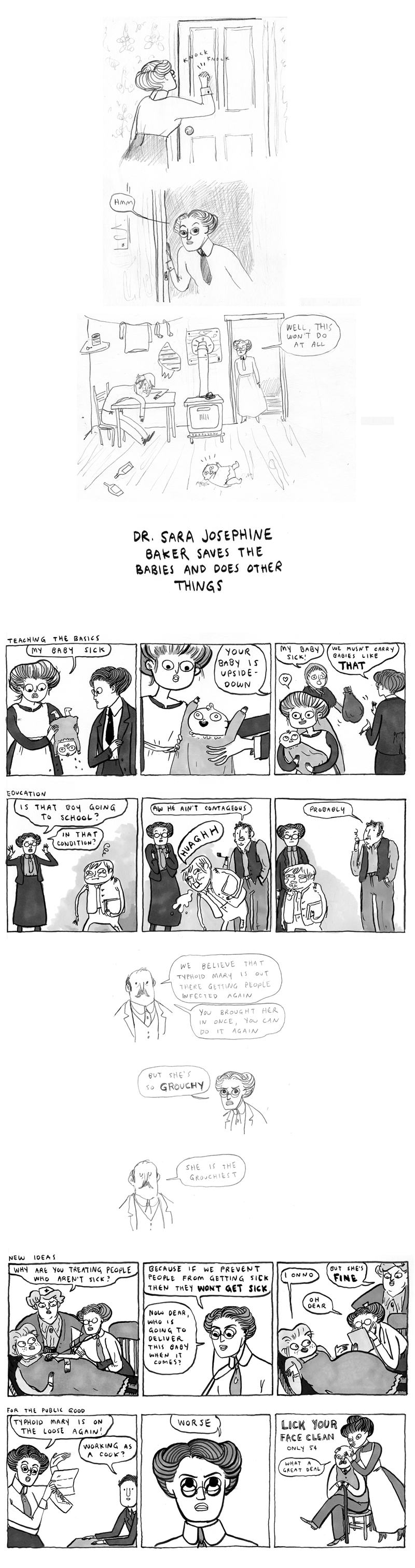
Hark, a Vagrant: Dr. Sara Baker


buy this print!

Dr. Sara Josephine Baker: look her up. Under her watch the infant mortality rate in New York city went from being one of the worst possible to one of the most enviable, and her ideas on public health and preventative care spread far and wide. She swam against the stream her entire life and she saved thousands of people, what more do you want in a hero?

As for Tyhpoid Mary, or Mary Mallon, well I guess you'd be grouchy too if you were her! Truth be told, I came upon Dr. Baker's story because I was reading about Mary's. She seemed to have been well liked by people who weren't public officials trying to drag her into quarantine. Let's be fair: that would be a real pain in the ass. But then again you can't just walk around making people sick! It gets complicated, but take a look through this book by Judith Walzer Leavitt for a sympathetic view.


I do keep that tumblr updating with things!


I added another link to the friends list, my friend Carolyn makes apps for children over at Shortstack Apps, and they are adorable and great!

06 Apr 20:20

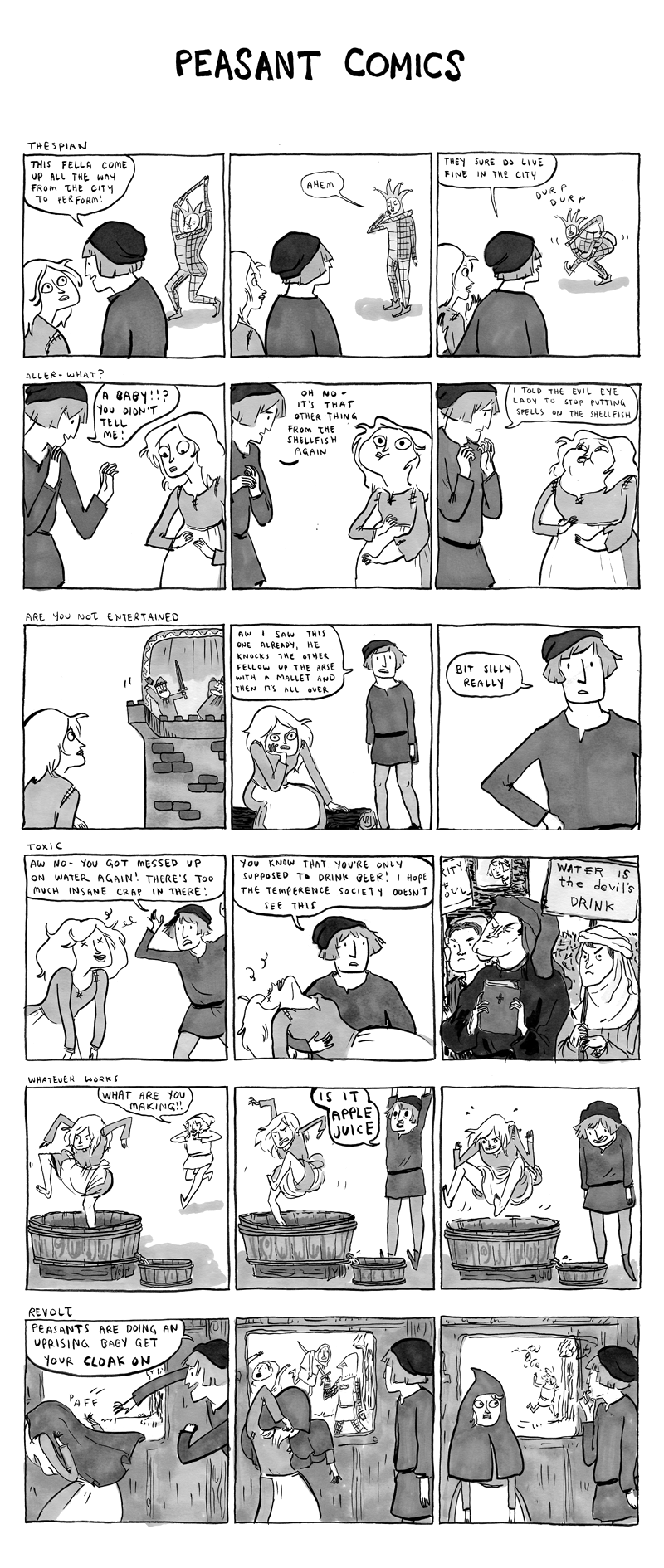
Hark, a Vagrant: Peasants #2


buy this print!

I have been obsessing over Medieval history in the past while. It only seemed natural to come back to the world of our old friends. I like the idea of recurring characters in this strip, and that's why you're seeing more of it! Though we might take them from 15th century to 14th century. The 14th century is just so.. gloriously Medieval.

I like a good old mix of funny history with a lil' anachronism thrown in the mix. For allergies, I'll be honest: I have no idea what people thought then. And I've been looking at medical Medieval image catalogues like nobody's business. I should really make a tumblr or something to record research travels on the internet, because I just want to share everything with you! There is so much great stuff out there! We'll see. But anyway, back on track re: allergies-

I once read that it's possible Jean Paul Marat suffered from a gluten intolerance which led to him being confined to his bath, which led to him being murdered, which led to him being painted Pieta-style with a bathtub instead of the Virgin Mary. Can you imagine, an old timey French dude just chowing down baguettes every day and wondering what the heck was the matter while all the doctors bang their heads on the wall? C'est tragique. But in a funny way.

Weren't we talking about Middle Ages stuff? Well, read all about it in my new book, How to write jokes about topics that are unrelated.


And for heaven's sake, watch Terry Jones' Medieval Lives and do it now- you won't find a more charming, intelligent host anywhere. Terry, if you're reading this (you're not, but just in case you are), you're the best.

06 Apr 14:17

Hark, a Vagrant: velocipede


Happy New Year everyone!

Just playing around with drawing pictures.

The greatest thing about the invention of the bicycle and ladies starting to ride them is: everything. The clothes! The bikes! The attitude! But perhaps especially: the scads of satirical cartoons made at the time that were supposed to make women look shocking and inappropriate but just makes them look super stylish and badass instead. I just can't get over the cigarette in the cartoon I used though, and the splayed legs as she rumbles willy-nilly down the street. God, is there anything better than cartoons?

Incidentally, 'velocipedestrienne,' not a word I made up. You're looking for page 89 of this very informative contemporary read. I enjoyed the chapter very much. You would not believe how many words they manage to birth out of the word 'velocipede' in that book. If you notice the date you'll see that I stuck a phonograph in the cartoon about ten years too early and well that is just because I can do what I like around here.

06 Apr 14:16

Taiwan

by Alex Noriega


06 Apr 14:14

Hark, a Vagrant: Holiday Sketches


I'm headed home! Here are some holiday drawings before I go. Ken in the Nativity Scene is there just because I remember both owning Hollywood Ken (he had stars on his pants and the word HOLLYWOOD on his t-shirt) and trying to play with the figures in Mom's Nativity scene. I mean let's face it: they're dolls right? Amirite. The problem was that they were all puny next to the Barbies and that is a problem, because no doubt Mary would consider a man-about-town like Hollywood Ken to be the foster father of her miracle child, but she only went up to his hip, so Joseph was a more reasonable choice in the end.

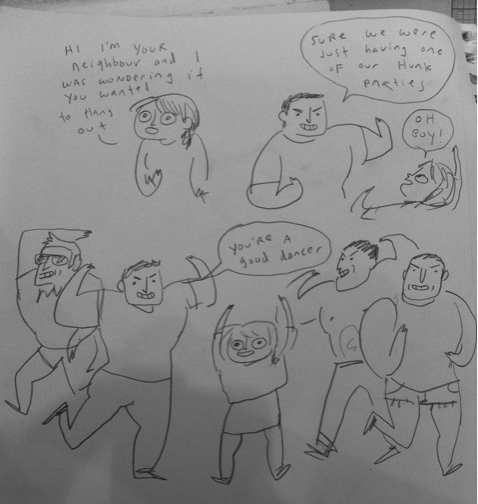
As for Hunks, you may remember this twitter comic I made about meeting my neighbours:

I had to make a comic out of it in some way right! Here are some things that will always be funny to me:
butts
hunks and babes
people lying on the floor
top gun

And that is the secret to anything I have ever made.

Will you be in New York between Christmas and New Years?

Then come to the third Crime Stoppers Club, a show put on by Michael Kupperman and myself, this month featuring the great talents of Julia Wertz, Anthony Devito, Mitch Magee, Julie Klausner and MARK TWAIN!

That's December 27th, at Luca Lounge in the East Village! Clicka that link hey why not

Oh yeah one more!

If you're back in Cape Breton for Christmas like me, I'm going to do a little signing or meet and greet sort of thing on Boxing Day in my hometown, Mabou. It's at the museum - An Drochaid, the Gaelic and Historical Society building - at 7:30pm. Be sure to drop by and say hello before the dance starts, hmm?

06 Apr 14:13

“I’m going to kill myself tomorrow.” The...


“I’m going to kill myself tomorrow.”

The Royal Tenenbaums (2001)

06 Apr 14:02

My sporadic obsessions

by Alex Noriega


06 Apr 02:46

'A Couple Chooses a Movie'

by Bobby Finger

---

See more posts by Bobby Finger

71 comments
06 Apr 02:30

Photo


05 Apr 19:42

I did a joke in a show the other night which included me saying “My two year old hates it when...

I did a joke in a show the other night which included me saying “My two year old hates it when I try to clip his fingernails, so I just don’t do it anymore and now he has claws…” That was 4 seconds of a 10 minute set I did at a show in an independent movie theater in downtown LA. 

Today I got a message on Facebook from a guy who was at the show who told me that his dad used to wait till he was asleep and then he’d clip his fingernails. He suggested I try this. I almost cried reading it, picturing this man I’ve never met, as a small child, asleep in his father’s arms, getting his tiny nails cut. And then as a grown up, writing this earnest note to a comedian in an effort to help him and his kid.

I’m almost crying again writing about it. Moments like this torpedo any cynicism I have and remind me that people are good and kind and wonderful, whether you like it or not. 

05 Apr 18:08

Happy Birthday Grumpycat! (via grumpycat)


Happy Birthday Grumpycat!

(via grumpycat)

05 Apr 14:02

You know what I’ve always hated? When people think little people/dwarves are funny. Why that...

You know what I’ve always hated? When people think little people/dwarves are funny. Why that fuck would they be funny? Unless they’re funny like Richard Pryor or Joan Rivers or something. But funny just because they’re a different size? I guess it’s nice though because even before I worked in comedy if somebody said something about little people being funny I could write them off as being a fucking idiot who knew nothing about comedy and was probably an asshole in 15 other areas of their life as well. Easily one of my biggest comedy bullshit piss-me-off shit sandwiches. 

Also, one out of a THOUSAND mustaches are funny. People who have ever even THOUGHT the word “meh,” let alone WRITTEN it have a fungus eating their brain and should be pitied and kept outside. In addition, if you’ve used the word “amazeballs,” get away from me and my family. Finally, if you’ve ever used the phrase “friend zone,” you should get therapy because you have a personality that might one day metastasize into that of a rapist. 

I will probably delete this. 

05 Apr 13:40

beeishappy: TCR 2013.01.28 | TDS 2013.04.02 | Jon & Stephen...


beeishappy:

TCR 2013.01.28 | TDS 2013.04.02 | Jon & Stephen Break Up With North Korea [xx]

05 Apr 12:26

Tyler Perry Isn't Just an Artless Hack, He's a Scary Ideologue

by Lindy West

Tyler Perry Isn't Just an Artless Hack, He's a Scary IdeologueThere are a lot of things to laugh at in Tyler Perry's Temptation: Kim Kardashian's attempts to move and talk at the same time, Vanessa Williams's fake French accent for no reason (hoh-hoh-hohhh!), the alien dialogue, the blunt-force moralizing, the sheer ineptitude of Perry's filmmaking. (Worth noting: None of Perry's actual scripted "jokes" made the list.) But, that said, it is not a funny movie—it's a frightening one. Temptation is a movie about punishing women. Specifically, Perry is obsessed with punishing women who stray from the good woman/bad woman binary dictated by traditional Christian gender roles. That is the film's entire purpose. I watched it 24 hours ago and my skin is still crawling. And I'm starting to believe that Tyler Perry isn't just artless—he's reprehensible.

Temptation is framed as a story told by a marriage counselor to her client. The client, some white lady, comes in and is like, "I'm thinking about having an affair! YOLO!" And the marriage counselor is like, "Well, let me tell you a little story, lady. About my, um, 'sister.'" (The first of a million spoilers: IT'S REALLY ABOUT HER. SHE IS HER OWN SISTER.)

The "sister" in question is Judith—a nice, pretty, church-going "good woman" who wears ugly high-collared blouses, cooks dinner for her man every night, and only has married-sex in bed with the lamp off. Judith's husband, Brice, is a "good man." He works hard at a pharmacy all day, wears glasses, and is on great terms with Judith's mother. They are "happy." Except that they're totally not (spoiler #2: it's Judith's fault).

The first hint of Judith's discontent comes when she and Brice are heading home from a romantic dinner. A group of ne'er-do-well youths on the street cat-call Judith as they pass. Judith flips the fuck out and has to be physically restrained by Brice, who tells her to calm down, ignore it, let it go. They get in the car and go home. Judith refuses to speak to Brice for the rest of the night, because he didn't defend his property her honor by fighting the cat-callers to the death. He didn't do his manful duty. "But honey, they could have had guns!" Brice says. THEN HE APOLOGIZES TO JUDITH FOR NOT FIGHTING THE YOUTHS. I didn't see the rest of the scene because my eyes fell out and rolled away.

Meanwhile, at the Millionaire Matchmaking agency where she works, Judith meets Harley—the "third largest social media inventor since Zuckerberg!" (so, uh, LinkedIn? Christian Mingle?). Harley immediately fixates on Judith and begins scheming about how to get his penis inside her posthaste. Harley is rich, sexually aggressive (his dialogue highlights the inhuman weirdness with which Perry writes about sex: "Sex should be random, like animals!"), he believes in Judith's career (Brice, by contrast, told her that she should stay at the matchmaking agency for 15 years before starting her own practice—!?!?), and he goes jogging with no shirt so ladies will look at his muscles. "I bet you only have sex in a bed with the lamp off," he tells Judith. (Nailed it!!!) In a clunky counterexample to the cat-calling incident, Harley attempts to murder a doofy bicyclist who accidentally bumped Judith's knee with his bicycle. He is truly the best man ever.

Oh, also Harley is literally the devil. Linemouth.

You can tell he's literally the devil because he says things like, "Let me play devil's advocate," he drives a sinful red sports car, everything in his apartment is constantly on fire, and every time Judith's churchy mom sees him she starts screaming, "HE'S THE DEVIL. THAT MAN IS LITERALLY THE DEVIL." He is literally the devil.

And because he's the devil, he manages to "seduce" Judith, lure her away from her good Christian life with Brice, nose-feed her mountains of cocaine, beat the shit out of her, and turn her into a cackling demon who hates Jesus and never, ever cooks dinner. Back at the pharmacy, Brice discovers that Harley has been running around giving HIV to all kinds of fallen women all over town. This discovery finally awakens his dutiful aggro side, so he runs to Harley's apartment to rescue Judith from Satan-AIDS, and then throws Harley through a window. Then Brice gets a new, better, non-HIV-having wife and Judith puts her frumpy clothes back on and goes to church, alone forevermore.

Cut back to this dialogue between the therapist and the white lady:

"How does the story end?"
"Well, it's still being written."
"Did [Judith] get HIV too?"
"Yes."
"Did Brice?"
"No."
"Thank you so much for sharing this story with me  I'm going to end this almost-affair and stay with my husband."

THE END. OF THE MOVIE.

Okay. Now. Okay. There are three main areas in which Tyler Perry is fucking over the entire human race in Temptation.

1. Men Do Marriage Like This/Women Do Marriage Like This!

Temptation is a feature-length Chick tract, only with slightly less artistry and nuance. Watching this film as an atheist, it makes absolutely no sense. If you don't believe in the devil, which I don't, Temptation is simply the story of a 25-year-old woman who got married too young, is no longer compatible with her partner, is frustrated with her stalled career, and is preyed upon by a charismatic sociopath with a drug problem. Then, because of Perry's fixation on Christian moralizing, the film portrays Judith's contraction of HIV (deliberately given to her by an abusive partner) as a fitting punishment for her "sins." From a godless perspective, this is bonkers.

Outside the confines of traditional gender roles, Judith is just a woman trying to find her place in the world. She is confused, she is sad, she is frustrated. "I feel so dead with you Brice," she says. In the real world, women are not obligated to cook dinner for their husbands, or eschew casual sex, or put their careers on hold for their partners, or submit sexually to dominant men, or ignore cat-callers, or stand up to cat-callers, or swath their knees in modest hemlines, or be nice to their moms. Women are people. But in Perry's universe, women are women, and a "good woman" is a very specific and important thing to be.

People can have whatever kind of relationships they want—if a traditional Christian marriage works for you, go nuts—but Perry's insistence on punishing women who don't follow his doctrine of subservience is harmful and oppressive. Compliance with gender roles doesn't make anyone a good person. People are good people because they're good people. Church doesn't make you good. Loving your mom doesn't make you good. Even fidelity doesn't make you good. Those are all just excuses, loopholes, cop-outs that signify "goodness" without having to actually do the legwork.

When Judith stops being "good," she is punished. The moral of the movie is explicit: Stay in your unhappy marriage forever because the alternative is Satan-AIDS.

Which brings me to my second point.

2. People with HIV Are Not Your Toys.

Three people in Temptation have HIV. One of them is literally the devil (see above), and the other two are black women who slept with the devil. That Perry would have the gall to use HIV as a punitive measure against black women who don't fit his idea of "goodness"—black women, by the way, account for 2/3 of new HIV infections among women—betrays a frightening selfishness and lack of empathy. It echoes, very plainly, the old Fundamentalist rhetoric that AIDS is a punishment from god for the sins of the gays. Perry expands that rhetoric, sure—now dirty, filthy women can sin just like gays do!—but the message is the same. Casual sex is a sin and sinners deserve HIV. That. Is. Crazy.

The other woman infected by Harley is named Melinda (played by the Brandy), a saintly gal who works at the pharmacy with Brice. "I'm accepting my part in it," she says. She chose to stay with Harley even though he was abusive and she knew he was sleeping around. Besides, the film takes care to point out, she totally took Harley's private jet for granted—so of course he cheated! Temptation isn't a movie about Harley—who, after all, can't help his sin seeing as he is a demon from hell. It's a movie about Harley's victims. Only they're not portrayed as victims—they're sinners. They're to blame. And in the end, Melinda and Judith wind up alone, repentant and meek, while Brice finds himself a new, untainted wife.

Apparently this needs to be said: People with HIV are people. People with HIV are not a rhetorical device that Tyler Perry gets to exploit to keep women in line. People with HIV have healthy relationships with other people, regardless of HIV status. Tyler Perry is a bad person.

3. Harley Rapes Judith.

Here are all of things that Judith says immediately before Harley has sex with her in his private plane: "No." "Stop it." "I don't want to." "Get off of me." Judith does not want to have sex with Harley. (There's another layer of nuance here—one reason Judith doesn't want to have sex with Harley is that she's deeply invested in Perry's beloved gender roles. But the reason for her "no" is irrelevant. Her spiritual weakness betrays her, Harley can tell she wants it, and she's punished for that weakness.)

He does not stop. He just tries harder. He knows what she really wants, no matter what her mouth and body are saying. She never says yes. He says, smugly, "Now you can say you resisted." He has sex with her anyway. This is a rape scene. But, in Perry's universe, Harley is right. She did secretly want it. And that's the real problem.

Afterwards, for a minute, Judith is disgusted with Harley and with herself. She pushes him away. She tells him never to contact her again. But then! Then! She's back on the phone with him almost immediately (while Brice is caught up in the football game—doofy doofy dur dur!), telling Harley he's the best she's ever had, begging him to have sex with her again. Judith, it seems, is addicted to what the dick did. And now she's like, "OMG I NEED MORE OF YOUR SATAN BONER AND ALSO COCAINE." Because that's how us fickle ladies work.

This idea—that men know what women really want, that resistance can be fucked out of us (or consent fucked into us)—is DEEPLY NOT OKAY. It's not okay to telegraph this to young men or young women or victims of sexual violence or potential perpetrators of sexual violence or lawmakers or anyone. It's a paradigm that I was hoping had died out with Pepe LePew. It is frightening.

I'm amazed at how efficiently Perry was able to roll back discourse, human rights, the basics of consent, and storytelling itself in just one shitty movie. Perry has done a lot for the visibility of black voices in popular culture, but that doesn't make his moralistic subtext in Temptation any less repellant and irresponsible. The world should demand better than Tyler Perry.

04 Apr 20:40

Planned Parenthood Does Not Endorse Infanticide and We Can't Believe That Even Needs to Be Clarified

by Katie J.M. Baker

Planned Parenthood Does Not Endorse Infanticide and We Can't Believe That Even Needs to Be Clarified Is Planned Parenthood the nation's leading sexual and reproductive health care provider OR a gang of savages stampeding through the country with baby heads on spikes? This week, anti-abortion advocates are eager to convince us of the latter by claiming that the Florida Association of Planned Parenthood Affiliates supports infanticide. Talk about a straw fetus argument! (It's like a straw man argument, but even less viable. HEYO.)
Last week, the Florida House of Representatives held a hearing on HB 1129, also known as the "Infants Born Alive" bill, which would provide legal protection for infants who "survive" an abortion procedure. Given that Florida doesn't allow abortions to be performed after 24 weeks, which is when most doctors define the age of viability, the proposed act is based on a ridiculous hypothetical — and one that's extremely hurtful to the pro-choice cause, since it perpetuates the concept that abortion providers are butcher-like murderers instead of medical practitioners. We don't need it.

But when Rep. Jim Boyd asked Alisa LaPolt Snow, a lobbyist for the Florida Alliance of Planned Parenthood Affiliates, what Planned Parenthood would "want to have happen to [a] child that is struggling for life" after being born alive in a "botched abortion" situation, she was caught in a catch-22 where she was basically forced to choose between effectively "admitting" that abortion is dangerous for babies or driving home the point that it should always be up to a woman to choose what's best for her. She went with the latter:

"So, um, it is just really hard for me to even ask you this question because I'm almost in disbelief," said Rep. Jim Boyd. "If a baby is born on a table as a result of a botched abortion, what would Planned Parenthood want to have happen to that child that is struggling for life?"

"We believe that any decision that's made should be left up to the woman, her family, and the physician," said Planned Parenthood lobbyist Snow.

Rep. Daniel Davis then asked Snow, "What happens in a situation where a baby is alive, breathing on a table, moving. What do your physicians do at that point?"

"I do not have that information," Snow replied. "I am not a physician, I am not an abortion provider. So I do not have that information."

Conservative outlets subsequently shit all over themselves in excitement scrambling to write op-eds about how Planned Parenthood wants to kill babies for sport. Choice example from The Christian Post: "If a child can be killed in the womb, there are no convincing arguments, either logical or a moral, as to why a child cannot be killed on the table, abandoned in the trash, burned alive in an incinerator or poisoned in the nursery." Logic!

Planned Parenthood released a clarifying statement this week:

Last week, a panel of Florida state legislators demanded speculation about a vague set of extremely unlikely and highly unusual medical circumstances. Medical guidelines and ethics already compel physicians facing life-threatening circumstances to respond, and Planned Parenthood physicians provide high-quality medical care and adhere to the most rigorous professional standards, including providing emergency care. In the extremely unlikely event that the scenario presented by the panel of legislators should happen, of course Planned Parenthood would provide appropriate care to both the woman and the infant.

The type of "botched abortions" anti-abortion advocates casually refer to as if they happen on the regular are extremely few and far between — and they usually only happen when women don't have access to the exact sort of reproductive health services Planned Parenthood offers. But why talk facts if you can write headlines that employ the phrase "abortion mill murder"?

[The Blaze]
[Planned Parenthood]