×You need to sign in to continue.

Shared posts

01 Nov 01:23

Ads and Support

by Jonathan Crowe

Updates to Google’s ad system did a number on the layout of this website, spraying ads everywhere, so I’ve disabled ads until I can get that sorted out.

They’ll probably have to come back at some point, because while I like the site without ads, it does cost me money to host this site, and time to work on it. If you like what I do here, this wouldn’t be a bad time to send a few dollars1 toward The Map Room’s hosting bills, or to me directly via Ko-Fi. (Both methods use PayPal; minimum of $10 and $3 respectively.)

As always, your support is not necessary, but it’s greatly appreciated, and I do not take it for granted.

12 Oct 13:06

New at Tor.com: ‘Where Do Fantasy Maps Come From?’

by Jonathan Crowe

New from me at Tor.com this morning, the latest instalment in my series on the history and design of fantasy maps. “Where Do Fantasy Maps Come From?” looks at the influences on and origins of the fantasy map style—the existing traditions, stretching back as far back as the sixteenth century, that the fantasy map drew upon when it came into being in the early to mid-twentieth century. (Tolkien couldn’t have made it up out of whole cloth, after all.)

This is a speculative piece that draws upon a large and diverse number of sources—everything from Forlani to Berann, from bird’s-eye views of cities to children’s book illustrations—to come up with … well, something interesting, at least. To do proper justice to the subject would require a Ph.D. dissertation. This is a start.

06 Oct 17:00

To stay secure online, Password Checkup has your back

We’ve all been there. Compromising security for convenience, we put our personal information at risk with poor password habits. One in four Americans use common passwords—like Abc123, Password1111, and P@ssw0rd. Sixty-six percent of Americans admit to using the same weak password across multiple sites, which makes all those accounts vulnerable. And every day, new data breaches publicly expose millions of usernames and passwords.

Until passwords become a thing of the past (trust us, we’re working on it), there’s a simple and secure solution: use a password manager, like the one built into your Google Account and Google Chrome. It generates strong, unique passwords for all your online accounts, auto-fills them as you sign in, and helps keep them safe in a central place. 

Today we’re launching the Password Checkup—a new feature built into our password manager that checks the strength and security of all of your saved passwords, tells you if we find they’ve been compromised (for example, in a breach), and gives you personalized, actionable recommendations when needed. 

A built-in password manager in your Google Account

Video: A built-in password manager in your Google Account

With a single click, the Password Checkup tells you if: 


  • Your passwords have been compromised in a third-party breach. We’ve found more than 4 billion usernames and passwords that have been exposed due to third-party breaches. If any of these are yours, attackers could have these passwords and access your information. 

  • Your passwords are being reused across different sites. If someone gets access to a password that you reuse on multiple sites, they can use it to sign into your other accounts as well.

  • Your passwords should be strengthened. Weak passwords can be easily guessed by attackers, putting your personal information at risk. 

This is just one way we help protect you across the internet, not just on Google. The Password Checkup and the password manager are built into your Google Account, along with many other important privacy and security controls. To manage and check all of your saved passwords, you can go directly to passwords.google.com.
  • PasswordCheckup-HarrisPoll-InfographicFINAL_carousel1.png

    Google, in partnership with The Harris Poll, surveyed a nationally representative sample of U.S. adults to understand beliefs and behaviors around passwords and online security.

  • PasswordCheckup-HarrisPoll-InfographicFINAL_carousel2.png

    Google, in partnership with The Harris Poll, surveyed a nationally representative sample of U.S. adults to understand beliefs and behaviors around passwords and online security.

  • PasswordCheckup-HarrisPoll-InfographicFINAL_carousel3.png

    Google, in partnership with The Harris Poll, surveyed a nationally representative sample of U.S. adults to understand beliefs and behaviors around passwords and online security.

Coming soon: Always-on protection with Chrome

The Password Checkup is built from our Chrome extension launched earlier this year, which alerts you if your username or password has been compromised in a third-party data breach. The extension has been downloaded more than 1 million times, with nearly half of those users receiving a warning for a compromised password. Later this year, we’ll build Password Checkup technology directly into Chrome for everyone—so you get real time protection as you type your password without needing to install a separate extension. 

Features like Security Checkup, password manager and now the Password Checkup are all examples of how we're continuously working to make your online experience safer and easier—not just on Google, but across the web. So the next time you’re struggling to remember how many !’s and 1’s you added to your last password, we can help you with that. 

06 Oct 16:49

The Traveling Baptism Problem

by Keir Clarke
In the 1830's a woman called Elizabeth Nichols traveled the length and breadth of England & Wales baptizing her daughter in hundreds of different locations. The reason for this serial baptism of her child wasn't because Elizabeth Nichols was particularly devout. It was because of the alms or outdoor relief that she received upon baptizing her child, the assistance which was given to her in the
29 Sep 22:02

See the Space Station Tonight

by Keir Clarke
James Darpinian's See a Satellite Tonight can tell you when the International Space Station is flying over your house. It can also tell you where to look in the sky if you want to see it for yourself. Share your location with See a Satellite Tonight and you can view an interactive 3D Cesium Earth, showing your current location highlighted on the globe. The globe also shows an animated ISS
14 Sep 23:29

The courage to change: sharing resources for recovery

I didn't know what recovery meant until a friend asked me if I was still "in recovery." Confused, I responded, “Yes, I’m still not drinking, if that's what you mean.” I know now what I didn’t know then: Recovery means life after substance abuse. It means having a clear mind and a healthy body. It means having the foresight to say no to alcohol. It means having the mental clarity to thrive at work and the desire to live a fuller, happier, complete life. 

As someone who has struggled with addiction and embarked on a journey toward recovery, I am so proud that Google is marking National Recovery Month with a new site, Recover Together. I participate in a recovery group at Google and know how important it is for this community to be connected. As part of Google’s ongoing efforts to combat the opioid crisis, today we’re taking an additional step to support those in recovery.

Too many of us have experienced firsthand the devastating impact of addiction—with our friends, colleagues, family members and loved ones. From the first time I filled my water bottle with alcohol and brought it to school at only 14 years old, to the many times I blacked out and woke up in the back seat of my car in surprising locations, I know how deeply addiction affected my life and worried my family.

More than 21 million Americans struggle with substance use. But it is treatable: An estimated 1 out of 14 American adults is in recovery. In fact, people come to Google every day to seek information on addiction treatment, prevention and recovery. Just last month, we saw an all-time high in search interest for “rehab near me,” “addiction treatment near me” and “how to help an addict.”

Top searched questions on addiction

Starting today, you can come to Google to find recovery resources all in one place, beginning with a video series from those in recovery. I felt less alone when hearing others share their stories, and I am grateful to be able to do the same here.

Recovery locator tool

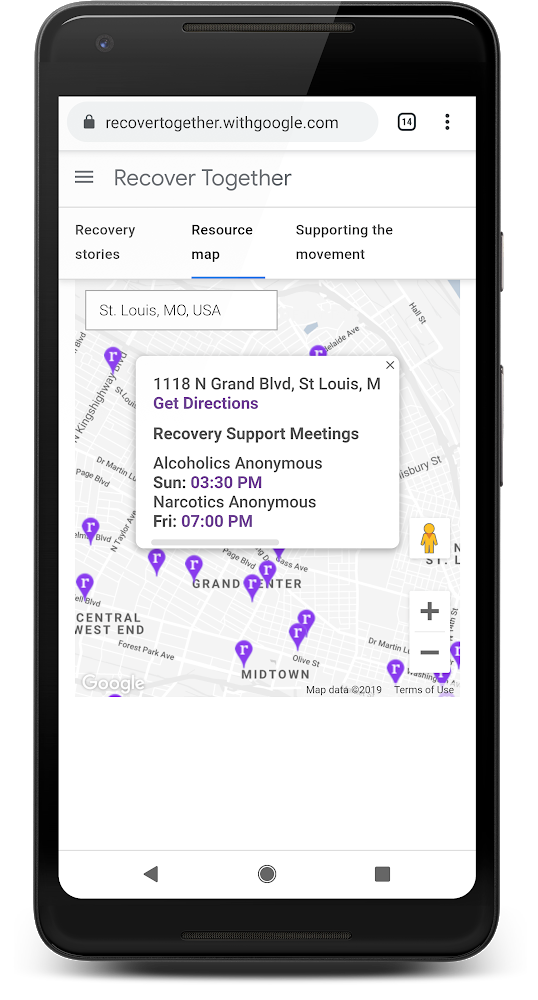
Our new Recovery Locator Tool in Maps. 

We’re also launching two new Google Maps locator tools that will connect people with crucial recovery resources, including: 

  • Recovery Locator ToolA map with locations of more than 83,000 recovery support meetings such as AA, NA, Al-Anon and SmartRecovery, and other services such as school-based and family support. These take place at more than 33,000 community centers, churches, and other spaces—put in your address and you’ll see many recovery services are in your area or wherever you’re traveling.

  • Naloxone Locator ToolA special locator tool will show you locations where you can get Naloxone, the life-saving opioid overdose-reversal drug, without a prescription. All you have to do is type “Naloxone near me” or “Narcan near me” into the search bar in the tool. It already includes 20,000 pharmacies (including CVS, Rite-Aid and Walgreens) in 50 states, and we’ll continue to add local clinics and independent pharmacies. The site will also have more information about the availability and life-saving capability of this medication. Soon, these locations will also be searchable directly in Google Maps.

Finding recovery is a personal journey, and I am so grateful to work for a company that is making resources available to those who need them. In addition to these new tools, the site points to many other resources for those seeking treatment, including a self-assessment screener from the National Institute of Drug Abuse and state-specific Helpline resources and hotlines. 

To anyone at the beginning stages of recovery: This process is hard and tiring and challenging and you do not need to figure this all out alone. From the moment I first connected to the Employee Assistance Program counselor at Google who helped me confront the reality of my addiction, my life has changed in ways that at one time seemed unimaginable. I teach yoga. I run marathons. My life has been enriched by others in the recovery community. My sorrow has been replaced with a joy I never thought possible. And today, my hope is that anyone seeking recovery can find the same help and resources through Google I wanted so many years ago. Recovery is difficult, and it is so much better when we’re all in it together.

30 Aug 22:43

Kickstarter for the Book Version of Barely Maps

by Jonathan Crowe

Earlier this year I told you about Barely Maps, the minimalist map project undertaken by Peter Gorman, who in a series of posters reduced maps to their most cryptic and abstract state. He’s been selling prints on Etsy, but now Peter has launched a Kickstarter campaign for the next phase of his project: a book that collects 100 of his minimalist maps, along with the stories behind their creation.

Peter sent me a proof copy of the book. The cover is as minimalist as you might expect from such a project. The maps are familiar if you’ve been following the Barely Maps project: here they take up an entire right-hand page, with a brief description on the facing page.

Peter is using offset printing to produce this book, which requires a 250-copy minimum print run. Supporting the Kickstarter starts at $39, which gets you one copy of the book and free U.S. shipping. Higher tiers add map prints to the cart. As I write this post, the Kickstarter is about 88 percent of the way to its $10,000 goal.

30 Aug 22:42

Mapping the Amazon Fires

by Jonathan Crowe

Let’s start with the current situation map from Brazil’s own space agency, the Instituto Nacional de Pesquisas Espacias (INPE), which I’m surprised is still online. In July Brazil’s president, Jair Bolsonaro, accused the widely respected agency of lying about the scale of deforestation in the Amazon; INPE’s chief, Ricardo Galvão, was forced out earlier this month after defending the agency. After that, INPE said that fires were up 84 percent over the same period last year. (The ESA, for its part, tracked nearly four times as many fires in August as they did last year.)

Other raw data sources include the Copernicus Atmosphere Monitoring Service (CAMS), fire activity data from which can be viewed here; and MODIS data from NASA’s Terra and Aqua satellites. For a live feed of MODIS data on the Amazon fires, see the MODIS Wildfire Dashboard.

NASA

Meanwhile, NASA’s Earth Observatory posted MODIS imagery of several Amazon fires, and had this curious statement that seemed to minimize the scale of the problem: “As of August 16, 2019, an analysis of NASA satellite data indicated that total fire activity across the Amazon basin this year has been close to the average in comparison to the past 15 years. […] Though activity appears to be above average in the states of Amazonas and Rondônia, it has so far appeared below average in Mato Grosso and Pará, according to estimates from the Global Fire Emissions Database, a research project that compiles and analyzes NASA data.”

A subsequent NASA Earth Observatory post seems to contradict the one I mentioned earlier, pointing to “a noticeable increase in large, intense, and persistent fires burning along major roads in the central Brazilian Amazon” which “are more consistent with land clearing than with regional drought” and noted fire detections “higher across the Brazilian Amazon” since 2010.

Contextualizing the amount of fires seems to be a recurring theme in the reporting: the number of fires are up sharply over last year, but close to the average when taking a longer view. It’s helped a lot of bad and insincere actors make it harder to get to the heart of what’s going on over there. They can’t, after all, deny the satellite imagery or the remote sensing: we can see the fires. We can detect the emissions of smoke, carbon dioxide and carbon monoxide (1, 2, 3). We can map them. And those maps can help us understand what’s going on.

On the NGO front, InfoAmazonia has produced the above map comparing fires over the last 24 hours with historical fire data. (They have other maps on this subject as well.)

Note, too, the reference above to burning along major roads. Tim Wallace crunches MODIS date from 2012 onward and teases out some patterns in the fires.

The New York Times

And the New York Times, where Tim used to work, has a map correlating the position of the current Amazon fires along the edges of past deforestation. The Times also has maps showing maps on a month-by-month basis and comparing August 2019 with the August average over the past decade.

[CityLab, Maps Mania]

25 Aug 15:00

Between a Wall & the Syrian Army

by Keir Clarke
In Syria hundreds of thousands of civilians are trapped between the concrete border wall with Turkey and approaching Syrian and Russian forces. Eight years after the start of the civil war in Syria fighting is now mainly limited to the north-western province of Idlib, the last stronghold of rebel forces. As the Syrian and Russian forces approach the border fleeing civilians have become trapped
15 Aug 22:43

How a love of reading turned into new features for Play Books

Have you ever wondered how new features are developed at Google? We start with a problem that needs to be solved, then consider what the best solution might be, so that our products can be more helpful. And, when we can, we like to get feedback from you (and Googlers themselves) before we officially launch so we can refine and improve.

Beta Features is new from Play Books, and it lets you test out experimental features on the web. This project originated with Dan Kimberg, a software engineer who joined the Play Books team to perfect a product he’d been a longtime fan of. Self-proclaimed bookworm and lifetime lover of literature, Dan was eager to personalize his library and make it easier to browse and organize his collection of books. He knew that other readers out there probably felt the same way—so he got to work.

These features may lack a bit of polish; they might evolve, improve, disappear or transform into new Play Books product updates. They’re experimental, and Dan and the team want to hear what’s most helpful to you. We sat down with Dan to learn more about the inspiration behind Beta Features.

What led you to the Play Books team?

I’ve been an avid reader my whole life, but I wasn’t always working in the world of books. I've been a software engineer at Google for eight years on different teams. And before coming to Google, I spent nearly 20 years as a researcher in cognitive neuroscience, using brain imaging to try to understand how the mind works. 

Before joining the Play Books team I filed around 50 feature requests, and I'd been thinking idle thoughts about how technology could improve reading, listening, (and writing) since I was a teenager. 

What inspired you to develop Beta Features?

As a constant reader, I used to go on vacation and pack 20 books because I didn’t know what I’d end up wanting to read. Throughout my years of reading physical books, there were some fundamental frustrations that inspired me to think differently about how technology can make reading more enjoyable. Physical books don’t give you the flexibility of selecting the right font size for you, not all printed books are well bound, page size varies and long lines of text may not be conducive to your reading style. Now, with the help of technology, I can try to solve some of those frustrations for others (and now I can bring as many books as I want on vacation).

Which Beta Features are available now to test out—and which is your favorite?

First, there’s Custom Shelves—my personal favorite and the most frequently requested feature from our users. It lets you organize your shelves in a more useful and personal way. For example, I’ve titled one of my Custom Shelves "Re-read me"—this is for books I've read but would like to revisit, so they don't get lost in the jumble of other books.

You’ll also be able to search quickly for a particular book within your library, or sort your library using different criteria—like author, title, last read and price. The last Beta Feature is a new shelf called Ready to Read, which shows you the books you haven’t finished yet to help you quickly pick up where you left off. 

How can you get started testing?

Head to play.google.com/books, click the Settings button, and select “Beta Features” to get started. You can enable all features or just the ones you find most useful. If you’d like to submit feedback on the Beta Features after you’ve tried them out, or want to send us a feature request you’ve been dreaming up, click on the Settings icon and then select Send Feedback.

02 Aug 16:14

With a tap on your phone, get help in an emergency

A quick, informative conversation with an operator during an emergency call is critical, but in some cases, people are unable to verbally communicate, whether they’re injured, in a dangerous situation or have a speech impairment.


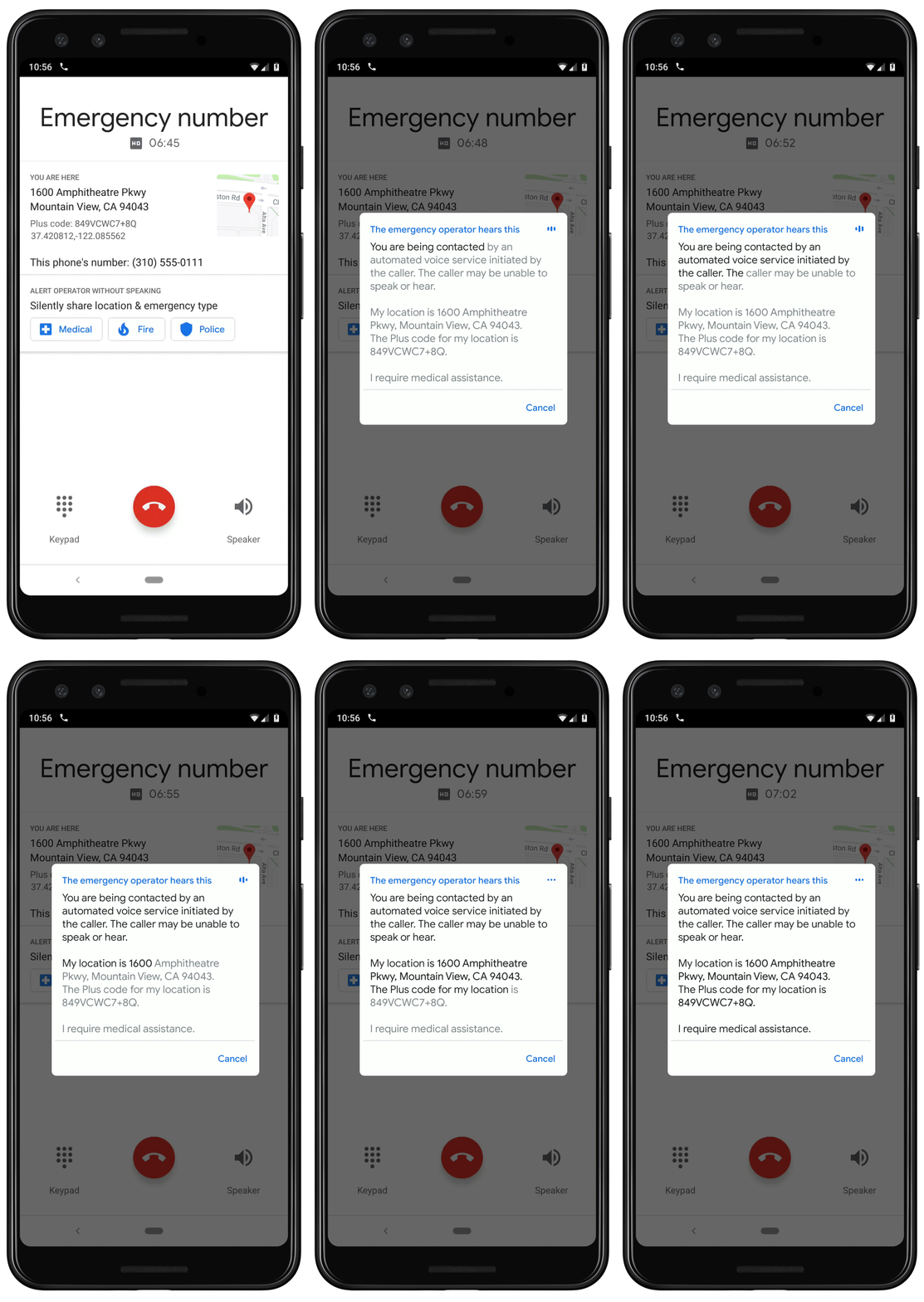
Soon, you'll be able to share information about the assistance you require, along with your location, to the emergency operator without speaking. This feature will be available in the Phone app on Pixel and select Android devices.
Calling emergency without

Tapping on the “Medical,” “Fire” or “Police” buttons during an emergency call will convey the type of emergency to the operator through an automated voice service. That service works on device, which means the information stays between you and emergency services, and the service functions whether or not you have a data connection. After you activate the service, you can always speak directly to the operator as well.

Your location, which comes from your phone’s GPS, is often already shared with the operator when you make a 911 call. This new feature provides similar location information through the automated voice service, along with the caller’s plus code, which is another reliable way to help emergency services accurately locate them. Like the rest of the content shared with the operator using this feature, your  location stays between them and emergency services. 

This feature will become available in the U.S. over the coming months, starting with Pixel phones. We’ve been collecting feedback from public safety organizations, including the National Emergency Number Association, to make this feature as helpful as possible, and we look forward to continuing our collaboration with the emergency services community to make people safer.

02 Aug 16:05

Complaints about Facebook’s Automated Edits in Thailand

by Jonathan Crowe

Facebook’s AI tool has added some 480,000 kilometres of previously unmapped roads in Thailand to OpenStreetMap, BBC News reports, but some local mappers have been complaining about the quality of those edits, and the overwriting of existing edits by Facebook’s editors: see OSM Forum threads here and here. In particular, see OSM contributor Russ McD’s rant on the Thai Visa Forum:

What Facebook fail to state is the inaccurate manner in which their AI mapping worked. The OSM community in Thailand had for years, been working slowly on mapping the Country, with the aim of producing a free to use and accurate map for any user. Information was added backed by a strong local knowledge, which resulted in a usable GPS navigation system based on OSM data. Main road were main roads, and jungle tracks were tracks.

Then along came Facebook with its unlimited resources and steamrollered a project in Thailand with scant regard for contributors … sure they paid lip service to us, with offers of collaboration, and contact emails … but in reality, all our comments went unanswered, or simply ignored.

Sure, their imagery identified roads we had not plotted, but along with that came the irrigation ditches, the tracks though rice paddies, driveways to private houses, and in once case, an airport runway! All went on the map as “residential roads”, leaving any GPS system free to route the user on a physical challenge to make it to their destination.

Local users commented, but the geeky humans who were checking the AI, living thousands of miles away, having never visited Thailand, just ignored our comments. They would soon move onto bigger and better things, while sticking this “success” down on their resume.

Sounds like another case of local mapping vs. armchair mapping and automated edits, where local mappers are swamped and discouraged by edits from elsewhere. [Florian Ledermann]

Previously: OpenStreetMap at the Crossroads.

01 Aug 14:32

“We choose to go to the moon”: Lessons from X

Editor's note: This month marks the 50th anniversary of the Apollo 11 mission landing on the moon. As part of Google's celebration of this historic event, we asked X's Astro Teller to share his thoughts on moonshots. This post was also published on X's blog.

In the fall of 2010, I asked Larry Page a series of questions to find out what he wanted X’s purpose to be. “Is X a research center?” No, Larry said. “A philanthropic organization?” No. “An incubator?” No. “Are we solving Google’s problems?” No. Eventually, I asked, “Are we taking moonshots?” And he smiled and said, “YES.” 


While I confess I hadn’t fully thought through the question when I asked it, the word’s sense of audacity and extreme difficulty spoke to both of us. And it was the seed of X’s identity as a moonshot factory, with a mission of repeatedly developing far-out, sci-fi-sounding technologies that might someday make the world a radically better place. So as we celebrate the 50th anniversary of the Apollo 11 mission this month, here’s some of the other inspiration I’ve taken from the teams who put a person on the moon. 

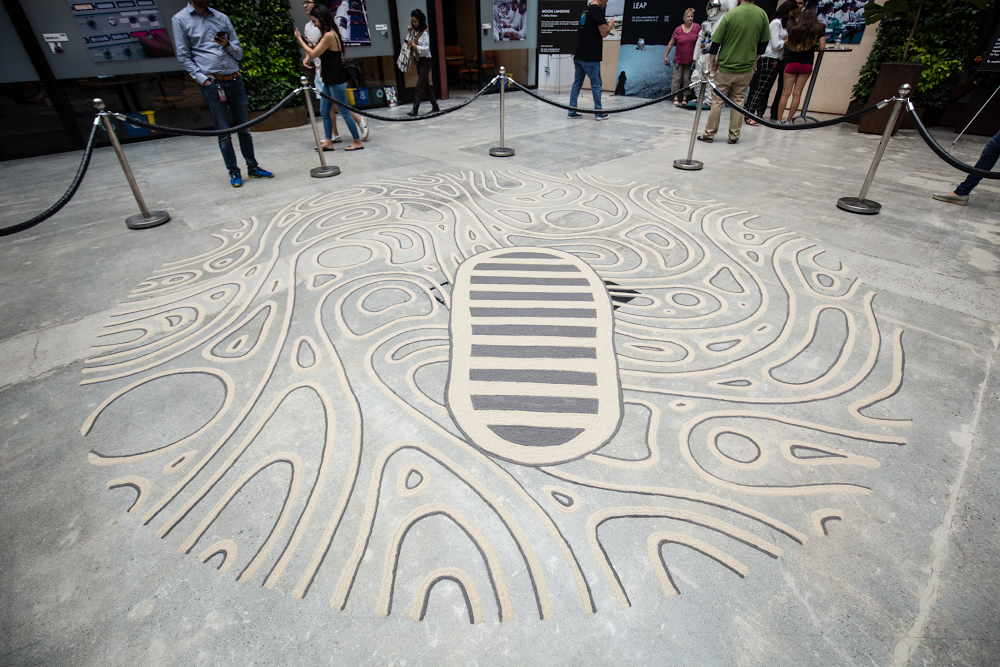
Commemorative sand mandala by Andres Amador at X's celebration of the moon landing

A commemorative sand mandala by Andres Amador at a celebration of the 50th anniversary of the moon landing at X headquarters 

Optimism and perspective-shifting as a strategy 

Our use of the term “moonshot” isn’t literal; it’s more of an emotional blueprint. A moonshot is about looking beyond where you can actually see and envisioning an answer that doesn't seem reasonable—and pursuing it anyway. It’s about doing things that sound undoable but if done could redefine humanity. 


In the early 1960’s, spacecraft for moon landings didn’t exist. There were no spacesuits, no space snacks, no computers for space navigation—plenty of reasons, in other words, to scoff at President Kennedy’s bold vision. But he made a powerful choice: to be an optimist and ask for something that, if possible at all, would require a radical reimagining of what space flight could be.  


Perspective-shifting is one of X’s most deeply held principles. It’s not just about having an idea that sounds like science fiction (though we do reject a lot of ideas for not sounding impossible enough!). We look for a new way of thinking that avoids the usual methods and obstacles—like beaming Internet from balloons or free-space-optical stations rather than running fiber-optic cable through jungles and mountains. When you let your imagination run free and then run experiments to see whether your hypothesis could actually work, you can uncover surprising new approaches.  


10X can be easier than 10 percent

Growing up there were three events I wished I had been part of. The first was the work led by Alan Turing and others during WWII to build the first real computer and the decryption process that led to modern computer science. The second, which my grandfather was a part of, was the Manhattan Project; work on the atomic bomb gave rise to the first electronic general purpose computer. The third was the Apollo space missions. These three special gatherings symbolized for me that the seemingly impossible can happen when passionate and talented people come together with urgency and determination. 


The secret? It’s easier to get people to work on making something 10X better than to get them to help make it 10 percent better. Huge problems fire up our hearts as well as our minds. When you’re aiming for a 10X gain, you can’t just slog through it. You have to find whole new ways of doing things, and lean on bravery and creativity—the kind that, literally and metaphorically, can put a person on the moon. 

Huge problems fire up our hearts as well as our minds.

Cognitive diversity is the key to creativity

More than 400,000 people made the Apollo mission possible—from mechanical engineers to fashion designers, with teams reaching from New England to California. Behind the millions of rocket components were many more millions of prototypes and experiments—all the rough ideas and uncomfortable moments necessary to solve problems no one had ever faced before. This was creativity in action, at a massive scale. 


The lone inventor having a eureka moment is largely a myth; innovation comes from great teams where everyone feels comfortable raising questions and sharing their views. The more people a project has from a wide range of backgrounds and communities, the more fresh perspectives and creative ideas we can generate—and the better we’ll all be. At X, that’s why former rocket scientists work alongside concert pianists and puppeteers, and marine biologists mingle with physicists and machine learning experts. 


Moonshots are a mindset 

The space race was valuable far beyond its original goal: NASA’s work has led to dozens of technology breakthroughs with many everyday uses, and inspired generations of kids like me to fall in love with science and engineering. When the world’s problems make us feel small and helpless, we should reflect on the lessons the Apollo missions hold about human nature, and our ability to choose bravery over fear and set aside apathy in favor of audacity. We can get traction against the world’s most pressing problems—I believe that deeply, and we need more people than ever to believe that too.
01 Aug 14:19

Queen launches 'You Are The Champions' campaign, giving fans a chance to star in three new user-generated videos on YouTube

by YouTube
Queen — in partnership with YouTube Music, Universal Music Group and Hollywood Records —has launched "You Are The Champions," a unique new campaign that gives fans an exclusive chance to become a part of Queen history with a starring role in three brand-new, user-generated videos for three of the band’s most celebrated tracks. The campaign launched to celebrate Queen’s iconic music video for “Bohemian Rhapsody,” becoming the first pre-1990s video to reach one billion views on YouTube.

Speaking from the band’s current sold-out North American tour, founding Queen members Brian May and Roger Taylor said, “We are honoured that Bohemian Rhapsody has just hit one billion views on YouTube. We want to thank you all and celebrate with our amazing fans all around the world by creating three new music videos to our songs, all featuring you! Whether you are a musician, singer, dancer, visual artist or you just want to have some fun. Go to youarethechampions.com to find out more and we’ll see you on the road somewhere.”

As part of the campaign, musicians, singers, and instrumentalists can take on "Bohemian Rhapsody." Visual artists will get the chance to design any word or phrase from the lyrics of "A Kind of Magic." And, finally, dancers will be able to give their own interpretations for "Don't Stop Me Now," with a special instructional video created by Polly Bennett (Rami Malek’s movement coach from the hit film, “Bohemian Rhapsody”).

“I was so happy to be asked to choreograph for this initiative,” said famed movement director and choreographer, Bennett. “Rami (Malek) and I spent a lot of time moving to Queen’s music while filming ‘Bohemian Rhapsody,’ so I’m thrilled to encourage the world to do the same. Get dancing! I can’t wait to see what you make.”

In addition to the three music videos created by user content, a fourth video for "We Will Rock You" will re-create the song's iconic BOOM BOOM CLAP using a collage of sporting event sounds. As a result, the new version will live as a sonic homage to the song's energized relationship with sports.

Fans can visit youarethechampions.com to find out more and add their submissions* through August 18 by 11:59 p.m. ET. The final videos will be available on Queen’s official YouTube channel this fall.

*Terms and Conditions for UGC submissions here.
21 Jul 14:48

A moonlit tribute to a moon landing icon

“There was no choice but to be pioneers.” 

That’s how Margaret Hamilton describes working on the software that put us on the moon. Margaret led the team that developed the onboard flight software for all of NASA’s manned Apollo missions, including Apollo 11’s historic moon landing.

With the anniversary of that moon landing approaching, Google set out to shine a light on Margaret’s influence on Apollo, and on the field of software engineering itself. The tribute was created by positioning over 107,000 mirrors at the Ivanpah Solar Facility in the Mojave Desert to reflect the light of the moon, instead of the sun, like the mirrors normally do. The result is a 1.4-square-mile portrait of Margaret, bigger than New York’s Central Park.

  • Margaret Hamilton portrait annotated

    The moonlit portrait has an area of 1.4 square miles, big enough to fit more than 200 Eiffel Towers.

  • The Ivanpah Solar Facility generates enough solar energy for 140,000 California homes.

    The Ivanpah Solar Facility generates enough solar energy for 140,000 California homes.

  • Hundreds of thousands of massive mirrors reflect the light of the sun throughout the day.

    Hundreds of thousands of massive mirrors reflect the light of the sun throughout the day.

  • The mirrors, repurposed at night to track the moon, creating a moonlit image.

    The mirrors were repurposed at night to track the moon and create a moonlit image.

  • The summer moon beams down, transforming Ivanpah into a massive display.

    The team took a photograph of the moon at the exact position and time as the tribute to Margaret. 

  • Moonlight catches the mirrors as they take position to form an image as big as New York’s Central Park.

    Moonlight catches the mirrors as they take position to form an image as big as New York’s Central Park.

  • Portrait of Margaret Hamilton, visible from 1,900 meters above sea level.

    The portrait of Margaret Hamilton was visible from 1,900 meters above sea level. 

  • Margaret Hamilton portrait

    The final image, seen from above.

At the MIT Instrumentation Lab in the 1960s, Margaret was working on code for the Apollo Guidance Computer. A working mom, she sometimes did what a lot of us do: she took her daughter, Lauren, to the office. Margaret would often test programs in the simulator, and Lauren liked to play astronaut like her mom. One day, Lauren crashed the simulator after she pressed a button that set off a prelaunch program while the mission was in mid-flight. 

Margaret didn’t scold Lauren. Instead, she was struck with a thought: “What if an astronaut did the same thing during a real mission?” Margaret lobbied to add code that would prevent a system crash from actually happening if he did. 

This way of thinking came to define Margaret’s work. She’d always ask, “What if something you never thought would happen, happens?” Then, she’d develop and test a system that would be prepared for that scenario.

Her “what if” mindset was crucial throughout the Apollo missions, where the software had to work perfectly, and had to work the first time, in space. Keep in mind, this was at a time when software engineering literally wasn’t even a thing yet—Margaret herself coined the phrase “software engineering” while working on Apollo.

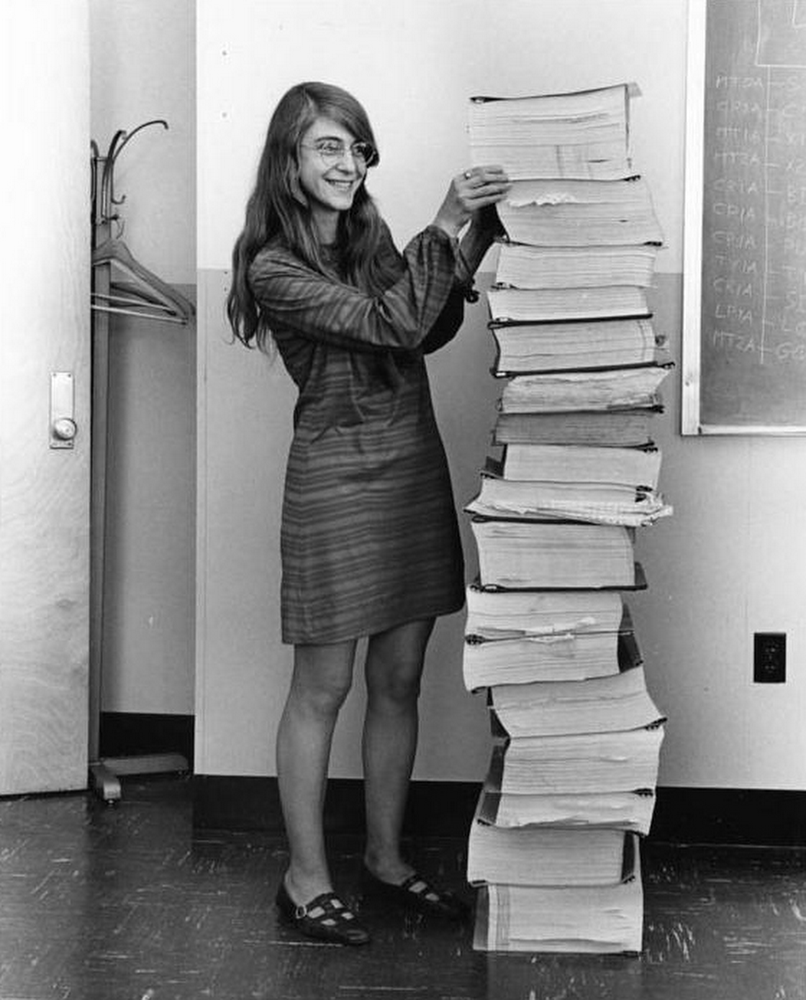
A portrait of Margaret Hamilton

Margaret, in 1969, standing beside the listings of the actual Apollo Guidance Computer source code. Photo courtesy of the MIT Museum.

Margaret’s mindset most famously paid off moments before Apollo 11 was set to land. The guidance computer was overwhelmed with tasks and underwent a series of restarts, triggering alarms that could have forced an abort. But the team’s software was reliable, and the priority display (that Margaret created, and fought to include) let the astronauts and Mission Control know what they were dealing with. The Eagle was able to land safely, and Neil Armstrong was able to take that one small step.

As the anniversary of that historic moment approaches, we can all thank Margaret for her part in it. But I find myself thanking her for so much more:

For pioneering the field of software engineering. A field that has changed our world. 

For reminding us to think always of the user, and to keep pushing to make software more reliable, and more helpful, for them. 

For inspiring us all to take moonshots, showing us what’s possible when you work tirelessly toward them, and demonstrating what magic can come when you allow a child’s perspective to change the way you think about the world. 

Want to learn more about Margaret and the moon landing? Check out Google Arts & Culture for all kinds of Apollo 11 anniversary stories, including an article about  Margaret. Want to teach Margaret’s story in your class? Download a Common Core aligned lesson plan.

01 Jul 14:49

The Pacific Ring of Fire

by Keir Clarke
More than 75% of the world's volcanoes and around 90% of earthquakes occur in and around the basin of the Pacific Ocean. This area is commonly called the Ring of Fire. The reason for all this  seismic activity in the Ring of Fire is the presence of converging tectonic plates. The Ring of Fire can be clearly seen in ResourceWatch's Global Earthquake Hazard Frequency and Distribution map. This
01 Jul 03:26

Europe’s Heat Wave, as Seen from Orbit

by Jonathan Crowe
ESA

Europe is in the middle of a severe heat wave. The European Space Agency has released a map of land temperatures in Europe as of 26 June, produced from the Copernicus Sentinel-3 satellite’s temperature radiometer, “which measures energy radiating from Earth’s surface in nine spectral bands—the map therefore represents temperature of the land surface, not air temperature which is normally used in forecasts. The white areas in the image are where cloud obscured readings of land temperature and the light blue patches are either low temperatures at the top of cloud or snow-covered areas.”

20 Jun 14:19

The Global Human Footprint

by Keir Clarke
The European Space Agency has released a new interactive map which shows how much of the world has been built upon by the human race. The world's population is now over 7.5 billion. All those people have got to live somewhere - and most of them live in urbanized areas. ESA's World Settlement Footprint interactive map visualizes human settlements around the world. The map was created from an
14 Jun 16:37

A Literal Map of the World

by Keir Clarke
Planet Dirt is an interactive map of the world in which the names of countries have been translated to provide their literal meanings. If you've ever wondered what the name of a country actually means then you can use this map to find out. Many countries around the world have wonderful literal meanings. For example Mali means 'Hippopotamus', Antigua and Barbuda means 'Ancient and Bearded' and
08 Jun 00:38

Mapping the History of the World

by Keir Clarke
Running Reality is an interactive map which is trying to build a map of the world over time. Using Running Reality you can view a map of any location in the world at any time during its history. In this way you can see how towns and cities have grown and fallen over time. You can also learn more about the people who lived there and the buildings in which they lived and worked. To see how
08 Jun 00:38

D Day Journeys

by Keir Clarke
75 years ago 150,000 Allied troops landed on the beaches of Normandy, France. D Day Journeys is a fantastic story map which allows you to follow the journeys of four of the individuals who took part in the D Day landings in Normandy on June 6, 1944. These stories of an individual pilot, sailor, riflemen and engineer help to personalize this massive campaign, a campaign which consisted of
08 Jun 00:20

Taking a harder look at harassment

by YouTube
There have been a lot of questions over the last few days about our policies on harassment, particularly around two YouTube creators: Carlos Maza and Steven Crowder. These are important issues and we’d like to provide more details and context than is possible in any one string of tweets.

Since YouTube started 14 years ago, we have focused on providing a platform where anyone can broadcast themselves, connect with people, and share their voices and their experiences with the world. This has brought a lot of good — like Jouelzy, who founded the #smartbrowngirl movement to empower women of color, or MatPat, a gaming creator — who, along with his fans and other creators — raised over $200,000 to combat mental illness. But it has also created many challenges. One of the most important issues we face is around harassment. We enforce our policies here rigorously and regardless of the creator in question: In the first quarter of 2019, we removed tens of thousands of videos and accounts for violation of our policies on cyberbullying and harassment. We also removed hundreds of millions of comments, many of which were flagged and removed due to harassment.

That said, policies need to keep up with current problems. One particular challenge we face more and more these days is creator-on-creator harassment. It’s an issue that Susan addressed in her latest creator letter. We update our policies on an ongoing basis to make sure they’re current. Just today, we took another step in our fight against hate speech and our responsibility to reduce the spread of harmful borderline content. As mentioned, one of our upcoming projects will reexamine our harassment policy, as well.

As an open platform, we sometimes host opinions and views that many, ourselves included, may find offensive. These could include edgy stand-up comedy routines, a chart-topping song, or a charged political rant — and more. Short moments from these videos spliced together paint a troubling picture. But, individually, they don’t always cross the line.

There are two key policies at play here: harassment and hate speech. For harassment, we look at whether the purpose of the video is to incite harassment, threaten or humiliate an individual; or whether personal information is revealed. We consider the entire video: For example, is it a two-minute video dedicated to going after an individual? A 30-minute video of political speech where different individuals are called out a handful of times? Is it focused on a public or private figure? For hate speech, we look at whether the primary purpose of the video is to incite hatred toward or promote supremacism over a protected group; or whether it seeks to incite violence. To be clear, using racial, homophobic, or sexist epithets on their own would not necessarily violate either of these policies. For example, as noted above, lewd or offensive language is often used in songs and comedic routines. It's when the primary purpose of the video is hate or harassment. And when videos violate these policies, we remove them.

Not everyone will agree with the calls we make — some will say we haven’t done enough; others will say we’ve gone too far. And, sometimes, a decision to leave an offensive video on the site will look like us defending people who have used their platforms and audiences to bully, demean, marginalize or ignore others. If we were to take all potentially offensive content down, we’d be losing valuable speech — speech that allows people everywhere to raise their voices, tell their stories, question those in power, and participate in the critical cultural and political conversations of our day.

Even if a creator’s content doesn’t violate our community guidelines, we will take a look at the broader context and impact, and if their behavior is egregious and harms the broader community, we may take action. In the case of Crowder’s channel, a thorough review over the weekend found that individually, the flagged videos did not violate our Community Guidelines. However, in the subsequent days, we saw the widespread harm to the YouTube community resulting from the ongoing pattern of egregious behavior, took a deeper look, and made the decision to suspend monetization. In order to be considered for reinstatement, all relevant issues with the channel need to be addressed, including any videos that violate our policies, as well as things like offensive merchandise.

In the coming months, we will be taking a hard look at our harassment policies with an aim to update them — just as we have to so many policies over the years — in consultation with experts, creators, journalists and those who have, themselves, been victims of harassment. We are determined to evolve our policies, and continue to hold our creators and ourselves to a higher standard.

—Chris Dale, YouTube
21 May 13:44

Behind Magenta, the tech that rocked I/O

On the second day of I/O 2019, two bands took the stage—with a little help from machine learning. Both YACHT and The Flaming Lips worked with Google engineers who say that machine learning could change the way artists create music.

“Any time there has been a new technological development, it has made its way into music and art,” says Adam Roberts, a software engineer on the Magenta team. “The history of the piano, essentially, went from acoustic to electric to the synthesizer, and now there are ways to play it directly from your computer. That just happens naturally. If it’s a new technology, people figure out how to use it in music.”

Magenta, which started nearly three years ago, is an open-source research project powered by TensorFlow that explores the role of machine learning as a tool in the creative process. Machine learning is a process of teaching computers to recognize patterns, with a goal of letting them learn by example rather than constantly receiving input from a programmer. So with music, for example, you can input two types of melodies, then use machine learning to combine them in a novel way.

IO_19_Wed_Evening_11769.jpg

Jesse Engel, Claire Evans, Wayne Coyne and Adam Roberts speak at I/O.  

But the Magenta team isn’t just teaching computers to make music—instead, they’re working hand-in-hand with musicians to help take their art in new directions. YACHT was one of Magenta’s earliest collaborators; the trio came to Google to learn more about how to use artificial intelligence and machine learning in their upcoming album.

The band first took all 82 songs from their back catalog and isolated each part, from bass lines to vocal melodies to drum rhythms; they then took those isolated parts and broke them up into four-bar loops. Then, they put those loops into the machine learning model, which put out new melodies based on their old work. They did a similar process with lyrics, using their old songs plus other material they considered inspiring. The final task was to pick lyrics and melodies that made sense, and pair them together to make a song.

Music and Machine Learning (Google I/O'19)

Music and Machine Learning Session from Google I/O'19

“They used these tools to push themselves out of their comfort zone,” says Jesse Engel, a research scientist on the Magenta team. “They imposed some rules on themselves that they had to use the outputs of the model to some extent, and it helped them make new types of music.”

Claire Evans, the singer of YACHT, explained the process during a presentation at I/O. “Using machine learning to make a song with structure, with a beginning, middle and end, is a little bit still out of our reach,” she explained. “But that’s a good thing. The melody was the model’s job, but the arrangement and performance was entirely our job.”

The Flaming Lips’ use of Magenta is a lot more recent; the band started working with the Magenta team to prepare for their performance at I/O. The Magenta team showcased all their projects to the band, who were drawn to one in particular: Piano Genie, which was dreamed up by a graduate student, Chris Donahue, who was a summer intern at Google. They decided to use Piano Genie as the basis for a new song to be debuted on the I/O stage.

Google AI collaboration with The Flaming Lips bears fruit at I/O 2019

Piano Genie distills 88 notes on a piano to eight buttons, which you can push to your heart’s content to make piano music. In what Jesse calls “an initial moment of inspiration,” someone put a piece of wire inside a piece of fruit, and turned fruit into the buttons for Piano Genie. “Fruit can be used as a capacitive sensor, like the screen on your phone, so you can detect whether or not someone is touching the fruit,” Jesse explains. “They were playing these fruits just by touching these different fruits, and they got excited by how that changed the interaction.”

Wayne Coyne, the singer of The Flaming Lips, noted during an I/O panel that a quick turnaround time, plus close collaboration with Google, gave them the inspiration to think outside the box. “For me, the idea that we’re not playing it on a keyboard, we’re not playing it on a guitar, we’re playing it on fruit, takes it into this other realm,” he said.

During their performance that night, Steven Drozd from The Flaming Lips, who usually plays a variety of instruments, played a “magical bowl of fruit” for the first time. He tapped each fruit in the bowl, which then played different musical tones, “singing” the fruit’s own name. With help from Magenta, the band broke into a brand-new song, “Strawberry Orange.”

IO_19_Wed_Concert_13496 (1).jpg

The Flaming Lips’ Steven Drozd plays a bowl of fruit.

The Flaming Lips also got help from the audience: At one point, they tossed giant, blow-up “fruits” into the crowd, and each fruit was also set up as a sensor, so any audience member who got their hands on one played music, too. The end result was a cacophonous, joyous moment when a crowd truly contributed to the band’s sound.

IO_19_Wed_Concert_13502 (1).jpg

Audience members “play” an inflatable banana.

You can learn more about the "Fruit Genie" and how to build your own at g.co/magenta/fruitgenie.

Though the Magenta team collaborated on a much deeper level with YACHT, they also found the partnership with The Flaming Lips to be an exciting look toward the future. “The Flaming Lips is a proof of principle of how far we’ve come with the technologies,” Jesse says. “Through working with them we understood how to make our technologies more accessible to a broader base of musicians. We were able to show them all these things and they could just dive in and play with it.”

21 May 13:38

How car-loving Googlers turned a “lemon” into lemonade

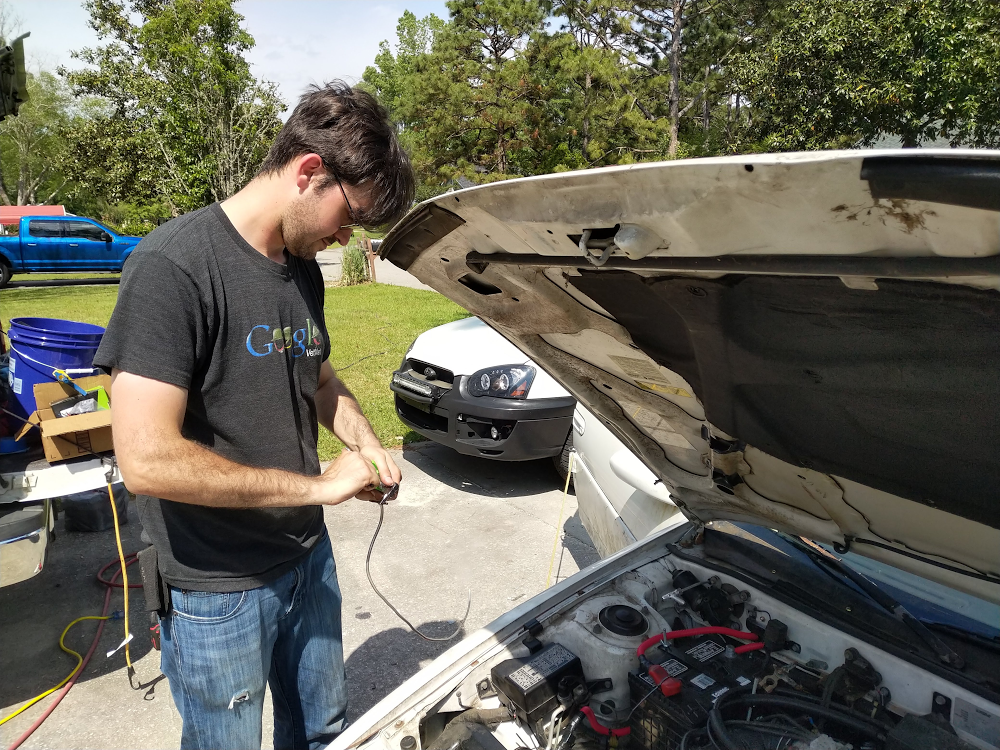
This April, Googlers Peter McDade and Clay McCauley spent an entire day trying to keep a $300 car running. No, they weren’t stuck on a nightmare of a road trip. They were competing in the 24 Hours of Lemons race, the culmination of eight months of blood, sweat and tears—and a whole lot of grease.

Peter and Clay work at a Google data center in Moncks Corner, S.C., located about 20 miles from Charleston. Like many Googlers, the two find joy in taking things apart and putting them back together to see how they work. The data center has a maker space for employees, where colleagues tinker with brewing, electronics and 3D printers, as well as an auto repair station, with a car lift and tools to let people work on their vehicles. But their “lemons” race was way more than an after-work hangout.

Here’s how a lemons race works: Participants must team up in groups, and each group must spend no more than $500 on a car. Then they fix it up, give it a wacky paint job and race them. This particular race, nicknamed Southern Discomfort, is a full-day race at the Carolina Motorsports Park; it’s one of the 24 Hours of Lemons races that take place across the U.S. throughout the year. Peter, Clay and two other friends each took one-hour shifts driving, while the rest of the group stayed on call as a pit crew, taking action in case anything broke. Which, given the price of the car, was pretty likely. “The point is not to win,” Peter says. “The point is to finish and have fun.”

Peter first came up with the idea of participating in the race, and spread the word at work. Clay was immediately interested and signed up to help, but didn’t think it would work out. “I was thinking, Oh, it probably isn’t that serious, it probably will never happen,'” Clay says. But they stuck with it once other friends outside of Google stepped up to join.

Their “lemon” car, which they purchased for $300.

Their “lemon” car, which they purchased for $300.

Their first challenge? Find a car for under $500. It took them months, but Clay ended up finding a listing for a $300 car, which had been sitting in a field for a long time. “It was actually sinking into the ground, it had been there for so long,” Clay says. “It had grass overgrown around it, and it had mold growing on the paint.” Though the car barely rolled, thanks to a badly bent wheel, they decided they could figure something out.

That was the beginning of five months of work. They stripped the car down, fixed elements like the brakes and the wheels and added required safety features like a roll cage. At first, they tinkered with the car on site at the data center, but soon moved it to Peter’s driveway, where it remained until the race. They spent Tuesday and Thursday evenings, plus weekends, working to get it in shape, and kept track of what they had to do with Google Sheets.

Peter worked on the car in his driveway.

Peter worked on the car in his driveway.

On the big day, other teams didn’t even expect them to finish because of issues with the car’s fuel system and what Peter calls “electronic gremlins.” But they did, and they bested even their own expectations. The team, nicknamed “The Slow and Spontaneous” as a nod to the “Fast and the Furious” movies, made it the full 24 hours, doing 309 laps and finishing in 49th place out of 84 participants.

  • 20190427_104927_HDR_new.jpg

    Clay at the wheel.

  • FB_IMG_1556544135650_new.jpg

    The car gets refueled mid-race.

  • 20190426_121708_HDR_new.jpg

    The car at tech inspection.

  • The "Slow and Spontaneous" crew signed the car.

    The "Slow and Spontaneous" crew signed the car.

Emerging victorious wasn’t really the point, though. It was to work on a project with friends, and learn new skills to boot. “We’re not satisfied with something being broken and having to throw it away and buying something new,” Peter says. “It’s better to get something you know you might be able to fix, trying to find it, and realizing that yeah, I could fail, but if I fail, I’m going to learn something.” And they’ll apply those lessons to their next lemons race, taking place this fall.

10 May 17:18

How AI can improve products for people with impaired speech

Most aspects of life involve communicating with others—and being understood by those people as well. Many of us take this understanding for granted, but you can imagine the extreme difficulty and frustration you’d feel if people couldn’t easily understand the way you talk or express yourself. That’s the reality for millions of people living with speech impairments caused by neurologic conditions such as stroke, ALS, multiple sclerosis, traumatic brain injuries and Parkinson's.

To help solve this problem, the Project Euphonia team—part of our AI for Social Good program—is using AI to improve computers’ abilities to understand diverse speech patterns, such as impaired speech. We’ve partnered with the non-profit organizations ALS Therapy Development Institute (ALS TDI) and ALS Residence Initiative (ALSRI) to record the voices of people who have ALS, a neuro-degenerative condition that can result in the inability to speak and move. We collaborated closely with these groups to learn about the communication needs of people with ALS, and worked toward optimizing AI based algorithms so that mobile phones and computers can more reliably transcribe words spoken by people with these kinds of speech difficulties. To learn more about how our partnership with ALS TDI started, read this article from Senior Director, Clinical Operations Maeve McNally and ALS TDI Chief Scientific Officer Fernando Vieira.

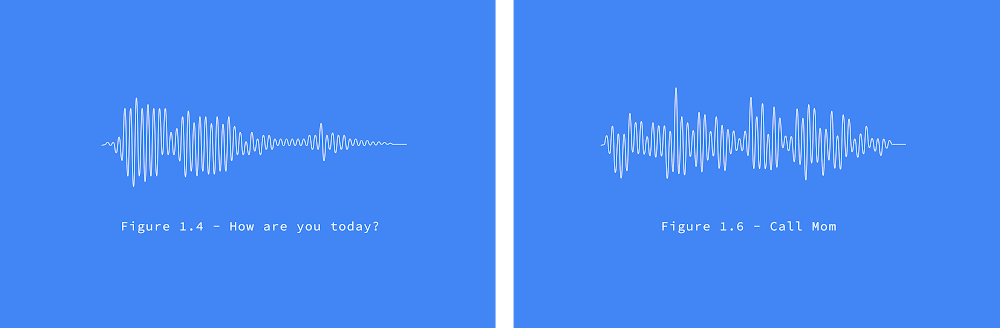
Euphonia_Waveform_TopologyGroups_ER_examples.png

Example of phrases that we ask participants to read

To do this, Google software turns the recorded voice samples into a spectrogram, or a visual representation of the sound. The computer then uses common transcribed spectrograms to "train" the system to better recognize this less common type of speech. Our AI algorithms currently aim to accommodate individuals who speak English and have impairments typically associated with ALS, but we believe that our research can be applied to larger groups of people and to different speech impairments.

In addition to improving speech recognition, we are also training personalized AI algorithms to detect sounds or gestures, and then take actions such as generating spoken commands to Google Home or sending text messages. This may be particularly helpful to people who are severely disabled and cannot speak.

The video below features Dimitri Kanevsky, a speech researcher at Google who learned English after he became deaf as a young child in Russia. Dimitri is using Live Transcribe with a customized model trained uniquely to recognize his voice. The video also features collaborators who have ALS like Steve Saling—diagnosed with ALS 13 years ago—who use non-speech sounds to trigger smart home devices and facial gestures to cheer during a sports game.

We’re excited to see where this can take us, and we need your help. These improvements to speech recognition are only possible if we have many speech samples to train the system. If you have slurred or hard to understand speech, fill out this short form to volunteer and record a set of phrases. Anyone can also donate to or volunteer with our partners, ALS TDI and the ALS Residence Initiative. The more speech samples our system hears, the more potential we have to make progress and apply these tools to better support everyone, no matter how they communicate.

10 May 16:47

Map to the Stars

by Keir Clarke
The Star Atlas is an interactive map showing you the position of the stars in the night sky. The map shows over 60,000 stars up to a magnitude of 8.5. If you share your location with the Star Atlas you can view the current position of the stars in the sky from where you are in the world. It is easy to translate the map to what you can actually see in the sky. The horizon is clearly shown on
07 May 13:57

Do I Need a Visa?

by Keir Clarke
If you are an international globetrotter then you should apply for citizenship of the United Arab Emirates. Travelers with a UAE passport can travel easily to more countries in the world than citizens of any other country. UAE passport holders can visit 167 countries with relative ease, 113 countries without a visa and 54 countries with a visa on arrival. Only 31 countries require UAE passport
01 May 12:07

The World in Globes

by Keir Clarke
From observing the cyclical movements of the stars in the night sky Greek philosophers theorized that the Earth was at the center of a circular universe. Aristotle surmised from the circular shadow of the Earth on the Moon that our planet must also be a globe. At least one of those Greek theories was correct. Humans have known for over 2,000 years that the Earth is round. We have also been
19 Apr 01:08

Mapping Urban Heat Islands

by Keir Clarke
While the governments of the world refuse to take action against climate change you might want to start planning how you are going to cope with the extreme heat of your future summers. Particularly if you live in a large town, city or other large built environment. It has long been known that certain areas of a town or city can be much warmer than other parts of the same town or city. This '
15 Apr 15:44

Leonardo da Vinci's Map of Imola

by Keir Clarke
In the early Sixteenth Century Niccolò Machiavelli and Leonardo da Vinci accompanied Cesare Borgia on his rampages through the Romagna region of northern Italy. Borgia, acting in the name of his father, Pope Alexander VI, was busy capturing city after city in order to create his own northern state in Italy. Machiavelli had been sent by Florence to accompany Borgia as an emissary-cum-spy.