Shared posts

04 Oct 17:32

Underground Cities

by Jonathan Crowe
Amazon (Canada, UK)
Bookshop

Mark Ovenden has made a career of publishing books about transportation systems and their maps that are both comprehensive and copiously illustrated. These include books about transit maps, railway maps and airline maps, as well as books about specific transit systems like the London Underground and the Paris Metro.

His latest, Underground Cities (Frances Lincoln, 22 Sep), is in some ways a natural progression from his past work: in the introduction he muses on the link between transit geekery and wondering about “what else lies down there beyond the walls” (p. 6). But in other ways this is quite a different book.

For one thing, Underground Cities is a book about cities’ underground infrastructure in general: not just subway lines and stations, but pedways, sewers, pneumatic mail systems and other utilities. For another, though maps, diagrams and other illustrations are found throughout this book, it’s about the infrastructure, not the maps.

The book is organized by city: 32 in all, 19 of which are in Europe, starting on the west coast of North America and moving eastward across Europe and Asia. Each chapter has a short essay on the underground infrastructure of the city, and is illustrated by photos (mostly of subway stations) and diagrams. Twenty of the chapters come with more detailed diagrams and maps. There are three types. First, each has a vertical scale showing just how deep the sewers, pipes caverns and subway stations go. Second, there’s a featured three-dimensional cutaway diagram showing the layout of some key facility, like a subway station or shopping mall. (London’s Picadilly station and Paris’s Forum des Halles are absolute standouts here, as are the facilities you wouldn’t expect, like Tokyo’s bike vaults, Helsinki’s swimming hall, or the Boring Company test tunnel in Los Angeles.)

Finally, there’s a two-page map spread of the underground city, which includes subways (and some surface rail lines), sewer lines and pedestrian passages. Each map spread uses a single colour scheme; all subway lines are orange regardless of the colour assigned to them by the official subway maps, which means that the Red Line and the Blue Line are all depicted with orange lines. A dense subway network like Paris’s becomes cluttered and indistinguishable. The map shows that there’s a subway line there, but it’s decidedly not for navigation. It’s an overview. So too is the text an overview, though there are some interesting gems there, like the cheese storage in New York City, and the tunnels carved into the Rock of Gibraltar.

Even with the included photographs, maps and diagrams, compared to some of Mark’s earlier books Underground Cities seems a bit sparse, if only because Transit Maps of the World and Paris Underground (the two books I’ve seen and reviewed) were so lavish and colourful. (Also, 12 out of the 32 cities have no maps or diagrams.) It occurs to me that this is probably a function of its subject matter. Transit systems have maps, posters and other ephemera that can be reprinted; sewer systems, pneumatic tube lines and bomb shelters, not so much. Those systems may (like Moscow’s secret Metro-2, or Tokyo’s mystery tunnels, both of which are tantalizingly and all too briefly mentioned here) be unmappable, though it may simply be that the systems are just unmapped, at least not in an accessible fashion. Rather than reprinting, Mark must have maps (by Lovell Johns) and cutaway diagrams (by Robert Brandt) made for purpose, which is (I’m guessing here) an impediment to going all-out.

For the purposes of The Map Room’s audience, this is not a book where the maps are front and centre; it’s an interesting introduction to a map-adjacent subject, and it’s got interesting maps and diagrams, though not nearly enough of them. This was a pregnant book that left me wanting more: more cities, more maps, more detail in the text and illustrations, as though every chapter ought to have been a book in its own right.

Disclosures: I received an electronic review copy of this book from NetGalley. Mark and I are acquainted in an online sense, and I’ve published an essay of his on The Map Room.


Underground Cities (cover)Underground Cities
by Mark Ovenden
Frances Lincoln, 22 Sep 2020
Amazon (Canada, UK) | Bookshop

27 Sep 15:40

A Blueprint to Save Earth

by Keir Clarke
A global team of scientists has spent over two years identifying the areas around the world that need to be protected in order to save the remaining biodiversity and biological wealth of our planet. If these identified areas are not conserved then we will not safeguard our biosphere. The Global Safety Net is therefore nothing less than a blueprint which has been designed to help save planet
19 Sep 17:11

The Interactive Whodunnit Map

by Keir Clarke
Crime City is a fun board game which is played on a hand-drawn city map. The demo of the game can also be played online as an interactive map. At the heart of Crime City is a large hand-drawn city map. This map contains a number of crimes and the clues that you need to solve them. The online demo of the board game uses the Leaflet.js interactive mapping library to allow you to play the game on
01 Sep 22:39

Monitoring the Arctic Heat Wave

by Jonathan Crowe
Extreme temperatures in Eureka
ESA/Copernicus Sentinel (CC licence)

The European Space Agency has a post about monitoring the Arctic heat wave (mainly, it seems, through the Copernicus program). It’s illustrated by a few startling images from this summer: of Siberia’s wildfires, the record-low levels of Arctic sea ice, and (above) a map showing the land surface temperatures on Ellesmere Island, Nunavut on 11 August, when Eureka, Nunavut—80° N—had a record high of 21.9°C (71.4°F).

17 Aug 19:13

#ISeeYou: Helping survivors during COVID-19

by Malika Saada SaarYouTube

COVID-19 has exacerbated many long-standing challenges in our society, from homelessness to racial inequity. A critical one has been the pandemic’s effect on those who face domestic violence at home: The UN Population Fund projected in the spring that six months of lockdown measures would lead to at least 15 million more cases of domestic violence.

In March, advocates for families affected by domestic and sexual abuse reached out to us asking us for help. In response, we’ve been thinking through how we can provide the most useful, relevant information for those in need, as well as family members and friends trying to help a loved one. 

To that end, the Google Ad Grants program has given an extra $2 million of search ads to domestic violence organizations since May. In one example, a Google volunteer worked with the National Network to End Domestic Violence (NNEDV) to build new ad campaigns to reach people searching for legal resources, yielding a 3.5x increase in engagement. In addition, our COVID-19 hub now provides links to support for vulnerable communities, including organizations supporting survivors of domestic and sexual abuse.

The timing is critical to help survivors get access to services. NNEDV’s WomensLaw.org Email Hotline reported that COVID-related inquiries increased more than 350 percent from March to April and more than 200 percent from March to May. That’s why together with our partners, we’re launching a new video campaign called #ISeeYou to help increase visibility of available services and to remind survivors that they are not forgotten.

Staying home is not a safe option for everyone. And COVID-19 has created financial, housing and childcare challenges that will further affect survivors over the coming months. The teams at hotlines, nonprofits and support organizations are doing incredible work to help. You can learn more about this work and the #ISeeYou campaign from Deborah J. Vagins, President and CEO of NNEDV over on the YouTube blog

And please share the #ISeeYou campaign or any of our other resources with your communities and help survivors know that we stand with them.

08 Aug 22:57

When a crisis happens, Google.org's Alex Diaz steps up

by Keyword Team
Alex Diaz.JPG

After Hurricane Dorian struck the Bahamas last year, Alex Diaz and his colleagues at Google.org took action. A team of Google volunteers on the Google.org Crisis Connectivity team spent 80 days in the field, helping to bring back Internet connectivity in dozens of locations. Residents were able to access critical information, connect with family members and simply de-stress by going online. 

More recently, Alex and his team worked with GiveDirectly for their Project 100 cash transfer project for COVID-19 relief. This time, the work he did was personal. “For many of my early years I lived with my biological mother,” he says. “We were often cash-strapped. Unplanned sudden financial shocks always had long-term ramifications.” During this ongoing crisis, he saw the immediate benefits of giving cash directly to families in need. 

Alex leads the Crisis Response and Humanitarian Aid portfolio at Google.org. He manages Google’s philanthropic response to global crises, such as natural disasters and public health emergencies, providing nonprofits on the frontlines with funding, volunteers, and other support. Here’s how he explains the work he does, and how tech and philanthropy can work together.

What does “crisis response” philanthropy mean at Google.org?

At our core, we back tech-enabled projects that help communities better prepare, respond and recover from crises. We make grants, encourage Googlers to donate (with a company match) and send our skilled volunteers to the communities that need it most. To have the greatest impact, we rely on strong partnerships with nonprofit organizations around the world which are preparing communities for disasters or delivering relief and recovery efforts. These organizations are the experts; we learn about their needs and search for where our philanthropic capital, coupled with technology, can help make the biggest difference. 

How does Google.org approach a crisis? 

We dedicate resources to stand with communities along the disaster cycle, from preparedness ahead of crises, to immediate relief after a crisis strikes, all the way through long-term recovery. Research continues to show that long-term support, particularly to local NGOs, is vital to a community’s recovery. Long after the media attention goes away, communities require ongoing, flexible funding to rebuild and to heal.

While philanthropy is important to support the efforts of frontline organizations, Google.org’s greatest asset is our technical talent. We often pair our grants with technical volunteers or pro bono support. One example is a project with GiveDirectly, in which we paired a $3 million grant with full-time support from Google engineers through the Google.org Fellowship program. That work supported a tool that will help target direct cash transfers to low-income families after a future U.S.-based natural disaster. The Google.org Fellows created a data-mapping tool that layers socioeconomic vulnerability data with disaster damage data to more quickly locate the pockets of highest need in an affected area. 

We also help manage a team of volunteers under our Google.org Crisis Connectivity program, who go to disaster-affected places with partners like NetHope and ITDRC to install temporary internet connectivity in critical locations such as shelters, clinics and schools.

That sounds challenging. What’s the hardest part about your job?

My job can take a personal toll. Reading about and working on crises 24/7 can add up. In some form or another I’ve worked on crises since starting at Google in 2016, and while I’ve learned to process complex emotions on the job, I would be lying if I said there were not moments where crises got the best of me. Thankfully, our company provides employees with great resources to help, and our team has created a culture of support to navigate these moments effectively. 

Another difficult aspect of the job is that even at a large company like Google, our resources will still never be enough to match the scale of global need every year. We can’t respond to every crisis, although we’d love to. So we look for the sweet spot where our philanthropy and technical expertise can make the most impact.

Everyone can do something. I think that's really the underlying message of this COVID-19 response—we're in this together.

How has responding to COVID-19 been different from past crises?

For all disasters, the needs are normally greater than the resources we have at hand. This is especially true with COVID-19, and it is affecting everyone in every corner of the globe simultaneously. During “normal” crises such as natural disasters, responding organizations or governments often reallocate resources to different parts of the world or country to support affected areas. That isn't possible with a global pandemic. The needs are so vast, diverse and geographically diffuse. We’ve tried to stick to areas where we can use our expertise: health and science, distance learning and economic relief and recovery.

What’s your advice to people who are looking to donate money in a crisis? How about during the pandemic?


Ask yourself: Is the solution you want to support better, however you define better, than simply giving people the equivalent in cash? Direct cash transfers are efficient and effective. Research shows that cash has a strong track record in effectively supporting some of the most vulnerable communities, and recipients largely prefer it over traditional forms of aid. GiveDirectly led the way in testing the efficacy of direct cash transfers in the humanitarian sector and as a disaster relief tool


With respect to COVID-19 relief, the needs are enormous. I’d encourage potential donors to pick their area of concern or passion, whether that is food assistance or support for our frontline healthcare workers, and to channel support locally or to the nearest area of greatest need.  Everyone can do something. I think that's really the underlying message of this COVID-19 response—we're in this together. 

We’ve learned from the way COVID-19 disproportionately affects Black and brown Americans that we’re really dealing with intersecting crises involving both health and race. How do you think about centering equity in your work?


I am Afro-Latinx. I have been the target of racial profiling by police. Even still, I am protected by my privilege of being lighter skinned. My heart goes out to my Black sisters and brothers who have endured so much pain through several difficult weeks, after several difficult months, after several horrifying centuries. What the world witnessed in an eight-minute video of George Floyd’s murder is the community’s everyday experience. Everyone needs to step up to ensure that equal justice under the law is more than just a value, but a reality. As Cornel West says, “justice is what love looks like in public.”


Equity is at the core of grantmaking at Google.org, and crisis grantmaking is no exception. To effectively respond to intersecting crises, we first need to acknowledge that race is a critical intersection. After we’ve acknowledged this reality, it is imperative to understand what it means and why, and to do this, we need data. Data that informs not only our understanding of the problem, but also what can be done to promote more equitable solutions. This is the primary motivation behind our recent $1 million grant and Google.org Fellowship to the Satcher Health Leadership Institute at the Morehouse School of Medicine. 

The Morehouse team, with support from Google.org Fellows, is planning to assemble a data consortium and develop a platform to map data related to racial and ethnic groups, socioeconomic status, medical conditions and health system access at the county level in order to examine the trajectory of COVID-19 cases and deaths across the United States. This work will hopefully allow researchers and policymakers to understand the impact of the virus on communities of color and inform effective and equitable policymaking in government response efforts. This is just a tiny step of the many steps we as a society need to take to move our country closer to the ideals that bind us.

04 Aug 17:23

17,572 singers, in perfect harmony (from their own homes)

by Megan FriedmanThe Keyword

When you think of a choir, you likely put a descriptor before it: a school choir, a church choir, a community choir. Singing in a chorus usually means you’re standing within a large group of people, belting out songs and nailing those harmonies together. But what happens when you can’t gather in person to sing? 


That’s where virtual choirs come in. Composer and conductor Eric Whitacre has been putting them together for more than a decade, long before the pandemic left us stuck at home—and his most recent collaboration, which debuted on YouTube July 19, is his biggest project yet. 


Whitacre started organizing Virtual Choirs in 2009, when a fan uploaded a video of herself singing one of his choral compositions. He saw the video, then asked others to record themselves singing the other parts of the same composition to form a “choir.” That first group featured 185 singers, and each one since has grown larger and larger, to more than 8,000 voices for the fifth performance in 2018.

Eric Whitacre Credit Marc Royce.jpg

Eric Whitacre (Photo by Marc Royce)

This year, signups for Virtual Choir have skyrocketed. More than 17,000 singers from around the world found a way to participate in the sixth recording from the isolation of their own homes. They all learned “Sing Gently,” a song Whitacre composed during the pandemic. “Even early on, you’d be walking down the street in masks and you’d go out of your way to not pass someone,” Whitacre says. “A random stranger would become a threat. That was hard to see, and I was feeling that all over.” So the lyrics to “Sing Gently” encourage people to “live with compassion and empathy, and do this together,” he says. 


The Virtual Choir team uses every video submitted, unless there’s a technical problem with the recording. That means there are thousands of videos to sync together, and thousands of sound recordings to edit so the result sounds seamless. This time around, the team featured three sound editors, six people reviewing each submission and two executive producers; the team was scattered through the U.S., the U.K. and South Africa. Across three different continents, they used Google Docs and Google Sheets to keep track of their progress, Google’s webmaster tools to manage thousands of email addresses and Google Translate to keep in touch with singers around the world. Singers checked the choir’s YouTube channels for rehearsal videos, footage of Whitacre conducting the song and Q&As with other singers and composers.

Sing Gently.jpeg

The video for "Sing Gently" features the song's lyrics and footage of the singers, who recorded from their homes.

It was also significant that these singers came together (figuratively speaking) at a time when musicians are suddenly out of work. “It’s an especially surreal moment for singers, because we’ve been labeled as superspreaders,” Whitacre laments, referring to a term for people who spread the disease more than others; in one instance, dozens of singers in Washington state were infected after a choir practice.  “Even just the act of singing is dangerous for other people.” He says he was struck by the number of participants who told him it felt good to sing with others again—even though they weren’t actually performing in the same room. 


Molly Jenkins, a choir lover based in North Carolina, was one of the 6,262 sopranos who took part in “Sing Gently.” She had always wanted to join a virtual choir, but never found the perfect time to give it a try. But since there’s no such thing as a perfect moment in a pandemic, she decided to figure out a way to make it work. 

This, I think, is the best of the promise of the Internet. Eric Whitacre
composer and conductor

With her phone in hand to hear the guide tracks, Molly practiced whenever and wherever she could: in the shower, at the kitchen table while working from home, in her front yard and while burping her baby. When it came time to record her track, there was one problem: finding a quiet place to record. “There was no space to record where a shrieking, gurgling baby wouldn’t interrupt the take,” she says. 

She ended up in her car on a rainy day, playing the conductor track on her laptop and recording her vocals on her phone. Sound engineers were able to isolate her vocal track from the background noise of the rain tapping on her windshield. “I’m just so glad I went for it,” Molly says.

Whitacre says that improvisational spirit is key to creating his choirs, and he’s grateful that technology can enable great collaborations despite social distancing. “It really speaks to the best of technology,” he says. “This, I think, is the best of the promise of the Internet.”

03 Aug 00:50

The Long View of London

by Keir Clarke
Panoramic maps are a wonderful hybrid of landscape painting and city map. The panoramic bird's eye views of cities we see in panoramic maps provide a wonderful historical snapshot of a city at a particular moment in time. London is lucky in that over the centuries a number of beautiful panoramic maps of the city have been lovingly created by some wonderful artists. Interestingly these panoramas
01 Aug 18:11

Garmin’s Slow Recovery from Last Week’s Ransomware Attack

by Jonathan Crowe

Engadget reports that Garmin’s services are starting to come back online after last week’s ransomware attack:

[I]t looks like things are slowly but surely coming back to life. Yesterday, activity-tracking app Strava confirmed that it was again able to send workout data to Garmin’s Connect service. […] But a quick look at Garmin’s system status page shows there are still plenty of issues across its platform.

Unfortunately, Garmin’s relative lack of communication around these issues means we still don’t know exactly what went wrong or when users can expect things to be back to normal. A few other key services, like registering a new device, are also back up and running, but if you’re still experiencing oddities with your Garmin devices, you’ll have to keep being patient.

Garmin’s FAQ on the outage is not particularly forthcoming.

Previously: Garmin’s Online Services Hit by Ransomware Attack.

Update, 1:48 PM: Garmin has issued a statement confirming that “it was the victim of a cyber attack that encrypted some of our systems on July 23, 2020.” There is no sign that customer data was affected, and they expect a return to normal within a few days. [Engadget]

01 Aug 18:10

Garmin’s Online Services Hit by Ransomware Attack

by Jonathan Crowe

Garmin’s online services have been hit by a ransomware attack, TechCrunch reports, with outages still ongoing as of this writing. “The incident began late Wednesday and continued through the weekend, causing disruption to the company’s online services for millions of users, including Garmin Connect, which syncs user activity and data to the cloud and other devices. The attack also took down flyGarmin, its aviation navigation and route-planning service.” Email and call centres are also reportedly out of operation.

25 Jul 15:05

Georgia’s COVID-19 Maps: Bad Faith or Bad Design?

by Jonathan Crowe

In How to Lie with Maps, Mark Monmonier warns that map readers “must watch out for statistical maps carefully contrived to prove the points of self-promoting scientists, manipulating politicians, misleading advertisers, and other propagandists. Meanwhile, this is an area in which the widespread use of mapping software has made unintentional cartographic self-deception inevitable.”1

So which of these two scenarios—careful contrivance or unintentional self-deception—is at play on the Georgia Department of Public Health’s COVID-19 daily status report page?

Twitter user @andishehnouraee notes the difference in scale between two county-by-county COVID-19 maps of Georgia. The earlier map maxes out at 4,661 cases per 100,000, the later (and as of this writing, current) map maxes out at 5,165 cases per 100,000. As they point out, there has been a 49 percent rise in total COVID-19 cases between the two maps, but you wouldn’t know it at a glance, because the scales have changed in the meantime.

Is this, as @andishehnouraee suggests, a concerted attempt to hide the severity of the outbreak in Georgia—or, as T. J. Jankun-Kelly thinks might be the case, something that happens when you max out the old scale. In other words: bad faith or bad design? (Or both: it can be both.)

Update 19 Jul: See Twitter threads from Darrell Fuhriman and Jon Schwabish disagreeing with critiques of the Georgia Public Health maps. It’s worth clarifying that only one map is ever viewable at the website: the map’s scale has changed over time, but it’s not like they’re side-by-side except in @andishehnouraee’s tweet.

Update #2: See Jon Schwabish’s blog post critiquing the data visualization critique in more detail.

11 Jul 00:32

You’re invited to participate in “Life In A Day 2020” on July 25

by YouTube
On July 25, executive producers Ridley Scott (“The Martian,” “Gladiator”) and Kai Hsuing (“Lords of Chaos”), along with director Kevin Macdonald (“Whitney,” “One Day in September,” “The Last King of Scotland”), invite you and the YouTube global community to pick up your cameras to create “Life In A Day 2020.”

Exactly 10 years after the original “Life In A Day,” the world will once again come together to create a YouTube Original feature-length documentary that tells the story of a single day on Earth. Selected footage sourced from participants like you will be woven together in this documentary to tell the story of an ordinary day during these extraordinary times. “Life In A Day 2020” will premiere at the Sundance Film Festival and on YouTube in 2021.

How the project works


On a single day, Saturday, July 25, people around the world are invited to film their day.

Maybe you'll be filming from home as you continue to navigate the coronavirus pandemic, or maybe you're in a part of the world where you're figuring out how to move forward in a transformed world. Maybe you're connecting with friends, reuniting with family, or going to work. Maybe it's a special day - you’re getting married, moving out, sharing important news. Or maybe it’s just a normal day. We want to weave together these unique experiences and perspectives to create a time capsule of this moment.

The final feature film will be edited over the course of five months, crafted entirely through what is found in the submitted footage. Once the submission window closes, a 30-person team of multilingual reviewers stationed around the world will begin reviewing and translating submitted videos. Three principal feature editors - Nse Asuquo (House of My Fathers, The Jazz Ambassadors), Mdhamiri Á Nkemi (The Pale Horse, Blue Story), and Sam Rice-Edwards (Whitney) - will then undertake an enormous post-production effort, working alongside director Kevin Macdonald, to shape the film's final narrative out of the submitted footage. br />

Who can take part


The filmmakers are encouraging people from all over the world to take part, and they hope to capture a wide perspective on life. Submissions are open from July 25 to August 2, which means you will only have one week to submit your footage at lifeinaday.youtube.

While only a small number of the submitted clips will make it into the movie, YouTube and the filmmakers hope the filming day itself becomes a significant day of global participation. The “Life In A Day 2020” project celebrates the importance of everyone coming together in a moment of equal, worldwide collaboration.

About the original film


In 2010, “Life In A Day” brought the YouTube community together for a massive participatory feature film project that attracted 80,00 submissions. The final film premiered at Sundance in 2011, was released globally in theatres, and has been watched on YouTube over 16 million times.
06 Jul 16:29

The Virtual Hajj

by Keir Clarke
This year, because of the coronavirus outbreak, the Hajj pilgrimage has been limited to only one thousand pilgrims. For Muslims the sacred Hajj pilgrimage is an essential life journey, a trip which they must make (if they are capable) at least once in their lifetime. The Kontinentalist has created an interactive story map, Inside the Sacred Hajj Pilgrimage, which explains how people undertook
06 Jul 16:09

One percent of Googlers get to visit a data center, but I did

by Stephanie Wong

For years I’ve wondered what it’s like behind the protected walls of a Google data center, and I’m not alone. In my job at Google, I spend my days working with developers. Our data centers are crucial to the work that they do, but most have never actually set foot inside a data center. And until recently, neither had I. I went on a mission to find answers to common questions like: Why are visits so tightly restricted? How secure is a Google data center? How do we meet regulatory requirements? Here's what I found out.

To keep our customers' data safe, we need to make sure the physical structure of the data center is absolutely secure. Each data center is protected with six layers of physical security designed to thwart unauthorized access. Watch the video above to follow my journey through these layers to the core of a data center, and read on to learn even more.

“Least privilege” is the rule to live by

badge swipe

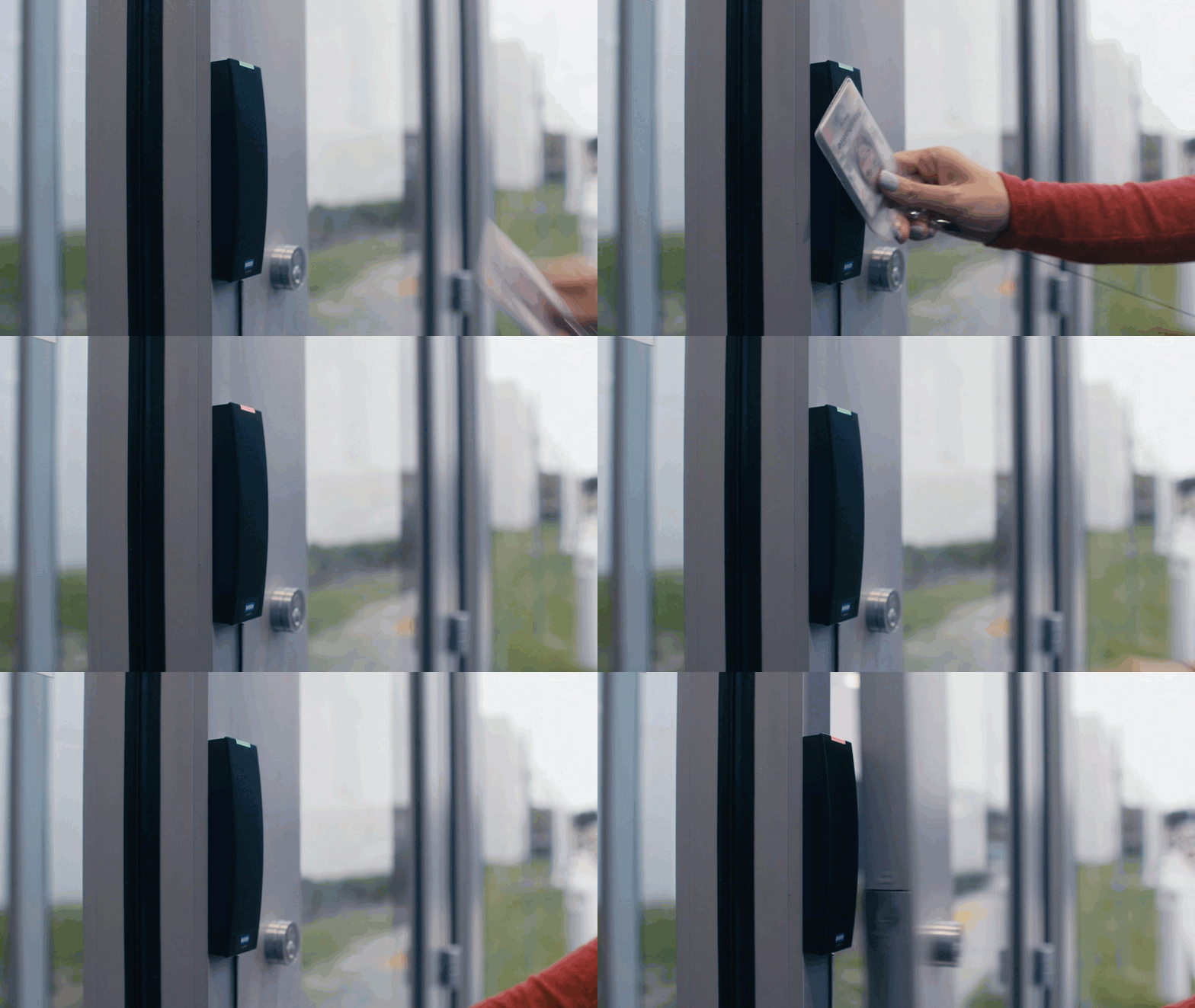
There are two rules strictly enforced at all Google data centers. The “least privilege” protocol is the idea that someone should have only the bare minimum privileges necessary to perform their job. If your least privilege is to enter Layer 2, you won’t have luck moving to Layer 3. Each person’s access permissions are checked at badge readers that exist at every access point in a data center facility. Authorization measures happen everywhere using this protocol. 


Another rule exists that prevents a vehicle or individual closely following another to gain entry into a restricted area without a badge swipe. If the system detects a door open for too long, it immediately alerts security personnel. Any gate or door must close before the next vehicle or person can badge in and gain access.

Two security checks: badge first, then circle lock

circle lock

You’ve probably seen dual-authentication when you try to sign into an account and a one-time password is sent to your phone. We take a similar approach at the data centers to verify a person’s identity and access. At some layers in the data center, you’re required to swipe your badge, then enter a circle lock, or tubular doorway. You walk into a special "half portal" that checks your badge and scans your eyes to gain access to the next layer of the data center. It prevents tailgating because only one person is allowed in the circle lock at a time.

Shipments are received through a secure loading dock

The facility loading docks are a special section of Layer 3, used to receive and send shipments of materials, such as new hardware. Truck deliveries must be approved for access to Layer 3 to enter the dock. For further security, the loading dock room is physically isolated from the rest of the data center, and guard presence is required when a shipment is received or sent.

All hard drives are meticulously tracked

hard drive

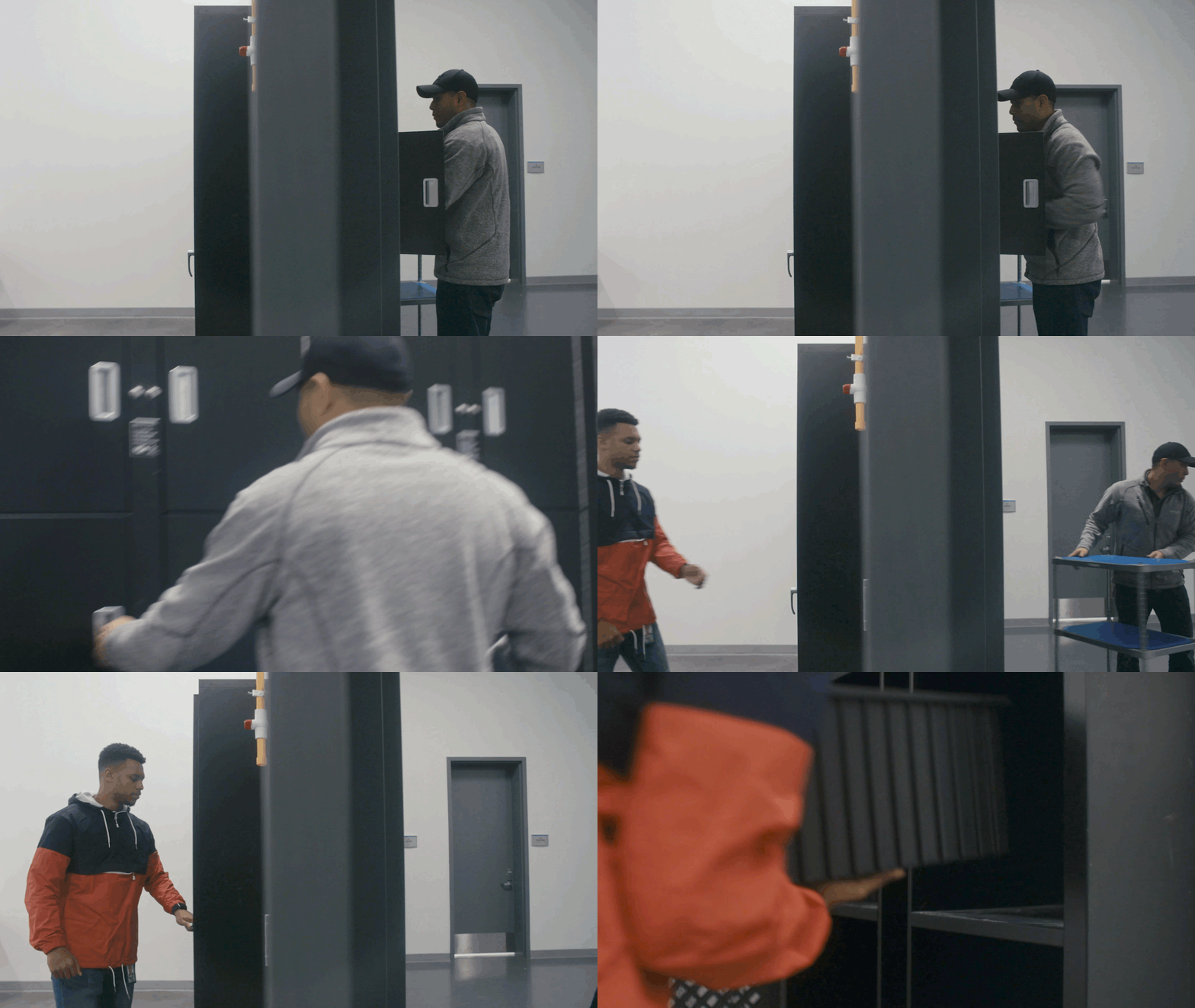
Hard drive tracking is important to the security of your data because hard drives contain encrypted sensitive information. Google meticulously tracks the location and status of every hard drive within our data centers—from acquisition to destruction—using barcodes and asset tags. These asset tags are scanned throughout a hard drive's lifecycle in a data center from the time it’s installed to the time it's removed from circulation. Tracking hard drives closely ensures they don’t go missing or end up in the wrong hands.


We also make sure hard drives are properly functioning by doing frequent performance tests. If a component fails to pass a performance test, it’s deemed no longer usable. To prevent any sensitive information from living on that disk, we remove it from inventory to be erased and destroyed in Layer 6, Disk Erase. There, the disk erase formatter uses a multi-step process that wipes the disk data and replaces each bit of data with zeros. If the drive can’t be erased for any reason, it’s stored securely until it can be physically destroyed. 

Layered security extends into the tech itself

Our layered security approach isn’t just a physical safeguard for entering our data centers. It’s also how we protect the hardware and software that live in our data centers. At the deepest layer, most of our server boards and networking equipment are custom-designed by Google. For example, we design chips, such as the Titan hardware security chip, to securely identify and authenticate legitimate Google hardware. 

At the storage layer, data is encrypted while it travels in and out of Google’s network and when it’s stored at the data center. This means whether data is traveling over the internet outside of Google’s facilities, or stored on our servers, it’s protected. Google Cloud customers can even supply their own encryption keys and manage them in a third-party key management system deployed outside Google’s infrastructure. This defense-in-depth approach helps to expand our ability to mitigate potential vulnerabilities at every point.

To learn more about our global data centers, visit our Data and Security page. We will also be sharing more about our security best practices during the upcoming Google Cloud Next ’20: OnAir event.

23 Jun 18:48

The Multilingual Map of the World

by Keir Clarke
Country Names in Any Language is an interactive map which allows you to view an atlas of the world on which the country labels are written in the language of your choice. Using the drop-down menu you can select from any language in the world to view a map on which the country name labels are displayed in the selected label. The country names for each language are fetched live from Wikidata and
20 Jun 18:04

A 3D Reconstruction of a Crime Scene

by Keir Clarke
In October of last year Iraq's security forces violently cracked down on protesters in Baghdad and southern Iraq. In Baghdad the security forces used lethal military-style tear gas and smoke grenade launchers against civilians which resulted in a number of gruesome deaths. In order to show how the security forces were deliberately using these grenades to maim and kill protesters Amnesty
20 Jun 16:30

Using Google Maps to Create a Real-World Paracosm

by Jonathan Crowe

Brendan Koerner’s 12-year-old son has been spending the lockdown planning a summer road trip in great detail using Google Maps. As it turned out, his son was doing something more than, and other than, simply planning a trip: he was using maps to create a paracosm, one based in data and real locations rather than fantasy space.

In the days that followed, I’d often catch my son on Google Maps with pen in hand, jotting down increasingly specific bits of information that he considered essential to his plans: the names of bridges that span the Susquehanna River, the phone numbers for motor inns in Greater Pawtucket, the best things to eat while watching the New Hampshire Fisher Cats. (The stadium’s clam chowder has received lavish online praise.) As I watched him get lost in the pleasure of these tasks, I realized that he was under no illusions about the trip’s actual odds of taking place. He was immersing himself in Google Maps not because he expected we’d be attending a Norwich Sea Unicorns game anytime soon, but so he could build himself a sanctuary—a space where he’s in charge of how an uncertain future will unfold.

Getting lost in maps is an activity I expect a lot of us recognize, and have done ourselves, though the particulars are probably unique to each of us. (Random thought: Is this one reason why fantasy novels come with maps? Are the maps doing more of the work than we thought?)

30 May 15:10

Tom Patterson’s Physical Map of the Contiguous United States

by Jonathan Crowe
Physical Features Map of the Contiguous United States
Tom Patterson

Tom Patterson’s latest project is a map of the physical features of the contiguous United States.

This map showcases physical features—mountains, plains, rivers, lakes, etc.—of the 48 contiguous US states. Map colors reflect natural environments across the continent from the forested east to the snowcapped Rockies to the desert southwest. You will also find a smattering of cities and faint state lines for reference.

Emphasis on smattering: there are only enough human features—cities and borders—to orient the reader; the focus is on bodies of water and landforms.

It’s freely available and in the public domain: it can be downloaded, shared and modified.

30 May 14:53

Spot the scam, stop the scammers

by Vint Cerf

According to the Federal Trade Commission (FTC), people reported $1.9 billion lost to scams in 2019. Every minute, more than $3,600 disappeared from wallets and bank accounts in response to made-up stories of urgently overdue tax payments, bogus contest winnings, or a smooth-talking online suitor who suddenly needs some gift cards. A high-pressure phone call or exciting message can overcome many people’s judgment, especially if they are caught  at a vulnerable moment.

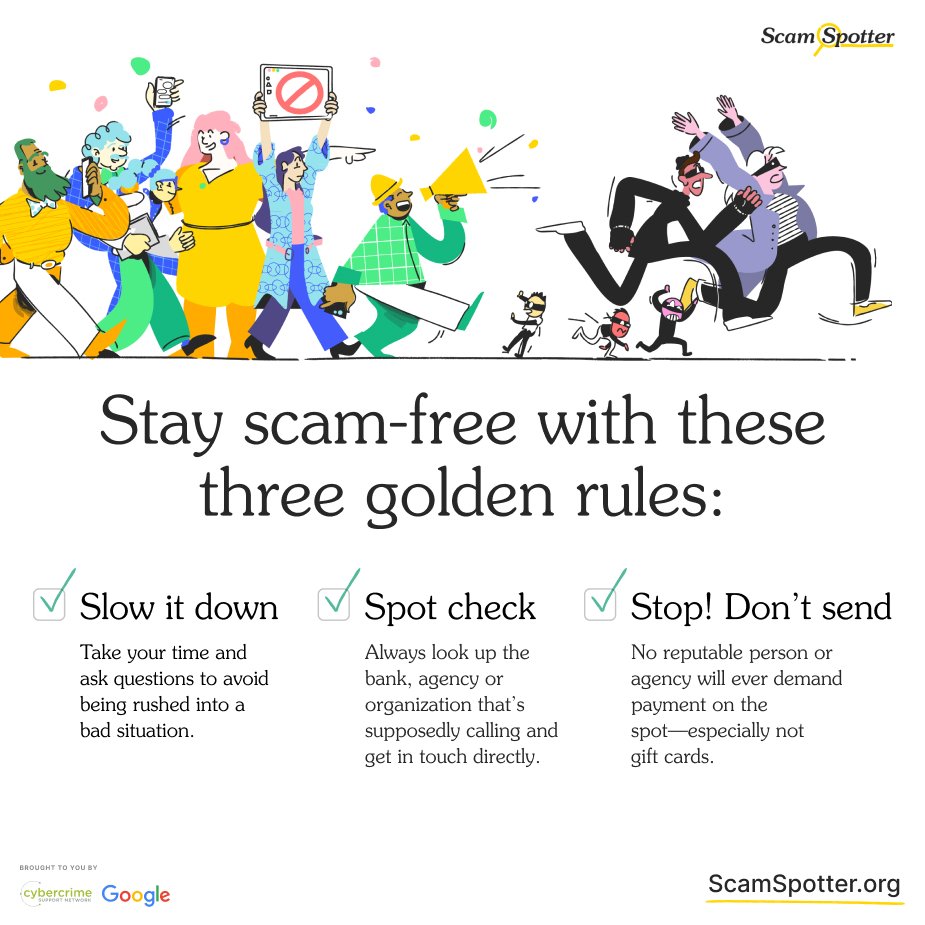
As the record-high scam reports keep coming, we’re providing support to the Cybercrime Support Network to help people identify scams before they fall victim to them through a new program called Scam Spotter. It simplifies expert advice with three golden rules—remember to refer to these rules when you receive a suspicious phone call or message to figure out if it’s a scam:

  • Slow it down: Are they telling you it’s urgent? Take your time and ask questions to avoid being rushed into a bad situation.
  • Spot check: Are they claiming to be from a specific institution? Do your own research to double check the details you’re getting. 
  • Stop! Don’t send: Are they asking you to go to the store and get gift cards? If you think a payment feels fishy, it probably is.

Just because COVID-19 has disrupted everyone’s life, it doesn’t mean the scammers have taken a break. In fact, scammers have exploited the pandemic with alarming speed, taking advantage of fear and uncertainty. More than $40 million in fraud losses have been reported to the FTC related to a myriad of COVID-19 complaints. While the stories are new—invented stimulus packages, phoney charities, romantic interests who now have an uncle in the ICU—the same three golden rules apply equally well:

Scam Free Golden Rules.jpg

While people ages 25-40 are most likely to be scammed, research shows it’s seniors who stand to lose the most, with their median losses more than double the average. As one of the architects of the Internet and an executive sponsor of the “Greyglers,” an internal group that promotes awareness of age diversity and issues related to age, I feel obligated to try to help my fellow Americans stay safe.  It will take a cross-generational effort. Please consider sharing ScamSpotter.org the next time you talk to the seniors in your life. Maybe you can both take the quiz and compare your scores, too.

Scammer Quiz Device.png

If we learn how to spot the bad actors, we can spend our time focusing on those moments that matter. And to the seniors out there, remember: of course the Internet is for us, we invented it!

30 May 14:49

Learn more about anxiety with a self-assessment on Search

by Daniel H. Gillison, Jr.

Editor’s note: This post is authored by Daniel H. Gillison, Jr., CEO of The National Alliance on Mental Illness.

Anxiety disorders affect 48 million adults in the U.S. Anxiety presents itself as a wide range of symptoms, and can be a result of biological factors or triggered by a change in environment or exposure to a stressful event. With COVID-19 introducing new points of stress, communities are seeing a rise in mental health issues and needs. New Census Bureau data released last week shows that a third of Americans are now showing signs of clinical anxiety or depression.

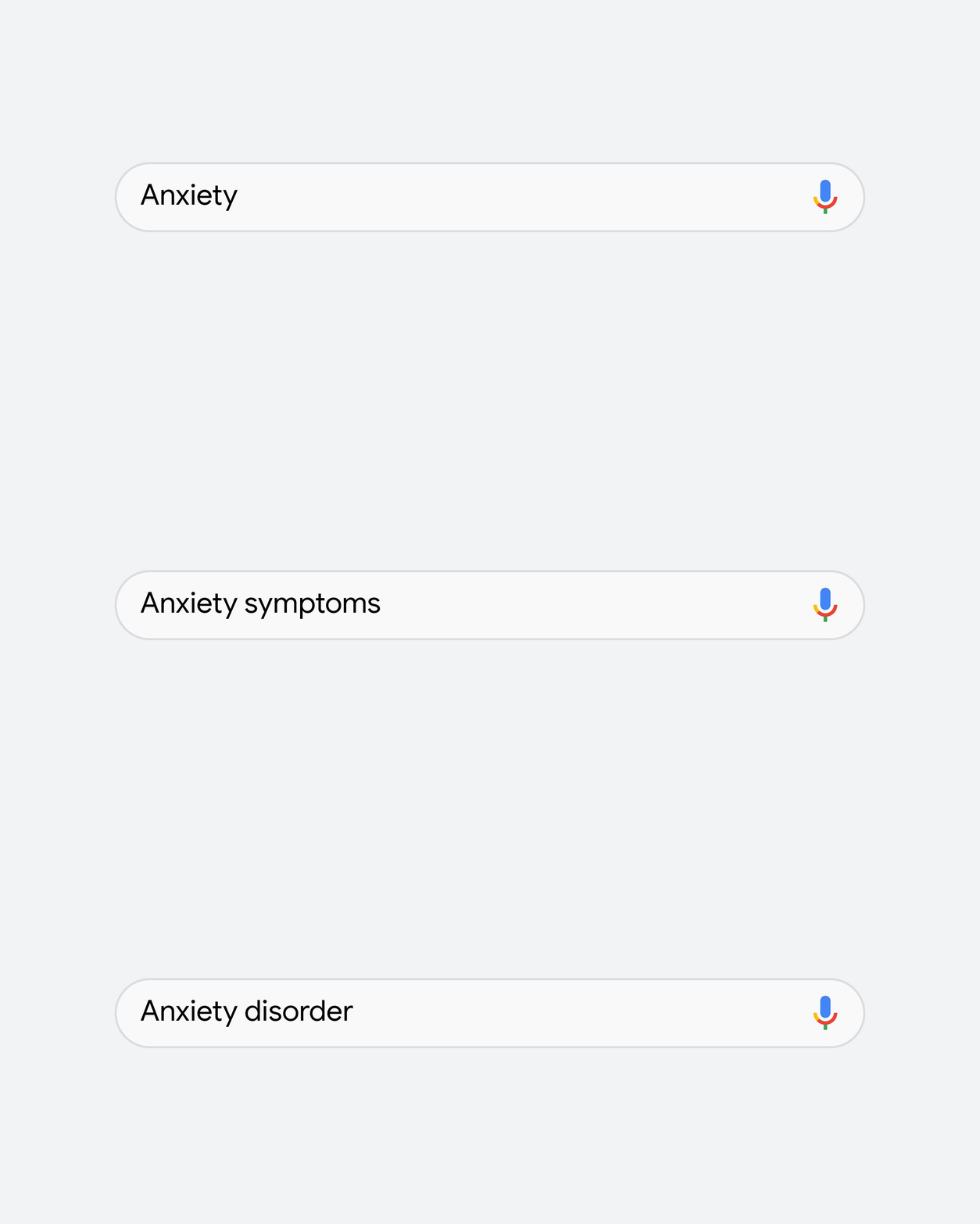
The National Alliance on Mental Illness (NAMI) is the nation’s largest grassroots mental health organization and we’re partnering with Google to provide access to mental health resources. Starting today when people in the U.S. search on Google for information about anxiety, we’ll provide access to a clinically-validated questionnaire called the GAD-7 (Generalized Anxiety Disorder-7). The GAD-7 will show up in the knowledge panel—the box of information that displays key facts when you search for something—and also has medically-validated information about anxiety, including symptoms and common treatments.

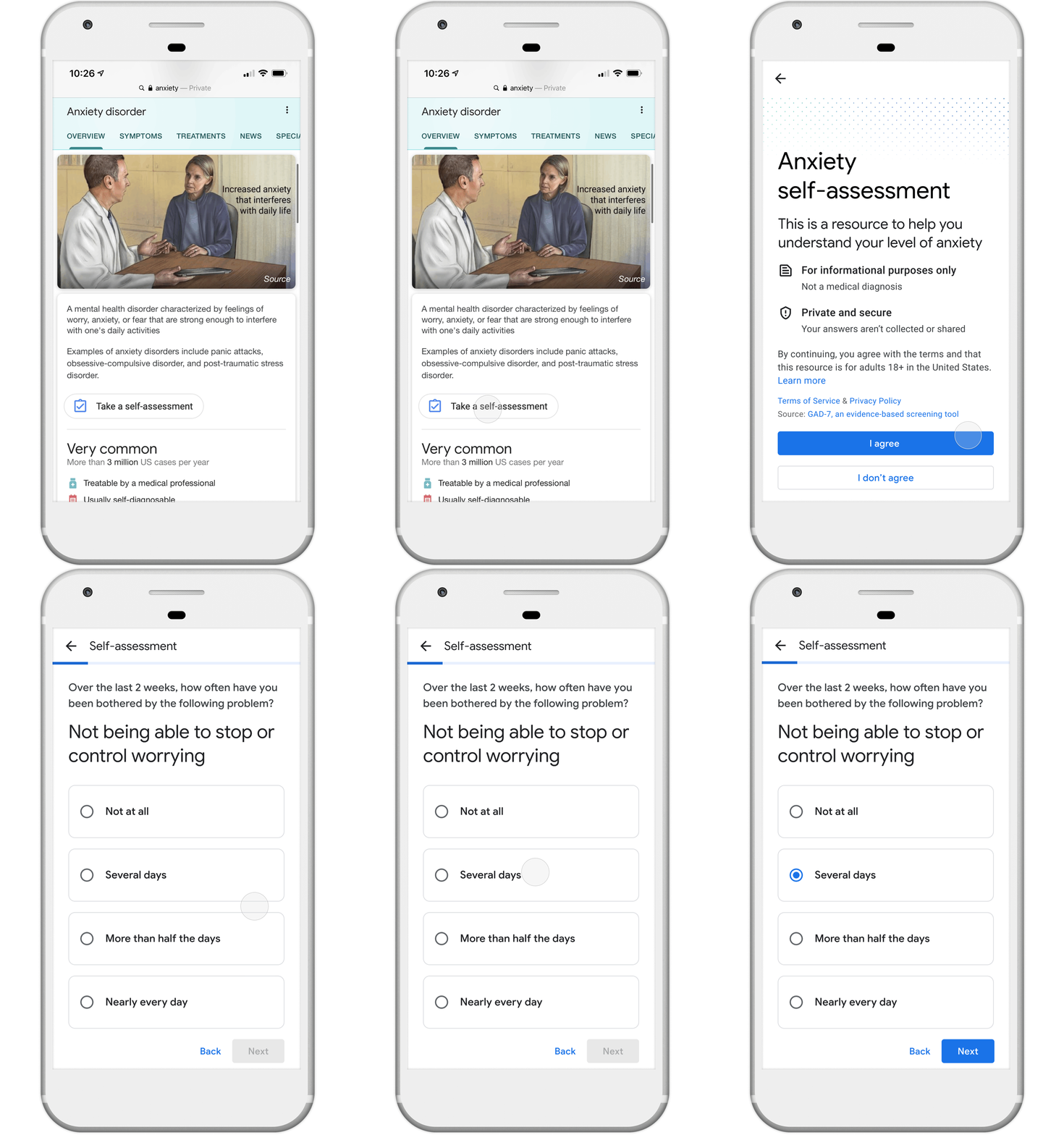
Anxiety self-assessment

This seven-question survey covers many of the same questions a health professional may ask, and your answers are private and secure (Google does not collect or share answers or results from the questionnaire). The GAD-7 helps people understand how their self-reported anxiety symptoms map to anxiety levels of people who completed the same questionnaire. The tool also provides access to resources developed by NAMI so people can learn more and seek help when needed. 

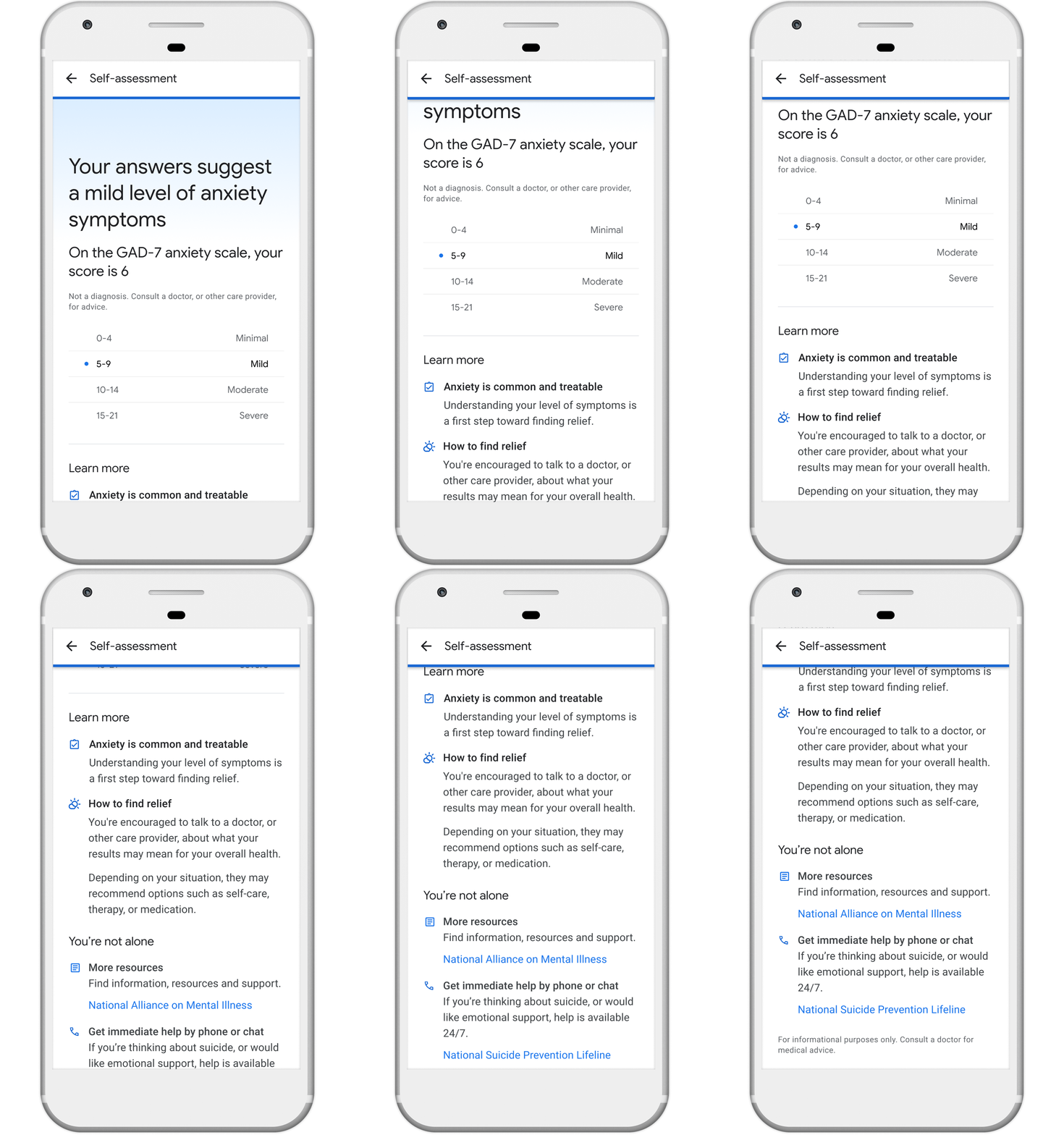
Anxiety self-assessment results

The GAD-7 is the third mental health screener available on Google Search. We’ve previously partnered with Google so that people who search for information on depression and PTSD can access relevant clinically-validated questionnaires that provide more information and links to resources about those conditions. The self-assessments are currently available in the U.S., and Google hopes to make them available in additional countries over time.

Anxiety can show up as a wide range of physical and emotional symptoms, and it can take decades for people who first experience symptoms to get treatment. By providing access to authoritative information, and the resources and tools to learn more about anxiety, we hope to empower more people to take action and seek help.

30 May 14:37

The big story behind a little Blue Dot

by Molly The Keyword

Editor’s note: May is Mental Health Awareness Month. Learn more about Google's mental health resources and tools. 

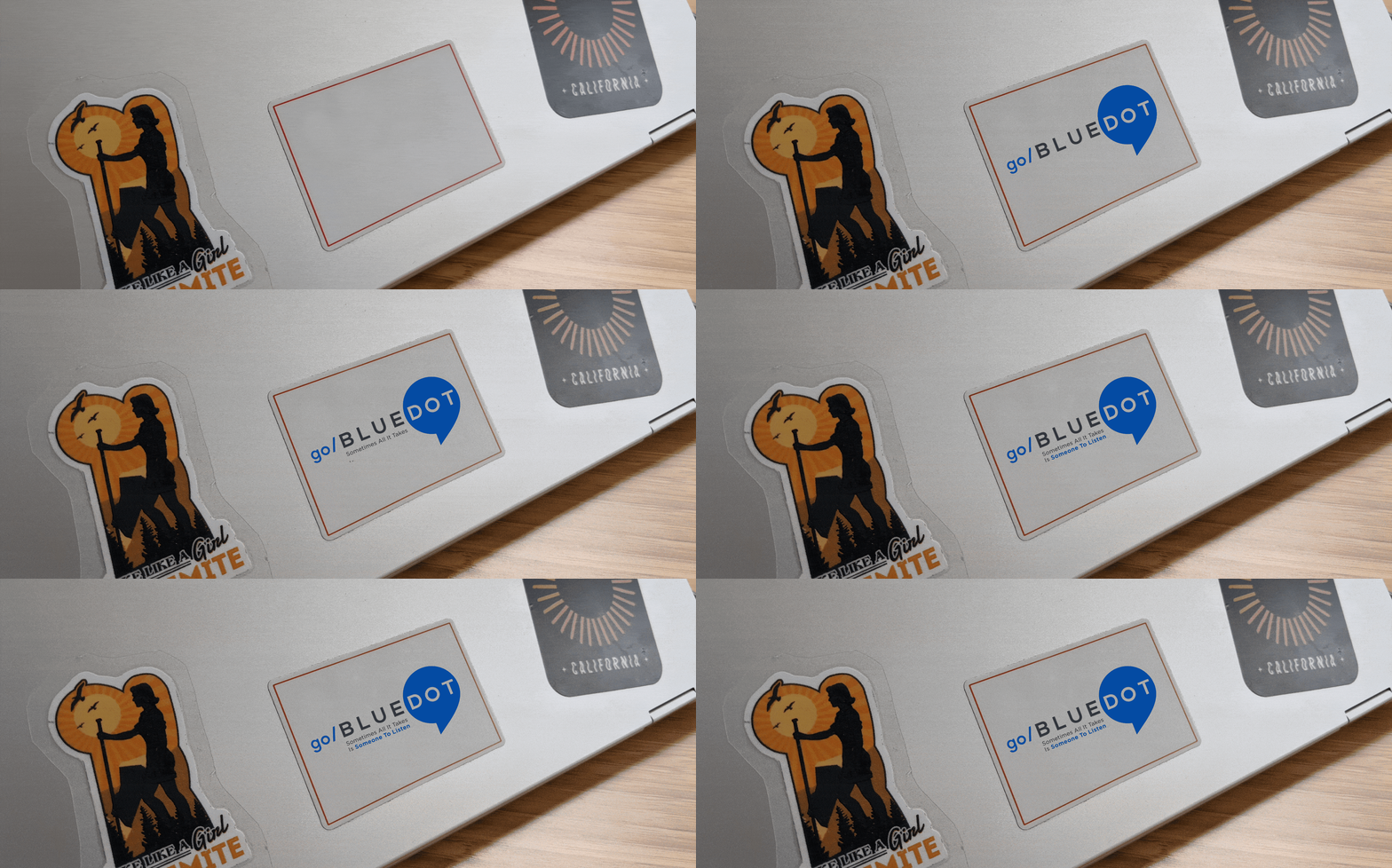
A few years ago, Jenny Fandrianto noticed a sticker on a colleague’s laptop that read “ask me about Blue Dot.” So, she did. 

She learned Blue Dot is a network of Googlers who simply listen to those who reach out to them. It's not therapy, and they don't tell anyone how to fix their problems. They just want to make it OK to talk about mental health. “Having that first conversation was really inspiring and energizing,” Jenny says. “I got to connect with someone and say ‘this is something that’s important to me, too.’” 

Blue Dot’s mission to destigmatize conversations like the one Jenny had began in 2016, when it was founded by Rachael Bleakley and Jack Kaden (a Googler and a former Googler, respectively). Rachael had recently seen a news segment about a barber with a poster in his shop that read “Feeling down? Chat to us!” “He said it nearly always started some great conversations about mental health with everyone who sat in his chair.” She pitched the concept and within days, was on a call with a global group of Googlers putting a plan in motion. 

Artboard 3.jpg

Why a blue dot? “Blue Dot was for practicality reasons...it's easy to buy blue dot stickers for cheap and anywhere in the world locally, so it made sense to pick something all the local office leads could stock up on themselves if we give them the budget.”

While growth wasn’t Blue Dot’s priority, it quickly took off. “We knew there would be appetite for this but it was so hard to measure in the beginning; the last thing we wanted to be doing was asking Googlers to tell us when they had a 'chat' thanks to Blue Dot!” she says. “We also had to be careful we weren't putting Googlers in potentially difficult situations if they got into a chat that was slightly out of their depth; the expectation is only to listen and not to offer specific advice.” 

Peter Corcoran took the reins at Blue Dot as it matured from its purely grassroots beginnings into an official employee resource group. “I was in the British Army for 10 years, and it was actually one of the reasons I got involved in Blue Dot, having suffered trauma in my military career,” Peter says. Becoming a Googler-led mental health resource sponsored by People Ops, he explains, was ultimately the right move. “It gave us access to better resources, better guidance. It created a much better ecosystem.”  Maja Bilić stepped in around the same time to help Blue Dot’s transition. She helped with infrastructure—things like building the website and creating the listener sign-up system. 

Artboard 2.jpg

“Blue Dot’s mission will be accomplished if every Googler knows about their mental health resources, and if people articulate their mental health needs,” Peter says. “The aim isn’t the success of Blue Dot. It’s the success of the mission.”

Artboard 5 (1).jpg

Prior to the time Maja stepped in, Blue Dot was far more grassroots. “Before that we just had an idea. We had stickers,” she says.

A tipping point in this evolution came during a global Google town hall last year, where Blue Dot was mentioned as a resource for Googlers. “I was like, ‘we’ve reached critical mass!’” Peter remembers. “It was kind of like, ‘oh, we’re grown up!’”


Amy Costello, Blue Dot’s acting global lead, discovered Blue Dot in 2018 after working at Google for about six months. “I was looking for a 20 percent project and lo and behold, I learned about this program called Blue Dot.” Amy, who lost her father to suicide as a teenager, describes her work with Blue Dot as “something that really hits close to home. If this is an area I can give back in, how wonderfully fulfilling.” 

Today, Blue Dot has nearly 2,000 allies in its network, but for privacy reasons, doesn’t collect data on sessions. Participants go through a self-guided training module on effective listening and what to do if someone needs additional support. "Listening is about devoting your full attention to another human being. It's a time to ignore the IMs, text messages and emails and provide someone with your undivided attention," Amy shares.

Artboard 1 (1).jpg

"When you’re talking to somebody, sometimes you’re thinking ‘well what am I going to say next?’ But your job is literally to not say anything. You’re only supposed to listen to this person and acknowledge what this person is saying.”

Jenny has benefited from Listener training even outside of Blue Dot. “While I’m on a video call, I don’t have email open, I’m not chatting with other people on Hangouts. In in-person meetings, my laptop is down, and if there are notes I need to take, I take them on paper. My attention is here, with you, right now, because you matter, and the time we spend together is valuable.” 

“Honestly, when we introduced trainings, people were a little like ‘ugh, really?’” Maja laughs. But participants ended up loving it, herself included. “You learn how to actively listen, and active listening is such an important skill.” 

Recently, Blue Dot pivoted from in-person listening sessions, moving to online only. In March, Blue Dot Sunnyvale began hosting virtual get-togethers. “But then we realized...it’s virtual! It doesn’t have to be just our campus,” Jenny says. “We shared this idea globally with the entire Blue Dot community and now we have this office hours program being replicated in all these different regions. It’s become much bigger than what we originally imagined.” 

The new online office hours may also be more welcoming for some. Googlers can select an appointment time with a Listener from any region that works for them, a system Jenny believes lowers the barrier for anyone who’s hesitant to reach out. “Just click and sign up and we’re here. I think it’s just a little bit more accessible to people who need it,” she says. 

Artboard 4.jpg

Jenny has noticed Blue Dot Listeners are taking on more and more time slots. “I’m seeing people who are making themselves available for office hours all times of the day. We have people signing up for even the holidays,” she says. “They’re thinking ‘you know, there might be people who need someone to talk to on a holiday, so I’m going to make myself available in case somebody needs it.”

Support systems are always a steadying force, but perhaps more so when it feels as if the entire world is on shaky ground. “I feel like on a day-to-day basis, my life is very happy, but at the same time, we don’t have the same releases right now. We don’t have the same kinds of mental breaks,” Amy agrees. “I find myself being over-tired, which is something I’ve heard from my colleagues as well. Having the Blue Dot community available for that outreach, for that friendly face, for people to know you are going to be really open to talking about things like this is so meaningful to the Google community.”

  • 00100trPORTRAIT_00100_BURST20200514091722983_COVER.jpg
  • F3C9B39A-66BC-4417-BB37-EE1C14D13DAB.jpg
  • IMG_20200512_131346.jpg
  • IMG_20200513_135938 (1).jpg
  • IMG_20200514_074641.jpg

Despite the challenges of sheltering in place, both Amy and Jenny notice it’s also inspiring frank conversations about mental health. “During every team meeting now, we start with five minutes of ‘How are you doing? What’s new? Is there anything I can do to help?” Jenny says. “We’re talking about our personal lives a bit more now. It’s funny because I feel like we’re closer as a team even though we’re all virtual. It’s because we’re genuinely concerned for each other outside of work.” 


Though Blue Dot has grown, the subtle ways it creates conversations about mental health remain. That little dot disintegrates some of the pressure; “ask me about Blue Dot,” for many, is easier to respond to than “ask me about mental health.” 

Today, in lieu of laptop stickers we can’t physically see, Listeners include a blue dot in their email signatures. “So many people have asked ‘hey, I see you have this blue circle in your email signature—what’s that about?’” 

The group is hopeful that someday, we won’t need a dot or anything else to openly talk about therapy appointments or depression. “We have no problem going to the doctor for a physical, we have no problem going to the dentist to get our teeth cleaned,” Amy says. “Why should we have a problem talking about our mental health, or saying, ‘hey, I’m going to the therapist today’? One of the really special things about Google is that those things are OK to say, and I feel like groups like Blue Dot help normalize it.” 

Blue Dot has helped Jenny feel comfortable being an advocate for mental health, and talking about her own. “I’m much more open about a lot of other things I don’t think people talk about. No one really comfortably talks about the struggles of being a woman in tech, or has revealing conversations around fertility challenges like IVF or miscarriages.” As she’s become more forthcoming, she’s felt groups forming—supportive pocket communities that invite, even welcome, these kinds of conversations. 

“People are OK being vulnerable, they feel safer,” she says. “And that’s brought a lot of us so much closer.” 

22 May 01:32

We hosted a virtual Iftar this Ramadan on YouTube, bringing together a global community

by YouTube
Like millions of families around the world, my family and I have been breaking our fast this Ramadan in the safety of our own home in the sunny city of Jeddah, Saudi Arabia — something I am very grateful for. Although I love my family, and I am thankful to have them here with me this Ramadan, something was still missing.

So I reached out to a few of my friends (Omar Hussein, Noor Stars, the Saudi Reporters, Asrar Aref, and the Anasala Family) and asked them if they wanted to come over for Iftar, and to bring millions of their friends with them.


On Tuesday, May 19, we decided to break our fast together at 6:32 p.m. — sunset in Saudi Arabia. We played games, showed-off our cooking skills, and finally broke our fast along with thousands of people who joined us from across the country and beyond.

What’s incredible is that people all around the world have been trying to find innovative ways to create that sense of togetherness during the holy month while staying safe. Earlier this month, creators in Indonesia came together and hosted a virtual Iftar, bringing together people from all over the country. Also next week, on May 26 at 8 p.m. EEST, Arab popstar Nancy Ajram is going to host a special Eid celebration concert on her YouTube channel.

I am proud I got to be part of this incredible experience that showed the world the power of YouTube and the creator community. Bringing this many people together during this difficult time is truly rewarding.

From all of us, we wish you a Ramadan Kareem and a blessed Eid ahead.

Mohamed Moshaya, YouTube Creator based in Saudi Arabia
16 May 15:14

Dr. Karen DeSalvo on “putting information first” during COVID-19

by Megan Washam

Dr. Karen DeSalvo knows how to deal with a crisis. She was New Orleans Health Commissioner following Hurricane Katrina and a senior official at the Department of Health and Human Services when Ebola broke out. And now, as Google’s Chief Health Officer, she’s become the company’s go-to medical expert, advising our leaders on how to react to the coronavirus. Dr. DeSalvo has been a voice of reassurance for Googlers, but her expertise is helpful outside of Google, too. I recently spoke to Dr. DeSalvo about how we’ll get through the crisis, what Google is doing to help and what makes her optimistic despite the challenges we face. 


How is the coronavirus different from other public health crises you’ve dealt with? 
In my work in New Orleans, whether it was a hurricane, a fire or a power outage, we drew resources from other parts of the country if we needed help. In this case, the entire world has been impacted. Everyone is living with uncertainty, disrupted supply chains, impacts on travel and social infrastructure. While this creates a sense of community that I hope will continue beyond the pandemic, the downside is that we have less opportunity to send assistance to other places. Where there is opportunity, we’ve seen people paying it forward, like when California deployed ventilators to the East Coast. The sense of community that grows out of any disaster is the bright spot, for me.


How are industries sharing ideas and research in this global crisis?
Physicians are using technology to talk to each other constantly about what they’re seeing and doing, and in prior outbreaks this real-time communication wasn’t possible. It makes a huge difference in clinical care. In the medical community, you sometimes have to pay for a journal article. But now if you want to read about COVID-19, it’s free for any researcher, scientist, clinician or layperson. That’s putting information first, putting knowledge and science above proprietary interest. 

It’s happening in science, too. For instance, there’s a collaboration between competitors in the private sector on designing trials and assessing the outcome of drugs and vaccines. At Google, our Deepmind colleagues were able to use deep learning to show protein folding, helping advance the thinking about therapeutics and vaccines. I don’t think we’ve seen this spirit of collaboration in the history of science, and it’s one of the reasons I’m so optimistic. 

What is Google doing to help curb misinformation?
In this historic moment, access to the right information at the right time will save lives. Period. This is why our Search teams design our ranking systems to promote the most relevant and reliable information available. We build these protections in advance so they’re ready when a crisis hits, and this approach serves as a strong defense against misinformation.  

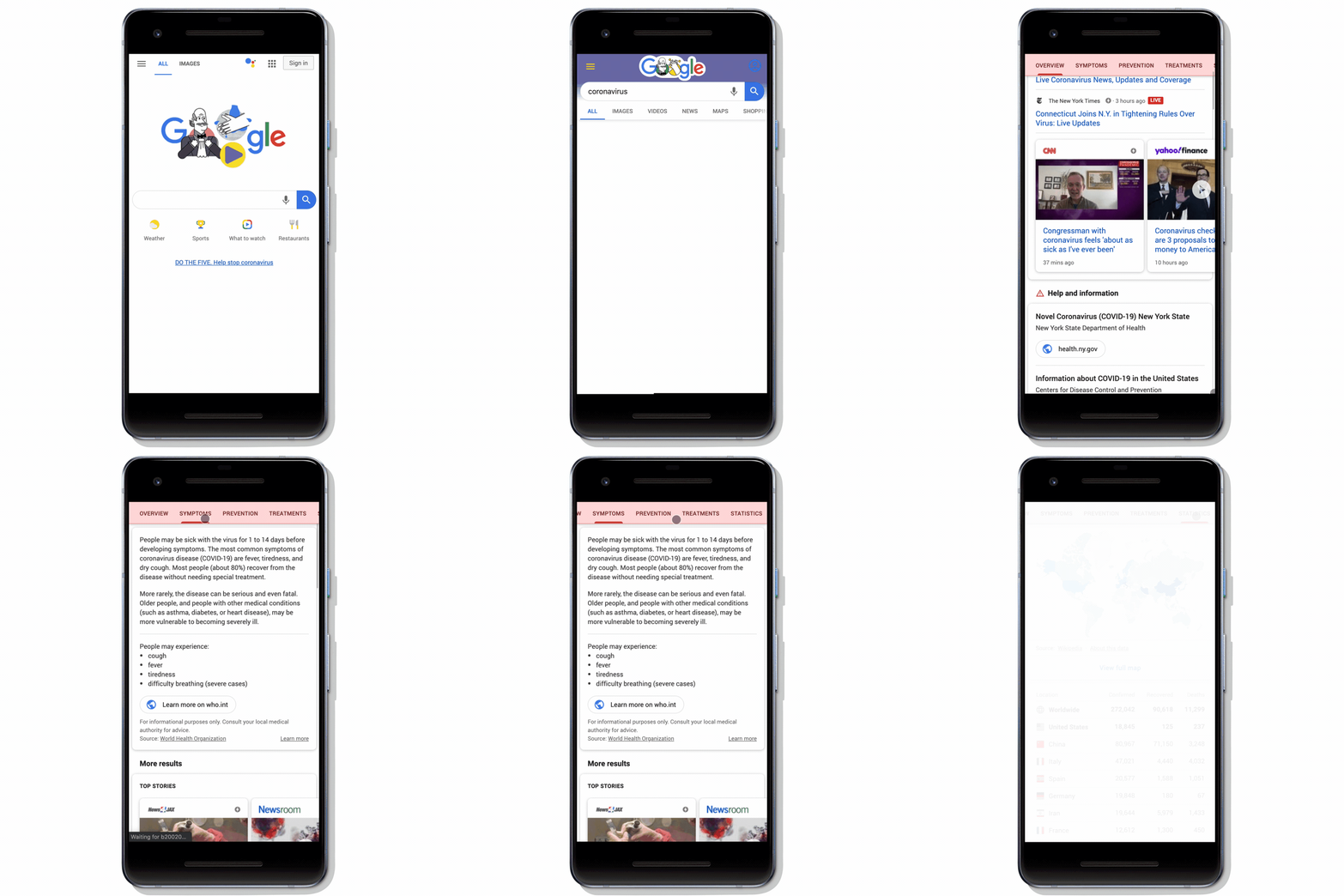
When COVID-19 began to escalate, we built features on top of those fundamental protections to help people find information from local health authorities. We initially launched an SOS alert with the World Health Organization to make resources about COVID-19 easily discoverable. This has evolved into an expanded Search experience, providing easy access to more authoritative information, alongside new data and visualizations. 

We’re surfacing content that’s accessible to a whole range of communities, and there’s constant vigilance to remove misinformation on platforms like YouTube—this includes videos or other information that could be harmful to people.

Search COVID GIF

COVID-19 information on Search. 

What does it mean to be Google’s Chief Health Officer?
My role is to bring a holistic view of emotional, physical and social health and well-being to Google’s products and services, particularly under Google Health. During this pandemic, my team has also thought about how Google can assist public health efforts. This has meant anything from the Community Mobility Reports, a tool to help measure the impact of social distancing, to building playlists in partnership with YouTube geared towards clinicians, and showing testing sites for COVID-19 all over the world.


In the general public, what behaviors or mentalities have arisen that should continue in the future?
First, there are fundamental ways to reduce the transmission of communicable diseases like the flu or, in some communities, measles or tuberculosis. If you’re able to, it’s important to stay home if you’re sick, wash your hands, cough into your elbow—I call these the “Grandma rules.” Second, there are a lot of components to health: social health, emotional well-being, financial stability. Health is driven by more than just medical care, and this is a moment for us to remember that a holistic approach matters. 


What should business owners consider for when restrictions begin to lift?
They need to prepare for a world in which employees can work remotely as much as possible. Policies will still recommend social distancing, but we also need to create an environment where people who are sick feel comfortable staying home. That’s not realistic for every small business, so paying attention to the basic hygiene stuff—Do the Five—is also important. 


After Katrina, there was this time when the world was paying attention and trying to help, but the emotional and social impact on our community lasted for months. There will be some of that after this pandemic, because you can’t just flip a switch and have people go back to work. That’s the important thing—being patient as people put themselves back into a normal routine. 

Health is driven by more than just medical care, and this is a moment for us to remember that a holistic approach matters.

Taking off your Chief Health Officer hat, how do you reassure friends and family when they’re worried about this situation?
Medically, we need to be patient and let the scientists do their thing. It’s probably going to take until summer or early fall in the northern hemisphere to get clarity on what therapeutics work. The end game is to develop a vaccine so we can make sure everybody is protected. This is going to be a long journey with many months ahead, so we need to pace ourselves. 

Statistically, more people will have anxiety and depression from COVID-19 than will actually get COVID-19. To share tips on mental well-being, we recently launched the “Be Kind To Your Mind” PSA on Google Search.

Lastly, I remind those who are privileged to have a safe space to stay home when other people can’t. I think about my previous work with low income patients, and how this crisis impacts them as well as communities of color, non-native English speakers, and individuals with disabilities. Staying home is not safe, comfortable and financially feasible for everybody. We should all be doing what we can for our neighbors and our friends and the people who aren’t always seen.

15 May 22:44

Melting Borders

by Keir Clarke
The border between Alberta and British Colombia is moving. This shifting border has nothing to do with any territorial dispute between the two Canadian provinces. It is moving because it lies across the Haig glacier. And the Haig glacier is melting. The boundary between Alberta and British Colombia is determined by the hydrological divide, that is "the spot where a raindrop at the highest
15 May 22:32

The 2020 Lock Down Music Festival

by Keir Clarke
There will be no music festivals this year. Unless you create your own. At home! Oslo World can help you get in the festival mood with their new music map, which features music which has been compiled by festival organizers from all over the world. The Oslo World Music Festival is a music festival held in Norway every year. The festival features music from around the globe, but with a primary
10 May 21:21

Resources for mental health support during COVID-19

by Dr. David Feinberg

The coronavirus pandemic has disrupted lives around the world. In addition to the lives lost to the virus, as many communities enter the second and third month under stay-at-home orders, there is a rising mental health toll, too. In a national survey released by the American Psychiatric Association in March, 36 percent of respondents said that COVID-19 was seriously impacting their mental health; 48 percent were anxious about getting infected; and 57 percent reported concern that COVID-19 will seriously impact their finances.


As a trained psychiatrist, I know firsthand the importance of bringing out into the open the issue of mental health. While it might be years between the first onset of symptoms and someone seeking help, the internet is often the first place people turn to find out more about mental disorders. To help address the emerging mental health crisis we’re sharing “Be Kind to Your Mind," which includes resources on mental wellbeing from the Centers for Disease Control and Prevention (CDC). Whenever people in the U.S. search for information about coping with the pandemic, or on COVID-19 and mental health, we’ll show a public service announcement with tips to cope with stress during COVID-19. To raise awareness of the importance of mental wellbeing during these times, we'll highlight these resources on Google's homepage tomorrow.

be kind to your mind.jpg

Whenever people in the U.S. search for information about coping with the pandemic, we’ll show a public service announcement with tips to cope with stress during COVID-19.

With May being Mental Health Awareness Month, we want to highlight a few other resources and tools across Google and YouTube that promote mental wellbeing.


Self-assessment questionnaires for depression and PTSD

When people search on Google for information about mental health conditions we provide panels with information from authoritative sources like Mayo Clinic that detail symptoms, treatments, and provide an overview of the different types of specialists who can help. On the info panels for depression and post traumatic stress disorder (PTSD), we provide direct access to clinically-validated self-assessment questionnaires that ask some of the same types of questions a mental health professional might ask. Based on a person’s answers, these self-assessment tools provide information on risk, along with links to more resources. Results to these questionnaires are not logged. We hope they can provide insight and help people have a more informed conversation with their doctor. We will add more self-assessment  questionnaires over time to cover more conditions.


Self-care content on YouTube

Over the last few months, YouTube has seen a 35 percent increase in views of meditation videos, and growing popularity of mindfulness and wellbeing content. YouTube is making videos like these and other mental health resources more widely available to anyone around the world, for free, by spotlighting channels and playlists that have wellbeing and mindfulness-focused content. Countless YouTube creators, like Dr. Mike and Kati Morton, educate their communities as they help reduce the stigma associated with mental health. YouTube is also launching relevant YouTube Originals, including a “BookTube” episode featuring top authors like Melinda Gates and Elizabeth Gilbert offering their best book recommendations.

get by with me

Finding virtual care options, quickly

Because of stay-at-home orders and restrictions that limit in-person interactions, many mental health care providers (including therapists and psychiatrists) are now providing telehealth care, like conducting therapy sessions over video conference. To make these options easier to find, we now allow providers to highlight their virtual care services on their Google Business Profile. So now, when you search for a mental health provider in products like Search and Maps, you may see an “Online care” link that can take you to their virtual care page, or even schedule a virtual appointment.


While the stigma around mental health has lessened in recent years, many people still find it hard to reach out to get help. By providing access to mental health resources, services and information across our products, we hope to make it easier for people to seek help and receive proper care.


09 May 17:35

Virtual Art Galleries

by Keir Clarke
The Metropolitan Museum of Art The Metropolitan Museum of Art is the largest art gallery in the United States. It has over two million works of art in its permanent collection. The Met 360° Project is a series of six 360° movies which allow you to explore the museum and some of its galleries. The videos include tours of the Great Hall, the Met Cloisters and the Charles Engelhard Court. As each
26 Apr 13:36

Malou Aamund turns career advice into a popular novel

by Katie Malczyk

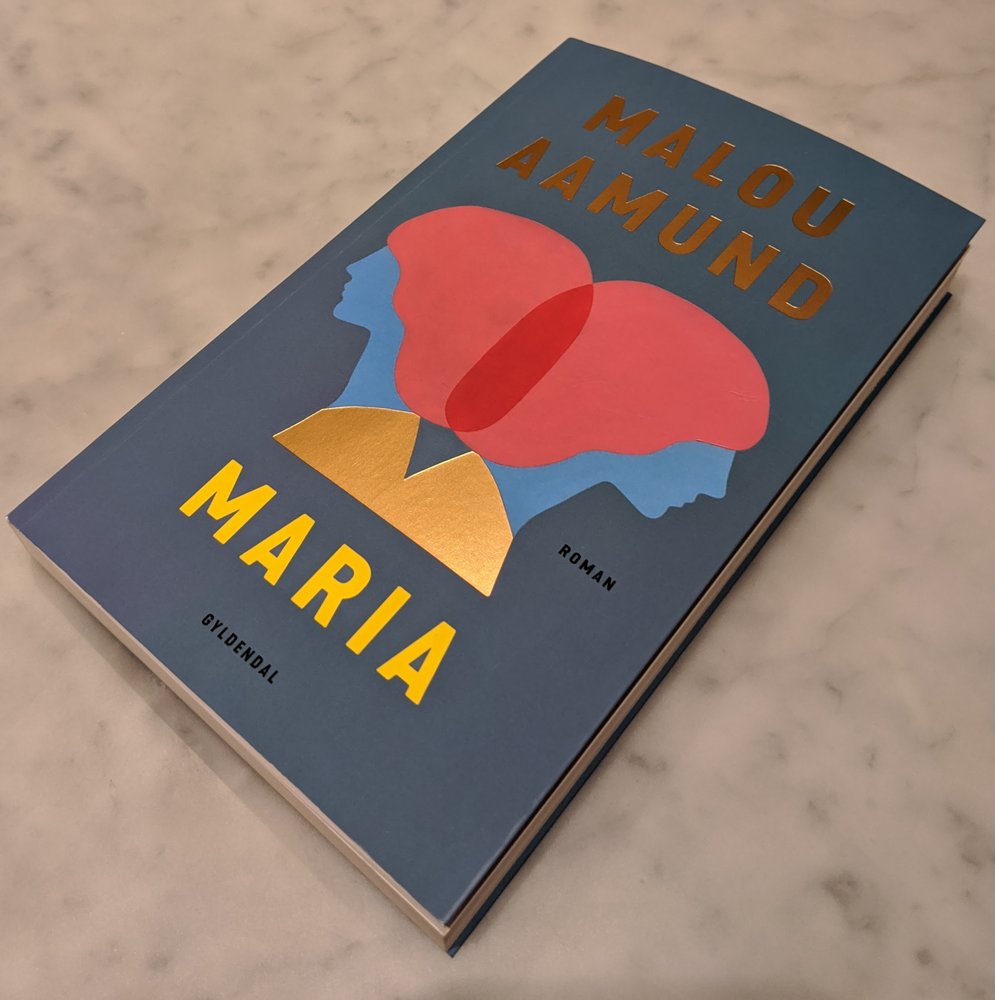
Malou Aamund is the Country Director for Google Denmark—a role that’s typically associated with sales strategy, not fiction writing. But she recently became the author of a new bestselling novel. 

Called Maria, it’s about two women who share the name. One of them chooses her family over everything else, only to find that she’s sacrificed and given away so much of herself that there’s nothing left of her own personality. The other Maria puts her career before everything and, in her determination to become a successful business leader, also loses herself.

“It’s about self help and personal development—this is fiction as a format for helping build your career,” Malou says. Typical career advice books—and there are plenty already—can be dry and detached. “I wanted to drive an experiment to see if you can get different emotions in people by putting this type of advice into fiction,” she says.

We (virtually) sat down with her to learn how her literary pursuits complement her day job—and vice versa.

How do you explain your job at a dinner party?

I’m responsible for all of Google’s business in Denmark, all the amazing things we’re doing with Grow with Google, and helping build small businesses. And I also work with many industries here in Denmark.

Your career has taken some strange detours—what are some of those?

The red thread has been that I’ve spent more than 20 years in tech at Microsoft, IBM and now Google. But along the way I also spent four years as a Member of Parliament in Denmark, representing the then-leading liberal party.

The idea of a political career started after I’d been on an international assignment in the U.S. for a few years. I got back to Denmark and thought, compared to the U.S., there was a standstill in our innovation agenda. As a business leader I could make recommendations, but what I really wanted was to take leadership and ownership. After I helped craft some policy reforms for the party, they asked if I’d be interested in running for office. And from there it was a wild and rewarding experience.

cover of malou aamund's book maria

What made you decide to write Maria?

It started 10 years ago. I was 15 years into my career, and was constantly seeing the same patterns when I was mentoring younger women. They felt there was a big personal cost for them to pursue their career dreams. It was disproportionate compared to how men felt at the same point in their own careers. I saw these amazingly talented women struggle with lower self confidence than men. I could see that in terms of how often women asked for a raise—they lacked the confidence to go in and demand what they deserved.

So I had the idea of creating a story where you had these two opposite personalities—one person who’s thinking so much about other people’s needs that she forgets herself, and the other who’s self-centered and opportunistic. They follow the same life pattern, but react very differently at life-changing moments. I wanted to empower women to have an emotional response to the story and think about how they would actually react.

Is it based on real people?

Not really, but based on a lot of observations throughout my career, along with data and research that I’ve read. We now have so many insights into the fact that women have lower self esteem and how that unfolds in their career. It’s the same research that we focus on in the #IamRemarkable initiative, a Google program to build self confidence in women. It’s becoming an amazing movement, a life-changing moment for women to go through.

What’s been the response to the book? 

I’ve been touring universities and leading career and book discussions. The most positive thing is that I’m seeing so many younger women embrace it, and really resonate with the characters’ problems and emotions.

There have also been a lot of parents who read the book first, and then give it to their adult children. As parents we all want to impart some values, and help our kids not make the same mistakes that we have. Here, parents can actually give moral advice in a fictional format.

Will Maria be translated into any other languages?

The publisher had planned to bring it to the London Book Fair, which is now cancelled due to COVID-19. But they are actively working on bringing it to other countries and languages.

Who has been a strong female influence in your life?

One of the highest ranking female executives in IBM was my mentor when I was pregnant with my second daughter. She asked me to join her team when I was six months pregnant, and showed a very courageous and progressive view on female talent, and took a personal bet on me. She is still a great support and a good friend. 

What advice do you have for women starting out in their careers? 

Choose the right partner. I have many girlfriends whose careers are not as highly prioritized as their partners’. Then, when they decide to pursue their career aspirations, it all of a sudden becomes a choice between their job and their marriage. Fortunately, there are many supportive spouses, but you need to discuss your dreams and aspirations up front to set the right expectations.

23 Apr 01:42

YouTube Originals announces slate of new content amidst COVID-19 #WithMe initiatives

by YouTube
YouTube Originals today announced a new slate of projects aimed to support, entertain and educate viewers around the world. Among the announcements, celebrities and educators come together to energize distance learning in “Celebrity Substitute” including Karlie Kloss working through a coding problem and Ken Jeong giving a Biology lesson; a weekly series “Stay Home With: YUNGBLUD,” following the UK recording artist and his band as they adjust to a remote lifestyle while creating music; a short-form family series, “Create Together #WithMe,” hosted by Joseph Gordon-Levitt featuring the creations of everyday people collaborating to make art on HITRECORD and YouTube while being at home; and “The Secret Life of Lele Pons” which gives an intimate look at battling Tourette Syndrome and OCD while juggling life in the spotlight.

In addition, engaging new content will come directly from notable YouTube personalities who will be able to leverage the global platform’s quality livestream capabilities from a safe space. Kicking off this new wave of content is a first-of-its-kind global live event, "The Creator Games Presented by MrBeast," hosted by top Creator and philanthropist MrBeast (34M subscribers) on April 25, where he will challenge some of the platform’s biggest stars to remotely go head-to-head in a battle of stay-at-home games where there can be only one winner. The proceeds will go to a COVID-19-related charitable organization.

"YouTube’s greatest strength is its ability as a global platform to build community and connection among people from all walks of life,” said Susanne Daniels, Global Head of Original Content for YouTube. "We’re working to develop exciting new original content that is relevant, useful, and entertaining in order to deepen those connections and give people an outlet to come together."

Also, as part of YouTube’s continued commitment to families, beginning in May, several new kids & family Originals will launch and be available on YouTube and YouTube Kids. These new Originals will help inspire kids’ curiosity, creativity, resourcefulness and resiliency during these unusual times.

Below is the current list of planned new Originals rolling out within the next few months:

"Money Talks: Taxes" — Streaming now!


In this new Learning Playlist, a roundtable of leading female financial experts provide answers to the questions surrounding personal finances that we are all desperate to know. Offering a step by step guide for viewers, this first series of videos covers pressing questions about filing taxes and the COVID-19 stimulus check. “Money Talks” is produced by Refinery29.

"The Creator Games Presented by MrBeast" — Live stream premieres April 25 at 6:00 p.m. ET / 3:00 p.m. PT


A global LIVE event where popular YouTube creator, MrBeast (34M subscribers), challenges the platform’s biggest stars to remotely go head-to-head in a first-of-its-kind battle of stay-at-home games where there can be only one winner. “The Creator Games Presented by MrBeast” will encourage viewers to donate to support COVID-19-related charitable organizations and is produced by Night Media and Fly On the Wall.

"Stay Home With: YUNGBLUD" — Series premieres April 27


This weekly episodic series follows UK recording artist, YUNGBLUD, through a month at a rental apartment in L.A. Along with four friends - his manager, videographer and two bandmates with whom he is quarantined - YUNGBLUD attempts to shoot a music video, write new songs, cook meals and stay connected to his UK-based family and avid global fanbase, all within the disconcerting shelter-at-home restrictions. “Stay Home With: YUNGBLUD” will encourage viewers to donate to support No Kid Hungry and is produced by Stick Figure Entertainment.

"#MoveWithMe" — Global Dance Event premieres April 29


In celebration of International Dance Day (April 29), this special will feature acclaimed choreographer Matt Steffanina as host, and talented dancers and choreographers from across the globe as they come together to provide dance-lovers with high octane performances to today’s chart topping songs in a way that can only be done on YouTube. Choreographers and dancers including LaurieAnn Gibson, WilldaBeast Adams, Chachi Gonzales, Kasia Jukowska, Vale Merino, Sonali Bhadauria, FitDance, Kaelynn KK Harris, Twist And Pulse, D-trix and more will be featured. “#MoveWithMe” will encourage viewers to donate to support the COVID-19 Solidarity Response Fund for WHO during the event and is produced by Den of Thieves.

"Stream #WithMe (UK)" — Live stream premieres April 30


In “Stream #WithMe”, a star-studded crew of some of the UK’s most loved YouTube creators and stars let us in on how they are coping with the lockdown experience in a livestream celebration of solidarity. The all-star group of creators and celebrities will share tips on how to keep entertained, upbeat, and active as they tag-team their way through four hours of joyful unexpected performances and exciting challenges culminating in an almighty stunt for the nation. “Stream #WithMe" will encourage viewers to donate to support NHS Charities Together and is made in partnership with Electric Robin (part of EndemolShine UK).

"Celebrity Substitute" — Series premieres May 7


Around the world, millions of students are joining virtual classrooms as part of the current distance learning initiative and teachers are looking for ways to keep their students engaged and focused to stay on target with their curriculum. In this series, some of the brightest celebrities and educators come together to energize distance learning. In each episode, a celebrity steps in to teach crucial high school lessons with real teachers. Some examples include Karlie Kloss working through a coding problem, or Ken Jeong giving a biology lesson that will be remembered for years to come. Additional celebrity substitutes include: Bill Nye, Camila Mendes, Janelle Monáe, and Terry Crews. “Celebrity Substitute” is produced by B17 Entertainment.

"The Secret Life of Lele Pons" — Series premieres May 19


In this raw and intimate five-part series, internet personality and music artist Lele Pons shares a side to her that no one knows about… Her lifelong struggle with Tourette Syndrome and OCD. Viewers will follow along on her journey of building and expanding her music career while battling what was previously hidden. Link to official trailer HERE. “The Secret Life of Lele Pons” is a Shots Studios Production.

"BookTube - Read with Me Special and Mental Health Episode" — Premieres May 21 and June 2020


The critically-acclaimed monthly book club, “BookTube,” is creating a special “Read With Me” episode premiering May 21. Now more than ever, people around the world are turning to books to help them feel connected. This special episode will feature several celebrities, booktubers, and authors - including Melinda Gates, John Grisham, James Patterson, Elizabeth Gilbert, Nicholas Sparks, Elaine Welteroth, and many more - sharing their current book recommendations. Additionally, the June 2020 episode of “BookTube” will feature authors Dr. Vivek Murthy, former U.S. Surgeon General (author of Together: The Healing Power of Human Connection in a Sometimes Lonely World), Lori Gottlieb (author of Maybe You Should Talk to Someone) and Haemin Sunim (author of The Things You Can Only See When You Slow Down) discussing anxiety, mental health, and advice for self care during these uncertain times. “BookTube” is produced by Boardwalk Pictures.

"Create Together #WithMe" (working title) — Series premieres May 2020


This mini-series, hosted by Joseph Gordon-Levitt, invites friends and families from all over the world who are coping with this unprecedented time of isolation to come together and showcase their creativity and collaboration. Rather than profiling lone artists and showcasing their finished work, each weekly episode will document the creative process as people find each other online and remotely collaborate on a variety of family friendly projects—short films, short documentaries, music videos, and more. Anybody can come be a part of the show on HITRECORD, Gordon-Levitt’s Emmy-winning platform for creative collaboration. “Create Together #WithMe” is produced by Brian Graden Media and HITRECORD.

"Locked Down" (working title) — Scripted series premieres May 2020


A social media mystery in a social distancing era! This scripted event series follows a group of bored teens working together online to solve a mystery involving one of their neighbors. Shot entirely via webcam and smartphone, “Locked Down” is a suspenseful look at how young people stay in touch while having to stay away, as well as what happens when boredom leads to suspicion. The story unfolds almost in real-time as the friend group works together - from a distance - to solve the mystery, while also exploring their own anxieties and frustrations about life during a pandemic. “Locked Down” is created and produced by Toronto-based Sinking Ship Entertainment (Dino Dana, Endlings, Odd Squad).

"Untitled Juanpa and Luisito Project" (LATAM) — Series premieres May 2020


Latin America’s top YouTube creators Juanpa Zurita (10.2M subscribers) and Luisito Communica (30.6M subscribers) come together for the first time to document an unprecedented situation (COVID-19 quarantine) in an unprecedented way. Filmed entirely under quarantine with no physical interaction, viewers will hear first hand personal stories from around the globe, including YouTube creators, health specialists, and everyday people as they reflect on their reality. Their challenges, their hopes, their solutions, their stories of inspiration and most importantly the resilience of human nature. This limited series will give a voice to individuals around the globe to unify us regardless of region or language. This project is produced by DW Entertainment & Media.

These new projects join a robust slate of learning, music and personality-focused original series and specials including “Kevin Hart: What the Fit,” (new episodes premiere each Thursday), YouTube Originals’ first beauty competition series, “Instant Influencer with James Charles” (premiering April 24), “TWICE: Seize the Light,” an 8-part docu-series on the K-pop girl group (premiering April 29 KST) and “Dude Perfect: Backstage Pass” chronicling the YouTube supergroup’s rise to fame (premiering May 11). Personality-driven projects including third seasons of hit scripted series “Cobra Kai” and “Liza on Demand,” “This is Paris” starring Paris Hilton and an unprecedented live event with David Blaine are scheduled to come later this year.

As part of YouTube Originals’ programming strategy, YouTube’s audience of two billion logged-in monthly users will continue to have the opportunity to enjoy new, upcoming original series and specials, focused on music, learning, personalities and kids & families, for free with ads. YouTube’s subscription service, YouTube Premium, will continue to offer ad-free access to all YouTube Originals as well as bingeabilty and exclusive content for select programs behind the paywall.

This news comes on the heels of YouTube’s recent announcements to release popular legacy and kids & family original content in front of the paywall, and the larger global initiative to encourage the world to stay home and save lives through the platform’s At Home #WithMe campaign. The campaign expands upon #WithMe -- a trend continuing to grow on YouTube over the past 15 years -- showcasing how people all around the world find community and engage with one another, especially during this time of crisis. From Emma Chamberlain, Markiplier and The Dolan Twins, to Karlie Kloss, Venus Williams, Sam Smith, Shawn Mendes, Hailee Steinfeld, J Balvin and many more, the campaign features YouTube creators, music artists, athletes and celebrities who have all made a home on YouTube.
15 Apr 19:18

Bookshop

by Jonathan Crowe

Most of The Map Room’s revenue comes from affiliate links (i.e., I get a cut when you buy something via a link on this website). That generally means the Usual Guys. But the Usual Guys aren’t for everyone, so I’ve signed up with Bookshop’s affiliate program. Bookshop is an online store that offers some support to independent bookstores: see InsideHook’s piece for details. It’s U.S.-only for now, and the selection is basically limited to what can be ordered through Ingram, but for something just getting off the ground it looks like a viable alternative. The Map Room’s Bookshop storefront is here, but direct links to book listings will appear where appropriate.