Chemistry of Materials
DOI: 10.1021/cm500700z
The subporphyrazine (SubPz) dimer diboron(III) [μ-1′,4′-benzenediolato][bis-(1,2,6,7,11,12-hexapropylsubporphyrazinato)] (2) and trimer triboron(III)[μ-1′,3′,5′-benzenetriolato][tris-(1,2,6,7,11,12-hexapropylsubporphyrazinato)] (4), consisting of SubPz units assembled through their axial positions by hydroquinone- and phloroglucinol-linkers, respectively, have been prepared. Selective ruthenium-π-coordination to the linking aromatic rings afforded SubPz arrays 8 and 9, respectively. These latter systems displayed different degrees of electronic communication between the macrocycles relative to 2 and 4 as inferred from analyses of the ground- and excited-state features. For instance, as revealed by time-resolved pump probe transient absorption spectroscopy, the excited singlet states of dimer 2 and trimer 4 undergo rather rapid deactivation. In contrast, the presence of a ruthenoarene linker, as in 8 and 9, serves to increase the SubPz singlet excited state lifetimes; these now reach values similar to those seen in the case of monomeric SubPz compounds that either do or do not contain ruthenoarene subunits (i.e., 7 and 6, respectively). These findings are ascribed to the redox active nature of the hydroquinone and phloroglucinol linkers in 2 and 4 and a change in the electronics that results from organometallic functionalization.

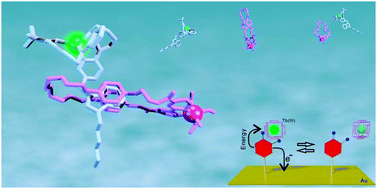
Making a connection: Cyclopentadienylruthenium π-coordination to the axial phenolic substituent that functions to link individual subporphyrazine (SubPz) subunits in dimers and trimers serves to modify the interactions between the macrocyclic constituents (see figure). The ground and excited states of the SubPz dimers and trimers of this study reflect the nature of the bridging spacer, with the extent of inter-subunit coupling being relatively increased in the case of the ruthenoarene bridged systems.
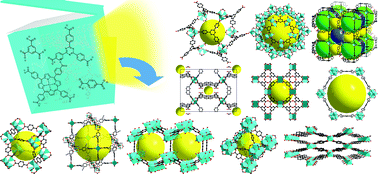
Herein, a novel anionic framework with primitive centered cubic (pcu) topology, [(CH3)2NH2]4[(Zn4dttz6)Zn3]⋅15 DMF⋅4.5 H2O, (IFMC-2; H3dttz=4,5-di(1H-tetrazol-5-yl)-2H-1,2,3-triazole) was solvothermally isolated. A new example of a tetranuclear zinc cluster {Zn4dttz6} served as a secondary building unit in IFMC-2. Furthermore, the metal cluster was connected by ZnII ions to give rise to a 3D open microporous structure. The lanthanide(III)-loaded metal–organic framework (MOF) materials Ln3+@IFMC-2, were successfully prepared by using ion-exchange experiments owing to the anionic framework of IFMC-2. Moreover, the emission spectra of the as-prepared Ln3+@IFMC-2 were investigated, and the results suggested that IFMC-2 could be utilized as a potential luminescent probe toward different Ln3+ ions. Additionally, the absorption ability of IFMC-2 toward ionic dyes was also performed. Cationic dyes can be absorbed, but not neutral and anionic dyes, thus indicating that IFMC-2 exhibits selective absorption toward cationic dyes. Furthermore, the cationic dyes can be gradually released in the presence of NaCl.

A tetranuclear metal cluster with primitive centered cubic (pcu) topology, IFMC-2, was synthesized as a new anionic metal–organic framework (MOF). The Ln3+-loaded MOF materials were successfully prepared by ion exchange, and the emission spectra indicated that IFMC-2 is suitable for the sensitization of Tb3+ and Dy3+ ions rather than as a Eu3+ and Sm3+ emitter (see picture). Additionally, IFMC-2 exhibits selective absorption toward cationic dyes, which can be gradually released in the presence of NaCl.
The synthesis of the first examples of tellurophenes exhibiting phosphorescence in the solid state and under ambient conditions (room temperature and in air) is reported. Each of these main-group-element-based emitters feature pinacolboronates (BPin) as ring-appended side groups. The nature of the luminescence observed was also investigated using computational methods.

Light at the end of the tunnel: By incorporating pinacolboronate side groups, the first examples of tellurophenes that are phosphorescent in the solid state were isolated. These tellurophenes readily form phosphorescent films from solution, making them amenable to device fabrication methods.
A versatile, two-step synthesis of highly substituted, cyano-functionalized diaryltetracenes has been developed, starting from easily accessible tetraaryl[3]cumulenes. This unprecedented transformation is initiated by [2+2] cycloaddition of tetracyanoethylene (TCNE) to the proacetylenic central double bond of the cumulenes to give an intermediate zwitterion, which after an electrocyclization cascade and dehydrogenation yields 5,5,11,11-tetracyano-5,11-dihydrotetracenes in a one-pot procedure. A subsequent copper-assisted decyanation/aromatization provided the target 5,11-dicyano-6,12-diaryltetracene derivatives. All of the postulated structures were confirmed by X-ray crystallography. The new chromophores are thermally highly stable and feature promising fluorescence properties for potential use in optoelectronic devices. They are selective chemosensors for CuI ions, which coordinate to one of the CN substituents and form a 1:1 complex with an association constant of Ka=1.5×10⁵ L mol−1 at 298 K.

Condensed sensors: The title reaction starts with the cycloaddition of tetracyanoethylenene to the central C![[DOUBLE BOND]](http://onlinelibrarystatic.wiley.com/undisplayable_characters/00f8fe.gif) C bond of cumulenes, followed by a multi-reaction cascade to yield tetracyanodihydrotetracenes. Elimination of (CN)2 provides tetracenes with a rubrene-like substitution pattern as highly fluorescent chromophores that can be used as molecular chemosensors for Cu+ and Ag+ ions.
C bond of cumulenes, followed by a multi-reaction cascade to yield tetracyanodihydrotetracenes. Elimination of (CN)2 provides tetracenes with a rubrene-like substitution pattern as highly fluorescent chromophores that can be used as molecular chemosensors for Cu+ and Ag+ ions.
Stretchable energy storage and conversion devices (ESCDs) are attracting intensive attention due to their promising and potential applications in realistic consumer products, ranging from portable electronics, bio-integrated devices, space satellites, and electric vehicles to buildings with arbitrarily shaped surfaces. Material synthesis and structural design are core in the development of highly stretchable supercapacitors, batteries, and solar cells for practical applications. This review provides a brief summary of research development on the stretchable ESCDs in the past decade, from structural design strategies to novel materials synthesis. The focuses are on the fundamental insights of mechanical characteristics of materials and structures on the performance of the stretchable ESCDs, as well as challenges for their practical applications. Finally, some of the important directions in the areas of material synthesis and structural design facing the stretchable ESCDs are discussed.

Stretchable energy storage and conversion devices (ESCDs) are of great interest for their potential applications in realistic consumer products, ranging from portable electronics, bio-integrated devices, space satellites, and electric vehicles to buildings with arbitrarily shaped surfaces. Rational design and engineering of materials and/or structures for stretchable ESCDs are crucial to tackle enormous challenges to satisfy the evergrowing needs arising from these above-mentioned fields. The latest advances in the exploration and development of stretchable materials and structures are reviewed and the fundamental insights, challenges, and prospects of stretchable ESCDs are discussed.
Carlosvery nice work!!
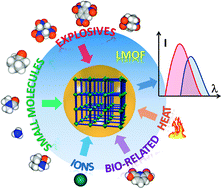
A sensor with a red-emission signal is successfully obtained by the solvothermal reaction of Eu3+ and heterofunctional ligand bpydbH2 (4,4′-(4,4′-bipyridine-2,6-diyl) dibenzoic acid), followed by terminal-ligand exchange in a single-crystal-to-single-crystal transformation. As a result of treatments both before and after the metal–organic framework formation, accessible Lewis-base sites and coordinated water molecules are successfully anchored onto the host material, and they act as signal transmission media for the recognition of analytes at the molecular level. This is the first reported sensor based on a metal–organic framework (MOF) with multi-responsive optical sensing properties. It is capable of sensing small organic molecules and inorganic ions, and unprecedentedly it can discriminate among the homologues and isomers of aliphatic alcohols as well as detect highly explosive 2,4,6-trinitrophenol (TNP) in water or in the vapor phase. This work highlights the practical application of luminescent MOFs as sensors, and it paves the way toward other multi-responsive sensors by demonstrating the incorporation of various functional groups into a single framework.

Multi-responsive fluorescent sensing is achieved using a Eu metal–organic framework (EuMOF). Accessible Lewis-base sites and coordinated water molecules are successfully anchored on the EuMOF-based sensor for the recognition of different analytes at the molecular level. This strategy paves the way for the practical application of luminescent MOF sensors in pollutant-detection.
Metal–organic frameworks (MOFs) are among the most attractive porous materials known today, exhibiting very high surface areas, tuneable pore sizes and shapes, adjustable surface functionality, and flexible structures. Advances in the formation of MOF crystals, and in their subsequent assembly into more complex and/or composite superstructures, should expand the scope of these materials in many applications (e.g., drug delivery, chemical sensors, selective reactors and removal devices, etc.) and facilitate their integration onto surfaces and into devices. This Concept article aims to showcase recently developed synthetic strategies to control the one-, two- and three-dimensional (1-, 2- and 3D) organisation of MOF crystals.

Superstructures: Recent developments are described for the construction of the first-ever MOF superstructures, all of which entail control over MOF crystallisation and/or the subsequent spatial layout of the resulting crystals. These methods are characterised as 1) spontaneous higher-order assembly, 2) self-assembly using hard templates, 3) self-assembly using soft templates and 4) self-templated synthesis.
A new theranostic strategy is described. It is based on the use of an “all in one” prodrug, namely the biotinylated piperazine-rhodol conjugate 4 a. This conjugate, which incorporates the anticancer drug SN-38, undergoes self-immolative cleavage when exposed to biological thiols. This leads to the tumor-targeted release of the active SN-38 payload along with fluorophore 1 a. This release is made selective as the result of the biotin functionality. Fluorophore 1 a is 32-fold more fluorescent than prodrug 4 a. It permits the delivery and release of the SN-38 payload to be monitored easily in vitro and in vivo, as inferred from cell studies and ex vivo analyses of mice xenografts derived from HeLa cells, respectively. Prodrug 4 a also displays anticancer activity in the HeLa cell murine xenograft tumor model. On the basis of these findings we suggest that the present strategy, which combines within a single agent the key functions of targeting, release, imaging, and treatment, may have a role to play in cancer diagnosis and therapy.

All in one: A new theranostic prodrug was developed containing a biotinylated piperazine-rhodol conjugate linked to the drug SN-38 through a self-immolative disulfide spacer. When exposed to cellular thiols in cancer cells, it is able to release the active chemotherapeutic, SN38, along with a diagnostic fluorophore. This theranostic framework permits the targeted delivery, release of an active agent (SN-38), and its facile monitoring in vitro and in vivo.

Carlosphosphorus heterocycles

Fluorinated olefin-containing benzothiadiazoles have important applications in optoelectronic materials. Herein, we reported the direct olefination of fluorinated benzothiadiazoles, as catalyzed by palladium. The reaction proceeds under mild reaction conditions and shows high functional-group compatibility. A preliminary study of the properties of the resulting symmetrical and unsymmetrical olefin-containing fluorinated benzothiadiazoles in red-light-emitting dyes has also been conducted.

Direct olefination: The direct olefination of fluorinated benzothiazoles, as catalyzed by palladium, proceeds under mild reaction conditions with high efficiency and shows high functional-group compatibility (see scheme; BQ=benzoquinone, DMF=N,N-dimethylformamide, tfa=trifluoroacetate). A series of unsymmetrical and symmetrical olefination products can be obtained through this method. These compounds have applications in optoelectronics as red-light-emitting materials.

Carloscation that lead to mechanochromism

Carlosuseful to know the available morphologies
CarlosThere we go compilation of interesting examples