09 Dec 08:22
Chem. Soc. Rev., 2015, 44,988-998
DOI: 10.1039/C4CS00262H, Review Article
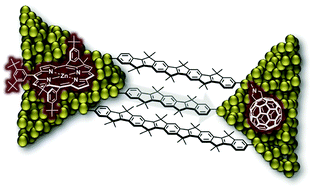
C. Schubert, J. T. Margraf, T. Clark, D. M. Guldi
We highlight recent progress in the field of electron transport through molecular bridges as integrative parts of electron donor-bridge-acceptor conjugates.
The content of this RSS Feed (c) The Royal Society of Chemistry

15 Oct 18:29
by Sigma Hashimoto, Soichiro Nakatsuka, Masaharu Nakamura, Takuji Hatakeyama
Abstract
A P-fused double helicene consisting of a highly distorted benzene ring, with a bending angle of 23°, has been synthesized by a tandem intramolecular phospha-Friedel–Crafts reaction. Despite the distortion and reduced aromaticity, the double helicene shows thermal and chemical stability. These are important features that make these compounds attractive for applications as a new C2-symmetric bisphosphine ligand. The simple strategy proposed in this work can be used to prepare a diverse range of distorted molecules.

Bent on helices: A P-fused double helicene consisting of a highly distorted benzene, with a bending angle of 23°, has been synthesized by a tandem intramolecular phospha-Friedel–Crafts reaction. Despite distortion and reduced aromaticity, the proposed molecule shows thermal and chemical stability, and can be converted into the corresponding C2-symmetric bis(phosphine).
Carlos and -1 others like this
14 Oct 06:25
by Marcin Jasiński, Damian Pociecha, Hirosato Monobe, Jacek Szczytko and Piotr Kaszyński

Journal of the American Chemical Society
DOI: 10.1021/ja507594h

13 Oct 14:03
Chem. Commun., 2014, 50,14512-14515
DOI: 10.1039/C4CC06853J, Communication
Eric J. Alexy, Jonathan M. Yuen, Vanampally Chandrashaker, James R. Diers, Christine Kirmaier, David F. Bocian, Dewey Holten, Jonathan S. Lindsey
Arrays composed of 1-4 perylene-monoimides joined to a free base porphyrin via an ethynyl linker afford panchromatic absorption (from the near-UV through the visible to the near-IR) and long-lived excited singlet states.
The content of this RSS Feed (c) The Royal Society of Chemistry

11 Oct 06:09
Chem. Sci., 2015, 6,308-321
DOI: 10.1039/C4SC02410A, Edge Article

Open Access
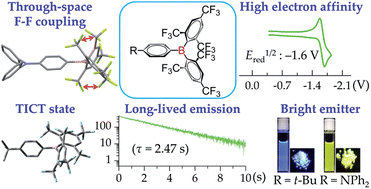
Zuolun Zhang, Robert M. Edkins, Jorn Nitsch, Katharina Fucke, Andreas Steffen, Lauren E. Longobardi, Douglas W. Stephan, Christoph Lambert, Todd B. Marder
R-Ph-B(FMes)2 compounds exhibit low reduction potentials, bright emission, a TICT state and unusual long-lived phosphorescence at low temperature.
The content of this RSS Feed (c) The Royal Society of Chemistry

11 Oct 06:08
by Christophe Allais, Jean-Marie Grassot, Jean Rodriguez and Thierry Constantieux

Chemical Reviews
DOI: 10.1021/cr500099b

10 Oct 20:15
Chem. Soc. Rev., 2015, 44,3890-3899
DOI: 10.1039/C4CS00261J, Tutorial Review
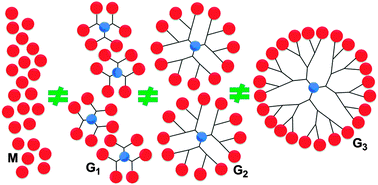
Anne-Marie Caminade, Armelle Ouali, Regis Laurent, Cedric-Olivier Turrin, Jean-Pierre Majoral
The dendritic effect occurs when the properties of a functional group become different when it is linked to a dendrimer.
The content of this RSS Feed (c) The Royal Society of Chemistry

10 Oct 20:12
Chem. Commun., 2014, Accepted Manuscript
DOI: 10.1039/C4CC07451C, Communication
Zhipeng Liu, Xiaoqing Wang, Yanping Wu, Qingsong Liu, Zhenyu Li, Hui Yan, Chonglei Ji, Jicheng Duan
A new family of pyridyl-enamido-based organoboron complexes (Borepy1-4) with aggregation-induced emission (AIE) properties were developed. They show very weak fluorescence in low-viscosity organic solvents and exhibit intense fluorescence in high-viscosity...
The content of this RSS Feed (c) The Royal Society of Chemistry

10 Oct 20:10
by Bryce R. Hoggard, Christopher B. Larsen and Nigel T. Lucas

Organometallics
DOI: 10.1021/om5008852

10 Oct 16:55
by Rebecca J. Lindquist, Kelly M. Lefler, Kristen E. Brown, Scott M. Dyar, Eric A. Margulies, Ryan M. Young and Michael R. Wasielewski

Journal of the American Chemical Society
DOI: 10.1021/ja507653p

07 Oct 21:20
by Daniel Escudero and Walter Thiel

Inorganic Chemistry
DOI: 10.1021/ic501430x

06 Oct 16:45
Chem. Soc. Rev., 2014, Advance Article
DOI: 10.1039/C4CS00280F, Highlight
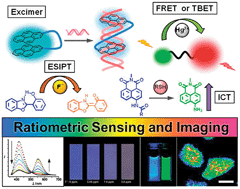
Min Hee Lee, Jong Seung Kim, Jonathan L. Sessler
Quantitative determination of specific analytes is essential for a variety of applications ranging from life sciences to environmental monitoring.
To cite this article before page numbers are assigned, use the DOI form of citation above.
The content of this RSS Feed (c) The Royal Society of Chemistry

04 Oct 07:29
by Mingzhe Yu
Article
There is substantial research underway into the development of lithium–oxygen batteries. Here, the authors use a redox shuttle to couple a photoelectrode with the oxygen electrode in a non-aqueous lithium–oxygen battery, which enables the photoassisted charging and reduces the battery overpotental.
Nature Communications doi: 10.1038/ncomms6111
Authors: Mingzhe Yu, Xiaodi Ren, Lu Ma, Yiying Wu

03 Oct 07:54
Dalton Trans., 2014, 43,17908-17911
DOI: 10.1039/C4DT02641A, Communication
Jian-Jun Liu, Yao Wang, Yu-Jian Hong, Mei-Jin Lin, Chang-Cang Huang, Wen-Xin Dai
A polyoxometalate-sensitized photochromic naphthalene diimide coordination network has been assembled under the cooperative effect of anion-[small pi] and coordination interactions.
The content of this RSS Feed (c) The Royal Society of Chemistry

01 Oct 05:38
by Bin Yao, Xichong Ye, Jie Zhang and Xinhua Wan

Organic Letters
DOI: 10.1021/ol502594m

30 Sep 15:47
by Huimin Ding, Yonghai Li, Hui Hu, Yimeng Sun, Jianguo Wang, Caixing Wang, Cheng Wang, Guanxin Zhang, Baoshan Wang, Wei Xu, Deqing Zhang
Abstract
Two-dimensional covalent organic frameworks (2D COFs) provide a unique platform for the molecular design of electronic and optoelectronic materials. Here, the synthesis and characterization of an electroactive COF containing the well-known tetrathiafulvalene (TTF) unit is reported. The TTF-COF crystallizes into 2D sheets with an eclipsed AA stacking motif, and shows high thermal stability and permanent porosity. The presence of TTF units endows the TTF-COF with electron-donating ability, which is characterized by cyclic voltammetry. In addition, the open frameworks of TTF-COF are amenable to doping with electron acceptors (e.g., iodine), and the conductivity of TTF-COF bulk samples can be improved by doping. Our results open up a reliable route for the preparation of well-ordered conjugated TTF polymers, which hold great potential for applications in fields from molecular electronics to energy storage.

An electroactive COF: A two-dimensional covalent organic framework (COF) containing well-known tetrathiafulvalene (TTF) units is synthesized (see figure). The presence of TTF units endows the TTF-COF with electron-donating ability, and the open frameworks of TTF-COF are amenable to doping with electron acceptors (e.g., iodine). In addition, the conductivity of TTF-COF bulk samples can be improved by doping.
29 Sep 21:50
by Nicholas C. Burtch, Himanshu Jasuja and Krista S. Walton

Chemical Reviews
DOI: 10.1021/cr5002589

29 Sep 21:50
by Sean Sweetnam, Kenneth R. Graham, Guy O. Ngongang Ndjawa, Thomas Heumüller, Jonathan A. Bartelt, Timothy M. Burke, Wentao Li, Wei You, Aram Amassian and Michael D. McGehee

Journal of the American Chemical Society
DOI: 10.1021/ja505463r

27 Sep 11:57
by Xiao Zhang, Wei Liu, George Z. Wei, Debasis Banerjee, Zhichao Hu and Jing Li

Journal of the American Chemical Society
DOI: 10.1021/ja507927a

25 Sep 05:38
by Masaki Yamamura, Tsuyoshi Saito and Tatsuya Nabeshima

Journal of the American Chemical Society
DOI: 10.1021/ja507913u

24 Sep 06:01
by Kecheng Wang, Dawei Feng, Tian-Fu Liu, Jie Su, Shuai Yuan, Ying-Pin Chen, Mathieu Bosch, Xiaodong Zou and Hong-Cai Zhou

Journal of the American Chemical Society
DOI: 10.1021/ja507269n

23 Sep 10:20
Chem. Commun., 2014, 50,13272-13274
DOI: 10.1039/C4CC05247A, Communication
Eugene Yau-Hin Hong, Hok-Lai Wong, Vivian Wing-Wah Yam
A new class of amphiphilic phosphole alkynylgold(I) complexes was synthesized and was demonstrated to display sheet-like nanostructures in aqueous DMSO solution.
The content of this RSS Feed (c) The Royal Society of Chemistry

21 Sep 18:03
by Xiang Wang, Shao-Long Gong, Datong Song, Zheng-Hong Lu, Suning Wang
A new class of brightly phosphorescent Pt(II) compounds that contain an N∧C-chelate phenyl-1,2,3-triazolyl ligand (ptrz) and an N∧C-chelate pyridyl-1,2,4-triazolyl ligand (pytrz) in the central core is achieved. The impact of various substituent groups on phosphorescence of this class of molecules is examined. Crystal structural analyses revealed that this class of compounds has a great tendency to form stacked dimers—one of which is persistent even in the gas phase—leading to excimer emission. The introduction of bulky substituents, such as diphenyl amino (NPh2) or trityl (CPh3), is found to greatly diminish the excimer emission. Using this approach, several highly efficient blue and green phosphorescent Pt(II) compounds with λem at ≈450–460 nm and Φp ≈ 0.70 to 1.00 are obtained. These molecules are highly robust with exceptionally high thermal stability. Bright bluish-green electrophosphorescent devices with external quantum efficiencies as high as 16.7% are fabricated.

Bright blue and green phosphorescent Pt(II) complexes with an N∧C chelate 1,2,3-triazolyl ligand and an N∧N chelate 1,2,4-trizolyl ligand, near unity quantum efficiencies and high thermal stability are achieved. Steric blocking and the rigidity enhancement around the Pt(II) core by large substituent groups at the para-position are found to be critical in the bright phosphorescence of this new class of compounds.
21 Sep 15:13
by Mehdi El Sayed Moussa, Kevin Guillois, Wenting Shen, Régis Réau, Jeanne Crassous, Christophe Lescop
Abstract
Reactions between the U-shaped binuclear CuI complex A that bears short metal–metal distances and the cyano-capped monotopic π-conjugated ligands 1–5 that carry gradually bulkier polyaromatic terminal fragments lead to the formation of π-stacked supramolecular assemblies 6–10, respectively, in yields of 50–80 %. These derivatives have been characterized by multinuclear NMR spectroscopic analysis and X-ray diffraction studies. Their solid-state structures show the selective formation of U-shaped supramolecular assemblies in which two monotopic π-conjugated systems present large (6, 7, and 9) or medium (8 and 10) intramolecular π overlap, thus revealing π–π interactions. These assemblies self-organize into head-to-tail π-stacked dimers that in turn self-assemble to afford infinite columnar π stacks. The nature, extent, and complexity of the intermolecular contacts within the head-to-tail π-stacked dimer depend on the nature of the terminal polyaromatic fragment carried by the cyano-capped monotopic ligand, but it does not alter the result of the self-assembling process. These results demonstrate that the dinuclear molecular clip A that bears short metal–metal distances allows selective supramolecular assembly processes driven by the formation of intra- and intermolecular short π–π interactions in the resulting self-assembled structures; thus, demonstrating that their shape is not only dictated by the symmetry of the building blocks. This approach opens perspectives toward the formation of extended π-stacked columns based on dissymmetrical and functional π-conjugated systems.

Stretching into infinity: A general approach to π-stacked dissymmetrical supramolecular assemblies is described. The reaction of a series of dissymmetrical cyano-capped monotopic π-conjugated systems with a U-shaped CuI dinuclear molecular clip results in the formation of U-shaped π-stacked supramolecular assemblies that self-assemble in the solid state along infinite columns of interacting π systems, regardless of the nature of the π-conjugated system (see picture).
21 Sep 15:10
by Ted M. Pappenfus, Daniel T. Seidenkranz, Matthew D. Lovander, Travis L. Beck, Brandon J. Karels, Katsu Ogawa and Daron E. Janzen

The Journal of Organic Chemistry
DOI: 10.1021/jo5017585

hailul and -1 others like this
21 Sep 14:27
by Feiye Sun, Lily Lv, Min Huang, Zhaohui Zhou and Xiangdong Fang

Organic Letters
DOI: 10.1021/ol502339h

cxl and -1 others like this
21 Sep 14:26
by György Szalóki, Guillaume Sevez, Jerôme Berthet, Jean-Luc Pozzo and Stéphanie Delbaere

Journal of the American Chemical Society
DOI: 10.1021/ja506320j

21 Sep 14:24
by Alexandra Velian, Matthew Nava, Manuel Temprado, Yan Zhou, Robert W. Field and Christopher C. Cummins

Journal of the American Chemical Society
DOI: 10.1021/ja507922x

15 Sep 17:08
by Yin Yang, Russell P. Hughes and Ivan Aprahamian

Journal of the American Chemical Society
DOI: 10.1021/ja508125n

13 Sep 07:12
by Anup Bhunia, Tony Roy, Rajesh G. Gonnade and Akkattu T. Biju

Organic Letters
DOI: 10.1021/ol502490t