Shared posts

21 Sep 21:42

Analysis: Using the Term ‘Rohingya’

by Zaw Lin Maung

The term ‘Rohingya’ has become one of the most controversial words in Myanmar politics today. More than one million Muslim people living in Rakhine State in western Myanmar identify as Rohingya—although in recent weeks an estimated 421,000 have fled to Bangladesh.

But the government of Myanmar labels them Bengalis, with the implication that they have immigrated from neighboring Bangladesh, despite the Muslim community’s long history in the region. The government doesn’t recognize them as one of the country’s 135 official ethnic minorities—a list determined by the military government in the 1990s—and restricts their access to basic rights including freedom of movement, healthcare, and education, as most do not have Myanmar citizenship.

The Muslims in Rakhine have insisted that they should be called Rohingya, and have refused to take part in the government’s national verification process for citizenship as long as they are categorized as Bengalis.

As follows is a range of conflicting local and international comments on the self-identifying Rohingya people.

Wai Wai Nu (Photo: Reuters)

Wai Wai Nu, founder of the Women Peace Network—Arakan and a self-identifying Rohingya activist said at the Oslo Freedom Forum in Norway in July 2017:

“Rohingya are a one-million-strong ethnic and religious minority in Burma. […] The Rohingya are an indigenous population with our own language, traditions, and culture in Burma. But we are different from the rest of the population. We are Burmese but we are part of the Muslim population in the country, which is less than five percent. […] From the 1980s, [the military regime] started to degrade the status of the Rohingyas, by enacting a discriminatory citizenship law, and by introducing many discriminatory practices and policies. In 2014, they took away our permanent citizenship, which is ours by birth. The last election, we were finally disenfranchised and lost our political rights.”

Snr-Gen Min Aung Hlaing (Photo: Reuters)

Snr-Gen Min Aung Hlaing in his address to the nation at the 72nd anniversary of Armed Forces Day in Naypyitaw in March 2017:

“It has already been announced that there is no race termed Rohingya in Myanmar. The Bengalis in Rakhine State are not Myanmar nationals but immigrants. It will be seen that the victims coming out of the terrorist attacks committed by some Bengalis which took place in October 2016 resulted in political interferences. Things that should be done under the existing laws must be carried out responsibly. The armed forces will be responsible for defending against all measures of insurgencies based on the religions and races. Only if we can establish domestic everlasting peace, will our nation develop.”

Gregory Stanton (Photo: George Mason University)

Genocide Watch president Gregory Stanton in pre-recorded talks for the Myanmar Muslims Genocide Awareness Convention 2016:

“The Rohingya are victims of a classification system in Myanmar that literally classifies them out of citizenship.”

In 1996, he created a model for the US State Department identifying eight—and later, ten—stages of genocide, the first of which is “classification” of “us versus them” along ethnic, national, racial or religious lines.

“If you stop using the name that the people have chosen, you are trying to classify them out of the system,” Stanton added, referring to the widespread use of the term “Bengali.”

Nai Hong Sar (Photo: The Irrawaddy)

Nai Hong Sar, UNFC chairman and New Mon State Party (NMSP) vice chairman in a conversation with The Irrawaddy last week:

“We do not recognize the term ‘Rohingya.’ We do not acknowledge the Arakan Rohingya Salvation Army as its operations appeared to be violent.”

Daw Aung San Suu Kyi (Photo: The Irrawaddy)

Myanmar State Counselor Daw Aung San Suu Kyi asked about her avoidance of the term ‘Rohingya’ in an interview with Asian News International (ANI) on September 20:

“Yes, because there have been a lot of controversies with regard to the term used to describe the Muslims of the Rakhine. There are those who want to call them as Rohingyas or who want to refer the Muslims there as Rohingyas. And the Rakhines will not use any term except Bengalis, meaning to say that they are not ethnic Rakhines.

And I think that instead of using emotive terms, this term has become emotive, and highly charged. It’s better to call them as Muslims which is a description that nobody can deny. We are talking about the Muslim community in the Rakhine State and other terms may be applied to that community but I do not see any point in using terms that simply inflame passions further.”

Barack Obama (Photo: Reuters)

Former US President Barack Obama in 2015 speaking to young Asians invited to the White House:

“I think one of the most important things is to put an end to discrimination against people because of what they look like or what their faith is. And the Rohingya have been discriminated against. And that’s part of the reason they’re fleeing.”

U Tin Oo (Photo: Reuters)

U Tin Oo, former Myanmar Army commander-in-chief (1974-76), who was a young army officer in northern Rakhine in the 1950s. He led a campaign to drive out people allegedly coming from East Pakistan (now Bangladesh) and fought Mujahideen separatists; however, it has also been alleged by identifying Rohingya that under his command, Myanmar Army troops destroyed dozens of their villages in the region. He is a founder and patron of the National League for Democracy (NLD):

“Long before the 1956 election, we’d never heard the word Rohingya. Four Muslim lawmakers from Maungdaw and Buthidaung contested the election under the belt of the then ruling Anti-Fascists and People Freedom League (AFPFL). The then Prime Minister U Nu granted the Muslims in the area citizenship as Rohingya as requested. He allowed the publishing of Arabic newspapers and 15 minutes of Urdu Service on the then Burma Broadcasting Service and there were strong reactions and [people] were angry and upset.”

Ban Ki Moon (Photo: Reuters)

Former UN Secretary General Ban Ki-Moon at a joint press conference with Daw Aung San Suu Kyi in 2016:

“Like all people everywhere, they need and deserve a future, hope and dignity. This is not just a question of the Rohingya community’s right to self-identity.”

Ko Ko Gyi (Photo: The Irrawaddy)

Ko Ko Gyi, a student leader from the 1988 democracy uprising, during a press conference in the wake of conflict in Rakhine in 2012:

“Rohingya is not one of the ethnic groups of Myanmar at all. We see that the riot happening currently in Buthidaung and Maungdaw of Arakan [Rakhine] State is because of the illegal immigrants from Bangladesh called ‘Rohingya’ and mischievous provocation of some members of the international community.

“Therefore, such interfering efforts by some powerful nations on this [Rohingya] issue, without fully understanding the ethnic groups and other situations of Burma, will be viewed as offending the sovereignty of our nation. Genetically, culturally and linguistically Rohingya is not absolutely related to any ethnicity in Myanmar. In terms of citizenship, I would state separately. As we share the borders with other countries, we have some Chinese and Indian descendants. They have been living in our country for generations and citizenship has been granted to them. We do not discriminate based on any race for granting the citizenship even if he is a Bengali. They should be protected in the same way as citizens of Myanmar. But, if we were forcefully pressured to accept Rohingya as one of the ethnic groups [of Myanmar], we wouldn’t tolerate that.

Mya Aye (Photo: The Irrawaddy)

Mya Aye, a Muslim student leader from the 1988 democracy uprising, during a press conference in the wake of conflict in Rakhine in 2012:

“Even before I got out of prison, the Rohingya issue had become a hot issue. It has become not only a hot issue in the international political community, but also a crowd-pleasing issue that can generate funds. Most of the Rohingya belong to the Islamic faith. Well, almost all of them. In order to become one of the ethnic groups, I think they tried to bond with Myanmar Muslims and have been pushing this issue to become a religious issue. That’s what Ko Ko Gyi implied by ‘provocation from abroad.’”

Dalai Lama (Photo: Reuters)

The Dalai Lama in September 2017:

“They should remember, Buddha, in such circumstances, Buddha [would have] definitely helped those poor Muslims. So, still I feel that [it’s] so very sad. So sad.”

U Thein Sein (Photo: Reuters)

Former President U Thein Sein in an interview with Voice of America in 2014:

“There are no Rohingya among the races [in Myanmar]. We only have Bengalis who were brought for farming [during British rule]. We have to provide effective education and they will determine what is right and wrong. When we made field trips there, we saw that the birthrate is very high and the population is rapidly growing.”

Desmond Tutu (Photo: Reuters)

 The Nobel Laureate Desmond Tutu on Daw Aung San Suu Kyi’s lack of condemnation concerning violence against the Rohingya, as was written on Sept. 7:

“Your emergence into public life allayed our concerns about violence being perpetrated against members of the Rohingya. But what some have called ‘ethnic cleansing’ and others ‘a slow genocide’ has persisted—and recently accelerated.

“It is incongruous for a symbol of righteousness to lead such a country. If the political price of your ascension to the highest office in Myanmar is your silence, the price is surely too steep.”

U Win Tin (Photo: The Irrawaddy)

U Win Tin, a founding member of the NLD and former editor who spent 20 years in jail, told the Bangkok Post in 2012 that conflict in Rakhine State was: “created by foreigners, by Bengalis.”

“My position is that we must not violate the human rights of these people, the Rohingya, or whatever they are. Once they are inside our land maybe we have to contain them in one place, like a camp, but we must value their human rights.”

He added that the people of Myanmar “cannot regard them as citizens, because they are not our citizens at all, everyone knows here that.” He said the problem was that “they want to claim the land, they want to claim themselves as a race, they want to claim to be natives and this is not right.”

Min Ko Naing (Photo: The Irrawaddy)

Min Ko Naing, a prominent Generation 88 leader who spent almost 20 years in prison, told a press briefing last week Rakhine State’s problems were not racial or religious but had to do with immigration laws and terrorism.

“They [self-identifying Rohingya] are not one of the 135 ethnic groups in Myanmar,” he said.

U Ba Shein, second from left. (Photo: The Irrawaddy)

Lower House Lawmaker U Ba Shein of Arakan National Party (ANP)

“Rohingya is a fabricated name. The Bangladeshi government knows those people are from their country. If they call those people Bengalis, it is somewhat admitting that they are from their country. That’s why the Bangladeshi government uses the term ‘Rohingya.’ Muslim countries and international media play the issue to make Rohingya become an ethnicity of Myanmar. It’s not only the issue of Rakhine people but also sovereignty.”

The post Analysis: Using the Term ‘Rohingya’ appeared first on The Irrawaddy.

11 Sep 02:34

Harvey, Irma… y el futuro. O el último peligro de la crisis ecológica: La desoxigenación

by Miguel Fuentes

Tal como atestigua el pasado Huracán Harvey, el desastre natural más destructivo de la historia de Estados Unidos, así como también los efectos de la súper-tormenta Irma y de los huracanes José y Katia, el calentamiento global estaría comenzando a adquirir el carácter de una crisis planetaria sin precedentes. Recordemos aquí que Harvey se desarrolló casi en paralelo a otras grandes tormentas que produjeron miles de muertos en diversos países asiáticos, demostrando con ello el papel crecientemente disruptivo del cambio climático en la arena internacional.

Figura 1. Huracán Harvey (El Clarín)

Con todo, si tenemos en cuenta que las diversas crisis ambientales (huracanes, aludes, sequías, olas de calor, incendios) que se han venido sucediendo han ocurrido en momentos cuando hemos alcanzado recién el primer grado centígrado de calentamiento global, puede afirmarse que todos estos desastres no son más que el comienzo… y que lo peor todavía no llega. Para entender esto basta con recordar que durante las próximas décadas la temperatura mundial podría alcanzar no sólo los temidos dos grados (la barrera catastrófica del cambio climático fijado por las Naciones Unidas), sino que varios más.

Parecen empezar a cumplirse así las predicciones científicas más pesimistas respecto a la crisis ecológica; por ejemplo aquellas del científico James Hansen, denominado como el “padre del cambio climático”, quien alertara en una reciente publicación de la posibilidad cercana del desarrollo de súper-tormentas (superiores a todas las conocidas hasta hoy), esto en el caso de que el calentamiento global llegue a superar los 2 grados.

Pero ni siquiera el peligro de las súper-tormentas, o bien el de otras graves amenazas asociadas al calentamiento global: aumento de los niveles oceánicos, súper-liberaciones de metano, derrumbe agrícola planetario, etc., pueden siquiera compararse al tipo de crisis ecológica que podría afectar durante este siglo (y eventualmente hacer colapsar) al pilar de sustento más importante de la vida terrestre: el oxígeno.

La crisis del oxígeno

Se entiende por “crisis del oxígeno” (o desoxigenación) a una posible reducción drástica de los niveles de oxígeno atmosférico como consecuencia de los efectos del calentamiento global sobre los mares. De acuerdo a algunas investigaciones, de hecho, los niveles de este gas podrían desplomarse durante este siglo a tasas inéditas desde la aparición de nuestra especie. La causa de lo anterior se encontraría en el avance del actual fenómeno de acidificación oceánica que, alentado por el calentamiento global, podría poner en riesgo (a mediano plazo) las poblaciones de fitoplancton responsables de la generación de más del 80% del oxígeno atmosférico.

Figura 2. El fitoplancton es el principal productor de oxígeno en la Tierra (Balnova.com)

Lo anterior no constituye sólo una posibilidad teórica, esto si tenemos en cuenta la serie de estudios que muestran una significativa caída de los niveles de este gas durante las últimas décadas en diversas regiones del planeta. Uno de los datos más preocupantes en este ámbito sería, entre otros, el rápido declive de las tasas de oxigeno oceánico, registrándose durante el periodo 1990-2008 una caída de un 0.3% anual en el Pacífico Norte. Esto último de acuerdo a un artículo de Paul Falkowski y colaboradores publicado durante el año 2011 en Transactions of the American Geophysical Union (EOS).

Figura 3. Niveles de oxígeno en el Pacifico Norte (AGU)

Existe así un relativo acuerdo en señalarse que una de las principales causas de este declive se relacionaría, tal como dijimos, a los efectos negativos del calentamiento global sobre los mares, los cuales han venido siendo particularmente afectados por este fenómeno. Un ejemplo de esto último puede verse en el siguiente gráfico.

Figura 4. Calentamiento oceánico global (NOAA)

Uno de los resultados de la caída de las tasas de oxígeno oceánico ha sido, entre otros, la rápida multiplicación de las llamadas “zonas muertas”; es decir, aquellas áreas de los océanos en los cuales los niveles de oxígeno son tan bajos o nulos (estado denominado como hipoxia) que la vida es imposible. Estas zonas ya sumarian más de cuatrocientas alrededor del planeta, abarcando de acuerdo a la investigadora Lee Bryant (Universidad de Bath) el 10% de los mares del globo.

Figura 5. Zonas muertas indicadas en rojo (World Resources Institute)

Otros de los factores que estarían jugando un importante rol en el declive del oxígeno oceánico serían, por mencionar algunos, la quema de combustibles fósiles, las cantidades de desechos industriales vertidos en los mares y las altas tasas de deforestación vistas en las últimas décadas.

Con todo, este problema ha estado lejos de reducirse meramente a los océanos. Por el contrario, uno de los ejemplos de la magnitud que estaría tomando aquel serían las significativas reducciones de los niveles de oxígeno atmosférico vistas recientemente, registrándose ya una caída desde un 21% en tiempos pre-industriales hasta un 19% en ciertas áreas del globo. Todo esto acompañado de caídas aún más dramáticas en algunas grandes urbes en las cuales se habrían llegado a registrar niveles de hasta un 15%.

Figura 6. Niveles paleo-climáticos y actuales de oxígeno terrestre (A Green Road)

Ahora bien, ninguno de estos datos puede darnos una idea de la gravedad que podría alcanzar la crisis del oxígeno en el futuro próximo, aquello si consideramos la velocidad y magnitud sin precedentes que estaría tomando el calentamiento global y la crisis ecológica.

Crisis del Oxígeno, Calentamiento Global… y grandes problemas para la humanidad

Repasemos algunos datos: caída de un 0.3% anual en los niveles de oxígeno del Pacífico Norte, proliferación de las “zonas muertas” en los mares, reducción significativa (inicial) del oxígeno atmosférico. ¿Grave? Sin duda ¿Puede ser peor? Sí, mucho peor, esto si pensamos que todos estos fenómenos se producen en momentos en los cuales, como ya dijimos, el calentamiento global recién ha alcanzado un grado centígrado de aumento, pudiendo aquel dispararse (de acuerdo a estimaciones del IPCC) a dos, cuatro o seis grados en las próximas décadas.

Una muestra de los efectos que podría tener la reducción de los niveles de oxígeno oceánico en un contexto de calentamiento global cercano a los dos grados podría encontrarse, por ejemplo, en los diversos eventos de varazones y muerte masiva de especies marinas ocurridos durante los últimos años alrededor del mundo, entre otros los acaecidos en las costas de Estados Unidos, Vietnam o Chile. Dichos eventos, asociados asimismo a una posible aceleración parcial del calentamiento oceánico como resultado del pasado fenómeno de El Niño, podrían de hecho convertirse en eventos periódicos en los próximos años, llegando con ello a generar importantes crisis de subsistencia (tal como la acaecida en Chiloé recientemente) en amplias regiones del planeta.

En el caso de que consideremos ahora un aumento de tres o cuatro grados de calentamiento global (escenario altamente probable durante las próximas décadas), nos estaríamos refiriendo aquí a una situación de stress ecológico y posible crisis terminal de la mayoría de los ecosistemas del planeta. De acuerdo a la ONU, de hecho, un calentamiento global que alcance los 3.5 grados centígrados bastaría para producir la muerte de una gran parte de las especies marinas y terrestres, esto al ocasionar una drástica disminución de la base alimentaria de las cadenas tróficas y alentando con ello, por ejemplo en el caso de las comunidades de fitoplancton, caídas aún mayores en los niveles de oxígeno planetario. Tal como se desprende de las proyecciones de las Naciones Unidas con respecto a este escenario:

“El programa medioambiental de las Naciones Unidas predice un incremento de 3.5 grados centígrados para el 2100. Un incremento de este tipo podría remover el hábitat de los seres humanos de este planeta, aquello tan pronto como la casi totalidad del plancton en los océanos sea destruido, asociándose además estos cambios de temperatura a la muerte de una gran cantidad de plantas terrestres. La especie humana jamás ha vivido en un planeta 3.5 grados centígrados por encima de la actual línea de base”.

¿Y qué efectos podría tener un aumento de 5 o 6 grados centígrados de la temperatura mundial sobre los niveles de oxígeno en el planeta? En este caso, nada menos que el colapso casi total de la producción de oxígeno oceánico, responsable como ya dijimos de suministrar alrededor del 80% del oxígeno atmosférico. Lo anterior de acuerdo a un reciente artículo de los investigadores Yadigar Sekerci y Sergei Petrovskii de la Universidad de Leicester en Bulletin of Mathematical Biology. En otras palabras, una reducción de los niveles de oxígeno terrestre comparable a las ocurridas en algunos de los eventos de extinción masiva más importantes del pasado geológico. Tal como señalan Sergei Petrovskii, líder del equipo de investigadores de dicho estudio:

“Cerca de dos tercios de la totalidad del oxígeno atmosférico es producido por el fitoplancton de los océanos y, por lo tanto, la cesación de su producción podría resultar en el agotamiento del oxígeno atmosférico en una escala global. Esto podría provocar una mortalidad en masa tanto de animales como de humanos”.

¡El fin del oxígeno! Este podría ser uno de los regalos póstumos (posiblemente cercano) de la crisis ecológica a la cual nos ha conducido esta sociedad basada en el consumo y el lucro, crisis que como vemos no se encuentra más que en sus comienzos… y que no tiene hasta ahora ninguna solución a la vista.

01 Sep 19:43

Who are the Rohingya?

The more than one million Rohingya Muslims are described as the 'world's most persecuted minority'.
29 Aug 17:30

List: Honest Latin Mottoes for Your Overrated University

by DANI BOSTICK

Septem annis
“Within seven years”

Convivium, fornicatio, prae omnibus aes
“Partying, fornication, and above all debt”

Per aspera ad malam occupationem
“Through adversity to a bad job”

Dormire quam superare
“To sleep rather than to excel”

Cibum, cervisiola, convictus
“Food, beer, hanging out”

Non volamus, vix reptamus
“We do not fly, we barely crawl”

Caeci procedimus
“We forge ahead aimless”

Certationes maxime amare
“Loving sports the most”

Magna collatione parva sapientia
“Meager wisdom through a large payment”

Noli hic rem facere ridiculam
“Don’t be an idiot here”

Semper foetida contubernia
“The dorms are always smelly”

Domum genitorum redire
“Returning to your parents’ house”

Intelligentes videmur, stultiores quoque sumus
“We seem intelligent, we are actually rather stupid”

12 Aug 14:41

Disappointing Progress on an Important Debate: Response to ‘The Myth Myanmar can Afford to Ditch’

by Zaw Lin Maung

Tea Circle Editor’s Note: The following is a response to a recent opinion piece by Brandon Aung Moe on Tea Circle. In light of responses to this post (both directly to our blog and circulating on social media and on other blogs), we invite readers to view an updated version of our submissions policy and to consider submitting their own responses. We also invite you to read some previous Tea Circle posts on issues related to women and women’s rights hereherehere and here.

In a recent post on Tea Circle, Ko Brandon Aung Moe asserts that the notion of the disempowered Burmese woman is a myth that Myanmar can afford to ditch. He argues that it gets perpetuated by both locals and foreigners who have not thoroughly inspected the issue of women’s rights in Myanmar, particularly during this period of Myanmar’s reintegration into the global community.

While I appreciate and agree with Ko Aung Moe’s apt sense that Burmese women are traditionally empowered, financially savvy, and efficient care-takers of the household, he has got it wrong that Myanmar today has achieved gender equality, and we can therefore move on from this much-needed discussion on gender and sexual identity rights. Unfortunately, there is much, much more work to be done for gender equality and basic rights for different identity groups in Myanmar.

My disagreement with Ko Aung Moe’s position begins from the very understanding of Myanmar’s context. In Ko Aung Moe’s worldview, Myanmar has always had a long history as an isolated patch on the world’s map until the last five years, which is how the foreigners in Myanmar today misinterpret the context of Burmese women, and locals perpetuate these misinterpreted views. My understanding of Myanmar is that the considerable detachment and isolation that the country is known for is a recent phenomenon, true only for the past five decades. As far as the existence of statehood goes, Myanmar (or the territories constituting today’s Myanmar) has had remarkable exposure to the outside world, and Yangon itself was an incredibly cosmopolitan city, until the socialist government’s policies took effect in the sixties.

Since Ko Aung Moe brought up the Kingdom of Ava in the late 18th century to establish then-Burma’s detachment from global trade, I would like to call to his attention that Burma by then already had trade relations with countries as far away as Portugal for about two centuries, since the reigns of Mrauk-U’s Minbin, and Toungoo’s Tabin-Shwe-Hti. Today in Lisbon, in front of the Monument of the Discoveries, still stands a world map listing Portuguese first contact with various civilizations, including “Pegu 1511” firmly inscribed on the marble map. The Court of Ava employed hundreds of Armenians, who had emigrated from Persia in the early 1600s and whose descendants had gone on to establish such businesses as The Strand Hotel, or Balthazar family offices, renting space to the likes of Siemens.

Additionally, when I was a Myanmar-language walking tour leader, I would stop by Yangon’s Port Authority to note that this port in the early 1920s used to be the second busiest, just after New York City. The fact that Nga-Zin-Ga was a Portuguese man who served as the governor or “Kalar-Wun” of today’s Thanlyin in the 1500s; the fact that one can see the beautiful fusion of traditional ornamental elements on an otherwise classical Corinthian column at the Rakhine merchant association’s tazaung on Shwedagon’s precincts; or the fact that the fruit “papaya” – while never seen in Bagan era inscriptions – is known and loved locally as “a fruit that comes on a boat” all are overlooked tidbits pointing to a cultural evolution. They are also evidence that the Burmese often do a fairly decent job accepting new cultures and people, and Myanmar’s self-imposed isolation is only a recent measure. For this reason, the locals like myself, who happen to agree with the foreign aid workers or journalists about the changing roles and needs of Burmese women, are perhaps worth listening to.

One of these urgent needs is a legislative update.  Much of the gender-specific legal guidance comes from an 1860 Penal Code, which does not address marital rape, or enable women (or men) to seek protective or restraining orders. The legal enforcement body is neither trained nor equipped to deal with women (or men) seeking support in case of sexual assault, and instead quotes the colloquial saying, “kyee-thaw-ahmu-nge-say, nge-thaw-ahmu-papyout-say,” meaning that the goal of a police officer is to reduce the gravity of a severe case, and do away with a small case altogether. In practice, this means that female victims in sexual assault cases are often dissuaded from pressing charges, which should strike any modern reader as a fairly egregious case of gender imbalance. A recent Myanmar Now article quotes the national police records of 700 rape cases in Myanmar last year. Assuming that only the most severe cases got reported in Myanmar last year, a comparable data point for England and Wales is 40,675 most severe cases. It stands to reason that either severe sexual assault is more pervasive in modern British society than Myanmar’s, or that the rape cases in Myanmar are severely underreported and the judicial infrastructure is painfully inefficient. I think I will go with the latter.

Another indicator of a severe violation of gender-based rights is an absence of legal remedies for the men and women in abusive relationships at home. Domestic violence is neither socially recognized nor legally envisaged. There are no legal provisions for a victim of domestic violence to break a tenancy agreement and walk away from an unsafe environment, for instance. Revenge porn is not deterred under the current legal guidance. Myanmar is unique in Southeast Asia for still not having a legal framework against domestic violence. While the Burmese language barely has a recognizable term for domestic violence, its neighbors, Cambodia and Thailand, passed legislation to combat domestic violence more than a decade ago, in 2005 and 2007, respectively.

According to the Penal Code, customary laws based on a given couple’s religion may guide the settlement of any marital disputes or divorce. This does not provide for equal protection for women or men of different faiths in Myanmar. To give a Buddhist example, a Buddhist wife may be obligated by Dhamma-that (Buddhist customary law), which technically gives the husband authority to physically “but lightly” punish the wife with a light cane. While having to legally declare one’s faith to the state is already an outdated concept, a severe lack of protection against domestic violence, and lack of process for an equitable dissolution of marriages, seems to be a massive legislative void that Myanmar cannot afford to ignore. As a Myanmar woman, I do not want to be guided by a Penal Code that is older than the invention of the zipper, the ballpoint pen, or the remote control. Myanmar’s legislation for gender-based rights needs an urgent update.

Reproductive health measures go hand-in-hand with social acceptance and a lack of basic gender-based rights in legislation. Reproductive health education is still considered taboo, mainly due to norms surrounding the control of a woman’s body. Women are less likely to seek information on sexual health when they are still expected to preserve virginity until marriage, while the same expectation is nonexistent for men. A Myanmar woman can access sterilization only with her husband’s signature. Most young Myanmar women, even in the most developed city like Yangon, are not receiving HPV vaccinations, which in many modern clinics are still reserved for married women. In 2015, the Myanmar government decided to ban the sale of birth control and contraceptives, including condoms, ahead of Thingyan Water Festival as a way to tackle unwanted sexual activity, which again seems to be an outdated measure stemming from a rigid adherence to traditional notions of a woman’s role and her ability to make choices about her own body.

Yet, the sexual activity seems to be there; while the data is difficult to come by on this front, we can deduce that sexual activity exists from the fact that many women seem to suffer from labor complications and preventable causes of death. Childbirth remains the most prominent cause of death for women in Myanmar, according to the Central Statistical Organization. The UNFPA data suggests that the maternal mortality rate is the second highest in ASEAN, ranging geographically from 230 to 580 cases per 100,000 live births, and averaging about 280 per 100,000 live births. Rectovaginal fistula (a very serious condition in women) is not well cared for, and I have seen a man make fun of a woman suffering from rectovaginal fistula in a village in Myanmar.

Lack of access to reproductive health information and contraception, is again a symptom of gender inequality. Instead of making it difficult to access modern contraception and family planning tools and knowledge, and then later punishing women with inadequate health care provisions for labor complications, how about we empower women to make choices for themselves? Instead of shaming a young unmarried woman in a rural village for an unwanted pregnancy and holding her to a double standard, while the man responsible for the pregnancy is not held to the same degree of accountability, how about we educate her about her body and safe options? The social pressure behind reproductive health suggests that the root cause of the problem is not simply a sign of difficult times, as Ko Aung Moe has asserted. Shocking health statistics reveal that a debate on gender inequality is not something modern Myanmar can afford to ignore.

Lastly, I would like to point to a certain sexist attitude that exists day-to-day. While Myanmar women do not need to change their last name upon getting married, as Ko Aung Moe has pointed out, Myanmar women are still identified in relation to their father on official papers. As a BBC article from awhile back makes the case, Burmese papers seem to be editing out the umbrellas being held by male subordinates for female politicians, because a reverse in traditional gender power structure is simply unsettling for many in Myanmar. The Burmese phrase for being petty is known as “main-malo, main-maya,” which is to say “like a woman,” thus effectively reducing half of Myanmar’s population to a petty bunch.  With this baseline attitude for women, it is not surprising that at my job, my colleagues would criticize in whispers a senior female executive for seating herself on the top row of a work forum, while her male counterpart was seen as rightly taking his position there. It is not surprising that when I meet with a film crew for a TV ad, my (male) Swiss intern is asked to stand in for an executive role while I am asked to be his secretary, even when I am the one handling the crew’s account. In such a society, it is not surprising that women are underrepresented in politics and business. In such a society, only one respectable woman makes it to the board seat of all public companies listed on Yangon Stock Exchange.

Again, I agree with Ko Aung Moe in that Burmese women can be empowered, strong, and feisty. Women and single mothers I have met throughout rural Myanmar are a resilient, entrepreneurial bunch, defying the harshest conditions, severe weather and inefficient economic policies for many decades. Yet, while Ko Aung Moe, with his reasonable and strong mother, has been fortunate to be sheltered from the deleterious effects of Myanmar’s legal failings, this is not the case for many women in Myanmar today. Local activists such as Ma Cheery Zahau of Women’s League for Chinland, Ma Htar Htar and Ma Win Win Khaing of Akhayar, or Ma May Sabei Phyu and Aunty Pansy Tun Thein of Gender Equality Network, work directly with women suffering from gender-based violence and often speak up about and attest to the depth and nuances of gender inequality in Myanmar. I do not agree that these locals are simply downplaying Burmese-style women’s empowerment, as Ko Aung Moe has mistakenly suggested.

If anything, the debate on gender equality is slowing down, instead of making progress. A discourse on gender should go beyond women’s rights, and encompass sexual identity rights, including LGBT rights and even include problems male victims face in gender-based violence. Instead of making progress on such fronts, Myanmar’s government recently enacted an interfaith marriage ban, which restricts women’s ability to make choices and treats women as inept beings who cannot think for themselves. The inspiration behind the ban, according to the monk Wirathu, is the protection of women. The chairperson of the Theravada Dhamma Network has said, “Our Buddhist women are not intelligent enough to protect themselves.”  While draft bills on violence against women have been in the making for more than five years, there are more restrictions now on women’s ability to make choices for themselves.

Therefore, while I appreciate the positive sentiments behind Ko Aung Moe’s recent post, I have to argue that Myanmar society cannot afford to ignore rights based on gender and sexual identity while reintegrating into the global community, after five unfortunate decades of isolation.

Born and raised in Yangon, May Thu Khine started her career as a fundraiser for New York City-based Girls Inc. She has since worked at Proximity Designs and Yoma Strategic Holdings, and is currently pursuing her MBA in London.

This article originally appeared in Tea Circle, a forum hosted at Oxford University for emerging research and perspectives on Burma/Myanmar.

The post Disappointing Progress on an Important Debate: Response to ‘The Myth Myanmar can Afford to Ditch’ appeared first on The Irrawaddy.

31 Jul 03:11

From 9/11 to President Donald Trump: A Short History of World War IV

by Andrew O'Hehir, Salon
The Western world is waging a long war—against itself.

After the terrorist attacks of Sept. 11, 2001 — still a widely misunderstood event, but one that divided the recent history of the world into “before” and “after” — the French philosopher and sociologist Jean Baudrillard floated a hypothesis that many Americans, including some on the left, found shocking or unacceptable. The destruction of the Twin Towers in lower Manhattan, which Baudrillard described as “the ‘mother’ of all events, the pure event uniting within itself all the events that have never taken place,” represented for him the fulfillment of a collective desire, reflecting a “deep-seated complicity” between the dominant world order and those who would destroy it. “The West, in the position of God,” Baudrillard wrote, “has become suicidal, and declared war on itself.”

This idea that “they did it, but we wished for it” did not go over well in an America overcome by patriotic fervor, and preparing to launch into a disastrous decade-plus Middle Eastern war would only make Baudrillard’s diagnosis of suicidal ideation seem more trenchant. After his essay “L’Esprit du terrorisme” was published in English in the February 2002 issue of Harper’s, Baudrillard was accused of offering a moral justification for terrorism and of perceiving the deaths of thousands of people as a symbolic or unreal event, (although he certainly was not alone in comparing the 9/11 attacks to a disaster movie). His essay does neither of those things. Readers either didn’t understand what the author of “Simulacra and Simulation” was trying to say, which was nothing new, or they found his thesis too troubling, too cold-blooded, too dispassionate and simply, to use the contemporary vernacular, too soon.

Read more than 15 years later, Baudrillard’s essay — now available in a different translation, in the 2012 collection “The Spirit of Terrorism” — strikes me as a work of startling, often brilliant insight, almost the only useful attempt to place that traumatic moment in a theoretical context that embraces both psychology and history. Beyond that, his analysis now seems prescient in ways that go well beyond its apparent subject, and provides a framework for understanding more recent events that may appear unrelated, including the political turmoil of the last few years epitomized by the election of Donald Trump.

Although President Trump is clearly an aspect of the Western world’s reaction to Islamic terrorism — or its “abreaction,” to use a psychological term Baudrillard employs in his essay — and has repeatedly vowed to stamp it out, that only underlines the fact that they are closely related phenomena. Like the 9/11 attacks, Trump’s ascendancy was a startling rupture in the official narrative of upward-trending Western civilization. Like the 9/11 attacks, Trump has provoked “prodigious jubilation” in some quarters, along with an unwholesome, libidinal fascination among both the media and the worldwide public.

On several occasions, I have tentatively suggested that the unexpected revival of both left-wing and right-wing populism — broadly speaking, the re-emergence of socialism and fascism, both of which were supposed to be dead — signified a new Age of Revolution, somewhat akin to earlier ones in the mid-19th and early 20th centuries. Perhaps what I was really perceiving was a new phase of what Baudrillard identified in 2002 as a global conflict within the Western world, reflecting a deep crisis in its dominant political and economic order. To put this in the most provocative terms possible, has Donald Trump succeeded Osama bin Laden as the central figure of World War IV?

Yeah, I know: If World War III already happened, how did we miss it? We’ll get back to that. Going back to “L’Esprit du terrorisme” and 9/11, Baudrillard argued that we could not hope to understand terrorism if we insisted on perceiving it as something inflicted on us from outside by hateful but mysterious enemies. From that blinkered perspective, the 9/11 attacks were “a pure accident, a purely arbitrary act, the murderous phantasmagoria of a few fanatics” who simply had to be eliminated to set the world to rights. (American military strategy in the Middle East, it is worth noting, continues to be based on that idiotic presumption, even if nobody believes it anymore.) Terrorism had less to do with a global conflict between Islam and the West, Baudrillard suggested, than with an internal crisis or “fracture” within the dominant Western social and economic order. The “fundamental antagonism” that drove terrorism was a matter of “triumphant globalization battling against itself.” (Emphasis in original.)

In the most famous and most controversial passages of his essay, Baudrillard described the collapse of the Twin Towers as “a fiction surpassing fiction,” a “Manhattan disaster movie” that combined the 20th century’s “two elements of mass fascination”: “the white magic of the cinema and the black magic of terrorism.” He was not denying that real people died in the towers, only saying that nearly all of us consumed that dreadful event as a media spectacle. There are premonitions of a certain reality-show celebrity turned politician who subverted an entire campaign cycle here as well, in the observation that the terrorists exploited the media economy and its “instantaneous worldwide transmission” of spectacle, but that none of us could resist its power: “There is no ‘good’ use of the media; the media are part of the event, they are part of the terror, and they work in both directions.”

One can apply virtually all of this analysis to Trumpism, which may suggest that the Trump movement is a form of terrorism conducted by other means. There is a similar urge among many Americans to explain away the election of Trump as a meaningless or anomalous event, an event that in some sense did not really happen. If it was the result of mass delusion and bigotry, fueled or enabled by the nefarious machinations of Vladimir Putin, then no further explanation is necessary and removing the president from office — preferably before the 2020 election — will at least begin to undo the damage.

I have previously discussed the multiple levels of magical thinking at work here, and the fact that many liberals continue to dream of impeachment (or 25th Amendment scenarios still more fanciful than that) exposes how tenuously such fantasies are connected to political reality. No American president has ever been removed from office through the impeachment process, still less through the bizarre kangaroo-court proceedings envisioned by the 25th Amendment; Democrats currently control neither house of Congress and will never, even in some imaginary Big Rock Candy Mountain era of liberal hegemony, command the 67 votes needed for conviction in the Senate.

It may be that the Trump phenomenon itself is transitory, but the internal fracture it exposes in Western society is not. I believe it’s more useful to consider the Trump presidency the way Baudrillard considered the terror attacks of 9/11, as a nihilistic and self-destructive “ruptural event” that symbolizes “the emergence of a radical antagonism” at the heart of the global capitalist order. Baudrillard died in 2007 — blissfully unaware of the coming Trumpocalypse, one hopes — but I suspect he would contend today that these events that appear to represent ideological opposites are in fact key battlefield markers in the global conflict he identified as a fourth World War. (The third one, in his schema, was the nuclear standoff of the Cold War, which ended with the defeat of communism and the consolidation of global capitalist order.)

Consider the following passage from a subsequent essay called “Hypotheses on Terrorism,” in which Baudrillard rejects what he calls the “zero hypothesis,” that being the idea that “September 11 constituted merely an accident or incident on the path to irreversible globalization.” For our present purposes, we might say that the zero hypothesis holds that Donald Trump is just a blip on the radar screen of democracy and that the usual rotation of center-right and center-left managerial politics will inevitably soon be restored.

According to the zero hypothesis, the terrorist event is insignificant. It ought not to have existed and, basically, it does not exist. This is to see things in terms of the idea that Evil is mere illusion or an accidental vicissitude in the trajectory of Good — in this case, the trajectory of the World Order and a happy Globalization. Theology has always based itself on this unreality of Evil as such.

Another hypothesis: It was an act of suicidal madmen, psychopaths, fanatics of a perverted cause, themselves manipulated by some evil power, which is merely exploiting the resentment and hatred of oppressed peoples to sate its destructive rage. The same hypothesis — but more favorably put, and attempting to lend terrorism a kind of historical rationale — is the one that sees it as the real expression of the despair of oppressed peoples.

Replace those sardonic, period-specific references to globalization and the “World Order” with other things — perhaps “liberal democracy” or even “progressive values” — and read the despairing “oppressed peoples” of the world as Rust Belt white folks hooked on Fox News and Vicodin, and you can apply that word for word to America’s current state of Trumpified bewilderment. The underlying question is exactly the same: Were the shocking attacks of September 2001 and the shocking election result of November 2016 — 9/11 and 11/9, the palindrome that defines our age — fluke occurrences amid the general upward trajectory of Western civilization? Or do they represent, as Baudrillard argued in the first instance, Western civilization’s innate yearning toward its own destruction?

Maybe it sounds cynical or pessimistic to proclaim that the Trump presidency is the latest battleground of World War IV, whose end is not yet in sight. That framing might shift our perspective to goals beyond a Democratic Congress in 2019, the impeachment and public pillory of Donald Trump and the election of President Joe Biden or Kamala Harris in 2020. (Only one of those is plausible.) But it does not imply that there’s no point in resisting Trump’s agenda or Trump’s politics on a pragmatic, day-to-day level. Similarly, when Baudrillard suggested that the origins of modern terrorism lay in a “total misunderstanding” about the relationship between good and evil at the heart of Western philosophy and that terrorism could never be conclusively defeated because it was coming (so to speak) from inside the house, I don’t think he meant to say that the relevant authorities should give up trying to prevent it.

Writing only a few months after the 9/11 attacks, Baudrillard predicted that the Western world’s “gigantic abreaction” to terrorism would ultimately reveal the true extent of the terrorist victory. A system-wide “moral and psychological downturn” was already visible that went beyond politics or the financial markets into “the whole ideology of freedom … on which the Western world prided itself, and on which it drew to exert its hold over the rest of the world.” The liberal global order of capitalism and democracy (words he conspicuously avoids, for his own reasons) was becoming its own dark mirror-image, “a police-state globalization, a total control, a terror based on ‘law-and-order’ measures.”

That is the world we live in now: the world of World War IV. The scale of the self-inflicted defeat in that first battle — which was more like an abject surrender — was greater than Baudrillard or anyone else could have imagined in 2002. It paved the way for many other defeats, large and small, including the spectacular and improbable rise of a clownish would-be dictator who barely pretends to care about the supposedly sacred traditions of democracy and who embodies the grossest possible caricature of the “ideology of freedom.”

He has turned the most powerful nation in the history of the world into a global laughingstock, even if the joke has long since stopped being funny. We can’t claim we didn’t have it coming, and he definitely couldn’t have done it by himself. Getting him out of the White House would be a good thing, needless to say. But let’s not kid ourselves: It wouldn’t end the war.


02 Jul 10:15

Boycott, Divestment, Sanctions: Reasons to Support BDS

by Ariella Azoulay, OR Books
The BDS movement sets out to accomplish three goals.

The following essay by Ariella Azoulay is an excerpt from the new book Assuming Boycott: Resistance, Agency, and Cultural Production, edited by Kareem Estefan, Carin Kuoni, and Laura Raicovich (OR Books, October 2017): 

1. Who Is Called on to Boycott Israel?

The Boycott, Divestment, and Sanctions (BDS) movement is a way to achieve three things: (1) to expose the mechanisms of dispossession, segregation, and legalized discrimination against Palestinians that are part of the Israeli democratic regime; (2) to publicly and internationally express solidarity with the Palestinians as a people, confronting the Israeli regime’s continuous efforts to fragment them into groups that are governed differentially within and beyond the green line; and (3) to mount pressure capable of impacting daily life for the privileged group of the governed population, i.e., Jewish Israelis, in order to radically alter the conduct of the Israeli regime or transform it altogether. A call for boycott is based on the assumption that sovereign states are actors in an international arena, and hence individuals, groups, institutions, and states can suspend their interactions with particular regimes until the justice of certain demands are recognized and adequately addressed. The Palestinian-led BDS movement thus aims to mobilize the international community to respond to a triple call from within that advocates: full equality for Palestinian citizens of Israel, an end to the military occupation of the Palestinian territories, and the right of Palestinians who were expelled in 1948 to return to their homes, on which more later.

The 2005 call for BDS is a way to reverse what the state of Israel has achieved since 1948—on the one hand containing “the conflict” as an internal affair between a sovereign state and its subjected population, and on the other hand determining who among the Palestinians can be “partners” for peace negotiations. Denied their rights to shape the regime or participate in its ruling apparatuses, Palestinians were thus deprived of their status as political actors both internally and internationally.

The boycott targets the Israeli regime, not Israeli citizens, unless they act as representatives of the regime. What, then, is the position of Jewish Israeli citizens with regard to this call? They may not be able to suspend their relations with the state completely, as BDS leaders themselves acknowledge. However, they can narrow them down. Occasionally, when they are able to mobilize symbolic power, they can publicly boycott particular events, prizes, and ceremonies, and avoid giving services that they are required to give. In this sense, their responses to the crimes and abuses practiced by their own regime do not come from an external position and hence do not consist of solidarity of the sort offered by citizens of other countries. Jewish Israelis are governed alongside Palestinians, and they are subjects of the same political regime; their citizenship is not external or incidental to the abuses of Palestinians under this regime, but its constitutive element. Unable to endorse the boycott from the outside, Jewish Israelis can still take part in it, and their participation, as citizens denouncing their own political regime, makes the BDS movement’s call a call to redefine the nature of their citizenship altogether.

2. Why Call for a Boycott?

The Israeli occupation regime has governed the West Bank and Gaza through military rule that employs disastrous measures such as concentration sites and camps, blockades, destruction, dispossession, and lethal violence. “The occupation” lies at the center of the effort to mobilize people to support the boycott. When measures employed in the occupied Palestinian territories become more visible through their imprint on the bodies of the regime’s direct victims, and when these harms are associated with the Israeli regime that bears direct responsibility for their infliction, the reasons for BDS become clear and the movement gains supporters around the world. This is not a negligible achievement. Criminalizing Israel, as is well known to those who seek to expose the state’s crimes, is an extremely difficult task. The growth of the boycott movement is an indication that the filters implemented globally by the Israeli propaganda machine are no longer as effective as they used to be. Many are beginning to realize that the Israeli regime is directly responsible for the disastrous conditions under which Palestinians live.

And yet, the occupation is not the sole reason for supporting the boycott. Already in the initial 2005 call for BDS, its authors made clear that at stake is also “Palestinian people’s inalienable right to self-determination” and “[r]especting, protecting and promoting the rights of Palestinian refugees to return to their homes and properties.” It is important to note that these two rights, of self-determination and of return, are formulated differently. The first is stated as an “inalienable right” while the second is formulated more hesitantly, as a right in need of “respect, protection and promotion.” The latter statement seems to petition for the very acknowledgment of this right, rather than to demand that the entitled persons be able to freely exercise this right. The hesitant tone anticipates, based on past experience, Israel’s possible response to such a petition and the type of support that can be expected in the international arena, especially from other states. It is not a coincidence that these two rights are expressed differently. These are two distinct types of rights: the first reassesses the imperial policies required for the creation and maintenance of sovereign states, such as the acts of partition and deportation necessary for a people to achieve self-determination (at the expense of another people); while the second threatens to reverse the authority of sovereign states to decide who will be included in their body politic and what status they will be given. The difference between these two rights testifies to the way the civil imagination is bounded by a post–World War II consensus on the legitimacy of sovereign states constituted by differential rule.  

In the years following WWII, armed Jewish forces in Palestine devised and embraced imperial measures that formed a part of policies aimed at implementing a “new world order” in and beyond Europe. Those policies, such as partition, massacres, deportation, destruction, and looting, helped to construct a body politic in which the most populous group—Palestinians—became an exception to the rule, that of Jewish self-determination. Though the numbers are widely known, it is still important to mention them. With the foundation of the State of Israel in 1948, 750,000 Palestinians were expelled and the remaining 150,000 became a minority. Meanwhile, almost 700,000 Jewish refugees and immigrants, most of whom were oblivious to both the scope of destruction that preceded their arrival and the fabric of the mixed society that had lived there before 1948, nothing of which remained after they arrived, were incorporated into the new nation-state. These immigrants were immediately recruited to partake in the war against the “enemy,” whose identity was intentionally blurred. The “enemy” was a result of the conflation of the British colonial power with “Arab armies” and the local Palestinian population. Thanks to this deception, the neocolonialism pursued by the nascent state of Israel could pass as anti-imperial struggle and provoke international support.

The destruction of Palestine as a mixed society involved the expulsion of the majority of Palestinians, the dispossession of their property, and the refusal to allow their return. Those expelled were confined to sites and concentration zones (“refugee camps,” ghettoes within cities such as Jaffa, Ramleh, and Lydda, and geographical regions such as “the triangle” and zones of the West Bank and Gaza Strip), many of which still exist today. There, for years to come, those expelled were exposed to the accumulating consequences of a regime-made disaster. The constant refusal to allow their return, which has been reaffirmed by every Israeli government since the state’s foundation, makes Israeli Jews both preservers of the consequences of crimes committed when the country was founded and perpetrators of new crimes. Under the emergency regulations that have not been revoked since 1948, and whose purpose has been to maintain the principle of differential rule, to be a good citizen means being involved, in more or less direct ways, more or less enthusiastically, in exercising the violence necessary to maintain this principle. Therefore, from the point of view of an Israeli citizen, the call for boycott can also be the beginning of the recognition of a right that Israeli Jews have been consistently deprived: the right not to be perpetrators.

The crimes that justify the boycott of Israel, crimes perpetrated against the Palestinians, are not just crimes against Palestinians but, to use Hannah Arendt’s expression, crimes against humanity.Stopping crimes against humanity and addressing the plight of their victims, providing reparations, and inventing forms of compensation should not remain the interest of Palestinians alone. These should be, first and foremost, the obligations and interests of Israeli Jews and the Jewish community worldwide, of all those who were implicated in committing and perpetuating these crimes, all those who—by collaborating with the political regimes that have ordered the crimes, refused to acknowledge them, and spread misinformation about them—have been deprived of their inalienable right not to be perpetrators.

Since the institution of popular sovereignty in the eighteenth century, and more intensely in the wake of WWII, with the consolidation of an international system of sovereignties based on mutual protection (often against their own governed populations), the “inalienable right of self-determination” has been the most sacred right protected by sovereign states. The recent recognition of a Palestinian state by several European parliaments, including that of the European Union, even before such a state has been established and without any significant changes in the lives of its inhabitants or reparations for past crimes, is symptomatic of this pact among sovereign nation-states. The return of those expelled, on the other hand, is somewhat like a Pandora’s box for sovereign states, many of which would refrain from endorsing such a demand for fear of exposing themselves to a tu quoque objection. The qualified formulation of the right of return in the BDS movement’s foundational statement betrays a tacit acknowledgement of this pact among sovereign nation-states and shows how this pact limits what the movement knows it can expect from the Israeli regime—if, that is, Israel is ever ready to comply with some of the BDS movement’s demands. This is, again, symptomatic of the power that the Israeli regime has acquired since it was founded on the ruins of Palestine and the mixed society that lived there.

The right of self-determination foregrounded by the BDS movement is a particular form of rule that was invented in the late eighteenth century by imperial powers through the American and French revolutions and was proposed to colonized peoples against whom crimes were committed. In the name of this right, regime-made disasters spread across the world. Crimes were committed in Palestine in the name of Jews’ right to self-determination, a right that was recognized by the UN General Assembly in 1948.2 These crimes require absolution: Palestinians’ place in an undifferentiated body politic should be acknowledged, and Israelis should be free to exercise their right not to become or remain perpetrators. The return of those expelled and the liberation of Israeli Jews from their role as perpetrators are linked and can be achieved only through processes of undoing this regime-made disaster rather than through more partitions, transfer, and cleansing.

3. What Makes a Civil “We” Possible?

The citizen-perpetrator is not only a particular kind of perpetrator but also a particular kind of citizen. Distinct from those high up in the state hierarchy, who plan and order the crimes, and unlike the “thoughtless” Nazi perpetrator described by Arendt,3 citizen-perpetrators are deprived of the choice not to be perpetrators. For the most part, they act within the capillaries of regime-made disaster and, hence, may at best alleviate the plight of Palestinians, be “more humane” or generous toward the Palestinians in different spheres of life. Even refusal to serve in the army, which few exercise, does not spare them the role of citizen-perpetrator they automatically reassume as soon as they are released from jail. Nothing short of a complete transformation of the principle that organizes the body politic can spare them from assuming this role. Studying the conditions of citizen-perpetrators within a regime based on differential rule, and understanding these conditions as part of the disaster, is a first step toward recognizing the disaster as inseparable from the political regime that generates it.

Implicit complicity with the reproduction of the regime awaits every newborn Israeli Jew. Her situation is not very different from that of the new Jewish immigrants of the late 1940s, thrown into a situation construed as an “existential war” in which they had to do their share in order to become good citizens. True, enough information about the disaster has always been available, but always in bits and pieces—and always mingled with lies. People could have known that this or that war they were recruited to fight was not really a war of “no choice” and that they did not fight for their very existence. More generally, people could have known that crimes had been committed, that Palestinians had been wronged, that they were made into enemies and not born so, and that the Israelis were constructed as natives in order to make the political regime appear as a fait accompli. However, assembling the numerous pieces of the puzzle into a coherent picture, while this fragmented information is almost always distorted, concealed, and scattered, framed as part of a story of “nation building” or as another response to “existential threat,” and buried under lies and misleading axioms, is as difficult as it is to persuade people to support the boycott. It takes a lot of time and some civic courage to invest political structures and situations with meanings that would counter those produced by the state. It takes more than a few individuals to propagate as crimes against humanity deeds that were originally made to appear as natural and necessary acts of self-defense.

The ongoing catastrophe visited upon Palestinians is inseparable not only from the structure of the Israeli regime and its system of citizenship but also from the fact that the very nature of this regime remains concealed from most Jewish Israelis, who take the differential rule at its foundation as either natural (in “Israel proper”) or temporary (in the occupied territories) and cannot understand that—or why—their regime should be dismantled. This collective blindness is an essential aspect of the catastrophe, produced and distributed along the dividing lines of the differential body politic in Israel-Palestine, and is what makes it a regime-made disaster. This disaster is constitutive of the regime, not incidental to its functioning, and contributes to its self-preservation. Most Jewish Israelis do not perceive themselves as perpetrators and do not recognize their regime as one whose end is long overdue; at the same time, conflating the state, the regime, and the people, they perceive calls to dismantle their regime as calls to destroy their country and annihilate its Jewish population. Today, Jewish citizens comprise no more than 52 percent of the governed population in Israel-Palestine. The unreserved support for and unconditional legitimization of differential rule by this group is necessary for the perpetuation of the Israeli regime.

In a decades-long process, the Israeli regime has succeeded in making it almost impossible either to imagine civil life in Israel-Palestine or to recognize the common history of Jews and Palestinians as a point of departure for any process of Palestinian reparation. The engaging call of the BDS movement—“Let us harness solidarity into forms of action that can end international support for Israel’s crimes”—should be understood as addressed to the international community. Israelis cannot allow themselves the luxury of solidarity, as if the struggle to overthrow the Israeli regime and the history of almost seven decades of regime-made disaster is a Palestinian cause they support from the outside. Israeli Jews should engage in the BDS movement’s call, but they should also do much more. It is their duty to start imagining new forms of partnership devoid of any claim for Jewish supremacy, working to recover pre-1948 modes of civil coexistence, which had not yet been nationalized, and which many of their ancestors opted for at the time.

They should do this not because the BDS movement requires or even welcomes such shared effort and common work of political imagination. Regretfully, it does not. The movement was initiated by Palestinians, in the name of Palestinians, and for the Palestinian cause, as if dismantling a regime-made disaster should be the onus of its direct victims alone. To the contrary, it is only through shared work by Israelis and Palestinians toward a total transformation of the regime under which they have been ruled together as perpetrators and victims that a fertile common ground can reemerge. That said, Palestinians cannot be blamed for not seeking Israelis as partners and collaborators. For decades, they have been deceived by Israeli Zionists who presented themselves as leftists but didn’t acknowledge the Nakba, and continued to support the Israeli regime’s militaristic logic and principle of differential rule, while rejecting expelled Palestinians’ right of return.

Acknowledging the Nakba is a prerequisite to join the BDS movement, but it cannot be enough for Israeli Jews. The destruction of pre-1948 Palestine should concern them not only as a problem of or a catastrophe for the Palestinians, but also as a crime against humanity for which they bear responsibility. Hence, in recognizing Palestinian rights, they should also supplement them with a right of their own—the right not to be perpetrators, the right to refuse to inhabit the position allocated to them by the Israeli regime. In the context of this regime, under which Jewish responsibility for the destruction of Palestine and the perpetuation of the catastrophe is still widely denied by many Jews, the universal value of the right not to be a perpetrator can be acknowledged today mainly by Palestinians and within the BDS movement. This universal right should be at the foundation of a different civil contract, which would emerge through a process of catastrophe reversal, including recognizing and promoting the right to return and reparations. Such common work on reversing the outcome of the catastrophe should include the inalienable right of all citizens to refuse to become perpetrators. This right could serve as the foundation of a new Palestinian-Jewish partnership. On this basis, a civil “we” might finally be uttered again.

1 Hannah Arendt, Eichmann in Jerusalem: A Report on the Banality of Evil (New York: Penguin, 2006).

2 The problem, of course, is with the right itself, not with the fact that Jews were granted this right.

3 Arendt, Eichmann in Jerusalem, 287.

This essay by Ariella Azoulay is an excerpt from the new book Assuming Boycott: Resistance, Agency, and Cultural Production, edited by Kareem Estefan, Carin Kuoni, and Laura Raicovich (OR Books, October 2017).


Related Stories

22 Jun 13:09

Love Missions: junta’s new soapie reflects military fantasy

by editor4
Kittinun Klongyai

This month, Thai television station Channel Seven — with ample members of the military in attendance — held a press conference announcing a new military-themed series named ‘Love Missions’. The show marks the military’s most explicit intervention in the country’s soap opera or lakorn industry yet.

Capt. Wanchana Sawasdee, a military representative, remarked that, “We feel that the stories support nationalism and love for the nation”. But how much fantasy can viewers stomach, as the reality of dictatorial rule grows bleaker by the day? 


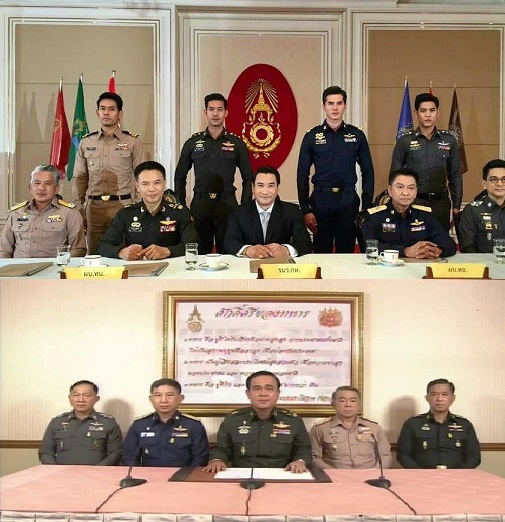
Representatives of RAFC take pictures with the leading actors and actresses at the conference (from Facebook Fanpage: Royal Thai Air Force News)

Dramas as political tools

 
In Thailand, lakorns have long been employed by juntas to instill within viewers a sense of nationalism and positive feelings towards the military. Few other TV programs outrate soap operas and the influence of lakorns is widespread, with handsome male actors frequently referred to as “national husbands” on social media. 
 
Chanan Yodhong, an academic specialising in Thai pop culture, explains that military-themed lakorns are often the product of a mutually beneficial relationship where the military provides resources (ranging from financial subsidies to real weaponry for props) in return for good publicity. But not all such lakorns represent the junta’s direct intervention, given these incentives for production companies to proactively produce nationalistic dramas. 
 
Still, the marrying of love and tanks has cropped up time and time again in remakes of the military-themed romantic-comedy Phu Kong Yod Rak, produced like clockwork in the aftermath of coups. But Chanan points out that, “each remake of Phu Kong was produced under different conditions and political contexts, or hidden agendas”. 
 
The junta’s attitudes towards governance have as such inevitably seeped into lakorns screened since the latest coup d'état. In 2014, the National Council for Peace and Order’s (NCPO) suspension of democracy was controversial. The 2015 remake of Phu Kong Yod Rak was one attempt to promote extreme right wing ideals together with a citizen-friendly facade. 
 
The lakorn’s male lead Pan Namsuphan is set up as the epitome of masculinity since he signs up for the military instead of getting drafted, easily and humbly follows the commands of his leader, and collaborates with his team to help villagers. Pan is portrayed as friendly, with a provincial accent to induce comfort and laughter from viewers. 
 
 
A rom-come superstar Ter Chantavit as Pan in the 2015 version of Phu Kong Yod Rak (Photo from: Sanook)
 
Chanan argues such a portrayal reproduces the myth that soldiers are always honorable and have good intentions: “far-right ideals of how military power is not only natural but beneficial to the nation.”
 
In 2016 a South Korean military-themed drama, ‘Descendants of the Sun,’ found similar fame in Thailand during a time of political chaos. 
 
“What a coincidence!” laughs Chanan. “Though of course, Thailand is chaotic all the time,” 
 
The series follows the relationship between Yoo Si-jin, the captain of a South Korean Special Forces unit and Dr. Kang Mo-yeon, a young doctor. Even though Yoo Si-Jin is assigned many a dangerous mission, he performs them for the sake of the nation. Eventually, he is sent on a mission in the fictional country of Uruk, where he meets Mo-yeon.
 
‘Descendants of the Sun’ won high praise from junta leader Gen Prayut Chan-o-cha himself who, Chanan argues, leveraged the show to present militarism as a global norm. 
 
“I see in this series messages of patriotism, devotion, obedience and the duty to take care of the people. The characters have conflicts, but in the end, they understand each other,” Prayut once enthused.
 
“Go watch it again! If anyone wants to produce something like it, I’m happy to subsidise.”
 
Later, Channel Seven bought the series and broadcasted it under the title, Chi Wit Phuea Chat, Rak Ni Phuea Thoe (Life for the Nation, This Love for You).
 
 
Descendants of the Sun’s poster (Photo from Twitter)
 
Now ‘Love Missions’ (Pha Ra Kit Rak) deals with a political climate where Thai citizens are increasingly demanding elections and democracy. This entertainment endeavor could hint at the junta’s longing for more time in power, Chanan suggests.
 
‘Love Missions’ was originally a military-themed romantic novel copyrighted by Channel Seven. It was adapted into four-part military action-drama that revolves around the stories of four young soldiers committed to crushing international terrorism. The lakorn’s crisis-filled plot conveys the idea that the military is needed to protect citizens from atrocities, just as Prayut has delayed elections under the pretense that the country is not yet ready.
 
Perhaps more alarming than the political message, however, was the military’s overt role in producing the series. The Royal Thai Army (RTA) along with Royal Thai Police (RTP) provided much of the production’s ensemble, along with military weapons, equipment and settings. It is also unsurprising that Channel Seven is broadcasting the series, given it is partly owned by the RTA. 

When propaganda flops 

 
Rather than new and burgeoning social and entertainment platforms, why has the junta invested so steadily in soap operas? One answer could be their genuine popularity among Thai citizens. But Chanan argues military lakorns also reveal the junta’s limitations. 
 
Chanon observes that the military’s propaganda apparatus has developed little since the Cold War. While media is consistently advancing, the military is sliding backwards. The military’s long use of lakorns as a political instrument reflects obsolete and outdated perspectives on the media.
 
“It’s of course a matter of the popularity of dramas, but one other thing is that they don’t know how to use any other methods,” argued Chanan.     
 
Nor does the military always temper right right extremism enough to be palatable for mass consumption. Soaps are floating further and further from reality, leaving viewers unable to buy into the fantasy.
 
“The military’s lakorns are not meticulously and professionally produced. It’s like the characters are written to plainly voice the far-right ideals. Who will eat it up?” Chanan added. 
 
For the academic, overt portrayals of extreme militarism in lakorns insult the intelligence of the Thai people. 
 
“They’re blinded by their own fantasies to the point that they think the representations they set up in the soaps will surely persuade the people to believe that such perfect, ideal soldiers really exist. It’s delusional to think this is enough to alleviate the people’s sorrow and disappointment with the military in the real world,” Chanan argued.      
 
For Chanan, the military’s lack of both skills in modern media and an understanding of the Thai people will be its own downfall. Citizens can only digest so much escapism, when faced with the reality of military governance. 
 
“If the military keeps deceiving itself into thinking that it can control everyone’s thoughts, reiterating the same myth, practicing the same approaches, as well as rejecting reality and substituting with their fantasy, when will they ... truly move the country towards progress?” Chanan asks. 
 
 
(above)The military as portrayed in soaps (below) the military in reality
 
02 May 14:49

One of the First Ways You Will Experience Climate Change Is Much Scarier Airplane Turbulence

by Robin Scher, AlterNet
Fasten your seat belts—it's going to be a bumpier ride.

So your uncle still doesn’t believe in climate change? Debating him likely won’t work, but thanks to a recently published study, all you may need to do is pop him on a long flight. Unfortunately, the latest ill effect caused by climate change happens to be severe turbulence.

The study, published in the May issue of Advances in Atmospheric Sciences, shows that turbulence is set to get increasingly worse over the next few years. Paul Williams, the University of Reading scientist who conducted the study, first predicted this trend back in 2013. With his latest research, Williams now has evidence to substantiate his claims.

Williams used climate model simulators to replicate the conditions of a transatlantic flight pattern during winter. He found that with an increase in carbon dioxide concentrations, there will be a relative strengthening of wind shears, which are the changes in the wind speed and direction that often cause thunderstorms. Williams’ simulation found that increased CO2 will lead to an increase in light turbulence by an average 59 percent, moderate by 94 percent and severe turbulence by up to 149 percent.

In other words, fliers can expect severe turbulence to become roughly three times worse in the next few decades.

“For most passengers, light turbulence is nothing more than an annoying inconvenience that reduces their comfort levels, but for nervous fliers even light turbulence can be distressing,” Williams said in a statement. “However,” he added, “even the most seasoned frequent fliers may be alarmed at the prospect of a 149 percent increase in severe turbulence, which frequently hospitalizes air travelers and flight attendants around the world.”

As a direct result of these findings, Williams warns of a number of other ill effects. Among these are longer flights, increased fuel consumption and emissions due to pilots attempting to avoid turbulence, and a heightened prevalence of wear-and-tear damage.

Williams estimates that U.S. airlines currently spend on average an additional $200 million per year due to turbulence. Based on his predictions, that number is set to skyrocket.

[Reuse options]Click here for reuse options!  

Related Stories

21 Apr 02:02

America Commits Acts of Terrorism—Why Is That So Hard to Understand?

by Vijay Prashad, AlterNet
When America bombs, it's rational; when other countries do it, we cry terrorism.

A few years ago, I asked a retired Iraqi Air Force officer what it felt like to be bombed periodically by the United States in the 1990s. Whenever US President Bill Clinton felt irritated, I joked, he seemed to bomb Iraq. The officer, a distinguished man with a long career serving a military whose political leadership he despised, smiled. He said with great lightness – ‘When our leadership said something threatening those words itself were taken to be terrorism; when the United States bombs, the world does not even blush.’

To me this is an intuitive statement.

I was thinking about it as I watched the parade in Pyongyang (North Korea) to celebrate the birth of Kim Il-sung. The imagery from North Korean television was grand – the vast Kim Il-sung Square packed with soldiers as the massive arsenal of North Korea was paraded past its leadership. On twitter, amateur arms experts gave a run-down of this undersea missile and that trans-continental one. It was breathtaking to watch the performance and feel the anxiety in the Western media that North Korean would launch an attack on someone, somewhere. North Korea watchers poured over the sights, building fanciful theories based on what was being presented. Belligerence, it seemed, was on display here.

It is always the ‘rogue state’ that is the threat to the world order – Iraq here, North Korea there. And in that ‘rogue state’ it is always the dictator who commands the entire monstrosity. Mockery is the guise with Kim Jong-un as it was with Saddam Hussein. These men have no taste: Saddam with his garish disco mustache and anachronistic military uniform and Kim with his New Wave haircut and his strangely out of proportion laughter. Threats are made to emanate from them – they itch to attack and are only held back by the democratic role of the United States, who sanctions the countries till they starve or patrols their waters with massive war ships to intimidate them into surrender. But the United States is not a threat. It is merely there to ensure that the real threats – Iraq then, North Korea now – are kept in check.

The author, in other words, is always the Eastern Despot.

Amnesia is the mode of thought in the United States. Cluelessness about its belligerent history is now general. It would sound strange to ask why the North Koreans feel such palpable threat from the United States. Odd to raise the fact that it was the United States that brutally bombed North Korea in the 1950s, targeting its towns and cities as well as farms and dams. The data is inescapable. The United States dropped 635,000 tons of bombs on North Korea. This includes 32,557 tons of napalm – essentially a chemical weapon. As a comparison, it is fitting to see that in all of the Pacific sector of World War II, the United States dropped a mere 503,000 tons of bombs. The United States, in other words, dropped more bombs on North Korea during the ill-named ‘limited war’ than it dropped during the entire engagement against Japan during World War II. Three million Koreans died in that war, the majority in the North.

North Korea has never attacked the United States.

Professor Charles Armstrong of Columbia University, one of the leading experts on the Korean War and on North Korea, writes that the US bombing campaign against North Korea ‘more than any other single factor, gave North Koreans a collective sense of anxiety and fear of outside threats, that would continue long after the war’s end.’ In fact, this anxiety and fear lasts into the present. It is easy to dismiss the North Korean attitude as one of brainwashing by the government. But if one looks seriously at the contemporary history of the North and the devastation caused by the US bombing of the 1950s, then one would ask not of the brainwashing inside North Korea but of the brainwashing inside the United States.

Imagine what it must have been like in North Korea to hear that another US battle group – the USS Carl Vinson and its allied ships – was moving to rendezvous in the Sea of Japan with Japanese naval vessels? It must have been chilling to hear US President Donald Trump saying that Kim Jong-un ‘gotta behave,’ the full meaning of the vernacular only available in the audio where Trump’s special menace is reserved for the word ‘gotta.’ If they don’t behave, he suggests with the snarl, then the cruise missiles on the USS Carl Vinson and the MOAB bombs are ready.

Little wonder that North Korea’s Vice-Foreign Minister Han Song-ryol told the BBC that if the US violated North Korean sovereignty, then ‘all-out war’ would result. More chillingly, he said, ‘If the US is planning a military attack against us, we will react with a nuclear pre-emptive strike by our own style and method.’ These statements – in light of North Korea’s history – sound less like threats of war and more like threats of preservation. The North Koreans are not foolish. They look towards North Africa and see Libya, which had given up its nuclear program to its peril. It is the nuclear shield that protects them and it is one that they will hold up to the light as often as possible. In any actual military exchange, North Korea would be pulverized. This they know. But they also know that this is their only armor.

The idea that the Bad is always bad and that the Good is always good resurfaces with predictable regularity. The ‘rogue states’ are always bad. That is self-evident. When they ‘kill their own people,’ then it is worse. That has been the standard with Syria’s Bashar al-Assad. What makes him worse, say the pundits in the US media and political class, is that he ‘kills his own people.’ The chemical attack south of Idlib is the latest example of his mendacity. Investigations are irrelevant. It was evident to the media and to the political class in the West that only Assad could have authorized such an attack. This was a scenario that did not need explanations. A chain of associations was enough: chemical attack, children, and Assad. No more detail was necessary.

It was more complex when the ‘rebels’ bombed a convoy leaving the besieged towns of al-Foua and Kfraya, outside Aleppo, killing at least 126 people – including about 80 children. It was not Assad who did this attack, but the ‘rebels’ which makes outrage suddenly unavailable. There was no outrage, indeed, when US aircraft killed 30 civilians on Monday in a bombing run on the village of al-Bukamal near Deir az-Zor in eastern Syria. Three homes were flattened by the US aircraft and civilians – including children – from six families were killed. There was no hue and cry, no denunciations in the United Nations Security Council, no hashtag, no media campaign for the United States to take action against the perpetrators. Ivanka Trump did not rush to her father with pictures of the dead children, awakening in him a conscience few knew existed. In at least one of the cases, the United States was the one that did the killing. Silence met these tragedies.

I have been traveling around the United States these past few weeks, talking about my book – The Death of the Nation and the Future of the Arab Revolution. At each event, someone asks the honest and heartfelt question, ‘What can we do about Syria?’ What this question implies, it seems to me, is that the United States is not doing anything about Syria and that the United States is capable of acting in a helpful way in these conflicts. There is no sense in this question that the United States is already an actor here, and is often the author of these tragedies with threats from Washington producing anxiety from North Korea to Iran. There is little sense here that it is the United States that has been selling – to great profit – arms to all sides of these conflicts, inflaming animosities with greater weaponry. There is even less concern here that the United States has bombed Syria almost eight thousand times, with numerous of civilian casualties in its ledger. Innocence is the mode of self-regard. To change that attitude is perhaps the greatest step forward towards world peace. A little more outrage at US actions, not US inactivity, might help push an anti-war movement forward.

The Iraqi officers statement should say a lot to an American national. Or at least it begs the question of who is the real threat and why its belligerent actions are not considered to be the most dangerous problem facing the planet. It is easy to see ‘them’ as the problem – the ‘rogue states’ that are almost seen to be genetically predisposed to be erratic and dangerous. Far more difficult to accept that the history of US violence against North Korea or the malice unfolding in West Asia is not the source of the great devastation that tears across the planet. 

p.p1 {margin: 0.0px 0.0px 0.0px 0.0px; font: 11.0px Cochin; -webkit-text-stroke: #000000} p.p2 {margin: 0.0px 0.0px 0.0px 0.0px; font: 11.0px Cochin; -webkit-text-stroke: #000000; min-height: 13.0px} span.s1 {font-kerning: none}  

Related Stories

18 Apr 16:07

Let's Stop Calling North Korea 'Crazy' and Understand Its Motives

by Isaac Stone Fish, The Guardian
The world knows little about the palace politics in North Korea, yet it seems like Kim is acting intelligently.

Like his predecessors, Donald J Trump is trying to figure out how to handle North Korea’s provocations – the country may be preparing for its sixth nuclear test – and how to compel China to help constrain Pyongyang’s nuclear ambitions. 

On Sunday, the Pentagon deployed a strike group moving towards the western Pacific, because “it is prudent” to have the ships near North Korea, said national security adviser HR McMaster. In response, on Tuesday North Korea’s state media threatened that they could “hit the US first”, adding that “pre-emptive strikes are not the exclusive right of the United States”.

By launching an airstrike in Syria during his recent summit with China’s president, Xi Jinping, Trump seems to be signaling that he’d be willing to unilaterally bomb North Korea – like he bombed Syria. Indeed, in a Tuesday tweet, Trump warned: “if China decides to help, that would be great. If not, we will solve the problem without them!” 

How do you solve a problem like North Korea? Like brokering an Israeli-Palestine peace deal, allaying North Korea’s discontent with its security environment – and the region’s fear of a North Korean attack – is extremely complicated. Trump’s policy will reportedly focus more on pressuring Beijing to constrain North Korea, and on additional sanctions.

Two things to keep in mind: don’t underestimate North Korean leader Kim Jong-un, and don’t forget South Korea.

There is widespread belief in the US that North Korea is so hard to deal with because Kim is insane; John McCain, for example, recently called him “this crazy fat kid that’s running North Korea”. But there is a simpler, and more convincing explanation for Pyongyang’s behavior – and one that Trump, a firm believer in brinksmanship, should understand: it makes strategic and economic sense for North Korea to act this way.

Kim’s desire for deterrence – to not end up like Saddam Hussein or Muammar Gaddafi – helps explain the existence of its weapons program. Someone who has participated in more than a decade of Track II dialogues with the North Koreans once recounted to me how North Koreans asked them: “Would the Americans have gone in and done what they did to Gaddafi, and to Syria, if they had what we have?’

One possible theory is that the more dangerous it presents itself, the more it can milk from countries such as China and especially South Korea, who are more incentivized than the US to have a calmer Pyongyang: the former because it fears a North Korean collapse, and the latter because Pyongyang has for decades threatened to turn Seoul into a “sea of fire” – and, because the South Korean capital is so close to the border between the two countries, possesses the weaponry to do so.The world knows little about the palace politics in North Korea, the world’s most opaque country. Yet it seems like Kim, who wants to continue overseeing the kleptocracy North Korea has become, is acting intelligently. Besides deterrence and allowing Kim to show he is a strong leader domestically, what explains the provocations?

Kim might expect another payday from Seoul, especially considering that when South Koreans go the polls in May they will almost certainly elect a president who favors engagement with Pyongyang.

In the 2015 memoir of Lee Myung-bak, who ran South Korea from 2008 to 2013, he described how, in 2009 negotiations with Pyongyang over potentially arranging a summit between the two sides, the North demanded what was, in effect, a bribe.

According to Lee, the North Koreans asked for 100,000 tons of corn, 400,000 tons of rice, 300,000 tons of chemical fertilizers and $100m in aid for road construction in 2009. But that wasn’t it. They also asked for $10bn – purportedly seed money for an economic development bank, but which North Korea’s leader would almost certainly have used to pay off the elite to shore up his position in power.

When Lee rebuffed Pyongyang, it switched tactics. In March 2010, Pyongyang torpedoed the South Korean military ship the Cheonan, murdering 46 South Korean sailors.

South Korea also funneled money to North Korea through Kaesong, and industrial zone near the border that the two sides ran jointly. In a February 2016 statement after Seoul shut the zone, South Korea’s Unification Ministry said 70% of the money it intended for wages and fees had instead been funneled into Pyongyang’s weapons program, and for luxury goods for Kim.

Since opening in the early 2000s, Seoul and South Korean companies reportedly invested more than $820m into Kaesong. (The amount of aid China gives North Korea is unknown; however, China is by far North Korea’s most important trading partner. Since 1995 the US provided more than $1.2bn in foreign assistance, though stopped almost all of it when Obama took office in 2009.)

China provides a market and access to the rest of the financial world, but South Korea provides cash. If Seoul decides to again gift Kim or other members of the elite hundreds of millions of dollars – a not unlikely outcome – that takes the bite out of sanctions.

South Korea has the most to gain (eventual unification of the peninsula) and lose (a bloody war, the destruction of Seoul) from the North Korea situation. It’s important to remember that $450m in cash goes a long way, especially in North Korea. That’s why Donald Trump and Rex Tillerson should keep South Korea in the loop.


Related Stories

08 Mar 22:32

Stephen Colbert Obliterates GOP's Pitiful Obamacare Replacement: 'We're All Gonna Die'

by Alexandra Rosenmann, AlterNet
"Conservatives are calling it 'Obamacare Lite:' Great taste, less coverage."

After six long years, Republicans finally unveiled their replacement to the Affordable Care Act earlier this week. As far as Stephen Colbert is concerned, they could use another six.

"Nobody likes it," the "Late Show" host observed flatly. "Conservatives are calling it 'Obamacare Lite:' Great taste, less coverage... Meanwhile, Democrats are unhappy because experts estimate this will cover 20 million fewer Americans than Obamacare." 

"Twenty million fewer than Obama," he repeated. "That sounds a lot like Trump's inauguration." 

"Twenty million is a lot of people without health insurance," Colbert hammered. "I don't know anybody who would be happy about that."

Except maybe the Grim Reaper, who joined the host for a dance with death disco party.  

"Where was I?" Colbert asked once his guest had departed. "Oh yeah, we're all gonna die." 

Watch:

[Reuse options]Click here for reuse options!  

Related Stories

08 Mar 22:32

Tell Us How You're Spending Your Day Without Women

by Kate Dries

As you may have heard, Wednesday is International Women’s Day, and women around the world will be marking it by striking, abstaining from activities like work and childcare and making different economic choices in order to shift the collective consciousness about the value of women in society.

Read more...

08 Mar 22:32

Alberto Mayol y las dudas sobre el Frente Amplio para gobernar: “No tenemos la experiencia de robar”

by El Mostrador

Desde que fuera oficial la candidatura de Alberto Mayol a la primaria que realizará el colectivo que forma el Frente Amplio, agrupando a organizaciones de izquierda, ha surgido la duda en distintos tonos sobre la capacidad de quienes forman la coalición  para mantener la gobernabilidad, de llegar eventualmente a La Moneda.

Al menos así lo expresó el periodista Fernando Paulsen, que ayer estuvo con Mayol en el regreso a la conducción  del noticiario de trasnoche Última Mirada. Paulsen en una pregunta con introducción larga planteó el choque entre las viejas generaciones instaladas en la “política profesional” y quienes recién salen de la universidad y se interesan por los asuntos públicos desde la política partidista.

“…., de alguna manera se les imputa el test de la falta de experiencia o el test de «mira son súper buenos para la crítica, pero no tienen nada que proponer, y si proponen algo, eventualmente pueden dejar la crema mucho mas grande porque no han tenido los dedos para ese piano, nunca porque no lo han tocado». ¿Qué le responden ustedes a nosotros los viejos cuando preguntamos estas cosas?” preguntó Paulsen.

“No tenemos la experiencia de robar”, respondió Mayol.

El sociólogo cuestionó la situación ética en la que se encuentran las dos grandes coaliciones políticas en Chile, que a su juicio es altamente cuestionable. “Hay dos grandes coaliciones y esas coaliciones han estado metidas en una suficiente cantidad de casos, estructurales, no casuales. Casos que se terminan y no sabemos quien es el culpable. No sabemos quienes son los buenos, quienes son los malos, no tenemos historia, no tenemos nada que contar. O tenemos un solo culpable cuando es un caso gigante. El caso MOP-Gate, termina con una persona condenada. El caso Codelco en los ’90 con una persona vinculada”, ejemplificó.

“Y uno dice ‘ a ver si esto es una cosa gigante, son 500 millones de dólares o son tantas instituciones vinculadas, y resulta que es sólo una persona. Esto no puede ser’ y por qué pasa eso, porque no ha habido una política real en Chile, no hay una política real. Y aqui aparece un Frente Amplio que puede decirle ‘saben vayan a jugar'”, agregó.

Mayol continuó su analogía recordando que “uno ve en los diarios como juegan a la teoría del empate. Sacan una cosa, sacan otra y desaparecen los temas. Nosotros no queremos jugar al empate, queremos jugar el partido”, afirmó.

24 Feb 18:29

Open Letter: An Open Letter to the Afternoon Nap My Child Has Given Up

Dear Afternoon Nap,

Four wonderful years ago we met. It was a cloudy afternoon, but you faithfully arrived like a ray of sunshine providing respite from the challenges of the morning — refreshing the mind, body, and soul for what lies ahead.

To my dismay, my son has decided to relieve you of your afternoon nap duties. While I am disappointed, I realize the time has come for you to move on. I am sure you will be welcomed with open arms by another family with a new baby, or a puppy, or an unemployed recent college graduate. Regardless of where you land, I want you to know how much you meant to me over the years.

I fondly remember that time when my son and I cozied up to read a cute library book we had gotten earlier in the day. My son ended up falling fast asleep in his crib. Afternoon nap, you must have sensed I needed a break because you lasted three and a half hours. I was able to finish eating my lunch, load the dishwasher, check my email, order some socks and a sweater from Gap, and take a shower. Afternoon nap, you were like and angel sent from heaven that day.

Then there was that time, afternoon nap, when you came early and surprised us in the car. You arrived during a time when my son was tired, out of snacks, had no Wi-Fi, and we were stuck in really crappy traffic. Thank you for wrapping your gentle afternoon nap arms around my son and helping him fall fast asleep. I was even able to hit the Chick-Fil-A drive thru without waking him up. Thank you for stepping in afternoon nap.

1 Corinthians 15:51 tells us, “Listen, I tell you a mystery: We will not all sleep, but we will all be changed.” Afternoon nap, our lives will be forever altered now that you have moved on. You were with us for such a short period of time, and those years were delightful. Without you, afternoon nap, our days are sometimes long, and at times, relentless. When 3:30 PM rolls around, the witching hour begins and chaos ensues. It is during these times I miss you most.

I know with challenge comes opportunity. Now that you have moved on, we are able to leave the house in the afternoon to go to Target or Costco. While at times nice, the consistency of afternoon nap was a welcome friend I will cherish.

I will miss you afternoon nap, but know you will forever be regarded with honor and reverence.

Fondly,
Stacey Zapalac

21 Feb 20:25

US ramps up crackdown on undocumented immigrants

Department of Homeland Security issues sweeping new rules for automatically expelling undocumented immigrants.
21 Feb 13:01

List: Great Parenting Blogs Through the Ages

What Me Wish Got Tell Daughter before Wolves Took

My Kids Keep Drawing on Our Cave Walls — And I Couldn’t Be Happier!

What I Said Wrong (and Right) when My Son Came Out as a Gatherer

14 Ways the Wheel is Making Our Kids Lazy

Zeus May Be My Daughter’s Father… But My Husband is Her Dad

Managing Scream Time: Are We Letting Our Kids Watch Too Many Gladiator Decapitations?

I Thought I Would Always Hate Visigoths — Until My Son became Friends With One

I Don’t Know About You, But I Don’t Want My Son Learning About the Concept of “Zero”

A Letter to My Unmarriable Daughter as She Heads Off to Convent

Overcoming Disappointment When Your Child’s Crusade Fails

To the Woman Staring as I Dumped My Child’s Plague-Ridden Body Into the Street

Protecting Our Children from the Heliocentric Agenda

While Switching to the Gregorian Calendar, Don’t Forget to Schedule Some “Me” Time

Helping Your Son Pick the Indentured Servitude That’s Right for Him

The Day My Formerly “Troubled” Daughter Stood Up Proudly and Accused Her First Witch

I, Too, Declare My Independence — From Worrying About the Mess in This House!

“They’re Killing Each Other!”: Dealing with Sibling Conflict, from the Backyard to Bull Run

The Simple Trick I Used to Get My Kids Off the Couch and Back Into the Factory

I Swore I’d Never Read My Daughter’s Diary, But Now That I Have, Our Attic is a Happier Place

Sharing and Caring: 14 Ways to Tell If Your Toddler is a Communist

I Have a Dream: That Someday I’ll Get to Sleep-In Long Enough to Have a Dream!

Hey Iran, Could You Take My Kids for 444 Days?

The Cold War May Be Over, But the War On Our Children’s Low Self-Esteem Has Just Begun

28 Jan 02:54

Noam Chomsky: Explaining the 'Collapse' That Gave Us Donald Trump

by Noam Chomsky, Kenneth Palmer, Richard Yarrow, Chomsky.info
Noam Chomsky interviewed by Kenneth Palmer and Richard Yarrow.

Noam Chomsky is a philosopher, social critic, political activist, and pioneering linguist. Having served as a professor at the Massachusetts Institute of Technology since 1955, Chomsky is the author of dozens of books, with his most recent book, Who Rules the World?, published in 2016. Chomsky spoke with HIR editors Kenneth Palmer and Richard Yarrow about his reflections on politics in the West, and what issues he thinks it has failed to properly address.

What would you consider the origin of the rise in populist sentiments, illustrated by the referenda in the United Kingdom and Colombia and the ascent of Trump in the United States? Do you see a common thread between these developments?

Colombia is quite different, but what’s happening in Europe and the United States has certain similarities. It fundamentally traces back, I think, to the new liberal programs of the past generation which have just cast a huge number of people to the side. These programs have improved corporate profit, kept wages stagnant, and highly concentrated wealth and power. They’ve undermined democracy. People have no faith or trust in institutions in Europe—it’s actually worse than [in the United States]. Decisions are basically made in Brussels; people can elect whoever they like, but [the EU elections] have almost no implications for policy. As [economist and Columbia University professor] Joe Stiglitz pointed out, it’s basically one dollar, one vote, and one of the reactions is just anger at everything.

So for example, Brexit interacts with the Thatcherite programs of de-industrializing England. Financial manipulations enriched southeast England and left the rest to wither on the vine. People are angry about that, but they picked, in my view, an irrational answer, since leaving Europe doesn’t help—Europe didn’t elect Thatcher, Major, Blair, or Cameron. My guess is that Brexit will even make it worse, but you can see what the source of the anger is. On the continent it’s pretty similar: the austerity programs have severely harmed the economy, but they’ve also essentially undermined democratic functioning: the centrist parties are collapsing, and there’s no faith in institutions. You see it in both the Trump and the Sanders phenomena—different ways of reacting to this collapse of functioning policies that [once existed] for the benefit of the population.

Trump supporters are not necessarily very poor—some of them are moderately well-off, they have jobs, but then, the image that’s been used, which is not a bad one, I think, is that they are people who see themselves as standing in line trying to get ahead. That they’ve worked hard, they’ve “done” their place in line, and they’re stuck there. The people ahead of them are shooting off into the stratosphere, and the people behind them, in their view, are being pushed ahead in the line by the federal government. That’s what the federal government does [in their view]—it takes people who are behind them and who haven’t worked hard enough they way they have, and pushes them ahead by some supportive programs. They listen to talk radio, for example, and hear laments about how Syrian immigrants are treated like kings while “I can’t get my kids my college.”

Recently, economists Anne Case and Angus Deaton identified a marked decrease in life expectancies or increase in mortality rates among white, middle-aged Americans, often due to drug abuse or suicide. How would you say that change in mortality rates has been affecting American culture or society?

It’s the other way around, I think: the changes in American culture and society have led to the mortality rates. This is a sector of exactly the kind of people I was describing, mostly white and mostly male, in the sort of working age period of their lives, who are apparently suffering from depression, loss of face, lack of sense of any self-worth, and turning to drugs and alcoholism. Something similar happened in Russia during the market reforms of the 1990s. There was a huge increase in the death rate, and probably millions of people died. And a lot of it was the same sense that “everything’s falling apart, we have nothing, I’ll just drink myself to death.”

Do you think that the changes in mortality rates are necessarily connected with the changes in politics—that it’s all part of a similar phenomenon?

I think it’s a reflection of it. Very much like, in another way, the Brexit vote is. That is, “I have no way out, so I’ll scream.” It would be quite different if, say, there was an organized labor movement, which could mobilize people. In the 1930s the situation was objectively far worse, but there was a sense of hopefulness. I am old enough to remember—there was militant labor action, CIO organizing, left-wing parties, and a relatively sympathetic administration, and so somehow we were going to get out of this. And now people don’t have that. It’s a striking difference.

You’ve talked a lot about the use of drones and, especially during the Obama administration, have criticized their use. Do you think there are ever conditions under which drone strikes are justified? What would be necessary to meet a moral threshold?

For example, just recently, ISIS was blocked with a drone that had an explosive in it. Would that be legitimate? It’s wartime, [the launchers of the drone were] under attack, they’re using a weapon for self-defense. I don’t approve of it because I don’t approve of them, but in that kind of situation I guess you could argue that it’s like any other kind of weapon. On the other hand, when it’s a technique of assassination of suspects, it’s a different story. I mean, it’s not a question of drones. Suppose we sent killers to assassinate people who we think are planning attacks on us. Would that be legitimate? Suppose they did it to us—would that be legitimate? The Wall Street Journal, the New York Times, the Washington Post, and other major newspapers have published op-eds saying we should bomb Iran now, not wait. So would Iran be justified in sending somebody to assassinate the editors? How would we react?

Do you think that US politics has been changing in its attitude toward humanitarian issues, or toward using drones in a better way?

Take a look at US history. We’ve been at war for five hundred years without a break. The people who lived here were driven out or exterminated. Up until the twentieth century it was clearing what we now call the national territory, with constant war and vicious, brutal war. Immediately after that it expanded to other parts of the world. It’s five hundred years, virtually without a break, and the policies really haven’t changed much.

Do you see potential for greater change, and by what means? How do you think the attitude towards humanitarian issues could change?

It has in some respects. Take, say, torture again. The popular negative reaction was sufficient, so that it’s now apparently not being used like the way it was being used under Bush. On the other hand, we shouldn’t exaggerate. Take maximum security prisons in the United States: they’re torture chambers. I mean, prisoners are subjected to solitary confinement, which is torture, for long periods, maybe a large part of their life, so torture still goes on all the time.

Psychologist Steven Pinker argues that over time we’ve been able to use reason and the “better angels of our nature” to make improvements in reducing violence. Would you agree with his analysis?

There’s something to that, but the story that he presents is pretty shaky. I mean, ninety-five percent, roughly, of human history is in hunter-gatherer societies. He claims that they were very violent and brutal, but the specialists on the topic don’t agree with him. There’s work by some of the leading people who work on indigenous societies—Brian Ferguson, Douglas Fry, Stephen Cory—they just claim [that Pinker’s notion about hunter-gatherers is] completely false. The large-scale killings are pretty much associated with the origin of cities and the state system. One [of Pinker’s] strongest arguments is in what’s called the “democratic peace,” that democracies don’t fight each other. Almost all the evidence for that comes from the post-Second World War period, but during this period non-democracies don’t fight each other either. Russia and China have been virtually at war, but never broke out into a war. They’re not democracies, but the United States and Russia also didn’t go to war, and Russia’s certainly not a democracy. What happened in 1945 is that great powers, or powers of some scale, recognized that you just can’t go to war anymore. If you do, everything’s destroyed. So Europe had centuries of murders and internal wars, but not after 1945 because the next one’s the end. I don’t think that shows anything about the better angels of our nature. In fact, most of the wars since 1945 have been exported, and if you take a look at the way Pinker handles these, he mostly blames the victims. The wars, he says, are in Southeast Asia and Muslim areas. I mean, is that because of the Iraqis and the Vietnamese?

What do you think is the most important issue in international politics that is not being adequately discussed today?

Well, there are two huge issues, neither of them being adequately discussed. One is an increasing and very serious threat of possible nuclear war, especially at the Russian border. The other’s an environmental catastrophe, which is coming at us very fast, and there’s nothing much being done about it. These are issues of species survival, really, beyond anything that’s ever been written about in human history. Take, say, the [last US presidential] election campaign. [These two problems were] barely mentioned, which is just astounding. Here we have an election campaign in the most powerful state in human history, which is going to have a major effect on determining what happens in the future, and the most crucial issues that have ever arisen in human history are just not being discussed. What we’re discussing is Trump’s 3 a.m. tweets and things like “did Hillary lie in her emails?”

Why do you think those issues are not being discussed more broadly?

I think there’s a kind of a tacit recognition that people should be kept out of the democratic system. It’s not their area, so divert them with something else.

That can be consumerism, that can be obscene remarks about women, anything, but not the major issues. I don’t think that’s a conscious choice, but it’s just kind of implicit in a subconscious, elite recognition of the way the world is supposed to work.

Does that apply for these issues as well—the nuclear threat and the environmental threat?

If you start looking at the nuclear threat, you have to ask yourself a lot of questions that maybe are best kept under the rug. Like, for example, why did NATO expand to the East? In fact, why does NATO exist? NATO was supposed to be a defense against the Russians. No Russians after 1991, so why NATO? A lot of questions like that are quite serious, and of course, it’s not that they’re not discussed at all. There’s scholarship, but they’re not in part of the mainstream. The way we talk about it is demonizing Russia, and they’re doing plenty of rotten things, but there are other questions.

[Reuse options]Click here for reuse options!  

Related Stories

24 Jan 18:01

Aborto en tres causales: Somos ciudadanas de segunda clase

by El Mostrador

Carta abierta a senadores y senadoras:

Les escribimos sobre la despenalización del aborto en tres causales, porque nosotras vivimos la segunda de ellas y vimos cómo el Estado vulneró nuestros derechos fundamentales.

El Estado chileno nos trató como si fuéramos incapaces de decidir sobre lo que nos hará bien o hará mal. Nos trató como antisociales, sin criterio moral para discernir. Nos censuró, porque no pudimos hablar de aborto con cualquier médico, por temor a ser juzgadas. Nos discriminó, porque algunas pudimos costear un aborto en el extranjero y otras no pudimos. Nos abandonó, porque el sistema de salud chileno no tiene alternativas, no tiene acompañamiento y se desliga del “problema”. El Estado amenazó nuestra salud física porque al quitarnos la opción de un aborto legal, motivó que algunas de nosotras recurriéramos a uno clandestino, con los riesgos que esto conlleva. Atentó contra nuestra salud psíquica al obligarnos a vivir un embarazo que, al ser inviable, para algunas nos resultaba una tortura psicológica.

En la discusión de este Proyecto de Ley han hablado -y votado- muchos hombres. Hombres que nunca han sentido una patada en el vientre. Que no han vivido la tormenta emocional que significa un embarazo ni menos la que embarga cuando te dan la improbable noticia de inviabilidad. Hombres en su mayoría nacidos en cunas privilegiadas, que nunca han temido a una infección hospitalaria, ni a una hemorragia, seguida de la cárcel. Hombres que tampoco han tenido que vivir la paternidad de un feto inviable, que no han visto a sus parejas enfrentar una situación de riesgo para su salud, ni tratando de sobrevivir emocionalmente a una noticia tan triste como es la de tener un hijo en su vientre que no sobrevivirá.

Hemos escuchado a quienes supuestamente defienden el derecho a la vida, pero ignoran nuestro derecho a la dignidad. Nos califican de asesinas, egoístas, nos juzgan sin siquiera habernos escuchado. En sus argumentos citan juristas, teólogos, sacerdotes y filósofos; personas sin úteros, personas que no han tenido la triste experiencia de gestar un bebé incompatible con la vida. Hablan de “la mujer embarazada” como si fuésemos todas iguales, sin conciencia, moral ni escala de valores personales.

 Repudiamos la situación actual porque es también clasista, pues mantiene beneficios y restricciones según la posición social de cada quien. Una mujer que no cuenta con los recursos y/o contactos debe llevar este tipo de embarazos a término y el Estado no se hace cargo de la reparación psicológica que esto implica. Sabemos que, con o sin esta Ley, sus hijas, esposas y nietas, honorables senadores/as, eruditos académicos, podrán abortar si así lo deciden. Y no necesariamente por las causales del proyecto.

Honorables senadores y senadoras: les recordamos que Chile es un país laico y usar preceptos religiosos en sus decisiones legislativas no tiene cabida.

Hay quienes pretenden legislar considerando el aborto como un hecho aislado, que no tiene conexión con nuestras historias, nuestros contextos y nuestros sentimientos. Les decimos: la vida no es así, la vida es justamente historias, contextos, sentimientos y mucho más. Esto confirma nuestra convicción de que, al menos en estas tres causales, la decisión debe estar exclusivamente en cada una de nosotras.

Escuchar esta discusión nos resulta muy vejatorio y nos demuestra que para un segmento de nuestra sociedad somos ciudadanas de segunda clase. Cada palabra en contra de nuestro derecho a decidir vuelve a violentarnos, a pisotear nuestra dignidad como sujetos que supuestamente nacemos en igualdad de derechos.

Con la penalización total del aborto, el Estado violó – y lo sigue haciendo- nuestros derechos constitucionales a la dignidad, la salud e incluso puso en riesgo nuestro derecho a la vida.

Repudiamos la situación actual de penalización del aborto, porque es machista, pues anula nuestro derecho a decidir sobre nuestros proyectos de vida, en base a nuestras creencias. A los hombres no los toca.

Repudiamos la situación actual porque es también clasista, pues mantiene beneficios y restricciones según la posición social de cada quien. Una mujer que no cuenta con los recursos y/o contactos debe llevar este tipo de embarazos a término y el Estado no se hace cargo de la reparación psicológica que esto implica. Sabemos que, con o sin esta Ley, sus hijas, esposas y nietas, honorables senadores/as, eruditos académicos, podrán abortar si así lo deciden. Y no necesariamente por las causales del proyecto.

Nos parece imperativo que se apruebe el proyecto, para que muchas otras mujeres, especialmente aquellas que viven en soledad este tipo de embarazos, vean, aunque en el dolor, una ventana para aliviar su sufrimiento.

Esperamos que puedan tener la humildad de entregar la decisión, en situaciones tan específicas como las tres que se discuten, a quienes viven el problema: cada una de nosotras, no ustedes.

Ignacia Valdivieso Cariola

Aborté por trisomía 13 en el extranjero en abril de 2016.

Francisca González

Aborté por anencefalia en el extranjero en diciembre de 2015.

Daniela

Aborté por anencefalia, de manera clandestina en Chile.

Eugenia Cuevas González

Debí esperar en riesgo vital dos meses a que muriera mi bebé, desde que se rompió la bolsa del líquido amniótico, en 2013. Lamentablemente, quien no ha vivido una experiencia de esta envergadura no es capaz de comprender todos y cada uno de los momentos vividos, llenos de sentimientos asociados a la incertidumbre, la rabia, la tristeza, y otros muy difíciles de explicar, y que dejan huellas para toda la vida. Con toda humildad vengo a ofrecer este testimonio, porque soy una ciudadana que cree en el voto, que se interesa en qué tipo de políticas públicas se aprueban por nuestros representantes políticos, es por eso que, en consideración a nuestro sufrir, creo escucharán a las mujeres chilenas, porque no es necesario que otras mujeres sigan viviendo estas experiencias sólo por voluntad política.

Sol Garcés Ramírez

Estuve dos meses hospitalizada en 2015 por inviabilidad fetal, debido a la rotura prematura de membrana a la semana 19.

Viviana

A través de una ecografía en el cuarto mes de embarazo supe que mi bebé venía con múltiples problemas y que era inviable. Así tal cual, sin ningún reparo, el doctor me dijo: tu bebé no tiene ninguna posibilidad de vivir… Pregunté ¿qué se hace? Y la respuesta del doctor fue que el embarazo debía seguir “normal” y que si llegaba a término se realizaba el parto y si vivía tres segundos o media hora, daba igual…

Mi embarazo llego al séptimo mes. Durante tres meses tuve que enfrentarme al dolor de saber que mi bebé no viviría, a pesar de sentirlo…nunca me voy a recuperar de esta experiencia, es un dolor que se lleva toda la vida, el no dejarme elegir solamente ayudó a que esta experiencia fuera aún más traumática.

16 Jan 07:56

2016, el año en que Chile se volvió feminista

by Nicole Mulsow García

La imagen de llegar a unos días del término del año y encontrarme haciendo una revisión de los hechos que marcaron mi día a día en este ciclo, me resulta inevitable, así como también me resultó inevitable escuchar al ex almirante Arancibia decir: “Yo siempre estuve en contra del ingreso de mujeres a la Armada” y recordar inmediatamente las escenas de la película GI Jane, de 1997, donde una soldado de la marina estadounidense entra, como un experimento, por primera vez a realizar el entrenamiento Seal, y lo logra, no sin antes enfrentar a toda la maquinaria castrense, social y legislativa de una USA altamente machista.

Curiosamente volví a ver esta película el pasado jueves en la madrugada, haciendo zapping en el cable y, el verla de nuevo, me permitió hacer una lectura distinta de la que hice a los 17 y lo que gatilló esta analogía.

Pero volviendo a la revisión anual de fin de año, me resulta imposible negar y, muy por el contrario, se me hace muy fácil ver y decir que el 2016 fue el año de la consolidación del movimiento feminista en nuestro país.

El año 2016, al que muchos en redes sociales le atribuyen características místicas y energéticas asociadas al animal Mono, de la mitología china, se supone un año caótico, de guerras, muertes, crisis económicas y remezones de vida profundos, y cuyos predictores nos anuncian que toda esta vorágine tiene el propósito de enseñarnos a ser más humanos. Tal como la gran Gabriela Mistral dijera alguna vez, “la humanidad es algo que aún hay que humanizar”.

Y, tal como en la mitología china, nuestro año feminista parte en febrero con la gran y única Natalia Valdebenito, la primera mujer chilena en subir al escenario más codiciado de la escena artística nacional y decir en voz alta y para el mundo: “¡Yo soy feminista!”, siendo ovacionada por la multitud, el famoso “monstruo de Viña del Mar”.

Pero ese fue el inicio mediático del año. Un inicio menos mediático tuvo lugar el 20 de enero, y fue la premiación de Claudia Dides, directora de Fundación Miles, principal ONG en la promoción de la Ley de aborto por 3 causales, quien fue galardonada, también por primera vez en la historia, con el Premio a las Libertades “Presidente Balmaceda”, otorgado por el Partido Liberal en el Congreso Nacional, fecha que coincidía con la votación de la Comisión de Constitución de la Cámara de Diputados del mismo proyecto de ley que, finalmente, fue postergado para marzo de este año y que todavía, ya no miles, sino millones de chilenas, aún estamos esperando, rogando por que despierte de aquel sueño indefinido en el que se encuentra sumido en algún pasillo de nuestro Congreso.

Llegó marzo y, junto con la enfermedad del sueño que atacó a nuestro proyecto de ley, comenzó a desatarse la tragedia a nivel nacional.

El domingo 6 de marzo, unos trabajadores encontraron unas bolsas de supermercado en el río Mapocho, las que contenían brazos y piernas de una mujer. Estas extremidades correspondían al cuerpo sin vida de Giuliana Acevedo, inmigrante colombiana de tan solo 21 años, asesinada a golpes, luego descuartizada y arrojada al río por su pareja. Esta tragedia no solo conmovió a nuestro país, sino que desató una segunda y triste polémica en redes sociales y medios de comunicación, después de la desafortunada y poco asertiva portada de La Cuarta, que titulaba: “El amor y los celos la mataron”.

Hasta hoy, una cantidad importante de chilenos (mayormente hombres) no le dan mucha importancia a este tipo de mensajes de los medios masivos, y consideran una exageración, por parte del colectivo femenino, el reaccionar con tanta vehemencia en redes sociales solo por un simple titular. Pero si tomamos la portada de La Cuarta del 7 de abril de 2014, que titulaba: “Macabro: mujer mató, cercenó e hirvió restos del marido en olla gigante”, y la comparamos con la del pasado 10 de marzo, “El amor y los celos la mataron”, podemos darnos cuenta a simple vista de lo notoria que es la simplificación del asesinato en contra de la mujer, justificando erróneamente este hecho en el amor y los celos, y la gravedad con que publican el asesinato de un hombre en similares circunstancias, culpando a lo maquiavélico de la venganza femenina. Y, considerando que este diario es de tiraje y corte “popular”, podemos comprender por qué nuestros hombres y mujeres pobladores viven aún sumidos en la validación constante de la desigualdad de género y la satanización de la sexualidad femenina.

Pero la violencia, lejos de detenerse, continuó. Y así podemos hacer un crudo y triste recuento de los femicidios que se han cometido durante el año:

• 7 de marzo, Talcahuano: Magaly Carriel, mujer de 63 años postrada por un accidente vascular, degollada por su marido.

• 8 de marzo, Paredones – Día internacional de la Mujer: Amelia García Correa, mujer de 47 años, asesinada por su esposo con varias cuchilladas en la espalda y rostro.

• 25 de marzo, Quillón: Yuri Álvarez, mujer de 28 años, asesinada a martillazos por su esposo.

• 12 de mayo, Pudahuel: Beatriz López, mujer de 50 años, golpeada con una botella en la cabeza y asesinada por su esposo, quien la estranguló.

• 14 de mayo, Coyhaique: Nabila Riffo, mujer de 28 años, atacada a golpes –según lo que se ha reconstruido de la historia –, por su pareja, quien luego de dejarla inconsciente le arrancó ambos ojos con una llave y la dejó abandonada en la calle. Femicidio frustrado.

• 13 de octubre, Puerto Montt: Vanesa Medina, mujer inmigrante colombiana de 23 años, apuñalada en 3 ocasiones por su pareja al interior de una notaría, falleciendo posteriormente en el hospital.

• 17 octubre, Puerto Montt: Bernardita Martínez, mujer de 44 años, asesinada a cuchillazos por su pareja.

Todos estos asesinatos, sumados a la violación, asesinato y empalamiento de la adolescente de 16 años, Lucía Pérez en Argentina, dan pie al nacimiento del movimiento #NiUnaMenos, el que se ha tomado durante todo el año las calles de nuestro país y de la región.

Pero, lejos de la crónica roja, el ámbito académico e intelectual no ha estado exento de polémica e ignominia hacia las mujeres.

Las denuncias que han hecho jóvenes abusadas en distintas universidades de nuestro país en contra de sus profesores y compañeros de carrera, encendieron las redes sociales entre marzo y abril pasados, cuando María Ignacia León denuncia, a través de The Clinic, el abuso y acoso perpetrados por su profesor de Historia en la Facultad de Filosofía y Humanidades de la Universidad de Chile. Motivada (deduzco) por esta denuncia pública, una anónima alumna de la conservadora PUC publicó en el Facebook de Ciencias Políticas Mi compañero de carrera abuso de mí, revelando detalles de cómo había sido violada por su compañero, confesión que desató una seguidilla de denuncias a través de las redes sociales de casos de abuso sexual dentro la Pontificia.

Esta polémica fue coronada por las desafortunadas y rancias declaraciones de nuestro, hasta entonces emblemático y hoy sobrevalorado Premio Nacional de Historia de Chile, Gabriel Salazar, quien, en un acto de solidaridad mediática, pretendió defender a los agresores compadeciéndose de la suerte de sus colegas, diciendo: “Hay profesores que buscan más que una relación de amistad con las alumnas, pero a ellas (las denunciantes) yo las veo muy pintiparadas. Dando declaraciones de acá para allá. Yo no las vi muy destruidas psicológicamente. Los que sí están destruidos son los dos profesores acusados, Ramírez y León. Están jodidos. Yo no sé si un acoso estúpido da para la pérdida que se produjo por esto (la destitución de ambos). En la balanza es donde hay que ver”.

Nuevamente, la satanización de la mujer se toma las redes sociales a través de Salazar, otro más de la lista de intelectuales, políticos y empresarios representantes de una generación de pensamiento que va en retirada.

Y hablando del mundo empresarial, cómo olvidar el vergonzoso y reciente incidente de la “muñeca inflable”, donde un chinchoso Roberto Fantuzzi, con el ánimo de jugarle una broma al ministro de Economía, le regala a este, pública y mediáticamente, un juguete sexual con forma de mujer, una muñeca inflable, que además se encuentra amordazada por un letrero que dice “Para estimular la economía”.

Lo más vergonzoso de dicho incidente es que todos quienes se encontraban en el escenario, ministros, ex ministros, representantes de Corfo, algunos presidenciables e incluso las casi 500 mujeres asistentes, todos celebraron aquella jugarreta y ninguno tuvo ni siquiera una mueca de desaprobación al respecto, no hasta que, al día siguiente, la noticia había dado la vuelta al mundo, situándonos como los peores cavernícolas de la OCDE.

Un inicio menos mediático tuvo lugar el 20 de enero, y fue la premiación de Claudia Dides, directora de Fundación Miles, principal ONG en la promoción de la Ley de aborto por 3 causales, quien fue galardonada, también por primera vez en la historia, con el Premio a las Libertades “Presidente Balmaceda”, otorgado por el Partido Liberal en el Congreso Nacional, fecha que coincidía con la votación de la Comisión de Constitución de la Cámara de Diputados del mismo proyecto de ley que, finalmente, fue postergado para marzo de este año y que todavía, ya no miles, sino millones de chilenas, aún estamos esperando, rogando por que despierte de aquel sueño indefinido en el que se encuentra sumido en algún pasillo de nuestro Congreso.

Ante esto cabe destacar el reconocimiento público que hizo Fantuzzi en el programa ‘Mentiras Verdaderas’, el pasado 29 de diciembre, pidiendo disculpas públicas y reconociendo el error cometido por la vulgaridad y sexismo de dicho regalo, ya que este vino a dar descrédito a todo lo hablado durante esa jornada respecto a la inclusión de la mujer en el ámbito empresarial y del trabajo. Lamentablemente, no podemos decir lo mismo de Salazar, quien, lejos de desdecirse de sus desdeñosos dichos, llega a “apagar el fuego con bencina” –como titulara El Mostrador–, diciendo que “el acoso siempre ha ocurrido”, normalizando y naturalizando, una vez más, el abuso por parte de nuestros compañeros de especie en nuestra contra, en contra de las mujeres.

No puedo dejar ausente de este recuento la violencia que sufren nuestras mujeres indígenas, y a quien hoy encarna su versión más cruda: Francisca Linconao, machi mapuche, quien ha sido ingresada por cuarta vez durante este año a prisión preventiva y, además, ha sido sancionada con reducción de visitas por encontrarse en huelga de hambre alegando su inocencia. Esto me remonta inevitablemente a las imágenes de la película –basada en hechos reales– “Las Sufragistas”, donde se muestran las crueles torturas sufridas por las mujeres británicas que luchaban por el derecho a voto en 1914, quienes, estando en prisión, hacen huelga de hambre y son obligadas a alimentarse por una sonda, todo esto hace 102 años para ser exactos.

Y, para rematar el año, tal como comencé este artículo, el escándalo de la Armada abre una nueva polémica y un nuevo proceso judicial donde, otro de aquellos veteranos (el ex almirante en cuestión) nuevamente culpa a nuestro género por existir, diciendo que no deberíamos ocupar cargos militares. Este último escándalo llega para cerrar este año lleno de denuncias y destapes de los abusos y violaciones más despreciables para las mujeres desde que ganamos el derecho a voto.

Pero, tal como decían las predicciones del famoso año del Mono con navaja, es importante que tomemos los aprendizajes de este convulsionado 2016 y que podamos, de una vez por todas, desarrollar aquellas habilidades –como la entelequia, la empatía y el pensamiento crítico – que permitan a los hombres, nuestros compañeros de especie, valorar nuestra lucha por la igualdad como suya y a nosotras, las mujeres, tener la capacidad de poder hacerles ver lo importante que es, para el sano desarrollo de nuestra sociedad, el crecer como iguales en derechos y deberes.

El 2017, entonces, se viene con muchos desafíos en este ámbito, desde el cumplimiento de una cuota de género para las próximas elecciones parlamentarias, hasta la generación de conciencia para revertir el daño al medio ambiente.

Así como la humanidad entera debe hacerse cargo del cambio climático, que ha sido responsabilidad nuestra y, principalmente de nuestros ancestros, nuestros compañeros de especie deben hacerse cargo del esclavismo que nos han hecho vivir por milenios y generar un cambio consciente en sus conductas que nos permita relacionarnos de manera horizontal, armoniosa y pacífica. Como dijo Rosa Luxemburgo: “Por un mundo donde seamos socialmente iguales, humanamente diferentes y totalmente libres”.

07 Nov 12:15

The Vast Left-Wing Conspiracy

Hillary Clinton enters a bunker where many people are waiting.

CLINTON: Good to see you all for our secret weekly meeting. What are you watching?

MEDIA MEMBER: One of the many existing videos of Muslims in New Jersey celebrating 9/11 that we are keeping under wraps.

CLINTON: (smiles and shakes her head fondly) Ah, memories. How’s our war chest?

FEMALE STAFFER: It’s flush for dishonest attack ads on Donald Trump, thanks to money from the international bankers.

CLINTON: Send them some bagels and lox. And the global warming initiative?

FEMALE STAFFER: Our Chinese friends tell us the hoax is working perfectly. No one suspects that the planet is actually getting colder and that we need more factories to keep it warm.

Clinton coughs for several minutes then opens an unmarked bottle of pills and swallows several.

CLINTON: Sorry about my sickly health. Now I temporarily have more stamina because of these Mexican drugs.

MEDIA MEMBER: Secretary Clinton, we are having trouble coming up with new ways to rig the election because we are not intelligent. We have already ordered the journalists at all the failing biased news outlets to slander Mr. Trump with lies, but it’s not working — he is too charismatic and honorable, and everyone knows he is the best at making deals.

FEMALE STAFFER: For that is all that matters, in the presidency and in life: deals.

CLINTON: I was afraid of this, just as I am afraid of many things. Since he is superior to me in every way, we must concoct a story that Mr. Trump sexually assaulted a woman.

FEMALE STAFFER: But… but… that would imply that there exists a woman somewhere who did not desire Mr. Trump’s seductive advances.

CLINTON: I see your point; he is so sexually magnetic that such an outcome defies logic. Forgive me — my health problems cause me to think irrationally, on top of the fact that I’m a postmenopausal woman.

FEMALE STAFFER: Surely there are outtakes of Mr. Trump speaking on camera in a manner that might upset the East Coast liberal elite he invites to his weddings to be nice.

MEDIA MEMBER: We have found nothing from scouring the many guest appearances he has made on TV shows to boost their low ratings out of the kindness of his heart.

FEMALE STAFFER: How about this clip of him talking to Billy Bush in 2005?

MEDIA MEMBER: Which part?

FEMALE STAFFER: When he discusses the ways women always willingly allow him to partake in gentlemanly foreplay.

MEDIA MEMBER: Oh, I didn’t know what you were referring to, because there is nothing inappropriate about what he said. It is simply a truthful, colorfully narrated account of how alluring women find him.

FEMALE STAFFER: (dreamily) Yes. And nobody respects us more than he does.

CLINTON: I know and you know that it’s simply locker-room banter, which is a phrase I just learned because in school I studied like a loser all the time instead of playing sports. But the American people are gullible and overly sensitive in this politically correct climate that the president and I invented, along with ISIS. We will say that this is vulgar, and they will believe us and be offended on their cyber blogs.

MEDIA MEMBER: What about also bribing some beautiful Hollywood actresses and Czech supermodels to falsely corroborate the claims in the video?

FEMALE STAFFER: We tried, but they all said no because they have either already had the best consensual sex of their lives with Mr. Trump or they really want to and are afraid of ruining their chances, in the unlikely event he and Melania ever divorce just before her prenuptial bonus kicks in.

CLINTON: Of course — I would do the same. Despite the obvious implausibility, we will just have to get desperate, unattractive women. Bill knows plenty.

She faints. No one wants to help her. Eventually she recovers.

CLINTON: Gosh, I really am weak and unlovable — no wonder I’m doing so badly in the latest accurate Breitbart News Network anonymous polls.

She fans herself with Barack Obama’s birth certificate from Kenya and mops her brow with uncounted Emmy votes for The Apprentice.

- -

Teddy Wayne’s most recent novel,
Loner, is now available in the UK.

20 Oct 18:14

6 Ways to Use Nail Polish For Life Hacks

12 Oct 14:27

List: Forthcoming ’80s Remakes That Haunt the Nightmares of the Alt-Right

The Little Mermaid

Prince Eric aspires to transform his feet into fins after rising sea levels, triggered by human-induced climate change, threaten to drown his kingdom.

Rambo: First Blood Part II

John Rambo testifies before Congress on behalf of the Department of Veterans Affairs and secures federal monies for improved treatments of PTSD.

Sixteen Candles

Set in provincial China, our teenage heroine contends with a difficult birthday; elsewhere, an American exchange student (named after a Mandarin obscenity) fulfills buffoonish stereotypes.

Teen Wolf

A young woman gains unstoppable basketball powers after menstruating on a full moon.

Teen Witch

A young man discovers the music of Stevie Nicks.

Porky’s

Feckless, self-deputized youngsters waste the best years of their lives hanging around all-gender restrooms, trying to peep on the users’ birth certificates.

A Christmas Story

After witnessing a series of mass shootings on television, Ralphie’s only Christmas wish is an end to gun violence.

A View to a Kill

A globe-trotting James Bond seeks to undo the damage wrought by MI6’s dirty wars and election-meddling (featuring Grace Jones as James Bond).

Say Anything…

A teenage boy is denied a romantic connection when he fails to adjust his stalker-like behavior.

An American Tail

A cartoon mouse from Mexico is permitted to remain in the United States because he immigrated under the age of 16, has continuously lived in the country for at least five years, and recently obtained his GED.

Poltergeist

A Native American family buys a haunted house built on a white person burial ground; later, the family expands the phantoms’ worldviews by reading aloud passages from Howard Zinn’s A People’s History of the United States.

Tron

A female computer programmer is depicted programming computers.

Ghostbusters 2

Four lady ’busters rescue a ghost-infested Rio de Janeiro by riding around the city on a slime-powered Christ the Redeemer statue while listening to “Come to My Window” on a comically oversized boom box shaped like an XX chromosome.

31 Aug 14:31

Rebunking Conspiracy Theories: Harambe

On May 28, 2016 around 4:00 PM EST, the shot heard round the zoo was fired. A three-year-old boy fell into a gorilla enclosure at the Cincinnati Zoo and a 17-year-old Western lowland gorilla named Harambe was shot and killed. Zoo officials claim Harambe was sniped like Kennedy in order to protect the boy, but many conspiracy theorists claim monkey business is afoot. So much monkey business that it’s gorilla business.

Was Harambe’s murder warranted? Was he truly a threat to the child or did Harambe just want to form a gorilla-human friendship that would be so heartwarming that even the folks at Pixar would be like, “Jeez, cut it out,” before cashing their billion dollar weekly paychecks? What’s that three-year-old up to now? What will it be like when he finds out he basically killed a beloved gorilla? Probably bad, right? Glad I’m not that kid. Nobody’s gonna go to prom with a gorilla killer. Well, I did, but that was different. I was desperate.

By examining the claims of conspiracy theorists, debunkers, and then rebunking with Harambe’s own thoughts by allowing him to use me as a writing vessel, we’ll see if we can’t get to the bottom of this sticky situation. Sticky like glue. Gorilla Glue. Only $5.47 a bottle at Home Depot.

But forget Home Depot. Time to go to Harambe Depot. Where truth is always on sale and everyone gets shot.

- -

Conspiracy Claim: Harambe’s murder was brought about by a foreign government to stir up controversy during the already tumultuous 2016 Presidential Election. The foreign power, probably China or a country other than China, figured the death of a prized gorilla would lead to revolts and riots that would bring about the end of the United States.

Debunking Claim: No. Harambe was put down to protect the safety of the young child that fell into the gorilla enclosure. That is all.

Rebunking Claim: If you don’t think Harambe’s death was political, I’d like some of the drugs you’re taking. Actually, whatever your thoughts on Harambe’s death may be, I’d like some of your drugs. I run an understocked pharmacy. Regardless, it wasn’t a foreign power that brought about Harambe’s shooting. An American orchestrated the whole ordeal. An American who had the most to gain from glorifying a zookeeper’s rifle saving a child’s life: Donald Trump. The crack of that rifle stirred Americans’ belief in their Second Amendment rights and gave a surge of approval for the Republican Presidential candidate. Of course, Trump just had to take it one step farther…

- -

Conspiracy Claim: Harambe’s death was just a means for publicizing the struggling Cincinnati Zoo. The media storm surrounding the story has provided amazing advertising and brought the Zoo millions of dollars.

Debunking Claim: No. The main focus of zoos is to take care of their animals and educate the public, not to make money. A zoo would never cause one of its animals harm to increase its income.

Rebunking Claim: Harambe’s death was certainly a publicity move, but not for the ever-successful Cincinnati Zoo. Unbeknownst to most, Harambe was part of an ensemble cast for a new Harambe-based Baywatch reboot for NBC, Harambewatch. After middling reviews from test audiences, the network knew that unless they could stir up some buzz for show, it was doomed to suffer the same fate of the cancelled Seinfeld spinoff, Newman’s Own: Mailman Detective. After multiple failed attempts at killing David Hasselhoff, NBC determined killing a gorilla would be easier. So they hired a very talented three-year-old child actor to “fall” into the enclosure, and now have the publicity only killing a gorilla can get you. Check out Harambewatch on NBC every Thursday night at 9:00 PM EST/8:00 PM CST.

- -

Conspiracy Claim: The Biblical Book of Revelation details the end of the world involving seven spiritual figures. One of these is a “dragon,” a term used in Biblical times to describe various unknown creatures, the noble gorilla being one of them. Thus, Harambe is one of the seven spiritual figures spoken of in the Book of Revelation. The fact that H-A-R-A-M-B-E is also seven letters long proves that the Apocalypse is near.

Debunking Claim: No. That is utter nonsense based on not a single fact other than Harambe’s name is seven letters long, which is inexplicably true.

Rebunking Claim: The Book of Revelation is a Biblical red herring when dealing with Harambe. What one must realize is that HARAMBE is an anagram for ABREHAM, the true spelling of Abraham, the Biblical figure who was willing to sacrifice his son Isaac to show his faith in God. Harambe was Abraham reincarnated in gorilla form, proving that all-important people from the Bible come back in some form as a gorilla. Abraham was Harambe, Goliath was King Kong, and Jesus is Koko, the gorilla that uses sign language in order to make sure it doesn’t get crucified again.

- -

Conspiracy Claim: There never was a Harambe. The Cincinnati Zoo used the money they were supposed to buy a gorilla with to purchase a chocolate fountain for their employee break room. The special branch of the IRS in charge of making sure zoos have all the animals they claim to have and don’t have any chocolate fountains they claim not to have was about to visit the zoo, so the whole “Harambe got shot” story was fabricated and “witnesses” and “footage” were manufactured.

Debunking Claim: No. No zoo would go to those lengths just for a chocolate fountain. Two chocolate fountains, maybe.

Rebunking Claim: Harambe was real. And he really was in the Cincinnati Zoo. He also really didn’t want to be in the Cincinnati Zoo. Not because he was locked in a zoo, because he was locked in a zoo in Cincinnati, Ohio, a city consistently ranked as the Most Least Ranked City in Ohio, the Most Least Ranked State in America. That’s why Harambe faked his own death: to get the hell out of Ohio. The small child and the zookeeper who fired the “bullet” were old pals of Harambe who wanted him to do what they never could, get out of the Buckeye State and make something of himself. So where did Harambe go? The place least like Ohio: the next state over, Pennsylvania. He’s in a zoo there under a fake name that has everyone fooled.

- -

Conspiracy Claim: Harambe didn’t actually die and will soon exact his revenge on the world that wanted him gone.

Debunking Claim: No.

Rebunking Claim: Yes.

18 Aug 20:00

I Should Never Agreed to This Update

05 Aug 18:33

2016 Is Going So Poorly That We Broke The "This Is Fine" Dog Meme

image web comics memes 2016 Is Going So Poorly That We Broke The "This Is Fine" Dog Meme

Up until now the rate of disaster in the world seemed to be set at a slow burn, just like the "This is fine" dog's kitchen. Well, as you may have noticed, everything is NOT fine. And this beloved meme/comic has noticed too. The original creator of the meme KC Green, has added an update to this classic. 


via thenib

Submitted by: (via thenib)

28 Jun 13:20

List: Casting Notes from the Lilly-White Notepad of a Hollywood Exec

From the studios behind Johnny Depp as Tonto, Jake Gyllenhall as Prince of Persia, Tilda Swinton as a Tibetan sorcerer, Scarlett Johansson as a Japanese human-cyborg, and Leonardo DiCaprio as Rumi…

- - -

Obama biopic
(working title: From the Hood to the White House)

- Focus on overcoming odds, ascending from single-parent household to pinnacle of power, navigating politics and race in a poisonously partisan Washington.

- Actor must be unifying, reassuring, presidential.

- Martin Sheen? Everyone loved him in The West Wing. Especially if we can get Allison Janney as Michelle, her ratings were great too.

- Sasha and Malia: Could we get the Olsen Twins to eat enough? Call their agent.

MLK reboot
(working title: My Dream is for Everyone,
Not Just Black People
)

- Selma was close but no cigar on the Oscar, didn’t have the star power; need a leader with a steady yet charismatic hand, bravery in the face of unrelenting threat, but approachable.

- Sean Connery? Too old, probably. Brad Pitt? People can get behind the guy who saved the world from zombies.

- Who’s the guy who plays a preacher in that new show on AMC. It’s actually called Preacher, right? Research further.

Tammy Duckworth
(working title: Senator/Vet/Patriot)

- That title! Nobody change that title!

- What is she, Hispanic? Asian? Research further.

- Need an actress who’s strong yet sexy, can play a double amputee.

- That Emma Stone did a crackup job as that Chinese-Hawaiian pilot in Aloha. Call her agent.

Prince biopic:
(working title: The Death of a Prince:
Purple Pain for Everyone, Not just Black People
)

- Sinewy sexuality, brazen musical genius, universal appeal.

- The Emma/Aloha note reminds me that Bradley Cooper would be a great choice. I love thought synergy!

David Bowie
(working title: Starman)

- Ask PC committee if we need to change this to Starperson to expand audience))

- Any number of Brits could play David, but we have to start thinking about Iman. Not enough talented black actresses out there who are tall enough. Plus she’s foreign. How about Angelina Jolie? She’s tall and has an accent, plus black hair. And she did a great job playing that journalist’s French-born, Dutch-Afro-Chinese-Cuban wife.

- So maybe Brad as Bowie, then?

Muhammad Ali
(working title: Float Like a Butterfly,
Sting like a Bee, Which, By the Way,
Does Not Have Only Black Stripes
)

- If we use Brad for Bowie, will he have time to bulk up for the Ali role? Or has it already been promised to Hugh Jackman? Call Jackman’s agent.

Malalla Youseffi (sp?)
(Working Title: People Lucky Enough to Live in a Country
That Doesn’t Shoot You for Reading Should Be
Grateful and Stop Complaining
)

- The documentary is sputtering, not enough star power. Need young, recognizable star. Miley Cyrus? Taylor Swift? Selena Gomez: reach-out star. PC committee, olive branch, press release?

- Maybe pivot focus away from girl onto heroic educator who teaches her how to read. Peace Corps? Aid Worker?

- Meryl! Oscar gold!

16 Jun 07:00

List: Woke Classic Lit

Pride and Systemic Prejudice

The Unbearable Lightness of Those Who Self-Identify as Being

The Sun Also Rises Up

Moby [Trigger Warning] Dick

Love in the Time of a Common Yet STILL Stigmatized Disease

Of Consensual Human Bondage

War and the Need for Self-Care

Portnoy’s Valid Complaint

Gulliver’s Voluntourism

Freed Nipple Lunch

Les Liasons Problematique

The Man Who Would Be King Thus Perpetuating Deeply Embedded and Harmful Notions of Class and Gendered Privilege

The “Good” Earth

- -

Wayne Gladstone’s
Internet Apocalypse Trilogy
is available now
.

25 May 05:07

List: Things About Bathrooms Actually Worth Getting Upset Over

Sticky floors

No hooks inside stalls for coats and bags

Pee on the seats

Unflushed toilets

No toilet paper

Empty soap dispensers

Inoperative automatic faucets

Lack of hot water

Germ-flinging dryers instead of paper towels

Overflowing trash cans

Misspelled graffiti

Craven politicians grandstanding about them in order to avoid actual issues

18 May 15:34

Use These 10 Kitchen Hacks to Have More Time to Be Lazy

Submitted by: (via HouseholdHacker)

Tagged: clever , life hacks , kitchen , food , Video , win