Shared posts

06 Dec 01:58

¿Exámenes psicológicos o test de sentido común para nuestros parlamentarios y parlamentarias?

by Germán Silva Cuadra

Luego del –lamentable y vergonzoso– espectáculo que hemos observado en el último tiempo en el Parlamento, especialmente en la Cámara de Diputadas y Diputados, diversos actores plantearon, durante la semana pasada, la necesidad de incluir una evaluación psicológica para quienes están a cargo de elaborar las leyes que rigen al país. Lo cierto es que la gota que rebalsó el vaso fue el momento de descontrol que sufrió el diputado Gaspar Rivas (PDG), quien procedió a insultar duramente a otros parlamentarios… de su propio partido. Pero no es la primera vez que el ex RN muestra conductas, a lo menos, inquietantes, considerando el cargo que ocupa. Rivas ha grabado videos llorando y se ha disfrazado de sheriff, entre otras curiosidades.

Pero no es el único. Alinco se descontroló a tal nivel durante un debate, que llegó a amenazar a la directiva de la Cámara. ¿El problema? Sus propios colegas denunciaron que el diputado –que tiene un largo historial de eventos muy poco decorosos– estaba algo pasado de copas. Claro, a las dos de la tarde. Gonzalo de la Carrera, por su parte, ha protagonizado desde golpizas hasta insultos varios a otros parlamentarios, pasando por burlas hacia la condición sexual de quienes comparten el hemiciclo con él. Una doctora-parlamentaria suele hacer diagnósticos psiquiátricos en público. Una periodista que ha intentado volar con una capa lila presentó, por enésima vez, el mismo proyecto –curiosamente con Alinco y Rivas– y las emprende ahora contra el Presidente Boric. Y un diputado ultraconservador intenta explicar por qué su señora usa sus vales de bencina.

Un grupo de diputados de oposición patrocina un proyecto para censurar a 13 presidentes de comisiones, liderados por… De La Carrera. Una simple triquiñuela técnica para quitarles el poder a los(as) otros(as). Kaiser renuncia al Partido Republicano después de usar lenguaje degradante hacia las mujeres. De la Carrera es separado también del partido, pero ambos aparecen después como voceros de la colectividad en todos los puntos de prensa. Tres diputados del PDG son sancionados por cumplir con la palabra empeñada y reciben un duro juicio ético por parte del líder de dicha tienda, quien vive en Estados Unidos y que no puede entrar a Chile por una demanda por pensión de alimentos.

Y no es todo. Una senadora viaja por dos meses a terminar sus estudios a España, dejando botado su trabajo. Tres senadores oficialistas se ausentan el día de una votación clave para designar al Fiscal Nacional y le propinan una dura derrota a Boric. Cruz-Coke le arrienda a su exsocio una oficina de lujo por 2 millones al mes para que sea su “oficina parlamentaria” –en el sector alto de la capital– y, cuando una periodista lo arrincona, dice que debe ser un error del conserje. Los miembros de Demócratas, Walker y Rincón, rinden más de 4 millones c/u al mes por concepto de “traslación”. El senador Chahuán llega a un encuentro, en que se busca acuerdos en torno a la seguridad, con una guitarra para burlarse de sus anfitriones. Unos días después, el mismo parlamentario sale mencionado en una investigación de Ciper –por suerte existen medios investigativos– por mal uso de la tarjeta de bencina (beneficio utilizado por su señora) durante la campaña del Rechazo.

Un grupo de parlamentarios negocia durante largos 84 días para encontrar un acuerdo que permita dar continuidad al proceso constituyente. Sin embargo, terminan informando a la ciudadanía que fueron incapaces de acercar posiciones y optaron por presentar cuatro proyectos distintos –uno por cada actor participante de las negociaciones–, y que esperan que un “comité técnico” o un “cónclave” decida por ellos. Por cierto, no dicen quiénes integrarían esas instancias, ni cómo funcionarían, ni menos cómo tomarían la salomónica decisión. Y, por supuesto, el “cónclave” no se realiza y pasa otra semana sin acuerdo.

¿Y cuál es, entonces, la diferencia entre los que se burlaban de la tía Pikachu o las excentricidades de los convencionales y lo que estamos viendo hoy en el Congreso? Muy poca. Rojas Vade mintió respecto de su condición de salud, pero, arrendar una oficina a un amigo y justificarlo como sede parlamentaria o usar vales de bencina para otros fines, ¿no es un engaño a la fe pública también? Por supuesto que votar desde la ducha es vergonzoso, pero ¿no lo es tratar a garabato limpio o golpear a otros parlamentarios?

Si algunos(as) pensaron que el 62% del Rechazo fue un triunfo de los partidos y la política tradicional, están no solo equivocados sino que cometen también un error de cálculo que se pagará después. Cuando en 2020 se eligió una Convención con mayoría de independientes, fue un voto de castigo a los partidos. Los mismos partidos que luego de tres meses no fueron capaces de encontrar un acuerdo, y los mismos partidos que hoy están dando un espectáculo gracias a varios de sus representantes. ¿Qué pensarán los(as) ciudadanos(as) de ellos? ¿Exámenes psicológicos o test de sentido común? ¿Volante o maleta?

30 Nov 16:18

INTERVIEW: ‘I was told that I would never see my family again’

by Radio Free Asia

Sean Turnell, an Australian citizen who served as an economic advisor during the National League for Democracy-led government in Myanmar prior to last year’s military coup, was released from prison by the junta in a general amnesty on Nov. 17 after more than 650 days behind bars. Sentenced to a three-year jail term for violating the Myanmar Government Secrets Act despite being officially appointed by the NLD-led government, Turnell described his imprisonment and amnesty as “circus stuff” used by the junta in a bid to extract concessions from the international community and confer legitimacy on its rule.

In an interview with RFA Burmese, Turnell recounts the difficult conditions he endured during his incarceration and provides his views on the state of Myanmar’s political crisis since the military takeover.

RFA: How are you?

Turnell: Very good, since being released. Not so good while I was not. So I’m feeling good, you know, I’m very happy that I am released. But very, very mindful that a lot of people are not, including many, many of my Burmese friends who remain imprisoned. And of course the whole country remains imprisoned [under junta rule]. So I’m very concerned about that.

RFA: What do you think was the reason for your release from prison?

Turnell: Good question, and I think it’s not entirely clear. I think partly it’s all pressure on … the regime, from people around the world including, of course, the United States, Australia … As you and all of the people listening to this know, the situation in Myanmar is absolutely terrible. The economy has also been completely destroyed and so I would imagine the regime is feeling under pressure and this is part of a gesture to try and get some of the pressure lifted off of them. So I think this is all a part of a political guise. But, you know, the real change – the important change – still hasn’t happened. This is all just circus stuff.

RFA: Could you please share some of your experiences in prison?

Turnell: Yeah, well, it was pretty bad. And again, I’m sure many people who are listening to this have experienced and fully understand what Myanmar prisons are like. They’re pretty dreadful. At a personal level, I thought I might have been treated very gently. And I suppose to some extent … I was treated slightly better than the average Burmese person was in Myanmar prisons. But it was still pretty rough. The conditions are pretty terrible. The food was bad, and it was very easy to catch diseases, so I got COVID five times while I was there.

Having said that, though, I was with a lot of Myanmar political prisoners, of course. And they remained in very good spirits. Very much supporting each other. There was a broad feeling of solidarity and compassion and certainly … my Myanmar colleagues who were political prisoners were very good to me. They helped me survive. There was really just a good spirit in the air.

[Deposed and jailed] State Counselor Daw Aung San Suu Kyi … was in great spirits. Very, very strong, very serene … the person we’ve always known her to be. She remains that. She probably spent more of her time keeping the spirits of everyone up around her rather than worrying about herself. So, amongst political prisoners, a great feeling that ultimately, in the long run, the people of Burma would win and some sort of peace will return at some point. And real strength and passion amongst the people.

ENG_BUR_TurnellInterview_11282022.2.jpg
Australian Sean Turnell is shown seated during a ceremony inside the Insein prison in Yangon, Myanmar, Nov. 17, 2022. Credit: MRTV

Subjected to ‘psychological torture’

RFA: Did you experience anything like torture?

Turnell: I was treated quite badly and also I witnessed and heard torture taking place all around me. But I wasn’t tortured myself, except psychologically. I was held in solitary confinement for months on end and not given anything to read, or things like that. I would call it psychological torture but my Myanmar friends who were caught were actually tortured, physically … They had electrodes attached to them and were electrocuted. People were beaten. There were bruises and scars that people had from beatings.

It’s not a good place and the regime doesn’t worry at all about any human rights … They don’t even care about their own laws. For instance, in the end, I was convicted under a law that legally doesn’t apply to me. But they didn’t really care … Sometimes they don’t even pretend to be doing things properly. The trial I was at where Daw Suu was accused and myself and so many other ministers, everyone knew it was a total sham. And [the regime] never really disguised that.

RFA: Did they take you to an interrogation room before prison?

Turnell: Yes. [For two months] I was just locked inside something that I call a box. It was almost like a small shipping container. It had no windows. It had nothing but a concrete floor and steel chair. It was bolted to the floor and there were chains and ankle cuffs … And I was held there for two months without any contact with the Australian Embassy … They used to just come inside the room at any time – middle of the day, middle of the night, no telling. They didn’t even identify themselves. So I was never quite sure, was I talking to a special branch, was it military intelligence? I think in the end, it was a mix of both.

That was the worst time. And as I mentioned before, completely outside of the law. At no time did they justify anything, at no time did they have warrants or anything or tell me in any way what I was being charged with or given any due process. Again, personally, not physical torture, but psychological torture, definitely. So I was told … that I would never see my wife and family again.

RFA: You got COVID in prison, right? Did you get proper medication?

Turnell: They were usually pretty good about that for me because I think they were only worried that if anything happened to me, the international community would really rise up. So they were willing to be careful about that. They didn’t care if I was comfortable or not. Or whether I got diseases … I think they were a bit worried I might die … So I usually got medical attention if it was serious.

RFA: How about the food they provided in prison?

Turnell: It was awful, it was terrible. It was just out of a bucket. Everyday you got something – bean soup, boiled rice. The rice was always horrible, with stones in it so you had to be careful not to break your teeth. Sometimes, I had this sort of meat thing … The best bits of it were sold off [by the authorities] on the black market and all that was left [for us] was bone and gristle and oily residue.

RFA: What do you think about the charges against you?

Turnell: Completely ridiculous. It was official secrets that they said that I breached, but all we were doing was economical work … And of course, all of this was done by a regime that itself is completely illegal and has no legitimacy. So the legal aspect was a complete sham, and the regime knows that. Sometimes they don’t even pretend that they’re acting in an illegal way.

ENG_BUR_TurnellInterview_11282022.3.jpg
Sean Turnell receives a COVID-19 vaccination in Insein Prison in Yangon, in this handout photo taken on July 28, 2021 and received on July 29 from the state-run Myanmar News Agency (MNA). Credit: Handout/Myanmar News Agency

‘We’re back to the Myanmar of 20 years ago’

RFA: How do you see the situation in Myanmar now?

Turnell: Terrible. The economy has been basically destroyed. The proportion of Myanmar’s population that dies of poverty has more than doubled. The exchange rate has collapsed … The foreign investment and all the nice [development] programs that get set up are all just ruined and all get pushed aside. We’re back to the Myanmar of 20 years ago. The country has made a great leap backwards. And while the people of Myanmar suffer, the military has made sure to look after themselves. It’s not too far to say they have destroyed the country.

RFA: Will you help Myanmar again if you have the chance?

Turnell: I sure will. One of the last things said to me as I was being deported a week ago was by a senior official who urged me to “please don’t hate Myanmar.” And I said, “I could never hate Myanmar. I love the people of Myanmar. I hate the regime … but I love the people. They were brave and strong and very good to me all throughout” … I have nothing but love and respect for the people of Myanmar. And I will continue to do all that I can to help.

RFA: What do you want to say about the junta to the international community?

Turnell: We need to do everything we can to get rid of them, frankly. Convince them to just get out of the way and to leave the people of Myanmar alone. There’s been such great progress over the years leading to this, they’ve knocked everything back. They’re a regime with no vision … But it’s a regime that is not very clever. They have no idea, no understanding, of economics at all.

RFA: What do you want to say to the people of Myanmar?

Turnell: Well, I love and respect you. I will always be here for you. So at a personal level, I would like to get that across. I don’t blame the people of Myanmar in any way. In fact, I see them as heroes, and people who were incredibly compassionate to me. Sometimes in the prison, the people who were the most vulnerable and had the least resources were the people who helped me the most.

Secondly, I suppose even though with Ukraine and all that, some of the attention has moved off Myanmar, we need to get some of the attention back. The international community will stand up for them. And hopefully, I guess the task is to keep that up and to reinvigorate that and make sure that Myanmar comes to the attention of everyone as well.

By Khin Khin Ei for RFA Burmese

(Copyright © 1998-2020, RFA. Used with the permission of Radio Free Asia, 2025 M St. NW, Suite 300, Washington DC 20036)

Related

28 Nov 15:13

If ‘Andor’ was a 1975 sci-fi movie.

by Ashley Kopmeyer

17 Nov 18:20

“Uno, Dos, Tres, Catorce”: Unpublished Excerpts from Bono’s Memoir

by Parker Tarun

Bono’s new book, Surrender, is a memoir in forty reflections, each taking its name from a different U2 song.

- - -

Chapter 31:
Vertigo

Ah, yes: the “catorce” song.

Let me kick this reflection off by getting something out of the way: You ungrateful pieces of shit.

You just couldn’t let me have one, huh? Bono’s not allowed to make mistakes, I guess.

It’s funny—no, really, it is—you can sing, “Every artist is a cannibal, every poet is a thief / All kill their inspiration and sing about their grief,” a thousand times, and nobody bats an eye.

But the second you sing, “Uno, dos, tres, catorce”? Forget it. You’re the catorce guy.

I’ve got a question for all you snarky little shits.

What do you think the Spanish-language offerings in Dublin, circa 1971, were like? Do you reckon they were robust? Well. They weren’t. And Y Tu Mamá También didn’t exist yet. So don’t pull that card.

Want to hear my theory?

You people wouldn’t know a good thing if it ran you over with a truck. After 9/11, what was playing on every radio station in the country to help you tune out the news cycle? To help you feel something resembling hope? Yep. It was “Beautiful Day.” If 9/11 was your sensitivity to light, “Beautiful Day” was your pair of Armani prescription sunglasses. It shielded you from all that you could not bear to face. You put it in your graduation montages and your Fourth of July fireworks shows. You got a lot of mileage out of “Beautiful Day.”

Fast forward. It’s a few years later. New album. New lead single.

I don’t know what I was expecting. A hero’s welcome? Maybe! Maybe I did.

And that’s on me. That’s on ol’ Bonbon. Mea culpa. Whatever. Next song.

Chapter 32:
Ordinary Love

In case you’re wondering, though, I don’t do it anymore. When we play “Vertigo” live, I mean. I don’t say “catorce.”

I don’t replace it with “cuatro,” either.

I could. I know how to. But I refuse.

It would make you feel so big if I changed the lyric to “cuatro,” wouldn’t it? It would make you feel like you had some kind of sick power over me. Like your sad little life means anything next to the high that I experience every night as I stride into an entirely sold-out stadium with thousands of people chanting my name (which I made up), singing along to words I wrote (but not “catorce,” not anymore), with my best friend, who also got to make up his name, by my side.

But in time, I’ve come to realize something. I don’t have to sing “cuatro” just because you made me feel small. Roslyn (my therapist’s name is Roslyn) says I don’t owe you anything.

Anyway. Next one. For real this time.

Chapter 33:
City of Blinding Lights

Big tune. Fun song where you can just crank the volume and belt it. This one never fails to get the crowd going. It’s bright, anthemic, and absolutely free of blunders in a foreign language.

Because, apparently, that’s what matters.

It doesn’t matter if the biggest band in the world, who honestly could’ve sold out a long time ago, put their heart and soul into a record.

One wrong word. That’s what you choose to remember. And honestly, I pity you.

Look. I know “catorce” means fourteen. And not just now. l knew it on the day we recorded. I got a little swept up and made a mistake. It can happen to anyone. Literally anyone. You’re not exempt just because you haven’t been to Davos or met the Dalai Lama. On every pedestal of life, high or low, you rest on a brittle column of “catorce.” I pray that when yours falls out from under you, you handle it half as well as I did.

I’m doing fine now, though.

That’s pretty much all I have to say on the subject. This is my last word on the song “Vertigo” and its count-off, which I guess failed to be the Rosetta Stone of pop music or whatever the fuck you guys were expecting.

Bono out.

Chapter 34:
Get Out of Your Own Way

The Dalai Lama loves “Vertigo.” He says the count-off is refreshing and more about a feeling than any strict meaning. It’s a rock song. He gets it.

15 Nov 23:15

Sheku Kanneh-Mason: Tiny Desk Concert

by Tom Huizenga
Sheku Kanneh-Mason performs a Tiny Desk concert.

Watch the rising young cellist transform a Bob Marley classic, explore brand new preludes and unspool a weepy Welsh ballad.

(Image credit: Bob Boilen/NPR)

07 Nov 19:12

Sociedad colonizada, cuerpos colonizados

by Álvaro Zavaleta Sahr

¿Qué nos configura como seres humanos? ¿Somos dueños de la creación de nuestra persona, nuestra subjetividad? ¿O acaso somos solamente entes que la sociedad maneja a su gusto?

Muchas veces resulta difícil diferenciar hasta qué punto las decisiones y pensamientos que tenemos son producto de nuestra propia individualidad, especialmente en un sistema tan abarcador y dominador como es el sistema mundial moderno.

Claramente (y para anticipar un poco la respuesta a las preguntas) no somos amebas a las cuales nos manejan, sí realizamos decisiones y sí tenemos pensamientos que dependen de nosotros mismos. Sin embargo (y acá está el truco), nuestras decisiones y pensamientos parten de un marco preconcebido, donde la estructura de pensar y de actuar está constreñida por el modelo ideológico dominante, el modelo occidental global o modelo eurocéntrico.

Es importante recalcar que esto no es una teoría conspirativa sobre la sociedad actual, no estoy escribiendo una descripción de cómo los malvados jefes que dominan el mundo nos controlan. No, muy alejado de la realidad. Lo que sí es real, es que, si miramos la historia a nivel global, podemos ver que el mundo desde la colonización empieza a configurarse de cierta manera, existiendo dos lados, los colonizados y los colonizadores.

Los colonizadores (el mundo occidental europeo), lleva su modelo de Estado nación a los diferentes países de América Latina, lo cual incluye no solamente a las instituciones coloniales, sino también el modelo de pensamiento racional occidental de la época. El problema de esto no es solamente un quiebre de una sociedad ya instalada, sino cómo se fue perpetuando este modelo, ya que cuando los países latinoamericanos se independizaron mantuvieron la mayoría de las instituciones y prácticas coloniales antiguas, ignorando muchas veces la diferencia de contexto entre América Latina y Europa. 

Esto trajo diversos problemas obviamente, pero, debido al poco espacio que tengo, me abocaré al dilema que nos compete, la imposición y continuidad de un modelo occidental, o como el sociólogo Aníbal Quijano lo llama: la colonialidad del poder. Esta colonialidad opera de formas diferentes, pero principalmente lo que genera es una matriz de poder colonial, la cual genera jerarquías sobre pensamientos y acciones, clasificándolas en aquellas que resultan más adecuadas o menos adecuadas para la sociedad, tomando al hombre blanco europeo como modelo a seguir.

La imposición de este modelo sigue hasta nuestro días, no solamente fue un cambio inicial que afectó gravemente a los indígenas de la zona (los cuales eran obligados a hablar español, vestir de cierta manera, etcétera) sino que también mantuvo en el tiempo el estándar occidental en diversos aspectos; una lengua heredada de la época colonial; clasificaciones de género más estrictas; modelos tradicionales de familia; incluso la forma en que uno debe desarrollarse como persona, siendo el modelo de persona racional y no el de persona emocional el que uno debe alcanzar. 

Por tanto (y ahora sí respondiendo las preguntas del principio), la colonialidad del poder está presente en todos nosotros y en diversos ámbitos, esto involucra el machismo, el racismo, el clasismo, todas estas ideologías dominantes operan en nuestros cuerpos y subjetividades a través de esta herida colonial que supuso el seguir manteniendo el modelo colonial, negando y reprimiendo otras subjetividades ajenas al sistema occidental.

En los últimos años se han ido cuestionando las ideologías dominantes que se desprenden de la colonialidad del poder, diversos aspectos sí han cambiado y hay aquellos que logran cuestionarla y enfrentarla. Sin embargo, es innegable (al menos en cierta medida) que la estructura de poder occidental nos afecta en nuestro desarrollo como personas, muchas veces redireccionando nuestro camino a tomar. Esto sucede también porque la opinión pública, los medios de comunicación y la tradición sociocultural del país están también sesgados a favor de este modelo, bombardeandonos con información que afecta la forma en que vemos el mundo (y, por tanto, al sistema occidental imperante), tanto al remarcar qué es mejor consumir, como al marcar la pauta sobre lo que es criticable o no.

En conclusión, el modelo occidental sí está presente en todos nosotros, influyendo en las cosas que valoramos más y en las que valoramos menos, sin embargo, la clave justamente está en comprender que este modelo colonial sigue existiendo en nosotros (al igual que saberse hijos del machismos nos permite ver las acciones que siguen perpetuando ese sistema, por ejemplo), y al aceptarlo, también podemos actuar para evitar reproducir estas acciones, deconstruyendo nuestras subjetividades, algo difícil pero clave para el desarrollo de nuestro ser, donde tenemos una individualidad que busca salir y luchar contra este sistema dominante, por lo que hay que darle terreno y así cada vez ser más dueños de la creación de nuestra persona. 

Aceptar que existe una herida colonial es comprender y abrazar nuestro pasado, pieza clave para construir nuestro presente y nuestro futuro.

07 Nov 19:10

Agenda 2030: la emergente obsesión de la ultraderecha que sigue a Pancho Malo en las redes sociales

by Roberto Bruna

Diecisiete puntos incluye la Agenda de Naciones Unidas 2030 para el Desarrollo Sostenible. Diecisiete puntos o ejes que, en su mayoría, llaman a implementar políticas orientadas a poner fin a la pobreza, promover la sustentabilidad ambiental, consagrar el respeto a los derechos humanos de las personas que emigran por diversas razones, a fortalecer los derechos sexuales y reproductivos de las mujeres así como la igualdad de género, la promoción del trabajo decente, educación y salud de calidad…

En apariencia, el programa de la ONU parece hacerse cargo de los grandes temas que ocuparán a la humanidad en esta década, pero para un grupo creciente de personas conservadoras esconde algo diferente, algo que bien vale ser combatido. Según estos se trataría de un siniestro plan diseñado por una élite global tendiente a destruir la soberanía de las naciones, minar las bases de la familia tradicional e impulsar el arrinconamiento (sino la aniquilación) de la etnia caucásica.

Esta es una de las últimas obsesiones del mundo que hoy sigue en redes a Francisco Muñoz, alias Pancho Malo, cuya conversión confirma la severidad de la crisis institucional y de representación democrática que vive el país. Según un sondeo del Observatorio Interpreta, el exlíder de la Garra Blanca es un potente movilizador en Twitter de los difusores locales de esta conjura global digitada desde las sombras por los sospechosos de siempre, entre ellos George Soros y la familia Rotschild, quienes, actuando de consuno con Naciones Unidas -en su calidad de “protogobierno global”-, estarían empujando esta Agenda 2030 orientada a establecer -presuntamente, claro- un “nuevo orden mundial” con características distópicas.

Presidente Boric en Asamblea General de la ONU

El integrante del Observatorio del Ascenso de la Extrema Derecha en Chile, Alejandro Lagos, quien es investigador de la Universidad de Chile, sostiene que la Agenda 2030 de Naciones Unidas “se enfoca en la reducción de la pobreza y el hambre, igualmente busca instalar la igualdad de derechos entre hombres y mujeres y combatir el cambio climático. Esta propuesta de alcance internacional es a todas luces un plan con lineamientos estratégicos progresistas en varias áreas, y es desde ahí que los sectores de extrema derecha lo repelen por varios factores”, sostiene, sin ocultar su inquietud por una interpretación que bien podría arrancar sonrisas toda vez que se antoja no ya sólo excesiva, sino que derechamente afiebrada, y ello porque refleja un estado de ánimo cada vez más divorciado de la racionalidad.

“En el área de los derechos, los sectores religiosos fundamentalistas rechazan los derechos reproductivos de las mujeres y el reconocimiento de las disidencias, igualmente el reconocimiento de la diversidad sexual, que es algo que los sectores conservadores rechazan con especial ahínco desde la tesis de la destrucción de la familia tradicional; esto es, hombre, mujer e hijos. En el área de la inclusión y el multiculturalismo, los grupos del racismo histórico, como neonazis y supremacistas blancos, vinculan a los Objetivos de Desarrollo Sustentable (ODS) de la Agenda 2030 con la tesis conspirativa del ‘Gran Reemplazo’”, agrega el investigador.

¿Y qué es el “Gran Reemplazo”? Lagos explica esta teoría -esbozada por primera vez por el escritor francés Renaud Camus- entregando luces respecto de los temores inconfesados que suelen embargar a personas como Pancho Malo, quien a menudo es blanco de mofas en redes sociales por experimentar un progresivo blanqueamiento de su apariencia, lo que quedaría de manifiesto en una cabellera que luce un aspecto cada vez más “nórdico”. Dice Alejandro Lagos: “El ‘Gran Reemplazo’ consiste en que el libre flujo migracional de las personas en búsqueda de oportunidades es en realidad la búsqueda de una élite judía por debilitar a la raza blanca a través del mestizaje. Todos estos relatos se anclan en las transformaciones que están ocurriendo en el marco de la soberanía de los estados-naciones en el siglo XXI, y que vienen ocurriendo gradualmente desde los acuerdos de Yalta después de la II Guerra Mundial”. Obviamente que Pancho Malo y su grupo, nucleados en la cuenta de Team Patriota, también suscribe la existencia del complot.

El mismo Francisco Muñoz y su grupúsculo Team Patriota se han sumado a la lucha contra esta perversa maquinación de la élite mundial. El tópico comunista no podía quedar fuera de esta teoría, aun cuando cuesta establecer un vínculo claro entre los banqueros de origen judío y una sensibilidad de izquierda que se encuentra en las antípodas en la tirante relación capital-trabajo, aunque cabe la posibilidad de que en la categoría “comunista” -y es muy probable que así sea- ingrese todo aquel que se ubique en el arco político más allá de la derecha. La exconvencional Teresa Marinovic es otra de las figuras del sector que suscribe la existencia de este plan.

“Las tesis ‘anticomunistas’ y en clave conspiracionistas son en rechazo a la filosofía de la economía circular, la que busca combatir el cambio climático revirtiendo la cultura del consumo. Sin embargo, para los grupos de extrema derecha la economía circular es una forma en la que la élite judía quiere instalar el ‘comunismo’ desde arriba, a través de la máxima ‘en 2030 no tendrás nada y será feliz’, lo que no fue otra cosa que un eslógan anticonsumista planteado por el Foro Económico Mundial y que acá en Chile, el diputado republicano Johaness Kaiser ha utilizado en clave conspiracionista para denostar al gobierno de Gabriel Boric”, agrega Lagos. La Agenda 2030 tendría así la gran singularidad de aunar prácticamente todas las principales teorías conspirativas de la ultraderecha, que van desde la instauración del marxismo (especialmente el «marxismo cultural», que es como define este sector a las cuestiones sexogenéricas) a la «geoingeniería», consistente esta última en la alteración global del clima a gran escala.

“Eso deja al descubierto que existe una coordinación entre la extrema derecha y las teorías de la conspiración, las que son utilizadas a voluntad para la exaltación populista y una cierta retórica de la ‘defensa de la libertad’, que no es otra cosa que una defensa de la propiedad privada”, agrega Lagos.

El diputado republicano Johannes Kaiser sostiene, sin embargo, que el plan de la ONU efectivamente “compromete a las generaciones futuras con una agenda que es política, no técnica, pues ahí vemos una serie de iniciativas de control central de la economía en nombre de la ecología. Es básicamente socialismo global. O bien el tema del aborto”, señala el parlamentario, quien acusa a los sectores más tradicionales del establishment chileno de adherir a esta agenda.

“Hay una convergencia que no se condice con los principios que los distintos sectores políticos dicen representar y defender. ¿Desde cuándo la derecha defiende una economía centralmente planificada y controlada? ¿Desde cuándo la derecha promueve el aborto o la ideología de género que nos dice que un hombre puede ser mujer y una mujer puede ser hombre en un abrir y cerrar de ojos? Digámoslo con claridad: el estado-nación como entidad de organización humana es un problema para los que quieren una gobernanza global, creando para ello regiones globales como la Unión Europea. La integración política a nivel global tiene de dulce y de agraz, pero deben transparentarlo, pues uno de esos costos es la pérdida de soberanía. Si quieren eso, mejor convirtámonos en una gobernación global y así nos ahorramos el Congreso”, señala enseguida Kaiser, quien avisa que la agenda se encuentra en pleno desarrollo, incluso en Chile. “Vaya al sitio web del Ministerio de Educación y verá ahí ‘Agenda 2030’. Es una página oficial del Gobierno”, señala.

Un cuadro desolador

 Asimismo, “Pancho Malo” arrastra en Twitter a sus seguidores (un 72% son hombres y un 28%, mujeres) comprometidos en la defensa de Carabineros (#Regla7MetrosAHORA) y la preservación del actual orden constitucional (#RechazoNuevoProceso), en la demanda de un sexto retiro de los fondos de pensiones (#SextoRetiro), y también en apoyo al diputado Gonzalo de la Carrera, con quien se fundió en un conmovedor abrazo pocos días atrás en las afueras del Congreso Nacional. Por cierto: el polémico diputado es uno de los más mencionados por el “exgarrero” (alrededor de 230 menciones), a los que se suman Sergio Melnick (460), Teresa Marinovic (140) y el ultraderechista argentino Agustín Laje (160), además de otras cuentas como @girealaderecha (380) y @conectados921, cuenta que corresponde al programa de Checho Hirane en radio Agricultura (300). Los conceptos que más reitera Francisco Muñoz son “casta política”, “operadores políticos”, “violar la democracia”, “dejen de robar la democracia”, “constitución actual” y “plebiscito ratificatorio”.

Pancho Malo y el diputado Alejandro de la Carrera en el Congreso

Como sea, este activista que no tiene oficio conocido -quien abrió su propia cuenta en julio de 2022-  se las ingenia para estar en boca de todos: desde el 1 de noviembre de 2021 hasta el 14 de octubre de 2022, se registraron 83.120menciones provenientes de 27.899 autores únicos. Entre el 1 de noviembre de 2021 hasta el 29 de junio de 2022, se registraron tres incrementos inusuales de menciones: el 9 de diciembre de 2021, cuando El Mostrador informó que lideraría una convocatoria en apoyo al por entonces candidato José Antonio Kast; el 4 de abril, fecha en la que lideró junto a Johannes Kaiser una manifestación del Rechazo en Providencia; y finalmente la semana del 6 de junio, cuando fue recibido por el presidente del Servel, Andrés Tagle. Tamviñen tuvo otros «momentos de gloria», todos ellos marcados por los “aprietes” a la senadora Fabiola Campillay, Luciano Cruz Coke y Javier Macaya.

Curiosamente, y pese a los ideólogos originales de esta teoría apuntan a una élite conformada por potentados judíos, la derecha que sigue en redes de Pancho Malo dan cuenta de otro rasgo de este fenómeno: la contradicción. No en balde, en la nube de emojis destaca la bandera de Israel, nación a la que los seguidores del exbarrista apoyaron con fervor a raíz del entrevero diplomático que protagonizó el Presidente Boric con el recientemente nombrado embajador Gil Artzyeli. Ahora, si de contradicciones se trata, criticar la pérdida de soberanía al tiempo que se celebra la suscripción de tratados de libre comercio también es una muestra de que la emoción es la gran generadora de prácticas y discursos.

Los principales hashtags usados por Pancho Malo en cuenta de Twitter

Para algunos, la teoría sobre la Agenda 2030 puede parecer absurda, una anécdota desopilante al pie de página de un país de que ha de interesarse por situaciones ciertamente más acuciantes, como la seguridad pública, las listas de espera en salud y las paupérrimas pensiones. Mal que mal, teorías conspirativas han existido siempre. Para otros, en cambio, el fenómeno actual -en un marco decreciente digitalización de las relaciones humanas- no tiene nada de irrelevante, pues las teorías conspirativas, aun cuando puedan sonar disparatadas (el epítome de la locura es QAnon, en Estados Unidos), son un síntoma claro de una democracia liberal que enfermó en la medida que sus “consensos” posteriores a la Guerra Fría pasaron por eliminar las posiciones alternativas que dan sentido a la política, según sostiene el doctor en Estudios Latinoamericanos de la Facultad de Filosofía y Humanidades de la Universidad de Chile y coordinador del Magíster en Comunicación Política del Instituto de la Comunicación e Imagen de la Universidad de Chile, Claudio Salinas.

Tópicos preferentes del mundo que sigue a Pancho Malo en redes

“A veces debemos preguntarnos por qué las fake news y estas teorías prosperan en las democracias. La respuesta, creo yo, está en que la democracia liberal perdió su proyecto político al anular los antagonismos que son inherentes a su naturaleza, y eso consiste en exponer proyectos alternativos que hicieran ruido. En Europa y Estados Unidos, por ejemplo, el progresismo en vez de responder de manera progresista a los ciudadanos opta por reafirmar el estado de cosas con tal de mostrarse responsable, y por eso (Donald) Trump aparece como más revolucionario pues se sienten con la libertad de ir a cualquier lado con su discurso basado en eso que llama ‘el sentido común’. Los progresistas al final no responden como progresistas, y ahí tenemos también a Gabriel Boric, que acusa esta contradicción de denunciar el status quo pero al mismo tiempo se le ve defendiendo el sistema porque está consciente de su debilidad”, sostiene. “¿Quién gana en este cuadro? Pues la ultraderecha, que maneja mucho mejor el manual de la desinformación”, añade.

Si a lo anterior sumamos que durante décadas la izquierda ha hecho propias algunas miradas filosóficas que renuncian expresamente a los valores de la Ilustración a efectos de incluir miradas marginalizadas o “invisibilizadas” (lo que ha debilitado al extremo el estatuto de la “verdad objetiva”), lo que vemos hoy en día no debería sorprender a nadie: todo el mundo, incluyendo los ultraderechistas, se sienten con el derecho de legitimar cualquier creencia o relato “alternativo” en la medida que cumpla con sostener su propia realidad. En ese sentido, la ultraderecha ha sabido sacar partido como nadie de este imperio de la subjetividad en que entramos allá por los años ‘70.

El diputado Johannes Kaiser suscribe la existencia del plan global

Para el cientista político Rodrigo Espinoza, el problema es que las teorías conspirativas son un combustible poderoso para estos grupos, pero también es extremadamente peligroso para la propia derecha tradicional, esa que termina siendo fagocitada por estos sectores extremos. Sin ir más lejos, Pancho Malo no sólo ha realizado funas a quienes participan en la conversación para un nuevo proceso constituyente, sino que además se ha comprometido a sabotear las opciones de Chile Vamos en la próxima elección municipal. De hecho, hashtags como #cancelamosachilevamos y #abandonenchilevamos predominan en sus tuiteos, así como todos aquellos que defienden la Constitución vigente: #rechazoplanc, #marchaporelrechazo y #rechazoporchile.

“En Polonia y Hungría son gobierno, también en Italia, en Suecia… En Brasil, (Jair) Bolsonaro ganó una elección y casi ganó la siguiente”, recuerda el analista. “La derecha tradicional, en este caso RN y la UDI, tiene dos alternativas: o aplica un cordón sanitario o derechamente incorpora a estos grupos como un matrimonio por conveniencia y da el giro, y lo que ha pasado generalmente es esto último. La literatura comparada dice que hay que acostumbrarse a que la derecha más radical va a estar siempre en la mesa de negociación”, sostiene Espinoza.

“Los republicanos se están reagrupando y se articulan con Pancho Malo, y tienen además una creciente base social. El contexto los ayuda: problemas de seguridad, inmigración descontrolada, recesión y crisis de representación son el caldo de cultivo para que dejen de ser grupos marginales”, agrega Espinoza, quien menciona otra terrible contradicción que embarga a este mundo que hace de la nación una tribu de valores pétreos e inmutables: “Los grandes problemas como la crisis climática, que seguramente incrementará la migración, sólo puede ser resuelta en la medida que nuestro país se articule con otros países. Estos problemas no pueden encararse si no es de manera coordinada”.

22 Oct 22:55

14 unexpected places for hiking and trails in Singapore

by Delfina Utomo

As products of a digital society, you’ve probably been told to ‘go touch some grass’ at some point in your life. And maybe you should because there are actually a lot of great nature spots to check out in Singapore. 

Forget the usual hiking spots that get crowded. Here are some alternative trails that take you to different worlds. 

Learning Forest

Photo: Delfina Utomo

Tucked in the corner of the Singapore Botanic Gardens is a century-old forest that has been landscaped to make it accessible to visitors. Though it is hardly a difficult hike, there is lots to learn about this dense forest. Walk through a boardwalk that takes you through freshwater forest wetlands, the canopies of ancient trees, a bamboo forest and a row of fruit trees.

FIND IT

753 Tyersall Ave, Singapore 257700 (nearest entrance is the Tyersall Gate)


Seletar Fishing Village

Only explorable at low tide. Photo: Delfina Utomo

More than just a hidden gem, Seletar Fishing Village is only explorable at low tide. Start the hike from the nearby Rower’s Bay Park where you can walk by the waterside of Lower Seletar Reservoir. The actual fishing village, Jenal Jetty is still in operation – you can find huts and boardwalks by the water but it is not accessible to the public unless you sign up for an official tour.

However there are viewing points a few yards from the village and at low tide, many hikers and explorers actually trek down to the beach to walk on the sandbars. It is also the perfect spot to view the sunset and sunrise – that is if the low tide syncs with the timing! Do check timings for the tide before exploring to avoid being disappointed.

FIND IT:
The best way to access the park is to walk from Rower’s Bay Park
.

Dover Forest

Photo: Delfina Utomo

Sometimes you don’t have to look far for the best trails. They might just be right there in the neighborhood – next to the MRT station for example. Dover Forest is a unique secondary forest in Clementi – and there are two sections: Dover Forest East and Dover Forest West. Though just a few meters away from Dover MRT station, expect to trek through thick vegetation, heritage trees and even a stream. Because there isn’t a clear entrance or proper trails in the forest, it’s well advised to go on a guided tour. Best to check out this not-so-hidden gem before Dover Forest East is cleared in the near future to be used for building HDB flats. 

FIND IT:
The best way to enter Dover Forest East is through Ghim Moh Link, and to enter Dover Forest West, follow the walkway when you exit Dover Station and walk through the field on your left. 


Thomson Nature Park

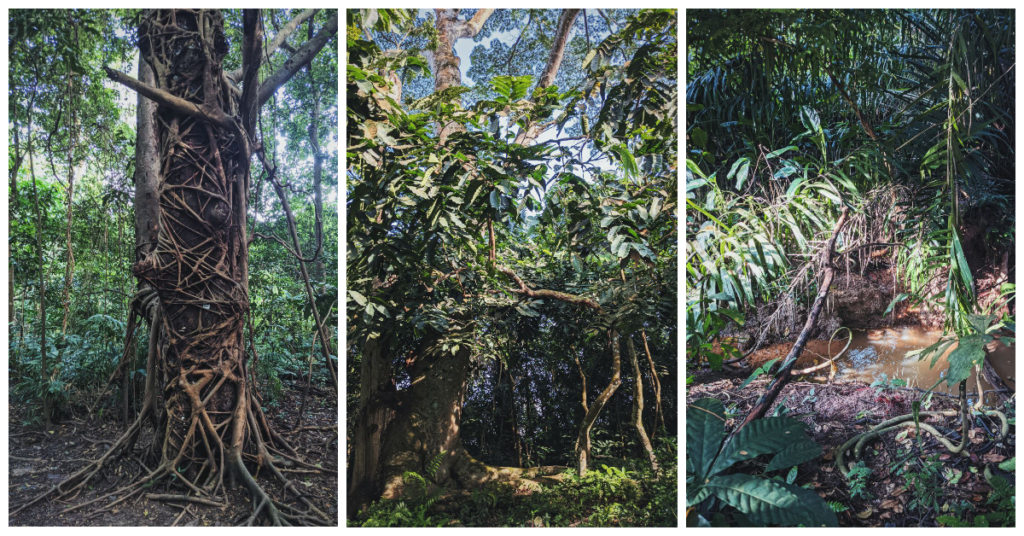
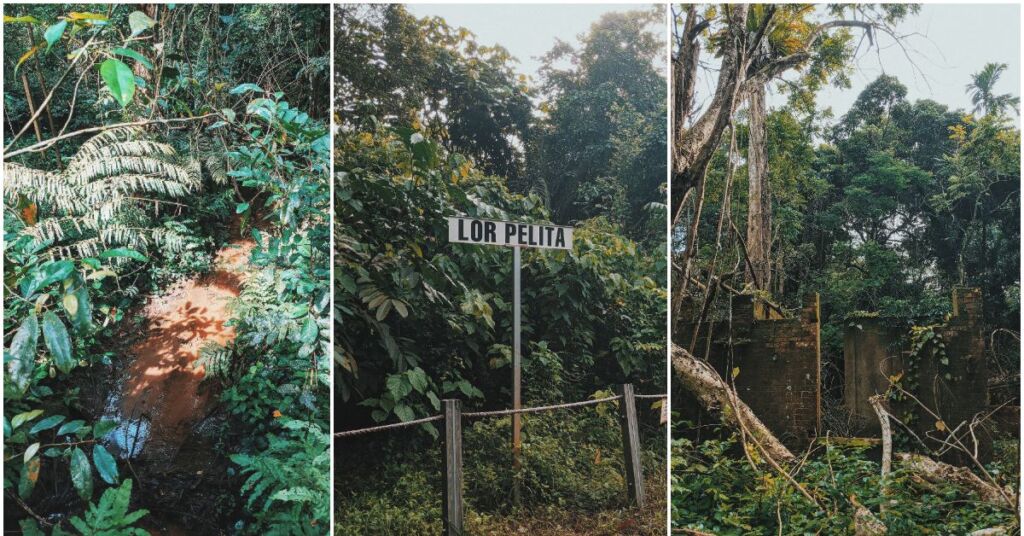
Ruins and streams at Thomson Nature Park. Photos: Delfina Utomo

Take a trail in this park which takes you through the ruins of a former village and a farm in Singapore. Though the route is relatively short, there’s plenty to see as you stroll through the pages of history. See remnants of houses, outdoor stoves, farmland and even the track where Singapore’s first Grand Prix was held in 1961.

Keep your eyes peeled for wildlife around the park, such as the shy and elusive banded langur, mischievous macaques, monitor lizards, squirrels and birds.

Read more: Secret City: Thomson Nature Park – Singapore’s former farm and Grand Prix track

FIND IT:
Upper Thomson Rd


Tampines Eco Green

Photo: Delfina Utomo

Tampines might be a very dense neighbourhood but this mature estate holds some (green) gems too. Just meters away from a major road and residential blocks is the lush Tampines Eco Green. The hidden park has several rustic trails surrounding a mini marsh and also spots – made from reclaimed timber and old wood – where people can quietly and discreetly birdwatch.

FIND IT:
Tampines Ave 9, Singapore 520491


Rifle Range Nature Park

coconuts.co
The newly opened Rifle Range Nature Park is another to add to the pretty parks list. Part of the Central Nature Park Network, the park serves as one of the…
14 Nov 2022

The Lost Ark

Photo: Delfina Utomo

Update: Due to the erratic weather in the first quarter of the year, the area is now flooded and difficult to get to. The fallen tree “ark” may not be structurally safe anymore so do be careful when hiking in this area

The dreamy-sounding Alexandra Woodland might sound like something out of storybooks but somewhere tucked on the side of the Green Corridor near Hang Jebat Mosque, is a plot of unprotected and almost untouched land with overgrown vegetation and a natural pond. One of the highlights of trekking in this area is the mysterious ‘Lost Ark’ structure made with fallen trees in the area. There’s a deck which faces the pond where you can stop for a quick thermos coffee break. Not a lot is known about the history of this place but judging from the small estates surrounding the woodlands which are full of colonial-era black and white houses, the clearing was probably a rustic recreational garden or park, similar to the ones in England during the time. 

FIND IT:

Find a manmade dirt path next to the Green Corridor near Hang Jebat Mosque and follow the trail


Kingfisher Lake

Kingfisher Lake. Photo: Delfina Utomo

In case you didn’t know, Gardens by the Bay is huge – really, really huge. In the sprawling gardens, there are plenty of mini-gardens within. One of the best ones (and also hidden ones) is the Kingfisher Lake. The main star is the lotus lake but follow the side stream and you’ll find a nice and lush spot – near the giant kingfisher – perfect for a little breather or contemplation. Other worthy spots in Gardens by the Bay include the Chinese Gardens with its landscaped terrain, water features and “moon gate” as well as the Serene Gardens on the far end of the park where there is a mini waterfall feature and is a little quieter and peaceful from the more bustling areas.

FIND IT:

Walk towards Satay by the Bay and you’ll stumble upon the lake.


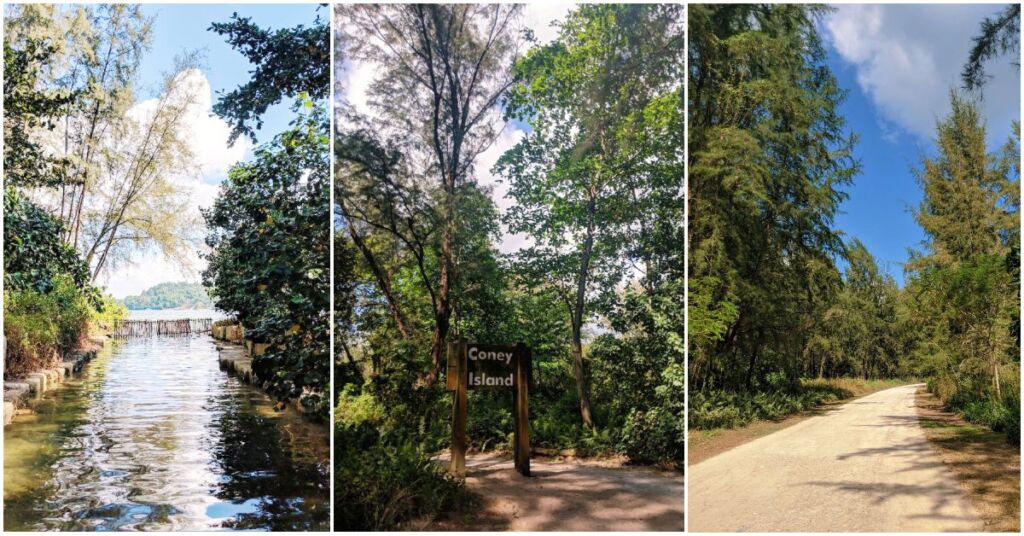
Coney Island. Photo: Delfina Utomo

Coney Island

Sure it’s a popular jogging track and outdoor spot for the weekend crowd but Coney Island has its little hidden and secret spots too if you veer just a little away from the main track that cuts through the island. Explore the hidden beaches – each beach area has a different feel to it – and if you’re up for it, you can try to find the abandoned beach villa which used to belong to the Aw Brothers of Haw Par Villa fame.

Read more: Did you know that Coney Island used to be a leisure resort?

FIND IT:
Head to Punggol Point Park and follow the boardwalk to the West Entrance of the island.


Windsor Nature Park 

Photo: NParks

Everyone goes to MacRitchie Reservoir for its views and diverse trails – which is also why it’s one of the most crowded places on weekends. If you don’t fancy your jungle walk to be disrupted by a bunch of young adults discussing how to do a proposal (true story), check out one of MacRitchie’s “side” parks, Windsor Nature Park. With streams, an eco pond and several trails where you can catch a glimpse of birds and other wildlife, you can still get your hiking fix without all the extra noise. 

FIND IT:
30 Venus Drive, Singapore 573858


Hampstead Wetlands Park

Photo: Delfina Utomo

Another result of the colonial hangover are names of streets and things named after actual places in England. Well, this place in Seletar is one of them. Though it’s been revamped quite recently, the park still retains a bit of its rustic charms. A dedicated trail takes you into the mini woods before you view the pond. There’s an observation deck on the boardwalk where you take a closer look at the pond and even spot some birds in the area. 

FIND IT:

1 Baker Street, Singapore 799977


Keppel Hill Reservoir 

Photo: Delfina Utomo

There’s a lot of history that surrounds this spot that it should be something everyone visits at least once while in Singapore. The start of the trail is a spectacle in itself. Start at the Seah Im Carpark near the food centre to check out an abandoned WWII bunker before climbing up the steep slope next to it for the second highlight. Don’t worry, there are ropes for you to hold on to as you make your way up. Keppel Hill Reservoir is located just around the corner from where you climb up. Formerly used as a source of water, and then later as a private swimming pool, the reservoir today has probably seen better days. But it’s still a sight to see, hidden for years and unmarked on most maps. 

FIND IT:

Start from the carpark at 2 Seah Im Road, Singapore 099114.


Seng Chew Quarry

Photo: Delfina Utomo

You’d never think you’ll find a lake with magical water, but there’s one right in Bukit Gombak. This disused quarry was a product of Singapore’s quarrying days which ceased by the 90s. Over the years, it’s been filled with rainwater and just sitting there casually behind some residential flats. To get there you just have to take a short walk from Bukit Gombak MRT to Block 383 and climb up the slopes facing the block. Follow the longkang and it will lead you to the quarry. You’ll be surprised at the size of it – it’s much bigger than Keppel Hill Reservoir. In the past, the water of the quarry is said to bring luck so taxi drivers would park near the drainage to wash their cars with the water. 

FIND IT:

Start from Bukit Gombak MRT and walk through Bukit Batok West Ave 5 until you reach Block 383.


Yunnan Garden

Photo: Delfina Utomo

Universities are hardly the place you’d think of going for a hike but planted within Nanyang Technological Univesity (NTU) is a beautifully manicured park inspired by classical Chinese gardens. There are gazebos, mini ponds, rock sculptures, and even a man-made lake, but the main highlight of the park is the picturesque waterfall feature. 

FIND IT:
1 Nanyang Drive, Singapore 637721

RELATED:

coconuts.co
After being gazetted as a conserved building, the new developers of Golden Mile Complex are looking to preserve the facade and distinct features of the iconic building. And while we…
11 Jul 2023
14 Oct 15:43

7 must-read non-fiction books to better understand Indonesia

by Coconuts Jakarta

A whole lifetime isn’t sufficient to get a full grasp of the vast archipelago that is Indonesia — home to over 270 million people. It’s a country of incalculable diversity, with deep historic roots and idiosyncrasies befitting of the fourth most populous nation in the world

So how does one even begin to comprehend Indonesia? The answer may just lie in written accounts of the country covering its rich — and, at times, violent — history, as well as those that try to make sense of the present and look ahead to the future.

If you are an Indonesian who wants to truly bleed red and white, or an outsider who is curious about this wondrous nation, below are 7 essential non-fiction books in the English language that will send you on a path to Indo-lightenment.

A History of Modern Indonesia — Adrian Vickers, 2005

Adrian Vickers is a professor of Southeast Asian Studies at the University of Sydney. His 2005 book, A History of Modern Indonesia, serves as the perfect crash course on contemporary Indonesia, covering pre-1945 Dutch colonial rule, anti-communist massacres, Soeharto’s New Order rule and its fall.

Soeharto: My thoughts, Words, and Deeds: An Autobiography — G. Dwipayana, Ramadhan K.H., 1989

Soeharto had the country in his dictatorial grip for 32 years. While few look back on his reign with fondness, his autobiography, which has been translated into English, offers intimate and deeply personal insight into Indonesia’s longest-serving president at the height of his powers — long before his New Order era ended with democratic reforms in 1998.

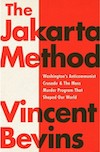
The Jakarta Method: Washington’s Anticommunist Crusade and the Mass Murder Program that Shaped Our World — Vincent Bevins, 2020

Soeharto played a key role in eliminating the Indonesian Communist Party (PKI), then the largest communist party outside of China. In The Jakarta Method, journalist Vincent Bevins combed through declassified documents and eyewitness testimonies to establish how the US government quietly helped the Indonesian military kill some one million civilians during the anti-communist massacre in 1965.

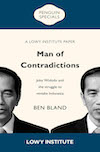
Man of Contradictions: Joko Widodo and the Struggle to Remake Indonesia — Ben Bland, 2020

One may argue that President Joko Widodo, a political elite outsider with a man of the people reputation, is the manifestation of Indonesian democratic ideals. Former journalist Ben Bland argues in his engaging book that there is more than meets the eye with Jokowi — a man, much like the country he leads, who is caught between and is navigating great opposing forces in the quest for progress.

Julia’s Jihad: Tales of the Politically, Sexually, and Religiously Incorrect: Living in the Chaos of the Biggest Muslim Democracy — Julia Suryakusuma, 2013

Julia’s Jihad is a collection of essays by columnist Julia Suryakusuma published over the span of eight years in The Jakarta Post and Tempo’s English edition. The book tackles serious feminist, religious, and human rights issues in a delightfully digestible fashion thanks to the author’s wonderful wit.

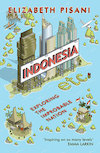
Indonesia, Etc: Exploring the Improbable Nation — Elizabeth Pisani, 2014

This one is for the Java-centric among us who wish to learn more about the diversity of this vast nation. Journalist Elizabeth Pisani takes us on a 26,000-mile journey across the country on roads less traveled than your run-of-the-mill travel book. In Indonesia, Etc, Pisani masterfully weaves in historical and sociopolitical contexts in search of links that bind a disparate nation.

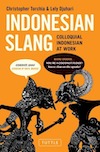
Indonesian Slang: Colloquial Indonesian at Work — Christopher Torchia, Lely Djuhari, 2011

Language — and certainly, slang — will never stop evolving, but Indonesian Slang from 2011 is still a great launching pad to familiarize oneself with informal Indonesian expressions and why we are so obsessed with random acronyms and portmanteaus. They say language is a window into a country’s identity and culture, after all.

06 Oct 00:01

7 of the worst domestic worker abuse cases in Singapore

by Carolyn Teo

Singapore has had some heinous crimes involving hurting and even killing helpless domestic workers trying to earn a puny amount of money on this island.  

Over 250,000 foreign domestic workers were recruited in Singapore since 2018, according to 2019 statistics. They have to be at least 23 years old to be employed by the roughly one in five Singapore households to do all sorts of chores like cooking, cleaning, and even care-giving, and at times, dealing with violence. Several Singaporean families have been reported to vent their anger at the workers, even driving them to death. Forcing food down throats, burning skin with a hot iron, and breaking fingers, were among the most evil things Singapore employers have been reported of doing. 

Here’s a roundup of some of the worst cases of domestic worker abuse in Singapore’s history.

Piang Ngaih Don

The most recent court case involves 24-year-old Piang Ngaih Don from Myanmar, who died from a brain injury in 2016 after she was inflicted by employers Gaiyathiri Murugayan, her cop husband Kevin Chelvam, and mother Prema Naraynasamy. Kevin was a staff sergeant when the abuse occurred, and was suspended from the police force the year the domestic worker died. The horrifying abuse lasted several months. 

They tied Piang to the window grille at night, stomped on her while she was on the floor, pulled her hair, attacked her with a broom and metal ladle, and even burned her forehead with a hot iron. She was also forced to use the bathroom and shower with the door open. Piang weighed a mere 24kg when she died, after being fed only bread soaked in water, cold food, and little rice. 

The abuse began five months into Piang’s employment, which began in May 2015. Gaiyathiri apparently lost her patience when she found Piang to be slow and unhygienic. She died in July 2016 when Gaiyathiri and Prema punched and hit her head with a detergent bottle for doing laundry too slowly and kicked her after tying her to the window grille. She did not wake up the next morning. 

Gaiyathiri pleaded guilty on Tuesday to 28 charges of culpable homicide, voluntarily causing grievous hurt by starvation, voluntarily causing hurt by a heated substance, and wrongful restraint. The case is pending charges for Kevin and Prema, with the prosecution seeking life imprisonment for Gaiyathiri.

Piang’s body was already brought back by her brother and buried in Myanmar, in the remote village of Dimpi.

Khanifah

Things started off well for 32-year-old Khanifah from Indonesia after she was employed by Zariah Mohd Ali and her family in 2011. Then things turned ugly less than a year later when their relationship soured, leading to what prosecutions had described as the worst case of domestic worker abuse in Singapore’s history at the time. 

Zariah was sentenced to 11 years in jail after she was found guilty of 12 charges in 2017 for hitting the back of Khanifah’s head and mouth with a hammer, stabbing her shoulder with a pair of scissors, slashing her forearm with a chopper, and breaking her pinky by bending it backward, among others. 

Zariah’s husband Mohamad Dahlan also took part in the violence and was sentenced to 15 months’ jail for hitting Khanifah on the head with a frying pan cover. They were both fined about S$57,000 in total as well.

The months of abuse left Khanifah with permanent scars all over her body, a deformed left ear, and an impaired left pinky.

The couple was previously convicted for abuse of another domestic worker named Tutik Rahayu Purwadi in 2001 over similar offenses, including rubbing chili on her eyes. For the previous offenses, Zariah was sentenced to 10 weeks’ jail and fined S$500, while Dahlan was jailed for 12 weeks.

Fitriyah in an undated photo. Photo: Give.asia

Moe Moe Than and Fitriyah 

Two domestic workers, Moe Moe Than, 33, from Myanmar and Fitriyah, 40, from Indonesia, braved 10 months of abuse in 2012 at the hands of Singaporean couple Chia Yun Ling and Tay Wee Kiat. The couple’s case was so prominent that it set a new court framework to cover psychological harm suffered by domestic workers. 

Moe was thrown against the wall, stepped on, and forced to down rice and sugar using a funnel whenever she complained of hunger. She was also told to eat her own vomit and was threatened with her family’s death if she ever snitched on them. Both Moe and Fitriyah were forced to pray before a Buddhist altar 100 times even though they were not Buddhists, and made to slap each other 10 times.

Tay was sentenced to six years and one month in jail while Chia received four years and one month. They were also fined over S$13,000.

Sulis Setyowati

The abuse suffered by 24-year-old Sulis Setyowati from Indonesia was so harsh that she escaped from the Yishun flat by climbing down 15 stories from the balcony.

Only a month after Sulis’ employment began in December 2017, 31-year-old employer Nuur Audadi Yusoff began torturing her by spitting, slapping, and dragging her by the hair when she forgot to apply ointment on her child’s stomach. The abuse paused for months as Sulis requested for a transfer but continued after Nuur found out she had posted pictures of her children online. Nuur also bruised her forehead with a comb and repeatedly hit her with a broom.

She finally ran away at around 2am through the balcony as the front door was locked. She spent the whole morning climbing down the building, and went to the police. 

Nuur pleaded guilty in September 2020 to six counts of assault and was sentenced to 10 months and two weeks’ jail. She also paid Sulis more than S$7,000 in compensation.

Phyu Phyu Mar

In 2016, Myanmar national Phyu Phyu Mar, whose age was never made public, fell victim to abuse that lasted three months from yet another married couple.

Linda Seah Lei Sie, former manager of Anew Me Beauty Aesthetic salon at Orchard Road, and husband Lim Toon Leng had forced Phyu to pour boiling water on herself twice, drink dirty mop water, and starved her until her weight dropped from 50kg to 38kg. She was also never paid the S$700 monthly salary.

One of Seah’s salon employees alerted the police after Phyu accompanied Seah to the salon. Seah was guilty of five assault charges and one count of causing the domestic worker to drink the dirty water and sentenced to three years’ jail while Lim got six weeks’ jail. They were also fined over S$12,000.

Amandeep Kaur 

Amandeep Kaur, 32, from India was put through abuse since her first day of employment in 2016. Farha Tehseen and her husband Mohammad Tasleem treated Amandeep like a punching bag, kicking her waist and lower back twice, and punching her eye and nose as punishment for trivial things like being too slow to prepare milk for their son. 

She escaped through the living room window of the Sengkang flat from the fourth floor and stood on the ledge until a painter who was working in the estate used a gondola to help her down.

Farha was found guilty of nine counts of assault and one count of criminal intimidation and was sentenced last year to 21 months’ jail, while Tasleem was guilty of two assault charges and sentenced to four months’ jail. Both were fined a total of $5,500 paid in compensation to Amandeep.

Estabillo Soledad Agustin

A 42-year-old Filipino woman named Estabillo Soledad Agustin was assaulted by a 21-year-old after a dispute at home went wrong. 

Ng Jia Sheng pleaded guilty last year for using criminal force, causing grievous hurt by performing a rash act and insulting Estabillo in 2018. Ng argued with Estabillo after he asked her to turn on the air conditioner and she had replied irritatedly. They shouted at each other and he spat in her face before throwing a metal mug at her. Estabillo then retaliated by throwing plastic bottles at Ng but missed. She suffered multiple facial injuries including a nose fracture.

Reports said Ng told Estabillo that “she was only a domestic worker, was poor and had no right to be in Singapore.” Agustin has since returned to the Philippines.

Ng was sentenced to at least six months’ reformative training and will undergo counseling and follow a strict regimen that includes foot drills.

Other stories you should check out:

Singapore pastor denies victim blaming, just suggesting girls cover up out of ‘consideration’
Singapore mom creates exquisite slime treats, destroys them on camera for fun (Videos)
‘I have been dealing with self-harm for over 10 years’: Singaporean actress Julie Tan
Singapore to get more 4K Wong Kar-wai after ticket debacle

05 Oct 23:58

‘Sounds like a slave auction’: The racial stereotypes used to market domestic workers in Singapore

by Coconuts Singapore

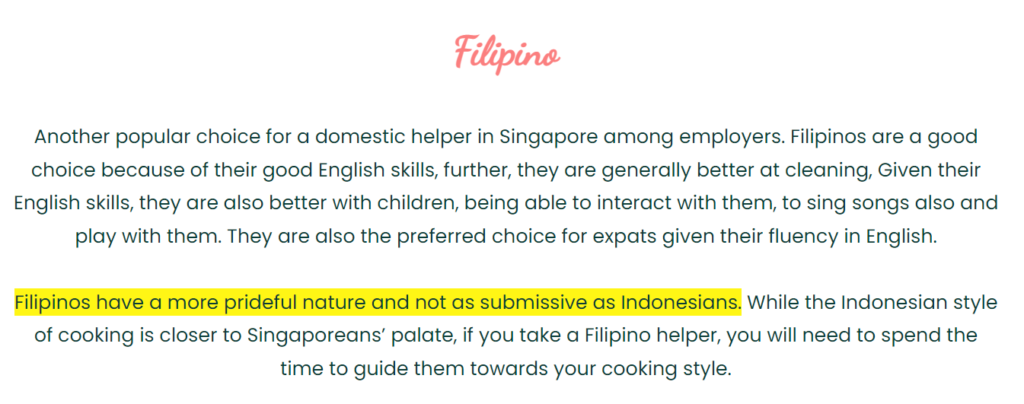
Domestic workers from Indonesia are “… more submissive [and] appear more obedient… However, because of their innate characteristics, they tend not to speak up so if you prefer someone who is vocal and assertive, Indonesians may not be the best choice.”

“Most Mizoram maids come from the mountain areas, which leads to them having a hardier constitution, and are stronger physically, with more endurance then the other races.”

“Filipinos have a more prideful nature and [are] not as submissive as Indonesians.”

Screenshot: Best Housekeeper / Internet Archive

Those racially stereotyped descriptions were, until recently, featured on the website of Best Housekeeper, a domestic worker agency in Singapore. They were quietly removed from the site late last week but can be seen in full on an Internet Archive snapshot of the page taken on Sept. 28.

Hoping for an explanation for the removal, Coconuts called Best Housekeeper’s office but were told they were “not interested” in speaking to the media. So we must surmise they were taken down in response to the outrage over a viral tweet that highlighted them last week.

While the backlash may have led to one domestic worker agency removing racially stereotyped language from their website, we were able to find plenty of similar examples used by other agencies and their affiliates. Migrant worker advocacy groups say such language can have a serious impact on their working conditions and treatment.


“Hiring domestic workers based on purported nationality-based traits diminishes the need to give them strong labour protections, and takes away from their right to decent work conditions, which ultimately is detrimental to their physical and mental well-being.“

– Humanitarian Organisation of Migration Economics (HOME), a migrant workers advocacy group based in Singapore

The tweet that surfaced Best Housekeeper’s descriptions was made in response to a much-discussed clip of the late great Anthony Bourdain telling a table of Singaporeans how he really felt about their reliance on domestic workers.

More than a few commenters said the language used reminded them of a slave auction.


A widespread issue

This is far from an isolated case involving a single company. With little effort, we were able to find similar examples of racially stereotyped language on the websites of many domestic worker agencies and their affiliates.

This description of domestic workers from Myanmar comes from the Frondosa City Employment Agency website:


Here’s the description of Indonesian domestic workers used on the EazyMaid website:


And here’s EazyMaid’s description of Sri Lankan domestic workers:


Here are some of the benefits of hiring a domestic worker from Myanmar listed in an article on Homee.co:


This is from the Searchmaids.sg FAQ page on Indonesian domestic workers:


We should strive to treat domestic workers with dignity, and not as commodities where we attribute arbitrary, baseless stereotypes to them based on where they come from.”

Humanitarian Organisation of Migration Economics (HOME)

In 2014, Al Jazeera caused an uproar with its reporting on foreign domestic workers (FDWs) being put on display and made available for ‘purchase’ in Singapore’s shopping malls. In that article, Jolovan Wham, executive director of the Humanitarian Organisation of Migration Economics (HOME), a migrant workers advocacy group based in Singapore, noted how racial stereotypes were also sometimes used by employment agencies: “Some of the stereotypes include Filipinos as ‘smarter’, Indonesians as ‘less bright’ and Burmese as ‘sweet-natured and compliant’”.

In response to the Al Jazeera report, Singapore’s Ministry of Manpower (MOM) sent out an advisory banning employment agencies from “insensitive advertising and inappropriate display” of maids by agencies. MOM said all advertising should “accord foreign domestic workers (FDWs) basic respect and human dignity”. The president of the Association of Employment of Agency (AEA) in Singapore specified that advertising materials should not refer to promotional rates, fees, and racial stereotypes of workers and that employment agencies that violated those guidelines would receive demerits and potentially lose their licenses.

Asked to respond to the continued use of this kind of stereotyped language by some domestic worker agencies and their affiliates, a spokesperson for HOME told Coconuts:

“Agents, who are instrumental in matching employers and domestic workers, should not be perpetuating nationality-based stereotypes. They should endeavor to match employers and domestic workers with considerations such as whether the domestic worker will be given a decent working and living environment in the employer’s house, and whether the job requirements and workload are reasonable for the domestic workers, instead of amplifying sweeping presumptions of their personalities to employers.”

Hiring domestic workers based on purported nationality-based traits diminishes the need to give them strong labour protections, and takes away from their right to decent work conditions, which ultimately is detrimental to their physical and mental well-being.

We should strive to treat domestic workers with dignity, and not as commodities where we attribute arbitrary, baseless stereotypes to them based on where they come from.”

It’s impossible to quantify how much dehumanizing racial stereotypes contribute to the mindset that leads some employers to mistreat domestic workers but there is no doubt that mistreatment remains a major issue. There have been many high-profile cases about FDWs in Singapore experiencing horrific physical abuse at the hands of their employers, but the dehumanizing emotional abuse many suffer has also been well documented, if not as widely discussed. 

A 2017 study by independent consultancy group Research Without Borders found that 60 percent of domestic workers in Singapore said they were exploited by their employers, including receiving low pay, little time off work and verbal and physical abuse.

At least 90 percent of those surveyed reported working excessive hours, with 84 percent saying they worked more than 12 hours a day and 41 percent saying they were forced to work on their sole mandated rest day.

Singapore’s Ministry of Manpower responded by calling the study “misleading” and referring to its own 2015 survey that said an astounding 97% of FDW were satisfied working here and had no issues with their workload.

Related

21 Sep 15:21

7 films about martial law that you can stream for free

by Coconuts Manila

On this day, 50 years ago, former president and dictator Ferdinand Marcos Sr. signed Proclamation 1081, effectively declaring martial law in the Philippines. What followed was one of the darkest periods in the country’s history, full of egregious corruption and human rights abuses.

But even though these transgressions were well documented, myths about the Martial Law era are still being perpetuated, tarnishing the memory of those who suffered greatly during it.

Today, another Marcos is president. Social media is rife with distorted truths about Marcos Sr’s regime. But for those who want to know the truth, there are many films you can watch online depicting the experiences and voices of that era’s victims, whose stories have largely been swept under the rug.

In honor of the 50th anniversary of martial law, we’ve put together a list of the best of these films that you can stream right now for free.

The Kingmaker

Lauren Greenfield’s critically acclaimed documentary The Kingmaker centers on infamous first lady Imelda Marcos and her desire to restore the Marcoses to glory after protests against her husband’s decades of corruption and human rights violations forced their family to flee the country. The documentary debuted at the 76th Venice International Film Festival in 2019 and depicts Imelda as an “unreliable narrator”; you see the Marcoses’ ascent to power through her lens and then through the lens of martial law survivors.

Ahead of the May elections, Greenfield announced they had worked out a deal with streaming partners ABS-CBN and iWantTV to offer the movie for free in the Philippines.

You can watch it here.

Respeto

Treb Monteras’ first award-winning film, Respeto (“Respect”), which was also screened at the Toronto International Film Festival, sees an aspiring young rapper, Hendrix (Abra), who dreams of making it big in the rap battle scene and breaking away from his abusive family, strike an unlikely friendship with Doc (Dido de la Paz), an old and crabby bookstore owner who turns out to be a former revolutionary poet during the martial law era.

You can stream Respeto via MOOV here.

Imelda

Before The Kingmaker, there was Imelda: the award-winning documentary by Ramona S. Diaz that takes a closer look at the life of the infamous former First Lady. The 2003 documentary chronicles her childhood, her marriage to Ferdinand Marcos Sr, and the luxurious life the Marcoses led during the martial law era. Like The Kingmaker, Imelda’s narratives are challenged by opposing views from victims and survivors of that era.


Watch the documentary here.

Liway

Liway, directed by Kip Oebanda, centers on a boy named Dakip, who lives in a prison camp with his mother, a martial law dissident known as Commander Liway (Glaiza de Castro). Distracting him from the difficulties of living in a prison camp, Dakip’s mother tells him stories to protect the child from the realities of a political prisoner’s life.

The film is based on the director’s real-life experience with his mother, Cecilia Flores-Oebanda, aka the “real-life Liway.”

Stream it here.

Mula sa Kung Ano ang Noon

Mula sa Kung Ano ang Noon (From What is Before), directed by acclaimed filmmaker Lav Diaz, follows the struggles of a remote town in the Philippines and the strange and mysterious events that happen when Ferdinand Marcos Sr announces Proclamation 1081. The film is over five hours long but remains gripping throughout with its insights into the difficulties ordinary people faced during that period.

You can stream the movie on Youtube here.

Bakit Dilaw ang Gitna ng Bahaghari?

The 1994 “never-ending documentary” Bakit Dilaw ang Gitna ng Bahaghari? (Why is Yellow at the Middle of the Rainbow?), directed by National Artist for Film Kidlat Tahimik, compresses 10 years of filmmaking into a 175-minute long “cinematic essay” that touches on aspects of the Philippines’ culture and history interspersed with snippets from his everyday life — proving that the personal is political. 

Stream the documentary here.

Barber’s Tales

The 2013 film Barber’s Tales by Jun Robles Lana tells the story of a widow named Marilou (Eugene Domingo) who inherits her husband’s barbershop, the only one in a rural town at the height of the Marcos dictatorship. Watch the movie here.

READ: #NeverForget, #NeverAgain trend on Twitter as Filipinos mark 50th anniversary of martial law

20 Sep 15:57

Hand of St. Etheldreda in London, England

Reliquary

St. Etheldreda’s Church is a Roman Catholic church and dates back to 1250 when it was the town chapel of the Bishops of Ely. It was built by John de Kirkeby, the Bishop of Ely, and dedicated to Etheldreda, a Saxon Princess born in 630 and who was the daughter of King Anna of East Anglia. It is the oldest Catholic church in England and one of only two remaining buildings in London from the reign of Edward I. It was once one of the most influential places in London.

Despite wanting to be a nun, Etheldreda agreed to an arranged marriage with King Egfrith only on the condition that she remain a virgin. However, the King changed his mind and Etheldreda fled back to Ely where she founded a religious community. Etheldreda died in 679 of the plague and was buried in a simple grave at Ely Cathedral. About 16 years after her death, Etheldreda's body was removed from that grave to be interred in something more befitting her status. Her body was found to be "incorrupt," with no signs of decay. Believing it to be a sign from God and that she was a saint, Etheldreda's reputation for miracles grew and so did the religious relics. Today an annual blessing is still held in the church on her saints day for those with sore throats and neck infections.

Off the main thoroughfare, the church is down a little cul-de-sac. The walls are ordained with shields of prominent families of the day and to the right of the altar is a small wooden jeweled casket. Inside it is claimed is the undecayed hand of Etheldreda herself still intact more than 1,350 years after her death.

09 Sep 17:07

Gobierno constituye Mesa Regional de Trata de Personas para «abordar de forma conjunta» los efectos del crimen organizado 

by Mesa de noticias de El Mostrador

El Gobierno del Presidente Gabriel Boric anunció la conformación de una Mesa Regional de Trata de Personas.

Esta definirá los protocolos intersectoriales sobre la atención a víctimas de trata de personas por medio de mecanismos de coordinación entre los servicios de asistencia y protección a víctimas con prestaciones en los ámbitos de salud, asistencia jurídica, regulación migratoria, asistencia social, educación y un retorno asistido y protegido de las víctimas hacia su país de procedencia.

Esta comisión asesora estará compuesta de 22 instituciones públicas, de las cuales destacan la Subsecretaría del Interior; Delegación Presidencial; Ministerio Público; Justicia; Relaciones Exteriores; Defensa; Mujer y Equidad de Género; PDI y Carabineros.

Tendrá como objetivo lograr desarrollar acciones institucionales e intersectoriales que favorezcan la prevención del delito de trata de personas, la protección de sus víctimas y la persecución de las organizaciones criminales que se encuentren detrás de su realización.

La delegada presidencial RM, Constanza Martínez, indicó que «la conformación de esta mesa nos permite abordar de forma conjunta y sostenida los efectos del crimen organizado y la trata de personas como resultado de este. Delitos de esta magnitud no pueden quedar impunes, por lo que hemos discutido mecanismos para la prevención y persecución de estos, junto a la protección de las víctimas».

Cabe destacar que el Ministerio del Interior se encuentra actualmente elaborando la Política Nacional contra el Crimen Organizado, para establecer una respuesta efectiva contra el mismo.

Es por eso que el seremi de Justicia, Jaime Fuentes, apuntó que «la estrategia de implementación regional de la Mesa Intersectorial sobre Trata de Personas es una medida de reforzamiento en el combate contra el crimen organizado, previniendo, reprimiendo y sancionando esta modalidad por la cual obtienen ganancias ilícitas por medio de la explotación de personas, objetivándoles como bienes económicos y despojándoles de su agencia como sujetos de derechos humanos».

«Nos encontraremos frente a uno de los delitos más graves contra los derechos humanos que atenta contra la dignidad de las personas, por lo que esta mesa tendrá como objetivo también recibir, acompañar y reparar a las víctimas», adicionó.

Según información que maneja el Gobierno, entre 2011 y 2021, se ha logrado identificar 309 víctimas en 52 causas formalizadas. El 45% son víctimas de sexo masculino y el 54% de sexo femenino, todos en su mayoría con fines de explotación sexual. De ese total, se han identificado 25 víctimas niños, niñas y adolescentes.

18 Aug 05:37

Accamma Cherian: Why India forgot this freedom fighter from Kerala

Accamma Cherian's contributions in India's struggle for independence have been lost to history.
18 Aug 05:15

Police rescues six migrant workers from forced labour in anti-trafficking raid

by Coconuts KL

During a raid in Kampung Sungai Udang in Klang on Tuesday, police said they freed six trafficking victims from forced labor. All of the victims were foreigners.

The police also detained four suspects, including a foreign couple as well as another man and woman. The suspects range in age from 38 to 43.

During the operation, twenty passports and RM13,600 (US$3,057) were seized.

According to a police statement, the six victims, who ranged in age from 24 to 44, were tricked by an employment agent into working excessive hours at a cement mill. 

Police said they had been lured from overseas with offers of well-paying jobs at the factory. 

“However, upon arriving, costs for travel and passports were deducted every month from their salaries and they were forced to work long hours to pay off this ‘debt’,” South Klang district police chief Cha Hoong Fong said.

“The agent had also confiscated their passports and, despite being promised work permits, they were forced to work without valid documents.”

Cha said the case is being investigated under Section 44 of the Anti-Trafficking in Persons and Anti-Smuggling of Migrants Act 2007. He urged the public to report any such cases to the police.

Foreign workers constitute more than 30 percent of the Malaysian workforce. They typically migrate voluntarily—often through irregular channels—from Bangladesh, Burma, Cambodia, China, India, Indonesia, Laos, Nepal, the Philippines, Thailand, and Vietnam.

According to the 2021 Trafficking in Persons Report, human traffickers exploit domestic and foreign victims in Malaysia and, to a lesser extent, traffickers exploit victims from Malaysia abroad. The overwhelming majority of trafficked victims are among the estimated two million documented and an even greater number of undocumented migrant workers in Malaysia. 

14 Aug 08:18

Sobre fascismos, nazismo y la izquierda

by Pablo Álvarez

Cada cierto tiempo reflota en redes sociales y en uno que otro foro televisivo la idea de que el nazismo y el fascismo eran de izquierda. Esa es una polémica bastante absurda que dice mucho de quienes la enuncian. Vale la pena aclarar el asunto.

Primero. Hay una derecha neoliberal que ha pretendido cooptar a toda la derecha y consideran que las ideas contrarias al liberalismo de Von Hayek y cia. son de izquierda. Esa posición es vieja, dentro de la sociedad Mont Pelerin, fundada en Suiza por el mismo Frederic Von Hayek para defender sus ideas ultraliberales, consideraban todo lo que no era parte de su acervo ideológico como izquierdista. Después de la Segunda Guerra, años en que en todo Occidente el pensamiento económico estaba hegemonizado por el keynesianismo, los acólitos del liberalismo de Hayek consideraban que el camino a la servidumbre estaba garantizado. Solo a partir de los años 70 esa escuela de pensamiento económico comenzó su hegemonía. Su estandarte era Milton Friedman, un economista de Chicago que tenía una receta liberal para el problema de la inflación que aquejaba a las economías centrales y periféricas. El asunto es que, desde esos años aciagos para el capitalismo industrial, el pensamiento ultraliberal de Hayek y Friedman gana terreno y comienza un acelerado desmantelamiento de algunos fundamentos del capitalismo industrial tal como se le conocía. Para estos ultraliberales todo lo que no estuviera dentro de su cerco ideológico es de izquierda. Eso incluye a los populismos, que es bien discutible que fueran de izquierda, recordemos que Juan Domingo Perón, el general y presidente de Argentina que fundó el justicialismo, señalaba que su política era una tercera alternativa al liberalismo radical y a la revolución socialista, pero era una tercera alternativa nacionalista.

El nazismo y el fascismo eran de derecha, de una derecha distinta a la que dominaba la política del período entre guerras. Esto no quiere decir que toda derecha sea violenta, por el contrario, políticos de derecha liberal o de tradición conservadora eran considerados enemigos por los fascistas.

Segundo. Cuando alguien dice que los nazis eran de izquierda porque el nombre del partido era Partido Nacionalsocialista de los Trabajadores Alemanes, y se quedan con el “socialismo” del nombre, olvidan que antes que eso es nacionalista. Ese nacionalismo radical, anti oligárquico, anti elitista y furioso, era una reacción al pavor que generó en las masas obreras nacionalistas la posibilidad de una revolución socialista a escala continental. Pero también, es una reacción a la política burguesa elitaria. Para los fascistas, el verdadero pueblo era la masa de trabajadores que no tenían un espacio en la política elitista de hegemonía burguesa y aristocrática. Se identifican con un “demos” (pueblo idealizado), romantizado, cuya supuesta historia es ancestral y su identidad es racial y pura. Si la izquierda marxista reivindicaba una identidad de clase histórica y transnacional; los fascismos (nazis y fascistas) reivindicaban una identidad racial transhistórica y esencial. Los fascismos emergen como una forma política radical, anti ilustrada y violenta. Los socialismos provienen de la misma ilustración que los liberalismos, por lo tanto, los fascismos son antiliberales y antisocialistas.

Tercero. Todo el que quiera llevar agua a su molino de forma burda dirá que su posición política es mejor porque tiene una historia intachable. Los ultraliberales creen que solo la izquierda ha cometido atrocidades, cierta izquierda hace lo mismo. Lo que todos ellos olvidan es que la política de izquierdas y derechas, que proviene de la Ilustración y la Revolución Francesa, está marcada por una historia de violencias. Por ejemplo, eran regímenes liberales los que llevaron el colonialismo a África y masacraron pueblos por ambiciones económicas y políticas. Todos tienen tejado de vidrio, pero cada uno debe cargar sus muertos y no adjudicárselos de mala fe a los demás. El nazismo y el fascismo eran de derecha, de una derecha distinta a la que dominaba la política del período entre guerras. Esto no quiere decir que toda derecha sea violenta, por el contrario, políticos de derecha liberal o de tradición conservadora eran considerados enemigos por los fascistas.

Para dejar atrás la violencia política de los fascismos se debe entender que sus ideas son ante todo reaccionarias, desdeñan de la Ilustración, desdeñan del liberalismo, aborrecen a los socialismos y detestan la democracia. El peligro que representan debería hacernos olvidar rencillas políticas pequeñas y llegar un mínimo común que signifique un rechazo a toda alternativa política violenta y contraria a los logros civilizatorios mínimos que hemos alcanzado.

03 Aug 20:56

Patricio Guzmán y el estreno de su película sobre el estallido antes del plebiscito: «Va a ayudar a que la gente resuelva sus opiniones”

by Emilia Aparicio

El 18 de octubre de 2019 se estaba exhibiendo en las salas de cine de París La cordillera de los sueños, el más reciente documental, en ese momento, de Patricio Guzmán, mientras en Chile comenzaban a desarrollarse las protestas más intensas y masivas de nuestra política reciente y que marcan la historia social hasta el día de hoy. Si bien el documentalista tuvo la oportunidad de filmar desde el comienzo otros momentos históricos y decisivos para el país, como lo hizo con La batalla de Chile, para el estallido social estaba a más de diez mil kilómetros de las personas que se reunían en distintos puntos del país para demostrar su descontento con las desigualdades, el costo de la vida, la elite política y las injusticias que se arrastraban desde el retorno a la democracia. Sin embargo, un año después, Guzmán aterrizó en Chile y se encargó de recuperar la memoria del estallido social que venía ocurriendo en su ausencia.

«Sin previo aviso, de una manera completamente instantánea, explosiva, aparece la toma del Metro en Santiago, que parecía un evento corriente, pero luego, al cabo del segundo día, se vio que la explosión era enorme y nos quedamos mirando las noticias con la boca abierta, porque fue un hecho espectacular. Y ahí mismo, en ese instante, dijimos ‘bueno, pero hay que estar en Santiago y filmar lo que está pasando; lo que está pasando es tan importante que no se puede dejar en segundo término'», relata el cineasta en una entrevista con El Mostrador.

«No pude filmar la primera llama», narra en Mi país imaginario, el documental que se estrenará este 11 de agosto en Chile. No obstante, desde la distancia Patricio Guzmán ya había desplegado un equipo en terreno para grabar lo que es ahora parte de la historia.

«La cuestión ya no era un alzamiento estudiantil, sino que era un alzamiento nacional y con mayor razón dije ‘bueno, esto hay que filmarlo’. Hablé por teléfono con nuestro equipo en Santiago y empezamos a planificar e improvisar cómo filmar lo que estaba pasando», cuenta.

Al igual que otras películas de Guzmán, Mi país imaginario se caracteriza por la construcción de un relato a partir de las propias memorias y reflexiones del cineasta. En este documental habla de la filmación de La batalla de Chile y de los procesos de cambios sociales que han ocurrido en el país. En ese sentido, Guzmán retoma la idea de la memoria histórica del país.

«Hay una especie como de línea recta que viene desde aquellos años, ya casi son 50 años y es insólito. Ahí está esa especie de giro histórico del cual Chile no se quiere desprender hasta solucionarlo, hasta repararlo, hasta darle la vuelta, hasta extender a todo el mundo lo que realmente significó olvidar la naturaleza de un pueblo entero. Ahora se vuelve a recuperar poco a poco», comenta en relación con las consecuencias que ha dejado en la sociedad la dictadura militar.

«La memoria es siempre la memoria, tú puedes trabajar sobre el momento en que Allende tomó el poder o que desfiló en pos de ese vicepresidente nuevo que apareció. O puedes filmar el momento en que Allende cayó en el momento en que gente muere. Y puedes filmar las mujeres chilenas cuando empezaron realmente a protestar sistemáticamente durante 40 años. Y todos esos pasados son uno solo, es la memoria de nuestro país, una memoria maltratada, porque nadie la ha tratado, la ha juzgado. Por lo tanto, es una memoria enormemente rica e interesante que está delante de nosotros y que es un pasado presente magnífico, digamos. Sobre este presente que es la memoria podemos construir muchas películas y nos haría muy bien», afirma.

El cineasta también habla de su relación con el documental y las narrativas por las que se pueden identificar sus obras.

«Yo creo que las obras de arte en general tienen que partir de ese punto de vista personal. Tú partes de tu propia infancia, de tus vivencias, de tus padres, de tus abuelos, de tu familia, de lo que había en el colegio, qué colegio era, dónde estaba, qué pasaba, qué ocurrió. A partir de ese volumen de experiencias es que nace un relato, una narración, un río, que es muy importante en el cine documental que yo defiendo, porque es el cine documental personal, es el documento como testimonio íntimo de la persona que empieza a contarlo. Y me gusta mucho ese tipo de de películas documentales, y en Chile tenemos varios autores estupendos, más que en otros países de América Latina, lo cual es magnífico para nosotros. Y eso significa que el diario del país es un diario nuestro también», comenta.

El estallido a través de voces de mujeres

En Mi país imaginario todos los personajes y fuentes que se ven en el documental son mujeres. En tal sentido, el director relata que no fue una decisión que se tomó desde el principio sino que a partir de las investigaciones que fueron haciendo, hasta que se dieron cuenta de que eran todas mujeres.

«De repente empezamos a ver que las personas más interesantes que teníamos delante de nosotros eran mujeres. Mujeres muy diferentes, jóvenes, muy jóvenes y señoras ya de edad y tenían todas una especie como de furor, una especie como de fuerza, una personalidad abierta, una indignación común. Y eso nos pareció sorprendente y comenzamos a filmar sin preocuparnos y, al cabo de un tiempo, nos dimos cuenta de que la mayoría eran mujeres y la mayoría de las que eran buenas. Entonces comenzamos a dejar a los hombres un poco a un lado y finalmente los eliminamos porque las mujeres eran más espontáneas, más directas, tenían mejor fundamentación, tenían un propósito inmediato, pero con historia. Era un grupo importante de mujeres que tenían conciencia y no era uno o dos o tres. No era un grupito, no era una minoría, eran cientos y esto a mí me dejó sorprendido, porque eso no ocurre en todas partes», relata.

En el documental aparecen figuras conocidas como la escritora y dramaturga Nona Fernández, la periodista Mónica González y también mujeres comunes y corrientes, como una madre que estaba en la primera línea en las protestas, una dirigenta social y una politóloga.

El estreno a semanas del plebiscito del 4 de septiembre

El estreno mundial del documental se hizo en el Festival de Cannes en mayo de este año y, al terminar la función, el público se expresó con entusiasmo respecto de la película y aplaudió el trabajo de Patricio Guzmán, quien estaba presente en la sala. Finalmente, Mi país imaginario llega a las salas de cine chilenas este 11 de agosto, a solamente semanas del plebiscito del 4 de septiembre, donde se definirá si se aprueba o rechaza la propuesta de nueva Constitución. Guzmán expresa que la fecha de estreno comercial la eligió la distribuidora y le parece que fue una buena decisión.

«La fecha la eligió la distribuidora chilena y ella opina que esa fecha es buena porque es justo antes del plebiscito y va a ayudar a que la gente resuelva sus opiniones y estoy muy contento que así sea», expresa.

Si bien el documental retrata el estallido social de 2019, en consecuencia también habla del proceso constituyente, el plebiscito del 25 del octubre y la conformación de la Convención Constitucional. Sin embargo, ese proceso todavía no finaliza. En ese sentido, ¿por qué Patricio Guzmán no grabó el proceso constitucional por completo?

«Hay que parar un poco y hay que reflexionar. Porque en este tipo de procesos, si tú sigues demasiado sumergido adentro del océano de lo que se mueve, acabas ahogándote. Es complicado, tienes que mantener la distancia y mantener la distancia es muy difícil en el cine documental, y además es muy duro porque tú estás enamorado de una situación y tienes que alejarte de lo que quieres para tener claridad. Y por eso es que vamos a hacer un pequeño compás de silencio, porque hay que acumular material, se sigue filmando, seguiremos filmando. Tenemos cuatro cámaras filmando Santiago. Pero filmar es una parte, ¿no? Lo otro es la reflexión, qué es lo que vas a hacer con ese material o qué es lo que Chile necesita tener en estos momentos y en los momentos que vendrán. Y ahí estamos», finaliza.


03 Aug 20:41

Home minister: Efforts to eradicate human trafficking need public’s involvement 

Malay Mail

PETALING JAYA, Aug 3 — Efforts to eradicate human trafficking should not only solely fall on the shoulders of the government as it needs the involvement of the people as well.

Home Minister Datuk Seri Hamzah Zainudin said while enforcement activities are carried out via various approaches including air, sea and land, all parties should give serious attention to the issue as national security is a joint responsibility.

“To ensure the success of the country on the matter, it is of utmost importance that all of us take an interest in the country’s security together and attract more foreigners to come as investors, visitors and workers,” he said.

He was speaking to reporters after opening the “Aviation Against Trafficking In Persons Conference (AATIP-C) 2022” held in conjunction with the World Day Against Trafficking In Persons 2022 here today.

Apart from that, Hamzah said the government would continue to tighten border control at all gateways into the country including rat trails apart from stepping up programmes to create the people’s awareness of human trafficking.

Meanwhile, in his speech, Hamzah said according to the Council for Anti-Trafficking in Persons and Anti-Smuggling of Migrants (MAPO) statistics, from 2015 to June this year, a total of 1,972 trafficking cases were reported while 2,902 people were arrested in connection with the cases.

“In an effort to combat human trafficking in Malaysia, the government has enacted a special law, the Anti-Trafficking in Persons and Anti-Smuggling of Migrants Act or Atipsom (2007), which was enforced in 2008 and it was recently reviewed with the third amendment coming into force in early 2022,” he said. — Bernama

08 Jul 17:28

Carta abierta al ex Presidente Lagos: ¡Qué pena, Ricardo!

by Jorge Arrate

Estimado ex Presidente, estimado Ricardo:

Los punteros del reloj siguen su curso y el tiempo corre sin que nada lo modere. Por eso las vidas demandan, al llegar a la última recta, como en nuestro caso, una rúbrica, en particular a quienes hicimos de los asuntos públicos una de las motivaciones principales de nuestra existencia.

Yo intento ser leal a aquello que ha definido mi transcurso político: soy socialista y allendista. Y el de nuestra generación política: luchar por un mundo más justo y humano. Pensé que tú, más allá de nuestras legítimas diferencias, procurarías algo semejante. Pero tus declaraciones recientes desmienten mi expectativa.

Mi opinión no tiene influencia decisiva en el plebiscito próximo. Deberías abrirte a la posibilidad de que la tuya ya no sea muy importante. Ha emergido una nueva generación e intentar extender tu influencia es iluso y artificial. El pasado nos hace morisquetas burlonas. A mí no me perturba demasiado, no pienso haber tenido siempre la razón. La política es un permanente ejercicio de conformación de voluntad mayoritaria en torno a un proyecto de sociedad. Tal vez el éxito es impulsarlo una y mil veces, a pesar de lo abrupto del camino, sin perder nunca el norte y sin necesariamente liderarlo. Nuestro activo es perseverar, nunca desertar.

Me cuesta aceptar que pienses como equivalentes la Constitución de 1980 y sus modificaciones y esta nueva Constitución, y los senderos que abren el Apruebo y el Rechazo. Desde ya la legitimidad democrática es incomparable. Por más que hayas estampado tu firma en reemplazo de la firma de Pinochet, la Constitución de 1980 no dejó de ser la Constitución del Estado subsidiario, binominal, centralizadora, ignorante de nuestra rica diversidad humana, despreocupada de la naturaleza, sin resguardo ni aseguramiento de derechos sociales y con un veto implícito para la derecha. En cambio, la nueva Constitución se hace cargo con decisión de los grandes problemas del país y es integradora y democrática.

Leo ahora tus últimas declaraciones. Mientras más hablas de lo que te ha llevado a adoptar tu postura, más te hundes en un marasmo de argumentos aberrantes. Algunos lo han dicho: tus expresiones dañan la opción transformadora y favorecen a la derecha. Pero quisiera ir más allá: si gana el Apruebo, tu rol será aun menor de lo que ya es. Solo el Rechazo te daría la oportunidad de negociar con la derecha, una vez más, nuevos retoques a la Constitución pinochetista.

Como rúbrica de una trayectoria política es indecorosa.

¡Qué pena, Ricardo!

11 May 21:05

Political Dynasties vs People Power: How two presidential campaigns predict the future of the Philippines

by Coconuts Manila

On Monday, three months of campaigning will come to a close as Filipinos head to the polls to pick the candidates who will lead the nation for the next six years. The problems facing the country’s next set of leaders are enormous: the Philippines is still reeling from the devastation of Covid, as well as ballooning debt and accelerating inflation — all issues magnified by systemic graft, corruption and widespread poverty.

Out of 10 presidential candidates in this year’s race, the two frontrunners are far ahead and facing off in what is sure to be a pivotal point for the future of the Philippines. Surveys show a strong lead for former senator Ferdinand “Bongbong” Marcos Jr., son of the late dictator Ferdinand Marcos, while Leni Robredo, the current vice president and primary opposition candidate, appears to be a distant second in the polls but has seen a huge upswell in public support and volunteer activity late in the race. 

While the Philippines has long seen a more active electorate and higher voter turnout compared to its neighbors in the region, many analysts say this year’s election season has been unprecedented. 

“For many Filipinos, this is the election of their lifetime. The stakes are high,” says Cleve Arguelles, assistant professorial lecturer at the De La Salle University’s Department of Political Science. “On the one hand, many of our people are still suffering from the losses during the height of the pandemic. We are slowly recovering but there is no assurance it will be less painful.”

Many Filipinos fear that their post-COVID struggles will be magnified if the Marcos’ family returns to power and glory following a Bongbong win. The family was defamed following the toppling of Marcos Sr.’s 21-year authoritarian regime during the 1986 People Power Revolution, which drove the family out of the Malacañang Palace and forced them to flee to Hawaii, but they still managed to get away with an estimated US$10 billion worth of ill-gotten wealth, much of which has not been recovered to this day.

Marcos Jr. topping the polls signifies that the painful lessons of the People Power Revolution appear to have been forgotten a mere 36 years later. 

“A Marcos Jr. presidency would indicate that Filipinos demand a new social contract away from the liberal democratic promises of the 1986 People Power Revolution. This may include experimenting with taking the country on, as in Marcos Sr.’s rule, a decidedly authoritarian path. In the past six years under [President] Rodrigo Duterte, the support that his government enjoyed was an experiment on the part of usually democratically ambivalent Filipinos,” Arguelles explains.

Also on Bongbong’s side is President Duterte’s daughter Sara, who is running for vice president. For Sara, who is the incumbent mayor of Davao City in Mindanao, joining forces with Bongbong is seen as not only the missing piece that will secure Marcos Jr.’s votes in the Visayas and Mindanao islands, but also the main signifier that the duo are the anointed successors to Rodrigo Duterte’s administration.

“Without a doubt, this is a continuity election. President Rodrigo Duterte, despite the blunders in his pandemic responses as well as attacks to democracy and human rights, is set to end his term as among the most popular of Philippine presidents,” Arguelles explains, adding that surveys show that voters have positively assessed his time in office and continue to support him.

“[Duterte’s] popularity is driving demand, as also shown in polls, for a presidential candidate who can continue his programs and politics. Marcos Jr.-Duterte have clearly positioned themselves as the continuity candidates — their campaign promises center on building on the legacies of [the president’s] government.”

The Marcos machinery: blood ties, Dutertismo and a disinformation machinery

According to Arguelles, Marcos Jr.’s electoral advantage can be summed up in two Ds: disinformation and Dutertismo — Duterte’s brand of populist politics. 

Arguelles surmises that the Bongbong Marcos-Sara Duterte tandem benefit from a massive disinformation machinery that has been put into place “as early as six years ago.” 

Over the past few years, pro-Marcos and Duterte disinformation campaigns have dominated social media platforms popular among Filipinos. Fact-checking collective Tsek.ph places Facebook, YouTube, and TikTok as the leading sources of online disinformation. Just this week, the US Filipinos for Good Governance uncovered over 100 trolls engaging in coordinated inauthentic behavior on Facebook, spewing pro-Marcos propaganda and falsehoods about Robredo, her programs, and fabricated ties to the communist movement.

READ: After Bongbong Marcos dares critics to ‘show me 1 troll,’ Filipino-American group exposes hundreds of fake news peddlers

This disinformation machine has been effective in convincing a large swathe of voters to vote for Marcos Jr. and Duterte. They’ve successfully peddled false narratives such as portraying the years the country was under martial law as a prosperous era, that the Marcos government was responsible for the Philippines’ golden age of infrastructure, and that the Marcoses have been unfairly treated by the country’s political elites and oligarchs — despite being members of the elite class themselves.

“Their disinformation machinery has also systematically targeted young voters on social media platforms like TikTok. These TikTok disinformation campaigns are designed to rehabilitate the Marcos family image by portraying them as hip and relatable political celebrities while downplaying the family’s role in some of the country’s worst cases of plunder of government funds and human rights abuses. For instance, old videos of then First Lady Imelda Marcos justifying the use of government resources for her personal excesses as just her philosophy of beauty circulate on TikTok,” Arguelles elaborates.

READ: So what was so bad about martial law?

While the deeply entrenched disinformation web has played a massive role in rehabilitating the Marcoses’ once-tainted image, the Marcos campaign has also benefited from President Duterte’s halo effect, despite the latter saying that he would not endorse any presidential candidate.

“He didn’t have to formally endorse Marcos Jr. because he has been campaigning for the family since he assumed the presidency. Since 2016, he has also mobilized state resources to rehabilitate the image of Marcos Sr and the legacies of the Marcos dictatorship,” Arguelles says, citing Duterte’s repeated praise of Marcos Sr.’s rule and his regime’s lasting achievements, as well as the controversial decision to allow the late dictator’s to be buried at the national Cemetery of Heroes — a milestone in the Marcoses’ long road to symbolic redemption. 

“So for the past six years, Filipino voters have been exposed to pro-Marcos propaganda on two levels— coming from the very top (the president) and in everyday life (social media). This kind of ecosystem, dominated by state machinery and disinformation machinery, effectively shifted the nature of public conversations and considerations, including for the 2022 elections.”

Arguelles explained that the Marcos Jr.-Duterte dynastic tandem represents the political marriage of some of the most formidable, notorious, and entrenched political elites — including former Presidents Gloria Arroyo and Joseph Estrada, who had been embroiled in their own corruption cases, as well as the Romualdez and Villar clans. Marcos Jr.’s mother, Imelda, hails from the politically influential Romualdezes in the Leyte province, while Manny Villar, former senator and real estate magnate, is currently ranked the richest Filipino.

Arguelles explained that these alliances help concentrate significant political resources that are crucial to the Marcos Jr.-Duterte campaign. “Many of these political dynasties have been in control of their respective provinces since the return of elections in the country. The Marcos and Duterte families are the best examples of this— they have been the dominant political families in Ilocos Norte and Davao, respectively, for so long. Among other resources, these local political bosses deploy proven grassroots election machines which have been tested throughout the years in their own electoral races.”

The Robredo magic: Will volunteerism be enough to carry her to the presidency?

While Marcos Jr. controls formidable financial and political resources, the greatest obstacle to his campaign is the groundswell of organic, grassroots support that has driven the campaign of his closest rival, Vice President Leni Robredo.

The Philippines votes for the president and vice-president posts separately and the Marcos Jr. and Robredo rivalry stems from the 2016 election, in which they faced off in the vice-presidential race. Robredo narrowly defeated Marcos Jr. in that election, despite him having held the frontrunner position in the polls. That led Marcos Jr to file multiple electoral protests over the course of four years until the Supreme Court unanimously junked the case in 2021 after he was unable to provide evidence for his claims of vote fraud.

Robredo’s spotless track record, her background as a lawyer for the marginalized, and the excellent pandemic response she engineered, despite the meager budget for the Office of the Vice President and multiple politicking tactics by Duterte’s allies, have earned her a strong and fervent following among those fed up with traditional dynastic politics and endless post-pandemic struggles.

“The movement for Vice President Leni Robredo represents the highest ideals of our democracy — that of empowering the people to determine the affairs of our society. But because it challenges a tried and tested electoral strategy, the fate of a volunteer-driven election campaign is still unclear. However, if there is someone who can succeed in using a volunteer-driven election strategy, it will be Robredo. She did it in 2016 and it may also send her to Malacañang this year,” Arguelles says.

The political scientist said that the strength of Robredo’s campaign definitely lies in the unprecedented number of volunteers that it has been able to mobilize for the election campaign. Robredo’s spokesman, Barry Gutierrez, pegs their number of volunteers at two million — a clear pushback by the people against the overwhelming machinery of the Marcos Jr. campaign.

“The thousands of volunteers leading the house-to-house campaigns and rallies of Robredo repudiates the role of the usual political dynasties and their machineries in our elections,” Arguelles says.

A glimmer of hope is the consistently high turnout at Robredo’s campaign events, dubbed “grand people’s rallies,” that have seen a broad range of Filipinos from across generations, classes, and genders convene towards a common goal. In Pasig City, some 137,000 Filipinos came out in support of Robredo, a number that was topped by a grand rally in Pasay City that saw over 412,000 flock to the site. Social media is rife with moving stories of Robredo supporters sharing food, car rides, and other acts of kindness that make one hopeful for the possibility of change.

“My encounter with the crowds in the rallies is always inspiring,” Arguelles shared. “How the rallies, for instance, attract broad support from diverse groups of Filipinos — young and old, students and professionals, ARMY and BLINK, rich and poor, straight and queer — you begin to imagine that the class, gender, generational and other divides that characterize Philippine society can be bridged even temporarily.”

“From the firsthand accounts I have read, this is exactly how many Filipinos felt when they joined the 1986 People Power protest against Ferdinand Marcos. After six years of demobilization under Rodrigo Duterte, Filipinos are mobilizing for democracy and good governance again.” 

READ: Power to the People: Citizens, not officials, raise Robredo’s and Pangilinan’s hands

Arguelles argues that the ability of everyday Filipinos to mobilize such a strong campaign has been striking. “These ordinary Filipinos have been organizing the rallies, showing up in huge numbers, and volunteering to take care of each other’s needs. All because they have embraced a campaign and a candidate; all because they have been convinced that another Philippines is possible. We have not seen this kind of broad and deep democratic solidarity among Filipinos in past elections.”

Although Marcos Jr. has sustained his lead in the surveys, Arguelles believes that strong voter turnout, as well as shifts among “soft” supporters and undecided voters, could still influence the election’s outcome. “In a survey, we have seen that around 30-35 percent of the voters are still ‘soft voters.’ This means that almost three or four out of 10 voters may still change their vote preferences for president between the survey period and election day.”

“Robredo, as shown in the polls, generally has the most number of ‘hard’ supporters or those unlikely to change their voting preference until election day. If she is able to maintain her core supporters, encourage Marcos Jr.’s soft supporters to switch to her camp, and get the support of the undecided voters, she could still pull off a surprising last-minute victory.”

The path to a Robredo presidency has many obstacles to clear, but it is evidently not an impossible feat. The question is: is there enough time?

11 May 20:58

A Reimagining of Your Uterus, Which I, Elon Musk, Now Own

by Miriam Jayaratna and Alexa Kocinski

20 Apr 20:34

Jesus’s Tomb Diary

by Ross Murray

Day 1

Good Friday, you ask? Not great. Died today. Very painful. Do not recommend. Saw Dad briefly and brought it up first thing. “All-powerful and You couldn’t have made it, I don’t know, smothered by puppies? No, it had to be nailed to a cross.”

“Trust Me,” He said, “the merchandising.”

Then He told me He was sending me back.

“So we’re really doing that?” I asked.

“We’re going to blow their minds.”

But wait: First He said I had to hide out for three days so people would believe I was genuinely dead. I was nailed to a tree and left to agonize in the sun for hours; I think they’ll figure it out.

“So I come back,” I said, “and then I just go on with my life? Because dying really makes you think, you know? And I’ve been seriously neglecting my carpentry.”

“No, you’re only alive again for a few weeks.”

“Oh.”

“But then you come back again in two thousand years or so. Maybe.”

I just don’t get Him.

Anyway, woke up here in this tomb. Pitch black. Luckily, I have this heavenly aura going on now, kind of like Mom had, so I can see a bit. Found a blank scroll and a pot of ink. At least I hope it’s ink. The glow is only so-so and I’m afraid to look too closely.

Not going to lie, good to have some alone time. Disciples, disciples, disciples. Always with the questions. “Is it me, Lord?” “When will these things be?” “Is this really the last supper? Because it’s Simon’s turn to host next and he makes a wicked hummus, though I doubt it’s an original recipe…” Friggin’ Thomas…

Might take advantage of the peace and quiet to work on some new parables. Parable of the Pitless Olive. Parable of the Fasting and the Furious. I wonder if anyone would be interested in these in book format?

Hmmm, now I want hummus…

Signing off for today. Fingers starting to cramp up, what with the hole in my hand and all. Thanks again, DAD!

Day 2

So BOOOOORED!!! If only there were a corpse in this tomb I could raise from the dead. At least we could play Sin or No Sin or something.

This wound in my side is not looking good at all!

And surely Dad could have thought ahead to provide some snacks. Omniscient? My Saint Fanny!

Getting nowhere with the parables. The Parable of the Creepy Tomb. The Parable of What’s Shuffling in the Corner? The Parable of the Overbearing Dad Who Keeps Me in the Dark (Literally and Figuratively). The Parable of the So-Called Friend Who Denies Knowing You Three Times, Peter!

Still thinking about hummus. I tell myself to stop thinking about hummus, but then all I can think about is that I’m not thinking about hummus. Considered performing the Miracle of the Ink into Hummus but still not sure what I’m writing with. It has a kind of smell… Then again, that could be my wound.

Hard to focus. Mind beginning to wander.

The boys know that whole body/blood thing was a metaphor, right? That must have sounded crazy! I should clear that up when I get out of here.

There was a pretty good turnout for my crucifixion, though, I have to admit.

Ugh, how much longer!

Maybe if I sing some songs. Some hymns. That’s a funny word. Hymn. Hymn. Hymn…

“I am just all right with me! I am just all right, oh yeah! I am just all right with me! I am just all right!…”

Day 3

Rolled the rock away this morning. I mean, it’s the third day, right? Technically I’ve only been stuck in here for two full days – Saturday makes one complete day, and today is two days – but if you count Friday as day one, Saturday day two, this is the third day. Three days. I’ve done three days. Or maybe two. I don’t care, I can’t take it anymore.

Stepped outside. Kind of expected a crowd but found only two shiny dudes in white standing there. “You Dad’s guys?” I asked. They nodded. Couldn’t even be bothered to show up Himself. Typical.

“Listen, if anyone comes looking for me, tell them I went to take a bath. Maybe some anointing.”

Then I wandered off. Pretty forgettable morning, really.

Am no longer craving hummus. Suddenly want chocolate.

11 Apr 21:40

Redefining my Thai identity

by Srisuda Rojsatien

When I was 10, a teacher told my class to draw a picture about Thai identity. Something that is just unique to Thai culture, tradition, and our land.

I remember it was tough. “Thai costume” seemed obvious. But my 10-year-old self already knew that our neighbouring countries also shared similar costume. At that time, I also did not appreciate Thai foods enough. So, I decided to draw a banana tree, thinking that it was so Thai.

As I was growing up, I did not think much about Thai identity or Thai-ness. But I remember knowing that Buddhism and the monarchy are highly respected. They were perceived as the driving force, the soul of the country, the reason we have survived as a nation. If you criticised them, you would be burnt in damnation, or be socially excluded, sanctioned. Or worst, face a criminal legal charge with an infamous lèse-majesté law. Back then, I had nothing against them because I was a “good” kid. To be precise, I was a relatively obedient kid who listened to adults or those in power, my parents, my aunts, teachers, and of course, the mainstream media.

In my 20s, I learned, not from the mainstream media, that during the Cold War, the fear that the communist spectres would destroy the monarchy and Buddhism led to many inhumane killings. On Oct 6, 1976, student protestors were slaughtered on the campus ground at Thammasart University, for “insulting the monarchy” and “trampling the soul of the nation”. Bodies were burnt on street. Hung on trees and beaten with a chair. In broad daylight. In front of the Emerald Buddha Temple and the Grand Palace.

Yes, I am not over that chapter of history. And how can anyone move on when Cold War’s legacies are still there, scattered all over South-East Asia?

Did I go back too far? [But does time mean anything if no one is held accountable?]

How about the Red Shirt crackdown in April-May, 2010? Streets of Bangkok soaked with blood and bodies of “bad people” who “burnt the nation” and “wanted to overthrow the monarchy”. Later, everything is swept under the rug sugar-coated with the Thai smiles. That rug was guarded with guns and law.

Some say that we should forgive and forget like good Thai-Buddhists would do. But before we even think about forget and forgive, I wonder, why good Thai-Buddhists chose and accepted barbaric killings at the first place? Since when did massacres and oppression become a path to the “righteousness”, as if there is no other way? Why do good Thai-Buddhists have such a low tolerance for different ideologies? I thought tolerance and compassion are adjacent to the heart of Thai-Buddhism. Am I wrong?

At some points, it seems like being Thai means I have to overlook the barbaric killings and the state impunity as if it is a way of life. Of course, like many Thais, I cannot forgive and forget. Let alone moving on. I cannot unlearn those traumatic facts. I cannot unsee those photographs. Every time someone said that Thai people are nice, I saw the beaten body hung from the tamarind tree. How can I forgive and forget, as I roam Bangkok streets, knowing that people were slaughtered here? When no one was held accountable for any of these cruel acts.

That official narrative of Thai-ness: I can no longer identify myself with it. But I have to admit that its toxic fruits are real and there. Since I grew up there, that toxin is a part of me too. Haunting me, deeply rooted in me, shaping the way I think, feel and behave, somehow. Even if I cannot embrace it. Even if I cannot shed it the way snakes shed their skin.

Related

Film Review: Ten Years Thailand

What bleak stories can be told about what Thailand will be like in a decade, when Thais have already lived under nearly five years of military rule? The film Ten Years Thailand grapples with that very question.

James Buchanan 20 December, 2018

Because national identity is not something one can erase, no matter how disappointed or betrayed one feels.

So, I have to convince myself that the official narrative is not all Thai-ness is about. Deep down, underneath my rage and disappointment, I know that Thai identity means something to me. I know it means something to me when I experience racism outside Thailand. I know it means something to me because I miss Thailand, not just my family and friends. And I miss Thai foods so bad. Sometimes when I have not had Thai foods in a while, my body feels off, as if it doesn’t know how to function properly.

******

For me, Thai identity is not just a geographical body of land and borders (nor cuisine). As I was struggling to redefine it, I found pieces of my homeland I can still love and embrace in Apichatpong Weerasethakul’s films. From a tale created by seemingly-ordinary people across the country in Mysterious Object at Noon to an afternoon escape by a factory worker and her illegal Burmese lover who has flaking skin in Blissfully Yours. A love story between a male soldier and a country boy featuring magical-tiger folklore in Tropical Malady. Male soldiers with the mysterious sleeping sickness supposedly caused by dead kings in Cemetery of Splendour. Lastly, a terminally-ill man, who has killed “too many communists”, visited by his deceased wife and his son who has left home and turned into a red-eyed monkey ghost in Uncle Boonmee Who Can Recall His Past Lives. Uncle Boonmee also recalls his dream in which future authorities erase the people from the past.

These films are not only connected by illnesses and the tropical landscape. They also portray Thai lives in honest ways, signifying the people, their labour and local languages as well as everyday surroundings without romanticising their hardship nor employing a condescending tone. Unconventionally, they dig up unresolved/buried traumatic pasts, gently yet firmly expressing defiance of the official narratives.

Perhaps with the design of light, colours, framing, and ambient sounds, these films somehow were able to recreate memories, reminding me of this set of experiences and feelings of being born and raised there. These memories, mine and perhaps others’ as well, scatter all over the place. From the rain forest to the arid land. In trees/bushes/grasses. Mountains and hills. In animals roaming freely. The sounds of insects at dusk. On lonely country roads. Busy city streets. In food vendors, static and roving. Night markets.

In the ways music is played and languages are uttered. What [and how] people actually believe and hold on to. In the haunting red-eyed spectres of the past. In the interrupted/broken memories and the pains we carried, willingly or not. All these seemingly small things that weave Thai lives together.

Watching his films felt as if I was having an honest conversation with someone, sitting among the ruins, preparing for a coming storm. No more lies this time.

Somehow, this is warm and comforting, a moment of peace and consolation I can grab when the wave of traumas and ugly truth have crashed. And among all of these, the true meaning lies in the people who have struggled and fought to be alive and freed in that constrained geographical body. The fight has gained momentum in the last few years with the call I had not dared to dream of, they demand the monarchy to be reformed.

Today, if I were to draw something about Thai-ness. It wouldn’t be just one item. I would need a big canvas. On it I would paint a picture of a red-eyed spectre with a monitor ankle eating Pad-kra-pao in a night market somewhere, with rain forest and banana trees in the background. While the people are staring at a gigantic monument of a king, hoping their gaze will turn it into dust.

The post Redefining my Thai identity appeared first on New Mandala.

11 Apr 20:56

Why is Thainess invariably defined by royalist narratives?

by ApeelZl
Submitted on Fri, 25 Mar 2022 - 05:09 PM
Bandhukavi Palakawongsa na Ayudhya

We are Thai; how could we survive without our “nation, religion and king”? Those who don’t like our institutions should live somewhere else

“Nation, religion, and king” -  a slogan that seems almost spiritual and sacred to Thai nationalists. Why? I don’t think I am alone in believing that, even as we debate political topics, we feel that certain things - like our national religion and our royal institution - cannot be forgotten. Why exactly is difficult to explain.  

Examining cultural narratives and collective memories may help us to understand better. In particular, it is a good idea to look at how historical representation has been used to form a collective romance of the Thai past.

A kingdom in peace and harmony

In the Thai history that I was taught in school, royal narratives have always been central. I learned that royalist ideology has informed national values since the birth of “Thainess”, that Thai identity is associated with peacefulness and paternalism under the embrace of the monarch. How exactly? To answer that, we need to explain how the origins of the Thai nation are now represented.  According to official history, the Thai nation emerged in the Sukhothai era.   A stone inscription attributed to Ramkhamhaeng, a 13th century Thai ruler, is treated in Thai textbooks as the first known version of a “proper” and “nationalistic” history, providing evidence of an “appropriate” Thai governing system - The following passage comes from this Ramkhamhaeng Inscription No.1:

 “He [the king] has hung a bell in the opening of the gate over there: if any commoner in the land has a grievance which sickens his belly and gripes his heart, and which he wants to make known to his ruler and lord, it is easy; he goes and strikes the bell which the King has hung there; King Ramkhamhaeng, the ruler of the kingdom, hears the call…examines the case, and decides it justly for him.”

Translation provided by Assoc. Prof. Dhiravat na Pombejra, Ph.D.

I am not sure what purpose the inscription served in the past.  Its origins have also been contested.   At present, though, this kind of narrative - the image it creates - is a good example of how kings of the past are now depicted as national protectors.

Who should we thank for our independence?

In Thai nationalist thinking, it is a given that “Siam has never been colonised” and that “our nation survived because of the merit of kings.” These arguments seem self-evident to people studying Thai history because of the different narratives of neighbouring countries.  “Never being colonised” in this context means escaping direct western control, although Siam did have to give up some of its territorial claims. But, again, the main point of these discourses is to reaffirm an image that royal power brings peace and harmony. Others played a part in this victory as well but the focus of oral and written narrative is always on kings.

Whenever national history is invoked, the transmitted cultural memory is that kingship is a sacred requisite for the proper functioning of the social order. Royal-national history affirms that the nation was preserved by just the merit of kings.   

The royal institution is the heart of our nation.  It is like a mighty Po tree which has all along provided us will cooling shade, with peace, and with happiness.  We must remain loyal to the institution until death. We must defend it.

How did this messy monarchist history come into being? The answer is, I am not sure either. Maybe too many people believe textbook history and too few explore and criticise records. To my mind, we share responsibility for part of the mess. The education system fails to enhance critical thinking among students, of course, but education is still a larger part of society and culture. And maybe Thai culture and society have been formulated in such a way as to make Thainess and royalism seem inseparable. We have been inculcated to defer to our heroic, virtuous leaders from the beginning.

A good example from history is the origin of “Thainess” - a cultural narrative that has been heavily propagated, creating a memory and belief that circulates endlessly. Metaphorically, it is “cultural dope” which addicts us to the belief that kings make our land peaceful and happy, that kings made us who we are today. We are the passive subjects of an education system which implants in our heads the importance of kings as social artifacts of Thai culture and the nation.

We love the Nation, Religion, and Monarchy. We must protect our national institutions.

A king as a social artifact is one thing. Bigger problems would not arise if the collective memory was not also shaped by romantic distortions affirmed through literature, art, and architecture that kings are invariably merciful.

From the Ramkhamhaeng Inscription to modern drama and literature - nirat (narrative poems), the Legend of King Naresuan, the Siam Renaissance (Thawiphop), or Four Reigns (Si Phaendin) and other texts from Thai popular culture and the Thai education system - our memories of Thainess and virtuous kings are constructed. I think it is better to critically dissect these texts to better understand that history is not just about kings but everyone, that we are all protagonists in this long story.

The construction process is also shaped by objects, places, and spaces such as Phra Siam Devadhiraj, murals in Phra Buddha Rattana Sathan, Dusit and others palaces. These sites become a part of our everyday culture.  We seldom recognise that this cultural capital from the past is an affirmation of cultural hierarchy, or as we say in cultural studies, “high culture”.

If we have high culture, we also have low culture, right? In truth, everyone has a claim to culture, which should not be divided into aesthetically high or untouchably low. All levels of culture should be represented. But instead, royalist representation has become our collective memory.  We imagine our ruling class to be guardian angels, our kings have become deities who own the land.

“This country belongs to the people, not the king like you have been deceived.”

The role of kingship, for me, is not that important. A nation can stand without royalty but not without ordinary people. I think we need to reconsider many of our cultural ideologies, to move on from the royal narratives that many have long believed, especially the conflation of royalty with goodness. Historically, kings have not necessarily always been good and virtuous. For those that are, there is no reason to promote their royal images.

Humans are … human; we cannot be absolutely good or bad. Everyone can do wrong and kings can do wrong. Kings that heroically ride elephants to fight our enemies no longer fit with the needs of modern governance. Kings are no longer obligated to perform this duty anymore.  And there is no need to promote the idea kings are gods that protect us. We have a government and we have ourselves.

Unfortunately, it seems that the current government prefers royal images of old, a cultural legacy that is still being used to promote a conservative nationalism.  As long as royalism is central to every argument, there will be no new solution for Thailand. The narrative and memories are so strong and we have no one to blame but ourselves.  

At the end of the day, small elements in culture that many people might neglect create a cultural foundation, leading to looped arguments like that surrounding the “institution” -  that kings are guardian angels, social and spiritual anchors, and righteous people who own us and our homeland. The power of cultural memory and narrative is strong, as can be seen from official Thai history.  Many cultural artifacts including literary and architectural forms have been deployed to enhance the image. For generations, we have been inculcated with memories of kings as saviours and we still trust in the narrative.

Maybe it is too late for us to change the minds of the older generation, to persuade them that nation, religion, and monarchy are not the only things in their lives. Maybe it is too deeply imprinted in their thoughts. Still, I think it is time that we talk about the government version of history, time that we sort things out publicly, time to stop reproducing the cultural narratives of the past.  Thainess is not just about the monarchy.  In order to have a meaningful discussion, we need to start from the idea that these two things are extricable. 

I call upon my readers, Thais or foreign nationals alike, to rethink the prevailing discourse.  It may be a beautiful narrative, but every discourse has an unseen and oftentimes less attractive purpose. 

References

Barker, Chris, and Jane Emma A. 2016. Cultural studies : theory and practice.

Barker, Chris and Pasuk Phongpaichit. 2014. A History of Thailand. 3rd. Cambridge: Cambridge University Press.

Halbwachs, Maurice, and Lewais A. Coser. 1992. On collective memory.The Heritage of sociology. Chicago: University of Chicago Press.

David K. Wyatt. 1984. Thailand: A Short History. New Haven: Yale University Press.

ธงชัย วินิจจะกูล. 2016. โฉมหน้าราชาชาตินิยม. นนทบุรี: สำนักพิมพ์ฟ้าเดียวกัน.

Bandhukavi Palakawongsa na Ayudhya or “Keng” is currently in the International Programme at the Faculty of Arts, Chulalongkorn University. He is interested in understanding human complexities, social controversies and paradoxes, using the tools of applied and new-emerging branches of humanities like cultural studies, sociocultural studies, and memory studies.

11 Apr 19:28

Greek Tragedies as Teen Movies

by Jenny Gorelick

Okay, Hollywood, it’s way past time for the next batch of raunchy teen movie adaptations. And since we’ve already covered Shakespeare’s entire canon, next on the hit list are Greek Tragedies. Because nothing is hornier or more relevant to teens than plays written over two thousand years ago by a bunch of dead white guys.

Oedipus Rex

Oedipus “Eddie” Rex is the hot and horny new kid at school who wants to get laid before graduation. He wins over his classmates by being the star football player, absolutely dominating the rival school in THE BIG GAME. At prom, he bangs his hot teacher after bonding over their dark and sexy pasts (she had a teen pregnancy; he was involved in a learner’s permit hit and run). But wait, hold the phone: his hot teacher is also his… hot MOM. Sick! And at one point, he puts his “Oedipenis” (that’s what his comic-relief best friend Tiresias [probably just “Ty”] calls his shlong) in a dessert. Please note: all the actors in the movie must be hot.

The Bacchae

You know the drill, it’s one last rager to celebrate THE BIG GAME. Huge, hot ensemble cast, including a teen heartthrob musician—really a thirty-year-old playing a teen—as “Dion.” And it has one of those killer subplots where a guy dresses up as a girl to flirt with his crush in disguise. Never misses! Lots of teens doing drugs, and drinking alcohol, and pranking the adults who are trying to stop the party. Also, the adults are very hot, you know, for adults at least.

Antigone

Since our Oedipus adaptation will be such a banger, can you say sequel? “Andi” is the nerdy, unpopular freshman who is into weird stuff like politics. Her brothers went to rival schools and died after brutal football injuries during THE BIG GAME, so she wants to shut down the whole football program in protest. It’s like a social justice thing about concussions—super zeitgeisty right now. BUT the jocks stop her by having the captain take a bet to transform her into prom queen—even though she wears glasses. Yada yada, she’s expelled before prom, and he ends up naked at graduation. He’s hung up on Andi… and well-hung. That’s straight out of Tiresias’s mouth. (You bet Ty’s back for a cameo and better than ever, baby!) And don’t worry, when she takes off the glasses, she’s smokin’ hot.

The Odyssey

Okay, technically not a tragedy, but an epic poem… emphasis on epic. Odysseus “O.D.” is a stoner who forgot how to get home. The movie is a series of shenanigans and hookups as he tries to get back to his house in time for prom after THE BIG GAME. The title is Dude, Where’s Ithaca? and it has everything: more cross-dressing for a crush (never misses!), an orgy with the Sirens (the school’s a capella group), and a drug dealer named Circe whose molly gets everyone porking (that’s what Ty calls sex). Oh, yeah, you thought we couldn’t squeeze in another Ty cameo? Well, you thought wrong, amigo. This one is a little alternative in that O.D. is unconventional hot, like how some people have messed up noses but they can still pull it off.

Medea

Hear me out: HORNY TEEN DANCE MOVIE. Medea isn’t much of a dancer, but her hot football captain boyfriend, Jason, cheated on her with the most popular girl at dance school, so she must get revenge by killing… it in the BIG DANCE COMPETITION. She’ll stop at nothing to win, going as far as destroying the popular girl’s costume, giving the principal food poisoning, and burning down the dance floor and Jason’s actual house while their kids are inside. Their kids are their shared ninth-grade peer mentees, and they perish. For real. The chorus is a bunch of TikTok stars, obviously. Not only is the cast hot, but so is the choreography—even hotter than the flames that consume those poor teens!

And hey, if these movies aren’t all hits, at the very least, substitute teachers can show them when their lesson plans bomb. Now that’s longevity, baby!

17 Feb 14:28

The Curious Case of Colonial India's Breakfast Curries

by Lily Kelting

“By an Indian breakfast by no means must be understood that simple bread, tea, and butter, which compose an English one.” Edward Fane, the nephew of the British General Sir Henry Fane, devotes a lot of time to describing breakfasts in his memoir of their travels through India, then a British colony, in 1858. Describing the morning meals of local English families, he notes that they include meat and fish and eggs, as well as “the eternal curry and rice.”

This is what the British Raj commonly ate for breakfast: breakfast curry.

You might, like many people, think of curry as a bastardization of Indian food, even a hurtful slur. India's regional cuisines are hugely varied, multiple, nuanced, delicious; rejecting curry is a way of rejecting their oversimplification or appropriation. Curry is colonial, it gestures at India with only the waviest of hands, it’s been co-opted since British people came to India in 1608 and misheard “kari.” These sentiments have been echoed over the past decades, both by academics and even the great actress and cookbook author Madhur Jaffrey, who wrote, “To me the word ‘curry’ is as degrading to India’s great cuisine as the term ‘chop suey’ was to China’s.”

Given the rich history of chop suey, this may be a more apt comparison than Jaffrey intends. Although curry is often described as an invention of British colonizers, Indians ate what non-Indians call curries long before the British arrived, and Indians across India still eat all kinds of curry today. Curry is not a colonial relic.

In colonial India itself, curry wasn’t solely the site of exploitation and domination; curry was a two-way street. Colonial food was not just one homogeneous mulligatawny but a dynamic cuisine based on shifting power relations between the imperial government and their local contacts, relations, and staff. Curries are the dishes that best encapsulate historian Cecilia Leong-Salobir’s argument that Anglo-Indian food was a site of active negotiation between colonial officials and their Indian staff, especially their cook. Colonial food was a give-and-take marked by "mutual accommodation." British colonizers' fondness for spicy and savory breakfast curries—so different from the sausages and eggs they grew up on—isn't just a historical curiosity; it’s a testament to Indian food’s resistance to cultural domination.


article-image

Partially, this is because the nature of British colonial presence in India shifted significantly over the centuries, and along with it, colonial food culture. In the late 1700s and early 1800s, British people working in India for the British East India company were mostly single men. They ate mostly Indian food; to be more specific, they were heavily dependent on their Indian servants and so ate regional foods of the Bombay (Mumbai), Madras (Chennai) and Calcutta (Kolkata) Presidencies.

“Until the end of the eighteenth century, there was little sense of racial superiority among the British, whose main motivation was profit,” Colleen Taylor Sen writes in Curry: A Global History. “Company men lived much like the native population: they spoke Indian languages; took Indian mistresses and wives; wore Indian clothes; and consumed Indian meals prepared by local cooks.” These meals centered the foods cooked and eaten by meat-eating Indian Muslim communities at the time, namely creamy, Persianate qormas and qalias: curries.

As British rule formalized and stabilized, British colonial officials living for decades in India started to call themselves Anglo-Indians (the term now refers to their mixed-race descendants). Culinary fusions developed too, such as kedgeree, which contains so much flaked fish it’s pretty much nothing like the dal and rice khichdi that it’s based off of. But when it came to curry, 19th-century cookbook recipes seem surprisingly authentic. All these recipes call for whole spices or ground whole spices; they feature cooking methods still common in India today. Although some colonial cookbook authors did tamp down the heat and spice of curries, this wasn’t uniformly the case. The Economical Cookery Book’s korma calls for eight whole red chiles. A recipe for one masala from the army surgeon at the court of the Nizams of Hyderabad calls for a whopping 12 green chilis.

“In the end, we simply loved their curry and rice. It was delicious.”

These cookbooks demonstrate that for British imperial officers, there wasn’t just one generic, bastardized “curry” but a range: vindaloos, Malay curries with lemongrass, so-called Hoosainee curries that typically require first the mincing and grilling of seekh kebabs. Some of these breakfast curries read as distinctly Victorian (beef curry made with the trimmings of last night's roast), while others seem to be quite accurate representations of local South Indian breakfasts ("Pepper Water, or Rasam"), even if rasam is strictly speaking neither curry nor breakfast. In the separate chapter devoted to breakfast curries in the Economical Cookery Book, there’s fish curry, prawn curry, onion-based do pyaza curries, various moilees of fish, egg, or potato. In a rare surviving cookbook written by a servant, Daniel Santiagoe enumerates still other regional curry variations, such as, “Delhi Curry, Agra Curry, Curry à la Punjab… I myself… will be glad to recommend Madras Curries as best.”

As these trading communities of Europeans in India shifted into direct rule by the British Army and colonial officers—with the establishment of the British Raj in 1858 and Queen Victoria installed as Empress of India in 1877—these food cultures shifted again. Officers’ wives and children joined them to establish permanent residencies in India, and Anglo-Indian cookery became much more Anglo, especially as British wives took over “oversight” of the kitchen staff. British officers entertained each other over roasts and potatoes for dinner: “strictly English, no peculiarities” according to memoirist Colesworthy Grant. But breakfasts stayed Indian. Anglo-Indians still ate curry—just not when other British people were around.

Keeping up colonial appearances demanded offering guests tinned asparagus, imported butter, and dinner tables overflowing with British foods, and so breakfast curry became, for Anglo-Indians, a kind of guilty pleasure. According to historian Mary Procida, one snobby British Army wife was discovered by another army wife, “squatt[ing] on the sofa demolishing a plate of curry-and-rice! The curry was obviously fiery with chillies … Then realising that she had been properly caught enjoying the very stuff for which she and her set evinced such contempt; stuff that ‘the servants eat and which never appeared on her table’ – the wretched woman uttered a shriek of dismay and fled from the room!”

article-image

Which brings us back to breakfast curry. The 1894 Mem Sahib’s Book of Cookery states, "curry is eaten in almost every household at least once daily, generally at breakfast." Colonial official and household manual author Albert Kenney-Hebert elaborates: “The molten curries and florid oriental compositions of the olden time—so fearfully and wonderfully made—have been gradually banished from our dinner tables; although a well-considered curry or mulligatawny… are still very frequently given at breakfast.”

It's unclear whether a phrase like “fearfully and wonderfully made” is meant as a genuine compliment or sarcastic barb. And indeed some of these 19th-century colonial accounts of curry were demeaning—writers call them “greasy” or “sweet” or “so entirely of an Asiatic character and taste that no European will ever be persuaded to partake of them.” One of the most famous authors of these cookbooks wrote anonymously under the moniker “the thirty-five years resident,” stressing his Indian bona fides. But apparently even 35 years in India didn’t warm him up to Indian foods: He describes qorma curries as “quite unsuited to European taste” and offers an alternative recipe without the dish’s characteristic aromatic spices such as clove and black cardamom.

But these dismissive writers were the exception. You get the sense from reading colonial cookbooks that, for the most part, the men and women who authored these texts did so because they liked curry: they wanted to learn more about it, and document how to make it. An anonymous colonial official’s wife reports: “In the end, we simply loved their curry and rice. It was delicious.”

Strikingly, the writers of these cooking manuals clearly knew the difference between a Madras-style fish curry (tamarind, fenugreek seeds, mustard seeds, tomato, curry leaves) and a New Zealand Curry (“much appreciated”) of beef, potatoes, carrots, and two heaping tablespoons of Madras Curry Powder. These writers knew, the juxtaposition of these two recipes suggests, the difference between authentic and inauthentic versions of Indian food and they liked them both for different reasons. Even though the 35-Year Resident insults the original qorma in The Indian Cookery Book, he nonetheless offers his readers a printed version of a more typical qorma recipe alongside his own blander “gentleman’s” one.

article-image

If anything, breakfast curry shows that by the late 1800s Anglo-Indians prided themselves on their abilities to perform both sides of that hyphen. Paradoxically, as the British colonial government became increasingly institutionalized, underscored by increasingly bigoted programs of racial difference, curries became a more intimate part of Anglo-Indians’ diet. Breakfast curry was a break from conspicuous consumption, from demonstrating knowledge of the latest European dining trends, from the seemingly ceaseless work of entertaining that formed the cultural backbone of British colonial life. Many British officials, it seems, were nostalgic for the days of social integration. They were nostalgic for curry.

Of course, these cookbook authors and household manual writers and memoirists weren’t doing the actual cooking. These recipes belong to the household manager, the khansama, or the cook (bawarchi) who prepared breakfast curries alone, before the British woman head of household officially took over the kitchen and household management duties. The written record of colonial food tells the story from the British side, but we can read between the lines a different story: of Indian cooks whose skills, and whose culinary traditions, overcome Anglo-Indians' pretensions to conquer their dining tables throughout, eventually, the whole British Empire.

article-image

Most of today’s conversation about curry and colonialism focuses on curry powder—how English businessmen cheapened India’s diverse masalas by marketing instead a single spice blend of mainly turmeric, how curry powder’s imperial spread to Britain and its colonies served to incorporate the “exotic” subcontinent into the English body politic.

The spread of curry and curry powder is often presented as something done to hapless Indians by their colonizers. But curry also represents the durability and flexibility of Indian culinary traditions, the talent and influence of the cooks who made and make them. British people tried to emulate the taste of Indian regional foods for centuries, even if all they could muster was a pale imitation. Looking closer at the eating patterns of the British Raj, the clandestine breakfast curries of 19th-century India, allows us to better understand the history of colonialism without celebrating it. Breakfast curry shows us curry’s unceasing appeal, even in a colonial empire loath to admit the superiority of anything created outside England.

12 Feb 19:22

Director de filme sobre Neruda y episodio de violación: «No tuvo el valor ni la personalidad de hablar de esto hasta escribir sus memorias»

by Marco Fajardo

Un relato sobre la violación de una mujer por parte del poeta Pablo Neruda en Ceylán (hoy Sri Lanka), en 1929, es parte del filme Alborada, del cineasta cingalés Asoka Handagama (1962), exhibida en el 34° Festival Internacional de Cine en Tokio, en octubre pasado.

El hecho, relatado en el libro autobiográfico Confieso que he vivido (1974), publicado un año después de la muerte del Premio Nobel de Literatura (1904-1973), ha causado la indignación del movimiento feminista y fue uno de los ejes del debate público cuando, en 2018, se propuso poner el nombre del vate al aeropuerto de Santiago.

Handagama posee una dilatada trayectoria como cineasta, con cintas como Me mage sandai (2000), Thani Thatuwen Piyambanna (2002) y Him, Here, After (2012).

Está previsto que Alborada se exhiba en otros festivales, pero esto se ha visto afectado por el COVID. Asimismo, su director está en busca de su distribución en las plataformas digitales.

«Me encantaría mostrarla a la audiencia chilena», comenta el realizador.

Poeta conocido

El cineasta cuenta que Neruda y su poesía son bastante conocidos en Sri Lanka, donde residió como diplomático entre 1929 y 1930, aunque no tanto entre el público común como entre los amantes de la literatura, especialmente poetas y escritores.

«Tiene un grupo de seguidores que lee sus poemas, aunque sus vivencias en nuestro país son menos conocidas. Tras leer sus memorias, quise explorarlas», cuenta. Eso fue a fines de los años 90.

Handagama conoció la obra del poeta chileno en su época de universitario, «porque yo también escribí poemas en aquella época. Así supe de su contribución a la poesía, su obra».

En sus memorias, Neruda describe en siete líneas cómo un día fuerza sexualmente a una chica tamil, quien provenía de la más baja casta de los sakkili, que eran considerados “intocables”:

“Una mañana, decidido a todo, la tomé fuertemente de la muñeca y la miré cara a cara. No había idioma alguno en que pudiera hablarle. Se dejó conducir por mí sin una sonrisa y pronto estuvo desnuda sobre mi cama. Su delgadísima cintura, sus plenas caderas, las desbordantes copas de sus senos, la hacían igual a las milenarias esculturas del sur de la India. El encuentro fue el de un hombre con una estatua. Permaneció todo el tiempo con sus ojos abiertos, impasible. Hacía bien en despreciarme. No se repitió la experiencia”.

Una suerte de vacío

A esa altura, Handagama ya sabía que había varias películas sobre la vida del poeta, como Ardiente paciencia (1983), de Antonio Skármeta, o Neruda (2016), de Pablo Larraín.

Sin embargo, «nadie había hecho nada sobre el periodo de su vida en Sri Lanka. Es una suerte de vacío. Así que comencé a pensar en un guion», detalla.

Entre que comenzó la escritura y el estreno de la cinta, el realizador hizo otras tres películas. Y atribuye la demora a que quería hacer una cinta bien hecha, con dedicación «full time».

«No quería hacerla a las apuradas. Recién en 2019, cuando empezó el COVID, pude terminarla», relata.

La cinta cuenta la historia del arribo a Neruda al país, supuestamente en fuga de la tormentosa relación con su amante birmana Josie Bliss. En Ceilán, conoce a Patsy, una chica francesa, con la cual tiene sexo libre sin compromisos. Sin embargo, Josie aparece en su puerta, pero Neruda se niega a recibirla, por lo cual la mujer abandona el país. Neruda queda abatido y dirige ahora su atención hacia la chica sakkili, que le vaciaba y limpiaba los baldes de excremento del retrete cada madrugada, y con la cual fantaseaba por su parecido a una escultura de la diosa Parvathi.

Neruda es interpretado por el actor español Luis J. Romero.

Desafíos

La filmación, en medio del inicio de la pandemia, supuso grandes dificultades, como es posible imaginarse.

«El principal desafío fue hallar las locaciones para representar la época de fines de los años 20. Colombo (la capital de Sri Lanka) ha cambiado mucho. El suburbio rural en que vivía hoy es parte de la ciudad. Tratamos de encontrar una locación similar en el sur del país. Ahí recreamos el ambiente», cuenta.

En cuanto a los actores, la cinta cuenta con un reparto internacional, encabezado por el español Luis J. Romero como Neruda, la franco-vietnamita Anne-Solenne Hatte como Josie y el cingalés Malcolm Machado como el fiel sirviente Rhatnaigh. La actriz cingalesa Rithika Kodithuwakku, en tanto, interpreta a la mujer tamil.

Para el personaje de Neruda, previamente Handagama probó a un actor chileno, Andrew Bargsted, pero por la pandemia al intérprete le fue imposible viajar y no pudo contar con él. Fue entonces que halló a Romero, «un amante de Neruda. Fue un acierto, también por su conocimiento» del poeta.

Complejidad

Lo interesante de esta cinta es que muestra la complejidad del episodio, de Neruda y la propia sociedad cingalesa de la época, muy lejos de las simplificaciones de Hollywood.

«Cuando comencé a escribir el guion, las severas críticas (del movimiento feminista) aún no estaban, las desconocía. En la escritura traté de explorar las relaciones románticas que (Neruda) tuvo durante este periodo. Pero en 2018, cuando supe de las protestas contra el nombramiento del aeropuerto de Santiago con su nombre, seguí muy interesado este tema. Vi que había una especie de enojo con él. Empecé a reescribir el guion, reequilibrando las cosas, mostrando también la parte crítica de la historia. De hecho, quise bajarlo del pedestal, humanizar la situación», cuenta.

«Ahora podemos releerlo, apreciarlo desde un punto de vista diferente. Para mí es un tipo de persona que sufrió durante el resto de la vida por este incidente, hasta su muerte, en su propia conciencia. No tuvo el valor ni la personalidad de hablar de esto hasta escribir sus memorias. No lo mencionó en ninguna otra parte. Quedó dentro de él, pero tenía un especie de conflicto de conciencia. Lo escribió, no dijo directamente que fue una especie de violación, pero la forma en que lo escribe en sus memorias lo insinúa».

La otra clave, para el director, es lo que este episodio dice sobre su propio país.

«Esto ocurrió durante la época colonial», específicamente bajo dominio británico, que duró desde 1802 hasta 1948. «En esa época había una comunidad en el país, una casta muy baja, los ‘intocables’, traídos de la India para limpiar los baños en el área urbana. A nadie le importaba esta casta. Neruda no era alguien que discriminara, pero había un tema de ego con él. Él llegó al país desde el extranjero y pudo haber pensado que podía hacer lo que quisiera», señala Handagama.

«Ahora la situación es diferente. Ya no hay intocables, se han mezclado con el resto de la gente, no pueden encontrar diferencias. No existen este tipo de clases o diferencia racial en la sociedad. Cambió totalmente. Pero este incidente aún tiene una especie de poder o relevancia para leer la sociedad. Podemos crear una diálogo a partir de eso, y por eso quise hacer una película sobre esto», concluye.

24 Jan 20:17

Doctor clears stuffy nose in one move.

by Ashley Kopmeyer

07 Jan 23:57

Short Conversations with Poets: Raúl Zurita

by Jesse Nathan

The Argentinian writer Jorge Luis Borges, blind, dared to say anything that happens to an artist that does not destroy them is a gift. I don’t know whether the Chilean poet Raúl Zurita would agree that his, for instance, extreme suffering at the hands of one of the world’s ugliest regimes, led by the CIA-backed Augusto Pinochet, was a gift. I don’t think it was a gift that drove Zurita to try to blind himself in the midst of it, when he was no longer interested in seeing what was unfolding. For seeing, in a certain sense, can cease to become anything so noble as witness or resistance, can maybe feel—I am guessing—like further torment or, worse, an act of complicity. This feeling may be one reason Zurita’s breathtaking oeuvre, some of which was gathered in English a few years ago in Sky Below: Selected Works, often gives us a voice—as rendered brilliantly by Anna Deeny Morales—impatient with description. Not at all opposed to it, master of it in quick bursts, but not keen to dwell in that mode, driven instead by the urgency experienced in dreams, never far from the rawness of existential panic, drawn on by a nervy and radically desperate beauty. Here’s an untitled sampling from INRI, a book that takes its name from the story of the crucifixion of Jesus. Zurita’s description of a landscape blossoms impossibly like an heroic simile, a baroque flowering that shifts suddenly back into Kurosawa-like dream-narrative:

[…] In the foreground the white
breaker rises and falls. The small cities are white
on the paths at night. They look like luminous
flakes that appear for a moment and then nothing.
Someone heard them, and now they’re thousands
of white faces, with teeth slightly reddened and the
hollows of their eyes empty. My love letters. Then
nothing.

I cross small towns at night. I cross furs mottled
with blood. Both are slight […]

Zurita, who studied engineering and mathematics, and at one point survived by selling computers door-to-door, writes poetry that sometimes consists of pictographs, sometimes formulas like math problems of the spirit—“Areas N = The Hunger of My Heart”—or subpointed sequences, like “The Beaches of Chile” series. Not a direct description of the beaches, but an account of the suffering in and around that stark beauty, the psychic account of the experience of a particular place in a particular time, which yet has a feeling of myth to it: “i. Soaked in tears he threw his vestments to the water / ii. Naked you’d have seen him huddled coiled upon himself shaking with his hands covered over the swarm at his wounds.” Zurita once years ago (there are pictures in Sky Below) had some of his poetry written by airplane in the firmament over New York City, a gesture that signals his ambition, his anti-provincialism, and maybe his ironical and worldly understanding of where certain kinds of power gather—he didn’t write these lines over Valparaiso or Santiago, where he was born. It was a ritual signaling his willingness to suspend the orthodoxies of even the page itself.

Which is to say, his relationship to limits—limits of all kind—suggests his genius, for he seems to sense that limits (such as the edges of language, the edges of a life) are and are not real and final, even limits imposed arbitrarily and terribly, like dictatorship or dying. Coexistence with such a reality—our reality—is a tricky business, and Zurita’s poetry offers one way, or the record of one man’s way, of mapping it without losing your mind or your will or your way. A way to face even the realities that can’t be seen. This is a poet who writes a little fable not so much of as in the shadow of the political nightmare of a collapsing social order. Not so hard for Americans to imagine anymore. A poet whose lines are sliced unnaturally, often breaking jaggedly in Spanish at the logistical helper-word “que,” and at “the” in the English version. In one of his poems about the human face—and so many of Zurita’s poems seem to gesture at, or openly make a subject of that irreducible stamp of our subjectivity—the lines are replete with a characteristic mythic compression, that vividness impatient with emplotment and extensive description, vividness which nonetheless claims a time and place:

With my face blood-soaked I called at his door:
Could you help me—I said—I’ve got some
friends out here
“Go away—he replied—before I kick the
shit out of you”
Come on—I reminded him—sir you know they
also turned Jesus back.
“You’re not Jesus—he answered—get or I’ll
break your face. I’m not your father”
Please—I insisted—they’re your sons …
“Fine”—he said calming down—“take them to
the promised land”
Okay, but where is that place?—I asked—
Then, as if it were a star that spoke, he
answered:
“Far off, in those lost cordilleras of Chile”

- - -

JESSE NATHAN: Many of your poems seem to move like dreams and yet also to move through history. The poems in Zurita, for example, imagine September 10, 1973, and the gesture reminds me of Czesław Miłosz taking us in a poem to the night of August 31, 1939. And then there’s the way you weave things together: the insignificant imagined alongside the momentous. What can a poet say to history? How does a poem intervene in time, or in history? And what is the responsibility of a poet toward the human body?

RAÚL ZURITA: Often when I write I am overwhelmed by a strange sensation. It is as if I were taking an exam for which the examiners have disappeared. I’m ignorant of the questions, but I must answer them somehow, knowing ahead of time that, whatever your answer, it will always be wrong and that the punishment for the error is inevitable. You are in the center of the plaza, the pyre is lit and awaits you. Writing is like the ashes that remain from a burned body. In order to write it is necessary to burn yourself entirely, consume yourself to the point that not even a sliver of muscle or bone or flesh remains. It is an absolute sacrifice and at the same time it is the suspension of death. When writing, you suspend life, and so also suspend death. The instant in which you are being burned by the mistake of your words is the same instant in which that infinite cloud of wrong answers also burns, wrong answers which we, as if in a dream, have called El Quijote, Hamlet, Inferno, The Brothers Karamazov, and Residence on Earth. I draw back, then, and awaken, I see the mound of ashes of my poem scattered on the ground and I get up. I write because it is my private exercise of resurrection.

I have believed that there is no before and no after in poetry, that all poems are being written simultaneously, and that they are answers to questions that even now have not been formulated. The central theme of poetry is time, and that one of those times, just one of them, is what we call history. Poetry is the most vast and desperate effort to say with words from this world things that no longer make up this world. We die there, in that radical defeat and failure, because the work never was to write poems or paint pictures; the work was to make of the world something decent, and the pulverized remains of that work cover the world as if they were the debris of a battle atrociously lost.

More and more I see my poems as ruins, they refer often to things that are happening but as if they had happened thousands of years ago. I have written from a body that is bent over, that has become stiff under the effects of Parkinson’s, that trembles, that goes forward and falls, and I have found my infirmity to be beautiful, I have felt that my tremors are lovely, that the challenge of holding up these pieces of paper that I now read is lovely. I have written about that body, about the pains that I myself have caused others and that I have inflicted on myself, I have recorded my poems on its skin. I have come to believe that only the sick, the weak, the wounded are capable of giving beauty to those ruins, that debris. Such beauty is intolerable and at the same time is the light of the world. When all of humanity bows down weeping before La Pietá, the world will have come to its end. Meanwhile, all we have are our ruins, our tiny misfortunes, our great loves, our horror, our deaths.

- - -

Translated with Daagya Dick.