Dan Jones
Shared posts
June 06, 2014

In case you want to hear me at my long-windiest, I did an interview with Science... sort of shortly before we launched the newest project.
Games Contained Within American Football

Basically American Football is like a combination of film school … and war.
I’m uncomfortable around my father. What do I do?
Dan JonesI love this statement: "You love your Dad, but if he is guilty of the things you think he is then that love should compel you to stop him."
It teaches us that helping someone cover up their sins is not a sign of love. If we really love someone, we need to help them change, and part of that is to endure the punishment for their sins.
Question
Gramps,
I don’t know what to do and I don’t want to be judgmental but I do want to help my family. I’m worried about my dad and the influence he’s brought to me and this family. When I was around 16, he introduced me to pornography, masturbation, and has also been involved in inappropriate touching. Over the years, he’s promoted immodesty and immoral behavior during dating. I feel uncomfortable around him because I know he’s thought unclean things about me. He’s been a member of the church his whole life, but he seems unhappy. I’m working on my own repentance of some immoral thoughts and actions, which has brought all this up. I love my dad, but I think he’s done some terrible things. I don’t know if I should do anything or just leave it alone and worry about myself. Please help me Gramps.
Rachel
Answer
Rachel,
What you describe sounds like sexual abuse of children. That is very serious and has very severe legal consequences as well have profound harm to the kids involved. You need to (1) report the matter to the local police so they can run an investigation on your dad and try to figure out how bad it is. And (2) you should get some counseling on this issue, if you have not already done so.
Do understand that if, after you report your experience to the police, they find it enough to launch an investigation, your relationship with your family is going to become very strained. It is human nature to take sides in matter like this. It’s very likely that some will choose to side with your Dad and attack you. You need to be ready to deal with that with as much Christ-like love as you can muster.
You love your Dad, but if he is guilty of the things you think he is then that love should compel you to stop him. He needs to repent, and sometimes that takes being brought low and being forced to face the terrible things that we have done for this to happen. Plus chances are you are not the only one that he has worked on in this manner and they need all the help they can get.
I wish you the best in this.
Gramps
When I'm supposed to be looking up a scripture reference on my phone
what I’m actually doing:


Hundreds Of Cities Are Wired With Fiber — But Telecom Lobbying Keeps It Unused
Image: Flickr/ Savannah River Site
In light of the ongoing net neutrality battle, many people have begun looking to Google and its promise of high-speed fiber as a potential saving grace from companies that want to create an "internet fast lane." Well, the fact is, even without Google, many communities and cities throughout the country are already wired with fiber—they just don't let their residents use it.
The reasons vary by city, but in many cases, the reason you can't get gigabit internet speeds—without the threat of that service being provided by a company that wants to discriminate against certain types of traffic—is because of the giant telecom businesses that want to kill net neutrality in the first place.
Throughout the country, companies like Comcast, Time Warner Cable, CenturyLink, and Verizon have signed agreements with cities that prohibit local governments from becoming internet service providers and prohibit municipalities from selling or leasing their fiber to local startups who would compete with these huge corporations.
Because ISPs often double as cable and telephone companies, during contract negotiations with governments, they'll often offer incentives to the government—such as better or faster service, earlier access to (their company's) cable internet for residents, and the like—in exchange for a non-compete clause.
To be clear, these are often strictly local agreements between cities and cable giants.
In Washington DC, for instance, the country's first 100 Gbps fiber network has been available to nonprofit organizations since 2006—but not to any of the city's residents. During a re-negotiation with Comcast in 1999 in which the company threatened to cut off cable service to the city, Comcast agreed to provide some of its fiber access to the city for the government's "exclusive use."
"The 1999 agreement was conditioned in important ways," former Obama administration assistant and Harvard University researcher Susan Crawford wrote in a recent paper examining the city's fiber network. "First, the city agreed not to lease or sell the fiber. Second, the contract required that the city not 'engage in any activities or outcomes that would result in business competition between the District and Comcast or that may result in loss of business opportunity for Comcast.'"
Comcast never even made its fiber available to the city, but that agreement, and a future one with Verizon, has, in part, kept the city's DC-NET fiber network out of residents' homes.
“The intent was never to take the business away from Verizon or Comcast,” Anil Sharma, director of operations for DC-NET, told Washington City Paper last year. “Our target audience always was community anchor institutions.”
What happened in DC is not uncommon. According to MuniNetworks, a group that tracks community access to fiber nationwide, at least 20 states have laws or other regulatory barriers that make it illegal or difficult for communities to offer fiber access to their residents. Even in states where there are no official rules, non-compete agreements between government and big business are common.

These are the cities and towns where residents can access community fiber. Image: MuniNetworks
What happens then are so-called "middle-mile" projects, where government buildings, schools, and nonprofit groups can be wired up, but expanded access to consumers is met with stiff lobbying opposition and threats from larger ISPs.
"A full fiber-to-the-premises model, on the other hand, might attract the attention of the entire national communications industry and related industries," New America Foundation researchers wrote in a May report called "The Art of the Possible: An Overview of Public Broadband Options." "That is because the competition enabled by a high-capacity fiber-to-the-premises infrastructure would be perceived as a direct challenge to the interests of incumbent players in the current market structure."
There are, however, glimmers of hope.
Cities are beginning to see the importance of providing their residents with cheap, fast, and open broadband networks, and at least 89 cities and towns nationwide now offer fiber to their residents as a publicly owned utility. Patrick Lucey, one of the authors of the New America report, told me that the number of communities that actually offer fiber "doesn't capture the amount of conversations and attention that broadband infrastructure is getting."
Officials in Chattanooga, Tennessee, which offers gigabit fiber to more than 39,000 residents, said that they initially invested in fiber to "control their own destiny." Wilson, North Carolina, a city of 50,000 people, offers the fastest internet speeds in the entire state and has noticed a population growth and a marked increase in the number of businesses relocating to and forming in the city.
"A lot of these small communities have decided to make the decision to try to try to keep young people from moving away and have decided to invest in this," Lucey said. "It's not just about having broadband internet so you can watch Netflix, it's about making sure schools and first responders have the bandwidth capabilities they need. To have libraries and hospitals wired up and to give residents the chance to take advantage of it."

Fiber availability (from any company) for US residents. Image: US Broadband Map
Meanwhile, cities that are already wired up but don't have restrictive agreements with a major ISP are looking for ways to lease or sell it off to smaller, local ISPs—but, unfortunately, the business model appears elusive in many places. Despite the fact that this fiber often exists in the ground, it's expensive and cumbersome for a city—without the help of an ISP—to go the "last mile" to residents' homes unless it has already planned to do so (though dozens have decided to do it on their own anyway, and have had success).
San Francisco's average internet speeds don't even rank in the top 100 municipalities in the country, but, like many other places, most of the city is wired with municipal fiber that's used by government officials, police stations, and city colleges. In 2008, the city made some of that network available to low-rise public housing projects, but still doesn't offer fiber to its other residents.
"We've met with them several times over the past three years, but they can't figure out how to work with a local company," Alex Menendez, who helps run MonkeyBrains, a small ISP based in the city, told me. "They don't run a business and can't figure out how to sell it, how to price it. We would love to do fiber to the home, but it doesn't make sense for us to use the city's at the current pricing."
Menendez told me that, after paying what the city wants to charge, he'd have to sell fiber access to customers at $200 a month just to break even.
Instead, the company is trying a pilot program with the city to offer fiber to businesses in certain office buildings. The plan is to build an "island of fiber" in seven buildings in the city—but he doesn't see the company, or the city for that matter, offering up fiber to its residents.
It's not for a lack of interest. I asked him if more people have signed up since the FCC offered up its plan to create an internet "fast lane."
"It's definitely picked up. It's been a steady flow—we have more business than we're staffed for, and we have more business than we can do," he said. "These folks care about net neutrality, and our customers like being able to call a number and talk to someone who really controls a good size of the business."
Unfortunately, those people—and millions of others around the country—will have to settle for Internet speeds that are relatively run-of-the-mill, while tons of unused fiber sits beneath them.

Verizon Tells Netflix To Stop Throwing Shade, Netflix Says No

Tap to expand image
Verizon just sent a letter—full text below—demanding that Netflix stop blaming it for congested internet traffic that leads to poor video quality. Netflix, in a statement also pasted below, said it would continue testing the error message.
(The message, seen above, is not specific to Verizon; an AT&T customer has also spotted a version targeting his internet provider.)
Here’s the full text of Verizon’s letter from Randal Milch, the company’s general counsel, to his counterpart at Netflix, David Hyman:
Dear David,
An article posted yesterday on Quartz (qz.com) reveals that Netflix is displaying “error messages” to customers that blame the customer’s Internet service provider (ISP) for purported connectivity issues. The article contains an image allegedly captured by a Netflix customer while watching a Netflix video on his computer using his Verizon Internet access service. The image states that “(t)he Verizon network is crowded right now. Adjusting video for smoother playback…”
There is no basis for Netflix to assert that issues with respect to playback of any particular video session are attributable solely to the Verizon network. As Netflix knows, there are many different factors that can affect traffic on the Internet, including choices by Netflix in how to connect to its customers and deliver content to them, interconnection between multiple networks, and consumer in-home issues such as in-home wiring, WiFi, and device settings and capabilities.
Indeed, in the first instance, responsibility for its customers’ experience falls squarely on Netflix itself. Netflix has the ability to directly connect to every broadband network in America should it choose to do so. Instead, as described in a recent entry on the Internet Phenomena Blog, Netflix relies on a panoply of content-distribution and other middle-man networks to reach its customers, trying to lower its costs as much as possible? The cost/quality trade-off is one Netflix has chosen. Netflix has been aware for some time that a few Internet middlemen have congestion issues with some IP networks and nonetheless, Netflix has chosen to continue sending its traffic over those congested routes. To now accuse last-mile ISPs of being solely responsible for service issues that may relate to congestion on peering circuits stemming from network arbitrage by upstream providers is self-serving, deceptive, inaccurate and an unfair business practice.
Netflix’s false accusations have the potential to harm the Verizon brand in the marketplace. This potential harm is broader than only the experience of a customer viewing Netllix content. The impression that Netflix is falsely giving our customers is that the Verizon network is generally “crowded” and troublesome. This could cause a customer to think that any attempted viewing of video, whether it be Hulu, YouTube or other sites, would yield a similarly “crowded” experience, and he or she may then choose to alter or cease their use of the Verizon network. This potential damage to Verizon, because of Netflix delivery decisions must be factored in to Netflix’s deceptive behavior. The fact is that Netflix’s characterizations run directly counter to other, publically-available information that highlights the reliability and consistency of Verizon’s broadband services. For example, in testing performed by the Federal Communications Commission as part of its Measuring Broadband America program, Verizon’s service consistently delivers speeds well in excess of advertised speeds, even during peak busy hour.
In light of this, Verizon demands that Netflix immediately cease and desist from providing any such further “notices” to users of the Verizon network. We further demand that within five days from the date of this letter that Netflix provide Verizon with any and all evidence and documentation that it possesses substantiating Netflix’s assertion to Mr. Yuri Victor that his experience in viewing a Netflix video was solely attributable to the Verizon network, and that Netflix also provide a list of all Netflix customers on the Verizon network to whom Netflix has delivered such messages with the date and time that each such message was displayed for each user and the purported substantiation for it. Failure to provide this information may lead us to pursue legal remedies, and Verizon reserves all rights in that regard.
Finally, as you know, our two companies recently completed a long-term, strategic agreement to bring Netflix content directly onto the Verizon network for the mutual benefit of both our customers. I sincerely hope this is not a harbinger of things to come in terms of how Netflix treats its network partners and our mutual customers.
Sincerely,
Randal S. Milch
Executive Vice President
Public Policy General Counsel
Verizon Communications Inc.
And here is Netflix’s response:
This is about consumers not getting what they paid for from their broadband provider. We are trying to provide more transparency, just like we do with the Netflix ISP Speed Index, and Verizon is trying to shut down that discussion.
We are testing ways to let consumers know how their Netflix experience is being affected by congestion on their broadband provider’s network. At present, we are testing in the U.S. in areas serviced by many broadband providers. This test started in early May and it is ongoing.
Our test continues.
wordsofdiana: 5 Hilariously Bad Superhero Disguises 5. Captain America Used to be Better at...
5 Hilariously Bad Superhero Disguises
5. Captain America Used to be Better at This
One of the great things about Steve Rogers is his trusting nature and good heart, so when he gets a call from a villain named Sidewinder asking for help it’s no surprise that he agrees to meet with him. But Captain America also isn’t an idiot so just in case this is a trap he decides to scope out the meeting place first. Covertly, of course.
[Sorry, this must be the wrong panel, Captain America’s not even … WAIT A MINUTE!]
Despite this absolutely amazing disguise, the bad guy immediately recognizes him and teleports in but even he can’t believe that Cap actually wore that to their meeting.
[This is the guy I came to for help? Dear god am I desperate.]
The disguise isn’t a total loss though. It does manage to fool a little girl with a brain tumor a few pages later.
[Nailed it.]
Read the rest of 5 Hilariously Bad Superhero Disguises at Geekpron.com
How did you not bring that little girl a Bucky Bear??? You really aren’t Captain America.


#pleasenotmyboys
*Blogger, Katie Stirling with Segullah, writes her reaction to the hashtag #yesallwomen and how her and her husband plan on raising their
Book Purses: Burses by Ammy
Dan JonesWere I to carry a purse, I would carry a purse like this.
Book Purses: Burses by Ammy
 |
Article by: Geek Girl Princess Nightmare Princess Nightmare wrote about the awesome Burses By Ammy... |

Ammy was a vet tech and making Burses as gifts on the side for friends. One day she was severely injured on the job and lost her career due to the injury. A friend suggested to make some of her Burses and take them to a local art show in Las Vegas. She took 20 with her and sold 17 that night! From there Ammy started her businesses of selling Burses.

With a constant array of favorites like Harry Potter, Song of Fire and Ice, Hunger Games, Interview with the Vampire, Poe, Dracula, etc she also adds her fantastic sense of humor with Burses made from books like Zombie Cat, All My Friends are Dead, and Bimbos & Zombies. Some of her Burses go above and beyond and have an attachment with a flask, most often featured on books of cocktails and Alcoholics Anonymous. For Whovians - there are even Tardis Burses.

There is quite literally something for everyone. These are great accessories and make great gifts! Ammy also takes commissions for custom Burses. Each Burse is unique, some may use the same book but the fabric or handles will vary so each time you buy a Burse you are buying a completely one of a kind purse. If you are like me, this could become an addiction.

When I found Ammy... I immediately had to have a million of them and now have a Burse to go with every outfit I have. Everywhere I go I have a Burse with me and every place I go to from the pet store to the doctors office people love them, at least once a day someone asks me a question about the Burse on my arm. It is a great way to be unique and have something that reflects 'you'.' Not to mention that following Ammy's facebook page and seeing new Burses come up I have expanded my actual library as there are so many books she finds I've never herd of that peek my interest.

Geek Girl Princess Nightmare with a Burse!
Find Ammy on Facebook as well as her Rock A Novel website!

Kat Von D with a Burse!
Follow us on:


June 05 2014
You're using the wrong dictionary
James Somers says that we're probably using the wrong dictionary and that most modern dictionaries are "where all the words live and the writing's no good".
The New Oxford American dictionary, by the way, is not like singularly bad. Google's dictionary, the modern Merriam-Webster, the dictionary at dictionary.com: they're all like this. They're all a chore to read. There's no play, no delight in the language. The definitions are these desiccated little husks of technocratic meaningese, as if a word were no more than its coordinates in semantic space.
As a counterpoint, Somers offers John McPhee's secret weapon, Webster's Revised Unabridged Dictionary, the bulk of which was the work of one man and was last revised in 1913.
Take a simple word, like "flash." In all the dictionaries I've ever known, I would have never looked up that word. I'd've had no reason to -- I already knew what it meant. But go look up "flash" in Webster's (the edition I'm using is the 1913). The first thing you'll notice is that the example sentences don't sound like they came out of a DMV training manual ("the lights started flashing") -- they come from Milton and Shakespeare and Tennyson ("A thought flashed through me, which I clothed in act").
You'll find a sense of the word that is somehow more evocative than any you've seen. "2. To convey as by a flash... as, to flash a message along the wires; to flash conviction on the mind." In the juxtaposition of those two examples -- a message transmitted by wires; a feeling that comes suddenly to mind -- is a beautiful analogy, worth dwelling on, and savoring. Listen to that phrase: "to flash conviction on the mind." This is in a dictionary, for God's sake.
And, toward the bottom of the entry, as McPhee promised, is a usage note, explaining the fine differences in meaning between words in the penumbra of "flash":
"... Flashing differs from exploding or disploding in not being accompanied with a loud report. To glisten, or glister, is to shine with a soft and fitful luster, as eyes suffused with tears, or flowers wet with dew."
Did you see that last clause? "To shine with a soft and fitful luster, as eyes suffused with tears, or flowers wet with dew." I'm not sure why you won't find writing like that in dictionaries these days, but you won't. Here is the modern equivalent of that sentence in the latest edition of the Merriam-Webster: "glisten applies to the soft sparkle from a wet or oily surface
Who decided that the American public couldn't handle "a soft and fitful luster"? I can't help but think something has been lost. "A soft sparkle from a wet or oily surface" doesn't just sound worse, it actually describes the phenomenon with less precision. In particular it misses the shimmeriness, the micro movement and action, "the fitful luster," of, for example, an eye full of tears -- which is by the way far more intense and interesting an image than "a wet sidewalk."
It's as if someone decided that dictionaries these days had to sound like they were written by a Xerox machine, not a person, certainly not a person with a poet's ear, a man capable of high and mighty English, who set out to write the secular American equivalent of the King James Bible and pulled it off.
Don't miss the end of the piece, where Somers shows how to replace the tin-eared dictionaries on your Mac, iPhone, and Kindle with the Webster's 1913. (via @satishev)
Update: In the same vein, Kevin Kelly recommends using The Synonym Finder as a thesaurus.
Tags: books James Somers John McPhee languageJust look up a word, any word, and it proceeds to overwhelm you with alternative choices (a total of 1.5 million synonyms are presented in 1,361 pages), including short phrases and only mildly related words. Rather than being a problem of imprecision, the Finder's broad inclusiveness prods your imagination and prompts your recall.
Star Trek Geek Paradise Mansion
Star Trek Geek Paradise Mansion
Internet mogul Marc Bell is selling his gorgeous Florida home complete with awesome geeky rooms for only $35 million (I wish lol). This stunning mansion has 8 bedrooms, 16 bathrooms and a couple of Star Trek-themed entertainment rooms including a kick ass detailed recreation of the Starship Enterprise home theatre...
"We built this house to have fun. We wanted the home to be hands on and all about enjoying life," Bell said in a listing from Douglas Elliman Real Estate. "My philosophy is that you only live once, so why not make the most of where you live?"


Source: Douglas Elliman Real Estate
(via: Mashable)
Follow us on:
May 31 2014
This Dress Is The Perfect Thing To Wear To Comic-Con

This dress is made entirely out of several years worth of the bags they hand out to Comic-Con attendees. It’s the creation of DeviantArtist Bandoodie who is, unsurprisingly, a huge fan of the convention. She made it using a Butterick dress pattern and then wore the creation to the con that served as inspiration.
See another picture after the break.

(via Neatorama)
Google Launches New Chrome Extension In Hopes Of Demystifying Encryption
Dan JonesThis is a cool idea, but until everybody is using OpenPGP, and I can use it, not only from the web and a desktop app, but also my mobile apps, it's not that useful.
It's a step in the right direction, though.
Google pressures email providers to step up encryption of mail sent between servers as it debuts End-to-End, a Chrome extension that promises the first streamlined use of PGP in webmail.
 A promotional image from Google's new Transparency Report section on Web-based email. Google wants to make it harder to spy on webmail by encouraging more webmail providers to adopt serevr-to-server encryption. Google
Google launched a two-pronged attack against unencrypted email on Tuesday, divulging which webmail providers don't encrypt their customers' webmail in a new Transparency Report update, while making it easier for individuals to implement the tough email encryption standard known as Pretty Good Privacy, or PGP, with a new browser add-on called End-to-End.
An update to Google's Transparency Report published today introduces a new section called Safer Email. Based on traffic Google sees from Gmail, the section describes a world of webmail where only about half of all email sent is encrypted from server to server.
This is important because webmail that is sent between servers that has not been encrypted can be spied upon with relative ease, similar to the difference between sending a letter in an envelope and an open postcard. If the entire chain of communication isn't encrypted from the starting server to final destination server, the email essentially has no protective envelope.
 When Google's webmail competitors don't provide server-to-server email encryption, it exposes Gmail users, too. Screenshot by Seth Rosenblatt/CNET
"Our data show that approximately 40 to 50 percent of emails sent between Gmail and other email providers aren't encrypted," wrote the Gmail Delivery Team tech lead Brandon Long, although he chose an encouraging tone over a scolding one.
"Many providers have turned on encryption, and others have said they're going to, which is great news," he wrote in a blog post announcing the update to the report.
Google wants webmail providers large and small to adopt Transportation Layer Security (TLS) to encrypt email and other data sent between its servers. While Gmail uses TLS in all its transmissions, Google's report says that currently, only 65 percent of messages sent from Gmail to other providers are received by a webmail provider using TLS. Messages sent to Gmail from other webmail systems fare even worse, with only 50 percent of them originating from companies that use TLS.
While Google's charts show that there's been a slight uptick recently, it's too recent to confirm as a trend. Google also provided interactive lists that chart which providers encrypt email in transit.
 Google's Transparency Report charts show that some of the biggest offenders are major webmail vendors such as Microsoft, Apple, and Comcast. Screenshot by Seth Rosenblatt/CNET
As the chart depicting worldwide traffic above shows, email marketing site ConstantContact.com, eBay Enterpise site ed10.com, Web coupon giant GroupOn, and Microsoft's Hotmail.com protect their users' email sent to Gmail accounts the least. Of the sites in the top 10 that encrypt at least 90 percent of their email to Gmail accounts, LinkedIn performs the worst. It sends less than 1 in 20 emails to Gmail accounts unencrypted, for a score of 95 percent.
Microsoft also shows up in the chart of emails sent from Gmail accounts to recipients whose providers don't encrypt incoming transmissions. Hotmail, Live, and MSN are all Microsoft services that scored poorly. As an email provider, Comcast encrypts "a very small fraction of emails in transit from Gmail, or none at all." Apple's Me.com, now part of its iCloud service, does not encrypt incoming emails from Gmail.
A Microsoft spokesperson told CNET that the company is in the process of implementing TLS for its webmail services, all of which have been bundled under Outlook.com. Apple did not return a request for comment.
Encryption keys: Going where they haven't gone before
Along with the Transparency Report update, which is aimed at pressuring more webmail providers to encrypt all server-to-server email transmissions, Google has released a rough alpha extension for Chrome called End-to-End. Open-sourced with express purpose of attracting developers not at Google, it will allow a first for webmail: streamlined, relatively easy-to-use PGP integration.
"While end-to-end encryption tools like PGP and GnuPG have been around for a long time, they require a great deal of technical know-how and manual effort to use," wrote Stephan Somogyi, a Google security and privacy product manager in a blog post announcing the add-on. "To help make this kind of encryption a bit easier, we're releasing code for a new Chrome extension that uses OpenPGP, an open standard supported by many existing encryption tools," he said.
 The logo for End-to-End, an OpenPGP-based Chrome extension for fully encrypting your webmail -- even Gmail. Google
The extension is not ready for wide use, so Google has declined to host it in the Chrome Web Store and is discouraging developers from compiling it and submitting it to the store themselves.
"The End-To-End team takes its responsibility to provide solid crypto very seriously, and we don't want at-risk groups that may not be technically sophisticated -- journalists, human-rights workers, et al -- to rely on End-To-End until we feel it's ready. Prematurely making End-To-End available could have very serious real world ramifications," reads the extension's home page.
The add-on is in a rough state. Besides being an extension that developers must compile themselves before testing, Google had to build a JavaScript-based cryptographic library since none had existed before that could meet the needs of a PGP browser add-on.
However, don't let its unpolished condition fool you. Google is putting its weight behind the project by including any security holes found in End-to-End in its lucrative Vulnerability Reward Program.
The End-to-End project site explains some of the difficulty Google engineers faced in building the extension. "We hold ourselves to a higher standard; we started from scratch and created a testable, modern, cryptographic library."
The project site says that the OpenPGP implementation was built on top of custom support for BigInteger, modular arithmetic, Elliptic Curve, symmetric and public-key encryption. How big a deal is this extension to Google? The company did not respond to a request for comment, but the project site states that some parts of the library designed for End-to-End "are already in use within Google. We hope our code will be used widely in future JS cryptographic projects."
Although the tech titan didn't specifically cite the ongoing revelations of government spying from documents leaked by Edward Snowden, it's been clear over the past year since Snowden came forward that government spying has driven the development of these tools. While they might compete on product development, Facebook, Google, Microsoft, and others have joined forces to fight against what they consider to be illegal government spying.
The tools would not change the policy of nearly all tech firms to comply with government subpoenas for information, although Microsoft recently reported that it defeated a government request on the grounds of its broad gag order.
Update at 3:55 p.m. with more information.
Gwyneth Paltrow's pseudoscience
Dan JonesCelebrities need to stop talking about science altogether.
It is sad to see Gwyneth Paltrow promoting pseduoscience hucksters like Masaru Emoto in her very popular Goop newsletter. It begins:
I am fascinated by the growing science behind the energy of consciousness and its effects on matter. I have long had Dr. Emoto's coffee table book on how negativity changes the structure of water, how the molecules behave differently depending on the words or music being expressed around it.
And later on in the letter, Dr. Habib Sadeghi continues:
Japanese scientist, Masaru Emoto performed some of the most fascinating experiments on the effect that words have on energy in the 1990's. When frozen, water that's free from all impurities will form beautiful ice crystals that look exactly like snowflakes under a microscope. Water that's polluted, or has additives like fluoride, will freeze without forming crystals. In his experiments, Emoto poured pure water into vials labeled with negative phrases like "I hate you" or "fear." After 24 hours, the water was frozen, and no longer crystallized under the microscope: It yielded gray, misshapen clumps instead of beautiful lace-like crystals. In contrast, Emoto placed labels that said things like "I Love You," or "Peace" on vials of polluted water, and after 24 hours, they produced gleaming, perfectly hexagonal crystals. Emoto's experiments proved that energy generated by positive or negative words can actually change the physical structure of an object.
Riiiight. Paltrow should stick to recipes, fashion, and workouts and leave the science to people who actually understand it lest she wander into Jenny McCarthy territory. There's nothing wrong with asserting that thinking positively will improve your life, but connecting it with quantum physics and the like, without rigorous scientific proof, is dangerous and stupid.
Tags: celebrity Gwyneth Paltrow Habib Sadeghi Masaru Emoto pseudoscience scienceWhich English?
Dan JonesFor me, it guess Standard American, Canadian, or Ebonics
An interesting quiz from “games with words”:
Is Throw me down the stairs my shoes a good English sentence?
The answer depends on where you live. Many people in Newfoundland find that sentence perfectly grammatical.
By taking this quiz, you will be helping train a machine algorithm that is mapping out the differences in English grammar around the world, both in traditionally English-speaking countries and also in countries like Mexico, China, and India.
At the end, you can see our algorithm’s best guess as to which English you speak as well as whether your first (native) language is English or something else.
It’s fun, it only takes a few minutes, and it’s for Science! My only quibble (as I told them in the box they provide for feedback) is that I don’t understand why there are so many sentences of bizarro Chomskyoid form (a la Is that the book you saw the man he said he told to hold it for?); throw one in for kicks, sure, but more is overkill. My results:
Our top three guesses for your English dialect:
1. American (Standard)
2. Singaporean
3. US Black Vernacular / Ebonics
Our top three guesses for your native (first) language:
1. English
2. Swedish
3. Norwegian
I’m sure it’s coincidence that my mother was Norwegian-American, but she would have been pleased and amused. (Via Anatoly.)
Free Access to Family History Sites
 In April, FamilySearch announced that Latter-day Saint users of FamilySearch.org will be able to receive free access to Ancestry.com, findmypast, and MyHeritage.
Invitations to sign up for these three sites will be sent by email to members of the Church over the next few months.

Update June 5, 2014: This post previously recommended that you change your name and email settings in FamilySearch.org in preparation for receiving your invitation. I have confirmed with FamilySearch that these steps are not necessary.
When you receive your email invitation, it will explain how to register for your personal account. The invitation e-mail will only work for the member who receives it.
For more information see LDS Member Access to Partner Family History Websites.

The Most Common Causes Of Death In Each State

Last month, I wrote about the fun and the pitfalls of viral maps, a feature that included 88 simple maps of my own creation. Since then I’ve written up a bunch of short items on some of those maps, walking through how they can both illustrate great information and hide important details. At one point, I said I was done with these. Well, I wasn’t. Here’s another, on death. Enjoy!
The data used to create the table below are from a 2008 CDC report that’s based on numbers from 2005. Ideally, we’d have more up-to-date information, but their page on mortality tables indicates that there’s nothing more recent on state-by-state causes of death.
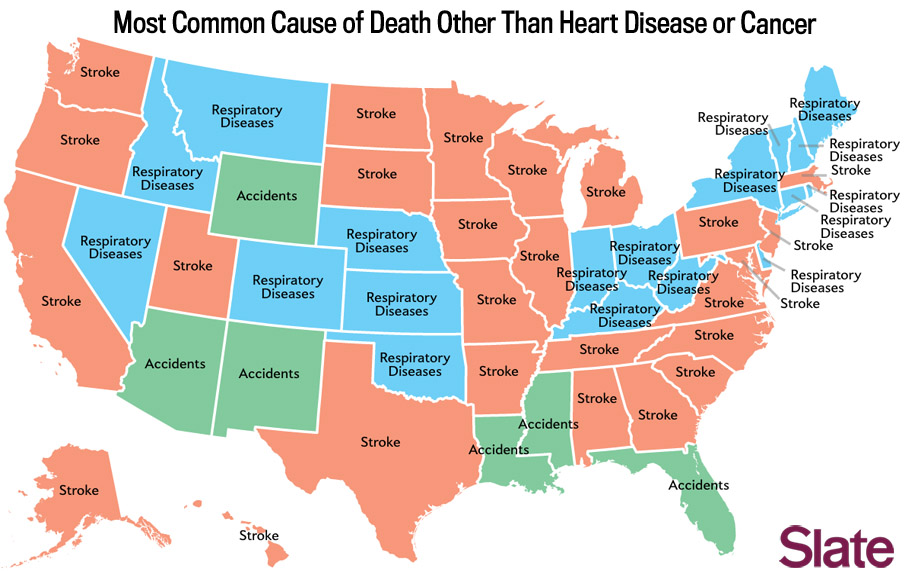
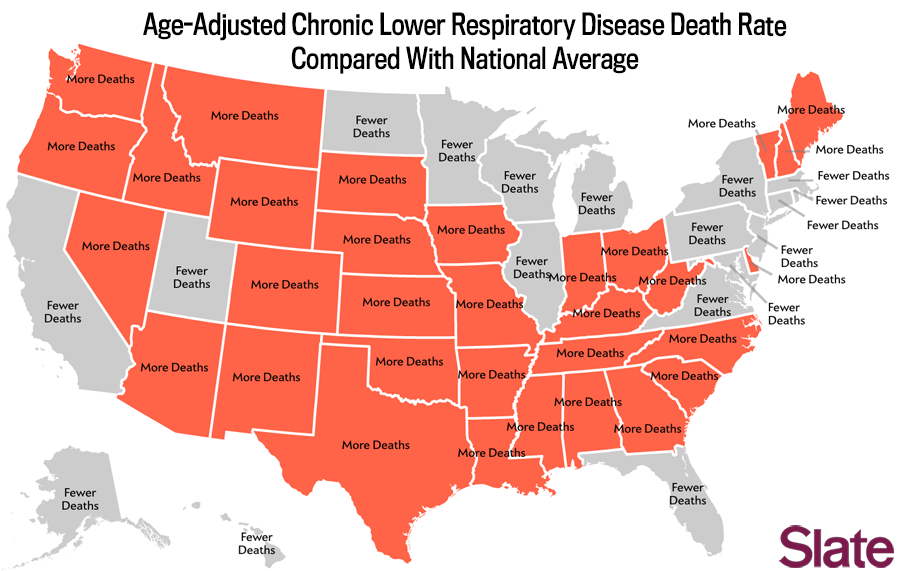
The map above, included in the original interactive, showed the most common causes of death excluding heart disease and cancer. The reason for the exclusions was to create more geographic variation. Heart disease and cancer, the top two leading causes of deaths in every state, account for more deaths than the next eight causes of death combined
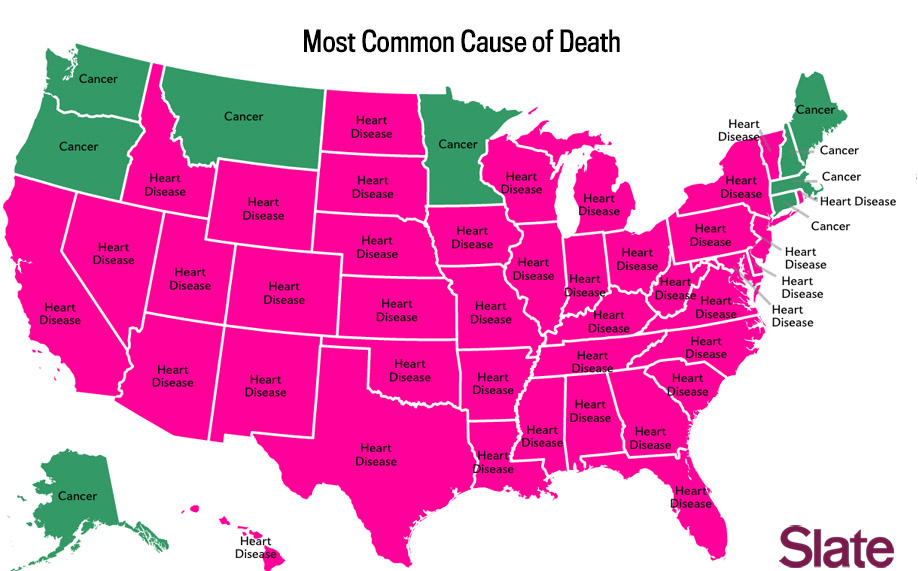
In these first two maps, we still only see five causes of death: heart disease, cancer, stroke, accidents, and respiratory diseases. Inspired by an unrelated map on regionalism in music preferences, I created a map in the original interactive that showed which cause (in the national top 10) affected each state at a rate most disproportionate to what one would expect based on the national rates. (I measured this using a ratio of state level rate to national rate, also known as the location quotient.)
The 10 causes as classified by the CDC are “diseases of heart” (heart disease), “malignant neoplasms” (cancer), “chronic lower respiratory diseases” (respiratory diseases), “cerebrovascular diseases” (stroke), “accidents,” “Alzheimer’s disease,” “diabetes mellitus” (diabetes), “influenza and pneumonia,” “nephritis, nephrotic syndrome, and nephrosis” (kidney diseases), and “septicemia.”
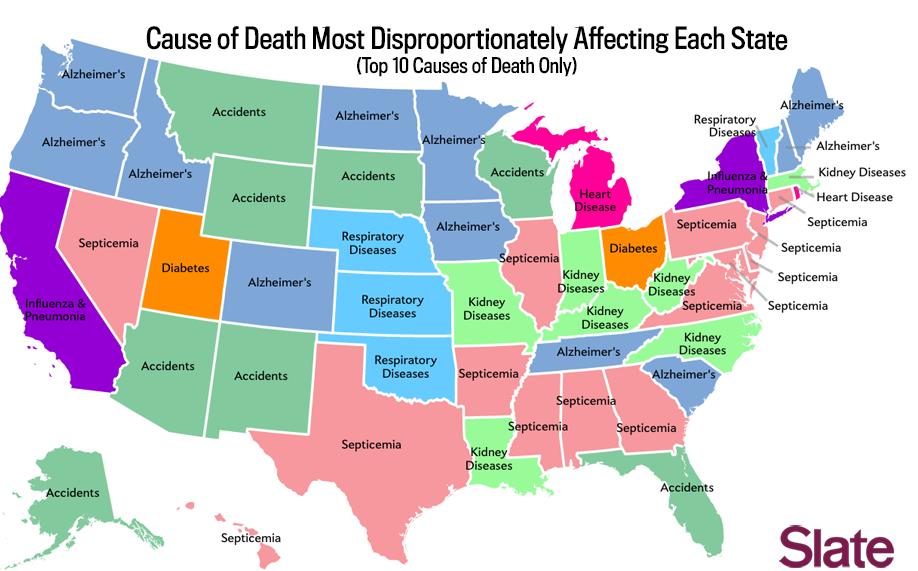
I included this map because it illustrates a few things the other two don’t, mainly the regionalism in diseases like septicemia and kidney diseases. But this map—like many maps which purport to show attributes meant to be “distinct” or “disproportionate”—can be misleading if not read properly. For one thing, you cannot make comparisons between states. Looking at this map, you probably would not guess that Utah has the sixth-highest diabetes rate in the country. Diabetes just happens to be the one disease that affects Utah most disproportionately. Louisiana has a higher diabetes death rate than any state, but is affected even more disproportionately by kidney disease.
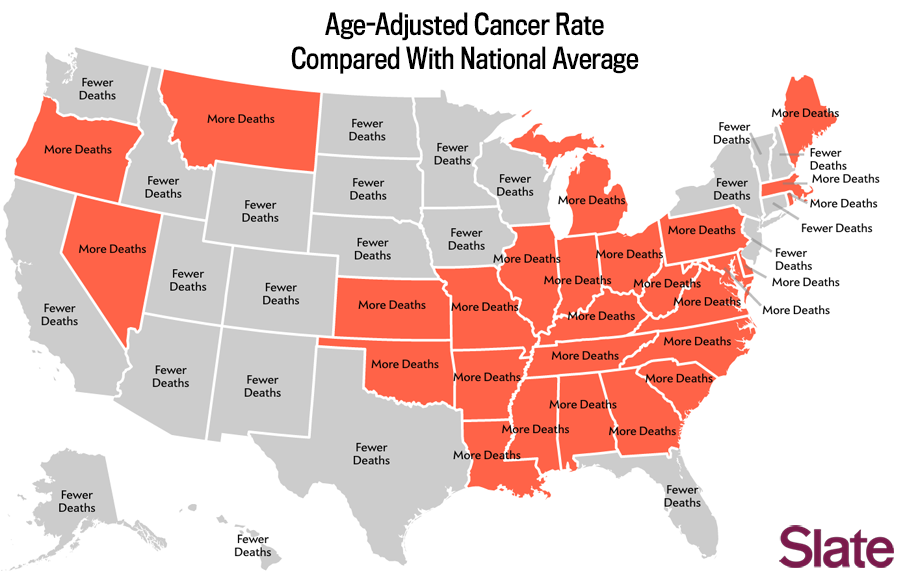
If you’re interested in geographic variation of cause of death, I’d recommended looking through the data (either on the CDC site or easily organized on this site). But I also realize data tables are not as fun as maps, so below is an attempt to break down the numbers in a more granular but still visual manner. For instance, take this map that shows which states have more people die from accidents than the national average.

It should be noted that each state’s rate is compared with the national average, not the median. That’s why it’s possible for 30 states to have more deaths than the national average.

It should also be clear that this data is not normalized by state. This means a cause of death may be uncommon for its own state, but still higher than the national average. For instance, a person from Alabama dies from every single one of the nation’s top 10 causes of death at an age-adjusted rate that exceeds the national average.
By contrast, the age-adjusted death rates for the top 10 causes of death are all lower in Minnesota than they are nationally. It makes sense, then, that the most recent estimates by the CDC have the life expectancy in Minnesota as nearly five years longer than in Alabama.
Below are maps for the other top eight causes of death. Accidents are the fourth-leading cause and heart disease is the first. The rest are presented in sequential order.



How A Toilet Shortage Is Fueling Rape In India
Dan JonesThis is absolutely terrible.
Indian police keep watch at the tree where the bodies of gang rape victims were found hanging, ahead of Congress party Vice President Rahul Gandhi's arrival in Katra Shahadatgunj in Badaun district, India's Uttar Pradesh state, on May 31, 2014.
The young girls always traveled in pairs when walking to the wheat fields near their northern Indian village at night to relieve themselves before bed. That precaution wasn’t enough to prevent them from being raped and killed last week.
Women in Katra village, where the murders took place, describe the act of open defecation as one of fear and indecency, where the threat of attack and harassment is unavoidable. Three men are accused by police of abducting the girls, 12 and 14, before gang raping them, and then hanging them from a mango tree by their head scarves.
“We’re scared when we go into the fields because we have exposed ourselves and there’s no protection,” said Sridevi, the mother of one of the victims, sitting in a shady corner of her home under police protection. Her last name is being withheld under a law that grants victims anonymity. “The world doesn’t offer us the decency to let us defecate in private.”
Related:
- Indian Police Hunt Men Wanted for Gang Rape, Hanging Teen Girls
- India’s Police Mocked Father of Pre-Teen Raped and Killed
- Indian Top Cop’s ‘Enjoy Rape’ Comments Spark Fury Amid Assaults
Typically considered a private moment, relieving oneself may now become one of India’s most public issues in the aftermath of the killings. Prime Minister Narendra Modi, who won the largest electoral mandate in 30 years last month, vowed to build a toilet in every home in a nation where half of India’s 1.2 billion people currently defecate in the open, the highest number in the world.
 Photographer: Chandan Khanna/AFP/Getty Images
The grandmother of the gang-rape victims looks on at a residence in Katra Shahadatgunj in Badaun, Uttar Pradesh, India. Close
The grandmother of the gang-rape victims looks on at a residence in Katra Shahadatgunj... Read More
Close
The grandmother of the gang-rape victims looks on at a residence in Katra Shahadatgunj in Badaun, Uttar Pradesh, India.
‘Easy Prey’
Nine of out of ten women and girls say they have faced harassment when going to the bathroom in Bhopal, the capital of the central Indian state of Madhya Pradesh, according a report by WaterAid in 2012. About a third said they have been assaulted, the survey said, without saying how many women it interviewed.
“When women go to the fields they are easy prey for men,” said Shaibal Gupta, an economist at the Asian Development Research Institute in Patna in the eastern state of Bihar. “I struggle to describe it. It’s one of the most dastardly acts imaginable.”
The cousins set off into the fields just after dusk on May 27. Like the majority of people in their village, they didn’t have a toilet at home so they were forced to defecate in the open. For women this poses particular risks, as traditions on modesty mean they usually have to go in the dark and travel with someone else for safety.
No Privacy
The victims walked a quarter-mile along a narrow dirt path that opened up into fields of wheat and cereals where cows and water buffaloes graze in the day under the shade of mango and eucalyptus trees, according to an uncle called Baburam who was in the field at the time of the attack. The girls stopped on a small patch of land full of sharp, thorny bushes growing about a foot off the ground. They were then kidnapped.
“This vicious, horrifying attack illustrates too vividly the risks that girls and women take when they don’t have a safe, private place to relieve themselves,” said Barbara Frost, the London-based chief executive of WaterAid, a charity that helps poor communities get access to sanitation. “Ending open defecation is an urgent priority that needs to be addressed.”
While India has been one of the world’s fastest-growing major economies for much of the past decade, sending rockets into space and giving rise to a class of billionaires, it has lagged on social indicators. About 626 million Indians defecate in the open, compared with 14 million in China, the World Health Organization said in a 2012 report.
Space Missions
“The possibility of space missions seems to capture the imagination of the privileged far more than flush toilets,” Nobel-prize winner Amartya Sen and development economist Jean Dreze wrote in their 2013 book “An Uncertain Glory: India and its Contradictions.”
The United Nations held a campaign earlier this year to encourage Indians to build more toilets called “Take Poo to the Loo.” A video featured a young man being chased by human excrement until he builds a toilet and flushes it away.
India’s shortage of toilets costs the country more than $50 billion a year, mostly through premature deaths and hygiene-related diseases, according a 2010 study by the World Bank. India suffers a greater cost than other Asian countries from the inadequate collection of human excreta, the study found.
‘Toilets First’
Modi’s ruling Bharatiya Janata Party promised in its manifesto to help people build toilets in homes, at schools and in public places to end open defecation. In October, Modi said if elected he’d plan to build “toilets first, temples later.”
“We will certainly be coordinating with the health ministry to see that toilets are a priority of this government,” Maneka Gandhi, Women and Child Development minister in Modi’s week-old government, told reporters yesterday when asked what his administration will do to reduce rapes.
The Congress party, which was in power for a decade until it was ousted last month, also promised it would build a toilet in every home in its 2014 campaign manifesto. Jairam Ramesh, the rural development minister under Congress, told women in 2012 not to get married into families that don’t have toilets.
Sulabh International, a New Delhi-based organization that has built public toilets and campaigned on human emancipation issues since 1970, will build toilets in every household in the village where the attack took place, Suresh Prasad, vice president of the organization, said in a phone interview. Work will begin in the next two weeks, he said.
“Building a toilet in my home won’t bring my daughter back,” Sridevi, the victim’s mother, said from her home. “It’s too late. The police and government never cared to give us security and decency so we could use the bathroom, and now my daughter is dead.”
To contact the reporters on this story: Andrew MacAskill in New Delhi at amacaskill@bloomberg.net; Kartikay Mehrotra in New Delhi at kmehrotra2@bloomberg.net
To contact the editors responsible for this story: Daniel Ten Kate at dtenkate@bloomberg.net Jeanette Rodrigues
Better Late Than Never: Google Finally Brings 64-bit Chrome to Windows
Dan JonesWhat the heck took you so long, Google? I'm pretty sure I've been using 64-bit builds on Linux ever since the first stable release.
 Google has finally released native 64-bit builds of Chrome for Windows 7 and 8, albeit as development builds aimed at developers and brave testers.
The post Better Late Than Never: Google Finally Brings 64-bit Chrome to Windows appeared first on OMG! Chrome!.


Universal overflow: auto;
Dan JonesInteresting idea. I think I kind of like it.
Greg Smith isn't advocating we start just slapping on * { overflow: auto; } into all our existing projects. But if we start a project with this, there are a number of advantages, like not needing to use a clearfix or worrying about collapsing margins. Of course sometimes you want a different overflow behavior, but you can just set it like you would anyway.
See the comments about inheriting the value rather than setting it.
Sometimes these things catch on, just look at box-sizing. And sometimes they don't.
Direct Link to Article — Permalink
Universal overflow: auto; is a post from CSS-Tricks

SVG `symbol` a Good Choice for Icons
You could design an icon set where the icons all had the exact same aspect ratio. But that's probably not typically going to be the case. The container around a little beaker icon might be tall and narrow. The container around a little fish perhaps short and long. You probably shouldn't have to think too much about that, but unfortunately you kinda have to when you use an SVG icon system as I've described in the past, because you need to use the viewBox attribute to describe that container/aspect ratio.
An improvement is to use the <symbol> element in SVG instead of directly referencing shapes (or a <g>), because you can define the viewBox directly on the <symbol> and then not need one when you <use> it later in an <svg>.
An example is in order.
Here's two icons with very different aspect ratios, as you can tell from the artboard in Illustrator.

We could adjust them to all be placed within a consistent aspect ratio, but I find it's more flexible and workable to know that your icons edges are right where the shapes stop, not with an arbitrary amount of white space around them.
The "Old" Way
If we go the <defs>-block route, we might combine them into:
<svg>
  <defs>
    <g id="shape-icon-1">
      <!-- all the paths and shapes and whatnot for this icon -->
    <g>
    <g id="shape-icon-2">
      <!-- all the paths and shapes and whatnot for this icon -->
    <g>
  </defs>
</svg>
Then use them like:
<!-- These viewBox's better be right or the icons won't look right! -->

<svg class="icon" viewBox="214.7 0 182.6 792">
  <use xlink:href="#shape-icon-1" />
</svg>

<svg class="icon" viewBox="0 26 100 48">
  <use xlink:href="#shape-icon-2" />
</svg>
That puts a good amount of onus on the implementer to get those viewBox attributes correct in the markup. That's one reason why might want to try and get all those icons at a consistent viewBox="0 0 100 100" (or something), but then we have that kinda arbitrary whitespace thing going on.
The "New" Way
Enter Fabrice Weinberg and TxHawks. Fabrice works on grunt-svgstore, a Grunt plugin for creating the SVG sprites from a folder of SVG files. This kind of thing makes the SVG icon workflow quick and easy. That is, except for the fact that you need to know that dang viewBox for each icon before you use it.
TxHawks suggested having grunt-svgstore at least put data-* attributes on the <g> elements that wrap each icon, so there could be programmatic access to what it is supposed to be. But unfortunately SVG doesn't allow those (it would have probably worked, but might as well make a build tool spec-compliant). It doesn't matter though, because soon after, they suggested using <symbol> instead, which turns out to be quite a good idea.
Instead of using <g> to wrap all the icon shapes, use <symbol>, like this:
<svg xmlns="http://www.w3.org/2000/svg" style="display: none;">

  <symbol id="beaker" viewBox="214.7 0 182.6 792">
    <!-- <path>s and whatever other shapes in here -->
  </symbol>

  <symbol id="shape-icon-2" viewBox="0 26 100 48">
    <!-- <path>s and whatever other shapes in here -->
  </symbol>

</svg>
Note that the viewBox is defined for each icon and as you're defining it as opposed to when you're using it. That means using it becomes easier:
<!-- We ain't even need no viewBox round here. -->

<svg class="icon">
  <use xlink:href="#shape-icon-1" />
</svg>

<svg class="icon">
  <use xlink:href="#shape-icon-2" />
</svg>
Easier, and less error prone.
And it gets better: you can add <title> and <desc> tags in the symbol as well, meaning the accessibility stuff is baked in as you use it.
<symbol id="icon1" viewBox="original-file's-viewBox">
  <title>original-file's-title</title>
  <desc>original-file's-desc</desc>

  <!-- <path>s and other shapes -->

</symbol>
grunt-svgstore does this now, thanks to TxHawks and Fabrice!
Why <symbol> is better for icons
Just to put a point on it:
- The
viewBoxcan be defined on the symbol, so you don't need to use it in the markup (easier and less error prone). -
titleanddesctags can be added there as well, making accessibility easier to do right. - Symbols don't display as you define them, so no need for a
<defs>block. - This is probably what
<symbol>was invented for anyway.
Demo
It works:
See the Pen Hwcxp by Chris Coyier (@chriscoyier) on CodePen.
SVG `symbol` a Good Choice for Icons is a post from CSS-Tricks
June 3rd, 2014 - /r/ShittyKickstarters: I've got this idea for rocket powered socks, I just need a little seed money!
/r/ShittyKickstarters
8,959 Backers for 1 year!
Crowd funding. It's pretty awesome, right? Combining the collective purchasing power of hundreds or thousands of consumers whilst reducing the overall risk to the business, artist or inventor is pretty much the dream for small scale endeavours. Of course, the words 'small scale' are relative with several crowd funding campaigns raising over $1 million in backing.
Hell, I mean the Veronica Mars movie raised over $5 million and the Pebble e-paper watch raised over 10,000% of their $100,000 target and ended up with more than $10 million!
Of course, crowd funding doesn't always work out the way we hope. From financial successes that fail to deliver on their promises, cough Ouya cough, to vague, meandering pitches that fail to secure the funding they need to get off the ground, there are a multitude of ways for a kickstarter to fail. Luckily for us, /r/ShittyKickstarters provides a place to collect together the laughable and the absurd, the hopeless and the mindboggling so that we can point and laugh whilst weeping gently about our own lack of inspiration and drive... Just me? OK.
Submissions are welcomed from any crowd funding site, not just Kickstarter, so you can expect posts from the likes of indiegogo and pledgemusic.
Posts cover a whole range of shittiness, from the highly implausible to the incredible breaches of copyright, the pretentiously insane to the remarkably lazy.
There are a million ways for a crowd funding campaign to be shitty but the worst of all, without a shadow of a doubt, are the scams.
Here is an especially awful example.
Now you've got your blood all fired up, let's meet the mod of /r/ShittyKickstarters, /u/IIoWoII!
Tell me a little about yourself?
IIoWoII I'm an early-twenties CS student from The Netherlands.
How did this subreddit come about?
IIoWoII There was a post on /r/cringe, I don't remember which, but it was about a... cringy kickstarter and someone in the comments mentioned that there should be a subreddit for stuff like that.
What makes a crowdfunding campaign truly shitty?
IIoWoII Well, there are different kinds of shitty. Many shitty kickstarters are just people who have put in like 3 minutes of work and want $50k. Then there are the ones who have put a relative high amount of work in the Kickstarter but have no way of actually delivering a product and still want a delusional amount of money. Scams are obviously pretty shitty too, maybe even the shittiest.
Do you have any favourite posts from the subreddit?
IIoWoII I think this: http://www.reddit.com/r/shittykickstarters/comments/22eq6y/i_have_no_idea_what_this_is_but_they_want_10m_for/ is a pretty shitty one.
What are your hopes for the future of the subreddit?
IIoWoII My hopes are that it just slowly grows a bit, I mean, this is not a subreddit for millions of subscribers anyway. But with more people I hope that somehow me may be able to help prevent scams a bit.
So, uh, about that seed money...?
[link] [12 comments]

