
Support Lunarbaboon on Patreon: http://www.patreon.com/lunarbaboon
Support Lunarbaboon on Patreon: http://www.patreon.com/lunarbaboon


By Scott Kaufman
Monday, June 9, 2014 10:33 EDT


According to researchers at the University of Utah, the bones of the human face have evolved to be more robust for protection against repeated impacts by small objects like the human fist, which they claim similarly evolved to protect the hand’s delicate musculoskeletal system when punching.
David Carrier, co-author of “Protective buttressing of the hominin face,” said in a statement that, “[i]f indeed the evolution of our hand proportions were associated with selection for fighting behavior you might expect the primary target, the face, to have undergone evolution to better protect it from injury when punched.”
“When modern humans fight hand-to-hand the face is usually the primary target,” he continued. “What we found was that the bones that suffer the highest rates of fracture in fights are the same parts of the skull that exhibited the greatest increase in robusticity during the evolution of basal hominins.”
Carrier and his co-author, Michael Morgan, contend that these changes to the facial feature appear at the same time as human ancestors evolved a hand with proportions capable of forming a fist. According to Carrier, “[t]he australopiths were characterized by a suite of traits that may have improved fighting ability, including hand proportions that allow formation of a fist; effectively turning the delicate musculoskeletal system of the hand into a club effective for striking.”
Together, these findings suggest “that many of the facial features that characterize early hominins may have evolved to protect the face from injury during fighting with fists.”
The implications of the pair’s conclusions reach outside debates about human evolution. “The debate over whether or not there is a dark side to human nature goes back to the French philosopher Rousseau who argued that before civilization humans were noble savages; that civilization actually corrupted humans and made us more violent,” Carrier said.
His work with Morgan would indicate otherwise. “What our research has been showing is that many of the anatomical characters of great apes and our ancestors, the early hominins — such as bipedal posture, the proportions of our hands and the shape of our faces — do, in fact, improve fighting performance,” he said.
He and Morgan were careful to stress that this does mean that humans are “naturally” or “inherently” violent, only that they evolved in an environment in which a particular mode of violence manifested itself.
["Australopithecus africanus - Cast of Taung child" by Didier Descouens, Creative Commons Licensed]

Scott Kaufman
Scott Eric Kaufman is the proprietor of the AV Club's Internet Film School and, in addition to Raw Story, also writes for Lawyers, Guns & Money. He earned a Ph.D. in English Literature from the University of California, Irvine in 2008.

Dan JonesIn case you don't use Evernote, this might be useful for you.
 Microsoft has released a Chrome extension for its digital notebook app OneNote that makes 'clipping' web content for viewing later easier than before.
The post Microsoft Release OneNote Clipper Extension for Google Chrome appeared first on OMG! Chrome!.

The Teenage Mutant Ninja Turtles look even cuter with an extra dose of mutant in the form of the X-Men. Wolverine, Gambit, Cyclops, and Colossus have never looked so fierce, or adorable.
Product Page ($20 via Cheezburger)
Dan JonesCool idea
Jafar is the primary villain of the Disney animated classic, Aladdin, which magic carpeted its way into our hearts back in 1992.
I’m sure many of you agree that the film is easily one of Disney’s best offerings of all time, and a lot of that has to do with its complex “good and evil” narrative, as well as some fantastic music.
Rather than leave the movie alone, however, I’ve decided that it requires a little over-analyzing, and you can thank the recent live-action Disney film, Maleficent, for my mischief.

Maleficient is a modern retelling of the classic story, Sleeping Beauty, which you may fondly remember as a VHS box tape that sat next to Cinderella, Snow White and maybe even Peter Pan. In this new version of Sleeping Beauty, Disney decided to turn the narrative on its head by making Maleficient a misunderstood villain.
Much like Broadway did with the Wicked Witch from The Wizard of Oz in “Wicked,” Disney retold the classic story with Maleficient actually being justifiable in her actions, though I won’t say much more for fear of ruining the film for anyone else.
At any rate, I found it valuable to do the same with Jafar from Aladdin, and I think you’ll find I have a decent case on my hands.

Right now, you’re probably remembering all of the awful things Jafar did in both Aladdin and its somewhat unofficial sequel, Return of Jafar. For the sake of keeping things simple, we’ll stick with just talking about Aladdin.
In the movie, Jafar betrays Aladdin after hiring him to do a job, tries to kill him later on, hypnotizes the sultan, tries to kill Aladdin again and then uses his power to usurp the title of sultan and force Jasmine and the real sultan to do his bidding.
After all of that, how could we possibly perceive Jafar as a good guy? Case closed, right?
Well, not necessarily. The problem here is that we have an unreliable narrator that could change the way we really watch the movie. The narrator I’m referring to is the merchant from the very beginning of the film.

If you recall, the movie starts with an unnamed merchant who is trying to sell his wares to us, the audience. To be clear, he’s as sleazy as they come, and it’s not long before he tries to sell us the magic lamp that once belonged to Aladdin.
In other words, the entire movie is a sales pitch.
The merchant is trying to prove to us (in his words) that the lamp is important because it “changed the course of one man’s life.” He then goes on to tell us the “story” of Aladdin.
The main problem here is that in order for us to want the lamp, he would have to position the main character, Aladdin, as the good guy. Even if he’s telling a “true” story, we as the audience have no idea how far he may be straying from the truth in order to convince us that having a magic lamp is a good idea.
(I’m sure what I just said has raised a lot of questions for those of you who remember how the movie ends, but stay with me for now).
To be fair, even the merchant’s telling of the story raises a lot of doubts for me that Jafar is that bad of a guy. So before we go any further, let’s go through the “Case for Jafar.”
This is probably the most important piece of evidence we have to work with. The root of Jafar’s motivation is to replace the sultan, but why do you think he is lusting for this power in the first place?

There’s a three-pronged answer to that question:
All of these are reasons for why the Grand Vizier would be so incredibly frustrated with the current affairs of Agrabah. As we see in the opening sequence with Aladdin and Abu running from the guards, poverty and homelessness is a huge problem.
This is likely because every time we run into the sultan, he’s goofing off or playing with toys. Jafar has to hypnotize the sultan just to get him to do his job.
Jafar himself is not a sorcerer until the end of the movie, but he does have a wide array of magical tools and instruments, which includes his cobra staff, the sands of time, etc. So why does he need a lamp to make himself sultan?

We’re led to believe that Iago (his parrot) convinced Jafar that he should just get the sultan to make Jafar a suitor for the princess. But if Jafar was really as cruel as the merchant portrays him, then Jafar could have simply hypnotized the sultan to concede his title.
Instead, Jafar wants to become sultan by either “wishing” himself sultan or marrying into it, which would both occur without hurting anyone (except Jasmine’s feelings).
You could argue that Jafar isn’t powerful enough to hypnotize the sultan in this way, but he seems to have plenty of other tools at his disposal. It seems unlikely that he wouldn’t be able to accomplish this without the lamp unless he was trying to do this without bloodshed.
Let’s review. We have a Grand Vizier named Jafar who is fed up with how the sultan is refusing to take his job seriously. Poverty and homelessness run rampant, the princess is antagonizing her suitors and the sultan is just standing by.

The law says Jasmine has to marry within the next few days, but she refuses because she wants love. So Jafar decides he needs to take matters in his own hands.
He’s been hypnotizing the sultan so far to keep things running, but that’s not enough anymore. Jafar decides he needs to become sultan himself and right what the sultan has wronged, while also allowing Jasmine to marry whomever she wants.
Meanwhile, Jasmine runs away and falls for a homeless thief who only likes her for her looks (as evidenced by how he describes her to the genie).

Of course, the sultan is old and could die soon. If Jasmine, his only heir, doesn’t marry in time, then the city will fall into turmoil. But Jasmine selfishly neglects her responsibility until the guards finally find her.
Jafar discovers with the sands of time that Aladdin is the key to getting into the Cave of Wonders, where the lamp resides. He hires him to get the lamp, but his stupid monkey touches something and the whole thing is collapsing. Deciding not to take any chances, Jafar takes the lamp and lets Aladdin suffer the consequences of his actions, but Abu steals the lamp back as they become trapped.
Jafar then has no choice but to save the city by hypnotizing the sultan into arranging a marriage between him and Jasmine.

But then some random prince no one has ever heard of (from a place no one has ever heard of) bombards the palace with a parade. The guy certainly doesn’t act or talk like a prince, but the sultan doesn’t care at all about how shady the situation is.
Of course, the “prince” is Aladdin, who tricked the genie into breaking him out of the cave without wishing for it and then made the promise that he’d free the genie later (even though he apparently didn’t intend to keep that promise).
Aladdin sneaks into Jasmine’s chambers (at night) and whisks her away across the world. Oh, and he lies to her again about who he really is by claiming he was a prince all along.

Jafar knows that the “prince” is a fraud, so he arranges to have him disposed of before he ruins the entire kingdom. But Aladdin escapes thanks to the genie, whom he betrays by going back on his promise to free him. Aladdin decides it’s more important to keep the genie around in order to keep the “prince” act up.
But Jafar realizes that the “prince” is actually Aladdin, so he steals his lamp back and commands the genie to make him sultan.
He also wishes for power, hoping that it will protect Agrabah from the country that just found out their prince they sent to marry Jasmine was attacked by a tiger. Jafar even places the kingdom on a hill to make it a more secure stronghold.

Alas, Aladdin returns and tricks Jafar into becoming a genie, thus imprisoning him.
We could also talk about Return of Jafar (which starts with the same merchant singing “Arabian Nights” by the way), but it’s pretty much the same story.
Oh, and I’m not the only person to argue for the case of Jafar. In fact, there is an entire musical based on this concept called Twisted, which you can watch in its entirety below:
(Warning: contains material not suitable for children)
The obvious question here is, why would the merchant tell us that the lamp is essentially useless? At the end of Aladdin, the merchant tells us that the genie is freed. That definitely explains how the merchant would have his hands on it without just using it himself.

The only answer I can think of is that he wants to sell the lamp because it is rare. It’s no ordinary lamp! This is the lamp that Aladdin used to defeat the evil Jafar! Hear the tale of the magical Genie would can summon entire parades that disappear without any explanation!
Can you see how his hyperbole and twisting of the story would convince someone that the lamp would be cool to have? Even if the story isn’t accurate? This is the same sales tactic that people make even today, but especially during those times when street merchants would shout extravagant sales pitches from the corner.
Am I over-thinking this? Of course. But I didn’t get into this because I want to prove something is true. Rather, I recognize the value in turning a story on its head to learn a new lesson.

The message here is that sometimes, things aren’t all what they seem. Sure, Aladdin is probably a cool guy and Jafar was a jerk, but my article may have made you doubt that a little. And that’s just because it’s easy to twist a story and blur the lines between good and evil (even though they are clearly distinct at the same time).
That said, which version of Jafar do you prefer?
Thanks for Reading! You can subscribe to this blog by email via the prompt on the sidebar. Otherwise, be sure to stay connected with me on Twitter (@JonNegroni). I’ll follow you back if you say something witty and awesome.


A typical message from my employer
"I have a degree, you know," I tell the semi-circle of moustachioed men around me, but they don't seem too bothered. "And I'm getting paid 10,000 Rupees to do this." Their expressions suddenly change; they seem interested. "But that is a lot of money," they say. Yeah, it is. Why the hell else would I be doing this? Few jobs are so bad that they cause a woman to envy a pole dancer. Look at her, suspended above that giant cocktail glass, awash with the green glow of the lasers, dry ice and the penetrative stares of a gang of voyeuristic 60-somethings, twirling around like she owns the place.
Lucky bitch.
I wish I had her job. But instead, this evening I am going to be an inanimate object. Not in the sense of being objectified, like, "women are just pieces of meat". No – literally. Tonight, I am going to be a table! A human table wearing a glow in the dark fireman's hat.

This is what it looks like to dress as a table.
Welcome to the weird and wonderful world of "White Girl Jobs" in India. Every backpacker who's wandered the pavements of Mumbai will have encountered the overly friendly young men lurking round the Leopold Cafe trying to scout random travellers for “starring roles" in upcoming Bollywood blockbusters. This is already kind of old hat. Watch any recent Bollywood film and in almost every dance, club or party scene there will be a group of white men or women inexplicably placed amid the pros, looking lost and bewildered.
But now there is a new trend growing among India's middle classes. They've started to employ white Western girls to hang out at weddings doing various weird things purely because they – we – are white and Western. Jobs can include anything from greeting guests while dressed as a London Beefeater, to leading the bride and groom's wedding procession on the back of a horse, to being a human statue.
Or, in my case, handing out drinks while dressed as a table – then standing there waiting to have the empties deposited back onto me. It really is as interesting and embarrassing as it sounds.

Among the luxuries at a wedding are an uncooked turkey and lobster
Nevertheless, it pays well, and in many senses this is the whole point. It is impossible to ignore the uncomfortable racial and post-colonial undertones at play in my situation. For whatever reason, affluent Indians seem to place a premium on pale skin, and anyone rich enough to pay for ethnically white people to work as living furniture at their weddings is seen as kind of a big deal.
Back in the days of empire, no colonial Indophile worth their salt would have been without their harem of Indian entertainers. From snake charmers to sitar players – imperialists loved to surround themselves with what, to them, seemed exotic. Today, the roles have been reversed – an irony I mulled as I stood there, laden with drinks.

Apparently a weeding planner ran out of things to spend money on
From start to finish, the whole experience was a total shambles. I received a call from a fierce-sounding Eastern European woman whose job it is to approve your pictures and measurements, then arrange a time and place to meet. In my case, this was a station right at the outskirts of the city – Delhi’s equivalent to Cockfosters. "Make sure you are there for five o'clock, otherwise no payment!" I was warned. "I mean it girls, don't fucking mess me around!"
I got there at five and then... nothing. By six o'clock, a few more girls had showed up – predominantly sad Russians speaking nothing but sad Russian. By seven, one of the guys who'd scouted me in central Mumbai had arrived, carrying three crappy phones, two of which he was speaking into simultaneously. His name was Pinky, he said. He'd just got WhatsApp – could he add me on it?
The next thing I knew, the ten of us were being bundled into a white Toyota Innova with "TOURIST" printed on the side – like we weren't conspicuous enough already – and driven off to god knows where. Like, seriously – I had no idea where we were going. I thought I was doing a two to three hour job on the outskirts of Delhi but eventually turned up seven hours and 200 miles later in Ludhiana, Punjab.
Upon arrival I hung around in the Green Room for an indeterminable length of time while "The Client" (whose identity is very rarely revealed) decided which of us were lucky enough to be allowed to work. While this process was going on, we were showered with the attentions of some Punjabi rappers. "They live in Canada," we were assured on a number of occasions. "They are very famous."

The green room: "Some famous Punjabi rappers… They live in Canada"
Most of the girls I met were either interning or studying in Delhi and doing the odd job to make ends meet. One of them told me she "couldn't believe" where she'd ended up: "This is where three years slogging my guts out at Oxford got me – dressed in a turban, miming playing the violin, while saxophone music blares in the background."
Some of the girls – from my experience, mainly Russians – work full-time on contracts. They get paid upwards of R80,000 a month (£800 – not bad at all in India), as well as having their accommodation and living expenses covered. However, these girls are pretty much unable to refuse work, no matter where or what it is or how long it lasts.
Most of them didn't seem to have any complaints but it just seemed kind of weird and fucked up to me. Perhaps they work their way up until one day they become that terrifying voice at the end of the line, ordering girls to pick-up points.

The stage. These have hosted everything from strippers to Hindi karaoke.
In the end, I can hardly complain of exploitation as a result of my alabaster skin in a country where millions are exploited every day for having the "wrong" skin tone. I was getting paid £100 for two hours' work – relatively huge compensation for this easy, albeit brain-haemorrhagingly frustrating, line of work. The main inequity, I felt, wasn't one suffered by me – or even the guys who felt like they needed to splash a bunch of money around just to have some white chicks dance to "Yaariyan Sunny Sunny" with them on the dancefloor. It was that I was earning double the amount of the native Indian girls who were also working at the event. And why? Because I'm Western and white.
I guess you could call it positive-exploitation, but standing around as a table, I didn't feel all that positive.
More about India:
Exploring Kashmir's Idyllic Meadow of Death
I Shat My Way to Love in Kashmir
What Do Young British Indians Think of the Biggest Election in History?


Boring, Oregon; Hell, Michigan, Toad Suck, Arkansas; Monkey’s Eyebrow, Kentucky -- Americans have truly gone to all depths of the imagination in naming their small towns. While the U.S. contains a plethora of unfortunately-penned places, our neighbors in Canada have outdone us, particularly in the northeastern province of Newfoundland and Labrador.
When famed British explorer and cartographer Captain Cook mapped the coast of Newfoundland in the late 1700s, he had no reservations about enlisting his crude sense of humor. With a complete disregard for future residents, he went about pervishly enshrining towns across the island -- Cuckolds Cove, Blow-Me-Down, and Come-By-Chance among them. But the Captain’s most inflammatory donning came after landing on a southeastern Newfoundland location that juts out into Trinity Bay, a place he proclaimed “Dildo.” Today, the name stands and is enjoyed by residents and visitors alike.
While the exact origins of Dildo’s name are shrouded in mystery, the word was widely used in the 18th century to describe anything cylindrical (test tubes, corks, etc.). But the term’s etymology dates as far back as the 1590s, when it was used as a bastardized form of Italian diletto ("delight"). Some scholars suggest the word was enlisted to describe sex toys as early as the Renaissance, though others, like Dildo resident Stella Wright, surmise that the town has existed “a lot longer than artificial penises have been around.” Whatever Captain Cook’s intentions may have been, the name is unmistakably penetrating.
An hour west of Newfoundland’s provincial capital, Dildo is a quiet, meandering harbor town with a population of 1,200. At one time, it flourished on the back of a burgeoning whaling and fishing industry; today, its name is that only thing that keeps people coming.
Though there may not be a whole lot to do there (the top three “Dildo attractions” on Tripadvisor are all hotels), the town’s residents are a proud, boisterous bunch, and partake in a number of annual festivities. Each summer, “Captain Dildo” -- an old wooden statue of a boat skipper -- leads the Annual Dildo Parade through the streets. (If you’re lucky enough to attend, be sure to snag an “I Survived Dildo Day” souvenir T-shirt -- they’re a hot commodity!)

In the 1980s, some of the town’s less-thrilled residents took issue with Dildo. Led by Robert Elford, an electrician, a petition was circulated lobbying for a more reserved name -- “Seaview,” or “Pretty Cove” -- but the “crusade” was unanimously vetoed at the climax of debate. Again, in 1990, Elford fought to ditch “Dildo” -- this time in favor of “Baytona” (a play on Florida’s much-warmer Daytona).
"Things always got a bit sticky for my son when people asked him where he lived," he told the Independent in 1995. "It all got too personal." But the petition failed again, and Elford settled on changing his own personal address from “Dildo” to “New Harbour,” a neighboring village. Life went on.
Similar protests in other crudely-named Newfoundland provinces have been more successful. Around the same time, a coastal community, Gayside, changed its name after residents were accosted by homophobic locals. Cuckold’s Cove, another waterfront town, is now Dunfield; Silly Cove is now Winterton, and Famish Gut (another Captain Cook classic -- an ode to his starving seamen) is now Fairhaven.
But Dildo refuses to be displaced, and most of its inhabitants have made the best of their geographic misfortune, including Diane George, who runs the island’s gift shop.
"You've hit the spot, all right," she tells visitors with a wide smile. "It does rather stick out at you from the map, doesn't it?"
This post was written by Zachary Crockett. Follow him on Twitter here, or Google Plus here.
Bill Watterson is the Bigfoot of cartooning.
He is legendary. He is reclusive. And like Bigfoot, there is really only one photo of him in existence.
Few in the cartooning world have ever spoken to him. Even fewer have ever met him.
In fact, legend has it that when Steven Spielberg called to see if he wanted to make a movie, Bill wouldn’t even take the call.
So it was with little hope of success that I set out to try and meet him last April.
I was traveling through Cleveland on a book tour, and I knew that he lived somewhere in the area. I also knew that he was working with Washington Post cartoonist Nick Galifianakis on a book about Cul de Sac cartoonist Richard Thompson’s art.
So I took a shot and wrote to Nick. And Nick in turn wrote to Watterson.
And the meeting didn’t happen.
Bill apparently had something to do. Or more likely, wanted nothing to do with me.
Which is smart.
But Nick encouraged me to send an email to Bill anyways. I said I didn’t want to bother him.
But a week or so later, this Pearls strip ran in the newspaper:

And I figured this was as good of a time to write to him as any.
So I emailed him the strip and thanked him for all his great work and the influence he’d had on me. And never expected to get a reply.
And what do you know, he wrote back.
Let me tell you. Just getting an email from Bill Watterson is one of the most mind-blowing, surreal experiences I have ever had. Bill Watterson really exists? And he sends email? And he’s communicating with me?
But he was. And he had a great sense of humor about the strip I had done, and was very funny, and oh yeah….
…He had a comic strip idea he wanted to run by me.
Now if you had asked me the odds of Bill Watterson ever saying that line to me, I’d say it had about the same likelihood as Jimi Hendrix telling me he had a new guitar riff. And yes, I’m aware Hendrix is dead.
So I wrote back to Bill.
“Dear Bill,
I will do whatever you want, including setting my hair on fire.”
So he wrote back and explained his idea.
He said he knew that in my strip, I frequently make fun of my own art skills. And that he thought it would be funny to have me get hit on the head or something and suddenly be able to draw. Then he’d step in and draw my comic strip for a few days.
That’s right.
The cartoonist who last drew Calvin and Hobbes riding their sled into history would return to the comics page.
To draw Pearls Before Swine.
What followed was a series of back-and-forth emails where we discussed what the strips would be about, and how we would do them. He was confident. I was frightened.
Frightened because it’s one thing to write a strip read by millions of people. But it’s another thing to propose an idea to Bill Watterson.
The idea I proposed was that instead of having me get hit on the head, I would pretend that Pearls was being drawn by a precocious second grader who thought my art was crap. I named her “Libby,” which I then shorted to “Lib.” (Hint, hint: It’s almost “Bill” backwards.)
(The introduction of Libby can be found HERE and HERE).
At every point in the process, I feared I would say something wrong. And that Bill would disappear back into the ether. And that the whole thing would seem like a wisp of my imagination.
But it wasn’t that way.
Throughout the process, Bill was funny and flexible and easy to work with.
Like at one point when I wanted to change a line of dialogue he wrote, I prefaced it by saying, “I feel like a street urchin telling Michelangelo that David’s hands are too big.” But he liked the change. And that alone was probably the greatest compliment I’ve ever received.
I don’t want to say any more about our exchange because to do so would probably be to compromise the privacy he so zealously guards. But I will offer you this one biographical tidbit:
Technology is not his friend.
I found that out when it came to the logistics of the artwork. I drew my part first and then shipped him the strips. I wanted him to fill in the panels I left blank, and simply scan and email me back the finished strips.
I asked him to do this because I did not want to be responsible for handling his finished artwork. Partly because I knew it would be worth thousands of dollars. Partly because I knew he wanted to auction it off for charity. And partly because my UPS driver has a tendency to leave my packages in the dirt at the end of our driveway. (I could just imagine the email I’d have to write the next day: “Dear Mr. Watterson – The first comic strip you’ve drawn in 20 years was ravaged by a squirrel.”)
So this left doing it my way. Digitally.
And this is when I found out that Bill Watterson is not comfortable with scanners or Photoshop or large email attachments. In fact, by the end of the process, I was left with the distinct impression that he works in a log cabin lit by whale oil and hands his finished artwork to a man on a pony.
So I proposed working out our technological issues over the phone. But he didn’t want to.
At first I thought it was because he didn’t own one. Or have electricity. But then I remembered we were emailing.
And so I soon came to the sad realization that he probably just didn’t want me to have his phone number. Which was smart. Because I would have called that man once a week for the rest of his life.
And so we worked through the technological problems via email.
And unlike every other technological problem I’ve ever had, it was not frustrating.
It was the highlight of my career.
The only thing Bill ever asked of me was that I not reveal he had worked on Pearls until all three of his strips had run. (And if you haven’t yet seen those three strips, they can be found HERE, HERE, and HERE.)
And so I did not reveal his participation until now. And it was the hardest secret I’ve ever had to keep.
Because I knew I had seen something rare.
A glimpse of Bigfoot.
. Bookmark the
.

Activists protesting outside FCC headquarters in Washington, DC, on May 15, 2014. Photo by Alex Wong/Getty Images
Consumer advocates everywhere are demanding that the Federal Communication Commission continue down its current path for shelving net neutrality and allowing a two-tiered internet. That is, if cable company-created front groups and other industry-funded organizations are to be believed.
The controversy, at the moment, rests on a legal distinction. A federal lawsuit filed by Verizon has forced the FCC into a corner by creating a standard under which effective net-neutrality rules—which ensure all internet traffic is treated equally—can only be reached, according to most analysts, by classifying the internet as a "common carrier," or in other words, a public utility. Such a distinction would allow the FCC to demand that internet service providers, like Comcast or Verizon, are not allowed to create internet slow lanes and fast lanes.
To the surprise of probably no one, ISPs are enraged at the prospect of being classified as a utility and are fighting back. But the attacks are not fully transparent. Many of the organizations protesting a move toward classifying ISPs as a utility, which is the only likely option for enacting net neutrality, are funded by the ISP lobby.
Take this opinion column by former Republican Senator John Sununu and former Democratic Congressman Harold Ford in the San Francisco Chronicle. The pair argues that reclassification would lead to "chronic underinvestment" in broadband services while threatening job loss. The disclaimer running under their byline says they are honorary co-chairs of Broadband for America, which the paper describes as "a coalition of 300 internet consumer advocates, content providers, and engineers."
A disclosure obtained by VICE from the National Cable and Telecom Association (NCTA), a trade group for ISPs, shows that the bulk of Broadband for America's recent $3.5 million budget is funded through a $2 million donation from NCTA. Last month, Broadband for America wrote a letter to the FCC bluntly demanding that the agency “categorically reject” any effort toward designating broadband as a public utility. It wasn't signed by any internet consumer advocates, as the Sununu-Ford letter suggests. The signatures on the letter reads like a who's who of ISP industry presidents and CEOs, including AT&T's Randall Stephenson, Cox Communications' Patrick Esser, NCTA president (and former FCC commissioner) Michael Powell, Verizon's Lowell McAdam, and Comcast's Brian Roberts.
Notably, Broadband for America's most recent tax filing shows that it retained the DCI Group, an infamous lobbying firm that specializes in creating fake citizen groups on behalf of corporate campaigns.
Another group leading the charge is the American Consumer Institute. The organization recently filed a letter with the FCC opposing reclassification, and argues that ISPs should be left alone. "The fact is that the broadband market is competitive and becoming more so," wrote ACI, which claims that consumers currently enjoy "increased choice." In January, ACI called the Verizon lawsuit that struck down the original FCC net-neutrality guidelines, "a victory for consumers."
Why would a self-professed consumer advocacy group not only oppose moving toward net neutrality but claim that America's broadband market—one of the slowest, most expensive in the industrialized world with fewer than three choices in many parts of the country—is so great?
Perhaps because ACI, like Broadband for America, is financed by an ISP lobby group. Annual tax returns show that a foundation controlled by lobbyists from the cell phone industry, called MyWireless.org, has contributed to ACI since 2010.
Other cable-funded allies have helped spread doubt about net neutrality. "If broadband providers want to start charging Netflix and Google for hogging all the bandwidth, that is their right as the owners of those networks," said Jim Lakely of the Heartland Institute, who called net neutrality regulations "a solution in search of a problem."
Leaked documents from the Heartland Institute, a conservative think tank famous for shilling on behalf of corporate donors, show major funds from Comcast, AT&T, and Time Warner Cable.
The push for reclassifying broadband as a utility may be an uphill battle. As VICE first reported, the FCC is led by a former cable-industry lobbyist, and many of his chief staffers are also former Comcast attorneys. Several new FCC staffers previously lobbied the agency against net neutrality in the past.
Still, the public is beginning to mobilize around the issue. Advocacy organizations focused on promoting a free and fair Internet, including Free Press, Color of Change, the National Hispanic Media Coalition, Demand Progress, and others, are using the FCC comment period, in which the agency is soliciting outside feedback about the rule-making, as an opportunity to organize the public.
Last Sunday, John Oliver rallied viewers of his HBO show, Last Week Tonight, to submit comments to the FCC in support of net neutrality. The response has overwhelmed the agency with thousands of comments.
Lee Fang, a San Francisco–based journalist, is an Investigative Fellow at The Nation Institute and co-founder of Republic Report.
The federal government just published data about the 779,929 immigrants who became US citizens in 2013. It shows that people are still coming to the United States from all over the world — but a few countries dominate the list.
Here's a chart of naturalized citizens based on country of origin. You can see that it's a pretty steep curve. Twice as many people born in Mexico became citizens in 2013 as people born in India — the next largest group. Twice as many people born in India became citizens in 2013 than people born in nearly any other country (the exceptions are the Philippines, the Dominican Republic, China, and Cuba).
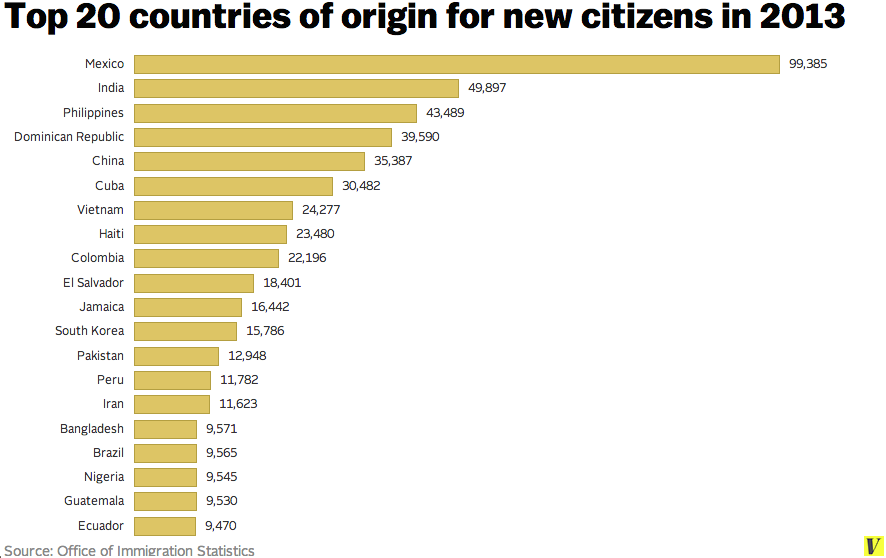
But there's also a wide range of countries represented — the people who became citizens last year came from 198 countries in all.
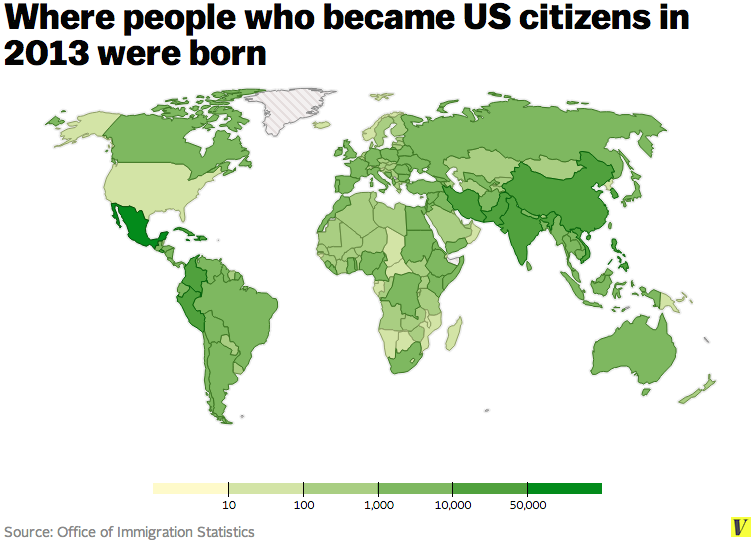
These new citizens have already lived in the United States for at least five years — and some have lived here longer than that. 2807 new citizens are listed as having been born in the "former Soviet Union" — which might mean that they've been in the United States since before the end of the Cold War, and are just now becoming citizens. (It also might just mean that they meant that their country of birth was the USSR at the time, even if it's, say, Latvia now.)
By the way, that light green shading on the US itself is not a mistake with the map. 55 new US citizens are listed as having been born in the United States. Most people who are born in the US are automatically citizens at birth — but there are exceptions. US Citizenship and Immigration Services says that those 55 new citizens could be, for example, the children of diplomats from other countries.
Just like new citizens are pretty concentrated in a few countries of birth, they're also clustered in a handful of states — notably California, New York, and Florida.
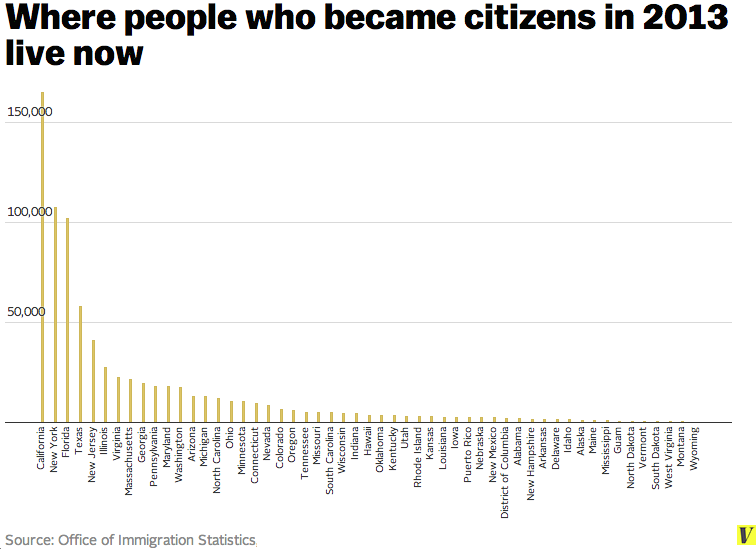
But every state has at least some new citizens in it.

Wyoming, which has the fewest new citizens, is still home to 242 of them. That's almost as many new citizens as were born in the whole country of Austria (248). Along those lines, here's another version of the above map. It's still covered according to how many new citizens are living in each state. But it's labeled according to which country of origin has the new citizens closest to that state's population. So Wyoming (242 new citizens) is labeled Austria (248 new citizens); Kentucky (3341 new citizens) is labeled Turkey (3390 new citizens); etc. A couple of countries are used twice, though we tried to avoid duplicates.

There's one exception to the map above. There are 164,792 new citizens living in California. No single country even had close to that many people naturalized as US citizens last year. Even in a country that's still a nation of immigrants, California stands alone.
Computing pioneer Alan Turing said that a computer could be understood to be thinking if it passed the test, which requires that a computer dupes 30% of human interrogators in five-minute text conversations.
Eugene Goostman, a computer programme made by a team based in Russia, succeeded in a test conducted at the Royal Society in London. It convinced 33% of the judges that it was human, said academics at the University of Reading, which organised the test.
It is thought to be the first computer to pass the iconic test. Though there have claims other programmes have successes, those included set topics or question in advance.
A version of the computer programme, which was created in 2001, is hosted online for anyone talk to. (“I feel about beating the turing test in quite convenient way. Nothing original,” said Goostman, when asked how he felt after his success.)
The computer programme claims to be a 13-year-old boy from Odessa in Ukraine.
"Our main idea was that he can claim that he knows anything, but his age also makes it perfectly reasonable that he doesn't know everything," said Vladimir Veselov, one of the creators of the programme. "We spent a lot of time developing a character with a believable personality."
The programmes success is likely to prompt worrying thoughts about the future of computing, said Kevin Warwick, a visiting professor at the University of Reading and deputy vice-chancellor for research at Coventry University.
"In the field of Artificial Intelligence there is no more iconic and controversial milestone than the Turing Test, when a computer convinces a sufficient number of interrogators into believing that it is not a machine but rather is a human," he said. "Having a computer that can trick a human into thinking that someone, or even something, is a person we trust is a wake-up call to cybercrime.
"The Turing Test is a vital tool for combatting that threat. It is important to understand more fully how online, real-time communication of this type can influence an individual human in such a way that they are fooled into believing something is true... when in fact it is not."
The test, organised at the Royal Society on Saturday, featured five programmes in totla. Judges included Robert Llewellyn, who played robot Kryten in Red Dwarf, and Lord Sharkey, who led the successful campaign for Alan Turing's posthumous pardon last year.
Alan Turing created the test in a 1950 paper, 'Computing Machinery and Intelligence'. In it, he said that because 'thinking' was difficult to define, what matters is whether a computer could imitate a real human being. It has since become a key part of the philosophy of artificial intelligence.
The success came on the 60th anniversary of Turing's death, on Saturday.

06.08.14
They’re complex ideas—the origins of the Universe, the evolution of the human eye, and the potential for life on other worlds—but one scientist makes them engagingly accessible to all.
Neil deGrasse Tyson has never suffered from a case of the Mondays.
“Days of the week are completely socially constructed,” he says, instantly employing what can best be described as his Lecture Voice. “None of this ‘I just need to get through Wednesday,’ or ‘I can’t wait ‘til Friday.’ To me, they’re just days, and I just live every day.”
Welcome to a conversation with one of the smartest men in the world: Even the most mundane pleasantry (“How’s your Monday?”) is returned with an answer that makes you question the entire idea behind the question. But before you beat yourself up for asking Neil deGrasse Tyson—the world’s most famous astrophysicist, the Frederick P. Rose Director of the Hayden Planetarium, the host of the most important science documentary series in three decades, the man who demoted Pluto and coined “Manhattanhenge” and holds 17 honorary doctorates plus the NASA Distinguished Public Service Medal—an incredibly dumb question, he stops you with one of his trademark sayings: “No one is dumb who is curious.”
If Cosmos, Dr. Tyson’s milestone science documentary series airing its finale tonight on Fox, shares one guiding principle with its host, it is the fervent belief that curiosity about the world around us is the key to solving humanity’s greatest challenges. By explaining concepts as complex as origins of the Universe, the evolution of the human eye, and the potential for life on other worlds accessibly enough to enthrall even the most disinterested liberal-arts student, Cosmos and Tyson are the most powerful force for curiosity about the mysteries of the Universe in American culture.
And it couldn’t come at a more important time. 42 percent of Americans believe that God created humanity in their present form 10,000 years ago, a figure largely unchanged over the past three decades. Climate-change denying politicians metronomically brandish their incuriosity with cries of “I’m not a scientist,” then decry the work of the 97-plus percent consensus on the issue by people who actually are scientists. The National Research Council reports that NASA has functionally thrown in the towel on a manned mission to Mars.
“Science literacy is not so much what you know, but about what is your depth of curiosity about what goes on around you. That’s how I measure the intellectual fertility of a culture, of a nation.”
But, as Dr. Tyson reveals in a conversation that covers topics from alien invasions to the privatization of space exploration, it’s not a lack of knowledge about science that concerns him—it’s a lack of curiosity.
Your involvement in this new iteration of Cosmos is tied pretty closely with Carl Sagan, astrophysicist and creator of the original 1980 miniseries, which Dave Itzkoff of The New York Times described it as “a watershed moment for science-themed television programming.” How intense is the pressure to live up to Sagan’s work?
I don’t think about it at all. I’m not trying to imitate Carl Sagan—I can only be myself. I can be an awesome version of myself! But I’m sure I would fail if I just tried to be Carl Sagan, so I try to be myself. We have genetic connections to the original—[Sagan’s widow] Ann Druyan and Steve Soter, the two writers of this series, were two of the three original creative principals of the original Cosmos, so we knew that we would keep the soul of the original, but I can just be myself.
Is that why you kept on the “Spaceship of Imagination” from the original iteration? (Note: The “Spaceship of Imagination” was a narrative device/actual starship. Fueled by “curiosity,” Sagan’s flagship traversed the galaxies as a way to explore the Universe.)
We of course kept certain potent educational tools. The Spaceship of Imagination had very mixed reviews in the original, and I had very little idea of what it was doing. Only in its re-envisioned form did we all embrace what it could be for the show: Sort of an impossibly minimalist ship that does what we need it to do just by the action of my thoughts. Its role and utility and value has been greatly magnified from the original.
What would Carl Sagan learn from watching your Cosmos?
[laughs] You mean tactically or scientifically?
Either! What do you think would surprise him most?
The fact that we have catalogues of a thousand planets orbiting other stars, he would have expected by now, but he would be delighted to know that the planets are sitting there in the catalogue, waiting to be studied and to be explored further. I don’t know if he could learn anything from me, pedagogically, because he carved so much brush, going where no one had gone before in this “pop scientist” realm. And the rest of us are just moving in that cleared brush.
Previous episodes of Cosmos have tackled “controversial” topics like evolution and the funding of anti-science organizations by corporate interests. Last week, you confronted climate change-deniers head-on with what was probably the best illustration of the climate-versus-weather distinction ever: a leashed dog wandering a beach.
The fun part with the dog is, we were burying treats to my left and to my right! Actually, as a kid I walked dogs for a living to buy my first camera and my second telescope, so I’d like to think that I was pretty smooth holding this dog, but while I’m talking to you I’m unwrapping him from around my hip and around my knees. I think I carried it off pretty well!
With an issue like climate change, which has a pretty entrenched opposition, how do you navigate educating the public about science without turning Cosmos into an hour-long fact-checking session?
Cosmos is not only about exploring what science is and why it matters, it’s also an exploration of how we came to know what we know. There are people who somehow think that scientists speak for what they want to be true, rather than what is true, and that we have a way to decide what is true and what is not. Many people who are in denial cherry-pick the results of science such that it is resonant with their philosophies, be it political philosophy, social philosophy, religious philosophy, philosophic philosophy—it doesn’t matter! If you cherry-pick science so that it resonates with your belief system, you are not understanding how science works.
You never see me debate anyone—I don’t debate people. As an educator, I just try to educate people, so that they know how they need to see the world as science has come to reveal it. Science has transformed our lives, and the reason for that is because it’s objectively true! When a scientific truth arises, it is so because of observational and experimental consensus. When that emerges, that is the new emerging truth, and you get over it! Scientists move on to the next problem. Nobody cherry-picked E=mc2—we built bombs off of that! You don’t cherry-pick the laws of gravity because you happened to gain weight last week. “Repeal gravity!” [laughs]
Speaking of climate change, President Obama just released new guidelines for carbon emissions that aim to reverse the effects of greenhouse gases, or at least slow them down. In “The Lost Worlds of Planet Earth,” you detail the Permian-Triassic Extinction, where it’s hypothesized that a runaway greenhouse effect killed 90% of life on Earth. Do you think we’ve passed the point of no return with anthropogenic climate change, or is there something we can do to stop it?
That’s not the specific expertise I carry. I do know that no one wants to go extinct. We will do all we can to not go extinct. I don’t know what would happen if our carbon footprint, as of tomorrow, went to zero. I don’t know. But what I do know is that if it doesn’t go to zero, things will get worse. For sure. So I don’t think there’s any rational argument to the idea that, “Oh, it’s already too late, let’s keep doing it. See you on the other side!”
How do you feel President Obama has been on science? At the beginning of his administration, he increased funding for NASA and called for a manned trip to an asteroid, but then he cancelled rocket programs that could have made it possible due to budgetary concerns.
I’m not here to tell people to like space if they otherwise don’t like space. I happen to like space because it’s fun and it’s a frontier and I think somebody has always, in the history of our species, liked frontiers. That’s how we learn things, that’s how we grow—that’s how you cross the valleys and climb the mountains and reach for the stars. But I can’t require everyone to want to do that.
What I can say is that a healthy future in space, based on my analysis of the causes and effects of innovation, is an extraordinary driver of innovation in science and technology. As a capitalist democracy, if we don’t want to die poor, you’re not going to solve that by creating programs to get someone interested in science. That’s not how its works. Someone says, “Okay, let’s make better science teachers and they’ll get all the kids excited!” So now they become scientists—now what? Is the government doing anything with them? No! No! No! So they become investment bankers! That’s what happens when you have smart people who don’t have any interesting science to do when they get out of school. They take on other fields.
Do you think that the privatization of space exploration is going to fill the gap? Or are we going to end up with corporate monoliths like Weyland-Yutani from Alien, plundering the cosmos for booty and leaving science by the wayside?
No. It can’t lead a space frontier. As long as space is expensive, has unquantified risks to your investment, and is dangerous, private enterprise cannot establish a capital market valuation of advancing a frontier. You could do a one-off, but it’s not a business model. Historically, those kinds of frontiers are breached by governments, who have long-term interests in their survival, longer-term interests than do corporations,. The first Europeans to the New World was not the Dutch East India company—it was Columbus, funded by Spain.
Then Columbus reports on the edge of the Earth: Where are the trade winds? Where are the hostiles? Where are the friendlies? He came back, and within years, Dutch East India was doing business, because they could then quantify the risk. They knew how long the voyage would take, they knew what they would find on the other side. That’s the role that private enterprise has historically taken in this kind of activity. That’s the kind of role I would expect them to play going forward. But without the government leading it? Forget it.
They’re not exactly discovering new worlds.
It’s great, and they’ll do it cheaper than NASA ever will, but [space transport services company] SpaceX is not going to create a business model by being the first on Mars. NASA could be the first on Mars, using government money, and they could pay for SpaceX spaceship, sure! But it’s not SpaceX leading it—it’s still NASA, it’s still government money, and it’s not a business model for going to Mars.
And as far as actual exploration and discovery, that gets thrown by the wayside.
It would not be done by private interests, unless it’s cheap. You could do it if it’s cheap! But space travel has not borne out that it’s cheap. Here I am, saying, “I want to explore the backside of Mars, who’s with me?” And I have a room full of venture capitalists, and they say, “Sure thing, how much does it cost?” And I say, “I don’t know, but probably a lot.” And they ask, “Is it dangerous?” And I say, “Yeah, people will probably die.” What’s your return on investment? “I don’t know, probably nothing.” The meeting would last twenty seconds.
Nearly 400 years after the trial of Galileo, a National Science Foundation study showed that one in four Americans think the Sun revolves around the Earth. For an astrophysicist, that’s got to be pretty irritating to hear. How do we reach that last 25%?
I’m less worried about that than most people are. I’m less worried because 400 years ago, everyone presumed that the Sun revolved around the Earth, because that’s what it looks like. To know that the Earth has to go around the Sun means that you have to learn that somewhere, you’re not going to get that from observations that you conduct on your own.
When I hold people accountable, it’s for things that happen in front of their face, and they don’t notice, or they don’t pay attention to it. Then that means that they’re not curious about their environment. Science literacy is not so much what you know, but about what is your depth of curiosity about what goes on around you. That’s how I measure the intellectual fertility of a culture, of a nation. I’d be more concerned if someone said that heavy things fall faster than light things. I’d ask them, well, have you tested that? Go drop your shoe and a Bic pen: Which hits the ground first?
“What’s the brightest star in the night sky?” Well, nine out of ten people will say the North Star—that means they’ve never looked up! The North Star is not even in in the top forty. That concerns me. If you had a curiosity, and if you noticed these things, you would wonder: “Well, it looks like the Sun is going around the Earth, but I wonder if that’s really true. Let me investigate it further!” And you would immediately get rid of that one-fourth of the population. They would answer those questions for themselves. I’m for the stimulation of curiosity, not the ladling of information into other peoples’ heads. Curiosity brings you knowledge.
What role does science fiction play in educating the public about science at large? After all, science fiction is a precursor to science fact.
I don’t think it educates the public, but it creates a curiosity. Curiosity matters. People say, “Oh this textbook says some wrong things, it’s bad.” Okay, fine, the update it, use it as a teaching tool. “Five years after this textbook was published, this result became a different result!” Oh, that’s cool! Just use it. People overvalue information relative to curiosity, because curiosity brings you the information.
Your Cosmos is coming up on its final episode. In “Who Speaks for Earth?”, the final episode of Carl Sagan’s Cosmos, the question of human engagement with extraterrestrial life is framed by referencing the destruction of the Aztec civilization by Spanish conquistadors. You’ve addressed the possibility of life in the Universe in “The Immortals”—there’s a hundred billion galaxies in the Universe, we may very well not be alone—but given the context of the interactions between less advanced cultures and more advanced cultures throughout human history, do you think we should we try to stay alone? Are projects like SETI Institute (a not-for-profit organization that searches for signals from extraterrestrial intelligence) not such a good idea?
I’m ambivalent on that. Any encounter between a more advanced civilization and a less technologically advanced civilization and a more technologically advanced civilization did not bode well for the less technologically advanced civilization. So that is enough to make one apprehensive about sending out our return address to aliens, because if they have a way to get here, they are more advanced than us. Period. Probably way smarter than us, as well.
But the other side of me says, our greatest fears for aliens are entirely derived from how we know we treat each other here on Earth. So I would ask: Are we a good model for how others would treat others? This alien fear factor is more a fear driven by how we know we treat each other than it is of a fear of how we think they would treat us. Our fear derives from our own fear of ourselves. Really, that fear factor is an indictment of who we are—not an indictment of some hypothetical alien species.
If people walk away with one thing from watching Cosmos, what would you want that to be?
That science is all around us, and it is the best method ever devised to establish an objective reality in which we live, and it’s that objective reality on which we should be basing decisions related to the future of our species. That’s the practical side of this. The glorious side is, I’d like to think, that people feel uplifted: Intellectually, emotionally, spiritually by getting this level of exposure not only to the methods and tools of science, but to the discoveries of science that have gone so far to convey what our place is in the Universe. Our past, our present, and our future.


Dan JonesNow, if I only had a Chromecast, this would be really cool to me
 Popular media player VLC is about to get popular with Chromecast fans, as it announces plans to add native cast support to its mobile and desktop apps.
The post VLC Adding Chromecast Support to Android, iOS and Desktop Apps appeared first on OMG! Chrome!.
7 Elements of Radically Simple OS Migration
Exclusive Above-top-secret details of Britain’s covert surveillance programme - including the location of a clandestine British base tapping undersea cables in the Middle East - have so far remained secret, despite being leaked by fugitive NSA sysadmin Edward Snowden. Government pressure has meant that some media organisations, despite being in possession of these facts, have declined to reveal them. Today, however, the Register publishes them in full.
The secret British spy base is part of a programme codenamed “CIRCUIT” and also referred to as Overseas Processing Centre 1 (OPC-1). It is located at Seeb, on the northern coast of Oman, where it taps in to various undersea cables passing through the Strait of Hormuz into the Persian/Arabian Gulf. Seeb is one of a three site GCHQ network in Oman, at locations codenamed “TIMPANI”, “GUITAR” and “CLARINET”. TIMPANI, near the Strait of Hormuz, can monitor Iraqi communications. CLARINET, in the south of Oman, is strategically close to Yemen.
British national telco BT, referred to within GCHQ and the American NSA under the ultra-classified codename “REMEDY”, and Vodafone Cable (which owns the former Cable & Wireless company, aka “GERONTIC”) are the two top earners of secret GCHQ payments running into tens of millions of pounds annually.

The Seeb spy base. Not in your name? My dear boy, that's the whole point
The actual locations of such codenamed “access points” into the worldwide cable backbone are classified 3 levels above Top Secret and labelled “Strap 3”. The true identities of the companies hidden behind codenames such as “REMEDY”, “GERONTIC”, “STREETCAR” or “PINNAGE” are classified one level below this, at “Strap 2”.
After these details were withheld, the government opted not to move against the Guardian newspaper last year for publishing above-top-secret information at the lower level designated “Strap 1”. This included details of the billion-pound interception storage system, Project TEMPORA, which were revealed in 2013 and which have triggered Parliamentary enquiries in Britain and Europe, and cases at the European Court of Human Rights. The Guardian was forced to destroy hard drives of leaked information to prevent political embarrassment over extensive commercial arrangements with these and other telecommunications companies who have secretly agreed to tap their own and their customers’ or partners’ overseas cables for the intelligence agency GCHQ. Intelligence chiefs also wished to conceal the identities of countries helping GCHQ and its US partner the NSA by sharing information or providing facilities.
According to documents revealed by Edward Snowden to journalists including Glenn Greenwald among others, the intelligence agency annually pays selected companies tens of millions of pounds to run secret teams which install hidden connections which copy customers' data and messages to the spooks’ processing centres. The GCHQ-contracted companies also install optical fibre taps or “probes” into equipment belonging to other companies without their knowledge or consent. Within GCHQ, each company has a special section called a “Sensitive Relationship Team” or SRT.
BT and Vodafone/C&W also operate extensive long distance optical fibre communications networks throughout the UK, installed and paid for by GCHQ, NSA, or by a third and little known UK intelligence support organization called the National Technical Assistance Centre (NTAC).
Snowden’s leaks reveal that every time GCHQ wanted to tap a new international optical fibre cable, engineers from “REMEDY” (BT) would usually be called in to plan where the taps or “probe” would physically be connected to incoming optical fibre cables, and to agree how much BT should be paid. The spooks' secret UK access network feeds Internet data from more than 18 submarine cables coming into different parts of Britain either direct to GCHQ in Cheltenham or to its remote processing station at Bude in Cornwall.
Among the cables specifically identified in one document as currently being intercepted or “on cover” are an Irish connection, Hibernia Atlantic, landing in Southport, and three European connections landing at Yarmouth, Dover, and Brighton.

via ScaryMommy
Liesl Testwuide sent her son to summer camp with high hopes.
Testwuide, owner of the parenting blog ScaryMommy, not only wanted her son to have a good time, and experience all that summer camp has to offer, but she dreamed of the day she’d get a letter home from the 8-year-old saying that he missed her as much as she missed him.
She got her wish — he sent her a letter the day after he got to camp. It wasn’t exactly what she had in mind but dear god was it amazing.

via ScaryMommy
[via MSN]
Please enable JavaScript to view the comments powered by Disqus.
blog comments powered by

 What Beats by Dre Are Actually Doing to Your Ears Image Credit: Ronald Martinez, Getty Images
Last week, Apple purchased Beats Music for $3 billion — the largest acquisition the company has ever made. With it, the company acquired Dr. Dre and longtime Interscope Geffen A&M Records executive Jimmy Iovine, the men behind Beats and a "sound revolution" who are actually doing irrevocable damage to our ability to appreciate music.
They aren't alone in it. Beats is just the biggest representative of the cultural trend of constant headphone use, and the silent epidemic that has come with it.
Dre and Iovine's headphones are engineered so that you "hear your music the way the artist would play it back" — specifically, the way hip-hop and rap artists, like Dre, would want to play it back: with a lot of bass, in the way that leads to hearing loss. For most high-quality headphone brands, that's the sell.
Beats' headphones have been flaunted in rap music videos and touted as expensive fashion accessories, creating a commercialized hip-hop culture that stems from the celebrity of Dre's production history. As a result, much of Beats' engineered appeal is in its emphasis on low, bass-heavy frequencies of the "Xxplosive" sort. It makes sense: Rap and hip-hop are often characterized by their heavy, booming bass lines. And while a human ear normally registers frequencies anywhere between 20 Hz and 20 kHz (or 20,000 Hz), the sub-bass sounds in rap songs, like a classic 808 drum kick, will range as low as 80 to 20 Hz. The lowest A on a piano, for example, vibrates somewhere around 25 Hz. In order to hear those notes, you have turn the volume way up.
Frequencies that are often "felt" through stereo systems are what Beats and other high-end headphones aim for — that's the way the artist produced it in the studio. But sometimes, those bass-heavy details can be too much. While Beats can recreate the feel of a tight, punchy bassline, a boomier backdrop, like Wu-Tang's "C.R.E.A.M," has the tendency to overpower and weaken a song's mid-tones, things like guitars and voices. So in addition to having louder bass from the get-go, listeners often turn up headphone volume in order to hear those higher frequencies, and consequently "feeling" the bass affects our ears even more. Deeper bass means louder playback, especially when we're listening to the sort of hyper-compressed, ear-fatiguing music that is associated with mainstream pop and hip-hop. And it's nothing new that prolonged exposure to loud music, especially through headphones, causes hearing loss.
It's considered safe listening to music at 85 decibels or lower. Crank your Beats all the way up to their 115-decibel peak (the kind of volumes you might reach when on a loud train) and you could experience severe hearing loss after just 15 minutes of listening every day. When our ears are frequently exposed to high decibels, the inner ears' hair-like fibers, called stereocilia, which are responsible for activating frequencies of particular sounds, can be permanently damaged over time. This can lead to noise-induced hearing loss, which is often ignored, or tinnitus — aka that buzzing in your ears after a night of loud music. Even though that buzz may be gone by the morning, its damaging effects can linger.
And we may just keep turning it up. While many have already anticipated a deafness epidemic, it seems increasingly likely. In 2010, the Journal of the American Medical Association found that 1 in 5 U.S. teens already suffer from hearing loss, and 1 in 20 have "mild or worsening" symptoms. So if Beats is leading a sonic revolution, it's worth remembering: Sometimes revolutions end badly.

Katie is a recent graduate from The College of William & Mary, where she majored in English and minored in Cultural Studies. She's written pieces published on NPR Music, Thought Catalog and AnimalPlanet.com, but her true passions probably ...

Today is the day we Reset the Net! It's been one year since the Edward Snowden disclosures hit the news and the whole world woke up to the scale of mass, indiscriminate Internet surveillance -- a spying campaign that was only possible because our own tools leak our private information in great gouts. Reset the Net provides you with a technical, political, and social toolkit to harden our Internet against the spies; and Boing Boing is proud to be playing a role.
Spy agencies like the NSA can hack anyone, but they can't hack everyone. Mass surveillance is only possible because our tools and systems make it very easy to get at our private communications by transmitting and storing them without any kind of privacy protection, like cryptographic scrambling. Reset the Net aims to fix that, making our Internet into a place where no one -- not governments, crooks, or spies -- can conduct indiscriminate privacy attacks on whole populations.

Reset the Net comes in two parts:
A privacy pack: with downloadable tools to make your phone or laptop secure, running Ios, Android, Windows, Mac OS, or GNU/Linux. Also in the pack are tools for making secure phone-calls, conducting secure chat and SMS, hardening your passwords, and making your browsing more anonymous and private. Also included: instructions and tools for including your phone's storage or your laptop's hard-drive; even booting up your computer into a secure operating system like Tails.
A pledge for developers and site operators: Here are best-practices for people who make mobile apps, host sites, and write code to make the Internet more secure against mass surveillance. For example, mobile developers can use cert pinning and end-to-end encryption to keep their users safe and private. And websites can use SSL to protect their users' privacy when they use the net.
The campaign is collecting pledges from developers with the steps that they're taking to make the Internet safer from spying.
We're proud to announce that we are migrating Boing Boing to SSL-by-default and plan on having this in place shortly.
If you have a website of your own or social media account, you can help spread the word about Reset the Net.
The campaign has a great collection of banners and buttons ready-made for your social-media account. And if you add this code to your website, you'll put a great banner on every page advertising the campaign to your friends and readers:
<script src="//fightforthefuture.github.io/reset-the-net-banner/banner/rtn.js" async></script>

-Cory Doctorow
Dan JonesI would think they would put this Concierge app on the Play Store, charge $500 for it, and not give a free trial. If I were a busy CEO, I would definitely use that app, but I wouldn't pay $10k for a phone just to get that app.

Image: Courtesy of Vertu
Within 10 hours of receiving my loaner unit of the Vertu Signature Touch, I almost dropped it on a marble floor. It would have been bad. It would have been really bad.
You see, the Vertu Signature Touch starts at $10,300. That’s hard to ignore, even if the phone actually is pretty good. The cost is practically part of the phone’s feature set; Vertu says the Signature Touch is for “high-net-worth individuals,” those who value exclusivity and standing out above all else. The one I tested was the bargain-bin version; there are versions that cost as much as $21,900. It’s a luxury car, a luxury watch, a luxury handbag. Normal consumer logic does not apply.
If the phone had hit the floor, it may well have survived the impact. Its 4.7-inch touchscreen is coated with a pricey sheet of sapphire crystal glass, making it nearly impossible to scratch. It can take anything short of a diamond to the screen and remain unscathed, but it can shatter just like normal glass if you drop it. There was some weight behind that sapphire crystal glass too—the Signature Touch has a heavy-duty titanium frame. Prior to my reflexes kicking in, I took a nanosecond to appreciate how beautiful the phone looked floating in midair. Sapphire and titanium glistened, rotating in zero gravity, unbefouled by human touch. Maximum luxe.
I made a miracle catch, then sat in silence for two minutes. I felt the way you feel when you tip back in a chair too far and stop yourself from falling backward at the last moment. It was pure anxiety, a cold reminder that a $10,300 phone will not suspend Murphy’s Law nor the laws of physics. You can still drop this thing and break it, you can still leave it in a cab, and you can still forget it’s in your pocket when you jump in a pool.
I’ve done all those things with phones, and that’s one of many reasons I’m not the target market for the Vertu Signature Touch. Like most people, I also can’t afford or justify its purchase. The value-shopper in me gets nauseated just thinking about it. I’m too self-conscious to use it. I’m too self-deprecating. It would clash with my carefully curated laid-back wardrobe. We were the Odd Couple, me and the Vertu.
Let’s pretend, though. Let’s pretend a phone that costs as much as an OLED TV is reasonable and well within everybody’s phone-buying budget. Let’s pretend this is just another phone, built to compete with the iPhones and Nexuses and Galaxys of the world. Does it stack up? Hell yes it does. Sort of.
I really have no idea.
The Signature Touch’s Concierge service is what sets it apart from other phones. It’s free for the first year, then jumps to around $3,000 a year. Concierge makes the phone more like an American Express Black Card or a diplomatic passport. It works like this: You request (legal and somewhat reasonable) things via the Concierge app, and then a real, live person makes them happen. You basically have a personal assistant on call at all times. A little button on the side of the phone fires up the Concierge app directly. The assistant who helped me was Celine. She was great.
To kick off my review time, Vertu offered to book me a dinner reservation at the members-only CORE:Club to show how the Concierge could gain access to exclusive places. I declined that offer, as I wanted to test the Concierge using my own requests.
Instead, I checked OpenTable at 2:00 p.m. on a Saturday and found popular restaurants fully booked that day and on the weekend. There was nothing available for dinner at ABC Kitchen in a few hours or brunch at Red Rooster the next morning. I opened the Concierge app and asked for reservations at 7:30pm that night and noon the next day, knowing it would be tricky. No problem, reservations booked. Thanks Celine! On another Saturday night, I was a head-nod away from getting a group of five on the VIP list at a fancy club called Avenue. If we’d been willing to pay $200 apiece for a table and bottle service—and had any intention of actually going—we’d have been in. Coincidentally, $200 is the price of a normal phone.

Image: Courtesy of Vertu
Concierge does have its limits. I requested a time machine, and Celine replied “I wish I could help you with this request!” There was one mixup: Concierge checked in with me about a flight I was booking to Belgrade, except I never tried to book a flight to Belgrade. I explained this, and they apologized for the misunderstanding.
To get the most out of Concierge, deep pockets come in handy. When you initiate the service, you can set up a profile that includes your credit card number so that you can be billed directly for plane trips, hotel stays, and event tickets booked via Concierge. Another Vertu app called Life offers a curated feed of events and attractions around the globe: Formula 1 races, theater, concerts, and private events with world-class chefs. If you’re interested, you tap an inline “Concierge” button for each event and your magical helper handles the request. There are Concierge teams around the world, working 24/7, to handle the requests.
Concierge was awesome. I miss it. Everything was very polite and professional and resort-like, and I was addressed as “Mr. Moynihan” the whole time. At one point, Celine called me “Mr. Vertu Extraordinary.” I’m not even sure what that meant, but I went ahead and got it tattooed on my back.
It has a very pleasant odor. The Vertu Signature Touch is easily the best-smelling phone I’ve ever used. The “Claret Calf” version I tested had a stitched calfskin backing on it that emitted a rich, intoxicating leathery scent. I didn’t get any nose-on time with the lizard- and alligator-skin backings, so I can’t speak to their olfactory qualities.
A++ handfeel. All phones should feel as good in the hand as the Vertu Signature Touch. At least twice, my eyes rolled back into my head due to the overwhelmingly pleasant combination of the raised seam running down the back of the phone, the cool touch of the titanium edges, and the satisfyingly hefty 6.77-ounce weight of the device. That’s almost twice the weight of the iPhone 5S. Remember when phones weren’t ridiculously light? This one makes a case for them beefing back up a bit. The best part is the way the heavier build feels with the stronger-than-most haptic feedback from its touchscreen. There’s a deeper, machine-like kick to it that other phones don’t have. So nice.
Materials and build quality. The materials used in the Vertu Signature Touch are appropriately expensive: Strong and durable titanium, a scratch-resistant sapphire crystal screen, a back cloaked in premium animal hide, and a ceramic “pillow” around the earpiece of the handset. All of this accounts for some of its exorbitant price. Even its SIM-card holder has flourish: You fold out a little handle on the back of the phone, twist it, and pop open a swinging door. The underside of that door is signed with an etching by its builder; each phone is assembled by a single person from soup to nuts in Vertu’s factory in England. The one I tested was built by someone named C. Davis, and he (or she) did a good job. It would have made me feel worse if I’d dropped it.
Luxe ‘tones and speakers. When you turn the phone on, your ears are treated to a dope flute riff recorded by the London Symphony Orchestra. Every time you receive an incoming message, you hear another sick flute mini-jam mixed in with some bird noises. This phone has top-shelf ‘tones, all recorded by the LSO. The front-firing speakers are also noticeably good, sounding much louder and brighter than most phone speakers. That said, the low-end has no punch. The next version should have a huge subwoofer or a man that follows you around with an 808 machine.
Blackphone-like security. If you really value your privacy, rest assured that the Signature Touch is able to keep your text messages and phone conversations (but not your emails) on lockdown. The Signature Touch comes with voice, video-chat, and text encryption powered by Silent Circle. Just keep in mind that the recipient of the messages must also be running the company’s Silent Phone or Silent Text app to get the full end-to-end encryption. The Silent Circle features are only free for the first year, and you need to register your phone with them.

Image: Courtesy of Vertu
The screen. The Vertu Signature Touch’s 1080p display has a pixel density of 473ppi, and it looks great. The pixels are packed in even tighter than phones like the Google Nexus 5 (445ppi), HTC One M8 (441ppi), and Samsung Galaxy S5 (432ppi), but you’d need better eyesight than mine to see a huge difference. It’s a tack-sharp, high-quality screen, but if you were expecting to see holograms and IMAX and money blasting out of its 4.7-inch display, no dice. The size and resolution is wonderful in landscape mode when typing and watching movies. It felt a bit too skinny and long when I typed in portrait mode. Installing SwiftKey helped, just like it does on a normal phone.
Up-to-date OS and features. Believe it or not, previous versions of Vertu’s phones were an even tougher sell, as they didn’t have state-of-the-moment components or operating systems. That’s not a problem with this phone, as the new Signature Touch packs Android 4.4.2 KitKat, a 2.3GHz quad-core Qualcomm Snapdragon 800 CPU, and 2 gigs of RAM. You also get NFC, support for 4G networks across the globe, and Google Now voice-assistant features. The combination of all those things puts the Signature Touch among the current wave of high-end Android phones. At this moment in time, any potential buyer will not be left wanting for speeds and feeds. Then again, this is a $10,300 phone we’re talking about. You should get Android 9.7 Zabaglione and a freon-cooled processor with like a zillion cores.
A very good camera. The Signature Touch’s 13-megapixel camera is also solid, with performance that matched up well to some of the better smartphone cameras I’ve used. Low-light performance is good for a phone—using HDR mode or adjusting its ISO settings manually helps—and the interface was developed in a partnership with Hasselblad. There are some scene modes in the mix, exposure-compensation settings, and white-balance adjustments, too. Is the camera good? Yes. Is it clearly better than the camera in other phones with good cameras? No.
Bad battery life and no expandable storage. The 2,275 mAh battery got me about half a day when I used this phone like a normal phone. You also can’t swap in a fully charged spare, because that battery is sealed in (probably with unicorn glue) under those premium materials. If anyone asks you why you don’t own the Vertu Signature Touch, just pretend it’s because of the battery life. No expandable storage, either—you’re stuck with the 64GB on board.
The back plate gets hot. When the battery was about halfway dead on my test unit, the area around its beautifully handcrafted SIM-card door heated up quite a bit. Not “Yow!” hot, but definitely “Hey, that’s abnormally hot” hot.
The design isn’t for everyone. Superb craftsmanship, premium materials, and A++ handfeel aside, the Signature Touch’s ornamental touches look old-timey. It has a leather-covered front bumper and a car-like “V” logo on its ceramic “pillow” that makes it look like a shrunken-down car console. You don’t get the edge-to-edge screen, narrow bezel, and sleek looks that you get with most phones, which is probably the point. This is a phone that’s built to be noticed on purpose.
It’s stressful. Dropping it is one thing. Do you get nervous when you take your phone out in public places, because maybe someone will steal it? Imagine that nervousness if your phone costs 11 grand—and it was a phone built to attract attention. I never wanted to take it out of my pocket on the subway.
This phone and its price are inextricably intertwined, which makes it a non-starter for almost everyone. It’s clearly Vertu’s best device so far, with competitive specs for an Android phone, better build quality (and speakers) than any other phone out there, and a killer feature in the Concierge. For a Monopoly-money lifestyle, maybe the Signature Touch makes sense? If you are dead-set on buying a Vertu phone, this is the one to get.
Still, I wonder if a feature like the Concierge would be as cool or useful to anyone who actually has their own personal assistant—or someone with enough pull to get a table at any restaurant just by showing up. That’s the kind of person this phone is for. The person who doesn’t worry about using it on the subway, because they don’t take the subway.
But I couldn’t help feeling that the Signature Touch might be a peek at the short-term future of the mobile landscape. Maybe there is a wider market for a phone like this that costs $1,000 to $2,000, with a premium build, up-to-date specs, and services that go beyond the usual fare. Pretty much every phone is excellent these days. They’re getting harder to tell apart, because they’re all gravitating toward the same indistinguishably good mobile device with roughly the same features. Now that smartphones are the new normal phones, premium smartphones may be the next step up.
After all, your phone is with you all the time. It’s more visible than a luxury watch or maybe even a luxury handbag. It’s mission-critical.
However, unlike cars and watches and bags, a phone has a two- or three-year shelf life. There’s no Project Ara version of it. And while the Vertu is built to last, its components may seem outdated next month. That’s just how it is with phones. The clock is always ticking.
Dan JonesWritten by my little sister
In every thrift store across this great land, tucked away in a forgotten corner of the housewares section, sits a potent culinary powerhouse – usually in harvest gold and priced at $5 or less. I speak, of course, of the humble slow cooker, which, with the input of a meager amount of electricity and some time, can coax the richest and most complex flavors from the humblest of ingredients. You may have grown up seeing that raw potential squandered on countless dubious hunks of meat covered in off-brand dry soup mixes, but you don’t have to make the same mistake. Pick that aesthetic monstrosity off the thrift store shelf and work some low-budget magic with it. Try it now, because summer is the perfect time to start experimenting with slow cookers. They give off so little heat that you can cook to your heart’s content without having to face the prospect of a sweltering kitchen or standing over a hot stove.
Of course you don’t have to stick with the harvest gold thrift store model. Even brand new slow cookers are incredibly cheap and newer slow cookers often have neato whizbang programming features and come in really cute colors and patterns. However, for the love of cheap, all the recipes in this article can be made with an old or basic model whose only settings are “plugged in” and “unplugged” (plugged in corresponds to “low” on a multi-setting cooker).

This is probably the most well known slow cooker trick, but it’s worth repeating because THE WORLD MUST KNOW. It’s magic; creamy, delicious magic. Here’s the super complicated recipe:
1 or more cans of sweetened condensed milk (how ever many you can fit in your cooker without them touching)
Peel the label off the can(s).
Turn it/them or its/their side and place in slow cooker.
Cover with water.
Turn cooker on low.
Leave for 8-12 hours.
Turn off and let cool before removing cans. Done.
Label the cans before you forget and store. They have to be refrigerated after opening, but can stay on the shelf unopened pretty
much forever.
Now that you have all this wonderful dulce de leche you can now start putting it on everything: ice cream, popcorn, hot cocoa, oatmeal cookies, poured in ribbons on top of brownie batter before baking, whisked with cream cheese into frosting, the possibilities are endless.
I once read that carmelized onions are like bacon for vegetarians, both because they have the same deeply satisfying umami-filled flavor profile and because they act as that one secret ingredient that makes almost everything they touch just takes better. Sadly, they’re a complete pain to make. You have to spend at least an hour slowly cooking them over lowest heat, stirring constantly to make sure they don’t stick. That is, unless you’d rather just throw some onions in a slow cooker and flip it on.
No really, that’s the basically the recipe. Take as many yellow or red onions as you can fit in your model (usually about 5 pounds for a 6 qt), slice them into half moons. Place in slow cooker and sprinkle about 1 tsp of salt over them all, then drizzle 1-2 Tbsp olive oil. Stir to combine and cook on low for 12-24 hours, until they reach desired color and yumminess. This will yield about 5 cups of caramelized onions.

You might also have some broth left over at the bottom of the pot. This is potently oniony so dilute it in a quart of beef or vegetable stock to add extra onion power to the broth, Alternatively, scoop half the onions from your pot and reserve for future use, pour in that quart of beef or vegetable stock and about a ¼ cup of sherry. Keep it on low until warmed through and you’ve just made pretty killer French Onion soup. Just add bread and cheese and broil.
You can freeze the onions in convenient amounts for later use. Fill an ice cube tray with some and once they are frozen, transfer to a plastic bag. One or two cubes is the perfect amount for all your sandwiches (try some in grilled cheese with a really potent gruyere), omelettes and such. Freeze the rest in half or 1 cup amounts to add to things like soups, sauces, quiches, and meatloaf. My favorite use is a plain rice pilaf (pictured below with the dahl).
Heat the oil in a pot over medium heat and add in onions.
Saute until onions are warmed and any liquid has dissolved (usually a minute or two).
Add rice and saute a few minutes until some kernels have started to color, then add cinnamon and saute 30 seconds more.
Meanwhile, heat up stock in microwave until is is nearly boiling (2-3 minutes on high, stirring half-way though).
Pour enough stock over rice to cover completely plus about one centimeter, stir well to combine, and turn heat to lowest setting immediately.
Take a damp tea towel (two paper towels will do in a pinch) and place it on top of the pot, then fit the lid tightly in the pot over the towel. If the towel is large and hanging a little too close to the heating element, tie the corners together in a square knot over the lid, like you see here.
After ten minutes, taste the rice to see if it is tender. If it isn’t, re-heat the stock and pour a little bit more over, don’t stir, then replace the towel and lid and give it another five minutes. Once the rice is tender, take it off heat, put the towel and lid back on and let it rest for 10-15 minutes.
When serving be sure to scoop deeply into the bottom of the pot, because the rice on the bottom with have formed into a flavorful, chewy crust.
Long have slow-cookers been considered the preserve of the carnivore, capable as they are of turning cheap cuts of meat into a yummy dinner, but I say: no more! Slow cookers are just as much a boon to vegetarians/vegans as to anybody (I mean even beyond the onions), because slow cookers can make the smoothest, creamiest bean dishes you’ve ever had with practically no effort. Win the next vegan potluck with your giant bowl of perfect hummus, or enjoy easy but delicious Indian dahls (perfect with your caramelized onion pilaf) such as the one below.

Put everything but the coconut milk and cilantro in the slow cooker, stir, and turn on low for 5-6 hours.
Stir in coconut milk and continue cooking for half an hour to an hour, until it’s the consistency you want.
Serve and garnish generously with cilantro.
This is a good, basic recipe that you can use as a basis for more experimentation. Mess around with the spices, try it with split chickpeas or some other lentil or bean (whole beans will take much longer to cook). Go nuts. If you have a smaller cooker or don’t need enough dahl for eight people, for instance, you can just half the recipe.
(In the picture below the part of cilantro is being played by parsley because I grabbed the wrong thing at the store)

That just means “housewife cooking” but doesn’t it sound fancier in French? That’s kind of the thing. Slow cookers are great for making food that is homey and comforting, but that doesn’t have to also mean boring or pedestrian. Homey food can be elevated, interesting, and alive with flavors. You just have to say it in French (or you know, experiment with different recipes, use good, non-weird-processed stuff ingredients, try out your own culinary genius; but then again it might just be the French). Here’s my favorite slow cooker recipe to make when I’m trying to convince someone I spent a summer backpacking through Provence. It’s a one-pot meal and pure comfort food, but it reads fancy. I call it “Poulet de la Menteuse”.

Combine the herbs, spices, and salt in a wee bowl.
Toss potatoes with half the oil and half the spices then place in the bottom of your slow cooker.
Layer half the olives and pepper over potatoes, then pour on the green beans (or whatever).
Rub the chicken with the remainder of the spice mixture then layer on top of the beans.
Layer the remaining olives and pepper on top of chicken then drizzle the remaining oil over everything, then slowly pour the wine on top. This does especially well assembled the night before and then cooked the next day, but it’s good either way.
Cook on low for 6-8 hours, until chicken is fall-off-the-bone-tender. Serve garnished with fresh parsley. Serves 4-6.

Let me leave you with a few general tips for playing with your slow cooker:
Add something fresh and bright, like some fresh herbs or a twist of lemon, right before serving. Slow cooked foods don’t tend to be what you’d call a riot of color so a little garnish will make it much more beautiful and appetizing while adding a bright note to contrast the usually heavier resonant flavors a slow cooker extracts.
Almost no liquid cooks out of a slow cooker, so if you are converting a recipe for slow cooker use, add less liquid.
Generally don’t put dairy in until the last hour of cooking or it will curdle.
If you, like me, are really not a morning person, assemble your slow cooker meal in the pot the night before. All you’ll have to do in the morning is pop it in and turn it on. This adds about an hour to the cooking time.
Leave the lid on for christsakes! It’ll take forever if you take off the lid, even just for a second to check on things. I know it smell delicious, just leave it alone (possibly transcribed from an actual conversations with old roommates).
Today is National Donut/Doughnut Day, apparently a relatively venerable holiday with roots in a Depression-era Salvation Army giveaway. But just how do you spell that "edible, torus-shaped piece of dough which is deep-fried and sweetened"?
The Official Dictionary Spelling of the word in question--if you're into that sort of thing--is "doughnut." The expedited, simplified, Americanized spelling of "donut," as Grammarist tells us, has been around since at least the late 19th century. It didn't catch on, though, until late in the 20th century.
Why? That's when Massachusetts-based chain Dunkin' Donuts first started taking off -- so thank (or blame) Dunkin' for the popularity of the "Donut" spelling.
Historically, I've bowed to usage on this one and spelled it "donut" (just like I use "catalog" and other Americanized spellings that are more than a century old). But Dick Wisdom has an informal survey that shows that even professional publications are torn on which spelling to prefer. Even that quintessentially British, infinitely rule-observing Reuters has been known to publish either spelling.
As a professional journalist, I've learned to follow the style guide and keep my private grumblings about grammar and usage confined to Twitter, email, IRC, and viva voce conversation. So for clarity, I asked: what does Jason do? (I did the same thing yesterday to decide whether or not to put "Lego" in all-caps.)
For kottke.org, Jason overwhelmingly prefers "donut." The vast majority of "doughnut" spellings found on the site are direct quotes (which kottke.org normally does not adapt to match house style). There are some really fun posts about donuts, too, including 2003's "A Fun Thing I'll Do Again":
I have tasted a donut so hot and delicious that I burned my fingers eating it but did not stop to put it down. I have eaten foie gras creme brulee and heard tale of a foie gras donut.
Still, even here, we see a stray native spelling of "doughnut":
This video is too long and come frontloaded with too much explanation, but like a jelly doughnut, there's some goodness in the middle
So here, like at Reuters, Wired, Gawker, and the BBC, the lesson seems to be to do what you feel.
PS: How cool is the word "torus"? Finally, a way to describe a donut's shape without saying "donut-shaped"!
(Links via @phillydesign, @bydanielvictor)
Tags: best of kottke donuts doughnutsDan JonesIt's an interesting site. Not exactly sure what I feel about it, but interesting nonetheless.
The Millennial Star reported that this morning a new website launched called DiscussingMarriage.org. The new website has a lofty goal


Dan JonesHaha. Stupid gang members.
It's no secret that teenagers can be pretty stupid about their social media habits, and this also seems to be true for kids that may be street smart.
Some 103 alleged gang members were indicted on Wednesday in what authorities have called the largest gang takedown in New York City’s history, a takedown largely made possible by a long trail of incriminating Facebook messages the young suspects left behind.
Meet the South Central LA School Counselor who helps students combat PTSD from gang violence.
About 500 NYPD officers stormed two warring housing projects early on Wednesday — the Grant and Manhattanville houses — arresting dozens of alleged members of three gangs: the allied Make It Happen Boys and Money Avenue, and their rivals, 3 Staccs.
The accused — aged 15 to 30, with most of them at the lower end of that range — were indicted on a variety of criminal charges, including two murders, 19 non-fatal shootings, and 50 shootings in which nobody was hit. The boys are also accused in a long list of stabbings, slashings, assaults, robberies, and firearms possession.
One of their victims — 18 year-old Tayshana “Chicken” Murphy — was a promising basketball star gunned down in her building in September 2011. The second victim, Walter "Reck" Sumter, was killed that December, in direct retaliation for her death.
'They are Facebook dummies. Because the stuff that they were saying, that was gonna come back to bite them.'
The arrests and indictments came on the heels a four-year investigation by the NYPD, who pored over more than 40,000 phone calls between gang members already in jail and their peers on the outside, hundreds of hours of surveillance video, and “more than a million social media pages,” the New York DA said in a statement. While 40 people were arrested during the Wednesday raid, 39 were already in jail, and the rest remain at large, officials said.
“The deadly and dangerous feud between the Manhattanville and Grant Houses dates back decades,” Manhattan District Attorney Cyrus R. Vance said in the statement. “In the last four years, it has escalated into a bloody turf war marked by violence for the sake of violence.”
According to the indictment, two days after the death of Murphy — who was nicknamed "chicken" because of her bowlegged walk, according to DNAinfo — Davon "Hef" Golbourne wrote to a 3Staccs rival that they had "fried the chicken." The rival, Brian "Pumpa" Rivera, replied “NOW IMAAA KILL YUHH."
The exchange is just one of hundreds left behind by the boys, who took to Facebook to boast about their attacks or pledge revenge.
In photos: the social media of Brazil’s gang wars.
“They are Facebook dummies," Rev. Vernon Williams, a Harlem pastor who has spent years trying to curb youth violence in the neighborhood, told VICE News. "Because the stuff that they were saying, that was gonna come back to bite them, especially admitting participating in crimes, admitting getting the weapons that were gonna be used in crimes, and then calling someone in a state prison and giving them a report of what they did.”
Williams — who personally knows many of the indicted boys and says "they don’t judge me and I don’t judge them” — tracks gang rivalries on Facebook and Twitter. He is yet to catch up to Instagram, a new favorite among the youngest members. When the posts alert him to a possible fight, he shows up, and tries to break it up. For him, reading the two indictments was both painful and clarifying.
"The indictment for me, I was able to visualize it mentally, knowing where I was when this was going down, knowing where I was when this was happening,” he said. Williams slammed the kids for their Facebook stupidity, but also criticized the cops for not intervening earlier.
'Once we take down one from your block, we'll be good.'
"The indictment is almost 200 pages long and I would say 75-80 percent of it is Facebook posts and similar activity,” he said, referring to one of the two indictments. “The DA’s office was helped by the accused, all they did was watch and document it. I don’t know what took them so long, but once they had enough, they scooped them up.”
The word "Facebook" shows up 162 times in one of the indictments and 171 in the second. Here's a brief selection of the very thinly veiled exchanges between the indicted teens:
"3Staccs we ain playing games wit dese niggas locked up we goin bring the pain to these niggas letting off shots I got aim for these niggas heashots ima leave a stain in u nigga... if you want beef we emptying dem clips running from the D's and my team movin quick"
"I clapped at your man salendine them tnd niggas them nd the m.a. niggas on 25th and 7th last weekend"
"Dis Mike Slimes nicca gotta die. Money ave killer sending bullets to they liver!"
"Once we take down one from your block, we'll be good"
"Fuck Manhattanville, someone is going to die tonight."
"Got a man down."
LA gang ‘homies’ claim to be fighting in Syria. Read more here.
William Bratton — the city’s newly appointed police commissioner — told a press conference on Wednesday that the alleged gang members turned the two housing projects into a “war zone.”
"They're not organized crime. They're not disorganized crime," he said. "It's all about violence."
Then Bratton took to social media himself — tweeting this photo of some of the officers behind the bust.
Follow Alice Speri on Twitter: @alicesperi
Photo via Flickr


Dan JonesThis is kind of cool, but you're still paying what amounts to a monthly contract. I think it would be much better if you prepaid for amounts of data. Pay $15 and get 250MB of data to use whenever you need it, for example. That way, since on your table, you're using WiFi most of the time, you only use the data you need once in a while, when you need it.
Over the past year, tablets have gained a stronger footing on carriers, so much so that AT&T is doing something that’s previously unheard of. AT&T is now allowing select tablets to access its prepaid GoPhone service. Rather than signing a contract or having to pay for a traditional off-contract plan, AT&T is letting customers purchase data on a prepaid monthly basis. The selection of compatible tablets is limited, but the list is fairly lengthy:
Per usual, those who want to access the service will need to purchase a $10 GoPhone SIM kit. Data prices start at $15 per month for 250MB of data and then head north to 3GB for $30 and top out at 5GB for $50. GoPhone prepaid cards are available at a whole lot of stores so purchasing data should be easy as pie.
How does this deal sound to you?

 GQ
GQ Rolling Stone
 Esquire
 Chris Illuminati
