Comic by Gemma Correll.
(via Neatorama)
Dan JonesGoing on now!
 Google's I/O conference kicks off today, June 25, but you don't have to be in San Francisco in person to see what's happening — here's how to watch it live.
The post How to Watch The Google IO 2014 Keynote Live Online appeared first on OMG! Chrome!.
Dan JonesFantastic!
The Supreme Court just ruled unanimously in two decisions that police officers can't search the cell phone of someone they've stopped or arrested unless they have a warrant. That's true even if the cops suspect that the phone has data that's relevant to the crime.
Police officers can't search cell phones unless they have a warrant
Police are already allowed to search "physical objects" that might be on a suspect's person — for example, in his pockets. But the key point in today's decisions was that (in the words of Chief Justice John Roberts, who wrote the opinion) there's a "qualitative and quantitative" difference between cell phones and other physical objects.
In other words, cell phones are different just because of how much information they can store or access, and because of how personal that information is.
The court even makes an oblique reference to sexting to make that last point, as Ryan J. Reilly pointed out on Twitter:
The difference between the two cases was that only one of them (Riley v. California) involved a smartphone — the other (United States v. Wurie) involved a search of a "flip phone." Because "flip phones" can store a lot less data than cell phones, and aren't as likely to interact with external "cloud" servers to get data, it was possible that the Court might decide that they were closer to physical objects than digital ones.
But in fact, the Court decided, both phones had access to "digital data" that cops shouldn't have unrestricted access to.
Justice Sam Alito wrote a separate "concurrence" — which agrees with the outcome of the case, but not necessarily all the arguments Chief Justice Roberts used in the opinion.

Dan JonesI can tell you right now why this wouldn't work.
As someone married to a woman from South Philly, I can guarantee you that no Philadelphian would accept being put into the same state as people from New Jersey.

In 1973, California State University geography professor George Etzel Pearcy suggested that the U.S. redraw its antiquated state boundaries and narrow the overall number of states to 38.
Pearcy's proposed state lines were drawn in less-populated areas, isolating large cities and reducing their number within each state. He argued that if there were fewer cities vying for a state's tax dollars, more money would be available for projects that would benefit all citizens.
Because the current states were being chopped up beyond recognition, part of his plan included renaming the new states by referencing natural geologic features or the region's cultural history.
While he did have a rather staunch support network—economists, geographers, and even a few politicians argued that Pearcy's plan might be crazy enough to work—the proposal lost steam in Washington. Imagine all the work that would have to be done to enact Pearcy's plan: re-surveying the land, setting up new voter districts, new taxation infrastructure—basically starting the whole country over. It's easy to see why the government balked (though that doesn't mean it was a bad idea).
Here's how certain cities would fall under Pearcy's plan (see larger):

The Afternoon Map is a semi-regular feature in which we post maps and infographics. In the afternoon. Semi-regularly. We first covered today's map way back in 2008.
Dan JonesWelsh Atlantis emerges from the depths? Awesome!
Is there going to be a Welsh Aquaman as well?
HTTP/1.1 302 Found Date: Wed, 25 Jun 2014 02:49:40 GMT Server: Apache Set-Cookie: NYT-S=deleted; expires=Thu, 01-Jan-1970 00:00:01 GMT; path=/; domain=www.stg.nytimes.com Set-Cookie: NYT-S=0MtVUJd3OZVJzDXrmvxADeHLa6Y2/rTqFGdeFz9JchiAIUFL2BEX5FWcV.Ynx4rkFI; expires=Fri, 25-Jul-2014 02:49:40 GMT; path=/; domain=.nytimes.com Location: http://www.nytimes.com/2014/06/24/science/a-sunken-kingdom-re-emerges.html?_r=0 Content-Length: 0 Cneonction: close Content-Type: text/html; charset=UTF-8 HTTP/1.1 200 OK Server: Apache Cache-Control: no-cache Channels: NytNow Content-Type: text/html; charset=utf-8 Content-Length: 72766 Accept-Ranges: bytes Date: Wed, 25 Jun 2014 02:49:40 GMT X-Varnish: 464509480 464486049 Age: 289 Via: 1.1 varnish Connection: keep-alive X-Cache: HIT X-API-Version: 5-5 X-PageType: article

BORTH, WALES â There is a poem children in Wales learn about the sunken kingdom of Cantreâr Gwaelod, swallowed by the sea and drowned forever after. On a quiet night, legend has it, one can hear the kingdomâs church bells ringing.
When the sea swallowed part of Britainâs western coastline this year and then spat it out again, leaving homes and livelihoods destroyed but also a dense forest of prehistoric tree stumps more exposed than ever, it was as if one had caught a faint glimpse of that Welsh Atlantis.
The submerged forest of Borth is not new. First flooded some 5,000 years ago by rising sea levels after the last ice age, it has been there as long as locals remember, coming and going with the tides and occasionally disappearing under the sand for years on end. But the floods and storms that battered Britain earlier this year radically changed the way archaeologists interpret the landscape: A quarter-mile-long saltwater channel cutting through the trees, revealed by erosion for the first time, provided a trove of clues to where human life may have been concentrated and where its traces may yet be found.
Photo
âWe used to think of this as just as an impenetrable forest â actually this was a complex human environment,â said Martin Bates, a geoarchaeologist at the University of Wales Trinity St. David, who oversees the excavation work in Borth on a beach he played on as a toddler. âThe floods have opened our eyes as to whatâs really out there.â
Scanning the army of ghostly spikes protruding from the sand here one recent morning, Dr. Bates said it was as if nature were making a point: The recent torrential rains, linked by a growing number of climatologists to human-induced climate change, have provided an ancient laboratory to study how humans coped with catastrophic climate change in the past.
Indeed, across Britain, two consecutive years of exceptional winter weather have left in their wake some equally exceptional discoveries: from unexploded wartime bombs and Victorian shipwrecks to archaeological finds that are nearly a million years old. Scientists have barely kept up. Last winter was the wettest on record, according to the Met Office, the national weather service.
Dog walkers and amateur archaeologists are being sought in ever-greater numbers to help record new sites. In some areas hit especially hard by erosion, locals are equipped with cameras that log digital images with geocoordinates so the artifacts they find on beach walks can be added to national databases.
âArchaeologists canât be everywhere, but locals can,â said Erin Kavanagh, Dr. Batesâs partner and a fellow archaeologist.
Nicholas Ashton, the curator of Paleolithic and Mesolithic collections at the British Museum, has been organizing âfossil road showsâ in which he invites civilians to bring in any potential archaeological finds and have them identified. (One man recently showed up with a six-inch-long hippo tusk and a well-preserved ax, both found locally and both more than half a million years old.)
Having those extra eyes on the ground can make all the difference in coastal areas, Dr. Ashton said, for what the sea reveals, it tends to reclaim almost as soon. He learned this lesson firsthand.
In May 2013, shortly after the first set of storms, Dr. Ashton commissioned Dr. Bates, an old university friend, to work on Britainâs east coast in Norfolk. The beach near Happisburgh (pronounced hays-boro), a longstanding archaeological site, had suffered severe erosion. Dr. Ashton, an expert in early humans, wanted a geophysical survey to map any channels or rivers that might lie beneath about 30 feet of sediment. Some of these channels, he reckoned, might contain evidence of early humans because sources of freshwater would have been natural gathering spots.
It was on their second visit, on May 10, that Dr. Bates noticed some indentions on the otherwise flat horizons of the laminated silts recently laid bare on the beach. The humps and bumps looked familiar. He told Dr. Ashton: âTheyâre just like the human footprints in Borth.â
AudioInside long-term acute care hospitals, where critically ill patients may remain indefinitely; a British flood reveals archaeological treasures; scientists figure out what happened to the boundary-pushing âpseudomatureâ students of middle school. David Corcoran, Michael Mason and Joshua A. Krisch
Footprints of humans and animals in Borth had been dated to about 6,000 years ago. The site in Happisburgh was 900,000 years old, a time when mammoths and hippos still roamed in these parts. No human bones or prints that old had ever been found in Britain.
Could this be possible?
A frantic race against time began. Every day, the shape of the prints would blur a little more as the coming tide eroded the contours of heels, toes and arches. A team led by Sarah Duffy from the University of York arrived to apply a technique called multi-image photogrammetry, taking about 150 digital photographs of the surface area containing the prints and feeding it into a program that created a three-dimensional model. By the time another team had come to do some laser scanning, it was too late: The prints were barely visible.
Panicked, scientists lifted from the site a 130-pound block of sediment with one faint print on top, to have it analyzed at the National Oceanography Center. It is the only remaining physical evidence of the footprints: Before the month was out, all traces of them had vanished. It was a powerful reminder of both the resilience and the fragility of human life.
âWhat had been preserved for nearly one million years was taken back by the sea in the space of 10 days,â Dr. Ashton said.
Initially skeptical, he said he knew the footprints were real when Dr. Duffyâs computer images landed in his inbox sometime last June. âI thought, bloody hell, we are dealing with something quite extraordinary here,â he said.
The footprints, the oldest known outside Africa, probably belonged to a family group of Homo antecessor, a cousin of Homo erectus that possibly became extinct when Homo heidelbergensis from Africa settled in Britain about 500,000 years ago, he said. Using foot-length-to-stature ratios, scientists estimate that the male was perhaps 5 feet 9 inches tall, and the smallest child a little less than 37 inches.
Little is known about this early human species. Fossil skeletons in Atapuerca, Spain, from around the same time suggest that they walked upright and looked much like modern humans, though their brains were smaller. If they had language, it was primitive. Living at the tail end of an interglacial era, as winters were growing colder, they may have had functional body hair. So far, there is no evidence that they used clothes, shelter, fire or tools more complex than simple stone flakes.
But despite their elusiveness, the human ancestors in whose footsteps modern-day Britons walk â literally â have fascinated the nation. Before some basic tools were found here in 2010, it had been believed that humans had entered Britain much later, about 700,000 years ago, Dr. Ashton said. (Before 2005, when another set of tools was discovered in Suffolk, the presumed date was 500,000 years ago.)
Photo
âBritish civilization started in Norfolk,â a headline in The Times of London put it at the time. A blog post by Dr. Ashton on the British Museum website on Feb. 7, when the paper he co-wrote about the footprints appeared, had more hits than any other post on the museumâs site before or since.
âWe can reconstruct the climate and climate change nearly one million years ago,â Dr. Ashton said. âThe big lesson is, we have to adapt. Whether we like it or not, the climate will change â it always has â and today we are accelerating that change.â
Standing on the ridge above Cardigan Bay in Borth, Dr. Bates described what the area would have looked like at the height of the last ice age some 20,000 years ago: more than half a mile of ice overhead and dry land stretching across todayâs North Sea. The sea level was 400 feet lower than it is today.
âYou could have walked from Denmark to Yorkshire in those days,â he said.
About 10,000 years ago, temperatures warmed sharply, by eight to 10 degrees Fahrenheit. By that time, the European ice sheets had melted, but the much thicker North American sheets took much longer. While the climate had warmed to todayâs levels, allowing mixed oak woodland to grow and humans to recolonize Britain, the sea level remained some 130 feet lower for another 3,000 years.
When it did rise, it would have been traumatic for the population, wiping out whatever settlement there was, and eventually the forest of Borth. The displaced humans of the time, Dr. Bates said, were prehistoric refugees from climate change.
âEven in the reduced life span of the day, the coastline would have advanced dramatically,â said Dr. Bates, who is convinced that stories like Cantreâr Gwaelod originated in this period.
Similar tales abound on the western European seaboard: There are Cornish and Breton versions, and variations of the theme exist in Jersey and the Orkney Islands. The ultimate legend, of course, is Atlantis, which Plato placed somewhere in the North Atlantic.
âIt was a traumatic geological event, and people turned it into a story to make sense of it,â said Gerald Morgan, a retired head teacher and local historian in nearby Aberystwyth.
The same thing is happening again today, as Britons survey the damage of the past couple of years of flooding and storms and ponder the future. The submerged forest in Borth, little known outside a small radius here, has once again become part of local lore. Its haunting shapes are featured in poetry slams and in storytelling evenings, and modern-day performances of Cantreâr Gwaelod have been staged on the beach, said Mr. Morgan and his wife, Enid.
Have they ever heard the bells?
Mrs. Morgan smiled. âI knew someone who did.â
A version of this article appears in print on June 24, 2014, on page D1 of the New York edition with the headline: A Sunken Kingdom Re-emerges.
A very important Science of Us investigation.
 Photo: Adam Taylor
And now, Science of Us attempts to unravel the answers to a summertime question of monumental importance: Why does nearly everyone instantly look more attractive with sunglasses on?
You know you’re at least a little curious. And so was Vanessa Brown, a senior lecturer of art and design at Nottingham Trent University in the U.K. Her research focuses on the meaning we assign to commonplace, everyday objects, and in an academic book that’s coming out early next year, she explores the cultural and psychological relationship between sunglasses and our modern idea of “cool.” In an email to Science of Us, Brown explained what her research has uncovered about why most of us look better in shades.
Because they really do make your misshapen face look better. Put on a pair of sunglasses, and voilà – instant symmetry! The dark lenses cover up any asymmetrical oddities around your eyes, and research on facial attractiveness shows a clear link between symmetry and our perception of beauty.
As an added bonus, Brown pointed out, sunglasses provide a kind of scaffolding effect, imposing the appearance of an external, extra-chiseled bone structure on top of your relatively softer-featured face.
Because mystery. Many of the snap judgments we form about people come from looking them in the eyes; shade yours, and you’re instantly a more intriguing presence. “The eyes are such a tremendous source of information — and vulnerability — for the human being,” Brown explained. Eye contact helps us form judgments about someone’s intelligence, confidence, and sincerity, and sunglasses keep us literally in the dark about forming those perceptions about a person. And it works both ways, because the wearer of the sunglasses feels more inscrutable, too. One recent study showed that people who wore sunglasses acted more selfishly and dishonestly than those wearing eyeglasses, which, the researchers argue, suggests that shades delude us into feeling more anonymous, or unknown.
It's colloquial wisdom that an air of mystery increases sexual desire, and research bears that notion out. Think of the common “the thrill is gone” complaint that accompanies the long-term relationship, for one. And one recent study showed that women who were uncertain of a man's feelings toward them ended up reporting more attraction to those men. It's essentially the plot of many a rom-com: We're drawn to the people we can't quite figure out.
Because of their historical link with edginess and glamour. We take their ubiquity for granted today, but sunglasses are a relatively modern everyday accessory, Brown said. Sales started to pick up in the 1920s, but they didn’t become commonplace until about two decades after that. The way sunglasses were most often used prior to their commercialization helps explain some of their inherent coolness, Brown said, because in their early days sunglasses were primarily used during risky water and snow sports, and were also associated with new technologies like airplane travel, which made them seem “daring and thoroughly modern.”
Soon after that, Hollywood stars of the 1950s and 1960s started wearing sunglasses to defend themselves from being recognized by the public or harassed by paparazzi, whose flashbulbs would often explode violently, sometimes literally in their faces, Brown said. But regardless of practicality, movie stars’ adoption of the accessory cemented the link between sunglasses and glamour.
Also – and this is more from my own personal research than Brown’s — hang-overs. They’re really great for hiding hang-overs.
Apparently an unofficial U.S. holiday known as National Date Night is this Saturday. It's an occasion that poses more definitional issues than you might suspect. Glamour, in a recent poll, found that 73 percent of women "said they often can't even tell whether they've been on a date or not" and 19 percent "said they had never been on a real date at all."
What's going on? Why are so many people so confused?
A combination of things — technological changes like online dating, societal changes like the whittling down of the stigma attached to casual sex, and economic changes — have worked together and bent what we thought we knew about what we were taught about dates and dating. Anything, everything, and sometimes nothing can pass for a date nowadays.
So confusion isn't really all that surprising. Here's why:
Part of this confusion is that each person has their own working definition of what it means. This idea varies from person to person, and is usually something culled from what that person has been told a "date" is, rather than from personal experience.
In the 1950s, there were instructional videos about dating for teenagers, which were made by adults. Those videos codified dating to an extent by providing guidelines for acceptable behavior and activities to do on a date. This was a drastic change from dating in the 1920s when there would be parental supervision:
Today, those messages are a bit watered down (some, as we explain, still stick). And parents and adults today don't have as much control over young people's dating actions.
"It varies from person to person," Dr. Zhana Vrangalova, a sex researcher and adjunct professor at NYU, says. "Some people think of it in the traditional sense: dinner, movies, whatever. People have also stretched the definition of the date to something more casual like getting drinks. Couples and non-monogamous couples have their own definitions of dates too."
Eliminating the idea that a date is a prescribed set of actions makes those older definitions obsolete. Ergo, a 20-minute coffee meet-up and an afternoon stroll in the park could both be dates, as could seeing a movie together, or dropping by for wine and an episode of Game of Thrones.
The downside is that when anything can be a date, any platonic friendship activity can be construed as a date. That's part of the reason why there's that startling number of women in Glamour's poll who can't tell whether they've been on a date. It's not that they don't have working definition of dating or what a date is. It's that they can't tell what the person they went on that "date" with is working with the same definition.

Joe Shlabotnik via Flickr
Guys paying for the check has been a way for both women and men to tell and signal if they are on a date. It's a tradition that men and women still hold on to, even though women have better jobs, a better range of jobs available to them, make more money than they did in the past and even though studies show that men continually to rate intelligence and education as important, desirable qualities in a mate.
According to researchers at California State University Los Angeles, nearly two-thirds of women said they offered to pay for dates. But nearly 40 percent of those women said they hoped the guy would turn down the offer, and 44 percent said they would be annoyed if the bill was split.
Dr. Wendy Walsh, CNN's human behavior expert, takes this a step further in her explanation of why the old definitions of dating are obsolete. Men, she believes, used to use dates to flaunt their ability to be a good partner for the future, with the end goal being sex. Sex and partnership were incentives for courtship. But women, she points out, are earning more and more specifically, childless women in their 20s out-earn their male peers
"When you have a high supply of powerful women, they can have sex for pleasure's sake. The price of sex in the 1950s was around six months of courtship — the beginning of dating to marriage. In the '80s, it was three dates," she says. "Now the price of sex is one well-worded text: 'Do you wanna hang out?'"
Walsh's criticisms and opinions about dating and sex seem to only apply to certain subset of the women. And Walsh fully admits hers is a very controversial stance — studies have shown that even though the marriage rate in the United States has dipped, the numbers have dipped less for educated women than they have for other segments of the female population.
"The problem is that one partner has a fertility window and the other doesn't … Guys like to feel like a king. There can't be two kings," she said. "This is news that powerful single woman don't like to hear. I'm not politically correct — I'm scientific."
When it comes to gay and lesbian relationships, these gender norms are, of course, thrown out the window. There seems to be chatter that whoever does the inviting should offer, but the answer "who pays" question isn't any more clear.

A still from the Bravo show, Online Dating Rituals of the American Male
On the surface, online dating doesn't seem that confusing. If you're meeting someone using sites like OkCupid and Match or apps like Tinder, Grindr, or Scruff, those are probably dates (or hookups) and both of you are pretty sure you're not meeting each other with the primary intention of friendship.
But that doesn't mean online dating is purely beneficial.
"It has deepened a gulf between reality and imagination," Giovanni Frazzetto of the Institute for Advanced Studies, Berlin explains. "It's ridiculous that if someone sees a beautiful human being on the other side of the bus stop, instead of approaching them with an elegant line or finding an excuse to talk them, the first thing done is to check whether they are online."
Frazzetto defines a date as a "bridge" you build to get to know someone else. "They are the inevitable first step to be in the exclusive presence of someone we are interested in getting to know better. Dates are a bet, a transaction of hopes, and sometimes a mirror for illusions," he said.
Frazetto and Vrangalova both say that online dating has given people plenty of dating options, and perhaps too many dating options. And in the online dating world, people have become a commodity, which has changed the way we date. Frazetto argues that we don't have as much patience, and are hesitant to devote our time on a date. That's the reason, he says, 20-minute coffee dates are now a thing.
"The fact that people may swipe potential partners on a screen and date up to five possible individuals a week is a sign of determination to find a partner, but it makes the whole enterprise rather superficial," Frazetto said. "The interest (and the relevant investment) in the person on the other side of the coffee or dinner table evaporates too quickly sometimes, because there will always be another (perhaps more appealing) prey when the computer or smart phone is turned on."

But let's suppose that instead of going to a dinner and movie, two people simply hook up without any preceding activities. Is that a date? Or something else?
Vrangalova is the creator of The Casual Sex Project, a website that collects stories from people having sex with people who they aren't in a monogamous relationship with. "For some people, a date is a hookup." she said. "There's a lot of uncertainty about what things mean."
Further, the definition of "hookup" is as varied as the definition of date. "Defining what hooking up and what a hookup is a problem," Amanda Gesselman, a 28-year-old post-doctoral research fellow at the Kinsey Institute, told me. Gesselman studies hookup culture, and explained that the word could mean anything from making out, to one night stands, to assisted masturbation.
"We're hearing a lot more about it, because it's easier for people to do that [hooking up] on college campuses, and also because it's not quite as stigmatized."
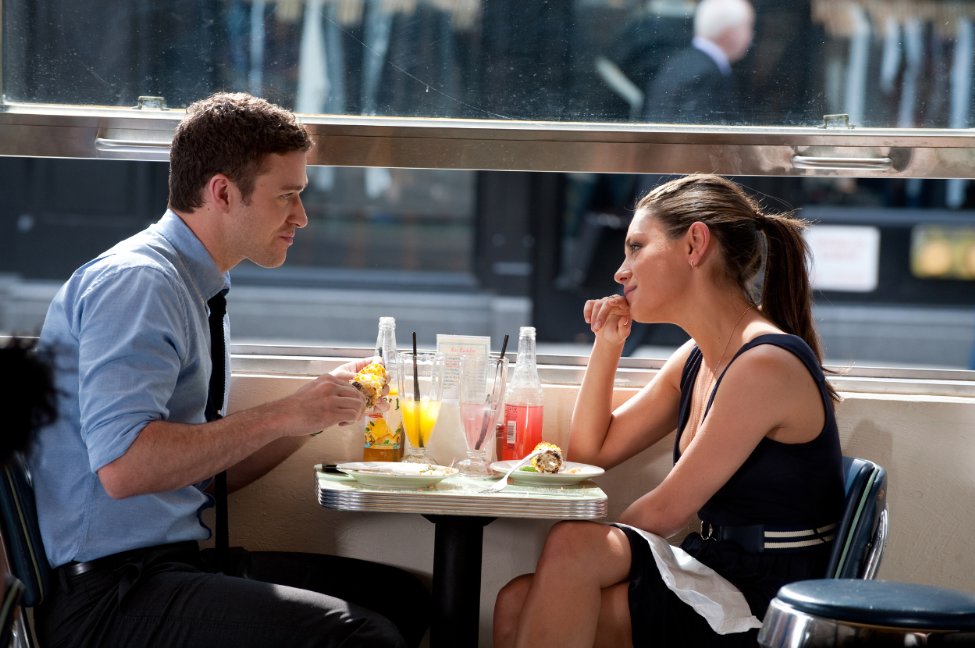
Friends with benefits have become such a hot topic, that a movie starring Justin Timberlake and Mila Kunis was created to explain them.
We might have called them one-night stands in the past. But that doesn't apply anymore. Because there's less stigma, one-night stands turn into "friends with benefits" (FWB) situations — a relationship built on the premise of regular casual sex without commitment. Gesselman sees a lot more FWB-type of situations in her research. She calls this behavior "pre-dating," when women "try out" a suitor, and sees what kind of partner they can be. "That affects dates and dating," she said.

Photo by: Photo by Kevork Djansezian/Getty Images
"Hook up culture" has been a popular trend story for the past few years. And there's this image of undergrads and young adults being more promiscuous than ever. But that might be just a myth.
A 2011 study from researchers at University of Nebraska-Lincoln entitled : The Influence of College Student Social Networks on Non-relationship Sex," found that only 37 percent of the students they studied reported two or more hookups during the school year. But 90 percent of the participants thought a "typical" student had been involved in two more hookups.
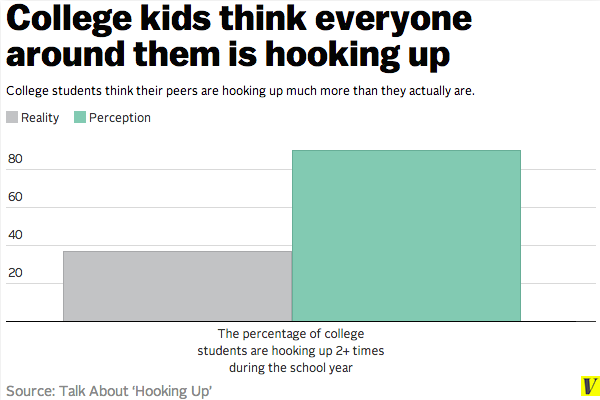
Even if the numbers in real life aren't as out of touch as they are on a college campus, there is some sense of hookup inflation. This perceived sense of everyone hooking up around us changes our expectations, changes the pressure we have, and perhaps changes the way we'd naturally behave.
After speaking to all these experts, I asked them what their definition of a date is. I've assembled the very basics of a "date":
But we'll probably be fine without it.
Update: One of our readers pointed out that Dr. Walsh's points might be mistaken for facts on marriage rather than opinion. I tried to make that clearer.
 Google Chrome is the world's most used browser on desktops and mobile devices, a new report from Adobe Digital Index (ADI) claims.
The post Adobe Crowns Google Chrome World’s Most Popular Browser appeared first on OMG! Chrome!.
Tablet magazine, an excellent source of discussion of all things Jewish, has reprinted a 2010 article by the late Cherie Woodworth (I wrote about her sudden death last year, and I still miss her and find it hard to believe she’s gone) on the titular subject; she begins with the great scholar Max Weinreich and the new edition of his magnum opus, History of the Yiddish Language (over 750 pages of footnotes!), and his very influential theory that
…Jews from Rhineland France, presumably through contact with Jewish settlements in southern Germany, converted from old Judeo-French to western Yiddish, which was more purely German with some elements of Latin or early French. In subsequent centuries—when, exactly, is a source of considerable debate—this language moved east with Jewish emigrants, settlers, and refugees, either in the 12th century (after the Crusades and persecutions) or in the 14th or 15th. There it picked up a significant cargo of Slavic vocabulary and expressions and became the Yiddish more familiar today: eastern Yiddish.
She then moves on to Paul Wexler and his very controversial book The Ashkenazic Jews: A SlavoTurkic People in Search of a Jewish Identity; you can tell from the title why it’s controversial. Her discussion of all this is fascinating and (like all her work) well written; I’ll just quote a bit on my own former specialty and leave you to read the whole thing when you have the time and attention span:
Comparative linguistics poses two genuine, and interconnected, problems when its methods are used to make arguments about history. The first is that in its most specialized details, the evidence and arguments are inaccessible to outsiders; Wexler will not be able to persuade historians about the origins of the Jews by discussing lexical inventories and phonemic shifts (especially as long as other linguists return fire with equally arcane and scientific-sounding counterarguments about other phonemic shifts). Second, despite its stress on precision and details, comparative historical linguistics is not as scientific or as purely historical as it seems; lost forms must be reconstructed, development must be interpolated, and thus no argument is definitive. The majority view among Yiddish linguists—a very small but committed cadre of scholars—is that Wexler’s argument is untenable.
Tablet followed up Cherie’s piece with an equally long and very lively one by their staff writer Batya Ungar-Sargon, “The Mystery of the Origins of Yiddish Will Never Be Solved,” in which she discusses the, shall we say, vivid personalities involved in the arguments. She starts out with an amazing story about a 1987 book, Origins of the Yiddish Language, which got a scathing review in Language that turned out to have been almost certainly written by Wexler under a pseudonym (though he denies it). She goes on to describe the various contending theories. Dovid Katz’s is that “the Jews arrived in what Katz calls ‘the cradle of Yiddish,’ the city of Regensburg, speaking Aramaic. It is this spoken language that provided the source material for the Semitic component of Yiddish, spreading both further east as well as west, to the Rhineland, replacing whatever language the western Jews were speaking.” Then there’s Alexandre Beider, who has a doctorate in applied mathematics from the Moscow Institute of Physics and Technology and “believes that western and eastern Yiddish are simply too different to have a common origin. Rather, Jews spoke German dialects until the 14th century, when gradually their dialects became different from those of their co-territorialists.” And of course Wexler, who “holds the controversial position that Yiddish is neither German nor Jewish but a Slavic language with German and Hebrew words slotted into Slavic grammar in a process called ‘relexification’:
Other linguists have not taken kindly to the Slavic hypothesis, nor to its author. “I have no impression that Paul Wexler is searching for the truth,” said Beider. “Sometimes I even wonder if he himself believes in what he writes. If he is not believing, but making a provocation, his writings of the last 20 years are oriented just to prove that Jews are not Jews. In this case, there is nothing to discuss.” Indeed, though he has a following amongst non-specialists, most linguists disagree with Wexler. “I respect him as a linguist, but I don’t agree with him,” said Steffen Krogh. Simon Neuberg called the relexification theory “very adventurous” but said ultimately it “seems more of a marketing trick.”
And finally, there’s Manaster Ramer, who “believes that Roman Jews speaking a Romance dialect, not French but related to it, lived in both western and southern areas of what would become Germany. When the German tribes invaded the Roman territories, these Jews learned perfect German”:
So, if the Jews who started speaking Yiddish originally spoke German, how and when did the Semitic component enter the language? The question itself is unscientific, said Manaster Ramer, ignoring as it does the historical context in which Yiddish came to be, which incidentally was a time in which German too underwent a similar process, incorporating loan words from Latin. Indeed, said Manaster Ramer, the influence of Latin on German was far greater than the Hebrew and Aramaic influence on Yiddish, “and yet no Yiddishist seems to asks, why does the massive Latin influence on German not mean that German is not German, if the much smaller Hebrew influence on Yiddish is supposed to mean that Yiddish is not German,” he wrote in an email. Any language spoken by polyglot people can incorporate words from their second or third language at any time. Furthermore, he said, almost all of the Hebrew and Aramaic words in Yiddish are accretions added to the language after the 13th century.
We’ll probably never know the truth, but I sure enjoy the back-and-forth. Thanks for the links, bulbul and Kobi!
Imagine sitting down to watch an episode of the HBO hit series Game of Thrones—and hardly being able to understand anything. That’s the case for non-native English speakers or any of the 36 million deaf or hard-of-hearing Americans. HBO doesn’t expect its viewers to have a knowledge of High Valyrian; that’s why it takes care to offer subtitles to viewers understand exactly how Daenerys intends to free the slaves of Essos.
If only most online streaming companies took as much care in everyday captioning.
Machine translation is responsible for much of today’s closed-captioning and subtitling of broadcast and online streaming video. It can’t register sarcasm, context, or word emphasis. It can’t capture the cacophonous sounds of multiple voices speaking at once, essential for understand the voice of an angry crowd of protestors or a cheering crowd. It just types what it registers. Imagine watching classic baseball comedy Major League and only hearing the sound of one fan shouting from the stands. Or only hearing every other line of lightning-fast dialogue when watching reruns of the now-classic sitcom 30 Rock.
As of April 30, streaming video companies are now required to provide closed captioning. On all programming. There’s no doubt that we’re in a better place than we were even five years ago, when streaming video companies weren’t required to closed-caption any of its content. But, there still is a long way to go in improving the accuracy of subtitles. Netflix and Amazon Prime users have bemoaned the quality of the streaming companies’ closed captions, citing nonsense words, transcription errors, and endless “fails.” These companies blame the studios for not wanting to pay for accurate translations but excuses aren’t flying with paying streaming video subscribers.
Marlee Matlin, the Oscar-winning actress and longtime advocate for better closed captions for the deaf and hard of hearing, recently mentioned in an interview that she knows that she’s missing out on most of the action when she’s watching streaming video. “I rely on closed captioning to tell me the entire story,” she says. “I constantly spot mistakes in the closed-captions. Words are missing or something just doesn’t make sense. My kids spot it too, they’re aware of sloppy captions and the pieces of information that I’m not being given.”
Machines also fall short when it comes to translating one language into another. It isn’t sufficient to merely exchange words in one language for its equivalent. When it comes to translating emotional writing and an actor’s subtle delivery of a piece of dialogue, there’s no substitute for the human touch. Let’s take it a step further. Imagine being a Japanese person watching the 1995 film Trainspotting and having to rely on a word-for-word translation of heavy Scottish dialect and slang. To say that much would get lost in translation is an understatement.
A good translator will have lived in the countries where the respective languages are spoken and aware of cultural and linguistic nuances and will keep up to date through various media with current affairs, the introduction of new words and phrases, and most importantly, will have an intuitive sense for the languages. A good translator will understand how important these details are because she wants others to be as excited and horrified about everything that’s unfolding on the screen as she is.
Humans can ensure quality and quantity when it comes to giving beloved films and TV shows the proper translations they deserve. Machines can’t be fans in the same way that humans can. They don’t go back and add more details just to enrich the experience or think carefully about whether an audience will understand why a certain word sounds silly in one language but is a deep and unforgivable insult in another.
Crowdsourced subtitling platforms like Viki, a TV site powered by a community of fans who translate shows into multiple languages or Amara that allows you to add closed captions to YouTube videos there are no boundaries on the number of languages a show or film can be translated into and how quickly and accurately the content can be made available to viewers all over the world.
Finally, it’s impossible to overemphasize the role subtitling plays in connecting people who are living abroad or in exile.
The demand for better closed captioning is yielding positive results. Congress recently passed a closed captioning law, requiring broadcasters to caption Internet-distributed video files if the content was broadcast on TV with captions. Netflix is working to comply with the Americans with Disabilities Act to make sure that all its streamed content has subtitles. Amazon Prime is also putting efforts behind making sure all of its Instant Video is closed-caption ready. YouTube has also improved its closed captioning and crowdsourcing and capabilities,. On the human translation front, other companies, such as Amara, a new transcribe-and-translate platform are seeing the value of using people to provide better options than machines. Up in the air, there are changes on the horizon as well. Last week, Sen. Tom Harkin (D-Iowa) demanded that US airlines add closed captioning to in-flight movies to for the benefit of hearing-impaired airline passengers. Closed captioning for all is a fantastic step in the right direction, but until there’s accurate closed captioning for all, we’re still fighting the good fight.
Follow Tammy on Twitter @TammyNam. We welcome your comments at ideas@qz.com.


Dan JonesExcited to see what's in store for Android Lollipop (or Licorice, or Lemon Meringue).
We’re thoroughly expecting tomorrow’s Google I/O opening keynote to be packed to the brim with major announcements. According to Bloomberg Businessweek and an interview with Android lead Sundar Pichai, one of those major announcements will in fact be the unveiling of the next version of Android.
For months now we’ve seen rumor after rumor saying that Google is working on something big for the next release of Android. Tomorrow, we may just finally get our first real look at exactly what all those rumors mean. In an interview with Bloomberg Businessweek, Sundar Pichai has revealed that Google wants, “the world to understand what we are doing sooner.” An early Android preview would give not just consumers, but manufacturers a closer look at the next version of Android before releasing it to the world this fall. Exactly what this means for manufacturers developing updates, the Nexus program or Android Silver we don’t know yet, but we’re sure to find out more tomorrow.
As for what else we expect to see from Google tomorrow, everything from Android Wear to Android TV is a possibility. Keep it locked to Android and Me as we work to cover Google I/O over the coming week. It’s going to get crazy.


 Les and Dave Jacobs/Getty
Newly uncovered components of a digital surveillance tool used by more than 60 governments worldwide provide a rare glimpse at the extensive ways law enforcement and intelligence agencies use the tool to surreptitiously record and steal data from mobile phones.
The modules, made by the Italian company Hacking Team, were uncovered by researchers working independently of each other at Kaspersky Lab in Russia and the Citizen Lab in Canada, who say the findings provide great insight into the trade craft behind Hacking Team’s tools.
The new components target Android, iOS, Windows Mobile, and BlackBerry users and are part of Hacking Team’s larger suite of tools used for targeting desktop computers and laptops. But the iOS and Android modules provide cops and spooks with a robust menu of features to give them complete dominion over targeted phones.
They allow, for example, for covert collection of emails, text messages, call history and address books, and they can be used to log keystrokes and obtain search history data. They can take screenshots, record audio from the phones to monitor calls or ambient conversations, hijack the phone’s camera to snap pictures or piggyback on the phone’s GPS system to monitor the user’s location. The Android version can qlso enable the phone’s Wi-Fi function to siphon data from the phone wirelessly instead of using the cell network to transmit it. The latter would incur data charges and raise the phone owner’s suspicion.
“Secretly activating the microphone and taking regular camera shots provides constant surveillance of the target—which is much more powerful than traditional cloak and dagger operations,” notes Kaspersky researcher Sergey Golovanov in a blog post about the findings.
It’s long been known that law enforcement and intelligence agencies worldwide use Hacking Team’s tools to spy on computer and mobile phone users—including, in some countries, to spy on political dissidents, journalists and human rights advocates. This is the first time, however, that the modules used to spy on mobile phone users have been uncovered in the wild and reverse-engineered.
Kaspersky and Citizens Lab discovered them after developing new methods to search for code fragments and digital certificates used by Hacking Team’s tools.
The modules work in conjunction with Hacking Team’s core surveillance tool, known as the Remote Control System, which the company markets under the names Da Vinci and Galileo.
In a sleek marketing video for Galileo, Hacking Team touts the tool as the perfect solution for obtaining hard-to-reach data—such as data taken by a suspect across borders or data and communications that never leave the target’s computer and therefore can’t be siphoned in transit.
“You want to look through your targets’s eyes,” says the video. “While your target is browsing the web, exchanging documents, receiving SMS….”
Hacking Team’s tools are controlled remotely through command-and-control servers set up by Hacking Team’s law enforcement and intelligence agency customers to monitor multiple targets.
Kaspersky has tracked more than 350 command-and-control servers created for this purpose in more than 40 countries. While Kaspersky found only one or two servers in most of these countries, the researchers found 64 in the United States—by far the most. Kazakhstan followed with 49, Ecuador with 35 and the United Kingdom with 32. It’s not known for certain whether law enforcement agencies in the U.S. use Hacking Team’s tool or if these servers are used by other governments. But as Kaspersky notes, it makes little sense for governments to maintain their command servers in foreign countries where they run the risk of losing control over the servers.

Map showing the number of countries where command-and-control servers for the Hacking Team are currently being used.  Courtesy of Kaspersky Lab
In addition to the modules that were uncovered, Citizen Lab obtained from an anonymous source a copy of the lengthy user’s manual that Hacking Team provides customers. The illustrated document explains in detail how to build the surveillance infrastructure needed to deliver implants to targeted devices and to use the software tool’s dashboard to manage intelligence gleaned from infected computers and phones.
“This gives new visibility into the operational procedures of lawful intercept malware,” says Citizen Lab researcher Morgan Marquis-Boire. “Previous research has allowed us to understand how the software works. This allows us a holistic view of how this type of targeted surveillance is conducted.”

Image from Hacking Team’s user manual showing the interface for managing hacked systems and data siphoned from them. Courtesy of Citizen Lab
The modules and training manual all show that Hacking Team is well aware of the attention its products have received from researchers in recent years and has taken several steps to thwart attempts to understand how its spy tools work.
“They are well aware that their product may show up on the analyst chopping block at some stage, and they’re taking various steps to mitigate this risk,” says Marquis-Boire.
The Android spy module, for example, uses obfuscation to make it harder to reverse-engineer and examine the module. And before installing itself on machines, Hacking Team’s main spy tool has scouting agents that conduct reconnaissance to identify anything on a system that might detect it.
Once on a system, the iPhone module uses advance techniques to avoid draining the phone’s battery, turning on the phone’s microphone, for example, only under certain conditions.
“They can just turn on the mic and record everything going on around the victim, but the battery life is limited, and the victim can notice something is wrong with the iPhone, so they use special triggers,” says Costin Raiu, head of Kaspersky’s Global Research and Analysis team.
One of those triggers might be when the victim’s phone connects to a specific WiFi network, such as a work network, signaling the owner is in an important environment. “I can’t remember having seen such advanced techniques in other mobile malware,” he says.
Hacking Team’s mobile tools also have a “crisis” module that kicks in when they sense the presence of certain detection activities occurring on a device, such as packet sniffing, and then pause the spyware’s activity to avoid detection. There is also a “wipe” function to erase the tool from infected systems. Hacking Team asserts that this will uninstall and erase all traces of the tools, but Citizen Lab discovered that initiating a wipe on some mobile phones creates telltale signs. On a BlackBerry, for example, it causes the device to automatically restart. On Android devices, the uninstall can, under certain conditions, cause a prompt to appear onscreen asking permission from the user to uninstall an application called “DeviceInfo”—the name the Android spy tool uses for itself.
In addition to the variety of obfuscation measures the tools use, Hacking Team also advises customers to set up several anonymous proxy servers through which to route data stolen from victim machines. In this way, researchers and victims won’t be able to easily follow the path the data takes back to command servers. Oddly, Hacking Team borrows the logo of the hacktivist group Anonymous—an empty black business suit—to designate the anonymized proxy servers in its user manual.

Hacking Team borrowed the logo of the hacking group Anonymous to designate anonymized proxy servers in its user manual. Courtesy of Citizen Lab
Hacking Team first developed its Remote Control System spy suite in 2001. Initially it was a free, open-source tool for conducting man-in-the-middle attacks and was used by hackers and security researchers alike. Soon, however, police in Milan contacted the two authors of the tool—Alberto Ornaghi and Marco Valleri—for help developing something to eavesdrop on Skype communications. Work on this tool evolved into RCS.
Hacking Team has long argued that its products are intended for lawful governmental interception only and that it won’t sell its products to repressive regimes and countries blacklisted by NATO. But its spy suite reportedly has been used to spy on the citizen journalist group Mamfakinch in Morocco and appears to have been used by someone in Turkey to target a woman in the U.S. who was a vocal critical of Turkey’s Gulen movement.
Indeed, the Android spy module that Citizen Lab uncovered was masquerading as a legitimate news app for Qatif Today, an Arabic-language news and information service that covers the Qatif region in eastern Saudi Arabia. The government of Saudi Arabia has faced off several times in the last few years against Shia protestors in the Qatif region who have demanded political reform from the Sunni government and the release of political prisoners.
Although the Citizen Lab researchers are careful to point out that they don’t know for certain that the Saudi government is using the Hacking Team tool to spy on political dissidents, circumstantial evidence shows this may be the case.
The malicious Qatif Today app was discovered after someone uploaded the file in March to the VirusTotal web site—a site owned by Google that aggregates several dozen antivirus scanners to detect malware. The file was signed with a bogus certificate that appeared to belong to Sun Microsystems. Citizen Lab found evidence that a Twitter account of interest to Shiites in Qatif may have been used to tweet a link to the malicious file to lure targets into downloading it onto their phones.
While Hacking Team’s core Galileo tool for spying on computers is valuable for governments, the mobile spy modules are particularly attractive to repressive regimes where activists and others use their mobile phones to organize and stay connected during protests.
Cops can install the phone implants directly onto a mobile device if they have physical access to it. But they can also install the implants if a user connects the mobile device to a computer—for example, to charge the device—and the computer is already infected with Da Vinci or Galileo.
The iOS spy module works only on jailbroken iPhones, but agents can simply run a jailbreaking tool and then install the spyware. The only thing protecting a user from a surreptitious jailbreak is enabling a password on the device. But if the device is connected to a computer infected with Da Vinci or Galileo software and the user unlocks the device with a password, the malware on the computer can surreptitiously jailbreak the phone to install the spy tool.
So far, the researchers haven’t uncovered any methods used for remotely infecting phones with the Hacking Team malware via a phishing attack or a malicious web site.
Citizen Lab points out in its report on the malware that it’s important to understand how Hacking Team’s tools work, since they are powerful weapons, no different from the types of tools used by nation states against one another. But in this case they’re employed by government customers not against other government targets but against ordinary citizens.
“This type of exceptionally invasive toolkit, once a costly boutique capability deployed by intelligence communities and militaries, is now being marketed for targeting everyday criminality and ‘security threats,’” they write. “An unstated assumption is that the entities able to buy these tools will use them correctly, and primarily for law enforcement purposes. As our research has shown, however, by dramatically lowering the entry cost on invasive and hard-to-trace monitoring, it lowers the cost of targeting political threats” too.


Patrick Schroeder
www.photosofkaos.com
June 23, 2014 10:00 AM ET
It's a rainy Sunday evening in May, in the town of Weiden, in northeastern Bavaria, and Patrick Schroeder, whom the German press has dubbed the "Nazi-hipster," is preparing for his big webcam entrance. As the opening sequence for his weekly Internet TV show, FSN.tv, plays silently in the background, he ties a bandana stitched with the slogan "H8" around his mouth and fiddles with his mouse. A map of Germany in 1937 hangs on the wall above him.
It's hard to get the timing for the intro "just right," he explains, and once the graphics stop playing, he strides into frame and raises his arm, curling his hand into a fist and wishing his viewers, a few hundred members of Germany's extreme right, a lovely evening. He calls this gesture his "professional wrestling entrance move," which he claims was inspired by WWE-style theatrics, though it also, not inconveniently, looks a bit like a heil Hitler Nazi salute.
Schroeder is 30 years old, about six feet tall, with the boxy musculature of an MMA fighter, his blond hair shaved except for a jaunty strip along the top of his head. He's dressed all in black, wearing armbands slightly reminiscent of those favored by vintage Avril Lavigne and speaks quickly and loudly, with a strong Bavarian lilt. When he laughs, his upper right lip rises up, making him look both threatening and insecure. "If the Third Reich was so bad, it would have been toppled," he argues, before the filming begins. "Every half-intelligent person knows there is no system where everything was bad."
Berghain: The Secretive, Sex-Fueled World of Berlin's Coolest Club
He won't elaborate, for legal reasons, but he'll happily share his topline thoughts about everything from Obama (whom he grossly describes as America's "neger president") to why black people don't belong in Germany ("It's against nature — there's a reason we're not walking around in the sun, in Ghana, with our skin color"), to why American neo-Nazis are "primitive" ("It's like they're always dressing up for a costume party") and — because, just like many other Germans, he loves American TV — his strong feelings about the series finale of How I Met Your Mother ("The mother dying was a good reminder that the world isn't a great place").
Inane rhetoric notwithstanding, Schroeder comes across first and foremost as a dedicated self-promoter, and he clearly enjoys putting on a show: For the next two hours, he sits at the computer and chats with his remote co-host about the latest Nazi news — recently banned groups, European elections — and riffs on pop culture. He peppers his statements with self-deprecating asides and eye-rolls, and he occasionally interrupts the chatter to play Rechstrock, neo-Nazi rock songs.

Neo-Nazi Hipsters in Magdeburg, Germany.
Jesko Wrede
FSN.tv is Germany's only neo-Nazi Internet TV show, and in the two years since it has existed it has turned Schroeder into a well-known, if highly controversial, figure in the German extreme right, largely because he has been open about his desire to give the German neo-Nazi movement a friendlier, hipper face. Schroeder sometimes conducts seminars showing neo-Nazis how they can dress less threateningly and argues that anybody from hip-hop fans to hipsters in skinny jeans should be able to join the scene without changing the way they look, an idea that, for many older members, is an affront to their anti-mainstream values.
Over the past year, partly because of leaders like Schroeder and partly because of the unstoppable globalization of youth culture, the hipsterification of the German neo-Nazi scene has begun to gain steam. This winter, the German media came up with a new term, "nipster," to describe the trend of people dressing like Brooklyn hipsters at Nazi events. Experts have noted that the German neo-Nazi presence on Tumblr and other social networking sites has become sleeker and more sophisticated. Neo-Nazi clothing has become more stylish and difficult to recognize. There's even a vegan Nazi cooking show. "If the definition of the nipster is someone who can live in the mainstream," Schroeder explains, "then I see it as the future of the movement."

Patrick Schroeder and his co-host Vendetta on his weekly Internet TV show, FSN.tv.
These are strange times to be a neo-Nazi in Germany. The Federal Constitutional Court is gearing up for a hearing on the latest attempt to ban the National Democratic Party of Germany (NPD), the country's oldest and biggest extreme-right political party. Regardless of the verdict, the party is close to running out of money and Nazi opponents have become successful at shutting down its public appearances (in April, a high-profile Berlin NPD march was successfully blockaded by several thousand protesters). The murder trial of the lone surviving core member of the National Socialist Underground, a far-right terror cell that accused of killing 10 people between 2000 and 2007, is also ongoing in Munich, and focusing the nation's attention on extreme-right crimes, and a recent study found that the number of people with extreme-right sympathies has sunken from 9.7 to 5.6 percent in the last 12 years.
At the same time, Germany and German culture have become more porous and international than ever: A federal survey found that nearly 20 percent of Germans have an immigrant background, and another new study found that immigrants and Germans are becoming increasingly similar. German TV broadcasts The Real Housewives, the Top 20 pop charts include songs by Calvin Harris, Coldplay and Pitbull and thanks to the Internet, teenagers can pirate the latest episode of Girls a few hours after it airs in America. And now another American export has arrived: In 2012, the daily Welt heralded the "hipster" as Germany's "new object of hate" and just this February, the country's biggest tabloid, Bild, offered a guide to "hipster types" for its readers. (Example: "The fixed-gear fanatic never goes anywhere without his bike.")
For people like Andy Knape, the rise of the German hipster presents both an opportunity and a dilemma. For the past two years, the 28-year-old Knape has been the head of the Junge Nationaldemokraten (JN), the youth wing of the NPD. His office is located in the state parliament of Saxony, in the eastern part of Germany, and overlooks the city's majestic opera house, which largely burnt down after the city's firebombing and was rebuilt after the war. A poster of an elderly woman with a shotgun and the words "drastic security measures" hangs on the wall, next to a photo of several steely-eyed white people smiling.
The Hidden War Against Gay Teens
As head of the JN, Knape's job is to make the NPD, and its extreme-right politics, appealing to young people (one of his biggest goals, he explains, is to "preserve German culture") and he's a good salesman — 5'8", fit and dressed in a grey T-shirt and Converse-style sneakers, he wouldn't look out of place on an American college campus. He first entered the scene when he was 13, in Magdeburg, because his brother was also "right-wing oriented" and he "started to ask himself lots of questions." Eventually, he says, he began going to NPD demonstrations, and got more involved. Although his eyes betray a palpable aggressiveness and many of his talking points seem clearly rehearsed, for a man in charge of an organization being monitored by the Bundesverfassungsschutz — Germany's domestic security agency — he is surprisingly soft-spoken. When he speaks he tends to curl up in his chair.
Like Schroeder, whom he sees as an acolyte, Knape wants to give "nationalism" a friendlier, cooler face (in the NPD, and many other extreme-right organizations, "nationalist" often functions as a politically acceptable euphemism for "Nazi"). For Knape, who grew up with American pop culture, the idea of policing what young members of the scene watch or listen to is silly — he'd much rather hijack it, and use it to bring young people into the fold. Michael Schaefer, the JN's excitable 31-year-old press person, chimes in: "We've taken over the nipster," he says, giddily, before catching himself. "I mean nationalist hipster, not Nazi hipster."
The term hipster has, of course, always been notoriously slippery. Back in his 2010 book What Was the Hipster?, Mark Greif described the term as meaning a "consumer" who "aligns himself both with rebel subculture and with the dominant class and thus opens up a poisonous conduit between the two." But in Germany, as elsewhere, the newly discovered hipster is often reduced to its more superficial component parts: "skinny jeans, a bushy beard, bright sunglasses" (Welt), "strange, nerdy and somehow different," (Sueddeutsche Zeitung), "self-important culture snobs" (Tagesspiegel). Here, the hipster is simultaneously a uniform, a cooler-than-thou weltanschauung and signpost of globalized American youth culture and consumerism.
"We don't want to cut ourselves off," Knape says, about hipster culture. "I see rap and hip-hop, for example, as a way of transporting our message." In recent years, a number of extreme-right hip-hop acts have emerged in Germany — with names like Makss Damage and Dee Ex. Despite the awkward politics of using hip-hop to preach the virtues of German identity, they've amassed a small, but significant presence within the scene. Dee Ex, for example, has over 7,000 likes on Facebook and posts photos of herself in a revealing outfit on her blog. There is now neo-Nazi techno (biggest act: DJ Adolf) and neo-Nazi reggae.
Knape, on his end, has also gotten increasingly invested in online culture: "The Internet allows us to reach people we can't reach on the street." Now young people can get in touch with him over Facebook or e-mail without their parents, or anybody else, finding out. "They don't need to out themselves immediately," he says. Knape is especially proud of his viral-video outreach: last year, his group filmed a "Harlem Shake" video. In the JN video, people in masks bounce around junked cars while one of them holds up a sign saying "Have more sex with Nazis, unprotected." It has over 17,000 hits on YouTube. ("New, modern, but not decadent," Knape says about the video, which you can watch below.)
But, perhaps partly because of this internationalization of German culture, Knape struggles to define the "German traditions" he's trying to preserve. It's understandable: Germany, even by European standards, is a supremely contrived state composed of 300 formerly distinct political entities. Founded in 1871, it is also younger even than Canada — there's a reason Hitler had to reach back to centuries-old, mythical folklore when trying to sell people on the idea of Germanic superiority. Knape says he wants more people to mark the "Sonnenwende" or solstice — a celebration the Nazis tried to revive in the Hitler era — for example, and to preserve the German language. He is concerned that "these days, we see a lot of people mixing German and English" — though he acknowledges that when it comes to technology, it's "not easy to avoid." He notes, with some resignation, that there is no German word for "hashtag."
To read the new issue of Rolling Stone online, plus the entire RS archive: Click Here
In 2008, China’s government added an entry to the list of conditions classified as mental illnesses: “Internet addiction.” According to numerous reports in state-run media, China’s young people were spending too much time in Internet cafes, ignoring family or work to play online games into the wee hours, sometimes neglecting to eat, drink, or sleep, and endangering their own health.
Anxiety about addiction to screen time gave rise to a dubious new line of businesses: boot camps, often run by ex-military personnel, promising to help wayward youth kick the habit. But investigative reports published in recent days by Beijing News and the Mirror reveal abusive conditions, leading to the death of at least one student, at the Zhengzhou Boqiang New Idea Life Training School—which billed itself as an Internet-addiction recovery camp in eastern Henan province.
A 19-year-old girl, referred to as Guo Lingling (this may be a pseudonym), was allegedly struck and kicked repeatedly by her so-called instructors after failing to ask permission to go to the bathroom. An autopsy report showed she died from skull injuries and brain damage.
When her mother came to the school to collect Guo’s remains, other students gave the grieving woman their names and phone numbers, asking for her help in contacting their own parents to get them out of the boot camp. One of the practices of the facility, which aimed to “reform” behavior through fear-based training and harsh discipline, was to limit students’ contact with the outside world.
Local educational authorities have since revoked Zhengzhou Boqiang New Idea Life Training School’s license and launched an investigation into its record. Hauntingly, the school’s website remains online, replete with photos of students in camouflage uniforms performing drills and attending what the site labels “wonderful lectures.”
Larson is a Bloomberg Businessweek contributor.
Here's some advice on how to get some time off from work: Have your daughter send a really cute letter to your employer, asking them to give you a day off.
Bonus points if the letter is written in crayon.
One little girl decided to give her dad a hand. She wrote his employer, which happens to be Google, a letter, asking that they cut him some slack with the work schedule.

Imgur
The letter reads:
Dear Google Worker,
Can you please make sure when daddy goes to work, he gets one day off. Like he can get a day off on Wednesday. Because daddy only gets a day off on Saturday.
From, Katie
P.S. It is Daddy's BIRTHDAY
P.P.S. It is summer, you know
Perhaps it was the crayon, or perhaps it was that final nudge about it being summer, but Google obliged.
In a letter back to Katie, her dad's boss, Senior Design Manager Daniel Shiplacoff, not only complimented Katie's dad on his hard work, but also gave him a bonus week off. Since it is summer, after all.

Imgur
A Google spokesman confirmed to The Blaze that the letter is, in fact, the real deal.
Dan JonesThis is the best TFLN mash-up I've seen. That text so amazingly captured that TNG seen.

The Mafia is an example of the “adoration of evil and contempt of the common good,” he said.
In unplanned remarks about the ‘Ndragheta crime group to thousands of people at Mass in southern Italy, Pope Francis said: “Those who in their lives follow this path of evil, as Mafiosi do, are not in communion with God. They are excommunicated.”
The pope said that the church would use its full force to combat organised crime. “Our children are asking for it, our young people are asking for it,” he said.
 Pope Francis leaves in a helicopter from the small town of Sibari after a mass during the feast-day Mass of Corpus Domini, where he made the comments. Source: Getty Images The comments came after the pope met the family of a three-year-old child murdered earlier this year. Authorities believe that the ‘Ndrangheta are behind the killing, in which two other people died.
They concluded a visit to Calabria, 'Ndragheta's heartland and the site of the murder.
A spokesman said that the words did not constitute the kind of formal decree that is required for official excommunication. But the statement is still expected to have a deep affect on members of the Mafia, because many see themselves as religious and attend ceremonies.
The comments — the first time that a pope has used the word excommunicated in relation to th e organised crime group — are thought to be the church’s strongest attack on the Mafia since 1993. Then, Pope John Paul blasted the Sicilian Mafia when he visited the area after a run of murders, and urged Roman Catholics in Sicily to rise up against them.
A number of churches were bombed after Pope John Paul's comments, in part because the church had broken an unwritten hands-off rule towards organised crime, experts said at the time.
The target of Pope Francis’ attack, the ‘Ndrangheta, is based in Calabria, the heel of Italy and is estimated to make up at least 3% of the country’s GDP. But it has spread across the world and has revenues of around £44 billion from drug trafficking, extortion and money laundering.
 A photo of Mozilla's Firefox OS Google Chromecast rival has been leaked this week, while an early hands-on reveals support for Cast Ready apps like YouTube.
The post This Is Mozilla’s Answer to the Google Chromecast appeared first on OMG! Chrome!.
Dan JonesI'm surprised this is just now happening.
The United States’ National Weather Service has been using the same process to get weather forecast data from the atmosphere since the 1930s—by launching weather balloons carrying devices called radiosondes that measure pressure, temperature, and humidity. These balloons, launched twice a day from 69 fixed locations in the continental US, offer a relatively reliable way of gathering data, but the system is fundamentally patchy. And while radiosondes dropping from the sky are harmless, they can produce an alarming noise and sulfuric smell.
That sounds somewhat retrograde, and it is: This is very old technology. Meanwhile, there are tens of thousands of airline flights crossing the United States every day, with the potential to produce far more data. Southwest Airlines has entered a partnership with the National Weather Service, using increasingly sophisticated sensors and the fact that its planes cross the country hundreds of times a day to fill in gaps and create a more sophisticated and accurate forecast, according to Bloomberg.
There’s a benefit for the airline, too. Southwest’s own meteorologists have early access to the data that the airline collects, and that better data has kept flights going when other airlines were grounding planes based on forecasts of freezing rain. The NWS is also working with the package delivery service UPS to use its planes for sensors.
Earlier airline sensors were able to collect data on temperature and wind. The new ones add humidity, which is particularly important for forecasting weather. The combination of new data and better computing has the potential to reduce delays and airline costs. According to Bloomberg, no one has quantified the benefits of the new data.
Currently, under 1% of US commercial aircraft have these sensors. Expanding them to a broader fleet could produce vastly more data and significantly better weather forecasts, benefitting many people other than just airline operators and their passengers.
Dan JonesI would use that all the freaking time.
"Hey jerkface, pick a lane."
"You double-parked, you numbskull."
"Have you ever heard of a turn signal? Use it!"
Yeah, driving brings out the worst in me.

Getty
General Motors wants to make it easier for Chinese customers to curse out the moron who cut them off or get the digits of the attractive driver one car over at the stop light. So it’s developed an app called DiDi Plate that lets Android users text the owner of a car by simply scanning its license plate.
John Du, GM China’s research and development director, demonstrated the app at the Telematics Detroit conference earlier this month, according to ComputerWorld. It’s a prototype app, but Du said GM is looking to have the technology added to its in-car infotainment system.
Du didn’t explain how the app links a license plate to a phone number, what happens if the person behind the wheel doesn’t own the car, or how GM will reconcile the fact most people probably don’t want text messages from strangers on the street, for whatever reason.
Du offered two examples of how DiDi Plate might be used: 1) A male driver asks a female driver on a date (she accepts); 2) a driver’s car is blocked in a parking lot, so she texts the owner of the offending car, asking him to move. Talk about a limited imagination. This app would definitely—if not exclusively—be put to creepy uses. Remember when we thought the Internet would make us nicer?
License plate-derived intelligence is not new. Governmental agencies and law enforcement can easily collect license plates and link them to their owners to glean information about where and how we drive. With DiDi Plate, the threat is that the public would have access to information reserved for government officials, says professor Ryan Calo, a privacy and technology expert at the University of Washington.
“The difference is that it’s in private hands,” he says, “with the opportunity to contact you.”
DiDi Plate is a jarring idea because it takes something the law requires drivers to display and makes it a tool others can use to track them, says Lee Tien, a senior staff attorney with the Electronic Frontier Foundation. Most of the time, people can ensure privacy by speaking quietly, closing the shades, or locking their doors. But they can’t legally choose not to have a license plate on their car. “That’s the crux of the problem.” says Tien. “You’re also exposing your license plate and basically who you are to everyone for all sorts of purposes.”
Whenever a new connectivity tool like this arrives, whether or not users can opt out makes a big difference. That brings up the most unsettling aspect of this technology: Regardless of whether you’ve registered the app, anyone can contact you, Du says.
Given society’s concerns about privacy these days, it’s unlikely Americans would accept DiDi. It has a better shot in China, which is where the app is likely headed. The country has a long history of repression and intense state surveillance, Tien says, so it’s hard to know if its citizens are OK with intrusions on their personal lives, or simply accept them because there’s nothing they can do.
Either way, it looks like GM has a shot at making life in China a whole lot creepier.
When Google began testing its Wi-Fi enabling balloons, the company probably wasn't expecting to cause panic in New Zealand. The Wall Street Journal writes that the country's emergency services were contacted on Friday after one of the tech giant's balloons was mistaken for a crashing plane. A rescue helicopter was sent to investigate the presumed wreckage, which was reported to be seen off the east coast of New Zealand’s South Island.
Google has confirmed that one of its balloons had indeed landed in the sea. The Wall Street Journal was later told that it was difficult to keep balloons in one place because of wind conditions. Revealed last year, Google's Project Loon involves deploying hundreds of these balloons in an attempt to provide Internet coverage to remote locations throughout the world. Unfortunately, the company's endeavors have also caused some complications and were recently responsible for knocking out power lines in a Washington town.
Dan JonesInteresting
The money is flowing in the tech world. Following Google’s acquisition of Nest earlier this year, Nest (Google in disguise) has announced its purchase of Dropcam for $555 million. If you’re not familiar with Dropcam, it’s a cloud-based WiFi video streaming service. That sounds like an entertainment service, but it’s actually used for security, allowing homeowners to easily monitor and track what goes on in their homes via Dropcam cameras.
What intrigues us is that this is Google’s second large purchase of a company that makes goods to improve the home. Rumors have been swirling that Google is planning a push toward smart homes, and if its latest purchases are any indicator, then that rumor would appear true. While a home connected by Google Now would have hundreds of benefits, it would also raise security risks tenfold. We sincerely hope that Google takes their time to make sure that everything is ironed out before trying a smart home concept.
Mum is the word for Nest on what Dropcam will be used for, but the founder of Nest did say this:
Once the deal closes, we'll incorporate Dropcam into how we do business at Nest. That includes how we handle everything from customer support to customer privacy. Like Nest customer data, Dropcam will come under Nest's privacy policy, which explains that data won't be shared with anyone (including Google) without a customer's permission. Nest has a paid-for business model and ads are not part of our strategy. In acquiring Dropcam, we'll apply that same policy to Dropcam too.Matt RogersNest
What are your predictions for how Google will use Nest and Dropcam?
Show Press ReleaseThe transaction is subject to customary closing conditions, including the receipt of regulatory approvals in the US. For more information, visit the Nest blog.
About Nest
Nest reinvents unloved but important home products, like the thermostat and smoke and CO alarm. The company focuses on delighting customers with simple, beautiful and thoughtful hardware, software and services. The Nest Learning Thermostat™ and Nest Energy Services offerings address home energy consumption, and Nest Protect: Smoke + Carbon Monoxide™ helps keep people safe. Nest products are sold in the U.S., U.K. and Canada, and are installed in more than 120 countries. For more information, visit www.nest.com.



Gramps,
Why does the Bishop’s storehouse stock and give out food that is not healthy and loaded with GMOs?
Marie
Marie,
The Bishop’s Storehouse is not in the business of following the latest food trends or diet fads. It has one real purpose, and that is to support life. Please note I said support life, not support lifestyle. Jesus Christ gave the command to feed the hungry and that is what the Bishop’s Storehouse is designed to do as efficiently as possible.
Now you can have the opinion that the food is not healthy for GMOs or other reasons, just don’t expect everyone else to agree with your opinion. For example, I think the food from the Bishop’s Storehouse is much healthier then starving to death, so I would not tell anyone who needed it not to use it.
Of course the use of the Storehouse is also designed to be of limited duration, to get people over a rough patch in their lives. Therefore the choices made by the Storehouse are focused on maximizing that short term goal. Once past that rough patch, the people can and should buy food for themselves that matches what they can afford and what lifestyle they are willing to pay for. They should make informed choices about what they eat to ensure health and long life. But that is a choice they get to make for themselves, once they have recovered and are in a position to do so.
Dan JonesInteresting. More reason to get a Chromecast. But I'll still probably wait for some other "Google Cast" enabled device.
 Google is about to make it easier for Chromecast users to find 'cast ready' applications that work with their device.
The post Finding Chromecast Compatible Apps Is About To Get Easier appeared first on OMG! Chrome!.