Shared posts

19 Jun 20:29

Starz Digital Media Repackaging Popular Web Series ‘Lizzie Bennet Diaries

by Ana Avila
Dan Jones

I love this show.

I also love that the woman who played Jane is now Raj's morbid girlfriend on Big Bang Theory and the new squintern on Bones.

lizzie_bennet_diaries


The modern-day “Pride and Prejudice” retelling, which began as a YouTube series, will be sold through online platforms starting June 23.

Popular web series The Lizzie Bennet Diaries is getting the royal treatment.

Starz Digital Media, the digital and on-demand licensing and content syndication arm of Starz, is bringing Lizzie Bennet Diaries in a repackaged form for purchase on various platforms such as iTunes, Amazon Instant Video, Xbox Video, Nook, CinemaNow, Vudu and Google Play beginning June 23.

Read more on The Hollywood Reporter

19 Jun 20:18

look around at today's kids. they're everywhere! what do they want? what do they eat? and what happens when that food runs out and they turn on us??

Dan Jones

I, too, loved He-Man before I developed adult critical faculties, because it was awesome.

archive - contact - sexy exciting merchandise - search - about
← previous June 19th, 2014 next

June 19th, 2014: Adventure Time #29 came out yesterday, and here's a preview! It features GHOSTS and SURPRISES. Probably you like both those things?

– Ryan

19 Jun 19:47

How The Mormons Conquered America

At the end of the smash Broadway musical, The Book of Mormon, the protagonist, Elder Price, a zealous young Mormon missionary in Uganda, triumphantly sings, “We are still Latter day Saints, all of us / Even if we change some things, or we break the rules.”

The ribald musical, written by South Park creators Trey Parker and Matt Stone, mocks the Mormon religion and its visionary founder Joseph Smith. At one point Smith has sex with a frog to rid himself of AIDS. The musical gleefully incorporates how the real church will react to it, having an outraged Mormon leader, Mission President, declare, “You have all brought ridicule down onto the Latter Day Saints!”

If the real Mormons feel like Mission President, they aren’t showing it. Instead the church has consistently bought ad space in cities where the musical has appeared to promote the Church of the Latter Day Saints and the real Book of Mormon, its sacred foundation. The ads have appeared on a Times Square billboard, around London, and in The Book of Mormon playbills for touring companies, featuring the taglines, “You’ve seen the play… now read the book,” and “The book is always better.”

Clearly the Church of Jesus Christ of Latter-day Saints can take a joke—especially if it gets people talking about the faith. That the Mormon church appears to be good-natured about a scatological musical might surprise those who associate the church with the squeaky clean image of the Osmond family and Mitt Romney.

Religions don’t have literal DNA, of course, but they can parallel how species mutate.

The truth is that the Mormon church has always changed with the times. Religions have to mutate “if they’re going to survive,” says J. Gordon Melton, a religious scholar who founded the Institute for the Study of American Religion. They survive by setting what the anthropologist Roy Rappaport has called “ultimate sacred postulates,” ultimate truths, and then re-interpreting them over time. Scholars say the Church of Latter-day Saints provides a casebook study of how a religion has thrived by folding its postulates into a social institution that adapts to changing environments.

The analogy, they say, can be stretched to science. Religions don’t have literal DNA, of course, but they can parallel how species mutate. There are key properties of successful genetic mutations that religions must have to succeed, says Lucas Mix, a researcher at the Haig Lab at Harvard University, who is both an evolutionary biologist and an Episcopalian priest. The properties are inheritance, variation, and selection.

For religions, inheritance means the ability to transmit beliefs, behaviors, and a sense of belonging to new generations. Variation means having the ability to allow for innovations to take place, and selection means having a way to absorb converts and deal with bad mutations, in religion’s case apostates or heretics. Because Mormonism emerged so recently, says Jan Shipps, a historian of Mormonism, we can see its changes and how they helped guarantee the church’s survival and growth—in fact, its phenomenal growth. Sociologist Rodney Stark, co-director of Baylor University’s Institute for Studies of Religion, has projected that 265 million Mormons will populate the world by 2080.

The Mormon story is quintessentially American. “It has all the features we associate with being American: patriotism, country, entrepreneurship, capitalism, all bound together,” says Wade Clark Roof, professor of religious studies at the University of California, Santa Barbara.

Mormon founder Joseph Smith was born in Sharon, Vermont, in 1805. The Louisiana Purchase was barely two years old. The westernmost of the 18 U.S. states were Tennessee, Kentucky, and Ohio. Florida, what would become Texas, California, and Utah, were all Spanish possessions. The U.S. had thrown off its connection to English and European history. The nation, whose population would triple during Smith’s 39 years, was pushing west into new territories. Smith’s family would itself move to Palmyra in western New York by 1817, seeking economic opportunity as the Erie Canal was being built.

The Smiths moved into the heart of the Second Great Awakening, a period of intense evangelization that ran from about 1790 until the end of the 1830s. Western New York was dubbed the Burned-Over District because so many people, the saying goes, were burned by the fires of revivalism. It was here, in 1827, that Smith claimed to have been led by the angel Moroni (son of the prophet Mormon) to gold plates written in “Reformed Egyptian.” He spent the next three years “translating” the plates through a series of visions, dictating what he was told to various scribes.

The Book of Mormon did not replace what Christians call the Old and New Testaments, but became “another testament of Jesus Christ,” written as “a record of God’s dealings with the ancient inhabitants of the Americas and contains, as does the Bible, the fullness of the everlasting gospel.” Perhaps most pivotally, at least in connecting the new religion to the new nation, the Book of Mormon claimed that Jesus, shortly after his resurrection, descended from heaven into America to heal the sick, bless children, and teach disciples how to spread his gospel.

Being able to change without having practitioners feel like they have changed is a powerful adaptive tool for religions.

The Book of Mormon was published in 1830, and from six initial converts, Mormonism grew quickly, thanks in no small part to Smith’s charisma, touting the Book of Mormon like a talisman. Soon he had to build a more formal structure for his religion, and his vision of a new heavenly society on Earth. He called the faithful to a central location, a trait of Smith’s Mormonism that probably helped it in the beginning, notes Matthew Bowman in his 2012 book, The Mormon People. Smith sent out evangelists, including to England and Scandinavia, but encouraged converts to come to where he was and settle, a community that could be separate from those who disagreed with their radical new ideas.

It was not free from strife. Smith had to flee his base in Kirtland, Ohio, due to the crash of a bank he founded, heading to Missouri, where a successful Mormon outpost had been established. The Mormons’ rapid growth upset the settlers there, and armed conflict broke out. Smith was jailed along with some other Mormon leaders, released after the Mormon community had gone across the Mississippi River into southern Illinois. They established Nauvoo, which grew to 12,000 residents by 1844, the largest settlement in Illinois, more than twice the size of Chicago. Troubles came there, as well, in part because it became public knowledge that Smith was practicing polygamy. Smith attempted to destroy a local newspaper that exposed the polygamy, caused a public riot, and was jailed. A mob stormed the jail and killed him and one of his brothers.

The death of the prophet shocked Mormonism. But it survived because Smith had put in place mechanisms to accept and reject innovations, mechanisms that allowed it to both adapt and wall off competition. Smith established multiple councils, like the First Presidency, the Quorum of Twelve, and the Seventy, to judge new ideas, and he himself was subject to the councils. This helped Smith, and Mormonism, to contain the excitement of other newly converted Mormons, who were prone to charismatic visions of their own. It also meant there was established leadership in place to guide the church after Smith was killed; though some groups of Mormons split off, most remained supporters of Brigham Young, the leader of the Quorum of Twelve eventually elected as Smith’s successor. This leadership structure remains in place today.

The church’s prime mutation was the Book of Mormon itself. “A lot of religions tend to last as long as the prophet, and when the prophet dies, the religion itself begins to die out,” says Shipps. “The important thing about Mormonism is that it has the Book of Mormon.”

The stories within the Book of Mormon offered a new revelation about Christianity, one adapted specifically to America. Those who accepted the message could believe they were helping to restore the real church of Jesus Christ, a seductive message. Mormonism is built on “a narrative structure rather than a philosophical belief system,” explains Kathleen Flake, professor of Mormon Studies at the University of Virginia. “That allows people to find meaning in it through narratives.” It allows them to see God’s impact on their own lives.

The properties are inheritance, variation, and selection.

Flake explains the church has simplified its message as the church has spread, a subtle adaptation most Mormons may not notice. Sunday school lessons involve simply giving scriptures to read and having people discuss them in their local context, without theological takeaways. Borrowing from existing successes, the centralized structure for controlling doctrine resembles that of the Catholic Church. Mormon men are even designated priests, but don’t take vows of celibacy or spend years in theological training. The Latter-day Saints do not have a seminary. At the local level, every one is a volunteer, and every person has a role to play.

As the 19th century rolled on, the Mormons adapted their doctrines to ensure their survival multiple times after Brigham Young led them west into what was then Mexico. He went seeking a place to create a new Israel, a heavenly kingdom on Earth, with its own laws, an idea that attracted Mormon converts looking to be part of something important. But Utah was not very hospitable, and Young would seek federal money for his struggling flock, creating ongoing tensions between the Mormons and the American government, especially after the Mexican-American War ceded territory including Utah to the U.S.

The Mormons lived communally, until the railroad and non-Mormon settlers forced them out of isolation. While a minority of Mormons practiced polygamy, the leadership fought to keep it, arguing it was protected as freedom of religion, until the U.S. Supreme Court ruled against the practice. While the church was under public fire, it steeled itself with capitalist enterprises. Young set up department stores and a co-op mercantile institution. “A mercantile church and a missionary church move in the same holy direction, and the vector that points both forward is the energy of enterprise,” wrote Adam Gopnik in a 2012 New Yorker essay on Mormonism, as Romney ran for the White House. “It was a victory of Gilded Age capitalism … over Great Awakening spiritualism.” And one that would stretch into the 20th century. Some of the major companies started or run by Mormons include Marriott, the hotel chain, JetBlue and Skywest airlines, Bonneville Distribution, and Beneficial Life Insurance.

It’s a hallmark of religions to claim they haven’t changed significantly in their core beliefs. Yet being able to change without having practitioners feel like they have changed is a powerful adaptive tool for religions, says Richard Sosis, an evolutionary anthropologist at the University of Connecticut, and co-editor of the journal, Religion, Brain & Behavior. “Religion’s sleight of hand is fascinating, how effective religions are at masking the change that takes place,” he says. Scholars “often recognize these changes as a consequence of economics and politics and all the different sociopolitical factors we would anticipate religion adapting to. But within the religion, you don’t experience them.”

Religions stress continuity to avoid appearing expedient, Sosis says, and to preserve their connection to the sacred, to the things that made them important in the first place. Religions want to stay connected to the sacred aspects that infused their founding and development. Rituals tend to endure, while behaviors adapt to social norms; a choir may be accompanied by a five-piece band instead of an organ, playing a modern hymn, but it’s still a hymn.

Mormonism, then, has adapted in part by adopting a structure that allows for local flexibility and requires local involvement, which encourages members to be more involved. This allows the religion to mesh with many different cultures. It has a prophet who declared new core truths to an existing religion and published the basis for those. It has always encouraged missionaries to go out and spread word of its beliefs, drawing in new people.

The Mormons “are notoriously one of the most assertively proselytizing churches,” Flake says. “Mormons fly whatever flag gives them the freedom they need to root that religion in their culture. They root it by observing the culture laws of that country.”

But the Mormon structure, like those of many religions, looks backward, not forward. It is not a structure that allows for quick responses to social currents. As Flake notes, two of the three major social movements in America and much of the world in the last 100 years include equal status for women and gays and lesbians. The Mormons are among many religions that do not give full equality to women, gays, and lesbians.

Such stances make Mormonism seem regressive in the U.S., where in a recent poll 55 percent of Americans support gay marriage, and where women have gained full leadership roles in a number of churches, notably Protestant denominations.

The real Mormon church has consistently bought ad space in cities where The Book of Mormon has appeared to promote itself.

Social pressure will not change the church. Outsiders and dissenting Mormons can feel anger about the church’s practices, but there’s little point to organizing protests. The President of the Church, in accord with the two other members of the office of the First Presidency and the 12-man Quorum of the Twelve Apostles, changes doctrine. Flake says this creates incredible stability and immunity from outside influences or charismatic mavericks. The Mormons “pay a price for it but they also get a benefit for it,” says Flake. “The price and the benefit look remarkably alike. You constrain or stabilize the system. It also makes them a very structurally conservative institution. They have to move by agreement.”

That need for concurrence makes Mormonism a religion that is not typically subject to disruptive innovations, to borrow a term from Clayton M. Christensen, a professor at Harvard Business School, an expert on innovation and a Mormon. In an interview, Christensen, 62, says the church is different than the church of his youth—it ordains blacks and sends more women on missions. It’s because “we remain open to questions,” he says, as Mormon Tabernacle Choir music plays in his office. He argues that other religions prefer to say they have all the answers. Practitioners of other faiths might dispute this, but new prophecies tend to be viewed with skepticism. Mormonism considers itself a faith of continuous revelation, where God may give new prophecies to the church’s leadership. That gives it a mechanism for doctrinal change, such as abandoning polygamy or opening the priesthood to non-whites.

Christensen tells a story from the Book of Mormon about the brother of Jared, an ancient prophet, who talked to God in the clouds. God instructed the brother of Jared to build a boat and when he did, the brother asked God to imbue a host of white stones with light so the brother could place them in the dark hull of the boat to see. God agreed and the brother was “blown out of his socks with fear,” says Christensen, when he saw the actual finger of God, who later appeared to him as a man. The story, Christensen says, shows that while God doesn’t change, what people on earth can know about God can.

Christensen says this process is similar to what the church is going through on some social issues. “Our understanding of God, and our relation to him, and questions like same-sex attraction and marriage, we’re somewhere between here and there.” Christensen says he realizes that same-sex attraction and marriage can be seen as a disorder and a sin. But that’s not what he sees. “My position would be, I think you guys are dead wrong. But I can’t announce to mankind that I’m right and the church is wrong. The best I can do is to say, ‘well, just like the brother of Jared, where the truth is on the other side of this boulder, I’m on this side, I’m learning and I can say to myself and to my friends, I think I’m farther along than the church is on this one.’ ”

The church may catch up to Christensen in its own time. Shipps notes in her 1985 book Mormonism that 1980s Mormons put back into 1880s Utah would not have recognized much about their faith, and the same may well hold true 100 years from now. As Mormonism continues to grow more rapidly outside the U.S. than in it, the religion will inevitably change. Already, its Quorums of the Seventy (there are eight quorums in total) includes numerous people born outside of the U.S., especially Latin Americans.

On a recent Sunday morning in Providence, Rhode Island, a new face of Mormonism, in tune with a changing America, is on display, underscoring the church’s perpetual ability to mutate and adapt. Music throbs happily as women in colorful dresses and men in suits and ties filter into a Mormon church in a well-kept red brick former school building.

Buenos dias!” says a man in a light-colored suit, once black hair mostly gray. Behind him hangs a painting. Two robed gray-haired men, blatantly gringo, stand over a white boy who cowers on the ground before them. That boy is Joseph Smith. Smith did not speak Spanish. But his 1820 vision of God and Jesus telling him not to join any local church because religion had lost its way appears to mean as much to the members of this Spanish-speaking Mormon congregation as it did to him.

After Communion is served, Rich Hutchins, a Pfizer senior director, and volunteer Mormon stake president, stands at the church’s lectern. He’s tall, wearing an Organization Man gray suit and white shirt, his brown hair trim, his face clean-shaven, his back straight. He gives the sermon in fluent Spanish. His sermon is about splitting the congregation, sending those who live around Central Falls, a suburb north of Providence that is nearly half Latino, to worship in a different church.

“This is how to hasten the work of salvation in our stake,” he says, “it will enable more to attend church and worship.” As a young girl in a back row weeps, Hutchins exhorts the congregation to think of those they know who have stopped coming because it is difficult to get to this Providence church. “Invite back those who have gone away!” he tells them. “The Lord has given us an opportunity to save their lives.”

Michael Fitzgerald is a writer in Cambridge, Massachusetts, whose work has appeared in The Economist, Fast Company, and The New York Times.

19 Jun 19:47

Teaching Creationism Now Illegal In The UK

Dan Jones

I wish we would do that here.

LONDON, June 18 (UPI) --The United Kingdom has banned the teaching of creationism as scientifically valid in all schools receiving public funding.

The government released a new set of funding agreements last week including clauses which specifically prohibit pseudoscience.

"The parties acknowledge that clauses 2.43 and 2.44 of the Funding Agreement [which preclude the teaching of pseudoscience and require the teaching of evolution] apply to all academies. They explicitly require that pupils are taught about the theory of evolution, and prevent academy trusts from teaching 'creationism' as scientific fact," one clause reads.

The funding agreement defines creationism as "any doctrine or theory which holds that natural biological processes cannot account for the history, diversity, and complexity of life on earth and therefore rejects the scientific theory of evolution," and goes on to note that this idea is rejected not only by the scientific community but most mainstream churches as well.

"It does not accord with the scientific consensus or the very large body of established scientific evidence; nor does it accurately and consistently employ the scientific method, and as such it should not be presented to pupils at the Academy as a scientific theory," the agreement states.

The funding agreement notes that the discussion of beliefs about the origin of the Earth including creationism are permitted in religious education "as long as it is not presented as a valid alternative to established scientific theory."

The British Humanist Association has been lobbying against the instruction of creationism since 2011 with its Teach Evolutionism, Not Creationism campaign.

The BHA is currently celebrating the UK government's declaration that "the requirement on every academy and free school to provide a broad and balanced curriculum ... prevents the teaching of creationism as evidence based theory in any academy or free school."

"We believe that this means that the objectives of the campaign are largely met. We congratulate the Government on its robust stance on this issue," said BHA Head of Public Affairs Pavan Dhaliwal in a statement on the organization's website.

The United Kingdom's position on creationism in the classroom and public discourse is an interesting parallel to the United States', where celebrity scientist BIll Nye engages in public debate about the validity of creationism and two states, South Carolina and Missouri, saw anti-evolution bills proposed in the last month.

19 Jun 19:47

X-Men Characters Looks, Cartoon vs. Movie

X-Men Characters Looks, Cartoon vs. Movie


X-Men In Your Face Tumblr!!! made these handy comparisons between how some of the X-Men look in the cartoons vs. the movies...

X-Men Characters Looks, Cartoon vs. Movie

X-Men Characters Looks, Cartoon vs. Movie

X-Men Characters Looks, Cartoon vs. Movie

X-Men Characters Looks, Cartoon vs. Movie

X-Men Characters Looks, Cartoon vs. Movie

X-Men Characters Looks, Cartoon vs. Movie

X-Men Characters Looks, Cartoon vs. Movie

X-Men Characters Looks, Cartoon vs. Movie

X-Men Characters Looks, Cartoon vs. Movie

X-Men Characters Looks, Cartoon vs. Movie

Source: X-Men In Your Face Tumblr!!!

(via: Geeks are Sexy)

Follow us on:
 

June 19 2014
19 Jun 15:42

Take Your Dog To Work Day

Dan Jones

I should definitely do this tomorrow.

Jasmine Song, special to wtop.com

WASHINGTON -- Dog lovers can get the chance to work with their furry friends on June 20 to celebrate the 16th annual Take Your Dog To Work Day.

The event is one of the longest-running online pet-adoption campaigns and has grown in popularity since its creation in 1999 by Pet Sitters International.

Employers are encouraged to open their workplace to employees' four-legged friends on this day to celebrate the human-canine bond and promote pet adoptions from local shelters, rescue groups and humane societies.

For cat owners -- or any kind of pet -- the week leading up to Friday is Take Your Pet To Work Week, June 16 to 20.

Follow @WTOP on Twitter and WTOP on Facebook.

19 Jun 15:42

1980s NYC subway photos

by Jason Kottke

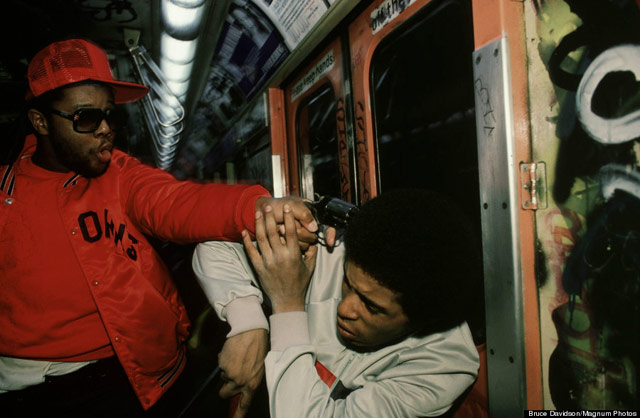
You've probably seen Bruce Davidson's photos of the gritty 1980s NYC subway, which were collected into a book published in 1986.

Bruce Davidson, Subway

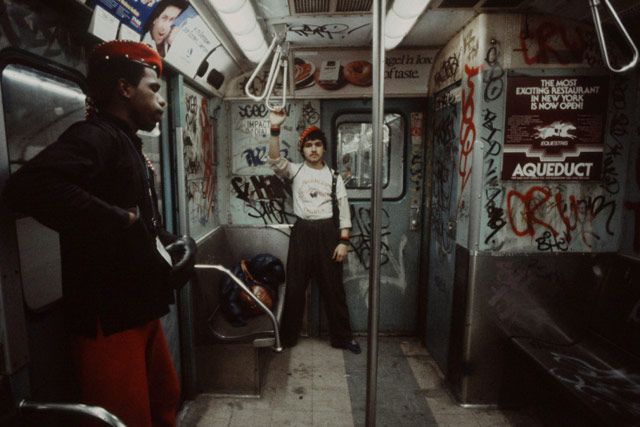
Earlier this year, Time posted some previously unpublished photos of the NYC subway taken in 1981 by Christopher Morris, an admirer of Davidson's.

Christopher Morris, Subway

Tags: Bruce Davidson   Christopher Morris   graffiti   NYC   photography   subway
19 Jun 15:41

Chromecast Support for YouTube Live Streams

by Alex Chitu
Dan Jones

Sometimes I think I should get a Chromecast, but I figure they'll integrate Chromecast into future Android TV set-tops, which I will really want.

Chromecast is now even more useful: you can watch YouTube's live streams. This should work in YouTube's mobile apps and in Chrome for Android.

Here's a screenshot from YouTube's app for Android:


"With Chromecast available in 18 countries and YouTube live streams happening on the regular, we wanted to share one of our favorite ways to use Chromecast. Head to one of the live streams in the YouTube app, just press the cast button, then kick back and enjoy these live events from the comfort of your living room," informs Google.

Here are some live streams you can watch:

* ASP World Tour (surfing)
* Adidas Dugout live from Rio (football / soccer)
* Birds, puppies, cats and more streaming live @ The Pet Collective
* other live streams

Apparently, "YouTube Live streams cannot be viewed from Germany." Here's an explanation: "because of the German law (RStV), you must have a broadcast licence from the media authorities when you make a live stream that can reach more than 500 people at the same time. Not getting one would result in a fine of up to 500000€. "
19 Jun 15:41

Hangouts Integration in Google Search

by Alex Chitu
Dan Jones

Very interesting.
The Google Voice add-on automatically makes phone numbers clickable, to call on one of my Voice phones, but it doesn't support making a call from Hangouts, so this is pretty cool for when I just want to use my computer to make a call.

Some of the phone numbers from Google's Knowledge Graph cards are now linked and open Google Hangouts. When you search for a local business, Google usually displays the phone number next to the address. Click the phone number and you can call directly from your browser using Google Hangouts, which opens in a pop-up window and informs you about the fees. Calls made to the U.S. and Canada are free.


For searches like [john radcliffe hospital phone number], Google shows a separate card that includes the phone number.


It's interesting to notice that not all phone numbers are clickable. Phone numbers from local search results or from ads don't have links. Another exception: customer service numbers.


{ via Search Engine Roundtable }
19 Jun 15:39

A Tribe Called Red’s “Caucasians” T-shirt sparks accusations of racism

Dan Jones

This is pretty great.

A Tribe Called Red’s “Caucasians” T-shirt sparks accusations of racism:

whitepeoplemadatthings:

The First Nations trio A Tribe Called Red has apparently sparked calls for a boycott after one of their members wore a t-shirt that plays on the logo of the Cleveland Indians baseball team.

Wanna get some angry white people calling you a reverse racist? You can have your own Caucasians shirt for only $22: http://www.shelflifeclothing.com/shirtpages/caucasians.html

19 Jun 15:39

#878 – Washed (7 Comments)

by Chris

#878 – Washed

Don’t mess with an engineer.
19 Jun 15:39

Emacs: Turn Off Auto Backup; Set Backups into a Directory; How to Delete Backup Files

Article note: "Set backups into a directory" is very cool. Now I don't have ~ files all over the place, but I still have them available. Now, I can stop worrying about having to always add it to my .gitignore files as well.
18 Jun 20:54

How To Anonymize Everything You Do Online

anon

Hlib Shabashnyi/Getty

One year after the first revelations of Edward Snowden, cryptography has shifted from an obscure branch of computer science to an almost mainstream notion: It’s possible, user privacy groups and a growing industry of crypto-focused companies tell us, to encrypt everything from emails to IMs to a gif of a motorcycle jumping over a plane.

But it’s also possible to go a step closer toward true privacy online. Mere encryption hides the content of messages, but not who’s communicating. Use cryptographic anonymity tools to hide your identity, on the other hand, and network eavesdroppers may not even know where to find your communications, let alone snoop on them. “Hide in the network,” security guru Bruce Schneier made his first tip for evading the NSA. “The less obvious you are, the safer you are.”

Though it’s hardly the sole means of achieving online anonymity, the software known as Tor has become the most vouchsafed and developer-friendly method for using the Internet incognito. The free and open source program triple-encrypts your traffic and bounces it through computers around the globe, making tracing it vastly more difficult. Most Tor users know the program as a way to anonymously browse the Web. But it’s much more. In fact, Tor’s software runs in the background of your operating system and creates a proxy connection that links with the Tor network. A growing number of apps and even operating systems provide the option to route data over that connection, allowing you to obscure your identity for practically any kind of online service.

Some users are even experimenting with using Tor in almost all their communications. “It’s like being a vegetarian or a vegan,” says Runa Sandvik, a privacy activist and former developer for Tor. “You don’t eat certain types of food, and for me I choose to use Tor only. I like the idea that when I log onto a website, it doesn’t know where I’m located, and it can’t track me.”

Here’s how you can use the growing array of anonymity tools to protect more of your life online.

Web Browsing

The core application distributed for free by the non-profit Tor Project is the Tor Browser, a hardened, security-focused version of Firefox that pushes all of your Web traffic through Tor’s anonymizing network. Given the three encrypted jumps that traffic takes between computers around the world, it may be the closest thing to true anonymity on the Web. It’s also rather slow. But the Tor browser is getting faster, says Micah Lee, a privacy-focused technologist who has worked with the Electronic Frontier Foundation—one of the organizations that funds the Tor Project—and First Look Media. For the past month or so, he’s tried to use it as his main browser and only switch back to traditional browsers occasionally, mostly for flash sites and others that require plugins.

After about a week, he says, the switch was hardly noticeable. “It may not be entirely necessary, but I haven’t found it that inconvenient either,” Lee says. “And it does have real privacy benefits. Everyone gets tracked everywhere they go on the Web. You can opt of out of that.”

Email

The simplest way to anonymously send email is to use a webmail service in the Tor Browser. Of course, that requires signing up for a new webmail account without revealing any personal information, a difficult task given that Gmail, Outlook, and Yahoo! Mail all require a phone number.

Runa Sandvik suggests Guerrilla Mail, a temporary, disposable email service. Guerrilla Mail lets you set up a new, random email address with only a click. Using it in the Tor Browser ensures that no one, not even Guerrilla Mail, can connect your IP address with that ephemeral email address.

Encrypting messages with webmail can be tough, however. It often requires the user to copy and paste messages into text windows and then use PGP to scramble and unscramble them. To avoid that problem, Lee instead suggests a different email setup, using a privacy-focused email host like Riseup.net, the Mozilla email app Thunderbird, the encryption plugin Enigmail, and another plugin called TorBirdy that routes its messages through Tor.

Instant Messaging

Adium and Pidgin, the most popular Mac and Windows instant messaging clients that support the encryption protocol OTR, also support Tor. (See how to enable Tor in Adium here and in Pidgin here.) But the Tor Project  is working to create an IM program specifically designed to be more secure and anonymous. That Tor IM client, based on a program called Instant Bird, was slated for release in March but is behind schedule. Expect an early version in mid-July.

Large File Transfers

Google Drive and Dropbox don’t promise much in the way of privacy. So Lee created Onionshare, open-source software that lets anyone directly send big files via Tor. When you use it to share a file, the program creates what’s known as a Tor Hidden Service—a temporary, anonymous website—hosted on your computer. Give the recipient of the file the .onion address for that site, and they can securely and anonymously download it through their Tor Browser.

Mobile Devices

Anonymity tools for phones and tablets are far behind the desktop but catching up fast. The Guardian Project created an app called Orbot that runs Tor on Android. Web browsing, email and IM on the phone can all be set to use Orbot’s implementation of Tor as a proxy.

Apple users don’t yet have anything that compares. But a 99-cent app called Onion Browser in the iOS app store offers anonymous web access from iPhones and iPads. An audit by Tor developers in April revealed and helped fix some of the program’s vulnerabilities. But Sandvik suggests that prudent users should still wait for more testing. In fact, she argues that the most sensitive users should stick with better-tested desktop Tor implementations. “If I were in a situation where I needed anonymity, mobile is not a platform I’d rely on,” she says.

Everything Else

Even if you run Tor to anonymize every individual Internet application you use, your computer might still be leaking identifying info online. The NSA has even used unencrypted Windows error messages sent to Microsoft to finger users and track their identities. And an attacker can compromise a web page you visit and use it to deliver an exploit that breaks out of your browser and sends an unprotected message revealing your location.

So for the truly paranoid, Lee and Sandvik recommend using entire operating systems designed to send every scrap of information they communicate over Tor. The most popular Tor OS is Tails, or The Amnesiac Incognito Live System. Tails can boot from a USB stick or DVD so no trace of the session remains on the machine, and anonymizes all information. Snowden associates have said the NSA whistleblower is himself a fan of the software.

For the even more paranoid, there is a lesser-known Tor-enabled OS called Whonix. Whonix creates multiple “virtual machines” on the user’s computer—software versions of full computer operating systems that are designed to be indistinguishable from a full computer. Any attacker trying to compromise the user’s computer will be confined to that virtual machine.

That virtualization trick underlines an important point for would-be anonymous Internet users, Lee says: If your computer gets hacked, the game is over. Creating a virtual sandbox around your online communications is one way to keep the rest of your system protected.

“Tor is awesome and can make you anonymous. But if your endpoint gets compromised, your anonymity is compromised too,” he says. “If you really need to be anonymous, you also need to be really secure.”

18 Jun 19:53

Google to announce Auto Link car system at Google I/O

by Dima Aryeh

It seems like Google’s goal is to infiltrate every aspect of our lives. To be honest, I don’t mind. The way Google has already improved my life with things like Android, Google Now and especially Google Maps, I’m down with the company giving every market a shot. Next up, Google will be unveiling Auto Link at Google I/O.

Auto Link will be Google’s car-based system. It isn’t a full system that can connect to your smartphone, but one that uses your Android smartphone to work. It will be shown off this month at Google’s event, but the manufacturers that will use it will not be announced. However, because so many companies are part of the Open Automotive Alliance, we could see mass adoption of this system.

Stakes are high, as Apple has already announced its own system called CarPlay. However, more people use Android than iOS, so integrating Auto Link would make more sense on a wider scale. Obviously, auto manufacturers should offer both options to consumers (and if they switch smartphones, we wonder how many thousands of dollars it’ll cost to swap the system).

It’s awesome to hear that Google has been working on an in-car system, and I can’t wait to see it unveiled. Hopefully it’ll be released in custom head units for those of us who drive older cars. Do you think having your Android phone being displayed on an in-dash display is a good idea? Leave a comment!

18 Jun 19:53

Meet Amazon's Smartphone: The Fire Phone

Amazon doesn't just sell smartphones anymore — it makes one. In news that should surprise exactly no one, Jeff Bezos has officially unveiled Amazon's first cellphone, the Fire Phone. It joins the Kindle Fire tablets, Kindle ebook readers, and Fire TV set-top box in Amazon's ever-growing lineup of devices. Amazon's been in the device business for ten years, Bezos reminded the crowd in Seattle, with the first Kindle coming fully seven years ago.

The announcement comes after weeks of buildup, including an open invitation from Amazon to an event showcasing "an amazing new device," a teaser video filled with people having their minds blown by a device that was just off-screen, and a, well, unique package from Amazon last week. Rumors of the company's smartphone ambitions began more than two years ago, and there has likely been a phone for that long — recent reports say the phone has been heavily delayed. But it's here now, the star of the Seattle event Amazon threw for press, buyers, and developers.

"We asked, how would it be different? Can we build a better phone for our most engaged customers?"

During the announcement, Bezos took time to mention that when Amazon first launched the Kindle, it was met with something of a tepid response. That has, he took care to note, changed in a big way. The same thing happened with Kindle tablets, he said — and he not-so-subtly implied that the same might happen with the new phone.

Developing. Check out our liveblog for the latest updates!

18 Jun 16:27

Who was evil before Hitler?

by Jason Kottke

Before Adolf Hitler came along and seized the title of the most evil person in the world, who was commonly cited as the embodiment of evil? The Egyptian Pharoah in the story of Exodus.

In the 18th, 19th, and early 20th centuries, many Americans and Europeans had a firmer grasp of the bible than of the history of genocidal dictators. Orators in search of a universal symbol for evil typically turned to figures like Judas Iscariot, Pontius Pilate, or, most frequently, the Pharaoh of Exodus, who chose to endure 10 plagues rather than let the Hebrew people go. In Common Sense, Thomas Paine wrote: "No man was a warmer wisher for reconciliation than myself, before the fatal nineteenth of April, 1775 [the date of the Lexington massacre], but the moment the event of that day was made known, I rejected the hardened, sullen tempered Pharaoh of England for ever." In the run-up to the Civil War, abolitionists regularly referred to slaveholders as modern-day Pharaohs. Even after VE Day, Pharaoh continued to pop up in the speeches of social reformers like Martin Luther King Jr.

Also, this is a good line:

Generally speaking, hatred was more local and short-lived before World War II.

(via mr)

Tags: Adolf Hitler
18 Jun 16:27

The First Image From Disney’s “Descendants” Shows Off Fabulous Costumes

by Amy Ratcliffe
Dan Jones

What do you guys think? Looks like it might be pretty cheesy to me.

DOVE CAMERON, BOOBOO STEWART, SOFIA CARSON, CAMERON BOYCE

If you haven’t heard, Disney is working on a live-action movie about the progeny of Disney villains. Descendants features the offspring of Cruella de Vil, Maleficent, The Evil Queen and Jafar, and they have to decide whether to be bad like their parents or to make their own choices and follow a different path. The movie will be out in 2015, but Disney’s released the first official image.

Going clockwise from the top left, the picture features Jay, Carlos, Evvie, and Mal. They are the children of Jafar, Cruella de Vil, the Evil Queen, and Maleficent respectively, and you can kind of tell that from their outfits. They aren’t dressed like everyday teenagers, and the bold looks make me excited about seeing the outfits of the heroes in the story and all the resulting cosplay.

Will the movie be corny? Maybe. They look like they’re setting up a merchandise line just to sell Monster High-type dolls. I’m going to give it a shot though just based on these costume designs.

(via io9)

18 Jun 14:23

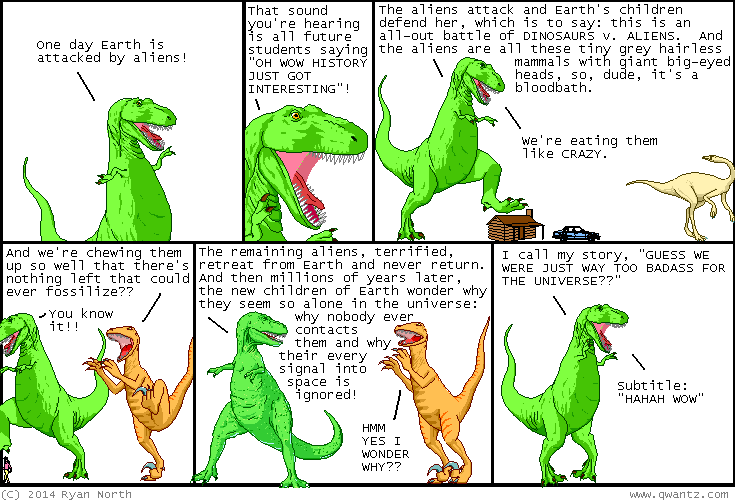
did you know: "chew your food so well that there's nothing left that could ever fossilize" was a common expression in dinosaur times??

Dan Jones

Best solution to the Fermi Paradox that I've ever heard.

archive - contact - sexy exciting merchandise - search - about
← previous June 18th, 2014 next

June 18th, 2014: EARTH'S SECRET HISTORY: REVEALED, HERE ON DINOSAUR COMICS DOT COM

– Ryan

18 Jun 14:22

Were Dinosaurs Warm-Blooded, Cold-Blooded Or Something Else?

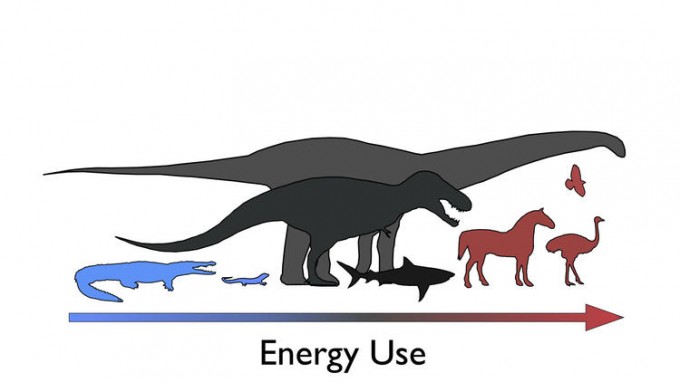
Diagram: energy usage in a number of animal groups, including birds, mammals, dinosaurs and modern reptiles. Dinosaurs were "mesotherms," neither warm- nor cold-blooded, a new study finds. (John Grady, LA Times)


Diagram: energy usage in a number of animal groups, including birds, mammals, dinosaurs and modern reptiles. Dinosaurs were "mesotherms," neither warm- nor cold-blooded, a new study finds. (John Grady, LA Times)

Were dinosaurs warm-blooded or cold-blooded? That's a debate that's been going on since 1968, when Yale scientists first proposed that dinos could have been active, agile, and fast.

It's also a debate for which there's not yet a good conclusion. Yes, scientific consensus has shifted away from perceiving dinosaurs as being slow, lumbering, and essentially reptile-like. But just because we now know that some dinosaurs are the ancestors of birds doesn't mean we've solved the question of how dinosaurs — in general — maintained their body heat and governed their metabolism. All the evidence is indirect, for obvious reasons, and being related to birds is not the same thing as being birds.

The trouble with dinosaurs is that they were something totally different. Not birds. Not reptiles. Something else. Likewise, a new paper suggests that the question of whether they were warm-blooded or cold-blooded can't really be answered in a binary way.

For this paper, the scientists decided to perform a metabolic census of sorts. They compared the growth rate, adult size and metabolism of 381 vertebrate species, living and extinct, including 21 dinosaur species. The idea was that the higher the growth rate, the higher the animal’s rate of metabolism would probably be. And higher metabolisms would probably tend to be endothermic, warm-blooded systems.

Sure enough, they found that high growth rates seemed to match up with the higher metabolisms of warm-blooded animals, whereas lower growth rates were linked to the lower metabolic rates of cold-blooded animals. The dinosaurs seemed to sit right in the middle, overlapping with some endothermic and some ectothermic animals. The scientists aptly called them “mesotherms” ("meso" basically means "middle" in Greek.)

There are some intermediate, mesothermic species that exist today, the authors point out: Animals such as tuna and the leatherback turtle are able to somewhat regulate their internal temperatures, though not to the extent that warm-blooded animals do.

That's from an LA Times article by Amina Khan. I'd also recommend taking a look at Ed Yong's take on the same paper at the Not Exactly Rocket Science blog.

Finally, if you want more background information on the debate over dinosaur metabolism, the University of California Museum of Paleontology has a really nice backgrounder on their DinoBuzz site. It sums up the evidence for warm-blooded dinosaurs, the evidence for cold-blooded dinosaurs, and explains the range of top hypotheses that exist. Despite the way the LA Times (and many other outlets) have framed this, the dino blood debate isn't as simple as Once We Believed This, Then We Believed That, Now This New Paper Proves Something Else.

Thanks, Xeni!

18 Jun 14:22

Ubuntu AIO – Ubuntu and derivatives on one ISO

by ruchi

The plan is to bring Ubuntu and some of the official derivatives (Kubuntu, Ubuntu Gnome, Xubuntu and Lubuntu) on one iso file that can be burnt on one DVD or USB flash drive. Every one of them can be used as Live system, with no need of installation on hard drive, or can be eventually installed on computer for full Ubuntu or any other system experience.
(...)
Read the rest of Ubuntu AIO – Ubuntu and derivatives on one ISO (122 words)

© ruchi for Ubuntu Geek, 2014. | Permalink | No comment | Add to del.icio.us
Post tags: desktop, download Ubuntu AIO, Ubuntu AIO

Related posts

18 Jun 14:22

#877 – Bandage (4 Comments)

by Chris

#877 – Bandage

“Mom, can you tie my shoes for me? I don’t want to smudge my band-aids.”
18 Jun 13:19

Batman 'Nearby Frenemies' Comic

Batman 'Nearby Frenemies' Comic


Sarah Yoshi & M. Sozo over at the awesome webcomic Berds & Nerds created this funny Batman comic that teaches a good lesson about facebook! ;) Here's the artist's note...

"Looks like someone forgot to turn off their location services! Jokes aside, if you don't want random acquaintances finding you, just make sure the 'Nearby Friends' feature is turned off."

Batman

Artist: Berds & Nerds - facebook

Source

Follow us on:
 

June 17 2014
17 Jun 18:23

Carrot Top Got To Star In A Movie, Once

Television talk shows generally abide by an unwritten social contract where no matter how dodgy or terrible a guest’s project sounds, the guests and host all pretend it at least has the potential to be good. On a famous episode of Late Night With Conan O’Brien in the late 1990s, however, this unwritten social contract was dramatically, hilariously shattered. In a violation of talk-show etiquette so unexpected that people still talk about it, a guest was brutally honest about what he thought of another guest’s project. 

The awkwardness begins early, with guest Norm MacDonald and host Conan O’Brien discussing their respective crushes on guest Courtney Thorne-Smith, then of Melrose Place. Then O’Brien mentions that MacDonald referenced Carrot Top earlier in the show, and in what now appears not to be just a fortuitous coincidence, Thorne-Smith had recently filmed a role as the female lead in Carrot Top’s 1998 starring debut, Chairman Of The Board. 

The great thing about MacDonald’s appearance on Late Night—and his talk-show appearances in general—is that it feels like he’s drunkenly, inventively heckling the show from his La-Z-Boy at home, even though he’s a mere foot from Thorne-Smith, and a couple of feet from O’Brien. MacDonald’s delivery of “Wait, she left Melrose Place to do a movie with Carrot Top?” gets a huge laugh, even though it’s less a joke than a setup. A setup like that doesn’t need a punchline, because in any sentence, Carrot Top instantly qualifies as one. 

This prompts O’Brien to ask poor Thorne-Smith a question no one should have to answer: “Why a movie with Carrot Top?” The lost expression on her face as she attempts to answer suggests she understands this isn’t a softball question: It’s an existential query that simultaneously demands and defies an easy answer, for society and the film industry, as much as for this luckless actress. Thorne-Smith never directly answers that question, instead mumbling effusively about what a sweet guy Carrot Top is. When O’Brien asks whether she experienced the exquisite pleasure of love scenes with Carrot Top, she nervously jokes it’s just like “9 1/2 Weeks, with Carrot Top.” MacDonald quips, “Is it called 9 1/2 Seconds? Like, he’s a premature ejaculator?” which is a hack joke rendered borderline-brilliant by the context and delivery. O’Brien, who is clearly half concerned and half overjoyed to be losing control of his show to MacDonald, a man he obviously reveres as a comic genius (because he is one), attempts to wrestle control back by asking Thorne-Smith the name of the movie—a pretty harmless question in most circumstances. MacDonald pipes in: “If it’s got Carrot Top in it, you know what a good name for it would be? Box Office Poison.”

The segment’s infamy is attributable partly to the cult of Norm MacDonald, who made his name attacking the phoniness and pretension of pop culture. As a satirist, MacDonald had a sacred professional obligation to go after Carrot Top; it was a rare instance when making a cheap joke at the expense of a walking punchline becomes righteous, even heroic. Pop culture often resembles a reverse meritocracy, one where LMFAO can make tens of millions and Gram Parsons dies at 26. But something just seemed wrong about Carrot Top being given his own movie. The ridiculousness of a seemingly smart, sane woman leaving a hit show to play the romantic interest in a Carrot Top movie had to be confronted. 

The clip went viral in a pre-Internet age because there was a sense that MacDonald is speaking for all of us—and for O’Brien as well. He was implicating the movie industry as whole for thinking, “Why not a Carrot Top movie?” But it went even further: MacDonald was also implicating the entertainment industry for making Carrot Top happen in the first place, for rewarding him with the kind of success and visibility that made a multi-million-dollar film vehicle not just possible, but inevitable. 

Carrot Top is a walking punchline partially by design. He turned himself into his own biggest, goofiest sight gag. From his name to his signature frizzle of red hair, he made himself an enormously lucrative joke, working the college circuit with such success that Rolling Stone was moved to write an article about how this red-headed freak had come out of nowhere and was making millions, and perhaps most disturbingly and inexplicably, getting laid by a selection of nubile co-eds.

The Rolling Stone profile had such a famously, disturbingly sexual element that a Los Angeles Times writer named Suzanne Fields used it to illustrate the perils of what she describes as the “fast pace, tinsel sensuality and titillating lure of ‘free sex’” that the young people were apparently rebelling against by embracing abstinence, writing:

A long article on a comedian named Carrot Top, who performs in college towns the way Debby does Dallas, illustrates the bleak emptiness of the groupie scene. His performance is largely devoted to getting a good-looking woman to leap between his sheets. He flirts and flatters Beth, a young woman in the audience. She can’t imagine going to bed with this guy unless she’s dead drunk. “Carrot Top flashed his carrot tattoo and told Beth how attractive he found her. All the while, she was gradually moving, drink by drink, beyond her depth, until, with the bar beginning to whirl around her, she was drunk enough to toss off a tell-all comment” that is not printable in this newspaper. At the end of the verbal performance, Beth drives off with Carrot Top. His remark dismissing her the next morning is the moral of this Rolling Stone tale: “That girl is a future restraining order.” 

The moral is clear: give in to the fast pace, tinsel sensuality, and titillating lure of “free sex,” and BOOM, the next thing you know, you’re naked in bed with Carrot Top, who has an impatient gleam in his eye that suggests he can’t get away fast enough, and that he thinks he’s the one doing you a favor. That, in this columnist’s mind, is the ultimate danger of the sexual revolution: your daughter fucking Carrot Top. 

This hysterical column captures the visceral negative reaction Carrot Top invokes. He isn’t just mocked because he embodies prop comedy, perhaps the lowest and least-respected form of comedy; he’s mocked because on a primal emotional level, he’s disturbing to look at. The shock of red hair, the weirdly smooth, feminine features, the skinny-yet-cut body—it’s all weirdly repellent. In the Late Night segment, O’Brien gets laughs just by repeatedly showing a photograph of Carrot Top, but it’s safe to assume the audience is laughing at the man, not with him. The audience is never laughing with Carrot Top, and he at least has the decency to be an okay sport about always being the butt of the joke.

Carrot Top apologists point out that unlike, say, Gallagher, Carrot Top doesn’t appear to be a hateful human being. On the contrary, he seems like a likable enough guy whose juvenile, idiotic humor isn’t really hurting anyone. The anger directed toward him consequently feels disproportionate, yet not entirely unmerited. Still, re-watching that wonderful Late Night clip, I couldn’t help but discern a passive-aggressive subtext in MacDonald’s comments, since the two starring film vehicles MacDonald got to make, Screwed and Dirty Work, could also be titled Box Office Poison. Hollywood gave MacDonald, a widely revered comedy figure, only one more cinematic chance than it gave Carrot Top. 

So why a Carrot Top movie? The answer, not surprisingly, has everything to do with commerce and timing, and nothing to do with art or inspiration. The kids seemed to love Carrot Top (enough to have sex with him!), and if he made millions entertaining drunk, stoned college kids, why couldn’t he make millions entertaining drunk, stoned movie audiences? So Trimark, never the classiest of movie studios, took a calculated risk that he might be able to make it money, the same way Pauly Shore and Jim Varney’s Ernest P. Worrell made big profits for studios while arguably not contributing anything of vital significance to our culture. 

Commerce explains the “why” of the Carrot Top movie. It doesn’t explain the “how.” How do you turn a goofy-looking dude whose act consists of making one-liners about odd-looking, homemade contraptions into a movie star? How does Carrot Top function onscreen? Who is he, if not a touring comedian making jokes about props? The answer Chairman Of The Board comes up with is lazy and unsurprising. 

Onscreen, Carrot Top is Pee-wee Herman in Pee-wee’s Big Adventure. He’s both a live-action cartoon character and the personification of childhood innocence, a man-child who lives in a massive Rube Goldberg contraption of a house seemingly built from the blueprints of Pee-wee’s home in Pee-wee’s Big Adventure. He’s a kook who lives in his own wacky, whimsical world, and he doesn’t need to grow up: The stuffy squares who comprise the world would be better off adopting his freewheeling approach to existence. 

Chairman Of The Board steals shamelessly and ineptly from Pee-wee’s Big Adventure, but it’s just as shameless in its appropriation of Yahoo Serious’ Young Einstein. Serious’ would-be American breakthrough was a wacky slapstick comedy positing young Albert Einstein as a kooky, crazy-haired, surf-happy inventor. Chairman Of The Board is a wacky slapstick comedy about a kooky, crazy-haired, surf-happy inventor named Edison, played by Carrot Top. The problem is that Carrot Top is not Pee-wee Herman. He’s not charming, innocent, appealing, funny, or asexual; he’s creepy, unappealing, and both sexual and sexualized in ways that are deeply disturbing and, like the account of Beth’s lost night in Carrot Top’s bed in Rolling Stone, creepily memorable. 

Edison is introduced naked in the shower. Later, when he’s looking for employment, he procures a position in the inspection room at Royal Condoms, where his boss (Jack Riley, credited as “Condom Boss”) finds him on the floor, fucking the boss’ half-naked daughter to prove that the company’s French tickler works. 

It’s a throwaway gag that aspires to the taste and sophistication of a “Female Body Inspector” novelty T-shirt, but it invites a slew of disturbing questions: 

  1. Did this beautiful woman see having sex with Edison as part of her job, or was she so intensely attracted to him that she decided to have sex with him right there on the floor, despite knowing how angry it would make her father? 
  2. In the world of Chairman Of The Board, do all women find Edison inexplicably irresistible, or just this particular employee of Royal Condom? 
  3. Why is Chairman Of The Board forcing us to think about Carrot Top’s penis, and what he does with it? What kind of monster does that? 

Later, after smashing his arch-rival in the nuts with a tennis ball, Edison seeks the services of a buxom tennis instructor played by Cindy Margolis (once Guinness’ world-record holder for Internet download popularity), who suggestively massages a pair of tennis balls and strokes her racquet, moaning, “Well, Edison, to master the game, you need to get zen about it! You have to feel the balls, caress them, instead of whacking them. And think of your racket as an extension of yourself, another muscle—strong, hard, forceful, a tool to penetrate your opponent’s court!” While she lewdly caresses her double entendres, Carrot Top moans and contorts his face to suggest he’s experiencing a powerful orgasm.

Edison’s romance with Natalie Stockwell, Thorne-Smith’s character, is comparatively tame and wholesome by comparison. Their big scene together involves Natalie belching the alphabet while on a lunch date at a museum. Yet it’s worth noting that every moment Thorne-Smith is onscreen, she looks visibly more awkward than she did during the Conan segment, a television spot that has become famed for its awkwardness. All Thorne-Smith is called upon to do here is force smiles and act like she’s attracted to, and impressed by, a character played by Carrot Top. And yet she is utterly defeated by those demands. 

Chairman Of The Board begins by shamelessly ripping off Pee-wee’s Big Adventure, then purloins its central plot point from Melvin And Howard when Edison stumbles upon Armand McMillan (two-time Academy Award nominee Jack Warden, who also co-starred opposite Norm MacDonald that same year in Dirty Work), the free-spirited, surfing genius behind McMillan Industries, a company so committed to ideas and innovation that high atop its headquarters sits a giant lightbulb with the words, “Where Idea Is King.” By all accounts, Armand was a magical man-sprite whose life was all about loving people, riding killer waves, and inventing things, yet the research-and-development department of his company—you know, the one with the giant lightbulb at the top to convey its zeal for researching and developing things—left him a husk of a man presiding over a sad roster of shuttled projects. This living embodiment of impish joy and exuberant kindness lets Bradford (Larry Miller), his sadistic, misanthropic, black-hearted villain of a nephew, rule over the company with an iron fist. That is, until Armand meets Edison, and is so blown away by what I suppose would have to be his charm and likability (it’s difficult to say, because Carrot Top gives a performance devoid of charm and likability) that when he dies, he leaves Bradford his surfboard, and Edison his company. 

At this point, the film becomes a Spuds Mackenzie variation on The Hudsucker Proxy, as the wacky young boss gets a bunch of uptight, old business-type dudes (whose ranks include the great M. Emmet Walsh) to loosen up and embrace their inner Van Wilder, while his nemesis tries to drive down the stock price to the point where he can take over. First, Edison wins their favor by getting them to play Twister. Then he inspires a new golden age of productivity for the company by instituting a weekly luau, complete with a designated area where the sad old men can mosh in safety and comfort. How crazy is this luau? At one point, a dog shows up—on a surfboard! 

Edison’s innovations, like a lie-detector shirt that emits loud fart noises when the wearer is lying (the film never quite explains why someone would voluntarily agree to wear a shirt that promises to humiliate them while exposing their deceptions) and a TV dinner with an actual TV attached (available in such timeless flavors as Beavis & Broccoli, N.Y.P.D. Blueberry Pie, and Chicken, Corn, and M*A*S*Hed Potatoes) make him the most successful entrepreneur in the world. Yet in a puzzling development, Edison still struggles to come up with the money to pay rent on the beach-side shack he shares with his two best buddies. 

Carrot Top’s character is designed as a lovable dreamer, but he comes off as creepy, repellent, sexist, and deeply mentally ill, an oblivious jerk whose life is filled with cruelty and sadism, whether he’s ripping the necktie off a corpse to look better at Armand’s funeral, or trying to intimidate little girls during an audition for the lead in Annie. Whatever tacky magic Carrot Top has or had as a live performer, he lacks as a film actor. The question isn’t whether this Carrot Top movie will be good or bad, but whether it will be merely bad, or the fucking worst. (It’s the second thing.)

Chairman Of The Board epitomizes the mindless optimism and go-go confidence that characterized the 1990s dot-com bubble, when the idea really was king, brash young men with crazy ideas were heralded as the saviors of both the economy and society, and irrational exuberance was the order of the day. Technology was going to change the way we lived and worked, and usher in a utopia. Dreamers with silly ideas were suddenly afforded a level of respect and importance that now seems delusional. It was an age where we threw money at the longest of long shots, be it a gamble that a medical-information website fronted by former Surgeon General C. Everett Koop would become a billion-dollar commercial dynamo, or that a red-haired prop comic whom much of the public nursed a strong desire to punch in the face might become a major movie star, like Cary Grant or Pauly Shore. 

The public coldly rejected both Chairman Of The Board and Carrot Top as a movie star. The film is currently ranked as the 51st worst film of all time on IMDB, and Mystery Science Theater 3000’s Mike Nelson, who knows something about bad films, listed it as one of the five worst comedies of all time for Cracked.

Carrot Top never starred in another film, but director Alex Zamm has gone on to continue the saga of some of our shittiest franchises in his direct-to-video work on projects like Inspector Gadget 2, Dr. Dolittle: Million Dollar Mutts, Beverly Hills Chihuahua 2, Tooth Fairy 2, The Little Rascals Save The Day, and, coming in 2015 to a Netflix queue near you, Jingle All The Way 2.

That last film reunites Zamm with Tooth Fairy 2 star Larry The Cable Guy. I like to imagine that when Larry The Cable Guy and Carrot Top see each other at a Las Vegas casino or pricey Beverly Hills restaurant (as they must), they nod and exchange a deep, soulful look that wordlessly but powerfully conveys the unspoken but profound connection between them. Beyond their collaborations with Zamm, these men understand what it’s like to have your existential humiliation and enduring success inextricably intertwined, to be worshipped and reviled for the same stupid shtick. They understand what it’s like to stop being a human being with dignity (Scott Thompson in the case of Carrot Top, Dan Whitney in Larry The Cable Guy’s case) and become a cartoon character and walking punchline in exchange for fame, money, and power. In a perfect world, someone like Quentin Tarantino would salvage these broken, degraded icons and pit them against each other in a film that would reinvent both their careers by stripping away all the bullshit, and getting to the sadness and desperation at their core.

Chairman Of The Board really is as terrible as its reputation suggests, but there’s something oddly poignant about it all the same. It exemplifies a curious time when anything seemed possible, even the notion that Carrot Top might be a major movie star. Some dreams, however, prove too preposterous. 

Next: David Byrne’s True Stories

17 Jun 17:35

How to Download Auto Awesome Photos

by Alex Chitu

Auto Awesome is one of the best features of Google+ Photos. It's a good reason to upload your photos to Google+ instead of choosing a different service: you get something in return. Auto Awesome photos and videos use your photos and videos to create something new. Some of them improve your photos, others are funny, while some of them would normally require professional software.

Just because they're so nice, I decided to backup my Auto Awesome. Here's how to download them:

1. open this page: https://plus.google.com/photos/search/%23AutoAwesome (or go to Google+ Photos and search for #AutoAwesome)

2. click "show all" below the first photos from that page


3. select the first photo: mouse over the photo and click the tick icon.


4. use your browser's find-in-page feature (Ctrl+F or Command+F on a Mac) and search for from your circles. That's a different section which shows Auto Awesome photos from your circles and that's where your Auto Awesome gallery ends.


5. Shift+click the last photo above the "From your circles" section and you should see a message like "230 selected".


6. click "more" in the navigation bar and select "download".


7. You'll get a Photos.zip archive with both photos and videos. The filename includes the type of AutoAwesome effect. The archive should also include the "year in review" video titled 2013-MOVIE.m4v.

17 Jun 17:34

New Studio Ghibli Costume Hoodies From Rarity’s Boutique

by Amy Ratcliffe
Dan Jones

I would love a Totoro hoodie, but not for $200.

totocollage

Are you ready to get cuddly and warm with Studio Ghibli? Good, because the talented Lisa Lou of Rarity’s Boutique has just released some Ghibli-inspired costume hoodies. You can dress like Totoro from My Neighbor Totoro, Haku from Spirited Away, or San from Princess Mononoke. The creative designs are available in unisex and women’s sizes and made from anti-pill fleece with handmade appliques. They’re also made to order and ready to ship up to ten business days.

See more of the Ghibli-inspired collection after the break.

hakucollage

san1

san8

sancollage

totoro7

san3

totoro3

Product Page ($200 and up)

17 Jun 03:40

Chart of the United States’ Growing Love of Soccer

by DOGHOUSE DIARIES

Chart of the United States' Growing Love of Soccer

Here’s an update on our project Forekast.com! We got a lot of helpful feedback, great suggestions, and have learned a ton from the folks helping with the beta testing (Thanks guys!).  We’ve been working really hard to make improvements and within the next few weeks we’ll be rolling out some new features. We’re really excited, and if all goes well, it shouldn’t be long until we’re ready to share it with all of you!

If you missed it the first time, you can check out Forekast.com to see what it’s about and leave your email to get the news when it launches!  Thanks again for all the support everyone!
17 Jun 01:32

Movie Posters as Animated .Gifs - The Future of Movie Posters?

Movie Posters as Animated .Gifs - The Future of Movie Posters?


Check out these awesome animated .gif versions of popular movie posters! Is this the future of movie posters?

Movie Poster as Animated .Gifs The Future of Movie Posters

Movie Poster as Animated .Gifs The Future of Movie Posters

Movie Poster as Animated .Gifs The Future of Movie Posters

Movie Poster as Animated .Gifs The Future of Movie Posters

Movie Poster as Animated .Gifs The Future of Movie Posters

Movie Poster as Animated .Gifs The Future of Movie Posters

Movie Poster as Animated .Gifs The Future of Movie Posters

Source: Imgur

(via: Visual News)

Follow us on:
 

June 16 2014
16 Jun 23:31

A people's center of the United States

by Jason Kottke

The center of the population of the United States has been moving steadily west and south since 1790. This video shows the progression until 2010:

You can step through the animation yourself on the US Census Bureau site. It's interesting to see how even the changes are...there was one big jump from 1850 to 1860 and a slow down in westward migration from 1890 to 1940, but other than that, it shifted west about 40-50 miles each decade.

Tags: infoviz   population   video
16 Jun 20:17

Google Open Sources PDF Code in Chrome, Brings Built-In PDF Viewing to Chromium

by Sam Tran

foxit logoGoogle and PDF-centric company Foxit has announced that it is open sourcing the PDF library used in Google Chrome.

The post Google Open Sources PDF Code in Chrome, Brings Built-In PDF Viewing to Chromium appeared first on OMG! Chrome!.

16 Jun 20:17

Join The Lantern Corps With These Officially Licensed Rings

by Amy Ratcliffe

Lantern rings 1

Whether you want to join the Green Lanterns or the Sinestro Corps, Guild Jewellery has you covered with their sterling silver and enamel designs. The superheroic jewelry is officially licensed and looks beautifully made. They’re obviously ideal for your Lantern Corps cosplay but would also work with any outfit – anyone who doesn’t recognize the Lantern Corps symbols would just think you were wearing cool abstract designs.

Check out close-ups of each ring after the break.

2nd_gen_black_lantern_ring_1_1

2nd_gen_blue_lantern_rings_2

2nd_gen_indigo_tribe_rings_2

2nd_gen_larfleeze_rings_2

2nd_gen_red_lantern_ring

2nd_gen_sinestro_corps_rings_2

2nd_gen_star_sapphire_rings_2

2nd_gen_white_lantern_ring_1

Product Page ($103 via TMS)