
It gets awkward fast.


Reuters

06.29.14
After months of gaining territory, weapons, and cash, ISIS is putting its global credibility on the line in a play that could backfire spectacularly.
On Sunday morning, the Islamic State of Iraq and Syria (ISIS, or ISIL, if you must) pronounced the reformation of the caliphate—the historical Islamic state that once stretched over much of the modern-day Muslim world—with ISIS emir Abu Bakr al Baghdadi as the man in charge.
It’s arguably the boldest move yet by the group, which renamed itself simply The Islamic State. But if ISIS isn’t careful, this could be the moment when all of its gains in Iraq and Syria are squandered; when would-be allies are alienated; and when the group’s critics within the jihadi community were proven right all along.
In the statement—released in Arabic, English, German, French, and Russian—ISIS claimed that it had fulfilled all the legal requirements for the caliphate and that all existing jihadi groups and indeed all Muslims around the world were religiously obligated to swear loyalty to the new Caliph Ibrahim (using the name provided by ISIS in the course of proving that Baghdadi has the required lineage for the title).
Prior to this pronouncement, my assessment was that there was almost no way ISIS could exit June in worse shape than it entered the month, and that still holds. But July is beginning to look like an open question. ISIS, an al Qaeda breakaway group, had made a bold move to seize territory in Iraq that had resulted in tremendous gains in both equipment and money. Even if it lost all of the territory it gained in June, it would still retain many of those spoils, with new clout, status and physical assets to compete with the other jihadi groups operating in Syria and near the Iraq border.
The declaration of the caliphate is a massive gamble that puts many of these gains at risk, although the potential benefits are also substantial. Here's a quick rundown of the moving parts:
Competition with al Qaeda
As I’ve discussed previously, ISIS has been competing with the original al Qaeda for leadership of the global jihadist movement (a great history of the conflict can be found here by Aaron Zelin).
ISIS’s recent gains in Iraq projected strength and dynamism, while AQ Classic looked weak and indecisive. AQ has maintained a slim but diminishing lead over ISIS among key influencers in the movement, and more recent data suggested that it was hurting AQC in fundraising networks, although it also appeared to be diminishing enthusiasm for the jihad in Syria overall.
There is one factor that could cause all of this to work out dramatically in ISIS’s favor, but it would require a large number of variables to fall into place. That factor is U.S. intervention.
The pronouncement of the caliphate is sure to be wildly controversial on religious grounds, but ultimately it could cut either way. The backlash may harden the pro-AQ segment of the global jihadist movement against ISIS, especially with the announcement’s flat-out demand that all other jihadist groups are religiously obligated to pledge loyalty to ISIS. But it will also generate some enthusiasm from foot soldiers and different segments of the global movement that see ISIS as a rising star.
There is a risk of high-level defections from AQ to ISIS, particularly in North Africa, where several groups and segments of groups have already broadly telegraphed their sympathies toward ISIS. A significant number of al Qaeda in the Arabian Peninsula (AQAP) supporters in Yemen have also been showing signs of sympathies to ISIS for some time. Since the announcement, social networks in the neighborhood of AQAP appear to be supportive.
On the other hand, Muslims worldwide are likely, on the whole, to react negatively to the pronouncement. The question here is how many currently nonviolent radicals will jump toward ISIS and how many will jump away from it. Again, this is a high-risk, high-reward scenario for ISIS. It could reap considerable benefits, but the backlash could be severe.
Regardless of how that plays out, today’s pronouncement will likely generate new streams of fundraising and fighter recruitment, even as it depresses others.
The long-term outcome is unclear, but much may depend on what happens next in Iraq.
On the Ground in Iraq
ISIS made its gains in Iraq as part of a coalition of Sunnis with grievances against the Maliki government. Those groups may have seen a temporary advantage in aligning with ISIS, but the pronouncement of the caliphate sends a clear message to all of ISIS’s Iraqi partners that they are the subordinate parties in this alliance. ISIS may have cleared this move with its key allies in advance, but if it didn’t, the power grab could splinter the very coalition that allowed it to seize territory in the first place.
More significantly, the calculus of holding territory has now changed. Prior to the pronouncement, ISIS could have fallen back to its previous domain along the border of Iraq and Syria with little loss of face and a huge increase in its war-fighting capabilities, thanks to captured weaponry and millions of dollars in stolen funds.
Now, if ISIS is driven back, Baghdadi risks being seen as the man who grasped for the caliphate, held it in his hands for one brief shining moment, then lost it all.
Such a loss would highlight the hubris of ISIS in making this pronouncement and would also seem to validate the arguments of al Qaeda emir Ayman al Zawahiri that ISIS’s methodology was flawed and that the splinter group was putting the cart of an Islamic state ahead of the horse of fighting jihad.
The question now is how confident ISIS is about its ability to hold substantial territory in Iraq (reports suggest it is under heavy pressure in Tikrit already, and the United States has yet to deploy any airpower against the insurgents). If ISIS made sure its partners are the ground would support the pronouncement and if it withheld the pronouncement until it was sure it had consolidated its gains, then it is in a position to reap benefits.
If ISIS rushed its timeline or overruled objections from local partners, it may lose its territorial gains quickly and end up condemned for an arrogant and ill-advised power grab. The wording of its pronouncement certainly reeks of arrogance, demanding an oath of loyalty from essentially all Muslims, with dissenters being labeled sinners at best, or apostates at worst.
At best, and in the absence of any surprising new information (which could certainly be coming), ISIS appears to be standing on the edge of a precipice with an adolescent faith in its ability to keep its balance.
It may be able to walk that line, but it’s a stunning and unnecessary risk by a group that could have navigated the next few months with excellent odds of an outcome that ranged from good to very good. Now it has introduced a much higher risk of an outcome that is truly bad for its long-term prospects.
 AP
AP
One Potential Path Through
There is one factor that could cause all of this to work out dramatically in ISIS’s favor, but it would require a large number of variables to fall into place. That factor is U.S. intervention.
The prospect of a U.S. military intervention, most likely in the form of air strikes, was already problematic. While there are many who understandably favor hitting ISIS in order to deny it control of territory in Iraq, such a strike would bestow on ISIS the one thing it has until now been unable to definitively claim—legitimacy. A potential new line of jihadist argument then emerges: The caliphate was restored, but it was directly destroyed by the United States.
(Iran could also possibly fill the villain role here, resulting in a different possible tectonic shift in the global movement. And I suppose the Israelis could also intervene, which would probably overturn the entire playing board and start a new, very unappealing game.)
Even before today’s pronouncement, there was a substantial risk that U.S. strikes on ISIS would bolster its standing in the global jihadist community, allowing it to gain ground against al Qaeda in the battle for hearts and minds.
U.S. strikes could also subvert the trend in recent years toward the localization of jihadist conflicts or unite the currently splintered jihadist movement against the U.S. as its primary enemy once more, with ISIS subsequently holding a central position in a unified global struggle.
If the pronouncement of the caliphate is received as legitimate by some significant number of jihadists and their stay-at-home supporters worldwide and...
If the United States is seen to be the most important contributor to destroying that nascent caliphate...
...there could be cascading consequences on a scale we have not previously seen. It could result in waves of terrorist attacks in the West, a surge in foreign fighter recruitment and fundraising, and significant instability in the Middle Eastern states that aren’t already experiencing it.
But those are two extremely large ifs.
If this has been ISIS’s plan all along, it is audacious but borders on the insane. It is an all-or-nothing gambit. ISIS has meaningfully put its existence on the line with today’s pronouncement. It is playing the lottery, and while the odds are stacked against it, sometimes people win the lottery.
Above all else, it is clear that ISIS is an adrenaline addict. If the group survives, it may be emboldened to take even greater risks, and our strategy needs to be informed by that understanding.
The article originally appeared at Intelwire, which delivers breaking news, primary source research, and critical analysis on terrorism, homegrown extremism, and national security.

| archive - contact - sexy exciting merchandise - search - about | |||
 |
|||
| ← previous | June 30th, 2014 | next | |
|
June 30th, 2014: Behold, a comic that uses "principle" and "principal" in the same strip! AND I DIDN'T EVEN REALIZE THAT UNTIL AFTER I'D WRITTEN IT!! – Ryan | |||
Facebook caused a stir over the weekend with the revelation that it had been altering the content of some users' News Feeds in an attempt to study the psychology behind what causes people to post emotional material. Now Adam Kramer, Facebook data scientist and co-author of the study, has posted an explanation of the motivation behind the research, which he says serves as Facebook's statement on the matter.
"The reason we did this research is because we care about the emotional impact of Facebook and the people that use our product," says Kramer. "We felt that it was important to investigate the common worry that seeing friends post positive content leads to people feeling negative or left out. At the same time, we were concerned that exposure to friends' negativity might lead people to avoid visiting Facebook."
"In hindsight, the research benefits of the paper may not have justified all of this anxiety."
Kramer notes that the study affected 0.04 percent of users over one week in 2012, though at Facebook's scale that covers hundreds of thousands of people. The study's findings contradicted conventional wisdom, according to the scientist, as seeing positive emotions on Facebook was found to encourage similarly positive content. In a separate statement provided to The Guardian, Facebook said the research was designed to "improve our services and to make the content people see on Facebook as relevant and engaging as possible."
"Having written and designed this experiment myself, I can tell you that our goal was never to upset anyone," says Kramer. "I can understand why some people have concerns about it, and my co-authors and I are very sorry for the way the paper described the research and any anxiety it caused. In hindsight, the research benefits of the paper may not have justified all of this anxiety." Kramer says that Facebook has improved its internal review practices since 2012, and future research will take the reaction to this study into account.
Dan Jonestl;dr Teenagers act like teenagers because their brains make them anxious.
HTTP/1.1 302 Found Date: Sun, 29 Jun 2014 09:53:08 GMT Server: Apache Set-Cookie: NYT-S=deleted; expires=Thu, 01-Jan-1970 00:00:01 GMT; path=/; domain=www.stg.nytimes.com Set-Cookie: NYT-S=0M8QqATSq9fZnDXrmvxADeHKCVqhc8XZOkdeFz9JchiAIUFL2BEX5FWcV.Ynx4rkFI; expires=Tue, 29-Jul-2014 09:53:08 GMT; path=/; domain=.nytimes.com Location: http://www.nytimes.com/2014/06/29/opinion/sunday/why-teenagers-act-crazy.html?_r=0 Content-Length: 0 nnCoection: close Content-Type: text/html; charset=UTF-8 HTTP/1.1 200 OK Server: Apache Cache-Control: no-cache Content-Type: text/html; charset=utf-8 Content-Length: 69119 Accept-Ranges: bytes Date: Sun, 29 Jun 2014 09:53:08 GMT X-Varnish: 2122018215 2122018021 Age: 5 Via: 1.1 varnish X-Cache: HIT X-API-Version: 5-5 X-PageType: article Connection: close

ADOLESCENCE is practically synonymous in our culture with risk taking, emotional drama and all forms of outlandish behavior. Until very recently, the widely accepted explanation for adolescent angst has been psychological. Developmentally, teenagers face a number of social and emotional challenges, like starting to separate from their parents, getting accepted into a peer group and figuring out who they really are. It doesnât take a psychoanalyst to realize that these are anxiety-provoking transitions.
But there is a darker side to adolescence that, until now, was poorly understood: a surge during teenage years in anxiety and fearfulness. Largely because of a quirk of brain development, adolescents, on average, experience more anxiety and fear and have a harder time learning how not to be afraid than either children or adults.
Different regions and circuits of the brain mature at very different rates. It turns out that the brain circuit for processing fear â the amygdala â is precocious and develops way ahead of the prefrontal cortex, the seat of reasoning and executive control. This means that adolescents have a brain that is wired with an enhanced capacity for fear and anxiety, but is relatively underdeveloped when it comes to calm reasoning.
Photo
You may wonder why, if adolescents have such enhanced capacity for anxiety, they are such novelty seekers and risk takers. It would seem that the two traits are at odds. The answer, in part, is that the brainâs reward center, just like its fear circuit, matures earlier than the prefrontal cortex. That reward center drives much of teenagersâ risky behavior. This behavioral paradox also helps explain why adolescents are particularly prone to injury and trauma. The top three killers of teenagers are accidents, homicide and suicide.
The brain-development lag has huge implications for how we think about anxiety and how we treat it. It suggests that anxious adolescents may not be very responsive to psychotherapy that attempts to teach them to be unafraid, like cognitive behavior therapy, which is zealously prescribed for teenagers.
What we have learned should also make us think twice â and then some â about the ever rising use of stimulants in young people, because these drugs may worsen anxiety and make it harder for teenagers to do what they are developmentally supposed to do: learn to be unafraid when it is appropriate to do so.
As a psychiatrist, Iâve treated many adults with various anxiety disorders, nearly all of whom trace the origin of the problem to their teenage years. They typically report an uneventful childhood rudely interrupted by adolescent anxiety. For many, the anxiety was inexplicable and came out of nowhere.
OF course, most adolescents do not develop anxiety disorders, but acquire the skill to modulate their fear as their prefrontal cortex matures in young adulthood, at around age 25. But up to 20 percent of adolescents in the United States experience a diagnosable anxiety disorder, like generalized anxiety or panic attacks, probably resulting from a mix of genetic factors and environmental influences. The prevalence of anxiety disorders and risky behavior (both of which reflect this developmental disjunction in the brain) have been relatively steady, which suggests to me that the biological contribution is very significant.
One of my patients, a 32-year-old man, recalled feeling anxious in social gatherings as a teenager. âIt was viscerally unpleasant and I felt as if I couldnât even speak the same language as other people in the room,â he said.â It wasnât that he disliked human company; rather, socializing in groups felt dangerous, even though intellectually he knew that wasnât the case. He developed a strategy early on to deal with his discomfort: alcohol. When he drank, he felt relaxed and able to engage. Now treated and sober for several years, he still has a trace of social anxiety and still wishes for a drink in anticipation of socializing.
Of course, we all experience anxiety. Among other things, itâs a normal emotional response to threatening situations. The hallmark of an anxiety disorder is the persistence of anxiety that causes intense distress and interferes with functioning even in safe settings, long after any threat has receded.
Weâve recently learned that adolescents show heightened fear responses and have difficulty learning how not to be afraid. In one study using brain M.R.I., researchers at Weill Cornell Medical College and Stanford University found that when adolescents were shown fearful faces, they had exaggerated responses in the amygdala compared with children and adults.
The amygdala is a region buried deep beneath the cortex that is critical in evaluating and responding to fear. It sends and receives connections to our prefrontal cortex alerting us to danger even before we have had time to really think about it. Think of that split-second adrenaline surge when you see what appears to be a snake out on a hike in the woods. That instantaneous fear is your amygdala in action. Then you circle back, take another look and this time your prefrontal cortex tells you it was just a harmless stick.
Thus, the fear circuit is a two-way street. While we have limited control over the fear alarm from our amygdala, our prefrontal cortex can effectively exert top-down control, giving us the ability to more accurately assess the risk in our environment. Because the prefrontal cortex is one of the last brain regions to mature, adolescents have far less ability to modulate emotions.
Fear learning lies at the heart of anxiety and anxiety disorders. This primitive form of learning allows us to form associations between events and specific cues and environments that may predict danger. Way back on the savanna, for example, we would have learned that the rustle in the grass or the sudden flight of birds might signal a predator â and taken the cue and run to safety. Without the ability to identify such danger signals, we would have been lunch long ago.
But once previously threatening cues or situations become safe, we have to be able to re-evaluate them and suppress our learned fear associations. People with anxiety disorders have trouble doing this and experience persistent fear in the absence of threat â better known as anxiety.
Another patient I saw in consultation recently, a 23-year-old woman, described how she became anxious when she was younger after seeing a commercial about asthma. âIt made me incredibly worried for no reason, and I had a panic attack soon after seeing it,â she said. As an older teenager, she became worried about getting too close to homeless people and would hold her breath when near them, knowing that âthis was crazy and made no sense.â
B. J. Casey, a professor of psychology and the director of the Sackler Institute at Weill Cornell Medical College, has studied fear learning in a group of children, adolescents and adults. Subjects were shown a colored square at the same time that they were exposed to an aversive noise. The colored square, previously a neutral stimulus, became associated with an unpleasant sound and elicited a fear response similar to that elicited by the sound. What Dr. Casey and her colleagues found was that there were no differences between the subjects in the acquisition of fear conditioning.
But when Dr. Casey trained the subjects to essentially unlearn the association between the colored square and the noise â a process called fear extinction â something very different happened. With fear extinction, subjects are repeatedly shown the colored square in the absence of the noise. Now the square, also known as the conditioned stimulus, loses its ability to elicit a fear response. Dr. Casey discovered that adolescents had a much harder time âunlearningâ the link between the colored square and the noise than children or adults did.
IN effect, adolescents had trouble learning that a cue that was previously linked to something aversive was now neutral and âsafe.â If you consider that adolescence is a time of exploration when young people develop greater autonomy, an enhanced capacity for fear and a more tenacious memory for threatening situations are adaptive and would confer survival advantage. In fact, the developmental gap between the amygdala and the prefrontal cortex that is described in humans has been found across mammalian species, suggesting that this is an evolutionary advantage. This new understanding about the neurodevelopmental basis of adolescent anxiety has important implications, too, in how we should treat anxiety disorders. One of the most widely used and empirically supported treatments for anxiety disorders is cognitive behavior therapy, a form of extinction learning in which a stimulus that is experienced as frightening is repeatedly presented in a nonthreatening environment. If, for example, you had a fear of spiders, you would be gradually exposed to them in a setting where there were no dire consequences and you would slowly lose your arachnophobia. The paradox is that adolescents are at increased risk of anxiety disorders in part because of their impaired ability to successfully extinguish fear associations, yet they may be the least responsive to desensitization treatments like cognitive behavior therapy precisely because of this impairment.
This presents a huge clinical challenge since young people are generally risk takers who are more prone to exposure to trauma as a direct result of their behavior, to say nothing of those who were exposed to the horrors of the wars in Iraq and Afghanistan or the mass shootings like those in Newtown and Aurora. Many of them will go on to develop post-traumatic stress disorder, which is essentially a form of fear learning. Now we have good reason to think that exposure therapy alone may not be the best treatment for them. A recent study of children and adolescents with anxiety disorders found that only 55 to 60 percent of subjects responded to either cognitive behavior therapy or an antidepressant alone, but 81 percent responded to a combination of these treatments. And in another study, there was preliminary evidence that adolescents responded less well to cognitive behavior therapy than children or adults.
This isnât to say that cognitive therapy is ineffective for teenagers, but that because of their relative difficulty in learning to be unafraid, it may not be the most effective treatment when used on its own.
And there is potentially something else to worry about with our anxious adolescents: the meteoric rise in their use of psychostimulants like Ritalin and Adderall. In theory, stimulants could have a negative impact on the normal developmental trajectory of anxious teenagers.
According to the health care data company IMS Health, prescription sales for stimulants increased more than fivefold between 2002 and 2012. This is of potential concern because it is well known from both human and animal studies that stimulants enhance learning and, in particular, fear conditioning. Stimulants, just like emotionally charged experiences, cause the release of norepinephrine â a close relative of adrenaline â in the brain and facilitate memory formation. Thatâs the reason we can easily forget where we put our keys but will never forget the details of being assaulted.
Might our promiscuous use of stimulants impair the ability of adolescents to suppress learned fear â something that is a normal part of development â and make them more fearful adults? And could stimulants unwittingly increase the risk of PTSD in adolescents exposed to trauma? In truth, we havenât a clue.
But we do know this: Adolescents are not just carefree novelty seekers and risk takers; they are uniquely vulnerable to anxiety and have a hard time learning to be unafraid of passing dangers. Parents have to realize that adolescent anxiety is to be expected, and to comfort their teenagers â and themselves â by reminding them that they will grow up and out of it soon enough.
Richard A. Friedman is a professor of clinical psychiatry and the director of the psychopharmacology clinic at the Weill Cornell Medical College.
A version of this op-ed appears in print on June 29, 2014, on page SR1 of the New York edition with the headline: Why Teenagers Act Crazy.
Dan JonesIf it were that speaker, I could listen for hours.
them:

me:

Simply asking questions has never constituted apostasy. Apostasy is repeatedly acting in clear, open, and deliberate public opposition to the Church or its faithful leaders, or persisting, after receiving counsel, in teaching false doctrine.
The U.S. Navy has taken on a curious new counterterrorism role.

The USS San Antonio (James DeAngio/U.S. Navy)
Right now, a suspected terrorist is sitting in the bowels of a U.S. Navy warship somewhere between the Mediterranean Sea and Washington, D.C. Ahmed Abu Khattala, the alleged leader of the September 2012 attack on the U.S. embassy in Benghazi, Libya, is imprisoned aboard the USS New York, likely in a bare cell normally reserved for U.S. military personnel facing disciplinary action at sea. En route to the United States for more than a week, he’s being questioned by military and civilian interrogators looking for critical bits of intelligence before he’s read his Miranda rights, formally arrested, and transferred to the U.S. District Court in Washington, where he’ll face trial. Meanwhile, the sailors aboard are going about the daily business of operating an amphibious transport ship—even as the ship’s mission has been redefined by the new passenger in their midst.
This isn’t the first time the Navy has played such a critical, curious, and largely under-reported role in U.S. counterterrorism efforts. In 2011, Ahmed Abdulkadir Warsame, a military commander for the Somali terrorist group al-Shabab, was captured aboard a fishing boat in the Gulf of Aden and detained by the Navy, on the high seas, for two months. In 2013, Abu Anas al-Libi, the alleged mastermind of the 1998 terrorist attacks on American embassies in Kenya and Tanzania, was held aboard the USS San Antonio—an identical ship to the one being used this week. Both men were interrogated at sea before being flown to the United States to face criminal charges in federal courts. Warsame eventually pleaded guilty to nine counts, including providing material support to al-Qaeda in the Arabian Peninsula and teaching other terrorists how to make explosives. Al-Libi pleaded not guilty to terrorism-related charges, and his case is ongoing.
In many ways, it’s not surprising that the U.S. government has been turning Navy assets into floating prisons for these dangerous men. Taking the slow route back to the United States offers interrogators the time and space to gather crucial intelligence from high-value sources like al-Qaeda-linked operatives. During the two months that Warsame was at sea, a select team of FBI, CIA, and Defense Department officials, part of the Obama administration’s High-Value Detainee Interrogation Group, questioned the Somali terrorist on “all but a daily basis.” He was cooperative throughout and some reports suggest that subsequent U.S. counterterrorism operations, including a drone attack in Somalia shortly after his capture, were a direct result of intelligence Warsame provided to authorities. While al-Libi was only detained at sea for about a week—a chronic medical condition prevented him from being held on a ship for an extended period—reports suggest that similar intelligence-collection efforts were underway in his case as well.
"Our operations were driven by having to hold onto these knuckleheads,” one Navy officer said.The U.S. government has also embraced the approach because it has limited options for holding and interrogating men like Abu Khattala after capture. The Obama administration remains committed to ending detention operations at Guantánamo Bay, Cuba. While the facility is still home to almost 150 alleged terrorists, the United States has not sent any new detainees there since March 2008. Detaining suspected terrorists at other overseas facilities is likewise not an option. For a time, U.S.-run prisons in Afghanistan were a possibility. But the detention facility in Parwan is now an Afghan-run prison, and using facilities in other countries would raise a host of legal, operational, and humanitarian concerns. Even if U.S. officials were willing to forgo the opportunity to question Abu Khattala before he’s arraigned in federal court and provided with a lawyer, flying alleged terrorists to the United States immediately presents its own set of problems. Seemingly small operational and political considerations about the ways in which the United States transports terrorists captured abroad have major strategic implications, particularly given lingering questions about U.S. rendition efforts under the Bush administration. In this context, the Navy has taken on the role of high-seas prison warden, even as lawyers continue to debate whether and what international legal rules apply to terrorists captured abroad and detained, temporarily, on a ship.
Two years ago, I stood on another U.S. warship as it pulled into the Arabian Sea, similarly tasked with holding dangerous men no one else wanted to hold. The brig below had just been cleared of approximately a dozen alleged pirates who, like Warsame, al-Libi, and Abu Khattala, had yet to stand trial. They had been captured a few weeks earlier, in the midst of attacking a cargo ship, but it was still unclear who could—and would—prosecute them. In the interim, the Navy had imprisoned them in the carrier’s brig—a barren room with a dozen bunk beds and matching small lockers, its gray walls devoid of any marks indicating where on the ship they were located. Like the guards at Guantánamo, the ship’s burly master-at-arms removed his name tag while the pirates were on board so that they couldn’t identify him. He told me that his men weren’t quite sure what to feed the pirates, or what to give them to read to pass time during their weeks in custody at sea. At least, he noted, the detainees seemed to like getting fresh air on the ship’s flight deck—and the cigarettes and candy bars his sailors provided when the pirates followed the rules. Even more curious was the impact holding these dangerous men had on the carrier as a whole. As one former Navy officer explained to me, “We ended up driving [our] ships up and down the coasts, to keep them [in international waters]. . . . Our operations were driven by having to hold onto these knuckleheads.”
Somali pirates are usually let go if no country is willing and able to prosecute them. In these situations, the Navy has no choice but to put them in life jackets and shuttle them close to the coast on small boats, where they are set free and wade to shore. The alleged orchestrator of the Benghazi attack, on the other hand, will soon face trial in a U.S. federal court. Until then, the USS New York steams west from the Mediterranean. Abu Khattala undergoes questioning. And a Navy sailor wonders what to make a Libyan terrorist for dinner.
Humans have been using the same rat poisons since the 1950s, and scientists are concerned that the rodents have developed a mutation that makes them immune.
Reports this year suggest that rats in the UK are also becoming bigger, with a new strain of 'super rat' expected to outnumber humans by next year.
Scientist Dr Dougie Clarke explained that female rats are able to breed again immediately after giving birth to their young, meaning that they multiply extremely quickly.
Rats are responsible for spreading bacteria, viruses and diseases as well as inflicting damage on buildings.
Footage of the rats will be shown on the Tonight programme, on ITV at 7.30pm BST.
Dan JonesAwesome! I hope it's not a battery drain.
The Google Search app, better known as Google Now on devices with Jelly Bean and up, is getting a huge update. After the update, the Google Search app will be able to listen for the “OK Google” hotword throughout the entire phone instead of just in the app, the Google Now Launcher or the few third party launchers that also include hotword support.
This is a huge change. The only time system-wide hotword detection has been available is on the Moto X, which used a special chip to do it. Unlike with the Moto X, this update won’t add the ability to wake the phone with your voice; your display has to be on. But Google is probably taking advantage of the existing chip in Qualcomm processors for this purpose.
The update may take a good while to roll out to you. In classic Google fashion, it may be a week or two. But check for updates often, as you may get it much sooner than that. Enable the feature in the app settings. Also, check out Audio History, a new feature that lets the app learn the sound of your voice. Tell us when you get it!
Katie, who blogs on dallinkatieandco.blogspot.com, wrote a response on the excommunication of Kate Kelly and explores the reason she was
Dan JonesWow.
The photos and satellite images from Tikrit provide strong evidence of a horrible war crime that needs further investigation. ISIS apparently executed at the very least 160 people in Tikrit.
Peter Bouckaert, emergencies director
(Baghdad) – Analysis of photographs and satellite imagery strongly indicates that the Islamic State of Iraq and Syria (ISIS) conducted mass executions in Tikrit after seizing control of the city on June 11, 2014.
The analysis suggests that ISIS killed between 160 and 190 men in at least two locations between June 11 and 14. The number of victims may well be much higher, but the difficulty of locating bodies and accessing the area has prevented a full investigation, Human Rights Watch said.
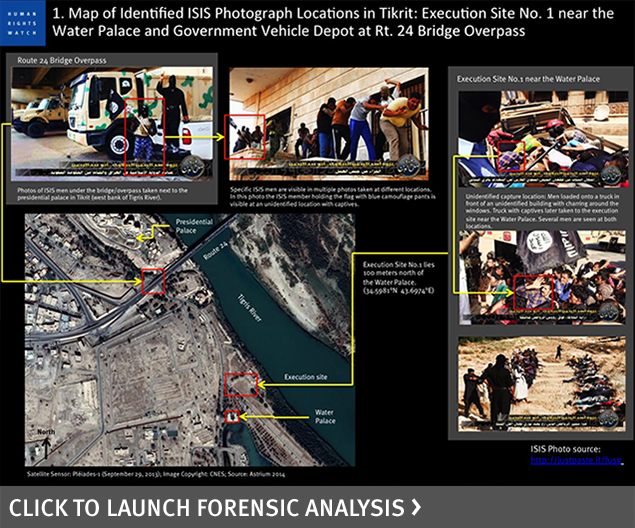
On June 12, ISIS claimed to have executed 1,700 “Shi’a members of the army” in Tikrit. Two days later, it posted to a website photographs with groups of apparently executed men. On June 22, Iraq’s human rights minister announced that ISIS had executed 175 Iraqi Air Force recruits in Tikrit.
“The photos and satellite images from Tikrit provide strong evidence of a horrible war crime that needs further investigation,” said Peter Bouckaert, emergencies director. “ISIS apparently executed at the very least 160 people in Tikrit.”
On June 12, ISIS first announced on its now-closed Twitter feed that it had “exterminated” 1,700 Iraqi troops. The same day, the group posted videos of hundreds of captured men in civilian clothes, who it claimed had surrendered at the nearby Iraqi Speiker military base. On June 14, ISIS posted roughly 60 photographs, some of which show masked ISIS fighters loading captives in civilian clothes onto trucks and forcing them to lie in three shallow trenches with their hands bound behind their backs. Some of the images show masked gunmen pointing and firing their weapons at these men.
By comparing ground features and landmarks in the photographs released by ISIS, Human Rights Watch established that two of the trenches were at the same location. By comparing these photographs with satellite imagery from 2013 and publicly available photographs from Tikrit taken earlier, Human Rights Watch located the site in a field about 100 meters north of the Water Palace in Tikrit – a former palace of Saddam Hussein next to the Tigris River. The location of the third trench has not been identified.
Human Rights Watch also reviewed satellite imagery of the area recorded on the morning of June 16. The imagery does not reveal evidence of bodies at the site with the two trenches, but does show indications of recent vehicle activity and surface movement of earth that is consistent with the two shallow trenches visible in the ISIS photos. Without visiting the site it is impossible to know if bodies are buried there or were moved.
On June 22, the Iraqi human rights minister, Mohamed Shia Sudani, said at a news conference that the bodies of some of the 175 air force recruits who had been killed were thrown into the Tigris River and that others were buried in a mass grave. A spokesman for the minister confirmed that statement to Human Rights Watch on June 23.
An Iraqi security official said that as many as 11 bodies of the executed recruits had been recovered from the Tigris River downstream from the execution site.
The execution photographs that ISIS distributed suggest that gunmen killed the men at the site in at least three groups. The photographs show one group of men lying in one trench and a second group of men lying on top of the first. A third group of men is seen lying in a second trench.
Based on a count of the bodies visible in the available photographs, Human Rights Watch estimates that ISIS killed between 90 and 110 men in the first trench and between 35 and 40 men in the second.
A preliminary review of the shadow length and angle in the photographs suggests the two groups of men in the first trench were possibly executed around 1:30 to 2:30 p.m. The men in the second trench were possibly executed around 2:30 to 3:30 p.m.
Photographs from ISIS show a fourth group of approximately 30 to 40 prisoners on, and later next to, one of the two transport trucks on the main road between the execution site and the Water Palace. The photos were probably taken later that day, between 4 and 5 p.m.
One of the photographs that ISIS distributed suggests that the group killed prisoners at a second site around the same time, but Human Rights Watch has been unable to locate that site. That photograph shows a large trench with between 35 and 40 prisoners being shot by at least 8 ISIS fighters. Based on the shadow length and angle, the photograph was probably taken between 11 a.m. and 1 p.m. One of the ISIS gunmen visible at that site was also visible in photographs from the killing site with the two trenches near the Water Palace.
The photographs and satellite imagery strongly suggest that ISIS transported its captives by trucks to the two killing sites. Human Rights Watch identified the same ISIS fighters and captured men in multiple photographs, including captives who were photographed in trucks and then again being unloaded from the same trucks next to the execution site at the Water Palace.
Human Rights Watch spoke with one man who said he fled Tikrit after the killings. The man said he watched from the rooftop of his home in the Hay al-Qadsia neighborhood in the late afternoon just after ISIS arrived as armed members of ISIS loaded hundreds of captured men onto trucks and drove them away:
I saw them with my own eyes. It was late afternoon. It was a long line. I saw about 10 armed gunmen with their guns pointed at the line of men, walking them to military trucks. Some of the gunmen had masks and others showed their faces. The [captured] men were not handcuffed. They wore civilian clothes.
The man said he did not know where the men took their captives and could not remember the exact date. Tikrit residents told him later they saw bodies floating in the Tigris, he said.
During an armed conflict, the murder of anyone not taking an active part in hostilities, including members of armed forces who have laid down their arms and those in detention, is a war crime. Murder, when systematic or widespread and committed as part of a deliberate policy of an organized group, can be a crime against humanity. Both war crimes and crimes against humanity are considered international crimes, with criminal liability attaching to those who commit or order the crime, but also those who assist, and commanders who should have known of the crime but fail to prevent it.
Human Rights Watch has previously documented serious crimes by ISIS in other areas of Iraq and Syria, including car and suicide bomb attacks in civilian areas, summary executions, torture in detention, discrimination against women, and destruction of religious property. The evidence documented by Human Rights Watch strongly suggests that some of these acts may amount to crimes against humanity.
“ISIS is committing mass murder, and advertising it as well,” Bouckaert said. “They and other abusive forces should know that the eyes of Iraqis and the world are watching.”
Dan JonesPreach on, Sister Enid.

Enid vs. The Blood of the Martyr
6/27/2014
Dan JonesThis is the best brief explanation of polygamy in the early church that I've ever read.
Gramps,
I was preparing a talk for church and read in a book called “Our Latter-Day Hymns” by Karen Lynn Davidson that Eliza R. Snow was married to the Prophet Joseph Smith while writing the hymn “Oh My Father”. That got me curious as I had previously thought that there was no confirmed plural wives of Joseph Smith Jr. and that even Emma had stated on her death bed that he was not a polygamist. So I got online and went to Wikipedia, looked up Eliza R. Snow and read some of her history. Then things got even more confusing. It says she married Joseph on June 29 1842 even writing fondly of Joseph “my beloved husband, the choice of my heart and the crown of my life, then later that year she started a petition trying to restore his virtue and denying that he was a polygamist. She even published a certificate denouncing polygamy and denying Joseph as its founder in October 1842. As we know later she married Brigham Young, as a plural wife or for time who knows. If it was for time wouldn’t that be against the whole argument of polygamy being to seal spouses so that they can qualify for the blessings of celestial kingdom? Eliza was one of the Relief Society presidents. Help me understand how a woman who obviously had inconsistencies could have been a leader in the church. Then there’s the whole Joseph Smith possibly being sealed to woman who were married to living men…I find this topic somewhat troubling because in my mind if the men and women who founded the church were living unworthily how could they have received inspiration from Heavenly Father. This is a very troubling topic for me and I can’t just ignore it.
Kandace
Dear Kandace,
Most of my current thinking and support about Joseph Smith’s plural marriages comes from the three volume set by Brian C. Hales entitled Joseph Smith’s Polygamy Vol 1-3. I wanted to give credit up front for these ideas. All references in support of the ideas given here could be found therein.
First, let me address the thought of no confirmed plural wives of Joseph. I think, if I understand you correctly, that you have correctly concluded that this is not true. There is a great deal of evidence supporting the fact that Joseph had plural wives.
Emma did claim in later years that Joseph was not a polygamist. We don’t know for sure what her motivations were. There are a variety of theories. But there is pretty solid evidence that she actually attended a few of Joseph’s plural weddings. There can be little doubt that she was very aware by the end of Joseph’s life.
When Eliza Snow produced a variety of means to “restore Joseph’s virtue” by way of petition and affidavit and the like, there was some pretty interesting stuff happening by way of the man John C. Bennett. Bennett came into the church and quickly worked his way up to become moderately close to Joseph and influential in the city. He actually became the mayor of Nauvoo. But he was not one of the faithful. We don’t know exactly where he got the idea, perhaps from rumors, but he started secretly introducing the idea of “spiritual wives” around the community. This concept was that a man could have spiritual wives that he was not married to in life, but he was free to have physical relations with them. In other words, it was an excuse for adultery. This led to all sorts of problems. John C. Bennett was eventually excommunicated for adultery, and he turned against Joseph and the church. He began to smear the prophet’s name with all sorts of accusations and publications.
The church went on the defense. Almost all of the literature produced at this time that seems to be anti-polygamy was a direct defense against John C. Bennett’s lies. It also needs to be taken into account that those who accepted plural marriage as God’s law would have believed it to be absolutely and completely virtuous. In short, Bennett claimed Joseph was an adulterer. Snow was defending Joseph.
Concerning Snow’s marriage to Brigham Young — almost all of Joseph’s plural wives (except the polyandrous ones) later married others who were ranking authorities in the church. This was Joseph’s desire. He wanted them taken care of. These marriages were generally time only, where they remained sealed to Joseph.
There is no “whole argument” that polygamy was to seal people to get to the Celestial kingdom. Polygamy is not a requirement for that. The only known purpose for polygamy is to build up seed unto the Lord. We can also presume that it was meant as a trial of faith.
Polygamy can be one of the most difficult things to understand from the perspective of our day. It is so culturally foreign to us, and often we cannot help but look at it through our 21st Century lens. Additionally, critics of Joseph Smith and the church like to approach polygamy with a pre-assumed motivation of lechery. They start from a position that Joseph Smith was sexually deviant, and all of their interpretations of events are informed by this opinion. If, however, one accepts that Joseph’s primary motivation was compliance with God’s will, then a different story emerges fairly easily.
For example, when we look at Joseph’s sealings to women who were married to other men, if we presume it a foregone conclusion that he had marital relations with these “wives” while they were also engaged in the same with their legal husbands, it can be confusing. That would make no sense from our understanding of morality, both culturally and religiously. However, if we look at the big picture there are different ways to look at it.
There is no concrete evidence of sexual relations between Joseph and his wives. Every evidence we have is by way of witness. First hand witnesses exist — meaning some of Joseph’s wives testified directly that they lived as man and wife in the truest sense of the word with him, as well as second hand witnesses — those who claimed Joseph had spent the night with one of his wives at their homes and the like. There are also third hand, hearsay type witnesses aplenty, but they are, obviously, less reliable.
What is interesting to note is that there are no first or second hand witnesses of Joseph being involved physically with any of his wives that were married to other men except two – and those two have explanations that involve things like their legal husbands having run off and left them, and the like.
Obviously this doesn’t prove anything, but it does present a different story especially when coupled with a few other interesting things.
For example, perhaps you are familiar with the famous angel-with-a-sword story. If not, here’s a quick recap. An angel with a sword (perhaps flaming) appeared to Joseph and commanded him to live polygamy or he would be destroyed. The thing is, the third appearance of this angel (the time where he had the sword and threatened) was actually after Joseph had already married several polygamous wives? Seems odd, right? But not if we understand that the sealings that had taken place before that were to women already married to other men, with a good indication that they were only “eternity” sealings and not “time” marriages. It seems that perhaps Joseph, in struggling to comply with the principle, and in a potential effort to comply without hurting his wife Emma, may have joined into sealings with women who were married to other men in order to not have the need for physical relations with them, and in order to appease Emma’s difficulty with the concept.
As you can see, the story of polygamy is not a simple one. We want it all wrapped up and tied into a pretty little bow. But it is complex, and understanding it, even to the limited extent that we can, takes a great amount of learning and understanding. Even if we do the level of research that Brian C. Hales did for his books, we still do not have a complete picture. We have to fill in the blanks a bit. It really comes down to this. Joseph was either a prophet or he was not. He either did as he was commanded by God or he did not. If we believe he was a prophet and did as commanded then we can let the things go that we do not understand, trusting that someday we will. So it is with Eliza R. Snow. We cannot fully understand her. We don’t have the complete picture. We can surmise based on the information we do have, and we can interpret that information based on our belief concerning the truthfulness of the restored gospel. What we do know is that Eliza R. Snow remained a faithful member and stood strongly in support and defense of Joseph Smith throughout her life.
For more insight in it, read the article on lds.org, Plural Marriage and Families in Early Utah.
Dan JonesI've said it before, but nerd girls get the best clothes/accessories.

This Konami Code necklace is the perfect jewelry for gamers. The code is formed out of 3mm mirror acrylic with the code engraved on the back. Each piece measures about 3/8″ across and the chain is 18″ long with a magnet clasp in the back.
See more pictures after the break.


Product Page ($22.99 Geekymerch via Boing Boing)
 One of the biggest surprises at I/O 2014 was Google's plan to bring select Android apps to Chrome OS later this year. Which apps? That’s entirely up to you.
The post Google Asks Users What Android Apps They Want on Chrome OS First appeared first on OMG! Chrome!.
Dan JonesWe love you, T-Rex, insecurities and all.

T-Rex was the most insecure of all the dinosaurs.

06.26.14
As the world held its breath during the Cold War, England built a top-secret underground city to save its government in case of nuclear attack. For half a century, "Burlington" lay ready.
In case of nuclear disaster: stay calm and carry on…living underground.
In 1956, the British government began building a sprawling subterranean city two hours from London underneath the ancient, 13,000-person town of Corsham. If the nation was struck with a nuclear bomb, 4,000 government employees would be shuttled via a secret train line from downtown London to a blast-and-radiation-proof bunker code-named “Burlington”. From these emergency government war headquarters, as they were designated, Britain could resume governing while the world above burned.
The secret word for this evacuation was “orangeade,” a 1962 copy of the Cabinet Office’s War Book revealed in 2011. The code would also be told to security agents guarding the site. "Advance parties going to Burlington would be kept to a minimum and every effort would be made to maintain the cover story,” the document explained. From Burlington, the assorted agencies could plan their next moves. “The chiefs of staff will be ready to make recommendations on the use of the nuclear retaliatory forces based in the UK."
After its completion in 1961, the accommodations constructed 100-feet underground would not have made for an entirely claustrophobic existence. The 35-acre bunker had two canteens, four residential areas, a bakery, hospital, library, and a VIP suite, according to a map of the facility. There even was rumored to be a pub called Rose and Crown that was modeled after Whitehall Street’s famed and favored Red Lion bar.
With these amenities, inhabitants could live for three months without having to emerge into the chaos above ground, the Ministry of Defense predicted. Burlington was replete with 60 miles of roads—labeled with American street names like Main Street and First Avenue—that were navigable by battery-powered buggies. It had an underground water treatment plant, a power station, Britain’s second-largest telephone exchange (with updated directories maintained until the late ’80s), and a system of pneumatic tubes that hurled messages throughout the complex. The climate was set to a comfortable 68 degrees.
A BBC studio was constructed to be manned by 11 employees who, at the hour of attack, would stop normal programming and switch to “Wartime Broadcasting Service”. The station’s staff would assist then-Prime Minister Harold MacMillan in addressing the country. MacMillan and his family would be brought in by helicopter to the complex, where they had the only en-suite bathroom in their whitewashed room.
The only potential hiccup in this grand plan was that very few people knew of the bunker’s existence. Not the BBC employees pre-selected for the station, nor the majority of the government staffers who’d be living there.
The site of Burlington, or Site 3, as it later came to be known, was a former stone quarry that the government began converting into an underground factory in the 1940s. At the end of World War II, the factory closed, and the space was used for storage. As the government began concocting this worst-case scenario plan, it kept an eye out for a secure location and soon decided to use the former factory as an alternate seat of power in case of war. The area was already filling with military personnel: census records show that between 1931 and 1951, the population nearly tripled due to a large army base.
As the Cold War died down and nuclear destruction never came to fruition, the underground complex slowly slipped into disrepair. After a quarter-century of disuse, part of the bunker was converted into a “nuclear reporting cell,” again a response hub in case of an attack, which held a staff of 50 to 100, but was never actually put to use. In 1991, following the fall of the Soviet Union, when the entire site was decommissioned after the government voted against a £40 million site upgrade.
“For nearly half a century, it was ready to serve Britain at a moment's notice, waiting at attention like a dutiful agent of the crown.”
Long speculated to be a UFO research center, Burlington has been the subject of rampant conspiracies for decades. Subterranean explorers puzzled over the mysterious red door that cut off access to underground tunnels leading to the bunker. But the true nature of its existence wasn’t revealed until 2004, when it was declassified by the government. The fully stocked bunker was still intact—with stores of linens, “Top Secret” stationary, pots and pans, outdated technology, and toilet paper—and a staff of four maintenance men.
In 2005, it was put up for sale and received a number of eager bidders, but was taken off the market for reasons unknown. Today, the mysterious world underneath the sleepy town of Corsham still hasn’t been opened to the public and continues to breed mystery.
Online, commenters seeking a way in or claiming to have visited the site propagate stories about the Cold War bunker. A lucky few have gotten to explore it for themselves. “Plates & cutlery all laid out make this area look like it’s ready to be used at the drop of a hat, or as if previous inhabitants just upped and left,” a group of urban explorers writes of a 2010 visit. Another, a member of the Royal Air Force, remembers visiting in 2006 and recalls “the supply store was like going back in a time capsule.” The whole place, he says, was “like a James Bond film set.”
Unlike Bond, constantly thwarting Soviet villains, Burlington never got a chance to flex its muscle. But for nearly half a century, it was ready to serve Britain at a moment's notice, waiting at attention like a dutiful agent of the crown.
comments
Android Wear is now the new thing, with three new devices shown off at Google I/O. In fact, two are already on sale in the Play Store! If you want to pick up a Samsung Gear Live or an LG G Watch, you’re now able to, after doing some research of course. However, is your phone compatible with Android Wear watches?
It’s easy to find out. Just open up your browser on your device and head to g.co/WearCheck. This official site will tell you if your device will be compatible. But if it features Android 4.3 Jelly Bean or higher, it’s compatible and you don’t have to worry. Go out and buy that new smart watch.
Would it surprise you to know that the company that brought the world the very popular Apples to Apples game,
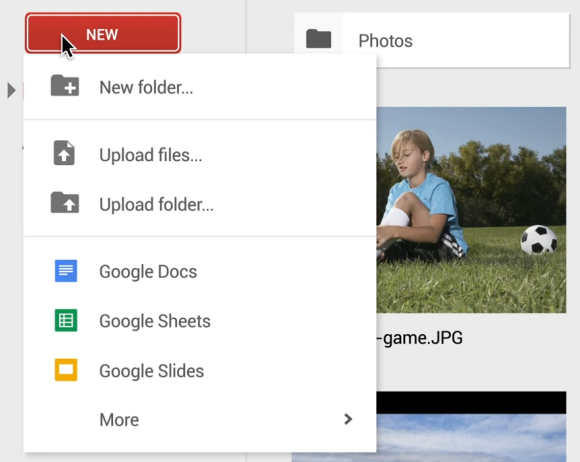
There are a lot of changes in Google Drive for both the web apps and the mobile apps. Google Drive has a new desktop interface that will roll out in the coming weeks. The updated UI includes a unified "New" button for both creating new documents and uploading files, a streamlined grid view, a list of recently used folders, an incoming view that shows the files that have been shared with you, a simplified toolbar, better ways to select files, a new look for the "details and activity" sidebar and more. The new Google Drive is faster and more consistent with the mobile apps. It's also "much more accessible for blind and visually impaired users. The new Drive includes improved keyboard accessibility, support for zooming and high contrast mode, and better compatibility with screen readers."



This comic is a day late because Ray punched the wrong date into the time machine. You’re lucky it was just the day field that was off by one. Comments welcome on Facebook.
Dan JonesWe can just drop "phone" and refer to them as "cells." They do still use cellular technology, after all.
I do like "Handy," though.
The phones are the least exciting things about them.
 This is a texting machine, not a phone. Photo: Shutterstock
Last week, when Amazon CEO Jeff Bezos took to a Seattle stage to announce a new smartphone called the Amazon Fire, he spent an hour and a half describing feature after feature: unlimited photo storage, 24/7 video support, 13-megapixel camera, a 3-D-like "dynamic perspective" display, a visual-recognition shopping button called Firefly, and dozens more bells and whistles.
But there was one question Bezos left unanswered about his new device's feature set. Namely: Could it, you know, make phone calls?
Several years ago, Bezos's neglect of the Fire's phone capabilities would have seemed like a huge, glaring omission. (Remember the raging debate over the iPhone 4's poor reception?) But these days, smartphones are phones in name only. For many of us, the green, phone-shaped icon on our home screens has become just another minor feature – like a stopwatch or a stock ticker. And for others, it's completely irrelevant.
“I haven’t made a phone call on my phone in a long time,” Bezos later told the Times. “But I know people still make phone calls.”
Not so much. In fact, the use of voice calls – which has been dropping since 2007, the year Apple introduced the original iPhone – has fallen off a cliff lately. As of last year, cell providers in the U.S. are now making more money per user from data use than voice calling. (The U.S. is only the seventh nation to reach the data-voice tipping point — it happened in countries like Japan as early as 2011.) A recent survey of 7,000 U.S. high-school seniors found that only 34 percent made phone calls every day — far fewer than the number who texted or used apps like Snapchat, Facebook, and Instagram. And companies like AT&T and Verizon, which saw the data boom coming years ago, have been spending more and more on new, bigger LTE data networks, while essentially giving away their voice plans for free.
 Graph courtesy of Chetan Sharma Consulting
In the app age, old-fashioned phone calls have become not only passé, but ominous. Today, when I get a call outside of work hours, I think: Who died? Who's trapped on a mountain? What awful global calamity is unfolding? I use apps and text messages for everything – ordering dinner, hailing cabs, telling friends I'm running late – and I rarely check my voice mail. I don't have any friends who regularly call me; even my parents have switched to texts.
All of which raises a question: Why are we still calling these things phones?
This isn't just a semantic issue. It's a marketing one. Wireless companies want us to think of our rectangular gadgets first and foremost as phones, since what their plans give us in the phone department (unlimited minutes and texting, on most carriers) is much better than what they give us in the data department (tiered caps on data use, with charges for overage). In fact, these companies make millions of dollars a year from our tendency to overestimate the number of calls we'll make in a given month, and underestimate the amount of data we'll use.
For example, take my case. For several years, I paid about $100 a month for a phone plan that gave me 900 minutes per month and allotted me two gigabytes of data. That suited me fine – I rarely went over my allowances – but this year, I found a "loyalty" plan from Verizon that cost only $60 a month, and had unlimited talking and texting with the same two gigabyte data cap. Great news, right?
Not exactly. Like most Americans, my data use has skyrocketed – from less than two gigabytes a month to more than five gigabytes on average – and as a result, I end up spending $30 or $40 each month on overage charges. The upshot is that I'm still paying Verizon about $100 a month to use my phone, even though I nominally have a better, cheaper plan. And if I wanted a plan with a bigger data allotment, I'd have to pay much more – in fact, at my current levels, it costs less to pay the penalties than move up a notch.
I'm not alone in my frustration; a 2013 study by Cisco estimated that, by 2017, the average North American mobile user will use six gigabytes of data per month. It's not wrong, necessarily, for carriers to charge more for all that extra data, which taxes their networks in a way voice calls don't. But it is opportunistic of them to encourage us to focus on the bold print in smartphone plans – the "unlimited talk and text" part – while distracting us from the more important matter of how much data we're allowed to guzzle before we're charged extra. (An exception among big carriers is T-Mobile, which doesn't charge data overage fees, though it does slow down users' data after they exceed their plans.)
Regardless of its implications on wireless carriers, it's odd to refer to these vast, all-encompassing gadgets merely as "phones." It would be like calling a car a "radio box," or a microwave a "popcorn maker." All smartphones can make calls, sure, but what makes one device different from another is how well it can do everything else.
So let's call these devices something that more accurately reflects how we use them. One idea would be to take a cue from the British and start referring to them simply as "mobiles." We could even call them "Handys," as the Germans do, or "mini-tablets," which is essentially what they are. Or we could coin another neologism, like "pocket computer." ("Pock-comp" for short.)
All of these words sound more awkward to our unaccustomed American ears than "phone" or "cell phone." But they're better descriptors of what these devices are. And when we accept the fact that our iPhones are being used for apps, rather than calls, perhaps providers will be convinced to create more customer-friendly data plans. Now that would be news worth calling home about on your mobile, Handy, or pock-comp – if you can still remember how, that is.
Dan JonesI don't think Kanye West knows how trees work.
Kanye West is many things: a father, a rapper, a fashion designer, but sometimes he is also a seagull or a woman’s brooch. We here at Nerve operate under the assumption that every batshit, overreaching thing Kanye says about himself is true. The following list compiles every rapper, artist, entrepreneur, flora, fauna, or brand Kanye has confirmed that he is or is like, so far. We look forward to continuing to follow Kanye on his journey to expand this list to encompass every great person, animal, or mineral that has ever existed.

“Yeah. I love the fact that I’m bad at [things], you know what I’m saying? I’m forever the 35-year-old 5-year-old. I’m forever the 5-year-old of something.”
- The New York Times, June 2013

“I made that song because I am a god,” he says finally. He laughs for a second, then stops. “I don’t think there’s much more explanation. I’m not going to sit here and defend shit. That shit is rock ’n’ roll, man. That shit is rap music. I am a god. Now what?”
- W Magazine, June 2013


In a special message to Nike’s CEO, he is the polarizing King of Pop Art: “Mark Parker … I will still accept an investment in DONDA. I’ve got some more ideas that don’t involve shoes [so] if you guys are investing in the arts I am standing up and I’m telling you. I. Am. Warhol. I am the number one most impactful artist of our generation, in the flesh.”
- The Wake Up Show, SiriusXM Radio

“I’ve been connected to the most culturally important albums of the past four years, the most influential artists of the past ten years. You have like, Steve Jobs, Walt Disney, Henry Ford, Howard Hughes, Nicolas Ghesquière, Anna Wintour, David Stern.”
- The New York Times, June 2013

“Cause it’s like, ‘Yo! Nobody can tell me where I can and can’t go. Man, I’m the No. 1 living and breathing rock star. I am Axl Rose … I am Jimi Hendrix.’ You can’t say that you love music and then say that Kanye West can’t come to your show! To even think they could tell me where I could and couldn’t go is just ludicrous. It’s blasphemous—to rock ’n’ roll, and to music.”
- W Magazine, June 2013


“I am flawed as a human being… but my music is perfect,” he declared, adding: ‘You could go back to Beethoven and s***, but as far as this lifetime, though, this is all you got.”
- concert in New Jersey, 2012

“After I live, I wanna be compared to Big, any one: Big Pun, Big L, or Notorious,”
- from “The Glory”


“Bruce Springsteen dropped this album called Nebraska and right after that he did Born in the U.S.A. This next one, I have a feeling, because of what we did right now, has to be Born in the U.S.A.“
- Power 105.1 interview, 2013


My niche is that I’m the funny version of Dead Prez,” West says. “I’m the rap version of Dave Chappelle. I’m not sayin’ I’m nearly as talented as Chappelle when it comes to political and social commentary, but like him, I’m laughing to keep from crying.”
- Rolling Stone, 2004


“I ain’t going after no one on the radio. I’m going after Shakespeare. I’m going after Walt Disney. I’m going after Howard Hughes. I’m going after David Stern. I’m going after Henry Ford. I’m going after Elon Musk,”
- Bonnaroo, 2014

“Yeah, I got beat up. It was like a modern day Internet version of Emmett Till.”
- Hot 97 radio interview, 2010


“I am in the lineage of Gil Scott-Heron, great activist-type artists. But I’m also in the lineage of a Miles Davis — you know, that liked nice things also.”
- The New York Times, June 2013


“I walk through the hotel and I walk down the street and people look at me like I’m fu**ing insane, like I’m Hitler. One day the light will shine through and one day people will understand everything I ever did.”
- Big Chill Music Festival, 2011


“Like my idol Jim Morrison, like his approach to shit — When I see, like, a documentary; I’ve seen the movie — I’m like, ‘Yo, that’s really who I am. I am this guy in real life.’“
- W Magazine, June 2013

“The reason I thought [my life] was like The Hunger Games as this idea all these contestants over the years that have won, and they’ve all been quiet, and there’s this one that won that wanted to turn up, and that’s what I felt like.”
- Madison Square Garden concert, 2013

West promised to “bring you the best I have to offer with the same dedication that Kobe has on the court”
- from his now defunct blog

“You like Piña Coladas, gettin’ caught in the rain/ Or rockin’ flannels all summer, like Kurt Cobain”
- from “White Dress“


“I’m Kan, the Louis Vuitton Don. Bought my mom a purse, now she Louis Vuitton Mom”
- from “Last Call“


“I’m fly like the Malcolm X, buy any jeans necessary, Detroit Red cleaned up,”
- from “Good Morning”

“I want to show you that this is the type of imagery that has been presented to all of us, and the only difference is a black dude in the middle of it … I’m like Marina Abramović. This is like performance art.”
- On Jay Z’s favorite dancing partner/performance artist, in defense of the “Bound 2″ video.


“IT’S FUNNY HOW SO MANY RAPPERS GET WORSE AS THEIR CAREERS STRETCH OUT BUT TRUE POETS GET BETTER,” he writes, “WE WILL FOLLOW IN THE FOOTSTEPS OF MAYA ANGELOU, GIL SCOTT HERRON (sic) AND NINA SIMONE.”
- from his now defunct blog

“I would not be Kanye West if it wasn’t for Michael Jackson…I was able to ascend to massive heights. And I’ve got to a point that Michael Jackson did not break down. I have reached the glass ceiling, as a creative person, as a celebrity and I’ve been at it for ten years.”
- BBC Radio Interview


“If Michael Jordan can scream at the refs, me as Kanye West, as the Michael Jordan of music, can go and say, ‘This is wrong’”
- The New York Times, June 2013

“I had a dream that I was The Wright Brothers. I had a dream that I was Thomas Edison. I had a dream that I was Mandela. I had a dream that I was Martin Luther King. I had a dream, I had a dream, I had a dream. I had a dream, I had a dream. And I’m not afraid to dream out loud.”

“I’m just going to give y’all the truth and you’re going to learn to love it. My grandfather loved Ali until he died, and my grandmother hated Ali till she passed. You are going to love me, or you’re going to hate me, but I’m going to be me.”
- Jimmy Kimmel Live, 2013


“I don’t know if y’all have heard of Nikola Tesla, and I’m not talking about the car, I’m talking about the inventor. Or if y’all ever heard about Alejandro Jodorowsky, the director who made Holy Mountain. But there’s so many amazing creative inventors who weren’t recognized in their time.”

“I will be the leader of a company that ends up being worth billions of dollars, because I got the answers. I understand culture. I am the nucleus.”
- The New York Times, June 2013

“No matter how they try to control you, or the motherfucker next to you tries to peer pressure you, you can do what you motherfucking want. I am Picasso.”
- concert in Paris, February 2013


“They always say, ‘Kanye keeps it real, boy,’ Pinocchio’s story is ‘I just wanna be a real boy’,”
- from “Pinocchio Story”

“No one is looking at what [Barack Obama] is wearing. Michelle Obama cannot Instagram a pic like what my girl Instagrammed the other day.” – On Air With Ryan Seacrest, 2013


“Prince William’s ain’t do it right if you ask me. Cause I was him I would have married Kate & Ashley”
- from “Niggas In Paris”

“When you think of Polo, you got the story that Ralph Lauren is giving you … you think about the pictures of him and his wife [and] all the ads he puts up. You think about an urban line and it might just be a picture of someone standing in front of a car. It’s not a good story. The greatest story is Christianity, the Bible. That’s a deep story that can last forever. Ralph Lauren tried to create his own Bible, and the reason … I’m going to be the next Ralph Lauren is that everyone is looking at my story now. I can hate the paparazzi all I want, but they’re telling people the story.”
- Art Basel, 2013

“Even a Rick Owens has compromised. You know, even a Kanye West has compromised. Sometimes you don’t even know when you’re being compromised till after the fact, and that’s what you regret.”
- The New York Times, June 2013


“I’m just giving of my body on stage… I’m putting my life at risk. This is like being a police officer or war or something. You’re literally going out to do your job every day knowing that something could happen to you… verbally, from the press bashing you, something could happen to you from people not liking you anymore… [or] you could actually slip on that stage.”
- SaturdayNightOnline.com, 2013

“Who knew she was a drama queen that would turn my life to Stephen King’s?”
- from “RoboCop”

‘Have y’all ever seen Wreck-It Ralph? You remember how that girl in there—the people that was racing? She was the glitch. You’re telling me they don’t look at me like the motherf***ing glitch? You’re telling me people don’t look at Kanye West like the glitch? Right now. She was on the side of the video game, the whole time!’
- BBC Radio 1 interview, 2013

“We were sort of like Will Smith and his son, in the movie – I ain’t talkin’ ‘bout the rich ones,”
- from “Champion”

“I am Shakespeare in the flesh. Walt Disney. Nike. Google. Now, who’s going to be the Medici family and stand up and let me create more? Or do you want to marginalize me till I’m out of my moment?”
- Sway in the Morning radio interview, 2013

“I want to be as unrealistic as possible. The worst thing about me comparing myself to Steve Jobs in that it’s too realistic of an idea. What I need to say is I’m more like Willy Wonka.”
- 92.3 NOW radio interview, 2013
Ok, so it was a marathon. Google announced a bunch of stuff today, but it was a true developers conference. Lots of nerdy, wonky stuff in here. We tried to highlight the biggest bits. Let’s get to it:
- This is interesting! Google just announced a smartphone system to get phones into under-served populations. Will cost under $100 and will be available in India this Fall. Android comes standard.
- Android One creates hardware models that other manufacturers can use to build their phones. The idea is to build solid Android devices at realistic costs for the developing world. Individual manufacturers will also be able to build their own apps on the standard Android device.
- As Apple popularizes “flat design,” Google goes the other way: “material design,” with drop shadows and other depth effects.
- Rich animated touch feedback. You get a ripple effect and some other small animations that make the experience feel a bit more fluid. It’s not a huge change, but Google was really pushing it as a breakthrough.
- Big emphasis on notifications: We’ve been saying it for months — the lock screen is the new homescreen. Many of us waste minutes a day fiddling with the pin unlock - now Google has a personal unlocking function to determines if it’s in a trusted users’ hand, by detecting your Android smartwatch. That’s pretty handy, but only if you HAVE a smartwatch.
- Google touted performance: Improved graphics, enhanced battery life — you can extend your battery life by 90 minutes — and there’s a new battery saver mode.
- Google shows off the LG G Watch, which has an always-on display.
- According to Google, people check their Android phones an average of 125 times every day. With this in mind, the whole point of the smartwatch is to get what you care about on the watch screen while cutting down on the number of times you have to check your phone. Trade obsessively checking your phone for obsessively checking your wrist. Progress! Innovation!
- Just in case you don’t want to be bothered every nine seconds, you can set the watch to ‘do not disturb’ with one touch.
- Google Maps will have turn-by-turn directions. Which is actually pretty great. Maybe the one true convenient use for a smartwatch.
- Voice actions will now be available for more and more apps, which could be nice, though I can’t imagine myself wanting to talk to my hand on a busy street corner.
- You can order a pizza in under 20 seconds…because if humanity needs anything, it’s quicker access to pizza.
- You can also use voice dial integrated with the driving service Lyft to immediately call a car. Look for Google to integrate even more developer partners and companies into this type of service. (Uber, for example, is already integrated into the Google Maps app.)
- You can plug in, put your phone down and use the car controls to control your phone. You can bring your Google ecosystem with you into any car. Since the software is on your phone and not in your actual vehicle it won’t go obsolete as quickly.
- The Maps integration is super handy…and voice-enabled, which makes sense.
- Auto will push text notifications to you via voice — it’ll be available to other messaging services too. Get ready to be compelled to respond to Facebook messages, Kiks, WhatsApps, Tweets, and Gchats in your vehicle. No place is safe!
- Android auto experience will be available later this year.
- Google is really pushing its Android TV voice search - which works pretty well on stage to find out some info about Breaking Bad cast members, but if past experience is any guide (cough, Xbox One, cough), it’d probably just be easier to use a remote.
- It looks a lot like Amazon’s Fire TV, which is also run on Google’s Android software. Android TV’s user interface looks a lot like most streaming tv set top boxes, so users shouldn’t be too confused.
- Android TV can also double as a streamer for the Cast feature so users can search for things on mobile or in Chrome, then beam it up to the TV.
- You can control it with your smartwatch, which, in all honesty, sounds like a user experience nightmare.
- And, this is big: the entire 2015 HD and 4K smart TV lines from Sony, TP vision, Sharp and Philips will run on Android TV. It will come out in the fall.
- Chromebooks are making a real play at the laptop market so moves here are pretty important. Google vanity stat: Ten of the top ten highest-rated laptops on Amazon are Chromebooks.
- That’s why Google is integrating the mobile OS with Chromebook’s OS. Similar to the stuff we’ve seen from Apple integrating iOS.
- Google is also isolating personal and corporate data with secure separation, so you don’t need to carry around two separate phones.
- Google Drive has 190m MAUs, up 85% in last year.
- Google Slides is coming to Android, and Drive will be more collaborative.
- While Microsoft boasts roughly one billion office users, Google touted some solid enterprise stats: 67 of the top 100 startups opted for Google Drive, as well as 58% of Fortune 500 companies and 72 of the top 100 universities.
- This I/O we got a new Android operating system, Android TV, a car integration system in Android Auto, some major plays at making smartwatches ‘a thing’ (unlikely because they look kinda ugly), and major integrations between desktop operating systems and mobile operating systems. Much like Apple’s WWDC conference, its a good example of the major tech companies drilling down and keeping you happy inside their ecosystem. Stay in the family and you will be rewarded.
Dan JonesI am excited to get one. I wonder if an Android TV set top could replace my XBMC box, or if I'll end up installing XBMC on it?
What this article failed to mention, that was mentioned in the keynote address was that all the new 4K TVs from the big manufacturers will all be Android-powered. Very cool. I may just hold off on getting an Android TV set-top box, and wait until I'm ready to get a new TV with it already built in.
Following last year’s home run with the Chromecast, Google is taking Android into the living room with Android TV. Not to be confused with Google TV, Android TV is a version of Android designed to easily use the TV with an emphasis on search and gaming. Not only can Android TV be built right into the TV itself, but it can also come through set-top boxes.
Android TV takes full advantage of the huge screen that’s available with a TV. Big, beautiful content is front and center, making it viewable from a distance. The experience is simple and smooth, and navigation can be controlled either by voice or by a connected device such as a smartphone, smartwatch, or laptop. Content is the highlight, with partners in big names like Netflix and Hulu as well as Google’s own services, allowing for tons of movies, TV shows, and music to be available through Android TV.

Search is a key part of Android TV with the search being intuitive. One can simply say the name of a TV show to have it pop up with options for watching; as well as the cast, similar shows, and more. But search is bigger than that, by allowing you give a query such as, “Oscar nominated movies from 1995″ and Android TV will immediately bring up an entire list with watching options.
Google Play Games is coming to Android TV, allowing you to game with your device on the big screen. Android TV devices will come with a controller for better gaming performance and the demos at the keynote have been impressive.
Partnerships with manufacturers like Sony and Sharp have been announced to help design TVs with Android TV built in. Razer and ASUS were both announced as partners currently working to create set-top boxes primarily for gaming, increased by the new graphics abilities in Android L.
The Chromecast hasn’t been left out, with some new features coming. The first is Backdrop, that allows your TV to basically act as a giant screensaver that can display high-quality photos, pieces of art, or things like the weather and news. Next up is the fact that devices not connected to your Wi-Fi network can still connect to your Chromecast, allowing your friends to quickly throw things up from their devices.
The final feature of the Chromecast is the biggest and that’s the fact that you can now mirror your Android phone or tablet to the Chromecast in real time. Google developed an entirely new protocol to reduce the latency enough to make it so that the delay is nearly unnoticeable. This allows you to use your Chromecast, and in turn your TV, as a wireless display for your phone or tablet, allowing for more immersive content. Not all devices are supported yet, but more are on the way and most popular Android devices should be supported by the release date.
The new Chromecast features will be rolling out later this summer.
At Google I/O 2014, Google introduced its new initiative called Android One. Android One is a set of reference designs for OEMs to use to create high quality, low cost smartphones for emerging markets. Android One smartphones will run stock Android and receive automatic updates straight from Google. This will allow for a quality experience across Android One devices.
The program will launch in India, with other countries following. Google showed off an Android One device from Micromax, which features a 4.5-inch display, dual-SIM support, microSD card slot, and FM Radio. Android lead Sundar Pichai has been using the device and said that it’s a pleasure to use. The best part? The device costs less than $100 making it extremely affordable for developing markets. Alongside Micromax, Karbonn and Spice will also be creating Android One devices in India.


