Ok, so this isn’t a “Text from NASA” but it’s NASA tweeting William f-ing Shatner, and that’s cool.
Ok, so this isn’t a “Text from NASA” but it’s NASA tweeting William f-ing Shatner, and that’s cool.
Dan JonesThis is awesome.

Chris Pratt has been making the press rounds for Guardians of the Galaxy (it’s out today, by the way), and when he talked with Panzer TV, he revealed that the stole his Star-Lord jacket from set. He didn’t do it for selfish reasons; he swiped the costume piece because he thought it might be valuable to a sick kid later. MTV News transcribed Pratt’s words:
“I stole the jacket and some of the wardrobe so that, if this movie comes out and does what everyone hopes it can, I can follow the example of someone — say, like, a Russell Wilson [Seattle Seahawks quarterback] — and go visit kids…
If it was a big enough movie to where it would mean something to a kid who’s sick in the hospital for Peter Quill or Star-Lord to come visit them, I’ll do that. I think that’s awesome, man. That would give me real meaning for this movie, you know?”
Insert a collective, “Awwww,” here.
Watch the interview after the break.

Offered without interpretation. Though in the process a thought I had once did return to be which I made into a Wondernode post (warning, this is a serious thought and contains no humor–proceed at your own risk). As always, comments on (well you guessed it) Facebook, are welcome.
We are excited to announce that the media center software we’ve all loved for so many years will have a new name, starting with version 14. Instead of XBMC 14, we’d like to introduce you to Kodi 14.
Since 2002, the software known as XBMC has gone through three namings. First, it was called Xbox Media Player. Upon realizing that it did a bit more than your traditional media player, in 2004 the development team elected to rename it Xbox Media Center. A mere 4 years later in 2008, the team once again elected to rename the software to simply XBMC, given that it had moved on from its original roots on the Xbox. Support for the Xbox was dropped shortly thereafter. Today it’s all happening one last time.
Six years have passed since the Xbox Media Center became XBMC, and simply put, “XBMC” fits less now than it did even in 2008. The software only barely runs on the original Xbox, and then only because some clever developers are still hacking on that platform. It has never run on the Xbox 360 or Xbox One.
Furthermore, while the software still acts as a media center, it also hosts addons, loads games, streams content to and from numerous devices, and can ultimately act as a complete replacement for whatever platform it is hosted on. Indeed, XBMC today is far more an Entertainment Center than a simple Media Center.
In essence both the “XB” and “MC” simply don’t make a whole lot of sense any more.
Beyond the nonsensical nature of the software’s name, there is a secondary issue. Because “XBMC” was originally based on the name Xbox, the developers of the software (that’s us) have never had any sort of legal control over the use of its name, which has resulted in a whole slew of problems.
In the past few years, we have seen the mass confusion that resulted from this lack of control first hand. Users have been fooled into wasting money buying boxes running hacked and typically broken versions of XBMC. News sites and blogs have gotten caught in confusing language numerous times. Unrelated fan communities, often founded under the best of intentions, have found themselves under attack, simply because no guidelines existed to simplify the process of clearly distinguishing themselves from the XBMC Foundation. What’s more, the Foundation itself and all of its developers have always operated under a potential legal threat from other companies that did have a legal trademark in a similar name. And that legal threat has actually gotten more problematic in recent years.
Because all these problems have been getting more and more pronounced, the Foundation decided to review its options with the help of the legal team at the Software Freedom Law Center. In the end, it was decided renaming the software that we all love so much was the most realistic solution. We’ve done it twice before. We believe this time Kodi will be the name we can keep forever.
The average user will see little difference with the new Kodi. The software will remain the same. Users will get to keep using the software however they like. The code will remain licensed under the GPL 2.0. We even intend to stick with our current numbering scheme. Our next release will be titled Kodi 14. Indeed, the most significant difference for most people will be a slightly altered splash screen on boot up.
For companies, fan sites, and add-on developer sites, this name change should actually make work substantially easier. The XBMC Foundation has elected to wholesale adopt the policies of the Mozilla Foundation with regards to distribution and trademark licensing. For more information for web hosts and hardware vendors, see our Trademark Use FAQ (currently a work in progress). Simply put we are happy to remain incredibly permissive with the 3rd Party use of the Kodi name, so long as that use doesn’t confuse other users and the community. The FAQ and Trademark Policy should help you navigate exactly what “confusing” means to us.
 Because of your generosity in t-shirt sales, straight-up donations, and word-of-mouth evangelizing, this project has lasted for 12 years and through four different names, and with your help, we all believe it can last twice that long again. So we figured we’d offer a t-shirt to commemorate the name change.
There’s only one thing. The image at the top of this article is not the final logo. We are working with doghousemedia to truly realize an awesome logo, and we aren’t quite there yet.
So instead of offering a bit of swag with the new name, we figured we’d offer the exact opposite. This is it. The last XBMC shirt or related piece of merchandise we’re ever going to sell.
There’s still a long ways to go in the renaming process. A ton of code has to be changed to reflect the new name. So many websites, webpages, social networks, and other things have to be updated. Much of the trademark legalese needs to be reviewed by the lawyers and government officials. The logo has to be finished. Needless to say, the upcoming Kodi developers conference this year is certainly going to be intense as we work through these issues. But we believe that with your support and the support of the whole community, Kodi, the media center or entertainment platform or whatever you choose to call it that we’ve all come to love will be even stronger than it was before.
Thank you all for your support, now and in the future. In the comments below, we’d love to hear your thoughts, whether they be about how you first discovered XBMC/Xbox Media Center/Xbox Media Player, or about what you think of the new name.
As a bonus, you can grab the first Kodi 14.0 “Helix”alpha2 build from our download page. The complete feature and changes list will follow in several other announcements. Going more in depth on all changes.
Today around noon, Facebook went down. The earth kept spinning, shockingly, but Facebook was unavailable. For some users, it would not load at all. For others, it showed the ominous message, "Sorry, something went wrong."

In the second quarter, Facebook had posted revenue of $2.91 billion. The second-quarter lasts 90 days, from April 1 to June 30. That's $32,333,333 a day. That's about $1,347,222 per hour. That's $22,453 per minute. Not too shabby. It looks like the outage lasted from from about 12:08 p.m. to 12:27 p.m.. So for the 19 minutes no one could use it, Facebook just lost roughly $426,607.
Considering how much Facebook earns every day, it is a tiny hit, but nonetheless, not too many companies can lose almost half a million in less than a half hour.
On the other hand, Twitter jumped:
Facebook's last outage, which was overnight this past June and lasted about a half hour, also cost the company about half a million dollars.

Dan JonesSo, like Picasa Web, which is, in fact, still a thing?
 Is 'Google+ Photos' is to be made into a standalone product free of any requirement to use Google's social networking service? That what some sources are claiming.
The article Rumor: Google+ Photos To Become Separate, Standalone Service was first published on OMG! Chrome!
Dan JonesI got an email from the White House about this yesterday, because this was the direct result of a White House petition I signed a year ago.
Consumers in the US should soon be able to legally unlock their phones for use on other wireless networks. The House of Representatives unanimously passed a bill this afternoon legalizing cell phone unlocking, following the lead of the US Senate earlier this summer. President Obama came out in support of the policy over a year ago, spurring this activity in Congress, and now all that's left is for him to sign this bill into law.
"It will provide greater competition and more consumer choice."
The bill, known as the "Unlocking Consumer Choice and Wireless Competition Act," directs the Library of Congress to allow consumers and third-parties to legally unlock phones that were received through a carrier. Carriers have always been able to unlock these phones on their own, but until recently they often had convoluted and arbitrary rules governing if and when they would actually unlock one.
Today's legislation will not permanently allow legal phone unlocking, however. The rule will be reconsidered by the Library of Congress once again in 2015 and every three years thereafter unless circumstances should change. It appears unlikely that unlocking will be banned again next year given the wide support for it, but there may be a continued struggle for its legalization in the future.
"The cell phone unlocking bill has a direct impact on Americans as we become more reliant on our wireless devices," Senate ranking member Chuck Grassley (R-IA) says in a statement. "This bipartisan bill is pro-consumer and pro-competition and allows for greater ease in the portability of devices. It will provide greater competition and more consumer choice."
What if you wanted to cut a bagel in half not for toasting or sandwich purposes, but to explore its topology and mildly astonish your friends?
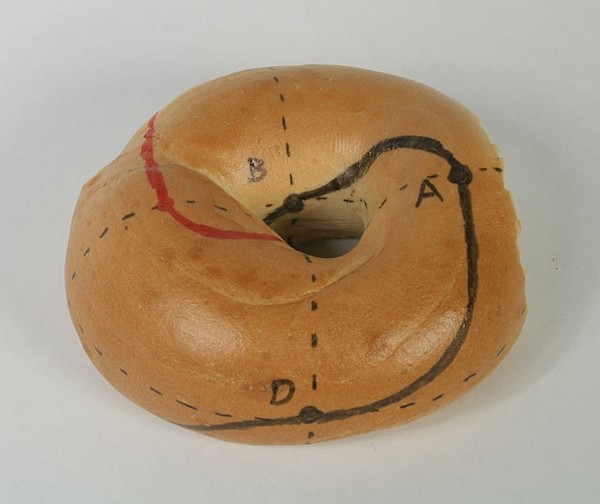
If you cut a bagel along a möbius strip pattern, you end up with two separate halves that form interlocking rings, as shown below.

Geoge Hart, who cut this bagel and made this video, is an engineering professor at SUNY-Stony Brook and "mathematical sculptor. On his web site, he offers two bagel-derived math problems: What is the ratio of the surface area of this linked cut to the surface area of the usual planar bagel slice? and Modify the cut so the cutting surface is a one-twist Mobius strip.
Via @mark_e_evans and The Onion A/V Club.
Tags: bagels mathematics MoMath
What toddler truisms are we missing?
Dan JonesBest Buy is seriously struggling, it sounds like.
Re/code has landed in Minneapolis to talk to the folks at Best Buy — the last standing nationwide big-box, bricks-and-mortar consumer electronics retailer, with over 1,000 main stores and hundreds of smaller mobile device stores.
The chain, survivor of a breed that once included competitors like Circuit City and CompUSA, is waging a multi-front battle for relevance and even survival. Its foes: Online-only alternatives like Amazon, deep discounters like Walmart and high-touch boutique stores like Apple.
It’s also battling the trend called “show-rooming” in which consumers try out products in a store like Best Buy but then buy online from e-tailers like Amazon. To fight this, it has expanded its price matching to include online sellers. And it is revamping its website (which was ugly, hard to navigate and hard to search) in the hope that it will become a bigger shopping destination for people who start, or even complete, purchases online.
But it may have more fundamental problems: Sinking sales of Windows PCs, once a reliable Best Buy mainstay, which had their worst sales year ever in 2013; and, lately, a dive in the sales of the presumed replacement for all those laptops: Tablets.
Best Buy CEO Hubert Joly gave an exclusive interview to me at company headquarters in Richfield, Minnesota, a Minneapolis suburb.
Re/code: What is happening with the PC? Why is it declining quarter after quarter? Will it turn around?
Hubert Joly: So, we’ve actually had a revival of the PC business at Best Buy [in the company's first quarter]. Part of it was that Microsoft stopped supporting the old version.
Stopped supporting Windows XP?
Yes. So that was good. From a technology standpoint, customers now have a broad range of choices with the tablets and the phones. So some of us have a phone and a tablet and a laptop, but many people can now converge to either a tablet and a phone or a phone and a laptop. So you have more diversity of offers.
The tablets boomed and now are crashing. The volume has really gone down in the last several months. But I think the laptop has something of a revival because it’s becoming more versatile. So, with the two-in-ones, you have the opportunity to have both a tablet and laptop, and that’s appealing to students in particular. So you have an evolution. The boundaries are not as well defined as they used to be.
If you take the [Microsoft] Surface, is it a tablet or a laptop? I think it’s both. So I don’t think the laptop has said its last word.
Is this just a Best Buy phenomenon? Sales have certainly been dropping overall. What’s the deal?
In this sector, it always depends on the next generation of innovation, right? So, if the Mac continues to do interesting things and converge across the entire Apple ecosystem, that could be very positive. And, you know, the Mac sales have actually done quite well.
Part of the problem is that, for the Windows market, the deflation has been enormous. So you now find laptops at $300 that used to cost $1,000. So, if there’s more innovation at the high end of Windows, then you can have a revival.
You said the tablet had “crashed.” Do you believe it’s going away?
Yeah, “crashed” is a strong word. So, the tablets have been an unbelievable phenomenon. I don’t think there’s a category that ever took off so quickly and so big in the history of tech.
The issue has then been that, once you have a tablet of a certain generation, it’s not clear that you have to move on to the next generation.
As a consumer?
As a consumer. I think replacement is the issue. The penetration has gone so fast that it’s reaching an amazing degree and therefore it becomes more of a replacement market, and the level of innovation in the past year has not been as great as it had been in the previous two years. So, there again, the jury’s out in terms of what’s going to happen, because it’s going to depend on what innovation comes to market. But you need a reason to replace.
And the smartphone?
In the U.S., we are now achieving levels of penetration that are quite significant and it’s evolving now into more of a replacement market. So, it’s still huge volume, but you don’t have the same growth here in the U.S.
The bulk of our business is in the U.S. and the U.S. market has grown mature.
What’s the third smartphone platform? Is it Windows phone? Is Windows Phone going to finally get off the mat in the developed world? Amazon believes their platform has a chance to become the third. What’s your take?
We don’t have a bet at this point.

Best Buy Staff “Blue Shirts”
When I walk into a Best Buy I now see, right from the front door, a giant Apple logo. I see a giant Samsung logo. I see a giant Microsoft Windows logo. And those are stores within a store. So it leads me to wonder: Have you simply rented out your stores?
No, this is not rented. What we’ve done is, we’ve made Best Buy the place where customers can discover, understand, these different ecosystems. There’s these giant ecosystems: The Apple world, the Android/Samsung world, the Windows world. And so, for the customers, it’s a very unique opportunity to see it in one place, and in the space of half an hour, to be able to talk to our various specialists, and touch, feel, experience these products.
But it’s our store. It’s staffed by “Blue Shirts” (Best Buy sales folks).
Why would people not just use your store as a showroom and then buy the products on Amazon?
Two simple reasons. One is our prices are competitive, and we match others’ prices. So, once you are in the store, you have no reason to leave.
If I go into my Amazon app while I’m in your store …
We’ll match the price. So we’ve taken price off the table. Because we think that customers come to us with good intentions.
So what do I have to do? Do I have to literally say, “Here on my phone you can see, Amazon has this TV for $100 less.” And you’ll just match it?
Yes, exactly. With a smile.
Am I going to have to go through a hassle?
With a smile. And so we’ve taken price off the table. And therefore the customers can take advantage of the service we provide: the advice, the Geek Squad, and the advantage of being able to pick up [online orders] in the stores. Or, if they didn’t like a product, they can return it to the store. So, we have unique things to offer that combine online and offline assets.
Do you assume your customers are starting the purchase process in the store, or starting online now?
So, according to Google, when people buy something above $100, the shopping journey starts online. So it’s really the “Web-rooming” phenomenon much more than the “show-rooming” phenomenon. Because we’re making our site a destination for customers who want to do research.
So you’re just as happy if I never go into your store but I buy from your website.
We love to serve you the way you’d like to be served.
So, why should I buy a phone from you rather than from the maker of the phone, like Apple, which has hundreds of stores, or the carriers? Don’t the carriers know more about the phones than you do?
So, if you’re interested in objective, knowledgeable advice, both on the plans — because it’s quite complicated, right? — and the devices, Best Buy is a very good place to shop.
In other words, if I go to the AT&T store, they won’t tell me about the Sprint plans, but you will?
Exactly. And we have the same prices, and that knowledgeable advice.
Is Best Buy going to be around in 5 years?
We’ll be around in fifty years. We have a unique role to play for customers.
The worst Ebola outbreak in history has put a number of countries in West Africa in lockdown, led to the deaths of nearly 700 people since February and brought new reports of doctors, including Americans, contracting the virus they are attempting to contain. The situation is undeniably scary. Here's what you need to know.
Ebola viral disease is a highly infectious illness with fatality rates up to 90 percent, according to the U.N. World Health Organization. Symptoms initially include a sudden fever as well as joint and muscle aches and then typically progress to vomiting, diarrhea and, in some cases, internal and external bleeding — you can see a full, grim description of symptoms compiled by the Centers for Disease Control and Prevention (CDC) here.
The virus spreads through contact with bodily fluids of someone who is infected. Reports of human infections usually first emerge in remote areas that are in proximity to tropical rain forests, where humans can come into contact with animals such as chimpanzees, gorillas and forest antelope. The consumption of bush meat is often a precursor to such outbreaks. The WHO says fruit bats are probably the natural host for the virus.
It's named after a tributary river in northern Congo. In 1976, a village near the river was the site of one of two simultaneous outbreaks of the disease (the other was in Sudan). Of the six known strains of Ebola, the five that are transmittable to humans are found in Africa. A sixth, the Reston virus, ravaged monkey populations in the Philippines, but no humans in its environs have contracted the illness.

There is no known vaccine or cure for the disease, but if caught early, it can be battled like other viruses such as influenza. The CDC says supportive therapy such as administering liquids and electrolytes and maintaining the patients' oxygen status and blood pressure can combat the virus. Doctors Without Borders, or MSF, the Paris-based medical NGO, said a strict quarantine while treating patients is essential to controlling outbreaks and was vital when the group's doctors helped contain an outbreak in Uganda in 2012.
Ebola is alarmingly contagious; there have been incidents in which the disease has spread at funerals for victims. Public health officials deem an outbreak to be over only after 42 days have elapsed without any new confirmed cases, which is leading some to predict that the current crisis may last well into the autumn.
Bad — very, very bad. It's concentrated in three small West African states: Sierra Leone, Liberia and Guinea, where reports of Ebola infections first emerged in February. The outbreak has claimed more than 670 lives and, worryingly, infected medical personnel attempting to stop its spread. A prominent Liberian physician died Sunday.
What's particularly scary, though, was the recent death of a Liberian man in Lagos, the bustling coastal mega-city in Nigeria, Africa's most populous country. The man, a consultant for the Liberian government, had traveled from Liberia through an airport in Lome, the capital of Togo, before arriving in Nigeria. The hospital where he died is under lockdown, and the WHO has sent teams to Togo and Nigeria.
Those who have contracted the virus and the medical personnel treating them need to be kept under strict quarantine. That's easier said than done, especially in countries where resources are limited and public health protocols are not always heeded. On Monday, Liberia sealed off most of its border crossings (it has kept its main airport open). Nigeria has placed all entry points into the country on "red alert." The threat of the virus spreading beyond the immediate region remains real, and authorities have to be vigilant. A patient may manifest symptoms of the virus only three weeks after getting infected.
One of the continuing challenges is getting local populations to abide by the edicts of government authorities and foreign health workers. The WHO has repeatedly warned about the risk posed by mourners reclaiming the bodies of the deceased for traditional burial ceremonies. But in some cases during the current outbreak, families have refused to hand over the bodies to officials; some communities have staged roadblocks to halt ambulances and launched protests outside hospitals and clinics.
The hysteria caused by the spread of Ebola has led also to the spread of rumor and conspiracy theories. Angry crowds have accused foreigners of bringing the virus in their midst: In April, the threat of violence forced MSF to evacuate all its staff from a treatment center in Guinea. In Sierra Leone, which has the largest number of Ebola cases at present, thousands protested over the weekend outside the country's main Ebola treatment facility in the eastern city of Kenema.
Police had to disperse the crowd with tear gas and a 9-year-old was injured in the leg by a police bullet, Reuters reports. The demonstration was sparked, the news agency claims, by a rumor spread in a nearby market that the disease was a ruse used to justify "cannibalistic rituals" being carried out in the hospital.
Liberia and Sierra Leone have societies that still live with the traumas of brutal civil wars. Susan Shepler, a professor at American University who is conducting field work in both countries, writes that such concerns and hysteria have as much to do with systemic failures in governance as they do with local superstitions:
Really who among us would want to turn a sick loved one over to a hospital staffed with foreigners, knowing we might never see them again? And hospitals in this part of the world have notoriously poor service. Families routinely have to prepare meals and bring them to patients. Families have to go to local pharmacies to buy drugs and even gloves or needles from India or Nigeria because hospital storerooms are routinely not stocked. People’s apprehensions about the failings of the healthcare system come from experience, not from ignorance.
And so as the outbreak rumbles on, the panic surrounding it may be spreading just as virulently.
Related: West Africa struggles to contain Ebola outbreak

Ishaan Tharoor writes about foreign affairs for The Washington Post. He previously was a senior editor at TIME, based first in Hong Kong and later in New York.
UGC FROM ARTICLE: !!!
FINAL commentConfig: {includereply=true, canvas_permalink_id=washpost.com/8bvh5zpd9k, allow_comments=true, commentmaxlength=2000, includeshare=true, display_comments=true, canvas_permalink_app_instance=bg52e9xhqr, display_more=true, moderationrequired=false, includefeaturenotification=true, defaultsort=reverseChronological, canvas_allcomments_id=washpost.com/km4ey0dajm, comments_period=14, includevoteofftopic=false, allow_videos=false, childrenitemsperpage=3, markerdisplay=post_commenter:Post Commenter|staff:Post Writer|top_commenter:Post Forum|top_local:Washingtologist|top_sports:SuperFan|fact_checker:Fact Checker|post_recommended:Post Recommended|world_watcher:World Watcher|cultuer_connoisseur:Culture Connoisseur|weather_watcher:Capital Weather Watcher|post_contributor:Post Contributor, includesorts=true, includeheader=true, defaulttab=all, includeverifiedcommenters=true, includerecommend=true, maxitemstop=2, includereport=true, source=washpost.com, allow_photos=false, maxitems=5, display_ugc_photos=false, includepause=true, canvas_allcomments_app_instance=6634zxcgfd, includepermalink=false}!!
UGC FROM ARTICLE: !!!
FINAL commentConfig: {includereply=true, canvas_permalink_id=washpost.com/8bvh5zpd9k, allow_comments=true, commentmaxlength=2000, includeshare=true, display_comments=true, canvas_permalink_app_instance=bg52e9xhqr, display_more=true, moderationrequired=false, includefeaturenotification=true, defaultsort=reverseChronological, canvas_allcomments_id=washpost.com/km4ey0dajm, comments_period=14, includevoteofftopic=false, allow_videos=false, childrenitemsperpage=3, markerdisplay=post_commenter:Post Commenter|staff:Post Writer|top_commenter:Post Forum|top_local:Washingtologist|top_sports:SuperFan|fact_checker:Fact Checker|post_recommended:Post Recommended|world_watcher:World Watcher|cultuer_connoisseur:Culture Connoisseur|weather_watcher:Capital Weather Watcher|post_contributor:Post Contributor, includesorts=true, includeheader=true, defaulttab=all, includeverifiedcommenters=true, includerecommend=true, maxitemstop=2, includereport=true, source=washpost.com, allow_photos=false, maxitems=5, display_ugc_photos=false, includepause=true, canvas_allcomments_app_instance=6634zxcgfd, includepermalink=false}!!
| archive - contact - sexy exciting merchandise - search - about | |||
 |
|||
| ← previous | July 30th, 2014 | next | |
|
July 30th, 2014: HEY GUESS WHAT?? The final issue of The Midas Flesh is out now! You can read a preview here, and catch up with all you missed at midasflesh.com!
 – Ryan | |||
[Editor's note: Tara Haelle is a freelance science writer whose specialties include medicine, vaccines and public health. Her work has appeared in Scientific American and Slate. She blogs at Red Wine & Apple Sauce and is working on a book about science-based parenting with Emily Willingham.]
It’s a favorite media trope – whiz kid makes amazing scientific discovery. So it was no surprise that the story of 12-year-old Lauren Arrington went viral. For her sixth-grade science fair project in 2012, the Florida girl tested the lower limit of salt concentration that invasive marine lionfish could withstand, identifying the lowest concentration ever recorded for a living lionfish. Ultimately, her work earned her an acknowledgment in a just-published paper addressing the same question. Headlines ensued: Girl’s science fair project leads to huge discovery. Someone even set up a petition demanding she be added as a paper author.
For her project, Lauren, now 13, set up lionfish tanks at the Loxahatchee River District in Florida, where her biologist father Albrey Arrington is executive director. According to some versions of the viral narrative, Lauren had discovered the invasive lionfish in the brackish water of the Loxahatchee River.
The Palm Beach Post claimed that Lauren “made history.” The b-word--“a Florida teen’s experiment turned into a real breakthrough”--and the p-word--“meet the science prodigy whose work is already leading to change”--both appeared in a CBS report.
But there was something was missing in this glowing coverage. Even the most rudimentary reporting should have made clear that this fish tale, as told, didn’t hold water.
When we meet Lauren in the CBS story, she describes wondering whether lionfish could swim upriver from the ocean, where they’re already wrecking Florida’s marine habitats. We also meet her father, who is asked whether anyone knew lionfish were a threat in “rivers like this one.” His answer? “They didn’t. We certainly did not understand that. Lauren’s research showed they are.”
But “they” did know.
The first author on the peer-reviewed paper was Zachary Jud, Ph.D., who had done lionfish salinity work as a graduate student at Florida International University with his adviser, Craig Layman. A simple web search turns up Jud’s 2011 paper describing the discovery of lionfish in the Loxahatchee River. The last author on the paper was Lauren’s father--Albrey Arrington.
Arrington also knew Jud had found lionfish in water with salinity as low as 8 ppt, documented on Layman’s lab blog, where Arrington commented--“Cool!”--in August 2012. That might explain how Lauren knew in winter 2012 that she could take the salinity down to 6 ppt – not far from 8 ppt – without killing the lionfish, which would have violated science fair rules.
The synergy is clear between a father’s attempts to shape the narrative and the media’s adoration for the underdog story. The result: a failure of basic reporting and fact-checking.
Ideally, Craig Layman, Jud’s adviser and co-author, could have clarified the timeline: Jud found lionfish in the river, published and lectured about it, and inspired a girl’s science fair project. Her lab experiments confirmed field findings, contributing incrementally to the scientific process. Jud went on to conduct and publish his own findings.
But Layman’s firsthand and secondhand quotes only muddied the waters. In a blog post Thursday morning, Layman noted he “was not happy with the way I was quoted in these early articles,” leading him to decline further media requests.
Then the narrative moved from problematic to train wreck. As the story gained momentum, Arrington attributed Jud’s research primarily to Layman, and stories portrayed Lauren’s work as inspiring scientists to suddenly look for lionfish in river water – already a part of Jud’s dissertation.
After Arrington rebuffed Jud’s email request for proper credit, Jud went to Facebook with a public post, inadvertently shifting the narrative toward another media favorite – the wronged man.
Gawker’s io9 ran with a headline “Sixth-Grader May Have Stolen Credit For Marine Biologist’s Lionfish Research.” Then Boing Boing, UPI, Fox News and USA Today picked it up. Before long, Lauren had “hijacked” Jud’s research. Commenters traded accusations against Jud and Lauren. Even reporters such as Bethany Brookshire, whose reporting at Student Science accurately reflected Jud’s earliest statements, were caught in the crossfire (for which Jud has officially apologized).
By the time the story reached The Blaze and Miami Herald, Arrington had changed his narrative, acknowledging Jud’s work as Lauren’s inspiration. But the damage was done. Then the self-correction cycle began. The Washington Post tried and failed to parse out events. The Scientist delivered a more thorough account. NPR and others added updates to their stories, and NPR has since published an ethics blog post and a reflection story. Christie Wilcox, who spoke with Jud (as did I), published a chronology at her Discover blog, incorporating the details of a timeline Layman posted Thursday.
This narrative began with a shiny fish tale of a girl science prodigy, a sparkle so irresistible that journalists let the spin mislead them and failed to clarify the facts early on. Now, as the feeding frenzy fades, two people are suffering most: a newly minted Ph.D. on the job hunt, and a girl whose dream is to become a scientist.
We might want to put those loaded words--“breakthrough” and “prodigy”--back in the desk drawer.
-Tara Haelle
Dan JonesI love this, so much.

[First image: Merida from Brave, wide-eyed.
Second image: Queen Elinor, looking somewhat concerned.]
(716): oh my god i have a fantastic druncle story to tell you. It involves a burrito, a meltdown and a bear
(1-716): The burrito and meltdown are standard, but I’m intrigued by the bear

Irony. The term people love to use... incorrectly. On TV, in literature, between friends — people misapply and misuse the word a million times a day. Even the pop anthem dedicated to the trope gets it wrong (or does it?). But you oughta know all this by now.
The fight over what is "ironic" and what isn't can be traced all the way back to Biblical times when Eve said to Adam, "The irony is that I don't even like apples." Adam took exception, and thus begin the greatest of language debates.
More recently, this debate took hold of our entire office, pitting friend against friend, coworker against coworker, intern against another company's intern because we only have one intern. To save the company, we decided to get to the bottom of this once and for all with a illustrated guide to the difference between irony and mere coincidence.*
*Note to the dogged usage experts: We're only concerned with the definition of Situational Irony here — the most confusing of all the different kinds. We know that Rhetorical, Dramatic and Cosmic Irony exist and we trust that you can google them.

The main point to remember about Situational Irony is that it is a direct result of an action intended to produce the opposite effect. An easy way to distinguish between irony and unlucky coincidence is to check if there's an action or intention involved.
An elevator company's out-of-order elevator may be a bummer, but it's not strictly ironic. It's just an unfortunate and surprising juxtaposition of facts. Of course, if an elevator repairman broke the machine while performing preventative safety measures, we'd make the leap from coincidence to full-blown irony.

Meg felt lonely, so she organized a support group to help her feel better. When no one came, Meg felt even more alone than she did before. (Don't worry Meg, there are restaurants made just for you.) Here's a great example of Situational Irony. Meg took an action that was supposed to alleviate her loneliness, and the result was the exact opposite of what she intended. Sad, but truly ironic.
Got it? Good. That's all for the usage lessons for today. And don't worry, we won't lecture you about how you misuse the word 'literal.' We'd rather leave you with this pun instead.


TECHNO SANS TECHNOLOGY
If you know one techno song, it's this one. You've just never heard it played like this before.

LOOKS JUST LIKE OUR PERMANENT TRACERS
You may want to sit down for this one.

WORTH A SECOND TAKE
After Michelle Beadle responded to Stephen A. Smith's comments about domestic violence, the "First Take" host only made things worse.

It may not be a Swiss army knife, but it’ll keep your hair in place and you can use it to prep food if you’re ever stuck in the wilderness.
This Leatherdos hair clip is a multi-tool that includes 3 screwdrivers, a ruler, a cutting edge, a wrench and a trolley coin. From what I can tell, if you have this and some bubblegum, you might just be able to out MacGuyver MacGuyver in both cleverness and style.
Check out more pictures and uses after the break.


Product Page ($9.99 via Gizmodo)


Dan JonesIf I could marry pizza, I would have done so a long time ago.
We would have had a beautiful pizza wedding, and my pizza wife and I would have half a dozen pizza roll babies.
And then I would eat them all.

[First image: Giselle from Enchanged, speaking delightedly.
Second image: Giselle and Robert sitting at the table in the pizzeria, with a large pizza on the table in front of them. Giselle looks amazed.]
(910): I’m getting married.
(910): To pizza


Dan JonesI love an Iron Man Mystery Machine


Dan JonesGreat parenting
Dan JonesSeriously. Baby wipes are super useful. I wish I'd known before I became a parent.
Back in college, it would have been great on days that I had a morning class, but woke up too late for a shower. A quick wipe down with baby wipes, stop off at Jamba Juice for breakfast, then off to class.
We no longer have babies and should — at least traditionally — have no use for baby wipes. But I’m here to admit that we just received a brand new shipment. On my list of priorities these days, “conserving paper” is right above “Inventing a car that runs on pee.” A year ago, when I changed a diaper, I would lay out a dozen of them, like I was setting up a game of wipe solitaire. We still have a container in nearly every room and use them now for a variety off-label uses.
Dan JonesMust have

ThinkGeek’s TNG Uniform hoodies were so popular that they are boldly going back to the original series for a new round of designs. From the product page:
Each Star Trek The Original Series Uniform Hoodie is as perfect as we could make it – teaming up with the folks at CBS, of course. There are three styles (each with a specific Rank Braid). Here’s the rank breakdown: Command Gold is Captain, Sciences Blue is Commander, and Engineering Red is Lieutenant. No Lieutenants were harmed during the making of these Star Trek The Original Series Uniform Hoodies… promise.
This full-zip hoodie is an officially-licensed Star Trek clothing item. It’s made of 60% cotton / 40% polyester. The colors are pieced together, not printed on. It has two front pockets and embroidered insignia and rank braid.
A release date for the hoodies hasn’t been announced, but they’ll be priced at $59.99.
Dan JonesI would love this, but would never pay $300 for a single article of clothing.
 When Picard is chilly, he puts on his jacket. And now you can too! This is Picard's jacket. Patterned and color-matched directly from a screen-used jacket, this is the most accurate replica available anywhere. $299.99