Shared posts

03 Sep 02:15

Time Travel Simulation Resolves 'Grandfather Paradox'

What would happen to you if you went back in time and killed your grandfather? A model using photons reveals that quantum mechanics can solve the quandary—and even foil quantum cryptography

Sep 2, 2014 |By Lee Billings
timelike curve

Entering a closed timelike curve tomorrow means you could end up at today.
Credit: Dmitry Schidlovsky

On June 28, 2009, the world-famous physicist Stephen Hawking threw a party at the University of Cambridge, complete with balloons, hors d'oeuvres and iced champagne. Everyone was invited but no one showed up. Hawking had expected as much, because he only sent out invitations after his party had concluded. It was, he said, "a welcome reception for future time travelers," a tongue-in-cheek experiment to reinforce his "1992 conjecture that travel into the past is effectively impossible.

But Hawking may be on the wrong side of history. Recent experiments offer tentative support for time travel's feasibility—at least from a mathematical perspective. The study cuts to the core of our understanding of the universe, and the resolution of the possibility of time travel, far from being a topic worthy only of science fiction, would have profound implications for fundamental physics as well as for practical applications such as quantum cryptography and computing.

Closed timelike curves
The source of time travel speculation lies in the fact that our best physical theories seem to contain no prohibitions on traveling backward through time. The feat should be possible based on Einstein's theory of general relativity, which describes gravity as the warping of spacetime by energy and matter. An extremely powerful gravitational field, such as that produced by a spinning black hole, could in principle profoundly warp the fabric of existence so that spacetime bends back on itself. This would create a "closed timelike curve," or CTC, a loop that could be traversed to travel back in time.

Hawking and many other physicists find CTCs abhorrent, because any macroscopic object traveling through one would inevitably create paradoxes where cause and effect break down. In a model proposed by the theorist David Deutsch in 1991, however, the paradoxes created by CTCs could be avoided at the quantum scale because of the behavior of fundamental particles, which follow only the fuzzy rules of probability rather than strict determinism. "It's intriguing that you've got general relativity predicting these paradoxes, but then you consider them in quantum mechanical terms and the paradoxes go away," says University of Queensland physicist Tim Ralph. "It makes you wonder whether this is important in terms of formulating a theory that unifies general relativity with quantum mechanics."

Experimenting with a curve
Recently Ralph and his PhD student Martin Ringbauer led a team that experimentally simulated Deutsch's model of CTCs for the very first time, testing and confirming many aspects of the two-decades-old theory. Their findings are published in Nature Communications. Much of their simulation revolved around investigating how Deutsch's model deals with the “grandfather paradox,” a hypothetical scenario in which someone uses a CTC to travel back through time to murder her own grandfather, thus preventing her own later birth. (Scientific American is part of Nature Publishing Group.)

Deutsch's quantum solution to the grandfather paradox works something like this:

Instead of a human being traversing a CTC to kill her ancestor, imagine that a fundamental particle goes back in time to flip a switch on the particle-generating machine that created it. If the particle flips the switch, the machine emits a particle—the particle—back into the CTC; if the switch isn't flipped, the machine emits nothing. In this scenario there is no a priorideterministic certainty to the particle's emission, only a distribution of probabilities. Deutsch's insight was to postulate self-consistency in the quantum realm, to insist that any particle entering one end of a CTC must emerge at the other end with identical properties. Therefore, a particle emitted by the machine with a probability of one half would enter the CTC and come out the other end to flip the switch with a probability of one half, imbuing itself at birth with a probability of one half of going back to flip the switch. If the particle were a person, she would be born with a one-half probability of killing her grandfather, giving her grandfather a one-half probability of escaping death at her hands—good enough in probabilistic terms to close the causative loop and escape the paradox. Strange though it may be, this solution is in keeping with the known laws of quantum mechanics.

In their new simulation Ralph, Ringbauer and their colleagues studied Deutsch's model using interactions between pairs of polarized photons within a quantum system that they argue is mathematically equivalent to a single photon traversing a CTC. "We encode their polarization so that the second one acts as kind of a past incarnation of the first,” Ringbauer says. “So instead of sending a person through a time loop, they created a stunt double of the person and ran him through a time-loop simulator to see if the doppelganger emerging from a CTC exactly resembled the original person as he was in that moment in the past.

By measuring the polarization states of the second photon after its interaction with the first, across multiple trials the team successfully demonstrated Deutsch's self-consistency in action. "The state we got at our output, the second photon at the simulated exit of the CTC, was the same as that of our input, the first encoded photon at the CTC entrance," Ralph says. "Of course, we're not really sending anything back in time but [the simulation] allows us to study weird evolutions normally not allowed in quantum mechanics."

Those "weird evolutions" enabled by a CTC, Ringbauer notes, would have remarkable practical applications, such as breaking quantum-based cryptography through the cloning of the quantum states of fundamental particles. "If you can clone quantum states,” he says, “you can violate the Heisenberg uncertainty principle,” which comes in handy in quantum cryptography because the principle forbids simultaneously accurate measurements of certain kinds of paired variables, such as position and momentum. "But if you clone that system, you can measure one quantity in the first and the other quantity in the second, allowing you to decrypt an encoded message."

"In the presence of CTCs, quantum mechanics allows one to perform very powerful information-processing tasks, much more than we believe classical or even normal quantum computers could do," says Todd Brun, a physicist at the University of Southern California who was not involved with the team's experiment. "If the Deutsch model is correct, then this experiment faithfully simulates what could be done with an actual CTC. But this experiment cannot test the Deutsch model itself; that could only be done with access to an actual CTC."

Alternative reasoning
Deutsch's model isn’t the only one around, however. In 2009 Seth Lloyd, a theorist at Massachusetts Institute of Technology, proposed an alternative, less radical model of CTCs that resolves the grandfather paradox using quantum teleportation and a technique called post-selection, rather than Deutsch's quantum self-consistency. With Canadian collaborators, Lloyd went on to perform successful laboratory simulations of his model in 2011. "Deutsch's theory has a weird effect of destroying correlations," Lloyd says. "That is, a time traveler who emerges from a Deutschian CTC enters a universe that has nothing to do with the one she exited in the future. By contrast, post-selected CTCs preserve correlations, so that the time traveler returns to the same universe that she remembers in the past."

This property of Lloyd's model would make CTCs much less powerful for information processing, although still far superior to what computers could achieve in typical regions of spacetime. "The classes of problems our CTCs could help solve are roughly equivalent to finding needles in haystacks," Lloyd says. "But a computer in a Deutschian CTC could solve why haystacks exist in the first place.”

Lloyd, though, readily admits the speculative nature of CTCs. “I have no idea which model is really right. Probably both of them are wrong,” he says. Of course, he adds, the other possibility is that Hawking is correct, “that CTCs simply don't and cannot exist." Time-travel party planners should save the champagne for themselves—their hoped-for future guests seem unlikely to arrive.

More:

The Quantum Physics of Time Travel  (All-Access Subscribers Only)
By David Deutsch and Michael Lockwood

Can Quantum Bayesianism Fix the Paradoxes of Quantum Mechanics?

Astrophysicist J. Richard Gott on Time Travel

risk free title graphic

YES! Send me a free issue of Scientific American with no obligation to continue the subscription. If I like it, I will be billed for the one-year subscription.

cover image
Scientific American is a trademark of Scientific American, Inc., used with permission

© 2014 Scientific American, a Division of Nature America, Inc.

View Mobile Site All Rights Reserved.

Scientific American Special Universe

Get the latest Special Collector's edition

Secrets of the Universe: Past, Present, Future

Order Now >

X
03 Sep 00:10

Hackers Build A Skype That’s Not Controlled By Microsoft

Unknown

Screenshot: WIRED/Source: Tox

The web forum 4chan is known mostly as a place to share juvenile and, to put it mildly, politically incorrect images. But it’s also the birthplace of one of the latest attempts to subvert the NSA’s mass surveillance program.

When whistleblower Edward Snowden revealed that full extent of the NSA’s activities last year, members of the site’s tech forum started talking about the need for a more secure alternative to Skype. Soon, they’d opened a chat room to discuss the project and created an account on the code hosting and collaboration site GitHub and began uploading code.

Eventually, they settled on the name Tox, and you can already download prototypes of the surprisingly easy-to-use tool. The tool is part of a widespread effort to create secure online communication tools that are controlled not only by any one company, but by the world at large—a continued reaction to the Snowden revelations. This includes everything from instant messaging tools to email services.

It’s too early to count on Tox to protect you from eavesdroppers and spies. Like so many other new tools, it’s still in the early stages of development and has yet to receive the scrutiny that other security tools, such as the instant messaging encryption plugin Off The Record has. But it endeavors to carve a unique niche within the secure communications ecosystem.

‘Up to Your Imagination’

The main thing the Tox team is trying to do, besides provide encryption, is create a tool that requires no central servers whatsoever—not even ones that you would host yourself. It relies on the same technology that BitTorrent uses to provide direct connections between users, so there’s no central hub to snoop on or take down.

There are other developers trying to build a secure, peer-to-peer messaging systems, including Briar and Invisible.im, a project co-created by HD Moore, the creator of the popular security testing framework Metasploit. And there are other secure-centric voice calling apps, including those from Whisper Systems and Silent Circle, which encrypt calls made through the traditional telco infrastructure. But Tox is trying to roll both peer-to-peer and voice calling into one.

Actually, it’s going a bit further than that. Tox is actually just a protocol for encrypted peer-to-peer data transmission. “Tox is just a tunnel to another node that’s encrypted and secure,” says David Lohle, a spokesperson for the project. “What you want to send over that pipe is up to your imagination.” For example, one developer is building an e-mail replacement with the protocol, and Lohle says someone else is building an open source alternative to BitTorrent Sync.

The New Skype

That said, the core Tox team is focused on building the features specifically required for building a Skype replacement. There are at least 10 different Tox messaging and voice clients so far, each supporting a different range of features. Eventually, Lohle says, there will be “official” clients for each major operating system, but for now the team is just recommending a few specific clients. µTox, which is available for Linux and Windows, is a the “bleeding edge” reference design, while qTox is the project’s recommendation for OS X users and Antox is the recommended for Android. There is no iOS version as of yet.

µTox is still rough, but the interface and experience is straightforward. You download the client, and it automatically creates a public encryption key that you can provide to everyone, and a private encryption key that you keep on your computer or phone. From there, it works very much like Skype. You can add a friend to your contact list by pasting in their public key, and then you just click their name to send them a message, or click the big phone icon to call them. If you want to move your identity from one computer to another, you just copy a single file that includes your private key and contact list.

There are still a few features that are missing, though. For example, there’s no way to do a group chat yet. And there’s no way to be logged in as the same person on two different devices — say, both your phone and your computer. But Lohle says those features are coming, and the team already as a proof-of-concept for how group chat will work.

He says the team has no plans to turn it into a company or monetize it in any way. “No one getting paid, but we dedicate as much time as we can,” he says. “If I’m not in class, or I’m not eating, I’m probably working on Tox, and that’s at least the same for probably 10 people.” Besides, the lead developer, known only as irungentoo, is completely anonymous, so it would be hard to issue him a paycheck. “I don’t think any of us know his real name,” Lohle says.

The Link With 4Chan

Today Lohle downplays Tox’s relationship to 4chan. “We were self-sufficient after only a couple weeks,” he says. “We also posted on reddit and hacker news, and people joined from that.” He probably has good reason to distance the project from the site. The racism, homophobia and misogyny on display on the 4chan on a day to day basis would be a big turn off both for users and potential contributors.

The association has also exposed the project to the trolling and drama characteristic of the forum, which often makes it hard for outsiders to evaluate. For example, one Tox developer raised concerns about Tox users exposing their IP addresses to each other. The team responded by masking IP addresses through a technology called onion routing — the same technique that the Tor Project uses to protect user anonymity on the web. But the fix didn’t stop a wave of paranoia from sweeping forums, and it’s hard to tell how much of that is trolling and how much of it is legitimate concern.

Can You Trust It?

Worse, the project let its “warrant canary” page go offline for a week. A warrant canary is usually a website that states that a company or organization has not be served by a secret subpoena from the NSA or any other law enforcement or intelligence agency. It’s meant as a way to bypass laws that prevent companies from warning their customers that they have been served with a national security letter. The Tox team claimed in a blog post that they simply forgot to put the warrant canary back online after moving web hosts. But the incident led to degree of understandable suspicion.

Meanwhile, few security experts outside the project have reviewed the Tox code yet, but the project is based on an existing set of code libraries for working with crypto algorithms called NaCl, which has received considerably more attention. “NaCl is a newish library that is nevertheless very highly regarded in the security community, produced by skilled people,” says the Electronic Freedom Frontier senior staff technologist Jacob Hoffman-Andrews, who hasn’t yet evaluated Tox.

But it’s entirely possible to good crypto libraries in poor ways, so the Tox team is saving money to hire a professional security firm to audit the code once it reaches a more stable state. “Right now we’re relying on the open source community,” Lohle says. “We have about 15 who stare at the code for days or weeks.”

02 Sep 17:50

09.02.2014

Cyanide and Happiness, a daily webcomic
Copy this into your blog, website, etc.
<a href="http://explosm.net/comics/3670/"><img alt="Cyanide and Happiness, a daily webcomic" src="http://www.flashasylum.com/db/files/Comics/Dave/jealous.png" border=0></a><br />Cyanide & Happiness @ <a href="http://explosm.net">Explosm.net</a>
...or into a forum
[URL="http://explosm.net/comics/3670/"]
[IMG]http://www.flashasylum.com/db/files/Comics/Dave/jealous.png[/IMG][/URL]
Cyanide & Happiness @ [URL="http://explosm.net/"]Explosm.net[/URL]
<—- Share this comic!

02 Sep 02:27

September 01, 2014


Just a reminder, the Pluto shirt is available a little while longer.
01 Sep 16:16

Ballooning

Time to dance in front of Mary Jane! If I'm lucky, she'll turn out not to practice pre-copulatory sexual cannibalism!
31 Aug 04:05

Bye, Google Maps

Dan Jones

Looks like a good mapping app for people whose primary transportation isn't by car.

Citymapper is what happens when you actually understand user experience.

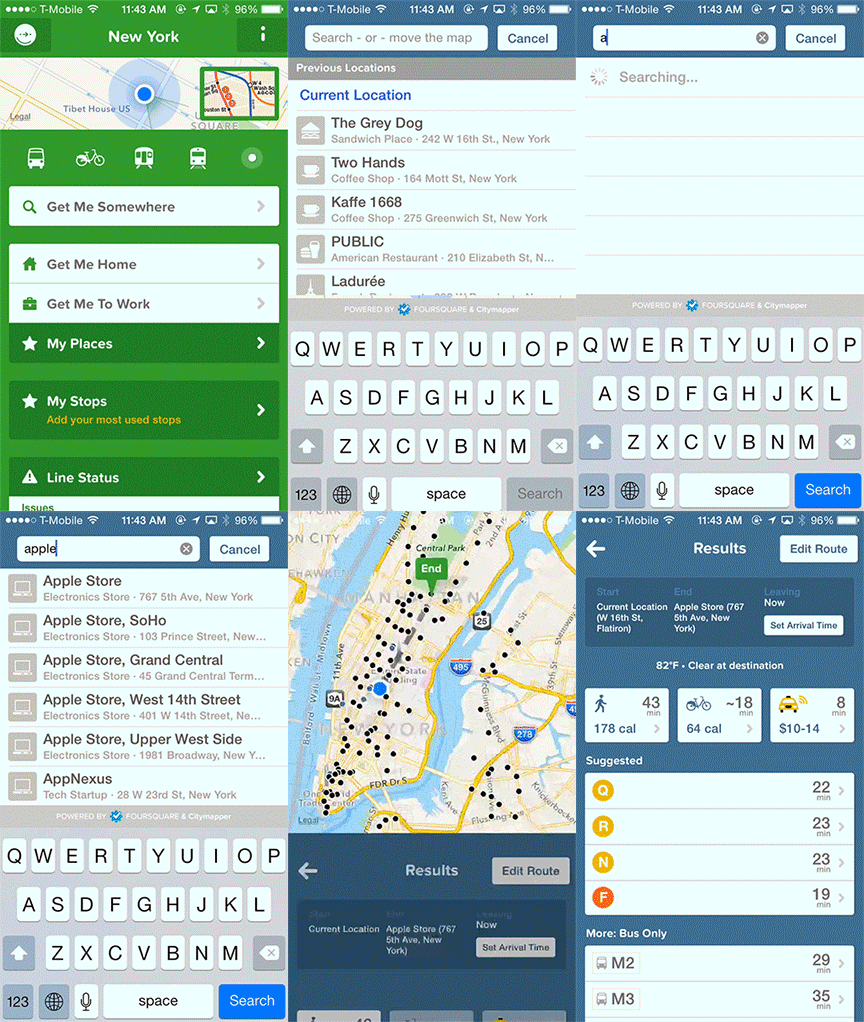
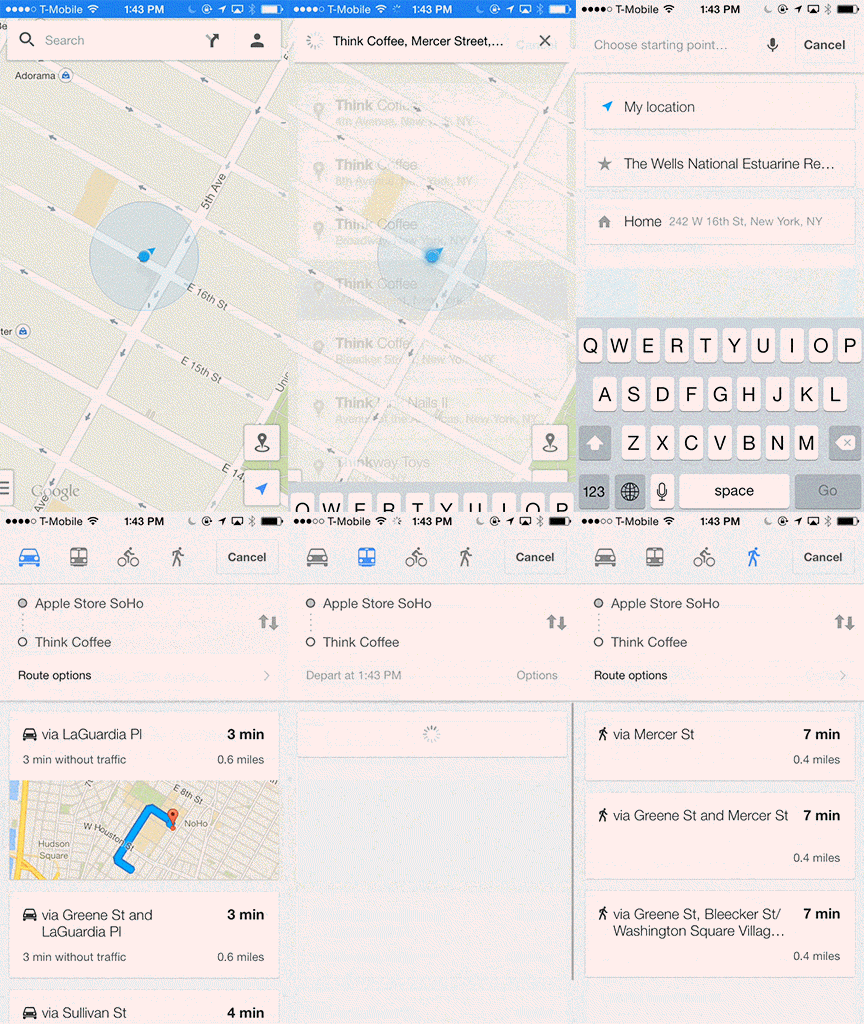
Every so often, an app comes along that just completely understands the way you think. I don’t normally write long posts about an app I’ve used. But Citymapper is so incredibly well-made that I decided to put together a list of common use cases of a maps app, and how both Google Maps and Citymapper handle them.

Scenario 1: I need to get somewhere as fast as possible.

Citymapper, 10 seconds: I can see all 4 options (public transport, walking, car/taxi, and biking) side-by-side, allowing me to compare options quickly.

Google Maps, 20 seconds: I need to click through each individual option and remember which is the fastest. Also, the flyover animation is cool but unnecessary when I’m trying to see what the fastest time is.

Scenario 2: I want to see the time needed to get from point A to point B.

Citymapper, 10 seconds: I can enter my origin and destination at the same time.

Google Maps, 30 seconds: I need to first enter my destination, then specify how I want to get there, and then change my origin from “My Location” to a different address.

Scenario 3: What are the trains near me?

Citymapper, 2 seconds: Since I know the subway system pretty well, I don’t always need full directions — I just need to know where the closest subways are so I can judge which one I should take. With one click on the train icon, I can see all the trains near me, sorted by distance. Same thing for buses.

Google Maps, 30+ seconds: There’s no way to see all nearby trains, so you have to manually look around your waypoint and click on each station. There is a public transit option in the sidenav, but it only highlights the lines on the map and you still need to click through to see which stations are closest. And at transit hubs (in this case, Union Square) it considers different subway entrances and lines as separate, so it won’t let you see aggregate information for a particular station.

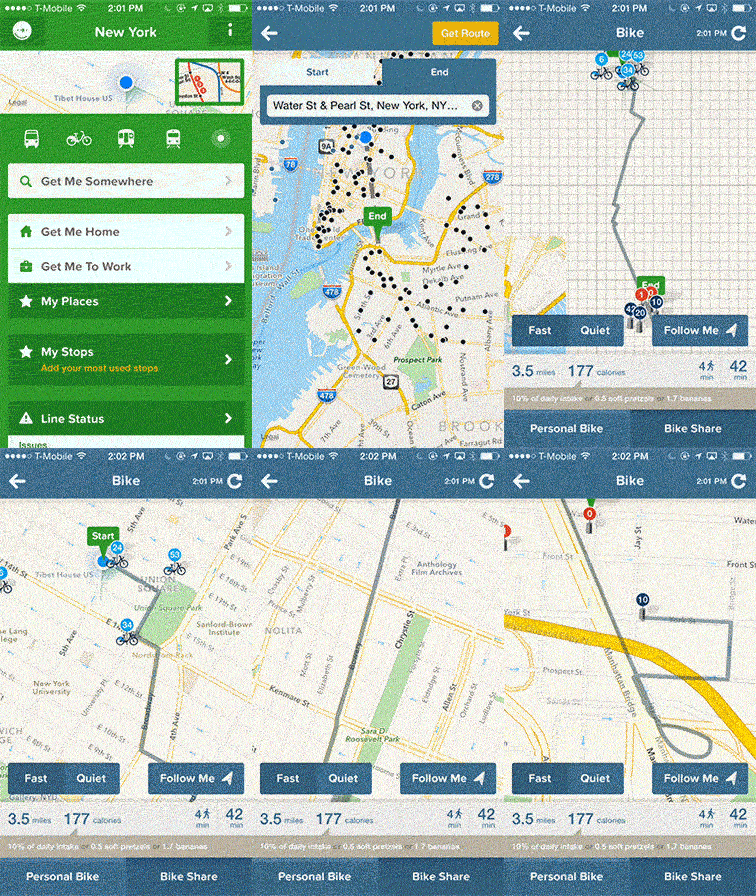
Scenario 4: How long will it take me to get somewhere by Citibike?

Google Maps, can’t do it: Google Maps doesn’t have bikeshare integration, so I’m forced to switch apps and use the equally scatterbrained Citibike app to find availability.

Citymapper, 15 seconds: Not only does Citymapper find where the nearest Citibike location is and let me choose whether I want the fastest route or the quietest (read: safest) route, it also notices that the closest Citibike location to my destination has no available spaces and reroutes me to the next closest one that does. That’s magical.

Scenario 5: I just searched for directions at the office, and now I want to see those directions again.

Citymapper, 5 seconds: Previously searched destinations can be found right underneath the search bar for easy access.

Google Maps, 10 seconds — if you know where to find it: For some reason, previously searched destinations are found under your profile (the person icon next to the search bar) instead of when I search. I never noticed that until I started writing this post.

Scenario 6: I’m late to a meeting so I’m sprinting as quickly as possible down the street, looking at my phone for directions.

In any other app, shaking my phone might mean “undo last action” (e.g. Mailbox) or “submit feedback” (e.g. some beta builds of mobile apps). In a maps app, though, there’s pretty much one thing a shaking phone means — I’m running, biking, or just moving. And when I do any of that with Google Maps, this happens:

It blocks my view, it shuts off turn-by-turn directions, and is altogether a pretty terrible interaction.

Other design details

City icons

Going to a different city? Citymapper’s customized icons for each of its supported metro areas gives the app personality.

Offline subway map

If you’re in the subway, you can access a full offline zoomable subway map by clicking on an icon on the homescreen.

Humor

When presenting your transit options, Citymapper will occasionally throw in a funny option:

30 Aug 12:31

Thor Works for Amazon Customer Service

Thor Works for Amazon Customer Service


tickld shared this hilarious exchange between the Asgardian god of thunder Thor of Amazon.com and a̶ ̶c̶u̶s̶t̶o̶m̶e̶r̶ the Allfather Odin! This is priceless, I wish this is how all customer support was...

Thor Works for Amazon Customer Service

(via: tickld)

Follow us on:
 

August 29 2014
30 Aug 04:46

Sit Anywhere On A Chair You Can Wear

A 4.4-pound, leg-worn exoskeleton creates a chair out of nowhere.

Over the last several years, office workers have begun to see the error of their sedentary ways. Study after study has shown that sitting down all day can contribute to a bunch of health problems, including diabetes and cancer. The solution: Stand up for part of the workday. In some companies, nearly one-third of the workforce has adopted sit-and-stand workstations.

Factory workers, on the other hand, have the opposite problem. Standing on an assembly line for hours puts undue stress on lower limbs, joints and the back. It can also exacerbate existing conditions, such as diseases of the heart.

Yet at many factories, there’s not a chair in sight. Owners want to maximize space on the line and reduce clutter that might pose safety hazards, desires that leave little room for sitting. That’s why Zurich-based startup Noonee has developed the Chairless Chair, a wearable armature that provides workers with a place to perch—no matter where they are.

Keith Gunura, Noonee CEO and co-founder, first had the idea for an exoskeleton-type chair when he was 17 and working on a production line in a factory in the U.K. “We wanted the ability to sit anywhere and everywhere,” he recalls.

The Chairless Chair consists of a thin aluminum armature attached to the user’s shoes and waist. Wearers first clip on a belt, which contains the control module, then attach a strap onto the heel of their shoes (any heel a quarter-inch or larger will do). They tighten straps around their upper and lower legs and adjust the length of the aluminum frames to match the length of their calves and thighs.

When looking to sit, a worker bends his or her knees and presses a button on the control unit to lock the chair into place. A damper that extends from the knee to the heel provides the support. The system can hold up to 400 pounds and can lock in anywhere through the knee’s range of motion. Gunura says the best position is a perch, not unlike sitting on a barstool—an ideal posture because it keeps the wearer’s back straight. If you try to lean back, you’ll throw off your center of gravity and tip over.

The current Chairless Chair prototype weighs 4.4 pounds. Users can walk, even run, normally with the unit tied on. But, Gunura says the final version will be even lighter.

Gunura estimates that it will be three to five years before the Chairless Chair becomes a fixture in factories, but the company is gearing up for a robust set of trials in facilities across Europe and the U.K. that will begin within the next year. According to CNN, BMW and Audi will be among the first factories with the device. The company has not set a price yet, but says it will be affordable.

Noonee says that factory owners it’s been in contact with—the startup is not currently able to call their partners by name—see the productivity benefit of allowing their workers to take short rests during the workday. “We don’t want to promote long-term sitting; what you want are micro breaks,” says Gunura.

Once the professional rollout is underway, the company will begin adapting its technology to other fields, including medicine and rehabilitation, and eventually develop a consumer-friendly version. “We’ve had interest from surgeons saying that they want to try this as a substitute for their stool, which is something they normally have to move quite a lot,” Gunura explains.

Unlike other exoskeleton devices, the Chairless Chair does not imbue the wearer with extra strength or capabilities he or she might not otherwise have. Devices like the TitanArm, Gunura contends, could actually make the wearer weaker over time, as he or she progressively relies more and more on the mechanical assistance. “That’s the trade-off,” he says.

As for a layperson device, Gunura is fixated on making the Chairless Chair look as little like a rehab device or exosuit as possible. “We want to make it invisible, so that you can take it anywhere you want,” he imagines. “It could be embedded in your jeans.”

Previous Article

Navdy Projects Apps and Text Messages Onto the Windshield of Almost Any Car

29 Aug 22:57

Looney Labs donates for the second year in a row!

by ToMolly

Looney Labs donated for the second year in a row!

Looney Labs is very well known for Fluxx and Chrononauts. Check out their website for their full list of games, and come bid on their donations in our silent auction!

29 Aug 02:51

#928 – Shoe (9 Comments)

by Chris

#928 – Shoe

It’s a great way to save on rent when starting a new family.
29 Aug 02:51

Ice Bucket Challenged

by Sarah Yoshimura
    

Artist's Note:

Man. I wonder how long this thing is gonna keep on going?


Writer's Note:

Forever. Until we melt the ice caps and descend into the inferno of global superwarming.

At least that's what Al Gore told me.

 
28 Aug 00:01

Google Teapot Easter Egg

by Alex Chitu
Dan Jones

It even correctly returns a 418 status

Google has a funny error page at google.com/teapot. It says: "418. I'm a teapot. The requested entity body is short and stout. Tip me over and pour me out." If you click the teapot, you'll see a nice animation.


So what's this 418 error? You may have noticed HTTP status codes like 404 (page not found) or 403 (forbidden). There are many other 4xx error codes, but 418 was only used for an Easter Egg. "This code was defined in 1998 as one of the traditional IETF April Fools' jokes, in RFC 2324, Hyper Text Coffee Pot Control Protocol, and is not expected to be implemented by actual HTTP servers." Here's the text from the document: "Any attempt to brew coffee with a teapot should result in the error code '418 I'm a teapot'. The resulting entity body MAY be short and stout."


{ via Search Engine Land }
28 Aug 00:00

Hello Kitty Is Not A Cat

Her expressionless mug has been featured on countless toys, not to mention bowling balls, motor oil, a Fender Strat, a pricey Judith Leiber clutch, sanitary napkins and mens underwear. She has inspired a controversial song by Avril Lavigne, works of sculpture by Tom Sachs and a pretty spectacular dress worn by Lady Gaga.

I am talking about Hello Kitty, the adorable cultural force that began life as a character on a coin purse in Japan 1974. Produced by Sanrio, she arrived in the United States two years later. And she's been a part of global popular culture ever since.

This fall, she is set to take L.A. by storm, with a full-blown retrospective of Kitty art, merch and fashion at the Japanese American National Museum, which opens in mid-October. Two weeks later, the first ever Hello Kitty Con, will be held at the Museum of Contemporary Art.

Christine R. Yano is an anthropologist from the University of Hawaii (and currently a visiting professor at Harvard) who has spent years studying the phenomenon that is Hello Kitty. She is also the author of the book "Pink Globalization: Hello Kitty's Trek Across the Pacific," published by Duke University Press last year. She says that Kitty's unreadable features (she usually doesn't have a mouth), along with clever merchandising, has helped cultivate the character's following.

"Hello Kitty works and is successful partly because of the blankness of her design," Yano says. "People see the possibility of a range of expressions. You can give her a guitar, you can put her on stage, you can portray her as is. That blankness gives her an appeal to so many types of people."

That also makes her more than just another fabrication of Japan's culture of cute, known as kawaii.

"She doesn't have this insipid cuteness," explain Yano, who is also serving as curator for the Japanese American National Museum's retrospective. "It's something clever and creative which contributes to a certain cool factor. For example, take Precious Moments [giftware]. That's cute. But there's nothing cool about Precious Moments. Hello Kitty has the potential to be so many other things."

This year, Kitty turns 40 — and her power as icon and brand shows no sign of abating

But there's a lot we don't know about Hello Kitty. And, Yano, who is currently wading through hundreds of objects for the exhibition at the the Japanese American National Museum (including the famous Gaga dress), gives us the lowdown:

Hello Kitty is not a cat.
You read that right. When Yano was preparing her written texts for the exhibit at the Japanese American National Museum, she says she described Hello Kitty as a cat. "I was corrected — very firmly," she says. "That's one correction Sanrio made for my script for the show. Hello Kitty is not a cat. She's a cartoon character. She is a little girl. She is a friend. But she is not a cat. She's never depicted on all fours. She walks and sits like a two-legged creature. She does have a pet cat of her own, however, and it's called Charmmy Kitty."

I grew up with Hello Kitty everything and all I have to say is, MIND BLOWN.

Hello Kitty is British.
Kitty is actually named Kitty White and she has a full back story. She is a Scorpio. She loves apple pie. And she is the daughter of George and Mary White.

"She has a twin sister," adds Yano. "She's a perpetual third-grader. She lives outside of London. I could go on. A lot of people don't know the story and a lot don't care. But it's interesting because Hello Kitty emerged in the 1970s, when the Japanese and Japanese women were into Britain. They loved the idea of Britain. It represented the quintessential idealized childhood, almost like a white picket fence. So the biography was created exactly for the tastes of that time."

Hello Kitty has special significance to Asian Americans.
Yes, she's worldwide. But Hello Kitty has had special resonance with Asians who grew up in the United States.

"When Hello Kitty arrived in the U.S. in the mid-1970s, it was a commodity mainly in Asian enclaves: Chinatowns, Japantowns, etc.," explains Yano. "In talking to Japanese Americans who grew up in the 1970s, they say, 'That figure means so much to us because she was ours.' It's something they saw as an identity marker. This is why the exhibition is being held at the Japanese American National Museum. It's about reconnecting her to this community. It gives the whole thing a certain poignancy and power."

"Hello! Exploring the Supercute World of Hello Kitty," opens Oct. 11 at the Japanese American National Museum, 100 N. Central Ave., downtown Los Angeles, janm.org. Hello Kitty Con runs for four days starting Oct. 30 at the Museum of Contemporary Art, 152 N. Central Ave., downtown Los Angeles, sanrio.com.

Twitter: @cmonstah

Copyright © 2014, Los Angeles Times
27 Aug 13:05

Nazi Soldier and Jewish Survivor Find Each Other and the Church

by Kylie Patten

The following tells the true story of a World War II concentration camp survivor and a Nazi Soldier that met, fell

27 Aug 13:05

12 Completely Clean Stand-up Comedians

by Melissa Muse

Everyone likes a good laugh, but when people feel guilty when they watch filthy, cuss and innuendo-filled comedy, it leaves something

26 Aug 17:43

#926 – Vicarious (7 Comments)

by Chris

#926 – Vicarious

They only thing I played with from my dad’s childhood was a baseball and glove. My son is interested in every single major toyline I played with as a kid. It’s something I never expected to happen but it’s a lot of fun getting to relive all my childhood stories with him.
26 Aug 17:41

Batman Was Out For A Ride In Japan This Weekend

by Nicole Wakelin
Dan Jones

That cape is dangerous. Edna Mode would tear into him for that.

bat1

Just imagine looking out the window while you’re driving down the highway and seeing Batman. On his Batcycle. That’s what happened to Ryuuchan this weekend in Chiba Prefecture. He snapped these pictures of Batman speeding down the highway, apparently on his way to fight crime somewhere.

See another picture, plus one from the film for comparison, after the break.

bat2

bat3

Send your cosplay tips to tips@fashionablygeek.com.

(via Kotaku)

26 Aug 16:38

List of lists of lists

by Jason Kottke

Holy informational rabbit hole, Batman! Wikipedia has a page that is a List of lists of lists.

This article is a list of articles comprising a list of things that are themselves lists of things, such as the lists of lists listed below.

Inception horn! Includes such lists of lists as Lists of fictional Presidents of the United States, Ranked lists of Chilean regions, Lists of black people, and Lists of nuclear disasters and radioactive incidents. (via @sampotts)

Tags: lists   Wikipedia
26 Aug 14:52

External Addresses No Longer Use Gmail SMTP Servers

by Alex Chitu
Dan Jones

Not good for folks with their own domain who don't have their own SMTP server.

Gmail has a feature that lets you send mail from a different email address. For non-Gmail addresses, you could send email addresses using Gmail's SMTP servers or through the email provider's SMTP servers. Now you can no longer use Gmail's SMTP servers when adding new accounts:

We rolled out a change for new accounts where if you would like to send mail as from a non-Gmail or non-Google Apps account, you can no longer use the option of Gmail's servers to send your mail. Google is a strong supporter of email authentication standards including DKIM, SPF and DMARC. This is one in a series of changes to strengthen email authentication, and end any practices by Google products which break authentication.

Any accounts which previously were using Send Mail As via Gmail servers will not be affected, you can keep the previous set up. If you are a Google Apps user sending from a domain alias or email alias you can also check out the steps listed in this help center article under "I'm a Google Apps for Business user sending from a domain alias or email alias".


The help center article has more information: "Your other email provider has to provide authenticated SMTP support for you to use this option. We'll use TLS by default, or SSL if you enable it. Many email services that provide POP or IMAP support also offer authenticated SMTP support, and you can likely find your SMTP server configuration instructions alongside information about POP or IMAP."

Until 2009, all the addresses you added to your Gmail account used Gmail's SMTP servers. In 2009, Gmail added the option to use the email provider's SMTP servers. One of the benefits was that email clients like Outlook no longer displayed "From username@gmail.com On Behalf Of customaddress@mydomain.com". At that time, Google mentioned that "we recognize that your other address might not have a server that you can use to send outbound messages — for example, if you use a forwarding alias rather than an actual mailbox, or if your other email provider doesn't support authenticated SMTP, or restricts access to specific IP ranges. For this reason, we've kept the original method as well." Now, the original method is no longer available.

{ Thanks, Jan Willem Hengeveld. }
26 Aug 03:26

[video]


[video]

25 Aug 03:30

Android Phones Hit by ‘Ransomware’

by John Gruber
Dan Jones

Yikes.

Nicole Perlroth, reporting for the NYT:

You are guilty of child porn, child abuse, zoophilia or sending out bulk spam. You are a criminal. The Federal Bureau of Investigation has locked you out of your phone and the only way to regain access to all your data is to pay a few hundred dollars.

That message — or variations of it — has popped up on hundreds of thousands of people’s Android devices in just the last month. The message claims to be from the F.B.I., or cybersecurity firms, but is in fact the work of Eastern European hackers who are hijacking Android devices with a particularly pernicious form of malware, dubbed “ransomware” because it holds its victims’ devices hostage until they pay a ransom.

Seems like some apps do get written for Android first.

24 Aug 14:33

I cannot stress this enough, it’s the only requirement to...


I cannot stress this enough, it’s the only requirement to be my friend. 

Full image Facebook Twitter

24 Aug 14:28

Tom Lehrer

"I wish people who have trouble communicating would just shut up."

24 Aug 14:28

Free Member Access to Family History Sites

by Larry Richman
Dan Jones

Yay!

family history sites
Latter-day Saints who haven’t yet received their email invitation for free access to Ancestry.comFindMyPast, and MyHeritage can now get access at FamilySearch.org/partneraccess.

In April, FamilySearch.org announced that Latter-day Saint users would be able to receive free access to these three commercial sites. Invitations to sign up for these sites have been sent to thousands of members each week since that time. More than 138,000 members have now signed up.

You need to be 13+ years old for access to these websites or get parental permission.  

If you experience any problems creating new accounts or converting existing partner accounts, please contact FamilySearch Support at support@familysearch.org or call 1-866-406-1830 for help.

For more information see Free Access to Family History Sites.


24 Aug 14:28

08.24.2014

Dan Jones

If Mark Sanderson were gay.

Cyanide and Happiness, a daily webcomic
Copy this into your blog, website, etc.
<a href="http://explosm.net/comics/3661/"><img alt="Cyanide and Happiness, a daily webcomic" src="http://www.flashasylum.com/db/files/Comics/Rob/homosexuality.png" border=0></a><br />Cyanide & Happiness @ <a href="http://explosm.net">Explosm.net</a>
...or into a forum
[URL="http://explosm.net/comics/3661/"]
[IMG]http://www.flashasylum.com/db/files/Comics/Rob/homosexuality.png[/IMG][/URL]
Cyanide & Happiness @ [URL="http://explosm.net/"]Explosm.net[/URL]
<—- Share this comic!

24 Aug 14:27

John F. Kennedy

"Mothers may still want their sons to grow up to be President, but according to a famous Gallup poll of some years ago, some 73 percent do not want them to become politicians in the process."

24 Aug 14:27

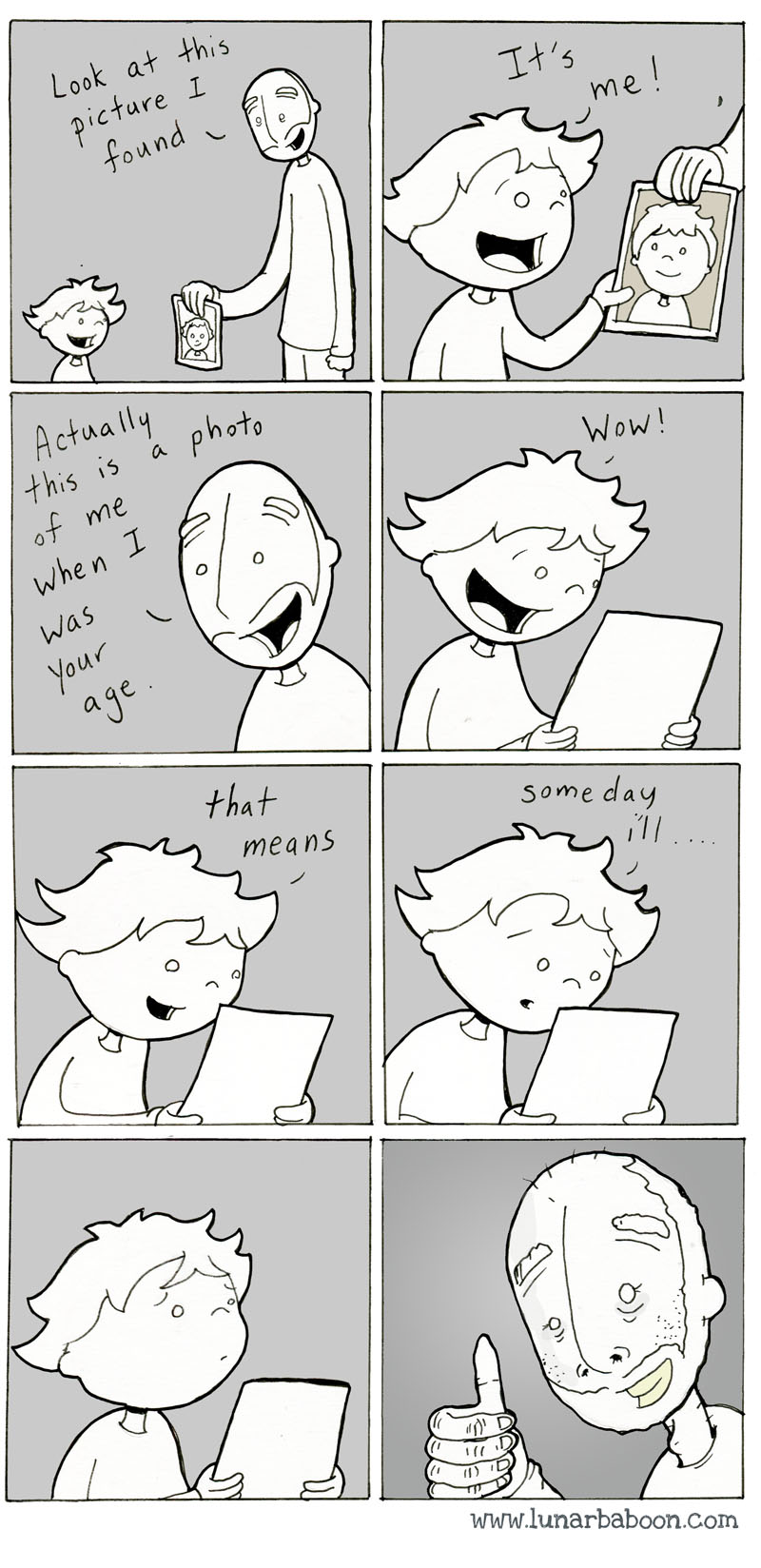
epiphany

by Lunarbaboon
Dan Jones

I sure hope my daughter doesn't grow up to look like me.

24 Aug 14:27

Pearls Before Swine: Sunday, August 24, 2014

Pearls Before Swine
23 Aug 12:45

Texts From Superheroes Facebook | Twitter | Pinterest | Patreon


Texts From Superheroes

Facebook | Twitter | Pinterest | Patreon

22 Aug 20:51

Superman Helps a Suicidal Girl in Superman: Grounded

Superman Helps a Suicidal Girl in Superman: Grounded


This touching excerpt from Superman: Grounded written by J. Michael Straczynski shows how truly great Superman can be.

"After the devastating events of WAR OF THE SUPERMEN, Superman looks to reconnect with the roots of his battle for Truth, Justice and the American Way. ?Grounded? begins as Superman visits Philadelphia ? on foot ? then continues in a small town in Ohio where, as in many towns, a number of its residents are from other places. But when The Man of Steel discovers that there are also a number of residents secretly from other worlds, he unravels a mystery that may have grave consequences for Earth."

On his quest trying to find himself he meets a suicidal young woman prepared to jump off a building...

Superman Save a Suicidal Girl in Superman: Grounded

Superman Save a Suicidal Girl in Superman: Grounded

Superman Save a Suicidal Girl in Superman: Grounded

Superman Save a Suicidal Girl in Superman: Grounded

Superman Save a Suicidal Girl in Superman: Grounded

Superman Save a Suicidal Girl in Superman: Grounded

Superman Save a Suicidal Girl in Superman: Grounded