Shared posts

08 Feb 07:57

Liquid-Phase Modeling in Heterogeneous Catalysis

by Mohammad Saleheen and Andreas Heyden

TOC Graphic

ACS Catalysis
DOI: 10.1021/acscatal.7b04367
07 Feb 07:41

TiO2(B) and Anatase Angstrom-Scale Wires: A Theoretical Study

by Luciana Fernández-Werner, Estela A. González, Ricardo Faccio and Álvaro W. Mombrú

TOC Graphic

The Journal of Physical Chemistry C
DOI: 10.1021/acs.jpcc.7b10418
02 Feb 09:40

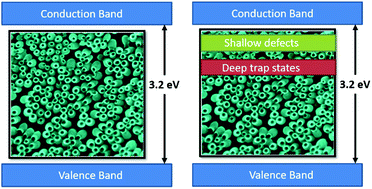
On the relationship between rutile/anatase ratio and the nature of defect states in sub-100 nm TiO2 nanostructures: experimental insights

Phys. Chem. Chem. Phys., 2018, 20,5975-5982
DOI: 10.1039/C7CP08629F, Paper
Moamen M. Soliman, Mohamed H. Al Haron, Menna Samir, Sarah A. Tolba, Basamat S. Shaheen, Ahmed W. Amer, Omar F. Mohammed, Nageh K. Allam
The anatase/rutile ratio and annealing atmosphere determine the defect states in TiO2 nanotubes and their photoelectrochemical activity.
The content of this RSS Feed (c) The Royal Society of Chemistry
31 Jan 08:24

Multimode Electron Tomography as a Tool to Characterize the Internal Structure and Morphology of Gold Nanoparticles

by Naomi Winckelmans, Thomas Altantzis, Marek Grzelczak, Ana Sánchez-Iglesias, Luis M. Liz-Marzán and Sara Bals

TOC Graphic

The Journal of Physical Chemistry C
DOI: 10.1021/acs.jpcc.7b12379
30 Jan 07:55

Generalization of the periodic LCAO approach in the CRYSTAL code to g -type orbitals

Abstract

The Linear Combination of Atomic Orbitals approach implemented into the public Crystal program for quantum-chemical simulations of n-dimensional periodic systems ( \(n = 0,1,2,3\) ) is here extended to g-type basis functions. A general algorithmic procedure is devised for the calculation of the coefficients needed for the analytical evaluation of one- and two-electron integrals for energy and forces within the recursive McMurchie–Davidson strategy, up to arbitrarily high quantum numbers. Explicit routines are generated for the calculation of all the coefficients needed for g-type functions, which ensure a very high computational efficiency. The code has been generalized in many respects so as to allow for the use of g-type functions for: (1) Hartree–Fock energy and forces; (2) density functional theory energy and forces (in either a local density, generalized gradient, meta-GGA or various hybrid approximations); (3) all-electron and pseudo-potential basis sets; (4) spin-restricted and unrestricted calculations; (5) coupled-perturbed Hartree–Fock/Kohn–Sham (hyper)-polarizability calculations; (6) projected density-of-states. The g-type basis functions are expected to play an important role in (1) the description of the electronic structure of heavy elements and in particular of lanthanides and actinides with occupied 4f and 5f bands, respectively, where they represent the first polarization, (2) those calculations requiring an accurate description of the electronic polarization.

26 Jan 11:51

Toward a muon-specific electronic structure theory: effective electronic Hartree-Fock equations for muonic molecules

Phys. Chem. Chem. Phys., 2018, 20,4466-4477
DOI: 10.1039/C7CP07599E, Paper
Milad Rayka, Mohammad Goli, Shant Shahbazian
A set of novel effective Hartree-Fock equations are derived for muonic molecules and implemented computationally for a number of species.
The content of this RSS Feed (c) The Royal Society of Chemistry
25 Jan 08:25

Moving Boundary Truncated Grid Method for Wave Packet Dynamics

by Tsung-Yen Lee and Chia-Chun Chou

TOC Graphic

The Journal of Physical Chemistry A
DOI: 10.1021/acs.jpca.7b11932
25 Jan 08:21

First-Principles Calculations of Sarin Adsorption on Anatase Surfaces

by Nam Q. Le, Chinedu E. Ekuma, Brett I. Dunlap and Daniel Gunlycke

TOC Graphic

The Journal of Physical Chemistry C
DOI: 10.1021/acs.jpcc.7b11509
24 Jan 08:06

Role of Gold Adatoms in the Adsorption of Sulfide Species on the Gold(001)-hex Surface

by Flavia Lobo Maza, Pilar Carro, Carolina Vericat, Klaus Kern, Roberto C. Salvarezza and Doris Grumelli

TOC Graphic

The Journal of Physical Chemistry C
DOI: 10.1021/acs.jpcc.7b11059
23 Jan 08:27

Calculations of CO Oxidation over a Au/TiO2 Catalyst: A Study of Active Sites, Catalyst Deactivation, and Moisture Effects

by Zhiyao Duan and Graeme Henkelman

TOC Graphic

ACS Catalysis
DOI: 10.1021/acscatal.7b03993
22 Jan 07:46

Understanding the Active Sites of CO Hydrogenation on Pt–Co Catalysts Prepared Using Atomic Layer Deposition

by Joseph A. Singh, Nuoya Yang, Xinyan Liu, Charlie Tsai, Kevin H. Stone, Bart Johnson, Ai Leen Koh and Stacey F. Bent

TOC Graphic

The Journal of Physical Chemistry C
DOI: 10.1021/acs.jpcc.7b10541
15 Jan 07:23

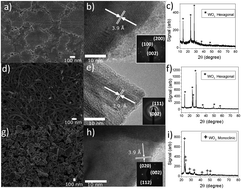
Tungsten oxide ion gel-gated transistors: how structural and electrochemical properties affect the doping mechanism

J. Mater. Chem. C, 2018, 6,1980-1987
DOI: 10.1039/C7TC04529H, Paper
M. S. Barbosa, F. M. B. Oliveira, X. Meng, F. Soavi, C. Santato, M. O. Orlandi
Electrolyte-gated transistors hold promise for applications in printable and flexible electronics.
The content of this RSS Feed (c) The Royal Society of Chemistry
12 Jan 07:56

Full Quantum Dynamics Simulation of a Realistic Molecular System Using the Adaptive Time-Dependent Density Matrix Renormalization Group Method

by Yao Yao, Ke-Wei Sun, Zhen Luo and Haibo Ma

TOC Graphic

The Journal of Physical Chemistry Letters
DOI: 10.1021/acs.jpclett.7b03224
05 Jan 09:19

Comment on “Natural Bond Orbitals and the Nature of the Hydrogen Bond”

by F. Weinhold and E. D. Glendening
The Journal of Physical Chemistry A
DOI: 10.1021/acs.jpca.7b08165
03 Jan 06:58

Using Density Based Indexes and Wave Function Methods for the Description of Excited States: Excited State Proton Transfer Reactions as a Test Case

by Juan Sanz García, Federica Maschietto, Marco Campetella and Ilaria Ciofini

TOC Graphic

The Journal of Physical Chemistry A
DOI: 10.1021/acs.jpca.7b10033
02 Jan 09:49

WO3 Photoanodes with Controllable Bulk and Surface Oxygen Vacancies for Photoelectrochemical Water Oxidation

J. Mater. Chem. A, 2017, Accepted Manuscript
DOI: 10.1039/C7TA10056F, Communication
Jijie Zhang, Xiaoxia Chang, Chengcheng Li, Ang Li, Shanshan Liu, Tuo Wang, Jinlong Gong
Introduction of oxygen vacancies for semiconductor photoanodes is an effective method to accelerate charge carriers transfer and improve the photoelectrochemical performance. However, excessive surface oxygen vacancies are always created in...
The content of this RSS Feed (c) The Royal Society of Chemistry
02 Jan 09:40

Multiscale simulations of ligand adsorption and exchange on gold nanoparticles

Phys. Chem. Chem. Phys., 2018, 20,1381-1394
DOI: 10.1039/C7CP07039J, Paper
Hui-Min Gao, Hong Liu, Hu-Jun Qian, Gui-Sheng Jiao, Zhong-Yuan Lu
Multiscale simulations of CTAB/PEG-SH ligand adsorption and exchange kinetics on gold nanoparticles.
The content of this RSS Feed (c) The Royal Society of Chemistry
22 Dec 13:23

Fourier Transform Surface Plasmon Resonance (FTSPR) with Gyromagnetic Plasmonic Nanorods

by Insub Jung, Haneul Yoo, Hee-Jeong Jang, Sanghyun Cho, Kyungeun Lee, Seunghun Hong, Sungho Park

Abstract

An unprecedented active and dynamic sensing platform based on a LSPR configuration that is modulated by using an external magnetic field is reported. Electrochemically synthesized Au/Fe/Au nanorods exhibited plasmonically active behavior through plasmonic coupling, and the middle ferromagnetic Fe block responded to a magnetic impetus, allowing the nanorods to be modulated. The shear force variation induced by the specific binding events between antigens and antibodies on the nanorod surface is used to enhance the sensitivity of detection of antigens in the plasmonics-based sensor application. As a proof-of-concept, influenza A virus (HA1) was used as a target protein. The limit of detection was enhanced by two orders of magnitude compared to that of traditional LSPR sensing.

Thumbnail image of graphical abstract

FTSPR: Durch Kombination mit magnetischer Rotation eines ferromagnetischen Fe-Segments zwischen plasmonischen Au-Blöcken gelingt ein elektrochemischer LSPR-basierter biologischer Nachweis. Spezifische Bindungsereignisse führen zu einem dynamisch gestörten System, in dem die Frequenz der Nanostäbe gemäß einer Fourier-Transformations-Analyse oberhalb einer kritischen Antriebsfrequenz nachläuft.

21 Dec 16:41

Unveiling the Atomic Structures of the Minority Surfaces of TiO2 Nanocrystals

by Wentao Yuan, Jun Meng, Beien Zhu, Yi Gao, Ze Zhang, Chenghua Sun and Yong Wang

TOC Graphic

Chemistry of Materials
DOI: 10.1021/acs.chemmater.7b04541
15 Dec 11:49

Perturbation of Reactivity with Geometry: How Far Can We Go?

by Randall J. Meyer, Qiang Zhang, Anna Kryczka, Carolina Gomez and Ruzica Todorovic

TOC Graphic

ACS Catalysis
DOI: 10.1021/acscatal.7b03228
14 Dec 13:06

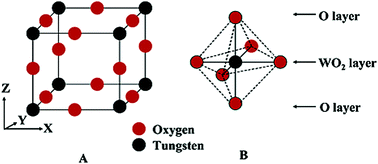
Advances on tungsten oxide based photochromic materials: strategies to improve their photochromic properties

J. Mater. Chem. C, 2018, 6,191-212
DOI: 10.1039/C7TC04189F, Review Article
Shufen Wang, Weiren Fan, Zichuan Liu, Aibing Yu, Xuchuan Jiang
Photochromic materials have been extensively studied because they are quite attractive and promising for many applications.
The content of this RSS Feed (c) The Royal Society of Chemistry
13 Dec 09:38

Construction of Vibronic Diabatic Hamiltonian for Excited-State Electron and Energy Transfer Processes

by Yu Xie, Shengshi Jiang, Jie Zheng and Zhenggang Lan

TOC Graphic

The Journal of Physical Chemistry A
DOI: 10.1021/acs.jpca.7b07737
12 Dec 08:02

Water Splitting with an Enhanced Bifunctional Double Perovskite

by Jian Wang, Yang Gao, Dengjie Chen, Jiapeng Liu, Zhenbao Zhang, Zongping Shao and Francesco Ciucci

TOC Graphic

ACS Catalysis
DOI: 10.1021/acscatal.7b02650
06 Dec 07:49

Computational and Experimental Study of Thermodynamics of the Reaction of Titania and Water at High Temperatures

by Q. N. Nguyen, C. W. Bauschlicher, D. L. Myers, N. S. Jacobson and E. J. Opila

TOC Graphic

The Journal of Physical Chemistry A
DOI: 10.1021/acs.jpca.7b08614
05 Dec 08:53

Weak binding mode of CH4 on rutile crystallites from density functional theory calculations

Publication date: 1 December 2017
Source:Computational and Theoretical Chemistry, Volume 1121
Author(s): Ali Abbaspour Tamijani
In the recent years, the surfaces of oxides and fluorides have received considerable attention due to their suitability for emerging technologies such as fuel cells. Among these substances, well-known rutile TiO2, and rutile-like SnO2, MgF2 and ZnF2 are of particular interest owing to their utilization in a wide range of applications such as heterogeneous catalysis. In order to probe these materials for their catalytic activity, physisorption of small organic molecules, such as methane, on their respective dominant surfaces is of potential value. However, the lack of adequate experimental results on the adsorption energetics and geometries of binding particles, has stimulated a large number of computational studies. In this work, the van der Waals-driven sorption of CH4 on (110) face of all of the abovementioned structures has been examined computationally. A manifold of dispersion-corrected DFT methods was applied to evaluate the binding and surface energies as well as surface-induced atomic displacements. Only the most energetically favored configuration of the adsorption, has been examined. The calculated values were compared to the pertinent literature data, either theoretical or experimental, when available. Whilst optB86b-vdW produces the most consistent atomic displacements, despite its confinements, revPBE-D3 results in the most accurate adsorption energies for CH4-TiO2(110). Calculated surface energies were in agreement with the prior studies if available.

Graphical abstract

image