Shared posts

04 Mar 11:36

Business Decision

by Kevin Batcho
Setting the scene for the Zelenian Dialogue

In The History of the Peloponnesian War, Thucydides doesn’t merely chronicle events—he dissects the raw mechanics of power, exposing a cold logic that reverberates through history. Whether driven by an innate human instinct or by leaders consciously re-enacting his script, his account remains the blueprint for great power struggles, shaping conflicts long after the war he describes ended in ruin.

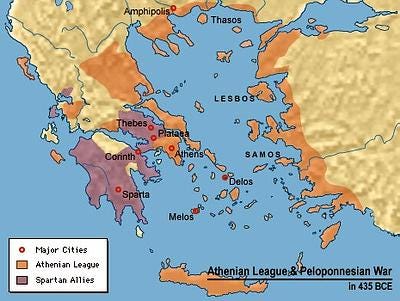
In the Melian Dialogue, Thucydides captures a brutal showdown between Athens, an imperial juggernaut, and Melos, a defiant but fragile island. With their larger war against Sparta on the verge of reigniting, Athens dispatched envoys to neutral Melos with a blunt ultimatum: submit or be annihilated. This wasn’t simply a threat—it was a reckoning.

The Melians, clinging to honour, faith in the gods, and the belief that Sparta—Athens’ sworn rival—would not abandon them, refused. They gambled that their shared blood and Sparta’s hatred of Athens would tip the scales in their favour.
In pressing for Melian submission, the Athenian envoys dispensed with pretences. They stripped the world to its raw mechanics: no justice, no divine will—only power and self-interest. Their argument was unsparing, built on strength, necessity, and the cold reality that nations act not out of virtue but to serve their own advantage. It was not morality that dictated survival, but the ability to recognize where one’s true interests lay—and the will to act accordingly.

The Lacedaemonians [Spartans], when their own interests or their country’s laws are in question, are the worthiest men alive… but such a way of thinking does not promise much for the safety which you now unreasonably count upon.

The Melians stood defiant. They countered with appeals to justice, and the sacred bonds of kinship, believing that Athenian power without righteousness was ultimately hollow. In their eyes, Sparta’s honour was more than self-interest—it was an obligation, a duty that could not be ignored. They placed their faith in the gods and in the idea that Sparta, however pragmatic, would not abandon its own.

But we trust that the gods may grant us fortune as good as yours, since we are just men fighting against unjust, and that what we want in power will be made up by the alliance of the Lacedaemonians, who are bound, if only for very shame, to come to the aid of their kindred.

The Melians’ moral defiance, once their shield, became their downfall. Yet their lofty appeals to justice did not die with them. Instead, they took on new life, re-emerging as a blueprint for empires that cloaked conquest in virtue.

Across centuries, the same moral rhetoric would be repurposed—for Europe’s 19th-century colonial mission civilisatrice, later for liberal interventionism’s wars of “liberation.” Pillage was repackaged as philanthropy, war waged in the name of freedom, empire draped in the language of rights. The sword still swung, but always for a noble cause—schoolgirls in Afghanistan, the oppressed in distant lands. Realists see power as a tool to balance terror; idealists wield it to remake the world.

Melos bet on Sparta, lost, and paid in blood—men butchered, women and children sold into slavery. But the deepest wound wasn’t carved by the sword; it came from the Athenians’ unflinching truth: justice and the gods don’t rule the world—power does. The Melians had wagered on abstractions—honour, divine favour, the promise of a distant ally. Athens dealt in hard currency—ships, soldiers, and the cold arithmetic of force.

The strong do what they can, and the weak suffer what they must.

Sparta had no voice in the Melian Dialogue, but its shadow loomed over every word. Athens pressed Melos not just to break its will, but to send a message to its true rival. The Melians prayed for rescue, convinced that emotion would in the end drive Sparta to act. But Sparta did not move on hatred—it moved on the cold arithmetic of power. Ever attuned to the grand chessboard, it weighed the odds and made a business decision—waiting, watching, and letting a lost cause sink.

Subscribe now

The Zelenian Dialogue

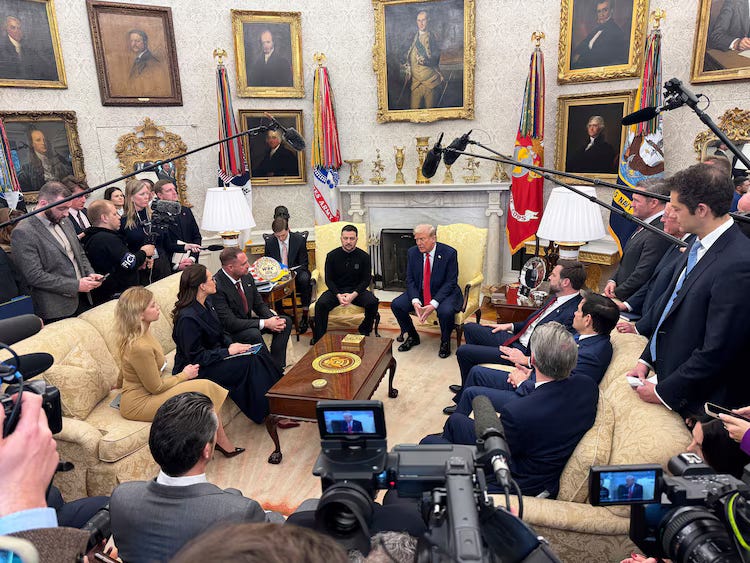
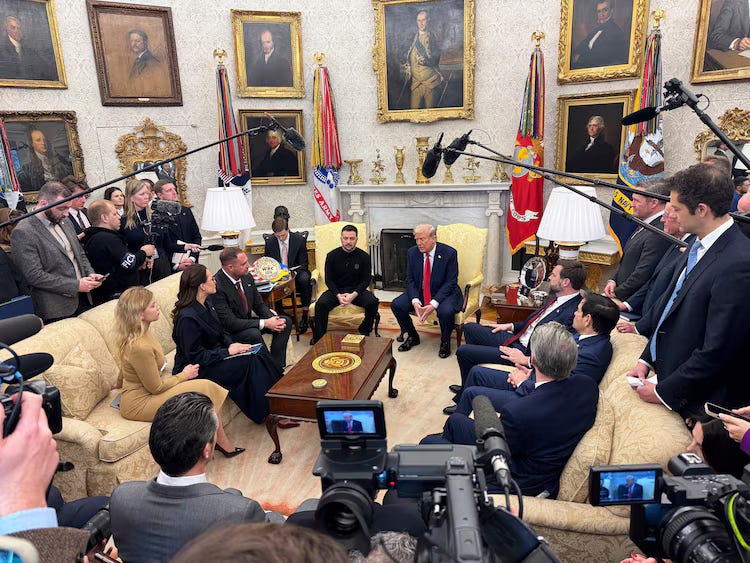
Two thousand four hundred and thirty-nine years later, a strikingly similar drama unfolds, but with a modern twist. On February 28, 2025, Ukrainian President Volodymyr Zelensky meets with U.S. President Donald Trump and Vice President J.D. Vance in the Oval Office. This time, it’s not Athens crushing Melos under its heel—it’s a great power cutting ties with its torn and frayed proxy.

Russia, like Sparta in the ancient story, looms in the background, but the real twist in this dialogue isn’t about who’s menacing an attack—it’s about who’s walking away from a fight.

For years, the U.S. and Russia, two rival giants, have pulled Ukraine back and forth in a relentless tug-of-war, leaving the country demographically drained and financially fractured. Now, Trump as the cameras of the world unite their gaze, changes the game: he stops playing the aggressive role of Athens, and instead adopts the stance of Sparta—a passive pull back. His team has done the math—Ukraine is no longer worth the cost.

Zelensky, like the Melians, pleads for a lifeline, insisting that Ukraine has stood strong on its own.

We are staying strong from the very beginning of the war, we have been alone.

Trump’s had enough of the talk. He hits back with the bare facts:

You don’t have the cards right now.

Zelensky appeals to ideals, claiming he’s not “playing cards” as he tries to shift the frame from the realm of power, where he is weak, to the plane of morality, where he feels as invincible as the Zealots of Judea.

Trump cuts him off sharply: “You are playing cards. You’re gambling with the lives of millions of people. You’re gambling with World War III.

Why don’t you wear a suit?” a Trump team member asked Mr. Zelensky.

Business attire would corrode Zelensky’s aura of righteous crusader, exposing him as a dark dealmaker "cutting losses." Che Guevara didn’t wear a suit.

For Trump and Vance, this isn’t about morality or justice—it’s about cold calculations, risks, and what’s practical. To them, Ukraine isn’t a noble cause worth politically dying for; it’s a losing bet they’re no longer willing to back.

A Word Doing a Lot of Work: Guarantees

Zelensky didn’t fly all the way to Washington for a chummy chat—he wanted one thing: a U.S. guarantees to stand firm against Russia. He hammered it ten times, fishing for a solid yes. Trump nudged him toward peace; Zelensky shot back:

Yes, of course I want to stop the war. But, as I’ve said to you, with guarantees.

That word—guarantees—was a loaded gun. It meant after an eventual ceasefire, Ukraine could break any truce, lob shells at Russia, and dare them to hit back. When they did, the do-gooder loudmouths would howl for American kids to die in the Donbass, all for some grand moral feels.

Trump, however, wasn’t swayed—like Sparta, he saw no reason to entangle himself in another couple’s domestic squabble, especially when Russia was the enraged ex. Zelensky played the classic underdog card, appealing to emotions, but no amount of sob stories or lofty rhetoric could override hard realities. The only true game-changer—U.S. boots on the ground—was never on the table.

Even if Trump wanted to send US fighting men to the Donbass, which he doesn’t, they might never reach the frontlines. Putin isn’t Saddam in 2003, waiting passively as invaders gather just next door. Russia has hypersonic missiles and a clear message: just last weekend, they demonstrated this by striking a British ship near Odessa.
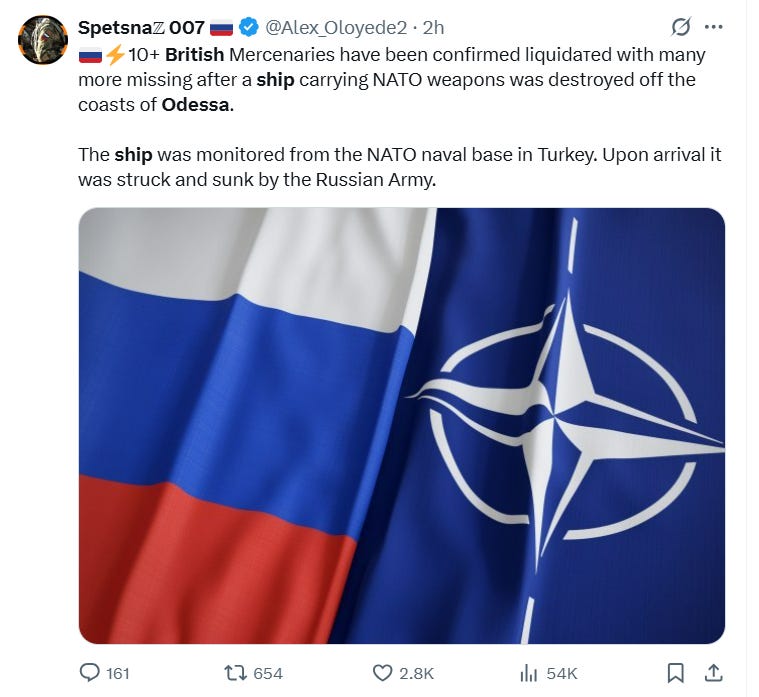
In turn, Vance, like an Athenian envoy cloaked in modern cynicism, scolds the discarded Zelensky for not showing enough gratitude.

"Have you said thank you once?"

Yet the message is clear—this is not a debate, not a negotiation. This is a severance notice. Trump, weary of the cost, is forcing Ukraine to face Russia alone, or at best, with the weasel-word backing of Europe—which is, strategically speaking, the same as being alone.

If The Melian Dialogue featured an empire at its peak brandishing its sword, the Zelenian Dialogue stars an aging great power withdrawing its shield. The lesson, however, remains the same: in the realm of realpolitik, power—not honour, not gratitude, not even past alliances—dictates survival. And just as Melos was left to its fate against Athens, Zelensky now faces a far more dangerous moment—a looming Melian Dialogue 2.0 with Russian President Vladimir Putin.

Geography of Conflict

In Thucydides’ History, Athens and Sparta aren’t just cities or armies—they’re forces, stripped to their essence, looming out of a dead world into ours. He doesn’t waste breath on battle lists or legal fine print. Instead, he carves out a stark, unflinching tale of two opposing drives—Athens, the relentless empire-builder, and Sparta, the grim, unmoving sentry.

Athens gets the usual title—“the Athenians”—but when Thucydides sharpens the blade, he calls them “the sea power” and “the tyrants of Greece.” The words bite. They rule the waves, bend their Delian League allies into submission, and never stop reaching. He dubs them “the innovators” too—a compliment that cuts both ways. Brilliant but reckless, they press forward, spitting on anything that stands still. The Sicilian Expedition, that glorious disaster, the Athenian Waterloo, proves it—overextension turns to collapse. Athens is a machine that cannot stop, not until it drives itself into ruin.

Sparta is another beast entirely. Thucydides calls them “the Lacedaemonians,” a name as stiff as their way of life. They’re also “the Peloponnesians,” not rulers of an empire but leaders of a league—a pack, not a dominion. Where Athens sails, Sparta digs in. “The land power,” slow to take up ships, wary of foreign entanglements, as rigid as old wood. They are “the upholders of custom,” chained to the past, allergic to change. They don’t win the Peloponnesian War with daring or brilliance. They grind it out—waiting, watching, letting Athens bleed itself dry.

At its core, the war is energy against endurance, expansion against restraint, the new against the old. Athens burns too hot and collapses; Sparta weathers the storm and takes the prize—only to find victory a burden it can’t carry. Thucydides doesn’t moralize. He has no patience for Spartan stagnation or Athenian arrogance. He just lays it bare: power is a trap. What makes a state strong is what destroys it when pushed too far.

The Peloponnesian War isn’t just a clash of two cities—it’s a brutal autopsy of how empires rise, overreach, and decay. Some, like Athens, burn out in brilliance; others, like Sparta, survive their own triumphs only to stumble forward, exhausted, into irrelevance.

From Stairway to Coltrane

In geopolitics, mouthing the tired old Munich appeasement narrative is like clanging away at Stairway to Heaven in a guitar store. Learning to master Thucydides and his Melian Dialogue, however, opens the door to weaving silky Coltrane melody lines on smoky late-night X war threads.

Thucydides’ History of the Peloponnesian War isn’t buried in the ruins of old Greece—it cuts through time, cold and exact, landing squarely in today’s power struggles. He wasn’t just a clerk scribbling down battles; he laid bare the ruthless mechanics of domination and downfall, turning history into a blueprint for those willing to grasp how war and power truly work.

Polybius, chronicling Rome’s rise, borrowed Thucydides’ method to dissect empire. Machiavelli, holed up with The Prince and The Discourses, stripped those ancient wars to their brutal core, sketching a code for rulers who knew survival outranks sentiment. To him, Athens and Sparta weren’t dusty relics; they were blueprints—democracy crashing into oligarchy, proof that every system carries the seeds of its own undoing.

Fast forward to the Cold War, and Thucydides is back in play. The U.S.—loud, ambitious, ruling the seas, spreading its culture like a tide—falls into Athens’ role. The Soviet Union—rigid, landlocked, hoarding its strength—mirrors Sparta. The analogy wore thin, but it stuck because Thucydides wasn’t just chronicling a war—he was mapping a pattern, one that grinds through every age, endlessly repeating in new disguises.

Now, figures like Donald Kagan drag the Peloponnesian War out of the dust for anyone paying attention. At Yale, he laid it out in four towering volumes, then distilled it into The Peloponnesian War—a stark reminder that ambition burns hot, fear grips hard, and hubris wrecks all. It’s not just history; it’s a mirror, daring us to see ourselves in its ruins.

Team Blue vs. Team Red forever

The same struggle plays out in America’s own halls of power. The Democrats—restless, global-minded, fluent in the language of progress—inherit Athens’ mantle: expansive, always reaching further, blind to the breaking point. The Republicans—land-bound, wary, clinging to order and tradition—channel Sparta: cautious, resistant, playing for time, believing survival lies in restraint, not overreach.

It’s not about ideology; it’s the same primal clash—motion against inertia, ambition against endurance, expansion against self-preservation. Inspired by Athens and Sparta, Machiavelli’s Foxes, cunning and quick to adapt, push for movement, while his Lions, strong but rigid, dig in their heels. Both sides follow their nature, blind to the cracks forming beneath them—archetypes trapped in endless Groundhog Days of conflict.

Turn the lens towards Ukraine, and the old script plays out again. The United States and Russia slip into their ancient roles—Athens and Sparta, rewritten with modern weapons. The U.S. is the restless titan, fleets everywhere, dollars pouring out, preaching democracy to anyone who will listen, always one step from overreach. Russia is the land power, heavy, battered, hunched over its own fractures, playing the long game. It’s the same struggle: motion against resistance, expansion against defense. Each has its poison. And the world, cold and indifferent, turns on under the same pitiless sky.

Getting Real, Going Liberal, Gone Neocon

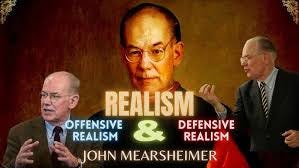
Thucydides rips the mask off foreign policy, stripping it down to a brutal tug-of-war between power and principle, carved deep into history’s bones. Realism—hammered out by hard minds like Machiavelli, Hobbes, and Morgenthau—draws straight from the Athenian side of the Melian Dialogue, where the strong tell the weak to kneel or die, no illusions allowed. Nations run on self-interest, cold and simple. Morals are window dressing for power, and history doesn’t bend toward justice—it just keeps score.
But the Melians didn’t kneel quietly. They fired back with appeals to fairness and faith, insisting that justice, not brute force, should decide their fate. They lost—crushed under Athens’ boot—but their defiance echoed through history, shaping the belief that nations could stand for something greater than raw power. It was the seed of liberal idealism, blooming into dreams of mere laws restraining empires, of principles stronger than armies. A beautiful idea. A costly one—hanging, as ever, by a thread.

From this came Liberal Interventionism, the creed that has steered America for over a century. It began with Woodrow Wilson, who cast the U.S. as the world’s enforcer, spreading democracy like gospel. That mission pulled America into both World Wars, the Cold War, and now Ukraine—fighting under a banner so torn they can’t see the frays.

The Cold War mutated something sharper: Neoconservatism. These weren’t starry-eyed idealists; they saw war as a chisel, carving the world to fit their vision. They masterminded Iraq, Syria, Libya, and for 20 years, they’ve been stoking the fire in Ukraine, determined to gut Russia for good. To people like Victoria Nuland and Robert Kagan, diplomacy isn’t strategy—it’s surrender. Every compromise only fuels the next enemy, and the real battle, the one that matters, is always just over the horizon.

Ukraine is the proving ground where these doctrines collide. Realists like Mearsheimer argue that NATO poked the bear too hard and warn that without a deal, the war will spiral into catastrophe. Biden’s Liberal Interventionists poured in billions, casting the fight as a grand defense of democracy—Athens squaring off against Sparta once more. But the Neocons, the most unyielding of all, won’t settle for anything less than Russia crushed, its ruins paving the way to keep America on top. And now Trump, drifting toward the realist line, makes his business decision—severing the war machine’s lifeline with a stroke of a pen.
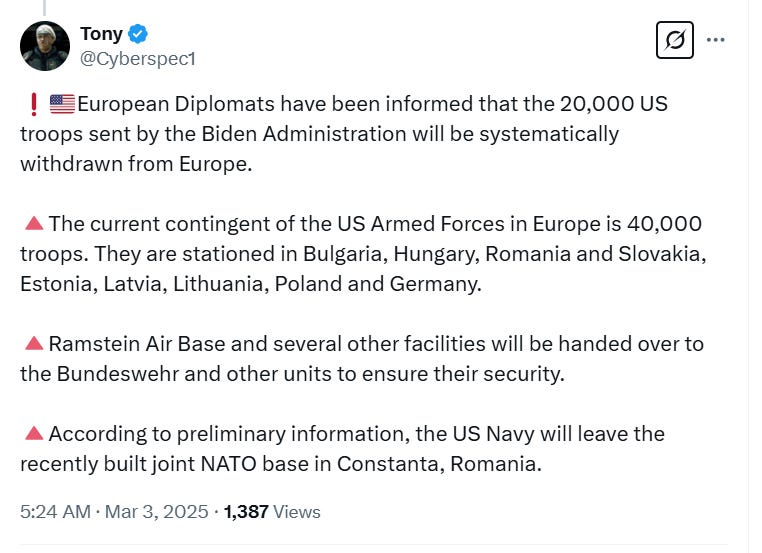
Unconfirmed but big if true

As Captain Alfred Thayer Mahan wrote, the Peloponnesian War proved that “strategic problems remain the same, though affected by tactical difficulties peculiar to each age.” The same hard truths played out in Athens’ doomed march on Syracuse—blinded by hubris, deaf to warning, they charged ahead, only to be shattered and left bleeding in the dust.

Slouching Towards Syracuse

History is littered with the wreckage of overreach, and few disasters loom larger than Athens’ Sicilian Expedition. What began as a bold bid for dominance in Sicily spiralled into catastrophe, shattering Athenian naval supremacy and sealing its fate in the Peloponnesian War.

Envisioned as a masterstroke of imperial expansion, the campaign became an albatross—draining resources, costing thousands of lives, and exposing the limits of Athenian ambition. Sparta, which had stood by when Athens annihilated Melos, now watched as its rival blundered into a self-made disaster.

But Sparta wasn’t the only power lurking offstage. The Persian Empire—nominally an enemy of all Greece—saw no reason to meddle in the war, at least not at first. Unmoved by Athens’ and Sparta’s desperate appeals, Persia waited, patient and calculating. Only when Athens overreached in Sicily did Persia make its move, funnelling ships and silver to Sparta. With Persian backing, Sparta finally struck the fatal blow, ensuring Athens' collapse.

Today, China plays a similar role in the wake of the “Zelenian” Dialogue. While Russia looms just beyond the verbal sparring in the Oval Office, China stands further back, weighing its options. But history shows that great powers rarely remain neutral forever. If the war in Ukraine drags on, Beijing may face the same choice Persia did centuries ago—whether to keep watching or step in and tip the scales.

The spectre of the Sicilian Expedition has haunted military strategists for centuries. Napoleon’s march on Moscow, Hitler’s siege of Stalingrad, even America’s invasion of Iraq—famously likened to Athens’ disaster by historian Donald Kagan—all echo the same fatal miscalculation: the belief that power, once wielded successfully, can always be extended. But history imposes limits, whether leaders acknowledge them or not.

Did the West, by rejecting the Istanbul Accords between Ukraine and Russia, negotiated in 2022, hope to lure Russia into its own Sicilian Expedition in Ukraine? By prolonging the war and closing off diplomatic off-ramps, did NATO strategists aim to ensnare Putin in a costly, unwinnable quagmire—just as Athens was drawn into Sicily? If so, the gamble has failed and the tables are turning.
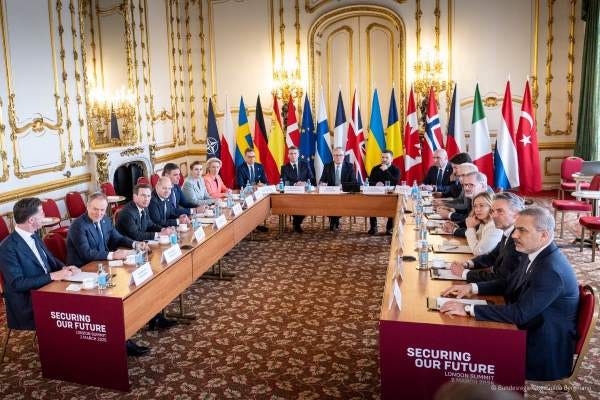
Call a meeting, take a group photo, a Euro-Eunuch War Party

Now, a different trap is being set. Europe and Ukraine are military eunuchs without U.S. backing, and both were blindsided by the return of the Bad Orange Man. Trump 2.0, now on a mission to yank America out of Europe, has thrown their entire long-term strategy into question. When Zelensky rushed to the Oval Office, was he trying to bait Trump into offering security guarantees—tempting him into an eventual Sicilian Expedition of his own, one that could wreck his political career and bury the MAGA movement for good?

Why exactly are 500 million Europeans asking 300 million Americans to fight 140 million Russians on their behalf?
Subscribe now

Share

07 Jul 10:52

Lant Pritchett on development

by noreply@blogger.com (Urbanomics)

There is an excellent interview of Lant Pritchett here. I'll quote at length because even by Lant's exceptional standards, this is full of wisdom on several areas. It packs so many invaluable insights into a brief interview. 

He identifies four transformations a country should make - to a productive economy, to a capable state, to a government responsive to the needs and wishes of citizens, and to a society where equal treatment of all before the law and of each other is a bedrock principle. 

He finds the modern development discourse as being detrimental to realising these transformations,

Yet the current focus in development is on what I call ‘kinky development’, which involves tinkering on the margins to help the poorest of the poor. That is the wrong focus. If you achieve national development, you will solve poverty and provide prosperity for the general population, whereas focusing on poverty alone often is at odds with getting you to desirable levels of prosperity. We should ask ourselves with everything we do: “Is this contributing to one of the four transformations we need to do, and if so, how?”... Given limited time, resources, and attention, it sometimes seems reasonable to prioritise by focusing on small-scale stuff, but a series of small-scale interventions doesn’t add up to real transformation and often presupposes that the big changes are already in place. It presupposes a capable state, for example, which is often lacking. It also presupposes that the government is responsive and is concerned about the problems that you want to address. 

This problem with the obsession with evaluation 

I object to the current trend that says large-scale change is too difficult to assess scientifically, so we should focus on small changes. That’s not how the rich countries became rich. They went through a messy, difficult, extended, contested process regarding the four transformations. No country has high levels of human well- being without having achieved national development; and every country that has high national development achieves very high levels of human well-being. So, the only path to high human well-being is through national development...
Doing rigorous experiments to figure out how much further you can travel with an extra gallon of gas is meaningless if the transmission is broken and the tyres are flat. Things work as systems and thinking that you can solve them piecemeal without a diagnostic of the overall functioning of the system is just madness.

This on the problem with the prevailing practice of education, 

... ‘spending ain’t investment’. It is only ‘investment’ if it works. If I worship a god of the ocean, and I throw gold into the ocean, and call that investment in my prosperity, I have made a mistake because there is no causal link between my spending and my prosperity. Unless you are causally right about the chain of events that leads from your spending to the desired outcomes, you can spend all you want and not actually improve outcomes. In Indonesia, which is a reasonably well functioning country, teacher’s pay was doubled and the amount of spending per child tripled over the past 20 years, yet learning has not budged a bit; if anything, it has deteriorated. I think people have confused ticking the box of spending money on a budget item called ‘Education’, with true investment in human beings.

On the comparison between education in India and Indonesia,

India never changed its mind about having a selection system rather than an education system. A selection system is where you put all children in a classroom, but provide a poor or indifferent environment for learning, and see what happens. The students that learn in that environment must be brilliant. As for those who do not learn, teachers will say they must be the type of children who cannot learn. India took that option because they expected that 2-3% of the population would be an educated elite, and that would be good enough. And so, they committed themselves to selection rather than education. Things will only change once they fundamentally change their ideas, which they are hopefully in the process of doing now.
Indonesia was different. They decided to provide a standardised product for all learners at a fairly low level, and they reached a decent level of learning where most kids learned some basics. In fact, they were superior to India. Many people think of India as doing better, but India does worse for the average person while also producing a smart elite whose members sometime win a Nobel Prize. Indonesia did far better at covering the basics for everyone as a way of building national unity around a common language. But they never really provoked themselves to go further. Now, they’re stuck at this low-level equilibrium of mediocrity, and they haven’t been able to budge past it in spite of making an important transition to democracy.

The fundamental issue is commitment. Do we have a clear vision of what we expect every child to know and do? Is it a reasonable set of commitments? Can we actually achieve it with the resources we have and the teaching force we have, and what we know how to do? And are we really committed to achieving it? Are we going to hold ourselves to account for achieving the reasonable and important objectives we’ve set? Once you get that right, there are some other things that need to happen, but those are minor details.

On the importance of place in the productivity of people, the "place premium",

The productivity of a person is therefore influenced by the person’s characteristics, skills, capabilities, ambition, and so on; but is also limited by the productivity of the place they are in. So, when you take a worker from a low productivity place and you put them in a high productivity place, their productivity goes up by a factor of four, simply because they are now in a productive place.

On corruption

Hyper regulation necessarily creates corruption. If you create a set of laws that people cannot abide by, you will generate corruption, because you basically create an environment in which the state, and whoever controls the apparatus of the state, can sell differential enforcement to the highest bidder. Thus, corruption is the natural result of a set of laws that are beyond the capacity of a state to enforce. If you borrow best practice law from a country that can enforce it, and you put it in a place that cannot enforce it, corruption is guaranteed... The problem is that there are two bad things about deals: that they are not honoured and that they are closed to some people – not everybody can access the deal – and by being closed, they are not transparent. If the goal is to create more openness about the deals that are being cut, then any deal, to survive scrutiny, will have to be done honourably. The tendency to prioritise laws over practice should be reversed, in other words.

On evolution of policy making,

Often, protecting labour or the environment can be better served by a more realistic set of policies that grows endogenously and organically out of the processes of experimentation. I think good policy comes from good practice rather than good practice coming from good policy.

This about the perils of imitation and transplantation,

The AK47 is the world’s most popular weapon. The M16, which is the standard weapon in the US army, is far and away a more accurate weapon than the AK47, which beyond a few hundred yards, cannot hit a thing. The AK47 emerged from the Soviet Union, where they designed their weapons for the soldiers they had, low capability with little training. They also designed the AK47 to be unbelievably robust; no matter what you do to it, when you pull the trigger, it fires. You can basically hand anybody an AK47 and it will be a reasonably effective weapon. The United States took the opposite approach of designing the best possible weapon and training soldiers to match the weapon. It is an excellent weapon, but if you do not keep it clean and in good functioning order, it will misfire.

The problem is when you give the M16 with its perfect design to a poor soldier it won’t work. This mirrors a lot of what has happened in development – the desire to adopt best practice, leads to a gap between practice design and the capability for implementation. Rather than organically building designs that work in a low- implementation environment, policymakers have tried to borrow designs and fit them into countries, and it just does not work. When well-designed programmes are poorly implemented the reason is obvious, but the problem repeats itself, because no one ever admits that what they need is an AK47. You need to design the programme for the soldiers you have.

This is just a brilliant conclusion that goes to the heart of development,

You should nominate and work on problems that people really want to solve. The way you build capability is by solving problems. The way you get ahead is by working on problems where there is a broad consensus about what needs to be solved, and then you get people to work on that problem. Once you have a well-defined problem, then you can begin to work organically on a solution. In every historical example I know of, countries became successful by means of an ugly, messy, contested, hard slog that took decades. And then, after they become successful, they create myths about how wonderful it was and the reasons why they did it, when the reality was just that it was a hard slog.

Once the problem is clearly defined and there is collective commitment to the cause, there is just no substitute for plain simple hardwork and persistence.

Add to Technorati Favorites
16 Oct 06:40

Trickster

This is a recommendation for 2½ books and a just-launched TV series, and for the books’ author, Eden Robinson. As a consequence of watching the TV pilot I’m now re-reading the books, which is strong testimony. While this is pretty Canadian stuff, I think the story of a disadvantaged and hard-pressed young aboriginal person, lost in strange spaces, would resonate in plenty of other landscapes. Anyhow, it’s dark and entertaining, with sex and drugs and rock ’n’ roll and supernatural creatures you would not want to meet on a dark night. These are page-turners, keep-you-up-too-late stuff.

Son of a Trickster Trickster Drift

The books are Son of a Trickster (2017), Trickster Drift (2018), and the “½” is because the third book, The Trickster Returns, isn’t out till next spring. But boy will I ever snap it up.

The TV series is on CBC (Canadian public TV); here’s a pointer which I’m not 100% sure will work outside Canada. If it does, the shows are free but there are ads. I thought S1E1 captured the spirit of the books perfectly and I’ll be spudding out. Sorry, it’s real actual TV so you’d have to wait a few months to binge it.

Our hero is Jared, a Native high-schooler whose family is deeply, spectacularly dysfunctional.

Drugs, violence, you name it, all the usual marks are checked. The locus of chaos at Jared’s place is his mother, who’s all about trashy men and bad drugs, with a casual attitude toward rent, utility bills, and education. Granted the difficulties she’s sort of lovable, and definitely to be feared not pitied. Jared’s Dad (not situated locally) is a wastrel of a different flavor.

The thing about Jared is he takes care of people, whether or not they deserve it; it seems he can’t help it, it’s just who he is.

Which means Jared has a high-stress life. It helps that he’s bright and well-organized and actually makes enough money to keep the family afloat. (Not legally, but still.) He’s got his own substance-abuse issues and suffers from typically-toxic high-school culture.

Now mix in the Trickster of the title, not a natural creature at all, except sometimes a raven; there are strong roots here in our Pacific-Northwest Native story culture. Trickster has a name: Wee’git.

The supernatural bulges through the surface of reality in horrifyingly believable ways; its inhabitants are not cuddly and not friendly and are apt to bite off pieces of human anatomy, given a chance. The first book is set in a mid-coastal town and the second mostly in Vancouver, my hometown, which I disclose because it may have contributed to my being completely taken with these stories.

It seems very unlikely that the TV series will achieve the full dark craziness of the books, but early indications are positive. The actors playing Jared his his mother are razor-sharp.

Hmm, I seem to have got way down here without talking about the underlying social issues. Canada has systemic racism just like everywhere else. In particular there’s no getting away from the fact that Canada is substantially built on stolen land. The abuse of our indigenous people has been explicit and multigenerational and brutal. So, unsurprisingly, a lot of them are really hurting. These stories inhabit that reality and show you things you can’t unsee, with awesome clarity but without ever giving you a feeling that you’re being lectured. A lot more Canadians would benefit from learning the truths on display on these pages.

Oh, and a word about the author. She has a couple of other books which I plan to read, and when you hear her on the radio or YouTube or whatever, she’s a scream, with a big laugh and an endless line of good-humored stories about Native life and writer’s issues and, well, everything. I think she’d be a delight to hang out with

[Disclosure: The buy-this-book links above are Amazon Associate tagged and if you follow them I might make a buck.]

04 Sep 07:08

The George Burns Syndrome

by Atanu Dey

One time I was asked to explain how Israel, despite being a socialist country, was successful in light of the fact that I keep claiming that socialism is a recipe for disaster. My response was this.
Let me tell you about what I call the “George Burns Syndrome.” George Burns was an American actor who lived up to a ripe old age of 100 (1896 – 1996). He smoked cigars like a chimney and drank like a fish (although I doubt that fish drink all that much.) It would be incorrect to conclude that the secret to a long life is to smoke & drink like he did. The fact is that Burns worked out regularly — daily swimming, walks, sit ups and push ups. No doubt genes also had something to do with it.

The regularities that we observe in nature always admit exceptions. The exceptions prove (where the word ‘prove’ is meant in the sense ‘test’) the rule. The rule does not get invalidated but tested by exceptions.

Socialism fails to produce prosperity. That’s a regularity. Why socialism fails to produce prosperity can be analytically understood and empirically verified. The fact that Israel prospers despite being somewhat socialist (if that is indeed the case; I don’t know that for a fact) does not invalidate the analytical or the empirical fact that socialism is a bad way of organizing an economy.

Smoking and excessive drinking is bad for your health even if Uncle George lived a very long life. Perhaps if Uncle George had not smoked, he could have lived to 120, who knows. Israel is successful no doubt but could it have been even more so if it were not partially socialist?

18 Aug 08:01

Democracy before state building and clientelism - lessons from the US

by noreply@blogger.com (Urbanomics)
Continuing from the earlier post here on the stages of development of countries and the emergence of liberal democratic systems.

In Political Order and Political Decay, Francis Fukuyama writes about precocious democracy,
Those countries in which democracy preceded modern state building have had much greater problems achieving high-quality governance than those that inherited modern states from absolutist times. State building after the advent of democracy is possible, but it often requires mobilization of new social actors and strong political leadership to bring about... Many of the problems of developing countries are by-products of the fact that they have weak and ineffective states.
On the importance of strong governments and institutions in preventing conflict and poverty,
Almost all the authors systematically studying the phenomenon of conflict point to weak governments and poor institutions as a fundamental cause of both conflict and poverty. Many failing or fragile states are thus caught in a low-level trap whereby poor institutions fail to control violence, which produces poverty, which further weakens the ability of the government to govern... While many people believe that ethnicity is a cause of conflict when observing the Balkans, South Asia, Africa, and other places in the aftermath of the cold war, William Easterly shows that when one controls for the strength of institutions, any link between ethnic diversity and conflict disappears... James Fearon and David Laitin similarly show that higher levels of ethnic or religious diversity were not more likely to cause conflict when controlling for level of per capita income.
This is a good summary of the need for strong governments,
The first and most important institution that fragile or failing states lack is an administratively capable government... Political order is not just about constraining abusive governments. It is more often about getting governments to actually do the things expected of them, like providing citizen security, protecting property rights, making available education and public health services, and building the infrastructure that is necessary for private economic activity to occur... The real question facing most governments, then, is less whether to redistribute than at what level to do so, and how to redistribute in ways that minimize moral hazard.
This about patronage and clientelism,
A patronage relationship is a reciprocal exchange of favors between two individuals of different status and power, usually involving favors given by the patron to the client in exchange for the client’s loyalty and political support... Patronage is sometimes distinguished from clientelism by scale; patronage relationships are typically face-to-face ones between patrons and clients and exist in all regimes whether authoritarian or democratic, whereas clientelism involves larger-scale exchanges of favors between patrons and clients, often requiring a hierarchy of relationships... In a clientelistic system, politicians provide individualized benefits only to political supporters in exchange for their votes... These benefits can include jobs in the public sector, cash payments, political favors, or even public goods like schools and clinics that are selectively given only to political supporters... In societies where incomes and educational levels are low, it is often far easier to get supporters to the polls based on a promise of an individual benefit rather than a broad programmatic agenda...

Reciprocal altruism involves the exchange of favors between unrelated individuals on a face-to-face basis... Clientelism is a form of reciprocal altruism that is typically found in democratic political systems where leaders must contest elections to come to power... Compared to an elite patronage network, clientelistic networks need to be much larger because they are frequently used to get hundreds of thousands of voters to the polls. As a result, these networks dispense favors not based on a direct face-to-face relationship between the patron and his or her clients but rather through a series of intermediaries who are enlisted to recruit followers. It is these campaign workers—the ward heelers and precinct captains in traditional American municipal politics—who develop personal relationships with individual clients on behalf of the political boss...

Clientelism should be broadly related to the level of economic development. This is a simple matter of economics: poor voters can be more easily bought than rich ones, with relatively small individual benefits like a cash gift or a promise... As countries become wealthier, the benefits politicians need to offer to bribe voters increase, and the cost of clientelism rises dramatically.
Italy and Greece are examples of clientelism in Europe. They did not develop modern bureaucracies and modern states before they became electoral democracies. In contrast, in Germany, the militaristic Prussian absolutist monarchy from the 18th century built up a strong state and rule of law (albeit weaker than that achieved in Britain due to the Glorious Revolution and its focus of accountability - no taxation without representation), underpinned by a powerful, autonomous, and merit-based bureaucracy. Since democracy made its appearance only in the 20th century, its governments never needed clientelism to maintain power. Britain, France, and Germany began industrialisation hereby having an organised working class well before they democratised. Political parties emerged only just before democratisation in all these societies.

On British bureaucracy,
British were able to do in the period from the issuance of the Northcote-Trevelyan reforms in 1854 to the establishment of a modern civil service in the 1870s... Northcote-Trevelyan reforms were driven by the demands of the British middle class for access to a civil service dominated by aristocratic patronage.
The last sentence has strong echoes with the Indian Civil Service, especially the IAS in the post-independence era.

This is a good summary of the differing trajectories of various European countries,
As Europe exited feudalism, the key to the eventual emergence of accountable institutions was the balance that existed between the monarch (or state) and the other elite power holders in the society. Where the monarch succeeded in co-opting the aristocracy and upper bourgeoisie, as in France and Spain, weak absolutism emerged; where the monarch and aristocracy joined hands against the peasantry, as in Prussia and Russia, there was strong absolutism; where the aristocracy was stronger than the monarchy, as in Hungary and Poland, there was local tyranny and national weakness... Only in England were the state and aristocratic elites relatively balanced; constitutional government arose out of the fact that neither one could prevail over the other. The English state often threw its weight into the balance in favor of nonelites against the aristocracy, not out of egalitarian ideology but because it wanted to clip the wings of a rival for power. While we are familiar with the story of King John’s barons limiting his power through the Magna Carta, English kings were also instrumental in limiting the power of the barons and lords against their tenants and nonelite.
This about how trust lowers transaction costs,
Living in a high-trust society has many advantages. Cooperation is possible in low-trust societies, but only through formal mechanisms. Business transactions require thick contracts, litigation, police, and legal enforcement because not all people can be relied upon to meet their commitments. If I live in a neighborhood with high rates of crime, I may have to walk around armed, or not go out at night, or put expensive locks and alarms on my door to supplement the private security guards I have to hire. In many poor countries, as we will see in Part II, families have to leave a member at home all day to prevent their neighbors from stealing from their garden or dispossessing them of their house altogether. All of these constitute what economists call transaction costs, which can be saved if one lives in a high-trust society. Moreover, many low-trust societies never realize the benefits of cooperation at all: businesses don’t form, neighbors don’t help one another, and the like...
The vast majority of law-abiding behavior is based rather on the fact that people see other people around them obeying the law and act in conformity to the perceived norm... Conversely, if a bureaucrat sees a fellow worker taking a bribe for allowing someone to jump the queue, or if a politician perceives that the rival party is benefiting from rake-offs from public contracts to his detriment, then he will be much more likely to behave in a similar fashion. If many citizens cheat on their taxes (as happens routinely in both Greece and Italy), then any given person is going to look stupid paying up in full... A low-trust society constitutes what economists call a collective action problem. Distrust is socially counterproductive, and everyone would be better off if they behaved in a trustworthy manner. But any given individual has no incentive to be the first person not to take a bribe or to pay her taxes. Since distrust feeds on itself, everyone is trapped in what is known as a low-level equilibrium, where everyone is worse off but no one can break out. By contrast, if the government were clean, honest, and competent, then people would be willing to trust it and follow its lead.
The United States did not have any legacy of feudalism (and therefore inequality and attendant demands for redistribution) or violent wars, which meant that the imperative for strong state was not felt. This was also amplified by the settlers antipathy to strong government as represented by the absolutism of the British monarchy which made them flee. The settlers brought with them the Tudor tradition of divided sovereignty (as against concentration in one strong government), Common Law as source of authority with attendant role for Courts in governance, and accountable government based on the principle of no taxation without representation. In fact the founding fathers were even suspicious of political parties, with James Madison calling them "factions". Instead their vision was of leadership by public spirited individuals who were concerned about the common good.

America's founding fathers, who drafted the constitution, were elites who graduated from Harvard and Yale. This was also borne out by them recruiting more of their own kind into the leadership positions of the initial governments. The initial electorate were those with property ownership (from the Whig view that only those who paid taxes should have a share in the government). It required the arrival of commoner Andrew Jackson as President to reduce the elitism in US and usher in the Jacksonian tradition of populism which lives to this day.

This description of US system is instructive,
The political system that emerged after the Jacksonian revolution became what political scientist Stephen Skowronek has labeled a “state of courts and parties.” That is, the two institutions of constraint, the rule of law and accountability, were the most highly developed. What did not exist in nineteenth-century America was a centralized, bureaucratic, and autonomous state of the sort that had been created in Prussia, France, and Britain... The emerging political parties substituted for the state by exercising a high degree of control over the operations of the government... Parties organized governmental institutions internally … routinized administrative procedures with patronage recruitment, spoils rotation, and external controls over the widely scattered post offices, land offices, and customs houses.”...The legislative and judicial branches began to take on functions normally performed by the executive in European political systems... for the first two-thirds of the nineteenth century, there was little that the national government needed to do beyond running customshouses and post offices, and distributing land...

American clientelism was most highly developed on a municipal level and survived there for the longest time. Political machines were erected in virtually all the major eastern, midwestern, and southern cities, where they served as mechanisms for mobilizing large numbers of nonelite voters.42 They were particularly important in New York, Chicago, Boston, Philadelphia, and other cities that saw, toward the end of the century, a huge influx of emigrants from Eastern and Southern Europe who had never before voted... It differed very much from the type of patron-client relationships that existed in southern Italy in the nineteenth century, where existing elites could use their wealth and social status to organize and dominate large numbers of poor voters. In America, by contrast, clientelism was a way for ambitious but nonelite politicians to become wealthy and increase their social status, while delivering concrete benefits to their supporters... Municipal-level political machines were simply modernized and highly organized versions of the Melanesian Big Man and tribal wantok, in which an elected leader develops a base of political support by giving out individualized benefits to his supporters.

... successful bosses tried to maintain personal relationships with as many supporters as possible, but they needed to recruit precinct captains and ward heelers as intermediaries to manage recruitment of voters, distribution of resources, and monitoring of voter behavior. It was these individuals who had to have detailed knowledge of their constituents and be able to cater to their needs. The individualized benefits given out could vary from jobs in the post office or city hall to Thanksgiving turkeys to hods of coal... Despite these outrageous instances of corruption, municipal machines like Tammany Hall did play an important positive role in mobilizing otherwise marginalized citizens and allowing them to participate in the political system. This was particularly true of recent immigrants, who were often disdained by existing elites for their religion, habits, or sheer foreignness...

While the poor gained advantages from the party machine, their long-term interests suffered. Because they were being organized on the basis of the distribution of individual benefits rather than broad programmatic agendas, it was much harder to recruit them into working-class or Socialist parties of the sort that emerged in Britain and Germany, where working-class parties demanded more formal types of redistribution such as universal health care or occupational safety programs.
... parallel reform process unfolded in each American city dominated by a boss and a political machine. For example, the Republican machine in Chicago at the end of the nineteenth century was run by William Lorimer, a congressman and later senator who handed out food, coal, pensions, scholarships, licenses, and jobs to political supporters... His machine, like those in other cities, catered to the interests of the huge number of immigrants and working-class voters who were flocking into the city to work in its new industries.
On the Gilded Age in the US,
Gilded Age that began with the presidency of Ulysses S. Grant in 1869, a period characterized by a number of scandals—the Crédit Mobilier affair, the Whiskey Ring, War Secretary Belknap’s selling of Indian post traderships, the “Salary Grab” in which Congress voted itself a retroactive pay raise at the end of the session from $5,000 to $7,000 per year... With the growth of industrialization and the vast new concentrations of money that came with it, lobbyists emerged to mediate between private interests and Congress. The railroads in particular paid legislators on both federal and state levels to do their bidding. Several western states were commonly believed to be wholly owned by railroad interests...

America in the 1880s had many similarities to contemporary developing countries. It had democratic institutions and competitive elections, but votes were bought with the currency of public office. The quality of government was generally poor, a problem mitigated only by the fact that it wasn’t expected to do much in terms of fighting wars or regulating the economy. These conditions changed dramatically as the country began to industrialize in the last decades of the nineteenth century; the United States needed a European-style state, and it slowly began to build one.
On the end of clientelism in the US,
The end of the patronage system at a federal level did not arrive until the middle of the twentieth century. Despite the fact that Franklin Roosevelt and the New Deal oversaw an enormous expansion of the scope and functions of the federal government, the president himself used patronage appointments early on in his first term to ensure that the government was staffed by loyalists... Between the 1880s and the 1920s, the United States gradually dismantled the clientelistic system of party government and laid the foundations of a professional bureaucracy comparable to the ones that had been operating in Europe for several generations. The fact that the United States had a clientelistic system in the first place had to do with the fact that it was democratic earlier than most European countries, and that it had not already created a strong, autonomous state at the point when the franchise was first opened up. A coalition in support of an autonomous bureaucracy eventually emerged, but it had to be put together under strong leadership over an extended period of time, both at a national level and in each city and state that was subject to machine politics.
What does the US experience teach today's developing countries?
The American experience contains some important lessons for contemporary developing countries that want to reform clientelistic political systems and create modern, merit-based, technically competent governments. The first is that reform is a profoundly political process, not a technical one... Clientelism exists because incumbents benefit from the system, either as political bosses who get access to power and resources, or as their clients who get jobs and perks. Dislodging them requires more than the formal reorganization of the government. The experience of public-sector reform mandated by international aid agencies for developing countries at the turn of the twenty-first century demonstrates the futility of a purely technical approach.

A second lesson is that the political coalition favouring reform has to be based on groups that do not have a strong stake in the existing system. Such groups occur naturally as the by-product of economic growth and social change. New business interests that are excluded from the existing patronage system, middle-class professionals lacking access to politics, and civil society groups catering to the needs of underserved populations are all candidates... A third lesson is that while government reform reflects the material interests of the parties involved, whether entrenched patronage politicians or rising middle-class voters, ideas are critical in shaping how individuals see their interests. A middle-class voter could equally well take a proffered government job, or be persuaded that his or her family’s long-term interests are better served by a system that recruits the best possible people on an impersonal basis...

A fourth lesson is that reform takes a great deal of time. The Pendleton Act was passed in 1883, but it was not until the 1920s that a large majority of public servants were put under the merit classification system. Even then this pattern was reversed briefly early in the New Deal... Oftentimes reform is spurred by accidental events, like the assassination of James Garfield, or the exigencies of wartime mobilization.
Add to Technorati Favorites
19 Jun 08:57

Examining progress

by noreply@blogger.com (Urbanomics)
The central thesis of modern western philosophy is the idea of progress. It is the belief in a trajectory of movement from primitive to advanced states in our material, vocational, personal, familial, cultural, spiritual, moral, social, and political realms. This movement was assumed to be both positive and inevitable. 

This (broadly) linear idea of progress is at variance with the eastern philosophy which views things in cyclical terms. 

John Gray, one of the critics of the dominant western view, talks about two different dimensions to the evolution of human societies over time. His central thesis is that the fundamental idea of progress is applicable only to the material realm of science and technology, and not to ethics and politics.

One, at a scientific level, human societies progress in a monotonic manner, moving further up the chain of scientific development over time. This knowledge is never unlearnt but is accretive or monotonically increasing. Two, at an ethical or political level, human societies adapt to the emerging contexts and manifest as the prevailing norms and culture. But this is not accretive, and there is nothing called progress. What was repugnant a few generations back can become acceptable and then relapse back to being repugnant, and then back as acceptable over time. So there is nothing permanent about socio-political or socio-economic organisations like liberal democracy or free market system.

The gains in science and technology are a cumulative advance. These realised gains are not lost, and they are the basis for further gains. We often see accelerating and exponential gains. However, in ethics and politics, what is gained is very quickly, often invisibly, lost. The upward arc that is a feature of science and technology does not exist for ethics and politics.

Technology hits a ceiling when faced with issues like making human beings more rational or more civilised. Both civilisation and barbarism are natural to human beings.

Mirroring John Gray, EO Wilson had written much earlier,
‘The real problem of humanity is the following: we have paleolithic emotions; medieval institutions; and god-like technology. And it is terrifically dangerous, and it is now approaching a point of crisis overall.’
Another critic of the progress view is German Oswald Spengler, who proposed a cyclical view of history and also rejected the west-centric focus of world history. Robert W Merry has a very good essay about Spengler here.

Spengler saw all "great cultures as essentially organic entities whose phases of emergence, development and decline are remarkably similar from culture to culture". Accordingly, he viewed "history as the story of various discrete civilizations, each with its own distinct culture, that emerged, developed, flowered and then declined". Merry writes,
First, since civilizations and cultures are distinct, there can be no universal culture. No body of thought emanating from one culture can be imposed upon another, either peacefully or through force. And civilizational decline is an immutable rule that applies to all civilizations, including the West. The second noteworthy element of Spengler’s thought is his view, based on his study of eight great civilizations, that the process of decline carries with it a surge of imperial fervor and a flight toward Caesarism. Hegemonic impulses come to the fore along with forms of dictatorship. As Charles and Mary Beard wrote in The American Spirit, “Spengler’s judgment of history certainly conveyed to American readers the notion that ‘Western civilization’ was doomed and that another Caesar, the conquering man of blood and iron, would bring it to an end.”
Spengler's analysis of history differs with the scientific method and is grounded on destiny and historical analogy, the natural order of life and phenomena. In fact, his argument that understanding of history is "unapproachable through the cognition-forms which the Critique of Pure Reason investigates" has remarkable similarity with the subjective appreciation of revealed knowledge (smriti) in Hinduism.

For Spengler the driving force behind the decline is "deterioration of folk traditions and innocent enthusiasms of the culture". Robert Merry writes,
Its cultural essence, once of the soil and spread throughout the “mother-region” in town, village and city, now becomes the domain of a few rich and powerful “world-cities,” which twist and distort the concepts of old and replace them with cynicism, cosmopolitanism, irony and a money culture. Thus, Spengler draws a sharp distinction between culture and civilization. The former is the phase of creative energy, the “soul” of the countryside; the latter is a time of material preoccupation, the “intellect” of the city. As Hughes elaborates, “So long as the culture phase lasts, the leading figures in a society manifest a sure sense of artistic ‘style’ and personal ‘form.’ Indeed, the breakdown of style and form most clearly marks the transition from culture to civilization.”... But what most clearly marks the civilizational phase is what he considered the inevitable gravitation toward Caesarism and empire. Spengler’s historical analogies taught him that the transition from culture to civilization unleashes a kind of Will to Power, manifest internally in a drive to consolidate power within the civilization, and externally in a drive to assert dominance over other peoples. “Imperialism,” writes Spengler, “is Civilization unadulterated.”...
Spengler predicted with uncanny foresight a number of Western developments of the past century, including the rise of world-cities and the money culture, the emergence of a powerful feminism focused on the yearnings of the Ibsen woman, the force of money in politics, declining birthrates and the popular embrace of avant-garde cultural sensibilities, awash in cynicism and cosmopolitanism and bent on destroying the cultural verities of old.
Add to Technorati Favorites
01 Mar 13:08

Essential Adam Smith and Essential Hayek

by Amol Agrawal
Two free e-books on the two scholars: Smith and Hayek. The essentials summarise the key ideas of the two scholars…  
29 Dec 10:21

What returns will I get from equities going forward? – Part 2

by Arun

In the first part of this series here, we discussed on how to evaluate valuations and plug it into our future returns estimates.

Today, we shall solve the next part of the future returns puzzle – Earnings.

Let me be honest upfront. I don’t think I know an exact method to predict earnings growth. In fact I don’t think I ever will 😦

So acknowledging this inability of mine, the idea here will be to work around with a simple framework which is not intended to be precise, but rather can be a good starting point in our conversations about equity return expectations.

Now that we are done with all caveats, let’s dive in..

How do we estimate future earnings growth?

Carl Jacobi to our rescue

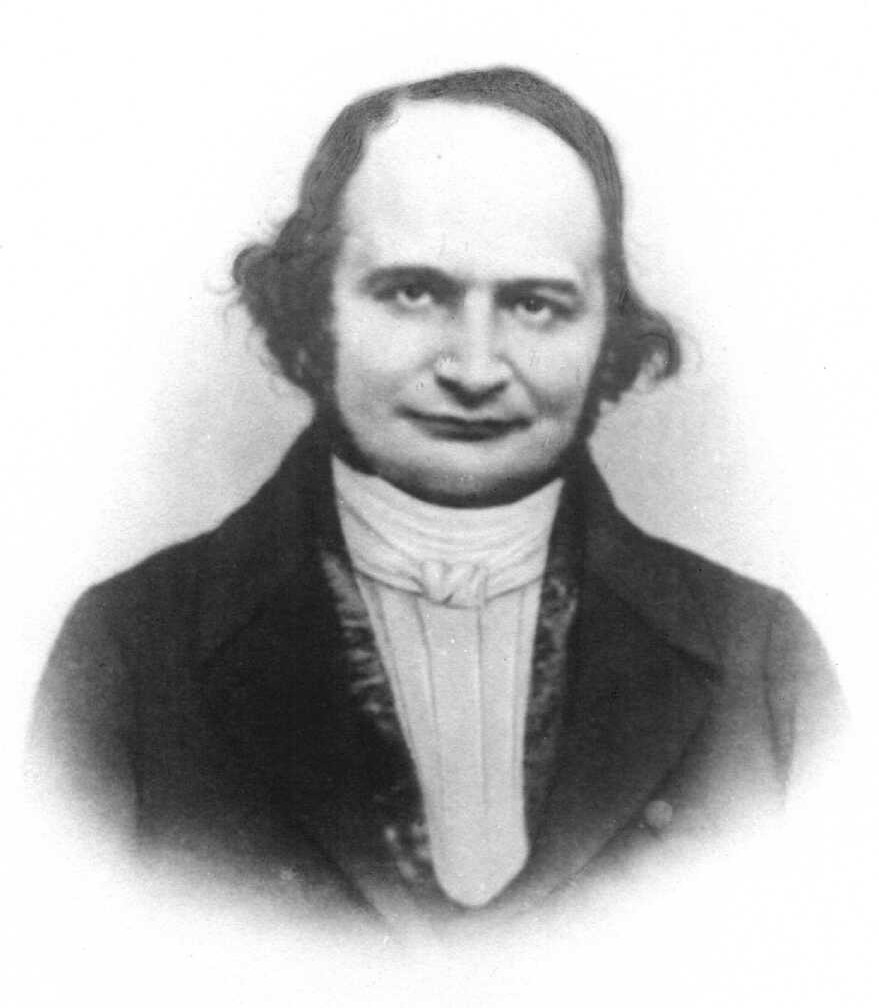
Jacobi, a German 19th-century star mathematician, believed that the solution for many difficult problems could be found if the problems were expressed in the inverse – by working backward.

Image result for invert always invert

He was fond of saying, “Invert, always invert”

So instead of asking what will be the future earnings growth, what if we invert our problem and ask –
“For my expected returns from equities, what is the earnings growth required?

Let me explain..

Assume you need at least 15% from equities in the next 5-7 years.

In our earlier post, we found that

Returns from equity = Change in earnings + Change in PE valuations + Dividend Yield

The current trailing PE for Sensex is 23.5. As we had seen in our earlier post here historically we have always got the opportunity to exit above a PE valuation of 17x in the last 2 years of our investment time horizon.

Assuming we get to exit at 17 times PE, this implies a 28% absolute decline due to PE value coming down from the current 23.5 times.

This negative 28% spread across 5-7 years implies a compounded annual loss of ~5-6%.

The dividend yield of Sensex has historically hovered around the 1% to 1.5% range.

I intend to make around 15% from equities. (You are free to have a different return requirement)

Thus putting all this together,

Returns from equity required = 15%

= Earnings growth + Change in PE valuations (- 5 to 6%) + Dividend Yield (1%)

= Earnings Growth – (4 to 5%)

So for getting 15% returns from equities, the Sensex earnings growth should grow by around 20% for the next 5-7 years!

Phew, that gives us a fair idea of the expectations being built in. But how easy or difficult is this 20% number to achieve.

Let us take a look at history..

  • FY 93-96 : 45% CAGR
  • FY 96-03 : 1% CAGR
  • FY 03-08 : 25% CAGR
  • FY 08-16 : 6% CAGR
  • FY 16-21 : ????

You can clearly see that Sensex earnings growth has remained cyclical and alternates between low and high growth periods.

So going by the historical trend, it seems reasonable to expect better growth over the next 5-7 years.

But let us dig further..

Earnings Growth details.png

Source: MOSL

As seen above the Sensex earnings growth over a 5-7 year period has crossed 20% only in the FY93-96 period and FY 03-08 period.

  • FY 93-96 is when Indian economy was opened up for foreign investments and its a one off event.
  • FY 03-08 was primarily led by a strong global growth, domestic investment cycle and commodity bull run.

Now that means, there has only been 2 instances in the past where 20% expectations have been met. Out of which, one of them was led by a one off event, so technically it’s just one instance in the entire 23 years!

So while earnings growth, given their cyclical nature is expected to improve going forward, 20% growth is definitely not an easy ask.

What should happen for this 20% earnings growth to materialize?

A simple way to evaluate where we are in the earnings growth cycle is by using the corporate profits as a % of GDP equation.

corp pat as a % of GDP.png

Source: MOSL, Livemint

In order to arrive at our approximate estimates for the next 5 year earnings growth, we need to project these two parameters

  1. Nominal GDP Growth (i.e Inflation + Real Growth)
  2. Corporate Profits as a % of GDP

Assumptions

  • For nominal GDP growth, let us go by RBI estimates which is around 6-7% real growth + 4-5% inflation = 10 to 12% Nominal Growth
  • We will assume that the corporate profit as a % of GDP moves closer to the long term average (5% of GDP) over the next 5 years. (to around 3.5% to 4.5% as a % of GDP)
  Final 3.0.png

Going by this, our reasonable estimates of earnings growth for the next 5 years can be around 15% to 21%.

But do corporate profit as a % of GDP mean revert?
Let us see what happened in the US where we have the data spread across a large period

Screenshot-2017-10-1 Corporate Profits After Tax (without IVA and CCAdj) Gross Domestic Product

Great. The long term data clearly shows that Corporate Profits as a % of GDP is cyclical in nature. Thus our assumptions for mean reversion of Corporate Profits as a % of GDP in India is reasonable.

Ok, so where that does leave us with

  1. Earnings growth can be around 15% to 21% over the next 5 years
  2. Valuations will lead to a negative impact of 4-5% over the next 5 years
  3. Dividends will add around 1 to 1.5%

Thus overall return expectations for the Sensex over the next 5 years can be approximately around 11% to 17%

Mutual funds historically have done slightly better (by capturing higher earnings growth due to stock selection) and can be expected to provide ~1-2% out performance over the Sensex.

Now that we have a reasonable framework, depending on how reality evolves and we can improve or adapt our existing process.

All this is fine. But how in the world, do we convert all this mumbo jumbo into an executable framework?

Hang on till the next week..

Till then, happy investing as always 🙂

And, just in case you found what you just read useful, share with your friends and do consider subscribing to the blog along with the 1400+ awesome people, so that you don’t miss out on the next week’s post. Of course additionally you also get loads of free, interesting investment insights delivered straight to your inbox.

Disclaimer: All blog posts are my personal views and do not reflect the views of my organization. I do not provide any investment advisory service via this blog. No content on this blog should be construed to be investment advice. You should consult a qualified financial advisor prior to making any actual investment or trading decisions. All information is a point of view, and is for educational and informational use only. The author accepts no liability for any interpretation of articles or comments on this blog being used for actual investments

20 Nov 10:08

There’s Seldom Any Traffic on the High Road

by Farnam Street

We’ve all been there: someone says something rude to us and our instinct is to strike back with a quick-witted comeback. That’s what many people do. It’s also a big reason that many people don’t get what they want. Consider this example from my recent travels:

“Are you dense?” the gate agent blurted to me, clearly frustrated as I asked a question she’d be asked a million times that day. Only moments before, I had been sitting on a plane to Seattle when the announcement came over the PA system that the flight was cancelled.

The instructions were clear: check with the gate agent for reassignment.  I was tenth in line. By the time I talked to her, this agent had already had to deal with nine angry customers. She wasn’t frustrated with me, but I knew that everyone else had verbally beat her up. I also travel enough to know how seldom that works. She had instructed the previous nine passengers to collect their bags, go through customs, and go to the Air Canada customer service desk for reassignment.

“I guess you’re right, I can be slow sometimes,” I said. “I’m sorry.”

Her words finally caught up with her, and she apologized. “I’m sorry, that was rude of me. I didn’t mean—”

“You’ve had a long day. People are frustrated and taking it out on you when it’s not your fault. I know how hard that can be.”

She cracked a smile, the first I had seen from her since I joined the line. And she happily found me a seat on the next flight.

She was being rude. Yes. But that wasn’t the best version of her.

When people are rude, our subconscious interprets it as an assault on hierarchy instincts. Our evolutionary programming responds with thoughts like, “Who are you to tell me something so rude? I’ll show you….”

Our instincts are to escalate when really, we should be focused on de-escalating the situation. One way to do that is to take the high road.

Say something along the lines of “I can see that.” You don’t have to apologize. You don’t have to agree with what the other person is saying. But I promise the results are magic. It’s hard to be angry with someone who agrees with you. And when there is no one to argue with and they’re the only person worked up about the situation, they will quickly feel uncomfortable and try to correct course.

Making enemies is expensive. Sometimes you don’t even realize how expensive. I saw one of those other nine passengers two and a half hours later, running to the gate to board the flight I was on. They had only just gotten through the hassle that resulted from their dealings with the gate agent—while I had grabbed a glass of wine and read a book. They had no idea how much their rudeness cost them in time and energy. It wasn’t visible to them. It was, however, visible to me.

The high road not only holds your frictional costs to the minimum, but it makes you happier. You’ll go farther and faster than others in the same situation. Sure, it involves putting your ego aside for a second—but if you think about it, this approach can often be the quickest to getting what you want.

The post There’s Seldom Any Traffic on the High Road appeared first on Farnam Street.

23 Aug 12:34

The Best of the Aleph Blog, Part 40

by David Merkel

======================

In my view, these were my best posts written between November 2016 and January 2017:

When I was a Boy…

Can lessons from the distant past illumine the future?  I think so.

On Long-Term Corporate Investments

This is timely.  Are US firms too short-term in their orientation? No.  To be more controversial, if companies in the rest of the world imitate the US, they will be better off.  They don’t push the present hard enough, and the great long-term returns don’t materialize as a result.

How do you Manage a Company when the Stock is Considerably Overvalued?

This was a fun piece to write.  It is a high quality problem (usually), but the rules are the opposite for firms with undervalued stock, which is more common.

“Do Half” Applied

What should you do if you think you missed the rally?  What should you do if you think you think you should take money off the table?

Edging In, Edging Out

How do you balance the short- and long-term in long-only investing?

The Beauty of Old Ideas

Often it takes time for an investment thesis to work.  Thus, look at old ideas that have gone nowhere… maybe the work is about to pay off.  Also, other ways to find ideas to buy.

Patience and a Little Courage

Why are patience and courage the attitudes that most investors need?

The Rules, Part LXII

In markets, “what is true” works in the long run. “What people are growing to believe is true” works in the short run.

Be wary of surrendering liquidity

I talk about interval funds and other illiquid investments.

Who Needs Liquidity Most?

Liquidity is plentiful now, but what happens when it switches and becomes scarce?

The Value of Risk-Based Capital in Financial Regulation

How to think about asset credit risk for financial institutions.  Also, why a “brain dead” 10% leverage proposal for banks is a bad idea, and really not a conservative idea at all.

A Failure of Insurance Regulation

On the liquidation of Penn Treaty’s subsidiaries, and what things regulators should do to avoid a repeat.  (Hint: apply these ideas to Genworth.)

Call Me When You Have A Real Insurance Company!

Supposedly Hank Greenberg said that to Warren Buffett at one point.  This was written when BRK wrote a huge retroactive cover for AIG, capping prior bad underwriting decisions.

Distrust Forecasts

Distrust Forecasts, Part 2

Why you should be careful about what you read in the media, and even from me.

A Cautionary Tale on Municipal Pensions

Why the main municipal pension fund in South Carolina ran into troubles, and what lessons we can learn from that.  (Put on your peril-sensitive sunglasses before reading this…)

Trump and Conflicts of Interest

Why Trump could have IPO’ed his firm, and lost all of the conflicts of interest, despite his objections at the time.

On Human Fertility, Part 5

Fertility doesn’t turn on a dime.  When women conclude that the rewards of society (money, power, approval of peers) go to those with fewer children, that’s a tough cultural idea to overcome.  I would conclude that it will take a lot longer than a single five-year plan to turn around birthrates in China… if they can be turned around at all.  All across Asia, marriages happen at lesser rates, happen later, and produce fewer children.  China is one of the more notable examples.

23 Aug 12:34

Disasters, Price Gouging, Greed, Ignorance, and Stupidity

by Atanu Dey

You can bet on this fact: that occasionally there will be natural disasters like floods, fires, and earthquakes. You can also bet on a follow-on fact: that in those places, prices of essential goods and services will go up. And finally you can bet your life on this: that popular accusations of price gouging by greedy corporations and windfall profits will motivate politicians and bureaucrats to impose price controls.

Of all the harm that a natural disaster brings in its wake, one of the most harmful and the most avoidable is the deliberate, the imposition of price controls. It’s entirely human-caused. There is no justification. The move to control prices is based on ignorance of reality, a desire to do good, to signal a virtuous concern for the plight of the poor. It is wrongheaded and outright evil in its consequences.

Every disaster brings out the usual suspects who recycle the economic arguments against price controls. It’s hard to keep coming up with new and innovative ways to explain basic concepts of economics. But they do try.

Here’s a bit from the NY Times almost a year ago. Dateline: Sept 11, 2017. Hurricane price gouging is despicable. It starts:

When a devastating hurricane like Irma or Harvey arrives, stories about price gouging inevitably spread quickly. Last week, a one-way coach flight from Miami to Phoenix jumped in price from $547.50 to $3,258.50, prompting immediate outrage. In Houston, a picture of a case of water being sold for $42.96 at Best Buy did the same. (Best Buy apologized and said it was a “big mistake” by a few employees.)

Over all, more than 8,000 complaints of price gouging on items like gas, food and ice were lodged with the Florida attorney general’s office through the weekend.

On its face, the very idea of price gouging, especially during a natural disaster, feels outrageous. Indeed, 34 states have anti-gouging laws meant to protect consumers.

However, in a small slice of the world of economists and businesses, there is a fascinating debate about the topic — with many arguing that price gouging is actually a good thing.

Why is it a good thing that the price of the flight mentioned above rose six times the pre-disaster price? Why did the case of water cost a fortune? Is it simple greed or is there a reason?

Plain decency and intuition says making profiting from misery is morally wrong. But actually it’s the outrage against those high prices that is wrong and damaging. Our intuition is very, very wrong. It’s naive and divorced from reality.

To understand we have to understand what a market is and what its essential function is. Markets, through the price mechanism, convey information to buyers and sellers. That information is essential to know what to do.

The price signals to sellers how much stuff they have to bring to the market, and to buyers whether or not they need to economize. When potential sellers recognize an opportunity to make a profit and they enter the market. That increases the amount available and consequently moderates the price. The buyers see the higher than normal prices and tighten their belts. That reduces the quantities they consume.

Price controls destroy the information channels that people depend on to tell them what to do. They tell sellers that they will be foolish to supply their products at the controlled price. And they tell consumers that they don’t need to modify their consumption decisions. That leads to shortages of goods in the market.

Then there is the matter of fixed supplies. At any moment, at any place, there is only a fixed amount available for consumption. The supply is said to be “inelastic” — you cannot expand the supply however much you wish you could.

The number of airline seats is fixed in the short run (by definition.) If today 200 people want to travel from A to B but the airlines have only 100 seats to sell, everyone cannot be accommodated. No one has empty planes sitting around to meet unexpected demand. We have to “ration” out the available 100 seats,. It can be done in a variety of ways. One, a lottery system. Two, people in positions of authority choose who gets to travel. Three, let the market ration the seats by allowing the price to rise to the level at which there will be only 100 people willing to pay for the seats.

Yeah but that means the seats will be taken by the rich and the powerful. Yes, that’s the reality. There is no way that the number of seats can be expanded to meet the demand. The seats will go to those who are willing to pay the higher price, or to those who have special political privileges. You can address the problem through the market (voluntary transactions) or through political means (which means coercion and force.)

Price controls basically means that sellers are discouraged from entering the market. Take the airline example. Airlines don’t cover their costs in every flight. On average their try to cover their costs. They lose money during the lean seasons because they cannot fill all the seats that they need to have for the peak seasons. During the peak seasons, they fill the seats and at a higher price for each seat. That gives them the headroom to be able to stay in business by riding out the lean season losses.

If the airlines were not allowed to raise their prices during the peak seasons, they would have to fly fewer seats round the year so that they fill all seats during the lean and peak periods. Fewer seats means fewer seats for people. The fact that the prices are stable throughout the year is no good thing. Prices should fluctuate to approach some optimal outcome.

Why shouldn’t the government regulate prices? Simple reason: the government officials don’t have a clue about costs and prices. If they had they would be running businesses. Furthermore, they don’t have an incentive to remedy their cluelessness. They don’t have any skin in the game. The airlines people lose money if they are clueless and the market weeds out the ignorant and the incompetent. People in business have something to lose.

Government officials face perverse incentives. Not only they don’t pay a price for their misguided policies that are supposedly for the poor, they are rewarded for proposing idiotic policies by the people who are actually hurt by those same policies. It’s a perfect storm of idiocy and ignorance.

I wish we the people get into the habit of pausing every now and then, especially when we feel an outrage coming on, and ponder two simple questions:

  • If we believe this particular fact about the world to be true, what other facts must be true about the world?
  • If we do what’s being proposed, what else would happen other than what we are attempting to accomplish?

So if we believe that price controls are good for the poor, what other fact have to be true about the world? Do we see those things in the world? If not, perhaps we are mistaken about the goodness of price controls.

And if we do impose price controls, what are the consequences that must follow, other than preventing the price increase? Lazily assuming that nothing else changes is being full retard. Never go full retard.

It’s all karma, neh?

27 Jul 10:47

Why I don’t like standup comedy

by SK

The other day, the wife was watching some standup comedy on Netflix when I walked by, and she asked me to stop and watch for a couple of minutes. Apparently the joke was funny.  Maybe it was, but those two minutes also taught me why I don’t like the genre. It’s the low “bit rate”.

Recently I read this book called The Design of Everyday Things. Among other things, it talked about why most people prefer reading to listening – because reading is much faster. We read at approximately 300 words per minute, while we can listen to a maximum of 50 words per minute. So minute-for-minute, you get a lot more information (in terms of words) from reading.

Which is why podcasts are hard to listen to unless you’re combining them with another activity, such as driving or commuting or exercising. If you’re only listening to a podcast and doing nothing else, you’ll get bored. Because the rate of information flow is low. In that sense, a good podcast offers much more than words – there will be information embedded in the voices, tones, any accompanying music, etc. so that more information can be transmitted to compensate for the low bit rate.

The same thing applies to video as well – the rate of flow of words is much lower than text, but the visuals more than compensate for it. In fact, good movies and shows (in my view) are those that overwhelm your senses with a high rate of flow of information that they keep you engrossed and occupied, and deliver “high information”.

So coming to standup comedy – the reason I don’t like it is because of its low bit rate. Most standup comics speak at a rate slower than Atal Behari Vajpayee, possibly because they want (canned) laughter during each of their pauses. So standup usually goes at well under 50 words per minute.

And there is nothing to compensate for this low bit rate. Visuals are flat – just a person standing on a stage and talking. There is very little action. In the samples that I’ve sampled, the jokes are nice but nothing extraordinary. And there is no information content – it’s just jokes for the sake of it. Finally, you are expecting to be told jokes all the time, and so there is no surprise in the timing of jokes.

So if it were up to me (I’m no standup comic, so it would be never up to me), how would I change it to make it more interesting? The first thing would be to convey additional information through the visual. The low verbal bit rate seems to be endemic to the genre, so that might be hard to change. So adding further information through better visuals can help.

Props might be a good first addition (from my experience with NED Talks, lecture demonstrations were very very well received). Better sets, maybe. Maybe some music (Shekhar Suman already had this with the “rubber band” on Movers and Shakers all those years ago). Anyway, I’m least qualified to comment on this except as a non-customer!

There’s one thing I’ve never understood about standup comics, though – why do they never use collar mikes?

07 Mar 09:33

Prospects for Indian Development Models – Part 2

by Atanu Dey

Vocabulary

All revolutions begin in dictionaries.[1] I think that all confused thinking begins with an improper understanding of words — and often ends in needless man-made misery. To think and discourse effectively, we must define precisely the words we use. In the context of economics, words like “capitalism” have been misused and the concepts abused to the point that all related discussions are pointless. Douglass North said, “I don’t know what the word capitalism means and therefore I have never used the term.” [2]

If North, a Nobel laureate economist, hesitated using that word, who are we to use the word without at least attempting a definition? Dictionary definitions don’t quite serve the purpose. Every shorthand definition is inadequate for complex concepts. Understanding comes prior to the formulation of a concise statement of the idea, not after. It’s like the mathematical equation E=mc² — you have to understand a truckload of basic physics ideas before you can come anywhere close to understanding what the equation implies.

Capitalism

Take, for example, one of Ayn Rand’s definitions: “Capitalism is a social system based on the recognition of individual rights, including property rights, in which all property is privately owned.” [3] Perfectly reasonable as definitions go but it becomes meaningful only after the concepts of “rights”, “property”, “private ownership” are properly understood. You don’t have to be a pedant to insist on precision of language but basic practicality requires we do the work of figuring out how to say what we mean.

I much prefer to use simple words and build more complex words using them. It’s like building the foundation first, then the first floor, and then on to higher floors. The words that go into the foundation have widely shared denotations and connotations. Trade (or exchange) is one such word. We all understand trade — we traded as small children, we see things traded every day, it is an universal activity. Life would be solitary, nasty, mean, brutish and short without the ability to trade. That instinct is as much a part of being human as the language instinct. Adam Smith wrote about “the propensity to truck, barter and exchange one thing for another …”

Truck, barter and exchange

To trade stuff, we need to have stuff that others value and wish to have, and further they have something that we value and wish to have. Apples and oranges, etc. Two other words are concealed in there. Ownership and scarcity. If something is not scarce, then there is no need to trade it for something else. Sea water when we are standing at the sea shore is not scarce. There I can’t trade you a bucket of sea water for a sandwich. You can take as much sea water as you wish without giving up your sandwich — because sandwich is scarce, and therefore an “economic good” whereas sea water is not scarce and therefore is not an economic good.

But I could offer you five dollars in exchange for your sandwich. Both dollars and sandwiches are scarce. My offer of five bucks means I value the sandwich more than the money. If you accept my offer, it means you value the five bucks more than the sandwich. Therefore if we trade, we are both better off than before. We both win. No one loses when trade is voluntary.

Market

When we exchange stuff, we bring into existence an abstract notion called a “market.” A market is where economic goods (defined above) are traded or exchanged. It can be a physical place but it can be in a “:mental” space (as when I get title to a piece of land by paying for it electronically over the web.) A market is called a “free market” when there are no barriers to entry or exit. A labor market is free when anyone can offer (or refuse to offer) and anyone can accept (or refuse to accept) labor services.

If I offer to work for you for $10 an hour, and you freely accept my offer, it’s a free market. If the government intervenes and prevents you from accepting my offer (because the minimum wage is $15 an hour), it’s not a free market. If the government forces me to work for someone (perhaps itself), it’s not a free labor market — it’s a slave labor market. What a slave lacks is the ability to exit the market. The ability to exit freely is as important as the ability to enter freely.

Capitalism

But what about capitalism, you’d ask. I am coming to that. Once we are done with capitalism, we can talk about what economic development is. And then we can talk whether there is something we can call “an economic development model”, and then we can talk about whether there is a Western economic model, and then we can talk about whether it makes sense to have an “Indian model” and then we can talk about shoes and ships, and sealing wax and kings, and whether pigs have wings.

A preview. Capital is central to capitalism. Well, it is central to (nearly) everything we produce and consume. To understand that, we have to first understand the process of production. We have to focus on processes, not events. Lots of things are processes but are mistaken as events. Politics, for example, is a process. So also the abstract idea of markets — a market is a process, not an event. There are events (exchanges) that occur within the market process but those events are not the market.

Be well, do good work, and keep in touch.

{Previously in this series: Prelude and Part 1.}

NOTES:

[1] According to Irving Babbitt, the American conservative and leader of the New Humanism movement.

[2] Quoted in the book “The Long Process of Development” by Hough and Grier. Cambridge Univ Press 2015.

[3] I am a big fan of Ayn Rand. An amazing hero for freedom.

28 Feb 10:33

And the award for the world’s best risk manager goes to..

by Arun

In my last post I had indicated that at the current juncture investors are underestimating risks and overestimating returns, and hence we need to focus on risk over returns at this juncture.

While this looks like an eloquent statement, I could hear you go “WTF..What exactly does that mean ?”

Unfortunately, risk is an extremely fuzzy concept and it’s hard to precisely measure it. But as Einstein says..

Einstein Quote.png

So let us try and understand more on how to evaluate risk and its nuances.

Predicting a crash in hindsight..

Nowadays a lot of the mutual fund presentations have a default slide in all their presentations as to why today’s market is not anywhere close to the 2007 peak levels.

bsl ppt

Kotak 2007 vs 2017

Source: Kotak Mahindra AMC and Birla Sun Life AMC

Somehow hindsight makes it crystal clear that 2007 markets had all signs of a bubble.

Just for the sake of being curious, why don’t we actually travel back to 2007 and check out what the fund managers had to say during those times.

Prashant Jain – HDFC Mutual Fund (26-Nov-2007)

Do you see a market crash in the near future?
In my opinion, a “crash” is probably too strong a word for the Indian market. But a correction can never be ruled out. It is true that the Indian market is somewhat expensive, but it offers a unique combination of size and growth. Global investors are increasingly looking at India as a mainline asset class and are therefore, investing with a long term view. If you look at Indian P/E’s of nearly 20, 15-20 per cent earnings growth, interest rates of 4-6 per cent prevailing outside India and an appreciating currency, then Indian P/E’s still look reasonable. India is somewhat expensive compared to the past and to the prevailing interest rates locally. But when viewed in the global context and in view of improved size, fundamentals and visibility of the Indian economy, the market does not appear to be unreasonably valued.

Source: Link

Mahesh Patil – BSL MF (28-Nov-2007)

Do you see a market crash in the near future?
I don’t see a major market crash in the near future. The long term trend is still up. However, after the smart rally we have seen in the last few weeks, one can expect a short correction of about 5-7 per cent in the near future.

Source: Link

A Balasubramaniam – Birla Sun Life AMC (24-Dec-2007)

Do you see a market crash in the near future?
During the recent run up of the market, post the US Fed cutting the Fed rate, we have seen the CNX MidCap under perform the larger indices. This has resulted in an increase in the valuations gap between large- and mid-caps. We analysed the results of all manufacturing companies in the BSE 500. We saw sales rise by 24 per cent while PAT grew by 70 per cent on year-on-year basis. Given the lower the inflation and a softer interest rate regime, we expect the coming quarters to go quite robust. This would widen the valuations gap between large- and mid-caps further. Hence we believe mid-caps would be very attractively valued.

Source: Link

Birla Sun Life AMC Factsheet (31-Dec-2007)

Investors have now started worrying about a possible US recession and the consequent impact on the emerging markets including India. We believe that a near recessionary US economy is unlikely to have as significant an impact on emerging markets as in the past. Indian economy, is resilient to the impact of any potential US slowdown (domestic consumption driven and low export-to-GDP ratio at about 15%). India has diversified its exports base – commodity and country wise – share of US exports now stands at 15% of India’s total exports from 22.8% in FY2000. Research indicates that for every 1% fall in GDP growth in the US, India’s growth will only be affected by 0.25%.

 We believe India is entering a period of increased stability with limited impact on growth. India’s level of trend growth is expected to be sustained at  8% plus, due to  improved  macroeconomic stability, liberalization in a number of key areas and gradual improvement in infrastructure.”
 Source: Link

Srividhya Rajesh – Sundaram AMC (6-Dec-2007)

Do you see a market crash in the near future?
While we are of the opinion that there may be a bubble (in terms of valuations) being formed in the market, we do not forsee it being pricked in the near future. Given the global liquidity conditions, we expect the bubble to last longer.

Source: Link

Anand Shah – ICICI Prudential AMC currently the CIO of BNP Paribas Mutual Fund (20-Dec-2007)

Do you see a market crash in the near future?
The rise is the reflection of very strong GDP growth rates in the last three years and expectation of the same being sustained in the foreseeable future. We believe that strong earnings growth of India Inc will sustain going forward and thus market valuations are reasonable on a one-year forward earnings basis. Also, the balance sheet of India Inc is stronger then ever. We are of the opinion that the market might remain volatile in times to come, however a market crash is unlikely.

Source: Link

ICICI Prudential AMC Factsheet (31-Dec-2007)

As we step into 2008, Indian economy seems to be in fine shape, more capable of handling global slowdown than many peers. Globally, subprime related issues are resulting into credit squeeze. Banks are worried to carry out normal borrowing and lending amongst each other. ECB and US Fed are pumping liquidity to ensure that credit squeeze does not result into recession. Our feel is that with minor hiccups central banks world over will be able to stimulate global economy with series of rate cuts, pumping of liquidity and pro-growth statements.
Indian economy aided by domestic growth is likely to be an oasis of growth among the global desert. Q3FY08 results are likely to be in line with market expectations, except for some treasury gains or losses which are difficult to forecast. Big queue of IPOs and QIPs expected in 4QFY08 will keep up the supply pressure and also maintain momentum. FIIs, after turning sellers of Indian equities in 3QFY08 will have to think twice before selling in 2008. Chinese markets are running at higher valuation than Indian markets and as long as that gap is maintained, there is not much worry on the de-rating of Indian valuations. The domestic investors led by retail, insurance companies and mutual funds are taking lead over FIIs in articipating in Indian equities.
Net-net, the outlook for Indian equities in 2008 seems to be positive on the back of:
  • Economy, which is likely to grow above global average based on domestic factors
  • Valuations which are at premium over other EMs but at discount to China H share market
  • Domestic investors now stepping up to take lead over FIIs

Source: Link

Sadly the other AMCs dont publish their historical factsheets 😦

But the story is pretty similar across most of the interviews which you can find in value research here

Most of them are amongst the top respected names of the industry and have a solid performance track record spanning decades. There is no doubting their integrity or intellectual capabilities and these are people who have been-there-and-done-that.

Yet, none of them got it!

While everything looks easy to predict in the hindsight why weren’t even the best able to predict the crash.

Before we naively start to blame the fund managers, there is an important lesson for us..

Welcome to the world of alternate histories..

Our first instinct is that all factors such as high valuations, high credit growth, high capacity utilization, high corporate earnings, asset shift towards thematic funds, high retail participation etc were clearly indicating a crash and why hadn’t the fund managers spotted them as they mention in their current presentations.

Here is where the concept of alternate histories come –

  • What if the same crisis stuck after 2 years – say in 2010 instead of 2008?
  • And what if instead of 2 years it took 5 years for the crisis to manifest?

All the fund managers would have been right in this alternate history (and you may also argue that this version of history might have been the most probable one)..

The fact that something happened doesn’t mean it was likely, and the fact that something didn’t happen doesn’t mean it was improbable. Improbable things happen all the time, just as likely things often fail to occur
                                                                                                  – Howard Marks

The key here is to note that the actual trigger for the event was the sub prime issue.

And ironically, the manifestation of sub prime had nothing to do with the parameters which we were evaluating such as high valuations, high credit growth, high capacity utilization, high corporate earnings, asset shift towards thematic funds, high retail participation etc

And the reality is that the sub-prime could have hit at any point in time. Who knows!

Unfortunately most of the negative triggers in the past that led to large corrections also had nothing to do with the domestic markets. In 2016 it was the Chinese slowdown, in 2013 it was the Fed taper, in 2011 it was the euro debt crisis, in 2008 it was the subprime, in 2000 it was the dotcom bubble, in 1997 it was the Asian currency crisis etc.

There are 195 countries in the world and something will always go wrong somewhere. Further there are thousands of variables which can impact markets and the unpredictable complex interplay between them makes it next to impossible to exactly predict and time a market correction.

Thus a negative trigger which is the catalyst for a market decline is impossible to predict and time with consistency

Takeaway 1: It is impossible to consistently predict and time the next crisis

But is everything lost, now that we know that we cannot predict these negative triggers and to our solace even the best guys weren’t able to predict.

Hang on, we have some valuable clues to solve this issue from another mundane activity that most of us do everyday – driving!

Your own driving has the answer to the puzzle

comparison-motor-bikes-cars-bugatti-world-fastest.jpg

When I first started riding my bike, I never had a concept called accident in my mind. An accident was always something that happens to someone else. For years together, I was an extremely rash biker (the jackass who goes between two trucks, overtakes on the left etc) with an ability to over speed at the drop of a hat. And yet, while there were several close calls there was not a single scratch on me and my bike.

And then came 2004, my first accident where I nearly scraped my right eye off and broke my hand. I still have the scar below my right eye reminding me of the accident.

For the first time in my life I realized – things could go wrong.

And then came the killer. After a few weeks I started riding again but at much lower, controlled speeds and was going to meet my doctor to check on my hand. As fate would have it, a small kid suddenly ran across the road excited on seeing her mother. I fervently swerved, missed the kid by a whisker and met with my second accident, all in a span of 1 month.

This incident taught me all that I needed to know about investing.

Accidents can happen anytime. You have freaking no clue when they happen.

The first time I met with accident, I had taken more risks since I drove rash and at high speeds.

The second time despite a lower speed and lower risk, I still met with an accident but ended up with lesser injuries and saving the kid as I could maneuver better.

Outcomes are the same – an accident. But which driving style should I follow going forward?

Welcome to the world of understanding “risks” and evaluating outcomes.

When we say a higher speed is risky, what we really mean is that if there is some unexpected external event not under your control (say a broken road, an unexpected swerve from the car in front of you, a dog suddenly crossing in front of our bike, a drunkard crossing the road etc) your ability to maneuver the bike is a lot lower at higher speeds and hence the possibility of an accident and the expected impact from it is also very high.

But the real cause for the accident is actually the unexpected event and not the speed. So while the unexpected occurrence might not happen everyday, if you keep over speeding everyday, then your chances of an accident are very high in the long run.

Even at lower speeds, this unexpected event might lead to an accident. However at lower speeds your ability to maneuver is much better and hence the chance of minimizing the impact of the accident is also very high.

In reality the only way you can predict an accident is to exactly foresee the unexpected event. Now the irony is that it is called an unexpected event precisely for the reason that it is unexpected!

So all we do while driving is to focus on what is under our control – the speed at which we drive our vehicles. We try to manage risk by increasing and decreasing the speeds based on the road conditions.

This is precisely what we should try and do in investing too – control investment risks

Controlling investment risks

Just like in driving, we have no clue where and when the next trigger for an investment accident (read as crisis) is going to originate.

However similar to driving, in investing while we cannot predict the time and magnitude of a crisis, we can always prepare for them.

Just like how we control our speeds based on the road conditions, we need to control risks in our portfolio based on the investment environment.

This risk control can take the form of adjusting equity allocation, staying out of overvalued segments, exposure to reasonably valued and contrarian segments, diversification, asset allocation, hedging strategies, extending time frames etc

Unfortunately, the process of evaluating risk cannot be put into a mathematical formula. Accessing risks in the equity market still requires skilled and subjective judgement .

Takeaway 2: While we cannot predict, we can still prepare


Checklist for assessing risks

Here is a good starting point – a checklist for identifying bubble risks from ICICI Prudential AMC

ICICI Pru Checklist for market tops.png

The key thing to remember is that even if all these factors turn negative at some point in time, it still does not mean equity market will crash immediately.

All it means is that, if and when a negative trigger hits, the impact to your equity portfolio will be substantial.

So technically, now all these factors are not negative, but if there is a negative trigger which occurs the next week, the markets can still crash. The magnitude of the impact will depend on the risks taken in the portfolio.

I personally use valuations in the context of earnings cycle, corporate balance sheets and investor sentiments as an indicator of equity risks. (will explain them in detail in future posts)

The whole idea of controlling risks is to reduce the impact of declines (by reducing risks when likelihood of reasonable returns are low) while ensuring sufficient participation in the upside (by taking intelligent risks when likelihood of reasonable returns are high).

So what does this mean for us?

A negative trigger is the necessary catalyst for a crash which none of us can time and predict. A high risk in the portfolio only magnifies the impact if and when it hits.

Takeaway 3: When you evaluate that risks are high, all that you mean to say is that if some negative trigger hits, the magnitude of the fall can be substantial! If and when it happens is anyone’s guess.

This implies that any strategy which aims to reduce risk is not a market timing strategy (something which will exactly predict the top and bottom of the market). Most often than not, these type of strategies will be early in their decisions and will focus on reducing the overall declines while providing sufficient participation in the upside. It will work well only over longer periods and can under perform in the short run.

Takeaway 4: Any strategy that pursues to control risk, is not a market timing strategy and will inevitably undergo periods of short term under performance in pursuit of long term out-performance

In a nutshell

  • Any crisis is easy to predict in hindsight
  • Even the best of the fund managers, weren’t able to predict the 2008 crisis
  • The future is always a set of possibilities while the same future in hindsight is always a precise outcome
  • Always evaluate alternate histories to understand the quality of a investment decision
  • A negative trigger which is the catalyst for a market decline is impossible to predict and time with consistency
  • Takeaway 1: It is impossible to consistently predict and time the next crisis
  • In driving, you can never predict an accident but you try to manage that risk by controlling your driving speed
  • Similarly in investing, while we have no clue about the negative triggers which keep hitting the markets from time to time, we can manage and navigate them by focusing on controlling risks
  • Takeaway 2: While we cannot predict, we can still prepare
  • Controlling risks while cannot be put into a mathematical formula, involves a qualitative judgement on valuations in the context of earnings growth cycle, corporate balance sheets and investor sentiment (captured by flows).
  • High risk does not equal to immediate market crash and vice versa!
  • Takeaway 3: When you evaluate that risks are high, all that you mean to say is that if some negative trigger hits, the magnitude of the fall can be substantial. If and when it happens is anyone’s guess!
  • Any investment strategy that focuses on risk – more often than not, will be early in its decisions and will focus on reducing the overall declines while providing sufficient participation in the upside
  • Takeaway 4: Any strategy that intends to control risk, is not a market timing strategy and will inevitably undergo periods of short term under performance in pursuit of long term out-performance

Now that we understand the importance of evaluating risk, in the coming weeks we shall actually go about evaluating various risks at the current juncture and see how we can manage the risks in our equity portfolios.

And in case you haven’t guessed till now, the award for the world’s best risk manager goes to the driver in us for navigating the Indian roads each and every day 🙂

As always, happy investing 🙂

If you loved what you just read, share it with your friends and don’t forget to subscribe to the blog along with the 3000+ awesome people. Look out for some free super interesting investment insights delivered straight to your inbox. Cheers 🙂

Disclaimer: All blog posts are my personal views and do not reflect the views of my organization. I do not provide any investment advisory service via this blog. No content on this blog should be construed to be investment advice. You should consult a qualified financial advisor prior to making any actual investment or trading decisions. All information is a point of view, and is for educational and informational use only. The author accepts no liability for any interpretation of articles or comments on this blog being used for actual investments

23 Feb 08:52

Monitor Financial Accounts Regularly

by David Merkel

=================

Fewer laws protect you now. In some ways, the laws are more virtual than real, and only apply to real situations, and not virtual ones.

Let me explain.

Though checks make up an increasingly smaller fraction of transaction volume in the US, they are still a lot higher here than in Europe.  As such, federal and many state legislators have not caught up with the effects of a hybrid system, where they attempt to regulate electronic banking transactions under the same rules as paper checks.

Many people like making mobile deposits, rather than going into the bank, or snail-mailing the deposits in.  But what happens if a check gets mobile-deposited to two banks?  Or, since many banks don’t actively check mobile deposits closely, what if someone repeatedly deposits a check to his bank, while altering the check number?

The latter scenario happened to me, and I am out a considerable amount of money because I was not following my accounts closely.

  • My soon-to-be former bank would not reimburse the losses, citing the account agreement, even though they facilitated the thefts by not checking the drafts against my account.
  • The same was true of the bank of the fraudster, which accepted the same altered check again and again.
  • The state of Maryland would not prosecute fraud charges against the person, because the crime was not committed inside a bank branch, and they could not conclusively prove that the perpetrator did the crime, even though all of the money went to his account.  And,that is even though the perpetrator admitted it to me, and I have it in writing.
  • Thus, I have an informal agreement with the perp to pay me back or face a tort claim.  His situation is not strong, and you can’t squeeze blood from a stone.  I could force him into bankruptcy, but what good would that for me?  I’m not vengeful.

So what is the best defense?  Check your transactional accounts weekly if not daily.  On that level, the banks will take the losses, if you identify them fast enough.

I began doing that recently, and found someone using one of my credit cards to pay his phone bill.  I have since reversed most of those charges.  GIven that many vendors try to induce you into payment plans that auto-renew, it is wise for that reason to do so, that you would cancel services that you no longer use.

So what can I say?  I could have not written this up, but I am not perfect in my personal money management… better that others learn from my mistakes.  Until the state and Federal governments get their acts together, you are your own best defender.  Check your transactional accounts frequently.  The money you save will be your own.

07 Dec 12:55

The 39th Lesson

by Vishal Khandelwal

Life’s passing by too fast, or so it seems. I complete 39 years in my present state of existence today. That’s 14,245 days or around 57% of the average life expectancy of an Indian male.

While spiritualists would want me to believe that I have existed from anadi (before the beginning of cosmos), and will exist till ananta (infinity), I see thirty-nine years as a good enough time to find some meaning in one’s life. At least, my rapidly greying hair and receding hairline help me realize that.

Now, while it amazes me that I’ve been around that long — I feel like I’ve barely begun.

I’m not usually one to make a big deal about my birthday, but as always, it has given me an opportunity to reflect.

So, like I have done over the past three years – see here, here, and here – let me share one of the key life lessons that have guided my life over the years, and two small but wonderful books that have brought this lesson to fore every time I have read them, including when I read them this year.

The first book is Richard Bach’s Jonathan Livingston Seagull, which is a story about following your dreams even when they go against the grain. It’s about making the most of the life you have been given.

In the book, the author uses the metaphor of seagulls flying to demonstrate that if we follow our dreams and achieve our dream goals, we too can soar.

The title character, Jonathan, is banished from his flock because his innovations in flight challenge the flock’s norms. He is branded as an outcast, which leads him to spend his years in solitude developing his talents and broadening his awareness.

He enjoys a rich life in exile, whose joys he is unable to share with other gulls. But in that period of reflection, he discovers that boredom, fear and anger are the reasons that a gull’s life is so short, and with these gone from his thought, he ends up living a long fine life.

One of the profound lessons I’ve learned from Jonathan’s story is how essential it is to release our belief in our own limits. Leaving our minds and hearts open leaves our minds and hearts open – to grow.

The second book I re-read recently, which added to this belief of challenging our limits if we want to grow in life, was Seth Godin’s The Icarus Deception.

In this book, Seth writes about the story of Icarus, whose father Daedalus fashioned two pairs of wings out of wax and feathers for himself and his son to fly out of a prison they were captivated in.

Daedalus tried his wings first, but before taking off from the island, warned his son not to fly too close to the sun, nor too close to the sea, but to follow his path of flight. However, overcome by the giddiness that flying lent him, Icarus soared through the sky curiously, but in the process he came too close to the sun, which melted the wax.

Icarus kept flapping his wings but soon realized that he had no feathers left and that he was only flapping his bare arms, and so he fell into the sea.

The Icarus myth is often used as an example of when hubris or over-confidence – of flying too high – can go badly wrong.

However, Seth, in his book, points out that there is another part of the story – Icarus’s father Daedalus also told his son not to fly too low as the water could also damage his wings.

As per Seth – “Society has altered the myth, encouraging us to forget the part about the sea, and created a culture where we constantly remind one another about the dangers of standing up, standing out, and making a ruckus.”

However, he writes, settling for too little is “a far more common failing”.

You see, like Jonathan did and what Daedalus advised Icarus, we all have the potential to do great work in life. However, to do so, we need to leave our comfort zones – to fly closer to the sun and to fail sometimes.

If you’re not failing every now and again, it’s a sign you’re not doing anything very innovative.

Looking from another angle, if you’re hitting bulls-eye every time, maybe you’re standing too close to the target.

Like when it comes to investing, I have a long list of great stocks that I did not buy or sold early, for a simple reason that I feared taking some risk. But since these errors of omission won’t show up in my profit and loss account, I often ignored them.

The reality is that our errors of omission – not taking risks, not flying high and close to the sun – can be costlier than the errors of commission – taking risks, flying too close to the waters.

Thankfully, what I omitted – taking risks – in my investing life, I committed to my work life, and that led me to quit my job to pursue my passion six years back.

Arthur Koestler put it so well – “If the Creator had a purpose in equipping us with a neck, he certainly would have meant for us to stick it out.”

So, I moved out of my comfort zone, stuck my neck out, and took some risks. I don’t know whether it has paid off well, given that I’ve been just six years into it. But the risks I took have brought me contentment and enough happiness. And that’s what really matters, isn’t it?

I can just imagine how our world would look like if more people moved out of their comfort zones – in life, investing, everywhere – and took risks to change their and others’ lives.

As I race towards forty, I remain more hopeful than ever.

The post The 39th Lesson appeared first on Safal Niveshak.

    
30 Nov 09:40

Generalist and specialist managers

by SK

A really long time ago, I’d written this blog post about “comparative advantage” versus “competitive advantage” employees. A competitive advantage employee is better at a particular kind of task or skill compared to the rest of the team, and he is valued for that kind of skill.

A comparative advantage employee, on the other hand, is “dominated” by at least one other person in the team – in the sense that someone else is better than this person at everything required for the job. In that sense, the value that the comparative advantage employee adds is by taking load off his colleagues, and allowing them to do more (and focus on the more productive parts of their jobs).

Thinking about it now, I realise that a similar classification exists from the manager’s perspective as well. And this is broadly correlated with whether the manager manages a “generalist” or a “specialist” team.

A specialist manager manages a team all of whose members work on and excels at one specialist task. This task could come from any part of the organisation – it could be sales or a particular kind of operations, or some financial activity or whatever. The defining feature of this kind of task is that it is usually repetitive and needs to be done in high volumes. Such tasks also offer high “returns to experience”.

The average employee of a specialist team is usually a “comparative advantage” employee. In most cases, such an employee is likely to be “dominated” by the manager, and the value he adds is by taking the load off the manager and allowing him to do more. Over the course of time, he becomes good enough at the job to become a manager himself, and the cycle continues – he will manage a team of people who are mostly inferior to him in the job.

Due to managers dominating direct reports, such teams end up being largely hierarchical, and there can be a tendency for the manager to micro-manage – if you are better at the task than the person actually doing it, you can do worse than giving specific instructions.

Generalist managers, on the other hand, manage teams that involve at least a few competitive advantage employees. What this implies is that there is a set of people who are better than the manager at certain parts of the business. The manager’s role in such a team is more of a facilitator, in terms of bringing the team together and coordinating in a way that they can maximise the team’s effectiveness.

Generalist managers seldom micromanage, since usually their team members know better (literally). They are also usually open-minded, since extracting full value from the team means recognising each member’s strengths (and consequently their own weaknesses). They learn the art of asking questions and verifying insights and work of the team in a cheap manner (remember from complexity theory that the complexity of verifying a solution can be much lower than the complexity of finding a solution).

Regular readers of the blog might have anticipated this paragraph – the trouble comes when a generalist manager has to manage a specialist team or the other way round.

A generalist manager managing a specialist team may not offer as much as he can to the team based on his experience. He might be too hands-off and team members used to more handholding and direction might feel lost. And so on.

A specialist manager managing a generalist team can be more damaging – not appreciating that some members might know more about some parts of the business might limit the performance of the team (since what the team can do is limited by what the manager knows). Also too much micromanagement on employees who know better about some parts of the business than the manager can result in disillusionment and ultimately backfire on the manager.

I wonder if this has something to do with the Peter Principle!

11 Jun 11:56

$1000 to $2 Million

by Muthu

I always keep telling you not to time the market. Hopping in and out of the market leads only to wealth destruction or sub-optimal returns. Country like India is in a structural bull market. In the long run, markets only keep going up, with occasional corrections and bear markets. If you can stay the course, ignoring the pains of corrections and bear markets, you would definitely get rich. Accepting volatility is the price you pay for obtaining excellent returns.

We always emphasise that equities need to be held for multi-decades and even multi-generations. Considering that one has a career span of 3 decades and post retirement life of another 2 or 3 decades; we need to learn to hold equities for many decades. Since a part of our wealth goes to next generation, we also need to learn to hold it for multi-generations. Great wealth is made only this way.

If you can change your mindset towards equity and be a ‘buy & hold’ investor, financial independence and significant wealth is definitely yours.

I keep sharing data and real life examples to reinforce the need to hold equities for long run without timing the market.

I was reading this article.

Russ Gremel of Chicago is 98 years old. Due to his love for nature, he is donating $2 million to establish a 400 acre wild life refuge, which is also being named after him.

Seventy years ago, when he was in his twenties, he saw Chicago based Walgreens, apharmacy chain, growing well. He invested $1000 in the stock of Walgreens. He held it through bull and bear markets, recessions and booms, good and bad news and various business cycles. He was just monitoring the company, without selling a single share. Though it is not mentioned, he might have received excellent dividends over all these years. No one in his neighbourhood was aware that he is a rich man.

Now that $1000 has become $2 million. Power of buying right and sitting tight.

Whether it is stocks or equity funds, staying the course for long run is the way to create huge wealth even with relatively modest investments. Churning should be very minimal. Chasing performance and timing the market invariably brings only wealth destruction.

Our biggest value addition as an advisor is making you stay the course. Example such as Russ Gremel is to provide you positive reinforcement.

Wishing you a great week ahead.


04 Jun 20:34

Portfolio communication

by SK

I just got a promotional message from my broker (ICICI Direct). The intention of the email is possibly to get me to log back on to the website and do some transactions – remember that the broker makes money when I transact, and buy-and-hold investors don’t make much money for them.

So the mail, which I’m sure has been crafted after getting some “data insight”, goes like this:

Here is a quick update on what is happening in the world of investments since you last visited your ICICIdirect.com investment account.
1. Your total portfolio size is INR [xxxxxx]*
2. Sensex moved up by 8.36% during this period#
3. To know more about the top performing stocks and mutual funds, click here.

While this information might be considered to be useful, it simply isn’t enough information to make me learn sufficiently about my portfolio to take any action.

It’s great to know what my portfolio value is, and what the Sensex moved by in this period (“since my last logon”). A simple additional piece of information would be how much my portfolio has gone up by in this period – to know how I’m performing relative to the market.

And right in my email, they could’ve suggested some mutual funds and stock portfolios that I should move my money to – and given me an easy way to click through to the website/app and trade into these new portfolios using a couple of clicks.

There’s so much that can be done in the field of personal finance, in terms of how brokers and advisors can help clients invest better. And a lot of it is simple formula-based, which means it can be automated and hence done at a fairly low cost.

But then as long as the amount of money brokers make is proportional to the amount the client trades, there will always be conflicts of interest.

29 May 05:29

Asking people out and saving for retirement

by SK

As early readers on this blog might be aware of, I had several unsuccessful attempts at getting into a relationship before I eventually met the person who is now my wife. Each of those early episodes had this unfailing pattern – I’d somehow decide one day that I loved someone, get obsessed with her within a short period of time, and see dreams for living together happily ever after.

All this would happen without my having made the least effort on figuring out how to communicate my feelings for the person in question, and that was something I was lousy at. On a couple of occasions I took a high risk strategy, simply approaching the person in question (either in person or online), and expressing my desire to possibly get into a long-term gene-propagating relationship with her.

Most times, though, I’d go full conservative. Try to make conversation. Talk about banal things. Talk about things so banal that the person would soon find me uninteresting and not want to talk to me any more; and which would mean that I had no chance of getting into a relationship – never mind “long-term” and “gene-propagating”.

So recently Pinky the ladywife (who, you might remember, is a Marriage Broker Auntie) and I were talking about strategies to chat up people you were interested in (I must mention here we used to talk about such random stuff in our early conversations as well – Pinky’s ability to indulge in “arbit conversations” were key in my wanting to get into a long-term gene-propagating relationship with her).

As it happens with such conversations, I was telling stories of how I’d approach this back in the day. And we were talking about the experiences of some other people we know who are on the lookout for long-term gene-propagating relationships.

Pinky, in one of her gyaan-spouting moods, was explaining why it’s important that you DON’T have banal conversations in your early days of hitting on someone. She said it is important that you try to make the conversation interesting, and that meant talking about potentially contentious stuff. Sometimes, this would throw off the counterparty and result in failure. But if the counterparty liked the potentially contentious stuff, there was a real chance things might go forward.

I might be paraphrasing here, but what Pinky essentially said is that in the early days, you should take a high-risk strategy, but as you progress in your relationship, you should eschew risk, and become more conservative. This way, she said, you maximise the chances of getting into and staying in a relationship.

While I broadly agree with this strategy (when she first told me this I made a mental note of why I’d never been able to properly hit on anyone in the first place), what I was struck by is how similar it is to save for your retirement. 

There are many common formulae that financial advisors and planners use when they help clients save for retirement. While the mechanics might vary, there is a simple principle – invest in riskier securities when you are young, and progressively decrease the risk profile of your portfolio as you grow older. This way, you get to maximise the expected portfolio value at the time of retirement. Some of these investment strategies are popularly known as “glide path” strategies.

Apart from gene propagation, one of the purposes of getting into a long-term relationship is that there will be “someone who’ll need you, someone who’ll feed you when you’re sixty four”. Sixty four is also the time when you’re possibly planning to retire, and want to have built up a significant retirement kitty. Isn’t it incredible that the strategies for achieving both are rather similar?

29 May 05:09

1 small trick which can drastically increase your saving rate each month

by Manish Chauhan

Do you want to save more money each month? Today, I am going to reveal a secret trick that will help you to increase your monthly investments by some margin. This trick is more of a psychological shift in the way you think about money, emergencies and how much should you invest. However, this is […]

The post 1 small trick which can drastically increase your saving rate each month appeared first on Jagoinvestor.

29 May 05:09

Simply ignore

by Muthu

You would have recently seen an advertisement of Reliance Growth Fund multiplying money by 100 times over last 22 years. Reliance Growth is only an example. There are many good funds which have multiplied money between 40 to 100 times over last two decades.

Who would have got this kind of returns? It’s only someone who stayed the course without break, not worrying about corrections and bear markets, not feeling uneasy during roaring bull markets and not hopping in and out of the markets trying to time the tops and bottoms.

We’ve written many times in the past that investor returns and investment returns do not match due to the behaviour gap; trying to time the entry and exit and chasing performance by constant churning. I observe that not only investors but financial advisors too prone to this kind of behaviour. It’s only human to be so but the end result is that their clients do not get the benefit of staying the course.

In our case, over the years, we’ve shaped our behaviour and constantly keep nudging our clients towards right behaviour. Great wealth is built over long term only by completely shutting oneself from daily noise, in the form of various opinions and suggestions peddled by business channels and newspapers. I do watch business channels and read business papers; because they also provide certain useful stuff and is also entertaining. But I don’t let them affect my investment strategy. Since for many, it may be difficult not to be influenced by constant stream of ‘expert’ opinions, it is better to avoid them.

Corrections are way of life in the markets. Usually a fall of 10% or more is considered as correction. Markets normally go through at least one correction every year. If the fall is more than 20%, then it is called a bear market. I’ve read that less than one out of five corrections turn into bear market. Bear market usually happen at least once in 3 to 5 years. There are more positive years than negative years in the markets. But even in positive years, there would be intra year correction. Corrections and bear markets may or may not have reasons. Even when there are reasons, usually it is different one each time.

Though the reason for bear market may vary each time, economy and businesses always find a way to move on. That’s why bear markets are always followed by bull markets. This holds 100% true for countries like India which are in structural long term growth. Also bull markets can happen even when fundamentals are not good. This is because markets always keep trying to discount the future and not necessarily reflect the present.

The crux is that markets would continue to keep making new highs with periodical corrections and gut wrenching bear markets in between. We are optimistic that our economy and businesses would do very well over next one decade. What you need to do is to simply ignore all kind of noise and just stay the course. Do not get scared by bear markets or become uneasy by bull markets. Always remember the pendulum keeps swinging between optimism and pessimism and is rarely in equilibrium. This is the way to wealth.


23 May 14:45

Government and Education

by atanu

In a comment Ram wrote, “What are your thoughts on governments (or quasi government bodies) deciding what subjects should be taught in schools. For physical and social sciences, yes, I could think of market deciding it. But specifically what about languages? Can a government decide? But again, if we leave it to the market, some languages may not survive. I find it abhorrent that in some Indian states one could complete schooling all the way until Grade 12 without learning the local language.”

TL;DR version: Government should never get into any aspect of education — funding and running schools, dictating content, etc. That’s the job of parents, and if necessary, the job of society. Regarding languages, people decide what survives and what doesn’t. It’s a pity when a language dies but the use of force to keep a dying language alive cannot be morally justified.

Self-ownership

The fundamental principle I subscribe to is that of self-ownership, from which follows the notion of personal responsibility. But if one denies the basic axiom of self-ownership, then one is compelled to admit that someone else owns the self, and therefore the person cannot be held responsible for anything, and therefore everything regarding the person becomes the responsibility of the owner.

Assuming that the self-ownership axiom is admitted, let’s proceed to examine the idea of a government.

Government

Government is an institution (one among many) that is collectively created to serve some functions that is supposed to be in the interests of the people that comprise the collective. The functions of governments differ among societies since societies differ in their culture, goals, capacities, etc. A society of free people would admit a kind of government that differs from the government of non-free people.

Let’s recall what Edward R Murrow (1908 – 1965), the legendary American journalist said. “A nation of sheep will beget a government of wolves.” Governments are creations of the underlying society and thus are functionally related to the nature of the society.

Free Society

In a free society, the people, individually and collectively, assume the responsibility for themselves and what’s theirs. Being free naturally implies that they are free to give up whatever freedoms they freely choose to, and assign the associated responsibilities to others, including governmental institutions.

Let’s assume here that a certain free society retains all conceivable freedoms and the responsibilities that flow from them. What then is the role of the government in such a free society? The answer is straightforward: to prevent the use of any force between and among the people through the enforcement of laws that prohibit coercion. That’s all, and nothing else.

Parents are Responsible for Children

With that preamble, we are ready to address that part of the question related to the matter of what should be taught in schools for the education of children. Children are the responsibility of parents. Therefore it is the parents’ duty and their sole prerogative to decided what their children should learn, and where and how they will learn. It is not anybody else’s business what the child learns other than his parents’. The government of a free society certainly has no justification to interfere in the right of parents to decide what the children learn.

That is the principle but is empty of any content or directions on how to operationalize the education of children. It leaves a lot of room for the precise form and functioning of the financing and provisioning of education. The choice ranges from home-schooling to private institutional schooling to public institutional schooling.

Public Schooling

Now it is true that “public institutional schooling” (public schools) is usually equated with government schools but the equation is only incidental and nothing compels it to be so. Public schools don’t necessarily have to be run by the government. They could as well be in the domain of organizations that are funded and controlled by the parents who have an interest in educating their children in public institutions.

It is usually the case that governments run public schools and finance them through taxation. But that’s not dictated by any unalterable law of nature. The reasons why governments do run public education are many, the primary reason being that it allows the government to brainwash children into believing whatever the government wants people to believe. Catch them young and with the proper indoctrination they will become obedient citizens.

Indoctrinating the Children

As an aside, here is a short list of doctrines that children are force-fed by the government in government-controlled educational institutions (including private schools):

  • Government is always the answer to all of society’s problems
  • Government is never at fault for any of society’s problems
  • The government’s sole purpose is the “public good”
  • Nationalism is good
  • Joining the army is noble
  • Democracy justifies all the powers that the government usurps for itself
  • All laws passed by the government are good because the people freely elected the legislators
  • It’s the government’s responsibility to feed, clothe, house, educate, and medicate people
  • The government will decide what you can, cannot and must do
  • It’s the government’s responsibility to redress all social imbalances and ensure equality among the people
  • Without the government’s intervention in every aspect of life from the cradle to cremation, society would collapse into chaos

Recent additions to those doctrines

  • Climate change is anthropogenic
  • Global warming is threatening the planet
  • CO2 will kill us all

Education is Not the Government’s Business

Alright, now that that rant is out of the way, here’s my take on the issues that Ram raises.

Government has no business to dictate to anyone what children should learn. (The corollary follows: government should not unilaterally decide to run schools and force people to pay for schools that they are not willing to send their children to.) That’s the job of the parents.

If the parents are unable, then they have to admit their incapacity and hand over the education of their children to others who would decide. In short, “I don’t know what my child should learn. You please take this job. And here’s the money I will pay you to do it.” So if a set of parents want that their children to be taught by the government, then they should approach the government with money in hand. Note that this is a “market solution” — the people who want public schooling, pay for it with their own money, and the government provides what the people are willing to buy. It’s no different from parents sending their children to private schools.

Languages

Now to the matter of languages. Recall Ram wrote,

“…what about languages? Can a government decide? But again, if we leave it to the market, some languages may not survive. I find it abhorrent that in some Indian states one could complete schooling all the way until Grade 12 without learning the local language.”

The principle I would consistently apply is of non-coercion. It’s true that some languages may not survive. So what are the alternatives.

  1. They die
  2. They are kept alive by government mandate
  3. They are kept alive by those who find the idea of a language dying abhorrent, and they do so by funding the continued survival of the language with their own money

Option 2 is clearly out of the question as a viable means in a free society. It is easy to see why if you consistently apply the principle of non-coercion. I leave it to the interested reader. Or perhaps for another post.


22 May 05:17

The Road to Tyranny

by atanu

Slowly raising the temperature allows a frog submerged in water to get accustomed to its ever-worsening condition until it gets cooked to death. So goes folk wisdom regarding how to cook a frog. Though a pointless exercise, it does serve as a good metaphor for how countries gradually advance on the road to tyranny — in very small, nearly imperceptible steps.

But it is possible to notice small objects and minute changes if one gets sensitized to them. It is hard to notice a commercial jetliner at cruising altitude from the ground without its telltale vapor trail. However, if someone pointed you to it, it’s easy enough to track the nearly invisible object in the sky if you pay attention.

I think that people are not paying attention to the steps that the government of India is taking in relieving people of the few freedoms they had. The control over various aspects of people’s lives that the government is increasingly taking through large and small measures should be terrifying. Should be but it isn’t. People should be expected to resist and even revolt. But they appear not to be bothered, leave alone resist.

Niccolò Machiavelli (1469 – 1527) — the Italian Renaissance humanist, philosopher, political theorist and diplomat, famous for his political treatise The Prince — wrote a set of books titled Discourses on the First Ten Books of Titus Livius. They comprise of 142 chapters in three books. While reading it, I was struck by one passage:

To usurp supreme and absolute authority in a free State and subject it to tyranny, the people must have already become corrupt by gradual steps from generation to generation. And therefore all such as desire to make a change in the government of a republic, whether in favor of liberty or in favor of tyranny, must well examine the condition of things, and from that judge of the difficulties of their undertaking. For it is as difficult to make a people free that is resolved to live in servitude, as it is to subject a people to servitude that is determined to be free. In any such attempts men should well consider the state of the times and govern themselves accordingly.

Let’s repeat that: “… the people must have already become corrupt by gradual steps from generation to generation.”  For nearly one hundred years under the British raj, the Indian psyche got used to the notion that the government control of citizens is as natural as the seasons, and therefore should be accepted with the same resignation that one accepts the climate. The freedoms that the British denied Indians was not a major concern, having become accustomed to their lack. Which explains that even when India became independent of the British, Indians did not push to get those freedoms that the British had denied them.

The so-called “Independence Struggle” so famously led by M K Gandhi was not a “Freedom Struggle” because Indians did not demand freedom. The Indian governments that followed the British were rationally not inclined to allow Indians freedom. They examined the conditions and realized that it was not difficult to keep the Indians under government servitude.

Let me repeat that bit from Machiavelli: “And therefore all such as desire to make a change in the government of a republic, whether in favor of liberty or in favor of tyranny, must well examine the condition of things, and from that judge of the difficulties of their undertaking.”

Starting with Nehru, continuing on with Indira and the rest of them, ending in our present Modi — they in government judged that there was little difficulty in denying Indians freedom. Why? Because Indians don’t really value freedom that much.

Let’s repeat Machiavelli. “For it is as difficult to make a people free that is resolved to live in servitude, as it is to subject a people to servitude that is determined to be free.”

If ever Indians become determined to become free — that’s a rather big if — it would be impossible for any government, domestic or foreign, to deny Indians the freedom they must have to prosper. Until then, it’s a slow but determined march down the road to tyranny.


20 May 16:14

Why people prefer unequal societies

by Greg Mankiw
A friend points out that this paper is related to some themes I have written about.  The abstract (emphasis added):
There is immense concern about economic inequality, both among the scholarly community and in the general public, and many insist that equality is an important social goal. However, when people are asked about the ideal distribution of wealth in their country, they actually prefer unequal societies. We suggest that these two phenomena can be reconciled by noticing that, despite appearances to the contrary, there is no evidence that people are bothered by economic inequality itself. Rather, they are bothered by something that is often confounded with inequality: economic unfairness. Drawing upon laboratory studies, cross-cultural research, and experiments with babies and young children, we argue that humans naturally favour fair distributions, not equal ones, and that when fairness and equality clash, people prefer fair inequality over unfair equality. Both psychological research and decisions by policymakers would benefit from more clearly distinguishing inequality from unfairness.
19 May 07:05

Introverts and extroverts

by SK

I find the classification of people into introverts and extroverts to be rather simplistic. While it is bad enough that people are commonly classified into one of these, you also have metrics such as the Myers Briggs Type Indicator (MBTI) that formalise this classification, with top consulting firms actively using such classifications in their day-to-day work.

What makes introvert-extrovert thing complex is that it is not even a spectrum between introversion and extroversion – you can’t say, for example, that you’re “20% introvert and 80% extrovert”. So you can’t even convert the binary classification into a scale.

The thing is that introversion and extroversion is context sensitive. For example, I like to socialise by talking to people (I HATE “catching up” in cinema halls or loud bars, since they don’t allow conversation). In terms of work, though, I largely prefer to be left alone. Even within that, I sometimes like to talk to people when I’m ideating but wholly want to be left alone when I’m executing on something.

And with each person, there might be different contexts in which they might derive energy from people around them, and contexts where they might want to be left alone. And within each context, whether they want to be with or without people is probabilistic, without a good classifier telling when they want to be how.

So introversion or extroversion is a rather large and complex set of personality traits that people have tried to force-fit not only on one axis, but also into binary classifications. And with it being part of management theory as practiced by top strategy consulting firms, it’s simply sad.

18 May 04:51

Direct listing

by SK

So it seems like Swedish music streaming company Spotify is going to do a “direct listing” on the markets. Here is Felix Salmon on why that’s a good move for the company. And in this newsletter, Matt Levine (a former Equity Capital Markets banker) talks about why it’s not.

In a traditional IPO, a company raises money from the “public” in exchange for fresh shares. A few existing shareholders usually cash out at the time of the IPO (offering their shares in addition to the new ones that the company is issuing), but IPOs are primarily a capital raising exercise for the company.

Now, pricing an IPO is tricky business since the company hasn’t been traded yet, and so a company has to enlist investment bankers who, using their experience and investor relations, will “price” the IPO and take care of distributing the fresh stock to new investors. Bankers also typically “underwrite” the IPO, by guaranteeing to buy at the IPO price in case investor demand is low (this almost never happens – pricing is done keeping in mind what investors are willing to pay). I’ve written several posts on this blog on IPO pricing, and here’s the latest (with links to all previous posts on the topic).

In a “direct listing”, no new shares of the company are issued, the stock gets listed on an exchange. It is up to existing shareholders (including employees) to sell stock in order to create action on the exchange. In that sense, it is not a capital raising exercise, but more of an opportunity for shareholders to cash out.

The problem with direct listing is that it can take a while for the market to price the company. When there is an IPO, and shares are allotted to investors, a large number of these allottees want to trade the stock on the day it is listed, and that creates activity in the stock, and an opportunity for the market to express its opinion on the value of the company.

In case of a direct listing, since it’s only a bunch of insiders who have stock to sell, trading volumes in the first few days might be low, and it takes time for the real value to get discovered. There is also a chance that the stock might be highly volatile until this price is discovered (all an IPO does is to compress this time rather significantly).

One reason why Spotify is doing a direct listing is because it doesn’t need new capital – only an avenue to let existing shareholders cash out. The other reason is that the company recently raised capital, and there appears to be a consensus that the valuation at which it was raised – $13 billion – is fair.

Since the company raised capital only recently, the price at which this round of capital was raised will be anchored in the minds of investors, both existing and prospective. Existing shareholders will expect to cash out their shares at a price that leads to this valuation, and new investors will use this valuation as an anchor to place their initial bids. As a result, it is unlikely that the volatility in the stock in initial days of trading will be as high as analysts expect.

In one sense, by announcing it will go public soon after raising its last round of private investment, what Spotify has done is to decouple its capital raising process from the going public process, but keeping them close enough that the price anchor effects are not lost. If things go well (stock volatility is low in initial days), the company might just be setting a trend!

03 May 06:07

Politicians simple solutions!

by subra
When Yogi Adityanath was approached by cane growers, he passed an order that the sugar mills should pay the cane farmers IMMEDIATELY along with interest. Great. Boy gets education loan after writing to PM, bank had rejected due to father’s credit rating. Wow PM, tusi great ho. Woman tweets to Suresh Prabhu and the train […]
03 May 06:04

The need to combine iteration with a basic production function

by noreply@blogger.com (Gulzar Natarajan)
I blogged earlier expressing my frustration at the excessive hold of the evidencariat on development thinking.

One variant of evidence fanaticism takes scepticism about what works to its extremes and disowns all priors. There is just no credible enough production function for the problem. Replication of any best practice is isomorphic mimicry. But this leaves them without anything to say about what can be done about the problem.

In this backdrop, the iterative adaptation model of tackling public policy challenges that Lant Pritchett and Co have formulated, Problem Driven Iterative Adaptation (PDIA), comes handy. So their proposition - we can tell you how to go about trying to solve the problem, but we cannot tell you what to do. But, as any practitioner worth his salt would say, this won't suffice if the objective is scaled up implementation or if the challenge is to design a program or policy to address a complex development problem. The practitioner needs to start with something baked up enough. Let me explain.

I am a strong believer in the model of Pritchett et al, especially in the implementation of programs. At some level, even without knowing it, many successful practitioners deeply internalise this approach when they try out new initiatives. They consciously iterate based on a minimum viable product (MVP) (generally arrived at combining knowledge on what has worked with contextual adaptations) as the initiative gets rolled out. The need for an MVP necessitates delving into some form of the production function.

And when we are talking of scale in a system with very weak capacity and poor median leadership, the ability to carry out such iterative adaptation starts looking questionable. So the MVP has to be far more prescriptive than is desirable.

The challenge with policy making or program formulation is even greater. The implementer, by being close to the cutting-edge, has the luxury of being able to string short and closely monitored feedback loops and iterate on multiple strands of the implementation model. However, the policy maker's flexibility in this regard is far limited. He is distant, his span encompasses several contexts, his monitoring and guidance bandwidth limited, and his own institutional capacity weak. He just cannot stand back and let the policy or program elements largely evolve iteratively.

One option then is to delegate or devolve finances and functions to provincial or state government levels. Let them figure out policies and formulate programs to address learning outcomes, poor primary health care, and poor nutrition levels. But two problems with this.

One, they too suffer from the similar span, bandwidth, and institutional capacity problems. Two, given the reality of weak capacity at provincial levels and the limited likely ability to iterate adaptively, such delegation could easily become counter-productive.

At a fundamental level, the binding constraint is clear. It is very weak state capacity. And approaches like PDIA, by their very nature, require strong states.

So, we need a PDIA plus to meaningfully engage with practitioners. The next step in the evolution of iterative adaptation literature should be the incorporation of the MVP. Ironically, the iterative adaptation model should include a basic version of the production function. Fortunately, there is a lever already available. Iterative adaptation literature talks about positive deviances. The learnings from these positive deviances should help construct an MVP. 

An illustration with respect to education is available here
Add to Technorati Favorites
01 May 05:40

How people lose money!

by subra
Long ago a relative of mine came up to me and asked ‘how can this company pay 22% p.a. interest’? and I burst out laughing saying “only fools and idiots will invest in these schemes”. He turned red. He had invested in this scheme. Not much by today’s standards, but in 1982, it was a […]