R.P. Aditya
Shared posts
Can a Middle-Aged Dad Still Perfect His Jump Shot?

Melatonin's Effect on Skin and Hair
Article URL: https://thelri.org/blog-and-news/melatonin-s-effect-on-skin-and-hair/
Comments URL: https://news.ycombinator.com/item?id=19355597
Points: 332
# Comments: 126
Books etc.: Behold, the Tiniest of Books

A Good Idea Is Not Good Enough (Ep. 369)
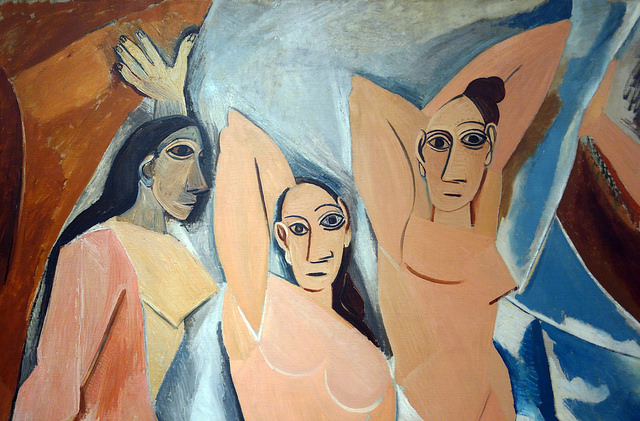
Pablo Picasso drew hundreds of preparatory sketches before even starting to paint Les Demoiselles d’Avignon. (Photo: Steven Zucker/flickr)
Whether you’re building a business or a cathedral, execution is everything. We ask artists, scientists, and inventors how they turned ideas into reality. And we find out why it’s so hard for a group to get things done — and what you can do about it. (Ep. 4 of the “How to Be Creative” series.)
Listen and subscribe to our podcast at Apple Podcasts, Stitcher, or elsewhere. Below is a transcript of the episode, edited for readability. For more information on the people and ideas in the episode, see the links at the bottom of this post.
* * *
Jessica O. MATTHEWS: So, I’m at Harvard, undergrad, I think it’s the end of my sophomore year, and I’m taking this course called “Idea Translation: Effecting Change Through Art and Science.”
That’s Jessica O. Matthews. And this class was back in 2008.
MATTHEWS: And I had heard from people that they gave you some money to do some cool stuff and that unlike most universities, they wouldn’t own the cool thing that you did. And I was like, “Okay, I like doing cool stuff and I like inventing, let’s see what happens.
Stephen J. DUBNER: But we should say, you were not an engineer or an engineer wannabe.
MATTHEWS: Well, I was studying psychology and economics. I grew up wanting to be an inventor. My father is a businessman. My sister, who had been at Harvard for two years before me, she actually was studying film, but she told my dad, my Nigerian dad, that she was studying economics.
DUBNER: I don’t blame her.
MATTHEWS: So two years pass and she graduates and we hear “visual and environmental studies” and my dad almost has a heart attack in the graduation stadium. And I’m sitting there just like, “All right dad, I’ll add economics.” So, I’m taking this course and I remembered thinking back to when I was 17, when I was in Nigeria and I was at my aunt’s wedding. And, as expected, we lost power. As expected, we brought in a diesel generator. And the fumes were so bad. And my cousins, who were in their 20’s at the time, they were just like, “Don’t worry, you’ll get used to it.”
And that’s what shook me. I was like, “Don’t worry, I’ll get used to it?” And I was like, “Okay, that’s a problem for the people in my family, that’s a problem for people in the world.” You have 1.3 billion people around the world who still, to this day, they don’t have reliable access to electricity. When the sun goes down, that’s often the end of their day. And that’s a travesty.
So Matthews, faced with a classroom assignment to invent something that would “effect change through art and science” — she thought about this problem, and she thought about a creative way to address it.
MATTHEWS: And I observed my cousins showing passion and showing excitement when they were playing soccer, right? So this is where the psychology comes in. And the same cousins that were saying, “Don’t worry, you get used to it,” had all these highfalutin, delusional ideas about what they could do on the soccer pitch that they just couldn’t do. They were not as good as Pele in any single way, but they would tell you they were. And this is how you need to be attacking life. I want to invent something, not something that would solve the energy problem but that would address it in a manner that would inspire people to be part of the movement toward solving it.
The invention she came up with was ingenious: a soccer ball that captures the kinetic energy that builds up as it’s being kicked and turns it into enough electrical energy to power a reading light. She called her electric soccer ball the Soccket. It won some fans in very high places:
Barack OBAMA: Some of you saw the Soccket, the soccer ball that we were kicking around that generates electricity as it’s kicked. I don’t want to get too technical, but I thought it was pretty cool.
After the Soccket came a jump rope that used the same technology. Matthews finished her undergrad degree and got an M.B.A., also at Harvard. And she started a company, based in Harlem, called Uncharted Power. The soccer ball and the jump rope didn’t turn out to be durable enough. But Matthews has raised $7 million in venture capital and is pushing her company to work on a larger scale: the electrical grid itself.
MATTHEWS: Our platform is called M.O.R.E. That stands for “motion-based off-grid renewable energy.” And it’s a platform that basically leverages our innovations in energy generation, energy transmission, and energy storage to offer what we like to call convenient energy.
One advantage of “convenient energy,” theoretically at least, is that it is decentralized, and therefore would not require the massive capital investments that power plants traditionally need. How well will Jessica Matthews’s idea actually work? It’s hard to say — and Matthews wouldn’t get into the details of Uncharted Power’s technology and implementation. So why am I telling you this story? Because it’s a story about the power of a good idea — and I think you’d agree that turning kinetic energy that’s fun to generate into electricity is a good idea. But really why I’m telling you this story is to point out that a good idea is worth nothing without great execution. That’s where Jessica Matthews stands right now, and she knows it.
MATTHEWS: I think ideas are great. But in a weird way it’s almost like they’re meaningless if they don’t actually make a difference in our lives. So I had to figure out execution because how can I go to my cousins and be like, “Oh, I have this cool idea for an energy-generating soccer ball” and then two weeks later they’re like, “Hey how’s it going?” I’m like, “Oh, I just have more ideas.” They’d be like, “What? Shut up. Stop coming here and telling us dumb stuff, Jessica.” So I had to come back and be like, “Here’s the prototype. What do you think?” Everyone is going to be motivated by different things but I’m the kind of inventor that’s looking to make whatever amount of time we have on this world better. And so execution has always been part of it.
* * *
Walter Isaacson has written biographies of some of the most creative people in history: Leonardo da Vinci, Benjamin Franklin, Albert Einstein — and Steve Jobs—
Walter ISAACSON: Who, in his first stint at Apple, was such a perfectionist that he holds up shipping the original Macintosh because he doesn’t think the circuit board inside is pretty enough. Even though nobody will ever see it. And after a while, he gets fired from Apple because he’s such a perfectionist. And he would say, “Well, real artists sign their work,” meaning they have to wait until they are perfect before they ship. When he comes back to Apple at the end of the 1990’s, they give him a new motto, which is, “Real artists ship.”
But how do you ship your work? How do artists and scientists and inventors and other creative people turn the sparks flying around in their heads into something they can share with the world?
Margaret GELLER: Well, one of the difficult things of course is moving projects forward. There’s a big difference between the idea and execution.
That’s the pioneering astrophysicist Margaret Geller.
GELLER: And sometimes, you know, you start to do something, and nature just doesn’t conform. And you wonder, why me? And after the fact it’s fun, but it’s not so much fun while you’re doing it. It’s often very slow, it takes a long time, a lot of it is drudgery. It’s not as though you have an idea and tomorrow you write a paper and you submit it to the journal, and it’s done. And I think it’s the same with art and with writing.
Now, there are exceptions to prove every rule. The writer Michael Lewis, for instance. Among his books are The Big Short, Moneyball, and The Undoing Project. Even when he writes about complicated topics, Lewis’s writing is extraordinarily pleasurable and easy to read. So I once asked Lewis — it can’t be so pleasurable and easy to write, can it?
Michael LEWIS: Yes. It is pleasurable and easy. I hate to ruin your punchline, but actually what is hard for me is figuring out in the beginning what I want to say. I spend a lot of time gathering material and organizing the material before I sit down to write. I’d say three-quarters of the time is that. When the actual writing starts, it’s, for me, fun. It’s just fun. I mean, it’s fun and hard, but if it’s hard, it’s hard in a fun way. And people like my wife, who has walked in on me while I’m writing — I write with headphones on that just plays on a loop the same playlist that I’ve built for whatever book I’m writing. And I cease to hear anything in the world outside of what I’m doing. And apparently I’m sitting there laughing the whole time. And I think basically what I’m doing is laughing at my own jokes, but I wasn’t even aware of that. But people like my kids and my wife say that, “You’re sitting at your desk laughing all the time.”
Okay, so let’s set Michael Lewis aside. He’s his own category: the untortured artist. Let’s look at a project that was so difficult to execute that its creator did not finish it in his lifetime. And which is still being worked on today, nearly a century after his death. If you’ve ever been to Barcelona, you already know what I’m talking about: the Sagrada Familia church, designed by Antoni Gaudi, among the world’s best-known architects today. Who, during his lifetime, was a troublemaker.
Gijs Van HENSBERGEN: He was someone who was very loath to follow the kind of textbook, standard way.
Gijs van Hensbergen is a Dutch art historian who’s written a biography of Gaudi. He’s also, interestingly, a certified suckling-pig specialist.
VAN HENSBERGEN: Yes. I trained to write a cookery book, in fact. And using food as a way of understanding a different culture. So I went to train in Segovia, in the center of Spain, just north of Madrid, as a suckling pig chef.
All right, let’s get back to Gaudi, the man behind the unfinished masterpiece in Barcelona.
VAN HENSBERGEN: He was someone who was prepared not to just go down the orthodox route of what his teachers were saying. And in fact, once somebody asked him who influenced you most, and he said, “Well, I probably learned more from watching my father making boilers than I ever learned at architecture school.”
He was born in 1852 and grew up in a rural area outside of Barcelona.
VAN HENSBERGEN: As a child, he suffered badly from kind of a youthful version of arthritis. And so as a kid, he couldn’t always go to school, and his father — who was a boilermaker for making the stills for brandy distilling — would take him out to the workshop, out in the country.
He was enthralled by the exotic look of buildings around the world.
VAN HENSBERGEN: It was also for his generation, the first generation that could actually just look at photographs and see photographs of buildings all over the world. And he spent all his free time in the library just going through magazines and looking at photographs of buildings.
He was also enthralled by nature.
VAN HENSBERGEN: The little details of shells, the way the wind blew, the way that trees grow, the kind of magical Fibonacci sequences that appear in sunflower heads. And all these things, he’s instinctively, but very empirically, noticing, and would reappear in his buildings and his building techniques later on.
Gaudi studied architecture formally in Barcelona but was unimpressed by the orthodoxy of his teachers. It bored him. When he started getting commissions — for houses and apartment buildings and parks — he was relentlessly experimental. His traditional elements were exotic, his modern elements phantasmagorical. Gaudi was also an oddball: a hermit, a celibate, and something of a despot. He’d show up at a building site in the morning and order the contractors to demolish what they’d built the day before, so that he could redesign it. Meanwhile, in the rural Catalonia where he’d grown up there was a massive economic disruption caused by phylloxera, a disease that ruined the grapevines that were the source of many farmers’ income.
VAN HENSBERGEN: Once the vines started being attacked, and people lost their vines and they lost their livelihoods, came flooding into the cities. And it meant that there was massive, massive social pressure from a predominantly illiterate working class, which would fill the factories. And massive overcrowding, and the working classes felt that they were being abused. But particularly with the Church, they felt that sometimes the Church was misusing its so-called charity, looking after them but actually in a sense controlling them.
The Catholic Church was looking to rehabilitate its relationship with these newly urban parishioners. So it decided to build a huge church in a working-class part of Barcelona. It would be dedicated to the Holy Family — the Sagrada Familia — because, after all, Joseph was a carpenter.
VAN HENSBERGEN: The Holy Family could act as a model, that the working man — their handicraft or whatever — should be something that is respected.
Gaudi himself was a very conservative Catholic; his feelings for the Church and for Jesus ran deep and pure.
VAN HENSBERGEN: Right at the heart of his belief system was this idea that Christ’s suffering is something that we understand only through our own suffering, and that his ultimate generosity of course was to die for us.
When Gaudi received the commission to build the Sagrada Familia, after the original architect resigned from the project, he was only in his early thirties.
VAN HENSBERGEN: And I think Gaudí felt his duty as an architect, and certainly with the Sagrada Família, was that a building should reflect the glory of God, and that God was working through him.
Gaudi’s concept for the church was massive, extraordinarily detailed, a mashup of every architectural style under the sun but like nothing anyone had ever seen. It included life-like sculptures of Bible stories — emphasis on the life-like.
VAN HENSBERGEN: So when, on the Sagrada Família, you have the flight to Egypt, he wanted a donkey, it had to be life-size, he sends one of his workmen over to look around for a donkey that might look as if it had walked 40 days through the desert, and he finds the rag-and-bone man’s donkey, and he gets it, puts it in a harness, chloroforms the donkey, and then puts it into plaster and makes molds. He does it with chicken, with geese. One of the most dramatic moments is actually the Slaughter of the Innocents, where the little babies being cast down by this giant Roman centurion, total kind of brutal scene, this baby has his head smashed on the ground. And Gaudi actually took stillborn children, cast them, and used those models for the sculptures that would then be on the face of his building.
The scale, both exterior and interior, was way larger-than-life, designed to inspire awe. The interior pillars resemble a forest of grand trees.
VAN HENSBERGEN: Trees are actually some of the most efficient pieces of architecture ever grown, not built, and the way that they can put up with wind, and the way that they know where they should stick out a new branch. And he creates this lapidary forest, this extraordinary forest of columns, as you walk in. And this soaring space which is so dramatic, and with these stained-glass windows and this amazing light. I mean, even if you weren’t religious, there is a very, very powerful kind of explosion of space.
Gaudí would work on the project for the rest of his life, eventually moving into the basement workshop.
VAN HENSBERGEN Later on in life, he became very ascetic. He made his own clothes. He looked more and more like a tramp. He lived the whole purpose of the Sagrada Familia, which was to create this new Christian temple on a scale which today is kind of only just, we’re beginning to see, what an extraordinary kind of fantasy and dream that Gaudi had created for this building.
DUBNER: I’m also curious, because of what Gaudí said about creativity, as you write, “Creation works ceaselessly through man, but man does not create, he discovers. Those who seek out the laws of nature as support for their new work collaborate with the Creator. Those who copy are not collaborators. For this reason, originality consists in returning to the origin.” So to me, that is a bit of a paradox. And I wonder if you can explain that for me, as it relates to Gaudí, and especially as it relates to the Sagrada Família.
VAN HENSBERGEN: Well, I often think back on Isaac Newton, saying, “Look, I was just like a little boy walking along the beach, picking up a pebble, and I noticed one was shinier than the other.” And there is a sense of humility about Gaudí’s genius as well. And this idea of going back to the origin. Because one of his signature discoveries — and something which became right at the core of his building technique — was the discovery of the power of the catenary arch. And the catenary arch is: take a chain, hold it between your fingers, and let it drop. It’s gravity pulling it down, which of course for Gaudí becomes another kind of religious metaphor, because who is it that invents gravity? Well, God of course.
But what you get is this chain formation. If you flip it over, it forms this catenary arch, which is the most economical shape in architecture. And he uses that as a kind of leitmotif, for the last 20, 30 years of his creative life, and works on the model which is four-and-a-half meters high and all these little chains with little bags, shotgun pellets, representing the different stresses, etc. And almost like an analog computer, sitting there over 10 years out in the countryside. People must have thought, Who is this madman? And creating a system which is still used today by the architects who are working on the Sagrada Família to try and finish it for 2026.
2026 will be the 100-year anniversary of Gaudi’s death. He died at age 73, after getting hit by a streetcar. As the story goes, his ragged clothes led passers-by to think he was a tramp, not the city’s most famous architect. In any case: a team of architects is continuing Gaudi’s work on the Sagrada Familia. By necessity, they are amending his original plans. To some, this is a betrayal of Gaudí’s original genius. Gijs van Hensbergen is not one of those people; he thinks it’s in line with what Gaudí himself would have done.
VAN HENSBERGEN: Well, clearly, we can’t go back to just what was built by Gaudí. Gaudí knew equally that future generations would have to work on it. And he talked about Chartres and other cathedrals saying that God took 400 years to finish Chartres. It took 600 years to finish Barcelona Cathedral, in the Gothic Quarter. And he said that God is very patient as a client. He doesn’t want to be hurried.
Gaudí was constantly tinkering with his designs, sometimes changing them from day to day. Execution-by-tinkering: it turns out this is a common thread among many creatives.
ISAACSON: Leonardo da Vinci worked on the Mona Lisa for more than 15 years.
Walter Isaacson again.
ISAACSON: During that period, he was dissecting the human face, figuring out every nerve and muscle that touches the lips, figuring out how details of sight go right into the center of the retina, but what you see out of the corner of your eye are shadows and colors. So he uses all of that knowledge, for example, to make the details on the Mona Lisa’s smile go straight, but the shadows and colors go up, so the smile flickers on and off, depending on how you’re looking at it. He also has it so perfectly anatomically correct that it’s the most amazing and memorable smile ever created.
All of these things he does over the course of this very long period as he’s living in Milan, and then in Rome, and then in Florence, and then taking it across the Alps with him when he goes to Paris, he adds layer after layer of tiny translucent brush strokes until he can make what is probably the most perfect painting ever done.
“The most perfect painting ever done?” That’s pretty hard to quantify. There are people, however, who’ve spent a great deal of time trying to quantify different trends in painting over the centuries, different styles of execution, and their relative value.
David GALENSON: I am David Galenson. I’m a professor of economics at the University of Chicago.
DUBNER: And you would describe your research specialty as what?
GALENSON: I study creativity. And really, more specifically, the life cycles of human creativity. What I’ve tried to do is find the process. You know, what are the mechanisms behind the discoveries?
Most great painters throughout history are considered innovators, at least on some dimension. But Galenson separates these innovators into two camps, what he calls experimentalists and conceptualists. Da Vinci and Gaudi would fit into the experimentalist category.
GALENSON: These are empiricists. They’re interested in perception, observation, generalization about the real world. They have very vague but very ambitious goals. And because they’re vague, they’re uncertain how to achieve them. So they work by trial and error. These are the people who never reach their goal. They are never satisfied.
Another example would be Paul Cézanne.
GALENSON: Very near the end of his life, he wrote to a younger artist. He said, “The progress needed is endless.” And that’s experimental creativity. You never can reach the goal.
Cézanne wanted to fuse the realism of the old master paintings he loved with the immediacy of a new style, impressionism.
GALENSON: Impressionism was, as the name implies, it was an ephemeral, momentary art. So Cézanne was frustrated with impressionism, with the superficiality. There’s no depth in impressionist paintings. These are all just on the surface. He set out to combine the bright colors of impressionism with the solidity of the old masters. So Cézanne set out to do something that was essentially impossible, but he spent then the next 40 years trying to do it.
For instance: in his later years, he kept painting the view of a mountain near his home, Mont Sainte-Victoire.
GALENSON: If you just take all the textbooks of art history that you can find, there’s no single painting by Cézanne that appears more than a few times. But he painted Mont Sainte-Victoire about 50 times over a period of about 30 years. If those were all a single painting, all of those illustrations were of a single painting, that would be the single-most-reproduced painting in the history of modern art. Now, they’re all different. He’s never doing the same thing. He’s always changing. But he’s changing so gradually that a lot of people don’t perceive it at the time.
So the experimentalist, as Galenson sees it, innovates by tweaking and tinkering, by methodically moving the needle an inch at a time. Meanwhile, the conceptualists?
GALENSON: As the name implies, these are people who have new ideas. These are theorists.
Galenson’s favorite example? Pablo Picasso. Picasso’s process of creation, as described by David Galenson:
GALENSON: Basically, the process is, you come to a new discipline, you learn the rules, and you say, I don’t like some very basic rule. And I get rid of it.
Picasso’s rule-breaking masterpiece? Les Demoiselles d’Avignon.
GALENSON: Now, that’s a painting that Pablo Picasso made when he was 26 years old. And it wasn’t just casually done. When Picasso was about 25, he was a young, struggling painter in Paris. And the king of the hill was about 10 years older, Henri Matisse. Matisse had made a large figure painting called The Joy of Life, that made a tremendous splash at the annual salon. And Picasso was very jealous.
So, here’s this young 25-year-old who starts making preparatory drawings. In total, he makes between 400-500 preparatory drawings for this — the largest painting he’s ever attempted, by far. That’s the most preparatory works that have ever been made in Western history for a single painting, as far as we know. Here’s a 25-year-old who’s not really thriving economically, but he takes essentially a full year to prepare to make this one painting. So, he’s deliberately creating a masterpiece. That painting is in 95 percent of all the textbooks of art that cover the early 20th century. No other painting is in more than half.
DUBNER: Now, let me ask you this. The way you just described that process, however, doesn’t sound so different from the way you described the process of the experimental innovators. Over and over, repeating and repeating.
GALENSON: The difference is the following: If you x-ray a Cézanne, you’ll find there’s nothing underneath the paint. He painted, what the artists say, “directly.” He just began using a brush on canvas. He made no preparatory drawings for his paintings, ever. The whole point actually was to be spontaneous. That was the point of impressionism. Whereas, if you x-ray the Demoiselle, you’ll find very precise under-drawing. And it’s not an accident. If you go to the Picasso Museum, where they have these dozens and dozens of sketchbooks, you’ll find that every figure in that painting was planned extremely carefully. So that by the time he began painting the painting, he knew what it was going to look like.
See, this was the first thing I discovered about the difference between experimental and conceptual artists. That it’s not just that they paint differently, but they want to paint differently. The conceptual artist wants to know, before he starts — before he picks up a brush — he wants to know exactly what the painting is going to look like. Whereas the experimental painter goes out of his way to avoid that. They want to make discoveries in the process of painting. So, it comes down to this fundamental question: Do you make the discovery before you start working or while you’re working? And in discipline after discipline, that is going to be the key question separating the two types of innovator.
“Experimental innovators,” Galenson has written, “work by trial and error, and arrive at their major contributions gradually, late in life. In contrast, conceptual innovators make sudden breakthroughs by formulating new ideas, usually at an early age.” Picasso invented cubism in his 20’s; Bob Dylan wrote “Like a Rolling Stone” when he was 24.
GALENSON: You can get an idea at any age. But the most radical ideas come not necessarily when you’re young chronologically, although you tend to be, but when you’re new to a discipline.
Experimental innovators, meanwhile, build up to their masterpieces. Virginia Woolf was 44 when she wrote To the Lighthouse; Cézanne was still painting Mont Sainte-Victoire when he died, at 67. The novelist Jennifer Egan is now in her mid-fifties. By the time Egan won the Pulitzer Prize and the National Book Critics Circle Award for her book A Visit From the Goon Squad, she’d been writing for a couple decades. She’d only completed three novels during that time — and the one that followed, Manhattan Beach, took another seven years. One reason it takes so long: her process; the way she executes the idea.
EGAN: Once I write that first draft — which, in the case of Manhattan Beach was 1,400 pages, and type it up, I do many, many, many revisions, usually by hand on hard copies. But we’re talking ultimately 40 to 50 drafts per chapter. So there’s a lot of fixing and problem-solving. And in certain ways, that’s where a lot of the writing happens. It’s the big moves that I’m trying to get a hold of in that first draft. And then once I have those, then I can work with it and try to bring it all up many, many notches to be something that’s actually readable and entertaining. My first drafts are full of clichés. I loathe clichés. It’s not that you can’t write them in the first place. They have to be replaced. So, ultimately, I have weighed every word. To use a cliché.
Okay, so if your style of execution is to produce draft after draft after draft; or sketch after sketch or prototype after prototype — how do you judge what’s working and what’s not? Every domain is different, of course: writing a novel is different from building a better means to capture kinetic energy. But in every case: how do you measure the success of your execution? When Jennifer Egan was writing her first novel, The Invisible Circus, she did not have a reliable way to do that.
EGAN: I wrote in a vacuum, and that was just wildly unsuccessful. I spent two years writing — horrible. Just dreadful. And this isn’t even being over-harsh. I’m never going to make that mistake again.
Ever since then, Egan has relied on a writers’ group. Even today, after all the success and all the awards.
EGAN: It includes a couple of the people I’ve been showing work to since 1989. We have an essayist, a playwright, a poet, and then a couple of fiction writers.
What the writers’ group provides Egan is something that every creator needs constantly, whether you’re working in the arts, in science, in business, whatever: feedback.
* * *
It’s not that great ideas are easy; but without good execution, an idea doesn’t mean much. A key component to execution — a key component to getting better at anything — is feedback. The writer Jennifer Egan was telling us that she still relies on a writers’ group to workshop her current novel-in-progress.
EGAN: Even with Manhattan Beach.
That’s her latest book, an historical novel published in 2017.
EGAN: I had an idea about a present-day narrator who would be kind of winking at the reader because we all know that it’s not 1934 anymore. That was so dead on arrival.
DUBNER: And when you get that kind of feedback, and you decide ultimately that it’s fruitful and that it’s correct, what does that feel like?
EGAN: It feels like a relief, because usually I can feel when something is not working. Sometimes things aren’t working because I just haven’t spent enough time making them better.
DUBNER: Did you have to beat up your writing group a little bit after you started winning these awards and say, “Listen, I still need you to come at me as hard as you did”?
EGAN: No, they they did it. I would recommend that anyone do this. People are afraid of hearing criticism. And I think often when they say, “What did you think of something?” you know that they don’t really want to know if you have any thought that isn’t positive. And I so understand that. I mean, it’s awful to hear that something you think is working isn’t. And I’ve sat there, and many times thought, “I’m done. I’m never coming back here. It’s been great. You guys suck. You don’t get it. Other people tell me I’m great.”
But even by the end of the meeting I’m already — I can feel my brain kind of prickling around whatever it is and I’m already starting to think of solutions. So it hurts, but it’s not going to kill you. I feel like criticism that’s wrong-headed, okay, I don’t agree with it. Fine. Keep going. There’s a fear that somehow criticism can break you. I don’t believe it.
DUBNER: Do you have any advice for people who have that fear, which I would guess is probably 95 percent of humanity?
EGAN: I would say think very carefully about which is worse: finding out now that this work has problems or finding out after everyone has told you it’s perfect and you’ve published it. You’re going to find out.
Teresa AMABILE: I think the best thing we could do is to find one honest person who you know will give you honest feedback.
Teresa Amabile is a psychologist who studies creativity.
AMABILE: Ideally, you’ll have an artist friend, or maybe it’s a teacher, who knows you reasonably well, whom you trust, to whom you can say, “I really want some feedback on this, but I need you to not dampen my spark here, if you would.” I think that’s much better than trying to get feedback from a large number of individuals. One or two people who will be honest with you, but who can who can give you the feedback in a way that you’ll be able to use it and not be not be destroyed by it. We can manage our feedback givers.
But what if you aren’t in a position to manage your feedback givers? What if your feedback givers are your employer, or your funder, or your customer?
Don HAHN: We test-screen everything we do. We bring in a living room full of people and show them the movie and then sit around afterwards and have a really painful discussion about things they didn’t understand, or story points they didn’t like, or characters they didn’t like.
That’s Don Hahn.
HAHN: And I’m a filmmaker and I’ve made most of my career producing animation for Disney. But now I do a lot of documentary work.
Among the films he’s worked on: Who Framed Roger Rabbit?; Beauty and the Beast — both the animated and live versions.
HAHN: And The Lion King, a little story about a lion cub that gets framed for murder.
Hollywood calculus, as we all know, can be strange. A team of filmmakers can work on something for a couple years — and then have it quashed by a room full of little kids who get squirmy at a test screening.
HAHN: And then you have to go away and decide whether they’re right or not. And you can also dismiss it to your peril, or dismiss it to your advantage. Gosh, and there’s endless stories about that. In Pocahontas, the animated movie, there was a love song that Mel Gibson as John Smith sang to Pocahontas. And he was tied up in a tent and Pocahontas came in and they sang this beautiful love song under the moon. It’s a lovely song. But the audience just checked out and kids started wiggling in their seats and moms started running out for a bathroom break. So it got cut from the movie.
But conversely, there’s a song in The Little Mermaid called “Part of Your World,” and it’s Ariel’s “I-want” song. And that was a real kind of wiggler song where in previews, even though it happens early in the movie and even though it’s crucial to Ariel’s character, our executive at the studio said, “Ah, kids are wiggling during this. We have to cut it out. It’s not working.” And he was wrong. The directors and the animators came back and said, “Kids may wiggle during it but it’s the kind of song you need in these movies. It’s a statement of what she wants. It’s a statement of her goals and passions and without it, it’s ambiguous what she wants.” So it stayed in the movie and became one of the most favorite songs in the movie.
You can see why producers and studios might be cautious: a big film is a huge investment. The desire for feedback has deep roots in Hollywood, including Walt Disney himself.
HAHN: Walt Disney used to famously walk around the studio, and he would tell the story of, let’s say, Pinocchio to a couple of guys in the coffee lounge. And then he’d get their reaction and then he’d go down the road to a couple of secretaries and tell them the story. And so he was workshopping again and again and again this story. And every time refining it in his mind a little bit more until it became very close to what was in the film.
A documentary film, meanwhile, which is what Don Hahn is mostly making these days—
HAHN: Documentaries are a little different because you’re telling an existing story. But you have to go where the story takes you, and when you start out you may not know all the ins and outs of the plot. So, it’s a little like putting a jigsaw puzzle together without the picture on the box. You’re kind of feeling your way through the dark. And a lot of times there’s discoveries halfway through the making of the movie.
We did a movie for Disney Nature called Chimpanzee about a mother and her little baby chimp. And halfway through the shooting, the mother went out one night and was killed by a panther. So you just go, “Okay, I guess we’re done.” But over the ensuing weeks the alpha male in that tribe of chimpanzees adopted that little baby, otherwise it would have died. And that’s something that just never happens. Jane Goodall even said she didn’t ever see that in the wild. So sometimes you have to just open up enough to go kind of ride the horse in the direction that it’s going to have the movie tell you what it wants.
Another documentary that comes to mind is the 2007 film The King of Kong, directed by Seth Gordon.
Seth GORDON: It was definitely a let’s-see-what-happens mission in the sense that we had no idea what would transpire.
Gordon’s made a lot of big movies and TV shows since then; he also worked on a documentary version of Freakonomics; that’s how I got to know him. The King of Kong is a great story about a couple of guys competing for the world-record score in the arcade game Donkey Kong. There’s the self-important defender, Billy Mitchell, and the underdog challenger, Steve Wiebe.
Steve WIEBE: I was just doing it because I thought it would be a neat achievement. I didn’t think it would ever blow up to be a big story.
GORDON: I had been going to the arcade featured in that film in New Hampshire, it’s called Fun Spot, since I was a kid. And I was aware that there was a culture of gamers for whom that was where the battles would be waged, and the official scores would be set. Because they have all the legitimate old machines. And I knew of Billy Mitchell, but I didn’t know if he was going to commit to be filmed by us. So that was a big question.
And then the other was, how would he and Steve be on camera? And because those were very much unknowns, we were simultaneously chasing other rivalries in the video game world, and we thought it was going to be a film that was about portraits of these rivalries. But because Billy is such an extraordinary person and masterful storyteller himself, he made the movie become about him.
Billy MITCHELL: Competitive gaming? When you want to attach your name to a world record, when you want your name written into history? You have to pay the price.
GORDON: Because of the situations that he created and the actions that he took, all the other storylines paled in comparison.
It makes sense that you can’t foretell how a documentary will unfold. But what about scripted entertainment? How locked-in are you there, and how flexible do you need to be?
HAHN: So you start out with a script and make it as good as you can. And then as you actually get into the production, you allow yourself to improvise and make it better. So animation is a real iterative process. You can visit and revisit and revisit, and sometimes it takes five or six or seven times of putting the movie up on reels to look at it and then have it fall apart and rebuild it and tear it down and rebuild it before it starts to be anything.
And the reason is the leap from the written word to a visual storytelling medium is huge. It’s like the leap from a recipe on a page to a beautifully prepared dinner that you’re actually ingesting. So on a page, how do you describe a perfectly cooked steak with just the right seasoning? You try your best, but once you get that in the frying pan and start to cook that steak, it’s a whole other thing.
And I think that’s why some people shy away from the making part because you can have perfection on a piece of paper and say, “This is a beautifully designed piece of architecture, or a fantastic recipe, or a great script,” and it’s going to really go south when you try to execute it, no matter what it is. And it’s just experience and craft that allows you to maintain some sort of order and work that written idea into something that’s actually visual up on the screen.
Again, as we’ve been hearing from all sorts of creatives: the execution of an idea requires determination, craft, experience, maybe a little luck. It’s almost enough to persuade you, at least in some cases, that if there were a competition between idea and execution, the idea isn’t even such a formidable competitor.
HAHN: There’s an argument to say a film like E.T. or Star Wars or Roger Rabbit was a great idea out of the box, and anybody could have made that movie. But I subscribe to the other approach, which is you can take a mediocre idea and put great people on it and come up with a great movie. So, take the Pixar movie Ratatouille. It’s the worst idea for a movie ever. It’s like, “Let’s put rats in a kitchen and we’ll make an animated film about it.” It’s a horrible idea. And there’s plenty of really good ideas — we’ve all seen movies that had tremendous promise and the buzz was great about them and then you go see you in the theater and they’re awful.
Filmmaking is, by its nature, a hugely collaborative project. Dozens, maybe hundreds of people, all with specific skills and tasks. It’s a creative team. That is a common construct these days, in many realms.
ISAACSON: We sometimes think that there’s some guy or gal who goes into a garage or garret, and they have a light bulb moment, and that’s how innovation happens. But that’s not the way it is. Great scientific research these days is going to be done in large collaborative units. When you look at how people are going to do gene editing, or CRISPR technology, or, for that matter, figure out background gravitational waves, these are the type of papers that are going to have dozens of names on them, or hundreds of names on them. And it’s not going to be like Newton sitting under an apple tree, or Galileo peering into a telescope, because this ability to make great mental leaps is now augmented and amplified by our ability to work together collaboratively.
AMABILE: Most work done in organizations now is done on a project basis, by teams. That has advantages because you’re combining the efforts of many people, you’re combining the viewpoints of many people. But oh, it’s hard.
Teresa Amabile has studied creativity in corporate settings by having people keep daily work diaries.
AMABILE: It’s really hard to work effectively in a team. It’s hard to manage a team effectively. And there are a number of things that can help. One is to make sure that you have a nice diversity of skills in the team, where people are not completely overlapping in what they know, because that redundancy is not really helpful, but where people do have different perspectives and different knowledge base to some extent that they can bring to the problem.
It’s also helpful to have different cognitive styles. So doing things better within a paradigm or differently outside paradigms, you’re likely to make a lot of progress in a project if you have both kinds of cognitive style on a team, but only if you have people who can effectively translate between the different styles. They have to be able to talk to each other and very often you find conflict arising. “That idea is crazy, how would you possibly think that that would work?” And on the other hand, “What are you doing, you’re stuck in the status quo, you’re not doing anything at all exciting, you’re boring.” And we actually in our research saw a team that had to just call a halt to its project because we had these very different cognitive styles and there was no one who could mediate between them. That can be someone else on the team, it can be a manager, but you have to watch out for that.
There’s one more thing a successful creative team needs.
AMABILE: You need a high level of trust. You need people to be to be willing to give each other a little slack, to give each other the benefit of the doubt. Under those circumstances, if you’ve got that diversity of skills and styles you can do great things on a team.
But some creative endeavors tend to be solitary, even if you routinely submit your work for feedback. And some creative people just prefer to work on their own. So how do those artists ship? How do they execute ideas without a team, without the boss or studio or publisher watching over them?
Dean SIMONTON: There are some people who, they are only creative in the morning. They will get up early, they will write so much, and then that’s it for the rest of the day.
Dean Simonton is a psychologist who for years has studied the productivity habits of creative giants.
SIMONTON: There’s others that can only work late at night after everybody has gone to bed. There’s others that make their own time. They have a cue, like who was it? I think it was Schiller, who had to have the smell of rotten apples. And when he felt like being creative, he’d pull out a rotten apple. And that would cue him to be creative.
DUBNER: What about you, when you’re working?
SIMONTON: I’m generally a morning person.
DUBNER: And do you need to cue or trick yourself in any way? Or do you sit down, and you put away the distractions and get to work?
SIMONTON: I, first of all I pick the morning because there’s the fewest distractions, and the smell of black coffee really helps as well. Okay. Pretty ordinary.
DUBNER: Do you think if you smelled it and didn’t actually consume the caffeine, it would have the same effect?
SIMONTON: Oh I have to have it. I need it.
DUBNER: So it’s not just the smell. The smell is the cue to the physiological reaction.
SIMONTON: No, I need the caffeine in my system. But then, usually by a few hours, I’m kind of pooped out. Sometimes I get rejuvenated before I go to bed. But then, it’s usually a glass of wine that does it. So go figure.
DUBNER: So, let’s say the pattern that you just described happens to be the one that I subscribe to. I’m a morning person. I get up early. I like those hours quiet, alone, etc. So if you’re that person, and let’s say you have four or five hours of really hardcore productivity and creativity, then you have the rest of the day. And let’s say you’re lucky enough to have a life like an academic, like you do, or a writer, like I do, and you can actually choose what to do. No one’s telling you what to do. What do you do there, with your now diminished capacity for creativity or productivity?
SIMONTON: Well, fortunately, guess what? You know this is the case. There’s so much else that’s involved with being creative. Like when the proofs arrive. You know? I can’t do proofreading in the morning. I don’t want to waste my creativity doing proofreading in the morning. The things on your reading list that you have to catch up on. And particularly when you’re doing what I’m doing, scientific research, you have to find out what other people are doing. I review a lot of submitted manuscripts and grant proposals.
DUBNER: Right. So you don’t want to waste your best brain cells on all that stuff?
SIMONTON: Oh, no. I mean don’t tell them that I’m only working at half-mast. You know?
DUBNER: I think you just did, but that’s okay.
Getting up early, drinking coffee; or staying up late and drinking wine; working alone, or with collaborators — plainly, there’s no single route for getting good work done. Everyone has their own strategies for executing ideas.
SIMONTON: Too many people want a one-size-fits-all. “What do I need to do to be creative?” And I’m afraid there’s no one-size-fits-all. There’s a few things that everybody has to adhere to. You have to know what you’re doing, and you have to be willing to fail. You have to be committed to achieving in that domain. You have to be reasonably bright, and so forth. But beyond that, some people have red socks and some people have purple socks.
* * *
Freakonomics Radio is produced by Stitcher and Dubner Productions. This episode was produced by Matt Frassica, with help from Stephanie Tam and Harry Huggins. Our staff also includes Alison Craiglow, Greg Rippin, and Zack Lapinski. Our theme song is “Mr. Fortune,” by the Hitchhikers; all the other music was composed by Luis Guerra. You can subscribe to Freakonomics Radio on Apple Podcasts, Stitcher, or wherever you get your podcasts.
Here’s where you can learn more about the people and ideas in this episode:
SOURCES
- Teresa Amabile, psychologist and professor emerita at the Harvard Business School.
- Jennifer Egan, novelist and journalist.
- David Galenson, economist at the University of Chicago.
- Margaret Geller, astrophysicist at the Harvard–Smithsonian Center for Astrophysics.
- Seth Gordon, filmmaker.
- Don Hahn, filmmaker.
- Gijs van Hensbergen, art historian.
- Walter Isaacson, biographer and professor of history at Tulane University.
- Jessica O. Matthews, inventor and c.e.o. of Uncharted Power.
- Dean Simonton, professor emeritus of psychology at University of California, Davis.
RESOURCES
- Creativity In Context by Teresa Amabile (Routledge 1996).
- A Visit From the Goon Squad by Jennifer Egan (Knopf 2010).
- The Invisible Circus by Jennifer Egan (Knopf 1994).
- Manhattan Beach by Jennifer Egan (Scribner 2017).
- Gaudi by Gijs van Hensbergen (Harper Perennial 2003).
- Guernica by Gijs van Hensbergen (Bloomsbury Publishing 2005).
- Leonardo da Vinci by Walter Isaacson (Simon & Schuster 2017).
- Steve Jobs by Walter Isaacson (Simon & Schuster 2011).
EXTRA
- “How to Be Creative,” Freakonomics Radio (2018).
- “Where Does Creativity Come From (and Why Do Schools Kill It Off)?,” Freakonomics Radio (2018).
- “Where Do Good Ideas Come From?,” Freakonomics Radio (2019).
The post A Good Idea Is Not Good Enough (Ep. 369) appeared first on Freakonomics.
My Afterlife on the Body Farm

How Alexandria Ocasio-Cortez Won the Cohen Hearing

Why a Grape Turns into a Fireball in the Microwave
Article URL: https://www.wired.com/story/why-a-grape-turns-into-a-fireball-in-a-microwave/
Comments URL: https://news.ycombinator.com/item?id=19195692
Points: 303
# Comments: 85
For a Black Mathematician, What It’s Like to Be the ‘Only One’

The Two Codes Your Kids Need to Know

Feature: The Secret History of Women in Coding

Kabul Dispatch: A Shotgun Under Her Bed, This Afghan Maverick Wants No Peace With Taliban

The Interpreter: When Facebook Spread Hate, One Cop Tried Something Unusual

Watch how the climate could change in these US cities by 2050

In some cities, it’ll be like moving two states south.
Last month was the second-hottest April on record on planet Earth. Arctic sea ice hit a monthly record low.
Clearly, the planet is warming. And more records are likely to be broken this year.
As the climate crisis accelerates, it’s worth asking what to expect if we aggressively cut greenhouse gas emissions now, and what would happen if we do nothing. As part of our Weather 2050 project, we used the latter scenario to look at what could happen to temperature and precipitation in US cities by the middle of the century.
We found that by 2050, many US cities may resemble hotter, more southern parts of the country today. We’ve mapped a few of the most striking transitions here:
/cdn.vox-cdn.com/uploads/chorus_asset/file/13590787/US_MAP_LOGO.gif)
As you can see in this map, climate change means cities could move further south in terms of their temperature and rainfall patterns. In some cases, the closest match may be hundreds of miles away. If you want to get a sense of what climate change could mean for your city, you might need to take a road trip.
By 2050, in Cleveland, Ohio, the average summer high is going to heat up by 5.4°F. The average winter low will rise by 5.3°F. That means Cleveland will have the climate of a St. Louis suburb more than 500 miles away.
Let’s zoom in on how climate in different regions could shift. Take a look at this animation of changes in the northeastern US:
/cdn.vox-cdn.com/uploads/chorus_asset/file/13590607/NE_SHIFT_2.gif)
You can see that Scranton, Pennsylvania, will have a climate that resembles that of Round Hill, Virginia, today. That’s a distance of about 220 miles as the crow flies, but it means that Scranton will face average summer peaks that are 4.8°F higher and winter temperature low that are 5.5°F higher.
We can also see this in the southeastern US:
/cdn.vox-cdn.com/uploads/chorus_asset/file/13590795/SE_shift_3.gif)
Cities in the South are moving even further south. By 2050, annual temperature and precipitation patterns in Atlanta, Georgia, will look more like Selmont, Alabama, today. That’s a move of more than 200 miles, with the average summer high jumping 4.1°F to 92.6°F.
Other parts of the country may see smaller shifts by 2050, as you can see in this map of the Southwest:
/cdn.vox-cdn.com/uploads/chorus_asset/file/13590759/SW_SHIFT_2.gif)
Apache Junction, Arizona, will likely experience a year-round climate that’s more like Peoria, Arizona, a city that’s just 50 miles west. But that still means the average summer high from today, 103.5°F, will rise by 4.9°F by 2050.
As you might imagine, the shifts will be even greater by 2080. And in February (two months after this story was first published), two scientists unveiled in Nature Communications a new climate-analog mapping project for the US showing that by 2080, the “climate of most urban areas will shift considerably and become either more akin to contemporary climates hundreds of kilometers away and mainly to the south or will have no modern equivalent.” Play with their fascinating interactive here.
What climate change means for the United States
For any given city, a few more degrees of heat and a few additional or fewer inches of rain over a season may not seem like much. But it can be the difference between having enough rain for healthy crops and a drought that kills them. It’s the difference between wet winter and a white winter.
Not every part of the country is changing at the same rate. Broadly, the more northern parts of the US are warming faster than the southern ones, so the climate shifts tend to be larger. Cities in the eastern US and upper Midwest will likely see larger changes than those in the West.
But it’s clear that hundreds of cities will have to adapt to changes that could be quite profound for people’s way of life. More homes will need air conditioners as summers become filled with deadly heat waves. More vegetation will dry out, creating more fuel for wildfires. This in turn could affect the local economy as climate-dependent industries like agriculture or outdoor tourism decline.
It’s important to note the averages we cite don’t tell the whole story. Some of the more temperate parts of the US like the California coast will see sharper swings in their weather. Rather than spreading rainfall throughout the year, California is expected to see periods of intense rainfall followed by extreme dryness, a phenomenon researchers have described as weather whiplash.
The planet as a whole has already warmed by 1°C since the dawn of the Industrial Revolution, and we are currently on track to see upward of 2°C of warming by 2040. But we still have an opportunity to prevent the worst-case scenarios. And we already know what to focus on. Here are 10 ways to accelerate progress against climate change and a simple guide to the climate policies that work.
How we made these maps
We generated our city pairs by matching the future annual temperature and rainfall projections to year-round climate patterns today, looking for present and future cities that most closely aligned.
To build our comparisons, we averaged daily minimum and maximum temperatures and rainfall patterns for each month over 30 years (1986 to 2015) to establish a climate baseline for cities. Then we looked at how these cities would warm by 2050, again averaging over 30 years (2036 to 2065).
These projections are based on a suite of climate models aggregated in the Localized Constructed Analogs data set developed by the Scripps Institution of Oceanography at the University of California San Diego.
The scenario here is built on a standard set of assumptions in climate models known as RCP 8.5. This is generally seen as a high-end estimate of warming since it presumes the world will continue on the same course of carbon dioxide emissions with limited improvements in technology or efficiency.
That said, it tracks closely with where we are now and serves as a useful upper boundary for what we can expect. RCP 8.5 also doesn’t result in a vast difference in climate change estimates compared to other scenarios when looking at the middle of the century. The largest variations under RCP 8.5 emerge around 2100.
There are several important caveats to our analysis. Part of the reason we’re not seeing such big geographic changes in analogous cities in the south is that we don’t have enough cities even further south available for comparison. Our dataset only includes the continental US, but a Texas city could see its climate look more like a city in Mexico, and a Florida city may resemble an island in the Caribbean. So there were many Southern cities for which we don’t have matches at all. We chose the best available matches with the data we do have.
We’re also only comparing cities based on temperature and precipitation, looking at which cities today most closely resemble a given city’s projected changes by 2050. These are just two variables out of dozens that define a local climate. In addition, temperature projections out to the middle of the century tend to be more robust than precipitation models, which are much more dependent on local variables and present more uncertainty.
However, the biggest uncertainty here is the same as it is for all climate predictions: How quickly will we act on climate change? Whether the world shifts to cleaner energy, eats less meat, manages land better, pulls carbon dioxide out of the air, or sticks to business as usual will mean vastly degrees of future warming.
What we do from here on out genuinely matters for our hometowns, our country, and future generations around the world.
Feature: The Tiny Swiss Company That Thinks It Can Help Stop Climate Change

Abolish Billionaires

Breakfast is not the most important meal of the day, scientists confirm

Cereal companies created a myth about the first meal of the day. Researchers keep debunking it.
You probably feel guilty when you skip breakfast. Why wouldn’t you? Many of us grew up with parents fussing to make sure we had something in our bellies before we set off for school. Or we were brainwashed by TV commercial propaganda that promised eating cereal would make us lean and athletic, that breakfast keeps our metabolism on track and helps us avoid bingeing later.
But it turns out the research on eating breakfast has been far, far less conclusive than either your mother or Tony the Tiger would have you believe. In fact, if you’ve been eating breakfast to stave off weight gain, researchers are increasingly learning that breakfast might have the opposite of the desired effect — it can promote more calorie consumption and weight gain.
This shouldn’t be that surprising given that we know breakfast in America — muffins, waffles, sweetened yogurt — is often little more than repackaged, sugary dessert.
Before we get into what the science says, it’s worth understanding how the myth of breakfast was created.
The origins of the breakfast myth
Much of the research suggesting that breakfast is absolutely crucial for your health is ... funded by cereal makers.
As nutrition researcher Marion Nestle puts it: “Many — if not most — studies demonstrating that breakfast eaters are healthier and manage weight better than non-breakfast eaters were sponsored by Kellogg or other breakfast cereal companies whose businesses depend on people believing that breakfast means ready-to-eat cereal.”
Check out the disclosures on these papers to get a sense of the conflicts: This review of observational data, which concluded that breakfast skipping is not a good way to manage weight, was funded by the Kellogg Company. Another study, which found that skipping breakfast had health costs, was funded by the Quaker Oats. Quaker also contributed to the study design — and edited the manuscript! Granted, that’s not proof that the study is wrong, but it should make one awfully skeptical.
Second, it’s true that there are some independent studies suggesting breakfast has health benefits. But even these are less convincing than they appear at first glance.
Researchers have published a number of observational studies that find an association between abstaining from breakfast and having a higher body mass index or higher rates of illnesses like coronary heart disease. (Some are sponsored by industry, some aren’t.) If you glance over those studies, you might assume that skipping breakfast is bad for you, that it somehow screws up your metabolism, brings on diseases, and causes you to gain weight, possibly by eating more later in the day.
But it’s important not to confuse correlation with causation. These observational studies generally took people who were already eating breakfast and then compared them with people who weren’t. They weren’t experiments that randomly assigned people to eat breakfast or not and compared the difference.
That means breakfast itself may not account for differences in bodyweight or disease between the two groups. People who eat breakfast might differ in other ways from those who don’t. Maybe people who exercise are more likely to eat breakfast, and that explains the difference. Or maybe it’s a function of income. It’s hard to tell.
Eating breakfast doesn’t help with weight loss and may even promote weight gain
More recently, researchers have published rigorous randomized controlled trials that can pinpoint the effects that eating or skipping breakfast have on weight loss. In these studies, participants are assigned to eating breakfast or skipping, then compared to each other. Since the only difference between the two groups is whether they ate breakfast or not, it’s easier to tell if breakfast caused a difference in health outcomes.
The largest such trial to date, published in 2014, followed 300 people who were trying to slim down for 16 weeks. The researchers found that eating breakfast had no effect on weight loss during this period. (An older randomized trial found people lost more weight when they skipped breakfast.)
On January 30, the BMJ published a systematic review of 13 randomized controlled trials, including the big 2014 study. They concluded that there’s “no evidence to support the notion that breakfast consumption promotes weight loss or that skipping breakfast leads to weight gain.” Instead, the people who ate breakfast consumed 260 more calories per day and weighed a pound more than the breakfast eaters, so “caution is needed when recommending breakfast for weight loss in adults, as it may have the opposite effect.” (You can see a cool visualization of the studies here.)
“Reasonable evidence now suggests that skipping breakfast can actually be a useful strategy to reduce weight,” the author of an editorial about the BMJ study, Tim Spector, wrote.
But one researcher who was involved in the big 2014 trial, University of Alabama’s David Allison, told Vox that while breakfast’s health halo may indeed be undeserved, that doesn’t mean it’s pointless.
He noted there’s some suggestion that skipping meals and eating late in the day can affect one’s ability to regulate glucose. But eating too many calories late in the day is not quite the same as skipping breakfast, he pointed out. (Related: The reviewers in the new BMJ article found there was no difference in the metabolic rates of the breakfast eaters and the breakfast skippers — good news for folks who don’t like breakfast.)
Many researchers are also skeptical of the oft-repeated claim that breakfast makes kids smarter. The data here is equivocal, as this 2009 review of the research notes. There was some compelling evidence to suggest undernourished kids perform better at cognitive tests when enrolled in a breakfast program. But it wasn’t clear that the breakfast itself was doing the trick — it might have been the fact that the program led to increased school attendance. Maybe feeding children dinner would have the same effect.
So should you eat breakfast?
/cdn.vox-cdn.com/uploads/chorus_asset/file/6775575/SUGAR_BREAKFAST_DESSERTff3.0.jpg) Javier Zarracina/Vox
Javier Zarracina/Vox
It’s worth being clear about what research on breakfast says and doesn’t say. It suggests the claims that breakfast is a health and weight management panacea may be unsupported — but not that breakfast is pointless. It’s entirely possible that breakfast has amazing health effects, especially for some groups, like growing children and athletes. It’s just that there’s not a lot of good evidence behind those benefits.
Some experts, like Yale nutrition specialist David Katz, have made the case for breakfast: He says it’s a good time of day to stock up on fiber and fruit. And for growing kids, breakfast is as good a time as any to eat.
Others, like Nestle, the nutrition researcher (and longtime a breakfast skipper), argue that “any eating pattern can promote health if it provides vegetables and fruits, balances calories, and does not include much junk food.”
So if you’re going to eat breakfast, seek out foods that give you the vitamins and nutrients you need to stay healthy, like fruits, vegetables, fiber-rich cereals, and eggs. Steer clear of the desserts that are often masquerading as breakfast, like high-sugar granola and sweetened yogurt.
I find that starting my day with muesli — a mixture of yogurt, fruit, nuts, and oats — sets me up very nicely. But that’s just me. If you’re a breakfast eater, carry on; just make sure to choose healthy foods. If you’re not, don’t fret. The best science we have suggests you’re fine either way.
This Chatbot from Planned Parenthood Can Answer Your Teen's Sex Questions

Talking to our kids about sex is admittedly a task that most parents don’t look forward to. But to be fair, our kids probably aren’t too thrilled about it, either.
Personal Health: For Real Weight Control, Try Portion Control

4,000 Miles, Seven Countries: An African Adventure on Two Wheels

Washington State Weighs New Option After Death: Human Composting

Did Kamala Harris’ Berkeley childhood shape the presidential hopeful?
 Long before she was a 2020 presidential contender, Kamala Harris was a resident of the Berkeley flats and a student at Thousand Oaks.

Alarming Decline of Quality Youth Playtime
Article URL: https://houseoflawandorder.com/the-alarming-decline-of-quality-youth-playtime/
Comments URL: https://news.ycombinator.com/item?id=18980954
Points: 367
# Comments: 262
I Found $90 in the Subway. Is It Yours?

What Is a Fecal Transplant, and Why Would I Want One?

On whether changes in bedroom CO2 levels affect sleep quality
Article URL: https://www.gwern.net/zeo/CO2
Comments URL: https://news.ycombinator.com/item?id=18959796
Points: 562
# Comments: 299
Learning From Cuba’s ‘Medicare for All’

Microsoft Pledges $500 Million for Affordable Housing in Seattle Area

Is Sunscreen the New Margarine?
Article URL: https://www.outsideonline.com/2380751/sunscreen-sun-exposure-skin-cancer-science
Comments URL: https://news.ycombinator.com/item?id=18890475
Points: 316
# Comments: 176

