R.P. Aditya
Shared posts
Elizabeth Warren Is Completely Serious

How Data Can Help You Win in the Winner-Take-All Economy

The New York Times course to teach its reporters data skills is now open-source
Article URL: https://open.nytimes.com/how-we-helped-our-reporters-learn-to-love-spreadsheets-adc43a93b919
Comments URL: https://news.ycombinator.com/item?id=20169635
Points: 417
# Comments: 82
Gorilla Youngsters Seen Dismantling Poachers’ Traps (2012)
Article URL: https://news.nationalgeographic.com/news/2012/07/120719-young-gorillas-juvenile-traps-snares-rwanda-science-fossey/
Comments URL: https://news.ycombinator.com/item?id=20178255
Points: 539
# Comments: 140
Formiga Isn’t Going Anywhere

My Father Has a Second Family in His Bedroom

Depaving Paradise: Grassroots Portland Group Reclaims Parking Lots by Hand

 A little less asphalt. A little more greenery.
That’s the mission of Depave Portland, a volunteer group that is deconstructing parking lots all across the Oregon city, replacing them with water filtration gardens, or playgrounds for children.
Since its founding in 2008, the organization has deconstructed some 75 parking lots across Portland, removing 150,000 square feet of pavement by hand with the help of more than 3,000 volunteers. Its projects have diverted more than 3.5 millions gallons of stormwater runoff from local watersheds.
The movement is spreading; Depave groups modeled on Portland’s are now active in Canada, Cincinnati and Tennessee.
Carlos Nuñez, a member of the board, spoke with Streetsblog to explain the motivation and how it all works. (The below has been lightly edited for length and clarity.)
A little less asphalt. A little more greenery.
That’s the mission of Depave Portland, a volunteer group that is deconstructing parking lots all across the Oregon city, replacing them with water filtration gardens, or playgrounds for children.
Since its founding in 2008, the organization has deconstructed some 75 parking lots across Portland, removing 150,000 square feet of pavement by hand with the help of more than 3,000 volunteers. Its projects have diverted more than 3.5 millions gallons of stormwater runoff from local watersheds.
The movement is spreading; Depave groups modeled on Portland’s are now active in Canada, Cincinnati and Tennessee.
Carlos Nuñez, a member of the board, spoke with Streetsblog to explain the motivation and how it all works. (The below has been lightly edited for length and clarity.)


The language of physics
10 more words that mean something different to scientists.

Word fans, rejoice! Symmetry is back with another list of 10 common words that take on a new meaning when spoken by scientists. Check out the first and second lists, then take these physics words for a spin, too:

Uncertainty
A person talking about how uncertain they are might seem less than confident, but for scientists, it can be quite the opposite. Providing the measure of uncertainty gives context to how well something is known. Every measurement has some degree of error, and there’s natural variability to experimental results even without human intervention. It’s only after scientists establish the uncertainties in a mathematical way that they can see how a result compares to a numerical prediction or a previous measurement.

Signal
The word “signal” might make you think of a gesture or preparing to make a turn in a car. In physics, a signal is the data coming from an expected source—the process or event that scientists are trying to capture. Experiments looking for rare, faint signals (such as the decay of a single proton or the minuscule deposit of energy from a dark matter particle) take great pains to understand, reduce or eliminate anything that could provide a false signal.
Noise
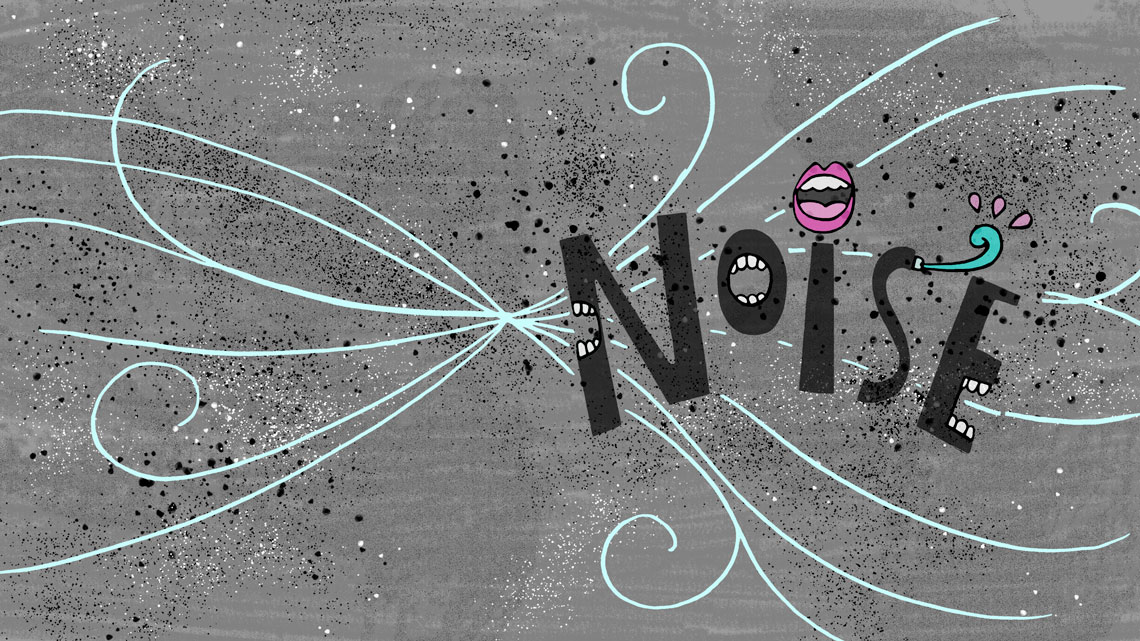
You probably don’t want a bunch of noise when you’re trying to hear a particular sound—and physicists don’t want a bunch of noise when they are searching for a particular signal. Noise is the unwanted data that can be captured along with—and sometimes obscure—the signal a scientist is looking for. This distracting background can come from things like fluctuations in electronics or processes near an experiment such as everyday radioactive decay of materials or collisions of cosmic rays with the atmosphere. For experiments to work, the signal has to rise above the noise so that scientists can detect it.

Damping
Not to be confused with making something wet, damping in physics is associated with reducing vibrations or oscillations. This is particularly important in particle accelerators, where bunches of particles, like boats on a lake, can leave wakes behind them. These wakes make passage trickier for the next bunch of particles. Using mechanical dampers can reduce the wake and improve how well an accelerator performs.

Spin
It’s easy to imagine a spinning planet, ballerina or top. Physicists also use the term “spin,” but in a different way: to describe the properties of particles. In particular, physicists discovered that, at the quantum mechanical level, particles have an intrinsic property that is like a permanent rotation, even when a particle has zero diameter and is considered a point-like object that can’t be described as rotating. Thus spin is used to describe an effect, not the way that effect is actually generated.
Beam
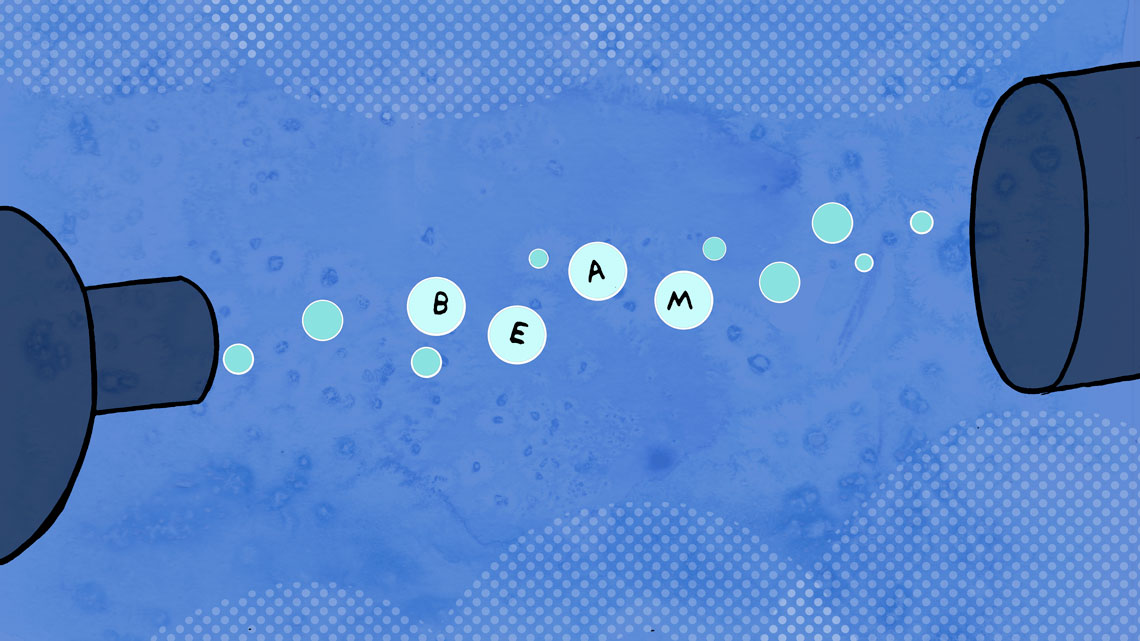
It’s not a steel girder or a toothy smile—a beam is a focused stream of particles. Beams are created by particle accelerators and can be made of different kinds of particles, such as protons, electrons, neutrons, ions or neutrinos. These concentrated torrents of particles can be manipulated, studied in physics experiments or crashed into targets to create other kinds of particles.

Tunneling
For physicists, tunneling isn’t about the habits of moles or carving away mountains to make room for roads. Quantum tunneling is instead a phenomenon in which a particle can pass through a barrier it normally wouldn’t be able to cross. It’s a result of quantum mechanics, the strange way that things can act differently at the smallest scales than they do at the larger scales that we’re used to. Quantum tunneling occurs, for example, during radioactive decay when a particle escapes the nucleus of an atom.
Luminosity
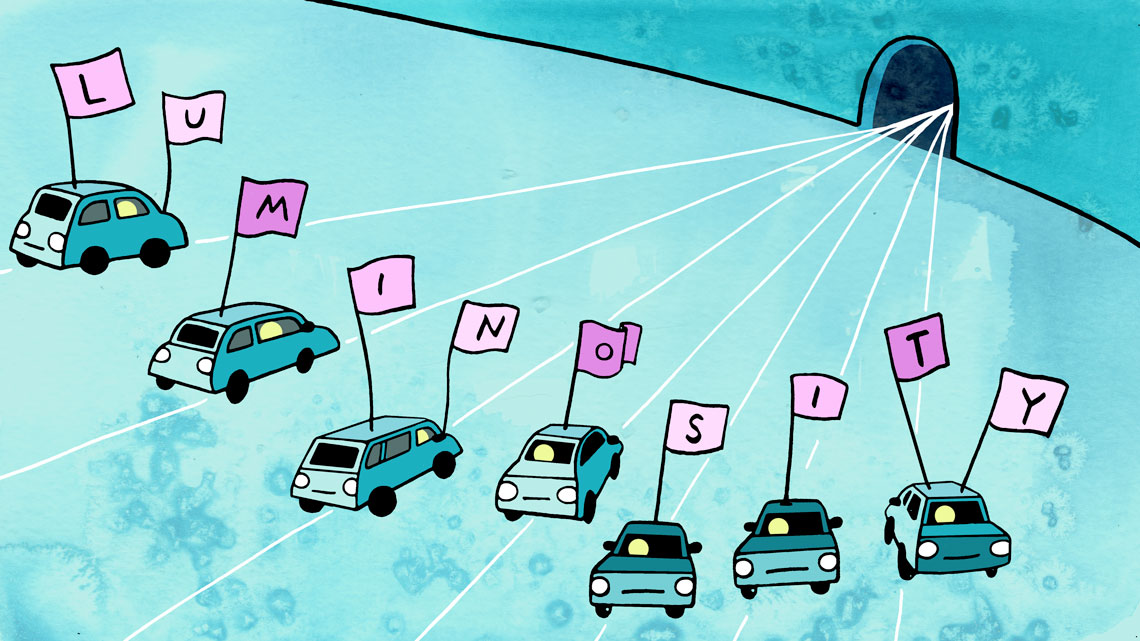
You might think of luminosity as how much light something emits. In astrophysics, this is pretty close: Luminosity is how much energy a celestial object like a star emits in a certain amount of time. But luminosity is also a term in collider physics, where it describes how many particles will pass through a certain point—say, the heart of a detector where the particle collisions happen. Higher luminosity means more particle collisions and a higher chance for making discoveries.

Quintessence
“Quintessence” refers to a perfect example or the essence of something. But you also can find it in physics papers about the expansion of the universe. Dark energy is the mysterious force thought to be driving the expansion of our universe, defying the pull of gravity at an ever-growing rate. Scientists use the term quintessence to discuss the theoretical idea of an evolving type of dark energy that would change strength over time.

Lifetime
To us humans, a lifetime is—if we’re lucky—about 90 years. For particles, it’s another story. The lifetime of a particle is based on how long it takes to decay, or transform into other (typically lighter) particles. Those that decay quickly have lifetimes of slivers of a second. Higgs bosons, for example, only can expect to hang around for about 1.6 x 10⁻²² seconds. Other particles, such as protons, are incredibly long-lived. It’s unknown whether protons decay at all. If they do, they have a lifetime that is longer than the entire history of our universe so far. But that doesn’t mean that all protons necessarily live that long. Experiments could record evidence for the decay of a single proton on any day, revolutionizing our understanding of the building blocks of matter.
Solving a Leafy Mathematical Mystery

Practical Ways to Improve Your Confidence (and Why You Should)

Who’s Afraid of Arabic Numerals?

Who Can Adopt These Navajo Children? A Tale of Two Mothers and a Bitter Constitutional Fight

Custard Sheds a Few Layers

New York Is a Noisy City. One Man Got Revenge.

The 2019 National Spelling Bee ended in an unprecedented 8-way tie

Eight contestants exhausted the Spelling Bee’s dictionary over the course of an intense, three-hour final round.
Winning the Scripps National Spelling Bee is an impressive academic achievement: Not only do its champions boast frighteningly large vocabularies, but they’re all under the age of 15. And on Thursday night, the 2019 National Spelling Bee ended with multiple young contestants earning a victory to add to their résumés, when eight contestants tied for the title — an unprecedented outcome for the event.
The National Spelling Bee named eight co-champions on May 30, at the end of a three-and-a-half-hour final that aired live on TV and ended in a historic eight-way tie. Whittled down from an initial field of 562 contestants, the final eight went for 20 straight rounds of spelling words without any errors.
Congratulations to our Octochamps!#Speller5 Rishik Gandhasri#Speller93 Erin Howard#Speller132 Saketh Sundar#Speller307 Shruthika Padhy#Speller354 Sohum Sukhatankar#Speller407 Abhijay Kodali#Speller427 Christopher Serrao#Speller462 Rohan Raja https://t.co/du3VgXKKEz pic.twitter.com/ZhYvFeiWE0
— Scripps National Spelling Bee (@ScrippsBee) May 31, 2019
And it seemed likely enough that the group of 12- to 14-year-olds could keep going indefinitely, to Scripps’s surprise. The list of “qualified” words that the organization pulls from is only so long, as competition pronouncer Jacques Bailly announced after the spelling bee’s final hit the three-hour mark. The eight remaining contestants were about to burn through it.
“Dr. Bailly just announced we’re in uncharted territory,” the Scripps Twitter account revealed during the 17th round. “We won’t run out of words but may run out of words to challenge our most storied spellers in Bee history.” Whoever made it to round 20, Bailly declared on behalf of Scripps, would automatically walk away a winner.
Dr. Bailly just announced we're in uncharted territory. We won't run out of words but may run out of words to challenge our most storied spellers in Bee history. At Rd 20, 3 away, all remaining spellers will be named Co-Champions of the Scripps National Spelling Bee. #spellingbee
— Scripps National Spelling Bee (@ScrippsBee) May 31, 2019
The decision appeared to have been made on the fly, as what to do in the face of such fierce competition isn’t exactly spelled out (heh) in the National Spelling Bee’s rulebook, which states that the competition allows “no more than 25 consecutive rounds of oral spelling involving three or fewer spellers. At the end of a round when it is mathematically impossible for a single champion to emerge within those 25 consecutive rounds, the remaining spellers in the competition will be declared co-champions.” But in this case, there seemed to be little reason to keep spelling through round 25; not only was the bee running out of appropriately challenging words, but many more than three spellers remained in the competition.
Scripps has named co-champions in the past, including as recently as 2016, but only two contestants at most have shared the National Spelling Bee trophy in any given year. And the competition has never come so close to a 25th round with so many spellers still gunning for the top spot. Words like “callejón,” “omphalopsychite,” and “auftaktigkeit” failed to trip up this year’s spellers, as Bailly paged through the authoritative Merriam-Webster Unabridged word bank the National Spelling Bee uses as its source, looking for words of the right level of difficulty for the final round.
That’s how Rishik Gandhasri (age 13), Erin Howard (14), Saketh Sundar (13), Shruthika Padhy (13), Sohum Sukhatankar (13), Abhijay Kodali (12), Christopher Serrao (12), and Rohan Raja (13) all walked away with a piece of the 2019 title. Each will be awarded the full cash prize of $50,000, promised trips to New York and Los Angeles, and some time on the talk show circuit. Additionally, they’ll each get their own trophy, which is good news, as I imagine it’s hard to share one between eight people, Sisterhood of the Traveling Pants-style.
As the Scripps National Spelling Bee itself quipped on Twitter following the competition’s hard-won end, it was the dictionary that ultimately lost this year’s event.
Mathematics all-in-one cheat-sheet (2013) [pdf]
Article URL: https://ourway.keybase.pub/mathematics_cheat_sheet.pdf
Comments URL: https://news.ycombinator.com/item?id=20048205
Points: 1041
# Comments: 157
On the Trail of Tupelo Honey, Liquid Gold From the Swamps

Frances Arnold Turns Microbes Into Living Factories

The Indian Law That Helps Build Walls

‘Not Just a Maid’: The Ultra-Running Domestic Workers of Hong Kong

Traditional Dresses as Resistance

I also want holiday, says Mrs. Mathrubootham - The Hindu
It seems there is now one cave in Himalayas for one person stay. Only ₹990. I have told my son to make immediate enquiries.
Past Tense: A Look at Window Washers: ‘You Only Get to Fall Once’

A Sealed Garden That Was Watered Once in 53 Years (2017)
Article URL: https://biologicperformance.com/sealed-bottle-terrarium-garden-watered-once-53-years/
Comments URL: https://news.ycombinator.com/item?id=19957405
Points: 402
# Comments: 162
Joudie Kalla’s Baladi Palestine
Joudie Kalla’s book ‘Baladi Palestine: A Celebration of Food from land and sea’ (published by Interlink Books) is 256 pages of visual delight, apart from the obviously excellent recipes. The photographs in this book are my favorite and what makes them even sweeter is that the images actually have been crowd-sourced through people living in Palestine, so what you see is streets, orchards, fresh produce, beautiful bazaars, farms- you see the Palestine that people carry in their hearts and not the Palestine that makes it to newspapers. One of my favorite books about Palestinian food, Baladi Palestine brims with breakfast ideas especially useful during Ramadan for suhoor, recipes that can be prepared earlier or even whipped up quickly within a few minutes. I’ve chosen some such recipes and illustrated them. Take a look:

Mashwi ma’ bayd
Grilled halloumi, fried eggs and roasted tomatoes

Qudsiyeh
Hummus and fava bean purée with olive oil and parsley

Shatta Khadra wa hamra
Green and red shatta

Hummus bil shatta
Hummus with spicy shatta

Khubez bil awermah wa bayd
Pastry stuffed with spiced lamb with eggs
Be sure to check out the book and get a copy, it’s a wonderful book to own!
The gorgeous images I’ve illustrated, are by photographer Jamie Orlando Smith.

‘Knitting Is Coding’ and Yarn Is Programmable in This Physics Lab

Waste Not, if You Want to Help Secure the Future of the Planet

The One-Income Trap

A New Way of Voting That Makes Zealotry Expensive
Article URL: https://www.bloomberg.com/news/articles/2019-05-01/a-new-way-of-voting-that-makes-zealotry-expensive
Comments URL: https://news.ycombinator.com/item?id=19817760
Points: 323
# Comments: 320
Right and bright idea - The Hindu
R.P. Adityaright idea should come from right people!
An Alistair Maclean saga of daring adventure and cunning plan and supense thrills, says J. Mathrubootham.