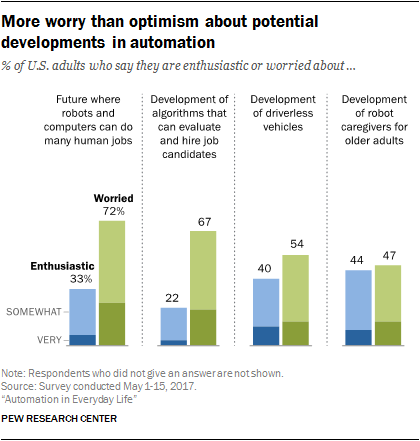
The Pew Internet report, Automation in Everyday Life, is more about fear of automation than enthusiasm for it
The Pew Internet report, Automation in Everyday Life, is more about fear of automation than enthusiasm for it

darktable)The Teaching Challenge is a website built by the team at the Taylor Institute, partially inspired by the DS106 Daily Create. The goal is to provide a platform – scaffolding – to give instructors concrete projects to try in their courses. Projects can range from building some media – make a video – to more complicated things like incorporating active learning. Participants post reflections on what they’ve tried, how it worked, and share with the community. Some very cool stuff. It’s started basically as a skunkworks prototype, but is growing to become a foundation of how we do things. I believe this forms an important way for people to take risks and try new things – and, when combined with Badges and ePortfolio, provides a meaningful way to document and develop growth as a teacher.
Organized by the Taylor Institute for Teaching and Learning, the Teaching Challenge is a community hub, offering a series of online activities that serve as prompts for educators to explore techniques and to gather feedback from peers, connecting an interdisciplinary community of educators. Geared towards an interest in innovative teaching and learning methods, the initiative’s “challenges” range from incorporating student reflective writing exercises to creating podcasts or screencasts for classroom use.
and
The Teaching Challenge has also had a positive impact on Andrea Freeman’s career as an instructor. “Lifelong learning is about more than just increasing knowledge,” she emphasizes. “It is about becoming the best you can be. This type of peer-to-peer sharing provides insight that cannot be obtained from teaching evaluations and reinforces excellent teaching strategies. I came to the University with a strong research focus, but teaching is so much a part of our lives and the future of the University. The Teaching Challenge is a simple way for me to find better ways of engaging my students, so that I can be a more effective contributor to learning on this campus.”
Source: The Teaching Challenge
I’m really proud of how this project was built – collaboration across the Learning Technologies and Learning and Instructional Design Groups, from concept through software development and prototyping, and integration with existing and emerging programs. Very cool stuff. We’re also using it as a foundation of the Taylor Institute’s new Graduate Student Certificate in University Teaching and Learning, to guide participants through the Learning Spaces and Digital Pedagogy badge (which also uses our badges.ucalgary.ca platform… I love it when a plan comes together…)

In The bubble without any fizz, The Economist addresses the fact that financial-asset prices (stocks, bonds, and the like) keep drifting up and up in a world where inflation doesn’t; are we in a mega-bubble? What’s really going on? Looks obvious to me, but then I’m a left-winger. I think it’s all a straightforward consequence of economic efficiency and class warfare.
It stays low because our globalized economy is hyperefficient at making the things we want, extracting the fuels we burn, and growing the food we eat. And also flexible enough that it can scale up and down to meet demand without apparently kicking off waves of inflation or bankruptcy.
All of which is true, but I think the effect of class war is even bigger. Let’s start with a picture.
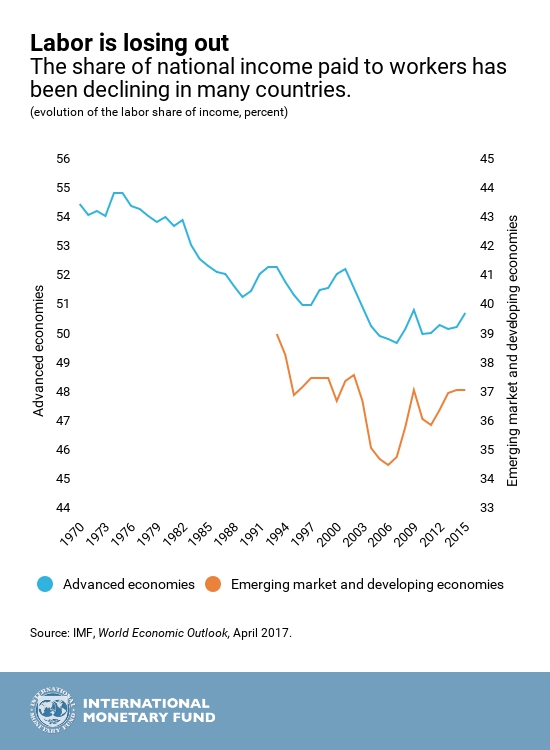
From Drivers of Declining Labor Share of Income, published by those commies at the International Monetary Fund.
Unions are in retreat and conservatives rule in the great economies of the developed world. Generation Z is being forced into the gig economy, into low-agency, low-paying, no-commitment jobs where being a shift lead at Starbucks is an aspirational goal.
When you don’t have to pay people much, well yeah, you get low inflation.
When it’s the prices of household goods, they call it “inflation”. When it’s financial assets, they call it “a bull market”. But the cause is the same: Too much money chasing too few targets.
It’s like this: There’s a surplus of accumulated wealth (see Piketty), and the people who hold it can’t possibly spend it on goods and services — how many yachts can you waterski behind? So they throw it at financial products, which then inflate.
I think this is bleedingly obvious, but that’s possibly because I’m a citizen of the technology scene, and of Vancouver. In the venture-capital business, there’s just way too much money chasing way too few unicorns. Go to a startup showcase sometime and hear the pitches, see who’s getting funded. If you’re like most people, you’ll leave shaking your head.
I also sit in Vancouver, which is experiencing severe inflation, in our housing sector. Since Vancouver is a relatively low-paying city, not just on a world scale but compared to its Canadian peers, it’s obvious that global capital is part of the problem. Our real-estate frenzy has become an international news story (it appears in the Economist piece linked above), but I un-humbly think my own 2015 Game of Homes captures the essentials pretty well.
So, what do Vancouver real estate and financial instruments have in common? Limited supply, that’s what. Check out A Dearth of I.P.O.s, but It’s Not the Fault of Red Tape ; not only has the IPO rate plunged (from 706 in 1996 to 105 in 2016), so has the number of public companies (from 7,322 to 3,671). Declining supply, increasing demand, d’oh.
Other financial assets, e.g. bonds, may not be as supply-starved (I couldn’t turn up good numbers) but it stands to reason that when companies all over the world are reporting robust profits (class war, remember?) they probably don’t need to borrow as much. And (as The Economist notes) when investors are driven to buying 100-year bonds from Argentina, a nation that has defaulted on its bonds six times in the last 100 years, you know they’re getting desperate.
More evidence, were any needed, of the global capital surplus? How about the $21 trillion being hidden from the tax-man here and there around the world?
Beats me. The sad thing is, I don’t see any reason why things can’t go on the way they are for the foreseeable future. Objectively, it would probably be good for the world if a lot of the accumulated wealth was just vaporized. Unfortunately, the only way that seems to happen historically is in major wars, as Piketty’s graphs illustrate. Which nobody wants.
Then there’s the leftist world-view, for example On the Left from last year. Tl;dr: Tax wealth, force radical transparency on asset ownership, jail business criminals, offer universal basic income. Works for me; but I’m still looking for the right political party.
There’s just too much money out there not doing anything particularly useful.

After revealing the iPhone X to the world on September 12th, Apple updated its Human Interface Guidelines and introduced a series of developer videos to address, among other topics, designing iOS apps with the iPhone X’s notch in mind. Designer Max Rudberg provides a comprehensive overview of Apple’s treatment of the notch. As Rudberg explains:
Apple is choosing to highlight the fact that the screen reaches the top left and right corner of the device. So the recommendation is clear. As a good platform citizen, one should follow their lead. By doing so, you likely have better chances to be highlighted by Apple in the App Store, or even win an Apple Design Award.
Eventually, they will get rid of the notch. It could be 2, 5, or even 10 years, but it’s a stop gap, not a permanent design solution. In the meantime, treat it like the elephant in the room. We all know it’s there, but for the most part, you should design as if it’s not.
Rudberg illustrates his article with screenshots of each point he covers and the dimensions of each screen elements adjacent to the notch. It’s not a substitute for reading the Human Interface Guidelines and watching Apple’s videos, but Rudberg’s article is a great place for developers to start when considering how to design for the iPhone X.
→ Source: blog.maxrudberg.com
With visions of a car-light area in Gastown, City of Vancouver is consulting residents on a transportation area plan. Tour and workshop, Saturday October 21, 1:30 to 4:30. Project, event details and signup HERE. An online survey is available for members of Talk Vancouver.
Starting, as with Burrard Bridge, from the need to do major repair, CoV seeks input on moving Gastown towards a complete street design model.
“We have an opportunity to build on the strengths of Gastown and design the streets in a way that better serves the area. We want to work with the community to achieve the best outcome,” says Lon LaClaire, Director of Transportation for the City of Vancouver. “As part of our community engagement, we will be exploring whether Water Street could become car-light, but it is important to us to work closely with businesses in the area to see how the streets can continue to support loading and movement needs.”

Potential car-light street
Water Street was identified in the Downtown Eastside Plan and Transportation 2040 as a potential car-light street and as a missing link within the east-west bike network.
Car-light refers to a street design that reduces the number of vehicles travelling through an area in order to create more inviting spaces for people to walk, cycle, and enjoy.
Any car-light area will need to balance mobility and access needs for local businesses, residents and visitors with the desire to create an interesting and welcoming place for people to be.


Sometimes the best distraction from a frantic and chaotic day is an even more frantic and chaotic game. Fowlst, which developer CatCup Games, describes as ‘an action game about an owl that is trapped in Hell for some reason’ is perfect for just such an occasion.
Fowlst is an arcade-style action, dodging game. You play as the owl, pursued by demons that shoot lasers at you while you try to avoid buzzsaws, fire, and other obstacles. The game gets crazy fast.
The mechanics remind me of Don’t Grind, one of my favorite arcade-style games released last year. You control your owl by tapping on the left and right-hand sides of the screen, which makes your owl fly in a bouncy kind of way in the direction of your taps. The controls purposefully require a careful coordination of left and right taps to navigate your owl. Power-ups are activated by swiping up on the screen. It’s a simple control scheme that makes Fowlst easy to pick up and start playing, but difficult to master.
Demons are defeated by colliding with them before you run out of hearts from being hit by lasers or other obstacles. Unlike Don’t Grind, you don’t have to keep your owl aloft constantly. You can rest on the bottom of any stage or a perch, but constantly moving helps make it harder for the demons to get you. There are also periodic bosses theoughout the game to mix up the pace of the action.
When you defeat a demon, it’s replaced with a floating sack of money and occasionally a heart or power-up that disappears after a few seconds. To collect items, you need to steer your owl into them while simultaneously dealing with other demons and obstacles. The cash you collect can be spent to upgrade your owl with health and weapons.
The game ends when you run out of hearts. Fowlst then tallies the money you collected, the number of levels cleared and shows how you did compared to your high score, which has the effect of making the game wonderfully-compulsive to play. Fowlst keeps things interesting by randomizing the levels you are presented each time you play through. It’s a carefully struck balance that keeps the gameplay familiar enough to avoid frustration but also avoids becoming monotonous.
Fowlst combines its arcade action with pixelated art, a complementary chiptune soundtrack, and lots of ‘pew-pew’ laser sound effects. The result is an addictive arcade game that has almost no learning curve and is easy to pick up and play for short periods of time but is difficult to master and hard to put down. It’s a perfect combination for a mobile game, making Fowlst a title I’m going to be returning to often.
Fowlst is available on the App Store.
Club MacStories offers exclusive access to extra MacStories content, delivered every week; it's also a way to support us directly.
Club MacStories will help you discover the best apps for your devices and get the most out of your iPhone, iPad, and Mac. Plus, it's made in Italy.
Join Now When Google unveiled the Pixel 2 and Pixel 2 XL last week, it made quite a bit of fuss about the camera performance of the devices. The company even demoed some camera shots taken from the handsets at the event that showed what the camera was capable of.
Continue reading →
When Google unveiled the Pixel 2 and Pixel 2 XL last week, it made quite a bit of fuss about the camera performance of the devices. The company even demoed some camera shots taken from the handsets at the event that showed what the camera was capable of.
Continue reading →
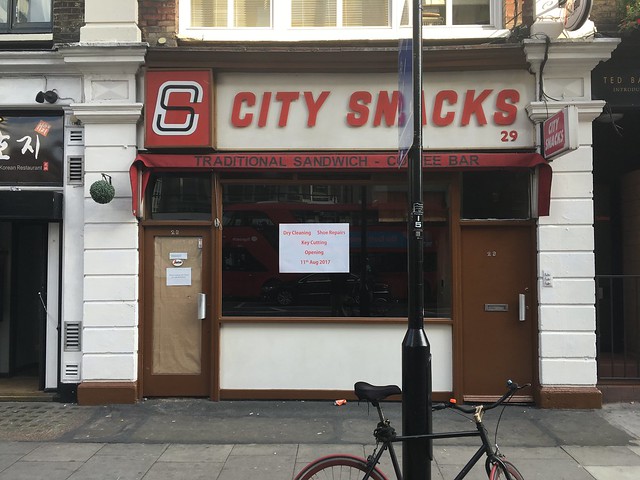
City Snacks closed over the summer. For a long time it was a place I walked past occasionally. I popped in to cover it for A Good Place for a Cup of Tea and A Think. But when I was working at GDS it was just around the corner, 10 minutes walk, just the right distance to be a bolt-hole, a retreat. I came to love it. The people, the atmosphere, the food. We gossiped here, we made plans, we cursed the system and marvelled at the determination of our colleagues.
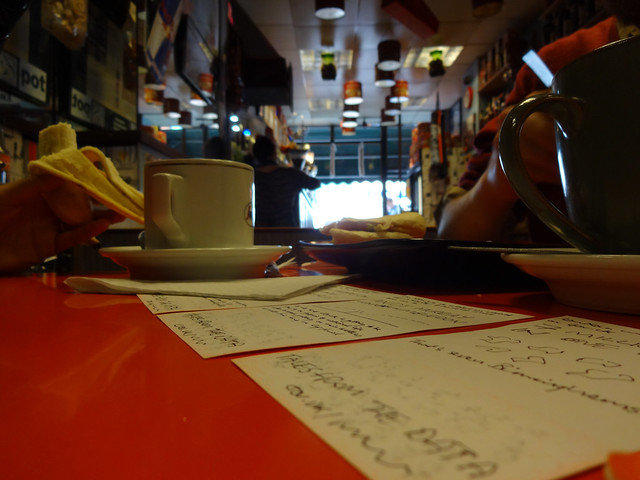
I think this was us designing these.

This was probably Matt making them better.
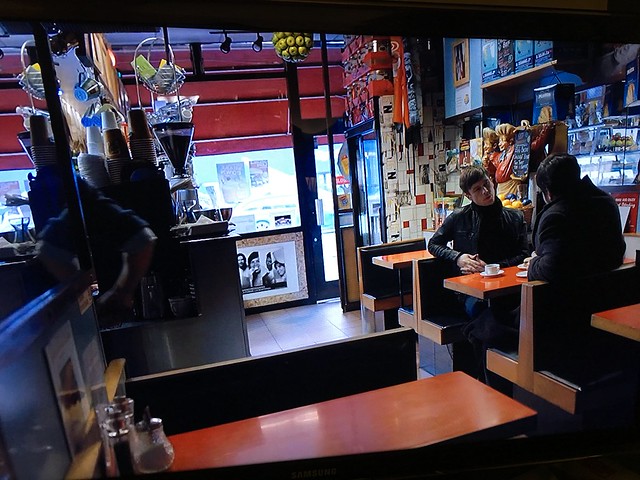
Oddly, just a few weeks ago it popped back to life on the telly, as a location in The Cuckoo's Calling. I hope they got a last bit of decent money from the fee. Used it to have a proper holiday. When I'd first seen the place was closed I wasn't that worried, they always used to close for quite a long time over the summer, go back to Italy. I admired that. I thought that was happening again until that dry-cleaning sign appeared.
Mostly though I just remember sitting here, writing optimistic notes about work that mattered, for stuff that had a chance of actually happening. That's proven to be rare in the world of 'digital transformation'.
Those red tables were gorgeous. Highly instagrammy.
And there was always a little odd thing to notice.
Ah well. City Snacks is now on EBCBrevisited and will be in tomorrow's Afternoon Slow.
I need to find another cafe.


After six years of testing, over the course of which we’ve examined 70 pairs of touchscreen gloves, we’ve found that though no pair is going to keep your hands warm and let you type as well as you can with your bare fingers, the Black Diamond HeavyWeight ScreenTap Fleece Gloves are the best compromise. They type pretty well, are warmer, and fit hands better than the competition.
mkalus
shared this story
from  Price Tags. Price Tags.
|
From Jarrett Walker, an American who helps people think … in particular about transportation in their communities …
Happy Thanksgiving weekend, Canadian friends! You might enjoy my sentimental 2005 Thanksgiving piece, written while I lived in Vancouver.

If you allow yourself to fantasize about your ideal country, I bet you’ll imagine one that’s defended by nature. Perhaps you’ll think of a mountain valley walled off from invaders and influence: Alpine Switzerland or Bhutan or the Shangri-la of legend. Or maybe it will be an island-state, like the England of Shakespeare’s John of Gaunt:
This precious stone set in the silver sea,
Which serves it in the office of a wall,
Or as a moat defensive to a house,
Against the envy of less happier lands,
— Richard II, ii.1
Today people fantasize about Iceland or New Zealand or Tahiti in search of that same security, that sense (however illusory) that in such a place, the complexity and danger of the world is far away.
Secure in such boundaries, whether mountain or water, you can spin out the culture and values of your ideal country with ease. Culture will change, of course, but slowly enough, and around-the-edges enough, that it will still be your ideal country’s culture.
But what if you didn’t have natural boundaries? What if your country was a few people spread across a vast distance? What if your border was a long, straight imaginary line, so that your people lived closer to foreigners than to each other? Then, inventing your ideal country would be like trying to paint on a surface where paint turns to droplets and rolls away, while droplets from other paintings are rolling in. You couldn’t even begin.
Such is the challenge of imagining Canada. It’s hopeless, but Canada is here regardless. And because the harvest is earlier here, today is Canada’s Thanksgiving.

Thanks for the worst kind of border, impossible to defend, easier to cross than to work within. Thanks for the 49th Parallel, a mathematical thread stretched east-west where everything else — mountains, rivers, energy infrastructure — runs north-south. Thanks for the 141st Meridian, between the Yukon and Alaska, which runs north-south where everything else runs east-west. Thanks for a border that is not only unnatural, but perpendicular to nature.
Thanks, as a result, for the odd sensation that the two sides of the border are the same place in every way that matters: the same high valley, the same alpine plateau, the same cliff-face, the same coastal boglands, the same rainforest, the same Point Roberts peninsula. And the same culture: the same dying prairie towns, the same wild west, the same rainy urban cappucinos, even the same paleo-Mormon polygamists. Thanks for a border that you can hike across by accident, high in the mountains, often without a sign.
Thanks for the arctic pressure that compresses the population against the border, so that the nation is the border, as arbitrary as the border itself. Thanks for the national intellectuals who worry about this for us, e.g. for John Ralston Saul, who can begin a chapter with the words: “The natural flow of Canada is east-west.” Thanks for the perfect emptiness of the word “natural” in this sentence, the creative archeology of it, as arbitrary as the 49th Parallel itself.
Thanks, back east, for the cradle of Canada, the one place where cities can get back from the border and invent unbordered selves. Thanks that this center is also the center of the great division, the “two solitudes” of French and English. Thanks that however often a political leader declares that “the time of the two solitudes … is past,” the twoness will linger as long as there are two languages, and will multiply as Punjabi and Cantonese and many others find new and honored homes. Thanks that in the last Parliamentary election, an electorate in Surrey, BC held a debate entirely in Punjabi. Thanks for a century of practice at truly multilingual democracy, long before it was the fashion.
Thanks, still, for the special status of the French language even in the furthest corners of Canada. Thanks that a friend of mine is paid to produce French translations of the laws of the Yukon Territory. Thanks that when Japanese- and Chinese-speaking focus groups in Vancouver were asked what languages other than English should be on the signs in Vancouver’s new subway, French was their top priority.
A special thanks for South Asia’s superpower status among immigrant cultures. Thanks to people who left home countries whose lowest temperatures are near Vancouver’s highest, and who brought bright colors that erupt surreally against the northern grays. Thanks for the clearwater simplicity of Sikh ethics, among the many spiritual traditions arriving on this wave. Thanks for the fact that any national politician must not only speak at least two languages fluently, but must also look not-too-silly in the simple head-covering one wears to Sikh events.
Thanks for the Arctic, the otherness that presses Canadians into the border, a frontier that a century of global warming will not close. Thanks for the world’s highest per-capita supply of barren arctic islands. Thanks, as a result, for the almost tongue-in-cheek attitude that prevails over Hans Island, a rock near Greenland that is claimed by both Canada and Denmark. Thanks for the Swiftian absurdity of this dispute, plainly evident to most Canadians. Thanks for the polite editorials on both sides, suffused with such equanimity that the whole matter will probably be resolved with a game of chess, or the flip of a coin.
Boundless thanks, then, for the dying leaf, for the permanent autumn of Canadian patriotism. Thanks for the way the flag, rippling in uneven breeze, can fold to suggest the shapes of a leaf further gone toward mulch, the leaf already part-decayed or stepped on. Thanks for the red leaf painted on faces — whether at hockey games or on Canada Day in midsummer — a symbolic gesture of pride that is also a literal welcoming of decay: the Fourth of July and Ash Wednesday rolled into one. Thanks for all of the insecurity, mortification, and anxiety that can be spun from this image. Thanks for the serenity that lives these contradictions.
Thanks for a country that didn’t need the Buddhists to explain the “wisdom of insecurity,” because it has known nothing else.
Finally, thanks for the big noisy neighbors, so big and so noisy that Canada is all but invisible to them. When national identity becomes too vague, Canadians can always complain about the neighbors. They can even say rude things about them, confident the neighbors will never hear. Saying rude things is good exercise sometimes; perhaps it should be a holiday tradition.
From Canada, and to Canada, happy Thanksgiving.


The New York Times published a devastating and detailed piece on decades of sexual advances by powerful movie producer Harvey Weinstein. Weinstein responded with a strange statement about taking a leave from his movie company to take on the NRA and President Trump. Weinstein’s statement is bizarrely sensible — but only if you believe, in … Continued
The post Deconstructing the bizarre Harvey Weinstein statement about sexual harassment appeared first on without bullshit.

One of the rare occasions where people are paying attention to the candidates in the upcoming civic byelection on October 14.

When running for office, it’s hard not to engage in the Generality of Good Intentions. Identify the problem and declare you’ll work hard to solve it. Without being too specific.
On top of verbal mush, however, candidates can sprinkle crunchy nuggets of nourishment – any proposal that would make a big difference if implemented and yet realistic enough to actually happen.
Two of the candidates on either end of the panel above at SFU City Conversations put forward examples. Jean Swanson (independent but COPE supported) proposes a variable property tax. The City couldn’t do that now, but Swanson wants increases of several percent on residential properties assessed over $5 and $10 million (‘Mansions’) – to raise over a hundred million dollars for housing and regulation of the existing rental stock.
Hector Bremner (NPA) is emulating what Gordon Campbell as mayor was good at: proposing something quite radical without being seen to. He’d rezone the whole city at once as part of a big plan that would obviate the need for spot zoning. And in doing so, make once-sanctified single-family zones places for multiple dwellings. It’s what a lot of urbanists are calling for, but didn’t expect it to come from the NPA.
If those proposals were seriously undertaken, it would be the biggest change in the civic culture of Vancouver since the amalgamation of 1929 that created this town in the first place. But they could be done.
Candidates from both ends of the political spectrum are capturing the agenda. One might also capture a council seat.


|
mkalus
shared this story
from Price Tags.
|
“Where you have cars driving with no steering wheel, no pedals, I think first what you’re going to see is designated areas of cities that are going to be cordoned off,” said Jack Weast, Intel’s chief architect for self-driving solutions
“Think about 40 city blocks — let’s say the entire downtown [of Washington], D.C. — off-limits to human-driven cars, only automated robo-taxis cruising around.”
Potentially a huge step for auto dominance: the designated use of streets only for automated vehicles. Everything ‘irrational’ will be prohibited or tightly controlled: non-automated vehicles, bicycles, even pedestrians.


When Google announced the Pixel 2 and Pixel 2 XL earlier this week, a lot of people were understandably frustrated to learn that, after making fun of Apple for removing the headphone jack from the iPhone 7, Google decided to do the same.
Following the unveiling of the two devices, Google community manager Orrin published a post to the company’s product forums titled “Listening to your Pixel Phone.” In it, the search giant provides some context for its decision to remove the 3.5 headphone jack from both of its new smartphones.
“Moving to the USB-C audio port with Pixel 2 allows us to provide a better audio and digital experience, as we move towards a bezel-less future,” says the company through one of its community managers. Google product chief Mario Queiroz reiterated also this reasoning in an interview with TechCrunch.
Whatever you think about the company’s stated reason for removing the headphone jack from its new phones (there are, after all, easy-to-find examples of phones that have managed to incorporate a bezel-less display while still retaining a headphone jack), you’ll need to keep some practical considerations in mind if you decide to buy the Pixel 2.
Later in its post, Google writes: “We realize that some of you might be looking for USB-C headphones, and we want to provide some guidance around headphone compatibility with Pixel 2 devices. The main thing to keep in mind is that Pixel 2 devices are compatible with USB-C headphones that support digital audio.” You can find the full list of compatible headphones here.
Google doesn’t provide much information on what “digital audio” means in the context of its new smartphones — though you can read all about it on Android’s developer portal.
Essentially, neither the Pixel 2 nor the Pixel 2 XL include a chip dedicated to converting digital audio signals to analog ones. This chip, known as a DAC, is present in every phone that features a 3.5mm headphone jack.
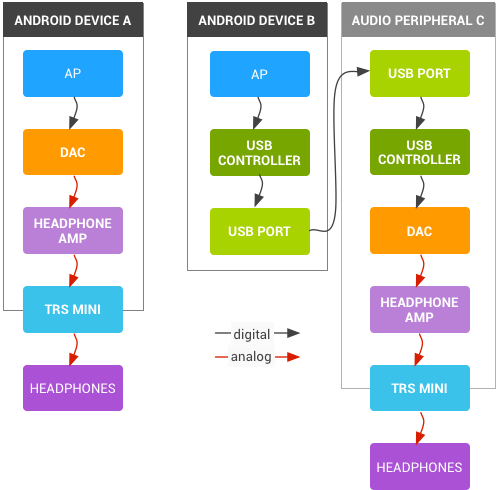
Not so with the new Pixels, which means should consumers decide they want to invest in a pair of USB-C to go alongside their new phone, they’ll need to buy a pair of headphones that includes a built-in DAC and amplifier (many USB-C headphones include a built-in DAC).
A Google spokesperson confirmed this in a statement issued to MobileSyrup.
“The Pixel 2 does not have a DAC/amp. It transmits audio digitally over USB to your headphones. To give people a choice of audio options, we’ve included an adapter in the box which includes a DAC/amp that can be used with existing headphones.”
Ultimately, this represents a significant paradigm change from how compatibility between smartphones and headphones works with devices that feature a headphone jack. In the case of a device that works with analog headphones, any pair of headphones with a 3.5mm input will work. By contrast, devices like the Pixel 2 require consumers do the extra work of making sure the headphones they’re about to purchase include an on-board DAC.
In fact, Google’s list of USB-C headphones that will definitely work with the Pixel 2 and Pixel 2 XL is quite short.
I should also note not all USB-C to 3.5mm headphone adapters will work with the Pixel 2. To quote the post: “Other USB-C to 3.5mm adapters/splitters should work, but please be sure they are compatible with digital audio and support the proper audio standards.”
Presumably, the majority of USB-C headphones to come out in the future will include the necessary components to work out-of-the-box with smartphones like the Pixel 2. Moreover, all wireless headphones will work as long as they support Bluetooth.
However, for a port format that was supposed to make technology simpler, USB-C seems to have done anything but that.
Source: Google
The post Forget a missing headphone jack, the Pixel 2 doesn’t even have a DAC appeared first on MobileSyrup.
A call to action by Abundant Housing Vancouver, which popped up in my e-mail (I know, so primitive, and not even on a phone).
It’s an example of pushback from a single-family-home ‘hood when faced with a relatively modest change (72 housing units, among the many thousands per year needed to begin to dent demand and affordability).
There’s a message here for council by-election candidates and parties who advocate re-zoning. My take on the message: go big or go home.
Says Abundant Housing Vancouver:
Last February, we helped push forward a project in Kerrisdale to build 32 Social Housing units, add community space, retrofit the historic Dunbar Ryerson United Church, and build 40 market apartments and townhouses. Today, it’s time to to let the City know that these homes and homes like them should go forward.
On October 17 at 6 PM, the Dunbar Ryerson rezoning goes before City Council.
Sadly, against this are arrayed rich property owners who demand that these homes not disturb their exclusively zoned neighbourhood. This project adds much needed rental housing to the exclusionary West Side, away from polluted arterials, but still a short walk from numerous shops, amenities, and frequent buses.
We’re asking you to let your voice be heard. The most effective way to be heard is to sign up to speak at the hearing by registering with publichearing@vancouver.caIf you can’t make the hearing, any letters the city receives are distributed to Mayor and Council before the hearing. Looking for something to say? Try our letter writing tool, and add your voice to ours or craft your own letter, and we’ll send it automatically to City Hall.
More information – including how to sign up to speak at the public hearing – can be found on the city’s website. The public hearing is at City Hall on Tuesday, October 17, 2017 at 6 PM.
Thanks
PS: We’ve released our byelection candidate questionnaire results!

Project view from the south. Click to enlarge
The City of Vancouver has received an application to rezone 2165-2195 West 45th Avenue and 2205-2291 West 45th Avenue from RS-5 (One-Family Dwelling) District to CD-1 (Comprehensive Development) District. The proposal for the two sites included in the rezoning application includes:
East Site:
West Site:


One of the biggest undertakings in the Burrard Bridge project was one we never really saw. And it had nothing to do with bicycles.

It was mostly below grade or underground.
The replacement of water and sewerage lines is a big deal. And for many months whole lanes of Burrard Street south of Davie were taken up to do it.
We take for granted, thank god, this water system that is essential for our existence as a city. But there has been a long-term commitment by every council to maintenance and replacement of those pipes – and this project reflects that.
More later.


“Where you have cars driving with no steering wheel, no pedals, I think first what you’re going to see is designated areas of cities that are going to be cordoned off,” said Jack Weast, Intel’s chief architect for self-driving solutions
“Think about 40 city blocks — let’s say the entire downtown [of Washington], D.C. — off-limits to human-driven cars, only automated robo-taxis cruising around.”
Potentially a huge step for auto dominance: the designated use of streets only for automated vehicles. Everything ‘irrational’ will be prohibited or tightly controlled: non-automated vehicles, bicycles, even pedestrians.
This is an Alberta thing, apparently. Well worth 43 seconds of your time.
https://twitter.com/NorthDarling/status/912081179255357440/video/1
Many thanks to PT commenter Gar Fisher for the link.


Hello Mozillians,
We are happy to let you know that Friday, October 13th, we are organizing Firefox 57 Beta 8 Testday. We’ll be focusing our testing on the following new features: Activity Stream, Photon Structure and Photon Onboarding Tour Notifications & Tour Overlay 57.
Check out the detailed instructions via this etherpad .
No previous testing experience is required, so feel free to join us on #qa IRC channel where our moderators will offer you guidance and answer your questions.
Join us and help us make Firefox better!
See you on Friday!
Amazon is trying to take more control of the ‘last mile’ in logistics, by developing its own delivery service, and potentially cutting out FedEx and UPS.
As a result, those companies stocks dropped:

$AMZN was up $15.40, 1.59% in the day’s trading.

When Google announced the Pixel in October of last year, the company unveiled a policy wherein future Pixel owners would get unlimited original resolution photo and video uploads to Google Photos. With the launch of the Pixel 2 and Pixel 2 XL, Google is altering that policy.
Moving forward, Pixel 2 and Pixel 2 XL owners will get unlimited original quality photo and video uploads to Google Photos until 2020. By 2021, they’ll only be able to upload an unlimited number of photos and videos in “high-quality.” In other words, by 2021 Google Photos will automatically downsize photos to 16-megapixels and videos to 1080p if Pixel 2 users don’t want their media counting against their Google Drive storage limit.
The change was spotted by Engadget, and in a statement to the publication, a Google spokesperson said the company made the change after considering how long people tend to keep their smartphones.
“With Pixel 2 you get free, unlimited original-quality storage for photos and videos uploaded through the end of 2020, and free, unlimited high-quality storage for photos uploaded afterwards. After 2020, there is no change to the photos you took before 2020 and you will always have access to those in original quality,” said the spokesperson.
“This is new for this year. We know that people tend to change their phone every 2-3 years so for Pixel 2, we are offering storage in line with that.”
What do you think of Google’s decision? Tell us in the comments section.
Source: Engadget
The post Pixel 2 to only offer unlimited original quality Google Photos uploads until 2020 appeared first on MobileSyrup.


 CommitStrip.


