Shared posts

12 Nov 23:57

If We Talked About the Internet Like We Talk About OER

by Stephen Downes
David Wiley offers a provocative perspective titled If We Talked About the Internet Like We Talk About OER: The Cost Trap and Inclusive Access. Here's how he sets it up:
Imagine that – somehow – you’ve never used the internet before. A good friend and long-time internet user finds this out and begins trying to describe to you how awesome the internet is. However, for some inexplicable reason, all of his arguments for why you should be on the internet focus on cost.
He follows this with a series of images showing services such as gMail, Instagram and Wikipedia with a slogan emphasizing how it is cheaper than its alternative. "Wikipedia: cheaper than Encyclopedia Britannica," for example. He then argues,
While it is absolutely true that each of these services is cheaper than its pre-internet counterpart, cost is far and away the least interesting thing about any of them. Would these arguments actually inspire someone to want to use the internet? If you’re already familiar with the internet, the whole line of argument seems to miss the point. It omits the heart and soul of what makes the internet amazing. Who thinks about the internet this way?
I do.

I was around in the pre-internet days. I remember life without an internet. I remember when online access was granted through services like Compuserv, which would cost me (had I been able to afford it) $6 per hour. Other services were even more expensive. Remember?
When you look at what we pay for high speed Internet access now, it’s almost hard to imagine it ever being another way…but it was…oh boy, it was. In 1995 getting online was done in an almost completely different way, and access to online services were charged for, in most cases, BY THE MINUTE like a long distance phone call.
Like pretty much every other internet user in the late 1980s and early 1990s I accessed it for free through university access on campus. I was also able to dial in via modem when I lived in the city. Outside the city I incurred long distance charges, which I passed on (when I could) to Athabasca University. I ended up incurring thousands of dollars in internet debt by 1995. Fortunately I got a job in Manitoba and was able to escape the trap.

In Brandon I was determined that the scenario would not be repeated. With a group of people I worked on a project called Brandon Freenet, later called the Westman Community Network (because some jerk trademarked the term 'Freenet' and would't let anyone use it). It was part of a wider network of freenets across Canada and the United States. A lot of them don't exist any more; some of them still do, because there's still a need.

It wasn't easy, especially once commercial internet came on to the scene. In Brandon, the only internet access point was Brandon University; the college and everyone else in the city went through BU. We raised money, purchased access, and made it available at low cost (and in some cases, for free). But we ran into issues because come computer science professors at the university launched a commercial service, called Docker, and it became more and more difficult to maintain our community service. Docker eventually sold out to (I believe) Bell and the professors did just fine.

There was a time when free public access to the internet was in the balance. Many communities (and community organizations, like our own) wanted to provide it as an essential social service. Commercial internet providers did what they do best, and virtually eliminated the competition. Not though the free market; don't be silly! They lobbied and in some cases sued and made community internet access illegal. Like they did in Colorado. Like they did in Minnesota. Like they did in Tennessee.

Commercial access providers don't actually like the free market. People and governments could provide internet access for much less than it costs today. Most of the backbone is already underwritten by the taxpayer, and a lot of local infrastructure is as well. But commercial providers do everything they can to ensure limited, and often monopoly, access to the last mile.

So yeah, Dave - it's about the money.

---

Why does this matter? Why does David Wiley even raise the point? It has to do with textbook publishing, and in particular, something called 'inclusive access' to commercially published textbooks in university courses.

I covered this a couple of times last winter in OLDaily. Wiley is responding to an Inside Higher Ed article published yesterday called 'Inclusive Access Takes Off. The core idea of this scam purchasing plan is that
instead of buying textbooks with credit cards or cash, students can be automatically charged for course materials by the institution when they enroll.... Publishers previously lost a lot of revenue from textbooks because many students bought secondhand, rented, pirated or just skipped buying textbooks altogether. Inclusive-access programs have changed that.
The article touts savings of "up to" 70 percent. There's no reason to believe these savings will persist once the publishers have locked up monopoly access to sales of course materials. And of course they are well into the process of depicting community-based access (such as sharing or reselling texts) as "illegal".

Wiley responds as follows:
While everyone wants educational materials to be less expensive, lower costs are the least interesting thing about digital, networked learning... 
By focusing on cost, the article takes a page directly from the publishers’ playbook. Keeping the conversation laser-focused on cost is the core of their defensive strategy with regard to OER. Because when you think the problem to be solved is the high cost of textbooks, the way you solve that problem is by lowering the cost of textbooks.
This is an interesting perspective. The core issue here, argues Wiley, is one of permissions, not cost. The argument based on cost is just a distraction. It allows publishers to respond to the challenge of OER by lowering their prices, while all the while maintaining their lock on content, preventing anyone from reusing (or sharing, or whatever).

And because of this, he argues, we lose the advantages of OER (just like, he says, we lose the advantages of the internet if we're only focused on internet access costs).

---

Here's how he expresses the 'advantages of OER' argument:
When, o when will we turn our attention in earnest to OER-enabled pedagogy – to all the teaching and learning practices (and associated benefits) that are possible only in the context of OER adoption? When will we stop focusing on cost to the exclusion of other benefits? ... 
Every time we focus a conversation about OER on cost, we simultaneously strengthen the arguments in favor of inclusive access.
I like to keep the language clean in my posts, but it's difficult. Oh so difficult.

There are two problems with this line of argumentation. I'll deal with the easy one first: we are focused on the advantages of OER-enabled pedagogy. What do you think the whole MOOC thing George Siemens and I and others was about? Beginning in 2003 and continuing consistently thereafter I have depicted learning resources as words in a conversation, and applied the logic of language to the logic of reuse. In 2006 I described and recommended the community-based model to support sustainable OER-based pedagogy.

In the intervening years we've seen no support from David Wiley with respect to this alternative model. His focus has been on traditional institutions of learning and the traditional classroom model. When he has worked toward the production of OERs, it was to produce textbooks. I've spent years working toward a pedagogy of sharing and networks and communities enabled (partially) by open educational resources; Wiley has appeared disinterested. He says the discussion of MOOCs "has sucked the air out of conversation around innovation in education."

Now to be fair, his criticism is that "the horrific corruption perpetrated by the Udacity, Coursera, and other copycat MOOCs is to pretend that the last forty years never happened." But the problem he sees with these MOOCs isn't the pedagogical model per se, it's that they have the wrong licensing. "I believe we must ground our open thinking in the idea of open licenses. Specifically, we should advocate for open in the language of the 5Rs," he writes. And this has been his position consistently for a number of years.

And this brings us to the second problem with his line of reasoning. It's this: the reason people talk about the cost of open educational resources is because some people - David Wiley included - think it's an essential part of 'open' that the resources be commercialized and that vendors charge money from them. Of course he wants us to stop talking about cost - that would deflect the criticism of his own business model. Lumen Learning is in the same business as  Pearson, Cengage and McGraw-Hill Education: selling textbooks (directly or indirectly) to students.

That, to me, makes them, and him, part of the problem. And it makes him even more complicit in the problem when he accuses people of 'not talking about open pedagogy' when they take a perspective that is not based in the precious 5 Rs.

---

We've had this discussion before, at length, and some would say, ad nauseum. The debate around open pedagogy is just the latest incarnation.

At core, Wiley sees 'commercial' as good, while I don't. More accurately, I think, Wiley sees 'commercial' as the only good, while I think that public and community-based non-commercial alternatives are equally viable.

This is certainly how the debate about licensing has played out. My position is that, first, I choose to use a non-commercial license, and I tell people that they should feel free to use any of the Creative Commons licenses on their open educational resources. Wiley (and a cluster of other OER advocates) insist that creators must use a CC-by license, allowing commercial use, if they want their work to be considered open.

The difference arises essentially because I consider learning and pedagogy to be non-commercial enterprises. This is especially the case when, as I advocate, OERs are created by students as a part of their studies for sharing with and use by other students (like words in a conversation). And I see no good reason why we should require the production of educators and students to be fair game for resellers who want to pluck it for free out of the commons and charge money for it to those not lucky enough to be a part of our community.

So when I see somebody saying "you shouldn't argue about price" and "you must allow commercial reuse of OERs" I see somebody who is not only not talking about pedagogy, I see someone who is trying to destroy open pedagogy, by destroying communities and replacing them with companies. I see someone who can't get past the idea of education as something that is provided by a university or publisher or whatever, and not possibly created by people working together on their own.

You want me to stop talking about cost, David? Stop charging money for something that should be free. Return education to the community network. Help work with us together without putting a price tag on it.

12 Nov 23:56

Results of the MDN “Thin Pages” SEO experiment

by sheppy

The MDN team has been working on a number of experiments designed to make decisions around prioritization of various forms of SEO problems we should strive to resolve. In this document, we will examine the results of our first such experiment, the “Thin Pages” experiment.

The goal of this experiment was to select a number of pages on MDN which are considered “thin”—that is, too short to be usefully analyzed—and update them using guidelines provided by our SEO contractor.

Once the changes were made and a suitable time had passed, we re-evaluated the pages’ statistics to determine whether or not the changes had an appreciable effect. With that information in hand, we then made a determination as to whether or not prioritizing this work makes sense.

The content updates

We selected 20 pages, choosing from across the /Web and /Learn areas of MDN and across the spectrum of usage levels. Some pages had little to no traffic at the outset, while others were heavily trafficked. Then, I went through these pages and updated them substantially, adding new content and modernizing their layouts in order to bring them up to a more useful size.

The changes were mostly common-sense ones:

  • Pages that aren’t necessary were deleted (as it turns out, none of the pages we selected were in this category).
  • Ensuring each page had all of the sections they’re meant to have.
  • Ensuring that every aspect of the topic is covered fully.
  • Ensuring that examples are included and cover an appropriate set of cases.
  • Ensuring that all examples include complete explanations of what they’re doing and how they work.
  • Ensuring that pages include not only the standard tags, but additional tags that may add useful keywords to the page.
  • Fleshing out ideas that aren’t fully covered.

The pages we chose to update are:

The results

After making the changes we were able to make in a reasonable amount of time, we then allowed the pages some time to percolate through Google’s crawler and such. Then we re-measured the impression and click counts, and the results were not quite what we expected.

First, of all the pages involved, only a few actually got any search traffic at all. The following pages were not seen by users searching on Google at all during either/or the starting or ending analysis:

The remaining pages did generally see measurable gains, some of them quite high, but none are clearly outside the range of growth expected giving MDN’s ongoing growth:

June 1-30 Sept. 24 – Oct. 23
Page URL Clicks Impressions Clicks Impressions Clicks Chg. % Impressions Chg. %
https://developer.mozilla.org/en-US/docs/Web/CSS/Media_Queries 15 112 111 2600 640.00% 2221.43%
https://developer.mozilla.org/en-US/docs/Web/CSS/transform-function/translateZ 1789 6331 1866 9004 4.30% 42.22%
https://developer.mozilla.org/en-US/docs/Web/HTML/Inline_elements 3151 60793 4729 100457 50.08% 65.24%

This is unfortunately not a very large data set, but we can draw some crude results from it. We’ll also continue to watch these pages over the next few months to see if there’s any further change.

The number of impressions went up, in some cases dramatically. But there’s just not enough here to be sure this was related to the thin page revisions or related to other factors, such as the large-scale improvements to the HTML docs recently made.

Uncertainties

There are, as mentioned already, some uncertainties around these results:

  • The number of pages that had useful results was smaller than we would have preferred.
  • We had substantial overall site growth during the same time period, and certain areas of the site were heavily overhauled. Both of these facts may have impacted the results.
  • We only gave the pages a couple of months after making the changes before measuring the results. We were advised that six months is a more helpful time period to monitor (so we’ll look again in a few months).

Decisions

After reviewing these results, and weighing the lack of solid data at this stage, we did come to some initial conclusions, which are open to review if the numbers change going forward:

  1. We won’t launch a full-scale formal project around fixing thin pages. It’s just not worth it given the dodginess of the numbers we have thus far.
  2. We will, however, update the meta-documentation to incorporate the recommendations around thin pages.That means providing advice about the kinds of content to include, reminding people to be thorough, reminding writers to include plenty of samples that cover a variety of use cases and situations, and so forth. We will also add a new “SEO” area to the meta docs that covers these recommendations more explicitly in terms of the SEO impact.
  3. We will check these numbers again in a couple of months to see if there’s been further improvement. The recommendation was to wait six months for results, but we did not have that kind of time.

Discussion?

For discussion of this experiment, and of the work updating MDN that will come from it, I encourage you to follow-up or comment in this thread on the Mozilla Discourse site.

12 Nov 23:55

Hosting in Vancouver?

by randall

Dear Lazyweb,

If you are a happy customer (or a shameless promoter) of a hosting provider that has its servers in Vancouver BC, I'd love to hear from you. The amazing Retrix, and lovely host of this blog has announced that they are shutting down so looks like I'll be migrating soon.

My needs aren't too elaborate: I'll be setting up a couple of database driven websites, probably Drupal-based, hosted email is a plus.

Oh yeah... must be Ubuntu inside ;)

Thanks!
http://randall.executiv.es/contactme

12 Nov 23:55

The Omni Show

I’m the host of a new podcast: The Omni Show. Here’s the announcement on the Omni blog with all the details. There’s a Twitter account, @theomnishow, you can follow.

I’m super-excited to be doing this, partly because my co-workers at Omni are interesting, and partly because some of it may actually be useful — that is, learning how we think about UX, testing, engineering, support, and so on might be helpful for other people. That’s my hope.

Our first episode is with Kristina Sontag, Software Test Manager, and the second episode is with Curt Clifton, OmniFocus engineer. The next two episodes will feature support and UX. We’re covering all the bases. :)

I’ve done podcasts before (see Identical Cousins and The Record), so I’m not completely new to this. It’s produced by Mark Boszko, also a podcast veteran, who does The Optical, which is a must-listen for everybody who likes movies. The music is by Aaron Cherof, composer extraordinaire, and the look of the site is by Kaitlin Reiss. My favorite touch is the big “THE OMNI SHOW” title at the top — watch it as the gradient slowly changes. It’s mesmerizing.

And, of course, there are more people working on the show. Like everything else, it’s a team effort, but it goes to the theme of the show (“The Omni Show is people!”) to mention some specific individuals — and to thank them. Thank you to everyone who works on The Omni Show.

12 Nov 23:55

Battle of the 4K streaming boxes: Apple, Google, Amazon, and Roku

Here’s a dirty little secret the TV companies would prefer that you didn’t know: You can’t see the difference between 4K and regular high definition.

“4K” means four times as many pixels as on an HDTV in the same space. And from a normal seating distance, on standard TV sizes, the human eye can’t make out the additional resolution.

What you can see—what is worth upgrading to—is a much less catchy format. It’s called HDR, for high dynamic range. (You might either “HDR” or “Ultra HD Premium”—they both mean high dynamic range.)

If you have an HDR screen and an HDR movie to watch, hoo boy: the quality hits you between the eyes. Much brighter brights, much darker darks; more detail in those bright and dark places; and more shades in between. More shades of color, too. Really fantastic.

image
This is a mockup from Apple, but it does approximate the difference that HDR makes.

Still with us? OK, good—then here’s another dirty little secret about 4K: Not a single TV network or cable channel broadcasts anything in 4K. If you own a 4K television, and you want to watch 4K shows and movies, you have two choices: Buy a 4K Blu-ray player and new movies on disc—or stream your shows online, from services like Netflix, Amazon, Hulu, iTunes, Google Play, Vudu, and YouTube.

Streaming your shows, of course, is ultimately less expensive than buying on Blu-Ray, and offers far greater variety and choice of stuff to watch. But to stream them, you need a fairly fast internet connection and streaming box attached to your TV.

As it turns out, all four of the major streaming boxes—Apple TV, Roku, Google Chromecast, and Amazon Fire—have just been re-introduced in 4K HDR versions in the last couple of months.

(Since 4K TV has been around for four years now, what took 4K streaming boxes so long to come out? Simple: Their makers were waiting for HDR to become a thing. Because remember: 4K alone doesn’t make any visual difference.)

Meet the Contenders

I rounded up the four major rivals on a quest to figure out which one is the best: Apple TV ($180), Roku Streaming Stick+ ($70), Amazon Fire TV with 4K Ultra HD ($70), and the Google Chromecast Ultra 4K ($70).

image
The four new streaming boxes offer 4K—but, more importantly, HDR.

They’re all black plastic. Each plugs into one of your TV’s HDMI input jacks. Each then has to plug a power outlet. (The exception: The Roku stick can get power from a USB jack on your TV instead.)

Most come with a remote control. (The exception: the Google Chromecast. You’re supposed to use a special app on your smartphone to control it, which can be a huge inconvenience. If the person with the phone isn’t home, or if the phone’s dead, guess what? No movies for you.)

Each of these devices starts you off with an absolutely miserable setup experience. You have to download and install each of the “apps” or “channels” you’ll want to watch: Netflix, YouTube, HBO GO, Hulu, and so on. Then you have to enter your account information for each one—your email address and password, usually—by using arrow keys on the remote to skate across an on-screen grid.

It’s awful. It’s a user interface from 1956. It’s tedious. And you have to do it over and over and over.

image
This is how you log in to every. single. channel. on most streaming boxes.

Apple and Roku offer something called “single sign-on,” which saves you some of that data entry. You log into your TV provider account (cable or satellite); at that point, you don’t have to log into the individual apps for channels you’re already paying for.

Unfortunately, single sign-on is available only for some cable companies, and works with only some channels within them. When it comes to tedium, the Apple TV strikes the greatest blow in your favor: It lets you speak and spell your name and password for each login, using the remote as a microphone, instead of tapping them out on a grid. It’s not only much faster and more accurate, but the magic of seeing it work takes the drudge out of the job.

The power of speech

Once you’ve got everything set up, you discover the beauty of speech. You may now have dozens or hundreds of video sources—how are you supposed to find stuff?

With speech.

The remote control for each box has a little microphone button. Hold it down to search by title, director, actor, or genre. “Find comedies starring Meryl Streep,” you can say. Or “Show me action movies for kids.” Or “Find ‘Inception.’” The search results are instantaneous and usually very accurate.

Here again, though, the Apple box goes far beyond. It lets you specify the service you want: “Find sci-fi movies on Netflix.” It lets you refine your results, too. If you first said “Find Tom Cruise” movies, you can now say “Only the good ones”—and the ones with low Rotten Tomatoes scores drop away from the results.

Once you’re viewing a show or movie, Apple’s Siri also lets you say things like, “Fast forward five minutes,” “Go to the beginning,” “Turn on subtitles,” and “Who stars in this?” None of the other boxes offer this kind of vocal control, and they feel much dumber as a result.

Service selection

When you’re buying a streaming box, you have to consider which “channels” it can show you.

Roku offers hundreds of them, but many are, ahem, not what you’d call must-see TV (Cruise Addicts, anyone? Topic UFO? War Games with Miniatures?)

image
Not all of Roku’s channels are what you’d call household names.

What you probably care about are the major services, the ones most likely to offer the shows or movies you want. Only one box offers all the major services—Netflix, Hulu, Vudu, Amazon, and iTunes—and that’s the Apple TV. (Or will shortly; Apple says that Amazon’s app will be coming to the Apple TV in December.)

Thanks to a corporate feud, Google Chromecast doesn’t have Amazon, and the Amazon doesn’t have Google Play. And, of course nobody offers iTunes except Apple. Most of the movie sources get the same movies simultaneously, but iTunes still gets the occasional exclusives, especially when it comes to indie movies.

To some extent, you can work around the missing-service problem by using the awesome, new MoviesAnywhere.com. It’s a free service that links your Amazon, iTunes, Google, and Vudu accounts, so that a movie you’ve bought on any one of those services show up in a single “channel” on your streaming box (or web browser) alongside all the others! In this way, you can watch your iTunes movies on a Roku or Amazon Fire, or your Google movies on the Amazon Fire.

There are plenty of footnotes, though. You still can’t buy iTunes movies on a Roku or Amazon Fire, or shop Google Play on the Amazon device—only watch them after buying them elsewhere. And Paramount and Lionsgate movies aren’t included. And it affects only movies, not TV shows.

Geek note about standards

There are two competing HDR standards: HDR10 and Dolby Vision. (Remember VHS and Betamax? Those were the days.)

Every HDR movie is available in HDR10, which is an open format; only some come in Dolby Vision, which generally looks a little better. Roku, Amazon, and Chromecast all offer HDR10; only Apple TV can handle both.

On the other hand, Apple TV doesn’t offer the high-end surround-sound format called Dolby Atmos. Very few services, and very few movies, offer Atmos (Vudu has a few, for example)—but now you know. (The Chromecast doesn’t, either; the Fire and Roku can pass along Atmos if you connect them to your receiver.)

The final decision

Now you know the stakes. So, if you have a 4K HDR TV, which box should you buy?

 Google Chromecast 4K

For most people, no. It’s just much more convenient for anyone to pick up a dedicated remote, rather than a phone. It’s missing iTunes and Amazon.

Amazon Fire 4K

The Fire can be introduced to an Amazon Echo, which means that you can speak to it without even using the remote. You can say, ““Alexa: turn on Fire TV,” or “Alexa: find Steve Carrell movies.” That’s pretty great.

But the Fire’s remote can’t turn on your TV or adjust the volume, like the Roku and Apple can. So your coffee table will have to harbor at least two remotes.

Another reason to avoid the Amazon Fire: Amazon has the gall to show ads on your home screen. Half-screen ads for Amazon shows, and banner ads for cars and fast-food restaurants. No thanks.

image
Why does the Amazon Fire show duplicate channel icons? And why does it show ADS on the home screen?

Roku Streaming Stick+. This company really has it together. The Stick has a sleek, simple, streamlined interface, a do-it-all remote, and most of the major services. If you pay $30 more for the Ultra box instead, you get a remote control with a headphone jack. Meaning that you can listen in comfort at full blast without bugging anyone else in the house. (The Ultra also includes a card slot for playing your photos, and an Ethernet jack.)

image
Roku’s interface is simple to navigate.

Apple TV 4K. It should be clear that the Apple TV is the best 4K streaming box. Its Siri commands humiliate its rivals’ speech commands. It has the best access to the most services. And here’s a little mind blower: Apple doesn’t charge any more for 4K movies than regular ones!

Here’s another: If you’ve ever bought movies from Apple, they get magically upgraded to 4K for free. When in history has a new video format not required you to re-buy all your movies??

That’s kind of awesome.

(It’s also very nice that when you search for a movie, Apple TV shows you all the services that offer it—but it lists the free sources first. In other words, if some movie is included with your Netflix subscription, Apple doesn’t try to trick you into renting it from Apple; it proposes Netflix. Roku does that, too. Nice.)

Apple says it will soon add the ability to see “apps” for live sports and news coverage, drawn from the channel package you’re already paying for. That’s cool. And, of course, the Apple TV plays beautifully with other Apple stuff: view your iCloud photos on the TV, for example, or transmit audio and video from your Mac or iPhone to your TV with one tap.

image
The Apple TV’s interface is clean and sharp in 4K.

OK, great—but because Apple has the best streaming box doesn’t mean that’s the one you should buy. Mainly because all of the other 4K boxes cost $70—and Apple’s costs $180, more than twice as much!

(There’s even a $200 version, containing more storage [64 gigs vs. 32] for people who like to download and store game apps.)

The smarter voice control, the broader access to services, and the live news and sports make the Apple TV a joy to use. But at $70, the Roku is a much better buy.

David Pogue, tech columnist for Yahoo Finance, welcomes non-toxic comments in the Comments below. On the Web, he’s davidpogue.com. On Twitter, he’s @pogue. On email, he’s poguester@yahoo.com. You can subscribe to his articles and videos here.

12 Nov 23:55

The archive of by-election coverage

by Frances Bula

Catching up on posting some older stories here. First up: the stories before and after the Oct. 14 by-election, which provided a story with endless interpretation possibilities (Vision dead; no, progressive vote on the rise; no, NPA on the rise; no, people-power politics on the rise; coalitions the politics of the future; yada yada).

First up was the story that focused a bit on how many people working the campaigns were reporting a complete lack of interest or knowledge on the part of voters. That worry turned out to be justified. Just under 11 per cent of people voted. I talked to many knowledgeable, politically engaged people afterwards who completely forgot to vote on the Saturday, saying it had just slipped their minds because there was so little coverage and/or because they never received any kind of reminder from the city in the mail.

Then there was afterwards, with the endlessly fascinating results, as the NPA’s Hector Bremner won the council seat but progressive parties took most of the seats on school board. That set off a frenzy of speculation (two examples here and here) that Vision was dead, a trope that was repeated a couple of weeks later when Vision Councillor Andrea Reimer announced she wouldn’t be running again — an announcement that I understand some tried to get her to delay making because of the damage it would do coming so close after the by-election loss.

12 Nov 23:55

Apple defends its tax dodges

by Josh Bernoff

The New York Times, reviewing leaked documents from the law firm Appleby, described how Apple reroutes profits to avoid taxes. Apple’s denial is full of facts but lacks clarity. In Monday’s New York Times article “After a Tax Crackdown, Apple Found a New Shelter for Its Profits,” here’s what we learned: Five months after [Apple … Continued

The post Apple defends its tax dodges appeared first on without bullshit.

12 Nov 23:55

How to avoid decision fatigue

by April Kilcrease
Illustration by Fanny Luor

You get home from work and your partner asks what you want to order for dinner. Somehow that simple question seems impossible to answer. You toss the choice back to them. And so the game of “I don’t care. You pick,” begins. What’s going on here? Why does take-out suddenly seem so complicated?

You’re likely experiencing decision fatigue, a syndrome most of us suffer from on a daily basis. The phenomenon zaps mental energy, promotes impulsivity over thoughtful deliberation, and can cause people to shut down and do nothing. Researchers have found that just as our muscles tire after repeatedly lifting weights, our brain tuckers out after making multiple decisions. Given that the average adult makes a whopping 35,000 decisions each day, it’s no wonder dinner decisions can seem so taxing.

Although selecting an entree isn’t particularly high-stakes, decision fatigue can have big consequences in other areas. It can lead otherwise reasonable people to snap at co-workers, spend the afternoon on an online shopping spree, or put off big decisions, creating institutional bottlenecks and even bigger problems later on.

Making decisions uses “the same willpower that you use to be polite or to wait your turn or to drag yourself out of bed or to hold off going to the bathroom,” psychologist Roy F. Baumeister, co-author of Willpower: Rediscovering the Greatest Human Strength, told The New York Times. “Your ability to make the right investment or hiring decision may be reduced simply because you expended some of your willpower earlier when you held your tongue in response to someone’s offensive remark or when you exerted yourself to get to the meeting on time.”

Since even getting out of bed requires choosing to do so, how can any of us hope to preserve our willpower and mitigate decision fatigue?

Make important decisions in the morning

A study involving medical decisions found that doctors were more likely to prescribe unnecessary antibiotics for respiratory infections as their workday wore on. The doctors weren’t discovering renewed faith in these antibiotics later in their shifts. Rather, the mental work of evaluating patient after patient progressively impaired their ability to resist ordering inappropriate—albeit easy and safe—options.

To ensure you don’t unwittingly let reduced willpower negatively impact your work, focus on your most important projects early in the day when your cognitive resources are fresh. You’ll be better able sort through complex problems and avoid making hasty decisions.

Put your creative energy to work, with Dropbox

Use the power of routine

Stop wrestling with the same daily decisions. Even seemingly trivial questions—donut or bagel, bike or drive—chip away at your willpower. To combat this erosion, cultivate helpful routines. Plan your meals in advance so you don’t waste energy debating what to eat—or end up defaulting to a tasty but unhealthy choice. Rather than hemming and hawing over whether to go to the gym, set a workout schedule and stick with it. Eventually, your new routines will turn into fatigue-free habits, leaving you with more mental energy to make good decisions.

Limit your options

We tend to celebrate choice, but too many options can sometimes be more debilitating than liberating. From jams to chocolates, researchers have found that too many options of even the best things can lead to analysis paralysis or make us more likely to regret the decision we made.

One way to fight choice overload: eliminate options. Mark Zuckerberg and Barack Obama both famously simplified their wardrobes in an effort to save their decision-making power for more important things. While you might not want to don a gray T-shirt or blue suit every day, it’s probably a good idea to narrow your selection whenever you can. For example, to combat the endless number of options on the internet, one psychology professor recommends limiting yourself to three websites when researching new purchases.

These sorts of constraints can lead to more creative ideas, too. Artists of all stripes have long used limitations to unleash new possibilities. Confined to only 50 words, Theodor S. Geisel (aka Dr. Seuss) wrote the classic children’s book Green Eggs and Ham. His publisher, Bennett Cerf, had bet Geisel $50 that he couldn’t do it after he struggled with The Cat in the Hat, which used 225 words. And according to legend, when Ernest Hemingway was challenged to write a story in six words, he penned: “For Sale: baby shoes, never worn.” Decades later, the tale inspired an entire book of six-word memoirs.

Don’t second-guess yourself

Let go of your perfectionist impulses and embrace the idea of “good enough.” Rather than agonizing over whether or not Futura is an overused font or if the shade of green you chose is too grassy, trust your decision and move on. Repeatedly questioning your choices only leads to making more decisions, and reduces your decision-making resources.

Releasing the pressure to make the very best choice may also make you happier. Researchers have found that people who “satisfice,” or search only until they find an option that meets their criteria, feel good about their decisions. On the other end of the spectrum, “maximizers,” who weigh every option before choosing, often end up feeling worse about the outcome and tend to be more depressed than satisficers.

Have a snack

Never try to make important decisions on an empty stomach. Just like the rest of your body, your brain gets energy from glucose. Researchers found that when your brain is low on glucose, it “responds more strongly to immediate rewards and pays less attention to long-term prospects.” However, if you stop for a snack, your depleted brain will bounce back. When asked to make financial decisions after downing some sugary lemonade, participants in the study resisted quick payoffs and made more rational choices.

For better or worse, making decisions is a fact of life. However, with some strategic scheduling and effective habits, you can protect your cognitive resources, leaving you with more creative energy for the decisions that matter most.

Put your creative energy to work, with Dropbox

12 Nov 23:55

Bloor gets a bike lane

by dandy

Illustration by Brett Lamb

Bloor gets a bike lane

By Albert Koehl

After many studies, debates, and disappointments, Bloor Street has a permanent bike lane. The historic decision follows a 36 to 6 vote by City Council on November 7, 2017, to make the pilot bike lane, which stretches 2.4 km from Avenue Road to Shaw Street, permanent. The victory must be measured in more than kilometres. The approved bike lane on Bloor unlocks the potential for transformational change for cyclists in Toronto, and for the city itself.

The pilot bike lane was installed in August 2016, and was then poked and prodded like virtually no other road project before it in Toronto. Over the last year the impacts on local businesses, motor traffic, pedestrians, and cyclists were all studied. When the pilot passed all these tests with positive numbers, the matter returned to the Public Works and Infrastructure Committee (PWIC) on October 18, 2017. With an encouraging 4 to 2 vote, PWIC recommended approval of the permanent bike lane and sent the matter to the full council for a final decision.

Bloor has long been important for cyclists (and residents who would cycle but for the danger) for both practical and symbolic reasons.

Cyclists use the east-west Bloor thoroughfare for the same reasons as other road users: it’s convenient and useful for getting downtown and to popular local destinations like the University of Toronto, cultural venues like the Royal Ontario Museum, and shopping areas in the Annex and Koreatown. The high cycling volumes on Bloor are no recent phenomenon. Beginning with the bicycle revival of the 1970s, Bloor quickly became one of the city’s top cycling routes. In fact, many decades earlier during the ‘bicycle craze’ of the 1890s, Bloor was proposed as part of a Toronto bicycle path network.

In addition to being a convenient bike route, “bike lanes on Bloor” has become a rallying cry for the cycling community in Toronto. If a popular cycling route like Bloor can’t have a bike lane, the city couldn’t credibly say that cycling or cyclists’ safety matters. As long as the city mostly put bike lanes in places that are convenient to motorists or acceptable to local merchants --- instead of where they are needed by people who want to bike --- a proper cycling network would not be possible.

Bike lanes on Bloor have been studied many times since the beginning of the 1970s. The first study, by city consultant Barton Aschman in 1977-8, ranked Bloor at the top in terms of cyclist numbers, cycling growth potential, and cyclist injuries. In 1992, City consultant Marshall Macklin Monaghan (MMM) - as part of a City policy to address climate change - identified Bloor-Danforth as a potential spine of a city-wide cycling network. MMM recommended full implementation by 1993. In 2007, a feasibility study for Bloor-Danforth bike lanes was undertaken. The report was never released although it morphed into a decision to study the environmental impacts of such a bike lane – a bizarre development, the absurdity of which only made sense in the context of the city’s historic fear of cycling infrastructure. Another preliminary study followed. Subsequently, the pilot, championed by local residents’ groups, Councillors Joe Cressy and Mike Layton, and the cycling community, was approved by city council in May 2016.

The 2.4 kilometre Bloor bike lane is not the end game for cyclists. It is, however, a key first step in getting a 20-km bike lane across Bloor-Danforth, as proposed in the 1992 MMM report, and connecting it to new north-south routes. The pilot shows that bike lanes on Bloor work. Indeed, the current, short bike lane on Bloor works even though it is a mere stub that ends at Shaw St. on one end and Avenue Rd. on the other.

This victory is also to be measured by lower greenhouse gas emissions, commuter costs, traffic congestion, and air pollution, along with better levels of physical fitness and health. The vote opens the door for cycling to become safe across the city, and for what Andre Vallillee of the Metcalf Foundation calls "transformational change" to make Toronto a more vibrant, sustainable, and healthy city.

The City’s staff report of October 3, 2017 about the pilot confirms, albeit in a bureaucratically conservative tone, the advisability of expanding the bike lane east and west.

The pilot project has demonstrated that a cycling facility can be successfully implemented on one of the busiest and most constrained sections of Bloor Street and should be considered for the full length of the Bloor Danforth corridor. Further study, consultation, design and council approval would be required for other sections of Bloor and the Danforth.

City staff have confirmed that a connection from Church to Sherbourne is already part of the 2019 City capital works schedule. Other east and west extensions will be studied, albeit with somewhat nebulous timelines. We know that the city will need an additional push. Without such pressure, the city will likely fall back into comfortable patterns where studies are substituted for action and where the priority remains accommodating single-occupant cars. We have much work to do.

This vote is a historic moment for Toronto and a major achievement for cyclists. The door is now open to real change in Toronto; where cycling is treated as a legitimate mode of transport, where safety on the public road is a priority, and where vibrant, liveable neighbourhoods are the goal.

Photo of Angela Bischoff and thousands of cyclists on Bloor by Martin Reis.

Albert Koehl is an environmental lawyer and founding member of Bells on Bloor.

Related on dandyhorsemagazine.com

A Do-able Danforth

Ride on: A Retrospective on the Battle for Bloor 

Riding the Bells on Bloor Victory Lap

Bloor Bike Lanes Officially Open
The First Week of the Bloor Bike Lane in Photos
Bike Spotting on Bloor Part One from our new issue
Bike Spotting on Bloor Part Two from our new issue
Bike Spotting on Bloor Part Three from our new issue

12 Nov 23:55

Showing up

by Helen Keegan
Woody Allen famously said that 80% of success was simply showing up. The older I get, the truer I think that sentiment is. And as Martin Bihl points out, it's certainly true of advertising. And I would say, it's (sadly) especially true of how online and mobile advertising currently works. A lot of advertising works simply by being there when your competitor isn't.

I'm consistently disappointed with the dismal quality of a lot of advertising, the volume of advertising messages via all channels and the desperation of ad networks to sell their inventory, of ad agencies wanting to buy eyeballs and of advertisers clutching at straws to make us buy something we really don't need. 

As an early mobile marketing pioneer, I'm also frustrated at the lack of innovation when it comes to mobile advertising in particular. We have all these wonderful, unique qualities to a mobile phone in terms of location, convenience, uniquely personal, and many other sensors and we just use them for analytics that then drives more dismal advertising to our screens, whatever screen that may be. Where are the new ways to connect with customers beyond pushing them a bunch of unwanted messages? Where are the nifty ways to improve on customer service to help us retain customers? There has to be a better way than sending relentless 'buy me' emails, surely?

When I started at ZagMe with Russell Buckley 17 years ago, and my younger and less experienced of life, really thought we could change the advertising world for the better by being more relevant, increasing the quality of advertising whilst decreasing the volume of it. I guess greed, desperation and a lack of imagination got in the way and, instead we have the online advertising model of advertising shoehorned on to a tiny screen.

Martin's post on the topic of advertisers showing up is well worth a read and he says it much better than I can. Check it out here.

It's not all bad though. We are seeing some quality TV adverts on our screens in the UK. The current Warburton's advert, Pride and Breadjudice, with Peter Kay is a particular favourite of mine. 


Day 8/30 NaBloPoMo
12 Nov 23:55

piwheels: making “pip install” fast

by Ben Nuttall

TL;DR pip install numpy used to take ages, and now it’s super fast thanks to piwheels.

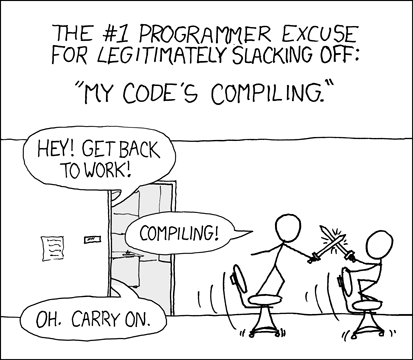
The Python Package Index (PyPI) is a package repository for Python modules. Members of the Python community publish software and libraries in it as an easy method of distribution. If you’ve ever used pip install, PyPI is the service that hosts the software you installed. You may have noticed that some installations can take a long time on the Raspberry Pi. That usually happens when modules have been implemented in C and require compilation.

XKCD comic of two people sword-fighting on office chairs while their code is compiling

No more slacking off! pip install numpy takes just a few seconds now \o/

Wheels for Python packages

A general solution to this problem exists: Python wheels are a standard for distributing pre-built versions of packages, saving users from having to build from source. However, when C code is compiled, it’s compiled for a particular architecture, so package maintainers usually publish wheels for 32-bit and 64-bit Windows, macOS, and Linux. Although Raspberry Pi runs Linux, its architecture is ARM, so Linux wheels are not compatible.

A comic of snakes biting their own tails to roll down a sand dune like wheels

What Python wheels are not

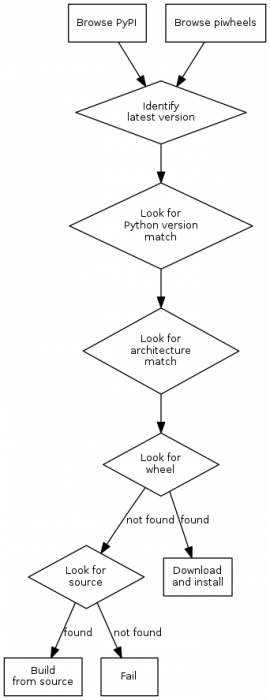
Pip works by browsing PyPI for a wheel matching the user’s architecture — and if it doesn’t find one, it falls back to the source distribution (usually a tarball or zip of the source code). Then the user has to build it themselves, which can take a long time, or may require certain dependencies. And if pip can’t find a source distribution, the installation fails.

Developing piwheels

In order to solve this problem, I decided to build wheels of every package on PyPI. I wrote some tooling for automating the process and used a postgres database to monitor the status of builds and log the output. Using a Pi 3 in my living room, I attempted to build wheels of the latest version of all 100 000 packages on PyPI and to host them on a web server on the Pi. This took a total of ten days, and my proof-of-concept seemed to show that it generally worked and was likely to be useful! You could install packages directly from the server, and installations were really fast.

A Raspberry Pi 3 sitting atop a Pi 2 on cloth

This Pi 3 was the piwheels beta server, sitting atop my SSH gateway Pi 2 at home

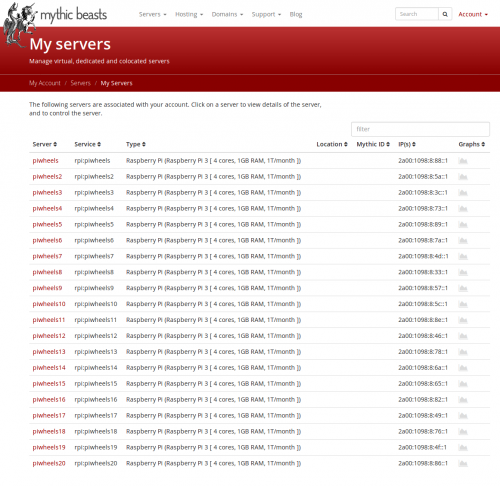
I proceeded to plan for version 2, which would attempt to build every version of every package — about 750 000 versions in total. I estimated this would take 75 days for one Pi, but I intended to scale it up to use multiple Pis. Our web hosts Mythic Beasts provide dedicated Pi 3 hosting, so I fired up 20 of them to share the load. With some help from Dave Jones, who created an efficient queuing system for the builders, we were able make this run like clockwork. In under two weeks, it was complete! Read ALL about the first build run drama on my blog.

A list of the mythic beasts cloud Pis

ALL the cloud Pis

Improving piwheels

We analysed the failures, made some tweaks, installed some key dependencies, and ran the build again to raise our success rate from 76% to 83%. We also rebuilt packages for Python 3.5 (the new default in Raspbian Stretch). The wheels we build are tagged ‘armv7l’, but because our Raspbian image is compatible with all Pi models, they’re really ARMv6, so they’re compatible with Pi 3, Pi 2, Pi 1 and Pi Zero. This means the ‘armv6l’-tagged wheels we provide are really just the ARMv7 wheels renamed.

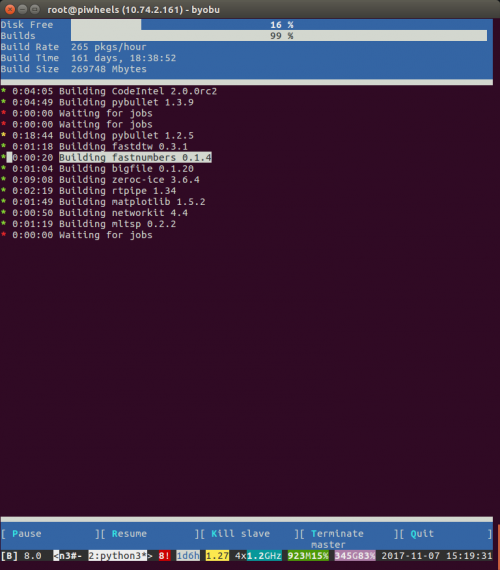
The piwheels monitor interface created by Dave Jones

The wonderful piwheels monitor interface created by Dave

Now, you might be thinking “Why didn’t you just cross-compile?” I really wanted to have full compatibility, and building natively on Pis seemed to be the best way to achieve that. I had easy access to the Pis, and it really didn’t take all that long. Plus, you know, I wanted to eat my own dog food.

You might also be thinking “Why don’t you just apt install python3-numpy?” It’s true that some Python packages are distributed via the Raspbian/Debian archives too. However, if you’re in a virtual environment, or you need a more recent version than the one packaged for Debian, you need pip.

How it works

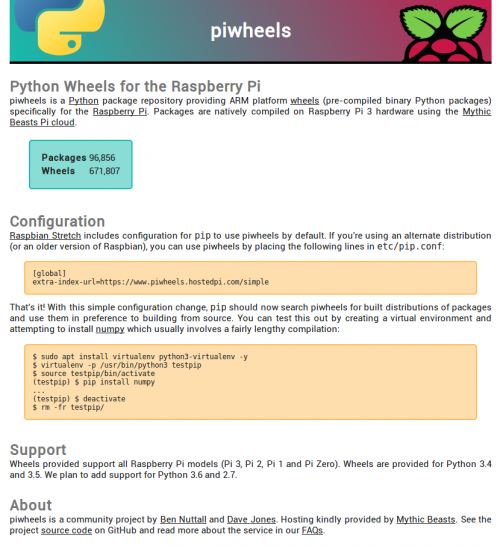
Now that the piwheels package repository is running as a service, hosted on a Pi 3 in the Mythic Beasts data centre in London. The pip package in Raspbian Stretch is configured to use piwheels as an additional index, so it falls back to PyPI if we’re missing a package. Just run sudo apt upgrade to get the configuration change. You’ll find that pip installs are much faster now! If you want to use piwheels on Raspbian Jessie, that’s possible too — find the instructions in our FAQs. And now, every time you pip install something, your files come from a web server running on a Raspberry Pi (that capable little machine)!

Try it for yourself in a virtual environment:

sudo apt install virtualenv python3-virtualenv -y
virtualenv -p /usr/bin/python3 testpip
source testpip/bin/activate
pip install numpy

This takes about 20 minutes on a Pi 3, 2.5 hours on a Pi 1, or just a few seconds on either if you use piwheels.

If you’re interested to see the details, try pip install numpy -v for verbose output. You’ll see that pip discovers two indexes to search:

2 location(s) to search for versions of numpy:
  * https://pypi.python.org/simple/numpy/
  * https://www.piwheels.hostedpi.com/simple/numpy/

Then it searches both indexes for available files. From this list of files, it determines the latest version available. Next it looks for a Python version and architecture match, and then opts for a wheel over a source distribution. If a new package or version is released, piwheels will automatically pick it up and add it to the build queue.

A flowchart of how piwheels works

How piwheels works

For the users unfamiliar with virtual environments I should mention that doing this isn’t a requirement — just an easy way of testing installations in a sandbox. Most pip usage will require sudo pip3 install {package}, which installs at a system level.

If you come across any issues with any packages from piwheels, please let us know in a GitHub issue.

Taking piwheels further

We currently provide over 670 000 wheels for more than 96 000 packages, all compiled natively on Raspberry Pi hardware. Moreover, we’ll keep building new packages as they are released.

Note that, at present, we have built wheels for Python 3.4 and 3.5 — we’re planning to add support for Python 3.6 and 2.7. The fact that piwheels is currently missing Python 2 wheels does not affect users: until we rebuild for Python 2, PyPI will be used as normal, it’ll just take longer than installing a Python 3 package for which we have a wheel. But remember, Python 2 end-of-life is less than three years away!

Many thanks to Dave Jones for his contributions to the project, and to Mythic Beasts for providing the excellent hosted Pi service.

Screenshot of the mythic beasts Raspberry Pi 3 server service website

Related/unrelated, check out my poster from the PyCon UK poster session:

A poster about Python and Raspberry Pi

Click to download the PDF!

The post piwheels: making “pip install” fast appeared first on Raspberry Pi.

12 Nov 23:54

All Ears

by Adam Clair

Like many creative types, writers believe their work is resistant to automation. Their language is too rich and complex to be reduced to data and code. But what if their readers are less interested in complexity than straightforward, direct information?

Automation and artificial intelligence don’t necessarily have to emulate human behavior perfectly in order to profitably approximate the functions humans perform. They don’t have fool users into thinking they are human; they just have to adequately meet a set of practical expectations. Perhaps it is a uniquely human skill to rhapsodize in prose over the achievements of a particular musical composition, but when a set of algorithms can let you choose among songs that are consistently in the general ballpark of your tastes, record reviews seem to lose some of their purpose.

On-demand music streaming has obviated the need for purchasing advice. Why read even a few paragraphs about a song when you can just listen to it?

The modern record review was conceived in the late 1960s, with Rolling Stone, Melody Maker, Creem, and other publications emerging to help listeners sort through the explosion of recorded music at the dawn of the album era, and they have stayed largely the same since. Reviewers functioned as de facto ideologists for the music industry, helping to stimulate demand by rationalizing a boredom with the familiar and championing novelty as an expression of innovation and creativity.

The streaming model would seem to require a different sort of ideology to sustain demand. With streaming services, it costs consumers no more to listen to 100 albums than it does to listen to one album 100 times. Whereas the music press has traditionally hyped the quality of new music to preserve its role as tastemaker, streaming services hype quantity and access to its pseudo-Babelian music libraries.

At their best, reviews provided cultural context that could help imbue certain kinds of music with the power to foster greater social connection. People who read music reviews made up a small percentage of listeners even before digital streaming, but those readers often evangelized for the records they read about. As a result, music reviews have shaped the discourse around music for half a century. But even as they articulate an ecology of cultural influence, such reviews are still ultimately conceived as a buyers’ guide (hence the numerical and star ratings), and the way we buy music has changed. On-demand music streaming has obviated the need for purchasing advice, and as a result, publications like Pitchfork and Spin have ceded influence to the likes of Spotify and YouTube. Why read even a few paragraphs about a song when you can just listen to it?

In its mid-aughts heyday, Pitchfork had kingmaking power in the indie world. Even a bad review could increase album sales or attendance at shows, and a positive one could push a band to the upper echelons overnight. In a 2006 Wired piece by Dave Itzkoff, Broken Social Scene’s Kevin Drew talked about the effect a positive Pitchfork review had on his then-unknown band. “The next tour we went on, we suddenly found ourselves selling out venues. Everyone was coming up to us, saying, ‘We heard about you from Pitchfork.’ It basically opened the door for us. It gave us an audience.” Now, placement on a prime Spotify playlist can do for a band today what a favorable score from Pitchfork did for Arcade Fire and Interpol a decade and a half ago.

With more access to more music than ever — Spotify boasts more than 30 million songs in its library — listeners are still in need of filters. But with streaming services, influential editors at taste-making publications have been replaced by a more diverse set of algorithms that draw on different kinds of data, making the filters at once more personalized and more standardized. Where reviews once served as a proxy for the sentiments and attitudes of a certain milieu — explaining why music might matter as well as what it sounds like — Spotify draws directly on cohort analysis to guide its listeners, as several articles have detailed, but it serves those recommendations without much supplementary context. It overlays social connectivity on music consumption, but deskills it at the same time. It assumes no learning curve; it demands no intricate subcultural navigations to find your way in.

If expanding one’s horizons is simply a matter of clicks, the broader purposes that musical affiliation has often served — not merely the generation of cultural capital but also the sense of oppositional solidarity and tolerance for friction, difficulty, and difference necessary for social resistance — may be in danger of being lost.


Both streaming sites and reviewing sites are in the business of guiding listeners toward new music, but they differ in how they view those listeners. Outlets like Pitchfork conceive of their readers as aspirationally cool, reading to learn which bands their friends will be talking about, so they can talk about them first. It assumes people want to discover new music in part to impress and influence others, and demonstrate how they are ahead of a trend curve. Accordingly, its editors favor music that they perceive to be innovative or indicative of emerging trends. Writers for these publications are telling readers not what to listen to so much as how to seem relevant.

If sites like Pitchfork offer coolness as aspirational, Spotify suggests users are already cool enough. Spotify doesn’t have to prove it is a tastemaker you should follow. Instead, it flatters: Your taste is already great, and here’s some tracks to show how tasteful your listening data has already proved you are. In Spotify, taste requires no effort, no cultural capital, no imaginative synthesis or rationale. It becomes simply empirical, latent in the data and waiting to be extracted by Spotify’s algorithmic analysis.

Spotify doesn’t have to prove it is a tastemaker you should follow. Instead, it flatters: Your taste is already great

Streaming services’ incentives are not to create a sense of aura and scarcity around music and musical taste. They are premised on the principles of abundance and access. Spotify makes its money not by making music appreciation seem demanding, requiring arcane knowledge and background reading, but by making it seem automatic, to keep you listening.

It’s unclear to what extent Spotify can be profitable, but bands certainly aren’t making much money off of it directly. The music press, by contrast, had mutual incentives with the bands they covered, to establish each other’s credibility. When positive coverage in the music press translates to record sales and show attendance, it translates back into a demonstrable sense of a publication’s value to the industry: The co-ascendance of indie rock with independent music blogs in the early 2000s exemplifies this. Streaming services, however, seek mainly to increase plays on their platforms. Hyping specific bands is incidental to their business model (and without a particular niche, it has no allegiance to any genre or scene). Streaming services have no reason to push anyone out of their comfort zones. It hopes instead to prove to us how well it knows those comfort zones and convince us that comfort matters more than taste.

A reviewer can urge you to stick with music even if it’s not immediately accessible or within your typical purview. A playlist offers no such rationale, just the opportunity to skip ahead. A reviewer can explain why a piece of music might matter. An algorithm’s logic will often remain formulaic or opaque. The net effect is that Spotify crystallizes musical taste as it is, for the individual and for the culture at large.

Internally, Spotify measures success for its Discover Weekly playlists in terms of how many users they reach, how much time they spend on the playlist, and how many of those users come back each week. Any tweaks to the algorithm or the balance between code and human curation will be made toward optimizing for these metrics. Whether it furthers musical innovation or pushes boundaries or cultivates listeners’ ability to appreciate “difficult” music — the music that critics might secure capital by championing — is incidental. Instead, streaming services tend to imply there is nothing difficult in discovery and that exposure to music is tantamount to the competency for appreciating it.

The algorithmic modus operandi, in which our revealed preferences dictate what is offered to us, in some ways corresponds to an early internet fantasy that the tyranny of tastemakers could be upended through our broader access to the means of media distribution. Mainstream reviews and marketing could be countered with a more diverse flow of information, which some assumed would lead to a flourishing of niches and niche reviewers. Pop culture would no longer necessarily congeal around its lowest common denominators.

Pitchfork’s prominence reflected that idea, but it was an outlier. As cultural products became easier to access, the spectrum of consumer tastes for the most part narrowed rather than broadened. In The People’s Platform, Astra Taylor notes that “while peer-to-peer networks can be used to share amateur and independent creativity, in practice they are more often used to trade Lady Gaga or Game of Thrones.” In part, this is because consuming pop culture, even when alone, is a social activity, an attempt to belong to the moment. Social media (and the social components of streaming services) up the stakes for this: They let us showcase our consumption for immediate recognition. This makes the idea of being uninfluenced in one’s tastes seem undesirable and implausible as well as impractical. Having “refined” tastes might only make more clear and palpable one’s sense of cultural isolation. Streaming services, meanwhile, deploy the idea of collective participation as a form of personalization, drawing recommendations from what others with similar taste are listening to, offering a sociality without requiring any socializing.

Spotify insists that, despite pressure from bands and labels, it never intentionally puts anyone’s music on anyone’s Discover Weekly playlist. Like other social media platforms, it asserts neutrality, following only the information its users provide, but those playlists are sourced heavily from playlists that are prone to all sorts of outside influence. Zach Fischel, vice president of label relations and business development for independent music distributor MVD Entertainment, says that Spotify has become the primary marketing focus for modern indie labels. Unlike Pitchfork, which is “going to write about what they feel,” he says, Spotify is, in his view, more easily influenced. “With Spotify, you can build a case,” he says. “They are looking at streaming numbers, or SoundCloud, or Bandcamp. They’re going to look toward information you can present, whether it be a support slot on a big tour or a bunch of great press. You can influence them if you have that direct communication.”

Streaming services’ incentives are not to create a sense of aura and scarcity around music and musical taste. They are premised on the principles of abundance and access

If you can generate some momentum, you can get your band on prominent playlists, which will in turn lead to more exposure via Discover Weekly. That in turn leads to greater exposure beyond Spotify. Sirius XM, for example, makes decisions about its rotation based on Spotify numbers. “The Spotify curated playlist is where we see the biggest, fastest spike,” Fischel says. So he instructs his artists to do everything they can to direct listeners to their Spotify pages and drum up follows and listens, hoping to reach the critical mass that will push them to the next level. Bands must serve and promote Spotify if they want its influence. Their music, regardless of what it sounds like, becomes an ad for Spotify subscriptions.


The consumption of complex art has always required privilege. Understanding “difficult” music, for example, often requires not just a specialized education, disposable income and plenty of leisure time, but also a surplus of intellectual capital. Difficult music takes work to consume. For everyone else, there is “escapist” media that lets a consumer “turn their brain off.” A hard day’s work necessitates shallower art consumption, or at least the escapist sort that one can dissociate into for a little while.

In “The Culture Industry: Enlightenment as Mass Entertainment,” Max Horkheimer and Theodor Adorno argue that capitalism produces hollow art to condition people for hollow lives. “Amusement under late capitalism is the prolongation of work,” they write. “It is sought after as an escape from the mechanized work process, and to recruit strength in order to be able to cope with it again.” The choices offered by the marketplace serve not to liberate listeners with freedom of consumption but rather to sort them into more easily manipulated subgroups. “Something is provided for all so that none may escape; the distinctions are emphasized and extended,” they write. “The public is catered for with a hierarchical range of mass-produced products of varying quality, thus advancing the rule of complete quantification.”

Streaming services modernize this rule. The mesmerizing freedom of choice traps us in a cycle of deskilled consumption that greases the wheels for deskilled production. The more choices offered, the more we depend on algorithmic sleight-of-hand to make those choices for us. Transgressive music will have a more difficult time finding an audience, while readily accessible music may be superficially diverse yet carries the same message that cultivating “taste” is a worthless, unnecessary pursuit. Spotify offers not just escapism after work, but often, a lubricant to more easily get through the workday, background music specially fitted for any desk job. By dispensing with the contextual ornamentation, streaming services align themselves with other Silicon Valley productivity apps. The music may entertain but it also numbs.

Breaking that cycle may possibly require “difficult” music, music that exists not in reaction or response to the predictable and familiar but wholly separate from it. It must not simply syncopate the rhythm of modern life but seek to dismantle it entirely. If we are to step out of the marching line and into new social possibilities, we need to question and challenge the comfort zones of streaming.

12 Nov 23:48

A Clash of Cultures

by bunnie

There’s an Internet controversy going on between Dale Dougherty, the CEO of Maker Media and Naomi Wu (@realsexycyborg), a Chinese Maker and Internet personality. Briefly, Dale Doughtery tweeted a single line questioning Naomi Wu’s authenticity, which is destroying Naomi’s reputation and livelihood in China.

In short, I am in support of Naomi Wu. Rather than let the Internet speculate on why, I am sharing my perspectives on the situation preemptively.

As with most Internet controversies, it’s messy and emotional. I will try my best to outline the biases and issues I have observed. Of course, everyone has their perspective; you don’t have to agree with mine. And I suspect many of my core audience will dislike and disagree with this post. However, the beginning of healing starts with sharing and listening. I will share, and I respectfully request that readers read the entire content of this post before attacking any individual point out of context.

The key forces I see at play are:

  1. Prototype Bias – how assumptions based on stereotypes influence the way we think and feel
  2. Idol Effect – the tendency to assign exaggerated capabilities and inflated expectations upon celebrities
  3. Power Asymmetry – those with more power have more influence, and should be held to a higher standard of accountability
  4. Guanxi Bias – the tendency to give foreign faces more credibility than local faces in China

All these forces came together in a perfect storm this past week.

1. Prototype Bias

If someone asked you to draw a picture of an engineer, who would you draw? As you draw the figure, the gender assigned is a reflection of your mental prototype of an engineer – your own prototype bias. Most will draw a male figure. Society is biased to assign high-level intellectual ability to males, and this bias starts at a young age. Situations that don’t fit into your prototypes can feel threatening; studies have shown that men defend their standing by undermining the success of women in STEM initiatives.

The bias is real and pervasive. For example, my co-founder in Chibitronics, Jie Qi, is female. The company is founded on technology that is a direct result of her MIT Media Lab PhD dissertation. She is the inventor of paper electronics. I am a supporting actor in her show. Despite laying this fact out repeatedly, she still receives comments and innuendo implying that I am the inventor or more influential than I really am in the development process.

Any engineer who observes a bias in a system and chooses not to pro-actively correct for it is either a bad engineer or they stand to benefit from the bias. So much of engineering is about compensating, trimming, and equalizing imperfections out of real systems: wrap a feedback loop around it, and force the error function to zero.

So when Jie and I stand on stage together, prototype bias causes people to assume I’m the one who invented the technology. Given that I’m aware of the bias, does it make sense to give us equal time on the stage? No – that would be like knowing there is uneven loss in a channel and then being surprised when certain frequency bands are suppressed by the time it hits the receivers. So, I make a conscious and deliberate effort to showcase her contributions and to ensure her voice is the first and last voice you hear.

Naomi Wu (pictured below) likely challenges your prototypical ideal of an engineer. I imagine many people feel a cognitive dissonance juxtaposing the label “engineer” or “Maker” with her appearance. The strength of that dissonant feeling is proportional to the amount of prototype bias you have.

I’ve been fortunate to experience breaking my own prototypical notions that associate certain dress norms with intelligence. I’m a regular at Burning Man, and my theme camp is dominated by scientists and engineers. I’ve discussed injection molding with men in pink tutus and learned about plasmonics from half-naked women. It’s not a big leap for me to accept Naomi as a Maker. I’m glad she’s challenging these biases. I do my best engineering when sitting half-naked at my desk. I find shirts and pants to be uncomfortable. I don’t have the strength to challenge these social norms, and secretly, I’m glad someone is.

Unfortunately, prototype bias is only the first challenge confronted in this situation.

2. Idol Effect

The Idol Effect is the tendency to assign exaggerated capabilities to public figures and celebrities. The adage “never meet your childhood hero” is a corollary of the Idol Effect – people have inflated expectations about what celebrities can do, so it’s often disappointing when you find out they are humans just like us.

One result of the Idol Effect is that people feel justified taking pot shots at public figures for their shortcomings. For example, I have had the great privilege of working with Edward Snowden. One of my favorite things about working with him is that he is humble and quick to correct misconceptions about his personal abilities. Because of his self-awareness of his limitations, it’s easier for me to trust his assertions, and he’s also a fast learner because he’s not afraid to ask questions. Notably, he’s never claimed to be a genius, so I’m always taken aback when intelligent people pull me aside and whisper in my ear, “You know, I hear Ed’s a n00b. He’s just using you.” Somehow, because of Ed’s worldwide level of fame that’s strongly associated with security technology, people assume he should be a genius level crypto-hacker and are quick to point out that he’s not. Really? Ed is risking his life because he believes in something. I admire his dedication to the cause, and I enjoy working with him because he’s got good ideas, a good heart, and he’s fun to be with.

Because I also have a public profile, the Idol Effect impacts me too. I’m bad at math, can’t tie knots, a mediocre programmer…the list goes on. If there’s firmware in a product I’ve touched, it’s likely to have been written by Sean ‘xobs’ Cross, not me. If there’s analytics or informatics involved, it’s likely my partner wrote the analysis scripts. She also edits all my blog posts (including this one) and has helped me craft my most viral tweets – because she’s a genius at informatics, she can run analyses on how to target key words and pick times of day to get maximum impact. The fact that I have a team of people helping me polish my work makes me look better than I really am, and people tend to assign capabilities to me that I don’t really have. Does this mean I am a front, fraud or a persona?

I imagine Naomi is a victim of Idol Effect too. Similar to Snowden, one of the reasons I’ve enjoyed interacting with Naomi is that she’s been quick to correct misconceptions about her abilities, she’s not afraid to ask for help, and she’s a quick learner. Though many may disapprove of her rhetoric on Twitter, please keep in mind English is her second language — her sole cultural context in which she learned English was via the Internet by reading social media and chat rooms.

Based on the rumors I’ve read, it seems fans and observers have inflated expectations for her abilities, and because of uncorrected prototype bias, she faces extra scrutiny to prove her abilities. Somehow the fact that she almost cuts her finger using a scraper to remove a 3D print is “evidence” that she’s not a Maker. If that’s true, I’m not a Maker either. I always have trouble releasing 3D prints from print stages. They’ve routinely popped off and flown across the room, and I’ve almost cut my fingers plenty of times with the scraper. But I still keep on trying and learning – that’s the point. And then there’s the suggestion that because a man holds the camera, he’s feeding her lines.

When a man harnesses the efforts of a team, they call him a CEO and give him a bonus. But when a woman harnesses the efforts of a team, she gets accused of being a persona and a front. This is uncorrected Prototype Bias meeting unrealistic expectations due to the Idol Effect.

The story might end there, but things recently got a whole lot worse…

3. Power Asymmetry

“With great power comes great responsibilities.”
-from Spider Man

Power is not distributed evenly in the world. That’s a fact of life. Not acknowledging the role power plays leads to systemic abuse, like those documented in the Caldbeck or Weinstein scandals.

Editors and journalists – those with direct control over what gets circulated in the media – have a lot of power. Their thoughts and opinions can reach and influence a massive population very quickly. Rumors are just rumors until media outlets breathe life into them, at which point they become an incurable cancer on someone’s career. Editors and journalists must be mindful of the power they wield and held accountable for when it is mis-used.

As CEO of Maker Media and head of an influential media outlet, especially among the DIY community, Dale Dougherty wields substantial power. So a tweet promulgating the idea that Naomi might be a persona or a fake does not land lightly. In the post-truth era, it’s especially incumbent upon traditional media to double-check rumors before citing them in any context.

What is personally disappointing is that Dale reached out to me on November 2nd with an email asking what I thought about an anonymous post that accused Naomi of being a fake. I vouched for Naomi as a real person and as a budding Maker; I wrote back to Dale that “I take the approach of interacting with her like any other enthusiastic, curious Maker and the resulting interactions have been positive. She’s a fast learner.”

Yet Dale decided to take an anonymous poster’s opinion over mine (despite a long working relationship with Make), and a few days later on November 5th he tweeted a link to the post suggesting Naomi could be a fake or a fraud, despite having evidence of the contrary.

So now Naomi, already facing prototype bias and idol-effect expectations, gets a big media personality with substantial power propagating rumors that she is a fake and a fraud.

But wait, it gets worse because Naomi is in China!

4. Guanxi Bias

In China, guanxi (关系) is everything. Public reputation is extremely hard to build, and quick to lose. Faking and cloning is a real problem, but it’s important to not lose sight of the fact that there are good, hard-working people in China as well. So how do the Chinese locals figure out who to trust? Guanxi is a major mechanism used inside China to sort the good from the bad – it’s a social network of credible people vouching for each other.

For better or for worse, the Chinese feel that Western faces and brands are more credible. The endorsement of a famous Western brand carries a lot of weight; for example Leonardo DiCaprio is the brand ambassador for BYD (a large Chinese car maker).

Maker Media has a massive reputation in China. From glitzy Maker Faires to the Communist party’s endorsement of Maker-ed and Maker spaces as a national objective, an association or the lack thereof with Maker Media can make or break a reputation. This is no exception for Naomi. Her uniqueness as a Maker combined with her talent at marketing has enabled her to do product reviews and endorsements as source of income.

However, for several years she’s been excluded from the Shenzhen Maker Faire lineup, even in events that she should have been a shoo-in for her: wearables, Maker fashion shows, 3D printing. Despite this lack of endorsement, she’s built her own social media follower base both inside and outside of China, and built a brand around herself.

Unfortunately, when the CEO of Maker Media, a white male leader of an established American brand, suggested Naomi was a potential fake, the Internet inside China exploded on her. Sponsors cancelled engagements with her. Followers turned into trolls. She can’t be seen publicly with men (because others will say the males are the real Maker, see “prototype bias”), and as a result faces a greater threat of physical violence.

A single innuendo, amplified by Power Asymmetry and Guanxi Bias, on top of Idol Effect meshed against Prototype Bias, has destroyed everything a Maker has worked so hard to build over the past few years.

If someone spread lies about you and destroyed your livelihood – what would you do? Everyone would react a little differently, but make no mistake: at this point she’s got nothing left to lose, and she’s very angry.

Reflection

Although Dale had issued a public apology about the rumors, the apology fixes her reputation as much as saying “sorry” repairs a vase smashed on the floor.

Image: Mindy Georges CC BY-NC

At this point you might ask — why would Dale want to slander Naomi?

I don’t know the background, but prior to Dale’s tweet, Naomi had aggressively dogged Dale and Make about Make’s lack of representation of women. Others have noted that Maker Media has a prototype bias toward white males. Watch this analysis by Leah Buechley, a former MIT Media Lab Professor:

Dale could have recognized and addressed this core issue of a lack of diversity. Instead, Dale elected to endorse unsubstantiated claims and destroy a young female Maker’s reputation and career.

Naomi has a long, uphill road ahead of her. On the other hand, I’m sure Dale will do fine – he’s charismatic, affable, and powerful.

When I sit and think, how would I feel if this happened to the women closest to me? I get goosebumps – the effect would be chilling; the combination of pervasive social biases would overwhelm logic and fact. So even though I may not agree with everything Naomi says or does, I have decided that in the bigger picture, hiding in complicit silence on the sidelines is not acceptable.

We need to acknowledge that prototype bias is real; if equality is the goal, we need to be proactive in correcting it. Just because someone is famous doesn’t mean they are perfect. People with power need to be held accountable in how they wield it. And finally, cross-cultural issues are complicated and delicate. All sides need to open their eyes, ears, and hearts and realize we’re all human. Tweets may seem like harmless pricks to the skin, but we all bleed when pricked. For humanity to survive, we need to stop pricking each other lest we all bleed to death.

/me dons asbestos suit

Update: November 20, 2017
Make has issued an apology, and Naomi has accepted the apology. My sincere thanks to the effort and dedication of everyone who helped make this right.

12 Nov 23:45

Free Webinar: Small is Big – Michael von Hausen

by pricetags

How can small cities and towns revitalize their small downtowns, and proactively respond to rapidly changing demographic demands that shift priorities in place-making decisions?

Join award-winning urban designer Michael von Hausen for an insightful webinar where he provides ideas for how new life can be breathed into small towns and cities across North America. Details below.

Small Is Big: Jump-Starting Small-City Downtowns for the New Economy 
Mon Nov 20, 1-2:30 PM PDT
Speaker: Michael von Hausen
Free. Reserve a spot


Read more


12 Nov 23:45

Vancouver Setting, Korean Sugar

by pricetags

Vancouver has never really had a definitive novel that captures the character of the city, its history, its culture.  There’s not a movie that uses the city as an unambiguous setting so integral to the plot that it becomes a kind of character.  There’s no equivalent of ‘Portlandia.’

I wondered if some day that novel or movie might originate from, say, Korea, where the characters from a more constrained culture find themselves in this city, after which hilarity or tragedy ensues.

Well, this aint it.

From the Georgia Straight:

Korean-pop group Twice, composed of nine female members, released the Vancouver-shot music video for their single “Likey” from their first studio album Twicetagram …

Set to an effervescent ditty about the agony of trying to elicit a social-media “like” from a crush (because c’mon, who hasn’t experienced that?), the video follows a high school student who pulls a video camera out of a locker to make a film of her friends making their way about the city and breaking into choreographed dance routines (just like all Vancouverites do on a daily basis).

If you have diabetes, trigger alert.  But it is interesting to see what the producers decided captured the essence of teenage Vancouver.

And it will certainly have an impact on shaping young Asians’ view of the city.  At the moment, the video has close to 50 million views – yes, close to one and a half times the population of Canada.


12 Nov 23:45

Not Worthy of Comment

by pricetags

Some of the 2017-2018 UBCM Executive recently elected:

  • Three women, all in senior positions, including President
  • Two, maybe three, people of colour
  • From every part of the province.

No big deal.


12 Nov 23:44

Reeder 3.1 Adds iPhone X Support

by Federico Viticci

Reeder got me into reading RSS feeds on my iPhone several years ago. The app isn’t updated often these days, but developer Silvio Rizzi always makes sure to release updates that support the latest Apple hardware and iOS versions, which I appreciate. Reeder is as smooth and elegant as the day it came out (specifically, version 2 in 2013), and today’s 3.1 update is a welcome one as it brings support for iOS 11 and the iPhone X.

There are no new features in this version, but I recommend trying it out on an iPhone X if only to look at the “pure black” theme on the device’s OLED display. It’s glorious. I’m looking at Reeder now as I’m reading some articles in bed, and I can’t tell where the display and the bezels meet. I wish more apps would implement dark themes like this on the iPhone X. And as always, it’s great to see that Reeder is still around.

→ Source: itunes.apple.com

12 Nov 23:44

SuperDuper! Updated for macOS High Sierra and APFS

by John Voorhees

High Sierra introduced APFS, Apple’s first entirely new file system on the Mac in decades. Today, Shirt Pocket Software announced an update to its backup utility SuperDuper! that is compatible with APFS. In fact, the app can create a bootable clone for any Mac running Mac OS X 10.9 and later.

Supporting a brand new file system is a tall order. As Dave Nanian explains on the Shirt Pocket blog, APFS volumes are handled differently by macOS than HFS+ ones were. That complicated the update of SuperDuper!, but as with earlier OS updates, Shirt Pocket has solved the issues and is ready with an update that works with Apple’s latest version of macOS.

If you’re not already making a bootable backup of your Mac’s drive, the update to SuperDuper! is the perfect time to download the app and get started.


Support MacStories Directly

Club MacStories offers exclusive access to extra MacStories content, delivered every week; it's also a way to support us directly.

Club MacStories will help you discover the best apps for your devices and get the most out of your iPhone, iPad, and Mac. Plus, it's made in Italy.

Join Now
12 Nov 23:44

Tweetbot for iOS Adds 280-Character Tweet Support

by John Voorhees

Yesterday, Twitter extended the character limit of tweets to 280. Unlike some features, Twitter has made the new tweet length available to all third-party developers.

First out of the gate is Tweetbot by Tapbots. Less than 24 hours after Twitter’s announcement, Tweetbot users can use a full 280 characters in tweets. I expect we’ll see additional updates from other Twitter client developers soon.

Tweetbot is available on the App Store.


Support MacStories Directly

Club MacStories offers exclusive access to extra MacStories content, delivered every week; it's also a way to support us directly.

Club MacStories will help you discover the best apps for your devices and get the most out of your iPhone, iPad, and Mac. Plus, it's made in Italy.

Join Now
12 Nov 23:44

Workflow 1.7.7 Brings Drag and Drop Integration, iPhone X Support, and More iOS 11 Changes

by Federico Viticci

Workflow, the iOS automation app acquired by Apple earlier this year, received a major update today, adding support for the iPhone X and a variety of iOS 11-only features.

The marquee addition of this release is full support for drag and drop in iOS 11, which is especially impressive on the iPad as it allows you to trigger actions based on content you drop into a workflow. In the original Workflow, if you wanted to feed external content (text, images, links, videos, etc.) to actions, you had to manually select an item from a native picker, use the iOS clipboard, or use Workflow's action extension in other apps. The system worked well, but it was neither fast nor intuitive.

Drop content onto the Play button to run a workflow with that input.

Drop content onto the Play button to run a workflow with that input.

iOS 11's drag and drop largely obviates these limitations: if you want to run actions for an image in Workflow 1.7.7, you just need to drag the image and drop it into an existing workflow. Want to turn some rich text into Markdown? Simply pick up a block of text from Notes, drop it into Workflow, and the 'Make Markdown from Rich Text' action will see the dropped item as input and convert text to Markdown. The same is true for videos, audio files, PDFs, or URLs; anything that can be dragged in iOS 11 can now become an input source in Workflow.

Drag and drop is a major addition to Workflow's automation environment, and a perfect way to take advantage of iOS 11's focus on iPad multitasking. It adds a visual, tactile layer to Workflow that can make the app's automation features more approachable and easier to explain.

I'm already considering how some of my workflows could be used exclusively via drag and drop now, with Workflow pinned in Slide Over and ready to accept input through drag and drop. It's going to be interesting to see how Workflow's Content Graph engine and advanced functionalities such as conditional blocks will tie into this as well.

In addition to drag and drop, Workflow 1.7.7 integrates with other key iOS 11 features: Files and Photos. The Convert Image and Encode Media actions have been updated to support HEIF and HEVC – the new image format and codec in iOS 11, respectively. As for the new Files app, Workflow uses new APIs in iOS 11 to support saving and opening multiple files at the same time. Lack of support for multiple file operations has long been one of the primary shortcomings of iOS; before iOS 11, apps could only open and share one file at a time. I'm happy to see that we'll be able to automate this lesser known improvement of iOS 11 as well, as it should speed up document-based automation considerably.

But the iOS 11 improvements don't stop here. Workflow supports the new data types for Health in iOS 11 (such as insuline delivery and waist circumference); the Tweet and Post on Facebook actions have been fixed due to the removal of social accounts in iOS 11; and last, there are dozens of miscellaneous fixes and improvements that should make the app run more smoothly (I've been noticing performance issues and glitches with the old Workflow 1.7.6 on iOS 11).

While many – myself included – doubted Apple's ability to maintain Workflow as a standalone app without severely limiting its functionality, the company has been devoting resources to Workflow, refining its actions and expanding its native integrations with the OS. Workflow's update pace has slowed down since the acquisition, and it's still not clear whether Apple plans to turn Workflow into a native iOS automation layer in the future. For now, however, we can appreciate the fact that the Workflow team has been able to work on a substantial iOS 11 update, which opens up fantastic possibilities for iOS automation both on the iPhone and iPad.

I plan to extensively cover the changes in Workflow 1.7.7 over the next few weeks in our dedicated Workflow hub and my iPad Diaries column, as well as Club MacStories. In the meantime, you can download Workflow 1.7.7 from the App Store and check out the full changelog here.


Support MacStories Directly

Club MacStories offers exclusive access to extra MacStories content, delivered every week; it's also a way to support us directly.

Club MacStories will help you discover the best apps for your devices and get the most out of your iPhone, iPad, and Mac. Plus, it's made in Italy.

Join Now
12 Nov 23:16

Day One

files/images/Day_One.JPG

Ben Saunders, Nov 11, 2017


Icon

Ben Saunders is attempting the first unaided solo crossing of Antarctica by land (which makes me feel cold just typing it) and this is his ongoing blog of the expedition. This is one sort of online learning I like a lot: the sort where a real person doing something interesting shares their experiences with the world. It's not about teaching or curriculum or anything like that, it's about being open and unleashing the imagination. I've subscribed to the feed - it's hard to find but it exists here - and will be shivering along with Ben through the trip.

[Link] [Comment]
12 Nov 21:23

Twitter Favorites: [phirephoenix] On Medium no one feels the need to say “sorry I haven’t been posting” and I feel like that in a nutshell is why it’s beating out blogs.

Jenny (Phire) @phirephoenix
On Medium no one feels the need to say “sorry I haven’t been posting” and I feel like that in a nutshell is why it’s beating out blogs.
12 Nov 21:23

Twitter Favorites: [ReneeStephen] @gregeh Bring back tweetups that companies funded despite no evidence that had any impact on revenue. Free drinks a… https://t.co/ddlclqkYJc

Renée Stephen @ReneeStephen
@gregeh Bring back tweetups that companies funded despite no evidence that had any impact on revenue. Free drinks a… twitter.com/i/web/status/9…
12 Nov 21:14

Twitter Favorites: [knguyen] wow @karenkho did a great job on this profile of me https://t.co/cvhNg156VG

Kevin Nguyen @knguyen
wow @karenkho did a great job on this profile of me cjr.org/the_profile/ja…
12 Nov 19:14

Google unveils Resonance Audio, new spatial audio software development kit

by Dean Daley
google resonance audio

Google has released a new spatial audio software development kit (SDK) called Resonance Audio.

The technology, based on Google’s VR Audio SDK, is designed to help bring sound into the 3D space for 360-degree video, virtual reality (VR) and augmented reality (AR). Resonance Audio will also work across both mobile and desktop platforms, is compatible with game engines like Unreal Engine and Unity, and works with a suite of editing software.

With Resonance Audio, Google wants to replicate what it’s like to be immersed in a virtual world.

For example, Google wants users to hear the difference between a helicopter flying overhead, a car honking on the street beside you, the rumble of the subway beneath your feet or the sound of being locked in a room with a very loud boombox. While sounds can currently come from either a left or right audio source, 3D audio aims to reproduce sounds in three-dimensional space.

Resonance Audio accomplishes 3D sound by using a full-sphere surround sound technique called ‘Ambisonics’ to imitate sounds coming from hundreds of simultaneous sources. It does this without compromising its audio quality, no matter which platform, according to Google.

Ambisonics and head-related transfer functions (HRTFs) — the process used to map sounds moving toward your head — are combined together to trick the brain into believing sounds are coming from different distances and positions even when coming from a pair headphones.

Resonance Audio can also imitate how an object sounds when a person is facing it versus how it sounds when they turn their back to an object. Additionally, Resonance Audio can tell the difference between approaching a sound or walking away from a sound, or if something is coming between a person and a sound source.

While it works with all of the above-mentioned sounds, Resonance Audio is also capable of using the Unity engine to calculate reverberation effects, such as a boombox in a stairwell.

Although Resonance Audio is available for developers, it doesn’t mean all app creators will take advantage of it. Developers could continue use the existing options or even create their own.

Regardless, Google’s technology will be great for 360-degree YouTube videos and Daydream VR development.

Source: Google Developers Blog

The post Google unveils Resonance Audio, new spatial audio software development kit appeared first on MobileSyrup.

12 Nov 19:14

Apple’s 2018 iPad will feature Face ID and nearly bezel-less display, says new report

by Patrick O'Rourke
iPad Pro

It looks like Apple could have big plans for the iPad in 2018.

The company is working on a redesigned, high-end iPad Pro that’s tipped to release at some point in 2018, according to new rumours. This remodelled iPad will reportedly feature “slimmer edges” and facial recognition technology borrowed from the iPhone X, according to a new report stemming from Bloomberg’s often reliable Mark Gurman.

The new version of Apple’s iPad will feature a screen size that falls in line with the 10.5-inch iPad Pro, complete with Face ID for unlocking the tablet, Apple Pay and, of course, animated Animojis.

This also means that the rumoured upcoming iPad design won’t feature a Touch ID fingerprint sensor. To put this shift in perspective, Apple’s various iPads have included a fingerprint sensor 2014.

Removing the fingerprint sensor will allow Apple to reduce the tablet’s border, bringing its design closer in-line with the iPhone X’s nearly bezel-less display.

Apple updated its high-end iPad line back in June 2017 with a 10.5-inch iPad Pro iteration that features ProMotion 120Hz display technology, which makes the the tablet’s operating system appear smoother when flipping rapidly between apps. Just a few months earlier, Apple also released a cheaper version of its standard iPad model as well.

Interestingly, according to Bloomberg, it’s likely that Apple’s revamped iPad won’t feature the same OLED display technology as the iPhone X. According to what the publication calls “a person with knowledge of Samsung’s display operations,” the company is unable to manufacturer iPad sized OLED displays at the capacity required to meet a 2018 release.

Samsung is currently the only display manufacturer able to produce large quantities of liquid-crystal screens, says Bloomberg.

Source: Bloomberg

The post Apple’s 2018 iPad will feature Face ID and nearly bezel-less display, says new report appeared first on MobileSyrup.

12 Nov 19:14

Quebec says it will tax Netflix even without federal government support

by Patrick O'Rourke
Netflix

The Quebec Government has confirmed plans to tax Netflix with or without the support of the Canadian federal government.

Quebec Finance Minister Carlos Leitao, told reporters that he sent out a letter to Federal Finance Minister, Bill Morneau, inviting the Liberal government to rethink its position on not taxing Netflix.

Leitao says that Netflix will be forced to pay provincial sales tax in the region because the streaming service’s $500 million deal with the Canadian government gives it an unfair advantage over Quebec-based companies that offer similar streaming platforms, with Vidéotron’s Club Illico being the most notable example.

Leitao says that the province does not need Ottawa’s permission to move forward with its plan to tax Netflix because the Province’s sales tax is harmonized with federal GST.

In late September Canada’s Heritage Minister revealed the creation of a first-of-its-kind Netflix Canada production company, as well as a $500 million CAD commitment to invest in original Canadian productions over the next five years.

The plan, however, doesn’t include new taxes on digital platforms, despite pressure from traditional television providers to impose a levy on the popular streaming service that would potentially contribute to the Canadian Media Fund (CMF), commonly referred to as a ‘Netflix Tax.’

Shortly after the announcement was made, Minister Leitao spoke publicly about Quebec’s intention to charge provincial sales tax on Netflix. Quebec’s Minister of Culture and Communications Luc Fortin was also critical of the federal government’s plan.

Quebec’s Finance Minister says that the new tax will be introduced in 2018.

The post Quebec says it will tax Netflix even without federal government support appeared first on MobileSyrup.

12 Nov 19:13

Shadow Profiles

by jwz
mkalus shared this story from jwz.

How Facebook Figures Out Everyone You've Ever Met:

Shadow contact information has been a known feature of Facebook for a few years now. But most users remain unaware of its reach and power. Because shadow-profile connections happen inside Facebook's algorithmic black box, people can't see how deep the data-mining of their lives truly is, until an uncanny recommendation pops up. [...]

Facebook warns users to be judicious about using all this data. "You may have business or personal contacts in your phone," the Learn More screen admonishes the reader. "Please only send friend requests to people you know personally who would welcome the invite."

Having issued this warning, and having acknowledged that people in your address book may not necessarily want to be connected to you, Facebook will then do exactly what it warned you not to do. If you agree to share your contacts, every piece of contact data you possess will go to Facebook, and the network will then use it to try to search for connections between everyone you know, no matter how slightly -- and you won't see it happen. [...]

The existence of shadow contact information came to light in 2013 after Facebook admitted it had discovered and fixed "a bug." The bug was that when a user downloaded their Facebook file, it included not just their friends' visible contact information, but also their friends' shadow contact information.

The problem with the bug, for Facebook, was not that all the information was lumped together -- it was that it had mistakenly shown users the lump existed. The extent of the connections Facebook builds around its users is supposed to be visible only to the company itself.

If this sounds a lot like Equifax to you, then you are, like, some kind of pattern-matching machine:

Schneier's Congressional testimony on Equifax:

3. There are thousands of data brokers with similarly intimate information, similarly at risk.

Equifax is more than a credit reporting agency. It's a data broker. It collects information about all of us, analyzes it all, and then sells those insights. It might be one of the biggest, but there are 2,500 to 4,000 other data brokers that are collecting, storing, and selling information about us -- almost all of them companies you've never heard of and have no business relationship with.

The breadth and depth of information that data brokers have is astonishing. Data brokers collect and store billions of data elements covering nearly every US consumer. Just one of the data brokers studied holds information on more than 1.4 billion consumer transactions and 700 billion data elements, and another adds more than 3 billion new data points to its database each month. [...]

4. These data brokers deliberately hide their actions, and make it difficult for consumers to learn about or control their data.

If there were a dozen people who stood behind us and took notes of everything we purchased, read, searched for, or said, we would be alarmed at the privacy invasion. But because these companies operate in secret, inside our browsers and financial transactions, we don't see them and we don't know they're there.

Regarding Equifax, few consumers have any idea what the company knows about them, who they sell personal data to or why. If anyone knows about them at all, it's about their business as a credit bureau, not their business as a data broker. Their website lists 57 different offerings for business: products for industries like automotive, education, health care, insurance, and restaurants. [...]

6. The market cannot fix this because we are not the customers of data brokers.

The customers of these companies are people and organizations who want to buy information: banks looking to lend you money, landlords deciding whether to rent you an apartment, employers deciding whether to hire you, companies trying to figure out whether you'd be a profitable customer -- everyone who wants to sell you something, even governments.

Markets work because buyers choose from a choice of sellers, and sellers compete for buyers. None of us are Equifax's customers. None of us are the customers of any of these data brokers. We can't refuse to do business with the companies. We can't remove our data from their databases. With few limited exceptions, we can't even see what data these companies have about us or correct any mistakes.

We are the product that these companies sell to their customers: those who want to use our personal information to understand us, categorize us, make decisions about us, and persuade us.

Previously, previously, previously, previously, previously, previously, previously, previously, previously, previously, previously, previously, previously, previously, previously, previously, previously, previously, previously, previously, previously.

12 Nov 19:13

ExpanDrive 6.1.5

by Jeff Mancuso
mkalus shared this story from ExpanDrive for Mac & Windows.

ExpanDrive v6.1.5 is out with improvements for large uploads in Dropbox, non-ascii character handling in Dropbox on Window, improvements to the Shared with Me folder on OneDrive for business, fixes for the dock visibility toggle in Windows, improved uploading on hubiC and a variety of other small fixes. You can get it from our download page or via the auto-updater.

12 Nov 19:13

Berlin: Hauptstadt plant sichere Radwege

mkalus shared this story from SPIEGEL ONLINE - Schlagzeilen.

In Berlin soll der Wunsch vieler Fahrradfahrer in Erfüllung gehen: Die zuständige Senatorin Regine Günther (parteilos) plant an einigen Hauptverkehrsstraßen geschützte Radstreifen. Diese sollen sich nicht nur durch grüne Farbe von der Fahrbahn abheben, sondern zusätzlich durch Poller geschützt werden.

Damit kommt die Politik einer alten Forderung von Fahrradlobbyisten nach. Im letzten Fahrradklima-Test des Allgemeinen Deutschen Fahrrad Clubs hatten 76 Prozent der Befragten es als wichtig für ihr Sicherheitsgefühl bezeichnet, separiert von Autos, Lkw und Motorrädern Rad zu fahren. Kopenhagen, das als besonders attraktiv für Fahrradfahrer gilt, setzt bereits seit Jahren auf solche Fahrradstrecken. Dort trennen beispielsweise Bordsteine Wege von Fußgängern, Radlern und Autos.

Ein erster Prototyp des grünen Berliner Radweges wird im kommenden Jahr im Stadtteil Neukölln entstehen. Er hat eine Länge von etwa einem Kilometer, ist mindestens zwei Meter breit und durch 90 Zentimeter hohe Poller geschützt. Weitere Strecken sollen folgen. Berlin gehört laut ADFC aktuell zu den fahrradunfreundlichsten Städten in Deutschland. Zuletzt rangierte die Hauptstadt auf Platz 36 von 39 Städten.

Berlin investiert in den nächsten Jahren insgesamt 200 Millionen Euro

Der Rot-Rot-Grüne Senat hat das Problem erkannt und versucht, gegenzusteuern. Im Koalitionsvertrag der Regierung sind für die Legislaturperiode 200 Millionen Euro für die Radinfrastruktur vorgesehen - dazu zählen nicht nur Radwege, sondern auch Parkhäuser für Fahrräder. Berlin ist die erste Stadt mit einem eigenen Radgesetz. In diesem ist auch ein Ausbau des Radwegenetzes verankert.

In fast allen deutschen Städten soll das Fahrrad als Verkehrsmittel gestärkt werden, um die Luftverschmutzung zu senken. Besser ausgebaute Radwege gelten als wichtigster Anreiz für eine verstärkte Fahrradnutzung - wie auch aus dem Fahrradmonitor des Verkehrsministeriums hervorgeht. "Am wichtigsten ist es, Radwege zu bauen, auf denen sich die Leute sicher fühlen, damit sie das Fahrrad auch nutzen. Das erreicht man mit separaten, baulich getrennten Fahrradspuren. Hier fühlen sich auch Senioren und Eltern mit Kindern sicher", sagte Klaus Bondam in einem Interview mit dem NDR.

Als ehemaliger technischer Bürgermeister gilt er als einer der Väter des Fahrradwunders in Kopenhagen. Mittlerweile liegt der Radverkehrsanteil in Kopenhagen bei mehr als 50 Prozent. Berlin möchte diesen bis 2025 auf 18 bis 20 Prozent steigern. 2013 lag er laut einem Senatsbericht bei 13 Prozent. Mittlerweile ist der Anteil deutlich höher.