Shared posts

04 Dec 22:40

A different metric of #AcWri success: Completing sentences and paragraphs

by Raul Pacheco-Vega

When I read what other writers who write about academic writing, I’m often left with the feeling that there is no room for manoeuvering in their advice. “Write 1,000 words a day, no matter what“. “Write for two hours every day” (and yes, I’m well aware that I am well known for advocating this approach – with the proviso that I do recommend that people do whatever suits them best, as long as they are able to create their own academic writing practice). I have been pondering for a while advocating for the value of a different metric of success in #AcWri – success in completing sentences and paragraphs.

Let me share an example: I was working recently on a paper on evidence-based policy making, science-policy interfaces and coproduction of science and policy. These aren’t fields I usually work on, this was a commissioned paper. As a result, it’s been quite painful to finish the damn manuscript. A few days ago, I decided that it was good time to finish writing this piece, because I have to move on to other, more pressing manuscripts. I was literally about 1,200 words away from completing the draft.

As I’ve suggested above, I take the “complete sentences and paragraphs approach” because I do get tired quite easily. While I love writing, it’s hard for me to stay writing for a relatively long period of time. So, I focus on completing a sentence, stringing a few sentences, or finishing an entire paragraph. This is the idea behind the “anchor sentences” approach.

The trick for me is to focus on completing sentences, and on finishing paragraphs. So, instead of being overwhelmed by the fact that I still have 1,200 words to finish, I focus on completing a sentence that I left incomplete.

While I recognise that this approach may not work for everyone, I agree that we ought to give ourselves permission not to finish all the sentences or complete paragraphs so we can pick up the next day where we left off.

Outlining a paper and adding text allows you to form more coherent thoughts as you write.

Because I do get tired of writing after a while, I calculate “how much more work do I need to do” – so, for example, here I know that I need to write 3 paragraphs (one per bullet item). So, that’s about 300 words. That feels doable and I can do that within an hour that I may have here or there. Or while waiting at the airport for my flight.

Leaving text for the following day is a well tried strategy as you can see here.

Knowing that you can start the next day from an outline of half-completed sentences and paragraphs can actually be helpful. But more importantly, as I’ve said, instead of dreading a blank page, and wondering if 2 hours will be enough to complete 1,500 words, I prefer to focus on completing sentences and paragraphs. Perhaps this approach may be helpful to my readers. It’s definitely useful for me!

04 Dec 22:40

Twitter Favorites: [PortmanDoe] Kit and I are out running errands together and I love it because every minute with her is like the best date I’ve e… https://t.co/Lt9PsIIUWY

Portman Doe @PortmanDoe
Kit and I are out running errands together and I love it because every minute with her is like the best date I’ve e… twitter.com/i/web/status/9…
04 Dec 22:40

Sunday nostalgia…

by michaelkluckner
mkalus shared this story from Price Tags.

a

Mixing all forms of transportation at Chilco and Georgia in 1936, a photo from the interesting collection on the Three Quarter Lids blog here.


04 Dec 22:40

three quarter lids: Vintage Vancouver

mkalus shared this story from three quarter lids.

Boeing 247

04 Dec 22:40

Twitter Favorites: [Planta] I've already sent two Christmas cards to sick children who've sought them online. If you come across any other requ… https://t.co/lgzfmztgmM

Joseph Planta @Planta
I've already sent two Christmas cards to sick children who've sought them online. If you come across any other requ… twitter.com/i/web/status/9…
04 Dec 22:39

Twitter Favorites: [Sean_YYZ] The new passage to Hudson’s Bay from the Eaton Centre over Queen Street is great. https://t.co/Og4D0loJsw

Sean Marshall @Sean_YYZ
The new passage to Hudson’s Bay from the Eaton Centre over Queen Street is great. pic.twitter.com/Og4D0loJsw
04 Dec 22:39

Huawei Mate 10 Pro :: An awesome walkthrough

by Volker Weber

I have used the Mate 10 Pro for few weeks and still learned quite a few features from this awesome walkthrough. This is quite a remarkable phone as you will see.

04 Dec 21:22

Twitter Favorites: [cbcian] Is she staring at me? Looking away? My co-host, always present, even on the way to work. https://t.co/TKjO23LPNY

Ian Hanomansing @cbcian
Is she staring at me? Looking away? My co-host, always present, even on the way to work. pic.twitter.com/TKjO23LPNY
04 Dec 21:22

Psychological Safety in Operation Teams

Psychological Safety in Operation Teams:

Think of a team you work with closely. How strongly do you agree with these five statements?

  1. If I take a chance and screw up, it will be held against me.
  2. Our team has a strong sense of culture that can be hard for new people to join.
  3. My team is slow to offer help to people who are struggling.
  4. Using my unique skills and talents comes second to the objectives of the team.
  5. It’s uncomfortable to have open, honest conversations about our team’s sensitive issues.

Teams that score high on questions like these can be deemed to be “unsafe.”

04 Dec 21:22

Drawing with noise

by Nathan Yau

This looks like a fun Processing tutorial by Etienne Jacob. Use noise to draw organic-ish loopy GIFs. I bet the logic could be ported to R.

Tags: GIF, noise, Processing

04 Dec 21:21

Michael Flynn reveals the template for apologies without remorse

by Josh Bernoff

Former Trump National Security Advisor Michael Flynn has pled guilty to lying to the FBI. He has also issued a self-praising statement minimizing what he did. It’s an interesting strategy. Should everyone else who apologizes do the same? Flynn’s proud, patriotic apology Flynn spoke to the Russian Ambassador about foreign policy during the transition, when … Continued

The post Michael Flynn reveals the template for apologies without remorse appeared first on without bullshit.

04 Dec 21:20

5G & IoT? We need to talk about latency

by Dean Bubley


Much of the discussion around the rationale for 5G – and especially the so-called “ultra-reliable” high QoS versions – centres on minimising network latency. Edge-computing architectures like MEC also focus on this. The worthy goal of 1 millisecond roundtrip time is often mentioned, usually in the context of applications like autonomous vehicles with snappy responses, AR/VR headsets without nausea, the “tactile Internet” and remote drone/robot control.

Usually, that is accompanied by some mention of 20 or 50 billion connected devices by [date X], and perhaps trillions of dollars of IoT-enabled value.

In many ways, this is irrelevant at best, and duplicitous and misleading at worst.

IoT devices and applications will likely span 10 or more orders of magnitude for latency, not just the two between 1-10ms and 10-100ms. Often, the main value of IoT comes from changes over long periods, not realtime control or telemetry.

Think about timescales a bit more deeply:

  • Sensors on an elevator doors may send sporadic data, to predict slowly-worsening mechanical problems – so an engineer might be sent a month before the normal maintenance visit.
  • A car might download new engine-management software once a week, and upload traffic observations and engine-performance data once a day (maybe waiting to do it over WiFi, in the owner’s garage, as it's not time-critical).
  • A large oil storage tank, or a water well, might have a depth-gauge giving readings once an hour.
  • A temperature sensor and thermostat in an elderly person’s home, to manage health and welfare, might track readings and respond with control messages every 10 minutes. Room temperatures change only slowly.
  • A shared bicycle might report its position every minute – and unlock in under 10 seconds when the user buys access with their smartphone app
  • A payment or security-access tag should check identity and open a door, or confirm a transaction, in a second or two.
  • A networked video-surveillance system may need to send a facial image, and get a response in a tenth of a second, before they move out of camera-shot.
  • A doctor’s endoscope or microsurgery tool might need to respond to controls (and send haptic feedback) 100 times a second – ie every 10ms
  • A rapidly-moving drone may need to react in a millisecond to a control signal, or a locally-recognised risk.
  • A sensitive industrial process-control system may need to be able to respond in 10s or 100s of microseconds to avoid damage to finely-calibrated machinery
  • Image sensors and various network sync mechanisms may require response times measured in nanoseconds
I have not seen any analysis that tries to divide the billions of devices, or trillions of dollars, into these very-different cohorts of time-sensitivity. Given the assumptions underpinning a lot of 5G business cases, I’d suggest that this type of work is crucial. Some of these use-cases are slow enough that sending data by 2G is fine (or by mail, in some cases!). Others are so fast they’ll need fibre – or compute capability located locally on-device, or even on-chip, rather than in the cloud, even if it’s an “edge” node.

I suspect (this is a wild guess, I'll admit) that the proportion of IoT devices, for which there’s a real difference between 1ms and 10ms and 100ms, will be less than 10%, and possibly less than 1% of the total. 

(Separately, the network access performance might be swamped by extra latency added by security functions, or edge-computing nodes being bypassed by VPN tunnels)

The proportion of accrued value may be similarly low. A lot of the IoT examples I hear about are either long time-series collections of sensor data (for asset performance-management and predictive maintenance), or have fairly loose timing constraints. A farm’s moisture sensors and irrigation pumps don’t need millisecond response times. Conversely, a chemical plant may need to alter measure and alter pressures or flows in microseconds.

Are we focusing 5G too much on the occasional Goldilocks of not-too-fast and not-too-slow?
04 Dec 21:20

me@onenote.com

by Volker Weber

ZZ2161387D

As most of you know, I am writing a weekly column that talks about what is going to happen in the coming week. This is kind of difficult, because my crystal ball is often clouded. It would be much easier to write a summary about what happened last week.

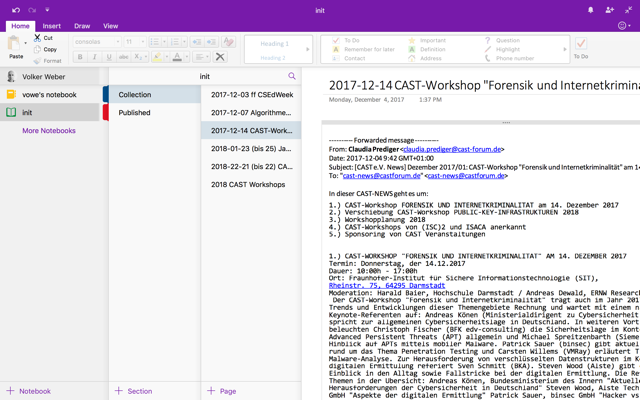
One of the things that puzzled me was how I could take notes for things happening in the future. I solved this with a OneNote notebook specifically for this task. And there is a convenient way to fill it with invitation emails. I just forward them to me@onenote.com. You have to specify the from address you are taking these notes from and you tell OneNote where to put them.

ZZ745AA09E

More >

04 Dec 21:20

Hund und Mensch

by Volker Weber

ZZ133373E3
Foto Max Bäumle

Als Hundebesitzer muss man mehrmals am Tag raus und spazieren gehen. Das tut Hund und Mensch gut. Dabei trifft man viele Leute. Manche haben Angst vor dem Tier, die meisten freuen sich. Von einer Begegnung will ich erzählen:

Freitags ist ein kleiner Bauernmarkt in Bessungen. Dort gehe ich regelmäßig hin. Frau Brandlinger darf mit, aber sie nervt manchmal, weil es soviel zu entdecken gibt. Deshalb halte ich sie meistens an der kurzen Leine. Vor ein paar Monaten fiel mir eine ältere Dame auf, die den Hund immer anhimmelte. Ich ging zu ihr hin, damit sie ihm begegnen kann. Sie hatte Tränen in den Augen und erzählte mir, dass ihr Tier eingeschläfert wurde. Für die Nicht-Hundebesitzer: Man sieht das von außen nicht, aber Hunde sind Familienmitglieder und manchmal das einzige Familienmitglied, das bleibt. Ich sprach der Frau deshalb gut zu, sich ein neues Tier zu suchen. Dann erzählte sie mir, dass sie ihren Hund abgeben musste, weil sie ins Heim kam. Ich war erschüttert. Woanders schafft man Therapiehunde an, um alte Menschen aus ihrer Depression zu lösen.

Daran musste ich gerade denken, als ich las, dass die Wissenschaftsstadt Darmstadt die Hundesteuer von zunächst 66 auf 92 und nun auf 120 € für das erste Tier erhöht hat. Das soll 120.000 € zusätzlich in den Stadtsäckel bringen und trifft ganz sicher oft die Falschen. Viele alte Menschen sparen sich alles für das Tier vom Mund ab.

04 Dec 21:20

Big Decisions

by Ken Ohrn

It was 50 years ago that people made a big decision — no freeways in Vancouver.  It fundamentally altered the city, I say for the better. It changed the city’s look, feel, population and shaped its future.

HERE’s a review of the event by Maryse Zeidler at CBC News.

With a quote from PT’s own Gordon Price:

Gordon Price, a fellow at Simon Fraser University’s Centre for Dialogue, says freeways were seen as modern and economically attractive — linking cities to trucking routes, trade and the ever-expanding suburbs.

“Freeways have a very bad rep these days but, man, in that period in the 60s when they were newly built, they were astonishing,” Price said.

“Every city wanted a connection with the continental freeway system …  I mean, why wouldn’t you?”

When I am roaming the city, I think of other big decisions, and imagine the battles and back room maneuvering that went on:  Stanley Park, the seawalls, West End’s traffic calming.  Not to mention those little-bitty bike lanes.  All so much accepted now that their reversal or removal would be unthinkable.

Which brings me to upcoming big decisions:  well, how about mobility pricing?

In a preview of the local mobility pricing work now underway, consider the story of Stockholm. Their scheme prevailed over fierce initial hostility, got bad reviews early on (36% public acceptance) but, oh my, now gets support from more than 2/3 of the population and all political parties  HERE‘s a 42-page PDF:  a primer and tutorial on the scheme, its design, the decision, the process, its politics, and its results from Jonas Eliasson, KTH Royal Institute of Technology, Stockholm.

The Stockholm charges went from “the most expensive way ever devised to commit political suicide” (to quote the then‐secret feelings expressed by the Head of the Congestion Charging Office) to something that the initially hostile media eventually declared to be a “success story” (e.g. Dagens Nyheter, June 22, 2006).

No doubt Metro Vancouver can expect similar battles, but a positive outcome on this big decision could change the metro region for the better, in my opinion, for many decades to come.  We can watch and work over the next months as this big decision moves along.

Mobility pricing may not be as big a decision, but just might be as positive as the big decision, 50 years ago, on freeways.


04 Dec 21:20

Twitter Favorites: [BaseballHer] I am still mad online (and offline) about the King Street Pilot project.

DowagHer Countess @BaseballHer
I am still mad online (and offline) about the King Street Pilot project.
04 Dec 21:20

City Streetcars — Keeping Options Open

by Ken Ohrn

The City of Vancouver is planning ahead to ensure that the option of a streetcar line remains open.   The city has issued THIS RFP for a consultant to “. . . future proof the planning of streets and development within Vancouver so that a modern streetcar system can be constructed in the future.”

Just as the city has done great work to make choosing a bike a safe and effective option, the idea is to make sure that nothing eliminates building streetcar lines into an effective choice.

A proposed alignment of the streetcar has previously been established, as mentioned above. Previous plans and thinking envisage the streetcar travelling through the following neighborhoods/areas:


  • Arbutus Greenway
  • South False Creek
  • South East False Creek
  • International Village and Science World
  • False Creek Flats (at 1st Avenue)
  • North East False Creek
  • Yaletown, along Pacific Boulevard
  • Chinatown
  • Gastown
  • Coal Harbour.


Thanks to Frances Bula in the Globe and Mail for the heads-up.


04 Dec 21:20

Is Vancouver a “Sponge City?”

by Sandy James Planner

201503250815012lhxz11

Internationally water management is the purview of the Dutch, who consulted in the rebuilding of New Orleans after the horrific hurricane and also worked with China on the concept of Sponge Cities to improve drainage and provide flooding mitigation. This is achieved by innovative sewage and waste water techniques, and combining spatial planning and water management, an interdisciplinary approach to flood proofing cities.

Similar work has been successful in the Dutch city of Nijmegen where flooding capacity of a river was enlarged by creating an extra stream channel, which  as part of that City’s policy also enhanced economic development and place making.  In Rotterdam plazas have been created that hold rainwater in extreme weather events replacing infrastructure basins. There have also been pioneering work on the use of dry river bed “wadis” incorporated  in new residential housing developments to mitigate flooding.

As reported to the World Economic Forum  China is utilizing the spongy city design concept in 30 cities including Shanghai, Wuhan and Xiamen. With an investment of 12 billion US dollars the project hopes to have 80 per cent of urban areas in China reusing almost 3/4 of their rainwater in the next three years.

Vancouver is riddled with underground streams, many lost in development~and there is a treasure trove of materials available at the University of British Columbia. There are great stream stories-by mistake the Mount Pleasant stream that used to move logs and power wood mills was excavated during work near Main Street and Broadway decades ago. There is also a large aquifer and flowing stream below the Oakridge Mall. City Engineers have calculated that the Oakridge aquifer can supply 120 US gallons a minute or approximately 7.5 litres of water per second. Indeed the water is used by the mall as a coolant, and has been used that way since the 1970’s.

New York City’s urban ecologist Eric Sanderson has created a “digital elevation” of New York  pre-development and is discussing how these ancient watersheds and streams can be reincorporated into city landscapes for resiliency and public amenity. It is this interdisciplinary approach to flooding, flora and fauna that will bring streams back to New York City and provide a new amenity in the concrete signature of the city. As outlined in this piece from Mountain View’s Vancouver Street Stories, everything old is new again~and streams and old river beds have a renewed purpose in weatherproofing  and providing new recreational spaces in  spongy cities.

sponge1


04 Dec 21:20

I wrote a story and you can read it

I've mentioned here before that I'm part of a writing group called Upsideclown. We take it in turns to write short fiction, and I'm up today!

It's a gentle tale of extraterrestrial visitations, and of rekindling old friendships. Here's a taster:

Petr held the Scotch egg still between thumb and forefinger, and cut it carefully in two. They sat in the library cafe. He placed the symmetrical halves side by side on the plate, two halves of egg in two half balls of sausage, centred on yellow yolks.

'The Dogon people, in Mali,' said Bruno, eying Petr's lunch, 'were visited by aliens from the Sirius star system.'

'And you find somewhere scenic for the presenter to stand while they say this,' said Petr, 'so nobody notices how absurd it is.'

Read: The search for another intelligence, by me, at Upsideclown.

#

I'm rusty at writing fiction so I'm loving being part of this rebooted writing group. But I'm also particularly pleased at how this story came out for a couple of reasons:

  • I'm using characters and dialogue -- it's been a personal challenge to make full use of both, and I think I'm beginning to get the hang of it
  • I'm beginning to write deliberately. For fiction I've always written intuitively before: hold an idea in my head and then just bang it out. Which is great but is very mood-dependent. This time I had a process: I sketched out a summary, turned it into an bigger summary, and then wrote out the story over a few sessions, finally making revisions. This process is not a breakthrough to anyone except me! But what it means is I can now handle stories longer than 1,200 words, and I can also work on them incrementally such as on the tube and in the evenings

So yeah. Learning the craft. It's not my best story by any means, but right now it's the one I'm pleased with most.

04 Dec 21:20

Twitter Favorites: [pfrazee] Working on a blog post titled "The Web is your database." 🕸️💾🕸️ @dat_project, JSON files, and a secondary indexer go a long way.

Paul Frazee✌️ @pfrazee
Working on a blog post titled "The Web is your database." 🕸️💾🕸️ @dat_project, JSON files, and a secondary indexer go a long way.
04 Dec 21:20

Firefox 58 Beta 10 Testday, December 8th

by Petruta Rasa

Greetings Mozillians!

We are happy to let you know that Friday, December 8th, we are organizing Firefox 58 Beta 10 Testday. We’ll be focusing our testing on Media Recorder Refactor and Tabbed Browser.

Check out the detailed instructions via this etherpad.

No previous testing experience is required, so feel free to join us on #qa IRC channel where our moderators will offer you guidance and answer your questions.

Join us and help us make Firefox better!

See you on Friday!

04 Dec 21:20

Polyvalent and Piolet Pre-Sales are Live

by noreply@blogger.com (VeloOrange)

The pre-sales for the Polyvalent and Piolet are up! While the retail price of both framesets is $725, the pre-sale price is $675.


Here is the fine print for the offer:
  • Frame and fork in Deep Emerald Green for Polyvalent and Poppin' Purple for Piolet
  • Pre-sale cannot be combined with any additional promotions or discounts
  • Early April 2018 arrival
  • Pre-sale concludes January 15th, 2018
  • Shipping fees for orders outside the contiguous 48 states will be quoted and billed separately at time of shipping.

In order to keep pre-sales nice and tidy, one thing we'd request is if you're placing an order for other items now, please place one order for the frameset, and another for everything else. All other products will be shipped immediately.


Can't wait to see how you all build them up!
04 Dec 21:19

We have 10 days to save net neutrality

by Dries
Cable squeeze

Last month, the Chairman of the Federal Communications Commission, Ajit Pai, released a draft order that would soften net neutrality regulations. He wants to overturn the restrictions that make paid prioritization, blocking or throttling of traffic unlawful. If approved, this order could drastically alter the way that people experience and access the web. Without net neutrality, Internet Service Providers could determine what sites you can or cannot see.

The proposed draft order is disheartening. Millions of Americans are trying to save net neutrality; the FCC has received over 5 million emails, 750,000 phone calls, and 2 million comments. Unfortunately this public outpouring has not altered the FCC's commitment to dismantling net neutrality.

The commission will vote on the order on December 14th. We have 10 days to save net neutrality.

Although I have written about net neutrality before, I want to explain the consequences and urgency of the FCC's upcoming vote.

What does Pai's draft order say?

Chairman Pai has long been an advocate for "light touch" net neutrality regulations, and claims that repealing net neutrality will allow "the federal government to stop micromanaging the Internet".

Specifically, Pai aims to scrap the protection that classifies ISPs as common carriers under Title II of the Communications Act of 1934. Radio and phone services are also protected under Title II, which prevents companies from charging unreasonable rates or restricting access to services that are critical to society. Pai wants to treat the internet differently, and proposes that the FCC should simply require ISPs "to be transparent about their practices". The responsibility of policing ISPs would also be transferred to the Federal Trade Commission. Instead of maintaining the FCC's clear-cut and rule-based approach, the FTC would practice case-by-case regulation. This shift could be problematic as a case-by-case approach could make the FTC a weak consumer watchdog.

The consequences of softening net neutrality regulations

At the end of the day, frail net neutrality regulations mean that ISPs are free to determine how users access websites, applications and other digital content.

It is clear that depending on ISPs to be "transparent" will not protect against implementing fast and slow lanes. Rolling back net neutrality regulations means that ISPs could charge website owners to make their website faster than others. This threatens the very idea of the open web, which guarantees an unfettered and decentralized platform to share and access information. Gravitating away from the open web could create inequity in how communities share and express ideas online, which would ultimately intensify the digital divide. This could also hurt startups as they now have to raise money to pay for ISP fees or fear being relegated to the "slow lane".

The way I see it, implementing "fast lanes" could alter the technological, economic and societal impact of the internet we know today. Unfortunately it seems that the chairman is prioritizing the interests of ISPs over the needs of consumers.

What can you can do today

Chairman Pai's draft order could dictate the future of the internet for years to come. In the end, net neutrality affects how people, including you and me, experience the web. I've dedicated both my spare time and my professional career to the open web because I believe the web has the power to change lives, educate people, create new economies, disrupt business models and make the world smaller in the best of ways. Keeping the web open means that these opportunities can be available to everyone.

If you're concerned about the future of net neutrality, please take action. Share your comments with the U.S. Congress and contact your representatives. Speak up about your concerns with your friends and colleagues. Organizations like The Battle for the Net help you contact your representatives — it only takes a minute!

Now is the time to stand up for net neutrality: we have 10 days and need everyone's help.

04 Dec 21:19

Secure communication in 140 chars or less

by Volker Weber
04 Dec 21:19

John Anderson, Who Ran Against Reagan and Carter in 1980, Is Dead at 95

by ADAM CLYMER
Drawing support from moderate to liberal Republicans and liberal Democrats, Mr. Anderson held the spotlight for a while before voters turned to candidates who they believed could actually win.
04 Dec 21:17

Samsung to reportedly launch Galaxy S9 in blue, gold, black and purple

by Dean Daley
Samsung Galaxy S8 on a fence

As the New Year draws closer, we’ve shifted our attention from recently released phones like the OnePlus 5T, the iPhone X and the Pixel 2 XL, to Samsung’s inevitable next flagship, the Galaxy S9.

The latest leaks from the constantly churning rumour mill, reveals the various colours the flagship is reportedly set to be available in. According to a report from SamMobile, the S9 will come in blue, black, gold and surprisingly, purple. While blue, gold and black are common hues for Samsung devices, the South Korean tech giant seems to be aiming to shake things up with a new purple colour. It’s worth noting that the LG V30 Plus is also available in violet.

It’s unknown exactly what shade of purple the handset will be, though I’m hoping it resembles the same colour as the LG Lotus.

SamMobile also doesn’t mention specific names for the colours — such as ‘Orchid Grey,’ or ‘Midnight Black,’ — but it’s likely that apart from purple, the names will be similar to the colours of past devices.

Moreover, it’s unknown exactly what markets will launch with a purple S9, with Canada often only getting two or three of the various available colours.

Alongside the four aforementioned colours, it’s possible that ‘Orchid Grey’ and ‘Arctic Silver’ will also be included in the colour lineup.

The Samsung Galaxy S9, which is rumoured to be unveiled at CES 2018, is expected to feature Qualcomm’s still unannounced Snapdragon 845, standard 3.5mm headphone jack, 90 percent screen-to-body ratio and a fingerprint sensor placed underneath the rear-facing camera setup.

Source: SamMobile

The post Samsung to reportedly launch Galaxy S9 in blue, gold, black and purple appeared first on MobileSyrup.

04 Dec 21:17

Ontario unable to meet 2020 electric vehicle target, analysts say

by Bradly Shankar
Tesla Model 3 red and grey

In 2016, electric vehicles made up less than one percent of all passenger vehicle sales in Ontario. By 2020, the government is looking to increase that number to five percent.

However, analysts say that the province won’t be able to meet this goal in this time.

“The chances of meeting it aren’t low, they’re zero,” auto industry analyst Dennis DesRosiers told The Canadian Press. “In the auto sector all roads lead to electric, it just happens to be that the road to serious acceptance of them is probably at least 2030 and more likely 2040, 2050.”

This is in spite of the ways in which the government has been encouraging electric vehicle sales, such as through the provision of $75 million in rebates to vehicle owners and the spending $1 million CAD to open an electric vehicle education centre in North York in May.

The government has also put an additional $20 million into the construction of a network of 500 public charging stations along highways and at public places across the province.

Analysts, industry and government alike have cited fears that electric vehicles’ range are what is holding back greater adoption. There are concerns that electric vehicles will run out a charge before arriving to charging stations, leading many to prefer gasoline-based vehicles instead.

Telematics company FleetCarma found that sales of electric vehicles rose 96 per cent year-over-year for the first nine months of 2017. Meanwhile, in the second quarter, the firm reported that electric vehicle sales accounted for about 0.7 percent of the market.

Pointing to the upwards trajectory, the president of the Canadian Vehicle Manufacturers’ Association said he believes there is a good chance of hitting the government’s five percent electric vehicle target in 2020.

Via: The Record 

The post Ontario unable to meet 2020 electric vehicle target, analysts say appeared first on MobileSyrup.

04 Dec 21:16

Requiem for a great magazine

by Doc Searls

Linux Journal is folding.

Carlie Fairchild, who has run the magazine almost since it started in 1994, posted Linux Journal Ceases Publication today on the website. So far all of the comments have been positive, which they should be. Throughout its life, Linux Journal has been about as valuable as a trade pub can be, and it’s a damn shame to see it go. I just hope a way can be found to keep the site and the archives alive for the duration, as a living legacy.

I suppose a rescue might still be possible. But, as Carlie wrote in her post, “While we see a future like publishing’s past—a time when advertisers sponsor a publication because they value its brand and readers—the advertising world we have today would rather chase eyeballs, preferably by planting tracking beacons in readers’ browsers and zapping them with ads anywhere those readers show up. But that future isn’t here, and the past is long gone.”

I’m working hard at making that future happen (see the list below), and it bums me deeply that we didn’t succeeded in time to save Linux Journal. But here we are.

My own history with Linux Journal began when Phil Hughes pulled me into an email discussion of his plan to start a free software magazine. That was in 1993: twenty-four years ago. Phil ended that discussion when he announced, to everyone else’s surprise, that he had found this kid who had written a new version of UNIX that would likely take over the world. The kid was Linus Torvalds and his operating system was called Linux. I thought, what? But, as he was about so many things, Phil was right. Our first issue came out in April 1994, when Linux hit version 1.0. Linux Journal’s editor for that issue Bob Young, who left shortly after that to start Red Hat and much else. (I once asked Bob—by then a billionaire but no less a great guy—if Phil actually taught Bob how to spell Linux. Bob said yes.)

I first appeared on the masthead in 1996, and I haven’t left it since 1998. For many years I wrote the “Linux for Suits” column, and for many after that “EOF,” which ran inside the back cover. I also wrote a newsletter called “Suitwatch” and a spin-off blog called IT Garage (which you can still find at that link in the Internet Archive). I was the least technical of all Linux Journal‘s editors, but readers mostly seemed to appreciate my elevated but devoted perspective on Linux’s role in the world.

There were heady times in that history. Linux Journal succeeded fast, got fat during the dot-com craze in the late ’90s, and managed to survive the crash when many other rags went down. Remember Upside? Red Herring? The original FastCompany? (Tip your hat to Brewster Kahle and friends for the fossils of those you’ll still find in the Internet Archive.)

We can thank resourceful management and devoted subscribers for our persistence. And, of course, Linux itself. Today all 500 of the world’s top supercomputers run Linux. Since Android is built on Linux, most of the world’s smartphones run on Linux. Name a giant tech company (e.g. Google, Amazon, Akamai) and chances are the services it deploys run on Linux too. Month after month, Netcraft‘s Most Reliable Hosting Company Sites lists are either all-Linux or close enough. Linux is also embedded in countless devices, from clocks to wi-fi routers to flat-screen TVs.

In its own small but significant way, Linux Journal helped make that happen. Wish it could keep doing that, but alas.

So a hearty thanks to everyone who helped us through all those years. It’s been great, and will remain so.

Now, in hope that other publications might be saved, here are some of the posts and essays I’ve written toward that goal—and toward saving the advertising business from itself as well:

  1. Without aligning incentives, we can’t kill fake news or save journalism (15 September 2017 in Medium)
  2. An easy fix for a broken advertising system (12 October 2017 in Medium and in my blog)
  3. Let’s get some things straight about publishing and advertising (9 September 2017 and the same day in Medium)
  4. Good news for publishers and advertisers fearing the GDPR (3 September in ProjectVRM and 7 October in Medium).
  5. Publishers’ and advertisers’ rights end at a browser’s front door (17 June 2017 in Medium). It updates one of the 2015 blog posts below.
  6. How to plug the publishing revenue drain (9 June 2017 in Medium). It expands on the opening (#publishing) section of my Daily Tab for that date.
  7. Customertech Will Turn the Online Marketplace Into a Marvel-Like Universe in Which All of Us are Enhanced (29 May 2017 at ProjectVRM and in Medium)
  8. What if businesses agreed to customers’ terms and conditions? (28 April 2017)
  9. How are ad blockers affecting journalism? (My answer to a Quora question on 27 April 2017)
  10. The only way customers come first (26 April 2017 in Customer Commons)
  11. Brands need to fire adtech (23 March, and 25 March in Medium)
  12. The Problem with Content (1 March 2017 in Linux Journal)
  13. The Next Revolution in Advertising Will Be One Customers Lead (7 February 2017 in Medium)
  14. How True Advertising Can Save Journalism From Drowning in a Sea of Content (22 January 2017 in Medium and 26 January 2017 in my blog.)
  15. The problem for people isn’t advertising, and the problem for advertising isn’t blocking. The problem for both is tracking.(21 October 2016 and same date in Medium).
  16. It’s People vs. Advertising, not Publishers vs. Adblockers (26 August 2016 in ProjectVRM and 27 August 2016 in Medium)
  17. The cash model of customer experience (17 August 2016 and 18 August 2016 in Medium).
  18. If it weren’t for retargeting, we might not have adblocking (13 August 2016 in ProjectVRM and 15 August 2016 in Medium)
  19. The Castle Doctrine (19 June 2016 in ProjectVRM, and in Medium)
  20. Why #NoStalking is a good deal for publishers (11 May 2016, and in Medium)
  21. An invitation to settle matters with @Forbes, @Wired and other publishers (15 April 2016 and in Medium)
  22. TV Viewers to Madison Avenue: Please quit driving drunk on digital (14 Aprl 2016, and in Medium)
  23. The End of Internet Advertising as We’ve Known It(11 December 2015 in MIT Technology Review)
  24. Ad Blockers and the Next Chapter of the Internet (5 November in Harvard Business Review)
  25. How the Big Data Craze Will Play Out (1 November 2015 in Linux Journal)
  26. How #adblocking matures from #NoAds to #SafeAds (22 October 2015)
  27. Helping publishers and advertisers move past the ad blockade (11 October on the ProjectVRM blog)
  28. Dealing with Boundary Issues (1 October 2015 in Linux Journal)
  29. Beyond ad blocking — the biggest boycott in human history (28 Septemper 2015)
  30. A way to peace in the adblock war (21 September 2015, on the ProjectVRM blog)
  31. How adtech, not ad blocking, breaks the social contract (23 September 2015)
  32. Debugging adtext assumptions (18 September 2015)
  33. Separating advertising’s wheat and chaff (12 August 2015, and on 2 July 2016 in an updated version in Medium)
  34. On taking personalized ads personally (27 March 2015)
  35. Thoughts on tracking based advertising (18 February 2015)
  36. On marketing’s terminal addiction to data fracking and bad guesswork (10 January 2015)
  37. Privacy is personal (2 July 2014 in Linux Journal)
  38. What the ad biz needs is to exorcize direct marketing (6 October 2013)
04 Dec 21:16

Fido Pixel 2 and Pixel 2 XL to receive Wi-Fi calling support [Update]

by Sameer Chhabra
The Fido store front

Fido customers with a Pixel 2 or Pixel 2 XL are now able to upgrade their devices to utilize Wi-Fi calling.

Wi-Fi calling comes alongside the December 2017 Android security update, as well as an update to Android 8.1 Oreo.

The 2017 Pixel twins join the the LG G4, G5 and G6, as well as the Samsung Galaxy S6, S6 Edge, S7, S7 Edge, S8 and S8+ as the only Android devices that can currently access Wi-Fi calling on Fido’s network.

Once activated — and assuming your device remains connected to a stable Wi-Fi connection — the Pixel twins should default to Wi-Fi calling.

Update: While Rogers Upgrade site states this feature is ‘coming soon,’ we are receiving tips that customers are able to enable Wi-Fi calling support.

Source: Fido

The post Fido Pixel 2 and Pixel 2 XL to receive Wi-Fi calling support [Update] appeared first on MobileSyrup.

04 Dec 21:16

A Legacy Of Spies

Peter Guillam, no longer young, is summoned from retirement to the new offices of the old Circus. British intelligence, is seems, is being sued by the heirs of agents and officers, long dead, and soon we are back with Alex Leamas, Toby Esterhase, the young Connie Sachs, and George Smiley. This might have been merely a pleasant final bow, but it’s not: a thoughtful and sensitive re-evaluation of a war that, suddenly, seems very distant.