Genau wie vor einem Jahr gab es heute bei uns Linseneintopf.

Ob der auch Glück bringt, wenn man nicht abergläubisch ist – keine Ahnung! Hat aber letztes Jahr auch nicht geschadet, also gab es den Eintopf jetzt wieder.
Genau wie vor einem Jahr gab es heute bei uns Linseneintopf.
Ob der auch Glück bringt, wenn man nicht abergläubisch ist – keine Ahnung! Hat aber letztes Jahr auch nicht geschadet, also gab es den Eintopf jetzt wieder.

I’m sure about one thing regarding 2017: I’m thankful it’s over.
I think when it comes to smartphones, 2018 is set to be a much bigger year than 2017 was. Meanwhile, in terms of gaming, I, unfortunately, didn’t purchase a Switch until this week. While there were many great games released this year, I felt like I missed out on some of the games I really wanted to spend all night playing, like The Legend of Zelda: Breath of the Wild and Super Mario Odyssey, for example. Now that I own a Switch, I plan to change that.
When it comes to television shows, I felt like I watched a lot of TV in 2017, but at the same time, I’d still rather pick up older shows that I have already seen a million of times. Finally, while this was a great year for movies, I feel like 2018 is poised to be a lot better with movies like Black Panther, Infinity War, New Mutants and Deadpool 2 on the horizon — though I really liked Spider-Man: Homecoming.
With all that said, I’ve picked out a few things I genuinely liked this year.

With the release of the LG G6 and the Samsung Galaxy S8, came a new and interesting shape for smartphone displays — the 18:9 aspect ratio.
The ratio, which might seem odd at first glance to some, allows for more screen real estate. It gives smartphones an overall sleeker and taller appearance, making larger phones easier to hold in one hand. The shift also made devices that didn’t adopt the 18:9 aspect ratio look decidedly old fashioned. Even Apple’s recently released iPhone 8 and iPhone 8 Plus look like last generation smartphones due to their 16:9 aspect ratio.
We’ve begun to reach a plateau in the smartphone industry where it’s evident manufactures only aim to improve new versions of their devices by small increments. Many flagship smartphones — and even some mid-range devices — already feel very quick, feature buttery smooth transitions and displays that look pristine.
With the introduction of the 18:9 aspect ratio though, flagship smartphones felt fresher this year. Another benefit of the 18:9 aspect ratio is that it offers a more immersive viewing experience for when watching video content on platforms like Netflix and YouTube.
Over the course of 2017, in terms of devices that featured an 18:9 aspect ratio, I’ve used the Samsung Galaxy S8, the Samsung Galaxy Note 8, the LG V30, the LG Q6 and the Huawei Mate 10 Pro.

Hellblade: Senua’s Sacrifice is fun and immersive Playstation 4 and PC video game.
In Hellblade: Senua’s Sacrifice, players become Senua, a woman who suffers from depression and schizophrenia. Throughout the dark, lonely title, Senua is attempting to save Dillion, the man she loves, from the Norse underworld. She struggles throughout the game as she fights several Norse Gods and her own inner demons.
Throughout her adventure, Senua hears voices, that, while sometimes helpful, aim to tear her down whenever they get a chance. The voices constantly speak negatively about her, saying things such as, “she’s lost,” “she doesn’t know where she’s going,” and “she’s going the wrong way.” Senua also hears a voice that she recognizes from her past. This haunting voice will periodically scare, yell and remind Senua of her past failures to keep her from accomplishing her goal.
While Senua’s Sacrifice isn’t a combat heavy game, it still offers an amazing gameplay experience. Senua and the world around her are detailed and every emotion is conveyed perfectly on Senua’s face, especially during cutscenes.
I also bonded with this game as I currently live with someone who suffers from schizophrenia. Ninja Theory, the game’s developer, worked with patients and psychiatrists to accurately depict how it could feel to play as a character suffering from the mental illness.

This might sound odd in a tech blog, but I’ve always loved style. Although I’m not very stylish myself, whenever I see a friend ‘slaying it,’ it’s extremely difficult for me to not exclaim “Yaas!”
With that in mind, I’ve recently become aware of funnel neck sweaters. Though I believe I’m pretty late on the uptake with this trend, as this was more of a fall fashion trend (I think, anyway), I’m still loving it. Having bought my first funnel neck sweater this Christmas season, I’ve grown a new appreciation for one of my friends who constantly wears them.
The neckline isn’t as tight as the average turtleneck sweater and it doesn’t look as corny either. The sweaters come in all sorts of varieties, but always look fabulous, While they aren’t necessarily used for warmth, the sweaters allow you to pretend you’re a turtle and hide your face from the elements.
Funnel neck sweaters are definitely fashionable, fun and genuinely aesthetically pleasing.

The HTC U11 is my favourite phone of the year, and while it lacks the beautiful 18:9 aspect ratio I rave about above, I still think it’s a worthy comeback from my favourite smartphone manufacturer.
After failed smartphones such as the HTC One A9 and the HTC U Ultra — released earlier this year — it started to look like HTC fans had no hope left.
But in May of 2017, the company unveiled the HTC U11. Not only did the device feature high-end specs, but it also included new, unique functionality. Being able to squeeze the phone was such an interesting in put mechanism information that it definitely caught me by surprise. The feature, called Edge Sense, allowed users to squeeze the device to launch any app on their phone, squeeze to launch Google Assistant and even squeeze to perform in-app actions such as switching the device’s from rear-facing camera to its front shooter.
Due to Edge Sense, it’s 5.5-inch display, it’s rear that changes colours and it’s HTC user experience, I had no choice but to love the U11 — though I’m almost 100 percent sure I’d like the HTC U11 Plus a lot more due to its slim 18:9 aspect ratio.

Attack on Titan is hands down one of my favourite anime shows.
I understand that Attack on Titan moves at a snails pace, but overall it’s still exhilarating. From the very first season, I was in awe of the show’s rampant gore and intense plot line — and season two is so much better.
Watchers of season two, got the opportunity to learn more about how titans are created, find out who exactly the Colossal and Armored titans are, and get an unexpected visitor from a Beast Titan.
While season two offers all of these new elements, it still features the Titan versus Titan combat and the Titan versus Soldier battles that involve using 3D maneuver gear, that fans of the series love.
The post Dean’s favourite things of 2017 appeared first on MobileSyrup.
Best of 2018 to you. But this isn’t a real blog post, it’s a placeholder to debug a subtle Unicode bug in my comment system that doesn’t appear on my staging environment. *sigh*
Aaaaand, that does it. The bug was introduced when I switched over to Ruby 2.x, approximately five years after I should have. Ruby 2 is known to have differences in UTF-8 handling. That turned out to be OK, the bug was in the fifteen-year-old Perl substrate. I have to say I’m a different kind of person than I was when I bashed out that Perl in 2002. And while I don’t want to diss Perl, I would never do anything like that again.
Oh well, pardon the interruption.
A list of things that I think are doable that I’d like to accomplish over the next year:
For a long time, Apple's App Store review guidelines prohibited apps from downloading executable code from the Internet. The company's original stance resulted in IDEs that couldn't sync scripts and programs across multiple devices – a serious limitation for the emergent movement of programmers embracing the iPad Pro as a portable workstation.
Fortunately, Apple started relaxing their rules earlier this year, allowing "apps designed to teach, develop, or test executable code" to download and run code. Pythonista, the popular Python IDE for iOS (and one of the best pro apps for iOS, period), has been updated this week with the ability to sync scripts with iCloud and edit external scripts in-place using Files' document picker.
As someone who used Pythonista heavily for years and remembers previous rejections based on old App Store guidelines, this is fantastic news. I moved my existing script library to iCloud, which means all my code is now shared between the iPhone and iPad – no workarounds required. Pythonista now supports the iPhone X and drag and drop for importing scripts, but, even better, the app can open scripts and edit them in-place (saving changes back to the original location) just by opening them with the built-in Files picker. This feature makes it possible to, say, use Pythonista as an editor for script files stored in GitHub repositories and managed by Working Copy – all entirely on iOS, and natively integrated with Files.
Version 3.2 of Pythonista gets rid of the most annoying limitations imposed by the old Apple, another sign that the company's approach to professional iOS software has changed over the years. While I don't use Pythonista nearly as much as I did a few years ago (you can imagine why), I plan on playing around with Pythonista 3.2 over the next couple of weeks.
→ Source: itunes.apple.com
This is part eleven of my annual look at the year’s “top ed-tech stories”
In May, venture capitalist and former securities analyst Mary Meeker released her annual “Internet Trends” report. The report is always a big deal in technology circles – “a tech industry event in its own right,” as Wired’s Steven Levy put it in 2012 – and many publications and pundits dutifully cover Meeker’s observations, often adding very little analysis of their own.
Among the major trends Meeker identified for 2017: mobile advertising, gaming, and healthcare. She also noted the growth of markets in China and in India.
Another notable area of growth: the size of the report itself, which has expanded from 66 slides in 2011 to 355 this year, with the number of slides almost doubling in the last year alone. Longer doesn’t necessarily mean better or smarter (as readers of this series will surely attest), and some observers wondered if the length of Meeker’s report reflected a lack of focus on her part or a lack of innovation on the part of the industry itself. There are, after all, only so many times you can put “mobile” on your list of “what’s on the horizon” before folks begin to suspect your insights might not be that… insightful.
Much of what Meeker says in this year’s report about education is placed under her category “gaming.” She posits gaming as the new site for “modern learning,” with an emphasis on skills training and data-driven self-improvement.
I admit, I find this both an odd and a striking observation. Although I’ve written extensively in this series about the ways in which education is being framed in terms of “skills” and “data” and about how “behaviorism” – an older term for “gamification,” I’d wager – is growing more and more influential over how education products and policies are designed, I haven’t seen much indication this year that the future of education (or even the future of ed-tech) is “gaming” per se. (Although no doubt, Microsoft, now the owner of Minecraft, would like us all to repeat that particular storyline.) That this is how a venture capitalist would characterize the future of education is, nonetheless, quite notable.
And it raises a number of questions, I think: how good is Mary Meeker at actually identifying and analyzing Internet trends? (Hacker News commenters complained that she made no mention in her report of the blockchain or cryptocurrencies or Initial Coin Offerings. But guys, that might mean those aren’t actually “a thing.”) How accurate are her observations? How accurate is her data? (I’d contend that the slide on the rapid acceleration of technology adoption, for starters, is dead wrong.)
Why do so many people in the industry insist that this is “essential reading”? Why do people love to be told about “trends”?
Tom Webster, the VP of strategy at the market research firm Edison Research, argued that the report should be viewed as “an extremely effective piece of content marketing,” pointing to the number of slides that cite data about or by a portfolio company of Meeker’s employer, the venture capital firm Kleiner Perkins Smith Caulfield. “Why are there 72 slides about gaming, from a company invested in EA, Zynga, Mobcrush, and Magic Leap?” he asks. “Why is there a slide about Peloton? Is this really a trend? Would it be valuable to KPCB if it were?”
(For what it’s worth, Kleiner Perkins made just one major investment in education in 2017, participating in Coursera’s $64 million round this summer. KPCB partner John Doerr also invested in the “college alternative” MissionU.)
“Think critically about what has, and has not, been covered in this deck,” Webster urges. “Think about how much the report’s heft and quality lowers your defenses. And consider how much of the deck is about Internet Trends, and how much is a statement about KPCB’s portfolio. There is much to learn from the Meeker report. It’s just not what you think.”
The same could be said about so many of the reports and so much the writing that came out of the ed-tech industry this year. (It holds true for my work too, of course.) Why are certain types of technologies (and certain types of users) featured? Who and what is missing? Who is telling the stories, and who is funding the stories, and how much of ed-tech journalism ends up reflecting their “portfolio,” if you will – the political and financial investments certain people have made in a certain type of future.
There may be no better example of this in 2017 than “personalized learning.” There were hundreds upon hundreds of headlines this year, many touting the promise of new technologies to tailor teaching to each individual learner.
“Personalized learning” has powerful advocates, least of which US Secretary of Education Betsy DeVos who talks about it as part of her broader initiative to “rethink school.” DeVos likes to contrast stories about “personalized learning” with a narrative about school not changing in hundreds of years, about school not recognizing individual student’s needs, about schools forcing students to all learn the same material at the same pace. “It’s a mundane malaise that dampens dreams, dims horizons and denies futures,” she told a crowd at a school in my hometown of Casper, Wyoming this fall. “Personalized learning,” we must imagine if we believe DeVos’s lyricism here, will be shinier.
I say “must imagine” because there isn’t really much research that supports the claims that “personalized learning” advocates make about it. There was a RAND study, funded by the Gates Foundation and released this summer, that did find modest gains for students in schools (that were funded by the Gates Foundation to utilize “personalized learning”) that tailored instruction to their needs, but the researchers cautioned against reading too much into the results and urged schools not to rush into buying new products or implementing new initiatives. There’s really no agreed-upon definition of “personalized learning” after all, and as such no real way to measure how many or how well schools are actually implementing it. Whatever “it” is.
So is “personalized learning” really a “trend”?
The lack of research hasn’t stopped the positive press coverage. Nor has it stopped Facebook CEO Mark Zuckerberg from making “personalized learning” a centerpiece of his venture philanthropy firm’s education work or from vowing to spend hundreds of millions of dollars on it. Indeed, the Chan Zuckerberg Initiative has paid for some of that very press coverage, funding for example “an EdSurge Research series about how personalized learning is implemented in different school communities across the country.”
It’s hard to overstate how much influence philanthropic organizations have had on education policy, now and throughout US history. According to David Callahan, editor of the website Inside Philanthropy and author of the 2017 book The Givers: Wealth, Power, and Philanthropy, philanthropists have more power than ever before, and “that influence is likely to grow far greater in coming decades.”
While civil society was a junior partner in the twentieth century relative to government and business, this is changing: Philanthropy is becoming a much stronger power center and, in some areas, is set to surpass government in its ability to shape society’s agenda. To put things differently, we face a future in which private donors – who are accountable to no one – may often wield more influence than elected public officials , who (in theory, anyway) are accountable to all of us.
No longer is this simply a matter of making a donation and getting one’s name on a university building – although there is still plenty of that. Philanthropy today shapes policy. It shapes discourse.
No contemporary billionaire has shaped the policy and the discourse in education quite like Bill Gates. The amount of money distributed by his philanthropy, the Bill & Melinda Gates Foundation, is simply staggering: some $15 billion across some 3000+ grants since the organization was founded in 1998. The Gates Foundation has backed a variety of education reform initiatives: charter schools, the Common Core State Standards, “small schools,” inBloom, teacher evaluations, and yes, “personalized learning.” He has backed these initiatives financially; and he has backed the publications and conferences that promote these sorts of efforts. The policy and the discourse.
In October, Gates announced to the attendees at the Council of the Great City Schools that his foundation plans to spend $1.7 billion in the next five years on education initiatives. But, Gates added, “our education efforts are evolving.”
The foundation will no longer directly invest in new initiatives involving teacher evaluations and ratings, Gates said – something the foundation has spent almost a billion dollars on – but will continue to gather data on the impact of these kinds of reforms. The foundation will focus on “locally-driven solutions” that networks of schools say are working well, using “data-driven continuous learning and evidence-based interventions to improve student achievement.” It will help to develop curricula and professional development aligned to state standards. It will continue to support charter schools, helping them with challenges like developing students’ “social and emotional skills.” And it will fund “innovative” research to “accelerate progress for underserved students.”
No mention of “personalized learning” in that outline, something that the Gates Foundation first started funding back in 2000 in some of its earliest grants “to support personalized learning environments where all students achieve.” Why, it’s almost as though there is some other tech billionaire who will now pick up the mantle for that cause…
There are many other billionaires – and not just tech billionaires, of course – who are active in education philanthropy and as such, education policy and education discourse. The Walton Family Foundation (of Walmart fame and fortune), for example, which pledged last year to spend $1 billion in K–12 education in the next five years, much of it going to fund charter schools. The Eli and Edith Broad Foundation, whose founder Eli Broad announced this year he was stepping down from his philanthropy. The Sackler family – dubbed by The New Yorker this year as “The Family That Built an Empire of Pain” because of its role in funding the opiate industry – has backed a variety of education philanthropies and invested in a variety of education companies (including AltSchool). The Charles Koch Foundation, which gave some $50 million last year to universities and think tanks to support “free market ideas.” (I talk a bit about the Koch Brothers in part seven of this series that examines “free speech” on campus.) The Dick and Betsy DeVos Family Foundation, which has given money to charter schools (including Success Academy Charter Schools), media organizations (including The 74), and conservative education organizations (including Jeb Bush’s Foundation for Excellence in Education). (Perhaps that name, Betsy DeVos, is familiar. I have mentioned her once or twice in this series.)
Some of this is what Jane Mayer describes in her 2016 book Dark Money – the powerful and secretive networks of right-wing billionaire activists. Some of this is what was revealed this year in the release of the Paradise Papers – a trove of documents that show how wealthy individuals (and wealthy corporations and wealthy universities) keep their money in shell companies and offshore accounts, so as to avoid taxes. (According to The Givers, the US Treasury has estimated that charitable tax breaks will total some $740 billion over the next decade, although this calculation came prior the recent GOP tax plan that altered how the middle class benefits from these sorts of deductions.)
To avoid taxes and to avoid scrutiny.
To its credit, the Gates Foundation does make the list of its grant recipients publicly available on its website. (I spent some time this summer going through that list and compiling all the education-related ones – you can find that work on funding.hackeducation.com, including details of the $235-ish million in grant funding that went to education projects this year.)
But others in education philanthropy, particularly venture philanthropy, are far less transparent. The Emerson Collective, the investment firm run by Steve Jobs’ widow Laurene Powell Jobs, is notoriously opaque about its investments. Edsurge, for example, received funding from the company this year, but there was no public announcement to that end.
The Chan Zuckerberg Initiative, for its part, has opted for a different organizational structure – an LLC – enabling it to avoid the kinds of disclosure that the IRS requires of foundations like the Gates’. As Jesse Eisinger wrote in a scathing article in The New York Times when Mark Zuckerberg announced the initiative back in 2015,
An L.L.C. can invest in for-profit companies (perhaps these will be characterized as societally responsible companies, but lots of companies claim the mantle of societal responsibility). An L.L.C. can make political donations. It can lobby for changes in the law. He remains completely free to do as he wishes with his money. That’s what America is all about. But as a society, we don’t generally call these types of activities “charity.”
Despite the promises that the Chan Zuckerberg Initiative has made about investing hundreds of millions of dollars in personalized learning and other education projects, we don’t know how much has been invested or how much has been granted or where all that money has gone.
We did learn a little this year about what happened to that famous $100 million donation Zuckerberg made to Newark’s public schools – thanks to research underwritten by the Chan Zuckerberg Initiative: “by 2016, Newark students were making greater gains on English tests than they were in 2011. But the results are not uniformly positive. It finds no impact in math. And in both subjects, the reforms seem to have come with a cost: student achievement declined substantially in the first three years of the changes,” Chalkbeat reported this fall.
And we learned a little too about other CZI efforts based on the odd press release and media coverage: money to the College Board; money to Chiefs for Change; investments in Brightwheel, Sawyer, Andela, and Panorama Education. CZI hired Bror Saxberg, whose previous work was with the for-profit online charter school K12 Inc and the for-profit college Kaplan, as its learning scientist. It hired David Plouffe, Obama’s ex-campaign manager who had most recently worked at Uber. It hired former PayPal exec Peggy Abkemeier Alford as its CFO. It hired Joel Benenson, former Obama and Clinton political strategist. (Don’t worry. Mark Zuckerberg is totally not running for President.)
If the Chan Zuckerberg Initiative is a new model for ed-tech philanthropy, then it’s important to recognize how its lack of transparency reflects a growing influence of “dark money” in education and education technology. The policy and the discourse.
You can find more data about “the business of ed-tech” – from 2017 and from previous years – on funding.hackeducation.com. Here are some of the numbers from this one:
The amount of investment is up from last year by over $1 billion. But it’s down from the record-setting year in 2015 – down by about $1 billion. The number of deals this year is also down from the two previous years, as is the number of acquisitions. That is, there were more large investments in fewer companies, but also fewer companies buying the little ones in turn.
The companies that have raised the most money in 2017 (not including the venture capital firms that have raised new funds):
These are (as far as I can tell) currently the most well-funded startups in education:
The most active venture capitalist firms this year:
Among the most popular areas of investment for venture capitalists:
It’s worth considering, I think, whether or not the level of investment matches the hype: do the areas above coincide with the stories that we were most often told this year about what, supposedly, are “ed-tech trends.” Gaming – what Mary Meeker, if you’ll recall, positions as the future of learning – doesn’t make the list here, for example. Nor does “social emotional learning,” virtual reality, predictive analytics, wearables, or the other things likely to end up on various publications’ lists of trends. Are tutoring and test prep – pax Benjamin Bloom – actually what we can expect with investors’ and philanthropists’ push for “personalized learning”?
Looking at investment dollars doesn’t tell the whole story, of course, of what might be “trending” – of what’s popular, of what’s profitable, of (god knows) what’s pedagogically useful or ethically desirable.
One could look at other financial indicators, I suppose, to get a sense of the health and viability of certain trends (or at least, of certain businesses). Companies that were acquired in 2017, for example. The number of acquisitions was down from previous years, as some of the companies who, in previous years, gobbled up a lot of small startups, seem to be struggling financially. (Pearson, for one.) Or one could gauge “ed-tech trends” based on the companies that went out of business. This year, Yik Yak shut down, despite having raised some $73 million in venture funding. Two high-profile coding bootcamps, The Iron Yard and Dev Bootcamp, closed their doors. Or one could look at ed-tech companies that laid off staff: the coding bootcamp Galvanize, the analytics company Civitas Learning, the learning management system Schoology, MOOC provider Coursera, the education giant Pearson, for example. One could look at companies that made major shuffles in the executive boardrooms: a new CEO at Coursera, the departure of Coursera’s chief product officer, a new CEO at Knewton, the departure of Altschool’s COO, for instance.
Of course, it might not be possible (or wise) to glean “trends” from business patterns, despite the popularity of all those Mary Meeker slides. But it’s probably one way to surmise what investors are betting “the future of education” to look like. If that’s the case, that future might look like China, with over a quarter of venture capital in ed-tech this year going to Chinese companies – almost entirely to tutoring and test prep. Six out of the top ten largest rounds of funding went to Chinese companies. Three out of four of the education IPOs this year were Chinese companies. Three out of the best funded education startups are Chinese companies. There was lots of talk this year about Chinese’s growing influence and innovation in tech, so to borrow from a Fortune headline, will China emerge as an education technology superpower to rival the US? How will the growing demand for education in China shape the future of education technologically and the future of education globally?
(Yes, this series is focused primarily on the stories we were told about education and education technology in the US. For a quick overview of some of the other stories from other countries, you can read more on the 2017trends.hackeducation.com blog.)
For the past few years, I’ve noted that many in education technology have pointed to the procurement process as “the problem” – that that’s really what’s to blame when ed-tech (and the business of ed-tech) is terrible. Their “solution”: something I dubbed “procurement-as-a-service” – that is, a service offered to schools to help them make better and easier purchasing decisions. “Consulting” is probably the better word for it, in hindsight.
There were a string of events at the beginning of 2017 that made me think that this was going to become “a thing”:
But then in May, Edsurge suddenly pivoted again, announcing “the next stage” for its Concierge service: “Starting on June 1, EdSurge Concierge will no longer offer free, phone-based diagnostics to school and district administrators, nor will we make direct connections between administrators and company representatives.” Instead, it said it would offer some diagnostic tools online.
Around the same time, The New York Times began publishing Natasha Singer’s year-long investigative series into how education technology is being sold to classrooms, chronicling the ways in which Silicon Valley is changing what hardware, software, and curricula schools purchase. “Some tech moguls are taking a hands-on role in nearly every step of the education supply chain,” Singer wrote, “by financing campaigns to alter policy, building learning apps to advance their aims and subsidizing teacher training.” Edsurge, I’d suggest, may be a key piece of that supply chain, funded by the very same investors who’ve backed the products it covers and “trends” it promotes.
Singer’s series examined how tech companies are wooing school “gatekeepers” and decision-makers – how the Baltimore County Public Schools in particular made some of its tech procurement decisions, noting a tangle of relationships among education foundations, ed-tech advocacy groups, technology companies, and public officials (including the district’s superintendent Dallas Dance, who resigned suddenly in April and is now under investigation, in part for his connections to SUPES Academy, according to The Baltimore Sun, a company run by the former head of Chicago Public Schools, Barbara Byrd-Bennett, who pleaded guilty in April to a bribery and kickback scheme).
Perhaps the most controversial (in some circles, at least) story in Singer’s series was her look at “brand ambassadors,” those educators who provide free marketing for ed-tech companies – receiving new products for use in their classroom (for free and as such outside the typical procurement process), promoting these products to other educators, and providing the companies with feedback. The story profiles two teachers – Nicholas Provenzano from Gross Pointe South High School in Michigan and Kayla Delzer from Mapleton Elementary School in North Dakota – who have leveraged their social media followings to become high profile “influencers” in education technology, shaping what other teachers learn about “ed-tech trends.”
Here’s part of what I wrote in response to that article:
“I am in this profession for kids,” these celebrity educators insist, not for money or fame. But altruism is not the same as justice.
“My kids have access to awesome things that, as a district, we could never afford,” teacher Nick Provenzano tells The NYT in justifying his relationship with a 3D printer company. The article takes that assertion at face value; many readers probably did too. Again, we all know that school budgets are tight. But “tight” is relative; budgets are relative. And Provenzano’s school is quite affluent. Just 7% of the students at his school qualify for the free and reduced lunch program – the state-wide average in Michigan is 38%, and 74% of students in the neighboring Detroit Public Schools qualify. Provenzano worries his English lit students won’t have a 3D printer; teachers (and parents) just 8 miles away in Detroit still have to worry about the lead in the city’s drinking water.
Inequality is rampant throughout public education in the United States (and yes, throughout the United States itself), and inequality affects not just how much money is allocated per student – funding is typically tied to property taxes – or how much teachers and families can afford and expect to spend in order to supplement that. These inequalities affect what sorts of education technology appears in the classroom and how these products are used. Some students get 3D printers; some students get digital drill-and-kill. Some students get colorful beanbags to sit in; some students have to walk through metal detectors.
Educational inequalities are historical and they are structural and they are dependent on class and race and geography. 86% of the students at Provenzano’s school are white; 80% of those at Kayla Delzer’s, the other teacher in The NYT story, are white (which is, in fairness, a reflection of the overwhelmingly whiteness of North Dakota). This stands in stark contrast to the percentage of students enrolled in public schools across the entire US who are white: less than 50%. The student-teacher ratio at Delzer’s schools is 8 to 1; it’s significantly higher – no surprise – in those classrooms in Detroit, which makes it difficult to imagine how a teacher there could adopt the “flexible seating” options that Delzer promotes with her social media profile.
The New York Times series raises a lot of questions about the ethics of ed-tech procurement – about “influence” and decision-making and one of today’s most powerful industries. But it raises questions too about the business of “ed-tech trends” and the power of ed-tech storytelling. We’d do well to consider how our imaginations about the future of education and education technology are shaped by the narratives we see promoted by education investors and education philanthropists and education trade shows and education companies and by the educators that regularly speak for them. What ends up on schools’ and students’ shopping lists because of these stories? What legislation ends up on politicians’ desks?
Imagine that, instead of fawning over future-oriented “trends” or the future promise of products – be they virtual reality or “personalized learning” or “flexible seating” or what have you, that education technology actually centered itself on ethical practices – on an ethics of care. And imagine if education’s investors, philanthropists, and practitioners alike committed to addressing, say, economic inequality and racial segregation instead of simply committing to buying more tech.
It’d be a whole different story…
Financial data on the major corporations and investors involved in this and all the trends I cover in this series can be found on funding.hackeducation.com. You can read more at 2017trends.hackeducation.com.
This article is part of a series of hands-on tutorials introducing FFA, or the Finite Field Arithmetic library. FFA differs from the typical “Open Sores” abomination, in that — rather than trusting the author blindly with their lives — prospective users are expected to read and fully understand every single line. In exactly the same manner that you would understand and pack your own parachute. The reader will assemble and test a working FFA with his own hands, and at the same time grasp the purpose of each moving part therein.
You will need:
Add the above vpatch and seal to your V-set, and press to ffa_ch5_egypt.vpatch.
You should end up with the same directory structure as previously.
Now compile ffacalc:
cd ffacalc
gprbuild
But do not run it quite yet.
First, let’s go through the “mail bag” from Chapter 4:
Reader Apeloyee observed that FZ_Valid_Bitness_P can be made slightly shorter and clearer. I have taken the more conservative of his two suggestions.
The rewritten procedure now looks like this:
   -- Determine if a proposed FFA Bitness is valid.
   function FZ_Valid_Bitness_P(B : in Positive) return Boolean is
      Result   : Boolean := False;
      T        : Natural := B;
      PopCount : Natural := 0;
   begin
      -- Supposing we meet the minimal bitness:
      if B >= FZ_Minimal_Bitness then
         while T > 0 loop
            PopCount := PopCount + T mod 2;
            T := T / 2;
         end loop;

         -- Is B a power of 2?
         if PopCount = 1 then
            Result := True;
         end if;
      end if;

      return Result;
   end FZ_Valid_Bitness_P;
I would like to thank again the eagle-eyed Apeloyee for his attentive and skeptical reading.
And now for the solution to the Chapter 4 Puzzle:
Readers who have written solutions of their own to this puzzle, are invited to post them as comments to this post (please try to avoid spoiling it for those who have not yet reached Chapter 5.)
In Chapter 4, we wrote a small and very limited RPN calculator, FFACalc, capable only of addition, subtraction, basic I/O, and a few stack motion operations. In Chapter 5, we will give it the ability to multiply and divide.
The division and multiplication routines in FFA will extend across more than one chapter in this article series, on account of the wide spectrum of possible tradeoffs between simplicity and speed in the known approaches to both problems. We will begin at the extreme of simplicity at all cost. And, as the reader may already have guessed from the title of this Chapter, we will begin with division and multiplication algorithms that were known to the ancient Egyptians.
But first, a few small helper-function additions to LibFFA.
A convenient WBool (See Chapter 1) inverter:
w_pred.ads:
   -- Return WBool-complement of N.
   function W_Not(N : in WBool) return WBool;
w_pred.adb:
   -- Return WBool-complement of N.
   function W_Not(N : in WBool) return WBool is
   begin
      return 1 xor N;
   end W_Not;
   pragma Inline_Always(W_Not);
A convenient function for determining the bitness of an FZ integer:
fz_type.ads:
   -- A count of Bits, anywhere (cannot be 0):
   subtype Bit_Count is Positive;
fz_basic.ads:
   -- Determine the Bitness of N
   function FZ_Bitness(N : in FZ) return Bit_Count;
fz_basic.adb:
   -- Determine the Bitness of N
   function FZ_Bitness(N : in FZ) return Bit_Count is
   begin
      return N'Length * Words.Bitness;
   end FZ_Bitness;
   pragma Inline_Always(FZ_Bitness);
And finally, a mechanism for constant-time conditional addition:
fz_arith.ads:
   -- Gate = 1: Sum := X + Y; Overflow := Carry
   -- Gate = 0: Sum := X;     Overflow := 0
   procedure FZ_Add_Gated_O(X          : in  FZ;
                            Y          : in  FZ;
                            Gate       : in  WBool;
                            Sum        : out FZ;
                            Overflow   : out WBool);
pragma Precondition(X'Length = Y'Length and X'Length = Sum'Length);fz_arith.adb:
   procedure FZ_Add_Gated_O(X          : in  FZ;
                            Y          : in  FZ;
                            Gate       : in  WBool;
                            Sum        : out FZ;
                            Overflow   : out WBool) is
      Carry : WBool := 0;
      Mask  : constant Word := 0 - Gate;
   begin
      for i in 0 .. Word_Index(X'Length - 1) loop
         declare
            A : constant Word := X(X'First + i);
            B : constant Word := Y(Y'First + i) and Mask;
            S : constant Word := A + B + Carry;
         begin
            Sum(Sum'First + i) := S;
            Carry  := W_Carry(A, B, S);
         end;
      end loop;
      Overflow := Carry;
   end FZ_Add_Gated_O;
   pragma Inline_Always(FZ_Add_Gated_O);
This is something like a hybrid between FZ_Add (See Chapter 1) and FZ_Mux. If Gate is equal to 1, Mask is set to “maxint” of our Word, i.e. 11111….1; consequently the quantity B is unmolested, and the routine behaves exactly like FZ_Add. However, if Gate is equal to 0, Mask is then also equal to 0 and B is forced to also equal 0 during each iteration of the loop; the resulting addition is a constant-time “no-op”.
Work out the behaviour of this algorithm on a sheet of paper, as you have done for the material in earlier chapters.
And at last, we are ready for “Egyptological” division:
fz_divis.ads:
with FZ_Type; use FZ_Type;


package FZ_Divis is

   pragma Pure;

   -- Dividend is divided by Divisor, producing Quotient and Remainder.
   -- WARNING: NO div0 test here! Caller must test.
   procedure FZ_IDiv(Dividend  : in  FZ;
                     Divisor   : in  FZ;
                     Quotient  : out FZ;
                     Remainder : out FZ);
   pragma Precondition(Dividend'Length = Divisor'Length and
                         Quotient'Length = Remainder'Length and
                         Dividend'Length = Quotient'Length);

   -- Exactly same thing as IDiv, but keep only the Quotient
   procedure FZ_Div(Dividend  : in FZ;
                    Divisor   : in FZ;
                    Quotient  : out FZ);
   pragma Precondition(Dividend'Length = Divisor'Length and
                         Dividend'Length = Quotient'Length);

   -- Exactly same thing as IDiv, but keep only the Remainder
   procedure FZ_Mod(Dividend  : in FZ;
                    Divisor   : in FZ;
                    Remainder : out FZ);
   pragma Precondition(Dividend'Length = Divisor'Length and
                         Dividend'Length = Remainder'Length);

end FZ_Divis;
This algorithm is quite exactly analogous to the “long division” everyone learns in grade school. The “Egyptian” variant is also known as “restoring division” and is discussed as such in, e.g., Vol. 2 of D. E. Knuth’s “Art of Programming”. Observe that, just like every other FFA operation, this procedure does not branch on the operand bits. This is essential in any routine intended for use in cryptographic arithmetic.
The mechanics are quite simple: the Dividend is shifted into a register R “head-first”, and the Divisor is repeatedly subtracted from R. If the subtraction results in an underflow, this is taken to signify that the Divisor “did not go in”, and the subtraction is then undone, in constant-time (via the conditional-adder introduced earlier in this Chapter.) In the latter case, a 0 is revealed as the current bit of the Quotient — whose bits are found backwards, from last (highest) to first (lowest); in the opposite case, a 1 is written. The Remainder obtained from the division is found in R at the end of the procedure, which requires a number of iterations equal to the bitness of the Dividend:
fz_divis.adb:
with Words;    use Words;
with W_Pred;   use W_Pred;
with FZ_Basic; use FZ_Basic;
with FZ_Arith; use FZ_Arith;
with FZ_BitOp; use FZ_BitOp;
with FZ_Shift; use FZ_Shift;


package body FZ_Divis is

   -- Dividend is divided by Divisor, producing Quotient and Remainder.
   -- WARNING: NO div0 test here! Caller must test.
   procedure FZ_IDiv(Dividend  : in  FZ;
                     Divisor   : in  FZ;
                     Quotient  : out FZ;
                     Remainder : out FZ) is

      -- The working register
      QR : FZ(1 .. Dividend'Length + Divisor'Length);

      -- Bottom seg of Z will end up containing the Quotient; top - remainder
      Q  : FZ renames QR(1                   .. Dividend'Length); -- Quotient
      R  : FZ renames QR(Dividend'Length + 1 .. QR'Last);         -- Remainder

      C : WBool := 0; -- Borrow, from comparator
   begin
      Q := Dividend; -- Q begins with the Dividend
      FZ_Clear(R);   -- R begins empty

      -- For each bit of Dividend:
      for i in 1 .. FZ_Bitness(Dividend) loop

         -- Advance QR by 1 bit:
         FZ_ShiftLeft(QR, QR, 1);

         -- Subtract Divisor from R; Underflow goes into C
         FZ_Sub(X => R, Y => Divisor, Difference => R, Underflow => C);

         -- If C=1, subtraction underflowed, and then Divisor gets added back:
         FZ_Add_Gated(X => R, Y => Divisor, Gate => C, Sum => R);

         -- Current result-bit is equal to Not-C, i.e. 1 if Divisor 'went in'
         FZ_Or_W(Q, W_Not(C));

      end loop;

      Quotient  := Q; -- Output the Quotient.
      Remainder := R; -- Output the Remainder.

   end FZ_IDiv;
   pragma Inline_Always(FZ_IDiv);
The above is, to my knowledge, the simplest practical integer division algorithm (simple repeated-subtraction is not practical for large numbers and will not be discussed.) There are several substantial improvements that can be made to it, and we will visit them in later chapters. However, it is worth noting that Division is the most expensive of the familiar arithmetical operations, and — unlike multiplication — no order-of-magnitude speedup for it is known.
Now we will define remainderless division, and modulus operations. These can be optimized to an extent, but their simplest possible formulation is the trivial one below, written in terms of FZ_IDiv:
   -- Exactly same thing as IDiv, but keep only the Quotient
   procedure FZ_Div(Dividend  : in  FZ;
                    Divisor   : in  FZ;
                    Quotient  : out FZ) is
      Remainder : FZ(Divisor'Range);
      pragma Unreferenced(Remainder);
   begin
      FZ_IDiv(Dividend, Divisor, Quotient, Remainder);
   end FZ_Div;
   pragma Inline_Always(FZ_Div);


   -- Exactly same thing as IDiv, but keep only the Remainder
   procedure FZ_Mod(Dividend  : in FZ;
                    Divisor   : in FZ;
                    Remainder : out FZ) is
      Quotient : FZ(Dividend'Range);
      pragma Unreferenced(Quotient);
   begin
      FZ_IDiv(Dividend, Divisor, Quotient, Remainder);
   end FZ_Mod;
   pragma Inline_Always(FZ_Mod);

end FZ_Divis;
And, now: “Egyptological” multiplication.
fz_mul.ads:
with FZ_Type; use FZ_Type;


package FZ_Mul is

   pragma Pure;

   -- 'Egyptological' multiplier. XY_Lo and XY_Hi hold result of X*Y.
   procedure FZ_Mul_Egyptian(X     : in  FZ;
                             Y     : in  FZ;
                             XY_Lo : out FZ;
                             XY_Hi : out FZ);
   pragma Precondition(X'Length = Y'Length and
                         XY_Lo'Length = XY_Hi'Length and
                         XY_Lo'Length = ((X'Length + Y'Length) / 2));

end FZ_Mul;
Observe that it is “symmetric” with the Division, i.e. the exact same process “in reverse gear”:
fz_mul.adb:
with Words;    use Words;
with FZ_Basic; use FZ_Basic;
with FZ_Pred;  use FZ_Pred;
with FZ_Arith; use FZ_Arith;
with FZ_Shift; use FZ_Shift;


package body FZ_Mul is

   -- 'Egyptological' multiplier. XY_Lo and XY_Hi hold result of X*Y.
   procedure FZ_Mul_Egyptian(X     : in  FZ;
                             Y     : in  FZ;
                             XY_Lo : out FZ;
                             XY_Hi : out FZ) is

      -- Register holding running product
      XY : FZ(1 .. X'Length + Y'Length);

      -- X-Slide
      XS : FZ(1 .. X'Length + Y'Length);

      -- Y-Slide
      YS : FZ(Y'Range) := Y;

   begin
      -- Product register begins empty
      FZ_Clear(XY);

      -- X-Slide initially equals X:
      XS(1            .. X'Length) := X;
      XS(X'Length + 1 .. XS'Last)  := (others => 0);

      -- For each bit of Y:
      for i in 1 .. FZ_Bitness(Y) loop

         -- If lowest bit of Y-Slide is 1, X-Slide is added into XY
         FZ_Add_Gated(X    => XY, Y => XS, Sum => XY,
                      Gate => FZ_OddP(YS));

         -- X-Slide := X-Slide * 2
         FZ_ShiftLeft(XS, XS, 1);

         -- Y-Slide := Y-Slide / 2
         FZ_ShiftRight(YS, YS, 1);

      end loop;

      -- Write out the Product's lower and upper FZs:
      XY_Lo := XY(1                .. XY_Lo'Length);
      XY_Hi := XY(XY_Lo'Length + 1 .. XY'Last);

   end FZ_Mul_Egyptian;
   pragma Inline_Always(FZ_Mul_Egyptian);

end FZ_Mul;
We begin with a working register XY, initially zero, wide enough to hold the product; a “X-Slide” XS, which initially equals multiplicand X; and a “Y-Slide”, YS, which initially equals multiplicand Y. XS slides “upwards”, and so is given room so as to be able to fit the uppermost possible bit of the product. YS slides “downward” and is therefore Y-sized.
The procedure requires a number of iterations equal to the bitness of Y (which, the attentive reader will observe, in current FFA will always equal the bitness of X — but why not specify the general case?) In each iteration, XS is conditionally added in constant time to the running product XY. The condition is determined by the lowest bit of current YS. At the end of each iteration, XS slides “up”, i.e. is multiplied by two, while YS slides “down”, i.e. is divided by two.
After the required number of iterations, XY will equal the product of the multiplicands X and Y. The two halves of this product, FZ integers equal in their bitness to that of the multiplicands, are finally written to XY_Lo and XY_Hi — the lower and upper halves respectively.
Observe that this multiplier runs in O(N^2) — FZ_Add being an O(N) operation, N being the current FZ bitness. This “bearded” algorithm is impractically slow for battlefield use, in e.g. RSA. However it is unbeatable in simplicity. The reader should be able to fully understand why it cannot fail, and why the result will be emitted in constant time (i.e. the required work is wholly independent of the Hamming weights of the multiplicands) and occupy exactly the allotted space.
In subsequent chapters, we will explore several other multiplication algorithms, which make tradeoffs in simplicity (but however pointedly without compromising constant-time operation!) and gain considerable improvements in speed.
Now, let’s add all of the new operations to FFACalc:
First, a helper function that prevents division by zero:
ffa_calc.adb:
      -- Ensure that a divisor is not zero
      procedure MustNotZero(D : in FZ) is
      begin
         if FZ_ZeroP(D) = 1 then
            E("Division by Zero!");
         end if;
      end MustNotZero;
The Division-with-Remainder, Integer Division, Modulus, and Multiplication operations:
First, ‘\’: expects a Dividend, and on top of it, a Divisor; and leaves the stack containing in their place a Quotient, and on top of it, a Remainder:
ffa_calc.adb:
               -- Divide and give Quotient and Remainder
            when '\' =>
               Want(2);
               MustNotZero(Stack(SP));
               FZ_IDiv(Dividend  => Stack(SP - 1),
                       Divisor   => Stack(SP),
                       Quotient  => Stack(SP - 1),
                       Remainder => Stack(SP));
Then, ‘/’: exactly the same thing as the above, but leaves only the Quotient on the stack:
               -- Divide and give Quotient only
            when '/' =>
               Want(2);
               MustNotZero(Stack(SP));
               FZ_Div(Dividend  => Stack(SP - 1),
                      Divisor   => Stack(SP),
                      Quotient  => Stack(SP - 1));
               Drop;
And, ‘%’: this is the familiar modulus operation; it performs division but leaves only the remainder on the stack:
               -- Divide and give Remainder only
            when '%' =>
               Want(2);
               MustNotZero(Stack(SP));
               FZ_Mod(Dividend  => Stack(SP - 1),
                      Divisor   => Stack(SP),
                      Remainder => Stack(SP - 1));
               Drop;
Finally, multiplication, using the very slow Egyptian method. Observe that multiplication of two integers results in a product having as its bitness the sum of their bitnesses. Therefore FFACalc multiplication places two FZ integers on the stack, the lower half of the result, followed by the upper half. If the latter is unwanted, it must be dropped using the Drop (”_”) operation (See Chapter 4.) The Overflow flag is in all cases unaffected, as there is room for the entire product — its lower and upper halves occupy the same places on the stack which formerly held the multiplicands.
               -- Multiply, give bottom and top halves
            when '*' =>
               Want(2);
               MustNotZero(Stack(SP));
               -- Ch5: slow and simple 'Egyptological' method:
               FZ_Mul_Egyptian(X     => Stack(SP - 1),
                               Y     => Stack(SP),
                               XY_Lo => Stack(SP - 1),
                               XY_Hi => Stack(SP));
Now let’s build the improved FFACalc:
cd ffacalc
gprbuild
And try out the new operations:
$ echo -n -E ".FA55F3F5459A9E799FD0913737C3FCBE74C01A9C3CE54F80083E16F27091F65F.F88A509A858786B366D16B9D65BF3991D0\##" | ./bin/ffa_calc 256 32

000000000000000000000000000000A1398B1FBC8872F908C44763C5427EBD0F
000000000000000000000000000000000101D96F0815F0853E1D8D883B93F2D9

$ echo -n -E ".FA55F3F5459A9E799FD0913737C3FCBE74C01A9C3CE54F80083E16F27091F65F.F88A509A858786B366D16B9D65BF3991D0/#" | ./bin/ffa_calc 256 32

000000000000000000000000000000000101D96F0815F0853E1D8D883B93F2D9

$ echo -n -E ".FA55F3F5459A9E799FD0913737C3FCBE74C01A9C3CE54F80083E16F27091F65F.F88A509A858786B366D16B9D65BF3991D0%#" | ./bin/ffa_calc 256 32

000000000000000000000000000000A1398B1FBC8872F908C44763C5427EBD0F

$ echo -n -E ".FA55F3F5459A9E799FD0913737C3FCBE74C01A9C3CE54F80083E16F27091F65F.0\#" | ./bin/ffa_calc 256 32
Pos: 67: Division by Zero!

$ echo -n -E ".FA55F3F5459A9E799FD0913737C3FCBE74C01A9C3CE54F80083E16F27091F65F.0/#" | ./bin/ffa_calc 256 32
Pos: 67: Division by Zero!

$ echo -n -E ".FA55F3F5459A9E799FD0913737C3FCBE74C01A9C3CE54F80083E16F27091F65F.0%#" | ./bin/ffa_calc 256 32
Pos: 67: Division by Zero!

$ echo -n -E ".FA55F3F5459A9E799FD0913737C3FCBE74C01A9C3CE54F80083E16F27091F65F.F88A509A858786B366D16B9D65BF3991D0\.A1398B1FBC8872F908C44763C5427EBD0F={[R OK]}{[R SAD]}_[; ].101D96F0815F0853E1D8D883B93F2D9={[Q OK]}{[Q SAD]}_[; ]" | ./bin/ffa_calc 256 32

R OK; Q OK;

$ echo -n -E ".FFFFFFFFFFFFFFFFFFFFFFFFFFFFFFFFFFFFFFFFFFFFFFFFFFFFFFFFFFFFFFFF.FFFFFFFFFFFFFFFFFFFFFFFFFFFFFFFFFFFFFFFFFFFFFFFFFFFFFFFFFFFFFFFF * ##  " | ./bin/ffa_calc 256 32

FFFFFFFFFFFFFFFFFFFFFFFFFFFFFFFFFFFFFFFFFFFFFFFFFFFFFFFFFFFFFFFE
0000000000000000000000000000000000000000000000000000000000000001
Homework Problems, in order of difficulty:
~To be continued!~
I just realized as I was trying to file away 2017 that this blog turned 12 years old two weeks ago with no fanfare. Maybe that’s proof it has become so much a part of the fabric of my life that I can take it for granted. At this point I’ve been blogging for more than a quarter of my entire life. And the long list of personal and professional riches that resulted from regularly sharing my incoherence over that time still shocks the hell out of me.

Scared Mario Bava GIF BY Kino Lorber
This year was a relatively quiet one on the bava with 117 posts (or a post every 3 days or so). I travelled a lot in 2017, which can throw off my writing rhythm quite a bit. That said, I’ve also been intentionally slowing things down in terms of blogging to focus on getting back into physical shape, reconnecting with my family during the 9 months I’m not traveling, and generally taking the pressure off a bit. That said, I passed a pretty big personal milestone this year hitting the 3000 posts mark and regardless of intensity, blogging still provides the best outlet I’ve ever had to share my thoughts and ideas freely. I find myself still blogging about random stuff without much of a pre-defined focus (save Reclaim and presentations), and I love that my most visited posts this year (combining for 30,ooo visitors) were guides for bypassing region lock on the 3DS. I’m in the wrong racket  Thanks for any and all folks how graced the bava with their presence this year, I remain a very big fan!
I wouldn’t say these are all the stories about education technology we were told this year. But these are the ones I decided to analyze:
In addition to these eleven (damn) articles, I wrote a bunch of supplemental pieces, mostly trying to fill in some of the gaps in the storytelling:
I also wrote about the investors and corporations funding each of these powerful storylines (or at least, funding the new ed-tech companies associated with them):
This was the eighth time undertaking this year-end project, and it was, by far, the most difficult one yet. In part, 2017 was just a very bad year. A bad year for the politics of education. A bad year for the politics of technology. A busy year, full of bad education technology. There were many ed-tech storylines to follow, almost all of them dystopian. In part too, this project is just a lot of work, as there’s a ton of writing and as (I hope) there’s some big thinking as well.
This undertaking would not be possible without the scholarship of many other writers and thinkers. (So credit where credit is due.) And it certainly would not be possible without the financial and moral support of readers. Thank you everyone who read and shared my work this year.
Except for the haters. Don’t @ me.
If last year was the year Apple fell off their pedestal as far as I was concerned, this year… wasn’t really much of an improvement.
On one hand, the Apple Watch I’m now wearing is the epitome of personal technology done right (I wouldn’t go as far as call it life-changing, but yes, the fitness aspects stuck with me, and it gets me through my day in a number of different ways), and on the other, the iMac Pro’s lack of expandability, the almost completely useless Touch Bar and the continued absence of any sort of modular (or entry-level) desktop machines to replace my seven (going on eight)-year-old mini are a continued disappointment (and yes, I realize I’ve been harping on about this).
Since I now use a Surface Pro 4 every day, I have to acknowledge that yes, there are options. But most of my year wasn’t spent considering personal computing—it was spent working (perhaps too much) and worrying about work-related stuff (definitely too much).
This year, I managed to get quite a lot of stuff done—but more in terms of breadth than depth. Most of what I was able to release on GitHub were Docker containers, but besides those I went from minimalist IoT stuff to large-scale infrastructure templates, to name a few.
I also spent a while dealing with the “serverless” hype—I’d dabbled with AWS Lambda and Google App Engine in the past, but Azure Functions upped the ante by dint of having a much nicer developer experience (even in NodeJS), so I ended up spending a while engrossed in them.
Part of my dive into serverless was also due to the chatbot hype. I’m up to my ears in bots, intelligent agents and call center stuff, which makes complete sense given my background but can be a little repetitive (people keep having completely unrealistic expectations of what chatbots can do, or regarding the kind of work that’s required to make interacting with them “natural”, and every engagement has its Groundhog Day moments).
I eventually had to break away from Functions for my own stuff (the new out-of-process model in the Functions 2.0 runtime doesn’t support Python yet), but expect to keep using it for other things. On the other hand, I’ve been steadily getting deeper and deeper into Kubernetes and strongly suspect Istio is going to be the future of “serverless”, so… who knows?
I honestly can’t think of anything of consequence I’ve deployed that wasn’t using Docker. It’s become second nature to hunt down and (re)package stuff I want to run (or even just test) as a container, and I’ve recently come across projects like linuxserver who provide automated builds of stuff like Home Assistant and forked-daapd for both Intel and ARM architectures, saving me quite a bit of time.
But, most importantly, Kubernetes has finally become palatable (as in, deployable without the massive amount of pain it used to require), and after around seven years of messing about with container technology (I just checked, and I started keeping notes on Docker in late 2013, after using LXC since 2010), I think it’s high time that line-of-business applications start to be designed for and delivered atop container solutions.
Real life, of course, disagrees, especially in the WIndows-centric IT environments I have to work in, and it’s disheartening sometimes, but the few customers that get it largely make up for it.
This year I tried to go back to using R (which I dislike but is still common in many places), but all of a sudden the interest in Python for data science exploded again, and I had to leave that aside.
I dove into machine learning with the aim to spend some quality time playing with Tensorflow, but to be fair I’ve barely been able to scratch the surface—time and resource constraints were not on my side, for one, and (again) many of customers I’ve been dealing with have other concerns, and in my experience conventional ML techniques will get you 80% of the way there in most situations provided you have a) good enough data and b) a good understanding of the problem domain.
That didn’t stop me from writing about the human aspects of data science, popping up on local meetups and delivering a few talks, but on the whole, most of my data projects this year were (to be honest) too much on the BI/conventional analytics side of the fence, which is a direct consequence of the immaturity of the local enterprise market.
Although my job still requires me to spend most of my time with customers at a variety of different locations (with occasional bouts of frequent travel and some photo opportunities), I’ve become quite the home office junkie, working late into the night far away from the bustle of our open space office—sometimes making up for lost time due to trips or meetings, but most often because it is still the place where I’m most productive at.
A while back I went and got a NILSERIK stool, and even though the thing is still a pain to sit on (the padding could be softer, and feels like an afterthought), it has indeed improved my posture and lessened the lower back and shoulder pains that were making lugging about a ThinkPad a muted hell. I also had a bout of plantar fasciitis that harked back to last year’s MakerFaire and three days spent running around helping out, and the stool definitely helped mitigate that too.
But besides that, my current setup is pretty sweet: I’m still using my Mac mini as my main desktop machine, which means that every day I use it to log on to either my Surface, a local VM or a beefier Windows 10 desktop on Azure via Remote Desktop in nearly absolute quiet, with everything rendered on my (admittedly dated and cheap, but still effective) dual 22” monitor setup.
And since my home office is still the place I do my best work in (an old tradition that goes back years, even though the past two were the ones I made the most use out of it), I intend to up the ante regarding it next year—for starters, I’ve been meaning to ditch those two seven-and-a-half-year-old panels in favour of something like the LG 43UD79-B, but right now I just don’t have the right hardware to drive it, and whatever I get has to be as noise-free as possible.
As far as photography is concerned, this year was a bust.
I let my Flickr account linger (partially because I don’t see the service lasting another year), turned to Instagram and made an effort to post a few photos to this site now and then, in hopes that I’d finally have enough material to put together a photo gallery again.
I carried my Canon S95 in my bag on numerous trips, took the usual amount of family photos during Summer, and made an effort to capture as many interesting shots as possible using my iPhone, but ended up not taking half as many as in previous years.
However, work squeezed out so much of the time I usually spent reviewing and filing photos, that I now have around six months of backlog, which I’ve been tackling half-heartedly every now and then. Darktable is turning out to be a great solution for that, but time hasn’t been on my side.
Hobby-wise, there was a greater shift towards electronics and microcontrollers this year, motivated by a need to balance out all the cloud hype and build smaller, more tangible stuff, and I spent an inordinate amount of time hunting down components on eBay and AliExpress to put together some gadgetry.
I’m a bit sad that battery and actuator technology hasn’t progressed as far as I’d like, but building tiny sensors is still fun.
Movies, TV and books also took a toll—my free evenings shrunk noticeably, and I decided to take a stab at reading more work-related stuff, so less fun was had overall. Short form and TV series are just easier to squeeze in and follow along as I work, and even as I am looking forward to the return of The Expanse and American Gods, I was also pleasingly surprised by how much fun The Orville is turning out to be.
Given that this year was a complete bust in terms of work-life balance, I’m going to try to have another go at sorting that out in 2018. I already feel as if I have far too much on my plate as it is, and need to get more enjoyment out of what I do.
On Friday, as the rain was steadily falling, I took the Seabus across the Burrard Inlet, from downtown Vancouver to the North Shore, North Vancouver. Close to Waterfront Park, I stopped to admire the Vancouver skyline and watch cargo ships passing by. An enjoyable experience.

To recap: On Sunday, December 17th, I completed Cycle 38 Week 1. I have Multiple Myeloma and anemia, a rare cancer of the immune system. Multiple myeloma is a cancer of the plasma cells that affects the plasma cells, a type of immune cell that produces antibodies to fight infection. These plasma cells are found in the bone marrow. As a blood cancer, it is incurable, but treatable. Since February 9th 2015, I have been on Pomalyst and dexamethasone chemo treatment (Pom/dex). On July 16th, my dexamethasone treatment ended, due to eye damage, reported by my Glaucoma Specialist, from long-term use.
Weekly chemo-inspired self-portraits can be viewed in my flickr album.
 May 2014: Granville Island
The post Week 150 of chemo complete: The view from the North Shore appeared first on Fade to Play.
My 100% unironic take:
Dwayne Johnson, the former WWE superstar known as The Rock, should run for president of the United States of America.
Twenty seventeen: Donald’s first year. A year of exhaustion and planetary confusion and excess. Bitcoin briefly topped $20,000. Geopolitics is a reality show and no one knows what’s real anymore.
This year we arrived at, and moved well beyond, some of the foreseen conditions of technological and political dystopia. Civilization-warping crises of public trust.
I began the year in a cold haze. Dopamine and push notifications. Watched incredulously for months and gradually lost the capacity for shock.
I wasted a lot of time this year, but also spent it productively. I tried to defend the window; indulged in some therapeutic 90’s nostalgia; rediscovered some family history; and reflected on my relationship with the internet and its self-fashioned guardians.
I wrote some words about misinformation and civics, the idea of digital sovereignty, and an out-of-the-box solution for our decaying political culture.
I secured a $2m grant to establish a bottom-up innovation project to benefit Syrian refugees in Jordan, and visited Amman to help get the “Mahali Lab” off the ground.
I helped colleagues organize events on next-generation video transcription and strengthened bridges between my organization and the tech world. I took a Westworld-style road trip to the American southwest.
I joined the crypto bull run in a small but astonished way and caught a glimpse of the future economy (or lack thereof).
I did some more teaching at NYU ITP—in its last year in the legendary space on 721 Broadway. I returned to NYU Shanghai for a few weeks and bummed around China, an accidental witness to a strange re-balancing moment for the planet.
Finally (and probably most notably) I played a part in securing the biggest prize in philanthropy: the inaugural $100m grant from MacArthur’s 100&Change competition. Eighteen months in the making. Hundreds of hours of synthesis, writing, and storytelling paid off. Thanks to MacArthur, the International Rescue Committee and Sesame Workshop will deploy the largest early childhood intervention in the history of humanitarian response. Surreal to behold our proposal come through a field of 2000 others. And also to reflect on my own relationship with those muppets, and this moment in time, and the idea of acting globally.
A year that by most measures was kind to me, but subtly shaded by Jack Ma’s warning that the world will see “more pain than happiness” in the years to come.
Also: UFOs are apparently real, but apparently not front page news 


Dear Premier Horgan:
Your explanation for continuing Site C was quite inadequate. How can terminating a project that has cost 2.1 billion plus remediation at 1.8 billion be more costly than completing it for a total of 10.7 billion? The 2.1 billion has already been spent. Your ability to carry out social programs should be aided by not needing to spend another 8 billion (or more) to complete another mega dam that is not needed.
You argue that cancelling construction would immediately add to the provincial debt. Jan Slomp (2017) of the National Farmer’s Union writes: “BC Hydro is a provincially owned Crown Corporation, with net earnings that contribute to the annual provincial budget. If the Horgan government wanted to shut down Site C, BC Hydro’s net earnings, debt and equity would allow for an internal schedule to recover the costs already incurred on Site C. These payments would affect BC’s budget very marginally and it would definitely save BC residents in the long term, whether in taxes or hydro rates. From a strict financial perspective, cancelling a project with a $2.1 billion sunk cost would be more prudent than locking BC residents into an open-ended juggernaut, with a budget exceeding $10 billion and more unforeseen construction costs down the road.”
Continuing the project, even though it is not fully justified, requires a certain degree of stubbornness and inability to recognize when continuing is irrational. It’s a phenomenon in which people stick with something because they’ve already invested so much time, money or energy, even if it’s not the best decision. “Just because you’ve lost money on something or spent some money on something doesn’t mean you should keep doing it.” The financial term for this is the ‘sunk cost fallacy’ (Azpiri 2017).
The estimated debt of 1.8 billion for remediation is an estimate in the mid-range of a wide range of guesses. There is no existing remediation plan, so the reasonable thing to do would be to form a land planning group consisting of Peace Valley residents, First Nations, and government. There would be basic remediation such as bank stabilization, trees, shrubs and ground cover. A certain amount of fill in would be accomplished by natural regeneration. The cost would certainly be less than 1.8 billion, perhaps between 0.3 to 0.5 billion. This could be covered by the same internal schedule as the sunk costs.
Unfortunately, you ignored all the good economic advice you got, and you followed Christy Clark’s decision, based primarily on BC Hydro recommendations with no second expert review by BCUC. You ignored the recent BCUC review and Deloitte’s review, and expert opinions by Harry Swain, Marc Eliesen, Robert McCullouch, and others, and you gave greatest weight to economic elites, business and labor organizations, entrenched civil servants, and a Crown Corporation whose main objective is maintenance of its authority and control of BC electricity.
You did not take account of other economic factors, environmental impacts and social impacts by the dam: loss of thousands of hectares of highly productive agricultural land and economic potential for increased agriculture and food supply; loss of land and livelihoods of landowners and farmers; loss of ecosystem services from the Peace River watershed, vegetation and wildlife diversity; lost Carbon Capture and Sequestration by destroyed vegetation; migrations of mammals and birds with international implications, and fish movements in the river; impacts on the downstream water supply for wetlands in Wood Buffalo Park in Alberta, a UNESCO World Heritage Site (Nikiforuk 2017); and critically, infringement on the Treaty 8 rights of the First Nations on the Peace River–hunting, fishing, trapping, protection of grave and sacred sites, etc.
How are you going to establish good relations, nation-to-nation, and an accord on Indigenous Rights, if you and developers keep unilaterally taking away or degrading the land and water? And more philosophically, is it morally right to destroy a river passage that is like none other in western Canada, cutting deeply through low mountains and plains, with unique microclimates and innumerable ecosystems and species such as exist nowhere else. This land and water is the birth-right of the FN who have lived here for millennia. When are we going to develop an honest Land Ethic in which we honor and respect the Rights of Nature? (Leopold 1949; David Boyd 2017).
The most important thing you forgot, in my view, is the impact this mega-dam will have on Climate Change. The news now regularly contains items on climate change, and we know the big changes in climate and weather patterns–temperature, glacier and ice cap melting, ocean rise, increasing ocean acidity, increases in storm strengths (hurricanes, typhoons), extreme precipitation and drought, increasing incidence of wildfires — the impacts go on and on. This means that in all our development actions, we must consider the impacts of each action on climate. And we need to save ecosystems for their carbon capture and sequestration (CCS) abilities, and forest and agricultural production.
Why did you not consider what climate impacts the damming of a large river and creation of a large reservoir would have on the environment and climate? What would its carbon footprint be? Several decades of study have shown that mega-dams are not clean energy—they release both CO2 and methane(CH4) from soil disturbance and flooded decomposing vegetation. Further, a high amount of CO2 is produced in the manufacture of cement, steel and other components (Schindler 2017). And the scores of excavators and trucks give rise to tonnes of CO2, NOx, and black carbon. In the present crisis of climate change, any development activity must take into account the carbon footprint (impact of GHGs causing heating of the atmosphere).
I understand that you will soon travel to the far east to visit Japan, Korea and China. A major topic will be LNG. So again you follow the path of Christy Clark. I suspect that extracting LNG and fracked natural gas was a big factor in your decision to complete Site C, and also those who influenced you. Perhaps you were thinking to complete the dam to give the possibility for supplying more water and electricity to support fracking and LNG plants?
Fracked natural gas and LNG is the wrong path for BC, and for the world. Fracked natural gas, predominantly composed of methane (CH4) is not a bridge to a cleaner atmosphere. CH4 is a full-fledge fossil fuel! Experts peg fracked natural gas with a Global Warming Potential higher than oil or petrol, and similar to that of coal, sometimes depending on coal grade even greater (Howarth 2014). Fracked natural gas loses considerable CH4 during its extraction, processing, pipeline transportation, LNG liquefaction, shipping, regasification, distribution, and final burning. Christy and her ‘clean energy’ was only talking about the final burning of the gas at the end of the life cycle. LNG liquefaction also has significant emissions. Liquefaction is usually done by burning incoming natural gas; electricity can be used in combination with gas.
In fracking, huge volumes of water containing a wide range of possible chemicals, sand and other agents are forced under great pressure down vertical then horizontal bore pipes, emerge from exploded holes in the horizontal pipe, and are forced into a system of cracks in adjacent geologic layers. After a period of time fracking is stopped and gases and wet organics flow back into the pipe and upwards to the surface, where the gases and organics are collected and separated, and wastewater held in containment ponds.
It is well documented that not all of the ‘slickwater’ containing the gases moves back into the bore pipes. Some escapes and travels outside of the pipes, some reaching the ground surface. Cement caps and encasements around the vertical bores are supposed to stop this upward flow, but cracks develop over time in the cement, maybe from earthquakes. Some of the fracked gas-liquid may even move considerable distances away from the drilling site in natural faults, and pollute aquifers and surface waters. It is documented that escape of gasses and organics have tainted water wells of houses and farmsteads, rendering the water undrinkable. The most spectacular effect is tap water that can be ignited! As well, studies in the US have shown that proximity to fracking operations, has influenced adult health and birth defects in infants.
The Pembina Institute and Pacific Institute for Climate Solutions published a report in 2014 on the use of LNG in B.C (Horne & MacNab 2014). The Clark government’s claim that LNG exports offer the “greatest single step British Columbia can take to fight climate change” is inaccurate [actually wrong!] in the absence of stronger global climate policies. The Report states that “Natural gas does have a role to play in a world that avoids two degrees Celsius in global warming, but only if strong emissions reduction policies are put in place in the jurisdictions that produce and consume the gas.”[my emphasis]
By going the natural gas route we simply slow down the rate of adoption of truly clean alternative energies. Even if we manage to get CAPP and oil companies to act responsibly to reduce the fugitive losses of CH4 (they say by 2025, but this is doubtful; they will not do this until the US-EPA mandates it, which is highly unlikely under Trump and Pruitt) we may only achieve a reduction of 40 to 45% of the present losses of CH4. CH4 is 108 times more powerful in Global Warming Potential than CO2 over a time-frame of 10 yrs; 86 times over 20 yrs; and 34 times over 100 yrs (Howarth 2014). We are so far along in climate change, with air temperature increase over 1.0 0C (since ca. 1900), that we must work for much faster reductions of green house gas (GHG) emissions, and much sooner.
The UN climate program and the world’s top climate scientists and activists urge levelling off and reduction of GHG emissions in the next 3 years (Figueres et al. 2017). In my reading, fracked natural gas will not provide a bridge to zero-carbon clean energy before we reach 2 0C. Canadian and provincial government actions to reduce fugitive emissions are dreadfully slow.
Carbon capture and storage (CCS) is a possibility, but so far no fully effective techniques have been developed (Hawken 2017). The only fully effective CCS so far seems to be the natural CO2 capture by green plants, especially forests and grasslands, transfer and storage as underground carbon. Agricultural land if managed correctly can be quite effective for CCS in soil.
If you have dreams for natural gas and LNG, I think you should abandon them, and leave the gas in the ground. If we can stabilize at 2.0 0C or less, we can always come back to natural gas, it will still be there. It seems to me that the Asian countries will be buying LNG and natural gas cheaper from producers closer to them than Canada. Besides, China and India are moving rapidly along paths of alternative clean energies, and other countries know they should move away from fossil fuels, including natural gas. If you try to play the LNG export game, you will be hindered by the tax- and subsidy-favorable deals that Clark cut with Petronas, which is embedded in B.C. legislation for years. So we would end up selling the LNG at bargain basement prices. (This would be comparable to selling electricity from Site C at far less than its cost to generate.) And we will be wasting our time and money on the fossil fuel energies of the previous industrial revolution, when we should be transitioning rapidly into the clean energies industrial revolution.
We should be moving toward a sustainable economy based on the 17 Sustainable Development Goals (SDG) enunciated by the UN. It is essential to rapidly switch off the fossil fuels with high GHG emissions, and move to affordable clean energy, SDG 7. This can be done developing local grids and distributed energy, which can be linked to the existing hydro grid of BC Hydro. First Nations and local communities have much interest in local clean energy systems (mostly run-of-river, solar, wind). Several have already have built or are interested in community energy systems, and these could be promoted.
BC already has plenty of electricity to last for decades. Any shortfalls can be supplemented by several sources we already own—Columbia River entitlement, Burrard Inlet natural gas plant, adding generation capacity to dams already in the BC system, and actually using existing run of river facilities. Wind and solar prices are falling rapidly, and are comparable to hydro, even cheaper. Geothermal, although more expensive, could readily be geared up, drawing on existing expertise in fracking. Low periods of production by solar and wind can be augmented by storage in our hydro reservoirs, pumped storage, and developing big battery storage technology (e.g. Elon Musk, European battery systems). There are numerous potential jobs in clean renewable energy, as well as immediate jobs in energy conservation programs, new housing and energy retrofits.
I urge you to abandon the LNG idea, and to focus on Clean Energy. I hate the idea that my children and grandchildren, and BC citizens, will be paying for un-needed hydro from Site C for generations, especially since we don’t need it AND because hydro is not the cleanest of energies. You should stop Site C now, it was Christy Clark’s project and you and your party should not have to assume the blame for it. You should get with the new age of Sustainable Development, first by whole-heartedly adopting Clean Energy alternatives, then working on your progressive, socially-orientated programs that would make Tommy Douglas, and David Lewis and Jack Layton proud.
Please reverse your decision on Site C, it will drag you and the NDP down. But worse, it will unnecessarily burden all of us, the rate and tax payers, the Greens, and the Liberals, and slow up the inevitable conversion to Clean Energy and Sustainable Development. Adopt sustainable development and establish yourself as a champion of climate action and clean energy! Then of course, work on critically needed social and sustainability programs – indigenous rights, housing, efficient mass transportation, electric vehicles, child care, health care, poverty and living wages, bikes-ridesharing, education, and so on. Lots of jobs will be produced by clean energies, new housing, energy conservation in new and retrofit building, sustainable forestry and agriculture, etc.
I believe the majority of people of BC are ready and anxious for these changes. Your government should help to make these changes happen!
References
1) Op Ed_Renegades Rewarded at Public Expense in Site C Dam Decision—Jan Slomp, Natl. Farmer’s Union, 24Dec2017;
2) Site C didn’t need to be approved just because money was already spent_ critics– Jon Azpiri Global News 12Dec2017
3)A Sand County Almanac–Aldo Leopold, Oxford 1949;
4) The Rights of Nature–David Boyd, ECW Press 2017;
5) A bridge to nowhere–methane emissions and the greenhouse gas footprint of natural gas–Robert Howarth-Energy Science & Engineering (Society of Chemical Industry and JohnWiley&SonsLtd.) 15May2014;
6) Drawdown: The most comprehensive plan ever proposed to reverse global warming–Paul Hawken Penguin Books 2017;
7) LNG and Climate Change: The Global Context— Matt Horne & Josha MacNab, Pembina Inst and Pacific Inst Climate Solutions;
8) United Nations Says Canada’s Largest Park Under Threat, Calls for Site C Review–Andrew Nikiforuk, TheTyee.ca 13 Mar 2017;
9) Opinion_ Decision to approve Site C undermines reconciliation with Indigenous peoples and long-term action on climate change–David Schindler & Faisal Moola, Van Sun 20Dec2017; 10) Three years to safeguard our climate–Christiana Figueres et al. nature.com 28June2017;
11) Comment_ Reverse direction on Site C, or pay the price—Vicky Husband Times Colonist 21Dec2017;
12) Past time to take First Nation consent on developments seriously–Judith Sayers, First Nations in BC Knowledge Network, December 21, 2017.
Yours sincerely,
John K. Jeglum
Duncan BC
“I’m not one for end of the year posts,” he says as he writes an end of the year post. But I wanted to take advantage of this blog genre to clear the decks for 2018. What do I mean? Well, I have a bunch of posts I wanted to write in 2017 but never got around to them for one reason or another. So, this post will be a long, rambling exercise in exorcising my blog demons from 2017 and starting fresh in the new year. I’ll take this in bits:
Reclaim Hosting

Scene from the Reclaim trip to NYC in November. Image credit: Meredith Fierro
2017 was another awesome year for Reclaim Hosting. The thing that stood out for me was that we were able to grow gracefully and build capacity. We went to four full-time employees with the hiring of Meredith in September, and I feel like we are really hitting our stride for 2018 as a team. This year saw the opening of CoWork (a.k.a. Reclaim Hosting’s HQ) in Fredericksburg this past May, which seems much longer ago than that.

Tim and Lauren opening CoWork
We also ran a really fun conference.
Martha Burtis killing the keynote at Domains 17. Image credit: Bionicteaching
Party like it is 2006 with the great Jon Udell at Domains17. Image credit: Bionicteaching
And despite all that, we have remained solid financially without depending on outside investment, and this is something I’m grateful for in the wake of the terrible, unexpected news of the sudden shutdown of the New Media Consortium.

For us 2018 will be about having some fun watching video kill the radio star with ReclaimVideo, and continuing to do what we do best: support faculty and students getting up and running with web hosting. There are no foreseeable price increases on the table for 2018, and things are looking good all around. I think the one thing I want to do for Reclaim in 2018 is blog more about the details. Feature more work from the various schools, talk more about how we work as a team, and share more quotidian details. That said it has been a great year, and I thank my lucky stars every day for Reclaim.
Blogging
I actually split this section out into its own post given I realized I missed the bava’s 12th birthday. Lucky 12.
Hiking
 I blogged here and there about my new found interest of daily hiking here in Trento. That has been an ongoing love affair in 2017, and while I missed the coveted 10,000 steps average for each and every day of 2017, I did finish with a pretty strong average of 3.9 miles or 9126 steps every damn day, while climbing on average 28 flights of stairs. The last bit is amazing to me, and I got deeper into hiking after snowboarding for the first time in 20 years this past February and realizing I need to get my shit in better shape. I’ll be heading back to the mountains tomorrow, so it will be interesting to see how (and if) this labor paid off. Although, regardless of snowboarding, I quickly became sold on hiking for the temporary break it provides from work and all the other crap that can creep into daily life. Plus, the malga food and the scenery have quickly become reasons enough…

Car Sharing
Yeah, this was kind of a small but significant thing for me this year. I only blogged about it once because I’m not sure how much you can say about car sharing, but it contributed greatly to my attempt to get into shape. We remained carless in 2017, and that meant we walked a ton more than we would have otherwise—which has been the greatest benefit of car sharing bar none.
That said, the financials are also in for 2017 , and the way I figure it we spent half of what we would have if we owned a car. It cost us on average 169€ for car sharing each month, which includes gas and insurance. That’s a grand total of 2028€ per year. That is about half of what we would have paid to buy a new car and pay for gas and insurance. Even a fairly modest car loan of $225/month and another $100 for gas and $75 for insurance puts you at $400, which is about 340€. It’s good for you, for the environment, and it saves money—who is better than me?
Travel
I don’t even know where to start, and this section is why I wanted to write this post to begin with. I traveled a lot in 2017, but unfortunately I did not blog a lot of it. That pains me cause I had a lot of fun adventures with some great people, so this will serve as a cleansing of my bad travel blogging during 2017. I’ll point to some of them here with the limp promise to blog them in more detail sometime next year, although get ready to be disappointed dear reader (womp womp).
Fredericksburg: I spent almost 3 weeks of January back in Fredericksburg communing with Tim and working on the new office:
I also got to check out a few excellent films at the Library of Congress, Packard Campus:


Long Island: During my trip to Virginia I was able to head up to Long Island for a few days and visit with my family there. I got this shot of my dad at diner in Wantagh that captures him pretty well. Alive and kicking at 80, a new record for the Groom family?

And on the way out of the USA I got to see some of the blowback from the Muslim travel ban at Dulles Airport:



Sweden: After the trip to the US I had a pretty short turn around in Trento before I was heading to Karlstad University in Sweden to run a workshop with the great Tom Woodward. Our most gracious host Jörg Pareigis was wonderful, and we started work that week that we are still working on together. I will blog about this in more detail during the new year given I will be taking a class or two that they will be running as part of their open, online course initiative.





Image credit: “f2f” by Bionicteaching
Ireland: In late March I was back on the road to Ireland and after that England for OER17. I actually had a one night layover in London before heading to Dublin, and I was able to catch a lecture about and a film by Rainer Werner Fassbinder, which was a total treat.


After that I flew to Dublin and spent the night. I took in a great exhibit “Humans Need Not Apply” and even had Beckett and Joyce sightings, kind of.


Next day I drove to Cork to give a presentation at University College Cork, which was gorgeous.


After Cork I drove through the Highlands of Kerry, which was gorgeous (gorgeous is a common thread in Ireland):



And then I spent the might on the Atlantic Ocean just outside of Waterville:


After that it was a long drive up the coast to Galway for another workshop at NUI Galway thanks to the great Catherine Cronin.



Ireland was brilliant, and while I only had a few days, what I saw blew me away. After that, it was back to Dublin to fly back to London for OER17. It was a great conference, and a good sign of that was that I was so locked in I have no photos to speak of. After that I went to Coventry University with Brian Lamb, Audrey Watters, Kate Green, and Christian Friedrich for a series of small talks and discussions, which was a lot of fun.
New Zealand: After Ireland and the UK I had about 3 weeks back at home before Antonella and I headed to New Zealand. The trip was unbelievably awesome, and I blogged about it a couple of times at least. I went to present at THETA 2017 thanks to the ever awesome Nigel Robertson, and Antonella and I made a trip of the rest of it—I loved New Zealand.

VA/OKC/Route66/LA/San Diego: This was another epic 3 week trip that took most of June. It started at the Reclaim offices for two days in early June, then we went to Oklahoma City to run the Domains 17 conference (I saw so any awesome people over that 3 days it would be impossible to list them all here), and after that Mikhail and I hit Route 66 all the way to Los Angeles. It was a lot of fun:











After we made it to LA and I spent a few days with my favorite Angelinos, then headed south to San Diego for my niece’s college graduation (but first a stop at Banana Dang in Oceanside to visit an old friend):




La Jolla was awesome, I got some In and Out on the way back to Los Angeles, and after that it was back to Italy.
Sardegna: Literally two days later the entire family was off to Sardegna for a beach stay. It was my first time, and I’ll let the pictures do the talking.

Australia:And if the year wasn’t rich enough already, I was invited to Melbourne, Australia by Deakin University to talk about WordPress and Domains. It’s where I saw the light of SPLOTs in their full glory, and also got to enjoy a memorable Saturday touring Melbourne.
Visions of #domains17 with @timklapdor and @KeeganSLW in Melbourne! pic.twitter.com/tZZfrrSyz8
— Jim Groom (@jimgroom) July 22, 2017
A few of my favorite things about Melbourne: the Aardman exhibit at ACMI pic.twitter.com/pUWOfLGzgt
— Jim Groom (@jimgroom) July 22, 2017
The last of the great V8s pic.twitter.com/55wwdczgM3
— Jim Groom (@jimgroom) July 22, 2017
Few of my favorite things about Melbourne: getting to hang with the fastidiously amazing @rowan_peter -as good as first time on #ds106radio pic.twitter.com/G9vB79aaQF
— Jim Groom (@jimgroom) July 22, 2017
A few of my favorite things about Melbourne: the street art scene pic.twitter.com/Q5pcX5LAdQ
— Jim Groom (@jimgroom) July 22, 2017
After a week in Melbourne I headed up to Wagga Wagga for a presentation at Charles Sturt University and a very pleasant stay with the great Tim Klapdor. I even got to see my first kangaroos in the wild on CSU’s campus:

I am realizing I have a ton of photos from this portion of the trip still waiting to be published on Flickr. Maybe I’ll finally get around to setting them free in 2018.
Rome: Not long after Australia, the whole family took a trip to Rome with the Owens family (Tim, Emalee, and Sid). I have a ton of photos from this trip still waiting to go public, but a few of the highlights from this trip were finally getting to see the Vatican Museum:



Rome’s Forum:

Bernini’s Ecstasy of San Teresa:

Another Caravaggio:

The Calling of St Matthew (Caravaggio)
Rome in August was a bit hot to start, but it cooled off after a day or so and the town was empty as everyone was heading out for vacation—as the Italians do.
Barcelona
I wrote about the presentation I gave with Brian Lamb in Barcelona to an empty room (save the other presenters). And I have to say this whole experience was a ton of fun. They actually published a video of the talk:
And to my great delight, Audrey Watters even gave the papers we wrote for this conference a nod in her massive end-of-the-year awesomeness. Spending time with Brian is precious to me, and we made the most out of our short time together. He took this shot of me in that beautiful and relatively placid city just a few days after Catalonia’s vote to leave Spain. It’s my favorite photo anyone has taken of me in a long while, and not just because of the shirt. It reflects pretty much how I feel these days, but I may be beaming more than usual given the company.

VA/NYC: And the final trip was another jaunt back to Virginia for a Domains Workshop (which was awesome) and a Reclaim team trip to NYC (mentioned above) as well as a trip to Colgate University and a final bounce back to Long Island. And with that my travel would come to a close for 2017.
Family
The other 9 months I was not traveling I was home entertaining guests from abroad (there were a few), blogging on the couch, and basically haunting my family. The single best thing about my life since leaving the States has been the possibility of spending more time with Antonella and the kids than ever before. On a personal level, that has been the very best part of an amazing year.

But I’ll stop there, cause this post is already too long and I need to go snowboard some mountains in Alto Adige.
mkalus
shared this story
from  archpics on Twitter. archpics on Twitter.
|
The Old Library, The Hague, The Netherlands pic.twitter.com/YI17T541ug

 archpics
on Sunday, December 31st, 2017 3:58pm
archpics
on Sunday, December 31st, 2017 3:58pm
Want to learn a new language?
While for some people the process of learning a new language is a bit daunting, the Tandem app aims to make it easy for everyone.
Tandem helps its user learn more than 150 different languages and was recently awarded one of the Google Play Store’s ‘Best App of 2017’ awards in the social category.
Tandem teaches languages in an interesting way. Unlike Duolingo or Babbel, Tandem actually introduces users to one another so they can help each other learn new languages.
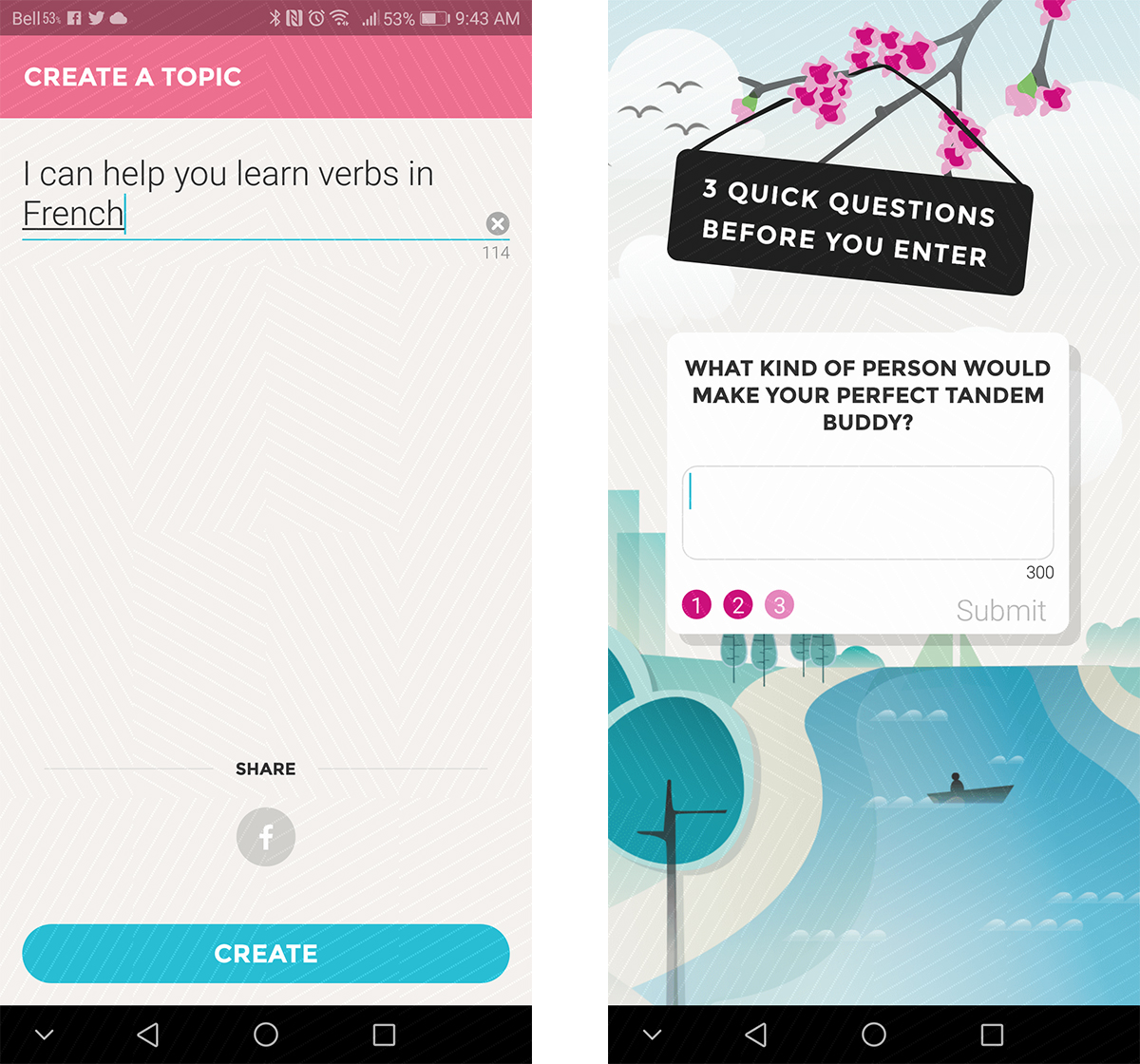
For instance, I’m fluent in English, emoji and I mostly know French, so when I used the app it introduced me to other users who wanted to learn English and French (apparently no one wanted to learn emoji). Then, since I wanted to learn German, it introduced me to people who knew German already.
After completing the setup, users can message any one of the other users on Tandem and immediately start a conversation with them to begin learning. Following the Community tab, there’s a Tutor option that allows users to find tutors that charge per hour. Users can set up times with multiple tutors and have a variety of lesson plans laid out.
In my experience with Tandem, I immediately began speaking with another user who lived near Munich, Germany, who wanted to learn English. The user was polite and spoke English quite well. Though I wanted to learn German, I felt quite comfortable just speaking English to the man. I tried messaging another user, but unfortunately they were unresponsive.
Tandem is odd in comparison to Duolingo as that app doesn’t require the person to be speaking to another person on the other end.
Many people learn better when learning together and for those who do learn better that way, Tandem is the app for them.
Tandem is free on the Google Play Store and the App Store.
The post Learn new languages with people around the world with Tandem [App of the Week] appeared first on MobileSyrup.

While many of us are getting ready to start 2018, residents of Ontario already have a new consumer protection to enjoy.
The Government of Ontario’s loyalty and reward points ban is officially in effect as of January 1st, 2018. The ban is retroactive, and includes all points earned on and after October 1st, 2016.
According to the government, Ontarians will be able to “request that businesses reimburse them” for improperly expired points. Ontarians will also be able to file a complaint with Consumer Protection Ontario to recover any improperly expired points.
“These are important new ground rules that preserve the points consumer have built up over time,” said Tracy MacCharles, Ontario’s minister of government and consumer services, in a Government of Ontario media release. “Many people save their points for years to use toward a large purchase. That has real value and should be protected.”
While companies can’t expire loyalty points, consumer can still lose their points if the loyalty program already has expiry provisions set in place.
For example, if the loyalty program enumerates that loyalty accounts can be be closed if members don’t remain active for a certain amount of time, then the Ontario expiry ban will not come into play.
“With so many reward programs out there, it’s important for some basic rules to be in place from one program to the next,” said Athurt Potts, Ontario MPP for Beaches-East York, in the same media release. “ This bill was always about basic fairness and I’m thrilled to see that it’s becoming a reality.”
Ontario’s reward points expiry ban is part of a series of consumer-side laws aimed at protecting Ontario consumers.
The Ontario government also banned ticket bots in December 2017.
Source: Government of Ontario
The post Ontario’s reward points expiry ban is now in effect appeared first on MobileSyrup.
Looking back on 2017, this image is a big fave. It does look best at large size.
All the best in the New Year to the Price Tags family.


So what kind of year did Price Tags Vancouver have? There were 1,359 posts published, and 456,000 page views. Over 8,600 comments were made on Price Tags Vancouver, with thirteen contributors providing content.
And the top Seven Posts?
Top Seven Posts:
1. Fun with the 2012 Census
2. Daily Durning: Vancouver History in Colour
3. Port Says Deeper Fraser River Not Needed for Massey Bridge
4. Another One Bites the Dust
5. Sandusky, Ohio and a Pier
6. Vancouver Condo Presales Cheaper in China
7. Mike Harcourt and the Massey Tunnel~Let’s Get Moving .
Wishing you and yours a happy and healthy 2018.


Jan 03, 2018

This is Audrey Watters's final wrap-up for 2017, consisting of 11 major articles plus a variety of other stories and studies. My only criticism is that she is too U.S.-focused. But this pales in comparison to the scale of the effort here - it's essentially a full book (whch she could probably compile and sell on Learnpub). Her studies of "who's funding whom" are especially welcome, as the education technology market is now big money and the players don't always have the needs of students, schools and society at the top of their lists of priorities
[Link] [Comment]

Andy Hicken,
Web Courseworks,
Jan 04, 2018

I like the use of the hype cycle diagram to tie together these predictions for 2018. The advantage of using the hype cycle is that you're reporting on trends rather than specific things. This makes the predicting easier and more general. For example: "we’ll see greater application in the next three years or so." The technologies described are pretty specific, though: Distributed CE ledgers ("AKA credit hours as cryptocurrency"), value-based accreditation, "electronic health records (EHR) data being incorporated into performance improvement projects," and "getting your high-fidelity medical simulator to talk to your LMS and LRS" (we did that a couple of years ago in LPSS).
[Link] [Comment]
Toyota has finally brought its Entune infotainment system to Canada after years operating in other markets, including the United States. Now that it’s crossed the border, does it feel like a big upgrade?
More and more, Toyota (and by extension, Lexus) is something of an island in the world of automotive infotainment. It brought in Entune to some of its 2018 vehicles, but still refuses to support Apple’s CarPlay or Google’s Android Auto projection platforms.
Cutting those out could be viewed as a courageous move (pun intended), except it applies more pressure on Toyota’s engineers and Tier 1 suppliers to come up with a viable alternative. Entune isn’t something new. The 3.0 version is merely an evolution of an existing platform that had plenty of holes to fill.
I got to test drive it in a 2018 Toyota Camry XSE, which is a $37,000 vehicle with all the upgrades inside. Entune 3.0 is essentially standard on all trims, though embedded navigation isn’t on all of them.
The system is not backward-compatible, so if you already own a Toyota model from the last few years, you won’t be able to get it installed.
That gives it a form of exclusivity, but as I’ll demonstrate, it has a long way to go to drive past competitors.

Entune is largely an app-based platform that works in tandem with a connected smartphone. The phone is necessary to pull in the data required to run apps on the platform itself. The in-car SIM has an exclusive data connection.
I say ‘exclusive’ for the simple reason that the SIM doesn’t do anything else for the driver. It’s easy to install system upgrades over the air, and in my one week of testing, I had to do it three times. That’s a good sign. At least it shows Toyota is trying to improve and tweak what it has.
The problem was I had no idea what the update was changing. The install alone could take several minutes, and no pop-up on the screen appeared to tell me what it was fixing. Was it a security update? A new feature? A basic tweak I wouldn’t have otherwise noticed? I never knew.
I point this out because, being new to the Canadian market, there is a learning curve involved in what Entune and the wider system can do.
In that respect, I would break down Entune and the infotainment system as two equal parts. Entune works within it, yet feels like it operates independently to some degree.
Toyota also packed the Camry with various safety features under its Safety Sense package, though I didn’t focus on those for this review. There are no autonomous driving features included in any 2018 Camry trim.

Much of what Toyota put in the Camry XSE was standard fare. There is a dedicated USB port for smartphones under the dash beside an Aux-In port. There are two more USB ports with 2.1Amp power inside the centre console. These are only for charging, and do not interact with the system in any way. You also get a 12-volt socket in there as well.
Under the dash, and in front of the gearshift, is a Qi wireless charging pad. The pad is compatible with any phone supporting the standard, including the iPhone X and iPhone 8/8 Plus. I charged an iPhone X with a case on without fail. Other phones worked fine too. The pad doesn’t work as a physical input, meaning the system won’t see it as a device plugged in directly. Some other automakers have done this, but it’s not an option here.
Bluetooth works as expected, with both Siri Eyes Free and Google Assistant available when phones are paired. To avoid cutting off its own voice assistant, Toyota mapped Siri and Google Assistant to the call button on the steering wheel. The voice button always defaults to Toyota’s own. So, when paired, I pressed the call button and Siri or Assistant would pipe up waiting for a command.

I mentioned the in-car SIM’s limitations, and will add that it also doesn’t do in-car Wi-Fi. It’s a passive data connection in the car serving the infotainment system, not any devices brought into the vehicle.
The 8-inch display (some trims have a 7-inch) is clear and bright. While capacitive, its touch sensitivity isn’t like a mobile device. It’s easier to get around by tapping arrows or navigation bars, rather than swiping. Pinch-to-zoom also didn’t work for me.
Physical buttons and dials flank the display, simplifying how to get to shortcuts or basic features, like volume.

Entune’s app integration relies on what is already there, rather than what you have on your phone. There is one exception to that with navigation maps, which I’ll touch on later.
These apps are mostly proprietary, with the exception of Yelp, Slacker and NPR One. I noted the in-car SIM already, which clearly has a data connection to pull in updates over the air, but it doesn’t chip in for Entune. Without using the phone’s data connection, the apps wouldn’t pull in any information.
What’s in the app suite is almost entirely contextual. That’s great in theory, and results weren’t all that bad during my testing. Fuel listed the nearest gas stations. Traffic pointed out obstacles or incidents on the road. Weather showed me a forecast and current conditions. Sports gave me the latest scores from a variety of leagues. Stocks could show me how my portfolio was doing.
In the case of Fuel and Traffic, I could see where their respective locations were on the Scout GPS map. If need be, I could also initiate navigation to the gas station I selected.
They felt a little dated, but these basics apps weren’t that bad. The thing that struck me was that I was getting something visual on the screen when I could simply ask Siri or Google Assistant for some of the same information. If I wanted to know a score, I simply asked for it. Same with weather or traffic. Even the nearest gas station wasn’t hard to find, and I never had to cycle through a menu.
In one sense, Toyota is offering the best of both worlds. Those who want something to actually see can peruse the onscreen list. Other who can get around fine verbally have their phone’s voice assistant do the work.
Adding Yelp is definitely helpful, and it works well in Entune. Given that neither CarPlay or Android Auto have integrated it, this is a rare win for a factory infotainment system.

If you’ve never heard of Scout GPS Link, it’s not surprising. This is a dedicated navigation mapping app made for Toyota and Lexus vehicles. It was the only embedded nav option on the Camry XSE, and it ran off my phone.
The app is available for free on iOS and Android. It doesn’t require opening an account, but doing so does make the process of connecting in the car easier. Once registered, in-car connections are almost instant.
Telenav’s OpenStreetMap powers the app’s maps, with a decent enough interface, though not on par with the slick feel of Google Maps or Waze. Strangely, there was no way to send a destination from the phone to the car. This was odd, given the in-car SIM. Instead, I had to start the route on the phone first, which would then pick up once I connected in the car. Not terribly invasive, except I could hear the map’s voice awkwardly give instructions as I was walking in public toward the car.
As for actual performance, there were some inconsistencies. Initially, my iPhone X wouldn’t work when plugged in, even though it did over Bluetooth. I wasn’t able to play music when plugging in a Pixel 2 XL, yet ran Scout GPS Link without a problem.
It attempts to be dynamic by showing construction and certain points of interest on the map. It just lacks the texture and dynamism I’ve become accustomed to with Google Maps and Waze. Even Apple Maps looks considerably better.
Also worth noting is the map won’t work outside Canada. Cross the border into the U.S. and it won’t carry on. Having a backup ready with Google Maps, Waze, TomTom Go or something else, even if it works offline, is the only other option.
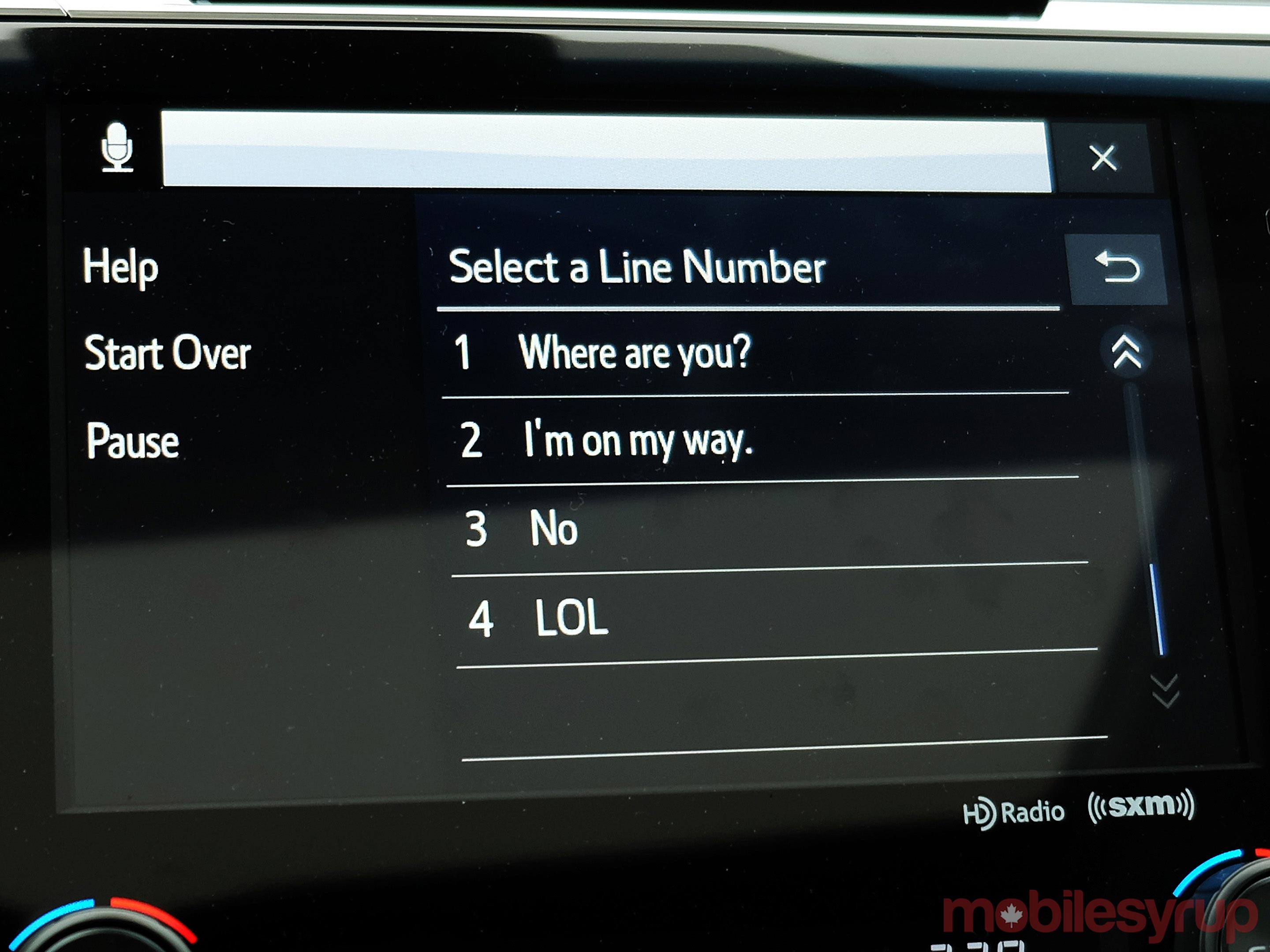
Slacker is okay, but it felt like a consolation. Same with NPR One. I’d much rather have TuneIn built-in, with native support for Spotify. That combination would do wonders for Entune, but as is, the system feels like it integrates what was relevant in 2010.
Bluetooth audio streaming was fine, no matter what I played, but I wouldn’t expect any less. I could control playback through the physical buttons and steering wheel, or even moderately control things through voice (more with Assistant than Siri).
What I missed was the integration CarPlay and Android Auto enable. With Toyota’s system, I could never see playlists, or navigate to different streaming music apps. I needed to use my phone to do that, which defeats the purpose of hands-free operation.
Phone calls were pretty flawless, regardless of whether I used Toyota’s system, or the other voice platforms. Texting was initially problematic until I realized that Toyota developed its voice system to be precise. If I simply said, “Send a text to (name),” it would give me a puzzled response. If I said, “Messaging,” it would then ask me who to send it to, with a list of preloaded messages I could send. I was impressed there were 15 to choose from, including common quick ones, like “yes,” “I’m on my way,” and “LOL.”
If I wanted to recite my own message, I could do that instead. In those cases, though, I usually leaned on Siri or Assistant to do the job.
The post 2018 Toyota Entune 3.0 System Review: Holding out hope appeared first on MobileSyrup.
New Year’s is a good time to think about change. As I think back on all the biggest opportunities and shifts I have made in my career, they all have these things in common: I was feeling stuck and bored. Something was tickling the back of my imagination. I moved toward it. And eventually, I … Continued
The post New year, new thinking: What to do when you’re stuck in a rut appeared first on without bullshit.
Here’s my New Year’s Resolution: I’ll try to try to publish a short piece every day recommending a song that I think is excellent, and apt to please at least some readers. Let’s see how far into 2018 I get; a quick run through the collection turned up around 240 candidates, so a whole year’s worth of songs would be a stretch goal. Read on for motivation, logistics, and mechanics. Or just read the song notes, starting tomorrow. Or don’t.
2018 will be this blog’s fifteenth year, and the fragments don’t flow as fast as they used to; I have to reach back pretty far sometimes to achieve even three or four microessays a month. Which is weird, because ongoing centers on computing, and I’m intensely engaged at the white-hot core of Cloud, which as interesting a technology segment as there is. Especially if money is your measure.
But… there’s this term “insider” and I’m one of those, de jure and for real, and I could write any number of authoritative and amusing pieces on Hybrid Cloud or Serverless Economics or competing with Azure vs Google or, well, you get the idea, but I couldn’t convincingly claim they were uninfluenced by my work at AWS or didn’t reflect views held by at least some senior people. And that wouldn’t do at all. Might even be illegal.
I still find space to technologize here now and again when I think it can’t go wrong, but there’s writing energy curdling in the back of my brain. And I used to have fun here with the 5★♫ series, and music’s been a primary recreation for way more than 38 years. So welcome to “SotD”, a tiny song-discovery service.
“Song” doesn’t strictly imply a singer. I should strictly say “track of the day” but “song” is a better word.
It does imply some virtues of brevity and coherency; I won’t be recommending abrasive free-jazz jams or 70-minute minimalist drones or gamelan explosions.
A lot of it is going to be kind of old, because I am, but let’s see if we can have regular visits to this century. And I’m determined to find something in 2018 to feature in 2018.
I’ll work on diversity, but Canadians, males, and electric guitars are going to be over-represented.
I’ll restrict myself to things you can actually get, which sadly means I’ll have to skip that dub compilation on a skeevy-looking CD I got in a skeevier-looking part of Sydney in 1991.
You’re probably gonna hate some of the SotDs.
I reserve the right to re-use some previous 5★♫ tunes.
Other things being equal, I’ll lean to great songs from the lesser-known, and lesser-known songs from the great. Which means, expect a few one-hit wonders. But big hits get to be big hits for a reason, and anything that was a big hit before say 1990 comes from another planet anyhow.
This is the World Wide Web, y’know? So I would very much like to link to every song. There are a lot of ways to access music these days and in principle they should have links. At a minimum, I think I ought to be providing iTunes, Google Play, Spotify, and Amazon links, and would gratefully consider suggestions for other channels.
Of those, Google Play is the only one I use (here’s why) but so far I haven’t figured out how to extract song URLs from its JavaScript maelstrom.
I believe firmly that Live Music Is Better, so wherever possible I’m going to link to live video. Things being what they are, this means a lot of YouTubes; oh well.
Back in the late Eighties, for a few months I went to aerobics class, and once every session the instructor put this U2 chestnut on and every time my beats-per-minute cranked right up. Not in the slightest obscure, but worth revisiting at least once a year, ideally on this day.
U2 are pretty well dinosaurs now, but then I am too. And when they stomped the earth in the late Eighties, it shook. They brought a whole lot of musical intensity to the stage, and the best live bass sound I’ve ever heard. And passion: I recall a hot summer night back, then an outdoor show; Bono’s arm was in bandages and a sling because he’d fallen off the stage a few nights earlier. But then they were swinging into People Get Ready and he said “Gotta have two guitars for this one” and ripped the bandages off to play rhythm. That’s rock&roll.
Anyhow, New Year’s Day is a fine song; note what’s maybe Edge’s best ever guitar break, and the clever way he switches between guitar and piano. Also the, foundational guitar isn’t guitar at all, it’s bass, one of Adam Clayton’s nicest outings.

