Shared posts

03 May 18:07

Relationships in Data Analysis

I recently finished reading Steve Coll’s book Directorate S, which is a chronicle of the U.S. war in Afghanistan post 9-11. It’s a good book, and one line stuck out for me as I thought it had relevance for data analysis. In one chapter, Coll writes about Lieutenant Colonel John Loftis, who helped run a training program for U.S. military officials who were preparing to go serve in Afghanistan. In reference to Afghan society, he says, “Everything over there is about relationships.” At the time, Afghanistan had few independent institutions and accomplishing certain tasks depended on knowing certain people and having a good relationship with them.

I find data analysis to be immature as an independent field. It uses many tools–mathematics, statistics, computer science–that are mature and well-studied. But the act of analyzing data is not particularly well-studied. And like any immature organization (or nation), much of data analysis still has to do with human relationships. I think this is an often ignored aspect of data analysis because people hold out hope that we can build the tools and technology to the point where we do not need to rely on relationships. Eventually, we will find the approaches that are universally correct and so there will be little need for discussion.

Human relationships are unstable, unpredictable, and inconsistent. Algorithms and statistical tools are predictable and in some cases, optimal. But for whatever reason, we have not yet been able to completely characterize all of the elements that make a successful data analysis in a “machine readable” format. We haven’t developed the “institutions” of data analysis that can operate without needing the involvement of specific individuals. Therefore, because we have not yet figured out a perfect model for human behavior, data analysis will have to be done by humans for just a bit longer.

In my experience, there are a few key relationships that need to be managed in any data analysis and I discuss them below.

Data Analyst and Patron

At the end of the day, someone has to pay for data analysis, and this person is the patron. This person might have gotten a grant, or signed a customer, or simply identified a need and the resources for doing the analysis. The key thing here is that the patron provides the resources and determines the tools available for analysis. Typically, the resources we are concerned with are time available to the analyst. The Patron, through the allocation of resources, controls the scope of the analysis. If the patron needs the analysis tomorrow, the analysis is going to be different than if they need it in a month.

A bad relationship here can lead to mismatched expectations between the patron and the analyst. Often the patron thinks the analysis should take less time than it really does. Conversely, the analyst may be led to believe that the patron is deliberately allocating fewer resources to the data analysis because of other priorities. None of this is good, and the relationship between the two must be robust enough in order to straighten out any disagreements or confusion.

Data Analyst and Subject Matter Expert

This relationship is critical because the data analyst must learn the context around the data they are analyzing. The subject matter expert can provide that context and can ask the questions that are relevant to the area that the data inform. The expert is also needed to help interpret the results and to potentially place them in a broader context, allowing the analyst to assess the practical significance (as opposed to statistical significance) of the results. Finally, the expert will have a sense of the potential impact of any results from the analysis.

A bad relationship between the analyst and the expert can often lead to

  • Irrelevant analysis. Lack of communication between the expert and the analyst may lead the analyst to go down a road that is not of interest to the audience, no matter how correct the analysis is. In my experience, this outcome is most common when the analyst does not have any relationship with a subject matter expert.
  • Mistakes. An analyst’s misunderstanding of some of the data or the data’s context may lead to analysis that is relevant but incorrect. Analysts must be comfortable clarifying details of the data with the expert in order to avoid mistakes.
  • Biased interpretation. The point here is not that a bad relationship leads to bias, but rather a bad relationship can lead the expert to not trust the analyst and their analysis, leading the expert to rely more strongly on their preconceived notions. A strong relationship between the expert and the analyst could lead to the expert being more open to evidence that contradicts their hypotheses, which can be critical to reducing hidden biases.

Data Analyst and Audience

The data analyst needs to find some way to assess the needs and capabilities of the audience, because there is always an audience. There will likely be many different ways to present the results of an analysis and it is the analyst’s job to figure what might be the best way to make the results acceptable to the audience. Important factors may include how much time the audience has to see the presentation, how mathematically inclined/trained they are, whether they have any background in the subject matter, what “language” they speak, or whether the audience will need to make a clear decision based on your analysis. Similar to the subject matter expert, if the analyst has a bad relationship with the audience, the audience is less likely to trust the analysis and to accept its results. In the worst case, the audience will reject the analysis without seriously considering its merits.

Analysts often have to present the same analysis to multiple audiences, and they should be prepared to shift and rearrange the analysis to suit those multiple audiences. Perhaps a trivial, but real, example of this is when I go to give talks at places where I know a person there has developed a method that is related to my talk, I’ll make sure to apply their method to my data and compare it to other approaches. Sometimes their method is genuinely better than other approaches, but most of the time it performs comparably to other approaches (alas, that is the nature of most statistical research!). Nevetheless, it’s a simple thing to do and usually doesn’t require a lot of extra time, but it can go a long way to establishing trust with the audience. This is just one example of how consideration of the audience can change the underlying analysis itself. It’s not just a matter of how the results are presented.

Implications

It’s tempting to think that the quality of a data analysis only depends on the data and the modeling applied to it. We’re trained to think that if the data are consistent with a set of assumptions, then there is an optimal approach that can be taken to estimate a given parameter (or posterior distribution). But in my experience, that is far from the reality. Often, the quality of an analysis can be driven by the relationships between the analyst and the various people that have a stake in the results. In the worst case scenario, a breakdown in relationships can lead to serious failure.

I think most people who analyze data would say that data analysis is easiest when the patron, subject matter expert, the analyst, and the audience are all the same person. The reason is because the relationships are all completely understood and easy to manage. Communication is simple when it only has to jump from one neuron to another. Doing data analysis “for yourself” is often quick, highly iterative, and easy to make progress. Collaborating with others on data analysis can be slow, rife with miscommunication, and frustrating. One common scenario is where the patron, expert, and the audience are the same person. If there is a good relationship between this person and the analyst, then the data analysis process here can work very smoothly and productively.

Combining different roles into the same person can sometimes lead to conflicts:

  • Patron is combined with the audience. If the audience is paying for the work, then they may demand results that confirm their pre-existing biases, regardless of what evidence the data may bring.
  • Subject matter expert and the analyst are the same person. If this person has strong hypotheses about the science, they may be tempted to drive the data analysis in a particular direction that does not contradict those hypotheses. The ultimate audience may object to these analyses if they see contradictory evidence being ignored.
  • Analyst and audience are the same. This could lead to a situation where the audience is “too knowledgeable” about the analysis to see the forest for the trees. Important aspects of the data may go unnoticed because the analyst is too deep in the weeds. Furthermore, there is potential value and forcing an analyst to translate their findings for a fresh audience in order to ensure that the narrative is clear and that the evidence as strong as they believe.

Separating out roles in to different people can also lead to problems. In particular, if the patron, expert, analyst, and audience are all separate, then the relationships between all four of those people must in some way be managed. In the worst case, there are 6 pairs of relationships that must be on good terms. It may however be possible for the analyst to manage the “information flow” between the various roles, so that the relationships between the various other roles are kept separate for most of the time. However, this is not always possible or good for the analysis, and managing the various people in these roles is often the most difficult aspect of being a data analyst.

03 May 18:07

SotD: Sweet Jane

Some people just go out dancing / other people like us we gotta work. Lou Reed’s Sweet Jane has been special to me since the first time it crossed my radar, which I don’t remember since it was in the Seventies. This may be Lou Reed’s masterpiece.

I’m pretty old, but too young to have been into the Velvet Underground. But I was living in dingy basement back in those days when someone brought home Lou Reed’s Rock n Roll Animal and oh my goodness, every note on that record spoke to me, and it still does. I blogged at length on the subject a dozen years ago, Let me quote myself:

Let’s see: the band is tight as any famous-name classical string quartet, the guitars are orchestrated and played well; Lou’s vocals are wasted-sounding, which is appropriate, but the phrasing and timing is right up there. And the songs, those songs are jam-packed full of wonderful melodies and lyrics that get their hooks into your brain and won’t let go.

Well, OK, on the other side of the coin, yes, it’s heavy pompous Seventies glam/arena rock, and two of the songs are totally about getting high, and the guitar-playing isn’t very innovative (it’s very good, just not very innovative) and Heroin in particular hasn’t worn all that well. But still, this is really extra-fine music.

Rock n Roll Animal

In that blog piece I also dissed Lou’s remark that the best version of Sweet Jane was the Cowboy Junkies’, from The Trinity Session. But as I get older I find I keep going back to Trinity and often get teary-eyed. Its beauty is stark, the performance polished, and the recording sounds fabulous on the big system.

I only saw Lou once, one of his last performances, in 2010 as part of the Vancouver Olympics cultural festival. It was at a weird concert where a whole crowd of musicians not including Neil Young performed Neil’s Songs. Lou took an atonal electric charge at Helpless which was memorable if not actually good, and then joined Elvis Costello for the closing extended raw-noise melting down of Cowgirl In The Sand, which was actually pretty excellent.

This is part of the Song of the Day series (background).

Links

Spotify playlist. From Rock n Roll Animal: Amazon, iTunes, Spotify. From The Trinity Session: Amazon, iTunes, Spotify. As for live video, it’s a little disappointing, but here is Lou looking way druggy with part of the Rock n Roll Animal Band and lousy vocals in Paris, and then much older in a Velvet Underground reunion, with insufficient guitar roar but nice snappy vocals and Maureen Tucker’s downtown drumming. As for the Junkies, they’ve always been more a studio than a performance band, but this is pretty gripping.

03 May 18:07

Recently

by Tom MacWright

I finally got a library card to the San Francisco Public Library, and it’s been a big month for reading, but I haven’t posted reviews under /books because I’ve promised myself to finish the book identifier converter I’ve been tinkering with for a while. I read ‘White Rage’, ‘The Shock Doctrine’, and am currently working on ‘The Immortal Life of Henrietta Lacks’ and ‘Inheritors of the Earth’.

On the internet, I enjoyed Roger Schank on IBM Watson’s overblown claims (see also, my own AI skepticism).

Watching

I’ve really been enjoying Atlanta, and finding new music from the snippets on the show. It’s practically the only TV series I feel good about watching.

I finally ponied up the dollars to contribute to the Patreons of Adam Neely and Ben Levin, two YouTube music educators I admire. Their stuff is consistently great and wacky - check out Ben’s gear rundown (watch till the end), Adam’s Polyrhythms are polypitch, and Justice Cow’s Elephant Man - also watch till the end.

Listening

Elsewhere

I’ve been hard at work with Mike and Jeremy, building Observable, and working on several projects at the same time - perhaps too many. The next two to land will be the book identifier converter, and a dat version of this website.

03 May 18:07

Firefox Mobile Can Now Delete Cookies On Exit!

by Martin

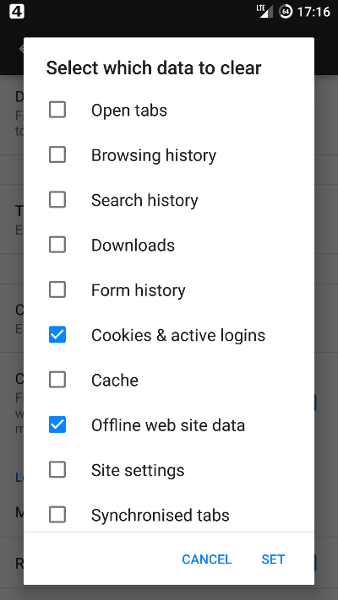
Firefox Mobile Cookie SettingsGood news on the privacy front!: When I recently installed Firefox on a new Android phone I browsed a bit through the settings and noticed that it is now possible to delete all kinds of data when the browser is closed. This includes cookies and offline website data that is often used to track usage. Also, it’s possible to reject 3rd party cookies. Very good, I’ve been waiting for these features for a long time on mobile. It could be that they’ve been in Firefox Mobile for quite some time already but this is the first time I’ve noticed it!

03 May 18:06

(Re-)Learning Apple Script to Automate Some Work

by Ton Zijlstra

For a few things I use Apple Script to automate tasks. For instance if I start a new project, I run a script that creates basic things like folders, standard to-do’s and notes on my hard drive and in my Things and Evernote applications. They save me time and let me avoid a lot of repetitive work. I wrote those scripts years ago, and meanwhile I have forgotten what little I knew about Apple Script.

Now I’m trying to build a new script. I had thought about this already, then Frank Meeuwsen’s similar steps (in Dutch) triggered me to start.

During my reading online I save articles and documents into Evernote, which I tag and store.
I’d like to automatically create a Suggested Reading posting weekly based on what I save in Evernote. I imagine adding a specific tag for this to the things I save, so I can also save things without them showing up in such a posting. The articles I save usually have a short sentence about why it’s relevant to me.

This means:

  • Running the script automatically weekly
  • Selecting Evernote notes from the last 7 days with the right tag
  • From each Evernote extract the short descriptive sentence I added, the associated weblink, as well as other tags I added when saving.
  • Then build a bullet list, with the descriptive sentences as text, and the link embedded either at the end, with its title as text, or maybe embedded in the description, based on some sort of indication.
  • Select three random tags that occur at least twice in the list of links
  • Add those three tags as part of the title of the blog post
  • Add all tags used to the tags for the blogpost
  • Set Linklog as the Category
  • Save as draft in my WordPress blog, with a scheduled post date of 16 hours.
  • Send me a message inviting me to review the draft and post. (If I don’t review, the posting will thus automatically appear)

I used to use a bookmarking service like Delicious or Diigo, and there used to be ways, or maybe still are, to blog automatically from their service. However it would necessitate me to save everything twice: As a bookmark and as a full article in Evernote. (Saving the entire article circumvents issues with link rot and paywalls, and allows me local full text search in all my notes)

I’ll likely suffer hours of frustration trying to find out how to do things correctly in AppleScript. Any pointers to useful resources (example libraries for instance) are therefore welcome.

(And yes, I understand the discrepancy between wanting to write a script to work with Evernote, while simultaneously wanting to leave Evernote)

02 May 02:23

Media Critique of Biking To Work

by Ken Ohrn

What does CBC’s Stephen Quinn have to say about riding his bicycle to work in Vancouver?

Hint: he likes it.

Fits nicely with the upcoming Bike To Work Week (May 28 to June 3).

If you’re not part of the Bike to Work Week competition, why not join a team (or put one together yourself)?

Go after some of the many excellent prizes up for grabs (including a trip for two to Portugal from Exodus Travels).

02 May 02:22

Analyst predicts Apple won’t bundle headphone adapter with 2018 iPhones

by Igor Bonifacic

Apple really wants consumers to buy a pair of AirPods with the next iPhone.

In a note to investors obtained by MacRumors, Barclays’ Blayne Curtis predicts Apple will not include a Lightning to 3.5mm headphone adapter with future iPhones.

To date, Apple has included the $10 Lightning to 3.5mm headphone adapter since it started shipping the iPhone 7, the first iPhone model to not include a headphone jack, in 2016, and continued to do so with its 2017 lineup of smartphones, which includes the iPhone X.

“We currently model no dongle this year,” writes the analyst.

Curtis doesn’t provide much insight into why Apple plans to stop including the adapter with new iPhones. Moreover, he’s admits he’s making more of an educated guess than anything else.

That said, Barclays typically sources its information by visiting Apple’s supply chain partners, and the bank has been correct in the past. In 2017, Barclays wrote, “We believe [the adapter] stays this year but goes away at some point, potentially in the 2018 model.”

As MacRumors notes, the inclusion of a headphone adapter always felt temporary. Moving forward, it’s likely the company wants to give its users even more reason to buy a pair of AirPods.

Source: MacRumors

The post Analyst predicts Apple won’t bundle headphone adapter with 2018 iPhones appeared first on MobileSyrup.

02 May 02:22

Instagram now filtering out bullying comments

by Bradly Shankar
Instagram app on iOS

Instagram has announced that it has begun filtering out bullying comments on the platform that intend to harass or upset other users.

In a blog post, Instagram co-founder & CEO Kevin Systrom explained that the new filter will hide comments that attack a person’s appearance or character, in addition to threats to a person’s well-being.

According to Systrom, the new filter will also alert Instagram to repeated problems so appropriate action can be taken.

The filter can be disabled in the Comment Controls centre of the app.

Systrom also confirmed that it will be updating its policies to better protect younger users. “Protecting our youngest community members is crucial to helping them feel comfortable to express who they are and what they care about,” Systrom wrote.

In other Instagram news, the company announced at Facebook’s F8 conference that it is launching a video chat feature.

Source: Instagram

The post Instagram now filtering out bullying comments appeared first on MobileSyrup.

02 May 02:22

A refurbished iPad, the CAP theorem, and a lesson on negotiation

We’ll get to the iPad and CAP theorem soon, but first, let’s talk about negotiation:

  • Your boss hands you a project with an impossible deadline–so you end up working evenings and weekends.
  • You get a job offer that’s lower than you’d like–and you accept it.

And that’s just the way things are, and it’s not like there’s anything you can do, right?

Maybe. But quite possibly there is something you can do.

To explain why, I’d like to share an edifying tale, a story of broken promises and ultimate–albeit minor–triumph. Along the way we’ll take a detour into distributed systems theory, and when we’re done there will even be a moral (hint: it’s about negotiation).

A purchase is made

Once upon a time, at a different job that subsidized such things, my wife purchased an iPad. Years passed, operating systems were upgraded, and over time this iPad became too slow to run some apps, and too old to run others.

It was time to buy a new iPad.

The day Apple released their new 2018 iPad we went to Apple’s online store and purchased a refurbished 2017 model. We got a confirmation email, and looked forward to a tablet that could keep up with many companies’ unwillingness to ship performant code (looking at you, Skype).

The next day Apple sent us another email: our order had been canceled, and our money would be refunded. When we checked the store, the refurbished model was no longer in stock.

Our somewhat cheaper iPad was not coming.

A theory is introduced, with some references to distributed systems

Why did the Apple Store cancel our order? Perhaps it was a bug, but I have another theory: the constraints of the CAP theorem.

Eric Brewer’s CAP theorem states that a distributed data store–a system composed of multiple nodes–can only have two out of three properties:

  1. Consistency: all nodes have same view of the data.
  2. Availability: the system can respond successfully to clients.
  3. Partition-tolerance: if the network between the nodes fails, the system can continue to operate.

Now, the online Apple Store is quite likely to be a distributed system, given the need to scale to many users. And it needs to store data, the size of the inventory of each item in the store. Given a choice between those three properties, the only two reasonable choices are availability and partition-tolerance.

It’s far better to have a store that is available than to have completely consistent tracking of inventory. There is a cost to this choice, though: every once in a while a large rush of orders will cause inconsistent views of the available inventory.

  • Node A thinks there is one iPad left, and sells it to customer 1.
  • At the very same time, Node B thinks there is one iPad left, and sells it to customer 2.

Because the system can’t enforce consistency, the same iPad is sold to two people. What to do?

One common solution (alas, I can’t find the original paper where I read the idea) is “compensation” or “apology”: out-of-band business processes to repair the mistakes. In this case, a post-processing stage that notices the double-sold iPad and handles it somehow.

How this rare but inevitable mistake is handled is a policy decision, and Apple’s chosen policy is to simply cancel the order–contrary to a guarantee they make on their website.

A complaint is made

If you go to the Apple Store website’s refurbished section, you will see in small letters at the top that “availability is guaranteed once we receive your full payment.” Given that promise, and the fact we’d gotten a confirmation email for our payment, my wife called up customer service and politely asked why our order was canceled.

The representative went off, and after some delay she indicated that she’d talked to her manager and she’d gotten approval to send us a new iPad instead. So the next week we received a 2018 iPad, while only paying the cost of a refurbished 2017 model.

Success, and easy success at that that. My wife didn’t have to complain loudly, point out Apple was in the wrong, or hassle anyone. She just asked.

The topic of negotiation is reintroduced

Apple made a promise (payment == guaranteed delivery), and then violated it. Why? Violating the guarantee on their website was an opening offer in a negotiation.

When you’re negotiating, you need to ask for what you want, or you won’t get it. In practice most people won’t ask and won’t complain, and so it’s in Apple’s interest to start with a low offer: most people will get the email canceling the order, grumble a bit, and re-order something else.

Often how you ask is also important: you need to ask the right way. I once had a $5000 medical expense denied over and over by a health insurance company. Eventually I indicated I wished to file a grievance–a bureaucratic procedure I found on their website–and suddenly they found a “coding error” that had caused the problem and my bill was paid. (My uninformed guess is that grievances get reported to state regulators.)

The same dynamic is part of how many companies take advantage of employees, and the cost you’ll pay for not asking is even higher. When a company gives you a job offer they will have a salary range they are willing to pay, but they will usually not offer their high number. Instead, they will offer you the lowest number possible they think you might accept. Sometimes that number will also be far below market rate.

Many people will simply accept that initial salary offer–I’ve certainly made that mistake–and therefore end up getting paid much less than they could otherwise get. But of course that’s just an initial offer, and simply asking for more will usually result in a higher offer. And you can do even better if you do a little work beforehand.

A summary is presented

Here’s what we’ve learned:

  1. Recognize negotiating situations: you’ve already lost if you don’t realize you’re negotiating.
  2. Ask for what you want, or you won’t get it.
  3. Ask in the right way.

For a useful guide to negotiating your salary and benefits in general, see Valerie Aurora’s negotiating guide. And if it’s your working hours you care about, check out my book: Negotiate a 3-Day Weekend.


02 May 02:21

Firefox Performance Update #7

by Mike

G’day folks, just another Firefox Performance Update coming down the pike1 for you, so strap in.

But first a word from our sponsor: health.graphics!

This performance update is brought to you by The Quantum Dashboards at health.graphics! The first step to changing something is to measure it over time, and once you have those measurements, it’s usually a good idea to find some kind of visual representation for that measurement so that you can track your progress.

Contrary to the domain name, health.graphics measures much more than just the health of our graphics layer. The dashboards at health.graphics show visualizations for a bunch of measurements that we care about – from crash rates, to platform feature state, to raw performance numbers, these dashboards help us make sure that we’re not back-sliding on things that truly matter to us and our users.

And now for some Performance Project updates!

Early first blank paint (lead by Florian Quèze)

Florian sent out an Intent to Ship for this perceived performance optimization for Firefox 61. The beta channel will transition to 61 in a bit over a week, and we’ll use that cycle to ensure that the feature should ship out to release.

Faster content process start-up time (lead by Felipe Gomes)

After some research and examination of how our content processes initialize themselves, the first few bugs have started to get filed to get fixed. This bug, for example, is for introducing infrastructure to make the privileged JavaScript loaded in the content processes more lazy. Another bug was filed to shine some light on the “dark matter” that exists at the start of many content processes in our profiler tools.

Get ContentPrefService init off of the main thread (lead by Doug Thayer)

After much heroic effort, this has landed! If you’re curious about the shutdown leak that was preventing this from landing earlier, here’s the patch that fixed it. Spoiler alert: it was the spellchecker, of all things.

This project is done, and will be removed from the updates from here forward.

Blocklist async-ification (lead by Gijs Kruitbosch)

As of a few days ago, all public blocklist API calls are asynchronous! This was a monumental effort from Gijs, and should result in faster start-up times for some of our users (especially ones with slower magnetic disks).

There are still some very minor internal mechanisms that can still cause the blocklist to be loaded synchronously, but hitting these should be super rare. In the meantime, now that the async-ification is complete, we have an eye towards migrating the back-end to indexedDB.

As the async-ification is wrapped, we’ll be removing this section from the updates from here forward.

LRU cache for tab layers (lead by Doug Thayer)

The patch to introduce the LRU cache have been written and are just waiting until the 62 cycle to begin on Nightly in order to land. No doubt there’ll be some interesting edge-cases to hammer out, but we’re very excited to see how this improves tab switching times for our users!

Tab warming (lead by Mike Conley)

After sending out an Intent to Ship, the prefs to allow Tab warming to ride to release on Windows and Linux were flipped. If all goes well on Beta, Windows and Linux Desktop users should see some nice tab switching performance improvements in Firefox 61!

While investigating the behaviour that’s preventing us from shipping tab warming on macOS, a new bug was filed to try to reduce the number of paints that are occurring during tab switches.

Firefox’s Most Wanted: Performance Wins (lead by YOU!)

Before we go into the grab-bag list of performance-related fixes – have you seen any patches landing that should positively impact Firefox’s performance? Let me know about it so I can include it in the list, and give appropriate shout-outs to all of the great work going on! That link again!

Grab-bag time

And now, without further ado, a list of performance work that took place in the tree:

(🌟 indicates a volunteer contributor)

Thanks, folks!


  1. I used to think it was pipe. It’s pike. 

02 May 02:21

Facebook brings AR camera features to Instagram, launches AR Studio for third-party creators

by Patrick O'Rourke

Facebook is working hard to develop its presence in the augmented and virtual reality space.

During the social network’s opening keynote presentation, Mark Zuckerberg, the company’s CEO, took to the stage to discuss Oculus Go pre-orders launching, as well as the company’s next steps in augmented reality.

Facebook is bringing its AR camera platform to Instagram and launching a new feature the company calls AR Studio. The AR platform was first revealed back at F8 2017 and offers AR masks and animations in the style pioneered by Snapchat.

Through AR Studio, Facebook says, “creators will be able to design unique, interactive camera experiences, including face filters and world effects, for their followers on Instagram.”

Businesses will be able to utilize AR templates that open the Messenger camera, complete with pre-loaded filters and AR effects “tailored specifically to the brand and experience,” says Facebook.

Augmented reality development frameworks are becoming increasingly common in the mobile space. For example, Apple has ARKit, while Google continues to push is ARCore platform.

The main question surrounding Facebook’s AR initiative is whether or not the brands the social network has partnered with will be able to release features that amount to more than just a silly gimmick. Current brands signed up for the beta of Facebook’s new AR platform include Sephora, KIA, Nike and ASUS.

On the Instagram side of the spectrum, Facebook is extending its camera effects to allow developers to build their own face filters and world lenses for their followers. Launch partners currently include Kylie Jenner, NBA, Jiffpom, Liza Koshy, Baby Ariel, Ariana Grande, Vogue and BuzzFeed.

The post Facebook brings AR camera features to Instagram, launches AR Studio for third-party creators appeared first on MobileSyrup.

02 May 02:18

Godot.framework

I wouldn’t wait for “Marzipan” or XKit or whatever it is.

We don’t know what it is. But my guess — based on my 38 years of writing code for Apple computers — is that it’s something you can use along with UIKit and AppKit, and not a wholesale replacement.

Maybe it’s a declarative API that helps make some things easier, and maybe you can make a cross-platform button more easily. Maybe your table view code could be the same on iOS and macOS. Great!

But don’t expect Macs to turn into large iPads all of a sudden. Macs are gonna Mac. Apps are going to have multiple resizable windows and a menubar. Targets will still be sized and designed for mice and trackpads.

In other words, if you want to write a Mac app, you’re still going to have to deal with the things that are inherently different about Mac apps, regardless of the specific API.

Let’s say this thing ships in the fall of 2019, over a year from now. If past is a guide, we might imagine it would be fun to play with, but not more useful than, say, the original version of Swift. (Swift didn’t get really good for writing apps until Swift 3.)

So it might be 2020 before it’s something that accelerates Mac development in any real way.

You could write a few Mac apps between now and then.

* * *

I realize that documentation on writing Mac apps is hard to find these days. Books on the subject are rare, and any book you find may be out of date.

But…

One of the reasons I made Evergreen open source is so that people who want to write a Mac app have some examples.

And I just learned that there’s a big list of open source Mac apps. This is way more than than was available when I started writing apps for OS X.

I don’t have time to write a book on Mac app development. I wish I did. I might make the time to do a small article now and then, using Evergreen as example. Maybe.

But it’s not my job (as I have to keep reminding myself). It’s Apple’s job to document and evangelize the Mac platform.

(As an additional part of that, I’d like to see Apple update the Mac App Store, and maybe also deal with some of the issues with sandboxing. It would signal that the company cares about Mac apps. I know it does care, but a more public demonstration would be welcome.)

01 May 16:51

Getunte E-Bikes machen zunehmend Radwege unsicher | heise online

mkalus shared this story from heise online News.

(Bild: European Cyclists' Federation, CC BY 2.0)

Mit dem Tuning von E-Bikes lassen sich die meist auf Tempo 25 gedrosselten Elektromotoren überlisten und das Rad fährt flotter. Experten warnen vor den Gefahren. Aber kann die Polizei frisierte E-Bikes bereits erkennen?

Die Bauteile sind klein und fallen oft kaum auf, die Wirkung aber ist beachtlich: Mit Bausätzen zum Tuning von E-Bikes kann das Limit von Tempo 25 für die Elektromotoren überwunden werden und die Räder gewinnen tüchtig an Schwung. Unversichert und ohne Helm ist das flotte Fahren auf Radwegen so aber nicht mehr statthaft und Experten warnen vor Gefahren.

Die wachsende Tuning-Community unter den 3,5 Millionen E-Bikefahrern in Deutschland muss bisher aber wenig befürchten. Die Polizei nämlich ist für das Erkennen getunter Bikes noch kaum gerüstet - es sei denn, die rasanten Radler düsen direkt vor dem Streifenwagen her.

Rasante Räder

"Ich halte das für unsere Infrastruktur für absolut gefährlich, so etwas zu tun", sagt die Geschäftsführerin der Landesverkehrswacht Niedersachsen, Cornelia Zieseniß. "Andere rechnen nicht damit, dass da jemand auf dem Radweg ankommt, der fast so schnell ist wie ein Auto." Da es verlässliche Zahlen zu getunten E-Bikes und Pedelecs bislang nicht gibt, halten sich der ADAC und der Fahrrad-Club ADFC mit einer Bewertung des Phänomens noch zurück. "Wir halten E-Bikes schon ungetunt für relativ gefährlich", sagt die Sprecherin des ADAC Niedersachsen/Sachsen-Anhalt, Christine Rettig. Die meist ältere Zielgruppe sei auf den Rädern oft nicht sicher unterwegs.

&lt;img src="https://heise.cloudimg.io/width/2000/q75.png-lossy-75.webp-lossy-75.foil1/_www-heise-de_/imgs/18/2/4/1/8/0/0/6/28sep2011-72c914d879d5a76f.jpeg" alt="[Link auf <a href="https://udv.de/de%5D%22" rel="nofollow">https://udv.de/de]"</a> class="akwa-article-teaser__image" style="width:100%;" &gt;

"Der Punkt ist, dass das Tuning gewaltige Dunkelziffern hat und die Polizei das nicht erfasst", sagt Unfallforscher Siegfried Brockmann, der die Unfallforschung der Versicherer (UDV) in Berlin leitet. "Die Bausätze sind im Internet rege angefragt." Wenn die Räder mit extra Schub unterwegs seien, drohten Kollisionen mit anderen Radfahrern und Fußgängern. Wenn der E-Biker dann nicht versichert sei, sei dies eine schlechte Nachricht für das Unfallopfer.

Mehr Platz für E-Bikes

Zum Versand bereit liegen bei Onlinehändler Jens-Ulrich Müller in Hannover Tuning-Module, Chips und Aufsteckboxen - alles kleine Helfer, die das E-Bike schneller fahren lassen. "Die Kunden wollen das", sagt der Betreiber des E-Bike Tuning Shop, der fast alle der derzeit 24 Tuningprodukte führt und ins In- und Ausland verschickt. Dass die elektrische Unterstützung bei Tempo 25 gedrosselt wird, empfänden viele E-Bikebesitzer wie das Fahren gegen eine Gummiwand, etwas mehr Tempo reiche vielen schon. "Dass ist die E-Mobilität, die die Menschen wollen und die funktioniert." Mehr Platz für E-Biker müsse es im Zuge einer Verkehrswende auf den Straßen geben, findet Müller.

Zu einem unkontrollierten Geschoss werde auch ein getuntes Rad kaum, gibt der Tuning-Experte zu bedenken. Ab Tempo 35 bis 45 bremsten Luft- und Rollwiderstand und die steigende Trittfrequenz den Schwung, der ohnehin nur zunimmt, wenn der Fahrer selber kräftig in die Pedale tritt. E-Bikes seien auch "Männerspielzeug", ein Tuning-Modul etwa erlaube nicht nur die Veränderung der Herstellereinstellungen, sondern es könnten auch Fahrtenbücher geführt und verbrauchte Kalorien registriert werden. Und manchen Leuten sei ihr E-Bike auch zu schnell und sie wollten die Elektrounterstützung auf Tempo 15 drosseln, beispielsweise auch zu Trainingszwecken.

Illegales Frisieren

Deutschlandweit sind derzeit rund 3,5 Millionen Elektro-Fahrräder unterwegs, sagt der Geschäftsführer des Zweirad-Industrie-Verbands (ZIV), Siegfried Neuberger. Wie viele davon frisiert seien, dazu gebe es keine Zahlen. Der Verband gehe aber von einem ernstzunehmenden Problem aus. "Wir beobachten das mit einer gewissen Sorge", sagt Neuberger. Die Manipulationen seien illegal, durch sie werde aus einem Fahrrad ein Kraftfahrzeug. Auch seien die Bremsen und Gabeln der Fahrräder nicht auf höhere Geschwindigkeiten ausgelegt.

In Baden-Württemberg wie andernorts auch wird über das technische Aufrüsten von E-Bikes bisher keine Statistik geführt. "Dem Innenministerium ist jedoch bekannt, dass insbesondere im Internet 'Tuning-Kits' angeboten werden", sagt Behördensprecher Carsten Dehner. "Dabei gilt im Grundsatz: Der Verkauf solcher Kits ist legal, der Einbau und Betrieb im öffentlichen Verkehrsraum ist verboten." Im Südwesten führe die Polizei deshalb stichprobenartig Kontrollen durch; dabei müsse die Leistungssteigerung des E-Bikes von einem Sachverständigen nachgewiesen werden.

Solche Experten gibt es auch beim Prüfkonzern Dekra. "In der Regel werden unsere Fachleute von den Behörden dann hinzugezogen, wenn es zu einem schweren Unfall gekommen ist", sagt ein Sprecher des Unternehmens. Der Auftrag an den Unfallanalytiker laute, die Unfallursache herauszufinden. "Bei der Unfallanalyse durch unsere Experten spielt dann auch eine Rolle, ob ein Pedelec manipuliert worden ist." (Michael Evers, dpa) / (tig)

01 May 16:51

SotD: Working Class Hero

It’s May First which is to say Happy Commie Day! Let me look for a Song of the Day in that spirit… oh hey, that wasn’t hard: There's room at the top they're telling you still / But first you must learn how to smile as you kill. — John Lennon.

Working Class Hero

Stolen from The Music Court, which looks like a cool place.

Hey, and after all it’s a good song, easy to sing along in your head. You can quibble: It’s about the “class” not the “work” in working-class, about growing up in a shitty dead-end (working-class) town in a shitty dead-end (working-class) school.

I’m not going to get into taxonomies of the Left in a Song of the Day essay, I’m just going to observe that, to my eyes anyhow, there’s a lot of bad shit going down and it’s a good time to be angry about what we see around us, and that evidence suggests the public sector is unduly influenced by the interests of the moneyed.

This is part of the Song of the Day series (background).

Links

Spotify playlist. The capitalists at Amazon, iTunes, and Spotify will cheerfully sell you this song. Near as I can tell, nobody ever filmed Lennon singing it, so let’s investigate covers. Green Day does it well but their YouTube versions edit all the “fucks” out, so fuck ’em. Marilyn Manson is OK but is a toon. Here’s a decent performance by a late-stage Allman Brothers. But no need to worry, Marianne Faithfull will take good care of you.

01 May 16:51

First shorts ride of the year

by jnyyz

IMG_8345

Everything’s been pushed back this spring with the lingering cold. High Park sakura are probably not due for two weeks, unlike last year.

01 May 16:51

Das Fahrrad in den Urlaub mitnehmen

by noreply@blogger.com (Christine Lehmann)
mkalus shared this story from Radfahren in Stuttgart.

Das ist leichter als man denkt, erläutert Blogleser Philipp, der einen Blog und eine Testseite für Fahrradträger betreibt, in seinem Gastbeitrag. Und es hat Vorteile.  Hier sein Beitrag: 

Nicht nur im Alltag ist das Fahrrad ein ständiger Begleiter für viele Menschen. Auch im Urlaub wird der alte Drahtesel immer beliebter. Die Gründe für das Fahrradfahren im Urlaub können hierfür vielseitig sein. Oberbegriffe sind aber sicherlich die Umwelt sowie die Gesundheit.

Radfahren im Urlaub hat viele Vorteile. Zum Beispiel erhält man mit dem Rad die Möglichkeit, auch die entlegenen Orte in einem Urlaubsort zu erkunden. Während es mit dem Auto nur möglich ist, zu den alltäglichen Orten zu gelangen, kann man mit dem Rad oftmals Stellen zu entdecken, die man ansonsten niemals hätte finden können. Im Gegensatz zum Wandern birgt dies einen zusätzlichen Vorteil, denn es ist um einiges schneller möglich, das Urlaubsziel zu erkunden als zu Fuß.
Ein weiterer großer Vorteil ist die Gesundheit. Während viele in einem Strandurlaub den ganzen Tag im Bett oder am Strand liegen, schafft das Rad die Möglichkeit, Erholung und Training miteinander zu verbinden. Auf der beliebtesten Ferieninsel der Deutschen, Mallorca, boomt der Radsport, weil sich die Urlauber nicht mehr mit dem Strandurlaub zufrieden geben möchten. Ganz egal, ob Abnehmen, Hochleistungssport oder einfach nur die Insel erkunden – der positive Effekt, bezogen auf die Gesundheit, lässt sich nicht von der Hand weisen. Radwege findet man in den meisten Urlaubsorten ohnehin reichlich.

Zu guter Letzt spricht auch die Natur für einen Urlaub mit dem Rad. Nicht nur, dass etwas für die Umwelt und gegen einen hohen CO2-Ausstoß getan wird. Auf dem Fahrrad kann man die Natur um sich herum endlich wieder bewusst wahrnehmen. So gelingt es tatsächlich, sich vollends fallen zu lassen. Was gibt es Schöneres als eine tolle Aussicht und eine frische Brise im Gesicht während man die gesamte Umwelt bewusst auf sich wirken lässt?

Fast alle, aber eben nicht jeder Urlaubsort ist für das Fahrrad tatsächlich geeignet. Meist lässt sich das mit ein paar Klicks im Internet recht schnell herausfinden. Dennoch gibt es verschiedene Aspekte auf die geachtet werden sollte, bevor der Urlaub mit dem Fahrrad gebucht wird. Sinn macht es vor allem dann, wenn man ein Ziel hat, etwa die Vorbereitung auf einen Wettbewerb oder beispielsweise die Reduktion von Gewicht. Da Radfahren auch alle Sinne aktiviert, kommt man geistig wacher aus dem Urlaub wieder als wenn man drei Wochen am Strand gelegen hätte. 

Wie kann ich ein Fahrrad transportieren?
Möglichkeiten das Rad zu transportieren gibt es viele. Als Beispiele können hier die Mitnahme auf einem Dach- oder Heckfahrradträger genannt werden. Die sicherste und beste Alternative ist jedoch der Fahrradträger für die Anhängerkupplung. Durch ihn wird zwar die Sicht nach hinten eingeschränkt, letztlich ist es aber über die Seitenspiegel möglich das Geschehen um das Auto herum genau zu verfolgen. Hier sollte vor allem auf die rechtlichen Vorgaben in den Ländern geachtet werden. Auch der Benzinverbrauch kann gesenkt werden, da das Rad im Windschatten des Wagens befestigt wird. Anders also als beim Dach- oder Heckfahrradträger entsteht keine zusätzliche Fläche.

Doch auch die Sicherheit ist am Ende mit dem Fahrradträger an der Anhängerkupplung gewährleistet. Zum einen erkennt man während der Fahrt sofort, ob etwas nicht stimmt, und zum anderen ist es ohne Probleme möglich, auch mehrere Räder auf bestimmten Trägern zu transportieren.Die passende Tour zu finden ist nicht immer ganz leicht. Am einfachsten ist es im Internet und Fahrradforen zu recherchieren. Eine traditionelle Karte, die man bie Touristeninformationen bekommt, hilft auch. Ansonsten kann man auch der Nase nach radeln.

Was man unbedingt bei jeder Tour dabei haben sollte: 
  • einen Ausweis (oder Reisepass) 
  • Bargeld für kurze Pausen 
  • Ein Handy für Notfälle 
  • Ein Erste-Hilfe-Set für Unfälle 
  • Ein Pannenhilfe-Set fürs Fahrrad 
  • Genügend Trinkwasser 
  • Einen Helm
01 May 16:51

Washer 4 is busy

by Michael Kalus
mkalus shared this story from Uploads from Michael Kalus.

Michael Kalus posted a photo:

Washer 4 is busy

Processed with VSCO with ke1 preset


01 May 16:51

Victoria Arduino @ Prado

by Michael Kalus
mkalus shared this story from Uploads from Michael Kalus.

Michael Kalus posted a photo:

Victoria Arduino @ Prado

Processed with VSCO with kp3 preset


01 May 16:51

What I Learned Producing 90 eLearning Videos In 8 Weeks At Google

files/images/producing-video.jpg

Sam Rogers, eLearning Industry, May 04, 2018


Icon

A lot of this may be familiar to those already steeped in e-learning production, but it's a good quick read and will help managers (and employees!) very quickly determine whether a production process is on track or in danger of becoming bogged down. I expecially liked this: "by doing things in this order you will meet your learning objectives halfway through the process. This is key. There is no possibility that you will hand over a finished product that does not already meet its goal. With this approach, you can simply “refine until deadline” and quit when you hit it." Also this: "we started with the exam. Before we wrote the scripts, we made the test. When the last step of the Learner’s process is the first step you take, all the SME and legal and marketing approvals are identified and engaged upfront."

Web: [Direct Link] [This Post]
01 May 16:50

Moocs are a solution in search of a problem

files/images/moocs-bridge.jpg

Chris Fellingham, Times Higher Education, May 04, 2018


Icon

According to Chris Fellingham, MOOCs " arose from the boredom of Stanford University computer science professors fed up with teaching the same lectures each year. Out of idle curiosity, they wanted to see what would happen if they dumped their courses, lectures and all, online for anyone to take." According to this story, OOCs then searched for a problem to solve - providinbg new skills to university graduates, say, or offering new kinds of certificates. None of that is my experience, nor is it even true outside the narrow bounds of Coursera and Udacity. MOOCs were created in order top provide access to learning using open educational resources, modeling the connectivist philosophy George Siemens and I had been working on for a number of years. The problem of access is real. It exists because the people writing in places like Times Higher Education do not consider access to be a problem at all.

Web: [Direct Link] [This Post]
01 May 16:50

Chrome OS update 66 brings improvements and security patches

by Jonathan Lamont
Toshiba Chromebook 2

Google released an update today for Chrome OS devices. The update bumps the browser-based operating system up to version 66.0.3359.137. While not the most exciting update, it brings a number of small improvements, bug fixes and security updates.

Most notable are the improvements to picture-in-picture mode and video recording in the Chrome camera app. The update also brings extended device support for Magic Tether, a Chrome OS feature that allows easy data tethering through paired Bluetooth devices.

It also brings a number of tweaks to Google Play on Chrome OS, including native printing support, screen sharing support for Android apps installed through Google Play and improvements for maximized windows in Chrome OS.

The update also brings the new keyboard shortcut viewer to Chrome OS. The tweaks to the shortcut viewer were criticized for not being as useful as the old style. The shortcut viewer was update to use Material Design and while certainly looking better, is less functional than the original virtual keyboard style viewer.

Another important update is a security patch for devices on Intel kernel 3.8. It brings a Meltdown mitigation known as Kernel Page Table Isolation (KPTI).

KPTI forces computers to set up page tables, a virtual memory system that stores data vital to computer operations, at the most secure level, instead of at the less secure user level where it can be accessed using the exploit. The Chrome OS update will be the final step in securing all Chrome OS devices against Meltdown.

The full list of updates can be found here.

Source: Android Police

The post Chrome OS update 66 brings improvements and security patches appeared first on MobileSyrup.

01 May 16:50

Why Product Managers Should Learn to Love Deadlines

by Cliff Gilley

Introduction

Introduction Product managers and deadlines have a complicated relationship for a wide variety of reasons.  We often hate them because of the constraints that they put on us, the pressure that they exert on our development teams, and the oversight (sometimes verging on micromanagement) that comes along with them.  Yet we accept them as a necessary evil, an imposition of the real world on our blue...

Source

01 May 16:50

How to Ace Competitive Analysis

by Anne Harris

Constantly comparing yourself to your peers might be silly when you’re in high school, but in the work world, it’s a different story. Keeping tabs on the competition in business isn’t a petty affair. Your company’s ability to know what other players in your market are up to is essential to hold onto your current customers and achieve the growth your stakeholders are counting on. What...

Source

01 May 16:50

AppStories, Episode 53 – In Search of Apple TV Apps

by John Voorhees

On this week's episode of AppStories, we cover how we use the Apple TV and highlight a handful of notable Apple TV apps.

Sponsored by:

→ Source: appstories.net

01 May 16:50

These Weeks in Firefox: Issue 37

by kit

Highlights

Friends of the Firefox team

Project Updates

Add-ons / Web Extensions

Activity Stream

Browser Architecture

  • Tracking work to allow top-level HTML windows.
  • Filed a spec bug for slight divergences in custom elements implementations.
  • RKV proceeds with XULStore as a first testcase.
  • Mentat now has an SDK for Android as well as iOS.

Lint

Mobile

  • Work for Firefox for iOS 12.0 is steadily moving forward, making progress on unifying our share extensions, and exposing Sync more prominently in the Application menu.

Fluent

Performance

Policy Engine

  • Starting to evaluate new policies for next release
  • Starting to see Enterprise-folks poking at the engine and testing it out

Privacy/Security

Search and Navigation

Address Bar & Search

Places

Sync / Firefox Accounts

Test Pilot

  • Lots of focus on mobile in this quarter: Notes app is pre alpha, working with relman on a release pipeline
  • New experiment launch dates are June 1 for Color and Side View

Web Payments

This week I learned

Below the fold

01 May 16:48

Content marketing is good for your soul — and your company’s, too

by Josh Bernoff

Content marketing is a way to drive traffic to your site, get leads, and generate business, right? Well, sure. But if that’s all it is, it’s just inside-out advertising. No, I think there’s more to it than that. I’m considering this as I prepare for three upcoming conferences. Starting tomorrow, May 2, I’ll be at … Continued

The post Content marketing is good for your soul — and your company’s, too appeared first on without bullshit.

01 May 16:48

The pithiest description of strategy in complexity you’ll ever need

by Chris Corrigan

Mark O Sullivan is a soccer coach in Sweden who does remarkable work using complexity theory, learning theory and cognitive science to develop youth footballers at AIK.

Yesterday he shared a tweet that simply and directly captures everything you need to internalize and learn about working in complexity.

Complicated machine-like systems follow 1 path to achieve a specific end are predictable and vulnerable. Complex systems achieve objectives through aprocess of exploratio, on-going adaptation, solving problems through trial- and-error, and flexibly adapting to changing circumstances.

01 May 16:48

Apple facing camera patent lawsuit over iPhone 8 Plus and iPhone X

by Bradly Shankar
iPhone X

Israeli startup Corephotonics has filed a patent infringement claim against Apple in regards to the cameras found in the iPhone 8 Plus and iPhone X.

According to Corephotonics, it met with Apple to discuss its technology, and while Apple refused to enter into an agreement to license the company’s technology, the tech giant subsequently used technology that was described during the meeting. The company further alleges that Apple’s negotiator even boasted the company could infringe on any patent with impunity.

Corephotonics previously sued Apple in November 2017 over camera technology used in the iPhone 7 Plus.

As Patently Apple notes, however, the new claim centres on a patent granted only in January this year. Therefore, there is question as to how Apple could have infringed on a patent that was granted after the phones containing this technology have been on the market since the end of 2017.

Patently Apple also mentions that the new patent is “basically a redo of their first patent infringement lawsuit filed in November with the addition of one new patent that wasn’t available at the time of the original lawsuit.”

Source: Patently Apple Via: Engadget

The post Apple facing camera patent lawsuit over iPhone 8 Plus and iPhone X appeared first on MobileSyrup.

01 May 16:30

The bosses we remember

by Volker Weber
01 May 14:10

TD Bank becomes founding member of Canadian Institute for Cybersecurity

by Igor Bonifacic
TD Canada Bank app on iPhone

The University of New Brunswick’s Canadian Institute for Cybersecurity recently secured one of its biggest supporters to date.

On Monday, TD Bank Group announced it will become a founding corporate member of the Canadian Institute for Cybersecurity. In doing so, TD is the first Canadian bank to support the institute.

Launched in 2017, the Canadian Institute for Cybersecurity is a UNB-affliated centre devoted to educating new cybersecurity experts, as well as fostering cybersecurity-related research and development. The institute takes a multi-disciplinary approach to its work, collaborating with researchers in a variety of fields, including the social sciences, law, engineering and more.

“The University of New Brunswick is fast becoming an international centre of cybersecurity excellence and we look forward to working with its multidisciplinary teams on real-world problems, while growing out technology talent base,” said Jeff Henderson, executive vice-president and chief information officer at TD, in an April 30th press release.

According to TD, the institute’s graduate students will work with its technology teams to develop new threat assessment methodologies and algorithms.

The move is part of a broader initiative by TD to invest in cybersecurity. In October of last year, the bank opened a cybersecurity office in Israel, hoping to leverage the country’s expertise in the area.

Source: TD Canada Trust

The post TD Bank becomes founding member of Canadian Institute for Cybersecurity appeared first on MobileSyrup.