Shared posts

10 Nov 02:29

The Hidden Costs of Requiring Accounts

Benjamin Mako Hill, Aaron Shaw, Communication Research, Nov 08, 2021
Icon

I'm glad to find I am not the only one arguing against registration requirements online. Here we have a a paper on the hidden cost of requiring accounts (25 page PDF) in wiki conmtributions. "Requiring accounts leads to a small increase in account creation, but reduces both high- and low-quality contributions from registered and unregistered participants." And "although the change deters a large portion of low-quality participation, the vast majority of deterred contributions are of higher quality." Via Community Data Science Collective.

Web: [Direct Link] [This Post]
10 Nov 02:29

How to avoid premature optimization?

by Eric Normand

I explore why clean code is a lagging indicator and how the domain model is a leading indicator of maintenance cost.

The post How to avoid premature optimization? appeared first on LispCast.

08 Nov 03:28

DataMeet COVID19 Updates – Vaccination Data

by Thejesh GN

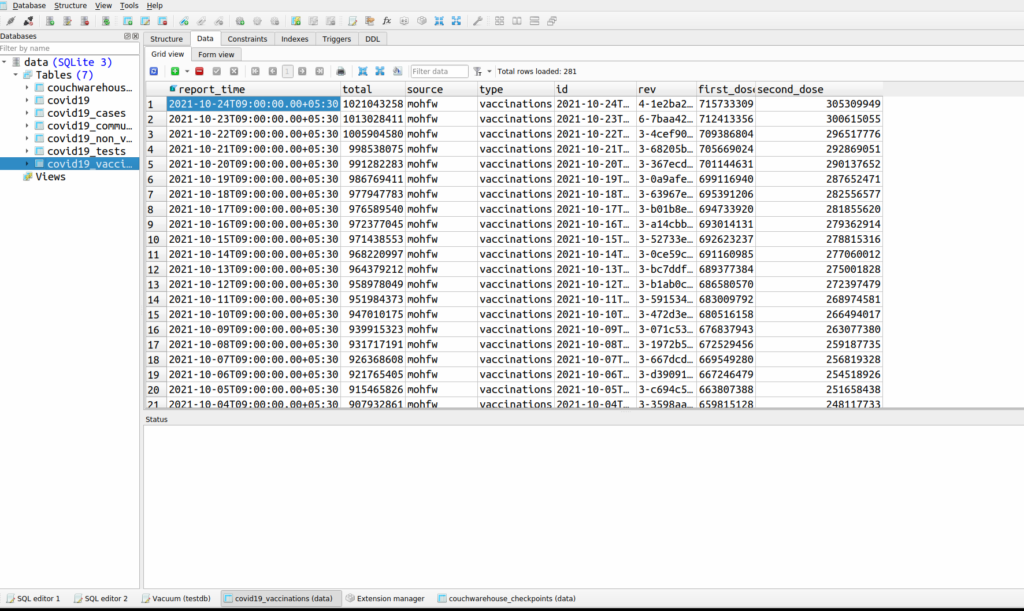
If you are following DataMeet's COVID19 git repository, you would have observed some changes in how Vaccination data is scaped and added. Until now, we were adding only total at the national level, and now it has first_dose and second_dose details at the national level.

{
  "_id": "2021-10-20T09:00:00.00+05:30|vaccinations",
  "_rev": "3-367ecd616d5b8af41da5d799fa1c34ad",
  "report_time": "2021-10-20T09:00:00.00+05:30",
  "total": 991282283,
  "source": "mohfw",
  "type": "vaccinations",
  "first_dose": 701144631,
  "second_dose": 290137652
}

I am working on bringing in the state data as well. I have written the PDF scraper. But it's not there yet, as the PDF format has changed multiple times. But by the end of November, we should have the state-level counts too.

Screenshot - SQLItePro showing COVID19 India Dataset

We also have a combined SQLite file now, which has each dataset as a separate table. This is useful for folks who want to use SQL instead of wrangling JSON. One could use tools like SQLite studio or DB browser to analyze the data or export to CSVs. Or you could use this online Datasette based data browser to explore. I am planning to update the SQLite file once a week.

I am yet to update the project page and documentation. Will do. PRs are welcome :)

The post DataMeet COVID19 Updates – Vaccination Data first appeared on Thejesh GN.
08 Nov 03:21

Better To Be Community-Driven Or Community-Powered?

by Richard Millington

Better To Be Community-Driven Or Community-Powered?

It’s more important to be powered than driven by a community.

In community driven, members drive the behaviors of the organisation. By some definitions, customers identify as members and the goal of the organisation is to strengthen and support the community.

You can probably spot the two obvious problems.

First, how many companies do you feel you are a member of right now? 2? 5? Taking a spot poll amongst some friends this morning, the answer is 0. Did you wake up with a strong urge this morning to increase that number? Probably not.

Second, if you let members drive the wheel, we’re reminded of Henry Ford’s (probably apocryphal) quote about getting faster horses instead of Model T cars. Or, to use a modern example, you get Boaty McBoatface. Your audiences simply don’t share the same goals, expertise, or understanding of the constraints as you do.

For example, let’s say you announce you’re going to depreciate a product feature because it’s built upon outdated technology/processes. If the feature is popular, the entire community might rise up against you doing it. Do you back down because you’re community-driven? Generally speaking, communities always want you to spend more, create better products, while they pay less.

I’m far more excited about organisations which are community-powered. This is a pragmatic approach. It recognises customers generally don’t identify as members. Instead they participate to satisfy their immediate needs (usually for information and to highlight things they want to change). A handful will also feel the urge to help others. You can use the activities and insights which take place within these communities to support all parts of your organisation (sales, marketing, customer support, success, product/engineering) – but you always retain control of the wheel.

In community-driven, the goal of the company is to build a better community.

In community-powered, the goal of the community is to build a better company

Perhaps it is semantics, but I suspect the latter will prove far more successful than the former.

The post Better To Be Community-Driven Or Community-Powered? first appeared on FeverBee.

08 Nov 03:17

Expert says 'bold' action needed on B.C. doctors and nurses accused of anti-vaccine misinformation

mkalus shared this story .

b'

More than a year after a B.C. doctor began circulating a letter declaring the COVID-19 pandemic "over" and speaking at rallies against masks and vaccines, there\'s still no resolution to the numerous complaints filed against him.

Dr. Stephen Malthouse, now the subject of further investigation for his alleged involvement with a business offering phoney mask and vaccine exemption \'certificates,\'\xc2\xa0is currently a fully licensed doctor with no limits on his medical practice, according to the College of Physicians and Surgeons.

That comes as a shock to Harry Cayton, an international expert on professional regulation who completed a review of B.C.\'s health colleges in 2019.

"If you are standing up in public and saying I\'m a doctor and I\'m going to say things which are contrary to good medical practice, then you are, I think, in breach of standards and you should be challenged by the regulator," Cayton told CBC News.

"That is very different from saying in the privacy of your own home to your spouse, \'I\'m not keen on this vaccination lark.\'"

Several health professional colleges in B.C. have had to confront concerns about licensed medical professionals discouraging COVID-19 vaccination and spreading unproven claims about the virus.\xc2\xa0

Just this week, the College of Nurses and Midwives issued a warning in response to public statements from unvaccinated nurses calling themselves \'NURZ\'s and declaring they are "divorcing" from the college because of B.C.\'s vaccine requirement for health-care workers.

These cases highlight a struggle Cayton says regulators around the world are dealing with as they attempt to draw a line between the importance of respecting personal opinion and encouraging scientific debate on the one hand, and keeping the public safe from COVID-19 on the other.

It also calls attention to the different approaches that Canadian provinces are taking when dealing with health professionals accused of spreading misinformation.

"If necessary, government has to step in and clarify the law around these things," Cayton said.

"We have to say that it\'s not in the public interest in the present circumstances for people to be discouraging other people from protecting themselves from the virus."

Ontario taking doctors to court

According to a petition filed by Malthouse in B.C. Supreme Court in June, the college has informed him of its intention to reprimand him and ban him from speaking about COVID-19 in response to complaints from at least 10 other physicians.

Malthouse has argued that\'s an infringement of his right to free speech and is asking for the courts to step in, claiming in his petition that his statements on the pandemic are "backed and supported by sound scientific and medical peer-reviewed literature and evidence."

The college says it is unable to comment on the proposed disciplinary action or the next step in that case.

In Ontario, on the other hand, three doctors have been banned from issuing mask and vaccine exemptions in recent weeks. That province\'s college has also filed court applications asking for a judge to compel four doctors to comply with investigations into their conduct related to COVID-19.

One of the doctors targeted by both measures, Dr. Rochagne\xc2\xa0Kilian, recently had her licence suspended as well.\xc2\xa0

There is no evidence of similar actions in B.C., despite clear similarities in the situation.

The Ontario college\'s application concerning Kilian, who previously practised in B.C., says the college "has received confirmation that she provides medical exemptions through Enable Air, a website which facilitates the purchase of vaccination exemptions."

<a href="http://EnableAir.com" rel="nofollow">EnableAir.com</a> is based in Kelowna. Though it has largely been taken offline, the website "indicated that if an individual applied for an exemption through the site, \'it is next to impossible that the physician would reject it,\'"\xc2\xa0the college\'s application says.

Malthouse is also under investigation in B.C. in connection with that website, following a complaint about a four-page "declaration certificate of medical exemption including psychosocial conditions" that he purportedly signed.\xc2\xa0

The certificate says it was produced by Enable Air, and the contact information on it matches the business and personal information of Dr. Gwyllyn Goddard, whose medical licence is temporarily inactive.\xc2\xa0

\'Regulators should not be hiding behind caution\'

Neither Malthouse nor Goddard have responded to questions about any involvement with the site, and nothing has been made public about possible\xc2\xa0action by the college.

Earlier this week, a college spokesperson said no official complaint had been filed related to Enable Air, and investigators had not seen a copy of a certificate produced through the website.

However, CBC News has reviewed emails confirming that a complaint was filed on Oct. 5, including a certificate purportedly signed by Malthouse and created on <a href="http://EnableAir.com" rel="nofollow">EnableAir.com</a>.

Asked to clarify the situation, the college spokesperson said she couldn\'t comment publicly on complaints or investigations because of privacy legislation.

The college has said that it\'s possible to restrict B.C. doctors from writing mask and vaccine exemptions if the evidence suggests they are providing fraudulent exemptions. However, a spokesperson said B.C. law would not allow a regulator to follow Ontario\'s example and take someone to court to force cooperation with investigators.

Cayton says if that\'s true, it\'s a problem.

"The professional must cooperate with the regulator, otherwise\xc2\xa0they\'re not regulated, to put it quite bluntly," he said.

He\'s calling on regulators to be "bold and take action" on professionals who are suspected of spreading false information and discouraging patients from being vaccinated.

"In these kinds of circumstances, regulators should not be hiding behind caution ... They should be saying the public interest is first and foremost, and let\'s test whether our legislation will allow us to take action," Cayton said.

'
08 Nov 03:15

Week Notes 21#44

by Ton Zijlstra

A pretty regular week, despite the government announcing a tightening of pandemic restrictions (after having seen most measures removed in September), in light of the rising case numbers heading into winter. It means face to face office meetings, the few we did, are again not taking place. Masks are mandatory in public places and shops again. I briefly contemplated going to a very large scale conference (10k people) in Barcelona later this month, but realised I felt uncomfortable about it, as well as seeing limited potential value in being there. I need and want to be more selective in opting to travel.

This week I

  • Had an extensive session with my business partners reviewing the 2020 and current year’s financials. I do the books for our company, and it was useful to provide the others a deeper insight into how things went and are going in this pandemic. We saw a slow down in activity this spring, in everything, probably general fatigue, visible on our side and with our customers. After the summer holiday we see a very different momentum, and the figures show a matching uptick.
  • Bought some cushions for the new couches in our office. We redid our office, removing a large part of the working desks, and adding two large couches. When I saw the couches this week, I realised they needed some colorful cushions.
  • Had a very useful day comparing the current results of the various work groups in the national digital twin for the built environment program. I’m part of the working group for a reference architecture, which intersects with the other working groups (e.g. on models and AI, on public values and ethics, on data, and on the state of play w.r.t. digital twins in the Netherlands). It was the first time that I saw the work in other groups in detail, and immediately different connections jumped out at me, to be followed up in the coming week.
  • Had a half day working session of the reference architecture group for the Dutch national digital twin
  • Spoke to a re-formed project team at a client we finished work for last spring, to discuss the progress we made and didn’t make until then, and our perpsective on what’s missing and next steps. It’s odd but sometimes as an external party you get to play the role of organisational memory for a client, and this was an example of that. Maybe next year we can do some more work for them when it comes to deploying data sharing as a policy instrument to enable and encourage others to act.
  • Went shopping with E, and now have all our Sinterklaas shopping done. Being this early, partly because of some signs of supply chain issues, creates an unexpected calm.
  • Did the monthly invoicing
  • Marked the 19th anniversary of this blog
  • Had our car towed, with a malfunctioning clutch pedal. Before our summer trip to Denmark I had added a component to our Volvo service subscription, extending car replacement from 3 to 30 days. Because if something happened in Denmark, I didn’t want to have to break off our stay there. This upgrade is valid for a year, and now comes in handy, as the repair of our car may take over 2 weeks before they have time for it. Meaning we now have a Volvo rental for that time without charge.
  • Wrote a proposal for a small additional component on my work on the EU data legislation, to compare it with existing Dutch government plans for potential public use of 3rd party (geographic) data.
  • Discussed with colleague J how to better visualise what our team is working on and how busy we really are(n’t)
  • With E put together Y’s new Ikea loft bed. By having Y sleep a bit higher up, she has an additional space in her room to play.
  • Went shopping again at the re-opened wholesale store I had to leave in a hurry last week because there was a fire.
  • Visited our teen-aged cousin M with E and Y, for his birthday party.


Waiting for a morning train at Vathorst station in the early low sunlight.


This is a RSS only posting for regular readers. Not secret, just unlisted. Comments / webmention / pingback all ok.
Read more about RSS Club
08 Nov 03:13

Columbia’s new Omni-Heat jacket keeps you warm and looks cool

by Brad Bennett

Columbia is revamping its Omni-Heat Infinity fabric with a new design that traps more warmth to help make lighter jackets and coats perform better.

Over the past month, I've been daily driving the Columbia Men's Labyrinth Omni-Heat Infinity Insulated Hooded Jacket to test out the new tech, and for the most part, I've enjoyed it. Part of the reason I agreed to do this review was that up until the winter of 2019, my main cold-weather jacket was an older Columbia Omni-Heat coat from 2014-2015. I loved that coat for its lightweight and impressive warmth. It was a bit heavier than the puffer I got to review, but it was still lighter than most winter jackets.

"While I wish I could expend the budget and the time to test out every single black puffer jacket from the $100 to $300 range to compare like some sort of Wirecutter employee's fever dream, I can't."

If you're unfamiliar with Omni-Heat, it's a form of reflective dots that Columbia attaches to a fabric that can reflect heat towards the body. This year's innovation is a tighter weave of these dots that can reflect even more heat back onto the wearer. Specifically, this new model can reflect up to 40 percent of heat while the original Omni-Heat only pushes back around 30 percent.

When talking to Haskell Beckham, the company's director of innovation, he shared that this tech can be applied in many different ways. For instance, Columbia's Omni-Heat Black Dot uses dots on the outside of the coat to absorb heat from the sun. When developing last year's tech, Columbia also learned how to colour the Omni-Heat foil, leading us to the new tech's fun space-inspired gold colour.

Yes, sadly, this means there's no magic in the new colour, other than the fact that it looks fantastic and has a little more flash compared to the older style of Omni-Heat. While I wish the gold meant something more, I love the space vibes that it puts out.

Beckham also shared that the tech works optimally with more layers underneath the jacket to help trap the reflected heat. This means that the coat would technically be more functional if the Omni-Heat fabric were under the down lining inside the jacket's outer shell, but then consumers wouldn't be able to see it.

These kinds of caveats surround the tech once you dive a little deeper as well. Columbia talks a lot about the innovation of Omni-Heat being both reflective and breathable. Still, it appears that the company knows that it could be pushing this tech even further to maximize heat retention, but it isn't. Some of the graphs even showed that the fabric becomes slightly less breathable past a certain point. I assume this is because the open top and bottom of the jacket still provide enough airflow for most circumstances.

Combining this with the fact that the tech would work better inside the jacket's lining doesn't give me the most confidence in Columbia as a consumer. In my time with the coat, it's been excellent, and I've enjoyed the fit, look and warmth of it, but I'm not sure if it actually presents enough upgrades over a traditional jacket to be worth its expensive $209 price tag. Especially something as light as this puffer. At least if you're wearing it on its own. As a base layer under a larger jacket with much more insulation, I could see the tech working more effectively in cold temperatures.

While I wish I could expend the budget and the time to test out every single black puffer jacket from the $100 to $300 range to compare like some sort of Wirecutter employee's fever dream, I can't. So all I can leave you with is what I've learned and the simple fact that I still like this jacket regardless of its issues. It's warm enough to be a good fall coat and light and thin enough to be a base layer on freezing days too. And as meaningless as the golden colour is, I love it (it can even double as a quick space costume).

Over the past month, there haven't been too many cold days in Toronto to test out the jacket with, but it has gotten down to around 5 degrees some nights, and if you're not layered up enough or doing something active, you will still get pretty cold in this coat. The other day it was around six degrees, and I was sitting in a park for about 30-minutes testing out the new Mavic 3. By the end of this outing, I was getting pretty chilly. Other days, when biking around with this jacket on I found it was a great windbreaker and had no problem keeping me warm when I was being more active.

Overall, I'd be less critical of the tech if Columbia wasn't pricing its Omni-Heat jacket at a premium in Canada for such meagre benefits over a traditional insulated puffer jacket, but that said, the fit and finish of the coat lives up to the quality you'd expect from the brand. With this in mind, if you like it or any other models in the Omni-Heat Infinity lineup, you can't go wrong with buying one. I'll likely be keeping my eye out for some sales on a heavier, more winterized version in Jan-Feb when the winter clothing sales start.

You can buy the Labyrinth Omni-Heat Infinity Insulated Hooded Jacket for $209.99 here.

MobileSyrup utilizes affiliate partnerships. These partnerships do not influence our editorial content, though MobileSyrup may earn a commission on purchases made via these links.

08 Nov 03:13

riding between two rail trails

by jnyyz

I’ve been logging my rides on a free website called Veloviewer for about three years now, and one of the fun things about it is that I can see how all of my rides overlap with time (i.e. a personal heat map). I can also track approximately how much new ground I cover by collecting tiles that are about a mile on a side. A while ago I mapped out a route specifically to connect the ride that I did along the Elora Cataract Trail with the rides that I have done on the Caledon Rail Trail. The route is shown below, and it follows part of a TBN route that covers the area around the Forks of the Credit.

Today had glorious weather, and so it was an ideal time to try out the route. While I was at it, I decided to take a little detour to cover the easternmost section of the Elora Cataract rail trail that I skipped the last time by starting in Erin and going west from that point.

Here is the official eastern end of the trail off of Cataract Rd. Note that this is not a great starting point as there is no parking. There were quite a few cars parked the next intersection west on Mississauga Rd, where there was space for about two dozen cars on the shoulder.

If you face the other direction (east) you see that the trail actually continues further east, but it is more of a narrow walking trail with no gravel laid down. It is easily bikeable; just be nice to all of the hikers and dog walkers.

The trail ends at Cataract Rd just near the Forks of the Credit Inn. There is not much parking available here either.

Here I am biking back west on the trail.

It’s that time of year where sections of the trail are covered in leaves, but the trail is in good condition with no nasty surprises like potholes.

The route uses Winston Churchill to descend the escarpment. Here is the intersection with the Caledon rail trail.

Heading back to the starting point in Inglewood.

Here is a map showing the tiles, and today’s ride provides a connection all the way from TO to Elora. I’m going to try to connect Elora to the rides that I’ve done along the G2G trail next.

08 Nov 03:12

Metabrand

by Benedict Evans

About 20 years ago, Deutsche Telekom bought a UK mobile network called One2One and rebranded it T-Mobile. One2One had been known for low prices and a weak network, so what was this new 'T-Mobile' thing? Well, it had low prices... and a weak network. They changed the name but didn't fix the product. 

If your brand has become toxic, and you create a new brand to leave that behind, pretty soon the same old problems will leach into your shiny new identity as well. A marketing person would probably suggest you do this the other way around - you should fix the problems first, and then decide how to communicate that. So why would Facebook move to ‘Meta’ today?

One answer might be that Facebook will not be fixed, whatever that means, any time soon. Two billion people use it every day, posting over 100bn messages - SMS at its peak handled only a quarter of that volume. When you connect two billion people, that includes all the bad people, and more importantly all of our own worst instincts, expressed and channeled in new ways. All social media companies are struggling with that realisation; Facebook now has forty thousand people working on this, which is why all of that research was there to be leaked, but it still isn’t ahead. Complexity, trade-offs, technology limitations, politics, misaligned incentives and structural dysfunction all collide. 

But meanwhile, though Facebook wrestles with toxicity (or even if you think it doesn’t care), it worries that teenagers prefer Snap or TikTok, and that Apple’s Tim Cook has his boot on their throat. These questions give Facebook's investment in VR (over $10bn this year, it disclosed in the accounts) and now ‘the metaverse’ existential urgency. If there is something after smart phones, Facebook wants to be the landlord, not a tenant. It wants to set the agenda and invent new experiences (and - let's be honest - it hasn't invented much itself for quite a long time). Of course, today this is as speculative as smartphones were in 2001 - VR seems stuck as a subset of games, and ‘metaverse’ is more mood-board than product. When I wrote about the term a few weeks ago, I described it as the new 'information superhighway' - a bunch of really interesting ideas on a whiteboard, that probably won't actually happen quite like that. There is probably some displacement here too - testing VR goggles is more fun than being shouted at in Congress.

But Facebook is protean- it shifts and turns and surfs user behaviour. It crushed MySpace and jumped from the web to mobile and then to Instagram. I think it would be wrong, or at least limited, to see this as a PR move - Facebook wants to move in a new direction. Perhaps ‘Facebook’ should be left behind as a ‘bad bank’ while Meta now builds quite new experiences again, this time perhaps even planning for those problems.

Indeed, it seems to me that the real rebrand this week wasn't Facebook to Meta but VR to Metaverse. VR is an old and pretty stale term - a dad brand - and Facebook wants to make VR into much more than just a headset and some games. It's trying to make that happen through sheer weight of investment, effort and organisational mass - Moore's law plus money and momentum will pull this into existence out of thin air (it hopes). Rebranding, reconceptualising, and relaunching might be part of that.

The trouble is, tech history is full of companies that dominated one generation trying to seize the next - they tend not to make it. The incumbents very rarely create the future, and the future very rarely comes from a centralised, $10bn project. Indeed, one might suggest that the problem with ‘the information superhighway’ was the word ‘the’ - it came with a presumption that there would be one, single, centralised project, probably built by companies like AT&T and Disney. When people say ‘our company is going to build the metaverse’ I get the same feeling - many of the ideas inside that will probably happen, but not as one project, and not with one name.

08 Nov 03:12

What (a subset of) Done Looks Like

I recently ran a workshop on managing research software projects, and one of the questions that came up was, “What does ‘done’ look like?” There are lots of answers elsewhere for the technical side [1, 2, 3], but what about project management and governance? Here’s a first cut of the artifacts used to support those activities for a project with up to a couple of dozen contributors; additions, deletions, and corrections would be very welcome. (As always, please email me: the last time I opened up comments on this site it took all of two days for the trolls to show up.)

  1. A shared Google Drive with a doc called “Roles and Responsibilities”
    • Google Doc because some collaborators aren’t comfortable with Git
      • And to make it easier to paste in figures and screenshots
    • Defines roles and explains what each is responsible for in one page
    • Each role has a doc of its own with its checklists
  2. The same shared Google Drive has one doc per year called (e.g.) “Progress 2022”
    • Section headings are weekly meeting dates
      • Table for each week with columns Name, Progress, Plans, and Problems (bullet points)
      • Anything too long to fit comfortably in the table is linked to an issue in the project’s GitHub repository
    • Project has a little script that lists issues and PRs touched by each person (reminder)
  3. Weekly hour-long status meeting (which often finishes early)
    • On Wednesday so that people aren’t scrambling on Friday or a weekend (or holiday Monday) to write status updates
    • Rotating moderator: last week’s moderator is this week’s note-taker
    • Before meeting, members star points in the status doc they want to discuss
    • Moderator draws up agenda based on starred items
  4. Proposals can be done as either Google Docs (in shared folder) or GitHub issues
    • Must be flagged to moderator the day before the meeting for inclusion
    • Added to agenda
  5. Project has a single repo with code, website, tutorials, etc.
    • So that releases are in sync
  6. Uses Google Docs (again) for publicity materials (because non-programmers)
    • All materials are owned by project account, not personal accounts
    • Every change larger than a typo produces a new doc
    • Every doc has date in title, e.g., “University Press Release 2022-05-13”
  7. Budgets for grant proposals, job contracts, etc., are stored in university system
    • Legal requirement
  8. GOVERNANCE.md in root directory of project explains Martha’s Rules
    • And membership rule: anyone who has had a PR merged in the last year or made some other significant contribution (as determined by the PI)
    • List of active members and alumni is in the foot of GOVERNANCE.md
  9. Another small script checks that the tags in each project repository are consistent and that each issue has at least one tag
  10. Project website has a “skills ladder” on the “Positions” page (even when positions aren’t open)
    • “What we mean by each of these terms for the research and coding tracks”
  11. Project website has a value statement and a contact address that isn’t anyone’s personal address
    • Plus a page for publications
    • Plus a page pointing at all repositories
    • Plus a “Getting Started” page
    • And a “Who’s Using Us How” page
    • And a “People” page
  12. The “help” option for the software includes the URL to the project page

A Note on Consensus

As Jo Freeman pointed out in “The Tyranny of Structurelessness”, every group has a power structure; the only question is whether it is explicit and accountable, or implicit and unaccountable. Unfortunately, GitHub’s Minimum Viable Governance guidelines duck this issue:

2.1. Consensus-Based Decision Making

Projects make decisions through consensus of the Maintainers. While explicit agreement of all Maintainers is preferred, it is not required for consensus. Rather, the Maintainers will determine consensus based on their good faith consideration of a number of factors, including the dominant view of the Contributors and nature of support and objections. The Maintainers will document evidence of consensus in accordance with these requirements.

In practice, since people’s idea of what constitutes “good faith” varies widely, “consensus-based” means governance by the self-confident, stubborn, and well-connected, which marginalizes a lot of people. Martha’s Rules and other procedures for putting proposals forward and voting on them aren’t perfect—democracy never is—but they’re better.

08 Nov 03:12

I don't know about you, but I'm feeling 75

by peter@rukavina.net (Peter Rukavina)

The Widow We Do Now? podcast continues to be an important source of support, solace, and inspiration. Last week’s episode featuring Constance Dahlbäck was particularly affecting, both for her reflections on life with her late partner, and on the life she’s living now.

The podcast has a companion private Facebook group, the “Widow Wives Club,” that has proved similarly helpful: having a space to blargh into, a space that’s safe, non-judgemental, and filled with people who know the terrain, that’s saved my emotional hide more than once over the last year.

A few days ago I posted this in the group:

I’ve realized recently that the process of supporting Catherine through 6 years of living with, and ultimately dying from, cancer made me feel like I was 75 years old: all that time in hospitals and hospice, all that fragility, all that ever-closer end.

But I’m not 75 years old, I’m 55 years old. And getting a handle on that, and remembering how to do that, that’s a thing.

Does anybody else feel this way?

This was a thought that emerged in a session with my therapist last week, a new conception for a discontinuity-with-everyone-else I’d been feeling for a long time.

The reaction to the post warmed my heart: I thought perhaps this was something I was uniquely feeling, but from the many replies starting with “YES!!” and “Every waking hour” and “Absolutely!” it seems like I put words to something many who spent a long time supporting a partner with an incurable illness experienced.

I met Catherine when I was 25; to emerge from the DeLorean of grief at age 55, after having spent a long season feeling 75, well, who the hell am I anyway?

I guess figuring that out is what’s next.

08 Nov 03:12

How large an impact does social conformity have on estimates?

by Derek Jones

People experience social pressure to conform to group norms. How big an impact might social pressure have on a developer’s estimate of the effort needed to implement some functionality?

If a manager suggests that the effort likely to be required is large/small, I would expect a developer to respond accordingly (even if the manager is thought to be incompetent; people like to keep their boss happy). Of course, customer opinions are also likely to have an impact, but what about fellow team members, or even the receptionist. Until somebody runs the experiments, we are going to have to do with non-software related tasks.

A study by Molleman, Kurversa, and van den Bos asked subjects (102 workers on Mechanical Turk) to estimate the number of animals in an image (which contained between 50 and 100 ants, flamingos, bees, cranes or crickets). Subjects were given 30 seconds to respond, and after typing their answer they were told that “another participant had estimated X“, and given 45 seconds to give a second estimate. The ‘social pressure’ estimate, X, was chosen to be around 15-25% larger/smaller than the estimate given (values from a previous experiment were randomly selected).

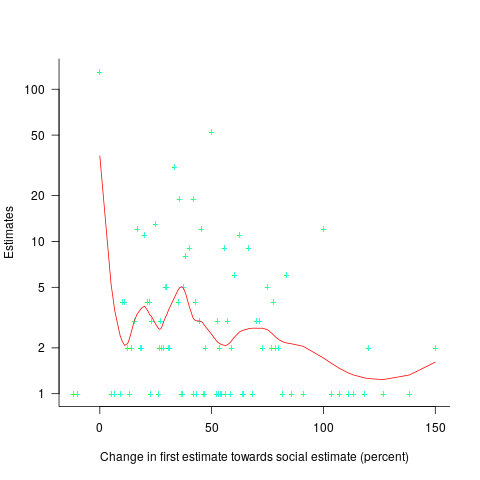
The plot below shows the number of second estimates where there was a given percentage change between the first and second estimates, red line is a loess fit; the formula used is {secondEstimate-firstEstimate}/{SocialEstimate-firstEstimate} (code+data):

Number of second estimates having a given change in the first estimate towards social estimate.

Around 25% of second estimates were unchanged, and 2% were changed to equal the social estimate. In two cases the second estimate was less than the first, and in eleven cases it was larger than the social estimate. Both the mean and median for shift towards the social estimate were just over 30% of the difference between the first estimate and the social estimate.

As with previous estimating studies, a few round numbers were often chosen. I was interested in finding out what impact the use of a round number value for the first estimate, or the social estimate, might have on the change in estimated value. The best regression model I could find showed that if the first estimate was exactly divisible by 5 (or 10), then the second estimate was likely to be around 5% larger. In fact divisible-by-5 was the only variable that had any predictive power.

My initial hypothesis was that the act of choosing a round numbers is an expression of uncertainty, and that this uncertainty increases the impact of the social estimate (when making the second estimate). An analysis of later experiments suggested that this pattern was illusionary (see below).

Modelling estimate values, rather than their differences, the equation: secondEstimate approx firstEstimate^{0.6}*SocialEstimate^{0.3} explains nearly all the variance present in the data.

Two weeks after the first experiment, all 102 subjects were asked to repeat the experiment (they each saw the same images, in the same order, and social estimates as in the first study); 69 subjects participated. Nine months after the first experiment, subjects were asked to repeat the experiment again; 47 subjects participated, again with each subject seeing the same images in the same order, and social estimates. Thirty-five subjects participated in all three experiments.

To what extent were subjects consistently influenced by the social estimate, across three identical sessions? The Pearson correlation coefficient between both the first/second experiment, and the first/third experiment, was around 0.6.

The impact of round numbers was completely different, i.e., no impact on the second, and a -7% impact on the third (i.e., a reduced change). So much for my initial hypothesis.

The exponents in the above equation did not change much for the data from the second and third reruns of the experiment.

The variability in the social estimates used in these experiments, involving image contents, differs from software estimates in that they were only 12-25% different from the first estimate. Software estimates often differ by significantly larger amounts (in fact, a 12% difference would probably be taken as agreement).

With some teams, people meet to thrash out a team estimate. Data is sometimes available on the final estimate, but data on the starting values is very hard to come by. Pointers to experiments where social estimates are significantly different (i.e., greater than 50%) from the ones given by subjects welcome.

08 Nov 03:11

Twitter Favorites: [JewelStaite] I don’t know who needs to hear this, but life is too short to finish a book you don’t like.

Jewel Staite @JewelStaite
I don’t know who needs to hear this, but life is too short to finish a book you don’t like.
07 Nov 03:49

Deno Deploy Beta 3

Deno Deploy Beta 3

I missed Deno Deploy when it first came out back in June: it's a really interesting new hosting environment for scripts written in Deno, Node.js creator Ryan Dahl's re-imagining of Node.js. Deno Deploy runs your code using v8 isolates running in 28 regions worldwide, with a clever BroadcastChannel mechanism (inspired by the browser API of the same name) that allows instances of the server-side code running in different regions to send each other messages. See the "via" link for my annotated version of a demo by Ondřej Žára that got me excited about what it can do.

Via My TILs

07 Nov 03:21

2021-11-05 General

by Ducky

Treatment

Fantastic news! Pfizer has a pill which, if you take it in the first three days after symptoms appear, cuts hospitalization by NINETY F PERCENT!!! If taken within the first five days, it’s ~85% effective.

The pill, called Paxlovid, is a protease inhibitor, which ought to be easy to make and have low side effects. It is so F effective that they stopped the trial early.

(Merck’s drug, molnupiravir, works by mutating the hell out of the virus’s genome which is okay only as long as there are SO MANY mutations that the SARS-CoV-2 virus just can’t cope. I worry that it could give rise to a hardier strain of SARS-CoV-2. Molnupiravir is also only 50% effective.)

I gotta say, Pfizer is TOTALLY WINNING at this pandemic: first a vaccine with 90% efficacy, then a pill with 90% efficacy. WINNING.

Transmission

This article reports that pets got sick with COVID-19 in the UK.

Recommended Reading

This article talks about the trade-offs in vaccinating kids. Spoiler: do it.

07 Nov 03:20

Lenovo Update

by Rui Carmo

It’s been almost three months since I got a Lenovo as my primary Linux laptop and installed Elementary on it, so I guess it’s time for an update on how that’s going. Spoiler: I installed Windows 11.

The short version is that I’ll eventually be installing Linux on it again, but not just yet.

The long version is that there were a few things that drove me to do this:

  • Elementary kept getting “stuck” while Alt-Tabing through windows, which I do a lot and was especially frustrating in a time-critical situation that led to my missing an opportunity to debug something.
  • I decided to take a stab at fixing the “plug in the manufacturer’s original power adapter” bug by upgrading the BIOS, and I just couldn’t find any way to do it while running Elementary.
  • I have become really used to Windows 11 window management features (including the SnapAssist layouts that appear when you hover on the maximize button), to the point where I miss them in both Linux and macOS.
  • I wanted to try out some music software (especially VSTs) that simply won’t run on Linux, and the Lenovo has a much beefier CPU than my 2016 MacBook Pro.
  • I also wanted to try out a bunch of other things (Unity, for instance) that I can’t currently run properly on my MacBook and didn’t want to have on a corporate machine. In fact, having a Windows machine without corporate device management was an added bonus.

Hardware-wise, there is little to say. The machine is very solid, although I’ve picked up a bit of occasional coil whine coming from a speaker in the late evenings and I’m a bit sad the Radeon graphics can’t drive my 5K display at full resolution.

The Tweaker Lifestyle

Mind you, life in Elementary was pretty nice. AppCenter just worked, and Elementary core components got daily fixes, so I could see new tweaks land on the OS every week.

And, like I wrote, Web (Epiphany) was indeed good enough for daily use and _nearly_ like Safari in that regard. It has some layout and JavaScript bugs, though, so I spent a while inside Firefox - but eventually installed the Edge beta for Linux for bookmark and password syncing across all my machines. That's right, no more 1Password...

After a couple of kernel updates, fan noise had become sporadic, power management was working better and I hadn’t experienced any significant annoyances other than one time when the machine was “trickle charging” and did not fully charge overnight (which also drove me to update the BIOS).

Fiddling with cpufreq (for which I found a nice GUI) allowed me to tweak power consumption to an insane degree (like having only 2 CPU cores online at half speed), which eliminated fan noise altogether and boosted battery life.

So yes, it’s still a great OS, and I expect it will be very much improved when I get back to it.

Windows Pluses

After getting everything set up (essentially Windows, all the updates, PowerToys, Fira Code, Bitwig and WSL, inside which I set up Docker and my dotfiles), a few things were immediately apparent:

  • Having fractional font scaling was a significant improvement.
  • The Lenovo trackpad supports all the Windows multitasking gestures (some of which Elementary doesn’t have equivalents for), which makes for a definitively superior multitasking experience that is unrivaled except on the Mac (and even then I’m missing SnapAssist there).
  • Quake Champions (which I made a point of installing Steam for, to compare with what I’d seen earlier) was able to get to 60fps steadily on the 5700G.
  • Everything I plugged in to the machine just worked (some USB MIDI devices just wouldn’t register under Elementary for some reason).

Also, I finally found a use case for flipping the screen and using the machine as a tablet (running Bitwig, which has amazing touch screen support), and Windows obligingly flipped the display orientation automatically, without any Lenovo-specific software installed.

Update: It bears noting that I’ve also installed a few creature comforts like RoundedTB for a nicer looking taskbar and Winaero Tweaker to get rid of the glaring white titlebars in legacy apps. Also, Unity and Unreal Editor mostly work on this hardware, which is quite nice (although I have no ready use for them as yet).

Linux Development in Windows

I still needed Linux to work on my personal projects, though, so I installed WSL2 with Ubuntu 20.04 LTS inside.

I’m not going to go on about WSL other than point out that Windows Terminal is in the Windows Store and (since it now allows me to hide scrollbars) I now consider it good enough for daily use.

Filesystem shenainigans aside (I have a few Windows paths symlinked from WSL for sanity, like Documents, SyncThing and Downloads) it is essentally the same thing as popping open any other terminal window on any UNIX system, and a far cry from the days I would hack things inside Cygwin to get them to run under Windows NT.

Like I wrote almost five years ago now, It just works, and the only caveat is that I don’t have full hardware device access (although some USB serial devices poke through). But only someone like me would notice (or need) that.

There are a number of recent improvements as well, but I have zero interest or use for running graphical Linux stuff via WSLg right now, so I haven’t even tried most of them – I just open a full-screen terminal window with tmux (or VS Code using the Remote extension) and get to work.

The only real caveat is that my current setup hinges on running SyncThing to have all my git repositories instantly, brainlessly synced across my machines, and that running it on Windows works well until you try to run git from inside WSL2 and accessing the Windows filesystem – which feels dog slow in comparison with just having a clone inside WSL’s VM when (like me) you have repos that are around 2GB in size.

I just moved those into WSL and began syncing them manually. It’s not a problem on this machine.

The Minuses

There are, however, various annoyances worth reporting on:

  • The AMD Radeon software sucks (visually and in terms of user experience) so badly I regret ever having installed it to see if it would improve graphics performance, and it stopped working after Windows Update installed its own updated graphics drivers. I had seriously forgotten how bad PC software was…
  • Using Surface devices has spoiled me, and I was shocked when I actually tried to use Lenovo’s 720p webcam for a Zoom call (which I wouldn’t have done under Linux). The good news is that plugging in a Logitech BRIO also afforded me Windows Hello face recognition, which was useful on my desk.
  • Font rendering is still not as (subjectively) good on a 1080p display as on the Mac or Linux (again, Surface HIDPI screens have spoiled me). I have learned to tune it out when working and have taken the time to go through the Adjust ClearType text wizard, but it still looks like pants.
  • For whatever reason, many application windows tend to have white title bars and dialog boxes even in dark mode, which is extremely annoying. Although I use Windows daily for work, I hardly ever open anything else besides Edge, Office and Teams, so wading into the world of Win32 apps yielded a bunch of weird surprises like this that were all the more apparent after being able to spend three months in Linux, where the only white on display came from web pages and text.
  • Worse, besides legacy Win32 apps, there are still various essential system utilities (like Task Manager) which apparently can’t even think about using dark mode, and the white title bars are just hideous when in what I’m now calling “faux dark” mode (something I grumble about every time I have the occasion).

And, of course, the machine never crashed when running Linux, whereas the very first time we decided to record a podcast episode, it crashed exactly when I was using Audacity to export my end of the conversation – instant reboot when hitting Save, but fortunately Audacity was able to recover the session.

I’m hoping that was a one-off (I’ve had pretty much zero crashes on any of my Windows machines this year, to be honest, but then again I haven’t done any serious media work on any of them). If it isn’t, I’ll likely be back on Linux before the end of the year.

Update: I have a suspicion that was due to the AMD High Definition Audio Device driver, which I’ve since disabled. Let’s wait and see…


07 Nov 03:18

Tesla Canada to locate manufacturing facility in Markham, Ontario

by Jonathan Lamont

Markham, Ontario Mayor shared on social media that Tesla Canada would locate a manufacturing facility in the city to produce manufacturing equipment for use at the company's 'gigafactories.'

In a post on Twitter and Instagram, Frank Scarpitti welcomed Tesla, calling it a great addition to "the 'future car' cluster of companies" in Markham. You can read the full quote from the image below:

"I am delighted to share that Tesla Canada is joining our already robust automotive and technology ecosystem by locating a manufacturing facility in the City of Markham. The facility will be the first branded Tesla Canada manufacturing facility in Canada and will produce state-of-the-art manufacturing equipment to be used at the Gigafactories located around the world in the production of batteries."

https://twitter.com/frankscarpitti/status/1456335788170481673?s=20

Scarpitti also clarified that the manufacturing facility would be located "just south of Highway 7 west of Warden."

The mayor's announcement comes just days after Tesla Canada put out a call for applications on LinkedIn, which also included a recruitment video republished by Tesla North on YouTube.

https://youtu.be/xsuiqaP8pjs

The video shows a short interview with employees at the Markham location who work on battery development, factory design, charging infrastructure, battery CNC machine programming and more.

Source: Frank Scarpitti (Twitter) Via: Tesla North

07 Nov 03:18

Five-word movie review: “Finch”

by sheppy

Charming. Funny. Sad. Delightful robot.

07 Nov 03:18

The Club of Rome and Prince Edward Island

by peter@rukavina.net (Peter Rukavina)

Through this WWF panel discussion at COP26 I was introduced to Sandrine Dixson-Declève, Co-President of The Club of Rome, and seeking further context I found my way to her presentation on the 1.5-Degree Lifestyles Report. From her talk:

I would like to first start by reminding everyone that actually a lot of this discussion already started in 1972 with The Limits to Growth, and I just want to read something that I think is absolutely fundamental when we talk about systems change and lifestyle change, which was already said and pronounced in 1972 by Donella Meadows:

“People don’t need enormous cars, they need admiration and respect; they don’t need a constant stream of new clothes, they need to feel that others consider them to be attractive, and they need excitement and variety and beauty; they don’t need electronic entertainment they need something interesting to occupy their minds and emotion…”

While there’s a back-to-the-land quality to Meadows’ words, the larger notion that when we’re looking at systems change we should be looking at the fundamentals, not one-for-one replacement, remains vital.

This is, for example, a place where the shift to electric vehicles needs a closer look: we tend to look at this issue as “we need to replace our bad cars with good cars,” when we would be better served by framing the issue as “we need a way of getting from place to place” (or, even better, by asking “do we really need to get from place to place so much?”).

The Club of Rome played a larger-than-life role in the environmental history of Prince Edward Island; as the late Andy Wells told me when I interviewed him in 2009:

The first thing I came across was a videotape of the Club of Rome, and I persuaded [Premier] Alex [Campbell] to bring his whole cabinet together and to come down and sit in the viewing room and we played this video, and Alex converted immediately; he understood the problem. 

From Wade MacLauchlan’s biography of Premier Campbell, Alex B. Campbell: The Prince Edward Island Premier who Rocked the Cradle:

The economic positions that Campbell articulated as early as 1967 can be seen as a quest for local specificity, viability, esteem and quality of life. He promoted a vision for Canada’s national economy based on competitive and complementary regional inputs. His practical quest was for self-reliance for Prince Edward Island and the Atlantic region. In philosophical terms, Campbell’s arguments were a forerunner of debates about globalization that dominated the 1980s, or ongoing debates about the environment and limits to growth.

Campbell’s quest for “local specificity, viability, esteem and quality of life” finds echoes in The 1.5-Degree Lifestyles Report:

The focus of this report is on lifestyles and climate change. Lifestyles embrace much more than just consumption patterns and behaviours. Lifestyles include non-economic aspects of our lives, such as caring for children or elderly parents, spending time with our friends, play, engaging in voluntary work, activism, or supporting a local campaign or political party. All of these potentially affect, directly or indirectly, our well- being and our carbon footprint. Lifestyles are how we consume, and also how we relate to one another, what kind of neighbours, friends, citizens, and parents we are, what kinds of values we nurture, and how we let those values drive our choices.

These issues are largely missing from recent local political discussion of climate change mitigation and adaptation, which has primarily focused on the technical aspects of lowering GHGs, and has not taken a larger view of the lifestyle changes that will necessarily underpin the societal transformation we should be in the midst of right now if we’re going to meet our climate commitments. The depth of the political discussion rarely strays beyond “things can stay much the same, just with heat pumps and solar panels and bike paths,” and almost completely absent is a drive to seek consensus on how we will spend the much, much smaller carbon budget we’ll have in a just fashion.

07 Nov 03:04

From the Bay to the Bayou: 10 places that are steeped in Filipino American history - The Points Guy

06 Nov 02:24

Fishy arguments

by Chris Grey
It’s been a horrible week for Brexit news, and a depressing one for any hope that UK-EU relations will settle into harmony or, at least, pragmatic cooperation. Careful readers of this blog will have been primed for the resumption of the Jersey fishing rights row this autumn, and almost everyone expected a crisis over the Northern Ireland Protocol (NIP). With both happening simultaneously, it’s important to understand how they do and don’t relate to each other, not least because it’s clear that the Brexiters and the government are intent on lumping them together in false and hypocritical ways. But that’s also a difficult task, because each of them involves considerable complexity – hence an even longer than usual post.

Fishing licences row

As regards the row over licences for French boats, it is a complicated story as fishing stories always are. It is partly about the issuing of licences to fish in the 6-12 nautical mile zone by the UK generally (licences for the 12-200 mile zone are effectively granted automatically). However, the central issue relates to the large number of rejected or outstanding applications to fish in Channel Island waters, which first erupted in May. That adds another layer of complexity because of the distinctive constitutional status of the Channel Islands.

Jersey and Guernsey

The Jersey dispute arises from Brexit because the Trade and Cooperation Agreement (TCA) superseded the Anglo-French Granville Bay Agreement. The latter agreement was originally created, following numerous disputes between Jersey and France, in 1839 and was updated in 2000 with implementation in 2004. Scrapping it as part of Brexit was strongly lobbied for by the Jersey Fishermen’s Association during the TCA negotiations. Separately, the UK also chose to leave the 1964 London Fisheries Convention causing problems for fishing around Guernsey, Alderney and Sark.

As well as having that difference in historical background, the Guernsey problems have so far been quietly dealt with because its approach has been to issue interim licences until 31 October 2021, automatically renewable monthly until full new licences are issued in December to be in force from 31 January 2022 [1]. By contrast, the Jersey approach has resulted in a mixture of boats fully licensed, boats temporarily licensed until 31 January 2022, and boats which had an ‘amnesty’ until, in effect, 31 October 2021 but with no renewability unless transferred to the temporary licensing list. It is the latter boats which are at the centre of the row. This Guernsey-Jersey distinction is a niche issue, to say the least, yet it seems an important and neglected part of the story.

Bogus comparisons

At all events it is crucial to grasp that this row is primarily over licences for Jersey waters, which are issued by the Jersey government, given that central to France’s complaint is an alleged disparity between the UK’s treatment of its boats and those of other EU states. Thus Clément Beaune, France’s Minister for European Affairs, tweeted in response to David Frost that whereas about 90% of all EU licence requests had been granted by the UK [2], France had not received licences for 40% of its requests. The implication was that France was being discriminated against.

However, it was a bogus comparison because the majority (59%) of France’s ungranted licences are applications to fish in Jersey waters, and France seems to be the only EU country with boats applying for such licences (certainly, all licences so far granted by Jersey are to French boats). Moreover all of the small (under 12 metre) boats and about 80% of the large boats seeking UK (not Channel Islands) 6-12 mile licences are French. It is these smaller boats which are far more likely to have ungranted licences because they tend to lack the expensive GPS systems needed to readily provide the data required to prove they have an historical record of fishing in the relevant waters.

This means that, as a matter of simple arithmetic, France’s number and proportion of ungranted licences is bound to be far greater than any other EU country, not because it is being discriminated against but just because it is the only EU country involved in the vast majority of relevant applications (i.e. small boats in the inner zone around the UK and Jersey). It would be equally absurd to say that, because all the Jersey licences for EU boats have gone to France, it has been specially favoured! In fact, the only inter-country comparison that can be made for the applications over which the UK has discretion is between France and the other country seeking large boat licences in the UK inner zone, Belgium, which has 19% of its licences still pending (i.e. 81% granted) whereas France has only 3% pending (i.e. 97% granted).

This isn’t to say that France has no grievance at all – a key point is that had the TCA negotiations not been so truncated, at British insistence, the details of licensing data requirements for small boats could have been agreed. Nor is France behaving particularly heinously. After all, it’s hardly the only country in the world to make bellicose noises about fishing rights! But the grievance is not especially serious (although of course it matters hugely to the fishermen affected) and it’s not the grievance of discriminatory treatment claimed.

Contradictory conduct

Moreover, France’s conduct has been somewhat contradictory. On the one hand, it has been acting as if this were still an Anglo-French matter. That is despite the fact that France, like Jersey, had wanted Channel Islands fisheries to become part of the TCA - although, interestingly, during the May crisis, the French Minister of the Sea called for the Granville Bay Agreement to be reactivated and in September France called for a revival of consultative process of the old agreement. Yet, on the other hand, it has been seeking to make it a UK-EU dispute.

These are contradictory to the extent that, viewed as a UK-EU dispute, making threats of unilateral French action against British boats and imports, or raising energy supply tariffs to Jersey, is not only arguably disproportionate to the grievance but also arguably illegitimate. The UK government has suggested such action would be a breach of the TCA. The French argument is that it would be ‘retorsion’, falling outside of the Dispute Resolution Mechanisms of the TCA [3]. Yet, at the same time, French Prime Minister Jean Castex requested concerted EU action in a letter to European Commission President Ursula von der Leyen which was leaked last weekend (and of which more later).

In fact, the European Commission has been notably unwilling to ‘take France’s side’ or to escalate the row politically, perhaps recognizing that the grievance claim is rather overblown. Rather, it has acted as a broker, arranging technical meetings between British, French and Channel Island authorities. This led (unless it was a coincidence) to Jersey issuing some forty-nine further licences on Monday, and France subsequently suspending its threat of unilateral sanctions. On Thursday, Frost and Beaune met – itself perhaps slightly odd if this is seen as a UK-EU dispute – without apparent outcome but with no new flare-up of hostilities either. This isn’t the end of the story as there are still talks to come, and the new licences granted are only temporary, but as the week has gone on the row has certainly de-escalated.

Yet much damage has been done. Apart from a further deterioration in the Anglo-French relationship, Brexiters and the UK government have been all too keen to build upon the conflation of the Anglo-French and UK-EU aspects of the row to try to link it with their wider confrontational approach to Britain’s post-Brexit relations with the EU, especially as regards the NIP. So, in what was already a fraught situation, the fisheries row has exacerbated a “poisonous atmosphere” for the NIP talks (£).

Northern Ireland Protocol row

The NIP is bound up with a similarly long and far more fraught history, this time between the UK and Ireland, which is far too complex to review here. Crucially it too grows from (though does not supersede but seeks to accommodate) a situation defined by a pre-existing agreement between two member states of the EU, i.e. the 1998 Good Friday (Belfast) Agreement (GFA). Moreover, this agreement was to a large degree predicated upon both parties being member states, in that the EU single market and customs union had removed the need for an economic border between Ireland and Northern Ireland prior to the GFA and thereby created an important pre-condition for it.

So in both cases inter-governmental relationships became ameliorated by being enfolded within common membership of the EU and have been disrupted by Brexit. It’s not difficult to see how the longstanding UK-Spain dispute over Gibraltar falls into the same category, for all that it isn’t currently so fractious. The argument that the EU played a role in maintaining peace was mocked by Brexiters during the referendum campaign with the reductio ad absurdum that to point to it was to predict that Brexit would mean World War Three. But it is a fact that many longstanding disputes between member states have, at least, been de-escalated by virtue of membership of the EU.

Indeed, that’s underscored by Boris Johnson’s call upon Ursula von der Leyen to intervene in the fishing dispute with France. Actually, as an interesting article by Gideon Rachman suggests this week (£), it is probably the US which is best-placed to act as some sort of mediator between the UK and France over their now constant acrimony. The same may well be true as regards UK-EU relations, and if the NIP row escalates to a UK invocation of Article 16, as many expect, I wouldn’t be surprised to see some such initiative from Joe Biden’s administration, for all that the Brexiters distrust him.

Differences and connections

However, although in both cases Brexit has thrown up new problems, they are problems of a fundamentally different sort. As regards fishing rights, the French accusation is that the UK is not sticking to what it agreed in the TCA, but not questioning the terms of what was agreed. As regards Northern Ireland, the UK accusation is, first, that the EU is sticking too rigidly to what was agreed in the NIP and, second, that the terms of what was agreed are unacceptable.

Yet despite being different in these ways, both sides see the issues as being linked. For France, and perhaps the EU, they are both examples of UK duplicity and bad faith. This may well be unfair to the UK in terms of fishing licences, but it is certainly not as regards the NIP and goes to show the high price to be paid for serial dishonesty: it completely undermines credibility.

For the UK, what is now erroneously being called ‘the punishment letter’ from Castex to the European Commission President about fishing licences is being used to suggest that the EU’s entire approach to Brexit, including the NIP, is one of seeking to punish the UK. As ever, the liar-in-chief is Boris Johnson, who said (£) that Castex was “explicitly asking for Britain to be punished for leaving the EU”. In fact, the word ‘punish’ or its cognates didn’t appear in the letter. The relevant sentence would best be translated as “It is essential to clearly show to European public opinion that respect for commitments made is non-negotiable and that there is more damage in leaving the union than in remaining there.”

As such, this is just the boilerplate EU position that it must be demonstrably better to be a member than not to be, otherwise the union, like any other, has no purpose. Actually, If anything, the EU’s conduct over the fishing row, which has been placatory and not markedly supportive of France, shows the opposite of a punitive stance to Britain.

By pretending that the letter threatens ‘punishment’, an ever-present Brexiter myth is being invoked, as when in 2017 Johnson spoke of France trying to “administer punishment beatings”. In this current invocation it uses what Castex (didn’t) say as regards fishing to bolster the longstanding falsehood that the NIP and ultimately the entire issue of the Irish border was invented by the EU to punish the UK for Brexit and that they succeeded because of the failures of Theresa May’s government. Notably this position was re-iterated in David Frost’s foreword to a Policy Exchange document on the NIP published this week.

So there is a triple lie here: a lie about what Castex said about the fishing row, a lie about the reasons for the NIP, and a lie about the implications of the fishing row letter for the NIP row. The latter lie involves an entirely opportunistic and false equivalence, in the same way as that endlessly drawn between the quickly abandoned EU proposal to invoke Article 16 over vaccines and the UK’s current threat to do so.

No need to take sides

Because of this incontinent flood of lies, there is a temptation for erstwhile remainers to ‘side with France’ in all aspects of the fisheries row. It is also tempting because the Brexiters are trying to use the row with France to drum up jingoistic support for Brexit just at the time that the economic damage of Brexit is becoming so obvious. But these are not good reasons to support France’s stance, any more than they were when some sought to defend the EU’s Article 16 foolish mis-step over vaccines in the face of the Brexiters’ lies and jingoism about that.

It is neither necessary nor right to embrace the ‘them versus us’ logic of Brexiters. The dividing line on both the fishing and the NIP issues is a clear and principled one which is solely about who is abiding by, and who is flouting, the terms of what was agreed. Being sucked into supporting France when it is not especially warranted simply plays into the hands of those Brexiters who want to paint ‘remainers’ as unpatriotic, and to use such tactics to discredit or divert attention from the follies of Brexit. It also undermines the legitimate defence of the EU’s position as regards the NIP by enabling the accusation that those who are opposed to Brexit blindly support the ‘other side’, using their stance on the fishing row as proof.

On the other hand, it is perfectly justifiable to point to the hypocrisy of the Brexiters and the government. After all, they constantly call for the EU to be ‘flexible’ in its implementation not just of the NIP but also of import controls generally (remember the outcry over the ‘ham sandwich confiscation’). So why not offer flexibility over fishing licences, especially as the row revolves around a few small boats? Equally, for all that the French threats of unilateral action were unjustified, it is rank hypocrisy for the government to be invoking respect for international law and good faith when it has shown so little of either over the NIP.

The clocks (don’t) go back

As to that, Frost continues to escalate the rhetoric, which suggests that the triggering of Article 16 is in the offing and, with that, as the Irish Taoiseach warned this week, a very serious crisis. Frost meets Maros Sefcovic today, which may yield further clues as to whether that will happen. However, as I’ve repeatedly argued, there is little point in speculating about the intentions of a government whose intentions are entirely opaque, perhaps even to itself.

That said, reports that the government plans to rig the legal advice to justify invoking Article 16 (£) are very ominous. And the Policy Exchange document Frost forwarded makes it clearer than ever that Brexiters see phase 1 of the Article 50 negotiations, in 2017, as having being pivotal (correctly, in my view, though I don’t agree with their explanation or conclusions). Equally clearly, they, and more particularly Johnson and Frost, think they can use Article 16 to re-wind the clock and have another shot at getting ‘true Brexit’.

Whatever else happens, they will fail in that. History, politics, and indeed physics, don’t work like that. As for ‘true Brexit’, it remains as elusive as ever, the fading illusion of a dwindling number of the deluded and the deranged. All we have are the realities of Brexit. These, in the form of this week’s bickering and dishonesty, have been on display to the world because of COP-26, with a cringingly ‘larky’ speech from our manifestly inadequate Prime Minister.

Imagine how different that might have been had the UK still been a leading partner within the huge EU economic and diplomatic power bloc. Or imagine if, as the Brexiters promised, the UK was striding self-confidently forward as Global Britain, admired and respected throughout the world, rather than the laughing stock Brexit has made us. Amongst the many crimes of Brexit is to have robbed us of the former possibility on the fraudulent prospectus of the latter. There’s no way to turn the clock back on that.


Notes

[1] This also means that the implied complaint in the Castex letter that Guernsey has issued no permanent licences, and therefore fewer even than the UK and Jersey, is misconceived – it is only because that point in the process hasn’t been reached, but French boats are able to fish in Guernsey waters in the meantime. This is quite different to the situation of those boats which have neither permanent nor temporary licences from Jersey.

[2] The UK government gives the figure as 98%, but this is misleading, especially in the context of this row, as it excludes the Channel Islands figures. With those taken into account the French claim of about 90% is right (in fact, it’s closer to 88% on the basis of the UK government’s statement of licences issued as at 3 November – this statement is the source of all the statistics cited in this post for licences granted other than where other links are provided).

[3] The entire situation is a complicated one because the specific fisheries dispute settlement mechanism within the TCA does allow some retaliatory measures to be taken in advance of arbitration, but with various rules and processes attached. A further complication is that some of the provisions within that specific mechanism don’t apply to the Channel Islands. And yet another complication is that the UK government seems to be envisaging a counter-action to any French actions under the general TCA disputes settlement mechanism rather than that specific to fisheries. I don’t pretend to have any expertise at all in this arcane topic but for those seeking to make sense of it there is an Institute for Government overview, a more detailed House of Commons Library briefing, and a lengthy blog post on Professor Steve Peers’ EU Law Analysis website. I’m very grateful to Professor Peers for answering my queries on this topic whilst preparing this post – all errors are of course my own.

06 Nov 02:13

A half-hour to learn Rust

A half-hour to learn Rust

I haven't tried to write any Rust yet but I occasionally find myself wanting to read it, and I find some of the syntax really difficult to get my head around. This article helped a lot: it provides a quick but thorough introduction to most of Rust's syntax, with clearly explained snippet examples for each one.

06 Nov 01:27

Twitter Favorites: [rcousine] UTC will come for us all, and we will like it. #utceverywhere https://t.co/Zue4z6BkdR

Ryan Cousineau @rcousine
UTC will come for us all, and we will like it. #utceverywhere twitter.com/sillygwailo/st…
06 Nov 01:26

Twitter Favorites: [RM_Transit] Should I make a Toronto Transit Tour on Google My Maps where someone can see the best Toronto Transit has to offer in one single evening?

Reece Martin @RM_Transit
Should I make a Toronto Transit Tour on Google My Maps where someone can see the best Toronto Transit has to offer in one single evening?
06 Nov 01:26

Fight + Build = Power

by thornet

At Mozilla, I’m working with the talented Brandi Geurkink to explore how our advocacy and movement-building towards climate justice could better complement each other. We were struggling with immediate actions versus building up positions.

The “Fight + Build = Power” model by Geoffrey MacDougall really helped unlock how to think about addressing both the urgent and the long-term goals.

Here’s an excerpt from Geoffrey’s great post:

Fighting gives you urgency and consequence. Building gives you hope and endurance. You need both.

Fighting is an active frame full of individual agency, possibility, and passion. There is a villain to provide the urgency and the ‘other’ to help define the moment and the identity of the group of people pushing back. Fight narratives are like adrenaline shots. They do a massive amount of work in a very short time, but wear out really quickly.

The build narrative provides the aspiration. What you’re trying to achieve, rather than prevent. The hope and sense of shared creation. The build narrative tells you what’s possible, where you’re going, and why it matters. It’s also lasting: it’s what will keep someone engaged over years, rather than hours or weeks.

06 Nov 01:25

Audiophile Audiophoolery: 90% wrong about turntables

by vwestlife
mkalus shared this story from vwestlife's YouTube Videos.

b'
\n \n
\n
\n From: vwestlife
\n Duration: 08:00
\n

\n

A major audiophile equipment retailer publishes a claim about turntables that\'s so blatantly false, it\'s enough to make you blow a fuse!

\n '
06 Nov 01:25

Political labels and the question of scale

FIRSTLY.

This is a tough but intriguing one: The Sound of Music is ostensibly a movie about homely Austrians resisting the invading fascists.

But Slavoj Zizek explains that it is also a pro-fascist movie.

Zizek’s argument: the heroes of the movie are these anti-intellectual Austrians who are living a traditional life, i.e. rejecting change. Therefore they have a fascistic quality. Whereas the type Nazis shown not soldiers but urbane cosmopolitans, precisely the elite class that (populist) fascists want to eliminate.

So while the surface narrative is about beating the Nazis, the underlying message has us rooting for a fascistic mindset.

It’s… a stretch. If true then maybe that’s why the movie continues to feel so fresh: because it runs counter to our expectations every time. (But I enjoy being challenged to think about things like this, especially a film that I’ve seen so many times.)

The meta here, I suppose, is that we all have a fascistic tendency and that’s why the traditional Austrian life appeals: the desire to resist change, and to exert control on others and the world. Sometimes that’s unhealthy (I mean, clearly when it comes to Nazis, but also authoritarianism in general, and also when it is generally unwarranted and connected with fury when the world - understandably - doesn’t immediately accord to one’s whim). But sometimes it is fine: gardening, parenting, management, design, all forms of control that are generally a-o.k… though I imagine we can all recall examples where even these have become over-controlling. And so the line must be policed.


SECONDLY, in my series of two disjointed thoughts about politics:

I’m just back from Center Parcs which - for US readers - is a certain kind of British/European/middle class phenomenon.

Each Center Parcs location is a forest village with hundreds of almost identical, comfortably furnished self-catered lodges (ours had a hot tub). Cars are banned except on moving days; you cycle everywhere. There are tons of activities such as swimming, zip lines, sports, pottery, woodland walks, falconry, etc.

So let’s be clear: it’s super fun and I’ve had a wonderful week of full-on family time, swimming, biking, star gazing, and adventuring.

It is utopia made from market communism. It is undeniably gorgeous to be cycling from activity to activity in the woods. You sign up for activities by paying a moderate fee but we all get to choose from the same relatively small set of choices. It’s a captured market: a fine resource allocation mechanism, but not allowed to run rampant. Variation is within limits. We live equally.

BUT.

There are the workers, of course. The cleaners, the foresters, the shop cashiers, and so on. So another way of looking at this communist idyll is to call it totalitarian class capitalism. The consumer and worker classes may never cross; the consumer class lives a life of luxury but at the expense of freedom.

All of which has left me a little at sea about political descriptions.

Functionally it seems like market communism and totalitarian class capitalism are equivalent, so what’s the point of holding a political position? Maybe we need other ways to describe the differences between things?

OR maybe these two labels are simultaneously true, only at different scales or social “distances”. It’s communist for me and people like me, looking from the inside. It’s totalitarian looking from the outside. Taking one step further away, one bubble further out, it’s class capitalism.


And I wonder how much political differences and positions would make more sense if we clarified the scale and the stance.

You might be socialist for “people like us” (whatever that means: class, ethnicity, nation) and neoliberal outside that. But that means something entirely different depending on your position and where you draw the line for “like me”. Maybe the lesson from The Sound of Music is that fascistic tendencies are actually pretty normal at certain scales and from certain perspectives.

This goes back to oikos vs polis (May 2021) which is basically blood vs state, two ends of the scale: which do you privilege.

Anyway.

06 Nov 01:24

Editing a background check policy

by Luis Villa

We’re implementing a background check policy for some roles at Tidelift, because we see security-critical information from our customers. Our background check provider (who I won’t name, because this isn’t about them) has a template policy that is pretty good! But the rest of their product has a very high standard for UX—their designers generally do not settle for pretty good.

“The red pen bleeds during term paper season… (11/52)” by Rodger_Evans is licensed under CC BY-ND 2.0

Since I know they care, and since employment documents (especially ones that relate to bias) are an important way Tidelift communicate about our company values, I took the time to send them my changes. Having done that work I figured I’d make it a blog post too :) Some notes:

Consistency between software and legal documents

A legal document is, in many cases, a part of a company’s user experience. As such, it needs to be vetted for consistency with the rest of the software, just as you’d vet any other part of the UX.

This is hard, and easy to screw up, because let’s face it—who likes reading and re-reading legal documents? Not even lawyers, if we’re being honest. This particular document screws this up in two ways.

First, the tool (very correctly!) encourages companies not to do a background check for every position, since that introduces a significant bias against people who may have been rehabilitated and should have a fair chance at employment. But the legal document says very plainly that “all offers of employment are contingent on … a background check” (emphasis mine). The legal terms must be brought into alignment with the software’s reality.

Similarly, one of the benefits of this tool is that it takes care of the paperwork for you—without pens and paper. And yet the legal document says that a “signed, written consent will be obtained … in compliance with … law”. Now, good American lawyers know that under the E-SIGN Act of 2000, lots of digital things are “signatures” for the purposes of American law, but most people don’t know that. Good drafting will avoid confusing these non-lawyers by simply saying the consent will be “explicit” and recorded by the service.

Multi-clause sentences and checklists

This is not always the case, but many sentences in legal documents would benefit from being broken up into bullet points, so that each criteria is easier to follow or even treat as a checklist. Consider the difference between:

A decision to withdraw an offer of employment will be made only after conducting an individualized inquiry into whether the information obtained is job-related and a decision to withdraw an offer is consistent with business necessity.  

Original policy

And:

A decision to withdraw an offer of employment will be made only after conducting an individualized inquiry into whether:
– the information obtained through the reference check is relevant to the nature and performance of the role; and
– withdrawal is consistent with the business’s needs.

My revisions

This sounds sort of trivial, but clear writing really can help you spot errors. In this case, breaking up a sentence into bullet points made me notice that the document was inconsistent—an important anti-bias process step was listed in another section, but silently dropped in this list. So someone skimming just the one section of the policy might get it very, very wrong. (Programmers reading this will be nodding along right now—this is debugging by using better formatting to ease code inspection.)

Similarly, where a process is spread across multiple paragraphs, consider using numbered bullet points to emphasize the checklist-like nature of the process and improve the ability to discuss. Much easier to ask “did you do step 4” than “did you do the second clause of the third sentence”.

Q&A style

I continue to believe that many legal documents should at least be edited (not necessarily finalized) in a Q&A style—in other words, changing each section header to a question, and making sure the section actually answers the question. I talked a bit more about that in this post about doing it for a draft of the Mozilla Public License.

In all cases, doing this forces you to make sure that each section has a focused, clear purpose. For example, in the original draft of this policy, there was a section titled “Evaluating Background Check Results”. Revising that into a question (“How will we evaluate the results of the background check?”) helped me realize that one sentence was about a related, but different topic—privacy. Breaking that out into its own privacy section both clarifying the original section and allowed the new section to respond more forcefully to employee concerns about confidentiality.

In the best cases the Q&A framing can really help understanding for non-legal (and even legal) readers. In this case, I found that a well-placed question helped differentiate “why the company does it” from “how the company does it”—which was muddled in the original draft, and important to aid understanding of a tricky anti-bias concept.

Be careful about definitions

Last but not least—you can often tell when a document has suffered from copy/paste when it uses a defined term exactly once, rather than multiple times. Not only does this give you the opportunity to remove the defined term (in this case “Company”) but it also reminds you to give extra focus on the ways that term is used, since it is likely to have copy/paste problems. (In this particular case the stray “Company” thankfully didn’t point to anything worse than jarring word choice—but at least it was easy to eliminate!)

Interested in learning more? Come work with me!

I can’t promise we approach everything with this level of detail; we’re still a small startup and one of the ways we balance the tension between pragmatism and idealism is to Just Get Things Done. But I’m also proud of the way so many of us think through the things some other companies get wrong. If that sounds like fun, we’re hiring!

06 Nov 01:23

Lest We Forgets

by peter@rukavina.net (Peter Rukavina)
06 Nov 01:23

Ivermectin-COVID-19 study retracted; authors blame file mixup – Retraction Watch

mkalus shared this story from Retraction Watch.

b'

The authors of a study purportedly showing that ivermectin could treat patients with\xc2\xa0 SARS-CoV-2 have retracted their paper after acknowledging that their data were garbled.\xc2\xa0

The paper, \xe2\x80\x9cEffects of a Single Dose of Ivermectin on Viral and Clinical Outcomes in Asymptomatic SARS-CoV-2 Infected Subjects: A Pilot Clinical Trial in Lebanon,\xe2\x80\x9d appeared in the journal Viruses in May. According to the abstract:\xc2\xa0

A randomized controlled trial was conducted in 100 asymptomatic Lebanese subjects that have tested positive for SARS-CoV2. Fifty patients received standard preventive treatment, mainly supplements, and the experimental group received a single dose (according to body weight) of ivermectin, in addition to the same supplements the control group received. \xe2\x80\xa6\xc2\xa0

Results results results \xe2\x80\xa6 and:\xc2\xa0

Ivermectin appears to be efficacious in providing clinical benefits in a randomized treatment of asymptomatic SARS-CoV-2-positive subjects, effectively resulting in fewer symptoms, lower viral load and reduced hospital admissions. However, larger-scale trials are warranted for this conclusion to be further cemented.

However, in early October, the BBC reported \xe2\x80\x94 in larger piece about the concerns about ivermectin-Covid-19 research \xe2\x80\x94 that the study:

was found to have blocks of details of 11 patients that had been copied and pasted repeatedly \xe2\x80\x93 suggesting many of the trial\xe2\x80\x99s apparent patients didn\xe2\x80\x99t really exist.

The study\xe2\x80\x99s authors told the BBC that the \xe2\x80\x98original set of data was rigged, sabotaged or mistakenly entered in the final file\xe2\x80\x99 and that they have submitted a retraction to the scientific journal which published it.

That\xe2\x80\x99s not quite what the retraction notice states:\xc2\xa0

The journal retracts the article, Effects of a Single Dose of Ivermectin on Viral and Clinical Outcomes in Asymptomatic SARS-CoV-2 Infected Subjects: A Pilot Clinical Trial in Lebanon [1], cited above.

Following publication, the authors contacted the editorial office regarding an error between files used for the statistical analysis.

Adhering to our complaints procedure, an investigation was conducted that confirmed the error reported by the authors.

This retraction was approved by the Editor in Chief of the journal.

The authors agreed to this retraction.

Ali Samaha, of \xc2\xa0Lebanese University in Beirut, and the lead author of the study, told us:\xc2\xa0

It was brought to our attention that we have used wrong file for our paper. We informed immediately the journal and we have run investigations. After revising the raw data we realised that a file that was used to train a research assistant was sent by mistake for analysis. Re-analysing the original data , the conclusions of the paper remained valid. For our transparency we asked for retraction.\xc2\xa0

About that BBC report? Samaha said:\xc2\xa0

The BBC article was generated before the report of independent reviewers who confirmed an innocent mistake by using wrong file.\xc2\xa0

Samaha added that he and his colleagues are now considering whether to resubmit the paper.\xc2\xa0

The article has been cited four times, according to Clarivate Analytics\xe2\x80\x99 Web of Science \xe2\x80\x94 including in this meta-analysis published in June in the American Journal of Therapeutics, which concluded that:\xc2\xa0

Moderate-certainty evidence finds that large reductions in COVID-19 deaths are possible using ivermectin. Using ivermectin early in the clinical course may reduce numbers progressing to severe disease. The apparent safety and low cost suggest that ivermectin is likely to have a significant impact on the SARS-CoV-2 pandemic globally.

That article was a social media darling, receiving more than 45,000 tweets and pickups in 90 news outlets, according to Altmetrics, which ranks it No. 7 among all papers published at that time.\xc2\xa0\xc2\xa0

The retraction marks the 189th for papers on Covid-19, by our count.

Like Retraction Watch? You can make a\xc2\xa0one-time\xc2\xa0tax-deductible contribution by PayPal\xc2\xa0or by Square, or a\xc2\xa0monthly tax-deductible donation by Paypal\xc2\xa0to support our work, follow us\xc2\xa0on Twitter, like us\xc2\xa0on Facebook, add us to your\xc2\xa0RSS reader, or subscribe to our\xc2\xa0daily digest. If you find a retraction that\xe2\x80\x99s\xc2\xa0not in our database, you can\xc2\xa0let us know here. For comments or feedback, email us at <a href="mailto:team@retractionwatch.com">team@retractionwatch.com</a>.

Related

Ivermectin meta-analysis to be retracted, revised, say authors

Less than a month after the withdrawal of a widely touted preprint claiming that ivermectin could treat COVID-19, the authors of a meta-analysis that relied heavily on the preprint say they will retract their paper. According to an expression of concern posted yesterday and announced by Paul Sax, the editor\xe2\x80\xa6

In "expression of concern"

You want to do what? Paper on anal swabs for COVID-19 retracted for ethical issues

An article claiming that anal swabs can be used to detect SARS-CoV-2 in patients cured of Covid-19 has been retracted after the journal found that the authors failed to get permission from the patients to conduct the study.\xc2\xa0 To be clear: We\xe2\x80\x99re not sure if the researchers -- from Weihai\xe2\x80\xa6

In "breach of ethical policy"

'