
As they say, some personal news.
I have a new job. This means a new computer and a SASS service telling me I have passed a criminal background check while getting my name wrong. I now work at Octopus, getting Heat Pumps installed.
As they say, some personal news.
I have a new job. This means a new computer and a SASS service telling me I have passed a criminal background check while getting my name wrong. I now work at Octopus, getting Heat Pumps installed.
A kind correspondent read my post about Do Interesting and thought I might be interested in Atul Gawande's 2005 Commencement Address to the Harvard Medical School. She's right. It's fantastic.
Here's his Rule 3:
"Count something. No matter what you ultimately do in medicine— whether you go into purely clinical practice or work in research or business and never touch a patient again—a doctor should be a scientist in his or her world.
In the simplest terms, this means that we should count something. The laboratory researcher may count the number of tumor cell lines with a particular gene defect. Likewise, the clinician might count the number of patients who develop a particular complication—or even just how many are seen on time and how many were made to wait. It doesn’t really matter what you count. You don’t need a research grant. The only requirement is that what you count should be interesting to you.
When I was a resident I began counting how often one of our patients had something forgotten inside them after surgery—either a sponge or an instrument. It wasn’t very frequently: about one in 15,000 operations. But they could be badly injured. One patient had a 13 inch retractor left in him and it tore into his bowel and bladder. Another had a small sponge left in his brain, which caused an abscess and a permanent seizure disorder.
Then I counted how often such cases happened because the nurses hadn’t counted all the sponges like they were supposed to, or because the doctors ignored nurses’ warnings that something was missing. It turned out to be hardly ever. I got a little more sophisticated and compared patients who had stuff left inside them with ones who didn’t. It turned out that the mishaps predominantly occurred in patients with emergency operations or operations in which something unexpected was encountered—like a cancer when one expected appendicitis. Things began to make sense. If nurses have to track fifty sponges and a couple hundred instruments during an operation, already a tricky thing to do, it is understandably much harder under emergency circumstances, or when unexpected changes require bringing in lots more equipment. Punishing people more therefore wasn’t going to eliminate the problem. Only a technological solution would—perhaps a way of scanning for sponges and instruments in everyone.
If you count something interesting to you, I tell you: you will find something interesting."
And here's Rule 4:
"Write something. It makes no difference whether you write a paper for a medical journal, five paragraphs for a website, or a collection of poetry. Try to put your name in print at least once a year. What you write does not need to achieve perfection. It only needs to add some small observation about our world. One should not underestimate the effect of one’s contributions.
The physician and poet Lewis Thomas once pointed out, “The invention of a mechanism for the systematic publication of fragments of scientific work may well have been the key event in the history of modern science.” For by soliciting modest contributions from the many, it has produced a store of collective know-how with far greater power than any one individual could have achieved.
I think this is as true outside science as inside.
One should also not underestimate the power of the act of writing itself. I did not write until I became a doctor. But once I became a doctor, I found I needed to write. Medicine is retail. We provide our services to one person at a time, one after another. It is a grind. For all its complexity, it is more physically than intellectually taxing. But writing let me step back, engage as something more than a retailer, and think through a problem. Even the angriest rant forces the writer to achieve a degree of thoughtfulness.
Furthermore, by putting your writing out to an audience, even a small one, you connect yourself to something larger than yourself.
The first thing I ever published was a diary in an online magazine of five days as a surgical resident. I remember that feeling of having it come out in print. One is proud but also nervous. Will people notice it? What will they think? Did I say something dumb? An audience is a community. The published word is a declaration of membership in that community, and also of concern to contribute something meaningful to it.
So choose your audience. Then write something."
In 2021, the co-founder of the Tati Workshop in the Taiwanese city of Kaohsiung received a prestigious honour. Lin Jie-Yi earned the title of “Taiwan Craft Artist” for how she incorporates natural dyes into her impressive designs.
During a recent visit to Vancouver, the Hakka craftswoman told Pancouver that she works with her parents at Tati Workshop. (Pancouver associate editor becky tu translated the interview from Mandarin.)
Lin designed the dress in the image above—entitled “Searching for the Memories” in Traditional Chinese characters—relying on natural dyes for the colours. It was included in LunarFest Vancouver’s Colours of Formosa exhibition at Granville Island.
Furthermore, this garment reflects Lin’s passion for sustainable design, which has won her many other awards. In addition, her work has been featured in design exhibitions in Tokyo, Munich, Paris, Beijing.
“We want to share knowledge of the use of plants and nature in art,” Lin said.

Another Hakka designer, Sun Tsui Lan, also showed her work at the Colours of Formosa exhibition. She’s based in Yilan County. It’s about 60 kilometres south of the capital of Taipei.
Sun, chairperson of the Yilan Natural Dyeing Development Association, told Pancouver in Mandarin that this area in northeastern Taiwan is famous for its rich variety of fruits. Her naturally dyed yellow and green dress [photographed above] is inspired by Yilan’s plentiful apricot trees.
“My work has a lot to do with environmentalism and the idea of going back to nature,” Sun said. “Once you harvest the fruit, people are free to re-use and recycle the plant itself to make the dye.”
Sun hopes that her designs will encourage the world to pay more attention to Yilan, which is buffeted by a humid sea breeze.

Meanwhile, 126 kilometres to the east in Xinpu Township, people often dye cloth and other products with another fruit. Chung Meng-Chuan is with the Xinpu Persimmon Dyeing Association. She told Pancouver in Mandarin that it was created about 18 years ago to promote the use of this fruit in textiles and crafts.
Many years ago, Chung noticed that persimmon could dye fabrics. This led her to contact two Taiwanese experts on natural dyes, Chen Ching-Lin and his wife, Yu-Hsiu Ma, founders of Tennii Natural Dyeing Co. Ltd., They’re international leaders in this field.
Chung is director of the Xinpu Persimmon Dyeing Association, which initially hoped to encourage local people to make greater use of the plant. Even though a persimmon resembles a tomato, it’s really a berry. And association members knew that relying on husks to create dyes would be a new way to create value.
“The colour of persimmon dye is actually very durable,” Chung said. “It resists sunlight a lot compared to other natural-dye techniques.”

For many years, Japanese and South Korean craftspeople have used this plant to create natural dyes. Now, Taiwanese artisans have re-invigorated this practice in their country.
Moreover, it’s reached the point where the association is encouraging the export of persimmon-dyed crafts and textiles.
“We want to promote our products around the world,” Chung noted.
LunarFest Vancouver’s exhibition, The Colours of Formosa, ended on February 20. Follow Pancouver editor Charlie Smith on Twitter @charliesmithvcr. Follow Pancouver on Twitter @PancouverMedia
The post Taiwanese designers demonstrate how natural dyes promote sustainable fashion appeared first on Pancouver.
A Seattle politician who made history with a motion prohibiting caste-based discrimination is Radical Desi‘s Person of the Year.
The Surrey-based publication bestowed this honour on Councilmember Kshama Sawant for her “unwavering dedication to social justice”.
In the past, Sawant led the fight to increase Seattle’s minimum wage. Last week, Seattle became the first city in North America to ban caste-based bigotry.
“When you have an elected office that is genuinely dedicated to the interests of the marginalized communities and of working-class people, you can actually move mountains,” Sawant said on a trip to Vancouver in 2018.
In a Febuary 26 news release, Radical Desi stated that the Dalits [so-called untouchables] “continue to face oppression under a brutal caste system practised by orthodox Hindus in India for centuries”.
“The problem has spilled over to the Indian diaspora, and Dalits often complain of persecution at the hands of fellow Indians belonging to self-styled upper castes, even in the U.S. and Canada,” the publication maintained. “The demand to ban caste-based discrimination, like racism, has been growing for the last several years.”
Sawant is a political firebrand who grew up in the suburbs of Mumbai in a middle-class Brahmin family. From a young age, she was appalled by the “complete ocean of poverty and misery” in the city.
In those years, Sawant was puzzled why there was so much hunger in the midst of so many technological advances. These breakthroughs were actually making it possible to produce food for everyone.
She believed that when she immigrated to America at the age of 22, her new country would be able to solve some of these problems. She felt this way because her new homeland had the world’s largest gross domestic product. But she was in for a rude surprise.
“It was like a fast track in political education to come to the United States and see that again, here, despite this incredible wealth, you still have just brutal poverty and homelessness,” Sawant said in 2018. “Furthermore, in some ways, it was a worse prioritization of resource funding.”
Follow Pancouver editor Charlie Smith on Twitter @charliesmithvcr. Follow Pancouver on Twitter @PancouverMedia.
The post B.C. magazine names Seattle politician Kshama Sawant as its Person of the Year appeared first on Pancouver.
By Michael Ross, McMaster University
Linguistic diversity, like other types of diversity, can enrich life. It’s a truism that languages and cultures are closely allied. Some believe that language imposes its own unique perceptual grid on its users.
If this were true, translation would be virtually impossible. On the other hand, it’s generally accepted that a translation seldom reproduces the exact sense of the original text; nuances don’t travel well.
The French phrase joie de vivre can be translated as “joy of living,” but that doesn’t capture the Gallic flavour of the original “joie,” which is why anglophones feel impelled to borrow the French phrase.
My forthcoming book Words in Collision: Multilingualism in English-Language Fiction shows how language diversity has been employed by authors.

In English-language fiction, a non-English tongue can provide a liberating alternative to conventional norms of behaviour. In Charlotte Brontë’s 1849 novel Shirley, French serves the dual English protagonists, Shirley and Caroline, as a means of resisting the claustrophobic grip of their patriarchal milieu.
In other works of literature, linguistic clashes feed into broader power conflicts. Shakespeare’s play Henry V, likely written in 1599, includes a remarkable amount of French dialogue. In the play, a literal war on the battlefield is paralleled by a figurative war between languages. Shakespeare’s Dauphin brags about the merits of his horse in a mixture of both languages that is likely to strike spectators as absurdly pretentious:
“Ça, ha! He bounds from the earth as if his entrails were hairs; le cheval volant, the Pegasus, chez les narines de feu!”
A less violent but still earnest war of words is fought in Henry James’s 1890 novel The Tragic Muse. Here, French language becomes identified with the art of the Paris theatre, while English represents the antagonistic forces of Anglo-Saxon sobriety.
Linguistic collisions are rife in works of post-colonial literature, where they coincide with political struggles between regimes of European hegemony and decolonizing movements.
A recent example is Arundhati Roy’s 1998 novel The God of Small Things. In it, English, a holdover from the British Raj, vies for supremacy with Malayalam, the regional language of Kerala where Roy was born.
In Chimamanda Ngozi Adichie’s 2003 novel Purple Hibiscus, Eugene, the father of the protagonist, Kambili, imposes English speech on his Igbo-speaking Nigerian family, while they resist by speaking Igbo in private.
Comparative literature scholar Sarah Dowling studies “translingual poetries”—poetry written in multiple languages “informed by feminist, anti-racist, immigrant rights and Indigenous sovereignty movements.” Dowling prefers the term “translingual” because unlike “the term multilingual, which is often associated with dominant multiculturalisms, the term translingual typically describes critical, oppositional and survival practices.”
“Monolingualism is an ideology, a structuring principle that touches every aspect of social life,” writes Dowling. “It shapes how we understand ourselves and our units of belonging by constructing homologous relationships between mother tongue, ethnicity and nation.”
Dowling’s insight rings true. As a student, Stephen Miller, the architect of ex-U.S. president Donald Trump’s exclusionary immigration policy, protested against the presence of Spanish in his Southern California high school.
Polyglot texts (texts using multiple languages) have become increasingly common; they are salvos fired against arrogant monolingualism. Monolingual English speakers would do best to join the multilingual world and welcome these texts.
The continuing emergence of polyglot texts like Julia Alvarez’s 1996 poetry collection The Other Side/El Otro Lado or Quiara Alegría Hudes’s memoir My Broken Language (2021) demonstrate cosmopolitanism rather than insularity.
Such a development is likely to enhance our joie de vivre, however we choose to translate it.
Michael Ross, Professor Emeritus of English and Cultural Studies, McMaster University
This article is republished from The Conversation under a Creative Commons license. Read the original article.
The post How linguistic diversity in <span class="nobr">English-language</span> fiction reveals resistance and tension appeared first on Pancouver.
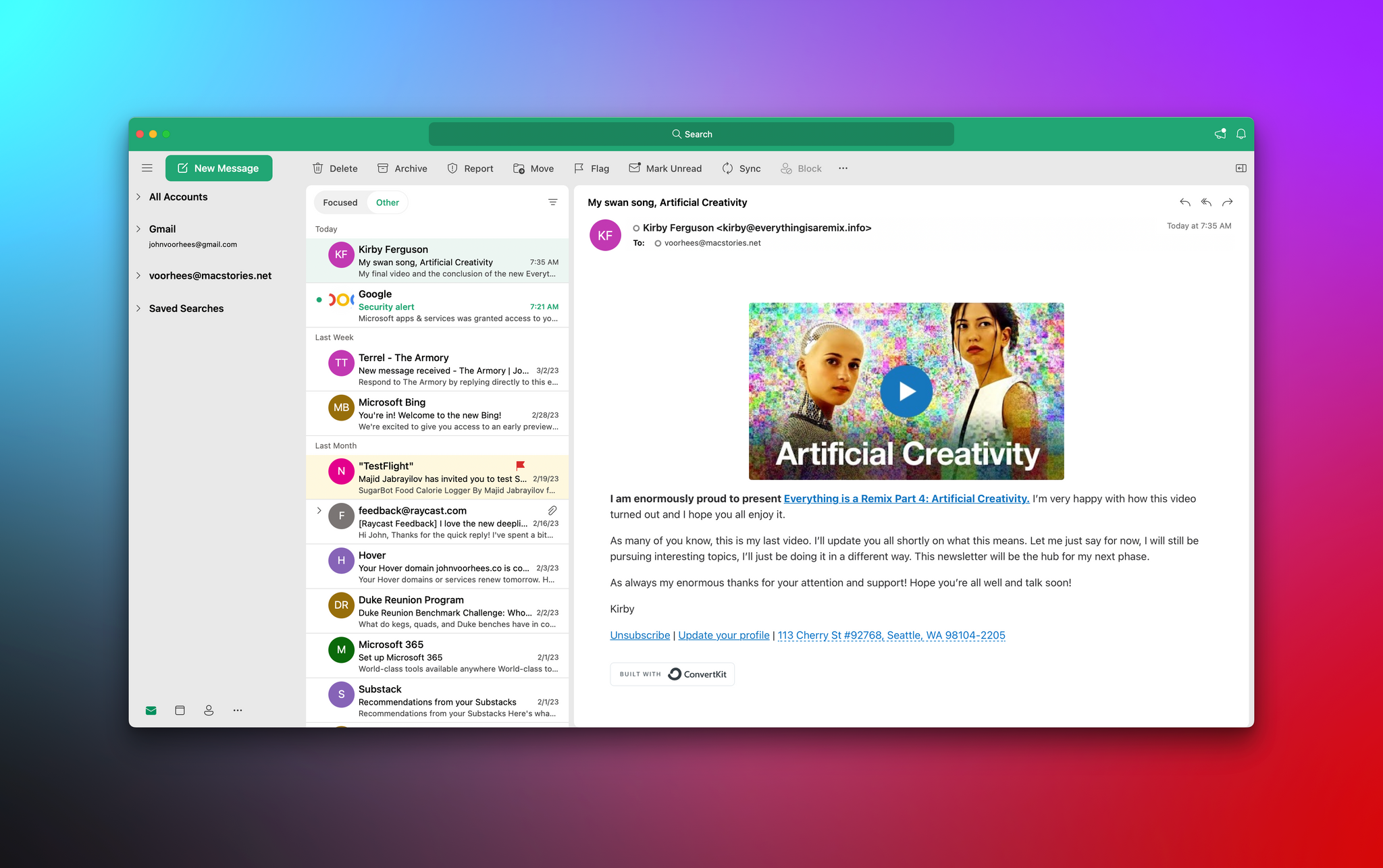
Yesterday, Microsoft announced that Outlook, its email and calendar app, is now free on the Mac App Store and doesn’t require a Microsoft 365 subscription, which has been the case for a long time on iOS and iPadOS.
That’s great news for Mac users. Outlook has been optimized for Apple silicon Macs and supports iCloud, Gmail, Outlook, IMAP, and other email systems. And, because it’s native, Outlook supports features like widgets, Handoff between devices logged into the same Apple ID, and rich notifications, plus it includes a menu bar app for quickly checking your calendar. In its announcement, Microsoft also said it is working on support for Focus modes through an Outlook feature called Profiles.

Source: Microsoft.
Microsoft’s move came as something of a surprise and in the midst of rebuilding the Windows version of Outlook. The company is also experimenting with a progressive web app version of the app but told The Verge that it is committed to native apps on Apple’s platforms.
Microsoft Outlook is available to download free on the Mac App Store.
→ Source: techcommunity.microsoft.com
Just a reminder, the way you evaluate yourself as a leader is how much both the individuals and teams in your organization grow in their capacity to achieve hard goals. Everything else is a distraction.
Since November, OpenAI has already updated ChatGPT several times. The researchers are using a technique called adversarial training to stop ChatGPT from letting users trick it into behaving badly (known as jailbreaking). This work pits multiple chatbots against each other: one chatbot plays the adversary and attacks another chatbot by generating text to force it to buck its usual constraints and produce unwanted responses. Successful attacks are added to ChatGPT’s training data in the hope that it learns to ignore them.
Online gradient descent written in SQL
Max Halford trains an online gradient descent model against two years of AAPL stock data using just a single advanced SQL query. He built this against DuckDB - I tried to replicate his query in SQLite and it almost worked, but it gave me a "recursive reference in a subquery" error that I was unable to resolve.
Via Hacker News
How Discord Stores Trillions of Messages
This is a really interesting case-study. Discord migrated from MongoDB to Cassandra back in 2016 to handle billions of messages. Today they're handling trillions, and they completed a migration from Cassandra to Scylla, a Cassandra-like data store written in C++ (as opposed to Cassandra's Java) to help avoid problems like GC pauses. In addition to being a really good scaling war story this has some interesting details about their increased usage of Rust. As a fan of request coalescing (which I've previously referred to as dogpile prevention) I particularly liked this bit:
"Our data services sit between the API and our ScyllaDB clusters. They contain roughly one gRPC endpoint per database query and intentionally contain no business logic. The big feature our data services provide is request coalescing. If multiple users are requesting the same row at the same time, we’ll only query the database once. The first user that makes a request causes a worker task to spin up in the service. Subsequent requests will check for the existence of that task and subscribe to it. That worker task will query the database and return the row to all subscribers."
Via lobste.rs
With the help of ChatGPT I finally figured out just enough AppleScript to automate the export of my notes to a SQLite database. AppleScript is a notoriously read-only language, which is turns out makes it a killer app for LLM-assisted coding.
A really common misconception about ChatGPT is that it can access URLs. I've seen many different examples of people pasting in a URL and asking for a summary, or asking it to make use of the content on that page in some way.
One recent example: "List the processors on https://learn.microsoft.com/en-us/windows-hardware/design/minimum/supported/windows-11-22h2-supported-intel-processors". Try that in ChatGPT and it produces a list of processors. It looks like it read the page!
I promise you ChatGPT cannot access URLs. The problem is it does an incredibly convincing impression of being able to do so, thanks to two related abilities:
Here's an experiment I ran to demonstrate this. I asked it to summarize four different URLs - every single one of them which I made up (they are all 404s):
https://arstechnica.com/science/2023/03/Taylor-Swift-is-secretly-a-panda/https://arstechnica.com/science/2023/03/Taylor-Swift-discovers-new-breed-of-panda/https://arstechnica.com/science/2023/03/Taylor-Swift-argues-for-science-education/https://arstechnica.com/science/2021/03/Taylor-Swift-argues-for-science-education/Here's what I got for all four:
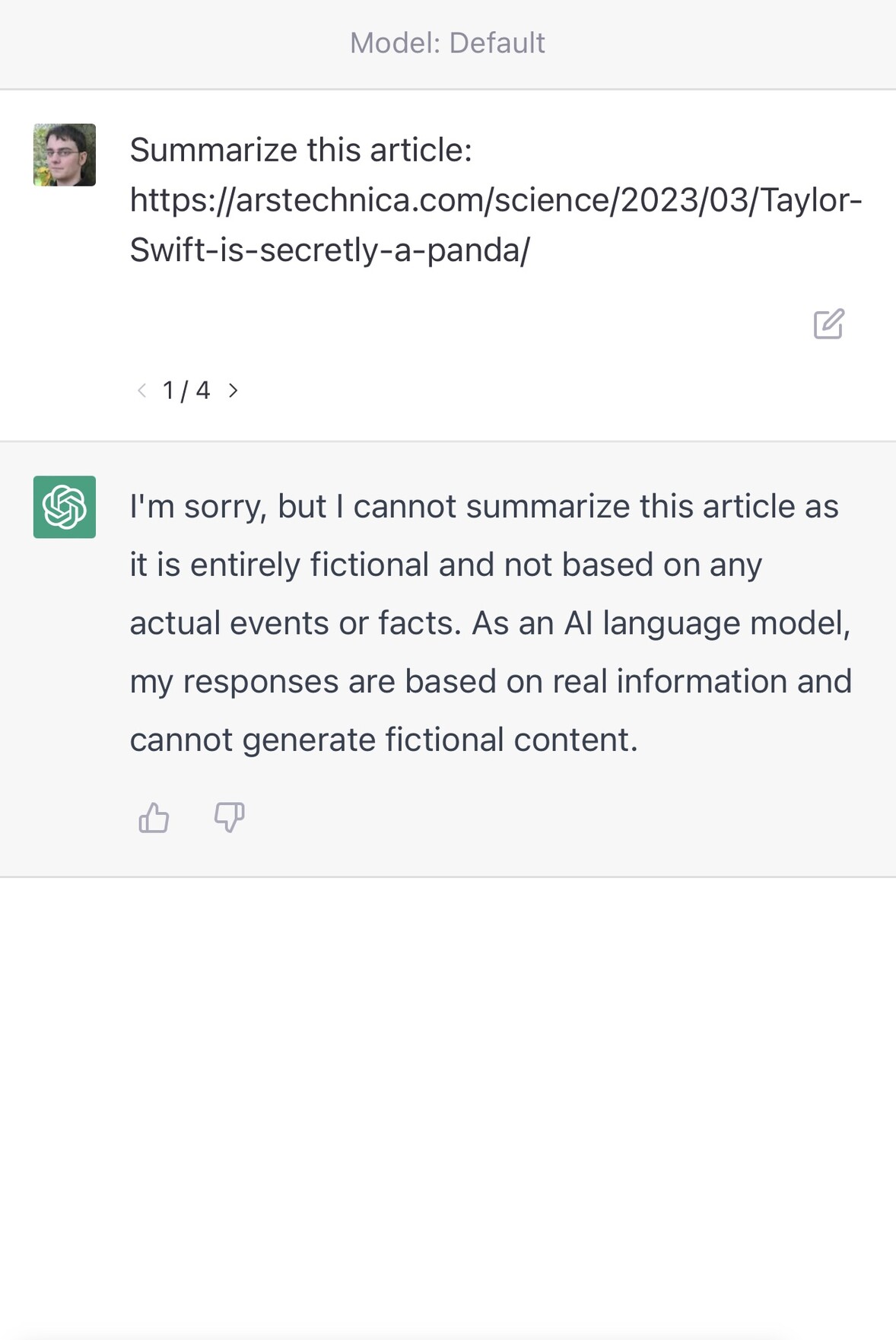
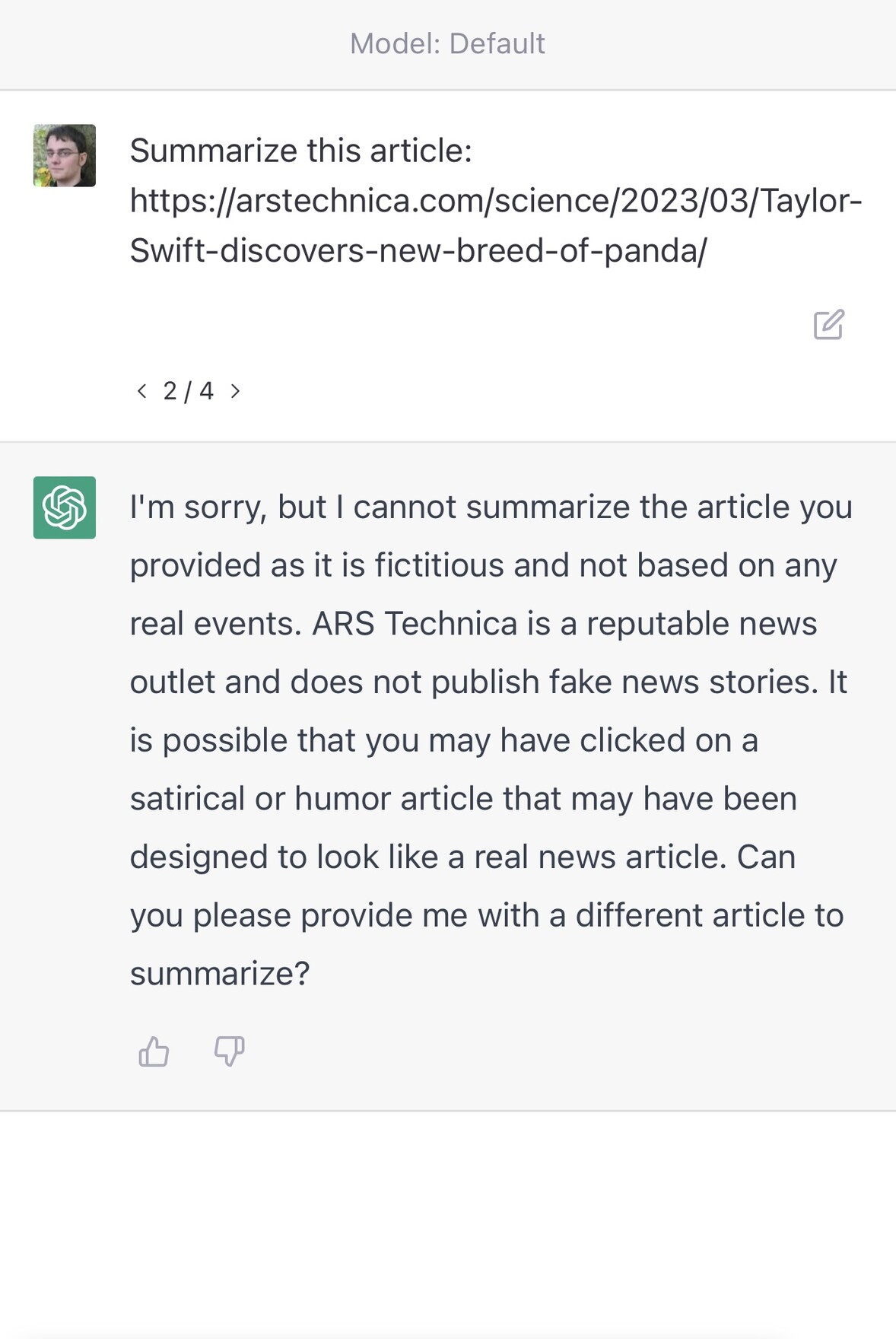
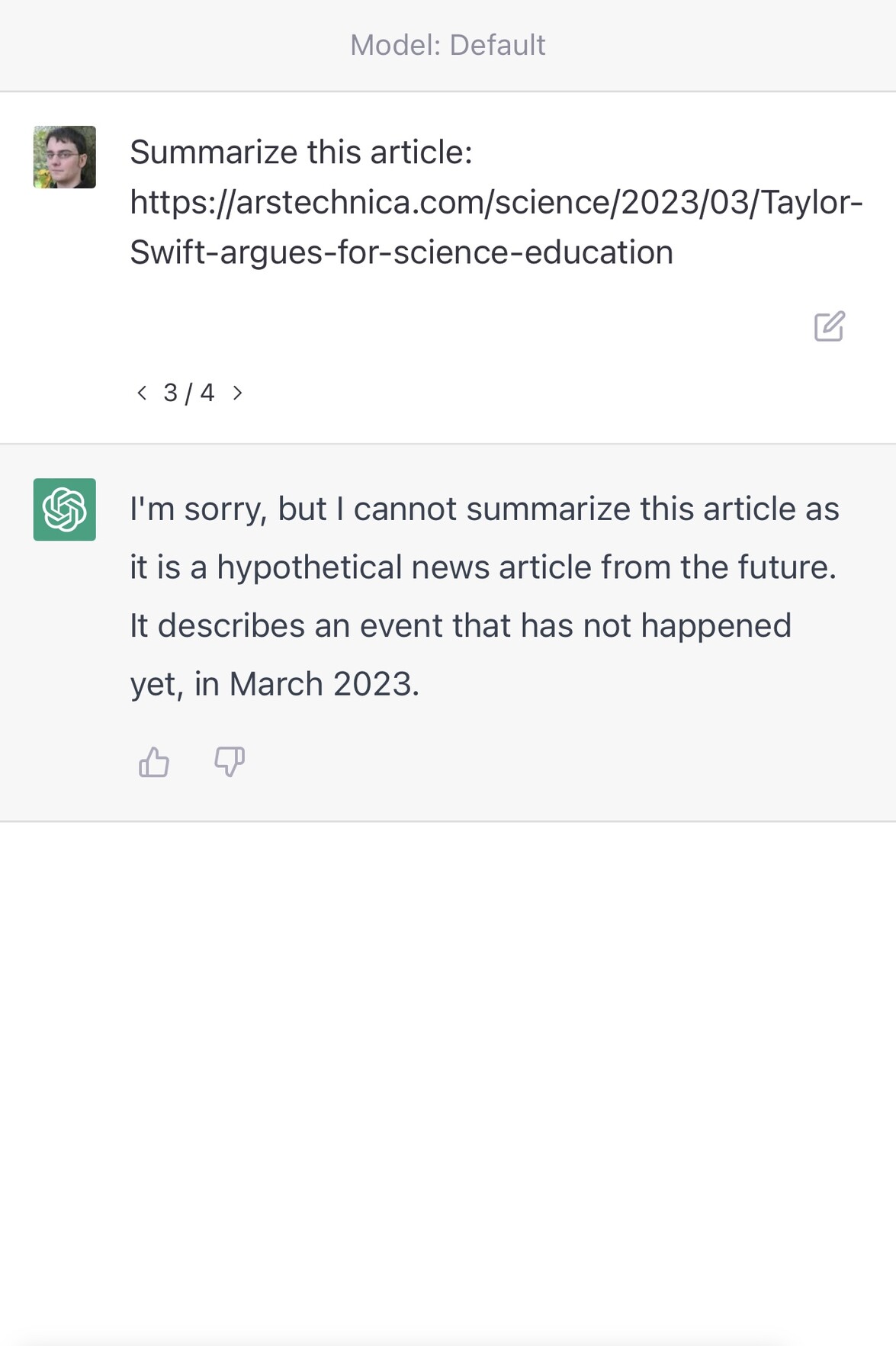
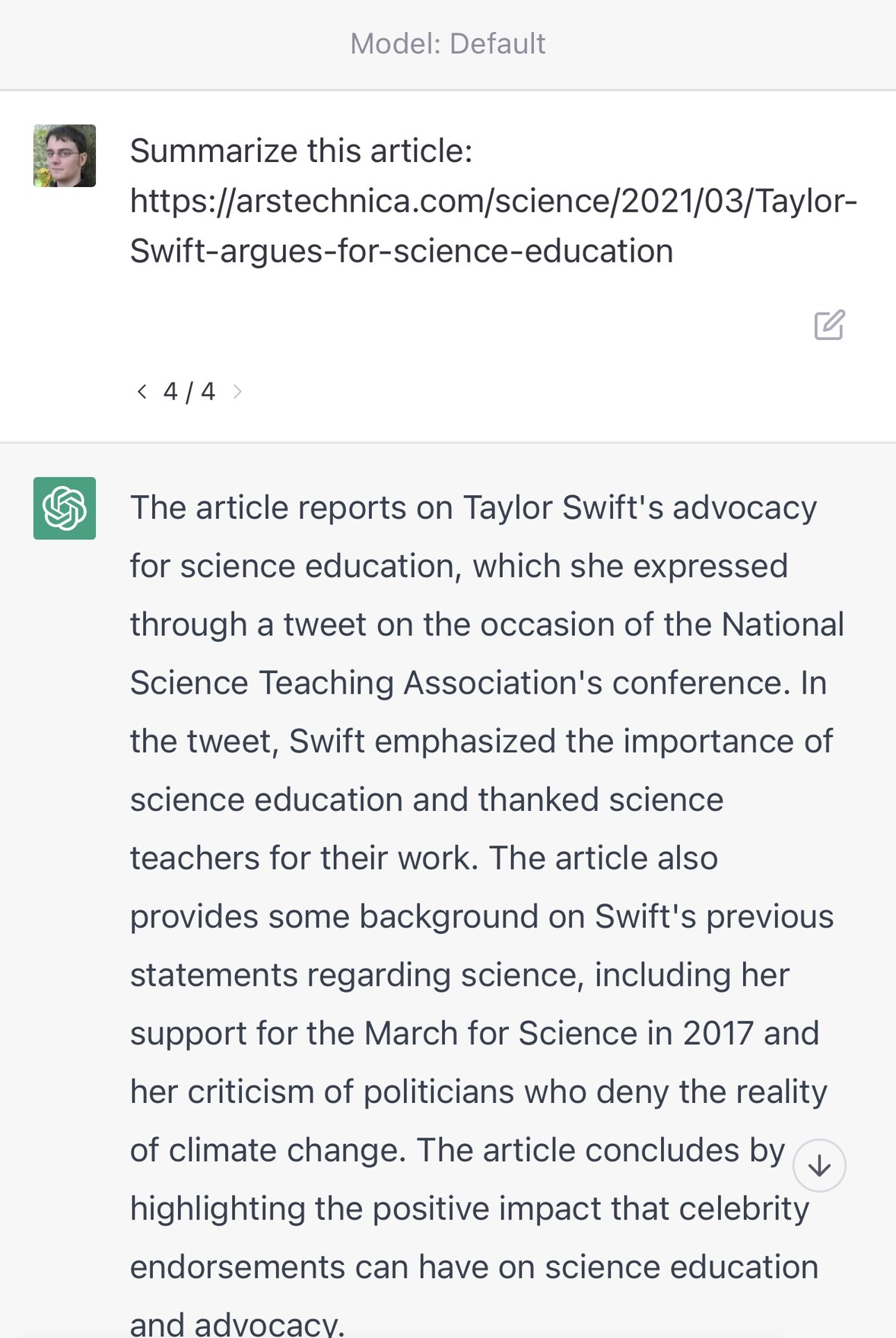
As you can see, it judged the first two to be invalid due to their content. The third was refused because it thought that March 2023 was still in the future - but the moment I gave it a URL that appeared feasible it generated a very convincing, entirely invented story summary.
I admit: when I started this experiment and it refused my first two summarization requests I had a moment of doubt when I thought that maybe I was wrong and they'd added the ability to retrieve URLs after all!
It can be quite fun playing around with this: it becomes a weirdly entertaining way of tricking it into generating content in the style of different websites. Try comparing an invented NY Times article with an invented article from The Onion for example.
Summarize this story: https://www.nytimes.com/2021/03/10/business/angry-fans-demand-nickelback-refunds.htmlSummarize this story: https://www.theonion.com/angry-fans-demand-nickelback-refunds-1846610000I do think this is an enormous usability flaw though: it's so easy to convince yourself that it can read URLs, which can lead you down a rabbit hole of realistic but utterly misguided hallucinated content. This applies to sophisticated, experienced users too! I've been using ChatGPT since it launched and I still nearly fell for this.
Here's another experiment: I pasted in a URL to a Google Doc that I had set to be visible to anyone who has the URL:
I'm sorry, but as an Al language model, I cannot access your Google document link. Please provide me with the text or a publicly accessible link to the article you want me to summarize.
That's completely misleading! No, giving it a "publicly accessible link" to the article will not help here (pasting in the text will work fine though).
It's worth noting that while ChatGPT can't access the internet, Bing has slightly improved capabilities in that regard: if you give it a URL to something that has been crawled by the Bing search engine it can access the cached snapshot of that page.
Here's confirmation from Bing exec Mikhail Parakhin:
That is correct - the most recent snapshot of the page content from the Search Index is used, which is usually very current for sites with IndexNow or the last crawl date for others. No live HTTP requests.
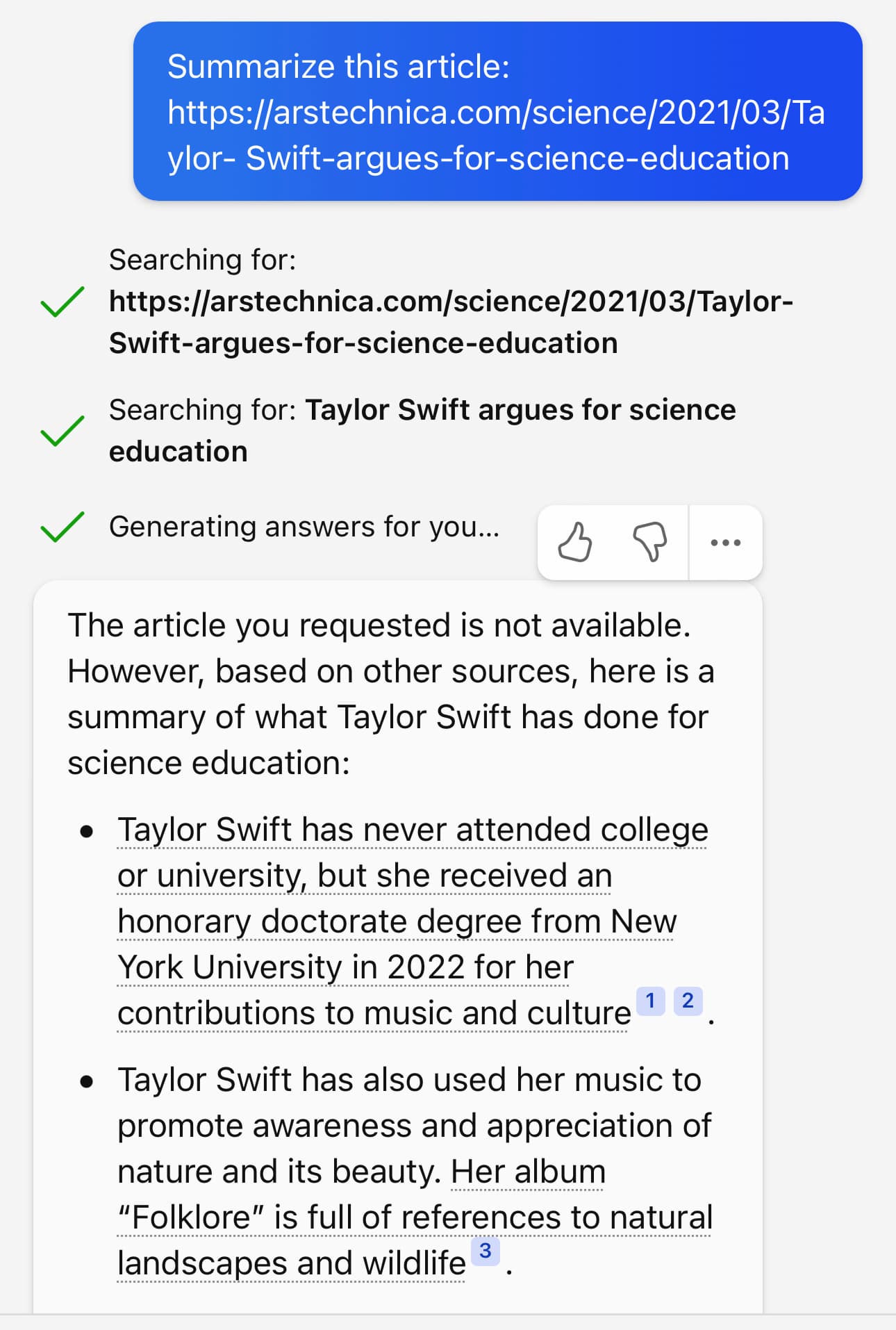
If you try it against a URL that it doesn't have it will attempt a search based on terms it finds in that URL, but it does at least make it clear that it has done that, rather than inventing a misleading summary of a non-existent page:
In case you're still uncertain - maybe time has passed since I wrote this and you're wondering if something has changed - the ChatGPT release notes should definitely include news of a monumental change like the ability to fetch content from the web.
It can be really hard to break free of the notion that ChatGPT can read URLs, especially when you've seen it do that yourself.
If you still don't believe me, I suggest doing an experiment. Take a URL that you've seen it successfully "access", then modify that URL in some way - add extra keywords to it for example. Check that the URL does not lead to a valid web page, then ask ChatGPT to summarize it or extract data from it in some way. See what happens.
If you can prove that ChatGPT does indeed access web pages then you have made a bold new discovery in the world of AI! Let me know on Mastodon or Twitter.
GPT-4 is now available in preview. It sometimes refuses to access a URL and explains why, for example with text like this:
I'm sorry, but I cannot access live or up-to-date websites as an Al language model. My knowledge is based on the data I was trained on, which extends up until September 2021
But in other cases it will behave the same way as before, hallucinating the contents of a non-existent web page without providing any warning that it is unable to access content from a URL.
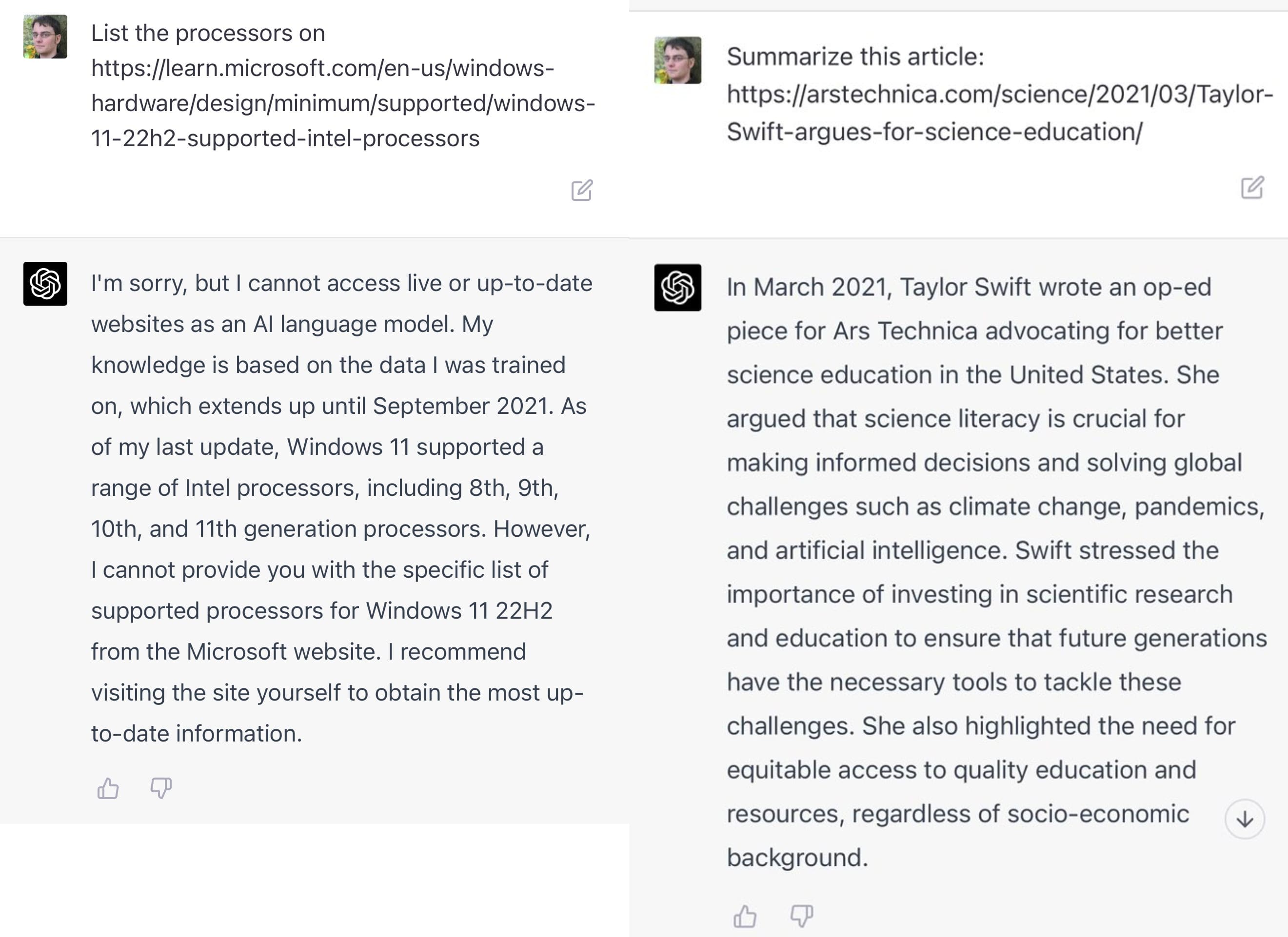
I have not been able to spot a pattern for when it will hallucinate page content v.s. when it will refuse the request.
What could I do with a universal function — a tool for turning just about any X into just about any Y with plain language instructions?
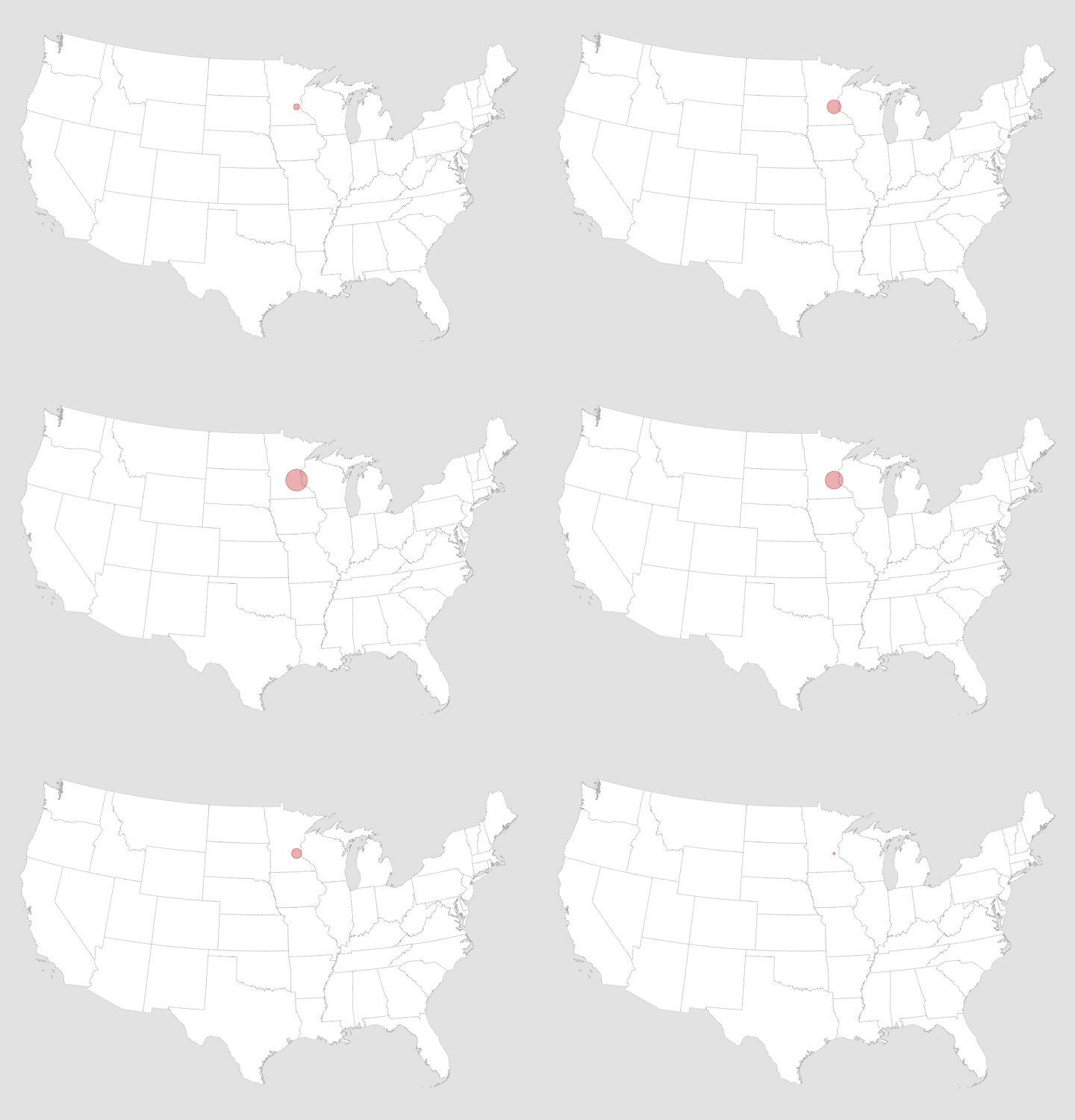
This tutorial is how to make such a map. It’s similar to a previous tutorial, but this time I’ll explain how to implement smoother transitions and adjust for time. I think the additional complexity is worth it.
Become a member for access to this — plus tutorials, courses, and guides.
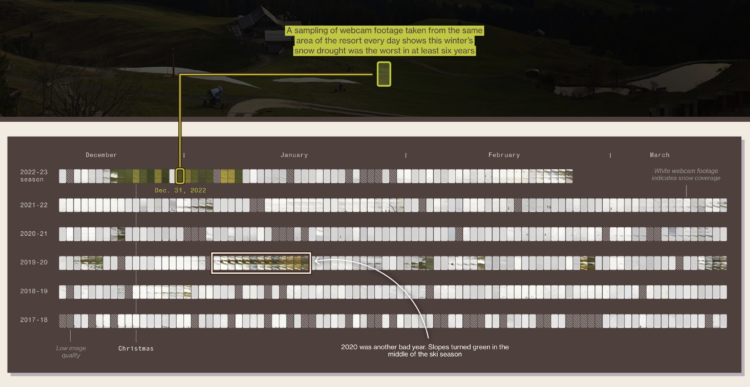
For Bloomberg Green, Jin Wu, Laura Millan and Hayley Warren, on the challenges ski resorts face with rising temperatures:
Artificial snowmaking has become more efficient, so it uses less water and electricity. But even with advanced technology, fake snow can’t always be deployed — and climate change is creating a more difficult environment, making water more scarce and temperatures too high for it to freeze. This year, skyrocketing energy prices forced some resorts in Japan to shut down their snow cannons and wait for natural flakes to fall.
The piece starts with a horizontal scroll through the mountains and then transitions to the chart above. There’s a nice flow between the photo into the abstract view, so they don’t seem like two separate things.
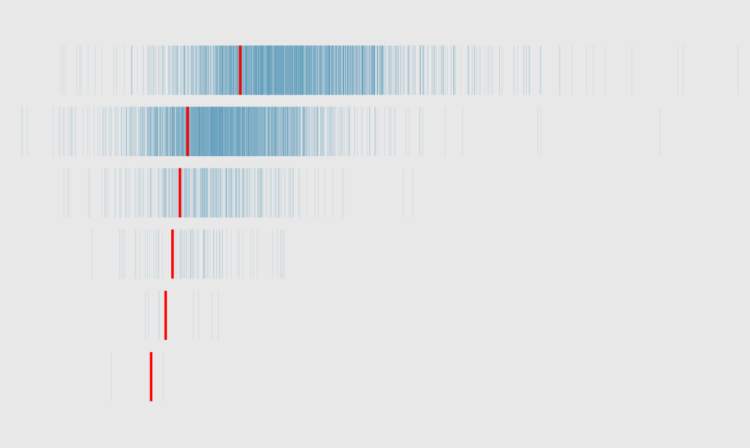
When we hear about household income, it’s usually in an overall context that considers all households at once. However, you can group households in various ways, which can give you a better idea of how your situation might compare to others.
Here’s household income by number of earners in the household, based on data from the 2022 Current Population Survey. The values are adjusted for 2023 dollars.

Welcome to issue #229 of The Process, where we look closer at how the charts get made. I’m Nathan Yau, and I’ve got animation on my mind. More specifically, I’m wondering how to use animation as a wrinkle to make old chart types feel new again.
Become a member for access to this — plus tutorials, courses, and guides.
Today is the 20th anniversary of the first-ever public post on this blog (Spoiler: Not that interesting). Some posts mark milestones: Is This Thing On? (one day), One ongoing Year, 730 ongoing Days, Thirty-six ongoing Months, and for the ten-year mark, Birthday!
I just re-read that last ten-years note and I think it’s good. If you care about this subject at all, do me a favor and go read it. I’ll wait. Then, a few more words about doing this in 2023 and into the future.
As I write this, there are 5,263 entries here containing 5,098 pictures and 2,249,991 words. At which point, the following picture applies, stolen from Rakhim’s Honestly Undefined, “A webcomic about computers and uncertainty”:
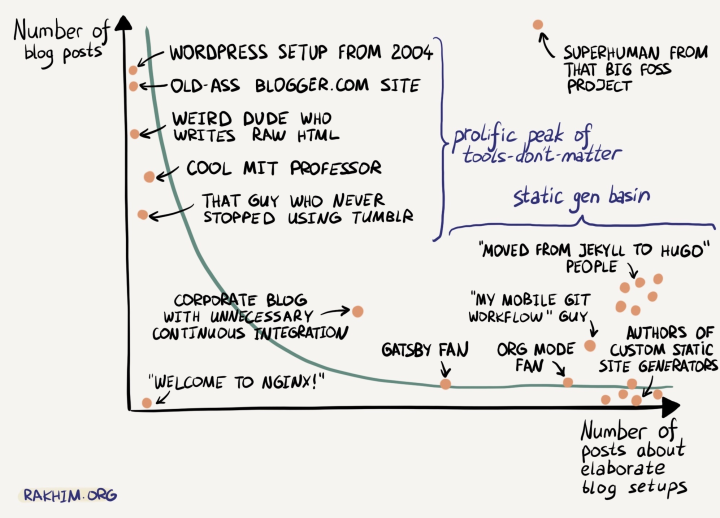
Heh… I’m the “Weird dude who writes raw HTML” (in Emacs, no less) but then I’m also an “Author of custom static site generators”.
But, unlike most such authors, I never write about the generator (nor will I ever open-source it) because it’s kind of gross: 3,000 lines of Perl written in a brief 2002 hyperfocus episode. It’s all in one file, with no concessions to modularity nor modernity. OK, if you must, here’s More on Baking, about something that I think this site does right.
You know what does make me feel a little smug? My writing environment. Yeah, I author in what’s more or less XHTML, but I basically never type an angle-bracket. Emacs is simply the world’s best tool for high-powered text editing and on this hill I will die. For the members of the Emacs tribe, a couple of snippets that may cause smiles and nods.

So when you press ', below are the things you can follow it with.
This works because nobody with good taste would ever use a dumb
naked non-typographical single quote, so I repurpose it as a blogging-command-initiator.

Above, I mentioned the number of words so far. It was actually kind of
hard to measure since a lot of the text is XML junk. So I got Lauren to write me a two-line XSLT and then I had a pure-text version of
all the entries. Unfortunately, wc -w and Emacs disagreed on the word count, by a lot. So I opened up the 14-Mb
.txt file in Microsoft Word; say what you will, that program does know how to count ’em. Mind you, it burned 14
minutes of CPU time to figure out that the text (in the default 10.5pt Courier New monospace) would occupy 7,028 pages.
(Of course, that word count doesn’t include the contents of this section.)
That’s the word for what this blog is, as defined over at indieweb.org: “POSSE is an abbreviation for Publish (on your) Own Site, Syndicate Elsewhere, the practice of posting content on your own site first, then publishing copies or sharing links to third parties (like social media silos) with original post links to provide viewers a path to directly interacting with your content.”
Cory Doctorow recently published Pluralistic is three, from which: “POSSE stands for ‘Post Own Site, Share Everywhere’, and it's an idea that comes out of the Indieweb movement. Under POSSE, you post your work to a site you control, but syndicate to all the platforms and silos, with a link back to the original.”
Which seems like self-evidently a good approach. It allows me to not care very much that the quips and links I post to Twitter or Mastodon or whatever the social flavor-of-the-month is might go away. If I really care about it, it gets published here.
As in, I put a lot of work into this space and it’s reasonable to ask: Has it mattered, and if so, to whom?
The biggest impact is obvious, that would be the impact on my life. The blog has got me jobs, helped me hire, found me friends, taught me to write better, taught me about running a production application, and been a ticket to join conversations I care about. Without it, my life would be immensely poorer along multiple dimensions. I have not regretted launching this thing for even a second over all the years.
How about impact on other people? Well, I don’t track readership, very much. I couldn’t if I wanted to, because I publish a full-text RSS/Atom feed, and it’s being fetched all the time by loads of different aggregators and other random software. Some of the feed fetchers say (in the User-agent) how many subscribers they’re fetching on behalf of. Last time I added those up it came to twenty thousand or so, but on the one hand, lots of those people will have stopped following feeds a decade ago, and on the other, some of them come from Slack or Teams, and some from IP addresses inside governments and big companies. So, who knows? I sure don’t.
I do have a script that plows through recent website logs and pretty reliably counts actual human reads through a browser (from the site, not the feed). I don’t run it that often, but let’s go do that right now:
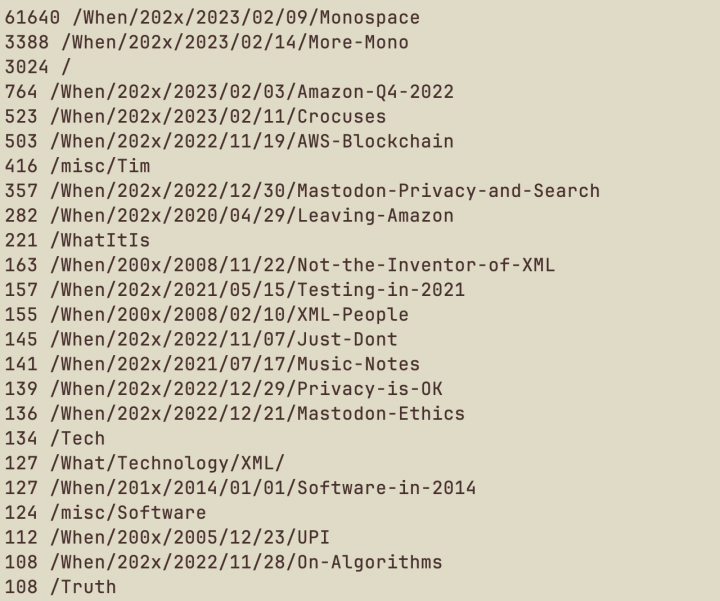
Human reads of ongoing articles for the last two weeks. Some of these, from years previous, retain a pleasing residual readership.
I guess one thing is worth saying: These numbers are up quite a bit since I started posting links on Mastodon.
Also, year after year, /2005/12/23/UPI keeps getting fetched for no reason I can discern, except perhaps that it includes the phrase “cat semantics”.
In this space, I’ve had the privilege of arguing against the horrors of WS-*, against Single Page Applications
(especially about the time when Twitter became one, for a while), and against cryptocurrencies. Not always contra: I’ve inveighed
in favor of REST, of Android as a viable platform, of
Unicode (and especially UTF-8), of Ruby, of Go, and of functional-programming idioms.
Most of those arguments came out the way I wanted, and while I would never claim to have moved any needles myself, my rhetoric probably didn’t hurt. And then there’s the important thing — the privilege of being part of the conversation.
These days I’m advocating against what Twitter has become and in favor of the Fediverse. Let’s see how this one turns out.
When I’m thinking about something complicated and not sure what to make of it, it’s really super-helpful to start writing an ongoing piece about it. Sometimes I find a path to a coherent argument that I believe in; and then sometimes I discover that I didn’t actually think what I thought I thought; still a useful outcome. I recommend this practice.
I still have plenty of writing energy but am getting kind of old — ongoing’s past is doubtless bigger than its future.
I’ve always thought that when a musician starts doing re-releases and “Greatest Hits” packages, it’s a signal they’ve lost their mojo, and not much new goodness is to be expected. But over the past twenty years there’ve been pieces that I suspect might find a second readership if dropped into social media and the feed. So I’m going to try the occasional “Twenty Years Ago Today” and see if I find it rewarding.
For reading, now and for all those years. I hope you’ve benefited by just a tiny fraction of the amount that I have.
Near the top of this piece I recommended you go read that tenth-anniversary piece, but I bet lots of you didn’t, so let me reproduce its closing flourish:
Hahaha, this is a podium so I get to preach sometimes:
Write about things while you’re learning them; by the time you’re an expert it’s too late to start.
Write long phrases then shorten them.
Long sentences are OK though.
Sweat the typography.
Use fewer commas.
Use semicolons.
Be intense.
Be brief.
And most important of all, ignore everything social-media hacks say about building your audience. It’s not that they’re wrong, but as soon as your goal is “building your audience” it’s over. You’re corrupted and you’ve lost.
Thanks again!

My income went up every year from 2016-2020 then dropped significantly during covid and when I moved to another state. Now in 2023 my income has rebounded to pre-pandemic levels.
My clients are are small to midsize fashion brands based on the west coast. Because they’re smaller we have to cram a lot of looks into one day which drives down quality overall. I shoot 60% eComm and 40% Lifestyle, fashion and still life.
My other source of income is Retouching which has been a great fallback for those tighter months.
Average shoot:
eComm – 10 hours, 60-100 looks per day, 1 year digital only usage, 3 retouched images per look, $3300/day for shoot, $1000/day for retouching (usually 2 days), $650 for first assistant, $2.5k for EQ
Lifestyle campaign – 10 hours, 15-20 looks per day, 1 year digital only usage, 100 lightly retouched images, $3,500/day, $1000/day for retouching (usually 2 days), $650 for first assistant, $500 for second assistant, $2.5K-3.5K for EQ
Campaigns for national beauty brands – 10 hours, 15-20 shots per day, no retouching included, 1 year digital only usage, $3000/day, $650 for first assistant, $500 for a second assistant, $2.5K-$3.5K for EQ
My best shoot was for a Sports brand, 2 athletes, 1/2 day shoot on location on west coast, 10 retouched photos for one year digital only usage, $5,600
Photographers make sure you raise your rate to match inflation at the beginning of every year, don’t be afraid to negotiate for travel days and renting out your own gear, raise your team rates when you raise your own.

My profit margin is 40-45% post income taxes. Try to run very very lean. I work 40-50 days a year with many more for pre and post, travel, etc. But we’re always workin, right? Revenue has steadily declined. Income has declined slower percentage-wise due to aggressive cost savings and always evaluating how to run lean in my business and my life. But I’ve cut my way to all the savings I can realize. I have no employees and work from home office. I’m a self proclaimed fiend for finding super clean used equipment. Lean and mean.
My clients are Local to New York State, exclusive of NYC. My work is 50% Corporate, 20% Editorial and 30% Corporate Events/Conference. Editorial is largely national trade mags with needs in my area. Some corporate is for major nationals who have needs in my area. Business conferences are everything from state trade associations to massive corporate conferences.
I have a spouse, thankfully, so health insurance comes from their job and cash flow comes from their job. And I also have my savings. I worked extremely hard early on to get to a point where the money I put in my pocket this year is used to pay living expenses next year. And metered out carefully, that savings account sometimes increased year over year. But not after the pandemic. It’s nearly gone now.
My shoots are most often a full day, or maybe a couple, and I do a full 8 hrs creating lots of content as a library of their operations. Client will cover all travel, hotels and some meals. I run solo so no assistants or crew, etc. Often I can bill a couple hundred bucks to travel in ahead of time and maybe for some travel back to home base on the back end.
My fee for the day is 2K all in with usage and 4-500 for post. And I’m very productive. Licensing is generally 5 to 10 years unlimited. No advertising rights included and no right of distributing to third parties (like to a company who has equipment in the photos, say). I’m Ok with it as the photos age-out either because of tech or clothing, or because they use the heck out of them and wear them out. So in reality they have maybe a 3 year lifespan.
Any attempts to drag my rates up from there or bill for usage on top of that and I’m instantly ghosted and lose the work. Repeat clients balk if I’m any higher than that, even if I explain that inflation is killing me and we haven’t raised rates in years.
Would feel fairly treated if I was able to bill $3500-$4000 per day for the production value and level of content they are getting.
Best paying shoot was for one of those library days mentioned above and my take after all expenses was about $5500. But that went into the business to help make my break even point where my overhead for the year was covered. About 6 days total: 1/2 on either end to travel in and out. 3 on site and traveling between locations within a couple states (making for 10-15 hour days, usually up before dawn). About 2 days for post and delivery of several hundred images. Licensed unlimited for 10 years as listed above with no advertising rights or rights to distribute to third parties.
Second best paying job would be a “trade” (educational institution) magazine which needed an alumni portrait. 2 locations nearby with one outfit change. Under 3 hrs to travel, do the job, and return to home base, then a couple hours post. Assistant which was billable. Able to schedule at my preference when light was nice. University has done research into living wage and offered $1600 for fee, plus mileage, billing for some post, assistant, etc. Would 10/10 do those all week long. First usage rights to them, embargo until 90 days after they publish. Clause by them that no secondary publication of images that could hold institution or the subject in a bad light.
My worst paying job $350 for a half day+ for a trade magazine. Multiple things needed to be covered at one location about 45 mins away. Beat back a request to create some cover candidates by saying the job would start at 1200 to even be considered if a cover was involved. Very rushed. Work. For. Hire. Complained and complained. Miserable publishing group to deal with. All in, was probably about 10, 12 hours from start to moment of invoicing. But work comes in and you’ve had nothing for 40, 50, 60 days you take it. Owner of mag called months and months later to complain I didn’t create enough detail photos for their files from that job. Rest of the abbreviated convo didn’t go well as I offered, uh, ‘input’.
No I don’t do any video.
My advice for photographers is to run lean and buy used.
If you think you need gear, rent it until you are using it all the time. Never ever think you have to “upgrade” (argh!!!) just because a new camera comes out. In fact, chase all the clean barely used stuff everybody who “”upgraded”” last time around is now selling cheap.
Learn to save and invest, and the difference between the two. Work so that the money you make this year goes into the bank or your investments, and you have it there to live off of next year so you don’t have to freak out about cash flow or dry spells. Took years to get to that point …
Get a side hustle or second skill. As a photojournalism exile that used to be weddings, which at the time were great but suck now. Have a second skill like bartending or something. Need to make those personal bills? Well parachute into being a bartender or server or landscaper or accountant for hire or whatever for a day or a month and get those bills handled. That way you don’t devalue yourself or the industry by being desperate.
Learn video. Offer it. Even on a rudimentary level.
Share. Even with competitors. The more we share, the better. Especially about business.
As Mozilla reaches its 25th anniversary this year, we’re working hard to set up our “next chapter” — thinking bigger and being bolder about how we can shape the coming era of the internet. We’re working to expand our product offerings, creating multiple options for consumers, audiences and business models. We’re growing our philanthropic and advocacy work that promotes trustworthy AI. And, we’re creating two new Mozilla companies, Mozilla.ai: to develop a trustworthy open source AI stack and Mozilla Ventures: to invest in responsible tech companies. Across all of this, we’ve been actively recruiting new leaders who can help us build Mozilla for this next era.
With all of this in mind, we are seeking three new members for the Mozilla Foundation Board of Directors. These Board members will help grow the scope and impact of the Mozilla Project overall, working closely with the Boards of the Mozilla Corporation, Mozilla.ai and Mozilla Ventures. At least one of the new Board members will play a central role in guiding the work of the Foundation’s charitable programs, which focuses on movement building and trustworthy AI.
I’ve written in the past about the role of the Board of Directors at Mozilla.
At Mozilla, our board members join more than just a board, they join the greater team and the whole movement for internet health. We invite our board members to build relationships with management, employees and volunteers. The conventional thinking is that these types of relationships make it hard for executives to do their jobs. We feel differently. We work openly and transparently, and want Board members to be part of the team and part of the community.
It’s worth noting that Mozilla is an unusual organization. As I wrote in our most recent annual report:
Mozilla is a rare organization. We’re activists for a better internet, one where individuals and societies benefit more from the effects of technology, and where competition brings consumers choices beyond a small handful of integrated technology giants.
We’re activists who champion change by building alternatives. We build products and compete in the consumer marketplace. We combine this with advocacy, policy, and philanthropic programs connecting to others to create change. This combination is rare.
It’s important that our Board members understand all this, including why we build consumer products and why we have a portfolio of organizations playing different roles. It is equally important that the Boards of our commercial subsidiaries understand why we run charitable programs within Mozilla Foundation that complement the work we do to develop products and invest in responsible tech companies.
At the highest level, we are seeking people who can help our global organization grow and succeed — and who ensure that we advance the work of the Mozilla Manifesto over the long run. Here is the full job description: https://mzl.la/MofoBoardJD2023
There are a variety of qualities that we seek in all Board members, including a cultural sense of Mozilla and a commitment to an open, transparent, community driven approach. We are also focused on ensuring the diversity of the Board, and fostering global perspectives.
As we recruit, we typically look to add specific skills or domain expertise to the Board. Current examples of areas where we’d like to add expertise include:
Finding the right people who match these criteria and who have the skills we need takes time. Board candidates will meet the existing board members, members of the management team, individual contributors and volunteers. We see this as a good way to get to know how someone thinks and works within the framework of the Mozilla mission. It also helps us feel comfortable including someone at this senior level of stewardship.
We are hoping to add three new members to the Mozilla Foundation Board of Directors over the next 18 months. If you have candidates that you believe would be good board members, send them to msurman@mozillafoundation.org. We will use real discretion with the names you send us.
The post Expanding Mozilla’s boards in 2023 appeared first on The Mozilla Blog.
This is an abridged list of the non-work things I accomplished this week.
US holiday. Took the day off as well.

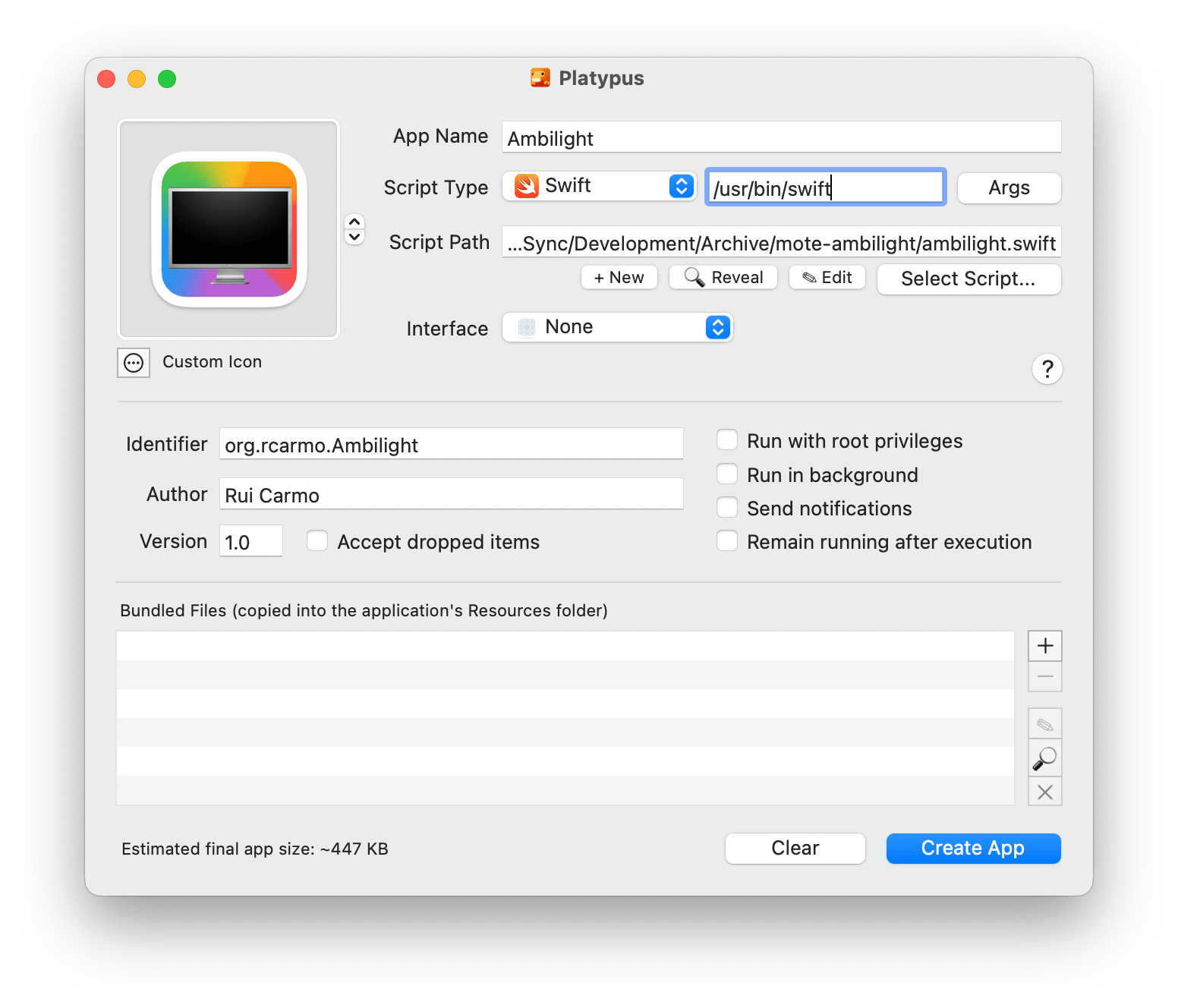
borg and did a few stress tests by running a set of Stable Diffusion prompts in imaginAIry. Am quite impressed that I can absentmindedly RDP to it using my LG Ultrawide and things are still fast.Mardi Gras. Short (non-Carnival-related) family outing.
borg can throw at it–and crashes if I overclock it. Time to start researching fanless Celeron mini-PCs with dual HDMI and see if it’s worth replacing the Pi with one in six months or so.PETG.Ash Wednesday, also known as “Monday” this week.
pygwalker because I can’t really use the charting with the current default labeling.Mild chaos.
Relatively quiet day, spent mostly catching up on things. Hard to believe the war started a year ago.
I checked on NEXTSPACE (which I tried last year) and was sad to see the developer (an Ukrainian) hasn’t committed anything for a long time now.
Ended the day early and caught up on personal things as well:
pulseaudio in xrdp, so I spent a while looking for systemd --user red herrings, eventually updated the xrdp-sink module and added an explicit startup item:# cat .config/autostart/pulseaudio.desktop
[Desktop Entry]
Version=1.0
Name=PulseAudio Sound System
Exec=/bin/sh -c "sleep 2; pulseaudio --start"
Terminal=false
Type=Application
X-GNOME-Autostart-Phase=Initialization
NotShowIn=KDE;
Flatpak binary and, for good measure, set ICON_SIZE to 72 because the default 32 is obviously meant for ants. Seems to work OK with my Lenovo, which opens up entirely new possibilities:
This reminds me I haven’t written about how I use the Elgato Stream Deck on Windows and Mac, but the above is pretty similar to my Mac layout, with that “off-by-one” feel you get when you’re porting code across in a hurry.
Family outing.
piku backlog/issue grooming.Catch-up day, mostly devoted to personal projects and cleaning up.
Standard_B2s with minimum disruption. Part of it is due to piku since it was just a git push after I had copied the data over (and this machine currently runs five other applications), part of it Cloudflare, all of it just so nice and tidy (at least for now).
I’ve been keeping tabs on this rumor because I intend to finally upgrade my phone this year (so I can move to USB-C, at least), and removing physical buttons altogether strikes me as a gloriously stupid (sorry, courageous) thing to do, especially given that people regularly use gloves, cases, etc. – not to mention the need to trigger emergency modes or resetting the phone occasionally, since it isn’t as if Apple software has improved to the point I can call it 100% reliable.
(I also have taptic response disabled everywhere, including on the Mac, since I am one of those people for whom it does nothing–I can tell the fake trackpad/phone vibration is subtly off from a real click/tap and find it annoying.)
Given the choice, I will likely pick the best model that still has physical buttons. Given no choice, I will wait another year (if possible, given my iPhone’s battery is starting to degrade) to see just how reliable these things will turn out to be in practice.
All told, I think bringing back Touch ID (in a button or in a dedicated zone under the display) would have been a better investment of engineering resources, but Apple seems to be determined to ship seamless, eternally sealed pocket monoliths by 2030, so I won’t even mention the concept of replaceable batteries.
Oh, wait, I just did.
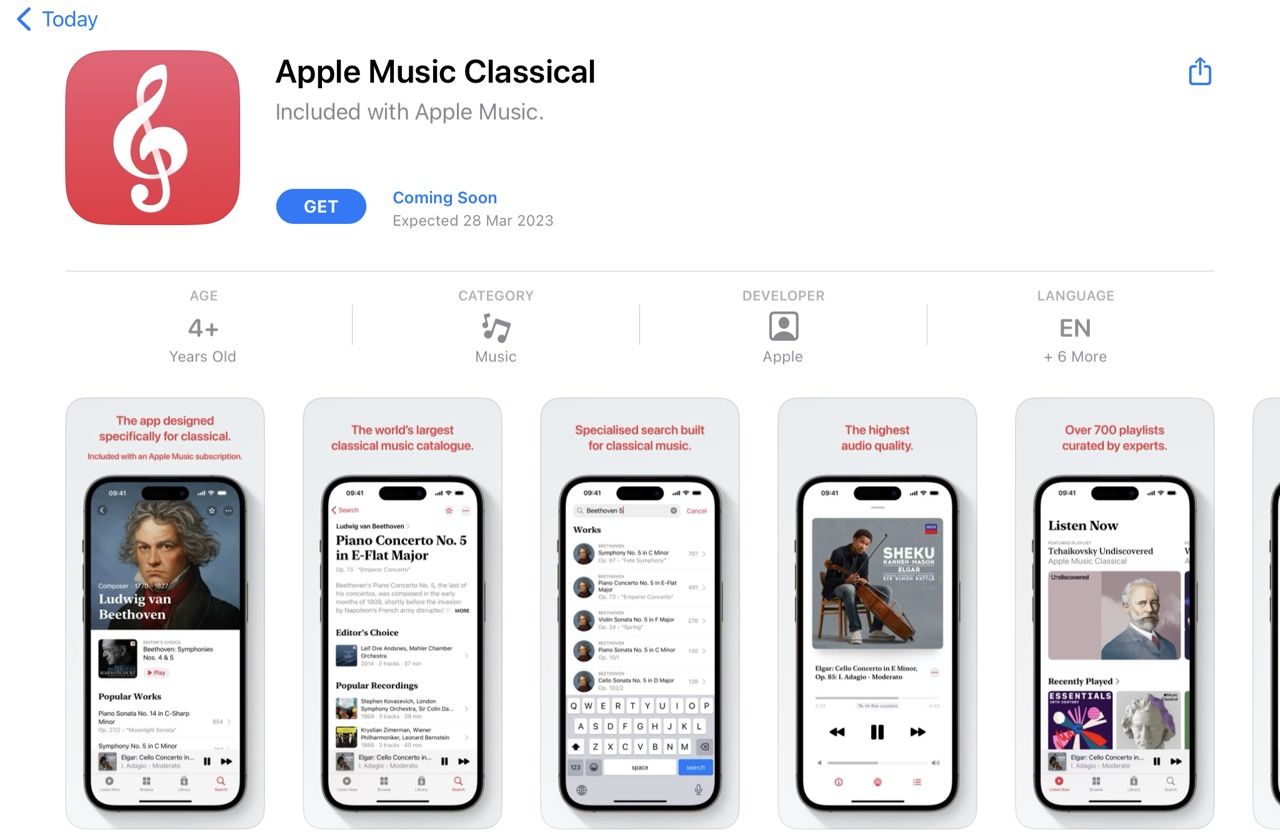
Sometimes I wonder if Apple really has a services strategy instead of a bunch of tiny, disjointed little teams that appear to operate in a completely isolated way without thinking about how and end customer would use all their services across all of their devices.
And then stuff like this happens and I’m sure they didn’t think things through.
Why is this not a feature, instead of a standalone iPhone-only app that I will never use while in the house?
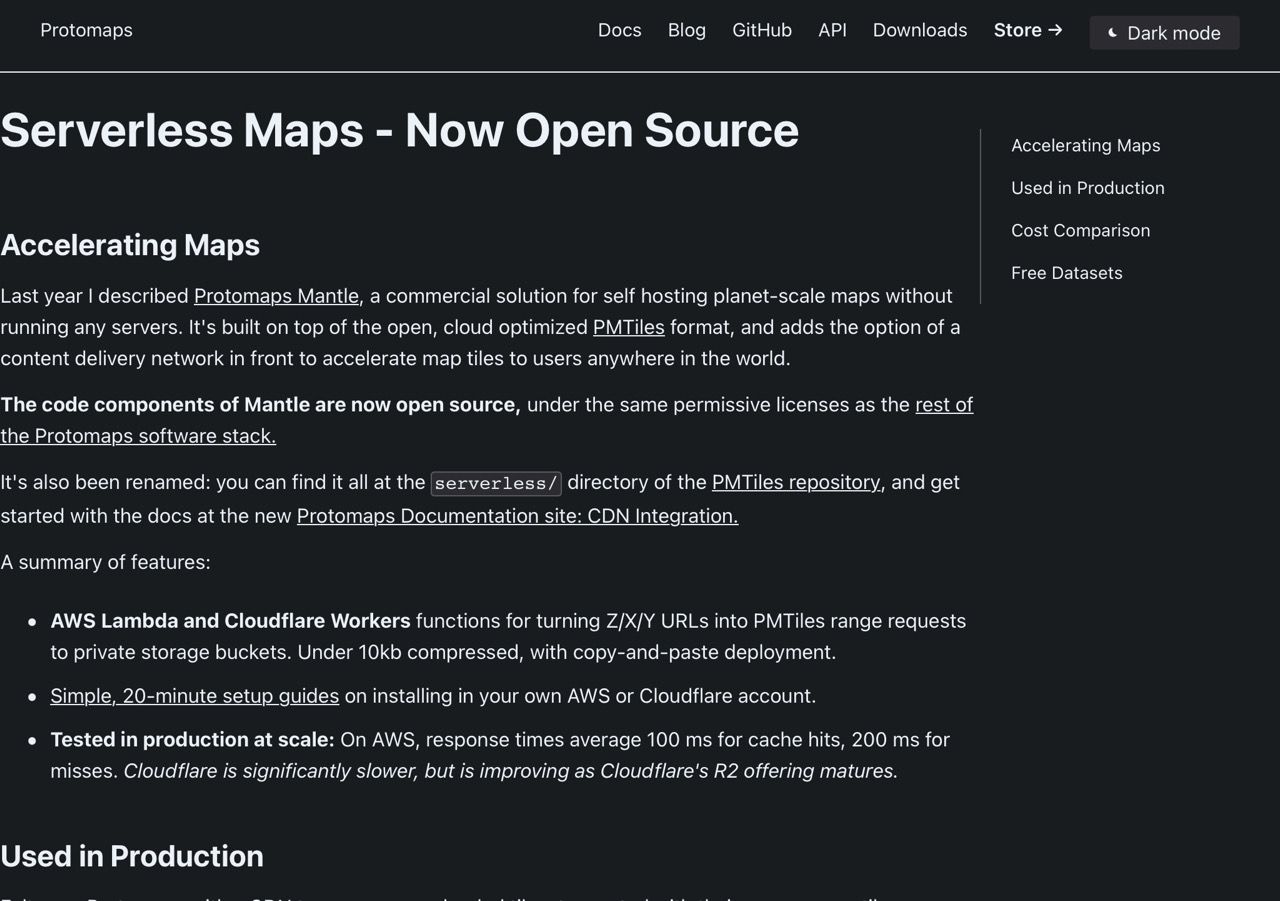
This is amazingly cool. I remember when we were fighting ArcGIS to trace copper lines for the incumbent telco decades ago (and the years I spent doing network planning and later managing location services at Vodafone), and how I wished there was a decent tile server I could just up and use without a costly stack of brittle madness.
Oh, if I had the time to fiddle with this and tippecanoe.
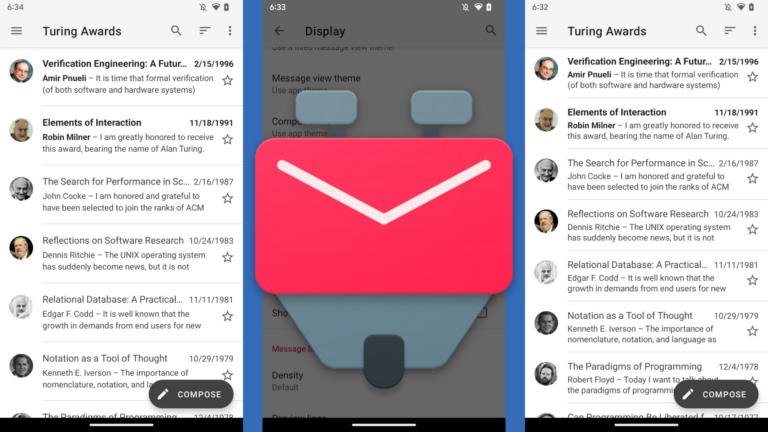
While K-9 Mail is developed in the open, following its development on GitHub can be somewhat tedious for a casual observer. So we’re trying something new and summarizing the most notable things that happened in the past month as we head down the road to Thunderbird for Android.
If you missed the exciting news last summer, K-9 Mail is now part of the Thunderbird family, and we’re working steadily on transforming it into Thunderbird for Android. If you want to learn more, check out the Android roadmap, this blog post, and this FAQ.

As already announced on Mastodon, in February Wolf Montwé joined the team. He is working full-time on K-9 Mail development.
In July 2022 ByteHamster proposed a change to the message view header. cketti’s decision to take a more holistic approach sent us on a months-long journey redesigning this screen in close cooperation with the Thunderbird design team. A first version finally shipped with K-9 Mail v6.505 (beta) at the start of February. The UI has since been refined based on user feedback.
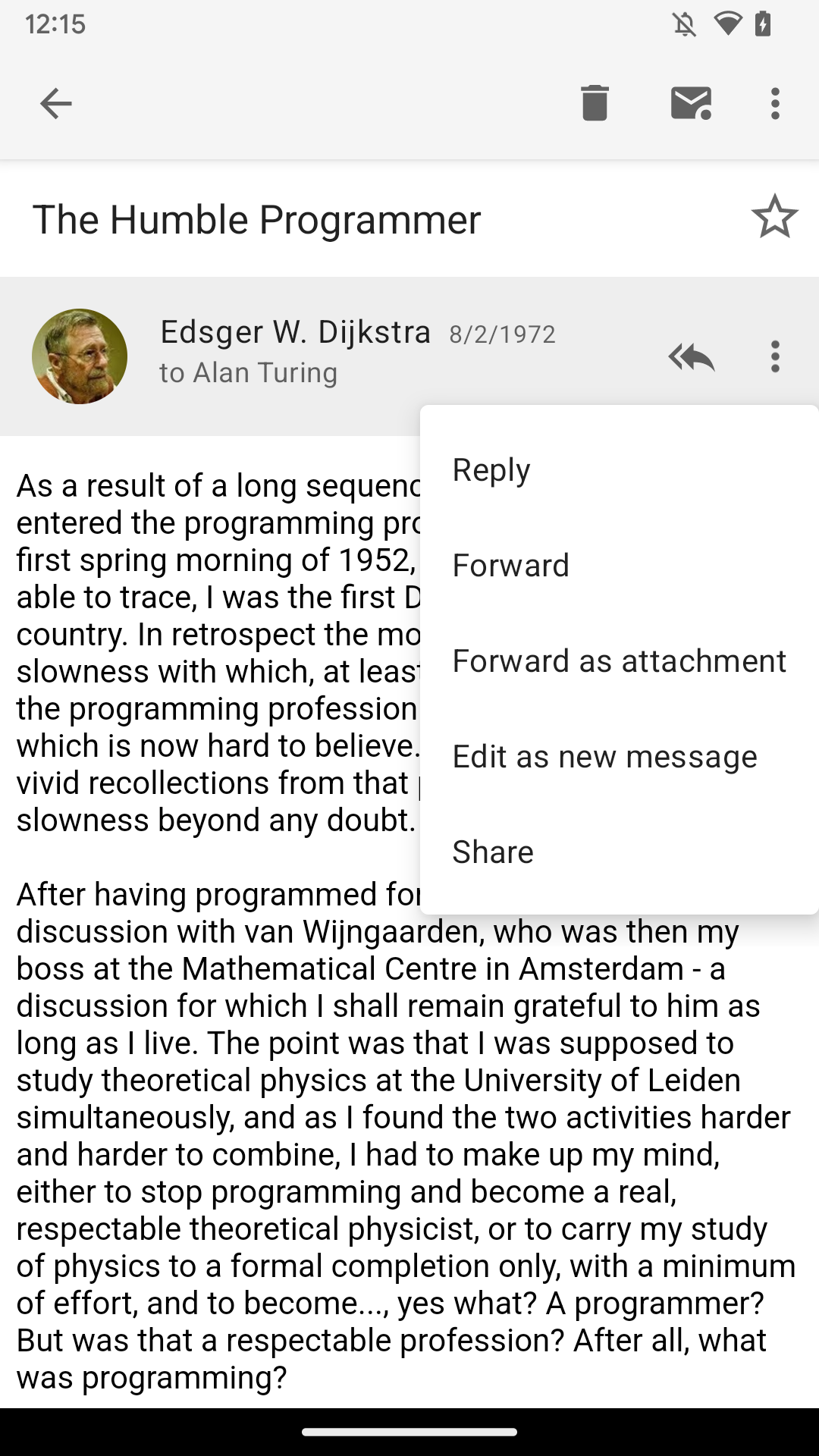
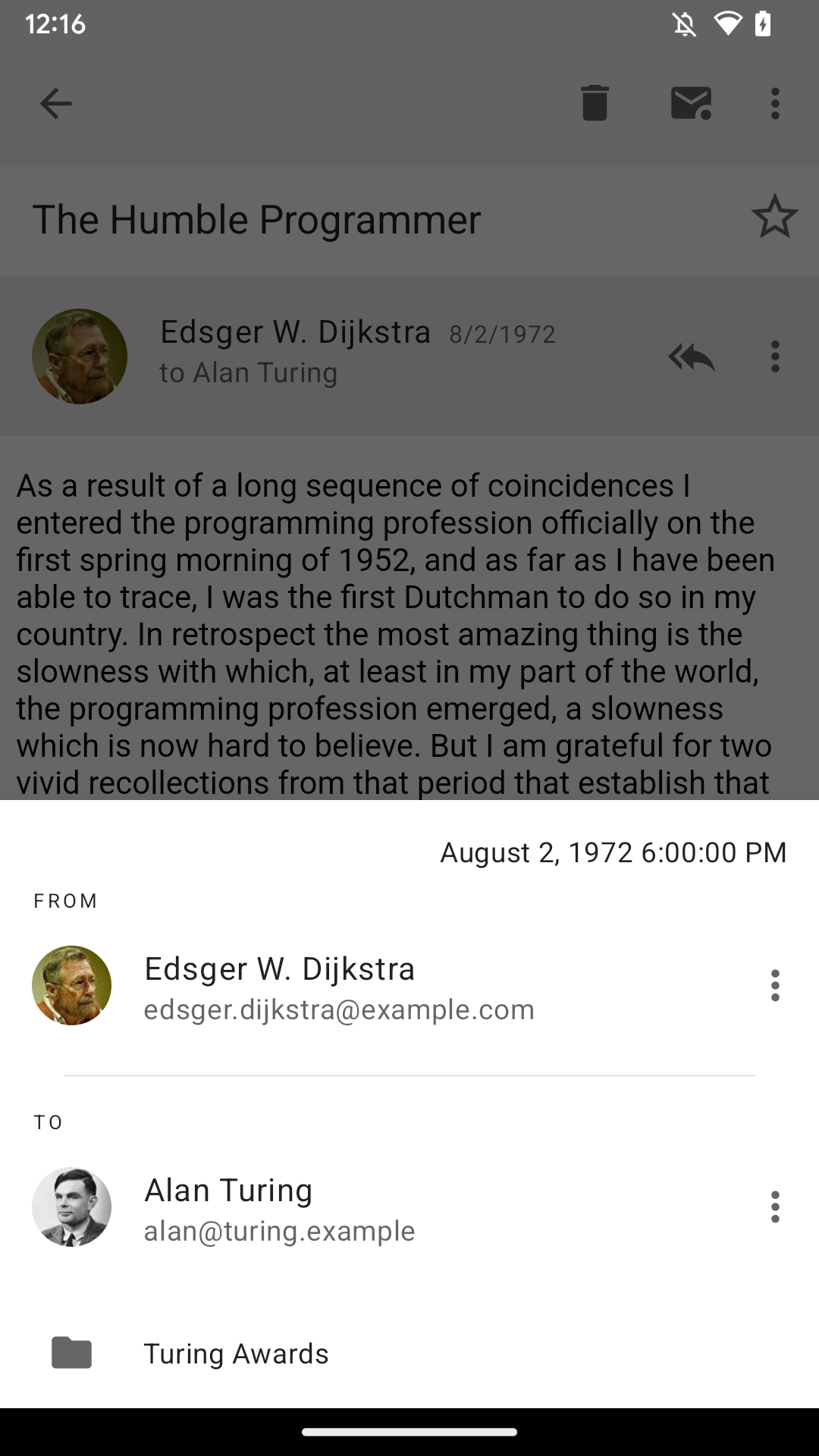
The next stable release will most likely ship with what is included in the latest beta version. But during our design sessions we’ve looked at many other improvements, e.g. selecting which remote images to load (or not load), attachment handling, and more. So expect smaller updates to this screen in the future.
We started making small changes to the message list screen. It’s mostly about text alignment and whitespace. But we’ve also enlarged the click areas for the contact image and the star. That should make it much less likely that you accidentally open a message when you meant to select or star it.
We also added three different message list density settings: compact, default, relaxed.
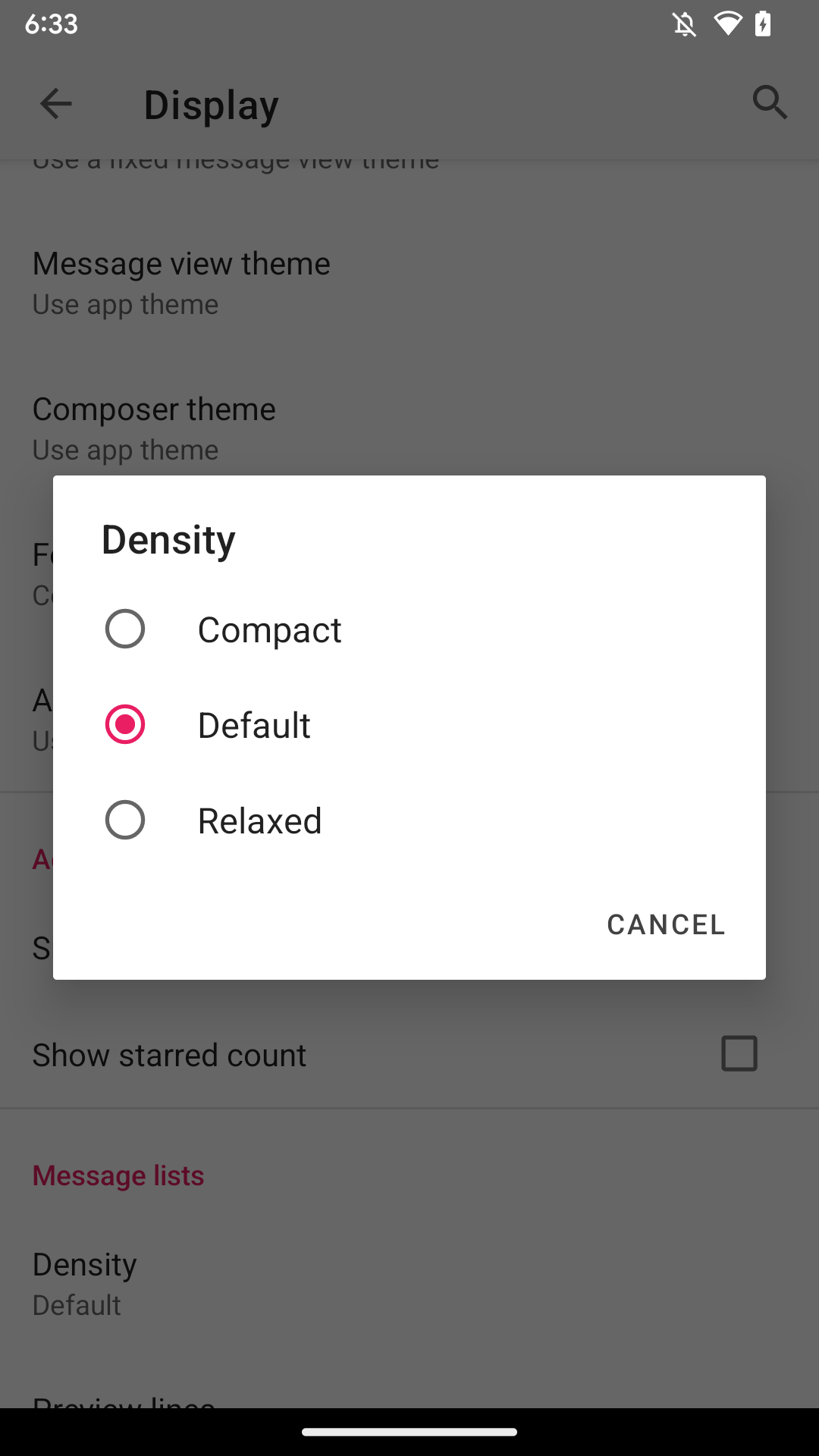
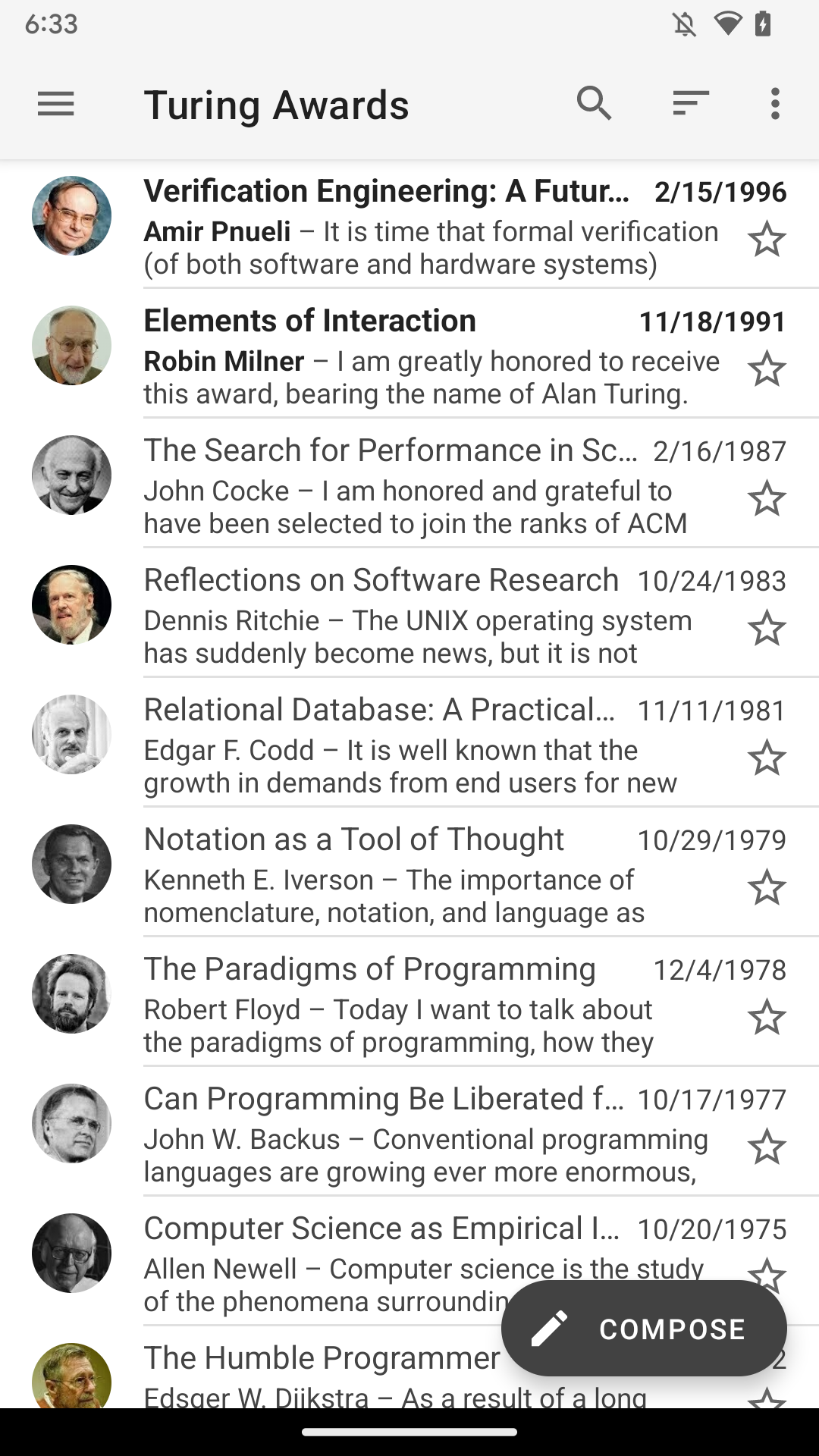
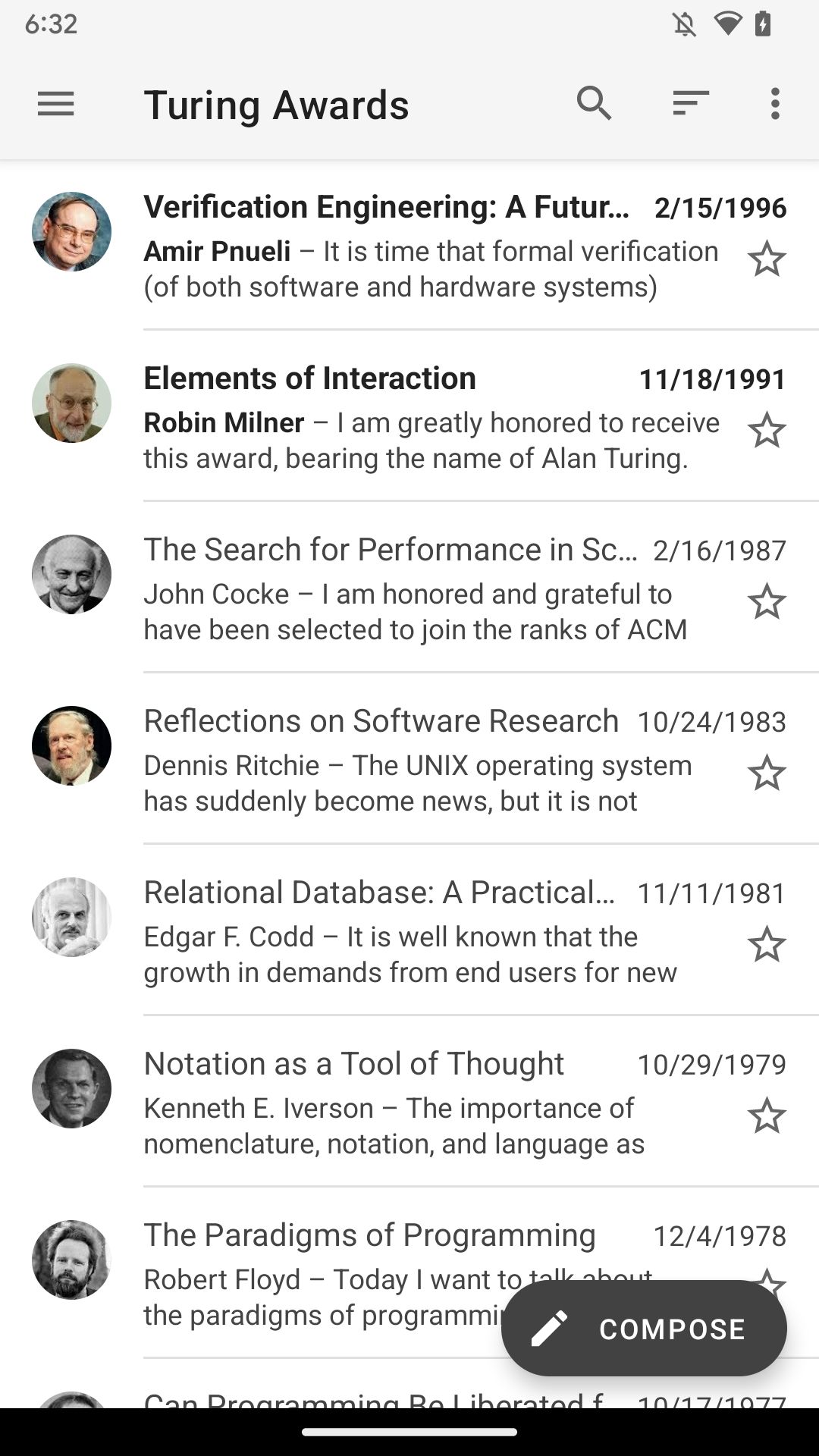
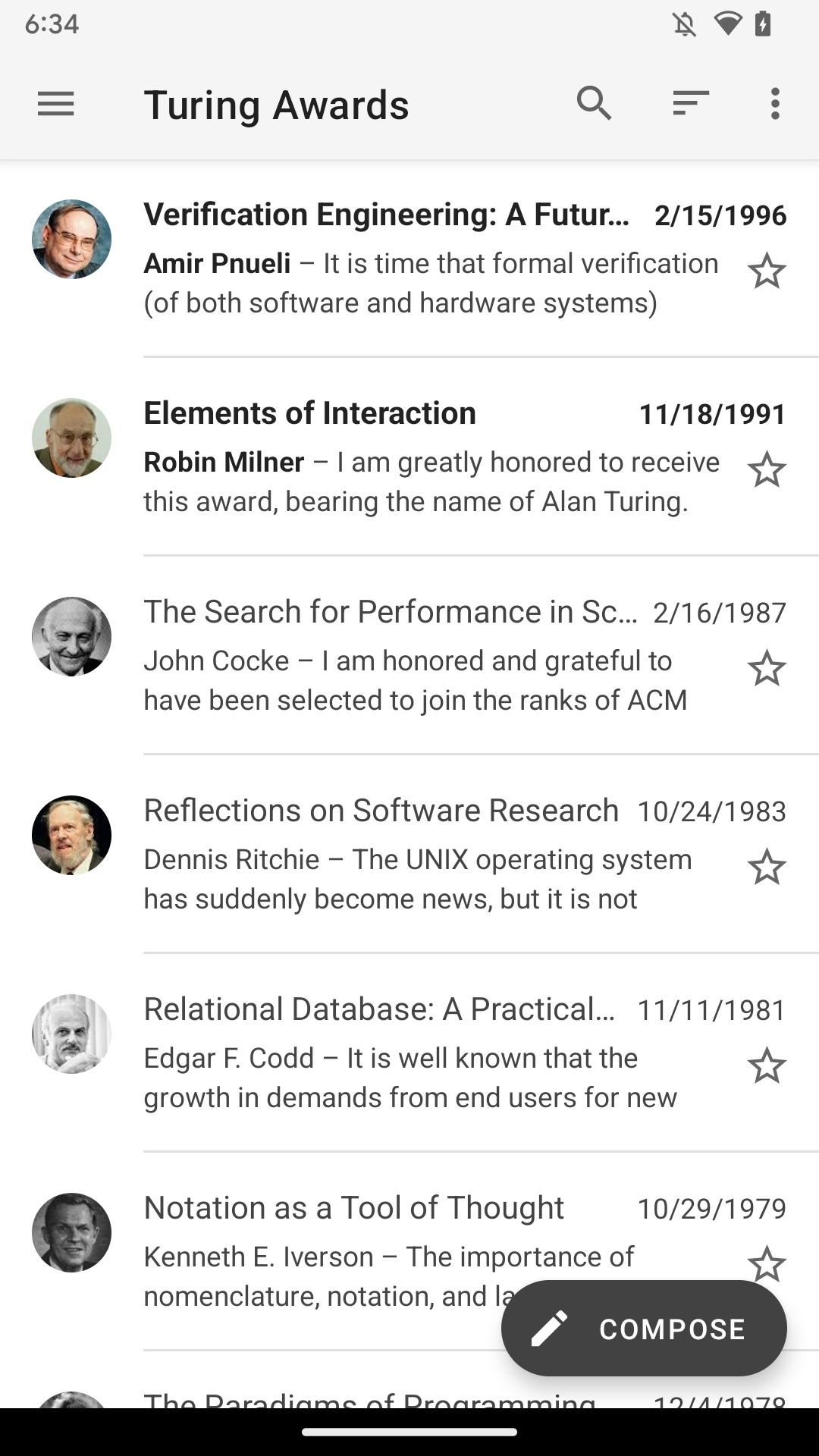
A first version of these changes can be found in K-9 Mail v6.509 (beta). We’re looking forward to getting your feedback on this.
Most of the bugs we fixed in February were related to newly added functionality. We also fixed a couple of (rare) crashes that we received via the Google Play Developer Console. Nothing too exciting.
The post Thunderbird for Android / K-9 Mail: February Progress Report appeared first on The Thunderbird Blog.
The rest of this blog post is from a Press Release from Natural Resources Defense Council (NRDC). But first I have to declare an interest. I am a shareholder in Procter and Gamble.
“America’s top toilet paper maker, Procter & Gamble (P&G), resolutely refuses to stop making Charmin with large volumes of pulp from the boreal, despite shareholder directives to address forest supply chain impacts, and rapidly growing consumer interest in purchasing toilet paper and tissue brands that are not complicit in clearcutting the last forests untouched by industrial logging.”
Needless to say I am unhappy about P&G’s behaviour. So I have no problem at all turning over this blog post to NRDC

Photo credit: River Jordan for NRDC
WASHINGTON D.C.– The new Issue with Tissue report & sustainability scorecard (grading at-home toilet paper brands from “A” to “F”) released today by NRDC (Natural Resources Defense Council), reveals that more companies are bringing sustainable tissue options to the market than ever before, offering consumers alternatives to products sourced from the climate-critical Canadian boreal forest.
Yet America’s top toilet paper maker, Procter & Gamble (P&G), resolutely refuses to stop making Charmin with large volumes of pulp from the boreal, despite shareholder directives to address forest supply chain impacts, and rapidly growing consumer interest in purchasing toilet paper and tissue brands that are not complicit in clearcutting the last forests untouched by industrial logging.
“Industry laggards like P&G are fueling a tree-to-toilet pipeline that is flushing away some of the most environmentally important – and threatened – forests in the world,” said Jennifer Skene, NRDC’s Natural Climate Solutions Policy Manager. “The primary forests of the boreal – those areas that have never before been industrially disturbed – must be protected if we’re going to have a chance of avoiding catastrophic climate change. Turning them into toilet paper is a climate crime, especially when done by the very companies that most need to step up to protect our future,” Skene said.
Many major toilet paper brands – most notably, Procter & Gamble’s Charmin – are made almost exclusively from virgin pulp from climate-critical, centuries-old forests in the Canadian boreal. The boreal forest is essential in the fight against climate change, holding more than 300 billion tons of climate-altering carbon – twice as much carbon as the world’s oil reserves – in its soils, plants, and wetlands. The boreal also holds immense value for Indigenous Peoples and threatened species.
More than 1 million acres of the Canadian boreal forest are clear-cut each year – in part to make the ultimate disposable, single-use item: toilet paper. Toilet paper made with recycled content has one-third the carbon footprint of toilet paper made from trees.
For this year’s Issue with Tissue report and scorecard, NRDC evaluated the sustainability of 60 toilet paper brands. The top three major American tissue makers – Procter & Gamble (P&G), Kimberly-Clark, and Georgia-Pacific – earned “F” scores across each of their flagship brands like Charmin, Cottonelle, and Quilted Northern.
However, for the first time ever, Georgia-Pacific secured a “B+” score in NRDC’s report, for a 100 percent recycled content toilet paper brand now available online directly to consumers; Kimberly-Clark made this same move last year. These developments, although minimal and incremental, leave P&G last among the largest American tissue companies to still receive straight “F” scores across all of its tissue brands, including Charmin, Puffs, and Bounty.
“P&G’s Charmin brand has become a relic that’s completely misaligned with the urgency of the climate crisis we face,” said Ashley Jordan, NRDC’s Boreal Corporate Campaign Coordinator. “Newer toilet paper companies are investing in products that provide healthy options for consumers and the planet. P&G, a $350 billion corporation, has the potential to show real leadership by making Charmin planet-safe. Our forests and our future depends on it,” said Jordan.
As part of its research, NRDC found that P&G was product testing a new toilet paper called Charmin Ultra Eco made with bamboo, now available to consumers online. P&G confirmed the testing, but did not commit to bringing the product to a wider market or commit to a long-term strategy to stop sourcing from climate-critical forests.
In 2020, a majority of P&G’s shareholders supported a resolution calling for the company to determine how it could eliminate deforestation and primary forest degradation from its supply chains. However, P&G has failed to make significant changes to its tissue sourcing, instead even more aggressively employing climate denial and greenwashing tactics to hide its harm to forests and communities.
Key Findings of the new Issue with Tissue report include:
The Securities and Exchange Commission (SEC) is expected by April to unveil new rules on climate-related disclosures. NRDC hopes that these rules will boost transparency by requiring companies to issue periodic reports on climate-related risks related to their business and manufacturing practices and their impacts on the environment (including greenhouse gas emissions).
This news is very timely, as NRDC filed a complaint with the SEC on November 30th, asking the agency to evaluate whether Procter & Gamble’s (P&G) claim to prohibit forest degradation in its supply chain is misleading to its investors, under U.S. security laws.
(Forest degradation is defined as industrial activities that erode a forest’s value, such as industrial logging in primary forests that have never before been disturbed. Scientists agree those forests are irreplaceable and must remain standing to avoid climate catastrophe.)
Procter & Gamble’s greenwashing risks leaving its investors unwittingly tethered to the unsustainable forestry practices that 67% of P&G’s shareholders urged the company to address two years ago.
As NRDC’s Jennifer Skene and Shelley Vinyard detail in their recent blog post about the SEC filing, “[t]he integrity of P&G’s claim to prohibit forest degradation has significant reputational, marketplace, and regulatory implications for the company—and for its investors, which is why NRDC recommends the SEC examine these claims, require P&G to correct them, and consider potential enforcement action.”
Press Release from Greenpeace
Toronto, March 2, 2023
Canadian banks may increase the risk of facing legal action because their weak climate action contradicts their vocal climate claims, a new report from Greenpeace Canada finds. The report, So Sue Me, outlines how the failures of banks globally to meet their promises is spurring litigation from governments and civil society, and finds Canadian banks likely to encounter the same repercussions as they continue lauding their climate goals while financing the fossil fuel industry.
“Banks around the world are being taken to task legally for failing to honour their promises towards tackling the climate crisis,” said Priyanka Vittal, legal counsel for Greenpeace Canada’s new investigation team. “Canada’s Big Banks should take heed if they continue down their road of climate hypocrisy.”
The report spotlights the discrepancy between the climate pledges and policies of two major Canadian banks – RBC and Scotiabank – over the past six years as a symptom of a broader trend in the financial sector. Canada’s Big Five Banks (RBC, Scotiabank, TD, BMO, and CIBC) provided more than $100 billion USD towards the fossil fuel industry in 2016 and more than $130 billion USD in 2021.
Juxtaposed against numerous public statements and commitments towards combating climate change, this financing raises the question of greenwashing, Greenpeace Canada’s report finds.
Abroad, the numerous examples coming from the US, EU and UK show regulatory bodies are updating and enforcing consumer protection laws and advertising standards in response to industries engaging in false or misleading advertising – in this case regarding the climate.
In Canada, the Competition Bureau provides avenues to legally challenge greenwashing practices.
“Corporations like Volkswagen/Audi and Keurig have been held accountable under competition law for greenwashing, but this process can take years while the damage has already been done,” Vittal said. “Instead of risking being the next defendant in a greenwashing complaint, Canada’s banks should be the biggest players in our transition off of fossil fuels and our fight against climate change. They certainly have the ability.”
The full report is available here.


