Shared posts

27 Oct 16:26

Great Britain and “Noddy” Suburban Housing

by Sandy James Planner

Noddy_300

Noddy_300

When The Guardian started talking about “Noddy” housing, they are not referring to the wooden cartoon character that drove around in a yellow and red taxi with a police officer  named Mr. Plod.  “Noddy housing” refers in this context to buildings that are built with low quality and little design feature, and in Britain refer to small houses built in the last thirty years by larger property development corporations.

In talking about “Noddy” or suburban tract low quality housing,  the true costs of living in suburbia are discussed,  a concept already explored in Price Tags in the enterprising work of transportation expert Todd Litman.  Todd was talking about was the false economy of living in cheaper housing farther out from where people work, where car dependency and a lack of transit options means driving more and driving longer, with higher commuting costs.

In Great Britain, “Researchers visited 20 new housing developments around the country, many of which, in the report’s words, didn’t “connect to anything other than the road network…Central government assigns housebuilding targets to councils, which they must deliver purely on the basis of numbers. Local planners ask meekly for funding to integrate new developments into public transport networks and are told to get lost, because properly planned and integrated transport takes time, money and, above all, political will.”

Just like in Canada, Britain looks to the Netherlands where new development must demonstrate solid walking,cycling and public transport options for connectivity. Car journeys are rising in Britain after the 2008 financial crash. And sadly “Britain right after the war was better served by public transport than it is now. Until the late 1950s most towns and cities had extensive and cheap tram and trolleybus networks to complement buses. Rural and semi-rural areas were served by an extensive branch railway network until the 1963 Beeching report cut thousands of miles from the national network and closed more than 2,000 stations. Only in the late 1970s did some councils, facing increasing congestion and pollution, try to redress the imbalance by offering super-cheap bus fares on their municipal services.”

Until planners can require mandatory transit and walking and cycling connections as part of suburban development, “the bar was set miserably low, but only by necessity…Developments like these may as well be on the moon, for all they enable people to live the healthier lives they are told they should be living, to make the car-free journeys they are told they should be making, to be the citizens of “somewhere” rather than “nowhere” that they are exhorted to be.”

news_4984

news_4984


27 Oct 16:25

There are now more than 1.5 billion active Gmail users

by Jonathan Lamont
Gmail app on iOS

Google says it has 1.5 billion active users on Gmail now.

That’s a whole lot of people using the search giant’s free online email platform.

It’s also surprisingly fast growth. It was only early 2016 when the company announced Gmail had a billion users. In less than three years the emails service has added half a billion users.

Furthermore, this means there’s roughly one active Gmail account for every five people on the planet.

However, it doesn’t mean there’s actually that many people using Gmail. I, for one, have at least three accounts, if not more.

Still, 1.5 billion is a lot of users.

Source: Twitter V

The post There are now more than 1.5 billion active Gmail users appeared first on MobileSyrup.

27 Oct 16:25

Übernahme von GitHub durch Microsoft abgeschlossen

mkalus shared this story from heise online News.

Die Übernahme der Software-Entwicklungsplattform GitHub durch Microsoft ist abgeschlossen. Der US-Konzern hat GitHub im Juni 2018 für 7,5 Milliarden Dollar gekauft. Nach der Zustimmung der Kartellbehörden wurde die Übernahme vollzogen.

"Der Pull-Request wurde erfolgreich übernommen. Starte Build...", so betitelte der neue CEO Nat Friedman den Blogpost mit der Ankündigung seines Amtsantritts. Friedman beginnt seine neue Stelle am Montag und bekräftigte nochmal seine Prinzipien für GitHubs Zukunft.

GitHub soll weiterhin als unabhängiges Unternehmen, Plattform und Community existieren. Das bedeutet, dass die Entwickler weiterhin frei bleiben sollen in der Wahl der Programmiersprachen, Lizenzen oder Plattformen. Die Fokussierung auf die Bedürfnisse der Entwickler wird weiterhin im Vordergrund stehen. GitHubs Vision sei es "jeden Entwickler auf dem Planeten den besten Platz zur Softwareentwicklung bereitzustellen".

Alle im Unternehmen freuen sich auf Microsoft

Konkrete Verbesserungen für die Plattform stellt Friedman auch in Aussicht. Man will sich im Rahmen des "Paper Cuts"-Projekts weiter um die kleinen Alltagsprobleme der Entwickler kümmern. Friedman will auch die Suche, Benachrichtigungen und die Nutzbarkeit auf Mobilgeräten verbessert sehen.

GitHub hatte im Rahmen seiner Entwicklerkonferenz Universe in San Francisco bereits einige neue Features wie Actions vorgestellt. Im Rahmen der Konferenz erfuhr heise online, dass ein Umzug in Microsofts Azure-Cloud nicht geplant sei. Generell sei die Stimmung im Unternehmen sehr gut und alle freuen sich auf die Übernahme, verriet Github-Manager Paul St John heise online: "Alles was wir den Kunden gegenüber versprochen haben, können wir [mit Microsoft als Mutterkonzern] umsetzen – nur schneller als früher." (mls)

Zur Startseite
27 Oct 16:24

Chrome OS 70 is rolling out now with fresh tablet interface and floating Gboard

by Brad Bennett
Pixel Slate header

Google’s Chrome OS operating system is being updated to version 70. This update brings a floating Gboard option and a changed look for tablets.

If your Chromebook has a touchscreen or you have a Chrome OS tablet, then the apps in the ‘app shelf’ are now slightly more prominent and centred.

The ‘Control Panel’ where you set the screen brightness and Wi-Fi has been changed to look more like the icons in Android 9, with rounded, easily tappable icons.

There are a few other minor visual changes, but more or less most things are in the same place, though they’re now easier to use with touchscreens now.

The Gboard-esque virtual keyboard can now be undocked and moved along the screen. There is another button that can also shrink the keyboard down to about the same size as it would be on a smartphone.

If your Chromebook has a camera, the Camera app has also been updated with a new look. In addition to this, the camera now sends captured files to the devices downloads folder.

A smaller change that might help some people switch from a traditional PC to a Chromebook, is the addition of SMB file sharing so Chromebooks can talk to other devices on local networks much easier than before.

Image source: 9to5Google

Source: 9to5Google

The post Chrome OS 70 is rolling out now with fresh tablet interface and floating Gboard appeared first on MobileSyrup.

27 Oct 16:21

Bill McFadden for Mayor

by peter@rukavina.net (Peter Rukavina)

Bill McFadden has heretofore been notable to me primarily for his ubiquity: he is one of a small cast of people whose path I seem to cross several times a day while making my way around downtown Charlottetown. When Fred Rogers sang of “the people in my neighbourhood,” it was people like Bill he had in mind.

In addition to his ubiquity, Bill is also an actor (“an actor of extraordinary gift and remarkable talent,” wrote my friend Ann some years ago), a writer, a father, and someone who has thought a lot about the world and how it works and doesn’t.

A few weeks ago I ran into Bill on Prince Street and his impending entry into municipal politics was much in evidence: he had the nomination package in hand, and was in the midst of dotting and crossing.

So it was not a surprise when, a few days later, he became the fifth person to announce a candidacy for Mayor of Charlottetown in November 5th’s municipal election.

My first chance to see Candidate McFadden in action was at Wednesday’s Mayoral Debate; it turns out that Candidate McFadden is pretty much like regular-everyday-person McFadden: thoughtful, entertaining, and a good listener.

Bill’s time on the dais on Wednesday was mostly spent in observational silence; he did, however, make two powerful points.

First was that the role of mayor is to chair meetings of council, to develop consensus, to cast the deciding vote when needed, and to report the results to the people.

The truth of this is born out in the Municipal Government Act:

Role and duties of mayor
The mayor of a municipality, in addition to performing the duties of a member of council, has a duty to
(a)    preside, when in attendance, at all council meetings, except where this Act provides otherwise;
(b)    provide leadership to the council and the chief administrative officer;
(c)    cast a deciding vote in instances where there is an equal number of votes for and against a bylaw or resolution; and
(d)    perform any other duty or function imposed on the mayor by a bylaw or this Act.

While “performing the duties of a member of council,” can, of course, include having ideas of ones own, it seems clear that the primary duty of the mayor is to act as combination Chief Facilitator and Chief Storyteller.

None of the other candidates embraced this characterization to the extent that Bill did: each presented an agenda of projects, ranging from eliminating traffic accidents to building new ice rinks to filling in ditches. While there was lip-service paid to consensus-building and public consultation, the notion that the mayor’s chief goal should not be to reshape the city in their own image but rather to do everything they can to enliven the necessarily collaborative process of council hovered far off in the background. If it was there at all.

When I was chair of PEI Home and School Federation, I would often get calls from the media on various public school-related issues: “what do parents think of the new zombie apocalypse drill procedures?”, “should students be held back to repeat a grade,” “how do you feel about the standardized test results?”

My universal reply was “I don’t know.” Unless it happened to be an issue on which our federation had reached consensus through a policy resolution. I did not consider it my role to have opinions, to have an agenda, to communicate my personal take on education as though it represented the collective view (indeed my personal take was often at odds with the collective view). Instead, I saw my role as doing what I could to bring people together, to help them make decisions, and to communicate those decisions to others.

That model of leadership has served Home and School well for 65 years, and I believe it’s the model that should govern the conduct of the mayor; of the candidates, only Bill McFadden appears to agree with me on this.

The second point that Bill made is that there’s no “us and them, there is only us.” He put this emphatically and eloquently, in a way that I cannot properly do justice without a transcript, but I appreciated both his message and his ability to communicate it. While I’m not looking for a mayor with a policy position on traffic lights, I am looking for a mayor with a policy position on humanity, and humanity seems to be something that Bill McFadden has a lot of.

There are five good people running for Mayor of Charlottetown this fall. Four of them have spent months of work on their campaigns, have teams of supporters, campaign offices, brochures, and answers for any question that electors might put to them; it is clear that each of the four is very invested in the campaign, and wants to be mayor.

Bill McFadden seems to, mostly, want to continue to be Bill McFadden. It seems odd to say so, but I think that having a mayor who casually ambles to the position out of a sense of civic duty is preferable to someone who wants to be mayor so badly they can taste it.

At the end of Wednesday’s debate we spotted Bill’s bicycle near the entrance of the hall, and we hung around, groupie-like, to thank him for his approach. We had a brief chat, and then he got on his bike and sped off into the cool Charlottetown night.

Bill McFadden, I think, deserves our serious consideration for the job.

Photo of Bill McFadden's bicycle.

27 Oct 16:21

Frank's English

by peter@rukavina.net (Peter Rukavina)

Frank chimes in with his own thoughts on bookmarks practice and includes a description of his blogging that comes as close to my own as I’ve come across:

My blog has always been this wunderkammer, a cabinet of curiosities where the categorical boundaries are yet to be defined. Of course you can see some of the topics that are of interest, but I feel my blog should be some short of Frankopedia, where you get to know more about me, not just as a professional but also as a person. So I love to share links and pointers to all sorts of places on the web. Sometimes with some context, sometimes just a link.

Frank helpfully wrote this post in English:

BTW, if you’re wondering why I am writing in English, it’s my service to Peter to save him another trip to the machine-translator and get an idea what I am talking about ;-)

I appreciate this: Frank Translate is way better than Google Translate.

I’ve long been fascinated with the minutiae of daily life, and I’d love to read posts similar to those we’ve written today about bookmarks but about toothbrushing, car oil changes and breakfast food habits.

27 Oct 16:20

Installation Installation

by peter@rukavina.net (Peter Rukavina)

Catherine has a piece in the show that’s opening tomorrow night at the Confederation Centre Art Gallery. As it’s a complicated, delicate piece that’s to be mounted high in the air, its installation has spread over three days. Fortunately the gallery has a crack curatorial team, and it’s all coming together.

Here’s a sneak peek; come to the gallery tomorrow night for the opening to see it in all its splendour.

, ,
26 Oct 17:57

The magic of flying in a window seat

by Dries
Colors from the plane
26 Oct 17:54

Klare Kante zeigen

by Andrea

Deutsche Welle: Kreativer Widerstand gegen AfD-Meldeportal. “Internetportale, auf denen Schüler AfD-kritische Lehrer melden sollen – das hat für Protest gesorgt. Der geht nun kreative Wege. AfD-Fraktionen in mehreren deutschen Landtagen hatten die Beschwerde-Seiten eingerichtet.”

“Die “Alternative für Deutschland” (AfD) lebt politisch wesentlich davon, in die Schlagzeilen zu kommen. Zurzeit schaffen die deutschen Rechtspopulisten das mit einem Beschwerdeportal für Schüler gegen Lehrer. Hier sollen – kurz gefasst – Schüler online eine Beschwerde hinterlassen, wenn Lehrer ihrer Meinung nach schlecht über die AfD reden.

Betreiber sind die AfD-Fraktionen in den Landtagen. […]

Die für Bildung zuständigen Kultusminister der Länder, Bildung ist in Deutschland Ländersache, haben das Vorgehen der AfD kritisiert. Man wende sich “entschieden gegen Internetportale, in denen Schülerinnen und Schüler ihre Lehrkräfte wegen vermeintlicher parteipolitischer Einflussnahme denunzieren sollen”.”

Kritiker verurteilen AfD-Meldeportal. “Geht es nach der AfD, dann sollen Schüler Lehrer melden, wenn diese sich politisch äußern. Es formiert sich Widerstand gegen den Internet-Pranger der Rechtspopulisten. Denn viele erinnert das an Mittel von Diktatoren.”

“undesjustizministerin Katarina Barley (SPD) nannte das Einrichten solcher Meldeportale einen Akt “organisierter Denunziation”. Das sei “ein Mittel von Diktaturen”, kritisiert die SPD-Politikerin in der Frankfurter Allgemeinen Zeitung. Wer so etwas als Partei einsetze, um missliebige Lehrer zu enttarnen und an den Pranger zu stellen, der gebe viel über sein eigenes Demokratieverständnis preis, ergänzte die Justizministerin.

Auch Lehrerverbände, Beamtenvertreter und die Kultusministerkonferenz (KMK) zeigten sich empört. Der aktuelle KMK-Vorsitzende nannte den Internet-Pranger für Lehrer ein “No-Go”. Wenn die AfD hier fordere, dass Kinder zu Denunzianten werden, erinnere ihn dieses Vorgehen an die dunkelste Zeit der deutschen Geschichte von 1933 bis 1945, sagte der thüringische Bildungsminister im öffentlich-rechtlichen Fernsehen. “Deswegen müssen wir klare Kante zeigen.””

AfD macht Schule. “Die Rechtspopulisten versuchen zunehmend, Einfluss auf Schulen zu nehmen. Teilweise mit Erfolg, wie die Ereignisse rund um den Sternmarsch für Toleranz im rheinland-pfälzischen Neuwied zeigen.”

“Mit der “Aktion Neutrale Schule” will die AfD das in Hamburg ändern, eine Internet-Plattform ermöglicht es Schülern und Eltern jetzt, AfD-kritische Lehrer zu melden. Zur Not auch anonym […]

Für Hans-Peter Meidinger, den Präsidenten des Deutschen Lehrerverbandes, erinnert dies an schlimme Zeiten der deutschen Geschichte: “Das ist ein Aufruf zur Denunziation. Ungeprüfte Anschuldigungen gegen Lehrer verstoßen nicht nur gegen den Datenschutz, sondern auch gegen das Vertrauensverhältnis im Klassenzimmer.” Ilka Hoffmann von der Gewerkschaft Erziehung und Wissenschaft, GEW, sieht die Plattform ähnlich kritisch: “Das Vorgehen der AfD ist höchst totalitär.””

26 Oct 17:53

The Journalists and Processes That Drive Apple News

by Ryan Christoffel

Today Jack Nicas of The New York Times published a first-of-its-kind in-depth look behind the curtain of how the Apple News journalistic team operates. The piece highlights Apple's distinct handling of the news, where human curation is a larger driving factor than at other major tech companies. Nicas writes:

Apple has waded into the messy world of news with a service that is read regularly by roughly 90 million people. But while Google, Facebook and Twitter have come under intense scrutiny for their disproportionate — and sometimes harmful — influence over the spread of information, Apple has so far avoided controversy. One big reason is that while its Silicon Valley peers rely on machines and algorithms to pick headlines, Apple uses humans like Ms. Kern.

The former journalist has quietly become one of the most powerful figures in English-language media. The stories she and her deputies select for Apple News regularly receive more than a million visits each.

Lauren Kern, the editor in chief of Apple News, heads a staff of journalists that span the globe. One of their chief responsibilities is selecting each day's top stories for the app.

Ms. Kern leads roughly 30 former journalists in Sydney, London, New York and Silicon Valley. They spend their days consuming news across the internet, fielding 100 to 200 pitches a day from publishers, and debating which stories get the top spots.

Ultimately, they select five stories to lead the app, with the top two also displayed in a prominent window to the left of the iPhone home screen. They also curate a magazine-style section of feature stories. The lineup typically shifts five or more times a day, depending on the news.

Apple News is a service that has grown increasingly important in recent days. As major tech companies like Google and Facebook have struggled to combat the fake news phenomenon, Apple relies on its editors' discerning eyes.

Ms. Kern said she prioritizes accuracy over speed. When a 24-year-old gunman killed two people in August at a video-game competition in Jacksonville, Fla., headlines on Google News, Facebook and Twitter blared that the shooter hated President Trump — a sensational detail that drove clicks and helped spread the story.

On Apple News, the prominent stories about the incident did not mention this factor. Ms. Kern had told her staff to be especially wary of reports immediately after mass shootings. “After every shooting, there’s always a ‘this person is associated with a terror group’ and then it turns out not to be true,” she said. She was proved right: Within days, the killer’s alleged hatred for Mr. Trump turned out to be false.

That approach also led Apple News to not run an ABC News bombshell in December about Robert Mueller’s investigation into the Trump campaign’s ties to Russia. The story alleged that former national security adviser Michael Flynn was prepared to testify that Mr. Trump had directed him to contact Russian officials during the 2016 campaign. It rocketed across the internet, boosted by Google, Facebook and Twitter, before ABC News retracted it.

Ms. Kern said she and her team did not run the story because they didn’t trust it. Why? It’s not a formula that can be baked into an algorithm, she said.

“I mean, you read a story and it doesn’t quite pass the smell test,” she said.

Besides information obtained directly from Apple, the story also mentions source-supported rumors of the company's future plans for News, which not only include a Texture integration but also a potential bundling of major national publications into a single subscription. This latter option is something I think could have wide appeal, including for me personally. I like to read from a variety of sources, so a subscription bundle that provides that ability would be great.

I've been a daily Apple News reader for a long time now, and found Nicas' entire article a fascinating read. As Apple continues moving further in the direction of becoming not just a tech company, but also a media giant, I hope the kind of transparency that inspired this story becomes commonplace.

→ Source: nytimes.com

26 Oct 17:53

Ghost bike ride for another unknown cyclist

by jnyyz

Last week a cyclist was killed at a GO Train level crossing at Steeles, just east of Kennedy Rd. Today was the ghost bike ride in his memory. At the time of this writing, we had no other information about the deceased.

Given that all seven riders at the start were among the usual suspects, no pre ride briefing was required. It was a bit chilly, but there was no wind. 26 km to the crash site.

DSC03464

Off we go.

DSC03466

On Bloor.

DSC03468

Across the viaduct.

DSC03473

On the Gatineau corridor.

DSC03476

A brief stop at Warden to remember Edouard LeBlanc. His ghost bike was removed for the Pan Am Games, and we have intended to replace it. Sadly, Geoffrey has been too busy this year making new ghost bikes.

DSC03479

DSC03478

Last bit of trail riding.

DSC03480

Regrettably I was not able to take the time to ride all the way to the crash site. Here, the other six turn north on Kennedy.

DSC03481

Here is one of Joey’s pictures from the crash site.

44771157_10157843411309046_7448827082135568384_n

(image source)

More pictures here:
https://www.facebook.com/plugins/post.php?href=https%3A%2F%2Fwww.facebook.com%2Fjoeys1%2Fposts%2F10157844428019046&width=500

Thanks to the six who rode until the end. That’s seven cyclists down this year just in the City of Toronto. Please no more.

It’s getting dark early now. Ride safe everyone.

Update: statement from Joey Schwartz:

Today’s Ghost Bike memorial ride for an unknown male cyclist, was one of the longest of the year. The ride occurred on the one-year anniversary of David Delos Santos’ memorial ride in Parkdale.

We passed one Ghost Bike that we recently erected for Dalia Chako at St. George at Bloor St (2018). Continuing on Bloor St West we went by the oldest Ghost Bike Memorial still existing, for Darcy Allen Sheppard (2009). On the way back, we passed by Adam Excell’s (2015) bike at Avenue Road at Davenport, it needs some touching up.

Besides those three bikes, we went by the locations of previous Ghost Bike Memorials that are no longer standing: Jack Roper (2011) Greenwood/Plains Ave; Unknown 71-year-old male (2014), Victoria Park at O’Connor Drive; Edouard Le Blanc (2014), Warden Ave on the Gatineau Trail; Henry Mejia (2013), Kennedy Rd at HWY 401; Unknown 54-year-old female (2010), Finch Ave east of Kennedy Rd; Richard Melvyn Curley (2009), West Don Trail.

Considering there was a cyclist killed at the next major railway crossing south of the memorial, back on 2 November 2010, not much has changed along this Stouffville rail corridor. Infrastructure changes that likely would have saved the latest cycling victim have been delayed for months, if not years. Only too typical an occurrence.

26 Oct 17:53

Flickr Inktober 2018 group closing soon!

by Leticia Roncero

There is only one week left of Inktober! It’s hard to believe that time can go by so fast, but you still have until November 1st to send your submissions to the official Flickr Inktober 2018 group!

No matter how skilled you are at drawing, sketches are always fun to look at, especially when they’re cute or humorous, so here’s a compilation of some great illustrations from the group pool. Check out the full gallery on Flickr for more selections.

Postcards for the Lunch Bag - Black Jaguar
B061-365 one bird a day - #Inktober2018 - 20 - BREAKABLE
Pig sleeping in the mud

To continue your inky art on Flickr throughout the rest of the year, we’d recommend joining the Ink Drawings and A Sketch-A-Day Flickr groups. Flickr is home to sketch artists, illustrators, and cartoonists both professional and amateur.

I will get back to #inktober this week. And while I try to keep my promise you could look at Uchenna, Elliot, and Jersey dozzing off during one of their crazy trips. #inktober2018 #UnicornRescueSociety https://ift.tt/2O2desX
(DAY SEVEN of BATOBER)Inktober+Batman 2018
26 Oct 17:53

J. Herbin Eyedropper Pen, Take One

by peter@rukavina.net (Peter Rukavina)

A couple of months ago at Pen Night we received a tutorial on converting fountain pens to become “eyedropper pens,” where the entire barrel of the pen is used to hold the ink, rather than a cartridge or converter. The benefit of this conversion is a pen that can hold much more ink; good for Antarctic expedition journalling, etc.

This conversion obviously requires the barrel to be watertight, and, to this end, I acquired an O-ring from the Bookmark ($1 plus tax; an excellent value).

What I neglected to note, however, is that the J. Herbin pen I selected to convert has a tiny hole in the bottom of the barrel. And so, when I syringed in the Sunshine Yellow ink, it immediately drained out (fortunately I was able to slurp most of it back up).

I got in touch with PenChalet, where I’d purchased the pen, and they confirmed it’s not a defect.

So now I’ll have to figure out a way to seal it up.

Stay tuned.

26 Oct 17:52

a common objection to privacy improvements

One common objection to the new third-party cookie behavior in Firefox is something like,

If you block the tracking cookies that advertisers use to decide which ads to target you with, you'll start getting the low-budget, low-quality ads that show up in the absence of the targeting data that marks you as a desirable customer.

Before I turned on Enhanced Tracking Protection I was getting ads for stuff like cloud computing services and luxury SUVs. Now, with Enhanced Tracking Protection, am I going to get more ads for for FREE nutritional supplements? You know, the offers where you put in your credit card info for shipping and then they keep billing you even after you try to cancel? Or maybe I'll get offered a great deal on a for-profit college program, or some predatory finance! I can't wait.

It might be an inconvenience for me to start getting the ads that people get when they're too broke, or just too old, for high-bidding advertisers to care about reaching them. But the real problem is that legit sites are running those ads in the first place.

26 Oct 17:52

Berkeley Tower: The Next 105 Keefer Street

by Gordon Price

A strategy for community and housing activists emerged from the fight over 105 Keefer: Choose a development that, though following proper process and may be allowable under the existing zoning, is out of touch with the sentiment in a changing community – in this case, Chinatown.

Fight like hell.  Make it a cause celebre.  Get media attention.  Change the terms of the debate.  Go to public meetings and contest the assumptions, ideally culminating in a decision, whether from council or an authorizing board, that rejects the current proposal and changes everything that follows.

The biggest public meeting imaginable just occurred.  The civic election.  And the results have changed the assumptions about what kind of development will be expected, what will be approved, and what’s required  from developers.

That’s clear:

It’s still an open question as to how much this council will change the status quo if it involves changing the scale and character of existing neighbourhoods – but without doubt there will be unity and an enthusiastic willingness to protect the existing rental stock, physical and affordable, and the long-term tenants.  That was the lesson from Burnaby.

So this is likely the first test to come forward:

The Berkeley Tower at the south east corner of Davie and Denman was one for the first highrises to be built in the post-war boom that transformed the West End.  The architect, Warnett Kennedy, was also an NPA alderman.  He took the basic slab of the pre-balcony era and twisted it 45 degrees, maximizing the views to English Bay.

Other than the rebuilding of the commercial frontage, it hasn’t changed much since the late 1950s.  Until now.

This is what the tenants say is happening:

In 2016, the building was purchased by Reliance Properties Ltd. Just two years have passed and Reliance is now promising to use renovations to justify evicting every tenant, starting in the spring of 2019.  An eviction means a  new lease – the only way Reliance can substantially increase rents.  This is what the conversation is really about – Reliance needs these evictions to charge more rent, and the renovations are the road they’re choosing to achieve that.

There are always more facts and points of view to come (what has Reliance offered?) – but one thing is likely clear.  City Council isn’t going to side with the developer.

Jon Stovell is the president and public face of Reliance Properties.  He is also chair of the Urban Development Institute.

He is sitting right at the cusp if not the cross-hairs of change, as a personality, a president and a chair.

Watch what he has to say next about Berkeley Towers.


26 Oct 17:52

Why is Facebook doing VR if AR is the big prize? (mesh unf**kers and the future)

by Robert Scoble

Ben Thompson’s excellent Stratechery newsletter took this topic on this morning. Why is Facebook doing VR, he asks, while pointing out that Apple is the apparent winner?

I have been watching this space in much more detail than Ben, having cowritten a book on augmented reality and I have a few friends who are working inside Facebook on various efforts. Lately I’ve been visiting with people building Magic Leap and HoloLens and other AR glasses as well.

This gets to what I’ve been working on the past year: building a new theory of the next five years.

What is that thesis?

2019: six degrees of freedom VR for $400 on the VR front. On the AR front (the industry is moving toward calling these “XR” or “Spatial Computing Glasses” or “Mixed Reality Glasses”). Expected, a new version of Microsoft Hololens, which joins Magic Leap. Expected to be for high end users only, since the price of these will still be $3,000 and fairly big.
2020: Facebook enters the spatial computing glasses with something around $1,500.
2021: Apple releases its first spatial computing glasses at about $1,000. Microsoft, Snap, Samsung, Facebook, Google, and others jump in as well.
2022: Second pair of Apple finally fixes them enough that the mass market starts showing up.

Why am I still so bullish on spatial computing? Let’s start with the fact that you get as many virtualized screens around you as you want. Imagine working in an office where you just show up with a little keyboard and your glasses and you get glorious big screens around you. That, alone, will sell many of us on using these glasses. I have a Hololens already and it’s quite compelling to see virtualized screens in front of you. The problem is that Hololens is WAY too heavy and big to wear for long, way too expensive for most to try it, and the optics just aren’t very good so you can’t work as well as on a physical screen yet. I hear all of those problems get fixed by 2021.

This thesis comes from studying the immersive/spatial computing/VR/AR industry very closely for years. You can follow along by watching the best people and brands on this Twitter list I built.

So, this gets me to Thompson’s thesis and question. Why invest in VR today if it’s AR (er, spatial computing, XR, mixed reality glasses) that everyone is going to use?

This brings me to the video. It’s of a new SDK that’s coming from HTC in a few weeks. Most of you haven’t seen it, and wouldn’t know what’s important about it, but the developers I talk to say this technology is HUGELY important to where the glasses are going.

To get computing to properly interact with the real world, you will need many new technologies to be built BEFORE the glasses hit.

The video shows one of them my friend calls “a mesh unfucker.” Technical term, sorry for the harsh language, but that is what my friends call it so I’m going to stay with that term for now.

See, when you get the glasses they will have a sensor, or a few sensors, on the front that will see the world and then overlay a mesh of little polygons on top of that world.

The problem is that sensors will always introduce noise. You see that in the video by inaccuracies in the way the polygons lay on top of the real world. You then see the mesh unfucker do its work. Someone trained it, with deep learning, about the objects it sees there. The chair, for instance, and then the mesh unfucker “locks” the polygons onto the chair, so that the virtual human can properly sit in that chair.

This is really advanced tech that will be improved over time (Carlos Calva is building a company in this space, for instance, and he’s not alone, he’s one of the people who taught me about unfucking the mesh, more on his company when he gets out of stealth mode probably next year as a new Hololens and Oculus Quest arrives). The problem is that developers who are building these new technologies can’t always afford a HoloLens or a Magic Leap and certainly can’t afford 20 of them for a lab. Right now they are $2,500 each, while VR headsets are coming down to $400 for an Oculus Quest next spring).

Also, users can’t afford these headsets. Quick, how many of you bought a HoloLens. I know very few.

But many more users, for now, can afford a VR headset. So, now, think about how brands get built. How companies get built. How communities get there.

Facebook is using VR to “boot up” all of that into the glasses so that when glasses do arrive and do get popular, they will have a ton of cool things to do on them.

This is the fight of the next decade and billions of dollars are being spent.

So, will Apple’s program of secrecy work better to get all sorts of amazing apps built for the AR glasses? Or will Facebook’s more open strategy of working with VR developers get more apps?

I’m betting Facebook’s strategy will and I won’t be shocked if I’m more excited by Facebook’s ecosystem, even though Apple has so many more advantages, from 450 stores to a brand people are fine with putting on their face, to an non-ending marketing budget.

Note that developers are getting major new technologies from the VR ecosystem now, while Apple remains silent. This video is showing something that HTC Vives will have in a few weeks.

Where’s Apple?

Yes, Apple has AR Kit, its own AR on the phone, but phone-based AR just doesn’t get developers and users to dream like putting on a VR headset.

That all said even if Apple wins, all this work and investment that Facebook is doing will pay off big time as it will have a ton of great things to do on the Apple headsets as well and will have all the learning that comes from making its own operating system and headsets (and Facebook is learning a LOT by doing this work) much of which will port nicely into Apple’s headsets as well.

For these big companies it’s about keeping relevant as a paradigm shift hits and this paradigm shift will be the biggest one yet for a whole lot of reasons.

Oh, and as to the future of jobs, well, there are teams coming up with mesh unfuckers as we speak. Imagine trying to explain that one to your family “well, I am training the mesh to reduce noise in it and more accurately get it to wrap to objects in the real world.”

I want that job and am learning as much as I can about how to train systems to do that. Hey, in two years you will want your mesh not to be fucked, no?


26 Oct 17:51

Retiring?

I’m not young and I can afford to stop working. I’m wondering if I should.

Reasons to retire

  1. Some mornings, I feel like sleeping in.

  2. And then, when I get up, I’d like to spend two or three hours on Feedly and The Economist, just reading what’s going on in the world.

  3. I’d like to spend more summer time at my cabin.

  4. When I’m engaged in work I bring a whole lot of intensity; not significantly less than a few decades ago, I think. But at the end of the day, man, I’m so tired. Some days I can hardly scare up evening conversation with the family.

  5. Progressive friends, people whose opinions I respect, give me shit about working for Amazon. I claim that the problem is capitalism, flaccid labor laws, and lame antitrust enforcement, not any particular company; maybe I’m right.

  6. I want to write a truly great Twitter client for Android Auto, to keep me informed as I cruise down the road.

  7. I want to start working full-time on AR now so that I’ll have something cool running when the hardware becomes plausible. I have a couple of fabulous app ideas; nothing that would make any money, but I’m OK with that.

Reasons to keep working

  1. I get to write software that filters and routes a million messages a second.

  2. I’m in a position where it’s really hard for people not to listen to my opinions about technology. I’d become amazingly uninteresting about fifteen seconds after retiring.

  3. I like computers, and so it makes sense to work for (what I assume must be) the world’s largest provider of computers to people and businesses who use them.

  4. I get a chance to move the needle, a little, on the way people use computers.

  5. The people at work are interesting and nice; basically none of them get on my nerves.

  6. I learn things all the time about how to think about how to use computers.

  7. The Vancouver tech scene needs an anchor tenant and it’s cool to be helping build one.

  8. The money’s good.

When my Dad retired, he really hadn’t made any plans for what he was going to do with his time, so he didn’t do much, and that was bad; he went downhill really fast. I don’t have plans enough just yet to hit that Eject button.

26 Oct 17:50

I Need Some Help

by Richard Millington

I admit it, I need some help.

Over the years we’ve taken on some big projects.

..and plenty more.

Many of these projects need to be kept fresh with the latest examples, information, and more.

If anyone out there is interested in working with me on these and some fun, creative, content projects, drop me a line.

Share some information about your expertise, your hourly rate, and your availability. Examples of your work would be useful too.

Applications are open until we find someone we like.

26 Oct 17:50

On Collecting Bookmarks

by Ton Zijlstra

Just quickly jotting some thoughts down about bookmarking, as part of a more general effort of creating an accurate current overview of my information strategies.

Currently I store all my bookmarks in Evernote, by storing the full article or pdf (not just the url, removing the risk of it being unavailable later, or behind a paywall). I sometimes add a brief annotation at the start, and may add one or more tags.

I store bookmarks to Evernote from my browser on the laptop, but also frequently from my mobile, where I pick them out of various timelines.
There are several reasons I store bookmarks.

  • I store predictions people make, to be able to revisit them later, and check on whether they came true or not.
  • I store news paper articles to preserve how certain events were depicted at the time they happened (without the historic reinterpretation that usually follows later)
  • I store pages for later reading (replacing Instapaper)
  • I store bookmarks for sharing in (collated) blogposts, or on Twitter, or to send to a specific person (‘hey, this looks like what you were looking for last week’)
  • I store bookmarks around topics I am currently interested in, as resource for later or current desk research, or for a current project.
  • I store bookmarks as reminders (‘maybe this restaurant is a place to go to sometime when next in Berlin’, ‘possible family trip’, ‘possible interesting conference to attend’)

In the past, when I still used Delicious, when it had a social networking function, I also used bookmarking for discovery of other people. Because social tools work in triangles (as I said in 2006) I would check in Delicious who else had also bookmarked something, and with which tags they did so. The larger the difference in tags (e.g. I’d tag ‘knowledge management’ and they’d tag ‘medication’) or difference in jargon (me ‘complexity’, they ‘wicked_problem’, another ‘intractable’), the likelier someone would be part of different communities than me, but focusing on the same things. Then I’d seek out their blog etc, and start following their rss feeds. It was a good way to find people based on professional interests and extend my informal learning network. A way to diversify my inputs for various topics.

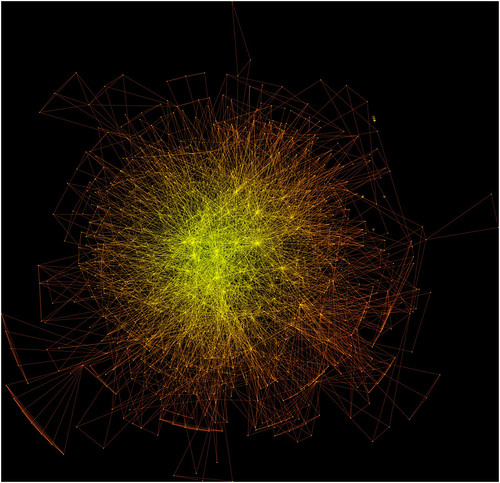
Visualization of my del.icio.us bookmarks
A visualisation of Kars Alfrink’s Delicious bookmarks, based on usage of tags, 2006, CC-BY

Looking at that list of uses, I notice that it is a mixture of things that can be public, things that can be public to some, and things that are just for my eyes. I also know that I don’t like publishing single bookmarks to my blog, unless I have an extended annotation to publish with it (more a reflection or response to a link, than just bookmarking that link). Single bookmarks posted to a blog I experience as cluttering up the timeline (but they could be on a different page perhaps).
The tagging is key as a filing mechanism, and annotation can be a helpful hint to my future self why I stored it, as much as a thought or an association.

When I think of ‘bringing bookmarking home’ in the sense of using only non-silo tools and owning the data myself, several aspects are important:

  • The elements I need to store: URL, date/time stored, full article/pdf, title, tags, notes. Having a full local copy of a page or PDF is a must-have for me, you can’t rely on something being there the next time you look at an URL.
  • The things I want to be able to do with it are mostly a filtering on tags I think (connecting it to one or more persons, interests, projects, channels etc.), and then having different actions/processes tied to that filtering.
  • I’d want to have the bookmarks available offline on my laptop, as well as available for sharing across devices.
  • It would be great if there was something that would allow the social networking type of bookmarking I described, or make it possible in decentralised fashion

When I look at some of the available open source bookmarking tools that I can self-host I notice that mostly the ability to save full pages/documents and the offline functionality are missing elements. So maybe I should try and glue together something from different building blocks found elsewhere.

What do you use for bookmarking? How do you use bookmarks?

26 Oct 17:50

Do I conclude correctly Peter from your descrip...

by Ton Zijlstra

Do I conclude correctly Peter from your description that at no point you store a full webpage, but only the URLs? That Nextcloud app looks like it stores some preview of sorts?

26 Oct 17:49

How I Save Bookmarks

by peter@rukavina.net (Peter Rukavina)

Ton asks “What do you use for bookmarking? How do you use bookmarks?”

I have three systems I’ve settled into.

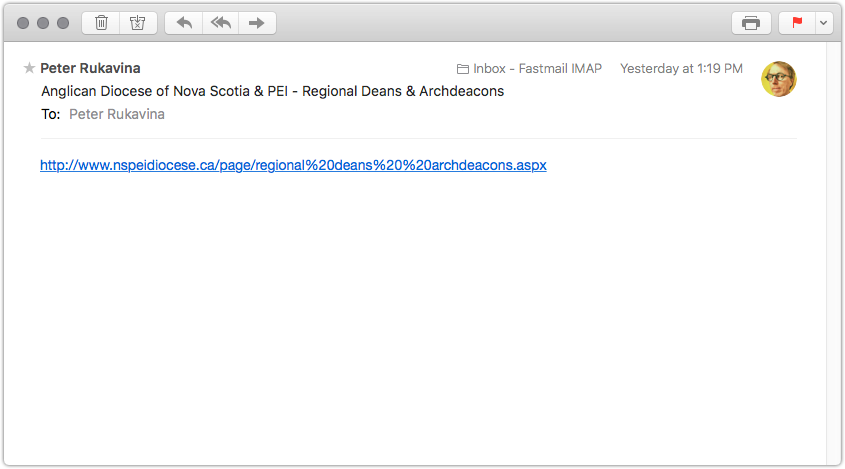
Email myself a link

When I’m reading an article on my mobile that I want to return to in the very near future to read more completely, I email the URL to myself using the built-in Android share-by-email feature. This isn’t elegant, but it puts the URL in my email inbox, where there’s no question that I’ll see it.

Screen show of an email that I've used to send myself a link

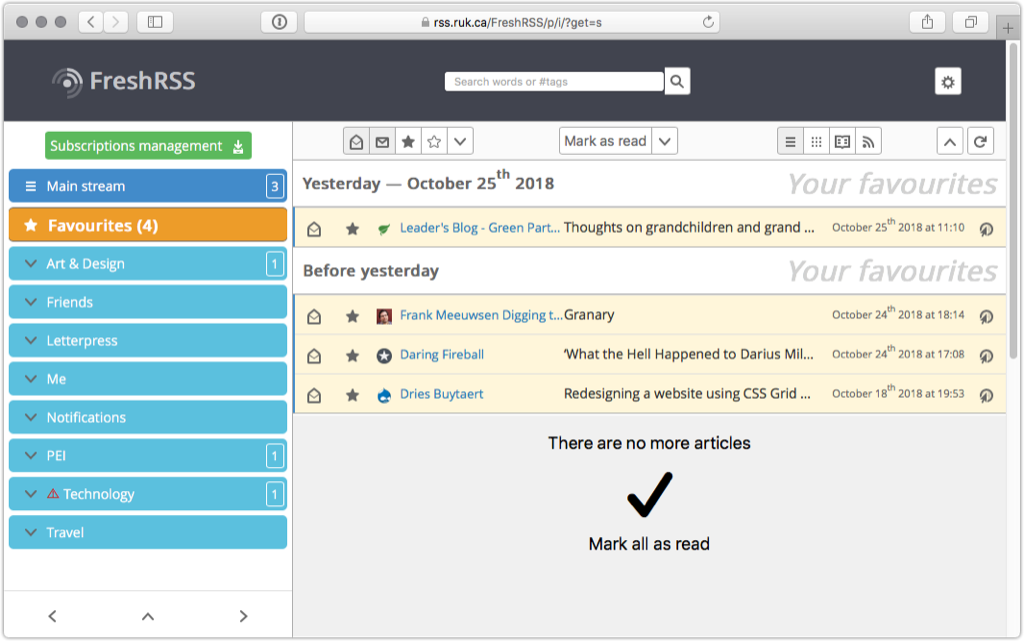
FreshRSS Favourites

When I’m scanning my RSS feeds, on either desktop or mobile, using FreshRSS, and I come across something I want to make a point of returning to, but not necessarily immediately, I use the built-in FreshRSS favourites system (tap the star in the header of any item). I make a point of reviewing this section every couple of days. This is the system closest to using Instapaper or Pocket, both of which I’ve tried in the past; the advantage it has for me over those approaches is that because it’s integrated into my feedreader, I don’t have another place to go looking for these items.

Screen shot of FreshRSS favourites section

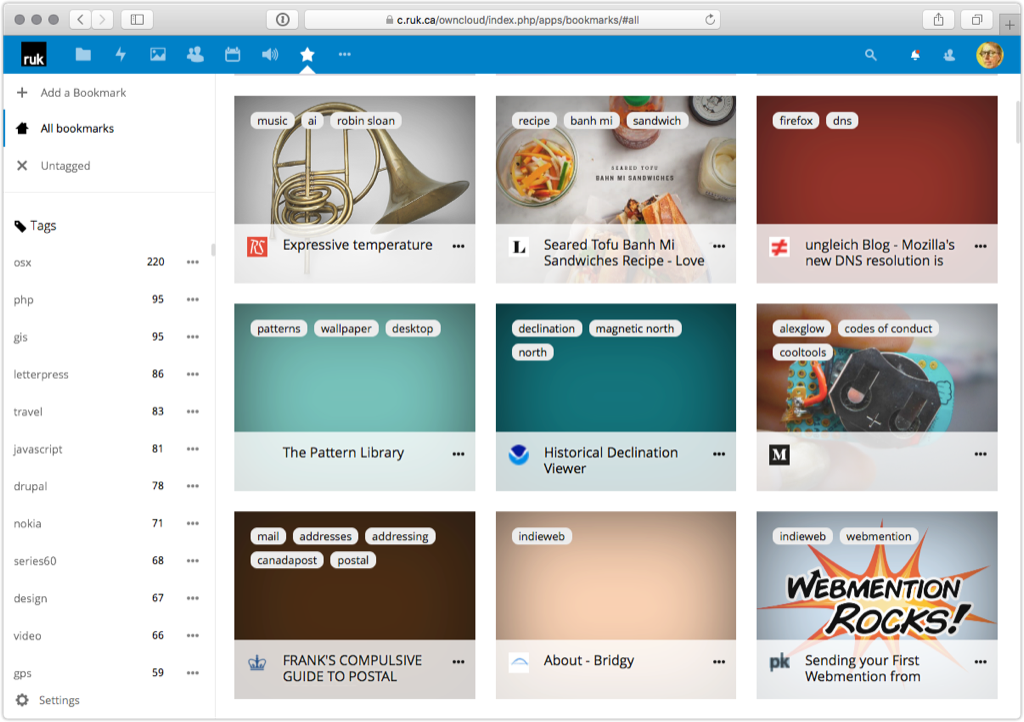
Nextcloud Bookmarks

On the desktop, when I encounter something that I want to be able to reference in the medium-to-long term future, rather than read in the near future, I use the Nextcloud Bookmarks app, running on my self-hosted Nextcloud instance, via a bookmarklet in my browser toolbar. This app has been updated recently to include a more visual interface; this is certainly more pleasing to look at, but is overkill for my use (and it’s also rendered the tag editor a little buggy). This is the system closest to what I used to use Pinboard and Delicious for; they were both useful and full-featured, but they weren’t owned-and-operated, which is why I migrated. I only rarely miss the social features of those systems.

To be honest, bookmarking things in this way is most useful in the mechanism it provides for assuaging “I should really bookmark this” feeling, in the moment, rather than for any practical utility it affords in the actual medium-to-long term future. I have found it a useful way to collect links to hotels, restaurants and other places I want to visit (I’ve got a very rich “Berlin” tag in this regards).

Screen shot of Nextcloud Bookmarks

My bookmarking hygiene is nowhere near as rich as Ton’s; it seems that it’s “saving a list of things to see in Berlin” is the area of greatest overlap.

26 Oct 17:49

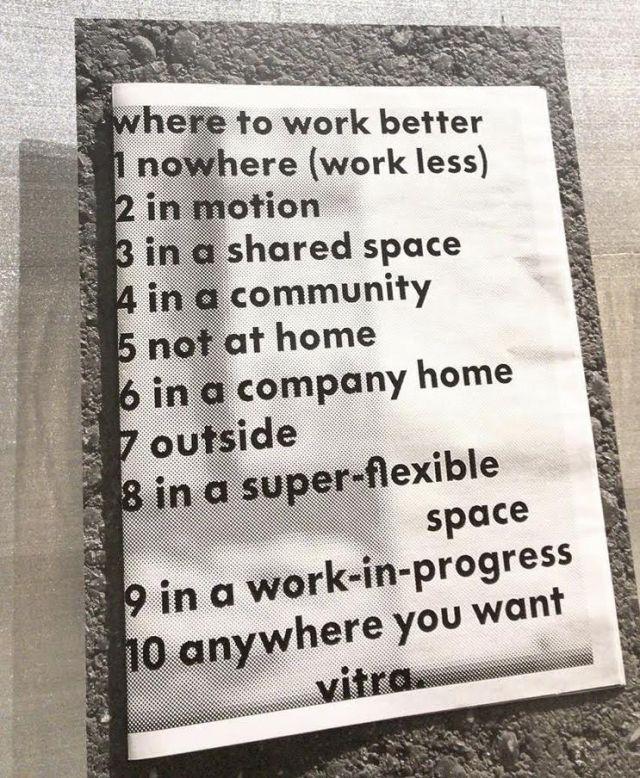
"where to work better"

by peter@rukavina.net (Peter Rukavina)

From David Noel’s Friday’s Five newsletter, a photo of a Vitra “manifesto” about workplaces. My favourite is “nowhere.”

(If you are ever in metropolitan Basel, a visit to Vitra is a must).

26 Oct 17:48

Women Who Tech and Mozilla Announce Winners of Women Startup Challenge Europe

by Mozilla

Europe was at the center of a milestone for women in tech today as nonprofit Women Who Tech and tech giant Mozilla announced the winners of the Women Startup Challenge Europe. Women-led startup finalists from across Europe pitched their ventures before a prestigious panel of tech industry executives and investors on 25 October at Paris’s City Hall, co-hosted by the office of Mayor Anne Hidalgo.

“While it’s alarming to see the amount of funding for women-led startups compared to European companies as a whole go down from 14% to 11% between 2016 and 2018, the Women Startup Challenge is on a mission to close the funding gap once and for all. If the tech world wants to innovate and solve the world’s toughest problems and generate record returns, they will invest in diverse startups,” said Allyson Kapin, founder of Women Who Tech. “If investors don’t know where to look, our Women Startup Challenge program has a pipeline of over 2,300 women-led ventures who are ready to scale.”

Sampson Solutions from the UK won the grand prize, receiving $35,000 in funding via Women Who Tech to help scale their startup. The Audience Choice Award went to Inorevia from Paris, France. Mozilla awarded an additional $25,000 cash grant to Vitrue from the UK, selected by jury member Mitchell Baker, Chairwoman of Mozilla.

“Paris is determined to provide girls and women with the resources to occupy their rightful place in the society and in the tech industry. We were thrilled to co-host the Women Startup Challenge Europe and showcase 10 talented women-led startups who are making an impact in this world,” said Deputy Mayor Jean-Louis Missika.

  • Grand prize winner Sampson Solutions capitalizes on business opportunities precipitated by the Paris climate agreement. Founded by Colleen Becker, Sampson Solutions is creating bio-based construction materials from sustainable sources using a closed-loop, carbon neutral manufacturing process.
  • The Audience Choice Award was awarded to Inorevia. Inorevia’s work in developing  instruments used for bioassays has resulted in minimizing the cost, time and manipulation needed for next-generation bioassay and precision medicine.
  • Mozilla Prize Winner Vitrue Health is developing computer vision based tools that sit in the background of clinical assessments, autonomously measuring motor function metrics, freeing clinicians to focus on more complex patient interactions, and allowing them to detect and treat degradations in functional health. This improves quality of life and saves millions in healthcare costs.

“I’m honored to award the Mozilla prize for privacy, transparency and accountability to Vitrue Health,” said Mitchell. “Vitrue creates data about mobility capabilities, makes that data accessible and useful, and provides it to patients.  By providing patients with access to their data in a useful way, Vitrue offers us an example of how creating new data — even personal data — can be quite positive when it is handled well.”

The in-person jury included Mitchell Baker, Jean-Louis Missika, Deputy Mayor of Paris, Fatou Diagne, Partner and Cofounder at Bootstrap Europe, Julien Quintard, Managing Director of Techstars Paris, and Stéphanie Hospital, Cofounder and CEO of OneRagtime.


The post Women Who Tech and Mozilla Announce Winners of Women Startup Challenge Europe appeared first on The Mozilla Blog.

26 Oct 17:48

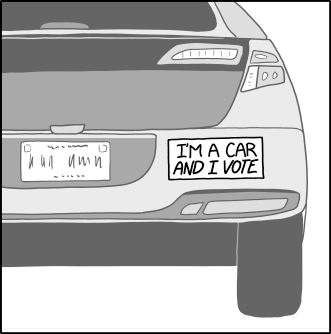
I'm a Car

mkalus shared this story from xkcd.com.

I'm the proud parent of an honor student, and the person driving me is proud, too!
26 Oct 17:48

Google’s Night Sight Mode for Pixel 2 and Pixel 3 is Magical

by Rajesh Pandey
Earlier this month when Google unveiled the Pixel 3 and Pixel 3 XL, it briefly talked about Night Sight. The feature is supposed to make its way to Pixel 3 and Pixel 2 devices later this year with an update and its aimed at greatly improving the low-light imaging performance. Continue reading →
26 Oct 17:46

Android Nearby Notifications will end on December 6th

by Dean Daley
Android Mascot

Google has announced that it will end its Nearby Notifications Android feature.

The feature that was supposed to offer useful and relevant information about closeby locations, such as free Wi-Fi, museum information and list transit schedules, has become primarily a spam tool.

Google has decided that Nearby Notifications “did not meet the bar” and lead to “poor user experience.”

“While filtering and tuning can help, in the end, we have a very high bar for the quality of content that we deliver to users, especially content that is delivered through notifications,” read the Android Developers’ blog post.

Due to this, the three-year-old functionality will come to an end as of December 6th. From that day forward Android users will no longer receive Nearby Notifications.

Source: Android Developers Blog 

The post Android Nearby Notifications will end on December 6th appeared first on MobileSyrup.

26 Oct 17:46

Google paid Andy Rubin $90 million to leave company due to sexual misconduct allegations: report

by Brad Bennett
Essential founder Andy Rubin

A new report from the New York Times alleges Google provided Android creator Andy Rubin a $90 million exit package after he left the company due to an investigation into his alleged sexual misconduct.

The investigation, which The Information first reported on, centered on an extramarital affair Rubin had with a female Google employee in which he allegedly coerced her into performing oral sex in a hotel room sometime in March of 2013.

The woman had been casually seeing Rubin and had gone to the hotel to break off the relationship. It was at that moment that the incident occurred. The relationship ended after that, but the employee waited until 2014 to file a complaint with Google’s human resources department.

The case was eventually escalated to management. Once the company determined that the claim was credible, Rubin was asked to resign. Google’s stance, at the time, was that it was impossible to prove the incident had happened, but that the relationship was inappropriate — company policy at the time required employees to disclose to HR that they had entered into a relationship so that one of them could be reassigned.

Google was not obligated to give Rubin an exit package but did so that he wouldn’t disparage the company in public or join one of its competitors.

Moreover, even after distancing itself from Rubin, Google still invested significant money in his venture capital firm, Playground Global.

Rubin’s spokesperson, Sam Singer, told the New York Times that he left Google on his own accord. Singer also said that any relationships that Rubin had at Google were consensual and were not with people who reported directly to him.

At Google, Rubin had a reputation for believing he should get his way due to his position within the company, according to sources who spoke to The New York Times. He unfairly reprimanded some employees by calling them stupid or incompetent. On top of that, a security team at Google had to remove bondage porn from Rubin’s work computer. That year Google docked his bonus, according to The Time’s sources.

Rubin’s spokesperson also denied that Rubin ever called anyone incompetent.

It’s unclear how many women at Google Rubin dated, but it’s confirmed that he met his ex-wife there, and then dated at least two other women while married, according to a group of four anonymous sources who spoke to the Times.

His ex-wife, Rie Rubin, recently sued Rubin, claiming that he had multiple “ownership relationships” with other women during their marriage, and he paid the women hundreds of thousands of dollars as well.

One text message that was revealed during the suit read as follows:

“You will be happy being taken care of. Being owned is kinda like you are my property, and I can loan you to other people.”

According to The New York Times, Rubin was one of three Google employees that were protected after they were accused of sexual misconduct. One of the other instances was similar to Rubin’s scenario. The search giant distanced itself from the senior executive but paid him millions.

The third executive who is still nameless, and whose behaviour is not detailed, still has a job at Google.

In a company-wide email, Google has openly fired 48 employees for sexual harassment and 13 were senior managers and above said Google CEO Sundar Pichai

Source: New York Times

The post Google paid Andy Rubin $90 million to leave company due to sexual misconduct allegations: report appeared first on MobileSyrup.

26 Oct 17:46

Google is bringing its dark mode to the Dialer app

by Brad Bennett
Google Phone app

The APK Insight section of 9to5Google has discovered that upcoming versions of Google Dialer and Contacts have a dark mode.

Since this is an APK Insight, there’s a chance that some of these features never see the light of day. However, it’s likely that it will happen, given that a lot of other Google apps are getting dark modes as part of the Material Design refresh.

The teardown shows the Dialer with Google’s Dark theme and bright colours. It also looks like the app can automatically go into dark mode when the phone enables Battery Saver like Google News.

The Dialer syncs with the contacts app better once it has the update.  There is speculation that since Contacts and Dialer are so interconnected that they will both be updated at the same.

Image Source: 9to5Google

Source: 9to5Google

The post Google is bringing its dark mode to the Dialer app appeared first on MobileSyrup.

26 Oct 17:46

Aukey’s KM-G6 keyboard offers a great budget typing experience

by Jonathan Lamont
Aukey KM-G6 keyboard

These days, mechanical keyboards are all the rage. They’re the go-to for PC gamers, beloved by typists and the evoke a nostalgia for the early days of computers.

However, good mechanical keyboards can be expensive, especially if they use high-quality switches. Keyboards with switches like the vaunted Cherry MX Blues — considered the best for typing — will often run you between $100 and $300.

Thankfully, companies like Aukey are offering more budget-friendly options, and they’re quite good.

Aukey logo on KM-G6

I’ve spent the last week typing on Aukey’s KM-G6 keyboard, which currently retails for $48.99 on Amazon. Aukey chose to use Outemu Blue switches instead, which feel almost identical to the MX switches but come at a lower price.

That means the KM-G6 feels premium without breaking the bank. The typing experience is fantastic. The keys are incredibly tactile. They are also loud, and while I love it, the people sitting near me don’t.

LED backlights with customizable patterns

Along with the excellent typing experience, Aukey packed several other features into the keyboard.

The KM-G6 features six-colour LED backlights, one colour for each row of keys. Additionally, the keyboard features several lighting patterns along with customizable backlights.

KM-G6 with the FPS set up

Ten distinct backlight patterns correspond to popular video-game genres. There are layouts for first-person shooters that highlight the W, A, S, and D keys and MOBA layouts that highlight Q, W, E, R, D and F.

Further, the keyboard has several animated lighting patterns users can cycle through. There’s the primary backlight for all keys, but users can also have a key light up when they press it.

My favourite was a ripple effect that sends a wave of light out from the key I press.

However, I would love a small software component to control and adjust the lighting options. The current system has you cycle through them on the keyboard. It isn’t an ideal system, as it’s hard to tell how many options there are and what they all do.

Windows and Alt keys on KM-G6

Aukey also made the keyboard spill-proof, a fantastic addition to any keyboard. There’s nothing worse than spilling liquid on a keyboard. Not having to worry about damage is a bonus.

Finally, the keyboard has full 104 N-key rollover. This means the keyboard can scan and receive input from every key at once.

KM-G6 looks good, except for the font

The keyboard is made primarily out of black plastic. It looks good and feels heavy. However, at some angles, you can see the white plastic around the base of the switches. It seems odd when the rest of the keyboard is dark.

Furthermore, the font on the keycaps isn’t great. It isn’t the worst font I’ve seen, but it still isn’t ideal. I’d expect to see this kind of type on the cover of an old science fiction novel, not a keyboard.

The KM-G6 also lacks some other small features I’ve come to expect from other keyboards. The keyboard I typically use with my personal desktop has USB ports and a headphone jack so I don’t have to go digging around the back of my computer. Those would be nice to see here, but by no means are they deal-breakers.

Full KM-G6 keyboard

Overall, the Aukey KM-G6 is impressive for its price. If you like clicky, tactile keyboards for typing or gaming, you can’t go wrong with this.

It features some fun and creative additions as well, like LED backlighting and water resistance.

Overall, I think the KM-G6’s good far outweighs the few cons. I’d highly recommend it for mechanical keyboard lovers on a budget.

You can pick one up on Amazon for $48.99.

The post Aukey’s KM-G6 keyboard offers a great budget typing experience appeared first on MobileSyrup.

26 Oct 17:46

WhatsApp is adding support for stickers

by Igor Bonifacic

WhatsApp may be years late to the party, but the Facebook-owned company announced on Friday that it’s adding stickers to its popular chat app.

Once they start rolling out over the next couple of weeks, users on both iOS and Android will be able to add the graphics to their conversations by tapping the new stickers button in the main chat interface.

To start, the company is releasing stickers made by its own designers and a select group of other artists. Moving forward, however, a newly released set of APIs and interfaces will allow third-party designers and developers to create their own packs.

Source: WhatsApp

The post WhatsApp is adding support for stickers appeared first on MobileSyrup.