Shared posts

10 Nov 21:43

Tangletown, MN

There’s got to be a morning after.

We won what was winnable: the House. We did what we set out to do.

In Minnesota, we won MN-02 and MN-03 — both pickups from particularly invidious Republicans. We lost MN-08 up North. We still don't know about MN-01: this morning, Democrat Dan Feehan is down by 1400 votes but we’ll see. (I told our volunteers this might be the closest race in the country, and I was pretty close. That busload of volunteers on Saturday, many from UMN and Macalester and St. Olaf, looks pretty good right now.)

Trump remains strong. The forces of darkness retain terrible power. One of our two political parties is insane.

This is not the beginning of the end. Yet still…

- - -

Drainage matters in suburban Minneapolis-St. Paul, so every suburban house is on its own little hill. That’s a lot of uphill driveways to walk.

It snows in Minnesota. Who knew? Rain, wind and snow make canvassing less fun.

It’s not much fun anyway.

They do breakfast well here. I had the “If You Must,” which has a thick slice of house-cured bacon from the restaurant’s own farm, eggs, cornbread — but can she make corn muffins?! — and really superb potatoes.

Democrats need to think about new media. We’ve left it to the Republicans. We took back a share this time because we had dollars and no broadcast slots to buy. I think it matters.

Democrats need to think about the human cost of our dependence on canvassing.

I did not see a Republican canvasser — not one — on any of my shifts. I did not see a Republican door-hanger — not one — on any of my doors. Yet we won MN-02 by 4% and lost MN-01 (though not by much — we think by less than 0.5%.)

Tangletown, MN
10 Nov 21:42

How to brainstorm the future

by Josh Bernoff

Every strategy book I’ve ever written includes a final chapter about the future. Here’s how I do the brainstorms that turn into those chapters — and how you can run your own brainstorms about the future, whether you’re writing a book or just planning for scenarios. The objective of a brainstorm like this is to … Continued

The post How to brainstorm the future appeared first on without bullshit.

10 Nov 21:38

SFU: Want More Skytrain? Do the Numbers (Part I)

by Colin Stein

This week, Alex Boston, the Executive Director of the Renewable Cities program at SFU’s Morris J. Wosk Centre for Dialogue, wrote an op-ed in the Vancouver Sun on the proposed two big changes threatening to upend phases 2 and 3 of TransLink’s Mayors Plan.

Boston’s piece is a call, if slightly veiled, to Vancouver’s Kennedy Stewart and Surrey’s Doug McCallum to do what they were elected to do when it comes to regional matters — understand all the issues in a city which are regionally dependent or impactful, obtain support and confidence from your respective councils on big ideas, and work collaboratively with the other mayors and the TransLink Board to realize them.

But of course as you may know, it’s never that easy. And much like the housing crisis, there may not even be agreement on what the two problems are. 

Boston makes his position, and that of many academics, planners and pundits, that in the end, nothing should be done (or re-done, or undone) without a business case.

Since his accompanying, longer piece published on the Renewable Cities website includes some numbers, it’s a bit more compelling for those who are, shall we say, extra passionate about this issue.

Source: Renewable Cities

Most interesting is the table comparing employment and resident densities — and the relative thresholds for shifting between transit type — of TransLink, the GTA’s Metrolinx, and the Government of Ontario.

(One assumes that, in addition to residents and workers, variegated student populations are also accounted for specifically due to the question of rail to UBC.)

What’s striking in looking at the table, and thinking about Boston’s argument in favour of business cases, is where the gaps are. While Translink has very granular density threshold guidelines in place for the lower-capacity, ‘bus end” of the spectrum, it’s not clear they’ve established similar thresholds for subway/Skytrain, rapid rail/bus, and commuter rail, as have the transit authorities in Toronto and across the rest of Ontario. If they do, they’re keeping them a bit too quiet given the present debate.

Toronto also takes the extra step, ala Vancouver’s Greenest City Action Plan, of linking demand thresholds to mode share targets.

Thus, one of the questions Boston’s deep-dive analysis prompts — whether he intended to do so or not — is whether aspects of TransLink’s Phase 2 and Phase 3 plans may have been developed without the benefit of a full set of demand guidelines, from which a bullet-proof case for high-speed, high-capacity solutions could be formed.

And so, while it should not be a reason to shy away from dissecting the plans, Kennedy and McCallum had better be prepared — back to Boston’s central point — to do an even better job of justifying their very specific remedies.

If indeed density thresholds, carrying capacities, and service standards have been established and agreed upon between the mayors and TransLink, and the mayors agree that transportation planning entails defining not ‘shovel-ready’ but ‘shovel-worthy’ projects (as Boston testified to as a witness at the House of Commons Standing Committee on Transport, Infrastructure and Communities this past May on Ottawa), then maybe all this recent talk about extending or swapping in Skytrain is just that — talk.

Maybe, just maybe, the mayors didn’t want to bore us all with the reality of business case writing. Which is a process unto itself, a veritable rabbit hole, down into the warren of wonk.

Yet, with campaign season well behind us, maybe we’re all finally ready for some data-driven decision-making.

Tomorrow, Part II — a comparison of some of the metrics that would, in part, form business cases for the UBC extension, and Surrey and Langley Skytrain lines…and how they’re very, very different.

Photo credit: Colin Knowles, “Skytrain abstract 6

10 Nov 21:36

We need physical separation

by Stephen Rees

I have been on Twitter this morning and there is a picture of a mother and daughter riding their bikes on the sidewalk.

Screen Shot 2018-11-08 at 1.44.24 PM

Seeing that reminded me of the pictures that I had taken outside the place we were staying at in Chicago’s Loop district (downtown). The bike lane is a bit better in Chicago than North Van but it is still just paint. And as the three pictures show a lot of green paint does no more to deter cars from entering the lane than that thin white line with the occasional bike logo. Anyone riding a bike down East Washington St would have to swerve around those parked cars putting them in line for a potential collision with moving vehicles.

If you look closely at the two left hand images you can see in the previous block a big bus shelter outside the bike lane providing excellent separation.  For the 60 feet length of a bus anyway.

For more see “Walkable City Rules” (see previous post) Part XII Build Your Bike Network especially Rules 58 and 59. Best practices are outlined in the NACTO Urban Bikeway Design Guide. 

By the way if you like those cars on green bikelane pictures, follow Streetsblog New York (@StreetsblogNYC) on Twitter for more.

StreetsblogNYC


10 Nov 21:35

The end of PHP 5

by Dries

PHP, the Open Source scripting language, is used by nearly 80 percent of the world's websites.

According to W3Techs, around 61 percent of all websites on the internet still use PHP 5, a version of PHP that was first released fourteen years ago.

Now is the time to give PHP 5 some attention. In less than two months, on December 31st, security support for PHP 5 will officially cease. (Note: Some Linux distributions, such as Debian Long Term Support distributions, will still try to backport security fixes.)

If you haven't already, now is the time to make sure your site is running an updated and supported version of PHP.

Beyond security considerations, sites that are running on older versions of PHP are missing out on the significant performance improvements that come with the newer versions.

Drupal and PHP 5

Drupal 8

Drupal 8 will drop support for PHP 5 on March 6, 2019. We recommend updating to at least PHP 7.1 if possible, and ideally PHP 7.2, which is supported as of Drupal 8.5 (which was released March, 2018). Drupal 8.7 (to be released in May, 2019) will support PHP 7.3, and we may backport PHP 7.3 support to Drupal 8.6 in the coming months as well.

Drupal 7

Drupal 7 will drop support for older versions of PHP 5 on December 31st, but will continue to support PHP 5.6 as long there are one or more third-party organizations providing reliable, extended security support for PHP 5.

Earlier today, we released Drupal 7.61 which now supports PHP 7.2. This should make upgrades from PHP 5 easier. Drupal 7's support for PHP 7.3 is being worked on but we don't know yet when it will be available.

Thank you!

It's a credit to the PHP community that they have maintained PHP 5 for fourteen years. But that can't go on forever. It's time to move on from PHP 5 and upgrade to a newer version so that we can all innovate faster.

I'd also like to thank the Drupal community — both those contributing to Drupal 7 and Drupal 8 — for keeping Drupal compatible with the newest versions of PHP. That certainly helps make PHP upgrades easier.

10 Nov 21:35

Recommended on Medium: A.I. and the Future of Work

Photo © Adrien Williams

Disclaimer: the views expressed in this post are my own and do not necessarily reflect the view of my employer, Accenture.

I participated in a debate on Artificial Intelligence and the future of work last month. The motion was that “A.I. will create more jobs than it destroys” and my teammate, Dr Augustin Chevez, and I were arguing in favour of the motion. I’m happy to report that we won the debate, which was decided based on the number of audience members we managed to persuade.

It was interesting to see what did and did not come up during the debate, which included a Q&A round with audience participation. For example, I was sure there’d be a lot of talk of self-driving cars, but they hardly got a mention. And one thing that did get quite a bit of attention was the notion of the Singularity, an idea which I have difficulty in taking seriously at all.

I find that talk of the Singularity and Superintelligence can add a lot of confusion to discussions of this topic, so in this post I’m laying out how I navigate the question of whether AI will adversely affect employment, based partly on the arguments I presented at the debate.

AI and Automation

In the past, new industries hired far more people than those they put out of business. But this is not true of many of today’s new industries. . . . Today’s new industries have comparatively few jobs for the unskilled or semiskilled, just the class of workers whose jobs are being eliminated by automation.

Those words were written in 1961, in Time Magazine. Even then, automation wasn’t new — there had been automation through mechanisation for over a century. But the thinking was, This time it’s different, and it’s different because of computers. Today, the thinking is, This time it’s different, and it’s different because of AI.

Without committing to a particular definition of AI, let’s at least constrain it somewhat, i.e. to technologies that already exist but that will improve a lot over time. In other words, we’re not postulating any entirely new inventions of the future, such as whole brain emulation. We’re talking about the type of AI that exists, not the type of AI you get in science fiction stories.

Given this constraint, we also need to decide how broadly to define the term. A very broad definition of AI would include anything that uses a computer to do things that previously were done by humans: everything from ATMs, pocket calculators, and automated parking lot barriers all the way to today’s chatbots and online travel booking sites. On the “jobs destroyed” side we can then include parking lot attendants, travel agents, elevator operators, etc. But on the jobs created side we’d have to include not only the entire tech industry, but any job that involves working with a computer. Also, a big part of this automation story has already played out, and it hasn’t resulted in mass unemployment.

So it makes sense to use a narrower definition of AI, which makes it possible to claim that “this time it’s different.” What is the reason for the sudden surge of interest in AI? What are the technologies that have really taken off in recent years? Machine Learning (ML) is at the centre of it all. Deep Learning in particular is something you can point to and say “This is new. This we have not seen before.” Except it’s not really all that new — these techniques have been around for decades — but the amount of data and compute power available to train these systems is unprecedented, so let’s call Deep Learning new at least in this respect.

Is Machine Learning replacing humans?

So what is Deep Learning being used for and whose jobs will it take away? One great success story of Deep Learning is Machine Translation, one of the foundational tasks within AI. Early approaches weren’t very successful, but now the results with Google Translate and similar tools are really quite impressive. And Chinese internet giant Baidu recently announced a real-time ML-based interpreter. So surely translators’ and interpreters’ jobs are in danger? Not according to the US Bureau of Labor statistics. They forecast 18% growth in demand for translators and interpreters between now and 2026.

What’s happening here? Well, it turns out that once you reduce the cost of doing something by automating it, demand for that capability goes up, opening up more opportunities for humans to add value. In the case of translators, this means for example translating the specifics of legal contracts, doing localisation work, etc.

This is similar to what happened with ATMs: they reduced the cost of opening a branch, so banks actually opened up more branches and employed more people to do higher value tasks than just cashier work. And in fact the same thing happened in the textile industry in the early 19th century: automation made it cheaper to produce fabric, which drove demand for more product, which led to more jobs in the industry.

What all of this shows is that the interaction between automation and employment is more complicated than you might think. For more on this, read Why Are There Still So Many Jobs? The History and Future of Workplace Automation by David Autor.

Machines that are smarter than humans?

You’ve all seen the exponential progress curves, heard talk of the so-called Singularity. The thinking is that since there’s progress being made at all in something called Artificial Intelligence, then this will necessarily lead to the creation of a machine that is more intelligent than humans. And if that happens, it can of course take all the translation and interpreting jobs as it will be better at these tasks than humans.

But where progress is being made is in well-defined problem spaces: computer memory, processing speed, ability to store and work with ever larger quantities of data, accuracy of data-driven approaches to classifying objects in images or recognising faces. On the other hand, “solving intelligence” is not a well-defined problem. And so it’s really not clear at all whether progress in the well-defined problem spaces will lead to an “Artificial General Intelligence” (AGI), the term used to refer to this notional machine with at least human-level intelligence.

It’s also not clear whether the ability to understand natural language, such that a machine could be a better translator than a human, is possible without human-level intelligence. So in the absence of any coherent definition of what AGI is and how we might achieve it, and without a non-AGI solution to the task of language understanding, we can at least say that it is very unlikely that translation will be entirely taken over by machines. The same can be said for any task which requires what we call “common sense.”

Indeed, Baidu’s own CTO has said in relation to their AI-based interpreter service, that there will continue to be a need for human translators and interpreters “especially for high stake occasions which require consistent and more precise interpretation.“

Putting people first isn’t just a nicety

Many companies working in the AI space today are at pains to make clear that these technologies are about augmenting human intelligence, not about machine intelligence replacing humans. This may seem like a PR platitude to avoid coming across like they’re in the business of putting people out of a job, but it’s actually more than that. The type of AI that’s being used today, i.e. Machine Learning, doesn’t just augment humans, it requires them.

The first stage where humans are needed is in the labeling of data to train the Machine Learning model. It’s not always an explicit task where the human is knowingly labeling data to be used for ML (as in the case of creating training data for self-driving cars — work that is painstakingly being done by thousands of people in Kenya), and it’s not always as straightforward as annotating a picture of a cat with the word “cat”, but it’s a necessary step, and it has to be done by people who understand the domain in question. If we stick with the translation example, here the “labeling” is the human translation of text from the source language to the target language. If Google or Baidu decided to stop using human translations to train their models with and instead fed them their own past translations, people would very quickly lose faith in their translation services. When a snake eats its own tail, so much the worse for the snake.

Another fundamental facet of ML, besides its need for copious amounts of human-labeled training data, is that it is inherently uncertain. It produces guesses based on probabilities arising from the data it was trained on, which often need to be verified by a human. When the stakes of a decision aren’t that high — for example, when a mistake just means a poorly targeted ad or the wrong word being predicted in your smartphone autocomplete — there’s no need for human verification. But if a decision significantly affects people’s lives, or for any reason comes with a level of responsibility, no provider of ML systems will take on that responsibility, and so a human has to. Sadly, this is not always understood and there are certainly cases of decisions being entirely automated when they shouldn’t be.

Given that Machine Learning, by definition, requires human supervision, this means that ML-enabled automation is in fact less likely to result in wholesale replacement of people with machines than the type of automation that came before, i.e. automation of routine tasks that could be described with rules (because there’s no uncertainty there, hence no need for supervision). So the argument that this time the automation story is different because of AI really doesn’t hold much water.

The dangers of overestimating AI

Problems arising from automation of decisions that shouldn’t be automated, for example in the criminal justice system, sometimes come down to people thinking that ML-based systems are more “intelligent” than they are. This in turn comes from the many exaggerated claims being made of such systems. While reporting in the mainstream media can be held accountable for a lot of this, AI researchers themselves have been known to inflate the significance of their accomplishments. Geoff Hinton, one of the fathers of Deep Learning, proclaimed during a talk at a hospital in 2016 that “They should stop training radiologists now,” because Deep Learning will soon be better than humans at identifying medical problems from images. In fact, there’s been a radiology staffing crisis in the UK for the last few years, and though it’s hard to know whether Hinton’s remarks played a role in that, they certainly can’t have helped.

Hinton was mistaking the task for the job, and he has since walked back his comments somewhat and clarified that the role of the radiologist will change as Deep Learning approaches to medical imaging improve. Well, of course it will — as the tools of a job change, the individual tasks constituting that job must change. A big part of the job of a radiologist, which will not be changing, is the responsibility for making decisions that affect people’s lives. Deep Learning cannot help with that part. These systems are tools that can help speed up decision-making, they are not themselves decision-makers. And better tools are exactly what radiologists need if they’re to have any hope of keeping up with the exponential growth in demand for medical imaging. But even then, better tools will help only if there are enough radiologists in the first place, which there won’t be if the AI overhype discourages people from entering the field.

Making assertions about a whole class of jobs going away in the near future because of AI is downright irresponsible.

Responsible AI talk

Most of the talk around responsible AI is about the responsible development and deployment of AI, and the need for fairness, transparency and accountability. In addition to this, I’d like to advocate for the responsible discussion of AI, and I think everyone can play a part here. During the Q&A round of last month’s debate, someone said “I’ve heard that AI can now tell if you’re a criminal by looking at your face.” They were referring to a paper from a couple of years ago that claimed to have achieved this, which I quickly pointed out, as I’ve done elsewhere before, was less a case of Artificial Intelligence than human stupidity.

When we hear grand claims about AI, each and every one of us is capable of at least questioning whether the claims make sense before we repeat them as fact. How AI is discussed will affect how it is deployed, including whether its limitations (bias, uncertainty, etc.) are adequately accounted for. Adequately accounting for such limitations is, and will continue to be, the job of humans, and there’s no end in sight to the work to be done here.

One of my opponents in the AI debate-who had spent a good deal of time talking about AGI-was asked by an audience member, “If an AGI will be better than humans at everything, won’t it be better at being good too?” My opponent responded that it would; but he warned that we mightn’t like the ethical decisions it made, even if they were more correct than ours. He illustrated this claim in a puzzling way, with a scenario where an AGI makes the “correct” ethical decision to kill a healthy person in order to save five others who need organ transplants. I found the example puzzling because just that case is typically used as a counterexample to the variety of consequentialism about ethics called act utilitarianism. And it’s a counterexample precisely because it gives an ethically wrong answer. Yet here the case was now, being touted by my opponent as the “ideal” answer that a supposedly perfect AGI would give to an ethical dilemma (and by a professional ethicist, no less). But we already have machines capable of mindless decision-making based on a predefined optimization function-just like act utilitarianism. No need to wait for the AGI! Figuring out what to optimize, and how to be fair, that’s the hard part. Only we can do that.

We humans have got our work cut out for us.

Originally published at katbailey.github.io.

10 Nov 21:35

Recommended on Medium: Why We’ll Never Know the Truth About Trump’s Press Conference Video

During a press conference at the White House Wednesday afternoon, CNN’s Jim Acosta got into a heated exchange with President Donald Trump. Acosta, a reporter already seen by Trump—and Trump’s supporters—as either merely an aggressive agent or as a literal secret agent, pressed Trump on how he characterized the so-called migrant caravan making its way through Central America as an “invasion.”

“They’re hundreds of miles away, that’s not an invasion,” Acosta said.

“Honestly, I think you should let me run the country. You can run CNN, and if you did it well, your ratings would be much higher” Trump replied.

As Acosta began another question, Trump looked around the room to call on another journalist. “That’s enough,” he told Acosta, as a White House staffer approached to remove the microphone from Acosta’s hand. The staffer grabbed the mic, but Acosta refused to let go.

https://medium.com/media/42d8ee9c5164e86da72533871b773c5f/href

What happened next is the cause of considerable debate. The controversy foreshadows a larger, looming debate—one not merely about the validity of video evidence, but about reality itself.

A few hours after the terse exchange, Acosta tweeted that his White House media pass had been revoked. White House press secretary Sarah Huckabee Sanders released a statement soon after, along with video of the exchange, claiming that Acosta had assaulted the staffer who had attempted to take the mic from his hand. “President Trump believes in a free press and expects and welcomes tough questions of him and his administration,” she wrote. “We will, however, never tolerate a reporter placing his hands on a young woman just trying to do her job as a White House intern.”

Sanders later posted a video that zoomed in on the moment where Acosta refused to release his grip on the microphone. It showed the moment when his arm made contact with the staffer’s. “We will not tolerate the inappropriate behavior clearly documented in this video,” Sanders wrote in the attached tweet.

Debates like this one, over the legitimacy of video evidence, are just beginning.

That allegation was roundly denounced by other reporters in the room. By Thursday morning, it wasn’t just the interpretation of Acosta’s downward arm motion or contact with the intern that was the subject of frenzied online debate. It was, instead, whether the video Sanders posted had been doctored—sped up to appear as though Acosta had been more forceful.

In a tweet that, at this writing, has been shared nearly 30,000 times and liked over 19,000 times, Rafael Shimunov claimed to show evidence that the video had been doctored. This claim that was quickly picked up by a variety of mainstream news outlets and echoed by others performing their own video analysis.

“I’ve edited video for 15+ years,” Shimunov wrote in the tweet. “The White House doctored it.” Shimunov, who has professional experience in technology and media development, later clarified that the White House may not have actually altered the video. Instead, Sanders may have been sharing a clip that was manipulated elsewhere.

He pointed a finger at Paul Joseph Watson, a vocal right-wing conspiracy theorist often described as “alt-right” (though he disputes that label). Watson refuted the charge.

“The claim being made my [sic] some media outlets that I ‘sped up’ the Acosta video is a brazen lie,” he tweeted, attaching what he claimed is the “original editing,” wherein, he said, “no tracks are ‘sped up’… I just zoomed in.”

It all leaves us in a familiar spot. In the days following Trump’s inauguration, a similar debate erupted over his erroneous claims about the size of the crowd that witnessed his swearing in. “This was the largest audience to ever witness an inauguration—period,” then-White House press secretary Sean Spicer aggressively told reporters after the event.

It was, in fact, not at all the largest, a fact made all the more obvious by aerial photos released soon afterward. But the Trump White House stood by its claim, and in subsequent months, it was revealed that official photos of the inauguration were cropped by a government photographer “to make the crowd appear bigger following a personal intervention from the president.”

But photos are one thing. Video is entirely another.

Claims of doctored video have existed for decades—the Zapruder film remains controversial, for instance—but in the 21st century, amateur conspiracy sleuths, armed with increasingly effective editing software, have taken to analyzing video in the search for hidden clues that help bind together their alternative theories of global events. Since 9/11, video analysis has become a veritable cottage industry on YouTube, leading people down weirder and weirder paths and contributing to a splintering of accepted reality.

In 2015, work done by computer scientists from Germany and California suggested video analysis was about to enter a new, and stranger, phase after they released the first clips of a program designed to alter video in real time. Their software, called Face2Face, captures the facial movements of someone in a studio and superimposes those expressions onto a video of someone else—a world leader, for instance.

https://medium.com/media/e9992dd8168c816502336f734181a210/href

Since then, real-time video alteration has only grown more effective. Technologies that change other aspects of doctored videos — like audio — to make them more convincing have grown more powerful, too. And while there are still ways to spot a faked video (including how often the video subject blinks), knowing the truth will only become more difficult. The general public is usually either not aware of the technology or not sufficiently trained to recognize its effects when they occur.

Worse, however, will be a question of sourcing.

As the debate Thursday showed, determining ownership of a video found on the internet can often be frustratingly difficult, particularly if you’re trying to establish veracity against the instantaneously deadlines of a frenetic news cycle. It’s difficult to decide, in the mere moments of a video scrolling past on Twitter, whether one thing is more accurate than another. Without the ability to know where something came from, or how it traveled, figuring out how and when video may have been altered will quickly become a fool’s errand.

Already, the debate over the Acosta video is a wormhole of conspiracy and conjecture. This might be okay if it were limited to a strange corner of YouTube. The Acosta video debate, however, was created and already mainlined into legitimacy by very prominent and established outlets, none more so than the White House itself, which is attempting — whether conscious or not if the video had been altered — to establish, just as it had following Trump’s inauguration, its own narrative of accepted events.

Whether or not you believe the White House’s account of what transpired, or those who claim the video has been altered, one thing is certain: this is the new reality. Debates like this one, over the legitimacy of video evidence, are just beginning. Things will only get weirder from here.

10 Nov 21:34

How do people decide whether or not to get a browser extension?

by Jennifer Davidson

The Firefox Add-ons Team works to make sure people have all of the information they need to decide which browser extensions are right for them. Past research conducted by Bill Selman and the Add-ons Team taught us a lot about how people discover extensions, but there was more to learn. Our primary research question was: “How do people decide whether or not to get a specific browser extension?”

We recently conducted two complementary research studies to help answer that big question:

  1. An addons.mozilla.org (AMO) survey, with just under 7,500 respondents
  2. An in-person think-aloud study with nine recruited participants, conducted in Vancouver, BC

The survey ran from July 19, 2018 to July 26, 2018 on addons.mozilla.org (AMO). The survey prompt was displayed when visitors went to the site and was localized into ten languages. The survey asked questions about why people were visiting the site, if they were looking to get a specific extension (and/or theme), and if so what information they used to decide to get it.

Screenshot of the survey message bar on addons.mozilla.org.

The think-aloud study took place at our Mozilla office in Vancouver, BC from July 30, 2018 to August 1, 2018. The study consisted of 45-minute individual sessions with nine participants, in which they answered questions about the browsers they use, and completed tasks on a Windows laptop related to acquiring a theme and an extension. To get a variety of perspectives, participants included three Firefox users and six Chrome users. Five of them were extension users, and four were not.

Mozilla office conference room in Vancouver, where the think-aloud study took place.

What we learned about decision-making

People use social proof on the extension’s product page

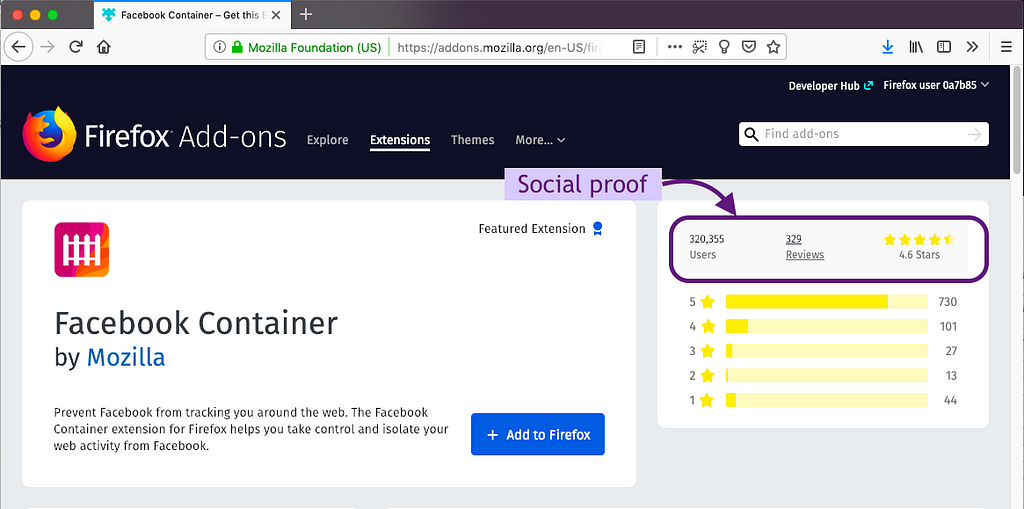
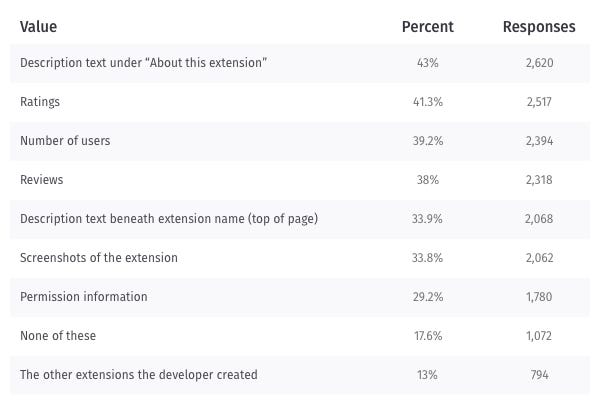
Ratings, reviews, and number of users proved important for making a decision to get the extension in both the survey and think-aloud study. Think-aloud participants used these metrics as a signal that an extension was good and safe. All except one think-aloud participant used this “social proof” before installing an extension. The importance of social proof was backed up by the survey responses where ratings, number of users, and reviews were among the top pieces of information used.

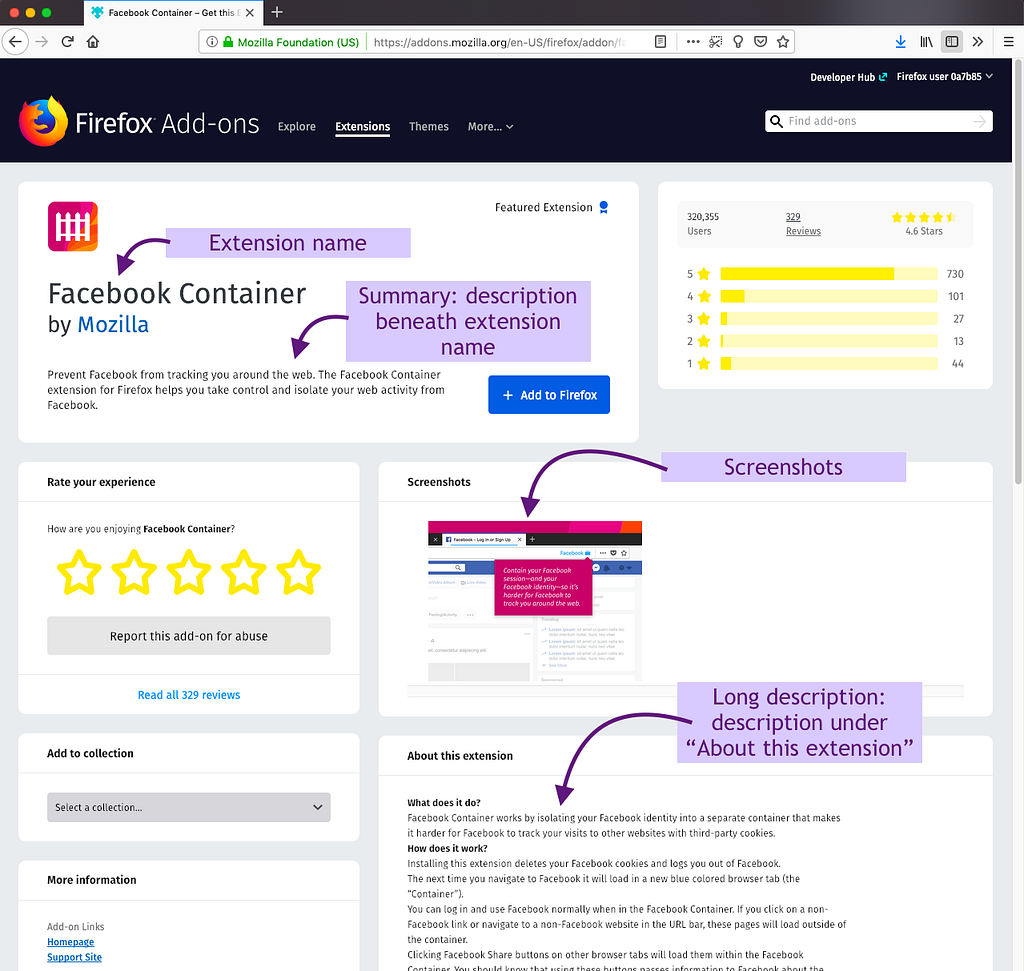
Screenshot of Facebook Container’s page on addons.mozilla.org with the “social proof” outlined: number of users, number of reviews, and rating.
AMO survey responses to “Think about the extension(s) you were considering getting. What information did you use to decide whether or not to get the extension?”

People use social proof outside of AMO

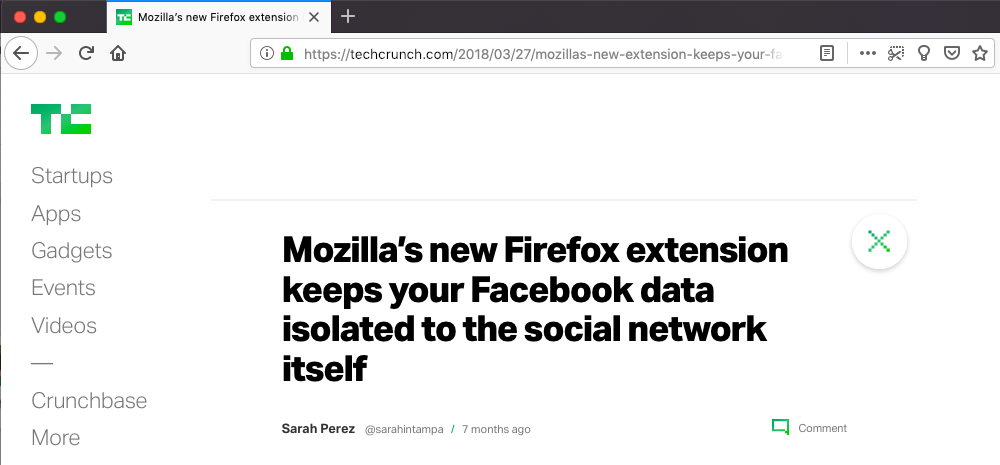
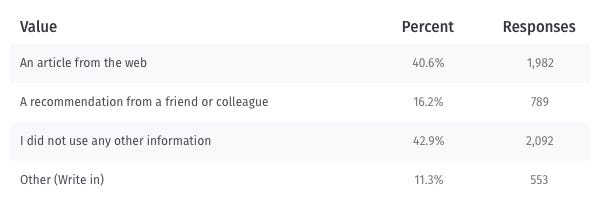
Think-aloud participants mentioned using outside sources to help them decide whether or not to get an extension. Outside sources included forums, advice from “high authority websites,” and recommendations from friends. The same result is seen among the survey respondents, where 40.6% of respondents used an article from the web and 16.2% relied on a recommendation from a friend or colleague. This is consistent with our previous user research, where participants used outside sources to build trust in an extension.

Screenshot of an example outside source: TechCrunch article about Facebook Container extension.
AMO survey responses to “What other information did you use to decide whether or not to get an extension?”

People use the description and extension name

Screenshot of Facebook Container’s page on addons.mozilla.org with extension name, descriptions, and screenshot highlighted.

Almost half of the survey respondents use the description to make a decision about the extension. While the description was the top piece of content used, we also see that over one-third of survey respondents evaluate the screenshots and the extension summary (the description text beneath the extension name), which shows their importance as well.

Think-aloud participants also used the extension’s description (both the summary and the longer description) to help them decide whether or not to get it.

While we did not ask about the extension name in the survey, it came up during our think-aloud studies. The name of the extension was cited as important to think-aloud participants. However, they mentioned how some names were vague and therefore didn’t assist them in their decision to get an extension.

Themes are all about the picture

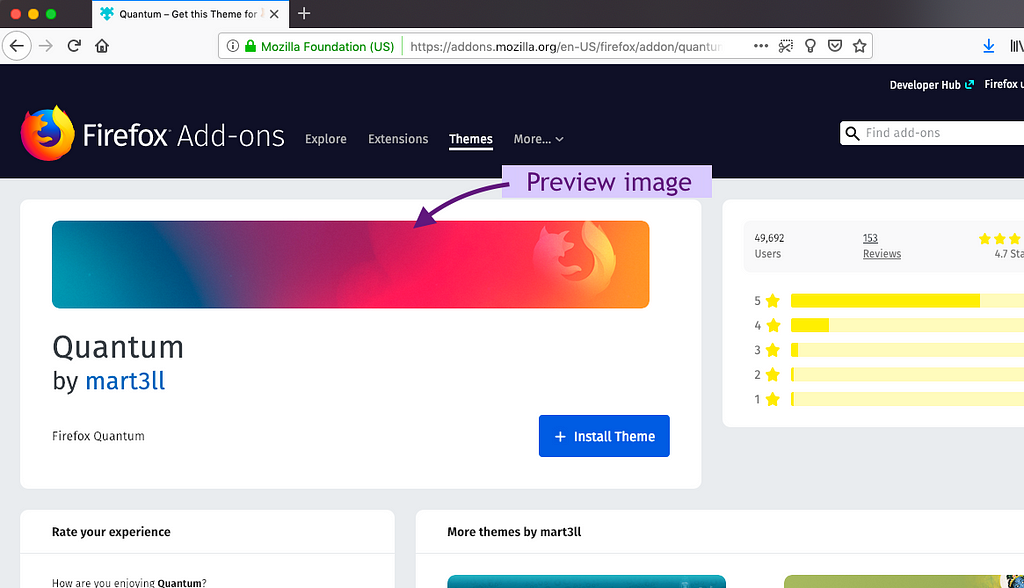
In addition to extensions, AMO offers themes for Firefox. From the survey responses, the most important part of a theme’s product page is the preview image. It’s clear that the imagery far surpasses any social proof or description based on this survey result.

Screenshot of a theme on addons.mozilla.org with the preview image highlighted.
AMO survey responses to “Think about the theme(s) you were considering getting. What information did you use to decide whether or not to get the theme?”

All in all, we see that while social proof is essential, great content on the extension’s product page and in external sources (such as forums and articles) are also key to people’s decisions about whether or not to get an extension. When we’re designing anything that requires people to make an adoption decision, we need to remember the importance of social proof and great content, within and outside of our products.

In alphabetical order by first name, thanks to Amy Tsay, Ben Miroglio, Caitlin Neiman, Chris Grebs, Emanuela Damiani, Gemma Petrie, Jorge Villalobos, Kev Needham, Kumar McMillan, Meridel Walkington, Mike Conca, Peiying Mo, Philip Walmsley, Raphael Raue, Richard Bloor, Rob Rayborn, Sharon Bautista, Stuart Colville, and Tyler Downer, for their help with the user research studies and/or reviewing this blog post.

Also published on the Firefox UX blog.


How do people decide whether or not to get a browser extension? was originally published in Firefox User Experience on Medium, where people are continuing the conversation by highlighting and responding to this story.

10 Nov 21:33

Not Indispensable

by Richard Millington

The Starbucks’ Leaf Rakers Society isn’t an indispensable community.

It doesn’t significantly improve the lives of its members.

It doesn’t deliver clear, irreplaceable, value throughout the business.

It doesn’t bring to bear a brand’s unique assets to create an unparalleled community experience.

This time next year, it will be long gone and forgotten.

Sure, it’s only a half-serious community. But remember Starbucks has a unique opportunity to build an amazing community for baristas, remote workers, coffee lovers, and many other related groups. Each of which would benefit from being closely connected to one another.

Instead, they dove straight into the engagement trap trying to create something fun and viral.

Don’t copy Starbucks here. You have audiences that need to be connected, audiences where you can offer unique value and create something that really drives your business forward. Go build that, skip the quick likes.

p.s. The only worthwhile lesson here is if a Facebook group is good enough for Starbucks to get started, it’s probably fine for you too.

10 Nov 21:33

Wie schnell ist mein USB Type C Port?

by Volker Weber

ZZ10022CB1

Wenn alles gut läuft, dann druckt der Hersteller Eures Rechners ein kleines Symbol neben Euren USB-Port. Und das sagt Euch dann, was dieser Port kann. In der ersten Reihe seht Ihr zwei Symbole für USB 3.1 und USB 3.1 Gen 2. Der linke schafft 5 Gbit/s, der rechte 10. In der zweiten Reihe ist das Symbol von einer Batterie eingefasst. Das sind die Ports mit USB PD (Power Delivery). Das USB-Symbol ohne SS (Superspeed) zeigt USB 2.0 Geschwindigkeiten, also 480 Mbit/s, an.

Und dann gibt es noch Thunderbolt 3.0, das den gleichen physischen Stecker benutzt, aber ein Blitz-Symbol hat. Das überträgt dann bis zu 40 Gbit/s und Strom bis zu 100 W, ein geeignetes Kabel und Endgerät vorausgesetzt.

Thunderbolt oder USB-C, wie gesagt gleicher Stecker, entscheidet auch, was man damit antreiben kann. Ein iPad Pro hat kein Thunderbolt und kann deshalb das LG 5k Display nicht bespielen, sehr wohl aber das LG 4k.

09 Nov 22:33

looking back at Waimānalo Beach

by Emily Chang

looking back at Waimānalo Beach

Photo Caption: looking back at Waimānalo Beach

Photo taken at: Waimanalo Beach, Hawaii

Instagram filter used: Normal

View in Instagram ⇒

09 Nov 22:31

A more natural interface for weather

by Marek Pawlowski
The Weather Cube by Yu Zhuang (source: Yanko Design)

The Weather Cube, designed by Yu Zhuang and featured in this post by Yanko Design, is an alternative interface for meteorological information. Using ultrasonic actuators, it changes the nature of the water contained within a sealed cube to reflect the conditions outside. On a windy day, there are waves; when it is sunny, the water is calm and still. The temperature is permanently displayed through projection.

While I can foresee a number of practical challenges with this implementation (not least how it would cope with British days when it can be windy, sunny and raining all at the same time), I found its approach refreshingly different. It provided a reminder that computer screens should not always be our default choice when we think about new ways to convey information to users.

Part of MEX Inspirations, an ongoing series exploring tangents and their relationship to better experience design.

09 Nov 22:31

Product management learning list - for government, open to all

Canadian Digital Services, Nov 11, 2018
Icon

This is a low-tech way to distribute what is essentially a self-paced course on product management. It came to me via the Canadian Digital Services newsletter, part of an ongoing program to modernize digital services in the Government of Canada. It's a Google Sheets spreadsheet with resources collected from around the web, a short commentary, and information about the focus and type. Everything is freely accessible - click and read. That's the way to do it.

Web: [Direct Link] [This Post]
09 Nov 22:31

Historian Tiya Miles, and her husband, Joseph Gone. I have a...


Historian Tiya Miles, and her husband, Joseph Gone. 

I have a tendency to search on images of people I read about, and to read more deeply into their lives. She’s just the most recent. A fascinating woman. See this Op-Ed she wrote for the NY Times, for example.

09 Nov 20:53

Sabbatical Log: November 1st

by kevinmontrose

This blog series is running about a week behind my actual work, giving me time to clean things up.  The date the actual work was done is in the title, horizontal lines indicate when I stopped writing and started coding.

I’m on sabbatical for November, and am taking the time to play around with a kind of coding I’ve never dabbled in: Game Dev. I’ve read a decent amount (mostly Gamasutra and forums), watched a lot of videos (GDC and Handmade Hero), and certainly thought about it – but I haven’t actually done it.

I have no delusions of actually finishing this month, or even making something all that fun. I’m just aiming to Learn Me A Thing™.

The first decisions I’ve made are:

    1. What kind of game?
      • A top down action-RPG in the mold of one of my all time favorites
      • I’ve also bought Link To The Past a half-dozen times, so I don’t feel scruples about stealing some assets for this little exercise.
        1. However, I don’t intend to publish the code with assets.
    2. What language am I working in?
      • C#, solely because I like it and know it well. I considered TypeScript and Rust, but while TypeScript is better than JavaScript I still don’t really like working in it and I don’t consider myself proficient in Rust yet.
    3. What, if any, framework am I using?
      • I’m going to use MonoGame.
      • I only want something to handle the blitting of pixels into the screen for me, I intend to implement all other systems myself, and MonoGame looks like it fits the bill.

I guess it’s, time to get to work.


My first focus was on some infrastructure, namely a barebones Entity-Component-System.

I’ve decided that there are basically two “types” of Components (binary/flags and stateful ones), Entities are just id numbers, and Systems work over enumerations of entities having some component. All of entity management bits are wrapped up in an EntityManager class like so

Specifically, the EntityManager class handles:

      • Creating entities
      • Release entities
      • Attaching and removing flag components to entities
      • Attaching and removing stateful components to entities
      • Enumerating entities with specific flag or stateful components
      • Fetching flag or stateful components for specific entities

Since I expect garbage collection to be something of an enemy in this project, I’m keeping allocations to a minimum. For the EntityManager class that means I only allow a fixed number of entities, and a fixed number of stateful components per entity – the required space for tracking both sets is allocated up front, in the constructor. I’m also avoiding all LINQ-to-Objects, and using C#’s duck typing of foreach to avoid allocations during miscellaneous logic.

I’ve also written test cases for this class, and it is my intent to continue to do so for all future code. I’ve read it can be pretty hard to actually test games, so we’ll see how well I can keep to that.


I’ve now implemented enough systems and components to get a box moving on the screen; and it only took ~5 hours of work.

My solution now looks like so

I’ve got some components:

      • InputComponent receives “input” from a player
        • Although I don’t intend for their to be multiple players, this abstraction is nice because it lets me mock input handling more easily
      • PositionComponent holds an X & Y for an entity
        • I’m using subpixels, so this entity also does the conversion (only the subpixels are writable)
      • I also added FlagComponent.Player (my first “boolean” component) to mark the player entity
        • Although I’m also assuring that Id=1 is always the player elsewhere, it feels cleaner to have an explicit marker for the player

My first two systems are:

      • InputSystem, which takes input from MonoGame and updates InputComponent baring entities
        • This actually works off an interface, so it can be mocked. MonoGameHardwareInputAdapter does the actual mapping of GamePadState and KeyboardState to “PressedKeys”.
        • Testing so far is minimal, but still seems workable. For example:
      • UpdatePositionSystem is a temporary system that updates player entities’ PositionComponent based on their InputComponent.
        • All the logic it really does is keeping the player entity inbounds with some hardcoded sizes
        • I consider this temporary because I think it’d be more sensible to model velocity and have player movement handled by the same “physics” that moves everything else

And I’ve introduce a GameState class that wraps around the EntityManager and has an Update(TimeSpan) method which triggers the various systems in the appropriate order. Not putting any of the logic in the Game-derived class makes it easier to test – in fact you can see the creation and use of a GameState in the above test.

All of the above gets us to logically moving the player, but there’s no code for actually drawing it. To solve that, I introduce a FrameStateManager that is used to construct a FrameState which is used is then translated into Draw calls. While I could directly translate GameState into Draw calls, I like introducing an intermediary representation for a few reasons:

    • Once the FrameState is constructed, it’s safe to modify GameState again; so in theory I could get a leg up on the next frame while still rendering the previous one. I doubt that will be necessary, but it’s conceptually nice.
    • Going the other way, constructing a separate FrameState makes it much less likely I’ll accidentally modify GameState as part of rendering.
    • A separate FrameState makes it possible to “record” a play session into a parseable representation, which will hopefully make testing easier.
    • In the age of Twitch, YouTube, and speed running – recording gaming sessions is commonplace. Being able to “record” into something that can then be properly rendered later just strikes me as neat.

Continue onto November 2nd

09 Nov 20:52

Wearing a Poppy

by peter@rukavina.net (Peter Rukavina)

I have never been a regular wearer of Remembrance Day poppies, for no more reason that ignorance and sloth.

Archdeacon John Clarke wrote a moving argument for the poppy in a blog post last week; in part:

The red poppy was not chosen as a symbol of remembrance because of its beauty. It’s because it grew around the graves of soldiers killed in Europe during the world wars. The deep red colour of the poppy reminds us of the blood that poured from the wounds of people killed in battle.

We place a symbol of the poppy on our lapels, near our hearts, to remind ourselves of one essential fact, that war is ugly. The poppy in no way falsely glorifies war. Its intention is the exact opposite, it reminds us of the utter and complete horror of the violence perpetrated on soldiers and civilians in war. The poppy is a stark symbol of the need for us and our political leaders to do all in their power to achieve an everlasting peace.

If I needed any more convincing, this passage from one of the Letters from the Great War was all it took:

Just a few lines to let you know I am alright. Hoping this will find you all the same. Well, I am still in Blighty and I am tired of writing and getting no answer. I have not had a letter from you since I had the registered one with the dollar in it. It seems to be the same with all us Canadians here, as there is about a hundred in the hospital here and they don’t get any letters from Canada. I would like to know where in hell they are going to. That is why I am having mine sent to a private address. I do stand more chance of getting them.

Well, I had a Medical Board two weeks ago and they marked me B I for B II, so I am expecting to be on the next draft and it is for Siberia, but you leave that to me. I do not want to go there. It is too far away and too cold. I would rather go to France. I think I can kick off it. Well, I am not fit for it anyhow, but I am getting better every day. I am getting stronger. It takes quite a little time to get over gas, but this is a dead place here. I do not like it.

It’s not so much the prospect of being sent to Siberia or France to fight that is chilling–although it certainly is–as much as the humanizing contrast between the everyday worries about postal service and what should be exceptional worries about the time needed to “get over the gas.”

As Archdeacon Clarke wrote in his post, war is ugly. We wear a poppy to remind ourselves of that. There’s one on my coat as I type.

09 Nov 20:51

The Fourth Industrial Revolution is here, and it is changing everything

Colleges and Institutes Canada, Desire2Learn, Nov 11, 2018
Icon

Desire2Learn has updated and published a Canadian edition of its report on the future of learning (28 page PDF) (and you don't even have to give them information to read it; well done D2L). The premise is that the nature of work is changing and that therefore "societies must embrace new or hybrid learning models to allow individuals and economies to thrive going forward." A challenge is coming from automation and AI, "putting cognitive jobs at risk." There's also the rise of "the gig economy". So "neither employers nor employees can expect skills to stay relevant throughout careers."

So what needs to change? "Higher education must redefine its value proposition for students and employers." Just getting a credential is not enough any more. Institutions need to embrace "delivery models that are learner-centric, flexible, responsive, and adaptive," for example, "a system of stackable credentials (that) can be leveraged to provide ongoing education and skill development for employees." D2L recommends aligning programs and credentials to labour market needs (which I think is a dubious proposition), expanding work-integrated learning (which I support), and ensuring the system is affordable (which i very much support).

Web: [Direct Link] [This Post]
09 Nov 20:51

Best and Worst Things I’ve Been Told

by Gail Mooney

I can make you a lot of money and you won’t have to live in NJ anymore. In its heyday, stock photography was big money and various stock photo agents actively sought after my partner/husband and me. We had a deep body of travel and portrait images that were valued by many and we had set up meetings with some of the stock houses that were located in NYC – just across the river from where we lived, in NJ. One day we had a meeting with a rep who repeatedly praised our work as she went through our portfolio and made it clear that she wanted to sign us up. Then she said, “I can make you a lot of money and you won’t have to live in NJ anymore.” We didn’t sign up with her, went on to make a lot of money in that part of the business (at that time anyway) and live in one of the most beautiful places in the United States that happens to be in NJ.

We call this the “love” contract. When many photographers were making pretty good money producing and/or licensing “stock” or existing images, one of the big stock outlets decided to roll out the new contract. At that time, stock photo contracts were changing and to be brief, the changes were never in the favor of the content creator. One day, there was a huge meeting of the photographers at their NYC headquarters and the point people from the company came out on stage and joyfully announced the rollout of the new contract, which they called the “love contract”.

That immediately caught my attention but not for the right reasons. Later the audience asked dozens of questions about changes or alterations to the contract, which were answered with replies like “we’ll take that to corporate”. After about an hour of listening to this but not seeing anyone taking notes, I instinctively asked, “How are you going to remember all this?”

They say your print is only as good as your negative. When we were starting out we were very lucky because we were embraced and mentored by a leading art director at a prestigious magazine and he gave us a lot of opportunities. I can honestly say, that knowing and working with this man has changed my life for the better I many ways. One thing he loved to do was to have a luncheon or dinner with the photographer(s) and writers and staff who worked on the article together. We were young and very green and we’d be at the table with some of the legends in the business. During one of those luncheons, a very prestigious photographer and his wife were in attendance. The photographer was going on and on complaining that he couldn’t find an assistant that could make a good print. This particular photographer was well known for complaining. I’m not sure if it was the 2nd glass of wine I had or the fact that I was sympathetic for the assistant but for some dumb reason something popped into my head from what they always told us at Brooks and I blurted out – “You know what they say. The print is only as good as the negative.” I don’t know who laughed harder, the photographer, his wife or our mentor.

We didn’t feel we needed to see you. One day my daughter came home from school and told me that her teachers didn’t feel they needed to see me on parent/teacher night because she was a great student. At the time, our town was growing and class sizes were getting big and I suppose the teachers felt that since there were no problems, there wasn’t the need to talk. I understood their plight, but I have one child and pay dearly for the public schools through high property taxes. So, please don’t tell me I can’t have 10 minutes of your time. When I met with her teachers, they praised her and said they really didn’t have much more to say. I instinctively said, “ I didn’t know it was going to be a one-way conversation.

What’s the worst thing that could happen? When I was headed to Brooks Institute and planning to drive my 10-year-old VW bug from NJ to California, by myself, my Dad told me that I would be foolish and it would be better for me to buy a better car. I immediately said, “How will I pay for it? My dad said, “you’ll get a job”. I said, “What if I don’t get one?” He said, “Gail, what’s the worst thing that could happen?” I thought, well they would take away the car if I couldn’t make the payments, but at least I’ll get to California.

Why not? I got together recently with my friend and fellow filmmaker when she was in town to do a Q&A at a screening of her new movie. She reminded me of something that I once said to her and has stayed with her and inspired over the years. I said, that whenever someone questions me and asks me why I’m doing something that may seem too outrageous or daring, I answer by saying – why not?

 You’re 25 and already making compromises? I call this story my Jay Maisel story and is one of the most important things anyone has ever said to me. I was young and showing my portfolio around in NYC. My love was travel and I wanted to shoot for magazines, but it wasn’t a good time to pursue editorial work, Look magazine had recently shut down and Life had folded for the first time. Everyone was telling me that if I wanted to make a living with photography then I needed to shoot commercial work. I had put together my commercial portfolio and went to see the legendary and blunt NYC photographer, Jay Maisel. He looked at my work and pretty much threw it back at me and said: “This is crap, this isn’t what you want to do – is it?” I told him no, and that I wanted to shoot for magazines and travel but everyone told me that I wouldn’t be able to make a living at it. And the blah blah blah of youthful excuses. He asked me how old I was to which I replied that I was 25 years old. I’ll never forget what he said, “You’re 25 years old and you’re already making compromises!”

09 Nov 20:50

My talk in Calgary as part of Walrus Talks

by Mathew

In case anyone is interested, Walrus magazine has posted the video of a talk I gave recently in Calgary as part of their “Walrus Talks” series, which involves seven people from different walks of life giving seven talks of seven minutes each. We had an interesting group, including country music star Paul Brandt, who I enjoyed talking with in the green room before the show (the other talks are here).

The theme for this series was disruption, so (of course) I talked about disruption in the media — but I didn’t talk about Facebook and Twitter and Russian trolls or Trump, at least not directly. That would have taken too long! Instead, I talked about the evolution of my thinking about the disruptive effects of the internet on media and journalism in the form of a story — a story about what happened after the Globe and Mail launched the ability for readers to add comments on news stories in about 2005 or so (we were one of the first major newspapers in North America to do this).

Basically, my point was that like many people, I started out being very optimistic about what the Internet would do for media and journalism, and quite quickly also saw the dark side of it (ask me about moderating reader comments on stories about gay marriage or the Middle East sometime). But despite all that has happened, with Trump and Russia and neo-Nazis on Twitter etc., I still believe that the Internet and the social web are a net positive — although sometimes it is hard to convince myself of that.

Note: I got the timing of the two comments I mention wrong in my talk, which I will have to fix the next time I do it. The one about Simon Wiesenthal came first and the one about the bridge collapse in Quebec came much later. Also, I described the first comment incorrectly — it wasn’t about adding salt to the concrete mix to keep it from freezing (it actually lowers the freezing point), it was about not taking enough steps to prevent de-icing road salt from getting into the bridge and rusting out the rebar supports. Anyway, apart from that it went pretty well.

09 Nov 20:48

The danger of metrics: how the Bill James comments dehumanize baseball players

by Josh Bernoff

Bill James, the inventor of the baseball analytical method sabermetrics, controversially tweeted that baseball players could easily be replaced with no effect on the game. This prompted a swift and outraged reaction from players. It also raises a larger point — should businesses focus primarily on metrics, or on people? James was in a Twitter … Continued

The post The danger of metrics: how the Bill James comments dehumanize baseball players appeared first on without bullshit.

09 Nov 20:48

Escaping the macOS 10.14 (Mojave) Filesystem Sandbox with R / RStudio

by hrbrmstr

If you’re an R/RStudio user who has migrated to Mojave (macOS 10.14) or are contemplating migrating to it, you will likely eventually run into an issue where you’re trying to access resources that are in Apple’s new hardened filesystem sandboxes.

Rather than reinvent the wheel by blathering about what that means, give these links a visit if you want more background info:

and/or Google/DuckDuckGo for macos privacy tcc full disk access as there have been a ton of blogs on this topic.

The TLDR for getting your R/RStudio bits to work in these sandboxed areas is to grant them “Full Disk Access” (if that sounds scary, it is) permissions. You can do that by adding both the R executable and RStudio executable (drag their icons) to the Full Disk Access pane under the Privacy tab of System Preferences => Security & Privacy:

I also used the Finder’s “Go To” command to head on over /usr/local/bin and use the “Show Original” popup on both R and Rscript and dragged their fully qualified path binaries into the pane as well (you can’t see them b/c the pane is far too small). The symbolic links might be sufficient, but I’ve been running this way since the betas and just re-drag the versioned R/Rscript binaries each time I upgrade (or rebuild) R.

If you do grant FDA to R/RStudio just make sure be even more careful about trusting R code you run from the internet or R packages you install from untrusted sources (like GitHub) since R/RStudio are now potential choice conduits for malicious code that wants to get at your seekret things.

Photo by Alexander Dummer on Unsplash

09 Nov 20:47

You probably don't mean simplistic

by Tom MacWright

If you’re describing something simple, minimal, functional, and well-designed, you don’t mean to use the word ‘simplistic’. The Oxford English Dictionary defines simplistic as:

‘Treating complex issues and problems as if they were much simpler than they really are.’

Simple has neutral connotation, but simplistic is negative and critical. Here’s a correct use of word simplistic, from the New York Times:

“Today we are threatened by a new simplistic approach that reduces all the problems in the world to the struggle against terrorism,” Mr. Védrine said during a lengthy interview on France’s Inter radio. “This is not well thought out.”

Védrine is saying that the US’s approach is oversimplified - that it lacks essential elements and ideas.


I suspect this mistake stems from a false parallel with minimal. Minimal and minimalistic have the same connotation and similar meanings, whereas simple and simplistic are very different. When writing approvingly, simplistic is probably not the word you’re looking for.

I hope that this rant steers people away from the avoidable mistake of misusing simplistic.


You probably shouldn’t use minimalistic either. It’s barely a word, not worthy of the Oxford English Dictionary or Merriam-Webster, only appearing in the expansive Collins Dictionary of dictionary.com fame. It only started showing up in the 1950s, and then mostly to refer to minimalistic art, not minimal things in general. Minimalistic is a lot like ‘utilize’ – a word that adds letters but not meaning.

09 Nov 20:47

Dominic Raab’s geography for dummies paves the way to an idiot’s Brexit | Marina Hyde | Opinion

mkalus shared this story from The Guardian.

“I hadn’t quite understood the full extent of this, but if you look at the UK and if you look at how we trade in goods, we are particularly reliant on the Dover-Calais crossing.” Brexit secretary Dominic Raab, ladies and gentlemen, at some event on the tech industry this week.

“My wife would say [my Lego collection is] far too large, but I find Lego therapeutic … Everybody who does any difficult or stressful job needs a way to switch off. We all have different ways. Mine is Lego.” Culture secretary Jeremy Wright, ladies and gentlemen, on Talk Radio yesterday morning.

“I freely admit that when I started this job, I didn’t understand some of the deep-seated and deep-rooted issues that there are in Northern Ireland. I didn’t understand things like when elections are fought, for example, in Northern Ireland, people who are nationalists don’t vote for unionist parties and vice versa.” Northern Ireland secretary Karen Bradley, ladies and gentlemen, in a political magazine interview this September.

Behold the government of all the talentless: a place where you don’t just think it, but you make extra sure to say it out loud and in public. As the Lego song itself goes: everything is awesome, everything is cool when you’re part of a team. Or is it? Perhaps you are highly relaxed about the fact that seemingly every cabinet job these days is an outrageous fish-out-of-water comedy, or a Pygmalion-like plot in which two unseen financiers have decided, for a bet, to pass off a rejected Family Fortunes contestant as a secretary of state. Or perhaps, like me, you occasionally wake up screaming: “Wait! Morpheus, come back! I’ve changed my mind! I want the blue pill. GIVE ME BACK THE FUCKING BLUE PILL.”

I truly don’t want to know that anyone in the animal kingdom, let alone in the Department for Exiting the European Union, is not meaningfully aware that the UK is an island. Then again, I am somehow even more horrified by the news that on Friday morning allies of Raab – whose own officials call him Raab C Brexit – were taking the time to brief that he did actually know Britain was an island/archipelago.

I mean, once you’re calling journalists, on behalf of a secretary of state, and your tongue and your teeth and your lips are working together to form the statement, “Of course Dominic knew Britain was an island”, haven’t you gone way past your personal safe word? When you look in the bathroom mirror, is the face of your eight-year-old self not looking back at you and whispering, “Get out now!”? Or is it, in fact, even worse than that? Politically speaking, do you not at that point realise you’ve been dead the entire movie?

At this moment in our national journey, the government makes much more sense when you realise it can only be a massive hidden-camera simulation designed solely to amuse the occupants of a distant planet. Clustered round a visual port somewhere in Andromeda galaxy, interconnected strings of aliens cry with laughter every week at top-rating series Big Brexit, in which the hapless denizens of a Truman-like shitshow fail to realise they are being taken for a ride by their competition-winner overlords. Every UK resident stars.

And so to where we find ourselves, several weeks after the date we were once told was the absolute deadline for domestic agreement on a deal, and the PM can’t even get her own government or parliamentary partners to agree. As I was writing this, transport minister Jo Johnson resigned. The DUP, on whose support Theresa May relies after her Darwin award-winning 2017 election, have accused her of breaking her promises to them. No 10 appears to be the last to know what everyone else has been saying for months: that it was only a matter of time before this particular alien burst out of the government’s chest cavity. Meanwhile, the noises off are pushing no deal with increasing insistence. “We are a big country,” blustered David Davis on Thursday. “We can look after ourselves.”

And yet, are we, and can we? There was a 69-year-old Dutch chap in the news this week who is going to court to argue he should be allowed to formally self-identify as 49 because he reckons he’ll do better on Tinder. Apparently he sees himself as a “young god” whom doctors have told has the body of a 45-year-old. “When I’m 49,” he reasoned, “with the face I have, I will be in a luxurious position.” I couldn’t help feeling there was a little something of Brexit UK to this gentleman: that sense that you’re a total swashbuckler who’s only being held back by imagined red tape, and that you’d get laid twice as much and twice as filthily under WTO rules.

May’s government is the obnoxious hatchback driver in the Ferrari baseball cap, with negotiators such as Davis veering from ill-mannered to unrealistic. It has squandered much of the negotiating period since article 50 was triggered, acting like its bumper sports the legend “MY OTHER COUNTRY IS A SUPERPOWER”. Incidentally, from the clown car to the car being driven knowingly over a cliff, it’s striking how many of the most apposite Brexit metaphors are car-related. Or, as the more literal leading Brexiteer economist Patrick Minford put it the other week: “You’re going to have to run [the car industry] down, in the same way we ran down the coal and steel industry. These things happen.”

So there you go. Many of us who once thought the UK had been having its post-imperial hangover for a few decades now realise that, during that period, Britain was in fact still drunk. The real hangover, unfortunately, is only just about to kick in.

• Marina Hyde is a Guardian columnist

09 Nov 20:47

How to explain Jacob Rees-Mogg? Start with his father's books | Books

mkalus shared this story from The Guardian.

In the spring of 1997, shortly before Tony Blair took power, William Rees-Mogg, ex-editor of the Times, leading Eurosceptic, pinstriped self-publicist and father of Jacob, published a book that claimed to see the future of the world. The Sovereign Individual: The Coming Economic Revolution and How to Survive and Prosper in It opened with a quote from Tom Stoppard’s play Arcadia: “The future is disorder.”

For 380 breathless pages, Lord Rees-Mogg and a co-author, James Dale Davidson, an American investment guru and conservative propagandist, predicted that digital technology would make the world hugely more competitive, unequal and unstable. Societies would splinter. Taxes would be evaded. Government would gradually wither away. “By 2010 or thereabouts,” they wrote, welfare states “will simply become unfinanceable”. In such a harsh world, only the most talented, self-reliant, technologically adept person – “the sovereign individual” – would thrive.

The book’s mixture of gloom and glee, and air of patrician certainty, did not go down well with British reviewers. In 1997, the west was entering a period of relative prosperity, equality and political optimism, which the rise of Blair personified. The book seemed too apocalyptic. Besides, Rees-Mogg had been making melodramatic predictions in newspaper columns for decades. So many had been wrong – Colin Powell would be the first black president of the United States; Margaret Thatcher would survive the 1990 coup against her – that Private Eye called him “Mystic Mogg”, after the astrologer Mystic Meg.

When he died in 2012, the obituaries were more respectful, concentrating instead on his many years smoothly ascending and serving the establishment. They only briefly mentioned The Sovereign Individual, and the handful of other, equally strange and ambitious Rees-Mogg volumes that preceded it, without making much effort to explain what the books were about. His career as an author, the obituarists discreetly implied, had been an insignificant sideline, or a bit of an embarrassment.

That verdict is now beginning to seem premature. In August, Alastair Campbell, Blair’s former right-hand man and a prominent remainer, wrote about The Sovereign Individual at length on his blog. He called it “the most important book you have never heard of”. “After reading it,” he intriguingly claimed, “it is easy to see” why Jacob “so loves Brexit, and the chaos and disorder, and opportunities for disaster capitalism and super-elitism, that it may provide.”

Across the Atlantic, the book has become associated with another disruptive tendency in modern politics, the rightwing libertarians of Silicon Valley. From the start, the book was better received in the US, where futurology and polemics against the state are more mainstream genres. In 2011, almost a decade and a half after the book’s publication, Rees-Mogg was still being invited there to talk about it, to students at Stanford University, one of Silicon Valley’s prime recruiting grounds. In 2014, Peter Thiel, the intellectually restless, fiercely conservative co-founder of PayPal, told the business magazine Forbes that The Sovereign Individual had influenced him more than any other book.

As well as airy rhetoric about the internet’s revolutionary potential – already standard stuff for futurologists in the mid-90s – the book contained more concrete and pioneering predictions: about cryptocurrencies, electronic warfare, smartphones and the possibility of online bots imitating humans. Some of these forecasts had an accuracy that still amazes. Rees-Mogg and Davidson envisaged a “new digital form of money”, for example, to “consist of encrypted sequences … unique, anonymous and verifiable … tradable at a keystroke in a multitrillion-dollar wholesale market without borders” – Bitcoin in other words, a decade before it was actually invented.

The book also foresaw a backlash against the footloose, cosmopolitan elites that digital technology would help create. The economy’s “losers”, as Rees-Mogg and Davidson called them, who “do not excel in problem-solving or possess globally marketable skills”, would turn to nationalism and bitter nostalgia. They would “seek to thwart the movement of capital and people across borders”.

In today’s ever more connected, ever more fragmented world, Mystic Mogg appears to be having the last laugh.

He was 68 when the book came out. The long, sometimes eccentric, rarely examined intellectual journey that led up to it tells us important things about transatlantic conservatism over the last half-century, and how drastically it has changed. Rees-Mogg’s journey also helps explain his increasingly powerful but still quite opaque son, Jacob: not just as a supporter of Brexit, but as an unsentimental and nimble “sovereign individual” of exactly the type his father envisaged. Simultaneously, Rees-Mogg Jr has managed to become a successful player in the modern, borderless financial industries, and a nationalist politician with an instantly recognisable retro image. He has seduced some Labour MPs with his old-fashioned manners; and he has met privately in a Mayfair hotel with the would-be guru of the international far right, Steve Bannon. This lack of squeamishness about how the conservative establishment holds on to political and economic power has been passed down the Rees-Mogg generations. As Jacob told the Times in 2015: “My father, with whom I discussed all aspects of politics and finance, was the greatest influence in my professional life.”

William Rees-Mogg was born in 1928. His father was a Somerset landowner, and his mother an American actor. From a young age William, like Jacob, combined fogeyishness – he loved double-breasted suits and old books – with a modern expertise at self-promotion. A high-profile undergraduate at Oxford, he told an interviewer from the student magazine Isis that he read the Financial Times every morning. He was hired by the paper shortly afterwards.

After failing twice to be elected as a Conservative MP in the 50s, he settled for achieving political influence by journalistic means, becoming editor of the Times in 1967, at the then precocious age of 39. Over his 14 years in the post, he grew steadily more rightwing. During the 60s, he was a relatively egalitarian Tory, arguing in a party pamphlet that “it is reasonable to encourage employees to identify themselves with a company by having some small share-holding in it” – an approach to capitalism being promoted by the shadow chancellor, John McDonnell. But by the mid-70s, the west’s postwar economic boom and political consensus were coming to an end, and Rees-Mogg joined the swelling ranks of rightwing doom-mongers. In 1974, he spent his August family holiday hastily writing a book, The Reigning Error: the Crisis of World Inflation.

Its tone was both grand and panicky. “Inflation is a disease of inordinacy,” he wrote. His readiness to generalise and use ostentatious, archaic language was something with which readers of his books – and followers of Jacob’s pronouncements – would become very familiar. “There are other such diseases,” Rees-Mogg continued, “anarchy and tyranny … cancer …” He argued that economic “order” could be restored by giving gold a central role in the world economy, a policy that had been out of fashion for decades. He also advocated monetarism, or restricting the supply of money: a newer idea that was becoming popular on the British right, and which would be adopted by Thatcher as premier – with mixed economic and devastating social consequences.

Rees-Mogg supported his arguments with a teetering pile of references from, among other fields, history, philosophy, psychoanalysis and nuclear physics. The overall effect was uneven: the fluent, entitled assertiveness of a Times leading article awkwardly mixed up with a more personal tone, digressive, a little amateurish.

But Rees-Mogg was not put off. He was a confident, not especially conscientious newspaper editor, rarely in the office after 6.30pm. Three years further into his tenure, in 1977, he found the time to produce another sweeping book with a grandiose title: An Humbler Heaven, about his keen Roman Catholicism and the value of religion in general. Again, he was preoccupied by the need to bring order to a supposedly chaotic present. “A world which has lost its faith,” he wrote, “is like … a drowning man, desperately thrashing around.” Four years later, in 1981, he seemed to underline his opposition to the unruly forces of modernity by stepping down as Times editor shortly after Rupert Murdoch became proprietor.

Yet behind the showy Rees-Mogg reverence for rules and tradition there lurked more hard-nosed impulses. He had inherited money from his parents, and had always been interested in the stock market. After leaving the Times, he met Davidson by chance at the home of a mutual friend in Oxford. They quickly found that they agreed, Rees-Mogg wrote in his memoirs, on the importance of “low taxation” and “personal independence” from government – the two sacred causes of the radical right at the time and since. In 1983, the two men set up a company to publish a newsletter, Strategic Investment. It used their knowledge – or the knowledge they assumed they had – of history, business and social trends to offer long-term advice to wealthy investors. Rees-Mogg made each of his children a shareholder. Jacob was only just a teenager, but was already eagerly managing his own share portfolio, to the delight of the rightwing press.

In 1987, Davidson and Rees-Mogg expanded some of their newsletter material into a book, Blood in the Streets: Investment Profits in a World Gone Mad. Its main message was summed by a quote from the 19th-century financial trader Nathan Rothschild: “The best time to buy is when blood is running in the streets.” The book’s prose was equally blunt, broken up into bite-sized chunks, with grabby headings, as if to catch the attention of time-poor plutocrats. “The world is getting more dangerous by the day,” a typical sentence announced. Another advised: “You should probably hold some gold.”

In 1992, in a preface to another lurid Rees-Mogg and Davidson volume, The Great Reckoning: How the World Will Change Before the Year 2000, Rees-Mogg revealed that he had not, in fact, written either book. “My contribution,” he said, “has included … ideas … continued discussion between us … as well as the discovery of relevant books.” Since 1981, he had owned an antiquarian bookshop in London, Pickering & Chatto. Yet whatever his exact role in the collaborations – and judging by how many of his favourite historical figures and hobby horses appeared, it was substantial – his worldview had clearly shifted. Instead of warning against social and economic turmoil as a threat to conservatism and the well-off, he now saw it as an opportunity for them. After the millennium, many British and US rightwingers would follow him down that risky path.

Jacob is not much of a writer. He has produced no books. He is probably too busy with politics and his business career. But his father’s impact on his thinking and behaviour is obvious, once you know what to look for.

In 2012, two years after becoming an MP, he contributed a short, rather stiff introduction to an essay collection published by the rightwing thinktank Politeia. He wrote that he was for “the individual against the state”, and against a “society wrapped in cotton wool”. “The choice,” he concluded, is between “the collective and constant mediocrity”, and “freedom and great peaks of human endeavour” – a world arranged for personal success above all else.

In 1997, in The Sovereign Individual, Rees-Mogg Sr recommended Singapore to readers who were entrepreneurs, as one of several countries that “impose low costs” on business. The book also advised readers to use tax havens. In 2007, after studying history at Oxford like his father, Jacob co-founded Somerset Capital Management – the name a classic Rees-Mogg mixture of the cosy and the calculating – which has since become a highly profitable London company, investing money for clients in “emerging markets” such as south-east Asia. The company also operates from Singapore, and has a subsidiary in the Cayman Islands. Both are tax havens.

This summer, Somerset Capital opened two funds for investors in Ireland: only a few months after one of its prospectuses warned that investments in Britain may be “affected” by “considerable uncertainty” around Brexit – a possibility that, as a politician, Jacob always plays down. Accused of hypocrisy and unpatriotic behaviour, he insisted that these Irish ventures had “nothing whatsoever to do with Brexit”, and were simply a response to interest from clients.

Unlike his loquacious father, Jacob has the politician’s ability to say as little as possible when necessary, and thus close awkward issues down. He also has a sly way with threats and euphemisms that his incautious father did not possess. In September, amid rumours of an imminent leadership challenge to Theresa May, Jacob told the website PoliticsHome: “She is a fantastically dutiful prime minister and she has my support. I just want her to change one item of policy” – by which he meant her entire Brexit approach.

Two decades ago, The Sovereign Individual prophesied that in the 21st century, “many of the ablest people” would use “clearheaded cost-benefit analysis” to assess what was in their best interests. They would “cease to think of themselves as party to a nation”. That may be something for patriotic Brexit supporters – and the rest of us – to ponder if we get prime minister Rees-Mogg.

09 Nov 19:19

Samsung to announce new Exynos chipset on November 14th

by Dean Daley

While in Canada Samsung devices feature Qualcomm processors, in Europe and Asia the handsets use the company’s proprietary Exynos chipset.

According to Samsung Exynos’ Twitter page, the company plans to show off the new Exynos processor on November 14th.

Samsung will implement this Exynos chipset in its upcoming Galaxy S10 handset, that it’ll reveal in February.

Currently not much is known about the upcoming chipset. Rumours point to Samsung building its new processor on 7nm technology that features two dedicated artificial intelligence processor cores.

By using two AI processing units, Samsung smartphones will be able to process images quicker and perform machine learning tasks faster.

The post Samsung to announce new Exynos chipset on November 14th appeared first on MobileSyrup.

09 Nov 19:19

Byte, a creation app from the co-founder of Vine, is coming next year

by Jonathan Lamont
Byte website

Vine co-founder Dom Hofmann has announced a spiritual successor to the popular short-form video platform called Byte.

Set for a July 2019 release, Byte is currently in private beta for iPhone and an Android version will come later this year.

While there are some similarities to Vine, Byte largely departs from the straightforward ‘tap-and-hold’ nature of its predecessor for something more ambitious.

According to The Verge, Byte eschews the simple creation system of Vine for something more complex and powerful. Byte’s creation tool lets you add gradients, emoji, pictures from your camera, text, drawings and more.

Byte also has a ‘soundtrack’ button that lets users make looping synths to play inside of creations. To create synths, users place emojis on a grid. Hofmann told the Verge that the soundtrack creator was designed to be forgiving and, unless you try, it’s hard to make something that sounds bad.

Finally, Byte features a ‘computer,’ an app launcher within the app that allows users to pull a variety of images, text and memes into their creations.

For example, users can access an app called Trendy to pull in news headlines, or an app called Drizzy for Drake-related quotes and images. Hofmann plans to open up a Byte API so others can make apps for it too.

Once you make a Byte, you can share it within the app, which pulls double duty as a creation engine and social platform for hosting your creations. You can also share your creations to Instagram and the web, or just save it to your camera roll.

Within Byte, you’ll have a feed where you can see other users’ creations. There’s also a ‘worlds’ section where you can browse themed collections of content, kind of like a subreddit.

If you see a Byte you like, you can remix it as well, adding your content to it and scrambling what’s already there.

On top of all this, Hofmann is toying with the idea to bring Byte to the third dimension with HoloLens or Oculus.

Overall, it looks like an exciting project, and I can’t wait to test it out myself. Byte may not be the ‘Vine 2’ we always wanted, but it could be something bigger.

Source: The Verge Via: Android Authority

The post Byte, a creation app from the co-founder of Vine, is coming next year appeared first on MobileSyrup.

09 Nov 19:19

Apple reportedly working on over-ear headphones with HomePod beamforming technology

by Brad Bennett

Rumours have suggested for a while now that Apple is working on a pair of wireless over-ear headphones. Now, however, it looks like those headphones might feature the HomePod’s audio beamforming technology.

Beamforming is used in the HomePod to determine the shape of the room the smart speaker is in, allowing the device to optimize audio playback to bounce off of nearby walls, or pump additional sound out of a corner.

The rumour stems from a recent Apple patent application. The patent states that by using this technology, the headphones might be reversible since they would be able to detect where the user’s voice is coming from and then adjust the stereo sound accordingly.

The headphones would do this by using five microphones built into each ear-cup, which could also allow for better voice isolation when the user is talking to a digital assistant or making phone calls.

This could be helpful for people making calls outside on the street or in a noisy office. As always, just because the tech giant has filed a patent, it doesn’t mean this product will ever actually exist.

Here’s hoping Apple finds a way to make these headphones a reality.

Source: United States Patent Office Via: 9to5Mac

The post Apple reportedly working on over-ear headphones with HomePod beamforming technology appeared first on MobileSyrup.

09 Nov 19:18

CRTC won’t force Bell to publicly disclose sales agent compensation figures

by Sameer Chhabra

Canada’s telecom watchdog won’t force Montreal-based telecom service provider Bell to publicly disclose how much its sale agents earn through the carrier’s various sales channels.

According to a November 7th, 2018 Canadian Radio-television and Telecommunications Commission (CRTC) letter posted to PIAC executive director and general counsel John Lawford, Bell established “that the likelihood of specific and direct harm outweighs the public interest in the disclosure of the designated information.”

The request was filed by the Fair Communications Sales Coalition — a consumer group comprised of the Public Interest Advocacy Centre (PIAC), the Association of Community Organizations for Reform Now (ACORN) Canada, the National Pensioners Federation (NPF) and the Canadian Association of Retired Persons (CARP) — on November 2nd, 2018.

The Coalition’s goal was to determine how much Bell sales agents earn on top of their base salaries.

The FCSC argued that the disclosure of sales agent compensation information would provide an opportunity to identify the specific sales channels that pose the greatest risk to consumers.

The Coalition’s request also argued that more specific compensation data would help provide insight into “whether the level of pay and the incentive structure may encourage inappropriate, misleading or aggressive sales generally at Bell.”

The request came in the wake of an October 23rd, 2018 FCSC appearance before the CRTC’s hearings into allegations of aggressive or misleading telecom sales practices, as well as an October 26th, 2018 appearance by Bell.

Bell used a November 5th, 2018 CRTC submission to argue against disclosure, stating that sales agent compensation information is competitively sensitive.

“In addition, Bell submitted that interveners do not require data on specific compensation rates in order to participate meaningfully in this proceeding,” reads an excerpt from the November 7th letter, penned by CRTC secretary general Claude Doucet.

The CRTC concluded its hearings into allegations of unsavoury telecom sales practices on October 26th, 2018.

The Commission now has until February 28th, 2019 to submit its report to government regarding its investigation.

Source: CRTC

The post CRTC won’t force Bell to publicly disclose sales agent compensation figures appeared first on MobileSyrup.

09 Nov 19:18

U.S. streaming video service Hulu plans to expand internationally

by Patrick O'Rourke
Hulu on the iPhone XS

Though nothing has been confirmed, it’s possible that Hulu’s recently announced international expansion plans could include the Canadian market.

In a recent TechCrunch story focused on the impending launch of Disney+, The Walt Disney Company’s upcoming streaming platform, Disney confirmed plans to increase its investment in Hulu. It’s unclear if Disney plans to bring its streaming service to Canada, though it’s likely the platform will make its way north of the U.S. border at some point.

Currently, a significant amount of Disney content, including recent Star Wars films, are available to stream on Netflix.

Following the finalization of Disney’s purchase of 21st Century Fox, the company will own 60 percent of Hulu, giving the media giant “considerable say” in how the service is run, according to the company’s chairman and CEO Bob Iger, during a recent earnings call.

Iger goes on to say that Disney plans to invest in creating additional Hulu original content, as well as to expand the service internationally. Disney believes that bringing “a lot more programming” to Hulu will make the streaming service more competitive in the increasingly crowded streaming video app space.

“Given the success of Hulu so far concerning subscriber growth and the relative brand strength and other things too like demographics, we think there’s an opportunity to increase investment in Hulu notably on the programming side,” said Iger during the earnings call.

The Handmaid’s Tale, one of Hulu’s most popular and critically acclaimed originals, plays on Bravo while also streaming on Bell’s Crave platform in Canada. Bell recently revamped its CraveTV streaming platform, changing its name to Crave, and also including current HBO content and not only the service’s back catalogue of television shows and movies.

Adding this additional content to Crave costs an additional $9.99 per month, bringing the service’s total monthly fee to $19.98 a month.

Further, Amazon launched its Prime Video streaming service in the Canadian market in late 2016. MobileSyrup has reached out to Hulu for comment on the platform possibly making its way to Canada.

Source: The Walt Disney Company Via: TechCrunch 

The post U.S. streaming video service Hulu plans to expand internationally appeared first on MobileSyrup.

09 Nov 19:18

Tesla releases Model 3 key fob, but it’s missing ‘passive entry’

by Brad Bennett

Tesla has finally released a key fob for the Model 3 that brings it up to par with the automaker’s other vehicle offerings, but it costs $200 CAD on top of the price of the car.

The fob looks like a little Tesla Hot Wheels car, but it includes some pretty cool features. One press on the top of fob locks the vehicle, two taps unlocks it, and a long press on the fob’s backside — where the trunk is on a real car — opens the car’s charging port. Tapping twice on either the front or the back of the car-shaped fob opens the respective tunk.

There is one feature missing though — ‘passive entry,’ which unlocks the car once the key is close enough to it. Both the Tesla Model S and Model X support passive entry with a fob.

Until now, Model 3 owners unlocked their car by using Tesla’s mobile app or a key card. The card functions similarly to the fob since neither features passive entry. The app automatically unlocks the car as you get near it and once you get in you’re able to start writing right away.

If the fob’s battery dies — Tesla claims should last for five years — you can use it the same as a keycard. Tapping it on the car’s B-pillar unlocks the vehicle, and then you have two minutes to put the car into drive and take off. If it takes you longer than two minutes to put the car in drive, you can tap it on the car’s centre console near the cup holders.

To learn more about the fob, check out Tesla’s Model 3 fob support page, or the online version of the car’s manual, which the support page says is updated with the most up-to-date fob information. The page doesn’t currently seem to be available, so it may take a few days for the company to add it in.

Electrek notes that Model 3 owners have been complaining that both passive entry and manually unlocking the car via the app is pretty finicky, so it’s odd that Tesla didn’t include this feature in the fob.

Source: Tesla Via: Electrek

The post Tesla releases Model 3 key fob, but it’s missing ‘passive entry’ appeared first on MobileSyrup.