Shared posts

08 Mar 02:02

The periodic table is a scatterplot. (Among others.)

150 years ago, a Russian called Dmitry Mendeleev created perhaps the most printed chart to date. Fifteen years ago, I looked at it in my older brother’s chemistry textbook, attracted by its curious shape. An hour ago, I built it in Datawrapper: The periodic table of chemical elements.

Even if you’ve read the Weekly Chart just a few times, you probably know that I’m a big, big fan of scatterplots. They’re just…shapes on a plane. Dots in a coordinate system. And so is the periodic table: Each element finds their place in a group (x-axis) and period (y-axis).

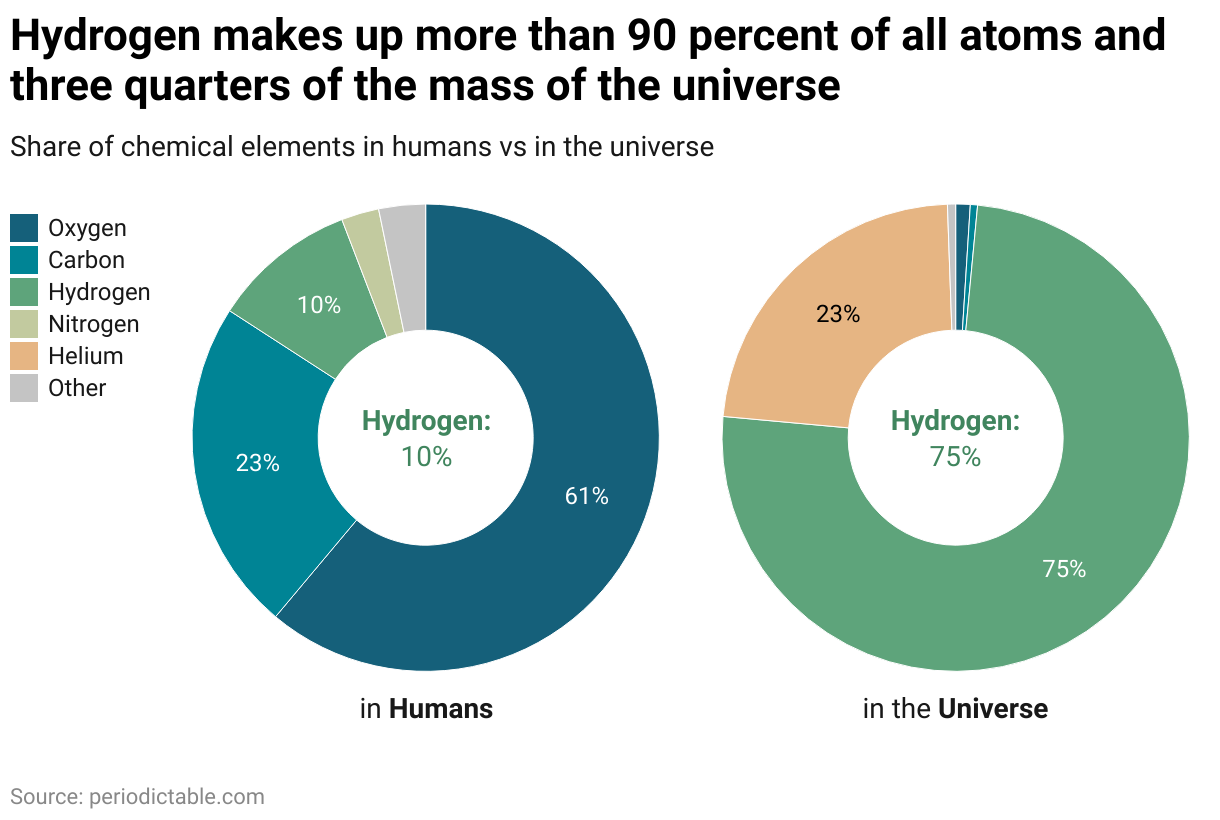
When creating the chart and gathering data, I was particularly fascinated to learn that only a few chemical elements make up more than 90% of the mass of the universe and the human body. So I placed this information in the scatterplot tooltips. It’s great to find out that e.g. Neon makes up 0.13% of the universe. But it doesn’t really bring the message across at a glance. A small multiple pie or donut chart is a far better choice to show the big picture (sadly, Neon does not make an appearence here):

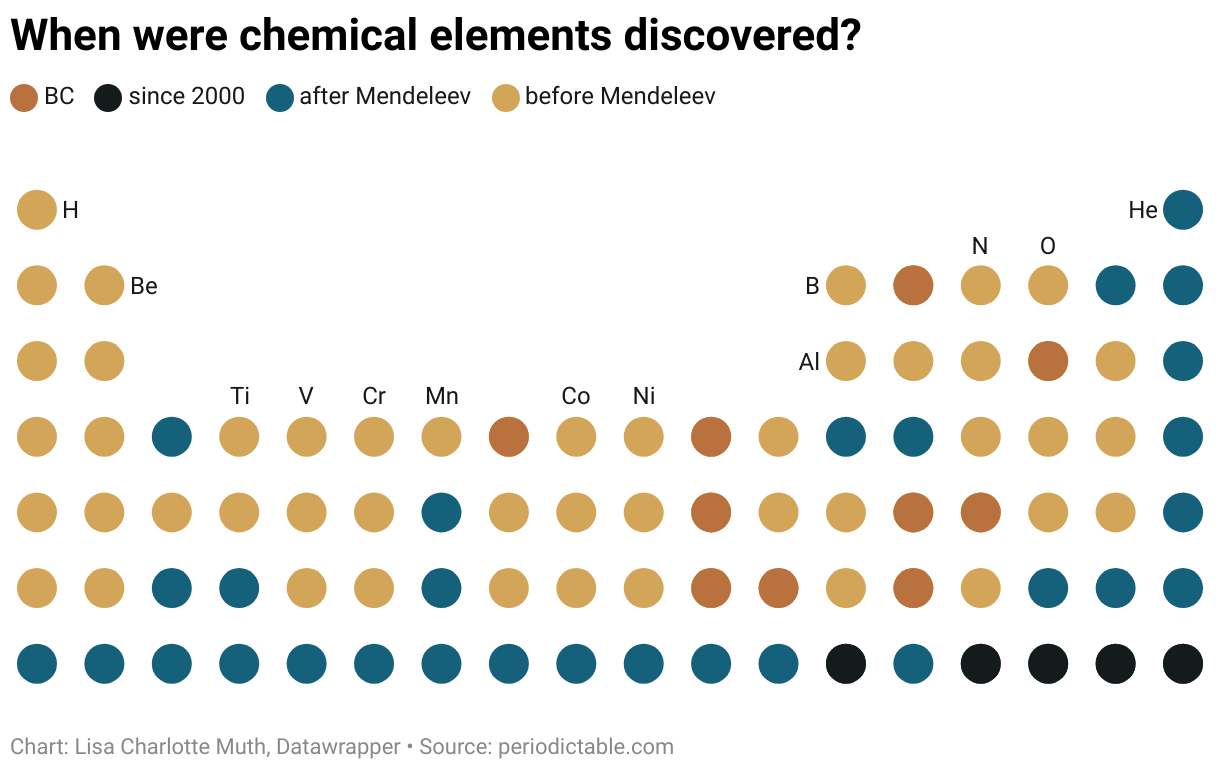
Mendeleev’s periodic table is just one way to display the chemical elements. There have been many attempts to show them differently, as shown in this Wikipedia article about alternative periodic tables. Here are my two favorites: This black & white minimalist line drawing

…and this organically shaped taste of futurism:


By the way, here’s a little Datawrapper trick: If you hover over “before Mendeleev” in the color key of the scatterplot above, you will see that they include the ones that appear when you hover over “BC”. To achieve this effect, I downloaded the “BC” elements twice and put the duplicates in the “before Mendeleev” category. To see what I mean, hover over the scatterplot and click on “Edit this chart” in the top right corner. I’ll see you next week!

08 Mar 02:02

Revamping Apple's Home Strategy

by Neil Cybart

Last week, news broke that Apple had hired Sam Jadallah, a former Microsoft executive and most recently founder of a smart lock company, to lead its various home initiatives. The announcement raised a number of questions, including the most obvious: What is Apple’s home strategy? Consensus in the press is that Apple is far behind Amazon and Google in the race to control the home. I’m not so sure about that. Instead, the entire smart home genre appears to be floundering. Jadallah’s hiring points to Apple reassessing how to best get the idea of an intelligent home off the ground.

The Smart Home

Starting a few years ago, the tech industry became desperate to position the smart home as the next big thing. Much of this was due to a strong desire to find growth after smartphones and tablets. Other companies were focused on moving past Apple’s and Google’s control over the smartphone and tablet paradigm. With wearables, success has been contained to a select few companies. Meanwhile, the smart home umbrella ended up covering multiple times the number of companies, including a long list of hardware-focused start-ups.

In one word, the smart home has been disappointing. The premise underpinning smart home adoption was that one smart device purchase would lead to another and then another. In reality, that kind of behavior has not become the norm. Despite there being plenty of products available, smart home adoption remains sporadic and disjointed.

While a few product categories, like stationary speakers, have gained traction in the home, such products end up being tangential to the idea of the smart home.

Amazon is considered to be the leader in the home, at least when going by the media’s perception. The company’s acquisitions in the space certainly help push the narrative of Amazon being aggressive and forward thinking. Similarly, for Google, considered a distant second in the smart home race, its Nest acquisition provided the company a decent amount of positive coverage when it came to smart home ambitions. However, that positivity is beginning to disappear based on increasingly questionable decisions like not disclosing microphones in products. Regardless, both Alexa and Google Assistant, Amazon’s and Google’s voice assistants, respectively, have never been short of praise in the press.

Problems

A number of issues are at the root of mediocre smart home adoption. The largest issue is that the vast majority of smart home devices lack an attractive value proposition.

  • Smart doorbells with cameras have become more about providing entertainment than anything else, serving as a way to see who stole packages off the front porch.

  • Smart power plugs end up being nothing more than a way to avoid changing timers a few times during the year.

  • Smart kitchen appliances controlled by voice still make more sense in cartoons than in real-world settings.

While a handful of interesting product stories exist in the smart home realm, they are few and far between. Instead, the way smart home gadgets have embraced voice assistants has ended up being more of a distraction than anything else. In the rush to add microphones and speakers to anything and everything, the smart home’s grand vision has been muddled.

Amazon and Google have used voice to hijack the smart home in order to push alternative visions, one around e-commerce and the other around delivering information, respectively.

  • Amazon is focused on becoming the go-to place for buying stuff in the home. For Amazon, the home is an e-commerce hub. Every one of Amazon’s actions within the home has been done in pursuit of this focus.

  • Google is focused on positioning its services as front-and-center in the home. For Google, the home is an information hub. Every one of Google’s actions within the home has been done in pursuit of this focus.

While there are some value-add propositions found with improving at-home shopping and delivery and having easy access to information-rich services, both home strategies amount to collecting as much user data as possible. In addition, neither strategy takes full advantage of the most powerful and valuable screens in our lives to push the smart home forward.

Amazon Echo and Google Home marketing are notorious for never showing other computing gadgets being used in home. There are zero smartphones, tablets, or wearables to be seen. It’s as if people leave their devices by the door when entering the home, only to pick them up on the way out. Amazon and Google both want people to think stationary smart speakers controlled by voice are adequate replacements for the various screens in their lives. The reality is that the best devices for consuming and transferring information in the home have screens and are either worn on us (wearables) or always near us (smartphones). It is far more useful and practical to get the day’s weather with a quick glance and tap at the wrist than by asking a digital assistant contained in a stationary speaker.

Apple and the Home

Apple’s approach to the home is quite different than the approaches of Amazon and Google. Apple is a design company tasked with coming up with tools that enrich people’s lives. Accordingly, the home is looked at as a place to use those valuable tools.

When it comes to the smart home, Apple has been following a three-pronged strategy:

  1. Rely on HomeKit and third-party hardware to establish an ecosystem of smart home devices. These devices can be controlled and configured using the most valuable tools in our lives including iPhones, iPads, and Apple Watches.

  2. Use select third-party hardware, such as stationary speakers and television sets, as Trojan horses for Apple’s content distribution services.

  3. Remain selective when deciding to ship first-party hardware solutions for the smart home. Apple TV and HomePod are the rare smart home exceptions for Apple. Both end up being accessories for Apple users looking for the best content consumption experiences in the home. Other Apple devices for the home like the Beddit sleep monitor end up being tangential to the smart home idea.

After a slow start, Apple has seen a pickup in HomeKit adoption among third-party smart home products. However, the way expanded AirPlay 2 support has been generating greater buzz says something. With AirPlay 2, Apple uses third-party hardware as a way to spread its content distribution services.

The fact that Apple doesn’t sell its own television set implies that there are going to be many large, non-Apple pieces of glass being used to consume video content in the home. This explains Apple’s decision to bring AirPlay 2 support to most of the premium television sets available in the market. A similar story is found with cheap stationary speakers in the home. Apple knows people are tempted by $30 speakers in a can. A significant portion of stationary smart speaker sales can be attributed to two products during the holidays: Echo Dot and Google Home Mini. The primary use case for such speakers is music consumption. At the same time, a good portion of Echo Dot users are iPhone users. This explains Apple’s decision to make Apple Music available on Echo devices. Apple ends up leveraging its existing user relationships to push Apple Music.

Benefits and Drawbacks

One benefit found with Apple’s strategy is that the company remains focused on offering a few great experiences in the home. When it comes to delivering sound in the home, HomePod, especially when multiple HomePods are paired together, offers intelligent sound at a fraction of the cost of a high-end speaker system. Apple TV is the best way for iOS users to consume various video bundles on a large piece of glass.

However, there are also drawbacks to Apple’s home strategy. Apple is ultimately dependent on others for its smart home vision. This reality may result in lackluster device support in addition to questionable experiences in the home. Further, Apple has been facing a growing amount of backlash for saying no to certain products in the home. Some people want Apple to provide everything from the internet wired into homes and Wi-Fi routers connecting our devices to smart light bulbs controlled by digital voice assistants. This just isn’t realistic given Apple’s functional organizational structure and design-led culture.

New Hire

Apple recently hired Sam Jadallah, CEO/founder of Otto, a smart door lock company that went under before getting its $700 lock to market. According to CNBC, and apparently confirmed by Jadallah himself via Twitter, he will oversee Apple’s various home initiatives.

It would be a mistake to look at Jadallah's hire as a sign that Apple will open the floodgates and develop a wide range of smart home devices. Apple simply isn’t structured for such a scenario. Instead, Apple’s culture positions the industrial design group as the ultimate gatekeeper of the experience found with Apple devices. The implication is that Apple will remain very selective in terms of developing its own home products.

Instead, Jadallah will likely focus on coordinating Apple’s various home plays and more importantly, revamping Apple’s broader strategy for the home. This task includes coming up with tangible ways Apple’s teams can turn vision into reality. Based on Jadallah’s previous public comments regarding smart home devices and given Apple’s product philosophy, we have some clues as to what such a vision may look like. Here’s Jadallah in 2017 in a post titled “The End of the Connected Home:

“Creating a product for the home is different than a wearable or a device that is easily replaced. Connected Home products are often installed. That installation dictates that they are reliable, durable and follow many of the rules of the products they replace. In our case, that requires a digital lock to be durable and to have design, and design options, that support the diversity of homes. Homeowners, beyond the early adopters, aren’t willing to sacrifice design, security or performance — they demand it all.

I’ll refer to Connected Home products that meet this bar as ‘Digital Home’ products. The Connected Home is far simpler — basic gadgets, obvious products with a primary value focus on connectivity. The Digital Home is the next wave of the Connected Home. Obvious products need not apply to the Digital Home, as they need to be very focused on the digital experience (connected, open, upgradeable) but also fit well into the home (designed as the home wants, not out of context design) and most importantly, be reliable, durable and classic as they are installed.”

In essence, Jadallah’s “digital home” concept describes a scenario in which design plays a much larger role in the home than what has traditionally been found in the space. It is this lack of design that has played a role in smart home products having questionable value propositions and resulted in mediocre smart home devices. With Otto, a company that reportedly was staffed with many former Apple employees, Jadallah was focused on developing a smart lock that would play in this new “digital home” era. His experience as an entrepreneur and product manager certainly fits with the idea that he will end up working closely with Apple designers on new experiences for the home.

Revamping

There are a number of ways for Apple to revamp its home strategy:

  1. Leverage existing tools in our lives (smartphones, wearables) to push the idea of a digital home forward. Should a smart home require us to use our most valuable devices less frequently? This question is going to gain importance when people begin wearing smart glasses in the home. Since we are going to literally be wearing the most valuable and powerful tools in our lives, why not take advantage of those tools to improve the home experience?

  2. Further incorporate design into the vision for the digital home. This step will involve addressing some obvious but incredibly important questions. How should humans interact with homes? How can digital home products improve our lives? Voice can’t be the only interface choice. Simply being able to unlock the front door with our voice or Watch isn’t enough.

  3. Determine where the most important experiences are found in the home and come up with ways of interconnecting those experiences. There are various genres at play within the home (entertainment, utility, health monitoring, security, etc.) How should health monitoring devices in the home communicate with devices tasked with keeping our home safe? As it stands today, there is little to no relationship or connection between experiences. Instead, everything is either funneled into a voice assistant or a framework like HomeKit.

Apple is not opposed to the idea of moving into first-party solutions for smart home gadgets. The company sells Apple TV and HomePod, after all. Instead, Apple will continue to ask the following questions: Which smart home devices are capable of fostering experiences? Which devices have a long runway when it comes to adding features and capability over time? The answers to the preceding questions will be the devices most likely to be tackled by Apple designers and engineers.

Bumpy Road

In my view, the smart home path is going to be very bumpy going forward. We are trying to compensate for the lack of homes being built from the ground up with technology truly in mind. Having homebuilders simply add voice activated gadgets in new homes falls short. Instead, the only genuine answer is to have tech companies build homes themselves. However, that isn’t on the horizon at this point.

As highlighted in the following exhibit, the home represents a crucial part of the new tech landscape. The home is a treasure trove of data, and companies are looking to grab as much of our data as possible. This explains why monitoring within the home has been all the rage. However, the home has not been the recipient of a great amount of design attention when it comes to intelligence and personalization. Instead, we have a whole lot of questionable voice-controlled devices and not much else. Hardware start-ups have been focused on adding voice control to smart home devices without a clear reason or purpose. Do consumers really want to talk to or control dozens of smart appliances installed throughout the home? Are consumers going to be OK with installing microphones throughout the home? Based on the backlash to news of Google not telling customers about a microphone being included in Nest Guard, there is a good chance we are moving to a major backlash phase against the smart home.
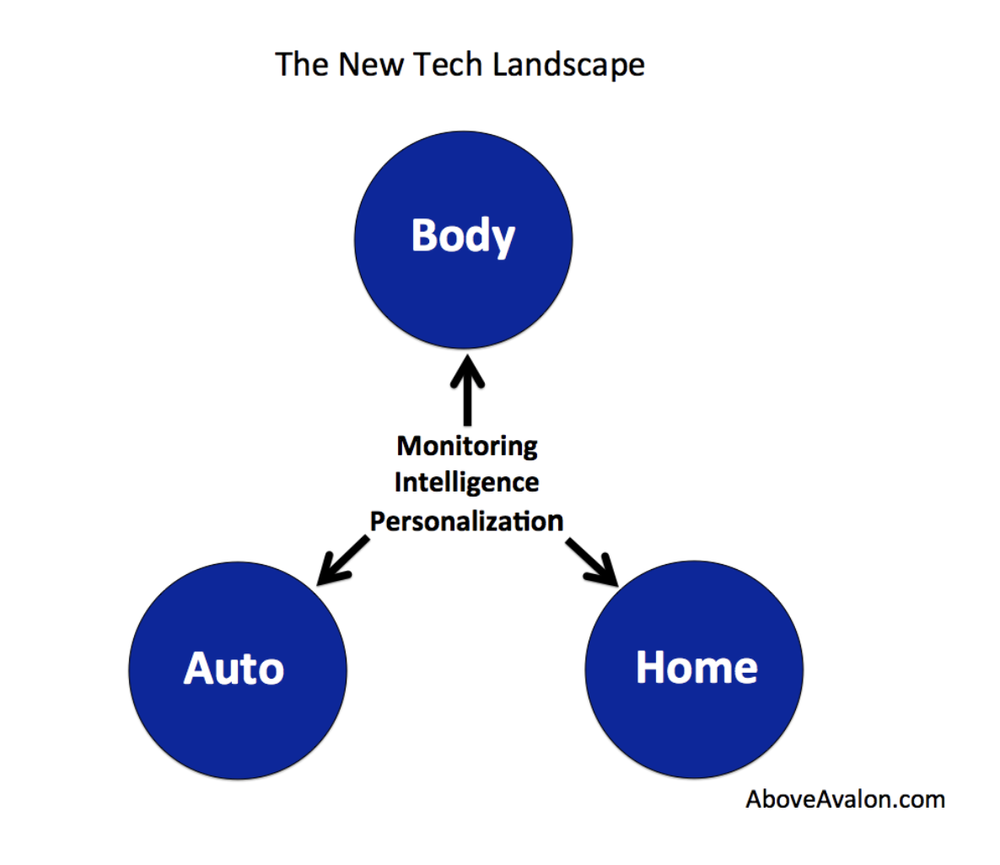
The New Tech Landscape

In recent years, the topic of “controlling” or “winning” the home has been a popular talking point. Consensus has landed on the winner in the home being the company with the most capable voice assistant as measured by the number of skills or features. This type of thinking is off the mark. Few people are using these voice skills. This explains why tens of millions of smart speakers end up being used for little more than listening to music, a development that ends up helping push forward the music streaming industry more than the smart home genre.

Instead, the winner of the home is the company that ultimately is able to grab our time and attention. This is why Apple’s vision of the home being a place where we use tools to improve our lives makes sense. If someone is dedicating most of his or her time to an iPhone while in a room full of smart home devices, which company is actually winning in that room? If an Apple Watch is continuously worn and used in a home filled with smart devices, which company is actually winning in the home? The way we think about digital homes is in need of a major reset.

Receive my analysis and perspective on Apple throughout the week via exclusive daily updates (2-3 stories per day, 10-12 stories per week). Available to Above Avalon members. To sign up and for more information on membership, visit the membership page.
08 Mar 02:02

While working on show notes for an upcoming epi...

While working on show notes for an upcoming episode of The Omni Show, I found this classic blog post about Objective-C Memory Management & Garbage Collection.

I had completely forgotten about the finalize method.

08 Mar 02:02

Should This Exist: Halo Neuroscience

by Caterina Fake

Memory palaces, cuneiform, kung fu–for millennia we’ve pushed ourselves to recall with greater precision, learn faster, perform better and achieve more. One new technology in particular we’re about to unlock—neurostimulation—may forever change what it is to compete as a member of society, and even alter our basic conception of what it means to be human.

Everyone has heard of the 10,000-Hour Rule popularized by Malcolm Gladwell in his book Outliers. It’s simply a matter of repetition: 20 hours of practice a week for 10 years will get you to mastery.

But what if by priming your brain to learn faster, you could accomplish the same in half the time and far surpass your “natural” abilities? Would you opt out? What about your kids? Would you zap your brain to become smarter faster? If I could learn Finnish or cello faster–especially at my age!––I would. Of course! 


My guest in the first episode of Should This Exist? is neuroscientist and entrepreneur Daniel Chao, co-founder and CEO of Halo Neuroscience. Halo Sport is their first product, a headset that enhances the neuroplasticity of the motor cortex in your brain. It could usher in a new golden age where millions of us  are virtuosos… or it could bring about the dystopia of Gattaca, where only a select few get superhuman abilities.

To a 1950s Olympic gold medalist, today’s Olympians would already seem superhuman. We all know they got there because today’s athletes train better. They use science, medicine, and technology (sometimes even pushing the boundary of what’s legal) to enhance their bodies and minds.

And it’s not just our top performers and dominant athletes. Normal people like you and me take it for granted we should be pushing ourselves to learn, perform better and achieve more at work and school. We tell our children how important it is to be resilient, try and try and try again until you make the cut.

We’re watching technology is being enthusiastically introduced into schools. STEM is seen as the most desirable focus for our kids, not the humanities. And there have been several well-publicized debacles which should give us pause.  Nowadays even pre-schoolers have to train to be smarter.

And another question: what if this technology is available to some and not others? Could the achievement gap widen? And what if instead it were given to the kids who had fallen behind, who were then able to catch up?

Cuneiform was restricted to the elites, and writing itself was the province of educated men–and only men–for centuries after its invention. Kung Fu wasn’t taught except to the lucky few. And sharing these technologies sometimes had dire consequences. Could Halo follow a similar trajectory?

Not on our watch! Daniel is a thoughtful, deep-thinking entrepreneur; we talked through its many possible permutations. Join us on Should this Exist?


Ep1_Halo_Caterina_tweet_4
08 Mar 02:02

Fighting Off The Competition

by Richard Millington

Back in the day, setting up a forum was so beyond the skill set for the average internet user that simply having one was your competitive advantage.

You were the only game in town and you won big. Many of these forums still survive today, decades later, as active as they’ve ever been.

Alas, a decade ago social media came along and blew most forums out the water. Now any of your members can set up a group for free (or next to free) for your audience on Facebook, Reddit, StackExchange, Slack, LinkedIn, MightyNetworks, Whatsapp, and a growing number of other tools.

Many of these tools are better embedded into your members’ habits, provide a frictionless joining experience, and siphon growth from other groups already in the platform.

Your platform might have a better design, better personalization, and be an easier place to follow discussions, but the last decade shows most members simply don’t care.

It’s like a local grocer trying to compete against a supermarket by learning the customer’s names, providing a more personal experience, and better quality of goods. Ultimately, most customers only care about price and convenience. That convenience is true in communities too.

If you want to prevail as a single community site, you need a competitive asset no-one else can match.

08 Mar 02:02

„Sobald wir Angst haben, gehen wir” – Juden in Deutschland

by Andrea

WDR Unterwegs im Westen: Jüdisches Leben: Zwischen Alltag und Angst?. (YouTube, 29min)

“m Alltag verschweigen viele Juden in NRW ihre Religionszugehörigkeit aus Angst vor Anfeindungen. Die Bedrohung kommt vor allem vom rechten Rand der Gesellschaft. „Heute werden wir mit Klarnamen im Internet beschimpft. Und aus Schulen hören wir, dass Jude wieder ein Schimpfwort auf den Schulhöfen ist“, erzählt Michael Rubinstein. Er ist Geschäftsführer des Landesverbandes der jüdischen Gemeinden Nordrhein und erlebt, wie sich jüdisches Leben in Deutschland verändert.”

08 Mar 02:02

Librem 5 Hardware Update

by Sriram Ramkrishna

Greetings everyone! This is a progress report on the Librem 5 development for the past two weeks. Here is all that happened.

Conferences and Communities
Quite a few members of the Purism team attended FOSDEM this year. Kyle Rankin gave a keynote, The Cloud is Just Another Sun that dealt with vendor lock-in in the cloud; the video is also available on the FOSDEM site. Meanwhile, some of the Librem 5 team organized a community Q&A session under the heading of Free Software on Mobile Devices. Owners of the Librem 5 Developer Kit got their LCD displays flashed with the commands needed to work around some issues they had been experiencing.
Plasma Mobile sprint
Not everyone in the Librem 5 team went to FOSDEM: two team members attended the Plasma Mobile sprint in Berlin. Once there, they helped set up Librem 5 developer kits, talked about user interface design in Plasma Mobile and discussed development issues and progress. The Plasma Mobile team got something up and running real quickly on the developer kit, despite some initial glitches concerning touch input. This has led to a productive discussion on ways to support different form factors, one that will hopefully lead to some nice cross-platform ways to support device convergence.
Application Development
Recent discussions, both in the Matrix chat rooms and on the forums, have led to two initiatives concerning the subject of phone applications: the first resulted in the compilation of the Mobile GNU/Linux apps list, a community-maintained list of applications that are meant to work on mobile devices running GNU/Linux – either because they target small screens, or because they feature adaptive user interfaces. If you can think of any app that should be on the list but ins’t, please follow the contribution guide at the end of the app list page.

Dev Kits

Probably the most significant event in last week’s news is that the LCD screens on development boards will now work, if you update the software running on them. We knew that the screens worked just fine on the development kits we sent our backers, but we’re still all very happy to know that any remaining display problems could be fixed in software, not requiring the panels to be replaced. This update took longer to develop than initially hoped, as our kernel hackers had to work around a couple of tricky bugs in the hardware preventing the panel from being set up properly. Our community has already been exploring other features of the development board, so we’re now looking forward to seeing what they can do with working displays!

The second initiative led to the creation of a new Matrix room (community/librem-5-apps) for app development discussions, and it’s now listed in the online documentation. It’s early days, there’s not that much being discussed at the moment but, with two other channels dedicated to different kinds of Librem 5-related conversations, it’s good to have a place for app-specific discussions.


Hardware
Much has been written about battery charging on the development board. Although the board’s controller circuit has built-in protection circuitry, we do recommend using batteries that also provide some level of overcurrent protection so that there is redundant protection in place. Batteries used with the development board must meet the specifications we’ve outlined – see the developer documentation and the printed text on the board’s battery holder. Following these guidelines is the safest; if you are unsure about whether the battery you are using meets the specifications, remove the battery when the board is not in use.

Still on the subject of batteries, charging now works with our 5.0 branch of the kernel; but the current status of the battery isn’t always correctly reported by the operating system. Despite this, the charging circuitry is always working, in order to make sure charging occurs properly. While the 5.0 branch brings this improvement, the 4.1x kernel has support for more of the Librem’s peripherals; so 5.0 is not quite ready for everyday use just yet.

Software
Developers with no access to boards can still get an experience of the current phone environment by using an emulator, thanks to Pan, one of the contributors to the developer documentation. While this gives a flavor of the phone experience, it may be lacking when it comes to prototyping with the types of peripherals that the phone will have. Fortunately, use of peripherals can be simulated to some extent, and a recent contribution to the documentation shows just how to do that.
Low-Level
Ongoing work on the U-Boot bootloader, the flash-kernel and the tools used to create images for the development board aims to make it easier to resize the storage space available on the board. This will help with the board’s software development, especially when testing with large Flatpak runtimes. In the kernel itself, we have tied the panel to the backlight so that the two turn on and off together, and we switched to the mainline touchscreen driver now that a compatible driver has been identified. The graphics stack has also been receiving some attention, in order to make it more stable – with work ongoing in a branch, and changes being upstreamed at least as far as PureOS.

Shell and Apps

We have guaranteed Phosh is now more stable on the development boards, as a result of removing unused components from the session. In the user interface department, the volume control now does indeed control the volume. Chatty, on the other hand, has been updated and improved over the last few weeks to include support for Matrix chats, using libpurple to provide this integration. The user interface now also features adaptive elements and dialogs, and includes a brand-new welcome screen.

Design

The new online account icons got merged https://gitlab.gnome.org/GNOME/gnome-online-accounts/merge_requests/17

Wi-Fi and Bluetooth

Wi-Fi was working on the developer kits, but many of the users found it to be unreliable; after a long investigation into this issue, a workaround was found and sent to the Librem 5 Development mailing list. As noted in the message, it will improve some aspects of wireless networking – although there are a few remaining issues to be aware of.

And that’s our report! Questions? Come by our matrix channels, we’ll be happy to see you.

The post Librem 5 Hardware Update appeared first on Purism.

08 Mar 02:02

“But what about naysayers?”

by Chris Corrigan

Perhaps I need to curate a series of posts called “The Whatabout Chronicles.” When I’m teaching participatory leadership or sharing complexity tools, folks who are wedded to traditional linear mind and tool sets often raise objections.

“Complexity would be nice, but we haven’t got the time. We have to get this problem solved now, and we need a plan to do it.”

It’s a hard one because often it’s obvious that the problem is complex and the desire for a linear solution, while urgent-feeling, is just not possible. But if you can’t see it that way, objections get raised.

In my courses and workshops, often people who are discovering these tools for the first time have their first moment of dread when they imagine themselves trying to “sell” a participatory or complexity-informed approach to their organization, team or, worse still, their boss.

“How do you handle the naysayers?” Yup.

Recently I was asked this question and I used the Cynefin framework to answer it. Disagreement with an approach depends on the context of the problem. Broadly speaking if we look at the five domains of Cynefin, you handle naysayers this way:

Obvious problems (knowable problems, predictable, simple solutions). If a problem is obvious then you should have no trouble convincing a naysayer that you are right. Does the door open in or out? Push it and see. Anyone who disagrees with you will have the problem of never getting into the room unless they adopt to the reality of the situation.

Complicated problems (knowable problems and predictable solutions, but only with expert help and analysis). Complicated problems have multiple competing approaches that may all be right, but will all be different. Plumbing a house is not an Obvious problem, but there are only a few ways to do it. There maybe different ways to do and experts may not agree, but they can give you a plan and show you in advance how their solution is a good one. To hire an expert, give them constraints to work with (money, time, and materials) and ask for a proposal. Disagreement between experts can help you solve the problem better, but don’t pretend you know enough to challenge an expert. Ask for a few quotes and choose the person that will do the job to your specs. Make a contract that makes them accountable for the outcome, and have someone else you trust evaluate their work.

Complex problems (unknowable and ever changing problems and unpredictable but multiple emergent ways of addressing them). Here we can’t know the whole system, but we can bring in multiple perspectives and look for patterns that will helps us figure out what to do. Naysayers in complex situations are a gift. You WANT naysayers in complexity. In complex problems like addressing social, cultural and economic systemic problems, no one has the right answer. In order to act you need people who will come into the space and offering competing approaches. You have to try them out – even contradictory ones – to see what works in your context of time and place. You might even discover new ways of doing things. For sure, the worst thing you can do in addressing complexity is create an agreeable environment that stifles conflicting views and difference. Diversity is required for a resilient and collectively intelligent approach. You have to make sure that the container you are working in can hold difference without becoming a fight or a power game of domination. The system should always move towards diversity of opinion, not consensus.

Chaotic problems (unknowable and unpredictable problems and there is not enough time to think about a solution). Everything is massively dependant in this scenario, and high chaos is a high energy environment where you might only get one chance to act. You might have seen situations where someone is injured and a paramedic arrives and the patient says “I’m okay, get away from me.” The paramedic may be able to see that the patient is not in fact okay. In these situations, imposing tight constraints is how you handle naysayers: “Sir, you are wrong! Sit down now before you risk further injury!” This can be very helpful, but you have to loosen the constraint once the situation has stabilized.

Disordered problems (where you don’t know what kind of problem you have). Sometimes you just have to start by saying “What’s happening here? is this a linear system or a complex one?” Using Cynefin can help you agree upon the characteristics of the system you are working with that allows you to then make a decision about the intervention. Naysayers here can be very influential, but you really don’t get to argue with reality. No matter what you say, racism is a complex issue. Get a group of people to help you address it. However, getting sued for a racist hiring practice is complicated. Get a lawyer. You’ll need one.

08 Mar 02:02

Hello world!

by admin

Welcome to WordPress. This is your first post. Edit or delete it, then start blogging!

08 Mar 02:01

Report: Transit agencies need new data sources to reverse ridership decline

by Stephen Rees

The headline is taken from an article in SmartCitiesDive about a report by KPMG (which you can get as a PDF if you want) but the TL:DR version is

“By analyzing three cities — Denver, Houston and San Diego — KPMG found access to transit stops is not the problem. Instead, the report says “current fixed-route bus service has not kept up with consumer preferences or been responsive to shifts in value of time perceptions.”

Yes transit decline is a problem in US cities. Except that Seattle has done pretty well – by expanding its bus services.

More and better data is always a good idea – but in this case I am not convinced. Transit ridership here is doing better, mostly because Translink seems to have got over its funding difficulties. But that doesn’t mean we are really tackling  the fundamental problem – which is usually summarized as “transit sucks”. It takes us from where we aren’t to where we don’t really want to be, stopping frequently on the way.

Just as an example here is a trip that I have had to make by transit in recent history

Screen Shot 2019-02-22 at 12.23.56 PM
Straightforwardly transit nearly door to door – short walk each end – via the #16 and the #9 – both reasonably frequent trolleybus routes. These are the predicted travel times: the actual time of my recent trips was usually longer: 45 to 54 minutes. Because of the transfer I have stood at bus stops for at least 10 minutes – often longer. One day I managed to hit the operator changeover twice – so I was sitting on buses while the new operator went through all the necessary steps of setting mirrors, seat, log-in to multiple systems. During the journey there was the usual delay while encumbered passengers with luggage, strollers and powered wheelchairs negotiated getting on and off. Since these are such common experiences, I wonder that Google does not factor them into the predicted travel time. Getting on the #9 headed out to UBC yesterday afternoon, the operator told us to get on by the centre door as it would take someone extra time to get off (an unheard of procedure). The bus was so crowded I could not actually see why that might have been.

Here are the comparisons for driving, walking and cycling for the same trip

Screen Shot 2019-02-22 at 12.32.10 PM

Note that in this case Oak Street traffic is bad – at the time I did that query it was snowing.

Screen Shot 2019-02-22 at 12.34.38 PM

Walking is more direct and not a great deal different to transit in travel time. Though that crossing of Granville Street midblock can be a scary experience.


Screen Shot 2019-02-22 at 12.36.32 PM

So cycling that way would be faster than the Greenway: I have no idea what bike parking is like at VGH – but coming back would be slower due to the change in elevation.

I think that it would be possible for transit to be improved in general simply by operating more frequent services, but also by making transit more reliable through well known traffic management techniques, to shift priorities away from moving and parking cars to more efficient modes. This is also known locally as political suicide. Actually I might withdraw that if the West Vancouver B Line gets approved. But as long as the car is one third of the trip time of transit, which would most people choose?  And do we actually need to hire KPMG to keep telling us that?

Postscripts

1     These maps came from Google. There is now academic research on how these time estimates compare to Uber data.

2     I recommend getting the Transit app for your phone. The latest version showed me that if I got the Canada Line from downtown and transferred to the #25 at King Ed I would get home much faster than waiting for the #16 (no transfer).

08 Mar 02:01

En vrac sur le climat du samedi

by Tristan
08 Mar 02:00

Back on the saddle

by Rui Carmo
Further evidence that Hell has frozen over (pun intended, and dedicated to a few people...)

I spent a week in Seattle attending the winter Ready conference (a Microsoft internal event held twice a year that brings together thousands of people to either Seattle or Vegas), and even though I can’t say anything about the conference itself, it was a great opportunity to meet up with people from all around the company, hear about what is coming down the pipeline, and taking an early shot at getting certified on the AI stuff I do as part of my work.

There were the usual highlights (watching Mark Russinovich and Scott Hanselman live, a few announcements, etc.), and I got to attend a couple of internal meetups, including an Open Source get together with some like-minded souls.

And (for the first time in months, really), I was reminded that one of the reasons I joined Microsoft was its global culture, and the way it was changing towards Open Source. It turns out that company culture is changing much faster than I anticipated, and most of the conference sessions I attended were spot on for me, with my peculiar mix of interests in Linux, Kubernetes and Spark/Databricks–which was great.

The Human Angle

Working in a subsidiary tends to act as a buffer in this regard, and I’m a bit sad I don’t get to experience some of those changes directly (or in a larger scale than what is possible by working only in Portugal), so this trip and the conversations I had over there are a big motivation for me to re-think what I want to do next.

And, of course, it was a great opportunity to catch up with friends I have in Seattle (some of whom are moving there now) as well as folk who’ve been working across EMEA for decades and seldom spend any time in Lisbon. Wrapping all of that (plus a lunchtime visit to Redmond) around the conference schedule was fun but exhausting.

Snowmageddon 2019 fallout

Ironically, after the whole “Snowmageddon” thing (with a lot of Seattle essentially shutting down over the first weekend) and most of the rest of the week spent traipsing between hotel conference rooms under varying ranges of snow and rain, I came back to Portugal and caught a cold almost immediately after returning to work…

Good thing I had packed some of my (woefully underused) snow gear at the last minute, and while I was there (other than a few cold-induced nosebleeds and wrestling with hotel thermostats and air conditioners), the biggest pain was conference catering (which was a challenge for most European palates), so I blame my catching that cold on my spending 9+3 hours on a cramped plane either way1 and completely wrecking my sinuses.

Places of Note

But I’m reminded me of something I noticed during my stay: even though I ordinarily like spicy foods, the kinda sorta fusion cuisine I was exposed to in Seattle errs on the side of hot & overly sweet rather than subtle, so I can’t say I enjoyed food outside the conference either (the notable exceptions being Elliott’s and Wild Ginger, which were great).

There might have been a selection bias here (I was dragged along by beer enthusiasts to a bunch of their favorite places, which tend to go for spicy and salty dishes to cater to their regulars), but next time around I fully intend to ping the locals for dining advice ahead of time.

When No News Would Be Good News

I’m quite happy to be back home, but the worst thing (besides going back to some bits of soul-crushing routine) was realizing I had to cancel some plans I had been making (among other things, I was invited to teach at a local university, but timing and other circumstances simply wont’t allow for it).

Fortunately it only took me a couple of days to find a couple of new projects to tackle, but I’m still looking for more satisfying stuff to do in the long term–visiting the mothership was a stark reminder that there are bigger, much more interesting things to do, and that what I’m doing now, although relatively fun (largely thanks to the customers and immediate team I’m working with), just isn’t enough.


  1. There’s also a weird dichotomy of being forced to book economy seats and then finding everyone else from other countries seems to be flying business class I need to look into–this time I was lucky enough to be bumped to Economy Plus on my return, so I actually managed to sleep on the longest leg… ↩︎


08 Mar 02:00

How to write an academic CV

by Raul Pacheco-Vega

One of the documents that I find is most required not only in job applications for the academic job market, but also generally to assess scholarly contributions is the curriculum vitae (CV). I have designed and re-designed my own academic CV quite a few times, and for the most part, all I did was to follow examples I saw from other scholars. I got asked last year to write a blog post on how to write an academic CV, and I left it in my queue until now.

After a few years on the tenure track, and having sat on several hiring committees and chaired a few of them, soI think I have an idea of what elements should be on an academic CV, though I don’t want to presume my own CV is perfect, or even an example (you can access my CV here). Here are a few recommendations before I share a few examples of CVs that I think are well crafted. Obviously these suggestions reflect advice *I* have been given as well!

1. Include your production *primarily*.

This is particularly a jab at Latin American CVs, where I see a list of the courses scholars have taken, or conferences they have ATTENDED. I believe that what should be reported on a CV is what a scholar produces. So, opinion pieces, consultancy reports, books, edited volumes, journal articles, and other types of products should be listed on a CV. A short list of courses taken (listed under “Additional Training”) could showcase special skills/computer software, but I don’t believe in listing every single course, nor conferences attended, rather than presented at.

2. Make your CV as brief as possible.

This is problematic once you’ve reached a certain number of years in the profession (my old CV was 23 pages long, and I’m not even a senior professor!). But I think that there are ways in which you can make your CV shorter. Instead of listing every paper you’ve presented at a conference, list the conferences (e.g. “APSA 2015, 2016, 2017″).

3. Clearly and honestly present what you’ve produced

I do not like when book chapters and journal articles are conflated. A number of scholars simply list “Publications”, but I believe that it is important to list what is peer-reviewed, what isn’t, book chapters separated from journal articles, opinion pieces, consultancy reports, etc.

4. Include “Work in Progress” well after your publications.

I always doubted whether I should include my work in progress, as I thought that since it wasn’t published yet, it would be problematic to say that I was working on something. A lot of senior scholars suggested that I should include it, but be very clear that it is Under Review. A number of academics also include what they’re preparing (In Preparation) though I am also not totally clear about whether or not it should be included. Still, it shouldn’t be in the Publications main section, but towards the end.

5. Include only the personal information you feel comfortable with.

In my CV I don’t post my personal address, and I certainly don’t post a photograph (though some countries require this, as well as your age!). I think you should only post what you feel comfortable with, and therefore I use my campus address. A number of people have asked me if they should include hobbies, past times, travel, etc. in their academic CV. I haven’t done it, but I don’t see why it would work towards their disadvantage.

6. Ensure that your CV is visually appealing and READABLE

My previous CV had a lot of fonts, underlining, highlighting, etc. My new one is a lot more sober. Depending on the font you use, you may get away with italics, etc. But I find that using white space, underlining and simpler fonts makes it easier for people to read your CV.

A few examples I really like are linked here. Obviously, I did not link to EVERY CV I like, but wanted to showcase a number of these that I think could help ECRs and PhD students. I tried to include CVs of assistant, associate and full professors, as well as PhD students.

Here you will find a few resources I deemed interesting on how to craft an academic CV.

Obviously, different countries and academic cultures have different idiosyncracies, so you may find that some or a lot of these suggestions may not apply to your particular case. As I mentioned at the top of this blog post, I crafted mine through a number of iterations and comparisons between my CV and that of other scholars. You may want to use a similar approach.

For additional examples of well-written CVs, please check the responses to my tweet below:

08 Mar 02:00

LP Log

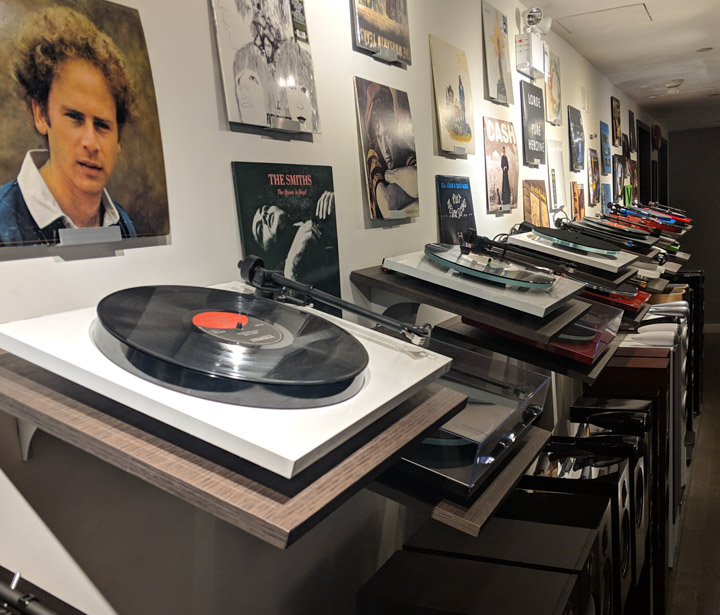
What happened was, Lauren said “My friend Leonard from choir has a friend whose husband died, and she’s wondering what to do with his record collection.” I said “If she doesn’t want to try to sell them, I’ll have a look at them.” Then I took off on a business trip. When I got back, Lauren said “You need to bring the records in from the van.” There turned out to be 900. This is the start of a story of musical discovery.

They turn out to be almost all classical, where the exceptions are cheesy-looking pre-Rock pop music. I think this piece will anchor an “LP Log” blog series in which I touch on the LPs’ payloads as I (slowly) work through the vinyl backlog. Also, as the picture below makes clear, I may have to do a bit of furniture shopping because it’s not as though I have enough shelf space for more than a small fraction of these.

Cat walking around on 900 used LPs

Cat for scale.

Just a couple of weeks before, I’d noticed that the old Linn cartridge on my lovely Simon Yorke “Series 9” had crapped out. I can’t complain, it had served me well and it was at least fifteen years old. So I needed a new one and, since I was staring at 900 probably-not-that-pristine records in the face, something to restore & rejuvenate them.

Record cleaner

A survey of the audiophile press suggests that the cleaners from VPI offer a good price/quality combination. The VPI HW 16.5 looked good but hard to buy in Canada, until I visited eBay, where they seem to appear regularly. It’s at least a decade since I bought anything at eBay; they seem to be getting along without me. I missed out on a couple of auctions but eventually scored, probably paying a little too much, jumping the bid by $50 in the closing seconds.

VPI HW 16.5

Cleaning LPs with the machine is just massively cool. First you screw the record down, spin up the turntable, and slather it with cleaning solution (20% isopropyl). Then you hit the vacuum switch and a hollow cylindrical arm with velvety brushes comes down on the disc and sucks the fluid right back in. Two revolutions of the turntable are plenty. It’s pretty remarkable to see an LP go on looking grungy and dim, and come off gleaming.

There are lots of videos on YouTube, but in most of them the actual action shot is embedded in a lengthy “review”. This one is blurry and shaky but gets right to the point.

The guy in the video uses a specialized record-cleaning brush. I didn’t have one in that style, so used a standard super-soft-bristle paintbrush and that works fine.

The cartridge

High-end audio is bloody expensive, and I have never previously purchased a component without listening to it, playing music of my own that I know and love. With the exception of cartridges; dealers are understandably reluctant to keep lots of tiny fragile objects in stock and let customers drop them on their own crappy vinyl. So it was a matter of reading reviews. Boy, are there ever a lot of cartridges out there. One decent survey is the long-running Recommended Components published twice yearly by Stereophile magazine. Check out the Fall-2018 Turntables, Tonearms, and Cartridges section.

Ordering high-end online doesn’t seem to be much of a thing so I got a local retailer, Vancouver’s Hi-Fi Centre, to order it in. The store is really a super pleasant place to visit.

The Hi-Fi Centre in Vancouver

My conversation with the guy there was a little sad. It’s a nice place, they seem to be doing well, but their customers are mostly over 50. I may be among the last generations to care enough about audio quality to do this sort of this stuff. For most people these days, a Sonos or an Amazon Echo or whatever that brings tunes to where they are will do the job. Me, I hope to spend a few more years of evenings sitting up late in a comfy chair with a small adult beverage, spinning the discs and listening, really listening, to them.

After a lot of grinding back and forth and looking for second opinions on the net, I settled on the Dynavector DV-20X2 (low-output option), made (by hand, they say) in Japan. My reasons: The price was within the bounds of sanity. It’s been described as easy to set up. Relative to many other good cartridges, it has relatively high “compliance”, which means it should be easier on the records, most of which are totally irreplaceable. Finally, a couple of reviewers said it did a great job on rock & roll. Yes, I know I have 900 classical records to consider, but I also know where my heart lives. Here it is, in action.

Dynavector DV-20X2 Low on a Simon Yorke Series Nine Dynavector DV-20X2 Low on a Simon Yorke Series Nine

Getting it set up was a major pain in the ass. I couldn’t turn up the original turntable documentation, but fortunately, it’s a major enough issue that there were two different places out on the net that talked through the process. It doesn’t help that I have shaky hands and am at best modestly dextrous. If Simon Yorke comes to read this (he’s retired but I think still living): It’s a great turntable, Simon, but getting the vertical tracking angle right is awful! If Lauren hadn’t helped I never would have managed.

Dusty in Memphis

Dusty!

Finally, it was all tightened down and the wires plugged in. For the turntable’s first outing, I put on a pristine copy of Dusty in Memphis that I’d bought but never played after discovering that my cartridge was busted.

Oh. My. God. Should have upgraded the cartridge years ago. If you haven’t heard good vinyl on good hardware I really don’t have any words that I think will convey the experience. I mean, it helps that at that moment in 1969 Dusty had cosmic mojo, fabulous producers, and took on a list of classics. I guess the most famous would be Windmills of Your Mind, but there are plenty more jewels.

Also, it’s a production triumph. The arrangements are cool, the musicians are razor-sharp, and the recording is just slightly on the dirty side of pristine, which is exactly what you want; it really does that thing that vinyl is (in my mind) a little better at than digital — creating the illusion of a bunch of musicians down at that end of the room.

     When you knew that it was over, you were suddenly aware
     that the autumn leaves were turning to the color of his hair.

08 Mar 02:00

Glimpses

by Dave Pollard

“April is the cruellest month” — The first line of TS Eliot’s The Wasteland, originally read “February is the cruelest month”, but Ezra Pound insisted it be changed, not to make it truer, but because it sounded better poetically. Image is from iTunes visualizer.

It’s been a stressful and anxious month for me, capping off a third consecutive hard winter in this usually balmy (perhaps in both senses of the word) part of the world. In some ways it’s been good for me — forcing me to face some fears that sometimes border on phobias, and beginning to move past them.

Such is the state of cognitive dissonance in which I live. On the one hand, I know, intellectually and intuitively, that everything I perceive, including my self and its sense of free will and choice and control over my actions and beliefs, is illusory, a trick of the brain, an unfortunate and useless evolutionary accident, a psychosomatic misunderstanding; research (and glimpses) have persuaded me that there is nothing separate, there is no time, and there is no individual person — there is only this, which cannot be known or experienced by any individual. Though there can be glimpses.

And on the other hand, afflicted with this illusion of self-hood and self-control, I am incessantly triggered by what seem to me incredibly stressful and anxiety-creating events, happening to me and those I love, leaving me exhausted and sometimes seemingly hanging by a thread from emotional collapse. It’s really insane.

It’s like watching a horror movie that you don’t want to watch any more, but discovering you can’t stop — you’re utterly immersed in the movie, and knowing it’s not real doesn’t help at all. Or like suffering from ghastly hallucinations that you recognize as such but can’t stop viscerally and endlessly reacting to. Or, of course, like finding yourself in a nightmare from which you cannot wake up.

It’s not usually like that, of course. Most of the time I’m my usual, grateful, blessed, joyful pessimist. Few people have less reason to be stressed or anxious than I do. Doesn’t matter a damn. Every prison-of-the-self is its own unique, inescapable and incomparable hell, much of the time, and knowing it’s a dream makes not one iota of difference. Like everyone, I am merely a reaction, with no control over what is apparently happening or how I apparently respond; on an endless roller-coaster alternatively laughing, and (uselessly gripping tightly) cringing in fear. Lost and scared. For no reason. And there’s no escaping it.

Of course, this is a very dismal and hopeless way of seeing the world. I think my interest in this radically non-dual suggestion of what is really real would never have seriously arisen or lasted (three years now) were it not for the glimpses. So what are these glimpses? Here’s what I wrote about the last apparent glimpse, three years ago:

  • It felt more like a ‘remembering’ than an ‘awakening’. Some memories of very early childhood (some of which had been just a blur until then) and a few memories from more recent, very peaceful times, flooded through my body, which felt ‘flushed’ in the way it feels during a sudden ‘aha’ moment, or during feelings of intense love.
  • It felt amazingly free of anxiety or fear, very peaceful and joyful in a ‘boundless’ kind of way. Everything was awesome, more-than-real, unveiled, unfiltered and just perfect, exactly as it was.
  • There was no temptation to grasp onto it lest it be quickly lost again. It was clearly always here, everywhere, not ‘going’ anywhere, accessible always. My self would have been anxious not to lose it, but my self was, in that moment, not present. The glimpse was completely impersonal, not happening to anyone.
  • A silly grin came over me, and stayed for hours.
  • If this is a glimpse, it is not my first, though this one seemed to connect me, through those suddenly recalled memories, to past glimpses. It felt wonderful, but also completely ordinary and obvious. Oh, that! Of course; how could I not have noticed?

My sense is that such glimpses are not rare among humankind. I suspect they happen all the time, but when the self returns, it just rationalizes that it was a nice blissful state that lasted for a while. The self takes ownership of what happened, and assumes it was a pleasant, temporary, possibly ‘out-of-body’ experience that happened to it. It cannot and will not recognize its own absence, its own unreality; its self-selected job, after all, is to be in control taking responsibility for and making sense of everything that seemingly happens to it.

This is a staggering tragedy. Not that the self is unable to see the truth of its own illusory and dysfunctional nature, but rather that the self, which afflicts us with such needless suffering and misery, such endless anger, rage, sadness, anxiety, fear, shame and depression for no reason whatsoever, evolved in the first place, probably just as an accidental consequence of the evolution of large brains and their capacity to conceptualize a separate ‘self’, which then came to accept and believe that self was real, and in control.

It’s a ghastly, awful cosmic joke that no self can ever get. There is no awakening, no enlightenment for the self, for the individual. Only the endless prison of its own invention. Awakening or enlightenment, or whatever one chooses to call it, only (apparently) happens when the self, mercifully, drops away, leaving only this. And the realization, by no one, that this is everything, this is all there is, a perfect and meaningless and astonishing appearance out of nothing, that needs nothing to be done.

My guess is that we’re getting close to a scientific and philosophical consensus that this is so. But just as there is a growing consensus that there is no such thing as free will, for the billions of human selves on the planet, this consensus will be mostly ignored, ridiculed, even condemned as cruel and escapist and dismissive of the misery of the human condition. The fact that this philosophical, existential schism will probably emerge just as the latest and largest (apparent) human civilization accelerates into chaos and collapse, is going to make the next few decades a fascinating and dreadful unfolding to witness.

In the meantime, if my description of a glimpse doesn’t resonate, I can fully understand that my recent writing must come across as non-sensical, preposterous, and probably annoying. Although there’s nothing any of us can do about it, I wish us all freedom from our selves, and the realization that, always and everywhere, all there is is just awesome, perfect, this, simply, obviously, beyond knowing, and beyond doubt.

But right now I’m still anxious, lost and scared, and this month seems (*sigh*) endless.

08 Mar 02:00

cable car no. 23

by Emily Chang

cable car no. 23

Photo Caption: cable car no. 23

Photo taken at: Powell Street Cable Car Turnaround

Instagram filter used: Gingham

View in Instagram ⇒

08 Mar 02:00

Apple plans to combine macOS/iOS apps by 2021

by Rui Carmo

I’m woefully late to this party, but although I understand what they’re driving at and have made the iPad my “personal” computer (in the sense that it is what I try to use first unless specific formats or development work are required), I hope they understand that the decades of successfully “dumbing down” consumer apps to fit touchscreens do not translate (at all) to “Pro” computer users’ wants and needs.

No, the iPad Pro isn’t good enough yet, and won’t be unless they do some radical changes to its iOS fork. So they are walking a very fine rope here, and all for the sake of their consumer audience (which I completely get), but mark my words:

The day Apple kills off the UNIX userland in macOS (which is already badly outdated), their developer (and pro user) market share will evaporate overnight, and likely take down a good chunk of the Apple developer community with it as well, because Macs will be back to being special single-purpose snowflakes instead of generic developer workstations.

Aiming for quantity instead of quality isn’t a winning strategy for an app ecosystem.


08 Mar 01:59

Normative

by Eugene Wallingford

In a conversation with Tyler Cowen, economist John Nye expresses disappointment with the nature of discourse in his discipline:

The thing I'm really frustrated by is that it doesn't matter whether people are writing from a socialist or a libertarian perspective. Too much of the discussion of political economy is normative. It's about "what should the ideal state be?"
I'm much more concerned with the questions of "what good states are possible?" And once good states are created that are possible, what good states are sustainable? And that, in my view, is a still understudied and very poorly understood issue.

For some reason, this made me think about software development. Programming styles, static and dynamic typing, software development methodologies, ... So much that is written about these topics tells us what's the right the thing to do. "Do this, and you will be able to reliably make good software."

I know I've been partisan on some of these issues over the course of my time as a programmer, and I still have my personal preferences. But these days especially I find myself more interested in "what good states are sustainable?". What has worked for teams? What conditions seem to make those practices work well or not so well? How do teams adapt to changes in the domain or the business or the team's make-up?

This isn't too say that we can't draw conclusions about forces and context. For example, small teams seem to make it easier to adapt to changing conditions; to make it work with bigger teams, we need to design systems that encourage attention and feedback. But it does mean that we can help others succeed without always telling them what they must do. We can help them find a groove that syncs with them and the conditions under which they work.

Standing back and surveying the big picture, it seems that a lot of good states are sustainable, so long as we pay attention and adapt to the world around us. And that should be good news to us all.

08 Mar 01:49

Most Uniquely Popular Job in Each State

by Nathan Yau

These are the jobs in each state that are most specific to the place. Read More

08 Mar 01:46

The Opposite of Profound

by Stowe Boyd

Should Diversity Be Secret? | Company Lying | The Resurrection of American Labor | Office Space Analytics

Beacon NY — 2019–02–19 — Secrets and lies in the corporation are the theme today, it seems, although the title of today’s issue actually comes from the quote of the day, because it’s a bit more interesting and uplifting.

If you’re getting this you probably signed up at workfutures.org (or one of its predecessors) or stoweboyd.com. If someone forwarded this to you, sign up here.

Consider becoming a paid sponsor to support our work, and to receive in-depth investigative reporting and discounts to other events, reports, and activities.

sponsor message from Boundaryless SRL

Platform Design 2-Day Masterclass New York City 18–19 March led by Simone Cicero

Look to the bottom of the newsletter for more information.

Links

Why Companies Shouldn’t Be Allowed to Treat Their Diversity Numbers as Trade Secrets | Jamillah Bowman Williams reports (paywall) on an odd corner in the diversity efforts at tech companies: they often treat their diversity data as if it were a trade secret.

“One might argue that placing high value on diversity through a trade secret framework sounds like a positive development. However, my research suggests that this approach ultimately harms diverse talent, hinders transparency and accountability, and limits the potential of diversity efforts to advance workplace equity.”

:::

4 Ways Lying Becomes the Norm at a Company | Ron Carucci found (paywall) four factors linked to dishonesty in a 15-year longitudinal study involving 3,200 interviews at 210 organizations. They found that a drop in trust leads to real impacts in missed revenues. “The four factors:

  • Lack of strategy clarity — ‘it is 2.83 times more likely to have people withhold or distort truthful information’ when companies lack consistency between mission, objectives, and values and the everyday reality felt and seen by employees and market. ‘A 10% increase in clarity can … improve truth telling by 5%’.
  • Unjust accountability systems — When the ways of assessing employees contributions are seen to be unfair or unjust, ‘we found it is 3.77 times more likely to have people withhold or distort information’. ‘Research on organizational injustice shows a direct correlation between an employee’s sense of fairness and a conscious choice to sabotage the organization. And more recent research confirms that unfair comparison among employees leads directly to unethical behavior.’ Improvement of 20% leads to 12% increase in truth telling.
  • Poor organizational governance — When needed conversations about tough issues don’t happen, ‘truth is forced underground’. ‘We found that when effective governance is missing, organizations are 3.03 times more likely to have people withhold or distort information.’ A 23% improvement leads to 20% increase in truth telling.
  • Weak cross functional collaboration — ‘When cross-functional rivalry or unhealthy conflict is left unaddressed, an organization is 5.82 times more likely to have people withhold or distort truthful information.’ A 25% improvement leads to a 17% increase in truth telling.”

Note that in each case countering the negative factor has to be larger — more broadly based and involving more leadership — than the final outcomes across the organization. Lack of trust is like a cancer, and it requires very strong medicine to root it out.

:::

The Resurrection of American Labor | Janet Paskin investigates traditional and innovative approaches to the power of labor organizing.

“Workers aren’t waiting for the traditional forms of organizing, as provided under labor law,” says Tom Kochan, co-director of the MIT Sloan Institute for Work and Employment Research. “They’re looking for new options, whether that’s Google employees on a one-day walkout or workers filing online petitions with their management about everything from scheduling to fringe benefits.”
Kochan has been studying what academics call “worker voice” — how much influence employees feel they have over their working conditions — since the 1970s. At the beginning of his career, about one-quarter of workers were represented by a union and another third, according to a national Quality of Employment Survey, said they’d join one if they had an opportunity. The next time the question was fielded, in the mid-’90s, workers’ interest in joining a union had barely budged.
Kochan and his colleagues put the question to almost 4,000 workers in 2017. The results: Almost 2 out of 3 said they had less of a voice than they felt they deserved, and nearly half said they’d like the opportunity to join a union. “That doesn’t mean they want an actual union in the traditional sense,” Kochan says. “It’s more of an expression that they’re looking for some form of voice, a desire for real influence.”

Go read the whole thing.

:::

WeWork Is Trying a Creepy New Strategy. It Just Might Signal the End of the Workplace As We Know it. | Betsy Mikel reports on WeWork wanting to become the ‘Google Analytics of space’, meaning office space.

“WeWork’s chief product officer Shiva Rajaraman told TechCrunch they’re moving towards becoming the “Google analytics for space” to make sure rooms are used most efficiently.
The positive spin on this technology is that it could inform decisions about how offices get designed. If a company better understands how different meeting rooms are being overbooked or under-utilized, they could make improvements. This could mean fewer room-booking snafus that any today’s office workers know all too well.
But tracking employees as they go about their work days presents obvious privacy concerns, too. Frankly, it’s creepy. It feels particularly Big Brother-y — especially if employees aren’t aware it’s happening.
Rajaraman assured TechCrunch that the technology would not capture anything personal or identifiable about people. “We’re looking at the aggregate level to understand how space is being used,” he explained.”

They aren’t tracking people’s movements, per se, but the utilization of space. Except, of course, if it can be used the other way. And the ostensible purpose is to minimize space: squeeze, squeeze, squeeze.

Quote of the Day

“The opposite of a correct statement is a false statement. But the opposite of a profound truth may well be another profound truth.”

| Niels Bohr

sponsor message from Boundaryless SRL

Platform Design 2-Day Masterclass New York City 18–19 March led by Simone Cicero

A moment of training and strategic thinking at the same time: two days in which you will learn — either independently or in a team — to use the Platform Design Toolkit, the most comprehensive set of tools for the design and prototyping platform strategies, used by thousands of practitioners around the world.

You’ll be able to apply it directly to your product, a process, or to the whole organization, a new service, a startup idea or to explore a market that you care about.

After building your strategic vision, we will help you prepare an implementation plan to validate your platform idea and test it through a lean prototyping approach that will avoid mistakes and waste of energy and money.

We will help you to get straight to a Minimum Viable Platform that will validate the appeal for your reference ecosystem, and we will prepare you to grow after. These two days will:

  • save you from bad investments and wasted expenses
  • take you from zero to a clear execution plan for the coming months.

Click to register, or for more information.

Stowe’s endorsement:

“I recently experienced a presentation by Simone Cicero about the strategy and economics of platform organizations, and he is the real deal. If you or your organization is interested in getting up to speed on the economics of platform ecosystems, this is an essential investment.”

Originally published at workfutures.org.

08 Mar 01:44

Uphill Riding: Pedal assist and mid-drive motors

by Blix PR

Riding an electric bike helps riders tackle hills easier by providing two motor options (mid-drive and rear-hub), varying levels of pedal assist, and sometimes a throttle. However, it is common for riders to wonder "how steep can a hill be for the pedal assist to still work?" To answer this question, Blix Electric Bikes decided to ask an employee's father to ride up the steepest hill in Santa Cruz, CA and talk about his experience. Mark rode a Prima up Miramar Hill not once, not twice, but three times! The pedal assist allowed him to keep a steady pace, a healthy heart rate, and energy for more biking.

Watch below as Mark conquers the hill and discusses how the pedal assist changed his ability to ride up a hill that he often avoids. Additionally, learn more about the two types of motors, as well as, the benefits associated with increased hill riding!


Mark crushed his uphill riding challenge on the Blix Prima high step and showcased how a mid-drive motor electric bike can handle very steep hills with ease. 

What  type of motor is best for big hill riding? It is important to understand the differences between motors. We explain these differences below!

Mid-drive:
A mid-drive motor is located in the in the crank instead of the rear wheel. Some of its perks include: 
  • Great for steep hills
  • Makes the bike battery twice as efficient as the battery on a rear-hub, no need to upgrade!
  • Smaller and lighter than a rear-hub motor
  • Changing a tire is easier as the rear tire doesn't have any special mechanical parts
Rear hub:
A rear-hub motor is located in the rear wheel. Some of its perks include:
  • Great for traveling long distances 
  • Constant "push feeling" up hills and especially on flat ground
  • Includes a throttle meaning no pedaling is required (helpful if a hill makes a rider too tired)
  • Ability to choose what size battery powers the motor

While mid-drive and rear hub motors differ in the perks they provide for specific riding, both motors will help riders feel confident in their ability to ride faster, easier, and stronger up all levels of hills.

Benefits of uphill riding:

Although riders often enjoy electric bikes because they do provide hill assistance and make riding up hills feel easier, there is added benefit to using your electric bike to tackle rides with an increased number of hills. When riders are able to confidently ride uphills they may have previously avoided such as Mark did with Miramar, they actually increase their activity and fitness levels. According to some medical professionals, benefits of increased uphill riding include:

  • A  sustained cardiovascular workout
  • A muscle workout: legs an abdomen
  • An ability to ride farther
  • An ability to explore places previously limited by hills

Overall, uphill riding shouldn't be avoided and when riding an electric bike it doesn't have to be! 


A special thank you to Mark for riding the Blix Prima up Miramar for us!

Check out more information on the Prima perks here
Follow us to stay updated on all things Blix!


08 Mar 01:44

Crapaud vs. Kinkora

by peter@rukavina.net (Peter Rukavina)

Ask an Islander where you can get a cup of tea near Crapaud on a cold winter’s afternoon and I’d hazard a guess that very few would recommend Kinkora: although the two communities are near each other, they inhabit distinct regions of the psychgeographic Prince Edward Island landscape.

This is partly due history: Kinkora is historically Catholic, Crapaud historically Protestant. They’re in different counties—Kinkora in Prince and Crapaud just across the border in Queens—and in different electoral districts.

Geography does not foster close ties either: the area between them, encompassing Maple Plains and Lady Fane, has only tertiary roads running through it, and both Kinkora and Crapaud lie on major east-west routes.

And yet you can drive between them in 15 minutes, even in winter, and the roads are well-plowed and the scenery compelling.

But ask an Islander in Crapaud running low on gas where they’d drive for a fill-up, and about half would say New Haven, about half would say Borden, and very few, unless Kinkorian themselves, would head to Kinkora (even though Borden, New Haven and Kinkora are all the same distance).

I took advantage of Kinkora’s proximity today, while Oliver was studying art in Crapaud, drove the 15 minutes northwest, and enjoyed a Caesar salad and a pot of tea in O’Shea’s Pub & Eatery.

What an interesting Island we live on.

08 Mar 01:39

Let’s Have Some IPerf Fun With 10 TB of Included Server Traffic

by Martin

When I want to test the data rates of networks I connect my PC to, I usually use wget to run a large file download from a public server to /dev/null. In the uplink I use an FTP server on the other side to push a file with randomized content. But actually, that is rather crude as there is a convenient tool available: iperf3

Iperf3 does not read and write to files, which is good if one is more interested in raw data rates and less if it is also important to find out if a device would actually be able to read and write data to a storage device at line speed. For this purpose, wget and curl probably do a better job.

There are a number of well connected public iperf3 servers on the net that can be used as source or sink for data streams with iperf3 in client mode on a local device. Running a downlink speed test can be done with the following command:

iperf3 -c ping-ams1.online.net -R -p 5206

This gives one the maximum downlink speed between the server and the location of the device from which the command is run. Vary the port number in case the server returns a message that it is busy.

When leaving out the -R command, the client transmits data to the server in the uplink direction as fast as it can. Perfect to test uplink speeds which are often much slower in DSL, cable and even fiber connections at home. Here’s the command:

iperf3 -c ping-ams1.online.net -p 5206

This made me think a little bit about how fast the server I run this blog on at a data center in Germany is connected and can be reached. In theory the virtual machine is connected with a 1 Gbit/s link. But how much of that is actually usable and is there another bottleneck in the data center? So since my virtual server subscription includes 10 TB of data traffic per month, of which I only use a few gigabytesfor this blog, there is ample capacity for some super high speed iperf3 tests.

And here are the results which I think are rather impressive:

DOWNLINK
=========

# iperf3 -c bouygues.iperf.fr -R -p 5203
Connecting to host bouygues.iperf.fr, port 5203
Reverse mode, remote host bouygues.iperf.fr is sending
[ 4] local 195.201.222.126 port 58990 connected to 89.84.1.222 port 5203
[ ID] Interval Transfer Bandwidth
[ 4] 0.00-1.00 sec 44.2 MBytes 371 Mbits/sec 
[ 4] 1.00-2.00 sec 58.3 MBytes 489 Mbits/sec 
[ 4] 2.00-3.00 sec 63.1 MBytes 530 Mbits/sec 
[...]
[ 4] 8.00-9.00 sec 66.7 MBytes 559 Mbits/sec 
[ 4] 9.00-10.00 sec 71.4 MBytes 599 Mbits/sec 
[ 4] 10.00-11.00 sec 76.2 MBytes 639 Mbits/sec 
- - - - - - - - - - - - - - - - - - - - - - - - -
[ ID] Interval Transfer Bandwidth
[ 4] 0.00-11.17 sec 0.00 Bytes 0.00 bits/sec sender
[ 4] 0.00-11.17 sec 721 MBytes 541 Mbits/sec receiver


UPLINK
======

# iperf3 -c bouygues.iperf.fr -p 5203 
Connecting to host bouygues.iperf.fr, port 5203
[ 4] local 195.201.222.126 port 58994 connected to 89.84.1.222 port 5203
[ ID] Interval Transfer Bandwidth Retr Cwnd
[ 4] 0.00-1.00 sec 92.0 MBytes 771 Mbits/sec 6 7.70 MBytes 
[ 4] 1.00-2.00 sec 114 MBytes 956 Mbits/sec 0 7.88 MBytes 
[...]
[ 4] 5.00-6.00 sec 115 MBytes 966 Mbits/sec 0 7.88 MBytes 
[ 4] 6.00-7.00 sec 115 MBytes 966 Mbits/sec 0 7.88 MBytes 
[ 4] 7.00-7.52 sec 59.8 MBytes 971 Mbits/sec 0 7.88 MBytes 
- - - - - - - - - - - - - - - - - - - - - - - - -
[ 4] 0.00-7.52 sec 840 MBytes 938 Mbits/sec 6 sender

That makes the 285 Mbit/s downlink and 42 Mbit/s uplink of my fiber link at home in Paris look rather slow. But o.k., my home is not a data center, despite what some people might say.

08 Mar 01:30

The real emergency is the climate. Greta Thunbe...

The real emergency is the climate. Greta Thunberg, an autistic 16 year old from Sweden says everything that needs to be said:

…everyone keeps saying climate change is an existential threat and the most important issue of all, and yet they just carry on like before. I don’t understand that, because if the emissions have to stop, then we must stop the emissions. To me that is black or white. There are no gray areas when it comes to survival. Either we go on as a civilization or we don’t. We have to change.

Instead, we’re all worked up over building walls.

08 Mar 01:30

“Will you move back home?” It’s a question I ge...

“Will you move back home?” It’s a question I get from people now and then, especially from the family where home means back to America. My answer is always swift: “For sure, not soon.”

”Why not?” is the predictable question.

There are dozens of reasons, but the one that comes first to my mind is always this: I don’t want my child ever having to take part in an active shooter drill at school. It’s such a uniquely American thing at this point in history, and so completely and utterly unimaginable to me, now that I live outside the states.

08 Mar 01:23

Eventail Widget Adds GoodTask Integration, New URL Buttons

by Federico Viticci

I last covered Eventail in April 2018, when its developer Jozef Legeny brought support for the iPhone X and new color schemes to his compact calendar widget for iPhone and iPad. With version 3.1 released today, Eventail (which over the past year also gained support for overdue reminders and interactive mode) is adding integrations for popular third-party apps and a convenient shortcut to reopen links contained in events and reminders.

As I argued last year, what sets the Eventail widget apart is the ability to fully customize it so that each day column can display a set of calendar events and reminders defined by you in the app's preferences. You can tweak the number of columns to display at once, which calendars and lists to fetch items from, and even adjust colors and fonts to your liking. In the Pro version of Eventail, available as an In-App Purchase, you can enable interactive mode, which lets you drill down into individual days displayed in the widget to reveal actions for each event or reminder, such as opening directions for a location contained in an event or completing a reminder.

In version 3.1, among the actions supported in interactive mode you'll also find buttons to view a reminder in GoodTask, Fantastical 2, or Memento. As a heavy GoodTask user myself, this is a fantastic change: with a couple of taps, I can jump from the Eventail widget to a specific reminder loaded in GoodTask, which will open with the screen I selected as the default one for a single-reminder view (the Quick Actions screen). I'm not aware of any other Calendar/Reminders widget that lets you mix and match apps like Eventail; I only wish that, as far as calendar clients are concerned, Eventail also supported Calendar 366 and Week Calendar in addition to Apple Calendar and Fantastical 2.

The second notable improvement in Eventail 3.1 is another nice one: if an event or reminder contains a URL, there will be an icon in the widget to instantly reopen it. In the case of local URL schemes (such as evernote://), you'll see an App Store button; for standard web links, you'll see a Safari-like glyph.

I often embed both URL schemes and web links in the note field of my reminders (GoodTask makes it easy to reopen them thanks to its quick actions), so I'm happy that Eventail is going to save me a few seconds to reopen links from anywhere on iOS.

If, like me, the comfort of Apple's ecosystem and the release of the HomePod last year pushed you to embrace iCloud calendar and reminders but you still want to be able to use more versatile third-party apps for them, you should take Eventail for a spin. The app provides a unique blend of customization and native integration with the system Calendar and Reminders apps, and it's now better integrated with third-party clients as well. Eventail 3.1 is available on the App Store here.


Support MacStories Directly

Club MacStories offers exclusive access to extra MacStories content, delivered every week; it's also a way to support us directly.

Club MacStories will help you discover the best apps for your devices and get the most out of your iPhone, iPad, and Mac. Plus, it's made in Italy.

Join Now
08 Mar 01:23

Is Apple Doing Enough in the Smart Home Market?

by John Voorhees

Jason Snell writing about a recent Apple hire for Macworld:

This past week we learned that the company has hired a new head of home products, which makes me ask the question: What exactly does Apple expect Sam Jadallah to do? Is his job to make deals with HomeKit partners and make the HomePod more successful? Or is this the sort of thing that happens when a company shifts gears because it realized that its old strategy wasn’t working?

That story got Snell thinking about how Apple could expand its current lineup of home products. He proposes two: a soundbar that integrates HomePod and Apple TV functionality and a wireless mesh networking system.

Both make a lot of sense. The technology for the soundbar has already been developed and it’s a device that sits in a unique position in a home entertainment system where it could both enhance the viewing experience with superior sound and facilitate the delivery of content from Apple’s services.

Why Apple abandoned the wireless home networking market remains a mystery. Although it may not have been as profitable as other product lines, networking sits at a strategic crossroads between all of Apple’s products. Whether it’s AirPlay, Handoff, the Universal Clipboard, other Continuity features, or something yet to come, controlling the network over which those experiences are delivered helps ensure that they work seamlessly.

Sam Jadallah, who previously worked at Microsoft and later ran a smart lock startup called Otto that was shuttered, certainly has the background to run Apple’s existing HomeKit programs, but like Snell, I hope his hiring is a sign that something bigger is on the horizon.

→ Source: macworld.com

08 Mar 01:23

Third-Party Vendors Fill the Void Caused by Overwhelmed Apple Geniuses

by John Voorhees

Molly McHugh writing for The Ringer:

The saturation of iOS and Mac products means more and more people own Apple devices—which means more and more people need help using them. Each iOS and MacOS release reveals a new suite of tools and capabilities, but also new challenges and complications (and sometimes bugs). At the same time, Apple’s Genius Bar has become a purgatory no iDevice owner wants to find themselves stuck in.

That in a nutshell is one of the greatest challenges facing Apple retail today, and one that’s been years in the making. It’s not really surprising either. Especially since the introduction of the iPhone, the number of Apple devices in consumers’ hands has grown exponentially, while the number of Apple Stores and Geniuses that work in them has not.

McHugh ultimately resorted to a third-party repair shop to solve a software problem with Voice Memos and had a good experience. The story, however, strikes an increasingly common refrain that highlights a problem Apple needs to address.

→ Source: theringer.com

08 Mar 00:42

Google SRE Book and Workbook

by Joe Gregorio

I never realized the detail that the Google SRE book provided on the production environment at Google, including such things as D, Colossus, Jupiter, BNS, and GSLB.

Also there’s now The Site Reliability Workbook, a hands-on implementation guide.

07 Mar 21:07

Oppo Unveils 10x Lossless Optical Zoom Solution For Smartphones

by Rajesh Pandey
Ahead of MWC 2019, Oppo held an event to unveil its 10x optical zoom solution for mobile phones. The company also announced that it would be launching a smartphone with 10x optical zoom in Q2 2019. Continue reading →