Shared posts

16 Apr 17:28

VisiData

VisiData

Intriguing tool by Saul Pwanson: VisiData is a command-line "textpunk utility" for browsing and manipulating tabular data. "pip3 install visidata" and then "vd myfile.csv" (or .json or .xls or SQLite orothers) and get an interactive terminal UI for quickly searching through the data, conducting frequency analysis of columns, manipulating it and much more besides. Two tips for if you start playing with it: hit "gq" to exit, and hit "Ctrl+H" to view the help screen.

Via @saulfp

23 Mar 07:20

Algorithmic Bias: Weapons of Math Destruction and Algorithms of Oppression

by alevin

I recently read two books – Weapons of Math Destruction by Cathy O’Neil and Algorithms of Oppression by Safiya Umoja Noble – that explore how algorithms in commercial software hide harmful biases. The information provided by “machine learning” algorithms is influenced by biases in the training data they’ve used to learn to classify, and the source data they’re drawing upon.  

Software and service providers have a hard time perceiving the biases in their products because of severe lack of diversity in the employee base; lack of skills in humanities and ethics to identify the impacts of biases; and advertising business models are motivated on serving eyeballs to advertisers, rather than providing information to customers.  

The biases are concealed in proprietary “black box” algorithms; consumers and citizens aren’t able to investigate the rules and the training data that lead to biased outcomes. The biases in the algorithms are the more pernicious because ordinary people, including professionals, tend to place misplaced faith in output of computers as “scientific” and fact-based.  

Weapons of Math Destruction covers a broad range of systems implementing services ranging from credit scoring and insurance, to job applications and college admissions, to criminal justice; along with advertising and information.  

In the olden days of non-automated lending discrimination, for example, bank managers would directly weed out black and brown applicants. Now, an algorithm might factor in the economic stability of the neighbors and relatives of an applicant, holding back creditworthy individuals who, like many in communities of color, live in poorer neighborhoods and came from low-income families.  

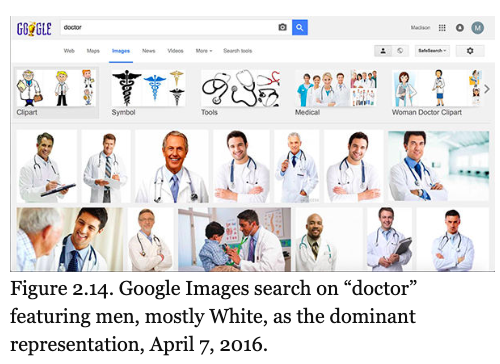
Algorithms of Oppression focuses most strongly on advertising based algorithms, and Google search in particular; and uses a black feminist lens focusing on harms to women of color, as well as other historically marginalized communities. Representations are systematically biased. One of many examples in the book is this Google image search which shows white men as images of doctors.

Another is the experience of an African-American hair salon owner who finds Yelp to be even less helpful than a typical small business owner. Removing images from the Yelp profile took away a marketing advantage that clearly showed a Black-owned business. The salon-owner reported that her customers hesitated to use a “check-in” feature due to culturally justified skepticism of features that could be used for surveillance.

The risks covered in the books are important issues for 21st century civic life and policy, and I recommend both to non-experts.  Algorithms of Oppression was somewhat frustrating; its important ideas would be better communicated with the assistance of a culturally-informed editor. The author consistently uses the term “neoliberal” with more and less precision; including in references to classical 18th century old liberalism.  The author treats history in very broad and sometimes misleading generalities. For example, she refers to the “public-interest journalism environment prior to the 1990s”, without nod to, for example, the racialized narratives of crime that shaped mass-market journalism from the very beginning.

The remedies that the books outline are suggestive, at the very beginning of initiatives to increase accountability and provide alternatives.   Weapons of Math Destruction starts with recommendations for codes of professional ethics among designers of algorithmic models and machine learning systems. WMD recommends regular auditing among algorithmic systems, with academic support and regulatory requirements, including access to the public.

Algorithms of Oppression is more skeptical of a model based on regulation of private sector services, finding commercial motives to be irredeemably untrustworthy.  Noble proposes publicly funded search systems that would be free from advertising business model bias and would provide more contextualized information designed to address the needs of communities, including traditionally oppressed communities.  

A world where the public sector supports information discovery systems that provide the ease of use of commercial software is far from today’s environment where public sector tools tend to be unsophisticated and clunky; and where public funding is exploited by contractors whose core competency is billing public agencies..  Providing search services that are scalable to vast amounts of information; can be used by billions of ordinary people, unlike the pre-google tools used by a small number of expert professionals; and can provide contextualized information is a very difficult thing to do.

The focus on information serving communities rather than individuals has substantial risks the book doesn’t cover.  Information services that serve religiously conservative communities can be customized to conceal information about religious diversity, LGBTQ information, evolution, and so on. Mainstream US residents would agree that the top search results for “black girls” shouldn’t be porn (which the author discovered with Google search in 2012 and had been largely fixed by 2016); but a religious community might also object to images that show exposed hair or naked elbows. Decisions about what information should be shown and suppressed in a culturally sensitive manner are more complicated and fraught than the book addresses.

Also, public search systems may not be a panacea in a world where government information systems carry differently terrible risks of surveillance and political oppression; consider China’s social credit system.

These books are just starting to scratch the surface in critiquing algorithmically biased systems, and in proposing remedies. These are important issues, and it’s good time to engage in critique and start to consider solutions.

23 Mar 07:20

Natural’s Not in It

by Danya Glabau

If the 20th century promised better living through chemistry, the 21st century has promised better living through digital technology. Yet rather than gravitic ships, holodeck entertainment, tricorders, and radical equality among genders and races, we have talking assistants helping us buy things we don’t need, a technologically facilitated growth industry of anti-Semitism, racism, and sexism, and a virtual reality platform owned by the same company that helped deliver the U.S. presidency to Donald Trump. Many of the societal ills we link to digital technology seem to have already happened to us, and it can feel like we have little control over them. This feeling is reinforced by metaphors of technological evolution that make it seem as though the always-on, precarious gig economy is the product of natural, biological forces we cannot stop.

But in fictional worlds, we can control technology again. While science fiction has provided the scripts that many technologists have used to create our disappointing future, it also plays an important epistemological role in the struggle against racism, sexism, ableism, classism, xenophobia, and capitalism. It invites us to consider that the ways societies are organized in the here and now are themselves contingent fictions. Science fiction reveals that the social facts many have taken for granted — things like gender, race, sex, class, hierarchy, and domination that are often attributed to “human nature” — are not inherently true and could be otherwise in the future. Technology can be distributed through non-hierarchical economies and social structures. And by describing in detail the potential technologies that could undergird different forms of life, science fiction demonstrates how versions of society where biology does not determine social worth might become durable.

Science fiction functions not only as a way to imagine the future but also a frame for decoupling nature from culture

Contemporary science fiction television series often perpetuate the idea that humans are at heart venal, violent, and greedy. Near-future theme parks of AI-driven robots in Westworld, for example, are portrayed as release valves for the baser human instincts, including rape and murder. Body-swapping, while maintaining one’s own consciousness and sense of identity, is a way to avoid the trauma of sexual assault in Altered Carbon. Digital technologies invented for episodes of Black Mirror from “Arkangel” to “Hated in the Nation” seem to follow an inexorable script in which tech companies invent new digital tools that further surveill people and extract natural resources. But this does not capture the full range of possible futures that the genre imagines. In fact, these visions of future technology are deeply conservative: They portray today’s social problems as built into human “nature,” inescapable and unalterable with or without new technology.

But science fiction is no longer the dystopian boy’s club it once was. From the revival of the popularity of Octavia Butler and Ursula K. Le Guin to the Hulu production of Margaret Atwood’s The Handmaid’s Tale to the influx of women and queer writers to the genre, including Malka Older and Annalee Niewitz, science fiction is increasingly a resource for imagining futures in which biology is no longer destiny.


At the moment, many designers, teachers, and technologists are turning to science fiction for inspiration for how to reimagine societies and their relationships to apparently natural facts. Speculative design conferences, influenced by speculative and science fiction, consider what “futures for all” would look like. Social science journals host debates about the role that speculation could play as a new method for fields like anthropology. Anthropologist Elizabeth Chin’s Laboratory of Speculative Ethnology uses speculative design exercises to point out that the “facts” of society might not be grounded in natural orders at all — that this assumption is just a hangover of colonialism.

In these contexts, science fiction functions not only as a way to imagine the future but also a frame for decoupling nature from culture. Under contemporary capitalism, race, gender, sex, and other forms of classification and division appear to be seemingly immutable laws that govern our lives at work and in the home. Taking gender as a particularly potent example, cultural stereotypes position men as computer programmers and factory workers and breadwinners, and women as secretaries and care workers and caregivers. Role expectations extend to how people present themselves while doing these jobs: Men grow beards and women wear dresses. In many places and contexts, individuals who transgress or otherwise challenge their place in the gender binary are swiftly, even violently, sanctioned.

Due to a long legacy of sciences that try to explain human societies through biology, centuries of capitalist discipline, and deeply embedded linguistic conventions, social categories like gender often seem self-evident, even natural. Social scientists, however, have tried to break society free from nature before. To give an early example, in The Rules of Sociological Method (1895), Emile Durkheim defined a “social fact” as “any way of acting, whether fixed or not, capable of exerting over the individual an external constraint; or: which is general over the whole of a given society whilst having an existence of its own, independent of its individual manifestations.” Social facts, in other words, exist independently of individuals and directed them to live in certain ways — for better, or worse. They sweep individuals up into the life of a society, shaping their interactions with institutions like school and religion as well as with co-workers and family members. Details of comportment that might seem to be freely chosen by individuals — what to wear, a hairstyle, a morning routine — are conditioned socially by one’s class, gender, family, and nationality, among other forces. Such social facts are experienced as inevitable by the individuals who dwell within them, in part due to the fact that they are widely shared by people in a particular nation or milieu.

But Durkheim’s method was to understand these facts as products of society, not as attributable to an external cause, like biology. While they felt like facts, they could only be true in the context that produced them. And while Durkheim made frequent analogies between social facts and biology in laying out this approach to the study of society, his aim was to cleanly separate them. He sought to develop techniques for describing the functioning of society as following rules and regularities unique to the social level of organization, even as race science and eugenics were gaining popularity by claiming that social hierarchies, patterns, and ills could be explained by biology, positioned as “nature” or “truth.”

In the process of doing things like remaking bodies, individuals and collectives open space for the creation of new social facts

But the separation Durkheim sought between social and biological facts was never made as tidily as he might have hoped. “Nature” has continued to haunt speculation about the conditions and norms of social life. In a turn he might not have anticipated, nature has become widely accepted as the bedrock for claims about social facts. This can be seen among the pied pipers of resurgent race science, like Charles Murray, who argue that differences in attainment, health, and ambition among those generally compelled to identify as a particular race are rooted in inborn biological differences in intelligence, self-control, and metabolism. Softer claims in a field as well-meaning as public health, such as the claim that exposure to lead is contributing to low achievement and criminality among Black American children, are close relations of the more bombastic claims. They still displace responsibility for social ills away from those in power and onto physiology, limiting the imagination of policy makers for addressing the oppression of Black people in the process. Computer programmers (like low-level Google employee James Damore) and economists (like former World Bank chief economist and Harvard president Lawrence Summers) biologize the social fact of sex, speculating on the biological unfitness of “females” to excel in mathematics and engineering. Most recently, Jordan Peterson has become the latest hero of adherents of evolutionary psychology, propelling himself to superstardom after resisting the use of the preferred pronouns of his students at the University of Toronto. For these men, the gender politics of modern workplaces and other social institutions merely reflect biological programming. Biological sex (itself far from fixed) is treated as a law-like force determining one’s place in society. If the social fact of sex is also a biological fact, the thinking goes, why bother educating or welcoming women in math and engineering at all, or promoting them through the ranks if they do manage to break in?

Yet even nature itself is a social fiction. The mutability of human biology, and the way that it can be further modified with or without reference to gender through the use of technology, ought to be the most obvious sign of that. The biological substrates that we read as sex (and that some still equate with gender) are less binary than once thought, with sex at both the genetic and physiological levels exhibiting significant variability. And from age-old tools like makeup and binders to modern gender-affirmation surgeries, surgical augmentations and reductions, and hormone therapies, “biological” sex and its relationship to gender can be reconfigured or reinforced at will — at least, for those with adequate financial resources, accepting social networks, and access to the right physicians. Despite what the Petersons, Damores, Summers, and Murrays of the world might say, biology is not necessarily fate, though society may make it hard to realize possibilities beyond what nature has programmed.

In the process of doing things like remaking bodies, individuals and collectives open space for the creation of new social facts. New social facts like “biology is malleable” or “biology does not determine one’s role in society” can open up more breathing space and greater opportunity for liberation from oppressive social arrangements. And if sex is not the same as gender and neither is destiny by way of nature, then other categories that have operated historically as axes of oppression need not determine one’s place in society either. Disrupting such naturalized, apparently biological facts ramifies outward to other social facts like race, class, occupation, educational attainment, nationality, disability, and more.

Upon close inspection, social facts might even start to look more like social fictions. That is, they begin to look less like inevitable facts about society or perfect reflections of underlying human “nature” and more like inventions of human culture that only apply to life as it is lived within narrowly prescribed limits. The “facts” we take for granted about society — even things that many people consider foundational to social order, like sexual binarism and the way it patterns the gender binary — are, in fact, mutable. Their mutability is often heightened with the help of technology. While social facts are often imposed, deadly, and oppressive, recognizing these facts as themselves fictional opens up new ways to be flexible, playful, and experimental with how we imagine future societies. Rewriting these facts as social fictions doesn’t divorce them from history, place, and context. But recognizing the constraints on our lives as social fictions, rather than natural facts, offers the utopian promise that we can be in control of our own stories again.


Ursula K. Le Guin’s writing in particular frequently turns up as a touchpoint in these conversations about how science fiction can be used as a tool to challenge the “facts” we take for granted about contemporary social life. Le Guin imagines societies in which social facts are shaken up by biologies and economies that operate otherwise.

In The Left Hand of Darkness, for example, we are transported to Gethen, a planet of humans without stable binary sex. For two days a month, Gethenian bodies take on binary sexual characteristics and become fertile; only during this period do they experience sexual desire. (It is considered a form of perversity otherwise.) And in another of Le Guin’s novels, The Dispossessed, we peer into the society of Anarres, whose economic system has denaturalized the family. As on Earth, men and women, biologically male and female, couple and have children, but a centrally planned, moneyless economy has done away with the nuclear family. Children are raised communally, and parents are not committed to lifelong compulsory monogamy. Binary gender also does not carry much social importance and its economic consequences are largely neutralized.

In the real futures we seek to build, on Earth or elsewhere, those in control must resist the temptation to reproduce the “nature” of society and follow the lead of what people actually do and want

Both novels offer alternatives to the accepted social facts of sex, gender, and homo oeconomicus, exploring how they might turn out differently if the relationship between biology, politics, and colonialism is reconfigured. In Le Guin’s writing, changes in the relationship between nature and culture becomes the basis for believable alternative politics, affects, and technologies. It is not prediction but, as Malka Older puts it, a form of speculative resistance to the naturalization of hierarchy and oppression in our world.

But these alternative histories are not simple utopias. Nor are they just positing better versions of the expansion of digital surveillance imagined by Black Mirror or embedding human violence in artificial intelligences as in Westworld. Le Guin’s work, for example, posits futures in which the basic instincts and characteristics of so-called human “nature” are part of what has changed. Technology is built around society, responding to novel needs rather than only perpetuating old and problematic modes of business as usual. For instance, in The Left Hand of Darkness, the absence of some familiar problems, like the naturalization of binary sex as gender and as social roles, does not fix all of the planet’s problems. The countries of Gethen are at the brink of war, arguing over the distribution of resources within and between states, launching spy missions across borders, and debating how to distribute ownership over extraplanetary communication links. The diminishment of sex does not create a quiet, feminized world, though it does remake reproduction, romance, and family structure.

In other words, Le Guin’s multiplanetary futures instruct readers that to generate new social possibilities in fictional futures, we must be familiar with how human narratives and patterns of thought shape technology and social institutions today, in the real world. If technology and society are both more pliable than we think, they are also more continuous. As tech moguls start to consider establishing Martian colonies to escape the problems of Earth, the myth of starting new societies on the blank slates of new lands looms as a potential misinterpretation of the utopian implications of writers like Le Guin. In the not-so-distant past, the great fiction of the American frontier promised colonists the (false) opportunity to start over on an imagined blank slate. Coming to a different continent was supposed to allow them to throw off the hierarchies of their homelands and create a new society with different rules. Yet ultimately, the frontier myth turned out to be a powerful ideological tool for reinforcing sex, gender, family structure, and race among the colonizers and as a justification for the genocide of millions of indigenous people and the theft of their land. In the real futures we seek to build, on Earth or elsewhere, those in control must resist the temptation to reproduce their assumptions about the “nature” of society and follow the lead of what people actually do and want, especially of those who would remake the relationship between nature and society from the bottom up. The oppressive edifice of naturalized social facts must be chipped away, one moment at a time.

The work of Le Guin and other science fiction writers whose work chips away at the presumed links between nature and culture demand that we regard biological facts (like sex) as accidents of history and social facts (like gender, family organization, and capitalism) as open to reconfiguration. Science fiction socializes technology, creating a sandbox in which its role in mediating biology and society can be reimagined as well. In the process the genre creates space to propose alternative social fictions that take the place of the social arrangements that act as social facts in the “real” world. Embedded in worlds that don’t (yet) exist, liberated from tech bros on scooters, and freed from the baggage of biology and predestination, technology can be made to uphold different social orders. Science fiction gives us hope, then, because it shows us how human nature might be remade — but safely, at a speculative distance.
23 Mar 07:20

Firefox 67 Beta 6 Testday, March 29th

by Bogdan Maris

Hello Mozillians,

We are happy to let you know that Friday, March 29th, we are organizing Firefox 67 Beta 6 Testday. We’ll be focusing our testing on: Anti-tracking (Fingerprinting and Cryptominers) and Media playback & support.

Check out the detailed instructions via this etherpad.

No previous testing experience is required, so feel free to join us on #qa IRC channel where our moderators will offer you guidance and answer your questions.

Join us and help us make Firefox better!

See you on Friday!

23 Mar 07:19

What it’s Like to Intern at Etsy? – Part I

by Kelly Shen

I secretly like seeing people’s surprise when I told them that I chose to intern at Etsy because it was the only company that asked for a cover letter. I enjoyed every second of filling out my Etsy software engineering internship application because I felt like I was really telling my story to a company that cared about my whole self. I interned at Etsy during summer 2016 and started working full-time after I graduated from college in 2017. The human touch embedded in Etsy’s engineering culture, business strategy and company vision is still the number one thing I am proud of.

Over the past three years, I have gotten many questions about what it’s like to intern and have my first job out of college at Etsy. It always gives me a warm feeling when students are curious and excited about careers at Etsy, and I think it’s time we give this question answers that will live on the interweb.

This past winter, I met five interns that Etsy hosted for WiTNY (Women in Technology and Entrepreneurship in New York)’s Winternship program. At the end of their three-week internships, they were super excited to share their experiences. One of the winterns, Nia Laureano, wrote a fantastic recap of her time at Etsy, and I thought it would be a great way to start sharing the Etsy internship experience!

Inventing a Process: Five Interns Navigate a Complex Problem Thanks to Etsy’s Relentlessly Human Touch

by Nia Laureano

Interning at Etsy is a unique experience because so much about Etsy’s identity has to be understood in order to move forward with any sort of work. For three weeks in January, a team of four girls and I joined the Etsy family as interns and were tasked with solving an issue being faced by a product team that helps the buyers.

Coming into our first day, the details of our task were overwhelmingly foreign to us. The subject we were dealing with was Etsy’s listing page. It’s a complicated page, due to the fact that 60 million listings exist on Etsy and they are all vastly different. When engineers make changes to the listing page, it is difficult to test their code against every possible variation of the page that exists. Sometimes, a variation slips from their mind — they forget to account for it, which could potentially cause the page to break when they push code. This is what engineers call an edge case, and our job was to create a tool that allows Etsy engineers to test for edge cases more thoroughly. Specifically, we were asked to create a reference for them to easily find listings that match different criteria and variations to test code against. But solving a project that we barely understood ourselves seemed daunting, if not impossible.

The entirety of our first week was spent immersing ourselves in the context of this world we were working in. We strolled through the typical workflow of an Etsy engineer, trying to imagine where our solution would fit neatly into the puzzle. We spoke to engineers about their frustrations to get to the root of their needs. We became engineers by being thrusted into the process of pushing code to Etsy’s repository. We couldn’t commit to our craft without first understanding how these employees live and work; then we had to imagine what we could do to make their world better.

After interviewing several engineers, we realized that they each had their own ways of testing for edge cases. “I just have two folders of bookmarks that have some links in them,” said one engineer. “But I’m not sure what other people use.” It was surprising to hear that engineers weren’t sure what other people on their team were doing. We realized, at this point, that the problem wasn’t a faulty process — there was no process to begin with. It was up to us to invent a process, or at least establish a basic standard when it comes to testing for edge cases.

In ideation, the solutions we envisioned ranged dramatically. Something as basic as a spreadsheet would have been helpful, but we also dreamed bigger. We thought about creating an automated Etsy shop that auto-generates listings that represent the edge cases that needed to be tested. We wanted to create something ambitious, but it also had to be something we could attain in three weeks. Ultimately, we focused on creating a solution that would deliver on three crucial needs of our engineers: structure, convenience and confidence.

Structure. While some engineers relied on their own bookmarks or spreadsheets to keep track of edge cases, some relied on sheer memory, or asking their coworkers via Slack. Testing for something that could potentially break the listing page, we realized, shouldn’t be such a structureless process. Our solution needed to provide an element of uniformity; it needed to eliminate that glaring unawareness about what other teammates were doing. It needed to be a unifier.

Convenience. In order to make a tool that was accessible and easy to use, we needed to identify and understand the environment in which engineers complete the bulk of their work, because that’s where we would want our tool to live. We quickly noticed one common thread woven through the workflow of not only Etsy’s engineers, but the company as a whole: our messaging platform, Slack. We observed that so much important work at Etsy is already accomplished via Slack; it’s where employees collaborate and even push code. It made perfect sense for our solution to be integrated within the environment that was already so lived-in.

Confidence. Bugs are inevitable, but our engineers deserve to feel confident that the code they are pushing is as clean as it can be. The more edge cases they can test for, the more certain they can feel that their code is quality and fully functional. Therefore, our solution had to be thorough and reliable; it had to be something engineers could trust.

After three weeks, our project was completed in two phases. Our first phase was focused on creating a spreadsheet. This was the skeleton of our final product, which mirrored the anatomy of the listing page itself. To build this, we broke down the different components of the listing page and identified all of the variations that could occur within those components. Then, we spent several days creating almost one hundred of our own listings on Etsy that represented each of those variations. We ended up with a thorough, intuitively structured catalog of edge cases which can now be accessed by anyone at Etsy who needs it.

The second phase of our project was a Slack-integrated bot. Using our spreadsheet as a backbone, we aimed to design a bot that can retrieve edge cases on command via Slack. Engineers can input commands that return single, multiple, or all edge cases they may be looking for. Due to our time constraint, we were only able to create a bot that utilizes test data, but we hope to see a future iteration that fully integrated with our spreadsheet.

A universe of terminology and culture had to be packed into our brains in order to accomplish what we did in three weeks. Yet, we somehow felt so seamlessly integrated into Etsy’s ecosystem from day one, thanks to the friendly and enthusiastic nature of everyone around us. We were never afraid to ask questions, because no one ever talked down to us or made us feel inferior. There are no mechanisms in place at Etsy that make power dynamics apparent, not even from the perspective of an intern.

Our project was completed not because of crash courses in PHP or because we overloaded on cold brew; it was thanks to the people who nurtured us along the way. It was the prospect of creating something that could make a lasting impact on a company we loved that motivated us. Etsy’s relentlessly human touch makes even the smallest of projects feel meaningful, and it can turn three weeks into an unforgettable experience that I will never stop feeling passionate about.

A note about our internship & our organization:

WiTNY (Women in Technology and Entrepreneurship in New York) is a collaborative initiative between Cornell Tech x CUNY designed to inspire young women to pursue careers in technology. WiTNY offers workshops and program that teach important skills and provide real work experience.

The Winternship program is a paid, three-week, mini-internship for first and second-year undergraduate students at CUNY schools, during their January academic recess. Etsy is one of many companies who participated in the Winternship program this year, taking a team of five young women and giving them a challenging project to complete while also teaching them about the different roles within a tech company.


23 Mar 07:19

Recruiting: New Owner for Mission Bicycle

by zack
After ten years and five thousand bicycles sold, it’s time for us to find a new owner at Mission Bicycle.
 
The current owners are heads down building a (nerdy) software company and recognize they are holding Mission Bicycle back. We are looking for a passionate outsider, with a deeps sense of brand and product to chart a new path for our brand and the cycling community.
 
Our dream is to organically grow Mission Bicycle into a beloved leading commuter bicycle brand with healthy margins and a world class team. Our small company plays a role in shaping the future of urban mobility — and our brand and products set the bar for beautiful and reliable commuter bicycles.
 
We are looking for a leader with a:
  • Deep sense of brand
  • Love of bicycling and product
  • Ability to invest or raise capital
  • Vision for bicycles as the future of urban mobility
 
Here is what we have to build on:
  • A beautiful and distinct product
  • An internationally recognized brand
  • A team with a proven ability to operate and execute
  • A passionate customer and follower base
 
Please get in touch if you are interested by emailing zack@missionbicycle.com.
Feature content: 
No
23 Mar 07:19

Somewhere in Kruezberg


Somewhere in Kruezberg

23 Mar 07:07

Finally, a new iPad mini

by Rui Carmo

At long last. The mini is (for me at least) the perfect size, and the mini 4 has been my “most personal” computer ever since it came out—it is still the first device I reach for in the mornings and often the last I put aside. Pretty much everything on this site (including the source code) was drafted on it.

That pencil, though. I really hate the way it charges…


23 Mar 07:07

Appointment of MozillaPH Regional Coordinator for Northern Mindanao

by Robert "Bob" Reyes
With the aim of growing the Mozilla Philippines Community (MozillaPH) beyond the reach of existing Mozilla Reps in the country, we started to appoint the very first Regional Coordinator last 2015. Frederick Villaluna, the Philippines’ very first Regional Coordinator has since then evolved to become a full pledged Mozilla Rep. It is with joy and pride that we announce the appointment of Romar Mayer Micabalo as the very first MozillaPH Regional Coordinator for Northern Mindanao effective today. A long time… Read the rest
22 Mar 18:00

Cooperative Fictions

by Stowe Boyd

Beacon NY — 2019–03–14 — This issue’s title is inspired by the swirl of political events that form the background of the context in which we live and work. As Yuval Harari says in the quote of the day, below, our ability to cooperate in large groups is based on fictions, agreed upon concepts that are immaterial, like politics, nations, money, or the theory of the corporation. Within the purview of Work Futures, I’ll bring it back to organizational culture, and the need for a structural and moral change in how we think about and operate businesses.

We need a better organizing fiction for business, something that can animate our hearts and minds, and help us cooperate toward the revolution in work that is needed for us to get there.

I think that’s what the Corporate Rebels are up to, as treated in the first story, below.

:::

If you’re getting this you probably signed up at workfutures.org (or one of its predecessors) or stoweboyd.com. If someone forwarded this to you, sign up here.

Consider becoming a paid sponsor to support our work, and to receive in-depth investigative reporting and discounts to other events, reports, and activities.

sponsored message from TINYpulse

Gender Equity Report | TINYpulse research findings are clear: Managers fail to make women feel valued.

“We dug into the data around workplace recognition and found that women received 17% less recognition than men.”

Want to attract and retain female employees? The TINYpulse platform collects anonymous feedback so you can learn directly from your employees how to create a healthier, more balanced workplace for women.

Stories

Announcing Revolt: A New Weapon In The Fight For Better Workplaces | The Corporate Rebels hinted last week that something big was coming, and we’ve learned what it is. They are trying to reformulate The Corporate Rebels into the orchestrator of a global ecosystem:

“We want Corporate Rebels to be even more: more than a blog, more than a source of inspiration, and more than a change company. We want it to be home to a global workplace revolution.
In short, we think of Corporate Rebels as an ecosystem: an ecosystem that researches, facilitates and boosts the revolution. Imagine a combination of individuals, groups, NGOs, and businesses — all contributing to better workplaces. United by purpose, separated by expertise. All are part of something bigger, while enjoying decentralized entrepreneurship and initiative.”

And this announcement is timed with the creation of a Corporate Rebels spin-off, Revolt, which is described like so:

“Revolt is an integral part of the Corporate Rebels ecosystem. We share the same mission, values, and beliefs. It’s also a separate entity — a company focused on igniting practical change, with a pragmatic, no-nonsense approach to revolutionize the way organizations work.”

Makes sense, since the Rebels have been working with companies to help them adopt the principles that they’ve found in what I call revolutionary companies. This way one group can focus on that set of activities, and others can grow the movement. I expect we’ll be hearing about other elements of the ecosystem in coming weeks.

Check out the Revolt website.

:

The 8 Habits of Companies You Wish You Worked For (And How To Put Them Into Practice) | These are the eight principles that The Corporate Rebels say are guiding their ecosystem and the work of the new organizational design company, Revolt, that they are launching.

:::

Why I am tired of National Napping Day | Casper cofounder Neil Parikh want businesses to stop the shaming and let people nap at work. Note: napping is an antidote to the effects of workism.

“Our society still very much abides by the adage, “I’ll sleep when I’m dead,” or its less aggressive cousin, “you snooze, you lose.” We’re living in a dangerous “always on” hustle culture that still boasts about pulling an all-nighter. Or as the New York Times recently put it, “When did performative workaholism become a lifestyle?”
This rise-and-grind, hustle-till-I-drop mentality is actually counterproductive when you dive into the facts. There are countless studies that detail how sleep (and naps) are not only good for our health, but make us more creative, more focused, and better performers in the boardroom, classroom, and fitness room.
A Harvard Medical study has evidenced that a nap can increase cognitive function, facilitate problem-solving, bolster creative thinking, and decrease the margin for error. The American Psychological Association says lack of sleep can alter a child’s performance in school by influencing memory, reaction time, logical reasoning, and symbol recognition, and according to a study conducted by the Gatorade Sports Science Institute, athletes who took a 30-minute nap increased their overall performance.
Some companies such as Zappos, Ben & Jerry’s, Nike, Google, and The Huffington Post have caught on and in addition to the usual corporate fitness perks, have added have nap rooms to their offices. Or perhaps they saw the economics attached to fatigue. Lack of sleep is estimated to have cost U.S. employers $411 billion a year in lost productivity. The U.S. is not surprisingly the largest culprit with Japan at $138 billion, Germany at $60 billion, the U.K. at $50 billion, and Canada with the lowest financial losses at around $21.4 billion.
Despite all this data, the Centers for Disease Control and Prevention has declared a national epidemic on sleep. More than 1 in 3 adults are not getting enough shut-eye. We caffeinate relentlessly (according to Reuters, coffee consumption in the U.S. is up 2% from 2017).”

Ok, now go take a nap. This newsletter will still be here when you get back.

I nap almost every day, a midday break that allows me to start my day at 5ish and end at 6ish. A nap and several walks every day.

:::

Flight attendants allege American Airlines attendance policy discriminates against women | Jennifer Carsen reports on a charge by the Association of Professional Flight Attendants (APFA), a union that represents more than 27,000 American Airlines flight attendants, filed with the US Equal Employment Commission.

“APFA said the policy “fast tracks” flight attendants — a group that is 75% female, it said — to potential discipline and discharge actions, while pilots — who are “overwhelmingly male,” according to the APFA — are not subject to the policy.
The flight attendants claim that the policy has a disparate impact on women, in violation of Title VII of the Civil Rights Act of 1964.”

Why am I not surprised?

:

Meanwhile, The U.S. Women’s Soccer Team Lawsuit Is the Latest to Illuminate the Astounding Wage Gap in Professional Sports | Kelley Czajka reports:

“All 28 members of the team are suing the U.S. Soccer Federation for gender discrimination, arguing that they are paid less than their male peers despite having the same job responsibilities and achieving superior results.”

:::

Why GitLab pays local rates | GitLab discusses paying employees based in part on location in their compensation calculator:

“The compensation calculator’s rent index came from a noted correlation between the aforementioned local market rate salaries and rent prices in the area. Using limited data sets with more than 100 locations across the globe, an analysis was run to determine the best gauge for local rates. The rent as listed on Numbeo was found to have the highest correlation.
“When you think about it, the correlation we found made sense,” Sid explains. “If there’s a place where people pay high wages, it tends to attract people. And then the rents, almost by force of nature, start rising. It’s not that we want to pay you based on your rent or compensate your cost of living. We want to make sure that we pay at or above market. We found that the rent was a great way to calculate that, and it’s why there’s a rent index as part of our global compensation formula.”

Smart.

Quote of the Day

“We control the world basically because we are the only animals that can cooperate flexibly in very large numbers. And if you examine any large-scale human cooperation, you will always find that it is based on some fiction like the nation, like money, like human rights. These are all things that do not exist objectively, but they exist only in the stories that we tell and that we spread around. This is something very unique to us, perhaps the most unique feature of our species.”

Yuval Harari, Sapiens: A Brief History of Humankind

Originally published at workfutures.org.


Cooperative Fictions was originally published in Work Futures Institute on Medium, where people are continuing the conversation by highlighting and responding to this story.

22 Mar 17:58

Two conflicting approaches on those Boeing 737 MAX crashes

by Josh Bernoff

Boeing and its airline customers are in a tough situation. Plane crashes are very rare — planes are safer than ever — but in the wake of two crashes of Boeing 737 MAX aircraft, they need to both reassure people and indicate that they’re taking steps to solve the problem. Boeing clearly has a disciplined … Continued

The post Two conflicting approaches on those Boeing 737 MAX crashes appeared first on without bullshit.

21 Mar 23:08

Ally is a verb, not a noun

by Tara Robertson

Jeremy Dutcher‘s music is so beautiful and powerful. The way he talks about hearing his ancestors singing and laughing on archival recordings moves me in a deep way that I have a difficult time explaining with words.

His Juno acceptance speech for best Indigenous Music Album was badass: he thanked his family and team, he asked the other nominees to stand up and praised their work for creating space and defying a single genre, then he called out the Canadian Prime Minister for supporting pipelines, for sending in militarized police forces into unceeded territory and for the boil water advisory that exists in many First Nations communities. He was interrupted by the music playing him off.

Later the Arkells, who won the Rock Album of the Year, said a quick thank you and stepped back and invited Jeremy Dutcher to finish what he was saying. Before yesterday it was outside my imagination that a rock band would step back and give a two spirit Indigenous opera singer space their time and space on the stage.

I think of allyship as a verb, not as a noun, and this was a beautiful example of this. All of this is such an inspiration for me to speak truth to power, to use some of my time to hold up my colleagues’ work on the stage, and to think about where i can step back and literally create time and space for others.

The post Ally is a verb, not a noun appeared first on tara robertson.

21 Mar 23:08

Pack it all with the new Blix cargo ebike: The Packa!

by Blix PR

This spring, we will be releasing our newest Blix electric bike model, the Packa! The Packa is an electric compact cargo bike perfect for families, people looking to replace their cars, and anyone wanting to spend more time outdoors. While we have yet to release all information about the Packa, we are just too excited to keep the secret any longer! In our latest Blix rider journal, we share a few Packa features.


Packa Features:

  • Affordable: The Packa starts at $1999, but Klarna has payment options of just $94 a month!
  • Range and Speed: The Packa can reach 20 mph and has a range of up to 70 miles per charge! This means you can quickly reach your destination loaded with cargo and not have to worry about running out of power!
  • 400 lb Payload: The max weight of both rider and cargo is 400 lbs. The rear rack and front rack can hold a total of 200 lbs of cargo, not including the rider!
  • 750w Direct Drive Motor: The direct drive motor is located in the rear wheel and works efficiently to provide you with assist when needed, especially with heavy cargo loads.
  • Dual Battery System: We designed a revolutionary dual battery system that works by automatically switching between batteries to ensure even power usage and improve the efficiency of the power usage.
  • Multi-Modular Racking System: With smartly designed racking mounts on the front and back of the Packa, you can mix and match our new Blix accessories (bags, baskets, racks, child seats and more) in over 200 ways!
  • Pedal Assist and a Throttle: The Packa offers 5 levels of pedal assist as well as a throttle to assist you as you ride!
  • Super Compact Sizing: At 81" long, the Packa is comparable to the length of a regular bike. Also, it boasts one of the lowest step-through frames for a cargo bike and with 24" wheels, it has a low center of gravity improving maneuverability when heavily loaded.

You can also check out the video below for a closeup look at the Packa and all of its awesome features!

More information will continue to be available in the upcoming weeks! Please visit our website to learn more. You can also check out Electrek's article for more info. If you have any questions, feel free to send us an email to support@blixbike.com or give us a call at 855-655-2549.


Follow us to stay up to date!

Facebook

Instagram


21 Mar 23:07

In Japan, Saving Face Trumps Justice. Your odds of being found guilty: 99%

by jakeadelstein
21 Mar 23:07

Vacation Break: Week of March 18th

by Ben Thompson

Stratechery is on vacation the week of March 18. There will be no Weekly Article or Daily Updates. The Daily Update will resume on March 25.

All new subscriptions made since February 25, including during this break, will have a week added to their subscriptions.

See you next Monday!

21 Mar 23:07

Re-dying some boots

by Liz

I have these amazing boots in black and blue, and love them quite a lot, so much that I mail ordered the same boots in red. But the contrasting color to the red was way browner than it looked in pictures. Every time I put these boots on I just felt like, Yuck, this brown is too peachy-ochre, and I want to look at my feet & think “YAY!! I have red boots on! RED!” instead.

OK! I’ve never done this before but I am accustomed to dying things, so here goes! I ordered 4 colors of leather dye and some de-glazer (4 bucks per color, very cheap!). After work today I went out on the porch and tried to strip the brown dye. It didn’t seem like a lot of it came off to be honest.

On to the dyeing! The toes and heel and straps I dyed a wine color and the main uppers of the boot are now red, a somewhat different red than the other original bright red (on the… lower part of the body of the shoe, and the tongue). The triangle part on the back calf is now black.

I forgot to get sealant! After these dry overnight I’ll touch them up, condition them, and maybe the sealant will come by then. Can’t wait to see how they come out.

pair of boots

It was so soothing after staring at Firefox stuff all day on my laptop to do something concrete with my hands. The other day I remarked to Danny how it’s so good for me now that the sun is out & I am gardening a little every day. “Why?” he said, cocking a eye from his cozy blanket nest, covered in different computer parts and cables and perhaps crumbs, analyzing me like I am an alien being, which he does every time I do something like load the dishwasher efficiently or remember to brush my teeth without a technological object telling me how and when. “Why is it good for you? What makes it good?” Perhaps I will now unlock a further level of the secrets of happiness with my homely domesticity! “Uh…. I dunno? I like… dirt?! Dirt is amazing. I like getting my hands in it and seeing what it’s doing. Like being aware of the tides! ” “So like, happy bugs and worms?” “Happy mycelia of good soil fungi! I guess it’s exercise too.” But, really it may have this component of being concrete and physical, it isn’t made of words, and I also feel like I’m caring for and preserving something. Exercising craft, or creating things, and also being nurturing in some way. Well, anyway dying my boots felt like that too. I like physical labor when I am capable of it.

Oh yeah and my hands and half the porch look like a very creative murder just happened, because I’m also a huge slob.

21 Mar 22:40

Accessibility, Equity and Inclusion in the Built Environment~Workshop April 4

by Sandy James Planner

IMG_6705.jpg

IMG_6705.jpg


The Planning Institute of British Columbia South Coast Chapter  is offering an afternoon  workshop on Accessibility~Understanding the Why and Then the How.

We invite urban planners, policy makers, architects, builders, engineers, park planners and anyone else who can learn from meeting people with various and levels of abilities that face barriers in the built environment. Let us learn how to make the built environment easy and safe to navigate from a mother with a baby carriage, grandmother with bags of groceries, Andrea Bocelli and friends, to Sue Thomas: F.B.Eye

The ‘dEMAND’ study conducted jointly by the University of British Columbia (UBC) and Simon Fraser University (SFU) led by Ben Mortenson, Ph.D., examines the environmental mobility and social participation barriers and facilitators in Vancouver are experienced by mobility device users (e.g., wheelchairs and walkers). From this team, Dr. Labbé and Dr. Mahmood will share their results in the form of a photo exhibit, and a game to play to help you feel what mobility device users experience daily.

In general, people know that society is working towards equality, inclusion and accessibility for all. However, such terms lose significance when they become ubiquitous unless a person has direct personal ties to inequality, exclusion or lack of accessibility. Experience helps understanding. 

Mingle with people of various levels of abilities; hear from them via a short panel presentation and learn about solutions such as the Rick Hansen Foundation Accessibility Certification program. Hear about the strategies that the City of North Vancouver has implemented to the benefit of all.

Participation limited to 45 people.

When:
Thursday, April 4, 2019
Time:
3:00 pm – 6:00 pm
Location:
Collingwood Neighbourhood House Annex
3690 Vanness Avenue
Vancouver, BC

You can find out more information and register here.

IMG_6720.jpg

IMG_6720.jpg


21 Mar 22:40

For West Van buses, ‘Park Royal’ isn’t

by Gordon Price

It’s not a park, and, at least for buses, not very royal.  Nor for their riders, waiting in the rain:


This is the stop for all West Van buses heading east, north and south.  It’s really a slightly enlarged bus stop serving as a transit exchange, except without sidewalk capacity, real-time signage, adequate seating and overhead protection.  Forget any prospect of a washroom.

There’s really no room for line-ups, which are simultaneous and frequent.  For riders running for a bus or trying to negotiate past the crowds, the surface is just dangerous and probably not even legal:


I doubt whether critics of enhanced bus capacity understand that the less adequate the transit, the more you get what’s next to it:


If West Vancouver insists that the B-Line stop at Park Royal, are they prepared to design and fund a proper exchange, as well as capacity for the buses to turn back?

21 Mar 22:40

Hudson Yards: Reviews and Expectations

by Gordon Price


It’s open.

Hudson Yards, the self-proclaimed “largest private real-estate development in North America” (maybe the world!), has been on my list of urban must-sees.  How convenient for it to have opened one week before I arrive with the hottest ticket in town: a reservation to climb ‘Vessel’ – the public-art centrepiece.

Whatever you call Heatherwick Studio’s Vessel—the wastebasket, the egg-crate, the Escher-brought-to-life, the basketball net, the Great Doner Kebab—it is the opposite of those examples. Not temporary, not cuddly, not delicate. It looks just like its renderings except possibly more perfect.

I had mentally assigned it an outer cladding of weathering steel; with everything else so smooth and shiny, surely Vessel would have an industrial flavor? But no—Heatherwick Studio leaned into the fractal nature of its design, and the cladding, copper-colored steel, has a mirror finish like Anish Kapoor’s Bean in Chicago’s Millennium Park, welcoming our irresistible impulse to selfie. As we assembled on the plaza below it, the underside of the upper tiers crisply reflected us as ants in bright orange safety vests.

The comment above is from Alexandra Lange, the architecture critic for Curbed.  Unlike the New York Times review of Hudson Yards, which was snarky and dismissive, Lange provides some good insights on the nature of such megaprojects (worth comparing to our own undertakings in the last two decades, as well as in Toronto).  Here are excerpts from here review: At Hudson Yards, the future isn’t now.

For all the talk of Hudson Yards as being the first North American smart city, it doesn’t feel like the future, except for perhaps the video screens that advertise, offer touchscreen wayfinding, ticketing, and—surprise!—enclose cameras that watch your every move. The majority of innovations called out on the press packet sheet labeled “Engineered City” are largely under the hood: A constant stream of inputs monitored by “operations managers” will allow Hudson Yards, the sentient being, “to monitor and react to traffic patterns, air quality, power demands, temperature and pedestrian flow to create the most efficiently navigated and environmentally attuned neighborhood in New York.”

Think of it as the next generation of contested public space. This is also—ahem—the promise of the platform at the highly contested Sidewalk Toronto, where traffic, wind, and winter will be overcome through the collection of data. …

We always knew it would be like this, because this is what you get when you let a private developer make a neighborhood—there’s no room for weirdness. … It is an explicitly rich person’s neighborhood on the edge of an island that tilts ever forward into being 100 percent rich person’s neighborhood. You really don’t have to go there if you don’t work there and, as I joked last year on Twitter, the whole thing could detach and float down the Hudson and it wouldn’t change a thing in my life. Farewell, great ocean liner of lawyers, fine dining, and fancy gyms! …

After the official tour I wandered back through the retail building with Cross, traversing the lobbies of 10 Hudson Yards and 30 Hudson Yards. He pointed out the future location of a tunnel to the 7 at the north end, and a potential hallway and elevated bridge that would cross 10th Avenue, through Brookfield’s Manhattan West, and connect to Moynihan Station. Finally, I felt a little bit excited. New routes! …

These are the sort of urban dérives—a term coined by philosopher Guy Debord to describe the joys of allowing oneself to drift from through the city in unplanned ways—that Vessel and, in fact, the entire development attempt to commodify and contain. How many blocks will you be able to traverse indoors? What places will now seem close that once seemed far? When the High Line opened, it created a whole new sense of proximity along the West Side. We’ve absorbed that shock to the system now, but maybe it can be startled again? Could these paths be beyond the reach of those elegantly be-cameraed kiosks? I want something to discover myself, something off the responsive digital map—something better than going around and around and always seeing another grid.


21 Mar 22:40

“Life Between the Umbrellas” Competition for Vancouver’s Rainy Public Spaces

by Sandy James Planner

underbrella-installation

underbrella-installation

The City of Vancouver Engineering Department’s  Viva Program is partnering with the Vancouver Public Space Network (VPSN ) on a new public space competition called “Life Between the Umbrellas: Public Space in a Rainy City”. 

In a city with five months of rain how do you modify road space and public spaces to encourage public life? How do you invite people to slow down, enjoy the space, and connect with other people?

If you have an idea on how to make a piece of public space rain city brilliant, you are invited to submit your ideas by April 15, 2019. Idea concepts are being accepted in three “streams” (no pun intended).

  • Stream 1 – The Place: An idea to make a new or existing public space (such as a plaza, street, sidewalk, laneway, parklet, or park) rain-friendly.
  • Stream 2 – The Intervention: A rain-friendly design feature or element, or seasonal structure that can serve to enhance an existing public space.
  • Stream 3 – The Celebration: A rain-friendly pop-up activation (e.g. an event or interactive installation) in a public space that will help build a more positive culture of rain-friendly activity, fostering social connections in the rainy months.

You can find out more about the competition and get guidance on how to make a submission to change a space here.

Yaletown-Public-Art-Umbrellas

Yaletown-Public-Art-Umbrellas


Images: UrbanYVR, CBC

21 Mar 22:40

Strategic Surrender in Seattle

by Gordon Price

It’s worth watching what happens in Seattle today: Its council will vote whether to allow taller buildings and denser construction in 27 neighborhood hubs and some other areas – affecting about 6 percent of land zoned single-family.

But the more interesting story is the zoning proposal that didn’t occur, as told in the Seattle Times:


It was July 29, 2015, and Seattle stood at a crossroads. A panel convened by then-Mayor Ed Murray had recommended buildings in neighborhood hubs and denser housing options everywhere, angering some homeowners who wanted to shield blocks of single-family houses from development.

So Murray made a decision still resonating today. City Hall would leave most of those blocks alone and move ahead with upzones of one or several stories only in and around the 27 hubs and along arterials, he said, sacrificing the more controversial proposal in order to protect a deal with developers that could yield thousands of apartments for low-income households.

The strategy may have paid off, because the council is expected to approve the targeted upzone plan while requiring developers to include some low-income apartments in their buildings or pay into an affordable housing fund. …

“It was the smart move, 100 percent,” Councilmember Rob Johnson said. “I learned an important lesson, which is to have a controversial element of your plan that you can surrender.”


The whole story is worth the read: so many of the issues Seattle is dealing with are similar to (hell, exactly the same as) Vancouver.  

21 Mar 21:30

Higher Education – the Last Bastion?

Gilly Salmon, Tya Asgari, European Journal of Open, Distance and E-Learning, Mar 18, 2019
Icon

This article explores the "problem of defence and stasis in the university sector despite the huge drivers for change" and "ways in which learning with and from the future can be encouraged." The authors find the cause of the resistance in the histories of the disciplines. "The history of a discipline is overwhelmingly powerful, and dominates academics’ thoughts, arguments and practice since the norms and traditions of disciplines or professions creates their identities."

Web: [Direct Link] [This Post]
21 Mar 20:36

Crypto Canon

Sonal Chokshi, Chris Dixon, Denis Nazarov, Jesse Walden, Ali Yahya, Andressen Horowitz, Mar 18, 2019
Icon

I've read a lot of these papers in my own research on blockchain but this list is well-presented and is more neatly formatted. On the other hand, my list contains a lot of excepts that indicate what the resource actually says. But this list is probably more canonical. I'll be running through it to make sure I haven't missed anything. For more, see their blog.

Web: [Direct Link] [This Post]
19 Mar 18:24

The 10.5-inch iPad Air and Fifth-Generation iPad mini: The MacStories Overview

by Ryan Christoffel

Today Apple has updated its online store with two major new products now available: an iPad Air with a 10.5" display, and a long-overdue fifth-generation iPad mini that includes Apple Pencil support.

The iPad Air is a brand new device that serves as a sort of mid-tier iPad, landing in both power and price point in-between the entry-level iPad and the high-end iPad Pro models. Like the entry-level iPad model, the iPad Air retains a classic home button with Touch ID, and support for the first-generation Apple Pencil, but it adds to those features a larger display, a modern CPU, Smart Keyboard support, and more. Essentially, it's the 10.5" iPad Pro reborn with a new name, more modern internals, and a lower price point.

The new iPad Air keeps the same basic form factor of the 9.7" iPad, but with slimmed down side bezels to make room for a larger 10.5" display. That display supports most modern Apple technologies like True Tone and P3 wide color, but notably it does not include ProMotion – a regression compared to the 10.5" iPad Pro.

The iPad Air boasts the powerful A12 chip found in the iPhone XS and XR, and includes a ƒ/2.4 8MP rear camera and 7MP FaceTime HD camera; neither camera supports Portrait mode.

Like the 10.5" iPad Pro, the iPad Air is equipped with Apple's original Smart Connector, so it can be used with the Smart Keyboard, but not the more modern Smart Keyboard Folio of the 2018 iPad Pros. Its Apple Pencil support is also limited to the first-generation Pencil; you cannot use the improved second-generation Pencil with the iPad Air.

Perhaps the iPad Air's biggest selling point is its price: it starts at $499 for the 64GB Wi-Fi model, or you can get 256GB for $649; cellular versions are available at $130 premiums. This isn't much of a price boost over the existing $329 entry-level iPad, but is still a significant discount compared to the iPad Pros which start at $799. Though prospective buyers will need to consider total price after calculating the cost of the Smart Keyboard ($159) and Apple Pencil ($99), if those accessories are desired.

While the iPad Air is in many ways a repackaged version of the 10.5" iPad Pro – minus ProMotion, and with only dual speakers versus the Pro's quad and 500 nits of display brightness versus 600 – the fifth-generation iPad mini is a major step forward for a product that had long felt entirely forgotten. Before now the iPad mini hadn't been updated since 2015, and with the increasing popularity of larger iPhones, many suspected the device simply didn't have a big enough market to merit future updates. However, four years following the iPad mini 4, Apple has finally released its successor.

The new iPad mini surprisingly bears very similar specs to the iPad Air. The outside may not have changed much – there's still the same 7.9" display, the same-sized bezels, and the same home button with Touch ID – but Apple has made significant internal upgrades that breathe new life into the device.

The iPad mini now supports the Apple Pencil for the first time ever, making it the smallest device to be Pencil-compatible. Like the iPad Air, the mini only supports the first-generation Pencil, not the second, but thanks to its extreme portability, the new mini combined with the Pencil can be a powerful pairing as a digital notebook.

Also like the iPad Air, the iPad mini now boasts an A12 chip, which is an enormous upgrade over the iPad mini 4's A8. The device also includes the same 8MP rear camera and 7MP FaceTime HD camera found in the iPad Air, and its display supports True Tone and P3 wide color.

Amazingly, despite the major internal upgrades it brings, the new iPad mini hits the same entry price point as its predecessor: it's available in a 64GB Wi-Fi model for $399, a 256GB model for $549, and cellular options are a $130 premium. While the iPad mini 4 came with 128GB of storage for $399, the smaller storage option of the new entry-level is more than made up for by the host of modern improvements to the device.

Both the iPad Air and iPad mini are available in three colors – silver, space gray, and gold – and can be ordered right now from Apple's online store.

Apple's iPad line is now more diverse and powerful than ever before. On the low end, the entry-level iPad remains $329, but moving up from there you can get a modern iPad mini or iPad Air for $399 and $499, respectively, before making the leap to the $799 and up iPad Pros. Notably, every iPad in Apple's lineup now supports the Apple Pencil.

Alongside these new devices, Apple has released a Smart Cover and Leather Smart Cover for the iPad Air, and a Smart Cover for the iPad mini. For customers with a 12.9" iPad Pro, there's also a new color option available for the device's Smart Folio: Pink Sand.

Normally the launch of new iPad and iPad mini models would merit stage time at an Apple event, especially since Apple has already confirmed an event set for March 25. These products debuting via press releases serves as strong evidence that the March 25 event will, as suspected, host no hardware releases at all, and instead focus on Apple's forthcoming video and news services.


Support MacStories Directly

Club MacStories offers exclusive access to extra MacStories content, delivered every week; it's also a way to support us directly.

Club MacStories will help you discover the best apps for your devices and get the most out of your iPhone, iPad, and Mac. Plus, it's made in Italy.

Join Now
19 Mar 18:24

A Peek Inside Apple’s Music Apps Studio

by Ryan Christoffel

In celebration of Garageband's 15th anniversary this year, Rolling Stone was granted special access to the studio where Apple's music apps come to life. If I had one major takeaway from the article, it would be that the amount of thought and effort Apple's team expends in Garageband's development is remarkable. Rolling Stone's Amy Wang writes:

In the first media visit Apple has ever allowed to its under-the-radar Music Apps studio, the team of engineers showed Rolling Stone how the creation process for Garageband’s two types of sounds — synthetic and “real” — can span weeks or sometimes months per instrument, with new hurdles at every turn. Synthesized sounds (i.e. the type of obviously artificial notes often heard in EDM) are made from code and tweaked by code; “real” sounds have to be recorded in a drop-dead-silent studio setting, dozens of times, then pieced together like patchwork to form single perfect notes, one by one.

Some instruments are extra excruciating. In the digital reproduction of an American upright bass, a player in the studio plucks a string, holds his breath for seven seconds to ensure there’s no extra noise on the recording whatsoever as the note shivers into the air (engineers have custom-coded an app to time the duration precisely), and repeats the endeavor at different finger positions, volumes and pressures, day in and day out. After wheeling each of the cavalcade of instruments out of the studio, the team pores over the hundreds of recordings to pick out the best. When adding a suite of East Asian instruments in a recent product update, the engineers consulted with designers across the world to pick out the specific color of wood and font of a poem that would make a Chinese guzheng appear the most authentic. Engineers also constantly browse music-making forums for complaints, suggestions and thoughts on what to tweak next.

Garageband's continued development over such a long period of time is a testament to music's importance to Apple, a point that's reinforced several times in the full article.

Besides highlighting the work that goes into making Garageband a better tool for creators, one other interesting tidbit from the article involves Apple's future direction for the app:

“Without getting into specifics, I think machine learning — as in, systems and software that will enable more ability to help anticipate what someone wants to do — will be of value,” [Phil] Schiller says about what’s in the works.

Perhaps before the year's out we'll see the fruits of Apple's efforts to apply machine learning to music creation.

→ Source: rollingstone.com

19 Mar 18:22

Apple hat angerufen

by Volker Weber

SharedScreenshot

Nanu, ein Anruf aus USA von einer 0800-Nummer? Das sah zunächst phishy aus. Aber der Anrufer sprach kurz auf's Band und probierte es gleich noch mal. "Volker, who is this?" - "Hi, this is Brad from Apple Support." Supernett, hat mich ein paar Sachen abgefragt zu meinem Problem mit Find My Friends und Apple Watch. Seriennummern, Software-Stände bis runter zur Buildnummer. Ich habe eine Case Number und er hat verstanden, dass das kein User Error ist. Ich bin gespannt, ob da noch mal was kommt.

Vielleicht kriegt Apple das doch noch gelöst.

19 Mar 18:20

Google working on ‘touchless mode’ for Chrome to work on feature phones: report

by Dean Daley

Google might have an upcoming “touchless” mode for Chrome, which will allow the browser to work with ‘feature phones.’

‘Feature phone’ is a term for smartphones that lack modern software and hardware, such as Energizer’s Energy E220s that uses KaiOS, which supports Mozilla Firefox but not Chrome.

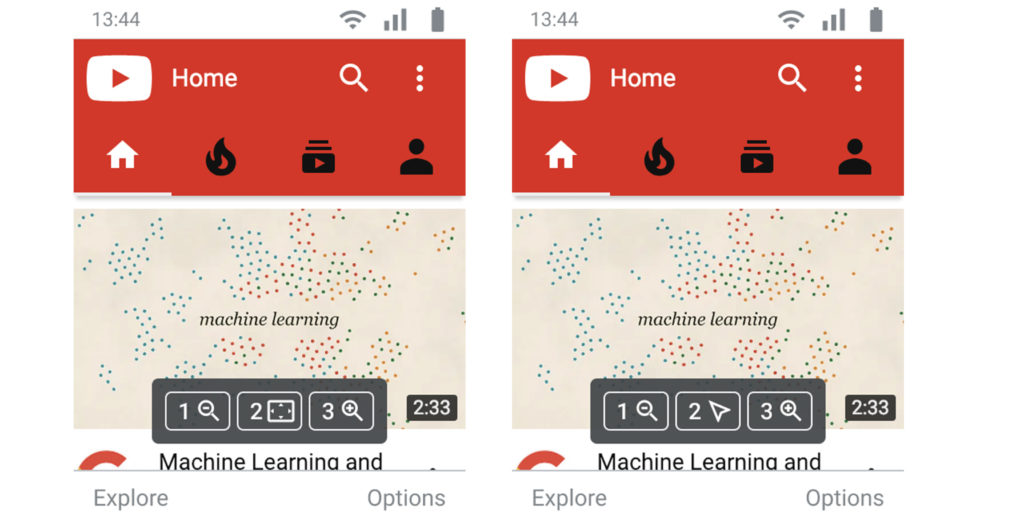
According to 9to5Google, that found the touchless mode in the Chromium Gerrit source code, the browsing mode will work with devices “with no touch input.” While devices with no touch input can include laptops, Android TVs, even Google Home speakers, a Google developer provided screenshots of the touchless mode feature to Chrome’s translation team.

For this to work, Google will have to completely rebuild Chrome for phones without touchscreens, which is why the screenshots show how users will zoom and scroll through pages. It seems users will be able to scroll through pages using the ‘1’ and ‘3’ on the number keypad. The ‘2’ will toggle between ‘spatial’ navigation and ‘cursor’ navigation.

Spatial navigation will allow users to navigate websites with the d-pad, while cursor mode should work on pages that can’t use the d-pad.

Google is currently working on a touchless mode for the ‘New Tab’ page that’ll feature website suggestions.

9to5 explains feature phones will require a powered down version of Chrome that will likely not support Incognito mode. Additionally, Chrome will close the previous tab whenever users open the browser through another app.

With this version of Chrome, the back button will not close the browser but will keep it open, until the phone no longer has the RAM to support it. This is reportedly the opposite of what Chrome does now.

9to5 is unsure which operating system will use this version of Chrome. KaiOS has its own browser and feature phones don’t use Google’s platform. So far, Android Go phones that use less 1GB  of RAM or less require a screen.

Source: Chromium Gerrit9to5Google

The post Google working on ‘touchless mode’ for Chrome to work on feature phones: report appeared first on MobileSyrup.

19 Mar 18:19

Apple launches Smart Covers for new iPad Air and Mini in Canada

by Bradly Shankar
Apple logo

Apple is now offering Smart Cover cases in Canada for its new iPad Air and iPad Mini models.

The following Smart Covers are now available on Apple Canada’s website:

The new 10.5-inch iPad Air, which features 2224 x 1668 pixel resolution and Apple’s powerful A12 Bionic processor, starts at $649 for the 64GB model in Canada.

Meanwhile, the new iPad Mini — Apple’s first updated Mini model since 2015’s iPad Mini 4 — starts at $529 for the 64GB model. Like the new iPad Air, the updated Mini features an A12 Bionic chipset and True Tone display.

The post Apple launches Smart Covers for new iPad Air and Mini in Canada appeared first on MobileSyrup.

19 Mar 18:19

More Android TV devices now support voice commands via Google Home

by Andrew Mohan

More Android TV devices can now be controlled using Google Home voice commands, according to Google’s updated support page.

As long as the Android TV supports Chromecast, you can use your voice to pause, play and navigate programs on video-streaming platforms that support it, such as Netflix and YouTube.

However, according to Android Police, Google disabled some features when operating an Android TV, which could be due to the ‘Photos’ bug that accessed other users’ private photos.

Full voice functionality should be restored to the Android TV after this issue gets fixed.

Before this update, the Nvidia Shield TV was the only Android TV device that had these voice commands with Google Home smart speakers.

Source: Google support page via 9to5Google

The post More Android TV devices now support voice commands via Google Home appeared first on MobileSyrup.

19 Mar 18:19

Netflix confirms it isn’t partnering with Apple’s upcoming streaming service

by Brad Bennett

At an event at Netflix’s office, the company’s CEO Reed Hastings confirmed that the streaming service will not be featured in Apple’s rumoured upcoming streaming video service.

During a question and answer period, Hastings explained that he feels it’s important viewers watch Netflix content on the company’s own platform

“Apple’s a great company, we want to have people watch our content on our service, so we’ve chosen not to integrate into their services,” said Hastings.

It seems Netflix is preparing to compete with Apple head-on on the streaming video space.

Netflix also opted not to partner with Apple when the company’s ‘TV app’ launched in the U.S. back in 2016. The app aggregates content from other streaming services like Crave and CBC’s Gem into one TV guide-like location. Apple’s TV app launched in Canada in September 2017.

Netflix doesn’t allow customers to sign up for its service on Apple’s devices to avoid the 30 percent cut the streaming giant takes from all subscriptions.

While Apple’s streaming platform is set to feature original content produced by the tech giant, the platform is rumoured also to include established premium video content services like HBO and Starz. That said, it’s unclear if these services will also make their way to the Canadian version of Apple’s streaming video service given Bell owns the exclusive rights to HBO and Starz content in Canada.

With files from Patrick O’Rourke 

The post Netflix confirms it isn’t partnering with Apple’s upcoming streaming service appeared first on MobileSyrup.