Shared posts

23 Apr 20:54

Notes on Continuous Integration and multi-architecture Docker Images

by Rui Carmo

I spent most of the intervening week in a haze (mostly pondering a few personal matters), but decided to scratch a few personal itches regarding my DevOps pipeline, most of which have to do with the lack of updated versions of Docker base images that I rely on–not for Intel/AMD CPUs, but for ARM machines. And since I like dealing with lower-level stuff as a distraction from work, I decided to rebuild everything as multiarch Docker images.

Basic Technique

Docker has massively simplified cross-compiling. Six or seven years back, when I was doing custom Android builds, I had the massive displeasure of dealing with cross-compiling toolchains, which were fast but required going through build scripts with a fine tooth comb and masking or overriding all sorts of things.

These days, as long as you have a fast enough CPU, all you need to do is load up QEMU and run the native compiler on your machine. And in modern Linux systems, Docker makes that trivial by both allowing you to run QEMU as a non-native binary handler inside a container but also by using qemu-user-static to run the ARM compiler inside the non-native containers themselves.

It all boils down to five simple steps:

  • Register QEMU as a binary loader inside the build system
  • Inject the qemu-user-static binary (the amd64 one) inside a vanilla alpine image for each architecture you need to target (because QEMU expects the binary to be inside the Docker filesystem)
  • Use those images as a base for your builds
  • Push them to Docker Hub
  • Build a virtual image manifest that references each architecture and push that as well

Continuous Integration

All of it is currently working on my alpine-python repository, which is the image I decided to start out with. The CI for it is maintainted via Travis CI (which precedes my use of Azure DevOps by several years), so I’m going to use its .travis.yml file as an example:

sudo: required
services:
  - docker # this tells Travis to start the service

before_install:
  - docker --version  # document the version Travis is using (currently 17.x, which is way too old)
  - echo '{"experimental":true}' | sudo tee /etc/docker/daemon.json # try to use manifests
  - mkdir -p $HOME/.docker
  - echo '{"experimental":"enabled"}' | tee $HOME/.docker/config.json # needed to use docker manifest
  - sudo service docker restart

install:
  - docker run --rm --privileged multiarch/qemu-user-static:register --reset # setup QEMU for cross-builds

script: # Since I want to move this to Azure DevOps, all the smarts are in a Makefile
  - make deps # this builds the base QEMU-enabled images
  - make 2.7  # now build each Python image I need (each line builds six variants)
  - make 3.6

after_success: # these can fail without breaking the build
  - docker login -u $DOCKER_USERNAME -p $DOCKER_PASSWORD
  - make push
  - make manifest # doesn't work on Travis since they are only using Docker 17.x

Like I point out above, the really smart bits to select the right base image and do the actual builds are inside the Makefile, and are nothing more sleight of hand, with careful handling of build arguments.

For the sake of brevity, I’m only going to show a few of the Makefile targets, but you can check out the whole thing at your leisure:

# Register QEMU into the host and grab the latest stable binary
deps:
	-docker run --rm --privileged multiarch/qemu-user-static:register
	-mkdir tmp 
	cd tmp && \
	curl -L -o qemu-arm-static.tar.gz https://github.com/multiarch/qemu-user-static/releases/download/v3.0.0/qemu-arm-static.tar.gz && \
	tar xzf qemu-arm-static.tar.gz && \
	cp qemu-arm-static ../qemu/

# Build a QEMU-enabled image for older Raspberry Pis using the Dockerfile in the qemu folder
qemu-arm32v6:
	docker build \
		--build-arg ARCH=arm32v6 \
		--build-arg BASE=arm32v6/$(ALPINE_VERSION) \
		-t local/qemu-arm32v6 qemu
        
# Use that image to build a Python 3.6 image using the Dockerfile in the 3.6 folder:
3.6-arm32v6:
	docker build \
		--build-arg BASE=local/qemu-arm32v6 \
		-t $(IMAGE_NAME):3.6-arm32v6 3.6
        
# Build and push a manifest with multiple architectures:
manifest:
	docker manifest create --amend \
		$(IMAGE_NAME):latest \
		$(IMAGE_NAME):3.6-amd64 \
		$(IMAGE_NAME):3.6-arm32v6 \
		$(IMAGE_NAME):3.6-arm32v7
        docker manifest push $(IMAGE_NAME):latest

The qemu Dockerfile is simplicity itself (and building for other architectures is just a matter of replacing the binary name, which can also be passed on as a build-arg):

ARG BASE 
FROM ${BASE}
COPY qemu-arm-static /usr/bin/qemu-arm-static

Next Steps

Right now, all that’s needed is to build up from this (I’m currently rebuilding some NodeJS images, in a fitting reversal of the “turtles all the way down” allegory).

But doing most of the logic inside a Makefile makes it very easy to move across CI systems. It can be a bit verbose and repetitive, but I can always assume I have GNU Make available and just do this:

ARCHS?=amd64 arm32v6 arm32v7
all:
    $(foreach var, $(ARCHS), make build-$(var);)

build-%:
	docker build \
		--build-arg BASE=local/qemu-$* \
		-t $(IMAGE_NAME):$* dockerfile_folder

…but it smacks of premature optimization, so I’m going to work my way through a few images in an easily debuggable fashion and then I’m going to give something like that a go.

Obviously, all of the above works in Azure Devops just fine, and I’ll add an example YAML for that once I start building a few of the “upper stack” images there.

I’m in no rush to move my existing CI across–remember, if it isn’t broken, don’t fix it, and it’s always a good idea to compare tools and focus on the core techniques.

Update: Well, I couldn’t just leave this alone, now could I? The repo is now fully cleaned up and the Makefile duly optimized. Even better, I’ve tested the same approach on a similar set of NodeJS images (although in that case the build time is so long that Travis times out, which means I will be moving those to Azure Devops next weekend), and expect to re-use this for another five or six images I maintain.


23 Apr 20:54

“Help Us Make It Amazing”

by Richard Millington

If you’re about to launch something new to your community (new platform, feature, product, etc..), you could try telling members how great it is.

This sets high expectations and you’re going to blend in with everyone else also declaring their new project is amazing.

A better approach is to ask your community to help make it amazing.

This lets members point out flaws without dumping on the project. It gives members a sense of influence and ownership. It increases the number of members who will promote the project at the end.

A tiny difference in words creates a big difference in mindset.

23 Apr 20:54

Arme Ritter – Poor Knights of Windsor – French Toast

by Andrea

Heute habe ich zum Frühstück aus einigen Scheiben Hefezopf von vorgestern Arme Ritter gemacht. Dabei habe ich mich grob an diesem Rezept aus dem Zeit-Magazin orientiert, aber die Mengen reduziert. Weil es immer noch viel zu viel war, notiere ich hier meine Version für die nächste Runde, die dann auch zu zweit schaffbar sein sollte:

Zutaten: 3 Scheiben Hefezopf, je 2cm dick (von dem großen Hefezopf aus 1kg Mehl), 3 Eier, 160ml Milch, 20g Zucker, Prise Salz

Eier, Milch, Zucker und Salz kräftig verrühren, in eine Auflaufform gießen. Die Hefezopf-Scheiben hineinlegen und von jeder Seite zwei oder drei Minuten einweichen lassen. Butter in einer nicht zu heißen Pfanne zerlassen und die getränkten Scheiben darin von jeder Seite zwei bis drei Minuten braten. Mit Zimtzucker bestreut servieren.

23 Apr 20:54

In-Flight Internet in the EU – Update 2019

by Martin

Last year I wrote about my first experiences with the European In-Flight Internet system. I came away quite impressed at the time despite only using a significantly rate limited option. When I was recently on two flights again that had the system installed, I decided that I would give the top-tier 15 Mbit/s option a try.

EAN speed and delayThe option to get this speed costs around 11 euros per flight, quite hefty for most European flights as they usually take less than two hours. But there’s also an option to pay via the accounts of some Wifi and mobile network operator subscriptions. In my case I could be billed via my mobile subscription and the 15 Mbit/s option was available for one euro per ten minutes. For a flight that takes an hour and a bit, that’s cheaper than the 11 Euro option that has to be paid with a credit card.

So how fast is this highest tier option? I was surprised to see that I actually got the 15 Mbit/s in the downlink direction and 5.5 Mbit/s in the uplink direction. Web browsing still felt a bit sluggish, however, due to the 900 ms round trip delay time. Sounds a bit high for a combined ground based + satellite Internet connection.

To see how stable the connection was I decided to watch a 30 minute Youtube video on my mobile device which only uses a fraction of the available bandwidth but does frequent downloads so data interruptions would show pretty quickly. The video streamed perfectly, no interruptions and the video only stopped a minute or two before the landing. A very smooth experience indeed!

That was on a Wednesday. When I tried the same thing again on my way home on Friday afternoon the result was a bit mixed. While I could sometimes get the 15 Mbit/s in the downlink direction when running a speed test, the test got stuck at other times. Also, Youtube videos did not play without interruptions. So I tried downloading some files to see what the sustained data rate would be and I came out at around half a megabit per second. Still good enough for web browsing and messaging, but I could have had that with one of the cheaper options as well.

Disclaimer: I work for one of the companies involved in EAN. I am not involved in this project, however, and the opinions mentioned in this post are my own.

23 Apr 20:53

Tame Your Desk Clutter With This One Simple Trick

by Michael Hession
Tame Your Desk Clutter With This One Simple Trick

Clearing your desk of clutter is easy enough. What’s wickedly difficult is keeping it clean. No matter how well you tidy up, little by little a state of disorder is sure to take hold again. Then, frustrated, you’ll likely give up entirely and concede defeat to the untameable mess.

But don’t lose hope! You can vanquish this desktop detritus. And the solution is shockingly simple.

I keep my desk orderly with small plastic trays that I stumbled on in the aisles of Muji, the Japanese retailer known for minimalist stylings and unadorned home goods. These trays are made to hold makeup, but I bought a bunch of them with an eye toward open storage on my junk-strewn desk.

To be clear, I like my junk. The multiple pens, dongles, little notebooks, keys, and paper clips are all useful. I don’t want to go full Marie Kondo getting rid of them. I also don’t want to stuff them in a drawer where I’ll never find anything. I want my stuff to be visible and accessible at all times, which is why I dislike traditional desktop organizers. Besides being an eyesore, they are just too dictatorial. You must put your pencils in this cup! And of course I never do. These little trays are a perfect in-between solution. You can toss any item onto a tray without thinking about it, yet the accumulation remains confined in a little playpen for all of your junk.

Storage is best when it’s customizable. The trays from Muji are great because they come in multiple sizes and cost only a couple of bucks each, so you can buy a whole bunch and create your own desktop anti-clutter system in no time. If you want something a bit more stylish, I recommend searching on Amazon for jewelry trays or makeup trays. Anything will work as long as it’s small and shallow. It’s a wonderfully low-key way you can inch toward a more orderly and comfortable desk.

23 Apr 20:53

Easter Fires’ PM10 Spike, Pt 2

by Ton Zijlstra

Where German Easter fires burn on Saturday evening, Dutch Easter fires burn on Easter Sunday. So this Easter Monday morning it’s time to look at the second spike of PM10 pollution in the air. The smell in the garden is as strong as yesterday.

The sensor grid shows a much more muted picture this morning. First the same sensors as I looked at yesterday.

Ter Apel (on the German border, have their own fire on Sunday evening, had an extreme reading after the German fires), shows twice the norm. Still a high outlier, but it pales in comparison to the 5 times the norm reading a day earlier. The peak also dissipates more quickly.

Upwind from us, in the Flevo polders, it is a similar picture, a less distinct peak than yesterday but still well above twice the norm.

And near us in Utrecht the readings are actually about the same as yesterday. That matches with my perception that the smell around our house is about the same as yesterday. It also implies that though yesterdays fires were much closer, they were perhaps less in numbers (some were cancelled due to drought) or intensity, or they weren’t actually as neatly upwind from us as the German fires and passed to the south of us.

The latter seems to be borne out by readings from some of the other sensors.
First Eibergen, on the border between the Twente and Achterhoek regions, an area with lots of Easter fires.

Eibergen shows a higher peak due to the Sunday fires than the day before, yet both peaks are in the same range at 2 to 2.5 times the norm.

South and east of the region we see similar patterns.
In Nijmegen more southern, the peak is higher than the day before, because they were not downwind of many German fires.

On the Veluwe, which is more eastern and closer to us, the peak is again lower than the day before yet still distinct.

Overall the pollution of Sunday’s fires is less visible across the Netherlands. Where Saturday’s fires made sensors go into the red from the north-eastern border, southwesterly across the country to Amsterdam, for Sunday’s fires such a clear corridor doesn’t show.

23 Apr 20:53

"If only they would talk to one another and not to me"

by peter@rukavina.net (Peter Rukavina)

C.S. Lewis, A Grief Observed:

No one ever told me that grief felt so like fear. I am not afraid, but the sensation is like being  afraid. The same fluttering in the stomach, the restlessness, the yawning. I keep on swallowing.

At other times it feels like being mildly concussed. There is a sort of invisible blanket between the world and me. I find it hard to take in what anyone says. Or perhaps, hard to want to take it in. It is so uninteresting. Yet I want the others to be about me. I dread the moments when the house is empty. If only they would talk to one another and not to me.

23 Apr 20:52

Pi Video Looper at OER19

by Reverend

Another thing worth mentioning about Reclaim’s sojourn to OER19 was our trial run of the Pi Video Looper setup that we’ll be rolling out for Ryan Seslow‘s artwork at Domains19. Luckily Meredith got a primer from Tim before making the trip to Galway because I was a bit rusty. The basic idea is you install the Pi Video Looper on a Raspberry Pi and the Pi boots up and automatically loops any video (or videos) loaded within a specific directory. So, you could have a video version of a GIF that loops eternally, which effectively gives you a hi-quality GIF looper, which is what we did for the Be Kind, Reclaim poster Meredith animated in anticipation of OER19. We also included an animation of VHS Tape art as well as a Ryan Seslow’s Vaporwave visual as a teaser. Here’s a look:

There are two tricks to Pi Video Looper after installing the software (see links below for more on this), one is actually finding the Raspberry Pi on the network, to accomplish this Adafruit’s Raspberry Pi Finder is crucial. You need to do this so you can eventually access the Pi via FTP and add files given there is no GUI for the PI when using Pi Video Looper software. The other trick is actually getting the Pi on the network, which gets doubly complicated when you are using a guest wifi network that requires additional steps. Luckily tethering to the iPhone worked cleanly, and to connect the Pi Video Looper with a specific network you need to add the wpa_supplicant-conf file and reboot so that the network settings are loaded.

Here is what my supplicant file looked like:

country=us
update_config=1
ctrl_interface=/var/run/wpa_supplicant

network={
 scan_ssid=1
 ssid="my iPhone name"
 psk="my tethering password"
}

You can see the full installation for the Pi Video Looper here, here are the install commands, here is the latest release of the software on Github, and finally if you need to change read-only permissions of mount drive for Raspberry Pi. [Leaving these links here predominantly for my own future reference, but let me know if you need more explanation.] And, finally, special thanks to Kate Molloy for capturing Reclaim’s video looping presence in all its glory!


23 Apr 20:48

Councillor Pete Fry, Slower Speeds in the ‘Hood, and Why This All Makes Sense

by Sandy James Planner

I have been advocating for slower vehicular speeds in neighbourhoods to make communities safer, more comfortable and convenient for vulnerable road users. I also have been writing about  the impact on communities elsewhere that have adopted 30 kilometer per hour as the default speed in municipalities.

The Scottish Parliament is considering a bill to  lower speed limits to 20 miles per hour (equivalent to 30 km/h) in all cities, towns and villages. That is a reduction from the currently accepted 30 miles per hour (50 km/h). London and several counties in the United Kingdom that have adopted the slower speeds within their city limits have seen vehicular deaths decline by 20 percent, and serious  injury also substantially decline.

City of Vancouver Councillor Pete Fry has introduced a motion asking that Council support a resolution to the Union of British Columbia Municipalities to lobby the Province to amend the Motor Vehicle Act “to a default speed limit of 30 kilometers per hour for local streets with municipalities enabled to increase speed limits on local streets in a case-by-case basis by by-laws and posted signage.” Councillor Fry has also requested that staff identify an area of Vancouver to pilot a 30 km/h speed limit, report back on the strategy, and implement the slower speed in that neighbourhood area to ascertain the effectiveness of the policy.

This is not the first 30 kilometers per hour rodeo going to the Union of British Columbia Municipalities. The City of New Westminster and Councillor Patrick Johnstone headed up such a request a few years back.  What really needs to happen is for this initiative to leave the purview of the municipalities and be seriously considered by Minister of Transportation and Infrastructure Claire Trevena who can give authorization for the change to the Motor Vehicle Act.

The beauty of a blanket implementation of the residential neighbourhoods is that there will not be a huge capital cost to create signage everywhere indicating how fast you can move on which street. While arterial roads would remain at 50 km/h, the local serving streets  within Vancouver  neighbourhoods could  all be 30 km/h.

This is also City of Vancouver City Council’s opportunity to correct the term “Vision Zero”. During the Vision Party’s majority they did not want the term “Vision Zero” in Vancouver’s reports  (which refers to the Swedish approach adopted in 1997 to achieve zero road deaths) to be used for political reasons.

Instead the strategy was called  “Zero Deaths”. Since Vision Zero is the international program that has achieved so much success, it is time to do the right thing and rename Vancouver’s program correctly.

Great Britain’s Rod King has outlined the compelling rationale for slower streets in his presentation to the Scottish parliament:

  1. From an emissions standpoint, a vehicle going 50 km/h requires 2.25 times the energy to sustain a speed 50 km per hour, compared to 30 km/h. A speed reduction to 30 km/h reduces diesel NOxand PM10 pollution by 8 per cent.

  2. The stopping distance required for a vehicle at 50 km/h is nearly double that of a vehicle at 30 km/h. A speed reduction to 30 km/h doubles the available reaction time for everyone involved, increasing the likelihood of avoiding a crash.

  3. The force of a collision involving a vehicle driving 50 km/h is 2.25 times that of a collision at 30 km/h; 80 per cent of pedestrians will die in a 50 km/h impact. At 30 km/h, 85 per cent of pedestrians will survive an impact


Of course there will be lots of pushback from the vehicular lobby which has for a century valued speed and convenience, viewing pedestrian and cyclist fatalities and injuries as unavoidable outcomes of a car first policy. Vancouver has embraced walking,biking and public transit as the transportation policy supported way to get around,

It just makes sense to ensure that residents can walk and cycle within their own neighbourhood without being subject to vehicular crashes at speeds that are in many cases not survivable. As the baby boom becomes one-quarter of the national population, we also need a way to ensure that seniors are fit, have good walking environments and are close to shops and services. Reinforcing the walking environment by slowing vehicular speeds will do that, and will also create a better quality of life.

In the words of Rod King: “If we want consideration for the amenity and safety of residents and communities to be a national norm, then at some stage we have to enter a national debate about the quality of our streets and whether we have rules built around optimising the speed of vehicles, or about the liveability of people. We need to end our thinking about 30mph from our warm, protected, comfortable windscreen view of the street, and consider it from the height of an 8-year-old on the pavement, or with the mobility of an 80-year-old trying to cross the high street to a shop”.

23 Apr 20:47

A more detailed view of the Mueller Report

by Nathan Yau

By now we’ve all seen the zoomed out thumbnail view of the Mueller Report. It gives you a quick look at the amount of the report redacted, but that’s about it. So, Axios tagged every paragraph with events, topics, people, and places to make things easier to find and jump to.

Tags: Axios, Mueller

23 Apr 13:49

Tim Cook: The Genius Who Took Apple to the Next Level :: Leander Kahney #nowreading

by Volker Weber

SharedScreenshot

Vorher habe ich mich schon durch Leanders Buch über Jony Ive gekämpft und viel gelernt.

More >

23 Apr 13:47

Telus offering $50 bill credit on new customer referrals

by Bradly Shankar

Telus is currently offering a $50 bill credit to customers with a referral code.

To access the referral platform, you’ll need to log in at telus.com/mytelus with your My Telus credentials. From there, a referral can be sent through email, SMS, Twitter, Facebook post or Facebook message.

Note that the referee must be a new Telus customer. Once the referral is received, the referee will have 15 days to sign up to the referral platform and join Telus on a new in-market Your Choice or Voice postpaid consumer plan.

After activation, the referee will need to verify their account in the My Telus portal. This step must be completed within 30 days of initial registration.

Once this has been completed, the referer and the referee will both receive the $50 bill credit. Customers can refer an unlimited number of people, but will only receive credits for up to six successful referrals per calendar year.

Credits will be applied within three to four weeks of process completion and will appear on the referer and referee’s respective next bills.

More information can be found here.

The post Telus offering $50 bill credit on new customer referrals appeared first on MobileSyrup.

23 Apr 13:47

Elon Musk takes the stage to talk about the future of Tesla and Robotaxis

by Brad Bennett

The electric vehicle company shared its incredibly optimistic full self-driving vision for the future which includes ‘robotaxis’ a new autonomous-driving chip and more.

New self-driving chip

To start off, the company shared that its Full Self-Driving computer is finally in production. Some vehicles—including Model S and X as of March 20th and the Model 3 as of April 12th—are even outfitted with this unit already.

The company will start offering the ability to upgrade older vehicles later this year, reports Electrek.

The chip is built from the ground up for Tesla’s self-driving neural network and is 21 times better than the previous Nvidia hardware. The chip is being manufactured by Samsung which was reported on late last year.

Robotaxis

By 2020, Elon Musk claims that there will be a million Teslas on the road that will be able to operate as self-driving robotaxis. He does note that regulatory approval will be a significant issue with pushing this out, but it’s something the company is working on.

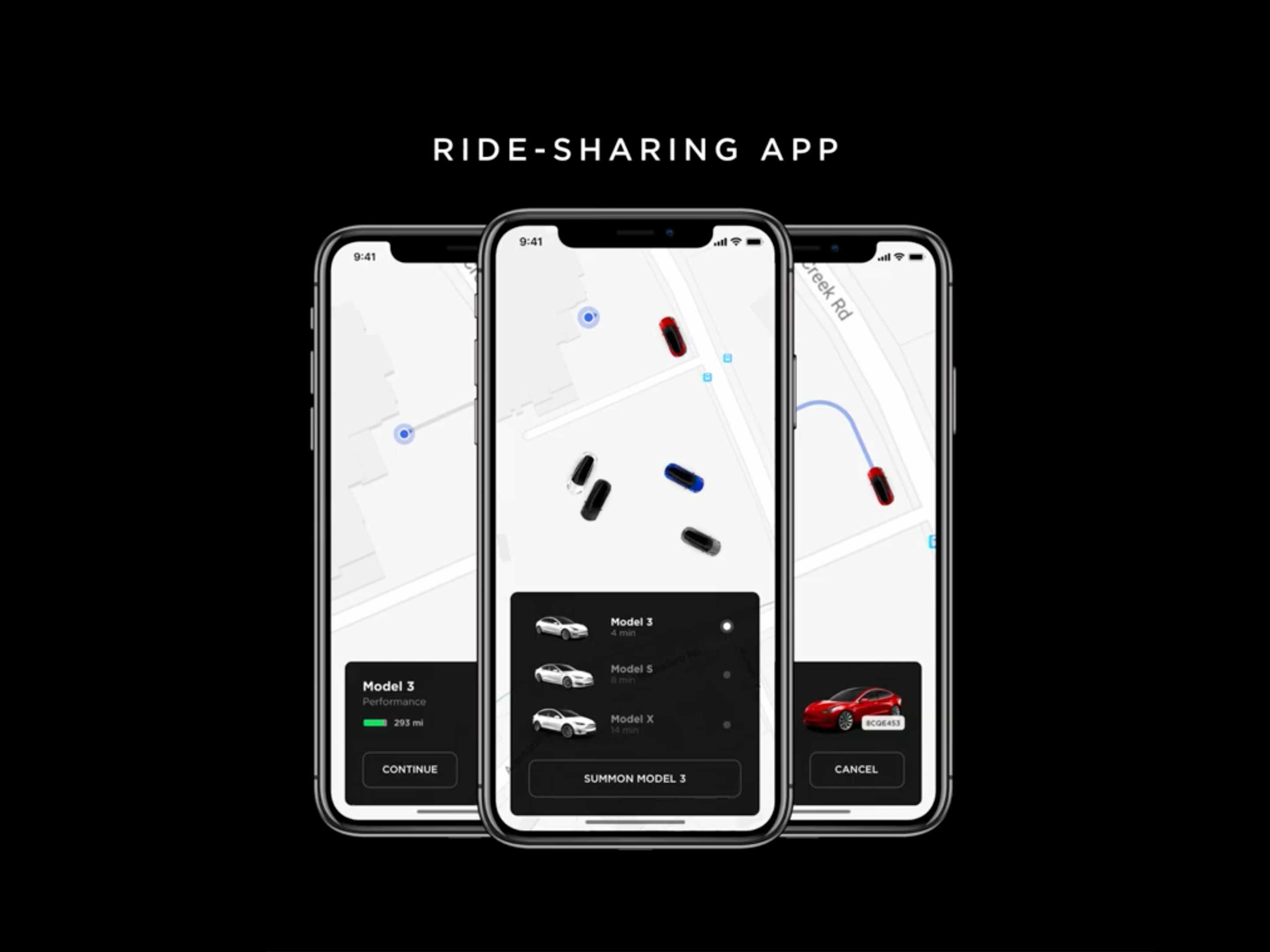
Tesla owners with vehicles that have the ‘Full Self-Driving’ capable package will be able to enter their Tesla into the robotaxi pool, and the vehicle will act similarly to an Uber whenever the driver isn’t using it.

To make this happen Elon Musk said that by the end of the year, Tesla’s vehicles with the Full Self-Driving package will hit SAE Level 5 autonomy, or the highest level of autonomous driving a vehicle can reach. In Ontario, only SAE Level 3 vehicles are allowed on roads.

Musk is also predicting that by the middle of 2020 there will be a million Teslas on the road that have this capability and will support being used as a robotaxi.

All users will need to do is open the Tesla app, summon a nearby vehicle to pick them up and it will take them from point A to point B—if they live in an area with regulatory support for self-driving cars without a driver, that is.

There will also be some restrictions that the vehicle’s owner will be able to impose on their car. Owners can make it so only their friends can rent their vehicle or choose select times during which their vehicle is available.

Tesla owners who rent out their vehicle can expect to make an extra $30,000 USD (roughly, 40,054.50 CAD) per year with the Robotaxi functionality, according to Musk’s presentation.

Musk says that with this feature on the horizon buying a traditional car is financially insane and will be like owning a horse in a few years.

These self-driving cars can’t be used by other ride-sharing companies either since Tesla implemented a clause a few years ago that restricts Tesla owners from using their vehicles for any other ride-sharing services other than its own.

The California-based company decided to do this since it’s hoping to make a profit from taking a cut from each Robotaxi ride, much like how Apple does when people buy apps from the App Store.

Musk also theorizes, but didn’t promise, that if a Tesla gets into an accident while driving itself, Tesla would be liable, not the owner.

Musk is so confident in the vehicle’s self-driving that he says in around two years he thinks the company will be making Teslas without steering wheels.

Other notable announcements

Musk states that Tesla owners will someday be able to dial up the aggression of their autonomous cars to a point where there might even be a slight chance that the vehicle will end up in a fender bender.

The CEO also took some time to take shots at 3D maps and LIDAR. Tesla’s notably don’t use LIDAR while their competitors do and Musk says that it’s an expensive add-on that’s not worth it, according to TechCrunch. Tesla’s use radar, GPS, maps, ultrasonic sensors and cameras instead.

3D maps are another technology that self-driving car companies are looking into. These maps are highly detailed digital versions of the world that allows the cars to know where they are and more. Musk says that these won’t be useful since the world is constantly changing.

While Musk announced robotaxis he mentioned that once that happens people won’t be able to buy a Model 3 after a lease since the car will still have value to the company.

Further, the company is designing all of its cars to work for 1 million miles so that they can handle all the extra driving involved with being a robotaxi.

Finally, he dropped another hint at the Tesla pickup truck saying that it is going to be unveiled later in 2019.

Source: Tesla, Electrek, TechCrunch

The post Elon Musk takes the stage to talk about the future of Tesla and Robotaxis appeared first on MobileSyrup.

22 Apr 21:53

The Prisoner of Echo Special :: The New Yorker

by Volker Weber

d03ddb0a7e654fc103054b37f616d904

The New Yorker is my favorite publication, for its long form reading. Case in point this story about Steve Wood and Mohamedu Salahi:

In 2004, Steve Wood was deployed to Guantánamo Bay, as a member of the Oregon National Guard. He and his comrades were told that many of the detainees were responsible for 9/11 and, given the opportunity, would strike again. “I just remember being super excited, because I thought, I’m going to be doing something important,” Wood told me. For two weeks, he worked as a guard in the cellblocks, monitoring men who had been captured on the battlefields of Afghanistan. Then a sergeant major pulled him aside for a brief interview, and assigned him to work the night shift in Echo Special, a secret, single occupancy unit that had been built to house the United States military’s highest value detainee.

Warning: This is a very long read, over two dozen pages, and it will touch you in a profound way.

More >

22 Apr 21:50

Firefox adds Picture-in-Picture mode in latest Nightly browser for Windows

by Jonathan Lamont

Mozilla’s Firefox browser is the latest to include a Picture-in-Picture (PiP) mode.

Enabled in its Nightly browser for Windows — an unstable, experimental version of the browser for developing and testing features — Mozilla’s attempt at PiP takes the best of other implementations.

Users can enable PiP on a video by right-clicking on it, then selecting ‘Picture-in-Picture,’ similar to Google’s implementation in Chrome. On websites with a built-in right-click menu, like YouTube, you will need to right-click twice.

Thankfully, Mozilla also borrowed from Opera and added a PiP button that hovers on videos. Clicking that button pops the video into a separate, always-on-top window. Users can drag this window around the desktop.

Further, the PiP window features a ‘return’ button to put the video back, as well as play/pause controls.

Interestingly, Mozilla chose to develop its own PiP implementation instead of using Google’s ‘Picture-in-Picture Web API.’

Mozilla’s Mike Conley (@mike_conley), who first announced PiP in Nightly on Twitter, said they went this route to put the user in control. However, he hinted Mozilla was open to using Chrome’s API.

Further, Conley said the team was working on PiP for macOS but was focussing on Windows first.

To try out PiP in Firefox, you can download the latest Nightly browser for free here.

Source: Twitter Via: TechDows

The post Firefox adds Picture-in-Picture mode in latest Nightly browser for Windows appeared first on MobileSyrup.

22 Apr 21:50

Google Photos will start showing which pictures aren’t backed up again

by Jonathan Lamont

Google Photos may be bringing back an easy way to tell which pictures it hasn’t backed up yet.

Previously, the app showed an indicator at the top of each media item that it hadn’t backed up. That made it easy to see what wasn’t backed up and choose things to back up.

However, sometime over the last year, that indicator disappeared from the app. But it seems the Photos team is finally bringing it back.

According to an update to the Photos changelog on the Play Store, the app will get a new ‘gallery view’ that will “help you see which of your photos and videos have not yet been backed up and proactively choose items to back up.”

Despite posting a changelog, the feature doesn’t seem to be in the Photos app yet. The Photos team has added changelogs for unreleased features before, such as when it tweeted about a one-tap document cropping feature that still hasn’t appeared.

Google Photos changelog

Regardless, I welcome the return of an easy way to check if a file is backed up or not. Right now, you can open a photo, and Photos will show a cloud icon in the top left corner if it hasn’t been backed up yet. However, if there’s a bunch of photos you’re waiting on, individually checking everyone to see its status is tedious.

Along with the ‘gallery view,’ the changelog notes Google improved Photos to support foldable devices better.

You can grab the update from the Play Store here.

Source: Android Police

The post Google Photos will start showing which pictures aren’t backed up again appeared first on MobileSyrup.

22 Apr 21:50

Samsung postpones Galaxy Fold launch events in China, United States

by Igor Bonifacic
Galaxy Fold

Samsung is delaying the launch of the Galaxy Fold in China.

Over the weekend, the South Korean postponed the April 23rd and April 24th launch events it had scheduled in Hong Kong and Shanghai. In a statement to China’s National Business Daily, Samsung China blamed the Shanghai cancellation on a venue issue. The company, however, provided no reason for the Hong Kong cancellation. Moreover, Samsung has yet to announce new dates for the two events.

The postponement comes after multiple reviewers, including YouTuber MKBHD and The Verge‘s Dieter Bohn, broke the foldable display on their pre-release devices. In several of the above instances in which the Galaxy Fold broke, the individual reviewing it had removed a pre-applied film designed to protect the screen. MobileSyrup‘s Galaxy Fold is currently undamaged and continues to work as usual.

In addition, according to the Wall Street Journal, Samsung has also delayed the launch of the Fold until “at least next month.”

Before the Galaxy Fold’s recent troubles, Samsung had planned to launch the device in Canada sometime in the summer. It’s unclear if that’s still the company’s plan but rumours point towards a June 7th release date.

Source: Engadget

The post Samsung postpones Galaxy Fold launch events in China, United States appeared first on MobileSyrup.

22 Apr 21:49

Samsung officially delays the Galaxy Fold’s U.S. release date ‘indefinitely’

by Patrick O'Rourke
Galaxy Fold

Samsung has confirmed earlier reports stating that it plans to delay the U.S. release of its $1,980 (roughly $2,600 CAD) foldable smartphone, the Galaxy Fold.

In a statement to multiple publications, Samsung says that it will reveal the phone’s new “release date in the coming weeks.” The Galaxy Fold was initially slated to release on April 26th in the United States.

Last week, reports emerged that the display featured in the Galaxy Fold started to fail in several review units. Some issues were related to a “protective layer” being removed from the display, while others related to what seems to be the screen being outright faulty in other ways.

Samsung’s full statement regarding the Fold’s delay can be read below:

“We recently unveiled a completely new mobile category: a smartphone using multiple new technologies and materials to create a display that is flexible enough to fold. We are encouraged by the excitement around the Galaxy Fold.

While many reviewers shared with us the vast potential they see, some also showed us how the device needs further improvements that could ensure the best possible user experience.

To fully evaluate this feedback and run further internal tests, we have decided to delay the release of the Galaxy Fold. We plan to announce the release date in the coming weeks.

Initial findings from the inspection of reported issues on the display showed that they could be associated with impact on the top and bottom exposed areas of the hinge. There was also an instance where substances found inside the device affected the display performance.

We will take measures to strengthen the display protection. We will also enhance the guidance on care and use of the display including the protective layer so that our customers get the most out of their Galaxy Fold.

We value the trust our customers place in us and they are always our top priority. Samsung is committed to working closely with customers and partners to move the industry forward. We want to thank them for their patience and understanding.”

While some of the Fold’s display problems, with The Verge’s Dieter Bohn (@backlon) being the most notable example, seem to stem from the smartphone’s display just outright being faulty, others involve what looks like a screen protector being removed from the Fold’s inner 7.3-inch AMOLED polymer display.

For example, CNBC tech editor Steve Kovach (@stevekovach) also experienced similar problems with the Galaxy Fold’s display.

On the other hand, Bloomberg technology reporter Mark Gurman (@markgurman) and YouTuber Marques Brownlee (@MKBHD) both removed what they assumed was a screen protector from the Galaxy Fold, only to find out that it is actually a protective layer holding the screen together.

Though it initially looked like those that removed the protective display layer ignored the written warning on the Fold’s packaging, it seems that isn’t the case. Many Fold review units did not feature the warning on their packing.

It’s unclear if this delay will shift the Canadian release date of the Fold, which Samsung Canada says is set for Summer 2019. MobileSyrup has reached out to Samsung Canada for more information regarding the Galaxy Fold’s Canadian release date.

Though Samsung has not revealed how much the Galaxy Fold will cost in Canada, the foldable smartphone costs $,1980 USD (roughly $2,600 CAD).

The post Samsung officially delays the Galaxy Fold’s U.S. release date ‘indefinitely’ appeared first on MobileSyrup.

22 Apr 21:48

RT @rosa: 🤨 pic.twitter.com/uXWOUXz25S

by rosa
mkalus shared this story from internetofshit on Twitter.


Posted by rosa on Saturday, April 20th, 2019 10:56pm
Retweeted by internetofshit on Monday, April 22nd, 2019 7:53am


4765 likes, 1525 retweets
22 Apr 21:47

Apple might not have been totally honest regarding how it feels about Qualcomm

by Bryson Masse
Qualcomm's new X55 modem

Years before the two companies engaged in the recently-wrapped up back-and-forth litigation, newly unsealed court documents outlined ways that Apple sought to lower its Qualcomm-related royalty costs.

According to the documents revealed by The Washington Post, Apple might not have been totally forthcoming in its testimony to jurors during the recent proceedings. In response to the iPhone-maker’s arguments that Qualcomm was over charging for use of its technology, lawyers for Qualcomm pointed out that it had multiple examples of Apple characterizing the technology as the best option available.

Qualcomm submitted evidence that in 2015, Apple’s vice president of hardware, Johny Srouji, wrote of Qualcomm technology, “Engineering wise, they have been the best.” As well in 2009, an Apple accountant said that Qualcomm is “widely considered the owner of the strongest patent portfolio for essential and relevant patents for wireless standards.”

These new details emerge after, as part of a settlement with Qualcomm, Apple agreed to pay an undisclosed amount to the chipmaker. It also signed a six-year licensing agreement, as well as the option to extend the deal a further two years. That means, since its previous modem supplier Intel exited the business, a 5G-connected iPhone is likely back on the menu for 2020.

Early Apple plans reveal goal to reduce Qualcomm patent costs

The iPhone-maker had also started to investigate ways to reduce its Qualcomm-related royalties all the way back in 2014. Although Apple waited for the end of a business cooperation agreement between the two companies to end in 2016 — alongside billions of dollars in payments from Qualcomm — to put its plan in place.

Included in the discovery was a 2016 document titled ‘Qualcomm Royalty Reduction’ and contained strategies like “Hurt Qualcomm financially” and “Put Qualcomm’s licensing model at risk.”

Another strategy included Apple specifically negotiating cheaper patents in a bid to make it appear like Qualcomm was charging above-average industry rates for use of its technology. The documents laid out how Apple would license patents from Huawei and Ericsson, which lawyers for the iPhone-maker used as examples as more realistic rates during proceedings last week.

“While it’s very common for companies who are engaged in legal disputes to play hardball, the disclosure of these documents is very unsettling,” said Adam Mossoff, a law professor at George Mason University told The Washington Post. “It potentially reveals that Apple was engaging in a bad faith argument both in front of antitrust enforcers as well as the legal courts about the actual value and nature of Qualcomm’s patented innovation.”

Source: The Washington Post 

The post Apple might not have been totally honest regarding how it feels about Qualcomm appeared first on MobileSyrup.

22 Apr 21:46

Uber Questions

by Ben Thompson

Over the course of Uber’s remarkable rise — very significant stumbles along the way notwithstanding — it has been more prudent to defend the company’s valuation than to question it. Look no further than the first Stratechery article about the ride-sharing “personal mobility” company, written in response to a 2014 Wall Street Journal column questioning Uber’s latest valuation. The title — Why Uber is Worth $18.2 Billion — holds up well given that Uber is expected to be worth around $100 billion when it prices its stock.

At the same time, to argue you were right based on a company’s private valuation is problematic: that valuation is a proxy for data about the business that simply isn’t available publicly. How much of the valuation is good money chasing bad? How much of the business is dependent on artificially low prices that are subsidized by those private investments? What parts — if any — of the company are leverageable?

Those questions are supposed to be answered by a company’s S-1. Uber’s, not so much.

The Personal Mobility Question

The promise of Uber — the biggest reason to believe that Uber was worth more than a taxi company — is, appropriately enough, how the company leads off its S-1.

We believe that Personal Mobility represents a vast, rapidly growing, and underpenetrated market opportunity. We operate our Personal Mobility offering in 63 countries with an aggregate population of 4.1 billion people. Through our Personal Mobility offering, we estimate that our platform served 2% of the population in these countries based on MAPCs in the quarter ended December 31, 2018. We estimate that people traveled 4.7 trillion vehicle miles in trips under 30 miles in these countries in 2018, of which the approximately 26 billion miles traveled on our platform represent less than 1% penetration.

Uber went on to define its Total Addressable Market as “11.9 trillion miles per year, representing an estimated $5.7 trillion market opportunity in 175 countries.” That, needless to say, is not a small market: it’s about 7% of gross world product, and an even higher percentage if you only measure those 175 countries (Uber cannot enter an additional 20 countries after selling its operations in those countries to competitors). Uber was slightly more modest about its Serviceable Available Market, that is, the countries it is currently operating in (and is not regulatory encumbered): a mere $2.5 trillion market opportunity — $3 trillion if you include those six countries with regulatory restrictions.1 The company concluded:

We believe that we are just getting started: consumers only traveled approximately 26 billion miles on our platform in 2018, implying a less than 1% penetration rate of our near-term SAM.

Uber has often seemed to function as a parody of startup culture, and this line is no exception: “We only need to get a small share of this very large market” is the most cliché of startup pitches, but that appears to be exactly what Uber is promoting.

And yet, what an alluring pitch it remains! The fundamental idea of paying tens of thousands of dollars (more or less) for a large metal box that sits idle the vast majority of the time, doing nothing but depreciating in value, doesn’t really make much sense in a world where everyone carries Internet communicators that let you call up a ride when — and crucially, only when — you need one. Remember that other classic Silicon Valley cliché — the Wayne Gretzky quote about skating to where the puck will be, not where it is — and the sheer ambition starts to make sense.

The Lyft Question

Of course Uber isn’t the only company chasing this prize: U.S. & Canada competitor Lyft IPO’d a few weeks ago and, despite Lyft’s growth, particularly in the wake of Uber’s self-inflicted disaster that was 2017, Uber should in theory be in a stronger position: it has more share, and more share should mean both more leverage on costs and better liquidity for drivers and riders.

Here’s the problem, though: it’s impossible to tell if theory matches reality. Uber has two major problems in the way they presented data in their S-1:

  • First, data from developed and emerging markets are presented in aggregate
  • Second, data from Uber ride-sharing and its other businesses, particularly Uber Eats, are also presented in aggregate

Consider the question of how Uber is doing in the U.S. & Canada, the relevant markets for a Lyft comparison: Uber reported $6.148 billion in “Core Platform Revenue”. “Core Platform” means ride-sharing and Uber Eats, and “Core Platform Revenue” is “Core Platform Gross Bookings less (i) Driver and restaurant earnings, refunds, and discounts and (ii) Driver incentives.” Therefore, in order to get a direct comparison to Lyft, it is necessary to separate ride-sharing and Uber Eats.

Unfortunately this is impossible for two reasons: first, while Uber does report separate numbers for ride-sharing and Uber Eats, that number is “Core Platform Adjusted Net Revenue”, which equals “Core Platform revenue (i) less excess Driver incentives, (ii) less Driver referrals, (iii) excluding the impact of legal, tax, and regulatory reserves and settlements recorded as contra-revenue, and (iv) excluding the impact of our 2018 Divested Operations.” Secondly, those numbers are not split out geographically. In short, to understand Uber’s North American ride-sharing business, you need to not only compare apples to oranges, but have to somehow ascertain exactly how many apples and oranges you are talking about.2

The Scooter Question

Meanwhile, 46% of trips in the U.S. are under three miles, and here scooters, e-bikes, and other non-car solutions could impact Uber’s core ride-sharing product, which the company admits:

We believe that dockless e-bikes and e-scooters address many of these use cases and will replace a portion of these vehicle trips over time, particularly in urban environments that suffer from substantial traffic during peak commuting hours…

The introduction of New Mobility products such as dockless e-bikes and e-scooters, which have lower price points than our existing products and offerings, will lower the average Gross Bookings per Trip on our platform.

This is ok, again in theory: Uber’s leading position in ride-sharing should give the company the advantage when it comes to redefining the space from ride-sharing to transportation-as-a-service. The problem, though, is that the S-1 offers basically no details about how this transition is going: is New Mobility growing? What are the cost structures like? Are increased trips making up for cannibalized revenue from ride-sharing?

To be fair, these are very early days for e-bikes and scooters, so the lack of data is understandable. At the same time, a lack of data is turning into a theme.

The Self-Driving Question

One of the biggest existential questions surrounding Uber (and Lyft) is self-driving cars: what happens when drivers are no longer necessary? In fact, it was here that I thought Uber’s S-1 was strongest:

Along the way to a potential future autonomous vehicle world, we believe that there will be a long period of hybrid autonomy, in which autonomous vehicles will be deployed gradually against specific use cases while Drivers continue to serve most consumer demand. As we solve specific autonomous use cases, we will deploy autonomous vehicles against them. Such situations may include trips along a standard, well-mapped route in a predictable environment in good weather. In other situations, such as those that involve substantial traffic, complex routes, or unusual weather conditions, we will continue to rely on Drivers. Moreover, high-demand events, such as concerts or sporting events, will likely exceed the capacity of a highly utilized, fully autonomous vehicle fleet and require the dynamic addition of Drivers to the network in real time. Our regional on-the-ground operations teams will be critical to maintaining reliable supply for such high-demand events.

Deciding which trip receives a vehicle driven by a Driver and which receives an autonomous vehicle, and deploying both in real time while maintaining liquidity in all situations, is a dynamic that we believe is imperative for the success of an autonomous vehicle future. Accordingly, we believe that we will be uniquely suited for this dynamic during the expected long hybrid period of co-existence of Drivers and autonomous vehicles. Drivers are therefore a critical and differentiating advantage for us and will continue to be our valued partners for the long-term. We will continue to partner with original equipment manufacturers (“OEMs”) and other technology companies to determine how to most effectively leverage our network during the transition to autonomous vehicle technologies.

This fits my previous read on the situation: I think that the most likely go-to-market for autonomous cars is via the ride-sharing networks, not as a substitute, and that driver availability and liquidity will continue to be differentiating factors.

That, though, raises two points of concern for Uber. First, while Uber has mostly settled its intellectual property dispute with Google’s Waymo (although Uber may still have to make changes to its autonomous vehicle software), Google has become much more closely allied with Lyft. This is a huge problem for Uber in the long-run if Waymo’s approach ends up winning out (because presumably Google would partner with Lyft to go-to-market at scale), and just as big of an issue in the short-term. Lyft is one of the best ways for investors to bet on Waymo, and the more money that Lyft has, the more Uber will struggle for profitability in the markets in which they compete.

Second, self-driving cars may emerge in markets that Uber cannot enter, like Singapore or China, thanks both to significantly increased density (which is better for ride-sharing in general and for leveraging high cost capital assets in particular) as well as governments more likely to limit the use of personal vehicles. This isn’t a total loss — Uber owns a portion of both Didi in China and Grab in southeast Asia — but whatever financial benefits may result may pale in comparison to the data and experience, leaving Uber vulnerable (neither Didi nor Grab are restrained from entering Uber’s markets).

And, of course, it goes without saying that there is precious little data about how Uber’s self-driving efforts are progressing, or what partnerships it has formed.

The Profitability Question

Unsurprisingly, many folks have fastened onto this risk factor:

We have incurred significant losses since inception, including in the United States and other major markets. We expect our operating expenses to increase significantly in the foreseeable future, and we may not achieve profitability.

This is, of course, quite standard, but it does feel particularly pressing given that Uber measures its annual losses in the billions. Unfortunately, it is here that Uber’s S-1 is particularly lacking. We don’t know:

  • How much it costs Uber to acquire drivers
  • How much it costs Uber to acquire riders
  • How much it costs Uber Eats to acquire restaurants
  • How much it costs Uber Eats to acquire customers
  • What is Uber’s retention rate for drivers
  • What is Uber’s retention rate for riders
  • What is Uber Eats’ retention rate for restaurants
  • What is Uber Eats’ retention rate for customers
  • Any sort of cohort analysis of any of the above categories
  • Ride-sharing revenue and profitability by geography
  • Uber Eats revenue and profitability by geography
  • Ride-sharing’s take rate overall and in developed versus emerging markets
  • Uber Eats’ take rate overall and in developed versus emerging markets
  • Ride-sharing revenue and profitability by time-in-market
  • Uber Eats revenue and profitability by time-in-market
  • An understanding of driver incentives and how they affect top-line revenue, or how “excess driver incentives” have changed over time
  • How costs are allocated, particularly when it comes to rider marketing and incentives
  • A breakdown of Uber’s many offerings (Black versus UberX versus UberPool etc.)

This is at best disappointing, and at worst feels like a cruel trick on retail investors: after all of these years, and all of these theoretical arguments about Uber’s potential, all we have are clichés about small pieces of gigantic markets and a heap of numbers that reveal nothing concrete about the business.


Despite it all, Uber may still be worth the investment: the theory of the company remains plausible, and the company is decreasing its losses (and could do so more quickly if it spun off its autonomous driving unit, as I believe they should). Moreover, I noted above how suitable China and Southeast Asia are for ride-sharing: investing in Uber is the most practical way of investing in ride-sharing everywhere.

However, if I bought individual stocks (I don’t per my ethics policy), I would be out: this S-1 is so devoid of meaningful information (despite its length) that it makes me wonder what, if anything, Uber is trying to hide. If I am going to be taken for a ride I want at least some idea of where I am going — isn’t that the point of Uber in the first place?

I wrote a follow-up to this article in this Daily Update.

  1. Argentina, Germany, Italy, Japan, South Korea, and Spain
  2. Financial Twitter mainstay @modestproposal1 put forth a good effort here; I tried for literally hours to come up with something better, but it’s frankly mostly guesswork, exacerbated by the fact that Uber and Lyft handle tolls, taxes, and other government fees differently: Uber includes them in revenue, while Lyft does not
22 Apr 21:46

RT @carolecadwalla: This is actually very important I think. @facebook refused to answer questions of British parliament. It refused to add…

by carolecadwalla
mkalus shared this story from ottocrat on Twitter.

This is actually very important I think. @facebook refused to answer questions of British parliament. It refused to address international committee of 9 countries. But @TEDTalks is its spiritual home. These are its peers. And it can’t face them either twitter.com/carolecadwalla…

Oh wow. This is what happened after my talk at #TED2019. This bit is not in the video. @TEDchris invited @facebook to respond. ‘We will make time for you,’ he said. Instead, they made an official complaint about what I said. And then: silence
pic.twitter.com/NpBwDbmTHy


Posted by carolecadwalla on Monday, April 22nd, 2019 2:09am


8228 likes, 3540 retweets

Posted by carolecadwalla on Monday, April 22nd, 2019 8:06am
Retweeted by ottocrat on Monday, April 22nd, 2019 5:29pm


4427 likes, 1986 retweets
22 Apr 21:46

Samsung Galaxy Wear app bug locks people out with white screen

by Dean Daley

Samsung Galaxy Wear users are reporting issues with the Galaxy Wear app. 

Individuals have taken to the U.S. Samsung Community forums to write about an issue with logging into the Samsung Galaxy Wear app. When signing into the app, users will see is a white screen, and will not be able to proceed any further.

The issue appears to be affecting a lot of users — over 65 pages worth — who use non-Samsung smartphones to connect to the Wear app. Many of the users who’ve commented use Huawei, OnePlus, Xiaomi. Pixel and even HTC smartphones. It also doesn’t seem to matter which Gear or Galaxy Wear devices the user is attempting to connect with.

Currently, I have the Samsung Galaxy Wear app on a Samsung Galaxy Note 9, a Note 8 and an LG G8 ThinQ, and the app works fine on all three devices.

According to reviewer Gavin Gadgets, Samsung has confirmed that they are working on a fix.

However, it’s unclear if this issue is happening to Samsung users in Canada. No one on the forums has mentioned if they’re in Canada.

Nonetheless, we’ve reached out to Samsung Canada for more information.

Let us know in the comments below if you’ve experienced the issue on your Samsung Galaxy Wear app.

Source: Galaxy Wear app. 

Via: The Verge

The post Samsung Galaxy Wear app bug locks people out with white screen appeared first on MobileSyrup.

22 Apr 21:44

Innisfil, Ontario could be the next 5G smart town

by Shruti Shekar

The Town of Innisfil is bustling with traffic at 9:30am.

Except, there are no taxis, janky busses, or subways. There definitely aren’t any streetcars packed to the brim, either. There are only Ubers. Ubers are everywhere and you can’t tell them apart from the other cars trying to get to work or to school.

Jean Theriault, a 64-year-old retired international sales consultant, has been an Uber driver since the ridesharing service became part of the city’s local public transit system in 2017.

“At the beginning when Uber first came, there would be mornings where no drivers were available. So as soon as a driver showed up and he has to take someone to the Go station, someone else wants a ride but they’ll have to wait a bit longer. But that’s non-existent now. Now it’s available 24-hours a day.”

Theriault is part of the 66.5 percent of Innisfil residents between the ages of 15 and 64 living in the town, according to the 2016 census.

He used to live in Toronto, but as he put it, he “kept moving north like everyone” in the city. His daughter goes to school in Barrie, which is a 15-minute drive from Innisfil.

“[Bringing Uber] was a great opportunity. I’m retired. Without it, I have no idea what I would be doing at this point,” Theriault said, smiling, as he drove to the town’s IdeaLab, which is also the library.

Innisfil is as big as Mississauga, Ontario and is located about an hour north of Toronto. It has a small population of 37,000 people that live in different pockets.

The town is a mish-mash of expansive farmland, modern, developed residences and shopping squares. As you’re driving by a massive farm complete with grazing cows, you’ll spot what looks like a brand new Starbucks, Pizza Nova, and Freshii, located right nearby

So how did this town decide to make Uber its primary public transit system? Further, how did it make the decision to add cryptocurrency as a form of payment towards property taxes?

The answers are found in the way Innisfil intends to become the next potential hub for 5G technology and evolve into one of Canada’s first smart cities.

Adopting technology means making a cultural change

Sitting in Theriault’s back seat, Innisfil’s Mayor Lynn Dollin explains that embracing a cultural change means adopting innovative technology, but in order to do that the town needed to become “courageous.”

“No one person makes anything happen. We have nine councillors, but they are courageous councillors. And even the council that came before me. You have to be courageous, this isn’t like any other business where you can say ‘oops well that didn’t work let’s move on to something else.’”

It’s important to note that Uber was established in the town before Dollin became the mayor in 2018. From 1994 to 2014 she was a councillor and from 2016 until she was elected mayor she was the president of the Association of Municipalities of Ontario.

She explained that most municipalities are risk averse because the town is accountable to taxpayers and if its elected officials make the wrong decision “we would get booted out of our job.”

“We can react quicker to things, it’s easier to convince a council of nine than one of 30 to go in a certain direction,” Dollin said.

That’s the case with most levels of government. If you screw up handling cash, do something inappropriate, or don’t act in the public’s interests, you may as well say bye-bye to getting re-elected.

Innisfil is free to make these changes because there’s less bureaucracy as well as fewer layers of government to go through to make final decisions, she said.

“We can react quicker to things, it’s easier to convince a council of nine than one of 30 to go in a certain direction,” Dollin said.

Part of that cultural change Dollin is talking about is communicating to residents and making them understand why the town should adopt certain new technologies.

“We want people who live in all parts of Innisfil to feel like they belong and to feel that no one has been left behind,” she said.

“If you tell a senior citizen that if they use their smartphone then they can see their grandchildren and speak to them who live in Australia or British Columbia or anywhere in the world, that’s a huge incentive for someone.”

Convincing people that Uber can be public transit is hard: Dollin

But, technically speaking, Dollin explained that Innisfil hired a transportation consultant in 2016 to figure out how to transport people from different pockets of the town.

The consultant had suggested getting two busses that ran up and down the main street, it would also mean that residents would begin to see a two percent hike in their property taxes to pay for the service.

“This isn’t your ordinary library. There is no old lady with a bun that’s going to shush at you,” Dollin said.

“You’re basically asking a whole bunch of residents to pay two percent more on their property taxes for services that they may never use,” she said.

Uber came up as an idea and the relationship started from there. It wasn’t easy because Dollin explained she and several others had to try and convince people who weren’t used to Uber as a form of public transit.

The base fare to use Innisfil’s public transit is $4 CAD.
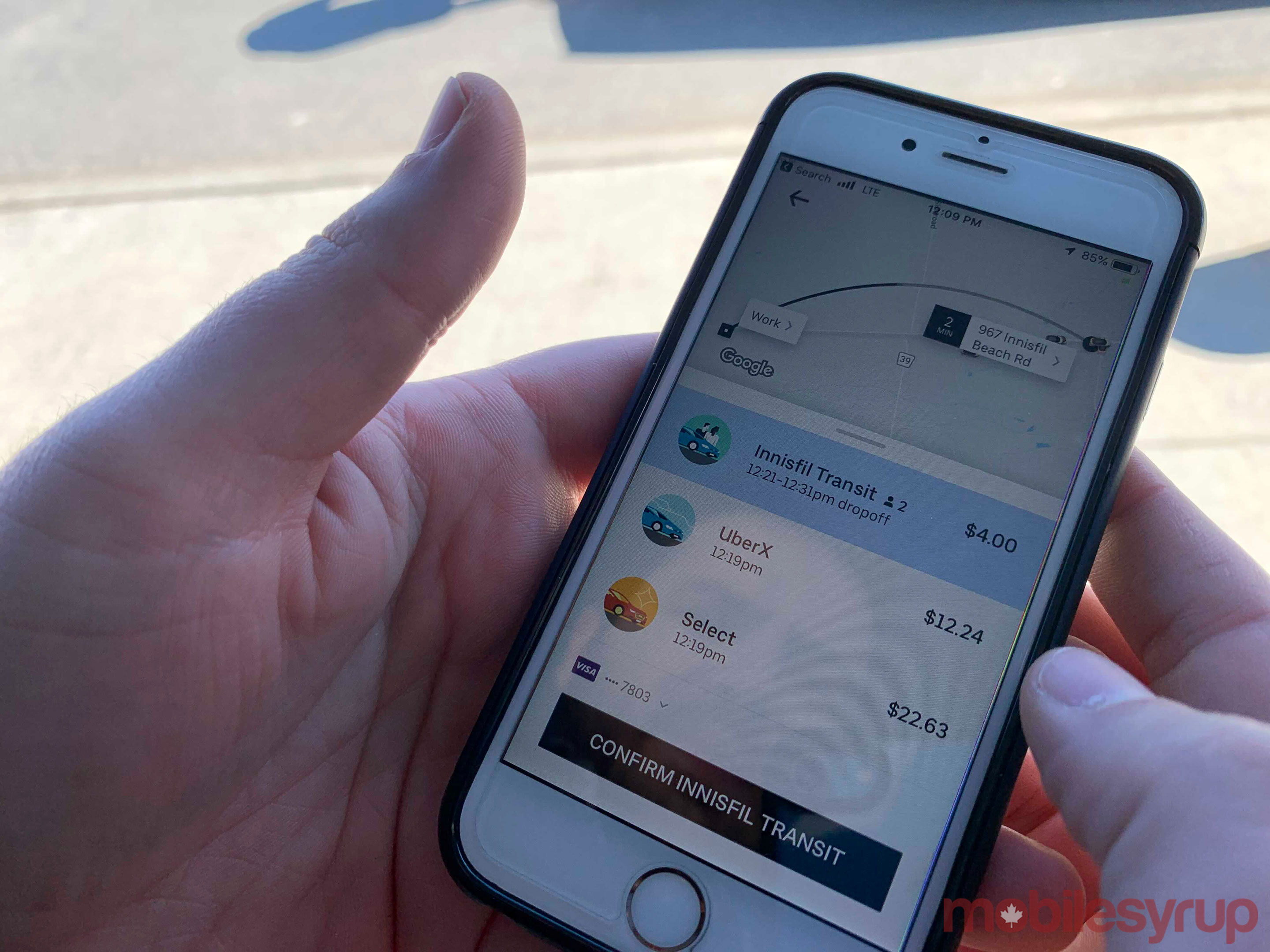
As Dollin got out of the Uber and walked into the IdeaLab, she explained the location was one of four in the town. The IdeaLab is far from your traditional library; it’s fully equipped with staff who teach residents about the latest technology and how to be more tech savvy.

“This isn’t your ordinary library. There is no old lady with a bun that’s going to shush at you,” Dollin said.

Dollin walked to the back of the IdeaLab and into a boardroom. She’s followed by the town’s chief administrative officer, Jason Reynar, and the library’s CEO, Erin Scuccimarri.

‘Boxing the risk’ by spending only $100,000 instead of $10 million: Jason Reynar

Reynar spoke about that cultural change Dollin and the rest of the city’s staff are trying to create.

He said he was responsible for “developing that culture where people who work for the municipality feel comfortable coming up with new ideas.”

“It’s about boxing the risk,” Reynar said.

“That’s why we do pilot projects. We do trials. We test out these kinds of innovative solutions and with the expectation that it may not work and we are going to learn from it, and we are going to iterate it and make it better the next time. Or we move onto something else and we do that fairly quickly.”

“We put the risk in a box and say ‘what’s the worst that can happen?’,” Reynar said.

Reynar said the town is very open and creates a “safe space” where people know what is going on and know when to expect failure.

“We put the risk in a box and say ‘what’s the worst that can happen?’,” Reynar said.

When the idea of Uber was brought up, Reynar said the town decided to invest only $100,000 instead of $10 million, making the case to pilot Uber more manageable.

“We managed the risk that way, and I think that’s what helps create a space where people can feel comfortable trying those things,” Reynar said.

From Uber to Cryptocurrency

Dollin said that after the town launched Uber, many companies approached the council to see if their ideas could be adopted.

“They don’t all make it to the council table,” Dollin said gratefully, adding she was impressed by the number of companies that want to invest in Innisfil’s culture.

“We love being a sounding board for all these great ideas, and the next one was Coinberry,” she said.

The company signed a partnership with Innisfil to provide the service as a one-year pilot project. Innisfil is now the first in Canada to accept cryptocurrency as a form of property tax payment.

Reynar noted that the form of payment is added onto existing payment methods, meaning residents can still pay their property taxes with credit cards, cash or checks. Reynar said this was where the future was going.

In fact, Twitter’s CEO Jack Dorsey told MobileSyrup that investing in smaller towns is easier especially with technology like cryptocurrency.

5G and becoming a smart city

But what Innisfil really wants, is to be a part of the movement adopting 5G technology and reimagining the town as a smart city hub.

So is Innisfil going to start looking into 5G enabled companies? What about working towards autonomous vehicles? And becoming a smart city?

“Yes, yes, and yes, right all of the above and not because we’re interested in competing with [others]…what we do want is fast internet, fast accessible cell signal service for our community. We want to be future ready, so we want autonomous vehicles, we want to get to that stage and experiment with companies that are curious on how that interacts with an urban and rural environment because we have both,” Reynar said.

Reynar said the town has the cash but it has to be careful in terms of how it intends to deploy it, adding that it has to be able to serve the public.

“It’s a good revenue generator and creates different kinds of revenue sources and solves a public problem,” Reynar said.

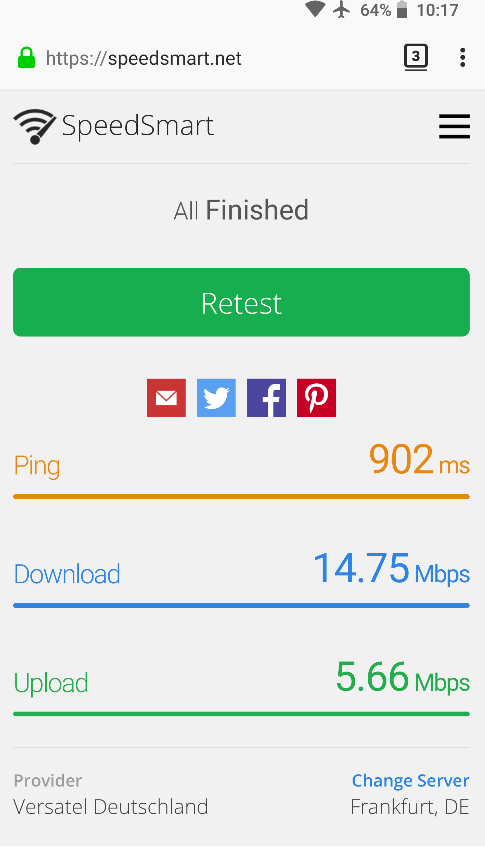
But so many residents in Innisfil don’t even have Wi-Fi or high-speed internet. In fact, Reynar said some residents only have dial-up internet connections.

Reynar said the town isn’t necessarily a hotspot for big telecom companies to come and build infrastructure because it’s “capital intensive.”

As an alternative, Reynar suggested they build their own tower and get a long term lease for a signal to put on the tower.

“It’s a good revenue generator and creates different kinds of revenue sources and solves a public problem,” he said. The coverage would, in turn, help the city move toward using 5G technology, which would eventually be added on to existing infrastructure when the spectrum is available to be deployed.

Reynar added that just like it’s easier to adopt Uber and cryptocurrency, it would be much easier to bring 5G technology to the town.

“We literally have one high school and eight elementary schools. So when you talk about how to test new technology, we could change the traffic lights so they are smart traffic lights so that between drop off times at schools we actually could reroute the traffic,” he said.

“Let’s try to figure out the logistics here and then scale up,” he said.

It’s important to note that while Canada just auctioned off 600 MHz, one of the bands for 5G, it still needs to auction off other bands that will help deploy 5G. The other spectrum auctions are to take place in 2020 and 2021.

Appy Hour, skills development and a Hack Lab

So how does Innisfil bring along the nearly, if not more than 10,000 adults that are aged 50 and above to be a part of these innovative programs?

Scuccimarri, the library’s CEO, explained that the town decided to invest in rebranding the library to offer services that help residents understand the technology around them.

“We did a rebranding three years ago to be more relevant in terms of the services we were providing,” she said. “We saw ourselves as reinventing the role of the public library in the community.”

She added that the town placed a huge focus on digital literacy, technology and learning. The library not only acts as a community hub but a space where residents of all ages can come and learn, she said.

The library offers services to help adults learn about the latest programs, skills classes, and even offers what it likes to call ‘Appy Hour,’ a weekly class that lets anyone drop in with their smartphone to learn about different apps.

The library has a media lab that includes a recording studio, video cameras, floor to ceiling green screen and machines to edit.

Scuccimarri said students and seniors both use the space.

As Scuccimarri walks through the library, she shows off the Think Lab, which is where residents can take different courses.

Lorie Smith, a retired 58-year-old, sits at one of the computers in the Think Lab.

“I’m retired and bored and I need socializing,” she said. “You’re used to and it’s an everyday thing.”

Smith’s been living in Innisfil for about 30 years now and comes into the IdeaLab every week for different classes.

“It’s challenging to adapt. It’s hard, and they’re so patient and they’re so good here. I don’t feel like an idiot, to be honest, because they’re very good, every one of them,” she said.

She was learning how to make a wooden sign for her trailer, but she’s made a plethora of things with the help from the library’s staff.

“We use innovation as a process to get us to a solution that’s affordable, that’s sustainable,” Scuccimarri

Scuccimarri explains that the staff is trained to help teach everyone everything and if there isn’t something they don’t know, then they learn it.

The library also has a Hack Lab, which is where the laser printers, 3D printers and other gadgets are located. It’s also where residents can come in and learn to code.

But despite all of the innovation in the town and where its going, Reynar wanted to reiterate that the town doesn’t “innovate for innovation’s sake.”

“We’re not sitting around trying to think of the next innovative solution. We use innovation as a process to get us to a solution that’s affordable, that’s sustainable, that makes sense and we’re not afraid to experiment and be creative with that,” he said.

The post Innisfil, Ontario could be the next 5G smart town appeared first on MobileSyrup.

22 Apr 21:44

The Last Button

by peter@rukavina.net (Peter Rukavina)
22 Apr 21:43

Pre order: Yagya / Stormur

by Ryan Griffin
mkalus shared this story from Blog - A STRANGELY ISOLATED PLACE.

ASIPV015_1A.JPG
ASIPV015_2.JPG
ASIPV015_3A.JPG
ASIPV015_3B.JPG
ASIPV015_3C.JPG
ASIPV015_4AB.JPG
ASIPV015_4CD.JPG
ASIPV015_BLACK.JPG
ASIPV015_BLACK2.JPG
ASIPV015_CD.JPG
 

Known to many for his infamous ambient dub techno album, ‘Rigning’, Aðalsteinn Guðmundsson’s aka Yagya's landmark release took us deep amongst the rain-drenched forest. The beautiful, slowly shuffling atmospheric masterpiece set a blueprint for the notorious style we now know him best for. Fast forward ten years, and the gently falling rain from Rigning has now intensified. Yagya has shifted to something with more energy, a more defined groove, and a growing euphoric state: Stormur. 

Stormur, sees Yagya continue to evolve his sound into the pure techno realm. His unique palette still identifiable, but the focus now on the swirling hypnotism, the delicate tonal progressions, whispering vocals, and the underlying current that transports you. From the forest floor to the soaring treetops, the dense whirlpools of mist, and the breathtaking landscapes are now seen from above. 

Confident in its simplicity and efficiency, Stormur is focused on the subtle flow and progression between tracks akin to a full DJ set, transporting you from one chapter to the next. Each track taking its cue from the previous. The tonal shifts are minimal, resulting in a trance-like state throughout the ten movements, best absorbed in one sitting, with guest vocalist Hatis Noir providing an angelic voice amongst the shifting patterns, swirling synthesizers and driving grooves. 

 Stormur by Yagya

Available in transparent blue marbled vinyl (400 copies), and black vinyl (200 copies) housed in a matte-laminated gatefold sleeve, including a full mixed-album CD and digital download.

See release page for full details and links to buy.


22 Apr 21:43

Support for Nextcloud

by Jeff Mancuso
mkalus shared this story from ExpanDrive.

ExpanDrive has always had support for Nextcloud using our WebDAV connector or our Owncloud connector. With ExpanDrive 7 there is now a full connection profile available for Nextcloud. You can easily mount Nextcloud as a fast network drive on Mac, Windows or Linux and you can also manage your files from directly within the ExpanDrive GUI.

To get started, grab ExpanDrive v7 and create a new drive. Next select the Nextcloud connection profile.

Once you’ve got the drive created, add your server root, your Nextcloud username and password and you’ll be good to go.

The post Support for Nextcloud appeared first on ExpanDrive.

22 Apr 21:43

Google testing iPhone-like gesture bar, swipe-to-go-back gesture in Android Q

by Jonathan Lamont
Android Pie gesture navigation

Google is testing more changes to how Android handles gesture navigation in Q, and things could become more like iOS.

According to XDA senior member ‘paphonb,’ Google is developing an iOS-like ‘swipe-to-go-back’ gesture. Currently, the gesture isn’t functional, but the animation is present.

paphonb was able to turn on the gesture in the Android Q system image and recorded a video of the animation in the Android Studio emulator.

XDA Developers was able to enable the gestures on a Pixel 2 XL running the second Android Q beta with the following ADB commands:

adb shell settings put global prototype_enabled 1
adb shell settings put global quickstepcontroller_edge_width_sensitivity 48
adb reboot

It’s worth noting that the ‘sensitivity’ number in the command, which measures how close you have to be to the edge of the screen to trigger the gesture, is dependant on screen resolution and density. For the purpose of this ADB command, XDA used the number for demonstration purposes.

Further, some Android phones, like those from Huawei, have similar back-gesture

The video also shows the iPhone X-style gesture bar Google is testing. In its current form, it doesn’t have a back button. Likely, the back gesture is meant to work with it — although it doesn’t work either, so if you choose to enable that, be aware you won’t have a back button.

That said, paphonb discovered that Google has changed how the gesture bar adapts its colour. Previously, the bar changed colour based on what the app told it to be. Instead, the gesture bar changes colour based on what’s actually behind it.

You can enable the gesture bar and the new colour adaptation with the following ADB commands:

adb shell settings put global quickstepcontroller_showhandle 1
adb shell settings put global navbar_color_adapt_enable 1

Ultimately, this could mark a significant shift in Android’s gestures. While some may dislike the iOS-like style of the new gestures, the iPhone is frankly a joy to use, and if Google follows Apple’s lead on gestures, it’ll make Android Q better. We’ll likely learn more about Google’s plans at I/O in May.

Source: XDA Developers

The post Google testing iPhone-like gesture bar, swipe-to-go-back gesture in Android Q appeared first on MobileSyrup.

22 Apr 21:42

Uber self-driving unit worth $7.25 billion USD, expected to go public soon

by Shruti Shekar

Uber said its investments in autonomous driving technology is now valued at $7.25 billion USD (about $9.67 billion CAD).

Reuters reported that the company raised nearly $1 billion USD ($1.33 billion CAD) from investors including SoftBank Group. It noted that this will likely appeal to financial analysts who have reported concerns of Uber spending a lot of money on its autonomous vehicles unit.

Uber did mention though in its initial public offering this month that the research and technology for autonomous vehicles are “expensive and time-consumer and may not be successful,” Reuters reported. In fact, the company lost $3.03 billion USD (about $4.04 billion CAD) last year.

Reuters also noted that it’s not very common that a company makes such investments so close to its IPO because “bringing in large new investors changes the company’s capital structure.”

The company is expected to have an early May debut on the New York Stock Exchange, Reuters noted. Reuters previously reported that Uber is expected to sell $10 billion USD (about $13.3 billion CAD) worth of stock; it would make for one of the biggest technology IPOs of all time.

Source: Reuters

The post Uber self-driving unit worth $7.25 billion USD, expected to go public soon appeared first on MobileSyrup.

22 Apr 15:26

Science and Society

by Stephen Downes
I was asked:

I'm a second-year student at Sciences Po Paris on the Nancy French-German campus. As part of a research project on the link between science and society, I'm working with a small group of other students on the concept of MOOCs. Therefore, I have been reading a lot about how they work and the different objectives behind their use.
 
I was wondering if it would be possible for you to explain, even in a short way by mail, what was the original idea that led you and Mr. Siemens to starting the project. Do you feel that this sentence: "In his work as a professor, Stephen Downes used to feel that he was helping those who least needed it. His students at places like the University of Alberta already had a leg up in life and could afford the tuition.", published in an article on the Chronicle of Higher Education on the 29 August 2010, reflects your original idea?  
 
Do you think MOOCs can really change the future of higher education? Could they just be instrumentalized? 


The Chronicle quote expresses a part of it. This is my motivation for working toward open education and open educational resources. I have been campaigning for access to education for a very long time (to be precise, since September of 1981, when I wrote my first (student newspaper) article on education funding. It was a struggle for me to access higher education, and expenses (including tuition) were always a struggle. For most of my student days I also worked on various jobs (dishwasher, store clerk, janitor, editor) to make ends meet. I met a lot of people who were just as qualified as I was to attend post-secondary education but who were not able to for social and economic reasons.

The other part of it explains how I felt access could be provided. Part of this is open source software and shareware, which I had used since my early days on a computer. Starting in 1980 I worked on computer programming, and in 1981 was exposed to 'Adventure', an online game propagated by sharing on mainframe computers (I was in Texas on a three-month training program for Texas Instruments). When I was tutoring for Athabasca University in 1988 or so I set up a Maximus Bulletin Board Service, using shareware, to try to reach students. This interest in computers in open education convinced me that they could be used to provide access beyond what in-person classes could provide. I pursued this thereafter, creating a compugraphics course, creating MUDs, and creating websites. In the 1990s, working at Assiniboine Community College, I drove around in a van filled with a computer network to remote communities and First Nation reserves in Manitoba introducing them to what the internet could do.

The other part of that explanation addresses networks and connectivism directly. While in university I studied philosophy, and in particular, the processes of learning, inference and discovery. I became convinced that cognitivist approaches were wrong (there is no brain writing; we don't have propositions in the brain). The network approach gradually emerged as the alternative - I had worked on it on my own for many years, creating concept maps, developing a 'logic of modification', etc., and then saw Francisco Varela give a talk at the University of Alberta hospital on networking and the immune system, which opened the doors. I followed up reading Rumelhard and MacClelland, and attending a Connectionism conference in Vancouver in 1990, and developed a network-based approach from there, incorporating the web, RSS, email newsletters, and other decentralized and distributed practices. This eventually merged with what George Siemens was doing and became connectivism.

The course itself was George's idea. He had run a successful online connectivism conference in 2007 and wanted to offer a course on connectivism at the university of Manitoba in 2008, and asked if I would co-teach it. I agreed on condition that it be an open course, and suggested that we run it as the first 'connectivist' course, the idea being to illustrate through practice what the theory described in principle. This meant it would be a distributed network-based course, that people would create their own blogs, that we'd use RSS and email, etc. He set up a Moodle installation and took care of the 'official' side of the course for the University; I designed the distributed parts, RSS aggregator, newsletter, etc., and we both participated in discussions and live webinars with guests (Dave Cormier helped us with this as well). We did not expect the course to become massive, but because of the way we had set up up, as a decentralized course, the course easily scaled, and became the first MOOC (so named by Save Cormier and Bryan Alexander in an online discussion (in Ed Tech Talk, I believe) about the course).

Can the MOOC change the future of higher education? I think it already has. It entrenched the idea of open online learning as mainstream, disproving the idea that it would be necessary to charge tuition for an online course. There had been free courses before - I remember taking a massive email-based course in the 1990s welcoming people to the internet. There had also been free online learning resources before and even free self-study courses. What made this different is that it was a course in the traditional sense, with pacing, with live events, and with (a lot!) of interaction among the participants. The course disproved the idea that only higher education institutions could provide the social aspects of an online course, and was the first to show it could be done in a scalable and massive fashion (as it had already been done in sites like SlashDot and WebReference, etc). These ideas are mainstream today, but they were inconceivable in 2008.

I think the influence of the MOOC over the long term may be even deeper. We are today weeing the dangers and weakness of centralized social networks online. The centralized MOOC (as exhibited in Coursera and Udacity) could not sustain a business model; it was many times more expensive to host than our decentralized course (since most of the activity took place on the students' own websites). So they have retreated from open online education, while decentralized courses continue to be offered informally and for free. And we don't need to worry about whether a course is massive or not because we have not invested hundreds of thousands of dollars creating materials in advance; open online learning is based on open educational resources, which people are now beginning to realized are best created and managed as a decentralized community-based resource. And the idea of a decentralized web is being explored by many people as an alternative to Facebook and Twitter - things like #indieweb and Mastodon / Activity Feed, etc. are being developed as alternatives - these are not really influenced by the MOOC in particular, but have the same origins as the MOOC, and benefit from open online learning.

And that's probably the final point. MOOCs were one part of a much larger story, a story that begins on one hand with shareware and bulletin board services and mixtapes, a story that includes cooperative networks and community organizers, a story that includes the study of computer networks, artificial neural networks, and community-based networks, a story that includes a mental puzzle about the bridges of Konigsburg, the synchronous chirping of crickets, the study of immunology, the creation of web-rings and content syndication, and (in my case) the story of someone observing the difference between being able to access an education, and in being denied that access. This is an important point to understand, because an emphasis of any one part of this fabric as 'instrumental' will not be effective without explicit recognition that it is embedded in this entire fabric, and that you can control or direct this network, that's not how it works, you can only be a part of this network and endeavour to make it better.

I hope this helps answer your question.


-- Stephen


('Science and Society' was the subject line of the email, and I assume the title of the course being taken'. I looked up the reference to the article to add the link to this post.).