Shared posts

12 May 05:34

Accepted Solutions and Best Answers

by Richard Millington

An accepted solution is a solution to the original poster’s question.

A best answer is someone’s subjective opinion of the best response from a range of answers.

The distinction is important. The former is based on facts, the latter is based upon opinions.

The original poster is best qualified to mark an answer as an accepted solution. She knows better than anyone whether it solved her problem or not. No promise is being made other than it solved the problem for 1 person. If it helps others too, great.

The original poster is less qualified to select the best answer from several responses. That requires expertise in the topic (expertise they might not have if they’re asking the question). The premise is different. ‘This might not solve your problem, but it’s the best answer we’ve got here.’

Both can be abused and misused.

Two useful principles here:

1) Accepted solutions are ideal for support communities. But they need automated prompts to the poster to mark an answer as an accepted solution or allow other members to highlight if an answer worked for them (with a limit i.e. 3 tags) for that answer to be marked as an accepted solution. Customer support staff can skim other responses and mark successful answers.

2) Best answers are ideal for customer success communities with a focus on helping others learn from each other. Here it helps to allow top members in the insider/mvp/superuser program mark an answer as best.

Don’t fall into the trap of confusing what’s based upon facts and what’s based upon opinions.

12 May 05:29

NYC in the 21st Century, Part 2

by Jonathan Blaustein


Change is hard.

That’s the truth.

As much as change makes us better, though, we rarely seek it out.

People don’t choose it, if left to our own devices. One needs training, which art school often provides, to temper our natural fear of change, and to learn to trust its inherent process.

Most of the time, though, change is thrust upon us.

It drops out of the sky, like an asteroid, ready to lay waste to the dumb dinosaurs below.

That’s far more common, right?

I mentioned this today, (writing on Wednesday,) because by the time you read this, it will likely be public knowledge that the New York Times Lens blog, my erstwhile employer, is shutting down at the end of this month.

Dead.
Done.
Kaput.

You guys know me, and writing as I do here, straight from me to you, is my particular speciality. Yet for 6 years, I learned how to write like a proper journalist.

No fucks, or shits. No first person narrative.

Thanks, NYT, I appreciate it!

But I only wrote a handful of times a year at Lens, by the end, and the money won’t make a difference in my life. (Though, like working with teenagers, I’ll miss the action.)

Rather, I feel for all the photographers who won’t be spot-lit across the globe. That blog had reach, and reach can = impact.

Speaking from experience, having “The Value of a Dollar” go viral from Lens MADE my photo career. That work is on the wall in a museum in Germany now, in 2019, and that never, ever would have happened without Lens.

These days, there are other places to publish such work. Sure. But for the photographers, losing Lens means losing opportunities.

And other places will have to pick up the slack.

Here in my column in APE, I’ll tell you that we intend to do just that.

For the rest of the summer, we’ll have portfolio review articles, exhibition reviews, and adventure pieces from the field. Between Denver, Portland, and wherever the hell I end up in Europe next week, there will be many stories to tell.

And I intend to show you the work of DOZENS of photographers.

There will be much to see, and after years of book reviews, we’re going to chill a bit on that, and bring them back at the end of summer. (Unless I need a brief break from all the action.)

Speaking of action, given the headline on this piece, I should be talking about my take on New York City and New Jersey in the 21st Century.

The Big Apple, and one of its primary suburban arms.
(Two thirds of the Tri-State Area, if you will.)

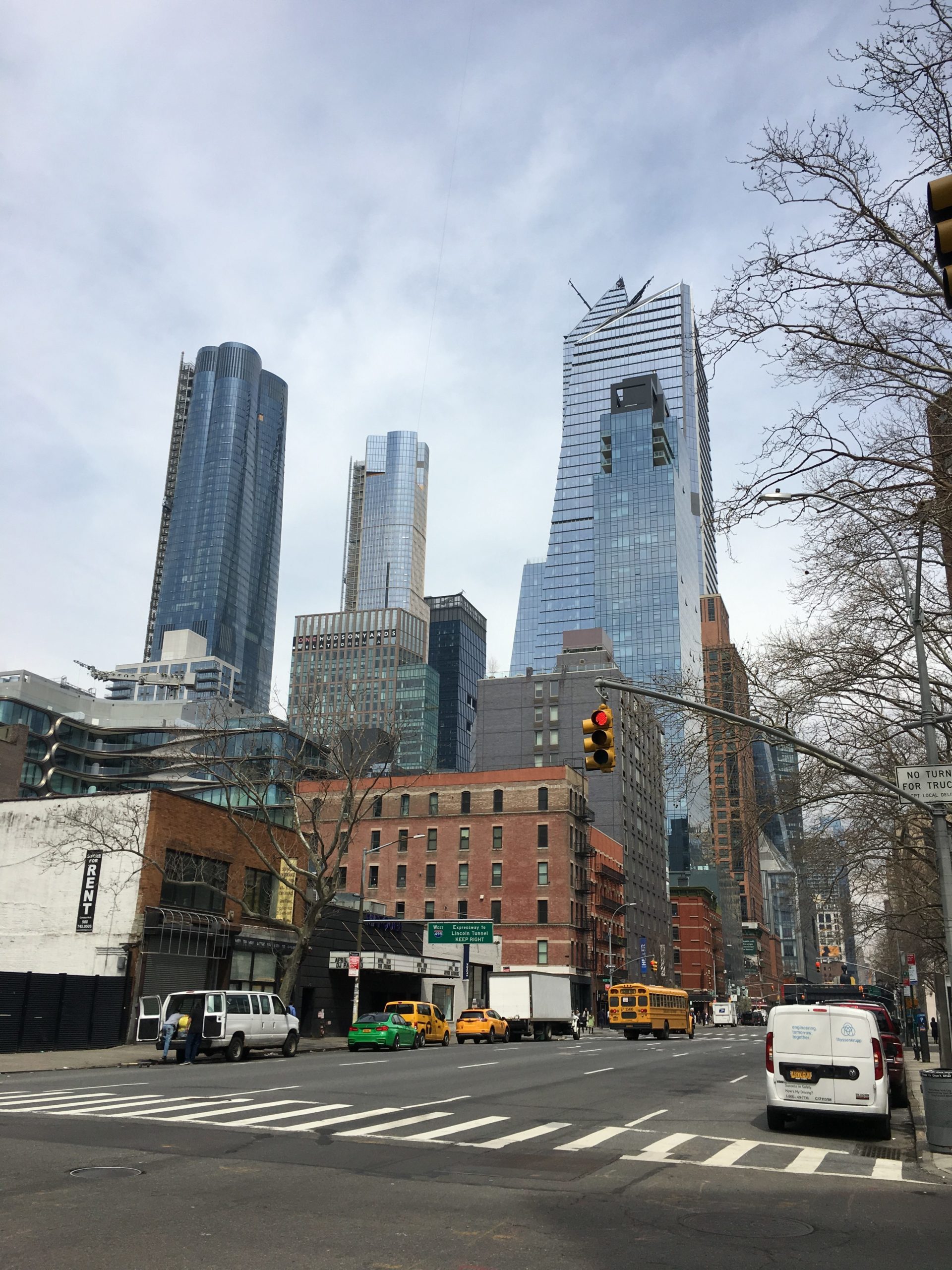
When last I left you, we’d talked about the development of NYC architecture, specifically Hudson Yards, and how a new NYC was rising in the ashes of the old.
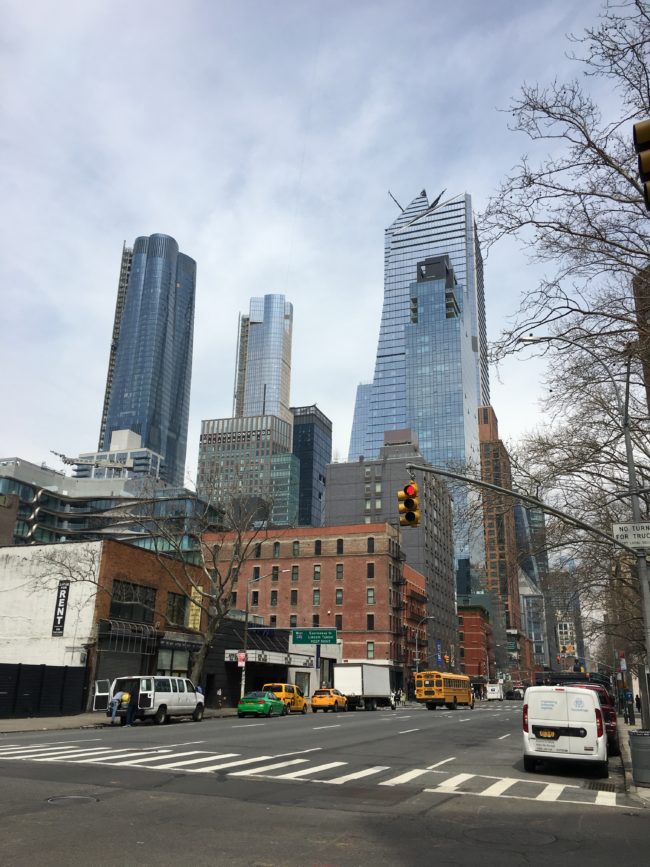
View of Hudson Yards from the South

Global replacing local.

Sure enough, when I spoke with a long-time New Yorker in Portland, and mentioned that I’d written about the Hudson Yards Project, his first comment was to complain about how it impacts locals.

I shit you not.

The first words out of his mouth.

Change is not only scary, but it doesn’t always work out for everyone. Particularly, when people aren’t actively working to embrace change: to learn and grow from it on purpose.

(Or when they perpetually get the crap end of the stick b/c of Capitalism, Racism, etc.)

I’ve had some nasty headaches the last few weeks, and I’m sure it’s because I’ve been pushing myself so hard to have new experiences this past month.

Making new neural pathways makes us smarter and better, but I’ve found that it can nearly cause a migraine. (As did all the Op-Art I saw in Portland, but that’s another story for a different day.)

Whether it’s the New York Times deciding there’s no money in a photojournalism blog, or a proud city regaining it’s mojo in 2019, change is only predictable in its unpredictability.

So while I can laud NYC for its ability to provide the most amazing 14 miles of eating, walking and looking a husband and wife could ask for, and will tell you about it briefly, I get that the “New” New York has more than its share of detractors.

As I’m pretending to be my former mentor Tony Bourdain for the summer, (#RIP Tony,) I’ll first share that Grand Sichuan, on 9th between 24th & 25th, on the edge of the Chelsea galleries, is totally boss.

I love it, have always loved it, and recommend it highly.

As Jessie and I ate our cold spicy noodles and egg rolls, sipping our (complimentary) tea on an extended walking break, she reminded me of the time my cousin Ron took us there for the night with his wife.

Back in the early aughts.

Ron was something of a foodie, had gone to culinary school, and knew to order off the Chinese Only menu. (We had chicken that was killed that afternoon.)

We drank, ate too much, and laughed all night. A few months later, Jessie and I had Christmas dinner at Ron’s house, and decided to move back to New Mexico.

Unfortunately, Ron died a few years later.

He was one of the early victims of the opioid epidemic. A nice Jewish guy from Jersey.

The canary in the coal mine.

(Hard to segue off of this, now that I think about it, so let’s just keep going.)

Jessie and I ate our way across New York, and thank god we were burning the calories.

Concrete architecture at the mouth of the Holland Tunnel

Because as soon as we walked East from the Tribeca waterfront, near the Holland Tunnel this time, we stumbled, quite literally, upon the cronut place.

THE cronut place.
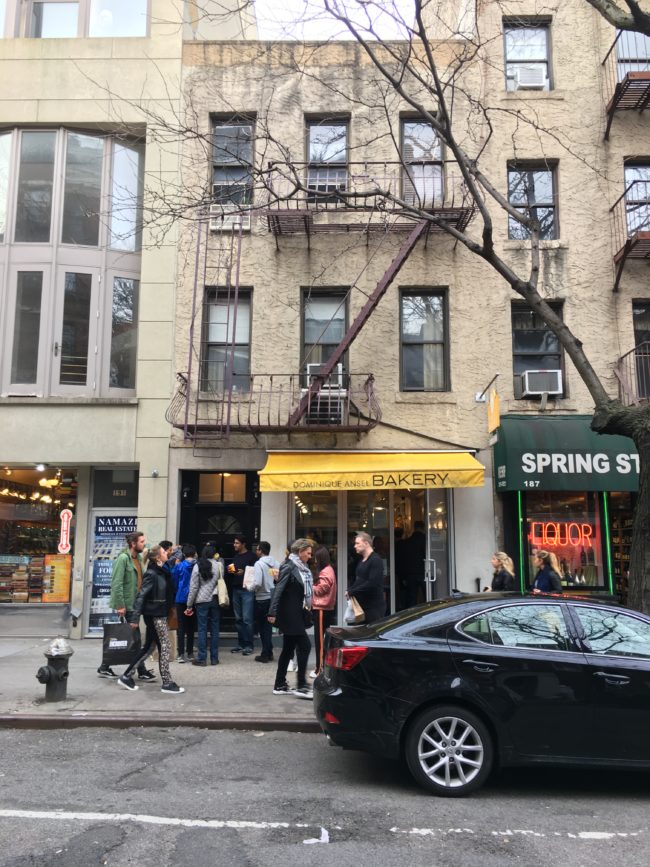
Dominique Ansel Bakery

Dominique Ansel Bakery. We read a sign about the line as we were walking by, but there were only 5 people in it. So we joined up, waited a few minutes, and then had some great coffee and pastries.

The salted caramel eclair was divine, the almond coconut chocolate croissant was really good, and the Nutella milk bread was highly disappointing.

They have a lovely outdoor courtyard that was quiet and spacious, which I highly recommend, and the massive Cafe Au Lait powered me up for the walk back to our hotel in Koreatown.

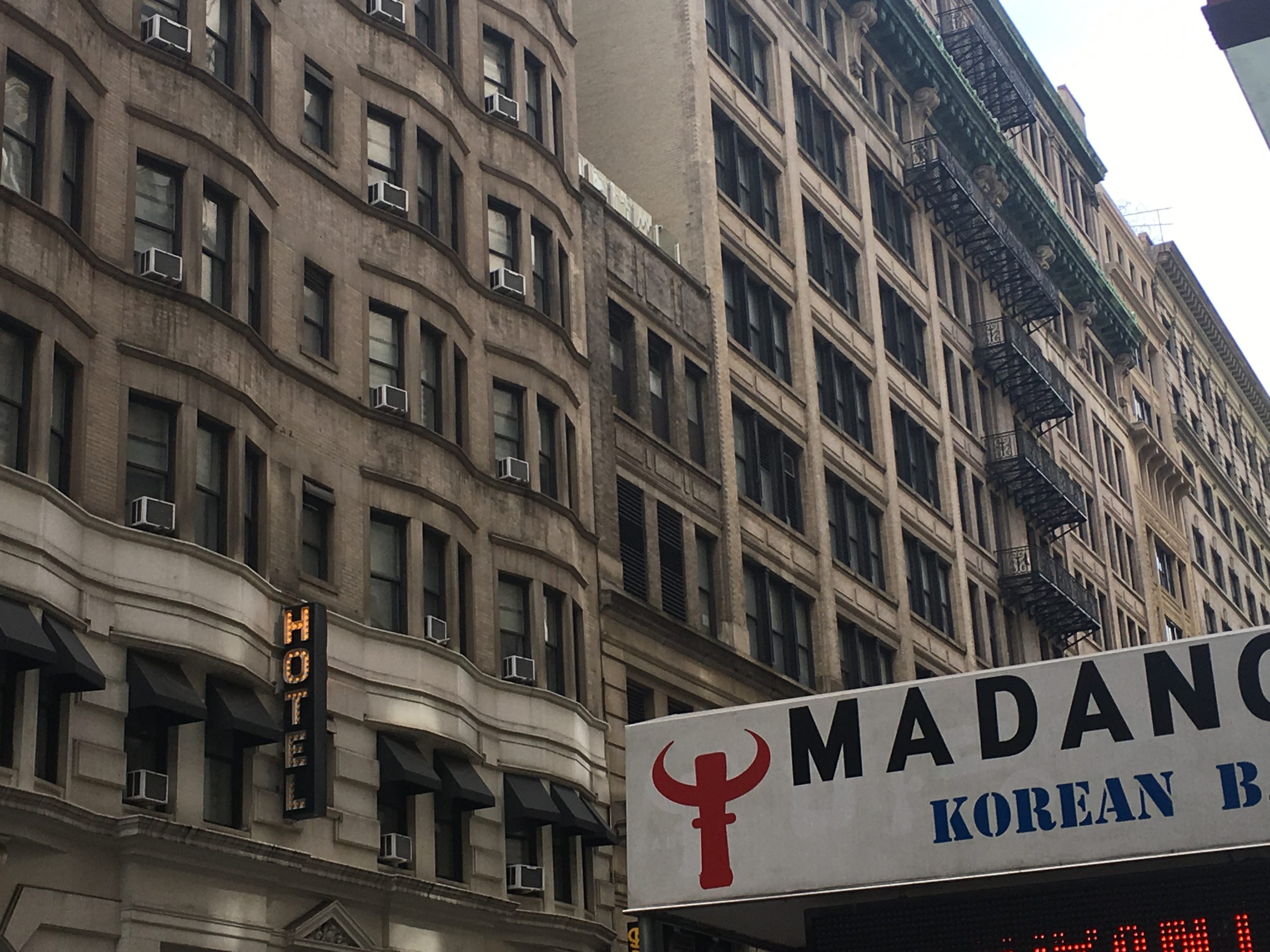
At the recommendation of Darren Ching, of Brooklyn’s Klompching gallery, we went across the street from our hotel to Madangsui, a Korean BBQ place, and ended up eating everything the next morning as breakfast. (As I told you in Part 1.) The food was brilliant: kimchee pancake, and a stone bowl bulgogi bibimbap that the waitress turned over table-side.

Koreatown

Yes, we ate in New York. The food was so good, and surprisingly affordable. As for the art, Jessie and I visited the Rubin Museum, in Chelsea, and saw some transcendental Tibetan and Buddhist work, including a re-created shrine that gave me goosebumps.

Recreations of Buddhist art depicting Yogic poses.


Five stars for sure.

But anyone can tell you about New York City.

New Jersey, though, requires a deft touch. (Me and David Chase. A short list.)

New Jersey never really changes, I thought. The shore, the nasty refineries along the Turnpike.

Bruce Springsteen, and the Best Pizza in America.
Skee ball and strip malls and Down-to-Earth people.

The world I knew was made of 2nd and 3rd generation Americans, the children and grand-children of immigrants who arrived at and ultimately fled New York City.

Mostly Italian-Americans, Irish-Americans, and Jewish-Americans, with some Central European/Slavic folks thrown in there as well.

In my town, though, we also had a large contingent of Asian-Americans, which was somewhat rare. (Back then, I didn’t distinguish between Chinese-Americans and Korean-Americans, Indian-Americans and Pakistani-Americans, as I would now.)

We had all sorts of Asian-Americans growing up in my hometown of Holmdel, NJ, because there was a gargantuan Bell Labs facility in the center of town.

A massive complex, set a half-mile back off the road, with a trippy-ass-space-ship looking tower in the front, which was as strange as it sounds.

For the uninitiated, Bell Labs was an offshoot of Alexander Graham Bell, and for much of the 20th Century was the most important research facility in the world.

In the world?

Sure. Why not.
Along with Livermore and Los Alamos, I guess.

It was right there in the heart of Holmdel, a place where they discovered, invented or refined radio wave technology, lasers, internet stuff, and all sorts of things.

It was a Nobel Prize factory, in the middle of corn fields that had been tended by Dutch colonists since the 17th Century. (Legit 1600’s for sure.)

And then…

Mergers. Breakups. Bankruptcies.

All of a sudden, it was Lucent, and then it was gone.

Out of business.
Permanently.

So an enormous building sat there empty, for years, reeking of the ghosts of America’s past

Until…

Now.
2019.

The present.

An Orthodox Jewish developer came along, called it Bell Works, and turned the entire Saarinen-designed-space into a mixed use development. Hotel, conference center, restaurants, shops, an indoor soccer field.

What?
And indoor soccer field?
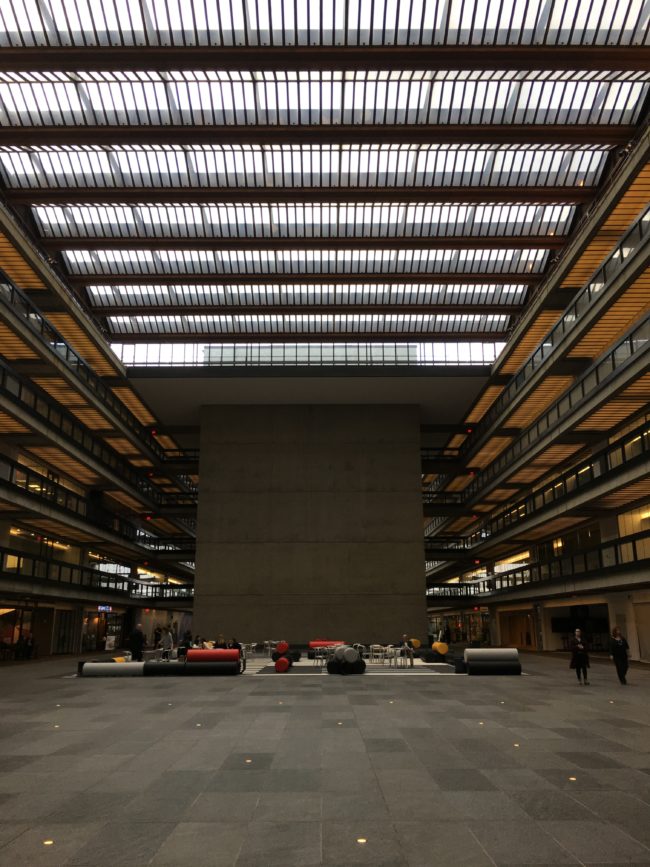
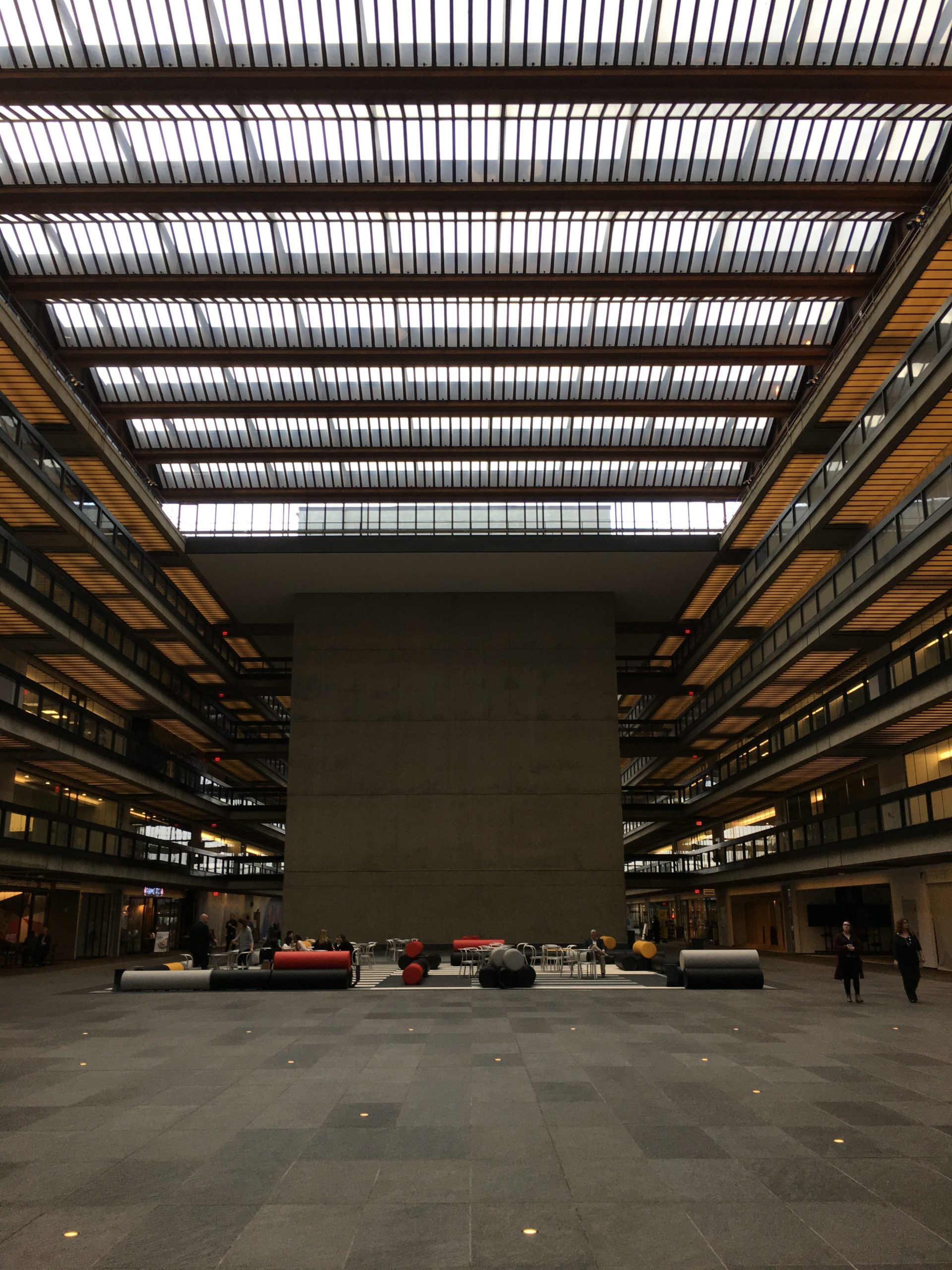
Bell Works

Saarinen’s design touch.

The Holmdel Public Library moved in, and they have a museum area dedicated to Bell Labs and its history. Plus, the place backs up on public park land, so it can be accessed on foot as well as by car.

I was flabbergasted.

Jessie and I ate samosas from an Indian-American-run convenience store INSIDE Bell Labs. With tamarind and cilantro chutneys. And it was really good!

Back in the 70’s and 80’s, you could have pizza or Chinese food, burgers in bar joints, or maybe Jewish Deli, and that was about it.

But it’s not the 20th Century anymore.

Not by a long shot.

And New Jersey, like its big brother NYC, also suffered tremendously from Hurricane Sandy as well, which I wrote about here back in 2013 or ’14. (Even I lose track sometimes.)

Sure enough, just like NYC, the Jersey Shore, which had been annihilated by Sandy, is now thriving.

Booming. Exploding!

I read in the Star Ledger that Pier Village, a shore development in Long Branch that DID NOT EXIST when I was in high school, was adding an additional 450 condominium units.

450!

And then I went there, as my buddy Felt moved into an ocean-front apartment last year. (My wife and I helped him decorate the place on a stoner ramble through NYC last April that I didn’t write about…)

Me and Felt, (who’s real name is Matt,) hung out at the Bat Mitzvah in North Jersey that drew me East, where thankfully the Italian-American food was flowing, and I drank Hennessy all day like it was going out of style.

Then I got to visit Felt’s apartment a couple of days later, and walked down a corridor so long that I got scared of “The Shining,” forgot about the reference, and then got scared of “The Shining” again, because the walk was 3 minutes long.

Looking Northeast at Pier Village

Looking Southeast at Pier Village

That’s how big they’re building these things.

And as Sandy destroyed so many buildings, clearing land, new developments were everywhere, trying to peddle chic.

Chic?

“South Beach at Long Branch” is a thing.

It’s not a joke. It’s real.

My theory is that once the Millennials decided Asbury Park was cool, as it gentrified, and they lacked the same biases against Jersey that their parents had, (Hamptons or bust,) it only made sense that these other beach towns, closer and MORE accessible, would start getting hot.


But trendy?
Like Miami?

I don’t buy it.

Rather, I think anyone who hangs out at the Jersey Shore will just end up getting Jersified.

So do ya-self a favuh, eat some great calamari at Rockafellers, ride some waves this summuh, and make sure ta tell ya friends.

You know what I’m sayin’?

My Aunt and kids after dinner at Rockafellers.


The post NYC in the 21st Century, Part 2 appeared first on A Photo Editor.

------------------------

Visit our sponsor Photo Folio, providing websites to professional photographers for over 10 years. Featuring the only customizable template in the world.

------------------------

12 May 05:29

Who built the buildings on Prince Edward Island?

by peter@rukavina.net (Peter Rukavina)

Continuing my exploration of OpenStreetMap as a database, I was curious to know how many buildings are on the map on Prince Edward Island, and how many OpenStreetMap users are responsible for having created them.

To extract the buildings I used this Overpass Turbo query:

[out:json][timeout:25];
{{geocodeArea:Prince Edward Island}}->.searchArea;
(
  way["building"](area.searchArea);
);
out meta;
>;
out skel qt;

I saved the resulting JSON output as buildings-on-pei.json; here’s what a single building looks like in that file:

{
  "type": "way",
  "id": 28325849,
  "timestamp": "2019-04-20T02:57:13Z",
  "version": 22,
  "changeset": 69393585,
  "user": "ParagonPrime",
  "uid": 1378289,
  "nodes": [
    311069933,
    311069935,
    311069936,
    2145848876,
    2145848878,
    4265414120,
    2603563172,
    311069941,
    3933036109,
    311069933
  ],
  "tags": {
    "addr:city": "Charlottetown",
    "addr:housename": "Confederation Centre of the Arts",
    "addr:housenumber": "145",
    "addr:postcode": "C1A 1J1",
    "addr:street": "Richmond Street",
    "building": "yes",
    "building:levels": "0",
    "building:levels:underground": "1",
    "level": "-1",
    "name": "Confederation Centre of the Arts",
    "roof:colour": "gray",
    "roof:material": "stone",
    "tourism": "attraction",
    "website": "https://www.confederationcentre.com/en/",
    "wheelchair": "yes",
    "wikidata": "Q5159778",
    "wikipedia": "en:Confederation Centre of the Arts"
  }
}

Note that there is a “user” element; I can use that to identify who created–or, to be more accurate, who last updated–each of the buildings.

First, I get a count of the number of buildings in the file:

# grep '"user"' buildings-on-pei.json  | wc -l
14395

Next, I get a count of the number of buildings attributed to each user:

# grep '"user"' buildings-on-pei.json  | sort | uniq -c | sort -rn
5069   "user": "MaestroGlanz",
2841   "user": "Peter Rukavina",
2816   "user": "Alecs01",
 996   "user": "Alan Bragg",
 684   "user": "mariadalton",
 534   "user": "the506",
 335   "user": "506imports",
 159   "user": "Matthew Darwin",
 143   "user": "dankpoet",
 129   "user": "kalebmcneil",
  72   "user": "lokejul",
  69   "user": "Rps333",
  57   "user": "TristanA",
  57   "user": "ParagonPrime",
  57   "user": "Gamer Gig",
  53   "user": "PurpleMustang",
  34   "user": "maTH5M2b",
  31   "user": "Bennard",
  28   "user": "Zeflind",
  20   "user": "allain_2",
  18   "user": "b-jazz-bot",
  12   "user": "Himké",
  10   "user": "dkunce",
  10   "user": "Michel G Arsenault",
  10   "user": "Kenfee3",
   8   "user": "CanuckGeographer",
   7   "user": "andrewpmk",
   6   "user": "binhex",
   6   "user": "Timothy Smith",
   6   "user": "StealthNinja51",
   5   "user": "november3000",
   5   "user": "fixedbusiness",
   5   "user": "RobJN",
   5   "user": "NoahUCD",
   5   "user": "Neeko",
   4   "user": "timdine",
   4   "user": "PelleB",
   3   "user": "xybot",
   3   "user": "wheelmap_visitor",
   3   "user": "smb1001",
   3   "user": "ionutr_telenav",
   3   "user": "hhcfw",
   3   "user": "fx99",
   3   "user": "Super-Map",
   3   "user": "Little Brother",
   3   "user": "DannyMcD",
   3   "user": "Bryson",
   2   "user": "petersfreeman",
   2   "user": "ngillis",
   2   "user": "mjf87nl",
   2   "user": "kartler175",
   2   "user": "huoju",
   2   "user": "boute002",
   2   "user": "Todd Gallant",
   2   "user": "PipoCanaja",
   2   "user": "Narcissus",
   2   "user": "JamieeR",
   2   "user": "FvGordon",
   2   "user": "Cynthia King",
   2   "user": "Bootprint",
   2   "user": "Be A Mapper",
   2   "user": "AndyJBlack",
   1   "user": "yumoon",
   1   "user": "vbertola",
   1   "user": "ti-lo",
   1   "user": "thetornado76",
   1   "user": "sjharper",
   1   "user": "shang 289",
   1   "user": "scruss",
   1   "user": "safirat",
   1   "user": "pingoo",
   1   "user": "ldgallant14",
   1   "user": "landblend",
   1   "user": "have moicy",
   1   "user": "carlb",
   1   "user": "b-jazz",
   1   "user": "ansis",
   1   "user": "Sammyhawkrad",
   1   "user": "RRW",
   1   "user": "Oliver Rukavina",
   1   "user": "Kelly Rayner",
   1   "user": "HitFilmMan",
   1   "user": "Gabe Groner",
   1   "user": "EzekielT",
   1   "user": "Cranberry",
   1   "user": "CanvecImports",
   1   "user": "Ashenzari",

There are 87 OpenStreetMap users responsible for adding those 14,395 buildings to the map, with the busiest contributor being MaestroGlanz.

12 May 05:29

Agnotology and Epistemological Fragmentation

danah boyd, Points, Medium, May 10, 2019
Icon

The term “agnotology” refers to the the strategic and purposeful production of ignorance. before this term was introduced, we used (more meaningful) words like "misinformation" and "disinformation". For the most part danah boyd is on-point with this discussion of the practice, describing how the tactic is used by far right groups to sow down and dissension in society, and to promote their own message and to create and recruit radicals. She also describes "epistemological fragmentation" to describe the creation or appropriation of terms that seed doubt and fragment society. And she suggests that the best response is to "blanket the information ecosystem with the information people need to make informed decisions." I think that's an old strategy, but then again, disinformation is an old tactic. But just as I don;t think yiu can defeat propaganda with more propaganda, I don't think adopting the tactics if the disinformationists will work either. It will just create two camps - one camp that uses the word “agnotology” and another that doesn't.

Web: [Direct Link] [This Post]
12 May 05:28

Dark Mode in Web Inspector

Web Inspector on macOS Mojave now supports Dark Mode.

Web Inspector: Light/Dark color schemes

Dark Mode in Web Inspector was introduced in Safari Technology Preview last year. This article highlights implementation details which could be helpful for anyone adapting Dark Mode for their websites or web views.


How do I enable Dark Mode for Web Inspector?

Web Inspector matches macOS appearance. To enable Dark Mode in macOS Mojave, go to “System Preferences → General” and select “Appearance: Dark” (see How to use Dark Mode on your Mac for more details). Note that it’s not possible to enable Dark Mode only for Web Inspector.

Dark Mode in Web Inspector is supported in macOS Mojave and later.

Why Dark Mode isn’t supported on macOS 10.13 High Sierra and below?
Web Inspector uses native form controls. macOS Mojave has a dark version of each form control (text fields, buttons, checkboxes, drop-downs, radio buttons, and etc.).

Dark form controls on dark background and light form controls on light background in macOS Mojave

macOS 10.13 High Sierra and below don’t support Dark Mode and only have light version of form controls. Without the proper form control styles, Dark Mode experience would be inconsistent so we decided not to do it.


Resources tab: light/dark color schemes

We tried to preserve syntax highlighting colors of the light theme. To keep text readable, we increased luminosity — by increasing brightness and sometimes changing the hue.

Network tab: light/dark color schemes

For some cases, like the bars in Network tab, we didn’t have to change anything. The same colors are readable in both light and dark themes.

Console tab

SVG and currentColor

Instead of maintaining a separate set of icons for Dark Mode, we changed the colors of the existing icons with CSS wherever possible.

SVG Icons

Most of Web Inspector icons are SVG files included inline in HTML:

<svg style="color: blue">
    <use xlink:href="Images/Paint.svg#root"/>
</svg>

Paint.svg:

<svg>
    <path fill="currentColor" d="..."/>
</svg>

currentColor is the color of the parent element. In this example, it’s blue.

currentColor only works for inline SVGs. It doesn’t work for SVGs included via <img> element or CSS (e.g. via background-image or content). For these cases, we used CSS filters to invert the colors.

CSS filters

The very first iteration of Dark Mode in Web Inspector was a single CSS rule:

body {
  filter: invert()
}

Inverting colors rotated the hue by 180 degrees. Notice how the selected color changed from blue to orange. We fixed that by rotating the hue another 180 degrees:

body {
   filter: invert() hue-rotate(180deg)
}

This had several issues. The colors didn’t exactly match the Dark Mode Human Interface Guidelines. The dark shadows turned light.

We ended up not using this filter for body, but we used it for icons included via CSS (e.g. via background-image or content), where currentColor didn’t work.

CSS variables

Implementing Dark Mode took over 1,000 lines of CSS. We used CSS variables extensively to reduce code duplication.

Previously, we had variable names such as --text-color-dark-gray and --text-color-light-gray. In Dark Mode, they would have to be inverted to provide desired contrast with the background: --text-color-dark-gray would become light gray, and --text-color-light-gray would become dark gray.

We started using semantic names such as --text-color-secondary instead of --text-color-dark-gray, and --text-color-tertiary instead of --text-color-light-gray.

Contributing

Please report bugs regarding Dark Mode in Web Inspector on webkit.org/new-inspector-bug. Make sure to include “Dark Mode” in the title.

If you’re interested in contributing or have any questions, please stop by the #webkit-inspector IRC channel.

12 May 05:28

Google’s Ad API is Better Than Facebook’s, But…

by Mozilla

… with a few important omissions. Google’s tool meets four of experts’ five minimum standards


Last month, Mozilla released an analysis of Facebook’s ad archive API, a tool that allows researchers to understand how political ads are being targeted to Facebook users. Our goal: To determine if Facebook had fulfilled its promise to make political advertising more transparent. (It did not.)

Today, we’re releasing an analysis of Google’s ad archive API. Google also promised the European Union it would release an ad transparency tool ahead of the 2019 EU Parliament elections.

Our finding: Google’s API is a lot better than Facebook’s, but is still incomplete. Google’s API meets four of experts’ five minimum standards. (Facebook met two.)

Google does much better than Facebook in providing access to the data in a format that allows for real research and analysis. That is a hugely important requirement; this is a baseline researchers need. But while the data is usable, it isn’t complete. Google doesn’t provide data on the targeting criteria advertisers use, making it more difficult to determine whom people are trying to influence or how information is really spreading across the platform.

Below are the specifics of our Google API analysis:

[1]

Researchers’ guideline: A functional, open API should have comprehensive political advertising content.

Google’s API: The full list of ads, campaigns, and advertisers are available, and can be searched and filtered. The entire database can be downloaded in bulk and analyzed at scale. There are shortcomings, however: There is no data on the audience the ads reached, like their gender, age, or region. And Google has included fewer ads in their database than Facebook, perhaps due to a narrower definition of “political ads.”


[2] ❌

Researchers’ guideline: A functional, open API should provide the content of the advertisement and information about targeting criteria.

Google’s API: While Google’s API does provide the content of the advertisements, like Facebook, it provides no information on targeting criteria, nor does the API provide engagement data (e.g., clicks). Targeting and engagement data is critical for researchers because it lets them see what types of users an advertiser is trying to influence, and whether or not their attempts were successful.


[3]

Researchers’ guideline: A functional, open API should have up-to-date and historical data access.

Google’s API: The API appears to be up to date.


[4] ✅

Researchers’ guideline: A functional, open API should be accessible to and shareable with the general public.

Google’s API: Public access to the API is available through the Google Cloud Public Datasets program.


[5] ✅

Researchers’ guideline: A functional, open API should empower, not limit, research and analysis.

Google’s API: The tool has components that facilitate research, like: bulk download capabilities; no problematic bandwidth limits; search filters; and unique URLs for ads.


Overall: While the company gets a passing grade, Google doesn’t sufficiently allow researchers to study disinformation on its platform. The company also significantly delayed the release of their API, unveiling it only weeks before the upcoming EU elections and nearly two months after the originally promised deadline.

With the EU elections fewer than two weeks away, we hope Google (and Facebook) take action swiftly to improve their ad APIs — action that should have been taken months ago.

The post Google’s Ad API is Better Than Facebook’s, But… appeared first on The Mozilla Blog.

12 May 05:25

SUMO/Firefox Accounts integration

by Madalina

One of Mozilla’s goals is to deepen relationships with our users and better connect them with our products. For support this means integrating Firefox Accounts (FxA) as the authentication layer on support.mozilla.org

What does this mean?

Currently support.mozilla.org is using its own auth/login system where users are logging in using their username and password. We will replace this auth system with Firefox Accounts and both users and contributors will be asked to connect their existing profiles to FxA.

This will not just help align support.mozilla.org with other Mozilla products but also be a vehicle for users to discover FxA and its many benefits.

In order to achieve this we are looking at the following milestones (the dates are tentative):

Transition period (May-June)

We will start with a transition period where users can log in using both their old username/password as well as Firefox Accounts. During this period new users registering to the site will only be able to create an account through Firefox Accounts. Existing users will get a recommendation to connect their Firefox Account through their existing profile but they will still be able to use their old username/password auth method if they wish. Our intention is to have banners across the site that will let users know about the change and how to switch to Firefox Accounts. We will also send email communications to active users (logged in at least once in the last 3 years).

Switching to Firefox Accounts will also bring a small change to our AAQ (Ask a Question) flow. Currently when users go through the Ask a Question flow they are prompted to login/create an account in the middle of the flow (which is a bit of a frustrating experience). As we’re switching to Firefox Accounts and that login experience will no longer work, we will be moving the login/sign up step at the beginning of the flow – meaning users will have to log in first before they can go through the AAQ. During the transition period non-authenticated users will not be able to use the AAQ flow. This will get back to normal during the Soft Launch period.

Soft Launch (end of June)

After the transition period we will enter a so-called “Soft Launch” period where we integrate the full new log in/sign up experiences and do the fine tuning. By this time the AAQ flow should have been updated and non-authenticated users can use it again. We will also send more emails to active users who haven’t done the switch yet and continue having banners on the site to inform people of the change.

Full Launch (July-August)

If the testing periods above go well, we should be ready to do the full switch in July or August. This means that no old SUMO logins will be accepted and all users will be asked to switch over to Firefox Accounts. We will also do a final round of communications.

Please note: As we’re only changing the authentication mechanism we don’t expect there to be any changes to your existing profile, username and contribution history. If you do encounter an issue please reach out to Madalina or Tasos (or file a bug through Bugzilla).

We’re excited about this change, but are also aware that we might encounter a few bumps on the way. Thank you for your support in making this happen.

If you want to help out, as always you can follow our progress on Github and/or join our weekly calls.

SUMO staff team

12 May 05:22

chinese greens/choy at the farmer’s market

by Emily Chang

Photo Caption: chinese greens/choy at the farmer’s market

Photo taken at: Waikiki, Hawaii

Instagram filter used: Clarendon

View in Instagram ⇒

12 May 05:22

Preparing to be Left Behind

by add1sun

My wife left to hike the Appalachian Trail just over six weeks ago. It’s been quite the experience so far for both of us and I want to talk a little about what it’s like being “the one left behind”. There are a million blog posts by hikers, but not so many from the family they leave behind. We have our own journey to travel through this as well and I think it’s worth sharing.

The decision

When we finally decided that she would hike the trail this year, we both began planning, albeit in different ways. When I say we decided, I do mean that. This is something that effects both of us, and while of course Camilla made the final decision, we walked into this together. I won’t speak for her or her decision—you can read that yourself in her blog—but I do want to talk about my decision and how it’s effected me so far. The first time she mentioned the idea I thought it was a passing fancy that would never manifest in my life. I played along with the thought experiment. After a while though it became clear that she was really drawn to the idea and she struggled to figure out how to make it a reality. I shifted gears to figure out how to support her making a final decision, knowing that whatever that decision was I’d be on the hook to follow through all the way with her. At the time it sounded so healthy and happy and far away. It was an easy commitment to make. I don’t regret a single second of it, but it has certainly been harder than I thought at the time.

For a little more context, I should also say that we’ve been married for 8 years (our anniversary is actually coming up in 2 weeks) and we’re in a really good relationship (it’s actually kind of ridiculous how awesome it is). I’m not at all worried that she’s going to cheat on me or leave me on the trail, and I don’t feel like she is doing this to get away from me. She has lots of reasons for going on the trail, but I’m not one of them. I’m one of the things that made it a hard decision to go, and I feel that deeply. So we’re good on that front and it really is more about how we can loosen the strong bond we have to give her space to explore this need and me space to see what that will mean for me too. I know this isn’t everyone’s experience in these circumstances and I feel lucky that I’m not dealing with layers of relationship problems through this.

Preparation

A few months after we decided, the reality of it started to hit me and I realized I needed to prepare myself. As she was researching the logistics and testing out a variety of equipment, I started to figure out my own plan. I was going to “lose” my best friend, my ballast, my solid ground for 6 months. Shit. While we are able to communicate just about daily, that is mostly just her sending a text that says something like “Long day. Time for sleep. Love you!”. We very occasionally get to chat for a few minutes on WhatsApp. We talk on the phone once a week or so. So she’s not “gone” but I don’t get my daily debrief over dinner, supportive hugs, or victory dances and high fives that define the rhythm of living with someone invested in your life. All of the little random things you want to say or laugh about just get backed up and then forgotten, unshared. It’s all the little counter-balances and gentle corrections that make navigating life more steady. It’s harder than it may sound, especially when you’ve had that rhythm for so long. I spent a lot of time thinking about what I most need and get from her and then how I could mitigate that loss. Here are the three things I did to prepare. These are certainly specific to me and my life, but perhaps this can helpful for others in the same or similar scenario.

1. Friends

I tend to be extremely withdrawn when I’m hurting in any way, so I knew that I would want to just disappear into my apartment and never come out again. I can get myself into a dark place and I knew I would need to interact with people to get out of my own head. I started talking with my closest friends about my fears and what I was going to need from them. I needed to be honest with myself and them. My biggest ask from the other people in my life was to pull me out of my shell kicking and screaming if they didn’t hear from me for a while (like 2-ish weeks max). For my friends in Copenhagen, they can show up at my apartment and drag me out somewhere. For others, it’s as simple as checking in regularly and asking how I’m doing and if I need anything. (Some people even literally have a schedule for this. <3) I’ll also admit that going to my friends with this kind of request made me realize that I need to spend more time taking care of my friendships. I can be a very “out of sight, out of mind” kind of person and have always put most of my focus on my significant other. This has made me really evaluate what friendship means and what I need to give to keep those relationships strong and healthy as well. I don’t want to take my friends for granted and this is a big personal focus for me this year. This void has created a great opportunity to deepen and broaden my friendships. I would say this is one of the biggest heartfelt lessons from this experience for me.

2. Habits

One big thing I wanted to make sure to deliberately address is self-care. It’s easy to let things go when my routines are off or I’m not feeling top of my game. Camilla and I encourage and support each other in this area and I knew I’d need something a little more rock solid this year. I ended up deciding to give myself a challenge to add a new positive habit each month. That way I could try something out for one month and I would be in a good pattern at the end so if I wanted to incorporate it permanently, I could just keep rolling. I decided to focus on adding positive things instead of removing negative things. I need all the positivity I can and removing bad habits is a lot harder to do in general. I also wanted to be clear about choosing things that would be long-term habits, instead projects with finite goals. The idea was to build a set of habits that are good for me, relatively easy to maintain, and would stick around throughout the year to give me touchpoints to build my own rhythm and routines around. I wanted to get these started before Camilla took off, so that I would have some habits well-established by then. So far this year I have worked on the following habits, and I’m happy to say that so far, they have all stuck.

  • Jan: Exercise at least 5 days a week
  • Feb: Meditate at least 10 minutes a day
  • Mar: Floss my teeth every day
  • Apr: Write in a journal every day

I think the most important aspects of this for me are making the habit goal 1) something I actually really do want to do for whatever reason and 2) giving myself fallbacks. Fallbacks are critical for habits for me. The idea is to do something on a regular schedule no matter what and the longer you do that, the more likely it will become a no/low-effort habit. I don’t always have the motivation or time every single day so fallbacks are levels of simplifying the goal to a point that you have no excuse to not do it, and you’ll still build that regular routine momentum need. For example, with meditation, my goal is at least 10 minutes, but my fallbacks were 5 minutes, 2 minutes, a deep breath and count to 20. My simplest fallback for journaling was to open the journal and write the date. Yeah, so easy that you can’t excuse yourself from helping yourself a tiny bit every day.

3. Coach

I knew that in addition to my personal life, my professional life would be challenging this year (in a good way!). We have a number of new and exciting things we’re working on, but that can also be quite stressful. A lot of being a CEO involves a huge amount of emotional energy, especially when dealing with change and challenge. I knew I would be emotionally challenged with everything going on and I wanted to make sure that I also cared for my professional life. I generally have a growth goal to support my team better and grow our company in a healthy way. Getting an executive coach gave me support towards these goals. In addition to professional advice, my coach is also very aware of the details of my personal life as well. She understands how they overlap and effect each other, and she plainly sees my struggles. I can’t really share this professional vulnerability with many people. This is just the way it is as a CEO. Having someone who knows all the currents going on for me and that I can be vulnerable with has been a huge help. It makes me a more sane and emotionally stable CEO.

I will note that that a coach makes sense for me because I knew I would have professional challenges generally this year as well as fallout from Camilla being away. A therapist is also a totally good choice here if there are deeper issues that should probably be dealt with. This is part of you needing to be honest with yourself about your weaknesses and needs.

Does this work?

Yes. I’m really glad I’ve taken the time to plan and prepare for this time alone. I would be drowning by now without it. Having a friend check-in and remind me that I am not really alone always warms me through. My habits have given me some small handholds to create a routine that is geared towards taking care of myself and since they are built as habits, I tend to do them even when I’m feeling angry or lazy. My coach has definitely kept me on target when I hit rough patches. She keeps me focused on the work at hand, while also accounting for my struggles. She’s straight up told me to step away from work when it was clear I needed to catch my breath and get my shit together, while I felt compelled to forge ahead. Having someone give me “permission” to take the space I need so that I can be a better CEO is kind of amazing.

The most important thing is to really evaluate what you’re going to need before you get to day one of the hike. It can lead to some uncomfortable conversations—with yourself, your significant other, or other people in your life—but you need to prepare just as much as your hiker does, and it will probably take some time to get things into place. You deserve the care you need and you’re just as brave as anyone setting boot to trail. Take care of yourself!

12 May 05:20

Marsha, Marsha, Marsha

by Reverend

I use this blog to track time, and in many ways it’s a chronicle of my warped history of the world. Many of the most regularly recurring themes on this blog, such as WordPress, UMW Blogs, ds106, Domain of One’s Own, etc., were part and parcel of the work I did while an instructional technologist at UMW. I spent 10 years at UMW, and crazily enough it will be 4 years this September since I worked there. Part of me will always be #UMW4life because I recognize and appreciate that that small, liberal arts public institution provided me a prolonged opportunity to dream about the possibility of edtech in partnership with some amazing colleagues. It’s hard for me not to look back with pride at the work we did together, and it makes Tweets wherein public higher ed is simply lumped in with for-profit that much harder to stomach.*

One of those colleagues who was particularly central to my professional development during my time at UMW was Martha Burtis, who recently announced she will be taking a job at Plymouth State University. In many ways this post is not only a congratulations to Martha for her new position, Plymouth State just got that much more awesome, but also as a way to mark history on this blog. With Martha’s departure does definitely mark the end of an era for edtech at UMW. Martha’s accomplishments in the field are legend, and there is no need for me to rehash them here. So, in an attempt to mark the occasion I just wanted to recount a memory of one of my earliest professional interactions with Martha.

When I was just getting my feet wet at UMW, not on the job more than a week or two, Martha came over to Campbell Hall (at that point all the instructional technologists were embedded in buildings rather than co-located as a centralized group) to accompany for one of my first faculty visits. We were to meet with Linguistics faculty member Paul Fallon, about what exactly I don’t remember. But I do remember strange details like Martha was wearing a brown  overcoat, it was really cold outside, and how much that meeting set the tone for my career at UMW. Martha brought me to the meeting and modeled for me what it meant to be an instructional technologist at UMW. After the meeting we walked across campus and I remember her telling me how excited she was we finally had a team (Patrick Murray-John and I had just been hired, rounding off a 5 person team that would be more or less in tact for 10 years) and her genuine sense of the real possibilities for all of us was both inspiring and prescient. I’m not sure why this moment still sticks with me, but I think for me it was my formal initiation into a career in educational technology that I have come to love. Martha is one of those people who “made me.”

We did go on to do a lot of amazing stuff together, and while I wasn’t always the best colleague—I was unbearable for a while when Martha was director—but coming back to UMW after my 6 week sabbatical at the University of Richmond was the beginning of one of the richest professional collaborations I’ve ever had. Martha’s work on UMW Blogs, her WordPress development chops, the building of the ds106 infrastructure, the co-teaching ds106, the framing of Domains, the building of DKC, and on and on. I promised I would not re-hash her long list of accomplishments, but how could I not?

So, here is to the end of an era at UMW, but more importantly the beginning of a new chapter of possibilities for Martha and her family in New Hampshire.

 _____________________________________

*The edtech landscape is increasingly dire these days and it has been depressing for me to think about. I am struggling with writing more about it, but until then can I say how much I am missing Audrey Watters’ voice online these days. She did a lot of heavy lifting fo the rest of us.

12 May 05:19

More renders of Motorola One Vision turn up alongside a specs list

by Jonathan Lamont

More renders and details about Motorola’s upcoming Android One device, called the ‘One Vision,’ have leaked.

Also known as the P40 in some markets, the One Vision sports a nearly edge-to-edge display with a small chin, and a display cutout for the front camera.

Additionally, the phone has a nice copper-coloured back plate and dual rear cameras.

According to the leak, one of the rear cameras is 48MP at f/1.7. Oddly, the leak lists 25MP and 5MP front cameras, both at f/2.0 despite the render only showing one selfie camera.

The display itself measures in a 6.3-inches, according to the leak, with a resolution of 2520 x 1080 pixels. It has a 21:9 aspect ratio.

On the inside, the leak says the One Vision will have a Samsung Exynos 9609 at 2.2GHz, along with 4GB of RAM and 128GB of storage.

A 3,500mAh battery powers the phone — a tad larger than past leaks, which pegged the battery at 3,290mAh.

Finally, the leak says the One Vision will measure in at 160.1mm x 71.2mm x 8.7mm. Additionally, it will weigh 180 grams.

Unfortunately, it’s still not clear if or when Motorola will release the device, or if it will come to Canada.

Source: SlashLeaks

The post More renders of Motorola One Vision turn up alongside a specs list appeared first on MobileSyrup.

12 May 05:19

ZOZO Redux, or Did I Just Waste 1,500 Words?

by Gabi Schaffzin
Yusaku Maezawa

Well that was quick. Around 18 months after launching their ambitious “ZOZOSUIT” product, the Japanese clothing company has shut down all international operations and is no longer offering the custom-fit service. Quartzy, which seems to have an unhealthy obsession with ZOZO and its founder and CEO, Yusaku Maezawa, has covered the rise and fall of ZOZOSUIT pretty well, so I’ll let you catch up over there. But I wanted to post something with a few quick reactions to the demise of “Custom-Fit Clothing for a Size-Free World”.

My first reaction when I received the email letting me know they were shutting the service down was, “are they going to keep my data?” The answer, of course, is yes. More specifically, “All body data will be anonymized and rendered unidentifiable by July 31, 2019.” It’s an old story that anonymized data is everything but, so color me unimpressed. One assumes they will be using the data for a future custom-sizing related project, or, given their recent financial troubles, selling to an interested acquisition or merger partner. Remember how their Privacy Policy claims to “not sell your data to third parties, ever”? Now that it’s considered “anonymized” is it still “my data”?

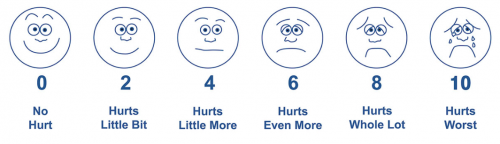
Then I put on my scholar hat (to be honest, it’s just a red beanie that I ironed a DSA patch onto) and had a few broader questions. Right now, I’m working on a dissertation that looks at the history of those designs which we use to self-report pain to our doctors. You know, like the smiley face chart on the wall at the doctor. I’m exploring questions of who designed them, when, how, etc. I want to contextualize their prominence in the experience of someone actually experiencing pain. And so of course, I am considering a chapter on new ways to facilitate pain self-reporting—mobile sites and apps with body diagrams and color codes or EEG-based offerings that promise “true” readings of someone’s pain.

The problem is, what happens when the latest and greatest goes defunct? I dropped 1,500 words on ZOZOSUIT back in October and, while it was a great excuse to put on a spandex onesie and teach readers about Henry Dreyfuss Associates, did I jump the gun? I suppose that’s the luxury of writing for a blog like Cyborgology—we’re focused on what’s being promised next, not what’s guaranteed to stay. Still, I don’t see that post aging very well. I worry about the same thing when picking which apps or services to include in my PhD research.

It’s a struggle any scholar working on tech and culture has. Even the most exciting books I’ve read that came out in the last year document and analyze websites that are not longer active. When our collective attention (and venture capitalist’s funding) jumps from latest app to newest device, it’s tough to predict what really has staying power. So I suppose the best alternative we can hope for is that something we’ve documented has some sort of influence as a precedent, a critical step in the genealogy of something big to come. Who knows, maybe in 2040, when Cyborgology turns 30, an emerging scholar will need some sort of reference to understand where that multi-billion dollar digitally-fit clothing industry came from and they’ll stumble upon my post. 

If so, I hope our image archive has degraded by then…

The author in his ZOZO suit

Gabi Schaffzin is a PhD candidate in Art History, Theory, and Criticism, with a concentration in Art Practice, at UC San Diego. He’s glad to know that those jeans really didn’t fit…it wasn’t just him being super un-hip.

12 May 05:19

Becky Hansmeyer writes, wisely, of App Store pr...

Becky Hansmeyer writes, wisely, of App Store pricing, that “you’re not going to make it up in volume.”

12 May 05:14

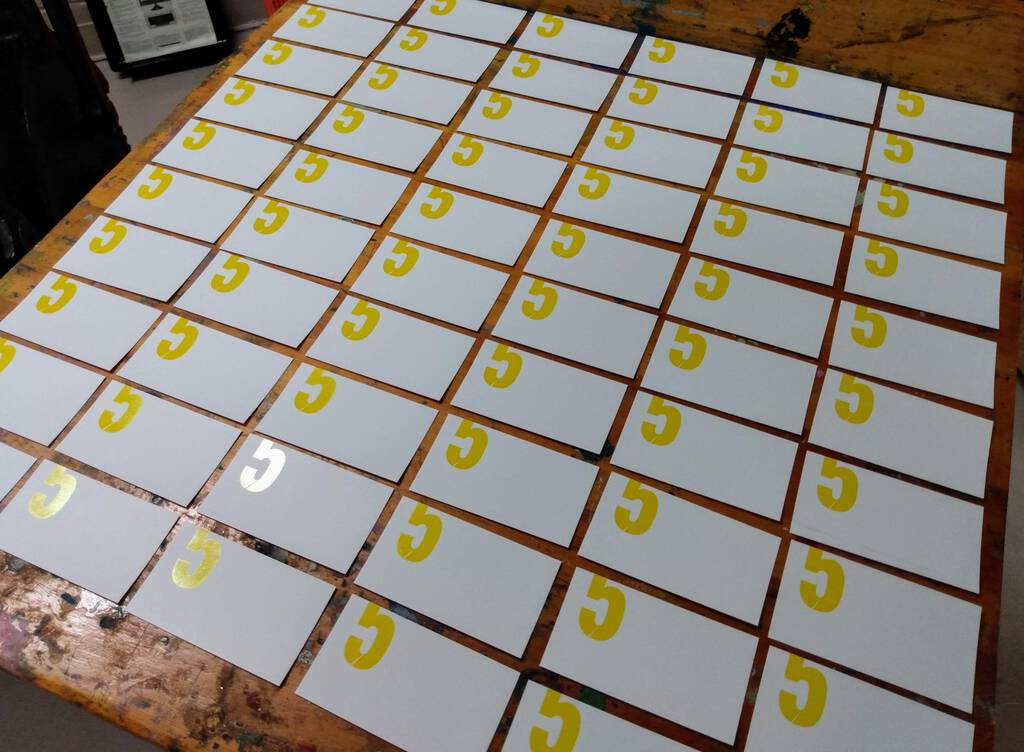
Une forêt de cédille jaunes

by peter@rukavina.net (Peter Rukavina)

Une forêt de cedilles en train de sécher

12 May 05:14

Dear Dropbox

If you can orchestrate the integration of Google documents into Dropbox, allowing us to now create...
12 May 05:13

Twitter Favorites: [shawnmicallef] What a day to lead a Bauhaus Toronto Walk - thanks @GoetheToronto for initiating. https://t.co/2SdPyZtIf2

Shawn Micallef @shawnmicallef
What a day to lead a Bauhaus Toronto Walk - thanks @GoetheToronto for initiating. twitter.com/kevinvuongto/s…
12 May 05:13

NewsBlur Blurblog: Shawn Micallef: Bauhaus influences can be found all over Toronto, even 100 years later

sillygwailo shared this story from TORONTO STAR.


Modernism, urban design and architecture wouldn’t be the same today without the Bauhaus art and design school founded in Germany in 1919.
11 May 06:38

Jag Diary 10: Four Months In

Yesterday I drove the I-Pace to Seattle and back in one day, 459.8km (285.7 miles); the second time I’ve done that. What with that, and coming up for four months ownership, I thought it was time for another, maybe the final, instalment in this diary. Mostly good news — by a wide margin the best car I’ve ever driven let alone owned — but nothing’s perfect.

Range

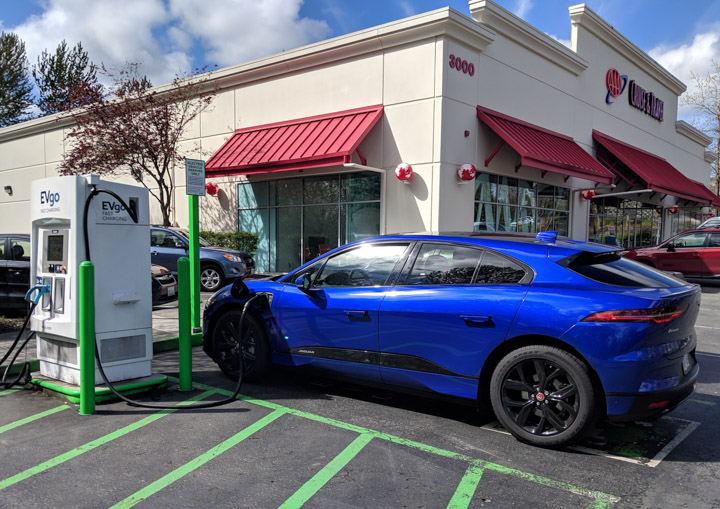
That’s still the biggest talking point about electric cars. But up here in the Pacific Northwest anyhow, the charging network is pretty well good enough and getting better. If I’m staying overnight in Seattle I use the Level 2 chargers in the Amazon buildings. But on single-day round-trips you need more watts. On both of those trips I used PlugShare to find fast DC chargers, and both were by EVgo. I really have no gripes, their gear seems to Just Work.

Charging the I-Pace Fast DC charger readout

The charger above is in Lynnwood, a suburb just north of Seattle. Amusingly, all the EVgo chargers have names, which actually help you to figure out which is which when they’re in a cluster. That’s “Elijah” in Lynnwood.

The screenshot is from one of the chargers (“Ceres” and “Millie”) at the REI flagship store, which at a block off I-5 is super-handy, and also a beautiful place to hang out and visit. On this particular trip I got there a little early and charged for 28 minutes before my meetings and then another 25 after, picking up a total of 41kWh, and getting home with 30km of battery to spare. EVgo charged me $16.28.

The attentive reader will note that 117A at 415V is 48.55kW. I have yet to encounter one of the rumored-to-exist 100kW chargers, but 53 minutes of charging for nearly six hours of driving at highway speeds across hilly terrain is bearable. At this point a snotty Tesla owner will point out that they have 100kW now and (for many of them) it’s free. Yeah, but your car is boring.

It’s worth noting that those fast chargers are kind of noisy; when they’re pumping 50kW into your vehicle there are heavy-duty mechanical sounds coming out; presumably fans? So you probably wouldn’t want one right next to your patio or bedroom window.

Since we’re talking about charging, obviously almost all of that happens at home. We hardly ever car-commute, with just minor puttering around town and weekend excursions, end up charging once every week or ten days. Looking at my power bill reveals I pay somewhere around $2.50/day when I don’t charge, and six or seven bucks when I do. Yeah, the car pulls twice as much as the rest of the house put together. OK, our stove and water heater are natural gas; but still.

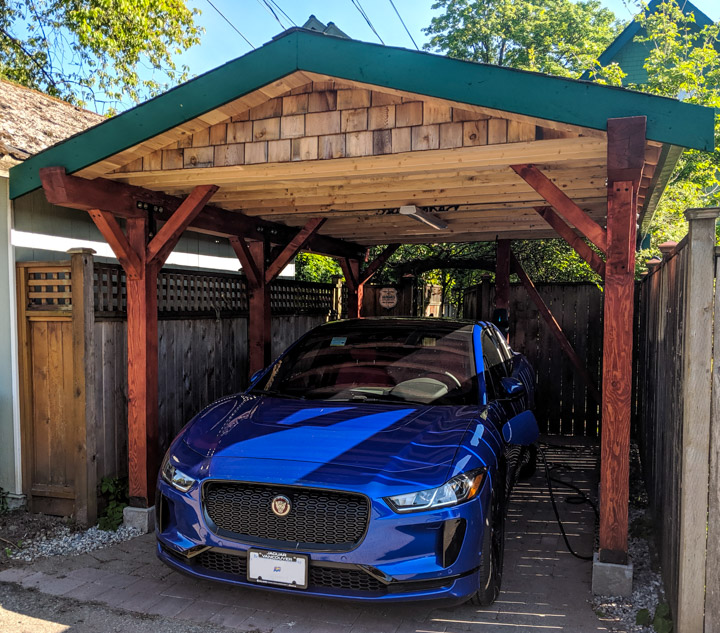
Charging the car at home

Above is the little carport we put in because I didn’t want either the charger or the Jag out in the weather all the time. If you look close you can see the charger just behind the car. This is just after the return from Seattle, so the car’s a little cruddy.

The home “Level 2” charger is entirely silent, but then depending on the temperature the car sometimes turns on its fans to heat or cool the batteries while charging; not for long, though.

We don’t have a garage door to open, but I wired the carport light up with a LiftMaster 823lm light switch and now I can turn it on with the garage-door control on the car’s rearview when I’m coming home after dark. I also had to get a LiftMaster remote control so I could turn it back off from inside the house.

Good stuff

You just can’t drive this puppy around without smiling. It’s smooth, comfy, and amazingly athletic. Merging onto a big highway is pure joy, and taking uphill curves hard will make you laugh out loud. Even going with the flow in heavy traffic is a lot more relaxing than you’re probably used to. When I get in any gas car now, it feels klunky, noisy, and unresponsive.

You get compliments and smiles from border guards, both US and Canadian. Now that is a new experience.

Yesterday was a super-warm Spring day so now I’ve driven it in four seasons, more or less; the climate control and general comfort is uniformly excellent, and I had my first experience of cooled seats, which feel amazingly great when you’ve been driving for a couple of hours in the sun.

When I first got in the car I hated the audio, it sounded tinny and like it was coming out of the windshield. And yeah, the default settings are lousy but they’re easy enough to fiddle; now the sound’s a warm bath of rich silky chocolate.

There are 3405km on the odometer (we’re pretty urban) and I haven’t had anything go wrong. Oh wait, let me amend that. Sometimes (not very often) things will get a little weird — Android Auto won’t connect, or the radio-station list won’t be there, or whatever. So, just like any other mobile computerized device, you pull over and you turn it off and back on again, and generally then you’re OK. One time I had to reboot both the car and my phone.

Bad things

I’ve said it before and I’ll say it again: This car’s a joybringer on any road, urban or rural or freeway, but it is a complete fucking pig to park. It’s wide, and because of the cab-forward design you totally can’t see the teeny front hood of the car at all from behind the wheel, so how in hell are you supposed to know whether you’re properly lined up at the curb or evenly between the lines? All these weeks in, I can now generally do a parallel park and end up about as straight as I’d expect from a 16-year-old trainee driver. But I often have to take two or three passes at ordinary parking-lot slots. And as for our carport, it isn’t any too big, and the alley it’s off of isn’t any too wide. I have on a single-digit number of occasions backed in straight and centered on the first try, but never when any of the neighbors or family are watching. I didn’t order the front camera option; maybe that was a mistake? Anyhow, I’m sure in another year or two I’ll be drifting into the carport.

What else can I complain about? Yeah, the infotainment software is a little slow and klunky. Six months into shipping this thing JLR still doesn’t have the software OTA working. I’m hoping that pretty soon it’ll be like my Fujifilm cameras and periodically get updates that add features and make things better.

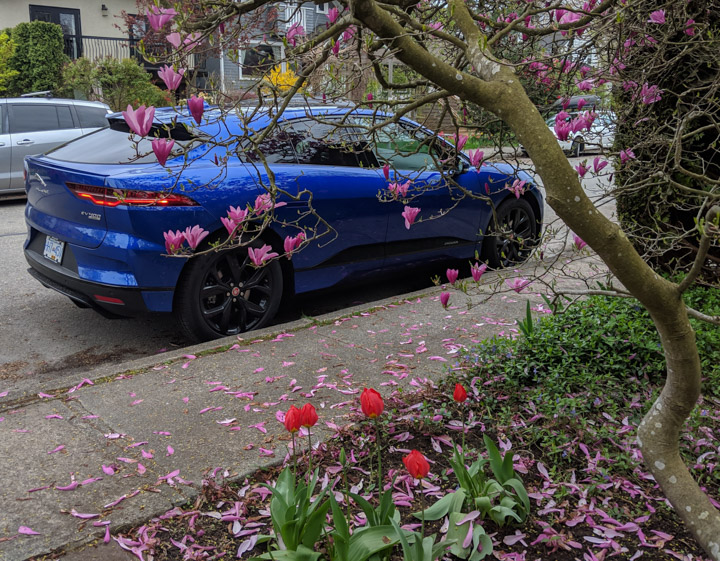
Magnolia I-Pace

Just a car

At the end of the day, that’s all it is. It makes me happy to drive, happy to talk about, and I’m loading the atmosphere with a whole lot less carbon than I used to. But a new car isn’t a life-changer. Except for now I get a few more smiles every week.

11 May 06:36

Demand for smartphones in North America decreasing at record rate

by Aisha Malik

The demand for smartphones is decreasing in North America due to reduced innovation from manufacturers, paired with the fact that everyone has a smartphone that they’re content with at this point.

In the first quarter of 2019, smartphone shipments decreased 18 percent from last year.

This is the sharpest decline ever recorded.

In the first quarter of 2018, 44.4 million smartphones were shipped. This number is a sharp contrast from the 36.4 million that have been shipped in this year’s first quarter.

Although Apple smartphones saw a negative growth of 19 percent, the company still remained the largest contender with 14.6 million smartphones sold.

Samsung took second place with 10.7 million smartphones sold, and is closing in on Apple. The company sold the same amount of S10+ and S10e smartphones as Apple sold iPhone XRs.

LG faced the largest decrease and lost 24 percent of its sales.

Lenovo sold 2.4 million devices in this year’s quarter. This number is a 42 percent increase from the 1.7 million sold from last year.

These numbers do not take into consideration the fact that smartphone prices are increasing, which means that fewer number of sales does not necessarily mean less revenue.

The statistics come from a report filed by Canalys.

Source: Canalys Via: Android Police

The post Demand for smartphones in North America decreasing at record rate appeared first on MobileSyrup.

11 May 06:36

Twitter to redirect users to credible public health sources on topics relating to vaccinations

by Shruti Shekar
Twitter

Twitter has launched new tools to help users be directed to credible public health sources when searching for information on vaccines.

A May 10th blog post from the social media site said in the U.S. it has partnered with the U.S. Department of Health and Human Services and will direct users to vaccines.gov. In Canada, it will link to a Public Health Agency of Canada site.

To note, Twitter does something similar when users search for terms associated with suicide or self-harm “as part of our #ThereIsHelp initiative.”

“Twitter is committed to helping Canadians connect with reliable public health information about vaccines,” Michele Austin, head of government, public policy and philanthropy at Twitter Canada, told MobileSyrup. “The #KnowTheFacts service is part of our ongoing work to provide Canadians with tools and resources to promote public understanding about conversations that are happening on Twitter.”

Twitter said in the blog post it hopes to “expand it to other important public health issues in the coming months.”

“We will not auto-suggest queries that are likely to direct individuals to non-credible commentary and information about vaccines,” the blog post read.

“We understand the importance of vaccines in preventing illness and disease and recognize the role that Twitter plays in disseminating important public health information. We think it’s important to help people find reliable information that enhances their health and well-being.”

Instagram took on the same initiative and intends to block access to hashtags associated with anti-vaccination misinformation.

Source: Twitter

The post Twitter to redirect users to credible public health sources on topics relating to vaccinations appeared first on MobileSyrup.

11 May 06:36

You can take RAW Night Sight photos with the Google Pixel phones now

by Brad Bennett

If you’re a Google Pixel owner, then you’re now able to take RAW file type images while you’re using ‘Night Sight.’

In the latest Google Camera update, you can Toggle ‘Raw+JPEG’ on now giving you more control to edit your Night Sight shots after you’ve taken them.

Make sure you’ve enabled the ‘Raw+JPEG control’ toggle in the ‘Advanced’ section of the camera app’s settings.

This isn’t the only Google Camera change rolling out to users. The Google Camera now has a dedicated ‘Timelapse’ mode that lets youse made varying lengths of time-lapse videos.

If you don’t have the update yet, you can download the APK here. 

Source: Android Police

The post You can take RAW Night Sight photos with the Google Pixel phones now appeared first on MobileSyrup.

11 May 06:36

Apple’s 2019 iPhones will feature three cameras, reverse wireless charging and A13 chip

by Patrick O'Rourke

Bloomberg’s Mark Gurman is back at it again with a string of new Apple-related rumoured related to the tech giant’s upcoming 2019 smartphones.

Backing up previous rumours and leaked case designs, the almost always reliable Gurman says that a dual lens setup is coming to the next iPhone XR, while the successor to the iPhone XS and iPhone XS Max are getting a triple-lens rear camera setup similar to what we’ve seen featured in Samsung’s Galaxy S10 and various high-end Huawei smartphones.

Further, Gurman goes on to say that the third camera in the iPhone XS and iPhone XS Max successor is set to be an ultra-wide angle lens that features a broader range of zoom. On the other hand, the rear camera on the iPhone XR will also feature additional zoom as well, though not to the same extent.

Unsurprisingly, all three smartphones are set to be powered by Apple’s unannounced A13 processor, the successor to the company’s current A12 Bionic chip. Borrowing a not very useful, but still welcome feature from Huawei and Samsung, Apple is also set to bring reverse wireless charging to all of its 2019 iPhones.

Gurman also says that Apple is working on a photography feature called ‘auto-correction’ that is able to re-add people to photos that may have accidentally been cut out.

Apple will likely launch its successor to the iPhone XS, iPhone XS Max and iPhone XR this coming September at the company’s annual fall hardware keynote.

Source: Bloomberg 

The post Apple’s 2019 iPhones will feature three cameras, reverse wireless charging and A13 chip appeared first on MobileSyrup.

10 May 14:06

What Will It Take?

by Dave Pollard

Last evening a group of about 30 Bowen Islanders watched a documentary called The Reluctant Radical. I arranged it, since the film profiles Ken Ward, who is a friend of Tree’s and who I’ve met a couple of times myself. Ken joined us for Q&A via video link after the screening.

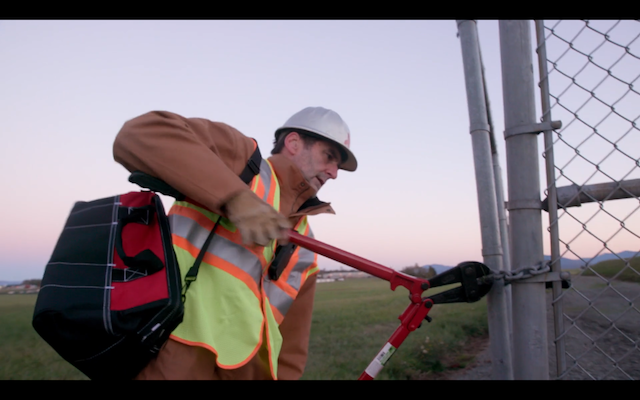
It’s one of the finest documentaries I’ve ever seen, and I’d be saying that even if I hadn’t met Ken. It’s concise — no superfluous material, no sensationalism, no waste. It doesn’t manipulate the viewer — it simply tells Ken’s story from his early years as a within-the-system activist to his more recent Direct Activism, most notably as one of the five “valve-turners” who, for a day, stopped the flow of tar sands bitumen to the US through four major pipelines by brazenly, but safely and carefully, breaking into the fenced pipeline enclosures at strategic places across the US and  turning off the valves that controlled the flow.

What makes this film remarkable is that it answers, completely and definitively, the question that I suspect all of us are going to have to answer for ourselves at some point in our lives, and possibly quite soon: What will it take to get us to the point we will be willing to do whatever it takes to halt the destruction of our planet? That could include giving up our safety, our freedom, or even our lives. The film makes it quite clear that until enough of us reach that point, the destruction will continue unabated.

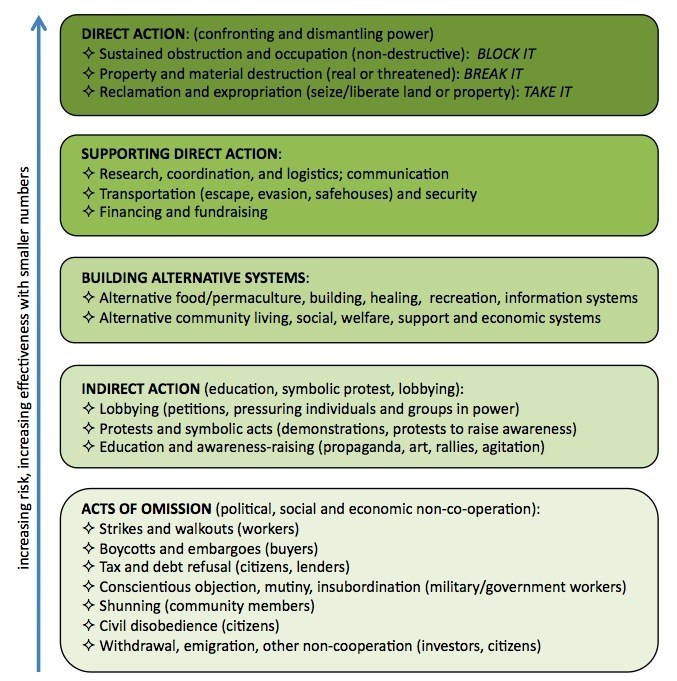
It will, at the very least, require us to personally move beyond symbolic and passive protests, to Direct Action, which Derrick Jensen has explained using the following chart:

Non-Violent Direct Action, according to Extinction Rebellion, must, in addition to being safe, respectful, well-researched, and carefully planned (to avoid the risk of itself causing harm to the environment or living creatures), be disruptive of the destruction it aims to stop, as the top box of the chart shows, by blocking, breaking, or taking control of land or property to prevent or reduce the damage being done to our planet.

It’s a time-honoured way of forcing change, used effectively in achieving women’s suffrage and ending slavery in many countries. But it carries with it the risk of arrest and incarceration, and even injury or death, by the agents of the political and economic establishment that are unwilling to tolerate any direct interference in their world-destroying activities. This establishment would much rather we limit our activities to protests, petitions and other passive actions they know will have no enduring effect. Since 2011, Ken has become a Direct Activist, at enormous personal cost, but with no regrets. Watch the film to see why this is so.

Since the 2016 “valve-turner” event described in the film, there have been some important developments:

  • Ken has joined the Extinction Rebellion (XR) movement, since its goals and methods are closely aligned with his, and since it brings a new, younger, global, and much larger cohort into the fold of those committed to Direct Action.
  • While Ken’s first trial for the 2016 valve-turning resulted in a hung jury, and the second resulted in a conviction for “burglary” only (with a sentence of two days’ time served and community service), the burglary conviction was recently overturned because an appeal judge ruled Ken was deprived of his constitutional right to use the Necessity Defense. This ruling (which the prosecutors have just appealed) will be essential to the success of many Direct Actions going forward (which is precisely why the prosecutors have appealed it).
  • Ken has been arrested again (last month) for blocking rail access to trains carrying tar sands bitumen from Alberta to a port in Portland OR, for shipment on to China. In explaining this latest action, Ken and his colleagues wrote a stirring Letter to Portland City Council.

This is only the second documentary I have seen that moved me to tears (the first was March of the Penguins). I am trying to figure out why. In the first place, while I have consistently expressed support in every way possible for those who take the risks of Direct Activism, it has been more than forty years since I participated in such activities myself. And while I don’t believe any of the actions on the chart that fall short of Direct Action will make any enduring difference (they certainly haven’t so far, except in very local, small scale battles, and even those will likely have to be fought again, and again, what Joanna Macy calls holding actions), I don’t believe Direct Action will make any enduring difference either. Why? Because the complex systems driving our global industrial civilization are designed to work around disruptions and quickly and expediently restore the status quo, and to continue to do so until they can no longer be sustained, and hence collapse. All complex systems work this way.

But that doesn’t mean there can’t be any short-term effects, with long-term impacts, even though they won’t be enough to significantly alter or delay the Endgame. What if, in the latest action in Portland, when the police issued the ultimatum that anyone who did not immediately leave the area would be arrested, instead of 52 people remaining on the tracks, there were 5200? As the predicament of our planet worsens, we will get to that point. While 52 people can easily be arrested and a rail line hence cleared to resume its shipments of toxic cargo, with 5200 it’s not so easy.

What happens when all destructive industrial activity, from tar sands production to factory farms, faces cradle-to-grave disruption from so many thousands of people that arresting and charging or otherwise stopping the disruptors becomes unfeasible and the economic viability of the destructive activity falls apart? History suggests that, after a brief period of extreme violence from the oppressors, they will give up and look for easier ways to make profits. Oil companies will, reluctantly or not, sooner or later, shift to making a living from so-called renewable energy. Other destroyers and oppressors in other industries will likewise make the necessary shift to keep profits flowing; very few actually want to fight battles with their customers and neighbours using threats, coercive power and misinformation.

So there will be changes, Direct Action or not, and Direct Action might make some of them happen sooner. But none of them will be enough. Our global industrial economy is so far overextended in its massive and accelerating debt to the environment, struggling nations, and future generations that its collapse is certain, quite possibly before climate change has fully weighed in and layered ecological collapse on top of it. And there is growing evidence that we passed the tipping point for stopping climate collapse decades ago, and that massive reduction of human numbers due to plunging carrying capacity of the land, massive extinctions and biodiversity loss, endemic disasters and immiseration of human life, unwillingness of the survivors to bring more humans into the world, the end of affordable energy, and the unfathomable challenge of dealing with billions of migrants seeking the last livable lands on the planet, will inevitably bring about an unrecognizably different world. In light of that, does it really matter if we stop extracting the ruinous Alberta tar sands bitumen sludge in five years or in fifty?

The reality is We don’t know. And as long as the Direct Activists are working to make it five years instead of fifty, I will cheer for them, support them, and cry with them, whether they win or lose each small battle. The Direct Activists are doing what they are doing, terrifying and personally risky as each action must be, because they can’t not do anything. They can’t, any longer, do what they know isn’t working, what they know isn’t enough.

We will all be there, fighting alongside them, and I increasingly believe it will for most of us be soon, in our own lifetimes. Each of us will answer the What will it take… question our own way in our own time, and join them. Too late, but never mind. This is the nature of the human creature, and we’re not going to change it.

There’s a poignant point in the film where Ken’s sweetheart says “One day people will ask us if we did everything we could, when there was still a chance to do something about it. And he [Ken] will be able to say that… I won’t be able to say that.”

And yet, none of us has a choice. None of us should feel bad or guilty for what we do, or don’t do. I’ve learned that what each of us does, each moment, is the only thing we could possibly have done, given our embodied and cultural conditioning and the immediate circumstances. That’s not an excuse; it’s the realization that our pretence of free will is an illusion.

I will cheer on Ken, and Derrick, and all the other Direct Activists who have no choice but to continue to put their safety, their freedom and possibly their lives on the line, because they cannot do anything less.

In this, none of us has any choice. We will support the Direct Activists, and one day, when it is our time, we too will reach that tipping point, and have no choice but to join them, doing whatever we can do, whatever it takes, to stop the destruction of our planet. It will ultimately not make a difference, not change the Endgame. But that will not matter.

I will see you, then, on the line.


10 May 14:06

Who built the building on Prince Edward Island?

by peter@rukavina.net (Peter Rukavina)

Continuing my exploration of OpenStreetMap as a database, I was curious to know how many buildings are on the map on Prince Edward Island, and how many OpenStreetMap users are responsible for having created them.

To extract the buildings I used this Overpass Turbo query:

[out:json][timeout:25];
{{geocodeArea:Prince Edward Island}}->.searchArea;
(
  way["building"](area.searchArea);
);
out meta;
>;
out skel qt;

I saved the resulting JSON output as buildings-on-pei.json; here’s what a single building looks like in that file:

{
  "type": "way",
  "id": 28325849,
  "timestamp": "2019-04-20T02:57:13Z",
  "version": 22,
  "changeset": 69393585,
  "user": "ParagonPrime",
  "uid": 1378289,
  "nodes": [
    311069933,
    311069935,
    311069936,
    2145848876,
    2145848878,
    4265414120,
    2603563172,
    311069941,
    3933036109,
    311069933
  ],
  "tags": {
    "addr:city": "Charlottetown",
    "addr:housename": "Confederation Centre of the Arts",
    "addr:housenumber": "145",
    "addr:postcode": "C1A 1J1",
    "addr:street": "Richmond Street",
    "building": "yes",
    "building:levels": "0",
    "building:levels:underground": "1",
    "level": "-1",
    "name": "Confederation Centre of the Arts",
    "roof:colour": "gray",
    "roof:material": "stone",
    "tourism": "attraction",
    "website": "https://www.confederationcentre.com/en/",
    "wheelchair": "yes",
    "wikidata": "Q5159778",
    "wikipedia": "en:Confederation Centre of the Arts"
  }
}

Note that there is a “user” element; I can use that to identify who created–or, to be more accurate, who last updated–each of the buildings.

First, I get a count of the number of buildings in the file:

# grep '"user"' buildings-on-pei.json  | wc -l
14395

Next, I get a count of the number of buildings attributed to each user:

# grep '"user"' buildings-on-pei.json  | sort | uniq -c | sort -rn
5069   "user": "MaestroGlanz",
2841   "user": "Peter Rukavina",
2816   "user": "Alecs01",
 996   "user": "Alan Bragg",
 684   "user": "mariadalton",
 534   "user": "the506",
 335   "user": "506imports",
 159   "user": "Matthew Darwin",
 143   "user": "dankpoet",
 129   "user": "kalebmcneil",
  72   "user": "lokejul",
  69   "user": "Rps333",
  57   "user": "TristanA",
  57   "user": "ParagonPrime",
  57   "user": "Gamer Gig",
  53   "user": "PurpleMustang",
  34   "user": "maTH5M2b",
  31   "user": "Bennard",
  28   "user": "Zeflind",
  20   "user": "allain_2",
  18   "user": "b-jazz-bot",
  12   "user": "Himké",
  10   "user": "dkunce",
  10   "user": "Michel G Arsenault",
  10   "user": "Kenfee3",
   8   "user": "CanuckGeographer",
   7   "user": "andrewpmk",
   6   "user": "binhex",
   6   "user": "Timothy Smith",
   6   "user": "StealthNinja51",
   5   "user": "november3000",
   5   "user": "fixedbusiness",
   5   "user": "RobJN",
   5   "user": "NoahUCD",
   5   "user": "Neeko",
   4   "user": "timdine",
   4   "user": "PelleB",
   3   "user": "xybot",
   3   "user": "wheelmap_visitor",
   3   "user": "smb1001",
   3   "user": "ionutr_telenav",
   3   "user": "hhcfw",
   3   "user": "fx99",
   3   "user": "Super-Map",
   3   "user": "Little Brother",
   3   "user": "DannyMcD",
   3   "user": "Bryson",
   2   "user": "petersfreeman",
   2   "user": "ngillis",
   2   "user": "mjf87nl",
   2   "user": "kartler175",
   2   "user": "huoju",
   2   "user": "boute002",
   2   "user": "Todd Gallant",
   2   "user": "PipoCanaja",
   2   "user": "Narcissus",
   2   "user": "JamieeR",
   2   "user": "FvGordon",
   2   "user": "Cynthia King",
   2   "user": "Bootprint",
   2   "user": "Be A Mapper",
   2   "user": "AndyJBlack",
   1   "user": "yumoon",
   1   "user": "vbertola",
   1   "user": "ti-lo",
   1   "user": "thetornado76",
   1   "user": "sjharper",
   1   "user": "shang 289",
   1   "user": "scruss",
   1   "user": "safirat",
   1   "user": "pingoo",
   1   "user": "ldgallant14",
   1   "user": "landblend",
   1   "user": "have moicy",
   1   "user": "carlb",
   1   "user": "b-jazz",
   1   "user": "ansis",
   1   "user": "Sammyhawkrad",
   1   "user": "RRW",
   1   "user": "Oliver Rukavina",
   1   "user": "Kelly Rayner",
   1   "user": "HitFilmMan",
   1   "user": "Gabe Groner",
   1   "user": "EzekielT",
   1   "user": "Cranberry",
   1   "user": "CanvecImports",
   1   "user": "Ashenzari",

There are 87 OpenStreetMap users responsible for adding those 14,395 buildings to the map, with the busiest contributor being MaestroGlanz.

10 May 14:05

Patagonia founder Yvon Chouinard: ‘Denying climate change is evil’ | World news

mkalus shared this story from The Guardian.

In his bridge-club cords and grandpa shoes, 80-year-old Yvon Chouinard doesn’t look the rock-star entrepreneur.

And, when he speaks, he doesn’t sound much like one either. The founder of US outdoor apparel brand Patagonia believes stock market valuations are “absurd”, investing in shares is “buying blue sky” – and modern-day capitalism is destroying the planet.

“I’d like to see an end to public corporations because we’re not going to revolutionise them, we’re not going to change them,” the self-confessed reluctant businessman told the Guardian.

It is easy to dismiss such comments as sour grapes or market envy. As a private company (Chouinard remains sole owner), Patagonia lacks the investment clout of Nike or The North Face.

Not that that has necessarily restricted the plucky Californian brand, which posted sales revenues of more than $1bn last year.

A soft-spoken former climber hailed by some as the Steve Jobs of eco-conscious commerce, Chouinard is not your usual businessman. Based in the small Californian town of Ventura, he eschews publicity and prefers gardening to board meetings. He set up his first company – a small climbing equipment firm – more than 50 years ago only because no one was selling the kind of pitons he wanted.

In 1973, he established Patagonia to help finance the low-margin equipment firm. Despite Patagonia’s exponential growth, Chouinard insists his company has sought to remain true to its eco-conscious origins. He cites the brand’s decision to use 100% organic cotton in its garments and to donate 10% of its profits to environmental charities by way of example.

Patagonia is far from perfect, however. By his own admission, the idea of a fully sustainable business or product is impossible: “There is no such thing as sustainability. The best we can do is cause the least amount of harm.”

Instead of “sustainable”, he prefers the term “responsible”, which, he argues, starts with companies treating nature not as a resource to be exploited but as a unique, life-giving entity on which we all – not least business – depend.

Chouinard may have his acolytes among eco-conscious consumers, but he doubts mainstream companies are listening to his reforming message. “I used to think that if we could show that being a responsible business is good business, then others would follow. And some do, but they’re tiny little companies. But the public companies, they’re all green-washing. I have no hope that they’re going to change.”

Nor does he hold out much hope for government to force big business to act more responsibly. Politicians are “pawns of corporations” says the man who, together with a coalition of indigenous North American tribes and grassroots groups, is currently suing the Trump administration for attempts to reduce the size of ancestral lands in Utah.

Our best hope for change lies with consumers, Chouinard maintains: “You’ve got to change the consumers first and then the corporations will follow and then government will follow the corporations. They [governments] are last in line.”

Hence, his recent appearance in New York, where Patagonia was premiering a new documentary at the Tribeca film festival about the dangers to wild salmon of fish hatcheries and open-net fish farms.

The film, entitled Artifishal, is intentionally provocative, Chouinard admits. “People don’t read any more and they make decisions based on emotions, so I think film is the best way to elicit people’s emotions.”

Eliciting consumers’ emotions is not without its risks, of course. One of the chief beneficiaries of salmon hatcheries are recreational anglers, a key consumer group for Patagonia. Chouinard says he couldn’t care less: if he loses business, so be it.

“I absolutely don’t believe in doing … focus groups and all that shit. Proctor and Gamble-style, no risk. Just do it,” he says.

The same thinking lay behind his decision in 2011 to run an ad campaign on Black Friday, the busiest day in the US retail calendar, with the tagline: ‘Don’t Buy This Jacket’.

On that occasion, the risk paid off: Patagonia gained 600,000 new customers and year-on-year sales quadrupled.

But 50 years of activism has seen Chouinard lose as many battles as he has won; high-profile campaigns against ocean pollution and genetically modified food are two notable cases in point.

Failure, fortunately, doesn’t seem to dishearten him. “If you expect victories, then you’re in the wrong business. Evil never stops. And it’s just a matter of endless fighting … the fight is the important thing.”

For all his talk of evil, it would be tempting to think Chouinard was religious. He is not. The money that is being spent on going to Mars “to see if God is up there”, he jokes, would be better spent on “doing some actual good”.

As he enters his ninth decade, the appetite of this business pioneer to disrupt the status quo appears to be growing, not shrinking.

Sparking his radicalism is the election of populist leaders, such as the US’s Donald Trump and Brazil’s Jair Bolsonaro, whom he accuses of riding roughshod over nature. More important still is the looming threat of climate change and massive species loss. As he told the audience at Tribeca: “The polar bear is toast.”

It’s time for brands to become more vocally political, he argues. Consumers, especially among the young, increasingly expect their favourite brands to speak out, he says.

Chouinard, for one, leaves little doubt where his politics lie. When President Trump announced his decision to slash corporate taxes, for example, Patagonia announced it would give away the money saved.

The decision has seen the brand donate $120m (£92m) to environmental causes so far. Chouinard sees it as an act of “karma”: “After all, we don’t need it, we’re debt-free.”

Similarly, plans are afoot to jazz up Patagonia’s political advertising. Rather than just call on the US public to vote for the environment, it now intends to specifically endorse pro-conservation candidates, says Chouinard.

“We simply can’t pussyfoot around anymore. We have to just say, you know, this administration is evil and anybody who is denying climate change is evil.”

Such moves will provoke controversy without doubt. Not that Chouinard cares. As he likes to advise graduating students, life is easier if you break the rules rather than conform to them.

“Invent your own game and that way you can always be a winner.”

This article is part of a series on possible solutions to some of the world’s most stubborn problems. What else should we cover? Email us at <a href="mailto:theupside@theguardian.com">theupside@theguardian.com</a>

… we can’t turn away from climate change. For The Guardian, reporting on the environment is a priority. We give climate, nature and pollution stories the prominence they deserve, stories which often go unreported by others in the media. At this critical time for humanity and our planet, we are determined to inform readers about threats, consequences and solutions based on scientific facts, not political prejudice or business interests. But we need your support to grow our coverage, to travel to the remote frontlines of change and to cover vital conferences that affect us all.

More people are reading and supporting our independent, investigative reporting than ever before. And unlike many news organisations, we have chosen an approach that allows us to keep our journalism accessible to all, regardless of where they live or what they can afford.

The Guardian is editorially independent, meaning we set our own agenda. Our journalism is free from commercial bias and not influenced by billionaire owners, politicians or shareholders. No one edits our editor. No one steers our opinion. This is important as it enables us to give a voice to those less heard, challenge the powerful and hold them to account. It’s what makes us different to so many others in the media, at a time when factual, honest reporting is critical.

Every contribution we receive from readers like you, big or small, goes directly into funding our journalism. This support enables us to keep working as we do – but we must maintain and build on it for every year to come. Support The Guardian from as little as CA$1 – and it only takes a minute. Thank you.

Accepted payment methods: Visa, Mastercard, American Express and Paypal
10 May 14:04

Growing similarity in global diet

by Nathan Yau

Diet around the world is growing more similar. National Geographic charted estimates of the similarity over time:

People increasingly eat the same types of food. They now get more calories from wheat, rice, corn, sugar, oil crops, and animal products. Meanwhile, consumption of grains such as sorghum, millet, and rye and of root crops such as cassava and yams has fallen.

Comparing diets by country, the international agricultural research group CGIAR tracked five decades of change.

Tags: diet, National Geographic, nutrition

10 May 14:00

iOS 13 to drop support for iPhone 6, iPhone 6 Plus, iPhone SE and iPhone 5s: report

by Igor Bonifacic
iPhone 6 Plus

Apple will soon discontinue software support for the venerable iPhone 6 and iPhone 6 Plus, according to a new report.

French-language website iPhonesoft reports iOS 13 will not support the iPhone 5s, iPhone SE, iPhone 6 and iPhone 6 Plus — as well as the iPad mini 2 and iPad Air (2013) — when Apple launches the operating system later this year.

The four models represent some of Apple’s most popular previous generation iPhones. Apple launched the iPhone 6 and 6 Plus in 2014. The two iPhones remain the company’s best-selling smartphones to date.

As usual with these type of reports, it’s best to take them with a healthy dose of skepticism. As 9to5Mac notes, if the report is accurate, it would mean Apple will have furnished the iPhone 5s with one additional year of software support over the newer iPhone 6 and 6 Plus. That seems a strange approach for the company’s most popular iPhone ever.

Whatever the case, we’ll know for sure when Apple announces iOS 13 at WWDC on June 3rd.

Source: iPhonesoft Via: 9to5Mac

The post iOS 13 to drop support for iPhone 6, iPhone 6 Plus, iPhone SE and iPhone 5s: report appeared first on MobileSyrup.

10 May 05:47

✚ Line Chart Baselines Do Not Have to Start at Zero (The Process #39)

by Nathan Yau

There was renewed interest in — gasp — truncated axes this week, a never-ending debate about whether starting axes at non-zero is misleading. Read More

10 May 05:44

Part-time software developer jobs don't exist, right?

If you’re tired of working long hours, a part-time—or even just 4 days a week—programming jobs seems appealing. You’ll still get paid, you’ll still hopefully enjoy your job—but you’ll also have more time for other things in your life.

Hypothetically you could negotiate for more free time, but obviously no company would ever agree to a shorter workweek, right?

And indeed there are plenty of people—on Hacker News especially—who will explain to you in great detail why this can’t be done, that no manager would ever agree to this, that it’s a logical impossibility, a mirage, a delusion, not even worth considering.

But—

The fact is there are quite a few software developers who work less than full-time. And to help convince you, I figured I would share just a few of the examples I know of.

I’ve done it

Personally I’ve worked at three different software jobs at between 28 and 35 hours a week. And before that, when I left my last full-time job, my manager offered to help me find a part-time job there so that I would stay.

People who have read my book have done it

Since I appreciated having a shorter workweek so much, I ended up writing a book about negotiating a 3-day weekend, and a number of people who read my book have successfully done so.

I could share quotes from people who did it, and the sales page above includes just some of them, but you might feel that lacks a little credibility. So let’s move on—

People I’ve interviewed have done it

I also interviewed a number of people for the book, including a guy by the name of Mike who has been working 4 days a week for 15 years now. You can read the full interview with Mike if you want to get his perspective.

But he’s just one person, so let’s move on to the final category: random people on the Internet.

Random people on the Internet have done it

Here’s just a sample:

pushcx on lobste.rs: “I’ve worked part-time for about six years of my career.”

Seitsebb on lobste.rs: “I work four days a week and can recommend it.”

stsp on lobste.rs: “I was fortunate enough to be able to negotiate [Fridays off] while employed and it had a very positive impact on both my work and quality of life in general.”

acflint on dev.to: “I negotiated a 4 day weekend so I could spend time on my side project … and enjoy life more.”

autarch on Hacker News: “As part of my negotiations for my current job, I negotiated a 4-day (32 hour) work week. I take Fridays off and do my own projects and volunteer work.”

Boycy on Hacker News: “I asked my then employer if I could drop to 4 days a week, pro-rata, and was surprised when the answer was yes!”

notacoward on Hacker News: “When I reduced my hours, I was amused to notice that everyone from the VP who approved it down to the person in HR who handled the paperwork said they wished they could do the same. I told them all that they could.”

lubonay on Hacker News: “I worked on a 4-day week for about a year between 2017 and 2018 for a small consultancy company.”

duckworthd on Hacker News: “I’ve been working a 4 day/week schedule for 1.5 years now.”

I could go on, but no doubt this is getting repetitive.

You can do it too

Want to join us and get more time for yourself?

For most programmers, the easiest place to negotiate a 3-day weekend is at your current job.


Tired of scrambling to get your job done?

If you were productive enough, you could take the afternoon off, confident you’d produced high value work. Not to mention having an easier time finding a new job when you need one.

Learn the secret skills of productive programmers.

10 May 05:42

Quoting Andrew Godwin

... the overall conclusion I reach is that we have so much to gain from making Django async-capable that it is worth the large amount of work it will take. I also believe, crucially, that we can undertake this change in an iterative, community-driven way that does not rely solely on one or two long-time contributors burning themselves out.

Andrew Godwin