I’m continuing to add more lessons to my free online R tutorial, 17 of them so far, adding more from time to time. Aimed specifically at nonprogrammers, though those with C or Python background should find it helpful too. Comments and suggestions welcome!
Alexander Deliyannis wrote:
Can you provide more details and/or some specific reference on this?
>
>
>washere wrote:
>>MS is not going to keep Windows as is if leaks are correct.
>
>washere wrote:
>>If the leaks from inside MS are correct, Windows will change in a few
>>years in big ways, and will be in trouble.
I read a couple of tech news articles last month about leaks from MS, you'll have to Google around yourself if interested. Basically they're thinking of killing off office and making office only cloud based, 365 version. But goes further, they're thinking of migrating Windows from a desktop os to a cloud OS. Pre-empt Chromebook popularity. Apparently not caring about some areas of third world, rural etc where broadband or even internet might not be available constantly or at all. No money there anyway comparatively for them. I don't think these are leaks, they're probably sending up balloons to test reactions. Eventually though, if not a couple of years, they will. Hence Linux.
______________
Also someone else asked about Google privacy here IIRC, you can now delete your whole location timeline generated from your Android phone etc, older article:
Also You can download your whole Google (Gmail based) data as a giant zip file, Google it and you'll find how. Data is collected by Google constantly from Android phones, tablets, Chromebooks, wear os, Google update processes + chrome browsers on desktops, Google apps & extensions, etc. and indexed by your Gmail (play store, Chromebook, browser snooping by chrome etc). Not everyone believes what Google let's you delete, is all they have or give up. It's a murky area by Google, intentionally so.
Today, the EU acts like an unpaid research and development department for Silicon Valley. We fund startups, which, if they’re successful, get sold to companies in Silicon Valley. If they fail, the European taxpayer foots the bill. .... The EC must stop funding startups and invest in stayups instead. Invest €5M in ten stayups in each area where we want ethical alternatives. Unlike a startup, when stayups are successful, they don’t exit. They can’t get bought by Google or Facebook. They remain sustainable European not-for-profits working to deliver technology as a social good.
This is very interesting reasoning. Especially because I end up in a lot of conversations on the flip side of this: government client saying they’d ‘like to use alternatives to big tech’ but ‘can’t’ because none are visible to them. Also my sense of public procurement procedures is that they are currently incapable of detecting such options and lifting them to the front.
Looking at this way of investing, also means public institutions will more easily stay out of conflicts with e.g. market regulations.
App Review has been a black box for over a decade now, with virtually no details leaking out of Apple. That's begun to change in 2019. Earlier this year, Mark Gurman interviewed Phillip Shoemaker, a former head of App Review, on Bloomberg's Decrypted podcast where Shoemaker described what app review was like before he left the company around 2016.
Now, CNBC has additional and more recent details about App Review from unnamed sources within the organization. Many of the tidbits in CNBC's report were previously shared by Shoemaker, but there are new details sprinkled throughout the piece about the organization and how apps are reviewed. For instance, CNBC reveals that:
Apple recently opened new App Review offices in Cork, Ireland, and Shanghai, China, according to a person familiar with the matter. The department has added significant headcount in recent years, they added.
CNBC also learned that:
The department has more than 300 reviewers and is based out of a pair of offices in Sunnyvale, California....
The report contains new details about the review process too:
Reviewers have daily quotas of between 50 and 100 apps, and the number of apps any individual reviewer gets through in an hour is tracked by software called Watchtower, according to screenshots seen by CNBC. Reviewers are also judged on whether their decisions are later overturned and other quality-oriented stats.
App Review is part of Apple's developer relations organization run by Phil Schiller, the company's Senior Vice President of Worldwide Marketing. Like other developer problems raised with front-line developer relations personnel, App Review decisions are escalated through the organization when an appeal is made:
Developers who disagree with a decision made by App Review can appeal to a board called the App Review Board, which can change the decision from a lower-level reviewer and is partially composed of reviewers with good track records, people who worked as reviewers said. Sustained appeals can bring an app in front of the Executive Review Board.
CNBC reports that the Executive Review Board, of which Schiller is a member, also handles sensitive app decisions like the decision to reject the Infowars app in 2018.
It's curious that after years of almost no information about the App Review, details are beginning to emerge now. However, other than the size of the organization, which is smaller than I would have guessed, and revelation that App Review now operates in Ireland and China, the review process is about what I thought it was given that Apple has said in the past that each app is reviewed manually.
Because this is not mine. This is a crisis of mediocrity.
Yesterday I was confronted multiple times with a lie that cannot stand.
The lie is repeated endlessly, brute forcing its ways into a public narrative, no doubt to be picked up and retold, so let this lie be singled out for dedicated attention: there was no public consultation.
And before I move onto this problematic lie about public engagement, a quick note about that oped from Anne Golden and Alan Broadbent that came out today — this in particular: “But what connects these disparate groups [the critics] is that their doubts are born out of the fundamental premise, unspoken or otherwise, that if this all went south, Toronto wouldn’t be able to fight back or hold its own.”
The deeply unfortunate thing about this framing of critics is that it shows a failure to understand what our opposition is doing within our democratic frame. So I’ll spell it out. And I find this somewhat tragic-comic because after I do this I’d be surprised if they weren’t onside with us.
The push on the vendor is to make more space for a better negotiating position for the public. Do I really have to say this out loud? Evidently. As anyone that has ever been an advocate for public interest knows, sometimes your job is to create air cover for what has to happen inside government. In this case, cover is accomplished by focusing on two things: 1. Making sure that Sidewalk’s tactics and operating approaches are known and visible and 2. Making sure government is given the space, resources, and time to do its job properly.
There have been decades of under-investment in the people and systems that are tasked with creating the regulatory response to many of the issues related to this project. They’re hard. And I’m sick to death of seeing the public service get more and more piled onto the side of their desks or outsourced to professional service firms by entrenched power that does not understand what they are asking the public service to do.
The regulatory challenges and the impacts of the digital era don’t stop in the public spaces we’ve been talking about — they’re throwing the democratic house, and our public service, into disorder and rapid change too. Everything is in flux. That’s why the severity of the issues must be flagged endlessly. Out of respect for the space and time our public servants, and we as people in a democracy, need to do our job properly. It would be heartening if the people that are keen to sound off now about how “we’ve got this” would show some awareness of the work that people that oppose this project have done for civic and public technology policy, both locally and globally.
Of course we can do this. The argument isn’t about whether we have the muscle, confidence, or capacity to do it. There is a difference between outside voices and inside voices with family business (aka our democracy). The question is why wouldn’t we have the confidence to do it on our own terms and time. That’s power. Capital will come and go, there’s lots of it out there. Building democratic and institutional strength? That feels more like a moment in time opportunity.
Ceding the framing of this work to this company is a decision to put ourselves in a weak negotiating position because this work never attained social license. This process is building us further into a house of cards with a shaky foundation. Going in further on that is not confidence. That’s what insecurity looks like. That’s fear. Confidence is saying no because we’ve got a clear line of sight on the stakes and the options. Confidence is saying yes to doing this properly without a glaringly anti-democratic input clouding the water.
The Democratic Rupture
Back to the corporate capture of public engagement. There was no public engagement. There was corporate capture of process.
The numbers being used to defend what is coming now are theatrical devices. Props. And all three governments are complicit in the manufacture of this particular lie. They’ve been party to lies like this before. So I understand why people don’t care. I understand this now in a way I didn’t two years ago.
I understand now how normal these lies are. They are so normal that two deeply respected and thoughtful leaders stepped onside with the program publicly today by saying of critics of the project that “Some are politicians who fear the public interest is being breached”.
The public interest is being breached.
Public interest has already been breached.
It’s not personal to point this out. It’s not us vs. them. It’s where do we disagree and how do we manage that area. Supporters are not making good public arguments that the process is defensible. I like lots of people that like this project, no matter how much others want to tell a different story. But I personally will ask for more from my democracy, I will fight for more from my democracy, and I am not ashamed to do so. I’m sorry Toronto that you want to move forward without naming the problems happening but we can’t get there without the mess. That’s what democracy is. Messy.
A democracy that has made space for this lie, that there was public consultation on the issues that actually matter, is a shell, a phantom, a name and label to gesture at. And democracy is not broken. It is working exactly as designed when it intersects with corporate power, entrenching and consolidating power within the establishment. The part I didn’t see as clearly back in 2017 was that it didn’t matter whether that power was corporate or governmental or non-governmental. I thought we still had lines. I have no shame in admitting how often I’m wrong. On this I was very wrong.
In this project established power has fused together in a way that I didn’t think was legal or possible. And when governments start breaking unwritten rules they have the power of trust of to pave the way. They can do it all in public. They can mix words and roles in the comfort of elected authority because other powers are telling you it’s fine. Life if busy. Competing attention spans and all.
I have watched the vendor in this process expose a little bit of a beam of light though, a little beam that may show the political system and process norms here may yet be a little bit different from the United States. Maybe behind them. It’s worth digging our fingers into this crack and breaking it open a bit further. It may be nothing, but it may also be something important.
Permissible Use of Money in Public Sector Projects
I’ve been trying to get my head around how to successfully express why the process that is happening should have everyone’s alarms ringing loud and looking for the kill switch. The worst part of this deal has already happened. It’s not the plan. It’s the process. And given that it’s not been enough to have the Prime Minister allude to a “the fix was in” selection process of the vendor, let’s try another track.
Using a firm like Navigator on the Public
Navigator is a firm that does messaging, strategic communications, gets opeds placed in the media, picks who has influence and gets them to weigh in on public issues, etc. Its job is to create and control a message. Its slogan is “When you can’t afford to lose”.
Waterfront Toronto and Sidewalk Labs are, through their existing legal contract, the Plan Development Agreement, doing joint public relations and government relations. What Sidewalk Labs does, it does in the name of Waterfront Toronto. And through Waterfront Toronto, Sidewalk Labs acts on behalf of all three levels of Canadian government. Based on what I’ve seen in the media and in exchanges with Waterfront Toronto I would think that Sidewalk Labs is in breach of contract but I’m not a lawyer.
What has happened since November 2017 and continues up until today is a process in which all governments are complicit in manufacturing consent, through the payment of a company with that explicit assignment. Actively taking no off the table. Only “how” is allowed. Only how do we do this.
“No” has become “Losing”. “When you can’t afford to Lose”
The process was designed not to ask people what to think about the set-up as a whole — not to question the governance and the relationship between the actors. It buried the land grab, the infrastructure finance, the revenue schemes, the things that should have been front and centre from day one.
Instead it was all framed in terms of what people were allowed to think about and talk about and weigh in on in order to get this deal done. The rest was presented as normative good and a done deal. The process was fixed. It’s what the $50 million USD bought.
There have been many many devices used to accomplish this. I’m not saying this is all Navigator by any means, some are other companies, some is Sidewalk Labs in-house knowledge, lots of it has nothing to do with money at all. I’m saying Navigator because it’s an explicit contract and it helps to use a concrete example.
This is a blurring of the lines that brings the tactics and methodology of a Navigator onto the public. Imagine if the City of Toronto hired Navigator to work on a public consultation? (And I mean, maybe that’s even happened before — I don’t know. Like I said, democracy is not in a great phase). That’s what, in essence, is happening here. Money is being used against the public to get them onside before a democratic process between government and people begins. Co-signed by all levels of government. It’s what some amount of money is being used for/has been used for.
When you design a defensible public process one of the core tenets of the design is what is on and off the table. What is up for debate and what is not.
Silence has been a killer here. The contract that Waterfront Toronto entered into effectively muzzled them. And now the establishment is celebrating a bully that has not shown itself worthy of our respect or time. Can we handle it? Of course. Should we ask more of our vendors? I’d argue yes.
Why are the opening salvos of these supporters’ pieces so consumed with what the opposition is saying? Why so many words and sentiments being placed there? Why not tell some great stories about the global track record on regulatory design for tech companies? Procurement is an absolute tire fire and has been for twenty years at least. The narrative about strength in the face of these truths is being co-opted again, out of context. The strength in this situation does not lie with engaging this company. The strength lies in valuing our civic worth and seeing the opportunity cost of playing defence. But here the civic imagination of the establishment clearly fails.
It’s also fascinating to me that on the heels of the Chair of Waterfront Toronto’s board asking for some respect regarding process, these two individuals feel it’s an appropriate time to weigh in with more establishment support that undoubtedly ratchets up the pressure to make a deal here, to show that Toronto has “got this”. I empathize deeply with Stephen Diamond in this moment. Deeply.
What Does New Power Look Like?
So can we do this? Of course we can. The outcome of the trajectory that this process is pointing us towards? More of the same. The status quo. Power begets power. This isn’t about whether we can withstand this, or whether we can manage it. The question is why is some of the establishment so excited to play defence instead of taking their full power and building this out on our own terms? New power isn’t carrying on with more of the same.
The fatal flaw in the RFP for this project, an item that will no doubt be studied for years to come — is how it was designed to enable corporate capture of regulatory process, for things both physical and digital. This was, unfortunately, an extension of well-considered flexibility in Waterfront Toronto. An intention that could be taken out of context and abused, turned up ten-fold under the eye of leadership that’s no longer in the building.
The common theme of what has happened in the last twenty months is erosion and blurring lines — this is how democracy further dissolves. And the set-up to enable this was perfect. There are multiple narratives that can make this seem like an inevitability, and why we need saving through “partnership” and “collaboration”. What we need is leadership and confidence in our democracy. We can rebuild trust with all of our institutions. The next six months will be an interesting test of who is interested in doing that, whose power they want to line up behind, and how.
In a memorable episode of The West Wing, visitors from the Cartographers for Social Justice upend CJ’s and Josh’s worldviews.
Cartographer: “The Peters projection.”
CJ: “What the hell is that?”
Cartographer: “It’s where you’ve been living this whole time.”
I’m having the same reaction to Colin Woodard’s 2011 book American Nations. He sees North America as three federations of nations. The federation we call the United States comprises nations he calls Yankeedom, New Netherland, The Midlands, Tidewater, Greater Appalachia, The Deep South, El Norte, The Far West, and The Left Coast.
Here’s his definition of a nation:
A nation is a group of people who share — or believe they share — a common culture, ethnic origin, language, historical experience, artifacts, and symbols.”
Worldwide some nations are stateless, some align with state borders, and some cut across state borders. North America’s eleven nations are, in his view, stateless, cutting across state boundaries in ways I find disorienting but enlightening.
Until now, if you asked me where I’ve lived, I’d have said East Coast and Midwest and recently California. According to the Woodard projection I have lived in four nations: Yankeedom, The Midlands, Tidewater, and The Left Coast. It wasn’t easy to locate my homes on his map. They all occupy a narrow band of latitude. On the East Coast, that band touches three of Woodard’s nations. In two of those, Yankeedom and The Midlands, I lived near the cradles of nations that spread far north and west.
I’m from near Philadelphia, in The Midlands, “founded by English Quakers, who welcomed people of many nations and creeds to their utopian colonies on the shores of Delaware Bay.” That resonates. I grew up in a place called Plymouth Meeting and went to Quaker kindergarten there. It would never have occurred to me that Philadelphia is culturally closer to places as far west as Nebraska, and as far north as the province of Ontario, than to Baltimore or Boston. Likewise I never thought of Ann Arbor, where I called myself a midwesterner, as part of a culture that flowed west from Boston. Or that Baltimore sits at the intersection of three nations.
These eleven nations have been hiding in plain sight throughout our history. You see them outlined on linguists’ dialect maps, cultural anthropologists’ maps of material culture regions, cultural geographers’ maps of religious regions, campaign strategists’ maps of political geography, and historians’ maps of the pattern of settlement across the continent.
Two of the eleven nations, Yankeedom and The Deep South, have been “locked in nearly perpetual combat for control of the federal government since the moment such a thing existed,” Woodard says.
The analysis, which builds on prior art that he cites, may be a helpful way to contextualize the 2016 US election.
I’m fairly certain that I went to my high school graduation, but I’m sure.
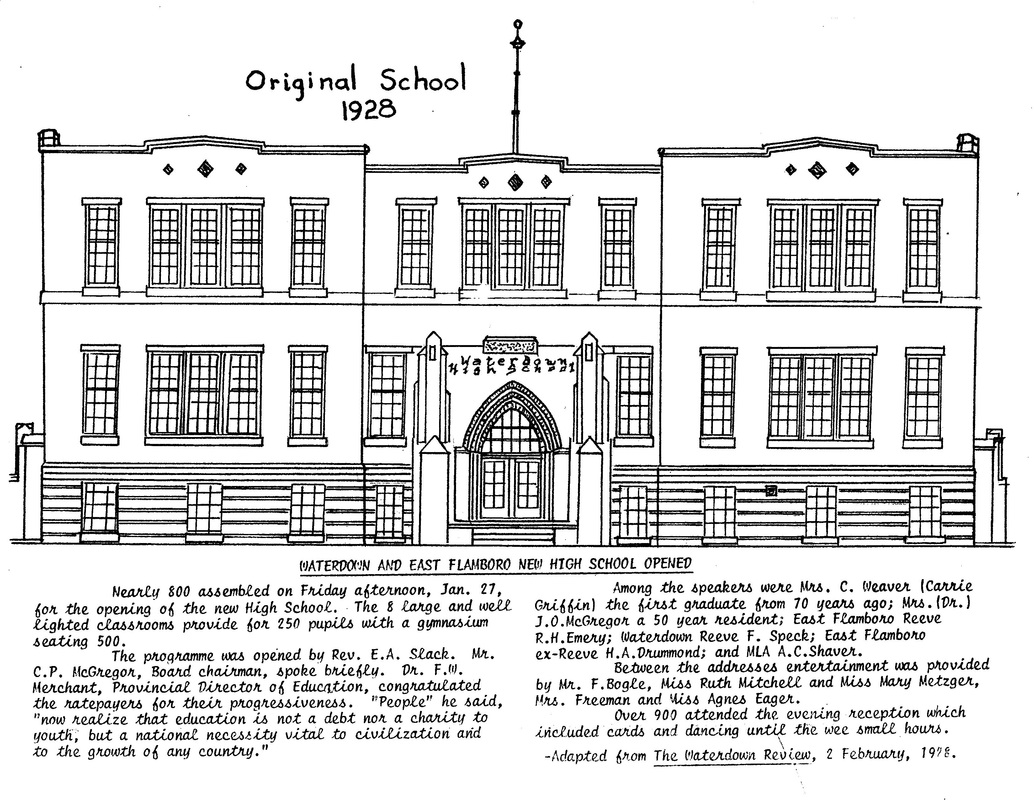
I had a complex end to high school: although I spent the first four years of the (then-five-year, including grade 13) experience at Waterdown District High School, doing my final year at the Ontario Science Centre Science School meant that I technically graduated from the nearby Don Mills Collegiate Institute in Toronto. That said, I have a memory of being allowed to join my peers at WDHS for the final graduation (as well as a memory that my brother Mike and I, independently, each opted out of wearing a gown to do so). But those memories are vague, and I may have made the whole thing up.
Oliver, however, did graduate from high school this week: I know this both because I was there, and because scenario-planning for the various and sundry ways that the perfect storm of crowded anxiety-ridden events could go sideways has consumed my spare thoughts for most of the last couple of months.
But it didn’t go sideways: thanks to a combination of a formidable effort by Oliver to keep calm, a lot of advance planning and practice, and a well-executed event, it all went off without a hitch.
Derrick Comes to Town
One of the best things that ever happened to Oliver is that, as he entered grade 9, Derrick Biso came into his life as an after-school and summertime support worker. Over three years Derrick and Oliver developed a strong bond, and there are few people in the world Oliver trusts more.
Unbeknownst to us, Oliver had invited Derrick to come back to the Island for the graduation and Derrick blessedly agreed. And so Derrick has been here all week: they went to prom together on Tuesday, Derrick sat beside Oliver at graduation, and they went to the “safe grad” activities afterwards. Everyone should be so lucky as to have someone like Derrick in their lives, and that Oliver’s week went as well as it did is due in part to Derrick’s presence.
The Morning Run-Thru
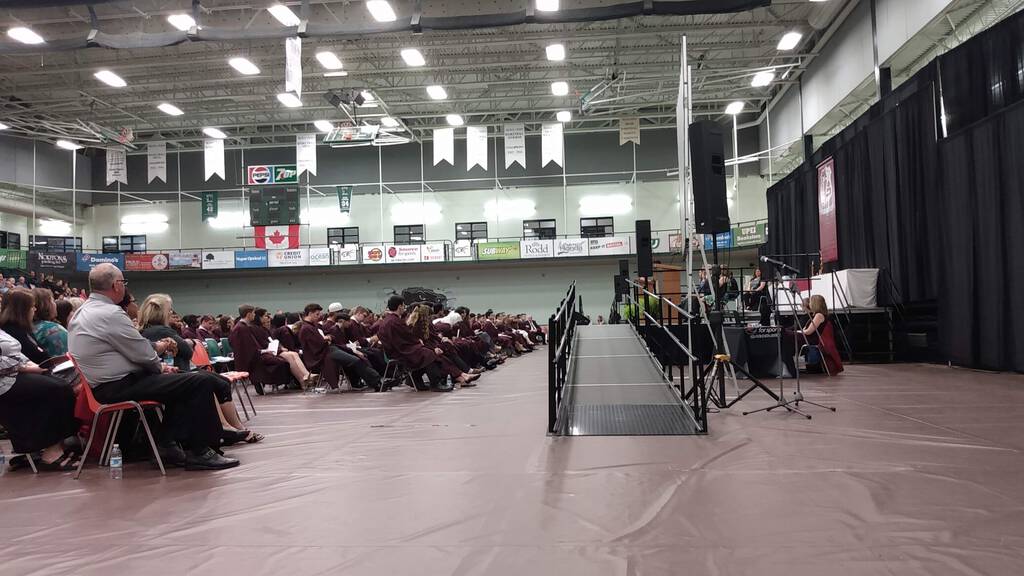
We started the day at the Chi-Wan Young Sports Centre at the University of PEI (where all the Charlottetown-area high schools hold their ceremonies, so as to accommodate all of the students, teachers, staff, families and guests at the same time). We met Shelly Mann (the Inclusive Education Coordinator at Colonel Gray and Oliver’s educational spirit guide), Dave Morrow and Maritza Vessey (Oliver’s morning and afternoon educational assistants, respectively, for the last three years) in the gym so that Oliver could get the lay of the land, and do a practice walk across the stage.
It was a great idea to do that, as it meant that when he went to do the real thing, later in the afternoon, it was old hat.
With the run-through out of the way, we went home for a few hours of rest, some lunch, and to get dressed for the ceremony proper.
To the Ceremony in the Rain
As the day progressed the projected rain materialized. And the rain got heavier and heavier. Oliver and I left the house just before 1:00 p.m. to go to Colonel Gray to pick up his gown, and then back to UPEI for 1:30 p.m. Although we were relatively early, the parking lot was already full enough that we had to park in the back-back and wade through a torrent of water to get inside (it was during this walk that I reconfirmed that my shoes had holes in them).
Walking into the gym we were greeted by Enes Alisic, who’d taught Oliver’s political science class last semester (and who proved to be a kind and estimable educator who developed a strong connection with Oliver).
Oliver chose to wear a variation of his prom outfit from earlier in the week: blue-checked shirt and green bow tie, both from Winners (really the only store in Charlottetown to shop at if your son tells you that he needs to dress like it’s 1929).
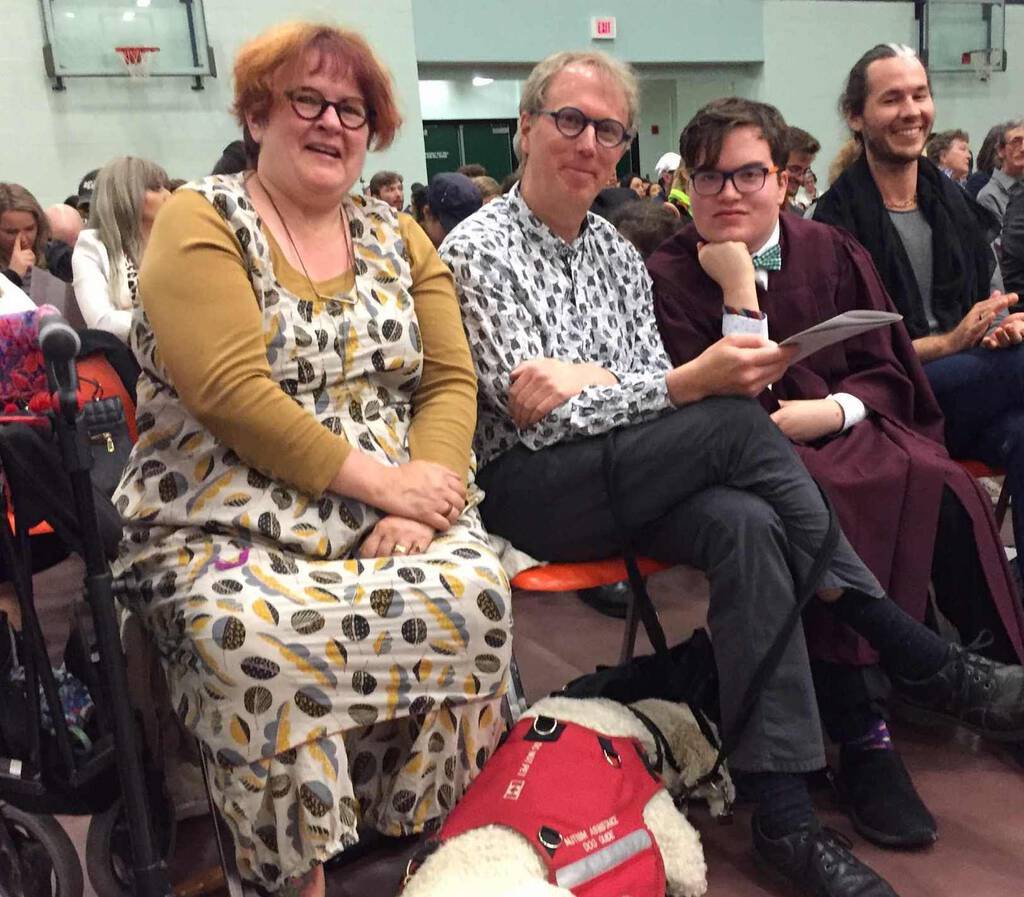
Close to 2:00 p.m. we took our seats, helpfully located in close proximity to the stage:
Blah Blah Blah
Oliver and I, the day before, had worked out a play-by-play schedule for the day so that he could know what to anticipate; because we didn’t have the exact schedule in-hand, there are a couple of lines in this schedule like:
Oliver returns to seat. Blah. Blah. Blah.
The graduation ceremony started with a lot of blah blah blah: graduates walk in en masse, O Canada, greetings from Public Schools Branch, greetings from the Government, Principal’s address. It then segued into the presentation of “major awards” – scholarships and prizes from universities and colleges. The organizers deserve credit for breezing through this quickly, and ensuring that if one student received multiple awards, they only ascended the stage once.
The blah blah blah finished with a rendition of Stand By Me by a talented group of students.
Presentation of Diplomas (and Catherine Arrives)
The first hill to climb for Oliver was to received his diploma: this was done in alphabetical order, and, as anyone with a later-alphabet name can attest, this meant a lot of waiting.
Because we knew that sitting on hard plastic chairs would wreak havoc on Catherine’s back, we’d arranged with our friend BJ to whisk her up to campus as soon as the alphabet started, safe in the knowledge that, with 265 graduates to get through, she’d have enough time to get there and take her seat. This worked like a charm, and by the time she was ready and seated they were still working through the Gs.
Oliver Takes the Stage
Here’s how the schedule described what came next:
At Oliver’s alphabetical time, Oliver and Dave walk from seats to stage. Ethan and Derrick and Peter and Catherine stay seated.
Oliver walks across stage, gets paperwork, shakes hands, photo taken, etc.
Oliver leaves stage to Shelly and Maritza on the other side, and returns to seat.
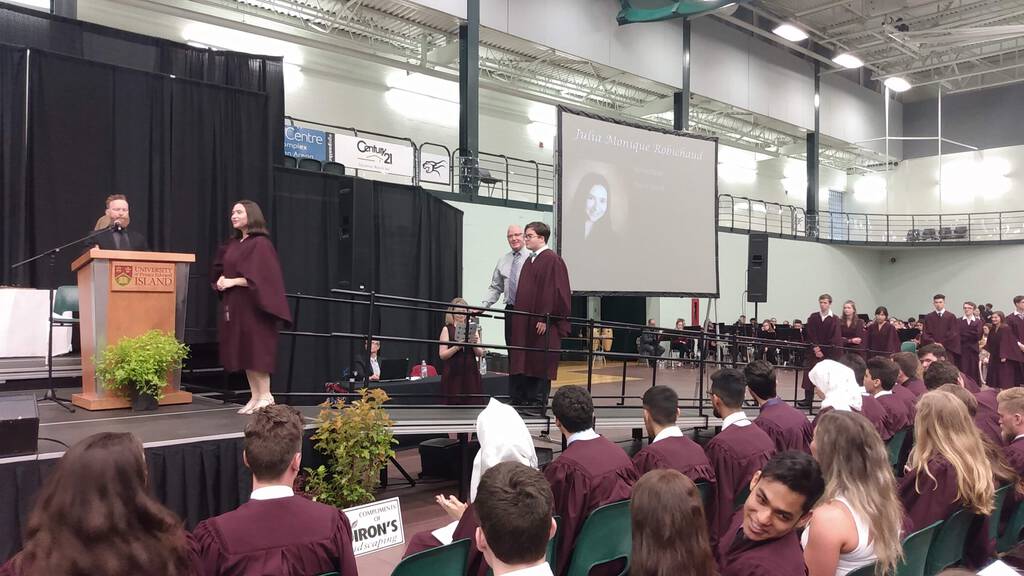
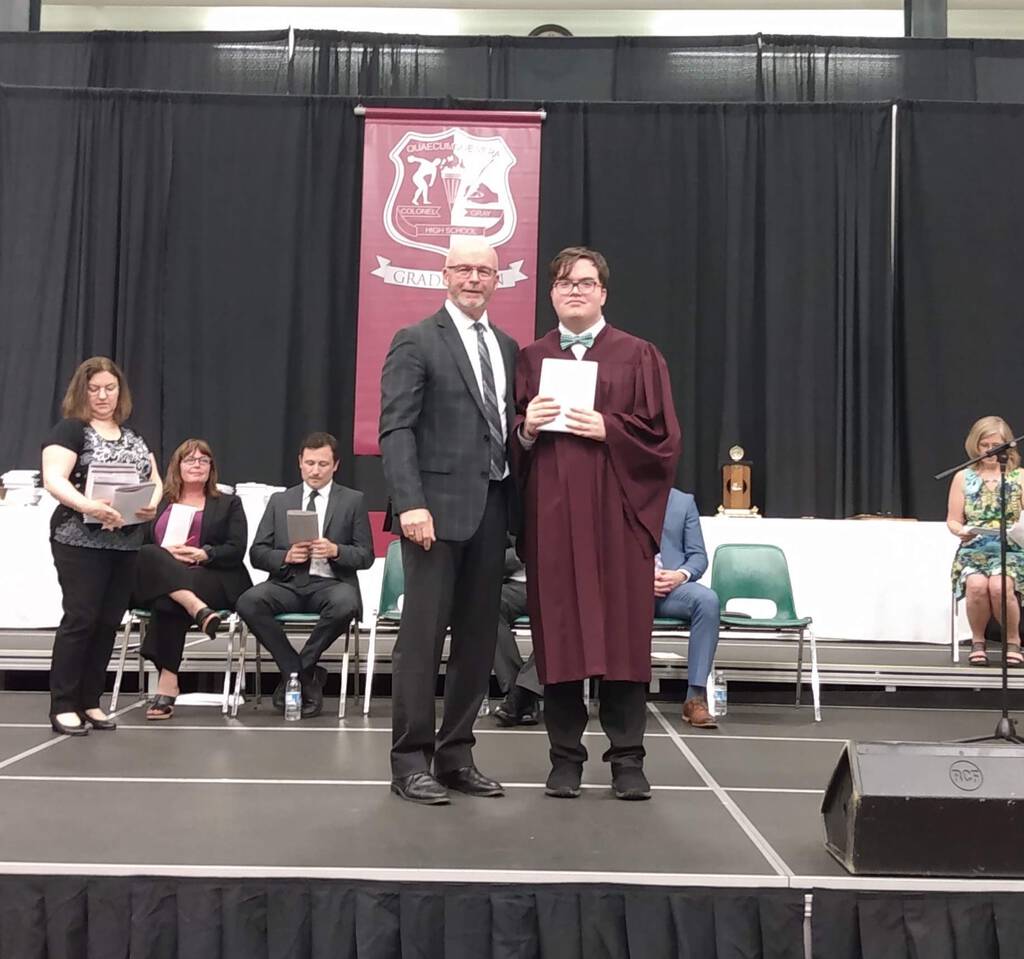
And that’s exactly what happened. The marshall-of-the-line helpfully opened up a spot for Oliver, pressing “pause” on the rest of the line, so that he didn’t have to wait an anxious eternity on the ramp up. Dave led him up to the stage, and he waited there for Julia Monique Robichaud (his alphabetical-predecessor), to receive her diploma:
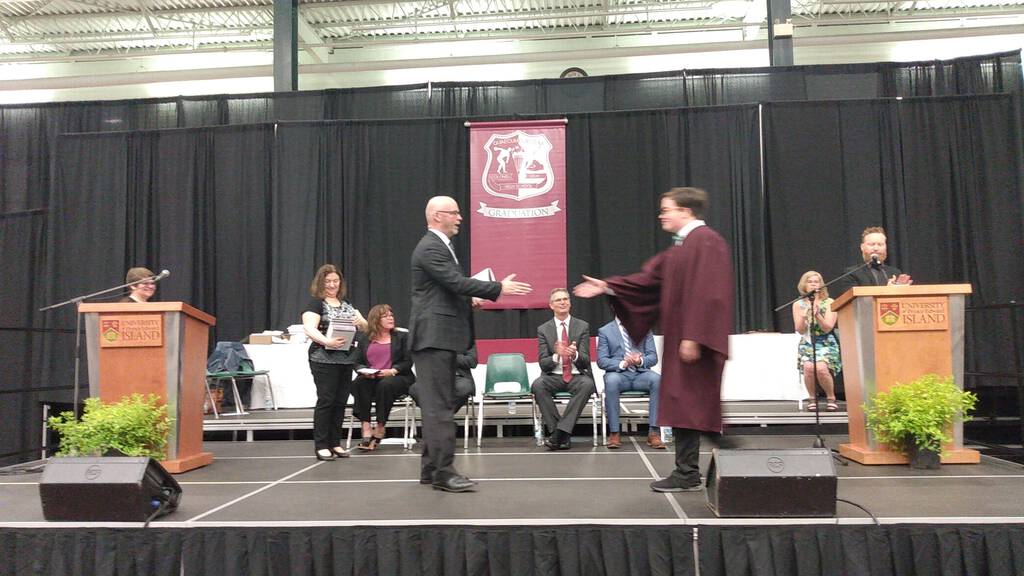
Then his name was called–Oliver Duncan Lowell Rukavina–and he simply aced the moves that came next:
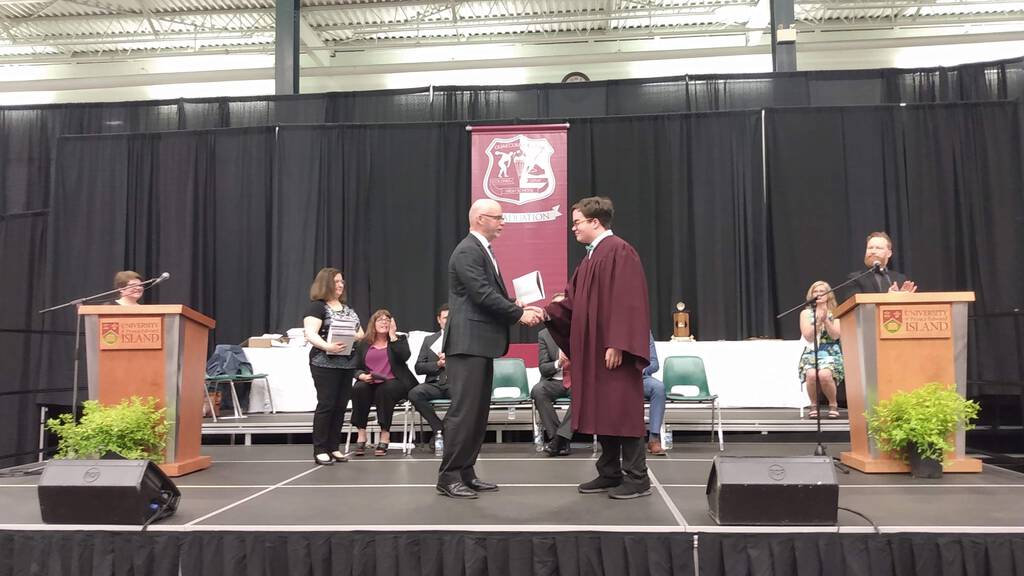
He looked around for me to take his photo:
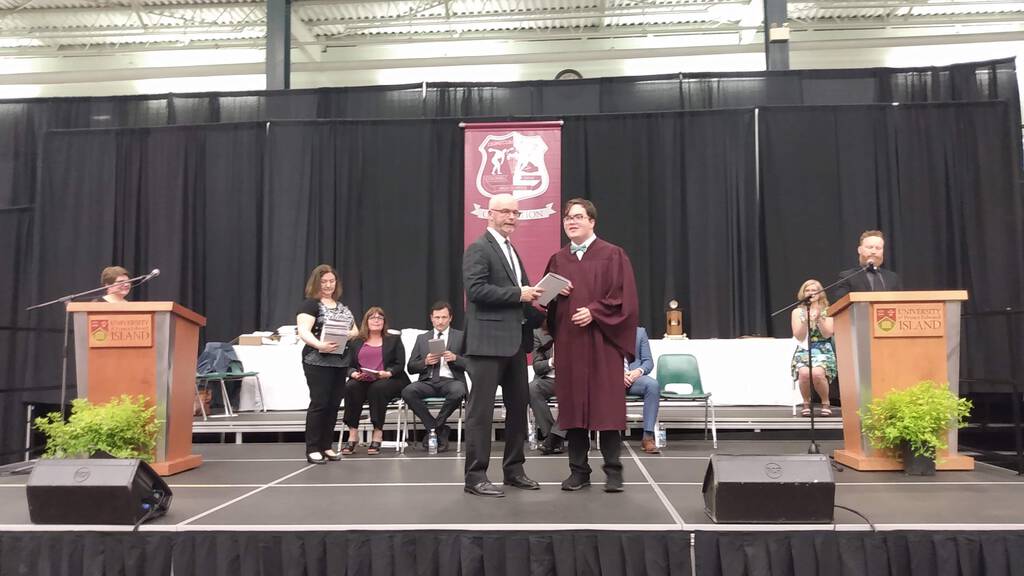
And, finding me, he posed for a photo (beside Dale Cole, the vice-principal):
Presentation of Prizes
Although the recipients of various prizes are supposed to be kept secret, things being kept secret is a source of considerable anxiety for Oliver (which has made me extra-sensitive to how many secrets-involving rituals we have in our culture!). As such, forward-thinking Shelly Mann broke the rules and gave us a heads-up that Oliver would be receiving a “Staff Award.”
Hence the next section of our schedule:
Blah. Blah. Blah. Awards.
Oliver gets Staff Award announced: same Dave- stage- photo- handshake- Maritza & Shelly system again.
Oliver returns to seat.
The Staff Awards were described in the program as being presented to “graduating students, who in their years at Colonel Gray, have made contributions to student life and/or maintained academic standing and/or applied consistent effort.”
After a raft of other prizes and awards, Oliver and the other recipients of the Staff Awards were called to the stage and, per our arrangement, Oliver and Dave got themselves to the end of the stage, and I arranged myself in the official photograph-taking area. Because, well, Murphy’s Law, I ended up shooting a lovely video of his walk up to the stage and his receiving the award with my finger over the microphone of my phone, so it’s a silent movie. But a lovely life-affirming one:
The Valedictory Address
Once all the awards were awarded, Cole Gallant, the valedictorian, took to the podium to deliver his address. Toward the end the students all stood up for the big finale, and Oliver stood up with them:
The End
Once the valedictory address was done, there were a few moments for photos.
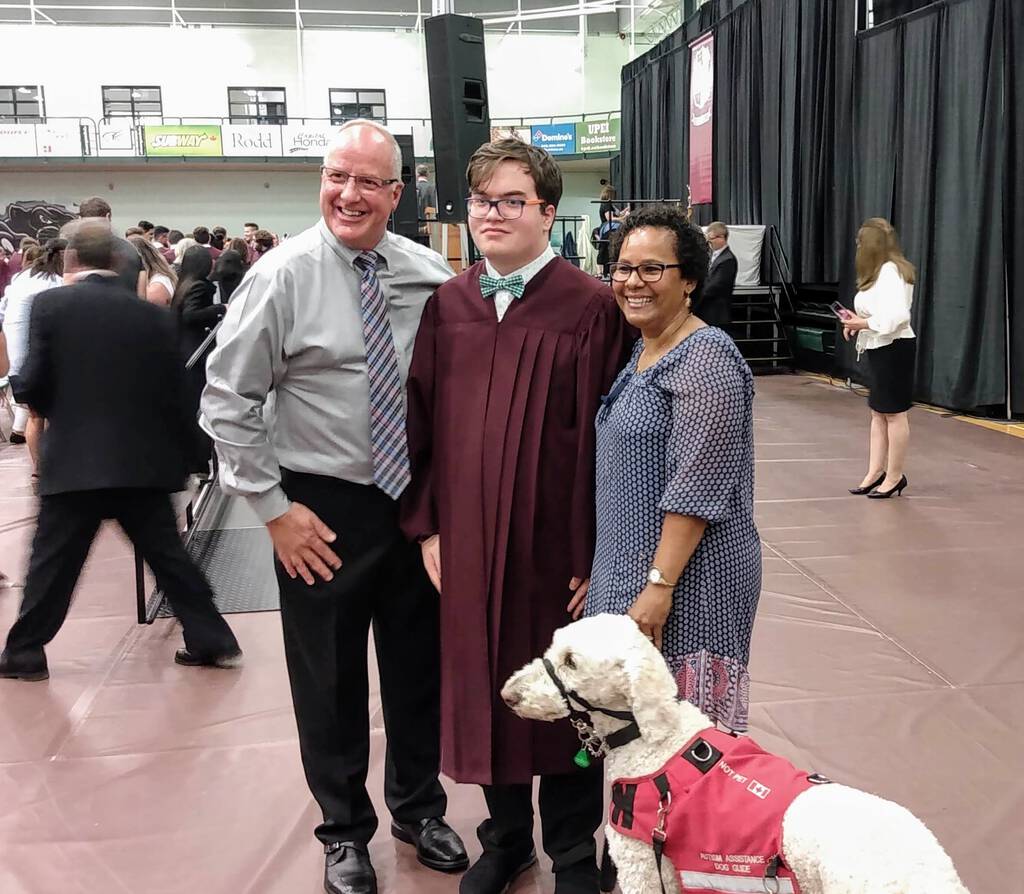
Here’s Dave, Oliver, Maritza and Ethan:
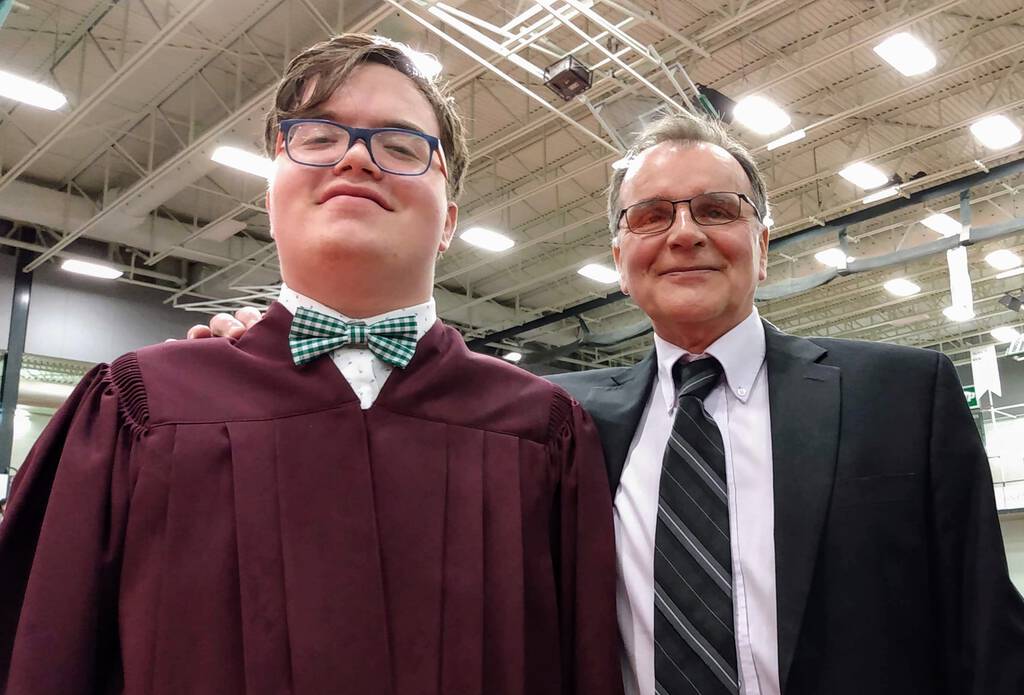
And here’s Catherine, me, Oliver and Derrick:
I darted back out into the rain to get Oliver’s change of clothes, pulled the car around for Catherine, and Oliver and Derrick headed off to the school for an evening of fun and frolic for the next six hours (did I mention the Derrick is amazing?).
Oliver, we are so, so proud of the young man you have become, and so proud of you for being able to successfully navigate yourself through what we know was a really, really hard day of stresses and triggers. You are amazing.
I’ve been experimenting with Termux on my Moto G7 Play. While my route in was looking for a terminal emulator for the phone, I’ve since discovered that Termux us much, much more than that.
Interestingly, my experience as in-house computer administrator is almost the same, but with Windows 10 replacing all previous Windows versions :)
The one occasional issue we've had is with specific updates which turned out to be incompatible with older hardware--graphics adapters mostly. But this could be expected; due to our ideology, line of work (we are a sustainability/communication agency) and economic reasons, we stick to our PCs for the better part of a decade at least, and buy almost exclusively refurbished machines. A side benefit of this approach is that we can afford redundant PCs, so when one doesn't work for whatever reason, we can replace it immediately and deal with the problem itself later.
MadaboutDana wrote:
>The most notable observation about the transition to Macs? How much
>easier it's made my life as our in-house computer administrator. Users
>no longer complain about crashes, about how to do stuff, about updates,
>about weird unexplained "events"... they just get on and work - and
>appear to enjoy it. In the 30 years or so since I started managing our
>computer systems, that's a first. I'm not saying there are never any
>problems, but they only appear occasionally, and tend to disappear
>again.
So, we’ve come to the end of my first full week back blogging every day. I’m not sure how long I’ll be able to keep this up, but it’s been an enjoyable week of writing.
Here’s a quick summary in case you’re just browsing at the weekend:
I wrote two things about effects pedals, with some tips on how I use them:
One of my favourite things about writing here regularly again is the comment threads that are growing – please do feel free to add your voice to the discussions. The way that social media conversations get lost so quickly has always saddened me, whereas blog comments have a much longer life and remain attached to the article as a collaborative writing effort. I’m grateful to everyone who adds thoughts and asks questions here, so feel free to join in!
If you want to get these blogposts emailed to you whenever I write here, you can subscribe to them via email here (naturally, you can unsubscribe from them at anytime):
Enter your email address:
It’s also been a week in while I’ve had quite a few new Bandcamp subscribers, no doubt wanting to explore the four new solo albums (I added a new track to the unfolding album Stepping Stones this week) and the upcoming LEYlines releases.
Besides all that, I got to meet up with the great bassist and journalist Ed Friedland yesterday – he was in town to play with The Mavericks, and sadly I missed the show due to illness, but we had an amazing day hanging out and catching up on news.
And then today, still recovering from a cold, which is now overlapping with hayfever, we took a leisurely family stroll through Birmingham, including a trip to the rooftop gardens at the Library Of Birmingham. I love living in this city
Ontology is “a gathering of or speaking (-logy) about ‘what is, what exists’ (onto-)”. The suffix -logy has come to mean a study or science, but originally it just referred to something said (the word monologue has the same root). So an ontology is a statement about what is.
The radical non-duality “message” is, essentially, an ontology, though a very unorthodox one. It is not a theory — its messengers assert that it is absolutely true, undebatable and obvious, and that it is only our illusory selves that cannot see this truth. The message is simply this:
There is no you. The sense of a separate person with free will and choice inhabiting a body is an illusion, an evolutionary misstep, a psychosomatic misunderstanding that arises in creatures with large brains. The brain and body have no need of a ‘self’ in order for the apparent human they are seemingly a part of to function perfectly well. Since there is no you, there is nothing you can do or learn or become to dispel or see through this illusion. It’s hopeless.
Nothing is real.Nothing is separate. There is no thing. There is only this (or everything, or whatever word you want to use), appearing as things and actions in (apparent) time and space. These appearances are not illusions like the self, and they’re not real, or unreal; they are just appearances. Inexplicably. For no reason or purpose.
That’s it. That’s the message. Everything else that radical non-dualists talk about is just an elaboration, an illumination, of the essence and consequences of this simple, hopeless message.
So we might inquire how and why this useless, annoying, suffering-causing illusory sense of separate self arose in this seemingly perfect-just-as-it-is “one-ness” appearing as everything (although if this message is true there is actually no “how” or “why” for anything).
There are possible evolutionary explanations, as I’ve described before — perhaps when large brains evolved the capacity to ‘model’ everything they perceived in order to make sense of it for survival purposes, that ‘model’ turned out to include a ‘self’, and when that ‘self’ was conjured up it began to use the brain’s power to perceive of itself (and everything else) as real and separate. There is growing evidence (from physics) that time and space aren’t ‘real’ (in the sense of being scientifically objectively verifiable) either — they’re just mental constructs used by the brain to organize and make sense of sensory perceptions. So why couldn’t the same be true of the self, itself?
If that’s true, then it implies that we, the supposedly super-intelligent, knowledgeable and super-conscious species, are actually the only species that cannot see through the illusion of its self, ie the only species that can’t see everything as it truly is — as a wondrous appearance of everything out of nothing, outside of space and time, without meaning or purpose or intention or anything separate.
If the message of radical non-duality is true (and over the last several years I’ve come to believe it is), then it is the most profound, and the most humbling, discovery in the history of our species. It means that our species is the only one hopelessly afflicted and debilitated by a hallucination that causes its victims untold suffering for no reason, and renders us uniquely unable to see what actually is. And who are its victims? Not the naked bipedal creatures ‘we’ presume to inhabit. These creatures are just appearances out of nothing, so they can’t be victims.
The victims of our selves’ psychosomatic misunderstanding are our selves. If this sounds recursive, it is. It would appear that our brains conjured up an illusory, imagined self so convincingly that it made that illusion ‘self-conscious’ and capable of believing itself real.
How can something invented become ‘self-conscious’? Well, what does it mean to be ‘self-conscious’? It means to believe itself to be real and separate and aware of something other than itself. AI fans are intrigued with the idea that robots could eventually do just that.
But if nothing is real, how could a self come to believe itself to be real? Because that’s what it perceives, how its conceptions makes sense of its perceptions. How can something that isn’t real have perceptions and conceptions? Anything is possible. Why not? If the sleeping brain can have a dream or nightmare that seems astonishingly real (perhaps enough to cause the body of the dreamer a heart attack), when it isn’t real at all, why should it be impossible that the (unreal) self can dream it is real and its experiences are real, when it is just an illusion, something conjured up by a pattern-making brain?
Let’s take a step back. The radical non-dual ontology says there are no ‘real’ creatures, brains, dreamers, heart attacks, lives, deaths, places, times, or things of any kind; there are only appearances of these things. What does it mean for something to be an appearance? (This is not the same as something being an illusion — a psychosomatic misunderstanding).
This is where the self’s understanding falters, and runs into the constraints of self-invented languages. The (illusory) self, which perceives itself to live in a dualistic world, where everything is either real (ie fits within its conceptions of what is real) or unreal (ie fits within its conceptions of what can be imagined) cannot conceive of or imagine what an ‘appearance’ is. An appearance is neither real nor unreal. It is not a conception, it is not a perception, it is not something that is or can be imagined, conceived or perceived by the self. How can it then possibly be true? Because it appears that when the self drops away (and it is seen that it never actually was) everything that is, is suddenly, wondrously, seen, as an appearance — by no one.
How do we know? We don’t — but (apparent) messengers of the radical non-duality ontology who claim ‘they’ don’t exist and do not ‘any longer’ have selves say this truth is now seen. Why should we believe them? Because their ontology is air-tight; it has no flaws, no loose ends, no ‘dark matter’ still unexplained, no contradictory arguments, no inconsistencies; no one could invent and ‘argue’ an ontology this brilliantly, and continue to do so for decades, as Tony Parsons has done for example.
And as perplexing as this ontology is, to some extent it is intuitive, even obvious to everyone. Whenever there is a ‘glimpse‘ it is seen to be true. When it’s accepted it is actually profoundly satisfying, since everything suddenly makes sense, including all the unhappiness and frustration the self feels, hopelessly and needlessly, life-long.
But it makes no sense to the self. It seems utterly preposterous. And even when science is able to eliminate all other possible ontologies (and I’d guess that will happen by the end of this century, if our civilization lasts that long), it probably won’t be accepted by most people as other than a useless scientific curiosity, like black holes.
It’s been suggested that belief in radical non-duality is just another dogmatic ‘self-denying’ religion — something that someone desperate enough for an easy answer to life’s apparent suffering will glom on to as a last resort, a coping mechanism during their ‘dark night of the soul‘. This is probably the hardest argument to address, since radical non-duality does partly meet the broader definitions of religion as a “system of faith and worship” or as a “system of beliefs, symbols and practices that addresses the nature of existence, and … is lived as if it both takes in and spiritually transcends socially-grounded ontologies of time, space, embodiment and knowing.”
But I don’t think it qualifies as a religion because:
it has nothing to do with spirituality or belief in a higher power or the supernatural
it has no object of worship (not even Gaia)
it is built on skepticism about other ontologies, rather than on faith (ie an unsupported or unsupportable belief) in an ontology
rather than being in conflict with, or dealing only with areas outside of science, it seems to have considerable scientific support (in neuroscience, quantum physics, astrophysics and cosmology)
it entails no practices and offers no pathways to or ideas about better ways to live
it offers no solace, salvation, redemption, comfort or any of the other apparent benefits of religious belief
So, back to the sheer preposterousness of this ontology. If it’s so “obvious”, why does almost no one subscribe to it?
The history of the human species is replete with belief systems that lasted millennia because they were simply the best that available scientific and other empirical evidence could come up with. And humans want to believe, and will accept almost any belief system that isn’t obviously wrong, dangerous or useless. We have believed (and some still believe) in magical and evil spirits, in reincarnation, in a geocentric universe, in a flat earth, that the earth was created by a superhuman in six days, that babies and non-humans cannot feel pain, that diseases are caused by humours or miasmas and can be cured by faith-healers, etc.
We generally believe (a) what we’re conditioned by parents, peers and other trusted people to believe, (b) what we learn that isn’t inconsistent with what we already believe, and (c) what we want to believe (because it’s easy, safe, or for other personal reasons). It is likely that billions of people still don’t believe in evolution. Many believe in outmoded ideas like the “big bang” or string theory simply because others have persuaded them that these theories seem to be consistent with scientific knowledge, and no better theory has been presented and explained to them.
So the fact that there is not even a small consensus on the validity of the ontology of radical non-duality is probably not surprising. It is very new (though in some ways very ancient — there is after all no such thing as “progress” of ideas and belief systems). It flies in the face of centuries of scientific thought. It is hopeless (there is no path to realize its veracity), useless (it offers no guidance on any subject), and it creates a host of moral dilemmas (it denies the existence of purpose, meaning, free will, self-control, or responsibility). In fact the only thing that it seems to have going for it is that it’s perhaps the only ontology that explains everything and isn’t directly contradicted by very compelling evidence. It is, perhaps, the ontology of last resort.
Suppose this ontology is correct. What would happen if it became largely accepted? Nothing would change. Because if it’s correct, and selves and separation don’t exist, then acknowledging that truth isn’t going to change anything. Those whose selves have apparently fallen away seem to behave almost exactly as they did before, confirming that the self, being an illusion, doesn’t actually influence anything — the apparent character (body+behaviours) ‘left behind’ continues to do what it’s been biologically and culturally conditioned to do. What seemed to be ‘decisions’ made by selves were discovered to be merely ‘rationalizations’ for what the character was going to do anyway.
So when I wrote earlier that humans are the only species that can’t see everything as it truly is, that’s kind of unfair to the billions of apparent human bodies on the planet that, unbeknown to our ‘selves’ are not actually separate or unable to see what truly is. What “can’t see everything as it truly is” are the selves that presume to inhabit those bodies, and which are disconnected from ‘everything that is’, including our remarkably competent (without any self telling them what to do) bodies.
So there is nothing to lose, or to gain, if this ontology becomes widely accepted. What will continue to (apparently) happen is the only thing that could have happened.
Our languages are utterly ‘self-ish’. They consist primarily of nouns (things that don’t actually exist), pronouns (references to self and others, which are illusory), and adjectives (conceptual, perceptual and judgemental descriptors of these non-existent things). Every sentence, by its grammatical form, is a story fragment — a fiction. Thoughts and feelings and personal sensations and perceptions, in the absence of language, are ephemeral — they have no substance, import or reality. They can’t be ‘made sense of’ without the context of a story, ie without language.
It is only when the self takes ownership of these ephemera that it ‘makes’ them real. Then, using language, the self weaves them into a story (about seemingly ‘real’ things existing and happening in ‘real’ time and space, and full of ‘real’ causality). And then these “psychosomatic misunderstandings” (as Jim Newman calls them) begin to wreak havoc on us — setting up the vicious cycle of what Eckhart Tolle calls the “egoic mind’s” often-terrible (and always invented) conceptions, perceptions, ideas, judgements, stories, expectations and beliefs, and the “pain-body’s” reactive negative emotions. Egoic mind sees loved one hugging stranger, invents a story about its meaning, and reacts with jealousy. And that jealousy then feeds more imagined aspects of the story, which fuels more reactive pain etc.
Language thus entrenches and reinforces the self’s sense of separation. Without it, could there even be a sense of self? Have humans always been afflicted with this sense of self?
There is (hotly debated) evidence that the first settlements, agriculture and abstract languages (the three hallmarks of ‘civilized’ society) all began about 10-20k ago (by contrast, human art dates back at least 100k years). These civilizations likely emerged independently in widely dispersed areas on five continents.
It is plausible that abstract language only evolved because it was needed to function in complex agricultural settlements, but it’s probably safe to assume all three hallmarks co-evolved and that all three are essential to a functioning civilization culture. There’s also some (equally-debatable) evidence that civilizations arose either (1) because exceptionally-comfortable post-ice-age climate conditions (since ~10k years ago) allowed massive increases in populations in suddenly-lush areas that had been largely lifeless when they were under mile-thick ice, or (2) because exceptionally-grim late-ice-age climate conditions (~20k years ago) forced humans to evolve civilizations in order to survive.
Whichever theory holds, it is interesting to speculate whether, prior to ‘civilization’, when we lived in relatively tiny numbers in tropical forests (and, later, as many vast forests burned due to more climate change, savannas), humans actually had selves. There is a credible argument that our first expansion (perhaps expulsion is a better word) from the once-all-providing forest to the unfamiliar and more perilous seashore enabled us to start to consume large amounts of amino-acid-rich (and plentiful) fish and seafood, which led to the major increase in the size and capacity of our brains, perhaps beyond the tipping point that would allow the idea of the ‘self’ to arise. Indeed, most early civilizations were in coastal areas.
This argument, then, would hold not only that climate change both provoked the emergence of human civilizations, and is now causing the termination of our global human civilization, but that illusory human ‘selves’ are concurrent with both stable climate and civilization culture. That would mean that pre-civilized humans were not conscious of themselves as separate and not afflicted by the illusion of selves with their commensurate, useless, body-mind trauma. It would also hold that when our global civilization culture fizzles out with the end of stable climate later this century, the (relatively small number of human) survivors millennia hence will not be afflicted with selves, and will not have civilizations, (catastrophic) agriculture, settlements or languages. Lucky them! What an amazing time that will be! But for no one, since the apparent human bodies will have no sense of being separate and apart from everything that (apparently) is.
Why wouldn’t these post-global-civ humans just reinvent language, settlement, agriculture, and civilization? Because they wouldn’t need any of these things to thrive, as humans apparently did for most of a million years before the ice ages. Even if selves emerged in certain large-brained post-civ humans, there would be no cultural conditioning to reinforce the illusion that the self was real, and hence it would be ignored, and not evolutionarily selected for.
How can any creature function without any sense of itself? When we study tiny wild creatures with minuscule brains (like silverfish or aphids), we see an amazing and clever instinct for survival, honed over millions of years to know just when and where to flee or freeze. When we study wild creatures that have no brains at all, like jellyfish, we likewise see amazing intelligence, but if there can be said to be a self in such creatures, it would have to be plural, since they have no centre, no place for a ‘self’ to reside.
When we study large-brained wild animals, like whales and elephants and ravens, we insist they must have a sense of self, and other, to explain many of their apparently clever, self-absorbed or altruistic activities. Yet none of these creatures has (to our knowledge) invented abstract language, catastrophic agricultural processes, complex settlements, or large-scale complex civilizations. Why not? Because they don’t need them. Whales have lots of the stuff of complex brains, so it’s clear they could evolve these things if it served an evolutionary purpose to do so, but it doesn’t. Does that mean they don’t have selves?
I would argue that they don’t have selves because they don’t need them, either. A self needs nurturing, conditioning, reinforcement. I would say that without abstract language it is impossible to ‘teach’ infants of any species to acknowledge and accept their selves as real. Without language there can be no stories, no sense of individuality or purpose or apart-ness — no sense of self. So even though a baby whale surely has the brain capacity to create a model of itself, even if it did so, would it take it seriously? Without language reinforcement from other whales, why would it consider the model of the self as any more than it is — a mental construct of no evident use or import?
There have been studies that indicate these complex creatures live most of their lives in a perpetual “now time”, unaware of the existence of “clock time”, of their separateness, or of anything apart. And then in moments of existential threat (eg a looming predator) they briefly enter an ‘altered state’ that causes them to fight, flight or freeze, and to use everything in their power (including their considerable wits) to protect themselves or their tribe-mates. And then it is physically ‘shaken off’ — like a bad dream — after which they return to “now time”. This makes enormous evolutionary sense.
Unfortunately, in humans, in crowded, precarious, agricultural settlements and massively overpopulated, crowded, unfathomably-complex civilized cultures, the stress that brings about this ‘altered state’ is chronic — it never goes away. So how do we cope? Enter the self, valiantly trying to make sense of this unnatural and traumatic state that you never seem to wake up from. And the self decides it is real, that everything else outside it is real (especially those threats), that it is in control (someone has to be in this awful chaos!), that it has free will and choice, and that it is responsible for the survival and well-being of the body it now presumes to inhabit. It invents language to communicate its trauma, and what might be done about it, to similarly afflicted selves, in the hope that selves working together will accomplish more than a lone self. And it never wakes up.
The tragedy of course is that this well-meaning self doesn’t actually do anything. It is the dream (or rather the nightmare, the prison it has caught itself in) it is trying to solve, to make better. Just as with every other creature, the human body knows, from a million years, a billion years of evolutionary learning stored in its DNA, just what to do. Not only does the self not do anything, it doesn’t even get in the way. It is a self-created illusion.
The question is not how we could or would function without selves, but rather how we are able to function perfectly well without selves. In part, that is the wonder of evolution — no ‘self-conscious’ self is needed (which is a good thing, because the self is pretty poor at what it does, in case you haven’t noticed).
Hidden beyond the veil of your self, that body that you’ve come to think of as yours is an amazing evolutionary ‘machine’ that doesn’t recognize or see ‘you’ at all, and it knows exactly what to do. No help from ‘you’ or ‘me’ required.
Beyond this dream-veil of the self the wondrous oneness of everything — not real or unreal, just everything appearing to happen, beyond time or space — is seen as it truly is. Not seen by a body, not seen by any one, just seen for what it, astonishingly, is. If you know (kind of) what I mean by a glimpse, you’ll understand. But you’ll still be trapped in the prison of your self.
If this makes no sense to ‘you’, it doesn’t matter. Everything will go on appearing, perfectly, wondrously, outside of ‘you’ and ‘me’, eternally and everywhere. Except when and where ‘you’ and ‘I’ are, hopelessly, looking.
Scams and political misinfo are bad, so why not report
them?
What follows is a version of my long email response to
a question about why I think that reporting problem
content to Facebook is a bad idea, at least here
in the USA. Complaining about Facebook is fine,
but complaining to Facebook, not so much.
That's because as of 2019, it's almost like there
are three Facebooks in this country, from the user
point of view.
Purple state Facebook: I wish I could predict
otherwise, but this is going to be a bigger and bigger
fraud and foreign misinformation operation leading
up to the 2020 election.
In some countries, doing moderation might be a
way to build goodwill with the government. But
here, the current US administration gives
foreign operations some of the credit for getting
elected.
Meanwhile, Facebook
needs to get an ambitious new cryptocurrency
scheme
approved by that very administration. Which means
nobody at Facebook can do anything serious about
the foreign misinfo problem, at least as it affects
the people that the re-election campaign wants to
reach.
They'll have to handle anything pro-reelection with an
extremely light touch, or face a regulatory mess that
will keep them out of the money-printing business.The good news is that these two assembly line
workers can get a break
from the "useless jobs" meme, and whoever is in charge
of pretending to moderate Russian troll accounts for
Facebook can have a turn.
Red state Facebook: At first I thought
that that Facebook could mostly ignore
the red state people, or just let skeevy
PACs
raise money from them, because
they live in states that are already safely in the
re-election column. But red state people have a
valuable role to play. When Facebook kicks some
of their favorite personalities off the service,
the role of the red states is to complain
loudly about it, and even threaten regulatory
action,
to help make it look like Facebook
is even-handed or leaning moderate
liberal,
to the remaining audience, which is...
Blue state Facebook: This is where the
prospective employees live, or are willing to
move, and also where you'll find the decision
makers at the major advertisers. But both of these
groups are more comfortable with a company that has
international appeal, so Facebook somehow has to look
“brand safe” in order to keep them on board.
That's where Grigory Potemkin's paint and trim
crew,
I mean the Facebook advertising "transparency"
operation, comes in.
The kind of people who might work for Facebook,
or advertise there, get targeted for a dramatically
different experience from what the regular people do.
How many
Facebook employees are embedded with the Presidential
re-election campaign these days, anyway? And how
many are planned to be there at the peak? IMHO
some reporter should ask that.
And much of the documentation that Facebook makes
public about its political misinformation problem is
a read-between-the-lines instruction manual on how
to do political misinformation without letting the
brand advertisers see it.
Regular people get quack miracle cures and
massacre-your-neighbors campaigns, while CMOs get ads
for luxury resorts and martech services. Of course
the CMOs are going to be fine with advertising there.
But no ad targeting system is perfect, and occasionally
some of the nasty stuff leaks through
where blue state people can see it, which means a
recruiting
problem to start with, and maybe even an advertising
problem. (Although as far as I can tell, CMOs are
pretty easy to keep in the dark, safely reassured
about how they can stay brand-safe and moderate even
while supporting a company that's already locked in
as a division of the re-election campaign.)
When Facebook asks you, a blue state person, to
please report things, that's where you come in.
They're looking for help spotting it when the bad
stuff that goes out to regular people leaks into the
sanitized version of Facebook seen by advertisers
and prospective employees. Anyway, long answer,
but that's why I don't report problems to Facebook.
When a drop of the purple-state crapflood leaks
through to me, I post it publicly and/or send it to
an advertiser instead.
The Irish Backstop dominates the discourse like it was Bake Off and these were normal times. In this resource, I wanted to do a step by step guide to understanding the Irish border, why Ireland insists on a backstop for it, and why that’s so problematic to some in the UK.
A big thank you to Mr Aodhán Michael Connolly (@MichaelAodhan) of the Northern Ireland Retail Consortium for his help in making me, and this article, less stupid. Any residual stupidity is in spite of his outstanding assistance.
First question, why are goods borders?
Great question, terrible grammar.
Goods borders exist to provide governments a level of oversight of what products enter the territory of their trading regime from another. Trading regimes can be a country’s territory, or a larger area like the European Union, within which common rules apply and movement within which isn’t considered by those who run it to be an import or export.
Why do governments want this oversight?
Because they want to be able to vet stuff entering their territory, including to confirm the entering good meets all local standards and has paid any required fees and tariffs.
So, they dig through every arriving box?
No, in the vast majority of cases the checks consist primarily of paperwork. A truck or freighter arrives at a border packed full of stuff, and with all the forms required to move that stuff inward. The border officers check the forms are filled out correctly and seem to broadly reflect what they’re seeing, and once they’re satisfied they let the container in without opening and searching it.
To make sure this trust isn’t taken advantage of, they use risk analysis to select individual consignments for thorough searches. At most modern borders this happens about 1% of the time.
I bet there are exceptions, though?
Yup. Some trading regimes have determined that certain types of paperwork required to move select products across the border require additional testing which can only take place at the border itself. The most famous example of this is EU veterinary tests for imported meat and livestock, which must be conducted by an EU veterinarian basically at the border.
Ok, got it. So what’s the Brexit link?
The European Union is a single trading regime because:
The Customs Union eliminates internal tariffs;
The Common External Tariff establishes a single tariff on goods from outside the EU;
The Single Market harmonizes standards and rules.
If the United Kingdom leaves the EU in a way that also pulls them out of either the Customs Union or the Single Market (or both), it will become its own distinct trading regime.
This trading regime will need to establish goods borders at the places where goods previously entered from the European Union, and the European Union will need to establish goods borders in places where goods previously entered from the United Kingdom.
One of these areas is the border between Northern Ireland (part of the United Kingdom), and Ireland (part of the European Union).
So why won’t Ireland and the UK just build borders then?
They still might, but they really don’t want to. There are two reasons.
First, historic political.
Northern Ireland has a grim and blood-soaked past. Those in Northern Ireland who wanted to remain part of the United Kingdom and those who wanted independence and perhaps unification with Ireland clashed violently with one another and with the UK government.
The violence was eventually halted in a historic peace settlement referred to collectively as the Belfast Agreement or Good Friday Agreement (GFA). The GFA represented a complex compromise, in part relying on Northern Ireland’s remaining politically a part of the United Kingdom but remaining heavily integrated into the island of Ireland.
There is a concern the building of any kind of goods border infrastructure at major crossing points from Northern Ireland into Ireland could reignite violence on the island.
Second, economic.
The economy of Northern Ireland is heavily integrated and intertwined with that of Ireland. There are products produced on the island which cross the current (invisible) border up to half a dozen times as they move from raw materials to finished goods.
If every one of those cross-border movements requires the preparation of paperwork, the presentation of that paperwork and potentially the paying of tariffs and other fees, the businesses which rely on these movements can rapidly become noncompetitive as costs and delays render their processes more expensive and slower than their competitors.
Even simple cottage pie made in Northern Ireland can undertake 7 border movements before it is the finished product. This includes the milk for the cheese topping which is from Northern Ireland but travels across the border to be made into cheese and then back to top the pie.
You can really taste the neoliberalism in every forkful.
That sounds bad. Can’t the UK and Ireland just… not?
So in a way, that’s the United Kingdom’s Plan-A in a No-Deal. Should the United Kingdom leave the EU without a deal in place, it has said it will simply not introduce any additional checks at that border, nor attempt to charge tariffs at it. In other words, with the exception of torture tools and biochemicals, the UK is going to act like nothing has changed.
So, problem solved then?
Not by a long shot, I’m afraid.
What the UK is essentially doing is accepting a degree of risk no other major country is willing to accept at a major border crossing. It is:
Assuming that goods standards in the European Union, which it will no longer help set or administer, will continue to be sufficient to protect UK consumers;
Accepting the existence of a backdoor past its tariff regime for EU products;
Assuming no 3rd country will make use of this backdoor.
That might be acceptable in the short term, but it’s a bandaid when what’s needed is a limb replacement. There is a genuine concern that while some businesses will follow the rules, many will not, undercutting those doing the right thing and making a mockery of the rules.
What about Ireland, is Ireland planning on doing the same thing?
Here’s where we come to the crux of the problem.
While the UK might be willing to accept the risk described above, the European Union doesn’t seem remotely as keen. The integrity of the EU Single Market and Customs Union is integral to them, and they will be very reluctant to accept a giant gap in its outer armor.
So, what will they do?
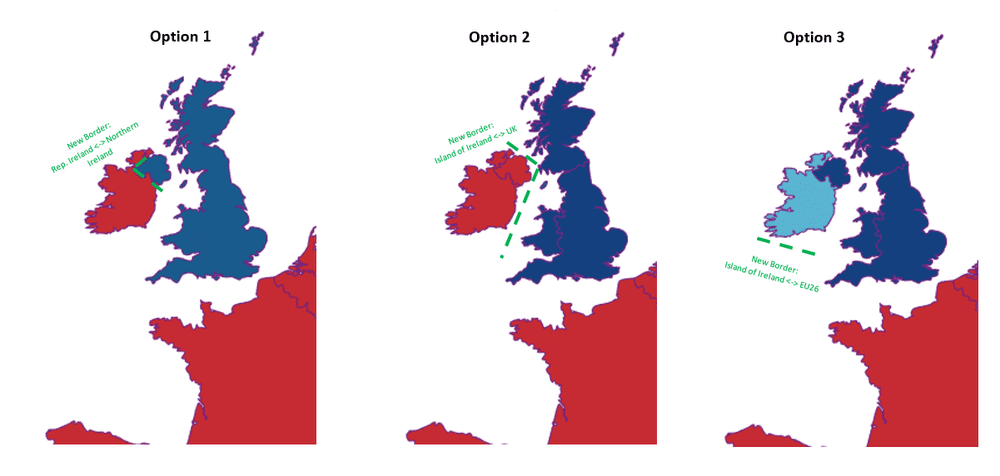
Following Brexit, there are three ways the European Union can prevent entry into its market of goods without clearance passing via Northern Ireland. It’s all about who is in which trading regime.
Option 1: Ireland remains in the EU trading regime Northern Ireland becomes part of the new UK trading regime. The EU then demands Ireland establishes a goods border where the two meet.
Option 2: Ireland and Northern Ireland remain part of the EU trading regime, and a goods border is established in the Irish Sea to administer goods moving between any part of Ireland and the new UK trading regime.
Option 3: Northern Ireland becomes part of the new UK trading regime, but no border is established. To prevent ‘contamination’ of its market the EU establishes goods borders between its other 26 Members and Ireland, effectively (partially) removing Ireland from the EU trading regime.
“Oh. Oh shit.”
None of those sound great.
Yup.
We’ve already discussed why Option 1 isn’t great.
Option 2 would require the UK to have part of its own territory effectively governed in a range of trade relevant areas by a bloc it’s not even a member of, while making internal UK trade a lot more painful.
Option 3 would cut Ireland off from some of the biggest benefits of European Union Membership from a trade perspective, without really addressing the fact that Ireland and the UK would have two different trading regimes with no border between them.
So what is Ireland doing about it?
Ireland and its partners in the European Union are insisting on the so called “Irish Backstop”:
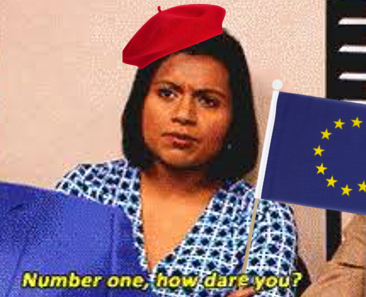
Well done on first mentioning that like 7 pages into an article with “Irish Backstop” in the heading, but sure, what’s that?
I hate you.
The Irish Backstop is a provision which emerged from the negotiations over the UK’s Withdrawal Agreement with the European Union.
Concerned about putting Ireland into a position where it has to choose between the three option above, the EU insisted on a ‘backstop’.
This backstop would mean that if at the end of the two year transition period (during which everything stays as it is now) an agreement hasn’t been reached which makes Option 1 acceptable to both sides (ie, minimizes political historic implications and ideally, economic disruption) then Option 2 would apply.
In other words, if a way to make the Northern Ireland border work hasn’t been found, they’ll wack a border in the Irish sea instead.
The UK under Prime Minister May couldn’t accept this, because it saw Option 2 is unacceptably splitting up the United Kingdom.
So what happened?
The EU reluctantly agreed that rather than Option 2, the backstop would instead apply to the entirety of the United Kingdom. In other words, if at the end of the transition period a way to make Option 1 work hasn’t emerged, the entirety of the UK would remain within the EU trading regime in all the ways required to eliminate the need for a goods border.
I see, and why is that unacceptable to Parliament?
A significant number of Parliamentarians who are otherwise very supportive of Brexit have refused to accept the Backstop. This has proven sufficient to prevent the passage of the Withdrawal Agreement through Parliament.
Their concern is over how the determination of what constitutes an “acceptable Option 1” is made. Under the Withdrawal Agreement, it’s a decision made by consensus. The EU27 and UK would have to jointly agree an acceptable Option 1 has emerged. Until that happens, the Backstop would remain in place and the relevant EU rules would apply UK wide.
MPs have signaled that without the ability to leave the Backstop unilaterally, the UK could be trapped in it forever by an EU that, either maliciously or simply through impossible standards, refuses to accept any Option 1 as ‘good enough.’
What do these Parliamentarians want?
They don’t all speak with one voice, but the general consensus seems to be that they want the Backstop either removed entirely, capped with a time limit or amended to introduce a mechanism whereby the UK can exit it without the EU’s consent.
Is the EU likely to accept that?
The EU has thus far said it isn’t, including at the highest levels. For the EU, this would be to transfer the ‘risk’ and difficult decision (between Option 1,2 and 3) onto Ireland. This would be seen as a betrayal of a smaller Member State by the big players, which is not a great look for the EU.
The EU are reluctant to accept a negotiation premised on the idea that it is engaged in a conspiracy to exploit Irish sectarian tensions to trap the UK forever in its customs and regulatory zone.
And what happens in a No-Deal?
Unfortunately for everyone involved, a No-Deal scenario just brings everyone back to the three options above, except two years earlier because there’s no transition period and with everyone angrier and things breaking left and right.
Can technology save us?
If this show has taught us anything, it’s that technology holds benign resolutions to all of our problems with no side effects or consequences of any kind.
Anyone attempting to implement Option 1 (a border in Northern Ireland) might be able to use technology to reduce the amount of infrastructure required, to move some of that away from the border and to minimize the amount of actual ‘paper’ involved in border paperwork.
To date however, technology alone has not eliminated the need for border infrastructure at any major commercial land crossing in the world. Even highly advanced countries with great relationships like Norway and Sweden or Switzerland and its neighbors have borders with extensive physical infrastructure and procedures which take time and cost money (directly and indirectly) to navigate.
The EU has therefore been unwilling to accept removal of its backstop insurance policy in exchange for the promise a technological solution will inevitably emerge. It argues those who believe a technological solution is imminent should have nothing to fear from a Backstop such technology will either prevent, or swiftly allow the UK to emerge from.
This all sounds really hard, what’s going to happen?
I honestly don’t know how this will all shake out.
It does however promise to be complex, painful, and irritating for everyone involved, so I hope there’s something good to drink in Ireland.
It’s green, so I’m just going to assume its Irish without doing any further research.
Thank you for reading, hopefully you found it useful.
As a gentle reminder, ExplainTrade.com is a free service I provide without a Patreon or GoFundMe. Instead, I use this website as a platform to sell my services as a trainer in negotiation skills, trade policy and accessible communication.
If you or someone you know could benefit from some learnings, do get in touch.
Here’s a breakdown of almost every smartphone leak from the last few days.
The leaks below encompass news from June 15th to June 21st, 2019.
Samsung
A new leak suggests that the Samsung Galaxy Note 10 may feature a three-stop variable aperture. A single lens would feature f/1.5, f/1.8 and f/2.4 apertures.
For more on the Note 10’s variable aperture, click here.
The Galaxy Note 10 is to feature ‘Sound on Display’ technology that’ll allow it to produce sound without an earpiece speaker. The feature would turn the body of the phone into a diaphragm enabling it to vibrate and make sounds when someone places their ear against it.
For more on the Note 10 featuring Sound on Display technology, click here.
Samsung Galaxy Note 10 is rumoured to launch on August 7th, according to the latest release date leaks.
Reportedly, Samsung will unveil the device at Barclays Center in Brooklyn, New York.
For more on the Note 10’s release date, click here.
Google
New leak indicates that the Pixel 4 will sport a display size between 5.6-inches and 5.8-inches, alongside roughly the following measurements: 147.0 x 68.9 x 8.2mm (9.3 if you include the camera bump.)
The Pixel 4 XL, on the other hand, is to feature a screen size between 6.2 inches and 6.4 inches and roughly 160.4 x 75.2 x 8.2mm ( again, 9.3 if you include the camera bump) measurements.
For more the Pixel 4 and Pixel 4 XL measurements, click here.
Asus
The Asus ROG Phone II to reportedly launch on July 23rd. Additionally, the phone is to cost 4,399 RMB ($853.54 CAD).
Apple’s 2020 iPhone lineup is already leaking online. Two out of the three handsets will reportedly sport 5G connectivity. Apple could launch a 5.4-inch and 6.7-inch OLED display handsets with 5G and a 6.1-inch lower-end OLED screen with 4G LTE instead of 5G.
For a limited time, Public Mobile is offering $10 off its 8GB plan for six months.
The deal goes live on June 22nd, 2019 and runs until June 23rd at 11:59pm ET. During that time, when you activate in-store or online, you can sign up for the $50 8GB plan but only pay $40 per month for the first six months.
Along with the 8GB of data at 3G speed, the plan includes unlimited Canada-wide and U.S. talk, unlimited international text and picture messaging, voicemail and call display.
Plus, if you sign up for Public Mobile’s AutoPay, you get a 500MB data bonus, bringing you up to 8.5GB total.
To take advantage of the offer, you’ll need a SIM card. You can order one online or get one at participating retailers. Then, activate in-store or online (you can do an online activation here). Follow the steps for online activation. At step three, you’ll need to select your plan. Here, you’ll want to pick the “Limited time: $50 8GB plan for $40 for first 6 months” plan. Then, complete the rest of the activation steps.
It’s worth noting that this discount only works for the $50 8GB plan, you can’t get it by creating your own plan — even if its the same as the $50 pre-made plan. Additionally, the $10 discount applies to months one through six. On the seventh month, you’ll pay $50.
It’s also worth noting that if you change your plan or if your account falls into a suspended or inactive state while on the promotion, you’ll no longer be eligible for the plan.
Microsoft unveiled a lot of new things at its 2019 Build conference in Seattle, Washington last month, and one of the hits — the new Windows Terminal — is available now.
Microsoft promised a preview build of Terminal in mid-June, and right on schedule has added the Windows Terminal to the Microsoft Store.
The app is the new central location for users and developers to access the traditional command line, PowerShell and the Windows Subsystem for Linux (WSL). Previously, developers could compile a build of the Terminal from code on GitHub, but now you can easily install it through the Microsoft Store.
Along with centralizing the various terminal interfaces, Windows Terminal includes tab support and themes for those who want to personalize their Terminal. For now, you’ll need to edit a JSON file if you want to get all the customization options, as the early preview doesn’t have full functionality.
Microsoft offers a set of instructions on how to configure your settings and key binds in the JSON file, plus it lets you change the background image.
On top of all this, Windows Terminal supports full GPU-based text rendering and emoji. Terminal uses DirectX to render text, so it will display regular text characters, glyphs and symbols that are available on your PC.
This release marks the first of many preview builds that will come ahead of the Windows Terminal 1.0 which will hit the Microsoft Store in the winter.
Additionally, Microsoft is also working to bring the full Linux kernel to Windows 10 to improve performance of the WSL.
You can download the new Windows Terminal preview build from the Microsoft Store here. It’s worth noting you’ll need Windows 10 version 18362.0 or higher — you can check this by opening Settings, clicking System then About, and scrolling down to the Windows Specifications section.
The Washington Post: Aretha: Her story was in her songs. “Six songs tell you as much about Aretha Franklin as any memoir ever could. The Queen of Soul was not much for talking about her life, so with the help of Oprah Winfrey, Paul Simon, Questlove and others, we peel back the layers of emotion, technique and lived experience she packed into these key performances.”








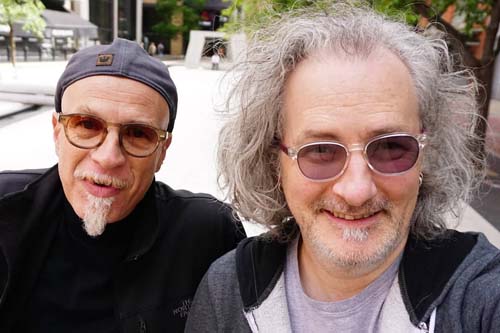 Besides all that, I got to meet up with the great bassist and journalist Ed Friedland yesterday – he was in town to play with The Mavericks, and sadly I missed the show due to illness, but we had an amazing day hanging out and catching up on news.
 Parveen Kaler @kaler
 Tampontreal Internationals Mega Fan @Lesley_NOPE
 Robin Sloan @robinsloan
 Shawn Micallef @shawnmicallef

 Karen Quinn Fung | 馮皓珍 @counti8



 Blogs - Trade Explained.

 moodvintage on Twitter.
 moodvintage
on Sunday, June 23rd, 2019 9:15am
moodvintage
on Sunday, June 23rd, 2019 9:15am