Shared posts

01 Oct 21:40

When I was the whistleblower

by Josh Bernoff

What does it feel like to file a complaint that something’s just not right and watch the process unfold? What’s happening right now in DC is unprecedented, and the stakes and risks for the person who filed the whistleblower complaint are very high. The person who reported on Trump’s activities in the call with Ukraine … Continued

The post When I was the whistleblower appeared first on without bullshit.

01 Oct 21:40

Solving Engagement Problems

by Richard Millington

Earlier this year, I coached a community manager who had been doing the same basic tasks in her community for almost two years.

She initiated and responded to discussions, hosted webinars, built relationships with members, and had a small group of top members.

The level of engagement was ok, she was handling just over 1000 posts per month, but the level of participation had barely budged since she had arrived.

Her plan to improve results could be boiled down into a single sentence; do more of what she was doing.

Or, to use another phrase, try harder.

Trying harder isn’t a strategy, it’s a new year’s resolution.


You Can’t Engage Your Way To Huge Improvements

Creating more discussions, responding to more posts, and hosting more webinars aren’t game-changers that get people more engaged.

If you want more participation, which she did, you need to do things which fundamentally change the game.

We coached her in a few areas:

1) Making a stronger case for the community. Her colleagues accepted the company had a community, but weren’t proactively supporting it. This meant she didn’t have the budget, support, or resources of her colleagues. We helped her summarise the benefits of a community into a pity metaphor, create an emotive appeal for colleagues, and schedule meetings with colleagues to understand what they wanted. She managed to get product managers responding to product questions directly, share exclusive news and beta versions with top members, and had the CEO create a blog in the community.

2) Better positioning and promotion of the community. To increase participation, you need more traffic. Members only drifted in via search today. We helped her get the community featured as a navigation tab on her company homepage which doubled the number of visits the community received overnight.

3) Improving search traffic. We helped her understand the importance of removing thin content, merging discussions, and tweaking discussion topics to attract more search traffic. It consumed a lot of time but also produced demonstrable results.

4) Rethinking what members were meant to do. We helped identify her member segments and develop unique journeys for each of them. This ensured each member was doing the things which deliver the best value to the community and for themselves.

5) Expanded the scope of the community. We also expanded the scope of the community to include newcomer-specific content and mentoring groups. We want this to be the place for newcomers to the field, regardless of whether they’re customers.

Within 3 months the number of posts had increased by 67% and continues to rise (steadily) today.

The lesson here is you can’t keep doing what you’re doing today and expect dramatically better results.

There is plenty you can learn on the job, but you also risk being stuck doing the same tasks today without any improvement.


Escaping the comfort zone

To make the big leaps ahead, you need to become familiar with skills beyond just engagement.

In this case, the community manager needed to learn technical skills, business skills, and some strategic skills.

The very skills her company hadn’t taught her were the very skills she needed to master to take her community to the next level.

It’s situations like these where coaching delivers the best results.

This is why we’ve launched our coaching programs this month.

We believe community managers should be highly trained professionals with a skill-set that extends beyond just engagement.


FeverBee’s Coaching Program

We can give community professionals a broader picture, help them identify the skills they need, and then take their community to an advanced level.

In our coaching program, we’ve broken community management into five core fields.

  1. Strategy.
  2. Engagement.
  3. Content.
  4. Business.
  5. Technical.

Each of these has five unique levels. And each level has specific skills you need to master to progress.

When you join our coaching program you benchmark your current level by (honestly) answering questions about your past experiences.

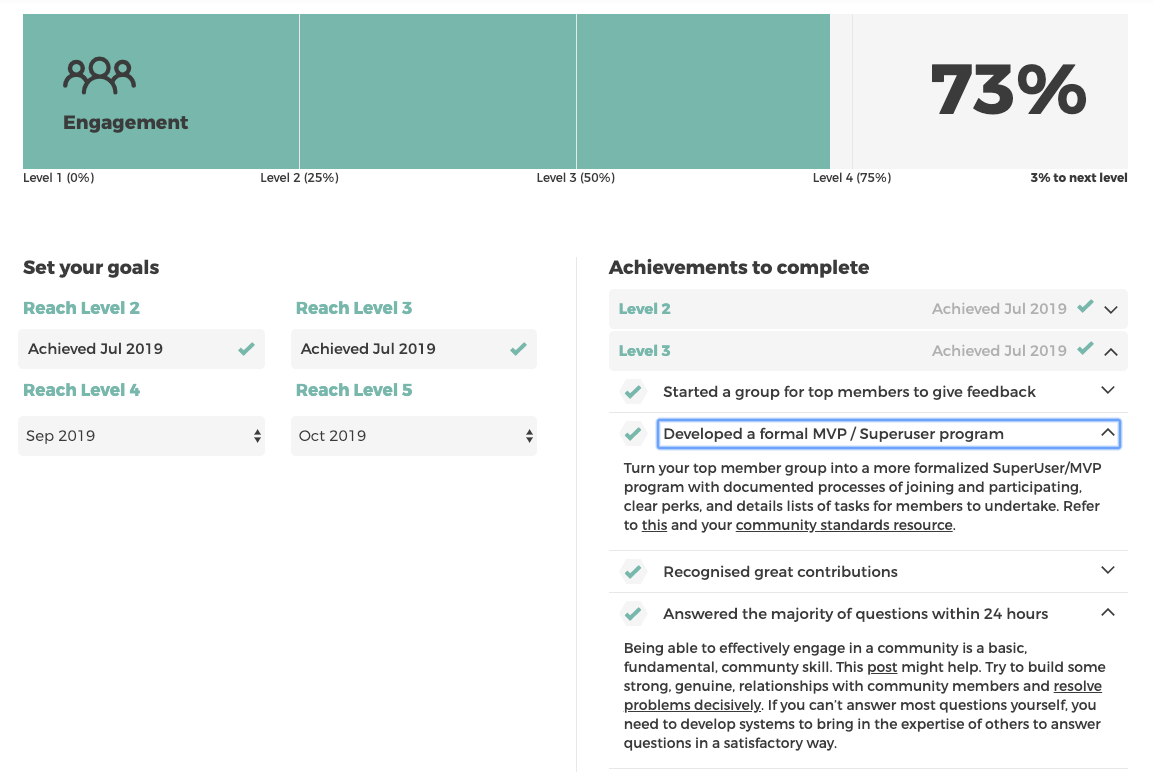
Based upon your assessment, you get a benchmark which looks like this:

You then collaborate with us (and ideally your boss) to set your goals for the next few months. We recommend progressing one level per month.

For example, if one category (i.e. technical) isn’t relevant to your work, you can ignore it and focus on the ones that are most relevant to you. If you’re already ranking highly for engagement skills, you might choose to master business skills instead.

Once you’ve set your goals, you get a roadmap which shows you what skills you need to learn and how to learn those skills.

These won’t be vague recommendations, they will be specific and practical.

Now we connect you with the skills, knowledge, and resources you need to steadily up your abilities. This involves three areas:

1) Personal recommendations. We’ve developed hundreds of specific steps you can take to master new skills. Once you’ve set your path, you can see the specific recommendations for you.

2) Private coaching. We provide personal coaching to each participant of the course. Your situation is quite unique and you’re going to need private support at times too. We’re here to answer your questions and give you that support.

3) Private group. Every member is connected to a private group within our community based upon their assessment. Here you can have the discussions you can’t have anywhere else with a private group of people in exactly your situation.

Each month you get to track your progress and see your skills levels steadily increase.

If you work for a company which doesn’t have the time to coach you in the skills you need, this program will really help.

Click here to learn more and sign up.

01 Oct 21:25

Comment about 20190929_202101

by bigsnit

bigsnit has posted a comment:

so helpful

20190929_202101

30 Sep 03:18

Tips to Keep You Warm and Dry for Fall and Winter Cycling

by Average Joe Cyclist

At this time of the year, it’s time to start thinking about how we are going to be comfortable cycling through fall and winter. Luckily, we have lots of posts to help you with that. Check out our most popular posts about cycling in cold weather ...

The post Tips to Keep You Warm and Dry for Fall and Winter Cycling appeared first on Average Joe Cyclist.

30 Sep 03:18

Eulogy for Dai Barnes

by Doug Belshaw

Today, Sunday 29th September 2019, I’m giving a eulogy for my good friend Dai Barnes, who passed away in early August. For those who can’t attend the memorial service at Oundle School, I’m sharing the text of it here along with the audio contributions I’m including from the last-ever episode of TIDE.

Thank you to everyone who had a hand in shaping this, and to Dai’s family for allowing me the honour of speaking at his memorial service.


Audio version of eulogy (in full)

I believe it was the author Terry Pratchett who said that “No one is actually dead until the ripples they cause in the world die away.” My friend Dai Barnes certainly caused some ripples during the time he spent on this Earth.

Today, almost two months after Dai’s passing, all of us in this room are at different stages in the grieving process. Some of us here knew Dai, or David as he was known by his family, for most of his life. Some of us knew him for some brief parts of it. What we all have in common is a feeling that he went too soon.   

Dai was around a decade older than me, but it didn’t feel like that at all. He had such a youthful exuberance about him and I’ve never met anyone who had such an affinity with kids. It really was his mission in life to be the best educator he could possibly be. I’m sure you’ll hear a lot more about that from Bill when he talks about Dai’s professional life.

For me, Dai was one of the most straightforwardly complex people I’ve ever come across. He was a bit of an enigma. At the same time as there being layers and layers to him that you’d peel back as conversations unfolded, he also wore his heart on his sleeve. I’ve never known anyone like him. 

Most people here will have known Dai IRL (“in real life”), but I just want to take a moment to talk about the other half of his existence. Dai’s online life was just as important to him as his life offline, and the number of tweets, audio and video recordings, and other messages that have come in since his passing really is testament to the impact he had on other people – even at a distance. 

Dai joined a new online service called Twitter in 2007 and, in fact, that’s how we met. In those days we’d also see each other in person at TeachMeets and other events, and that eventually led to us to co-host a Sunday night online meeting for educators called EdTechRoundUp. I just want to play a short audio clip from Mary Cooch, who some of you may know as @moodlefairy on Twitter. She was also part of that group.

Mary Cooch remembering Dai Barnes

EdTechRoundUp was around a decade ago. After that ended, Dai and I maintained contact, and then, back in 2014, we met IRL in a cafe in Newcastle. We talked about how we missed the EdTechRoundUp days and decided to start a new podcast together. We must have talked for about two and a half hours before I noticed he wasn’t wearing any shoes.

Going barefoot was the thing that most people noticed about Dai. He claimed that shoes were the “devil’s work” but, actually, he had a more prosaic reason for unencumbering his feet. He had fallen arches, and so after years of doctors’ advice leading to ineffective insoles and various other attempted solutions, he looked online and found that barefoot running might be the answer. 

Dai went without shoes wherever and whenever he could. He even walked barefoot to the top of Dale Head in the Lake District with me once! But he was nevertheless a pragmatist – a point he made in the introduction to a blog post he wrote back in 2016 about his experience of going barefoot in the Samaria Gorge in Crete: 

Being barefoot brings burden. You have to set your own rules. Some are die-hard – never a shoe in sight of sole. Never compromise. But that’s not my way. I wear my naked feet when I feel it’s okay. By default my choice is to be shoeless. But some things require footwear: football, cricket, tennis, uniforms. It would be misrepresentative not to expose my wrestle with pushing to be footloose everywhere I go. But there are expectations to meet. I am not the type to live beyond the influence of social expectation.

Dai Barnes

To be fair, the barefoot approach did fit in well with Dai’s slightly hippie approach to life. His family tell me that, as a child, he claimed that when he grew up he wanted to be a “beach bum”. And then, when he left home, for a few years he had long hair that he didn’t wash very often! 

Dai certainly had a unique approach to life. He was reliable yet spontaneous. He was willing to uphold tradition and convention, but wasn’t afraid to jump up on a table during an observed lesson to emphasise a point. His private school students obtained amazing results, yet he sometimes taught them in quite unconventional ways. For example, occasionally, he would allow them to stay in their rooms on a Saturday morning and teach the class virtually using a chat app called Slack.

The other thing that everyone comments on when they remember Dai is THE VOICE. It was my privilege to be able to record that voice for the world to hear through the Today In Digital Education podcast. We recorded 119 episodes of TIDE, as it was known, with the 120th being a memorial episode to celebrate Dai’s life. We’ve already heard Mary’s contribution to that, and now here’s Kevin McLaughlin talking not only about Dai’s voice, but about his sheer gravitas:

Kevin McLaughlin remembering Dai Barnes

There are so many other things I could tell you about Dai. The short amount of time I have here just isn’t enough. I want to talk about his amazing musical ability; he said that “a song is an algorithm for a person”. I want to talk about his generosity, his leadership, how jealous I was that he was better than me at every PlayStation 4 game we played together. Oh, and the time he bought Eylan Ezekiel and me some bamboo underpants that he discovered in India. 

Not everyone who knew Dai can be here today. As I’ve already mentioned, the number of people who got in touch with Amy, Eylan, and me in the days and weeks after Dai’s passing became almost overwhelming. From those memories that flooded in, I’d like to share just one more. This came from Keith Brown, a former colleague of Dai’s:

Dai and me were the IT department at St Benedict’s for about 7 years from 2006-2013. The funny thing was that he was my boss as Head of Department and I was his boss as Deputy Head of 6th Form as he was one of my pastoral team. We also played in the staff band together. He taught me pretty much everything I know and have traded off since! I left St Benedict’s in 2013 and implemented what I’d learnt from Dai as Deputy Head. I am now doing the same as a Head in Wimbledon. I’ve been able to carve out a career in my latter years based on much of what Dai taught me…. He was a friend, but perhaps more importantly, just a thoroughly good man.

Keith Brown

So, in closing, those ripples that Terry Pratchett talked about? The ones that have an effect far beyond the life of an individual? Dai’s ripples are not going to stop for a LONG time yet. So thank you David Sutherland Barnes, it was our absolute privilege to share a part of life’s journey with you. Your impact on us, and on so many others, has helped to shape who we are. 


Photos taken from those shared on Twitter using the #RIPDai hashtag.

30 Sep 03:16

At the Climate Strike

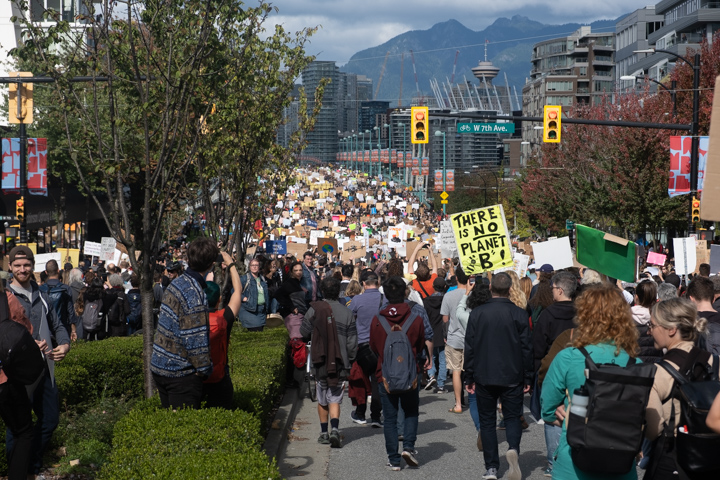
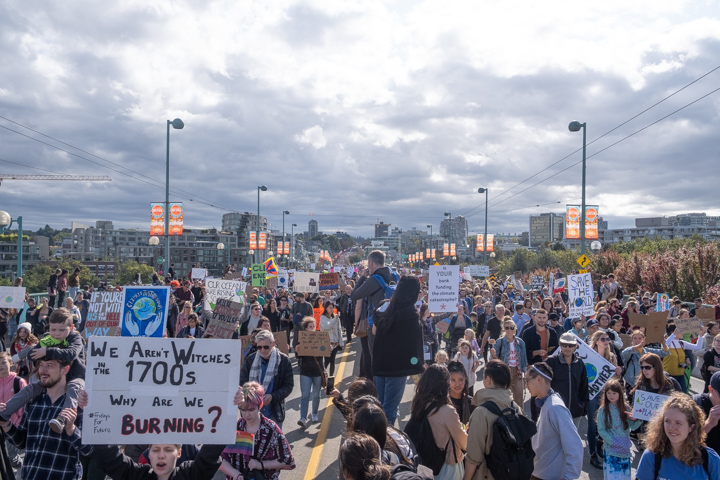
I went and so did lots of others, but many couldn’t so I thought I’d try to share the scale and the feel.

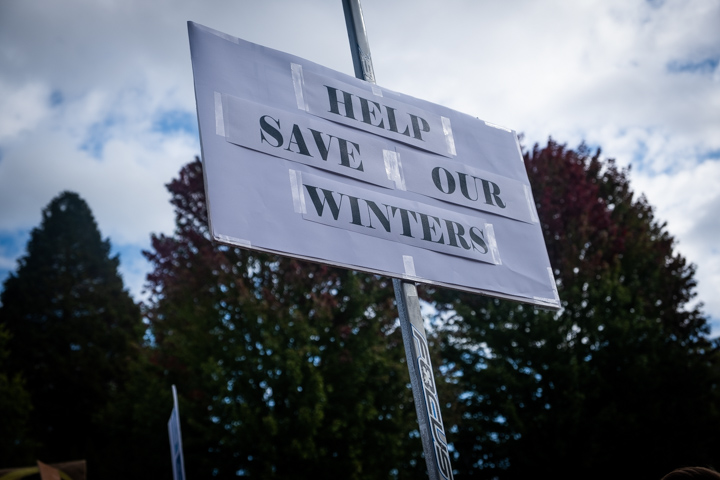
Help Save Our Winters

(Mounted on a hockey stick)

I’m pretty old and cynical and still, this felt like it mattered. Even though it was good-humored and consciously funny. Partly it was just the scale — one of our big north-south thoroughfares full of streaming strikers it seemed forever, but they say the peak of the parade only lasted an hour and a half. The police estimated a hundred thousand but they are prone to undercounting based on an institutional fear of too many people in one place going the same direction. Having said that, the cops were pretty exellent, see below.

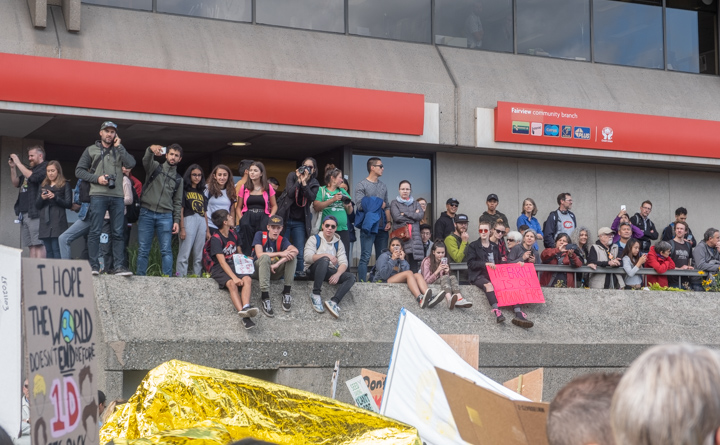
Many spectated.

Spectators at the Climate Strike

The crowd was young, people whom they say don’t vote, and anyhow many were too young to vote. But their good-humored passion could not fail to lift hearts. Well, mine anyhow.

This Pipeline Shall Not Pass

Not that I was the only greybeard. If you’d subtracted the kids it still would have been a pretty big deal.

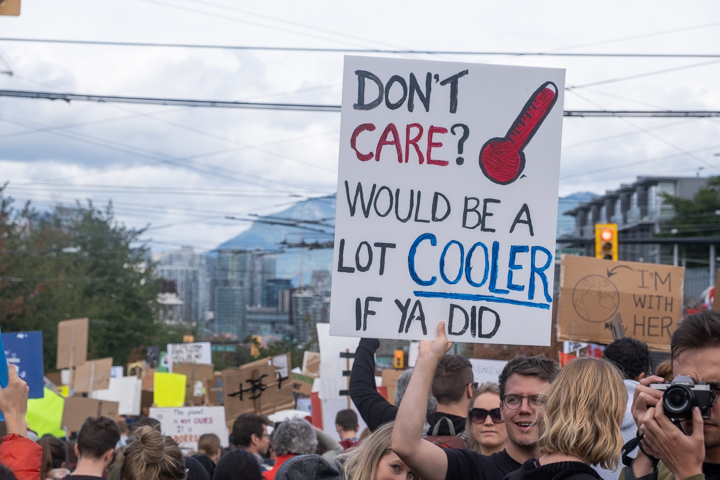
Don’t Care? Would Be A Lot Cooler If Ya Did

I didn’t get a picture of the kid with the sign saying “I’m skipping Fortnite to be here!”

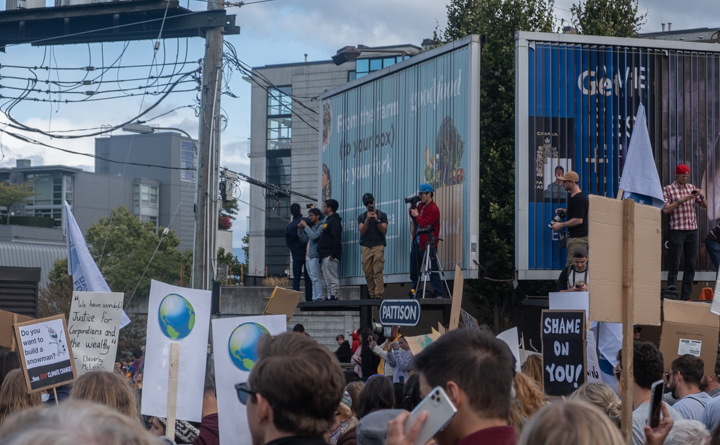
Photographers at the Climate Strike

Once we got downtown, all the balconies and windows were full of people watching.

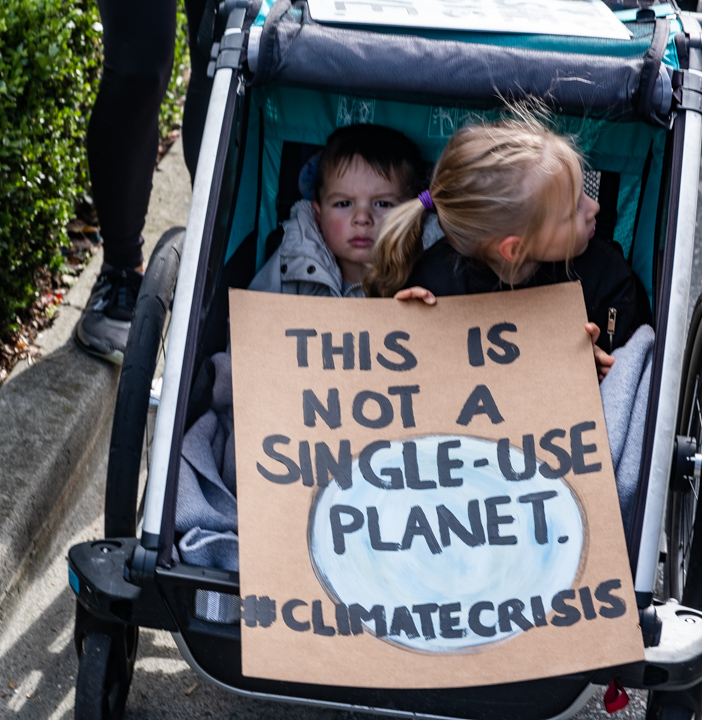
This Is Not A Single-Use Planet

The most popular chant was “What do we want?” “Climate justice!” “When do we want it?” “Now!” My voice is hoarse today. That chant is a common variation on a very old theme but it was the first time I’ve been part of it. After a little practice, the crowd gets into a more practiced and powerful rhythm; in particular the “Now!” becomes an explosion, elating to be part of and maybe a little scary for the intended audience. I hope so anyhow.

There Is No Planet “B”

There was this skinny little guy walking along, well under 10, whose chant was “Want to play in the snow? Stop global warming?” Pretty pedestrian, but he had a surprising volume and amazing endurance, he kept going and going and going and eventually the rhythm was fascinating and voices around him stilled.

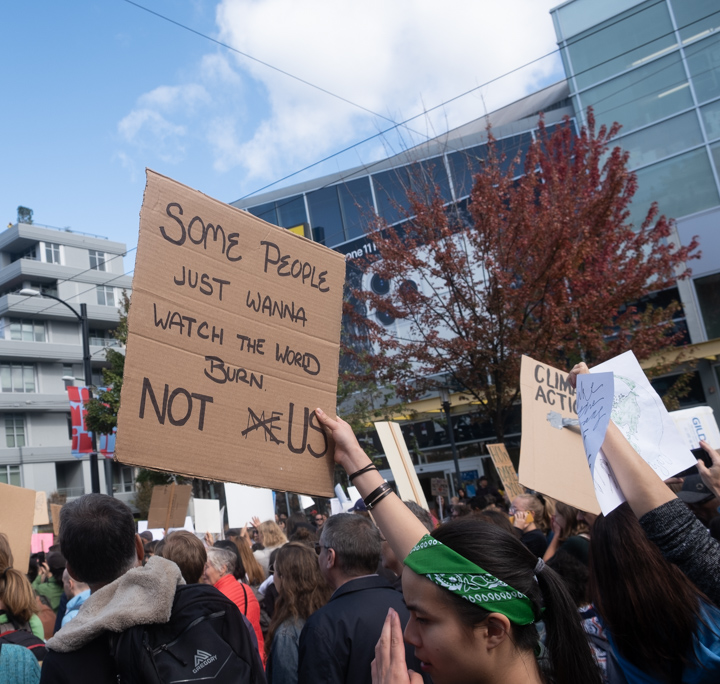
Some People Just Wanna Watch The World Burn

I was shocked that Justin Trudeau, pipeline promoter, had the gall to appear at the Montréal strike. His smarmy-robot mantra about “The environment and the economy” isn’t fooling anyone any more. The best route to a sound twenty-first century economy requires creative destruction centered on the fossil-fuel sector. There’s plenty of capital and demand and opportunity to fill in behind, but first we have to step away from petroleum extraction, big-time.

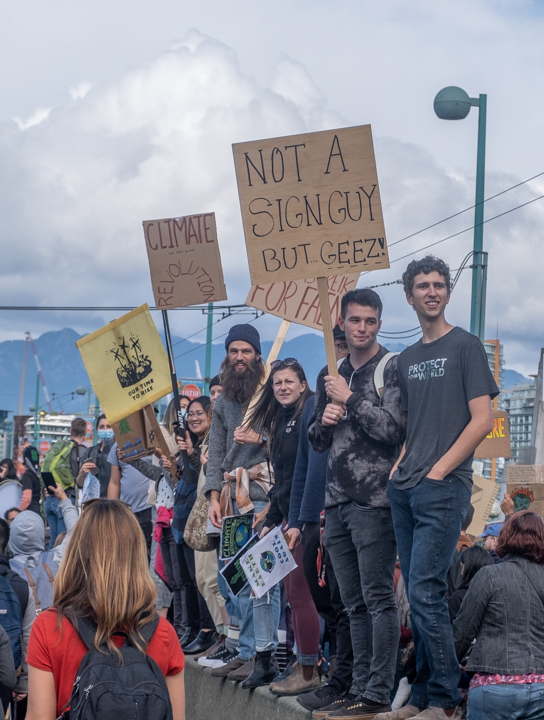
I’m Not A Sign Guy

Towards the end of the route, the crowd started piling up and I couldn’t make any forward progress. Somewhere up ahead I could hear speeches, but the point had been made and my feet were killing me, so I took the train home. Hats off to Vancouver’s cops and TransLink’s helpers who kept the throngs moving through City Center station and damn did they ever have those trains shuttling through on the double-quick. I admire calm-faced competence when I see it.

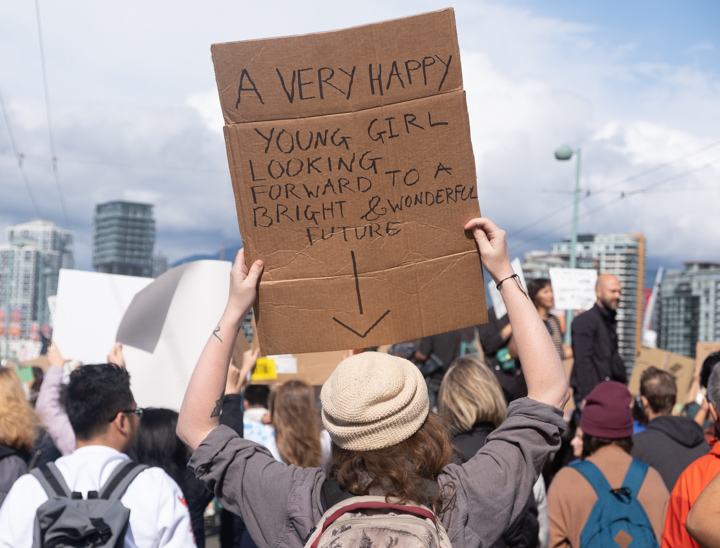
A Very Happy Young Girl

Everybody was self-congratulatory about the nonviolence and good cheer, and unlike other recent events, there are no counter-demonstrators in evidence. The contras are all behind the walls of the glass towers our chants were echoing off of, and those guys are way too busy to pay attention.

When the waters start rising and the crops start failing, the glass will start breaking.

We Aren’t Witches

A few signs here and there were really obscene, a repeated theme of, uh, let’s phrase it as inappropriate sexual relations involving a female parent. 100% of the people carrying these were women.

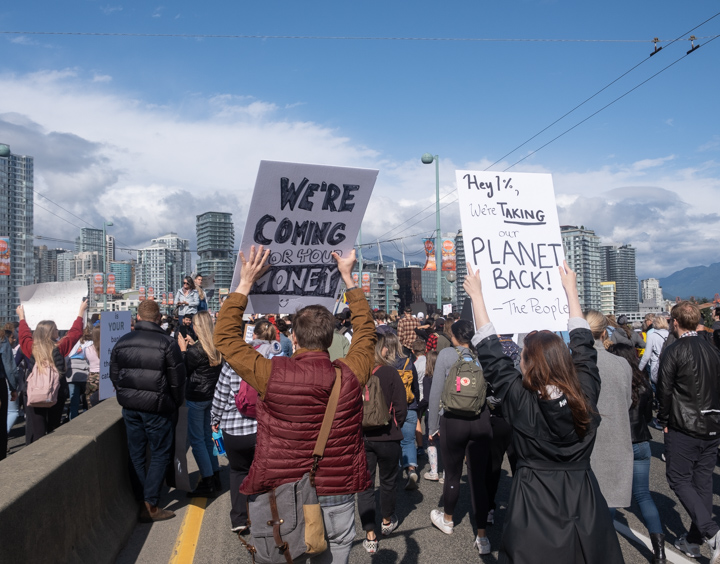
We’re Coming For Your Money

And of course, there were a variety of other causes looking for listeners in what smells like the progressive mainstream. Communists, vegans, co-operative housing advocates, I even saw a sign for the IWW, which I thought as a sort of historically-significant exotic fringe thing when I was a hot-headed young leftist 40 years ago. Seems the Wobblies have staying power.

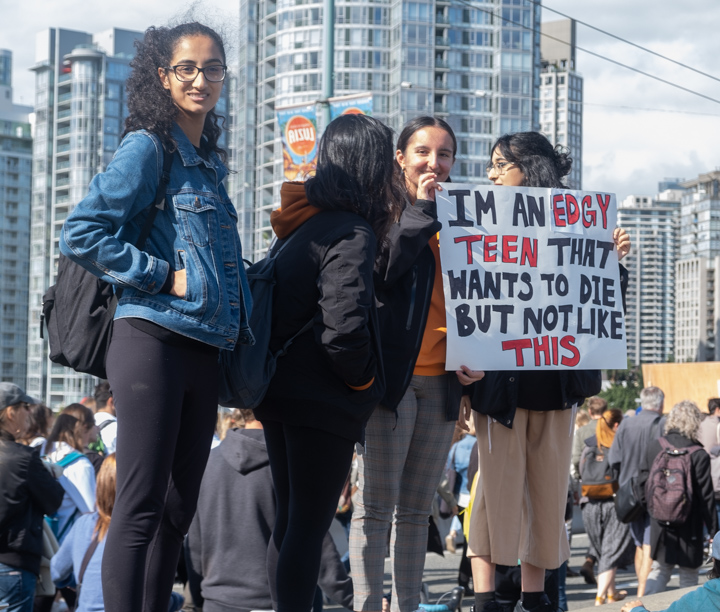
I’m An Edgy Teen

The cops had been smart, blocked access to the Cambie bridge and its feeders well in advance. Things went a little sideways downtown where a lot of people were trying to commute or go shopping and unfortunately got on the wrong cross-street and ended up motionless for a couple of hours while the strikers streamed past. I hope nobody’s life was seriously damaged, but a lot of lives are going to be seriously damaged if we don’t get our climate-change act together.

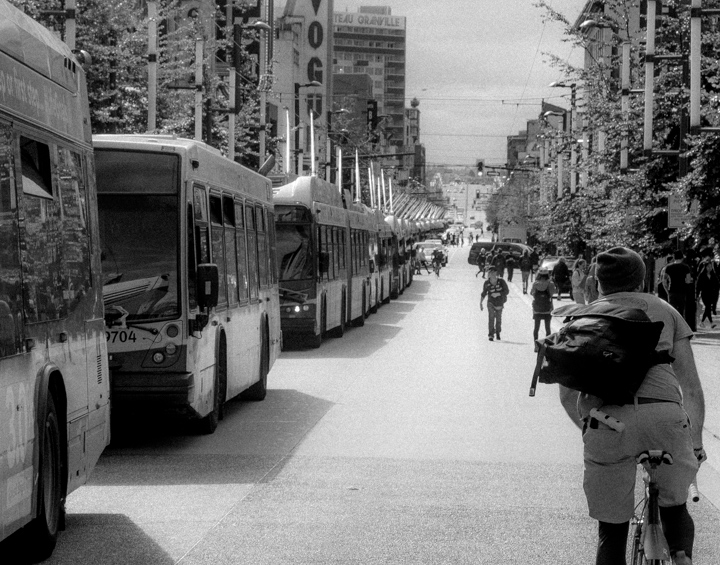
The buses were blocked on Granville Street.

Halted Buses at the Climate Strike

You’ve probably heard of airplane boneyards, places in the desert where they park hundreds of disused unwanted jet planes? When sanity sets in and it becomes just too expensive for people to waste energy the way internal-combustion cars do, there’ll be auto boneyards too.

30 Sep 03:15

IndieWebCamp Amsterdam After Event Notes

by Ton Zijlstra

IWC Amsterdam day 2 focused on doing. We started with a round of idea pitches that the dozen people present intended to work on, as well as listing things people could assist with.

IndieWebCamp Day 2All work ideas on a ‘windows wiki’

Then we all worked in different constellations until lunch, which we enjoyed at Hannekes Boom. Lunch, just like yesterday, took a bit more time as conversations were animated. We got back to work later than planned therefore and moved our time for demo’s correspondingly. Demo”s were live streamed, with Frank joining us remotely. With a final group picture we closed Indiewebcamp Amsterdam.

Lunch Day 2During lunch

On the train home I am jotting down notes for future editions.

Find the local others
First of all, while we did have more local, meaning Netherlands based participants than last time, we didn’t get any tangible interest from the networks Frank and I have access to. Without the interest of the wider international Indieweb community and holding the event in conjunction with two similarly themed international conferences the event would not have been a success (We had just over 20 people on day 1).
Though for the Utrecht event last spring it might have been because we announced it relatively late, this was definitely not the case for the Amsterdam event. This I feel at least partly comes from not being clear enough in explaining the intent and purpose of Indieweb. That is most likely why three of us dutchies worked on Dutch language texts to draw more people in. E.g. by avoiding jargon until you’re sure the reader gets what you’re saying.

A better on-ramp for new participants
Organising an indiewebcamp is fun and not particularly difficult if you have done small informal events like barcamp before. I think we do need to become better at catering to all levels of proficiency so we can be more inviting to those we think we want to include, especially locally. Perhaps by having a few preset intro sessions as a track you can announce, in contrast to the otherwise unconference approach.

Eventbrite not fit for this purpose
Both for the IndieWebCamp Utrecht and for this Amsterdam edition I used Eventbrite for registrations. This I will not do again. First it feels like a clash with the IndieWeb spirit, and there are IndieWeb ways for this available. More importantly it leads to fake and spam registrations, as well as a higher percentage no-shows. Where for a more formal or bigger event, Eventbrite can be really useful (I’ve used it for organising international conferences with up to 350 participants), for small informal ones like this the promotion Eventbrite itself gives to a listed event through their own channels only creates unwanted noise. Meet-up might be more useful in comparison even, as that is based of building up a group of people, and then host events for them. That fits the model of seeking to create a wider active audience for IndieWeb much better.

Setting a rhythm
I think for next year doing two events is again a good option. We will need to work harder though to get a more local crowd. Having our IndieWeb colleagues from abroad visit us is great, and most welcome (to both ensure connection to the wider community as well as for the enormous experience and technological knowledge they bring with them), but not enough to sustain doing these events. Having two in a year may seem contradictory to this, but it likely can serve to set a more observable rhythm. A drumbeat that can draw in more people, and can mean someone not able to join one event may be motivated to commit to the next one if it’s already on the horizon. I think Frank and I would do well to fix dates early for both events and announce them both at the same time.

Ability to live stream
Being able to stream the sessions is a key element of IndieWeb events, but we’ve now depended both times on existing experience and gear from outside. In Utrecht Rosemary brought everything we needed from Vienna and set it up for us. In Amsterdam she volunteered to do it again but ultimately couldn’t make it. If not for Aaron also participating, we would have gone without live streaming as he happened to have the gear for two simultaneous streams with him.

Have a third organiser
Due to family circumstances the Utrecht edition was mostly done by Frank, and this Amsterdam edition mostly by me. Not a problem, and I felt fine doing it throughout, simply because I’ve done loads of these type of events. Yet, being able to hand-off things to each other makes for a smoother experience all around, especially facilitating during the event itself. Frank and I need to bring a third co-organiser on board I think to be able to set the pace of doing two events next year, and avoid that most of the work falls to just one of us. Again, not because it can’t be done, or was an issue, it really wasn’t, but it is a continuity risk, and it’s more fun together.

Frank during his demoFrank on-screen doing a remote demo of his work today

30 Sep 03:14

Subscribing to Everything a Publisher Publishes

by peter@rukavina.net (Peter Rukavina)

Many years ago I found myself in Boston with Catherine Hennessey and we found our way to the New England Mobile Book Fair, which is, despite its name, neither mobile nor a fair, but rather an excellent firmly-held-in-place independent bookstore.

The store, at least at the time, organized some of its titles by publisher, rather than by topic or author, and this proved an invaluable aid to finding books I wouldn’t otherwise find, especially from publishers with a focus on a particular domain or approach to publishing.

I’ve yet to come across another bookstore that organizes books this way, but I’ve recently come across something even better: a publisher that allows you to subscribe to everything they publish.

Portland’s Microcosm Publishing has a BFF Subscription that, for a sliding-scale price, with a recommended $100 US per six months, gets you one of everything they publish:

Do you want us to publish more books that empower readers to change your lives and worlds?

Would you like to receive each new title as it’s published?

Subscribe as a BFF to our new titles and we’ll send you at least ten new titles that we publish over the course of six months!

The 6-month subscription is on a sliding scale, pay-what-you-can-afford fee with postage included. In addition to reading, we try to include any other material that we make.

Microcosm has a fascinating array of books and zines in its catalog; I came across their Bikequity, Bikenomics, and Bicycle/Race at Drawn & Quarterly last week in Montreal and bought all three. I’m looking forward to a regular dip into this well.

30 Sep 03:13

Recommended on Medium: Exploring Toronto Voter Statistics using Golang

An examination of Toronto municipal voting trends as the Canadian federal election starts and American presidential election approaches

Continue reading on Towards Data Science »

30 Sep 03:13

Twitter Favorites: [TeamUfYH] Never underestimate the power of clean sheets and a clean you. If you’re not feeling 100% (physically or mentally),… https://t.co/Ev2HzuMkA4

Unfuck Your Habitat @TeamUfYH
Never underestimate the power of clean sheets and a clean you. If you’re not feeling 100% (physically or mentally),… twitter.com/i/web/status/1…
30 Sep 03:13

[4K] Tech Focus: Radeon Image Sharpening - What You Need To Know

by DigitalFoundry
mkalus shared this story from DigitalFoundry's YouTube Videos.

From: DigitalFoundry
Duration: 12:18

Tech Focus returns with a closer look at Radeon Image Sharpening - a feature for Navi and Polaris graphics cards and an open source component of AMD's new FidelityFX. What's it best used for? What are its limits? Everything you need to know is right here.

Subscribe for more Digital Foundry: http://bit.ly/DFSubscribe

Join the DF Patreon, support the team more directly if you love what we do and get pristine quality video downloads: https://www.digitalfoundry.net

30 Sep 03:10

Samsung Galaxy Note 10 and Note 10+ Camera Review: Show me the night

by Ted Kritsonis
Galaxy Note 10 camera

In most cases, especially in recent memory, Samsung has tried to add something to the Galaxy Note that was missing from the Galaxy S. With the Note 10 and Note 10+, that’s not necessarily the case.

Rather than try to add a tangible or functional change, Samsung opted to harken back to an earlier time where gimmicky features reigned. Many of said features back then were since abandoned, never to be further developed for lack of traction. It’s a circumstance that comes to mind with some of what the Galaxy Note 10 and Note 10+ have to offer.

What Samsung introduced in the Galaxy S10 lineup made its way to these phones, maintaining the strong iterative tie between them. What’s different is a new set of options and modes designed to complement the existing camera. The third ultra-wide lens is also in the rear, adding an additional perspective, but there was an opportunity to do something more here.

Shooting with both Note 10 devices offered plenty of familiarity, albeit with results that could have been tantalizingly better. For everything else about the newest Note 10, MobileSyrup’s Patrick O’Rourke covers all of that.

Breeding familiarity

It’s always interesting to me when a phone gets a noticeable change in form factor, yet doesn’t come with a redesigned camera package. The svelte Note 10 (I’ll refer to both devices by that from here on, unless otherwise noted) is a sweet-looking device, with a cool iridescent back. True, that back also includes the 16-megapixels ultra-wide lens to bring it in line with the Galaxy S10/S10+.

All three lenses are identical with the same image sensors. If Samsung was going to change anything, it would have to be on the software side. Yes, there is the DepthVision camera in the back of the Note 10+ (the Note 10 doesn’t have it), but I’ll get to that later.

Even from a software perspective, the general makeup of the interface and its various modes appear intact. Whatever was brought in for the S10 models is also here, including features introduced in the flagships of 2018.

Samsung erred greatly when it didn’t include a Night mode with the S10 phones, only doing so as a software update afterward. The mode finally addressed the elephant that’s been in Samsung’s room going back a long while: low-light photos. Mechanical apertures and AI-driven scene optimizers are nice, except there was no way to emulate a long exposure shot when holding the phone in hand.

Samsung added the ability to shoot with Night mode on all three lenses, rather than only the standard wide lens. It’s a great move, and one that ensures you can theoretically capture any subject in dark conditions.

I do wish, however, there was greater control when shooting with it. Unlike Huawei’s night mode, there is no way to stop the exposure in progress (for less light sensitivity) or adjust ISO and shutter to gain more control over how the exposure will look. Instead, this is the school of ‘just point it at something dark and fire away.’

Firing away

There are still elements to this camera array that irk me, though I recognize my gripes may not be shared by many. For example, for a phone of this calibre and price, I should be able to shoot in Pro mode with any of the three lenses, not just the standard wide one. I also understand that Photo mode automatically selects between the f/1.5 and f/2.4 apertures, but I think that should be elective too.

Samsung quietly made Scene Optimizer available on all three lenses as well — something that was bizarrely missing when the S10 phones launched. The idea is to make it as easy as possible to shoot photos without finagling too much with the options and settings. It recognizes a scene and makes adjustments to maintain dynamic range.

In that regard, the Note 10 performs well, offering a higher level of dynamic range than some competitors do, especially in bright scenes. There is a level of detail that stays intact, where textures and text are visible with well-lit sharpness. Where Google’s Pixel phones are heavier on contrast, and Huawei’s regarding highlights, the Note 10 strikes a pretty happy medium in those scenarios.

That Samsung excels in daytime or good lighting is hardly a surprise. The company has routinely been among the best at shooting great photos in those conditions. Even the Pro mode, which I’ve long touted as worth learning for any interested mobile photography, has plenty of upside. Previous to the Night mode, Pro mode was the best way to shoot in low-light. Even better if you shot it in RAW and then worked on the photo in a post-processing app like Lightroom.

The problem with the Night mode’s dynamic range is that it doesn’t always have a happy medium. For instance, it can sometimes introduce noise in pitch black areas while overcompensating in bright portions. Or it could do the opposite. What you focus on makes a difference. Either way, it’s a mode you should only use for static scenes because moving subjects will blur beyond recognition.

It’s considerably worse with the telephoto lens, but that’s understandable, given the tighter aperture and greater sensitivity to hand shake. The ultra-wide lens offers greater stability, yet at the expense of dynamic colour and tone.

Waving the S Pen

Galaxy Note 10 camera

The Galaxy Note 9 introduced the novel concept of making the S Pen a camera tool. It was a great idea, and I put it to good use when shooting photos from tougher angles, or in long exposure shots on Pro mode.

The new gesture controls called Air Actions were designed to control some of the camera app’s interface. It’s an interesting concept, though fraught with inconsistency. A simple swipe up to switch from rear or front cameras was probably the easiest one to pull off. The others, however, not so much.

I could rotate clockwise or counter-clockwise to zoom in or out, effectively switching between the three lenses in the process. When it worked, it was neat, but too often, it simply didn’t register. The key was in holding the pen’s button while doing the action. The phone could only ‘see’ one action at a time. Once I stopped moving the pen, I needed to hold it down again to perform another gesture.

Like anything, it takes some practice to get the timing right, assuming you have the patience to do so. Switching between camera modes is relatively easy, with simple left or right swipes. Selfie fans may like how all this works, but for me, it was mostly about using the pen as a shutter.

Shooting in depth

Samsung played up its new DepthVision camera, a Time-of-Flight (ToF) sensor in the rear that is only in the Note 10+. In a nutshell, it uses the speed of light to measure distance, calculating how long it takes for a beam to reflect back to the sensor. The result is an image with dynamic and eye-catching depth of field.

And so, Samsung applied the sensor to shooting in Live Focus, the adjustable depth of field photo mode. It now has a video counterpart, and with the ToF sensor, can offer some unique blur to the background. There are now four different effects, with spin, zoom or a colour point to make them look more dramatic.

What Samsung never mentioned was that this iteration of Live Focus is heavily weighted on faces. It always was, but the problem is there’s little room for creativity when it comes to using it to shoot objects. I tried doing it with a car and it never looked right.

With people, it also had its drawbacks. Strangely, it would try focusing on multiple faces at once, which made the final image unusable. In another instance, the colour point effect colourized an additional person’s face even though they were clearly behind the subject by at least a few feet. Again, not a usable image.

While I like the idea of improving bokeh effects in mobile photography, Samsung needs to figure out how to make it more bulletproof. As is, it feels unpolished and in need of better intelligence to recognize who or what is in a scene.

This camera has bigger implications for AR (augmented reality) capabilities, which is why Samsung ensured there was something to play around with. AR Doodle, the feature that lets you use the S Pen to draw on anything or anyone onscreen and make creations “stick” to the subject, is an acquired taste. I’d prefer to see Samsung implement an extension of the feature whereby a user can draw on an object as a reminder. It could be an appliance at home or something at work.

Stable video

I mentioned video with the DepthVision camera, but there was also a new addition with Super Steady mode. This is a carryover from the S10 phones, and works in exactly the same way. It basically uses the ultra-wide lens and applies a crop factor to reduce any shakiness when shooting a clip.

Super Slo-Mo mode, much-hyped when the Galaxy S9 launched, is little more than a throw-in now. It maintains the same 720p resolution with a blizzard of grain, making it unusable in anything but bright conditions.

AR Emoji is also still kicking around, though I’m not sure what kind of retention it truly has. This was also a hyped feature going back 18 months to when the Galaxy S9 launched, and despite an effort to drum up third-party support, it seems to be somewhat forgotten.

Trying new things

Much like the Galaxy S10 lineup, Samsung took a cautious approach to the camera with the Note 10 duo, preferring to keep the two close together. The differences between them are about potential rather than actual output, as is the case with the DepthVision camera. Indeed, the new features were less about photos than they were about the act of capturing them.

This places more pressure on the company to not only update Night mode to make it better in the near term, but also come up with something innovative and competitive with next year’s phones. The mobile camera arms race is serving notice to consumers that other brands have something worth looking at.

The post Samsung Galaxy Note 10 and Note 10+ Camera Review: Show me the night appeared first on MobileSyrup.

30 Sep 03:10

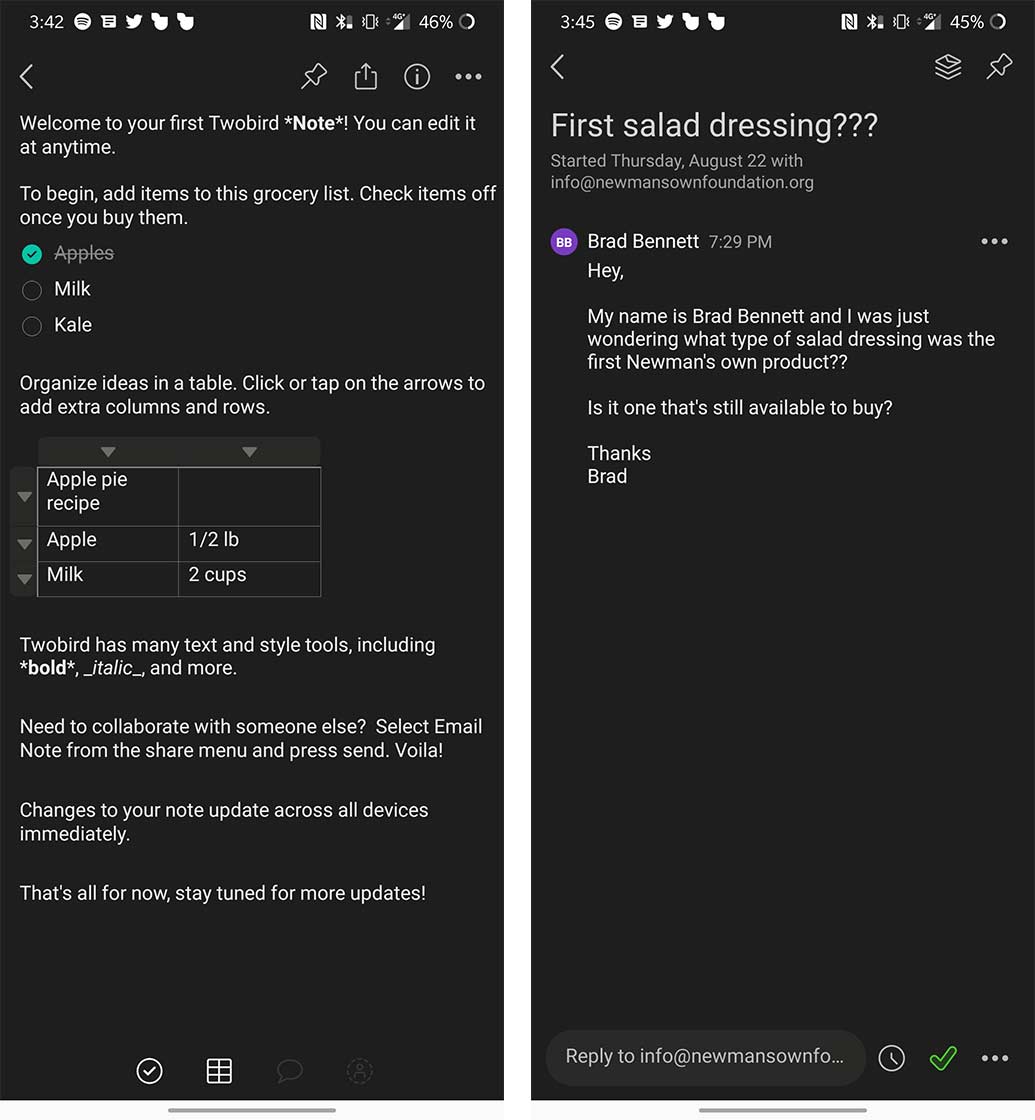
Twobird is an excellent looking email app that’s on the verge of greatness [App of the Week]

by Brad Bennett

Finding the perfect email app can be a challenge, but Twobird from the makers of Notability might just be able to solve this problem with its clean design and multi-platform nature.

The app is a relatively simple email client that also has a notes section built into it — hence the name Twobird.

Where it excels

The best thing about Twobird is that it’s available to download on Mac, Windows, Android and iOS. While this might not matter to every user, people who use two or three of these devices will know how much more comfortable having the same experience across several platforms is.

Building off of that, it features the same expert design on each version of the app too. This includes pops of colour, light and dark modes and a simple layout that is easy to understand.

The app also does a good job of sorting emails into high and low priority inboxes.

On the tools side of things, you can set Twobird to remind you of an email later, create a link to an email so you can easily share it and there’s also a ‘pinning’ option. Even though there isn’t a lot of tools, the functions that are offered are all things that I use often, and the lack of overwhelming options helps keep your inbox simple to use.

The ‘Notes’ section of the app is also simple and only features the bare necessity when it comes to writing tools. Users can use ‘#’ beside words to turn them into headings, add checkboxes and tables plus a few other text formatting options for bold, italics and strikethrough. You can even set the app to remind you of notes later making it function like a reminder app.

You can also invite other users to collaborate on your note even if they don’t have the app.

What’s holding it back

While the main inbox layout is spectacular, there are some flaws. Reading a thread of emails can be a chore since they often get disorganized if people have long signatures. On top of this, the font sizes in the body text and the email headers are often close in size resulting in ill-defined spacing bad confusing layouts.

It also nests emails like older clients, which is a bit annoying. This means that as you scroll through a thread, you’ll see previously sent and received emails often. I much prefer how Gmail and some other mail apps sort emails.

There’s also nowhere to add an email signature of your own, so you have to type it out every time you send an email.

Even though the app has several problems, it’s still in early access so I can hope that a lot of these features get worked out as the developers spend more time refining Twobird.

The strength of the app’s design and its high and low-priority inboxes was what drew me to it in the first place, but until it adds in signatures and a less confusing email reading experience, I’m not sure I can commit to it as my main email app.

If you’re someone who doesn’t use a ton of email this app could be perfect for you since most of its main interface is really simple and well thought out.

You can download Twobird for free on desktop from the company’s website and on iOS and Android for free as well.

The post Twobird is an excellent looking email app that’s on the verge of greatness [App of the Week] appeared first on MobileSyrup.

30 Sep 03:10

The moral market: How a rise in ethical consumption pushed veganism mainstream

mkalus shared this story :
“Ethical consumerism”. Talk about Bullshit.

When Elyse Jacobson, a professional violinist, was on tour in Denmark, she remembers a time when her diet requests failed to register.

"We got to the venue [and] the promoter who was a very sweet, friendly man was describing to us that, you know, there's lots of meat for your dinner," Jacobson said from Vancouver, B.C. 

When she explained she was vegan, he didn't skip a beat.

"He said, 'Oh, no problem, I'll have them bring you some fish,'" she said with a dry laugh.

That was nine years ago. Today, Jacobson, 35, says people are more aware of vegetarian and vegan diets. She's the administrator of the Vancouver Vegans Facebook group, which has more than 8,000 members. Seven years ago it had just 250 members.

Jacobson doesn't eat meat, fish, dairy, eggs, or honey. She also avoids wearing animal products such as leather, using products tested on animals, and supporting businesses that use animals for entertainment, like zoos and circuses.

Vegan as ethicial choice

Abstaining from meat has a long, rich history, with roots in world religions like Hinduism, Buddhism and Jainism.

Today, in light of the growing climate crisis, vegetarian and vegan diets have gained new currency as the ethical choice by animal rights activists and environmentalists as a way to protest factory farming conditions and the industry's carbon footprint.

"People choose to make ethical consumption decisions most closely related to a desire to reduce their impact on the environment," said Emily Kennedy, a professor of sociology at the University of British Columbia, who studies ethical consumption.

"In terms of the emissions from animal agriculture, we really don't have a good set of policy options right now, so ... veganism is actually a fairly decent option."

A B.C.-led trend

Jacobson became vegan in 2010 after watching a documentary on the use of animals in industry.

"It affected me really deeply and I kind of knew as soon as I watched [it] I had to make a change," she said.

And she's not alone. A recent study from Dalhousie University showed the number of Canadians interested in these diets has risen over the last few years.

Women are 1.6 times more likely to consider themselves vegetarian or vegan than men.

Consumers living in British Columbia are three times more likely to identify as vegetarians or vegans than consumers living in the Prairies or the Atlantic Region.

And those under 35 are three times more likely to consider themselves vegetarians or vegans than those 49 or older. 

'It's exploded'

While the sheer number of vegans is still not large — B.C. has the highest proportion in the country at 1.6 per cent — Jacobson has noticed a rising interest in the idea of veganism.

She estimates the Vegans Facebook group she administers has grown by another 1,000 members this year. 

"It's exploded," says Jacobson.

"There are just vegan and vegetarian restaurants ... We have a vegan shoe store in Vancouver. There's a vegan cheese shop."

Part of this 'explosion' in interest is fuelled by a larger societal shift about how we view our consumer choices. 

According to Kennedy's research, the connection between personal shopping choices and ethics has heightened in recent years in tandem with a growing concern for the environment.

Personal shopping choices now carry the weight of the planet in every transaction, she says. 

"You demonstrate [you are] a really ethical person by making moral choices through what you buy."

Kennedy says there are two reasons for this shift. 

One, trust in the government's ability to make change is declining. Two, people are short on time and making an ethical consumer choice at a grocery story is much more convenient than traditional modes of political activism like attending town hall meetings. 

Ethical consumption makes consumers feel like they can make daily choices that can tackle an overwhelming issue — that of climate change or industrial scale factory farming. 

Limits to ethical consumption

But using the power of your wallet to make social change has its limits. 

While going vegan has a positive environmental impact, Kennedy says it doesn't have the same impact as more overt political changes like collective action or government policy like regulations to change how global supply chains transport goods, or how the way we raise animals.

Also, a vegan crop that is mass-produced may still depend on cleared rainforest land, long-distance transport, or other environmentally-harmful practices.

"The food system is just morphing to add these ethical options, while continuing to maintain unethical labour and production practices," Kennedy said.

Jacobson knows that any choice will have ethical conundrums — but maintains doing something is better than nothing. 

"To me being vegan is not about pretending that it's possible for us to cause zero harm," she said.

"It's really about minimizing the amount of harm that we caused to the fullest extent possible."

Growing Vegan is a multiplatform CBC Vancouver series that explores how the business of veganism thrives in B.C. Follow the series on The Early Edition weekday mornings and On The Coast weekday afternoons on CBC Radio One, and watch CBC Vancouver News at 6 weekdays and read the daily stories online at cbc.ca/bc.

29 Sep 01:15

Twitter Favorites: [skinnylatte] It forces me to think about my food holistically. I used to eat out every couple of days, which would break the pro… https://t.co/Rqmjq6wVhJ

Adrianna Tan @skinnylatte
It forces me to think about my food holistically. I used to eat out every couple of days, which would break the pro… twitter.com/i/web/status/1…
29 Sep 01:15

Twitter Favorites: [ReneeStephen] Me: "Yay, I successfully ate under my calorie balance for the day!" A small handful of peanuts: "Or DID YOU?"

Renée Stephen @ReneeStephen
Me: "Yay, I successfully ate under my calorie balance for the day!" A small handful of peanuts: "Or DID YOU?"
29 Sep 01:00

Ultrawide opens new perspectives

by Volker Weber

99c502fa09416643acad90795a39c695

Novice photographers always enjoy their first zoom lens. They can finally zoom into a photo without losing detail. Often you can get a similar effect by just walking closer. Backing up isn't always an option like in this indoor climbing venue. This isn't even the whole wall.

After the break I will open up a few perspectives going from 52mm, to 26mm and then 13mm on an iPhone 11 Pro. These photos are downsampled.

29 Sep 00:59

Pollard’s Laws and XR

by Dave Pollard


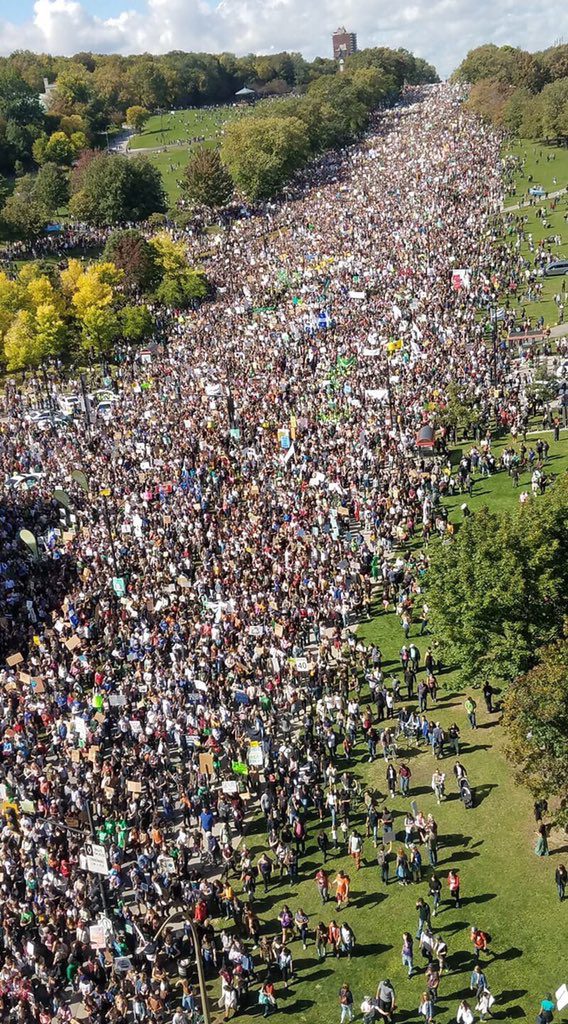
some of the half-million Montréalers who participated in yesterday’s climate march; from Greta’s twitter posts

One of the things that intrigues me about XR is that their three demands are simple, measurable and revolutionary:

  1. Government must tell the truth by declaring a climate and ecological emergency, and working with other institutions to communicate the urgency for change.
  2. Government must act now to halt biodiversity loss and reduce greenhouse gas emissions to net zero by 2025.
  3. Government must create and be led by the decisions of a Citizens’ Assembly on climate and ecological justice.

The actions of XR are all about government action, because XR believes (a) that many people already know there’s a climate emergency, and those that don’t will eventually be persuaded by rapidly-occurring changes, so it’s government that has to change, not public will, (b) meeting demand 2 will dictate unbelievably rapid and radical policy changes and actions in every area of government, so no other stand-alone actions, like emission quotas, ludicrous cap-and-trade schemes, and conservation regulations will be necessary, and (c) the Citizens’ Assembly, properly constituted and empowered, lets elected officials ‘off the hook’ for the very unpopular decisions they will need to make to meet demand 2 (they can say ‘the Citizens’ Assembly forced us to do it’, much as they now blame courts and others for things they do reluctantly).

What’s more, the clever wording and structuring of these ‘simple’ demands essentially recognize the truth of what I have been calling for the past 10 years (because they seem to hold up so well as more and more evidence comes to light), Pollard’s Laws. I thought it would be useful to explain how these laws apply and how XR so brilliantly recognizes and taps into them. So here they are:

Pollard’s Law of Human Behaviour: Humans have evolved to do what’s personally urgent for them (the unavoidable imperatives of the moment), then to do what’s easy, and then to do what’s fun. There is never time left for things that are seen as merely important. Social, political and economic change happens only when the old generation dies and a new generation with different entrained beliefs and imperatives fills the power vacuum. We have evolved to be a collaborative and caring species, and we are all doing our best — we cannot do otherwise.

Until XR, Greta and others who acknowledged the existential peril of climate catastrophe came to public attention, most polls indicated that the majority of people in most countries with decent education systems and information systems, believed a climate catastrophe was a real possibility, but conceded they were unwilling to change their lifestyle to address it — other priorities were considered more important and more urgent. That has changed very quickly; recent polls (and the Swiss gnomes who rate the world’s greatest risks) have quite suddenly acknowledged the climate catastrophe as our most urgent priority. If taken to heart, that moves the issue from the #4  category (merely important) to the #1 category, which has huge ramifications for governments and public policy.

This is particularly notable because grappling with this predicament is the opposite of easy, and the opposite of fun. (Neither are the climate marches a picnic.) It remains to be seen whether the shift will continue to gain momentum or fizzle out, but the odds of the former are increasing.

This movement (perhaps like the anti-war movement of the 60s) is a youth-driven phenomenon, and its elder leaders (like Roger Hallam, who’s much like Gene McCarthy in the 60s ) draw all their energy from the young. If the young show up in significant numbers, not only in the streets but at the polls and in the legislatures, they could dramatically change party platforms, election results and key vote outcomes, especially if XR stays true to its policy of relentless but non-violent disruption, so they can’t just be ignored.

When I meet conservatives now, it is obvious that most of them are realizing that they cannot possibly look young people in the face, including their own children, and baldly deny that their actions and inactions are accelerating climate catastrophe and imperilling their and other children’s futures. Just as radicals were ostracized in the ’50s and change resisters were likewise running for cover in the ’60s, it may be that for the rest of this decade, at least, global polluters and the politicians that pander to them will be excluded and shamed. That will be, perhaps, their final legacy, and their arguments that they didn’t know any better will carry no weight, least of all to their children.

If this shift can continue (and it may not, as we learned from the progressive movements of the 60s), we may see something of a quiet revolution, as the old step aside and, at least, say “OK, here are the reins of power, see if you can do any better.”

This mindset is clearly evident in the actions of Canada’s tarnished try-to-please-everyone pseudo-progressive PM Trudeau, who marched, heckled much of the way, in yesterday’s Montréal climate strike march, along with 400,000 others, led by Greta Thunberg. He met with her, and she told him, as she’s told other world leaders, that he’s not doing nearly enough. Perhaps it’s the idealist in me, but I think he marched not because it was politically expedient (his principal rival, in the current polls at least, the arch-conservative Andrew Scheer, whose do-nothing climate plan has justifiably been dismissed as “obscene”, was a no-show), but rather because he knows that climate catastrophe has arrived, and that he in fact has done much less than “not nearly enough”. He marched, of course, with his children. Could he have not?

We are all doing our best, and despite the enormous inertia in our political, social and economic systems, and despite the staggering cost that mega-polluters, foot-draggers, denialists and self-righteous 1%ers will have to face if they lose this battle (many of their corporations, to meet demand #2, will be quickly rendered worthless and wiped out), and despite the 1%’s massive economic and political clout, it is not inconceivable that power and law could radically shift, and the next few decades become a universal all-hands-on global battle to mitigate centuries of destruction. In some places, there was such a shift (including 90% personal and corporate tax rates) in the 1930s, when the urgency of ending the Great Depression at any cost became undeniable even to those buffered from it.

I think it’s too late, and that, even with enormous and coordinated political will, system change cannot happen nearly fast enough to prevent climate collapse (and economic collapse) bringing down industrial civilization in this century. But I’m stoked to see us try. Already, over 1,000 political jurisdictions have met the first part of demand #1.

My pessimism in the face of such a possible major shift in collective will has little to do with human nature and much to do with how change happens in complex systems — including ecosystems and social systems. That’s the subject of my second ‘law’:

Pollard’s Law of Complexity: Things are the way they are for a reason. To change something, it helps to know that reason. If that reason is complex (and it frequently is), success at truly understanding and changing it is unlikely, and developing workarounds and adapting to it is probably a better strategy. Complex systems evolve to self-sustain and resist reform until they finally collapse. For that reason, the systems of global industrial civilization culture are now collapsing rapidly and inevitably, producing the sixth great extinction of life on Earth.

Civilizations that collapsed in the past certainly saw the writing on the wall, as any student of Jared Diamond or Ronald Wright can tell you. It’s not that many caught up in them didn’t want to reform them or change them or overthrow them in favour of more sustainable societies, it’s that they couldn’t.

In nature, everything is connected, and there are a trillion moving parts that evolve to keep the system in balance. Sometimes, the system gets so unbalanced that these balancing mechanisms can’t right it. When this happens, it collapses. It’s called overshoot, and in some species (mosquitos for example) it’s endemic — endless cycles of boom and bust (collapse). But nature has evolved to prevent these extremes happening in species that are essential to ecological balance, including, until recently, our own. Many larger creatures, for example, somehow self-regulate their fertility rates so that, even in the absence of many predators, their population remains in check.

Ours did the same, for a million years or so. Until the advent of civilization and its technologies (agriculture, settlement, language etc), human women almost never had children more frequently than once every four years (breast-feeding is nature’s premier contraceptive). This meant that lugging the babies around until they could walk wasn’t an ordeal for nomadic pre-civ cultures; there’d only be one per family at a time. This is the kind of elegant balance a billion years of evolution enables, as long as there is a connection, a recognition of the a-part-hood and inter-dependence of all life on Earth. We lost this with the dawn of civilized, un-natural cultures, and now, like plagues of locusts, we have quickly desolated the world we live in, and at such a scale that we’ve wrought the sixth great extinction.

I’d love to believe we could change this now, but everything I’ve learned convinces me it’s preposterous to believe so, and our only avenue now is to relearn to adapt to sudden (a generation or two) and ongoing massive ecological change. That means relearning how to live in community, and relearning the skills needed to survive in low-tech, relocalized, massively migratory and highly-collaborative societies (which includes a ton of ‘soft’ skills like consensus-building along with the technical skills like mending clothes and growing food, and does not include ‘skills’ like hoarding and killing).

That we will do, or at least try, because, as Pollard’s first law says, we will have no other choice. It will be an interesting next millennium or two, as nature struggles to restore the balance, as it did when a meteorite caused the fifth great extinction, and as we rediscover, to our astonishment, that in this struggle we are all on the same side.

I’ve done quite a few things in my life that inspired and excited me, even though I knew in my heart they would not succeed, or, if they did, their effect would not last. That’s Pollard’s first law playing out in me. I can’t not do what I do, no matter what my instincts or my heart tell me. Like everyone, I’m doing my best, and I’ll be damned if knowing its futility will get in my way.

29 Sep 00:22

Get Powerbeats Pro, Google Wifi and more on sale at The Source

by Jonathan Lamont

The Source is running its ‘Red Tag’ sale with up to 40 percent off on a variety of tech.

For example, until October 9th, you can get the Powerbeats Pro on sale. The true wireless earbuds are available for $299.99, down from the regular $329.99.

Additionally, the Powerbeats 3 are on sale for $129.99 — that’s $120 off.

Below are some of the other highlights of the sale, including TVs, speakers and more.

There are plenty more things on sale as well. To see the full list of deals, head over to The Source’s website and take a look. Most of the deals end on October 9th, so you’ll want to act quick.

The post Get Powerbeats Pro, Google Wifi and more on sale at The Source appeared first on MobileSyrup.

28 Sep 05:32

Our Favorite Things for Making and Drinking Coffee on the Go

by Alex Arpaia
Our Favorite Things for Making and Drinking Coffee on the Go

If you’ve browsed any of our coffee coverage, you know that we take our brew pretty seriously. From pour-overs to espresso machines, and from bean roast to brew strength, we have strong opinions about it all. This week, it’s all things coffee at Wirecutter.

Waking up in a dew-covered tent and rolling out to fire up your stove for a morning brew is one satisfying feeling. But whether you’re hiking, road-tripping, or heading to a #coffeeoutside event, making and drinking coffee on the go can be disappointing without the right tools. I talked to experts and resurfaced some classic Wirecutter favorites to find the best things for coffee when you’re far from home.

28 Sep 05:26

What’s The Point?

Michael Chabon nearly despairs.

These feel like such dire times, times of violence and dislocation, schism, paranoia, and the earth-scorching politics of fear. Babies have iPads, the ice caps are melting, and your smart refrigerator is eavesdropping on your lovemaking (and, frankly, it’s not impressed).

Fascists, bigots, and guys who plan to name their sons Adolf wake up every day with a hateful leer on their faces and the Horst Wessel Song in their hearts—if you’re an ignorant, misogynist, xenophobic, racist against science, I guess times have never felt better. But for the vast rest of us—and please know, please believe, you and I greatly outnumber them—for the rest of us, things can seem so much worse than they did back in 2010, when a decent, thoughtful, level-headed, rational, and humane black man was living in the White House.

But perhaps there remains something to do.

The hell with fascism. The hell with bigotry and paranoia. The hell with fools falling for the lies of charlatans; that’s what fools do. We’re just going to keep on doing what we do: Making and consuming art. Supporting the people who remind us that we are in this together. We are each only one poem, one painting, one song away from another mind, another heart. It’s tragic that we need so much reminding. And yet we have, in art, the power to keep reminding each other.
28 Sep 05:26

danah

The inimitable and brilliant dana boyd unloads on the MIT Media Lab and the tech industry.

My time at the Media Lab was full of contradictions. I have so many positive memories of people and conversations. I can close my eyes and flash back to laughter and late night conversations. But my time there was also excruciating. I couldn’t afford my rent and did some things that still bother me in order to make it all work. I grew numb to the worst parts of the “Demo or Die” culture. I witnessed so much harassment, so much bullying that it all started to feel normal. Senior leaders told me that “students need to learn their place” and that “we don’t pay you to read, we don’t pay you to think, we pay you to do.” The final straw for me was when I was pressured to work with the Department of Defense to track terrorists in 2002.

She concludes: “‘Move fast and break things’ is an abomination if your goal is to create a healthy society. Taking shortcuts may be financially profitable in the short-term, but the cost to society is too great to be justified.”

28 Sep 05:21

Twitter Favorites: [DevonRowcliffe] Based on tonight's debate, the federal Liberal mantra in Toronto this election may be "we will stand up to Doug For… https://t.co/WtS5spQB6g

Devon Rowcliffe 🏙️🚶🏿🚲🚈🌳 @DevonRowcliffe
Based on tonight's debate, the federal Liberal mantra in Toronto this election may be "we will stand up to Doug For… twitter.com/i/web/status/1…
28 Sep 05:19

Twitter Favorites: [theJagmeetSingh] Im loving the passion here in Victoria - I’m so determined to ensure these young people have an ally in this existe… https://t.co/DwBWhwjRSe

Jagmeet Singh @theJagmeetSingh
Im loving the passion here in Victoria - I’m so determined to ensure these young people have an ally in this existe… twitter.com/i/web/status/1…
28 Sep 05:19

Twitter Favorites: [timbray] Vancouver has an opinion… Cambie St bridge has been full end-to-end for a looooong time. https://t.co/9PCAhDiDo8

Tim Bray @timbray
Vancouver has an opinion… Cambie St bridge has been full end-to-end for a looooong time. pic.twitter.com/9PCAhDiDo8
28 Sep 05:19

Twitter Favorites: [evacsenge] Youth striking for climate action currently taking over the Georgia and Seymour intersection in downtown Vancouver… https://t.co/tNPMv4jF3N

Eva Uguen-Csenge @evacsenge
Youth striking for climate action currently taking over the Georgia and Seymour intersection in downtown Vancouver… twitter.com/i/web/status/1…
28 Sep 05:19

Twitter Favorites: [ianhanomansing] Happening right now outside our Vancouver studio. Biggest crowd out here since Game 7, 2011. https://t.co/wBF2AZ5puS

Ian Hanomansing @ianhanomansing
Happening right now outside our Vancouver studio. Biggest crowd out here since Game 7, 2011. pic.twitter.com/wBF2AZ5puS
28 Sep 05:17

macOS Catalina will likely drop next week

by Patrick O'Rourke
macOS Catalina

With iOS 13, watchOS 6, iPadOS and tvOS 13 all now available, macOS Catalina, the upcoming update to Apple’s desktop operating system, remains the only holdout.

Now, according to a listing on Apple’s Danish website that was first spotted by MacRumors, it looks like the public version of the new OS will drop on October 4th. The listing only mentions Apple Arcade, but the new game subscription platform is set to release alongside Catalina.

Earlier this week Apple released the ninth developer beta and eight public beta for macOS Catalina.

While Catalina’s beta was far from completely stable, the new version of the OS is set to bring a new Apple Music app, a Podcasts app, Sidecar and more.

For more on macOS Catalina, check out my round-up of the operating system update’s five best new features.

Source: MacRumors, Apple 

The post macOS Catalina will likely drop next week appeared first on MobileSyrup.

28 Sep 05:17

Massive iOS exploit affects several iPhones, iPads, can’t be patched

by Jonathan Lamont

A significant new exploit uncovered for iPhones models ranging from 2011’s 4S to the recent iPhone X, could breathe new life into the jailbreaking community and brings major security concerns.

Uncovered by security research ‘axiomX,’ the exploit, called ‘checkm8,’ works on iOS devices with Apple’s A-series processors. Affected processors include everything between the A5 and A11. Along with the iPhone 4S and iPhone X, it also affects the iPhone 8, which is still on sale. It also affects iPad models ranging from the iPad 2 to the 2017 iPad Pro. Some Twitter users suggest the Apple Watch is vulnerable to the exploit as well.

Checkm8 isn’t a jailbreak on its own, but axiomX claimed on Twitter that it was “possibly the biggest news in the iOS jailbreak community in years.” By releasing it to the public, axiomX hopes it might benefit the iOS jailbreak community and security research community.

For those unfamiliar with jailbreaking, it’s a method of escalating privileges on an Apple device to remove restrictions the company puts in the software. One of the main reasons to do this is to install software through means other than Apple’s App Store or to access more in-depth customization options.

Checkm8 uses a bootrom exploit, which means it doesn’t use vulnerabilities in a device’s OS or software. That makes checkm8 quite powerful because Apple can’t just patch it with a software update — the company would have to make physical changes to its A-series chips.

The iPhone 4 in 2010 was the last device to feature a significant bootrom exploit like this.

While good for jailbreakers, checkm8 presents major security concerns as well. The exploit allows potential root access to affected devices, which means bad actors could take control of or wipe a device.

The upside is that checkm8 can’t be used remotely, so anyone trying to gain access to an affected iPhone or iPad would need physical access to it. So, if you don’t leave your devices laying around where they’re easy to access, you shouldn’t have to worry.

Source: Gizmodo

The post Massive iOS exploit affects several iPhones, iPads, can’t be patched appeared first on MobileSyrup.

28 Sep 05:16

Richmond, B.C. elementary school named Canada’s Greenest School

by Bradly Shankar
tree hugger

The Canada Green Building Council (CaGBC) and the Canada Coalition for Green Schools have revealed that the winner of the sixth annual Greenest School in Canada competition is W.D. Ferris Elementary School in Richmond, British Columbia.

In the competition, a jury of green building industry experts review applications from across the country. The jury specifically looks at a school’s emphasis on environmental education, conservation programs and efforts, community initiatives and facilities that are designed to benefit the health of occupants.

According to the jury, Ferris Elementary won due to its efforts around waste reduction, water and energy conservation, community involvement, and commitment to active transportation.

For winning, the school will receive a $2,000 cash award to put toward a new or ongoing sustainability project.

The runner-up was Calgary’s Career and Technology Centre at Central Memorial High School, while third place was claimed by Westwood Community High School in Fort McMurray, Alberta.

Image credit: Flickr — Marina del Castell

Source: Canada Green Building Council

The post Richmond, B.C. elementary school named Canada’s Greenest School appeared first on MobileSyrup.