Shared posts

18 Oct 15:27

Olympus E-M5 Mark III Announcement

bythom olympus em5m3wlens


Today Olympus announced the long-leaked and long-wished-for E-M5 update, the Mark III. Not a particularly exciting announcement, but it does bring quite a few significant updates to the model. 

For instance, the sensor has been upgraded from the old 16mp version to the 20mp sensor in the E-M1m2 and E-M1X. The EVF, though it has dropped slightly in size, is now OLED, so better in terms of presenting a less cheap TV-like appearance. …

18 Oct 15:24

Expanding Opportunities: Defining Quality Non-degree Credentials for States

Amy Ellen Duke-Benfield, Bryan Wilson, Kermit Kaleba, Jenna Leventoff, National Skills Coalition, Oct 17, 2019
Icon

There's a lot of stuff in this report (32 page PDF) talking about what non-degree credentials (NDC) are, why they're needed (TLDR: because not enough full degrees are being granted, and states need another way to meet their goals), and why a determination of NDC quality is essential. Eventually (p.13) we get to the definition (paraphrased): a quality NDC is student focused; supports equitable credential attainment; is supported by valid, reliable, and transparent information; allows flexibility in operationalizing the definition; and is the outcome of a public process to determine which credentials are quality credentials. We then get an additional definition of "the criteria that constitute quality" (paraphrased): substantial job opportunities as-sociated with the credential, competencies that align with expected job opportunities, evidence of employment and earnings outcomes after obtaining the credential; and stackability to additional education or training. This IMO is a very narrow definition of quality. Too narrow. Via eCampus News. Thanks to John H. Steitz for the suggestion.

Web: [Direct Link] [This Post]
18 Oct 15:18

Losing your laptop

by Volker Weber

If you leave your devices in a car, make sure they are off and not just sleeping.

18 Oct 15:18

The Grand Bargain, Illustrated

by Gordon Price


You won’t likely find “The Grand Bargain” in a planning text, even though it explains in a phrase the de facto understanding that has shaped many of the places where Canadians live.

The bargain looks like this:

This is North York* between the Sheppard and Finch subway stations – a one-block-deep corridor of high-density mixed-use development on either side of Yonge Street.

Go another block further and there is a cliff-face drop in scale, where single-family suburbia begins under a canopy of street trees.

Post-war Toronto and its suburban cities decided to accommodate density (those concrete towers especially) where there was primarily commercial and industrial zoning.  With the opening of the Yonge Street subway in 1954, the station areas made ideal locations, especially where there was already a streetcar village.

To deal with community blowback at the sudden change in scale and alienating architecture, especially if the bulldozing of existing residential neighbourhoods might be required, planners and councils struck a compact: we won’t touch a blade of grass in your single-family zones.  Your status will be maintained.

Hence the Grand Bargain: high-rise density, low-scale suburbia, little in between.  Massive change for one, almost none for the other, and spot rezonings thereafter.

On the other side of the country, something similar was going in Burnaby.  In the fifties, the Lower Mainland Regional Planning Board produced a vision – ‘cities in a sea of green‘ – and provided the guidelines to go with it, notably where to consider apartment zoning.  David Pereira details the evolution of Burnaby’s commitment to the regional vision and its apartment zones, renamed town centres, in the 1960s.

That bargain when built out looks like this:

Burnaby’s bargain meant skylines of towers clustered around mega-malls.  In return, a largely untouched mountain park above, lakes and streams in a pristine valley below, in between: subdivisions of single-family homes.

Councils stuck with that deal over decades, giving certainty to both developers and communities, and avoiding contentious rezonings in sensitive areas.  It only came unstuck when expansion required the demolition of the previous apartment stock from the 1950s south of Metrotown.  The Mayor, Derek Corrigan, unwavering in his commitment to the model, lost perspective – and his seat.

But the bargain has been adopted in every corner of the region, in Metro strategies and Official Community Plans.  The results are most apparent along the SkyTrain lines.

As in Coquitlam:

And Richmond:

And even on the transit-deficient North Shore:

The City of North Vancouver has consistently supported the town-centre strategy, accommodating highrise growth in Upper and Lower Lonsdale (one of the best examples in the region), while the Districts of North Van and West Vancouver subscribe to only half the bargain, aggressively resisting even modest proposals for higher densities, assuming that the City of North Vancouver will take up the demand and ignore the naysayers.

The Grand Bargain is even the unstated premise behind Vancouverism: the creation of livable mixed-use communities at high density.  From Expo 86 to the 2010 Olympics, during which seven megaprojects were underway**, it has accommodated growth pressures on a small fraction of the city’s land, while avoiding the political unpleasantness of significant rezonings in built-out neighbourhoods, whether on the West Side, the East Side or even the West End.

Unfortunately, by the second decade of this century, it became apparent that the bargain could not accommodate three emerging pressures: affordability, equity and the need for a broader range of housing choices.

The current council has a dilemma.  Most councillors intuitively understand the existence of the Grand Bargain, even if they would not subscribe to it, since it assumes that neighbourhoods will be inequitably treated: some taking drastic increases in scale and population, others left largely untouched. But as they learn over three-day public hearings for a single apartment building or townhouse proposal, there’s a powerful expediency behind it.

The political capital it requires to change the scale and character of even a single block does not provide a significant return when trying to accommodate overall growth.  It becomes increasingly attractive to look for a few places where the city can pack in and stack up the density – just as we’ve been doing region-wide for more than half a century.  (And the First Nations MST development company will be there to help.)

Nonetheless, the City-wide Plan is charged with ripping up the Grand Bargain – even though the first image one sees on the site is as good as expression of the bargain as can be found:

There’s really not much choice.  We’ve used up the green fields and most of the brown fields; equity requires that we look to every neighbourhood to take its ‘fair share’ of growth.  We obviously need new forms of housing and tenure, different from what has come before.  And we need a lot more of it.

Problem is, there’s nothing explicit, certainly nothing legal, to rip up – except the expectations and trust of those who assumed that the bargain was implicit in the purchase of their homes, their right to secure rental accommodation, or the expectation that somehow, somewhere the city will find a place for them without changing the character or scale of the place they love.

Councils and planners never named the Grand Bargain, though all understand its existence.  NPA’s George Puil and COPE’s Harry Rankin had that in common.

All that could change with the City-wide Plan and a new zoning bylaw, but only if a half century of expectations can be discarded and a new bargain written.

__________________


*Urbanist Michael Beach goes into detail on North York via Streetview and YouTube here:


** Megaprojects from north to south: Bayshore Gardens, Coal Harbour, International Village, Concord Pacific Place, Arbutus Gardens, Collingwood Village, Fraser Lands.  There were also the rezonings of Downtown South and Triangle West on the peninsula, which accommodated hundreds of more units on smaller sites, and the Olympic Village.


18 Oct 15:18

Why does Trump’s letter to Erdogan seem so odd?

by Josh Bernoff

Last week, Donald Trump sent a letter to Turkey’s president Recep Tayyip Erdogan. Starting with “Let’s work out a good deal!”, it’s the strangest communication between national leaders ever revealed. Ridicule from both liberals and never-Trump Republicans has spread rapidly. But even as we point and snigger, nobody has really asked, “Why does this letter … Continued

The post Why does Trump’s letter to Erdogan seem so odd? appeared first on without bullshit.

18 Oct 15:17

Upcoming talk in Vienna

I’ll be giving a talk at Tu Wien in Vienna, Austria, on 28 October covering some of the recent research I’ve been doing. The title is Machinic Medicalisation: The Promise and Peril of Diagnostic AI:

As data stores become larger (and efficient hardware smaller), machine learning systems are increasingly permeating our everyday lives. One area in which scholars from computer science, human-computer interaction and medicine have been focusing is diagnostics: the use of artificial intelligence to classify patients’ medical states and possible conditions. Advocates of these systems argue that it provides doctors with objectivity, reliability and efficiency - but what does it do for the patients? In this talk, drawing on my research into autism diagnostics, I will unpack the longer-term and more structural implications that diagnostic AI has. Further, I will propose alternate ways forward in the integration of artificial intelligence and disability that better attend to the sociotechnical nature of disability.

  • Where: Seminarraum Argentinierstraße, Argentinierstrasse 8, ground floor, 1040 Vienna
  • When: 28 October 2019, 18:15-19:45

It should be fun! I’m very excited to get to present this stuff, much of it for the first time.

18 Oct 15:17

Advanced Toasting

by nobody@domain.com (Cal Henderson)

I was pretty intrigued by the Balmuda, a highly-sought Japanese toaster that claimed to produce the perfect slice of toast. Three years on and Japan's specialization in extreme attention to detail and perfection has produced the Mitsubishi TO-ST1-T bread oven, an even more ludicrous single-slice toaster. If you're outside of Japan, you'll also need a transformer to supply 100V at 930W to make it work. I'll let you know how it goes.

18 Oct 15:16

How to Use Power Manager on Garmin Devices to Extend Battery Life

by garminblog
mkalus shared this story from garminblog's YouTube Videos.

From: garminblog
Duration: 02:17

The Power Manager feature on your Garmin watch or device lets you see how various settings and sensors impact battery life — enabling battery-extending changes on the fly.

18 Oct 15:16

Opinion: Not sure how to vote? Start with the parties that recognize there’s a climate crisis

mkalus shared this story .

Margaret Atwood’s latest novel is The Testaments, co-winner of this year’s Booker Prize.

I’m a reader of mainstream newspapers. Whatever their foibles, at least we know where they stand. They must try to report accurately and check their facts on pain of being sued, so I tend to rely on what’s in them.

But lately, reading about our upcoming election, I can’t quite believe my eyes. Has Conservative Leader Andrew Scheer been quoted correctly? He wants to build a “national energy corridor” from sea to sea, through which he’s going to “move oil, gas, hydro, telecommunications” and “other linear infrastructure?” It sounds so efficient! But we’ll be footing the bill, Fellow Taxpaying People, so maybe we’d better dig out our specs and read the fine print.

So wait a minute. You run the highly flammable hydrocarbons through the same pipeline-shaped item as the “hydro,” which I guess means a lot of electrical wires. And alongside all of that you run “telecommunications,” which I guess means fibre optic cables or something similar? Sea to sea, and bingo, we’re connected. How unifying. Am I the only person thinking “One terrorist bomb and there goes the whole shebang?”

And suppose the corridor is rendered bomb-proof along its entire 5,000 or so kilometres. Who will control the off-on switch that regulates the flow – of gas and oil, of electricity, of digital information? Would that be a Darth-Vader-suited Energy Corridor Master in – let me guess – Alberta? While turning off the lights – not to mention the heat and the television – for some perceived transgression by, say, Ontario or Quebec, will this shadowy personage exclaim, “Bwa ha ha! Let those eastern bastards freeze in the dark!” Or worse: “Kiss my toe, craven Easterners, or no more Netflix for you!” Am I being paranoid?

Even if I am, how much will this thing cost and how long would it take to build? Mr. Scheer won’t tell us, most likely because he doesn’t know. A hundred billion, according to one estimate, and decades at the very least. Needless to say, we’ll have to rip up that pesky environmental legislation. That’s a given; premiers like Jason Kenney and Doug Ford have already done it. While you’re at it, any First Nations that stand in the way will have to be brushed aside; Mr. Scheer has already made it clear that he will not respect the United Nations Declaration of the Rights of Indigenous Peoples.

Why would we wish to commit to this megalomaniac pipe dream? Because it will make us all rich? Because it will cure male-pattern baldness? About the same hope of the former as of the latter. The dream of fabulous, everlasting wealth through fossil fuels is already receding, for the simple reason that the climate crisis is real. If allowed to proceed unchecked, and especially if the oceans die, thus cutting off our oxygen supply, it will doom the human race.

More and more people in the financial world are recognizing that fact. According to Mark Carney, the governor of the Bank of England, industries that aren’t “part of the solution ... will be punished" and "companies that don’t adapt will go bankrupt without question.”

And unless we start the global transition soon, that transition – when it comes – will be abrupt and could trigger a world financial collapse. Viewed from this perspective, Mr. Scheer’s Magic Drainpipe looks like a very expensive piece of obsolete technology.

That’s certainly the perspective the people of the huge international movement called Extinction Rebellion are taking. Their badge looks similar to an hourglass, and it means time is running out. They want politicians to get serious about reversing the bioplanetary crisis, and although some of them aren’t yet of voting age, they will be soon. They’ll be coming to a foyer or a roadway near you, soon.

Story continues below advertisement

“But what about us?” ask adult Canadians. “We can vote, but who should we vote for? We don’t like any of them.”

I feel your pain. But we’re not crowning Miss Congeniality. We aren’t living in the land of Best. The most you can hope for is the least worst. So start at the bottom – the bottom being the one who denies there is even a problem – and work up from there. Vote for the party that knows there really is a climate crisis, that has even a semi-viable plan and that might actually win in your riding. You can’t afford to be squeamish. A while ago people were urging you to consider your grandkids, but things are moving faster. It’s not just your grandkids you need to worry about now. It’s you.

Keep your Opinions sharp and informed. Get the Opinion newsletter. Sign up today.

17 Oct 19:45

2019 French Fender Day

by noreply@blogger.com (VeloOrange)
by Igor

French Fender Day at Peter Weigle's is always a treat. Great people, unique bikes from all eras, delicious pot-luck food, and nice riding makes for a wonderful day out.

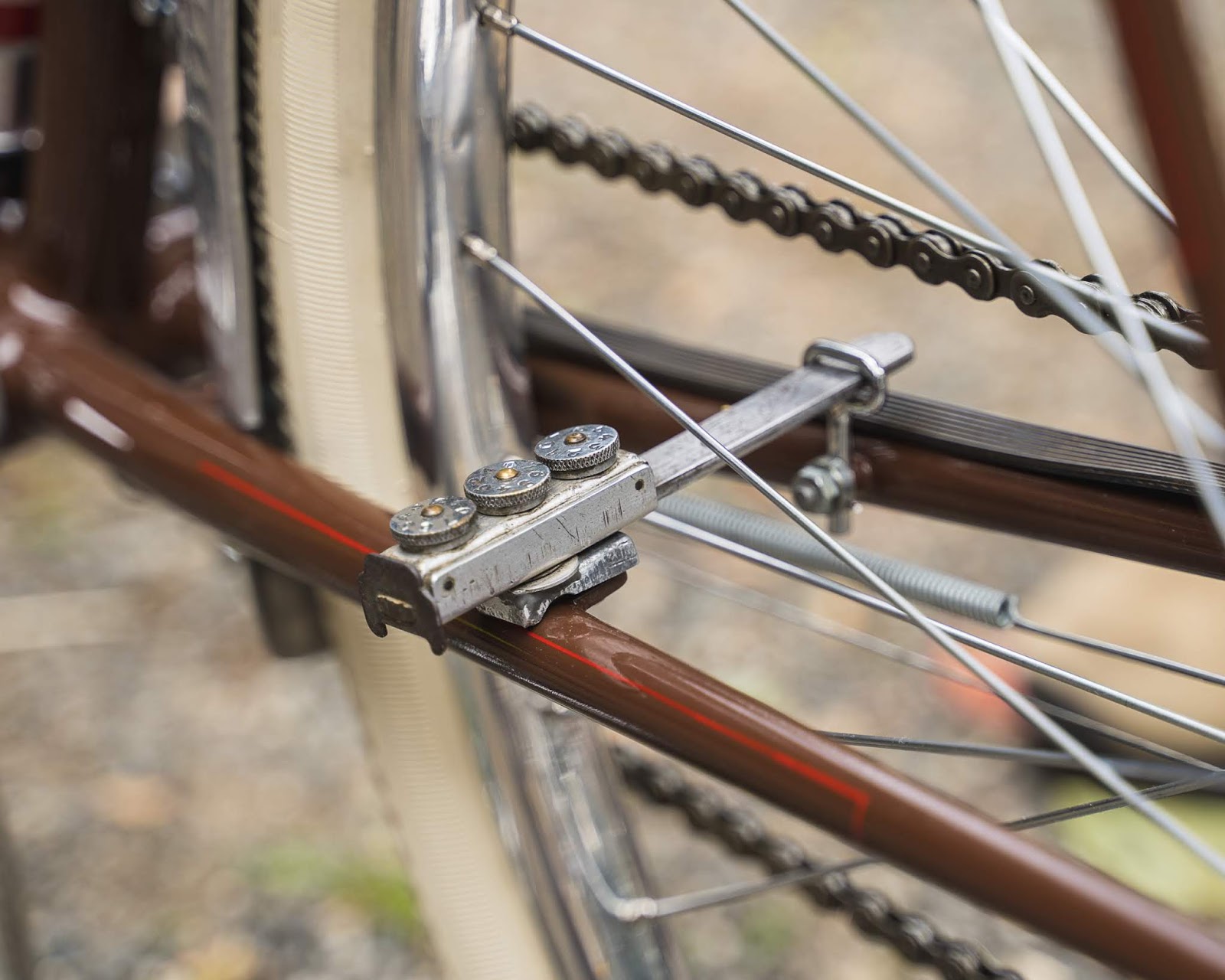
I'm gonna start out this year's recap with super clever L. Pitard touring bike from the 50's. This one features a super trick wheel-lock and kickstand setup that I have never seen before. On the non-driveside chainstay there is a combo lock with an extension. You swivel it, extend it through the wheel's spokes, and insert into the looped receiver on the driveside chainstay.


Then you move the non-driveside pedal to the low point, deploy the stand, and boom. Bike stands up. Innovation.


Security systems aside, this bike was chock full of constructeur nibs. Including this stem-mounted dynamo activator.


A speedo and headlamp mount.


And carrying capacity a-plenty.


Next up is this touring folding bike that started out life as a Raleigh Twenty. That is, before Shu-Sin got his hands on it. The only thing original is some of the rear end and folding triangle. Everything else has an astounding amount of custom work to turn it into this wonderful machine we saw last weekend.


Wind it up and watch it go.


Course Handlebars in Noir! Very rare.


Peter's personal ride, complete with Noir Smooth 650b Fenders.


Peter cuts his own spin on the fender ends for extra elegance.


Eye-candy knows no bounds at FFD. Beautiful Porsche 356.


Mixte's hold a special place in my heart. This Automoto was glorious.


Fanciful lugs work, top tube mounted shifter, plated fork crown.


Winged, Automoto branded chainguard.


Before lunch, we headed out for a quick jaunt. I rode my Neutrino with XXXXXXXL Handlebar Bag. See if you can spot it.


A Bishop with Ghost logos.


Woody's Polyvalent!


Number 001 Norther Klickitat with a well-used original Grand Cru Handlebar Bag.


This was one super super Diamondback Ascent. Giant front rack, drop bars, wide gears, and.....


Kelly Take Offs. Nice.


Plus a very well patina'd threadless stem affixed to our Quill Stem Adaptor.


The yearly large-format shot.


Mark my words, 2020 will be the year of foam.


As always, thank you for putting on such a great show, Peter! It's always a pleasure to head up to the New England area and ride bikes.

Do keep in mind that Philly Bike Expo is right around the corner - November 2nd and 3rd. We'll be there with a big booth. So come say hi and grab a seltzer!
17 Oct 19:44

Telus’ new ‘Peace of Mind Connect’ plans bring unlimited data to connected devices

by Jonathan Lamont
Telus building

Vancouver-based national carrier Telus is making the first significant adjustment to its rate plans since the launch of its Peace of Mind and Simple Share plans in July.

While the changes don’t affect the Simple Share plans, they do significantly alter the unlimited Peace of Mind plans.

The biggest change is the launch of ‘Peace of Mind Connect’ plans, which now allow customers to connect an additional SIM-enabled device to the unlimited data included in their plan. This includes smartwatches, tablets and Telus’ Drive+ connected car platform.

Customers can add additional devices using the ‘MyTelus’ service online or in-store.

As with the standard Peace of Mind plans, users have access to a set amount of ‘high-speed’ data. Once they reach their cap, customers will see speeds throttled to a max of 512Kbps, but they can continue to use data at the slower speed.

The new ‘Connect’ plans largely replace the old Peace of Mind plans and are actually cheaper than the old Peace of Mind plans, excluding the base level 10GB option. The only remaining regular Peace of Mind is the base $75 per month 10GB plan. You can see the new options below:

  • Peace of Mind Connect — $85 per month for 10GB unlimited data
  • Peace of Mind Connect Plus — $90 per month for 20GB unlimited data (Previously was $95)
  • Peace of Mind Connect Ultra — $115 per month for 50GB unlimited data (Previously was $125)

All the plans include unlimited Canada-wide talk and text.

At the time of writing, Telus’ Simple Share plans were unaffected by the changes.

Telus did adjust the ‘Canada-US Peace of Mind‘ plans as well. The new Canada-US options are as follows:

  • Peace of Mind Canada-US — $95 per month for 10GB of unlimited data
  • Peace of Mind Connect Canada-US — $105 per month for 10GB of unlimited data
  • Simple Share Canada-US — $105 per month for 10GB of shareable data

These plans all offer access to data, talk and text in the U.S. as you would have in Canada.

MobileSyrup has reached out to Telus for more details about the plan changes and will update this article accordingly. In the meantime, you can learn more about the plans on Telus’ website here.

The post Telus’ new ‘Peace of Mind Connect’ plans bring unlimited data to connected devices appeared first on MobileSyrup.

17 Oct 19:44

Ontario government invests $765 million to rebuild Public Safety Radio Network

by Shruti Shekar
Bell logo on building

The Ontario Government, in collaboration with Bell, will be rebuilding “core components of the ageing Public Safety Radio Network (PSNR).”

A press release from the government indicated that the $765 million CAD agreement will be to reconstruct core infrastructure, replace outdated equipment and maintain the new radio network.

Under the project, Bell will be building out the Land Mobile Radio Network, which is the network’s core infrastructure. That will also include support antennas, servers and data centre equipment, the release added.

Bell will also be providing first responders, as well as their dispatchers, radio equipment and consoles that enable quick and effective responses to emergency situations.

Additionally, the Montreal-based carrier will be providing network and radio equipment maintenance services for a period of 15 years.

This project will help more than 38,000 frontline and emergency responders, including OPP officers, paramedics and hospital staff, forest fire services, provincial highway maintenance staff, as well as parks, enforcement and correctional officers, the release said.

The release added that the transition to the new network will begin in 2021 and will be fully operational by 2023.

To note, the PSNR is one of the largest public safety radio networks and was last replaced in 1998.

“In a crisis, every second counts. Replacing our aging emergency radio network is not only vital to public safety, it’s long overdue,” Ontario’s Progressive Conservative Premier Doug Ford said in the release. “Working with our chosen vendors, we’re confident this investment will give our first responders on the frontlines access to a reliable, cutting-edge network, so they can do their jobs and keep our families and communities safe.”

Source: Ontario Government

The post Ontario government invests $765 million to rebuild Public Safety Radio Network appeared first on MobileSyrup.

17 Oct 19:44

The Art of the Personal Project: Aaron M. Conway

by Suzanne Sease

The Art of the Personal Project is a crucial element to let potential buyers see how you think creatively on your own.  I am drawn to personal projects that have an interesting vision or that show something I have never seen before.  In this thread, I’ll include a link to each personal project with the artist statement so you can see more of the project. Please note: This thread is not affiliated with any company; I’m just featuring projects that I find.  Please DO NOT send me your work.  I do not take submissions.


Today’s featured artist:  Aaron M. Conway

When capturing a portrait I want to make sure the subject’s personality comes through. I want the viewer to feel that they have some connection with the subject and understand their story. Sometimes that is with a smile or it’s a stare. It’s the creator’s job to bring the subjects true self out sometimes in just a short period of time.

When approaching this project I knew I needed to take the familiar subject of youth boxing and make it my own. I wanted to create a series of portraits of these boxers that they would be proud of. That shows their dedication and intensity. Along with highlighting the organization that helps these athletes grow both physically and mentally.

As I sat across from these kids I kept asking for their “Fight face”. Within the first few images I realized that everything was lining up. None of us had ever met before and they were able to take the focus they learn from their coaches and apply it to the photo. We moved throughout the gym capturing all aspects of their training to create this series of images.

We have now started the printing process and will be delivering large format prints to each of the kids. This is an important part of my process; I enjoy holding the photograph and not just viewing on a screen.  Now they can have something tangible from the photo-shoot versus something that could fade away in our digital world.


To see more of this project, click here.

APE contributor Suzanne Sease currently works as a consultant for photographers and illustrators around the world. She has been involved in the photography and illustration industry since the mid 80s.  After establishing the art buying department at The Martin Agency, then working for Kaplan-Thaler, Capital One, Best Buy and numerous smaller agencies and companies, she decided to be a consultant in 1999. She has a new Twitter feed with helpful marketing information because she believes that marketing should be driven by brand and not by specialty.  Follow her at @SuzanneSeaseInstagram

Success is more than a matter of your talent. It’s also a matter of doing a better job presenting it.  And that is what I do with decades of agency and in-house experience.


The post The Art of the Personal Project: Aaron M. Conway appeared first on A Photo Editor.

------------------------

Visit our sponsor Photo Folio, providing websites to professional photographers for over 10 years. Featuring the only customizable template in the world.

------------------------

17 Oct 19:43

I only started coming to work by tube because of Greta Thunberg. And now I run the risk of the train being hijacked by the lunatic fringe of Extinction Rebellion. Would they rather we all drove? Targeting commuters on public transport is a staggeringly stupid move.

by mrjamesob
mkalus shared this story from mrjamesob on Twitter.

I only started coming to work by tube because of Greta Thunberg. And now I run the risk of the train being hijacked by the lunatic fringe of Extinction Rebellion. Would they rather we all drove? Targeting commuters on public transport is a staggeringly stupid move.


8199 likes, 1371 retweets
17 Oct 19:43

The facts don’t allow the EU to be scapegoated if it falls apart today. But the facts & most Brexit commentary parted company years ago.

by mrjamesob
mkalus shared this story from mrjamesob on Twitter.

The facts don’t allow the EU to be scapegoated if it falls apart today. But the facts & most Brexit commentary parted company years ago.


1229 likes, 230 retweets
17 Oct 19:42

The climate crisis and the internet

by thornet

This post is part of a collection of writing about the climate crisis and the internet’s role in it. Topics will include recommended reading, meaningful action, personal reflections, a maintenance mindset, and the creative potential of a carbon neutral internet.

Prologue

Rare has it been in my life that I have felt truly unmoored. But last year certainly shook my sense of self and the world.

I gave birth, saw my mother die, got sidelined at work, witnessed my neighborhood battle for its soul, observed political upheaval and environmental destruction around the world, and in general felt like what the hell is happening.

I was grateful for the little creative space granted during my self-hosted residency in motherhood. Fueled by this perceived turmoil, I wanted to revisit my understanding of myself and the world and to think about “small utopias.” I wanted to reimagine what was possible and desirable, and what my role in all of that might be.

As some sort of “new normal” established itself in the year since, I decided to continue this self-learning project and share insights that might resonate with others. I’ve been documenting the raw bits of it in a learning log on Github. Writing here now helps get to some clarity on what those learnings actually are.

The main topic that seems worthy of talking about is the climate crisis. And the internet.

There are some quick, factual things to know. And then there are some slower, deeper questions I have and would love to learn with others about what’s going on and what would be meaningful to do.

A final caveat: I hesitate to suggest that my analysis is thorough. Or that my proposals for action are the most effective. So much of what I’m coming to learn is we are all so limited in what we can really know.


The internet’s climate crimes

So for what it’s worth, here’s snapshot of what I’ve learned about the internet and the climate so far:

A worldwide empathy network

Now, despite all of that, I still hold on to the belief that when humans can genuinely connect with one another, we can tap into an empathy and creative potential that transcends language, nationality, ethnicity, class, and whatever other barrier we’ve erected between us. My friend Renata Avila called it digital internationalism. Yochai Benkler described it as commons-based peer production.

I’d like to suggest that these days we’d benefit from focusing less on production and usefulness and more on some sort of commons-based peer understanding.

This worldwide empathy network is at the kernel of why I still care about the future of the internet. I think we should be doing more to look inwardly and locally. But this work is situated on a planet with many living beings all intertwined with one another. You won’t fight for what you don’t love. And it’s hard to love someone or something you don’t know or feel alienated from. And in this weird way, and kinda despite what it is right now, I love the internet because it helps us expand our circle of care.

We need some sort of caring mentality for the internet itself, not because of what it is today, but what it could be: a true exchange among people for our own understanding and preservation.

Images: William Sharp’s Chromolithographs of The Great Water Lily (1854) via The Public Domain Review

17 Oct 19:42

I had a Blackberry, even one of the ones that were pager sized.

by Michael Sippey

Today, like the clothes we wear or the cars we drive, the brand of smartphone, its model, and its age all act as a reflection of who we…

Continue reading on Stating the Obvious »

17 Oct 19:42

You thought Russians were the heaviest drinkers? Think again.

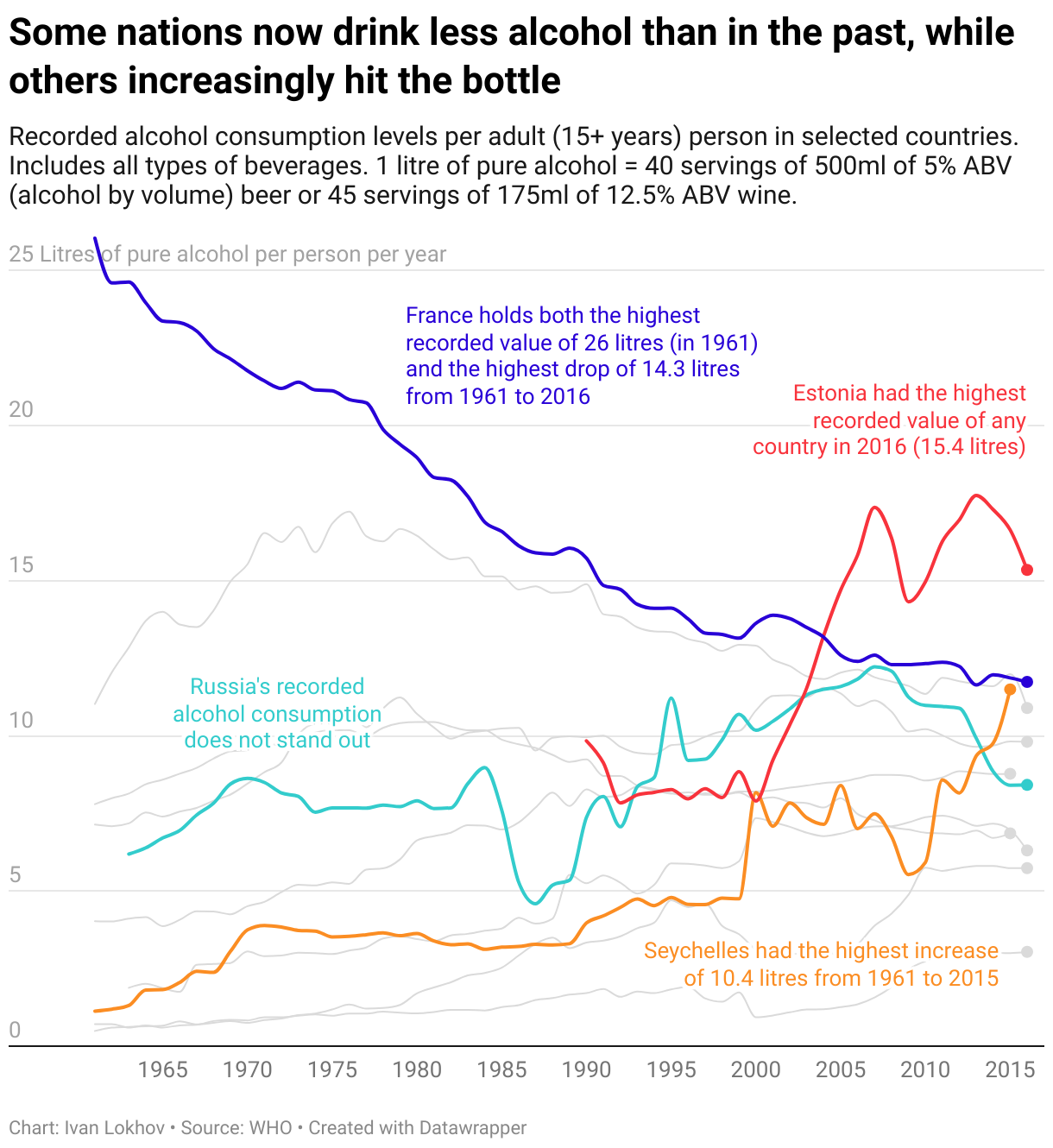
Hi, it’s Ivan, I’m team lead developer at Datawrapper. This week, we’ll look at how patterns of alcohol consumption have changed over the last several decades.

I recently read an article on how alcohol consumption in Russia had fallen in recent years and was now lower than in many other countries. I was astounded - surely this was a mistake? After all, one of the most prevalent stereotypes of Russians is that they are heavy drinkers, as witnessed in countless films.

So I decided to hunt for data and check it myself.

Turns out that the article I read wasn’t lying - the data indeed shows that there are a number of countries where more alcohol per capita is consumed than in Russia. So maybe it’s time for us to stop stereotyping poor Russians.

But hold on, things are unfortunately not as simple as that. The data shows only recorded alcohol consumption which means that alcohol produced and consumed outside of government control is not included. I found some data showing the unrecorded consumption but realised that it comes with problems: such data is based on estimates and is therefore inaccurate by nature. And after hours of searching I gave up on finding this data for all shown years for all countries.

I highlighted some other things that stood out to me from the dataset in the chart:

  1. France simultaneously holds two records. It had the highest overall recorded consumption in a single year: in 1961, 26 litres of alcohol per capita were consumed. That’s a whooping 1040 glasses (500ml) of beer 🍺 (5% ABV - alcohol by volume) per year or 2.85 per day. Or maybe more fitting: that’s 1170 glasses (175ml) of wine 🍷 (12.5% ABV) per year or 3.2 per day[1]. That’s a serious amount of drinking. Thankfully, France’s other record makes up for it: it had the biggest drop in consumption of all nations from 1961 to 2016. It went down by more than a half to 11.7 litres and now does not stand out from many other nations.

  2. While alcohol consumption in France greatly declined, Seychelles went the other way and had the largest increase of all nations. It went from 1.1 litres per capita in 1961 to 11.5 in 2015, which matches France’s current levels of consumption.

  3. Estonia has the highest most recent level of consumption: 15.4 litres of alcohol per capita in 2016. While this might currently be higher than any other nation, it pales in comparison to France in 1960s.

Chart choices

Once I knew that I wanted to show changes over time and compare different countries to each other, I figured out that a line chart was the ideal choice.

A problem that I encountered was which countries to show alongside the ones that I wanted to highlight. The original dataset contains data on 190 countries. When working on the chart, I tried including them all and also including none apart from the highlighted ones, but both were problematic:

Weekly chart showing all 190 countries

Weekly chart showing only 4 highlighted countries

Left: showing all countries creates too much background noise and leaves little space for annotations

Right: showing only highlighted countries means that there are no indicators of what alcohol consumption levels are like in any other countries.

In the end I settled on showing highlighted countries along with a few select ones as background indicators that either have high populations or those I thought would be of interest. It is not an ideal solution but in my view a sufficient compromise.


I hope you enjoyed the article whether you drink or not! I did not look into what might have caused the pattern changes that I highlighted. So if you know why alcohol consumption has gone down in France or gone up in Seychelles, or if you have anything else to share, please let me know in the comments. See you next week!


  1. Here is how I calculated this, eg for beer: 1 beer serving contains 500ml x 5% ABV (0.05) = 25ml of pure alcohol. So in 26 litres (or 26000ml) of pure alcohol per year there are: 26000ml / 25ml = 1040 beer servings. This amounts to 1040 / 365 = 2.85 beer servings per day. ↩︎

17 Oct 19:41

Lots of hype, no convincing evidence – Science-Based Medicine

mkalus shared this story from Science-Based Medicine.

PRP Injections are touted to effectively treat tendon and muscle injuries. The evidence is not impressive.

Like many people who are physically active, I have had my share of sports injuries, which seem to occur more frequently and last longer as I get older. Trying to fight against the inevitability of ageing is hard work, and no matter the activity, minor injuries seem to follow. Achilles injuries plagued my running. An intercostal strain from barbell training disrupted my sleep for weeks. And those newly aching elbows? Apparently I’m now getting some sort of tendinopathy. More trips to the physiotherapist. Sports medicine is quite possibly the worst area of medicine for pseudoscience, and it is difficult, if not impossible, to find a clinic that is pseudoscience-free. One service that is commonly offered and is seemingly very popular are injections of “platelet-rich plasma” or PRP. PRP is touted as an effective treatment for musculoskeletal injuries, where vials of your own blood are centrifuged and the platelets are injected back into you. PRP may be expensive, but does it work?

What is PRP?

Platelets are small cells in the blood that promote blood clotting. When you cut yourself and it clots, that’s your platelets working. Without platelets you would bleed to death. When platelets reach the site of a tissue injury they release chemical signals and growth factors to promote cell healing and recovery. Platelet-rich plasma is plasma (the liquid component of blood) with a concentrated amount of platelets. When vials of blood are spun rapidly in a centrifuge, the red blood cells, being more dense, separate. There are different methods to extract and separate out the platelets, but the final product will contain several times the normal concentration of platelets. This is then injected back into the injured area. PRP is a general term and there is no standardized product or manufacturing process that is used consistently by clinics that offer PRP. Moreover, as the evidence shows, there is no one method that has been clearly shown to be more effective than other forms. The variety of manufacturing processes complicates the evaluation of clinical trials. Like clinical trials of herbal remedies, the lack of standardization and consistency means that clinical trials may be complicated by slightly different “versions” of PRP.

What does the evidence tell us?

Surprisingly, no one has blogged about PRP at this blog since way back in 2009. (Isn’t it remarkable that SBM is still going strong 10 years later?). Val Jones noted at the time:

Without any clear evidence of benefit beyond placebo, platelet-rich plasma (PRP) is now being marketed aggressively as a cure-all for sports injuries. And at about $300 per injection (the NYT reports $2000/treatment), there’s plenty of money to be made.

She reviewed the literature and found it lacking, noting almost no published research on tendon injuries, and small trials in other conditions which were unconvincing. So what’s happened in ten years? In order to keep this blog post at a reasonable length, I’ll cite the evidence from the most comprehensive and current reviews that I could find.

The Alberta College of Family Physicians has an excellent Tools for Practice publication which answer clinical questions comprehensively. They recently published a summary of the evidence of PRP for Achilles tendinopathy, lateral epicondylitis (tennis elbow), and rotator cuff tendinopathy (the most common cause of shoulder pain). They restricted their search to randomized, placebo-controlled trials with patient-relevant outcomes measured. They noted:

Chronic Achilles Tendinopathy: Three RCTs comparing PRP to saline injections found no significant differences in pain, function, return to sport or patient satisfaction after 6, 12, and 24 weeks. They cite a meta-analysis which noted:

PRP injection with eccentric training did not improve VISA-A scores, reduce tendon thickness, or reduce color Doppler activity in patients with chronic Achilles tendinopathy compared with saline injection. Larger randomized trials are needed to confirm these results, but until or unless a clear benefit has been demonstrated in favor of the new treatment, we cannot recommend it for general use.

Chronic Lateral Epicondylitis: Two RCTs of PRP vs. saline found no difference at 12 or 24 weeks.

Rotator Cuff Tendinopathy: Two RCTs compared PRP to plasma or dry needling, finding no difference in pain or disability scores.

The review concludes:

The best quality evidence shows no difference in pain, function or return to sport between platelet-rich plasma, dry needling, or saline for patients with Achilles tendinopathy, lateral epicondylitis, or rotator cuff tendinopathy.

When it comes to summaries of the literature it is worth seeking out multiple reviews, to further minimize the risk of bias. Fortunately there is a 2014 Cochrane summary of PRP (called PRT, or platelet-rich therapy) for musculoskeletal injuries included a literature search up to 2013. It notes the following:

The quality of the evidence is very low, partly because most trials used flawed methods that mean their results may not be reliable. The trials also used different ways of preparing and applying the platelet-rich plasma. We were only able to pool data for our primary outcomes (function, pain, adverse events) for a maximum of 11 studies and 45% of participants.

And:

When we pooled the limited data that was available for all these conditions, we found very weak (very low quality) evidence for a slight benefit of PRT in pain in the short term (up to three months). However, pooled data do not show that PRT makes a difference in function in the short, medium or long term. There was weak evidence that suggested that adverse events (harms) occurred at comparable, low rates in people treated with PRT and people not treated with PRT.

And they concluded:

Overall, and for the individual clinical conditions, there is currently insufficient evidence to support the use of PRT for treating musculoskeletal soft tissue injuries. Researchers contemplating RCTs should consider the coverage of currently ongoing trials when assessing the need for future RCTs on specific conditions. There is need for standardisation of PRP preparation methods.

Is PRP safe?

There is the widespread belief that because PRP are your own cellular materials, injected back, that there are no risks to the treatment. Setting aside any sterility risks and the risks of infection that accompany any injection, PRP side effects tend to be minor and include pain, bleeding, bruising, and swelling. However, earlier this year Health Canada published a policy position paper, noting the following risks with autologous cell therapies (which include treatments like PRP injections):

With the exception of donor-derived infections and anti-donor immune responses, autologous cell therapy products present the same risks to patients as their allogeneic counterparts, including:

  • the potential introduction of bacteria or viruses;
  • between-patient cross contamination, for example if equipment is not properly sterilized;
  • risks resulting from processing activities and exposure to processing reagents; and
  • the stimulation of unwanted immune reactions, ectopic tissue and/or tumour formation.

From a clinical perspective, cell therapy products have unique absorption, distribution, metabolism, and elimination characteristics compared to other drugs, and have the potential to persist in recipients for a prolonged period of time. This prolonged exposure, relative to the duration of exposure to most drugs, carries the potential for both long-term benefits and long-term risks. Indeed, a number of serious adverse events have been associated with use of autologous cell therapies and strategies to mitigate these risks are needed.

But I’m injured! Is there anything to PRP worth pursuing?

Despite the enthusiasm and aggressive marketing, there are few well-controlled and rigorous clinical trials of platelet-rich plasma. These highest quality trials are consistently negative. It could be that the variety of manufacturing practices and administration techniques are confounding clinical trials, and that there is something actually worth still pursuing. No research has yet shown that to be the case. But it’s far more likely that what we see with PRP are simply placebo effects – the non-specific positive expectations initiated by health practitioners who are charging you a large sum of money for an injection (of cells!), backed by their personal assurances, patient testimonials, and glossy advertising. Until there is convincing evidence to demonstrate otherwise, there is little reason to accept the risk of PRP, regardless of your injury.

17 Oct 19:41

Nanoleaf unveils ‘Screen Mirror’ feature to create theatre-like experience

by Aisha Malik

Nanoleaf has revealed its latest feature, the Nanoleaf Screen Mirror, which is designed to create a theatre-like experience in your home.

The Screen Mirror feature works with the Nanoleaf Light Panels and Nanoleaf Canvas to form a multi-sensory experience. The content on your screen is reflected on the light panels and the Nanoleaf Canvas.

There are four different modes that you can select based on your mood or the occasion. You can choose ‘Match’ if you want to amplify an action movie. Another mode called ‘Melt’ subtly transitions between sequences when you’re watching something with an intense colour palette.

You can control the Screen Mirror feature using the new Nanoleaf desktop app. The new app lets you control the light panels and canvas from your computer.

The app was designed to give users more convenient controls and manage the larger installations. There’s also an offline mode that lets you access the lights even if you don’t have internet.

Image credit: Nanoleaf

Source: Nanoleaf 

The post Nanoleaf unveils ‘Screen Mirror’ feature to create theatre-like experience appeared first on MobileSyrup.

17 Oct 19:41

Adobe’s iPad Photoshop reportedly missing key features as it nears launch

by Brad Bennett
iPad Pro Apple Pencil

Adobe’s popular image editing software, Photoshop, is nearing its iPad release date, but reports say it’s missing key features like RAW image support, smart objects and more.

Adobe announced the product and said it was the full version of Photoshop during its ‘Max’ software conference last year. This year’s Max is slated to begin on November 2nd, and the release date for the app is supposed to be announced, according to Bloomberg

People who spoke with the publication state that the beta version of the app lacked “filters, the pen tool and custom paintbrush libraries, vector drawing, colour spaces, RAW editing, smart objects, layer styles and certain options for mask creation.”

Adobe’s chief product officer of its Creative Cloud division, Scott Belsky, stated that more, but not all, of the desktop version of the app’s features are slated to come to the app before it launches. He told Bloomberg that when Photoshop launches on iPad, it will represent version one of the product. More specifically, he said, “Launching every single feature that was accumulated over 25 years on the iPad on day one would not best serve our customers and the needs they have.”

This is an odd statement since you would imagine that the customers using Photoshop on iPad would be the same people who use it on desktop.

Either way, it seems like Photoshop for iPad is on the close on the horizon. It will be interesting to see what features are missing when the full version of the product launches later this year.

Source: Bloomberg

The post Adobe’s iPad Photoshop reportedly missing key features as it nears launch appeared first on MobileSyrup.

17 Oct 13:58

Blockchain in Higher Education: Are we on the Cusp of Transformation or Still Gathering Information?

Megan Raymond, WCET Frontiers, Oct 17, 2019
Icon

After a quick introduction defining blockchain, this article then shifts to its main focus, an interview with three experts on the following potential applications:

  • “blockcerts” for certifications and credentials,
  • bitcoin for paying for tuition,
  • blockchain for transcripts, and
  • using blockchain technology to retain authorship and attribution in open education resources.

The focus isn't exactly where I would place it, though it does represent what seem to be the  the core values of academia today: granting degrees, charging fees, and getting credit. There seems to be at least some recognition of this as Spencer Ellis comments, "Until proven to support the longstanding challenges we face in higher ed. (inequities, costs, program completion, etc.) any strategy could be considered hype. If strategies begin to address and change these outcomes, then they truly prove their worth."

Web: [Direct Link] [This Post]
17 Oct 13:58

Coming up on 21 years of Cluetrain

by Doc Searls

I posted this Cluetrain retrospective at doc.blog last year. I’m putting it here now because it’s timely again. cluetrain coverDig:

1) The original site and book are online in full at http://cluetrain.com and http://cluetrain.com/book

2) The 10th anniversary edition has new chapters by the four original authors, plus additional ones by JP RangaswamiDan Gillmor and Jake McKee.

3) David Weinberger and I posted an addendum to Cluetrain in 2015 called New Clues: http://cluetrain.com/newclues

4) The word “cluetrain” is more or less constantly mentioned on Twitter: https://twitter.com/search?q=cluetrain

5) A search in Google books https://www.google.com/search?tbm=bks&q=cluetrain brings up more than 13,000 results, almost nineteen years after the original was published.

6) A search in Google Scholar https://scholar.google.com/scholar?en&q=cluetrain brings up more than 4,000 results.

7) A dig through old emails just turned up the earliest evidence  (at least to me) of Cluetrain’s inception: a draft of a joint JOHO (David Weinberger’s email list) and EGR (Chris Locke’s list) posting, vetted for input by yours truly. This was when the three of us were first sharing the co-thinkings that became Cluetrain in early 1999. That email is dated 30 October 1998, meaning that more than two decades have passed since this thing started.

17 Oct 13:58

You Haven’t Earned Support Yet

by Richard Millington

I know people who have bounced constantly from one company to the next without ever getting the support they felt the community needed to succeed.

The language they use is telling.

“My boss doesn’t get community”
“The CEO doesn’t understand the benefits of a community”

etc…

It probably feels like a relief to shift the blame to someone else.

But the truth is you haven’t earned their support yet.

You haven’t built relationships with senior leaders, learned what they need, and how best to articulate the benefits to fit their worldview.

You haven’t delivered tangible results yet or you aren’t showing metrics which they care about (or even helped them identify which metrics to care about).

None of this is in your job description, but it’s all part of your job.

If you expect your boss (or her boss) to magically believe in the power of community one day, you’re expecting too much.

This means you need to learn how to build relationships and communicate with senior leaders, you need to learn how to distill the power of a community into an easily-digestible sound-bite which makes the community an immediate priority. You need to learn how to ensure the community isn’t seen as a threat to other colleagues and identify how they can best benefit from a community.

The most powerful work you can do isn’t to build a community for a company, but to prepare a company for a community. That’s a legacy you can be proud of.

17 Oct 13:58

Yes, we apparently live in a universe where POT...

Yes, we apparently live in a universe where POTUS sent that letter to the leader of another country.

Bloody hell.

17 Oct 13:58

I’m really proud that my group is sponsoring a ...

I’m really proud that my group is sponsoring a refugees and technology event on Oct 24th in Seattle.

This is a key global topic that we should meet with optimisim and opprotunity rather than walls and denial.

17 Oct 13:58

What are product and sum types?

by Eric Normand

Product and sum types are collectively known as ‘algebraic data types’. These are two ways of putting types together to make bigger types. Product types multiply their states, while sum types add them. With these two ‘operations’, we can precisely target a desired number of states. In this episode, we explore how we can eliminate corner cases with algebraic data types.

Video Thumbnail
What are product and sum types?

Product and sum types are collectively known as 'algebraic data types'. These are two ways of putting types together to make bigger types. Product types multiply their states, while sum types add them. With these two 'operations', we can precisely target a desired number of states. In this episode,

Transcript

Eric Normand: What are product and some types? By the end of this episode, you’ll know how to use these two concepts to create a very well-fitting model for your domain. My name is Eric Normand, and I help people thrive with functional programming.

Data modeling is very important in functional programming. Product and some types are a way of thinking about how our data is structured. These things, product and some types, together, they make up what’s called algebraic data types. That’s just a term that people use all the time.

I’m going to give a little scenario. Imagine we have some process-workflow engine where we give people a to-do list, a checklist of things to do. When they do it, then someone else has to come by and approve it, that they did it correctly. Then, just for safety, extra assurance, we have a second person check, too.

When they check it, they either say it’s approved, or disapproved or rejected, something like that. There’s a positive and a negative. Also we have to remember that before they approve it or reject it, we have to record that they haven’t yet.

We actually have three cases. We have they haven’t checked it yet, they have approved it, or they have rejected it. Then we have two of those because we want two checks.

If you look at all the possible states, we have three for the first one and three for the second one. Then there’s all the combinations of the two. The first one approves, the second one rejects. The first one approves, the second one approves. There’s all these combinations. How do you figure that out? It’s three times three, so there’s nine.

Then when you think about it, these people, they’re doing the checks one at a time. There’s the first person’s check and then the second person’s check. You might have all these rules in your system like if the first person rejects it, we don’t need the second check. We’re just going to tell them to do it again.

You need two approvals. If you have a rejection from either one, then you don’t need the second rejection, if you have the first rejection. What does it mean to have a rejection and then an approval because it’s not even possible to get in your system?

What does it also mean for the first one to be not checked yet, but the second one is already checked because if they’re going in order, that is not a valid state either.

What’s happened is we’ve created this system where we’ve got nine possible states. It turns out that several of them are not valid. They don’t make sense in our system. What does it mean for the second approver to check before the first approver has checked? What does that even mean?

Because if they come first, they should go in the first slot, not the second slot. Then, what does it mean for someone to approve after it’s been rejected? That also doesn’t make sense.

If you do the math out, there’s quite a few states in here that don’t make sense. Now, the math we’ve done — let’s just go back to that — is we’ve had three possible states and we multiplied it by three possible states. We get nine possible total states.

We multiply. That’s where the product comes from in product types. When you have two separate fields and each one has certain number of options, to figure out the total number of options for the two, you multiply them together. If you had a third one, you multiply that one together. You had a fourth field, you multiply those together. Now, that’s the product, because product is multiplication.

Where does the sum come from? Remember, sum is plus. The plus is that you have one unchecked, plus one approved, plus one rejected. As an example, you could have just a state, a status of approved and rejected, and then that’s a type.

That’s like an enum. That’s two states, and then to add a third one, you can make that a maybe. You’re adding the none case, the nothing case, by wrapping it up in a maybe or an option. That’s the sum type because you’re able to add one, you’re not multiplying them.

The classic — what do I call it? — essential product type is the tuple. The tuple is just a bunch of values. We have a pair. That’s a two tuple. You can have a triple, that’s a three tuple. The tuple is a product type, meaning you multiply all the possible states together to figure out all the states that your tuple is in.

The typical sum type is something like an either. Either they’re approved or they’re rejected. It’s an enum.

The exercise that we have to do as data modelers is take the system that we’ve created, which we’ve created poorly because there are states that are invalid in there, that don’t make any sense.

The thing is if you’re using a type system, the type system is going to say this is a valid state because that’s what you described. A tuple of two of these maybe statuses can be in any one of nine states, even though maybe three or four of them don’t make sense.

You’re not getting help from the type system to avoid those. How do you avoid them? You’re going to have to have conditionals in there to make sure that they don’t happen. What kind of conditionals?

You’re going to say, do we have some approval rating for the first one? Because if so, then we’ll use the second one for this check that we’re doing now. If not, we’ll use the first one. It’s a conditional.

The conditional is there because you’ve got invalid states. You’re adding complexity by having these invalid states. What we want to do is use the sum and product types to rework this so that it doesn’t have any invalid states.

Just to get a little bit deeper into the problem that we had, like why did we get here, where we have these invalid states, we broke the problem down. We said, each approver has a certain status or they haven’t done it yet. That’s three.

There’s three possible choices for each one, and that’s true of both. It’s true of both, but when you combine them, the combination isn’t a pure product because there are states in that product that you don’t want to be possible.

The problem was combining them with a tuple. Unfortunately, that happens a lot. I do it all the time where I say, “Oh, I have two Booleans and I’m trying to represent something with three states, but two Booleans is four states.” Then I have all this code to make sure I don’t get into that weird fourth state that shouldn’t make sense.

Let’s start with that two Booleans case. If we have two Booleans and we only need to represent three states, how would we do that instead? What else could we do?

Three is a prime number, so you think I can’t do a product really because a prime number is only a product of one and itself. The one doesn’t make sense as a type. What we do is then have to use a sum. We just make an enum or a sum type, a union, of the three possible choices. Instead of using two Booleans, we use three possible choices.

Likewise, we could say that there’s the case where no one has checked yet, the case where the first one has checked, and then the case where the second one has checked. That’s three cases.

In the case where no one has checked, there’s no other data we need to store. It’s just no one has checked. We could call that enum [indecipherable 10:26] . The case where the first person has checked, we have to capture what status they gave it. Did they give it approval or rejection?

In the case where two people have checked, we have to capture both of them. We capture the first one and the second one. Both are approval or rejection.

If you add that up, you have zero case. That’s one. The one person has checked. There’s two possibilities there. That’s 1+2. That’s three. Then in the two case, we have approve or reject twice. That’s 2*2. That gives us four. That’s 1+2+4 = 7. That’s seven cases.

You could try to model more closely that once the rejection has happened, first, you can’t have a rejection and then an approval. We could say in the two-person case, we don’t need to capture the first one anymore. That first one has to be an approval. We don’t need to capture it.

Instead of the two-person case, we could call it, “One approves,” or we could have, “Zero have checked, one have checked and approved, two have checked and approved and rejected.” We don’t record who rejected it, whether it’s the first one or the second one. Maybe we could. We could say, “Rejected by the first, rejected by the second.”

We’re splaying out all the possibilities. In this case, if we have zero have checked, that’s one case. One has approved, also one case. Two have approved, one case. First one rejected, one case. Second one rejected. That would imply the first one approved. That’s also one case. How many is that?

Zero, first approved, second approved, first rejected, second rejected, that’s five. That is probably closer to what…That probably exactly fits what we want. Since five is prime, it’s hard to do a product in there, but you could have a product to where it’s like, 2*2+1. It’s 4+1. Somehow, you have a 2*2 in there to get the four.

There’s all sorts of possibilities there that we can explore. The idea is you are using the structure of the product and sum to closely match. As closely as possible, you want to target exact the actual number of cases that you want to capture.

When you talk about all the zero, and then one, and then two, you might start to think we need something like a list. I would explore that for sure, not only because it makes sense — zero, one, two — but it also is like a more general data structure. What if we want to change our process so we have three approvals necessary? This is a way of making it the more general case.

Of course, there’s always a trade-off between getting very close with a huge type that you’re developing that has all these constraints on it versus have a more general type that does have some invalid cases, but you work within the code with a few if-statements to avoid those. That might actually be cleaner. In a lot of cases, it is. Sometimes, the generality of it is actually better.

Let’s look at the list as a type. Lists are a sum type. They’re an interesting sum type. List is either an empty list or an element and the rest of a list. The prototypical English words we use when we’re talking about a sum type is either/or. You have either an empty list, or the first element of the list and the rest.

“Or” is usually used for sum types. “And” is usually used for product types, so the element and the rest of the list. Notice the type is recursive. A list could have another list inside of it. That’s what makes it really interesting.

If you were just to do the math, let’s say it’s not recursive, it’s two cases, a list or the head of the list, and something else. Because it’s recursive, that list could be infinite in theory. There’s no bounds to it. The size of this list now becomes infinite, the number of possible states this list could be in. It’s unbounded in its growth.

That’s another constraint on your system. Do you want to allow unconstrained growth? In a type system like this that we’re talking about, it’s harder to make a list of length three or two, like we want here. It’s harder to do that than it is to have an infinite list.

If you want it to be length two, you’re going to have to do checks to make sure it doesn’t grow pass that, but sometimes you want that. You want the underlying generality of we don’t know how many approvals we’re going to want in the end.

It could be possible that you use a list. You have the empty list. That means zero people have checked. Then you add a check and a status. That’s the first element on the list, the only element on the list. Then you add a second one. Then you add a third one. You add a fourth one, all these statuses.

Then you can do, it’s another way of doing it, you’d say if any of them are rejections, we reject it. Or maybe you could count them up and figure out a vote between do we approve or reject.

You can do all of these things. As opposed to modeling the transitions very precisely with the type, you’re using more of a calculation to figure out whether to approve or reject that task.

These are all ideas in data modeling. I’m exploring this idea because the third part of my book is all about data modeling. I don’t have a very organized view of what this chapter or this part is going to be about, what are the skills that people need to learn.

I think sum and product types are a pretty good way of being able to talk about what states are possible. A lot of languages don’t have them in a strict way. They allow you to make them in a lot of times, but it’s a hack. In Clojure, we don’t really have sum and product types in the sense that Haskell has them, but we do make tuples using vectors.

Hash maps are product types because you have different values, then each of those values takes on different values, and so you multiply them together to get the total number of states possible. But we don’t have enums. What we use is keywords usually, if we need enums.

It’s not very straightforward in Clojure, how to use them. They’re more like idioms and patterns that we use.

Likewise, in something like JavaScript, you can basically do the same thing. You can use a raise to represent tuples, or you can use hash maps to represent tuples. How do you represent sum types? There’s no enum, but you could use strings, you could use something like that.

It’s not the easiest thing to see, and that’s why I want to teach people how to see this stuff.

I learned this in Haskell. Haskell does it really straightforward, really clearly. That’s how I learned it, and I’m trying to teach it to people who don’t have the opportunity to work in Haskell.

Anyway, these are really important concepts. You have product types, which means you multiply the number of states to get the total number of states. The word in English that we use for product types is “and.”

You have the first status “and” the second status. Then, there’s some types which add the states together. You might just add one. You might add 10 other states. The word we use in English is either/or, or just either or just or. It’s either/or because it’s one or the other. It’s not the or that has both inclusive or it’s either/or, exclusive or. Those do a sum.

Lists are a sum type, but it’s recursive. it’s not just adding because you’re adding infinity to it. It really explodes the number of possible states, which might be fine because you still have the two basic cases, where I either have a list or I don’t. It’s either empty or I have an element that is the first thing. That’s how we use it. When we process lists, we often do it recursively.

If you enjoyed this episode, you can find all the past episodes at lispcast.com/podcast. There you’ll find all of the old podcasts, the existing podcasts with audio, video, and text.

You’ll also find links to subscribe, whether you subscribe with RSS, iTunes, YouTube, or just text RSS. You’ll also find links for finding me on social media, on Twitter, LinkedIn, email, etc.

Looking forward to hearing from you. Thank you for listening. My name is Eric Normand. This has been my thought on functional programming, rock on.

The post What are product and sum types? appeared first on LispCast.

17 Oct 13:54

Freedom expected to continue gaining healthy subscriber additions in Q4 2019

by Aisha Malik

According to Scotiabank’s analysis, Shaw Communications’ Freedom Mobile is expected to have healthy subscriber additions and positive Q4 2019 results.

Following the competitive back-to-school period, the regional carrier “fared well and continues to gain accretive market share,” according to the bank’s telecom analyst Jeff Fan.

Shaw Communications’ Freedom Mobile is set to release its Q4 2019 results on October 25th.

Freedom is expected to have a wireless postpaid churn rate of 1.30 percent for Q4 2019, while it had a churn rate of 1.40 percent in Q4 2018. Churn rate is the rate at which a subscriber leaves a carrier to subscribe to a competitor.

Further, Freedom is expected to have an ARPU growth of one percent in Q4 2019.

Fan explains that “since subsidies are booked through a balance sheet and amortized over the contract against revenue,” there was a short-term negative impact on ARPU growth.

He states that this is not a reflection of re-pricing/overage decline and that ARPU growth is expected to re-accelerate starting in Q2 2020.

Additionally, Freedom is expected to have a wireless average billing per user (ABPU) of $43.30 in Q4 2019, an increase compared to $41.00 in Q4 2018.

The regional carrier is expected to have a postpaid net addition of 75,000, and a prepaid net addition of 5,000 for Q4 2019.

This translates to a wireless subscriber net addition of 80,000 for Q4 2019. In Q4 2018, Freedom had 85,000 in wireless subscriber net additions.

“Overall, we think Freedom Q4/F19 results will show that it fared well in a competitive period, with healthy subscriber adds in postpaid and prepaid, and despite slower ARPU growth, we will see strong service revenue growth at 20 percent,” Fan concludes.

Source: Scotiabank

The post Freedom expected to continue gaining healthy subscriber additions in Q4 2019 appeared first on MobileSyrup.

17 Oct 13:53

Apple says half of all iPhone users have updated to iOS 13

by Aisha Malik
iOS 13 Dark Mode

Apple has confirmed that 50 percent of users have updated their iPhones to iOS 13 over the past month since the operating system’s release.

The tech giant has also stated that 41 percent of users are still running iOS 12. Additionally, nine percent of users are still running an even older version of iOS.

The iOS 13 update came with system-wide dark mode, which was a highly anticipated feature. It also came with Apple Arcade, an on-demand gaming subscription service.

Interestingly, fewer people have downloaded iPadOS on their devices. For instance, only 33 percent of iPads are currently running iPasOS, while 51 percent are running iOS 12. However, the slow uptake could be due to the fact that iPadOS rolled out later than iOS 13.

After the rollout of iOS 13, a number of users reported problems with dark mode and the inconsistency with the feature. 

There were also some bugs that impacted Instagram, such as the sound in Instagram stories being cut, and the Spotify share to Instagram feature not working.

Source: Apple Via: Engadget 

The post Apple says half of all iPhone users have updated to iOS 13 appeared first on MobileSyrup.

17 Oct 13:53

Techniques for adding context to visualization

by Nathan Yau

When it comes to meaningful visualization, context is everything. Richard Brath, at the 2018 Information+ Conference, looks back on historical visualization approaches and how they might be applied today to make data graphics easier to read and use.

Tags: context, Richard Brath, talk