This does pretty much exactly what we described in Cagliari, but is an actual real product you can use yourself instead of just some proof-of-concept code. Related services include Unstoppable Domains, Pinata, and Viewblock There's a lot of activity taking place on places like Reddit around IPFS and similar initiatives. I'm not sure people have the first idea of how to regulate something like this - an address is a hash string, and how do you regulate a hash string?
This is a good post describing an impending migration from Twitter into Mastodon by Indian users, and some of the factors motivating the move. It's the usual story for the centralized social network sites: offensive content is not blocked, or blocked only selectively. As Mastodon itself tweeted, "To claim impartiality and non-bias, especially in 2019, is to take the side of the status quo." The article ends with the caution about echo chambers and the warning that "freedom of expression could also mean freedom to spread hate speech." As though this weren't presently the case on sites like Facebook and Twitter. Via Ca_Gi.
Upper Levels Highway BC MOTI photo from flickr Creative Commons license
Bowinn Ma isn’t interested in ad hoc highway expansion. So she has commissioned a study.
“Under the scope of the work, Parsons will assess how the highway is doing under current volumes as well as project demand up to 2050, including what local government priorities are and how a potential expansion of the B.C. Ferries terminal at Horseshoe Bay would funnel more cars onto the road.”
“Transportation systems have to be treated as systems. It’s important that we have these long-term plans in place if we actually want to start to address the problem.”
Well yes having a long term plan is a good start – but only if you stick to the plan. And a transportation plan by itself is actually counter productive. There has to be a land use plan as well and that has to fit into a broader regional perspective. If anyone has been reading this blog over the years knows, we used to do regional plans like this at one time – and then the BC Liberals got elected – and re-elected – over 16 years and those plans were simply ignored.
Developers like Jack Poole got a lot more attention than people who had been talking about what “increasing transportation choice” might mean. And while SkyTrain was expanded – a bit – much more got spent on moving congestion around. The North Shore has a railway – but it was essentially given away to CN. It might have served as both a connector to the rest of the region over the Second Narrows Bridge and improving travel options up Howe Sound to the interior. The needs of the Olympics at Whistler would have been more than adequately met – but that got sidelined when the developers insisted that this was an opportunity to increase car commuting into Metro from places like Squamish – directly in contradiction to the long term strategic plans of both regions. The idea had been to limit sprawl and reduce car dependency but that did not suit the paymasters of the BC Liberals.
Since Bowinn Ma does not believe in that policy she will have to do more than just have a highway study
“Most studies have shown adding new lanes for general traffic use only invites more people to drive, quickly negating the expensive project’s sought-after improvements, a concept known as induced demand, Ma said.”
I would not say “most” – I think it is all – or at least every one with any credibility. But it is not enough to talk about other modes – you also have to talk about what creates the demand for trips – and that is land use. Because North American planners are still stuck on separating out land uses and resisting mixed uses – and are wedded to zoning – trips are much longer than they need to be. You are simply not allowed to live over the shop in most of the region – which is the way urban humanity has always lived right up until the invention of the internal combustion engine. And a few decades after that when cars were viewed with skepticism. The attitudes of the vociferous in Ambleside show that there is going to be an uphill struggle to change attitudes about what sort of land use changes are essential to reduce motorised travel demand. And the topography of the North Shore is also going to be an issue. Note that Ms Ma bought herself an ebike. I trust it was one that will provide power when starting from rest on an incline. Because that gets defined as a motor vehicle by our legislation.
And if we are changing legislation, lets get rid of mandatory adult cycle helmets while we are about it – and provide lots more protected, separated bike lanes, which actually provide some real safety results.
By the way, it is worth comparing the Ministry’s picture (above) with that used by the North Shore News.
Alan Kay, Cathie Norris, Elliot Soloway, and I have an article in this month’s Communications of the ACM called “Computational Thinking Should Just Be Good Thinking.” (See link here, and a really nice summary at U-M which links to a preprint draft.) Our argument is that “computational thinking” is already here — students use computing every day, and that computing is undoubtedly influencing their thinking. But that fact is almost trivial. What we really care about is effective, critical, “expanded” thinking where computing can play a role in helping us think better. To do that, we need better computing.
It’s more important to improve computing than to teach students to think with existing computing. The state of our current tools is poor. JavaScript wasn’t designed to be learnable and to help users think. (Actually, I might have just stopped with “JavaScript wasn’t designed.”) We really need to up our game, and we should not be focusing solely on how to teach students about current practices around iteration or abstraction. We should also be about developing better designs so that we spend less time on the artifacts of our current poor designs.
Ken Kahn called us out, in the comments at the CACM site, suggesting that general-purpose programming tools are better than building specialized programming tools. I wrote a Blog@CACM post in response “The Size of Computing Education, By-The-Numbers.” We have so little success building tools that reach large numbers of students that it doesn’t make sense to just build on our best practice. They may all be local maxima. We should try a wide variety of approaches.
I got asked an interesting question on Twitter in response to the article.
Do you think @Bootstrapworld and @BerkeleyDataSci Data 8 modules both embody your philosophy?
I don’t think we’re espousing a philosophy. We’re suggesting a value for design and specifically improved design of computing.
Bootstrap clearly does this. The whole Bootstrap team has worked hard to build, iterate, test, and invent. If you haven’t seen it, I recommend Shriram Krishnamurthi’s August 2019 keynote at the FCRC. They solved some significant computer science design problems in creating Bootstrap.
Berkeley’s Data 8 is curriculum about existing tools, R and Jupyter notebooks. That’s following an approach like most of computational thinking — the focus is on teaching the existing tools. That’s not a bad thing to do, but you end up spending a lot of time teaching around the design flaws in the existing tools. I just don’t buy that R or Jupyter notebooks are well-designed for students. We can do much better. LivelyR (see link here) is an example of trying to do better.
We should be teaching students about computing. But computing is also the most flexible medium humans have ever invented. We should be having an even greater emphasis on fixing, designing, and inventing better computing.
Many thanks to Barbara Ericson, Amy Ko, Shriram Krishnamurthi, and Ben Shapiro who gave me comments on versions (multiple!) of this essay while it was in development. They are not responsible for anything we said, but it would be far less clear without them. The feedback from experts was immensely valuable in tuning the essay. Thanks!
In the always colorful world of San Francisco politics, I learned that our new DA, Chesa Boudin worked for Hugo Chavez of Venezuela, whose Wikipedia entry notes that:
Under Chavez, Venezuela experienced democratic backsliding, as he suppressed the press, manipulated electoral laws, and arrested and exiled government critics. His use of enabling acts and his government’s use of propaganda were controversial. Chávez’s presidency saw significant increases in the country’s murder rate and continued corruption within the police force and government.
Right? And his parents are both in prison–they were members of the Weather Underground, and were involved in the Brinks robbery which resulted in the death of two police officers. Boudin started visiting them in prison as a toddler, and so has seen the criminal justice system from the inside.
Camp Fire 2018
The story I have been following with the most interest lately, as it impacts all of us in California, is the PG&E story. Public utilities should not be for-profit endeavors, and bankrupt PG&E has been trying to evade responsibility for the fires it started in 2017 and 2018 (and undoubtedly this year’s fires as well.) Not only that it has been shutting off power, allegedly to prevent forest fires, a strategy from 100 years ago. A modern power company would not do this. A properly updated and maintained system would not require shutoffs. The 2018 Camp Fire was started by a 100 year old transmission tower, and this year’s Kincade Fire was probably started by a 43-year-old transmission tower. PG&E has dangerously old systems, and has been ordered to stop paying dividends. I would like to see a system which did not require power lines from power plants running through forests to rural areas, and a new power grid of wind and solar–a distributed, decentralized system. I don’t know much about the power grid and how it works, but this seems obvious. The technology exists.
Sam Liccardi, Mayor of San Jose, is getting a lot of public support for a proposal to take PG&E back, forming a co-op instead. Yes. PG&E should not be running our power any more.
Glad to see that San Francisco’s supervisors have reached an agreement for $100 million to go towards Mental Health reform. Which is long overdue. And of course it always shocks me to see how government differs from my general experience of “getting things done”, i.e. nothing specific will be enacted as a consequence of this agreement, but an 11 member committee will be formed to make recommendations. So it’s an agreement to make an agreement to address mental health. It’s a start. The main point of this article, though, seems to be that they didn’t go to the voters to decide. Up with representative democracy! There is waaay too much “going to the voters” in California. This is why we have elected leaders! So I can find a candidate with whom my values align, and I don’t have to decide if we need to invest in roads, or schools or hospitals or this proposal or that proposal. Thank you elected officials.
For months I am trying to get through an amazing book ‘The Dream Machine’, a biography of computing pioneer J. C. R. Licklider. The ‘problem’ with the book is that it is so packed with interesting stories about computing and networking from the 1950s to the 1980s, that there is hardly a page at which I don’t deviate to get some more background information. I am about halfway through and again got stuck when I started some background research on the early days of the Arpanet. This is when I stumbled over an incredibly interesting video I thought I should mention here.
The video is called ‘Computer Networks – The Heralds Of Resource Sharing‘ and is a 30 minute documentary about the state of the Arpanet ca. 1972. A lot of the people that where part of the project at the time such as ‘Lick’ himself, Bob Kahn, Larry Roberts and Fernando Corbató, appear in the documentary and explain their work. They talk a lot about packet switching, of which most people haven’t heard of at the time, and make a lot of predictions of how interconnecting computers will change the world. What’s amazing is that each one has become reality at some point over the next 40 years. It was also good to see that they included Donald Davies from the UK to document that there were also influences from other parts of the world.
Another thing that caught my eye was that quite a bit of technology was shown in the video. Remember it’s from 1972 and it’s quite evident that at this time, mechanical teletypes were still ‘state of the art’ as a means to interact with a computer. Also some ‘glass-ttys’ where shown so the move to something less noisy was well underway (see also my post on the evolution from the teletype to the touchscreen for details).
After watching the documentary twice, I started to wonder who made this documentary at the time and why. One of the comments on archive.org gives a clue:
According to the book, Open Standards and the Digital Age: History, Ideology, and Networks, this documentary was prepared for ICCC 1972, but not completed on time for the event. [see footnote 24 here]
So if you are interested in the history of computer networking and the Internet before it was the Internet, this is THE documentary to watch!
With a few exceptions, most sub-groups within a community fail.
There are two primary reasons for this.
They don’t have a good, committed, leader to succeed.
There isn’t enough activity/members to sustain the number of groups created.
Sub-groups are one of the last things I’d add to a community. They take time and energy away from the community’s prime purpose. They are primarily a tool for large, mature, communities.
A far simpler option to creating and hosting groups yourself is to link to any existing groups which do exist. These might be on Facebook, Reddit, LinkedIn, Slack, Telegram or any other channel.
Now you’re supporting an ecosystem that extends beyond just your community website.
As a good rule of thumb, if there aren’t existing groups outside of your platform, you’re probably not ready for groups on your platform.
Am Montag, den 11.11. war es mal wieder soweit – der Martinsumzug aller Schulen unseres kleinen Dorfes, das zwischen Köln und Düsseldorf liegt und sich nicht entscheiden kann, wo es hin gehört – stand auf [...]
Laura Goodfellow@transitrunner
The phrase "ok boomer" is kind of like the phrase "all men are trash" in that, generally, the people in the target… twitter.com/i/web/status/1…
Kevin Marks@kevinmarks
That's a Malthusian, you're thinking of the intricate meditative sand patterns created by Buddhist monks twitter.com/CastIrony/stat…
Apple has announced a new 16-inch model of the MacBook Pro that features a redesigned keyboard with keys that use a scissor mechanism, a larger screen with thinner bezels, and 9th generation Intel Core i7 and i9 processors. The new model replaces the existing 15-inch MacBook Pro.
Rumored since early this year, the new laptop is almost identical in size to the 15-inch MacBook Pro, which is 0.61 inches (1.55 cm) tall, 13.75 inches (34.93 cm) wide, and 9.48 inches (24.07 cm) deep. In contrast, the new 16-inch model is 0.64 inches (1.62 cm) tall, 14.09 inches (35.79 cm) wide, and 9.68 inches (24.59 cm) deep. The new MacBook Pro is also heavier, weighing in at 4.3 pounds (2.0 kg) compared to the 15-inch laptop, which is 4.02 pounds (1.83 kg).
The slight increase in size is thanks primarily to the reduction of the new MacBook Pro’s display bezels, which have been virtually eliminated. The laptop features a new high-resolution display too, which Apple lists as 3072 x 1920 pixels with a 226 ppi pixel density. The display is driven by new AMD Radeon Pro 5000M series graphics. Also, the MacBook Pro boasts significantly-improved 6-speaker setup and high-quality microphones to capture less background noise when recording.
Apple has also returned to a scissor mechanism for the new MacBook Pro’s keyboard. It remains to be seen whether the updated design is an improvement over the butterfly mechanism used for the past few years in Apple’s laptops. Before the company moved to the butterfly mechanism, which allowed for reduced key-travel and, consequently, thinner devices, a scissor keyboard mechanism was used in the MacBook Pro.
The keyboard on Apple’s latest pro-level laptop is also notable because it features the return of a physical escape key. The escape key was eliminated in Touch Bar-enabled MacBook Pros in favor of a software escape key on the Touch Bar, but the latest model shortens the Touch Bar to make room for a physical escape key, which many users missed. The new keyboard also features an inverted-T arrow key layout. Apple says:
The 16-inch MacBook Pro features a new Magic Keyboard with a refined scissor mechanism that delivers 1mm of key travel and a stable key feel, as well as an Apple-designed rubber dome that stores more potential energy for a responsive key press. Incorporating extensive research and user studies focused on human factors and key design, the 16-inch MacBook Pro delivers a keyboard with a comfortable, satisfying and quiet typing experience. The new Magic Keyboard also features a physical Escape key and an inverted-“T” arrangement for the arrow keys, along with Touch Bar and Touch ID, for a keyboard that delivers the best typing experience ever on a Mac notebook.
The 16-inch MacBook Pro also features an updated Intel 9th generation i7 and i9 processors with up to 8 cores. The base model runs at 2.6 GHz, which users can upgrade. RAM starts at 16GB and is configurable up to 64GB. Storage starts with a 512GB SSD, which can be increased to as much as 8TB.
The new laptops are already available to order on apple.com and with the Apple Store app starting at $2,399, the same price as the old 15-inch model, with deliveries beginning later this week. Apple also notes that the Mac Pro will be available to order in December.
Support MacStories Directly
Club MacStories offers exclusive access to extra MacStories content, delivered every week; it’s also a way to support us directly.
Club MacStories will help you discover the best apps for your devices and get the most out of your iPhone, iPad, and Mac. Plus, it’s made in Italy.
German car industry going to be looking stylish in their Berlin-made Teslas when they ride to Britain's rescue. twitter.com/faisalislam/st…
“Brexit [uncertainty] made it too risky to put a Gigafactory in the UK,” perhaps worlds greatest entrepreneur Elon Musk told AutoExpress at launch of Berlin European electric car/battery plant - NB Telegraph report PMs GE speech at electric car plant...
Das ist an sich eine gute Sache, finde ich. Es gibt gerade so zwei wichtige Trends, wie wir zu sicherer Software kommen können: Mitigations und Sandboxing.
Mitigations ist die Idee, dass wir nicht die Software sicherer machen, aber das Ausnutzen von Lücken erschweren. Dann kommen nur noch Geheimdienste überall rein, obwohl immer noch alles unsicher ist. Sozusagen: Die Shadowrun-Zukunft.
Sandboxing ist die Idee, einen Prozess einzusperren, damit er nicht viel Schaden anrichten kann, wenn er Mist macht.
Ich habe lange Zeit gegen Mitigations und gegen Sandboxing argumentiert. Die anderen haben sich durchgesetzt. Webassembly überlappt mit Sandboxing. Die Idee ist nicht nur, einer bestehenden Anwendung Dinge zu verbieten, sondern eine Plattform zu bauen, wo es diese gefährlichen Aufrufe gar nicht erst gibt.
Ich werde voraussichtlich auf dem 36c3 einen Vortrag halten, der diese Idee ein bisschen näher beleuchtet.
Das Hauptproblem mit Sandboxing ist halt, dass es nicht Angriffe gegen die Software verhindert, oder das Exfiltrieren von Daten, die die Anwendung vorhält, sondern nur dagegen, dass der Hacker dann auch direkt den Rest des Systems übernimmt. Häufig sind aber die Daten in der Anwendung in der Sandbox gerade die, die geschützt werden müssen.
You’ve probably seen the composite map of lights at night from NASA. It looks a lot like population density. Tim Wallace adjusted the map for population, so that you can see (roughly) the areas that produce more light per person.
Adjusting NOAA nighttime lights for population reveals areas that create an outsized amount of light per person living there. pic.twitter.com/k91cGyWvLd
Apple is finally fixing the keyboard by bringing back the scissor mechanism. At 16" the screen is an inch larger, the battery now has 100 watt hours which is the maximum for carry-on, it's a bit thicker and heavier, but it may also be solving thermal issues that hobble the older Macbook Pros. And a little thing: the Escape key and TouchID are now separate from the touch bar.
Now Apple needs to bring this configuration to the smaller Macbooks.
I’ve been running FlowingData Membership for almost eight years now, and one of the main benefits is that you get unlimited access to step-by-step tutorials. They’re based on my experiences analyzing and visualizing data.
This is great, because you get first-hand, practical advice on how to make any chart instead of hand-wavy tips with a semi-usable template.
But it has almost always been from my point of view, using the tools that I’m familiar with. While productive — there are about 120 tutorials that cover a wide variety of methods — I’ve always felt that I could provide more.
When I first introduced memberships, I wrote, “There are different points of view to explore, new software and methods to try, and growing data sources to play with.”
I’ve played with a lot of data, but the first two items could use improvement.
So over the next few weeks, you’ll notice some new voices and software around here. There might be a reptile or a grammar involved. Just saying.
I’m excited to learn from them and I hope you’ll join me.
If you’re already a member, thank you so much for your support. You’ll get instant access as usual when new tutorials are published.
Last week I attended the International Road Safety Symposium that was hosted by UBC’s Integrated Safety and Advanced Mobility Bureau as well as by the B.C. Centre for Disease Control. This team brought in practitioners from Australia and the Netherlands, where policy work and research mirrors or is ahead of our local policy. A mix of physicians, police officers , engineers and consultants presented and debated current issues and trends in road safety and active transportation, providing a very thoughtful discussion on how to make streets and roads safer for all users.
Speaker Dr. Fred Wegman is an emeritus professor of traffic safety at Delft University of Technology and is the individual credited with the development of the “safe systems” approach, “based on the principle that our life and health should not be compromised by our need to travel. No level of death or serious injury is acceptable in our road transport network.”
It was Fred that described the tremendous gains in the Netherlands where there has been a 49 percent reduction in fatalities/serious injuries with the safe systems approach. He also noted the importance of reducing speed as a basic tenet for safety, and that politically elected officials would not be reducing speed to save lives, but would be doing it for basic sustainability reasons. And tied into a greener, cleaner environment and the future, such speed reductions would be accepted nationally.
We didn’t need to wait long to hear the result of Fred’s prediction. The BBC News has just reported that in 2020 “the daytime speed limit on Dutch roads is to be cut to 100km/h (62mph) in a bid to tackle a nitrogen oxide pollution crisis”
This information is still confidential, but the disclosed report suggests that the current speed limit of up to 130 km/h would be allowed only in the night hours.
The Netherlands has been trying to deal with nitrogen oxide emissions that under European law must be mitigated before roads, housing and airports are built. With a plan to provide 75,000 new dwelling units in 2020, the Dutch government has proposed the lower daytime highway speeds, and also considered a ban on vehicles on Sundays.
The lowering of daytime speed will reduce auto emissions, although the more congested cities of Amsterdam, Rotterdam, The Hague and Utrecht will still need to find other ways to reduce emissions. The lower daytime speed limit of 100 km/h will make the Netherlands’ daytime highway speed the lowest in Europe, “on par with Cyprus.”
No word yet how such a policy could impact travel in North America, or factor into reducing nitrogen oxide emissions.
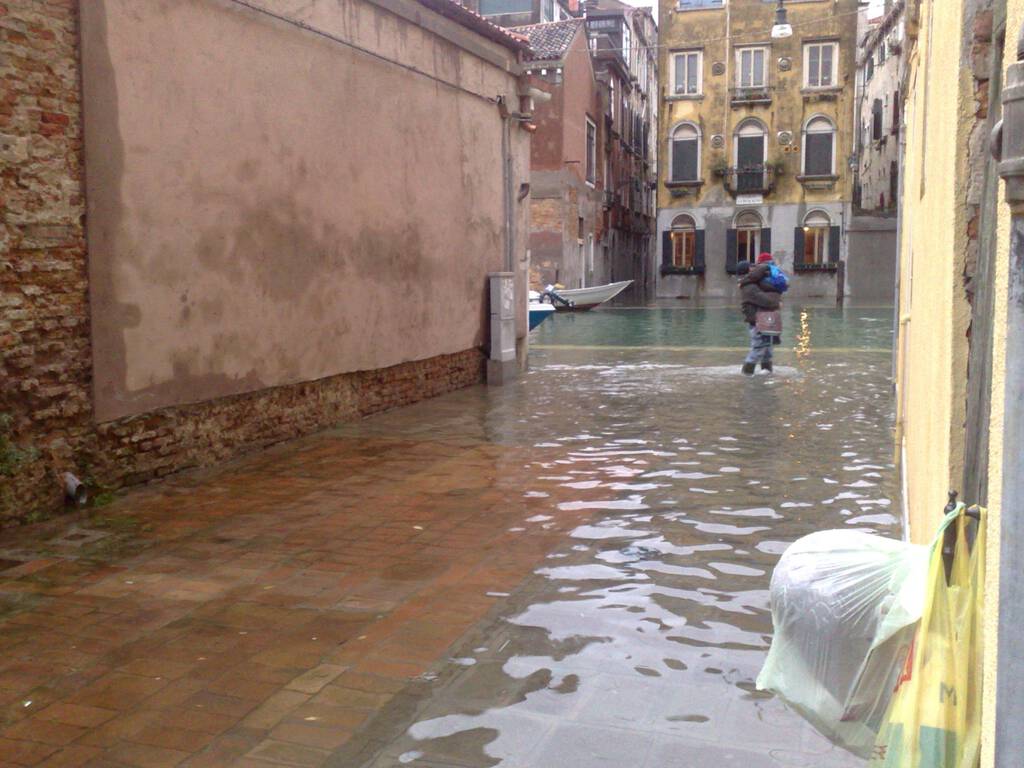
An hour later the water level was at 136 cm — the high water mark for the day, and the third-highest water level recorded in 2010 — and it was starting to come in our front door:
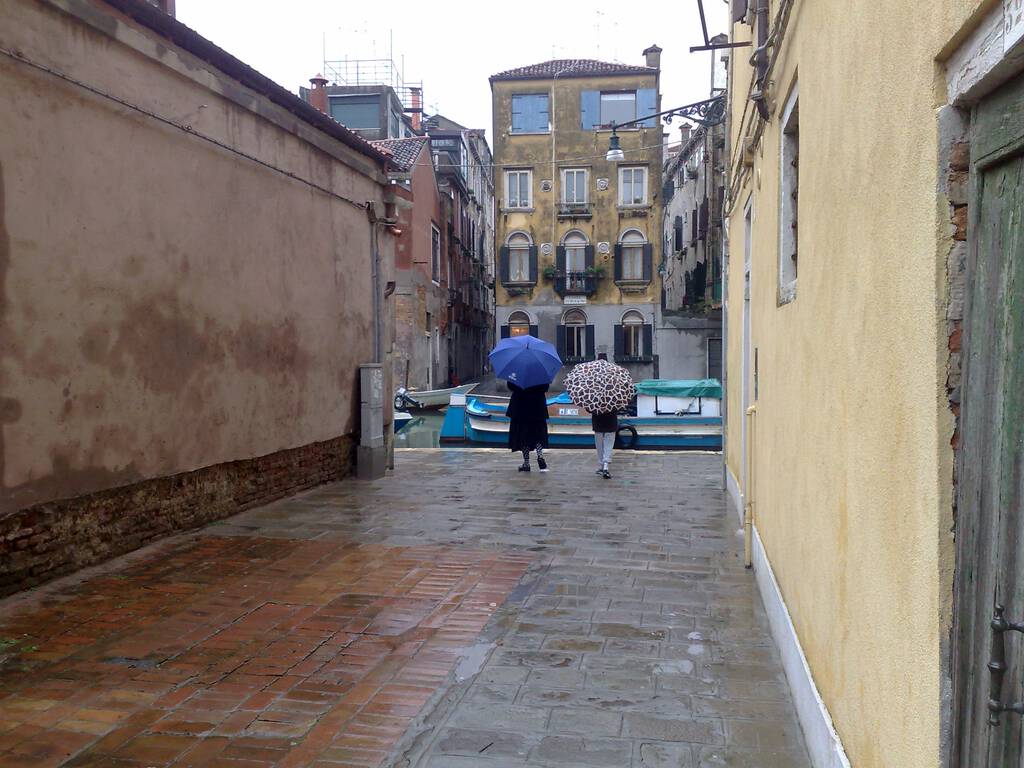
By 12 noon the water level had dropped to 84 cm and the street was empty of water (that’s Catherine and Oliver under the umbrellas):
Arrived in Brussels for Edgeryders SF authors and economists meetup. Looking forward to it.
Like a lot of blogging, this post concerned travel: in this case, a train trip (I’m hopefully assuming, given the distance involve) from Amersfoort to Brussels).
I’ve been thinking a lot about the importance of surfacing the carbon impact of our daily activities; travel, especially, is important to focus on, both for its significant contribution to total emissions (48% here in PEI) and because travel is something that we have atypical agency in reducing (it’s easy to decide not to fly to Europe; deciding not to heat my home is harder).
Anecdotal evidence from my personal experience suggests that paying continuous partial attention to consumption can have a positive effect on reducing consumption: even absent any other drivers, the mere fact of observing, it seems, is helpful.
What if Ton’s post embedded the carbon impact of his travel, and perhaps his mode of travel, turning this:
Arrived in Brussels for Edgeryders SF authors and economists meetup. Looking forward to it.
into this:
Arrived in Brussels for Edgeryders SF authors and economists meetup. Looking forward to it.
(the CO2 emission of a train trip from Amersfoort to Brussels are estimated to be 7.5 km by EcoPassenger).
To the casual reader of the blog post, nothing would change.
But with a little JavaScript, a curious reader could pull out the carbon impact of the activities described in the post:
var emissions = document.querySelector('.emissions');
console.log(emissions.dataset.co2);
Adopting this as a standard practice would be beneficial for two reasons:
For the blog author, forming a habit of documenting the climate impact of travel could be helpful in understanding more about (and coming face-to-face with) the accumulating effect of travel habits.
For the researcher, being able to extract climate impact data from blog posts could prove a useful data surface, and could spur the development of browser-based tools that could use this information in interesting ways (i.e. change the colour of the browser toolbar based on the carbon impact of a post).
We flew Charlottetown-Montreal-Vancouver today; we didn't leave Charlottetown until 4:00 p.m. and we're in bed in Vancouver at 11:00 p.m. Such is the wonder of the rotating Earth.
and:
We found our way to the SkyTrain, navigated to the Yaletown station, walked up the hill to Burrard. And are now ensconced inside The Burrard.
I can then extract the carbon impact of that post’s travels with this JavaScript:
var emissions = document.querySelectorAll('.emissions');
var total_co2 = 0;

emissions.forEach(function(trip) {
  total_co2 += parseFloat(trip.dataset.co2);
});

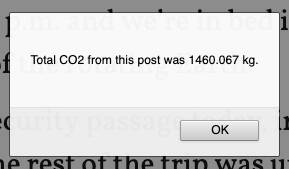
alert("Total CO2 from this post was " + total_co2 + " kg.");
which displays:
I’ve no idea whether this methodology is the best methodology, but I like the fact that it’s simple and doesn’t take much expertise to inject into a post; it would certainly be possible to add structured metadata to a post using JSON or XML, but that would add a perhaps-unnecessary level of complexity. And for this to work, it has to be easy.
Sorry for the long hiatus. I've been doing some formal advisory work and a bit of angel investing these past months, and so more of my writing has been private.
More than that, though, the Internet, with all the status games and incentives I wrote about in my last post, began to feel like an obligation that started whispering in my ear from a permanent porch on my shoulder. I needed a break from reading all the takes, most of all from the ones I felt myself forming in response to every next event, of which there is no end. The internet can cajole you into feeling as if you only exist through the act of posting.
Jia Tolentino writes in her great essay collection Trick Mirror:
As more people began to register their existence digitally, a pastime turned into an imperative: you had to register yourself digitally to exist.
...
The dream of a better, truer self on the internet was slipping away. Where we had once been free to be ourselves online, we were now chained to ourselves online, and this made us self-conscious.
...
As a medium, the internet is defined by a built-in performance incentive. In real life, you can walk around living life and be visible to other people. But you can’t just walk around and be visible on the internet—for anyone to see you, you have to act. You have to communicate in order to maintain an internet presence.
...
To try to write online, more specifically, is to operate on a set of assumptions that are already dubious when limited to writers and even more questionable when turned into a categorical imperative for everyone on the internet: the assumption that speech has an impact, that it’s something like action; the assumption that it’s fine or helpful or even ideal to be constantly writing down what you think.
I tweet, therefore I am? Internet participation can feel like being on tour in perpetuity, and the feedback loops can feel like a noose, one that you tighten yourself.
The rhetorical style of any Twitter account that continues to gain followers converges on that of a fortune cookie.
At what level of compression of thought on Twitter does any bit of specific wisdom get squeezed out of a thought?
Sometimes I wonder if the natural asymptote of an increasingly popular Twitter account is a parody of that same account. Could we train a GAN on some of the more prolific and consistent Twitter accounts to create Westworld-like clones, indistinguishable from the original? Could we create a parallel Twitter where these simulations of iconic accounts would live on in perpetuity, dispensing compressed nuggets of advice that straddle the line between profundity and banality, interacting with each other, believing that they and all of their peers were humans? Maybe we are all destined to become bots.
A long hiatus is a good test of what you truly miss, however, and I do miss the masochistic act of hammering a piece into some usable shape, and I miss the give-and-take with my readers. Thoughtful discourse hasn’t left the internet, it just isn’t happening in the public squares, for a variety of reasons I’ll dive into this month.
After my last post on Status as a Service, I received a lot of thought-provoking email, and in the ensuing months I’ve chatted for many hours with all sorts of people from operators to investors. I plan to spend some of my next few posts to respond to the most common points and questions my readers raised. A lot of these ideas have been renting a sofa in my head these past few months, and I need to Marie Kondo my brain cache.
Before doing that, a few updates.
I appeared on Peter Kafka's Recode Media podcast earlier this year to discuss Status as a Service. Peter has long been one of the journalists I follow on media/tech news, and podcasting has allowed him to be even more prolific and discursive on the topic; we all benefit. And while I love that podcasters can just show up with minimal equipment and start recording, it's always fun to go into the Vox studios, into a noise-proof room, don headphones, and speak into a high-end microphone. Rarely do I feel as, dare I say it, high status. Check out our conversation for a sense of how I've been updating my views on status as it relates to the tech sector.
My second update is that this is the first of my posts to be sent via Substack instead of Mailchimp. I grew out of the free tier of Mailchimp a while ago and the monthly bills were adding up even though I hadn't sent anything in months. I switched over to Substack even before they announced that A16Z would lead their latest round of funding, but I'd like to think the sequencing was causal (just kidding, it was not, and congrats to the Substack team who were friendly and helpful in getting me switched over smoothly).
Substack will allow me to selectively choose when to email my blog posts out, allowing my mailing list and blog to be separate entities. I'll still distribute or link to most of my posts via my mailing list, but on occasion, I may post something that's more blog-related housekeeping that won't be of interest to my email list, and, conversely, something may feel best suited for my mailing list but not my blog. I hesitate to consider myself in the newsletter business—I know, I know, another newsletter to clog your inbox, on top of the countless podcasts you already can’t keep up with—but if you're interested in reading all of my work, sign up for my Substack. If you're already on my mailing list, the backend has changed from Mailchimp to Substack, but otherwise you shouldn't notice any difference.
***
I titled this column Status Update because it was another of the titles I considered for my previous post. I always found it apt that Facebook referred to its posts as "statuses." That so many people use their posts to try to "update" their status—usually to try and raise it—made the term "status update" just too wonderfully loaded.
If you think of social networks as programmable interfaces, then each post on the network updates the contributor's status in a way that makes the nature of status on that network self-describing. You can even think of the impossibly long feeds and databases of all these social networks as one massive blockchain that all users are furiously writing to, trying to establish consensus around their relative status in the community.
My two principles of status were inspired, in part, by the two axioms of cosmic sociology from the science-fiction novel The Dark Forest, the second in Liu Cixin's epic Three-Body Trilogy. Those two axioms:
First: Survival is the primary need of civilization.
Second: Civilization continuously grows and expands, but the total matter in the universe remains constant.
I've always appreciated how the entire trilogy of novels derives, in part, from just those two axioms, though it takes some time for the reader to understand just how. In part, Status as a Service (StaaS) was an attempt to see how far I could extrapolate from just two axioms.
On to reader feedback. One point I heard from quite a few people was, “I don't use [insert social network of choice] for status.”
Of course, not everyone uses every social network purely for status, and as I noted in my piece, there are two other axes on which a social media services can construct a healthy business, utility and entertainment (I'll cover those axes in future posts as there are specific reasons I settled on those three in particular). Just as I would never claim that everything people do is in pursuit of status, no social network operates entirely on that dimension. And, of course, not everyone needs status from a network. Beyoncé doesn't need social media to earn status, she merely uses social media to harvest her already prodigious social capital. Your mileage, as compared to Beyoncé, may vary.
On the other hand, when I hear people claim they aren’t status-seeking, my initial thought is, “Okay boomer.” Well, perhaps that’s not quite right, but something along those lines. What it reveals is just how negative a valence the word "status" and the adjective "status-seeking" have today. Perhaps because we've long thought of status as a relative standing, and status competition as a zero-sum game, we find "status-seeking" personally threatening and distasteful all at once.
However, when I talk about seeking a sense of self-worth, a feeling of belonging and achievement, people have only positive reactions. Are those behaviors so easily titrated apart? I'm skeptical. But to all of you offended by being called "status-seeking," I apologize and applaud your lack of ego. I'm not saying that because I mean to raise your status, but...ah never mind.
The most common question I heard in response to Status as a Service was what spurred the piece. While it’s often difficult with fiction to pinpoint the origin of things, with an essay it’s easier to retrace the journey, or at least to point at specific ingredients.
One of the itches that spurred the piece was that my previous essay Invisible Asymptotes had me puzzling over why various social networks had collided with the shoulder of the S-curve after some prolonged period of hockey stick growth. Metcalfe's Law and the basic network effects theories that dominate discussion of networks would predict otherwise. While I offered some light exploration of the asymptotes for various social networks in that piece, it felt as if a giant variable was missing in the equation. The concept that best solved the equation in my mental backtests was status.
I also focused on status because, since it was my missing variable, it felt like the least understood aspect of social networks. I suppose that is tautological in structure, but it’s also endemic to mining for a new explanation for some phenomenon. There's always a risk in conjuring a single variable to make any equation work, but for argument's sake, I held the other variables constant and used status to the fullest extent possible, in search of its limitations.
What seems clear and almost obvious in hindsight is that not all nodes on a social network are equal and that different configurations of those nodes also matter. The quantity of nodes and connections isn’t sufficient to measure the value of a network alone. Two networks of similar size in nodes and connections may differ widely in stability and potential and kinetic energy. Status differences can be thought of as differences in the size of nodes and the configuration of them.
One of the critical forms of pattern recognition for anyone studying, investing in, or running these networks is learning which arrangements of what types of nodes are stable and which are inherently brittle or even volatile. That requires understanding a network’s status dynamics.
Much of my work advising companies recently has been helping them to understand which type of network configuration makes the most sense for the business they are in. While the past can be full of patterns that are about to implode, there's much to glean from studying previous network collapses because status dynamics remain, like much of human nature, fairly consistent across time. Digital anthropology is underrated.
For example, long ago, night clubs and dating apps understood that a successful marketplace equilibrium almost always begins with women as the supply side, not men. That's why if you're a guy you have wait in line for a long time just for the privilege of paying a cover charge at many clubs; meanwhile, groups of women are ushered in for free. How do you bypass the line as a group of men? By paying for bottle service, contributing to a very particular stable social equilibrium inside the club (not to mention a profitable one; witness the surge in % of floor space devoted to bottle service booths in Las Vegas clubs this past decade).
Any multi-sided marketplace veteran or observer now understands much more about how to sequence their efforts, and whether to focus on the supply or demand side first and why. Bill Gurley appeared on Patrick O'Shaughnessy's Invest Like the Best podcast and spoke to the differences between monogamous marketplaces, where two parties match exclusively for a long-term relationship (for example, finding a nanny for your children) and marketplaces where people just match up for a single transaction (Uber, for example). Li Jin and D'Arcy Coolican of A16Z have written several pieces about network effects that continue to fill in the nuance between the platitudes.
Despite all that, the industry still has a ways to go in incorporating status into its operations. One of the clearest ways this manifests is in the metrics most social networks monitor and report on. Almost all of them aggregate a lot of individual user behavior into aggregate stats. However, just as it's very dangerous to munge cohorts into one lump, failing to understand subgroup status dynamics and configurations among a giant social network disguises a lot of what's actually going on. The trends of the group can diverge from the actual dynamics of various subgroups. Your stats could be growing, they could be declining, and yet you have no idea why. Some competitor comes along and starts stealing market share, and yet on the surface they look like a smaller, subpar version of your network.
The topic of how social companies should analyze their networks is a topic worth a book in itself, and it's clear that we're very early in that journey. Many social networks continue to have no idea when they are about to hit a wall, with less visibility into the future than a club owner who comes in night after night and notices, gazing across the dance floor, realizes one night that the joint has lost its heat. When people refer to Facebook as a boomer ghetto, they're referring first to a decline in social capital, which precedes the loss of human capital
More on this soon, but for the remainder of this update, I want to look back at the 21st century to date and marvel at one of the greatest changes in civilization, one wrought by first the internet and second by the rise of massive social networks.
***
One way to understand the impact of these public social networks on humanity is to think of this as the era in which humans took their personal thoughts and lives public at scale. Billions of humans IPO'd, whether we were ready for it or not, explaining why the concept of a personal "brand" became such a pervasive metaphor.
In another era, most of us lived in social circles of limited scope. Family, school, coworkers, neighbors. We were, for the most part, private entities. Social media companies quickly hit on the ideal configuration for rapid network growth: take the interaction between any two people and make it public. Conversation and information-sharing became a democratic form of performance art.
One reason social networks quickly converged on this as the optimal strategy and configuration is that the majority of people on any social network merely lurk. By making the conversations of the more extroverted, productive nodes public, you sustain the interest of that silent majority of observers with what is effectively crowd-sourced (read: free) content. The concept of 1/9/90 is that a stable equilibrium can be achieved in a large network if the shouting class, the minority which entertains the much larger but silent majority, is given enough quantifiable doses of affirmation (likes) to keep the content spigot flowing. As these large public social networks grew, even many who were previously modest began taking the stage on social media to karaoke to the crowd. Live fast, die young, and leave a viral post.
Just as there are many advantages to being a public company, becoming a public figure carries all sorts of upside. Once your ideas and your self are traded publicly, anyone can invest and drive the value of those goods higher. If you’ve ever written a viral blog post or tweetstorm and gained thousands of followers, if you’ve had a YouTube video picked up by traditional media and found yourselves interviewed on the local news, you’ve felt that rush of being a soaring stock. Social networks not only provide public liquidity for anything you care to share on them, but they also continued to tweak their algorithms to accelerate the virality quotient of their feeds. In a previous generation, Warhol quipped the duration of sudden fame was 15 minutes, but social media has made that the time it takes to become famous.
The problem is that, like many private companies who find the scrutiny of public markets overly stringent, many of us were ill-equipped for "going public" with what were once private conversations and thought. It's not just those who made enormous public gaffes and got "canceled." Most people by now have experienced the random attack from a troll, the distributed judgment of the public at large, and have realized the cost of living our lives in public. Most celebrities learn this lesson very early on, most companies put their public-facing executives through PR training, but most humans never grew up under the watchful gaze of hundreds of millions of eyes of Sauron.
That dread we feel when our thoughts and selves are traded as public goods is the unease that comes from rendering the personal transactional. Public companies are restricted in what they can say publicly. The same is true for people who take their selves public. The markets punish companies that stumble, and the judgment of the masses is no less harsh for individuals who do their thinking out loud on social media. This new form of public backlash has even earned its own moniker: cancel culture.
One of the most famous and iconic incidents of cancel culture was the tweet that "blew up Justine Sacco's Life." As soon as I mention it, almost any student of Internet culture knows the tweet.
Before boarding the last leg of a flight from New York to Cape Town, Sacco wrote to her 170 Twitter followers at the time:
"Going to Africa. Hope I don’t get AIDS. Just kidding. I’m white!"
By the time her flight landed, she had what might be the closest experience to traveling to an alternate universe on a plane since the passengers of Oceanic Flight 815 on the TV series Lost. When Sacco's flight landed and she emerged from the runway into the airport, her phone reaching out to handshake with the network, she stepped into a timeline in which she was an international villain.
Justine Sacco must have felt like Jack on that beach in the pilot of Lost, wondering where she’d landed and what the hell had happened. In fact, in hindsight, perhaps Lost is more compelling as the story of a bunch of people who’d been canceled, all stranded in some social media purgatory to try to atone for their sins.
Nowadays, it's a common occurrence to see someone inadvertently place a tracer on themselves online and summon the collective brimstone and fury of a global mob on themselves. But, if you're old enough to remember the pre-internet, pre-social-media era, try to fathom how a single relatively unknown citizen of the world like Sacco could write or utter any sentence of just sixty-four characters and ignite anything remotely comparable to the fury of millions of total strangers from across the globe.
I'd argue that such a feat was impossible in a previous era. The only way someone like Sacco could even reach that many people back then would have been to broadcast such a message through a mainstream media channel like a newspaper or television network, all of which were under the control of a select group of gatekeepers who would've never broadcast her joke in the first place (remember, I'm talking about even the pre-Fox News era).
We've had no shortage of dystopic futures that warned of mass surveillance, but not many of them described a future in which you could destroy your own life with your own words. The Twitter "What's happening" prompt box is like a command line with the power to, among other things, obliterate your life. Such is the power of a megaphone that can reach most of the civilized world. Who's up for global open mic night? What could go wrong? Wheeeeeeeeee!
After I read the Three-Body Trilogy, the first metaphor that leapt off the page was the idea of Twitter as The Dark Forest. Many public figures had already gone radio silent online, the downside was so severe. Yancey Strickler recently wrote about this idea of the internet as Dark Forest, and if you're not worried about having that metaphor spoiled, click over and give it a read.
Just as the SEC regulates what public companies say, social norms regulate what a person can say on social media. PR training today begins for all of us once we get our hands on our first smartphone. It's little surprise that just as many companies now stay private for longer, many people have retreated to private messaging groups, taking their thoughts back into the shadows, while those who stay public learn to code messages in memes or language so opaque and Straussian that even political dissidents would be impressed.
If your feeling on all this is, good, these people got what they deserved, I understand. Some people who’ve been canceled have written some truly abhorrent things, some of it even illegal, and sometimes it can feel like we live in an age of hyperefficient social Darwinism, a hyperactive white blood cell army patrolling the alleyways of the internet in that distributed swarm style the internet made its own.
But the exact definition of “cancel culture” matters. The closer the social mob is to enforcing the values you believe in, the more just it feels. The more divergent the values of the mob, the more you feel attacked by an army of trolls. I’m not opposed to new forms of social capital regulation enabled by the internet, but social mob behavior can be a mass of unthinking, blind, rage. Like a real-life mob, just bigger, and faster moving. That’s a frightening phenomenon.
As we approach the year 2020, and we look back on two decades where billions of people went public, I’m equal parts astonished and horrified. I imagine a time traveler appearing to a citizen of the pre-internet era in a new age Monkey’s Paw fable, and asking that person, “I can grant you one wish, what do you desire?”
And that person would look at the world around them, all the people going about their business, strolling past and paying them no heed, and they’d say, “Make me famous.”
It’s difficult to say who was more confused by Don Cherry’s Tuesday appearance on Tucker Carlson Tonight – Don Cherry or Tucker Carlson.
The Fox News host didn’t seem to know who Cherry was (or that Canada had fought in both World Wars). Cherry seemed to have little understanding of why he was there.
Carlson wanted to talk about “fascists” and dog charities. Cherry wanted to talk about Bobby Orr and someone named Liz.
About a minute into the interview, Carlson started to get a look. This was not turning into the U.S.-style screed he’d hoped for. In his crotchety way, Cherry was almost apologizing.
With the crutch of hockey talk taken away, Cherry made even less sense than usual.
“We’re all immigrants and the whole deal and but I knew and nothing happened that night and nobody said anything that night and they ran it that night and they ran it later and the whole deal. And the funny thing is I never heard a thing that night. I heard it the next day at the, uh, the silent majority, as you know, is always silent.”
Carlson tried to goad Cherry into some fresh outrage. Cherry was either disinclined or couldn’t pick up his drift.
The segment would have gone smoother if Carlson had interviewed Ron MacLean, who in turn could have translated the questions into Ontarian and put them to Cherry.
Instead, the two men talked by, over and around each other. It was a nice metaphor for current cross-border understanding.
By the end, Cherry’s routine had so flustered Carlson that he signed off with this incongruous sentence pairing: “Google Don Cherry. He’s a famous man.”
Story continues below advertisement
So now we know: 72 hours or so – that’s how long it takes a national reckoning to descend into farce.
Three days is also enough time to sort the winners from the losers in this thing. There are no winners.
Rogers Sportsnet loses. They’re now stuck with a $5-billion hockey package they can’t afford and no one to provide the face of it.
Cherry didn’t just take himself down. He turned Hockey Night in Canada into the newest salient of the culture wars. Good luck to whomever has to replace him. It won’t save them. They are doomed. But good luck anyway.
MacLean loses. It’s possible he wasn’t even listening to Cherry as he wandered into a field of rhetorical bear traps. I mean, after 30-odd years of that blather, would you? But that thumbs-up at the end has brought MacLean low. He’ll spend the rest of his career being asked about it.
Hockey loses. The one thing the NHL would like to avoid in this country is a deep consideration of what hockey means.
Hockey would like to mean Jean Béliveau, frozen ponds on a Saturday afternoon and Paul Henderson’s goal. But all those things are from a long time ago. What does present-day hockey mean in modern Canada? That discussion starts by asking everyone in the room to stand up and split off into their tribes.
If America has blue states and red states, Canada has hockey regions and non-hockey regions. Hockey has very little to do with it, but it’s a convenient conceptual divider.
The regions were in a state of détente until Cherry’s forced ouster. That acted like a rocket launched over the border from downtown Toronto into Anywheresville, Alberta.
If I roll up to you in an airport departure lounge this morning and say, “Don Cherry, eh?”, within 30 seconds I will be able to take a good guess at who you vote for, what kind of work you do and whether you live in a hockey or non-hockey region.
Dignity loses. There were a half-dozen turnings in this story that might have made it a hopeful, redemptive or maybe just useful one.
If MacLean had confronted Cherry in the moment; if all the organs of hockey, instead of rushing to cover their own hindquarters with vague statements about diversity, had brought the weight of the game down on their errant bannerman; if Cherry had said on Canadian TV what he seemed to be trying to say on the U.S. version of Soviet Central Television.
For a few moments, it seemed like this could lead to a productive discussion about what it means to be Canadian. How ought we define that? Ought we define it at all? Given recent events, the question feels urgent. Four stray words from Cherry – “you people … come here” – had given it focus.
What do you feel about that and why? How does it inform your relationship with your neighbours? Do you wish you knew your neighbours better? Not the ones who live directly beside you or think exactly like you, but all of them. You probably do – and just as probably don’t know how to do it.
Whether we like it or not (and I believe the overwhelming majority of Canadians do), we’re all in this together. Cherry had given us a reason to talk about what that looks like, what it means and how we might make it better.
But that opportunity burned off quickly. Everyone ran to line up with their side and start chucking rocks. A little scroll through any random Facebook comments section on the matter is a vertical toboggan ride into intellectual hell.
My two key takeaways: The all-caps button ought to be banned from future keyboards, and if you are going to e-mail people and profanely berate them, you probably ought not do it from your work account.
Then Cherry pops up on Fox, making us all look like idiots, and you think: This cannot possibly get any stupider.
But it can. It always can.
Most of all, Canada loses. This country will be fine one way or the other. It’s too big an endeavour and too good an idea to fail.
But every once in a while, it’s useful to step back and really think about the big, fundamental questions. Without meaning to do so, Cherry gave us that chance. We were too busy yelling at each other to take it.
And: coincidence! I work via a consultancy vehicle called Mwie Ltd. I am its sole employee. Mwie was incorporated in October 2014 and issued its first invoice in November 2014, so that also puts me 5 years on the job. Happy work anniversary, I guess (which is absolutely not a thing although LinkedIn insists it is).
Inspired by Tom, I started writing a blog post retrospective. What I’ve been doing, what some highlights have been, etc.
What I’d like to do more of.
What’s missing.
What am I any good at.
Oh my god where is it all going anyway.
Ok so (a) I shouldn’t have tried to write to write a retrospective on my own on a Friday night; and (b) wow it got way too personal, there’s no way I’m sharing it.
The thing is that for the past five years, I haven’t been talking about what I’m up to, and there hasn’t been a plan. My strategy has been
talk with interesting people about what I’m interested in
don’t chase too hard: allow as much time as necessary for win-win situations to make themselves obvious
only do interesting, stimulating work — but never just because I need it for the cash or positioning (granted, it’s privilege to be able to be choosey like this, but I’ve previously worked to earn that)
no marketing except word of mouth: marketing can’t abide complexity. Crafting a message that will carry, any message, requires reifying my practice and I haven’t been ready to do that.
That last point all about what we’d call in other contexts product-market fit. That hyphen is an arrow of influence that points both ways.
Marketing requires a view on what the market finds valuable; what will resonate. In my case, how clients will find and understand business value. Not only have I lacked up-to-date knowledge of what value I, personally, can unlock, but prematurely working on marketing will shape the product before it’s ready.
And what is the “product” here? Well it’s me, my practice — it’s some overlap of what I find stimulating, what I’m good at, and what helps me get future work which is the same but better. But can I articulate that? Not a chance.
So if I look at the last five years, the strategy has been
follow my nose
discover what I want, because I can’t articulate it
discover what the market wants, because I don’t know.
If it sounds like I’m starting from the ground floor here, I guess it’s because I am. BERG (the design consultancy turned tech startup I co-founded) shut its doors in 2014, and I carried on working on various loose ends well into 2015. My “voice”, needs, patter, platform, and intellectual interests had been mixed with the studio, in one incarnation or another, for 10 years. It’s… confusing. Moreover, I had been surrounded by some of the most talented, unique individuals I have ever met — and one of the jobs of a CEO is to do only what can’t be done by others.
All of which means I came into my current five year stint as “Independent Consultant” (according to my LinkedIn) with very little real idea of what I was good at and what I wanted out of my work. And, if I’m honest, a bit afraid that the expectations of others — potential clients — would shape my practice into what they needed and thought I could offer, before I could figure that out for myself.
Let’s call it product discovery and market discovery. Business-speak as camouflage for feelings.
I wish I could find the source of this quote. I remember reading Kevin Kelly relating something he heard from his mentor Stewart Brand:
We have time for three 15 year careers. In each career, you’ve got five years to learn and work your way into it. Then five years to do it as well as you can. Finally you have five years where you can offer a new spin from your own individual perspective.
I think about this period I’m in as my second career. I’ve been in no hurry to figure out what it is.
But… five years in. Maybe it’s time to finish the discovery chapter and focus on execution for a bit.
Where were we? Oh yes, Friday night a little over two weeks back. On my own at the kitchen table with my laptop and a class of red, writing a career retrospective that was rapidly devolving into a career existential crisis.
Here’s what I did.
I wrote down everything I would regard as a career highlight from the past five years, and looked to find themes.
Then I went back to looked at extracurricular activities from the past five years. I’ve always got a side-project or two. Well, I decided, if they fit into one of my themes, they’re retrospectively now a work project.
I listed everything that I felt was missing. What do I wish I had done more of?
And then, at the end, there is this section: If I met me, and was advising me on what to do, this is what I would say: — and after answering that title I went to bed.
Before I go into the results of that personal career review, it’s worth saying why I separate myself from my consultancy, Mwie Ltd, even though the two are often the same.
It’s practical and means I can work with bigger clients. Incorporating means I can safely subcontract (which I’ve done frequently for clients) and relate to companies on the basis of product supplied rather than hours done.
I can invest in assets. Through Mwie Ltd I have run a bookshop in a vending machine, and I’m building Job Garden. Both cost money. But because they stick to the consultancy, even if they don’t wash their face by their own account, they can be worth it for the marketing, creds, or capabilities benefits.
Separating the company bank account from my own provides a psychic buffer. For years I’ve paid myself a regular monthly salary. Company revenue goes up and down. Clients sometimes pay late. Sometimes there’s a good month and the company looks flush. But so long as there’s a six month runway in the bank, none of that affects my sleep.
You get what you do. Or rather, you get what others see that you do.
It’s funny. Jack and I gave an interview to the Daily Telegraph business section (I’m not even kidding) way back in 2007. I just went back and read it, and the advice in that article is exactly what I had to remind myself about that Friday night. Here's the article:
"We started turning down work," says Webb, describing the duo's slightly different approach to building a fledgling business. But Schulze and Webb had an unusual problem - when they spoke to potential customers they would get offers to design websites or graphic material. But that wasn't what they meant by "design". "Bits of plastic and microcontrollers," says Webb, "the future world of products." These were the things that excited them.
Friends advised two strategies. One: find a way to communicate to people what you do in language they can use with others (such as their bosses). Two: make things that encapsulate the kind of work you want to do and hope people discover them.
And at the end of the article:
Do: Start with the smallest thing that'll work. The learning you get from 'doing' is huge, it gives you pace, and big plans are always bigger than they look from the outside.
Don’t: Take work only for the money. You get what you do, so work that makes you unhappy is not progressive. And it's better to structure the business so you don't need the cash than take work that kills the opportunity of much better work.
Bloody hell. Thank you very much Jack-and-me-from-2007.
My personal career review includes some course-correction points.
I’m not doing enough public speaking of the sort that I enjoy — I feel I’ve lost touch with my tribe, and I miss that.
And while the function of the work I’m doing is rewarding, and I enjoy and I’m good at it… I’m missing the opportunity to chase down intellectual avenues which — because of my individual perspective — fascinate me and I believe are important. I have a list of these.
I also have a couple of points which boil down to: this isn’t the consultancy, but do more of it!
I’m not going to share details on the above points if that’s ok.
Mainly, and this is what surprised me, when I looked back over five years of projects
there are indeed themes!
the kind of value I can offer and enjoy is supported by credible previous work!
I have opinions about the industry that I’m in, and what should be done better and differently!
I would like to do more of those things!
None of this was necessarily going to be the case. So, good news.
You get what you do.
Long story short, I redesigned my website. Between other things that took two weeks and I put it live yesterday.
I thought about renaming. But switching away from Mwie Ltd felt like it would be inauthentic — it is just me, after all, operating as a limited company, and I have no intention of building it into another agency. Been there, done that.
Secret origin: “Mwie” stands for Matt Webb Import/Export because when I was a kid, visiting family in Nairobi, we would pass all kinds of import/export businesses and I still remember them as exotic and mysterious. I always wanted one of my own. And so.
Yet Mwie is a dumb name. So in the spirit of celebrating that which binds us, I figured I would lean in and put the expanded version on the homepage too.
Actually writing the case studies was pretty simple. This isn’t a launch of a new offer. There’s nothing aspirational here, and no new positioning. All I’m doing — very incrementally — is reinforcing existing word of mouth marketing by stating exactly what I already say in person.
So I just wrote down how I already talk about my projects.
Putting them in one place, and grouping them: that’s new.
Oh, and the design. I get my hands dirty with web design every year or two. It’s fun, although of course now I can’t see anything except what I think is wrong with it.
Around this time every year, nostalgia kicks in and I am reminded of my telco years. I’ve written about that period before (The Blue Packet was an allegory for the Vodafone 360 debacle and Template For Small Countries merely one of the poignant moments I witnessed there), but as it happens I have a tangible souvenir of those years:
Part of my home office decoration for the past nineteen years
This oddly shaped, unwieldy chunk of purple plastic (which is around 6cm to a side, if you’re wondering) has been on my office desk for nearly twenty years now, and despite it being fundamentally useless (it doesn’t even make for a good paperweight) I keep it as a daily reminder of how dogma and preconceived notions can turn well-meaning engineering into a massive iceberg of technical debt.
The Very Beginning
I joined Telecel (which was later to become Vodafone Portugal) on April 1st 1999, originally as a product manager for “internet addiction”, an amazingly prescient job description that at the time entailed finding ways to keep dial-up ISP customers online for as much time as possible. Call termination rates and per-minute charges accounted for a sizable chunk of revenue, and it was in our best interest to maximize the latter.
So my first afternoon on the job was a memorable meeting with the CMO and the Director for New Business (my boss, who was effectively the head of the ISP business unit and easily the best line and skip manager I ever had) to discuss tariff plans and which ISP services had the most potential to keep people online for long periods of time.
We had the usual staple services: e-mail, NNTP, personal web hosting and a plain portal with a built-in search engine, but at the time “internet addiction” essentially meant IRC and online gaming, because those had the added advantage of being low-bandwidth and nearly residual impact on peering costs to other ISPs (PIX, the Portuguese Internet eXchange, was hardly useful at the time, and Portugal Telecom charged heavily for traffic exchange, so that was a factor too).
The fun bit was that one of the reasons I got a Marketing job instead of going to Engineering with other friends who joined at the time was because I ran the Quake servers at my former employer, IP Global1.
And Quake also played a role in challenging the engineering status quo, but I’m getting ahead of myself here.
Flipping The NETC Bird
The NETC logo
The ISP we were putting together was called “Netcétera” (NETC for short), and bootstrapping it was the technical responsibility of one the Telecel shareholders (AirTouch, which was later acquired by Vodafone). The name came with a whimsical tag line and logo, and since at the time you actually had to provide people with software to get connected (a SLIRP/PPP dialer, a mail client and a browser), we actually shipped subscription CDs in a plastic bird cage, with the subscription papers in the bottom:
The famous birdcage. Courtesy of Jorge Alves
Those were cute, innovative, very appealing for store displays, but a major pain to stock due to their size. Oh, and the guy who ended up building hybrid CD images for Mac and PC? Well, that was me too, since I had experience using IEAK (the Internet Explorer Administration Kit)2.
This was at the dawn of portals and search engines, and we were competing against Portugal Telecom’s Telepac (which had SAPO on its side as a prime online destination) and a bunch of other local ISPs.
The Menagerie Of The Rising Sun
AirTouch brought to Portugal a very experienced, senior engineer (whom I’ll call Calvin Brown) who had built several regional ISPs in the USA and was considered to be at the top of his game. And they also hired sysadmins, webmasters, DBAs and other roles from local ISPs, including one of my opposite numbers at Portugal Telecom—Telepac’s Quake server admin (whose handle was Underspell, and who became my partner in crime in this story).
And the culture (and budgeting) difference showed. Most other local ISPs had built their services atop cheap Linux or FreeBSD servers. Brown, however, swore by Sun hardware (and, unfortunately, also its ISP software suite) and followed the approach that a Portuguese national ISP should be at least as big (if not bigger) than the ones he’d built before, so the whole thing was a massive multi-tier deployment, with separate front-end (web, SMTP, POP), mid-tier (search, support systems, etc.) and back-end systems (mail, databases, storage, etc.).
I remember poring over the network diagram and thinking that it was at least three times as many boxes as what I was used to. That and the naming convention was also somewhat whimsical–machines were named after marine life (cod, beluga, etc.) according to their size and “depth” in the architecture, and there were a lot of names.
But one of the things that stuck with me was that every tier had four separate LAN segments (public, internal, monitoring, management, etc.). Almost every machine had multiple Ethernet interfaces, and all those LANs, for all layers, talked to each other via a SunScreen firewall with multiple quad Ethernet cards.
Keep this last bit in mind, it’s important.
Hundreds Of Little Feet
The actual size of the whole thing only became apparent to me when I visited the data center and looked upon dozens of racks filled with a sizable sample of the Sun Microsystems portfolio.
And by sizable I mean that a typical low-end machine in that setup would be a Sun Enterprise 250, a boxy affair that was rack-mounted sideways. But there were also a lot of Sun Enterprise 4500s, voluminous mid-range modular beasts that shipped with four purple plastic feet.
The Sun Enterprise 4500 in all its glory. Note the feet.
I forget exactly how many there were, but what I do remember was that when I leaned onto a couple of stacked cardboard boxes near the datacenter entrance, my elbow slid into the topmost with a sound that was not unlike LEGO bricks.
I reached in and realized that the box was filled to the brim with E4500 plastic feet that had been removed for rack mounting. Both boxes, in fact—there were a couple of discarded bezels and other things, but they were both 90% full of… feet.
Having previously worked at a Sun reseller, I was completely floored by the amount of cash all those feet translated into. If it sounds like overkill, well, it was.
By now you probably figured out the chunk of plastic I kept for all these years is one of those feet. And there was so much more I could write about that datacenter tour3…
Our estimation at the time was that if not for mail storage and databases (which would run better on Sun gear at that time), we could have run the whole thing on Compaq servers and taken up probably 50% less rack space and definitely much less cash4.
Launch Day
That was a day to remember, since we were under attack from the get go. Every single script kiddie in the country (and a few pros in the competition) wanted to get a feel for what we were running, and it brought to light a number of harsh realities, the first of which was that it was trivial to bring down the entire portal by typing in a single letter in the search field and hitting Return.
I can’t find any quality screenshots from that time (I suspect there are plenty squirreled away in e-mails, but nothing decent online), but this one should give you an idea of what the home page looked like on launch day:
All that yellow is just glorious, isn't it? Sorry you have to squint at it.
All you had to do was run a few simultaneous searches for “a”, and the whole thing would just collapse. Sun Web Server gave up and crashed, database load went through the roof, etc.
And then someone decided to script the GET requests at scale, and the entire ISP went down for hours–including sign-up pages, service links, tariff plans, the works.
Why? Well, because there was no input validation, no real separation between the search engine and the front-end, and no caching at any layer. And I’m pretty sure of that, because after much debate I was one of those who ended up trying to patch it until we could get the local company who coded it (which shall remain nameless) to fix the “search engine”.
Everyone was going nuts at the time, and I somehow ended up in front of a terminal session to one of the front-ends looking at the code alongside Underspell and a couple of other people.
The first thing we did was to add an if (strlen(input) < 3) { return; }. It wasn’t any sort of decent fix, but merely the simplest thing we could do across servers in 5 minutes until someone else tried to reconfigure the firewall.
But then some bright spark (whose IP address we logged, and tracked back to a rather amusing domain name I knew very well) decided to search for %%%, and I dug further into the code to discover (with considerable horror) that the “search engine” was effectively doing a “SELECT * FROM pages WHERE text LIKE '%” . query . “%';”5.
It took us a few days to get it properly fixed, but being able to articulate what was wrong was one of the reasons I ended up taking a permanent seat in Engineering and spending more time there than in Marketing during those early years.
We had constant trouble with the Sun ISP software stack. Sun Web Server was the first thing to be replaced (with Apache), LDAP was a major pain (we used it as a subscriber database for unified dial-up, mail and FTP login) that we spent years trying to fix, and Sun Mail Server was the worst e-mail system I’ve ever dealt with with regards to management and troubleshooting.
I remember Brown (who was in his fifties, bespectacled, blue-eyed, and white-haired), becoming visibly agitated and red-faced whenever we suggested replacing any of the software with “unsupported” Open Source alternatives, and how subdued he was when Sun support kept failing to get things to work.
He considered Linux inferior and insecure, but begrudgingly put up with running a few machines at the outer layer, as long as they were isolated from the rest. After all, we had to run some things on Intel (for instance, we couldn’t run any game servers on Solaris), but that was always a sore point with Brown.
So we begun setting up game servers (and other things) outside the “monolith”. By 2000, we had a separate portal for games. I paid (with my own money) for a separate domain name (one that became quite notorious, sadly fallen into disrepair as a malware haven these days), and we got to the point where we even ran our own e-mail and web hosting services–and quite a few extra projects started using those instead of the Sun ones.
A joint promotion with YORN (our mobile youth brand) for Internet World 2001.
But the games service was the main topic of dissent. Besides the internal discussions about branding and whatnot (it was one of those things that just grew into its own brand and became very popular indeed), the remaining Sun partisans were somewhat annoyed at us running it off a handful of Cobalt boxes (who someone wittingly named piranhas)6.
The first two piranhas. Courtesy of Bruno Rodrigues
That was until we started creating mailboxes for them to use when Sun Mail Server blew up (for testing, obviously…), and eventually managed to build upon that to sneak in software that actually worked, mostly by testing things on Linux, swapping some of it out on Sun boxes and letting things run for weeks without hitches before presenting Brown with accomplished fact.
But we never managed to touch the NNTP service–Brown was obsessed with News/NNTP, and managed those boxes himself.
Our shenanigans were tolerated because by that time we had fixed DNS, RADIUS and most critical services to a fair degree, but we had to put up with the Sun ISP software and architecture design for a long time, and it was a constant struggle.
At one time, we had so much unofficial support to get rid of Sun hardware that I even designed (and put up on the wall behind my desk) an “Eclipse” logo:
The Eclipse logo.
Black Hole Sun
But the SunScreen firewall took the cake when it came down to utter uselessness. Remember that it sat in between all the architecture tiers?
With four LANs per tier, the network design was so complex the thing had trouble with even basic routing, but when it got really confused and rebooted on its own, SunScreen would often set all the Ethernet ports to the same MAC address (zeroed out, for extra kicks).
That, in turn, brought down the entire ISP (except for the piranhas, which just kept going…) and forced us to manually reboot all the Cisco gear.
But I’m not even going to start on how much over-engineering and technical debt we got into on the networking side (at least in the ISP core, since the dial-up network was designed by my former colleagues and they ran things sanely). I’m just going to stop here and reminisce about having hair (and huge monitors) at the time:
At my desk, a few years later, as we were packing to move off the ISP floor. Courtesy of Bruno Rodrigues
After all, this post is getting really long and we’re only halfway there–I expect to be able to tell the rest of this saga (or at least a few more highlights) in a few weeks…
But I think you get why I kept that plastic foot. It stands for all that we went through at the time, and is the reason why I vowed never to get into anything else I couldn’t understand (or design) from the ground up.
And, more to the point, to never throw money at problems until they go away.
Because they don’t–they just feed on it and become massively huge problems that can take years to fix.
I should know, right?
(that later became Novis and was eventually merged into NOS, the third Portuguese telco by chronological order). ↩︎
That I would end up writing about this while working at Microsoft a couple of decades later is ironic at best. ↩︎
Another thing that really stuck with me was that all the boxes with redundant power supplies had both PSUs hooked up to the same power rail via Y cables. I have no idea who signed off on that… ↩︎
Sun salespeople were on-site every week to dispel that notion, obviously. ↩︎
Yep, no prepared statements. And I don’t recall there being a LIMIT clause when I looked at that code, either. And there were also some SQL injection attacks–the whole thing was a spectacular failure that proved to be a very valuable lesson to our management about subcontracting anything… ↩︎
Somewhat amusingly, those Linux boxes outlasted all of the Sun machines, and I ended up bringing a couple of “dead” Cobalt boxes home with me and swapping parts to make a working one. This site actually ran on it for a year or so from my cable connection… ↩︎
Scientists at the University of Waterloo have developed a device that is able to detect when a child or pet has been left in a car.
The sensor uses artificial intelligence and radar technology to determine if a child or pet has been forgotten in a car. If the sensor believes this is the case, it will trigger an alarm.
It would prevent the car’s doors from locking and would sound an alarm in an attempt to alert the driver and anyone near the car. The team that developed the product claims it functions with 100 percent accuracy.
The device would work by being attached to a car’s ceiling or rear-view mirror. The scientists say that the radar signals in the device would be reflected back by children or pets inside the car.
If the radar believes that someone is in the car, the AI system would then look at the findings and determine if the device should sound the alarm.
“Unlike cameras, this device preserves privacy and it doesn’t have any blind spots because radar can penetrate seats, for instance, to determine if there is an infant in a rear-facing car seat,” George Shaker, an engineering professor at the university, told CNN.
A study from SickKids recently concluded that one child a year dies on average in Canada after being left in a hot car.
After months of rumours, Apple’s new, subtly redesigned 16-inch MacBook Pro is finally here.
The most significant takeaway from my roughly 20 hours with the 16-inch MacBook Pro is the beleaguered ‘Butterfly keyboard’ featured in Apple’s laptops for the past few years will likely be slowly phased out.
The tech giant might not have said it outright, but the fact that its highest-end laptop now features a scissor key design that is different from every other device in the MacBook line, leaves the current MacBook Air and 13-inch MacBook Pro in a state of limbo.
It’s likely the keyboard as well as the 16-inch MacBook Pro’s other new features like the physical ‘Escape’ key and the Touch ID button that’s now separated from the rest of the Touch Bar will eventually make their way to Apple’s other laptops. Alongside display, audio and thermal improvements
The big question though, is when? The current state of Apple’s laptop lineup also makes the 13-inch MacBook Pro and MacBook Air difficult to recommend right now.
But, on to the new 16-inch MacBook Pro.
Apple listened
My main takeaway from my time with the MacBook Pro is that Apple listened to the many criticisms and complaints surrounding the 2016 redesign of its ‘Pro’ laptop line.
First, the ‘Escape,’ or ‘esc,’ key is no longer attached to the Touch Bar, which will be good news to anyone still mourning the death of the 13-inch MacBook Pro that didn’t include a Touch Bar. As you likely guessed already, there unfortunately isn’t an option to purchase a 16-inch MacBook without a Touch Bar. It seems despite a mixed response to the Touch Bar since its launch, Apple is sticking with the touch-sensitive strip.
The laptop also still sports three USB-C Thunderbolt 4 ports, and not a mix of USB-C and USB-A like Microsoft’s recently released Surface Laptop 3. Since USB-C is far more common than it was a few years ago, this is less of an issue now. Still, it would have been great to see Apple genuinely listen to its most vocal users and at least add one USB-A port to the new 16-inch MacBook Pro, along with a built-in SD card slot.
Other changes include reducing bezels by 25 percent on the top and 34 percent on the side, resulting in the 16-inch screen fitting in a body only slightly larger than the 15-inch MacBook Pro. The 16-inch Pro features a resolution of 3072 x 1920 pixels, amounting to a pixel density of 226ppi, and 5.9 million pixels in total. The display’s refresh rate is also now adjustable, which is an excellent feature for video editors but not functionality I’d likely ever find myself using.
During my time with the laptop, I found the display looked identical to the current 15-inch MacBook Pro despite the new P3 wide colour gamut, though the minimized bezels and the slightly larger 16-inch display results in a more immersive viewing experience. Overall, the screen is impressive. Colours are vibrant, brightness still hits 500 nits, and in general, the display remains one of the best laptop screens out there.
That said, it would have been nice to see Apple push pixel density to full 4K given how it’s positioning this new 16-inch Pro as its top-tier laptop. Of course, this would have been a significant hit to battery life. While Apple has bumped the laptop’s battery up to a 100-watt-hour power source, battery life still measures in at 11 hours, according to the company.
In practice, I’d say battery life is identical to the 15-inch MacBook Pro and very similar to my experience with the 13-inch laptop. During my time with the device, I wrote this story, edited photos, watched video and ran benchmark tests.
The first time I needed to charge the new 16-inch MacBook Pro was after spending roughly four hours and 15 minutes with the laptop. Others may be able to get more battery life out of the 16-inch Pro, but this will depend on what you use the laptop for daily.
It’s also worth mentioning the 16-inch MacBook Pro’s power adapter now delivers 96 watts of power.
Say goodbye to the Butterfly keyboard
The most noteworthy change to the new 15-inch MacBook is the laptop’s redesigned keyboard.
While I never had a significant issue with how the Butterfly keyboard felt beyond its reliability problems, it’s going to be difficult to go back to using it. Apple’s new scissor switch is an excellent mix of a classic keyboard, coupled with my favourite aspects of the Butterfly mechanism, including reduced key travel coming in at 1mm.
Given I’ve only spent a brief amount of time with the laptop, I can’t say with certainty if the design flaw in the first, second and third-generation Butterfly keyboard has been fixed. We won’t know for sure until the redesigned keyboard is out in the wild. With all this in mind, it’s important to note the new 16-inch MacBook Pro is not part of Apple’s current keyboard replacement program.
Apple says the keyboard included in the 16-inch MacBook Pro features the same technology found in the Magic Keyboard that comes with the new iMac and iMac Pro. The keys don’t feel entirely identical to the Magic Keyboard, but they’re very similar. Presses are more satisfying, especially if you’re fond of key travel. The keyboard is also overall quieter than both the Magic Keyboard and the Butterfly mechanism, though keys still have a pronounced, but muffled “clack” to them I wish wasn’t there.
The keys also feel stable and don’t wobble when rapidly typing thanks to Apple’s new rubber dome that sits above the scissor switch. In general, I like the new keyboard and think this is the direction Apple needs to move towards given the rampant issues the Butterfly keyboard has experienced over the years.
In a way, completely switching out the mechanism behind the keyboard is an uncharacteristic move on Apple’s part because it is an admission it just couldn’t get the Butterfly keyboard to work reliably. I can’t help but assume this seemingly abrupt decision to ditch the Butterfly mechanism is somehow related to Jony Ive, Apple’s chief design officer, recently leaving the company.
There are other changes to the keyboard, as well. The ‘Escape’ key is now physical, which is an excellent move on Apple’s part, and the Touch ID fingerprint scanner is separated from the Touch Bar and features a matte finish. In fact, the matte finish on the entire keyboard seems to resist grease more than its predecessor, though after a few hours of use, I still noticed smudges on frequently used keys. The keyboard also now features an inverted-T arrangement for the arrow keys that make them easier to use.
There are other improvements as well, including a new six-speaker design that mounts dual woofers back to back. This results in the deepest bass I’ve ever heard from a laptop. The vibrations that distort sound you’d typically find in a laptop that features a lot of bass have also nearly been cancelled out as a result of the woofer placement.
The 16-inch MacBook Pro’s built-in mic has also been upgraded with an improved signal-to-noise-ratio. While Apple claims the mic rivals studio-quality microphones, I’d say it’s more in-line with matching the capabilities of an external Blue Yeti USB mic. Overall, the mic’s hiss has been reduced by 40 percent compared to the 15-inch MacBook Pro, according to Apple.
Everything else
Along with subtle design changes, there are also several minor upgrades under the hood of the new 16-inch MacBook Pro.
The laptop features Intel’s latest hexa-core Core i7 and octa-core i9 processors with Turbo Boost speeds of up to 5.0GHz, resulting in what Apple says is performance faster than the highest-end quad-core 15-inch MacBook Pro.
Graphics card wise, the laptop features AMD’s Radeon Pro 5000M series with a configuration that allows for up to 8GB of VRAM. There are also new 64GB DDR4 and 8TB storage options. Apple claims the new 16-inch Pro is the only laptop available to offer an internal 8TB storage option.
The 16-inch Pro’s thermal architecture has been revamped to include a redesigned heat pipe and 20 percent more effective fans, likely to prevent YouTubers from placing the i9 version in a fridge again.
The 16-inch MacBook Pro I briefly tested out featured a 2.3GHz octa-core Intel i9 processor, 16GB of DDR4 RAM, an AMD Radeon Pro 5500 4GB, coupled with an Intel UHD Graphics 630 with 1,536MB.
During my brief time with the laptop, I played a few Apple Arcade titles, watched Apple TV+ content (Apple TV+’ See is still way better than I expected), wrote this story and edited photos of the 16-inch MacBook Pro with both Adobe’s Photoshop CC and Lightroom CC. I didn’t experience any instances of slow down, which should be expected given the new MacBook Pro’s power and price.
For context, I also ran Geekbench, with the laptop hitting a single-core score of 1,013 and a multi-score score of 6349. I don’t place much stock in benchmarking apps because I’ve always felt a device’s real-world performance is what truly counts.
When is the scissor keyboard coming to the rest of the MacBook line?
Make no mistake, the 16-inch MacBook Pro feels huge and remains rather heavy, coming in at a sizable 4.3lbs and 16.2mm thick. It’s so big that this isn’t the laptop I see myself using daily because I wouldn’t want to lug it between the MobileSyrup office and my home.
It’s obvious all of the 16-inch MacBook Pro’s design changes, including the separate ‘Escape Key’ and Touch ID scanner, reduced bezels and, most importantly, revamped keyboard, will make their way to the rest of the MacBook line. What remains unclear is precisely when this will happen.
I’m far more interested in the inevitable revamped 13-inch MacBook Pro than the new 16-inch iteration, so I’m hoping that after the holiday season these subtle but very welcome changes trickle down to the rest of the MacBook line.
Apple is also releasing a 16-inch leather sleeve for the new 16-inch MacBook Pro.
Just for fun, we built (but didn’t buy) the most expensive version of Apple’s new MacBook in the company’s online store. Without any software add-ons, the large laptop’s maximum price is just under $7,500 CAD — and that’s without including taxes.
For that price, you’re getting the 9th gen Intel i9 chipset that turbo clocks up to 5GHz, 64GB of DDR4 RAM, an AMD Radeon Pro 5500M with 8GB of GDDR6 and memory and 8TB of onboard storage.
To compare, the cheapest model includes a 9th gen Intel i7 that turbo boosts up to 4.5GHz, 16GB of DDR4 RAM, an AMD Radeon Pro 530M with 4GB of GDDRR6 memory and 512GB of storage.
Apple is still charging a premium for some parts like RAM and internal storage, but overall, the latest MacBook is a powerhouse.
Depending on your use case you may need to build a more expensive version of this computer, but the base model isn’t bad by any stretch of the imagination. If you need a cheaper MacBook Pro, the 13-inch Pro starts at $1,700.
Google is planning on opening a chequing account feature to build out its Google Pay functionality.
This move is rumoured to take place next year and will take a different approach to digital finances when compared to Apple’s recently launched credit card.
Anonymous sources speaking with the Wall Street Journalsaid that Google is looking to partner with Citigroup and a California-based credit union. This likely means that it will only be available in the U.S. at launch. Although, that isn’t confirmed yet.
Unlike the Apple Card, which is a re-branded MasterCard from Goldman Sachs in the U.S., Google’s first step into the financial world will revolve around a chequing account instead.
This is likely since Google often supplements data it learns about its users as more valuable than a form of payment.
The banking platform is currently codenamed ‘Cache,’ and so far, that’s all we know about the service. It seems unlikely that it will launch in Canada, but could make its way here afterwords.





 Am Montag, den 11.11. war es mal wieder soweit – der Martinsumzug aller Schulen unseres kleinen Dorfes, das zwischen Köln und Düsseldorf liegt und sich nicht entscheiden kann, wo es hin gehört – stand auf


 DmitryOpines on Twitter.


 Fefes Blog.


 Photo by Matheus Bertelli on