Shared posts

28 Nov 05:19

One more TBN ride for the year

by jnyyz

With the weather forecast for today being very promising, Terry Walsh organized a Program X ride. Keeping in mind that there was a strong wind out of the southwest, he planned a route starting from the West Harbour GO station in Hamilton to Clarkson GO, so that most of the ride would be with a tailwind.

I boarded at Mimico.

Here we are at West Harbour GO.

Terry leads us up Bay St.

The section through the centre of downtown has a protected bidirectional lane.

Starting up the escarpment on the rail trail.

Nice weather. Going up the escarpment it became apparent that most of the group would be at an Urban Roller pace, so I rode ahead.

The route back west on the mountain was along Limeridge. It used to be a continuous street, but after the Linc was built, they cut Limeridge up into sections. Here is the interruption at Upper Gage, with bike and pedestrian through traffic allowed.

Paying my respects at the Brian Woods ghost bike at Upper Wentworth.

One issue with Limeridge for cyclists is that you have to cross some pretty nasty interchanges. Here you see that Jimmy and Carol are crossing with a green light at the crosswalk, but there is no protection or signage on the high speed on ramp in the foreground.

All good.

I took a one block detour to take a picture of the house where I grew up. That tree in the front yard was a sapling when we bought the house. It is roughly the same age as my youngest brother (i.e. a little over 50 years old)

On the Keddy.

On Hunter St. Jimmy commented that the route should be called Tour de Hamilton.

Once we hit York Blvd, I took advantage of the strong tailwind, and went off the front. Just a few more pictures from the rest of the ride.

The route back avoided Lakeshore Drive, and took me through parts of Burlington and Oakville that I had never seen. Here is a trail in Burlington.

Just past Brant St is the start of the Centennial Trail.

This is what passes for a multiuser trail along Rebecca. Oakville, you can do better.

After crossing Winston Churchill, the route takes me on the Nine Creek Trail.

This branch off to the south leaves to a bunch of ramps for jump bikes, similar to the Sunnyside bike park.

It was nice to be on a peaceful trail after the short bit of nasty busy traffic on Winston Churchill.

The official route ended at Clarkson GO, after about 70 km, but I decided I might as well ride all the way home. Here I am almost there.

102 km for the day. I didn’t think that I’d be able to get in another long ride this season. I could count this one as my birthday ride.

Thanks to Terry for organizing, and planning a very interesting route. Thanks also to Jimmy and Carol for company. I hope everyone else had a good time.

28 Nov 05:18

Bye, Twitter

Today I’m leaving Twitter, because I don’t like making unpaid contributions to a for-profit publisher whose proprietor is an alt-right troll. But also because it’s probably going to break down. Read on for details.

I was beginning to think the End-Of-Twitter narrative was overblown, but evidence is stacking up. First, the increasingly-toxic politics; check out Elon Musk and the Narcissism/Radicalization Maelstrom by Josh Marshall, and Elon Musk Bans CrimethInc. from Twitter at the Urging of Far-Right Troll.

Then there’s the technology. Because of the way modern Web Services work, it’s unsurprising that it ticks along even with much of the workforce gone. I expect that happy state of affairs to end as soon as they start deploying new features or really any kind of update, because the greatest threat to a service is the team that operates it. And the threat is sharpest when they need to upgrade the service, to fix a bug or unleash a new feature. Especially when the sane people have all left, the ones who don’t want to commit to a “hardcore” lifestyle to enrich Elon.

What I’m doing

I’m not closing or deleting my account, because Twitter might come back, who knows. But I’m going to stop posting pictures and observations and amplifying worthy voices and all that stuff. Remember: Unpaid contributions, alt-right troll, fuck that.

I’ve deleted the app from my phone.

For the moment, my short-form notes on the world are available on Mastodon (and on various other channels); for details see my blog’s Author page.

I have roughly one-tenth the follower count that I do on Twitter, and am following only one sixth as many, but it has already become as amusing and instructive as my experience on Twitter.

I’ll still use Twitter to post pointers to ongoing pieces because that benefits me, not Elon.

Oh, the other thing I’m doing is working with the excellent people at CoSocial.ca to build a coop-based Canadian Mastodon presence. Check it out!

Are people really leaving Twitter?

Yes.

But it’s super-hard to measure. There’s an API for exploring the Mastodon instance space and then the Mastodon API itself lets you query an instance for its activity. There’s a feed full of graphs that apparently relies on this stuff. It’s been showing several thousand Mastodon sign-ups per hour ever since the Musk poison started flowing, I’ve seen as many as 10K and as few as 2K. It’s growing, but it’s not clear how fast. And the data may be sketchy.

Another metric, much more personal and anecdotal: The really interesting people and organizations I follow on Twitter are steadily showing up on Mastodon. I’m not using any of the migration-support apps, it’s just that the word seems to get around, naturally and organically.

So, suppose I’m right about Twitter…

What’s next?

I’m not exactly the only person who’s noticed the problems. In response, the noösphere is thick with alternative social-media offerings trying to fling themselves in front of the Twitter exodus. They fall into two baskets, companies and “the Fediverse”.

Companies trying to be The New Twitter

For example CoHost, Post, Counter.social, and Hive.

I think they’re all doomed. Twitter’s achievement — concentrating a high proportion of the world’s interesting voices in one place — was the result of an insanely lucky accident of history and is not gonna be replicated by any startup wannabe in 2022.

Speaking as a random was-successful-on-Twitter person, I can see no good arguments for redirecting my voice into anyone else’s for-profit venture-funded algorithm-driven engagement-maximizing wet dream.

Federation

I’ve already written about Mastodon. Experts will insist on pointing out that the real story isn’t Mastodon as such, it’s “The Fediverse” and ActivityPub and OStatus and so on. They’re right, and if you’re one of my geekier readers, you’ll probably enjoy diving into that stuff. But if you just want to get away from that Twitter stench right now, Mastodon is a decent proxy for the whole sector, and “Go to Mastodon” is good advice. I recommend it.

The great thing about Mastodon is that it’s not just one thing, it’s thousands of different instances, and from any of them you can follow and interact with anyone on any other. The worst thing about Mastodon is that to get started, you have to choose an instance. But it turns out that doesn’t matter very much, because, as noted above, if you find you’d rather be on another one, you can migrate with one click and your followers come along with you.

There are lots of getting-started guides, but I wouldn’t worry too much. As long as you’re basically a decent human being, you’ll figure it out and do OK.

Why Mastodon will succeed

It’s because of those Instances. They solve a whole bunch of identity problems, by creating what computer geeks like me call “Namespaces”. I could give you theory but screw that, here are a few interesting Mastodon handles:

  1. @noam_chomsky@faculty.mit.edu

  2. @sally_wong@undergrads.mit.edu

  3. @vladimir.putin@kremlin.ru

  4. @bey@beyonce.com

  5. @maggie.haberman@nytimes.com

  6. @tim-cook@mastodon.apple.com

  7. @DMV@lacounty.gov

(As of writing this, none of those actually existed, but none would be surprising.)

I think each one tells you a story and teaches what you might expect to find if you follow it. And none of them rely on an opaque and unreliable “verification” process offered by an exploitative tech giant.

An instance isn’t just a server with some software on it. It can be a neighborhoood, a faculty, a rock band, an employer, a religion, a lawn-bowling club. But there’ll also be general-purpose instances for anyone who just wants to talk. Here are some predictions:

  1. General-purpose (non-affinity-group) instances won’t be free; typical charges will be $5-10/month.

  2. They will compete on the quality of their moderation and spam/abuse prevention.

  3. Some of them will have familiar names. For example, Gmail, LinkedIn, and Reddit.

  4. Some will be ad-supported, but those (unless they’re big dogs like Google) will be sketchy and unreliable.

Is it perfect?

Of course not! It’s missing features that Twitter has like quote-tweet and search. That’s OK, Twitter launched without most of them, people improvised ways to get what they wanted, and the good ones were absorbed into the technology.

A lot of people are worried about scaling, if a few tens of millions more Twitter followers pile on. I’m not. Oh sure, the current Mastodon stack (a stateful Rails monolith) will, um, struggle. But computers are cheap and we’ve solved these kinds of problems before. There will be Fail Whales but it won’t be bad enough to keep people from having fun and getting value.

The real worry

It’s about abuse and moderation. One of the things that’s shocked me over the last couple of weeks has the voices of a few people from oppressed groups — BIPOC, LGBTQ+, women — pointing out that they are facing some really nasty abuse on Mastodon. In some cases they’re going back to Twitter. It doesn’t shock me that they experience abuse, it shocks me that Twitter had made so much progress that it’s seen as a better alternative.

(It’s not universal, I’ve heard Black voices saying “Huh? I’m doing fine.” But I do believe it bites hard on people who are some combination of visible and articulate and passionate. And it’s not acceptable.)

This is a big difficult subject and if the Mastodon community can’t figure out how to tackle it, I’d have to withdraw my recommendation to come on in. But I’m optimistic that there’s a good path forward; lots of smart people are thinking hard about it, and there already seem to be instances that have started doing a good job of protecting people who need it. But people shouldn’t have to suffer abuse as a consequence of picking the wrong instance. Anyhow, this is a big subject and this piece is already too long; I’ll write more later.

This is fun

I mean, living through the sharp edge of what might turn out to be a social-media inflection point. And I experienced an (unexpected) wave of relief when I deleted Twitter off my phone. Give it a try!

28 Nov 05:18

WalletConf

Link: https://images.weserv.nl/

aka Web3 UX Unconference

May [[2018]] in [[Toronto]] alongside [[EDCon]].

I attended and as part of it joined the [[EthMagicians]] and helped write up the conference notes.

I should probably import my WalletConf tweetstorm here to this page, I’ll start by embedding ThreadReaderApp:

28 Nov 05:17

Moved Mastodon Instance and Server m.tzyl.NL to m.tzyl.EU

by Ton Zijlstra

Today I moved my Mastodon account to a different server, and also changed the domain name (or rather the .tld).

I can now be found at https://m.tzyl.eu/@ton (previously m.tzyl.nl/@ton).

In 2018 I explored self-hosting Mastodon, but it was beyond what I could accomplish with my skills. I opted to host my personal Mastodon instance with Masto.host, based in Portugal. For 4 years this worked flawlessly, and I can recommend Masto.host to anyone.

I regard running one’s own instance (or one for a defined small group) as the logical endpoint of distribution and federation, like how a personal website is the most logical form of your web presence. As back when I started hosting m.tzyl.nl with Masto.host, the main considerations for me in running my own instance are those of control, flexibility and ease of use. Ease of use is what Masto.host gave me the past 4 years, beyond what I could accomplish myself. Ease of use is what I now also have on my VPS, thanks to Yunohost which provides me with a friendly interface to do server admin.

The change in domain name from the .nl tld to the .eu tld has two reasons. The primary reason was that I didn’t want to try my hand at moving my entire Mastodon server, and moving my account was the easiest path. But that requires an account to move to, while the one I’m moving from still exists. The second and secondary reason is that I prefer using a .eu domain. I’m based in the Netherlands, but I live in the EU, which I regard as ‘home turf’ in its entirety. My personal company site, my company site and various other sites I maintain use .eu domains.

There was one unexpected (because I didn’t think it through) effect of moving my account away from the Masto.host server: I’ve locked myself out of its back-end because my account is now marked inactive and moved, and it’s the account that has admin privileges. If I switch off the redirect to the new account I do have access so it’s not a problem. I do want to wait until the migration of the followed/follower lists is completed though, before cancelling the redirect. E is still on the m.tzyl.nl instance. She will likely move to her own domain and personal instance soon as well.
Once that is done, I will cancel my subscription with Masto.host. They’ve seen a large influx of new customers, which they are working to accommodate. Making a bit of room for those also looking to run their own instances is useful I think.


This is a RSS only posting for regular readers. Not secret, just unlisted. Comments / webmention / pingback all ok.
Read more about RSS Club
28 Nov 05:17

ActivityPub

by Rui Carmo

Given the great Twitter migration of 2022, I decided to start keeping track of ActivityPub-related resources and software.

Category Date Link Runtime Notes
Clients 2022-11 toot Python A decent CLI/TUI client
MetaText iOS my current go-to, runs on iOS and M1 Macs and has a very simple, streamlined UX
Marketing ActivityPub Landing Page Nothing much here.
Reference Mastodon Client API Fairly comprehensive.
Activity Streams 2.0 To be honest, the protocol seems horrendously inneficient, but at least it's documented. Sort of.
Servers 2022-12 Takahē Python Django-based, multi-domain support.
2022-11 snac C A minimalistic, UNIX philosophy Fediverse server
PixelFed PHP a specialized, photo-oriented service
GoToSocial Go A very nice, efficient and lighweight (but unfinished) ActivityPub server
2022-10 docker-mastodon Docker LinuxServer containers, updated regularly
Docker Hub (Mastodon) Official image
2018-09 Mastodon Ruby the dubiously default runtime, heavily reliant on Sideqik and Postgres
Pleroma Elixir An opinionated, stable Mastodon-compatible server

28 Nov 05:17

A Diffuse Return

by Rui Carmo

Progress over the past two weeks has been slow, but I’ve gradually been feeling well enough to get back to exercising and taking a stab at my hobbies again (work is another matter–I’ve been ramping up, but Thanksgiving holiday has slowed down everything).

And one of the things that has been on my mind is the recent release of Stable Diffusion 2.0, partly because it intersects with ML (which I wish I was doing more of, not necessarily of that kind), hardware (I keep wishing I had a beefy desktop machine with a hardware GPU, although my MacBook Pro and my iPad Pro can both run Stable Diffusion models just fine), and fun (because I had so much fun with the early version).

So I decided to do the kind of thing I usually do–I added another angle to this, which was automated deployment, and built an Azure template to deploy Static Diffusion on my own GPU instance.

An accurate rendition of how my head felt while I was doing this, courtesy of sinus troubles.

Alternatives

Like everyone else, I’ve been using a mix of free Google Colab workbooks (which have an annoying set up time, even though most of them will cache data on Google Drive to speed up repeated invocations), my MacBook Pro (where I’ve been using either imaginAIry for Stable Diffusion 2.0 or DiffusionBee for older versions), and even my iPad Pro with Draw Things–which works surprisingly well, although it does burn down the battery.

imaginAIry, in particular, appeals to me because it makes no attempt to hide the internals and exposes a nice Python API, so it’s my favorite for reproducible results.

But I also wanted to get a feel for how people were building services around this and needed an “easy” thing to get back up to speed, so I decided to host my own1.

Picking a VM

The thing is, GPU-enabled instances don’t come cheap. I already went down this track back in 2018 when I fiddled with NVIDIA Geforce NOW, and the only thing I didn’t do at the time was play around with spot pricing.

I have been using spot instances for my Kubernetes clusters, so I started by checking out spot pricing for a couple of interesting SKUs:

Looking for the cheapest price on the GPU instances I was interested in.

US $0.114/hour is really not bad considering that the retail price for a Standard_NV6 (which is exactly the same instance type I used in 2018) is, as of this writing, exactly ten times that amount, so that seemed OK. The additional surcharges for a standard SSD volume (a tiny one) and networking are residual, so I can certainly fit this into my personal budget for only a few hours of fooling around each month.

And getting the machine preempted would not be a big deal (you can also look up eviction rates, and they’re currently at 0-5%).

NVIDIA Driver Setup

Next, I went and hacked down my k3s template to deploy a single machine and started to figure out how to set up NVIDIA drivers in Linux. Given the hassle involved, I decided to go with Ubuntu 20.04 (which is still LTS, and has a couple more years of testing).

However, first I had to make sure I was picking the right image. And in case you’ve been living under a rock or are still doing Stone Age style manual provisioning in the Azure portal, I’m one of those people who only do automated deployments, so when I rewrote the Azure template I had to account for the fact that the Standard_NV6 uses an older generation of OS images (for a different hypervisor baseline):

    "imageReference": {
        "publisher": "Canonical",
        "offer": "0001-com-ubuntu-server-focal",
        "sku": "[if(contains(parameters('instanceSize'),'Standard_NV6'),'20_04-lts','20_04-lts-gen2')]",
        "version": "latest"
    },

Note that the if conditional above may seem lazy because I’m using contains, but that’s because I have also been playing around with the Standard_NV6_Promo SKU.

The next step was getting the NVIDIA drivers to actually install. And that turned out (after a couple hours of investigation and a couple of tests) to be as easy as making sure my cloud-init script did two things:

  • Installed ubuntu-drivers-common and nvidia-cuda-toolkit
  • Ran ubuntu-drivers autoinstall as part of my “preflight” script to set up the environment.

This last command does all the magic to get the kernel set up as well, although there is a caveat–you’ll need a reboot to actually be able to install some PyTorch dependencies (especially those that are recompiled upon install and need nvidia-smi and the like to have valid output, which only happens if the drivers are loaded).

But after a reboot, it works just fine:

+-----------------------------------------------------------------------------+
| NVIDIA-SMI 515.65.01    Driver Version: 515.65.01    CUDA Version: 11.7     |
|-------------------------------+----------------------+----------------------+
| GPU  Name        Persistence-M| Bus-Id        Disp.A | Volatile Uncorr. ECC |
| Fan  Temp  Perf  Pwr:Usage/Cap|         Memory-Usage | GPU-Util  Compute M. |
|                               |                      |               MIG M. |
|===============================+======================+======================|
|   0  Tesla M60           Off  | 00000001:00:00.0 Off |                  Off |
| N/A   47C    P0    38W / 150W |   2505MiB /  8192MiB |      0%      Default |
|                               |                      |                  N/A |
+-------------------------------+----------------------+----------------------+

+-----------------------------------------------------------------------------+
| Processes:                                                                  |
|  GPU   GI   CI        PID   Type   Process name                  GPU Memory |
|        ID   ID                                                   Usage      |
|=============================================================================|
|    0   N/A  N/A      3766      C   python3                          2502MiB |
+-----------------------------------------------------------------------------+

I’ve yet to test this on Ubuntu 22.04, but I suspect it will work just the same (I’m quite curious as to how docker-nvidia will work, although I didn’t need it for this).

And, of course, in the real world I would likely automate a pre-baked OS image so I could have fully reproducible deployments.

But one thing I made sure to set up already (besides adding Tailscale for easier remote access) was configuring the VM for automated shutdown at dinner time. You can do that via the portal in a few clicks, and I will be adding it to my template later.

After all, you absolutely must set guardrails on how you use any kind of cloud resource… Especially if you’re experimenting–that’s usually when things get out of control.

Picking a Version

I started out using imaginAIry and JupyterLab for Stable Diffusion 2.0, but I quickly realized that the new training set used for 2.0 is vastly different and omits most of the nice art styles that I’m rather fond of.

So I parked that for a while and decided to revert to 1.5 and the AUTOMATIC1111 web UI (which also supports 2.0 somewhat).

And I’m not at all sad about missing out on 2.0 for now, especially considering I can still get this kind of output out of 1.5:

Ooooh, shiny!

  1. There was also a serendipitous coincidence in that I was asked to help in a couple of things, one of which also included setting up a GPU instance, so this was a good way to keep the momentum going once I clocked off work. ↩︎


28 Nov 05:16

“A Man” Takes Imposter Syndrome To New Dimensions

by Kaori Shoji

by Kaori Shoji

Three minutes into A Man, you already know that Rie (Sakura Ando), who is minding her mother’s stationery shop in rural Miyazaki prefecture, will be dating the guy (Masataka Kubota) who walks into her shop one depressingly rainy afternoon. Rie is a single mom, having divorced her husband some years ago and she’s living with her young son and widowed mother. You can tell Rie doesn’t have much joy in her life. You can tell that this guy – Daisuke – has even less joy, even emotionally stunted. Of course, they hit it off. Then it’s three years later and Daisuke and Rie are married, with a new baby in their family. Life seems to be going incredibly well for them until Daisuke is killed in an accident. At the one-year memorial, his estranged older brother turns up from Gunma prefecture, clear across on the other side of Japan. Rie shows him Daisuke’s photo and he immediately says: “Who is that? That’s not Daisuke at all. That’s a completely different man.” 

Memo: Spoilers ahead. Read at your own peril but stay if you want insight into the greater themes of the book and movie.

An occurrence like this happens more often than you may think, even in a super-ordered and family-oriented society like Japan. According to the Metropolitan Police Agency, between 80,000 and 90,000 people disappear annually in Japan, and those are just the numbers based on reports filed by their families. Many of these missing persons end up as suicides or like Daisuke, goes off the radar to live a completely different life. Legally, if a person has gone missing for 7 years the spouses and families become eligible for their life insurance. This is why some people opt to disappear instead of committing suicide, the reasoning being that after seven years at least their families will get a substantial payout whereas most life insurance policies have a suicide clause. 

The reasons for disappearing varies but in many cases, money is a key factor. Debt, bankruptcy or sheer poverty. In Japan, once a person slips up financially, the odds of resurfacing are dismally low. It’s often simpler to disappear, change your name and assume a new identity, which is what Daisuke seems to have done. 

In Japan, sometimes people vanish to resurface as someone entirely different. Of the 80,000 people reported missing each year, how many of them are truly missing?
A Man (ある男)
©2022 “A Man” Film Partners

Based on the bestseller novel by Keiichiro Hirano and directed by Kei Ishikawa, A Man explores the world of identity scams, imposter syndrome and the ‘oyagacha phenomenon (the notion that one’s birth parents are like a box of chocolates; you just don’t know what you’re getting until it’s too late) that has become a reason and excuse for many of the ills of the Japanese existence. Failed in the university entrance exams? Failed in multiple relationships and can’t get married? Failed to land a high-paying job and now life is screwed? It all has do with oyagacha and how, if you don’t have the right lineage, you may as well give up and wallow in misery. 

Daisuke suffers from oyagacha on turbo wheels. His past is revealed in tragic, harrowing increments by Kido (Satoshi Tsumabuki), a lawyer whom Rie hired to look into her late husband’s past. Understandably, she wants to know the real identity of the man she married and loved for the past three years. Intriguingly, Rie’s mother and son, now a teenager, doesn’t oppose her in this quest to dredge up what is effectively a pile of dirty laundry. In real life if something like this got out in a rural area, Rie’s son will be bullied relentlessly at school and her mother will be forced to close down the family stationery store out of shame. Yes, it’s that bad. 

But in A Man, her family is actually supportive of Rie and by implication, the lawyer Kido. This is because Hirano is an advocate of the ‘bunjin’ or the ‘dividual,’ as opposed to the individual. Every one of Hirano’s books have dealt with the ‘bunjin’ in one or another, as a way to survive in modern Japan. The idea is to have multiple personalities, each specific to dealing with people and situations in the outer world. Instead of being locked into a restricting and uncompromising ‘me,’ multiple personalities enables the person to become more relaxed and fluid in their approach to life. Hirano has argued that the ‘bunjin’ method could be the only means to escape from ‘oyagacha.’ And by constantly updating the many bunjin in your mental stable, you can finally tell fate, destiny and parents to go f#ck themselves. 

After Kido’s investigations, it turns out that Daisuke was a young boxer named Makoto Hara. Hara was his mother’s maiden name. Makoto/Daisuke grew up in an orphanage because his mother abandoned him after his father was arrested for a triple murder and put on death row. If anyone had the right to complain about oyagacha, it was Makoto/Daisuke, for his upbringing was nothing short of a horror show. He got into boxing because he wanted to batter himself to the point of becoming unrecognizable. In one scene, Makoto weeps that he wants to tear off his face because it resembles his father’s visage. 

The more Kido digs into Makoto/Daisuke’s past, the more dirt he shovels up about the thriving identity business where desperate people buy and sell their birth names as a means to escape their lives. Initially Kido is mildly repelled by the identity scam game before getting becoming inordinately fascinated. That’s because Kido himself is a victim in the ‘oyagacha’ game – he’s a third generation ‘Zainichi (Japanese Korean resident)’ – and likely to be reminded of his ancestry more often than he’d like to admit. His in-laws for example, have no qualms about making racist remarks right in his presence, then following up with “but you’re third generation so of course you’re practically one of us.” 

The ending scene is both poignant and abrasive. Kido has finally put Makoto/Daisuke’s case to rest but in the process, discovers that his own reality has become skewed and uncomfortable, like a once-beloved jacket that no longer fits. The story however, doesn’t leave Kido stranded. Now that Kido knows the ins and outs of the identity scam game, he too, can choose to disappear and become a completely different someone else. Before the ending credits roll, we see that the temptation is already there. 

28 Nov 05:11

A Postcard from Shanghai

by peter@rukavina.net (Peter Rukavina)

A few days ago I walked to my mailbox up the street and opened it to find just one piece of mail, a postcard featuring a Shanghai street scene:

A blurry black and white postcard of a street corner in Shanghai at night, featuring a traffic light, a motor scooter, and bust street activity.

On the back was a short handwritten message about how Zephyr Berlin, a Kickstarter project launched by my friend Peter, and partners Michelle and Cecilia, had just started shipping its intriguing travel trousers. Inasmuch as I was under the impression that Zephyr Berlin wrapped up operations 2 years ago, this struck me as odd. But perhaps, I thought, Zephyr had risen from the dead? 

Screen shot of a Kickstarter email acknowledging my Kickstarter pledge of 179 EUR for a pair of Zephyr Berlin trousers.

I greeted this prospect of a possible rebirth with some enthusiasm: while I was an early backer of the Kickstarter, by the time the pants got from concept to production it turned out that the largest size, large, was for a 34 inch waist; at the time I sported a 38 inch waist, and there was no way they were going to fit. I had to downgrade my backing from “One pair of pants sent to you. First dibs from our production batch. Special Kickstarter edition” to “supporter” and sit out the production run.

As I write, I’m comfortably wearing a pair of blue jeans from The Gap with a 34 inch waist: perhaps I could ride the Zephyr now that I’m trimmer?

It was only today that I thought to look at the postcard in more detail: it was sent on November 4, 2016, six years ago:

The stamps and postmarks on the reverse of the postcard.

Somehow this postcard, placed, Peter reported to me today, in a Shanghai post box that “looked a little shady,” took 2,214 days to arrive. 

Where has it been?

Stuck in Shanghai? Stuck in Charlottetown? On a really, really, slow boat. The mind boggles.

So, no Zephyr Berlin trousers for me. But a mystery to ponder, and a welcome opportunity to ping Peter in Berlin.

28 Nov 05:10

By Opening This Book

by peter@rukavina.net (Peter Rukavina)

By Opening This Book is a limited-edition 200-page book from artist Jonas Lund that is “not exactly a book”:

This is a book, yet not exactly a book, more a contract between Jonas Lund and You, the reader.

While browsing the Internet we all click mechanically and blindly on the boxes confirming that we “agree to the terms of service”, entering into a legally binding contract with the corporation behind the website, yet the omnipresence of the legal pop-ups (and the near physical impossibility to read them) has gradually emptied the agreement of any substance beyond a legal function.

In a similar move, by opening this book, you agree to all of the following terms as presented by Jonas Lund. Somewhere among the 200 blank pages, the artist has handwritten a URL giving the reader access to a unique page, on which the reader’s experience will begin. Each copy of this book is unique and no one but the artist knows what terms the reader agrees to by opening this book.

Lund has an interesting body of work; Walk with Me is a good place to start.

28 Nov 04:56

Recommended on Medium: I am Sick of Success Stories

28 Nov 04:41

Iconic Vancouver hair salon Suki's celebrates 50 years in business | CBC News

mkalus shared this story .

One of Vancouver's most prestigious and awarded hair salons is marking 50 years in business.

Suki's Hair Salon is founded by Suki Takagi, originally from Tokyo, Japan.

Takagi began her career working for Gene Shacove in Beverly Hills, whom she describes as the "godfather of the industry" in the United States and whose clients included top movie stars and models, including Elizabeth Taylor.

She says she remembers Beverly Hills dominated by male hairdressers in the 1960s, whereas women were given shampoo or manicure duties.

But Takagi, who was the top student at her beauty school, says all that mattered was talent.

"I was very successful in Beverly Hills," she said.

"It didn't matter who you are, Asian or Japanese or women, as long as you're good."

In 1972, Takagi moved with her husband to Vancouver and purchased her first salon — which still exists in the South Granville neighbourhood. 

Building a company that will 'never discriminate'

As Takagi walked into the property with dreams of building Vancouver's best salon, Takagi says she was faced with a grim reality. 

"Surprise, surprise. All the stylists working in that salon said, 'We will not work with women nor Asians. We'll never work for Asian,' and they walked out," she said. 

"And the client said very similar things. They did not trust female hairdressers."

Suki's hair salon celebrates 50 years of business in Vancouver

Founder Suki Takagi shares how she experienced discrimination when she first started out in the hairdressing business.

In that moment, she says she decided on the philosophy her company would follow for years to come.

"No matter how many years I'm going to take, I'm going to build a company that will never, never discriminate [based on] nationality, race, colour of the skin, religion or no religion, culture, custom, language and very importantly, sexual orientation," she said. 

"And for these 50 years, I'm very proud to say we have never been compromised."

Over five decades, Takagi's business has grown from the original five-chair salon to five upscale salons across three cities — including Victoria and Surrey — and a hairstyling academy, with nearly 200 employees.

'100% quality and all fashion'

When she opened her salon in Vancouver, Takagi says she wanted to bring something new to the table. 

That meant quickly adapting her work to the city's rainy climate. 

She says she designed unique hairstyles for each guest that not only complemented their hair type and bone structure, but also suited their lifestyle and profession. 

"It's fashion-forward," said Lisa Tant, a style expert and client at Suki's Salon. 

"You have your person everywhere you go, and for me, it was coming to Suki's first because I knew it would be 100 per cent quality and all fashion," Tant said. 

"To have maintained the level of quality and high style for 50 years is a remarkable experience and even more difficult for a single mother, a woman of colour, to do at such a high level all the time," she added.

Ashley Hood, general manager at Suki's, describes the company as a "career salon" with a very low turnover of hairdressers.

She says people who come to work at Suki's find a sense of community and tend to stay and grow together.

"One of Suki's first apprentices, Kenny, is still working here to this day. He's been with us for 47 years," she said.

"We all just kind of grow and expand together. I've been here for 15 years and in the history of Suki's, that's just like a little tiny blip."

To celebrate 50 years in business, Suki's hairdressing team will present five shows from Nov. 27 to Nov. 29 at Dr. Sun Yat-Sen Classical Chinese Garden in Chinatown.

28 Nov 04:41

Mastodon stampede

by jwz
mkalus shared this story from jwz.

"Federation" now apparently means "DDoS yourself."

Every time I do a new blog post, within a second I have over a thousand simultaneous hits of that URL on my web server from unique IPs. Load goes over 100, and mariadb stops responding.

The server is basically unusable for 30 to 60 seconds until the stampede of Mastodons slows down.

Presumably each of those IPs is an instance, none of which share any caching infrastructure with each other, and this problem is going to scale with my number of followers (followers' instances).

This system is not a good system.

Previously, previously, previously.

28 Nov 04:40

Company fires 2,700 workers while they were sleeping days before Thanksgiving

mkalus shared this story from The Guardian:
I see Musk continues to inspire business "leaders".

A Mississippi-based furniture company abruptly fired nearly 2,7000 workers in the US just days before Thanksgiving, according to multiple reports.

Right before midnight on 21 November, thousands of workers – many of whom were asleep – received a text message from United Furniture Industries (UFI) saying that they were terminated effectively and were no longer allowed to return to work.

“At the instruction of the board of directors … we regret to inform you that due to unforeseen business circumstances, the company has been forced to make the difficult decision to terminate the employment of all its employees, effective immediately,” the message, which the New York Post reviewed, said.

“Your layoff from the company is expected to be permanent and all benefits will be terminated immediately without provision of Cobra,” a follow-up email from the company read, referring to a federal law that gives employees who lose their jobs the option to keep their employer-sponsored health insurance under certain circumstances.

The company also instructed its drivers to immediately “return equipment, inventory and delivery documents”, regardless of “whether or not [they] have completed [their] delivery”.

Employees were given no explanation for why they were terminated so abruptly. On Tuesday, UFI sent out an update regarding the retrieval of their belongings, which FreightWaves reviewed.

“As soon as the property manager can provide a safe and orderly process for former employees to come and gather their belongings, they will do so … We are not certain of the timeframe for this but will communicate proactively,” the email said.

In response, numerous employees expressed shock and frustration at their abrupt firing.

One employee told FreightWaves: “It’s not fair to the laborers who seriously worked so hard to be blindsided like this. It’s not fair to the mom who just had a baby to wonder if she even has health insurance to cover it. It’s not fair to the cancer patient in the midst of chemo about how to pay for her treatments.”

Another employee, TJ Martin, told WLBT: “This has been a drastic shock to every one of us … That puts a damper on everybody’s spirits, especially when you’re told to be ready to hit it hard Monday. Every one of us is dedicated to the company. We consider each other to be family members.”

On Wednesday, former employee Toria Neal filed a lawsuit against the company, alleging that it violated the federal Worker Adjustment and Retraining Notification Act by not providing at least 60 days notice of its shutdown.

26 Nov 17:25

Who wants to live to 100 on a diet of lentil and broccoli slurry? Mostly rich men | Gaby Hinsliff

mkalus shared this story from The Guardian:
Gotta wonder how many go full "Howard Hughes" in the end. Many already seem to be a good way there.

Shortly after waking, Bryan Johnson drinks a murky concoction involving olive oil, cocoa flavanols and something derived from algae. Breakfast will be a blended green slurry of lentils, broccoli and mushrooms, with lunch and dinner not much different.

The 45-year-old American entrepreneur is religious about his sleep, follows a strict workout regime, monitors the performance of his vital organs using hospital-grade medical equipment, and suggests to his social – media followers that deviating from what he calls the “blueprint” to have a raucous night out getting wasted with friends is a form of self harm.

If your best friend suddenly started behaving like this, you’d worry she was developing an eating disorder. But men like Johnson – whose monastically disciplined routine went viral on Twitter this week – consider themselves biohackers: scientific pioneers pushing the boundaries of human life expectancy, in what amounts to an attempt to hack death itself. He claims his experiment – from which he hopes to devise rules anyone can use – allows him to resist ageing so successfully that “for every 365 days, I age 277 days”, whatever that means. Yet contemplating his dessert of olive oil with pellets of dark chocolate floating glumly in it, you have to ask if it’s worth it.

Who wants to live for ever? Not me, with all due respect to Freddie Mercury for asking, and possibly not you either. Only a third of Britons even want to make it to 100, according to a recent Ipsos poll carried out for the British not-for-profit initiative the Longevity Forum. This suggests less a death wish than a fear of what growing old may actually involve. Tellingly, the older the respondent already was, the less enthusiastic they were about getting very much older. Extreme age can look brutal, up close.

Personally, I want very much to live until my child no longer needs me, whenever that may be, and to enjoy some kind of retirement. But beyond that, I just want to live until it feels like enough, and then ideally to have some control over the end. I’d rather have a busy, happy, meaningful life and drop dead at 75 than make it to 150 and run out of ways to fill the endless days.

Perhaps at 74 I’ll feel differently, but intriguingly the poll found women less keen than men on a long life, although it couldn’t explain why. Are we perhaps less likely to see ageing as a competition, won by the last person standing? Do we worry more about outliving all our friends? But perhaps it’s just that men are statistically more likely to die sooner, so don’t take longevity for granted. For whatever reason, venture capitalists continue to pour billions into biotech companies promising to extend human lifespan, while Silicon Valley tech bros’ famed obsession with often scientifically questionable “human optimisation” regimes shows no sign of waning.

The former Twitter CEO, Jack Dorsey, an early biohacking devotee, swears by just one meal a day and a morning “salt juice” (a mix of water, lemon and Himalayan salt). Dave Asprey, CEO of the supplements company Bulletproof, describes in his book, Superhuman: The Bulletproof Plan to Age Backwards and Maybe Even Live Forever, his hopes of making it to 180. Some biohackers predict a future where we’ll voluntarily replace healthy limbs with prosthetics, engineering ourselves for optimal performance.

But beneath this exhausting quest for immortality, the constant tweaking of the bodily algorithm to ensure maximum efficiency, you sense anxiety and perhaps also the legacy of burnout. Johnson has tweeted about suffering from depression in the past, admitting that while building the tech company he eventually sold to PayPal for $800m – freeing him to pursue adventures in biohacking – he worked round the clock: “Days without sleeping was legend. Ragged state of being a badge of honour. Now I’m trying to make up for that.” Perhaps extreme health kicks like this are best understood as a reaction against an extreme way of life, replacing workaholism with a different form of driven behaviour.

Yet already the niche language of biohacking is filtering down, much like its less sciencey cousin “wellness”, to the rest of us mere mortals via glamorous Instagram influencers and magazine articles suggesting you can shave years off a suspiciously nebulously defined “biological age” by eating more berries, walking barefoot on grass or taking ice baths. Biohackers often say they’re interested in extending healthy life, not living just for living’s sake, and of course it’s good to want to stay fit for as long as possible, dodging Alzheimer’s or cancer or painfully crumbling bones if you can.

But there’s a difference between enthusiastically wanting to get the most from life and fearfully striving to reverse the cellular process of ageing via suspiciously rigid regimes. Much of that venture capital and restless energy might be more practically employed seeking not to defer old age indefinitely, but to take the terror out of it – through better treatments for horrible degenerative diseases, unsexy but useful technology that helps people stay independent at home for longer, and reliable social care.

The goal shouldn’t be to endlessly extend life but to create joy and purpose at every stage of it, whether that means easing pain at the very end or not making employees spend their 20s sleeping in the office. We don’t really need to hack death. What we need is to make life worth living.

  • Gaby Hinsliff is a Guardian columnist

26 Nov 09:31

Thank you, health care workers

by Josh Bernoff

Every year at this time I consider the people to whom I owe the most gratitude. This is year it is healthcare workers: nurses, doctors, social workers, therapists, and even the reception and office staff. I’m grateful to all the people who helped deal with my father‘s cancer and the end of his life. The … Continued

The post Thank you, health care workers appeared first on without bullshit.

26 Nov 09:30

Big firmware update for Jabra Evolve2 75

by Volker Weber

• Updated: Improved speaker audio performance
• Updated: Improved microphone audio performance
• Updated: Improved volume steps for music and media
• Fixed: connection dropped in rare scenarios with certain Android devices
• Performance and stability improvements

Currently my favorite conference headset, but only slightly better than the wonderful Evolve2 65, because it has (mild) ANC and a folding boom.

More >

26 Nov 09:29

Thanksgiving debunked

by Caterina Fake

I asked my friend who hates Thanksgiving why he hates it and he said because it is a holiday based on gluttony. But every culture has a harvest festival, I said, every culture has feasts. Since time immemorial. Thanksgiving is just the latest version. The problem with it, by my thinking, I continued, is that feasting doesn’t make sense any more. It made sense during times of scarcity and hunger, but in an era of overabundance and overconsumption it seems excessive. Which is not to say we have eliminated hunger, but we live in a strange world where you can be both obese and starving at the same time. For lack of nutrition.

Lots of other holidays that have a less component, candy, mostly, like Halloween and Valentine’s Day. And of course there are birthday cakes. But sugar isn’t a special treat any more. It is something we have too much of and should probably avoid. But to my friend’s objection: I said, That’s just the food part! I said. I like the gathering of friends and family part, and the gratitude.

Here’s a NY Times article that debunks many of the Thanksgiving myths we grew up with in school, its possible origins in genocide or enslavement, and the myth of the Pilgrim. The Pilgrim! I didn’t know this, for example:

It’s been taught that the Pilgrims came because they were seeking religious freedom, but that’s not entirely true, Mr. Loewen said.

The Pilgrims had religious freedom in Holland, where they first arrived in the early 17th century. Like those who settled Jamestown, Va., in 1607, the Pilgrims came to North America to make money, Mr. Loewen said.

“They were also coming here in order to establish a religious theocracy, which they did,” he said. “That’s not exactly the same as coming here for religious freedom. It’s kind of coming here against religious freedom.”Also, the Pilgrims never called themselves Pilgrims. They were separatists, Mr. Loewen said. The term Pilgrims didn’t surface until around 1880.

There is a constant unearthing of truths obscured by myths. Bogus histories and bullshit. Thus, the National Day of Mourning.

There is nothing wrong with gratitude and gathering, and even occasional feasting, which also have a long history. Happy Thanksgiving!

26 Nov 09:25

week ending 2022-11-24 BC

by Ducky

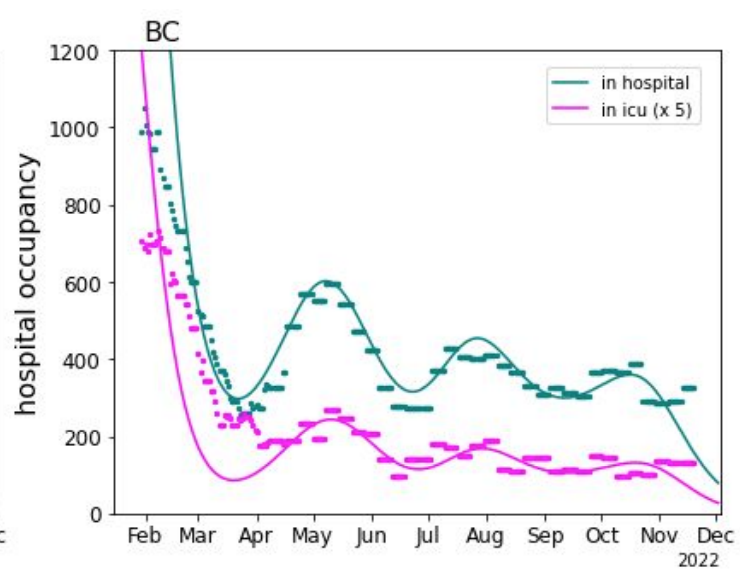
The BC COVID-19 Modelling group has issued its 26th report. It’s worth a read.

Here’s their excess mortality update (see p7):

They think that case rates are going to go down in BC due to increasing population-level immunity (because everybody has already gotten sick), but they aren’t sure about their model because they say that hospitalizations don’t count re-infections. I thought the province had said that the hospitalizations counted everybody who had COVID-19 (hospitalized both for and with COVID-19), so now I’m confused again.

They do a bunch of analyses to say that the fall wave wasn’t due to BQ.1.1’s immune evasiveness as much as it was to waning immunity. (What this means: GET ANOTHER BOOSTER!)

Mitigation Measures

This BC CDC web page says that starting 17 November 2022, there is no requirement to isolate after you catch COVID-19. None. It goes out of its way to say that if you are asymptomatic, there is no limit to what you are allowed to do.


This article says that the province determined that 95% of a subset of the files audited for compliance with the rules for B.C. Emergency Benefit for Workers were ineligible because they could not prove they filed a 2019 tax return. I have two thoughts: 1) Why do the taxpayers have to do the proving, doesn’t the province know if they filed a return? and 2) HOW CAN 95% OF ANY SAMPLE NOT FILE THEIR TAX RETURNS? Are those people actually humans, or are they fakes?

Adult Hospitals

This article says that last week, Provincial Health Services Authority said that it tested all respiratory patients to see what illness they had. This article says that somebody was in a hallway for two weeks, caught COVID-19 there, which prompted Island Health to say the moral equivalent of “oh actually we only test when we feel like it’s needed”. (He entered the hospital for something non-respiratory, so maybe they didn’t think they had to test him? But when he told a staff that he had respiratory issues, they blew him off, saying everybody had colds these days.)

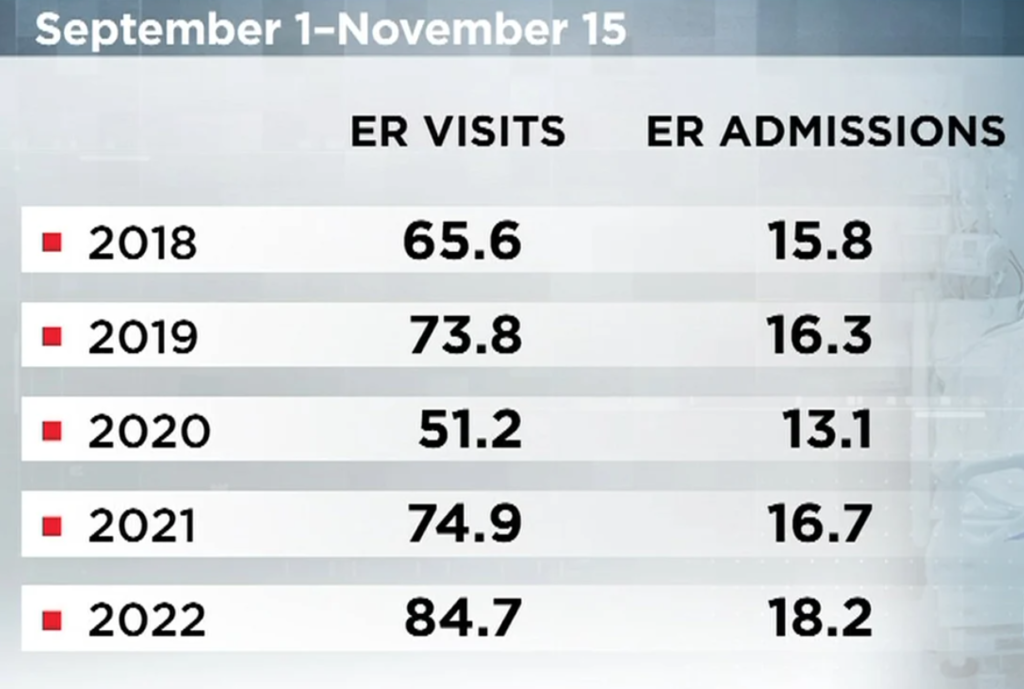
This article says that Island Health has more ER visits/admissions now than in the previous four years:

Pediatric Hospitals

This article says that children’s hospitals in BC are getting slammed. One explanation for the discrepancy between what the data I’ve been seeing says and what this article says is that only at-risk kids are getting tested. Great.

This article says that BC Children’s Hospital has set up an overflow unit for pediatric ER.

Okay, it looks like the distribution of pediatric infections is wickedly, WICKEDLY non-uniform. From the BC CDC Pathogen Characterization Report, the graph of infections for kids overall in BC just doesn’t look that bad compared to last year:

However, if you only look at Children’s Hospital (in Vancouver), it does look like it is spiking (although only to about the same level as last year):

Note: parents might be seeking more/earlier care this year because there’s a shortage of fever-reducing medications at the moment.

Statistics

As of today, the BC CDC weekly report said that in the week ending on 19 Nov there were: +498 confirmed cases, +144 hospital admissions, +23 ICU admissions, +21 all-cause deaths.

As of today, the weekly report said that the previous week (data through 12 Nov) there were: +484 confirmed cases, +189 hospital admissions, +36 ICU admissions, +41 all-cause deaths.

Last week, the BC CDC weekly report said that in the week ending on 12 Nov there were: +487 confirmed cases, +144 hospital admissions, +33 ICU admissions, +30 all-cause deaths.

Last week, the weekly report said that the previous week (data through 5 Nov) there were: +407 confirmed cases, +159 hospital admissions, +26 ICU admissions, +40 all-cause deaths.

The BC CDC dashboard says that there are 328 in hospital / 37 in ICU as of 24 November 2022.

Charts

From the BC CDC Situation Report for week 45 (ending 12 Nov):


From the BC CDC Variants of Concern report through 17 Nov:


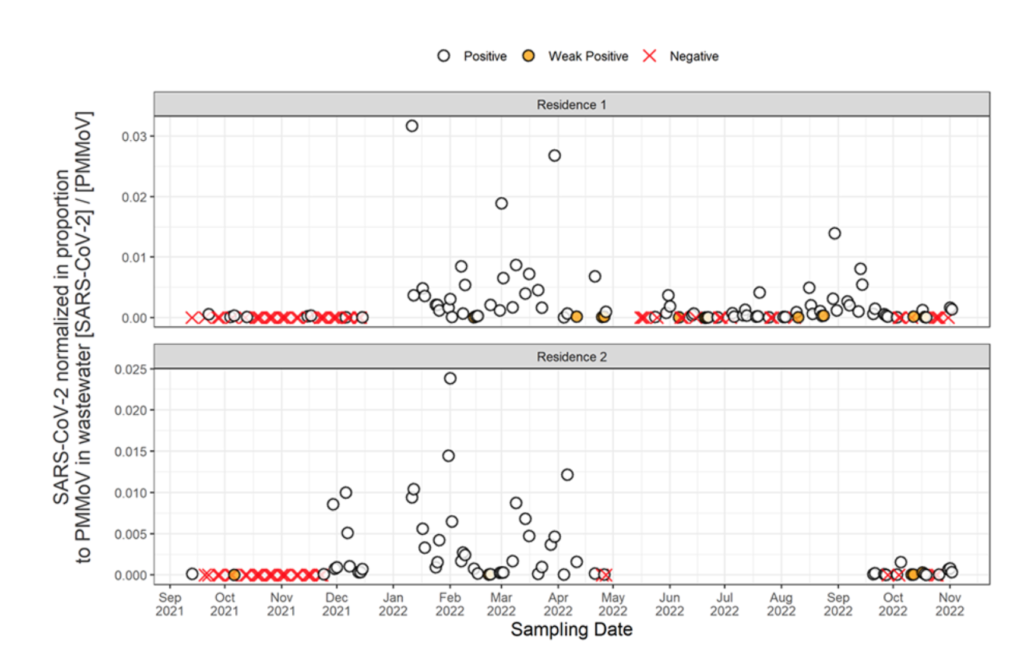
Hey! UBC monitors wastewater also! They normalize with PMMoV, a virus in peppers. Because people eat peppers at a pretty consistent rate, this provides a good way of dealing with different water levels (due to e.g. rain) and different people levels (due to e.g. vacations).


26 Nov 09:24

The Brexit silence is breaking

by Chris Grey
There has been a palpable change in the last week. Brexit is suddenly being more widely talked about again, and not just talked about but questioned and criticised. Despite having scarcely been mentioned in last week’s ‘budget’ statement or Labour’s response, it was that budget which was the spark, although the tinder was already there in the things set out in my post of 4 November.

Why is Brexit being talked about again?

In brief, I suggested that four factors were coming together.

First, the Liz Truss mini-budget had tested almost to destruction the theocratic Brexiter idea that belief could trump reality and the nationalist Brexiter idea that the UK was strong enough to buck what they call ‘the global Establishment’. At the same time, it made economic growth central to defining what Brexit was supposed to deliver.

Second, the disastrous collapse of the mini-budget and, with it, the Truss premiership, brought Rishi Sunak to power on the sole basis of his supposed economic competence and realism.

Third, this happened against a background where opinion polls show ‘the economy’ to be by far the biggest issue of concern to the public.

Fourth, it happened against the background of opinion polls which for many months have shown a growing majority for the view that Brexit was a mistake, and a majority view that Brexit has been economically damaging.

It was thus highly likely that once the delayed Budget statement occurred these things would coalesce around the question of how can the government claim to be economically competent and realistic, and how can it promote growth, if it does not address the economic damage of the unpopular policy of Brexit.

This is exactly what has happened this week, and it has been given added bite by a fifth factor, namely the way that George Eustice’s comments last week finally opened up for debate the inadequacy of the Brexiters’ sole claim to an economic benefit, that of making independent free trade agreements. With that has come a realization that Brexit Britain’s ‘trade honeymoon’ is over, though the red herring of CPTPP membership still lingers.

Although some media coverage talks as if the issue of Brexit has suddenly re-appeared, the truth is that it has never gone away, as anyone reading this blog regularly will know. Whilst media and political attention may have been much reduced, the reality is that neither leaving the EU, nor the Trade and Cooperation Agreement (TCA) that followed, provided a sustainable resolution to the Brexit debate.

The Brexiters’ political failure

That is partly because of the economic damage but, more fundamentally, because the Brexiters have totally failed to build a political consensus for Brexit. Even now, the only thing they can point to as the basis for such a consensus is the 2016 referendum result. But that narrow victory should have been only the beginning. If they had been serious about embedding Brexit as the new, accepted reality amongst a sustainable and growing majority of people they needed to show that it could work, and also to reach out to those who had opposed it.

Instead, they were not only unable to show it could work but, in many cases, actively decried what was being done as ‘not real Brexit’ whilst at the same time expecting those who had never believed in it to be persuaded to accept something they, themselves, were criticising. As for reaching out to opponents, they simply made no attempt at all. Only ‘true believers’ were regarded as having any right to shape Brexit, whilst remainers were treated with contempt. And so, quietly, and without much political leadership or media attention, opposition to Brexit has hardened amongst almost all of those who had always opposed it whilst the growing evidence of its failure reduced the number who supported it, with 20% of those who voted leave now regretting it. In short, the Brexiters won the referendum, but have failed to ‘seal the deal’ with the British people.

The aftermath of the budget

Now, in the aftermath of the budget, that is coming back to haunt them. Crucially, what is happening is not just a revival of ‘remainer’ criticisms. The pro-Brexit Telegraph is awash with articles bemoaning the “squandering” of Brexit (£) and of its “failure to deliver” benefits (£), to the point of recognizing that it might even be reversed. As for the Express, that other bastion of the true believers, it has recently gone remarkably quiet about Brexit. But, even there, an article by Tim Newark this week pronounced that, with the demise of Truss, “Tory MPs blew their one chance to re-commit to Brexit”.

Most strikingly, in an article in the Mail, veteran political journalist Andrew Neil wrote that “this is the week that Brexit died”. Neil has never declared how he voted in 2016, or whether he voted at all and, to be fair, his interviewing of Brexiters has generally been as robust as it has been of anti-Brexiters, although the tone of his writings does suggest a certain sympathy for Brexit. But, if anything, that gives an added authority to his remarks which, broadly, argue that leaving the EU was “supposed to create a post-Brexit, low-tax, low-regulation, free-wheeling economic environment” and has not done so.

It is not a new critique. The free-market right have been making it for at least a year. The difference now is that the Truss government, which vowed to deliver this version of Brexit, collapsed, and that the Sunak-Hunt budget shows, as Neil and Newark argue, that it will never be delivered. There is a deep flaw in this argument, of course, because neither this nor any other specific version of Brexit was ever proposed at the time of the referendum and nor was it at the 2019 General Election. What these right-wing ‘Singapore’ Brexiters tried to do was to use Brexit as a cover to deliver an agenda which no one was ever asked to vote on, and which it is unlikely a majority would have voted for had it been presented to them.

So, again, it shows the failure to build a political consensus, this time not just for ‘Brexit’ but for their version of Brexit, perhaps because they knew that no such consensus was attainable. In passing, I have never been convinced by the argument of some people who oppose Brexit that ‘low-tax, low-regulation Brexit’ was the ‘real agenda’ all along. Of course it was, by definition, the agenda of those many and powerful Brexiters who wanted that form of Brexit. But to say it was ‘the real agenda’ of Brexit is actually to concede to them the wholly dishonest idea that this was the true and necessary meaning of Brexit.

If one strand of the budget aftermath is right-wing Brexiters bemoaning that they will never get the extreme form of Brexit they wanted, the other strand is to re-open the question about whether the form of Brexit we have is too extreme. This was in evidence in the rumours that surfaced last weekend that the government was considering seeking a ‘Swiss-style Brexit’ for the relationship with the single market. Inevitably that also opens the door to the entire question of Brexit itself, especially given the polls showing clear public opposition to it.

Thus, to take a high-profile example, Piers Morgan – a remainer in 2016, but one who has hitherto been vociferous in arguing that Brexit should go ahead because of the vote – forcefully made the obvious point that “Brexit has been a disaster” and called for a referendum on re-joining. Arch-Brexiters like John Longworth may protest that “there should be no discussion now about EU membership” but to no avail. It is being discussed and it’s likely to go on being.

Back on the endless Brexit doom-loop?

Whether this revived discussion is a sign of moving forward is a moot point, however. The reports about moving to a ‘Swiss-style Brexit’ suggested that, even after all these years, quite basic things about Brexit are still not understood. Thus “senior government sources” apparently still believe that it would be possible to have Swiss-style Brexit without freedom of movement of people, and that the UK could get such a deal “because it is overwhelmingly in the business interests of both sides”. So here we are again, with the same old refusal to understand the single market and its inseparability from freedom of movement, and what is in effect a reprise of the ‘German car makers’ argument. It’s truly pathetic.

And that is even before considering that the Swiss model of multiple bi-lateral agreements with the EU is one that the EU itself regards as cumbersome and unworkable, would never be entertained with Switzerland were the relationship starting again now, and would not even be considered as a basis for EU-UK relations. Indeed, one of the core EU positions from the beginning was that the TCA would contain, in one architecture, the entirety of the post-Brexit arrangements, rather than making piecemeal deals. That certainly isn’t going to change now.

In any case, Sunak quickly disowned these reports (£), and he and Jeremy Hunt seem now to have the idea that post-Brexit barriers to trade can be reduced within the TCA framework. There is indeed some scope for that, although, at most, it is a limited scope, certainly not amounting to anything remotely like the “unfettered trade” Hunt has spoken of. That scope will be reduced to the point of non-existence (£) if, as he pledged this week, Sunak maintains the UK ‘red lines’ of refusing not only freedom of movement, but any role for the ECJ and any alignment with EU regulations. This also seems to bode ill for the ongoing Northern Ireland Protocol negotiations where, astonishingly, it is now reported that Steve Baker’s plan is to revisit the ‘sequencing’ row of the summer of 2017, which David Davis lost. So, once again, we seem to be going round in circles.

Needless to say, all this gave the hard Brexiters a fit of the vapours, with a 'new Tory civil war’ threatened and a revival of all the tired old talk of Brexit ‘betrayal’. In the process, there was a reminder of precisely the cultism with prevented them from building a consensus, with a “senior Tory backbencher” saying that “I and many of my colleagues have never regarded Rishi as a true Brexiteer”. Meanwhile, remain-voting Hunt was called on to “personally deny” the rumours, as a heretic might be called on to publicly recant. Outside the Tory Party, Nigel Farage made his habitual threat to ‘return to front-line politics’ if the government were to seek to ‘betray’ Brexit with a Swiss-style deal (he has apparently forgotten all the times he advocated such a model).

These reactions can also be seen as a re-hash of all the debates since 2016. They show that, even if Sunak is genuinely an ‘economic realist’ who can see the damage Brexit is causing, he, like any Tory leader, is hamstrung by the fanaticism of the Brexit Ultras in his party, a fanaticism which far from having been assuaged by Brexit has been inflamed by it. Equally, they show how, despite the idea that Brexit would kill off the external threat to the Tory Party from Farage, he continues to have the capacity to scare, and hence to control, it.

But this time is different

However, despite their familiarity, what is happening now is more than simply a re-run of old myths and old arguments. Before Britain left the EU, it was still possible for Brexiters to promise Brexit benefits and to decry ‘Project Fear’. Now, although they still try to do so, there is more than enough evidence to see the realities, especially the economic realities, of Brexit. That includes the evidence that the central premise of Brexit as regards trade – that increased trade barriers with the EU would be more than off-set by growing trade with non-EU countries – has been discredited.  

In short, Brexit is no longer hypothetical and that, in principle, makes a rational discussion of its economic consequences easier or, at least, ought to make an irrational discussion more difficult. That is made more so by the collapse of the Truss mini-budget because it so manifestly discredited the Brexiters’ claims that economic reality could be wished away, as the province of the ‘remainer Establishment’. Relatedly, the fact that the ‘intellectual’ basis of the mini-budget came from precisely the same group of economists who provided the economic case for Brexit itself has served to further undermine that case. Whenever their fantasies meet reality they fall apart.

And this extends beyond the purely economic frame. Especially as a result of the Ukraine war, the realities of the shared geo-political interests of the EU and the UK are more obvious. So, too, can it be seen that, far from ‘getting Brexit done’ with an ‘oven-ready deal’, the Northern Ireland issue that proved so central in the Brexit process has not, in fact been resolved. And since that is in large part because Brexiters have insisted that what was agreed and signed up to should not really be binding, then that undermines their equally loud insistence that every other aspect of the Brexit Boris Johnson agreed is, for all time, sacrosanct.

Moreover, before Britain left the EU, Brexiters could claim that they were seeking to ensure that ‘true Brexit’ was delivered. But, now, they are adamant that it has not been delivered. So often have they said that was we have got is ‘Brexit in name only’ (BRINO) that it takes away the force of their attempt to portray a softer Brexit than we currently have as BRINO. For if we really only have BRINO then why not have a different, less expensive BRINO? Or no Brexit at all? Or, to put it another way, if they insist that ‘Brexit has died’ because the ‘benefits’ (as they cast them) of a low-tax, low-regulation economy have been killed off, then the argument (in their terms) for undertaking Brexit has disappeared. So why not soften, or even reverse, it?

All of this means that the current, revived, Brexit debate is occurring against a different background to that of the pre-2020 debate. In one way, that background is worse for erstwhile remainers because, of course, there is no prospect of ‘remaining’, as sometimes seemed possible up until the result of the 2019 election. In another way, it is much worse for the Brexiters, because the very fact it is occurring is a sign of Brexit’s failure and, as the desperate tone of their attempts to ‘save’ Brexit shows, they know that it is a fragile and unpopular project. As if to provide a timely metaphor, this week Unboxed, the rebranded version of the Festival of Brexit, came to an end amid a welter of criticisms of it for being unpopular failure (£) and a waste of public money.

That unpopularity in turn means that the biggest battering-ram argument they used to constantly invoke, that Brexit is “the will of the people”, is now little more than a crumbling cudgel. Which people? The ones who, not just in the odd survey, but over and over again in every opinion poll say in a clear majority that Brexit was a mistake? Just for how long and how far can a referendum, the mandate of which has now been fully discharged, be used in defence of a version of Brexit that was not even the subject of that vote?

It all comes down to the Labour Party now

So in all these ways, something important is changing in the Brexit saga and that has become apparent this week. It is possible that the latest debate will all die down again, but that is unlikely because the underlying issues of the damage, especially the economic damage, of Brexit will persist. So, assuming economic performance continues to be the defining theme of Sunak’s government, then the debate will continue, and with it the daily new examples of Brexit’s failure and damage.

However, the unchanged dynamics of the Tory Party mean that Sunak will not be able to address, still less resolve, the problems of Brexit. There’s certainly little sign he can end the Northern Ireland Protocol row, because of those dynamics. It’s not even clear he will be able to stop adding to the damage, for example by dropping the EU Retained Law Bill, now widely recognized as being a recipe for administrative and business chaos but beloved by the Brexit Ultras in his party.

So if dealing with the damage of Brexit is to happen in any reasonable time-frame then it will fall to the Labour Party, assuming they win the next election. In any case, they can hardly stay mute as the Brexit debate revives. That makes it crucial, as pollster Peter Kellner argues, that Labour go into the next election with a clear policy to undo the worst of the economic damage of Brexit. It has to be clear, because otherwise they will not have a clear mandate if they win. And it needs to go well beyond the timidity, and vacuity, of ‘making Brexit work’ to some form of single market membership and a customs treaty.

In turn, that means breaking with its caution about immigration, the legacy not just of Brexit but of Gordon Brown’s ‘Mrs Duffy’ moment in 2010, and still in evidence this week in Keir Starmer’s comments about immigration at the CBI conference. In any case, the salience to the public of immigration as a political issue has steadily fallen from its peak in 2015, when 71% thought it was one of the top three most important issues facing the country, to as low as 14% in April 2020 and 22% at the beginning of October this year. It’s true that this has since risen to 37%, but that is almost certainly because the survey treats “immigration and asylum” as one issue which, for that matter, almost certainly makes all of the scores higher than they would be for ‘immigration’ alone. In short, Labour needs to be sure they are not fighting yesterday’s political battles on immigration.

As the staunchly Labour-supporting Associate Editor of the Mirror, Kevin Maguire, put it this week, Labour is “out of step with public opinion” on Brexit. I would put it more strongly than that. For once, Labour has a rare, perhaps generational, chance to stake out a position which is true to its values and those of its leader – for no one can seriously doubt, as they could of Corbyn, that Starmer thinks Brexit was a huge mistake – and which catches the tidal flow of the public mood, makes its economic policy credible, and is in the national interest. It’s a huge prize, if Labour can grab it.

Central to that happening is for this emergent new Brexit context to be fully understood and, in particular, for Labour to lose their apparent terror of being branded ‘enemies of the people’. That headline, with all the wider freight it carries, comes from 2016. Times have changed: Brexit has changed them. The people have changed: time and Brexit have changed them. The country and the world have changed: Brexit can change with them. But can Labour change? That remains to be seen but, right now, it is the only question that really matters.

26 Nov 09:24

week ending 2022-11-24 General

by Ducky

Mitigation Measures

This press release from the Government of Canada says that all Canadians in federally regulated private workplaces (like banking, telecommunications and interprovincial transportation) get ten days of paid sick leave, starting on 1 Dec 2022. (They don’t get all ten days at once, it accrues.) About 6% of Canadians work in federally regulated private workplaces. NB: BC mandates five paid sick days.

Vaccines

As this article reports, Novavax has been formally approved as a booster. It had been possible to get Novavax as a booster before — I got one — but you had to go through a few hoops, consent to a statement that this was off-label use and yes you know that and yes you want it anyway. I expect that now there will be fewer hoops and no need for a formal consent.


This paper from Singapore says that mRNA vaccines and inactivated-virus vaccines generate similar numbers of antibodies, but the inactivated-virus ones target a wider range of sites, while the mRNA vaccines (understandably) only make anti-spike antibodies. This means the inactivated-virus vaccines have broader protection. However, the inactivated-virus vaccines did not elicit killer T cells, only helper T cells; the mRNA vaccines elicited both.


This paper says that New York City saved $10.19 for every $1 it spent vaccinating people against COVID-19.

Treatments

This preprint from the USA found that people who got treated with Paxlovid shortly after a COVID-19 infection had a 26% lower risk of Long COVID than patients who did not get Paxlovid.


This paper from Germany says that there are zero monoclonal antibody treatments which work against BQ.1.1. Zero.


This study from the US says that patients who were prescribed Paxlovid had a 51% lower hospitalization rate than those who were not.

This is great, but it’s not as good as the original study, which said that there was an 89% reduction in hospitalization. It is not entirely surprising that real-world effectiveness is lower than clinical trial data because clinical trials tend to exclude a lot of people who are less healthy. However, it’s disappointing.


This article says that Ensitrelvir, a 3CL protease inhibitor, was approved for use in Japan. I know that doesn’t do us Canadians any good, but I mention it to show that it’s not just Paxlovid, but other protease inhibitors seem to work. This press release from September says that Ensitrelvir reduces recovery time by a day and cuts the viral load. (The clinical trial did not look at hospitalization rates.)

Transmission

Wow, I guess there’s a reason why I’ve been feeling like everybody but me has gotten COVID-19: this preprint from the USA says that 94% of Americans were infected with COVID-19 by 9 Nov 2022. 97% have either been infected or vaccinated.


This paper from the USA found that an NFL football game with more than 20,000 people attending led to 2.23 times as many spikes in COVID-19 as non-football game weekends.

I’m a little surprised, as football games are outdoors. However, they are crowded and full of shouting. Plus, toilets and concession stands are indoors.

Pathology

This paper from January 2021 from the France compared smokers and non-smokers on a naval vessel. It found that smokers were only 64% as likely to catch COVID-19 as smokers and former smokers. What’s more, the risk dropped to 33% for people who smoked more than ten cigarettes per day.


There is an idea floating around that viruses co-evolve with humans to become milder. This pre-preprint from South Africa found that when they evolved some virus in a lab (simulating a long-term infection, as sometimes happens in immunocompromised people), the virus got more virulent (i.e. nastier, less mild).


This paper from Spain (from August) found long-term changes in the expression of a protein P53 which has been implicated in some kinds of cancer. Translation: getting COVID-19 might make you more susceptible to cancer later.

This paper from BC found that the rate of myocarditis or myopericarditis after an mRNA vaccination was 14.81 times higher than the pre-pandemic baseline. For men aged 18-29 years old, the myocarditis/myopericarditis rates were 148 time higher than the baseline. (Reminder: that’s lower odds than if you get a COVID-19 infection, it’s still quite rare, and almost all cases are mild.)


This paper from the USA says that mental health in athletes was significantly better in Spring 2021 than in Spring 2020.


This paper from the USA found that veterans with PTSD were 18% more likely to be hospitalized and 13% more likely to die than other veterans.


This paper from Brazil says that people with COVID-19 have higher levels of ATP (the molecule in the blood which carries energy around to where it is needed) and lower levels of ADO (which you get when ATP is converted into ADP+energy). In other words, your body isn’t getting energy out efficiently. ATP is also a relatively strong inflammatory agent.


This paper from the USA suggests that children are at a higher risk of stroke if they have had COVID-19. It’s a small study and the effects are not huge, but more study is needed.

Testing

This article describes a neat COVID-19 test that can be used in ambient air. There are nanobubbles with COVID-19 receptors on the surface, and if a COVID-19 virus docks with the bubble, the bubble bursts, releasing salts. The salts close a circuit and can drive an alarm. I’m sure it’s a long way from commercialization, but it’s really cool! (And of course you could test for any airborne virus this way — and actually, just about any toxin.)


This paper from Quebec (from October) describes a COVID-19 test that gives results 11 minutes after you give it a spit sample.

Recommended Reading

This article (from October) talks about the hunt for protein-based therapies.


This article (from October) is from a virologist asking for less experimentation with viruses.


This article talks about how viruses interfere with (and don’t interfere with) each other.


This article is about what science learned about influenza from the COVID-19 pandemic.


This article talks about how COVID-19 and influenza interfere with each other. (Or do they?)

26 Nov 09:24

Some Initial Mastodon Instance Tweaking

by Reverend

Now that I have a few instances of Mastodon running in Reclaim Cloud, I figured it was time to start optimizing them for resource usage, storage, and security. This post is an attempt to capture what I’ve done thus far—which is not much—in order to keep track of changes I am making. Also, I’ve only been tweaking social.ds106.us given the other two servers (reclaim.rocks and bava.social) are still getting their legs. I’ll probably collect some of these resources and tweaks into a more comprehensive guide, but for now this will be fairly random and incomplete.

Chris Blankenship pointed me to a recent post from the Mastodon admin Tek of the freeradical.zone Mastodon server. I dig that they run a blog to capture and share the work they’re doing, and I think the breakdown of the different pieces that make Mastodon run in the “Surviving and thriving through the 2022-11-05 meltdown” post is quite good:

Let’s take a moment to talk about how Free Radical was set up. A Mastodon server has a few components:

  • A PostgreSQL database server.
  • A Redis caching server that holds a lot of working information in fast RAM.
  • A “streaming” service (running in Node.js) that serves long-running HTTP and WebSocket connections to clients.
  • The Mastodon website, a Ruby on Rails app, for people using the service in their web browser.
  • “Sidekiq”, another Ruby on Rails service that processes the background housekeeping tasks we talked about earlier [namely posting, following other users, notifications, etc.] .
  • Amazon’s S3 storage service that handles images, videos, and all those other shiny things.

This nicely highlights all the different pieces that go into running a Mastodon instance, underscoring that there’s some complexity. One of the issues that Tek was running into with the influx of new users was Sidekiq was overloaded with new and various tasks, so they were not showing up in real time—essentially being queued as a result of the bottleneck. What he did was separate out the PostgreSQL database (already done back in 2017), move Sidekiq to its own machine (a lonely Raspberry Pi 4 he found around his house), and eventually moved the Redis caching service to the server hosting Postgresql to ensure it was not competing with Sidekiq for RAM. The only services left on the original 4GB cloud server were the node.js streaming service, the Mastodon website Ruby on Rails app, and the original Sidekiq service (he added more works to the Sidekiq running on Raspberry pi to go from 25 to 160 works to deal with queueing tasks).  It never ceases to amaze me how resourceful and creative sysadmins can be to solve high-pressure issues like servers not working right for a community of 700 folks that are managing their social streams—it ain’t a job for the faint of heart.

What I gleaned from Tek’s experience is that breaking out the various services is essential as you scale, and it seems like the first to move was the database—which is good to know. Luckily we are only just now approaching 40 users on ds06’s instance, and we will most likely scale slowly and intentionally, so we may not have any of these issues just yet—but a behind-the-scenes peek at how freeradical scaled is really helpful if Reclaim does want to take on other instances that want to scale fast.

So, that was some good background ready and context for the tweaks I starting implementing on social.ds106.us. First things fist, I reading the scaling Mastodon doc and starting adding environment variables to the .env.production file to increase concurrent web processes (WEB_CONCURRENCY) as well as the number of threads for each process (MAX_THREADS). I read that Tek had these at 25 for concurrency, so I changed the default values of  2 and 5 respectively to 25. So far there have been no issues, but any one reading this who sees an issue let me know. Also, I real the DB_POOL would need to be at least as many as the number of MAX_THREADS, so I set that to 30.

WEB_CONCURRENCY=25
MAX_THREADS=25
DB_POOL=30

So far, so good. I then dug-in on the Scaling Down Mastodon guide by Nolan Lawson (h/t Doug Holton) which was quite helpful. In particular, I changed max database connections to 200 in the postgresql.conf file found, at least for me, at /etc/postgresql/15/main/

max_connections = 200 # (change requires restart)

I then tried using PGTune to fine-tune the database, but that brought everything down for a bit, so I quickly reverted and will need to re-visit that in a dev environment. Another thing I will be experimenting is PgBouncer in the event we start running out of available database connections. I upped the default from 100 to 200, so I am imagining this is not an immediate concern given our size, but at the same time this is also about figuring out how to optimize a server for scaling, so worth playing with in the future.

Another big piece of scaling down was figuring out how to control the explosion of files being stored in AWS’s S3. The scaling down guide pointed me to this bit in the Mastodon docs that shows you how to create a cron job to remove cached media files on a weekly basis. I ran the cron and it immediately cleaned out 2 GB of cached files. This of a possible 15 GB, bring the total closer to 13 GB.

Image of chart illustrating the growth of media files in Amazon's S3 for social.ds106.us that progressively grows to 15GB and then drops off 2GB to 13GB

Graph illustrating the growth of media files in Amazon’s S3 for social.ds106.us

That said, the instance is still taking on about a GB of files each day, so file bloat is something to continue to watch and fine tune. I have to believe there’s more we can do given it seems unlikely 30 users are uploading that much media daily, but I could be wrong. This also underscores the point that offloading media to cloud storage should not be optional for instances interested in scaling.

And the final tweak I made was last night when John Johnston discovered that nginx buffers needed to be upped to allow the service brid.gy to use OAuth to link his blog with his Mastodon instance. He did all the heavy lifting of searching for the fix, and I added the following following 3 lines to the http block in /etc/nginx/nginx.conf and it worked.

proxy_buffers 4 16k;
proxy_buffer_size 16k;
proxy_busy_buffers_size 32k;

After saving the file and restarting nginx without errors I got the confirmation from John it worked, which was pretty awesome given how quick and easy it proved to be. I’m not used to that.

So that’s it for the server tweaking thus far, I did upgrade the ds106 instance from version 3.4.2 to 4.0.2, and that went off cleanly. Only issue was me not following the post-migration database instructions, so that was on me. I followed these instructions for my non-docker environment.

The last thing worth sharing is costs in Reclaim Cloud given this has been a question we have gotten from folks, so I am trying to keep an eye on that. I have an 8-day breakdown of costs for my instance that can scale up to 8 GB.

Reclaim Cloud 8-day breakdown of costs for hosting social.ds106.us

Reclaim Cloud 8-day breakdown of costs for hosting social.ds106.us

So, as you can see from the image above the cost has been increasing daily by a few cents. The cost of the IP address is fixed at .09 cents a day, or $3 a month, the cloudlets (or CPU running the instance) vary daily, and the average has been about 14 per day, which works out to $40 per month in Reclaim Cloud.

Image of Reclaim Cloud panel for the social.ds106.us instance

Reclaim Cloud environment running the social.ds106.us instance

I’ve read about memory leaks in Sidekiq and wonder if restarting that service every few hours would help. It will be interesting to see how things shake out if ds106 scales. In particular, I am curious if the resources continue to mount for the environment, or if they proportionally taper off despite increased numbers of users. My logical assumption is it’s 1:1, more users more resources, but it seems like a base Mastodon instance without more than one or two users sits around 8 cloudlets, or 1 GB, whereas ds106 has still yet to hit 2 GB for 40 users. Would 100+ users be fine with 4 GB? Not sure, but I’m interested in finding out, so get a Mastodon account on ds106 Social you hippie!

26 Nov 09:21

Defederation and governance processes

by Doug Belshaw

I’ve noticed this week some Mastodon instances ‘defederating’ not only from those that are generally thought of to be toxic, but also of large, general-purpose instances such as mastodon.social. This post is about governance processes and trying to steer a way between populism and oligarchy.

The first thing I should say in all of this, is that I’m a middle-aged, straight, white guy playing life on pretty much the easiest difficulty level. So I’m not commenting in this post about any specific situation but rather zooming out to think about this on a wider scale.

What I’ve seen, mainly via screenshots as I rarely visit Twitter now except to keep the @WeAreOpenCoop account up-to-date, is that Elon Musk has run some polls. As others have commented, this is how a Roman Emperor would make decisions: through easy-to-rig polls that suggest that an outcome is “the will of the people”.

Tweet from Elon Musk: "Should Twitter offer a general amnesty to suspended accounts, provided that they have not broken the law or engaged in egregious spam?"

Yes 72.4%
No 27.6%

This is obviously an extremely bad, childish, and dangerous way to run a platform that, until recently, was almost seen as infrastructure.

On the other side of the spectrum is the kind of decision making that I’m used to as a member of a co-op that is part of a wider co-operative network. These daily decisions around matters large and small requires not necessarily consensus, but rather processes that allow for alignment around a variety of issues. As I mentioned in my previous post, one good way to do this is through consent-based decision making.

Screenshot of the Loomio for social.coop with multiple discussion threads

Using Loomio, the social.coop instance that I currently call home on the Fediverse, makes decisions in a way that is open for everyone to view — and also for members of the instance to help decide. It’s not a bad process at all, but a difficult one to scale — especially when rather verbose people with time on their hands decide to have An Opinion. It also happens in a place (Loomio) other than that which the discussion concerns (Mastodon).

So when I had one of my regular discussions with Ivan, one of the Bonfire team, I was keen to bring it up. He, of course, had already been thinking about this and pointed me towards Ukuvota, an approach which uses score voting to help with decision making:

To “keep things the way they are” is always an option, never the default. Framing this option as a default position introduces a significant conservative bias — listing it as an option removes this bias and keeps a collective evolutionary.

To “look for other options” is always an option. If none of the other current options are good enough, people are able to choose to look for better ones — this ensures that there is always an acceptable option for everyone.

Every participant can express how much they support or oppose each option. Limiting people to choose their favorite or list their preference prevents them from fully expressing their opinions — scoring clarifies opinions and makes it much more likely to identify the best decision.

Acceptance (non-opposition) is the main determinant for the best decision. A decision with little opposition reduces the likelihood of conflict, monitoring or sanctioning — it is also important that some people actively support the decision to ensure it actually happens.

The examples given on the website are powerful but quite complicated, which is why I think there’s immense power in the default. To my mind, democratic decision making is the kind of thing that you need to practise, but which shouldn’t become a burden.

I’m hoping that after the v1.0 release of Bonfire, that one of the extensions that can emerge is a powerful way of democratic governance processes being available right there in the social networking tool. If this were the case, I can imagine decisions around instance-blocking to be able to be made in a positive, timely, and democratic manner.

Watch this space! If you’re reading this and are involved in thinking about these kinds of things for projects you’re involved with, I’d love to have a chat.

The post Defederation and governance processes first appeared on Open Thinkering.
26 Nov 09:21

Nice

by russell davies

This is an excellent idea, from Alex Mitchell of #feministfriday

"Here's something I'm profoundly glad I do at work. Any time someone says (in writing) something good about something that my team or I have done, I save it to a notepad file called nice.txt. Then when I'm in need of a boost I will open nice.txt and read what people have said in descending date order until I feel happy again. If you think there is a possibility that this would work for you, I really encourage you to try it, it's been a tonic for me more than once and is so easy to do."

26 Nov 09:21

This Week in Photography: Giving Thanks!

by Jonathan Blaustein


Thanksgiving is such a weird holiday.

(It’s beyond absurd, if you think about it.)

Can you imagine if someone dreamed up Thanksgiving, from scratch, in 2022?


Macy’s Thanksgiving Day Parade, courtesy of the Today Show/ James Devaney/ Getty Images


Scene:


Ted: I’ve had an idea-gumbo cooking in my mental kitchen for a few weeks now, let me tell you.

Brad: Really, Ted?

Ted: Yes, Brad, really.

Brad: Are you just going to tease me? If I want to get teased, Ted, I can walk down to Janet’s cubicle, and she’ll do it gladly.

Ted: Wait, what? Janet’s been flirting with you? Damn, boy! Look at you!

Yes, Ted, I even bought a cheap generic Viagra just in case she flirts with me again.

Brad: (Pause.) Listen, Ted, I’m busy. Don’t you have a great idea? Isn’t that why you came over here?

Ted: Yeah, sorry, Brad. Totally. So, I’ve been thinking. Hallmark is not happy with their quarterlies, and we have to give them something good to keep the account.

What if we create a new holiday around gratitude? You know, giving thanks? I mean, what demo could possibly object to giving thanks?

Brad: Giving thanks? Ok, Ted. I’m curious. Keep going.

Ted: So then I thought, why not make it historical? How about we combine the giving-thanks part with honoring the founding of America?

Brad: I’m still listening.

Ted: OK, Brad. So who do we have to thank for the founding of America?

Brad: The crazy English fucks who sailed out into an empty, cold Ocean, and an unknown world, just to get away from England?

Ted: No, silly. We don’t thank THEM. Anyone can honor the Pilgrims. I mean, sure, we’ll mention them a little. But we’re going to thank the Native Americans who gave us the Continent, so we could found our new nation.

Let’s thank the them!

Brad: (Silence.) (Stares daggers at Ted.) Say what now, Ted? Say what?

You want us to make a holiday around thanking the people upon whom our American ancestors committed Genocide?

Do you hear yourself, Ted?

Ted: Yeah, yeah, sorry, Brad. You’re right. What was I thinking? I gotta stop eating that last edible right before bed.

It’s not doing me any favors.


End Scene:


Sure, Thanksgiving is batshit, but giving thanks IS a great idea.

I’m grateful for you, the audience of people who have read my musings here for the last 11 years.

And I’m beyond thankful for my lovely, amazing, supportive, incredible family. (As I’ve said, this column is older than my daughter, and she’s jealous.)

I’m also thankful to all the great artists who’ve made work that’s inspired me these many years.

Just the other day, for example, my son, (who’s 15,) wanted to show my daughter (10) his favorite childhood film: “Wallace and Gromit: The Curse of the Were-Rabbit.”


Such a brilliant movie!

(If you haven’t seen it, please do. I swear, it’s not just for kids. )

We all remembered every line, and Amelie was smitten, as it’s a perfect film.

Plus, the claymation is sooooooo laborious, the technical mastery is evident, without taking you out of the narrative.

There’s an old expression: They don’t make them like this anymore.

And in this case they actually can’t.

Peter Sallis, the voice actor who played Wallace, passed away in 2017 at the age of 96.

(RIP Wallace!)

Whether you’re an artist/critic like me, or just a “normie,” the biggest artistic touchstones will always represent a certain phase of your life.

An era.

Or an inflection point?

That’s what great art does for culture, and for our lives.


11 years ago, (in a story I shared too recently to re-tell,) I discovered a pure writing style for this column.

It was Thanksgiving, and after the night-time-drama, I woke up the next day and reviewed a massive Taryn Simon book, published by a start-up in London called MACK.

The book was titled “A Living Man Declared Dead and Other Chapters.”

Let me tell you, the book is massive!

It’s easily the biggest, thickest book I own, and I’m not sure I reopened it again before this morning.

Which means it’s time for a re-review, as this book, (like Wallace and Gromit,) is proper genius.

And just like W&G, they don’t make them like this anymore.

Seriously.

In an age of rampant inflation, I can’t imagine a publisher making a book this expensive to create.

(Unless it was a super-small-batch, limited edition.)

Not only that, I don’t think an artist working with these ideas and scope would do this project as “fine art photography” in 2022.

Let that sink in for a moment.


The book is amazing because the idea is amazing, and thoroughly executed.

But it’s also so bleak I had to stop at Chapter 12.

Ms. Simon has basically put human nature on display, by telling disturbing stories via human family networks.

Each tale is a thread in a metaphor-tapestry that depicts a cynical, nihilistic view of PEOPLE.

Off the top of my head, (though I did just look at the book,) we’ve got a litany of family horror stories:

A South Asian Indian family that declared some members dead to steal inheritance.

Zionists who successfully colonized Israel.

Filipino tribal people paraded as zoo animals at a World’s Fair 1O0+ years ago.

Saddam Hussein’s sadistic son’s tortured body double, Hitler’s legal advisor, Scottish thalidomide sufferers, a fisherman kidnapped by North Korean secret agents, Brazilian blood feud murderers, and Bosnian massacre victims.

Ms. Simon photographed teeth and bone fragments to represent some of the people, (killed in Srebrenica) as each family member in the book sits for a straight, typological portrait, unless they were unavailable for a host of difficult reasons. (Like fear of kidnapping.)

But worst of all, more horrifying than all the humans, is the chapter about lab rabbits in Australia, who are raised to be testing victims of viral warfare, as the government in Oz tries to wipe out rabbits, (which are non-native,) and were intentionally introduced by humans.

There is a photo of rabbits shot dead in a mass grave, and if you HAVE ever seen “The Curse of the Were-Rabbit,” you’ll know why my brain melted at the connection.

(Like I said, 12 Chapters was enough for one sitting.)


That the book exists is a miracle, given its scope.

But how did she even get the project done?

In 2022, I can’t fathom how much money was spent to travel the globe like this.

The research, the time making the pictures.

The assistants.

The film costs, the hotel rooms, the global fixers.

The printing, the editing.

All of it.

Coming in the late aughts, on the heels of Gursky, Struth, Simon and Demand making SERIOUS money selling their over-sized prints, I can just about understand the level of collector-support necessary to raise the MILLIONS of dollars.


Maybe.

But now?

In 2022?

As art, in culture? No way.

Done now, this would definitely be financed by Netflix or Amazon Prime.

The story would be told with photos, sure. But also video, podcasts, Patreon private parties, what have you.

“Photography” has seen too much of a decline in resources and attention, as a sub-species of culture, and too big a leap in importance in mass culture.

Magazines are gone, or minimized. Blogs folded. Newspapers are a fraction the size. Many galleries have contracted or shut. And NFT’s were not the magic-golden-bullet some promised.

While the “photography” industry was shrinking over the last 11 years, the impact of Photography has never been greater.

EVERY HUMAN WITH A PHONE takes pictures now.

We have succeeded to the point of irrelevance.

(Like I said, it’s a big idea.)

And a brilliant book.

See you next time.


26 Nov 09:20

You wouldn’t retweet a car

Hey it’s the final day of follow-up week! I’ve been blogging new words about old posts.

Re: Fanboost and other magical manifestations of the will (2020).

Formula E (the electric version of Formula 1) has FANBOOST which is maybe the tech equivalent of some kind of distributed good fortune magick?

You would vote for your favourite driver on social media, live, while the race was on. The top tweeted 5 drivers would get an extra surge of speed, like to surprise overtake an unboosted looooser.

I am sad to report that Fanboost is gone. It was for one season only. There’s a video record of the best Fanboost moments (YouTube).

Fanboost got to the heart of something: electric vehicles are also software-defined vehicles. And they’re networked, so they can do anything that networked software can do. UNREALISED POTENTIAL.


Anyway, so:

Mercedes-Benz is to offer an online subscription service in the US to make its electric cars speed up quicker.

For an annual cost of $1,200 excluding tax, the company will enable some of its vehicles to accelerate from 0–60mph a second faster.

– BBC News, Mercedes-Benz to introduce acceleration subscription fee (2022)

Tesla has sold “Acceleration Boost” since 2019: "Model 3 vehicles accelerate from 0–60mph half a second faster for a one-time fee of $2,000."

(Spotted at thejaymo’s Scrapbook. Thanks!)

Fanboost consumerisation!

I am taken with the idea of going full social on this. Subscriptions are the lazy route for lazy capitalists.

LIKE:

Each car could have a QR code on it, and if you do something nice then other drivers could fave you with an app. Collect 10 faves and trade them for a faveboost.

Keep below the speed limit according to your insurance company black box and get a good behaviour boost. (It shaves 0.1 seconds off your 0–60 acceleration time increasing each year alongside your no claims bonus.)

Augmented reality driver HUD on the windscreen to shoot green shells at bad drivers to immediately give them a negaboost.


Also from that BBC article, in-app purchase for premium vehicles is a thing now.

I’d forgotten about this: "rival manufacturer BMW offered a subscription feature earlier this year - for heated seats."

Which reminds me of this genius twist which somehow emerged from the web3 space:

I rather like the idea of turning subscriptions into digital assets. If I were BMW I’d consider turning those subscription options into nonfungible tokens (NFTs) that could be traded across Web3 so that we can see what the market thinks that they are worth. They would have to make the tokens function properly, of course, so that (for example) if I have a BMW heated seats token, then I’d expect it to work in any BMW I get into, whether it’s mine or a rental car or a friend’s car.

– Forbes, Tokens, Not Subscriptions, For Heated Seats In Your New Car (2022)

And while tokens vs subscriptions doesn’t quite stack up economically (BMW wants that sweet, sweet recurring revenue)…

…the idea that the heated seats are attached to me and not the car is kinda amazing?

So long as we’re heading into this capitalist hellscape in which I have to pay EVERY YEAR for stuff I’ve already bought, why not let’s go ultra individualistic libertarian on it too.


Mercedes-Benz Acceleration Boost should belong to people not vehicles, that’s what I’m saying.

This would dramatically grow their potential customer pool from anyone who owns one of their cars to anyone who even interacts with one.

Remember being a teen and getting lifts everywhere with your friends?

Imagine drivers competing to have you take shotgun with them because they’ll get better performance with you in the passenger seat.

You’d be so cool. Mercedes could charge twice as much for that, social peacocking beats functional any day of the week. ZOOM ZOOM. Hey Mr Benz you can send the cheque to my Paypal.


More posts tagged: new-words-about-old-posts (5).

26 Nov 09:19

Friction, writing, and timing

by Josh Bernoff

It is easier to keep writing than it is to start writing. Productive writers plan accordingly. Why is it easier to keep writing? Even if you don’t study physics, you’ve probably seen that if you try to move something heavy, like a car, it’s easier to keep something moving than it is to start something … Continued

The post Friction, writing, and timing appeared first on without bullshit.

26 Nov 09:18

Straßenverkehr in DDR 1989 kurz vor der Wende

by Ronny
mkalus shared this story from Das Kraftfuttermischwerk.

Kurzer Flashback für jene, die im Osten der Republik aufgewachsen sind. Und ich kann dieses Video riechen.

Ein gewöhnlicher Sommertag im kommunistischen Ost-Berlin, Ostdeutschland, im Juni 1989, nur wenige Wochen bevor der Eiserne Vorhang des Kommunismus quer durch Ost einstürzte in Europa. Gefilmt am Rosa-Luxemburg-Platz mit einem aus dem Westen eingeschmuggelten Camcorder.


(Direktlink)

26 Nov 09:18

Dali Clock for PalmOS, back from the dead and ready to party

by jwz
26 Nov 09:18

Line-out ≠ Headphone-out

by Techmoan
mkalus shared this story from Techmoan's YouTube Videos.

From: Techmoan
Duration: 11:55

A video to explain why a line output is not the same thing as a headphone output.

------------- Merchandise -----------------
New Techmoan Merchandise is now available.
https://etsy.me/3zzjweo

--------------- SUBSCRIBE ------------------
http://www.youtube.com/user/Techmoan?sub_confirmation=1

------------- SUPPORT ---------------
This channel can be supported through Patreon
https://www.patreon.com/techmoan

*******Patrons usually have early access to videos*******

---------- Outro Music -----------
Over Time - Vibe Tracks https://youtu.be/VSSswVZSgJw

------ Outro Sound Effect ------
ThatSFXGuy - https://youtu.be/5M3-ZV5-QDM

------ AFFILIATED LINKS/ADVERTISING NOTICE -------
All links are Affiliated where possible.
When you click on links to various merchants posted here and make a purchase, this can result in me earning a commission. Affiliate programs and affiliations include, but are not limited to, the eBay Partner Network & Amazon.
I am a participant in the Amazon Services LLC Associates Program, an affiliate advertising program designed to provide a means for sites to earn advertising fees by advertising and linking to AMAZON Sites (including, but not limited to Amazon US/UK/DE/ES/FR/NL/IT/CAN)

Regularly asked question
Q) Why are there comments from days ago when this video has just gone live today?
A) Patrons https://www.patreon.com/techmoan usually have early access to videos. I'll show the first version of a video on Patreon and often the feedback I get results in a video going through further revisions to improve it. e.g. Fix audio issues, clarify points, add extra footage or cut extraneous things out. The video that goes live on youtube is the final version. If you want to see the videos early too, you can sign up to Patreon here: https://www.patreon.com/techmoan

26 Nov 09:18

Alberta premier defends new rules banning school mask mandates, online-only learning | CBC News

mkalus shared this story :
"We need a normal school environment for our children, and we need to make sure that the classrooms stay open to be able to support our parents," She continued: "Even if it kills them, which in this financial perilous times will be a boon to the parents who can always make more kids when the economic situation improves."

Alberta Premier Danielle Smith is defending new rules ordering schools to provide in-person learning during the current wave of viral illnesses, saying a clear, measured response is crucial for students and parents.

"We need a normal school environment for our children, and we need to make sure that the classrooms stay open to be able to support our parents," Smith said at a news conference in Medicine Hat on Friday.

"That's why we made the decision that we did — to give that clear direction."

Her comments came a day after she announced regulatory changes saying school boards must provide in-person learning. Schools also can't require students to wear masks in school or be forced to take classes online.

The changes take effect immediately.

"Anyone is welcome to wear a mask if they feel that that is the right choice for them, but we should not be forcing parents to mask their kids, and we shouldn't be denying education to kids who turn up without a mask," Smith said.

She has said mask rules and toggling from online to in-person learning adversely affected the mental health, development and education of students during the COVID-19 pandemic and strained parents scrambling to make child-care arrangements when schools shut down.

That's over, Smith said.

"We're just not going to normalize these kind of extreme measures every single respiratory virus season," she said.

School boards have been asking for more direction as a slew of seasonal respiratory and gastrointestinal illnesses, along with some COVID-19 cases, have led to high classroom absentee rates and have jammed children's hospitals.

In Edmonton, Trisha Estabrooks, board chair for Edmonton Public Schools, said the decision provided the clarity that the board was seeking.

"All Albertans now understand that it's not within the jurisdiction, and nor should it ever have been within the jurisdiction of individual school boards, to make decisions that belong to health officials," said Estabrooks.

She said the province has made it clear that any future public health order would supersede the new rules.

The in-person learning change applies to grades 1 through 12 in all school settings, including public, separate, francophone, public charter and independent schools.

Sandra Palazzo, board chair for Edmonton Catholic Schools, echoed Estabrooks in saying that the school divisions now has more clarity. 

"We also really appreciate that we continue to have those opportunities to have discussions with the ministry, should there be any extenuating circumstances that may arise," she said. 

"And [we're] also further pleased that the Public Health Act will take precedence over the Education Act should there be reason to take stronger measures."

The masking change applies to those same grades and schools, but also to early childhood services.

The Opposition NDP criticized the new rules, saying it's unrealistic to force schools to be all things to all students while also handling a wave of viral illnesses and not providing additional supports to do it.

Jason Schilling, head of the Alberta Teachers' Association, said the government needs to work with school boards to figure out how to make this work.

"You have schools that are struggling to staff the building, [they] can't get substitute teachers, teachers are sick, they're covering each other's classes, principals are covering the classes," Schilling said in an interview.

"And then to say if you go online, you are to still offer the same programming in person — we just don't have the people to do that."

Wing Li, communications director for public education advocacy organization, Support our Students, said it will be difficult for schools to offer hybrid learning without any additional resources.

"There are no teachers," Li said in an interview. "Pivoting online was mostly due to staffing shortages, which is worse now three years in."

Li said online learning is challenging for students but, when temporary and supported, can keep schools and communities safe from spreading illness.

"This is a quite aggressive use of the Education Act to enshrine an ideology," she said.