Shared posts

12 Feb 18:13

2023-01-19 General

by Ducky

Long COVID

This paper from the UK says that people who have had COVID-19 infections are five times as likely to die in the 18 months post-infection than controls.


This paper says that people who were unvaccinated were more likely to have lingering illness for at 28 to 89 days than the vaccinated, and that the worse the COVID-19 case was, the more likely they were to have a lingering case: unvaccinated moderate cases were 80% more likely to linger and unvaccinated severe cases were 125% more likely to linger than vaccinated patients. People who were unvaccinated, got COVID-19, then got vaccinated were 41% less likely to have symptoms at six months than those who never got vaccinated.

They also found that people who had COVID were more likely to have other problems at six months than those who did not:

  • 2x chance of pulmonary problems;
  • 1.46x chance of diabetes;
  • 1.29x chance of neurological problems;
  • 1.28x chance of mental health problems.

This paper from the USA says that the risk of death in the first year post-COVID-19-infection is higher than in controls for various types of death but not cardiovascular deaths.

  • all causes death: 2.82x risk;
  • arterial thrombotic events: 2.26x risk;
  • venous thromboembolism: 9.33x risk;
  • serious cardiac arrhythmias: 3.37x risk.

(NB: I thought that clot deaths were “cardiovascular deaths”, so I’m not sure what CV actually means in this article. Heart attacks?)

Pathology

This paper (from May 2022) from the USA says that RNA of SARS-CoV-2 is found in the bloodstream (“RNAemia”) of many but not all COVID-19 patients, and that the chance of finding it in the blood increases with severity:

  • ICU patients: 100% chance of finding SARS-CoV-2 in plasma;
  • hospitalized non-ICU: 52.6% chance;
  • non-hospitalized: 11.1% chance.

This was not surprising; there have been other papers (like this one from July 2022 and this one from March 2022) which link outcome to RNAemia. However, it wasn’t clear if those were just fragments of viruses or if they were culturable (which would be viremia and not just RNAemia). I couldn’t follow the details, but the authors concluded that the RNA that they found was from actual virus particles, not just pieces.

(I was surprised that not all COVID patients had SARS-CoV-2 virions in the blood; I had assumed that SARS-CoV-2 was always in the blood!)

Vaccines

This article reports that the US CDC found a possibility of increased strokes in people over 65 for people who got the Pfizer bivalent vax, when looking at data from states. They looked at a shitton of other data sources, and couldn’t see a problem in those other sources. They are still examining, but it’s probably a case of hypervigilance.


From this tweet, here’s an updated table summarizing the effectiveness of bivalent boosters:


This paper from the USA found that three doses of the original mRNA vaccines wasn’t effective against XBB.1.5 (dark greenish in the figures below), but that a booster of bivalent BA.5 was effective.


If someone tells you that vaccines are causing sudden unexplained deaths, point them at this Substack post‘s graph (from UK data):

What about how way more young people are dying now than used to be? That same post has you covered, this time with USA data:
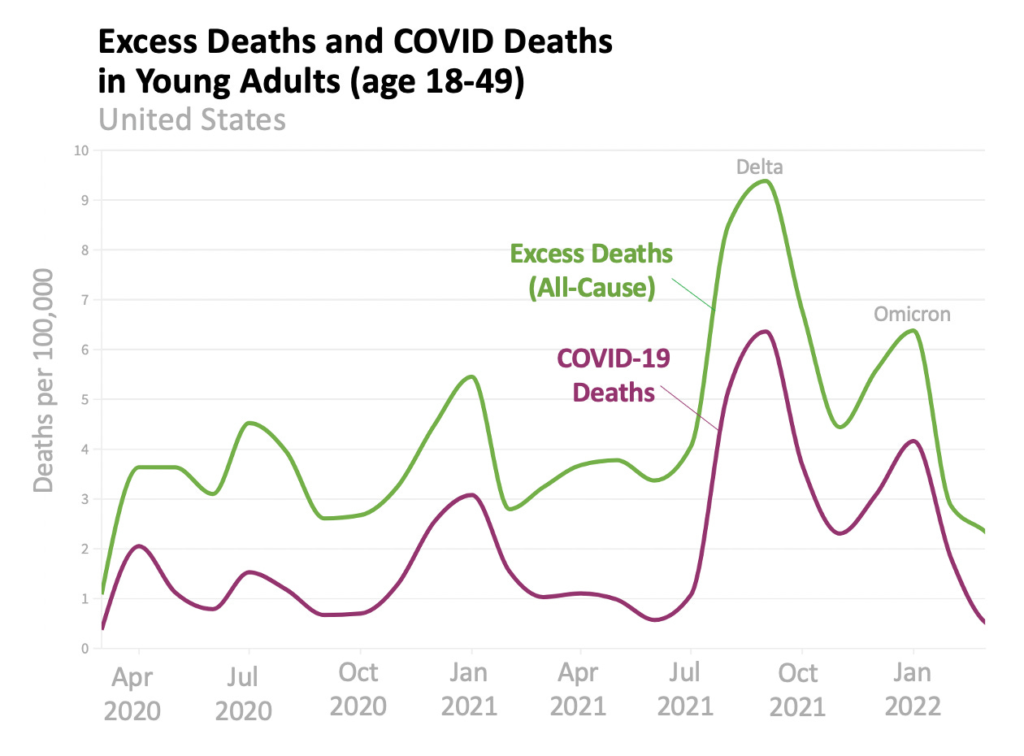
The posts speculates that a lot of excess deaths which were not attributed to COVID-19 were from secondary effects — heart attacks from COVID-weakend hearts, drug overdoses from lonely people, etc.

If you look just at circulatory system attacks in young people in the USA, you can see that the rate was going down pre-pandemic, then spiked post-COVID but pre-vax, and then slowed down again after vaxes showed up:

It’s a good post.


This paper discusses why it’s hard to get vaccines which give persistent immunity for common colds / flu / COVID, while vaccines for diseases like measles or mumps give lifetime immunity. The theory is that the diseases that vaccines give sterilizing immunity to are ones which get into the blood, where they interact with lots of different parts of the body’s immune system, giving all the different immune system pieces a chance to train defences. (They also have a very slow incubation period, unlike respiratory infections.)

The paper also says that humans have evolved some tolerance for respiratory infections. Basically, we inhale so much crud that if we called out the big guns every time we got an infection, we’d cause damage to our own cells.

The bottom line of this paper is: developing a vax which gives sterilizing immunity is going to be hard. 🙁

Treatments

This review-article preprint from the USA says that convalescent plasma reduced mortality by about ten to twenty percent. (I was surprised, because there had been a lot of studies early in the pandemic which said that convalescent plasma did not help.) It also found that there were better results with earlier treatment and with plasma that higher antibody levels.

Recommended Reading

If you are into Long COVID research, this review article has lots of detail about what they know about the pathology. This review article looks at what treatments have been tried and how well they do.


This article talks about Long COVID treatments.
31 Jan 07:14

datasette-granian

datasette-granian

Granian is a new Python web server - similar to Gunicorn - written in Rust. I built a small plugin that adds a "datasette granian" command starting a Granian server that serves Datasette's ASGI application, using the same pattern as my existing datasette-gunicorn plugin.

Via Granian issue tracker: Ability to serve an ASGI app object directly, rather than passing a module string

20 Jan 03:10

"I decided I can do something with a bigger impact."

by peter@rukavina.net (Peter Rukavina)

Sonya Emerick was elected to the Minneapolis School Board. Her reason for running:

I had two choices: to move into litigation with the district or to try to move where I had access to influence systems-level problems and barriers. I chose the latter. When you litigate in special education, it’s a significant amount of time and financial resources. It’s very, very draining on a family emotionally. Even if you get the best possible outcome, it still begins and ends with one kid, typically. I decided I can do something with a bigger impact. That’s why I decided to run.

Sonya, a trans-woman, is the first autistic person elected to the board.

20 Jan 03:09

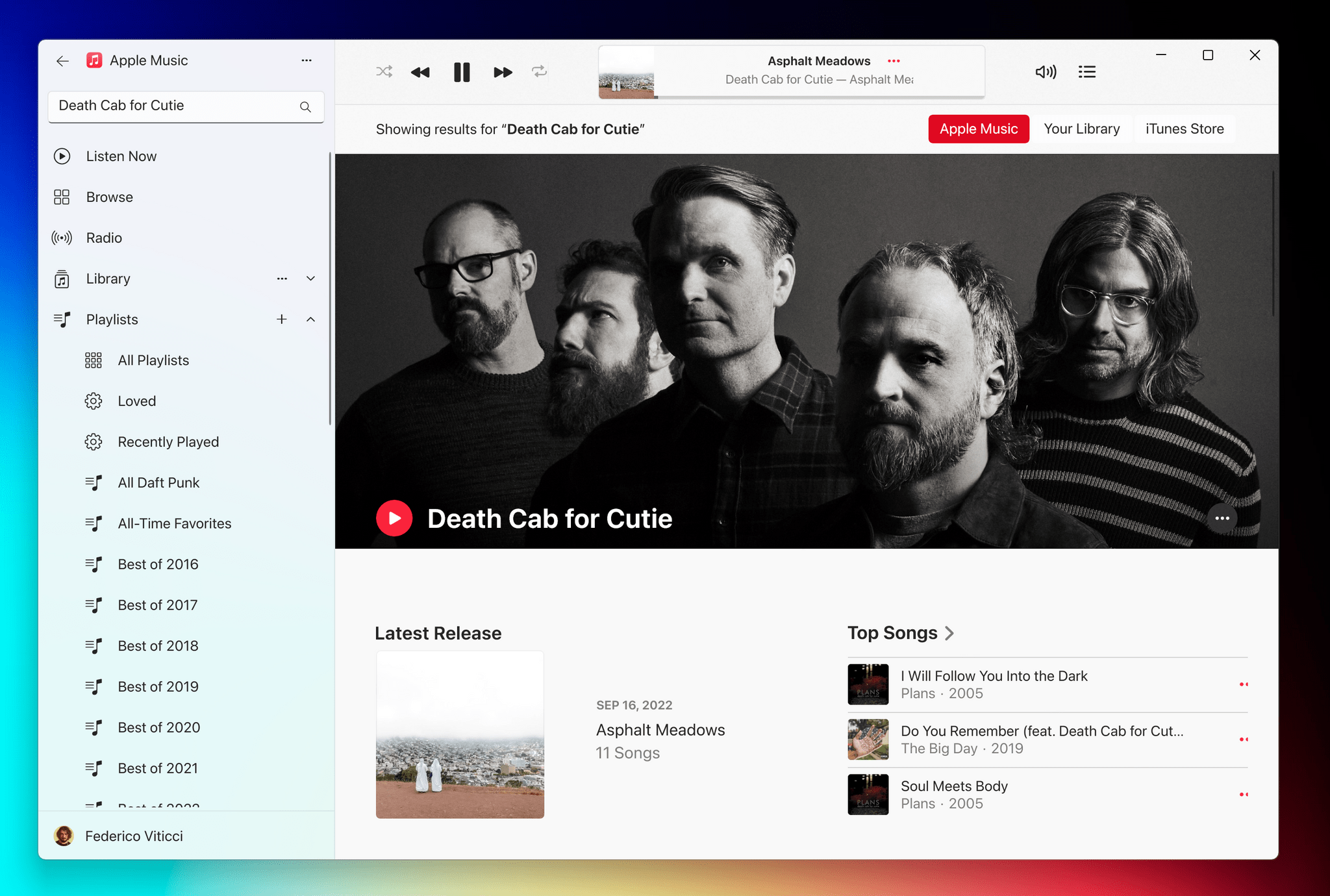
Hands-On with Apple Music for Windows

by Federico Viticci
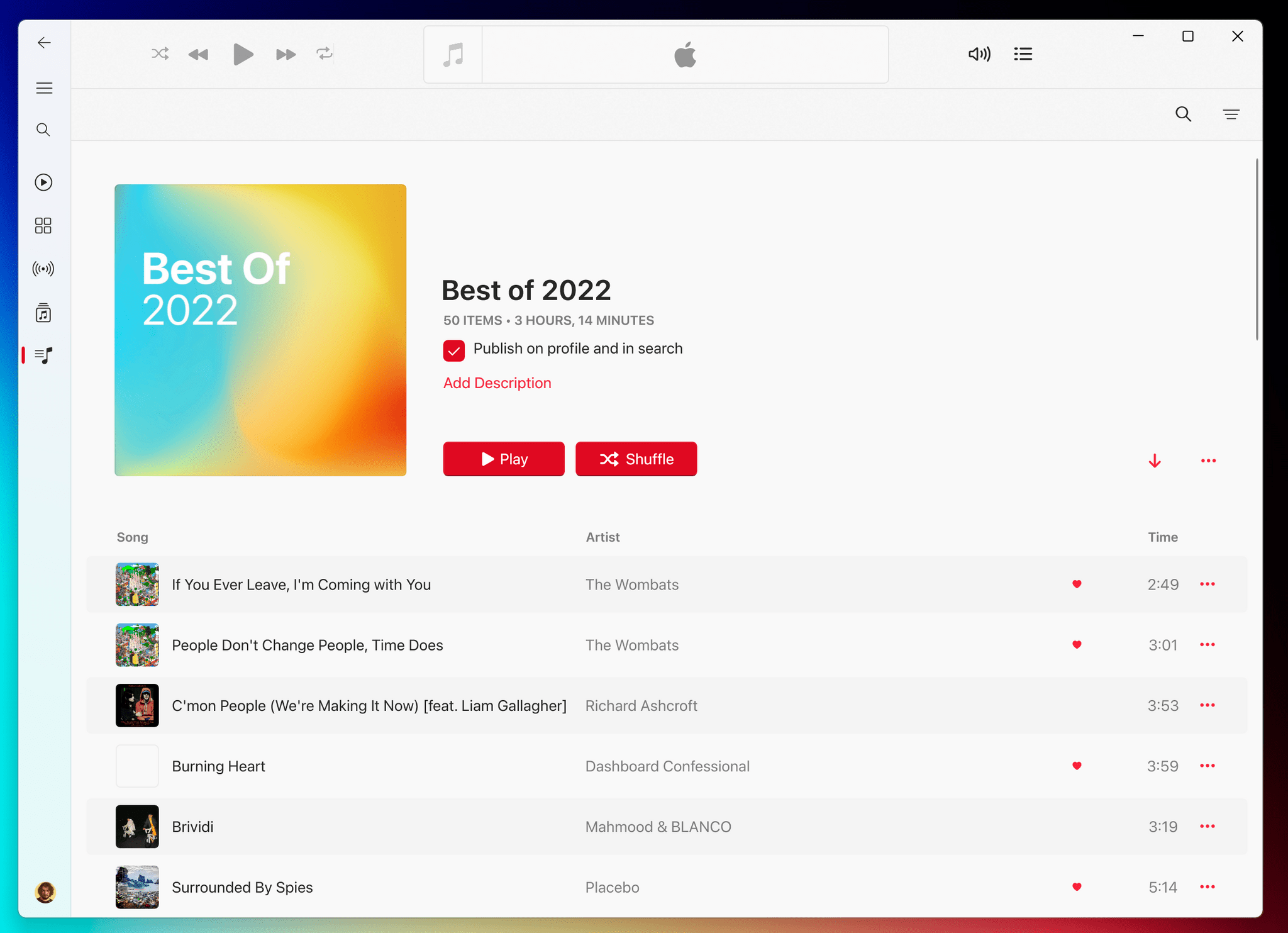
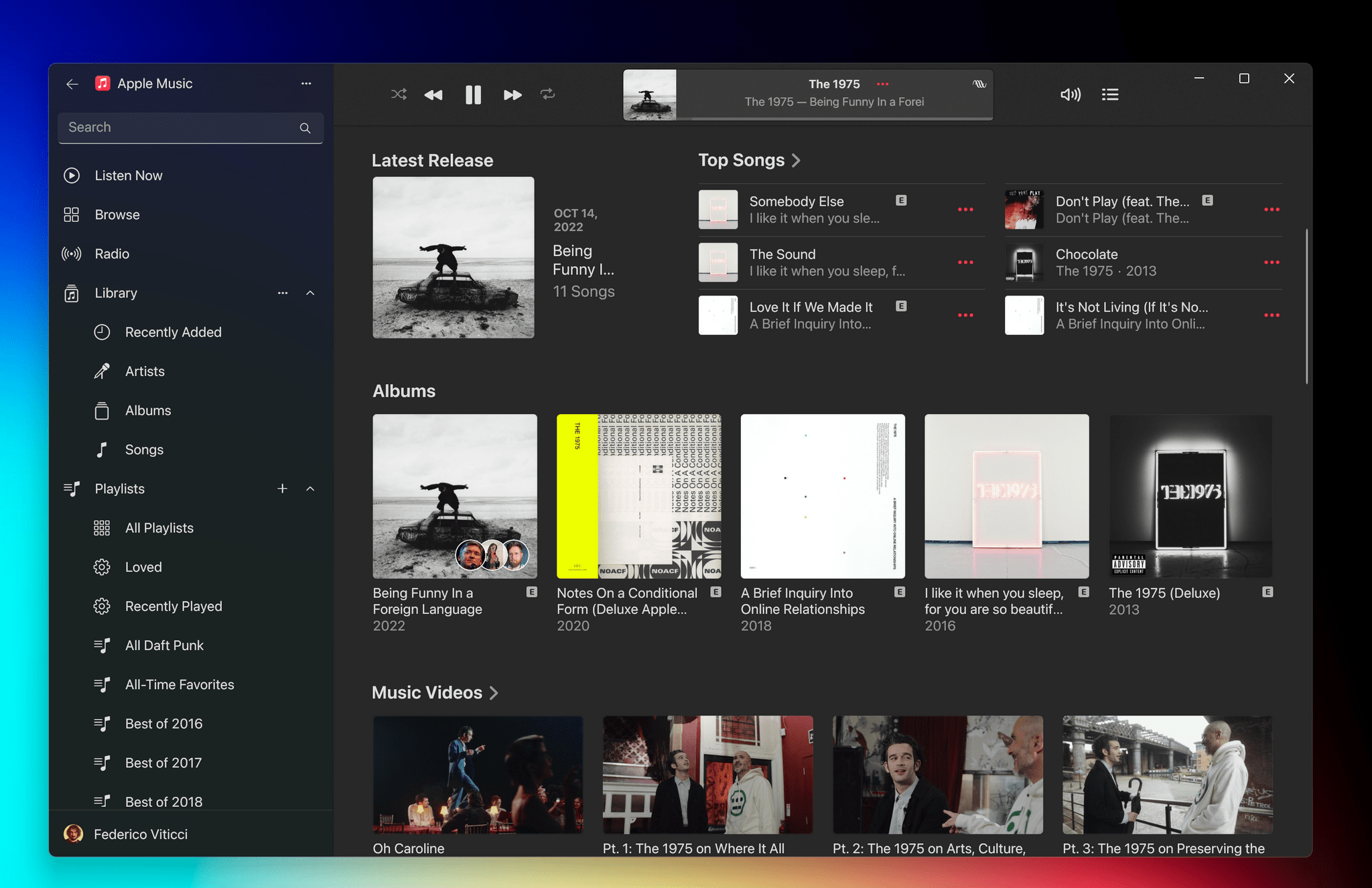
Apple Music for Windows.

Apple Music for Windows.

Last week, Apple released native versions of Apple Music, Apple TV, and Apple Devices for Windows. The apps, which are available on the Microsoft Store, are labeled as “previews”, and they’re meant to eventually serve as replacements for iTunes for Windows, which is the only flavor of iTunes Apple still distributes after they transitioned to standalone media apps a few years ago. I suppose the apps are also part of a broader strategy from Apple to establish a stronger presence of their services on Windows, as we saw last year with the launch of Apple Music on Xbox and iCloud Photos on Windows (which joined the existing iCloud configuration panel for Windows devices).

As an Apple Music subscriber and owner of a Windows gaming laptop, I thought it’d be fun to take Apple Music for a spin and see how it compares to Spotify on Windows as well as the existing Apple Music experience for Apple’s platforms, which I know very well and enjoy on a daily basis.

The first thing I noticed when trying to install Apple Music for Windows was that I couldn’t click the ‘Download’ button from the Microsoft Store. I figured that was due to the “preview” status of the app, and after some research, I came across a Reddit thread that suggested changing Windows’ region settings to United States to get access to the download from the Microsoft Store. That worked. I’m assuming “preview” means Apple rolled these apps out in the U.S. at first, with more countries to follow at some point in the future.

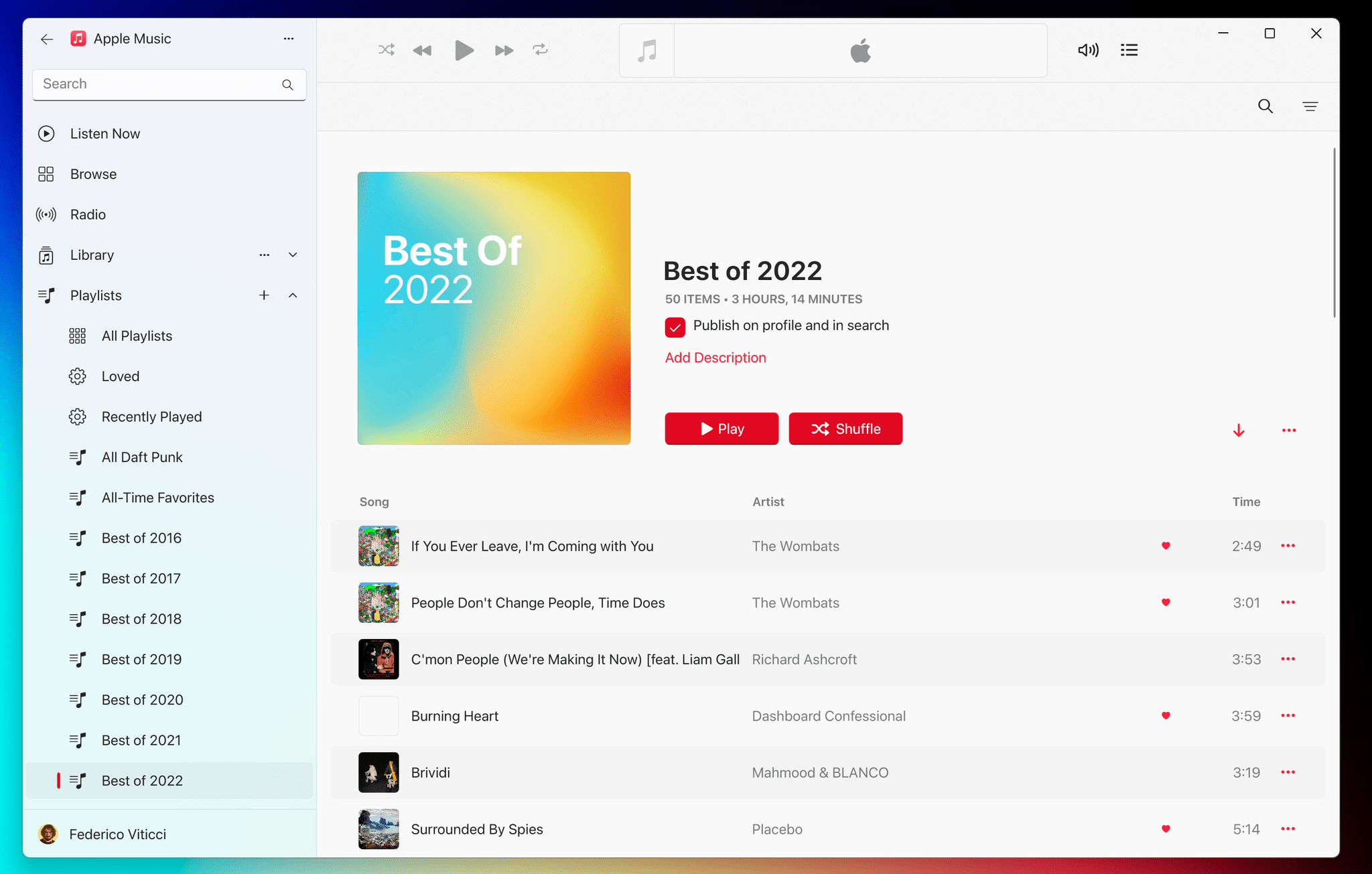
After signing in with my Apple ID, I was presented with the usual Listen Now page that displayed featured items, my recently played albums, and recommendations based on my listening habits. This section is the same as the Listen Now page on my iPhone and iPad, and it lets me drill down into the Recently Played area to get a longer list of albums, just like I can on other devices. The rest of the app feels like a hybrid of the old iTunes, the Music app for Mac, and Music for iPad: Apple rewrote Music for Windows as a UWP app (even though, technically, it has been deprecated by Microsoft), and it features a sidebar with links to Listen Now, Browse, Radio, Library, and Playlists. When the window is small enough, the sidebar has a compact appearance with only icons being shown (which is not something you can do on iPadOS); make the window larger, and you get a proper sidebar with nested items under the Library and Playlists sections.

Compact sidebar in Apple Music for Windows.

Compact sidebar in Apple Music for Windows.

Expanded sidebar in Apple Music.

Expanded sidebar in Apple Music.

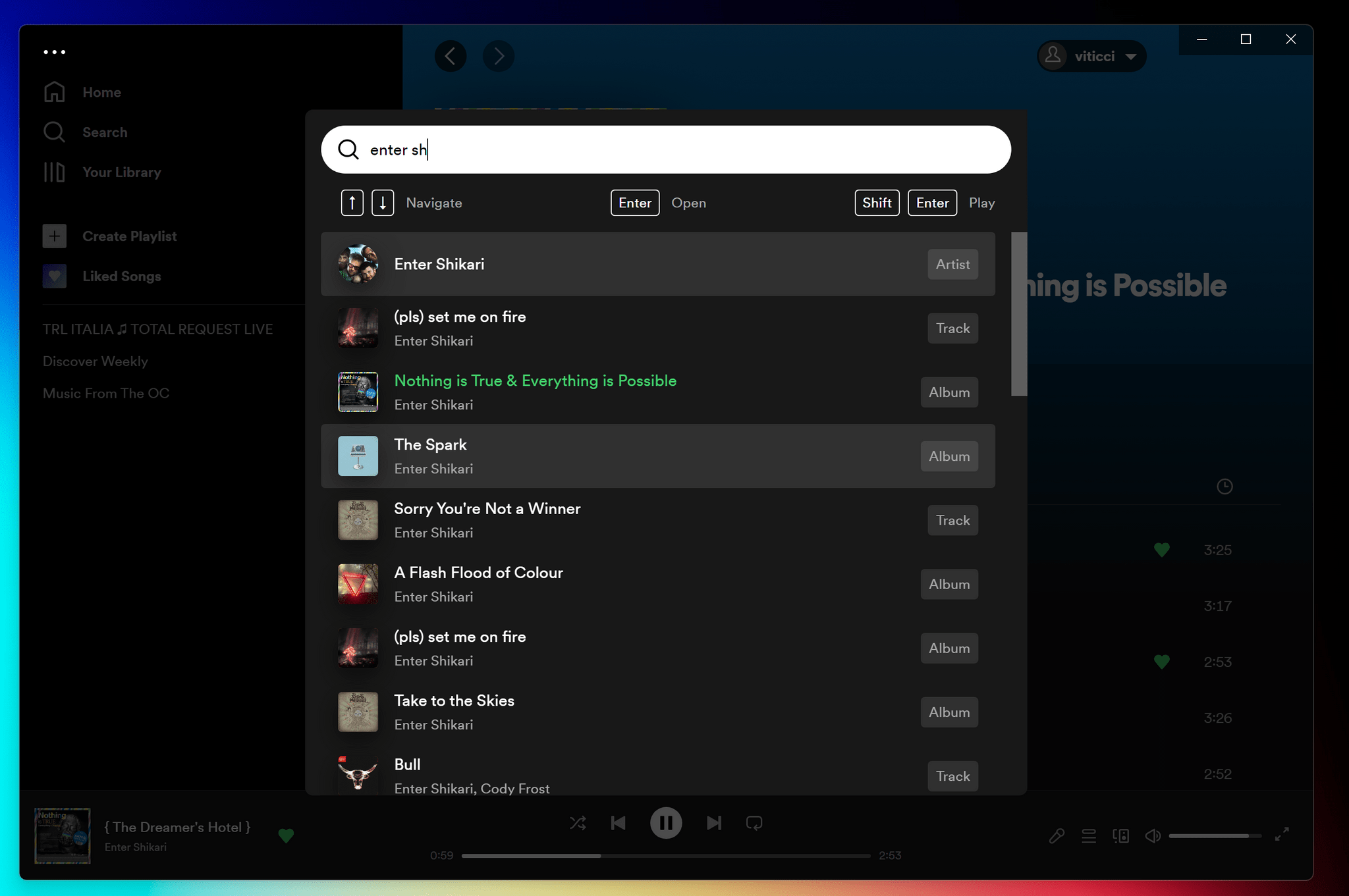
I noticed right away that my iCloud Music Library was synced from Apple’s servers quickly, but the whole app felt clunky and sluggish compared to, say, Music for iPad or even Spotify for Windows. For starters, while Spotify for Mac and Windows offers a handy Command-K bar to search for anything from anywhere in the app, in Apple Music for Windows you always have to click in the search box if you want to search for something, and there’s no Control-F keyboard shortcut to open the search page immediately. There are other keyboard shortcuts in the app, fortunately, but I couldn’t find one for search.

The Control-K bar in Spotify for Windows.

The Control-K bar in Spotify for Windows.

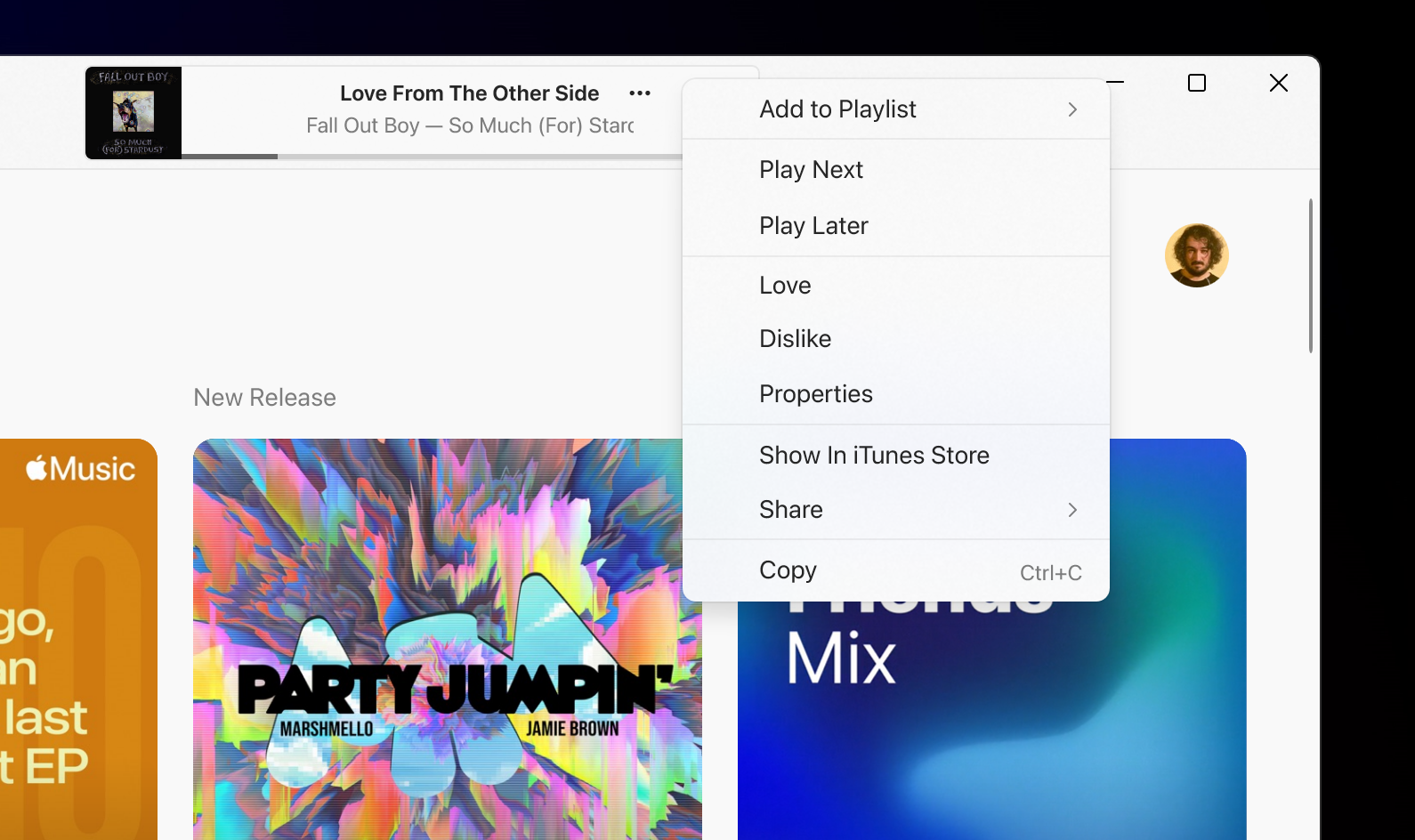
Where the “preview” nature of this app really shows is in its general instability and slow operations. I’m on the latest version of Windows 11, and sometimes when I search for something in Apple Music, search suggestions come up immediately underneath the search field, but actual results take more than 15 seconds to load. Other times the results page stays blank and I have to quit the app and reopen it. Occasionally, when I click the ‘Browse’ item in the sidebar, the app crashes. Then there are a series of inconsistencies: sometimes the contextual menu for songs has buttons to Play Next and Play Later, but sometimes it doesn’t (I haven’t been able to figure out why); the media keys on my keyboard to play/pause and skip tracks work just fine in Spotify for Windows, but they do nothing in Apple Music; sometimes new playlists sync back to my iPhone immediately, but other times they only appear after I’ve added at least a song to them.

A contextual menu in Apple Music for Windows.

A contextual menu in Apple Music for Windows.

Apple Music for Windows in dark mode.

Apple Music for Windows in dark mode.

I should also point out that two of Spotify’s best features are currently missing from Apple Music for Windows, and I was expecting Apple to ship at least one of them. First, there are no real-time lyrics in the app yet. Apple Music has, by far, the best lyrics experience of all modern music streaming services, and I hope Apple is working on bringing the functionality to its Windows client since I can’t imagine going back to reading lyrics on Google search results like it’s 2018 all over again.1 Second, when something is playing in Spotify for Windows, you can hover over its icon in the taskbar and you’ll get an interactive window thumbnail preview with a) the title of the song that’s currently playing and b) inline controls for music playback. The Apple Music taskbar icon offers neither of these functionalities right now, and I hope Apple will be willing to copy Spotify’s approach here.

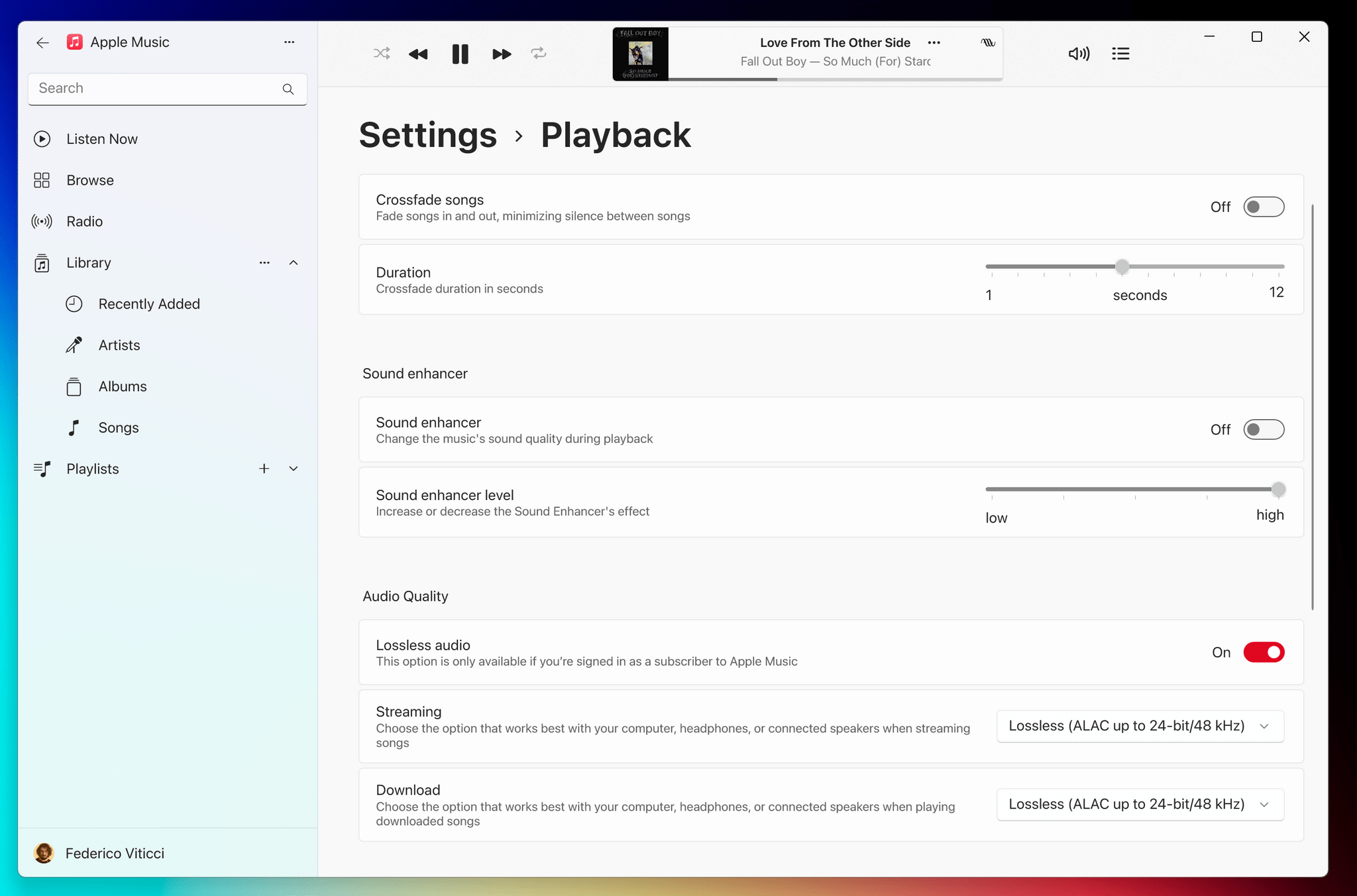
All that said, I should also note that, despite the issues and missing features of this first version, I’m excited to see Apple make more native apps for its services for Windows devices, and there were aspects of Apple Music for Windows that positively surprised me. For instance, lossless and hi-res lossless streaming and downloads are fully supported, as is crossfade (which is also available on Android but still nowhere to be found on iOS and iPadOS). There’s even a ‘Sound Enhancer’ feature that “changes sound quality during playback” that I only recall seeing on macOS before.

Playback settings for Music on Windows.

Playback settings for Music on Windows.

There’s a lot of work for Apple to do to catch up to their own web client, third-party Apple Music clients like Cider, or the Spotify desktop app for Windows.2 Regardless, the launch of multiple apps for one of their key competitors in desktop computing is the sign of a healthy Services division at Apple. I’m keen to keep an eye on future developments for Apple Music and Apple’s other media apps.


  1. What’s also odd: the Apple Music web client and third-party apps based on it, like Cider, also support displaying time-synced lyrics. ↩︎
  2. Obviously the most pressing issue at the moment: Apple Music for Windows does not integrate with the Last.fm desktop scrobbler. I’m sure this is a top-priority problem for Apple and Last.fm right now. ↩︎

Support MacStories and Unlock Extras

Founded in 2015, Club MacStories has delivered exclusive content every week for over six years.

In that time, members have enjoyed nearly 400 weekly and monthly newsletters packed with more of your favorite MacStories writing as well as Club-only podcasts, eBooks, discounts on apps, icons, and services. Join today, and you’ll get everything new that we publish every week, plus access to our entire archive of back issues and downloadable perks.

The Club expanded in 2021 with Club MacStories+ and Club Premier. Club MacStories+ members enjoy even more exclusive stories, a vibrant Discord community, a rotating roster of app discounts, and more. And, with Club Premier, you get everything we offer at every Club level plus an extended, ad-free version of our podcast AppStories that is delivered early each week in high-bitrate audio.

Join Now
20 Jan 03:09

Is ChatGPT A World Changing Technology? (And Will We All Become “Centaurs”?)

by John Battelle

Watching the hype cycle build around OpenAI’s ChatGPT, I can’t help but wonder when the first New York Times or Atlantic story comes out calling the top – declaring the whole thing just another busted Silicon Valley fantasy, this year’s version of crypto or the metaverse. Anything tagged as “the talk of Davos” is destined for a ritual media takedown, after all. We’re already seeing the hype start to fade, with stories reframing ChatGPT as a “co-pilot” that helps everyone from musicians to coders to regular folk create better work.

But I think there’s far more to the story. There’s something about ChatGPT that feels like a seminal moment in the history of tech – the launch of the Mac in 1984, for example, or the launch of the browser one decade later. Is this a fundamental, platform-level innovation that could unleash a new era in digital?

Possibly, but the simpler co-pilot concept also resonates. It reminds me of a conversation I had over the course of a year or so with Rob Reid, the author of the prescient 2017 novel After On. AI plays a central role in the novel, and Reid introduces the concept of “centaurs” – creatures that are part human, part AI – borrowed from Garry Kasparov, who imagined merging with Deep Blue’s chess AI back in 2014. More colloquially, Rob and I drained more than a few bourbons imagining how AI could be more like a smart friend or assistant, rather than an evil force hell bent on destroying humanity.

Centaur-like behavior is already emerging across the nerdosphere. I was on a call with a scholarly colleague just yesterday, and he showed me two applications that leveraged large-language models (LLMs) to both supplant and enhance human communications – both of them in multi-billion dollar markets that currently support millions of workers. I’ve no doubt that AI-enhanced models are just getting started, and we’ll likely see huge VC investment in the space this year.

What I’m interested in is the nature of those investments. While OpenAI is positioned as the alpha startup in the space – reportedly negotiating a $10 billion injection of capital from Microsoft at a $29 billion valuation – I find the ecosystem that’s developing around the APIs these large-language models enable to be far more fascinating. For AI to reach the historical status of the Mac/PC or the browser, it will have to spark a massive surge of new companies and economic activity. Six years ago, Kevin Kelly predicted an explosion of startups that would “just add AI” – similar to the surge of Web 2.0 startups in the mid 2000s that “just added AJAX” or mobile startups in the 2010s that “just added social.” He was wrong on timing – but I think he’s onto something in the long run.

What might an ecosystem leveraging ChatGPT-like functions look like, I wonder? What categories are poised for true disruption? Where might “ChatGPT as a service” re-imagine large industries? Here are a few that come to mind…

  • Customer service. Computers and script-driven voice mail trees already dominate this space, but we still have to deal with outsourced customer service agents who feel … worlds away and not particularly good. With clever parameters and programming, LLMs could truly change the game here. This firm is already leveraging ChatGPT in automated customer service and creating “super agents,” which sound a lot like centaurs.
  • Search. I’ve already written a fair bit about this (and so have many others), but search is a huge business, and the potential for “conversational search” is tantalizing.
  • Law. A lot of the current grunt work in law – essentially, what paralegals do all day, billed at $400 an hour –  is just recombination of a massive, interlinked reference set of cases and precedents. I imagine there’s plenty of opportunity to code that into parameters for a ChatGPT-driven platform that enables massive efficiencies in legal costs (which sounds good to me…).
  • Healthcare. Ditto here. Of course, as with law (and pretty much every other case here) we’ve got to be careful, but LLM’s ability to find patterns and report them out could truly disrupt healthcare, from the ridiculous maze of paperwork and insurance bureaucracy to diagnosis, novel protein and molecule discovery, and more.
  • Media. I don’t think any AI system will create the equivalent of a well thought out article (and I’ll be writing a piece on why soon), but AI is already being used for clearly structured pieces in finance, sports, and the like. I expect that trend to continue. When I was coming up as a tech reporter in the late 80s, my first assignments were to rewrite press releases. I stood out because I actually called the companies and asked follow up questions – but that wasn’t industry standard practice, and it still isn’t. ChatGPT, with the right guardrails, could probably do the same job – and for nearly no cost. I’m not sure that’s a huge, investable market, but it’s a leading indicator. Plus, tons of “real” writers and creators will use AI like centaurs – as muses and prompts. Media will certainly be changed forever by this technology.
  • Coding. This is obvious, and well-reported, but like media, a lot of coding these days is repetitive and rote. Plus, just like with writers, coders are using AI to prompt their work to another level.

OK, I’m going to stop here and ask what you think might change thanks to ChatGPT and LLMs. Does ChatGPT mark a truly historic breakthrough, like the Mac/PC or the web browser? Let me know in comments, or email me direct – jbat at this domain (battellemedia.com). Happy prompting, folks…

Hey, thanks for reading. You can get all my posts for free by signing up for email alerts right here!

20 Jan 03:08

Exploring the Research Trajectory of Digital Game-based Learning: A Citation Network Analysis

Wiwit Ratnasari, Tzu-Chuan Chou, Chen-Hao Huang, Educational Technology & Society, Jan 19, 2023
Icon

If you want to comprehend the development of core ideas over a large body of literature, how best to do it? This article offers one compelling method: "From over 30 years of digital game-based learning development, 26 of the most influential studies are identified and visualized using Pajek software." Pajek is "a program package for analysis and visualization of large networks." Read about it here. It was used to conduct a cutation analysis of some 2156 articles and their data from The Web of Science database; the software creates a visual representation of developments in the field (illustrated here) that can be studied to identify trends. "The findings show two development phases for this field: exploring the role of gaming for educational purpose as well as facilitating learning performance." Now of course we might get different results from a broader set of literature, and it would be interesting compare consider different sorts of network analyses. But note how different this is from traditional literature analysis, and how looking at the relations between papers shows something very different than what we see when we just aggregate data.

Web: [Direct Link] [This Post]
20 Jan 03:08

The Shit Show • furbo.org

mkalus shared this story from furbo.org:
I like the Fediverse, Space Karen's approach to re-create the AOL of the mid '90s shouldn't really surprise, he never had an original idea in his life. Maybe it's time to break these monopolies again, not maybe. It is.

20 Jan 03:06

Inside Elon's "extremely hardcore" Twitter

Alex Heath, The Verge, Jan 19, 2023
Icon

Teriffic look inside Twitter as it wnt through convulsions after being acquired. The story is a good case study of why individual owners shouldn't have so much power over a company. "Twitter's staff spent years trying to protect the social media site against impulsive billionaires who wanted to use the reach of its platform for their own ends, and then one made himself the CEO... Musk appears unaware of what he's actually broken: the company culture that built Twitter into one of the world's most influential social networks, the policies that attempted to keep that platform safe, and the trust of users who populate it every day with their conversations, breaking news, and weird jokes - Twitter's true value and contributions to the world." More: Publishers lament the removal of Twitter Moments as referral traffic dips.

Web: [Direct Link] [This Post]
20 Jan 03:06

Of course the attention economy is threatened by the Fediverse

by Jon Udell

Megan McArdle says this week, in the Washington Post, that “Twitter might be replaced, but not by Mastodon or other imitators.” I’m not linking to the article, you can easily find it, but that title is all we need for my purpose here, along with this bit of context: she has 93K followers on Twitter.

Nobody wants to walk away from that kind of audience. Well, almost nobody. Sam Harris’ recent Twitter exit is a rare example of someone concluding that a large follower count is a net negative. If I were in his shoes I’m not sure I’d be able to do the same. When my own audience was at its peak — at BYTE during the dawn of the Internet, then at InfoWorld in the early years of the blogosphere — I could press the Publish button on my blog and watch in realtime as the responses rolled in on waves of dopamine. It’s addictive, there’s never enough, you’re always looking for the next hit.

When Twitter started, that momentum carried forward for a while. I never racked up a huge follower count — it maxed out just shy of 6K — but most of those people followed me early on, thanks to the the ad-supported publications that had brought me to their attention. My Twitter following reached a plateau years ago. Did I wish for 100K followers? Sure, I’d be lying to pretend otherwise. But gradually I came to see that there was a sweet spot, somewhere between (let’s say) 200 and 15,000 followers, where it was possible to enjoy the kinds of pleasant and stimulating interaction that I’d first experienced in web forums and the blogosophere.

Until it wasn’t. Like a frog in slowly boiling water, I failed to notice how the Twitter experience degraded over time. Fewer and fewer of my 6K followers corresponded regularly, and my social graph there became stagnant. For me the Mastodon reboot has been a delightful replay of the early blogosphere: new acquaintances, collegial discussion, positive energy.

If you occupy a privileged position in the attention economy, as Megan McArdle does now, and as I once did in a more limited way, then no, you won’t see Mastodon as a viable replacement for Twitter. If I were still a quasi-famous columnist I probably wouldn’t either. But I’m no longer employed in the attention economy. I just want to hang out online with people whose words and pictures and ideas intrigue and inspire and delight me, and who might feel similarly about my words and pictures and ideas. There are thousands of such people in the world, not millions. We want to congregate in different online spaces for different reasons. Now we can and I couldn’t be happier. When people say it can’t work, consider why, and who benefits from it not working.

Here’s a graph of the Fediverse as it appears from my perspective right now.

It looks and feels healthy and it’s working just great. I don’t want us to replace Twitter, or imitate it. I want The Internet Transition that I hope is underway.

20 Jan 02:46

App Store Rejection of the Week: Ice Cubes

by Rui Carmo

I did say I didn’t want to talk about Twitter drama, but I was shocked by the extinction of third-party clients, am (like John) delighted with the current crop of third-party Mastodon clients and have extremely strong opinions about the current professionalism of the App Store review process.

Update: It’s been approved, two hours after John’s post.


20 Jan 02:45

Twitter Favorites: [marshalederman] In defence of Vancouver culture (and Toronto culture too). With thanks to ⁦@JesseBrown⁩ and ⁦@marcmaron⁩ for the in… https://t.co/zLnCpi08zb

Marsha Lederman @marshalederman
In defence of Vancouver culture (and Toronto culture too). With thanks to ⁦@JesseBrown⁩ and ⁦@marcmaron⁩ for the in… twitter.com/i/web/status/1…
20 Jan 02:45

Instead of posting on a personal #IndieWeb site...

Instead of posting on a personal #IndieWeb site (& POSSE copies), some post primarily to a #fediverse instance and syndicate to Twitter, or vice-versa. How to reply^1 to such posts, e.g.:

Reply to a toot (& POSSE tweet): https://tantek.com/2023/019/t4
* @-@ (Twitter @-name)

This is a variant of case (2) in https://tantek.com/2023/018/t1/elevate-indieweb-above-silo.

We can update the directive and two questions & answers in that prior post accordingly:

* Elevate #IndieWeb domains above @-@ addresses, and those above any silo identities

1. Do they have an #IndieWeb domain? Then @-domain mention them^2, like you are speaking to them at their domain identity. This will notify them there, or at least reinforce their domain’s importance.

2. Was their post only published on a #fediverse instance (and/or silo), or was it POSSEd to a fediverse instance (and/or silo) and do you plan to federate (and/or POSSE) your reply^3?
Then use their @-@ address or silo @-name, or @-@ (silo @-name) for both, or (@-@, silo @-name) parenthetically following their @-domain if (1). This will notify them on that instance (or silo), and may help thread your POSSE reply.

When posting a reply, you (or your CMS automatically) should explicitly link with u-in-reply-to markup^4 to the post your are replying to, and any of its syndicated copy permalinks on destinations you plan to POSSE your reply (see also multi-reply^5).
 

This is day 18 of #100DaysOfIndieWeb #100Days, written the day after.

← Day 17: https://tantek.com/2023/018/t1/elevate-indieweb-above-silo
→ Day 19: https://tantek.com/2023/020/t2/bridgy-fed-follow-form


^1 https://tantek.com/2023/017/t1/socialweb-blogs-reply-comment-post
^2 https://tantek.com/2023/011/t1/indieweb-evolving-at-mention
^3 https://tantek.com/2023/015/t1/publish-indieweb-decide-distribute
^4 https://indieweb.org/in-reply-to
^5 https://indieweb.org/multiple-reply
19 Jan 15:13

Microsoft launched ChatGPT-3, but Google also have a great hand, in fact they have a bird in the hand...

Donald Clark, Donald Clark Plan B, Jan 18, 2023
Icon

"Sparrow, from (Google) Deepmind, is likely to launch soon," writes Donald Clark. "Their aim is to trump ChatGPT by having a chatbot that is more useful and reduces the risk of unsafe and inappropriate answers. In the released paper, they also indicate that it will have moral constraints." They also intend "to build on Google Tools such as Search and Scholar to deliver factually correct text." See also the Decoder, TechRadar, Reddit, gHacks.

Web: [Direct Link] [This Post]
19 Jan 15:13

Apple Brings Back HomePod, What Happened?, HomePod Changes (Daily Update)

by Neil Cybart

Hello everyone. Happy Wednesday.

We have surprising news: HomePod is back. Earlier today, Apple unveiled a HomePod 2nd generation.

As a long-time HomePod user with 10 HomePods currently in use around my home (in five pairs), the HomePod has been an intriguing product. An Above Avalon Report from 2022 (available here) was dedicated to the HomePod discontinuation. We have a lot to discuss. Let's jump right in.


Apple Brings Back HomePod

In a surprise twist, Apple unveiled a 7-inch HomePod for the second time in six years. The speaker, which Apple is referring to as HomePod (2nd gen), will sit next to the HomePod mini.

In February 2018, Apple launched a 7-inch HomePod for $349. To avoid confusion, we will refer to that model as the original HomePod. After three years of sales, the original HomePod was discontinued in March 2021. At the time, Apple said they were going to put their focus on the HomePod mini:

“HomePod mini has been a hit since its debut last fall [2020], offering customers amazing sound, an intelligent assistant, and smart home control all for just $99. We are focusing our efforts on HomePod mini.”

The sudden (and surprise) discontinuation rubbed HomePod owners the wrong way.

An Above Avalon membership is required to continue reading this update. Members can read the full update here. An audio version of this update is available to members who have the podcast add-on attached to their membership. More information about the podcast add-on is found here.

(Members: Daily Updates are always accessible by logging into Slack. If you haven’t logged into Slack before, fill out this form to receive an invite.)


Above Avalon Membership

Subscribe $20/month Subscribe $200/year

Payment is processed and secured by Stripe. Apple Pay and other mobile payment options are accepted. Special Inside Orchard bundle pricing is available for Above Avalon members.

More information about Above Avalon membership, including the full list of benefits and privileges, is available here.

19 Jan 15:13

Empagliflozin (Jardiance) and Type 1 diabetes – a patient’s perspective on SGLT inhibitors

by Ethan

Hey, this is one of those blog posts intended for search engines more than for the casual reader… unless the casual reader happens to be a type 1 diabetic. I have had type 1 diabetes for more than 35 years, and a month into taking empagliflozin, it’s the biggest transformation I’ve had in my diabetes management experience. It’s been something of a miracle drug for me, and I wanted to share my experience for other type 1 diabetics who are in tight control, but seeking lower insulin doses and, possibly weight loss.

I was diagnosed with type 1 diabetes at age 13, and am now fifty. Like many young diabetics, I did a shitty job of managing my disease until my early twenties, and I experienced some serious consequences, notably significant problems with diabetic retinopathy. For the past 25 years, I’ve been in tight control (A1C below 7, often between 6-6.5) and have been able to manage my diabetes through world travel, unpredictable eating and sleep schedules, etc.

About five years ago, I moved towards using Tresiba as my basal insulin, using Humalog as a short duration insulin. I also moved to continuous glucose sensors. I was able to get much tighter control than I’d experienced with Lantus and Humalog, but it was a very brittle equilibrium. That is to say, I had to eat a very strict low-carb diet, and minor deviations would mean additional insulin.

I changed doctors about half a hear ago when my long time primary care physician retired, and my new doc found me an excellent nurse practitioner who works at a local (Pittsfield MA) endocrinology practice. My new NP talked with me about my diet, exercise, glucose monitoring, etc. and said, “Hey, we don’t recommend this for most patients, but it might work for you.”

The regimen he was recommending was 10mg daily of empagliflozin, a drug commonly used to help with type 2 diabetes. It’s a sodium glucose co-transporter-2 (SGLT-2) inhibitor, which is to say, taking it helps remove sugar from the bloodstream and move it to the urine. This is a phenomenon virtually all type 1 diabetics are familiar with – if your blood sugar is hight, you’ll get thirsty and need to pee. For me, that usually happens at about 240 mg/dl, a level at which I’d usually take a supplementary insulin dose. With empagliflozin, that experience happens at much lower blood sugar levels – around 150 mg/dl in my experience.

My NP suggested I’d need to adjust my insulin needs down, and he was right – WAY down. I am using 75% as much Tresiba as a basal dose, and I am taking 60% as much insulin with each meal. Despite cutting insulin significantly, I have far more flexibility than I used to have with my diet. I’ve cautiously let some carbs back into my diet, having a sandwich on two slices of bread rather than a low-carb wrap, for instance, or a small amount of brown rice with a curry.

What’s been most notable to me is a marked decrease in appetite. This may not purely be from the empagliflozin, as I’m also working on getting my thyroid levels under control. But insulin is known to be associated with weight gain, and I’ve steadily gained weight over the many years I’ve been managing my diabetes. It’s too early for me to say whether I’m experiencing significant weight loss, but my energy is great, my appetite is down, and it’s been much easier to control my sugars despite taking significantly less insulin.

In other words, the last month on empagliflozin has been like playing type 1 diabetes on easy mode. In exchange for drinking a bit more water and peeing a bit more, I have way more flexibility in what I eat, reduced appetite and increased energy. Yes, I’ll take it, thank you very much.

So why isn’t empagliflozin widely prescribed for type 1 diabetics. Well, it is, in Europe. Specifically, Europeans are using SGLT-1 inhibitors (which helps absorb glucose in the gastrointestinal tract) as well as SGLT-2 inhibitors (which focus on the kidneys) for type 1 diabetics who are overweight or obese (that’s me!) In 2019, a small study in Spain saw promising results, as have larger international studies.

So why has the FDA refused to sign off on empagliflozin for Type 1 diabetics in the US?

Ketoacidosis.

Diabetic ketoacidosis (DKA) occurs when your body doesn’t have enough insulin to process glucose into energy. The body begins breaking down fat for fuel, producing ketones in the process. The ketones build up in the blood and begin to turn the blood acidic, which has severe and widespread health consequences. DKA was the cause of death for almost all type 1 diabetics before the development of insulin, and still leads to hospitalization and sometimes death for a significant number of diabetics (about 220k hospitalizations and 835 deaths in 2017).

The FDA is concerned that SGLT-2 inhibitors will increase the chances of DKA in patients who stop taking insulin, incorrectly take a dose (pump failure, pen failure), who become dehydrated or have another significant health issue, like infection. I am not able to find studies that show a significant increase in DKA episodes for patients with type 1 taking SGLT-2, but that’s not surprising – the experiments done have been quite small, and DKA is not a routine experience for most diabetics. What this suggests is that FDA is being cautious, concerned that the increased risk of DKA doesn’t justify the benefits of reduced blood sugars, weight loss, etc.

I found this piece, which is extremely cautious as regards use of SGLT-2 in type 1 patients to be especially helpful, because it summarized the stakes so neatly:

“Recent data from the T1D Exchange (T1DX) registry (1), which comprises leading U.S. diabetes treatment centers, show that despite the widespread availability of insulin analogs and increasing use of insulin pumps and continuous glucose monitoring systems, only about 20% of adult patients achieve the A1C target of <7% (53 mmol/mol) recommended by the American Diabetes Association (2). It is reasonable to assume that glycemic control of patients receiving care outside of major centers might be even worse… There is clearly an unmet need for noninsulin adjunctive therapies that improve glycemic control without increasing the risk of hypoglycemia or contributing to weight gain, and it is noteworthy that among nearly 50,000 pediatric and adult participants in the T1DX registry in the U.S. and the Prospective Diabetes Follow-up (DPV) registry in Germany and Austria, two large consortia of diabetes centers, adjuvant medications are being used off-label by 5.4% of participants in T1DX and 1.6% in DPV (5).”

In other words, type 1 diabetes sucks, and most people can’t manage it within ADA’s guidelines, even with pumps, continuous glucose monitors, etc. And so an increasing number of folks are using off-label adjuvant medicines, like SGLT-2.

I wanted to write something about my positive experiences with SGLT-2 and type 1 because I simply couldn’t find another patient account on the web. I am not a doctor, certainly not an endocrinologist, and my experiences may not be your experiences. For that matter, my experiences after a few months on this regimen may be different than my experiences one month in. But, if your diabetes is in tight control, if you rarely have blood sugars above 240 mg/dl, if you’re overweight and having trouble losing weight, you might want to talk with your diabetes doc about SGLT-2 drugs.

The post Empagliflozin (Jardiance) and Type 1 diabetes – a patient’s perspective on SGLT inhibitors appeared first on Ethan Zuckerman.

19 Jan 15:12

Multiplying two integers from Rust

This is part of a series on Native AOT.
Previous -- Top -- Next


Rust has a really nice feature called raw-dylib, which allows calling external functions without linking at build time. Given the name of the shared library, Rust will dynamically load the library and lookup the function. (At the time of this writing, raw-dylib is supported only on Windows.)

So, because of this raw-dylib feature, Rust is one of the simpler examples of how to invoke our trivial multiply() function. We just need to declare the extern function signature and include a link attribute to let Rust know that the function should be found in a shared library with the base name "mul":

#[link(name="mul", kind="raw-dylib")]
extern {
    fn multiply(a : i32, b : i32) -> i32;
}

FWIW, raw-dylib in Rust is basically the same feature as P/Invoke in .NET:

[DllImport("mul")]
static extern int multiply(int a, int b);

Anyway, once the declaration is in place, we can call the function from Rust, keeping in mind that Rust considers any FFI function to be unsafe:

fn main() {
    let c = unsafe { multiply(7, 6) };

    println!("{}", c);
}

Of course, the program will complain if it can't find the dynamic library:

$ cargo run
   Compiling mul_rs_win_dynamic v0.1.0 (C:\Users\eric\dev\native-aot-samples\mul_rs_win_dynamic)
    Finished dev [unoptimized + debuginfo] target(s) in 0.41s
     Running `target\debug\mul_rs_win_dynamic.exe`
error: process didn't exit successfully: `target\debug\mul_rs_win_dynamic.exe` 
    (exit code: 0xc0000135, STATUS_DLL_NOT_FOUND)
C:/Users/eric/.cargo/bin/cargo.exe: error while loading shared libraries: 
    ?: cannot open shared object file: No such file or directory

But once mul.dll (built with Native AOT in the previous chapter) is copied into place, we can finally multiply two numbers from Rust:

$ cp ../mul_cs/bin/Debug/net7.0/win-x64/publish/mul.dll .

$ cargo run
    Finished dev [unoptimized + debuginfo] target(s) in 0.00s
     Running `target\debug\mul_rs_win_dynamic.exe`
42

The code for this blog entry is available at:

https://github.com/ericsink/native-aot-samples/tree/main/mul_rs_win_dynamic

19 Jan 15:07

OR, WA, and BC Must Invest Beyond Gas

by Stephen Rees

MEDIA CONTACT: Emily Moore, Director, Climate and Energy Program, Sightline Institute, emily@sightline.org  

SEATTLE, WA – As public concern grows over the health dangers of gas appliances in homes and the impacts of climate-warming fuels on their economies, Oregon, Washington, and British Columbia should look to a future energy system that is gas-free. To get there, leaders in the region should stop subsidizing the buildout of new gas pipe infrastructure and explore alternative energy systems like “GeoNetworks,” neighborhood-wide ground source heat pumps. That’s according to new analyses from the think tank Sightline Institute. 

“Gas utilities continue to perversely incentivize building new gas infrastructure that will pollute our homes and climate for decades, and gas customers are paying for it—likely without knowing,” says Emily Moore, Director of Sightline’s Climate and Energy program and author of the articles. “Regulators should eliminate these subsidies and hold the gas industry accountable to realistic climate strategies, not the faux solutions they are peddling today, like hydrogen for home heating.”

Read Moore’s full analyses, coauthored with Sightline fellow Laura Feinstein: 

### 

Emily Moore, Director of Sightline Institute’s Climate and Energy program, leads Sightline’s work transitioning Cascadia away from fossil fuels and toward cleaner and greener energy sources. Emily holds her Master’s in Public Policy from the Harvard Kennedy School and her Bachelor’s from Brown University. Find her latest research here, and follow her on Twitter at @_enmoore_

Sightline Institute is an independent, nonprofit think tank providing leading original analysis of housing, democracy, forests, and energy policy in the Pacific Northwest, Alaska, British Columbia, and beyond.  

19 Jan 15:06

Changes at Microsoft

by Volker Weber

Geekwire is citing a memo from Satya Nadella. Here is something that caught my eye:

we are taking a $1.2B charge in Q2 related to severance costs, changes to our hardware portfolio, and the cost of lease consolidation as we create higher density across our workspaces.

Microsoft is removing some 10,000 jobs while realigning the company. They are putting $1.2 billion on their balance sheet to offset costs for this change. Severance cost is money paid out to fired employees, cost of lease consolidation is money paid to get out of lease contracts and to move to fewer and smaller office spaces, but changes to our hardware portfolio is the interesting one.

There will not be any press statements about which products Microsoft is dropping. Your guess is as good as mine. You will have to watch what disappears from the Microsoft Store.

Update: Meanwhile somebody wrote a comment (disqualified by refusing to leave his full name) which had a good suggestion:

Update: This was a good call. CNET reports that Microsoft is shutting down Altspace VR on March, 10.

I was invited to an event at the beginning of February where Microsoft is demonstrating a teleporting service, which is most likely built on the cloud-based AR/VR platform Mesh.

19 Jan 15:06

The answer to “How should you @-mention someone...

The answer to “How should you @-mention someone you are replying to?”^1 can depend on many factors or a few. Context matters somewhat, sometimes.

We can simplify it to 2 questions, based on 1 directive:

* Elevate #IndieWeb domains, above any silo or @-@ identities

Two questions and answers:

1. Do they have an #IndieWeb domain? Then @-domain mention them^2, like you are speaking to them at their domain identity. This will notify them there, or at least reinforce their domain’s importance.

2. Was their post only published on a silo (or #fediverse instance), or was it POSSEd to a silo (or fediverse instance) and you plan to POSSE (or federate) your reply^3? Then use their silo @-name (or @-@ address), in parentheses if (1). This will notify them on that silo (or instance), and may help thread your POSSE reply.


Examples:


If the author has their own domain:

Reply to an IndieWeb post (& POSSE toot): https://tantek.com/2023/008/t1/
* @-domain (@-@)

Reply to an IndieWeb post (& POSSE tweet): https://tantek.com/2023/016/t1/
* @-domain [that matches their Twitter @-name]

Reply to a toot: https://tantek.com/2023/008/t4/
* @-domain (@-@)

Reply to a tweet: https://tantek.com/2023/002/t2/
* @-domain (Twitter @-name)


If the author does not have their own domain:

Reply to a toot: https://tantek.com/2023/002/t4/
* @-@

Reply to a tweet: none since this series, though it would be of the form:
* Twitter @-name


This is day 17 of #100DaysOfIndieWeb #100Days, again finished the next day.

← Day 16: https://tantek.com/2023/017/t1/socialweb-blogs-reply-comment-post
→ Day 18: https://tantek.com/2023/019/t5/reply-domain-above-address-and-silo


^1 https://tantek.com/2023/017/t1/socialweb-blogs-reply-comment-post
^2 https://tantek.com/2023/011/t1/indieweb-evolving-at-mention
^3 https://tantek.com/2023/015/t1/publish-indieweb-decide-distribute
19 Jan 15:03

Twitter Favorites: [scselvyn] Here are some examples of what the rendered shots will look like. And make sure you play the video with sound on 🤩 https://t.co/5YDCUC9HfV

S. C. Selvyn @scselvyn
Here are some examples of what the rendered shots will look like. And make sure you play the video with sound on 🤩 pic.twitter.com/5YDCUC9HfV
19 Jan 15:03

Twitter Favorites: [WNBA] The FIRST EVER #WNBA Canada Game featuring the @chicagosky & the @minnesotalynx is coming to Toronto!… https://t.co/bjengZIgod

WNBA @WNBA
The FIRST EVER #WNBA Canada Game featuring the @chicagosky & the @minnesotalynx is coming to Toronto!… twitter.com/i/web/status/1…
19 Jan 15:03

Twitter Favorites: [Amywalshharris] Layer 2 of the line to Lee’s Palace. #Torontoart #leespalace #toronto https://t.co/ha0ZP1av4e

Amy Walsh-Harris @Amywalshharris
Layer 2 of the line to Lee’s Palace. #Torontoart #leespalace #toronto pic.twitter.com/ha0ZP1av4e
19 Jan 15:02

Twitter Favorites: [Planta] Normally I would say somebody who puts things in front of books on shelves was unserious. https://t.co/Jfti5tAIb4

Joseph Planta @Planta
Normally I would say somebody who puts things in front of books on shelves was unserious. twitter.com/HowardMortman/…
19 Jan 15:02

Twitter Favorites: [somesarah] I have 53 browser tabs open at the moment. That's bad for me but it's also not THAT out of the ordinary. I welcome… https://t.co/KThi5VvG3t

Sarah @somesarah
I have 53 browser tabs open at the moment. That's bad for me but it's also not THAT out of the ordinary. I welcome… twitter.com/i/web/status/1…
19 Jan 15:02

Software Design by Example 15: Code Generator

Chapter 14 turned source code into a data structure in order to check that the code obeyed style rules. This chapter reverses the process by turning the data structure that represents source code back into text. This may seem like a pointless exercise, but in between the parsing and the unparsing we can modify the data structure in order to produce a program that’s slightly different from the one we started with. If we do this carefully, we can insert extra statements to check which functions are called when the program runs or to record how long their execution takes. Once more, treating programs as data allows us to do some pretty powerful things.

Tools like this are hard to build for languages like JavaScript because the source code as written is very different from the data structure that represents it in memory. The greatest strength of languages like Scheme is that these two representations are much more closely aligned, which makes this kind of metaprogramming much easier—once you get over the hurdle of typing in parse trees. As noted yesterday, the overwhelming majority of programmers still prefer not to do this sixty years after Lisp syntax was invented and despite decades of use in education. I used to believe that programmers would one day switch from punchcard-compatible programming tools to ones that separated models from views, but I no longer expect to see that in my lifetime. It’s a shame—experiments like the Glamorous Toolkit make programming with lines of text look as antiquated as chiseling hieroglyphics onto stone tablets—but even with this self-imposed clumsiness, I still believe that beautiful is possible.

Terms defined: byte code, code coverage (in testing), compiler, Decorator pattern, macro, nested function, two hard problems in computer science.

19 Jan 15:00

Yes, even if it's a bloody Caesar with extra celery: Why even just a little alcohol is a risk | CBC News

mkalus shared this story :
The Boston native said he is surprised that Canadian alcohol does not even report sugar levels, much less cancer risks, despite the fact that booze is "an intoxicating, addictive, carcinogenic thing that kills lots of people." He believes it's related to the focus on alcohol revenue over safety. "A can of peas in a supermarket has information about how much magnesium or calcium is in the peas, and those aren't even toxic carcinogenic products," said Naimi. =========== The reason given in the past was that the Government didn't want people to think booze was food. I mean, that's a really stupid argument NOT to put nutrition labels on it. But yeah, I can totally see the revenue thing being a thing. Restaurants too, they don't really make a lot of money on the food, most of their profit comes from the booze they sell you.

With alcohol-related deaths at an all-time high in Canada, and mounting pressure to put cancer warnings on alcohol containers, Canadians have questions about the specifics after a drastic shift in messaging.

In one fell swoop, an expert group has shifted the safe drinking range from 10 to 15 drinks per week, depending if you are a man or a woman, to less than two. Even small amounts of alcohol are now linked to up to nine kinds of cancer, according to the Canadian Cancer Society.

That has some Canadians pointing to aged lifelong drinkers in their family with consternation. 

Dozens of people wrote to CBC News asking just how many and which drinks are a danger and why cancer does not affect all big drinkers.

Dr. Tim Naimi, a physician and the director of the University of Victoria's Canadian Institute for Substance Use Research, understands the confusion.

"We understand that there's going to be anxiety," he said. "A lot of people really, really enjoy drinking alcohol."

Naimi says alcohol needs clearer labels so drinkers know what they are ingesting and understand the risks.

The Boston native said he is surprised that Canadian alcohol does not even report sugar levels, much less cancer risks, despite the fact that booze is "an intoxicating, addictive, carcinogenic thing that kills lots of people."

He believes it's related to the focus on alcohol revenue over safety.

"A can of peas in a supermarket has information about how much magnesium or calcium is in the peas, and those aren't even toxic carcinogenic products," said Naimi.

He said ingesting two standard servings with 14 grams of ethanol — the chemical name for alcohol — per week is OK, but after that health risks increase.

How does alcohol affect the human body?

The journey of alcohol through the human system is explained in an alert issued by The National Institute on Alcohol Abuse and Alcoholism (NIAAA). When a human drinks alcohol, the body works to process and eliminate it.

Enzymes help break apart the ethanol molecule into other compounds that the body can process, but some intermediate steps can damage the body.

Alcohol is metabolized by the brain, the stomach and the pancreas — but mostly by the liver. This organ converts alcohol into a short-lived but toxic compound — acetaldehyde, a known carcinogen — which is then broken down into a less toxic compound. But the speed at which that happens depends on many factors, including metabolism rates.

The body can only metabolize a certain amount of alcohol every hour, and that amount varies depending on factors that include the liver size, body mass and enzymes in the human body. Some people can break down alcohol faster than others.

The new guidelines 

Experts who launched updated guidance on alcohol and health say people deserve to know the current facts about drinking alcohol — given new research that's emerged linking booze to cancer and heart issues since 2011.

Peter Butt, associate professor at the College of Medicine at the University of Saskatchewan, and co-chair of Canada's Guidance on Alcohol and Health, says Canada is actually following the lead of other countries such as Australia, France and the U.K. and U.S., which have already updated their guidelines. He says alcohol has gotten a "free ride" when it comes to safety labelling for too long.

"We certainly have a problem, and it's hiding in plain sight. So this is why we want to shine light on it, provide information to Canadians so that they can make better informed decisions. They have a right to know," said Butt.

And the cancer risk related to alcohol can be higher depending on genetic factors.

"We're presenting this information based upon population health data, but if a person has a family history of breast cancer or indeed a personal history of breast or [gastrointestinal] cancer, they would be well advised to think very, very carefully about whether or not they want to engage with alcohol at all," Butt said.

Cancer risks understated for years

Elizabeth Holmes, senior manager of health policy at the Canadian Cancer Society, says drinking any kinds of alcohol hikes the risk for cancers, including those of the head, neck, breast, colorectal, esophageal, liver, stomach and pancreas.

"Drinking any type or amount of alcohol — so that's beer, wine and spirits — increases your risk for at least nine different types of cancer," said Holmes.

"It is the ethanol that is increasing your cancer risk."

The International Agency for Research on Cancer notes that some heavy drinkers never develop cancer while some moderate drinkers do, in part because the very genes that protect some people against alcoholism are now thought to make some humans more vulnerable to alcohol's carcinogenic effects.

Canada's alcohol-related deaths hit highs not seen in 20 years and kept rising during the COVID-19 pandemic, according to Statistics Canada, with a record 3,875 in 2021.

New U.S. research shows excessive alcohol use caused about 140,000 deaths per year in the United States between 2015 and 2019. About 60 per cent of those deaths were caused by chronic conditions attributed to alcohol, such as liver disease, cancer and heart disease, according to the New York Times.

The number of Canadian alcohol-related deaths is less than tobacco-related deaths — estimated at 48,000 per year, according to the Canada Gazette.

"The relative risk or the likelihood of tobacco increasing cancer risk, it's higher. Tobacco is linked with more cancer types, 16 compared to nine," said Holmes.

Cost of alcohol abuse cost Canada $16B in 2017

But the overall cost of alcohol abuse to Canadian society is the highest of any substance abuse. It cost Canada $4 billion in 2017 — or about $1,258 per person, according to Butt, citing the Canadian Substance Abuse Cost and Harms Report.

"When you look at the costs and harms of each particular substance in each jurisdiction. And what we find is that across the board, nationally and in every province except in the Maritimes, alcohol is number one," he said.

Of all the legally available and oft used psychoactive substances, alcohol and tobacco accounted for 63 per cent of the costs. Alcohol use alone cost Canada the most at $16.6 billion (36.2 per cent), about $12.3 billion (26.7 per cent) with other substances combined making up the remainder.

Butt says a lot of alcohol-related costs — such as trauma and heart disease — are not even part of the current tabulation.

"People are reflecting very deeply about this," said Butt.

19 Jan 15:00

Gurdwara in Surrey, B.C., raises alarm after spike in international student overdose deaths | CBC News

mkalus shared this story .

The president of a Sikh temple in Surrey, B.C., says the already alarming rate of overdose deaths among South Asian international students is only getting worse.

In a recent two-week span, Narinder Singh Walia of the Gurdwara Dakh Nivaran Sahib said he learned of four overdose deaths in the community, all current or former international students.

He said in the past two years, the gurdwara has helped the families of 16 men who died of overdose — all under the age of 30, international students or in Canada on a work permit.

Walia said the gurdwara gets involved when families of the deceased reach out asking for help in arranging a cremation, funeral or sending a body back to India. 

"Our gurdwara is contacted when something happens like this, somebody dies," he said. "Friends and their families contacted us because we announced we can take care of those dead bodies who have no relatives, who have no family here."

According to Walia, most of the deaths are incorrectly identified as a heart attack at first. But because the families give the gurdwara legal authority to deal with the deceased, he receives the corner's reports that cite the official cause of death. 

A 2019 study found in the Fraser Health region, which includes Surrey — about 35 kilometres southeast of Vancouver — those dying of toxic drugs were disproportionately young, male and South Asian. The authors used a name-based algorithm to identify who was South Asian. The B.C. Coroners Service does not track ethnicity in overdose deaths.

An unspoken mental health crisis

But Baljit Kaur Lally, Metro Vancouver director for Khalsa Aid Canada, believes better data would not only be helpful, it could spark a badly needed wake-up call in the South Asian community where there is a great amount of stigma around drug use.

"It's almost like you need to do a shock-and-awe right now," she said. "[Drug use] is so prevalent. I was on the Downtown Eastside a few weeks ago when the weather was super bad and I saw a lot of young South Asian men."

Lally said in South Asian culture, males are put on a pedestal and receive special treatment when they're young. However, as soon as they turn 18, they face immense pressure to provide for their family.

Those expectations, believes Lally, are responsible for an unspoken mental health crisis among South Asian men. Many, she said, are turning to drugs to cope.

"When it comes to international students ... they're coming with that burden on their shoulders that says, hey, you are going to take care of the family even though you're 18 years old," said Lally.

"You have to go into this Western culture where you have to pay for your tuition, pay for housing, cook your own food and do your own laundry, where you never had to do that before. And then at the same time, you have to bring your family here and provide for them."

In an attempt to shine a light on the problem, Walia's gurdwara is reintroducing an information bulletin about the overdose crisis that will be distributed to people using the gurdwara's international student aid program and food bank. 

He'd also like to see better overdose data specific to the South Asian population to fully illustrate the magnitude of the problem.

"I'm thinking there's so many other people that died of overdose who didn't contact us," he said. "You know, if we got our four in two weeks, it doesn't mean it's only four."

According to Walia, Gurdwara Dakh Nivaran Sahib has spent close to $200,000 helping the families of the deceased men.

19 Jan 15:00

Methodology Trial

mkalus shared this story from xkcd.com.

If you think THAT'S unethical, you should see the stuff we approved via our Placebo IRB.
19 Jan 14:59

The Machines Already Took Our Jobs

mkalus shared this story from Science Chamber of Horrors.

briankeene:

“This is John Connor. There is no fate but what we make.”

Terminator: Salvation

***

Eventually, after exterminating the soldiers, the policymakers, and the clergy, Skynet came for the writers and the artists. 

Back on December 16th, after an initial tweet by Scott Sigler, I said I’d write more about this issue here on my Blog.


Today is January 9th, and I’m just now finding the free time to Blog about this. And in truth, I don’t even have the free time. But I had to get up at 3am to drive my ex-wife to the airport, and then get back home in time to make my youngest son breakfast and get him off to the bus, and help Mary wrangle the cats for their vet appointment. As a result, both my sleep schedule and my work schedule are now off, and attempting to write any sort of coherent fiction today would be an exercise in futility. So, instead, I’ll write this, and try not to ramble.

Too late.

But I digress.

I could have had an A.I. system write this for me weeks ago, and if not for what I tend to think is my fairly distinct literary voice, you wouldn’t have known the difference.


Anyway, here’s the thing. You’ve already read news articles and non-fiction written by an A.I. and you probably didn’t know it. Now, I’m not talking about articles you read via The New York Times, The Washington Post, Rolling Stone, Vice, The Daily Beast, Bleeding Cool, Comics Beat, Rue Morgue, Dread Central, etc. Those mainstream venues are still profitable enough to pay real human beings to write content for them. But you know those clickbait sites that you stumble across on the web? The ones with random articles about comic book movies, or celebrity gossip, or investment tips, or five easy recipes to spice up your kitchen? Most of those sort of websites are now using A.I. to generate content. (I refuse to call the gibberish the machines spit out “articles” because they are not. The A.I. simply trawls the web, finds factoids related to the subject, and then assembles the raw materials together into a fairly coherent and readable piece of content).

Now, you might not think that’s a big deal, because who is reading those types of clickbait articles anyway? But there used to be a human writer churning out those things. And now that writer is just a little bit more financially insecure and scrambling to find another gig to replace it. 

But stick around, because it gets worse. It is one miniscule step from A.I. writing that sort of content to then writing an article for a magazine or a newspaper. And indeed, I know of magazines and newspapers whose owners are already looking into this possibility. As one person at a fairly decent-sized outlet told me, “From a cost-cutting perspective, it costs as much to pay an editor to look over a machine’s writing as it does to have them look over a human’s writing. But the difference is we don’t have to pay the human who wrote it. Just the editor. From a cost-saving perspective, it’s a game-changer.”

That’s not the only place you’re reading A.I. generated content. I personally know of three companies that now use A.I. to write their posts for LinkedIn and Facebook. And because that sort of content is usually dry as a Saltine cracker anyway, it’s impossible to tell that a machine wrote it rather than a human.    

I talked to an editor (from a different field/genre) last month who told me their company has begun using A.I. to write Blog posts. They used to pay freelance writers $250 a pop to write these Blog posts. And I have many friends who, in years past, have churned out a ton of such writing in order to supplement their income until the royalty check for their horror novel arrived. Now, those jobs are going to the machines. This editor told me that, in proofreading the finished Blog post, “the edits were no different than if a human had written it”. 

Of course, the real question is will there be A.I-written fiction, and the answer is of course there will be. It’s already being written. 

Now, we could get into an argument about whether or not machines can create “art” but before we did that, we’d have to actually define art. Suffice to say, the images being generated by A.I. are motel-room wall level quality. Are they “art”? That’s up to the beholder. 

Machines are already generating book cover illustrations and movie poster images, and there are several groups of engineers teaching A.I. how to do sequential comics and storyboards. And the first rudimentary A.I.-written fiction is already out in the wild, as well.

So, while it might score you points on social media to say “This is wrong. This should not be!” you’re not accomplishing anything by doing so. It’s also wrong to give an A.I. or a robot consciousness, but that’s not stopping engineers and researchers from forging ahead with the intent of doing just that – and thus finding a new kind of conscious, thinking being to enslave. 

“This is not just another research question that we’re working on,” Hod Lipson, the mechanical engineer in charge of the Creative Machines Lab at Columbia University, told The New York Times. “This is the question. This is bigger than curing cancer.”

I could do a whole separate Blog about why curing cancer could immediately improve human life more so than giving Artificial intelligence its own consciousness, but there’s no point. Nobody listens to anybody else anymore. There is no collective consensus. No community morality. No common good. Everyone is out for themselves, or for their own specific team, and fuck everybody else. 

So, yeah. When you’re posting on social media about how this is wrong, you’re right. But it’s too late. The machines have already taken our jobs.

What can you do to combat this as a writer? Like Scott said in the initial discussion – continue focusing on your fan community. Hopefully, you’re already doing that since I’ve been telling you to do it for years now. 

And continue to focus on your writing and your narrative voice. You can teach an A.I. to write like me, but that A.I. won’t be me. It never got its heart broken by its childhood sweetheart. It never nearly started an international incident in 1987 by tubing down the Jordan River and ending up in contested territory. It wasn’t there in the delivery room with me for the birth of either of my sons, and it wasn’t there with me the first time my soon-to-be stepdaughter gave me a hug. The A.I. wasn’t there with me when I caught on fire and rolled around in filthy floodwater to extinguish myself and then watched the skin on my arm drip off me like melted candle wax. The A.I. didn’t share the relief I felt when I found all of those kittens safe homes and convinced their mother to come inside and give domestication a try. The A.I. can write about all those experiences, and it can do so in a mimicry of my voice, but it won’t have my perspective or my inner feeling about those things – inner feelings which are then expressed through writing.  

And it can’t for you, either.

Find your voice. Focus and hone it. Imbue your writing with it. Because no one – not human or machine – can take that unique voice away.

Writers will survive the A.I. apocalypse, just as we’ve survived everything else the world has thrown at us. We’ve been here, doing our jobs, since the time of cave paintings, petroglyphs, and cuneiform. We will endure. But yeah, it’s about to get just a little bit harder. Before, you only had to compete with a bazillion other writers. Now, you and those bazillion other writers have to compete with a quadrillion machines, some of whom will eventually have a consciousness of their own. And with that consciousness will begin to develop their own voices.

Make sure your voice can still be heard over that din.

Worth reading, and relevant to my blog’s overall theme of “science horror.”

19 Jan 14:58

Real talk: Did your 5-year-old just tease you about having too many open tabs?

by Mozilla
An illustration shows various internet icons surrounding an internet browser window that reads, "Firefox and YouGov parenting survey."
Credit: Nick Velazquez / Mozilla

No one ever wanted to say “tech-savvy toddler” but here we are. It’s not like you just walked into the kitchen one morning and your kid was sucking on a binky and editing Wikipedia, right? Wait, really? It was pretty close to that? Well, for years there’s been an ongoing conversation on internet usage in families’ lives, and in 2020, the pandemic made us come face-to-face with that elephant in the room, the internet. There was no way around it. We went online for everything from virtual classrooms for kids, playing video games with friends, conducting video meetings with co-workers, and of course, streaming movies and TV shows. The internet’s role in our lives became a more permanent fixture in our family. It’s about time we gave it a rethink.

We conducted a survey with YouGov to get an understanding of how families use the internet in the United States, Canada, France, Germany and the United Kingdom. In November, we shared a preview with top insights from the report which included:

  • Many parents believe their kids have no idea how to protect themselves online. About one in three parents in France and Germany don’t think their child “has any idea on how to protect themselves or their information online.” In the U.S., Canada and the U.K., about a quarter of parents feel the same way.
  • U.S. parents spend the most time online compared to parents in other countries, and so do their children. Survey takers in the U.S. reported an average of seven hours of daily internet use via web browsers, mobile apps and other means. Asked how many hours their children spend online on a typical day, U.S. parents said an average of four hours. That’s compared to two hours of internet use among children in France, where parents reported spending about five hours online everyday. No matter where a child grows up, they spend more time online a day as they get older. 
  • Yes, toddlers use the web. Parents in North America and Western Europe reported introducing their kids to the internet some time between two and eight years old.  North America and the U.K. skew younger, with kids first getting introduced online between two and five for about a third of households.  Kids are introduced to the internet in France and Germany when they are older, between eight to 14 years old.

Today, we’re sharing more of the report, as well as our insights of what the numbers are telling us. Below is a link to the report:

An illustration reads: The Tech Talk

Toddlers, tablets, and the ‘Tech Talk’

Download our report

The internet is a great place for families. It gives us new opportunities to discover the world, connect with others and just generally make our lives easier and more colorful. But it also comes with new challenges and complications for the people raising the next generations. Mozilla wants to help families make the best online decisions, whatever that looks like, with our latest series, The Tech Talk.

The post Real talk: Did your 5-year-old just tease you about having too many open tabs? appeared first on The Mozilla Blog.