Shared posts

12 Oct 01:47

Echo, interfaces and friction

by Benedict Evans

Mobile phones and then smartphones have been swallowing other products for a long time - everything from clocks to cameras to music players has been turned from hardware into an app. But that process also runs in reverse sometimes - you take part of a smartphone, wrap it in plastic and sell it as a new thing. This happened first in a very simple way, with companies riding on the smartphone supply chain to create new kinds of product with the components it produced, most obviously the GoPro. Now, though, there are a few more threads to think about. 

First, sometimes we're unbundling not just components but apps, and especially pieces of apps. We take an input or an output from an app on a phone and move it to a new context. So where a GoPro is an alternative to the smartphone camera, an Amazon Echo is taking a piece of the Amazon app and putting it next to you as you do the laundry. In doing so, it changes the context but also changes the friction. You could put down the laundry, find your phone, tap on the Amazon app and search for Tide, but then you’re doing the computer’s work for it - you’re going through a bunch of intermediate steps that have nothing to do with your need. Using Alexa, you effectively have a deep link directly to the task you want, with none of the friction or busywork of getting there. 

Next, and again removing friction, we’re removing or changing how we use power switches, buttons and batteries. You don’t turn an Echo or Google Home on or off, nor AirPods, a ChromeCast or an Apple Watch. Most of these devices don’t have a power switch, and if they do you don’t normally use it. You don’t have to do anything to wake them up. They’re always just there, present and waiting for you. You say ‘Hey Google’, or you look at your Apple Watch, or you put the AirPods in your ear, and that’s it. You don’t have to tell them you want them. (Part of this is 'ambient computing', but that doesn't capture a watch or earphones very well.)

Meanwhile charging, for those devices that do have batteries, feels quite different. We go from devices with big batteries that last hours or at best a day and take a meaningful amount of time to charge, to devices with very small batteries that charge very quickly and last a long time - days or weeks. The ratio of use to charging time is different. Even the Apple Watch, mocked as ‘a watch that needs to be charged!’, is now good for two days of normal use, which in practice means that, presuming you take it off at night, you never think about the battery at all. Again, this is all about friction, or perhaps mental load. You don’t have to think about cables and power management and switches and starting up - you don’t have to do the routine of managing your computer. (This is also some of the point of using an iPad instead of a laptop.)

A nicely polarising example of this is in Apple’s AirPods, where the friction is being moved rather than removed, exactly. You can complain that you have to charge your headphones, but you can also say that instead of plugging them in every time you listen (and muttering swearwords to yourself as you untangle the cable), you can just put them in your ears, and with 30 hours of battery life between the case and the pods themselves, you have a week or two of use. You fiddle with a cable and plug them in twice a month instead of every single time you use them. Apple hopes that's less friction - we'll see, but it's certainly different. 

A common thread linking all these little devices is this attempt to get rid of management, or friction, or, one could say, clerical work. That links the Apple Watch, ChromeCast, Echo and Home, Snapchat's Spectacles, AirPods and even perhaps the Apple Pencil. They try to reduce the clerical work that a computer or digital device or service makes you do before you can use it - charging, turning on, restarting, waking up, plugging in, choosing an app and so on. A smartphone interface reduces the management you do within the software (file management, settings etc) but these are more changing how much you have to manage the hardware itself. There’s a shift towards direct manipulation and interaction - less abstraction of buttons between you and the thing you want. They don’t ask you questions that only matter to the computer (“do you want me to wake up now? Am I charged enough?”). The device is transparent to the task. 

Of course, questions can be friction, but they’re also choice. So, if it's not just a microphone but an end-point for a cloud service, it’s also an end-point only for Google or Amazon's cloud service (and if I tell Alexa to “buy soap powder”, what brand does it pick, and why?). If GoPro is just a camera but SnapChat spectacles are an end-point for Snapchat, they’re only for Snapchat. As platforms, Alexa or Google Home look a little like a feature-phone with a carrier deck, or a cable box - a sealed, subsidised device with centrally controlled services (Amazon probably wants to give Prime customers Echoes for free, or almost). Your choice of voice assistant is made when you choose to buy an Echo or a Home, and not afterwards (assuming you don’t buy both, and assuming they don’t argue with each other in your kitchen). 

That means that this is about reducing friction, yes, but it's also about the reach of cloud and web service companies, and how they think about a broader world in which the PC web is increasingly left behind, the smartphone OS is the platform and the platform is often controlled by their competitors, and how else they can build services beyond fitting into a smartphone API model that someone else defined. There’s an element of push from big companies with a strategic desire, at least as much as there is consumer pull. Google Home is an end-point for the Google Assistant, but so is the Allo messaging app, an Android watch or indeed an Android phone. Facebook hasn’t tried to make a device so far (beyond Oculus, which is a very different conversation, and a feature-phone partnership a long time ago), but like Google it has been circling around what the right run-time or touch-point might be beyond apps, most recently with the Messenger Bot platform.  

The final thing to think about here is how many of these devices are driven by some form of AI. The obvious manifestation of that is in voice assistants, which don’t need a UI beyond a microphone and speaker and so theoretically can be completely ‘transparent’. But since in fact we do not have HAL 9000 - we do not have general, human level AI - voice assistants can sometimes feel more like IVRs, or a command line - you can only ask certain things but there’s no indication of what. The mental load could be higher rather than lower. This was where Apple went wrong with Siri - it led people to think that Siri could answer anything when it couldn’t. Conversely, part of Amazon’s success with Alexa, I think, is in communicating how narrow the scope really is. Hence the paradox - voice looks like the ultimate unlimited, general purpose UI, but actually only works if you can narrow the domain. Of course, this will get better, but in addition, one shouldn’t think of sound and voice as the only AI-based UI - we really haven't tried to see how such an appliance-type model could apply to images, for example. That gets especially interesting when one thinks that, say, a face recognition engine (or a voice/language engine) could be embedded in a small and very cheap device, with the data itself never leaving the device. So an alarm sensor could be a people sensor instead of an IR sensor, that just sends out a binary ‘yes/no there are people’ signal. It might be battery powered and last for years. 

Of course, Amazon already sells a small, battery-powered sensor that sends only a very simple signal - the Amazon Dash button. Is it easier to put an Echo in your laundry room, or a Dash? There’s a neat contrast here - these devices are either very smart or very dumb. They represent either the cutting edge of AI research (perhaps locally, perhaps as the end-point to the cloud), or the simplest device possible, and sometimes both at the same time, and both getting you more Tide. 

12 Oct 01:45

Google Pixel to Gain Double Tap to Wake Soon; Video Shows Impressive EIS Implementation

by Rajesh Pandey
A Google Pixel kernel developer over at Google has confirmed while responding to a thread in a Pixel XL AMA on Reddit that the handsets will be gaining support for double tap to wake “soon.” Continue reading →
12 Oct 01:45

How To Get Expert-Level Discussions In A Large Audience

by Richard Millington

How do you have high-level, expert-quality, discussions with a large, open, audience?

You can’t. You have to choose.

Do you want expert-quality discussions or the large audience?

People don’t like to feel dumb (or like frauds).

Most people participate in discussions where they can add their experience. If they don’t have that experience, they usually won’t participate. They might ask a question or two, but they won’t participate for the long-term.

If you want to be the biggest, you might have to be the dumbest. Which is a crude way to say you might want to focus on the beginner-level discussions that everyone can participate in. You might not advance the field, but you can help a lot of people progress through it.

There is plenty of value there. Just be clear about what you’re creating.

Alternatively, you can create a tribal knowledge base featuring the contributions of top experts that might define your field. You can build key relationships. Far fewer people will help create the material, but many might read it.

Just decide which you want.

12 Oct 01:44

Samsung – Uncharted territory.

by windsorr

Reply to this post

RFM AvatarSmall


Samsung’s loss could be Huawei’s and Google’s gain.

  • As a result of making a complete mess of the Galaxy Note 7 recall, Samsung is more likely to lose a large number of high end users to other Android handsets rather than to Apple.
  • Samsung has halted production of the Galaxy Note 7 and requested that the channel cease selling and exchanging the device as it looks as if the replacement devices are suffering from a similar problem to the original.
  • This is the first time that I have seen a product recall go this badly wrong and when it comes to the damage that it will do to Samsung’s brand we are in uncharted territory.
    • First: cost.
    • Samsung has replaced roughly 70% the Note 7’s that it originally shipped which suffered from a battery defect caused by Samsung SDI (see here).
    • The replacement devices use the same battery as the other 30% of the original batch which comes from the Chinese company Amperex.
    • However, if it turns out that these batteries are also faulty than Samsung will have to recall not only the replacement devices but also the original 30%.
    • This could easily add another $1.0bn – $1.5bn to the cost of the recall bringing the total to $2.0bn – $2.5bn but who will bear the full cost of that is unclear at this time.
    • Second: the real issue is brand and reputation.
    • I have been of the opinion that as long as Samsung carried out the recall smoothly and kept users very happy, the issue would eventually blow over (see here).
    • Unfortunately, this is very far from the case and the fact that Samsung appears to still be shipping defective devices could trigger a large loss of faith in Samsung products.
    • It also ensures that when there are problems with its other products (such as washing machines) they will be brought into laser focus by the media.
  • The net result is that Galaxy Note 7 owners are now likely to end up with devices from other manufacturers.
  • I do not think that these users are likely to move to Apple in any meaningful way.
  • This is because I think that the high end users that still use Android do so because they prefer it and with a lot of apps already purchased, there will be meaningful switching costs.
  • This is why Samsung’s meltdown is a big opportunity for Google to do far better with Pixel than it has with its previous Nexus devices.
  • To do this, Google needs to be present at retail and with operators in volume in time to meet this demand.
  • With the device only becoming available on October 20th, Google may miss the window which is why it needs to accelerate the launch as much as it can.
  • LG, Huawei and others may also be able to benefit, but I think that this particular opportunity is Google’s to lose.
  • The real loser here is Samsung which may suffer long lasting damage to its brand across all of its products as well as a loss of share.
  • Samsung’s superb profitability in Android handsets is based on the fact that it out-ships its nearest competitor by more than 2 to 1, and a big loss of brand equity will give Huawei an opportunity to close the gap.
  • This will be highly detrimental for Samsung’s profitability in handsets (see here) leading me to be much more nervous with regard to the long term outlook.
  • Samsung has had a superb 2016 so far and the share performance has been excellent.
  • With the shares still not very far from my KRW1.8m estimate of fair value, I think that the risk is now on the downside leading me to be increasingly keen on taking profits now.
  • I would prefer Microsoft, Apple or Baidu over Samsung at least until the real fallout from this issue can be quantified.
12 Oct 01:44

Libraries Are Where You Go to Help Make Sense of The World

by Tony Hirst

After a break of a couple of years, I’ll be doing a couple of sessions at ILI 2016 next week; for readers with a long memory, the Internet Librarian International conference is where I used to go to berate academic librarians every year about how they weren’t keeping up with the internet, and this year will perhaps be a return to those stomping grounds for me ;-)

One of the questions I used to ask – and probably still could – was where in the university I should go to get help with visualising a data set, either to help me make sense of it, or as part of a communications exercise. Back when IT was new, libraries used to be a place you could go to get help with certain sorts of information skills and study skills (such as essay writing skills), which included bits of training and advice on how to use appropriate software applications. As the base level in digital information skills increases – many people are able to figure out how to open a spreadsheet on their own.

style_ons

But has the Overton window for librarians offering IT support developed with the times? Where should students wanting to develop more refined skills – how to start cleaning a dataset, for example, or visualising one sensibly, or even just learning how to read a chart properly on the one hand, or tell a story with data on the other – actually go? And what about patrons who want to be able to make better use of automation to help them in their information related tasks (screenscraping, for example, or extracting text, images or tables from hundreds of pages of PDFs); or who want help accessing commodity “AI” services accessed via APIs? Or need support in writing scientific communications that sensibly embed code and its outputs, or mathematical or musical notation, particular for a web based (i.e. potentially interactive) journal or publication? Or who just need to style a chart in a particular way?

Now it’s quite likely that, having been playing with tech for more years than I care to remember, I’m afflicted by “the curse of knowledge“, recently contextualised for libraries by Lorcan Dempsey, quoting Steven Pinker. In the above paragraph, I half-assume readers know what screenscraping is, for example, as well as why it’s blindingly obvious (?!) why you might want to be able to do it, even if you don’t know how to do it? (For librarians, there’s a couple of things to note there: firstly, what it is and why you might want to do it; secondly, which might be a referral to tools, if not training, what sorts of tool might be able to help you with it.)

But the question remains – there’s a lot of tech power tools out there that can help you retrieve, sort, search, analyse, organise and present information out there, but where do I go for help?

If not the library, where?

If not the library, why not?

The end result is often: the internet. For which, for many in the UK, read: Google.

Anyway, via the twitterz (I think…) a couple of weeks ago, I spotted this interesting looking job ad from Harvard:

Visualization Specialist
School/Unit Harvard College Library
Location USA – MA – Cambridge
Job Function Library
Time Status Full-time
Department Harvard College Library – Services for Maps, Media, Data, and Government Information

Duties & Responsibilities – Summary
Reporting to the Head, Social Sciences and Visualization in the unit for Maps, Media, Data and Government Information, the Visualization Specialist works with staff and faculty to identify hardware and software needs, and to develop scalable, sustainable practices related to data visualization services. This position designs and delivers workshops and training sessions on data visualization tools and methods, and develops a range of instructional materials to support library users with data visualization needs in the Social Sciences and Humanities.

The Visualization Specialist will coordinate responsibilities with other unit staff and may supervise student employees.

Duties and Responsibilities
– Advises, consults, instructs, and serves as technical lead with data visualization projects with library, faculty teaching, and courses where students are using data.
– Identifies, evaluates and recommends new and emerging digital research tools for the Libraries and Harvard research community.
– Develops and supports visualization services in response to current trends, teaching and learning–especially as it intersects with Library collections and programs.
– Collaborates in developing ideas and concepts effectively across diverse interdisciplinary audiences and serves as a point person for data visualization and analysis efforts in the Libraries and is attuned to both the quantitative and qualitative uses with datasets. Understands user needs for disseminating their visualizations as either static objects for print publications or interactive online objects to engage with.
– Develops relationships with campus units supporting digital research, including the Center for Government and International Studies, Institute for Quantitative Social Sciences, and Harvard Library Central Services, and academic departments engaged in data analysis and visualization.
– Develops, collects, and curates exemplar data sets from multiple fields to be used in visualization workshops and training materials

Basic Qualifications
– ALA-accredited master’s degree in Library or Information Science OR advanced degree in Social Sciences, Psychology, Design, Informatics, Statistics, or Humanities.
– Minimum of 3 years experience in working with data analysis and visualization in an academic setting.
– Demonstrated experience with data visualization tools and programming libraries.
– Proficiency with at least one programming language (such as Python and R).
– Ability to use a variety of tools to extract and manipulate data from various sources (such as relational databases, XML, web services and APIs).

Additional Qualifications

Experience supporting data analysis and visualization in a research setting.

Proficiency using tools and programming libraries to support text analysis.
Familiarity with geospatial technology.
Experience identifying and recommending new tools, technologies, and online delivery of visualizations.
Graphic design skills and proficiency using relevant software.

Many of the requisite skills resonate with the calls (taunts?) I used to make asking library folk where I should go for support with data related based questions. At which point you may be thinking – “okay, techie geeky stuff… scary…not our gig…”.

But if you focus of data visualisation many of which actually relate to communication issues – representation and presentation – rather than technical calls for help. For example, what sort of chart should I use to communicate this sort of thing? How can I change the look of a chart? How can I redesign a chart to help me communicate with it better?

And it’s not just the presentation of graphical information. Part of the reason I put together the F1 Data Junkie book was that I wanted to explore the RStudio/RMarkdown (Rmd) workflow for creating (stylish) technical documents. Just the other day I noticed that in the same way charts can be themed, themes for Rmd documents are now starting to appear – such as tint (Tint Is Not Tufte); in fact, it seems there’s a whole range of output themes already defined (see also several other HTML themes for Rmd output).

r_markdown_custom_formats___rstudio_blog

What’s nice about these templates is that they are defined separately from the actual source document. If you want to change from one format to another, things like the R rticles package make it easy. But how many librarians even know such workflows exist? How many have even heard of markdown?

It seems to me that tools around document creation are in a really exciting place at the moment, made more exciting once you start to think about how they fit into wider workflows (which actually makes them harder to promote, because folk are wedded to their current crappy workflows).

So are the librarians on board with that, at least, given their earlier history as word-processor evangelists?

See also: A New Role for the Library – Gonzo Librarian Informationista, including the comment Notes on: Exploring New Roles for Librarians. This also touches on the notion of an embedded librarian.

And this, from Martin Bean, previously VC of the OU, several years ago…


12 Oct 01:43

Columbus Day!?!? What the f* are we celebrating?

by zephoria

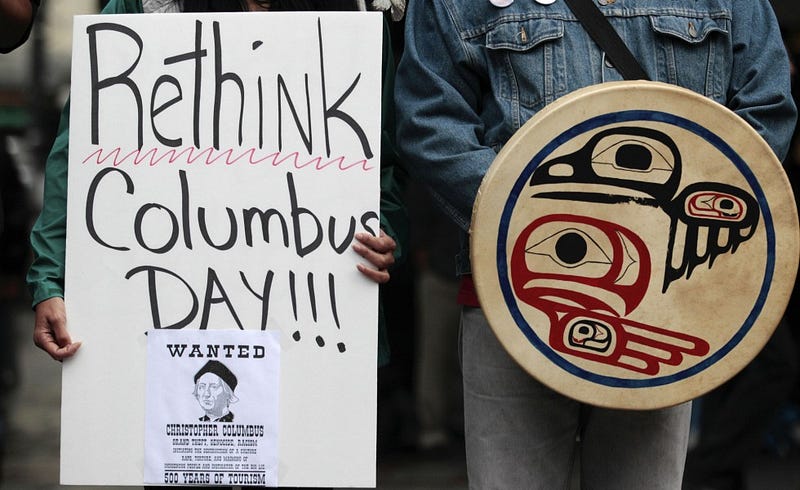
Today is Columbus Day, a celebration of colonialism wrapped up under the guise of exploration. Children around the US are taught that European settlers came in 1492 and found a whole new land magically free for occupation. In November, they will be told that there were small and disperse savage populations who opened their arms to white settlers fleeing oppression. Some of those students may eventually learn on their own about violence, genocide, infection, containment, relocation, humiliation, family separation, and cultural devaluation which millions of Native peoples experienced over centuries.

Hello, cultural appropriation!

Later this month, when everyone is excited about goblins and ghosts, thousands of sexy Indian costumes will be sold, prompting young Native Americans to cringe at the depictions of their culture and community. Part of the problem is that most young Americans think that Indians are dead or fictitious. Schools don’t help — children are taught to build teepees and wear headdresses as though this is a story of the past, not a living culture. And racist attitudes towards Native people are baked into every aspect of our culture. Why is it OK for Washington’s football team to be named the Redskins? Can you imagine a football team being named after the N-word?

Historically, Native people sit out Columbus Day in silence. This year, I hope you join me and thousands others by making a more active protest to Change what people learn!

In 2004, the Smithsonian’s National Museum of the American Indian was opened on the Mall in Washington DC as a cultural heritage institution to celebrate the stories of Native people and tell their story. I’m a proud trustee of this esteemed institution. I’m even more excited by upcoming projects that are focused on educating the public more holistically about the lives and experiences of Native peoples.

As a country, we’re struggling with racism and prejudice, hate that is woven deep into our cultural fabric. Injustice is at the core of our country’s creation, whether we’re talking about the original sin of slavery or the genocide of Native peoples. Addressing inequities in the present requires us to come to terms with our past. We need to educate ourselves about the limits of our understanding about our own country’s history. And we need to stop creating myths for our children that justify contemporary prejudice.

On this day, a day that we should not be celebrating, I have an ask for you. Please help me and NMAI build an educational effort that will change the next generation’s thinking about Native culture, past and present. Please donate a multiple of $14.91 to NMAI: http://nmai.si.edu/support/membership/ in honor of how much life existed on these lands before colonialist expansion. Help Indian nations achieve their rightful place of respect among the world’s nations and communities.

12 Oct 01:22

Twitter Favorites: [tilton_raccoon] Retweet if you live outside the United States and you’ve had a good experience with a national health care system!

Tilton Raccoon @tilton_raccoon
Retweet if you live outside the United States and you’ve had a good experience with a national health care system!
12 Oct 01:22

Twitter Favorites: [heyrickie] At some point on Sunday, I reached 1000 km run year-to-date. I'm well on the way to average 100 km/month for the year. #runnerd

Eric Bucad @heyrickie
At some point on Sunday, I reached 1000 km run year-to-date. I'm well on the way to average 100 km/month for the year. #runnerd
12 Oct 01:22

Why It’s Time to Let Go of ‘Meritocracy’ [DML Central]

by Doug Belshaw

My latest post for DML Central was published yesterday. Entitled Why It’s Time to Let Go of ‘Meritocracy’, it’s an attempt to explain why a belief in something most people see as unproblematic can actually lead to unforeseen issues.

A sample:

Building an education system around ‘meritocracy’ as it is commonly used post-Thatcher may be a function of those in power being so privileged that they are not in a position to see their own privilege. Those who have never witnessed people having to work three jobs to keep their family afloat may not understand why parents can’t do more to coach their children through an entrance examination.

Click here to read the post in full.

I’ve closed comments here so that you can add yours to the original post. I’d be keen to hear your thoughts!

11 Oct 18:02

Scenario Planning

Scenario planning is a way of thinking about the future. It’s not about predicting, but about imagining more effectively. The basic idea is this:

  • When we talk about “the future” we naturally imagine a linear extrapolation from the present.
  • This is a good way to be wrong. The world doesn’t do linear. Change typically follows an exponential S-curve. Dramatic, unexpected breaks in continuity (“Black Swans”) throw things off track.
  • We can’t predict the future, but we can identify the driving forces of change that are present today.
  • By identifying the things that are changing, you’re finding the pivot points we can start to think usefully about the space of plausable futures.

It’s a surprising and simple brainstorming process that has unfortunately been weighed down by superstition in the name of charging larger consulting fees.

The best thing about scenario planning is that I come away thinking differently about the present.

The Process

  1. Question and time frame (“what will cancer research look like in 10 years?”)
  2. Key factors influencing success or failure
  3. Driving forces of change (“DNA sequencing becoming cheaper, aging population…”)
  4. Major stakeholders (e.g. “Siemans, Medicare, …”)
  5. Uncertainties
  6. Draft Scenarios
  7. Identify leading indicators and signposts
  8. New questions we would like to answer

As you make a punch list of major stakeholders, driving forces and uncertainties, you’ll start to think differently about the problem space you’re exploring.

Where the surprises happen is in the unexpected lateral connections that surface between forces. These “nodal points” are where change is likely to happen in rapid and non-linear ways. Mini narrative scenarios are a great way to capture these confluences.

Major stakeholders are important to identify, because incumbents will either resist or benefit from change. Disruption Theory points toward which response incumbents will have.

Signposts meaninful events to watch for that hint the world might be moving closer to one or the other of your future scenarios.

It’s helpful to think about the story arc of your future.

  • Collapse: a kind of future in which life as we know it is falling apart.
  • Grow: a kind of future in which everything keeps climbing: population, production, consumption…
  • Discipline: a kind of future in where things are carefully managed by concerted coordination.
  • Transform: a kind of future in which a profound historical transition has occurred (spiritual, technological, …).

A few more tips:

  • Start by looking at the present and the past.
  • Go 10 or more years out.
  • Include outside information and outside people.
  • The proccess is more important than the result. Just listing driving forces will change the way you think about a space.

Resources

11 Oct 04:50

iPhone 7: Computer from the Future

by Federico Viticci

After nearly two years spent using a 5.5-inch iPhone, I'm accustomed to not having a compact phone anymore. The iPhone 6 Plus and 6s Plus have reshaped my iPhone experience for a simple reason: they give me more of the most important device in my life.

Thus, I was a little skeptical – even surprised – when Apple gave me a gold 256 GB iPhone 7 review unit (with a leather case) two weeks ago. I didn't think I would be able to enjoy a smaller iPhone, but, despite my initial resistance, I set up a fresh install of iOS 10 and used the iPhone 7 exclusively for two weeks.

I'm glad I did. While I'm still pining for a 7 Plus1, using the iPhone 7 showed me that there's more to this year's iPhones than the lack of a headphone jack.

In many ways, the iPhone 7 feels like a portable computer from the future – only in a tangible, practical way that is here with us today.

Wide Color

I was wrong to dismiss the appeal of wide color in the Camera section of my iOS 10 review, describing it as "[not] something most users will care (or know) about". My assumption stemmed from the technicalities of wide color photo capture and what it meant for the iPhone's camera pipeline; I wasn't considering the sheer potential of displaying wide color imagery on an iPhone.

Wide color photographs look stunning on the iPhone 7. Every friend of mine who's seen comparisons of iPhone 6s and iPhone 7 pictures immediately noticed the striking difference between them. Wide color absolutely is a feature non-geeks can understand and appreciate when presented with an everyday implementation. Pictures taken in wide color pop off the screen in a way old (sRGB) photos never could.

Wide color is hard to describe in text and impossible to visualize on older hardware. It's one of those features that has to be seen in person – even better if compared to old sRGB pictures displayed on an iPhone 7 or 9.7-inch iPad Pro. For a few days during my camera tests, I took the same pictures on both the iPhone 6s Plus and the iPhone 7. In every case, the iPhone 7 produced photos with deeper colors, warmer tones, higher contrast, and a more pleasant aspect to the eye.

Wide color makes photos look more realistic, while old pictures now appear washed out, less detailed, and, to an extent, less fun. After viewing wide color photos captured with the iPhone 7, I don't want to shoot in sRGB ever again.

Apple was smart in focusing on photography to explain wide color. After upgrading from a standard display, wide color photos have obvious, instantly recognizable benefits. But wide color goes deeper than photography – I genuinely believe it's going to change how we look at our screens with a long-term legacy comparable to adding Retina displays.

Wide color brings a superior representation of real life on our screens, and there's no going back from it. I want wide color everywhere.

About That Headphone Jack

Ask any technologist about the iPhone 7, and they'll likely start with a tirade on headphone jacks, open standards, and respecting the history of a century-old connector.

I get those arguments, but not to the same degree most tech blogs made them out to be before the iPhone 7's launch. In everyday life, every person I've talked to who doesn't read tech news and is considering an iPhone 7 – either Android users or existing iPhone owners – understands the trade-offs involved with the headphone jack and, in many cases, is unfazed by its removal.

It's not that I don't think the headphone jack was a great equalizer of all forms of audio output. The headphone jack served us well for decades and it allowed millions of people to experience music with any device they wanted, with any headphones they had. It was awesome. From my first CD player in the early 00's through my first batch of cheap MP3 players and, eventually, my first iPod touch, the headphone jack was always there, plugging into anything that could serve audio in a 3.5mm format.

What I believe many failed to observe is that most people aren't tech reviewers with a deep affection for cables and I/O standards. They're not switching between Android phones and iPhones on a weekly basis to test the latest flagship devices. They're not podcasters either. Unlike ten years ago, most people today listen to music on one device – their smartphone – and they want something that works.

The headphone jack worked; Lightning EarPods also work. As long as Apple throws a free adapter in the box, I don't think the majority of users will see removing the headphone jack as a predatory move from Apple.

This is a tough one to swallow for tech aficionados, myself included: most people don't care about our battles for open standards as long as their smartphones give them what they want. Look at modern tech through this lens, and you'll see it everywhere – in Facebook's proprietary article format (it loads fast), music streaming and DRM (it's easy and there's lots of music), charging cables (Lightning is reversible, tiny, and versatile), stickers (they're cute), and, now, audio outputs. You and I might wax philosophical about the beauty of RSS, HTML, MP4, and USB, but millions of people only demand easy tech and engaging social apps. Sometimes, the advantages of open standards aren't aligned with the interests or beliefs of companies that make the products we use. And so the Lightning EarPods are going to work fine for most people: they just use a different connector.

Large swaths of the press narrative around the iPhone 7 also failed to acknowledge that people have different priorities than tech bloggers. Water resistance matters to people when dropping an iPhone in a toilet can set them back $700. Longer battery life matters. Freedom of movement enabled by wireless headphones matters. Better cameras to capture fleeting moments matter to people. Getting rid of the headphone jack has a twofold effect that has been ignored or too easily dismissed: arguably, it has allowed Apple to cram new and better hardware into the iPhone 7; politically, it's a statement that facilitates a push for wireless audio, which other companies – phone makers and accessory manufacturers – are likely to follow in the next several years.

As with most things Apple, the iPhone ultimately comes down to balancing trade-offs and knowing which technologies are past their time and relevancy. In a device where physical space for internal components is at a premium, the headphone jack had to be the one to step aside for something else.

Consumers will vote with their dollars. So far, I'd argue that battery and cameras have been higher on the ladder of reasons people buy an iPhone than EarPods with a headphone jack. Remember: most people live with the default earbuds that ship in the box until they get a new phone. If Apple can ride on the coattails of wireless headphones' growing popularity, give wired headphone users a stopgap solution with a free adapter, and employ the space freed up by the headphone jack for something else – I think we'll be fine. In hindsight, the headphone jack will be regarded as another transition kickstarted by Apple – not without its initial pains and annoyances, but certainly a necessary and worthwhile one.

I believe Apple is handling the retirement of the headphone jack gracefully. I say this as someone who has bought several pairs of expensive headphones over the years2 and appreciates their quality and lack of latency: I like my headphones, but I don't want cables in my life anymore. Cables aren't a perk for me: they're a workaround put in place in an age when wireless audio wasn't possible.

The only downside I see at the moment is Apple's non-response to the issue of simultaneous listening with EarPods and charging. I'm sure that there will be plenty of third-party adapters soon enough – one has already been announced – but I would have liked to see Apple address this themselves, perhaps with a $19 adapter sold separately. For now, you'll have to wait for other companies to provide a solution, or make it a habit to charge your iPhone before listening to music.

We're in a transition phase of consumer audio. Years from now, AirPods are what should be included with an iPhone for free – but we're not there yet. The iPhone 7 is pushing us towards a cable-free future, which can't come soon enough.

The W1 Chip and the Beats Solo3

Part of wireless audio's future is already here: the Apple-made W1 chip powering the upcoming AirPods and refreshed Beats line.

I was intrigued by Apple's description of the W1 chip – essentially, a dedicated processor that manages Bluetooth connections between headphones and Apple devices. Here's what Apple executives said about the W1 in an interview with BuzzFeed last month:

AirPods use Bluetooth for their connection. Bluetooth headphones have historically suffered from a conga line of connectivity problems: onerous pairing, dropped connections, crappy sound. Apple is confident it’s solved them all with that W1 chip. “As you can imagine, by developing our own Bluetooth chip and controlling both ends of the pairing process there’s a lot of magic we can do,” Ternus says. “We use a Bluetooth connection, but cover it in a lot of secret sauce.”

Like any true Italian, I had to know more about the ingredients of the "secret sauce". To properly understand Bluetooth performance with the W1, I bought a pair of Beats Solo3 and used them alongside my Lightning EarPods and other Bluetooth headphones (older Beats Studio, PowerBeats, and BlueBuds X) for the past week.

Not only are Apple's claims accurate, I think they're downplaying the magic going on inside their W1-powered headphones.

There are three key aspects to the Beats Solo3 with the W1 chip: effortless pairing, battery life, and range. I'll start with pairing.

If you're familiar with Bluetooth headphones, you know how flaky and opaque pairing them can be. You usually have to press a combination of buttons, watch for special light indicators, go into your iPhone's Bluetooth settings, and hope for the best while following the instructions. It's even worse if your Bluetooth headphones are already turned on and paired with one device and you try to connect them to another.

The W1 chip gets rid of all that cruft. Here's what you do to pair the new Beats Solo3 headphones:

  1. Turn them on;
  2. Bring them close to your iPhone;
  3. Tap 'Connect' on a dialog that appears, and you're paired.

That's it.

Pairing with the W1 chip.

Pairing with the W1 chip.

The process takes less than 5 seconds and it's managed by the W1 chip inside the Solo3, which communicates with iOS 10 to display a custom pairing UI that abstracts the complexities of standard Bluetooth setup. In fact, there's not a single mention of "Bluetooth" in the modal interface3 – as the old adage goes, it's supposed to "just work".

And it does: in my tests, the quick pairing dialog came up as soon as I brought the Solo3 near my iPhone. The first connection took about 2 seconds; after that, iOS 10 displayed a success message with a battery level for the newly paired headphones. I never had this kind of pairing experience with other Bluetooth headphones in the past.

But there's more to the W1 than an intuitive setup flow. In another welcome innovation, bits of pairing information are stored in your iCloud account after the first connection so that you can connect to the Solo3 from an iPad or Mac without doing the initial setup again. The W1 chip works in tandem with iOS and iCloud to mark paired headphones as an already-configured accessory that can be used as output on other devices signed into the same iCloud account.

This is also part of the "secret sauce" Apple mentioned to BuzzFeed: instead of requiring a new setup for each macOS or iOS device, the W1 propagates headphone pairing across devices through iCloud, letting you switch between outputs from Control Center (on iOS) or the menu bar (on macOS). As a result, the Solo3 use Bluetooth under the hood, but it doesn't feel like it. As with pairing, I have never been able to seamlessly switch between devices while my old Bluetooth headphones were turned on and connected to my iPhone. With the Solo3, I can do it in a second – no error messages, no opening Settings, no headaches.

In everyday life, this means I'm no longer managing my headphones: I just wear them and switch between devices as needed. Most of the time, I'm listening to music or podcasts on my iPhone, and I select the Solo3 from Control Center (or the Music app). When I find the occasional YouTube video I want to watch on my iPad, I open Control Center, tap the Solo3, and I'm connected. I don't have to worry about Bluetooth's notorious instability; it's like Continuity for headphones.4

Beta Updates

If you follow me on Twitter, you might remember I reported some problems with W1 pairing and multi-device switching a few weeks ago. After a lot of back and forth with Apple’s support and good trial & error on my part, I confirmed that something went wrong when I downgraded from the iOS 10.1 beta 1 seed to iOS 10’s stable release. I had completed the initial setup on the 10.1 beta, and I don’t think the W1 contemplated downgrading as an option.
I solved my problems by re-updating to iOS 10.1 beta 1. Apple has released a second beta of iOS 10.1 since, which has fixed every issue I was still experiencing with the Solo3 on my iPhone and iPad.

To sum up: if you’re setting up W1 headphones on a stable version of iOS 10.0.x or on iOS 10.1 beta 2, you should be fine.

Easy pairing and iCloud sync are legitimate innovations in the wireless audio space, but Apple has accomplished more with the W1 in the Beats Solo3.

Range is impressive. I live in a small apartment, and I like walking around while I'm listening to music or podcasts. With older Bluetooth headphones, the connection would start dropping as I walked more than 10 meters across rooms. I performed some tests with the Solo3, and not only can I walk 20 meters away from my iPhone (across rooms with walls between them) – I can go outside on our balcony (a very large open space) and the connection holds up nicely until I walk to the very edge.

For comparison, my old Beats Studio, Apple Magic Keyboard, and first-gen Apple Watch can't keep their iPhone connection going at the same distance. Later this month, I should be able to keep my iPhone charging inside and chill on my sofa outside with a pair of AirPods, controlling (almost) everything with Siri. The Solo3's range is remarkable, and it builds on the idea of cable-free movement enabled by wireless audio.

Battery life is a noticeable upgrade from previous Bluetooth Beats as well. According to Apple, the Solo3 – driven by the efficiency of the W1 chip – should last 40 hours on a single charge, with Fast Fuel turning a 5-minute charge into 3 hours of playback. I can't confirm these exact numbers, but I can say this: after listening to music a couple of hours each night for 10 days, my Solo3 still had over 60% of battery left.

At roughly the same weight and comparable audio quality, the Solo3's 40 hours of battery life are a noticeable jump from the Solo2's 12 hours of wireless playback. I wouldn't be surprised if future Beats Studio Wireless models exceed 60 hours of battery life thanks to the W1. Historically, poor battery life has been the main drawback of Bluetooth headphones; Apple is onto something with the W1's power management.

It's fair to wonder if Apple will ever open up the W1 to third-party manufactures and allow them to build wireless headphones that work better than normal Bluetooth ones. The technologist in me would love to see this happen; on the other hand, I wonder if Apple may want to tightly control the W1 for technical and competitive reasons. If it were an open standard, could Google reverse-engineer the W1 to create headphones that bring a similar experience to their Pixel phones? Perhaps Apple should open up the W1 to third parties, but ensure that it only works with iOS devices and iCloud accounts?

My best guess: we're going to see more W1-powered headphones, but they'll be the product of direct partnerships between Apple and audio hardware makers, not something that any company will be able to freely access. Like Beats and AirPods, the W1 integration will be exclusive to Apple devices.5 I'd love to have a pair of wireless B&O H7 with a W1 chip inside someday.

The W1 allows wireless headphones to go beyond Bluetooth.

After trying the Beats Solo3, I feel like going back to traditional Bluetooth headphones would be a regression. Beats' sound quality aside6, the W1 allows wireless headphones to go beyond Bluetooth: the underlying technology hasn't changed, but the W1 makes the most critical aspects of wireless audio – pairing, range, and battery life – drastically superior and more user-friendly than before. I don't want to deal with Bluetooth's limitations and inconsistencies ever again. The W1 bodes well for future audio initiatives from Apple – whether they'll be aimed at the home or cars.

The Beats Solo3, powered by the W1 chip, epitomize the ideal wireless audio experience. I'm ready for the AirPods.

The Speakers

I'd be remiss if I didn't mention the new speakers on the iPhone 7. They're loud. They're not as loud or rich as the quad-speaker system of the iPad Pro7, but they're considerably louder than the iPhone 6s (twice as loud, according to Apple), and they make old iPhones sound flat and quiet in comparison.

The iPhone 7 embeds two speakers: one at the bottom, where it's always been, the other in the earpiece at the top. The stereo system doesn't have the same clear channel separation of the iPad Pro, but, overall, it makes listening to music and podcasts without headphones or external speakers better than it used to be.

The new speakers should also mitigate the lack of a headphone jack: because they're louder, I've found that I don't need to connect my EarPods as often anymore, thus freeing up the Lightning port more frequently.

There's an informal test I always perform when Apple changes the speakers on the iPhone and iPad: can I listen to podcasts while I'm washing dishes without putting my EarPods on? Unlike the iPhone 6s, Overcast on the iPhone 7 plays fine over the noise of water, so I can keep the iPhone close to me as I clean up after dinner each night.

Three other changes I want to point out:

  1. Playing music on stereo speakers seems to consume more battery than before in some apps (not a surprise);
  2. When I first played music at full volume, I thought the screen was vibrating. The speaker at the top transfers some vibrations to the glass below, but I've gotten used to the sensation by now;
  3. It used to be that I could quickly cover the bottom speaker with a finger if I knew my iPhone was about to play a sound I wanted to mute. That's difficult, if not downright impossible, with two speakers now, but I'll take that over not having stereo speakers.

The iPhone 7's speakers aren't as impressive as those on the iPad Pro, but because I'd rather keep audio playback away from the machine where I get writing done (so I don't have to open Control Center or other apps on my iPad), I'm going to use them more. For music, podcasts, movies, and personal videos, the new speakers are a solid upgrade.

The Apple Leather Case

Apple provided me with a leather case to go along with my iPhone 7 review unit. I've been an Apple silicone case user for a couple of years now, but I wanted to check out this year's slight revamp of the leather model.

I used the leather case for about a week.

I used the leather case for about a week.

I like the iPhone 7's leather case, but I don't love it, and I wouldn't use it as my everyday case. The grip is noticeably different from the silicone case: leather's texture is more slippery, although I like how it feels to the touch. The leather case is more rigid than the silicone case, and it's also more elegant, but in my week of testing, it slipped out of my pocket twice. The silicone case is harder to get out of my pocket (especially if I'm wearing tight jeans), but I consider that a feature, not a flaw.

On the other hand, Apple revised the volume and power buttons on the leather case to be actual aluminum buttons. They feel great and they produce a satisfying click. However, I found the mute switch difficult to engage when using the leather case; the cutout is more easily accessible on the silicone case.

If you're a fan of leather cases and don't mind the additional slipperiness of the material, I'd recommend the iPhone 7's leather case. But I'm too used to the grip and comfort of the silicone model to give it up.

The 24-Hour iPhone

I have a confession to make: I've been jealous of iPhone 6s owners and their Apple Smart Battery Cases. Ask any tech blogger, and they'll make fun of the "hump" on the back of the case and criticize Apple's industrial design. Appearances are debatable, but the Smart Battery Case has some serious practical advantages over third-party battery cases that I've always wanted to experience for myself. With an iPhone 7 to test, I went ahead and bought a new Smart Battery Case.8 I haven't taken it off since.

Here's how the Smart Battery Case works: unlike third-party battery cases, it has a special integration with iOS that allows it to display an additional battery indicator 9and to keep an iPhone fully charged at 100% while power is being drawn from the case.

Special battery integration for Apple's Smart Battery Case.

Special battery integration for Apple's Smart Battery Case.

Also, the Smart Battery Case doesn't have to be charged with a separate USB cable: it has a single Lightning port to charge both the iPhone and the case.

With third-party battery cases, it usually goes like this: you use your iPhone all day, and then when the battery gets low you flip a switch on the case which starts recharging the iPhone's battery. This means you either have to keep the case on the iPhone even when it's doing nothing, or you have to remember to put it on and press a button when the iPhone is running low on power.

With the Smart Battery Case, you avoid that full recharge cycle: assuming you charge the iPhone and the case at night, when you wake up in the morning iOS will keep the iPhone at 100% and go all day using the case's battery. When the case is out of juice, iOS will switch to the iPhone's own battery, which will still be at 100%.

Apple envisioned an experience where you don't have to manage or think about the Smart Battery Case at all: if both the iPhone and the case are fully charged in the morning, you can let iOS take care of battery management throughout the day.

This is exactly what I've been doing in my tests. I've kept the iPhone inside the Smart Battery Case and used it quite intensively as I do every day. I listened to music and podcasts via the speakers and on the Beats Solo3, I walked and drove around Rome, I spent hours on Slack and iMessage, played games, caught up on Tweetbot, read a few articles, watched Casey Neistat's channel, and took notes.

On average, the Smart Battery Case took between 11-12 hours to run out of power. I normally wake up at 11 AM/noon, and when the Smart Battery Case gives up at 11 PM/midnight, my iPhone is still at 100%. That gives me those extra 4-5 hours of late night work or entertainment without having to keep my iPhone plugged into a power source. From a power consumption standpoint, these numbers are astounding: the Smart Battery Case turns the iPhone 7 into a true 24-hour device with a smarter implementation than other battery cases on the market.

The downside, of course, is that the Smart Battery Case adds considerable bulk and weight to the iPhone. In addition to the bump and thicker profile, the Smart Battery Case brings over 100 grams of extra weight with it: an iPhone 7 without the case weighs 138 grams (according to my kitchen scale); with the Smart Battery Case, it's 242 grams. Furthermore, while the iPhone 7 is splash and water resistant, the Smart Battery Case isn't.

As for the case itself: I don't particularly mind the bump (have you seen other battery cases?), and the silicone exterior feels better in my hand than the leather case (plus, it's not made of cheap plastic and it's easy to slip on). If anything, I'd argue that the bump creates a ridge between the case and the battery that facilitates one-handed grip and usage. Despite the weight, I like how the Smart Battery Case feels in the hand.10

The iPhone 7's Smart Battery Case has been a revelation over the past couple of weeks. The bulk and peculiar look it adds to the iPhone are counterbalanced by a real 24-hour battery life that lets me enjoy the iPhone more. It may sound like a small victory, but it's nice to go all day without having to worry about charging cables and external battery packs.

If I had to pick a reason to stay on the smaller iPhone 7 instead of moving to the 7 Plus, that would be the Smart Battery Case. I will miss it on the bigger iPhone, and I wish Apple would consider a larger version for the 7 Plus.

Taptic Engine and Feeling Apps

Most of the coverage on the iPhone's Taptic Engine focused on how it enables a new solid Home button to simulate what a physical click feels like. I think the Home button is the least interesting part of the Taptic Engine.

As I've shared before, I don't have a particular affection for mechanical buttons (or wires) and the new Home button provides a different "clicking" feedback that I appreciated right away. In fact, we should stop thinking of what the iPhone 7's Home button does as a click – it's meant to feel like an action you can physically feel through the lower part of the iPhone. The idea of a self-contained "button" is not long for this world, but I'll leave speculation for another time.

How the Taptic Engine complements software is much more interesting. We've covered the iPhone 7's system haptics in a separate story, but to recap: the Taptic Engine can be used by developers to produce various types of feedback that reinforce actions happening on screen with a physical cue. There's an API to generate these feedback "messages", which can be subtle taps to indicate success or error, thuds to suggest impact and views colliding in the interface, and even clicks for selections. Apple is using the Taptic Engine extensively throughout iOS 10, and they're advising developers to consider augmenting their apps for this new kind of sensory experience.

The Taptic Engine lets you feel an app as you interact with it. If used intelligently and sparingly, haptic feedback can modernize old interactions to the same degree of a major UI redesign: spinning the date picker wheel, for instance, feels like spinning an actual dial; Control Center's cards snap into place and are accompanied by a light thud that confirms the view is now visible on screen. I've tried third-party apps that use varying levels of taps with swiping gestures, checking off tasks (such as Television Time), or scrubbing through a selection of options. Alto's Adventure – one of my favorite iOS games – deserves a special mention: haptic feedback has been thoughtfully implemented for falls and impacts, which adds a subtle new dimension to the endless running game.

Unlike 3D Touch, which requires an explicit action from the user, the Taptic Engine listens for interactions and becomes part of the experience when appropriate.

The Taptic Engine lets you feel an app as you interact with it.

Some people have suggested that the Taptic Engine is Apple's take on the rumble pack, but that's not a fair characterization. The Taptic Engine doesn't produce standard vibrations and it's got a wider repertoire of subtle and stronger feedback actions that can be programmed by developers and finely tuned to the interface and sounds. An example: the Lasers screen effect in iMessage has been paired with bass-like vibrations that move alongside lights, but Fireworks generates a series of "pops" timed to explosions. They are two completely different sensations and they are contextual to their associated animations.

Like 3D Touch in iOS 10, the use of haptic feedback is pervasive on the iPhone 7. In small doses, it's almost everywhere in Apple's apps and default system controls like on/off toggles or pull to refresh. The more you use an iPhone 7 and get accustomed to the iPhone reacting to your actions, the more apps that don't integrate with the Taptic Engine feel unfinished. Soon enough, the Taptic Engine starts playing an integral role in suggesting actions even if you're not paying attention to the UI on screen.

I was editing a board in Trello last week, for instance, and as I was dragging a card, I realized the Trello app wasn't giving me feedback when moving over lists. If you're a developer, you'll want to consider the spatiality of your interfaces, how content manipulation is handled in your app, and how haptic feedback can enrich actions and guide users.

The Taptic Engine has deep implications for overall usability, animation design, sound effects, and Accessibility. Assuming that its primary use is to power the Home button is reductive and shortsighted. Looking ahead at the iPad's future, it's also easy to imagine how drag & drop on a large canvas could benefit from physical feedback to hint at occluded views, drop areas, or content selections across concurring apps.

This isn't the first time Apple has brought the Taptic Engine to its devices. iOS, however, is uniquely suited to alter our perception of app interfaces and what using an app should feel like. The Taptic Engine is delightful and surprising, and I don't think we've seen the full picture yet.

Moving On

Beyond anticipated camera improvements, speed bumps, and design tweaks, the iPhone 7 is planting the seeds of future technologies that will ripple through the entire Apple ecosystem. Years from now, every photo we'll capture and view will be in wide color; Apple's wireless headphones will have advantages wired models never had; and interfaces without tactile feedback will feel as outdated as non-Retina graphics do today.

These aren't promises of features to come eventually: the iPhone 7 delivers them now. And while these changes may not be as flashy or attractive as radical new designs and colors, their impact on the iPhone platform will have wide-ranging and long-term ramifications.

I started testing the iPhone 7 thinking that a small phone could no longer fit in my daily life, and I'm still going to upgrade to an iPhone 7 Plus. But using the iPhone 7 also made me appreciate the meaning of changes that will reshape the iPhone platform going forward – something that's more significant than endlessly debating what we left behind.

The iPhone 7 is a bold step towards a future we can start understanding today.


  1. Which I plan on getting in the matte Black, 256 GB flavor. ↩︎
  2. Thanks, Marco↩︎
  3. Which, by the way, is the same sliding panel UI used for Apple TV setup and the future AirPods↩︎
  4. There's also a nice headphone icon in the iOS 10 status bar that indicates when the Solo3 (and other W1-powered headphones) have been connected. ↩︎
  5. You can use the Beats Solo3 as normal Bluetooth headphones, without the advantages of the W1 chip. ↩︎
  6. And, yes, I am one of those people who actually enjoys the Beats sound in many instances (mostly pop and hip hop music). I also think my Beats look better than any other pair of headphones I own. This isn't about being "right or wrong" on headphones; it's purely a matter of personal taste. ↩︎
  7. I'm still amazed by the sound quality of the iPad Pro, which I often use at full volume instead of my Sonos because of the superior Apple Music interface on iOS 10. ↩︎
  8. There are three differences between the Smart Battery Case for the iPhone 6s and the iPhone 7 model: the latest version has a matching speaker cutout in the bottom left corner (for symmetrical reasons), it fits the iPhone 7's larger camera, and, more importantly, it has a charge capacity of 2,365mAh. The old Smart Battery Case had a charge capacity of 1,877mAh, giving the new one a 26% charge increase. ↩︎
  9. On the Lock screen or in the Batteries widget. ↩︎
  10. Like the silicone case, the mute switch is easier to engage than the leather case, but I had to enhance the strength of the Home button's haptic feedback after putting the Smart Battery Case on my iPhone. I was using the Home button with the first click setting, but I've switched to the third (stronger) type of click because I felt like the case was attenuating the strength of the Taptic Engine. ↩︎

Like MacStories? Become a Member.

Club MacStories offers exclusive access to extra MacStories content, delivered every week; it’s also a way to support us directly.

Club MacStories will help you discover the best apps for your devices and get the most out of your iPhone, iPad, and Mac. Plus, it’s made in Italy.

Join Now
11 Oct 04:46

Twitter Favorites: [BKennedyStar] "Failure does not sit well with him." On Josh Donaldson's well-honed hyper-competitiveness: https://t.co/cTKeT7G5lH

Brendan Kennedy @BKennedyStar
"Failure does not sit well with him." On Josh Donaldson's well-honed hyper-competitiveness: thestar.com/sports/bluejay…
11 Oct 04:46

Twitter Favorites: [libovness] "Haha" is the new Read Receipt

Jonathan Libov @libovness
"Haha" is the new Read Receipt
11 Oct 04:46

Arbutus Greenway Passing Thoughts

by Ken Ohrn

On October 15, the City of Vancouver will release consultation results and the design for a temporary surface (or surfaces) on the Arbutus Greenway.

      October 15, 10:00 to 2:00
      Kitsilano Neighbourhood House (info boards also to be online)
      2305 w 7th Ave., Vancouver

Meanwhile, the grand design of the final Arbutus Greenway is still awaits the beginning of broad public consultations.

But how broad will they be?  Who will be able to get onto the Greenway, explore it and experience it for themselves, see and feel how they might use it and imagine what it could become? This is what’s at stake in the design of this temporary surface. Inclusion vs. exclusion.  Personally, I vote for inclusion. I’d prefer that we hear from a broad bunch of everyone in forming the final design.

Who will sway the day on the temporary surface design?  The “accessible to all ages and abilities” group?  Or the “bucolic park, blackberry bushes and able-bodied walkers only” group? Or some combination, or middle ground? Or something surprisingly different?

My personal prediction is that, at a minimum, we will see an asphalt pathway the full length (9 km), with possibly a few new (or improved) local access paths here and there, so that people with mobility challenges can get to the Greenway’s temporary surface.  My secondary prediction is perhaps a bit elaborate for a temporary surface design, but I would not be surprised to see some dual pathway areas: one side asphalt, the other “gravel” (apparently a slippery word that lay persons like me use to refer quite a large variety of materials).

I’m guessing that the (surprisingly few) intersections of the Arbutus Greenway with motor-vehicle roadways will remain much the same as they currently are.  And I guess that these will change significantly in the final Arbutus Greenway.

And speaking of final designs, here’s a look at a section of one of Vancouver’s oldest and longest Greenways:  the 25-km Central Valley Greenway (large PDF). There are a few things to note in the design of this section of the CVG.  (See photos).  Location is at North Grandview Hwy and E. 11th Ave.

Separated ped / bike areas, with treed boulevard between them and winding sidewalk around mature planted areas.  Seating area (middle right of frame). Motor vehicle bollard, large rocks (car scofflaw discouragers). Sidewalk ramp for those using mobility aids, like the stroller at mid-frame right (top photo). Lamp posts (or is that a sculpture support for a sheet metal crow?)

(Click image for a larger version)

central-valleycentral-valley-2


11 Oct 04:43

Google Pixel May Be Doomed, but It Will Greatly Benefit the Android Ecosystem in the Long Run

by Rajesh Pandey
The launch of Google Pixel and Pixel XL has stirred quite a controversy in many online forums. Not only did Google put an end to its renowned Nexus line of devices, but its new Pixel smartphones also have an iPhone-like pricing that has not gone down well with Nexus lovers. Continue reading →

11 Oct 04:43

Book Review – Impala

by Martin

impalaIt’s been a while since I read a good techno-thriller with a believable plot from an author that gets the technology right. William Hern’s Chronos is a book I enjoyed and so was The Billion Dollar Heist by Ben Lovejoy and Marc Russinovich’s novels like Rouge Code are also great examples. Now I’ve found another author and book that falls into this category, Andrew Diamond with his latest book Impala.

Meet Russell Fitzpatrick, a geek slightly on the rouge side of things in his youth. Eventually he got the curve before it was too late and now lives an ordinary live he doesn’t like in the US. Only a few pages into the novel his quiet live falls apart quickly when a friend from his shady past is reported dead in a car accident in South America, an odd email arrives and Colombian and Russian bullies start beating him up and stealing his notebook on a regular basis. Constantly challenged between being a white, grey and black hat hacker he stumbles through an incredible search, hide and seek story that is fun to read. This is not only because of the story line with lots of twists and turns but also because the author knows his way around programming, bitcoins, server administrations, zero days etc. The tech explanations are top notch, very accurate, make sense and are also understandable for non-techies. Two thumbs up!

11 Oct 04:42

3 things we need for the next big frontier in Open Badges and digital credentials

by Doug Belshaw

Just less than a year ago, I wrote a post entitled Why the future remains bright for Open Badges. There had been some turmoil in the ecosystem, and the ‘horses’ looked like they were getting spooked. I used Gartner’s hype cycle as a ‘convenient hypocrisy’ to explain that, at that point in time, the badges community was on the downwards slope towards the Trough of Disillusionment.

Right now, I think we’re coming out of that trough. We’re beginning to see people and organisations looking beyond individual badges towards connected credentials. There’s also renewed interest in badges as creating local ecosystems of value. Not only is LRNG continuing to expand, but the RSA is actively exploring ways in which badges could connect learning experiences across towns and cities.

For me, the key thing about the web is identity-at-a-distance. When I’m in front of you, in person, then the ‘three-dimensionality’ of my existence isn’t in question. There’s something about the bandwidth of in-person communication that is reassuring. We don’t get that when projecting a digital image of ourselves.

As an educator, I think the great thing about Open Badges is that they are packaged-up ‘chunks’ of identity that can be put together like Lego bricks to tell the story of who a person is, and what they can do. The trouble is that we’re used to thinking in silos, so people’s (understandable) immediate reaction is “can I put my badges on LinkedIn/Facebook/somewhere else I already have an account”. While the short answer is, of course, “YES!” there’s a longer, more nuanced answer.

This longer answer pertains to a problem, which like invasive advertising as a business model, seems almost intractable on the web. How do we demonstrate the holistic, yet multi-faceted nature of our identities in online spaces?

I helped set up, but then withdrew from, a group of people looking at ways in which we could use blockchain technology with badges. The trouble is, as Audrey Watters so eloquently pointed out in The ideology of the blockchain, that the prevailing logic when both technologies are used together is be to double-down on high-stakes testing. I’d rather find a way that recognises and fits human flourishing, rather than reductively retro-fitting our experiences to suit The Machine.

3 things we need to move forward

As I often mention during my presentations, the problem with linking to a particular venture-capital backed social profile (even if it’s LinkedIn) is that it shows a very two-dimensional version of who you are.

1. Progression pathways

What we need is a platform (ideally, decentralised and built upon interoperable standards) that allows individuals to display the badges they have, the ones they want, and — through an online dashboard — a constellation map of paths they can follow to employment or levelling-up their skills.

I’m not mentioning particular vendors in this post, but I feel that there are several platforms that are moving towards this model.

2. Granular permissions

Something else which would help on the identity front is the separation of badge display from badge evidence store. In the same way that YouTube allows you granular permissions over who has access to your videos, so platforms should allow you to make your badges public, but, if required, restrict access to linked evidence.

The only examples of this I’ve seen are people taking this into their own hands, by ensuring that the web address for the evidence going into the badge is under their own control. For example, if you put evidence in Google Docs, you can make that URL be entirely private, shared with specific people, publicly accessible, or fully searchable.

3. Long-term storage

We’re at the stage now where there are large enough vendors within the badges ecosystem to be ensure the long-term survival of digital credentials based on an open metadata standard. However, individual vendors come and go, and some ‘pivot’ towards and away from particular platforms.

For individuals, organisations, and institutions to be confident of establishing their long-term identity through badges, it’s important that the demise or pivot of a particular vendor does not unduly effect them.

The best way to do this that I’ve come up with is for there to be a non-profit explicitly focused on ‘deep-freeze’ storage of digital credentials, based on a sustainable business model. I know that there were conversations with the Internet Archive when I was at Mozilla, and there’s definitely a business opportunity using Amazon Glacier or similar.

Next steps

I often talk about solutions that ‘raise all of the ships in the harbour’. It’s relatively straightforward to build a platform that extracts the most amount of money out of customers. That’s a very short-term play. Open Badges is an open metadata standard that connects everyone together.

These three suggestions will allow the Open Badges ecosystem become an even more flourishing marketplace of digital credentials. For employers, it means they are not forced to use chunky ‘proxies’ such as degrees or high school diplomas when they’re looking for a particular combination of skillsets/mindsets. Educational institutions can return to being places of learning rather than examination factories. And, perhaps most importantly, individuals can show what they know and can do, in a flexible, holistic, market-responsive way.


New to Open Badges? Bryan Mathers and I put together this community course to help you get up-to-speed with the basics.


I consult on identifying, developing, and credentialing digital skills as Dynamic Skillset, which is a part of We Are Open co-op. I’m looking to partner with organisations looking to use Open Badges as the ‘glue’ to build learner identity on the web. With my We Are Open colleagues, we’ve already got one City Council exploring this, and we’d like to talk to more forward-thinking people.

Get in touch: hello@nulldynamicskillset.com / doug@nullweareopen.coop

11 Oct 04:42

'Westworld' Jumpstarts the Conversations We Need to Be Having About A.I.

by Annie Armstrong for The Creators Project

Warning: This article contains spoilers for Westworld Season 1 Episode 2: "Chestnut."

Images courtesy of HBO

For centuries, the human race has been fascinated by and terrified by the idea of artificial intelligence. It seems like we want it to love us, we want to have sex with it, we want to kill it, but also we think it will want to kill us. Clearly, there’s a lot to unpack. HBO’s new science-fiction series Westworld (produced by JJ Abrams and Bryan Burk, based on Michael Crichton's 1973 film) is throwing a new rhetorical hat in the ring.

For those not yet watching, the show takes place in a dystopian future, where people vacation to the high-tech Westworld, an American-West theme park, designed by scientists, but hosted by deceptively human-like robots. So far, the first two episodes have showcased how this environment brings out the worst in people, as guests rape and pillage their way through the Wild West.

This past Friday at Savannah College of Art and Design, The Creators Project attended a screening of the second episode of Westworld, which was followed by a panel-discussion moderated by famed astronaut Leland Melvin. The subject? How Westworld explores what the evolution of artificial intelligence means for humans.

“There’s an uprising coming. It’s Planet of the AI’s,” said Melvin, half-joking, to kick off his conversation with writer/cosplay artist, Talynn KellMulticultural Science Fiction Organization leader, Amanda Ray, and Shafeeq Rashid, creator of the Black Astronauts podcast.

Kell responded quickly: “We are very violent creatures, and when we talk about the AI we’re developing, they’re very idealistic, and designed not to be violent. Why would robots need us when we’re the ones ruining the planet?” Her sentiments are echoed in the second episode, “Chestnut,” which does not hold back in its disdain for the state of mankind. Two new “guests” enter Westworld: the hedonistic Logan (Ben Barnes), returning for his second time with guns blazing, and William (Jimmi Simpson), who shows conflict and confusion over not needing to empathize with the robots.

Still, the two manifest their destinies and indulge themselves in the village, getting into bar brawls and boozing with prostitutes. The Wild West setting is by no means arbitrary, Rashid speculates: “It didn’t escape me that the brothel was filled with women of different races and cultures, and that the majority of people in the brothel were Anglo people that were there to consume and guiltlessly take part in the destruction of people that don’t look like them.”

Trekkies and cosplayers alike can agree that science fiction has always run abreast—and ahead of, more often than not—real-world events. During what seems to be an exceptionally intolerant period in American history, it’s not easy to trust in the inherent "good" of mankind. An overarching theme in "Chestnut," involves the capacity to suffer as a metric for how “real” somebody is, the irony being that several of the human characters show less pain than the robots when witnessing atrocities. This begs the question, is simulated emotion now more real than instinct? Or at least, more moral?

“Once [artificial intelligence] becomes autonomous, it’s no longer machine.” argues Ray. “We’re moving very fast, and we’ve already seen a lot of these types of films where Frankenstein gets built. But it goes much deeper than just trying to kill your master.”

As Westworld progresses, it continues to reveal how similar humans are to the AI we create. As "Chestnut" demonstrates, systems might objectively be more moral than we are, as they can exist without the temptations of earthly delights. A repeated trope in this episode is the statement, “These violent delights have violent ends.” The bots in Westworld know only humans' capacity to sin. Why would they not try to get rid of them?

“The robots [we create today] are made of essentially the same things are we are. The same thermodynamic gobbledigook, the same carbon we’re made of, the same star dust. The only thing that’s missing is sentient thought,” said Rashid. “Once they have that, they should deserve rights just like any other form of life. They’re not organic life, but they have independent thought. It’s not an accident that the main designer’s name is Ford. That brings me back to Brave New World and other dystopian literature, and how the assembly line changed how we view consumerism. Once Elon Musk or Google decides to unleash the new robot order upon us, it’s going to change how we see the world and how we see human rights.”

Panelists Talynn Kel, Amanda Ray, Shafeeq Rashid, and host Leland Melvin on stage during the "HBO Westworld Talks Atlanta" at SCADshow on October 7, 2016 in Atlanta, Georgia. (Photo by Marcus Ingram/Getty Images for HBO)

The second episode ends with head designer Dr. Ford (Anthony Hopkins) alluding to introducing religion, specifically Christianity, to the Westworld story. Catch the next episode of Westworld on Sunday, October 16, at 9 PM, only on HBO. 

Related:

Here's What Actually Goes into Creating Artificial Intelligence

A Glowing Orb Simulates Interactions Between Humans And AI

10 Things We Learned from the Launch of the Brand New Star Wars Teaser

11 Oct 04:42

Managing Sensitive Information in an API and Microservices World

by olaf
Webcast replay

As enterprises begin to share their sensitive data through APIs, the ability to enforce authorization and non-repudiation of data with full visibility and traceability is critical for corporate compliance and viability. Comapnies need to manage data sovereignty through an end-to-end chain of custody through workloads, APIs, and end users.

In this webcast, Apcera's Peter Miron and Apigee's Josh Norrid discuss how to: 

  • connect applications and systems across APIs and multiple clouds using identity management and access protocols
  • explore policy as code to create a verified, tamper-proof auditable log trail for application composition, resources, scheduling, and communication
  • trust your device, workload, and platform integrations while accelerating time to market for new IoT and messaging applications as well as critical business services


11 Oct 04:41

Main Street and 2nd Avenue

by ChangingCity

2nd-main

It’s not often that we feature our own image for both the ‘before’ and ‘after’ images, and even less often that the ‘before’ is less than a decade ago, but the dramatic transformation of South East False Creek warrants a look. We took the initial image in 2007, long before the BC Place stadium got its new roof. We calculate that there are over 1,100 new apartments in the contemporary image, including 129 in ‘First Place’ the non-market housing building across the lane from the gas station.

The picture will change a little more as Concert Properties are developing around 600 apartments beyond the sites that have already been built – one tower crane is just showing on the left. One detail that you can’t make out at the resolution we post these images: in 2007 gas was 108.9c per litre; when we took the current shot (back in April) it was 111.9c.


11 Oct 04:41

Certificates, Pot Luck style…

by Bryan Mathers
Certificates, Pot Luck Style

Certificates that recognise something are often done by people at people. Creative Commons is taking a different approach. They’re asking the question, what can each of us bring in order to help recognise each other’s knowledge of the commons?. It’s possible that the word “certificate” won’t represent what it will evolve into. And I for one like the sound of that…

The post Certificates, Pot Luck style… appeared first on Visual Thinkery.

11 Oct 04:35

Diversity and Diversity Training

by Stephen Downes
Donald Clark appears to be settling into the role of the voice of the closed society. His latest foray into this is his recent column arguing that diversity is "wrong-headed". Leaving aside the question of which monoculture we would settle upon were we to do away with diversity (I'm thinking Hopi, maybe, or perhaps Maori) his argument is based on a short-sighted and narrow interpretation of what diversity means.

Clark's point of departure is Goran Adamson’s TheTrojan Horse. It is naturally not available as open content, so we have to rely on additoonal sources to look at the argument. An earlier report of his, Immigrants and Political Participation, he argues "successful assimilation of immigrants mainly is achieved by downplaying the exotic implication of group-based difference." (p.40)

Terri Murray summarizes, "multicultural ideology makes a fetish, like the racial theories of yore, of ethnic diversity... the multicultural view of immigrants doesn’t treat them as individuals who have a basic human need for self-determination; rather, 'the immigrant' is an abstract type, a species, a race." Worse, writes Murray, "When it comes to ethnic groups themselves, the rights of dissenting minorities within these groups are rarely defended. That’s because the multicultural agenda treats ethnic subcultures as homogeneous groups."

Clark takes this one step further, addressing diversity training. He writes, "Major studies from Dobbin, Kalev and Kochan show that diversity training does not increase productivity and may, in fact, produce a backlash. Most don’t know if it works as evaluations are as rare as unicorns"

Clark makes his case in ten points, and we'll address them in turn. The headings are Clark's, not mine.

1. Ideology of Diversity

The case in both Adamson and Clark is that the choice is being force upon us between individual freedom and the rights of a culture to assert itself. We'll revisit this theme many times. But to begin, the argument in favour of diversity is itself being presented as an ideology, against which no dissent is allowed. 

"‘Diversity’ is a word that cannot be questioned," writes Clark. "The rhetoric that surrounds diversity in itself seems to censor debate, a diversity of views being the first victim."

The existence of Adamson's report and Clark's column are, of course, counter-examples to this proposition, and there is no shortage of writing against the concept of diversity available for anyone to read. A quick search reveals the article Against Diversity published by the National Association of Scholars, a similar article published in the Economist, Walter Benn Michaels against diversity in New Left Review, and the list goes on and on.

Indeed, I wonder just what sort of opposition it is that they feel has been prohibited. Some of the more extreme expressions against diversity (of which, again, there have been many) speak of dress codes, language restrictions, and prohibitions against some religions. At a certain point the opposition to diversity tends to blend with outright racism. It is no surprise to see people react poorly to this (though one observes in the Trump and UKIP campaigns a suggestion that even this maay be tolerable).

Clark seems to suggest that this 'ideology' in favour of diversity is what supports the phenomenon of diversity training, despite evidence speaking against it. "The vast amount of time and money spent on diversity training, when evaluated, is found wanting, mostly ineffective, even counter-productive," he writes. It's an old argument, a favourite of the Harvard Business Review set, and not surprising to see it repeated here.

The same could be said (and, indeed, has been said) about training in general. Yet workplace training persists, not because whatever it promotes is held forth as some sort of ideology, but because workplace training officers don't know better, and because managers cling to traditional and outmoded views about training.

It's not surprising at all that forced diversity training can be ineffective; people respond poorly to coercion. But at the same time,  "When attendance is voluntary, diversity training is followed by an increase in managerial diversity," said Alexandra Kalev, a sociologist at the University of Arizona, (once of the researchers cited above).

The 'ideology of diversity' argument is a red herring. It is not based in fact. And it fails as an explanation of the failure of training.

2. Groupthink

Clark writes, "Companies, worldwide spend many hundreds of millions of dollars each year on diversity training. The tragic truth is that most of this is wasted. Groupthink seems to be at the heart of the matter." 

'Groupthink' is a term coined by social psychologist Irving Janis to describe what occurs when a group makes faulty decisions because group pressures lead to a deterioration of “mental efficiency, reality testing, and moral judgment” (p. 9).

Is that what is happening here? Clark cites "groupthink among compliance training companies, who simply do what they do without supporting evidence and tout ineffective ‘courses’. Groupthink in HR, who find it easier to just run ‘courses’ rather than tackle real business problem." This sounds like the problem of a monoculture, not one particular to proponents of diversity.

Indeed, diversity - a broader sense of diversity than the caricature being criticized by Clark here - is often offered as a response against groupthink. As this article states, "Groupthink occurs when a highly homogeneous, cohesive group fails to critically analyse and evaluate alternative ideas for the sake of harmony and conformity. In such a group, disagreement with the consensus is discouraged, which eliminates independent thinking and creativity."

It is important to understand that diversity is more than the mere celebration of exotic cultures. There are many ways in which people can be diverse, and the promotion of diversity is centered around encouragement of distinct perspectives and points of view, not just the elimination of offensive behaviour.

This is called 'thought diversity'. "Thought diversity goes beyond the affirmation of equality - simply recognizing differences and responding to them. Instead, the focus is on realizing the full potential of people, and in turn the organization, by acknowledging and appreciating the potential promise of each person’s unique perspective and different way of thinking”, summarizes a 2013 study by Deloitte Consulting.

3. Ill-defined

It may be that Clark was thinking along similar lines as he wrote his piece, as his next argument focuses on the vagueness of the term 'diversity'.

"One could invoke the idea that individuals are unique, and this uniqueness is paramount. Unfortunately, it then focuses on race, ethnicity, gender, sexual orientation, age, physical abilities, religious beliefs, political beliefs, or other ideologies," he writes.

What Clark sees to be doing is drawing a distinction between what might be called individual-based diversity and group-based diversity. Indivisual-based diversity might include a person's unique point of view, perhaps their income level, and the like, while (he says) "But ethnicity, gender and so on are terms associated with the collective, not the individual."

I'm sure this would come as a surprise to people who happen to find themselves Chinese, women, or gay. I still remember seeing a documentary about race, where the speaker was objecting to the idea of people being 'colour blind'. "My blackness is who I am," said the man. "It is myself, it is my identity."

And that's the thing about race, culture, religion, gender, orientation, and the other terms associated, as Clark says, with the collective. There is no 'black collective'. Or, to put it another way, all forms of fiversity apply equally well to the group and to the individual. It is a simple and fundamental point of logic, known since Aristotle, that any property can be used to define a category.

One of the fundamental elements of diversity training is the effort to show people are fundamentally individuals and that it is inappropriate to treat them as though they were all the same. Even in a close-knit community (the Mormons, say, or Cook Islanders) it is a category error to create and apply 'collective' properties (like, say, "all Mormons wear white shirts", or "all Cook Islanders love the ocean") to individuals.

We don't need to define diversity; only people consumed with group identity need to do that. The core idea behind diversity is that we encourage and respect differences between individuals. The prrinciple is the sae whether we are talking about their race or their taste in motocycles.

4, Lazy Cultural Relativism

As someone who has spent a lifetime as one who would be defined as a 'cultural relativist', I can say with assurance that there is nothing lazy about it. It is a constant effort to remind myself that other people may have different values, beliefs, and world-views than I do.

At the same time, I find that my own unique set of values, beliefs and world-views are substantially different from the majority, and I must struggle with this every day as well. For example, I believe that showing McDonalds advertising to children is morally wrong, I believe that people reason by means of similarity and metaphor, not logic and mathematics, and my world view does not include universals or laws of nature.

Clark writes, "a lazy cultural relativism descends, disallowing criticism of illiberal cultural norms. Freedom of speech is under attack from ‘trigger theory’, art is censored, honour crime not ruthlessly dealt with, FGM still prevalent. Any definition of diversity is glossed over and replaced with diversity plans."

This one-paragraph argument is itself lazy and poorly thought out. I understand that some people find the cultural practices of other cultures to be morally repugnant. I recognize they feel that way and may indeed even argue that way. Where we come into disagreement is when the other person represents their moral perspective as fact, and depicts their own culture as obviously superior to the other.

In the case of the four items listed by Clark, there are well-tolerated practices in my own culture, and his own culture, that are equally barbaric, and yet treated as normal. For example, one society that opposes 'honour killings' is fine with 'stand your ground' laws that permit legal homicide. Other societies that condemn female genital mutilation (FGM) as barbaric are fine with the routine practice of MGM (male genital mutilation).

For my own part, I believe that both murder and mutilation are both wrong, yet I have not found one culture on earth that believes these without reservation.

No, cultural relativism isn't lazy. Expressing a sanctimonious belief in your own world view is lazy. One-paragraph dismissals of difficult ethical philosophies are lazy.

5. Not an Intrinsic Good?

Clark argues that diversity is not an "intrinsic good", giving examples where sameness may be preferred to difference.

"Is polygamy better than monogamy? Will your coding team always benefit from having an even gender and ethnic mix or a ruthless focus on competence? Diversity rhetoric praises ethnic presence but could be a substitute for excellence and ideas?"

Clark slips into this short paragraph the old idea that support for diversity means sacrificing excellence. The suggestion is that by focusing on including (say) a person of colour on a team, we may be excluding a more qualified (or more competence, etc.) person who is not diverse.

This proposition depends on the idea that there is one set of properties - coding excellent, for example - that is relevant to team formation, and there are other sets of properties - cultural background, for example - that are not relevant. This presupposition depends in turn on the idea that the relevant set of properties could be identified and that differences in those properties could be measured in a statistically significant way.

And even if we can address all that it may well be that it is better overall to accept a less productive team in support of the principle that teams should be diverse. Because there is always more at stake than the performance of the individual team. If diversity is a value in society as a whole, this value may prevail whether or not it is a value in any particular case.

For example, consider airline pilots. It is arguable that we should ignore diversity in the cockpit because we want excellent pilots. But, first, it is arguable that even if women pilots aren't as good as men (a proposition which I doubt, by the way) it is demonstrably the case that they are good enough. And there is a need for girls to see examples of women pilots as role models.

This depends on the idea that diversity is a social good, of course. I believe it is - but again, this belief isn't a lazy belief, or even a popular belief. It most societies around the world, it is a minority belief. Which is what makes Clark's style in this article all the more astonishing.

6. Diversity as Conservatism

I don't automatically dismiss conservatism as wrong. But if it is, would it be an argument against diversity that it supports conservatism?

"Diversity is a deeply conservative idea masquerading as progressive," says Clark. "It replaces meritocracy with multiculturalism."

Let's stop right there for a moment. The concept of 'meritocracy' is deeply flawed and almost universally misapplied (this is the other part of the argument from the previous section). There are numerous arguments against the concept: it presupposes we can measure merit, it presupposes that merit reflects a person's worth, and it presupposes merit reflects an individual rather than their social of cultural background.

As Yong Zhao says, "The ideal of meritocracy is built on four assumptions. First, a society/authority can correctly identify the merit. Second, there are ways to accurately measure the merit. Third the merit is only individuals’ innate potential plus their efforts. In other words, it has nothing to do with their family background. Fourth, everyone has the same opportunity to develop the merit. None of these assumptions is true."


Moreover, meritocracy is morally wrong. As David Freedman writes, "Smart people should feel entitled to make the most of their gift. But they should not be permitted to reshape society so as to instate giftedness as a universal yardstick of human worth." Moreover, it is the gifts one has received in life that contribute to whatever qualities we call 'merit' - and luck does not convey any sort of moral primacy or quality of judgement. One only needs to observe the behaviour of the wealthy and gifted of British society to see that.

Where Clark is correct is that diversity brings with it difficult choices. As he observes, "From a feminist point of view, diversity may tolerate attitudes, cultural norms and behaviours that may prevent gender equality." Quite so. Nobody is automatically right in a diverse society. Every form of difference needs to, and has the right to, make a case. Ultimately it's about choice and deciding for oneself.

He also writes, " It prevents us from taking a secular view of the world, as we give in to relativism and acceptance." This is not true.I take a secular view of the world, as everyone knows. I also encourage those who wish to pursue a religious view of the world to do so. What 'diversity' means is that they can't force me to be religious, and I can't force them to be secular. Indeed, it's even a matter of bad taste to even try.

"The group trumps the individual," he writes. "It pits the poor against the poor. Ultimately, it is the dull traditionalism of conservatism." It does so only if we view these as struggles in which one or another type of diversity must ultimately prevail. But this is unreasonable. Nobody thinks that it is 'diversity' to hold that Sharia law ought to apply in all cases.

The people who oppose diversity are the ones pitting one group of people against another; they are, indeed, the ones who are representing them as groups in the first place.


7. Diversity does not lead to increased productivity

This was the major point raised by Adamson and others, and yet it begs the question: who said the objective of diversity was to increase productivity in the first place?

So we have Thomas Kochan saying, "There are no strong positive or negative effects of gender or racial diversity on business performance." But big deal. " According to the American Society for Training and Development's 2002 state of the training industry report, only one in 10 companies attempts to create results-based evaluations of its training programs."

Companies engage in diversity training to avoid litigation and human rights cases. They also do it because women and ethnic minorities (among others) are larger and larger parts of their customer base. To work in a global environment pretty much requires understanding of, and acceptance of, other cultures.

The five-year study referenced by Clark earlier and in this section provides an unambiguous statement in support of diversity:
Diversity is a reality in labor markets and customer markets today. To be successful in working with and gaining value from this diversity requires a sustained, systemic approach and long-term commitment. Success is facilitated by a perspective that considers diversity to be an opportunity for everyone in an organization to learn from each other how better to accomplish their work and an occasion that requires a supportive and cooperative organizational culture as well as group leadership and process skills that can facilitate effective group functioning.
The same authors continue:
training programs must help managers to develop the leadership and group process skills needed to facilitate constructive conflict and effective communication... raining programs that improve the skills of managers and team members may be particularly useful, but training alone is not likely to be sufficient. Organizations must also implement management and human resource policies and practices that inculcate cultures of mutual learning and cooperation. 
It's always a good idea to read the articles you cite.

8. Diversity shows virtually no effect

No doubt Clark means to say here that diversity training shows virtually no effect. Then it would make sense to quote Frank Dobbin saying "Practices that target managerial bias through…diversity training, show virtually no effect.”

Clark has cited this study numerous times through the years, though the number of citations it has received (969, according to Google Scholar) suggests that he protesteth too much when he says it was "ignored".  

It is worth noting, first of all, that Dobbin et.al. are not opposed to diversity itself. Indeed, the paper reads as supportive of diversity, with the authors surveying companies to find out what workss. That's why we read not simply that diversity training has no effect, but rather, a range of programs that do have an effect:
The most effective practices are those that establish organizational responsibility: affirmative action plans, diversity staff, and diversity task forces. Attempts to reduce social isolation among women and African Americans through networking and mentoring programs are less promising. Least effective are programs for taming managerial bias through education and feedback. 
Fair enough. But that's certainly not the persepective Clark would have us believe the authors represent.

9. More harm than good

Once again it is not clear whether Clark is talking about diversity in general or diversity training in particular (he appears to conflate the two throughout the article).

I think we can take it as a given that diversity programs, including training programs, can spark a backlash. There is ample empirical evidence of the backlash. The mere presence, for example, of women with an opinion seems to be very threatening to a certain subset of society. It is not surprising to see this in response to training programs as well. 

The anti-diversity backlash isn't unique to diversity training. Human resource writers have observed the backlash to all sorts of diversity programs, not just training. Even when the program is voluntary, it has triggered a backlash. It happens because the people who used to benefit from a monoculture no longer benefit. "The researchers reported that diversity efforts have led to increased numbers of women and minorities attaining managerial positions, but sometimes those efforts “can stimulate backlash among non-beneficiaries who may feel unfairly disadvantaged by these policies,” the report states."

It is not at all clear that this backlash constitutes "more harm than good". There was significant backlash against the freeing of the slaves in the mid 1800s in the United States, but this backlash not mean that the freeing of the slaves caused "more harm than good". Any time an unfairly privileged class of people loses that privilege, there will be a backlash.

10. No evaluation

It is not true that there has been no evaluation of diversity training programs, because then it would be impossible to state - as Clark has done consistently through this article - that diversity training has had no effect. Obviously some evaluation has taken place.

Clark cites another of Kalev's studies, this one a 2008 review of 830 companies. According to this article, the study found "the kind of diversity training exercises offered at most firms were followed by a 7.5 percent drop in the number of women in management. The number of black, female managers fell by 10 percent, and the number of black men in top positions fell by 12 percent."

But even this isn't the condemnation of diversity training Clark contends it is. The article continues:
The analysis did not find that all diversity training is useless. Rather, it showed that mandatory programs -- often undertaken mainly with an eye to avoiding liability in discrimination lawsuits -- were the problem. When diversity training is voluntary and undertaken to advance a company's business goals, it was associated with increased diversity in management.
So not only was there not no evaluation, the evaluation shows that in some cases diversity training let to positive outcomes.

Overall

I get that Clark is trying to be cute, layering the objections to diversity into a series of objections to diversity training. Had he given his writing a bit more effort and thought this intent may have shone through. But it did not, and I am not convinced that he cared.

Many of the articles offered by Clark against diversity training are arguments against the concept of diversity itself. And if you don't support diversity in the first place, you're not going to supporrt the idea of diversity training.

But the problem with diversity training isn't the fact that it is intended to promote diversity.  It can be argued (and I have done so in this post) that diversity itself is substantially valuable (and whether or not it promotes business productivity is irrelevant). You cannot have a fair and just society of any type without diversity, much less one that expects to work and thrive in a global economy.

And the failures of mandatory training are, well, failures of mandatory training. Ascribing the failure to the desire to promote diversity is inaccurate and unsupported by the evidence. Indeed, it feels like the purpose of this approach is to oppose diversity.

Clark is free to oppose diversity. Goodness knows, a substantial portion of his own compatriots do, to the point that they want to expel immigrants from the country (they probably have bad things to say about curry too). If he wants to align with the likes of Elizabeth Theresa May and Nigel Farage, he should just say so. This little dance around diversity training is a sham not worthy of the little effort it took to write.

11 Oct 04:32

Samsung officially asks carrier and retail partners globally to stop selling the Galaxy Note 7 [Update from Samsung Canada]

by Ian Hardy

The saga of Samsung’s Galaxy Note 7 has taken another twist with the manufacturer now asking device owners to power down their devices and carrier and retail partners to halt sales.

After a number of recent reports of replacement Note 7s catching fire in the Unites States, Samsung has released a statement noting it’s currently conducting another investigation into its latest flagship device.

“We are working with the U.S. Consumer Product Safety Commission (CPSC) to investigate the recently reported cases involving the Galaxy Note 7. Because consumers’ safety remains our top priority, Samsung will ask all carrier and retail partners globally to stop sales and exchanges of the Galaxy Note 7 while the investigation is taking place,” said Samsung.

Samsung Canada has not responded to the report, however, in a statement to MobileSyrup on October 9th, the company’s Canadian division stated the following:

“Samsung understands the concern of Canadian consumers following U.S.-based reports related to replacement Note 7 devices. There have been no reported incidents with replacement Note 7s in Canada.”

A statement posted to Samsung’s official website reads as follows:

“We remain committed to working diligently with the CPSC, carriers and our retail partners to take all necessary steps to resolve the situation. Consumers with an original Galaxy Note7 or replacement Galaxy Note7 should power down and take advantage of the remedies available, including a refund at their place of purchase. For more information, consumers should visit samsung.com/us/note7recall or contact 1-844-365-6197.”

On its site, Samsung revised statement notes that Note 7 owners should “exchange your current Galaxy Note7 for a Galaxy S7 or Galaxy S7 edge and replacement of any Galaxy Note7 specific accessories with a refund of the price difference between devices; or Contact your point of purchase to obtain a full refund.”

Update – October 10 at 9:00pm: We received the following statement from Samsung Canada:

“At Samsung Canada we remain committed to working diligently with regulatory authorities, carriers and our retail partners to take all necessary steps to resolve the situation. Canadian consumers with either an original Galaxy Note7 or replacement Galaxy Note7 device should power down and stop using the device. Details of the remedies available for Note7 customers, which will include a full refund at their place of purchase, will be announced shortly. For more information, Canadian consumers should contact 1-800-SAMSUNG.”

Related: Fifth Note 7 replacement reportedly catches fire [Update]

SourceSamsung
11 Oct 04:32

Dash and Apple’s Statement

Apple states that nearly 1,000 fraudulent reviews were detected — and that they’d given the developer notice and had tried to resolve the issue with him.

If this is true, then it would be hard to say that Apple has done anything wrong. In fact, we want Apple to notice fraudulent reviews (since they harm consumers and other developers), get them removed, and work things out with the developer.

I don’t know what’s true here. It wouldn’t be right for Apple to make all the evidence public, and it wouldn’t be right for Apple to publish their correspondence with him. So it’s likely we won’t ever know more than we do right now.

Apple’s statement is consistent with Apple’s doing the right thing, though. There’s a very good chance that they are.

While Apple’s culture of opacity continues to bother me — enough so that I won’t put any of my own apps on an app store — I can’t say for sure that this is a case where they’ve mistreated a developer.

11 Oct 03:56

From Deficiency to Strength: Shifting the Mindset about Education Inequality

files/images/YongZhao_243_MedRes.jpg


Yong Zhao, Oct 11, 2016


This is an excellent article that takes a deep look at the concept of merit and 'the achievement gap' in education. In a nutshell, the argument begins with the observation that cuurent programs operate on a 'deficit model' of learning - students are judged to be deficient, and then it is the task of education to address that deficiency. But this system perpetuates the gap "because the paradigm reinforces and reproduces educational and social inequity by design." Yong explains: "The ideal of meritocracy is built on four assumptions. First, a society/authority can correctly identify the merit. Second, there are ways to accurately measure the merit. Third the merit is only individuals’ innate potential plus their efforts. In other words, it has nothing to do with their family background. Fourth, everyone has the same opportunity to develop the merit. None of these assumptions is true." Keep this article in your citations list; you'll be referring to it again and again. Also posted at the National Education Policy Center; Journal of Social Issues  Vol. 72, No. 4, 2016, pp. 716– 735.  Download the PDF version.

[Link] [Comment]
11 Oct 03:55

Workplace by Facebook opens to sell enterprise social networking to the masses

files/images/04_workplace_homepage_desktop.png


Ingrid Lunden, TechCrunch, Oct 11, 2016


Facebook is launching an enterprise version of its software called Workplace in a bid to replace emails in the office. Everybody wants to replace workplace emails, of course, but there is a wide range of products already in the marketplace that already do that. The sector is called 'enterprise social' or 'enterprise collaboration' and includes well-known products and companies such as Jive, Yammer from Microsoft, Chatter from Salesforce, Hipchat and Jira from Atlassian, Slack, and more. Facebook, frankly, feels like a toy when compared to these products. But against that, there's this: "Facebook has become a de facto platform for billions of consumers globally to communicate with each other in the digital world, and now it is aggressively moving  to be  the same in the working world." More from BBC, Fortune, Engadget, Recode, CNet, CBC.

[Link] [Comment]
11 Oct 03:55

The unasked questions in last night’s debate

by Josh Bernoff

More than half of last night’s debate was about character. It feels like this whole campaign has been about character. It’s time to stop wallowing in that and face the country’s real problems, the problems nobody talks about, which go way beyond who’s running and what they did 10 and 20 years ago. In any campaign, here’s what … Continued

The post The unasked questions in last night’s debate appeared first on without bullshit.

11 Oct 03:55

Narrative ending sales and support of Narrative Clip

by Oskar K

Hello,

Thank you for checking in.

We started Narrative in 2012 with the vision to make moments more easily memorable and enjoyable. It has been an amazing experience to make this vision materialize over the years, with thousands of Narrative users all over the world wearing the Clip on their most precious moments. We hope and believe we have changed something for the better.

Today, this journey has come to an end. On September 26 2016, the company Narrative AB filed for voluntary dissolution. While this means that the Narrative team can no longer continue sales and support of the Narrative Clip, we are committed to secure the future use of all existing products currently in customers’ hands.

We have released a tool (see links below) to allow you to download your existing content from Narrative’s servers and we strongly suggest you use this to backup your content to your own computer now, as our main focus now is to make sure your content is safe. The servers will stay running until the end of October but after that we can’t guarantee that your data will be accessible.

For future support on your product, please join the user supported Facebook Group “Narrative Lounge“.

We want to thank everyone who has supported Narrative over the years – friends, family, customers and investors. Without your help, we would never have come this far.

Thank you,
The Narrative Team

Direct links to the latest version of the download/backup tool for Mac: NarrativeBackuptool-MacOSX-1.0.4.dmg and Windows: NarrativeBackuptool-Windows32-Setup-1.0.4.exe.

The post Narrative ending sales and support of Narrative Clip appeared first on Narrative Blog.

11 Oct 03:55

Why We are Uncomfortable Talking to Our Computers

by David Banks

AppleSiri1TNW-1200x651

I recently updated my mac’s operating system. The new OS, named Sierra, has a few new features that I was excited to try but the biggest one was the ability to use Siri to search my files and launch applications. Sierra was bringing me one step closer to the human-computer interaction fantasy that was set up for me at an early age when I watched Picard, La Forge, and Data solve a complicated problem with the ship’s computer. In those scenes they’d ask fairly complicated questions, ask follow-up questions with pronouns and prepositions that referenced the first question, and finish their 24th century Googling session with some plain language query like “anything else?”  Judging by the demo I had seen on the Apple website it seemed like I could have just that conversation. I clicked the waveform icon, saw the window pop up indicating that my very own ship’s computer was listening and… nothing.

The problem wasn’t with Siri, it was with me. I had frozen. It was as if a rainbow spinning beach ball was stuck in my mouth. I was unable to complete a simple sentence. I closed the window and tried again:

Show me files that I created on… Damnit

Sorry I did not get that.

Show me files from… That I made on Friday.

Here are some of the files you created on Friday.

In all honesty, I should have seen this coming. I frequently use Siri to set reminders or to put things in my calendar but I always use my digital assistant in secret: the moment between getting in the car and starting the engine, alone at my desk, or (sorry) while I am using the bathroom. It works almost every time but when something goes wrong, it is my commands not Siri’s execution, that is left wanting. I pause because I forget the name of the place I need directions to or I stumble when it comes to saying exactly what reminder I want to set. There are several Siri-dictated reminders sitting in my phone right now that don’t want me to forget to “bring it back with you before you go” or “to write email in the morning.”  I clam up when I know my devices are listening.

It gets worse when other humans are listening to my awkward commands. The thought of talking to an algorithm in the presence of fellow humans is about as enticing to me as reciting a poem I wrote in high school or explaining a joke that just fell flat. Here I was thinking it was the technology that had to catch up to my cyborg dreams but now it seems that the flesh is the half not willing.

As it turns out I am not alone in my stage fright. Last June the marketing research firm Creative Strategies released a short report (though none of the raw data or a comprehensive methods section) that noted 98% of iPhone owners use Siri but only 3% ever talk to it in public. Most Siri usage seems to happen in the car which they surmise is related to hands-free laws, not “a free choice by consumers to embrace this technology.”

The authors of the report are surprised and seem to have no explanation for their two big findings: that 1) the speaking-to-phones-in-the-car effect is more pronounced in iPhone users than Android users even though Apple Maps is terrible and Google’s maps are the gold standard and, 2) Americans are “uncomfortable” using virtual assistants in public even though “consumers are accustomed to talking loudly on phones in public.”

None of this seems particularly surprising given my own experiences. Cars definitely require more hands-free usage but they are also where I (and most Americans) spend the most time alone. Privacy seems like an equally if not larger precipitating factor, which would mean that maps are not the only thing being used in the car. Additionally, most of Americans’ time in the car is spent commuting to work, and so maps are unnecessary. It is far more likely that we’re asking our phones to play that new album or place a call to mom to see how she’s doing.

Equating human-to-human conversation over the phone with giving orders to a virtual assistant is a digital dualist mistake. Americans are certainly good at yelling at each in public, but that skill may not transfer to digital assistants. Interacting solely with a piece of software is something altogether different, although still social because algorithms are made by people and our interactions are situated within and among other humans.

Moreover, engineers assume a one-on-one relationship with devices with little regard for how a device is used in a group or how others see us use our gadgets. We can know this by just looking at how these services are demonstrated at their launch and subsequently marketed. Commands are clearly stated sentences from a single person into one device. Even devices like Amazon’s Alexa, which are meant to serve the whole home, cannot intercede in a conversation between two or more people. It is always one-on-one.

Many tech critics, unfortunately, tend to reinforce this assumption in their writing by describing psychological effects and rarely sociological observations. Analysis focuses on the extension of individuals’ cognitive abilities or laments eyes focused on screens. Rarely are we treated to a discussion of the role of devices as social actors in a relationship with multiple humans. Part of this is strictly economics: if a device is meant to be shared you cannot sell one to every single person. More insidiously though, the asocial approach to technology reflects a shallow understanding of humans’ communicative practices.

How we are seen talking by third parties, especially when the conversational partner is unknown, is very important. It is the stuff of reputations and flash judgements. One of the myriad scenarios that run through my head when I imagine using Siri in public is that someone might think I am talking to a human the way I talk to Siri, which is to say, talking to them like an asshole. I do not tell Siri please and thank you, nor do I use deferential phrases like “could you” or “would you mind.” I talk to Siri the way I talk to a cable company’s phone tree.

I have not done an exhaustive study of this subfield of HCI, nor am I practitioner myself but a quick look at some of the emerging textbooks and research in what is being called “conversational interfaces” is immediately telling. Michael McTear’s modestly titled The Dawn of the Conversational Interface [PDF] opens with an introduction describing the 2013 movie Her. He does not use this references as a cautionary tale, but as a simple demonstration of what conversational interfaces may soon become. Her is aspirational in a way that makes you hope that McTear stopped watching the movie before the third act. Unmentioned is the romantic relationship this male character has with this feminine AI who is, one must assume, both his secretary and lover. (More on those considerations here.)

McTear’s writing is one example of a fairly common relationship between fictional depictions of technology and very real attempts at making that technology come to life. Engineers and scientists regularly appeal to the fears and hopes depicted in film as a way of building a mythos around their research program. Cyber security research promises to prevent the devastation depicted in action movies, public funding for road infrastructure will deliver us into a Jetsons-like techno utopia (see previous link), and Siri will eventually fall in love with you.

If there is any prescription to be had here it is the work of Philip Agre, Phoebe Sengers, and others who advocate for the integration of critical theory into computer science and similar fields. Agre’s argument that computer scientists would do better work if they were critical of the basic assumptions of their field, is immediately relevant here. Is boss/assistant really the best relationship we could have with our devices? Is this nothing more than a softening of the master/slave terminology [PDF] that still lingers in mechanical engineering and computer science? Are we still beholden to the idea of the robotnik: The Czech word for slave that, through the translation of Karel Capek’s play R.U.R gave us the English word robot.

Perhaps, deep down, we are reticent to bark orders at our phones because we sense the echoes of arbitrary power in the construction of our machine-readable verbal commands. That the embarrassment we feel is a sort of discomfort with being a master, not just looking or sounding awkward. That makes the commands in private seem even worst if I am honest. At least open and notorious commands are exactly what they appear to be. Acting the master in private is a desire for veiled power which, to my mind, seems more sinister.

If Microsoft’s ill-fated Tay was a bellwether of the racist invective endemic to the internet then the cheery submissiveness of our digital assistants are something even darker. Certainly what we say and do to software is (for now) nowhere near as important as what we say and do to our fellow humans but we should think deeply about what we are indulging in when we talk to computers. Whether these practices and relationships are a net positive for a society that could use fewer power differentials. Just because we have talking computers doesn’t mean we’re any closer to the utopic visions we see on TV.

David is on Twitter: @Da_banks

10 Oct 15:18

Smile (If You Still Can), You're in 'The Brexit Photo Booth'

by Catherine Chapman for The Creators Project

IMG_1803.JPGTwo people get their picture taken at The Brexit Photo Booth, artist Jasper Joffee’s installation at The Other Art Fair. Photo: Catherine Chapman

The bitter aftertaste of Brexit continues to hang in the air, as British members of parliament demand Prime Minister Theresa May permit a debate over the steps Britain will take in leaving the European Union (EU), keeping the general public in a continued state of uncertainty. Reflecting this post-Brexit world at The Other Art Fair—London’s East End alternative to Frieze—artist Jasper Joffee has created a dialogue about identity, using a simple method of photography, with The Brexit Photo Booth.

“It’s kind of a silly and arbitrary thing, but in a way, that’s what meriting borders and nationalities is like,” Joffee tells The Creators Project. “Of course they’re important when you need them but the whole idea of dividing people up in that way is ridiculous, at least in my sense of it.”

IMG_1792.JPGArtist Jasper Joffee poses in his Brexit Photo Booth at The Other Art Fair. Photo: Catherine Chapman.

People interested in The Brexit Photo Booth have their photograph taken behind a blue drape background using a high resolution camera. Similar to a photo booth found at a wedding, individuals get colorful balloon props to play with, usually resulting in fun and animated portraits. Once printed, the photo is hung on a wall divided into three sections—EU, UK, or World—the person deciding in which area they would like to belong to.

“For example, we just had a girl whose family are Russian but she’s got a British passport,” explains Joffee. “She wanted to go into the European section. Then, some British people want to go in the European section because they’re sad about Brexit. Some want to go in the UK section.”

IMG_1796.JPGEU, British and world citizens line up for The Brexit Photo Booth at London’s The Other Art Fair. Photo: Catherine Chapman

Red-and-blue drawings done by Joffee accompany the wall where the pictures hang, giving the overall piece a look of a Union Jack. Joffee’s intention here, he says, was to present, “an overall sense of a big flag that all the people have created.”

“You’re not going to have all blonde-haired blue-eyed people in the British section, or all French and Germany people in the European section,” says Joffee. “People are flowing between the spaces.”

IMG_1789.JPGDrawings by Jasper Joffee hang alongside the photographs in The Brexit Photo Booth. Image: Catherine Chapman

For the most part, Joffee explains, attendees of The Other Art Fair approached The Brexit Photo Booth in amusement, but later, were able to partake in thought-provoking and sometimes cathartic discussions, side by side with strangers.

“Art is always this conversation,” says Joffee. “I’m not saying, ‘Here’s Brexit, look it's terrible,’ because no one wants to have that shoved in their face, they can read a newspaper if they want that. I think art is always about engaging people in a conversation about things in a less aggressive way than politics.”

IMG_1801.JPGWhat section of The Brexit Photo Booth would you belong in? Photo: Catherine Chapman

On June 23, 2016 51.9% of Britain voted to leave the EU, making some of the population feel like they had reclaimed their identity, and others feeling like they had lost it.  

The Brexit Photo Booth was presented by artist Jasper Joffee at The Other Art Fair, which ran October 6th through to 9th in London. Click here to learn more, and click here to see more of Jasper Joffee’s work.

Related:

Here's What Artists Are Saying About the Painful Brexit Decision

'We Happy Few' Is the Perfect Dystopian Video Game for Brexit Blues

With Volcanic Rock, an Artist Takes the Heat Out of Brexit

Exhibition Mirrors Uncertain Future for United Kingdom