Shared posts

20 Oct 04:42

A poor relationship with the Rogers family may be the reason Guy Laurence stepped down as CEO

by Rose Behar

In an unexpected move on October 17th — the same day that the company announced it was the first Canadian carrier to hit over 10 million wireless subscribers — Rogers CEO Guy Laurence stepped down.

With impressive growth over his three-year tenure and a successful track record that included the launch of Roam Like Home — a service that was not only wildly popular with customers but also differentiated the company from other Canadian telecoms — the news came as a shock to many. If performance wasn’t the instigator behind Laurence leaving, then what exactly was the issue?

“Disrespectful” treatment

A recent report by BNN delves into the possibility that the reason behind Laurence’s departure was “bad blood” between the former CEO and the Rogers family, who still controls the company through voting stock and has four family members on the 14-person board.

“This is more about the relationship between Guy Laurence and his board,” telecom industry consultant Iain Grant of Seaboard Group told BNN.

The slightly aggressive manner in which Laurence pushed Rogers’ growth may have been precisely the same trait that got the CEO in trouble with the company’s founding family.

An unnamed source that spoke with BNN stated that members of the Rogers family, particularly Edward and Melinda Rogers, disliked the way in which Laurence made them take a back seat with the company’s operations. The source noted that the two were initially on board with the strategy, but that ultimately his treatment of them was “disrespectful.”

Family ties and future plans

John Stephenson, CEO of capital management firm Stephenson & Company, agreed that Laurence has a brash style, and told BNN: “You have to get along with the members of the family. That’s a very significant portion of Rogers as a company.”

In a public statement, Deputy Chairman Edward Rogers said, “We have appreciated Guy’s leadership over the last three years. He has moved the company forward re-establishing growth, introducing innovative programs like Roam Like Home, while getting the company ready for its next phase of growth. On behalf of the Rogers family and the Board, I’d like to thank Guy for his competitive spirit and many contributions.”

Laurence is being replaced by ex-Telus CEO Joseph Natale, who will join the company once the two-year non-compete clause in his contract with the aforementioned telecom expires in the coming months. In the meantime, the company is being helmed by Chairman Alan Horn.

Related: Rogers CEO Guy Laurence steps down, to be replaced by former Telus CEO Joseph Natale

SourceBNN
20 Oct 04:42

Disney Monorail

by ljvintageads@gmail.com
mkalus shared this story from Vintage Ads.

20 Oct 04:41

Your guide to the five levels of editing (infographic)

by Josh Bernoff

In my experience, a big challenge for writers is the inappropriate edit. You know, the guy who corrects spelling errors in your outline, or wants to rearrange the whole thing during the proofreading stage. In fact, only 32% of business writers say that their process for collecting and combining feedback works well. I’ve written before … Continued

The post Your guide to the five levels of editing (infographic) appeared first on without bullshit.

20 Oct 04:41

Introducing DemoKit: Scriptable Product Demos

Today we’re open sourcing and releasing DemoKit, our new Electron app for scripting product demos. Using the web technologies you’re already familiar with, you can now record demos, tutorials, or any other videos that show off your products. Since the demos are scripted, you can check them into GitHub, incorporate feedback and changes, and even simply re-record them when your products visually change so they’re never out of date. In order to help get you started, we’re also open sourcing RunKit’s demo that appears on our homepage.

How It Works

DemoKit uses JSX (but not React) along with HTML, JavaScript, and CSS to let you define a “movie script” for your demos. For example, the following snippet types and execute a query in Duck Duck Go:

DemoKit includes a bunch of prebuilt “props” for your movie too: browser windows (that host your live webpage to interact with), terminal windows, and code editors. One of the cool experimental features we’ve added recently is the ability to embed buttons in your videos as well. Basically, DemoKit will track where all the buttons are in your video and generate a script to make those areas clickable on your web page as well.

Why DemoKit?

One of the things we wanted to do for the RunKit rename was create a demo video of our product for our new homepage. But the idea of doing this filled me with a fair amount of dread since creating demos is such a laborious process for me. I’m always making mistakes when I type, and its rarely a collaborative or iterative process since it never feels worth it to go re-record large portions of a video.

We originally wondered whether we could abuse Selenium and QuickTime screen capture to be able to program a demo the way we programmed our tests, and this actually got us quite far. Unfortunately, Selenium really isn’t designed for this task and has some issues running simultaneous animations and commands. At this point we decided to go all-in and build a dedicated tool using many of these ideas.

The result is something we’re really proud of: any member of our team can now tweak the demo and keep it up to date and fresh. More importantly, we can now invest in video tutorials which is something I’ve wanted to do for quite some time. We’d love to hear your thoughts on it too, you can install it with npm by typing npm install demokit -g, or check out the source as well.

20 Oct 04:41

Adam Croom – A brief pause from social media

by D'Arcy Norman

For an undetermined amount of time, I’m going to be taking a break from most social media activity. Call it whatever you want: rest, recovery, therapy, need for a change of scenery, election fatique, information overload, a distraction. They are all correct.

Source: A brief pause from social media. – Adam Croom

Yup. I’m right there with you, Adam. I deactivated my Twitter and Facebook accounts about 10 days ago. Not sure if I’ll let them evaporate at the end of the 30-day cooling-off period, but I sure feel less frustrated with the world since dropping out.

I did it in direct response to the insane election circus south of the border. Social media was just too much, too often, for too long. So, the accounts are gone. I haven’t missed them for a second.

I’ll still be blogging here, of course, and I’ll be reading 1011 RSS feeds and articles on Medium and elsewhere. I don’t think I’ll be missing out any important news.

20 Oct 04:41

Shinanomachi StationMinolta AutocordPhotographer: Aya Mizuno /...

mkalus shared this story from tokyo camera style.


Shinanomachi Station

Minolta Autocord

Photographer: Aya Mizuno / tumblr / website

20 Oct 04:41

Comment about crazy man can't resist yet another mirror shot :-) 18October2016

by cogdogblog

cogdogblog has posted a comment:

Nice double mirror, el hombre loco

crazy man can't resist yet another mirror shot :-) 18October2016

20 Oct 04:41

Google – Brain distribution pt. II.

by windsorr

Reply to this post

RFM AvatarSmall


Samsung presents Google with a unique opportunity 

  • The combination of more than 10m potential buyers and surprisingly good reviews coming in from the Internet presents Pixel with a great and unexpected opportunity.
  • On first glance, the Pixel is a mediocre looking device coming at a premium price but there is far more under the hood than one would presume.
  • I am certain that this is because, for the first time, Google has been able to control both the hardware and the software and make them work seamlessly together.
  • The fact that Huawei declined to manufacture this device is a good indication of just how much control Google has over this product.
  • Furthermore, I think that this is just the first iteration as the Google hardware business has not been formed very long and there are parts of the Pixel that are off the shelf.
  • A good example of this is the processor.
  • Google is hard at work developing its own silicon but because this is not ready yet, the Pixel uses the Snapdragon 821 from Qualcomm.
  • This in itself is an excellent product but the iPhone benchmarks clearly show the advantages in performance that can be achieved by designing hardware and software together in house.
  • When it comes to differentiation, Google has clearly put a lot of effort into the camera with good results but it is the software ecosystem where the opportunity lies.
  • At the top of this list is Google Assistant which is deeply integrated into the device (unlike it is on iOS) and its performance leaves everything in its wake.
  • This is because Google Assistant is powered by Google’s AI which is easily more clever and intuitive than anything else on the market.
  • This leaves Google with the classic software / hardware problem.
  • One can have the best software in the market but if the software finds its way into the hands of only a tiny number of users (as Nexus has done) it is effectively useless.
  • This is why the combination of good reviews from commentators highlighting the screen, camera, design, software and ecosystem combined with Samsung’s woes (see here) offers Google a unique opportunity.
  • Samsung would most likely have sold over 10m Galaxy Note 7’s during the next 6-9 months and these buyers will now all be looking purchase another device.
  • I continue to believe that these users are unlikely to switch to the iPhone (see here) leaving the way open for both Google and Huawei in particular.
  • The key to this will be execution.
  • Google needs to massively ramp up its launch plans and ensure that when these users turn up to buy a device, it is present and available.
  • The fact that it is exclusive with Verizon will help with those users but AT&T and T-Mobile users will have to go to retail.
  • If I was Google, I would also be running a lease scheme like the operators do to make it easier for users to purchase the device through retail.
  • I see the aim of Pixel being to put Google’s brains as close to the user as possible and to make it very easy to access and use.
  • The real return will be earned through what Google learns from users making use of its brain which will be used to generate targeted advertising as well as improve the quality of the services themselves.
  • Google has the best AI but has really been struggling to get it properly into the hands of the user which is why the volumes that these devices ship will be of critical importance.
  • Outside of this perfect world, Google’s ecosystem runs on horribly fragmented software over which Google has no control and no ability to add new features or fix problems.
  • This is why I continue to believe that Google will make Android effectively proprietary (see here) as only then will it have a chance to challenge the dominance of the Apple ecosystem and hold off the threat posed by Facebook
  • Alphabet shares are still reflecting all of the good news and none of the bad which is why I remain cautious on their performance.
  • I prefer instead Tencent, Microsoft, Baidu or Apple for the long term.
20 Oct 04:40

Come down to earth: some hidden truths about AI

by charlie

13920528727_a03087a1d3_zYou know that a tech trend is growing when there are more conferences and training programs than you can shake a stick at. And also, the trend is picked up by the amazing Science Friday and you get to hear some interesting developments and future direction.

One thing that you really don’t hear often are the “hidden truths.” The Verge recently wrote a very nice article highlighting three places where AI falls short – training, the bane of specialization, and the black box of how the AI works.

Machine learning in 2016 is creating brilliant tools, but they can be hard to explain, costly to train, and often mysterious even to their creators.

Source: These are three of the biggest problems facing today’s AI – The Verge

I had the good fortune to work with some very talented data scientists who were regularly using machine learning on healthcare data to understand patient behavior. Also, at IBM, I was able to learn a lot about how Watson thought and how well it worked. In all cases, the three hidden truths that The Verge had commented on were evident.

Teach me
The Verge article starts by pointing out the need for plenty of data to be able to train models. True. But for me, the real training issue is that it’s never “machine learning” in the sense of the machine learning on its own. Machine learning always requires a human, for example to provide training and test data, to validate the learning process, to select parameters to fit, to nudge the machine to learn in the right direction. This inevitably leads to human bias in the system.

“The irony is that the more we design artificial intelligence technology that successfully mimics humans, the more that A.I. is learning in a way that we do, with all of our biases and limitation,” said University of Utah computer science researcher Suresh Venkatasubramanian in a recent statement.

Source: Computer Programs Can Be as Biased as Humans

This bias means that no matter how well created or how smart, the AI will show the bias of the data scientists involved. The article quoted above references the issue in the context of resume scanning. No, the machine won’t be less biased than the human.

Taking that thought further, I am not concerned only with bias, but that possibly the AI cannot be smarter than the human, using the methods we currently have. Yes, an AI can see patterns across huge sets of data sets, automate certain specific complex actions, come to conclusions – but I do not think these conclusions are any better than a well-trained human. Indeed, my biggest wonder with machine learning in healthcare is whether all the sophisticated models and algorithms are no better than a well-trained nurse. Indeed, Watson really isn’t better than a doctor.

But that’s OK. These AIs can help humans sift through huge data sets, highlight things that might be missed, point humans to more information to help inform the human decision. Like Google helps us remember more, AIs can help us make more informed decisions. And, yes, Watson, in this way, is actually pretty good.

The hedgehog of hedgehogs
The Verge also points out that AIs need to be hyper-specialized to work. Train the AI on one thing and it does it well. But then the AI can’t be generalized or repurposed to do something similar.

I’ve seen this in action, where we had a product that was great in mimicking medical billing coding that a human could do. After training the system for a specific institution, using that specific institution’s data, the system would then perform poorly when given data from another institution. We always had to train to the specific conditions to get useful results. And this applied to all our machine learning models: we always had to retrain for the specific (localized) data set. Rarely were results decent on novel though related data sets.

Alas, this cuts both ways. This allows us to train systems on local data to get the best result, but it also means we need people and time (and money) every time we shift to another data set.

This reminds me of Minsky’s Society of Mind. Often we can create hybrid models that provide multiple facets to be fitted to the data, allowing the hybrid collection to decide which sub-models reflect the data better. Might we not also use a society of agents, a hybrid collection of highly specialized AIs that collaborate and promote the best of the collection to provide the output?

Black box AI
The third and last point the Verge article makes is about showing your work. I’ve been in many customer meetings where we are asked what are the parameters, what is the algorithm, how does the model think? We always waved our hands: “the pattern arises from the data,” “the model is so complex, it matches reality in its own way.” But at the same time, the output we’d see, the things the machine would say, clearly showed that sometimes the model could approximate the reality of the data, but not reality itself. We’d see this in the healthcare models and would need to have the output validated and model tweaked (by a human, of course) to better reflect the reality.

While black boxing the thinking in AI isn’t terrible, it makes it unapproachable to correct any misconceptions. The example in the Verge article on recognizing windows with curtains is a great one. The AI wasn’t recognizing windows with curtains, but correlating rooms with beds with windows with curtains.

AI is not about the machine
The human is critical in the building and running of AIs. And, for me, AIs should be built to help me be smarter, make better decisions. Some of the hidden truths listed above become less concerning when we realize we should, for now, stick to making AI as smart as a puppy, rather than imbue them with supposed powers of cognition beyond the human creators. AIn’t gonna happen any time soon. And will only annoy the humans.

Image from glasseyes view

20 Oct 04:39

Using clustering to make a color scale

by Nathan Yau

Clustering for color

Choice of color scale can make a big difference in how the data reads. A careless choice might make the data appear skewed too far low or too far high, so you need to look at the data and decide what’s right for the context. But, sometimes you just gotta make a lot of charts or maps. Or, you just don’t feel like manually picking the colors.

David Schnurr describes a way to use clustering to pick the natural breaks in a more automatic fashion. The best part:

In an effort to make it easier for anyone to use this technique in data visualizations, I’ve ported this new algorithm to JavaScript and created a custom d3 scale called d3-scale-cluster. You can find d3-scale-cluster on Github and npm–give it a try and shoot me a tweet @dschnr with your thoughts!

More on GitHub.

And I await for someone to make an R package.

Tags: color, d3js

20 Oct 04:39

Huawei Unveils Octa-Core Kirin 960 Chipset with Powerful New Mali GPU

by Rajesh Pandey
Huawei today unveiled its next generation Kirin chipset that will power its upcoming flagship handsets, the Kirin 960. Making use of the latest ARM cores and Mali GPU, the Kirin 960 chipset is based on the 16m FinFET fabrication process making it more power efficient than its predecessor. Continue reading →
20 Oct 04:39

Improving the Responsiveness of the Document Detector

by Jongmin Baek

In our previous blog posts (Part 1, Part 2), we presented an overview of various parts of Dropbox’s document scanner, which helps users digitize their physical documents by automatically detecting them from photos and enhancing them. In this post, we will delve into the problem of maintaining a real-time frame rate in the document scanner even in the presence of camera movement, and share some lessons learned.

Document scanning as augmented reality

Dropbox’s document scanner shows an overlay of the detected document over the incoming image stream from the camera. In some sense, this is a rudimentary form of augmented reality. Of course, this isn’t revolutionary; many apps have the same form of visualization. For instance, many camera apps will show a bounding box around detected faces; other apps show the world through a color filter, a virtual picture frame, geometric distortions, and so on.

One constraint is that the necessary processing (e.g., detecting documents, detecting and recognizing faces, localizing and classifying objects, and so on) does not happen instantaneously. In fact, the fancier one’s algorithm is, the more computations it needs and the slower it gets. On the other hand, the camera pumps out images at 30 frames per second (fps) continuously, and it can be difficult to keep up. Exacerbating this is the fact that not everyone is sporting the latest, shiniest flagship device; algorithms that run briskly on the new iPhone 7 will be sluggish on an iPhone 5.

We ran into this very issue ourselves: the document detection algorithm described in our earlier blog post could run in real-time on the more recent iPhones, but struggled on older devices, even after leveraging vectorization (performing many operations simultaneously using specialized hardware instructions) and GPGPU (offloading some computations to the graphics processor available on phones). In the remaining sections, we discuss various approaches for reconciling the slowness of algorithms with the frame rate of the incoming images.

Approach A: Asynchronous Processing

Let’s assume from here on that our document detection algorithm requires 100ms per frame on a particular device, and the camera yields an image every 33 ms (i.e., 30 fps). One straightforward approach is to run the algorithm on a “best effort” basis while displaying all the images, as shown in the diagram below.

The diagram shows the relative timings of various events associated with a particular image from the camera, corresponding to the “Capture Event” marked in gray. As you can see, the image is displayed for 33 ms (“Image Display”) until the next image arrives. Once the document boundary quadrilateral is detected (“Quad Detection”), which happens 100 ms after the image is received, the detected quad is displayed for the next 100 ms (“Quad Display”) until the next quad is available. Note that in the time the detection algorithm is running, two more images are going to be captured and displayed to the user, but their quads are never computed, since the quad-computing thread is busy.

The major benefit of this approach is that the camera itself runs at its native speed—with no external latency and at 30 fps. Unfortunately, the quad on the screen only updates at 10 fps, and even worse, is offset from the image from which it is computed! That is, by the time the relevant quad has been computed, the corresponding image is no longer on screen. This results in laggy, choppy quads on screen, even though the images themselves are buttery smooth, as shown in the animated GIF below.

Approach B: Synchronous Processing

Another approach is to serialize the processing and to skip displaying images altogether when we are backed up, as shown in the next diagram. Once the camera captures an image and sends it to our app (“Capture Event”), we can run the algorithm (“Quad Detection”), and when the result is ready, display it on the screen (“Quad Display”) along with the source image (“Image Display”). While the algorithm is busy, additional images that arrive from the camera are dropped.

In contrast to the first approach, the major benefit here is that the quad will always be synced to the imagery being displayed on the screen, as shown in the first animated GIF below.

Unfortunately, the camera now runs at reduced frame rate (10 fps). What’s more disruptive, however, is the large latency (100 ms) between the physical reality and the viewfinder. This is not visible in the GIF alone, but to a user who is looking at both the screen and the physical document, this temporal misalignment will be jarring and is a well-known issue for VR headsets.

Approach C: Hybrid Processing

The two approaches described thus far have complementary strengths and weaknesses: it seems like you can either get smooth images OR correct quads, but not both. Is that true, though? Perhaps we can get the best of both worlds?

A good rule of thumb in performance is to not do the same thing twice, and this adage applies aptly in video processing. In most cases, camera frames that are adjacent temporally will contain very similar data, and this prior can be exploited as follows:

  • If we detected a quad containing vertices {v0v1v2v3} in a camera frame I0, the quad to be found in the next camera frame I1 will be very similar, modulo the camera motion between the frames.
  • If we can figure out what kind of motion occurred between the two camera frames, we can apply the same motion to the quad in the first frame, and we will have a good approximation for the new quad, namely {T(v0), T(v1), T(v2), T(v3)}.

While this is a promising simplification that turns our original detection problem into a tracking problem, robustly computing the transformation between two images is a nontrivial and slow exercise on its own. We experimented with various approaches (brute-forcing, keypoint-based alignment with RANSAC, digest-based alignment), but did not find a satisfactory solution that was fast enough.

In fact, there is an even stronger prior than what we claimed above; the two images we are analyzing are not just any two images! Each of these images, by stipulation, contains a quad, and we already have the quad for the first image. Therefore, it suffices to figure out where in the second image this particular quad ends up. More formally, we try to find the transform of this quad such that the edge response of the hypothetical new quad, defined to be the line integral of the gradient of the image measured perpendicular to the perimeter of the quad, is maximized. This measure optimizes for strong edges across the boundaries of the document.

screen-shot-2016-10-18-at-10-27-00-am

See the appendix below for a discussion on how to solve this efficiently.

Theoretically, we could now run detection only once and then track from there on out. However, this would cause any error in the tracking algorithm to accumulate over time. So instead, we continue to run the quad detector as before, in a loop—it will now take slightly over 100 ms, given the extra compute we are performing—to provide the latest accurate estimate of the quad, but also perform quad tracking at the same time. The image is held until this (quick) tracking process is done, and is displayed along with the quad on the screen. Refer to the diagram below for details.

In summary, this hybrid processing mode combines the best of both asynchronous and synchronous modes, yielding a smooth viewfinder with quads that are synced to the viewfinder, at the cost of a little bit of latency. The table below compares the three methods:

Asynchronous Synchronous Hybrid
Image throughput 30 Hz 10 Hz 30 Hz
Image latency 0 ms 100 ms ~30 ms
Quad throughput 10 Hz 10 Hz 30 Hz
Quad latency 100 ms 100 ms ~30 ms
Image vs quad offset 100 ms 0 ms 0 ms

The GIF below compares the hybrid processing (in blue) and the asynchronous processing (in green) on an iPhone 5. Notice how the quad from the hybrid processing is both correct and fast.

Appendix: Efficiently localizing the quad

In practice, we observed that the most common camera motions in the viewfinder are panning (movement parallel to the document surface), zooming (movement perpendicular to the document surface), and rolling (rotating on a plane parallel to the document surface.) We rely on the onboard gyroscope to compute the roll of the camera between consecutive frames, which can then be factored out, so the problem is reduced to that of finding a scaled and translated version of a particular quadrilateral.

In order to localize the quadrilateral in the current frame, we need to evaluate the aforementioned objective function on each hypothesis. This involves computing a line integral along the perimeter, which can be quite expensive! However, as shown in the figure below, the edges in all hypotheses can have only one of four possible slopes, defined by the four edges of the previous quad.

Exploiting this pattern, we precompute a sheared running sum across the entire image, for each of the four slopes. The diagram below shows two of the running sum tables, with each color indicating the set of pixel locations that are summed together. (Recall that we sum the gradient perpendicular to the edge, not the pixel values.)

Once we have the four tables, the line integral along the perimeter of any hypothesis can be computed in O(1): for each edge, look up the running sums at the endpoints in the corresponding table, and calculate the difference in order to get the line integral over the edge, and then sum up the differences for four edges to yield the desired response. In this manner, we can evaluate the corresponding hypotheses for all possible translations and a discretized set of scales, and identify the one with the highest response. (This idea is similar to the integral images used in the Viola-Jones face detector.)

Try it out

Try out the Dropbox doc scanner today, and stay tuned for our next blog post.

20 Oct 04:39

Chaos of Facts

by Nathan Jurgenson

American presidential campaigns, we have rediscovered, are not in good faith. They are more performance than policy. They manipulate the media rather than articulate a philosophy of governance. The candidates are brands, and the debates have almost no discussion of ideas or positions, let alone much bearing on what being president actually requires. Instead, debates signify “politics” while allowing for depoliticized analysis: They are about assessing the candidate’s performance, style, tone, rhythm, posture, facial control, positioning with respect to cameras, and so on. What they say matters only with respect to how they said it: Did they convey conviction? Did they smile enough?

The candidates and those who fund them are as invested in these same campaign-ritual fictions about the electoral system’s underlying dignity as the reporters are. And there is nothing profound anymore in demystifying this. Astonished dismay at the lack of substance in presidential politics, driven in part by some inherently cheapening new media technology, has become as ritualized as the rest of the process, a point that pundits have been making at least since historian Daniel Boorstin published The Image, two years after telegenic Kennedy’s election over pale, beady Nixon. Joe McGinniss’s The Selling of the President 1968 described Nixon’s sudden interest in marketing through his next presidential run. Then, after nearly a decade of a president who was a movie actor, Joan Didion’s dispatch from the 1988 campaign trail, “Insider Baseball,” described presidential campaigns as merely media events, made to be covered by specialists “reporting that which occurs only in order to be reported” — a reiteration of Boorstin’s concept of the “pseudo-event.” Remember, too, George W. Bush’s Mission Accomplished stunt — essentially a campaign stop even though it wasn’t an election year — and more recently, the furor over the Roman columns erected for Obama’s 2008 convention speech.

So it has been clear for decades that presidential politics have turned toward the performance of an image. But away from what reality? Boorstin admits that he doesn’t have a solid idea: “I do not know what ‘reality’ is. But somehow I do know an illusion when I see one.” Boorstin takes refuge in the assumption that the average American voter is dumb and uninterested in anything more than the surface impression and incapable of reasoning about the substance of any political position. Marshall McLuhan echoed this view in his widely quoted claim that “policies and issues are useless for election purposes, since they are too sophisticated.”

Theories like Boorstin’s may be strong in describing how we construct an artificial world, but they are often compromised by their nostalgic undertow. We might believe a preceding era was more “real,” only to find that that generation, too, complained in its own time about the same sorts of unreality, the same accelerated, entertainment-driven reporting and bad-faith politics. This analysis has been rote ever since, complemented by the notion that the media dutifully supplies these highly distractible audiences the ever increasing amounts of spectacle they demand.

As media outlets have multiplied and news cycles have accelerated, the condition has worsened: Our immoderate expectation that we can consume “big” news whenever we want means that journalists will work to give it to us, to make the reality we demand. The television, and now the social media “trending” chart, gets what it wants. All this coverage, ever expanding into more shows, more data, more commentary, and more advertisements, come together to form the thing we’ve accepted as “the election.”

It is no accident that Trump, at many of his rallies, used the theme from Air Force One, a movie about a president

In this process, image-based pseudo-politics don’t come to replace real politics; the real comes to look like an inadequate image. Boorstin argued that, for example, the image of John Wayne made actual cowboys looked like poor imitations. (This is what Jean Baudrillard, writing after Boorstin, meant by “simulation.”) Similarly, the heightened media coverage of campaigns has made ordinary politics — eating pie, kissing babies, and repeating patriotic bromides — seem insufficient, underwhelming. It’s no accident that in the 2016 election, we got a candidate that gave us more and more outrageous news, a constant catastrophe perfectly tuned to our obsessive demand for horrifically fascinating entertainment. We might have hated every moment, but we kept watching and clicking, reproducing the conditions for the same thing to continue in the future.

If a politician’s ability to get covered becomes their most important qualification, it flips the logic of campaigning: The presidency is merely the means to the end of harnessing attention. The distinction between a campaign and how it is covered is unintelligible and unimportant. Hence, a lot of the media coverage of the 2016 election was coverage of how the campaigns tried to get themselves covered. For instance, much of the news about Donald Trump and Hillary Clinton was about the image they created, and how Trump specifically marketed and branded himself differently than those who came before, what conventions he happened to be violating. For much of the past two years, commentators would more often giggle at the way Trump’s affect violated campaign norms of image maintenance than discuss his bigotry and the white nationalism that preceded and fueled his rise.

Playing to the circularity of this, Trump campaigned by discussing his campaign process. Like a news-channel talking head, he spent many minutes at his rallies on poll numbers. He provided a similar running commentary on the debate stages, remarking about the venue, the crowd, and the performance of the moderators. He remarked on who was having a good or bad night, whose lines had or hadn’t landed, and analyzed his own performance as it was happening. He was even quick to point out to Hillary Clinton, in real time, that she shouldn’t have reused a convention zinger again in a debate.

With his steady supply of metacommentary, Trump embodied the pundit-candidate. While his repugnant politics have had material consequences, he campaigned more explicitly at the level of the symbolic, of branding, of the image. His representation of himself as the candidate who rejects political correctness epitomized this: How he talked about issues was trumpeted by the candidate and many of his supporters as the essential point, more important than any policy positions he could be irreverently talking about.

Much of the coverage of Trump followed suit: It wasn’t punditry about a politician, but punditry about punditry, for its own sake. Trump’s viability as a candidate demonstrates how far the familiar logic of the image has come, where a fluency in image-making is accepted to an even greater degree as a political qualification in its own right, independent of any mastery of policy or issues. Campaigning according to the image is not just using polls to pick popular stances but to relegate stances into fodder for talking about polls.

When politicians are concerned mainly with producing an “image” — not with what world conditions are actually there, which are heavy and can only change slowly and with great coordinated effort, but with what you see, what they want you to see, what you want to see — they are dealing with something that is light, something easily changed, manipulated, improved, something that flows from moment to moment. Trump appeared to understand intuitively the logic of lightness, that a candidate need only provide an image of a campaign.

Accordingly, he resisted building up much of the standard campaign infrastructure, from the provision of a detailed platform on up to the development of an adequate ground-game operation to get out the vote on Election Day. These too are heavy, like a locomotive tied to its tracks. Trump’s campaign floated above this, going wherever media expectations suggested it should go. Because there was so little depth anchoring the candidate and so little campaign machinery to weigh him down, Trump’s white nationalism nimbly flowed across various stances and issues, much like a fictional president being written and rewritten in a writers’ room. He could center his campaign on scapegoating Mexico and promising a border wall but then shift toward scapegoating Islam and preventing Muslims from entering the country in the wake of terrorist attacks, and then became the “law and order” candidate after police violence and anti-police protests dominated the news. It was no accident that Trump, at many of his rallies, used the theme from Air Force One, a movie about a president.

The role of a campaign apparatus is not to conceal how its candidate is “manipulating an image” but to emphasize the degree to which everything is image

If the contest is between images, candidates only need an improvised script; everything else leads to inefficiency. The role of a campaign apparatus, from this perspective, is not to conceal how its candidate is “manipulating an image” but to emphasize the degree to which everything is image, including, supposedly, the election’s stakes. By being so transparent in playing a part, by making the theatrics of it all so obvious, Trump offered catharsis for viewers so long served such obvious fictions as “my candidacy is about real issues” and “political coverage cares about the truth.” Accompanying any oft-repeated lie is a build-up in tension, of energy that gets tied up in sustaining it. Part of the Trump phenomenon was what happens when such energy is released.

It’s easy to see how Trump’s rise was the culmination of image-based politics rather than some unprecedented and aberrant manifestation of them. Yet much of the political apparatus — conventional politicians and the traditional media outlets accustomed to a monopoly in covering them — still rarely admits this out loud. Instead, it tried to use Trump’s obvious performativity as an opportunity to pass off the rest of the conventional politics it has been practicing — the image-based, entertainment-driven politics we’ve been complaining about since Boorstin and before — as real. Perhaps it was more real than ever, given how strenuously many outlets touted the number of fact-checkers working a debate, and how they pleaded that democracy depends on their gatekeeping.

Before the campaign began, comedian Seth Meyers quipped that Trump would not be running as a Republican but as a joke. Commentators said he had no chance to become the Republican nominee — or about a two percent chance, according to statistician Nate Silver. The Huffington Post decided to single out Trump’s campaign and label it “entertainment” instead of “politics,” as if the rest of the candidates were something other than entertainment. Many pundits put forward the idea that Trump was trolling, as if candidates like Ben Carson and Ted Cruz were actually preoccupied with pertinent political topics, and the press coverage of them was fully in earnest.

Trump was hardly a troll: He didn’t derail a conversation that was in good faith; he gave the media exactly what it demanded. He adhered to the unspoken rules of horse-race presidential-election coverage with a kind of hypercorrectness born of his respect for the reality-show format. The race was long made to be a bigger reality show, demanding more outsize personalities and outrageous provocations and confrontations. Trump may not have been a good candidate, but he made for an entertaining contestant.

The fact that Trump was a performer manipulating audiences without any real conviction in anything other than his own popularity made him more like other candidates, not less. Trump wasn’t uniquely performative, just uniquely successful at it. If the performance was bombastic, so much the better for its effectiveness. After all, the image is the substance.

In contrast, Obama’s performance as a symbol of hope and change was more coy and less overtly pandering. It more closely mimics what McGinniss, citing Boorstin, described in The Selling of the President 1968:

Television demands gentle wit, irony, and understatement: the qualities of Eugene McCarthy. The TV politician cannot make a speech; he must engage in intimate conversation. He must never press. He should suggest, not state; request, not demand. Nonchalance is the key word. Carefully studied nonchalance.

McGinniss says selling the president is like building an Astrodome in which the weather can be controlled and the ball never bounces erratically. But Trump took a very different approach; he wasn’t nonchalant, and he rarely hinted or suggested. He was consistently boisterous. In 1968, to build a television image was to make someone seem effortlessly perfect. Trump was instead risk-prone, erratic, imperfect, and unpredictable. Playing to an audience more savvy about image-making, Trump knew his erratic spontaneity played like honesty. In appearing to make it up as he went along, his calculations and fabrications seemed authentic, even when they consisted of easily debunked lies. It feels less like a lie when you’re in on it.

Some of the most successful advertisements make self-aware reference to their own contrivances. In this way Trump was like P.T. Barnum: He not only knew how to trick people but how much they like to be tricked. Deception doesn’t need to be total or convincing. Strategically revealing the trick can be a far more effective mode of persuasion.

We shouldn’t underestimate how much we like to see behind the curtain. There’s some fascination, morbid or not, in how things are faked, how scams are perpetrated, how tricks are played. The 2016 campaign gave us exactly what we wanted.


Any national election is necessarily chaotic and complex. The fairy tale is that media coverage can make some sense of it, make the workings of governance more clear, and thus make those in power truly accountable. Instead, the coverage produces and benefits from additional chaos. It jumps on the Russian email hacks for poorly sourced but click-worthy campaign tidbits, even as, according to a cybersecurity researcher quoted in a BuzzFeed report, they are likely driven by Russian “information operations to sow disinformation and discord, and to confuse the situation in a way that could benefit them.” Or as Adrian Chen wrote in his investigation of the Russian propaganda operation, Internet Research Agency:

The real effect, the Russian activists told me, was not to brainwash readers but to overwhelm social media with a flood of fake content, seeding doubt and paranoia, and destroying the possibility of using the Internet as a democratic space … The aim is to promote an atmosphere of uncertainty and paranoia, heightening divisions among its adversaries.

If that is so, the U.S. news media has been behaving like Russian hackers for years. From 24-hour television to the online posts being cycled through algorithms optimized for virality, the constant churn of news seems to make everything both too important and of no matter. Every event is explained around the clock and none of these explanations suffice. Everything can be simultaneously believable and unbelievable.

The race was long made a bigger reality show, demanding more outsize personalities. Trump may not have been a good candidate, but he made for an entertaining contestant

It’s been repeated that the theme of the 2016 campaign is that we’re now living in a “post-truth” world. People seem to live in entirely different realities, where facts and fact-checking don’t seem to matter, where disagreement about even the most basic shape of things seems beyond debate. There is a broad erosion of credibility for truth gatekeepers. On the right, mainstream “credibility” is often regarded as code for “liberal,” and on the left, “credibility” is reduced to a kind of taste, a gesture toward performed expertism. This decline of experts is part of an even longer-term decline in the trust and legitimacy of nearly all social institutions. Ours is a moment of epistemic chaos.

But “truth” still played a strong role in the 2016 campaign. The disagreement is how, and even if, facts add up to truth. While journalists and other experts maintain that truth is basically facts added up, the reality is that all of us, to very different degrees, uncover our own facts and assimilate them to our pre-existing beliefs about what’s true and false, right and wrong. Sometimes conspiracy theories are effective not because they can be proved but because they can’t be. The theory that Obama was not born in the United States didn’t galvanize Trump’s political career because of any proven facts but because it posed questions that seemed to sanction a larger racist “truth” about the inherent unfitness of black people in a white supremacist culture.

Under these conditions, fact-checking the presidential campaigns could only have been coherent and relevant if it included a conversation about why it ultimately didn’t matter. Many of us wanted a kind of Edward R. Murrow–like moment where some journalist would effectively stand up to Trump, as Murrow did on his news program with Joseph McCarthy, and have the condemnation stick. But our yearning has precluded thinking about why that moment can’t happen today. It isn’t just a matter of “filter bubbles” showing people different news, but epistemic closure. Even when people see the same information, it means radically different things to them.

The epistemic chaos isn’t entirely the media’s fault. Sure, CNN makes a countdown clock before a debate, and FiveThirtyEight treated the entire campaign like a sports event, but there was a proliferation of substantive journalism and fact-checking as well. Some blamed Trump himself. Reporter Ned Resnikoff argues this about Trump and his advisers:

They have no interest in creating a new reality; instead, they’re calling into question the existence of any reality. By telling so many confounding and mutually exclusive falsehoods, the Trump campaign has creative a pervasive sense of unreality in which truth is little more than an arbitrary personal decision.

But as much as Trump thrived within a system sowing chaos and confusion, he didn’t create it. He has just made longstanding dog-whistle bigotry more explicit and audible.

The post-truth, chaos-of-facts environment we have today has as much to do with how information is sorted and made visible as with the nature of the content itself. For example, in the name of being nonpolitical, Facebook has in fact embraced a politics of viral misinformation, in which it passively promotes as news whatever its algorithms have determined to be popular. The fact of a piece of information’s wide circulation becomes sufficient in itself to consider it as news, independent of its accuracy. Or to put it another way, the only fact worth checking about a piece of information is how popular it is.

Trump exploited this nonpolitical politics by taking what in earlier times would have been regarded by the political-insider class as risks. He would read the room and say what would get attention, and these “missteps” would get reported on, and then it would all get thrown into the churning attention machinery, which blurred them in the chaos of feeds that amalgamate items with little regard to their relative importance and makes them all scroll off the screen with equal alacrity. The result of having so much knowledge is the sense of a general mess. More and more reporting doesn’t open eyes but makes them roll.

The proliferation of knowledge and facts and data and commentary doesn’t produce more understanding or get us closer to the truth. Philosopher Georges Bataille wrote that knowledge always comes with nonknowledge: Any new information brings along new mysteries and uncertainties. Building on this, Baudrillard argued in Fatal Strategies that the world was drowning in information:

We record everything, but we don’t believe it, because we have become screens ourselves, and who can ask of a screen to believe what it records? To simulation we reply by simulation; we have ourselves become systems of simulation. There are people today (the polls tell us so!) that don’t believe in the space shuttle. Here it is no longer a matter of philosophical doubt as to being and appearance, but a profound indifference to the reality principle as an effect of the loss of all illusion.

Media produce not truth but spectacle. What is most watchable often has little to do with accuracy, which conforms to and derives from spectacle and remains inconclusive. The media produce the need for more media: The information they supply yields uncertainty rather than clarity; the more information media provide, the more disorientation results.

Trump helped these streams scroll even faster. He did not have to be right but instead absorbed the energy sparked by being wrong. He wasn’t the TV candidate or the Twitter candidate but a fusion of media channels, each burning at their core to accelerate. For example, cable news networks put members of the Trump campaign on TV ostensibly to tell “the other side,” yet their uniform strategy was to yell over the conversation with statements that often contradicted what the candidate himself was saying. They would be invited back the next day.

The 2016 election showed once again that journalism’s role is not to clarify the chaos around politics. Rather, an election and its coverage lurch along in a frothing, vertigo-inducing symbiosis. Every news event is at once catastrophic and inconsequential. War and terror seems everywhere and nowhere. Sociologist Zygmunt Bauman calls this a “liquid fear,” nihilistic in its perpetual uncertainty. Such fear fosters demand for a simple leader with simple slogans and catastrophically simple answers.

Perhaps we’ve come too close to the sun. The first rule of virality, after all, is that which burns bright burns fast. And the news cycle spins so rapidly we can’t even see it anymore. In this campaign, virality had nothing left to infect. Our host bodies were depleted, exhausted. The election ended too soon, well before Election Day. Amid this attention hyperinflation, can the currency of news be revalued?

If you push something too far along a continuum in one direction, it inevitably becomes its opposite. Perhaps the next election can’t produce anything as outrageous as Trump. We’ll return to politics as usual, to the performance of “issues” and “debates” that will seem more fully in good faith than before, in comparison to the embarrassment of this cycle. The election process will be as contrived and image-centric as ever, but we’ll be desperate to make it great again.

20 Oct 04:38

The IT Era and the Internet Revolution

by Ben Thompson

I like to say that I write about media generally and journalism specifically because the industry is a canary in the coal mine when it comes to the impact of the Internet: text shifted from newsprint to the web seamlessly, completely upending the industry’s business model along the way.

Of course I have a vested interest in this shift: for better or worse I, by virtue of making my living on Stratechery, am a member of the media, and it would be disingenuous to pretend that my opinions aren’t shaped by the fact I have a personal stake in the matter. Today, though, and somewhat reluctantly, I am not just acknowledging my interests but explicitly putting Stratechery forward as an example of just how misguided the conventional wisdom is about the Internet’s long-term impact on society, in ways that extend far beyond newspapers (but per my point, let’s start there).

What Killed Newspapers

On Monday Jack Shafer, the current dean of media critics, asked What If the Newspaper Industry Made a Colossal Mistake?:

What if, in the mad dash two decades ago to repurpose and extend editorial content onto the Web, editors and publishers made a colossal business blunder that wasted hundreds of millions of dollars? What if the industry should have stuck with its strengths — the print editions where the vast majority of their readers still reside and where the overwhelming majority of advertising and subscription revenue come from — instead of chasing the online chimera?

That’s the contrarian conclusion I drew from a new paper written by H. Iris Chyi and Ori Tenenboim of the University of Texas and published this summer in Journalism Practice. Buttressed by copious mounds of data and a rigorous, sustained argument, the paper cracks open the watchworks of the newspaper industry to make a convincing case that the tech-heavy Web strategy pursued by most papers has been a bust. The key to the newspaper future might reside in its past and not in smartphones, iPads and VR. “Digital first,” the authors claim, has been a losing proposition for most newspapers.

Shafer’s theory is that the online editions of newspapers is inferior to print editions; ergo, people read them less. To buttress his point Shafer cites statistics showing that most local residents don’t read their local newspaper online.

The flaw in this reasoning should be obvious to any long-time Stratechery reader: people in the pre-Internet era didn’t read local newspapers because holding an unwieldy ink-staining piece of flimsy newsprint was particularly enjoyable; people read local newspapers because it was the only option. And, by extension, people don’t avoid local newspapers’ websites because the reading experience sucks — although that is true — they don’t even think to visit them because there are far better ways to occupy their finite attention.

Moreover, while some of those alternatives are distractions like games or social networking, any given newspaper’s real competitors are other newspapers and online-only news sites. When I was growing up in Wisconsin I could get the Wisconsin State Journal in my mailbox or I could go to a bookstore to buy the New York Times; it didn’t matter if the latter was “better”, it was too inconvenient for most. Now, though, the only inconvenience is tapping a different app. Of course most readers don’t even bother to do that: they just click on whatever is in their Facebook feed, interspersed with advertisements that are both more targeted and more measurable than newspaper advertisements ever were.

The truth is there is no one to blame for the demise of newspapers — not Google or Facebook, and not 1990s era publishers. The entire linchpin of the newspaper business model was controlling distribution, and when that linchpin was obliterated by the Internet it was inevitable that the entire apparatus would collapse.

The IT Era

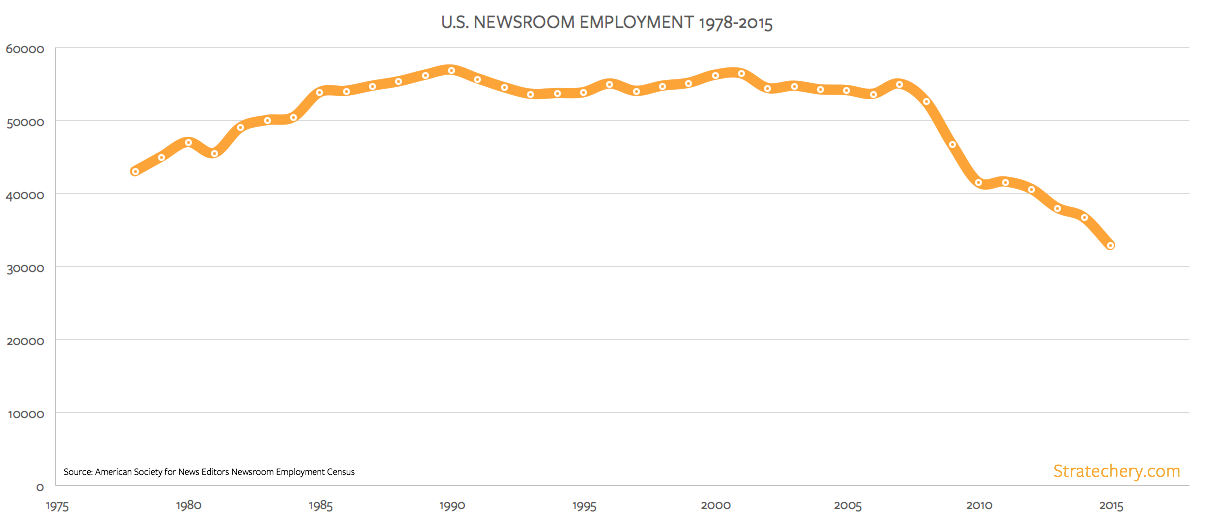
Make no mistake, this sucks for journalists in particular; newsroom employment has plummeted over the last decade:

screen-shot-2016-10-19-at-4-27-37-pm

Still, just for a moment set aside those disappearing jobs and look at what happened from roughly 1985 to 2007: at a time when newspaper revenue continued to grow jobs didn’t grow at all; naturally, newspaper companies were enjoying record profits.

What had happened was information technology: copy could be made on computers, passed on to editors via local area networks, then laid out digitally. It was a massive efficiency improvement over typewriters, halftone negatives, and literal cutting-and-pasting:

newspaper-copy

Newspapers obviously weren’t the only industry to benefit from information technology: the rise of ERP systems, databases, and personal computers provided massive gains in productivity for nearly all businesses (although it ended up taking nearly a decade for the improvements to show up). What this first wave of information technology did not do, though, was fundamentally change how those businesses worked, which meant nine of the ten largest companies in 1980 were all amongst the 21 largest companies in 19951. The biggest change is that more and more of those productivity gains started accruing to company shareholders, not the workers — and newspapers were no exception.

This is why I believe it is critical to draw a clear line between the IT era and the Internet era: the IT era saw the formation of many still formidable technology companies, but their success was based on entrenching deep-pocketed incumbent enterprises who could use technology to increase the productivity of their workers. What makes the Internet era a much bigger deal is that it challenges the very foundations of those enterprises.

The Internet Revolution

I already explained what happened to newspapers when distribution erased local newspapers moats in the blink of an eye; as I suggested at the beginning, though, this was not an isolated incident but a sign of what was to come. Back in July I laid out how the acquisition of Dollar Shaving Club suggested the same process was happening to consumer packaged goods companies: leveraging size to secure shelf space supported by TV advertising was no longer the only way to compete. A few weeks before that I pointed out that television was intertwined with its advertisers; the Internet was eroding the business of linear TV, CPG companies, retailers, and even automative companies simultaneously, leaving the entire post World War II economic order dependent on sports to hold everything together.

The ways these changes arrive are strikingly similar; I call it the FANG Playbook after Facebook-Amazon-Netflix-Google:

None of the FANG companies created what most considered the most valuable pieces of their respective ecosystems; they simply made those pieces easier for consumers to access, so consumers increasingly discovered said pieces via the FANG home pages. And, given that Internet made distribution free, that meant the FANG companies were well on their way to having far more power and monetization potential than anyone realized…

By owning the consumer entry point — the primary choke point — in each of their respective industries the FANG companies have been able to modularize and commoditize their suppliers, whether those be publishers, merchants and suppliers, content producers, or basically anyone who needs to be found on the Internet.

This is the critical difference between the IT-era and the Internet revolution: the first made existing companies more efficient, the second, primarily by making distribution free, destroyed those same companies’ business models.

The Internet Upside

What is easy to forget in this tale of woe is that all of these upheavals have massively benefited consumers: that I can read any newspaper in the world is a good thing. That we have access to many more products at much lower price points is amazing. That one can search the entire corpus of human knowledge from just about anywhere in the world, or connect to billions of people, or more prosaically, watch what one wants to watch when one wants to watch it, is pretty great.

Beyond that, what are even more difficult to see are the new possibilities that arise from said upheaval, which is where Stratechery comes in. By no means is this site a replacement for newspapers: I’m pretty explicit about the fact I don’t do original reporting. And yet, I certainly wouldn’t classify the time spent reading this site in the same category as the diversions of gaming and social networking I mentioned earlier. Rather, my goal is to deliver something completely new: deep, ongoing analysis into the business and strategy of technology. It is a viewpoint that wasn’t worth cutting-and-pasting into a broadsheet meant to serve a geographically limited market, but when the addressable market is the entire world the economics suddenly work very well indeed.

Oh, and did you catch that? Saying “the addressable market is the whole world” is the exact same thing as saying that newspapers suddenly had to compete with every other news source in the world; it’s not that the Internet is inherently “good” or “bad”, rather it is a new reality, and just because industries predicated on old assumptions must now fail should not obscure the fact that entirely new industries built with new assumptions — including huge new opportunities for small-scale entrepreneurship by individuals or small teams — are now possible. See YouTube or Etsy or yes, journalism, and this is only the beginning.

The Importance of Secondary Effects

I’d certainly like to think the benefits of this change run deeper than simply ensuring I earn a decent living; it is deeply meaningful to me when I have readers say my writing helped them land a job, or that they are applying my frameworks to a particularly difficult decision they are facing, or even that they feel like they are getting a business school education for practically free. To be certain that last point is overstating things, at least from a business school’s perspective: the breadth of material covered, the degree on your resume, and of course the friends you make are big advantages. But it used to be that the choice was a binary one: spend six figures on business school or don’t; if one can pick up a useful bit of business thinking for $10/month while still being a productive worker then isn’t that a win for society?

These secondary effects will be the key to building a prosperous society amidst the ruin of the Internet’s creative destruction: what is so exciting about Uber is not the fact it is wiping out the taxi industry, but rather that transportation as a service has the potential to radically transform our cities. What happens when parking lots go away, commutes in self-driving cars lend themselves to increased productivity, or going out is as easy as tapping an app? What kind of new jobs and services might arise?

As another example, I wrote last month about the dramatic shift in enterprise software that is being enabled by the cloud. The simple ability to pay-as-you-go has already had a big impact on startups and venture capital, but the initial impact on established companies has been to operationalize costs and increase scalability for established processes; the true transformation — building and selling software in completely new ways — is only getting started. Again, there is a difference between making an existing process more efficient and enabling a completely new approach. The gains from the former are easy to measure; the transformation of the latter is only apparent in retrospect, in part because the old way takes time to die and repurpose.

This two stage process is going to be the most traumatic when it comes to the already-started-and-accelerating introduction of automation and artificial intelligence. The downsides are obvious to everyone: if computers can do the job of a human, then the human no longer has a job. In the long run, though, what might that human do instead? To presume that displaced workers will only ever sit around collecting a universal basic income2 is to, in my mind, sell short the human drive and ingenuity that has already carried us far from our cavemen ancestors.

I know that my perspective is a privileged one: I am a clear beneficiary of this new world order. Moreover, I know that very good and important things will be lost, at least for a time, in these transitions. I strongly agree with Shafer, for example, that newspapers “still publish a disproportionate amount of the accountability journalism available” and that “we stand to lose one of the vital bulwarks that protect and sustain our culture.”

Fixing that and the many other problems wrought by the Internet, though, requires looking forwards, not backwards. The most fundamental assumptions underlying businesses — critical institutions in any society — have changed irrevocably, and to pretend they haven’t is a colossal mistake.

  1. Gulf Oil, which was the 7th largest company in 1980, was the exception
  2. Which I support
20 Oct 04:37

Twitter Favorites: [danielsilliman] Both George W. Bush and Hillary Clinton are United Methodists. What does that say about the church? https://t.co/qWtRrjcoNj

Daniel Silliman @danielsilliman
Both George W. Bush and Hillary Clinton are United Methodists. What does that say about the church? patheos.com/blogs/mercynot…
19 Oct 20:58

Being an Effective Ally to Women and Non-Binary People

by Toria Gibbs

This post is based on a talk and workshop that Toria and Ian gave at Etsy’s Dublin office in August.

Etsy has a strong set of beliefs that underpins our engineering culture. We believe in code as craft. We believe that if it moves, you should graph it. And we believe that when you’ve got some working code ready, you should “just ship” it.

This practice of “just shipping” is known as continuous deployment. We make small changes frequently, and we hide them behind “config flags” that let us test our work incrementally before a full feature launch. Etsy engineers collectively deploy code to the production site as many as 70 times per day.

Now imagine for a minute that you’re an engineer at an organization doing continuous deployment. You’ve got a small change ready to deploy. Your code is good. Tests pass. It’s all been reviewed. But every time you try to deploy, something goes wrong. This happens all the time, but only to you. Every time you try to deploy, you have to spend half an hour trying to fix the deploy system. No one else is motivated to fix anything because it works just fine for them. The deploy system is better for everyone because of your investigations, but fixing the deploy system isn’t part of your job. You just want to ship code!

What would be great is if some other engineers would pitch in and do the work too, so that you have more time to do your actual job. What you need are allies.

Surprise! That was a thinly-veiled metaphor for what it feels like to be a member of an underrepresented group trying to improve their work environment. Relying on members of minority groups to shoulder the burden of diversity issues is just as flawed as expecting one person to do all the work to fix a broken deploy system. You can’t excel at your job when you spend half your time dealing with other stuff. We need ways of spreading the load. We need allies. And we hope that’s why you’re reading this now.

Terminology

So what is an ally? Let’s start by defining some important terms so that we’re all on the same page.

Women, men, and non-binary people

At Etsy, we recognize that gender is non-binary: it lies on a spectrum. When we use the term “men” here, we’re talking about anybody who identifies as a man and experiences the benefits of male privilege. When we say “women”, we’re talking about anybody who identifies as a woman. Some people don’t fall into either of these categories: they are non-binary. Gender discrimination impacts these people too, and as such you’ll see references to them throughout this post.

Much of the discrimination that people face depends on how society identifies their gender, rather than how they themselves identify. A person with a beard is likely to be treated like a man regardless of their chosen gender, but they still have to deal with bias and prejudice in their daily life.

Feminism

“Feminism is the radical notion that women are people.” — Marie Shear

Of course women (and non-binary folks) are people. But while we think “of course they’re people”, we tend to overlook the countless ways in which society as a whole undervalues women and their work: lower wages for the same work or overall lower wages in industries dominated by women, portrayals of women as prizes to be won or objects to have, and the ignoring or ridiculing of problems faced by women, to name but a few.

Intersectional feminism

As you learn more about feminism, another term you’ll see is “intersectional feminism”. Intersectionality is the recognition that people are complex beings with multiple axes of identity. Although we’re talking primarily about gender here, a person’s identity is not solely defined by their gender. Intersectional feminism acknowledges that we can’t solve problems for all women without considering that women have different experiences based on their race, religion, sexuality, gender expression, or able-bodiedness.

Good news! Allyship is also intersectional! If you’re white, you can serve as an ally to people of color. If you can see, you can serve as an ally to people with vision loss. If you’re a man, you can serve as an ally to women. If you’re cisgender, you can serve as an ally to folks who are trans, non-binary, or genderqueer.

Consider intersectionality throughout this post. Ask yourself how these techniques for allyship can be applied for other underrepresented groups.

Privilege

The idea of privilege is often a massive stumbling block for people. We rebel against the idea that we have had an unfair advantage in life. “I had to work hard,” you’ll hear people claim. “I’ve struggled for everything I’ve got.”

Privilege does not mean you had it easy. It means you had it easier. If a man grows up in poverty, and drags himself out of it, that’s impressive. That’s hard. If he’d been a woman, he’d have had to do all the same things, while also fighting society’s expectations of what women can or should do. Privilege is what you don’t have to deal with.

In the opening example, everyone else ships more than you—not because they’re better than you, but because they don’t have to deal with the additional nonsense that you do.

Understanding privilege—and understanding and accepting your own privilege—is a vital part of becoming an effective ally. You’re not being asked to beat yourself up about it, you’re being asked to empathize with others who are less privileged so that you can do something about it.

Patriarchy

Along with “privilege”, “patriarchy” is another term that trips people up. It brings to mind a shadowy cabal of men pulling strings and malevolently excluding women. This is… silly.

Instead, the term “patriarchy” refers to structural sexism and gender discrimination. We are raised in a society that historically and systematically favors men over women. This colors everything we do and everything we see. We’re surrounded by the fruits of this bias, steeped in it from birth. Just one example: studies show that, from an early age, girls are held to higher standards of politeness, while boys are expected to speak dominantly and assertively, producing power imbalances in conversations that continue through to our adult interactions.

Patriarchy perpetuates itself. Not through conscious malevolence (most of the time), but because male-dominated power structures tend to stack the deck against women gaining power, and so produce more male-dominated power structures.

Unconscious bias

The perpetuation of the patriarchy is rooted in unconscious bias. These are biases we don’t even realize we have, but which influence how we think and act. They are instilled in us over the years by repetitive stimuli from our environment.

Consider the following story: “A man and his son were in a car accident. The man died on the way to the hospital, but the boy was rushed into surgery. The surgeon said: ‘I can’t operate! That’s my son!’”

The first time most people are presented with this, they fail to realize the surgeon is the boy’s mother. Mental blind spots like this one show that we are all a little bit sexist. (As a side note, this thought experiment has been around for many years. In recent years, respondents have often thought the surgeon was the boy’s other father. They are more willing to accept a gay male couple than a female surgeon.)

Dr. Catherine Ashcraft from the National Center for Women and Information Technology (NCWIT) gave a lecture at Etsy on unconscious bias. She talked about some experiments for quantifying gender bias. The NCWIT staff took these tests, and all the participants were found to be unconsciously biased against women. To repeat: women, working for the National Center for Women and Information Technology, working to bring gender diversity to our sector, were all biased against women.

We are all trained, over time, to have these habitual, instinctive responses to situations. When these unconscious biases are challenged, we tend to react negatively. For example, women who adopt more traditionally male behaviors and speech patterns in the workplace are often perceived more negatively than women who fit society’s expectations.

What we can do, however, is make conscious corrections. We can actively try to overcome these unconscious biases.

Microaggression

The best way to combat unconscious bias is to recognize that it exists and identify when it’s happening. It’s easy to identify and “call out” overtly sexist behavior, but what about the more subtle and ambiguous stuff?

Casual phrases like “you’re really good at sports for a girl!” or “going out with the guys tonight; leaving the old ball and chain at home!”, using gendered phrases like “the ops guys”, speaking over women in meetings, repeating their ideas as your own, expecting them to do clerical work like note-taking, or standing over them at a desk in a dominant position: these are examples of microaggressions. They’re the “little things” that, examined individually, don’t always seem like a big enough deal to make a fuss over. “Maybe it was a joke?” “Maybe he didn’t mean it that way?” “It’s just an expression!”

But microaggressions are cumulative. Over time, these subtle comments build and reinforce traditional power structures by reminding women and non-binary individuals of their position in society.

We must notice these subtle, often unconscious microaggressions in others—and in ourselves—in order to correct them.

Ally

And that brings us to “ally”: the key part of this post. An ally is a member of a privileged group (in this case, men) who works to enable opportunity, access, and equality for members of a non-privileged group (in this case, women and non-binary people). They are using their privilege, their advantages, to bring about change.

How can allies help?

So… centuries—millennia!—of systematic discrimination against women. Biases baked into us from birth! Society fundamentally biased against women! This is an overwhelming problem. It’s hard to know where to start.

Like any large, complex problem, begin by breaking it down into smaller, more manageable parts. Start at your workplace. If you can make a difference there, you not only improve the lives of the less-privileged people you work with, but you also improve your working environment. Research shows that more diverse teams, with more diverse perspectives and experiences, make better decisions and build better products.

Start today. You’ve read this far, so you’re already interested in making a difference. Don’t wait until you’re an “expert” on feminist theory to start speaking up. Just start trying. And just like with continuous deployment, when you mess up (and everyone does), get feedback, listen, learn, fix the problem, and try again.

Now you’re ready to start, but as a member of a privileged group, what can you do? What do allies offer?

  • Power and authority. In male-dominated power structures, men tend to have more powerful and influential positions and voices. Use those voices to speak on behalf of those with less privilege.
  • Access. Our networks tend to look like ourselves, so men tend to have networks full of other (powerful) men. Provide access to these networks.
  • Amplification. In addition to speaking up on behalf of women and non-binary individuals, men should amplify and endorse their words and achievements.
  • Modeling. Allies model good behavior and interactions, such as talking openly with others about gender discrimination or being vocal about addressing their unconscious biases.
  • Teaching. Expose other privileged people to the concepts you learn about. People from marginalized groups are often expected to do the teaching and allies can share the load.

Ten Steps to Being An Effective Ally

Being an ally is a constant learning experience. Being an ally isn’t a fixed state, it’s not a badge you earn (or take) and sew onto your sleeve and you’re an ally from then on. Being open to feedback and demonstrating that you’re willing to accept and learn from criticism is vital. More than anything, “ally” is a status accorded to you by those that you’re trying to help, based on your words and actions.

So, how do we ally?

1. Educate yourself

There are a ton of resources out there for you to learn from. Make the effort to educate yourself, rather than demanding that marginalized people explain things to you. You wouldn’t ask Rasmus Lerdorf, inventor of the PHP programming language, to explain basic PHP concepts. You would Google it. You would go out and find the articles, tutorials, and forum threads that already exist for beginners. There is already material for you to learn from: go out, find it, and read it. (We’ve created a reading list that would make a great starting point.)

While you’re reading, be aware that feminism isn’t a monolithic block of thought. There are a wide variety of viewpoints on the topic. Be sensitive to the possibility that what you’ve learned is just one viewpoint.

As an ally, you will never stop learning. Keep actively seeking out new writing and material so that you can deepen your understanding.

2. Expand your network

A great way to expand your understanding of feminism and gender issues is to expand and diversify your network. Make sure to follow your female and non-binary colleagues on social media. Then, make a habit of following the other folks they retweet or mention.

If you’d like to introduce yourself to a woman at your workplace or at a conference, do so! Just remember to keep the discussion technical and on-topic: talk to them because you’d like to know more about that new machine learning model they implemented, not because you need more diverse friends.

3. Listen and believe

Now that you have a good number of women and non-binary folks in your network, listen to them! Arguably the biggest thing you can do as an ally is to listen. Listen to the stories of the difficulties they’ve faced and the problems they’re experiencing in the workplace. When you hear their stories, especially ones that don’t fit with your mental model of your workplace or environment, believe them. No “aren’t you over-reacting?” No “I think you’ve misunderstood.” If they tell you there’s a problem, there’s a problem. So listen.

After listening, ask how you can help. Ask how you can support them in resolving the problem. It doesn’t have to be you doing the solving—your colleagues aren’t helpless damsels in distress—but your support can be invaluable.

One of the most difficult things to listen to is criticism of yourself and your actions. You still need to listen and believe and learn.

But just because you haven’t been told there’s a problem, that doesn’t mean there isn’t one. Speaking about experiences of discrimination is often very difficult, because it tends to be very, very risky. Marginalized people who report discrimination often find that doing so negatively impacts their careers. When they raise issues, they get labeled complainers or trouble-makers, while those they complain about see no consequences or repercussions for their actions.

Remember that you have no reason to expect that they will share their stories or concerns with you. These are not conversations that men, even well-meaning allies, should initiate. Don’t ask for these conversations, but when they happen, listen and believe.

4. Notice the small stuff

Your colleagues aren’t going to tell you about every bad experience; in fact, they won’t tell you about most of them. You can help by noticing problems by yourself and addressing them.

Microaggressions—the small stuff—are some of the most subtly toxic behaviors that women and non-binary people have to deal with. Microaggressions slowly eat away at their self-confidence and patience.

When you see some small inequity, mention it. If a colleague interrupts a woman, say, “I’d like to hear what __ was saying”. If a colleague assumes a woman will take notes, say, “I think __ could have some useful insights on this topic—could somebody else take notes so that she can participate more actively?” or possibly, “Have we considered a formal note-taking rotation to ensure that we’re not making gendered assumptions about who will do the clerical work?”

Try to also consider whether your comment will put the colleague who suffered the inequity in an uncomfortable position. If you’re not sure what to do, you should wait, talk to them privately, then defer to their decision on what further action should be taken. They may wish for you to speak with the person directly on their behalf or they may prefer for you to go to a manager. They may not want you to do anything at all (perhaps because they have plans to address this on their own). Sometimes the very recognition of the microaggression is enough! Remember: they don’t need you to save them, but your support and validation can be very valuable.

If you raise things like this with a colleague, it may feel “nitpicky”. It will certainly feel uncomfortable. But many productive and important conversations are uncomfortable! As an ally, you should be prepared to shoulder a bit of the discomfort and awkwardness that women and non-binary people experience every day.

You can also work on “anti-microaggressions”—small acts to nudge the culture in the opposite direction. Examples might include making sure a diverse range of people are featured in your illustrations, slide decks, user stories, etc., or that you pay attention to gendered language in your tools.

5. Teach others

Another way you can share the load is by teaching. Women and non-binary individuals are constantly expected to teach others about feminism and gender issues. It can be a great burden. Help them out by doing some of the teaching.

Have honest conversations with the people you work with, particularly if you observe behaviors that you know (or suspect) may have a discriminatory effect on your other colleagues. Remember that, most of the time, these behaviors are unconscious, or learned in different work environments. Talking about negative behaviors without blame and educating the men you work with helps them become better colleagues, and in the vast majority of cases it’ll be well-received.

In addition to educating other men, encourage them to speak up if they see instances of bias. The more men there are working on this, the easier it will be to make your workplace a more egalitarian environment.

6. Amplify and endorse

There is no point in having equality of numbers if there is no equality of influence. As such, we have to make sure that people from underrepresented groups are heard in meetings, that they have a chance to speak, and that their views are considered and respected. The frustration of not being able to contribute, or being ignored or belittled, is a fast track to quitting.

One type of unconscious bias is called “listener bias”. We are socialized to think that women talk more in general, and so tend to significantly overestimate the actual amount of time women spend talking in discussions, to the extent that we can think that women are dominating conversation when in fact men are doing most of the talking. As always, be aware of this unconscious bias. Correct for it by inviting your female and non-binary colleagues to offer their opinion in a meeting.

Make sure that women and non-binary individuals in your company have the opportunity to work on high-profile projects. If you make staffing decisions, pay attention to gender bias when considering who gets what role. If you’re not making those decisions, you can still advocate and lobby for them within your organization. Support and encourage them, but don’t micromanage them, or do all the work for them. Trust their expertise. You hired them, so they must be talented. If you don’t make use of their talents, not only do you lose out in the short term, but they’ll also eventually quit and you’ll lose out massively in the long term.

Also make sure they get credit for their accomplishments and contributions. Make sure they get to brag about what they’ve achieved. Approve of this behavior, rather than branding them as arrogant or conceited. Remember that society tends to consider modesty a virtue for women, but not men.

Amplify their voices outside of your workplace, too. If you’re invited to speak in public, ask yourself if there’s a woman or non-binary individual equally—or more!—qualified to speak on the topic. Pay attention to gender balance in panels and speaker line-ups at conferences you’re planning to participate in. Ask the organizer why their panel lacks diversity. Ask to see their Code of Conduct, and if they don’t have one, encourage them to change that. Consider not attending events without a code of conduct or refusing to sit on a panel that only includes men.

Social media is another excellent way to increase the visibility of underrepresented genders. If you’ve followed the advice earlier, you’re following women and non-binary folks on social media and have diversified your network, but consider also retweeting and promoting them. If they share a blog post, consider retweeting them instead of writing your own tweet with a link to the same content. Amplify their voices. Even small acts like retweeting can greatly increase their visibility and introduce your followers to more diverse opinions and ideas.

7. Recruit fairly

You know what else helps with gender diversity? Having more diverse people on staff! This might feel like it’s easier said than done, but there are concrete steps you can take to increase the gender diversity of your team.

The first step, which we’ve already addressed, is expanding your network. We tend to do a lot of recruitment from our personal networks, so having a diverse network can make a tremendous impact on the variety of candidates we can recruit.

Take the time and effort to review your job postings for gendered language: could your words make someone feel excluded or unqualified? Look at where your jobs are advertised: are you going to reach a diverse audience?

After you’ve established a diverse pool of applicants, you need to make sure the rest of the process is as fair and unbiased as possible.

When reviewing résumés, be explicitly aware of your unconscious biases to make sure you don’t filter candidates out for the wrong reasons. This doesn’t mean you’re purposely rejecting someone just because you think they’re female. Rather, you might reject someone because they haven’t described their accomplishments the way you might expect. Remember: women are conditioned to be modest and may under-report all the good stuff they’ve done.

There may be other reasons why they don’t conform to your preconceptions of the “ideal candidate”. For example, maybe you’d expect someone with their experience to have a long history of giving conference talks, but they haven’t been speaking at conferences because they perceive conferences as hostile environments.

When it comes to interview time, be mindful of the fact that there are a myriad of ways to be a successful employee and different candidates will excel in different environments. Using a diverse set of interview styles is beneficial for all candidates. Not everyone does well in aggressive “knowledge test”-style interviews. Some are better on a whiteboard, some are better at a keyboard, others respond well to discussion.

This is not to say that we should lower the bar for recruitment; rather, we should accept that we may be using the wrong measuring stick. Expecting everyone to act and respond in a particular way is the very opposite of recruiting for diverse viewpoints and experiences.

On the subject of recruiting women, it’s worth addressing “the pipeline problem”. This is the idea that we can’t hire more women because women aren’t studying computer science. This is somewhat correct, but entirely misleading. Women are not achieving computer science degrees at the same rate as men, it’s true, but the number of women active in the industry is much lower than the total number of women with relevant degrees (and that’s not counting the women who are capable self-taught programmers). Today, women earn 18% of CS degrees. In 1984, they earned 37% of CS degrees. These women are only in their 50s and still active in the industry. What happened to them? Clearly, the pipeline is not the only problem.

What good does it do us if we hire a load of great women and non-binary people, then they all quit because they arrive in a toxic work environment? What if the pipeline leads to a sewage plant?

8. Model and support sustainable work

In tech, particularly, women quit the industry completely with much higher frequency than men. They often leave not just because of sexist behaviors directly, but for a variety of complex reasons.

The expectations of the workplace can place an unreasonable load on all employees. Men are generally expected to meet those demands at the expense of family and personal life, while women are expected to do the opposite. The assumption that women will not have the time to meet these unreasonable demands is one way that society justifies the wage gap. Then, if a couple decides that one of them should stay home to care for the family, who do you think typically quits their job? The woman! Because we pay her less! But we pay her less because we expected her to leave!

In order to keep women in the industry, we need to pay them equally. More than that: we need to create a culture that supports sustainable work in a way that doesn’t pit employees’ personal and professional lives against each other. In doing so, companies invest in employees’ overall health, happiness, and engagement in their work. Your company may have unlimited vacation time or flexible working arrangements, but do your employees feel comfortable actually using those benefits?

Allies can help by actively participating in and supporting a sustainable work culture. They can normalize behaviors such as taking vacation, taking time for family, not working all hours, etc. Etsy’s CEO Chad Dickerson, for example, took full advantage of Etsy’s parental leave benefits (5 weeks at the time, now 26 weeks for all new parents) to help care for his family. More leaders should demonstrate that you can lead robust personal and professional lives that can enhance and support each other.

People of all genders should certainly still be able to opt out of the workplace to concentrate on their families, but that should be a choice, rather than an ultimatum.

9. Don’t lead, follow

Allies are there to share the load, not to take the lead. Allies simply haven’t lived the same experiences as those with whom they are allied. No amount of listening and learning will give you first-hand understanding of a person’s experiences!

Men are typically used to leading and taking charge, but women and non-binary individuals are perfectly capable of fighting their battles and defending themselves: they don’t need a man to step in to save them. What they need from men is support and understanding to make it easier, and for men to do their part so that eventually those battles don’t have to be fought in the first place.

10. Show up

Show up. Every day. Allyship isn’t something you can do in your spare time or only when it’s convenient for you. It’s effort, it’s work—often hard work. Show up, every day, and don’t let it slip.

Showing up includes a healthy dose of self-reflection and self-awareness. Think carefully about your own actions and behaviors—remember that unconscious bias is deeply entrenched and will rear up when you least expect it.

And don’t stop at supporting women and non-binary people at work. Learn about the issues faced by other underrepresented groups and how to apply your allyship skills to supporting them too.

Don’t expect a cookie, though. Actively working to correct injustices should be the baseline, not something special you deserve to be rewarded for. Do the work because the work matters, not because it looks good on your résumé, and give credit to those who helped you get there.

Being an ally is hard. It takes time and work and effort. Fundamentally, men could avoid this time and work and effort. Society doesn’t expect men to be allies. Men have the privilege of being able to ignore these problems if they want to. We hope this post has helped to persuade you that being an ally is important, but also achievable. You can make a difference—a huge difference—if you step up.

Acknowledgements

The material for this post was inspired (and immeasurably improved) by many women and non-binary people—at Etsy and beyond—who shared their knowledge and experience with us. We’re grateful for their time and effort.

We’d also like to acknowledge the contributions and feedback from men at Etsy who have reflected on their successes—and failures—as allies and shared what they’ve learned.

We also owe a debt to some of the resources made available by NCWIT and The Ada Initiative, as well as the countless people who have written books, blog posts, and talks that have helped us gain a better understanding of this complex topic.

Bibliography

This post references a number of external studies and articles on the research behind issues of diversity in tech and society in general, which are listed below. For more information on the business of allyship, check out our list of recommended reading for allies.

19 Oct 19:45

Twitter Favorites: [knguyen] Dunno, do you think being an introvert makes you an interesting person? https://t.co/UTAhFSQVtu

Kevin Nguyen @knguyen
Dunno, do you think being an introvert makes you an interesting person? pic.twitter.com/UTAhFSQVtu
19 Oct 19:45

Tech industry has added 51,000 jobs in Toronto since 2010

by Jessica Galang

As more Toronto tech founders grow businesses and raise millions, people from all industries — especially those being disrupted — can’t help but get caught up in the innovation hype. Many large institutions are setting up innovation centres in the city, while Mayor John Tory has, on more than one occasion, gone abroad to promote the city’s growing tech sector.

But how much is Toronto’s tech sector growing? And how can the city ensure its harnessing and fostering this sector in a way that’s effective? TechToronto — working in collaboration with PwC, the Innovation Policy Lab at the Munk School of Affairs, and economic data modeling firm Emsi — has attempted to answer these questions through a report providing an all-encompassing look at Toronto’s tech ecosystem.

The report provides data on how Toronto’s tech ecosystem is expected to grow, how this growth will impact the city’s economy and recommendations for public officials to foster growth in Toronto’s burgeoning technology sector.

“This report will help our community recognize itself and grow with Toronto’s public policy leaders,” said Alex Norman, managing director at TechTO, adding that he encourages the tech community to share the report and bring attention to why tech is so important to the city’s ecosystem.

“At Emsi, our data has shown global economies experiencing exponential growth for tech-related roles across all industries,” said Joshua Wright, director of marketing at Emsi. “For the report, the data reflected Toronto as the leading tech hub for Canada at a level comparable with other global tech leaders like New York or Silicon Valley, based on the proportion of tech jobs to the economy overall.”

The report measured the tech ecosystem by including jobs in the tech industry, non-tech jobs in the tech industry, and all tech jobs in non-tech industries. As of 2015, 2.7 million people were employed in Toronto, and tech jobs account for 401,000 of those — or fifteen percent.

“One of the major findings here is that tech isn’t a niche market anymore. There are more tech jobs outside of the tech industry than there are within it,” said Adam Thorsteinson, who works in user experience and analytics at PwC. According to the report, since 2010, the tech industry has added 51,000 jobs in Toronto, while finance added 17,000, and manufacturing has been reduced by 5,000 jobs within the same time period. Thorsteinson says this is because of both the rise of entrepreneurship and non-tech industries embracing tech to power their processes.

“In terms of growth rate, we’re seeing the fastest growth within the tech industry — tech jobs specifically, and entrepreneurship is fuelling a lot of this growth. But in terms of sheer numbers, most tech jobs in the last five years were added in what were traditionally non-tech industries,” he said. “Every single industry is being affected by tech. So it’s really a combination of the strong entrepreneurship ecosystem here in Toronto and the increasing importance of tech skillsets within non-tech companies that are creating such dynamic growth.”

Screen Shot 2016-10-18 at 5.37.10 PM

In Toronto, 72,000 people are working non-tech jobs at a tech company, 231,000 people are working tech jobs at non-tech companies, and 98,000 people are working tech jobs in a tech company.

“The trend of technology impacting our ecosystems, small and large, is becoming more clear than ever. All industries are benefiting from tech occupations and their work has made our economy advance quickly and built a global reputation across tech disciplines,” said Jesse Albiston, PwC’s innovation program manager. Albiston managed the creation of the TechTO report. “Tech clusters are highly employable and create complex outputs, making the economy more resilient and robust, but some cities have more talent than others based on education and employment opportunities. Regardless of where a tech job is located, it is developing skills and outputs for a resilient economy and is worth recognizing and supporting.”

The report looks at factors that contribute to economic resilience as a measure of determining Toronto’s economic performance; describing resilience as “an economy’s vulnerability to crises and its capacity to absorb and overcome shocks while supporting strong growth,” the report measured diversification, decentralization, and income equality of Toronto’s tech sector.

Using the Economic Complexity Index (ECI), which counts the number of industries in a city and assesses its uniqueness against other regions, the report determined that Toronto had the highest ECI in all of Canada. In general, the tech industry tends to be associated with diverse city economies, as economies that rely more on natural resources tend to have lower ECIs.

“The key to understanding this relationship between tech employment and economic diversity is the uniqueness factor. Big tech ecosystems are relatively rare across Canada at this point in time,” said Thorsteinson. Out of 33 cities in Canada, only five cities — Toronto, Montreal, Vancouver, Ottawa, and Kitchener-Waterloo — have high employment across a variety of tech industries. “That’s what’s causing tech employment to be so highly correlated with economic diversity scores. Toronto’s tech ecosystem is one of the things that sets us apart from other cities across the country.”

Income equality was measured using the Gini coefficient, where zero represents perfect equality where every citizen earns the same amount, and one represents extreme inequality. Overall, Toronto has a coefficient of 0.22, while the tech industry itself has a coefficient of 0.16.

Screen Shot 2016-10-18 at 5.37.50 PM

“It’s important to note that this analysis only scratches the surface of income equality. The wage gap between men and women has increased since the recession, with women now earning only 72 percent as much as men for the same type of work — and this issue persists across all industries, including tech,” the report reads.

The report touches more on encouraging diversity in its section dedicated to public policy recommendations. As the tech sector continues to grow, there is a need to encourage people to pursue postsecondary education in STEM, and encourage people from all walks of life to participate in this high-growth sector. Currently, women, which are 51 percent of Canada’s population, represent 29.6 percent of people with a STEM degree, and Aboriginal people represent 1.4 percent of people with a STEM degree. The report recommends expanding programs that attract youth to STEM, such as Girls Learning Code.

“As our report illustrates, all levels of government have a role in ensuring that policies support the success of Toronto’s tech sector. Making the right policy choices going forward will require meaningful collaboration with Toronto firms as well as coordination across governments,” said Travis Southin, a researcher at the Innovation Policy Lab.

The report also recommends fast track immigration visas for tech companies — a recommendation many in the space have supported — making housing more affordable for the 43.6 percent of Torontonians that are precariously housed, and getting Toronto and Kitchener-Waterloo recognized as a FinTech and machine learning hub.

“Toronto education programs have created world-leading experts in the field of AI, machine learning, biotech, and other tech verticals. In Silicon Valley, talent has been their word for Canadians in Toronto and Waterloo based on the incredible work worldwide from technical program graduates,” said Albiston.

At the same time, the report argues that Toronto’s regulatory environment could be stifling innovation, citing a separate 2015 report by the Innovation Policy Lab, which found that the most cited obstacle to FinTech innovation was regulation. “Regulators wanting to further support innovation should set industry-specific standards that facilitate experimentation as well as open opportunities for Canadian companies to pilot in other countries,” said Mike Katchen, CEO at Wealthsimple.

To create a more startup-friendly regulatory environment, the government — particularly provincial — should work to support high-growth, early stage startups. Currently, Ontario’s business support programs tend to favour older and larger companies; in 2014, the Expert Panel Examining Ontario’s Business Support Programs found that average support for companies with less than $0.5 million in revenue was $4,333, companies with more than $20 million in revenue received an average of $231,255 between 2011-2012.

“Tech companies are growing exponentially faster and becoming profitable quickly,” said Albiston. “We believe tech as a nascent leader for our ecosystem in its current state is only beginning. Tech companies that are solving real problems are pushing corporate effort and innovation, which is healthy for everyone. With the help of corporate partners, accelerators and education programs, identifying these disruptive companies and entrepreneurs who are passionately pursuing meaningful problems worth solving will be time well spent.”

Access the full TechTO report here.

Source TechTO

This article was originally published on BetaKithttp://betakit.com/techto-report-says-tech-accounts-for-15-of-all-toronto-jobs/

19 Oct 19:45

6 Easy Website Accessibility Tips That Will Improve Your Site

by Michael Keshen

Would you willingly reduce your potential website audience by 53 million people? When you launch a design without testing it for accessibility, that’s exactly what you’re doing. Individuals with a disability may find pages difficult to navigate or impossible to read. They get frustrated with this experience and may navigate right to a competitor’s website. By incorporating accessibility best practices, you create a website usable for every visitor.

Here’s our top 6 website accessibility tips to easily improve your website:

1. Use Alt Tags on Images

Visually impaired users have screen readers to help them consume the content on sites. They lose out on the impact of any images if you don’t have text descriptions associated with each picture. Alt tags provide the necessary context for these visitors so they don’t miss out on essential information. Err on the side of detailed copy rather than trying to keep it simple.

2. Consider Colorblindness When Choosing Design Colors

Color selection plays a major role in your website design, especially when it comes to considering the needs of colorblind users. Red-green colorblindness, which is the most common type, can make certain portions of your website unusable if you have the wrong color combinations. Use a tool that shows you how your design looks for the different types of color blindness, such as Vischeck or Coblis.

3. Incorporate Header Tags

Header tags, such as H1, H2 and H3, do more than structure your content and improve your search engine optimization. They also provide useful navigation cues for accessibility tools. Users can skip between sections with keyboard shortcuts or quickly grasp the main topics of a web page.

4. Add Subtitles and Transcriptions for Your Video Content

Online videos are engaging and convey a lot of information in a short time. However, people with hearing impairments struggle with websites that have a significant number of videos. You have two ways to make this content more accessible. The first method is incorporating subtitles into your videos so users don’t need sound to understand what’s going on. Viewers who look at your website with their sound muted can also benefit from this improvement. The second technique is creating transcriptions, which is useful for extended content.

5. Implement Form Labels

Are your website forms easy to understand? Labels allow the users to know exactly what they need to put into each field without any guesswork. Take a step back, and think about what people see when they provide this information. If you have rules on the types of characters required for a specific field, list this information to reduce frustration.

6. Thoroughly Test for Accessibility

Before you can call your website an accessibility success, you need to thoroughly test it to make sure it’s working properly. If possible, collaborate with users from the disabled community to conduct real-world testing. While you can’t try out every accessibility tool available to ensure compatibility, you can easily accommodate the most popular packages. Continually gather feedback from your visitors so you can fix any unexpected issues or incorporate more ways to provide an inclusive website experience.

Accessibility improvements give your site many benefits, especially for people who use assistive technology to browse the Internet. Create a welcoming place for every visitor who stops by your online presence rather than reducing your reach with a hard-to-use design. You also get the side benefits of better search engine optimization and well-structured content.

Know of any other helpful website accessibility tips? Please share in the comments below!

19 Oct 19:45

Buildings With Colour

by Ken Ohrn

Located near the stadium, and sporting pink/bronze coloured mirrored glass.  Daring in this town of simple grey and green.

It’s the parq Vancouver casino and hotel complex.

stadium-copper

Thanks to “guest” for the head’s-up.

And, from the parq Vancouver web site:

Sexy, playful, and full of promise.

Live life as it is meant to be lived – amongst friends with great food, extraordinary spaces and artful design. Plan a serene getaway to parq’s urban garden oasis, indulge in unique spa adventures, or dine and play at one of its exceptional restaurants or world-class casino.

  • 517 Hotel Rooms in Two Hotels
  • 5 Restaurants
  • 3 Bars & Lounges
  • Casino with Private Gaming Salons
  • Spa and Fitness Gym
  • 62,000 sq ft of Conference and Special Event Space

parq


19 Oct 19:45

Apple will reportedly debut a new e-ink display based keyboard in 2018

by Zachary Gilbert

With a 2016 Apple Mac event creeping closer, more news about future Apple products are coming to light. In the latest round of Apple news, the company is reportedly looking to turn the keyboard industry on its head with a new keyboard based on e-ink technology, according to The Wall Street Journal.

The keyboard will come in two year’s time as part of the company’s 2018 Macbook Pro lineup, reports the WSJ.

The keyboard tech Apple is said to be using is developed by Sonder Design Pty Ltd., an Australian startup backed by Foxconn.

Sonder’s e-ink keyboard is able to shift its layout depending on the current need of the user. For Photoshop users, for example, the keyboard could show various tools directly on the keyboard, obviating the need for the user to remember complicated keyboard shortcuts.

Desktop121

Similarly, this type of keyboard could be of great use to people who know more than one language.

19 Oct 19:39

Nasdaq using Drupal 8 for new Investor Relations websites

by Dries
Nasdaq using Drupal 8 for new Investor Relations websites Dries Wed, 10/19/2016 - 16:59
Topic
Industry
Nasdaq using drupal

I wanted to share the exciting news that Nasdaq Corporate Solutions has selected Acquia and Drupal 8 as the basis for its next generation Investor Relations Website Platform. About 3,000 of the largest companies in the world use Nasdaq's Corporate Solutions for their investor relations websites. This includes 78 of the Nasdaq 100 Index companies and 63% of the Fortune 500 companies.

What is an IR website? It's a website where public companies share their most sensitive and critical news and information with their shareholders, institutional investors, the media and analysts. This includes everything from financial results to regulatory filings, press releases, and other company news. Examples of IR websites include http://investor.starbucks.com, http://investor.apple.com and http://ir.exxonmobil.com -- all three companies are listed on Nasdaq.

All IR websites are subject to strict compliance standards, and security and reliability are very important. Nasdaq's use of Drupal 8 is a fantastic testament for Drupal and Open Source. It will raise awareness about Drupal across financial institutions worldwide.

In their announcement, Nasdaq explained that all the publicly listed companies on Nasdaq are eligible to upgrade their sites to the next-gen model "beginning in 2017 using a variety of redesign options, all of which leverage Acquia and the Drupal 8 open source enterprise web content management (WCM) system."

It's exciting that 3,000 of the largest companies in the world, like Starbucks, Apple, Amazon, Google and ExxonMobil, are now eligible to start using Drupal 8 for some of their most critical websites. If you want to learn more, consider attending Acquia Engage in a few weeks, as Nasdaq's CIO, Brad Peterson, will be presenting.

Comments

Kevin (not verified):

What was it written in before?

October 20, 2016
Dries:

I don't know, but you can look at some of the existing investors sites.

October 20, 2016
Joel Farris (not verified):

Wow, this is super cool news! Nice!

October 20, 2016
19 Oct 19:39

Apple and Homebuilders Work to Spread HomeKit Adoption

by John Voorhees

Apple has begun working with large US-based home builders, like Lennar and KB Home, to incorporate HomeKit-enabled systems into newly-constructed homes. HomeKit was introduced with iOS 8. Makers of home automation equipment were initially slow to adopt HomeKit, but it has begun to gain momentum in recent months.

With device manufacturers embracing HomeKit in greater numbers, Bloomberg reports that Apple has turned to large homebuilders to help get those devices into homes. One drag on home automation adoption is cost. As Bloomberg points out, a touchscreen deadbolt lock costs $200 compared to $32 for a traditional lock. Another issue is incorporating smart devices into older homes that were not designed with them in mind. To address both problems, Apple is focusing on new homes:

’We want to bring home automation to the mainstream,’ said Greg Joswiak, Apple’s vice president of product marketing. ‘The best place to start is at the beginning, when a house is just being created.’

By focusing on new construction, the cost of smart devices can be rolled into a homeowner’s mortgage at the time of purchase, making the cost easier to rationalize. New construction also has the advantage that it is easier to design devices into a home when it is built than to retro-fit existing homes.

→ Source: Apple Is Working With Homebuilders to Spread HomeKit Adoption

19 Oct 19:39

Windshield Locks Could Be Parking Enforcement’s New Tool of Choice

by Mary Beth Quirk
mkalus shared this story from Consumerist:
I give it a few weeks before someone comes up with a treatment for the whole windshield that will make the suction cups lose suction.

Putting a boot on a car to crack down on illegally parked vehicles could be a thing of the past in at least one city, where parking enforcement officials are considering an alternative mechanism: a windshield lock that makes it impossible for parking violators to see anything, preventing them from driving away

They call it the Barnacle: a large, yellow thing that looks like an unfolded briefcase, reports The Philadelphia Inquirer, which attaches to the windshield with two suction cups, securing it with 750 pounds of force. It can only be removed with a keypad on the device, or wirelessly by parking enforcement.

Drivers in Allentown, PA are now facing the Barnacle treatment if they run afoul of parking regulations as part of a pilot program, and if it proves effective there, the Philadelphia Parking Authority might give it a go in Philly.

“Can’t I just stick my head out the window and drive off?” you might be asking. Sure, but it’s illegal, and not as easy as you might think.

“If you ever actually try to drive that way, it’s physically very difficult,” Kevin Dougherty, president of New York-based Barnacle Parking Enforcement tells The Inquirer. “Cars are designed to keep you in.”

If you do decide you’ll take the risk and make a run for it, the Barnacle has an alarm system that will go off if the device detects movement, or if you try to MacGyver it to do your bidding.

The Barnacle may prove a good option for enforcers, as it doesn’t require them to kneel to attach it — like the boot — and is lighter and faster as well, Dougherty explains.

It’s also more convenient for drivers: they can pay their fine for a violation through a phone call or via an app, and the suction cups will be released wirelessly. The Barnacle can be stowed in a car’s trunk, and must be returned to parking authorities within 24 hours, Dougherty explained.

Allentown’s pilot program will run through at least next year before the city commits to buying more Barnacles, however.

“We’d really like to take this test through a Northeast winter,”Jexplained on Haney, the authority’s scofflaw supervisor. That’s because it might not be so easy to attach a Barnacle if your windshield is covered in snow or ice, he notes.

New windshield blocker could give the boot to the parking boot [The Philadelphia Inquirer]


19 Oct 19:38

API Best Practices: Analytics

by ArvindSai
How to measure the success of your APIs and API program

Previously, we discussed the key features of developer portals and considerations for the organizations who use them. Here, we'll cover how analytics are key for the success of different stakeholders in an API program.

As an API provider, you need to measure, analyze, and act on metrics associated with your APIs and your API program. Most API programs typically involve four types of users with unique needs when it comes to analyzing API metrics.


API producers

API developers care about building APIs using best practices based on learnings derived from other API developers who are doing similar things (such as applying specific types of policies to their API proxies). In addition, API developers need visibility into the step-by-step behavior of all the APIs they build in order to diagnose latency problems and improve performance of those APIs.

Operations admins

Operations teams care about maintaining peak performance and availability of their APIs. They want to see the throughput, latency, and errors associated with those APIs. In addition, they expect to get alerted in near real-time to quickly identify and resolve any issues that affect the quality of service of those APIs. These teams also care about protecting their APIs against malicious bots that could compromise their data and services.

Product owners

Product managers are responsible for the success of API programs, and thus need to measure the adoption and usage of the published APIs across various dimensions such as products, developers, apps, channels, and locations. Product managers also want to measure the business impact and financial value of those APIs by capturing the transaction or business metrics related to them.

API consumers

App developers want to understand the volume of API traffic and the quality of service (success rate, response times, and response codes, for example) for the APIs they build their apps against. App developers also need to track business metrics (such as money exchanged with the API producer), based on the API product pricing plans.

Analytics solves different problems for each of the user types discussed above and leverages data related to APIs, app developers, applications, and end users.

How API developers optimize APIs

As an API developer, you apply a set of policies to your APIs to ensure seamless and robust app functionality, while protecting your back-end systems. You must ensure that once implemented, your APIs are functioning as expected and performing with minimal latencies. This is enabled by visibility into the step-by-step flow with timing information for each API request as it flows through the API proxy.  

Here’s an example of a real-time trace capability that helps API developers diagnose their APIs:


Implement the wrong policy, and your API won't be used by app developers. For example, putting an OAuth policy in a product catalog API will force end-users to log in to the mobile app before getting generic information about the company’s products. This adds friction to that API’s adoption. So, by anonymously analyzing APIs across a wide population of customers, the analytics platform can provide insights into best practices on the most common policies implemented across a cross-section of APIs.

How API operations admins monitor APIs and SLAs

Once deployed, APIs become the conduit—and potentially the gating factor—for all user interactions that depend on information exchanged via those APIs. Therefore, your operations teams need the ability to monitor various traffic metrics in near-real time to ensure the desired operation of those APIs.

In addition to keeping track of total traffic volume and throughput for each API, the following additional metrics serve as first-level indicators for the overall health of the published APIs:

  • Response times for both the API proxy as well as the back-end systems at multiple call distribution levels (median, TP95, and TP99, for example)
  • Availability measurements based on error rates at each of the various tiers (client tier, API proxy, and the back-end systems)
  • Cache performance for measuring response times and hit rates for each API enabled with local cache

The diagram below shows the benefit of using a caching policy as part of the API where over 90% of the API calls were addressed from that cache. This resulted in a net improvement of over 3.5x in response time.


Another concern is identifying and blocking malicious users (typically automated bots) from hitting APIs to either steal valuable information or consume resources. Analyzing incoming traffic for patterns associated with API call frequency, location, and sequences can give operations teams the power to optimize operation of their APIs for all their consumers.

How product owners measure an API program’s success

To measure the success of any API program, product managers must be able to analyze the following types of metrics and reports:

  • API traffic trends broken down by products, app developers, and apps
  • Trends in signups of new app developers and apps registered for each product
  • Revenue or business value delivered for each published API
  • Revenue generated from app developers for subscribing to published APIs
  • Most prolific or highest-value developers
  • Developers who consistently exceeding their quotas
  • Developers who use APIs for free and are candidates for paid offerings

How API consumers see their apps’ API usage

App developers who subscribe to API products through an organization’s developer portal expect visibility into their API usage as well as the quality of service delivered for each of those APIs. Some of the metrics that app developers care about include:

  • Traffic volume, response times, and errors for each of the APIs called over time
  • Breakdown of API calls by the various registered apps
  • Distribution of clients (location, device type, OS platform) making those API calls
  • Overall availability for each of the APIs for valid calls that don’t contain client-side errors

The diagram below shows an example of the total availability of the published APIs as seen by consumers, with a breakdown of each of the tiers (API proxy tier, gateway, and back-end systems) and their contribution toward the APIs’ availability.


If the app developer has subscribed to specific pricing plans for using those APIs, then it’s necessary to provide some of the following reports for those developers as part of the developer portal:

  • Traffic volume applicable to each of the pricing tiers
  • Monthly payment breakdown and overage charges (if applicable) per pricing tier
  • Revenue shared (if applicable) by the API publisher for calls made by the API subscriber’s apps
Organizations use API management platforms to provide various types of users fine-grained visibility into API usage and performance. As enterprises adopt modern software practices like microservices, multi-cloud, and platform-as-a-service, gaining deep visibility into how their APIs perform and how developers use them is critical to success.


19 Oct 18:49

Feds Use Search Warrant To Make Everyone In Building Unlock Their Phones

by Kate Cox
mkalus shared this story from Consumerist.

If the cops show up with a search warrant, well, you expect they can search the premises. But showing up with a warrant that says every single person on a certain property has to unlock their fingerprint-reading phones and present them for search, too? That’s… pretty surprising. And yet, it turns out, earlier this year, that’s what happened in California.

What happened, Forbes spotted, is this: the Justice Department wanted a warrant to search a property in California. So far, so good.

But that warrant included language authorizing investigators to “depress the fingerprints and thumbprints of every person who is located at the SUBJECT PREMISES during the execution of the search and who is reasonably believed by law enforcement to be the user of a fingerprint sensor-enabled device that is located at the SUBJECT PREMISES and falls within the scope of the warrant.”

In other words: with that warrant, cops can walk a house or apartment building and demand literally everyone inside immediately use their fingerprints to unlock their phones for inspection. To search the entire contents every single device, whether it belongs to an identified suspect or not, that may exist at the search location.

Experts Forbes consulted found the scope and language of the warrant to be shockingly broad. “They want the ability to get a warrant on the assumption that they will learn more after they have a warrant,” one attorney told Forbes.

Another, from the EFF, told Forbes that usually, “It’s not enough for a government to just say we have a warrant to search this house and therefore this person should unlock their phone. The government needs to say specifically what information they expect to find on the phone, how that relates to criminal activity and I would argue they need to set up a way to access only the information that is relevant to the investigation.”

Someone living at the property in question did confirm to Forbes that the warrant was served, saying that law enforcement, “should have never come to my house,” and that neither they nor any relative of theirs at the address had been accused of participating in any crime.

This is far from the first time that law enforcement has compelled phone-owners to provide their fingerprints for phone-unlocking purposes.

There’s a bit of legal confusion, right now, over how law enforcement can or can’t compel you to unlock your phone. As we reported in May, courts have kind of held it both ways.

In Virginia, in 2014, a court ruled that cops can’t force you to reveal a passcode to your phone. That would be making you say something, and you have the right not to say things.

But, that same court held, fingerprints, body language, and other more body-based, physical things are discrete from things you say, and therefore fingerprints are fair game. That’s in line with a 1966 Supreme Court case Forbes mentions that found self-incrimination protections don’t apply to the use of your body as evidence “when it may be material.”

Since that 2014 ruling, there have been more warrants served on device owners in multiple states — California and Texas, making headlines — compelling them to unlock their phones with their fingerprints.

As Forbes observes, however, not all fingerprint unlock requests are successful — and neither of the requests it mentions were. Most phones require a password for the first unlock after powering back up, so if your battery runs down while you’re arguing with the police, or you turn it off before they ask, they may end up out of luck even if they do compel you to put your thumb on the home key.

Want more stories from Consumerist? We’re a non-profit! You can get more stories like this in our twice weekly ad-free newsletter! Click here to sign up.

Feds Walk Into A Building, Demand Everyone’s Fingerprints To Open Phones [Forbes]


19 Oct 18:04

Transport Canada plans to introduce strict new regulations for recreational drone flight

by Igor Bonifacic

Documents obtained by the CBC indicate Transport Canada plans to introduce strict new rules in 2017 to govern recreational drone flyers.

Should the proposed rules become law, recreational flyers will be required to register their drone, pass a knowledge test and acquire liability insurance to be able to operate a drone in Canada.

Moreover, anyone operating a drone weighing more than 250 grams — essentially all but the smallest of unmanned aerial vehicles (UAVs) — would be subject to the rules.

Transport Canada is also considering adding age adding an age restriction. Under the new rules, only individuals over the age of 16 would be allowed to operate a device over the 250 gram weight limit, while toy drones would be restricted to children over the age of 14.

“The proposed floor for very small UAVs is intended to minimize the risks to persons, based on the speed and potential lethality,” says the document.

The proposed rules come as a response to the recent growing popularity of consumer UAVs. In 2010, Transport Canada investigated just one incident involving a drone. By contrast, as of the start of September, the department looked into 82 different cases.

SourceCBC
19 Oct 17:26

A Future without Jobs, Trucking Division

by pricetags

Kent Lundberg contributes this piece from Vox –  an interview with Andy Stern, former president of the Service Employees International Union (SEIU):

work

When driverless trucks are manufactured at scale, which will happen far sooner than many realize (as soon as five years), America’s 3.5 million truck drivers will be dispensable. That doesn’t mean the profession of truck driving will disappear overnight, but it will shrink considerably.

According to Morgan Stanley, autonomous technology will save the freight industry $168 billion annually, nearly half of which will come from staff reductions. …

Stern:   A universal basic income is essentially giving every single working-age American a check every month, much like we do with social security for elderly people. It’s an unconditional stipend, as it were. …

We’ve already seen Uber-deployed driverless cars in Pittsburgh, and driverless trucks will be deployed in the next five to six years — we’ve already seen them across Europe. The largest job in 29 states is driving a truck. There are 3 and a half million people who operate trucks and 5 million more who support them in various ways.

So there’s a tsunami of change on its way, and the question is twofold. One is how does America go through a transition to what will be I think an economy with far fewer jobs — particularly middle-class jobs? What policies will guide us through this transition? And second, what do we want this to look like on the other end? …

I think we’re going through the cultural change without a willingness to admit that a lot of the uneasiness and unhappiness and anxiety in the country is caused by the lack of good and stable jobs. I think we have to admit that something big is going on, and that we’re at the front of the storm, but this is only the beginning of the disruption.

The question is, will we admit this and try to figure out how to ameliorate it or will we bury our heads in the sand and ignore it?


18 Oct 23:37

Plantronics updates the BackBeat Pro cans

by Volker Weber

ZZ40C9170F

I have had only one complaint about the BackBeat Pro headset: it's comically large on your head. But it does sound really great and it works extremely well isolating you from the noise around you. And it can do that 24 hours on a single charge.

Plantronics has been updating this 2013 design and came up with something smaller and lighter. I can't judge it from the photos, but supposedly the new cans take up 35% less volume and are 15% lighter, while sounding even better. I will let you know when I have a pair.

Plantronics should really hire a design director. Both the more expensive "Special Edition" above and the normal BackBeat Pro 2 don't look very intriguing. What is special besides the colour? The case and NFC pairing. What? NFC pairing is a differentiating feature? You've got to be kidding me!

29772501594 38f44e21f8 o

18 Oct 23:32

Samsung reportedly to release just one flagship smartphone in 2017 following Note 7 fallout

by Igor Bonifacic

Following the discontinuation of the Note 7, Samsung plans to release only one flagship smartphone in 2017, a successor to the Galaxy S7, according to a report coming out of Korea.

The Korean Herald reports Samsung made the decision to streamline its portfolio in an effort to ensure the quality of its future flagship device, presumably set to be called the Galaxy S8, meets both internal and consumer expectations. The pressure to deliver a high-end device ahead of Apple may have been a contributing factor to the Note 7’s ultimate demise.

For the time being, it doesn’t appear Samsung has told its suppliers about the move.

“Samsung has not notified its suppliers of the plan to scrap the current two flagship models strategy,” said an unnamed official with one of Samsung’s partner firms in an interview with the publication.

If true, the permanent discontinuation of the Note line will come as sad news to fans of the series’ stylus functionality; while other phones have similar specs, there are almost no other smartphone devices that offer the same stylus functionality.