Irving Wladawsky-Berger offers a useful overview of contemporary artificial intelligence (AI) from a non-technical perspective referencing Stanford University's One Hundred Year Study on Artificial Intelligence (AI100, 52 page PDF) including the list of 'hot' areas of current study (quoted, p.9):
Large-scale machine learning - algorithms to work with extremely large data sets.
Deep learning - has facilitated object recognition in images, video labeling, and activity recognition
Robotics - train a robot to interact with the world around it
Computer vision - form of machine perception; automatic image and video captioning.
Natural Language Processing - systems that are able to interact with people through dialog; machine translation
Collaborative systems - autonomous systems that can work collaboratively with other systems and with humans
Crowdsourcing and human computation - make automated calls to human expertise
Algorithmic game theory and computational social choice draw - handle potentially misaligned incentives
Internet of Things (IoT) - devices interconnected to collect and share their abundant sensory information
Neuromorphic - mimic biological neural networks
The report notes, "Contrary to the more fantastic predictions for AI in the popular press, the Study Panel found no cause for concern that AI is an imminent threat to humankind. No machines with self-sustaining long-term goals and intent have been developed, nor are they likely to be developed in the near future."
For their price, one of the biggest disappointments with the Pixel and Pixel XL is their lack of any kind of waterproofing. All other flagship phones that are priced on the same level as the Pixel and Pixel XL like the Galaxy S7 edge and iPhone 7 feature an IP67 or higher rating that makes them resistant to dust and water.
Continue reading →
In Canada we have a tradition of dressing in costume on or around Halloween (October 31). Traditionally these costumes were of scary things (such as skeletons, ghosts or monsters) but it has since branched out to include most anything (I once went out as the Empire State Building). We are now beginning to see the limits of 'most anything', and in one noted case, Brock University's student union has prohibited "any form of headdress, costumes that mock suicide or rape, those depicting transgender activist Caitlyn Jenner, or outfits featuring a culture’ s traditional attire" at its pubs and events." So of course some people are crying "censorship", as though mocking someone's culture or personal life is somehow a form of free speech. I think the student union's message is clear and reasonable: if you're going to be racist or offensive, don't do it here.
by Masha (Maria) Koblyakova for The Creators Project
All images courtesy the artist
A lot of people get a little touchy about engaging in public displays of affection, but French visual artist Julien NONNON put the intimate interactions of Parisians on display for his projection-mapped project #le_baiser. Using proprietary technology that allows him to project on any facade that strikes his fancy, NONNON broadcast the embraces of couples on buildings throughout the city.
The Creators Project previously wrote about NONNON’s Urban Safari project, in which the artist projected a series of anthropomorphic animal illustrations throughout Paris. #le_baiser is inspired by the work of French poet Alfred de Musset, who wrote, “The only true language in the world is a kiss.” NONNON illuminated buildings throughout Paris with his kissing creations on the night of October 1, as part of La Nuit Blanche, an annual nocturnal arts festival. More than a hundred Parisians volunteered to kiss on camera; the couples selected were chosen through an open casting call.
“The number of people aiming to [take part] was beyond my expectations,” NONNON tells The Creators Project. “I received many heartfelt and touching messages from a lot of people telling me their stories and why they wanted to contribute to such a project.”
NONNON hopes to reprise #le_baiser in other cities, around the world, so if engaging in PDA in a major way tickles your fancy, now’s the time to perfect your kissing technique.
To check out more of Julien NONNON's work, follow him on Instagram.
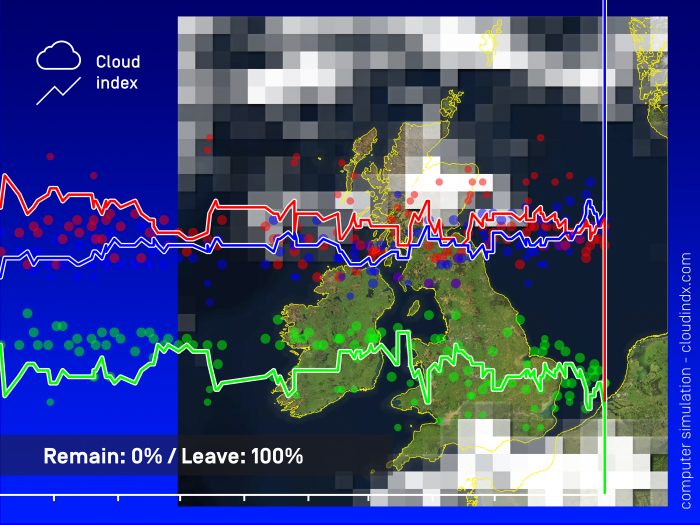
Cloud Index is the third digital commission by the Serpentine Galleries, London. It is available in its entirety online, accompanied by essays on the technology and history of machine learning and weather forecasting.
For some time, I’ve been fascinated with the physical infrastructure of the internet, and particularly the assemblage of what we’ve come to call “the cloud”: the vast networks of cables and servers inside huge warehouses which power the heavy computation required to run the modern world. This infrastructure is often hidden, for reasons of business, security, and aesthetics, and corresponds to the opaque nature of technology itself, its inscrutability and lack of general public comprehension from the black boxes of mobile phones to computer code itself. This opacity of “the cloud” is a problem when technology is political, and one of the primary shapers of contemporary life. But, like computer code, making visible the infrastructure is an opportunity to understand and explore it: comprehending it can increase agency too. The history of this infrastructure is one of increasing complexity and geographical scope over time, not miniaturising, but expanding from mainframe computers to satellite networks, gradually coming to cover the entire earth.
The history of this cloud is intimately bound up with real and artificial clouds: from climate activity to the atomic bomb. The first digital computers were designed for two main purposes: simulating atomic explosions and predicting the weather. The women and men who worked on these machines recognised and campaigned for the adoption of digital computation into every possible sphere of life, in a form of utopian technological thinking which has shaped the core narrative of the twenty-first century: that processing and automation by machines will not only replace human thought and action in every domain, but that it is morally and ethically superior as well, and separable from the flaws and biases of human intention. Technology is politics by other means.
The history of weather prediction is, in turn, bound up with the history of weather control. This is the idea that we can manipulate climate conditions for our own benefits. The history of weather control extends back to rain-makers and ancient augurs, and continues into the present with cloud-seeding – used extensively in, for example, China to prevent rain at the Beijing Olympics and during state ceremonies – and proposals for geo-engineering. Geo-engineering is the next great debate we are going to have in climate change. When it becomes clear to more people that the warming process is inevitable, direct intervention – in forms such as seeding the oceans with algae or increasing cloud cover to reflect more of the sun’s energy – will become a realistic, if a controversial, proposal. Evaluating such proposals requires, like an understanding of climate change itself, a literacy in data and computation, the lingua franca of power today. How we choose to deploy the technologies we are capable of building will determine whether we survive them. If we are capable of predicting outcomes in the world by modelling and simulating the results of surveillance and remote sensing, how far should we go to control and change those outcomes? Data is the atomic bomb of the twenty-first century.
Weather control is an extension of the idea that we can understand the world by gathering as much data as possible about it, modelling it to ever finer degrees, calculating every possible outcome, and use existing knowledge to predict and control it. This data-driven ontology is a way of seeing and acting in the world, and is the key to understanding contemporary scientific practice, architecture and design, the surveillance state, neoliberal economics, and media discourse. But it is also, in many ways, failing – failing to produce the expected equilibrium and equality it claims – and one of the reasons that it is failing is that it cannot account for the inherent plurality and complexity of the world itself, the reality revealed by our increasingly accurate and widespread technologies. My contention is that this reality is what we are really pointing to when we talk about “the cloud”; a reality that is “clouded”: diffuse, shifting, and ultimately unknowable.
This unknowability makes us uncomfortable and irrational. From the debate over climate change, to online conspiracy theories, to increasing fundamentalisms, to the “post-factual” landscape of British politics, our inability to synthesise the vast troves of information available to us is destroying our ability to act meaningfully in the world. Instead of data-driven knowledge, we need a cloud knowledge: a mode of being in and thinking through the world which does not assume mastery and control as its final outcome, but is aware of and comfortable with the vast, unknowable complexity of the world.
Today is a big day for anyone who’s managed to get their hands on an iPhone 7 Plus—not an easy task, considering how few are available to buy.
Because today, you can turn on Portrait mode.
First, some background: The 7 Plus has two camera lenses: one wider angle, one a 2X zoom. Clever software lets you blend the zoom to any degree between them (or, using digital zooming, go all the way up to 10X).
The iPhone 7’s two lenses.
But when Apple (AAPL) introduced the 7 Plus, it said that the two-lens setup has a second benefit: It lets the camera tell the foreground subject apart from its background.
And with that knowledge, the phone can create a soft blurry-background look, as in this shot (of fellow Yahoo employee Marissa Weber).
Blurry background shot taken with an iPhone 7 Plus.
(Some photographers refer to this blurriness as bokeh, although technically, that word describes the quality of the blurriness, not the blurriness itself. “I love the bokeh this lens gives you,” you might hear.)
Ordinarily, you see that look only in professional photos, or at least photos taken with big black SLR cameras using high-aperture lenses (f/1.8, for example). Like these:
Good examples of background blur in shots taken by World Skills UK (left) and Luis Calçana (right).
But soon, Apple said last month—once it finished writing the software—you’ll be able to do that with your phone.
Today’s the day. You can download the iOS 10.1 update for your iPhone 7 Plus that gives it a beta version of the new Portrait mode. (Open Settings -> General -> Software Update, and click Install.)
Now, the blur in this case is not optical, the way an SLR makes it. This is a glorified Photoshop filter; it’s created with software.
And Apple’s not the first company to try it. Some Samsung phones, years ago, offered a similar feature. But without dual lenses, those phones didn’t have great luck distinguishing the subject from its background, and you often wound up with hideous “leaking” of the blurriness effect.
Apple’s effect on the other hand, generally looks great, even when the outline of the subject is complex (like frizzy hair). The blur occasionally looks a little phony, as in the building outlines shown here, but at least it never spills out into your beloved’s face. (It does occasionally leak into non-human subjects. Maybe that’s why this feature is still called beta.)
In a few shots, the beta version of Portrait mode creates an artificial-looking bokeh.
How to use Portrait mode
The new feature shows up as one of the modes in the Camera app—you know, VIDEO, PHOTO, SLO-MO, and so on. Now there’s PORTRAIT.
Point the camera at someone who’s standing between 15 inches and 8 feet away, and boom: You see the background blur, right there in the preview image, as shown in the video above. Take the shot. That’s all there is to it.
If a second person is standing within the 8-foot range, you can tap the screen to make that person the subject.
In Settings -> Photos & Camera, you can turn on “Keep Normal Photos” for this depth effect. It means, “For each Portrait photo I take, save two images—one with, and one without the blur.”
The phone can save a de-blurred version of the photo (left) as well.
Fine print on Portrait mode
Portrait mode doesn’t always work. It can get confused when:
The light is dim, like in a bar or restaurant in the evening.
The subject is covered with a repeating pattern.
Your subject is reflective, like a shiny bottle.
Your subject is farther away than 8 feet, or closer than 15 inches.
As long as the light and the distance are right, though, the results are surprisingly good. Everyone I showed the results to was fairly amazed; the shots look exactly like fancy SLR shots.
Soon, the Flickrs (YHOO) and Facebooks (FB) of the world will start teeming with great-looking, blurry-background photos—or at least they will once Apple starts making enough iPhone 7 Pluses to sell!
David Pogue, tech columnist for Yahoo Finance, welcomes non-toxic comments in the Comments below. On the Web, he’s davidpogue.com. On Twitter, he’s @pogue. On email, he’s poguester@yahoo.com. Here’s how to get his columns by email.
Apple has released the latest iteration of smartwatch operating system, watchOS 3.1, which brings with it mainly bug fixes and small changes to Messages.
With watchOS 3.1, users can now replay bubble and screen effects in Messages, and the effects can also play with Reduce Motion enabled.
Other than those two minor updates, the new version addresses several bugs. It resolves an issue that stopped some Apple Watch Series 2 users from getting a full charge and fixes a problem that prevents Force Touch options from appearing in some third-party apps.
The previous iteration, watchOS 3, brought with it significant changes including speed improvements and a new ‘Dock’ system that replaced ‘Glance’ and holds 10 frequent-use apps.
To receive the update to watchOS 3.1, users can check the Apple Watch app on their iPhone.
A year ago, Twitter CEO Jack Dorsey said he “made some tough but necessary decisions that enable Twitter to move with greater focus and reinvest in our growth.” At the time the real-time platform slashed 336 people from its workforce, which represented approximately 8 percent.
A report in Bloomberg reveals the company could be making this act an October habit as its sources revealed Twitter may cut upwards of 300 people. This time the number of cut staff once again is about 8 percent of its total workforce. The finer details may be announced sometime this week, possibly before its third-quarter earnings on Thursday.
Twitter declined to comment on the report.
Twitter has been in talks with several companies regarding a sale, specifically Salesforce, Disney, and Alphabet (Google). However, all decided not to move forward with the transaction various reasons.
Overall, Twitter has over 300 million users worldwide and has struck up partnerships to stream live professional sports games with the NFL, NBA, NHL, PGA, and streamed the Presidental debates between Hilary Clinton and Donald Trump.
The efforts to “do something” about Vancouver’s historic Chinatown are never-ending. And it’s not just in Vancouver. Cities from Edmonton to San Francisco are also fretting about what is happening to their Chinatowns, either because they went into decline and are empty or, somewhat the reverse, they are being infiltrated by a host of non-Chinese enterprises who like the funkiness of old neighbourhoods.
The latest in Vancouver: City planners are holding workshops on the next stage of the Chinatown plan, with discussions about some changes that have emerged from the last Chinatown plan.
So, as I note in my story today, that means talks about reducing the density of new buildings (at the moment, there is only a height cap, not a density cap, for both Gastown and Chinatown), about possibly requiring a mandatory percentage of social/seniors’ housing in each building (no bargaining over the land lift), and some other changes intended to make new buildings fit into the Chinatown fabric better.
There will be more to come later. The Downtown Eastside plan talked about making efforts to keep local-serving businesses in place. When that discussion starts to get down to details, it will encompass Chinatown.
This 1895 image shows the first location of the city’s first fire hall. The City of Vancouver owned the site because before the 1886 fire the police house was located here, with the jail alongside and set back from the street. Some years after this picture, when the replacement fire hall was built on Cordova Street, the name went with it (so it retained the name Firehall #1, in a different location).
The first engine was manufactured in Brussels, Ontario, with the name plate ‘M A MacLean,’ the name of the city’s first mayor, on the engine when it arrived. Among the people posing in 1895 were the fire chief, Chief Carlisle and William McGirr. The brand new City of Vancouver were only too aware of the threat of fire to their newly established city. There were were discussions in Council at the first meeting in May 1886 about equipping the fire brigade, and telegrams had been exchanged with Mr. Ronald, a manufacturer of fire equipment in Ontario, but the confirmation to purchase was only made at the first Council meeting eight days after the fire, on 22nd June 1886.
The order was for a 5,000 pound Ronald steam pumper with four hose reels and 2,500 feet of 2 and 1/2 – inch hose that cost the city $6, 905. It arrived in Port Moody in July 1886, where the rail line ended at the time, and it was dragged by a team of horses through the forest to Vancouver. That’s the engine on the right with its steam powered pump. The engine was eventually pulled by a team of horses, but those weren’t acquired for eight or nine months, and initially the firemen had to manhandle it to a fire, which was slow, and meant that the first serious blaze at Spratt’s oilery, a barge previously used to process fish for oil, had burned before they could get the pump into position (although they did ensure sparks from the fire didn’t catch anything else alight).
If the Council had the funds to purchase a fire engine, how was it that they couldn’t afford the horses to pull it? The answer is that they didn’t pay for the fire engine. In an early form of vehicle leasing, the Council Minutes of August 6th 1886 recorded “That this Council do accept the Fire Engine, Hose etc from John D. Ronald as Complete and according to agreement. And that this Council do agree to hand over to Messrs. McIntosh and McTaggart Brussels Ont. Our City Debentures for the sum of sixty nine hundred and five dollars payable in ten years and bearing interest at seven per cent, as soon as same are issued and we agree to issue the paid debentures as soon as this can be legally done. And that the City Clerk be instructed to give Mr. Ronald a Certified Copy of this resolution and that the City seal be attached thereto.”
For the Firehall needed to house the shiny new engine, more money had to be raised – but not nearly as much as it took to buy the engine. On July 26th 1886 it was agreed that “a Fire Hall be at once erected 24 x 30, 2 stories high, the 1st story to be 12 ft Clear and the 2nd 10 feet with a tower 55 feet high and 6 feet square on top and that the City Engineer be instructed to prepare plans and specifications so that tenders may be asked for at once. We would also recommend that a Fire Bell be purchased at once the cost not to exceed one hundred dollars”. On August 30th Council agreed to accept the tender of A.D. McKenzie to build the hall for $743.00.
The fire brigade moved to their new hall on Cordova Street around 1907, and for a while it looks as if their old premises were re-purposed for retail uses. In 1908 Jacob Cohen had a clothing business where the firehall had been, in a block that had several other Jewish merchants including Maurice Goldberg’s clothing store next door and Zebulon Frank’s secondhand store a little further up the street. The address disappears by 1914, and we suspect the site was cleared. In 1930 the Nagle Brothers Garage was built here, designed by McCarter & Nairne. It was developed by Ed Baynes of builders Baynes and Horie, and was probably the city’s first parking garage.
In 1972, the Garage became one of the first rehabilitation and adaptive re-use projects in Gastown, converted to retail and office space by architect H Tanner. An inner courtyard was created, surrounded by balconies and trees. Redeveloped again in 2009 as ‘Garage’ – one of four building restored and added to by Acton Ostry Architects for the Salient Group. Garage was the youngest of the buildings and the redevelopment added three extra residential storeys, with no setback (because of the poured-in-place construction of the original building) but with a clear delineation of the original cornice.
First off, the Province still seems pretty resolute at building the Massey Bridge despite mounting concerns about how the project is being handled. MLA Vicki Huntington has written asking for information from the Province about gaps and assumptions about impacts on traffic, agriculture, wildlife and the community. The governments’ current application for an environmental certificate shows traffic estimates for a tolled new crossing would be approximately 40,000 vehicles less than one with no toll.
Ms. Huntington notes, “Many of my concerns centre around both the government’s traffic projections, and the lack of progress on a regional tolling policy review that was promised three years ago. I have repeatedly pressed the transportation minister to honour his promise to undertake that review, only to hear the same response: “There is plenty of time to talk about regional tolling.” I disagree. And Metro Vancouver mayors disagree. A Massey bridge toll could cost South Delta commuters more than $1,000 annually. It will affect not only how much traffic there is at the new bridge, but how much of it diverts to the heavily congested Alex Fraser.
This is especially concerning because many businesses on Annacis Island are already affected by traffic congestion, and some are considering packing up shop in search of greener pastures. With the proposed Massey bridge in place, the government’s own application says we can expect an extra 33,000 vehicles a day at the Alex Fraser by 2045. So the situation is set to get much worse.”
Dermod Travis has written a compelling article in Business in Vancouver regarding the financial costs of building the tunnel replacement. The Executive Director of Integrity BC, Travis notes that on the Massey Bridge’s website:
” …accounting firm KPMG – it has been advising on the project – says it’ll be in the neighbourhood of “$2 billion to $3 billion.” What’s $1 billion between friends? The government says $3.4997 billion (you read that right).Given the precision of the government’s estimate, it’s a tad worrisome that the Transportation Ministry was out doing test pile drives this spring.”
“It might be interesting to see how the geotechnical data used for the $3.5 billion estimate compares with the latest results. No one is chomping at the bit to release them. After cost comes performance. Three teams made it to the requests-for-proposals stage. Flatiron Canada is a member of the Gateway Mobility Solutions team and Kiewit Canada is part of the Lower Mainland Connectors team.”
“Together they’re responsible for the new Port Mann Bridge. They overshot the $2.4 billion fixed-price contract by $424 million…FSNC-Lavalin, Kiewit and Flatiron have completed five transportation projects in B.C. with a combined initial estimate of $3.8 billion. Final price tag? $6.5 billion.
With Metro Vancouver and all but one of its mayors giving a thumbs-down to the Massey project, there’s not much public buy-in for it. So here’s an idea: hit pause.
B.C.’s auditor general, Carol Bellringer, announced last year that her office would conduct a performance audit “to evaluate the quality of evidence to support the decision to replace the George Massey Tunnel.” If the government’s numbers are all on the up and up, what could it possibly fear from taking a few months to let the auditor general do her thing and report back?
Better a cost overrun avoided than a cost overrun paid out.”
The full text of Dermod’s article is available here.
Moleskine's Timepage has been a MacStories favorite ever since I reviewed it for the iPhone back in January. With its innovative design and slick group of features, it was an easy pick for my calendar of choice – with one big caveat: no iPad version.
Last week, the team at MacStories finally got our wish in Timepage for iPad. In it, we get all the same features we've come to love in previous versions in a beautifully designed package supporting the larger screen.
Two Panels, Always...
Rather than going for a blown-up version for Timepage on iPhone, the Moleskine team developed a new, dual-panel view. By always presenting two areas of information, the app now allows you to see your full calendar and a week view; on the iPhone, you'd have to swipe between screens for all of that. You can also split between the week and day views, as well as the day and settings screens.
With this design, Timepage makes accessing your calendar info ridiculously quick on the iPad. By bringing over its calendar switching mechanism from the iPhone, you can shift contexts while still keeping your current week in view.
My favorite combination of panels is the week and day views, where I can easily scroll through the timeline and view any daily events in detail. An activity's location, weather, and other information opens directly in the day view, giving you an in-depth look into what your day holds.
...Except in the Full Calendar View
Exclusive to the iPad version of Timepage is a full calendar view, which lives a swipe to the left of the smaller calendar picker. Taking up the size of the screen, this calendar displays the month and the events for each day, much like the stock calendar or Fantastical.
Although I don't think I'll use this much, it's a prime example of Moleskine looking to advance the app past its current state. People will, however, surely find this useful – for the big picture stuff, this view is truly useful.
Multitasking
While I'd like to think that all apps should be supporting Split View multitasking on the iPad, there are still plenty of developers who refuse to update their apps to include it. Luckily, Moleskine has decided to not only provide multitasking but also enhance it depending on layout size.
In practice, this means that when Timepage takes up half of the screen, you'll effectively get the full iPad app – the calendar view and dual-screen setup. When shrunk down to a compact view, the app acts like it does on the iPhone, presenting you one screen at a time.
Wrap-Up
I've glanced over a lot of the main features of Timepage, so if you're interested in knowing what makes the app great, check out my original review here. Timepage on the iPad includes everything that made the iPhone version a favorite and more. It's truly a companion to Timepage for iPhone, not a scaled up version.
Timepage for iPad comes in at $6.99, a price that should sit well to previous users of the app. But for potential new customers, take my suggestion: try the iPhone app first, then commit. At a combined price of around $12, the two are worth it – but only if you like Timepage as a calendar platform.
As for me, I was happy to finally rid my Home screen of Fantastical and replace it with Timepage. It was as much of an insta-purchase as I've had on iOS, and I'm happy to fully commit to the app and all of its features.
While the Pixel and Pixel XL are great devices, especially for Google’s first smartphone built from the ground up by the company, they are missing a few major features some high-end Android users have come to expect.
According to Wired’s David Pierce, who formerly wrote for The Verge, Google told him that it “ran out of time,” and was unable to add IP68 water resistance to its first flagship smartphone.
Compared to most devices, the Pixel’s development cycle was apparently very short, coming in at just “nine months and a week” from design to launch. The original plans for the phone were apparently canned at the start of 2015.
Other modern, high-end smartphones, including the Galaxy S7 and the dearly departed Note 7 are IP68 water resistance, while the iPhone 7 and iPhone 7 Plus are IP67 certified. In comparison, Google’s smartphone features IP53 certification for dust and water resistance, resulting in the phone being able to withstandmsplashes but not full submersion in water.
Other missing Pixel and Pixel features some users of the phone have complained about include a lack of standard OIS image stabilization, though Google says the phone’s gyroscope is used for image stabilization to some extent. In my experience I’ve only missed OIS when shooting in low light.
Hey readers, I have some news for you: The New York Times has acquired The Wirecutter. We’ll continue to work hard to help you find great things to buy quickly and easily. But the real reason we’re joining up is so that we can do what we do better than we ever have before, with support from the world’s greatest home to journalism. Thank you for your love and support over the past five years. I can’t wait to show you what’s next. —Brian Lam, founder, CEO
The Palate Deck@ThePalateDeck
Beer flights are a natural pairing with the Palate Deck. Sample your way through new brews with friends and learn a… twitter.com/i/web/status/7…
Steve@Stv
A service that put together a personalized daily highlight reel based on my fantasy pool would be a pretty compelli… twitter.com/i/web/status/7…
The Palate Deck@ThePalateDeck
If you want to experience everything a beer has to offer, pour it into a glass first. Here are some recommendations… twitter.com/i/web/status/7…
Renée Stephen@ReneeStephen
@sillygwailo Tmrw will just be all the baths you can usefully have, and by 2:55pm you'll have entered the long dark teatime of the soul.
Samsung will continue to make Note-branded smartphones, the company announced today, and will even offer Korean Note 7 customers an incentive to buy the next iteration of its stylus-enabled smartphone.
In a statement issued on Monday (written in Hangul), the company confirms it’s working on the Note 8 and says Korean customers who trade in their Note 7 for either a flat-screen or curved-screen version of the Galaxy S7 can subsequently trade up to a Galaxy S8 or Note 8 when those two smartphones launch next year. Samsung adds those customers will get 50 percent off the Note 8 if they decide to take the company up on its offer.
Samsung has yet to decide whether it will offer the 50 percent discount to Note 7 customers in other markets, the company says it will depend on the situation in each country. It declined to elaborate further.
Mike Smith wanted to be able to locate specific records in his collection with ease, so he turned to a Raspberry Pi for assistance.
A web server running on the Pi catalogues his vast vinyl collection. Upon selecting a specific record, the appropriate shelf lights up, followed by a single NeoPixel highlighting the record’s location.
recordShelf helps organize and visualize dat about your record collection. This is my second video demonstrating it’s latest form.
The lights are controlled with Adafruit’s FadeCandy, a dithering USB controller driver with its own software that allows for easier direction of a NeoPixel. It also puts on a pretty nifty light show.
Records can be selected via artist, title, record label, a unique index number, or even vinyl colour. This also allowed for Mike to select all records in a specific category and highlight them at once; how many records by a specific artist or label, for example.
Further down the line, Mike is also planning on RFID support, allowing him to scan a record and have the appropriate shelf light up to indicate where it should be stored. Keep up to date with the build via the project’s Hackaday.io page.
Megacities are, by definition, urban areas with a population of 10 million or more, and they have been a recent source of worry and research for the U.S. military. A 2014 Army report, titled “Megacities and the United States Army,” warned that “the Army is currently unprepared. Although the Army has a long history of urban fighting, it has never dealt with an environment so complex and beyond the scope of its resources.” A separate Army study published this year bemoans the fact that the “U.S. Army is incapable of operating within the megacity.”
These fears are reflected in the hyperbolic “Megacities” video.
As the film unfolds, we’re bombarded with an apocalyptic list of ills endemic to this new urban environment: “criminal networks,” “substandard infrastructure,” “religious and ethnic tensions,” “impoverishment, slums,” “open landfills, over-burdened sewers,” and a “growing mass of unemployed.” The list, as long as it is grim, accompanies photos of garbage-choked streets, masked rock throwers, and riot cops battling protesters in the developing world. “Growth will magnify the increasing separation between rich and poor,” the narrator warns as the scene shifts to New York City. Looking down from a high vantage point on Third Avenue, we’re left to ponder if the Army will one day find itself defending the lunchtime crowd dining on $57 “NY Cut Sirloin” steaks at (the plainly visible) Smith and Wollensky.
Lacking opening and closing credits, the provenance of “Megacities” was initially unclear, with SOCOM claiming the video was produced by JSOU, before indicating it was actually created by the Army. “It was made for an internal military audience to illuminate the challenges of operating in megacity environments,” Army spokesperson William Layer told The Intercept in an email. “The video was privately produced pro-bono in spring of 2014 based on ‘Megacities and the United States Army.’… The producer of the film wishes to remain anonymous.”
According to the video, tomorrow’s vast urban jungles will be replete with “subterranean labyrinths” governed by their “own social code and rule of law.” They’ll also enable a proliferation of “digital domains” that facilitate “sophisticated illicit economies and decentralized syndicates of crime to give adversaries global reach at an unprecedented level.” If the photo montage in the video is to be believed, hackers will use outdoor electrical outlets to do grave digital damage, such as donning Guy Fawkes masks and filming segments of “Anonymous News.” This, we’re told, will somehow “add to the complexities of human targeting as a proportionally smaller number of adversaries intermingle with the larger and increasing number of citizens.”
“Megacities” posits that despite the lessons learned from the ur-urban battle at Aachen, Germany, in 1944, and the city-busting in Hue, South Vietnam, in 1968, the U.S. military is fundamentally ill-equipped for future battles in Lagos or Dhaka.
“Even our counterinsurgency doctrine, honed in the cities of Iraq and the mountains of Afghanistan, is inadequate to address the sheer scale of population in the future urban reality,” the film notes, as if the results of two futile forever wars might possibly hold the keys to future success. “We are facing environments that the masters of war never foresaw,” warns the narrator. “We are facing a threat that requires us to redefine doctrine and the force in radically new and different ways.”
Mike Davis, author of “Planet of Slums” and “Buda’s Wagon: A Brief History of the Car Bomb,” was not impressed by the video.
“This is a fantasy, the idea that there is a special military science of megacities,” he said. “It’s simply not the case. … They seem to envision large cities with slum peripheries governed by antagonistic gangs, militias, or guerrilla movements that you can somehow fight using special ops methods. In truth, that’s pretty far-fetched. … You only have to watch ‘Black Hawk Down’ and scale that up to the kind of problems you would have if you were in Karachi, for example. You can do special ops on a small-scale basis, but it’s absurd to imagine it being effective as any kind of strategy for control of a megacity.”
The U.S. military appears unlikely to heed Davis’s advice, however.
“This is the world of our future,” warns the narrator of “Megacities.” “It is one we are not prepared to effectively operate within and it is unavoidable. The threat is clear. Our direction remains to be defined. The future is urban.”
A city is a machine with innumerable parts made by the accumulation of human gestures, a colossal organism forever dying and being born, an ongoing conflict between memory and erasure, a center for capital and for attacks on capital, a rapture, a misery, a mystery, a conspiracy, a destination and point of origin, a labyrinth in which some are lost and some find what they’re looking for, an argument about how to live, and evidence that differences don’t always have to be resolved, though they may grace and grind against each other for centuries.
[…]
Each of us is an atlas of sorts, already knowing how to navigate some portion of the world, containing innumerable versions of place as experience and desire and fear, as route and landmark and memory. So a city and its citizens constitute a living library.
[…]
Each of us grasps and inhabits only part of the pattern. The complexity beyond comprehension is one of the marvels of great cities, their inexhaustible, ever-renewing mystery… Every city is many places; the old woman and the young child do not live in the same city, and the rich and the poor, the pedestrian and the wheelchair-bound, black and white inhabit different but not completely separate realms.
[…]
A city is not one or the other of these things but all of them, contradictions and collaborations and conflicts together, forever churning and spitting out new possibilities.
Adam Pearce for the New York Times charted ad spending for Clinton and Trump, starting 20 weeks out from the election up to present. I like the John McCain, Mitt Romney, and Barack Obama spends as a point of reference.
Samsung has launched a special upgrade program in South Korea, its home market, where it will be offering customers who ‘downgrade’ to the Galaxy S7 or S7 edge from their recalled Galaxy Note 7 a discount when they purchase the Galaxy S8 or Galaxy Note 8 next year. A Samsung spokesperson said that this upgrade program from the company is aimed at “lightening the burden” on frustrated and disappointed Galaxy Note 7 owners.
Continue reading →
On September 7, 2016, Apple and Nike announced a Nike-branded version of the Apple Watch called the Apple Watch Nike+. Nike’s version of the Apple Watch did not debut with the Apple Watch Series 2, which became available on September 16th. Instead, Apple Watch Nike+ will go on sale October 28. 2016.
The new Nike-branded Apple Watch consists of a custom watch face available only to buyers of the watch, and a custom band. The band is basically a standard Sport band in construction, but includes distinctive holes throughout the surface, the interiors of which are a different color than the surrounding area. The result stands out, and I actually quite like it.
The band is available in four different colors, which vary the scheme between light and dark gray and a neon yellow-green (Nike calls the color "Volt"). The watch face mirrors these colors, and is available in several different styles, all which incorporate Nike's distinctive font and logo. The Apple Watch Nike+ also includes a permanent complication along the bottom of the display for the Nike+ Run Club app, which I assume comes preinstalled on the devices since the Complication can't be removed.
Running is one of the world’s most popular activities for staying in shape and being healthy, and with Apple Watch Nike+, runners will be even more motivated to achieve their performance goals…. The response so far has been incredible and we’re thrilled to get Apple Watch Nike+ onto customers’ wrists starting Friday.
The Apple Watch Nike+ comes in an aluminum finish and is priced the same as the Apple Watch Series 2. The watch will be available on Friday in Australia, Austria, Belgium, Brazil, Canada, China, Columbia, Czech Republic, Denmark, Finland, France, Germany, Hong Kong, Hungary, India, Ireland, Italy, Japan, Luxembourg, Macau, Malaysia, Mexico, Monaco, Netherlands, New Zealand, Norway, Poland, Portugal, Puerto Rico, Singapore, South Africa, South Korea, Spain, Sweden, Switzerland, Russia, Taiwan, Thailand, Turkey, the UK, and the US, with other countries being added shortly thereafter.

 For their price, one of the biggest disappointments with the Pixel and Pixel XL is their lack of any kind of waterproofing. All other flagship phones that are priced on the same level as the Pixel and Pixel XL like the Galaxy S7 edge and iPhone 7 feature an IP67 or higher rating that makes them resistant to dust and water.

 All images courtesy the artist




 Samsung has launched a special upgrade program in South Korea, its home market, where it will be offering customers who ‘downgrade’ to the Galaxy S7 or S7 edge from their recalled Galaxy Note 7 a discount when they purchase the Galaxy S8 or Galaxy Note 8 next year. A Samsung spokesperson said that this upgrade program from the company is aimed at “lightening the burden” on frustrated and disappointed Galaxy Note 7 owners.
