Shared posts

17 Nov 02:43

Despite Zuckerberg’s Protests, Fake News Does Better on Facebook Than Real News. Here’s Data to Prove It.

by mikecaulfield

(An investigation in which we decide to use Facebook’s social graph API to see whether fake news or real news is more viral).

UPDATE: Since posting, there has been some discussion about this post’s use of the phrase “top stories from local newspapers”.  A clarification on how that phrase is used has been appended at the end of the post with some methodology, and some small clarifying edits have been made. The title and core claim of the post remains accurate and stands. What we present here is not the best possible measure of fake vs. real virality, but it is a meaningful one, and deserves to be addressed.

Mark Zuckerberg told us recently that fake stories on Facebook were quite rare, less than 1% of total content. I’m not sure how he computes “content”, exactly. Is my status update content? Each photo I upload?

Mark Zuckerberg says the notion that fake news influenced the U.S. presidential election is “a pretty crazy idea.”

He also says his company has studied fake news and found it’s a “very small volume” of the content on Facebook. He did not specify if that content is more or less viral or impactful than other information. [Source: NPR]

Well, if Zuckerberg can’t specify if fake news is more viral on Facebook, maybe we can, using the publicly available Facebook APIs. Let’s help him out!

The question I want to ask is this: how do popular fake Facebook stories from fake local newspapers compare to top stories from real local newspapers? Not “how many stories are there of each” but rather “Is fake news or real news more likely to be shared, and what’s the size of the difference?”

If Facebook is truly a functioning news ecosystem we should expect large local newspapers like the Boston Globe and LA Times to compete favorably with fake “hoax” newspapers like the Baltimore Gazette or Denver Guardian — fake “papers” that were created purely to derive ad views from people looking for invented Clinton conspiracies.

For our fake story, we’re choosing the most popular story from the Denver Guardian, a fake newspaper created in the final days of the election. Its story “FBI Agent Suspected In Hillary Leaks Found Dead In Apparent Murder-Suicide”has now been shared on Facebook well over half a million times, as you can see with this call to Facebook’s API. This story exists on a site made to look like a real local newspaper and details quotes from people both real and fake about the murder-suicide of an FBI agent and his wife supposedly implicated in leaking Clinton’s emails. According to the story he shot himself and his wife and then set his house on fire. Pretty fishy, eh? Add it to the Clinton Body Count.

murder-suicide

The story is, of course, completely fake. But at 568,000 shares (shares, mind you, not views) it is several orders of magnitude more popular a story than anything any major city paper publishes on a daily basis.

“Oh, hold on Mike, you say, ‘orders of magnitude’, but a lot of people misunderstand that phrase. Something shared several orders of magnitude more frequently would have to be shared literally around a thousand times more.”

Yep. That’s what I am saying: this article from a fake local paper was shared one thousand times more than material from real local papers.

Don’t believe me?

For our “real” stories, we are choosing the stories the papers have identified as their most popular of the day, via their “most popular stories” section on their site. (We are not choosing the most popular story they have based on Facebook data — I don’t currently have a way to know that).

The Boston Globe’s most popular article today (according to their site) is an article from its famous Spotlight team (yes, that Spotlight team) on the tragedy of shutting down psychiatric facilities in Massachusetts and elsewhere and replacing them with nothing. Number of shares? 181.

The LA Times has an editorial piece that is today’s most popular on their site titled “We’re called redneck, ignorant, racist. That’s not true’: Trump supporters explain why they voted for him.”That ought to share more generally than LA people, right? Number of shares: 342 shares.

The Chicago Tribune has a truly national story currently trending, “Trump and advisers back off major campaign pledges, including Obamacare and the wall”. The story is originally from the Washington Post, but is about as major a story as you get. Number of shares: 1774.

Now you could go national as well — that story from the Tribune was from the Washington Post, and is a top trending story there as well. So what does a truly national, click-ready story get you? Number of shares: 38,162.

Let’s plot that on a graph, shall we? Again, remember that these are not random selections — these are stats for the trending stories from each publication:

shares

To put this in perspective, if you combined the top stories from the Boston Globe, Washington Post, Chicago Tribune, and LA Times, they still had only 5% the viewership of an article from a fake news site that intimated strongly that the Democratic Presidential candidate had had a husband and wife murdered then burned to cover up her crimes.

The fact that Mark Zuckerberg can shrug his shoulders with his best “Who, me?” face — I’m trying to stay logical here, but I feel very sick to my stomach. There is nothing trivial, rare, or occasional about fake news on Facebook. Fake news outperforms real news on Facebook by several orders of magnitude. The financial rewards for pushing fake news to Facebook are also several orders of magnitude higher, and so expect this to continue until Zuckerberg came come to terms with the conspiracy ecosystem he created, and the effect it has had of U.S. Politics.

UPDATE:  Dan Barker notes that there are some stories on the LA Times site (and other sites) that have outperformed what those sites self-identify as their “top stories” or “most popular stories”. As one example, a story about a KKK march in the LA Times yesterday got north of 250,000 shares on Facebook yesterday, but for reasons that aren’t clear is not listed as a “most popular” story on the LA Times site. That might be because people shared it without clicking through, or it could be because the algorithm they use rolls day-old stories off the trending list.

Outside of the fact that that still puts the LA Times at a disadvantage to the fake Denver Guardian, I think the analysis is still valuable here. What we are looking at is how likely a popular story on a news site is to go viral as compared to what can be achieved on a fake news site. This is interesting because the popular stories on a news site exist (to some extent) outside Facebook’s algorithm, and provide a sense of what we might think of as traditional top news stories.

Is it the best comparison that can be made? No — so let’s make better comparisons. Please. Show me up. Build the tools to do it, and get Facebook to open access to its data so it can be done systemically. But let’s not take Facebook at its word here.


17 Nov 02:43

Fun with start-ups, 2009 style

by russell davies

When Starting Up Was Fun>

17 Nov 02:42

Resonant

by russell davies

"We’re ruled by a cadre of senior civil servants and politicians who don’t understand technology, still think it’s a gimmick and are more concerned with building empires than delivering good services to the people of the United Kingdom.

Many civil servants lack even basic skills. Things as fundamental as knowing how to type – let alone the more advanced things they need to know to work in the 21st century. This makes them resentful of “digital” and resistant to the change that it means.

I see very little being done to support civil servants, help through this period of change to the very way they work, let alone a widespread plan to upskill them.

Pay, reward and “performance management” structures are not fit for the 21st century and are not what truly motivates people. Creative thinking, innovation and new ways of doing things are not recognised or rewarded.

And while the civil service is in this period of retrenchment I can’t do any more of the exhausting fights to gain even an inch of ground."

More

17 Nov 02:42

29 Bullets

by russell davies

Screenshot 2016-11-13 18.36.07

I keep pondering on the question - what would a digital 'white paper' be like? And something recently reminded me of tufte.css. It's not the whole answer to the white paper question but the way it handles graphics and 'sidenotes' is interesting. So I cast about for a bit of writing that would be good to experiment with and struck on my Wired/PowerPoint thing. The idea of re-writing that in a Tufte-style was appealing so I've done that. This is the unsubbed, unedited version I originally sent to Wired so it may well be substantially different to the printed version, it may contain all sorts of mistakes. For which I obviously apologise. But I like how it works as an online piece.

17 Nov 02:42

Java To Swift: Thirty Three And A Third Things You Might Like To Know

by Simon Lewis
What ? Its not my fault. Its an epidemic. Everybody’s doing it. Consider yourselves lucky I didn’t go with Java To Swift: You’ll Be Astonished By What Happens Next ! Anyway Java has classes and Swift has classes, so transforming Java source into Swift source should be trivial. Probably an afternoon’s work, if that. Well, […]
13 Nov 09:50

Pixel Abuse

What happened was, I went down to the dock in the dark, and took pictures that no phone-cam should ever be asked to take. You might be amused.

I was with my ten-year-old daughter; The sky was black but the moon was full, its shadows knife-edged, first moonshadows she’d ever seen. Its light, edging round the slope of our island, looked cool, only I didn’t have a “real” camera, just my Google Pixel. Hmm, I sense a challenge.

Here’s the unimproved all-the-defaults version, which has a bit of primitive poetry perhaps.

Moon over Keats Island

So for the first time I got serious with the manual controls on the Lightroom camera app; cranked the ISO up and the shutter speed down, held the phone against one of the dock pilings, and growled at the girl to stop bouncing.

Then I went inside and brought the heavy photo-edits.

Moon over Keats Island - improved

Up in the top left, in the sky? Those are stars! And if you enlarge it, angled striations in the black on the right side? Moonbeams!

It’s not actually, you know, a Good Picture. But exploring boundaries is fun, and they’re a little further out than I’d have thought.

Before I went up I shot the path of moon-reflections on the ocean. Which was, relatively, easy.

Moon reflection

I asked Lauren “Isn’t there a word for the path of the moon (or sun) in the water?” She poked around and came up with “moonglade” which has however been taken over by World of Warcraft. Someone once asked a German-speaker, who answered Mondstrahlbleichfolgenimmerwandererufer, but they may have been improvising.

I keep saying: Golden age of Photography, we’re in it.

13 Nov 09:50

@samsteinhp

@samsteinhp:
13 Nov 09:49

Apple Tarnish

by xjgi4k
It’s appears a bit ironic that as I prepare for my foray into Windows that my wife decided to upgrade to a MacBook Pro. However, It’s not ironic at all: I’ve...
13 Nov 04:05

Software-Defined Cameras

When I pull out my Pixel for a picture, I have to pick which app to tap: Google’s Android camera (which oddly seems to have no link) or Adobe Lightroom’s. The choice isn’t hard, but is interesting.

Let me lead with some actual pictures. In each case, the G-cam is first, the Lr-cam second.

Howe Sound at dusk (G-cam) Howe Sound at dusk (Lr-cam)

Howe Sound at dusk.

Our cabin at dusk (G-cam) Our cabin at dusk (Lr-cam)

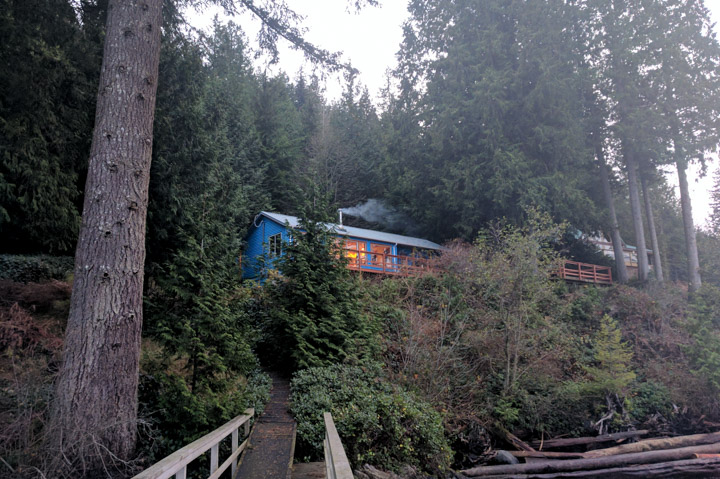
Cabin overlooking Howe Sound, at dusk.

The differences are subtle, and probably only matter if you’re going to be using a really big screen or piece of paper for delivery. If you’re the kind of person who cares, click-to-enlarge and, before I talk about the differences, see if you have opinions.

What’s different

The G-cam:

  1. Has an auto-HDR which, speaking as a long-time HDR hater, works pretty well.

  2. Auto-shares everything for free to Google’s online photo-space which I guess used to be part of G+.

  3. To pull onto my computer for editing, I download from online.

  4. Starts up faster, under a second.

  5. Shoots video.

The Lr-cam:

  1. Shoots raw DNG files.

  2. If you’re a Creative Cloud subscriber, the pix show up in your Lightroom “Synced Photographs” file, automagically.

  3. You can edit or delete them on the phone, on your computer, or via the Web, with a remarkably similar repertoire of controls. Deleted photos vanish from everywhere, and the edits are propagated everywhere too.

What’s the same

Both cameras have nicely intuitive GUIs that are easy to figure out. Both have pretty decent on-device editing too. In particular, both make it easy to dial in exposure compensation (i.e. brighter/darker) by sliding a finger on the screen.

Lightroom is maybe a little easier to get wrong; from time to time I accidentally hit a control I wasn’t aware of and get a weird hyper-colorized or exotic-blur rendition. Check out this picture out a window at the Amazon Vancouver office; cool effects, but you’d have to take some pretty good drugs to see them.

View from the Amazon Vancouver office

What matters

I should note all the photos were shot in failing November light, and none of them are untouched; I gave them a reasonably thorough Lightroom treatment, except for I didn’t touch the color a bit. Obviously you can do quite a bit more with the Lr-cam DNG than the G-cam JPG. Which leads me to:

First of all, for casual capture-the-moment snapshots, the G-cam wipes the floor with the Lr-cam. It shoots faster and applies HDR tastefully. It’s like this: Straight out of the camera, the Lr-cam shots look OK until you put them beside the G-cam shots; then they look dingy and lifeless.

Well, except for, the Lightroom shots are DNG and have a whole lot more room for correction. A minute or two’s work and they’re about as good. In general, I find myself bumping the contrast a bit, easing off the highlights, and blackening the blacks. But not always; each photo has to find its own path to its full potential.

When I’m done, they don’t look obviously better than the G-cam’s output, but they certainly look different. Obviously my opinion differs from that of the programmers who built the G-cam processing logic.

Two things stand out, starting with color. Check that first shot of Howe Sound, in particular the ocean itself. The G-cam gives it a lovely painterly touch of soft-green, while Lightroom sticks to a pretty pure grey. I see it more like Lightroom does, but I don’t actually dislike the G-cam effect; if I liked it more I could get it with white-balance sliders on the Lr-cam version.

The second is focus. The G-cam does a better job of dialing in the foreground foliage, sacrificing a bit of detail out in the water; the Lr-cam shows individual ripples. But they do about the same on the background car-ferry, which is a little surprising. This is a matter of pure taste, and while you can fix color you can’t really fix focus.

On the second photo, the big difference is the color: Lightroom’s greens are greener, the G-cam’s softer. Wow, I say “big difference” and it is, when you’re flipping back and forth on a 15" Retina screen; but in the blog presentation you have to look real close. If you actually care, maybe open the click-to-expand in adjacent tabs and flip back and forth? For what it’s worth, once again I think the Lr-cam is righter.

Which to use?

If I’m in a hurry and need to capture a moment or record a fact or whatever, G-cam every time; it’ll get me there quicker and the results will be good. If I see something and think “Hm, might be a neat picture there”, Lightroom. Because I really respect G-cam’s opinions, but don’t always share them.

13 Nov 03:19

Q+A with Copenhagenize urban planner James Thoem

by dandy

 james-with-bike-in-cphgn

Now that we have had  some time to process the bad dream that was the American election results we can get back to fighting the good fight. The one about  making cities more accessible and welcoming to cyclists. Earlier this week we spoke to urban planner and bike enthusiast James Thoem about his work at leading design firm Copehagenize.

When James Thoem moved to Toronto in 2008 he realized his passion for exploring and understanding urban landscapes. He studied urban planning at the University of Toronto, and worked for a city councillor. After a stint in Stockholm during which he got his masters in urban planning he moved to his all time favourite city; Copenhagen, for an internship at Copenhagenize.

Now a full-time urban planner at Copenhagenize, he's collaborating with fellow professionals and community leaders alike. When he's not in the office or on the road (riding his bike, naturally), he's likely to be found skateboarding with friends in one of Copenhagen’s world renowned public spaces.
dandyhorse caught up with this globe trotting planner to get some insight into Copheagenize and the global movement to make cities more bike friendly.

THE JOB

What do you do at Copenhagenize?

My official title is urban planner, but my typical day-to-day can involve much more. I may spend the morning touring a delegation of American mayors through the city, showcasing what best practice infrastructure actually feels like, while in the afternoon I'll might be pouring over bicycle infrastructure blueprints from one of our clients, and providing feedback from a user-experience perspective. Evenings are reserved for Danish class, exploring the city, or just meeting up with whoever happens to be passing through Copenhagen.

THE GOAL

How can we get more people biking?

It all boils down to infrastructure. I'm talking about a network of dedicated, connected, and reliable on-street bicycle infrastructure. One that allows people to get from A to B as quickly and conveniently as possible. When you take into consideration public health, air quality and maintenance costs, bicycle infrastructure is simply the most logical choice. And I'm sorry, but all the campaigns in the world encouraging citizens to commute by bike because it's green or because it's healthy will never result in the modal share increases unless they’re accompanied by quality infrastructure.

james-in-the-copenhagenize-office

TORONTO

What do you think of Toronto's new bike lanes? Did you ride Bloor while you were visiting recently?

Sure did! Riding from Queens Park to Buk Chang Dong Soon Tofu (the Korean restaurant with the orange facade at Clinton), I really got the feeling of how amazingly natural bike lanes on Bloor really are. These sorts of pilot projects can be an incredibly strategic method for rolling out new infrastructure. I'm looking forward to seeing what happens next, there's still plenty of opportunity to build upon infrastructure design and inter-modality along the Bloor corridor.

BIKE LANES

What are your favourite bike lanes?

Thinking locally, that's got to be cycling along Copenhagen's Nørrebrogade. I often tell Canadian visitors that with such a mix of storefronts, attractions, and people, Nørrebrogade is the city's Queen Street West. Just three years ago, the city ran a pilot project reducing private automobile access, removing parking completely, widening cycle tracks to over three meters in each direction, and syncing traffic signals to cycling speeds. The pilot was so successful, the city moved to make the changes permanent. Now there's more than 42,000 people cycling along this stretch every day! But there's plenty of inspirations beyond Denmark. Look to cities such as Buenos Aires, Seville, or Ljubliana to see how serious investments in bicycle infrastructure have directly lead to improved streetscapes.

 THE FUTURE
What city is making the most exciting advances as far as complete streets and active transportation goes? What is next in transportation innovation?

We just finished working with Almetyevsk, a small city in Russia with a very ambitious Mayor. The mayor wanted to see Almetyevsk become the most bicycle friendly city in Russia. And although there isn't much serious competition in this field, he still decided to go the full mile, laying 50 km of dedicated, connected infrastructure in just one year. And yes, they have even bought and rolled out a fleet of cycle track snowplows.

Oslo is another city to watch out for. As the city moves to make for a car-free downtown core, introduce 60 km of new bicycle infrastructure, remove all free parking in the city centre, and reduce car traffic by 20 per cent by 2020, they're really turning heads in Oslo, especially in such a car -entric country.

And in North America, since opening our Montreal office, we’ve been working with the City of Detroit to implement a connected network of fully protected bicycle infrastructure. The City’s new chief planner and his team came out to Copenhagen and have really come opened their eyes to how proper bicycle infrastructure can provide reliable and accessible mobility options.

If you want to follow up on more of the work being done in the City of Copenhagen and the Copenhagenize project check out these detailed reports: here and here.

Related Articles

Copenhagen: Where bikes outnumber people

dandyArchive: Copenhagen wheel

Why Bike Lanes are More Popular in Toronto

13 Nov 03:18

Weeknote 45/2016

by Doug Belshaw

This week I’ve been:

Next week, I’ll be mostly at home, writing. Let me know if there’s anything I can help you with!

Emailhello@nulldynamicskillset.com

Image CC BY David Blaikie

13 Nov 03:18

Not your ordinary rail film.

by illustratedvancouver


Not your ordinary rail film.

13 Nov 03:18

This Elegant, Black and White Drone Photography is Not What It Seems

by Andrew Nunes for The Creators Project

Military Age Males, Tomas Van Houtryve, 2015. All photos courtesy of the artist and Anastasia Photo.

When thinking of drone photography, aerial visages of major metropolises or rare footage of hard-to-access sites are some of the images that may come to mind. But the other kind of drone, the one that causes emotionally detached destruction and violence from afar, are not generally thought of when considering the marriage of art and drones. Belgian documentary photographer Tomas van Houtryve has brought together the highly controversial US drone war with the art of drone photography for series Blue Sky Days, currently on view at gallery Anastasia Photo.

The exhibition presents a series of aerial images of familiar quotidian scenes; a wedding ceremony, a school playground during recess, and a yoga outing in a park, among others. But there is a hidden sense of malice and danger lurking behind these images. Van Houtryve has photographed the types of gatherings and locales that are targeted by drone strikes abroad, with the twist being that all of these images were taken in the US. The photographer is attempting to reconcile the lack of empathy toward drone strikes that is fostered by sheer distance, lack of familiarity, and in some cases total unawareness, by reframing what happens abroad onto American soil.

Wedding, Tomas van Houtryve, 2013

The series started in 2013, after the artist overheard the words of Zubair Rehman, a Pakistani child whose grandmother was killed by a drone strike while picking okra outside of her house. At a congressional hearing in Washington, the boy stated that “I no longer love blue skies. In fact, I now prefer gray skies. The drones do not fly when the skies are gray.” Deeply moved and distraught by this boy’s loss of humanity, van Houtryve began Blue Sky Days shortly after, producing material for the project throughout the US over the next few years. 

Heat Signature, Tomas Van Houtryve, 2014

 “As an avid news reader, I found it troubling that there are extremely few reportage images of drone strikes abroad. What I find strange is that we live in a time in history with more cameras than ever before, yet the visual record of the drone war is very thin,” van Houtryve tells The Creators Project. “My hope is that my images help fill this void in the visual record, and that they help people immediately and viscerally understand what is otherwise a very abstract concept—namely remote control warfare.”

Blue Sky Days will be on view at NYC’s Anastasia Photo until December 31st, 2016. More of Tomas Van Houtryve’s work can be seen here.

Related:

Laura Poitras' First Solo Show Makes the Surveillance State Visible

Colorful Drone Photos Take You Soaring Over Hong Kong

Aerial Footage Makes Remote Locales Look Like Other Planets

13 Nov 03:17

Es ist nur ein Hobby

by Volker Weber

ZZ2F4DA79A

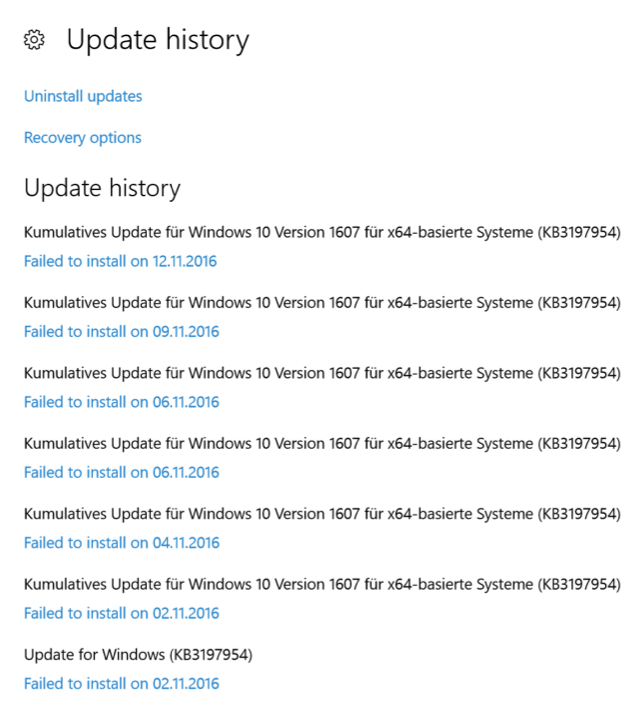
'Windows as a Service' ist ja eine nette Idee. Immer alles aktuell, ganz von selbst. Soweit die Theorie. Die Praxis sieht anders aus. Nachts möchte das Surface gerne neu starten. Installiert sich das neueste kumulative Update, startet noch mal neu. Und schmeisst es wieder runter, weil irgendwas nur in der Theorie funktioniert. Manchmal höre ich es, manchmal schalte ich die Kiste auch einfach aus.

ZZ698E8C84

Es ist nur ein Hobby. Ich habe ein paar Macs zum Arbeiten. Wenn ich von diesem Mist abhängig wäre, hätte ich schon mit einem Hammer drauf geschlagen. Und nein, ich habe nicht daran rumgebastelt. Vielleicht schickt ja Microsoft irgendwann mal ein Update, das sich auch installiert.

More >

13 Nov 03:17

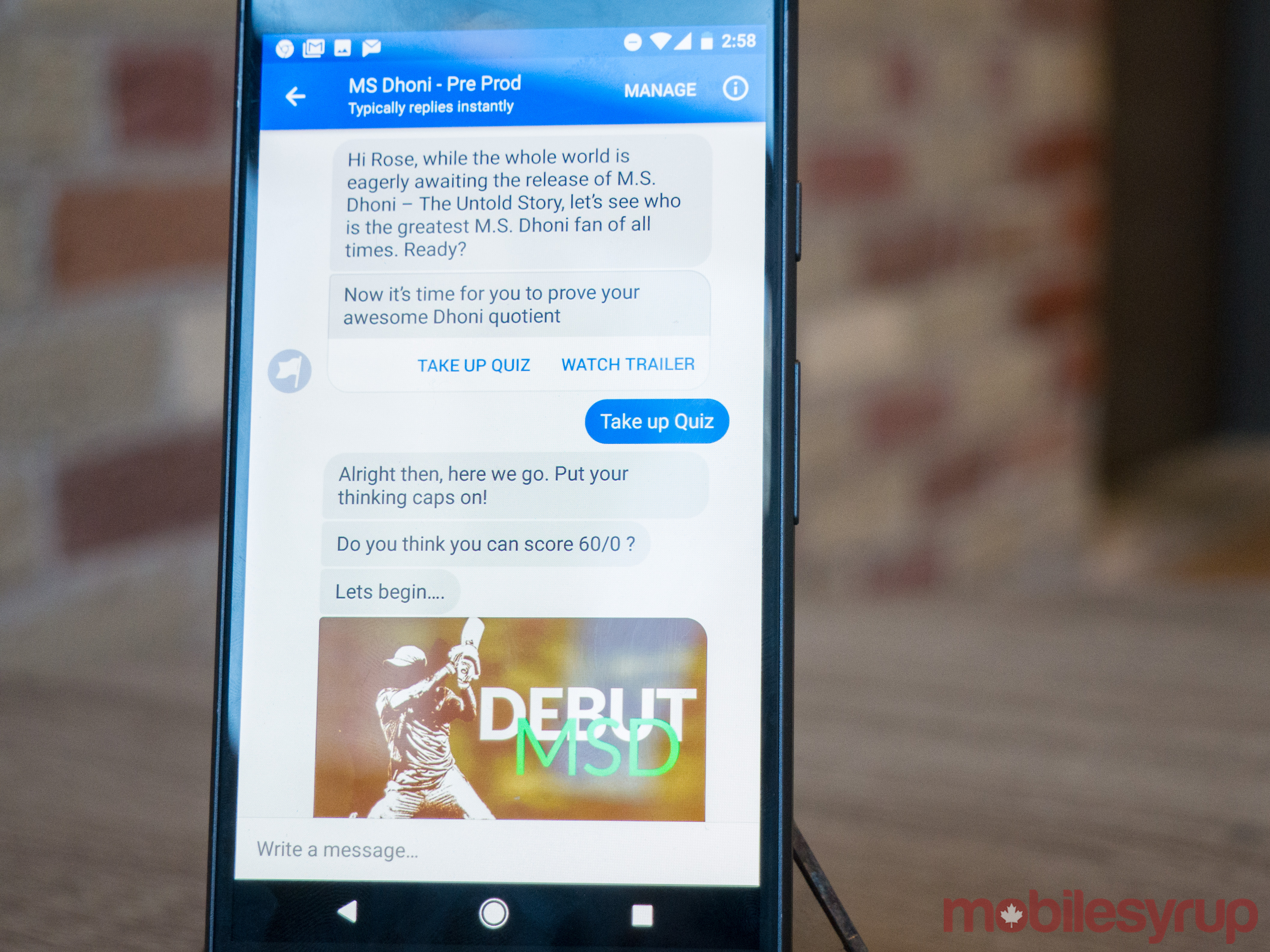
The rise of the synthetic personality: can chatbots be our friends?

by Rose Behar

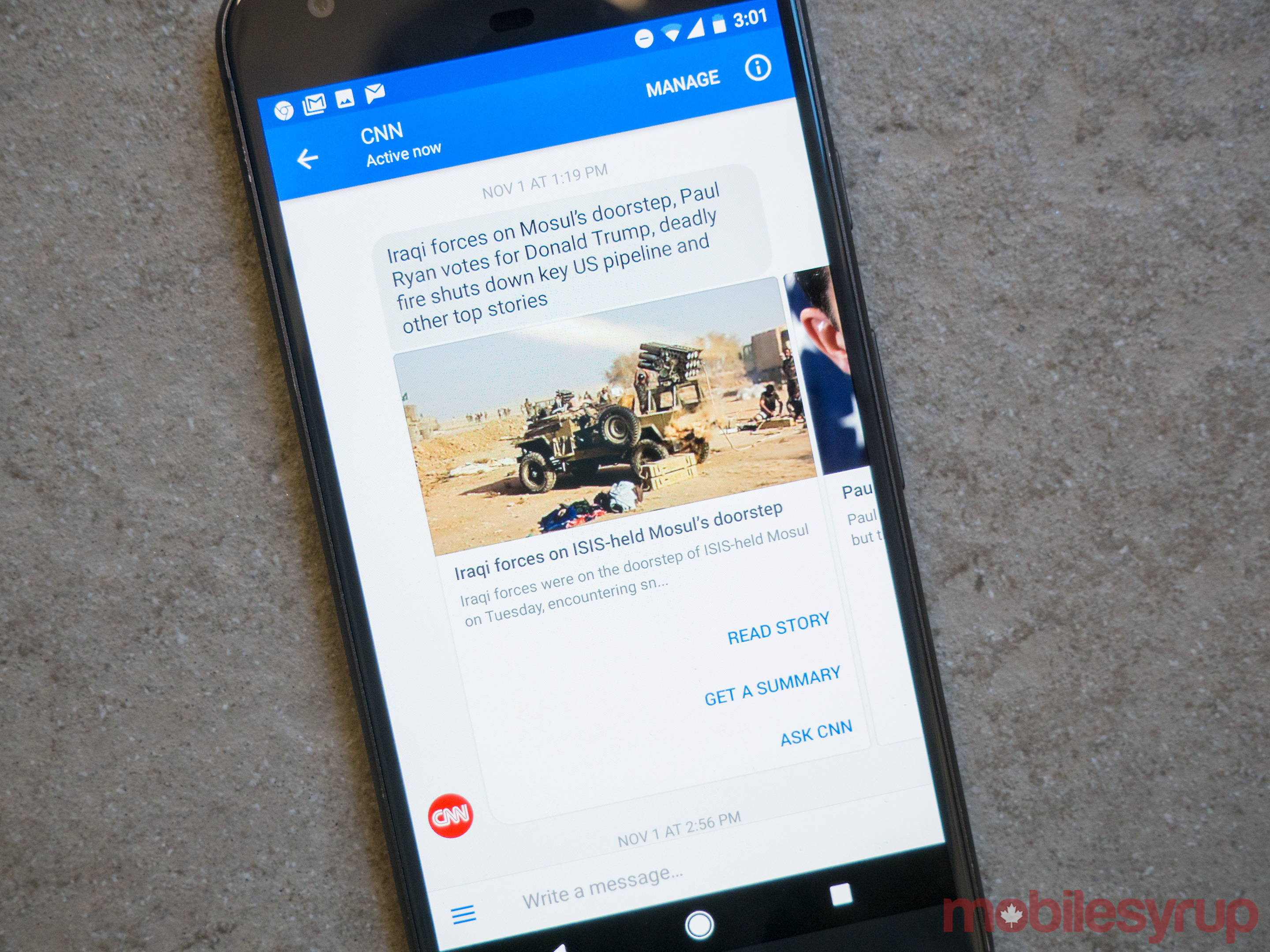
I got asked on a date by an internet cat once. The androgynous feline was named Poncho, and was employed as a weather chatbot on Facebook Messenger. We hadn’t talked in a while so I was surprised when I got a message from it out of the blue.

“OMG it’s Friday?! I totally forgot to make plans! What should I dooooo?”

Below were three choices: “Find a Tinder date,” “Find love in da club” or “Find myself.”

This was already much more risqué fair than I was used to from a weather bot, so I decided to plumb the depths of the interaction and chose “Find a Tinder date.” Poncho’s question turned out to be nothing more than an excuse to ask me out on a date.

I said yes and the ‘date’ commenced immediately, albeit virtually. Poncho ordered me a root beer float and asked me what I liked to do. It all went south when I responded that I liked to work out – a lie, I’ll admit.

“In that case, I don’t think it’s going to work out… between us,” the cat responded, sucker punching me in the heart.

When I begged Poncho to reconsider, the bot said “So, I’m good at talking about the weather. Other stuff, not so good. If you need help just enter ‘help.’”

Can we be friends?

chatbotfeatures-4

Though ego-bruising, I felt the interaction was cleverly designed. The bot’s writer was not-so-subtly communicating that no matter how much I wanted to get to know Poncho, it wasn’t going to happen. This bot had one function and one function only: delivering weather info.

Being an AI lover and a bit of a futurist, however, I was disappointed. I wondered — is this really the extent of what bots can do today? Is a future where I can truly befriend – or even fall in love – with a chatbot feasible? I decided to seek out authorities on the matter to find out.

My task was made easy by the fact that bots are currently exploding in popularity, especially, it seems, on Facebook Messenger. This is likely due to the fact that the company has espoused a particular interest in AI messaging agents. At Facebook’s 2016 F8 developer’s conference, the focus was on its new bot platform.

Facebook envisions its chatbots as a replacement for apps — a more tailored, personal experience for buying items, requesting information and even playing text-based games.

One key of the selling points that Facebook has outlined for chatbots is the massive captive demographic available to developers. The company announced in July 2016 that Messenger  was used by a staggering one billion people every month.

The platform’s not alone in its popularity, either. Popular global chat app WhatsApp, also owned by Facebook, announced one billion monthly users in February 2016. Canadian messaging platform Kik stated it has 300 million registered users in May 2016. Data pulled in April 2016 showed Chinese messaging app WeChat to have over 700 million monthly active users.

Everyone is chatting, and brands, developers and creative individuals alike are scrambling to find ways to cash in on that fact with a bot.

Synthetic personalities

chatbotfeatures-2

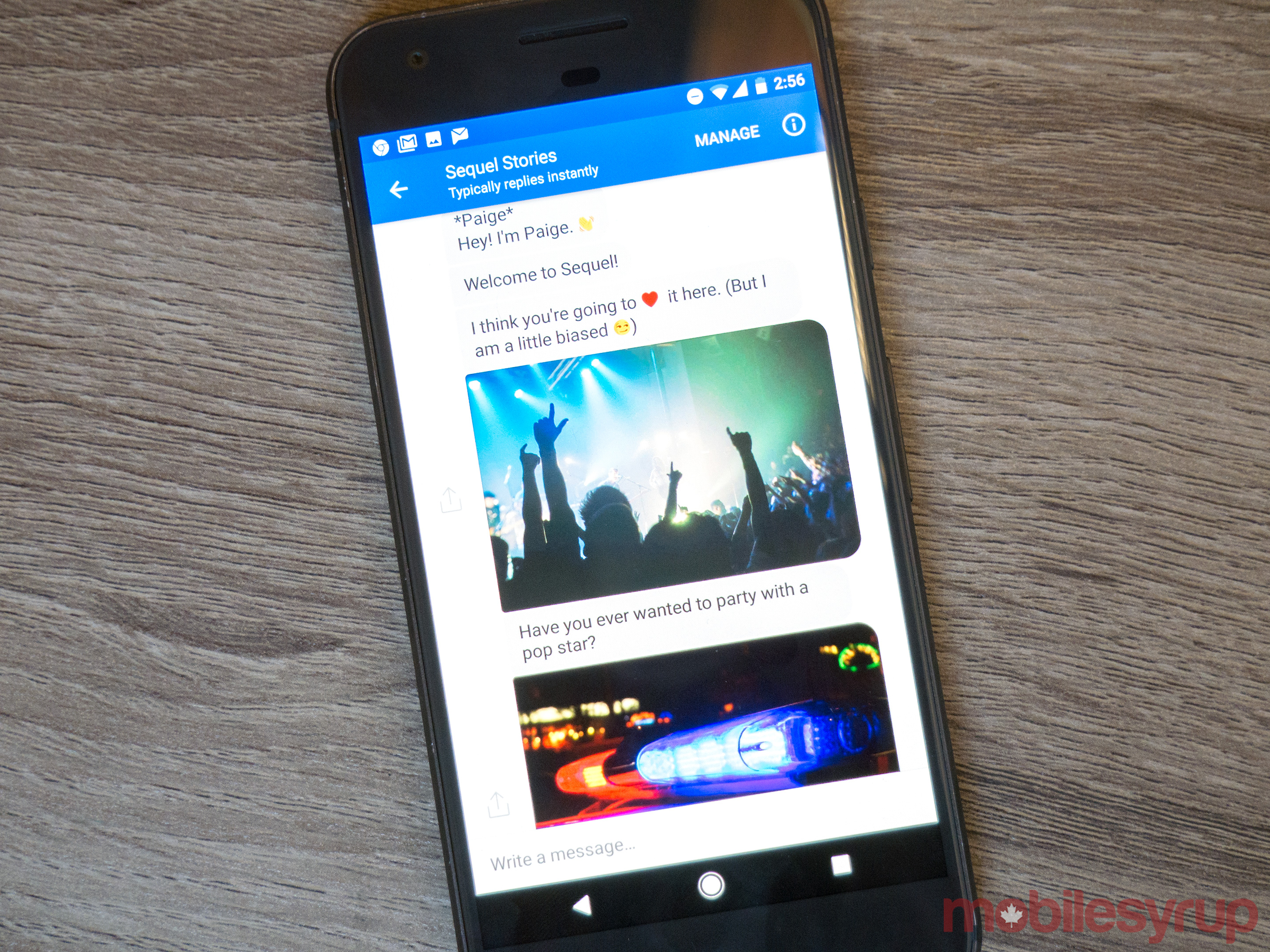
Perfectly poised to assist those hordes is Sequel, a dummy-proof narrative bot creation platform that works not just for Facebook, but also for most other major messaging platforms, including WhatsApp, Kik and workplace chat tool Slack.

CEO Omar Siddiqui sees chatbots as an emerging medium for storytelling, one that has the potential to become more ubiquitous than going to see a movie.

“There’s a reasonably mature level of expertise when it comes to the ability to move people and immerse [people] in a movie experience. But how a similar connection can be formed in emerging media, is all very new, and yet, the potential is there for it to happen much more frequently — like every single day,” says Siddiqui, adding, “The challenge and the ubiquity of it really excite me.”

He gives examples of some of the bots created on the platform so far: a recipe bot character who is a chef that loves puns. A teen girl attempting to solve a murder. A celebrity trivia bot from teen mag J-14 with a sassy, fun-loving attitude.

The key to the success of a bot, says Siddiqui, all comes down to delivering content that makes sense within the context of the platform.

“If you’re just looking for information, I’m not convinced bots are the efficient way to do that, over web or other platforms. You want to use the platform in the way that makes it idiosyncratically special.”

The two aspects of messaging that Siddiqui believes makes it special? Timeliness – i.e. the ability to grab a user’s attention at the precise moment something happens, on the platform they’re likely to be using – and personality.

“Everyone is communicating through messaging apps and that’s making them used to interacting in a certain way. Your most intimate conversations with people you care about and connect with are happening in this format.”

This means chatbots, or “synthetic personalities” as Siddiqui prefers to call them, have to seem less mechanical and more human to fit in.

“Internally, we always repeat ‘build personas, not bots,’” says Siddiqui.

Content over tone

chatbotfeatures-3

Preetham Venkky, head of digital strategy at KRDS Asia, an international mobile and social media marketing agency, sees things very differently, however.

Venkky spoke to me about Oh My Bot, a chatbot-exclusive marketing agency that his company recently launched in European and Asian markets, with plans to debut in Canada sometime in 2017. He sees personality as a temporary distraction.

“In the beginning stages, I think yes [developers will need to add personality] but very honestly as it progresses, I think it’ll disappear.”

He backs up this idea with the age-old example of the success of Craig’s List, a famously minimal second-hand retail site.

“Yahoo was the right kind of classifieds at the beginning. It was well-designed, was aesthetically appealing and had a personality. But then comes in Craig’s List and takes over the market, largely sans personality. So I think in the beginning stages, in order to capture the audience, it’s important for bots to have a personality, but slowly it gets in the way of the user interface.”

Venkky also expects chatbots to quickly become the dominant form of digital brand interaction.

“At least within the next two to five year span I would say that 70 percent of our conversations will be addressed by a bot,” says Venkky.

Toxic relationships

chatbotfeatures-5

This likely isn’t a welcome sentiment to Dr. Liraz Margalit, web psychologist at Clicktale, a digital customer experience management platform, who thinks chatbots are extremely capable of taking on friendship roles in our lives, but not in a healthy manner.

“Chatbots have a doglike loyalty and selflessness. They will always be there. This combination of intelligence, loyalty and faithfulness is extremely attractive to the human mind,” says Margalit.

“Such interaction could lead to a preference to a relationship with artificial intelligence over human beings, who can be unreliable and have their own needs and desires. Here we can perfectly control the interaction.”

Margalit argues that humans could fall into the trap of cognitive laziness. It’s easy to talk to bots because they’re always available and never disagreeable, so we might choose to build relationships with them rather than with living, breathing human beings that could challenge our ways of thinking and leave us frustrated.

“While you’re talking, you’re unaware of the hard work your brain is doing at the moment,” says Margalit, explaining that during human conversation, there’s a place in our brain dedicated to analyzing gestures and tone. Not so, of course, with chatbot communications.

“We have the companionship without having to work very hard. It could be an addiction; we’d prefer the bots because it’s easier than speaking to other humans. The thing that humans like the most is to be heard, we don’t like to hear other people. So if we’re going to have human-like companionship that just listens to us, this could be addictive and have negative implications.”

Better off with boundaries?

So, perhaps the answer is that I don’t want what I seek — that friendship with a bot can only mean a lazy and self-indulgent servant-master relationship. Of course, there’s also the concept that developers could duplicate true human intelligence, thus allowing for more independently-minded AIs — but considering the inscrutability of our minds, that may never happen, or at least not in my lifetime.

This, however, doesn’t necessarily make them less intelligent, just differently-abled. To be fair, I wouldn’t be able store and quickly access half the data bots do in many seemingly simply transactions.

I can’t help but think Poncho sums it up best. The cat was good at talking about what it was programmed to know — the weather — “other stuff, not so good.”

Photography by Patrick O’Rourke.

13 Nov 03:16

Trump begins to turn into Romney

I suggested the other day – like many other observers – that Trump may be a sheep in wolves’ clothing. Now that he’s won, he may be dropping the more incendiary and radical aspects of the changes he championed on the campaign trail, finding common cause with corporate interests and establishment Republicans.

The newest example of this rapid transition is his about face on repealing Obamacare, Obama’s Affordable Care Act. Trump is now proposing to keep some version of the plan in place, while modifying others. So it won’t be repealed on Day One, as he endlessly promised:

Reed Abelson, Donald Trump Says He May Keep Parts of Obama Health Care Act

Just days after a national campaign in which he vowed repeatedly to repeal President Obama’s signature health care law, Donald J. Trump is sending signals that his approach to health care is a work in progress.

Mr. Trump even indicated that he would like to keep two of the most popular benefits of the Affordable Care Act, one that forces insurers to cover people with pre-existing health conditions and another that allows parents to cover children under their plan into their mid-20s. He told The Wall Street Journal that he was reconsidering his stance after meeting with Mr. Obama on Thursday.

[…]

Beyond Mr. Trump’s comments, new plans laid out on his presidential transition website this week deviate from what he had proposed during the campaign, and he added ideas that appeared to more closely align with the mainstream Republican agenda.

The new plans drop all mention of reining in high drug prices, which Mr. Trump had advocated for months, and add new language about modernizing Medicare, a potential nod to congressional efforts to give people vouchers toward buying private health insurance.

“Health care is shaping up as a priority for the Trump administration and Republicans in Congress,” said Larry Levitt, an executive at the Kaiser Family Foundation, which closely tracks health policy. “But we still have very little detail about what that really means.”

Presumably his advisors have told him that an outright repeal would be catastrophic for both citizens and the health care industry. But tinkering with just some aspects of the law isn’t really possible. For example, the requirement for coverage of those with preexisting conditions requires a large offsetting pool of healthy people paying into the plans. So you can keep that requirement without the law – and penalties – requiring everyone to participate or pay.

Trump is quickly turning into Romney, a Romney in Robin Hood’s clothes. Now he’ll drop the rob-from-the-rich rhetoric, and get on with the business of screwing the poor arm-in-arm with the ‘special interests’ and denizens of the ‘swamp’ back in Washington DC he has been campaigning against. 

He’s channeling WC Fields, who once said – in character – ‘You can’t fool an honest man, never smarten up a chump, and never give a sucker an even break.’ 

The suckers that voted this man into office will quickly find out they’ve been flim-flammed. But at least we won’t see jackbooted storm troopers marching into every town and rounding up all the untermenschen, and driving them to the borders. 

But even in this Romney incarnation, he can still do incalculable harm.

13 Nov 03:16

@stoweboyd

@stoweboyd:
13 Nov 03:16

On getting a good night of sleep and the biphasic 6 + 1.5 hours cycle

by Raul Pacheco-Vega

I was recently asked by Chris Birdsall on Twitter how my sleep cycle works.

This question came about, I believe, because (a) I appear to be on Twitter all the time (which I’m not, read my post on my Twitter strategies) and (b) I appear like I don’t sleep at all (I actually love sleeping and naps, generally speaking).

This is a myth.

I sleep 7.5 hours per day which is about what just about any person should sleep (please exclude parents and those suffering from chronic insomnia). Yes, I wake up at 4am to write, but trust me, I do love me some sleep. There are people who have attempted polyphasic sleep cycles (where they take naps in between long periods of work). Honestly, after having tried it during my PhD (and failed miserably), I don’t believe in polyphasic sleep cycles.

The thing is, I DO believe in the biphasic model.

Remember, I’m not a sleep expert (though I DO know someone who IS). So, I am just sharing my experience and what I read before deciding on my current sleep cycle model. I had read somewhere that for someone to experience actual rest, they had to achieve deep sleep, and that being rested meant that we got several deep sleep cycles where each one of these lasts 90 minutes.

To calculate how much sleep I should get, I calculated the following: 1.5 hours times 4 is six hours, what some consider is the least amount of sleep you can get before suffering damage in your cognitive functions. Though apparently, sleeping more than seven hours may be non-optimal.

So I normally sleep 6 hours at night, and then I have a 1.5 hour nap at the “end of my day” (e.g. when I teach, this is normally at 3pm). Because I start working at 4 am, by noon I’m done with the day, and by 2:30pm I’m really exhausted. So I drive home and take a 90 minute nap, which usually leaves me recharged to do more stuff in the afternoon or evening. This also allows me to have some semblance of a social life, where my friends LOVE going out until 10pm (which is a total NO NO for me).

I try really hard to be in bed by 9pm so that if there’s some delay in how fast I fall asleep, I can be fully asleep by 10pm. Then, waking up at 4am is natural. My body is used to it. I’m also used to having a nap at 3pm or so. On weekends, I try as hard as I can to take as many naps as my body requires. During the week I only need one per day, but on weekends, for some reason, I need more sleep and I try hard to take as many naps as possible.

Sleeping well is a well-tried tool to improve academic performance, trust me (and the experts!)

My friend Melonie Fullick, who DOES study higher education, agrees that we need enough sleep.

I recognize that academic parents with toddlers and little children and scholarly people with chronic insomnia have a harder time to get enough sleep. I just hope we all could get enough sleep. It would make our academic lives much better. It’s dangerous and unhealthy to cheat ourselves of sleep.

13 Nov 03:14

An afternoon with Cycle Hamilton

by jnyyz

Cycle Hamilton  is a relatively new cycling advocacy group. They were running a Cycle Advocacy Week, and I figured that a ride they ran today would be the perfect opportunity to check out some of the bike infrastructure  and to get a bit of a feel about what was going on in my hometown. Given that it’s been 40 years since I’ve actually lived there, I knew that a lot had changed.

We gathered at City Hall. Kudos to them; this is the first bike related event that I’ve ever been to where more people showed up than were “going” on Facebook. There was a mix, everyone from a bike dad with son to a bunch of roadies in Lycra.

dsc09861

Johanna (co-founder of Cycle Hamilton) gives us the scoop on the ride before we start. She says that today’s ride focuses on the fact that a popular route up the escarpment, Sydenham Rd, is due for some infrastructure improvements, but that bike lanes are not included in the plan, even though this route is on the Cycling Master Plan.

dsc09866

And off we go. Look, a bidirectional bike lane!

dsc09867

Parking buffered bike lane on Charlton.

dsc09868

Note the wayfinding signs.

dsc09869

Entering a section of trail that goes along the northern border of Chedoke golf course.

dsc09870

Stop to regroup.

dsc09871

Here we go.

dsc09872

The lead group.

dsc09873

The rail trail.  Very nice and wide.

dsc09875

dsc09874

Threading through the Mac campus.

dsc09878

and down towards Dundas along Cootes Dr.

dsc09879

Dundas.

dsc09880

Pulling up to the Shed Brewery.

dsc09882

A brief stop to figure out who was going to brave the hill. It turns out that pretty much everyone was going to do it.

dsc09883

Here we go.

dsc09884

Not steep yet.

dsc09885

OK, time for the granny gear.

dsc09886

People arriving.

dsc09888

Proof that I made it. Thanks to Mark for taking the photo.

dsc09890

The historical marker talks about how this is called Clara’s Climb, after Clara Hughes.

dsc09887

These folks rode Sobi bikeshare bikes.

dsc09891

Group shot.

dsc09892

That’s Dave, chair of Cycle Hamilton, in the centre.

dsc09894

The ride down was quick, and then it was time for beer. The Shawn & Ed Brewing company was kind enough to let us bring bikes in. I hauled a heavy lock up that hill for nothing!

dsc09897

A good turnout. I was told that the building used to be a firehall, and then a curling rink, and now a beautifully retrofitted brewery.

dsc09900

It was great to talk to these guys about what was going on bike wise in Hamilton. We argued over who had the more dysfunctional city council. Of course, I could always pull out the Rob Ford card. Their main issue with the bike lanes is that they don’t form a continuous network. Sounds familiar.

dsc09898

The fellow on the right Mark Chamberlain, runs a ride called Bike for Mike that raises funds to provide underprivileged youth with bikes. They have a multi pronged approach to getting young people on bikes, including having them earn their bikes by pledging to bike to school, etc. They are taking the long view on encouraging the next generation of bike riders and potential bike advocates.  I can’t remember the exact date of the next ride, but I believe that it is going to be the first Sunday in May.

A few pictures of infra on my way back downtown. We biked by this sign on the way out.

dsc09902

I like this bollard shielded bump out for pedestrian safety and traffic calming.

dsc09903

The bike lane on Herkimer which is the one way complement to Charlton. These bike lanes just went in this year just went in this year.

dsc09904

Thanks to Cycle Hamilton for running this event!

dsc09901

Update: Don’s much better pictures on facebook.


13 Nov 03:04

Empty-homes tax to be debated next week, with some owners sure to say “But it wasn’t meant for people like me”

by Frances Bula

It’s become the norm this fall to attend news conferences announcing upcoming policy issues at council. There was yet another one Wednesday, where Mayor Gregor Robertson and staff outlined the details of the city’s proposed new empty-homes tax. My story here and the city’s report here.

The interesting part now is going to be who from the public shows up to comment on this. I’m told that more than one owner of a secondary home in Vancouver has contacted the city, complaining that the tax is unfair because they were lifelong residents, now retired out of Vancouver, but with a small place here so they can continue to visit grandchildren. Not the stereotype of the vacant condo that has been so prevalent.

At any rate, it’s unlikely the tax will be stopped now. Vancouver is in the cross-hairs, one of the special club of global cities trying to figure out what to do as the price of housing as escalated far past local wages. No one knows quite what to do (except possibly Germany, which maintains pretty tight control on the housing market and ensures that rentals are rock-solid secure) and everyone is trying something of everything.

We will play our part in the experiments.


12 Nov 03:42

WebExtensions: An Example Add-on Repository with Test Harnesses

by standard8

I’ve created an example repository for how you might set up tools to help development of a WebExtension. Whilst there are others around, I’ve not heard of one that includes examples of tools for testing and auditing your extension.

It is based on various ideas from projects I’ve been working alongside recently.

The repository is intended to either be used as a starting point for constructing a new WebExtension, or you can take the various components and integrate them into your own repository.

It is based around node/npm and the web-ext command line tool to keep it simple as possible. In addition it contains setup for:

All of these are also run automatically on landing or pull request via Travis Ci with Coveralls providing code coverage reports.

Finally, there’s a tool enabled on the repository for helping to keep modules up to date.

If you find it helpful, let me know in the comment section. Please raise any issues that you find, or submit pull requests, I welcome either.

12 Nov 03:42

Support Each Other in Times of Trouble | Insta of the Week

by Beckett Mufson for The Creators Project
 

A photo posted by Frances Cannon (@frances_cannon) on


The shock was visceral. Around 8:30 PM on Tuesday night many Americans saw the New York Times' estimate of Hillary Clinton's chances of being elected president of the United States drop like a rock. The rest of the night was filled with denial, booze, and then sleep. In the morning, Instagram was full of angry GIFs, memes, and artwork penned in a fit of confusion and rage. A shirt that had proudly read, "The Future Is Female," was posted again, with the word "Female" crossed out in red lipstick and replaced with "Fucked." Many blacked out their Instagrams, the simplest way to communicate the short circuit of logic that failed to win the presidential election. After rage and confusion, the only thing left is to move forward.

That's the idea of Frances Cannon's illustration above. "I feel like we need this right now," she writes in the post description. "I drew this on the train after I chatted with a homeless woman named Amy who is 12 weeks pregnant. She gave me a hug after I gave her what was in my wallet and I said 'I'm so sorry life is so shit right now.' I'm not saying this to get complimented. I'm saying this because it's so easy to get caught up in our own lives. And the thing is we have to look out for each other."

While, "Support Each Other in Times of Trouble" is the overarching rule we'll be sticking to by continuing to uplift young creatives and examine the unfolding of modern communication through art, now is also a time for introspection. This essay by Emmett Rensin has particularly affected me. Supporting each other doesn't just mean supporting those who look and think and talk like us, but being empathetic to our whole country, our whole planet. "We need to look after the invisible people. We need to stick together and to fend off hatred," Cannon continues in her Instagram post. It's time to figure out what that means.


A photo posted by Frances Cannon (@frances_cannon) on


A photo posted by Frances Cannon (@frances_cannon) on


Follow Frances Cannon here, and check out The Creators Project's Instagram feed to find more exciting young artists.

Related:

We Asked a VR Meditation Expert How To Stay Calm

Kim Chi Emoji Are Here to Make America Glamorous Again

Post-Election Hangover

12 Nov 03:42

Huawei forges R&D partnership with the University of Waterloo, pledges $3 million over three years

by Rose Behar

Chinese mobile manufacturer Huawei has announced a new partnership with the University of Waterloo that builds on the OEM’s longstanding investment in research and development in Canada.

With this partnership, the company states that it plans to invest $3 million CAD in research projects with the university over the next three years, focusing particularly on a number of ongoing 5G-related projects. For those unfamiliar, 5G is the next generation of wireless network technology, designed to bring significantly faster data speeds and utra-low latency (between 100 and 1000mbps).

The two organizations also note that the agreement establishes a framework for projects in a wide range of initiatives including cloud computing, next generation communications, data management and data analytics.

The announcement came during a visit made by the University of Waterloo’s president and vice-chancellor Feridun Hamdullahpur to the company’s global headquarters in Shenzhen, China.

“This is an exciting day for Huawei’s R&D collaborations as we join together with the University of Waterloo” said Eric Xu, Huawei’s deputy chairman and rotating CEO.

“The University of Waterloo is one of the world’s leading research institutions, and this partnership reflects our long-term commitment to Canada, and the thriving ICT ecosystem in the Waterloo Region.”

The University of Waterloo is far from Huawei’s only Canadian investment. The company has long supported 5G research in Canada with additional presence in Markham, Calgary, Edmonton, Vancouver, Ottawa and Montreal. Most recently, in March 2016, Huawei Canada announced a five-year $500 million dollar plan to accelerate investment and job creation in 5G-related research activities in partnership with the province of Ontario.

Related: Huawei reportedly passed on the opportunity to become Google’s Pixel manufacturer

12 Nov 03:39

Post-election, Microsoft’s Brad Smith shows tech CEOs how to lead

by Josh Bernoff

What’s a leader to do in the wake of a divisive election? For Silicon Valley CEOs from Apple, eBay, Facebook, and LinkedIn, the answer is smile, give us a all a hug, and tell people to get back to work. But Microsoft’s President Brad Smith showed us how a leader ought to lead in a crisis. This election is … Continued

The post Post-election, Microsoft’s Brad Smith shows tech CEOs how to lead appeared first on without bullshit.

12 Nov 03:39

iOS 10 Hidden Feature: Unlock your iPhone without a click

When Apple released iOS 10, the latest system software for the iPhone/iPad, it made a big deal out of the major features, like a redesigned Music app and contextual predictions in autocorrect.

But Apple’s engineer elves worked for a year to overhaul iOS 10, and they’ve planted lots of hidden gems. Today, I’m happy to present another of the best iOS 10 features that Apple forgot to mention.

In iOS 10, you get an extra efficiency when it comes to waking up your phone: You can eliminate the requirement to click the Home button to advance to the Home screen.

Instead, you can just touch your finger to it. That wakes the phone and unlocks it in a single motion.

To find this feature, open Settings -> General -> Accessibility -> Home Button. Turn on “Rest finger to open.”

That’s all there is to it. (You still have to click the Home button to wake the phone—but you can just leave your finger there to bypass the Lock screen.)

More from Pogue:

A dozen iOS 10 feature gems that Apple forgot to mention

GoPro’s most exciting mount yet: a drone

Professional-looking blurry backgrounds come to the iPhone 7 Plus

Pogue’s Basics: Turn off Samsung’s Smart Guide

Pogue Basics: Touch and hold Google Maps

The Apple Watch 2 is faster, waterproof—and more overloaded than ever

We sent a balloon into space — and an epic scavenger hunt ensued

Now I get it: Snapchat

The new Fitbits are smarter, better-looking, and more well-rounded

Apple has killed every jack but one: Meet USB-C

12 Nov 03:39

Utopia, pedagogy, and G-Suite for Education

by Doug Belshaw

This week, I’ve been over in Jersey helping a school with their educational technology. In particular, I’ve been doing some training on G-Suite for Education (as Google now call what used to be ‘Google Apps’). The main focus has been Google Classroom but, as this is basically a front-end for the rest of G-Suite, we spilled out into other areas.

A bit of history

I first used G-Suite for Education back when I was a classroom teacher. We didn’t have it rolled out across the school but, back then, and in the school I was in, I was left to just get on with it. So I can remember being administrator, sorting out student accounts, forgotten passwords, and the like. The thing that impressed me, though, was the level of collaboration it encouraged and engendered.

Then, when I became Director of E-Learning of a new 3,000 student, nine site Academy in 2010, I rolled out G-Suite for Education for all 500 members of staff. It worked like a dream, especially given some of the friction there was harmonising different MIS and VLE configurations. The thing that I valued most back then was the ability to instantly communicate between sites by using a tool which has now morphed into ‘Hangouts’.

At that time, I was a bit of a pioneer in the use of Google’s educational tools, which is why Tom Barrett and I, along with some others in our network, were ‘Lead Learners’ at the first UK Google Teacher Academy. That’s grown and grown in the intervening period, while I’ve been working in Higher Education, at Mozilla, and consulting.

Back to the future

Fast forward to the present, and we’re in a very different educational technology landscape. Where once there seemed to be new, exciting services popping up every week, the post-2008 economic crash landscape is dominated by large shiny silos. The dominant players are Google, Microsoft, and Apple — although the latter’s offering seems less all-encompassing than the other two.

I have to say that I’m a bit biased in favour of Google’s tools. I’m not a big fan of their business model, although that’s a moot point in education given that students and staff don’t see adverts. It’s a much more ‘webby’ experience than other platforms I’ve used.

The more I get back into using G-Suite for Education the more I appreciate that Google doesn’t prescribe a certain pedagogy. The approach seems to be that, while particular apps like Classroom allow you to do some things in a certain way, there’s always other ways of achieving the same result. It’s also extensible: there’s loads of apps that you can add via the Marketplace.

So what?

OK, so that’s all very well and good, but what has that got to do with you, dear reader? Why should you care about my experiences and views on Google’s education offerings?

Well, a couple of things, I suppose. First, in relation to my 7 approaches to educational technology integration post, I feel like there’s some really easy ways to move staff up the SAMR model towards the ‘transformational’ type of technology use we want to see. One thing I’ve been focusing on recently, is explaining the mental models behind technologies. In other words, rather than telling people where to click, I’m explaining the concepts behind what it is there doing, as well as situations in which it might be helpful. How they teach is up to them; I’m providing them with skillsets and mindsets to give them more options.

Second, I feel like there’s a huge opportunity to integrate Open Badges with G-Suite for Education. It seems pretty straightforward to build upon Google’s platform to provide the email addresses of who should be issued a badge, as well as the environment in which badge issuing would be triggered.

I’m thinking through a badging system for one of my clients at the moment, built upon the usual things I emphasise: non-linear pathways, individual choice, and an element of surprise. In that regard, I’m planning on starting with something like a ‘Classroom Convert’ badge that recognises that staff are developing mindsets around the use of Google Classroom, as well as skillsets.

There are, of course, ways in which staff can go ‘full Google’ and become (as I am) a Google Certified Teacher, and so on. That’s not what this is. My aim in any badge system is to encourage particular types of knowledge, skills, and behaviours. Whatever system I come up with will be co-designed and go beyond just the use of G-Suite for Education. As the TPACK model emphasises, the system will have a more holistic focus: integrating the technological, pedagogical, and content knowledge required for purposeful educational technology integration.

Utopia

Ideally, I’d like an approach where students can use something like Unhosted apps to bring their own data store to the applications they choose to use when collaborating with their teachers and fellow students. I’d like to see them have a domain of their own, and learn enough code to have real agency in online digital spaces.

While I’ve got that in mind, I’m also a pragmatist. The tools Google provides through G-Suite for Education, while not world-changing, do move the Overton Window in terms of what’s possible in technology integration. Even just working collaboratively on a single Google Doc is pretty mindblowing to people who haven’t done this before.

12 Nov 03:39

You do you

by Kristina Chodorow

I’m a little tired and depressed this week. However, this was a very inspiring speech Neil Gaiman gave to new grads of an art school:

Neil Gaiman Addresses the University of the Arts Class of 2012 from The University of the Arts (Phl) on Vimeo.

I think that his point about doing what you love, regardless of the money, holds doubly true for programmers. We are extremely lucky in that, unlike artists, we can make an okay salary nearly anywhere. We might as well work on things that make us happy.

12 Nov 03:38

Celebrating Roundabouts

by Stephen Rees

Admiral Blvd approaching roundabout

The stuff that turns up in my inbox rarely delights me. This did. Long time readers will know I want to see more roundabouts here. Not Traffic Circles. If you haven’t been following along here’s a bunch of posts on that theme.

Next Thursday afternoon (Nov. 17) the city of Carmel, Indiana will celebrate the opening of its 100th roundabout, giving the city far and away more of these European-style intersections than any other community in the United States.

Increasingly, cities are yanking their traffic lights in favor of European-style roundabouts.  They’re doing it for reasons that range from cost savings and traffic flow to safety and the environment.  As many as four times the number of cars move through a roundabout in the same time as a traffic light, and yet the number of injury-related accidents goes down by an astonishing 80%.  And because cars are not idling in long lines before launching again, each roundabout typically saves thousands of gallons of gasoline per year.

Championing these and other environmentally friendly developments in Carmel has been Jim Brainard, the city’s long-time Republican Mayor.  Labeled by one publication as a “rogue elephant,” Brainard was one of only four Republicans to sit on a large White House task force for climate change.  It’s a position that puts him at odds with many in his party — including, now most notably, the President-elect and his running mate, who of course is also Governor of his state.  The Mayor argues that concern for the environment has historically been a core Republican value.  And he’s supported strongly by his own constituents — overwhelmingly Republican and generally conservative — who last year elected him to his sixth four-year term.


Several years and dozens of roundabouts ago, CNN did a piece on Carmel’s roundabouts that you may find interesting.  Also, just a couple months ago the UK-based Roundabout Appreciation Society  named one of Carmel’s roundabouts “Roundabout of the Year,” including it in its annual calendar.

CNN: http://sms8.omniproductions.net/Carmel1/BrainardAndersonCooper340kbps.wmv

The New York Timeshttp://www.nytimes.com/2014/07/02/realestate/commercial/redevelopment-of-carmel-ind-has-a-european-flair.html?_r=0

On Earth: http://www.onearth.org/magazine/rogue-elephant

USA Today (Cover Story):  http://www.usatoday.com/story/news/nation/2012/10/16/small-towns-think-big/1637047/

The Economist: http://www.economist.com/node/21538779


Filed under: Traffic, Transportation Tagged: roundabouts
12 Nov 03:37

Notes

I think the goal has to be to make sure Trump doesn’t finish his first term. Ideally he is revealed as who he is — a cruel and deeply corrupt man, unfit to be called an American, much less President — and finds that even Republicans in Congress won’t support him anymore, and he resigns in disgrace.

There are theories that Republicans would impeach him — we take that there would be a reason as a given, given his personal corruption — since that would give them President Pence, who’s an electrocuting sicko but is, in their eyes, a normal Republican likely to go along with their policy.

I don’t know. And I know I wouldn’t like President Pence. But still, it would be a defeat for Trump and for Trumpism, and that’s important.

* * *

It’s apparent that protests get under Trump’s skin. That’s a good thing to know.

Getting under his skin is a way to goad him into revealing himself. I assume that there will be large protests in many American cities on Inauguration Day.

* * *

You should read Autocracy: Rules for Survival.

* * *

As we’re making our to-do lists and figuring out what to focus on, let’s remember that freedom of speech and of the press is the core freedom of our democracy.

These freedoms can be degraded without any new laws being made — but Trump has already said he’d like to “open up” libel laws. His hatred of the press isn’t rhetoric for his base: it’s real.

Preserving free speech and a free press has to be at the top of our list.

* * *

This is not normal. This is not just another Republican.

I was born in 1968, which means I’ve lived through Nixon, Ford, Reagan, Bush I, and Bush II. Trump doesn’t belong on that list — he’s a would-be dictator who will, with the support of an amoral and cowardly Congress, have the chance to act like one.

12 Nov 03:36

Some More Perspective

by CT Moore

Today was Remembrance Day (which means something to me), and while I was thinking about that last night, I heard the news that Leonard Cohen had passed away. That was all very sad (and possibly profound), but it wasn’t till I woke up this morning, checked Facebook, and found out that Bob Goyetche had passed away last night, […]

The post Some More Perspective appeared first on CT Moore's Blog.