Rolandt
Shared posts
17 Nov 02:31
No Airpods for Xmas?
by Volker Weber

My expectations was that Airpods would be the hottest Xmas item. However, Apple has delayed the launch and everything that is not available at Black Friday misses the holiday season. It's a hard decision, but also one that Sonos has made time and again. Don't ship shit!
17 Nov 02:28


Download our Strategic Community Management Templates
by Richard Millington
Salesforce has sponsored each of you with access to our Strategic Community Management templates.
This means you can now download our full set of strategic community management templates for free.
You can work on these solo or share these with your team. The goal of the templates is to force you to think strategically about the work you do.
To download the template, click here.
Thanks to Salesforce Community Cloud for making this possible.
p.s. You can get a $207 discount to our SCM program if you sign up by Friday 18th November.
17 Nov 02:28
Samsung – Empty horse
by windsorr

There are no Greeks hiding in the wooden horse of Harman.
- Samsung’s acquisition of Harman is about increasing its penetration of the automobile rather than offering a sneaky challenge to the car industry.
- Samsung has announced that it will acquire 100% of Harman International Industries for KRW9.3bn / US$8.02bn in cash with the deal expected to close in Q3 2017.
- Harman is a well-known Tier 1 automotive components supplier with 65% of its $7bn in revenues coming from the automotive industry.
- Its particular area of strength is in audio, electronics and infotainment systems which are already present in 30m vehicles worldwide.
- I see this deal benefiting Samsung in two ways.
- First – Verticalisation. Samsung will have more internal demand for its components as well as a large, new in-house customer for its foundry, Samsung LSI.
- Furthermore, there will be an opportunity for improved integration between hardware and software which should improve the performance of Harman’s products.
- Second – Customer access. Harman has strong relationships with almost every car maker which will give Samsung an avenue through which to sell its other products such as semiconductors and displays to the automotive industry.
- I do not think for one minute that acquisition is about Samsung building its own car or about Samsung extending its own digital ecosystem into the car.
- Consequently, I do not see this deal as threatening for the automotive industry but it is a threat for suppliers of Harman who now may lose out to the in-house supplier and to Harman’s competitors who may have a tougher time going forward.
- Apple’s realignment of its automotive experiment (see here) is a strong indication of how it is not a good idea for a tech company to start making cars and I do not think that Samsung ever had any intention of following Apple down this road.
- Most importantly, Samsung does not represent the same threat to automotive brands that Apple and Google do, as it long ago gave up trying to compete in the ecosystem.
- This means that Samsung will not be intending to ensure that its services (perhaps with the exception of Viv (see here)) and its brand are front and centre in automotive infotainment units and it will not be extracting any data.
- Consequently, I think Samsung simply aims to extend its strategy of selling electronics at huge scale and thereby earning a much better return than its competitors.
- This deal positions it well to meaningfully increase its penetration in the automobile as it becomes increasingly driven by electronics and increasingly autonomous.
- Samsung has realised that software and services is difficult and with every move that Samsung makes I see it increasingly leaving this piece to others such as Google.
- Hence, I think the automakers can rest more easily when it comes to Samsung and continue to put their attention on ensuring that Apple and Google do not steal the relationship they are trying to build with the end customer.
17 Nov 02:28
Stuff that works :: iPhone 7 Plus, Logitech K780, PLT BackBeat Pro 2
by Volker Weber
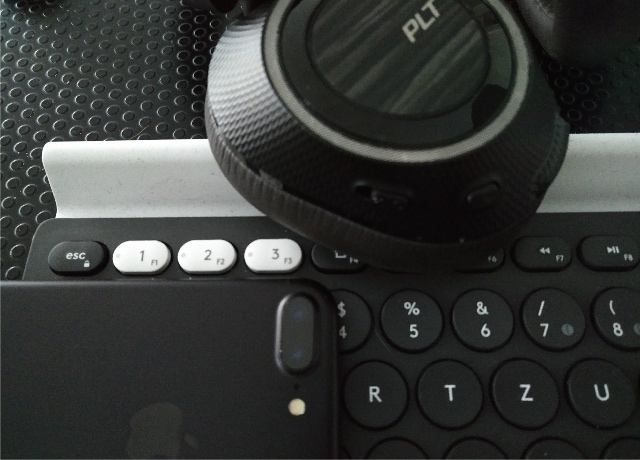
There is a lot of hardware coming and going at vowe's magic flying circus. There is stuff that works, there is stuff that doesn't. And then there is stuff that gets used. Every. Single. Day.
- It's kind of boring to even mention it. But Apple iPhone 7 Plus just kills it. Like the previous three models: 5S, 6 Plus, 6S Plus. When you have one of those, you may be tempted by other phones. Like I was by the Samsung S6 edge. In the end, you just keep using the iPhone. The 7 Plus gave me the telephoto lens that I needed the Olloclip ActiveLens for. Never missed the headphone jack. Still need the Silicone Case in Midnight Blue or Cocoa. Or Product(RED).
- The iPad Pro sits on a Logitech Base where it is being charged and displays the Fliqlo clock. Which I also use as a "screensaver" on Mac. When I type longer texts, I drop it on the K780 keyboard. Ever since I had it, it never left my table. It's both pretty and functional. I use the same keyboard for iPhone and BlackBerry. For traveling, I use another Logitech product: Create is an excellent folio keyboard that protects the iPad Pro and also stores the pen.
- I have only had the Plantronics BackBeat Pro 2 for two weeks, but I have used it every single day. I find it very comfortable and I love the sound. Battery life is outstanding. As is the range. So far I have not discovered anything that would bother me. It's an overall improvement over the previous BackBeat Pro.
Hidden in that list are two more products that works for me every single day: iPad Pro 9.7 and Apple Pencil. :-)
17 Nov 02:27
Twitter Favorites: [ReneeStephen] I just called HTTP Headers "webpage hats." I think it's time for a nap.

17 Nov 02:27

Design Talk 22. Agile marketing; Roland Smart, VP, Social & Community Marketing, Oracle
by Marek Pawlowski
Agile has become the de-facto approach to rapid, user-centred product development. However, it is not just for coders. In fact, Agile is at its most effective when product management and marketing work in the same rhythm. In this episode, hosts Marek Pawlowski and Alex Guest are joined by Roland Smart, author of ‘The Agile Marketer’ and someone who has seen these practices first-hand on the agency side with pioneering UX consultancy Adaptive Path and now client-side with Oracle, one of the world’s largest software companies. The episode explores the diverse ways in which marketers’ knowledge of existing users, and potential customers, can be integrated with design process.
On this edition
- Marek Pawlowski, co-host & founder of MEX (@marekpawlowski)
- Alex Guest, co-host & CEO of Zingy.life (@alexguest)
- Roland Smart, VP of Social & Community Marketing, Oracle; author of ‘The Agile Marketer‘ (@rsmartly)
Links
- Jascha Kaykas-Wolff, SVP of Marketing & Customer Success at Roland’s former company Involver. Also interviewed on The Marketing Agility podcast in this episode.
- The Agile Marketing blog & Marketing Agility podcast
- Roland’s book, The Agile Marketer
- Roland’s video on why Agile is important for marketing
- Adaptive Path, where Roland used to work
- MEX article about Capital One’s acquisition of Adaptive Path
- New York Times article on ‘What Google Learned From Its Quest to Build the Perfect Team‘, mentioned by Roland
- Roland’s blog post ‘A Brilliant Team Building Lego Exercise’
- Patrizia Bertini, Lego Serious Play facilitator
- Artefact’s Design Maturity survey and initial results, mentioned by Marek
- Myers Briggs test
- The Agile Manifesto
- Pair programming, an Agile technique of the ‘pilot’ and ‘navigator’ working together
- Pivotal, a company Roland worked with during his time at Involver
- Beyond Budgeting, the book by Bjarte Bogsnes, mentioned by Roland
About MEX Design Talk & how to get in touch
The podcast for the MEX community, interviewing UX pioneers, exploring emerging technologies, user behaviour and how to design better digital experiences.
- Archive of previous MEX Design Talk episodes
- Subscribe for future editions by searching ‘MEX Design Talk’ in your favourite podcast player. We’re also on iTunes and SoundCloud. For the old school, here’s our RSS feed
- If you enjoy MEX Design Talk, please help others discover the podcast by giving us a 5 star rating and a review on iTunes
- Get in touch with feedback and questions @mexfeed on Twitter or email designtalk@mobileuserexperience.com.
- MEX events
- MEX journal
Thanks
- Jukedeck, for the artificial intelligence engine which provided the music
17 Nov 02:27

Super Mario Run Launching on December 15
by Federico Viticci
With a press release issued this morning, Nintendo has announced that Super Mario Run – the company's first Mario game for iOS devices revealed at Apple's September event – will be released in one month, on December 15.
From the press release:
The first-ever mobile game featuring the most iconic video game hero of all time goes on sale for iPhone and iPad on Dec. 15 in United States time zones. Super Mario Run can be downloaded from the App Store at no cost, and players can try elements of the game’s three modes for free.
“The wait is almost over for a Super Mario game that can be played on mobile devices,” said Doug Bowser, Nintendo of America’s Senior Vice President of Sales and Marketing. “Developed under the direction of Mario creator Shigeru Miyamoto,Super Mario Run brings a new take on the series’ beloved action-platforming gameplay to iPhone and iPad for the first time.”
Super Mario Run will be available in 151 countries next month, and it'll be a free download from the App Store. A single $9.99 In-App Purchase will unlock all three game modes, which we previously detailed in our overview of Super Mario Run.
Super Mario Run will be modeled after the tradition of "endless runner" games for iOS that can be controlled with one hand by tapping on the screen to make Mario jump.
Update: You can watch a new gameplay video of Super Mario Run below.
Support MacStories Directly
Club MacStories offers exclusive access to extra MacStories content, delivered every week; it’s also a way to support us directly.
Club MacStories will help you discover the best apps for your devices and get the most out of your iPhone, iPad, and Mac. Plus, it’s made in Italy.
Join Now
16 Nov 02:45
Here are all the apps that support the 2016 MacBook Pro’s Touch Bar and Touch ID
by Patrick O'Rourke
Whether or not you think the 2016 MacBook Pro’s new Touch Bar is useful or not, the controversial USB-C utilizing laptop is here.
While the utility of the Touch Bar is questionable, there are already a number of apps that support the interesting new technology, with Apple claiming that many more are on the way, both from itself and third-party developers. Some utilize quick shortcut buttons, sliders and other simple functions, all changing contextually depending on what app is running.
We’ve rounded up a full list of apps that support the 2016 MacBook Pro’s new Touch bar.
Third-party apps
- Photoshop (December)
- Microsoft Office (December)
- Skype
- Da Vinci Resolve
- Parallels Desktop for Mac 12
- Pixelmator
- djay Pro
- Day One
- Coda
- Gestimer
- 1Password
- Affinity Designer (December)
- Sketch
- Memory Clean 2
- OmniGraffle (December)
- OmniPlan (December)
- OmniFocus (December)
- OmniOutliner (Early next year)
- Blogo (December)
- Opus One
- Disk Aid
- Glimpses 2.2
- Live Home 3D
- Focus- Productivity Timer
Apple’s Apps
- Safari
- iTunes
- Terminal
- Finder
- System Preferences
- TextEdit
- Final Cut Pro
- iMovie
- Keynote
- Numbers
- Pages
- Preview
- QuickTime
- Calculator
- Calendar
- Contacts
- FaceTime
- iBooks
- Reminders
- Maps
- Messages
- Notes
- Photos
- GarageBand
- Logic X Pro
16 Nov 02:44
Twitter adds new muting tools in an effort to curb harassment issue
by Patrick O'Rourke
Twitter is introducing new muting tools it says it designed to make users feel “more safe to engage” on the social media platform.
While Twitter continues to emphasize that it’s a service built around free expression, the platform draws a line when it comes to behaviour that targets an individual’s race, gender, sexual identity, ethnicity, disability or religion.
Designed to empower victims
In order to curb this issue, Twitter is creating what it calls a new hateful conduct reporting flow, in order to reduce the burden on the individual being harassed, as well as it to make it easier for users to report harassment on the platform. According to the social media network, this new feature is designed to empower victims of abuse and make it easier to report hateful comments to the service.
In order to make the rollout of this revamped feature run as smoothly as possible, the social network says it’s put its support teams through a retraining program that includes cultural and historical contextualization of hateful behaviour.
“We are looking for new ways to ensure that Twitter continues to be a public platform where one can express her/himself in a safe, informative and fun manner,” says Jennifer Hollett the head of news and government at Twitter Canada. “The goal with our new mute tools is to allow our users to exclude the terms and expressions they would prefer to not see on Twitter, providing another option in our user safety features.”
Muting out the haters
Similar to Instagram’s recently launched comment filtering option, Twitter users can now mute notifications for Tweets that contain specific words, phrases, usernames, emojis and hashtags, via a feature called “Mute Keyword.” Whenever one of these words or phrases has been muted, it will no longer appear in your notifications tab, push notifications, SMS or email notifications, though it will still appear in your timeline if you follow the individual.
Mute Conversations on the other hand, allows users to mute notifications from a specific conversation. When the conversation in question has been muted, you’ll no longer receive notifications from it, though you’ll still be able to see tweets from the conversation in your timeline when you click into the original tweet.
It’s no secret that twitter has had a harassment issue for a number of years now. One of the more high profile recent cases was Ghostbuster actor Leslie Jones’ abuse at the hands of online trolls who spouted racist and sexist comments. While muting users likely won’t completely solve the current issues the social media service suffers from, they’re a step in the correct direction.
Twitter’s new muting tools are rolling out globally over the course of today.
SourceTwitter
14 Nov 22:34
Worlds Apart
by Sarah Beller
Laura’s younger brother whom I’ll call John, age 26, had been addicted to heroin for a while. In December he was arrested for burglary. He had been arrested before, spending a night or two in jail, but this was the first time he couldn’t get out. His bond was set at $10,000 cash only.
That’s how Laura learned about “My Tech Friends,” a company that sells technology to jails and prisons for use in commissaries, phone calls, and remote video visitation — the only way she can communicate with her brother while he waits in Clark County Jail, Indiana. While the jail doesn’t technically disallow in-person visits to all inmates, John says he’s never heard of anyone having one. Like most people in jail, he’s only stuck there because his family can’t afford the bail while he waits for his trial. In John’s case, that could take quite a while. He does have a lawyer — a public defender, whom he hopes is good. But it’s not like he’s ever met him, or even talked to him on the phone. His lawyer has communicated with him by letter a few times in the nine months he’s been in the jail so far.
Laura and John’s parents, who live 40 minutes away, visit weekly. But they’re only allowed to see him over video chat from a separate room at the facility. At Clark County, video visitation is free if you go to the jail; you can chat remotely, from home or wherever you have an internet connection, but you’re charged $5 per 15 minutes. According to the Prison Policy Initiative, a research and advocacy organization challenging over-criminalization and mass incarceration, jails that provide free video visiting onsite often limit those visits to brief periods during the weekday, when people are at work and school, to encourage the costlier remote chats. Some other jails charge for use of the technology even if you do come to the facility. Video visits make the most sense in state and federal prisons, which can often be far away and difficult and/or expensive for families to get to — the technology could save families travel costs and prevent them from having to miss work and school. But it’s been local jails that have most embraced the technology.
Certain flaws in carceral video technology, like blackouts when a visitor’s head leaves the screen, are “security features” rather than bugs, and others may be key sources of revenue
Even in jails, video visiting could be a helpful supplement to traditional in-person visits. It could save children the traumatic experience of entering a jail and seeing a parent trapped inside; it could save visitors and prisons the emotional, temporal, and financial costs of intense processing and search procedures. It could increase flexibility in visiting hours and expand visiting opportunities, say from home-bound family members, clergy, and other members of a community. It could be used in reentry planning, to connect prisoners with reentry programs prior to release. In-person visits are highly mediated, too: Even before video visiting was implemented in the 1990s, most counties had eliminated “contact” visits where visitors and prisoners could touch. Following this logic, the industry claims that video visiting can provide easy, convenient communication with loved ones.
But while much of the technology’s potential lies in its use as a supplement to in-person visits, jail facilities throughout the country are increasingly adopting the costly technology in place of in-person interactions. More than 13 percent of local jails in the United States now use video visitation, and most of them (74 percent), banned in-person visits after adding the new technology, according to research by the Prison Policy Initiative (PPI). Securus, one of the most powerful companies in the phone and video visit industry, has in the past required the termination of in-person visits in their contracts, although thanks to advocacy they have recently announced they will no longer do so. Just last month, Governor Jerry Brown of California vetoed a bill that would have forced jails who adopted the video-visit technology to keep in-person visitation available. At least 11 counties in California have so far eliminated, plan to eliminate, or severely restrict in-person visitation in favor of video visiting technology, which families and activists say is a poor substitute.
As the Department of Justice stated in a 2014 report, in-person visiting helps maintain family stability, reduces disciplinary infractions and violence, and reduces recidivism. We don’t know if video visiting in its place would have the same effects, but it seems unlikely. Not least because video visitation technology frequently fails to work effectively — or, more accurately, it succeeds at working poorly.
“People compare video visiting to Skype or FaceTime,” says Bernadette Rabuy, Senior Policy Analyst of PPI, “because that’s an easy way to explain what’s going on. But it’s not like those services.” Skype and FaceTime are designed to allow us to feel together when we’re apart: long-distance couples use them to keep in touch; some therapists and doctors now conduct clinical sessions over video. The video visiting technology used in the carceral setting can do the opposite: make people feel worlds apart, when they might really just be on opposite ends of a jail. The technology seems designed to prevent intimacy and create a sense of disconnection. If Skype can simulate the feeling of being in a room with someone, carceral video technology can simulate something like being in a room filled with a dense fog and loud static; if you stretch out your hand in front of you, it’s not clear what you’ll touch, or whether you’ll touch anything at all.
When Laura tried to video visit John from where she lives, in another state, “it wasn’t worth it,” she says. “My brother answered the call, and I could tell he just thought it was gonna be a waste of time because he’d seen other inmates doing it. I was trying to show him, with my computer screen, the outside of the house I was in, just so he could see some outdoors, because he hasn’t been outside in a year. But every time you move your face away from the screen’s camera it goes black. I thought that was a technical glitch, but based on an email I received, that’s an intentional technology they have on it to try to prevent flashing of gang signs, or someone showing pornography.”
In the ad copy on its website, Tech Friends reveals the cause: “What’s the biggest fear with remote video visitation? Lewd or inappropriate content coming into your facility. While other vendors offer you the ability to monitor video using your personnel, the Eclipse technology eliminates it. See for yourself.”
“This is a vulnerable population that they are working with — the companies can get away with a bad product. If family members are having issues they might not have a phone number to call”
The link takes you to a YouTube video. A stock-photo pops up, one that can only have resulted from the search term “naughty cop”: a woman lying on her back, legs in the air, with a black police hat hanging jauntily off one foot. A black screen swipes across her body, leaving only a small square of her head visible. Above her head, words appear: “It’s all about CONTROL.”
The image fades, and loud buzzing feedback plays. We then watch a role-play of a simulated video visit between an “inmate” and an older, father figure. The simulation has the feel of an ’80s PSA, with the kind of acting that’s so fake you wonder why they bothered to stage it. Both the “inmate” and the “visitor” appear uncomfortable; they speak over each other, and generally seem to have trouble connecting, technologically and emotionally. “[It] looks like a dungeon here,” the inmate says. “Cold.”
“Right,” says the visitor. “Well, this video calling stuff’s pretty cool.”
“Yeah, I guess so, if you want to see people on the outside. Makes you homesick—”
“You’ve got a lot of people who want to see you in jail,” the visitor interrupts. “We could probably sell this video.”
The audio is horrible, the buzzing incessant. When the visitor moves out of the frame, the visuals on his screen go black.
The skit seems like an ineffective advertisement, until you remember that Tech Friends isn’t marketed to people in prison, or their families on the outside. It’s marketed to corrections departments. According to Prison Policy Initiative, which has been working to get the Federal Communications Commission (FCC) to address this issue since 2014, many of the problems with video visiting “are the inevitable result of the failed market structure: the companies consider the facilities — not the families paying the bills — as their customers.” Tech Friends is betting that a sheriff’s main goal isn’t enabling good communication between prisoners and their families.
Certain flaws in the technology, like blackouts when a visitor’s head leaves the screen, are “security features” rather than bugs. And others, like time delays, glitchiness, cutting in and out, sudden hangups, and lack of user support, may be key sources of revenue. As in the telephone industry, which PPI and families have been calling on the FCC to intervene in for over a decade, companies “find it economically advantageous to use poorly calibrated security systems to drop phone calls and trigger additional connection charges,” PPI reports. And it’s profitable for the prison and jails too, who sometimes get a portion of revenue kicked back to them, in the form of “commissions” from each visit. Before advocates stepped in, some children had to pay up to $1 per minute to talk to an incarcerated parent. Now the fees are lower, but there is also a long list of fees for other “services,” like setting up an account, closing an account, and even processing a payment.
“This is a vulnerable population that they are working with — the companies can get away with a bad product,” says Bernadette Rabuy. “If you had a problem [in the outside world] you might call the company, or online chat with them. With these families, if the family members are having an issue they might not even be able to have a phone number to call.”
A then-representative from a Missouri county purchasing department told a reporter, “I guess it depends what viewpoint you’re coming from. The way I look at it, we’ve got a captive audience. If they don’t like (the rates), I guess they should not have got in trouble to begin with.”
Video visiting makes it more difficult for families to know how someone’s really doing. At one point in the Tech Friends demonstration video, the “inmate” asks if the “visitor” would send money for commissary. “I don’t think so,” the visitor says. “We’ve been through this before … it’ll just get spent on someone else.”
“Oh, you think I’m getting pushed around in here?”
“I know you’re getting pushed around there.”
The inmate brings his head close to the screen, which moves in a lunging, time-delayed manner. “Look,” he says, “no bruises.” His face is blurry.
During video visits, families struggle to clearly see the incarcerated person, and instead face a pixelated or sometimes frozen image. Video chat confuses your senses: It’s a jerky, indistinct, distorted version of an interaction. “You can’t really assess their health, their skin tone,” Laura says. “You can’t really assess whether or not the jail is doing something really wrong.” For her, “It’s very dehumanizing to be told you can’t be in the same room, even for a short time, as the person you love.” The effects are worst, Laura says, for people who have young children. “[Kids] don’t know what’s happening. They can’t communicate over the computer. It keeps children away from their parents.”
Though also heavily monitored, in person you can whisper, murmur, mutter, imply, suggest and shrug. Video technology used in jails reduces interaction to its crudest features
Another big problem with video chats, especially bad ones: “You can’t make eye contact.” In her book Alone Together: Why We Expect More from Technology and Less From Each Other, MIT professor Sherry Turkle writes that robots who can make eye contact are key to human acceptance of artificial intelligence — without eye contact, machines can fall into the “uncanny valley,” and a person can seem not quite human. With video visitation, there’s a sense that you can’t experience the full reality of the person on the other end of the camera; nor can they experience yours. On top of that is the paranoia of knowing you’re under surveillance, or, even worse, that you may be. At the bottom of the screen runs the text: “This call may be monitored or recorded.” In-person visitation is heavily monitored, too, but in person you can whisper, murmur, mutter, imply, suggest and shrug, gestures and intonations that are lost with the video technology used in jails, which can reduce interaction to its crudest features. The lack of intimacy, and ability to communicate subtly in video visits can completely change the dynamic between loved ones.
“You can’t speak freely,” Laura says. “That would be another part of seeing him in person — being able to speak more candidly. Not to say anything bad, but just to ask, like … how are you really feeling?” On John’s end of the video visit, “he’s in a room with dozens of men. It’s incredibly loud, and he doesn’t want to talk in-depth about his feelings in front of all these men he has to maintain a pecking order with every day.” The necessity of having to articulate something loudly and clearly over video might make it not worth the risk.
When you’re already in an emotionally fragile place, the unpredictability of these video interactions can be further frustrating and traumatizing. When you’re using Tech Friends, Laura says, “you’re really scared they’re gonna cut it off at any minute for something you did.” Even if “they” don’t cut the feed, internet connections or the technology itself can cause the video to disconnect.
There’s no shortage of much more advanced video technology in jails, though it’s not being installed to help families. 60 Days In, a reality television show that just concluded its second season on A&E, is set in the very jail where John is locked up, and was filmed during his incarceration. According to Clark County Sheriff Jamey Noel, the show was conceived as a means of exposing criminal behavior within the facility, which was “known for being a violent, sort of terrible place,” in the words of ABC News’ Dan Abrams. Rather than install undercover cops, Noel decided, in collaboration with a production company, to enlist civilians willing to spend 60 days in the jail as plants.
“They came in and installed some pretty high-tech cameras that we’ve never had in our facility before,” Noel told Entertainment Weekly — reportedly more than 300 round-the-clock surveillance cameras, worth over $200,000, which A&E allowed them to keep. First Timers Holdings LLC, the production company, also paid the jail $500 a day to film, which Noel says added up to $51,000 over the two seasons, on top of paying for undercover inmates’ meals and reimbursing officers’ salaries over the course of filming. Noel, who told reporters that the jail has increased services for inmates since the series began, said that the show resulted in seven officers resigning and five getting fired for unacceptable behavior. He also said the surveillance equipment helped the administration charge inmates with an estimated 35 criminal charges.
Prison authorities were legally obligated to tell the prisoners that they would be filming a TV show, and give them the option of whether or not to appear on camera. They told them the show was a documentary about “first-time inmates.” What they didn’t tell the prisoners, or the guards, was that the seven “first-time prisoners” featured were not real prisoners — rather, they were reality show contestants acting as undercover spies. The show’s producer says they employed a team of lawyers to make sure they were getting away with as much as they could without technically violating any of the prisoners’ rights. “We’re not coming out and deceiving anyone,” executive producer Greg Henry told BuzzFeed. “We’re just telling them the doc is about first-timers and that’s the place we landed where everyone felt comfortable.”
“All the inmates were excited to watch it on the jail’s TVs when it premiered,” Laura says. “But they weren’t allowed to.” People who were incarcerated at the time of filming, but have since been released, have said the show was edited for drama. “They did alter a few things to give it a whole different meaning,” DiAundré Newby told News and Tribune, “so I’m quite sure that a lot of that had to do with them trying to get ratings and kind of Hollywood it up a little bit.” A&E declined to comment to the publication. A video’s distorted version of reality is quite familiar to most of the men and women locked up in Clark County jail, only allowed to see glimpses of the outside in stuttering video snippets, edited and “eclipsed” by Tech Friends. While the jail limits families’ access to prisoners, it welcomes TV producers.
While Clark County jail limits families’ access to prisoners, it welcomes TV producers: The blackout of information about the exploding prison population created fodder for collective fantasizing
In some ways, the success of 60 Days In can trace its origin to the 1970s, when a boom in prison construction was accompanied by a series of laws designed to fill the structures — mandatory minimum sentences, “three strikes” laws, and the “war on drugs.” At the same time, most states also enacted laws making it illegal for convicted authors to receive money for their writing; prison writing programs were defunded, and press access was restricted. The exploding prison population combined with the blackout of information created fodder for collective fantasizing about life in prison.
Neither video visitation nor 60 Days In bring outsiders any closer to understanding life inside of Clark County Jail. Video visitation software blurs and blacks out the camera and 60 Days In uses dramatic music, quick cuts, and familiar reality-TV tropes like the “confessional” that obscure the chronology of events. These distortions can be painful for both prisoners and their loved ones and shroud the reality of life inside.
“Even superficially realistic representations, such as the Oz TV serial, end up masking or normalizing America’s vast complex of institutionalized torture,” writes historian Bruce Franklin. “Perhaps the dominant image, promulgated by the very forces that have instituted the prison-building frenzy, envisions prison as a kind of summer camp for vicious criminals, where convicts comfortably loll around watching TV and lifting weights.”
In the penultimate episode of season two, the sheriff, his captain and a criminology professor debrief with one of the undercover contestants, Ashleigh. They ask her if, as a new mom, she was able to maintain relationships with her family while in jail using the technology available. “I know that the policy is no face-to-face visitation here,” she says, “but I feel like that would ease so much stress and tension. I feel like the benefit of someone being able to see their family and know that someone actually is out there and cares, that would really help reduce someone being locked up again.”
At first Laura couldn’t bring herself to watch 60 Days In, because she knew it was filmed while her brother was going through withdrawal from heroin, without access to replacement medication like Suboxone, which the jail didn’t allow. It also showed the prisoners corralled in a holding room for days, sleeping on the floor, without adequate water and shower facilities after a sewer pipe burst in the jail.
In terms of regulating the video visiting industry on a federal level, Rabuy of PPI is worried that the FCC will not be able to do anything anytime soon. The FCC is still dealing with legal battles resulting from its attempts to regulate the phone industry, which similarly charges families exorbitant rates to stay in touch with incarcerated family members. Since premiering last March, 60 Days In has become, according to BuzzFeed, “TV’s No. 1 new unscripted cable series and the network’s No. 1 program.”
The roleplay ad for Tech Friends ends with the “inmate” trying to say something: “Hey, if you see —”
The “father” character speaks over him. “Okay I’m gonna hang up,” he says calmly, with a slight smile. “Enjoy your stay at the ‘hotel.’”
“Yeah, yeah, the roach motel,” the inmate responds. “Thanks.”
As he begins to stand up, both screens freeze. The two men’s faces float; it’s impossible to tell what they’re looking at. All you can hear is loud buzzing.
14 Nov 22:34

Phil Schiller Explains Apple’s Motivation Behind the Touch Bar
by John Voorhees
The first reviews of the MacBook Pros with Touch Bars have begun to hit the web. In connection with his review of the new laptops on Backchannel, Steven Levy spoke to Phil Schiller, Apple's Senior Vice President of Worldwide Marketing, about the motivation behind the Touch Bar and recent criticisms leveled against Apple's new MacBook Pros.
Levy raised the perennial question of why Apple didn’t just make a touchscreen MacBook Pro. In response, Schiller told Levy it's not possible to design for a pointing device like a touchpad or mouse and a touchscreen without designing to the lowest common denominator:
"Our instincts were that it didn't [make sense to do a touchscreen], but, what the heck, we could be wrong—so our teams worked on that for a number of times over the years,” says Schiller. “We’ve absolutely come away with the belief that it isn't the right thing to do. Our instincts were correct.”
Schiller also bristled at the suggestion by Levy that the Touch Bar represents what Levy characterized as the 'overall annexation of the Macintosh platform' by iOS. Schiller responded that the Touch Bar:
“…is pure Mac,” he said. “The thought and vision from the very beginning was not at all, ‘How do we put iOS in the Mac?’ It was entirely, ‘How to you use the [iOS] technology to make a better Mac experience?’”
I look forward to trying the Touch Bar. With it only available on one line of laptops, it remains to be seen how widely it will be supported by third-party developers, but what I’ve seen planned for Adobe’s products, Sketch, 1Password, and other apps makes me optimistic.
There’s a fine line between whether bringing iOS technology to the Mac is in the service of creating a better Mac experience or amounts, as Levy characterizes it, to ‘the annexation of the Mac platform,’ but just as certain iOS gestures made sense to bring to the touchpad, the Touch Bar feels like a natural way to migrate Mac app toolbars to the keyboard and enhance the manipulation of linear content like audio and video.
→ Source: backchannel.com
14 Nov 22:34

Special Gifts for Your Favorite People, 2016
by Gregory Han
We at The Wirecutter spend most of the year figuring out how to improve our readers lives with useful and thoughtful buying recommendations. But when it comes to gift-giving during the holidays, “the best” isn’t necessarily served by purely pragmatic suggestions. We believe the holidays offer an opportunity to set aside the simply utilitarian and to seek out truly special artifacts of profound sentiment—gifts that convey our deepest feelings about the people we love the most. When we give, we don’t just hand over an object—we communicate something beyond just purpose: the mutual joy, memories, and laughter on which our most treasured relationships are built. Everyone will choose a different thing to carry these feelings, and we hope you can find something that inspires you and your loved ones among this eclectic mix of tools, adornments, whimsical pairings, and daydream fuel.
Jb3177 likes this
14 Nov 22:33


Back to the Massey Tunnel, er Bridge
by Sandy James Planner

Just in case anyone thought that the Massey Bridge was not a fait accompli by the Province, the Delta Fire Chief and Chief Administrative Officer weighed in with more reasons why the tunnel needed to be replaced during a Delta Council meeting, as reported in the Delta Optimist.
Perhaps feeling stung by the lack of support by other regional municipalities for the replacement of the current four lane tunnel for a ten lane bridge, Delta has prepared a new report saying that the tunnel had a higher accident rate than the provincial average and that vehicular accidents tend to be more severe and result in more significant injuries and death than accidents on open roads.
Because the accidents happen in the tunnel emergency vehicles can often not access the problem, and first responders have to enter the tunnel on foot. The report also adds “In terms of disaster management, there are significant concerns with the existing tunnel, which has approximately 10 years left before major components, such as lighting, ventilation and pumping systems, need to be replaced. Seismic upgrades were completed in the early 2000s which will withstand smaller earthquakes; however, the tunnel will not withstand a major earthquake, and it is not feasible to upgrade it to modern seismic standards.”
Apparently Mayor Brodie of Richmond has written the Premier and the Transportation Minister asking the Province to collaborate with all regional municipalities in this Massey Tunnel rethink. This new report produced by Delta will be sent directly to the dissenting mayors, and the Mayor of Delta outlined the information she felt that the Mayor of Richmond was erroneously talking about.You can access Delta’s agenda here and watch the video. Unfortunately a copy of Delta’s new pro bridge report is not attached for the public.

Proposed Steveston Overpass
Delta Mayor Jackson at the end of the Council meeting stated that building more roadway lanes on the bridge will not create more traffic, that transit will be improved by faster service over the bridge, and that there will be zero net loss of farmland, that farmers could farm below the raised interchanges.There would be reduced congestion for farm vehicles, better land drainage and since 60 per cent of the traffic went to Richmond, there would be no bottlenecking at the Oak Street Bridge. Ten lanes not eight lanes were needed on the bridge to accommodate bicycles and slow-moving vehicles. The bridge was not replacing the tunnel due to navigational needs of Port Metro Vancouver. There is a million hours of idling a year at the tunnel, and it is an environmental improvement to have a bridge for immediate access. Lastly, the Mayor pointed out that there was lots of public process and there was no need for a Federal environmental review as the Provincial review was comprehensive enough. A bridge would also reduce the collision rate by 35 per cent, and save many lives.
The perspectives of the Mayor of Delta and the Mayor of Richmond, both people deeply engaged and passionate about their municipalities are markedly different. One assumes that vehicular travel will remain a constant, the other is siding with other metro municipalities in asking to consider changes in travel patterns, technology, location of this bridge, and also the place of transit. Both feel they have the right approach. But is the 21st century really about building billion dollar highway infrastructure on river delta floodplain that is environmentally sensitive? If it is overbuilt and not well used, we’ll be paying for it in many ways for a very very long time.


14 Nov 22:33


Pucher: Cycle Tracks the Safest Facility
by pricetags
John Pucher (Professor Emeritus, Rutgers University) passes along this lead editorial on cycling in the new December 2016 issue of the American Journal of Public Health. “Table 1 should be especially interesting, as it compares trends in cycling infrastructure, cycling levels, and cycling safety in 10 US cities.”

A study of different kinds of cycling facilities in Vancouver and Toronto, Canada, found that the safest kind of facility, by far, were cycle tracks, which are on-street bicycle lanes that are physically separated from motor vehicles by raised curbs, bollards, or concrete barriers.
Compared with major streets with parked cars and no bicycle facilities, cycle tracks on roads without parked cars were 89% safer; regular, unprotected bicycle lanes on major roads without parked cars were 53% safer; and lightly trafficked residential streets without any bicycle facilities were 56% safer. Thus, removing car parking and replacing it with cycle tracks is an ideal way to improve cycling safety on major streets
14 Nov 22:33
"Every new beginning comes from some other beginning’s end."
“Every new beginning comes from some other beginning’s end.”
-
-
Seneca
14 Nov 22:33

inthenoosphere: Baggage claim, redesigned by Raffaello D'Andrea...
Baggage claim, redesigned by Raffaello D'Andrea (via The New York Times Magazine — Six designers take on some of the world’s toughest redesign challenges)
The robotic tray alerts you when your bag comes out of the Pez machine.
14 Nov 22:33
"On some great and glorious day the plain folks of the land will reach their heart’s desire at last,..."
“On some great and glorious day the plain folks of the land will reach their heart’s desire at last, and the White House will be adorned by a downright moron.”
- H.L. Mencken, On Politics (via nevver)
- H.L. Mencken, On Politics (via nevver)
14 Nov 22:33
"It is not the end of the world, it is the end of a world."
“It is not the end of the world, it is the end of a world.”
-
-
Marine Le Pen
14 Nov 22:32

Take the Touch Bar For a Spin on Any Mac
by John Voorhees
Daniel Jalkut’s Red Sweater Software released a free Touch Bar simulator for the Mac. The app, Touché, generates a floating Touch Bar simulator on your Mac’s screen. Touché requires macOS 10.12.1 or later, but there’s a catch. Not all builds of 10.12.1 support the Touch Bar. If you download Touché and it tells you you need a more current version of Sierra, click the ‘More Info’ button to get a link to a version of macOS that works with Touché.
Although clicking a simulated Touch Bar is not the same experience as the real thing, I found it interesting to see what tools were available in Apple’s built-in apps like Pages, Numbers, and GarageBand and imagine what using the Touch Bar is like.
Touché is available from Red Sweater’s website as a free download.
→ Source: red-sweater.com
14 Nov 22:32

Why do we test school kids anyway?
Finn Poschmann,
Atlantic Provinces Economic Council (APEC),
Nov 17, 2016
The Atlantic Provinces Economic Council (APEC) is an "independent think tank" that offers business-friendly advice to governments and lobbyists. Normally they steer away from education, but occasionally offer an item like this recommending that we adopt a pro-testing standards-based system that is definitely not constructivist or 21st-century learning. Finn Poschmann cites "evidence" (from another 'independent think tank', the C.D. Howe Institute; actually a link error but probably this) to argue "too much emphasis on using differently coloured blocks to represent 100s, 10s, and 1s, and not so much on “ what is 7 times 12?” seems to cause problems for kids in later years." The evidence seems to say the opposite; the highest-achieving students are in Quebec, Ontario and Alberta, and these are also the most progressive schools in the country. It's where progressive education is steadfastly resisted - as in Canada's Atlantic provinces - where we see poor test scores dragging the nation down. See also: high poverty school succeeds by focusing on adventure, the arts, project based learning.
[Link] [Comment]
14 Nov 22:32
Linked Research
Sarven Capadisli,
Nov 17, 2016
Linked Research "is set out to socially and technically enable researchers to take full control, ownership, and responsibility of their knowledge, and have their contributions accessible to society at maximum capacity." The idea is to have open calls for publication and open reviews. The site is brand new; the most useful bit so far is the resource page. Maybe it will go nowhere, but maybe it will become part of the Solid (decentralised personal data storage) and Linked Data Platform: (W3C standard for RESTful read-write Linked Data resources) ecosystem. See this paper from the same group from 2015.
[Link] [Comment]
14 Nov 21:05


What is this photo about?
by pricetags
It’s in the New York Times this weekend:

These are members of the Pacific Rim league, founded in 1983, playing curling on Sunday afternoons where the 2010 Vancouver Olympic curling events were held.
But it says a lot more about Vancouver, as well as Canada, particularly its small towns and big cities, than you’d guess. Go here to find out why.
14 Nov 21:04
The Year the Holiday Plans Were Upset
Some of my friends are talking about how they’re not going home for Thanksgiving or Christmas, because, at least for this one year, they can’t be with their family members who voted for Trump.
I don’t have this particular problem — my plans are to see family here in Seattle.
But here’s what I want to say: your family loves you, and not that many people in the world do, and you love them.
And I’ve had last Thanksgivings and last Christmases with several family members, and I never knew at the time it was the last one. You just can’t know.
I’m so glad I don’t have to make this decision myself. I understand both sides, and I wouldn’t criticize anybody for choosing either way.
It just sucks that anybody has to think about this. But they do.
14 Nov 21:04
No great rush
by russell davies
Putting this here because I'm always looking for evidence that we're not hurtling faster and faster into the future faster than anyone's ever hurtled into the future faster and faster before etc etc. You know the kind of thing:
"Some economic historians like Robert J. Gordon actually contend that we’re not in a period of great technological innovation at all; instead, we find ourselves in a period of technological stagnation. The changes brought about by the development of information technologies in the last 40 years or so pale in comparison, Gordon argues (and this is from his recent book The Rise and Fall of American Growth: The US Standard of Living Since the Civil War), to those “great inventions” that powered massive economic growth and tremendous social change in the period from 1870 to 1970 – namely electricity, sanitation, chemicals and pharmaceuticals, the internal combustion engine, and mass communication"
The Best Way to Predict the Future is to Issue a Press Release
14 Nov 20:51
Force Touch-like feature could be coming to Samsung’s Galaxy S8
by Patrick O'Rourke
It looks like Samsung could be working on a Force Touch-like feature for the S8, its next flagship smartphone, according to various industry sources.
Force Touch and 3D Touch, coined by Apple with the release of the iPhone 6s and 6s Plus, allow developers to implement contextual, pressure sensitive features in their apps. Examples include the ability to zoom in on photos or creating app shortcuts.
While useful in theory, developer adoption of 3D Touch has been slow and the overall utility of the feature is also questionable. Google’s Pixel includes a feature that’s very similar to 3D Touch, though it isn’t based on pressure sensitivity. When you press on an app from the home screen, additional options are available to the user.
Other smartphones, which so far have not made their way to Canada, including the Huawei Mate S and Meizu Pro 6s, have also featured Force Touch like technology.
If Samsung does implement Force Touch in the S8 it will be interesting to see how many developers actually take advantage of the feature. Unlike the iPhone, which offers one unified ecosystem, Android consists of a disparate number of devices. Despite the Galaxy series’ popularity, it’s unclear if developers will be included to implement new control schemes in their apps if the technology is only supported by a small number of phones.
SourceThe Investor
14 Nov 20:50
Miyazaki Is Coming Out of Retirement (Again) for What Could Be His Final Movie
by Beckett Mufson for The Creators Project
 Domenico, via Flickr
Serial retirer and Japanese animation legend Hayao Miyazaki, in a new special that aired yesterday on Japanese television, announced that he is working on a 13th feature-length film. In an interview, the director of Spirited Away and Howl's Moving Castle says he is "not satisfied" with his first CGI film, a short called Boro the Caterpillar. According to NHK's film, The Man Who Is Not Done: Hayao Miyazaki, the filmmaker has had a change of heart and submitted a proposal to Studio Ghibli for a feature-length version of the story in August.
Miyazaki first claimed to be out of the movie business in 1998, two years before directing the Academy Award-winning Spirited Away. Last year he said he was done making feature films, focusing his energies on Boro, which was to be screened exclusively at the Studio Ghibli Museum. Anime News Network, however, reports that while the feature-length version hasn't yet been approved, Miyazaki has started planning the film's storyboards anyway. Since he's created three of the top ten highest-grossing films in his country's history, we're confident he'll get the green light.
 MFW Hayao Miyazaki comes out of retirement for the fifth time. GIF by Maudit
Miyazaki describes Boro the Caterpillar as "a story of a tiny, hairy caterpillar, so tiny that it may be easily squished between your fingers." He's been writing the film for almost 20 years, but was interrupted by Princess Mononoke, a high-intensity action movie he wanted make while he was still young. He says he'll still work on the CGI version of Boro for the Ghibli Musuem, but it's unknown whether or not his final feature will be hand-drawn.
NHK's TV special features scenes of Miyazaki learning to animate on a tablet, chewing his staff out for animating "without thinking about anything," and at one point suggesting that a worker "quit ASAP," according to a translation from Kotaku. At the end of the special, he proposes the feature Boro, outlining a completion date of 2019, just before the 2020 Tokyo Olympics. The 76-year-old wonders aloud, “Maybe I’ll be alive?”

Miyazaki will be 78 when the film is finished, and faces the possibility that he might die before then with a signature stoicism. “I think it’s still better to die when you are doing something than dying when you are doing nothing,” he says in another scene. “It’s better to think about not dying when you die.”
Learn more about Hayao Miyazaki in our previous coverage below.
Related:
8 Pearls of Wisdom from Hayao Miyazaki
[Exclusive] Watch Miyazaki Do Calisthenics in the New Studio Ghibli Documentary
Original Creators: Hayao Miyazaki, "The Walt Disney Of Japan"

14 Nov 20:49
Picasso Forgers NABBED! | Last Week in Art
by Nathaniel Ainley for The Creators Project

A lot went down last week in the weird and wild world of Art. Some things were more scandalous than others, some were just plain wacky—but all of them are worth knowing about. Without further ado:
+ Austrian authorities nailed a small group of art forgers attempting to sell five artworks they claimed were Picasso originals. [The New York Times]
+ The City of Orlando has announced plans to buy the Pulse nightclub and turn it into a memorial in remembrance of the mass shooting carried out in June. [The Orlando Sentinel]
+ Diane von Furstenburg is to be named “Godmother” of the new museum for the forthcoming Statue of Liberty Museum. [Travel-About]

+ In response to Donald Trump’s victory, a Mexican design firm rendered a subversive mockup of a pink border wall. [Quartz]
+ The Brooklyn Museum is will be opening its door for free this weekend to facilitate a sense of national unity after last week’s divisive presidential election. [ARTNEWS]
+ An 80-year-old art collector claimed his mistress ran off with over 200 individual works of ‘erotic’ art valued at a total of $15 million. [WTHR]

+ When a Brazilian tourist tried to take a selfie at the National Museum of Ancient Art, they knocked over a 18th century statue of Archangel Saint Michael, smashing it into pieces. [Público]
+ The Museum of Fine Arts in Boston announced a $24 million renovation plan that outlines a 22,000 square foot conservation center. [Artforum]
+ Amnesty International and an Iranian rock band named Kiosk have linked up to launch a campaign to help free imprisoned artists in Iran. [The Art Newspaper]

+ Alexander McQueen’s illustrious $10 million London abode is about to go on sale. [Daily Mail]
+ Political activist and painter Arnold Mesches passed away November 5, at the age of 93. [The New York Times]
+ France’s first fair dedicated to African art goes up in Paris. [Le Monde]

+ A painting thought to be the lost second copy of Caravaggio’s Judith Beheading Holofernes is now on display at the Brera Art Gallery in Milan. The decision to include the piece, which was discovered in an attic two years ago, as an original Caravaggio, has sparked controversy within the art community as its authenticity remains uncertain. [Vancouver Sun]
+ Germany has appointed its first Jewish members to the panel in charge of meditating ownership disputes surrounding Nazi-looted artworks. [The Art Newspaper]
+ Two more archeological sites near the Iraqi City of Mosul have been destroyed amidst the fight against the ISIS stronghold. [National Geographic]
Did we miss any pressing art world stories? Let us know in the comments below!
Related:
Leonardo DiCaprio's Art Auction Raises $45 Million: Last Week in Art

14 Nov 20:48
Panasonic Holiday Deals
As I’ve done with Nikon products on dslrbodies.com, I’m going to start trying to do similar things with mirrorless products when I can. Panasonic has just listed their November rebates. Here’s my take.
First, the rebates:
- …
14 Nov 20:48

Meet the new IFTTT
IFTTT,
Nov 17, 2016
IFTTT - which stands for "If This Then That" - has long enabled people to partner their services with each other. For example, when I post a new photo on Flickr, I use it to repost it to my art blog and send a notification to Twitter. I also use it to create some RSS feeds out of social media to make keeping track of the industry that much easier. A similar (but expensive) service is Zapier. Anyhow, IFTTT has overhauled its technology, switching from 'recipes' to 'applets'. Applets can do much more than exchange content, for example, this: "Center the map on your home. When you arrive, your Android device will be unmuted, automatically and the volume will be set to 80%."
[Link] [Comment]