Shared posts

26 Nov 07:09

Friday Funny: Brave New World

by Ken Ohrn

The old order falls, and gives way to the new. And dread-laden bemusement may be the only response that preserves one’s ability to function.

liberace-trump

Liberace feeds candy to a polar bear; Trump lurks in the background.

Here’s an opinion piece from Thomas Homer-Dixon via the Globe and Mail:

In Mr. Trump’s alternative universe, chaos will become the new normal.


26 Nov 07:09

Unlocked HTC 10 Android 7.0 Nougat Begins Rolling Out Today

by Evan Selleck
Following the series of tests and pre-release procedures, HTC has gone through the steps to upgrade the unlocked HTC 10 flagship smartphone. Continue reading →
25 Nov 15:27

Can You Spot The Problem?

by Richard Millington

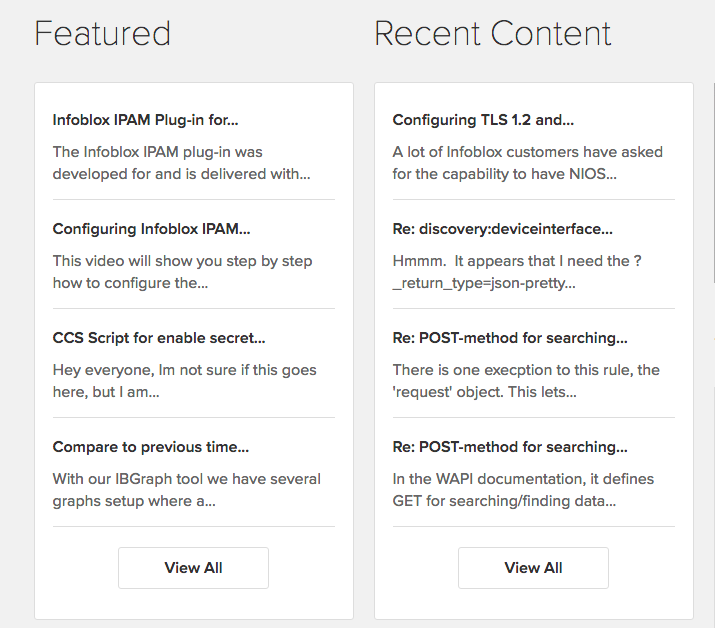
screenshot-2016-10-28-12-31-13

It took you about two seconds to notice every headline and description has been chopped off.

The community team are so used to the problem they barely notice it anymore. They’re working on going mobile, engaging members, and doing everything else.

Most regular members might be used to it too. They’re going to visit the community out of habit.

It’s the newcomers you need to watch out for. It might be worth spending a few minutes with a few potential newcomers to ask what they don’t like about the site. What do they notice that you haven’t noticed in a while?

The answers but might be very obvious and easily fixable.

Via Infoblox.

25 Nov 15:26

Microsoft – Back to front

by windsorr

Reply to this post

RFM AvatarSmall


Back to front strategy of Surface Phone looks sure to fail. 

  • Mobile phones are a bit of a blank spot for Microsoft but 2017 is likely to see it give it another go despite the fact that Office 365’s success in iOS and Android have made this feat almost impossible.
  • It has been a very long time since Microsoft has done anything meaningful in the mobile phone and with the massive write down of the Nokia acquisition and the lay-off of the vast majority of the staff, it would almost seem that it has given up.
  • However, there is still a device in the works which will be part of the Surface portfolio to add to the excellent Surface Pro, Surface Book and Surface Studio.
  • This device will be called the Surface Phone and very much like its big brothers it will aim to be the ultimate mobile device and appeal to a certain set of users.
  • Unfortunately, I suspect that no matter how good this Surface Phone is, it will not appeal to even Microsoft’s hardest core fans.
  • This is because the mobile phone is a device that is predominantly used for Digital Life whereas the Surface products excel at Digital Work.
  • In Digital Work the Surface products are aimed at content creators and in that instance they are best in class.
  • However, every content creator is also a content consumer who predominantly uses an Android or iOS device for his Digital Life.
  • Therefore, Microsoft will have to make its Digital Life offering utterly compelling to convince even these users to move their Digital Lives to Microsoft and in that regard I see nothing but neglect and malaise.
  • This is why the Surface Phone will fail because no matter how good the hardware is, the ecosystem has deteriorated to a point where most of the apps that the user would want are not available.
  • Microsoft’s coverage of the Digital Life pie has deteriorated from 71% to 57%, developers are rapidly deserting the platform and user numbers are in free-fall.
  • This is how Microsoft has it back to front as users tend to being their digital lives with them into Digital Work and not the other way around.
  • Furthermore, the fact that Microsoft has made good quality versions of Office 365 available for iOS and Android devices substantially reduces any reason to buy a Surface Phone.
  • I have long believed that Microsoft’s most valuable asset is Office 365 meaning that it is in Microsoft’s interest to ensure that it works as well as possible on as many devices as possible.
  • Therefore, using Office 365 as a differentiator for the Surface Phone could actually do more damage than good to Microsoft as it could dent Microsoft’s reputation on the other, far more important platforms.
  • Hence, the only option would be for these users to have two devices, one for Digital Work and one for Digital Life.
  • However, because iOS and Android offer Microsoft’s Digital Work services to an acceptable level of quality and because the Surface Pro and Surface Book are so good at Digital Work and so portable, there is no reason whatsoever to buy the Surface Phone.
  • Hence, I think Microsoft would be best served in quietly dropping this idea and focusing its resources on the things that it does best and where it can succeed.
  • I think the mobile phone ship has already sailed.
  • Despite the inevitable disappointment, Microsoft’s share price does still not fully reflect the opportunity available in Digital Work which is why I still like it alongside Tencent and Baidu.


25 Nov 15:26

Trump’s push for US-built Apple products could make iPhones more expensive

by Rose Behar

President-elect Donald Trump made it clear in a recent interview with The New York Times that he’s going to put pressure on Apple to bring its manufacturing process to the U.S.

“I said, ‘Tim, you know one of the things that will be a real achievement for me is when I get Apple to build a big plant in the United States, or many big plants in the United States, where instead of going to China, and going to Vietnam, and going to the places that you go to, you’re making your product right here,’” said Trump.

This is not the first time Trump has put forward such ideas. In January at a speech at Liberty University, he said “We’re gonna get Apple to start building their damn computers and things in this country, instead of in other countries,” and during the 2012 election he espoused the same idea to Fox News.

Trump can’t force Apple to adhere to this, of course, but his pressure, along with plans for tax cuts and regulation removals, could enact some change. If it does, and the ‘Designed in California’ phone becomes the ‘Made in California’ phone, it’s likely prices for the already premium device will receive a hike as well — which could have a significant impact on the mobile industry at large.

A source from the Asia Nikkei Review stated that making iPhones in the U.S. would mean double the cost, while Jason Dedrick, professor in the school of information studies at Syracuse University offered German publication Deutsch Welle more specific estimations.

“If the iPhone were assembled in the US (with the parts brought in from outside the US), it would add $30-40 to the cost of manufacturing. Some of this is labor costs, and some of it would be the extra logistics costs involved. If the parts/components were made in the US, as well as final assembly, it would add at least $80-90 to the cost,” he said.

It should also be noted that Apple does in fact do some American manufacturing. Since 2013 it’s been assembling Mac Pros and making some parts in the U.S. — though that’s certainly a very small portion of its overall product range.

Apple has not yet publicly commented on the call or even confirmed whether it took place.

Related: Tim Cook wrote a letter to Apple’s American employees following Trump’s presidential win

25 Nov 15:26

A Glowing Bicycle Path Takes Inspiration from Van Gogh's 'The Starry Night'

by Becky Chung for The Creators Project

Images via (unless otherwise noted)

This article was originally published on November 12, 2014 but we think it still rocks!

Vincent van Gogh's The Starry Night is instantly recognizableeven as an ocean current timelapse or an animation of aerosols in the air. In the Dutch province of Noord Brabant where Van Gogh was born and raised, you'll be able to experience the night sky as a bike path.

Daan Roosegaarde and his team of innovators at Studio Roosegaarde have previously created jewelry from smoga glowing lotus dome, and "LEGO from Mars." The Van Gogh-Roosegarde bicycle path is coated with a specially-developed paint that takes in solar energy during the day, and glows with it at night. "It's a new total system that is self-sufficient and practical, and just incredibly poetic," Roosegaarde told Dezeen. The work is the second part of Roosegaarde's research into creating smart glow-in-the-dark highways

Below, more stills of the Van Gogh-Roosegaarde bicycle path:

Image via

h/t Dezeen

First glowing Van Gogh-Roosegaarde bicycle path in the world from Studio Roosegaarde on Vimeo.

To learn more about the bike path click here

Related: 

Roads Of The Future Are Here... And They Glow In The Dark

New Project Cleans The Smog Out Of China And Turns It Into Jewelry

Korean Artist Koo Jeong-A Creates Glow-In-The Dark Skate Park In France

25 Nov 15:25

How to use Google Photo’s new ‘deep blue’ feature to brighten any day

by Rose Behar

While Google’s PhotoScan app got most of the attention when it rolled out earlier this month, the company simultaneously launched some pretty intriguing new photo editing features — including a slider feature that turns grey days into blue ones without affecting the vibrancy of any of the other colours in the photo.

Below is a breakdown of how to take advantage of the new feature and make every day seem just a little bit brighter than it actually is — something we could all use as we head deeper into the dark days of winter.

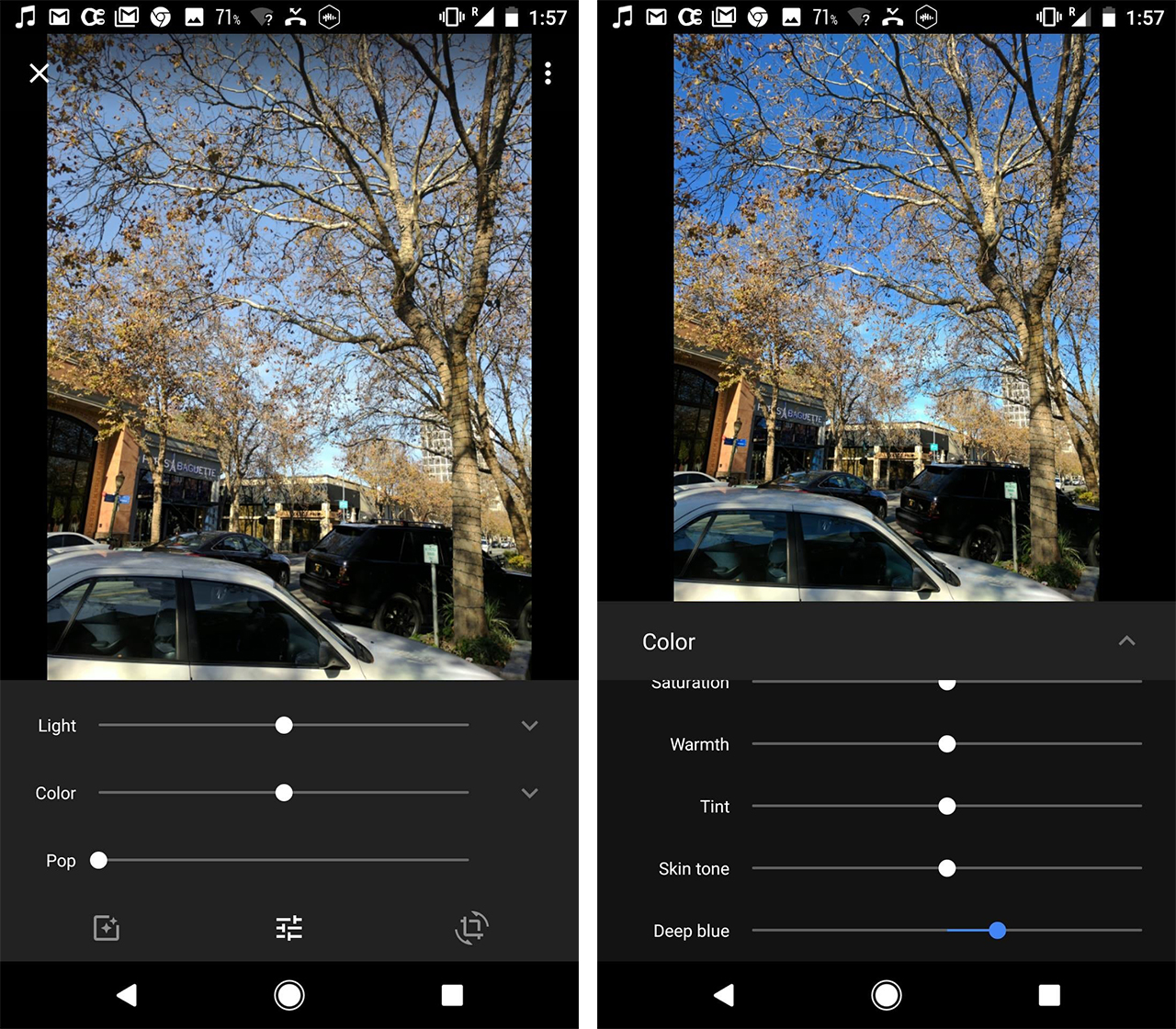
1. Navigate to your photo in the Google Photos app.

2. Press the pen icon in the middle bottom of the screen.

3. Press the slider buttons icon in the middle bottom of the screen.

google-deep-blue-2

4. Press to expand the ‘color’ slider options. Scroll to the bottom.

5. Use the ‘deep blue’ slider to boost the vibrancy of the sky.

google-deep-blue-3

6. Enjoy the sunny day! On your screen, indoors, where it’s warm.

Related: Google launches PhotoScan to optimize print photographs for digital

25 Nov 15:18

"The electric light did not come from the continuous improvement of candles."

“The electric light did not come from the continuous improvement of candles.”

-

Oren Harari

25 Nov 15:17

Google AI creates ‘Interlingua’

Using AI to translate across three languages has led to the observation that the AI has created – without direct help – an interlingua: an artificial language that – this case – is constructed to make translation easier, based on richer and broader semantics than are found in any of the natural languages.

Matt Burgess, Google’s AI just created its own universal ‘language

However, the most remarkable feat of the research paper isn’t that an AI can learn to translate languages without being shown examples of them first; it was the fact it used this skill to create its own 'language’. “Visual interpretation of the results shows that these models learn a form of interlingua representation for the multilingual model between all involved language pairs,” the researchers wrote in the paper.

An interlingua is a type of artificial language, which is used to fulfil a purpose. In this case, the interlingua was used within the AI to explain how unseen material could be translated.

“Using a 3-dimensional representation of internal network data, we were able to take a peek into the system as it translated a set of sentences between all possible pairs of the Japanese, Korean, and English languages,” the team’s blogpost continued. The data within the network allowed the team to interpret that the neural network was “encoding something” about the semantics of a sentence rather than comparing phrase-to-phrase translations.

“We interpret this as a sign of existence of an interlingua in the network,” the team said. As a result of the work, the Multilingual Google Neural Machine Translation is now being used across all of Google Translate and the firm said multilingual systems are involved in the translation of 10 of the 16 newest language pairs.

Soon, we may be speaking an interlingua that encompasses English, Swahili, Mandarin, and a hundred other languages. Perhaps we could wire it in such a way that people would innately find more kinship with others, and intuitively follow the golden rule. I propose we call it ‘Ish’, and start teaching the kindergartners.

25 Nov 15:17

2016 MacBook Pro with Touch Bar review: The future creates difficulties in the present

by Patrick O'Rourke

The 2016 MacBook Pro is one of the most divisive tech devices released in the last few years; it embodies everything great about Apple, but is also one of the company’s most significant missteps.

I’ve written a lot about Apple’s new lineup of ‘Pro” laptops over the last few weeks. First, taking a brief look at the 13-inch non-Touch Bar model, and then honing in on the Touch Bar iterations, as well as touching upon what it’s like to have lived the ‘dongle life’ for the past year. Now, I’m taking an overall look at the 13-inch and 15-inch MacBook Pro.

Let’s unpack a few things first: the new MacBook Pro is pricey, starting at an astounding $1,899 CAD for the 13-inch model without the Touch Bar, and then $2,229 for the 13-inch with a Touch Bar and Touch ID. The 15-inch costs even more, coming in at $2,999 to start.

Apple’s laptops have always been expensive, especially when a new iteration is launched. Remember how much the MacBook Air cost only a few years ago, or the Pro’s various minor facelifts? Still, even with that said, Apple’s new line of MacBook Pros are pricey laptops and the jump in cost has likely never been this significant.

macbookpro2016gallery-3

What you get for that hefty cost may not be worth it depending on what you expect from Apple’s new line of professional machines.

Specs
macbookproreview-1

MacBook Pro 13-inch with Touch Bar & Touch ID

  • Starts at $2,299 CAD
  • 2.9 GHz dual-core Intel Core i5 processor with Turbo Boost speeds up to 3.3 GHz
  • Intel Iris Graphics 550
  • 8GB of 2133MHz LPDDR3 onboard memory
  • 256GB of flash storage
  • Built-in 49.2-watt-hour lithium-polymer battery, 10 hours of battery life
  • Four Thunderbolt 3 ports
  • 3.5mm headphone jack
  • Silver and Space Grey colour options
  • 13.3-inch LED backlit IPS display with 2560 x 1600 pixel native resolution at 227 ppi
  • 1.37 kg
  • 1.49cm height

MacBook Pro 15-inch with Touch Bar & Touch ID

  • Starts at $2,999 CAD
  • 2.6 GHz quad-core Intel Core i7 processor with Turbo Boost speeds up to 3.5 GHz
  • Radeon Pro 450/Radeon Pro 455 graphics
  • 16GB of 2133MHz LPDDR3 onboard memory
  • 256GB of flash storage
  • Built-in 49.2-watt-hour lithium-polymer battery, 10 hours of battery life
  • Four Thunderbolt 3 ports
  • 3.5mm headphone jack
  • Silver and Space Grey colour options
  • 15.4-inch LED backlit IPS display with 2880 x 1800 pixel native resolution at 220 ppi
  • Force Touch trackpad
  • 1.83 kg
  • 1.55cm height

The Touch Bar is great, when it makes sense
macbookpro-4

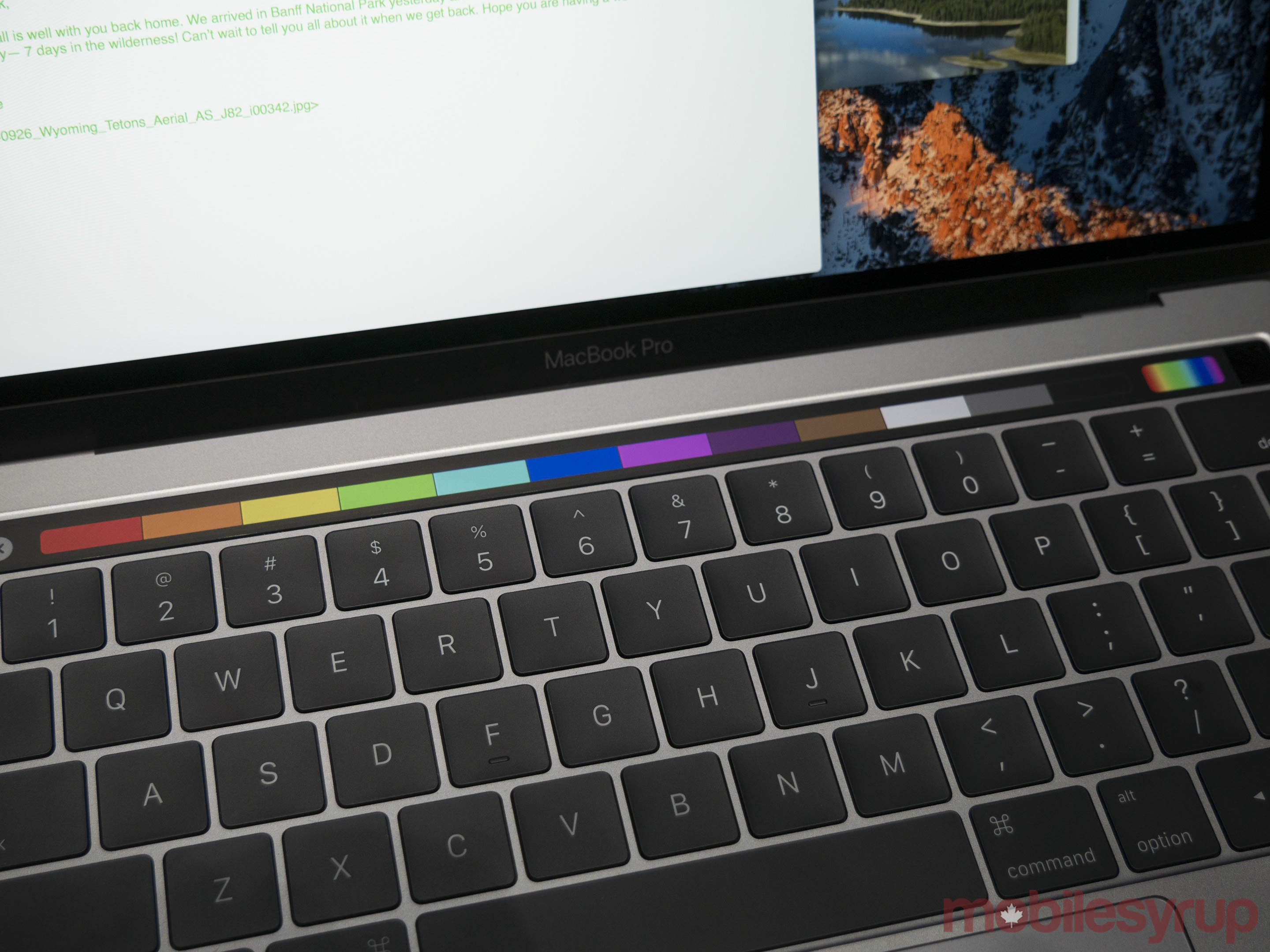
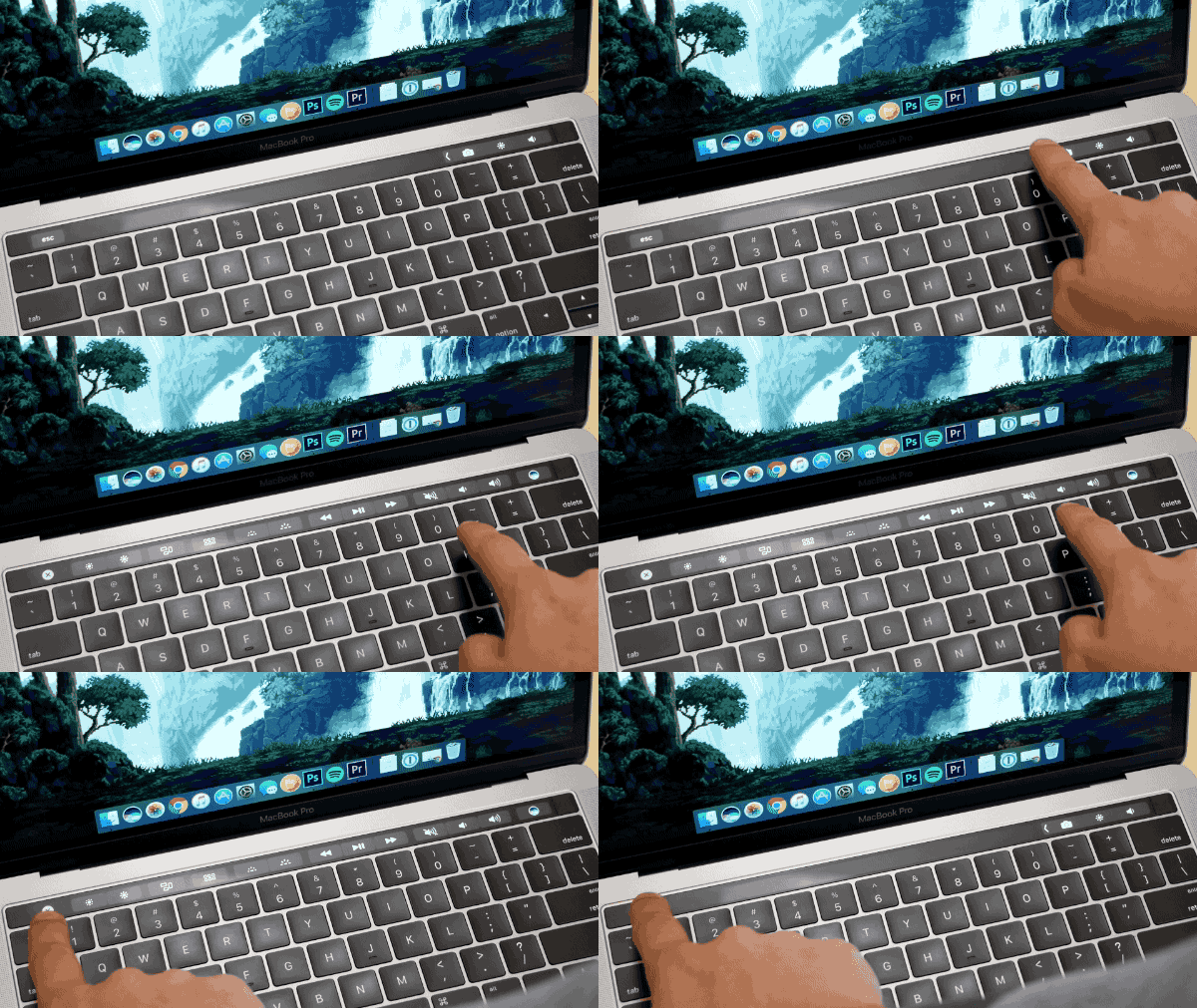
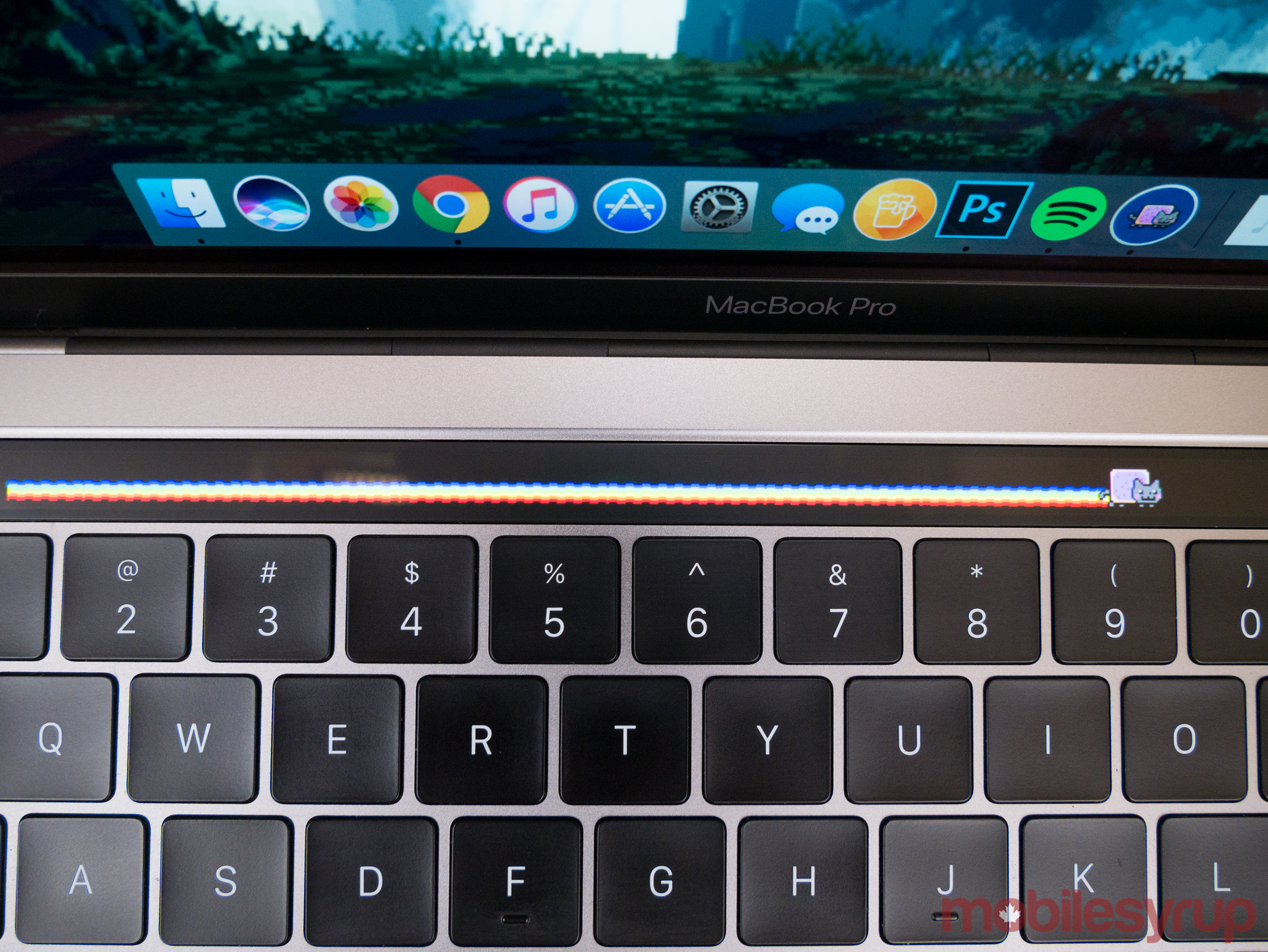
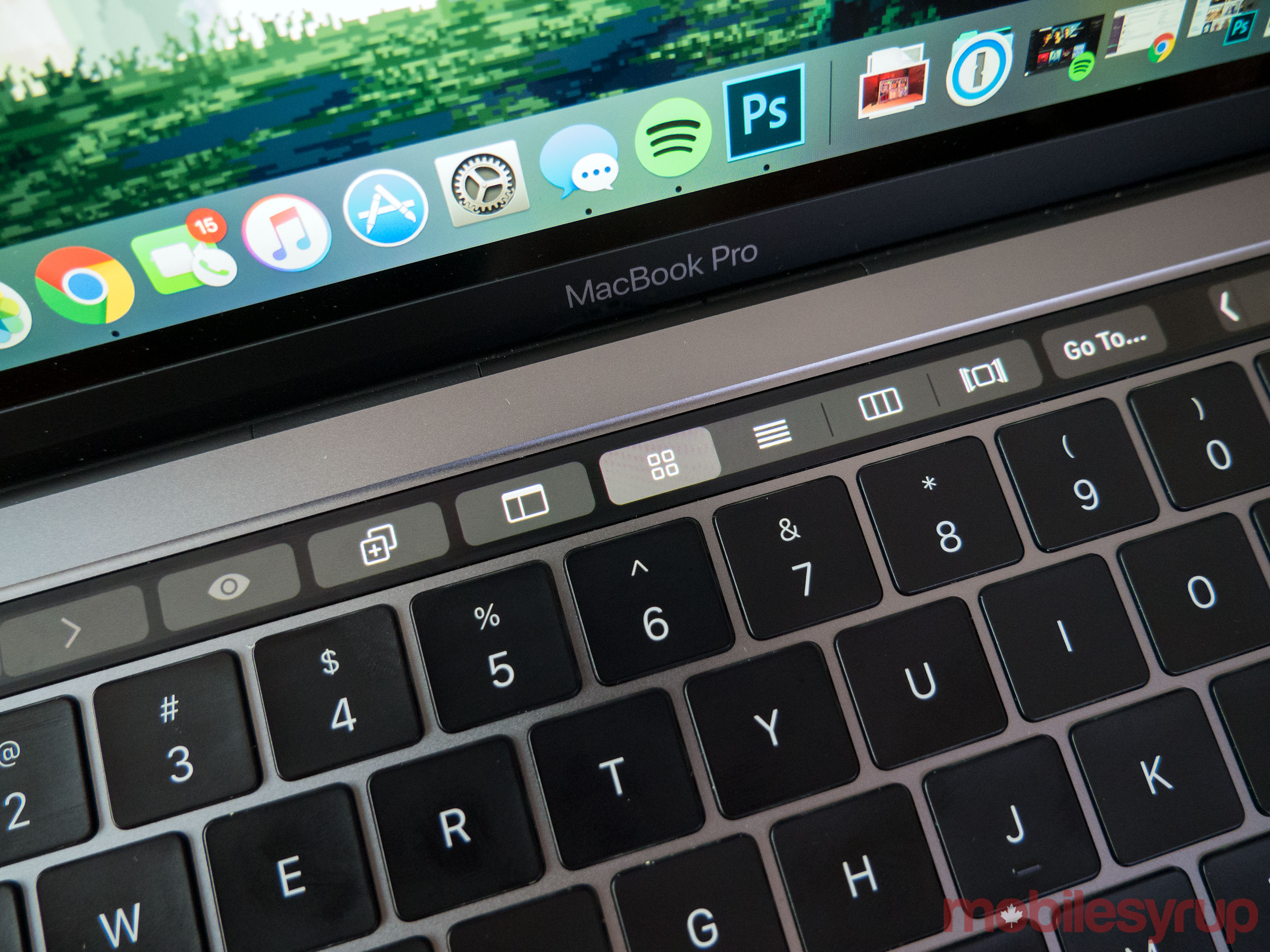
As I predicted in my MacBook Pro with Touch Bar preview, Apple’s new Pro touch interface is a fascinating experiment, though it doesn’t always make sense, especially when you need to actually access the computer’s virtual function keys.

While the Touch Bar features a 2170 x 60 pixel OLED panel, it doesn’t look or feel like a traditional touch screen. My finger slides across its surface with ease, moving from left to right with a slight glide. In fact, the Touch Bar is so slick that it almost feels like it’s covered in some sort of greasy fluid, which I found off-putting at first, though after spending a few days with the 13-inch MacBook, it slowly grew on me.

There’s something inherently fascinating about sliding your finger across the new Touch Bar. It’s worth pointing out, however, that it also features a relatively low resolution. However, given the Touch Bar’s utility and its distance from your eyes, this isn’t an issue.
macbookprogif

The apps where the Touch Bar makes sense like Photos, which allows users to move between images rapidly and with surprising accuracy, as well as Quick Time, a video and audio playing app that offers similar functionality through Apple’s new interface, are examples of the Touch Bar at its best. The way the secondary screen is used in the case of these apps is hopefully where Apple takes the interface element in the future.

The experience, however, falls apart for me with Mail, where the Touch Bar displays quick-access typing shortcuts and contextual emojis. Similar to my experience with Nintendo’s ill-fated dual-screened Wii U, there’s a disconnect between looking at the screen and rapidly typing, and then needing to glance down to reach the Touch Bar. I found this input method neither intuitive or necessary. It’s also strange that so few apps currently support the secondary screen, though Apple does claim there are more than 20 Mac apps set to add to the unique functionality by the end November. To put this limitation in perspective, Chrome currently doesn’t support the Touch Bar and neither does Spotify.

Even Adobe’s suite of apps currently don’t include Touch Bar functionality, though support is reportedly coming in the near future. Of the apps that support the Touch Bar, the majority are from Apple, so if you’re like me and use Apple hardware but typically opt for third-party solutions from the likes of Adobe and Google, then the company’s new tech won’t be useful to you right now.
macbookproreview-3

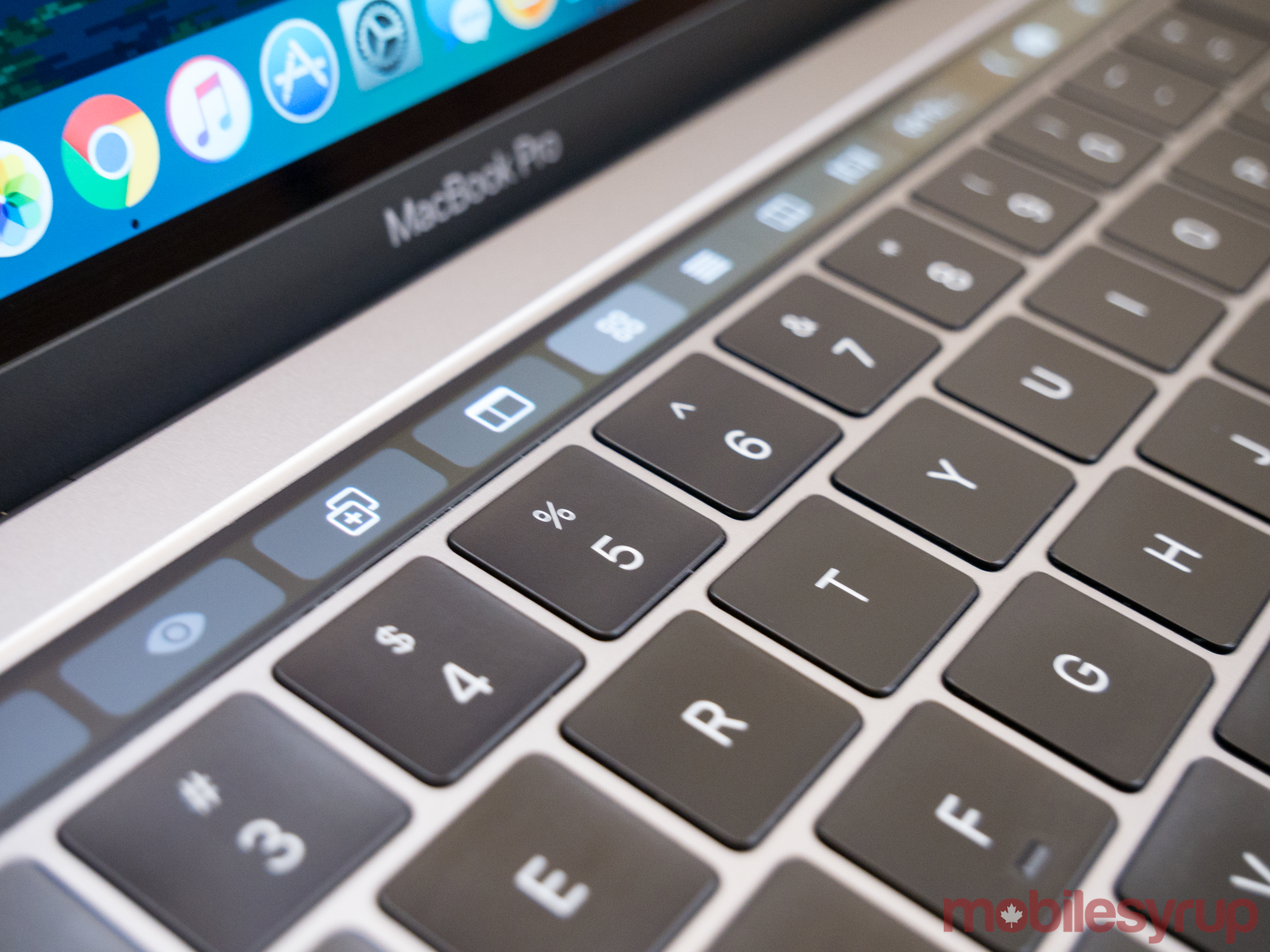
Like many of Apple’s supposed innovations, the Touch Bar isn’t exactly a new concept either, with keyboards from companies like Optimus predating the Touch Bar. What makes Apple’s Touch Bar drastically different is that the functionality is built directly into the macOS, giving developers a legitimate platform to develop for, as well as incentive to add the functionality to their apps.

Android and Windows fans often don’t want to admit this fact, but Apple often takes established concepts and improves on them significantly. In the case of the Touch Bar, that’s exactly what the Cupertino-based tech giant has done.

My biggest gripe with the Touch bar, however, is the fact that it doesn’t always display the full range of function keys most Mac users are familiar with. What it does instead is always show a customizable array of three function shortcuts.
2016macbookprovsgallery-10

I set my MacBook Pro’s Touch Bar to give me quick access to macOS’ screenshot functionality, as well as control over the computer’s brightness and volume sliders. In order to access the computer’s full array of function keys, you need to repeatedly press a tiny arrow on the left side of the Touch Bar — even when using an app that doesn’t currently utilize the Touch Bar.

This issue can be avoided by changing settings to ensure the entire Touch Bar is displayed at all times, defeating the purpose of the secondary screen’s contextual nature, or by delving deep into macOS’ unintuitive accessibility options. Apple needs to implement a feature that allows the Touch Bar’s functionality to be customized far beyond just the ability to swap our apps and altering their order.
macbookpro2016gallery-9

What the Touch Bar amounts to right now is only a fascinating experiment with a significant amount of untapped potential. I have little doubt that Apple will improve on its functionality significantly over the next few months, but as it stands currently, the Pro’s Touch Bar isn’t as useful or even as functional as it could be.

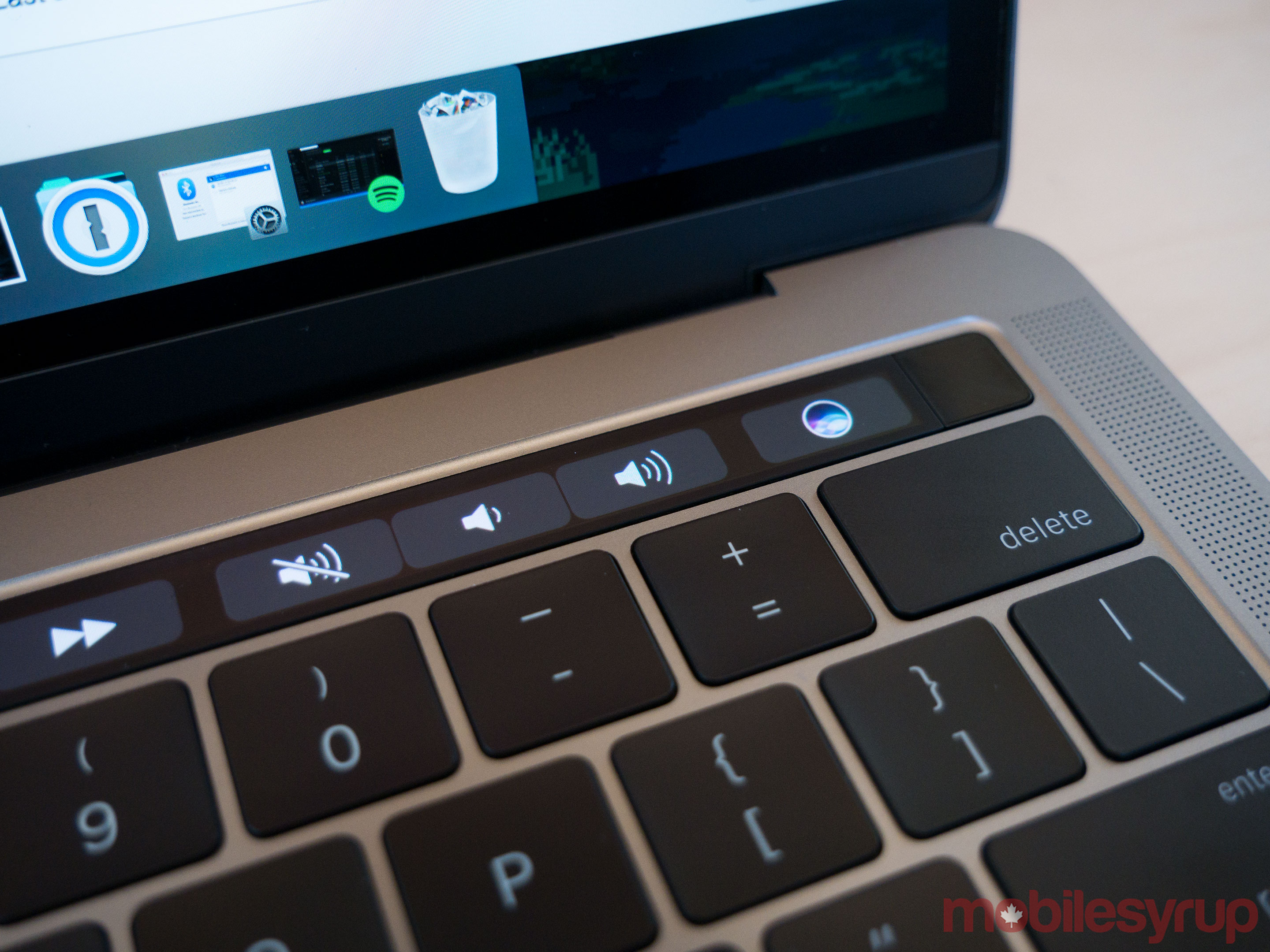
On the right side of the Touch Bar though, rests one of my favourite new MacBook Pro feature, a Touch ID sensor. This sensor, which reads the user’s fingerprint, can be used for Apple Pay purchases and to log into your laptop as well as to validate App Store purchases. While you may not think this makes a big difference in terms of the time it takes to log into your computer, I hate passwords and any form of technology that allows me to avoid them, is a step in the correct direction.

Welcome to the dongle life
macbookpro2016gallery-6

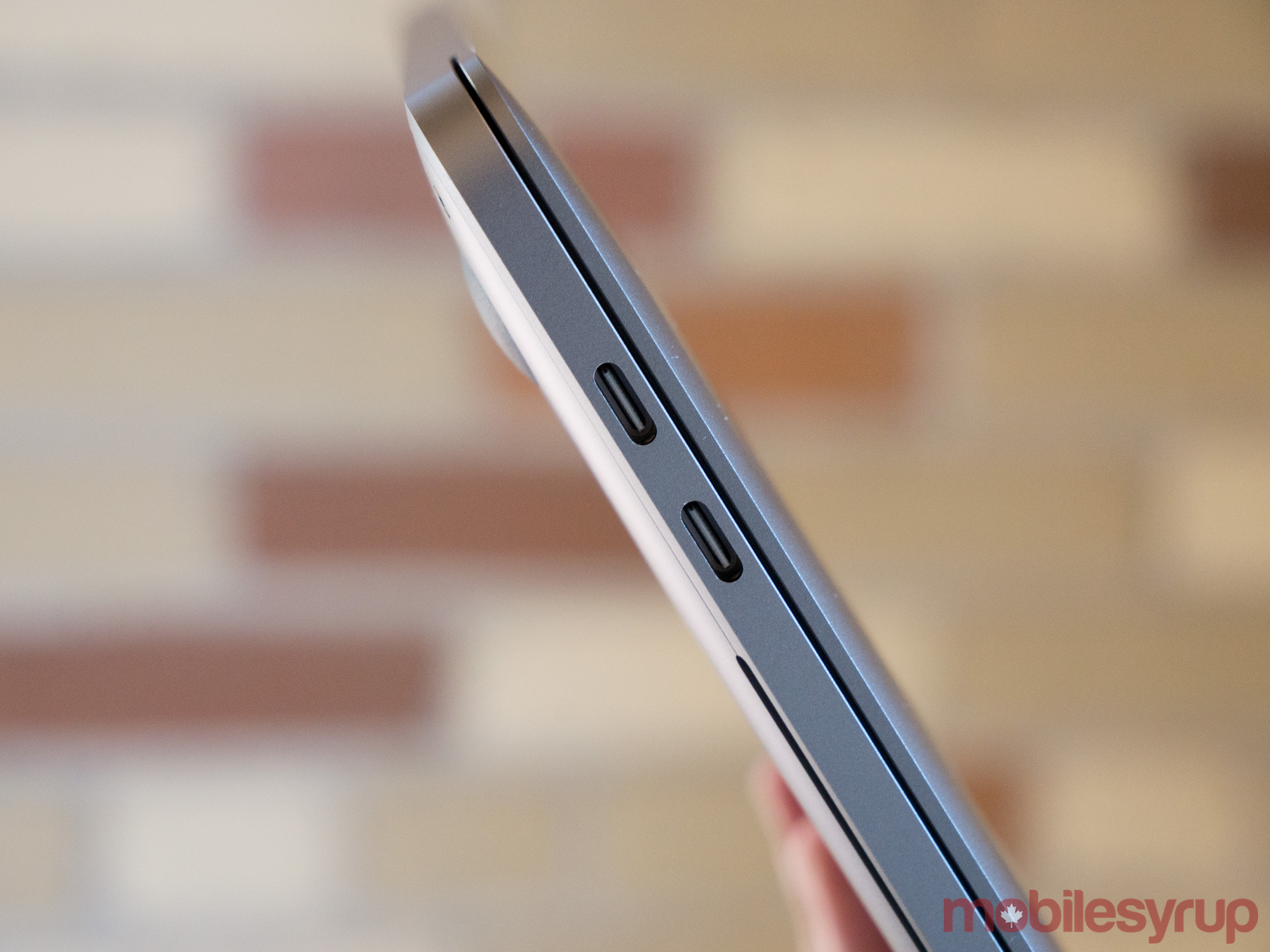
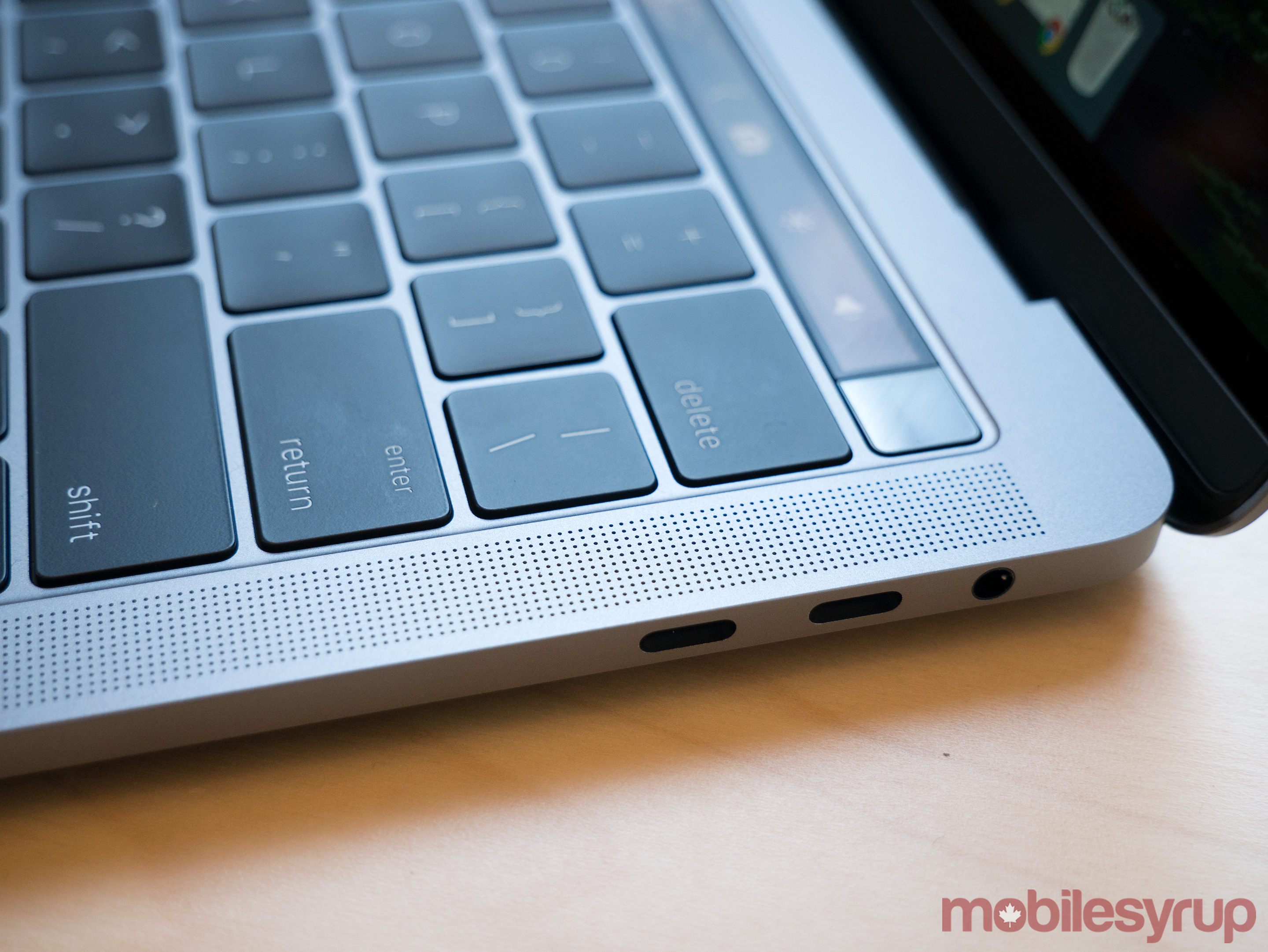
Apple’s new line of MacBook Pros utilizes four USB-C Thunderbolt 3.0 ports, a controversial choice on the company’s part, but one with which I agree. USB-C is the future of connectivity, but the relatively new port format suffers from issues right now.

Few devices support USB-C and some cables don’t hold to the format’s overarching purpose; a universal cable that can connect a display, charge a device and transfer data, all at the same time. This means that despite adopting USB-C being the correct move for Apple, until the format becomes widespread, using one of Apple’s new MacBook Pros is somewhat of a pain and will require most people to purchase at least one USB-C to A adapter.

As someone who rarely plugs devices into my laptop beyond a DSLR, which I’ve become accustomed to hooking up directly via a USB-C to A adapter, I fall into the market Apple is targeting with its new line of MacBook Pros.
macbookpro2016gallery-2

Despite this fact, and while I do agree with the switch to USB-C, the new Pro really should have included an SD card slot. None of Apple’s “future-pushing” explanations can excuse this fact. Photos isn’t powerful enough for most professional or even semi-professional photographers and an SD card slot could have easily fit into the laptop’s thin body.

Given that Pro is short for ‘Professional’ in the context of Apple’s laptop, I question whether the laptop should even be called ‘Pro’ given the difficulties it will likely cause many long time professional Mac users. The Pro line has clearly shifted direction and is now a high-end consumer-focused laptop, at least in its current iteration.

Apple could have easily avoided these issues and rampant criticism by including a free USB-C dongle that came equipped with a variety of different plugs. While lowering the cost of USB-C adapters is a step in the right direction for the tech giant, it doesn’t make up for the fact that almost all new MacBook Pro owners will need to purchase an array of adapters.

macbookpro2016gallery-7

In the end, USB-C is a hassle in the short term, but definitely a worthwhile shift for the overall industry. I dream of world where one cord can be used for charging, connecting devices and hooking up a display and this is a step in the right direction towards making that happen.

And yes, the new Pro does include a standard 3.5mm headphone jack, contrary to what many analysts expected.

That trackpad though
macbookproreview-2

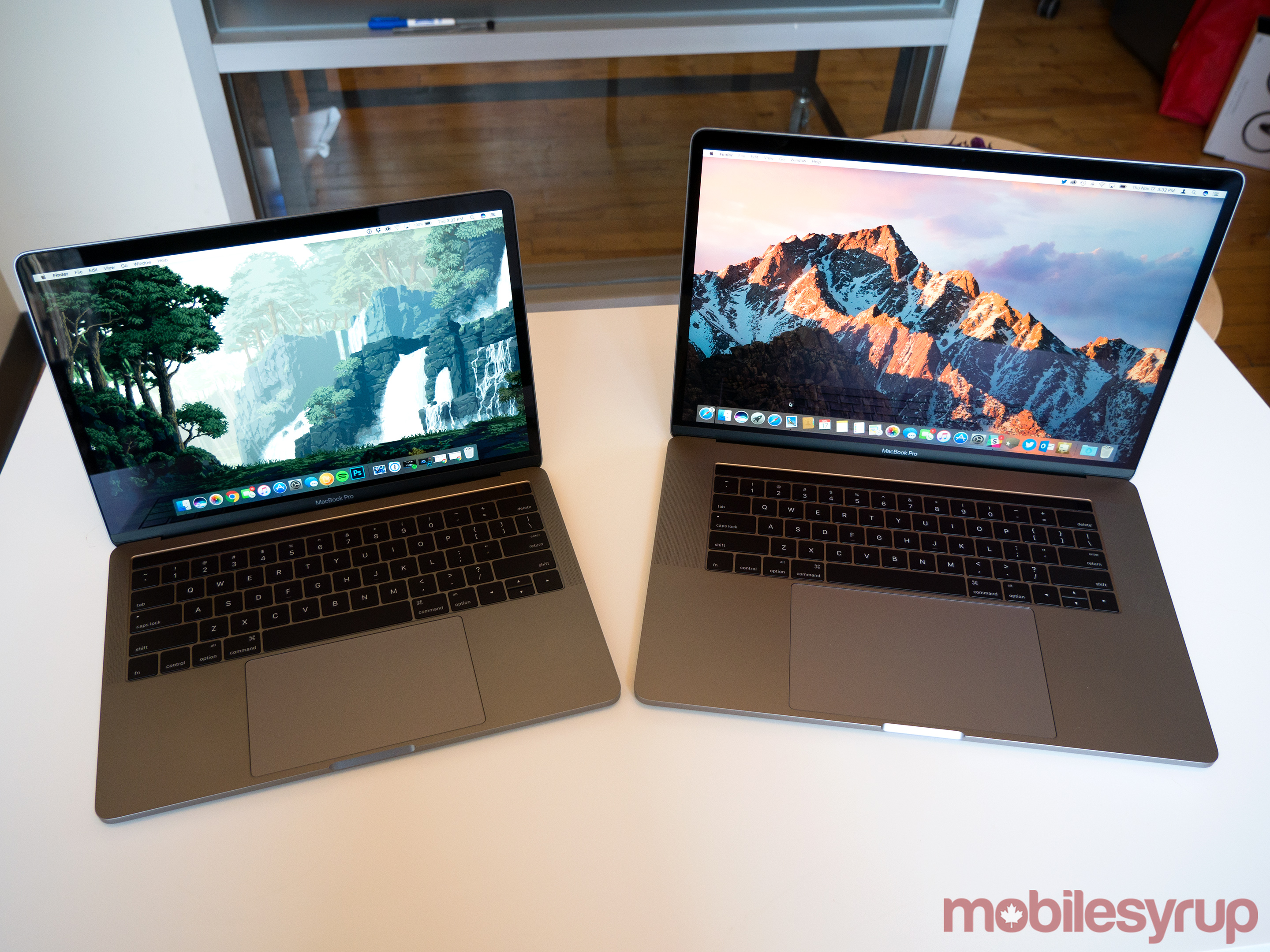
In typical Apple fashion, both the 15-inch Air — which looks identical to the 13-inch, though features a bigger trackpad, display and larger speaker grills — and 13-inch, are stunning looking laptops.

The 13-inch MacBook weighs in at just 1.36kg (3.02lbs), making it slightly heavier than the 1.3kg (2.96lb) MacBook Air, as well as 0.22kg (0.5kg) lighter than the previous generation MacBook Pro.

The 13-inch Pro is also 18 percent thinner, measuring in at 14.9mm, resulting in an overall 23 percent smaller footprint. The 15-inch, on the other hand, comes in at 15.mm thick, a 14 percent cut. It also weighs in at 1.8kg (4lbs), just slightly lighter than the previous model.

2016macbookprovsgallery-2

While these numbers may not sound like a significant shift on paper, the new MacBook Pro does feel considerably lighter and sleeker than its predecessor.

Its keyboard is also a step far above the 12-inch MacBook’s butterfly keyboard mechanism. It seems like keys have significantly more travel, though Apple says that’s not the case and that it has only reworked the second generation keyboard’s triggers to feel more tactile. The resulting keyboard present in both the 13-inch and 15-inch MacBook is probably the favourite one that I’ve ever used.

Those who hated the 12-inch MacBook’s keyboard, however, also won’t like the new Pro’s, though I still feel that if more people gave it a chance, they’d adjust to its low profile in just a few hours.

macbookpro2016gallery-4

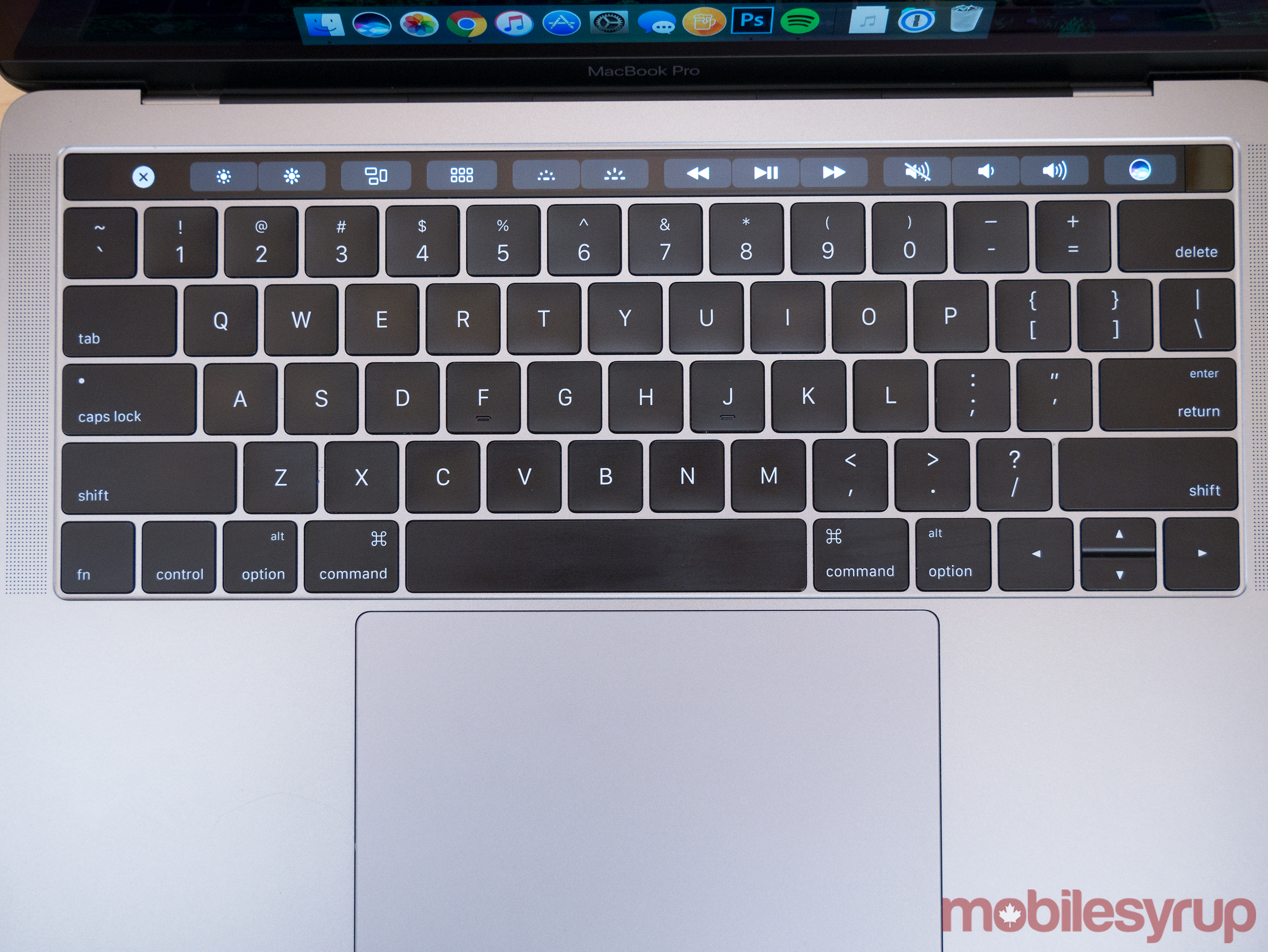
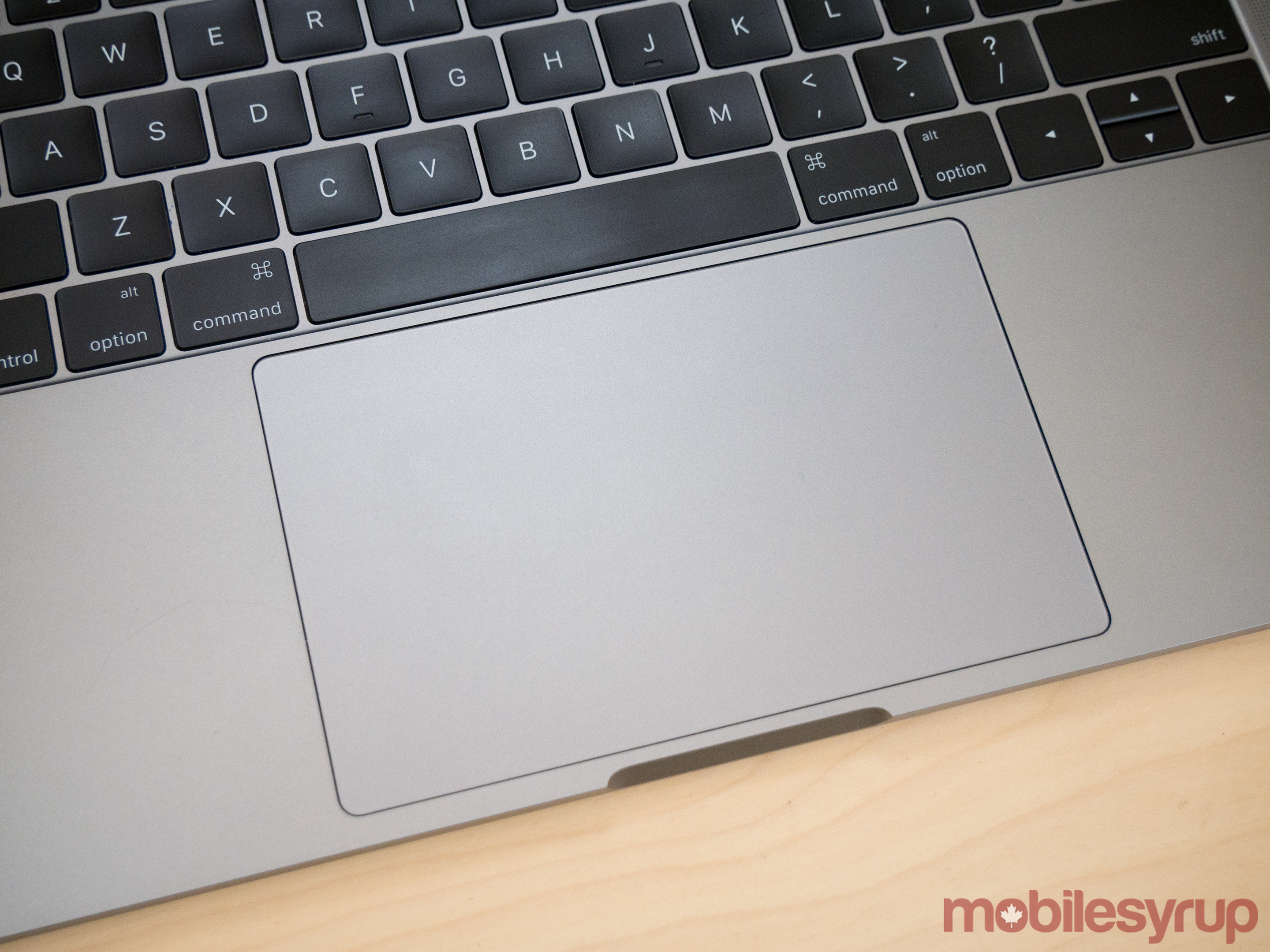
Beneath the keyboard is an absolutely massive trackpad that measures in at exactly 46 percent larger than the version featured in Apple’s previous 13-inch Pro. In the 15-inch iteration, the trackpad is twice as big. Seriously, take a look at it (below), it’s massive.

While some have scoffed at the new Pro’s massive trackpad size, when you actually test it out, it’s difficult to go back to the version featured in past MacBooks. The additional space gives ample room for navigation as well sliding, swiping and performing macOS’ more complicated gestures. The best in class palm detection Apple is known for is also back in the new Pro and more necessary than ever. I find that my palms actually regularly rest on both sides of the trackpad given its large size.

The trackpad also features Apple’s Force Touch technology, which means that it doesn’t actually click and instead simulates the sensation of clicking. This technology was introduced by the company with the 12-inch MacBook back in 2015. Similar to the butterfly keyboard, while some dislike this new trackpad, I’ve always thought it was great. With the new line of Pros, Force Touch has been improved significantly and actually feels somehow more tactile than even the click of a traditional trackpad.
macbookpro2016vsgallery-9

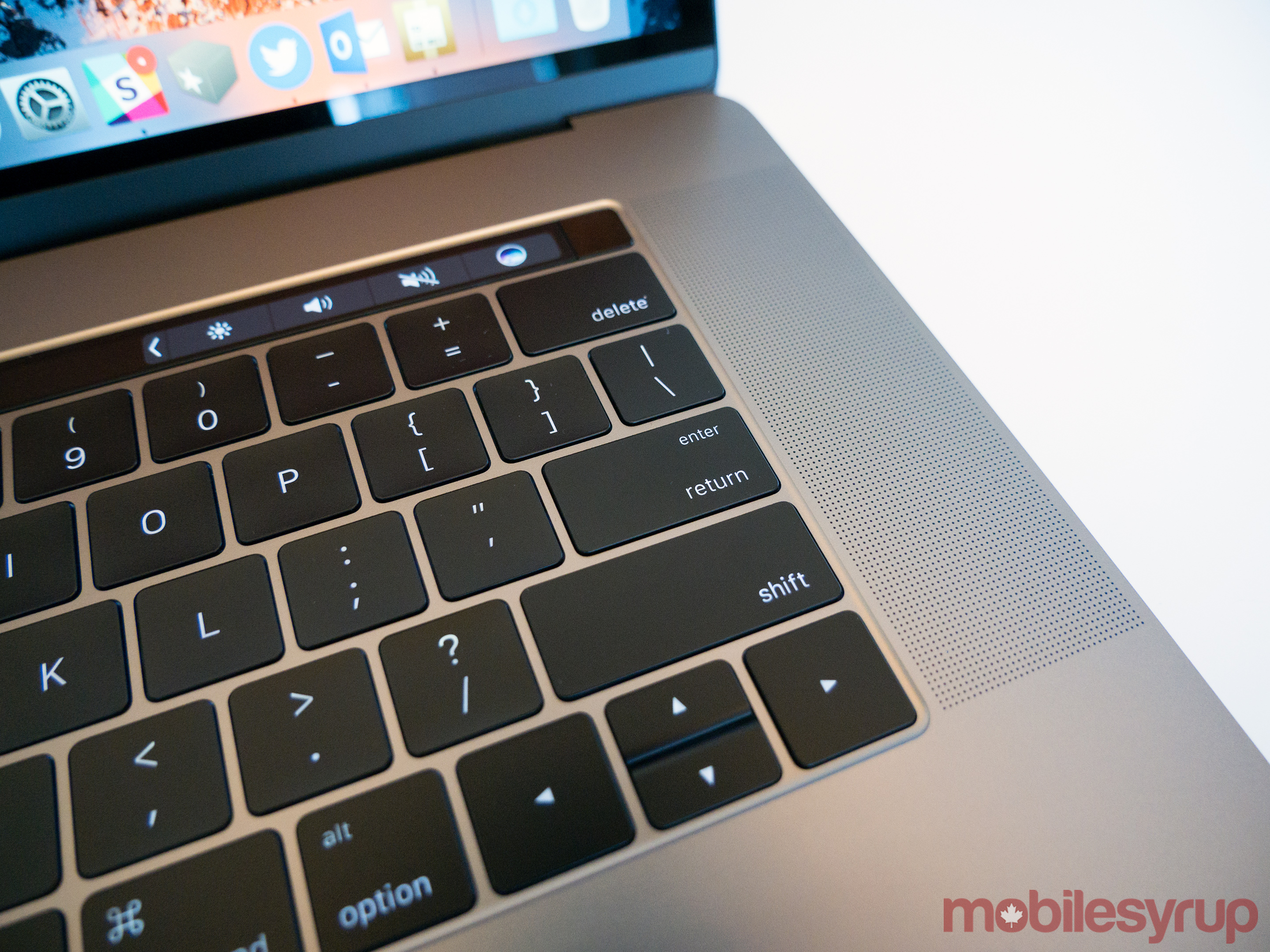
Audio quality wise, the stereo speakers in both the 13-inch and 15-inch MacBook are impressive, offering users twice the dynamic range and 58 percent more volume.

It’s worth noting, however, that various outlets have reported that the speaker grills in the 13-inch model are purely cosmetic.

Last year’s specs

macbookproreview-6

One of the main criticisms targeting Apple’s new line of Pros is the fact that they come equipped with Intel’s sixth generation Skylake processors and not the seventh generation of Intel Core CPUs. Apple claims it went with the older CPUs because the multi-core Kaby Lake processors the company would need for the new MacBook Pro aren’t available yet. Whether or not this is true, the reality is that if you want one of Apple’s new MacBooks, you’re paying a hefty price for last year’s technology.

That said, even with last year’s Intel chips, I didn’t run into any slowdowns during my roughly week and a half using the 13-inch MacBook Pro as my main laptop, whether I was running Adobe Premiere, Photoshop, or watching high-resolution video. Specifically, Apple claims that its new line of Pros, depending on what processor and graphics card the laptop comes equipped with, has 130 percent faster graphics performance in the 15-inch and 103 percent faster in the 13-inch.

The hard drive in both sized laptops are also reportedly 100 percent faster than the drives featured in the previous model of the MacBook pro, allowing for sequential read speeds of up to 3.1 gigabytes per second, with write speeds of up to 2.1GB/s on the 13-inch and up to 2.2GB/s on the 15-inch.

macbookproreview-4

So while Apple’s laptop’s may not feature the latest hardware technology in terms of processor, and also caps out at 16GB of RAM (apparently to save battery life, according to Apple), both laptops perform excellently under almost any circumstances.

Where the Touch Bar iteration of the laptop has been disappointing to me in terms of hardware is when it comes to battery life. In my experience, I’ve been able to get through roughly an entire work day with the 13-inch MacBook, coming in at approximately seven to eight hours, depending on the tasks I’m performing. This is slightly under the 10 hours Apple claims the laptop is able to last and below the about nine hours I experienced with the 13-inch new MacBook Pro without the Touch bar. Battery life was similar with the 15-inch in my testing, coming it at maybe an hour to 45 minutes longer.

 A painful interim
macbookproreview-5

I’m conflicted when it comes to Apple’s new line of MacBook Pros. On one hand, I’m a huge fan of the new laptop line’s build quality, ergonomics and overall look. The keyboard is the best I’ve ever used and the trackpad is responsive, fast, enormous and more importantly, extremely accurate. There’s literally no comparison when it comes to high-end Windows PCs when considering build quality and the trackpad, even when Microsoft’s impressive high-end Surface Book is thrown into the competition (for the record, I really like the Surface Book).

I also find that the more I use the Touch Bar the more frequently it becomes integrated into how I use the new Pro on a daily basis. I feel like Apple has the track record to turn its second-screen experiment into a viable development platform for app creators. It’s, however, far from the revolution the company boasted about during the reveal of the new Pro at its recent keynote. What it is though is a subtle shift in interaction language that could potentially change how we traditionally interact with a standard laptop.

Cutting out USB-A in favour of USB-C creates problems, but sometimes its necessary to forcibly kill aging technology in order to make way for the future, something Apple has done in the past with the three and half floppy drive and actually prides itself on as a company (cue the courage jokes). This time, however, the tech giant is too early, resulting in a confusing ecosystem of dongles. Including a hub of some sort with every laptop for free, as well as not removing the standard SD card slot, would have negated these issues altogether, making the new Pro more worthy of the ‘Pro’ moniker.
macbooktouchbar-4

There’s ultimately a lot to like about the new MacBook Pro, including the 13-inch version’s bright and vibrant 2560 x 1600 pixel display (the 15-inch comes in at 2880 x 1800 pixels) and even with the criticisms levied in this review, it’s still one of my favourite laptops ever released. Despite how hard the tech giant is pushing its ‘reality distortion field‘ of how professionals should get work done in the context of its new laptop line, the ‘Pro’ likely won’t be ‘professional’ enough for everyone.

Apple’s new Macs are the future of how we’ll use laptops and computers in general, unfortunately, we still live in the present.

24 Nov 21:32

What are the possible practical consequences of breaking the rules of the road?

by Kilisi

I was reading this question which seemed a totally weird thing to worry about and sparked my question.

I've always disregarded stop signs, lights, crossings and waving policemen as basically irrelevant since I'm on a bike and don't have a number plate or a licence that could be suspended.

So far I've only been hassled once by a cop telling me I have to ride on the sidewalk after I went through a couple of red lights next to his vehicle, and had a few yell at me about wearing a helmet which I just ignored.

Are there any realistic consequences apart from the obvious safety concerns (which I'm not asking about) to doing whatever you want on the road?

24 Nov 21:32

Thanksgiving reflections on the meaning of success

by Josh Bernoff

It’s been a hell of a year. The election didn’t turn out the way I expected or hoped. A lot of people that I admired have died. Facebook is full of angst and fake news stories. It is easy to despair. On a personal basis, I am now a year and half into the experiment of … Continued

The post Thanksgiving reflections on the meaning of success appeared first on without bullshit.

24 Nov 21:32

Candy

Michael Lopp: The Likeability Feedback Loop

"This likeability feedback loop tastes great. Who doesn’t want a steady flow of relevant, interesting, and targeted information? Who doesn’t want the world synthesized and simplified into a palatable set of information that one can easily consume in just a few moments? And who doesn’t like the simple satisfaction of sharing or retweeting that likable and relatable piece of information that just speaks to me."

24 Nov 21:31

Jake Fry: Making Heritage and Housing a Win-Win

by pricetags

A proposal for increasing attainable home ownership and/or rental that builds on the City of Vancouver’s Heritage Revitalization Agreement (HRA) policy – developed by Jake Fry, the owner of Smallworks Studios and Laneway Housing Inc.

A Proposal for Increasing Home Ownership and/or Rental using Vancouver’s existing Heritage Revitalization Agreement Policy

The core idea is to use the HRA tool to promote an initiative that would provide easy and significant incentives for property owners, resulting in both more housing and heritage retention.

The proposal is to develop a three-tiered system of development streams, with each tier representing an incremental increase in housing density.

Tier One

Allow a homeowner to preserve an existing character home by designating it through the HRA program, whereby the incentive is to allow the construction and strata-titling of a typical-sized (approx. 600–900 sq. ft. or 0.16 FSR) laneway house (laneway houses in Vancouver are currently not allowed to be strata-titled, only rented).

This incentive would increase the number of houses that would be heritage designated (thus saving such homes from demolition), add more housing density in a neighbourhood-compatible form, and offer an alternative to renting (thus appealing to a wider range of potential residents).

kitsilano-residence-1

Tier Two

Allow a homeowner to preserve an existing character home by designating it through the HRA program, and to add a modest amount of additional density (say up to 0.9 FSR) over current permitted levels in RS zones, and to build an infill house such as is allowed in the RT8 zone (e.g. Kitsilano, Mount Pleasant, etc.).

In this option, the principal building (the original home) would be permitted to be divided into up to 4 strata-titled units, plus the strata-titled infill house.

In this model, all the units thus created would have restrictions placed on their resale price, to reduce speculation and maintain affordability. Such restrictions could lower resale prices by 15-20% of market value, and keep this housing stock below market value in perpetuity.

Tier Three

Allow a homeowner to preserve an existing character home by designating it through the HRA program, and to add a modest amount of additional density over current permitted levels in RS zones, and to build an infill house such as is allowed in the RT8 zone (e.g. Kitsilano, Mount Pleasant, etc.).

This option is similar to the Tier Two option in terms of the building form, however in this option the housing units thus created would be required to stay as rental units (no strata-titling allowed). In exchange the homeowner would be allowed to have a little more density (say 0.95 FSR) and the principal building (the original home) would be permitted to be divided into up to 5 units, plus the infill house. In addition, the main house could also have the opportunity to create a lock-off suite.

General Conditions

Under this proposal, this initiative would be available to any single-family character or heritage home. All lot sizes could work as long as there is (as in current laneway houses) the safety requirement of a minimum 1.2 m (4 ft.) wide access path to the infill/laneway house in the rear, plus the standard 4.8 m (16 ft.) separating distance between the homes.

The City’s approvals process is key to the success of this proposal. It needs to be easy, quick and simple to get approval. The approvals process should be expedited. The City could even go so far as to put specific time limits on development application staff, within which permits must be issued under this process.

Unlike in a typical HRA, there would be less focus on ‘heritage revitalization’ and more on ‘character preservation’: this proposal seeks to keep the subject houses largely as they are rather than restoring them to a specific heritage style.

Parking is also addressed in this proposal:

In the Tier One option, only 1 on-site parking stall would be required. This will free up more of the site for the proposed development, reduce demand for vehicles, and encourage alternative means of moving about the city.

In the Tier Two and Tier Three options, 2–3 on-site parking stalls would be required for lots over 12 m (40 ft.) in width. The City could consider parking relaxations for sites narrower than 40 ft.

Observations

Any infill housing triggered by character home retention under this proposal potentially can have a lot of flexibility, meaning it would not have to be exclusively traditional infill or a laneway house.

The infill housing that existed in the pre-laneway housing era was taller (24 ft. in height whereas laneway houses are 20 ft.) and usually comprised more square footage than a laneway house.

An infill building on a character/heritage home site could differ from property to property, depending on the lot size, location of the existing character home, and surrounding character context.

‘Character Home’ will need to be defined with specific criteria developed by the City, in order to determine whether an application is eligible under this program. There are a number of ways in which this can be defined such as a date cutoff (e.g. all home older than say 1940, etc.), specific design criteria, a set of characteristics/attributes that are spelled out by the City, etc.

vhf-7-credit-martin-knowles-900x600

VHF: Martin Knowles

Under this proposal, the result does not have to be what we have done in the past. The HRA process is potentially very flexible if the program is administered in a progressive and more facilitative manner. For example:

  • it could privilege single storey designs, with greater parking relaxations
  • it could be bigger units for rental, smaller for strata title
  • it could comprise a rental unit option
  • it could offer options which avoid onerous rezoning approvals processes
  • it could showcase innovative, progressive housing design

In short, the building form could be tailored to meet Council’s agenda. More importantly, this can be done without having to go to any committee or rewriting any bylaws – it just needs the right people supervising the HRA approvals process, with approval subject to the Director of Planning’s discretion, which could be delegated to the staff person managing this program.

Addressing Speculation

Firstly, it is important to remember that this would not be implemented city-wide. Whereas it would be available everywhere across the city, it would only be taken up by those homeowners proposing an infill project in association with character home protection through an HRA. There are a limited number of character homes.

262-grayhouseThis in itself will be a great regulator of price as this is not a bare land strata, and such projects will come with encumbrances associated with a heritage designated property. This is in addition to the price regulation proposed in the Tier Two option.

It is important that this become a homeowner-driven program – one which gives real incentives for homeowners to consider this option over simply selling their property, to open up potential equity in their homes.

It is worth bearing in mind that the hesitation by Council to allow strata-titling of laneway houses at the time this policy was introduced was two-fold:

  • At the time of its implementation, laneway housing was targeted at the lack of affordable rental – the situation has changed since then, and laneway houses are not commanding higher rents.
  • Currently the City also needs to add to the ground-orientated housing stock, to address this dwindling portion of the housing spectrum: the starter home and the downsizing home.

This dynamic has existed in the older parts of Kitsilano for a long time and we have not seen a price jump because of speculation but rather because of lack of volume of these small housing forms. This is not a housing form typically being bought by speculators but rather by owner-occupiers. For example, a look at recent sales in Tatlow Court reveals an older cohort lining up to buy there because there are no similar options allowed elsewhere.

Add to this dynamic that with a greater volume of smaller homes becoming available we will see market volumes help keep prices down, or at least slow price increases. In addition, if we allow more living units on a given property without a large increase in permitted density (FSR), as this proposal suggests, we will inherently get smaller units. As such, even if prices do not decrease (as expressed in $ per square foot) the price will go down per household, as we will have more options for smaller ground-orientated living units.

Using Covenants

The City has some options around covenants/resale restrictions. The most appropriate might be:

A covenant on resale:

This scenario lets the market set the price initially, but as a property is resold there is a fixed increase in price. This approach has been used in other cities and works to ensure that ownership is connected to occupancy, not speculation.

There could also be a scenario where price is limited to a specified profit margin (e.g. indexed to cost of living, linked to inflation, resale cap, etc.)

This program could also be used to develop by non-profit housing projects.

Some Final Thoughts

This proposal is not intended to replace or eliminate other forms of infill housing in locations or on sites that would not qualify under this program. There remain significant opportunities for other small infill housing projects in single-family neighborhoods across Vancouver.

It is important to remember that the fundamental idea behind this proposal is to privilege rental co-ownership – both in units per lot and the size of units, so that rental (versus strata title) could very well remain the most attractive option for many homeowners taking advantage of this program.


24 Nov 21:31

week-409

by chris-roos

Thursday 24th November, 2016

Chris Roos by Chris Roos

Week 409

We were at the Digital Co-ops Retreat from Monday to Thursday and I was off on Friday for a weekend away in Ghent.

Digital Co-ops Retreat

We spent a really enjoyable couple of days at this retreat held at Wortley Hall near Sheffield. It should’ve been closer to 3 days but an oversight on our part meant that we missed the very first and very last sessions.

Our time was split between knowledge sharing sessions on any topic and focussed group sessions on how we might all pool our resources to work together. This was all facilitated by Seeds for Change, who did a great job of steering us all in the right direction.

While there was a lot of discussion, there were also a few practical things that came out of the retreat:

It was an intensive couple of days spent with lots of enthusiastic and like-minded people. It’ll be interesting to see whether the enthusiasm translates into action after the event: I certainly hope it does and am excited by the possibilities.

Many thanks to Outlandish for organising it!

Until next time.

– Chris

Please enable JavaScript to view the comments powered by Disqus. comments powered by Disqus
24 Nov 21:31

“I will absolutely NOT continue any relationship whatsoever with Equibit,” says McAfee

by Jessica Vomiero

John McAfee told Equibit they could call him “King,” but never said anything about CSO.

After hearing the news that he’d been hired as the Chief Security Officer with Toronto’s Equibit Development Corporation (EDC), he was more than surprised.

The Legend. The Myth.

McAfee took to Twitter and vehemently denied having any relationship with EDC besides an advisory agreement. MobileSyrup reached out to McAfee to clarify these statements.

“Like many companies who ask for my advice, I give it freely. Equibit wanted a more formal arrangement where they could call me from time to time for advice – the same as I do for everyone. They asked if they could title me Chief Security Officer. I told them they could title me “King” as far as I was concerned. At no time did they offer me money nor at any time did I ask for any money,” said McAfee.

EDC announced this morning through a story on Venture Beat that John McAfee had accepted a role as the company’s CSO. The company’s CEO, Chris Horlacher, told MobileSyrup that McAfee would serve as an internal auditor, and would answer to the board rather than the CEO.

“John’s primary role will be one of an internal auditor and, in keeping with industry best practices, he will be reporting independently to the board. He will be conducting regular penetration testing of our software and infrastructure. If he finds anything, EDC will of course move to remedy the situation as quickly as possible. We take our role as custodians of our user’s information and private keys very seriously,” commented Chris.

McAfee went on to tell MobileSyrup that he has identical relationships with 31 companies around in the world. In the several months since Equibit contacted him, McAfee states that EDC has yet to call for advice.

Screen Shot 2016-11-24 at 8.20.39 PM

McAfee says that when he was asked to be an advisor, EDC informed him that they required PEN (penetration) testing assistance. Over a phone call with Betakit, McAfee stated that he’d find them someone if they told him what they needed. He never received the specifications and therefore never found them a candidate.

“It’s a company in the security business that wants advice. If we do not pull together as a cybersecurity industry, we will collapse as a society. Cybersecurity is our weakest point, this is why I work with anybody,” said McAfee.

“I’m a full-time CEO, how can possibly spend months full-time doing PEN testing for a company? That’s absurd. That’s totally absurd,” he continued.

He says he never received any money from EDC, nor did he ask for any.

“Further, if they claim I have been paid anything whatsoever, ask them to provide payment stubs. I never ask money for advice.”

He goes on to say however, that whatever relationship he had with Equibit will not continue. Equibit has yet to respond to these developments.

“I don’t care about titles it makes no difference, said McAfee on a phone call, “but the formal relationship I have with Equibit is this. Call me for advice and I will give it to you.”

Betakit news editor Jessica Galang contributed to this story. 

24 Nov 21:30

Change, Persistence and Drive

by Omer Cohen
To the outside world, Lytro is synonymous with breakthrough innovation and content. Lytro is accelerating the evolution of the VR market, building the platform that will make VR and AR accessible and mainstream, and revolutionizing [...]
24 Nov 21:30

New mega-buses to replace trams?

by News
mkalus shared this story from Global Rail News.

Could advances in bus design threaten the role of trams on busy routes? New, longer designs which carry more passengers and combine flexibility with vast capacity.

The Campaign for Better Transport’s website, on its page ‘Better…Trams’, states: “In large towns or cities, trams are often a good solution – they fill the gap between trains and buses. They can carry large numbers of people and can be integrated with existing public transport.

“While trains move lots of people quickly over a long-distance and buses move smaller numbers of people, and for shorter journeys, trams are more flexible than trains – because they stop more often – and faster and more reliable than the bus.”

So being able to carry a larger numbers is obviously part of the attraction of trams, as opposed to buses, which carry fewer passengers.gran-artic-300_1

But what if buses could carry as many passengers as a tram? Or even more? Would their flexibility in using a city’s road system outweigh the environmental advantages of a tram which is constrained by its tracks?

One of the word’s leading bus manufacturers, Volvo Buses, has now launched a four-axle bus chassis which is 30 metres long and can potentially carry 300 people. That’s 92 more than a Croydon tram, and 50 more than an Edinburgh tram.

A biarticulated chassis (a bendy-bus with two bends), the new Volvo Gran Artic 300 was shown for the first time at the FetransRio exhibition in Rio de Janeiro, Brazil.

Fabiano Todeschini, head of Volvo Bus Latin America, commented: “We are leaders in vehicles for high-capacity transportation systems, Bus Rapid Transit (BRT), and now we introduce the world’s largest bus chassis.

“This vehicle will provide more efficient transportation systems, offering a higher quality for the passengers and improved cost efficiency for the transport operators.”

Developed in Brazil especially for BRT systems, the new Gran Artic 300 is the largest of a family of new chassis. The Super Artic 210, with only one ‘bend’, has five doors and can carry 210 passengers while the Artic 150, at a mere 18.6 metres long, carries ‘only’ 150 passengers

volvo-gran-artic-300

Volvo has already delivered more than 4,000 buses to BRT systems in Curitiba, Bogotá, Guatemala City, Mexico City, Santiago de Chile and San Salvador.

“We are proud to say that the world’s largest bus is a Volvo and that it was developed in Brazil,” said Idam Stival, sales engineering coordinator, Volvo Bus Latin America.

Report by Nigel Wordsworth

24 Nov 21:30

Final S Stock train delivered to London Underground

by News
mkalus shared this story from Global Rail News.

The last train of the new S Stock fleet has been delivered from Bombardier’s site in Derby to London Underground’s Ruislip depot.

The new fleet is one of the components of a major upgrade of the sub-surface lines, known as the Four Lines Modernisation (4LM) project.

As well as the S Stock fleet – the first Underground’s trains to include walk-through carriages and air conditioning – the Circle, District, Hammersmith & City and Metropolitan lines will be deploying a CBTC signalling system designed to increase capacity by a third.

The project’s principle contractor is Thales, which has delivered a similar system on the Jubilee and Northern lines.

The majority of the S Stock fleet is already in service. However, all of the 192 trains will have to return to Bombardier’s Litchurch Lane factory to have the in-cab signalling system installed – a process which has already begun.

Photo: TfL.
Photo: TfL.

London Underground had originally placed an order for 191 units to replace the current D Stock but later revised it up to 192 in anticipation of the opening of an extension of the Metropolitan line to Watford Junction in 2020.

By spring 2017, the D Stock fleet will have been completely phased out.

Mark Wild, London Underground managing director, said: “The delivery of the final 192nd S-Stock train is a landmark moment in the history of London Underground, bringing us one step closer to modernising the oldest metro lines in the world.

“Once the new signalling system is complete in 2023, our customers will benefit from faster, more frequent and more reliable journeys.”

24 Nov 17:42

Crash! Bang! Mamils! Why serious injuries are on the rise among cyclists

mkalus shared this story .

“For those cycling to commute or even for a hobby there’s also an emphasis on achieving speeds that can be fatal if you have a collision.”

One crash survivor, treated by Mr Hunt, is Andrew Curran, 45, who rides with the Viceroys Triathlon Club in Surrey. 

“I have no recollection of the collision,” says Mr Curran, from Shepperton, Middlesex. “I remember setting off that morning with the group, then waking up weeks later in hospital.” After crashing head-first into an oncoming car at speed while descending Headley Hill, MR Curran had to be taken by air ambulance to the Royal London hospital having sustained multiple chest, back and skull injuries (see below). 

“My chest wall had smashed and I’d severed the upper lobes on my right lung including the pulmonary artery. I was put into an induced coma for three and a half weeks to give my body the best chance to heal.”

“This year has been my first full year back on the bike since the crash. I still have pain in my ribs and the damage to my lungs means I’ll never ride to the same level ever again,” says Mr Curran. He also points to "psychological scarring" as a major outcome of the crash: "I feel anger when I witness cyclists doing reckless things on busy roads.”

Mr Moyes and Mr Hunt are not the only specialists concerned by the increasing numbers and severity of cycling injuries they are witnessing as cyclists get faster

Oliver McKenna, 36, from Brighton, crashed into a tree while off-road mountain biking. “I was probably going around 15 to 20mph. You tend to go slower off-road but I hit a very rigid silver birch at full pelt and smashed my colour bone. I was taken to A&E, then had to see a specialist, Mr Ali Noorani, who has fitted a 100mm long titanium plate into my collar bone to repair it.”   

24 Nov 17:42

East Pender Street, south side from Dunlevy

by ChangingCity

e-pender-dunlevy

Like the last image we posted, we’re looking at Mau Dan Gardens. These are the four storey apartments that are part of the Mau Dan Co-op, designed by Joe Y Wai and completed in 1981. It’s not so easy to line up the contemporary image because Dunlevy Avenue used to go through this site, but today it’s an internal area within the Co-op’s gated enclave. We’re pretty certain our image dates from the 1960s, before the site was cleared in the 1970s. The Co-op pay an annual fee to the City of Vancouver to have exclusive use of the roadway: when the project was first built there was still public access, but in 1995 City Council agreed to lease the land to improve safety, security and privacy for the residents.

Before the comprehensive redevelopment of this block there was a mix of residential and commercial property here. This was the 300 block of East Pender; Merv’s Auto House had once had a gas bar, but by the time this picture was taken had became a welding and repair shop with ‘Bee Line frame straightening’. This was a very Chinese part of town: all the names on Dunlevy and this part of E Pender were Chinese in the 1950s, and the Lore Yee Jang Tong had their fraternal house just out of shot to the west, with the Yin Ping Society a little further down the street on the same block.

This corner site was first developed with two houses; architect and builder W H Chow was hired to make repairs to one of them in 1914. By 1912 it was known as East Pender, but it had been named both Princess and Dupont before that. In 1926 this was identified in the street directory for the first as the Downes Super Service, run by A Downes, but the rest of the street were described as ‘chinese’, which in 1930 became ‘orientals’. A decade later a few Chinese names were recorded, as well as the Ten Yick Reading Room next to the tong house. Downes Super Service were still in business until 1940, still run by Arthur Downes, who lived on W10th Avenue with his wife Cornelia. The service station briefly became the Harry’s Super Service, then the Victory Service Station, but by 1943 it was closed. In 1946 Lees Transport were operating here, and from 1950 the premises were G Vernon’s tire service.


24 Nov 17:42

John McAfee denies announcement by Toronto security startup that he will join as CSO [Update]

by Jessica Vomiero

Update: While Toronto’s Equibit Development Corporation announced today that John McAfee would join them as the company’s new Chief Security Officer, he’s recently taken to Twitter to deny these claims.

McAfee has recently commented on the news from Equibit, stating that his role has been largely exaggerated by the firm. He posted several tweets detailing how he serves as an advisor to several companies, while being paid nothing for his contribution.

Hi wife, Janice McAfee joined her husband on Twitter to disparage the firm that allegedly falsely claimed to have hired McAfee as their CSO. In her tweets, she addresses Fortune and Venture Beat for falsely reporting that her husband would take on this role.


McAfee and Associates founder John McAfee has joined a Toronto-based Blockchain startup called Equibit Development Corporation (EDC) as its Chief Security Officer.

Equibit Development Corporation is a Toronto-based blockchain security startup that specializes in the safe issuing of shares and protecting trades from hacks. The startup also handles other client services such as voting and registering new stock owners through its decentralized blockchain technology.

EDC’s applications combine Bitcoin and Bitmessage protocols with the company’s own blockchain, Equibit, to provide clients with a secure, peer-to-peer trading platform.

In a claim made earlier today, Equibit stated that McAfee will be reporting directly to the board rather than the CEO in his new role. While McAfee founded McAfee and Associates in 1987, he left the company in 1994. The company was later sold to Intel for $7.68 billion.

Since leaving McAfee and Associates, the entrepreneur has tried his hand at several startups. These include QuorumEx in 2010, a company focused on developing a new type of antibiotics, Future Tense in 2013 to create “D-Central,” a security network device, and Cognizant in 2014, an app that helps smartphone users understand what permissions they’ve granted to other apps.

“We’re honoured and thrilled to be working with John McAfee,” said Equibit CEO Chris Horlacher, who has an extensive background both in financial services management and entrepreneurship.

“With his input and ongoing guidance, EDC will continue to set the security standard for blockchain services. We share his unwavering commitment to IT security and, with his help, will continue to push the boundaries of what’s possible in this industry,” Horlacher said in a statement.

John-Mcafee

In addition to launching several startups since leaving McAfee and Associates, McAfee reportedly fled Belize after being investigated for his connection to a murder that took place in the country. He has also often been suspected of abundant drug use and accused of sexual assault in the past. Furthermore, he was a presidential candidate for the Libertarian party this past year, but lost the nomination to Gary Johnson.

McAfee currently runs an incubator and holds the role of CEO and executive chairman of the John McAfee Global Technologies investment fund.

“Equibit Development Corporation has positioned itself to become a major player in the blockchain development field focused on the financial sector,” said McAfee in a statement.“With my guidance and advice, I anticipate the company to experience stellar growth and achievements,” said McAfee in a statement.

This announcement comes just a few weeks after EDC launched a beta testing program for the The Supernode — the first cryptocurrency node that performs all cryptographic operations (private key generation, encryption, decryption and digital signatures) in hardware rather than software.

As of February, 2016, EDC had closed a financing round with a $3 million USD valuation. The offering had been open for less than two months.

MobileSyrup reached out to EDC’s CEO Chris Horlacher on the development, who confirmed that McAfee’s role will be that of an auditor to ensure that the startup keeps with the industry’s best practices. He will report directly to the board.

Horlacher went on to say that McAfee will be conducting regular penetration testing of our software and infrastructure. Should he find anything, Horlacher writes that EDC will move to remedy the situation as quickly as possible.

“John has made no secret of his interest in Bitcoin and blockchain technology. He’s building one of the largest mining operations in the world. I can’t speak for him, but I believe that he understands the business case for something like Equibit and the value it brings to the securities industry,” commented Horlacher.

The startup’s CEO also went on to say that the more sensational stories about McAfee’s past are lacking in evidence, and would not comment further on the billionaire entrepreneur’s past.

“EDC is not in a position to comment on John’s personal and private history, however we find that the more sensational stories are severely lacking in evidence. It is his dedication to IT security that we share and can find no one more competent in this facet of the industry to be advising us.”

MobileSyrup has reached out to both McAfee and EDC’s CEO to comment on the most recent developments and will update with any information we receive.

Image credit: Gage Skidmore, NullSession

Related: BTL Group and Visa Europe Collab enter pilot project to explore blockchain technology

24 Nov 17:42

Are We Suffering from Kuebiko?

by Sandy James Planner

Public.Art.Broadway.Canada.Line

This term  as reported in the Indy 100 is a Japanese term that means “fatigue generated by senseless trauma”.

“Kuebiko was a Shinto deity of knowledge and agriculture, a scarecrow who couldn’t move but had complete awareness of events around him. He may be most known to the Western World through a wise scarecrow of his namesake that features in the video game The Legend of Zelda: Ocarina of Time.”

“If you feel impotent, looking on at a string of events beyond your influence, then you may relate to ‘kuebiko’.”

Kuebiko may well represent how many “globalists” feel after watching Brexit and the results of the American election. Oh and by the way, if you were British and wanted to remain in the European Economic Union, you are a “remainer”. And if you are a Canadian? You may be experiencing  Kuebiko. Here is how to pronounce it.

 scarecrow


24 Nov 15:39

kontextmaschine: everyone who saw this coming even close was an intuitionist. they ignored polls...

kontextmaschine:

everyone who saw this coming even close was an intuitionist. they ignored polls and studies and numbers and listened to taxi drivers and anonymous commenters and nowhere randoms

24 Nov 15:39

hey reblog this if you think girls can study and excel in computer science

24 Nov 15:39

perksofengineering: Probably you’ve heard Karlie’s speech about...


perksofengineering:

Probably you’ve heard Karlie’s speech about her coding scholarship. “I think it’s crucial that young women learn to code as early as possible, to ensure that we have a voice and a stake in what the world looks like”, she said at the famous promotional video.

Coding is an amazing skill for making some of your thoughts real. It’s the ultimate way for solving problems, implement algorithms and so on. As you may know, coding works as another way of communication, and so you need a language. But which one? Choosing the adequate one is sometimes difficult, always relevant. Wikipedia has a page itself describing the differences between C, C++, Python, Java, Pearl… Forums are a good source of information too.

For making easier the introduction to languages (maybe you don’t like how C++ works, Java syntaxis), I thought that a list of webs where you can code online could be useful.

Specifically for Web Development

My fave. I started when I was fifteen or sixteen learning on my own, and I was absolutely in love with Brackets. But here I found other software online:

Codepen: Minimal design, fast, with liveview that is automatically updated when you click them.

JsBin: This one allows you to code in the same page where it’s embedded into. Super recommended.

CSSDeck: Offers HTML, CSS, and JavaScript preprocessors, and is also connected with GitHub. In addition, you can record your process so it can be reviewed by others later.

Liveweave Updates the layout without reloading the page, and you can actually change the size of each individual cell, as well as downloading your code. It’s very similar to the others, and includes an interesting feature for autoformating and cleaning up the code. Many forums recommend it.

Miscellany

Ideone: Compiler and IDE that supports 40+ languages: Ada, assembler, C++, COBOL, Java, JavaScript, Pascal, Perl, PHP, Python, Ruby, SQL, and many more. Code can be download in the proper format to your computer system, and shared as well at a wide range of social networks. Super recommended.

CodeAnywhere: Super cool. Multiplatform (web, Android, iOS), 75 languages, customized playground, code beautify… It has different prices deppending on your needs. I recommend the $7 per user/mo., but they have a free version too.

Viper-7: PHP only.

Reply.it: Lots of languages, like JavaScript, Python, Ruby… visually, simple and with examples. It has a special service called “Teachers”, for making easier the taching of code.

Runcode: Compiling fragments of text in the language of your choice.

Pythonanywhere: A fully developed environment exclusively for Python.


We would be very happy to receive your opinions, and complete the list with many more sources. There are plenty of courses online about learning to code, so give a try!

image
24 Nov 15:39

laurenstonesviscom: Data Visualisation 


laurenstonesviscom:

Data Visualisation 

24 Nov 15:38

rinotino: The data visualisation process Taken from the book...


rinotino:

The data visualisation process

Taken from the book “Visualizing Data” by Ben Fry

24 Nov 15:37

Google to phase out ‘Cast’ brand in favour of ‘Chromecast built-in’ by the end of 2017

by Igor Bonifacic

In hopes of making the branding associated with its Chromecast streaming technology more recognizable, Google has started to drop the platform’s “Cast” name in favour of “Chromecast built-in.”

While some the company’s websites, including the Android TV page, still reference the old name, recent TV sets from the likes of Vizio and Toshiba use the new branding in their spec sheets. Google has also renamed its @googlecast Twitter account to @chromecast.

In a statement issued to Engadgeta spokesperson for Google said the company is making the switch to “help users identify the technology that they’ve come to enjoy and appreciate.” The spokesperson went on to say the official switch won’t occur until 2017.

While the timing of change may seem odd, the motive is in line with Google’s recent foray into building its own hardware. A name like Chromecast built-in clearly references a piece of hardware sold by Google, whereas the Cast branding was more nebulous.

SourceTwitter, Google
24 Nov 15:37

'Post-Truth' Is Just A Rip-Off Of 'Truthiness'

files/images/PostTruth_-_Colbert.PNG


Stephen Colbert, YouTube, Nov 27, 2016


It has to be said. And who better to say it than Stephen Colbert.

[Link] [Comment]