Shared posts

09 Dec 20:45

The Next Phase for Project Vaani

by Sandip Kamat

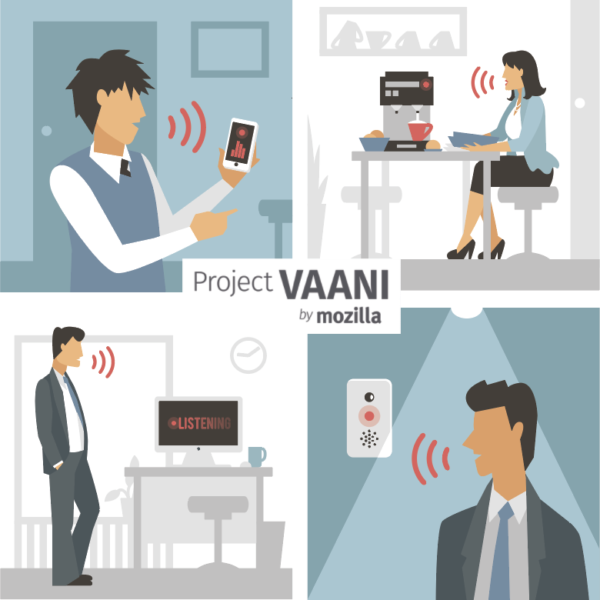
Project Vaani voice updateEarlier this year, we moved Project Vaani into a prototyping phase with user trials. We collected valuable feedback around product concept and design, as well as validated our assumption that a voice interface would help create a faster, easier and unconstrained way of doing things. This solution was designed and built around the users’ lives, as opposed to the service providers’ business interests. With that validation, we decided to focus on implementing the core voice technology components that everyone (Mozilla, as well as partners and the community) could use in their projects.

We also found that current market solutions offer speech recognition by using cloud based solutions which lead to privacy concerns. Such solutions also need investments in cloud infrastructure. We believe creating an offline solution that can be embedded in other applications and low-footprint devices would be essential to avoid these issues.

With that, the next steps identified are as follows:

  1. We are starting with an online solution to order to create trained models first. We will then compress these models so that they can be used offline on small footprint devices.
  2. We will also create a public corpora of voices which will help with creating inclusive technologies for both speech-to-text recognition and text-to-speech synthesis.

Deep-Learning based Online Speech Recognition
In the past ten years, Deep Learning has revolutionized numerous fields: natural language processing, image classification, automatic translation. Recently, Speech recognition has also benefited from the research in this space. Over the past few months, Mozilla’s deep-learning team has been using Tensorflow to build a speech decoder based on the findings in Baidu’s Deep Speech published research paper. The paper claims to be able to achieve a high accuracy by using a bidirectional recurrent neural network (BRNN) to ingest speech spectrograms and generate English text transcriptions.

This project will produce a Speech-To-Text (STT) engine, requiring a server class machine with an adequately powerful CPU, GPU, and memory. Once the model is trained, we plan to use Tensorflow serving to query the model without the high resource requirement. This will pave the way for creating the offline solution noted below.

Project PipSqueak – Offline Local Speech recognition
Project Pipsqueak is a client-based offline STT engine that targets devices with a smaller footprint (e.g. RPi 3 and Android phones). Based off of Google’s research in this area, the idea is to reduce the neural network model by quantization and a SVD-based (single value decomposition) compression technique. Reducing model size, we’ll be able to translate speech to text on small footprint devices removing the need of having servers and an internet connection to have accurate speech decoding. Once implemented, Project Pipsqueak could be embedded in other platforms and applications, such as Firefox or connected devices.

Project Voicebank
Project VoiceBank enables our community of volunteers from around the world to “donate” their voice for creating a public corpora that includes variety of languages and accents. This public resource will be available for all open source voice interface projects to help everyone build inclusive technologies that work for all. The Project VoiceBank team will be kicking off this project at the Mozilla Work Week in Hawaii in December 2016.

Architecture / Code Samples / Repos can be found here.

29 Nov 08:40

iOS 10 and Default Apps

by Federico Viticci

Kirk McElhearn, writing for Macworld, returns to the issue of iOS not having the ability to set different default apps:

We’re at iOS 10, and Apple still hasn’t allowed users to make these choices. It seems ridiculous that, with a mature operating system, we’re still locked into Apple’s default apps. It’s not rocket science to make these changes; after all, there are protocols that funnel requests to specific handlers, the same way they do on the Mac. Let us choose the apps we want to use: It’s time to let iOS users have the same freedom of choice as Mac users.

I've argued in favor of third-party default apps many times in the past (see 'Personalization' here). Clearly, this isn't a technical problem per se; I think Apple is more concerned about the strategic and security implications of default apps.

Opening up system default apps to any third-party app could result in users choosing alternatives for Apple Music, Maps, and Photos/Camera (among others). These apps are key to Apple's ecosystem of services and iPhone experience as a whole. They are essential differentiators, unlike, say, TextEdit or Calendar. The comparison between default apps on macOS and iOS only goes so far – I believe Apple sees certain iPhone apps as more important than their Mac counterparts and critical to controlling the iOS ecosystem.

Should Apple allow a third-party to replace the Health app? What about iMessage (a new platform inside iOS) or FaceTime? Bringing user-configurable default apps to iOS isn't as easy as flipping a switch – there are ramifications that go beyond opening .txt files in an alternative text editor on macOS.

I think there should be the option to set different defaults for some iOS apps, and I think we will get such feature, albeit in a limited fashion. Look at SiriKit and the rollout of a few domains in iOS 10.0; that's a good indicator of how Apple tends to tackle these problems. Different default apps would be welcome for iPad productivity (especially the web browser and email client), but I'd be surprised if Apple rolled out extensive support to change just about any default system app on iOS.

→ Source: macworld.com

29 Nov 08:40

The New MacBook Pro Is Kind of Great for Hackers

by Federico Viticci

Adam Geitgey:

A million hot takes have been posted about how the late-2016 MacBook Pro with USB-C is the undeniable proof that Apple doesn’t care about developers anymore. They took away all the ports! No Esc key! It’s just a more expensive MacBook Air!

But in some ways, the new MacBook Pro is the most techy and expandable laptop Apple has ever made. They are trusting their pro users to wade into murky USB-C waters in search of the holy grail of a universal, open standard for moving data and power between devices.

I’m not here to change your mind about the MacBook Pro. Yes, it’s probably too expensive and more RAM is better than less RAM. But everyone posting complaints without actually using a MBP for a few weeks is missing out on all the clever things you can do because it is built on USB-C. Over the past week or two with a new MacBook Pro (15in, 2.9ghz, TouchBar), I’ve been constantly surprised with how USB-C makes new things possible. It’s a kind of a hacker’s dream.

His examples make me wish the iPad Pro had a USB-C port to plug anything into it without having to buy adapters.

→ Source: medium.com

29 Nov 08:39

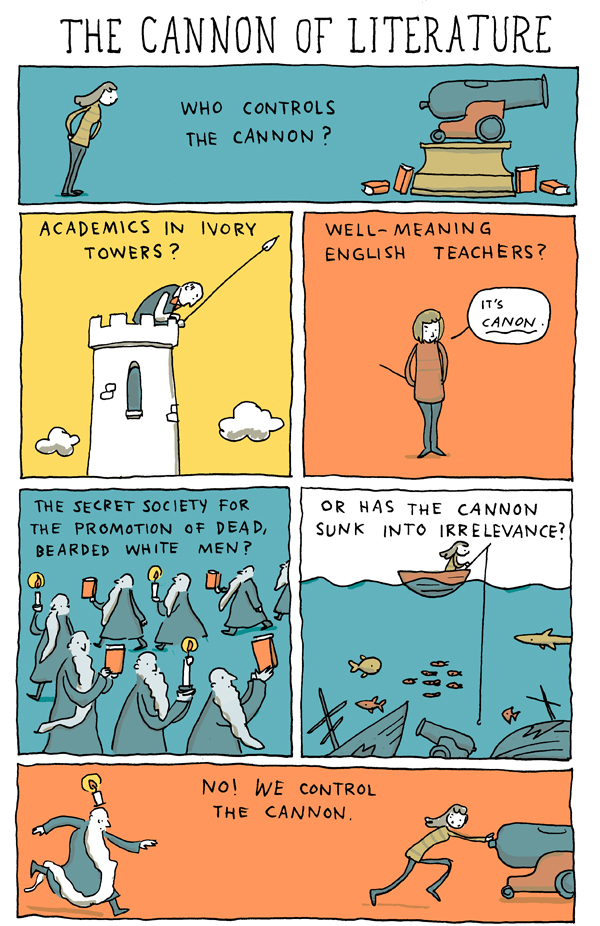
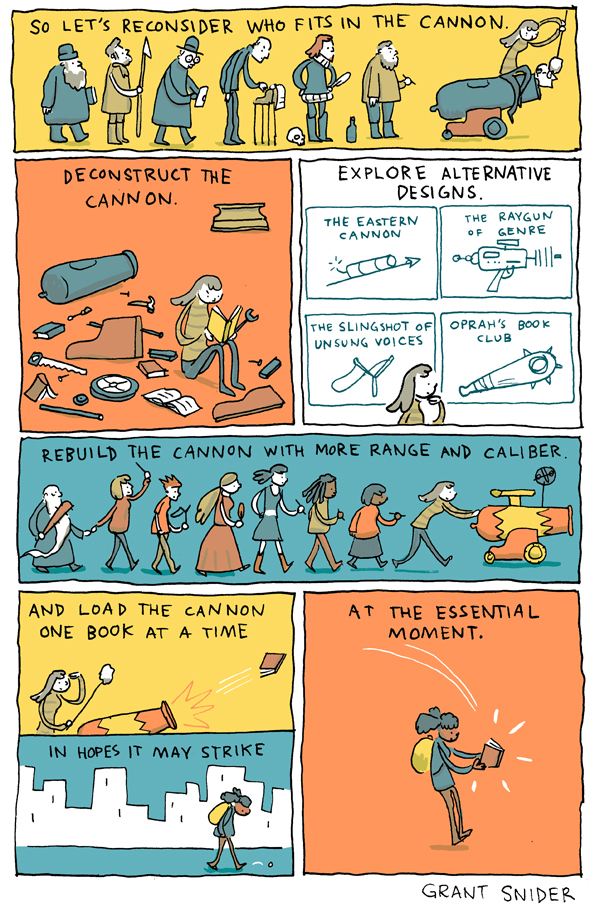
The Cannon of Literature

by Grant (noreply@blogger.com)
mkalus shared this story from INCIDENTAL COMICS.


This comic appears in the latest issue of The Southampton Review.

Posters of this and many other fine literary comics are available at my shop. They make perfect gifts for teachers, librarians, and your book-obsessed friends and family.

You can now pre-order my book, The Shape of Ideas.


29 Nov 08:38

The Many Myths Surrounding the Pilgrims and Thanksgiving

by Daven Hiskey
mkalus shared this story from Today I Found Out.

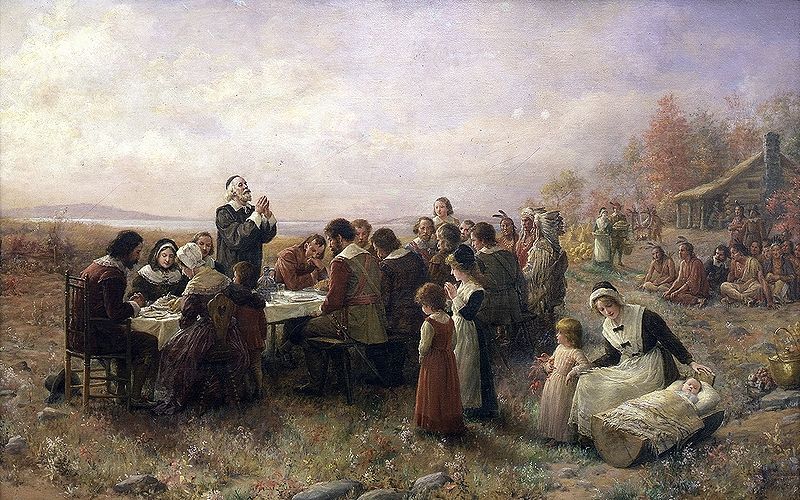
pilgrimsMyth: Pilgrims wore black and white clothing with buckled top hats.

The myth that they dressed like this stems from a popular clothing style in England in the late 17th century, which carried over to 18th and 19th century artist depictions of Pilgrims. In fact, historical records of Pilgrims’ clothing, such as the passenger list of the Mayflower, wills, which included descriptions of clothing, and other such records, paint a very different picture than the late 17th century artists depicted. For starters, the Pilgrims didn’t wear buckled hats. They also didn’t wear buckles on their shoes or waists. Buckles were expensive and not in fashion at the time. They simply wore the much cheaper leather laces to tie up their shoes and hold up their pants. Buckles later became very popular in England for their expense and as a fashion statement. Those who were too poor to afford buckles wore laces, similar to the Pilgrims.

They also didn’t only wear black and white. The Pilgrim’s common garb was very colorful, as was the fashion at the time. They only wore predominately black and gray clothing on Sundays. The rest of the time, they wore heavily dyed clothing in many different colors. For one example, a Pilgrim by the name of Brewster left his clothing in his will to someone, which was described as such: “one blew clothe suit, green drawers, a vilolete clothe coat, black silk stockings, skyblew garters, red grograin suit, red waistcoat, tawny colored suit with silver buttons.”

Another myth surrounding the Pilgrims is that they would have probably died the first winter had the Native Americans not taught them various agricultural tips and tricks. In fact, the Pilgrims didn’t come so unprepared. They had a contract with various merchants who would come regularly to bring them supplies of food, clothing, etc for a term no less than seven years, while they established their colony. They were also well versed in hunting and farming techniques from Europe. When the Pilgrims left, they were quite well aware of the colonies that had tried to settle in America and failed; thus, they took appropriate steps to avoid that happening to them.

pilgrims2This all brings us to the most pervasive myth of all concerning the Pilgrims, that they celebrated the first Thanksgiving in America and invited the Native Americans to join in.

The Pilgrims did not celebrate the first Thanksgiving in America. In fact, the particular Pilgrim event that is often cited as the first Thanksgiving wasn’t even the Pilgrim’s first Thanksgiving. They had several before then at various times and none of them were an annual thing. These days were simply a particular time where they had something significant to thank God about, so would set aside a day to do so.

Around the time the Pilgrims came to America in 1620, it was common in England and many parts of Europe to frequently set aside days for giving thanks to God. In the New World, where life was harsh in the beginning, there were numerous opportunities to hold such days of thanks, for example: any time a particularly good crop would come in; anytime a drought would end; anytime a particularly harsh winter was survived; anytime a group managed to repel an attack by Native Americans; anytime a supply ship arrived safely from Europe; etc. This sort of practice remained fairly common up until around the time when Thanksgiving became a national holiday. Most of these celebrations bore little resemblance to what we think of as Thanksgiving. Indeed, even the particular Thanksgiving day that the Pilgrims celebrated sometime between September and early October of 1621 bore little resemblance to what is depicted now.

So who actually celebrated the first Thanksgiving in America? Nobody knows for sure owing to how common these days of thanks were in the New World. Three popular examples that are often referenced as the actual “firsts” and that pre-date the Pilgrims date include:

  • September 8, 1565: This day of thanksgiving was celebrated by a group of Spaniards lead by Spanish explorer Pedro Menéndez de Avilé, in Saint Augustine, Florida. Interestingly, Menéndez de Avilé even invited the Timucua tribe to dine with them on that Thanksgiving.
  • 1598: In San Elizario, Texas, Spanish explorer Juan de Onate, on the banks of the Rio Grande, along with those with him held a Thanksgiving festival after they successfully crossed over 350 miles of Mexican desert.
  • December 4, 1619: Thirty-eight settlers landed on James River, on a ship called the Margaret, about 20 miles from Jamestown. Their charter required that the day of landing be set aside as a day of thanksgiving both on that first date and every year after. This tradition died out due to the “Indian Massacre of 1622″ where many of the settlers were killed and most of the rest fled to Jamestown.

OK, so they weren’t the first, but they invited the Native Americans to their 1621 party right? In truth, from the only two first-hand passages that directly describe the event in question, a letter from Edward Winslow in December of 1621 and William Bradford’s passage in “Of Plymouth Plantation,” it would appear the party was held with no such invite. We do know the Native Americans stopped by at random times, probably attracted by all the noisy games like shooting contests, and some that stopped by were allowed to participate, but as for specifically thinking to invite them to take part in the event, there’s no such record nor any real indication of this.

So why is the Pilgrim Thanksgiving that happened in the autumn of 1621 often considered the first Thanksgiving and why do we have all these myths surrounding the 1621 event? This is largely thanks to Sarah Josepha Hale, author of the nursery rhyme “Mary Had a Little Lamb” and one of the most influential women in American history.

She was particularly enamored with this Pilgrim event that she had read about in a passage by William Bradford in Of Plymouth Plantation as well as the particular Thanksgiving tradition which was somewhat common in New England at the time. She tirelessly campaigned for over 20 years to have Thanksgiving become a national holiday with a set date and was ultimately successful.

Through her highly circulated editorials, she was largely responsible for much of why we view the Pilgrim’s 1621 Thanksgiving how we do and was also largely responsible for many of the traditions we now tend to attribute to that Thanksgiving. For example, things like the tradition of eating turkey, mashed potatoes, stuffing, cranberry sauce, and pumpkin pie on Thanksgiving were all popularized by her and it is extremely unlikely that the Pilgrims ate any of those things.

If you liked this article, you might also enjoy subscribing to our new Daily Knowledge YouTube channel, as well as:

Bonus Facts:

  • The first record of the term “pilgrim” applying to the Mayflower passengers, and those of their group that followed later, appeared in William Bradford’s Of Plymouth Plantation. In it, he used biblical imagery to describe the Pilgrim’s departure from Leiden in 1620: “So they lefte goodly & pleasante citie, which had been ther resting place, here 12 years; but they knew they were pilgrimes, & looked not much on these things; but lift up their eyes to ye heavens, their dearest cuntrie, and quieted their spirits.” The next two instances of them being called Pilgrims came when Nathaniel Morton and Cotton Mather in 1669 and 1702, respectively, both paraphrased Bradford’s words. The next reference was in 1793 by Rev. Chandler Robbins who recited Bradford’s words at a Plymouth Forefathers’ Day observance. From here, the term caught on and it became popular to toast to the “Pilgrims of Leyden” on this observance day. By 1820, Daniel Webster referred to this group as the “Pilgrims” at the Plymouth’s bicentennial, which is hugely responsible for the term being picked up popularly as the name of this group.
  • Yet another myth surrounding the Pilgrims and Thanksgiving is that they were taught by the Indians to make Popcorn and served it at the “first” Thanksgiving. In fact, while there is little evidence of what they actually ate at their first Thanksgiving, it is very unlikely that they ate popcorn, due to the fact that all they had available was flint corn, at the time. This type of corn doesn’t pop when heated, rather just expands slightly. Thus, it wasn’t very palatable in this form, so they tended to boil it, preparing it as hominy.

The post The Many Myths Surrounding the Pilgrims and Thanksgiving appeared first on Today I Found Out.

29 Nov 08:38

Twitter Favorites: [Cuellar360] This is literally how Canadians do Door crasher Black Friday sale lmao. This is actually so Canadian it makes me cry https://t.co/cCbgAqioQ9

Cuellar360 @Cuellar360
This is literally how Canadians do Door crasher Black Friday sale lmao. This is actually so Canadian it makes me cry pic.twitter.com/cCbgAqioQ9
29 Nov 08:38

Twitter Favorites: [Planta] One of the main reasons that I'm reticent to write a book is that I'd likely act on the urge to use it to get even with people.

Joseph Planta @Planta
One of the main reasons that I'm reticent to write a book is that I'd likely act on the urge to use it to get even with people.
29 Nov 08:38

Recommended on Medium: The new MacBook Pro is kind of great for hackers

A million hot takes have been posted about how the late-2016 MacBook Pro with USB-C is the undeniable proof that Apple doesn’t care about…

Continue reading on »

29 Nov 08:37

Twitter Favorites: [Planta] What's up with Putin sending telegrams all the time? How does he do that? How does it get to places?

Joseph Planta @Planta
What's up with Putin sending telegrams all the time? How does he do that? How does it get to places?
29 Nov 08:37

Twitter Favorites: [Buster_ESPN] Bill Lee remains the Spaceman, as he nears 70. https://t.co/08Pzpz93zJ

Buster Olney @Buster_ESPN
Bill Lee remains the Spaceman, as he nears 70. bostonglobe.com/sports/redsox/…
29 Nov 08:37

Twitter Favorites: [Legopolis] Not even much of a football fan, but the @CFL always seems to come through with the excitement in the clutch. #GreyCup

Steven Schapansky
29 Nov 08:37

This Company Uses NLP to Find the Right Keyword

by mjkim

This is the ninth post in our series: Discover Korea’s Tech, where we will talk to a mix of Korean startup entrepreneurs who stood their own ground with their technology, in Korea’s economy notoriously dominated by gigantic companies. Stay tuned over the coming month as we talk to Korean entrepreneurs. You can follow our updates @technodechina for new stories in the series.

Entering a new market, especially one with a different language than yours, is not easy. All of your content needs to be expressed as naturally as possible. Finding the right words and expressions to accurately delivery your brand’s image and message is no easy task. Indeed, no matter how much time is put into crafting your content, fatal mistakes with awkward or incorrect translations are difficult to avoid.

That is exactly the challenge that Twinword hopes to solve by using natural language processing to make optimal language choices.

Since much of the Internet is based around search engine discovery, getting your keyword right is hugely important. Founded in 2012, Twinword combines data science and SEO/keyword research to deliver high quality keyword results for any business by extracting word associations and word relationships.

In the beginning of November, they released a new product called Twinword.Ideas.

“For those working in marketing industry in US are very keen to find relevant keywords and have had to pay a huge cost to advertisement companies for this role. Now, they can use Twinword.Ideas for that.” says Kono Kim, the founder of Twinword and a PhD candidate in natural language processing. On the other hand, Twinword also helps Korean and Chinese companies struggling to grab US consumers.

It is important to note that Twinword.Ideas is not merely a tool providing keywords.

“There already are a lot of startups providing similar service and Google Keyword Planner is doing this even for free”, says Kono.

Although these normal keyword research tools provides you with a long list of supposedly relevant keywords. But, this list is calculated purely from big data, it is very raw, leaving users to actually check one by one for relevance.

“Our technology provides other ways to play with that list. We do this through a technology called semantic sourcing which basically reprioritizes the order of words. We let the users catch the words that more specifically fits their demand and intent”, Kono said.
unnamed
There are two different features to realize this goal. The first one is User Intent; this filters keywords by the intent users have when searching between Know, Do, Buy, Local, and Web. For example, if the user chose ‘Buy’, only transaction-related keywords and buying-behavior related keywords will show up.

Another feature is Target Relevance. By freely entering the important element in keywords, the order of words changes to be more relevant. So, if I write ‘price’, then words that are related to price are put in higher ranks.

Considering that it has only been three weeks since Twinword.Ideas launched, it is impressive that Twinword.Ideas has been achieving more than 5 percent increase every week regarding user acquisition and traffic. And they have already established partnerships with US ad management solution platforms to integrate Twinword.Ideas keyword research tool.


“We are also close to partnering with SEO service platforms specialized in Chinese. So, in the future, as our existing clients want to expand their service to Chinese websites, we will be ready to provide that service as well”, says Kono. “Our goal is to assist companies in better understanding their consumers. We set up keyword strategy, utilize keywords on contents, validate traffic and results, and then at last, verify which keyword actually attracted their potential customers. It is a comprehensive cycle that we manage.”

Twinword is supported by K-ICT Born2Global Center, a major Korean government agency under the Ministry of Science, ICT and Future Planning (MSIP).

Image credit: Twinword

29 Nov 08:37

Ola. vs. Uber – Welfare state.

by windsorr

Reply to this post

RFM AvatarSmall


I suspect Ola will need state intervention to survive. 

  • Ola looks to have become desperate as it appears to be pursuing a new round of funding at a valuation 40% below where it raised money just one year ago.
  • This is just yet another sign of the malaise that has hit the Indian start-up arena as Flipkart has already run into difficulties resulting in lay-offs and management change and funding for Indian start-ups is down 50% compared to the first 3 quarters of 2015.
  • This echoes exactly what happened in Silicon Valley during 2015 where much more attention was put on profitability and valuation after a series of so-called unicorns failed to execute on their plans.
  • I think there is still plenty of money available for investing in India but it is now much more difficult to get one’s hands on it and founders will end up having to give more of their companies away.
  • Furthermore, I think the departure of Nikesh Arora from Softbank has caused it to be far more passive in the region which has also had a knock-on effect on valuations.
  • On top of this, Ola’s operational outlook is looking increasingly difficult because it no longer has a significant advantage in the Indian market.
  • Car hailing is one of the best examples of a networked economy and just like classifieds it is extremely difficult to make money until one of two criteria are met:
    • First: one must has at least 60% market share or
    • Second: one must have double the market share of the next largest player.
  • Earlier this year it was thought that Ola had 80% market share but when one looks at completed rides, it turns out this number is closer to 50%.
  • To make matters worse, its chief rival Uber has roughly the same position meaning that two are likely to fight it out until one cracks.
  • In the Chinese market it was Uber that cracked as it became clear that it would never be able to compete on a level playing field with Didi Kuadi (see here) but in India things are different.
  • The problem that Ola faces is that Uber is much larger and better financed meaning that it will be able to compete aggressively and lose money until Ola goes out of business.
  • Consequently, unless the regulatory landscape shifts more in favour of the local player (as in China), it looks like Ola will end up selling itself to Uber.
  • Car hailing, like food delivery and all other online market places are winner takes all markets and there are no prizes for second place.
  • As I result, I remain concerned with the long-term outlook for Ola and I would be very cautious at putting money in even at $3bn.
  • If nothing changes, Ola is likely to end up being worth far less than that.
29 Nov 08:37

An Example Of A Big Win In Community Management

by Richard Millington

The biggest wins in community management are not ‘sparks of genius’ moments you will have in the shower. The biggest wins come from following and refining a process.

The better the process, the bigger the win.

Our goal in the Strategic Community Management program is to teach you that process.

This process matters. This process stops you getting sucked into day to day minutia which keeps you very busy, but doesn’t move the needle.


A Great Example Of A Big Win In Community Management

One of my favourite examples of a big win is from Riot Games (also students on our course). Riot Games (like everyone in the video-gaming sector) faced a difficult harassment problem.

Most organizations respond to these problems by hiring more moderators and using learning management tools to identify and remove posts incrementally faster. This is classic routine thinking behavior. Riot Games did something completely different.

Riot Games stopped trying to remove content a few seconds faster and instead changed the psychology of harassment among members. In short, they stopped members wanting to harass each other.

The results were remarkable:

“[…] when abuse reports arrived within 5–10 minutes of an offence, the reform rate climbed to 92%. Since that system was switched on, Lin says, verbal toxicity among so-called ranked games, which are the most competitive — and most vitriolic — dropped by 40%. Globally, he says, the occurrence of hate speech, sexism, racism, death threats and other types of extreme abuse is down to 2% of all games”.

The answer itself (sending a timely reminder in the right colour within moments of the negative post) isn’t revolutionary. Any of us could implement that idea within a few weeks in our community.

The magic is zeroing in on that one specific intervention among the thousands you could test to solve the problem.

To zero in like this you need a process that combines data and psychology. Very few people do this today, yet it’s your best source of your biggest wins.

In almost every single goal you have for your community right now (getting more people to join, participate, share knowledge, answer questions, take action etc…) there are big wins like this waiting to be uncovered.

If you follow the right process you can unearth these big wins.

It’s far more exhilarating to work towards big wins that move the needle than the next piece of content in your calendar.

Thus far 53 people from around the world have joined us on our Strategic Community Management course to learn how to do that. They want to ensure they are spending their days working towards a big win that matters.

I hope you will join them and us on the Strategic Community Management course.

My team and I would love to work with you.

29 Nov 08:37

Firefox 51 Beta 3 Testday Results

by Paul Silaghi

Hi everyone!

Last Friday, November 25th, we held Firefox 51 Beta 3 Testday.  It was a successful event (please see the results section below) so a big Thank You goes to everyone involved.

First of all, many thanks to our active contributors: Krithika MAPMoin Shaikh, M A Prasanna, Steven Le Flohic, P Avinash Sharma, Iryna Thompson.

Bangladesh team: Nazir Ahmed Sabbir, Sajedul Islam, Maruf Rahman, Majedul islam Rifat, Ahmed Safa,  Md Rakibul Islam, M. Almas Hossain, Foysal Ahmed, Nadim Mahmud, Amir Hossain Rhidoy, Mohammad Abidur Rahman Chowdhury, Mahfujur Rahman Mehedi, Md Omar Faruk sobuj, Sajal Ahmed, Rezwana Islam Ria, Talha Zubaer, maruf hasan, Farhadur Raja Fahim, Saima sharleen, Azmina AKterPapeya, Syed Nayeem Roman.

India team:  Vibhanshu Chaudhary, Surentharan.R.A, Subhrajyoti Sen, Govindarajan Sivaraj, Kavya Kumaravel, Bhuvana Meenakshi.K, Paarttipaabhalaji, P Avinash Sharma, Nagaraj V, Pavithra R, Roshan Dawande, Baranitharan, SriSailesh, Kesavan S, Rajesh. D, Sankararaman, Dinesh Kumar M, Krithikasowbarnika.

Secondly, a big thank you to all our active moderators.

Results:

We hope to see you all in our next events, all the details will be posted on QMO!

29 Nov 08:37

Magnificent Desolation

by Elisa Gabbert

Some months ago I saw a link on Twitter to a YouTube video that caught my attention. It was a computer-animated re-creation of the sinking of the Titanic in real time, all two hours and 40 minutes of it.

I did not watch the whole video, but I skipped around and watched parts, interested especially in the few interior views where you can watch the water level slowly rising at an angle in the white-painted hallways of the lower decks, and later, in the ballroom and grand staircase, as wicker chairs bob around.

The strangest thing about the video is that it includes no people — no cartoon passengers. There is no violin music, no voiceover. The ship is lit up, glowing yellow in the night, but the only sound, save for a few emergency flares and engine explosions, is of water sloshing into and against the ship. The overall impression is of near silence. It’s almost soothing.

This is true until the last few minutes of the video, when the half-submerged ship begins to groan and finally cracks in half. Only then, as the lights go out and the steam funnels collapse, do you hear the sound of people screaming, which continues for another half-minute after the ship has disappeared. A caption on the screen reads: “2:20 — Titanic is gone. Rescue does not arrive for another hour and 40 minutes.” A few (apparently empty) lifeboats are seen floating on the calm black ocean under a starry sky. Then, another caption: “2:21 — Titanic is heard beneath the surface breaking apart and imploding as it falls to the seafloor.” The video ends on this disturbing note, with no framing narrative creating a pseudo-happy ending.

It’s terrifying, how quickly an ordered structure dissolves. Where does it all go? Buildings, like anything, are mostly empty space

I was suddenly obsessed with the story of the Titanic. I rewatched the James Cameron movie (still ridiculous, still gripping); I read a Beryl Bainbridge novel (Every Man for Himself) based on the night of the sinking; I read thousands of words on Wikipedia and what you might call fan sites, if you can be a fan of a disaster, reading lists of “facts” and conspiracy theories. I watched a documentary about a weird newish theory of the root cause of the disaster: One scientist thinks that a sudden and extreme drop in temperature caused a kind of mirage illusion on the horizon that obscured the iceberg from the men in the lookout until they were nearly upon it. The same illusion could, in theory, explain why a nearby ship (the S.S. Californian) did not clearly see that the Titanic was in danger. It is, of course, just a theory.

Even if you’ve read some history of the Titanic, even if you’ve never seen the movies, the Hollywood version of the narrative has a lot of pull — and that narrative puts the blame on hubris. Call it the Icarus interpretation: Blinded by a foolhardy overconfidence, we flew too close to the sun, melting our wings, et cetera. It’s the easiest explanation, appealing in its simplicity, its mythic aura, and not without truth.


When I ran out of freely available Titanic material, I moved to other disasters. I had a sudden overwhelming desire for disaster stories of a particular flavor: I wanted stories about great technological feats meeting their untimely doom. I felt addicted to disbelief — to the catharsis of reality denying my expectations, or verifying my worst fears, in spectacular fashion. The obvious next stop was 9/11.

9/11 is, so far, the singular disaster of my lifetime. People who were in New York City at the time always comment on how “beautiful” and “perfect” that September morning was, with “infinite visibility” — pilots call those conditions “severe clear.” As I recall, it was a bright blue day in Houston too. I was driving from my apartment to the Rice University campus a couple of miles away when I heard the reports of a plane hitting one of the Twin Towers on the radio. I continued driving to school, parked my car in the stadium lot, and went into the student center, where a few people were watching the news on TV, with that air of disbelief that can appear almost casual.

The live footage of a massive steel skyscraper with smoke pluming out of a hole in its side was shocking, but I felt it dully; shock is marked by either incomprehension or denial. I don’t remember truly feeling horror — that is, understanding — until people began to jump from the buildings. They were almost specks against the scale of the towers, filmed from a distance, but you knew what they were. They became known as the “jumpers”: people trapped in the upper floors of the building, above the plane’s impact and unable to get out, who were driven to such desperation from the extreme heat and lack of oxygen that they broke the thick windows with office furniture or anything else they could find and jumped to the pavement hundreds of stories below. Leslie E. Robertson, the lead structural engineer of the towers, later wrote that “the temperatures above the impact zones must have been unimaginable.” Their bodies were heard landing by those nearby and those still in the buildings.

The jumpers’ experience is exemplified by one Associated Press photo dubbed “The Falling Man.” It depicts a man “falling,” as if at ease, upside-down and in parallel with the vertical grid of the tower. (It’s a trick of photography; other photos in the series show him tumbling haphazardly, out of control.) The photo was widely publicized at first, but met with vehement critique. It seems that some people found this particular image too much to take, an insult to their senses. And though the jumps were witnessed by many, the New York City medical examiner’s office classifies all deaths from the 9/11 attacks as homicides. Of course, they were forced, forced by suffering — but they were also voluntary. It seems akin to a prisoner held in solitary confinement or otherwise tortured killing themselves — murder by suicide.

When I think of the jumpers, I think of two things. I think of images of women covering their mouths — a pure expression of horror. They were caught on film, watching the towers from the streets of Manhattan. I do this sometimes — hand up, mouth open — when I see or read something horrible, even when alone. What is it for? I think, too, of the documentary about Philippe Petit, who tightrope-walked between the tops of the towers in 1974. At the time they were the second tallest buildings in the world, having just been surpassed by the Sears Tower in Chicago. It was an exceptionally windy day (it is always windy at 1,300 feet) and when a policeman threatened him from the roof of one building, Petit danced and pranced along the rope, to taunt him. This still seems to me like the most unthinkable thing a man has ever willingly done. The jumpers did what he did, but worse. Death was not a risk but a certainty; they jumped without thinking. It’s more horrible to contemplate than many of the other deaths because we know the jumpers were tortured. Death is fathomable, but not torture.

A documentary on YouTube called Inside the Twin Towers provides a minute-by-minute account of the events on September 11, re-enacted by actors and intercut with interview footage from survivors. One man who managed to escape from the North Tower — he was four floors below the impact — recounts a moment when he opened a door and saw “the deepest, the richest black” he had ever seen. He called into it. Instead of continuing down the hall to see if anyone was there, he retreated back to his office in fear. He says in the film, “If I had gone down the hallway and died, it would have been better than living with this knowledge of, Hey, you know what, when it came right down to it, I was a coward. And it was actually our two co-workers down that hallway, on the other side, that ended up dying on that day. And I often think now, Perhaps I should have continued down that hallway.”

This is a classic case of survivor’s guilt, sometimes known as concentration-camp syndrome: the sense that your survival is a moral error. Theodor Adorno, in an amendment to his famous and somewhat misunderstood line about poetry after Auschwitz, wrote:

Perennial suffering has as much right to expression as a tortured man has to scream; hence it may have been wrong to say that after Auschwitz you could no longer write poems. But it is not wrong to raise the less cultural question whether after Auschwitz you can go on living — especially whether one who escaped by accident, one who by rights should have been killed, may go on living. His mere survival calls for the coldness, the basic principle of bourgeois subjectivity, without which there could have been no Auschwitz; this is the drastic guilt of him who was spared. By way of atonement he will be plagued by dreams such as that he is no longer living at all.

This common syndrome, along with post-traumatic stress disorder, goes some way toward explaining why so many Holocaust survivors commit suicide.


There is survivor’s guilt, but there is also survivor’s elation, survivor’s thrill — a thrill felt only by those a little farther from disaster. The September 24, 2001, issue of the New Yorker included a symposium of responses to the attacks. A few were able to acknowledge the element of thrill in our observation. Jonathan Franzen wrote:

Unless you were a very good person indeed, you were probably, like me, experiencing the collision of several incompatible worlds inside your head. Besides the horror and sadness of what you were watching, you might also have felt a childish disappointment over the disruption of your day, or a selfish worry about the impact on your finances, or admiration for an attack so brilliantly conceived and so flawlessly executed, or, worst of all, an awed appreciation of the visual spectacle it produced.

I find Franzen’s moral hierarchy here questionable, that “worst of all” most puzzling. Because to me, more than worry or admiration (!), the most natural and undeniable of reactions would seem to be awe.

It’s the spectacle, I think, that makes a disaster a disaster. A disaster is not defined simply by damage or death count; deaths by smoking or car wrecks are not a disaster, because they are meted out, predictable. Nor are mass shootings generally considered disasters. A disaster must not only blindside us but be witnessed in public. The Challenger explosion killed only seven people, but like the Titanic, which killed more than 1,500, and like 9/11, which killed almost 3,000, the deaths were both highly publicized and completely unexpected.

It’s comforting to believe disasters result from some fixable “fatal flaw,” and are not an inevitable part of the unfolding of history. We can’t imagine all possible futures

All three incidents forced people to either watch or imagine huge man-made objects, monuments of engineering, fail catastrophically, being torn apart or exploding in the sky. These are events we rarely see except in movies. The destruction of the Challenger and the World Trade Center are now movies themselves, clips we can watch again and again. The proliferation of camera technology, including our cell-phone cameras, makes disaster easier to witness and to reproduce; it may even create a kind of cultural demand for disasters. Also on film are reaction shots: We get both the special effects and the human drama.

Roger Angell’s version of survivor’s thrill in the same issue is less chastising:

When the second tower came down, you cried out once again, seeing it on the tube at home, and hurried out onto the street to watch the writhing fresh cloud lift above the buildings to the south, down at the bottom of this amazing and untouchable city, but you were not surprised, even amid such shock, by what you found in yourself next and saw in the faces around you — a bump of excitement, a secret momentary glow. Something is happening and I’m still here.

Angell, here, is saying this is not an aberration; it is the norm. It is one of the horrible parts of disaster, our complicity: the way we glamorize it and make it consumable; the way the news turns disasters into ready-made cinema; the way war movies, which mean to critique war, can only really glorify war. And we eat it up.

We don’t talk about it now, but I always found the Twin Towers hideously ugly, in a way not explainable by their basic shape — they are long rectangular prisms, nothing more. Perhaps that was the problem. In the past, anything so large (the Eiffel Tower, the Titanic, the Empire State Building) had usually attempted to be beautiful and usually succeeded. These other structures still appear beautiful. How could anyone have ever found or ever in the future find the Twin Towers beautiful? They seem designed only to represent sturdiness, like campus buildings in the brutalist tradition that were mythologized to be “riot-proof.”

A friend, a New Yorker, disagrees. She tells me the buildings “did amazing things with the light.” Another, also from New York, says they were sexy at night. But all skyscrapers are sexy at night, from below if not from afar, by virtue of their sheer dizzying size, their sheer sheerness, sheer as in cliffs. They stand like massive shears, stabbed into the sky.

Despite their imposing, even ominous height, the towers fell in less than two hours; the Titanic took only a little longer to sink. But that happened gradually. When you watch a building collapse, it seems like it suddenly decides to collapse. It’s a building, and then, it’s not a building, just a crumbling mass of debris. There seems to be no transition between cohesion and debris. It is terrifying, how quickly an ordered structure dissolves. Where does it all go? Buildings, like anything, are mostly empty space.


In the vocabulary of disaster, one very important word is “debris,” from the French debriser, to break down. A cherishable word, it sounds so light and delicate. But the World Trade Center produced hundreds of millions of tons of it. The bits of paper falling around the city led some people to mistake the initial hit for a parade.

In space flight, or even on high-speed jets, tiny bits of FOD, or “foreign object debris,” can cause catastrophe. Space food is coated in gelatin to prevent crumbs, which in a weightless environment could work into vulnerable instruments or a pilot’s eye. A small piece of metal on the runway could get sucked into a jet engine and cause it to fail.

The Challenger explosion, like the sinking of the Titanic, is usually chalked up to hubris. But if hubris is overconfidence, the explanation is unsatisfying. Engineers at NASA’s Marshall Space Flight Center knew that the O-ring seals, which helped contain hot gases in the rocket boosters, were poorly designed and could fail under certain conditions, conditions that were present on the morning of the launch. The O-rings were designated as “Criticality 1,” meaning their failure would have catastrophic results. But the engineers did not take action to ground all shuttle flights until the problem could be fixed. As the very first sentence in the official Report of the Presidential Commission on the Space Shuttle Challenger Accident puts it: “The Space Shuttle’s Solid Rocket Booster problem began with the faulty design of its joint and increased as both NASA and contractor management first failed to recognize it as a problem, then failed to fix it and finally treated it as an acceptable flight risk” (italics mine).

What shocks me most when I read about the space program is the magnitude of the risks. The Challenger exploding on live TV in front of 17 percent of Americans was unthinkable to most of those viewers but not unthinkable to workers at NASA.

From what I understand, NASA has always embraced a culture of risk. In his memoir Spaceman, astronaut Mike Massimino, who flew on two missions to service and repair the Hubble telescope, recounts the atmosphere at NASA after the space shuttle Columbia broke up on reentry in 2003:

When I walked in I saw Kevin Kregel in the hallway. He was standing there shaking his head. He looked up and saw me. “You know,” he said, “we’re all just playing Russian roulette, and you have to be grateful you weren’t the one who got the bullet.” I immediately thought about the two Columbia missions getting switched in the flight order, how it could have been us coming home that day. He was right. There was this tremendous grief and sadness, this devastated look on the faces of everyone who walked in. We’d lost seven members of our family. But underneath that sadness was a definite, and uncomfortable, sense of relief. That sounds perverse to say, but for some of us it’s the way it was. Space travel is dangerous. People die. It had been 17 years since Challenger. We lost Apollo 1 on the launch pad 19 years before that. It was time for something to happen and, like Kevin said, you were grateful that your number hadn’t come up.

In other words, the culture of risk at NASA is so great that in place of survivor’s guilt there is only survivor’s relief.

But knowing the risks and doing it anyway must entail some level of cognitive dissonance. This is apparent when Massimino writes that “like most accidents, Columbia was 100 percent preventable.” This is hindsight bias; only past disasters are 100 percent preventable. The Columbia shuttle broke apart due to damage inflicted on the wing when a large chunk of foam insulation flew into it during launch. This was observed on film, and ground crew questioned whether it might have caused significant damage. However, the insulation regularly broke apart during launches and had never caused significant damage before. Further, NASA determined that even if the spacecraft was damaged, which they had no way of verifying, there was nothing that the flight crew could do about it, so they didn’t even inform them of the possibility of the problem.

When Columbia came apart during reentry, disintegrating and raining down parts like a meteor shower over Texas and Louisiana, an investigation was launched. At first, no one believed that the foam could have done enough damage to cause the accident. It was “lighter than air.” As Massimino writes, “We looked at the shuttle hitting these bits of foam like an 18-wheeler hitting a Styrofoam cooler on the highway.” Not until they actually reenacted the event by firing a chunk of foam at 500 miles per hour toward a salvaged wing and saw the results did they accept it as the cause of the disaster. Anything going that fast has tremendous force. This was not like the failure of the O-ring; the risks of the insulation were not understood. Or, more properly, they were simply not seen — it’s basic, though unintuitive, physics. The same type of accident is 100 percent preventable now only because the disaster happened, triggering a shuttle redesign. When redesigns cost billions of dollars, if it isn’t broke, they don’t and probably can’t fix it.


The problem with the concept of hubris is that it lets us off too easy. It allows us to blame past versions of ourselves, past paradigms, for faulty thinking that we’ve since overcome. But these scientists we might scoff at now were incredibly smart and incredibly well-prepared. The number of things that didn’t go wrong on numerous space missions is astounding. It’s easy to blame people for not thinking of everything, but how could they think of everything? How can we?

Not knowing the unknowable isn’t hubris. There is real danger in thinking, We were dumb then, but we’re smart now. We were smart then, and we are dumb now — both are true. We do learn from the past, but we can’t learn from disasters that do not yet have the capacity to happen. While disasters widen our sense of the scope of the possible, there are limits. We can’t imagine all possible futures. Yet we call this hubris. Perhaps it’s comforting to believe disasters are the result of some fixable “fatal flaw,” and not an inevitable part of the unfolding of history.

Disasters always feel like something that happens in the past. We want to believe that better engineering will save us. But we can’t even hold on to what we already know

To say there are limits to technological progress — we can’t prepare ourselves completely for the unforeseen — is not to say progress is impossible, but that progress is tightly coupled with disaster. (As French cultural theorist Paul Virilio famously said, “The invention of the ship was also the invention of the shipwreck.”) Not until we experience new forms of disaster can we understand what it is we need to prevent. If this is true, overreliance on the explanatory power of hubris is itself a form of hubris, a meta-hubris, since it assumes a position of superiority.

And can we, in any case, have progress without hubris pushing us forward with partial blinders? Don’t we need hubris to enable and justify advances in technology? NASA seems to take hubris in stride; they see occasional disaster as the fair cost of spaceflight.

In his “Letter From a Birmingham Jail,” Martin Luther King, Jr. warned of “the strangely irrational notion that there is something in the very flow of time that will inevitably cure all ills.” You could say the same of technological progress; it is tempting to believe that progress occurs on a linear curve, such that eventually all problems will be solved, and all accidents will be completely preventable. But there’s no reason to assume the curve of progress is linear, that the climb is ever increasing.


I want to come back to the Titanic, and some common misconceptions. One is that there were not enough lifeboats on board for frivolous reasons — because proprietors felt they would look unattractive on deck, or because they were regarded as mere symbols, serving only to comfort nervous passengers on a ship designers believed was literally unsinkable. This isn’t the case. Rather, the thinking at the time was that the safest method of rescue, in the event of an emergency, was to ferry passengers back and forth between the sinking ship and a rescue ship. Because the Titanic would sink slowly, if at all, for some time it would actually be safer on the ship than in a lifeboat. Therefore the lifeboats didn’t need to accommodate the entire capacity of the ship in one go.

So why did the Titanic sink so fast? The surprising truth is that if the ship had hit the iceberg head on, instead of narrowly missing it at the stern and then scraping along its side, it would not have sunk. The ship was capable of sustaining huge amounts of damage from an impact like an iceberg — it could stay afloat if four of its 16 watertight bulkheads were flooded. But the iceberg tore into the ship in such a way that five compartments were damaged. This event was not, realistically, foreseeable; no iceberg in history had done that kind of damage to a ship, and none has done that kind of damage since. It was, in essence, a freak accident.

There are echoes of this in the World Trade Center’s collapse. It’s well known that the buildings were designed to survive the impact of an airplane. However, they were envisioning outcomes like a small, slow-flying plane hitting a tower by accident — in fact, a bomber flying in near-zero visibility had hit the Empire State Building in 1945 — not a modern jet being flown purposely into the tower at top speed. Still, there was a false sense of security. After the first impact, the PA system in the building told people to remain at their desks when of course they should have been evacuating. Some building staff also told workers it would be safer to stay where they were.

Is this hubris, or something else? Disasters always feel like something that happens in the past. We want to believe that better technology, better engineering will save us. The more information we have, the safer we can make our technology. But though it’s hard to accept, we can never have all the information. In creating new technology to address known problems, we unavoidably create new problems, new unknowns. Progress changes the parameters of possibility if it changes anything at all. In fact, this is something we strive for — to innovate past the event horizon of what we can imagine. Hubris feeds on itself, is self-sustaining. And with so much that is inaccessible, unknowable, and changing all the time, we can’t even hold on to what we already know.


As they stepped out of the lunar module and began their moon walk, Neil Armstrong said to Buzz Aldrin, “Isn’t that something! Magnificent sight out there.” Aldrin’s cryptic, poetic response was “Magnificent desolation.” I think of this quote when I see footage of disasters. Especially after years of buffer, years of familiarity, have lessened the sting, it’s easy to see these events as, in their way, magnificent. Magnificent creations beget magnificent failures. It is awesome that we built them; it was awesome when they fell. Horror and awe are not incompatible; they are intertwined.

Is it perversity or courage that allows some people to admit to survivor’s thrill? On the afternoon of September 11, I remember meeting my then-boyfriend on campus for lunch. He was a contrarian type, but nonetheless his reaction disturbed me — he was visibly giddy, buzzed by the news. It’s not that I don’t believe others were excited, but no one else had revealed it. In 2005, before the levees had broken in New Orleans, my roommate asked if I wasn’t just a little bit disappointed that Katrina hadn’t turned out as bad as predicted. Just hours later she regretted saying it.

Often, when something bad happens, I have a strange instinctual desire for things to get even worse — I think of a terrible outcome and then wish for it. I recognize the pattern, but I don’t understand it. It’s as though my mind is running simulations and can’t help but prefer the most dramatic option — as though, in that eventuality, I could enjoy it from the outside. Of course, my rational mind knows better; it knows I don’t want what I want. Still, I fear this part of me, the small but undeniable pull of disaster. It’s something we all must have inside us. Who can say it doesn’t have influence? This secret wish for the blowout ending?
29 Nov 08:37

Nordstrom: “We sell what sells, including Ivanka Trump”

by Josh Bernoff

Should Nordstrom continue to carry Ivanka Trump merchandise? It sells. So Nordstrom will keep selling it. In its rambling email to employees, it wraps that fact in tissue paper and packing peanuts. Why not have the courage to tell the truth? A friend of mine recently emailed Nordstrom to protest its decision to continue to … Continued

The post Nordstrom: “We sell what sells, including Ivanka Trump” appeared first on without bullshit.

29 Nov 08:37

Introducing a new game of (photo) tag!

by Kevin
mkalus shared this story from Blog – Plex.

Sometimes I wonder whether people from past generations are so fondly remembered because their minor transgressions were never properly documented. It’s difficult to stage an appropriately embarrassing photo when each exposure takes 90 seconds. So much has changed, and I can’t quite shake the suspicion that some day a new batch of humans will entertain themselves primarily by mocking our current generation’s mishaps. You spend one ill-fated Halloween rocking a Jheri curl meticulously crafted from half a bottle of your sister’s hairspray and the world will never forget. What a time to be alive…

If you’re like me (that is, one part photo nerd, one part data hoarder—I mean, digital lifestyle archivist), your photo library has been growing steadily since the early days of digital. For a while this was manageable: a few pics from a vacation, a snapshot here and there. A portrait of the kids (human or canine) in an especially adorable moment. Recently though, things have gotten pretty out of hand. The iPhone in my pocket is basically better quality than almost every Hasselblad that ever existed, my Facebook friends are clamoring for anything that’s not fake news, and let’s face it, Barkley’s not getting any less adorable. It’s the perfect storm, and the ensuing torrent of photos has given my Plex Camera Upload a workout. Really, it’s my cross to bear: these sunsets and eggs benedict brunches aren’t going to document themselves, right millennials!?

barkley-photo-cute

So how do we dig our way out from under this massive pile of pixels? More importantly, how do we find the proverbial needles in this hipster haystack?

As of today, Plex can help!

We’re seriously leveling up the Plex photo experience. For starters, the photos and personal video that you shoot on your phone no longer need to live in separate libraries. Your “Photo” libraries now incorporate your personal videos too. Seamless, like Ansel Adams intended. Second, we’ve significantly enhanced the photo viewer in the Web app. It’s beautiful, and it’s just a hint at shiny new things to come across the board.

Videos now live next to your Photos

But we weren’t merely content with a few cosmetic fixes. We’ve also sped up the process of importing photos into Plex by up to 300%. But really, we wanted to help people understand their photo libraries. So starting today, our Plex Pass subscribers can now let Plex automatically tag all your photos with fun stuff like “kitten” and “irish setter” using advanced machine learning technology. This is useful in a few ways:

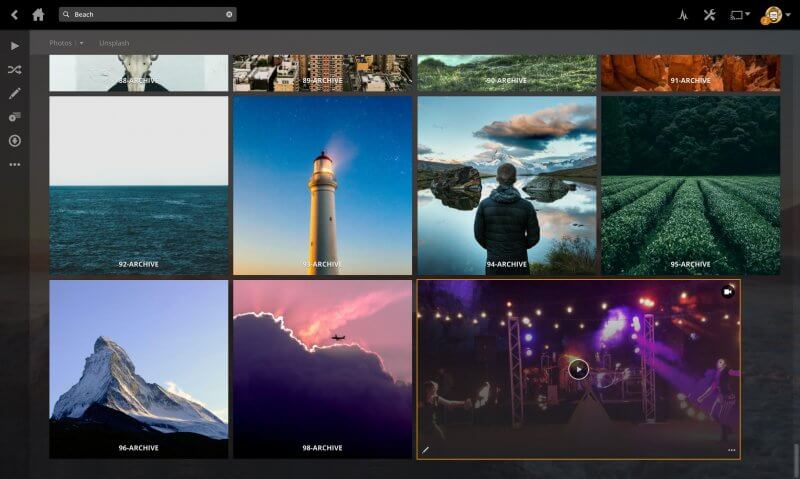
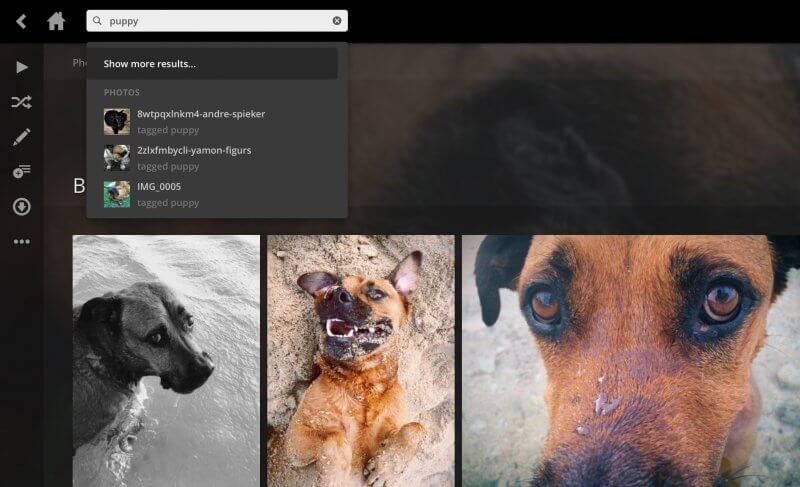
First of all, you can now search for images by using tags. For example, if I type in “Puppy” in the quick search bar, I instantly get results. It’s like magic!

Search tagged photos

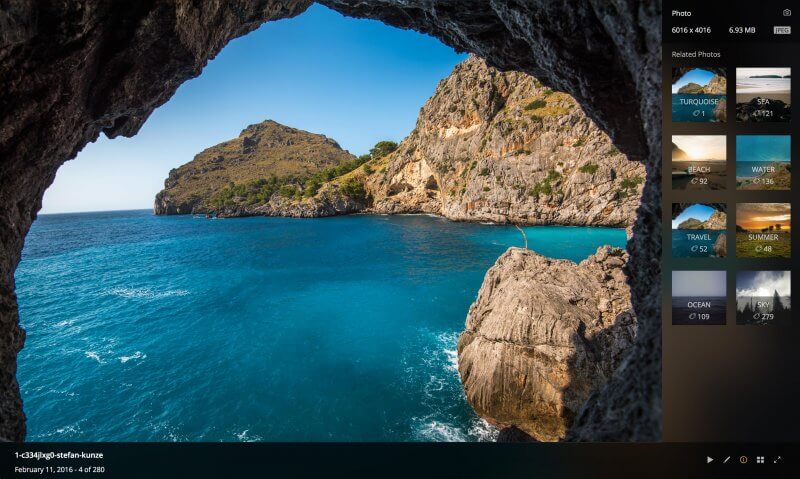
Secondly, when you’re viewing a photo, you can now see related photos based on tags, and explore that related set. It’s amazingly addictive, and a great way of spelunking through years of memories.

Related tags for Photos

Now for the fun part: I encourage you all to play a game. It’s kind of like Telephone, but the goal is to see how far you can get from where you started using only tags. My favorite was starting with “Vintage cars” and ending at “Norwegian elkhound”—how? I’ll never tell. Let us know your best photo path in the comments.

How do you enable this advanced-technology-which-is-clearly-indistinguishable-from-magic? Super simple: get a Plex Pass (assuming you don’t already have one), download the latest Plex Pass release of the server, and then either make a new photo library, or edit your current one to enable premium mode.

Plex auto-tagging for Photos

For those of you traveling for Thanksgiving this year, be safe, be well, and we wish you a wonderful time with family and friends. Barkley will be getting his share of turkey this year, promise. Oh, and don’t forget to take some photos!

plex-thankful

The post Introducing a new game of (photo) tag! appeared first on Plex.
29 Nov 08:37

Alexander Street at Columbia

by ChangingCity

locomotive-crossing-alexander

This image from around 1930 shows Canadian Pacific locomotive 2614 headed north-east along the tracks that cut a 45 degree angle through the East End of the city. We’re familiar with pictures of tracks running down the street carrying the interurban and streetcars of the BC Electric Railway, but don’t often see the full-sized locomotives that could shut the street down for several minutes. engine-2614-drake-st-yard-1920s-bc-archivesThe engine was probably coming from the Canadian Pacific Drake Street Yards – here’s another view of the Class G2E 4-6-2 locomotive built by the American Locomotive Company in the yards (on the right). There’s another picture in the City Archives of the engine in the station below Cordova Street in the 1930s, attached to a passenger train. The locomotive was sold for scrap in 1959.

There’s a challenge in lining up the contemporary image: the right-of-way that the train ran on has been built over. We’ve seen the building in an earlier post. It’s part of the Four Sisters Housing Co-op; this part was a newbuild component and there’s an attached heritage warehouse that in part dates from 1898. In 1988 the heritage building was converted to residential use, with the new structure replacing the right-of way as a part of the Co-operative, designed by Davidson and Yuen Partners for the Downtown Eastside Residents Association.

Image source: City of Vancouver CVA Can P103 and BC Archives


29 Nov 08:36

Massey Tunnel, Massey Bridge and Politics.

by Sandy James Planner


sdl201310042439411-jpg

In the recent  Delta Optimist, Doug Massey, son of George Massey has taken a look at the recent report by  the Corporation of Delta describing safety concerns and fire/ambulance response in the tunnel. And Mr. Massey responds “It’s all a plan in order to make it (tunnel) distasteful for the public and favourable towards a bridge. Politics by the province is behind the latest report by Delta on the George Massey Tunnel.”

As the son of George Massey who had the idea to construct the tunnel five decades ago, Doug Massey has been unwavering in responding to the continually  changing and sometimes quite diverse rationale that the Province champions in their dogged determination that the $3.5 billion dollar Massey bridge is good for us. After Delta’s safety report came out,  Transportation Minister Todd Stone commended  Delta for the report.

But Doug Massey says not so fast. “They’re playing a game of making the tunnel look bad. Of course it doesn’t have the safety features of a brand new tunnel but a lot of the accidents they’re talking about are not even in the tunnel, they’re on the approaches, and if they had proper warning signs well in advance to keep your headlights on, that would definitely help”.

Doug Massey also points out that there are immediate options to increasing first responder safety and lessening accidents in the tunnel, including restricting large trucks to certain times, and brightening the walls of the tunnel’s interior. He also notes that immersed tunnels are built around the world, with “some of these immersed tunnels (are) 37 metres down and 12 miles long, so, come on, you don’t build these things if they’re not safe. Ours is less than a mile long”.

“There’s a lot of things they could be doing to make it safer, but they’re making it more difficult. It’s just a game and they’re playing with people’s lives by doing it”. 

Despite the fact that every other municipality in Metro Vancouver has requested a rethink of this bridge’s size, location, and rationale, the Province is continuing its relentless quest forward. Its been a particularly awkward era in Delta, where cumulative impacts of  the proposed port expansion decimating vital flyway habitat, continued industrial development, the loss of agricultural land, and the building of a mega mall have erased arable farmland on the floodplain. Now the building of a massive ten lane bridge will further exacerbate the ecological fragility.

How will these decisions be regarded in fifty years?

massey


29 Nov 08:36

Raspberry Pi at MozFest 2016

by Olivia Robinson

MozFest, or Mozilla Festival, is an annual celebration of the Mozilla community and the wider open internet movement. People from all over the world gather to explore ways of making the internet a resource that’s open and inclusive to all. This year MozFest was held at Ravensbourne College in London from Friday 28 – Sunday 29 October.

Colleagues from the Raspberry Pi Foundation joined members of the community to run workshops across two classrooms in the Youth Zone; this meant more space than last year, bringing more opportunities to engage. Our community volunteers were really enthusiastic and varied in ages. Together we ran workshops ranging from Your Code in Space with Astro Pi, to how to create a burping Jelly Baby, to Physical Computing in Scratch and Hacking Minecraft.

A workshop leader leans over to point out something on a computer display to a young boy and a woman who are working together.

Families and young people at a Raspberry Pi workshop in the Youth Zone at MozFest 2016

One of the workshops I attended was how to create a burping Jelly Baby, run by Bethanie Fentiman (@bfentiman). She led a great session, especially given the technical hitches she encountered during the session: despite all of this, Bethanie and her team of helpers helped me to create a burping Jelly Baby by the end of the workshop. Thank you for all your patience and hard work! You can read Bethanie’s laconic take on MozFest in her blog.

All the workshops were well attended by a mix of families, children and teenagers.

Vincent Lee ran a workshop on making a Pi-powered automatic Twitter photo booth. His before and after MozFest blogs have some lovely photos, as well as candid insights into the frantic below-the-surface paddling that happens in order to deliver an event like this one!

MozFest 2016 was a great place to find out what you can do with a Raspberry Pi and discover what other members of the Raspberry Pi community have created. People were really impressed at the workshops run by the young volunteers, such as 11-year-old Elise with her workshop on Spooktacular Sounds with Sonic Pi. A massive thank you to them: it’s not easy to teach grown-ups alongside younger people! Elise’s MozFest 2016 blog describes her busy, sociable and exciting weekend.

Aoibheann, who ran Beginners’ Guide to Scratching Maths with Things from the Kitchen, travelled to MozFest from “the middle of nowhere” in the Republic of Ireland (so middle-of-nowhere, she has dial-up internet at home!). Aoibheann’s MozFest blog describes adapting her workshop to accommodate last-minute obstacles and finding that, despite the busy-ness, the Youth Zone was a home from home.

cwbus2sxyaqoun8

Two very popular workshops at MozFest were LASERS! Create your own jewellery/keyring using a laser cutter and LASERS! Bringing drawings to life! Both were run by Amy Mather, whose enthusiasm for lasers is just one of many things for which she’s become well known in the Pi community. Participants learned how to use Raspberry Pis and Inkscape, an open source design program, to create designs which were then sent to the laser cutter to be made. Amy’s MozFest 2016 blog is full of fantastic photos of laser-cut works-in-progress and finished products.

A huge thank-you to Joseph Thomas for his help with the laser workshop and for running Castles, code and capacitive buttons: Building castles in Minecraft with touch of a button not once, but twice. Joseph’s MozFest 2016 blog explains why, despite ending up with trench foot (really), he’ll still be back in 2017.

A laser cutter head cuts a child's Inkscape drawing of a bus into a piece of wood

A laser cutter brings a workshop participant’s Inkscape design into being at MozFest 2016

Cerys Lock for ran a workshop on Displaying Images and Animations on the Sense HAT – thank you, Cerys! Her pre- and post-MozFest blogs have an excellent photo log and an intriguing credits section.

img_8368-2

A massive thank you to the amazing team of 45+ volunteers, from the Pi community and beyond, who helped out over the weekend! Without you, Youth Zone simply would not have happened, let alone been the fantastic, creative space for exploration, discovery and excitement that it was. And particular thanks to Dorine Flies and Andrew Mulholland for their ridiculously hard work as Space Wranglers of Youth Zone this year. Andrew’s blog on MozFest 2016 describes the months of planning and the many long evenings of work that go into the Youth Zone, and he’s drawn together wonderful highlights from the weekend.

Having just joined the Raspberry Pi Foundation, I went to MozFest to get a taste of Raspberry Pi activities before I begin helping to organise other events in the future. I was incredibly impressed with the skill and patience of all the volunteers and their ability to teach me things that seemed very complicated at first. I’m really looking forward to getting to know the community better, as I work with the Raspberry Pi to deliver events that I hope will have just as much energy and passion as MozFest.

The post Raspberry Pi at MozFest 2016 appeared first on Raspberry Pi.

29 Nov 08:36

Specialized AWOL Expert

by Freewheel
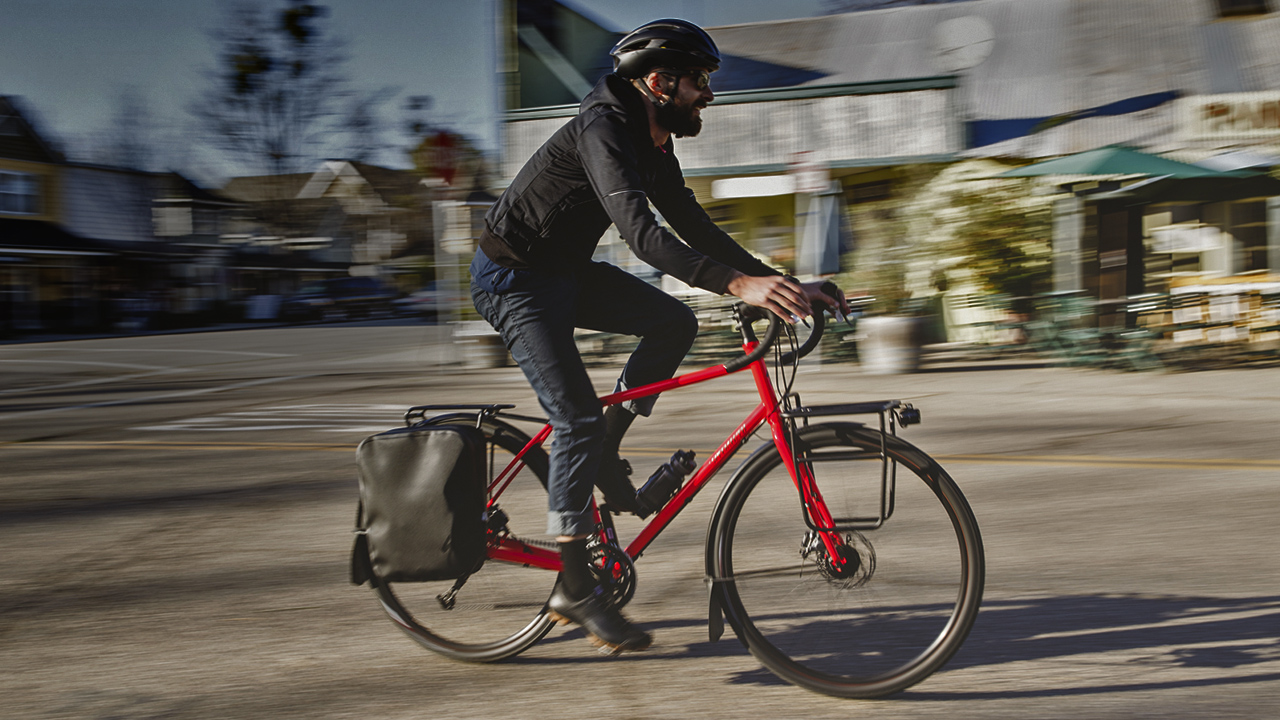
The Specialized AWOL Expert is a do-everything bike. Photo courtesy: specialized.com
The Specialized AWOL Expert retails for $2,500.

If you follow bicycle retail, you've probably noticed some interesting models labeled "adventure," "bikepacking," "gravel" or "offroad touring."  These are bikes like the Soma Wolverine, the Salsa Marrakesh or Vaya, and Surly's Troll or Ogre. They take wide tires, they tend to be made from high quality steel, and they come with disc brakes. Basically, they're designed to handle the rough stuff while carrying a load.

Specialized's offering is pricey, but it has it all: dyanamo-powered lights (add it to Edwin's list!); fenders with mudflaps; front and rear racks; disc brakes; really wide (comes with 700x45) tires; and a many gear combinations.  You could ride across the continent on this, or you could just ride to work. It will do whatever it is you want it to do.

Here is a 2014 review from Bicycle Times. 

Here are the specs:
    • FRAME

      Heat-treated custom-butted Premium Cr-Mo tubing, internal light cable routing-ready, Adventure Geometry, post disc mount, fender/rack mounts, kickstand plate
    • FORK

      Butted premium Cr-Mo, unicrown, heat-treated
    • FRONT HUB

      Shimano Dynamo hub, Center Lock disc, 32h 
    • REAR HUB

      Shimano Center Lock disc, 32h
    • SPOKES

      Stainless,14/15g w/self-locking threads
    • RIMS

      Specialized 29" disc front, 6061-T6 aluminum, 32h
    • INNER TUBES

      Standard, Presta valve
    • FRONT TIRE

      Specialized Borough Armadillo, 60TPI, 700x45mm
    • REAR TIRE

      Specialized Borough Armadillo, 60TPI, 700x45mm
    • CRANKSET

      Shimano Tiagra
    • CHAINRINGS

      50/39/30T
    • BOTTOM BRACKET

      Shimano Tiagra
    • SHIFT LEVERS

      Shimano Tiagra
    • FRONT DERAILLEUR

      Shimano Tiagra
    • REAR DERAILLEUR

      Shimano Tiagra
    • CASSETTE

      Shimano, 10-speed, 11-36t
    • CHAIN

      KMC X10EPT Anti-Rust, 10-speed, w/reusable MissingLink
    • FRONT BRAKE

      TRP HY/RD, hydraulic disc, 160mm rotor
    • REAR BRAKE

      TRP HY/RD, hydraulic disc, 160mm rotor
    • HANDLEBARS

      Specialized Adventure Gear AWOL, alloy, 125mm drop, 70mm short-reach, 12-degree flare-out
    • TAPE

      Specialized Adventure Gear S-Wrap Canvas Tape
    • STEM

      Specialized, 3D forged alloy, 4-bolt, 7-degree rise
    • SADDLE

      Body Geometry Phenom Comp, hollow Cr-Mo rails, 143mm
    • SEATPOST

      Specialized CG-R, FACT carbon, single bolt, reflective, 27.2mm
    • SEAT BINDER

      AWOL forged alloy, CNC, stainless bolt, 29.8mm


You can ride it in the country; you can ride it in the city. Photo courtesy: specialized.com

29 Nov 08:36

Holiday special: signed copies of Writing Without Bullshit for your staff

by Josh Bernoff

It’s the perfect holiday present for your hard-working staff and clients: a signed copy of Writing Without Bullshit with a personalized message from you. For less than $15 per person, you can show your workers, your clients, or anyone you value that you’re a no-bullshit kind of person — and make them smarter, too. Here’s how it works: Email … Continued

The post Holiday special: signed copies of Writing Without Bullshit for your staff appeared first on without bullshit.

29 Nov 08:35

Studio Neat Reveals Canopy, a Magic Keyboard Case and Stand

by John Voorhees

Studio Neat has opened pre-orders for a new combination Magic Keyboard case and iOS device stand called Canopy. I used an Origami stand by Incase Designs with my early iPads, but they are designed for Apple’s previous generation Bluetooth keyboards, which were a little bulky and heavy for my taste. Canopy is a case for Apple’s latest Magic Keyboard that folds open to create a stand that can be used with any iOS device, which should make it more practical to carry regularly.

Federico spent time with a prototype of the Canopy over the Summer as he wrote his iOS 10 review. We haven’t had a chance to try the final design yet, but when we do, we’ll post a review.

For a preview of the Canopy, head on over to Studio Neat's website and check out the video preview of their upcoming product.


Support MacStories Directly

Club MacStories offers exclusive access to extra MacStories content, delivered every week; it’s also a way to support us directly.

Club MacStories will help you discover the best apps for your devices and get the most out of your iPhone, iPad, and Mac. Plus, it’s made in Italy.

Join Now
29 Nov 08:35

Castro Makes Accessing Podcasts Easier Than Ever and Drops Price

by John Voorhees

Castro is designed around the philosophy of making it easy to access the podcast episodes you want to hear. The focus of Castro 2.0 when it launched in August was to make it simple to assemble a single queue of podcast episodes using an inbox to triage episodes from your podcast subscriptions.

Version 2.2 of Castro leverages its flat inbox/queue hierarchy to its advantage with new ways to get at your favorite podcasts. On the iPhone, Castro adds a new widget and 3D Touch support. By default, both display the first four podcast episodes in your queue with buttons featuring show art that can be tapped to start or resume an episode.

Castro’s widget can be expanded to reveal up to twelve episodes at the top of your queue. The use of show art makes identifying and playing an episode easy. The one downside of this approach though, is that there is no way to distinguish between different episodes if you have multiple episodes of the same show near the top of your queue.

In addition to displaying the first four episodes in your queue, 3D Touch adds shortcuts to other functionality, including the ability to kick off a search for new shows in Castro’s Discover tab using text on your clipboard, a feature that is handy if you read about a podcast somewhere that doesn’t include a 'subscribe' link. You can also set a sleep timer or jump directly to your inbox or queue with 3D Touch.

Finally, Castro 2.2 adds CarPlay integration, which I previewed in my CarPlay review last week. With just a queue and inbox to contend with, Castro makes navigating podcast episodes in your car a breeze. Instead of drilling through layers of playlists to find what you want to hear, you can go straight to your queue, or jump to your inbox if you’ve exhausted the queue, using the tabs at the top of Castro’s CarPlay interface.

Castro 2.2 is a free update for existing customers and $3.99 for new customers, a $1.00 price reduction from its launch price.


Support MacStories Directly

Club MacStories offers exclusive access to extra MacStories content, delivered every week; it’s also a way to support us directly.

Club MacStories will help you discover the best apps for your devices and get the most out of your iPhone, iPad, and Mac. Plus, it’s made in Italy.

Join Now
29 Nov 08:35

From my inbox

by Volker Weber

75a8d4a48e1169d087b3858b969d59fc

Just in time. I was running very low on inventory. Thank you, Armin!

29 Nov 08:32

Screenshots from iPhone 7 Plus Are Not Rendering Properly on Google Pixel

by Rajesh Pandey
With smartphones and operating systems getting more complex with every passing day, sometimes weird bugs end up shipping on final products. One such bizarre bug that has now been discovered by Pixel owners in which they are receiving garbled screenshots from iPhone 7 Plus owners. Continue reading →
29 Nov 08:31

Toronto-based KnowRoaming pursues IoT with acquisition of mobile operator Telna

by Rose Behar

Toronto-based international data provider KnowRoaming has acquired mobile network operator Telna in order to pursue the IoT and machine-to-machine (M2M) markets through offering a network as a service (NaaS).

“The idea with what we’re offering is — you don’t have to build your own mobile network or mobile agreements or understand how mobile networks work and invest in spectrum and all these different components that a network requires,” explained Gregory Gundelfinger, CEO of KnowRoaming and Telna in an interview with MobileSyrup. “We’ll give you the tools to be able to have the benefits of a mobile network but without having to own it.”

While this may seem like a change of pace for the brand, which is known for its innovative SIM roaming sticker and has more recently debuted a virtual ‘Soft SIM’ in partnership with Alcatel, Gundelfinger says that’s not quite the case.

“Is there a pivot that’s taking place in the company? I think that it’s becoming more of a platform than a singularly focused product. It’s becoming more a platform that’s been developed in a way that makes it very dynamic. Anybody that requires network services can utilize all that infrastructure without having to incur the types of costs that we did, to build and deploy.”

The acquisition has helped his company become completely vertically integrated, says Gundelfinger, offering everything from SIM cards to network infrastructure and commercial agreements. It also gains KnowRoaming access to the GSMA, an international trade body, as a member.

“The GSMA is like the UN for telecoms,” says Gundelfinger. “If you’re recognized by the GSMA, you have the ability to contract with other networks and you’re governed by the central regulatory body.”

KnowRoaming has been “strategically aligned” with Telna since 2014 when it began using the company as a supplier. Telna is a U.S.-based multi-IMSI network operator that provides international roaming through owned and partner networks worldwide.

Related: The best roaming options for Canadian travelers [2016 edition]

28 Nov 19:37

iPhone Owners Complain That iOS Update Drains Batteries Unexpectedly

by Ashlee Kieler
mkalus shared this story from Consumerist.

A week after Apple admitted that some iPhone 6S batteries weren’t woking properly and agreed to fix the power source for free, the company’s latest iOS update has been found to unexpectedly drain device batteries in a matter of seconds. 

PCMag reports that while iOS update 10.1.1 promises “stability improvements and bug fixes,” some customers claim that downloading and installing the software has led their devices’ batteries to malfunctioning, either by losing power suddenly or displaying incorrect battery percentage readout.

In some cases, Apple iPhone 6 and 5S owners report that their devices are unable to last a full day without additional charging, while others say their phones have died despite showing 30% to 50% battery left.

“After my iPhone 7 Plus upgraded to iOS 10.1.1 yesterday, I found the power consumption seems to became faster, the power endurance [lasts] half of the time as before,” one owner wrote on an Apple forum.

Another owner says that updating to the new system not only drained the device’s battery, but stopped it from connecting to Bluetooth and, at times, froze the phone.

PCMag reports that other users have reported going to bed with a phone that showed 80% battery life and then waking up to a dead phone.

When the owner plugged in the phone, it flashed 30% battery charge within a few seconds. When the phone reached a 100% charge and was unplugged it dramatically dropped to 50% as soon as the phone was unlocked.

Although the issues could be linked to Apple’s other recent faulty batteries, Mashable suggests it could be tied to errant apps that drain batteries or over-heating of the phone’s battery.

Mashable reports that many of the users reporting the issues were part of Apple’s open beta program that provides updates early. The program is now offering a 10.2 update, however, some users say the update hasn’t helped.

We’ve reached out to Apple for more information on the issue, we’ll update this post when we hear back.

Want more stories from Consumerist? We’re a non-profit! You can get more stories like this in our twice weekly ad-free newsletter! Click here to sign up.

iOS 10.1.1 Is Draining iPhone Batteries [PCMag]
iPhone users complain about 10.1.1 battery issues [Mashable]


28 Nov 19:37

Kickstart – Tolling and TSPs

by pricetags

By Gord Price

Mayor John Tory of Toronto announced last week that he’s going to try getting road tolls on the Gardiner Expressway and the Don Valley Parkway to help pay for their maintenance and to raise revenue for the city’s ambitious and much overdue transit plan.

Guess what? It’s controversial.

CBC’s Cross Country Checkup took it on as a topic on Sunday, and I had a chance to add my contribution (the interview starts at 20:00)

.

In summary:

It’s a gutsy move, every mayor will be watching – but they’re probably sceptical he can pull it off.

Don’t expect rational responses; this is emotional – and so it’s tough to find an option that will be seen as fair.  There are all kinds of reasons to not pursue any particular proposal, especially in the hope that technology will solve the problem in the future.

That’s one of the reasons there are so few examples of tolls on highway infrastructure that do anything more than pay for new roads or bridges.  The number of cities with congestion charges can be counted on practically one hand – and most ran into political opposition from the suburbs or exurbs that used their political representatives at the state or federal levels to fight the city’s proposal.  It happened with Mayor Bloomberg’s desired congestion charge for Manhattan, and Mayor Tory may run into the same problem with the Ontario legislature.

Anyway, the idea of tolling a road or bridge is so 20th-century.  Eventually, the charging will be done, as it is with telecommunications, through the individual user’s access to the system.  In other words, through the car and truck – and the distance, time and place they use.  Oregon and others are pioneering the technology.

But again, the problem is emotional: the loss of the ‘free way,’ the right to the road we’ve already paid for – a democratic space we all have equal access to.  But without an ongoing funding option, political leaders are left with few options: defer maintenance; allow the system to deteriorate physically and through congestion until unpalatable options become more acceptable; or privatize the system and shove the problem onto someone else.

In fact, I’m predicting the emergence of the Transportation Service Provider (TSP) – the equivalent of the telecommunications giants that provide us, for a monthly fee, with all the delightful, distracting and necessary things we get through our electronics.

Imagine a future Uber that contractually provides you with all the transportation options you need through car and bike sharing, transit of all kinds, taxi equivalents, as well as parking, maintenance, technology upgrades and, especially, the information you need to access it all.  And you will be able to pay for all those options through your monthly fee, including the taxes that will be effectively invisible.

That’s what will make the model so attractive to governments: they will be taxing a third party, not the user/voter.  (How much are the taxes on a cell phone call?  You don’t know and you don’t care.  If the cost seems to be too high, you blame your service provider.)

The prospect is actually pretty scary: these TSPs will be very powerful, and will likely be able to skew the transportation infrastructure and design to their benefit.  But if voters leave government with few other options, privatization will be irresistible if not inevitable.