Rolandt
Shared posts
Art is a powerful tool for change
The Last Jedi

Star Wars VIII has a name: The Last Jedi.

As is custom, we will now endlessly and thoroughly analyze a single image for as much signal as possible. My first thought: the typeface color is red. My second thought: in my head, each of the original trilogy movies is associated with a color.
- A New Hope: Blue (like Luke’s sword)
- Empire Strikes Back: Red (where Luke and Vader fight)
- Return of the Jedi: Green (like… Endor?)
Update: As Dan McClain points out on Twitter, the color matches the lightsaber of Luke, Vader, then Luke again.
Ground: A data context service

Adrian Colyer,
The Morning Paper,
Jan 26, 2017
Advanced analytics will look at much more than aggregate behaviour (which, for example, is what we see in learning analytics today) and will focus additionally on identifying context. For any given piece of data, for example, we can ask about who is using it (and with what), how they're using it, and how use changes over time. These are the major elements of an initiative called Ground, which is described in this article (which in turn summarizes a fascinating (12 page PDF) publication). "Each kind of contextual data (Application, Behavioural, and Change) is captured by a different kind of graph. Application context is represented by model graphs which capture entities and the relationships between them. Change context is represented by version graphs which form the base of the model. Behavioural context is represented by lineage graphs which relate principals (actors that can work with data such as users, groups and roles)."
[Link] [Comment]Slopes Skiing and Snowboarding App Adds Search

Slopes, by developer Curtis Herbert, is a skiing and snowboarding app that tracks your activity on the mountain. Like apps that track running and cycling activity, Slopes uses GPS to create maps of your runs, display real-time data while you ski or snowboard, track lifts, and compile detailed summary data that you can study after you finish a day’s activities. The app is full of nice touches like lift detection that automatically pauses data recording, and glanceable real-time statistics on the iPhone and Apple Watch.
Today, Slopes received an update that anyone who skis or snowboards a lot should appreciate. Version 2.5 of the app adds activity search. If you’ve logged hundreds of runs, you no longer have to scroll back through a long chronological history to find a particular trip. Now, you can search by several criteria including, resort name, city, state or province, and country. The update also improves integration with Apple’s Health app, enhances the design of resort maps, and includes several other smaller improvements and bug fixes.
I’m not a skier or snowboarder, so I haven’t tried Slopes on a mountainside myself. However, I did try the app with demo data to get a feel for it in action. As a stats-obsessed runner, I can see the appeal of Slopes to skiers and snowboarders. It makes tracking and logging data a breeze by minimizing the interaction needed to get started, which lets you enjoy yourself without fiddling with your iPhone or Apple Watch frequently. Then at the end of the day, you can sit back and study the breakdown of your activity to your heart’s content.
The core features of Slopes are free on the App Store, which makes trying Slopes on your next ski trip a no-brainer. You can unlock the ability to track additional detail about your skiing and snowboarding runs, daily timeline data, premium maps, and 3D interactive run replays by purchasing an in-app subscription for $19.99/year, $8.99/month, $4.99/week, or $1.99/day.
Support MacStories Directly
Club MacStories offers exclusive access to extra MacStories content, delivered every week; it’s also a way to support us directly.
Club MacStories will help you discover the best apps for your devices and get the most out of your iPhone, iPad, and Mac. Plus, it’s made in Italy.
Join NowSnapchat Adds Universal Search, Shows Off New Design

Snapchat, Snap Inc. introduced two major features in version 10.0.0 today.
Frequent Snapchat users will immediately notice the new universal search menu at the top of each view, which provides quick access to existing contacts as well as a way to find other users. By adding a mix of Bitmoji and ghosts to the contacts section, Snapchat has added a design language that it previously lacked.
For chatting or adding new friends, the search feature is a great convenience. However, if you spend most of your time taking pictures and sending them to the same group of friends, the new search capabilities won't get much use.
Snapchat has refreshed the design of its other sections with title cards with headlines too. The changes are small, but they clean up the app's interface and provide a greater sense of where you are in the app. In addition to labelling each of the three sections, the title bars include shortcuts to search and your snapcode. Snapchat also has new animations that makes the app feel more unified.
In total, I think that the update is a win for Snapchat's navigation, which has been a point of criticism in its previous iterations. Although there's much more work to be done, it's good to see Snap putting in work to make the app easier to use.
Version 10.0.0 is a free update for Snapchat in the App Store.
Support MacStories Directly
Club MacStories offers exclusive access to extra MacStories content, delivered every week; it’s also a way to support us directly.
Club MacStories will help you discover the best apps for your devices and get the most out of your iPhone, iPad, and Mac. Plus, it’s made in Italy.
Join NowSnap Inc. – Valuation snaps.

Snapchat looks more like Twitter than Facebook.
- Snapchat appears to be intending to focus on engagement metrics to justify its $20bn-$25bn valuation in the coming IPO.
- I see this as a sure sign that real metrics such as revenue and profit will fall far short of that which a regular company would need to justify that valuation.
- Snapchat is essentially an instant messaging platform with the ability to send video and pictures as well as some cool and fun video annotation features.
- Although video is a big part of the appeal of Snapchat, I do not consider this to be a Media Consumption platform meaning that Snap Inc.’s coverage of the Digital Life pie is actually pretty low.
- Given its current offering, I would be prepared to give it Instant Messaging and Telephony giving it total coverage of 14%.
- I do not think that its offering is yet broad enough to allow it to monetise either Social Networking or Media Consumption.
- RFM estimates that this would give it the ability to grow revenues to around $2.5bn per year in the best instance at which point it would then grow around 7-8%.
- I suspect that the long-term promises being made will be far higher than this as I see no way in which this scenario could underpin a valuation of $20bn – $25bn.
- Furthermore, I remain concerned that Snapchat’s core user base of 12-24 year olds is not as interesting to advertisers as the older demographic groups.
- This is because this age group does not have a lot of money to spend on products and therefore is of less value to advertise to.
- The net result is that Snap Inc. looks more like Twitter than Facebook and also has a user base less capable of generating revenues.
- This means that Snap Inc. will need to innovate and develop its strategy beyond its core offering to have any chance of justifying the IPO valuation.
- Snap Spectacles are an interesting move in this direction and are unique as the only product that has made wearing technology on one’s face cool.
- However, they are not going to do anything to revenues and so will not directly alleviate the situation in which Snap Inc. will find itself.
- The net result is that I see the following scenario without a major innovation on the part of Snap Inc:
- First: An IPO at $20bn-$25bn which goes reasonably on the back of promises that don’t have to be met for a little while.
- Second: A big miss on a set of quarterly results as revenues don’t come though as promised causing a collapse in the valuation.
- Third: Recovery will only come with a major innovation from Snap Inc. or the company will be acquired by one of the much larger ecosystems.
- On the basis of what I can see at the moment, I think a rosy future is already being paid for at $20bn – $25bn and so I would stay away from this one.
Asynchronous Joins Using RabbitMQ

Don Omondi, Campus Discounts' founder and CTO, talks about their use case of fetching data from multiple databases and joining them using RabbitMQ RPCs in this new Write Stuff article.
Technology keeps evolving and fast. Early last month, web browsing from mobile devices overtook that via desktop computers. For developers, this means optimizing our mobile users' experience and one of the best ways to do so is by minimizing the number of network requests needed to fetch data. But fetching data in a single payload might not be so simple because the nature of today’s data is unstructured.
It’s very common for apps to use multiple databases to store and query data. In addition, some apps need to query an external API endpoint such as weather or finance before displaying data to the end user. So how can we join all the needed data into one that's on demand? One way is by using RabbitMQ RPCs, and we can do so asynchronously using parallel RPCs.
Remote Procedure Call (RPC)
Remote Procedure Call (RPC) is a pattern where you run a function on a remote computer and wait for the result. RabbitMQ has documentation on how their implementation of RPC works and sample code in different programming languages on their website. Here is the structural overview.

We can use RabbitMQ RPC to send messages to remote servers with instructions to execute queries and respond with the results when done.
A Sample Use Case
Campus Discounts is a social network where students find and recommend discounts posted by businesses near campus. A discount post can have additional content such as comments, likes and recommendations. When constructing a discount post’s UI, we show a few of the latest discounts in tabs below it. Our backend is PHP, a synchronous language by default, hence to achieve this would potentially mean fetching the content one after the other.
<?php
………
   $discount = $service->queryDiscount($discount_id); // ~ 5ms
   $comments = $service->queryComments($discount_id); // ~ 12ms per comment
   $likes = $service->queryLikes($discount_id); // ~ 12ms per like
   $recommendations = $service->queryRecommendations($discount_id); // ~ 10ms per each
   $response = array(
     ‘discount’ => $discount,
     ‘comments’ => $comments,
     ‘likes’ => $likes,
     ‘recommendations’ => $recommendations
   );
   return $response;
………
?>
Here, PHP will perform 4 synchronous blocking tasks. First to fetch the discount that takes about 5ms, then fetch its comments, likes and recommendations. For a discount with 10 comments, 10 likes, and 10 recommendations, it would take 340ms plus 5ms for the actual discount. Querying 10 discounts would take about 3.4 seconds. We can optimize this process by fetching the data asynchronously using parallel RabbitMQ RPCs.

In the above image, the ‘C’ is the backend server that responds to the client’s API request. It is also the same server that initiates an RPC. The ‘S’ are servers that process remote queries received via RPC.
With parallel RPCs, we construct a single message on the client and queue it. RabbitMQ will then deconstruct it and simultaneously send each part of the message to different awaiting servers. Each server reads the message and performs the query action contained in it and sends back the result. RabbitMQ will wait for all parts to return before constructing them into a single message and send it back to the client.
We now replace our blocking query tasks with a single combined RPC call.
<?php
………
   $start = time();
   $client = new Thumper\RpcClient($registry->getConnection());
   $client->initClient();
   $client->addRequest($discount_id, 'discount', 'discount_' . $discount_id);
   $client->addRequest($discount_id, 'comments', 'comments_' . $discount_id);
   $client->addRequest($discount_id, 'likes', 'likes_' . $discount_id);
   $client->addRequest($discount_id, 'recommendations', 'recommendations_' .     $discount_id);
   $replies = $client->getReplies(); // This part ensures that our code blocks until we get all responses.
   $discount = $replies['discount_' . $discount_id];
   $comments = $replies['comments_' . $discount_id];
   $likes = $replies['likes_' . $discount_id];
   $recommendations = $replies['recommendations_' . $discount_id];
   $total_time = time() - $start; // ~ 120ms longest time for 10 comments or likes
   $response = array(
     ‘discount’ => $discount,
     ‘comments’ => $comments,
     ‘likes’ => $likes,
     ‘recommendations’ => $recommendations
   );
   return $response;
………
?>
$client->InitClient() initializes the RabbitMQ RPC connection while the $client->addRequest() adds the various parts into the RPC message. $client->getReplies() ensures that no further PHP code is processed beyond that line until RabbitMQ responds to the RPC call.
With RabbitMQ RPC, the total query times are now down to about 120ms, which is the longest time taken to query at least 10 comments or likes. How awesome is that, but wait, there’s still more.
For schema flexibility and horizontal scalability, discount comments and likes are embedded in respective MongoDB documents. However, the actual data containing the users or apps used to create the content is stored in MariaDB (cached by Redis) and would have to be fetched at runtime.
{
 "_id": 1,
 "comments": {
 "0": {
 "_id": 1,
 "message": "The first comment",
 "user_id": 1,
 "written_on": some_date_string,
 "edited_on": some_date_string,
 "status ": 1,
 "via_app_id": 5,
 "total_replies": 0
 "replies": []
 },
 "1": {
 "_id": 1,
 "message": "The second comment",
 "user_id": 1,
 "written_on": some_date_string,
 "edited_on": some_date_string,
 "status ": 0 // deleted,
 "via_app_id": 5,
 "total_replies": 0,
 "replies": []
 },
 "2": {
 "_id": 1,
 "message": "The third comment",
 "user_id": 4,
 "written_on": some_date_string,
 "edited_on": some_date_string,
 "status ": 1,
 "via_app_id": 2,
 "total_replies": 0,
 "replies": []
 }
This MongoDB document contains comment details but only the id of the users and/or apps that made it. To get the actual ‘usernames’ or app names, we have to loop through them querying for each in a very similar manner to our first problem solved by RabbitMQ RPC.
<?php
………
   $commentsDoc = $mongoService->fetchDoc($discount_id); // ~ 16ms
   $comments = $commentsDoc[‘comments’];
   foreach($comments as $comment){
     $user_id = comment[‘user_id’];
     $comment[‘user’] = $mariaCachableService->queryUser($user_id); // ~ 5ms
     $comment[‘viaapp] = array();
     $app_id = isset($comment[‘via_app_id’]) ? $comment[‘via_app_id’] : null;
     If($app_id){
      $comment[‘viaapp] = $ mariaCachableService ->queryApp($app_id); // ~ 5ms
     }
   }
   return $comments;
………
?>
Thus, fetching 10 discount comments could potentially mean one query for the MongoDB document and 10 queries to get the users and another 10 if they were created by apps. So a maximum of 21 queries.
Parallel RPCs Within Parallel RPCs
One of the best things about RPCs is that you can nest one in another. So, for example, our comments consumer can create two more parallel RPCs to asynchronously fetch the user and app responsible for creating the comment.
<?php
………
   $start = time();
   $commentsDoc = $mongoService->fetchDoc($discount_id); // ~ 16ms
   $comments = $commentsDoc[‘comments’];
   $client = new Thumper\RpcClient($registry->getConnection());
   $client->initClient();
   foreach($comments as $comment){
     $user_id = comment[‘user_id’];
     $client->addRequest($user_id, 'user', 'user_' . $user_id);
     $comment[‘viaapp‘] = array();
     $app_id = isset($comment[‘via_app_id’]) ? $comment[‘via_app_id’] : null;
     If($app_id){
       $client->addRequest($app_id, 'app', 'app_' . $app_id);
     }
   }
   $replies = $client->getReplies();
   $total_time = time() - $start; // ~ 5ms longest query time for any user or app
   foreach($comments as $comment){
     $user_id = comment[‘user_id’];
     $comment[‘user’] = $replies['user_' . $user_id];
     $comment[‘viaapp‘] = array();
     $app_id = isset($comment[‘via_app_id’]) ? $comment[‘via_app_id’] : null;
     If($app_id){
       $comment[‘viaapp‘] = $replies['app_' . $app_id];
     }
   }
   return $comments;
?>
We must first loop through each comment to grab the user and/or app id and each as a ‘part’ of the RabbitMQ RPC. Once finished we queue it and wait for the response. Thereafter, we have to loop through each comment again and set the now full user and/or app object we got from the RPC call.
With nested parallel RPCs, fetching all the data to display one discount takes approximately 21ms, which is the longest time required to fetch the MongoDB document and at least one comment user.
Sometimes, though, parallelism can be counterproductive. In the implementation above, should a discount_id result in a 404 not found error, we would still have to incur the penalty for sending out parallel RPCs to query for comments, likes, and recommendations that definitely do not exist. To avoid wasting resources, we first query if the discount exists before sending out parallel RPCs.
There are other gotchas as well, like when and how long to maintain an open connection as well as ensuring the correlation of unique ids. At Campus Discounts, we decided to embed the aggregate results of each discount query, together with its comments, likes, and recommendations, into respective Elasticsearch documents. This also gave us the added benefit of deeply nested searches. Nonetheless, the parallel RPC setup described enables us to greatly improve the overall Elasticsearch re-indexing times.
The Main Advantages:
- You can process a lot of data from different sources asynchronously and join them together with good response times.
- You can split your backend API servers, using the beefy ones for data processing while keeping them more secure and closer to your database servers (RPC Servers). Whereas the lighter ones can be used to respond to requests which you can geo-distribute closer to your users (RPC Clients).
- Parallel computing maximizes resource utilization by minimizing idleness.
The Main Disadvantages:
- Complex stack to setup, debug, and maintain.
- Real benefits only manifest if the number of individual queries and time to process them is large enough.
- Parallel data processing can easily lead to unnecessary DB queries that would have been avoided synchronously.
Conclusion
So there you have it, an asynchronous remote task processing system that returns the aggregate results using RabbitMQ. Remember, RabbitMQ RPCs are not limited to DB queries. You can use them to do anything so long as the result can be represented as a string, like a lot of APIs, whether getting a real-time sentiment analysis via Watson or receiving financial information from Yahoo.

attribution Mike Wilson
The Infant Car Seat for Us [And Instagram Giveaway]

My walking crew... Photo by Trevor
Living small is mostly about an intention and effort to live with less space and less things and it is a little bit about choosing the right gear/furniture to make living small possible. I believe that I have mentioned before that not only do we have a small home but we also have a small car! So before Theo was born and the world of baby gear was entirely overwhelming, I did hours of research to find a safe, high quality carseat. As with most baby gear items, I was concerned about size ;). I needed an infant car seat with the less depth to fit in our tiny car. I also wanted a light car seat that would be easy to move around and carry. The Maxi Cosi Mico Max 30 was the one for us (as I've shared previously in my Newborn Essentials for a Small Space Post). The Maxi Cosi Mico Max 30 was adaptable to both of our strollers (the bad stroller I used when Theo was a newborn and our current stroller that I love). I wanted the luxury of easily removing the carseat from the car when baby fell asleep (it's just one click)... this happened a lot when Theo was a newborn, and only a handful of times for Mae, my very light sleeper. I found that having the option to carry the carseat inside or click it into the stroller, made getting out for car trips much less intimidating in those early months when everything can seem intimidating.
I figure it goes without saying that knowing my baby was safe in the carseat was the ultimate priority but I knew that aspect was covered so I could worry about things like size, lightness and design. I love the clean simple design of the Maxi Cosi Mico Max 30, I don't think there is a better looking infant carseat. When a carseat makes it through two babies, it takes a bit of abuse and ours still looks great.
Maxi Cosi Canada noticed that I had previously shared my satisfaction with this infant car seat and offered to host a giveaway on my Instagram. Hop over there to enter (due to safety regulations this contest is open to Canadians only)! Also if you are looking to purchase the same carseat here is a link.

This is my first sponsored post. Maxi Cosi is a brand I have purchased myself and been very happy with so this partnership felt right to me. I also chose this as my first sponsored post because it gives something back to you, the readers. Thank you for reading and supporting this small passion project of mine as it grows.
Where we go from here.

Photo taken by me at the new Trump Tower during the Vancouver Women’s March on January 21, 2017.
I’ve noticed at conferences and gatherings that there are many colleagues in the credit union movement who don’t get into politics, and at times that’s a lovely respite from all the arguing. We all want to see our communities increase their self-reliance. Whether you’re into it because you like to see a non-governmental actor dive into the solution or because you see the need for progressive financial institutions shoring up what should be the government’s responsibility, we are working for common goals.
In this uncertain time we are entering, our core values are likely to be pressured and many of the people we’re here to serve will need increased support. We need to have healthy discussion in the movement about our purpose. Our “why.”
I came across this excellent five-part podcast from NPR’s On The Media about poverty in America called Busted: America’s Poverty Myths. I believe this should be required listening to any of us who believe in the core purpose of a credit union to increase the financial inclusion of our neighbours. What would result if groups of people in your co-operatives listened to this and came together, book-club style to discuss? What would happen if we invited our boards and members into that dialogue? Poverty is real and often our belief in a meritocracy is just that: more a belief than a reality.
I offer up the following for discussion.
Originally published on the CU Water Cooler.
Volunteers
For Tinderbox reasons as well as the exigencies of the present crisis, I’m interested in the management of volunteers on charitable and political organizations. What is the best modern thinking on the subject?
Traditional approaches are based in the expectation that the typical volunteer has little education and few skills. That was true in 1938.
My guess is that many organizations turn away useful help because they can’t match volunteers to things that need doing. Instead, they ask supporters to send money and hire the help they need. That makes sense in some environments: if you’re a prosperous attorney, for example, it’s better for you to work some extra weekend hours and then to send your extra billing to the cause. That’s more efficient than spending time knocking on doors or addressing envelopes, but lots of people can’t easily expand their income, especially in a world where plenty of folks find it hard to find a job in the first place. Overtime doesn’t grow on trees.
I think that organizations can probably use volunteers far more effectively than they do. I think we may need that in the coming crisis. But I don’t know: who does? Email me.
Things that have been forever
In Tofino for this week, today preparing for 60 people who will be joining us for an Art of Hosting.
The beach here, as anyone living on the exposed west coast will know, is constantly buffeted by surf and there is an endless white noise created by the waves crashing on the four sets of reefs offshore. Once, when I was in Quinault in Washington State, I remarked to an Elder that this sound must have had a beginning at some time in the earth’s history and perhaps will have an end. But in the meantime, as long as human ears have lived on this coast, the sound of surf has always filled them.
That’s pretty much forever.
As we begin a week of teaching some of the arts of community, I am reminded of the aspects of our better nature that we humans have always had, and my focus is fixed on what ways of being community, like the sound of this surf, have accompanied human beings forever.
Fritz!Box als Anrufabwimmler
-20170123221005.png)
Es gibt bei mir vier Klassen von Anrufern:
- Nummer steht in meinem Adressbuch, Name wird angezeigt. Da geh' ich dran, auch wenn jemand nur seiner Pressemitteilung hinterher telefoniert.
- Keine Nummer angezeigt. Die gehen ohne Ausnahme auf den Anrufbeantworter, sprechen aber eigentlich nie was drauf.
- Nummer wird angezeigt, kenne ich aber nicht. Rufe ich zurück, wenn ich rausfinden kann, wer das war. Oder wenn der Anrufer auf den Anrufbeantworter spricht.
- Call Center, Nummer bekannt. Kriegen einfach ein Besetzt.
Wie kommt man auf die Call-Center-Liste? Man nimmt einen Telefon-Roboter, der einfach den Nummernkreis durchtelefoniert, bis er auf einen Menschen trifft. Und der ist für mich leicht zu fangen. Ich habe so viele Telefonnummern, dass ich eine für diese Roboter reserviert habe. Diese Nummer kennt niemand. Wenn da ein Anruf eingeht, dann ist es garantiert nicht jemand, der gezielt anruft, sondern jemand, der Rufnummern durchprobiert. Ich gehe also immer wieder mal durch die Liste der Anrufer dieser unbekannten Nummer und nehme die Roboter in dieses Adressbuch auf. Danach bekommen sie kein Freizeichen mehr, sondern ein Besetzt. Auch wenn sie meine richtige Nummer anrufen.
Und dann gibt es noch diese Formulare, die man nicht abschicken kann, ohne eine Telefonnummer einzutragen. Da schreibe ich meine Faxnummer rein. Die funktioniert sogar. Leise pfeift die Fritz!Box.
User Experience and Value in Products - What Regression and Surrogate Variables can Teach Us
Over the past year, there have been a number of recurring topics in my global news feed that have a shared theme to them. Some examples of these topics are:
- Fake news: Before and after the election in 2016, Facebook (or Facebook’s Trending News algorithm) was accused of promoting news stories that turned out to be completely false, promoted by dubious news sources in FYROM and elsewhere.
- Theranos: This diagnostic testing company promised to revolutionize the blood testing business and prevent disease for all by making blood testing simple and painless. This way people would not be afraid to get blood tests and would do them more often, presumably catching diseases while they were in the very early stages. Theranos lobbied to allow patients order their own blood tests so that they wouldn’t need a doctor’s order.
- Homeopathy: This a so-called alternative medical system developed in the late 18th century based on notions such as “like cures like” and “law of minimum dose.
- Online education: New companies like Coursera and Udacity promised to revolutionize education by making it accessible to a broader audience than conventional universities were able.
What exactly do these things have in common?
First, consumers love them. Fake news played to people’s biases by confirming to them, from a seemingly trustworthy source, what they always “knew to be true”. The fact that the stories weren’t actually true was irrelevant given that users enjoyed the experience of seeing what they agreed with. Perhaps the best explanation of the entire Facebook fake news issue was from Kim-Mai Cutler:
The best way to have the stickiest and most lucrative product? Be a systematic tool for confirmation bias. https://t.co/8uOHZLomhX
— Kim-Mai Cutler (@kimmaicutler) November 10, 2016
Theranos promised to revolutionize blood testing and change the user experience behind the whole industry. Indeed the company had some fans (particularly amongst its investor base). However, after investigations by the Center for Medicare and Medicaid Services, the FDA, and an independent laboratory, it was found that Theranos’s blood testing machine was wildly inconsistent and variable, leading to Theranos ultimately retracting all of its blood test results and cutting half its workforce.
Homeopathy is not company specific, but is touted by many as an “alternative” treatment for many diseases, with many claiming that it “works for them”. However, the NIH states quite clearly on its web site that “There is little evidence to support homeopathy as an effective treatment for any specific condition.”
Finally, companies like Coursera and Udacity in the education space have indeed produced products that people like, but in some instances have hit bumps in the road. Udacity conducted a brief experiment/program with San Jose State University that failed due to the large differences between the population that took online courses and the one that took them in person. Coursera has massive offerings from major universities (including my own) but has run into continuing challenges with drop out and questions over whether the courses offered are suitable for job placement.
User Experience and Value
In each of these four examples there is a consumer product that people love, often because they provide a great user experience. Take the fake news example–people love to read headlines from “trusted” news sources that agree with what they believe. With Theranos, people love to take a blood test that is not painful (maybe “love” is the wrong word here). With many consumer products companies, it is the user experience that defines the value of a product. Often when describing the user experience, you are simultaneously describing the value of the product.
Take for example Uber. With Uber, you open an app on your phone, click a button to order a car, watch the car approach you on your phone with an estimate of how long you will be waiting, get in the car and go to your destination, and get out without having to deal with paying. If someone were to ask me “What’s the value of Uber?” I would probably just repeat the description in the previous sentence. Isn’t it obvious that it’s better than the usual taxi experience? The same could be said for many companies that have recently come up: Airbnb, Amazon, Apple, Google. With many of the products from these companies, the description of the user experience is a description of its value.
Disruption Through User Experience
In the example of Uber (and Airbnb, and Amazon, etc.) you could depict the relationship between the product, the user experience, and the value as such:

Any changes that you can make to the product to improve the user experience will then improve the value that the product offers. Another way to say it is that the user experience serves as a surrogate outcome for the value. We can influence the UX and know that we are improving value. Furthermore, any measurements that we take on the UX (surveys, focus groups, app data) will serve as direct observations on the value provided to customers.
New companies in these kinds of consumer product spaces can disrupt the incumbents by providing a much better user experience. When incumbents have gotten fat and lazy, there is often a sizable segment of the customer base that feels underserved. That’s when new companies can swoop in to specifically serve that segment, often with a “worse” product overall (as in fewer features) and usually much cheaper. The Internet has made the “swooping in” much easier by dramatically reducing transaction and distribution costs. Once the new company has a foothold, they can gradually work their way up the ladder of customer segments to take over the market. It’s classic disruption theory a la Clayton Christensen.
When Value Defines the User Experience and Product
There has been much talk of applying the classic disruption model to every space imaginable, but I contend that not all product spaces are the same. In particular, the four examples I described in the beginning of this post cover some of those different areas:
- Medicine (Theranos, homeopathy)
- News (Facebook/fake news)
- Education (Coursera/Udacity)
One thing you’ll notice about these areas, particularly with medicine and education, is that they are all heavily regulated. The reason is because we as a community have decided that there is a minimum level of value that is required to be provided by entities in this space. That is, the value that a product offers is defined first, before the product can come to market. Therefore, the value of the product actually constrains the space of products that can be produced. We can depict this relationship as such:
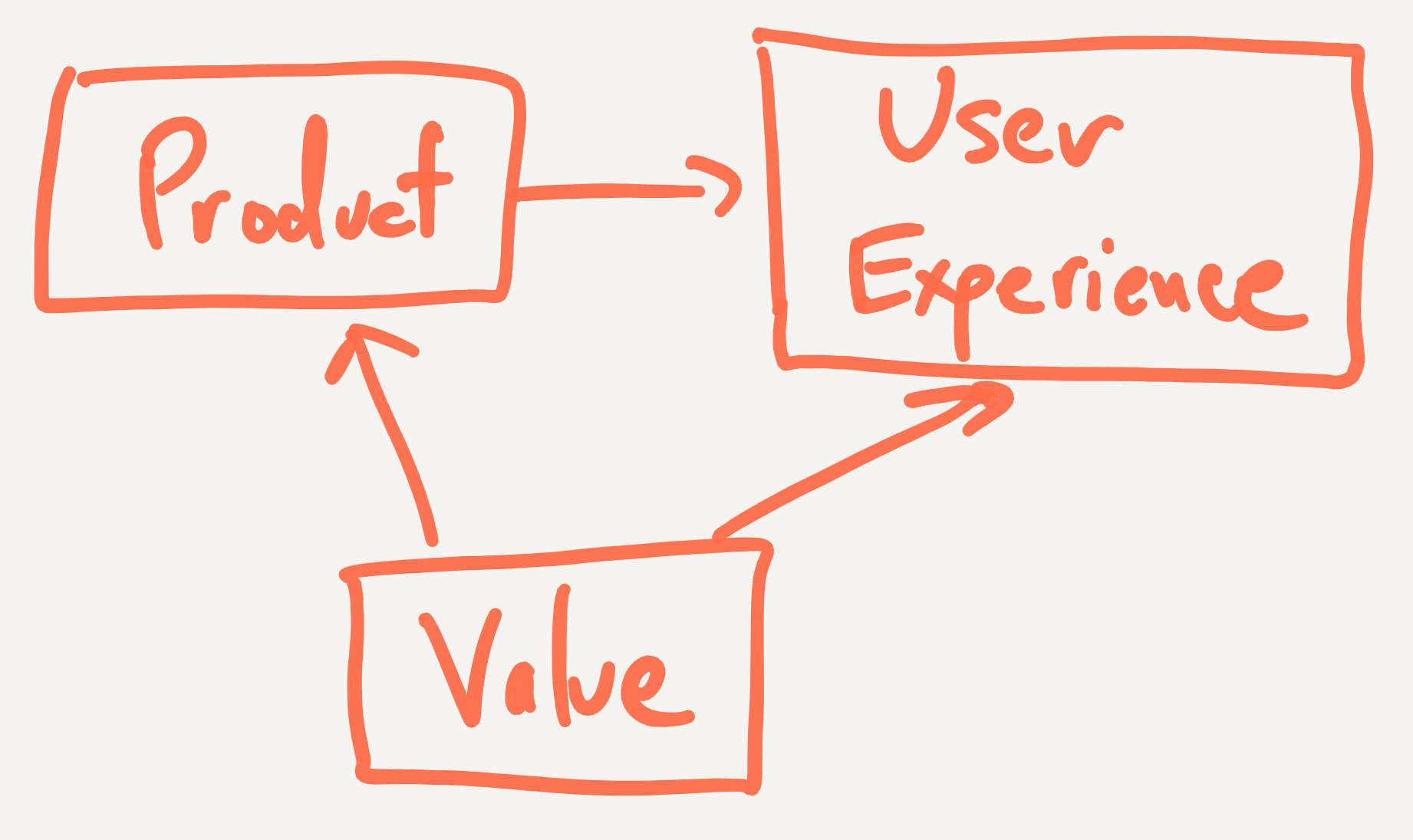
In classic regression modeling language, the value of a product must be “adjusted for” before examining the relationship between the product and the user experience. Naturally, as in any regression problem, when you adjust for a variable that is related to the product and the user experience, you reduce the overall variation in the product.
In situations where the value defines the product and the user experience, there is much less room to maneuver for new entrants in the market. The reason is because they, like everyone else, are constrained by the value that is agreed upon by the community, usually in the form of regulations.
When Theranos comes in and claims that it’s going to dramatically improve the user experience of blood testing, that’s great, but they must be constrained by the value that society demands, which is a certain precision and accuracy in its testing results. Companies in the online education space are welcome to disrupt things by providing a better user experience. Online offerings in fact do this by allowing students to take classes according to their own schedule, wherever they may live in the world. But we still demand that the students learn an agreed-upon set of facts, skills, or lessons.
New companies will often argue that the things that we currently value are outdated or no longer valuable. Their incentive is to change the value required so that there is more room for new companies to enter the space. This is a good thing, but it’s important to realize that this cannot happen solely through changes in the product. Innovative features of a product may help us to understand that we should be valuing different things, but ultimately the change in what we preceive as value occurs independently of any given product.
When I see new companies enter the education, medicine, or news areas, I always hesitate a bit because I want some assurance that they will still provide the value that we have come to expect. In addition, with these particular areas, there is a genuine sense that failing to deliver on what we value could cause serious harm to individuals. However, I think the discussion that is provoked by new companies entering the space is always welcome because we need to constantly re-evaluate what we value and whether it matches the needs of our time.

Pogue’s Basics: Teach Your iPhone Proper Pronunciation
The iPhone’s robotic voice is impressive, but it’s still a robot, and it still mispronounces things. Especially names. (Just ask my daughter Tia, whose name Siri pronounces “Shy-ah.”)
But in iOS 10, it’s very easy to teach Siri the correct way to pronounce a particular name—by speaking it.
Open Settings -> General -> Accessibility -> Speech -> Pronunciations. Hit +, type the name or word you’re teaching (“Tia,” in my case), then tap the blue microphone button on the Substitution line and speak the correct pronunciation.
The phone may now display a Play button; tap it to hear Siri finally get the name right.
If, instead, you see two or three different phonetic representations, tap each to hear it spoken; leave the checkmark on the correct pronunciation, and then tap Done.
From now on, wherever the phone spots this person’s written name, you’ll hear it speak that name right.
More from Pogue:
iOS 10 Hidden Feature: Bedtime-consistency management
Pogue’s Basics: Money – The Amazon card
iOS 10 Hidden Feature: Do Not Disturb Emergency Bypass
Pogue’s Basics: Money – Extended warranties
23 years on, before becoming a father
This entry is published on Monday, 23 January 2017. 23 years ago, Sunday 23 January 1994, I created a web page that looked like this and soon called it "Justin's Links from the Underground" as I publicly unearthed moist spots beneath rocks online.
My goal was to mess around with technology and permanence. What does it mean to share something of yourself with the world? Who will see it, interact with it and care about it? Blah blah blah - this is a subject I can't stay away from. I published a 40 minute documentary on these topics in August 2015, looking back at 20 years of personal online publishing: "overshare: the links.net story" available free on the internet.
Two months later, I was scheduled to get married to Ilyse on October 10 2015. On October 3, we discovered that our birth control methodology had not forestalled the advent of a viable embryo. We were about to be married, and about to be parents.
In April 2016 I turned a mobile phone camera on myself as I mused over this situation, and evinced some of my wrestling with pending fatherhood. I have been working to look critically at my motivations for parenthood, so I can adapt my own dadrole desires to respect & support whatever little person emerges from that situation, and to continue to support my partner in this adventure.
The baby was born in June 2016, and it's been pretty quiet around Links.net and thejustinhallshow.com. By January 2017, I'm updating this same 23-year-old web site with some personal content, except I'm a father. I've extended my life into another being. How can I make media about my experience of existence, and responsibly include my children?
Here's one attempt:
"before becoming a father" YouTube
"before becoming a father" Facebook
I filmed this video in one take on April 5 2016. I had on a stained shirt and some sweatpants. I realized how slovenly I looked as I started filming, but I felt committed to the moment so I proceeded to film. Then in January 2017, as my child turned seven months and the new year passed, I felt a strong desire to speak to my early parenthood experience. So I scripted and read-aloud another monologue over a blank FCPx timeline. That wasn't quite compelling, so I started poking through my archives. Found this footage from eight months earlier, sliced it a bit, and here we are.
Special thanks to Switzon S. Wigfall III for posting free VJ loop videos for remixing.
23 years later, I enjoy wrestling with media technology and personal storytelling! Perhaps this site could be seen as a sort of child. But it is not independent, it doesn't have any touch with the world these days save me. Comments are turned off on this weblog; there's not really a handle for participation. Links.net is a rock I visit a few times a year with a chisel. Except the rock is as sturdy as toilet paper and perhaps the chisel is my butt.
To upfrequent my updates here, I would consider publishing the scraps and notes and scores of micro-moments I've already inscribed. But I want to keep my focus on video storytelling, so for now, I'm saving my fathery feelings for future oral histories. Thank you for somehow ending up on this old web site! And seeing what one guy had to say, a guy that seems ever-older than the lad who foisted this thing online. What miracles.
Four weeks to IBM Connect 2017
In four weeks, the Opening General Session of IBM Connect 2017 will be over. If you want to attend, you can ask an IBM Champion for a $100 discount code. As a customer, you probably just have to wait it out until you can attend as a seat filler. If IBM has planned for 4000 attendees, they will probably have to come and get you. As press, who knows? Haven't heard so much as a whisper from IBM, so I am planning to sit on my sofa and see if IBM can keep a webcast going.
How many BlackBerry Android devices have been sold?
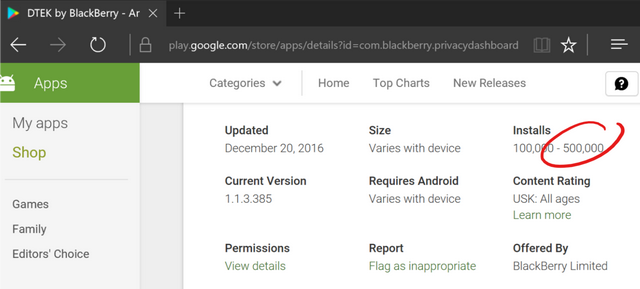
Help me with Google Play Store statistics. If you look up DTEK, the software that comes with all BlackBerry Android devices, it shows less than half a million downloads. When you activate a PRIV, DTEK50 or DTEK60, it will automatically download all updates to pre-installed sotware from the store. So for each device, there should be at least one download. And I believe that every consecutive download no longer counts against that tally.
If I am correct, then BlackBerry has sold less than half a million of those three devices, combined. If you look for the BlackBerry Hub+ Services, that also runs on other Android phones, the number of downloads passes half a million but not one million.
Bottom line: Apple sells more iPhones in a single day than BlackBerry sold Android phones in more than a year.
Some Uber Drivers Sleep In Their Cars So They Can Work In Expensive Cities
mkalus
shared this story
from  Consumerist. Consumerist.
|
If you want to be successful at driving for Uber, Lyft or some similar service, it’s important to not only put in a lot of hours behind the wheel, but to do so in a city where you’re likely to also have a passenger in the backseat. Problem is, dense urban areas where residents have disposable income may be out of your price range. Some drivers are getting around this by spending their brief downtime sleeping in their cars.
Bloomberg Technology talked to one Uber driver who commutes from Sacramento to San Francisco, about 90 miles, and then gathers with other drivers with similar commutes to sleep in the parking lot of a Safeway. He puts in a 70-hour week, then goes home to his wife, kids, and actual bed.
Another driver lives alone in Indiana, but sleeps in his car in the parking lot of a Chicago 7-Eleven. He started putting in more hours when he leased a newer car from Uber. When he began driving, he made around $40 an hour, but regular fare drops mean that he has to sleep in his car to make his lease payments so he can have a car to work.
READ MORE: 5 Things You Should Know About Uber’s Xchange Leasing Program & Its Costs
Last week’s settlement between Uber and the Federal Trade Commission would surely sound familiar to that driver: the transportation network company settled charges that it advertised hourly pay rates in different cities that were technically possible, but that only 10% of drivers are able to achieve.
Not all drivers bed down in their cars. Some stay in hostels, which offer the benefits of an actual bed and a shower. A clerk at a Travelodge motel near San Francisco’s airport estimated that drivers comprise about one-third of the guests.


 CommitStrip.
Flughafen Tempelhof 1954
mkalus
shared this story
from  Das Kraftfuttermischwerk. Das Kraftfuttermischwerk.
|
Follow Me at Tempelhof Airport back in 1954. #throwbackthursday #tbt pic.twitter.com/kKg56WUglM
— Berlin Airport (@berlinairport) January 19, 2017
#2. Doug Massey responds to Todd Stone Letter-Massey Bridge/Tunnel “Conspiracy”

On his Metro Vancouver transportation blog, Stephen Rees has a letter from guest editor Doug Massey in response to Minister of Transportation Todd Stone’s letter printed in the Delta Optimist on January 20th.
Doug Massey’s letter is worth reading in its entirety as he not only rebuts much of Minister Stone’s premise, he is also describing some very simple steps that could increase capacity in the tunnel if Delta Port implemented them, such as working 24 hours a day 7 days a week like other major ports.
Price Tags has abbreviated Doug Massey’s letter to Minister Todd Stone below:
…”If the statistics from the BC Ministry of Transportation and Infrastructure are correct that in 2015, the Annual Average Daily Traffic was 80,666. which would equal some 3, 361 vehicle per hour, well below the tunnel’s capacity of 7,000 cars per hour, why then is there a problem at rush hour? Could it be that Delta Port is the only major port in North America that does not operate 24/7? The fact that one container or large transport truck could displace up to 1.5 to 4 cars and subject to the fact that heavy trucks take up more space and are slow to accelerate could result in taking up the space of up to several more cars, perhaps up to 10 cars on the road,as at least 13 % of the vehicles using the tunnel during rush hour are large heavy duty trucks.”
“One has to ask why then has the B.C. Ministry of Transport and Infrastructure not even considered a modern day policy of banning all heavy duty large trucks during rush hour, and requiring all receiving and delivery points of cargo to be open 24/7 as is required in most cities around the world?”
Doug Massey notes that “… they are removing the tunnel so that the Fraser River could be dredged deeper to accommodate deeper ships, and that the province was not part of that project, could not be further from the truth. One part is true that they would not be doing the dredging because that is the responsibility of the federal agency, Port Metro Vancouver…building a bridge and removing the tunnel would be their preference and at the urging of industrial interests of the Pacific Gateway Strategy Plan on the Fraser River they chose the bridge.”
“A representative from the Ministry of Transportation and Infrastructure was present at meeting of the Pacific Gateway Strategy Plan on April 2006 and on Feb. 2. 2012, the Assistant Deputy Minister of Transportation and Infrastructure of the B.C. government met to discuss the constraints to increasing the Fraser River channel depth because of the existence of the George Massey Tunnel and recommended the removal of the George Massey Tunnel to achieve their goals.”
“So you see Mr. Minister and the public it was not a fallacy but a conspiracy.””


Buenos Aires 2 – Population and Density
Greater Buenos Aires is a big urban region. Over 13 million people.

In the City of Buenos Aires, however, there are about three million porteños (people of the port) – a population which has stayed steady since the Second World War.
Why not much growth in the city’s population? Low birth rates and a migration to the suburbs. Indeed, the surrounding districts in the Province of Buenos Aires have expanded five times over.
So: three million in the City; 10 million in surrounding suburbs. That ratio is not far from Vancouver’s: 600,000 in the city; 2.5 million in the region.

The population density in Buenos Aires proper is over 14,000 per square kilometre (in an area just under one and a half times the area of the City of Vancouver, with its population density of about 5,000 per square kilometer).
Our West End, by comparison, is about 44,000 people in its two square kilometers.
So think of the City of Buenos Aires as almost one big West End, plus Kits and downtown.
Lots of it looks that way too.


Museums Went on Strike for Inauguration Day | Last Week in Art

A lot went down this week in the weird and wild world of Art. Some things were more scandalous than others, some were just plain wacky—but all of them are worth knowing about. Without further ado:
+ Numerous art museums shut down or otherwise altered their policies (the Whitney and New Museum, for instance, were pay-what-you-wish) over the weekend as part of the #J20 Art Strike. [Hyperallergic]
+ Controversial Russian performance artist Petr Pavlensky said he plans to seek asylum in France after a Russian actress accused him and his wife of violent sexual assault. [The Independent]
+ One of Harvard’s graduate theater programs, ART Institute, has temporarily suspended admissions after the US Department of Education revealed that the school was leaving students with an unmanageable amount of debt. [The Boston Globe]
+ European police arrested 75 people in relation to an international network of art traffickers. [The New York Times]

+ City authorities in Paris have announced plans for a roughly $320 million renovation to the Eiffel Tower. [The Guardian]
+ The late Zaha Hadid left behind an $87 million fortune according to her will and grant of probate. [The Architects’ Journal]
+ South Korean culture minister, Cho Yoon-Sun, resigned over a blacklist controversy that targeted nearly 10,000 artists who spoke out against impeached President Park Geun-Hye. [AFP]

+ This painting of Donald Trump by Scottish artist Michael Forbes went viral after Madonna shared it on Instagram. [BBC]
+ A collection of 77 letters and documents that once belonged to Alexander Hamilton was sold for $2.6 million at Sotheby’s on Wednesday. [The New York Times]
+ A report released by Israeli news blog Ha-Makom asserted that James Snyder, director of the Israel Museum for the last 20 years, for years received a ‘double salary’ from the government-funded institution. [Artnet News + Ha-Makom]
+ A Swiss antiques dealership is suing The Getty and its director, Timothy Potts, for $77 million for cutting them out of a deal in connection with antiquities owned by the Torlonia family in Italy. [The Art Newspaper]

+ Shepard Fairey unveiled new set of protest posters aimed at the new President. The three part ‘We the People’ set features patriotic renderings of a Muslim woman, a Latina woman, and an African-American woman. [CNN]
+ The Nasty Women art show put together earlier this month raised $50,000 for Planned Parenthood. [The Huffington Post]
+ Trump’s transition team is considering cutting the National Endowment for the Arts and the National Endowment for the Humanities as part of a extravagant plan to cut government spending. [The Hill]
+ James Bradburne, the English director of the Pinacoteca di Brera in Milan, has become a recent target of nationalistic indignation after two of the museum’s 15th century paintings were damaged in a storm. [The Times]

+ The Syrian director of antiquities confirmed that ISIS fighters destroyed a section of Palmyra’s Roman Amphitheater facade. [Newsweek]
+ Saint Jerome, a 16th century painting by Girolamo Francesco Maria Mazzola, otherwise known as Parmigianino, is the latest addition to the Old Master forgery ring discovered late last year. This week, Sotheby’s declared the painting a fake, hoping to get their $842,500 reimbursed by the seller. [Bloomberg]

+ Robert Rauschenberg’s seaside compound in Captiva, Florida is at risk of flooding due to rising sea levels. [The Art Newspaper]
Did we miss any pressing art world stories? Let us know in the comments below!
Related:
A Racially Charged Painting Causes Controversy in Congress | Last Week in Art

How to Get a Legal Wall for a Mural
 Images courtesy the artist
The Guide to Life is exactly what it sounds like: a guide on how to live. The world is entering a different time, so across different verticals at VICE, we’re exploring what it means to be alive today, and how you can be your best self.
It's a boring Saturday. All of a sudden you remember that Donald Trump is the president, and it hits hard—all you want is to paint the town red. Here to help is Jasper Wong, a street artist and founder of POW! WOW! Worldwide, who has experience applying paint of all colors to walls from Hawaii to Massachussets to Japan.
Your idea for a sprawling mural that will really hit the Donald, or whomever you dedicate your artwork to, where it hurts—social media—is going to take time, work, and know-how. It's going to take money, creativity, and a lot of smooth talking. How do you find a good wall to paint? Should you get permission first, or cross your fingers and hope to not get caught? In the midst of preparing 48 muralists for the seventh annual POW! WOW! Hawaii by February 11, Wong dropped some wisdom about how you can reclaim your town's walls, one spray can or paint bucket at a time.

The Creators Project: What do you look for in a mural wall?
Jasper Wong: A ton of factors come into play, such as visibility, access, wall surface, obstructions, and the neighborhood it resides in. The main variables tend to be visibility and wall surface. Ideally, you would want a wall that can be seen by a lot of people and easy to paint. Corrugated metal or walls with a ton of obstructions, such as exterior pipes and wires are not the best to paint on. However, that is all subjective. Some artist love painting on those types of walls, because it lends itself to site-specific work and the ability to play with the existing structure of the building.
What are the advantages of a legal mural over an illegal artwork for getting your ideas out there?
Both are valid means of getting your ideas out there. With legal murals you just have more time to work on it. You're not rushed or concerned about being caught. You can spend a week or months working on your masterpiece.
Once you've found a wall, how do you get permission?
Our proven method is to just walk through the front door and ask to speak to the owner. If you're lucky, the path to the owner can be quite straightforward. Other times it takes a bit of hunting. Checking tax records, searching websites and other public databases can help as well. There is no harm in cold calling or emailing and seeing what happens from there. If it's owned by the city then it can be tougher and there might be a lot more hoops to jump through. Finding the owner of the wall can just be one out of many steps though. If the wall access is via another lot, then you need to find the owner of that as well. Sometimes you need permission from multiple entities, such as the wall owner, business owner, land owner, neighboring lot owner for access, and even the person that rents the parking stalls that front the wall. Securing walls is definitely not easy and it takes time. But, adding art to neighborhood can be a deeply rewarding experience.

How do you convince the owner to let you paint their wall?
Some owners are very open and supportive of the arts. They welcome you with open arms. Others need a bit of convincing and have their own misconceptions about public art. They see it as a blight on the neighborhood and a means to attract crime to their building. It does the complete opposite of that, but it takes time to educate them and change their views. I sometimes offer to paint over the mural if they don't like it. At the end of the day, they will either have a beautiful mural or a freshly painted wall. It's a win-win situation for them. 100% of the time they love the mural and keep it for years.
What about getting a permit?
It really depends on the city. Some cities require a permit and others don't. Agreements are done both verbally and via a written contract. That also completely depends on the owner. Other times, they require artist waivers to protect themselves if the artwork needs to be altered due to changes to the building structurally.
We normally reach out to the appropriate permitting departments to get the proper paperwork. Some cities require approval by individual neighborhood boards and recommendation letters from supporting politicians.

Once you have the wall, what materials and tools do you need? How much paint, etc.?
This really depends on how big the wall is and what is being painted. It could be hundreds of Montana Cans and gallons of house paint or just a handful.
How much money should artists expect to lay down for their mural?
That's really hard to say, because the scope and sizes vary so greatly. It could be as little as nothing, when paint is sponsored or building owners hire artists for mural commissions. Or it could be tens of thousands of dollars.

What other resources can our readers check out to learn more about making murals?
The best resource is connecting with artists that do it. I've learned so much from all of my peers, friends and family.
What's your advice for young muralists just starting out?
Just go out there and start painting.

See more of Jasper Wong's work on his website, and learn more about POW! WOW! Hawaii here.
Related:
Honolulu's 'Graffitification' Problem Can't Stop the POW!WOW! Art Festival
Meet the DIY Custodians Saving Athens' Street Art | Conservation Lab
[Exclusive] Spanish Muralist Cinta Vidal Is Bending Minds in Japan

Samsung confirms the Galaxy Note brand will continue with the Note 8
It looks like Samsung’s Galaxy Note line of smartphones will continue.
“I will bring back a better, safer and very innovative Note 8,” said D.J Koh, Samsung’s mobile chief, in an interview with CNET.
Following its recall of the Galaxy Note 7, Samsung has announced that its beleaguered smartphone’s difficulties were caused by faulty batteries and manufacturing issues. In total, over 3 million Note 7 devices were recalled, which is estimated to have cost Samsung about $5.3 billion USD in revenue and market share.
“I will bring back a better, safer and very innovative Note 8”
To ensure a recall doesn’t happen again, Samsung has set up a “battery advisory group” that will oversee its new “enhanced eight-point battery safety check” of all future products.
Samsung Canada stated in an interview with MobileSyrup that it has received 95 percent of the Note 7 devices and 99 percent of them have been removed from carrier networks.
Unfortunately, Koh did not discuss timing or specs of the Note 8. However, the company has stated that future devices will feature a new “bracket design” to ensure battery integrity.
Source: CNET
All new Chromebooks will support Android apps, says Google
Back in May of 2016, Google announced that Android apps were coming to select Chromebooks. Now, the tech giant says that all Chromebooks launched in 2017, as well as all future devices in general that utilize the operating system, will support Android apps.
While this is good news, the announcement has been expected for some time now. Bringing Android apps to Chromebooks is a great move for app developers and consumers, adding additional functionality to Google’s sometimes limited Chrome operating system. In order for most Android apps to be useful with Chrome, however, they’ll need to be optimized for the low-cost computer’s operating system.
Currently Android apps are supported by the Asus Chromebook Flip, Acer Chromebook R11/C738T and the 2015 Google Pixel, with the feature coming to a variety of previously released Chromebooks soon.
Source: Google
iOS 10.2.1 is now available for the iPhone, iPad and iPod Touch
Apple has officially dropped iOS 10.2.1 for the iPhone, iPad and iPhone Touch.
The update does not introduce new features and instead is focused on performance and stability fixes, according to its release notes. The OS’ original beta was released on December 14th, with a second Beta launching shortly before the holiday season.
iOS 10.2, released on December 12th, added Unicode 9.0 emoji characters, new iPhone 7 and 7 Plus wallpapers, a new TV app (only in the U.S.) and additional camera features.
Those using beta 10.2.1 will not receive an update since the beta build and this new release share the same number (14D27)
Microsoft just laid off ‘fedora guy,’ the company’s best presenter
Bryan Roper, commonly known as ‘Fedora guy’ is one of the best tech presenters in the industry.
His exuberant personality and outlandish style have made him a staple at Microsoft’s press events over the course of the last few years. Unfortunately, however, Roper tweeted today that he’s been laid off, as part of approximately 700 jobs being cut at Microsoft this week.
As one of the Microsoft folks impacted by layoffs today, my heart, ears, and network go out to anyone else impacted #staystrong #newhorizons
— Bryan Roper (@broper00) January 23, 2017
While Roper was often mocked, he was also recognizable and well-liked by many.
At one point Microsoft even published a lengthy feature story about how Roper came to be employed by the company, citing that an executive pulled him away from a job working as a “cruise ship piano lounge” player, to Microsoft’s marketing team.
— Bryan Roper (@broper00) October 7, 2015
Microsoft announced in June that it had plans to cut 2,850 jobs within a year. In total, Microsoft employs a total of 113,000 people.
During a visit to Microsoft’s main campus in Redmond, Washington last year, ‘Fedora guy’ gave a presentation to a group of journalists including myself. While the content of his mini keynote was relatively pedestrian — I think it was about a minor Windows 10 update — his trademark outlandish presentation style was extremely engaging.
Freedom Mobile cuts LTE plan by $10 for 10 months in limited time promotion
Aiming to promote its new AWS-3 spectrum LTE network, Freedom Mobile has cut its $45 CAD Smartphone 45 LTE Plan to $35 for new customers. The window for snagging this promotional offer is January 19th to 31st, 2017.
The plan, available to new and existing ‘Pay Before’ and ‘Pay After’ customers, offers 3GB of LTE/3G data on the Freedom Mobile ‘Home network’ plus an additional 3GB of data per month on the Home network until January 31st, 2018, after which point it will drop back down. The package also includes unlimited calls to Canada and the U.S. and unlimited global text.

On top of that existing promotion, the carrier is now further cutting the plan to $35 with a 10-month credit of $10 (totaling a $100 bonus) for new customers, which will bump back to $45 at the end of the promotional period. The credit is also available for new activations on the Everywhere 45 and 55 plans. At launch, the carrier offered its LTE plan for $40 for the first 12 months and $45 thereafter.
The price reduction is part of what Freedom calls ‘The Big Gig Event,’ which advertises the AWS-3-compatible ZTE Grand X 4 for $0 down on a two-year contract. Toronto and Vancouver-based customers who would like to take advantage of the carrier’s LTE speeds can also use the LG V20 and can expect to see more devices that support AWS-3 spectrum released in the near future. The carrier has also promised to roll out its ‘traffic-free’ LTE network to the entirety of its wireless footprint by Fall 2017.
Source: Freedom Mobile