Shared posts

11 Feb 00:07

HandyDart users concerned about wait times and ride availability: seniors’ report

by Stephen Rees

The headline comes from the Langley Advance. The good thing is that the report itself is actually available in the article page and for download from Scribd, so you can make your own judgement about what it says. Of course the press will always go with a negative for anything about TransLink – and I must admit that I have long been critical of the lack of service available to HandyDART users. What I think is remarkable about this survey is that it reports a generally positive tone in the responses.

screen-shot-2017-02-03-at-2-38-19-pm

The other thing that has to be noted is that very few of the people answering the survey were entirely reliant on the service.

screen-shot-2017-02-03-at-2-40-06-pm

Now the report does spell out where it was conducted – across BC but proportionately by population with properly weighted response rates. So this includes results from Metro Vancouver – where it is contracted out to an American operator (MVT) – and several of the larger BC Transit service areas.

And my impressions are not those of a user. At the time I worked for BC Transit and then TransLink (1997 – 2004) I was only too aware of a very high level of dissatisfaction. That was not based on an impartial survey but rather the constant pressure from advocates – and dissatisfied users. On social media and talking to people my own age, all I see are complaints. But if you think about it, that is also the case with transit service in general. The posts about friendly helpful bus drivers are few and far between – but the gripes when service is less than perfect are plentiful.

Some of the responses reported seem to be a bit obvious: “71% of respondents used the service to get to medical appointments.” Well that is because the age group of users is heavily weighted to those who no longer work or go to full time education. The supply of HandyDART trips is inadequate to meet every need so they have to be rationed, and those are the three for getting priority. Now, if you are a user who knows how to work the system you ensure that your doctor or clinic is located in or next to a mall so that you can quite reasonably combine trip purposes. But when you book it is for a medical appointment and not just to change your library books.

Of course in recent years many more services can be conducted on line – and as a senior myself I am well aware that the degree to which people of my age group have become adept at using computers. I no longer even own a cheque book and the number of times I actually need to go into a bank branch a year is less than one handful.

Buses in the City of Vancouver are now all accessible: back in 2004 they still looked like this:

TL 2926 on #16 Arbutus 2006_0416

One thing that has not changed is the level of dissatisfaction with taxis – which are used to supplement the inadequate supply of purpose built vans. This is not so much about the vehicles (though accessible taxis are often pre-empted by cruise ship passengers with lots of luggage) as the drivers, who still have a low level of understanding or tolerance for assisting people with disabilities. It is notable that those in Metro Vancouver get much lower ratings than those in other parts of BC.

I also still think that if we had an accessible, door to door, shared ride service – better than a bus, cheaper than a taxi – the overall level of service and customer satisfaction would increase and the need to rely on all those other types of service mentioned in that chart would decline. I hope that we recognize that this is a real need and one that ought to be met by the public sector, since Uber has clearly targeted this market as the one it thinks it will be able to monopolize and extort.

UPDATE   February 10

HandyDART trips to increase by 85,000 in 2017 says Translink CEO: currently, HandyDART makes 1.2 million trips each year and has 23,000 people registered with the service.


Filed under: ride sharing, transit Tagged: Accessibility, HandyDART, Taxi Saver
11 Feb 00:07

Pogue’s Basics: The secret trackpad on the iPhone 6s and 7

The big bummer about a smartphone, of course, is that it doesn’t have any pointing device except your big fat finger. That can make life clumsy when you need to highlight some text, for example.

And yet: The iPhone 6s and 7 (and their Plus siblings) actually come with trackpads!

Whenever text is on the screen and the keyboard is open, press firmly anywhere on the keyboard. All the keys go blank, as shown in the video above. You’ve just triggered the Force Touch feature (screen-pressure sensitivity) of those phones.

You can ease up on the pressure, but don’t lift your finger from the glass. You can now move the insertion-point cursor through the text just by dragging your finger across the keys. If it hits the edge of the window, it scrolls automatically.

Still keep your finger down. At this point, hard presses also let you select (highlight) text:

  • Hard-press twice to select an entire sentence.
  • Hard-press three times to select an entire paragraph.

Or use this trick: Move the insertion point to a word; if you now press hard, you highlight that word.

At this point, you can expand the selection by doing any of these things:

  • Drag up or down. (Again, you don’t have to keep pressing hard, but you do have to keep your finger on the glass.)
  • Hard-press twice to extend the selection to the entire sentence.
  • Hard-press three times to extend the selection to the entire paragraph.

Once you’ve selected text in this way, the usual command bar (Cut, Copy, Paste and so on) appears, for your text-manipulation pleasure.

Little by little, the iPhone is revealing its secret ambition to be a laptop.

Adapted from iPhone: The Missing Manual, 10th Edition, by David Pogue, tech columnist for Yahoo Finance. He welcomes nontoxic comments in the Comments below. On the Web, he’s davidpogue.com. On Twitter, he’s @pogue. On email, he’s poguester@yahoo.com. You can read all his articles here, or you can sign up to get his columns by email

11 Feb 00:07

Doors in Barcelona

by Matt

As I walked around Barcelona after everything was closed, I was really taken with the graffiti on the roll-down doors. Here’s a gallery of a few snaps.

11 Feb 00:07

Gallent, pal lead Mango Tee - Manila Bulletin


Gallent, pal lead Mango Tee
Manila Bulletin
Pooling 77s were the teams of Manuel Suarez/Andy Maglipon, JP Castrillo/Lito Oconer, Mar Tanglao/Mike Sandig, Arnel Paras/Roman Baltazar and Ferdie Inacay/William Gella. Challenging Gallent and Reyes with a 63 were Daniel Roa and Tootsie de Jesus ...

11 Feb 00:07

One View of the Impact of the New Immigration Ban (+ freeing PDF data with tabulizer)

by hrbrmstr

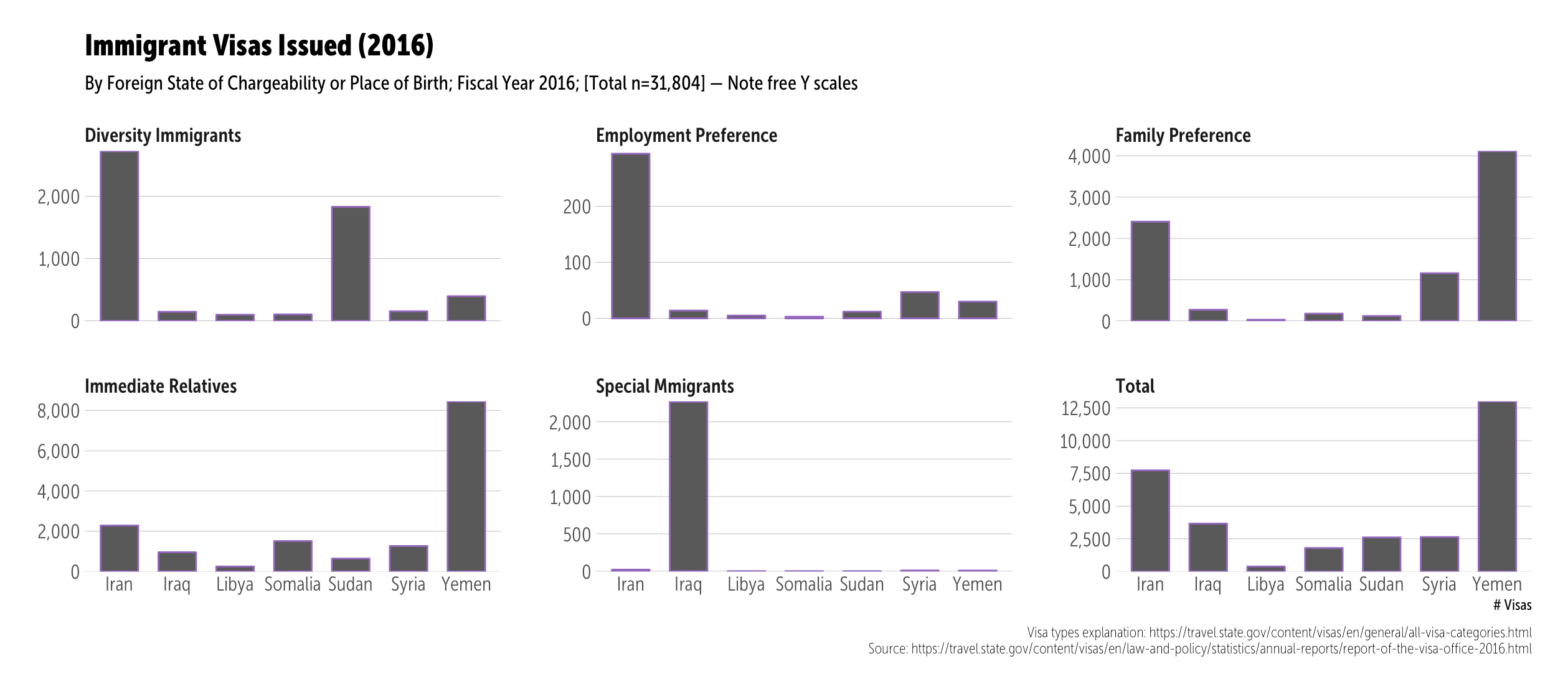
Dear Leader has made good on his campaign promise to “crack down” on immigration from “dangerous” countries. I wanted to both see one side of the impact of that decree — how many potential immigrants per year might this be impacting — and show toss up some code that shows how to free data from PDF documents using the @rOpenSci tabulizer package — authored by (@thosjleeper) — (since knowing how to find, free and validate the veracity of U.S. gov data is kinda ++paramount now).

This is just one view and I encourage others to find, grab and blog other visa-related data and other government data in general.

So, the data is locked up in this PDF document:

As PDF documents go, it’s not horribad since the tables are fairly regular. But I’m not transcribing that and traditional PDF text extracting tools on the command-line or in R would also require writing more code than I have time for right now.

Enter: tabulizer — an R package that wraps tabula Java functions and makes them simple to use. I’m only showing one aspect of it here and you should check out the aforelinked tutorial to see all the features.

First, we need to setup our environment, download the PDF and extract the tables with tabulizer:

library(tabulizer)
library(hrbrmisc)
library(ggalt)
library(stringi)
library(tidyverse)

URL <- "https://travel.state.gov/content/dam/visas/Statistics/AnnualReports/FY2016AnnualReport/FY16AnnualReport-TableIII.pdf"
fil <- sprintf("%s", basename(URL))
if (!file.exists(fil)) download.file(URL, fil)

tabs <- tabulizer::extract_tables("FY16AnnualReport-TableIII.pdf")

You should str(tabs) in your R session. It found all our data, but put it into a list with 7 elements. You actually need to peruse this list to see where it mis-aligned columns. In the “old days”, reading this in and cleaning it up would have taken the form of splitting & replacing elements in character vectors. Now, after our inspection, we can exclude rows we don’t want, move columns around and get a nice tidy data frame with very little effort:

bind_rows(
  tbl_df(tabs[[1]][-1,]),
  tbl_df(tabs[[2]][-c(12,13),]),
  tbl_df(tabs[[3]][-c(7, 10:11), -2]),
  tbl_df(tabs[[4]][-21,]),
  tbl_df(tabs[[5]]),
  tbl_df(tabs[[6]][-c(6:7, 30:32),]),
  tbl_df(tabs[[7]][-c(11:12, 25:27),])
) %>%
  setNames(c("foreign_state", "immediate_relatives",  "special_mmigrants",
             "family_preference", "employment_preference", "diversity_immigrants","total")) %>% 
  mutate_each(funs(make_numeric), -foreign_state) %>%
  mutate(foreign_state=trimws(foreign_state)) -> total_visas_2016

I’ve cleaned up PDFs before and that code was a joy to write compared to previous efforts. No use of purrr since I was referencing the list structure in the console as I entered in the various matrix coordinates to edit out.

Finally, we can extract the target “bad” countries and see how many human beings could be impacted this year by referencing immigration stats for last year:

filter(foreign_state %in% c("Iran", "Iraq", "Libya", "Somalia", "Sudan", "Syria", "Yemen")) %>%
  gather(preference, value, -foreign_state) %>%
  mutate(preference=stri_replace_all_fixed(preference, "_", " " )) %>%
  mutate(preference=stri_trans_totitle(preference)) -> banned_visas

ggplot(banned_visas, aes(foreign_state, value)) +
  geom_col(width=0.65) +
  scale_y_continuous(expand=c(0,5), label=scales::comma) +
  facet_wrap(~preference, scales="free_y") +
  labs(x="# Visas", y=NULL, title="Immigrant Visas Issued (2016)",
       subtitle="By Foreign State of Chargeability or Place of Birth; Fiscal Year 2016; [Total n=31,804] — Note free Y scales",
       caption="Visa types explanation: https://travel.state.gov/content/visas/en/general/all-visa-categories.html\nSource: https://travel.state.gov/content/visas/en/law-and-policy/statistics/annual-reports/report-of-the-visa-office-2016.html") +
  theme_hrbrmstr_msc(grid="Y") +
  theme(axis.text=element_text(size=12))

~32,000 human beings potentially impacted, many who will remain separated from family (“family preference”); plus, the business impact of losing access to skilled labor (“employment preference”).

Go forth and find more US gov data to free (before it disappears)!

11 Feb 00:07

The 🍊 Resistance

by hrbrmstr

I need to be up-front about something: I’m somewhat partially at fault for 🍊 being elected. While I did not vote for him, I could not in any good conscience vote for his Democratic rival. I wrote in a ticket that had one Democrat and one Republican on it. The “who” doesn’t matter and my district in Maine went abundantly for 🍊’s opponent, so there was no real impact of my direct choice but I did actively point out the massive flaws in his opponent. Said flaws were many and I believe we’d be in a different bad place, but not equally as bad of a place now with her. But, that’s in the past and we’ve got a new reality to deal with, now.

This is a (hopefully) brief post about finding a way out of this mess we’re in. It’s far from comprehensive, but there’s honest-to-goodness evil afoot that needs to be met head on.

Brand Damage

You’ll note I’m not using either of their names. Branding is extremely important to both of them, but is the almost singular focus of 🍊. His name is his hotel brand, company brand and global identifier. Using it continues to add it to the history books and can only help inflate the power of that brand. First and foremost, do not use his name in public posts, articles, papers, etc. “POTUS”, “The President”, “The Commander in Chief”, “🍊” (chosen to match his skin/hair color, complexion and that comb-over tuft) are all sufficient references since there is date-context with virtually anything we post these days. Don’t help build up his brand. Don’t populate historical repositories with his name. Don’t give him what he wants most of all: attention.

Document and Defend with Data

Speaking of the historical record, we need to be blogging and publishing regularly the actual facts based on data. We also need to save data as there’s signs of a deliberate government purge going on. I’m not sure how successful said purge will be in the long run and I suspect that the long-term effects of data purging and corruption by this administration will have lasting unintended consequences.

Join/support @datarefuge to save data & preserve the historical record.

Install the Wayback Machine plugin and take the 2 seconds per site you visit to click it.

Create blog posts, tweets, news articles and papers that counter bad facts with good/accurate/honest ones. Don’t make stuff up (even a little). Validate your posits before publishing. Write said posts in a respectful tone.

Support the Media

When the POTUS’ Chief Strategist says things like “The media should be embarrassed and humiliated and keep its mouth shut and just listen for a while” it’s a deliberate attempt to curtail the Press and eventually there will be more actions to actually suppress Press freedom.

I’m not a liberal (I probably have no convenient definition) and I think the Press gave Obama a free ride during his eight year rule. They are definitely making up for that now, mostly because their very livelihoods are at stake.

The problem with them is that they are continuing to let themselves be manipulated by 🍊. He’s a master at this manipulation. Creating a story about the size of his hands in a picture delegitimizes you as a purveyor of news, especially when — as you’re watching his hands — he’s separating families, normalizing bigotry and undermining the Constitution. Forget about the hands and even forget about the hotels (for now). There was even a recent story trying to compare email servers (the comparison is very flawed). Stop it.

Encourage reporters to focus on things that actually matter and provide pointers to verifiable data they can use to call out the lack of veracity in 🍊’s policies. Personal blog posts are fleeting things but an NYT, WSJ (etc) story will live on.

Be Kind

I’ve heard and read some terrible language about rural America from what I can only classify as “liberals” in the week this post was written. Intellectual hubris and actual, visceral disdain for those who don’t think a certain way were two major reasons why 🍊 got elected. The actual reasons he got elected are diverse and very nuanced.

Regardless of political leaning, pick your head up from your glowing rectangles and go out of your way to regularly talk to someone who doesn’t look, dress, think, eat, etc like you. Engage everyone with compassion. Regularly challenge your own beliefs.

There is a wedge that I estimate is about 1/8th of the way into the core of America now. Perpetuating this ideological “us vs them” mindset is only going to fuel the fires that created the conditions we’re in now and drive the wedge in further. The only way out is through compassion.

Remember: all life matters. Your degree, profession, bank balance or faith alignment doesn’t give you the right to believe you are better than anyone else.

FIN (for now)

I’ll probably move most of future opines to a new medium (not uppercase Medium) as you may be getting this drivel when you want recipes or R code (even though there are separate feeds for them).

11 Feb 00:07

Exploring News Coverage With newsflash

by hrbrmstr

I was enthused to see a mention of this on the GDELT blog since I’ve been working on an R package dubbed newsflash to work with the API that the form front-ends.

Given the current climate, I feel compelled to note that I’m neither a Clinton supporter/defender/advocate nor a 🍊 supporter/defender/advocate) in any way, shape or form. I’m only using the example for replication and I’m very glad the article author stayed (pretty much) non-partisan apart from some color commentary about the predictability of network coverage of certain topics.

For now, the newsflash package is configured to grab raw count data, not the percent summaries since folks using R to grab this data probably want to do their own work with it. I used the following to try to replicate the author’s findings:

library(newsflash)
library(ggalt) # github version
library(hrbrmisc) # github only
library(tidyverse)
starts <- seq(as.Date("2015-01-01"), (as.Date("2017-01-26")-30), "30 days")
ends <- as.character(starts + 29)
ends[length(ends)] <- ""

pb <- progress_estimated(length(starts))
emails <- map2(starts, ends, function(x, y) {
  pb$tick()$print()
  query_tv("clinton", "email,emails,server", timespan="custom", start_date=x, end_date=y)
})

clinton_timeline <- map_df(emails, "timeline")

sum(clinton_timeline$value)
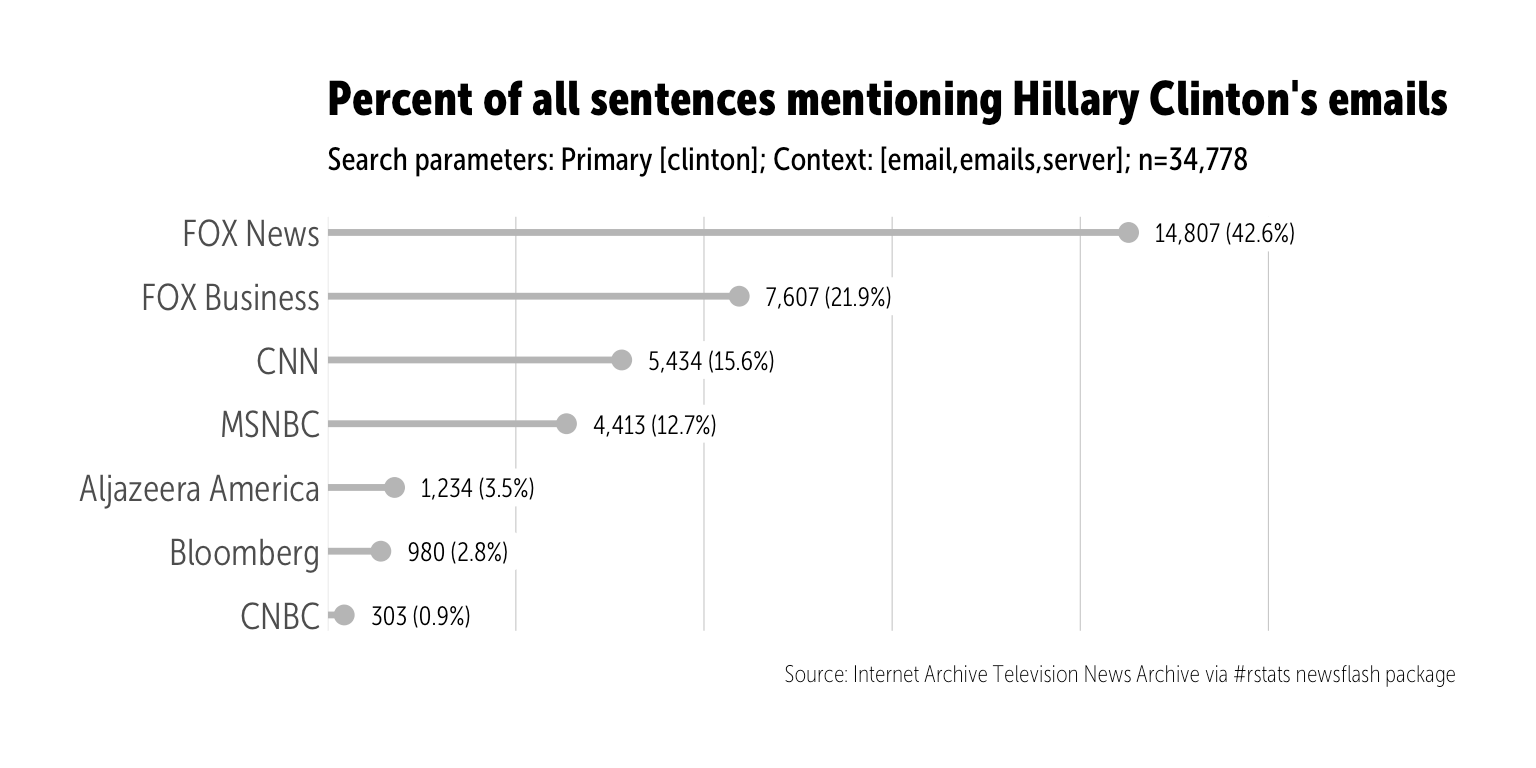
## [1] 34778

count(clinton_timeline, station, wt=value, sort=TRUE) %>%
  mutate(pct=n/sum(n), pct_lab=sprintf("%s (%s)", scales::comma(n), scales::percent(pct)),
         station=factor(station, levels=rev(station))) -> timeline_df

timeline_df

## # A tibble: 7 × 4
##             station     n         pct        pct_lab
##              <fctr> <int>       <dbl>          <chr>
## 1          FOX News 14807 0.425757663 14,807 (42.6%)
## 2      FOX Business  7607 0.218730232  7,607 (21.9%)
## 3               CNN  5434 0.156248203  5,434 (15.6%)
## 4             MSNBC  4413 0.126890563  4,413 (12.7%)
## 5 Aljazeera America  1234 0.035482201   1,234 (3.5%)
## 6         Bloomberg   980 0.028178734     980 (2.8%)
## 7              CNBC   303 0.008712404     303 (0.9%)

NOTE: I had to break up the queries since the bulk one across the two dates bump up against the API limits and may be providing helper functions for that before CRAN release.

While my package matches the total from the news article and sample query: 34,778 results my percentages are different since it’s the percentages across the raw counts for the included stations. “Percent of Sentences” (result “n” divided by the number of all sentences for each station in the time frame) — which the author used — seems to have some utility so I’ll probably add that as a query parameter or add a new function.

Tidy news text

The package also is designed to work with the tidytext package (it’s on CRAN) and provides a top_text() function which can return a tidytext-ready tibble or a plain character vector for use in other text processing packages. If you were curious as to whether this API has good data behind it, we can take a naive peek with the help of tidytext:

library(tidytext)

tops <- map_df(emails, top_text)
anti_join(tops, stop_words) %>% 
  filter(!(word %in% c("clinton", "hillary", "server", "emails", "mail", "email",
                       "mails", "secretary", "clinton's", "secretary"))) %>% 
  count(word, sort=TRUE) %>% 
  print(n=20)

## # A tibble: 26,861 × 2
##             word     n
##            <chr> <int>
## 1        private 12683
## 2     department  9262
## 3            fbi  7250
## 4       campaign  6790
## 5     classified  6337
## 6          trump  6228
## 7    information  6147
## 8  investigation  5111
## 9         people  5029
## 10          time  4739
## 11      personal  4514
## 12     president  4448
## 13        donald  4011
## 14    foundation  3972
## 15          news  3918
## 16     questions  3043
## 17           top  2862
## 18    government  2799
## 19          bill  2698
## 20      reporter  2684

I’d say the API is doing just fine.

Fin

The package also has some other bits from the API in it and if this has piqued your interest, please leave all package feature requests or problems as a github issue.

Many thanks to the Internet Archive / GDELT for making this API possible. Data like this would be amazing in any time, but is almost invaluable now.

11 Feb 00:07

Making knowledge work visible

by Jim

Invisibility is an accidental and troublesome characteristic of knowledge work in a digital world. What makes it invisible? Why does it matter? What can you do about it?

How did knowledge work become invisible?

As a knowledge worker, I get paid for what happens inside my head but not until I get the work outside where it can be seen. Before the advent of a more or less ubiquitous digital environment, that head work generated multiple markers and visible manifestations. There were handwritten notes from interviews, a presentation might start with rough mockups of slides scribbled on a pad of paper. Flip charts would document the outcomes of a group brainstorming session. A consulting report would start as an outline on a legal pad that would be rearranged by literally cutting and pasting the paper into a new order and organization. Computer code started as forms to be filled out and forwarded to a separate department to transcribe the forms onto punch cards.

No one would want to return to that world of knowledge work.

Digital tools—text editors, word processors, spreadsheets, presentation software, email—have eliminated multiple manual, error-prone, steps. They’ve made many low-value roles obsolete—sometimes by unintentionally giving them back to high-cost knowledge workers.

These same tools also reduce the physical variety of knowledge work to a deceptively uniform collection of keystrokes stored as bits in digital files hiding behind obscure file names and equally  uninformative icons. A laptop screen offers few clues about the knowledge work process compared to an office full of papers and books. A file directory listing appears pretty thin in terms of useful knowledge content compared to rows of books on shelves.

Why does the visibility of knowledge work matter?

If you can’t see it, you can’t manage or improve it. This is true as an individual knowledge worker and as a team or organization.

Noticing that digital work is invisible reminds us of benefits of analog work that weren’t obvious. Among those non-obvious benefits;

  • Different physical representations (handwritten notes, typed drafts, 35mm slides) establish how baked a particular idea is
  • Multiple stacks of work in progress make it easier to gauge progress and see connections between disparate elements of work
  • Physically shared work spaces support incidental social interactions that enrich deliverables and contribute to the learning and development of multiple individuals connected to the effort

Consider how developing a presentation has changed over time. Before the advent of PowerPoint, presentations began with a pad of paper and a pencil. The team might rough out a set of potential slides huddled around a table in a conference room. Simply by looking at the roughed-out set of slides you knew that it was a draft; erasures, cross outs, and arrows made that more obvious.

A junior level staffer was then dispatched with the draft to the graphics department, where they were chastised for how little lead time they were provided. A commercial artist tackled the incomprehensible draft spending several days hand-lettering text and building the graphs and charts.

The completed draft was returned from the graphics department starting an iterative process, correcting and amending the presentation. The team might discover a hidden and more compelling story line by rearranging slides on a table or conference room wall or floor. Copies were circulated and marked up by the team and various higher ups. Eventually, the client got to see it and you hoped you’d gotten things right.

The work was visible throughout this old-style process. That visibility was a simple side effect of the work’s physicality. Contributors could assess their inputs in context. Junior staff could observe the process and witness the product’s evolution. Knowledge sharing was simultaneously a free and valuable side effect of processes that were naturally visible.

Putting knowledge work on the radar screen

The serendipitous benefits of doing knowledge work physically now must be explicitly considered and designed for when knowledge work becomes digital. The obvious productivity benefits of digital tools can obscure a variety of process losses. As individuals, teams, and organizations we now must think about how we obtain these benefits without incurring offsetting losses in the switch from physical to digital.

Improving knowledge work visibility has to start at the individual level. This might start with something as mundane as how you name and organize your digital files. You might also develop more systematic rules of thumb for managing versions of your work products as they evolve. Later, you might give thought to how you map software tools to particular stages in your thinking or your work on particular kinds of projects. For example, I use mind-mapping software when I am in the early stages of thinking about a new problem. For writing projects, I use Scrivener as a tool to collect and organize all of the moving pieces of notes, outlines, research links, drafts, etc. The specific answers aren’t important; giving thought to the visibility of your own digital work is.

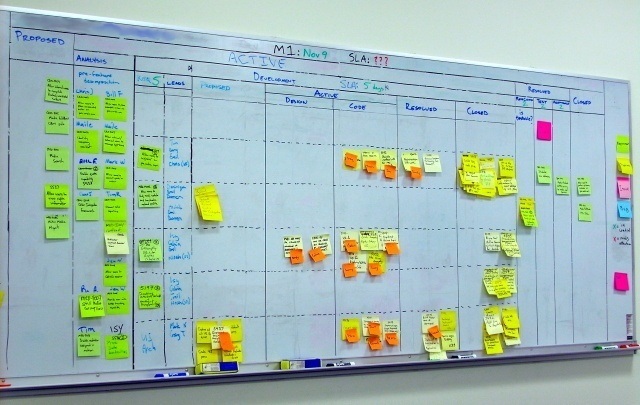
Teams should take a look at the world of software development. Software development teams have given more thought than most to  how to see and track what is going on with the complex knowledge work products they develop and maintain. Software developers have carefully thought out tools and practices for version management, for example. Good ones also have practices and tools for monitoring and tracking everything from the tasks they are doing to the software bugs and issues they are working to eliminate. These are all ideas worth adapting to the broader range of knowledge work.

Organizations might best adopt an initial strategy of benign neglect. I’m not sure we understand knowledge work in today’s world well enough to support it effectively at the organizational level. Knowledge management efforts might seem relevant, but my initial hypothesis is that knowledge management is hampered, if not trapped, by clinging to industrial age thinking. We’re likely to see more progress by individual knowledge workers and local teams if we can persuade organizations to simply let the experiments occur.

The post Making knowledge work visible appeared first on McGee's Musings.

11 Feb 00:07

Coldest day of the year ride 2017

by jnyyz

Today was the annual coldest day of the year ride. Several of us started a little early by riding in from High Park.

img_4722

Quite a good turnout, despite it being actually somewhat cold (-7°C). Here the crowd gathers on Harbord at Art Eggleton Park.

dsc04387

Never a problem parallel parking the Haul a Day.

dsc04389

Captain Sam organizes the Cycle Toronto volunteer marshalls.

img_4725

A few of Toronto’s finest are along to escort us.

dsc04390

Jared Kolb and Councillor Mike Layton warm up the crowd.

About half the crowd is what I could get into a single picture. By my count, almost two hundred cyclists.

dsc04396

Getting ready to depart.

dsc00118

Bloor at Montrose.

dsc00119

Along Bloor.

dsc00121

dsc00126

dsc00127

Down Sherbourne.

dsc00130

Near the end of the ride on Gerrard, with Rick and a bike dad.

dsc00133

a few sights and sounds from the day in this video.

Thanks, to Cycle Toronto, Toronto Police services, and Bikeshare Toronto!

Keep riding, and keep warm everyone!

Update:


11 Feb 00:06

chartier: Just a few recent magazine covers. NBD. 😔


chartier:

Just a few recent magazine covers. NBD. 😔

11 Feb 00:06

Ghost by the Machine

11 Feb 00:03

How Trump’s Support Erodes

Even Trump’s supporters know he’s not a good and competent man — nevertheless, they think they can get what they want from him. It’s a cynical deal, and bad, but you can understand it.

Trump’s vagueness and flip-flops, and the suggestion that he not be taken literally, all help him with this: his supporters, who don’t all want the same things, see what they want to see.

Many Republicans wanted a corporatist to replace Scalia on the Supreme Court, so that decisions like Roe v. Wade could be over-turned and, especially, so that more decisions like Citizens United would be made. It’s likely they’ll get that with a Gorsuch confirmation, no matter how Democrats fight (and they should fight).

But beyond that, every time Trump actually does something specific — as opposed to just saying hard-to-pin-down things — he erodes some support.

For example: many Republicans — Vice President Pence perhaps foremost, along with the Christian Sharia — want to see LGBTQ protections rolled back. But other Republicans don’t, and Ivanka Trump and Jared Kushner reportedly managed to prevent (at least for now) an Executive Order to that effect.

Many Republicans support multilateral free trade (as do I), and in particular agreements that strengthen our ties in Asia as a balance against emerging Chinese power. Well, TPP is not going to happen, and the future of NAFTA is in question.

Many Republicans do not support a Muslim ban which would make our country less safe and demonstrate to the world that we are not the beacon of liberty we’ve claimed.

Many Republicans support a strong NATO alliance and consider Russia one of our biggest threats — but Trump doesn’t. The jettisoning of the post-war American peace in favor of allying with Russia in a clash of civilizations with Islam is not what every Republican wants to see. (What is the winning condition — or final solution — for that kind of clash?)

Not every Republican is willing to spend taxpayer billions on a big, beautiful wall. They all know that Mexico is not paying for it.

Yes, there are some supporters who’ve been happy with everything.

But with each specific move, or lack of move, more supporters learn they’re not going to get what they want, and they learn they’ll get some things they don’t want.

Trump campaigned as almost a Rorschach test, where a large-enough coalition could believe he was on their side. As he makes specific moves, elements of that coalition learn that he’s not.

And that’s how his support erodes — because once you realize he’s not on your side, all you have left to support is his narcissism, mendacity, cruelty, corruption, and incompetence.

11 Feb 00:03

What The Verge can do to help save web advertising

by Don Marti

Walt Mossberg, at The Verge, points out that lousy ads are ruining the online experience.

No doubt about that. Web ads are crap.

Just try reading the same newspaper story in print and online. In print it's next to a professionally-shot photo in a kitchen remodeling ad. On the web it's next to YOU WILL DIE FROM LIVER FUNGUS UNLESS YOU CLICK ON THIS INFECTED LIVER NOW, done in MS Paint.

And it seems to be getting worse, not better. (Not surprisingly, ad blocking keeps going up.) The ads that provoke blocking and mockery are the same ones that get clicks. Everyone agrees that "we" need to get rid of "bad" ads. But naturally, "we" is defined as "you" and "bad" is "not the ads that work for me."

Print ads stay tolerable because in print, publishers have the market power to enforce standards. On the web, not so much. Mossberg again (read the whole thing):

About a week after our launch, I was seated at a dinner next to a major advertising executive. He complimented me on our new site’s quality and on that of a predecessor site we had created and run, AllThingsD.com. I asked him if that meant he’d be placing ads on our fledgling site. He said yes, he’d do that for a little while. And then, after the cookies he placed on Recode helped him to track our desirable audience around the web, his agency would begin removing the ads and placing them on cheaper sites our readers also happened to visit. In other words, our quality journalism was, to him, nothing more than a lead generator for target-rich readers, and would ultimately benefit sites that might care less about quality.

Publishers can't enforce ad standards when an original content site is in direct competition with bottom-feeder and fraud sites that claim to reach the same audience. As Aram Zucker-Scharff mentions in an interview on the Poynter Institute site, the number of third-party trackers on a site grows as new advertising deals bring new trackers along with them. Those trackers leak audience data into the dark corners of the Lumascape until the same data re-emerges, attached to a low-value or fraudulent site that can claim to reach the same audience as the original publisher. Deceptive and extremist sites are part of a larger problem. They're just especially good at playing the same adtech game that all low-value sites do.

So how to turn web advertising from a race to the bottom into a sustainable revenue source, like print or TV ads? How can the web work better for high-reputation brands that depend on costly signaling?

The good news for cash-crunched news sites is that the hard work of web-ad-saving software development must happen, and is happening, on the browser side. Every time a user turns on a protection tool such as Better by ind.ie, EFF Privacy Badger, or the experimental Firefox Tracking Protection, a little bit of problematic ad inventory goes away. Crap sites can only make money from users who are vulnerable to third-party tracking. When tracking protection tools keep ad money out of the nasty corners of the internet, legit sites can win.

For example, if a chain restaurant wants to advertise to people in a town, today they have a choice: support local news, or pay intermediaries who follow local users to low-value sites. When the users get protected from tracking, opportunities to reach them by tracking tend to go away, and market power returns to the local news site.

The Verge and other legit sites are a key part of the solution. The problems of web advertising have grown over years, and won't go away all at once. Sites will have to fix it in a data-driven, incremental way. Fortunately, we're getting the data to make it happen.

Measure the tracking-protected audience. Tracking protection is a powerful sign of a human audience. A legit site can report a tracking protection percentage for its audience, and any adtech intermediary who claims to offer advertisers the same audience, but delivers a suspiciously low tracking protection number, is clearly pushing a mismatched or bot-heavy audience and is going to have a harder time getting away with it. Showing prospective advertisers your tracking protection data lets you reveal the tarnish on the adtech "Holy Grail"—the promise of high-value eyeballs on crappy sites.

Tracking protection is hard to measure accurately, because there are many different kinds. What works for detecting AVG Crumble might not work to detect Privacy Badger. But now anyone with basic web metrics and JavaScript skills can do the measurement with the Aloodo un-tracking pixel and scripts.

Use data to sell brands on Flight to Quality. Real, high-quality sites have branding advantages over generic eyeball-buying, and adfraud is becoming a mainstream concern. The complex adtech that tracking protection protects against is also the place where fraud hides. (Adtech also tends to drag brands into Internet poo-flinging contests by attaching them to controversial sites, but that's another story.)

Higher-reputation publishers need more and better data to take to numbers-craving CMOs. Much of that data will have to come from the tracking-protected audience. When quality sites share tracking protection data with advertisers, that helps expose the adfraud that intermediaries have no incentive to track down.

Use service journalism. Users are already concerned and confused about web ads. That's an opportunity for The Verge. The more that someone learns about how web advertising works, the more that he or she is motivated to get protected. A high-reputation publisher can win by getting users safely protected from tracking, and not caught up in publisher-hostile schemes such as paid whitelisting, ad injection, and fake ad blockers.

Here is a great start, on the New York Times site. Read the whole thing:

Free Tools to Keep Those Creepy Online Ads From Watching You by BRIAN X. CHEN and NATASHA SINGER

Some ways to both help users and work in the interests of a quality site include:

Can't hurt to expose the protection racket behind AdBlock Plus, either.

Beware nerds who claim to fix everything (including me). High-reputation sites are still skeptical about alternate web business models, which is a good move. Better to put the resources into doing some careful adblocker workarounds, advocating responsible tracking protection, and working on magazine-style ads where the four-currency price of accepting the ad is lower than the four-currency price of blocking it.

Upgrading web advertising to a high-signal medium

Why do people watch and share Super Bowl commercials while web ad blocking continues to trend up?

The problem is that the story of web advertising has been one of frantically throwing technology at the lowest-value parts of the ad business while reducing the power of web ads to get a piece of the high-value parts. People who live in market economies are pretty good applied behavioral economists. They'll pay attention to ads that pay their way, with signal, while avoiding cold calls and ads that, through tracking and targeting, work like a cold call and fail to carry signal.

Tim Sullivan and Ray Fisman:

The challenge facing sellers of some genuine product—be it true late-night love or a Tiffany necklace on eBay — and the buyers in search of them is to prove that they’re not just full of empty words. This is where Super Bowl ads come in. Airtime during the game is, of course, fantastically expensive. So why do companies bother buying it? For the same reason that gang members get face tattoos: to prove that they’re in it for the long haul.

Pedro Gardete:

The researchers found that highly targeted and personalized ads may not translate to higher profits for companies because consumers find those ads less persuasive.

Privacy projects such as Better by ind.ie, EFF Privacy Badger, and Firefox Tracking Protection aren't just ways to implement the kind of personal data protection that users want. Those projects can also work in the interests of high-reputation sites, by making signaling work better. Sites like The Verge can help, by helping users squeeze out the signal-destroying tracking and targeting, and helping web ads become a signal-carrying medium.

Next steps: Aloodo HOWTO

11 Feb 00:03

2017 week 5 in review

by D'Arcy Norman

Work

Met with a bunch of folks in IT to start planning how we will turn UCalgaryBlogs into an Official Service™, with all that entails. It’s going to take some time, but it’s a good move. Everyone is on board, so now we just need to figure out what that looks like.

Back in HQ, we had a really good team discussion, trying to start figuring out how to shift from emergency/reaction mode to more R&D projects. It’s going to take some time, but we’ve basically been told we need to be the learning technologies innovation hub for the university, and that’s going to be a pretty major shift.

PhD

Doris Kosminsky gave a presentation to the iLab, about her work on visualizing complex energy datasets in Brazil.

Read

Other

I moved my web stuff back onto Canadian soil. It hurt, leaving Reclaim Hosting. A lot. Tim and Jim (and the rest of the crew) are awesome. Best web hosting, and best support community, I’ve ever been a part of. But it’s a US company (hosted through another US company’s infrastructure), which means I can’t leave my stuff there.

Friday was a PD day at The Boy™’s school, so I took a personal day and we headed out to Sunshine. His first time snowboarding on a Big Mountain. My third. We took it easy and had a blast.

Sunshine - Wawa Tin Can Alley wide open

11 Feb 00:02

Rejected answers to ‘why are you interested in our PhD program?’

  1. Capitalism requires me to trade my labour for food. Due to the extremely blinkered way in which we assess value, the accumulation of crippling debt at your institution will, in a decade, allow me to demand more food.
  2. Having been in the technology sector for many years I have already seen all the different kinds of systemic toxicity and violence it can provide, and am eager to explore hitherto-unknown kinds of systemic toxicity and violence.
  3. I work in infosec. At least your oozing, slurping horror is unionised.
  4. I figure if I can become a Doctor on top of being a lawyer, my Jewish mother will finally can it for like 5, maybe 6 minutes.
  5. Turns out Dr is the only gender-neutral prefix cis people can get through their skulls.
  6. One day I just looked at myself in the mirror and went: y’know, Oliver, your life doesn’t have anywhere near enough Nazi apologists in it.
  7. If I have to do one more bubble sort implementation on a whiteboard I swear to god I will burn the entire world down so help me.
11 Feb 00:02

A sneak peek at our 2017 ASME bike: Tempest

by jnyyz

Every year, one the main projects of the HPVDT is to build a bike for the ASME Human Powered Vehicle Challenge. The team is hard at work finishing the design for this year’s bike, and fabrication has started.

Here, several team members are working on their designs.

dsc00135

Meanwhile, in an adjacent room, the seismic design team is building a balsa wood tower for a competition in April.

dsc00136

Bill working on a component mold.

dsc00139

Evan poses with the halves of the plug for the body.

dsc00138

Here is the plug glued together. You can get a sense of the shape of the bike.

dsc00142

Alert readers will see the similarity to Vortex, which was the second ASME bike built by the team. It won the overall title at the 2011 ASME HPVC East competition. You can see glimpses of it in its raw carbon state in this ASME video.

screen-shot-2017-02-05-at-2-41-19-pm

https://www.facebook.com/plugins/video.php?href=https%3A%2F%2Fwww.facebook.com%2FASMEHPVC%2Fvideos%2F10100181743456556%2F&show_text=0&width=560

Here is Vortex sitting in a back storeroom.

dsc00140

After winning at ASME, Vortex went on to be raced at numerous races in the US Midwest, and was run every year at the WHPSC in Battle Mountain. The number on the side commemorates the fact that last September, Vortex made its 100th run at WHPSC, which was the most of any vehicle at that competition.

dsc04257

After Vortex, the team went on to try a variety of designs for ASME, including a streamliner

bluenose with tufts

a faired trike

1000px-celero

a leaning trike

danielle

and an unfaired lowracer. (Note that Sherry’s feet are not on the pedals in this pic)

dsc01187

Last year’s design, Cyclone, was based on Vortex, but it was not completed in time to run at the competition.

DSC08311

Tempest is another Vortex based bike, but with a refined shape. We plan to have it ready, running, and tested before ASME East which is at the end of the third week in April.


11 Feb 00:02

The American Wall: Spatialization of Inequality

by Rob Shields

Laura Poitras, Academy Award winning Director of Citizenfour and others at Field of Vision stitched together 200000 Google satellite images to create Best of Luck with the Wall, a video of the US-Mexico border, where the American government proposes to build a wall to keep out Mexicans.

Over the last 15 years, Space and Culture has published multiple articles on the Mexico-US border as a division, a trade corridor and space of mobilities, a lived cultural experience, and as a liminal space betwixt and between the two countries.  These included Remembering Laredo (Mehnaaz Momen 2007), Road Signs on the Border (Lee Rodney 2011) and Speed and Space within a NAFTA Corridor (Jane Henrici 2002).

-Rob Shields (University of Alberta)

10 Feb 23:59

Syncing Playlists with the Fiio X3 (or X1 or X5)

by Rob Campbell

Awhile back I wrote a review of my portable digital audio player, the Fiio X3 2nd generation (Amazon US, Canada). The summary of that review was that this is a bare bones audio player, with a simple UI, that is beautifully-built with an attention to sonic quality. It sounds fantastic but has a few UI quirks that take a bit of getting used to.

The Fiio players don’t come with their own software for keeping track of what’s stored on them. There are a few software options out there that aim to help with this, but most of them integrate with iTunes and I’m trying to wean myself off of that mess. The two best options for integrating sync with iTunes seem to be:

  1. Dapper (macOS, free demo, $27)
  2. iTunesFusion (Windows, free, $10, $15)

I have not tried these. If you have, I’d love to hear your impressions in the comments. My summary from reviews of Dapper is that it uses a custom set of playlists (using a prefix in the playlist name) to figure out what to export to your card. For less than the app’s listed 27 bucks, I can do the same by just creating custom playlists and exporting them myself.

You might be saying, “how can you do that? iTunes won’t let me export playlists.”

I have another utility excitingly named Playlist Export that does just this. Pick a playlist from the list and it will dump the m3u file and optionally copy the files to a destination of your choosing. It’s even somewhat smart in that it allows you to adjust the file paths on export to match up what you have on your player’s SD card. This is of crucial importance, because by default, the paths are slightly different than they are in my computer’s music collection.

In my case, the “Music File Path Settings” must be changed from /Volumes/Bulk/Music/rob’s iTunes Collection/ to an empty field on the Fiio’s card. I’m using relative paths for my playlists, and the m3u files are exported to the top-level music directory on the Fiio’s SD card.

An couple of example playlist entries might look like:

Elliott Smith\Elliott Smith\01 Needle in the hay.m4a
Death Cab for Cutie\Transatlanticism\07 Translatlanticism.m4a
...

Note the lack of a leading slash here. The files are stored in Artist\Album Name format. Yours may well look different, depending upon how you’ve formatted your music naming in your library.

This is great for dumping copies of playlists from iTunes, optionally with the included music. What it is not great for, is keeping a playlist in sync with the source computer. If your playlist changes, the contents on the Fiio won’t necessarily reflect those changes.

Don’t even think about editing a playlist on the Fiio itself. It’s not great for that.

And that brings me back to the device. Fiio, if you read this, please give us something that can edit the included library on the device. It is impossible to synchronize library metadata (information about the songs on the player) with an external source. Play counts, ratings, favorites and playlists are all locked inside the player, never to be used again. It’s a relatively minor complaint, but one I keep coming back to. And it’s the main reason I can’t come up with a more convenient, reliable way to sync music other than just copying and deleting the contents of the memory card.

There are a number of threads on the interwebs with people struggling to figure this out. This one, in particular, was the most helpful I found for decoding the structure of the Fiio’s entries. It’s still a fantastic player and I love it, despite some of its usability quirks.

UPDATE

Doug of DougScripts has a little utility to “Stuff a thumb drive with songs from your iTunes library” called M3Unify. I haven’t tried this but it looks promising and might just be the special sauce Mac users need for this. Cost: five bucks.

I’ve been using some of Doug’s AppleScript utilities in iTunes and they’re worth checking out. Some great tools for keeping your library organized.

10 Feb 23:59

Changing How Lurkers View Their Role In Your Community

by Richard Millington

If you interview any segment of community members you’ll discover the very real emotive reasons why people don’t participate more.

Lurkers, for example, give three common reasons for not participating:

  1. They don’t have enough time.
  2. They don’t feel they have anything to contribute.
  3. They don’t feel they are smart enough to share their knowledge.

You can tackle each of these.

Let’s assume lurkers say they don’t feel they can contribute anything useful. That’s the long-term perception you have to change.

In your welcome copy, your notifications, your personal messages, the copy on your site, and in your own responses, you need to ensure they know you need their questions more than their answers.

Insert copy to the effect of ‘we’re short of good questions, what questions do you have this week?’ (notice the emphasis on the need for good questions).

Segment lurkers into a separate mailing list and run a short campaign highlighting the kind of questions you need from them, why it helps the community, and how it helps them. You need them to know you want them to improve their skills, knowledge, and set of resources quickly.

Show more appreciation to people who ask new questions. Thank them for the question, highlight the impact it might have, get back to them on the resolution to the question, and be friendly and personal.

Think of this as a short persuasion campaign. You have to change how they think about their contributions to community. You don’t need their answers, you need their questions to help everyone.

Now interview another segment of members and do the same.

10 Feb 23:59

How China is grabbing the world’s headlines for its ambitious football policy

by Simon Chadwick
A well-known figure in English football once commented that the sport is characterised by the ‘prune juice effect’. That is, whatever goes in one end, quickly goes out again at the other. The person in question, Alan Sugar, was specifically referring to the money generated by television contracts and how it gets spent on excessive player transfer fees and salaries. The prune juice appears to have continued flowing during Europe’s recently-closed transfer window, England in...
10 Feb 23:59

Strung Out On String Ops – A Brief Comparison of stringi and stringr

by hrbrmstr

I made a promise to someone that my next blog would be about stringi vs stringr and I intend to keep said promise.

stringr and stringi do “string operations”: find, replace, match, extract, convert, transform, etc.

The stringr package is now part of the tidyverse and is 100% focused on string processing and is pretty much a wrapper package for stringi. The stringi package wraps chunks of the icu4c library but the stringi API frmaing was actually based on the patterns in the stringr package API. stringr did not wrap stringi at the time but does now and stringi strays a bit (on occasion) from string processing since the entire icu4c library is at it’s disposal. Confused? Good! There’s more!

The impetus for asking me to blog about this is that I’m known to say “just use stringi” in situations where someone has taken a stringr “shortcut”. Let me explain why.

Readers Digest

First, you need to read pages 4-5 of the stringi manual [PDF] and then the stringr vignette. I’m not duplicating the information on those pages. The TL;DR on them is:

  • that stringr makes some (valid) assumptions about defaults for the stringi calls it wraps
  • stringr is much easier to initially grok as it’s very focused and has far fewer functions
  • they both use ICU regular expressions
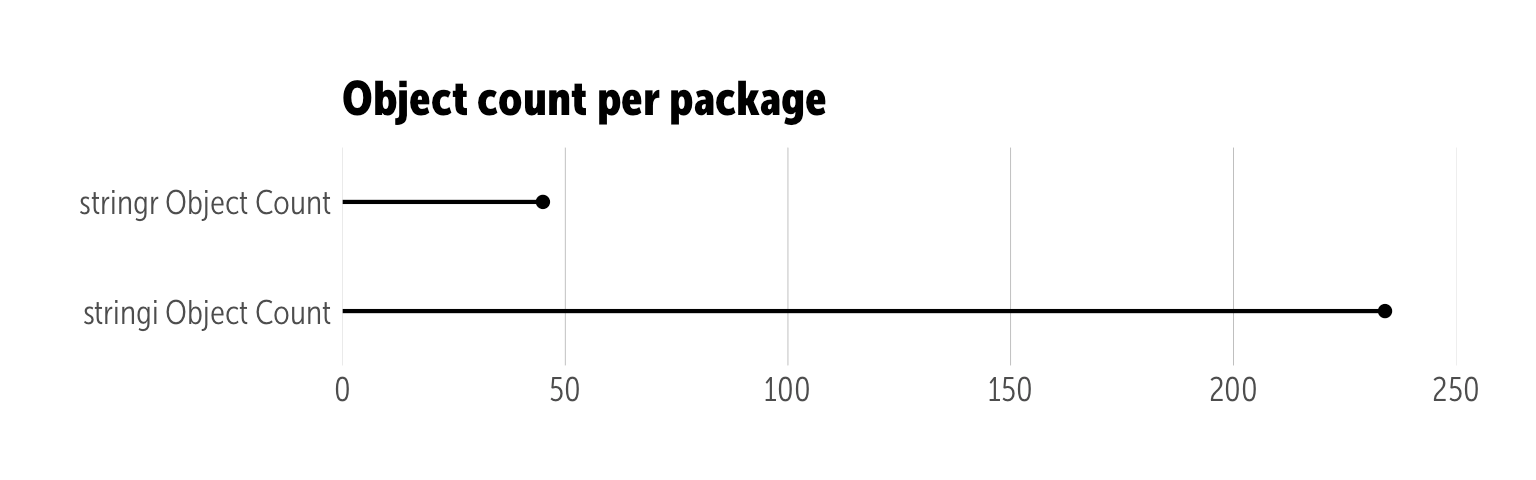
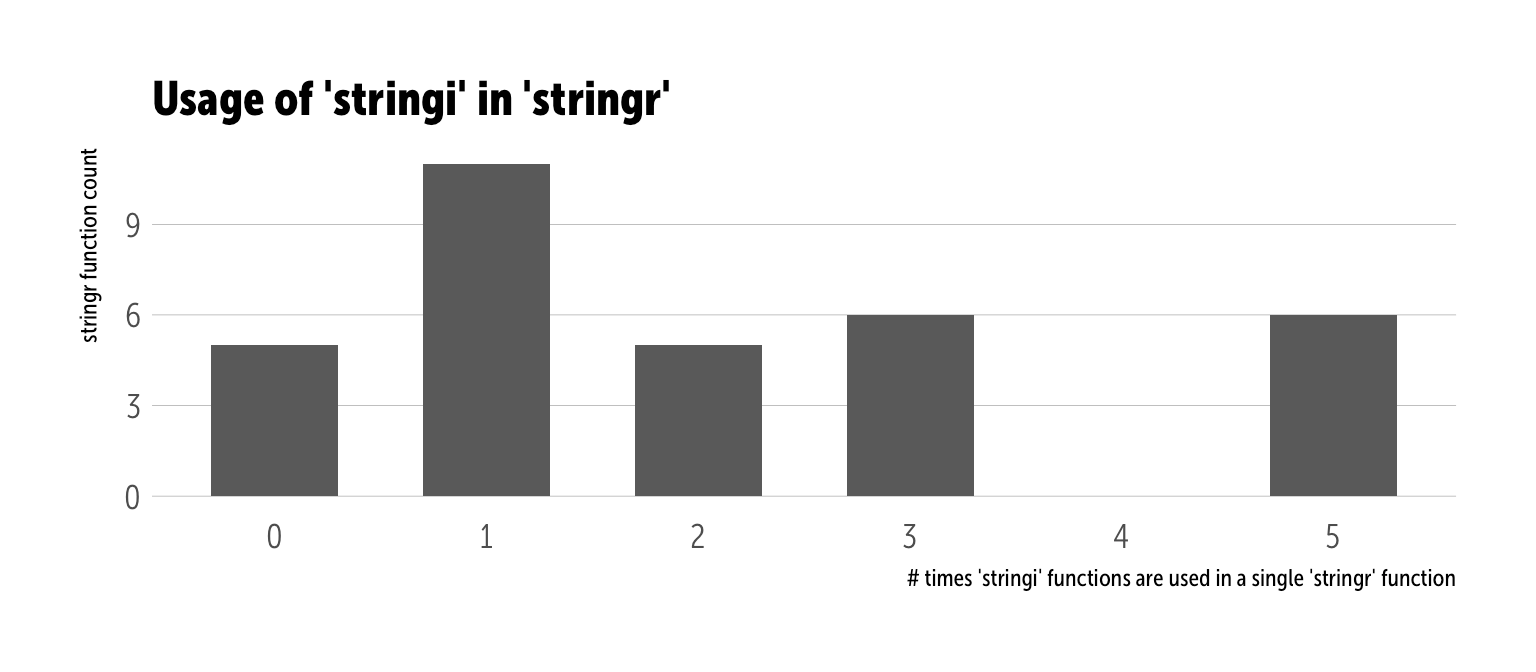
  • stringi includes more than string processing and has far more total functions:

As noted, stringr wraps stringi calls (for the most part) and some of the stringr functions reference more than one stringi function:

That’s my primary defense for “just use stringi” — stringr “just uses” it and you are forced to install stringi on every system stringr is on, so why introduce another dependency into your code?

All Wrapped Up

These are the stringr functions with a 1:~1 correspondence to stringi functions:

stri_c stri_conv stri_count stri_detect stri_dup stri_extract stri_extract_all stri_join stri_length stri_locate stri_locate_all stri_match stri_match_all stri_order stri_pad stri_replace stri_replace_all stri_replace_na stri_sort stri_split stri_split_fixed stri_sub stri_sub<- stri_subset stri_trim stri_wrap

I used 1:~1 since at the heart of the string processing capabilities of both packages lies the concept of granular control of matching behaviour. Specifically, there are four modes (so it’s really 1:4?):

  • fixed: Compare literal bytes in the string. This is very fast, but not usually what you want for non-ASCII character sets
  • coll: Compare strings respecting standard collation rules
  • regex: The default. Uses ICU regular expressions
  • boundary: Match boundaries between things

stringr has function modifiers around pattern to handle those whereas stringi requires explicit function calls. So, you’d do the following to replace a fixed char/byte sequence in each package:

  • stri_replace_all_fixed("Lorem i.sum dolor sit amet, conse.tetur adipisicing elit.", ".", "#")
  • str_replace_all("Lorem i.sum dolor sit amet, conse.tetur adipisicing elit.", fixed("."), "#")

In that case there’s not much in the way of keystroke savings, but the default mode of stringr is to use regex replacement and you do save both an i and _regex for that but add one more function call in-between you and your goal. When you work with multi-gigabyte character structures (as I do), those milliseconds often add up. If keystrokes > milliseconds in your workflow, you may want to stick with stringr.

Treasure Hunting in stringi

If you take some time to look at what’s in stringi you’ll find quite a bit (I excluded the fixed/coll/reged/boundary versions for brevity):

That’s an SVG, so zoom in as much as you need to to read it.

These are stringi gems:

  • stri_stats_general (stats abt a character vector)
  • stri_trans_totitle (For When You Want Title Case)
  • stri_flatten (paste0 but better defaults)
  • stri_rand_strings (random strings)
  • stri_rand_lipsum (random Lorem Ipsum lines!)
  • stri_count_words, stri_extract_all_words, stri_extract_first_words, stri_extract_last_words

Plus it has some helpful operators:

  • %s!=%, %s!==%, %s+%, %s<%, %s<=%, %s==%, %s===% %s>%, %s>=%, %stri!=%, %stri!==%, %stri+%, %stri<%, %stri<=%, %stri==%, %stri===%, %stri>%, %stri>=%

Of those, %s+% is ++handy for string concatenation.

Prior to readr, these were my go-to line/raw readers/writer: stri_read_raw, stri_read_lines, and stri_write_lines.

It also handles gnarly character encoding operations in a cross-platform, predictable manner.

FIN

To do a full comparison justice would have required writing a mini-book which is something I can’t spare cycles on, so my primary goals were to make sure folks knew stringr wrapped stringi and to show that stringi has much more to offer than you probably knew. If you start to get hooked on some of the more “fun” or utilitarian functions in stringi it’s probably worth switching to it. If string ops are ancillary operations to you and you normally work in regex-land, then you’re not missing out on anything and can save a few keystrokes here and there by using stringr.

Comments are extremely encouraged for this post as I’m curious if you know about stringi before and when/where/how you use it vs stringr (or, why you don’t).

10 Feb 23:58

Why do you use Firefox?

If you read my blog, you probably know I'm helping looking after the move to WebExtensions as the way to develop add-ons for Firefox. We've received some positive interactions but regularly face critics and bruising (if not insulting and threatening) comments. It's a tough job right now.

But one thing we hear repeatedly is this: "If you take away my Extensions as they exist today, I will just switch to Chrome"

That's a question that keeps troubling me, because I care about Firefox. Here's some points:

  • only about 38% of Firefox users have an extension [1]

  • some of those add-ons with a large install base are defunct eg Microsoft .NET Helper and Firebug

  • pretty much all the add-ons with a large install base [2] already exist on Chrome [3]

So here's my statement: the vast majority of users could switch to Chrome and get all the same extensions with almost identical functionality [4]. For a minority of users using extensions that do not exist in Chrome, you cannot. My guess at that number of users who cannot switch is well under 5% of our user base [5].

So some people will complain loudly and argue this is the death of Firefox. Whilst I can see this might cause a switch for some people, I haven't yet seen the evidence behind this statement. To be frank, why haven't you already switched to another browser?

The evidence tells me that Firefox must offer some benefits or value beyond just extensions. In fact it's insulting to all those contributors who work so hard on Firefox to say that extensions are the only thing keeping them from switching to Chrome.

So what does keep you using Firefox?

Update: this blog post has more attention than usual, so if you want to contact me, try: andy@mckay.pub or @andymckay. Thanks.


[1] Some of these are based on numbers I've seen and its Sunday night after the Super Bowl and I've had a drink so this is might not be completely accurate.

[2] There are some exceptions here NoScript, DownThemAll etc.

[3] Some people argue that some add-ons are better on Firefox, e.g: Adblock Plus has more features on Firefox than Chrome. For other add-ons e.g: React Tools it's not the case. Yet others argue that Adblock Plus is faster on Chrome than on Firefox and so on. Short answer: it's complicated.

[4] Remember all they have to do is switch and install the equivalent Chrome extensions.

[5] That's my guess. This is a number we are trying to figure out.

10 Feb 23:45

Terminal Democracy

by Christopher Schaberg

On January 28, the news was flooded with images of stranded international travelers, crowded airport spaces, and frantic airline employees — all the result of Donald Trump’s executive order imposing an immediate travel ban on visitors from seven nations in the Middle East. Travelers’ stories were told, but ethnography seemed hapless in the face of Trump’s cruel, sweeping order. By that evening protests were being held at airports around the country, at large airports and small. Even JFK’s airport tram — that humble form of limited public transit — became a contested place after protesters were temporarily blocked from it. Collective action at or around airports could be seen all over social media, and soon enough, the hashtag #OCCUPYAIRPORTS was gathering momentum. Within days, a website dedicated to the airport protests popped up, offering state-by-state plans of action, resistance, and recourse in the event of arrests.

In these images of protest, the sterilized backdrops of airport architecture stood in stark contrast to the masses of protesters and their hastily scrawled signs. A prayer session occurred in the DFW baggage claim, urgently sanctifying the “tight spaces” of airport waiting areas. Airport curbsides were no longer interstitial space but became effective staging grounds for highly visible demonstration. As Christopher Hawthorne argued in an article for the Los Angeles Times, “the airport is a hospitable host for protest precisely because of how poorly it works in terms of civic design on a typical day.” This is true, but the traction of the protests wasn’t just a matter of opportunistically seizing on the choke points in airport layouts. The ways in which airports do work as intended — the way they manage to consistently sustain flow-through for millions of passengers every day, at times facilitating the movement of some at the expense of others — has also played a role.

History professor Jacob Remes pointed out on Twitter how airports are the perfect places for contemporary protests, “key sites of employment (often the biggest worksite in a city), surveillance, migration, and movement of goods and people.” Not only that, the countless stories of racial profiling at security checkpoints and of passengers getting kicked off flights for speaking languages that others found suspiciously foreign suggests that racism and nationalism had long been acutely manifest in the routines of air travel.

If airports are designed to facilitate “loungification,” the protests were able to use these design principles against themselves

Positioned at the nexus of so many different frontiers, physical and conceptual, airports seem to be foretold sites of vulnerability and inevitable chaos. They are linked to a long history of hijacking and terrorism, of course, and 9/11 propelled this aura further into the American cultural consciousness. Over the first decade of the 21st century, surveillance and identity checks have become ever more intense at U.S. airports, indices of broader national and global tensions. Even those Americans accustomed to comfortable passage through whatever spaces they inhabit have felt airport misery in muted forms — not only during delays or cancellations but by the basic security clearance and boarding procedures that recast the traveling liberal subject as carefully tracked bio-cargo. Especially since 9/11, airport security checkpoints in the U.S. have seemed like minor police states, perhaps even to those inclined to trust the police.

After Trump’s executive order, tensions inherent to airports exploded to the fore, and two different kinds of chaos, each specific to a particular vulnerability, began to play out. The first of these had to do with the nature and extent of authority at airports. Behind the customs barriers and in waiting rooms, travelers were converted into suspects as airline employees and customs officials scrambled to make sense of (and enforce) Trump’s executive order. In these enclosed spaces, among some of these officials and their targets, it must have felt as though all the xenophobic pressure that had built up over the past 15 years or so had broken through. Authorities with prejudices and personal axes to grind suddenly found themselves with the leeway to grind them unilaterally, exploiting the ambiguities and uncertainties around the executive order to discriminate, intimidate, detain, and block people at will — at least in the early hours of the ban.

This chaos was the murky underside of airport security: a toxic blend of ideological, logistical, and functional rule. Just beneath its ordinary procedures linger questions about who gets to be protected, who gets treated as threats, who gets to exercise arbitrary power, and who gets singled out for persecution. While global air travel seems to rest of on ideals of tolerance and fair treatment across disparate geographies and nations, these ideals are unevenly distributed at best. And Trump’s executive order, beyond its practical snafus and blunders, exposed an underlying anti-democratic nature within air travel. Behind all the superficial order and worldly scope of modern flight, it turns out, are fractured dimensions of fear and hatred that can be exacerbated in an instant.

Later, as the protests began to mount, a second kind of chaos — a spatiotemporal chaos — took shape: crowds on the sidewalks, clogging the terminal buildings, basically blocking the open spaces and flows of bodies that airports depend on. If airports are designed to facilitate temporary inhabitance and relatively rapid and constant transitions — what has been called “loungification” — the protests were able to use these design principles against themselves. As Hawthorne described it, “The narrow sidewalks; the pedestrian bridges leading to and from parking structures; the little islands of pavement where we wait for shuttle buses; the bi-level ring roads that encircle every airport: These were the stages on which the protests were most effective on their own terms, both in clogging traffic and producing media-ready images of an angry, loud and unnerved public.” Yet this was no mere matter of poor design: It was always in airports’ very nature to welcome, shepherd, and display such collective action — passengers routinely clump up and board together, linger around baggage carousels in masses, and cluster and fume together when there’s a hiccup in the system. The protests were like a major wave of airline delays or cancellations, but instead of domestic flights in question, people were responding to entire ontological trajectories suddenly put on hold.

It’s no wonder that protesters were so deft at mobilizing and occupying public airport zones. Travelers on private jets, like Trump, have an experience that is utterly incommensurate with the grind of commercial air travel. Whereas Trump disingenuously lashed out at U.S. airports as “third world” in the first presidential debate — how many hours had he himself ever spent in these places of dead time, indignity, and rote work? — ordinary American travelers have internalized the spaces and procedural logics of air travel, and could put that knowledge to use in a readily legible public expression of resistance. Security was built-in (TSA agents aplenty); amphitheater-like areas were easily improvised; a continually renewed public audience passed by; the routes to the sites of protest were well established: These familiar aspects are all part of what I have called “airportness”: the ways that ordinary travelers internalize — and come to naturalize — the routines of air travel.

But not all travelers experience these routines in the same way. Earlier that week, before the ban was signed, something else happened at JFK: a 57-year-old Massachusetts man was charged with hate crimes after harassing and kicking a Delta employee who was wearing a head scarf, saying, among other things, “Trump is here now … He’ll get rid of all of you.” This incident occurred not in the open spaces of the airport concourses, or in the sorts of places where the protests would occur a few days later, but in the Delta Sky Club lounge.

The protests were like a major wave of airline delays, except that people were responding to entire ontological trajectories suddenly put on hold

What Trump seems to despise about airports is precisely what makes them airports: the tenuous messes, the congestion, the high visibility, and the people there. His rhetoric describing U.S. airports as “third world” raised their profile as sites of crisis, places where some supposed form of un-Americanness could already be seen plainly. But the nature of what is “unacceptable” remains open to contest, and the shared indignities and hopeful fantasies that airports structure for ordinary, non-elite travelers provides an entirely different basis for determining that and expressing it. Little did Trump realize that in directing further attention to airports, he was loading a weapon that would not be entirely his to wield.

Airports were already fraught borderlands where disconcerting, seemingly arbitrary regimes of identity checks and detentions are carried out, where the class privilege to avoid much of the procedural despair could literally and explicitly be bought. But after the travel ban, the airport’s abject zones — customs lines, waiting rooms, blazingly lit hallways leading to secret interiors — became public spectacles anew, where it wasn’t inconvenience and inefficiency on display but something like the rapid degeneration of democracy. And alongside it, something hopeful was happening: people were discovering that airports were primed for swarming by the resistance.


What goes on at airports never stays at airports. What occurs in these nodes ripples outward, affecting distant geographies, logistics, and emotions.

On Apple News, a Washington Post article “How the World Is Responding to Trump’s Travel Ban” was given a cover illustration of a stylized route map, similar to the sort you find in the back of an in-flight magazine. The airports were glowing blue dots, with the lines of flight paths gracefully arcing up and over a slightly tilted earth. A common enough image, it was nonetheless an odd one to use given the context. Once a diagrammatic expression of the hope of cosmopolitanism and a wide-open world woven together by flight, it has taken on new meaning in the context of the ban and the protests. It now suggests not safe points of origin and destination but contested sites of capture, deportation, and resistance. These are no longer curvatures of connection, but stark lines of division and discrimination. It now resembles something more like a battle map for the Trump regime, or a chart highlighting the epidemiological spread of what it regards as unwanted elements, vectors of transmission that demand containment.

What Trump seems to despise about airports is precisely what makes them airports: the tenuous messes, the congestion, and the people there

Airports, in Marc Augé’s oft-cited term, are “non-places”: in-between zones that facilitate various patterns and circulation cycles of modern life. If the airport is a non-place, it is now the site where Trump’s administration is trying to turn people into non-persons. With Trump’s travel ban we are seeing how such generic sites, supposedly devoted to any traveling subject, can be used to heat up and vent simmering forms of nationalism: They can be turned against specific traveling subjects, at will. However, this generic quality also allows airports to be occupied, to become sites of resistance. Any airport stands as a readymade point of protest. This double-sided feature of airports is itself rising in temperature. As much as Trump and his ilk can use airports to sort and intimidate people, others have discovered that airports are useful flashpoints in terms of their sensitized public status.

Trump’s clampdown on international airports is less about the experience of air travel itself than a symbolic rejection of cosmopolitanism and tolerance. But it is also much more than a symbolic gesture. Or rather, Trump’s travel ban symbolizes much more than its supposed limited and temporary scope. It does not involve just the few countries named and the travelers following these routes, and it doesn’t merely involve international airports. The executive order appears to have be rolled out by design in a confusing and disruptive fashion, allowing no time for airlines or government officials to prepare for its implementation. This has had significant financial implications for the airlines, who will be forced to adjust to the executive mandate at their expense (at the very least in terms of time, reputation, and so on). And it has placed officials in the position of having to deploy state power with no clear sense of the legality of doing so, as court orders were issued and variously defied.

Disrupting both state and airline protocols without warning, and instigating an enormous waste of time, money, and resources would seem to run counter to Trump’s expressed wish to make airports great again. But in fact, this action sheds far more disturbing light on what his regime takes to be “greatness”: extreme vetting, ever deeper insecurity, and even more paranoia. The executive order is a naked demonstration of the current regime’s willingness and intent to suspend the rights and protections afforded by the Constitution on the basis of religion, nationality, or ultimately any other arbitrary marker of identity, even at the cost of vast economic inefficiencies or the disempowering of the judicial branch.

Even if Trump’s order gets scaled back or curbed, the damage has been done: Trump has shown himself to be president of a terminal democracy. As liberal democracy teeters or, perhaps, reaches its unfortunate apotheosis, airports are now places to be watched not only for the emergence of nationalist politics but also for collective acts of resistance. Airports have never been neat and tidy border spaces. Now more than ever we may see these sites as vulnerable not just just in terms of who can enter and and leave, but also who can occupy them. Terminals can be places where the universality of certain human rights can be championed and defended, and not merely a place where such ideas are terminated.

10 Feb 23:42

What if instead of trying to convince people to buy what you’ve created, they lined up and waited for you to release it?

by Paul Jarvis
This is the actual process I’ve used to go from designer and writer to over $1,000,000 in product revenue as a company of one. It’s exactly what I’ve noticed many other successful people do and use in their own businesses as well.
10 Feb 23:42

Teaching materials for visualization

by Nathan Yau

Enrico Bertini, who has taught information visualization at New York University for the past few years, put up his class materials for open use. There are lecture slides, exercises, and a course diary of his own teaching experiences. Should be useful if you want to teach or learn on your own.

Back in my day, I didn’t have formal visualization courses. I checked out paper books from the library, pieced together tidbits of Flash tutorials meant for games, and walked in the snow for five miles to and from school. Consider yourself lucky.

Tags: teaching

10 Feb 23:40

Mozilla Files Brief Against U.S. Immigration Executive Order

by Denelle Dixon-Thayer

Mozilla filed a legal brief against the Executive Order on immigration, along with nearly 100 other major companies across different industries.

We joined this brief in support of the State of Washington v. Trump case because the freedom for ideas and innovation to flow across borders is something we strongly believe in as a tech company.  More importantly it is something we know is necessary to fulfill our mission to protect and advance the internet as a global public resource that is open and accessible to all.

The order is also troubling because of the way it undermines trust in U.S. immigration law. This sets a dangerous precedent that could damage the international cooperation required to develop and maintain the open internet.

We believe this Executive Order is misplaced and damaging to Mozilla, to the country, and to the global technology industry. These restrictions are significant and have created a negative impact to Mozilla and our operations, especially as a mission-based organization and global community with international scope and influence over the health of the internet.

The ability for individuals, and the ideas and expertise they carry with them, to travel across borders is central to the creation of the technologies and standards that power the open internet. We will continue to fight for more trust and transparency across organizations and borders to help protect the health of the internet and to nurture the innovation needed to advance the internet.

The post Mozilla Files Brief Against U.S. Immigration Executive Order appeared first on The Mozilla Blog.

10 Feb 23:40

Living with roommates at 30+, sometimes with babies added

by Frances Bula

A fun assignment recently, to take a look at the prevalance of room-mating as the housing crunch continues unabated.

There’s no doubt that the phenomenon of sharing is on the upswing in many high-priced cities. I remember reading a story from London that said the big dream for young people there was not their own apartment, but just their own bathroom.

I had noted in other stories I’ve done recently how many millennial couples I’d come across who were sharing an apartment or a house with a third person. But, for this story, I stumbled across an even more extreme example of the room-mate phenemonon: two professional couples, each with a young one, sharing a four-bedroom house.

That was along with people in their 30s, 40s, and 50s taking to the room-mate life, finding benefits not just in the money-saving, but also the extra company, the sense of security, and the expanded set of friends.

My story here. (Makes me wonder if any of will get to live alone until we hit the old-age home.)

10 Feb 23:36

Personally, I think we should have 100 years of women running everything — CEOs of all public…

by Stowe Boyd
10 Feb 21:40

Funny simple

by russell davies

Splendid piece in the New Yorker about children’s-book author and illustrator Mo Willem. I'd not heard of him before but I want to read them now, I might need to borrow some of children to do some readings.

I like this about the difference between a story that's a song and a story that's a score -

"The challenge for me is that my goal is to be funny, but within the constraint of using only about forty to fifty words,” Willems told me. “That’s why I say that early readers are hard writers—writing them isn’t easy.” They have to be short and immediately engaging, but they can’t rely on punch lines. “I sometimes joke that I write for functional illiterates,” Willems added. “Because these stories aren’t meant to be read once—they’re meant to be read a thousand times. In that way, they’re more like a song than like the score for a film. You don’t listen to ‘A Boy Named Sue’ for the ending.”
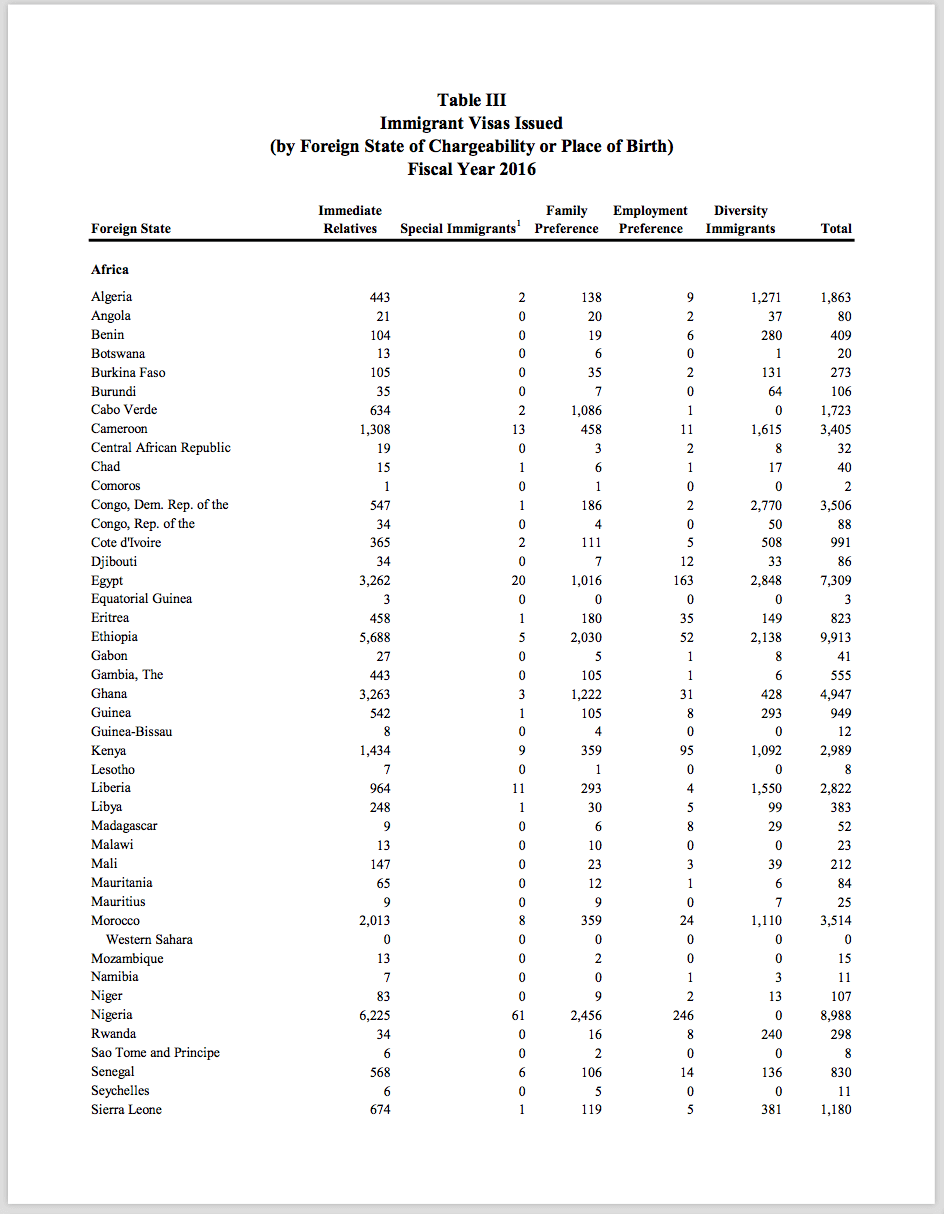
I like this about how hard it can be to do 'simple' (especially "“I wish I couldn’t draw the way you can’t draw, and couldn’t write the way that you can’t write.”) -

The kids’ books I remember from my childhood were for the most part not particularly funny. Instead, they were distinguished by being especially imaginative or touching or beautiful or rhyming. “Jumanji” or “Corduroy” or “The Snowy Day” or “Oh, the Places You’ll Go.” Willems’s books often consist merely of cartoon characters speaking in word bubbles. His friend Norton Juster, who wrote “The Phantom Tollbooth,” likes to tease him, saying, “I wish I couldn’t draw the way you can’t draw, and couldn’t write the way that you can’t write.” One can “read” Willems’s stories not just through the words but through the shifting shapes and space, through the changing type sizes. He said, “I try and make the emotional dynamic between the characters readable just from their silhouettes.” The animator Tom Warburton, his longtime friend and occasional collaborator, told me, “I know parents who think, These books are so easy to make, there’s so few words, the drawings are simple, I could do that. People have no idea how much work goes into achieving simplicity.”

And I like this about, basically, presenting. About surrendering your dignity for your audience -

At a Mo Willems reading, you are likely to find a very full auditorium of small people and the larger people who care for them. Willems walks onstage like a man who knows how to walk onstage: “Hi, I’m Mo Willems, and I’m . . . a balloon salesman.” The children shout, “No!” “I’m Mo Willems, and I’m a . . . corporate attorney specializing in tax affairs.” No! Willems onstage is all big gestures and hats, a different character from the adult you encounter offstage. If you are moved, as I am, when adults set aside their dignity in order to make kids happy, you will find these readings very affecting. Willems is a ham: his ego is absent, his audience’s happiness is all. After he reads, the kids ask questions. Then it often ends like this: Willems says, “Any librarians or teachers in the audience today? Raise your hands. Higher. Higher.” He pauses. Looks out. “Now back and forth a little bit, to try and get my attention.” The first time I saw this, I was waiting for him to suggest that we all clap. But that’s not how jokes work. Willems just says, “Well, now you see how it feels.”


10 Feb 21:40

A Dao of Product Design

Product Design is both a practice and a job, but regardless of which of the two applies to your work, there are considerations to make. Does your work make the user feel better? Does it inform them, or arm them with knowledge and a greater understanding? Does it make them stronger people, psychologically, or is it subtly eroding their confidence?

In my new article for A List Apart, the premiere magazine for web designers & developers, I examine five principles of great design: inclusion, positivity & civility, confidence & courage, emotional fortitude, and social mores. 

The article is the culmination of years of research into the intersections of technology, design, sociology, and society, from the point of view of a deep understanding of product design and development I've cultivated through my 16 years of (awards-winning) career experience in both. It provides a framework through which I do all of my work today, as well as my side activities (more here).

I'm proud to share: A Dao of Product Design.

Short URL: http://farukat.es/p716