Shared posts

16 Jun 03:04

My New Book Launches Today (it’s about these community skills)

by Richard Millington

My new book, Build Your Community, launches today. I hope you will consider buying it.

It’s an urgent book about developing incredible community skills.

We all know there’s a big difference between having an average or great designer, manager, salesperson on your team.

…well there’s also a big difference between having average and great community managers on your team too.

Put bluntly, great community professionals are game-changers.

Great community professionals are more persuasive, have natural credibility with their audiences, and can design systems that engage thousands, even millions, of people.

Sure, technology helps. But eventually, everything depends upon the abilities of you and your team to make this work.

I’ve been working with (and training) community professionals for over a decade now. Believe me, there is huge potential for most of us to get better at the work we do.


A Book For People In The Trenches

My new book, Build Your Community, will help you develop and improve your abilities to build more engaging communities.

This is a book for those of us in the trenches living and breathing this work every day.

It’s a book for those of us who know that community skills are indispensable to the success of communities.

It’s a book for those who believe we can improve how we design and nurture our communities.

If you’ve found this blog useful over the years, you will find the book even more so.

The post My New Book Launches Today (it’s about these community skills) first appeared on FeverBee.

16 Jun 03:03

Drought in the Western United States

by Nathan Yau

In what’s become a recurring theme almost every year, the western United States is experiencing drought, much of it exceptional or extreme. Nadja Popovich for The New York Times has the small multiple maps to show June conditions each year since 2000.

Tags: climate change, drought, Nadja Popovich, New York Times

16 Jun 03:03

The Health Benefits of Coffee | Jane E Brody Drinking coffee...


The Health Benefits of Coffee | Jane E Brody

Drinking coffee has been linked to a reduced risk of all kinds of ailments, including Parkinson’s disease, melanoma, prostate cancer, even suicide.

16 Jun 03:03

From TinyTiny to Fresh RSS

by Ton Zijlstra

As I’ve run into trouble with my TinyTinyRSS install, I’m switching to FreshRSS, to see how that works for me.

My TinyTinyRSS has the issue where many calls to the file backend.php keep timing out. It seems to have as effect that feed updates are not coming through, and worse that the repeated resource use flagged something with my hoster, making them blocking my home IP. That’s a blunt instrument to wield without checking whether that IP is your client’s own IP, but still.

Next to TinyTinyRSS my hoster also supports FreshRSS for self-hosting, so I installed that. I wanted to try FreshRSS out anyway, so this is a good opportunity to make the switch.

16 Jun 03:03

534 and 536 Cambie Street

by ChangingCity

Sometimes, even Downtown, there are modest buildings surviving longer than might be expected. Here are two on the 500 block of Cambie Street. Perhaps not surprisingly, in the short time since we started researching their history, a redevelopment has been proposed to build a 22 storey office building.

The building on the left dates from 1925, while the other was supposedly developed in 1912 (according to the Assessment Authority), but we haven’t identified an appropriate Building Permit. That may be because the structure still standing was clearly an addition to an earlier house, that no longer exists. The house was built at some point in the mid 1890s, and can be seen here in 1974 (and there was also originally a house on the lot to the north, on the left). The numbering on the block was altered in 1896, so the houses here had, for a while, non-sequential numbers, which makes it difficult to be certain of what was built when. Through the later 1890s the house seen here was occupied by two households; D A Campbell, a teamster, and A Cooper Dinsmore, another teamster. In 1898 some of the Scurry family moved to 514 Cambie (renumbered that year as 536). They ran a barbers saloon on Abbott Street. They appear to have moved next door (to the north) to 534 around 1901, when Martha Scurry (widow of Hiram) was living in the house that stood here, before the existing building was constructed in 1925.

The building on the corner of the lane is proposed to have its facade incorporated into the new development. The developers were the Cleland Bell Engraving Co., and the architects Benzie & Bow. Rogers and Purdy built the $17,000 building. The heritage statement for the new office tower repeats an inaccurate internet document about Cleland Bell, identifying Mr. Cleland as William Nelson Cleland, born in Brantford, Ontario in 1871. Unfortunately, the engraver was called Norman Cleland. Norman was William’s younger brother, and had also been born in Brantford. William arrived around 1899, and worked initially as a dyer, then as a clothes presser, and in 1902 he was working for the Perth Dye Works. Norman arrived in the city in 1902, and was a printer at Evans & Hastings. Both brothers had rooms on Richards Street in 1902, and lived on Robson Street in 1904 with William Cleland snr, who was presumably their father, and an accountant. The household didn’t identify a mother in the 1881 census when Norman was 6, and William jnr. aged 10 (There was also an older sister, Jessie and a middle brother, George). These arrangements stayed unchanged until 1907, when Norman went into partnership with Harry Welsh and established a printing business on Pender Street. (William Cleland was with B C Dye Works, and a year later co-owned the Berlin Dyeing and Cleaning Works). William Cleland senior died in September that year, aged 79.

In the 1911 census Norman Cleland was head of a household of three that included William, who was also listed as a printer, and described, unusually, as Norman’s partner, and Jessie, their sister. William had been living in his own rooms earlier in the year, and working as a presser again. Norman had a new business partner, and was now ‘Cleland and Dibble, Engravers and Printers’, on Water Street. William was briefly involved in real estate in 1913, the same year that Norman married an Australian widow, Margaret Zasama, in Victoria. In 1914 both brothers had moved to West 12th, where they each had apartments in the same building.

In 1919 Norman’s business name was changed to Cleland-Bell, and he was managing director; A L Bell was president, and William Cleland was working as a clerk. In 1926 the business became Cleland-Kent with a new partnership with Harry Kent. Although the business name continued under new management, Norman Cleland appears to have retired from the business around 1935, and after a year’s absence he took over a business called Art Engraving for a few years, with William also working there as a salesman. In 1935 he developed a retail building on East Broadway. William and Jessie lived on Point Grey Road, and Norman and his wife lived close by on the same block of West 1st Avenue. Norman died in Vancouver in 1944, aged 68. William Cleland was aged 82 when he died in 1953, His sister, Jessie, died in Vancouver in 1962, aged 92. Neither had been married.

Cleland-Kent continued to exist as a business, and occupy space in this building, through the 1950s. Their name was still on the building in our 1974 image, so we assume an engraving business continued in operation, even if the front door had been bricked up. Today, for the time being, there’s a new doorway, and a lawyer and a finance company have offices there.

Image source: City of Vancouver Archives CVA 778-55

1086

16 Jun 03:03

Monitoring the Health of Precursor’s TRNGs

by bunnie

This post is an abridged version of a longer-form narrative on implementing health monitoring for Precursor/Betrusted’s TRNGs. It’s the first of a series of two posts; the second, on implementing a CSPRNG conditioner for the TRNG, will go up later.

Background

Online health monitors are simple statistical tests that give users an indication of the quality of the entropy being produced. On-line health tests are like a tachometer on an engine: they give an indication of overall health, and can detect when something fails spectacularly; but they can’t tell you if an engine is designed correctly. Thus, they are complimentary to longer-running, rigorous diagnostic tests. We cover some of these tests at our wiki, plus we have a CI bench which generates gigabytes of raw entropy, over runtimes measured in months, that is run through a series of proofing tools, such as the Dieharder test suite and the NIST STS test suite.

It’s important that the health monitoring happens before any conditioning or mixing of the raw data happens, and significantly, there is no one-size-fits-all health monitor for a TRNG: it’s even advised by the (NIST SP 800-90B sec 4.4) specification to have tests that are tailored to the noise source.

Thinking

The first thing I do before doing any changes is some book research. As my graduate advisor, Tom Knight, used to say, “Did you know you could save a whole afternoon in the library by spending two weeks at the lab bench?”

NIST SP 800-90B section 4.4 specifies some health tests. The NIST spec seems to be fairly well regarded, so I’ll use this as a starting point for our tests. The tests come with the caveat that they only detect catastrophic failures in the TRNGs; they are no substitute for a very detailed, long-run statistical analysis of the TRNG outputs at the design phase (which we have already done). NIST recommends two tests: a repetition count test, and an adaptive proportion test.

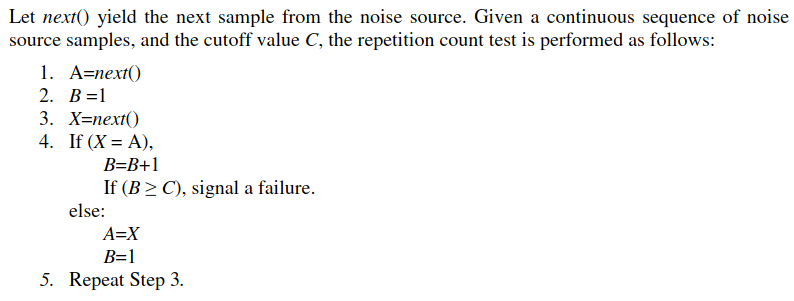
This is the repetition count test:

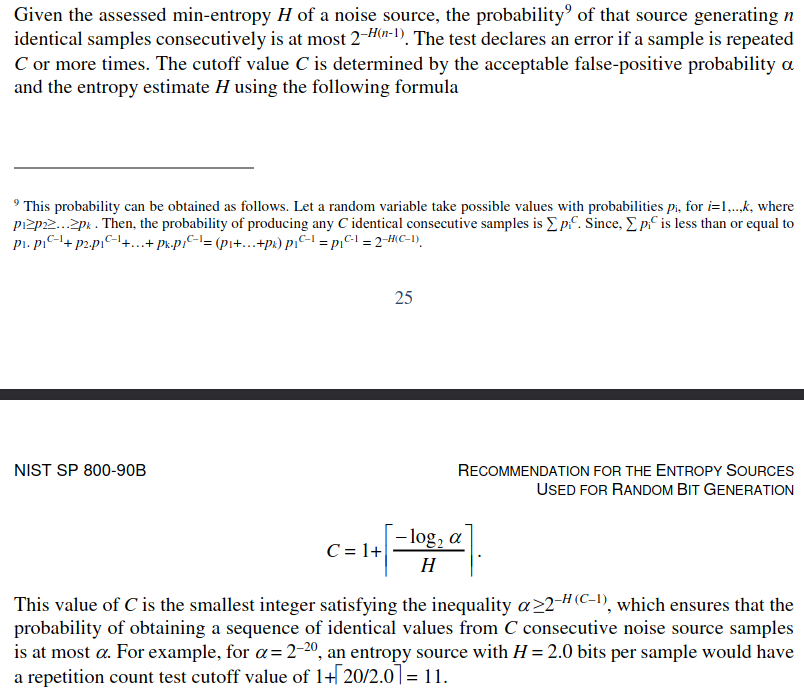
With the following criteria for failure:

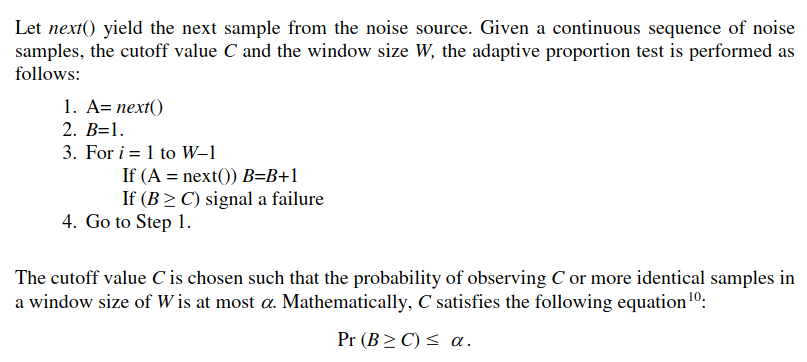
And this is the adaptive proportion test:

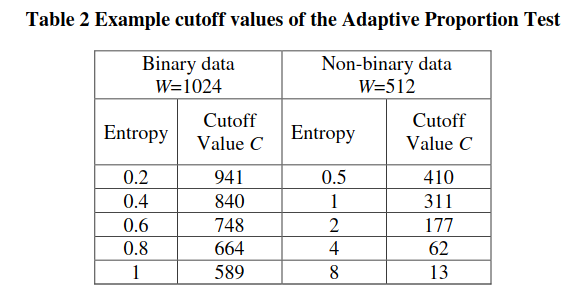
With the following example cutoff values:

OK, so now we know the tests. What do these even mean in the context of our TRNGs?

Ring Oscillator Implementations

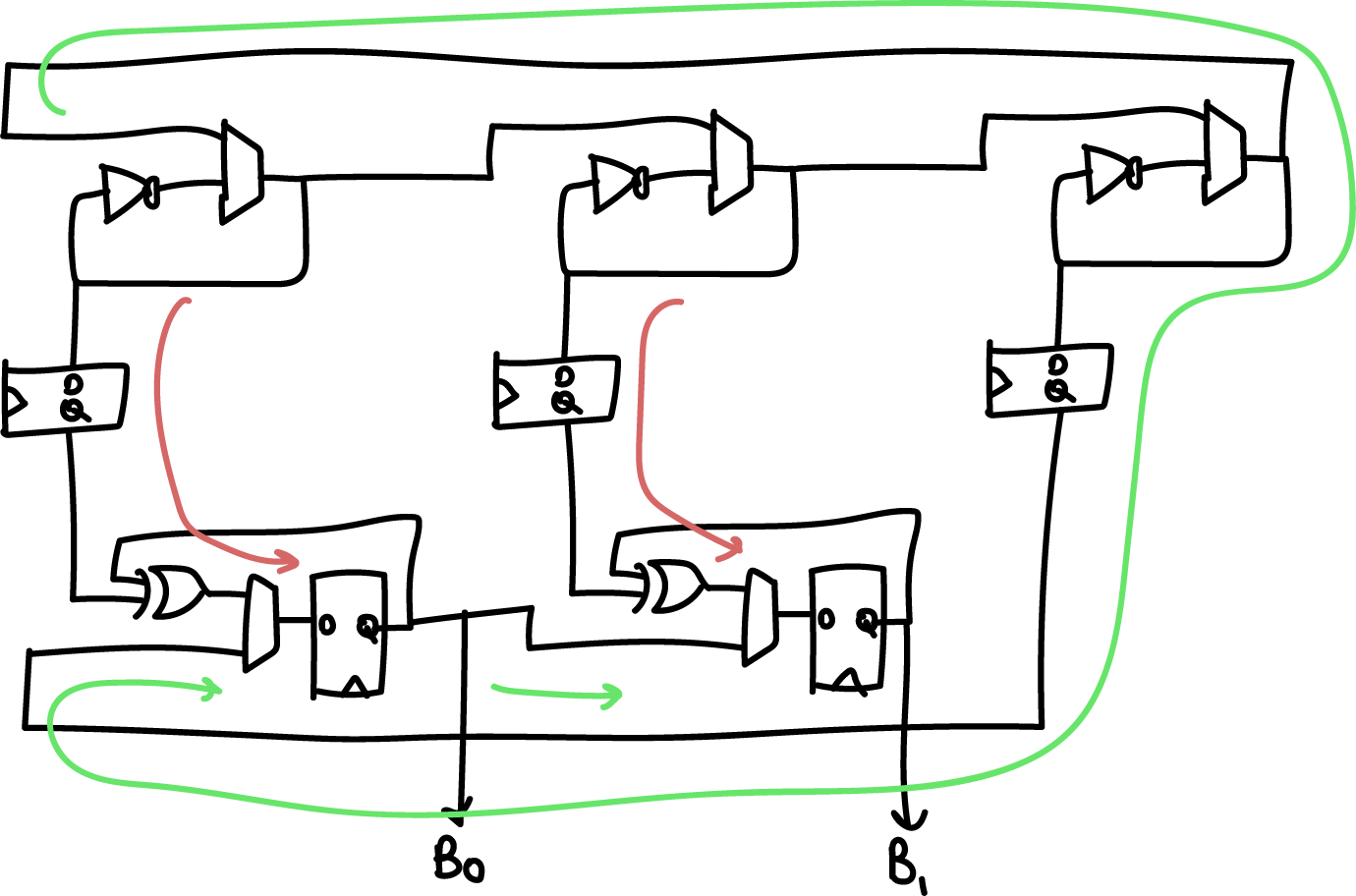
Our Ring Oscillator architecture consists of 33 independent ring
oscillators that operate in two phases. In the first phase, the rings oscillate independently of each other to collect phase noise; the state of each ring is XOR’d into a state bit through snapshots taken at regular intervals. In a second phase, they are merged into a single large ring oscillator, where they then have to reach a consensus. A single bit is taken from the consensus oscillator, and progressively shifted into the state of the ring oscillator.

Above is a simplified “two bit” version of the generator, where instead of 33 oscillators we have 3, and instead of 32 bits of entropy we get 2. The red arrow is the flow of entropy in the first phase, and the green arrow is the flow of entropy in the second phase. The two phases are repeated N+1 bit times (33 times in the full implementation, 3 times in the simplified diagram above).

We can see from the diagram that entropy comes from the following
sources:

  • Random phase accumulated in the smaller ring oscillators due to the accumulation of phase noise during a “dwell” phase that can be set by software (nominally 1000 ns)
  • Decision noise associated with the sampling jitter of the smaller ring oscillators with an initial sampling flip-flop. Note that the ring oscillators operate at a higher frequency (~300-500MHz) than the sampling rate of the flip flops (100 MHz).
  • Global phase accumulated during the consensus process of the larger ring oscillator. The time to achieve consensus is set by a “delay” parameter that is set by software (nominally 40ns)
  • Cross-element mixing through the continuous shifting of bits to the right, and further XOR’ing of phase

The global phase consensus and cross-element mixing is quite important because ring oscillators have a tendency to couple and phase-lock due to crosstalk side-channels on both signal and power. In this architecture, each ring’s local noise conditions, including its crosstalk, is applied across each of the 32 output bits; and each ring’s oscillation is “reset” with an arbitrary starting value between each cross-element phase.

A higher rate of aggregate entropy is achieved by running four instances of the core described above in parallel, and XOR’ing their result together. In addition, the actual delay/dwell parameters are dynamically adjusted at run-time by picking some of the generated entropy and adding it to the base dwell/delay parameters.

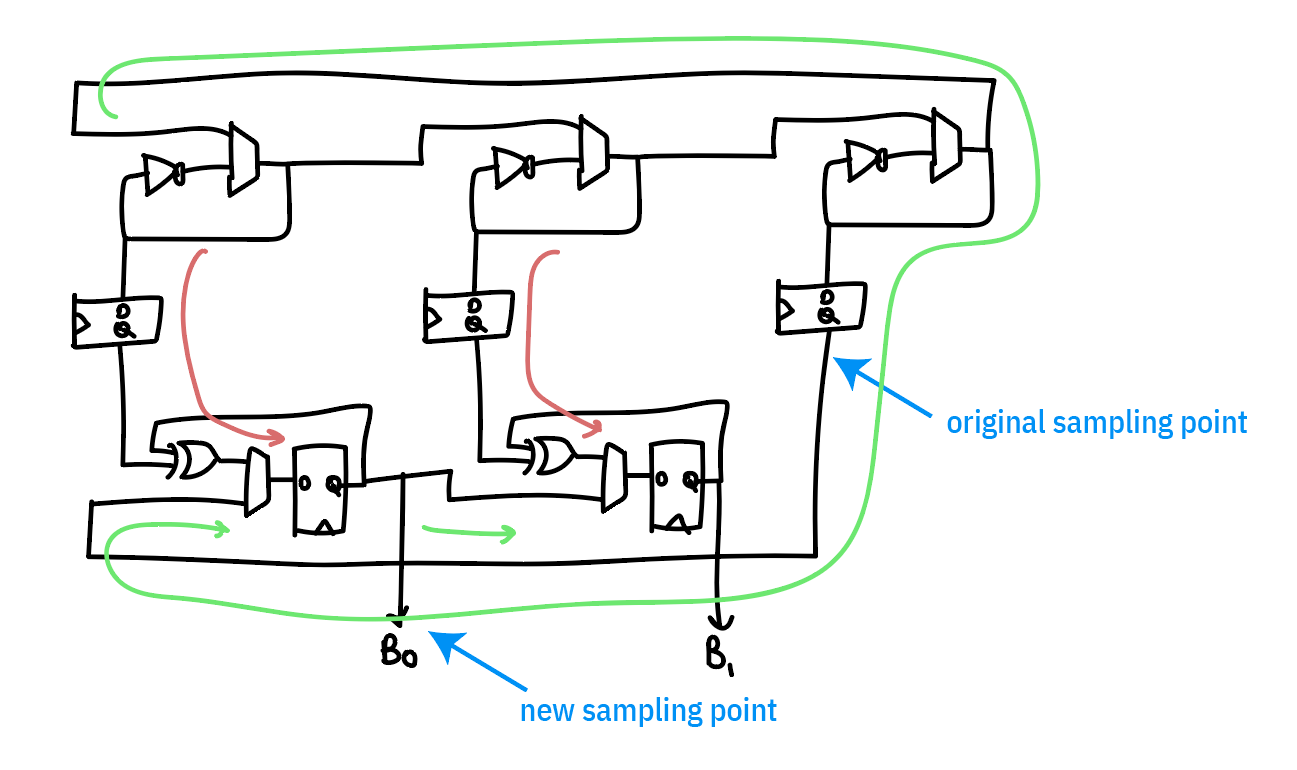
Thus, when looking at this architecture and comparing it against the NIST spec, the question is, how do we apply the Repetition Count test and the Adaptive Proportion tests? The Repetition Count test is probably not sensitive enough to apply on the 32-bit aggregate output. It’s probably best to apply the Repetition Count and Adaptive Proportion test a bit upstream of the final generated number, at the sampled output of the ring oscillators, just to confirm that no constituent ring oscillator is “stuck” for any reason. However, the amount of logic resources consumed by adding this must be considered, since we have (33 * 4) = 132 separate oscillators to consider. Thus, for practical reasons, it’s only feasible to instrument one output from each of the four cores that is indicative of the health of the entire bank of oscillators.

Picking the right spot to instrument is tricky. The “large” ring oscillator is actually low-quality entropy, because it has a period of about 30MHz but is oversampled at 100MHz. Thus the majority of the entropy is contributed from the repeated undersampling of the “small” rings. The final sampling point chosen is the output of the sampling register after it’s “soaked up” enough entropy from the combination of a small ring and a large ring to result in a useful measurement.

Originally, I had tried looking at the “large” oscillator only to try to find something more “raw”, under the hypothesis that we would be more likely to catch problems in the system at a less refined stage; the problem is that it was so “raw” that all we caught was problems. However, we do use this tap as a “true negative” test, to ensure that the health tests are capable of flagging an entropy source that is less than perfect.

I’m also going to introduce an extra test that’s inspired by the Runs Test in the STS suite, that I call “MiniRuns”. This test records the frequency of continuous runs of bits: 0/1, 00/11, 000/111, 0000/1111, etc. This test will offer more insight into the dominant projected failure mode of the ring oscillator, namely, it oscillating as a perfectly synchronized square wave — a condition that neither of the recommended NIST tests are capable of capturing. However, if the oscillator becomes too deterministic, we should see a shift in the distribution of run lengths out of the MiniRuns test.

Avalanche Generator Implementation

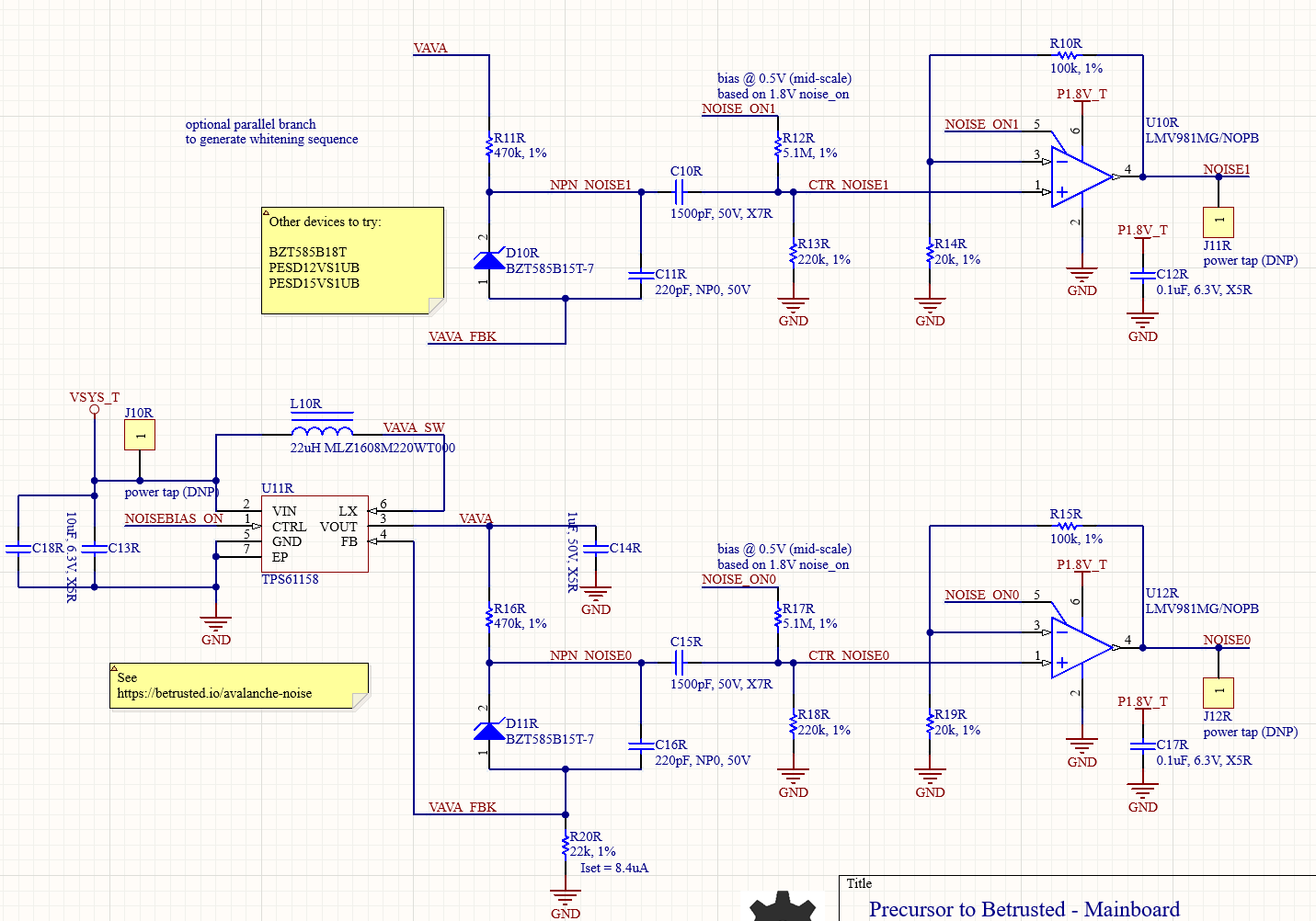
The avalanche generator consists of two avalanche diodes biased from a shared power supply, sampled by a pair of op-amps with a slight bit of gain; see our page on its theory of
operation
for details on the physics and electronic design. Here, we focus on its system integration. The outputs of each of the op-amps are sampled with a 12-bit ADC at a rate of ~1MSPS, and XOR’d together. As this sampling rate is close to the effective noise bandwidth of the diodes, we reduce the sampling rate by repeatedly shifting-by-5 and XOR’ing the results a number of times that can be set by software, nominally, 32 times into a 32-bit holding register, which forms the final entropy output. This 32x oversampling reduces the rate of the system to 31.25kHz.

Thus in this scheme, entropy comes from the following sources:

  • The avalanche properties of two individual diodes. These are considered to be high-quality properties derived from the amplification of true thermal noise.
  • The sampling interval of the ADC versus the avalanche waveform
  • Noise inherent in the ADC itself
  • Note that the two diodes do share a bias supply, so there is an opportunity for some cross-correlation from supply noise, but we have not seen this in practice.

Because we are oversampling the avalanche waveform and folding it onto itself, what we are typically measuring is the projected slope of the avalanche waveform plus the noise of the ADC. Significantly, the SNR of the Xilinx 7-series “12-bit” ADC integrated into our FPGA is 60dB. This means we actually have only 10 “good” bits, implying that the bottom two bits are typically too noisy to be used for signal measurements. The XADC primitive compensates for this noise by offering automatic averaging over 16 samples; we turn this off when sampling the avalanche noise generators, because we actually *want* this noise, but turn it on for all the other duties of the XADC.

It’s also important to consider the nature of sampling this analog
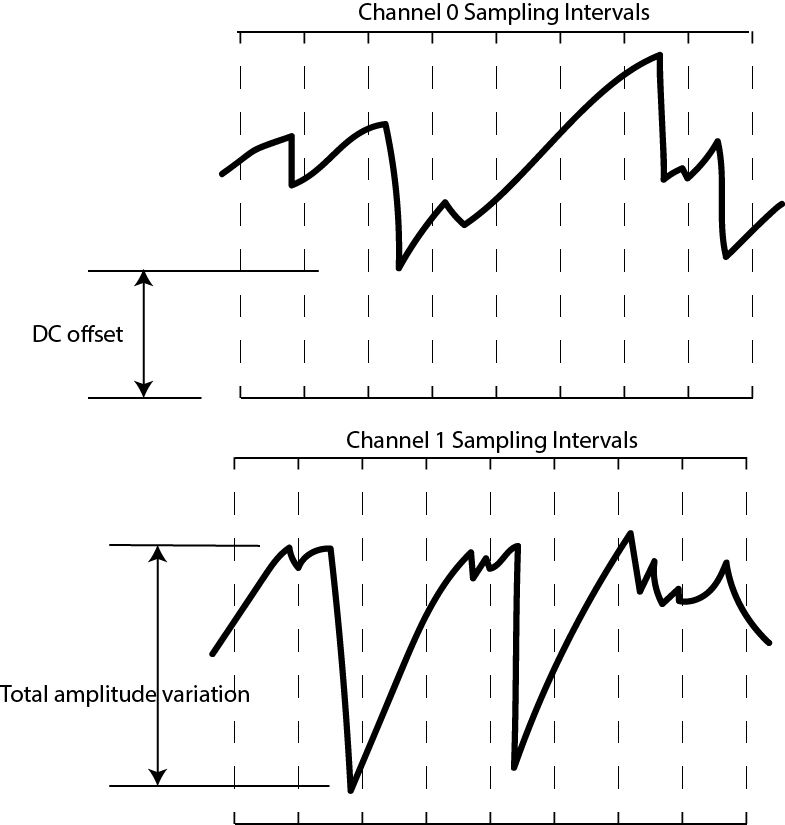
waveform with an ADC. The actual waveform itself can have a DC offset, or some total amplitude variation, so naturally the LSBs will be dense in entropy, while the MSBs may be virtually constant. By focusing on the bottom 5 bits out of 12 with the 5-bit sliding window, we are effectively ignoring the top 7 bits. What does this do to the effective waveform? It’s a bit easier to show graphically:

Below is a waveform at full resolution.

If we were to only consider 11 bits out of the 12, we effectively take half the graph and “wrap it over itself”, as shown below:

Down to 10 bits, it looks like this:

And down to 9 bits, like this:

And so forth. By the time we are down to just considering 5 bits, we’ve now taken the effective DC offset and amplitude variations and turned them into just another random variable that helps add to the entropy pool. Now take two of these, XOR them together, and add in the effective noise of the ADC itself, and you’ve arrived at the starting point for the ADC entropy pool.

In terms of on-line entropy tests, it probably makes the most sense to apply the Repetition Count test and the Adaptive Proportion tests to the bottom 5 bits of the raw ADC feed from each avalanche diode (as opposed to the full 12-bit output of the ADC). We don’t expect to hit “perfect entropy” with the raw ADC feed, but these tests should be able to at least isolate situations where e.g. the bias voltage goes too low and the avalanche effect ceases to work.

In addition to these tests, it’s probably good to have an “absolute
excursion” test, where the min/max of the raw avalanche waveforms are recorded over a time window, to detect a diode that is flat-lining due to aging effects, or a bias voltage source that is otherwise malfunctioning. This test is not suitable for catching if an attacker is maliciously injecting a deterministic waveform on top of the avalanche diodes, but is well-suited as a basic health check of the TRNG’s core mechanisms under nominal environmental conditions.

Developing

After installing the tooling necessary to build a Precursor/Betrusted SoC, I started writing the code.

Here’s the general method I use to develop code:

  1. Think about what I’m trying to do. See the first section of this
    article.
  2. Write the smaller submodules.
  3. Wrap the smaller modules into a simulation framework that shakes
    most of the skeletons out of the closet.
  4. Repeat 1-3, working your way up the chain until you arrive at your full solution.
  5. Write drivers for your new feature
  6. Slot your feature into the actual hardware
  7. Test in real hardware
  8. Continuously integrate, if possible, either by re-running your sim against every repo change or better yet recompiling and re-running your test on actual hardware.

The key to this loop is the simulation. The better your simulation, the better your outcome. By “better simulation”, I mean, the less
assumptions and approximations made in the test bench. For example, one could simulate a module by hooking it up to a hand-rolled set of Verilog vectors that exercises a couple read and write cycles and verifies nothing explodes; or, one could simulate a module by hooking it up to a fully simulated CPU, complete with power-on reset and multiple clock phases, and using a Rust-based framework to exercise the same reads and writes. The two test benches ostensibly achieve the same outcome, but the latter checks much more of the hairy corner cases.

For Betrusted/Precursor, we developed a comprehensive simulation framework that achieves the latter scenario as much as possible. We simulate a full, gate-level Vex CPU, running a Rust-built BIOS, employing as many of the Xilinx-provided hardware models as we can for things like the PLL and global power-on reset.

Demo

This is the point in the cooking show at which we put the turkey into an oven, say something to the effect of “…and in about five hours, your bird should be done…” yet somehow magically pull out a finished turkey for carving and presentation by the time we finish the sentence.

So: after a bunch more driver-writing and breaking out signals to gain visibility into the various metrics and failure modes, we can see the on-line health tests in action.

Above is an example of the trng test data output on Precursor, set where `RO 0` is connected to the “large” oscillator that runs too slowly (serving as a “true negative” test), and the others are connected to the final output tap for the test (serving as a “true positive”). In the output, you can see the four ring oscillators (numbered 0-3) with the frequency of each of five run lengths printed out. `RO 0` has a significant depression in the count for the run-length 1 bin, compared to the other oscillators (440 vs 515, 540, and 508).

One final detail is implementing an automated decision mechanism for the MiniRuns test. Since the MiniRuns test wasn’t from the NIST suite, I couldn’t simply read a manual to derive a threshold. Instead, I had to consult with my perlfriend, who also happens to be an expert at statistics, to help me understand what I was doing and derive a model that could help me set limits. Originally, she suggested a chi-square test. This would be great, but the math for it would be too complicated for an automated quick power-on test. So, we downgraded the test to simple max/min thresholds on the counts for each “bin” of runs. I used a similar criteria to that suggested in the NIST test, that is, 𝛂 = 2^-20, to set the thresholds, and baked that into the hardware code. Here’s a link to the original spreadsheet that she used to compute both the chi-square and the final, simpler min/max tests. One future upgrade could be to implement some recurring process in Xous that collects updated results from the MiniRuns test and does the more sophisticated chi-square tests on it; but that’s definitely a “one for the road” feature.

Closing Thoughts

The upshot is that we now have all the mandatory NIST tests plus one each “tailored” tests for each type of TRNG. Adding the MiniRuns automated criteria increased utilization to 56.5% — raising the total space used by the tests from about 2% of the FPGA to a bit over 4%. The MiniRuns test is expensive because it is currently configured to check for runs ranging from length 1 to 5 over 4 banks of ring oscillators — so that’s 5 * 4 * (registers/run ~30?) = ~600 registers just for the core logic, not counting the status readout or config inputs.

Later on, if I start running out of space, cutting back on some of the instrumentation or the depth of the runs measured might be a reasonable thing to do. I would suggest disposing of some of the less effective NIST tests entirely in favor of the home-grown tests, but in the end I may have to kick out the more effective supplemental tests. The reality is that it’s much easier to defend keeping inferior-but-spec-compliant tests in the system, rather than opting for superior tests at the expense of the specification tests.

That’s it for part 1. If you’re super-eager to read more, you can read the full wiki entry on data conditioning for the TRNG at the Precursor/Betrusted documentation wiki. Or, you can just wait until I get around to chopping the page down to size and repackaging it into a more bite-side blog entry.

16 Jun 03:02

HATETRIS

Code » Play Hate Tetris. This is bad Tetris. It's hateful Tetris. It's Tetris according to the evil AI from "I Have No Mouth And I Must Scream". I have to be honest, this is not an entirely original idea. However, RRRR's implementation of the concept of a game of Tetris which always gives you the worst possible pieces leaves much to be desired: the keyboard interface frequently doesn't work the conditions for failure are ambiguous and inconsistent the playing field is only 8 blocks wide as compared to the standard 10 the AI is either overly generous, or stupid, and frequently does NOT provide you with the worst possible piece (UPDATE: there is also Bastet, which can be played online here, but is also far too forgiving.) HATETRIS was an experiment to rectify those flaws. Also, every coder has to build Tetris at least once in their life. In addition, I also have a passionate hatred of JavaScript, but I felt that that hatred was borne out of ignorance, so this was an attempt to r...
16 Jun 03:02

2021-06-13 General

by Ducky

Supply

Tl;dr: we have enough supply to vax the world before the end of 2021.

I hear a lot of people being very concerned about the global supply, worried that it will be multiple years before we have enough doses to vax the world.

I think there is a really good chance that we will vax the whole world by the end of the year (well, to the 60% or 70% level, which will probably be as good as we can get).

The rest is details of how I worked out the numbers. Note: I drew heavily on the New York Times’ vaccine tracker page, it’s excellent.

The world has 7.7B people, let’s assume two doses for simplicity, and assume 60% vax rate. That means we need 9.2B doses. We’ve already given more than 2.3B doses, so we’re already a quarter of the way there! (That surprised me. I had kind of thought we were like 10% of the way there. My spouse guessed 5%.)

I’ve done some looking at what companies say they are going to make in 2021, or what other people estimate they will make. These numbers are too optimistic, certainly, but they give a sense of the scale of production.

For some producers, I couldn’t find production numbers. Some are new enough that they clearly don’t have any idea. (I made a SWAG at Sputnik V, which has incomplete and contradictory information.)

In the table below, I classify vaccines into four groups:

  • “now”, meaning a vax is going into arms and has published a phase 3 trial. (Note: Some of these started going into arms before the Phase 3 study was published, but they have since published the results.)
  • “sketch”, meaning that it’s already going into arms, but the clinical trial results have not been published, or were published in Russian an obscure journal that only three libraries in the world subscribe to. (<- I am exaggerating, but only very slightly.) Note: Sputnik V has serious quality control issues, but by my definition, I need to put them into “good”.
  • “soon”, meaning that the Phase 3 trials are over, and they are writing up the reports and/or waiting for approval. (All of them are likely to get approval, in my opinion. You don’t continue your Phase 3 trials if your vax sucks, and Phase 2 demonstrates safety.)
  • “later”, meaning that the Phase 3 trials are underway right now, and some relatively large fraction of them will get approval, probably in Q3. There won’t be a lot of vax that they will deliver in last quarter of the year, but there will be some.
have estimate unknown total with estimate
good Pfizer, Moderna, J&J, AZ, Sputnik V, Covaxin, Abdala Shenzhen Kantai/KCONVAC 7.8B
sketch CoronaVac, Sinopharm, Soberana, CanSino, QazVac, EpiVacCorona Sinopharm-Wuhan 8.3B
soon Novavax, CureVac, Zydus 0.87B
later Corbevax, Sanofi, VLA2001, COVIran AnGes, West China Hospital 0.7B

This adds up to 17.7B of vaccine supply in 2021 for just the vax I could find production estimates for.

Now, I presume that some of the manufacturers are overly optimistic and some are just flat-out lying, but they would have to be lying by an awful lot to not reach 9.2B. There’s almost twice as much vax as they say is going to be produced than we need.


Speaking of supply, Trudeau pledged to give 100M doses to the rest of the world.

Disease

I posted recently that COVID-19 might cause diabetes. Not so fast: this article suggests that it might just be that people with undiagnosed diabetes finally got seen my a healthcare system enough to notice.


Here’s a mass-media article about supertasters being less susceptible to COVID-19. I mentioned this fact already, but this is a nice article for the lay reader. (Disclaimer: I’m a supertaster and so personally probably excessively interested in something that might actually be a benefit of supertasting for a change.)

16 Jun 03:01

2021-06-12/13 BC

by Ducky

Employment

This article tells about how small tour boat operators in BC pivoted from tourism to marine clean-up during the pandemic. Awesome!

Unintended consequences

BC drivers are going to get another pandemic rebate cheque.

16 Jun 03:01

2021-06-14 BC

by Ducky

Vaccines

I’m a little late reporting this, but apparently Canada paid a premium to get some Pfizer doses early. Money very well spent, I say.

Mitigation measures

Playland has re-opened. 🙂

Press Briefing

Today, Premier Horgan, Dr. Henry, Minister Dix, Minister Mark, and Minister Kahlon had a press conference to talk about the Stage 2 reopening.

I found it spectacularly dull. The message was:

  • We said we were going to wait two weeks and see what the numbers looked like.
  • We did. Numbers look great.
  • All those things which that we told you in detail you’d be able to do in Stage 2? You’re going to be able to do them now, yay!
  • Go out an do them! Spend money! Rah! Rah!
  • Everybody from outside the province, we love ya but stay home. (Everyone else, go spend money!)

I understand why they had to do it. They wanted to get publicity for something which went right, they wanted to reinforce the message reinforce the message reinforce the message, and they wanted to generate media which would reinforce the message. Still, I didn’t think there was much new there.

Q&A

Reminder: liberally and snarkily paraphrased.

Q: Aren’t you scared of Delta, given how it’s trashing the UK? A: DrH: We respect Delta, but we think we’ve got things under control. Our contact tracers are a lot less busy now, so we can test/trace/trace, plus the UK has a lot of completely unvaxxed young people, while we have vaxxed pretty far down the age ladder.

Q: Are we going to get cruise ships back this calendar year? A: Horgan: The bill which Senator Murkowski (Alaska) passed is going to sunset with the end of the pandemic. There’s another bill from someone in a landlocked state that is more dangerously, we’re working on it. Staff is in big discussions with the US, I talk to the Ambassador (presumably the Canadian Ambassador to the US, not the US Ambassador to Canada) on the regular. I know people want to come but we aren’t going to allow that until it is safe to do so.

DrH: Partly us giving permission to cruise ships will depend on the US CDC’s cruise ship guidance. We are watching their cruise ships carefully to see what happens.

Q: We are going to get a shitton of Moderna in the next two weeks, how many shots per week do we have the capacity to put in arms? A: Dix: We have more capacity than we’ve been able to use because we’ve been supply limited. We are vaxing like crazy! We did 407K doses last week! We about run out of Pfizer each week before the new shipment comes in.

Dr. Ballem has been looking at how to best incorporate this increment of Moderna vax.

NB: Richard Zussman heard Dix say that we have capacity for 80K doses/day. I did not hear that, but the pro journos are better at catching all the details.

Note that there are pop-up walk-in clinics happening this week all over the province for first doses. Maybe that’s how we deal with the wave of Moderna.

Q: How do we deal with the conflict between people who are raring to go and those who are still anxious? A: Horgan: By being kind, calm, and safe.

DrH: Remember, we still have COVID Safety Plans. Ya still gotta follow measures to keep people safe, e.g. indoor masks.

Q: What are the timelines for dose1-to-booking and booking-to-vax? A: DrH: We try to get an invitation to book by 6 or 7 weeks, and the shot by about week 8 or 9. One of my sources says that invitations are coming predictably at 8 weeks.

Q: How are invitations getting sent out, by age? A: I had trouble interpreting her answer, but I think she said that it was based first on when you got your dose and second on how old you are.

Q: Despite 71% of Yukon being vaxxed, they still getting outbreaks. Does that mean we should bump our vax target of 70% up? A: DrH: Whoa whoa whoa, we never said our target was 70%. 70% is the MINIMUM level that gives us the comfort to go to the next step. Our target is 100%. We won’t get there, ofc, but that’s what we are aiming for.

Q: How are we going to keep people at seated indoor gatherings in their seats? Is that going to fall on the staff? A: DrH: COVID Safety Plans. We did this successfully last summer, if you’ll remember. Uh, what I remember is that you closed the banquet halls because they were unsuccessful at keeping people in line. This is only for two weeks, it’s a transition thing. And we will have enforcement.

Q: Won’t people seeing this news conference across the country get the message “BC is open for travel woohoo!” How much danger are we in from other provinces? A: Horgan: I talk all the time with other Premiers and keep asking them to tell their citizens not to visit. I mean, we luv ya guys, but not right now. Plus there are lots of places which just are not taking bookings from out of province.

Q: <nothing> A: Horgan: I’m going to get AZ as my second shot. My excellent advisors tell me the best shot is the first one you are offered, so that’s what I and my wife are going to take.

Statistics

Fri/Sat: +96 cases
Sat/Sun: +113 cases
Sun/Mon: +68 cases

Total over weekend: +4 deaths, +39,244 first doses, +115,521 second doses. Currently 1,537 active cases, 143,147 people recovered, 136 in hospital / 42 in ICU.

We have given first doses to 75.9% of adults, 74.1% of over-12s, and 67.4% of all BCers.

We have 204,384 doses in fridges; we’ll use it up in 3.5 days at last week’s rate.  We have given more doses than we’d received by 7 days ago.

We have 122,351 mRNA doses in fridges; we’ll use it up in 2.0 days at last week’s rate.  We have given more mRNA doses than we’d received by 7 days ago.

We have 82,033 AZ doses in fridges, which we’ll use up in 13.5 days at last week’s rate. (I have to say, I’m not impressed with how fast the pharmacies are getting the AZ out.)

Charts

16 Jun 02:57

AI, Experiment and Pedagogy - Why we need to step back from the critical "Punch and Judy" battles and be scientific

Mark Johnson, Improvisation Blog, Jun 14, 2021
Icon

There's a lot to agree with in this post, starting with the assertion that we should step back from the pro- and anti-AI camps and look at this whole thing more reasonable. AI is an incredible field to study not because it will produce robot teachers but because it has the potential to provide genuine insight into how we learn and who we are. But we'll get there only if we adopt a scientific stance, but a facile misinterpretation of Hume and depiction of "experiment as a thoroughly rational and cognitive operation - which it almost certainly is not." No, "scientists are engaged in something much more subtle when doing experiments. Science is really a 'dance with nature'." Quite right. Quite right.

Web: [Direct Link] [This Post]
16 Jun 02:56

Just How Niche is Headless WordPress?

Chris Coyier, CSS-Tricks, Jun 15, 2021
Icon

A lot of the work I've been doing with gRSShopper over the last few months is very similar in nature to what's being discussed here - "building out the user-facing site through the WordPress REST API rather than the traditional WordPress theme structure." For me, it has meant a lot of painstaking conversion of old CGI page-rendering functions to functions that produce JSON and are rendered locally using Javascript, and I'm doing it to enable cloud-based functionality I can access with a light interface wherever I want. But nothing is so simple as that, as I've been learning lesson by lesson. Now this article approaches the issue from the perspective of spin - will it become popular, will be be widely demanded, etc? It's not, so it's a 'niche thing'. Maybe in the world it is, but I'm thinking that in the wider world, and in the longer term, we'll build sites that serve data, and let the end-user decide how they want to work with that data. Image: Torque.

Web: [Direct Link] [This Post]
16 Jun 02:56

Which Way One-Way? A Fork in the Road for White Rock

by Gordon Price
mkalus shared this story from Viewpoint Vancouver.

Of all the COVID-created spaces in Metro, one of the smaller interventions has received a lot of the attention – a kilometre or so of Marine Drive in White Rock.

This May, the council voted 6-1 to make Marine Drive one way in order to allow for curbside patios, something commonly done by municipalities throughout the region last year.  But reapportioning asphalt can be like re-drawing tribal boundaries: lots of opposition, loudly expressed.  Sometimes it takes a war, sometimes a pandemic.

It’s already well into the summer, but White Rock, after an early June reconsideration, finally moved some concrete to make it real.  A few days ago it still felt a tad tentative, still awaiting the paperwork approval.

And the opposition is still making itself heard:

Council is still double-thinking it all:

Council added a new-proviso to the one-way, however – endorsing a motion from Manning that the lane be re-opened as soon as provincial health authorities allow full-capacity indoor dining again, which may happen as soon as July, dependent on COVID figures.

Really?  Undo it all, a week or so after the first customers have been seated?  Confident prediction: that will not happen.  The more interesting question is whether it will happen at all, even when the winter comes.

Consider what’s involved:

The City will have to move those Jersey barriers, store them, and then next year move them all out again.  Even for the City of Vancouver, this would be a logistically expensive proposition.

Likewise with the street marking, the signage, anything added, removed or changed.  It all has to go back to the way it was, and then be redone.

The lane markings that were scraped off and repainted – all redone, more scrapping, more painting, twice a year.

That’s just the physical stuff; there will also have to be another debate about the social and economics impacts, the potential and real accidents that might happen, the congestion, the pollution, the lack of parking. Leading into an election.

White Rock is in too deep now.  They might as well make it permanent – a one-way Marine Drive with a lane for patios and pedestrians.

One caveat of course: the traffic will adjust and there will be enough parking after all.  Yes, it will be crowded but not so congested that it drives, heh, heh, customers away.

My guess is that it won’t.  This is going to be permanent so that everything won’t have to adjust twice year – something that irritates people and make accidents more likely.

That’s a rational decision to avoid waste, but there’s another reason more of the heart than the wallet.  After transforming the beachfront, the pier, the parks, and after a year or so of patios spilling across the sidewalks, when all the decks, railings and overhead canopies will be permanently designed as outdoor urban rooms, and the City can get rid of barriers originally designed for the New Jersey Turnpike (it’s the brutalist architecture of road design) – .the people and even the critics of White Rock will (1) get used to it, (2) get to like it, and (3) be amazed that anyone thought it should ever be otherwise.


16 Jun 02:55

What grows in your Zombie Garden?

by Bryan Mathers
Zombie Garden

You know those ideas that don’t quite make the grade but you need to put them somewhere? Put them in the zombie garden. Recognise their malformed existence. Because chances are, they will raise their heads once more – hopefully in a way that brings life your project…

This Thinkery was captured live during a series of workshops by We Are Open, for Catalyst.

The post What grows in your Zombie Garden? appeared first on Open Visual Thinkery.

16 Jun 02:54

Day One at Automattic

by Matt

I’m not sure when I first came across the critically acclaimed Day One product, which is the best private blogging and journaling app out there, but I began seriously using it daily in 2016 when my father was in the ICU and later passed. Having a private, safe place to write what I was going through kept me sane and helped me process everything.

Writing has always been a salve for me, and I’ve had local or private WordPress installations pretty much since 2003 to capture and archive writing that wasn’t fit for the public web.

Day One not only nails the experience of a local blog (or journal as they call it) in an app, but also has (built) a great technical infrastructure — it works fantastic (when) offline and has a fully encrypted sync mechanism, so the data that’s in the cloud is secured in a way that even someone with access to their database couldn’t decode your entries, it’s only decrypted on your local device. Combining encryption and sync in a truly secure way is tricky, but they’ve done it.

This is a long intro to say, as you can read from Day One’s founder and CEO Paul Mayne, from Eli at WordPress.com, and on Tumblr, that Paul and the team are joining the team at Automattic. For many years I’ve talked to anyone who will listen about my vision of making Automattic the Berkshire Hathaway of the internet, and Paul’s decision to continue to grow his amazing business as part of Automattic is a great validation of the way we’ve been building our culture and long-term orientation in our business. Day One is a beloved product, and bringing it into the fold is a responsibility I take very seriously and comes from a deep respect for what’s been built and a belief that working together we can create something for users better than we could working apart.

Great software takes time, and the Day One team has been at it for about a decade now, I can’t wait to see what they accomplish in the coming decade and beyond. If you haven’t tried out Day One yet, please check it out in the Apple or Google’s app store.

16 Jun 02:53

Some 24-inch M1 iMac owners are reporting crooked mounts

by Patrick O'Rourke
M1 iMac

According to several reports across Reddit, Apple’s Support Community and notable blogs, some M1 iMac owners are noting that a manufacturing defect has caused the new version of the all-in-one computer’s display to not sit aligned, leading to a crooked screen.

Though the issue usually seems to only offset the computer’s display by a few millimetres, it’s still unacceptable that some users are encountering this problem. For a closer look at the problem, check out YouTuber iPhonedo’s video on the issue (seen below).

On Apple’s Support Community, user ‘pierreokivier‘ used a ruler to measure the height of both sides of their iMac, revealing that one side of the display is a few millimetres lower than the other.

According to MacRumors, seven screws hold the iMac’s display to its matching mount, and unfortunately, this doesn’t seem to be an issue users can fix. It’s unclear how Apple will respond to the issue, but at least right now, the problem doesn’t seem to be widespread. It’s worth noting that Apple offers a two-week return window, so if you happen to be unlucky enough to have a 24-inch iMac (2020) with this issue, it would be a good idea to exchange the computer within that time frame.

For what it’s worth, the ‘Yellow’ 24-inch M1 iMac Apple sent me doesn’t seem to suffer from an issue like this. For more on the 24-inch iMac (2021), check out my review of the all-in-one computer.

Source: Reddit, Apple’s Support Community Via: MacRumors

The post Some 24-inch M1 iMac owners are reporting crooked mounts appeared first on MobileSyrup.

16 Jun 02:53

Apple TV+ free trial to be reduced to three months starting July 1

by Bradly Shankar
Ted Lasso

Apple is cutting down its one-year free Apple TV+ trial to three months starting July 1st.

The tech giant revealed the change in the fine print of its official Apple TV+ website, confirming this will apply to Canada as well.

Since Apple TV+ launched in November 2019, anyone who purchased an iPhone, iPad, iPod touch, Apple TV, or Mac would be eligible for the free 12-month subscription.

Since then, Apple has twice extended this free trial for early adopters, making it valid until July 2021. However, those who buy an eligible Apple device on June 30th or earlier will just get one year.

While many Apple TV+ productions were delayed amid the COVID-19 pandemic, the service’s catalogue has still grown steadily over time. Some of the most notable recently released content includes Mythic Quest Season 2, The Mosquito Coast, Oprah Winfrey and Prince Harry’s mental health doc The Me You Can’t See. 

Meanwhile, the service’s upcoming 2021 slate includes the second seasons of Ted Lasso (July 23rd), See (August 27th) and The Morning Show (September 17th). Apple TV+ typically costs $5.99 per month.

Image credit: Apple

The post Apple TV+ free trial to be reduced to three months starting July 1 appeared first on MobileSyrup.

15 Jun 20:52

AirPods Max :: Sechs Monate später

by Volker Weber
AirPods Max und das unbenutzte Case

Vor einem halben Jahr habe ich einen der ersten AirPods Max in Deutschland in Betrieb genommen und war vom Start weg begeistert. Der Kopfhörer hatte eine mir bis dato unbekannte Qualität, sowohl in der Verarbeitung als auch im Klang.

Dann begannen die üblichen Dramen: Untaugliches Case und fehlender Ausschalter. Mon Dieu! Ein halbes Jahr später kann ich sagen: Kein Drama. Im ersten Software-Update hat Apple das Schlafproblem gelöst. Und das Case habe ich zu all den anderen Cases in den Schrank gelegt. Ich brauche es schlicht gar nicht. Aber wenn ich es brauchen würde, würde es eher einen Platz finden als die anderen Hardcases.

Ich nutze den AirPods Max jeden Tag mehrere Stunden. Er hat nichts von seiner Faszination eingebüßt und zeigt bisher keine Abnutzung. Es ist einfach ein tolles Produkt.

Wenn ich mir was wünschen dürfte: Ein 3.5 mm TRRS-Anschluss wäre hilfreicher als dieses flimsige Apple-Kabel. Ich habe noch kein 3rd-Party Produkt als Ersatz gefunden. Der Apple Kopfhörer-Adapter funktioniert nicht und damit wohl auch alle anderen Lösungen, mit denen man einen Kopfhörer am iPhone betreiben kann. Oder hat da jemand andere Erfahrungen?

15 Jun 20:48

Twitter Favorites: [photomatt] The great app @dayoneapp is joining @automattic, and here's a bit of my personal journey with journaling and the ap… https://t.co/9AVoRdd1bW

Matt Mullenweg @photomatt
The great app @dayoneapp is joining @automattic, and here's a bit of my personal journey with journaling and the ap… twitter.com/i/web/status/1…
15 Jun 20:48

Twitter Favorites: [amye] Powell's is still here. https://t.co/1RqgNk1Nwu

amye @amye
Powell's is still here. pic.twitter.com/1RqgNk1Nwu
15 Jun 20:48

Twitter Favorites: [Planta] I ordered a copy of @midlifebook and found it exciting to see all the marvellous talent assembled but also reassuri… https://t.co/wVT6diGXOa

Joseph Planta @Planta
I ordered a copy of @midlifebook and found it exciting to see all the marvellous talent assembled but also reassuri… twitter.com/i/web/status/1…
15 Jun 20:46

From Zoom Rooms to doorways on my desktop

Zoom Rooms are called rooms but they don’t feel like rooms. I’ll tell you what does.

I was speaking at Tweakers Developer Summit a couple weeks back – three talks on consecutive evenings. (Probably overambitious, and I was exhausted but there’s something that intrigues me about this experimental format, which I why I tried it, and I learnt a bunch. It worked! New narrative possibilities abound!)

Let me lay out the facts of the speaker experience first:

  • A few days ahead of the event, I received a link to my virtual room.
  • I could visit the room and make it my own. So I could change the layout presets, turn features like Q&A and polls on and off, upload docs to present, rehearse and so on.
  • At this point, the doors were closed. General attendees, even with the link, would not be able to enter. At the bottom of the screen, there was a timer showing when the event was scheduled to start…
  • On the day of the event, as the time approached, I could see people entering an anteroom one by one. A waiting area. They got a countdown and a splash screen (which I think I could also customise) while I, from my room, got to see a list of people queuing up.
  • When it got to about 40 people, I hit the button to go live, and everyone in the anteroom was brought automatically into my room. (I could have waited till the timer reached zero, but instead I opened the doors with about 30 seconds to go. It was neat to have that touch of agency.)
  • Because everyone entered at the same time, instead of trickling in, I was able to make this into a threshold event – no slow start here waiting for people to arrive, but a fun and immediate “hey, welcome!” and a high energy experience to kick things off.
  • During the talk, I positioned my slides full screen – and my face also full height, right next to the slides, but narrow. (The chat occupied a sidebar on the right.)
  • At the end, I said thanks and goodbye and ended the event on my own terms by closing the room again - without waiting for a clock to run down, or fumbling for the “hang up” button - and the attendees were moved out to the “thanks and please rate” exit screen.

What made this feel like a room vs dialling-in? Here’s what:

  • It was my own persistent room that I could customise, welcome people to, and so on. I had a calming 10 minutes sitting in my own before the talk, breathing and waiting, comfortable in knowing that all the tech was working, and watching people arrive.
  • I was able to control the end-to-end audience experience because of good threshold design. Throwing back the curtains to bring everyone in was a wonderful moment! Great energy and no dead air. So there was good attention to liminal places and moments (the anteroom, the “go live” button). Software regularly ignores these. And in this case it made the event feel like a place.

One other feature I liked: I was able to communicate both information and energy simultaneously. Virtual events are hard because the speaker’s face carries so much emotional energy, and it’s often relegated to a tiny box. But you also need slides to riff off and give attendees an anchor. The non-traditional layout of this platform (my face in a tall but narrow window, portrait style, next to the slides) really worked. (I’ve talked about the interplay of slides and speaker before (7 July 2020).)

Kudos to the underlying events platform, Let’s Get Digital, for some thoughtful design choices that made a difference.


So we could extend these ideas to video call software…

Could Zoom Rooms be persistent and customisable? What if I could set background wallpaper, and hook up a Dropbox folder to appear in an interactive panel? What if we could all do that together?

Could Zoom pay more attention to thresholds? Like, could the “waiting for the organiser to start this call” screen be a place to gather, somehow? Could it include a mirror to check my hair, or a transcript of the last call to get up to speed?

BUT

I’m more interested in leapfrogging to something else: the OS.


Social features should be part of the operating system.

(Here’s where I wrote about this before: Multiplayer docs, webcam fashion, noisy icons: three ideas (20 Nov 2020).)

In this case, I’m imagining that each video chat room is a window, just like a filesystem directory window. I can drag and drop documents into it, and they are immediately shared with the participants.

Of course if I drag and drop a person out of the video chat window onto another document, that document would immediately become shared. Give it a special border to distinguish it. We can both edit it; both of our cursors are visible.

Each room has an icon on my desktop (or I can file them away). Double click the icon, and it opens the meeting right away.

Now I’m inspired by the 1981 Xerox Star, the highly influential early “desktop” user interface. I’m especially taken with the way the printer appeared as an icon on the desktop, as this lengthy retrospective explains:

In Star, printing is invoked via the Copy command: users simply copy whatever they want to print to a printer icon. No Print command is needed. Similarly, the function Send Mail is handled via Move: by moving a document to the Out-basket.

– IEEE Computer, The Xerox “Star”: A Retrospective (1989)

Let’s do the same and have the meeting room icon double as the anteroom. As people join the call, I can see their tiny avatars appearing over the icon. If I long press or hover my cursor over the icon – ambient noise, the muffled hubbub of people waiting. Perhaps they should even be able to knock. A doorway on my desktop.

So a challenge to Microsoft, Apple, Google: what are the OS-level hooks required for third parties like Zoom (and even web-based services) to integrate like this?

15 Jun 20:44

Small Shiny Stuff from Forager and Runwell

by noreply@blogger.com (VeloOrange)

by Igor

Forager Cycles makes these super fun little ends for your cables dubbed Cable Cherries - and we have them back in stock! They're made in the USA, easy to install, and come in a variety of fun colors. I put some gold ones on my Low Kicker to match the warm tones of my brown handlebar tape and saddle.

Hubs Nuts are too often overlooked I say! So we were very excited to hear that Runwell was working on some premium Hub Nuts for bolt-on track hubs and after many weeks of waiting, they're here! These have magnificent construction and are a pleasure to install and use. They're currently available in M9 (front) and M10 (rear) in black finish. Silver is coming next week with the next Runwell restock.

We also just received a nice re-stock of Runwell Tools including these 4-Way Wrenches with a simple and elegant VO logo on the head. They're a really convenient addition to your tool kit. Instead of fumbling with a super compact multi-tool or multiple wrenches, the most-used hex wrench sizes (3, 4, 5, and 6mm) are quickly and easily accessible on this 4-way wrench for adjustments on the go.

Also straight in from Japan - more Runwell Punk Bolts! These have been a mosh pit favorite since they were first introduced. Dress up your unoccupied braze-ons with these fancy and slightly intimidating spikes. 


15 Jun 20:44

“Stanley Park for Everyone” – The Video

by Gordon Price
mkalus shared this story from Viewpoint Vancouver.

That title – “Stanley Park for Everyone” – could easily be used by all sides of the debate, and it is.  Those who oppose the bike lane maintain it deprives marginalized groups like the disabled from having (easy) access to the park.  Those who advocate for it make the case that total road allocation for vehicles is unfair to the tens of thousands of cyclists – of all ages and abilities – who want to use the park.

I call it the ‘Fairness Finesse’ – using the lexicon of equity to justify completely opposite positions, but using the same language. (It’s already being done, on one hand, by who oppose parking city-wide permit fees by listing the groups for whom the proposal is unfair.  There are many.  And then, on the other, you can list the arguments in favour by using the same words.  There are many.)

This video is by HUB, so you know it will make the case for … let’s see, how do they describe it: “Equitable access to Stanley Park for people of all ages and abilities.”  But the best part is seeing the sheer volume of cyclists using the roads in a way that brings safety and pleasure.

Credit to Shaun Lang.

15 Jun 20:43

Pluralistic: 15 Jun 2021

by Cory Doctorow
mkalus shared this story from Pluralistic: Daily links from Cory Doctorow.


Today's links


The IRS building in Washington DC, superimposed with an IRS welcome sign and a French engraving a man operating a guillotine.

Taxes are for the little people (permalink)

If you wanna do crimes, make them incredibly complicated and technical. Like the hustlers that came into the bookstore I worked at and spun these long-ass stories about why they needed money for a Greyhound ticket home.

Those guys shoulda studied the private equity sector.

Private equity's playbook is to borrow giant sums by putting up other peoples' companies as collateral (yes, really). Then they use that money to buy the company they mortgaged, and pay themselves a huge dividend.

Then they sell off the company's assets and pay themselves even more money. That leaves the company in a state of precarity – assets they once owned, like their buildings, they now rent. If the rent goes up, they have to find the money to cover it.

All of this forms a pretense for mass layoffs, defaulting on pension obligations, lowering product quality, stiffing suppliers and borrowing more money. If the company doesn't go bust, the PE looters can flip it to another PE company, that does it again.

Whenever you see something really terrible happening to a business that once offered useful products and services and paid decent wages, it's a safe bet that PE is behind it. Toys R Us, Sears, your local hospital – and that memestock favorite, AMC.

https://pluralistic.net/2020/04/12/mammon-worshippers/#silver-lake-partners

Private equity goons make their money in two ways: the first is by pocketing 20% of these special dividends and other extractive policies that hollow out business.

This is money at PE managers get paid for spending their investors' money. It's a wage, in other words.

But thanks to the "carried interest" loophole (a hangover from 16th-century sea captains that has nothing to do with "interest" on loans), they get to treat these wages as "capital gains" and pay far less tax on them.

The fact that we give preferential tax treatment to capital gains (money derived from gambling), while taxing wages (money derived from doing useful work) at higher rates really tells you everything you need to know about our economic priorities.

https://pluralistic.net/2021/04/29/writers-must-be-paid/#carried-interest

The carried interest loophole lets PE crooks treat their salaries as capital gains, are taxed at a much lower rate than the wages of the workers whose lives they're destroying.

On top of the 20% profit-share that PE bosses get every year, they also pocket a 2% "management fee" for all the "value" they add to the companies they've taken over.

This is definitely a wage. The 20% profit-share at least has an element of risk, but that 2% is guaranteed.

But PE bosses have spent more than a decade booking that 2% wage as a capital gain, using a tax-fraud tactic called "fee waivers." The details of how a fee waiver don't matter because it's all bullshit, like the tale of the needful Greyhound ticket.

All that matters is that a legal fiction allows people earning eight- or nine-figure salaries to treat all of those wages as capital gains and pay lower rates of tax on them than the janitors who clean their toilets or the workers whose jobs they will annihilate.

Now, the IRS knows all about this. Whistleblowers came forward in 2011 to warn them about it. The Treasury even struck a committee to come up with new rules to fix it.

But Obama failed to make those rules stick, and then Trump put a former tax-cheat enabler in charge of redrafting them. The cheater-friendly rules became law on Jan 5, and handed PE bosses hundreds of millions in savings every year.

https://www.nytimes.com/2021/06/12/business/private-equity-taxes.html

The New York Times report on "fee waivers" goes through the rulemaking history, the technical details of the scam, and the gutting of the IRS, which can no longer afford to audit rich people and now makes its quotas by preferentially auditing low earners who can't afford lawyers.

But former securities lawyer Jerri-Lynn Scofield's breakdown of the Times piece on Naked Capitalism really connects the dots:

https://www.nakedcapitalism.com/2021/06/private-inequity-nyt-examines-how-the-private-equity-industry-avoids-taxes.html

As Scofield and Yves Smith point out, if Biden wanted to do one thing for tax justice, he could abolish preferential treatment for capital gains. If we want a society of makers and doers instead of owners and gamblers, we shouldn't penalize wages and reward rents.

There's an especial urgency to this right now. As the PE bosses themselves admit, they went on a buying spree during the pandemic (they call it "saving American businesses"). Larger and larger swathes of the productive economy are going into the PE meat-grinder.

Worse still, the PE industry has revived its most destructive tactic, the "club deal," whereby PE firms collaborate to take out whole economic sectors in one go:

https://pluralistic.net/2021/05/14/billionaire-class-solidarity/#club-deals

We're at an historic crossroads for tax justice. On the one hand, you have the blockbuster Propublica report on leaked IRS files that revealed that the net tax rate paid by America's billionaires is close to zero.

https://pluralistic.net/2021/06/08/leona-helmsley-was-a-pioneer/#eat-the-rich

This has left the Bootlicker-Industrial Complex in the bizarre position of arguing that anyone who suggests someone who amasses billions of dollars should pay more than $0 in tax is a radical socialist (so far, the go-to tactic is to make performative noises about privacy).

At the same time, the G7 has agreed to an historical tax deal that will see businesses taxed at least 15% on the revenue they make in each country, irrespective of the accounting fictions they use to claim that the profits are being earned in the middle of the Irish Sea.

That deal is historical, but the fact that it's being hailed as curbing corporate power reveals just how distorted our discourse about corporate taxes has become.

As Thomas Piketty writes, self-employed people pay 20-50% tax in countries that will tax the world's wealthiest companies a mere 15%: "For SMEs as well as for the working and middle classes, it is impossible to create a subsidiary to relocate its profits to a tax haven."

Piketty, like Gabriel Zucman, says that EU nations should charge multinationals a minimum of 25%, and like Zucman, he reminds us that the G7 deal does nothing to help the poorest countries in the Global South.

https://www.lemonde.fr/blog/piketty/2021/06/15/the-g7-legalizes-the-right-to-defraud/

These countries and the EU have something in common: they aren't "monetarily sovereign" (that is, they don't issue their own currencies and borrow in the currencies they issue).

Sovereign currency issuers (US, UK, Japan, Canada, Australia, etc) don't need to tax in order to pay for programs – first they spend new money into the economy and then they tax it back out again.

https://pluralistic.net/2020/06/10/compton-cowboys/#the-deficit-myth

These countries can run out of stuff to buy in their currency, but they can't run out of the currency itself. Monetarily sovereign countries don't tax to fund their operations.

Rather, they tax to fight inflation (if you spend money into the economy every year but don't take some of it out again through taxation, more and more money will chase the same goods and services and prices will go up).

And just as importantly, monetary sovereigns tax to reduce the spending power – and hence the political power – of the wealthy. The fact that PE bosses had billions of tax-free dollars at their disposal let them spend millions to distort tax policy to legalize fee waivers.

Taxing the money – and hence the power – of wage earners at higher rates than gamblers creates politics that value gambling above work, because gamblers get to spend the winnings they retain on political influence, including campaigns to rig the casino in their favor.

This discredits the whole system, shatters social cohesion and makes it hard to even imagine that we can build a better world – or avert the climate-wracked dystopia on the horizon.

But for Eurozone countries (whose monetary supply is controlled by technocrats at the ECB) and countries of the Global South (whom the IMF has forced into massive debts owed in US dollars, which they can only get by selling their national products), tax is even more urgent.

The US could fund its infrastructure needs just by creating money at the central bank.

EU and post-colonial lands can only fund programs with taxes, so for them, billionaires don't just distort their priorities and corrupt their system – they also starve their societies.

But that doesn't mean that monetary sovereigns can tolerate billionaires and their policy distortions. The UK is monetarily sovereign, in the G7, and its finance minister is briefing to have the City of London's banks exempted from the new tax deal.

https://www.bloomberg.com/news/articles/2021-06-08/u-k-pushes-for-city-of-london-exemption-from-global-tax-deal

Now, the City of London is one of the world's great financial crime-scenes, and its banks are responsible for an appreciable portion of the planet-destabilizing frauds of the past 100 years.

During the Great Financial Crisis AIG used its London subsidiary to commit crimes its US branch couldn't get away with. The City of London was the epicenter of the LIBOR fraud, the Greensill collapse – it's the Zelig of finance crime, the heart of every fraud.

UK Chancellor Rishi Sunak claims banks are already paying high global tax and can't afford to be part of the G7 tax deal. If that was true, it wouldn't change the fact that these banks are too big to jail and anything that shrinks them is a net benefit.

But it's not true.

As the tax justice campaigner Richard Murphy points out, the risk to banks like Barclays adds up to 0.8% of global turnover: "The big deal is that the 15% global minimum tax rate is much too low. Suinak has yet again spectacularly missed the point."

https://www.taxresearch.org.uk/Blog/2021/06/09/how-big-is-the-tax-hit-on-banks-from-the-g7-tax-deal-that-sunak-fears-really-going-to-be/

(Image: Joshua Doubek, CC BY-SA)


This day in history (permalink)

#20yrsago Laid-off tech-workers crowd San Francisco homeless shelters https://memex.craphound.com/2001/06/15/laid-off-sysadmins-and-other/

#15yrsago PirateBay hides anti-MPAA taunt in DNS https://web.archive.org/web/20060904114045/http://hackingthemainframe.com/smf/index.php?PHPSESSID=94828ac4e02399d0b8f7586f1bff09fc&action=dlattach;topic=6217.0;id=253

#15yrsago Why Apple is to blame for iTunes DRM https://web.archive.org/web/20060620004534/http://vitanuova.loyalty.org/NewsBruiser-2.6.1/nb.cgi/view/vitanuova/2006/06/15/1

#15yrsago Jim Baen, science fiction publisher, has had a serious stroke http://nielsenhayden.com/makinglight/archives/007658.html#007658

#10yrsago Rotters: YA horror novel about grave-robbing chills, thrills, delights https://memex.craphound.com/2011/06/15/rotters-ya-horror-novel-about-grave-robbing-chills-thrills-delights/

#10yrsago French proposal: any URL to be arbitrarily blacklisted without due process https://www.laquadrature.net/en/2011/06/15/the-entire-internet-under-governmental-censorship-in-france/

#10yrsago Apple patents mobile camera that other people can shut off https://web.archive.org/web/20170226183949/https://www.cnet.com/uk/news/apples-killjoy-patent-may-thwart-illegal-mobile-recording/

#5yrsago The forgotten blockbuster locksport competitions of the mid-Victorian era https://muse.jhu.edu/article/597409/pdf

#1yrago Huge trove of unprotected dating-app data https://pluralistic.net/2020/06/15/raffi-and-jaffee/#kompromat

#1yrago Raffi on radical politics https://pluralistic.net/2020/06/15/raffi-and-jaffee/#raffi

#1yrago Al Jaffee has retired https://pluralistic.net/2020/06/15/raffi-and-jaffee/#what-me-worry


Colophon (permalink)

Currently writing:

  • Spill, a Little Brother about short story pipeline protests. Yesterday's progress: 255 words (5732 words total).
  • A Little Brother short story about remote invigilation. PLANNING

  • A nonfiction book about excessive buyer-power in the arts, co-written with Rebecca Giblin, "The Shakedown." FINAL EDITS

  • A post-GND utopian novel, "The Lost Cause." FINISHED

  • A cyberpunk noir thriller novel, "Red Team Blues." FINISHED

Currently reading: Analogia by George Dyson.

Latest podcast: How To Destroy Surveillance Capitalism (Part 06) https://craphound.com/nonficbooks/destroy/2021/05/10/how-to-destroy-surveillance-capitalism-part-06/
Upcoming appearances:

Recent appearances:

Latest book:

Upcoming books:

  • The Shakedown, with Rebecca Giblin, nonfiction/business/politics, Beacon Press 2022

This work licensed under a Creative Commons Attribution 4.0 license. That means you can use it any way you like, including commercially, provided that you attribute it to me, Cory Doctorow, and include a link to pluralistic.net.

https://creativecommons.org/licenses/by/4.0/

Quotations and images are not included in this license; they are included either under a limitation or exception to copyright, or on the basis of a separate license. Please exercise caution.


How to get Pluralistic:

Blog (no ads, tracking, or data-collection):

Pluralistic.net

Newsletter (no ads, tracking, or data-collection):

https://pluralistic.net/plura-list

Mastodon (no ads, tracking, or data-collection):

https://mamot.fr/web/accounts/303320

Medium (no ads, paywalled):

https://doctorow.medium.com/

(Latest Medium column: "Illegitimate Greatness," on what we can learn from Ida M Tarbell's century-old critique of John D Rockefeller https://doctorow.medium.com/illegitimate-greatness-674353e7cdf9)

Twitter (mass-scale, unrestricted, third-party surveillance and advertising):

https://twitter.com/doctorow

Tumblr (mass-scale, unrestricted, third-party surveillance and advertising):

https://mostlysignssomeportents.tumblr.com/tagged/pluralistic

"When life gives you SARS, you make sarsaparilla" -Joey "Accordion Guy" DeVilla

15 Jun 20:43

The (Scary) Power of Data Storytelling

by Nick Desbarats

I recently came across this video of US Congressmember Katie Porter using data to grill the CEO of a large pharmaceutical company about high drug prices (it’s well worth watching and only about two minutes long):

I agree with Porter that drug prices are artificially inflated and it was genuinely satisfying to watch her skillfully use data to grill a powerful person who could—and should—be doing something about it. I like Porter and how she goes after powerful interests and, no question about it, she’s a great data storyteller. So great, in fact, that she managed to overwhelm my ability to think critically about what she was actually saying.

Because Porter was making her points so compellingly, I watched the video a second time to study her techniques. During that second viewing, though, I noticed that, when she mentioned “marketing and advertising costs”, she used the number for one year but, for the other types of expenses, she used six-year totals (2013-2018). Hmm. Comparing expenses for one year to expenses for six years isn’t a valid comparison. The “marketing and advertising” bubble on her whiteboard should have been about six times larger than it was.

I restarted the video and watched it again with a more critical eye, trying to set aside my affection for Porter and her cause, and my disdain for the CEO. Two other problems jumped out almost immediately:

  • When Porter asked the CEO about executive compensation, he replied, “About $60M a year”, to which Porter replied, “Try $334M on for size”, as if the CEO had wildly underestimated that number. If $334M is the total for 2013-2018, then the CEO’s estimate of “about $60M a year” was actually almost bang on (in fact, he actually overestimated it a bit).

  • It was disingenuous to ask the CEO about expense totals for an arbitrary time period (2013-2018) as if every competent executive should know those kinds of numbers off the top of their head. She should have asked for typical yearly totals, which would have been directly relevant to the point she was making and are numbers that a CEO should be expected to know. This was a transparent attempt to make the CEO look incompetent, regardless of whether he actually was or not.

These misrepresentations aren’t enough to invalidate Porter’s entire case, but they’re not exactly minor details, either. They certainly make it easier for the CEO to write off Porter’s criticism as illegitimate and so not act on it.

My point here, though, is that Porter’s data storytelling was so good that I didn’t notice any of these problems the first time I watched the video. I’m guessing that most of the 31,000 people who’ve seen it on YouTube as of this writing didn’t either, since 100% of the comments on the first few pages are positively gushy.

I feel icky critiquing Porter and I’m still pretty sure that the pharma company’s pricing is deeply problematic, but those aren’t good reasons for my critical thinking skills to step out for a coffee break. In fact, when I like the speaker and agree with what they’re saying, those are the very times when it’s most important to check that my critical thinking skills are still fully online. Great storytelling, however, makes that harder to do. We’re brought along for such a great ride that it’s easy to forget to look down and make sure that the car is still solidly on the road.

Much has been written in recent years about how powerful data storytelling can be, and that’s certainly true. As the saying goes, though, with great power comes great responsibility (this axiom predates Spider-Man by at least 150 years, I just discovered). Someone who’s great at storytelling is, almost by definition, also great at suppressing the audience’s ability to think critically about what they’re hearing.

To be clear, I’m not suggesting that data storytelling is bad, or that it’s tantamount to manipulation. Most of the time, most people use data storytelling techniques to genuinely help audiences better understand and respond to data. It’s just that, if we get carried away and start crafting the data around the story instead of the other way around, great storytelling makes that harder for audiences to notice.

By the way…

If you’re interested in attending my Practical Charts or Practical Dashboards course, here’s a list of my upcoming open-registration workshops.

15 Jun 20:41

Josh Hawley’s radical manifesto “The Tyranny of Big Tech”

by Josh Bernoff

Missouri Senator Josh Hawley’s book The Tyranny of Big Tech is a diatribe against large tech platforms like Facebook and Google. It’s a remarkably radical, even quasi-Marxist critique for a Republican — one that proposes a series of regulations that would endear him to the most liberal of Democrats. I have problem with both Hawley’s … Continued

The post Josh Hawley’s radical manifesto “The Tyranny of Big Tech” appeared first on without bullshit.

15 Jun 15:44

Apple’s online store has refurbished M1 Mac, MacBook Pro, Air and more in stock

by Karandeep Oberoi
M1 Mac lineup

If you’ve been wanting to purchase an MacBooks for your work or study setup but the price was holding you back, now is your chance.

Apple’s online refurbished store has the MacBook Air, Pro, Mac Mini, iMac and iMac pros at a discount. As is usual with Apple’s refurbished products, the price cut only amounts to a few hundred dollars or so, but the products are guaranteed to work, feel and look like new.

Check out some of the notable refurbished products below:

The following products are refurbished too but their price might not make it seem so:

To learn more about Apple’s refurbished products, click here.

To find all refurbished products on Apple’s online store, click here.

Source: Apple

The post Apple’s online store has refurbished M1 Mac, MacBook Pro, Air and more in stock appeared first on MobileSyrup.

15 Jun 15:44

Vaccine Hunters Canada launches tool to find nearby appointments and pop-ups

by Aisha Malik

Vaccine Hunters Canada, the popular social media source for finding vaccines, has launched a new tool to further help Canadians get vaccinated.

The new tool helps you find available appointments or pop-ups near you. All you have to do is enter your postal code.

If there is availability in your area, the tool will display the location of the clinic/pop-up, along with the specific vaccine that is being administered there. The tool will also display the phone number of the clinic.

The tool is accessible in over 20 languages including French, Spanish, Arabic, Portuguese, Turkish, Tagalog and more.

Vaccine Hunters Canada notes that some pharmacies have yet to release new appointments, as they usually release them a few times a week. If you don’t see any availability in your area, it’s worth it to keep checking the tool.

The tool also includes an embedded link to Vaccine Hunters Canada’s Discord and Twitter pages, which are both also popular resources for finding vaccine appointments.

You can access the tool here.

Image credit: Unsplash (@stevencornfield)

The post Vaccine Hunters Canada launches tool to find nearby appointments and pop-ups appeared first on MobileSyrup.

15 Jun 15:44

Ikea and Sonos launch new Symfonisk Picture Frame speaker

by Brad Bennett

The newest Ikea x Sonos Symfonisk speaker collaboration takes the shape of wall art.

The speaker doesn’t appear to be the thinnest piece of art you might hang on your wall since it’s 6 cm deep. Still, it looks incredibly cool, and it comes in white and black colour schemes. Users can even customize it with one of three images, and it seems likely that it can be modded for custom art fairly easily.

The new Symfonisk can be paired in stereo with another Symfonisk frame. However, it can’t go in stereo with any other Sonos speakers. It can still be paired with other Sonos branded speakers for multi-point audio, but the stereo effect will only happen with other Symfonisk frames.

The device also needs to be plugged in at all times, so you’ll have to find a way to hide the cable running from it if you truly want to hide it.

Inside, there’s a single speaker and a woofer. Ikea says that the sound is clear and surprisingly loud and I have high hopes for this speaker since it sits at ear level on your wall, making it easy for it to blast sound right at you. The previous Ikea Symfonisk speakers also sound excellent, so it will be exciting to test this one later this summer.

The Picture Frame is going to be available on July 15th for $249 CAD.

The post Ikea and Sonos launch new Symfonisk Picture Frame speaker appeared first on MobileSyrup.