Shared posts

13 Mar 21:20

P.A.R.T.Y.

by Philip Colligan

On 4 and 5 March 2017, more than 1,800 people got together in Cambridge to celebrate five years of Raspberry Pi and Code Club. We had cake, code, robots, explosions, and unicorn face paint. It was all kinds of awesome.

Celebrating five years of Raspberry Pi and Code Club

Uploaded by Raspberry Pi on 2017-03-10.

It’s hard to believe that it was only five years ago that we launched the first Raspberry Pi computer. Back then, our ambitions stretched to maybe a few tens of thousands of units, and our hope was simply that we could inspire more young people to study computer science.

Fast forward to 2017 and the Raspberry Pi is the third most successful computing platform of all time, with more than twelve and a half million units used by makers, educators, scientists, and entrepreneurs all over the world (you can read more about this in our Annual Review).

On 28 February, we announced the latest addition to our family of devices, the Raspberry Pi Zero W, which brings wireless connectivity and Bluetooth to the Pi Zero for an astonishing $10. You seemed to like it: in the four days between the product launch and the first day of the Birthday Party, we sold more than 100,000 units. We absolutely love seeing all the cool things you’re building with them!

Raspberry Pi Zero W

Celebrating our community

Low-cost, high-performance computers are a big part of the story, but they’re not the whole story. One of the most remarkable things about Raspberry Pi is the amazing community that has come together around the idea that more people should have the skills and confidence to get creative with technology.

For every person working for the Raspberry Pi Foundation, there are hundreds and thousands of community members outside the organisation who advance that mission every day. They run Raspberry Jams, volunteer at Code Clubs, write educational resources, moderate our forums, and so much more. The Birthday Party is one of the ways that we celebrate what they’ve achieved and say thank you to them for everything they’ve done.

Over the two days of the celebration, there were 57 workshops and talks from community members, including several that were designed and run by young people. I managed to listen to more of the talks this year, and I was really impressed by the breadth of subjects covered and the expertise on display.

All About Code on Twitter

Big thanks to @Raspberry_Pi for letting me run #PiParty @edu_blocks workshop and to @cjdell for his continuing help and support

Educators are an important part of our community and it was great to see so many of our Certified Educators leading sessions and contributing across the whole event.

Carrie Anne Philbin on Twitter

Thanks to my panel of @raspberry_pi certified educators – you are all amazing! #piparty https://t.co/0psnTEnfxq

Hands-on experiences

One of the goals for this year’s event was to give everyone the opportunity to get hands-on experience of digital making and, even if you weren’t able to get a place at one of the sold-out workshops, there were heaps of drop-in and ask-the-expert sessions, giving everyone the chance to get involved.

The marketplace was one of this year’s highlights: it featured more than 20 exhibitors including the awesome Pimoroni and Pi Hut, as well as some great maker creations, from the Tech Wishing Well to a game of robot football. It was great to see so many young people inspired by other people’s makes.

Child looking at a handmade robot at the Raspberry Pi fifth birthday weekend

Code Club’s celebrations

As I mentioned before, this year’s party was very much a joint celebration, marking five years of both Raspberry Pi and Code Club.

Since its launch in 2012, Code Club has established itself as one of the largest networks of after-school clubs in the world. As well as celebrating the milestone of 5,000 active Code Clubs in the UK, it was a real treat to welcome Code Club’s partners from across the world, including Australia, Bangladesh, Brazil, Canada, Croatia, France, New Zealand, South Korea, and Ukraine.

Representatives of Code Club International at the Raspberry Pi fifth birthday party

Representatives of Code Club International, up for a birthday party!

Our amazing team

There are so many people to thank for making our fifth Birthday Party such a massive success. The Cambridge Junction was a fantastic venue with a wonderful team (you can support their work here). Our friends at RealVNC provided generous sponsorship and practical demonstrations. ModMyPi packed hundreds of swag bags with swag donated by all of our exhibitors. Fuzzy Duck Brewery did us proud with another batch of their Irrational Ale.

We’re hugely grateful to Sam Aaron and Fran Scott who provided the amazing finales on Saturday and Sunday. No party is quite the same without an algorave and a lot of explosions.

Most of all, I want to say a massive thank you to all of our volunteers and community members: you really did make the Birthday Party possible, and we couldn’t have done it without you.

One of the things we stand for at Raspberry Pi is making computing and digital making accessible to all. There’s a long way to go before we can claim that we’ve achieved that goal, but it was fantastic to see so much genuine diversity on display.

Probably the most important piece of feedback I heard about the weekend was how welcoming it felt for people who were new to the movement. That is entirely down to the generous, open culture that has been created by our community. Thank you all.

Collage of Raspberry Pi and Code Club fifth birthday images


The post P.A.R.T.Y. appeared first on Raspberry Pi.

13 Mar 18:54

Samsung releases S8 commercial in South Korea three weeks ahead of launch

by Jessica Vomiero

Samsung has released a television commercial for the Galaxy S8 three weeks ahead of its official unveiling.

This preemptive action is highly unusual for the smartphone giant, as advertisements like the one above are usually released closer to the launch date of a device.

However, according to The Korean Herald, the unorthodox pre-launch commercial was intended to take the spotlight off the LG G6, which has been doing well in the company’s home of South Korea. In eight days of pre-sale availability, LG recorded 82,000 G6 pre-orders, and in the two days since the device has been available, the company has sold 30,000 additional units.

Several reports suggest that the LG G6 could pose a real threat to Samsung’s upcoming flagship with its 5.7 inch screen and small bezels. With its 15-second teaser video, Samsung wants to remind its customers that the S8 and S8+ are just around the corner if they can resist being wooed by more immediate options.

Via: Android Authority 

The post Samsung releases S8 commercial in South Korea three weeks ahead of launch appeared first on MobileSyrup.

13 Mar 18:54

Item from Ian: “The Scofflaw Bicycle Survey”

by pricetags

From Nebraska Today:

“These results suggest that people are making judgments about appropriate bicycling based on their own experience,” Nebraska researcher Daniel Piatkowski said. “And that’s a problem. It means traffic laws or street design are not working.”


New research co-authored by a transportation expert at the University of Nebraska-Lincoln suggests that bicyclists’ behavior, like that of motorists, often is governed by unspoken rules of the road. …

“We know it’s the Wild West out there,” said Daniel P. Piatkowski, assistant professor in the community and regional planning program of the College of Architecture at Nebraska. “There are all these conflicting ideas of how a bike rider should behave — some legal, some illegal. We found that, regardless of how people are riding, most are doing so to avoid being injured or killed by a driver.” …

For the past several years, Piatkowski has worked with civil engineer Wesley Marshall at the University of Colorado, Denver, and sociologist Aaron Johnson of the University of Colorado, Boulder, on a massive worldwide survey of bicyclists. “The Scofflaw Bicycling Survey,” conducted online in late winter and spring 2015, attracted more than 18,000 respondents around the world. …

Marshall, Piatkowski and Johnson also co-authored “Scofflaw bicycling: illegal but rational,” published March 8 in the Journal of Transport and Land Use. That article describes the spectrum of illegal behaviors committed by bicyclists and investigates the motivations behind those acts. …

Marshall said he was struck by the significant percentages of respondents who reacted aggressively to each situation. They answered that the actions made them mad or made them want to confront the bicyclist.

“When a perfectly legal bicycling maneuver like taking the middle of the lane elicits an aggressive response from a significant number of drivers, that is a big problem,” Marshall said. “This sort of disconnect helps explain a lot of the behaviors we’re seeing out there.”

Although nearly 65 percent of the respondents were accepting of cyclists’ running a stop sign at a four-way stop, aggressive responses came from drivers who said they followed the rules of the road while cycling and those who said they were comfortable cycling in traffic.

“The more one rides a bike, the less likely they are to respond aggressively to another rider,” Piatkowski said. “Aggressive responses are significantly correlated with how one might behave in a similar situation, suggesting the behavior is guided by an informal norm based on personal experience, rather than the law,” Piatkowski said. …

“These results suggest that people are making judgments about appropriate bicycling based on their own experience,” Piatkowski said. “And that’s a problem. It means traffic laws or street design are not working.”

Full article here.


13 Mar 18:54

Google says it has not released a revised Google Pixel model [Update]

by Igor Bonifacic

Update 3/13/17 16:55: Google has told 9to5Google that is has made no revisions to either the Pixel of Pixel XL’s hardware. The ‘Rev. B’ on the box has nothing to do with the device and only acts as an identifier related to the smartphone’s packaging.

The company does, however, state that it’s made “small improvements” to the Pixel’s manufacturing process to reduce the “likelihood of an audio codec failure.”


Google has started shipping a new version of its flagship Pixel smartphone, according to an image obtained by 9to5Google.

A recent new Pixel owner from Europe sent the website a photo of their smartphone’s retail packaging. The sticker on the bottom of the box, which includes the device’s serial number, includes a reference to “Rev. B,” suggesting Google has started manufacturing a new Pixel that includes minor changes to the smartphone’s internal hardware.

Pixel packaging

It’s not clear exactly what hardware issues the revision resolves. However, one possibility is that the new Pixel doesn’t suffer from any of the microphone-related defects that have become a recent fixture on the Google Support Forums. Seemingly confirming this suspicion is a recent quote from a Google spokesperson.

“We have been taking additional steps to reinforce the connection at time of manufacture on phones built since January. Phones manufactured in the last month should not have this problem,” said the company’s Brian Rakowski on the Google Support Forums.

In any case, it’s not unusual for smartphone OEMs to replace a current in-market model with a new revised model. Usually, companies like Google and Samsung do this without much fanfare. A well-known recent example includes the Note 5. Several months after controversy over that smartphone’s “Pen-gate” design flaw erupted, Samsung quietly released a new Note 5 model that made it impossible for users to insert the smartphone’s stylus blunt side first.

Did you buy a Pixel or Pixel XL smartphone recently? Does the sticker on the bottom of the box phone came in indicate it’s one of the new models? Tell us in the comments section.

Patrick O’Rourke also contributed to this story. 


Source: 9to5Google

The post Google says it has not released a revised Google Pixel model [Update] appeared first on MobileSyrup.

13 Mar 18:03

Multihop SSH

by Martin

I’m running a number of servers at home and of course I want to access them over the Internet. As per good practice I have one gateway to which I can connect to with SSH from my Linux notebook. Once logged in I can then SSH to other machines in my network. This has worked well for me over many years but has three disadvantages: Despite using certificates, the process of first logging into the gateway and then logging into another machine is a bit more of an effort than it should be. Secondly, I can’t use SFTP via the file manager to exchange files with my machines at home this way. And finally this setup is not ideal from a security point of view because the internal machines have to trust the SSH key from the gateway machine. If the gateway is ever compromised, all machines inside are compromised as well. Recently, I found a cool way of how to fix all three things: Multihop-SSH!

What I didn’t know so far was that SSH has built-in multihop functionality and automation. By creating a configuration file in the .ssh directory it’s possible to daisy-chain SSH logins. Here’s an example:

#File '~/.ssh/config':

Host ext-secret
 HostName www.mydomain.com
 Port 19331
 User xy

Host int-machine1
 ProxyCommand ssh -q ext-secret nc -q0 192.168.99.44 22
 User martin

Host int-machine2
 ProxyCommand ssh -q ext-secret nc -q0 192.168.99.45 22
 User martin

This configuration does the following: When typing in ‘ssh int-machine2’ ssh reads the configuration file and notices that int-machine2 can’t be reached directly but only via ‘ext-secret’ and via non-standard port 19331. Therefore, ssh first establishes an ssh connection to ‘ext-secret’ by resolving its domain name (www.mydomain.com). Once logged in it starts ‘netcat’ on ‘ext-secret’ and creates a transparent tunnel from my PC over the ssh connection to the gateway and from there via ‘netcat’ to int-machine2. Once the tunnel is in place, SSH logs into that machine through the tunnel.

In practice this fixes all three shortcomings above without installing additional packages:

  • A single command to get to the internal host
  • ‘int-machine1/2’ don’t have to trust ‘ext-secret’ as the SSH keys of the PC and not those of the gateway are used.
  • SFTP is based on SSH and hence the config file is also used for SFTP directories mounted in the file manager.

For more details have a look here!

13 Mar 18:02

Scale of Aleppo against Berlin and London

by Nathan Yau

A lot of people around the world including myself don’t quite understand the scale of what’s going on in Syria. We just know it’s bad. Hans Hack overlaid Aleppo on top of London and Berlin to give you a better idea.

As a geographical reference point, the historical center of Aleppo (The Citadel of Aleppo) has been superimposed on that of Berlin (Museum Island) and London (The Tower of London). The reprojected destruction is indicated by randomly selected buildings marked in red. To make it more representative, the distribution of the reprojected destruction has also been mapped with respect to Aleppo’s administrative borders provided by OCHA.

Tags: Aleppo, scale

13 Mar 18:02

An Animated Introduction to Noam Chomsky’s Manufacturing Consent and How the Media Creates the Illusion of Democracy


Josh Jones, Open Culture, Mar 16, 2017


I read Manufacturing Consent many years ago. Its core claims are lavishly documented (indeed, most of the book consists of the documentation; the argument itself begins and ends in the first chapter). Here is an excerpt of the 'five filters' portion of the video:

  • Media Ownership— The endgame of all mass media orgs is profit. “ It is in their interest to push for whatever guarantees that profit.”
  • Advertising— What do advertisers pay for? Access to audiences. “ It isn’ t just that the media is selling you a product. They’ re also selling advertisers a product: you.”
  • Media Elite— “ Journalism cannot be a check on power, because the very system encourages complicity.  If you want to challenge power, you’ ll be pushed to the margins.
  • Flack— “ When the story is inconvenient for the powers that be, you’ ll see the flack machine in action: discrediting sources, trashing stories, and diverting the conversation.”
  • The Common Enemy— “ To manufacture consent, you need an enemy, a target: Communism, terrorists, immigrants… a boogeyman to fear helps corral public opinion.”

I try to make OLDaily the opposite of all that. OLDaily is non-profit. The audience is not for sale to anyone. It functions as a check on power. It acts against the flack machine and restores the conversation. And it rejects the dialogue of demonization.

[Link] [Comment]
13 Mar 18:02

Collision Course — Why Are Funders Straying from Their Lane?

files/images/collision.jpg


Kent Anderson, The Scholarly Kitchen, Mar 16, 2017


The pro-publisher website The Scholarly Kitchen is noting with alarm the shift in funding away from publishers and toward initiatives that compete with publishers. "What has led to this lane-changing behavior from  funders and philanthropies with regard to researchers, technology, and publishers?" asks Kent Anderson. "Why are they moving into the publishing world with competitive attitudes? Why are they seeking to define publication choices for their funded researchers?" The responses range from antagonism to opportunism, he writes, with a dose of short-sightedness: "funders  may not realize that there may  be one or two Jenga blocks that, if pulled out, could bring major functions  of the industry down in a tumble." Actually, I think they do realize this, which is why they're scouting for a replacement.

[Link] [Comment]
13 Mar 18:02

Granville Island History-Who What and Why

by Sandy James Planner

imagecache-172-440_display

Granville Island has a different history than the rest of Vancouver. The CBC has prepared  a short precis of the creation of the island  which also includes three short films. It’s worth taking a look at the link.  The island was built on a former First Nations fishing bank in the 1890’s after the  Granville Street bridge’s completion. Many industrial businesses were housed here until the 1960’s when demand for sawmills started to wane.

“While the city now controlled most of the south False Creek shore, Granville Island was still under federal jurisdiction — and the city preferred to keep it that way, fearing the liability. So the island was transferred to the federal government’s Canadian Mortgage and Housing Corporation (CMHC) to handle the redevelopment.”

541d2812-5ac2-495c-9633-5409cac09254-a75390

Ron Basford who was the Member of Parliament for Vancouver Centre championed the development of a mixed use space at this location. As local historian John Atkin notes“If Ron hadn’t picked up the baton and said, you know what, Granville Island’s going to be something interesting and unique, it probably wouldn’t have happened.”

bc_granville_basford

After the city approved a redevelopment plan, “the public market opened in 1978, and what was originally the Vancouver School of Art moved to the island in 1980 after being renamed the Emily Carr University of Art and Design. ” Historian John Atkin states that what was different was the unique approach curating the changing uses on the island. Despite the fact that the times were all about major demolition of existing uses  and redevelopment projects on massive scale, the island experienced “a gradual evolution” using the existing buildings. 

Because this area was under Federal not municipal control, there were never proper sidewalks or separation of traffic from pedestrians. Industrial uses like the cement plant co-existed with retail uses. Some can celebrate this mix which as John says ” broke so many of the accepted rules of public space.” 

I would also argue that it was because of the Federal jurisdiction that a shift to walking and biking modes on the island was not more supported. Automobiles could have been relegated to one holding area, and a tram (similar to the now defunct Downtown Historic Railway) could have connected users with the varying market areas.

Granville Island is now undertaking a process to determine its future in the next 40 years, but remains an important lesson in transforming spaces and uses gradually instead of in massive redevelopments. And as John Atkin notes “It’s part of that real seismic shift in the 1970s that creates the city we have today.”

granvilleisland


13 Mar 18:01

The Paradox of the Canadian Housing Market

by pricetags

From the New York Times:

It is a paradox of the red-hot real estate market around Toronto: Some owners are not selling because prices are too high. …

Last month, the average sale price in Oakville hit 1.4 million Canadian dollars ($1 million), 30 percent higher than a year ago. Prices are climbing into seven figures across the region, and rentals are expensive and difficult to find.

Those daunting figures have driven thousands of young adults back into their childhood bedrooms. An unusually high 56.5 percent of people in their 20s in the Toronto area still live with their parents, compared with 42 percent nationwide….

It can make sense financially for them, but it also makes the affordability problem worse. Basic economics says that high prices ought to entice more owners to sell, with the added supply helping to relieve some of the upward pressure. But that is not happening in Toronto, where, despite intense demand, the rate of new listings has been stagnant for several years, and even fell 12 percent last month.

There may be several reasons more Toronto-area homeowners are not doing what the economics textbooks predict. Some analysts believe that parents who might otherwise sell, but are staying put to accommodate their adult children, are a significant factor. …

Murtaza Haider, a professor of real estate management at Ryerson University in Toronto who specializes in data analysis, said the large number of adults still living with parents was an important factor. In parts of the area, the rate is as high as 78 percent, according to Statistics Canada, the federal census agency.

Some of that comes from social traditions among certain immigrant groups, but Professor Haider and others say the trend is driven more by high house prices and an increasingly unstable job market for young adults.

More here.


13 Mar 18:01

Twitter Favorites: [tinysubversions] Does anyone else ever stand at (45.512209,-122.653652) at 9:56am Pacific time on March 12, 2017? Am I alone here??

Darius Kazemi @tinysubversions
Does anyone else ever stand at (45.512209,-122.653652) at 9:56am Pacific time on March 12, 2017? Am I alone here??
13 Mar 17:02

An Unthinkable podcast — clarity in audio storytelling

by Josh Bernoff

I’ve done lots of podcasts. Jay Acunzo’s “Unthinkable” stands out. It’s a good example of how structure and some extra work make stories better, whether that’s in words or in recorded sound. The typical podcast I do is an interview. I get on the phone or Skype with somebody, they ask questions, and I respond. They … Continued

The post An Unthinkable podcast — clarity in audio storytelling appeared first on without bullshit.

13 Mar 17:02

World’s Best Bus Stop

by pricetags

From CityLab:

… thanks to DP Architects in collaboration with various agencies of the Singaporean government, there’s a bus stop in Jurong, an area in the southwest of the island city state, that has elements you might find in a café, park, or your living room—all places you’d probably prefer over a bus stop.

The stop features ample seating, a rack of books geared for all ages, from Enid Blyton to Ray Bradbury, bicycle parking, a swing, artwork by the local illustrator Lee Xin Li, and a rooftop garden, complete with a small tree.

The space is also hyperconnected. In addition to the print books, users can scan a QR code to download e-books from the National Library, charge their phones, and peruse interactive digital boards that provide arrival times and a journey planner to find the fastest route. Screens also broadcast information on weather, news, and local events. Solar panels help offset electricity use.

More here.


13 Mar 17:02

328 Water Street

by ChangingCity

324-334-water-st

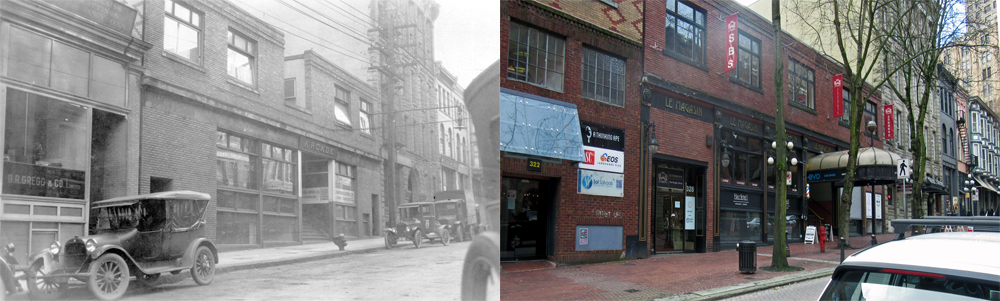
We’ve looked at both the buildings flanking this modest 2-storey structure in earlier posts. 322 Water Street, to the left was designed by Townsend and Townsend in 1912, while 342 Water on the right dates from 1899 and was designed by William Blackmore for John Burns. The retail arcade building in the centre also dates from 1912, designed by Stuart and White for the ‘Thompson Bros’ and built by the Burrard Construction Co for $30,000. It was an unusual building for Vancouver: an arcade linking Water Street to Cordova, with an entrance across the street from Homer Street, which presumably explains its name as the Homer Street Arcade.

As we noted in an earlier post, the Thompson Bros were really the Thomson Bros; listed as James A and M P Thomson who ran their stationers business from 325 West Hastings. An 1896 Auditor General’s Report noted that the company could be up to five years late in paying for publications they had sold on the government’s behalf; the report shows they also traded in Calgary.

Somehow the 1911 Census seems to have missed James (or we can’t find him), but Melville P(atrick) Thomson was living at 1215 Cardero, aged 51 with his wife Louise and their son, Melville F(itzGerald) Thomson who the street directory tell us was working for the Dominion Trust. Two more sons, George (a bookkeeper) and Donald were at home, as well as daughters Nora and Marcella, as well as a niece, A Finkueneisel, and their domestic. Melville senior was born in Ontario, while Louise was French. Louise seems to have been a second marriage for Melville; in 1888 he married Marcella Fitzgerald in Esquimalt. Melville died in 1944 aged 84, when he was living in Oliver. His death certificate says his wife was Marie Louise Kern, and that they had moved to the town in 1924. He had lived in BC since 1887, and we’re pretty certain he was born in Erin, in Wellington, Ontario, and that his brother James was three years older. The directory says that in 1910 James A Thomson was living at 1238 Cardero, so across the street from his brother.

The photograph shows the businesses located on Cordova Street included G.R. Gregg and Co. Ltd., The Borden, and Richardson Jensen Ltd. Ships’ Chandlers. The businesses in the Arcade were addressed from Cordova Street; The Borden was actually the The Borden Milk Co (so not a bar, despite the name). The heritage description for The Arcade says “The covered passage, with shops on both sides, served the bustling community with commercial and retail services.” In reality there was very little, if any retail – the building was full of commercial offices and some pretty specialized services. Here’s the complete list of businesses in 1914: Robt D Dickie – com agt, Alex Smith – accordion pleater, Searson & Russell – whol men’s furngs, Mendelson Bros – whol silks, A Olmstead Budd – produce broker, Walter D Frith – mdse broker, M B Steele – mdse broker, Hayward McBain & Co Ltd – com agents, corn, Dan Stewart – tailor (workroom), Hugh Lambie – com agt, Chas Schenk – tailor, Produce Distributers Ltd, Successful Poultryman, Excelsior Messengers, BC Assn of Stationary Engineers and Sandison Bros – mfrs agts.

During the 1970s the building was spruced up, with odd details that included facemasks of the entrepreneurs responsible for the revival of Gastown in the 1970’s. In recent years there have been a number of restaurants in this location, renamed Le Magasin, most recently the short-lived Blacktail. No doubt another concept will pop up soon.

Image Source: City of Vancouver Archives CVA 810-1


13 Mar 17:02

Talk Therapy

by Ruby Brunton

Who is going to take care of us when there’s no one left who’s supposed to do it? Those in need of medical aid are largely left to their own devices, while at the same time, we learn new life is priceless. Care becomes business and information gleaned from the sick is converted into product development, which to receive funds requires a marketing strategy, which is then converted into the promise of a “cure.” Convince the sick they are on the mend, and they will return to the cycles of production and consumption sooner, which are in part responsible for making them sick. Invisible traumas that bubble underneath the skin can be left untreated as long as they don’t disrupt the comings and goings of everyday life. That is, until the trauma starts to overflow and the need for care leads the affected to unlikely providers.

Thirteen years ago, I lost my father. There was a flood of support for my mother in her grief, but the idea that I too might be in need of material support was less apparent to all, including myself. The failures of the state-supplied care, which was only ever partial and left a lot of gaps that had to be filled by her community of friends and artistic collaborators, were felt by both of us. The first step to getting help, we are told, is asking for it, but to a teenage me who’d never experienced extreme grief and incapacitation due to mental illness before, the problem was I had no idea what kind of help to ask for. One night, insomnia keeping me up as had become the norm, I found myself traversing the new online music forums that had started to gather on the newly available internet. At first, being lost in disagreements over album rankings and musician’s personal lives was a distraction from the hard realities of my new life, but later the people I encountered in the forums became a source of comfort: I had found a handful of perfect strangers who were willing to be broken down on, a mutual escape from our real lives, a chance to divulge our interior selves without judgement.

The men I talked to wrote descriptions of how they imagined my appearance — Jessica Rabbit bangs, a side slit in a red pencil skirt — and remained patiently not typing anything as I became the perfect damsel in distress pouring my heart out about how my familial makeup had gone from two supportive parental figures to just me, a girl facing the world alone. As I was not being parented at the time, there was no one around to tell me to be careful. I didn’t tell anyone I knew how much time I was spending on those forums, though the intense bags under my eyes after sleepless nights may have been a hint, nor what I was talking to these random strangers about. The context of having a supply of completely featureless strangers to reveal my deepest emotions to somehow allowed me to really and honestly reveal them. The distance the screen placed between us meant I never read pity or judgement on their face or in their tone, when they did comment on my sadder thoughts, they said little. It would be another 10 years before I felt comfortable telling people I knew in real life, off the internet, the things I had freely unleashed onto perfect strangers.

The first step to getting help, we are told, is asking for it, but a teenage me, who’d never experienced extreme grief and incapacitation before, had no idea what kind of help to ask for

The concept of self-sourced care is barely new, it’s not as though people are born with a therapist attached. Most self-sourced care requires a lot of money, time, resources, a supportive community or family environment, the ability to take time off work and everything else that many of us don’t have. Initial bereavement counseling, sometimes provided by the state, educative institutions, or the workplace, usually seeks to reassure the bereaved that with time their feelings will subside and they will no longer need that same level of care. But in reality there is no timeline for grief, nor logic.

Five years after my mother died, while living in Australia, my stoicism evaporated and I realized I could no longer manage my mental health on my own. At the time, publicly funded health care allowed residents 18 visits with a psychologist per year, and access to various community support groups. I tried it all. I joined a support group for people who’d experienced a suicide in the family, organized by Jesuits, open to people of all ages and backgrounds. I was drawn to the creative writing group they offered, while others came just to hold someone’s hand and hear you’re not alone in this. Once again, I’d found a room full of people who were willing to listen to me without judgement or pity: the difference was when they spoke I knew they understood what I was saying. When I felt strong enough to, I moved to New York.


In the U.S., it feels community support groups exist when there’s a need to keep tabs on a population. The state accumulates data on participants and uses it for policy and commercial development. Those leaving prison or the psych ward find themselves placed in groups like Narcotics Anonymous as a condition of their release, but other forms of group therapy, forms that don’t only reflect the state’s commitment to the “war on drugs,” are relatively inaccessible to those with limited means. With a post-election society statistically more anxious than ever, there’s an even bigger strain on the mental healthcare industry.

As there is not the infrastructure to care for everyone in our current socio-economic setup, emergency solutions are often forged in response to national crises. As John D’Emilio said of the marginalized minority most affected by the plague of AIDS though the ’80s, “it led to a much higher level of organization and community infrastructure than had existed before and forced the establishment — a range of ‘mainstream’ institutions — into dialogue, whether they wanted to or not.” In a search for the same kind of group I’d been attending in Australia, I discovered orphans, semi-orphans, the bereaved, the depressed, and the suicidal are expected to pay upwards of $60 for a single group therapy session. I abandoned my hunt and took to sharing tiny morsels of on-brand grief on Twitter as a release. The desire to share with someone, anyone, took me back to the days of messaging strangers in online forums, and soon I was wondering what the scope for community support online could be.

Support After Suicide — the Australian support group I attended — had begun a trial of a new “Bereavement App” for “better access to our information by smartphone or tablet.” Though it’s still in development, seemingly as an aggregation of available resources and narratives of grieving, it didn’t turn out to manifest the idea of itself — or mine. I’d imagined a “bereavement app” as something like a tinder for grievers — a digital swipe-through of people who’d experienced loss that allowed you to be partnered with a suitable loss match. The screengrabs in the email inviting me to the trial seemed to suggest something slightly less exciting, an online “grief diary” where users can keep track of their eating, sleeping and grooming habits immediately following a loss to suicide. As I was not in Australia during the trial I was unable to test out the app, but based on the screengrabs and press release it would seem that it would barely fill a fraction of the hole in the existing dearth of talk therapy options.

Though crisis hotlines operated by volunteers have existed for decades, texting can bring an immediacy to the response, and when in distress, typing can be easier than talking. The national text therapy service, Crisis Text Line, is based on the idea that teens are already texting, and far more likely to divulge their secrets to an unknown responder than someone they’re face-to-face with: “The act of writing, even if the product consists of only a hundred and forty characters composed with one’s thumbs, forces a kind of real-time distillation of emotional chaos,” writes Alice Gregory in the New Yorker, “and although tapping out a text message isn’t the same as keeping a diary, it can act as a behavioral buffer, providing distance between a person and intense, immediate, and often impulsive feelings.” The same could be said of people of any of age. Texting is much easier to monitor, on the other hand, and the idea of people relaying their deepest innermost thoughts to a stranger in an app raises many questions about security. In order for therapy to be truly effective people need to feel free to be honest, and in our current climate of screenshotting and public call-outs, along with anxieties over state surveillance, it’s wise to consider the implications of text message confessions.

Initial bereavement counseling usually reassures the bereaved that with time their feelings will subside. But in reality there is no timeline for grief, nor logic

In the current days of “there’s an app for that,” for blocking your drunk dials or guessing the age of your dog from a photo, it makes sense there’d be a few different appified therapy options. It’s almost surprising, then, given the huge jump in public knowledge of the mental health crisis, that there are so few strong alternatives being developed. Could it be that those with the resources to develop apps don’t see the value in care work? This would seem misguided, as sites such as Talkspace, and online therapy portal based in New York City, saw membership triple following the election, and the American Psychological Association has polled a significant uptick in U.S. politics-related stress through this year.

The app that Support After Suicide was trialing, interestingly, was being developed by researchers at a university, with university funding. Still, with the nature of business, it feels even the mental health apps that start out publicly or university funded could be bought out or copied into a more seamless version by private companies with murkier interests. Health apps in wide use are as aggressively marketed as new pharmaceutical products. Anti-Alzheimer’s apps interrupt our Hulu shows, advertisements for period tracker apps line our subways.

The current state of health apps is that they are not widely regulated, unless the FDA ascertains that the app is being marketed or functioning as a medical device. An app that merely provides medical information is of no interest to the agency. The legal takedown of the Luminosity app — for “preying on consumers’ fears about cognitive decline” — reveals the darkest side to our willingness to put our trust in tech to cure us. Over 35 million people were convinced by the friendly reassurance that a $14.99-per month subscription and a few mind strengthening games would help ward off Alzheimer’s. The advertising hinted at “bettering” your brain, which could be read as a cure; the app regarded itself as a medical device. This is where regulation of mental health apps is trickier, as therapy is considered more of a tool than a cure. The consumer would potentially be left to weigh up the claims made by the app’s developers on her own. As these occasional takedowns happen, markets will only get wilier as to how to slip between regulatory guidelines.


The responsibility of care for the sick continues to be a contentious issue with currently only unsatisfactory answers. The shifting makeup of the modern family, the increased individualization of modern capitalist societies and the onward push towards total privatization places the burden of care on the sick and their family or community. Modern care-work is largely left up to our own volition and is mostly uncompensated, and state interventions sound as dystopic as ever. The question arises of not only who can perform care, but also who can be trusted enough to perform it whether tech companies can, as they promise, provide solutions for the state’s failures — and whether we would trust either one even if they were further from imperfect.

As we move further and further away from state-supported health care, the tech industry does appear to be one potential source of hope. At the same time, we are witnessing the steady subsumption of self-care into mass corporatization and the proliferation of unhealthy ideas like sleep deprivation as a sign of success. Further, what allows tech companies to disrupt holes in the market is the ability to formulate solutions based on the analysis of massive amounts of data. It’s all too easy to imagine a dystopian narrative wherein our outpourings — our deepest fears and anxieties — are collected and used against us, especially as these fears become increasingly political. Will these apps really be able to help us if they are predicated on storing and analyzing our innermost emotions? The sleekness of apps (and the money behind them) makes manipulation much harder to detect. Sure, it can be a huge comfort to think that a well-designed site promising a team of listeners will be providing better care than an online music forum. But in my experience, you never really know who you’re talking to.

13 Mar 17:01

Nanaimo Arena Iced for Now

by Sandy James Planner

port-place-event-centre-site-1080x641-1080x641

In a vote that was really no surprise, The CBC reports that the City of Nanaimo’s ballot to approve an $80 million dollar borrowing for the building of a hockey arena was soundly defeated by a no vote of 80 per cent.

The proposed centre was going to be on a lot adjacent to the water that was also of historical significance for the local  First Nations. The First Nations were apparently not consulted on Nanaimo’s choice.

The thought by Council was that such an arena would attract a World Hockey League team and provide an incubator for the downtown businesses and for the waterfront. Surprisingly, some council members are still pushing for a 5,700 seat hockey arena that could expand to 7,100 seats for concerts, as the magic bullet to move Nanaimo forward.

You’d think that such a vote would be a suggestion Council look at downtown revitalization, creating a better walking and biking environment, and promoting Nanaimo as a hub of business and activity. But no-“Councillor Jerry Hong says he was glad the vote was decisive, but that the project could be revisited.“I don’t think this is the end at all,” he said of Saturday night’s vote.”

voting-station-nanaimo-referendum


13 Mar 17:01

Bridge to Nowhere Connects in New York City

by Sandy James Planner


11bridge-master768

So what happens if there is a pedestrian “bridge” placed over a street between two buildings and those buildings have a change of use or are demolished? The New York Times explores  this in the little bridge built in 1989 that connected Trinity Church at Broadway and Wall to a 25 storey parish house across the street at 74 Trinity Place. That parish house was demolished last year leaving this-rather significantly-as the bridge to nowhere.

Because the nearest crosswalk was over 200 feet away, it was decided that a bridge was needed to help parishioners cross. The bridge is made of steel but takes its reference from “the design of a cast-iron pedestrian footbridge that was constructed in 1866 outside St. Paul’s Chapel, a few blocks north of Trinity Church but within its parish.” Because the bridge was historically informed it has been treated as a significant item by the Landmarks Commission and will be reintegrated with the rebuilding of  a new $300 million, 26-story parish building designed by Pelli Clarke Pelli Architects.

“Scripture tells us that faith is the evidence of things not seen,” the Rev. Dr. William Lupfer, Trinity’s rector, said. “The new Trinity parish hall will soon serve this community, neighborhood, and the City of New York for a fourth century.”

bridge


13 Mar 17:01

Marissa Mayer to step down as Yahoo CEO after Verizon deal closes

by Jessica Vomiero

A new regulatory filing indicates that Marissa Mayer will step down as Yahoo CEO after the Verizon deal closes.

Mayer will receive a $23 million USD severance package and Yahoo’s CFO Ken Goldman is set to step down as well. Goldman and Mayer will remain in their roles until the Verizon’s acquisition of Yahoo closes.

Mayer will be replaced by Thomas J. McInerne, the former CFO of IAC, and Goldman will be replaced by Alexi Wellman. It was previously reported that Mayer would step away from the board after the acquisition was complete, though it was not known at the time whether she would remain at Yahoo. 

The initial announcement of Verizon’s $4.83 billion Yahoo acquisition was made last year, and since then the takeover has faced a number of obstacles, including massive data breaches. After negotiating a $350 million off its original purchase valuation, Verizon pledged to follow through with the deal.

Source: United States Securities and Exchange Commission 

The post Marissa Mayer to step down as Yahoo CEO after Verizon deal closes appeared first on MobileSyrup.

13 Mar 17:01

Badges, Proof and Pathways [DML Central]

by Doug Belshaw

My latest post for DML Central has now been published. It was originally a commission through our co-op from Concentric Sky late last year, so I’m glad to finally have it published! It features a great header image from Bryan Mathers.

The focus of the article is on a new open standard for badge pathways that is available in Concentric Sky’s Badgr platform. I’m hoping other platforms adopt it quickly, as it makes a lot of things possible that until now have only been hypothetical.

An excerpt:

It just happens that all of these badges are issued via Badgr, but they could be issued by any badge platform. Interestingly, the Open Pathways standard has the flexibility to require all badges, or just some badges to earn before the ‘parent’ badge is completed. These pathways can then be stacked almost ad-infinitum leading to nested “constellations” of badges. The opportunities are endless.

Click here to read the article in full.

(Note: I’ve closed comments here to encourage you to comment on the original article!)

13 Mar 17:00

Chat Systems

mkalus shared this story from xkcd.com.

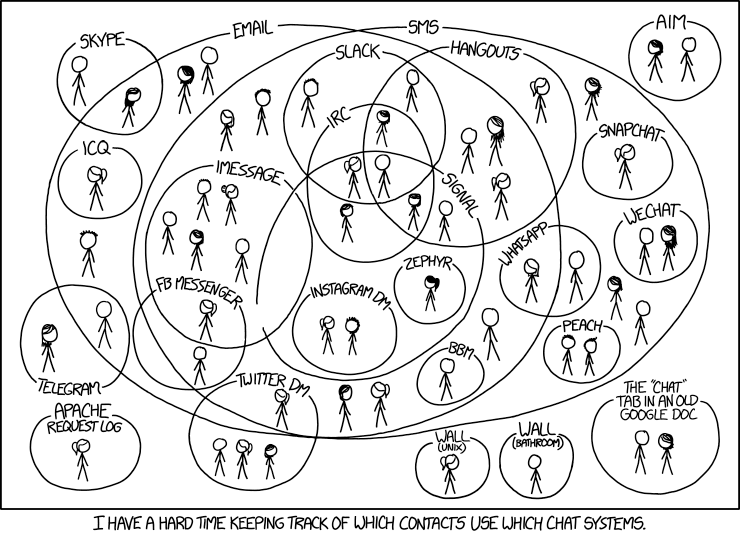
I'm one of the few Instagram users who connects solely through the Unix 'talk' gateway.
13 Mar 05:27

A Change Sprint – workshopping new ideas in a hurry

by dave

During a conversation in my back yard this summer with the excellent Robin DeRosa, she and I decided, once again, that most of us trying to do things differently in education all face the same kinds of issues.

We also noted that as our roles become more embedded and visible in our respective institutions, it is more difficult to do the deep speculative work necessary to come up with plans for change in education. Or at least, it’s more difficult to do it in the open.

I need to think out loud. But out loud isn’t so easy when my work is institutional and not just a MOOC run out of my basement. Being public before you’re ready means the work you’re trying to do can go in a negative or damaging direction.

And yet. The complexity at the core of the educational system requires a particular kind of multiplicity that can only be achieved with many perspectives. I realized, talking to Robin, that not having access to multiplicity was keeping me stuck in my own head.

The genesis of ChangeEd
We all have some core people in our network that we turn to for practical advice and who, when they are stumped, sometimes turn to us. I’ve spent much of the past dozen or so years working out loud with an excellent group of thinkers and practitioners. Two of my favourite people to work with on nasty problems are Rebecca Petersen and Lawrie Phipps. One day in September of last year, a few months after the conversation with Robin, I was talking to Rebecca and Lawrie separately about some work that we were poking away at. In each conversation, we talked about our desire for the intensity that can come from MOOC like experiences, or conferences (eventedness you might call it). We noticed that the calls to Twitter for participation weren’t quite doing the same thing they used to.

And then the three of us, in separate conversations, started talking about what a model for participation could look like. It turned out that they had both had conversations similar to the one I’d had with Robin in the summer. We decided to develop a model for how we could pull together the expertise we needed in a semi-protected way, and still participate in a broader open dialogue that is such a part of our practice.

The goal: make a call out to a group, think really fast, make something, call it quits.

There are any number of sprint models out there to choose from, agile development methodologies etc…but this one has been working well so far, emergently, the three times we’ve tried it.

Change Sprint
Asynchronous/online
I love to work with people f2f, but the challenges of pulling together a conference/project to trying to fit everyone’s schedule is impractical. The problems we were looking to solve were mostly time dependent, and we all have other things to do. There have been a couple of synchronous discussions via Google hangouts over the course of our Change Sprints so far, but we are mostly using Slack. Not perfect, but it allows people to drop in for five minutes when they can, and participate as they can.

Structured
A Change Sprint is focused on a central question posed by the member who calls or convenes the Spring to action. Each question, so far, has changed at least slightly in the course of each of the Sprints – the question can be iterative but it guides the discussion. A participant will convene a Sprint because they want help with an idea, a problem, a challenge…and are looking for a particular kind of outcome. They might want a model. They could need something said in a particular way, or need an idea workshopped before it goes out into the wild.

Before beginning, each convenor has to create a simple project charter that explains the necessary background in a simple, organized way. The charter allows people to get up to speed in a hurry, and provides a location for discussion around broader contextual issues.
We have a google template that has been working well for us.

It’s been really important to us that the sprints are as efficient as possible. We put the time limit on a sprint at 5 days, but any can end if the initial target is met and the convenor’s challenge addressed.

Success Measures
Ultimately these will be judged by the success measures that are part of each charter. They could include…better questions. A model. A rationale. A paper. A sketch of a plan. A series of guidelines. Constant movement towards an outcome is a good way to keep the discussion moving forward. That outcome also creates the potential of participating in a broader open conversation after the Sprint is complete.

Criteria for participants
We picked the first 10 people we could remember having this conversation with. We weren’t interested in people who would ‘take over’ a conversation, but rather, busy, practical people who love an opportunity to take a run at a thorny problem. We really wanted to keep the number small, and have tried not to think of all the terribly smart people we didn’t invite.

Weaknesses
The Change Sprints have been hard on the logically minded among us. If you wish to understand each item that whizzes by in the chat or if you want to read each entry this may not work for you. If you miss the first 25 minutes of the starting hour, you could be 300 messages behind. We had a couple of people who have withdrawn themselves because they aren’t able to ‘just’ donate an hour or so of their week to a conversation… they need to be all-in or all-out. That’s cool. That’s part of what makes them great professionals.

You also can’t guarantee that you are going to get to any kind of resolution. Sometimes the conversation rolls in the right direction and sometimes it doesn’t. Our first Sprint went so well (with the Learning Participant Ecosystem Model) that it’s easy to get disappointed when you don’t finish with a nice drawing :).

CC by Non Commercial
Learning Ecosystem Participant Model CC by Non Commercial

You really can’t do them very often. I wouldn’t think that more than 3 or 4 a year for any group would be possible and still maintain the enthusiasm. I might be wrong about that… Dunno.

Why you might want to do this
The Change Sprints we’ve done have replicated some of the power of the connected conversations I used to have on the open web, while cutting out much of the institutional risk. The focus on an specific outcome keeps people on task (mostly) and gives people something to rally around. You could setup a Slack channel (or a private Facebook group or whatever) fill out a charter, setup a start time and say go. You just need ten smart people to work with and a reasonable vision of where you want to get.

The thing I like about how this model works out is that it provides a clear structure for participation.

Participate as much as you can over the next five days. Then its done. If you can’t participate this time, or something comes up, that’s not a problem. If you can participate, be constructive, and keep nudging the problem around. Focused effort can do amazing things

13 Mar 05:27

Future Shock: UK Teenager Jailed For 5 Years For Downloading One Movie

by Andy
mkalus shared this story from TorrentFreak.

It’s January 2018 and after enjoying a meal with her family, recent school-leaver Rachel Owen walks to the mat to pick up an envelope addressed to her father. It’s from the family’s Internet provider and she opens it expecting to see the latest special offers.

Instead, she’s confronted with a nasty surprise. Her ISP says that it has handed over her father’s personal details to a foreign copyright holder after it monitored the family’s IP address sharing a movie online.

Having read that copyright holders usually settle these complaints for a few hundred pounds, Rachel comes clean with her angry father. Five months later in May 2018, the inevitable letter arrives.

It’s from a UK-registered company, with little to no assets, operating from a virtual office in London. In the past, these so-called copyright trolls had used firms of solicitors, but with the Solicitors Regulatory Authority paying close attention, it’s now safer to conduct business outside their jurisdiction and from offices that effectively do not exist.

The letter claims that the family’s IP address was tracked using the latest “forensic” technology. As expected, there’s an offer to settle with cash, but not for the £500 Rachel had been expecting.

Instead, the company is demanding £5,000 for the massive “risk of loss” Rachel’s download had subjected them to. It becomes evident that this wording has been carefully extracted from the Digital Economy Act passed by the UK government in the latter half of 2017. It’s a clever but devious tactic.

Under that legislation, which passed through parliament despite many warnings, anyone merely exposing a copyright holder to a mere risk of loss can be jailed for up to ten years. Lucky then, that this copyright holder is choosing to settle.

Unfortunately, neither Rachel nor her family has £5,000. Rachel’s job at an insurance company call center brings in just £5.55 an hour. Her father, who works as a driver, has a mortgage, credit card bills, and an overdraft. £5,000 is out of the question. So, together, they decide to write back to the copyright trolls to inform them they cannot pay.

Another six weeks passes and in June 2018 a new letter drops onto the mat. The copyright trolls note the refusal to pay and offer another month to settle. After that, all of the evidence will be passed to the police and a criminal prosecution will take place. For a naive and otherwise law-abiding teenager who downloaded a single movie, this is unfathomable.

However, thanks to the Digital Economy Act, which criminalizes anyone who violates a copyright holders’ distribution rights, this isn’t an idle threat. Ignoring warnings from organizations such as the Open Rights Group, the government refused to put in a threshold of criminality back in 2017. This means that after sharing just a single movie online, Rachel committed a criminal offense.

No one really thought a case like this would end up at trial. No one thought that a teenager like Rachel could end up with a jail sentence for sharing a single movie. That said, everyone should have anticipated the venom of copyright trolls hell-bent on ensuring that people in Rachel’s position settle future claims without putting up a fight.

During Rachel’s trial the evidence against her began to build. Someone, no one knows who, recorded the sci-fi movie in a theater and uploaded it to a torrent site. Rachel had no part in that but circumstantial evidence against her began to build. The trolls know this game well and pushed all the right buttons. Content creators need to be protected, they argued time and again.

Rachel told the court that when she jumped on the torrent she thought there were lots of other people seeding already – she just wanted a quick movie. However, according to the copyright trolls’ tracking company, she was among the initial handful of sharers. These people, they argued, were effectively a torrent swarm conspiracy who kickstarted an unstoppable and damaging chain of events.

Rachel, through her state-appointed lawyer (who was competent but had no specific copyright expertise), was powerless to argue otherwise. The government’s promise that the Digital Economy Act wouldn’t target kids in a bedroom seemed a distant memory and things were clearly getting out of hand.

Within 24 hours of appearing online this independent movie, in which the copyright holders had reportedly “invested heavily”, was apparently shared illegally in more than 50 countries, the court heard. Faced with a public who had already seen the movie, a planned cinema roll-out across Europe had to be abandoned, a somber prosecution lawyer explained. It was suggested that dozens of people lost their jobs.

Rachel and her faceless and apparently “still-on-the-run co-conspirators” were entirely to blame, the copyright trolls’ lawyer argued. The teenager, who had no ability to argue against the outrageous claims and should never have been in a criminal court at all, stood bewildered as more flooded in.

The trolls said that the initial seeders of the movie, from where all other copies of the movie were reportedly made, were responsible for at least 750,000 subsequent downloads on torrent networks alone. Direct downloads and streams were harder to track but they easily numbered 250,000, it was claimed.

In all, an estimated one million downloads priced at £7 each by the trolls were rounded down to £4 million in lost sales. This figure, the trolls said, warranted punishment right at the top end of the scale. Thanks to the Digital Economy Act passed in late 2017, that’s now 10 years in prison.

The judge took things seriously. He had to, the wording of the law was crystal clear. While there was no intention on Rachel’s part to get rich, her guilty plea under the Digital Economy Act indicated that she “knew or had reason to believe that [her actions would] cause loss or expose the rights holder to a risk of loss in money.” It didn’t matter that she thought she was just downloading a free movie.

With a five-year sentence handed down, the judge commented that given the wide-scale loss to copyright holders and few arguments in defense, he’d had little opportunity to further reduce Rachel’s punishment. With good behavior, she’d be out on license in half the time, but possibly not in advance of her 21st birthday.

While in prison, Rachel had time to think. If only she’d heard of the Open Rights Group’s efforts back in March 2017 to introduce a threshold of criminality into the Digital Economy Bill. She could have helped to persuade Government minister Jo Johnson to do the right thing. That would’ve protected small-time and indeed naive infringers while ensuring that commercial infringers would still be held to account.

Hindsight is a wonderful but rare thing. Act today by supporting the Open Rights Group’s initiative to have the government determine a sensible threshold for criminal liability in the Digital Economy Act.

Source: TF, for the latest info on copyright, file-sharing, torrent sites and ANONYMOUS VPN services.

13 Mar 05:27

Elektrobusse in Deutschland: Zu teuer, zu unzuverlässig, zu aufwendig

mkalus shared this story from SPIEGEL ONLINE - Schlagzeilen.

Die Luft in deutschen Städten soll sauberer werden. Fahrverbote für Dieselautos wie in Stuttgart sind dabei nur ein Mittel, auch die Umstellung von Diesel- auf Elektrobusse könnte helfen. Aber sind sie wirklich die Lösung? Daran zweifeln Experten. Die Zahl von E-Bussen ist bisher ohnehin verschwindend gering. Die Probleme: Zu teuer, zu unsicher, zu aufwendig, heißt es aus der Branche.

Selbst im von Abgas und Feinstaub hoch belasteten Stuttgart gibt es bislang nur wenige elektrisch betriebene Busse. Gut ein Dutzend der etwa 250 Busse, die die Stuttgarter Straßenbahnen AG einsetzt, sind Hybridbusse. Diese werden von einem Elektro-, aber auch von einem Dieselmotor angetrieben. Reine E-Busse gibt es in Stuttgart nicht. Dafür aber in mehr als 15 anderen deutschen Städten, darunter Hannover, Hamburg, Berlin oder Dresden. Die stärkste Elektrobuslinie stellt aktuell Köln: Hier sind acht reine E-Busse auf den Straßen.

Die neuesten Zahlen vom Kraftfahrt-Bundesamt (KBA) von Anfang 2016 ergeben:

  • Von 78.345 zugelassenen Bussen in Deutschland werden nur 458 ganz oder teilweise mit Strom betrieben. (1430 mit Gas und 76.334 mit Diesel)
  • Gut 20 Projekte mit Elektro- oder Hybridbussen zählt der Verband Deutscher Verkehrsunternehmen (VDV) in Deutschland. Diese Elektrobusse fahren aber fast nur im Testbetrieb.

Im internationalen Vergleich war Deutschland laut Martin Schmitz, Geschäftsführer Technik beim VDV, lange Zeit führend und sei es technisch immer noch. Die meisten Komponententeile für die Elektrofahrzeuge stammen laut Schmitz weiterhin aus Deutschland. Bei der Umsetzung der Projekte haben England und die Niederlande Deutschland mittlerweile aber abgehängt. Seit Kurzem gibt es in London mit 51 Fahrzeugen die größte Flotte rein elektrisch betriebener Busse Europas. Eindhoven setzt im öffentlichen Nahverkehr mittlerweile ausschließlich auf 43 rein batteriebetriebene Busse.

Zu wenig politischer Zwang

Warum hinkt Deutschland noch hinterher? Schmitz sieht die Ursachen dafür vor allem in den strengeren politischen Vorschriften, die andernorts herschen: In London zum Beispiel plant Bürgermeister Sadiq Khan eine "Ultra Low Emission Zone". Demnach sollen ab 2020 Gebühren für Fahrzeuge anfallen, die im innersten Stadtzentrum sehr strenge Obergrenzen bei der Schadstoffemission überschreiten. Diesen Richtlinien passt sich auch der öffentliche Nahverkehr an. Mit anderen Worten: Hierzulande fehlt der Zwang.

Beim VDV verweist man aber auch auf die Nachteile der E-Busse:

  • Genau wie beim Elektroauto ist auch die Reichweite von E-Bussen geringer als bei Bussen mit Verbrennungsmotor.
  • Elektrobusse sind laut Schmitz in der Anschaffung (rund 750.000 Euro für einen rein elektrisch angetriebenen Gelenkbus) mehr als doppelt so teuer wie entsprechende Dieselfahrzeuge mit neuesten Euro-VI-Motor (etwa 350.000 Euro).
  • Hinzu kommen höhere Kosten für die Instandhaltung, weil die Werkstätten auf Strom-Busse ausgerichtet werden müssen.
  • Die Busse sind noch nicht verlässlich genug: Laut Schmitz kann etwa einer von fünf E-Bussen in den Testprojekten wegen technischer Probleme seine Fahrt nicht antreten oder zu Ende bringen. Durch die neue sensible Elektronik gibt es beispielsweise Ausfälle bei den Türen oder beim Kompressor. "Auf Dauer bringt das nichts, weil die Fahrgäste unzufrieden sind und man mehr Busse vorhalten muss", sagt ein VDV-Pressesprecher. Zum Vergleich: Bei den Diesel-Bussen klappen etwa 9,5 von 10 Fahrten.

Dazu gibt es noch ein Problem, sagt Tobias Kothy, Referent beim Bundesverband Deutscher Omnibusunternehmer, der die Interessen privater Busunternehmen vertritt. Der Energieverbrauch für die Klimatisierung im Bus sei ganz erheblich. Grundsätzlich sei die Bereitschaft da, sagt Kothy. Doch: "Betriebswirtschaftlich rechnet sich das noch nicht."

Hinzu kommt das fehlende Angebot deutscher und europäischer Hersteller. Einzig Volvo setzt bereits seit Jahren auf Antriebe abseits der Dieseltechnologie. Konkurrent MAN plant mit 2019. Daimler rechnet damit, dass im Jahr 2030 mehr als 70 Prozent aller neu zugelassenen Stadtbusse über einen emissionsfreien Antrieb verfügen. Doch bislang setzt Daimler vor allem auf Gas. Der Stadtbus mit batterieelektrischem Antrieb geht erst 2018 in Serie, soll dann aber auch bei Alltagstauglichkeit und durch die lange Nutzungsdauer auch beim Preis konkurrenzfähig sein.

Anteil von Bussen an Luftverschmutzung ist fraglich

Die Entwicklung können die CO2-Gesetzgebung, Vorgaben zur Luftreinhaltung in den Städten und der Wunsch nach Lärmvermeidung in Ballungsgebieten maßgeblich vorantreiben. Dabei sieht die Branche aber nicht nur die Hersteller in der Pflicht, sondern auch die Politik. Es gebe zwar Förderprogramme, aber noch nicht genug: "Die Länder machen das im Moment noch extrem wenig", sagt ein Sprecher des VDV. In Baden-Württemberg sind in diesem Jahr von 15 Millionen Euro der Förderung für Busse lediglich drei Millionen für die rasche Modernisierung der Busflotten in Umweltzonen reserviert.

Dabei hebt vor allem Verkehrsminister Alexander Dobrindt gerne hervor, wie wichtig die Elektrifizierung von Bussen sei, um die Luftverschmutzung in den Städten zu bekämpfen. Der gleichen Meinung ist SPD-Chef Sigmar Gabriel. Das Loblied auf die E-Busse stimmen die beiden aber vor allem deshalb an, um die Forderungen nach einer blauen Plakette - also eine bundesweite Umsetzung der Fahrverbote für alte Dieselfahrzeuge in Innenstädten - zu übertönen.

Ob Elektrobusse allerdings die Lösung von problematischen Feinstaubwerten und Stickoxidbelastung in Innenstädten sein können, bezweifelt Marcel Langer vom Umweltbundesamt: "Es gibt keine belastbaren Zahlen über den generellen Anteil von Bussen an der Luftbelastung aus dem Straßenverkehr."

Nach Daten der Landesanstalt für Umwelt in Baden-Württemberg aus dem Jahr 2014 waren im von Feinstaub und Stickoxiden belasteten Stuttgart Autos für den Großteil von Feinstaub (72 Prozent) und Stickoxiden (63 Prozent) verantwortlich. Schwere Nutzfahrzeuge, zu denen die Busse zählen, machten 30 Prozent der Stickoxide und 22 Prozent des Feinstaubs aus. Der Anteil der Busse dürfte aber weit darunter liegen, so Langner.

"Wenn alle Busse von Diesel auf Elektro umgestellt würden, gäbe es keinen Rieseneffekt", stellt er fest: "Das wäre noch nicht die Lösung des Problems."

13 Mar 05:26

The Rise of the Luxurious Suburban Master Bathroom

mkalus shared this story from Atlas Obscura - Latest Articles and Places.

The 1986 edition of the International Collection of Interior Design, a trade magazine for those in the business, issued a bold statement regarding bathrooms:

“The era of the utilitarian, puritanical bathroom is over and now it is returning to center stage as the place for luxurious, sophisticated relaxation in the home.”

The 1986 bathroom would bring back the grand indulgences of the Romans, who surrounded themselves with plush beauty during their ablutions. This elevation of the master bathroom from the “necessary room” as it was euphemistically called, to its reign as the cornerstone of the master suite, was such a rapid and recent development, that it is easy to take it for granted.

Bathrooms haven’t changed much since indoor plumbing became a standard feature in newly built homes at the turn of the 20th century.  This, coupled with changing societal expectations regarding the frequency of bathing and new technology such as the flush toilet, swiftly ushered in the era of the modern bathroom.

Indoor plumbing coincided with the discovery of germ theory—the idea that disease is spread by germs. More importantly, germ theory linked cleanliness to the prevention of illness.  The intersection of science, technology, and societal pressures for cleanliness ultimately led to the development of the “hygienic” bathroom—one clad in tile and other hard surfaces, absent of carpet, heavy drapery, or other porous soft goods thought to be good places for germs to fester. The easier a bathroom was to clean, the more proper, safe, and sanitary it (and the people who used it) was. 

The hygienic prototype, aided by the new marvels of mass production, swiftly became and remained the standard. The typical bathroom is a five-foot-by-eight-foot square room with a bathtub, a toilet, and a pedestal sink. The pedestal sink may be swapped out with a vanity sink, the bathtub with a tub/shower combo or a shower stall, but the basic composition of three porcelain fixtures in a small room has remained relatively unchanged throughout the decades.

The consistent design schema of bathrooms is linked to a number of factors. Ease of cleaning was the main appeal in bathroom design—hence the popularity of tile walls and floors, as well as porcelain fixtures. The vanity sink, for example, did not become popular until the 1950s, when new materials such as formica and MDF made them less expensive as well as easier to clean and maintain.

In addition, Americans have always had a difficult time talking about intimate matters, including bathroom activities. The impropriety of such dirty acts as passing bowel movements made the bathroom a place that remained out of sight and out of mind, clinical in its aesthetic and unchanged since its inception. A recent article for The Atlantic pointed out that discussing or depicting the bathroom (specifically the toilet) on television was considered obscene until as late as the 1970s.

House size, however, was the main concern. At the turn of the 20th century, the vast majority of Americans lived in cities, and dwelled in townhouses, apartments or tenements. With the availability of mass-produced housing and inventions such as the streetcar, more affluent families expanded into the first generation of suburbs, located within the outer limits of the city.

The first generation of these houses, built from the 1890s to the early 1920s, took after farmhouses and Queen-Anne-style architecture, were the largest of the kit-houses, boasting 3 or more bedrooms as well as a parlor for entertaining. Still, despite their size, very few had more than one bathroom, as bathrooms were still rather expensive to build in the days before the fixtures could be cheaply mass-produced.

The majority of the kit houses from the ’20s and ’30s (which made up most of the U.S.’s suburban stock) were bungalows—small, one-story houses boasting two or three bedrooms and a single bath.

The bathroom was a utilitarian place, and its aesthetics came secondary to its functionality. There was no need for a large bathroom or multiple bathrooms in early suburban life, as space was scarce and fixtures were expensive. The Great Depression and World War II stalled residential construction, creating a huge need for housing in the 1940s. Coupled with the invention and proliferation of cars and housing incentives provided for veterans through the GI Bill, modern tract suburbia was born.

Despite the incentives to buy, the GI Bill only covered housing which conformed to the guidelines set by the Federal Housing Authority’s mandates: a price range of US$8,000 to US$10,000 and a size range of 800 to 1,000 square feet. Thus, houses built in 1950 were even smaller than those built in the previous 30 years, boasting a mere two or three bedrooms, a kitchenette, and one bathroom. These houses also boasted an open floor-plan in order to make them feel much less cramped than they actually were. Families sacrificed privacy for comfort.

However, it was during the 1950s that new and exciting technologies came on the market for the bathroom: hairdryers, built-in ventilation fans, warming units, and a plethora of new catchy products for haircare and makeup.

All of these new gadgets required space, and Americans wanted bigger and more spacious houses, especially since the two-car attached garage was becoming more and more common and desired. A garage was a huge chunk of square-footage, and house size grew accordingly.

The ’60s and ’70s saw further expansion out of cities into rural areas, and house size increased due to the inexpensiveness of rural land.

More square-footage meant more luxury. For example, standard queen- and king-sized beds didn’t even exist until the end of the ’50s. In response, the bathroom, for the first time in decades, had begun to change. The biggest change was the dawn of the commonplace master bath. House size was only one factor that facilitated this new luxurious feature.

Newly constructed neighborhoods featured infrastructure for more efficient plumbing and water management, leading to an increase in bathrooms in the home. Gone were the days when flushing the toilet meant a scalding surprise. More space meant that unlike their FHA-mandated predecessors, new houses boasted less-open floor-plans, offering the marital couple privacy. In addition, the sexual revolution of the ’60s led to more open-mindedness about private matters, as well as a penchant for plush new features like jacuzzis and garden tubs.

These factors stuck with the American public, and the master bathroom took off, becoming standard on all new homes by 1980. However, these bathrooms were still rather modest, like the one above. 

The growth of houses, while generally on the increase since 1960, stalled in the ’70s due to an energy crisis. When the ’80s rolled around and energy became cheap again, there was an explosion in homebuilding, and the homes kept getting bigger and bigger. The introduction of new construction materials (e.g. vinyl siding) and relaxed mortgage lending practices in the ’80s and ’90s meant it was easier to get a bigger house for less money. The outsourcing of labor during the Reagan and Clinton eras made consumer goods less expensive, and Americans consumed new goods—including luxury goods now available at a lower price point—like never before. Thus, the master bath exploded.

Societal changes have played a role in the growth of the master as well: women entering the mainstream workforce and the rise of the working couple meant families earned more, had more stuff, and needed more space. The puritan notions of the bathroom as a dirty place no one talked about were over—now was the time for sunken tubs and flaunted luxury.

The story of the master bathroom was long in the making. A space we now deem a necessity is only around 36 years old. It’s one of many examples of how a cocktail of social, technological, and economic influences combine to create new standards of living, and change the face of not only architecture, but how we live.

13 Mar 05:26

West End residents fight against “unfair” rent increases - BC

mkalus shared this story from Comments on: West End residents fight against “unfair” rent increases.

Tenants of a West End apartment building fear they might be pushed out after their landlord applied to increase rents by up to 43 per cent.

The 80-year-old units haven’t seen any recent renovations or upgrades, but the landlord of 1565 Harwood St. wants to increase rent by an extra $500 per month for some units.

“That’s money that is not going into our retirement, that’s money that is not going to education for our children,” said Amanda Burke, a resident of the building.

“I’m not one of those people that thinks everything has to be fair in life, but it has to be reasonable, and this is not reasonable,” another resident, Candace Mutch, said.

The increase is legal under a clause of the Residential Tenancy Regulation. The province currently caps annual rent increases at 3.7 per cent, but landlords can apply for exceptions if the rent they are currently charging is significantly lower than what is being charged for similar suites nearby.

Vancouver-West End MLA Spencer Chandra-Herbert says the increases are unfair.

“It’s an unfair clause which is just about gauging renters for more rent. It doesn’t add anything of value to anybody, except for a landlord greedy to take more money out of people’s pockets,” Chandra-Herbert said.

Chandra-Herbert says it’s the third time this month he’s seen owners use the so-called geographic area clause, and wants the province to remove it.

“Other provinces do not have this clause because it gets abused,” he said.

Tenants say the pricier comparisons shown to them by their landlord aren’t really comparable at all.

“I had a stove from the 1940s that I just got rid of and bought my own,” Mutch said.

The residents – many of whom have been there for more than a decade – will fight to keep their suites affordable in an arbitration hearing next month.

The building managers did not return calls from Global News.

© 2017 Global News, a division of Corus Entertainment Inc.

13 Mar 05:26

City cuts down line of cherry trees for bike lane construction - BC

mkalus shared this story from Global News:
As much as I hate seeing the trees go, this was a horrible scenario with regards to bikes, pedestrians and everybody else. Glad this gets addressed and maybe the city can plant some new ones?

Visitors to the south False Creek Seawall won’t be getting their annual cherry blossom show this spring. The City of Vancouver has removed a line of picturesque cherry trees along the seawall east of Granville Island.

The trees, which bloom into a ribbon of pink along the Alder Bay Walk stretch of the seawall every March, were cut down to stumps this week in order for crews to widen the seawall and create a designated bike lane.

Granville Island resident Yayoi Hirano told Global News she was very disappointed to see the trees gone.

“Since I moved here from Tokyo 15 years ago, I enjoyed so much to see this cherry blossom alley. Was it really necessary?” Hirano said.

The Vancouver Park Board indicated their plans to remove 34 trees in the area in April 2016.

“Along Creekside Drive there are 17 cherry trees exceeding 30 years of age that are in poor health and have a limited life expectancy,” the Park Board wrote in a report on South False Creek Seawall upgrades.

It indicated another 17 trees along the Alder Bay Walk, which were also at the end of their lifespan and diseased, would be removed as well.

The plans suggest 17 new trees will be planted in a median once the widened pathway is complete. The 17 trees along Creekside Drive will also be replaced.

“The new large stature cherry trees will be better suited to the site conditions and improve the future of the urban forest as the existing trees have a limited life expectancy at this time. These new trees will also flower in year one,” the report said.

For the usual spring show of cherry blossoms, visitors to and residents of the area will have to wait until 2018.

© 2017 Global News, a division of Corus Entertainment Inc.

13 Mar 05:25

7 Rules For Measuring and Improving Online Communities

by Richard Millington

Did you use the wrong tactics or were the tactics badly executed?

Are you measuring the metrics that matter to you or to metrics you heard someone else was measuring?

Are you just looking to impress your boss or are you sincerely looking for ways to improve your community?

When we do use data in online communities, we use it badly. There are 7 simple rules that might help:

1) Don’t measure anything you don’t have a process to improve. If your metric rises or falls, what will you do differently? You have four options, decide which before you collect the data or your emotions will get in the way.


2) Don’t open an analytics package before you know what to measure. You can spend hours making interesting observations which don’t matter. Sometimes no change shows tactics aren’t working. Decide what you’re measuring before you open the analytics package.

3) Don’t measure someone else’s strategy. If you measure the same things as someone else, you’re measuring someone else’s strategy. You need unique metrics for your strategy.

The next four rules use the hierarchy of measurement.

4) Measure if your tactics were well executed. First, measure if your tactics had good reach (a high % of people were aware of them), depth (they affected a high % of the target audience), and length (they were effective for a long time). If not, you need to improve the execution of tactics. Engagement-level metrics are useful here.

5) Measure if your tactics achieved your strategy. Second, did the tactics influence how people feel about the behavior you want? If not, you need different tactics. Emotion drives behavior, tactics should influence emotions. Survey data and sentiment analysis are useful here.

6) Measure if your strategy achieved your objectives. Third, did the strategy cause more people to perform valuable behaviors (answering questions, sharing knowledge, etc..). If not, you need a different strategy. These are the direct antecedents of ROI.

7) Measure if your objectives achieved your goal. Fourth, did the objectives create a positive return on investment for your online community? If not, you need different objectives.

Hint: The last three rules require you to establish at least strong correlation with the metric above (or causation by not exposing a random sample of members to the tactic).

Measurement isn’t easy, but when do well it saves you an incredible amount of time. It lets you focus on the key things which drive results. Even better, build your own custom dashboard (or get help) and share it with your team. Now everyone can focus on the actions that matter.

13 Mar 00:58

Get inspired to cook new things with Hey Plum [Bot of the Week]

by Rose Behar

One of the most important parts of cooking is inspiration. Without it, you’re liable to end up eating the same meals over and over again, making dinner time a drag.

The Hey Plum chatbot combats tedious cooking habits by providing users with customized suggestions. You just hop into Facebook Messenger and send the bot an ingredient, multiple ingredients or a whole dish — and the bot returns recipes. Want some recipes that showcase cayenne pepper? The bot suggest spicy cheese scones or double ginger gingerbread men. Have a hankering for ginger? There’s gluten-free ginger cake and ginger and orange-glazed baby carrots.

recipe chatbot screen shots - hey plum

If you’re really stuck for inspiration, you can also ask the bot to inspire them by listing off ingredients. After selecting an ingredient, the bot then sends over suggestions for dishes in which the ingredient plays a star role. For instance, when selecting ‘avocado’ the bot provides ‘hot and crunchy avocado fires,’ ‘coffee avocado milkshake’ and ‘avocado gelato.’

Additionally, Hey Plum is sensitive to diet requirements — allowing users to receive ideas that are dairy-free, gluten-free, vegetarian or vegan.

I found it a useful way to shake up my dinner routine by adding a few new recipes to my roster, and found the bot quick and intuitive. The only occasional inconvenience? The bot developer lives in the U.K., so occasionally the recipes may contain certain specific ingredients that are difficult to get in some parts Canada — though that’s a rare occurrence and is generally a matter of just tweaking brands.

To try Hey Plum click here.

The post Get inspired to cook new things with Hey Plum [Bot of the Week] appeared first on MobileSyrup.

12 Mar 17:37

Reading Is A Profoundly Creative Act

by Eugene Wallingford

This comes from Laura Miller, a book reviewers and essayist for Slate, in a Poets & Writers interview:

I also believe that reading is a profoundly creative act, that every act of reading is a collaboration between author and reader. I don't understand why more people aren't interested in this alchemy. It's such an act of grace to give someone else ten or fifteen hours out of your own irreplaceable life, and allow their voice, thoughts, and imaginings into your head.

I think this is true of all reading, whether fiction or nonfiction, literary or technical. I often hear CS profs tell their students to read "actively" by trying code out in an interpreter, asking continually what the author means, and otherwise engaging with the material. Students who do have a chance to experience what Miller describes: turning over a few hours of their irreplaceable lives to someone who understands a topic well, allow their voice, thoughts, and imaginings into their heads, and coming out on the other end of the experience with new thoughts -- and maybe even a new mind.

12 Mar 17:28

Build more Kerrisdales to rework the RS areas!

by michaelkluckner

kerris

The Kerrisdale village, about 8 blocks across, developed with low-rise to mid-rise apartments/condos from the 1940s to the 1990s. It is the model for giving a focus to the sprawling RS (single family) areas of Vancouver.

At the Urbanarium debate on March 8th about character-house retention, I argued there is little point in adding townhouses or duplexes to the RS areas of the city without giving neighbourhoods a focus – a village. Villages arose historically at crossroads; Vancouver’s current penchant for stringing density along arterials is not building communities, it’s just adding human units to our population statistics.

Furthermore, adding duplexes and townhouses to the car-captive RS zones will merely add more car captives. However, a concentration of population into neighbourhood centres (call them villages or whatever) would give a better opportunity to serve them with transit and, potentially, to create the kind of walkable communities for people at every stage of their lives – something that is definitely not happening with the strips of multi-family buildings along, say, Cambie Street south of King Edward.

So here’s a proposal to plan (properly) the RS areas:

  1. add density by focusing upzoning on some of the existing (green in the map below) multi-family islands.
  2. identify some new villages (red), zoning the crossroads about 6 to 8 blocks across, with 3 or 4 storey buildings on the commercial streets, 8 to 10 storey buildings behind them, and some lower-rise buildings providing a transition from them to the existing detached houses.
  3. allow the kind of multi-family conversion proposed in the character house initiative to proceed; leave the detached houses in the RS zones to evolve gradually into rooming houses and eventually be redeveloped when (if?) the city ever develops a real economy paying real wages.
  4. Give up the idea that you can build affordable duplexes or townhouses in a wholesale rezoning of the RS zones – there is simply no evidence of that being possible based on the experience in the RT zones.
  5. Accept that detached houses aren’t evil! Not everyone has to live the same way, comrade. As well, they’re the most flexible form of housing we have in the city, adaptable to all kinds of living arrangements other than the traditional nuclear-family ownership model.

vanmap

Notes:

The existing “villages” in green:

  1. West 10th/Point Grey Village: some apartments toward the Blanca Street end
  2. Dunbar shops: some multi-family; more could be added on side streets but there is no obvious crossroads.
  3. Kerrisdale: an excellent mix of rental/condo/townhouse/detached.
  4. Arbutus and King Edward: townhouses and car-accessed commercial; under redevelopment.
  5. Marpole: a good mix of long-established apartments, plus some new buildings at 70th, with a commercial area accessible to a relatively poor and aged demographic.
  6. Cambie: a long-established apartment area south of the Cambie shops, added to with many low-rise condos around the Canada Line Station at King Edward, but woefully inadequate commercial facilities: this new development is a real blot on Vancouver’s reputation for good planning.
  7. Oakridge: a long-established apartment area with a mall; dense redevelopment proposed around the multi-billion dollar public transit investment, with more redevelopment coming nearby on the Oakridge transit-station site.
  8. Cambie & Marine: high-density condos with little apparent relationship to the surrounding community; to the west and linking with Marpole, a fairly significant apartment area established for many years.
  9. King Ed and Knight – a big building next to pokey transit.
  10. Norquay and the Kingsway strip: it is amazing how the Nanaimo SkyTrain station is sitting in the middle of a suburban landscape.
  11. Fraser Lands: lots of multi-family but very little commercial with little focus, so  car-captive.
  12. 54th and Kerr, Champlain Mall: a suburban mall with surface parking in an area with interesting townhouses and coops.
  13. Joyce SkyTrain station: high-density (is it a complete community, or do people take the SkyTrain to somewhere like The Drive to hang out?).
  14. Broadway & Nanaimo: a concentration of apartments but not much in the way of commercial.
  15. Nanaimo & Charles: a neighbourhood commercial crossroads with a few apartment buildings.
  16. Hastings east of Nanaimo: a very good commercial strip with a lot of older, affordable housing on nearby streets. Gentrification would equal displacement.

Proposed “villages” in red:

17. Jericho Lands will have multi-family and commercial, yes?

18. Neighbourhood shops at 16th and Macdonald-Trafalgar.

19. Neighbourhood shops and a few townhouses at 33rd and Mackenzie.

20. Neighbourhood shopping area surrounded by single-family at 41st and Dunbar.

21. Pearson Lands redevelopment: will it get a Canada Line stop or will everybody be both high-density and car-captive?

22. 49th and Fraser: the partly abandoned Punjabi Village area that has decamped to Kennedy Heights, surrounded by affordable single-family/extended family.

23. 41st and Victoria: a vibrant commercial area in the middle of the sea of detached houses; redevelopment would gentrify and displace many immigrant families.

24. Renfrew and 1st: a vibrant commercial area in the midst of a poor/middle class detached housing area.