John Kelly is trying to make the nation more fearful, to make a case for increased security measures at airports and in screening of immigrants:
The United States is as vulnerable to an attack today as it was the morning of Sept. 11, 2001. Information in the press about national security is misleading or flat-out wrong, offering a false sense of security. The men and women of the Department of Homeland Security perform heroic work day and night for a largely ungrateful nation. If members of Congress are unhappy with the Trump administration’s crackdown on illegal immigration, they should pass new laws or “shut up.”
Those were the main takeaways from Homeland Security Secretary John Kelly’s first extensive remarks about how he intends to lead a vast bureaucracy on the front lines of immigration enforcement, passenger screening and cybersecurity.
“Make no mistake,” he said Tuesday during a speech at George Washington University. “We are in fact a nation under attack.”
Do you feel more or less safe after the billions we’ve spent since 9/11?
If Americans take his discourse at face value, they will be living in a paranoid society willing to trade fundamental freedoms and principles for a sense of security.
When will I get Android Nougat on my Galaxy S6 smartphone? It’s the question Canadian Galaxy S6 and S6 edge owners have been asking themselves for a long time.
If you’re on Rogers, the good news is that there appears to be a light at the end of the tunnel. According to the carrier’s OS Upgrade Schedule webpage, last updated earlier today, Rogers plans to start pushing Android Nougat to Galaxy S6 and S6 edge devices on its network on May 1st. Incidentally, Canada’s largest carrier will also push the lastest monthly Android security update to Pixel, Pixel XL, Nexus 6P and Xperia X Performance devices on its network on the same day.
As usual, Rogers warns, “Sometimes, things change beyond our control so all dates listed are subject to change.” Indeed, ask Telus S6 owners just how tentative those dates can be. The Vancouver-based said it planned to bring Nougat to the S6 earlier this month. It then delayed the release before removing it entirely from its update schedule webpage.
A spokesperson for the company told MobileSyrup that the update is still on its way. “We do intend to bring Nougat to the S6 but we’re currently working to ensure the best possible experience for our users. The release date will be updated as soon as we’re certain the experience will be seamless.”
Update (May 18th, 2017): Airfoil for Mac 5.6 restores direct streaming to all models of Apple TV. Get the latest version now from the Airfoil page. It is now safe to update your Apple TV to the latest tvOS. When you do, you’ll only need the latest Airfoil for Mac to stream to the Apple TV. No additional software will be required.
Update (September 25th, 2017): Airfoil for Windows 5.2 and above restore full Apple TV compatibility as well. Grab the latest from the Airfoil for Windows page.
Late last month, we alerted users to an incompatibility between Airfoil and Apple TVs running tvOS 10.2. We’ve since been hard at work on restoring the ability to stream audio from Airfoil to the newest Apple TVs. We’ve attacked this problem in two ways, and while we’re not finished yet, we’re now close to a pair of solutions to get things working for our users.
Long-Term Solution: Airfoil Updates
We’re working diligently to restore Airfoil’s ability to stream directly to the Apple TV. We know our users want to stream audio from their Macs and PCs to Apple TVs, and we’re incredibly eager to get this functionality back for you. This work has required a great deal of research, along with no small amount of reverse engineering, and that unfortunately takes time.
Happily, we’ve recently completed the preliminary work to enable Airfoil to connect with tvOS-based Apple TVs. We now have a working prototype for this, and we’re working on bringing the functionality into Airfoil. Once that’s ready, we’ll ship free updates for Airfoil for Mac and Airfoil for Windows. While we can’t yet give release dates for these updates, you can be sure we’re working hard to get them to you.
Interim Solution: Airfoil Satellite TV
In parallel with our work on Airfoil itself, we’ve also been working on a second solution to enable you to stream audio from your computer to the Apple TV. Yesterday, we submitted the results of this work to the App Store, in the form of a new app called Airfoil Satellite TV.
You may know that the Airfoil Satellite name is used for applications which enable various devices to act as audio receivers for Airfoil. With Airfoil Satellite running on a device, Airfoil sees that device as an output to which it can stream audio. When your Apple TV is running Airfoil Satellite TV, you’ll again be able to send audio from your Mac or Windows machine to tvOS-based Apple TVs.
At this point, we’re just waiting on Apple and the App Store review process to get the first version of Airfoil Satellite TV to you. We’ll post just as soon as it’s available.
Almost There
We hope to have Airfoil Satellite TV approved and in the App Store very soon. Once that’s available, all Apple TV users will be again be able to receive audio from their Macs and PCs using Airfoil.
Soon after that, we’ll be providing free updates to Airfoil for Mac and Airfoil for Windows, enabling Airfoil to talk directly to the newest Apple TVs without requiring any other software. These Airfoil updates will take a bit longer, but we’ll have more news on them soon.
We’re certainly sorry for this temporary loss of functionality in Airfoil, and we’re working diligently to have the problem resolved very soon. Thank you for your patience, and please stay tuned for updates.
This is an account of how the One Laptop Per Child evolved over time in Rwanda. "Rwandan government’ s partnership with Microsoft to roll out digital education has re-energised the debate by local and international observers on the progress of technology-enabled learning in the country."
Background information and updates on the xAPI profiles project. Follow the orientation link to the background document on Google Docs. "The Experience API (xAPI) Profiles Specification is a technical document that aims to improve practices for creating Profiles as defined in the xAPI Specification. The xAPI Profiles Specification lays out a structure that describes profiles uniformly, describes how profiles can be discovered and reused, and how profiles can be published and managed."
I've found that when I'm used to a certain route while on foot or on the bike, I tend to have my thoughts drifting away and becoming less attentive, usually leading to dangerous situations and sometimes even accidents involving other road users. It's dangerous and I'd like to avoid it when I start to take the bike to my current job.
What methods can I use to stay attentive and not get distracted by my own thoughts while riding?
The first earth day was celebrated on April 22, 1970, when 20 million Americans protested for a healthy and sustainable relationship with the environment. On this day there was the alignment of all environmental efforts that resulted in the opening of the Environmental Protection Agency. An agency that was responsible for passing acts such as Clean Air, Clean Water, and Endangered Species. These acts were created with the intent to improve and protect the quality of lives for citizens and animals residing in the United States.
Alas, 47 years later in a world where almost all nations are in unanimous agreement about the perils of climate change, the topic remains contentious in the US. As an ever growing force in the US, those who stand up for the environment do so with a passionate intention to inspire others to take care of the natural world. Today, its' apparent the effects this grassroots movement has had on generations to follow. Whether it’s embracing more sustainable home practices, voting with their dollar, or taking on a career within the environmental realm the idea of an environmentally conscious society are finally coming to fruition.
Blix Electric Bikes is one such example as a company founded by members of gen x who were inspired by the freethinkers of the 70’s. Recognizing the opportunity to use business for more than just short-term profit, but as a tool to improve the quality of life in the long term by also leaving a positive impact socially and environmentally. Electric bikes are an ideal commuting solution simultaneously reducing pollution, increasing health, and removing the obstacles regular bikes bring forth for the average rider. It is no coincidence that as environmentally conscious commute options are becoming more popular, electric bikes are becoming more and more common in the United States. Blix Bikes focuses on helping to reframe our perspective on what commuting could be for people around the world.
Looking for some inspiration yourself?
Participate in an Earth day event near you! There is a range of events that take place such as peaceful marches, concerts, e-bike meetups, and more. If you're in the greater Denver, CO Metropolitan area we have a few ideas about what you can do to participate Earth day over here!
It’s pretty hard to compare store-to-store, even though it is fairly clear which ones are going-going-gone. If we want to see the relative percentage of each store closing and also want to see how they stack up against each other, then let’s make a column of 100% bars and label total stores in each:
library(hrbrthemes)
library(tidyverse)

read.table(text='store,closing,total
"Radio Shack",550,1500
"Payless",400,2600
"Rue21",400,1100
"The Limited",250,250
"bebe",180,180
"Wet Seal",170,170
"Crocs",160,560
"JCPenny",138,1000
"American Apparel",110,110
"Kmart",109,735
"hhgregg",88,220
"Sears",41,695', sep=",", header=TRUE, stringsAsFactors=FALSE) %>%
  as_tibble() %>%
  mutate(remaining = total - closing,
         gone = round((closing/total) * 100)/100,
         stay = 1-gone,
         rem_lab = ifelse(remaining == 0, "", scales::comma(remaining))) %>%
  arrange(desc(stay)) %>%
  mutate(store=factor(store, levels=store)) -> closing_df

update_geom_font_defaults(font_rc)

ggplot(closing_df) +
  geom_segment(aes(0, store, xend=gone, yend=store, color="Closing"), size=8) +
  geom_segment(aes(gone, store, xend=gone+stay, yend=store, color="Remaining"), size=8) +
  geom_text(aes(x=0, y=store, label=closing), color="white", hjust=0, nudge_x=0.01) +
  geom_text(aes(x=1, y=store, label=rem_lab), color="white", hjust=1, nudge_x=-0.01) +
  scale_x_percent() +
  scale_color_ipsum(name=NULL) +
  labs(x=NULL, y=NULL,
       title="Selected 2017 Store closings (estimated)",
       subtitle="Smaller specialty chains such as Bebe and American Apparel are closing their stores,\nwhile lareger chains such as J.C. Penny and Sears are scaling back their footprint.") +
  theme_ipsum_rc(grid="X") +
  theme(axis.text.x=element_text(hjust=c(0, 0.5, 0.5, 0.5, 1))) +
  theme(legend.position=c(0.875, 1.025)) +
  theme(legend.direction="horizontal")
One might try circle packing or a treemap to show both relative store count and percentage, but I think the bigger story is the percent reduction for each retail chain. It’d be cool to see what others come up with.
One of the things that surprised me most about when my Dad was sick last year was that while he was in the hospital over about 5 weeks he lost any interest in music, TV, movies, anything on a screen. Music was particularly surprising given that he had music on at his desk pretty much all the time, and really enjoyed loading a new CD or record into the media library he had set up at home. One of the songs I remember playing for him was from a band, Manhattan Transfer, that we used to listen to a lot when I was younger and just learning about jazz, I chose Tuxedo Junction because it might cheer him up.
I remember him smiling faintly. (I wish I had played him more music. I wish I had recorded more of his stories, ideally before he got sick. I wish I had figured out how to navigate the hospital and health care system better.)
What I didn’t anticipate was how after his death there would be aftershocks of grief that would hit me over and over again, especially while driving or in a plane. I went from crying maybe three times in the past decade to breaking down at the end of a company town hall, when talking to family, when my Mom found out about the anniversary present my Dad had been looking at, and with any number of songs that unexpectedly took on a new meaning.
John Mayer’s Stop This Train is a song I’ve probably heard a hundred times since it came out in 2006, but all of sudden these words meant something completely different:
So scared of getting older
I’m only good at being young
So I play the numbers game
To find a way to say that life has just begun
Had a talk with my old man
Said, “Help me understand”
He said, “Turn sixty-eight
You’ll renegotiate”
I almost had to pull the car over: he was sixty-eight. What I would give for just one more conversation with him like the one the day before he passed. I wish I had written more down, recorded more of his stories, learned more about his journey.
As the year has passed, the surprise crying is much less common even when one of these songs comes on the radio. Usually when I think of my father it’s with a smile. I’ve even had a few treasured dreams where we’ve been able to talk, nothing that made much sense (it was a dream) but I remember waking up with an overwhelming feeling of enveloping love. While the “new normal” is different, I can’t say it’s better — he’s still gone.
This is how I envision WordPress platform evolving beyond what I outlined in Future of WordPress Platform. The vision is essentially a projection of what I had in mind with Teleport Network venture but did not get a chance to realize (old chicken and egg problem). As to why I’m doing this, it’s because WordPress has the scale and unrealized ideas are like orphans.
the vision starts with:
WordPress Studio – is the client-side application I outlined in the previous post on the subject. It’s not unlike VSCode in that much of its functionalities are derived from plugins. Plugins should be stackable so the platform itself can be extended to support key features like theming and financial transactions. Theme support, for example, needs HTML and PHP generators which in turn may need digital signature support to secure assets pushed to server. End goals are to a) reduce dependence on server-side changes to add features (a la serverless mindset), and b) create a vehicle to drive richer user experiences.
followed by:
WordPress Market – is a collection of studio plugins working in conjunction with backend services and UX-level plugins to provide rich mix of communication tools and integrated financial services. Intention is to bridge the difference between a collection of webpages and a retail store in RL. It must offer much more than in-page chatbox, even beyond what Slack offers today.
then ends with:
WordPress Atlas – uses data-science to pull blogs and websites into neighborhoods, towns, and cities based on topics, interests, and relations. Intention is to use real world metaphors to make discovery and sense of community more natural and explicit than, say, blogroll or news aggregators.
To me, Facebook is a mega-city of people just talking and exchanging photos, funnies, and insults all day everyday. I don’t care if Facebook is federated but I do care how drab everything is because you have to use what they offer and no more. I think WordPress can offer a way out of current conundrum without restarting from scratch.
HAPPY EARTH DAY! FREE SHIPPING + FREE WATER BOTTLE WITH PURCHASE. USE CODE: RIDEYOURBIKE. Now Thru 4/22 Midnight MDT. (US and Canada only - some exclusions may apply)
On this blog we like to celebrate all kinds of cycling—mountain biking, road biking, recreational rides—but bike commuting is without a doubt the most environmentally-friendly, responsible use of a bicycle. Lots of folks use a bicycle to get to work or to the grocery store, but throw a child into the mix and things get more complicated. Here are some of our tips on using a bicycle for transport with kids in tow.
If it would normally take you 30 minutes to bike somewhere, budget for 45 minutes when doing it with kids. Guaranteed someone is going to need a snack, a potty break, or a clothing adjustment. A time buffer also allows you to take a safer, potentially less-direct route than you would normally take.
If you’re just biking to the park or around town, a bike seat or trailer works great. But if you are using a bicycle as one of your primary modes of transportation, consider investing in a cargo bike or long-tail bike. These bikes allow you to haul kids as well as school gear, work clothes, groceries, and more. Some of the best options for commuting with kids are:
Trying to create a list of everything youâ€ll want to see and do in Europe can be a daunting task. How do you choose between seeing the Eiffel Tower, or exploring the castles spread out over Englandâ€s countryside? How can you choose between the incredible dishes that await you at nearly every location? Check off one, two or all of these and youâ€re guaranteed to have stories to tell when you come home, and a stack of photos to remember your journey. Here are five must-see events and venues to help you create your dream European vacation list!
You Saw a Soccer Match
You donâ€t need to get seats at the next Manchester United Game to truly appreciate a soccer game, although seeing them play would be nice. Champions League tickets are an absolute must when it comes to visiting Europe. The intense roar of the crowd, the chants, and the energy on and off the pitch are unmatched at most sporting events around the world. The closest feeling might be American football, but itâ€s still incomparable. Soccer matches are emotional affairs, and the crowd can move you to tears or joyous shouting all in a matter of moments. Even non-football fans should be sure to grab a match of a beautiful game for themselves.
You Bought Something from the Grand Bazaar in Istanbul
Itâ€s hard to really quantify the Grand Bazaar that spreads across 60 streets in Istanbul. The market contains some 5,000 shops with crowd sizes that can swell to as many as 400,000 in a day. Hong Kong has street markets that offer a similar feeling, but Istanbulâ€s Grand Bazaar is something out of a fantasy. It was between 1451 and 1466, by Mehmed the Conqueror, and offered a place for locals to buy imported goods. Today, itâ€s known for being the ultimate source for gold, textiles and Turkish ceramics unique to the region.
Plan a day to get lost here, and make sure you have some space for things to take home. Donâ€t forget to haggle!
You Saw Davidâ€s Backside
Want a great story for a cocktail party? Tell people about the time you saw the statue of Davidâ€s backside. Think about it, how often do we really ever see it? Almost every photograph is from the front side, and seeing it from the back requires a trip to Florence. Be sure to book ahead at The Accademia Gallery for a guided tour to learn more about the history of The Gallery, and to see its other unique statues by Michelangelo.
You Saw True Flamenco Dancers in Spain
Flamenco is an intricate art form in Spain, and it consists of many attributes. There is Toque, the guitar on which a cante (the song) is played. Then you must baile (dance), which is the soul of the art. Most people recognize flamenco dresses and costumes for their intricate presence. Dancers move to palos, over 50 different rhythmic patterns, that can range from serious to light hearted to deeply significant. In Andalusia, Spain, dancers take to the streets so you can eat while they perform.
You Ate at a Sidewalk Cafe in France
Is it the end of your journey? The start of new love? A moment of respite? Whatever your motivations, dining at a Paris cafe on the street is an experience completely unique to France. Itâ€s not just the food, itâ€s the atmosphere, the way people seem to be so carefree and full of natural joy. Maybe you sit in silence with a glass of wine and just people watch, maybe you try and meet new friends. Whatever your route, itâ€s an experience you can repeat as often as you like without ever finding it to be overdone.
Bonus: You Visited a German Beer Garden
Zugspitze sits atop Germanyâ€s highest mountain where the cold beer in your hand feels right at home with the cool breeze blowing past you. Dress warm for this one, but the truth is any German Beer Garden is an experience you wonâ€t soon forget. Unlike any restaurant youâ€ve ever been to. Expect grand tables, delicious and hearty food, and even some singing while you feast. Bring your appetite!
You have to admire the chutzpah of Maria Sharapova and her associates.
The Russian tennis star will be back in action on Wednesday this week, the first day she is eligible to play after a 15-month doping ban.
Rather than fight her way through the qualifiers as she should have to – the former world No.1 no longer has a ranking after her absence – organisers of the WTA Stuttgart Grand Prix have handed her a wildcard.
In a freak coincidence, the tournament is sponsored by Porsche, for...
For years, I’ve gone back and forth from OmniFocus to other task management systems. I’ve tried so many of them: Things, Todoist, Wunderlist, Basecamp, Reminders, Asana, 2do — I’m sure I’m forgetting a few. I’ve never lasted more than a month or two with any of these before coming back to OmniFocus.
I have a love/hate relationship with OmniFocus. (I once called OmniFocus “expensive” and “dystopian” on my personal blog, which may have been a bit melodramatic.)
But this app is honestly the only task management system that lets me work the way my brain works.
I’ve spent the past year going back and forth between all these systems, and after purchasing it three or four years ago (whenever version 2 came out), I’ve come full circle to embracing OmniFocus again. I’ve made a lot of notes over the past year about how I work and why OmniFocus works for me.
If you’ve been struggling to embrace a digital task management system, or trying to figure out what app you should use, then I hope this can help you.
Outlines of Tasks
First of all: like many creative types / coders that I know, I tend to think in outlines. Give me the back of a napkin and I’m writing a list out on it. OmniFocus is the only todo app that feels like an outlining app. (Obviously, that’s because OmniFocus shares heritage with OmniOutliner — another app I’m a huge fan of.)
So every day, when I’m doing a bit of a brain or idea dump, I can write it exactly how I would an outline. (It’s even better once you have the keyboard shortcuts memorized.)
But I know I’m not using OmniFocus right. I don’t use Reviews (well, not often). I don’t know use Contexts at all (seriously, not even a little). But I use Projects religiously.
I’ve organized my life into folders of projects in OmniFocus. Each folder includes a project called Miscellaneous, which I use to dump individual tasks that don’t belong to a larger project, but still need to be filed in the right place.
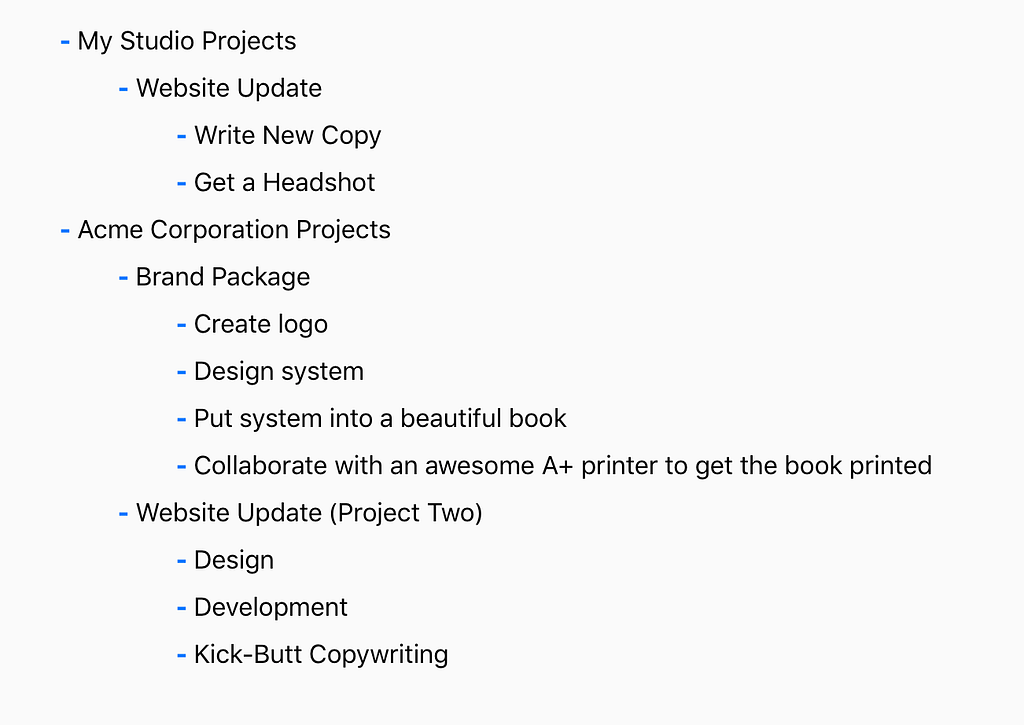
I have a folder for my studio, a folder for my church volunteering projects, and a folder for each client and product that I cater to. When a task gets added, assuming there’s a project or client related to it, the task immediately gets dumped in the proper spot.
I know what you’re thinking: “This sounds like a ton of work. I don’t want to think this hard.”
But it’s really not. It works just like an outline. The bullet list is actually very easy to visualize.
Etc, etc.
It’s not hard. It’s sensible — the exact same way you’d write it down on the back of the napkin.
Deferred Projects
To manage the bloat of projects, I also set up a ton of deferred start dates, which often repeat annually for clients on retainers. I can plan out a client’s entire year with them, and then start nudging them the day a project is set to start.
This has the side benefit of hiding any “inactive” project from my regular OmniFocus views. So there’s not too much clutter. Just enough to get a birds’ eye view.
Managing It All With Perspectives
All of this sounds really hard to manage, I know. I’ve got about 50 active projects going on at any given time.
This is where a task management system usually falls apart: what happens when you have hundreds and hundreds of items in it?
Most people start using Contexts at this point. I really don’t understand Contexts. I don’t get tags either. These systems don’t work the way my brain works. They give me headaches.
So here’s what I did.
I bought the Pro edition of OmniFocus, so I could set up custom perspectives. Perspectives are, for me, a bit of a lifesaver. They let me focus on individual projects at a time, instead of the full monte. (Hence the “Focus” in OmniFocus.)
I have two perspectives I use religiously.
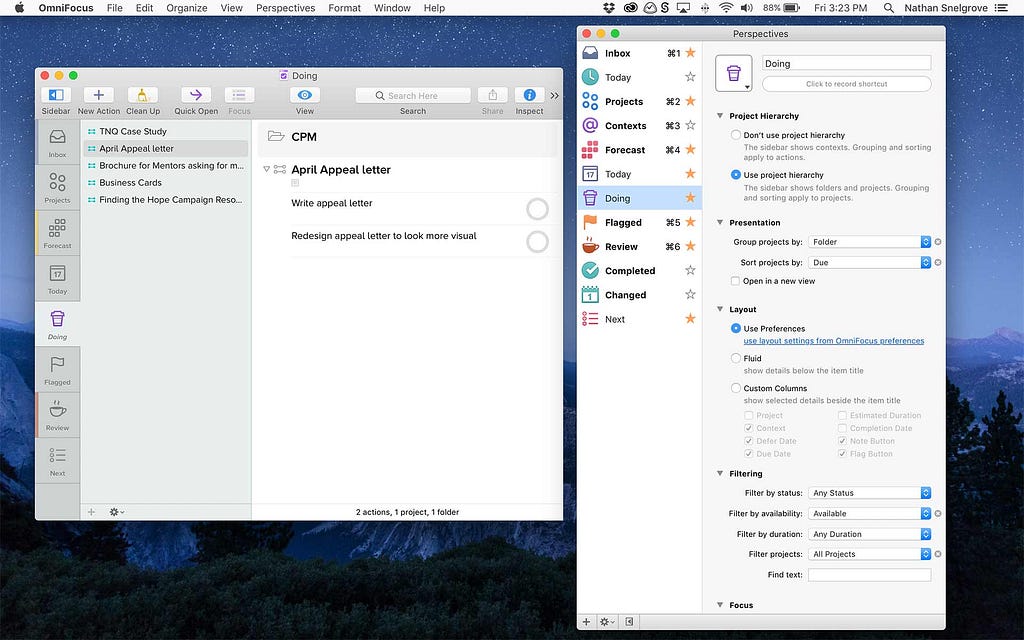
One is called “Doing”. I manually select the projects that I must make progress on every day right now, and have only those listed in this perspective. With one click, I can go to the perspective, see a quick list of the projects I should focus on, and check on the related tasks for each project.
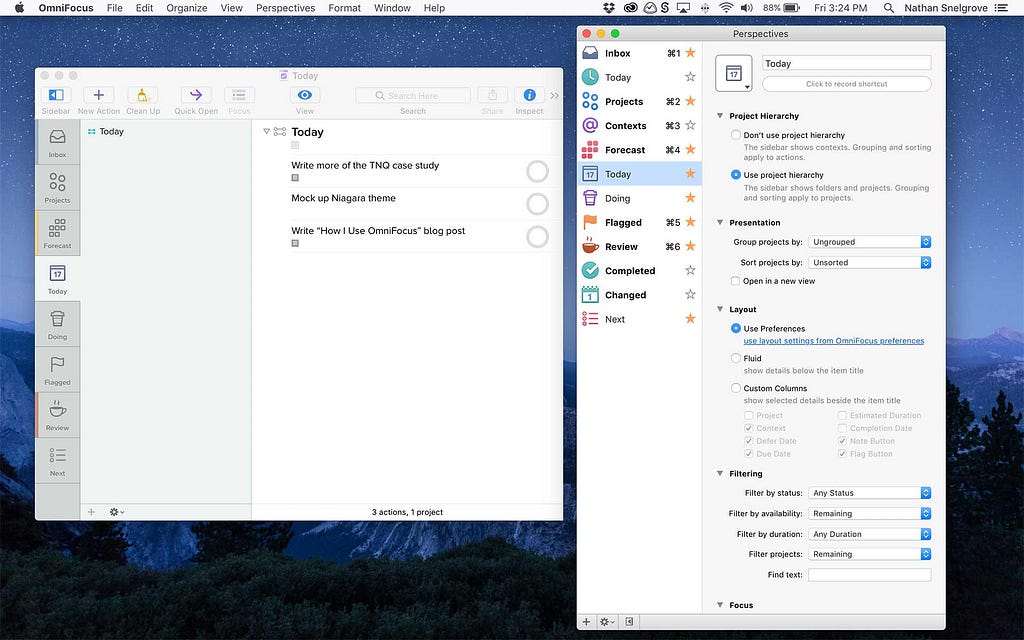
The other perspective is called “Today”. It also focused on a project, but this project is just a single action list called “Today”. Every morning, I delete everything in the list and write out only what needs to be accomplished that day. I don’t assign a due date or anything — I only use due dates if my life depends on it — but I start working through “Today” every time I finish in my Forecast.
My Key Principle: You Should Manually Curate Your Daily Tasks
Most hardcore OmniFocus people have a Today view in OmniFocus. The problem is, that Today view is usually based on some mixture of defer dates, due dates, and flagged tasks. I can’t have an entirely automated system like that; I need to manually curate my daily tasks.
I’ve tried, and tried, and tried to set up so many similar lists in any other app, but it never works for me. OmniFocus is the only app that bends to my will. (Things comes close, but their app is too inflexible to be of any real use for people with a million projects and areas of responsibilities.)
This workflow works if you’re the sort of person that dumps everything you need to do into your phone, but still writes out a quick list on paper every morning. I’ve just elected to make the whole thing digital.
If I’m being completely honest: you could probably make a compromised version of this system on anybody’s platform. But I don’t think anybody else makes it as easy to do what you want.
This isn’t a sales pitch. I get 0% of the money for doing this. I’m just finally happy with my system. If you want to try it out, you can check out OmniFocus on OmniGroup’s website.
Vignettes is, without a doubt, the most bizarre game (and app) I’ve ever purchased in the App Store.
The goal of the game – I think? – is to turn one object into another by twisting, rotating, tapping, and shifting your perspective of the object. If done correctly, you’ll transform a phone into a bowl, a light bulb into a lamp, and your brain from a completely functioning organ to a steaming pile of gray mush.
That’s about all there is to Vignette. The more you discover new objects, the more objects you'll want to find. As you proceed through the game, you’ll begin to unlock keys that will start you at different points in the game, reveal secrets, and let you interact with more objects.
That probably sounds incredibly generic, but that’s because it's incredibly difficult to put the concept behind Vignettes into words. It’s an experience, one that feels halfway between a game and an art project where the end object is to trick you to spinning your real-world chapstick around, hoping it transforms into something else (and yes, I did this!). There are almost no in-game instructions, either, so you’re left to your own devices from the outset.
However, there’s something really intriguing about the whole experience; although Vignettes is one of the most frustrating games I’ve played this year, the reward of discovery keeps me coming back the app even when I don’t think I want to. I get lost in its worlds, unable to comprehend exactly what puzzles I’m solving, but solving them nevertheless. Each puzzle is its own super weird and fun journey. I haven’t been so entranced by a iOS game in a long time.
A few years ago, starting with the One M8, HTC started itself on a trend of a distinct numbering scheme for its flagship smartphones.
Continue reading →
Joseph Planta@Planta
@jarmstrongbc @DanBurritt I like how Dan matches the pocket square to the shirt, and not the tie, which too many people on television do.
With its decision on Videotron’s zero rated Unlimited Music service on April 20th, Canada’s telecom regulator took a strong stance in favour of net neutrality.
The Canadian Radio-television and Telecommunications Commission (CRTC) ruled that Quebec-regional carrier Videotron gives undue preference to certain customers and music streaming platforms that are supported through its Unlimited Music service, which allows premium-tier customers to stream music from select apps without being billed for data usage.
Additionally, the regulator took the ruling as an opportunity to lay out a new framework that severely restricts the grounds on which differential pricing is allowed.
Strict guidelines for zero rating
The four main criteria of the framework are the equal treatment of data regardless of source or nature, the exclusiveness of the offer to the customer, the impact on internet innovation and whether there is financial compensation. The first criteria, equal treatment of data, has a major impact on content-based zero-rating offers.
Using Unlimited Music as an example, the fact that it zero-rates data from certain content providers is more likely to raise concerns than zero rating that treats data ‘agnostically’ — a ‘time of day’ offering for instance.
Additionally, Unlimited Music ran into issues with the exclusiveness of its premium tier-only offer and the impact of its service on internet innovation, since it only supports large established streaming platforms, not smaller apps or new entrants.
The new rules will be enforced through complaints, though operators can also submit a differential pricing practice to be reviewed prior to offering it.
“A free and open internet gives everyone a fair chance to innovate and for a vast array of content to be discovered by consumers,” stated CRTC CEO and chairman Jean-Pierre Blais in a press release accompanying the decision.
“A free and open internet also allows citizens to be informed and engage on issues of public concern without undue or inappropriate interference by those who operate those networks. Rather than offering its subscribers selected content at different data usage prices, internet service providers should be offering more data at lower prices. That way, subscribers can choose for themselves what content they want to consume.”
Canada makes its stance on net neutrality clear
The significance of these strict regulations made headlines not only in Canada, but in the U.S. as well, which is currently moving in a very different direction — the current chairman of the State’s telecom regulator, Ajit Pai, recently called net neutrality “a mistake” at Mobile World Congress and stated he believes in a “light touch” to internet regulation.
Michael Geist, one of the leading voices for net neutrality in Canada and Canada research chair in internet and e-commerce law at the University of Ottawa, lauded the CRTC’s decision.
“When combined with the federal government’s clear support for net neutrality, the Canadian framework is now one of the strongest in the world, providing guidance for the providers and appropriate protections for users and innovative services,” wrote Geist in a blog post following the announcement.
Geist says he expects the new guidelines to be strictly enforced by the regulator, stating: “Given that Commission rejects the Videotron service, has already rejected the Bell Mobile TV service, and rejects many compromise proposals that were raised during the hearing, it is clear that the bar for approval of a zero rating or differential pricing plan is very high. ”
Other consumer advocacy groups were also pleased with the result. John Lawford, executive director and general counsel at the Public Interest Advocacy Centre (PIAC) — one of the initial complainants against Unlimited Music — called it a “two-handed slam dunk” for net neutrality in a phone conversation with MobileSyrup and OpenMedia campaigns director Josh Tabish stated in a press release that “with the U.S. having just backed away from its own investigation into zero-rating, and the future of its net neutrality rules hanging in the balance, Canada looks like an increasingly attractive place to foster innovation online.”
Wireless market ramifications
Financial analysts, however, see the scenario from a very different perspective.
“We wonder why a service that encourages usage that consumers enjoy (where the content or app is not owned by the carrier) requires regulatory intervention,” wrote Scotiabank analysts Jeff Fan and Matthew Lee in a report to clients on April 20th.
“QBR [Quebecor] is merely leveraging its network capacity and passing on that benefit to its users.”
The analysts further note that the decision is similar to a concern raised by the prior FCC administration about AT&T’s zero-rating of its DirectNow TV service, which has since been treated dismissively by Chairman Pai.
“The CRTC Chairman’s term ends June 17, 2017 so perhaps our next Chairman will be more open to competition,” wrote Fan and Lee, referring to current chairman Jean-Pierre Blais.
The Scotiabank analysts concluded that the CRTC decision removed one of Videotron’s differentiators, but stated that ultimately, they did not believe it was a “game-changer” in the Quebec wireless market.
A BMO report primarily authored by analyst Tim Casey told clients that overall it views the decision as “not meaningful for the incumbents” and that it “continues to view the regulatory environment as generally benign but noisy.”
As for Videotron specifically, Casey said “we do not believe this service was material in driving ARPU [average revenue per user] or subscriber growth for Videotron. Moreover, other carriers could have replicated Videotron’s offer, so we didn’t view it as particularly differentiated.”
Regardless of its long-term impacts on the brand, however, the decision has caused the stock of Videotron parent company Quebecor to significantly decline on April 21st, down by 1.22 percent as of midday.
As for Canada, the CRTC’s recent decision was a strong step towards establishing the country as a world leader in net neutrality policy. Unfortunately, it’s unclear whether that will translate to lower data rates for consumers that pay some of the highest rates in the world.
"To sum it up: build a bunch of condos for people who don’t want to live in them, make the developers, real estate speculators and foreign investors rich…while regular, bike riding people who are actually here, can’t afford to live. Makes sense to me!
The majority of new builds in Toronto are condos. Over the past several years, we’ve built an average of close to 20,000 condo units per year. And about 50 per cent** of all new condo units are bought up by investors, who then turn them over to tenants, at reasonable rents, of course. (BTW, as a foreign investor, you still don’t pay capital gains on condos - so buy five units, sell them and pay no tax! Good deal!)
At the same time, just 1,700 rental units for regular people became available. Not sure, but I think they call this ‘affordable housing’. There are about 170,000 families waiting for affordable housing, waiting almost four years on average. But developers and real estate speculators aren’t letting ‘affordable housing’ get in their way.
The developers don’t seem to need to obey any real rules - just like all of the scofflaw cyclists in the city - they just pay a fancy ‘cash-in-lieu of community benefits’ fee.
Has anyone noticed that we already have 5 million people and there are only two subway lines? I guess all of the new condo owners will just drive cars anyway. What could possibly go wrong?"
**The numbers are fuzzy for the actual number of foreign buyers and range from 5 to 50 per cent depending on who you listen to.
Coding might arguably be the easiest part of application development. Fine if you’ve been hired but what if you’re ideating and developing a killer app from scratch and the successful outcome is up to you? When that’s the case think about these common roadblocks before writing a single line of code.
Monetization
Ads were once to the go-to strategy for monetizing apps. Not anymore. Users are tired of that tactic and more often than not, make app download, engagement and retention decisions based on anticipation of how irritating intrusions like ads will be. Stick with offering a freemium or trial version that’s so irresistible users want to pay one time or as a monthly subscription. Apps like Headspace, known for helping users relax via guided meditation does a fantastic job of this by offering a 10-day free trial followed by special offers meant to entice and keep users until they decide to buy.
Design challenges
Paying attention to ease of use in the post download phase of app engagement is critical. Instructions, explanations, examples and how to find help when you get stuck must be obvious or users will uninstall. Think about swiping, tapping and notifications – how will they be delivered to users in pleasing and intuitive ways? If you’re not confident in your ability to address these needs, user testing before launch is the way to go.
As technology continues to evolve another important design consideration is cross-device aka ‘omnichannel’ experiences. Don’t assume someone on a Mac uses an iPhone and likewise for Android apps. Make sure there’s a route to seamless integration across diverse devices from phones to tablets to computers and applicable wearable technologies.
Performance vs. Battery life
Battery life is a huge consideration for users when it comes to app downloads. Nobody wants a battery-guzzling app unless they have to; especially when security concerns tied to stolen data from using public charging stations continue to rise. Users tolerate apps like Facebook and Spotify that are famous for draining smartphone batteries but those apps can get away with it. However, not all apps are “can’t live without” and plenty of apps that you’ll be competing with offer battery saving features.
Smart app developers and marketers think about how to save battery life. For example, develop an app that picks up where the user left off, write efficient code, be aware of when things like locate need to be activated and when they don’t. Developing apps that are cognizant of battery life from the get-go improve user experience and engagement stats later.
Get noticed
With over 5 million apps available for download, getting noticed once the app is ready for consumption is the Achilles heel of app development. It takes smart marketing, App Store Optimization (ASO), Social media amplification, user reviews and word of mouth. So, if success is your goal, create a plan that addresses the launch, ongoing marketing, update strategies, and how you’ll maintain and wow users before beginning the development process.
Ideas for creating awesome apps with email can be found here! For more information on marketing, developing and driving success with apps, visit these blogs on Context.IO:
Much of the Russian cybercrime underworld is an enigma, but one technology serves as a crucial common link across all of it: Jabber.
In a space of cutting-edge tech, creativity and crime, the 18-year-old instant messenger is the most popular communication tool among Russian-speaking cybercriminals, according to new research from the security firm Flashpoint. It’s how hackers make deals, share intelligence and offer tech support on their malware products. While it already reigns in Russian communities, Jabber is simultaneously rising in popularity for cybercriminals around the world.
It’s a testament not only to the quality of the technology, but also to the influence of hacking trends set in Russia.
“In the cybercriminal economy, Jabber is seen as the gold standard for communication,” Leroy Terrelonge III, a senior researcher at the security firm Flashpoint, told CyberScoop.
Jabber (also known as XMPP or Extensible Messaging and Presence Protocol) is an open-source, federated instant messenger with thousands of independent servers and upwards of 10 million users around the world. The technology runs behind the scenes of major products like HipChat, the popular private communication platform, as well as video game chat apps on Sony’s PlayStation and Electronic Arts’ Origin. WhatsApp, with well over a billion users, runs on a variant of XMPP. Journalists and privacy activists alike often maintain accounts.
Long time in the field
With Russians as the vanguard, “Jabber has a bright future in the cybercrime community,” Terrelonge said.
A lot of what makes Jabber highly usable for enterprises also makes it ideal for criminals. The technology supports strong encryption and a range of high security features that, along with its openness, have boosted its appeal in a post-Snowden age.
Jabber was created in 1999 and has had millions of users for well over a decade. Starting in 2013, however, adoption rose strongly as the world became more acutely aware of the mass hacking and surveillance employed around the net. In Russia, users finally began to drop ICQ, the 1996-era instant messenger that dominated the country’s online communications for nearly two decades, in favor of the superior security offered by Jabber. It’s no big deal there to download and securely use the messenger with off-the-record encryption.
For less-sophisticated cybercriminals — especially in developing countries where police have limited technology — Microsoft’s communications app Skype is often enough. But even in places where Skype dominates cybercrime communities, Jabber has made inroads, with more sophisticated hackers integrating it into Skype.
Jabber’s federation means that anyone can open a server and run it as they see fit. That’s enormously attractive to criminals worried about companies cooperating closely with governments, especially in the United States. And some Jabber servers are set up specifically to cater to criminals.
Pyotr Levashov, the recently arrested alleged mastermind behind the Kelihos botnet, is typical of high-powered Russian-language users. To run his global business, Levashov operated an encrypted off-the-record Jabber server and account.
Most hackers don’t run their own Jabber servers, however, and instead rely on servers run by others. Among the underground faithful, it’s widely assumed that the Exploit.im Jabber server is a prime target of law enforcement.
Exploit.im is run by the community at Exploit.in, a semi-exclusive Russian-language cybercrime forum with a long-established pedigree of relative trust and authenticity. Joining the community requires a certain level of vetting or payment. An Exploit.im account, afforded only to approved members, is effectively a certification of prestige and confidence for its several thousand users. On top of all that, the server’s administrators promise users no logging, strong privacy and reliable service.
If you can manage to get an account, it’s a hacker’s dream.
Jon Mooallem does a great job of using our changing climate as perhaps the best example of the future colonizing the present:
The future we’ve been warned about is beginning to saturate the present. We tend to imagine climate change as a destroyer. But it also traffics in disruption, disarray: increasingly frequent and more powerful storms and droughts; heightened flooding; expanded ranges of pests turning forests into fuel for wildfires; stretches of inhospitable heat. So many facets of our existence — agriculture, transportation, cities and the architecture they spawned — were designed to suit specific environments. Now they are being slowly transplanted into different, more volatile ones, without ever actually moving.
We’re accustomed to hearing about the tragically straightforward cases of island nations that will simply disappear: countries like Tuvalu and Kiribati that face the possibility of having to broker the wholesale resettlement of their people in other countries. Yet there must also be, in any corner of the planet, and for each human living on it, a threshold at which a familiar place becomes an unfamiliar one: an altered atmosphere, inundated by differentness and weirdness, in which, on some level, we’ll live on, in exile. The Australian philosopher Glenn Albrecht describes this feeling as “solastalgia”: “a form of homesickness one gets when one is still at ‘home.’ ”
[…]
Still, we insulate ourselves from the disorientation and alarm in other, more pernicious ways, too. We seem able to normalize catastrophes as we absorb them, a phenomenon that points to what Peter Kahn, a professor of psychology at the University of Washington, calls “environmental generational amnesia.” Each generation, Kahn argues, can recognize only the ecological changes its members witness during their lifetimes. When we spoke recently, Kahn pointed to the living conditions in megacities like Kolkata, or in the highly polluted, impoverished areas affected by Houston’s oil refineries, where he conducted his initial research in the early ’90s. In Houston, Kahn found that two-thirds of the children he interviewed understood that air and water pollution were environmental issues. But only one-third believed their neighborhood was polluted. “People are born into this life,” Kahn told me, “and they think it’s normal.”
A University of British Columbia fisheries scientist, Daniel Pauly, hit upon essentially the same idea around the same time, recognizing that as populations of large fish collapsed, humanity had gone on obliviously fishing slightly smaller species. One result, Pauly wrote, was a “creeping disappearance” of overall fish stocks behind ever-changing and “inappropriate reference points.” He called this impaired vision “shifting baseline syndrome.”
[…]
Kahn calls our environmental generational amnesia “one of the central psychological problems of our lifetime,” because it obscures the magnitude of so many concrete problems. You can wind up not looking away, exactly, but zoomed in too tightly to see things for what they are. Still, the tide is always rising in the background, swallowing something. And the longer you live, the more anxiously trapped you may feel between the losses already sustained and the ones you see coming.
[…]
The future is always somebody else’s present — it will very likely feel as authentic, and only as horrific, as our moment does to us. But the present is also somebody else’s future: We are already standing on someone else’s ludicrous map. Except none of us are in on the joke, and I’m guessing that it won’t feel funny any time soon.
Government data isn’t always the easiest to use with computers. Maybe it’s in PDF format. Maybe you have to go through a roundabout interface. Maybe you have to manually request files through an email address that may or may not work. However, this file that OpenElections received might take the cake.
It’s a spreadsheet, but the numbers are clipart.
City of Detroit produced a lookup tables for its absentee precincts in 2016. It's in Excel. But wait for it: the values are CLIP ART. pic.twitter.com/pzsPbjvc6j
The Raspberry Pi Zero W is an amazing miniature computer piece of technology. I want to turn it into an epic portable Spotify radio that displays visuals such as Album Art. So in this new series called “Tinkernut Workbench”, I show you step by step what it takes to build a product from the ground up.
Raspberry Pi Zero audio
Unlike their grown-up siblings, the Pi Zero and Zero W lack an onboard audio jack, but that doesn’t stop you from using them to run an audio output. Various audio HATs exist on the market, from Adafruit, Pimoroni and Pi Supply to name a few, providing easy audio output for the Zero. But where would the fun be in a Tinkernut video that shows you how to attach a HAT?
“Take this audio HAT, press it onto the header pins and, errr, done? So … how was your day?”
DIY Audio: Tinkernut style
For the first video in his Hipster Spotify Radio using a Raspberry Pi Tinkernut Workbench series, Tinkernut – real name Daniel Davis – goes through the steps of researching, prototyping and finishing his own audio HAT for his newly acquired Raspberry Pi Zero W.
The build utilises the GPIO pins on the Zero W, specifically pins #18 and #13. FYI, this hidden gem of information comes from the Adafruit Pi Zero PWM Audio guide. Before he can use #18 and #13, header pins need to be soldered. If the thought of soldering pins to the Pi is somewhat daunting, check out the Pimoroni Hammer Header.
Tinkernut uses two 270 ohm resistors, two 150 ohm resistors, two 10μf electrolytic capacitors, two 0.01 μf polyester film capacitors, an audio jack and some wire. You’ll also need a breadboard for prototyping. For the final build, you’ll need a single row female pin header and some prototyping board, if you want to join in at home.
It should look like this…hopefully.
Once the prototype is working to run audio through to a cheap speaker (thanks to an edit of the config.txt file), the final board can be finished.
What’s next?
The audio board is just one step in the build.
Spotify is such an awesome music service. Raspberry Pi Zero is such an awesome ultra-mini computing device. Obviously, combining the two is something I must do!!! The idea here is to make something that’s stylish, portable, can play Spotify, and hopefully also display visuals such as album art.
Tesla’s iOS and Android apps received an update this week, providing users of the Tesla Powerwall energy storage system with information on their home electricity grids.
The Powerwall 2 is a giant battery similar to those found in Tesla’s electric cars. With it, homeowners are able to store 14kWh of energy per unit, which can power the average two-bedroom home for a full day. A built-in inverter allows the Powerwall to be connected to solar panels as well.
The app lets consumers monitor their Tesla products, including the Model S and Model X vehicles, solar panels and Powerwall. In real-time, users will receive such data as solar power generation, household energy consumption and battery power flow.
As well, in the event of a power grid outage, the app will also keep users notifying about current the current status of their Powerwall devices, including if the battery has backup power has kicked in. The amount of power given out by the home battery pack can also be adjusted.
With the Samsung Galaxy S8 launching today, Google and Samsung have announced a partnership that sees the Korean company make Google Play Music the default music player on its latest flagship handset.
Continue reading →
The Samsung Galaxy S8 has a bill of materials (BOM) that cost $301.60 USD (approximately 407.57 CAD), according to a preliminary estimate by IHS Markit, making it much pricier than previous Samsung smartphones.
By comparison, this is about $43.34 USD ($58.57 CAD) higher than the S7 and $36.29 USD ($49.04 CAD) more than the S7 Edge, as per the London-based financial service company’s estimates.
Factoring in $5.90 USD ($7.90 CAD) for basic manufacturing costs, Samsung’s total cost to produce the S8 comes up to $307.50 USD ($415.47 CAD).
“The higher total BOM costs for the Galaxy S8 seem to be part of a trend that reflects something of an arms race in features among Apple, Samsung and other phone manufacturers, as they all try to add new and distinguishing hardware features,” said Andrew Rassweiler, senior director of cost benchmarking services for IHS Markit. “While there are new non-hardware features in the Galaxy S8, such as a virtual assistant called Bixby, from a teardown perspective the hardware in the Galaxy S8 and that of the forthcoming new iPhone is expected to be very similar.”
It’s worth noting that the report don’t take into account any costs that may be associated with research and development. IHS Markit also doesn’t offer a full breakdown of the price estimates of each component found in the phone. However, it does note that the NAND flash memory and DRAM cost $41.50 USD ($56.09 CAD) combined, while the 3,000 mAh battery comes in at $4.50 USD ($6.08 CAD).
The Samsung Galaxy S8 and S8+ are now available in Canada. A list of nationwide carriers and their respective prices can be found here.
For more information on the S8 and S8+, check out MobileSyrup‘s review.
The Globe and Mail reports that some aspects of Vancouver’s foreign-buyers regulation have been embraced in Greater Toronto’s “Golden Horseshoe” the area from Peterborough to the Niagara region that houses a population of over 9.25 million people.
Effective today a new measure similar to Vancouver’s foreign-buyers tax will apply to buyers who are not Canadian citizens and permanent residents. Foreign companies will also not be exempt. The tax will be 15 per cent of the value of the purchase in a market that already has 8 per cent of home owners being non-residents. Those folks will also need to prove “ that they have a legitimate reason for buying property in Ontario that goes beyond investing. The tax is not aimed at new Canadians, according to Premier Kathleen Wynne. It will be reimbursed to buyers who become permanent residents within four years of a sale, and won’t apply to international students enrolled full-time for at least two years or someone who has been legally working in Ontario for at least one year. To qualify for a rebate, the property must also be considered someone’s principal residence.”
What is also interesting is that Ontario is planning to bring all rental apartments under rent control, meaning that rent hikes will be held “around inflation, and capped at 2.5 per cent a year, although landlords can still apply for special increases if they do renovations or upgrades. Rents can be raised when a tenant moves out.” Lease agreements are going to be standardized, and provisions when tenants could be vacated if the landlord wanted to move in are being tightened, with compensation now required for such lease termination.
Ontario has also announced a $125 million dollar program to rebate development cost charges to boost new apartment building construction, targeting areas where housing need is greatest. Powers for a vacant home tax enactment are also being given to the City of Toronto and other municipalities with housing shortages. The challenge of “paper flipping”, called “assignments” in British Columbia is also being investigated where titles of condominium units are sold with a market lift prior to the occupancy permits being granted.
These are measures towards providing housing affordability and accessibility in a market that is “saturated with families…who are not able to buy and are forced to rent indefinitely.” Diverse development is needed to accommodate a range of different family types and household sizes and incomes.
These are major changes in acknowledging the need for housing affordability and accessibility to appropriate housing-but is it too little too late for Toronto?

 We’re working diligently to restore Airfoil’s ability to stream directly to the Apple TV. We know our users want to stream audio from their Macs and PCs to Apple TVs, and we’re incredibly eager to get this functionality back for you. This work has required a great deal of research, along with no small amount of reverse engineering, and that unfortunately takes time.
 In parallel with our work on Airfoil itself, we’ve also been working on a second solution to enable you to stream audio from your computer to the Apple TV. Yesterday, we submitted the results of this work to the App Store, in the form of a new app called Airfoil Satellite TV.


 ll want to see and do in Europe can be a daunting task. How do you choose between seeing the
 .gif)

 A few years ago, starting with the One M8, HTC started itself on a trend of a distinct numbering scheme for its flagship smartphones.





 With the Samsung Galaxy S8 launching today, Google and Samsung have announced a partnership that sees the Korean company make Google Play Music the default music player on its latest flagship handset.


