Shared posts

10 May 20:26

Instagrim: Why Social Media Makes Students Miserable

files/images/landscape_650x433.jpg

Donna Freitas, The Chronicle of Higher Education, May 12, 2017


Icon

The gist of this article is that people can't be themselves any more on social media, that they have to edit their social media feeds and essentially 'professionalize' their online presence, and that this has in turn caused unhappiness in the student population. My own take is that the possibility of exposure on social media has made them clean up their act, and if this causes them stress and hardship, I'm sure they can learn to deal with it. [Link] [Comment]

10 May 20:26

Tunnel with nuclear waste collapses in Washington state

mkalus shared this story from CTVNews.ca - Top Stories - Public RSS.


Nicholas K. Geranios, The Associated Press
Published Tuesday, May 9, 2017 1:02PM EDT

SPOKANE, Wash. -- A portion of a storage tunnel that contains rail cars full of radioactive waste collapsed Tuesday morning, forcing an emergency declaration at the Hanford Nuclear Reservation in southeastern Washington state.

Officials detected no release of radiation and no workers were injured, said Randy Bradbury, a spokesman for the Washington state Department of Ecology.

There were no workers inside the tunnel when it collapsed. But nearby Hanford workers were evacuated and others who were farther away were told to remain indoors, the U.S. Department of Energy said.

The accident occurred at a facility known as PUREX, located in the middle of the sprawling Hanford site, which is half the size of Rhode Island, Bradbury said.

Hanford is located near Richland, about 200 miles southeast of Seattle.

The closed PUREX plant was part of the nation's nuclear weapons production complex.

Hanford for decades made plutonium for nuclear weapons and is now the largest depository of radioactive defence waste that must be cleaned.

It contains about 56 million gallons of radioactive waste, most of it in 177 underground tanks.

Bradbury said the collapse occurred at one of two rail tunnels under the PUREX site.

In the past, rail cars full of radioactive waste were driven into the tunnels and then buried there, he said.

Hanford has more than 9,000 employees.

The site was built during World War II and made the plutonium for most of the U.S. nuclear arsenal, including the bomb dropped on Nagasaki, Japan, at the end of the war.

10 May 20:26

I’m not recommending holding your breath, but what are you going to do, then?

by Stowe Boyd

I’m not recommending holding your breath, but what are you going to do, then?

10 May 20:26

A Q&A with Erica Morphy

by Stowe Boyd

Erica Morphy of CMSWire only used a few sentences from a recent email Q&A. Here’s the whole thing.

Erica Morphy: Do you believe that most people can be retrained to have productive work in this future, one characterized by artificial intelligence, robots and increasing automation? Why or why not?

Stowe Boyd: In a recent post (10 work skills for the postnormal era), I discussed the skills that we will need in the near future.

First of all is boundless curiosity, and while the behaviors of productive curiosity can be learned — like writing down ideas and observations as thy occur, for example — much of the engine for curiosity is psychological and cultural, and can’t be taught like trigonometry or tap dancing.

Second, I mentioned ‘freestyling’ derived from freestyle chess, where teams can use any sort of aid, including chess books, AI, and their cousin Joe, to decide what moves to make. As I wrote in that post, we have to learn to dance with the robots, not to run away from them. But that means we have to develop AI that is dance-withable, and not unrunnable-away-from.

source: WallpapersCraft

The biggest challenge is that the transition to a workscape dominated by AI in every niche may happen so fast that people just don’t have time to retool. And, how will we decide what occupations are most likely to need human beings?

EM: Also, what in your opinion, does the “future of work” look like? And when will this vision manifest? Five years? Fifteen?

SB: The rise of AI has emerged to color every discussion about work. Andrew Ng, founder of Coursera and Stanford professor, famously said ‘AI is the new electricity’. It’s hard to talk around that.

The only thing we can really bet on now is to believe in ourselves, and to hold onto hope.

Even a few years ago I proposed that the future of work would be a transition from rigid industrial era command-and-control hierarchic models toward more fluid post-industrial networked egalitarian models. But I think a number of major trends are converging so quickly that a simple maturation from one phase of work history to the next is being disrupted, like a butterfly emerging too soon from the cocoon.

The economy and society in which work is a part is being disrupted from top to bottom by a number of converging trends, including AI, but also these:

  1. the collapse of the employer/employee social contract and it’s replacement by precarious freelance contracting and part-timeism.
  2. the dilemma of corporate ‘alignment’ around the vision setting of founders/senior management on one side, and the premises of work autonomy, and purpose and meaning for individuals, on the other.
  3. the continued obsession with workism — the cult of overwork, the desire to follow leaders who are narcissistic sociopaths, and the embrace of folklore instead of science with regard to human interaction
  4. Techism — the unverified belief that the right technology will make us more productive, engaged, and happier, instead of proven approaches like working less on a daily, weekly, and annual basis, increased peace and quiet in the workplace (no open offices!).

But, just like the aftermath of Pandora’s Box, I am still holding onto hope, that we can make things better, one idea at a time. Rebecca Solnit wrote ‘Hope is an embrace of the unknown and the unknowable, an alternative to the certainty of both optimists and pessimists’.

EM: Finally, what kind of training would you suggest workers strive to get NOW for this future?

SB: The trend of having a ‘slash’ career, like my friend who is a marketing consultant/chef/children’s book author, suggests a sensible course. So get training in both modern and timeless skills.

We’re circling back to a preindustrial model, where being a jack of many trades was the norm. We’ve seen the end of the ’40 years at one company’ model, like my grandfather lived, and even the late industrial norm of six companies over 40 years is done. I can’t even count the number of jobs I’ve had or the companies I worked with, on a full-time or consulting basis over the past decades.

Nowadays people are living different careers in parallel, because who knows? The only thing we can really bet on now is to believe in ourselves, and to hold onto hope.


A Q&A with Erica Morphy was originally published in Work Futures on Medium, where people are continuing the conversation by highlighting and responding to this story.

10 May 20:26

Seatpost Setback - A Scrutiny of Styles

by noreply@blogger.com (VeloOrange)
By Scott

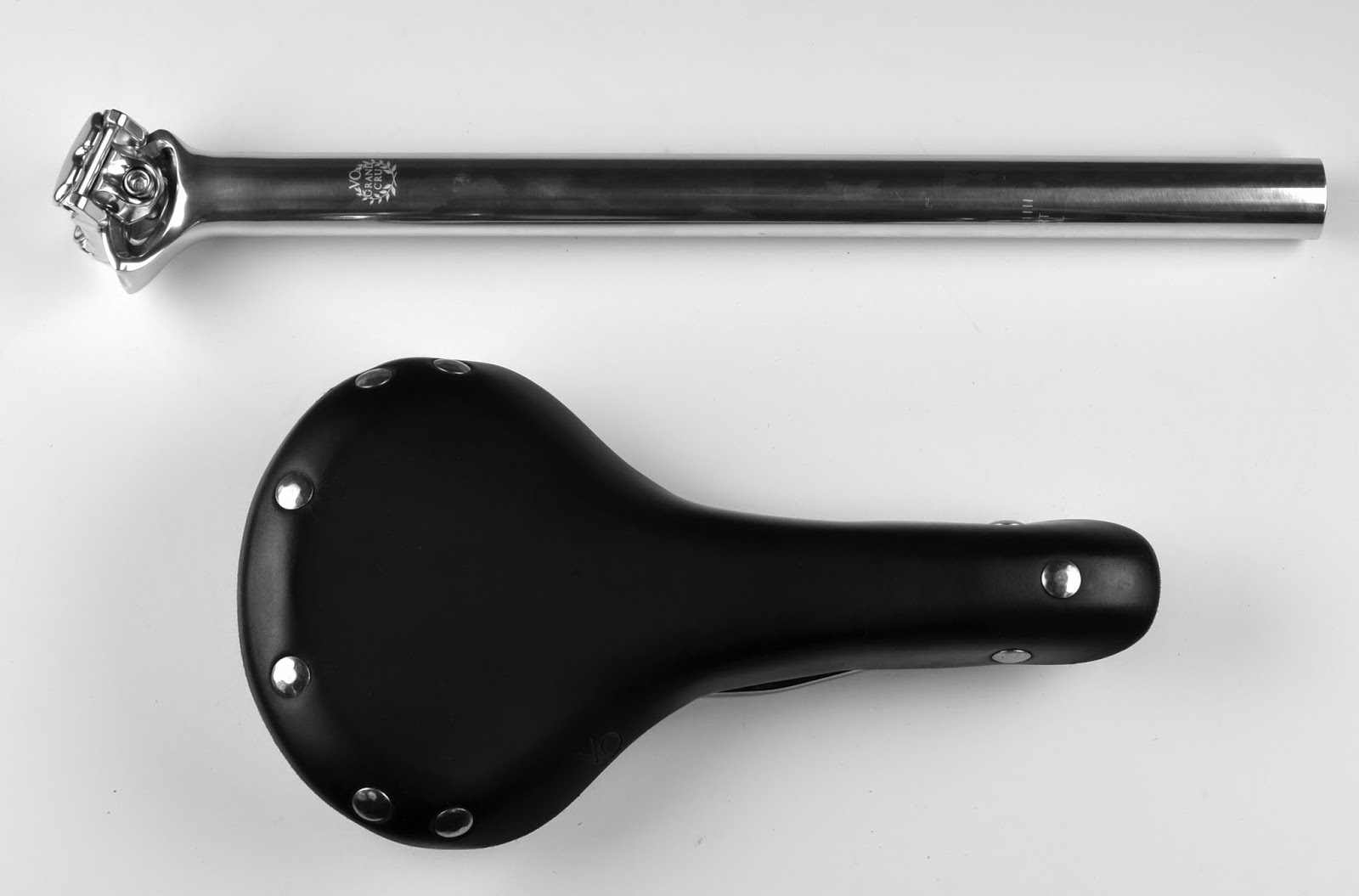
With Velo Orange expanding our range of products over the last few years, one of the newer items that we've developed is a Zero Setback Seatpost. Now, if you're a long time roadie, you may wonder why someone would want zero setback? So let's look into the mysterious world of bike fit and design to see why someone would want a zero/medium/long setback post.

Road bikes for years have had posts with setback- a seatpost where the clamping area for the saddle was behind the centre of the post that came up from the seatpost. The theory behind this was to allow for proper weight distribution (ideally 60 % on the rear of the bike, 40 % on the front). Assuming a 73 deg seat tube angle, the setback allowed one to fully engage the hamstrings and glute muscles more efficiently.

For most setback posts, the standard set back was around 25 mm or so. Why? Good question. My best guess is that it created the "medium" amount of setback that most people needed. With the costs of tooling to create different heads to the seatposts (this is all done with forging and dies), most folks went for the middle of the road to deal with the average.


Touring, city, and recreational riders tend to need more setback then a racer does. The more upright position requires more setback to put your legs in a more efficient bio-mechanical place.


The other factor is the rail length of the saddle. This is the ultimate limiting factor when it comes to proper position of the saddle, which ultimately effects where your knee and foot end up. Different saddle makers have different rail lengths. Traditionally Brooks and other leather saddle makers have had very short rails, thus the need for more setback in order to get the knee positioned correctly. In these cases, our Long Setback Seatpost is a winner. Our Model 3 Saddle  and Model 6 Saddle offer longer rails, so that you can choose which post style you'd like to dial in your riding position.


So why, after reading all this (thank you), does one need a zero setback post? Surely the above reasons make sense. Well, the rise of MTB's is one of the main reasons. The slacker and longer geometry of MTB's means that having zero offset puts the rider in the middle of the bike, rather then well behind the centre of the bike. Having more weight forward helped prevent you from toppling back on steep climbs and allowed you to move your butt behind the seat post on the steep descent. So MTB's tend to come with zero set back posts as standard. Zero set back posts also work if you have a short femur. The zero offset helps to put those folks over the pedal easier. Zero offset posts also work well if the top tube (real or virtual) is longer then ideal. Moving the seat forward reduces the distance between the stem and the saddle.

If you've got a theory about the relationship between setback, position, fit, and performance, let us know in the comments.
10 May 20:26

Snapchat Adds Magic Eraser, Emoji Brush, Limitless Snaps, and More

by Ryan Christoffel

In an update released today, Snapchat has added a slew of new tools to enhance the creation and sharing of Snaps.

The Magic Eraser is a tool for removing unwanted objects from a picture. You can use it by tapping the scissors icon, then the stars icon. The tool works very much like the Repair Tool found in Pixelmator, the powerful photo editing app. Simply tap and drag on the part of the image you'd like to 'erase,' and after a couple seconds of work Snapchat will remove the object. When it works properly, what's left in the absent object's place will blend in nicely with the rest of the photo. As with all tools like this, the reliability can vary depending on the particular photo and object.

A second new tool is the Emoji Brush, which lets you draw with emoji on an image like you might draw with a standard colored brush. Tap the brush icon, then the heart emoji, to pull up the emoji picker. Currently only a select few emoji are available to choose from, including the heart, fire, star, flower, and a few others. If you tap and hold on the bottom of the emoji lineup, it will expand to temporarily reveal a variety of colored heart options.

Additional changes in the app include the new Loop tool, which lets you set a Snap to loop until your friend taps forward to the next Snap. This pairs nicely with the new option to remove a time limit from your Snap, so friends can view it as long as they'd like before moving on. Once the Snap is closed though, it will still delete as usual.


Support MacStories Directly

Club MacStories offers exclusive access to extra MacStories content, delivered every week; it’s also a way to support us directly.

Club MacStories will help you discover the best apps for your devices and get the most out of your iPhone, iPad, and Mac. Plus, it’s made in Italy.

Join Now
10 May 20:26

Brexit weekly briefing: Theresa May's one-woman war on Brussels

by Jon Henley and Peter Walker
mkalus shared this story from EU referendum and Brexit | The Guardian.

PM accuses EU of meddling in general election while Emmanuel Macron’s victory in French presidential poll causes relief

Welcome to the Guardian’s weekly Brexit briefing, a summary of developments as the UK gallops towards the EU door marked “exit”. If you’d like to receive it as a weekly early morning email, please sign up here.

You can listen to our latest Brexit Means … podcast, updated every Wednesday, here. And with the general election under way in the UK, you can also sign up to the Snap, our daily email election briefing, here.

Continue reading...
10 May 20:25

What will happen to farmers like me when Brexit turns our industry upside down? | Edward Barker

by Edward Barker
mkalus shared this story from EU referendum and Brexit | The Guardian.

Uncertainty seems the only thing we can be sure of after 25 years of EU regulation. But this could also be an opportunity to make decisions for ourselves

I manage a mixed 500 hectare farm in Northamptonshire growing cereals, and supporting a beef and sheep enterprise. As the weeks went by during the Brexit referendum campaign, it became clear that the plight of British agriculture was something of a footnote, occasionally referenced by remain and leave politicians as a means of supporting their view. However, it is hard to think of any other sectors more affected by the vote to leave the EU than agriculture.

What is now clear is just how much the EU, along with its rules and regulations, has become central to agriculture over the past 25 years – and for good reason. Agriculture is complicated; it oversees the food we eat and the environment we live in. It is, in many respects, an appropriate competence for the EU. But no more – our government is now left with the task of repatriating all these rules, within a department, Defra, that has seen huge cuts to its operations over the past seven years.

Continue reading...
10 May 20:25

Post Office Redevelopment Moves Along

by Ken Ohrn

Thanks to Frances Bula for the tip.

Following up on this PT post from a year ago, the redevelopment plan for the old Post Office building at Georgia and Homer is going to the urban design panel tomorrow (3:15 pm, May 10, 2017).

  • Address: 349 W Georgia Street (Post Office Site)
  • Permit No.: RZ-2016-00021
  • Description: The proposal is to allow the retention of the heritage building (Class A heritage, yet to be designated) and convert it into a mixed-use seven-storey podium. The proposal also adds three towers above the podium, including 17 storeys of office, and 18 and 20 storeys of residential. An overall floor space ratio of 12.08 FSR is proposed as well a total floor area of 145,998 m2 (1,571,506 sq. ft.) and a height of 67.7m (222 ft.).
  • Zoning: DD to CD-1
  • Application Status: Rezoning Application
  • Review: Second Architect: MCM Partnership (Mark Thompson)
  • Staff: Michael Naylor & Paul Cheng

Altogether, about 900,000 square feet of floor area will be added to the building, which will give the overall project a floor area exceeding 1.5 million square feet. Approximately 300,000 square feet of retail space, varying from big open spaces to small units, will occupy the first four floors.  [Thanks to Kenneth Chan at VanCity Buzz].

The design does open up the now-blank walls along Dunsmuir, Homer and Hamilton.

A few numbers:

  • 799 residential units (372 market condominium units and 427 market rental units)
  • An overall floor space ratio of 12.9 FSR
  • Six levels of parking, including 1,168 bicycle spaces
  • A 49-space childcare facility

10 May 20:25

three open data projects: openstreetmap, openaddresses, and who’s on first

I work in or near three major global open data collection efforts, and I’ve been asked to explain their respective goals and methods a few times in the past couple months. Each of these three projects tackles a particular slice of geospatial data, and they can be used together to build map display, search, and routing services. There are commercial products that rely on these datasets you can use right now including Mapbox Maps, Directions, and Mapzen Flex. Each data project started small and is building its way up to challenge proprietary data vendors in a familiar “slowly at first, then all at once” pattern. Each can be used as a data platform, supporting new and interesting work above.

These are some introductory notes about the three projects, please let me know in comments if I’ve missed or misrepresented something. I’m looking at four things:

  1. Project history
  2. What kind of data is inside?
  3. How is data licensed?
  4. Who uses it, and where?

OpenStreetMap - openstreetmap.org

OpenStreetMap (OSM) is an early, far-reaching open geodata project started by Steve Coast in 2004. OSM’s goal is a global street-scale map of the world, and over thirteen years it has been largely achieved. OSM data collection started in the United Kingdom around London, expanded to western Europe and the U.S., and later other countries. Initially an audacious project, OSM communicated its aims through projects such as a 2005 collaboration with Tom Carden producing a ghostly map of London made up of GPS traces collected via a courier company. OSM became convincing around 2006/07 when larger-scale imports such as U.S. Census TIGER/Line seeded whole-country coverage beyond the U.K. and Europe.

OSM data is built on user-contributed free-form tags. Over time, a core set of well-understood descriptions for common features like roads, buildings, and land use has emerged. Today, OSM boasts strong global data coverage in urban and rural areas.

An important rubric for OSM data edits is verifiability: can two people in the same place at different times agree on tags for a feature based on its appearance? There will always be debates about precise tagging schema but generally it’s possible to agree on features like residential roads, motorways, one-way streets, building footprints, parks, and rivers. Historically, OSM editors have preferred direct visits and observation of features to “armchair mapping,” a term for editing based on remotely-collected data such as satellite imagery.

OSM data has always been distributed with a license that requires attribution and share-alike. Before 2012 this was a Creative Commons (CC-BY-SA) license with copyright belonging to individual project contributors. Since 2012 the license is the Open Database License (ODbL) with copyright belonging to the OpenStreetMap Foundation (OSMF). OSMF is governed by an elected board that also holds the OSM name and trademark. ODbL requires that datasets derived from OSM also be released under the ODbL license per the share-alike clause. Many derived works such as renders or pictures of the data are not covered by the ODbL. There has long been a measure of controversy and fear, uncertainty, and doubt connected to the ODbL. OSMF publishes some guidelines about its applicability and is working on further guidance for its behavior in cases like search and geocoding. Nevertheless, major companies like Mapbox, Telenav, Apple, Uber, Mapzen (Samsung), and others have found it an acceptable license for many uses.

OSM is of sufficiently high quality in populated areas to act as a display map rivaling proprietary commercial data. Thanks to its open license, mapping apps for offline use on mobile devices are a popular genre of applications for normal use. Mapbox in particular has built a substantial display mapping business on OSM data. OSM’s data quality for routing uses has also been growing, and both Mapzen and Mapbox offer commercial routing services with the data. OSM lacks certain features of proprietary routing data providers such as consistent turn restrictions and speed limits, but higher-level telemetry efforts can backfill this gap and even provide realtime traffic.

In recent years OSM has become a critical tool for international aid agencies like the Red Cross, and is often used as a reference map for disaster preparedness and response. For remote areas, organizations such as Digital Globe and Facebook are experimenting with satellite imagery feature detection techniques to improve the map, while Humanitarian OpenStreetMap Team (HOT) has provided ground mapping support and programs in locations such as Indonesia, Kibera, Haiti, Nepal, and elsewhere.

OpenAddresses - openaddresses.io

OpenAddresses (OA) is a relatively young project, started in 2014 by Ian Dees. OA’s goal is a complete set of global address points from authoritative sources. The first revision of OA was a spreadsheet of data sources compiled by Ian, after a suggested import of Chicago-area addresses was rejected by OpenStreetMap’s import working group. Nick Ingalls joined the project and produced the first automated code for processing OA data and began republishing aggregated collections of data. Metadata about address data sources moved from the initial spreadsheet to Github, where it was possible for a larger community of editors to use Github’s pull request workflow to add more data. I incorporated Nick’s code into a continuous integration process to make it faster and easier to contribute. Today, OA has ~460m address points around the world, with complete coverage of dozens of countries. The U.K. is notably missing, due to the privatization of Royal Mail several years back.

An important criteria for inclusion in OA is authoritativeness: the best datasets are sourced from local government authorities in a patchwork quilt of frequently-overlapping data. In the U.S., duplicate addresses might be sourced from city, county, and state sources. In many international cases, a single national scale data source like Australia’s GNAF provides correct, complete coverage. OA publishes point data, though points might come from a combination of rooftop, front door, and parcel centroid sources. OA’s data schema divides addresses into street number, street name, unit or apartment number, city, postcode, and administrative region. Only the street number and name are required for a valid OA data source.

OA’s JSON metadata files describing an address source are licensed under Creative Commons Zero (CC0), similar to public domain. The address data republished by OA keeps the upstream copyright information from its original sources. In some cases, sources require attribution. In a small number of cases, source license include a share-alike requirement. License features required by upstream authorities are maintained in OA metadata, and downstream users of the data are expected to use this information.

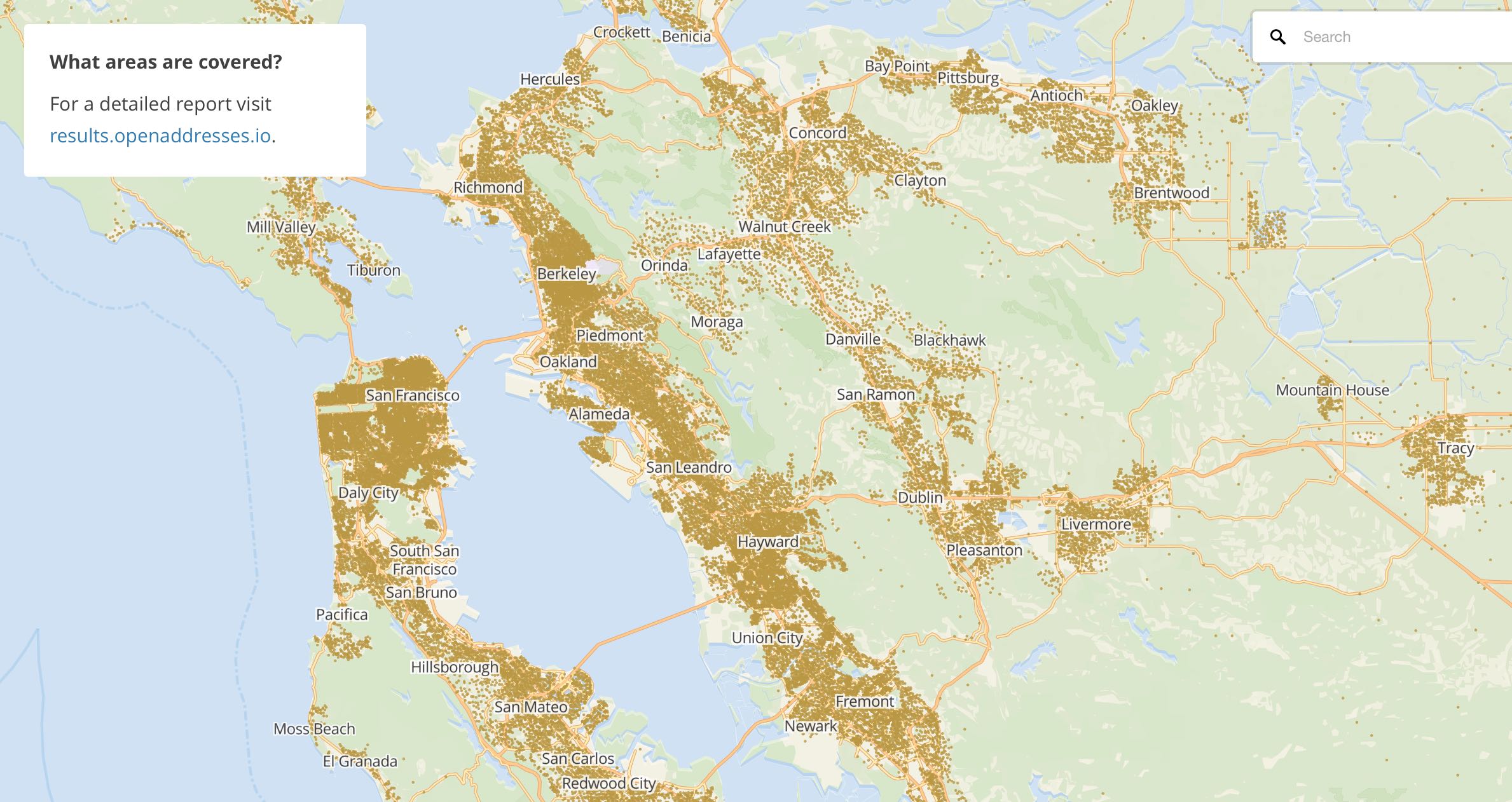
OA data coverage varies worldwide, depending on open data publishing norms in each country. In the U.S., OA data covers ~80% of the population, and has been growing as small local authorities digitize and publish their address data. In some countries, complete national coverage exists at a single source. OA can be used as a piecemeal replacement for proprietary data on a country-by-country basis, or state-by-state in the United States. Mapzen’s search service uses OA data for both forward and reverse geocoding. Many OA data sources come from county tax assessor parcel databases, which may only partially reflect a full count of street addresses. It’s common for geocoders to use interpolation to fill in these spaces, with examples from Mapzen and Mapbox showing how.

Data contributors come from a variety of backgrounds. In some cases, paid contractors are working to expand OA coverage. In others, academic experts on address data seek out and describe international sources. Sometimes, a single large country import comes via a local expert.

Who’s On First - whosonfirst.mapzen.com

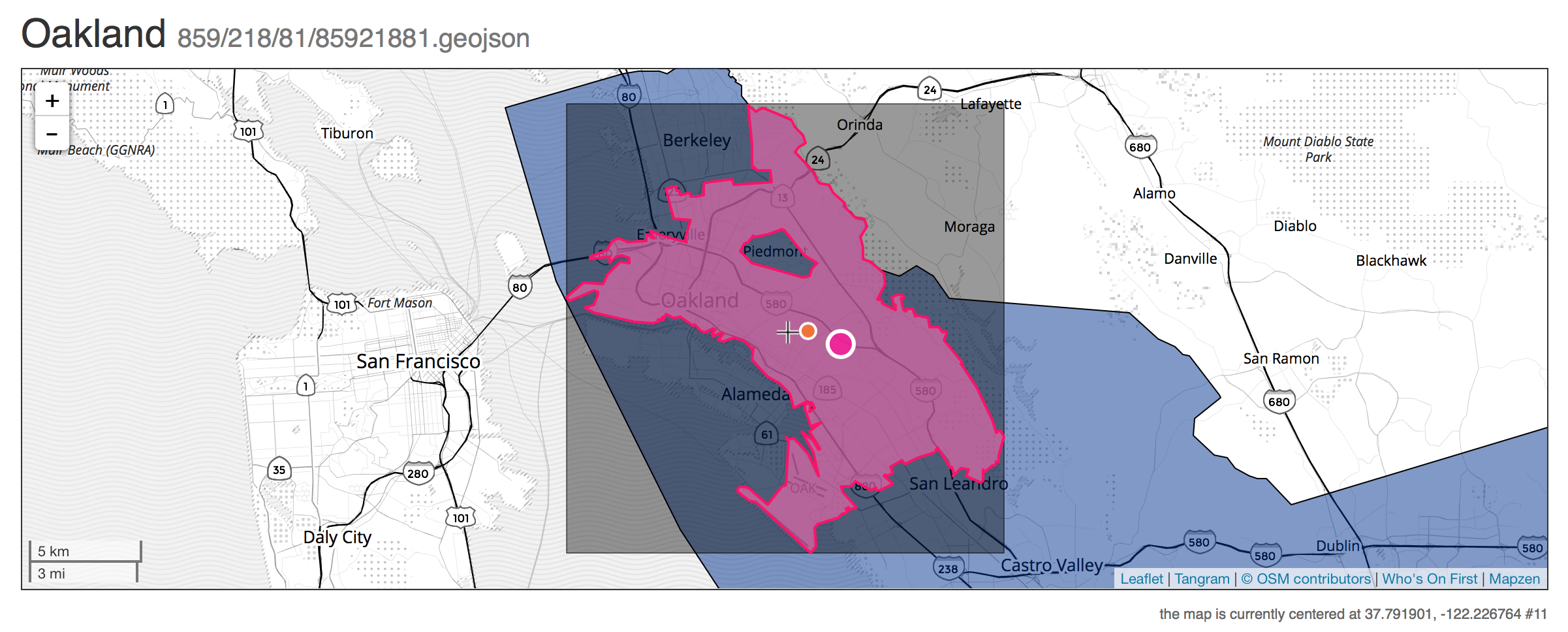
Who’s On First (WOF) is a gazetteer for international place and venue data started in 2015 by Aaron Cope at Mapzen, and now maintained by a data team. Data is stored as GeoJSON geometries with additional properties in numerous interconnected Github repositories. Data typically stored in WOF includes polygons for countries, administrative divisions, counties, cities, towns, postcodes, neighborhoods, and venues. WOF also accepts point data for venues and businesses. WOF properties can be very detailed, and typically feature multiple names for well-known places, such as “San Francisco,” “SF,” and even colloquial names like “Frisco.” Some WOF properties point to other datasets, such as Wikipedia or Geonames. These are called concordances, and make WOF especially useful for connecting separate data efforts. WOF geometries come in a variety of flavors, such as mainland area for San Francisco vs. the legal boundary that includes parts of the Bay and the distant Farallon Islands. Features in WOF each have a single numeric identifier, and can be connected in hierarchical relationships by way of these IDs.

WOF data can be quite free-form, and at various times new kinds of data such as postcodes or business locations have been imported en masse. Special consideration has been paid to unique features like New York City, which spans several counties in New York and is comprised of boroughs. As a result, WOF data can be considered late binding. It’s up to a user of WOF to determine how to interpret the complete hierarchy and narrow the list of properties to a smaller set of useful ones. Five levels in the placetype hierarchy are standard: continent, country, region (like a state), locality (like a city), and neighbourhood.

WOF’s license is a combination of upstream projects under CC-BY (GeoNames and GeoPlanet), Public Domain (Natural Earth and OurAirports) and other licenses. Data quality varies due to the diversity of sources: some data comes from SimpleGeo’s 2010 data, some from Flickr- and Twitter-derived Quattroshapes, and some from official or local sources. Quality is good and WOF places generally include accurate location and size, but geometries are not necessarily suitable for visual display. Attribution is required, but no WOF data is under a share-alike license.

A major user of WOF data is Mapzen’s own search service, via the Pelias project. WOF results for venues and places are returned directly in Mapzen Search, and also used at import time to provide additional hierarchy for bare address points.

Mapzen is the primary sponsor of Who’s on First, and most data enters the project by way of Mapzen’s own staff and contractors. Contributions are governed via Github, and the many repositories under the “whosonfirst-data” organization are the authoritative sources of WOF data. The project provides downloadable bundles of data by placetype in GeoJSON format, such as as the five core hierarchy levels of continents, countries, regions, localities, and neighborhoods.

Land Of Contrast

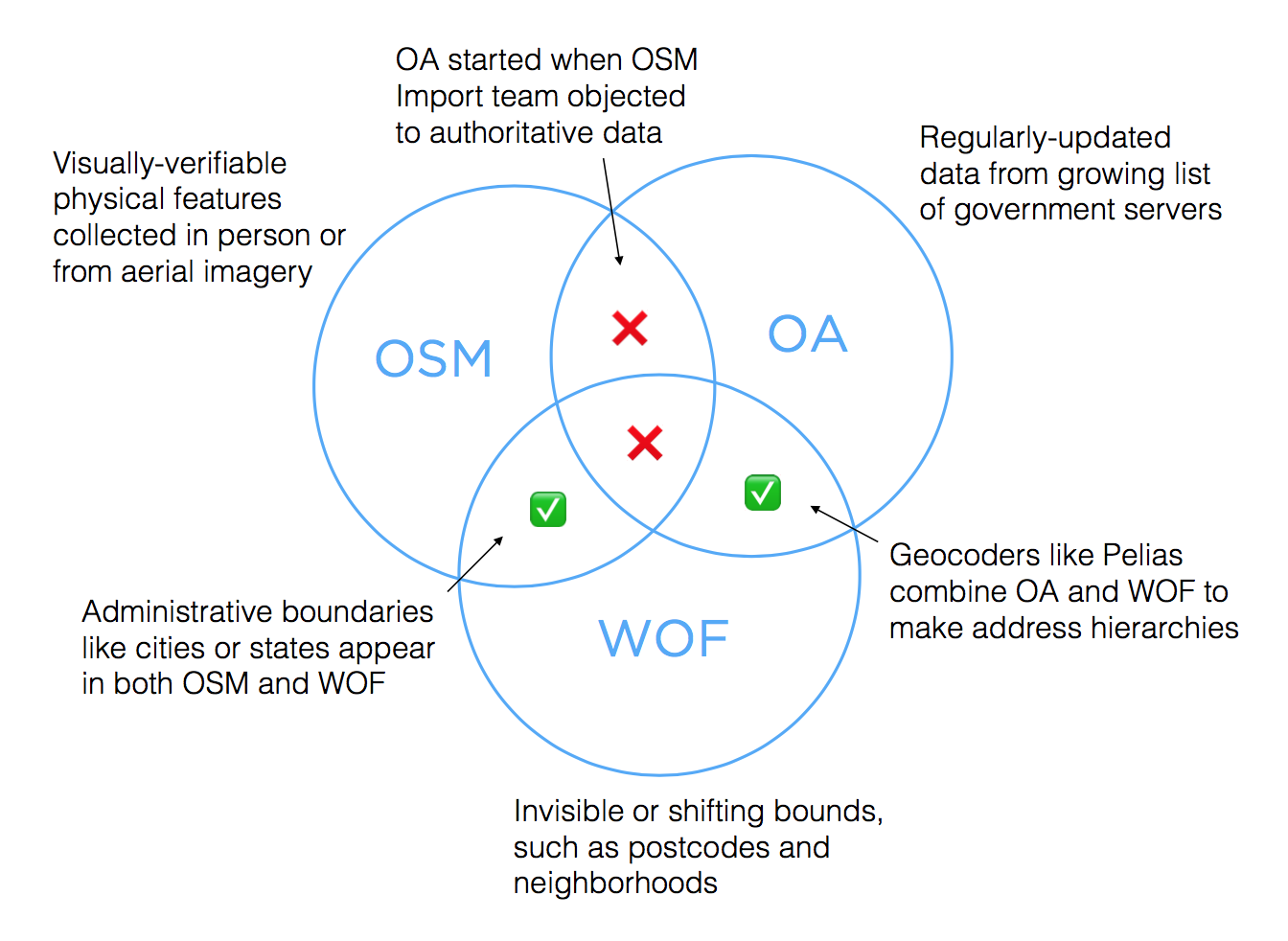
The boundaries between each of these datasets are fairly clear, with some overlaps.

  • OA began when Ian Dees was unable to convince OSM’s Import group to accept Chicago addresses. Authoritative addresses can violate OSM’s verifiability heuristic, because they don’t always come with a visible house number. Authorities also update data continuously, which can be hard to reconcile after an initial one-time import to OSM. The two datasets would diverge.
  • There are some addresses in OSM, typically formatted using the Karlsruhe schema. Availability varies.
  • WOF includes boundaries which are often invisible, such as postcodes and neighborhoods. They are therefore hard to verify through surveys or remote mapping, making them a poor fit for OSM.
  • Some easily-verifiable boundaries like city and state borders appear in both OSM and WOF, though they’re often implemented as connected linestrings in OSM and closed polygons in WOF, reflecting the uses of each data set.
  • Both WOF and OA eschew OSM’s ODbL share-alike license clause, so that they can be used in tandem to run geocoders. OSMF is trying to come up with formal guidance for use with geocoders, but meanwhile it’s simpler to offer attribution-only data from WOF and OA when serving search results.

Comments
10 May 20:25

This is How Google will Collapse

files/images/1-iOfSe5iGSfiPjq82lXRSSw.jpeg

Startup Grind, Medium, May 12, 2017


Icon

The thesis of this post is that advertising placement will collapse as a revenue model, and when it does, so will Google's dominance over the marketplace. What will replace it? Native advertising (i.e., advertising that is actually a part of the content you want to read, as for example when I mention Tim Horton's Coffee in a post). We're seeing this play out now as websites demand people turn off their ad blockers and as people, not being crazy, refuse to do so. And we're also seeing actual online commerce increase, a market in which Google has virtually no stake. "Over time, the computer itself — whatever its form factor — will be an intelligent assistant helping you through your day. We will move from mobile first to an AI first world." [Link] [Comment]

10 May 20:25

Experiential Learning: It’s been happening for years

files/images/Joe_Henry.jpg

Joe Henry, It's Not Academic, May 12, 2017


Icon

Experiential learning is not new, argues Joe Henry. It has been happening for years. " students have for generations, accessed and created a myriad of co-curricular, extra-curricular and work opportunities on campus that have allowed them to develop the skills necessary to think about their coursework in different ways or gain the experience necessary for that first job post-graduation." I agree. My experiential learning included five years as a staff member on the student newspaper, participation in academic conferences, and any number of other campus activities. But - and this is key - these almost all took place outside my courses. Which is why we need to think of an online education as involving a lot more than just a bunch of online courses. [Link] [Comment]

10 May 20:25

The ridings to watch for the election: Not Vancouver, not the north, but the suburbs

by Frances Bula

Increasingly, suburban ridings are filled with people who are finding that they are not living the dream, but are having to deal with issues that used to be thought of as strictly urban: homelessness, drug use, transit, school closures, and more.

And that’s what makes them an interesting group to watch during elections — their ideas about life aren’t necessarily locked into ideological positions and, sometimes, they will switch parties based on the immediate crisis in front of them.

Here’s my brief look in Vancouver magazine at what’s going on in the suburbs during this election.


10 May 20:24

Celebrating #Dropbox10: The 10 illustrations you never saw

by Ben Taylor

Since the company’s founding day in 2007, we’ve been honored to see the Dropbox community develop, grow, and thrive. To celebrate, we’re putting together a series of posts looking back at an exciting—and often surprising—decade. Join us as we reminisce, share a few stories, and reflect on how the industry has changed.

Since the earliest days of Dropbox, we’ve tried to connect with users through illustration. Whether we’re announcing a new product or fixing a pesky bug, we know users prefer to hear the news from fellow humans, not robots. Much of the Dropbox visual style has developed along those lines: personal, hand-drawn, playful.

In many cases, we’ll design several concepts before picking the option that’s just right. Here are 10 illustrations the design team loved, even if they missed the final cut.

1. Designing words with data

Illustration by Justin T.

“I really like how the concept turned out in this one—an illustration about taking a data-minded approach in UX writing. In the end, we decided to go with a less digital, more playful style, but I hope to apply concepts like this again in the future.” – Justin Tran, Illustrator

2. Over quota

Illustration by Justin T.

“We haven’t often depicted animals with human qualities, so I enjoyed giving this character a few human touches: a smile, a pair of glasses, a kiddie pool. While we wound up using a different animal, I liked the whimsical feel of this design.” – Justin T.

3. Billing options

Illustration by Justin T.

“The sign up process is a great moment to start a relationship with the user. Here, we tried a very conceptual way to think about billing options. We ended up going with a simpler concept, but the pogo stick / magic carpet design was fun to draw on the first pass.” – Justin T.

4. Feelings instead of features

Illustration by Fanny L.

“This illustration was part of a special Dropbox tour that we never launched. I had a lot of fun creating this joyous and fanciful world focused on feelings instead of features. I really wanted to capture a feeling of mobility and freedom.” – Fanny Luor, Illustrator

5. Scale, imagery, storytelling

Illustration by Fanny L.

“This was another unused sketch for that same tour. I enjoyed playing with scale, imagery, and storytelling to create an illustration that was more emotionally resonant. I liked blending Dropbox features with nature…for example, the ‘syncing flower’ and the photo as landscape.” – Fanny L.

6. Magic mobile features

Illustration by Fanny L.

“We had all these new features on mobile, and my first thought was, ‘it’s like magic!’ While we decided to go for more of a functional design in the end, I enjoyed bringing my reaction to life.” – Fanny L.

7. Stickers for Paper

Illustration by Brandon L.

“In the early days of Dropbox Paper, we created simple character stickers to function as placeholders within the product. When we revisited them, we developed new sets that better communicated productivity concepts. The above characters weren’t closely tied to any of those concepts, so we left them out, but I’d still love to revisit them at some point.” – Brandon Land, Illustrator

8. Pop culture references

Illustration by Brandon L.

“It was really fun to try and incorporate pop culture references, like the early Jon Ying* days of Dropbox. We wanted users to feel an immediate connection, a sense of emotional resonance with the design.” – Brandon L.

*Note: Brandon is referring to Jon Ying, a pioneering Dropbox employee responsible for many of the company’s earliest illustrations.

9. Inside the Dropbox office culture

Illustrations by Brandon L.

“I made various spot illustrations for fellow Dropbox employees, purely to capture a bunch of Dropbox-isms. For example, ‘one-on-one,’ is literally two number ones stacked on top of each other. ‘N’ is in a sink to show when people or files are ‘in sync.’ And then a spoon and a fork had a baby, creating a spork, to represent collaboration.” – Brandon L.

10. The Dropbox community

Illustration by Brandon L.

“This unused sketch was made for a possible dropbox.com homepage. We wanted to take a narrative approach, sharing how people use Dropbox in the workplace. In the end, we decided the concept needed to be a bit more straightforward and educational, but I still loved this design for the way it depicted a sense of community.” – Brandon L.

10 May 20:24

Pair Programming, Script Writing Edition

by Eugene Wallingford

Screenwriter Ken Levine answers one of his Friday Questions about how he and writing partner David Isaacs worked:

We always worked on the same script. And we always worked together in the room. Lots of teams will divide up scenes, write separately, then return to either polish it together or rewrite each other's scenes on their own. We wrote head-to-head. To us the value of a partnership is to get immediate feedback from someone you trust, and more importantly, have someone to go to lunch with.

It sounds like Levine and Isaacs (MASH, Cheers, Frasier, ...) discovered the benefits of pair programming in their own line of work.

I liked the second part of his answer, too, about whether they ever gave up on a script once they starting writing it:

Nothing gets done unless both team members are committed to it. Once we began to write a spec there was never any discussion of just junking or tabling it to work on something else. We would struggle at times with the story or certain jokes but we always fought our way through it. Wrestling scripts to the ground is excellent training for when you do go on staff.

Wrestling code to the ground is excellent training for what you have to do as a developer, too. On those occasions when what you thought was a good idea turns out to be a bad one, it is wise to pitch it and move on. But it's too easy to blame difficulty in the trenches on the idea. Often, the difficulty is a hint that you need to work harder or dig deeper. Pairing with another programmer often provides the support you need to stick with it.

10 May 20:24

3 Things Successful Product Managers Do Differently

by Jessie Buongiorno Kolbenschlag

Today marks my one year anniversary at UserVoice as a Sales Development Representative. This means that for the past year, I have spoken to loads of product managers every single business day. Having conversed with that many PMs…I have learned a thing or two about the product world and how product decisions are made.

When I ask product managers about how they decide which new features to build, I typically hear that they rely on customer interviews, or that management makes the decisions for them, or my personal favorite, ‘PM gut feeling.’ Don’t get me wrong, those things are definitely important and absolutely can be effective ways to make product decisions…but it is when I speak to the PMs who tell me how they automate parts of their process to be more time efficient and who have tools in place to ensure they are making the decisions that best benefit their business, that I really gain insight into how a successful PM operates.

So what do the most successful product managers do differently, you ask?

1. They close the customer feedback loop

closing-the-feedback-loop

Talk with your customers regularly. Instead of relying on a one way street for user feedback. successful PMs are closing the feedback loop by connecting with their customers with real conversations at multiple touch points in the customer lifecycle. Learning to iterate and re evaluate based on your conversations with customers is essential in building successful products.

2. They involve data in their decision making

data-driven-product-decisions

Data can take the emotion out of roadmap decisions! While data alone won’t tell you flat out which decisions you should make, it will definitely help aid in making those decisions and will certainly help you back up your choices to management and stakeholders. By using a combination of both quantitative data and qualitative user feedback, the best PMs are able to make more well-rounded product roadmaps.

3. They have a system in place to automate part of the process

Successful-teamwork-product-management

Try implementing a Product Management platform. Time savvy PMs are aware that ‘there must be a more efficient way to deal with all of this feedback’. Enter a PM platform that aggregates feedback from thousands and thousands of users at once and turns it into data for you to use. Having a platform like this in place is a huge step in figuring out how to scale your customer feedback process.


Want to learn more about how to become a more efficient Product Manager? Shoot me an email or check out Uservoice.com. UserVoice integrates easy-to-use feedback, helpdesk, and knowledgebase management tools in one platform that empowers users to speak and companies to understand.

10 May 20:24

Socialization theory F. Giddings (Part 2)

by admin

13

Giddings concludes his reasoning general conclusions: “The process of acquaintance with each other, the establishment of sympathy and friendship, learning to enjoy the community and to cooperate with each other in our work, we can be called socialization» ( “The process of getting acquainted with one another, establishing sympathies and friendships, learning to enjoy association and to cooperate with one another in our work, we may call socialization “) (Ibid:. 5) Socialization as a process of finalizing that consistently implement” assessment “,” use “and” characterization “this kind of pinnacle that begins at the previous levels, which can be up to a certain life stage is not given due attention. For the socialization of the need serious effort to develop it,” in order to obtain the maximum enjoyment and profit from it “(Ibid).

Thus, the theoretical concept of socialization proposed by F. Giddings, socialization as a sociological concept has a rather narrow meaning: it applies only to the establishment of an individual beneficial for him social ties with some circle of people. It is clearly expressed characteristic of early American sociology installation on individualism as the most valuable social quality. At the same time, it gives a reason to see the concept of socialization Giddings special kind of theoretical construction of these important sociology concepts, which can be expressed by the following formula: socialization – a process of building an individual of his social environment, in accordance with their goals and interests. It is obvious that the current understanding of socialization differ significantly from such an interpretation. But firstly, it is important to take into account the historical and sociological aspect, since it is one of the first attempts at a thorough presentation of the term “socialization” as important for the entire structure of sociology concepts secondly, within sociological theory, which held Giddings, his position on the meaning of socialization is logical and consistent, and thirdly, in the current conditions it is possible to take into account the conceptual side of Giddings concept, reinforcing its thesaurus concept of socialization (Lukov, Lukov, 2014).

Giddings their interpretation of socialization based on sociological theory, described by him in his generalizing work “Principles of Sociology» (Giddings, 1896). However, as noticed contemporary Giddings prominent American sociologist Albion Small, in some cases, the principles outlined here is not entirely clear (Small, 1897: 111). On the contrary, according to Small, in the “Theory of socialization” of the principles put forward by Giddings, stated quite clearly and have the potentiality for further development (Ibid: 113).

Giddings idea of socialization as the design of a suitable social environment for themselves, probably merited consideration in the terms of theories of socialization of our time.

The post Socialization theory F. Giddings (Part 2) appeared first on BookRiff.

10 May 20:24

Senators Want FCC Chair To Explain Why Online Comment System Crashed

by Chris Morran
mkalus shared this story from Consumerist.

What caused the crash of the Federal Communications Commission’s online comment-filing system? The FCC is blaming denial-of-service attacks from “external actors” without explicitly laying any blame on comedian John Oliver’s latest story about net neutrality. Now, some Senators want to know what happened.

In a letter [PDF] to FCC Chair Ajit Pai, Senators Ron Wyden (OR), and Brian Schatz (HI) point out that any denial-of-service attack against a federal agency is a threat, “doubly so if the attack may have prevented Americans from being able to weigh in on your proposal to roll back net neutrality protections.”

Worried about the possibility that people might be shut out of filing comments, the lawmakers are asking the FCC to create alternative options for submitting their thoughts on this issue. When the previous go-around with net neutrality crashed the FCC’s site in 2014, the Commission created a special email address for submitting comments.

Additionally, the Senators ask Pai to respond to a series of questions about the nature of the attack — how many devices were involved; were people blocked from commenting; how many visitors can the commenting site handle at one time; were comments lost — and any evidence it may have about the source. The letter also wants to know if the FCC has sought and received any help from other federal agencies in regard to these sorts of attacks, and whether the Commission is prepared if such an attack happens again.

The letter gives Pai until June 8 to respond.


10 May 20:24

United Apologizes After Agent Cancels Passenger’s Ticket For Recording Her

by Ashlee Kieler
mkalus shared this story from Consumerist.

Another day, another story of United Airlines being horrible to its customers. Thankfully, this incident doesn’t involve anyone being dragged forcibly off a plane or being flown to the wrong continent. This time, United is apologizing to a passenger whose ticket was canceled after he used his phone to record his interaction with airline employees.

NBC Bay Area reports that United is investigating an incident over the weekend in which a passenger traveling from New Orleans to San Francisco claims a ticket agent canceled his ticket when he began taping a confrontation about his checked bag.

The incident, which occurred around 4 a.m. at New Orleans’ Louis Armstrong International Airport, began when the traveler says he was inquiring about why his checked bag would cost $300 when it had cost just $125 on this original flight.

The man says that when the agent became rude, he started to record their conversation.

In the video, the woman can be seen pointing at the man and heard telling him to put down the phone, as he doesn’t have her permission to record the interaction.

After a moment she can be seen turning to another agent, asking for the man’s name and instructing the employee to “cancel the reservation.”

Eventually, the agent called airport police. When asked if he had to delete the video, the officer told the man he could do whatever the wanted, as it was a public space.

Still, the ticket agent said the man wasn’t traveling until the video was deleted.

“I was shocked because I didn’t know she had the right to cancel my flight because I started recording,” the man tells NBC Bay Area.

The man says that he eventually purchased a one-way ticket with a different airline, and would like United to pay for that trip.

A rep for United tells NBC Bay Area that it is now investigating the incident.

“The video does not reflect the positive customer experience we strive to offer, and for that we apologize,” the airline said in a statement. “We are reviewing this situation, including talking with [the passenger] and our employees to better understand what happened.”


10 May 20:23

Fait Accompli: Agentive Tech Is Here

files/images/tool-agent_distinction.JPG

Chris Noessel, A List Apart, May 12, 2017


Icon

Today's new word is 'agentive'. Something that is agentive "handles tasks so that you can use your limited attention on something else. So this part of 'acting on your behalf'—that it does its thing while out of sight and out of mind—is foundational to the notion of what an agent is, why it’s new, and why it’s valuable." This article looks at the concept, draws a very useful distinction between agents and tools, and makes the observation expressed in the title.' [Link] [Comment]

10 May 20:23

Dear Dads: let the Photolab uncomplicate Mother’s Day

by London Drugs

Dear dads,

Guess what? Mother’s Day will be upon us very soon. I’m sure your kids are well aware of this and may have alerted you already, but in case they haven’t you can thank me later; not just for the heads-up, but also for the gift solutions that this post will provide. Gift solutions that are convenient, unique, and require zero popsicle sticks, rubber bands, glue, cotton swabs or dreaded glitter (it’s ok to admit this…all parents dread glitter to some degree. At least when it’s used by children in the home).

As this post aims to demonstrate, personalized photo gifts are tailor-made for Mother’s Day. They require thoughtfulness and creativity, yet they are so simple to create using the Photolab website or in-store kiosks that even pre-school and kindie-age kids can put them together with minimal adult assistance. In fact, my own six-year old daughter has agreed to help me create a personalized photo mug. She’s quite computer savvy for her age (and all kids her age seem to be computer savvy) but it was her first time using the Photolab site, and she was able to do most of it by herself — especially when it came time to create and customize the design.

One reason Photolab gifts work so well for Mother’s Day is because you can make them into a modern-day variation of the handcrafted gift simply by using an uploaded child’s illustration instead of a photograph. Here I’ve scanned a picture my daughter drew for her mom.

In case it’s unclear, what you are looking at is a dragon showing love to its human ‘mommy’ (I do NOT let my kids watch Game of Thrones, I swear). Although she knew it was for a Mother’s Day gift, I’m not sure why she opted not to colour this one or choose another of her myriad full-colour drawings. But hey, it is not the place of mortals to question the artist’s muse. Anyway, after she drew it I scanned it and uploaded it to my Photolab account.

She chose the template and dragged-and-dropped her image into it — all I had to do was help her type the words (I suggested she use her impressive printing skills to print them herself on paper and upload the scan, but she insisted on using the keyboard — just like a big girl).

The video picks things up from the Occasions > Select a Product page. As you can see, while she needed a bit of instruction and assistance, she was able to use the site to bring her artistic vision to life.

I stopped it there so that you wouldn’t have to sit there and wait for her to slowly type out her greeting. The next video (below) picks things up again after she finished typing her message.

Yes indeed — she wanted to keep shopping! If I had allowed her to continue, every living family member probably would have received a personalized Mother’s Day photo gift. As with most kids, she is a quick study when it comes to technology, and I have no doubt that she will need little or no help the next time she is inspired to create a photo gift for someone.

So Dads, if you’re looking for an original Mother’s Day gift, think of how surprised Mom will be when she opens a photo gift that’s been personalized just for her with her children’s artwork or pictures they took themselves. It could be a mug, a collage, a shirt or blanket, or a simple greeting card. Or take the kids to a Photolab location and let them choose the gift themselves. Hey, as long as it’s made with love, that’s all Mom cares about…right?

10 May 20:23

The Local News Business Model

by Ben Thompson

It’s hardly controversial to note that the traditional business model for most publishers, particularly newspapers, is obsolete. Absent the geographic monopolies formerly imposed by owning distribution, newspapers have nothing to offer advertisers: the sort of advertising that was formerly done in newspapers, both classified and display, is better done online. And, contra this rather fanciful suggestion by New York Times media columnist Jim Rutenberg that advertisers prop up newspapers for the good of democracy, nothing is going to change that.

I already explained the problems with Rutenberg’s idea in yesterday’s Daily Update: advertisers are (rightly) motivated by what is best for their business, plus there is a collective action problem. I added, though, mostly in passing, that the future of “local news” would almost certainly be subscription, not advertising-based.

I think it’s worth expounding on that point. What most, including Rutenberg, fail to understand about newspapers is that it is not simply the business model that is obsolete: rather, everything is obsolete. Most local newspapers are simply not worth saving, not because local news isn’t valuable, but rather because everything else in your typical local newspaper is worthless (from a business perspective). That is why I was careful in my wording: subscriptions will not save newspapers, but they just might save local news, and the sooner that distinction is made the better.

The Unnecessary Newspaper

To be clear, I agree with Rutenberg when he states that “A vibrant free press…keeps government honest and voters informed.” Local government needs oversight, which is another way of saying local news is necessary for a well-functioning democracy. The problem is that assuming oversight must be provided by a newspaper is akin to suggesting that a tank be used to kill a fly: sure, it may get the job done, but there is a lot of equipment, ordnance, and personnel that is really not necessary when a flyswatter would not only be sufficient, but actually more effective.

For newspapers, the analogies to equipment, ordnance, and personnel are physical infrastructure, business operations, and editorial staff; just about none of them (yes, including most of the editorial staff) are actually necessary for covering local news.

Infrastructure

Printing presses are obviously obsolete: while some newspapers have finally closed them down, others hold on because there is still a modicum of print advertising to be earned. It’s the most prominent example of how newspapers are fundamentally incapable of evolving. Naturally, this extends to distribution centers, delivery trucks, newsstands, and all of the administrative infrastructure that goes into moving around pieces of paper that have zero connection to the actual distribution of local news.

The infrastructure overhead, though, does not stop there: without a print edition there is no need for layout, for high-end photography, or a centralized office space to assemble everything on deadline. There is also a drastically reduced need for editors: when text was printed copy was permanent, raising the cost of a mistake high enough to justify editing workforces nearly as numerous as journalistic ones. Digital stories, though, can be updated after-the-fact. Moreover, digital stories are interactive: readers can submit feedback instantly, and as I noted while writing about Wikitribune, the collective knowledge of readers will always be greater than the most seasoned set of editors.

Moreover, given that local news requires little more than text and images and perhaps some video, there is no need for expensive digital infrastructure either; a basic WordPress site is more than sufficient. In short, the entire infrastructure category, which makes up probably 60%~70% of a newspaper’s cost structure (possibly more if you include the editors), has nothing to do with sustainable local news.

Business Operations

Monetizing via print advertisements requires a lot of staff: salespeople to sell the ad, graphic artists to lay it out, account managers to collect the money, plus all the management required to make it work. For large national newspapers like The New York Times, this may all still be necessary, thanks to the ability to sell premium advertising online. However, all of this can be eliminated for most digital-only operations: simply use an ad network. Of course, those come with their own problems: ad networks make web pages suck, and just as importantly, most consumption is shifting to mobile where ad network monetization is particularly ineffective; to the extent advertising is part of the business model relying on Facebook is (still) probably the best option. Or better yet, don’t have any ads at all.

A purely subscription-based business model not only drastically cuts costs, it also makes for a better user experience, a particularly attractive point given that users are the paying customers. Even better, thanks to services like Stripe, digital subscriptions not only cost far less to administer than traditional newspaper subscriptions, but are far more user-friendly as well.

The reality is that for local news this entire category probably only needs to be one person: handle customer service for self-service subscriptions, do the books, and that’s about it. The 15~20% of revenue newspapers are paying for business operations has nothing to do with local news.

Editorial

This is the biggest blindspot for those lamenting the travails of local newspapers: it may be obvious that printing presses don’t make much sense with the Internet, and most websites have moved to ad networks for the obvious reasons; in fact, though, nearly all of the content in most newspapers is not just unnecessary but in fact actively harmful to building a sustainable future for local news.

Start with the front page (of a physical newspaper, natch): most newspapers have given up on having international, national, or even regional reporters, instead relying on wire services. Even that, though, is a waste: those wire services have their own websites, and international publications are only a click away. Maintaining the veneer of comprehensive coverage is simply clutter, and a cost to boot.

The same thing applies to the opinion section: any column or editorial that is concerned with non-local affairs is competing with the entire Internet (including social media). It’s the same thing with non-local business coverage. Moreover, the cost is more than clutter and dollars: almost by definition the content is inferior to what is available elsewhere, which reduces the willingness to pay.

It’s the same story in what were traditionally the most valuable parts of newspapers:1 sports and the (variously named) lifestyle sections. There are multiple national entities dedicated to covering sports all the way down to the university level, augmented by a still-thriving sports blogosphere. Granted, there may still be a market for local sports coverage, but that is a different market than local news: there is no reason it has to be bundled together.

As for the lifestyle section, it is everywhere. BuzzFeed has set its sight on cooking, crafts, and the horoscope;2 there are all kinds of sites covering gossip and advice; meanwhile, not only are there web comics, but social media provides far more humor than the funny pages ever did. What’s left, bridge? Why not simply play online?

A lot of this content has long since been standardized across newspapers, but the broader point remains the same: absolutely none of it has anything to do with local news, and it should not exist in the local news publication of the future.

Bundles and Business Models

What is critical to understand is that everything in the preceding section is interconnected: by owning printing presses and delivery trucks (and thanks to the low marginal cost of printing extra pages), newspapers were the primary outlet for advertising that didn’t work (or couldn’t afford) TV or radio — and there was a lot of it. Maximizing advertising, though, meant maximizing the potential audience, which meant offering all kinds of different types of content in volume: thus the mashup of wildly disparate content listed above, all focused on quantity over quality. And then, having achieved the most readership and the ability to expand to fit it all, the biggest newspaper could squeeze out its competitors.

In short, the business model drove the content, just as it drove every other piece of the business. It follows, though, that if the content bundle no longer makes sense — which it doesn’t in the slightest — that the business model probably doesn’t make sense either. This is the problem with newspapers: every aspect of their operations, from costs to content, is optimized for a business model that is obsolete. To put it another way, an obsolete business model means an obsolete business. There is nothing to be saved.

The Subscription Business Model

I’ve already hinted at the general outline of a sustainable local news publication, but the critical point is the one I just made: everything must start with the business model, of which there is only one choice — subscriptions.

It is very important to clearly define what a subscriptions means. First, it’s not a donation: it is asking a customer to pay money for a product. What, then, is the product? It is not, in fact, any one article (a point that is missed by the misguided focus on micro-transactions). Rather, a subscriber is paying for the regular delivery of well-defined value.

Each of those words is meaningful:

  • Paying: A subscription is an ongoing commitment to the production of content, not a one-off payment for one piece of content that catches the eye.
  • Regular Delivery: A subscriber does not need to depend on the random discovery of content; said content can be delivered to to the subscriber directly, whether that be email, a bookmark, or an app.
  • Well-defined Value: A subscriber needs to know what they are paying for, and it needs to be worth it.

This last point is at the crux of why many ad-based newspapers will find it all but impossible to switch to a real subscription business model. When asking people to pay, quality matters far more than quantity, and the ratio matters: a publication with 1 valuable article a day about a well-defined topic will more easily earn subscriptions than one with 3 valuable articles and 20 worthless ones covering a variety of subjects. Yet all too many local newspapers, built for an ad-based business model that calls for daily content to wrap around ads, spend their limited resources churning out daily filler even though those ads no longer exist.

A sustainable local news publication will be fundamentally different: a minimal rundown of the news of the day, with a small number of in-depth articles a week featuring real in-depth reporting, with the occasional feature or investigative report. After all, it’s not like it is hard to find content to read on the Internet: what people will pay for is quality content about things they care about (and the fact that people care about their cities will be these publications’ greatest advantage).

It’s also worth noting what a subscription business model does not — must not — include:

  • Content that is widely available elsewhere. That means no national or international news (except what has a local impact, and even that is questionable), no non-local business content, no lifestyle section.
  • Non-journalistic costs centers. As I noted above, a publication might need one business operations person, and maybe a copy editor; they can probably be the same person. Nearly everything else, including subscription management, hosting, payments, etc. can leverage widely available online services (and you can include social networks: treating all content the same hurts big media companies, but it’s a big opportunity for small ones).
  • Any sort of wall between business and editorial. This is perhaps the easiest change to make, and the hardest for newspaper advocates to accept. A subscription business is just that: a business that must, through its content, earn ongoing revenue from customers. That means understanding what those customers want, and what they don’t. It means focusing on the user experience, and the content mix. And it means selling by every member of the organization.

Notice how different this looks from a newspaper, as it must. After all, the business model is different.


I strongly believe the market for this sort of publication is there. My hometown city of Madison, WI has around 250,000 people (500,000 in Dane County), primarily served by The Wisconsin State Journal. To the paper’s credit the website is almost all local news; unfortunately, most of it is uninteresting filler. Worse, to produce this filler took a staff of 52 people, of which only 10 by my count are local reporters (supported by at least 8 editors).

Were a new publication to come along, offering a five minute summary of Madison’s local news of the day, plus an actually relevant story or two a week with the occasional feature or investigative report,3 I’d gladly pay, and I don’t even live there anymore. What I won’t do, though, is bother visiting the Wisconsin State Journal because there simply is too much dreck to wade through, created at ridiculous cost in service of an obsolete business model.4

Indeed, the real problem with local newspapers is more obvious than folks like Rutenberg wish to admit: no one — advertisers nor subscribers — wants to pay for them because they’re not worth paying for. If newspapers were actually holding local government accountable I don’t think they would have any problem earning money; that they aren’t is a function of wasting time and money on the past instead of the future.

  1. Other than the classifieds, that is
  2. “Choose these foods and we will tell you your ideal mate!”
  3. With typos
  4. This is where news foundations and benefactors can actually make a difference: stop supporting local newspapers and instead fund new startups until they build a critical mass of subscribers
10 May 20:23

Data on the Comey Effect

There is currently a debate about whether or not the Comey letter flipped the election. Nate Cohn makes a convincing argument that the letter had little to no effect. Some time ago I looked at this myself and came to a similar conclusion. If anything, it was the ACA price hike announcement that had the bigger effect.

To test out blogdown (thanks Yihui Xie!) I decided to write this post showing the code I used for the simple analysis I performed, hoping to get others to look at the data, point out mistakes, or show me a better way to do what I did. There are many more things I can think of doing, such as account for pollster effect or try to better estimate the day the poll was actually taken.

Here I read-in and wrangle the raw data prepared by 538.

library(tidyverse)
##download data from 538 
url <- "http://projects.fivethirtyeight.com/general-model/president_general_polls_2016.csv"
election_2016 <- read_csv(url)
election_2016 <- filter(election_2016, type=="polls-only")
election_2016$diff <- with(election_2016, rawpoll_clinton-rawpoll_trump) ##define the difference
election_2016$startdate <- as.Date(election_2016$startdate,"%m/%d/%Y") ##turn enddate into date
election_2016$enddate <- as.Date(election_2016$enddate,"%m/%d/%Y") 
start_day <- as.Date("2016-09-01")
election_day <- as.Date("2016-11-08")
dat <- filter(election_2016, startdate > start_day & state=="U.S.") ##after start date and national polls

Then I create a new data frame in which each day for each poll generates a row. I keep track of the reported difference, the number of days in the polling period, and the sample size.

polls <- lapply(1:nrow(dat), function(i){
  days <- (election_day - dat$startdate[i]):(election_day - dat$enddate[i])
  return(cbind( dat[i,c("pollster", "diff")], days, w=1/length(days), 
                n=dat$samplesize[i]))
})
polls <- Reduce(rbind,polls)

Then I compute a weighted average of the difference for each day. Because we are interested in sharp declines, I perform no smoothing other than that imposed by the fact that poll dates span multiple days. If a day was not included in the poll period that poll had 0 weight for that day. If it was include, then the weight was \(1/\mbox{number of days in poll period}\). For example, if poll 1 ran from October 2-4 and poll 2 ran from Oct 1-7, the October 3 estimate would use weights proportional to 1/3 and 1/7 for polls 1 and 2 respectively. They are proportional because weights are scaled to add to 1 for each day. I filtered out days with wieghts less than 10 days. The sample size was not used to compute the weight.

res <- polls %>% 
  group_by(days) %>% 
  filter(sum(w)>3) %>% 
  summarize(avg = sum(diff*w)/sum(w)) %>%
  mutate(date = election_day - days) %>% 
  arrange(date) 

Here is the plot of these weighted averages:

rafalib::mypar()
with(res, plot(date, avg, type="b", pch = 21, bg = 1, xlab = "Date", ylab = "Weighted Average of Clinton - Trump"))
abline(v =  as.Date("2016-10-28"), col = 2, lty = 2)
text(as.Date("2016-10-28"), 3,  "Comey Letter", srt= 90)
abline(v =  as.Date("2016-10-24"), col = 2, lty = 2)
text(as.Date("2016-10-24"), 2, "ACA price hike", srt = 90)
abline(v =  as.Date("2016-10-07"), col = 2, lty = 2)
text(as.Date("2016-10-07"), 3, "Access Hollywood", srt = 90)
abline(v =  as.Date("2016-09-26"), col = 2, lty = 2)
text(as.Date("2016-09-26"), 3, "First Debate", srt = 90)

10 May 20:14

Switching Normandy to use OIDC

Recently Normandy switched from authenticating users ourselves with boring username and passwords to using Mozilla's OIDC SSO to authenticate users more securely.

Normandy is a web service that holds a lot of influence over Firefox. Because of this, we have had a list of security features we've been working through. One of the big items on this list was to not store passwords, and do authentication of users ourselves.

We chose to use OIDC for this, primarily because it is the new hotness as far as authenticating Mozillians. It can use many sources of authentication, including Mozilla's LDAP servers, the canonical source of employee user data. This is exactly what we want to use for Normandy.

Overview

Normandy is a Django app, so we initially explored doing the integration with OIDC directly in the app. The idea would be to use an existing OIDC library to authenticate users with the Mozilla OIDC SSO, and correlate that to the existing users of the system via email address.

Unfortunately, we weren't able to get any of the libraries to work for us. The major problems we ran into were incompatibilities with something in our stack (Python 3.6 or OIDC specifically) or the implementation being too complex.

Instead we chose an easier process. Normandy is fronted by Nginx, which does some work with caching and logging. Our operations team has an Nginx access-proxy integration that works with our Nginx frontend. It passes authentication details to our app via the HTTP header Remote-User. This solution was much easier to implement: essentially we flipped a flag in Puppet, and we started getting authentication headers.

Changes to Django

Of course, sending the headers isn't enough. We also have to configure the app to read those headers and act accordingly. We did this with Django's RemoteUserBackend. This works by adding a middleware that annotates all requests with information about the authentication header, and an authentication backend that reads that information to sign a user in or out. If a user is authenticated via the Remote-User header, but does not exist in the database, the backend automatically creates the user and signs them in.

The default settings worked well for us. The only modification we needed was to tie it into our logging and settings systems. A simplified version of the changes is to add RemoteUserMiddleware to the MIDDLEWARE setting, and adding RemoteUserBackend to AUTHENTICATION_BACKENDS. You can see the full changes in this pull request.

Changes to Nginx

To implement the Nginx part of this, we modified the configuration to perform authentication via OIDC with Mozilla's SSO. That was implemented with lua-resty-openidc.

When an HTTP request comes in to Nginx with a url covered by OIDC authentication, Nginx checks if the request has cookies that already authenticate it via OIDC. If it does not, Nginx redirects the request to Mozilla's SSO to perform authentication, which then redirects the user back to Nginx with authentication tokens to log the user in. Nginx validates these tokens, and then proxies the request to Normandy with the Remote-User header to set.

Importantly, Nginx also strips any value of Remote-User that external users try to use. This way we don't allow users to sign in as any user simply by passing a HTTP header. That would be bad.

Migrating

The OIDC claim information identifies a user by email address and that's what gets passed to Normandy in the Remote-User header. The RemoteUserBackend authenticates users by matching that header to the username field of Django User models. Normandy has very few users, and all of them are Mozilla employees, so we know they all have LDAP emails. We wrote a migration to copy our users email addresses from User.email to User.username to accommodate this.

Here is a slightly abbreviated version of the migration:

from django.conf import settings
from django.db import migrations

def email_to_username(apps, schema_editor):
    """
    Copy emails to usernames for all users.
    """
    User = apps.get_model('auth', 'User')
    for user in User.objects.all():
        if user.email:
            user.username = user.email
            user.save()

def remove_email_from_username(apps, schema_editor):
    """
    Copy emails to usernames for all users.
    """
    User = apps.get_model('auth', 'User')
    for user in User.objects.all():
        if '@' in user.username:
            user.username = user.username.split('@')[0]
            user.save()

class Migration(migrations.Migration):

    dependencies = [
        migrations.swappable_dependency(settings.AUTH_USER_MODEL),
    ]

    operations = [
        migrations.RunPython(email_to_username, remove_email_from_username),
]

Challenges

All or Nothing

One of the major challenges in this system is that the rules for whether a user needs to be authenticated are not are necessarily very simple. Nginx can't really implement application level logic to decide if a user needs authenticated or not.

Before this system, we would allow certain views to be accessed by both authenticated users and anonymous users. We then used Django's permission models to decide if a user was allowed to do what they were trying to do. For example, the Normandy recipe listing page would allow an anonymous user to see the list of recipes, and an authenticated user to create a new recipe if they were in the correct group.

This isn't something we could do with Nginx. We could protect certain part of the site by URL, and it had to be all or nothing: Either a user was authenticated on that portion of the site, or the authentication header would never be passed, and all users would be anonymous. This turned out to be a minor annoyance for us, but I could imagine it being a huge problem for other sites.

We have two kinds of servers. One is read-only, and the other is read-write. The read-write version is only accessible over VPN, and only by Mozilla employees. It was easy to simply make the entire read-write server require authentication. Mixing authentication on one server would be challenging, because you'd have to carefully design your URL structure to separate authenticated and unauthenticted parts of the site.

Non-Browser Usage

The authentication flow outlined above relies heavily on having a web browser and a human around. We haven't figured out how to authenticate non-human users, such as shell scripts that use curl to automate requests to the API to make repetitive changes.

This is a minor use case that for now we've simply dropped. Some day in the future we may re-visit it and try to figure out a better work flow for these kind of changes.

Overall, the migration to using Auth0 has gone well, and we didn't have any major problems deploying it. We had to give up some control over authentication of users, but in exchange we have very easy user management and better security.

10 May 20:14

Updated: Vaccine-autism study retracted - again

mkalus shared this story from Retraction Watch.

For the second time, a journal has quickly retracted a study that suggested vaccines raise the risk of autism and other neurodevelopmental disorders.

The study first raised a furor last year, prompting a Frontiers journal to quickly retract it. After it was republished in the Journal of Translational Science this month, that journal has also retracted it.

Although the titles of the two papers changed, the abstracts were nearly identical. Both studies surveyed the parents of 666 home-schooled children, 39% of whom where not vaccinated, and concluded that vaccination increased the risk of neurodevelopmental problems, particularly if children were born prematurely.

A representative of the Journal of Translational Science told us “Pilot comparative study on the health of vaccinated and unvaccinated 6- to 12-year-old U.S. children” has been retracted, and it will update us with an explanation.

Here’s more from the (now-retracted) abstract:

…in a final adjusted model with interaction, vaccination but not preterm birth remained associated with [neurodevelopmental disorders], while the interaction of preterm birth and vaccination was associated with a 6.6-fold increased odds of NDD (95% CI: 2.8, 15.5)…While vaccination remained significantly associated with NDD after controlling for other factors, preterm birth coupled with vaccination was associated with an apparent synergistic increase in the odds of NDD.

The journal is published by Open Access Text, which was included in the now-defunct list of possible predatory publishers, compiled by librarian Jeffrey Beall.

When the study appeared last year in Frontiers in Public Health, it caused a firestorm on Twitter, prompting Frontiers to release a public statement, noting that the study was only “provisionally accepted but not published.” It was retracted later that same week.

In 2011, first author Anthony Mawson at Jackson State University, filed a lawsuit against the Mississippi State Department of Health, in which he alleged that, after he advocated the need for more studies on vaccine safety, a state officer interfered with his then-position at the University of Mississippi Medical Center, resulting in his contract not getting renewed. The suit was dismissed the following year.

The last author of the study, Binu Jacob, is listed as a former graduate student at Jackson State.

This isn’t the first time an anti-vaccine study was republished after a hasty retraction — last February, Vaccine temporarily removed (then retracted) a study linking the vaccine for human papillomavirus (HPV) to behavioral problems in mice; in July, the paper was republished by the journal Immunologic Research, albeit with major revisions, according to one of the co-authors.

Hat tip: Timothy Caulfield

Update 5/8/17 3:43 p.m. eastern: This story was updated since it was published to reflect the fact the paper had been retracted.

Like Retraction Watch? Consider making a tax-deductible contribution to support our growth. You can also follow us on Twitter, like us on Facebook, add us to your RSS reader, sign up on our homepage for an email every time there’s a new post, or subscribe to our daily digest. Click here to review our Comments Policy. For a sneak peek at what we’re working on, click here.

10 May 20:13

A tumblr? YEAG I got a "tumblr" for you RIGHT HERE [i open the car door and fatally roll out onto the freeway]

by shutupmikeginn
mkalus shared this story from shutupmikeginn on Twitter.

A tumblr? YEAG I got a "tumblr" for you RIGHT HERE [i open the car door and fatally roll out onto the freeway]


Posted by shutupmikeginn on Wednesday, May 10th, 2017 1:00am


230 likes, 57 retweets
10 May 20:13

Bike Spotting on Bloor in Koreatown

by dandy

Between the rain last week, we set out on a very sunny evening to ask more cyclists how they're feeling about the Bloor Bike Lanes? Commuters, kids and shoppers alike were singing its praises. The City has installed counters at Clinton and Bloor. You should probably get yourself over there as soon as the deluges are over!


Frida and Greg
Greg: This is the bike that Frida's mom learned how to ride on.
Frida: I learned how to ride last year and this is my second time on this bike. But I use the bike lane all the time! I ride to school on it.
Q: What can the city do to help more kids ride their bikes to school?
Frida: ADD MORE BIKE LANES!
Greg: We used to bike to her school on Barton but it's not very bike friendly.
Q: Do you do a lot of your shopping along Bloor?
Greg: Yes we do! Even when I'm not wearing a helmet and I go into a shop I like to remind them that I'm here because of the bike lane.


Daniel 
I'm just cycling home from work. I would never have cycled along Bloor before the bike lane.

Rebecca
I go to church on Bloor.


Henrik
Love the bike lane! I use it to shop daily

Coming soon: Bike Spotting in Koreatown Part 2.

Related on dandyhorsemagazine.com 

Bike Spotting: Do you shop on Bloor?

Bike Spotting in the Yucatan Mexico

Bike Spotting: How Has the City Been Doing With Bike Lane Maintenance This Winter? Part Two

Bike Spotting: How Has the City Been Doing With Bike Lane Maintenance This Winter?

10 May 20:13

Quick Links to Our Best Posts on Cycling Gear

by Average Joe Cyclist

links to our best posts on cycling gearHere are some quick links to our best posts on cycling gear. Our most popular posts include posts on waterproof cycling jackets, waterproof cycling pants, and cycling balaclavas. All of the links are below, for your convenience!

The post Quick Links to Our Best Posts on Cycling Gear appeared first on Average Joe Cyclist.

10 May 19:34

Apple confirms Worldwide Developers Conference keynote on June 5

by Bradly Shankar
Worldwide Developers Conference

Apple sent out press invites on Tuesday to various news and media sites for its upcoming Worldwide Developers Conference (WWDC). With these invitations, Cupertino-based tech company confirmed that there will be a keynote event on June 5th at 10am PT/1pm ET

Traditionally, Apple holds a keynote event on the first day of WWDC to introduce new software. It’s expected that new versions of iOS, macOS, tvOS and watchOS will be shown off at the conference.

There is also the possibility of an official reveal of the often-rumoured high-powered Siri speaker, which would serve as a competitor to the likes of Google Home and Amazon Echo.

Tickets were offered until March 31st for $1,599 USD (approximately $2,195 CAD). During this time, developers had a chance to enter in a lottery system for tickets, and until April 2nd, students were also able to apply for scholarships to attend.

WWDC will take place from June 5th to June 9th in San Jose, California in the McEnery Convention Center, as opposed to the San Francisco’s Moscone Center from previous year’s conferences.

Those who cannot attend can watch a livestream through the WWDC app or website.

The post Apple confirms Worldwide Developers Conference keynote on June 5 appeared first on MobileSyrup.

10 May 19:34

Toronto-based Snowman reveals new trailer for Distant

by Patrick O'Rourke
Distant Screenshot

Toronto-based Snowman, the creator of critically acclaimed mobile title Alto’s Adventure, has revealed a new trailer for its upcoming title ‘Distant.’

The developer behind the project says Distant “will be an experience meant to capture the elegance of movement.” The game’s story is set in a fantastical, colourful universe, coupled with simplistic, minimalist graphics that evoke a sense of calm, similar to the studio’s other games.

Distant Screenshot

The short trailer shows off the upcoming game’s fluid movement and detailed animation, as well as how the player is able to interact with the Distant’s environment. The game also looks to feature traditional platforming gameplay that focuses on jumping and bounding through the air.

Unlike Snowman’s previous releases which released on the iPhone and iPad first, Distant is set to drop on Mac, PC, Consoles and Apple TV.

The studio has a variety of other projects in the work, including Where Cards Fall, a game the developer is working on with The Game Band, and the next entry in the Alto series called Alto’s Odyssey.

The post Toronto-based Snowman reveals new trailer for Distant appeared first on MobileSyrup.